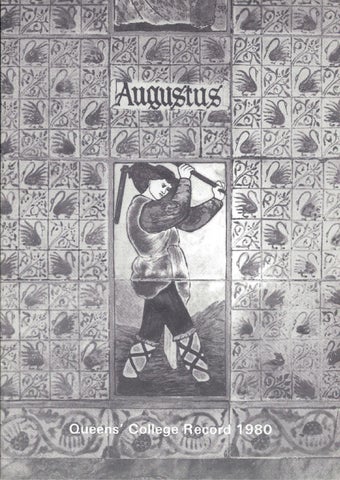
Cover photograph: Detail from the fireplace in the Old Hall: Rosetti for William Morris & Co.
Queens' College Record 1980
Queens' Col lege as at M arch 1 980 Visitor H E R MAJESTY TH E QU EEN Patroness HER MAJESTY QU EEN ELIZABETH THE QU EEN M OTH ER President DER EK WILLIAM BOWETI, Q.C., M.A., LLD ., Ph.D. {Ma nchester) Fellows
Edwin Arthur Maxwell, M .A. , Ph . D ., Life Fel low, formerly Senior Burs a r a nd D i rector of Studies in Mathematics. James Arthur Ramsay, M . B . E . • M . A . . Ph. D . , F . R . S . , Emeritus Professor of Comparative Physiology, Life Fel low, formerly Vice- Pres ident and D i rector of Studies in Natural Sciences. The Rev. Henry St John Hart, M .A., B . D . , Life Fellow and Hebrew Lecturer, formerly Vice-President, Dean and D i rector of Studies in D i vinity. Sir Harold Walter Bailey, M . A . , D . Litt. (h.c.) (W. Australia), D. Litt. (h.c.) (Australian National U n iversity), D . Litt. (h. c. ) (Oxon), D . D . (h. c . ) (Manchester), F. B . A., Life Fel l ow, E meritus Professor of Sa nskrit. Sir Arthur Llewellyn Armitage, M .A . , L L B . , LL D . (h.c.) ( M anchester), Life F e l low, formerly President. Douglas Parmlte, M .A . , Di rector of Studies in Modern La ng uages. John Holloway, M .A . , Litt. D . , D . Phil. (Oxon), D . Litt. (Aberdeen), Professor of Modern Engl ish. M axwell M arsden Bull, M .A . , M . D . , B .C h . , D i rector of Studies in Medici ne. Henry Cohen, M .A . , Ph. D . (Dunelm), Assistant Director of Studies in Engineering. Anthony Colin Spearing , M .A., Director of Studies in Eng l i s h . S i r James William Longman Beament, M .A. , Sc. D . , F. R . S . , F . R .S .A., Dra p ers Professor of Ag ricu ltu re. James Martin Prentis, M .A., M . Sc. ( E n g ), Ph. D . (London), Assista nt D irector of Studies i n Engineeri ng. Norman Francis H u g hes, M .A., Sc. D . , Keep er of the Records, Assista nt Director of Studies i n Natu ral Sciences {Earth Sciences). Kenneth Ewart Machin, M . A . , Ph . D ., Senior Tutor and Assista nt D i rector of Studies in Natural Sciences (Physics). Ajit S ingh, M .A., B.A. ( Punjab, Chandigarh), M .A. ( H oward, Washington), Ph. D . (Berkeley, California ) , D i rector of Studies i n Econo m i cs and Pol itics. Brian Albert Callingham, M . A . , Ph . D . ( London), Assistant Director of Studies in Med icine and Admissions Tutor (Science). James Diggle, M .A . , Ph. D . , Prae lector and Director of Studies in Classics. Peter Jaffrey Wheatley, M . A . , Ph . D ., Senior Bursar and Director of Studies in N atura l Sciences {Chem istry). John Tiley, M .A . , B . C . L. (Oxon), D i rector of Studies in Law and Admissions Tutor {Arts). John Edward Carroll, M . A . , Ph. D. , Director of Studies in E l ectrical Sciences. Peter Gonville Stein, M . A .. LL. B . , Ph. D . (Aberdeen) , F . B .A., Reg i u s Professor of Civil Law, Vice-President. The Rev. Brian Leslie H ebblethwaite, M .A., Dea n of C hapel and D i rector of Studies in Theology and Relig ious Studies and in P h i l osophy. lain R ichard Wright, M . A . , Tutor, Li brarian and Acting D i rector of Studies in E ng l ish . John Timothy Green, M .A . , Ph . D ., Dea n of College, Tutor and Director of Studies in Mathematics. David Barry Sattelle, M . A . , Ph. D., Bye-Fel low and Assista nt Director of Studies fn Natu ral Sciences { B iology). Thomas H enry Coaker, M . A . , Ph. D . , Steward a nd College Lecturer in Natu ral Sciences. Christopher John Baker, M . A . , P h . D . , Tutor and Director of Studies in H istory. William Andrew Phillips, M .A., Ph . D . , Tutor and Col l ege Lecturer in N atural Sciences . Brian William Napier, M .A., P h . D ., L L B . ( Edinburg h), Tutor and Assistant D i rector of Studies i n Law. Kevin John G ray, M . A . , Ph. D . , Tutor a nd Assistant Director of Stu d i es in Law. Robin Douglas Howard Walker, M .A . , Ph . D. , J u n ior Bursar, Director of Studies in Computer Science and Assista nt D i rector of Studies in N atural Sciences {Mathematics). Roderick Arthur Smith, M .A., P h . D . , D irector of Studies i n Engineering. Andrew Duncan Cosh, B.A. , Ph. D . , Tutor for Rese a rch Students and Assista nt D i rector of Studies i n Econom ics. John Clive E llary, M .A., B . S c . , Ph. D . ( Bristol), Col lege Lecturer i n Physiology. Peter Raynor MacDonald Steele, M . A . , M . B . , B.Chir. , Ph . D . , M . R . C . Path . , Tutorial B u rsa r a nd Col lege Lecturer in Pathology. The Rev. Brendan Ignatius . B radshaw, M . A . , Ph . D . , Col l ege Lecturer in H i story. R i chard Robert Weber, M . A . , Ph. D . , Tutor and Assistant Director of Studies in M athematics. Raphael Salkie, M .A. , Bye-Fe l l ow a nd Assistant D i rector of Studies in Modern Lan g ua ges. Allan N uttall Hayhurst, M . A . , Ph. D . , D i rector of Studies in C hemica l En g ineerin g . Peter S pufford, M .A ., Ph. D . Col lege Lectu rer i n H isto ry . Vani Kant Borooah, M .A . , P h . D . , B ye - Fel low ( Ecomonics ) . James Anthony J ackson, M .A . , Research Fellow (Geop hysics ). Peter Thomas Elian Merchant, M .A . , Research Fellow ( En g l ish ) . Christopher John Pountain, M . A . , Ph . D . , Assista nt D i rector of Studies in Modern and M edieval Lan g ua g es. The R ev. J ohn Sharp , Bye-Fellow a nd C h a p lain.
Honorary Fellows
The Rev. H en ry Chadwick, M . A . , M us. B . , 0 . 0 . , 0 . 0. ( h . c. ) ( Glas g ow), F. B .A . , Reg i u s Professor of D ivinity. S i r Thomas Padmore, G . C . B . , M . A . S i r Harold Walter Bailey, M .A., D . Litt. ( h . c . ) (W. Australia) , D . Litt. ( h .c. ) ( Australian National U n iversity) , D . Litt. ( h . c . ) (Oxon ) , D . D . ( h.c. ) ( Manchester), F. B.A. Professor S ir Arthur Llewellyn Armitage, M.A., LL B . , LL. D . ( h. c. ) ( Manchester) , Vice-Cha ncellor of the U n iversity of M anchester. Lord Allen of Abbeydale, G . C . B . , M . A . Alfred Charles Tomlinson, M . A . , Reader i n En g lish Poet ry in the U n iversity o f Bristol . Sir George Stanley Waller, O . B . E . , M . A . , J ud ge i n the Court of Appe a l . Professor Robert Neville Haszeldine, M .A., Sc. D . , F . R . S . , Princi pal o f t h e University o f Ma nchester Institute o f Science and Technology . Theodore Morris Su gden, M .A., Sc. D . , F . R . S . , M a ster of Trinity H a l l. James Arthur Ramsay , M . B . E . , M . A . , Ph. D . , F. R . S . Cyril Humphrey Cripps, M . A . , LL. D . (h.c. ) .
2
The New Development and the College Appeal As I indicated in last year's Record, we planned to occupy the new Armitage Room - named after my predecessor as President, Sir Arthur Armitage -during the course of the year, and this in fact we did in August. This is a long, handsome room, running the whole length of the Dining Hall at first floor level: it lies above the cloisters and looks into the Court. From inside the Court the room is easily identified by its long windows, broken up into a series of panels set at different angles so as to reflect the light. The room is capable of use either as one long room, or it can be subdivided by sliding panels of wood to form up to four smaller rooms, ideal for small dinner parties. Its availability has already proved valuable, but its full potential will only be realized when the completion of the staircase and the installation of the lift from the Kitchens is achieved. This remaining staircase, FF, is . our next objective. When completed, it will provide an additional 40 rooms and so work is already going ahead on the interior partition walls. Of course, little of this work is evident from the outside, but the external appearance of the building has nevertheless been greatly improved during the course of the year. This is because the bronze panels and windows have been installed on this remaining staircase. The effe.c t has been to make the Court as a whole look more complete, for hitherto the bare breezeblock walls looked incomplete and in stark contrast to the rest of the building. There is every hope that FF staircase might be finished by October 1980, but experience has taught us to regard such targets with a certain scepticism. Nevertheless, a good de¡a1 of thought is now being given to Phase Three, the final stage of the building of Cripps Court. This involves a new Multi-Purpose Hall, a meeting room, two new Squash Courts, the covered carpark in the area between the Fisher building and Cripps Court (covered by a lawn at first-floor level) and the repaving of the Round. Although, for obvious reasons, the completion of Cripps Court remains our first priority, a good deal of work is going on in the old College. The old Kitchens are being stripped, the old 'freezer' room converted to extra cellar space, and the re-lighting of the old Dining Hall is completed. The details of this work are best left to be described in the Junior Bursar's report on the fabric .
What is very much my concern is the cost of this work. For example, we had hoped to re-lay tiles on the floor of the old Dining Hall so as to reproduce faithfully the earlier floor designed by Bodley, the present tiles being badly worn, and in some places replaced by concrete . The estimate for this work was the astonishing figure of ÂŁ43,000 and at that point we have had to think again. A portion of the river wall has now collapsed and the College is bound to face a very heavy cost to repair this wall: we await an estimate for this work. Against this background of financial liability, it is with enormous relief that the College can look to the state of the College Appeal. The present gross figure is ÂŁ320,872. A good deal of this has already been spent on furnishing Cripps Court, centrally-heating Fisher, renovating the old Kitchens, and all the various appeal aims about which I have written at length on previous occasions. The figure also represents money which will come in gradually over the years, by virtue of the seven-year covenants. However, it is a tremendous source of strength to the College that so many members of the College have been willing to renew their covenants for a further seven years. By the end of March 1980, 163 Queensmen had done this, as the enclosed list of subscribers indicates. I find it difficult to give adequate expression to the gratitude of the College for this continued support. Just occasionally, we are able to do something by our own efforts, without having to rely on the old members. Readers of the Record will recall that, some few years ago, the College embarked upon a plan to improve and protect the Old Library. This involved the preparation of a comprehensive catalogue, a work which would occupy a skilled librarian many years; and the installation of a special fire-detection and fire-extinguishing system, relying on gas rather than water. The special Appeal launched for that purpose enabled the College to proceed with the cataloguing, but was insufficient to meet the capital cost of the fire-prevention system. However, as the Librarian reports in his section on the Library, the College has been able to find this money by the sale of a manuscript. We hope, therefore, to be able to get ahead with this work which will for the first time give reasonable protection to a valuable part of the heritage of the College. D.W.B.
The Armitage Room: D. W.B.
- ---,,----------,...,__...,,......,.........,__,,
3
The Society The New Year's Honours _List contained the splendid news that Professor Beament had been awarded a Knighthood. His distinction as a scientist, and as the Drapers Professor of Agriculture, is commonly-known; what is less well known, perhaps, is his work for many years in an advisory capacity to the Government, and particularly in recent years as a member of the National Environmental Research Council. When he became chairman of NERC in 1977 there seemed little doubt that his public service and academic distinction would soon be recognised, and so it has transpired to the great satisfaction of his many friends and colleagues. Another cause for celebration was the publication by Sir Harold Bailey of a concluding volume in his monumental work on the Saka manuscripts - the Dictionary of Khot,an Saka - in the year of his eightieth birthday. Sir Harold began in 1934with a plan to edit and transcribe these texts and then slowly to elucidate them. The dictionary contains a linguistic analysis of the texts and a translation of all the words used,,sg it follows on the previous six volumes as a culmination df the entire work. The Fellowship marked the occasion with a buffet luncheon in his honour, on the day of his birthday which happily coincides with "0 Sapientia", 16th December. There have been a number of welcom·e additions to the Fellowship. Dr Hayhurst, who was first a Research Fellow and then an Official Fellow from 1964-1972, has returned from the University of Sheffield to a Lectureship in Chemical Engineering in Cambridge and to an Official Fellowship in this College. Another welcome· return is that of Dr Pountain, who left a Research Fellowship in the College in 1972 to go to a Lectureship in Modern Languages at Nottingham, from which he now returns to a Lectureship here in Cambridge and an Official Fellowship in Modern Languages. Dr Spufford, formerly Reader in History in the University of Keele, has been elected to an Official Fellowship in History upon his appointment as a University Lecturer in History; this will, in some ways, help to offset the loss which we incurred last year with the departure of Dr Riley-Smith. We have made a new appointment in Economics, having appointed Dr Borooah, a Research Officer in the Department of Applied Economics, to a Bye-Fellowship. We have also made two new appointments to Research Fellowships: Mr Jackson, in Geology, and Mr Mercbant, in English: Both are Queensmen with distinguished academic records behind them and, with the help of a Research Fellowship, one can expect them to have an even more distinguished academic future ahead of them. The most recent appointment however, is that of Mr Sharp as ByeFellow and Chaplain. He will replace Mr Tuckett and he comes from a curacy in London, with the advantage of a First-Class degree in History from London so that he will be able to do some College teaching in addition to the duties of the Chaplaincy. - There have been a number of changes in College Office. Dr Prentis has resigned as Senior Bursar, having served in that office since 1970. There can have been few periods in the history of the College when we have demanded as much from the Bursar as during this past decade. We have faced rapid inflation, uncertainty over fee income, major changes in staff pensions and conditions of employment 4
and, above all, a large-scale programme of new building and repair and restoration of the old buildings. As Bursar, and as Chairman of the Building Committee, Dr Prentis has rendered quite conspicuous service for which the College and I personally owe him a real debt of gratitude. He will be replaced as Senior Bursar by Dr Wheatley, who·was·at one time Junior Bursar and who, by his long service on the Building Committee and his innate qualities of patience and thoroughness, will be well equipped to follow him. Mr Weber has become a Tutor and Dr Cosh has succeeded Mr Parmee as Tutor for Research Students. Dr Walker has succeeded Dr Cohen as Garden Steward and, in addition, bas assumed within his role of Junior Bursar the duties formerly carried out by Dr Cosh as Rooms Fellow. During the year a number of Fellows· have been on leave. Professor Stein and Mr Tiley were away for most of the academic year 1978/9, teaching in the United States and Canada respectively; and Dr Bull was ou leave, though remaining in Cambridge, for last Easter Term. This academic year Dr Phillips is away, engaged in research in France; and similarly Mr Spearing in the United States. Professor Holloway has been on leave for the Michaelmas Term and Dr Diggle and Dr Cohen will be away for the Lept Term. It remains for me to note four departures from the Fellowship. The first is that of Dr Overy, who has left to take up a lectureship in London. The second is that of Mr Wildman, Research Fellow in the History of Art, who leaves for an important post as Deputy Keeper (Prints and Drawings) with the Birmingham City Museum and Art Gallery, and the College can but wish him well in a career in which his Research Fellowship was a stepping-stone. Similarly with the departure of Mr Tuckett, our Chaplain and Bye-Fellow: he'has left for a Lectureship in Theology at the University of Manchester, and is to be congratulated on this appointment as a further stage in his career. The fourth departure is that of Mr. Hart who has retired; one cannot view this except with a feeling of sadness, for Queens' will be a somewhat different place without him.
Henry Hart abroad
Henry Hart came to Queens' as a Research Fellow, from St. John's, in 1936. Over the next 43 years he served the College as Chaplain, Tutor, Dean and VicePresident. He taught Theology and Hebrew, being University Reader in Hebrew and Intertestamental Studies, and exercised a patience and charm which became almost legendary. Within the College he became one of a small group of College Officers upon whom the whole life of College depended. He supported practically every College activity and for many years knew every man in the College by name. He entertained generously, conducted reading groups, walking tours, and ran the 'D' Society, that most successful of discussion groups which one attended by invitation and which brought together men from all manner of disciplines, in the interests of a wider education. To any new Fellow or inexperienced Tutor, Henry was a ready and valuable source offriendly advice and wisdom. In Chapel, his sermons were gems of reasoned Christianity and dry humour, delivered in a voice which could only be Henry's but which, being so, became the object of many a well-intentioned imitation. From my own personal observation I would say that I have met many Queensmen who had great affection for Henry; and no one who ever disliked him. True, there came a time during the turbulence of the late sixties when some undergraduates affected to regard him as the embodiment of "paternalism". They little realized that
this shy and generous man embodied the best of those qualities of scholarship and human decency that one could hope to find in an academic community. But if in those years Henry received some hurt at the hands of thoughtless undergraduates, he was fortunate to receive great recompense at the same time. For in 1969 he married Gillian, and all who knew them delighted in the happiness and warmth of their relationship. His retirement is well-earned, and its happiness is assured. At the Club Weekend in June, and later at the Fellows' Dinner in October, members of the College and the Fellows took their leave of Henry, bearing gifts. I could readily identify those gifts. I should find it very difficult to identify and measure all the gifts of learning, kindness and good companionship which Henry has bestowed on members of.this College over the past 43 years. I must finally record with sadness the death of Professor Brian who died from a heart attack in August, only two years after his retirement from the Fellowship. Professor Brian came to Queens¡ as a Professorial Fellow in 1968 and for the next nine years earned the respect of his colleagues as a quiet, kindly man whose words, though few, were full of good sense. His services to Botany were rewarded with a C.B.E. in 1975, and at the funeral service in Kingston Church on 23 August the church was packed with people paying tribute to this gentle scholar. D. W.B.
Co-residence in October 1980 For a College founded " ... to laud and honneure of sexe femenine ... ", Queens' must have seemed remarkably remiss for the past 532 years. From next October, our devotion to the wishes of our Foundress, Queen Margaret of Anjou, will be more publicly apparent. So far, every men's College which has decided to admit women has experienced a great boost in the number of applicants for its first co-residential year. Queens' was no exception: for next October we recei\'ed 485 applicants for 136 undergraduate places. This was 32% more than a much larger, perhaps more famous, but still single-sex College at the other end of the Backs. From this large field, we have been able to assemble a 1980 entry of unprecedented strength - strength not only in academic ability, but in all the other qualities needed in a well-balanced College. There is, however, a less happy side to the picture: we have had to turn down 349 applicants, probably half of whom could have got respectable Cambridge degrees. Among these, inevitably, have been sons and daughters of Queensmen. One or two
of the fathers feel that we should always prefer the son or daughter of an old member (if adequately qualified) to other, better, candidates. Yet there is clearly general support, even among disappointed Queensrnen, for our admissions policy: to aim for overall excellence. What, then, will the 1980 entry contain? About 98 men and 38 women - a good proportion. A few Head Boys, and one or two Head Girls. Captains of Rugger, Cricket, Tennis, Lacrosse, Water Polo, and Netball. Plenty of good string, woodwind and brass players, and a harpist. One entrant who plays Hockey for her County, is in the British Womens' Junior Athletics Squad, is a pianist of Grade VII standard - and is an Exhibitioner in Medicine. The largest number of award holders ever: a total of 56 Scholars and Exhibitioners. A few familiar surnames from one or two generations ago in the College. Almost the mixture as before - but mixed, and better. It will be an interesting year.
K.E.M.
5
The Fabric The largest piece of work this year (apart from the Cripps Court development, described elsewhere) has been the gutting of the Old Kitchen area. The ceiling and wall tiles were stripped off, together with layers of rendering underneath, until the original 1449 brick and cl unch walls were revealed. Three massive brick relieving arches reveal the locations of the three original fireplaces - one more than we expected! A bricked-up arch in the west wall is all that remains of a former door out to Pump Court, blocked when the Essex Building was put up around 1760. There are signs that one of the windows was moved at the same time. Throughout, most of the fabric has been much altered by successive refits of the kitchens. In particular: the ceiling is a modem concrete slab on steel joists; and the original 2-foot thick wall separating the Kitchens and Buttery was removed earlier this century. Restoration of a room with so many alterations remains a challenging task. The work of stripping out continues in the ground floor of the Essex Building, into which the kitchens expanded over the centuries. Here the floor boards and joists suffer severely from dry rot, and much rebuilding work will be necessary. The single-storey scullery projecting from the Essex Building into Pump Court has also been stripped of its internal fittings. This building was erected in the Long Vacation 1931 and was greeted by The Dial (the College magazine of the time) with the words: "We congratulate the architects on their compromise - a red brick which will before long tone well with the Tudor work, and stone window-fittings and lead gutters and pipes to match those of Essex. Both from an architectural and practical point of view the work is pronounced a great success." The description of this very soundly constructed building is accurate; but the observer today might choose to differ over the success of the architectural compromise - the red brick has not in fact toned in with the original work. There has been discussion as to whether Pump Court might be enhanced by the removal of the scullery and restoration of the Essex Building frontage; but both operations are technically difficult and expensive, and there is no doubt that we could find good use for the building as it stands. The kitchens had also expanded in the opposite direction into a ground floor set in C staircase, Old Court. This set has been stripped out, blocked off from the kitchens and restored to C staircase. A fine 15th century wall of stud work infilled with brick was revealed and carefully repaired. The ceiling and this wall have been replastered with the joists and studs left exposed; this is the modem fashion but probably not the original way of doing things. The rooms formerly occupied by the Buttery, between the Kitchens and the Hall, have been refitted as a Servery and Wash-up designed to cater for functions in the Old Hall, Combination Room or Munro Room. The Servery is intended to receive cooked food from the new kitchens across the river, to keep it hot and to dispense it either by waiters or as a self-service counter. One only has to cross the Screens passage to be in the Old Hall. This facility will once again make it possible to hold dinners and other functions in the older part of the College. 6
The former kitchen cellars have been stripped of their refrigeration equipment and other fittings, blocked off from the Old Kitchens and opened up into the wine cellars under the Old Hall. New bins have been erected and we are now able to relieve the congestion that had developed, mainly from bulk storage of wines for the vacation conference trade.
Stripping the Old Kitchens: D. W.B.
Moving now to the first floor above the Old Kitchens, the Erasmus Room (known to older readers as the Bernard Room) has received attention. This room had served as the J.C.R. between the demolition of the Fitzpatrick Hall in 1973 and the opening of the new J.C.R. in Cripps Court in 1975. During this period the Erasmus Room acquired an unattractive bar which robbed the room of some of its area and much of its charm; this bar has now been removed and the whole room redecorated. Next door, the set of the late Mr A. D. Browne (I.I) is being remodelled so that there may be direct access from I staircase to the Gallery of the Old Hall, instead of it being necessary to pass through the living room and study of the set. The living room itself has fine fielded panelling dating from the 18th century, and will not be altered. We are told that this room served as a temporary Chapel in 1773 while the old Chapel was being altered, but no evidence of this now remains. It seems the fate of I staircase to be used as temporary accommodation while other parts of College are redeveloped! The floor of the Gallery of the Old Hall is rotten and is being relaid, but in three tiers instead of flat, so that sightlines are improved for an audience seated in the Gallery. In the Old Hall itself, the panelling, dating from 17324, has been repaired and repainted and the 1861 tiled fireplace unblocked and restored. The High Tables have been restored and repolished. New lighting has been installed, supplementing the existing general-purpose fittings. Floodlights on the ledge above the panelling illuminate the walls and ceiling, decorated in 1875 by Bodley and Wtlliam Morris & Co. respectively; while spotlights, mounted above the truss beams, pick out the three large pictures above High Table, painted by Thomas Hudson in 1766. A dimming system has also been installed so that the intensity and balance of the lighting can be changed. The new lighting has enabled visitors more readily to appreciate the splendour of the Victorian decoration in the Hall, and in its dimmed form has proved admirable background lighting for special occasions such as Feasts.
Next door, in the Old Combination Room, all the panelling, dating from 1686, has been cleaned. The mahogany dining table has been repaired and repolished and returned to this room; for many years it had been kept elsewhere. The stained glass in the windows has been repaired and cleaned with astonishing results. With the availability of this room for small meetings and formal dinners, the Osborne Reynolds Room, referred to in the Record of 1968/9, has been converted back to a Fellow's set. The loss of the name is regretted but the duplication of facilities could not be justified. All of the work described above might be categorised as "Old College Redevelopment"; it has been made possible only by the generosity of members of the College making donations to the College Appeal.
River bank, North end of the Grove: January 1980: R.D.H. W.
Elsewhere in College, the normal maintenance work continues. Electrical rewiring of the residential sets in Old Court has been completed and, by the time you read this, Walnut-Tree Court and the basement of Dokett Building will have been rewired also. It is with a feeling of satifaction and relief that I am able to report that in the last nine years we have completely rewired all residential parts of the College; only the War Memorial Library and Music Room remain to be done. Electrical faults are a major cause of fire in Colleges, and the state of our old wiring had been a cause of concern for some time. The decorators follow in the wake of the electricians; all rooms in Dokett Building have been redecorated, and some progress had been made in rooms in Old Court. Two rooms there have taken a considerable amount of effort: the 18th century panelling in C4 had cracked and needed repair, and in B6 the 15th century studwork in the walls was found to be severely worm-eaten. Under the floorboards in B6 was found a Casting Counter, a metal token thinner than a coin. The inscription revealed that it was made in Nuremberg by Hans Krauwinckel around 1580-1610. Casting Counters were used to reckon up accounts in the days before roman numerals gave way to arabic ones; the counters were used in much the same way as beads on an abacus. Is it possible that these rooms were occupied by the Bursar of the time?
A major expense this year has been the conversion of both the President's Lodge and Dokett boilerhouses to gas firing, instead of oil. Both conversions were prompted by the mechanical failure of the existing boilers, but we took advantage of the opportunity to change to gas as it is a cleaner and more efficient fuel. New gas mains have had to be laid across Cloister Court and down Queens' Lane; while the Ketton stones were raised in Ooister Court we sent them to be resurfaced. Work undertaken by the College to meet the latest Fire Regulations includes the provision throughout Cripps Court of emergency lighting, and an automatic smoke detection fire-alarm system in the Kitchens and public rooms of the recently completed parts of that court. The control panel installed in the Porters' Lodge for this system is capable of extension to cover the whole of the College. We intend next to provide a similar detection system in Erasmus Building. During the Long Vacation 1979, some students again joined the maintenance staffand we were able to continue reinforcing the bank to Queens' Ditch with timber piles. This work may take two more years. In November 1979, the river was lowered to allow the College to execute repairs to the river frontage of the President's Lodge. The continual pounding it receives from inexpertly navigated punts had knocked loose much of the pointing and damaged some brickwork. These repairs were successfully completed, but further down the river some 20 feet of brick wall 9 feet high, forming the river bank of the Grove, suddenly collapsed into the water. A subsequent survey carried out by a diving team revealed that, for much ofits 300foot length, the wall is undermined by erosion of the river bed. This may be due in part to the repeated stirring-up of the river bed by punt poles. The cost of repair work to this wall may well exceed ÂŁ50,000. In the basement of the Dokett Building, showers have been supplied in all the bathrooms. In Friars' Building, we plan to convert four bedsits at. the back of the building to bathrooms and toilets in the Long Vacation 1980. With the admission of women in October 1980, we are planning some alterations to the Pavilion at the Sports Ground to provide changing rooms for women. R.D.H.W.
Control of Visitors Early in the last decade the increasing development of Cambridge as a tourist centre began to affect the life and work of the colleges; consequently towards the end of 1975, representatives of the riverside colleges met to discuss some disturbing aspects of the problem. They recognised that tourist visits to Cambridge had become established and were likely to increase entirely outside the control of the colleges which remain the principal attraction. In April 1977, a pass system operated through the City Tourist Officer was introduced experimentally; guided parties to a maximum of 24 persons were permitted entry to the colleges as organised groups, only on presentation of an official pass issued by the City Tourist Office. Reservations about the effectiveness of a pass system proved only too well founded as tourist pressure 7
mounted in 1977, and it quickly became apparent that some further control should be introduced if Queens' and the other riverside colleges were not to be overwhelmed by incursions. often commercially organised. At the request of the Colleges' Bursars Committee, the City Tourist Office introduced a quota element into the pass system; but this again was not sufficient protection for Queens' because coach operators had adopted the west part of Silver Street as a natural coach stop when Kings Parade became a pedestrian precinct. Our courts and particularly the Bridge became heavily congested, with a rising element of noise. In 1977, 1,400 organised parties representing 25,000 people passed through the College in the summer months; at least as many more came uncounted as individuals or in small groups. In March 1978, the Governing Body appointed Mr M. M. Scarr (1933) as Visitors Liaison Officer to assist in devising and implementing an approved scheme of effective control. The scheme evolved was based on a policy of positive helpfulness and encouragement to all serious visitors, accompanied by a charge for admission to check the stream of purely casual sightseers, leaving further control in College hands; it was envisaged that the proceeds would cover administrative costs. Thus, to protect the purpose and academic life of the College, the Governing Body authorised the following experimental restrictions from March 1979: (1) Entry and exit for visitors by the Old Porters' Lodge in Queens' Lane only. (2) Admission normally between 1400 and 1630 hrs daily. (3) Guided parties (consisting of not more than 12 persons with a guide) to be permitted entry between 10.15 and 1215 hrs as well as during the general afternoon opening, subject to maximum of ten parties per day. (4) Full closure to visitors during the period of examinations from mid-May to mid-June. (5) Entry for all visitors subject to an admission charge entitling each one to a pamphlet providing concise information about the College. Obviously the restrictions were not intended to apply to old members of the College (or the University) and their guests, and the Porters were so instructed. The Governing Body also took steps locally to inform Cambridge City residents that they were welcome to continue to pass through the College without charge and even to introduce their own visitors also without charge. In the event, the recognition of the special problems of Queens' by the Bursars' Tourism Committee was reflected in the public acceptance of the new policy. The local newspaper expressed sympathetic approval and there was little, if any, overt criticism; only one member of the College expressed written disagreement. This favourable reception was largely due to the allowance for local residents, and to the efforts of the panel of lady receptionists appointed to assist the Head Porter and his staff. The pamphlet issued has also proved successful, and has not been discarded after use as litter. After the 1978 season when it was estimated that about 60,000 visitors passed through, the new scheme in 1979 admitted rather fewer than 20,000, which was widely agreed in the College to be acceptable. In 1980, it is intended to continue the scheme with only minor changes of detail. 8
We hope that members of the College who have gone down will have no difficulty in identifying themselves and any personal guests to the Gate Porters at the Main Porters' Lodge (Riverside Gate). Old members wishing to lead a party of more than three or four visitors round the College are requested to write in advance to the Visitors Liaison Officer at the College. N.F.H.
The College Pictures An important addition to the College collection, and the re-hanging of a large number of modern works in one of the newly-opened public rooms in the Cripps building, must be recorded this year. At Christie's sale-rooms in June, the College managed to purchase a copy of the engraving by Albrecht Dtirer of Erasmus of Rotterdam, to add to our collection, which did not previously contain a good portrait of the most famous scholar to have lived and worked here. Engraved in 1526, it is of particular interest in being Dtirer's last work in that medium (he died in 1528). The impression just acquired is, in fact, a late one, bearing a Basel watermark of c. 1570-80, but loses nothing of the clarity of line and subtlety of observation that makes this such an evocative portrait. Dtirer also made two drawings of Erasmus in 1520, which are quite informal - sketches, perhaps, for a possible painted portrait. Erasmus wrote in 1525 that he "should not object to having my portrait painted by Dilrer, that great artist", but complained that "I have long been a sad model for painters, and am likely to become a sadder one still as the days go on." Dtirer's superb engraving captures Erasmus's feelings of loneliness and resignation while also reinforcing the image of the literary giant at work, inkpot in hand, books of reference open at his elbow. Beneath the Latin inscription ('The image of Erasmus of Rotterdam, drawn from life by Albrecht Diirer') is a Greek tag - 'His writings give a better picture' - which had appeared on the reverse of a lead metal made by Quentin Metsys in 1519, an electrotype copy of which may be seen in the Old Library. The engraving was bought out of the bequest of Professor Harold Kirkaldy. The walls of the new Armitage Room in the Cripps building have proved to be most suitable for displaying part of the collection of works of art bequeathed to the College in 1950 by Major Robert Temperley. The two central alcoves were found to be just the right size to accommodate two remarkable paintings, which had previously been languishing on the upper walls of the Memorial Library: 'La Belle Dame sans merci' by Lousia Hodgson (shown at the Royal Academy in 1935) and 'Dawn' by Byron Dawson, shown at the Royal Academy in 1928. Prints and drawings have been hung on the main walls - at the Fellows' end, works by French and English artists, including Toulouse-Lautrec and Sickert; and in the corresponding section, English prints by Sir D. Y. Cameron, Edward Gordon Craig and Allan GwynneJones. Two portraits are now also hanging, at either end of the room - that of Andrew Munro, by Thomas Haddon, and Ruskin Spear's portait of Sir Arthur Armitage. S.G.W.
The Library 1978-79 librarian: Mr Wright Acting Librarian (Lent Term): Mr Wildman Assistant Librarian: Mrs K. E. Machin Graduate and Undergraduate Assistant Librarians: P. J. Holmes, T. D. Howard, P. G. Smith, S. J . Hemmings, D . A. Meade, M. B. Robinson, N. P. Taylor. Perhaps the most dramatic event of the Library's year was the sale at Sotheby's of one of the College's AngloSaxon manuscripts. The manuscript was subsequently acquired by the British Library. The sale aroused widespread interest in the national press, and members may be interested to learn something of the background to it, since the document has a curious and rather romantic history. The College was in fact the owner of this manuscript only in a very temporary and formal sense. Two of the three portions into which it is divided were discovered in the Library in 1902, stitched into the binding of a copy of Diophantus, Arithmetica (Basel, 1575), where they had been used as reinforcements. It was soon realised that they formed part of a set of farm accounts for Ely Abbey (later Ely Cathedral), undated but probably written soon after the year 1007. By a remarkable stroke of good luck, the remaining portion of the document came to light many years later in a private collection in Lincolnshire, having reputedly been purchased in a Sleaford junkshop, and this portion was recently offered for sale to the College. It was clearly our duty to make every effort to ensure that the dispersed parts of this manuscript were brought together again, for it is of the very greatest historical importance. These accounts constitute some of the most detailed evidence available of the day-to-day operations of the farming economy of Anglo-Saxon England, including notes on the movements of small ships, records of farm implements, inventories of livestock, the price paid for a female slave, and full details of the rents (payable in numbers of eels) from different East Anglian fens . The sum asked for the remaining portion was a considerable one, however, and the College had regretfully to decide that it was not able to purchase the fragment outright. Instead, a loan was obtained, the condition being that the entire manuscript should then be offered for sale. The College is naturally saddened that it has not been able to acquire this unique treasure, but has the satisfaction of knowing that it has played its role in reuniting these long-sundered fragments, and members will be glad to learn that all proceeds from the sale will be put towards the upkeep of our own Old Library. We can now be sure of completing the great task of compiling our new catalogue - the first since the early nineteenth century - and of installing an adequate system for the detection and extinguishing of fire in the Library. 1979 saw the departure of our Deputy Librarian, Stephen Wildman, to a curator's post at Birmingham. Few men in recent years can have had such an extensive and curious knowledge of the Queens' libraries and archives as Stephen, and we shall miss him sorely. He was one of our most tireless and devoted helpers, and had worked in the Library for more than eight years as Undergraduate Assistant Librarian, Graduate Assistant
Librarian, Deputy Librarian and, last Lent Term, Acting Librarian while the Librarian was on leave. Stephen Wildman was responsible for organising a remarkable exhibition of works by and relating to Erasmus in the Michaelmas Term and, earlier in the year, an exhibition of the College's fine holdings in seventeenth and eighteenth century belles lettres was on display in the Old Library. A Library Dinner was again held in the Spring, when Professor Riley-Smith, formerly Librarian, gave a characteristically engage account of 'Books of the Catholic Counter-Reformation in Queens' College Library'. Mr H. J. Torpey has continued with his devoted work on the new catalogue throughout the year, and Professor Goldby and his wife have generously given more and more of their time to the rebinding and preservation of books in the Old Library. We are grateful once again for the many generous donations received during the year. Mr Wildman gave a very extensive collection of books and pamphlets about Cambridge, and the following Fellows donated works by themselves: the President, The legal Regime of Islands; Dr Singh, The Basic Needs Approach versus the New International Economic Order, North Sea Oil, and Third World Industrialization; Dr Singh and Mr Cosh (with A. Hughes), Causes and Effects of Takeovers; Dr Coaker (ed.), Applied Biology IV; Dr Bradshaw, The Irish Constitutional Revolution of the Sixteenth Century: Dr Spufford, Monetary Policies and Problems in the Burgundian Netherlands and Origins of the English Parliament; Dr Smith (ed.), Fracture Mechanics; Dr Prentis, Engineering Mechanics. Books have also been given by Mr Hart, Mr Hebblethwaite, Mr Spearing, Professor Riley-Smith, the Librarian, Dr Gray, Dr Diggle, Dr Callingham, Dr Pountain, T. R. Barker, R. de B. Welchman, M. Angeles, G. A. Starr, H . P. Gray, T. D. Howard, D. W. Bowman, B. D . Griggs, G. Ridsdill Smith, N. A. Harris, G. K. Das and the Virginia Law School.
1979-80 Librarian: Mr Wright Deputy Librarian: Mr Wildman Assistant Librarian: Mrs K. E. Machin Graduate and Undergraduate Assistant librarians: P. G. Smith, S. J. Hemmings, D. A. Meade, N. P. Taylor, D. R. Massey, C. D. St J. Penney, A. P-C. Yim, D . Annen. I.R.W.
Thomae Smithi Academia The Thomae Smithi Academia, a discussion group for Fellows, founded four years ago, continues to meet twice a term. During 1979 the following subjects formed the basis for discussion: 'Strikes and the Law' introduced by Dr Napier; 'College Wine', introduced by Dr Hughes; 'Computers and Society', introduced by Dr Walker; 'Is the Administration of Criminal Justice a task for Laymen?', introduced by Professor Stein; 'Per pinnam et precem: aspects of air transport', introduced by Dr Smith. 9
The E Society Three meetings of the Society were held in the Lent Term and two in the Michaelmas Term. The speakers were Dr Phillips, on 'Einstein, Relativity and Quantum Mechanics'; Professor C. B. Ricks, Fellow of Christ's, Professor of English, on 'The Anthropology of Mary Douglas, from the point of view of Literary Studies'; Dr Steele, on 'Alcohol and your Liver'; Dr Bradshaw, on 'History and the Irish Problem'; and Professor J. M. Thoday, Fellow of Emmanuel, Arthur Balfour Professor of Genetics, on 'Why Genetic Variation?'. The E Society Dinner was held in the new Hall on Saturday 21st April. B.L.H.
The Chapel The following visiting preachers came to the College Chapel in the course of the year: the Very Rev. the Hon. 0. W. Twistleton-Wykeham-Fiennes, Dean of Lincoln; Fr M. Couve de Murville, Fisher House; the Very Rev. M . S. Carey, Dean of Ely; the Rev. P. E. Ursell, Chaplain of Emmanuel College; the Rev. Canon R. J. Hammer, Director of the Bible Reading Fellowship; the Rev. Prof. G. W. H. Lampe, Regius Professor of Divinity; the Rev. Elizabeth Newlands, Church of Scotland; the Rev. R. D. Harries, Vicar of Fulham. Mr. Hart also preached, as did the Dean of Chapel and the Chaplain. The preacher at the Commemoration of Benefactors in Full Term was the Very Rev. F. E. Le Grice, Dean of Ripon {Qu. 1931-34), and at the visit of the Club in June, the Rev. M. B. Geach, Vicar of Linkinhorne, Cornwall {Qu. 1949-51). The Advent Carol Service was held on 2nd December. A memorial plaque in the antechapel to J. F. Clough, Organ Scholar 1970-73, was dedicated after the Commemoration of Benefactors on 29th April. S. R. Armstrong was succeeded as Organ Scholar by N. W. Watts, and T. D. Howard as Chapel Clerk by G. M. Hunter. The Chapel Choir went on a tour of France in June and sang Choral Evensong in Ely Cathedral on 25th April and in York Minster on 4th July. They also made two more records of Music for Evensong under the direction of the Organ Scholar, Stephen Armstrong. Mr Hart retired after forty years at Queens'. Among their many presentations, Mr and Mrs Hart received books from the Chapel Congregation and from the Chapel Choir. The Chaplain left at the end of the academical year to take up a Lectureship in New Testament Studies at the University of Manchester. His successor, the Rev. John Sharp, took up his post in January 1980. B.L.H.
IO
First Classes and Distinctions 1979 Archaeology and Anthropology. S. P. Wade. Chemical Engineering. R. B. Thorpe. Classics. J. M. G. Barclay, D. G. McFarland, S. P. Oakley. Economics. C. B. Chaloner, R. P. Collins, I. C. Malhotra, C. H. Stephens; J. Ward. Education. G. K. Sinclair. Engineering. A. D. Johnson; J. S. Dicker, P. D. Newth; M. C. Dawson, S. M. Hobbs, J. A. H. Mackay. Geography. J. Davis. History. D. I. Cesarani; G. S. Garnett. Law. J. R. Bradburne, M. J. Gordon; J. A. Grainger, S. J. L. Resuggan; A. D. Darwin, G. R. Newey, K. G. Young; M. J. Bennett, C. D. St J. Penney. Mathematics. S. H. Harmsworth, P. H. Haynes, S. P. Meacham; T. C. Carden, N. F. J. Inglis, M. P. Streuli, M. J. Thompson. Medical Sciences. A. P-C. Yim. Medicine. R. A. Chalmers, M. J. D. Goodfield. Modern and Medieval Languages. J. E. B. Walker; S. N. Botterill, P. T. Fletcher; T. J. Chamberlain; D. J. Ash, J. L. Raymond, P. McF. Stewart. Music. P. N. Coad, H . D. Keelan. Natural Sciences. I. M. Harvey; G. P. Barwood; A. Goldman, A. J. Green; G. P. Aylett, R. Barber, A. M. Brandenburger, J. D. B. Gilbert, J. Kimberlin, D. P. Peterzan. We apologise for an omission in the 1979 Record where the following First Classes were not listed: Economics. P. A. Bancroft, S. J. Roberts. English. M. W. M. Saunders. Modern and Medieval Languages. S. N. Botterill, P. T. Fletcher. Natural Sciences, A. J. Green.
University Awards Bartle Frere Exhibition: N. D. Dorey. Rebecca Flower Squire Scholarships: M. J. Bennett, A. D. Darwin. James William Squire Scholarships: G. R. Newey, C. D. St. J. Penney. Wrenbury Scholarship: I. C. Malhotra. George Peter Baker Prize: R. A. Chalmers. Wright Rogers Scholarship: K. G. Young. Waddington Scholarship: proxime accessit: D. G. McFarland. Browne Scholarship: S. P. Oakley. Henry Arthur Thomas Prize: S. P. Oakley. Porson Prize: D. G. McFarland. Members' Classical Reading Prize (for Latin): N. G. Davies. Members' Classical Translation Prize (for Latin): N. G. Davies. Sir William Browne Medals: (for Latin Elegy): D. G. McFarland. (for Greek Ode): D. G. McFarland. (for Greek Epigram): D. G. McFarland.
College Scholarships and Exhibitions Entrance Scholarships Miss R. T. Arnold, Rugby School, in Natural Sciences to read Medical Sciences (Melsome). M. R. Baliman, King Edward's School, Birmingham, in Natural Sciences (Melsome). P. A. Barr, Huddersfield New College, in History (Colenutt). S. Bavetta, Latymer School, Edmonton and Davies's, in Natural Sciences to read Medical Sciences (Melsome). J. D. Beardsworth, Bolton School, in History. H. C. Dalton, Royal Grammar School, High Wycombe, in Engineering. R. J. Dixon, Aylesbury Grammar School, in Engineering. S. W. D. Egan, St Dunstan's College, Catford, in Engineering. K. D. Hook, Eltham College, in Engineering. M. Howell, Langley Grammar School, in Engineering. P. D. Jukes, Aylesbury Grammar School, in English. A. J. Kelly, Tiffin School, in Mathematics. Miss C. M. Kennedy, Malvern Girls' College, in Modern Languages (Paterson). A. S. Lewis, Blundell's School, in Mathematics (Munro). J . W. Long, Nottingham High School, in English (Colenutt). S. A. Melton, Bedford Modern School, in Natural Sciences (Melsome). Miss L. C. North, Bedales School, in English to read Oriental Studies. I. R. Patient, Francis Bacon School, St Albans, in Engineering, A. J. C. Quinn, Trinity School, Croydon, in English. E. D. Smith, Harvey Grammar School, Folkestone, in Engineering to read Natural Sciences. G. C. Smith, The Haberdashers' Aske's School, in Natural Sciences to read Medical Sciences (Melsome). S. Thomas, The Haberdashers' Aske's School, in Engineering. L. B. Waldron, Lancing College, in Natural Sciences to read Engineering (Melsome). D. K. Watts, Royal Grammar School, High Wycombe, in Natural Sciences (Melsome). D. K. Waymont, Dartford Grammar School, in Natural Sciences (Melsome). G. J. Wimpenny, St Albans School, in Natural Sciences (Melsome). P. V. E. Wood, Westcliff High School, in History. Entrance Exhibitions M. E. Aarons, William Ellis School, in Economics. M. P. Anderson, Friends' School, Saffron Walden, in History to read Law. S. St J. Anstee, Watford Boys' Grammar School, in History. C. J. Baines, St Albans School, in Economics. P. G. Barker, Manchester Grammar School, in Classics. P. St J. Bennett, Repton School, in Natural Sciences (Frodsham). D. E. Brindle, Nottingham High School, in Engineering (Paterson). J. E. Brodrick, Ampleforth College, in Engineering. A. C. F. Butcher, Radley College, in Natural Sciences to read Medical Sciences (Melsome).
Miss R. M. Callow, New Mills School, in Modem Languages. Miss H. E. Claridge, Cheltenham Ladies' College, in Classics (Gray). M. D. H. Croft, Sherborne School, in English (War Memorial). Miss J. M. F. Cummings, Headington School, in Modern Languages. A. M. Eastwood, Manchester Grammar School, in Mathematics. S. A. Harris, Desborough School, in Engineering (Paterson). J. M. Hartley, King's School, Canterbury, in Engineering. R. F. Holmes, St Paul's School, in Mathematics. Miss J. A. Johnson, Herts and Essex High School, in English. P. G. B. Jones, Rossall School, in Engineering. R. M. Kamm, Wyggeston and Queen Elizabeth I College, in History. Miss G. L. Kaufmann, Haberdashers' Aske's Girls' School, in Geography to read Archaeology and Anthropology (Paterson). Miss A. A. A. Kyei-Mensah, Cheltenham Ladies' College, in Natural Sciences to read Medical Sciences (Haynes). A. S. Maclaren, King Edward VI School, Chelmsford, in Economics (Paterson). Miss B. M. T. Norden, St Benedict's School, Ealing, in English (Paterson). N. P. Quenby, Nottingham High School, in History to read Law. R. J. Ridley, Pangbourne College, in Natural Sciences (Melsome). A. P . Roach, Hymers College, Hull, in History. J. R. C. Seale, Lancing College, in Natural Sciences to read Medical Sciences (Melsome). P. le M. Sinclair, Sherborne School, in Mathematics.
FIRST YEAR
College Exhibitions J. Ward for Economics; M. J. Bennett for Law; C. D. St J. Penney for Law; N. F. J. Inglis for Mathematics; A. P-C. Yim for Medical Sciences; J. D. B. Gilbert for Natural Sciences; J. Kimberlin for Natural Sciences.
SECOND YEAR
Foundation Scholarships J. M. G. Barclay for Classics; D. G. McFarland for Classics; S. P. Oakley for aassics; I. C. Malhotra for F.conomics; J. S. Dicker for Engineering; P. D. Newth for Engineering; G. S. Garnett for History;A. D. Darwin for Law; G. R. Newey for Law; K. G. Young for Law; S. N. Botterill for Modem and Medieval Languages; P. T. Fletcher for Modern and Medieval Languages; A. Goldman for Natural Sciences; A. J. Green for Natural Sciences.
11
THIRD YEAR Foundation Scholarships C. B. Chaloner for Economics; R. P. Collins for Economics; C. H. Stephens for Economics; A. D. Johnson for Engineering; D. I. Cesarani for History; S. J. L. Resuggan for Law; J. E. B. Walker for Modem and Medieval Languages; P. N. Coad for Music.
Bachelor Scholarships R. B. Thorpe for Chemical Engineering; J. Davis for Geography; P. H. Haynes for Mathematics; S. P. Meacham for Mathematics; J.E. B. Walker for Modern and Medieval Languages.
FOURTH YEAR Foundation Scholarship I. M. Harvey for Natural Sciences (Medicine).
Special Prizes Joshua King Prizes: C. B. Chaloner, R. B. Thorpe, S. P. Wade, J. E. B. Walker. Hughes Prizes: G. S. Garnett, P. T. Fletcher. Venn Prize: A. M. Brandenburger. Penny White Prize: S. H. Harmsworth. Chalmers Prize: G. P. Barwood. Chase Prize: J. Kiddle. Melsome Memorial Prize: I. M. Harvey. Lucas Smith Prize: J. A. Grainger. Mosseri Prize: A. P-C. Yim.
Openshaw Prize: P. D. Newth. Ryle Reading Prize: M. B. Robinson. Proxime accesserunt: T. R. Barker, Macnaughton.
W.
M.
The College Union
in which the Junior Members can express their opinions and interests. These tasks were not made easy for the Council of the College Union by a marked lack of continuity following the elections in February: only one junior member of the new Council had served for a full year previously. Furthermore there were too few people who showed interest in standing for election to the Council. However, during the year this flagging interest was revived and in October fifteen freshmen stood for election to two posts. This was partly because the Council was seen to be concentrating on the interests of its members, rather than dissipating its energy on remote national and even international politics, as has become the habit in other Colleges. The Union continued to provide excellent services and entertainments throughout the year. The new JCR shop, ably run by Andy Mackenzie, expanded rapidly in terms of volume and started to sell College designed sweatshirts and records as well as stationery with great success. Each term a JCR diary and one or more newsletters were produced and distributed throughout the College, keeping members informed about the events around them. This year saw a determined effort to establish the bar and JCR as the focus of the social life of the College. The JCR ran frequent discos and evenings oflive music which proved to be very popular thanks to the efforts of Martin Scott. Other events included a half price beer night which was very successful and hopefully will be repeated in future. The JCR continued to provide such basic services as a television room and a wide selection of newspapers and magazines. As in previous years the Union helped introduce freshmen to the life of the College by writing to all of them before they came up, by offering them a free disco soon after their arrival and by subsidizing parties on each staircase. The rest of the Union's income was spent on financing the College sports clubs and other societies. This year saw the admission of the Classical Society to the status of an Affiliated Club. The advent of co-residence next year meant that the Union took steps to ensure that the women will have proper sports facilities. A four was bought for the Boat Club to enable women to row. After unsuccessfully approaching Homerton, an informal agreement was made. with Selwyn, with sports grounds next to Queens', enabling Queens' women to share facilities with Selwyn in the first transitional year of co-residence.
1978-79
President: N. D. Martin J(ice-President: Dr Baker Secretary: A. R. Christie Senior 'Jreasurer: Dr Phillips Treasurer: J. A. Davenport External Officer: R. D. Mattick Steward of the Fitzpatrick: D. J. Barker Fellows: Dr Bradshaw, Dr Steele Graduate: R. Bettley-Smith Third Year Representatives: R. F. Crellin, W. M. Macnaughton Second Year Representatives: J. R. Owen, W. J. Soutter First Year Representatives: J. N. White, S. J. Phillips Governing Body Observers: T. R. Barker, P. G. Smith The dual purpose of the College Union is to enhance the corporate life of the College and to provide a framework
12
1979-80
President: J. R. Owen Vice-President: Dr Baker Secretary: S. J. Phillips Senior Treasurer: Dr Weber 'Jreasurer: J. N. White External Officer: A. M. Alves Steward of the Fitzpatrick: R. H. Bigley Fellows: Dr Steele, Dr Carroll Graduate: D. M. Mulhaupt Third Year Representatives: P. D. Edwards, E. R. W. Lindsay Second Year Representatives: A. M. Mackenzie, M. J. H. Scott First Year Representatives: P. D. Allen, A. J. Baker Governing Body Observers: L. J. Walsh, N. J. Knight
M.C.R. 1978-79 President: Dr Bull Chairman: R. Bettley-Smith Secretary: G. J . Greenhough Treasurer: P. W. Davies Room Steward: J . R. Heritage
Each passing year, it seems, brings a stronger and more active MCR, both in the range of activities centred there, and in the support accorded to these activities by graduates. As has been the trend over the past several years, there is again an increased number of graduate students living in College. This is a particularly welcome development because it means that more graduates can take an active role in the life of the College, which is something of significant benefit to both. We hope that this trend will continue. This past year has seen the retirement of Mr Parmee as Tutor for Graduate Students and the election of Dr Cosh to take his place. Our thanks must go to Mr Parmee for his past assistance and support ranging over many years. We also welcome Dr Cosh who is already proving to be an excellent tutor. Special thanks are due to the President, our tutors and the Governing Body for supporting and encouraging programmes to facilitate SCR/ MCR inter-action. The practice of inviting graduate students to dine on High Table is continuing and is, as usual, very popular. The luncheon hosted by the Governing Body at the beginning of the year, the drinks party in the Solarium, the informal dinners at Andy and Jill Cosh's, and various other manifestations of interest and support both large and small are all greatly appreciated. The highlight of a successful 1978-79 year proved to be the Caribbean Party in June. This was a particularly memorable function for those who were there for a variety of reasons! The 1979-80 year has seen the continuation of graduate dinners and several parties, including the famous 'Republication of the Times Party' to which undergraduates were also invited. We hope that this will mark the beginning of increased graduate / undergraduate cooperation and functions. We have also reintroduced the after-dinner speakers series. The President kindly agreed to start the programme and gave a very interesting and topical presentation entitled 'Terrorism and Revolution: the Lawyer's Nightmare'. Additional speakers have been scheduled for future terms. The attendance at the first function and the positive comments associated with it bode well for this revived tradition. All these events, together with joint functions with Newnham College, five-a-side football matches and the myriad of informal and impromptu activities have made the MCR a facility much used and appreciated by the Graduate members of the College. The advent of women graduate students will only strengthen what is already one of the strongest MCRs in Cambridge. Thanks are due to many people, especially Dr Bowett, Dr Bull, Mr Parmee and Dr Cosh for their continuing encouragement and assistance. Their participation is highly valued.
1979-80 President: Dr Bull Chairman: E. J. Jankowski Secretary: N. J. Kruger Steward: D. M. Mulhaupt Treasurer: B. R. Cassell Room Steward: S. P. Luttrell
St Margaret Society 1978-79 President: Professor Beament Vice-President: H. D. Keelan Secretary : P. N. Coad Treasurer: S. F. Chadwick Publicity : C. Hilton Committee: S. R. Armstrong, J. A. Iggo, H. S. Ridge, J. W. Higgins, J. W. Styles
The Lent Term was a quiet one for the Society with few events except for the regular chorus rehearsals and the end of Term concert. The latter was held in Great St Mary's Church and consisted of a performance of Haydn's Creation Mass. This was well received by an attentive if rather small audience. The Easter Term featured a variety of events. Notable amongst these was the Smoking Concert which was held in an Old Hall full to overflowing. The audience was treated to an interesting mixture of music and humour washed down with plenty of beer. The May Week Concert was a more formal occasion with a programme of Brahms, Granados and Faure, interspersed with strawberries and wine served on the Erasmus Lawn. Thanks must go to Messrs. Armstrong, Hilton and Higgins for arranging performances of an unusually high standard for this event. The new academic year brought with it a new Committee headed by Jonathan Higgins who succeeded Hugh Keelan as Vice-President. In October we embarked on the new venture of putting on a series of lunchtime recitals featuring the work of one composer, Brahms. The seven recitals were extremely well attended with an average of over one hundred people packing into the Chapel each Tuesday. This series is being continued into 1980. A break from tradition was made with the Christmas Concert which was held for the first time in the concert hall of the New Music School in West Road. The programme was varied, with three composers presented by three different conductors. Stephen Ridge conducted Handel's Coronation Anthems, Jonathan Higgins directed the Vivaldi double 'Cello concerto and the performance was completed by Stephen Armstrong's excellent interpretation of Faure's Requiem. The evening was an unqualified success with the hall filled to capacity. We enter 1980 then, with a very successful Society, with hopes of even better things ahead and an even more successful President, Sir James Beament, whom we must congratulate on his recent Knighthood.
13
1979-80 President: Professor Sir James Beament Vice-President: J. W. Higgins Secretary: M. B. Alabaster Treasurer: M. J. Williams-Ellis Publicity: W. J. Howgego Committee: J. Thompson, H. S. Ridge, G. P. Aylett, N. W. Watts
The Bats 1978-79 President: R. F. Crellin Vice-President: I. D. Softley Secretary: P. E. Pearson Technical Director: J. R. Owen Senior Treasurer: Mr Wright Junior Treasurer: S. B. Provisor Equipment Manager: P. L. Taylor Committee: S. J. Roberts, J. Navon, J. J. Bell, M. J. Wickenden, G. M. Hunter, A. Goldman, K. J. Dinnage, S. K. Cherry, B. P. Taylor, D. N. Symons Toe BATS continues to enjoy its status as a dramatic society on a University scale, while remaining very firmly tied to Queens'. In 1979 we staged two main shows and two ]ate-nights at the University's ADC Theatre, various lunchtime shows in Queens', a pantomime which toured local schools, and of course the May Week production in Cloister Court. Queensmen have been heavily involved in all of these, and we have "home-grown" people to take charge of everything from mulling the wine to directing! Toe year began with an accomplished production at the ADC of Robert Bolt's A Man for all Seasons, a great success on all accounts, not least in that it played to packed houses on nearly every night. This saw BATS accidentally in an educational role, as the play turned out to be a set-text for 'O' levels -we hope we were of benefit to those school children who came! Toe late-night companion to the Bolt was a double-bill of shortplays by J. N. Synge, Riders to the Sea and The Shadow of the Glen. Irish accents were well cultivated for these by the actors, helped along by quantities of specially-brewed cold tea by way of imitation whisky. Toe ADC stage adapted itself well to the Celtic fringe, though the late-night atmosphere tilted the tragi-comic balance of the plays rather more in favour of comedy than tragedy. In May Week we returned to Shakespeare after our experiment with Gilbert and Sullivan in 1978, and chose the last play of the canon, The Tempest. Our VicePresident Iain Softley directed, and another experiment was tried by playing not against the President's Lodge as usual but against the river side of Cloister Court. This took advantage of the natural slope of the Court improving the audience's view, a small comfort to set against the drizzle which blighted some performances and was appropriate, by a small feat of imagination, to the play's setting against the background of the sea, though the otherwise admirable Prospero failed to raise a tempest in the ever-sluggish Cam. 14
In the Michaelmas Term we were at the ADC again, this time with Sheridan's The Rivals, directed by Jeremy Bell of BATS. This production successfully brought out more serious undercurrents beneath the farcical surface of what appears to be a straight comedy of love and disguise. A strong period flavour was evoked by firstclass costumes and furniture, and teething troubles with the set and a collapsing chair on the first night did not prevent a very rewarding production being enjoyed by large audiences. The late-night show accompanying The Rivals was Slawomir Mrozek's religious satire The Prophets, which humorously posed the far-reaching question of just what to do when two identical prophets appear at the Second Coming, and involved the attempts of an assortment of observers to come to terms with their predicament. No such problems were posed to schoolchildren in Cambridge and Ely by the BATS touring version of Aladdin, a highly successful pantomime by Simon Cherry which rounded off the year's activities.
1979-80 President: S. J. Roberts Secretary: G. M. Hunter Senior Treasurer: Mr Wright Junior Treasurer: J. R. Owen Equipment Manager: K. J. Dinnage Committee: J. J. Bell, S. K. Cherry, S. J. Fry, A. Goldman, J. S. Kershaw, J.C. V. Thomas, B. P. Taylor
'The Rivals'
Queens' Bench 1978-79 President: S. J. L. Resuggan Secretary: G. R. Newey Treasurer: K. G. Young The Queens' Bench continues to thrive, attracting increasingly large attendances at its meetings. In providing a forum for speakers to talk about their work or legal interests, the Society serves a very useful purpose. The meetings of the Lent Term 1979 were addressed by Professor Norman Anderson speaking on 'Law and the Enforcement of Morals'; Sir Robert Speed, Counsel to the Speaker, talking about 'Private Bills and Delegated Legislation'; and Mr Cavadino, whose subject was the National Association for the Care and Resettlement of Offenders and its work. Sir Arthur Armitage was the guest of honour at the Annual Dinner in May. This first-dinner in the new Hall was a great success, with thirty-six people attending. In the Michaelmas Term the first meeting was addressed by His Honour Judge James Kingham who spoke on the work of a County Court Judge. This was followed by an account of the work of company legal advisers given by Mr. Winterbotham, head of the legal department at ICI. At the final meeting of the Term, Sir Ian Sinclair, legal adviser to the Foreign and Commonwealth Office spoke about certain legal implications of membership of the United Nations. A visit to the Royal Courts of Justice and Brixton Prison is planned for the Lent Term. The Society would like to thank the President, Professor Stein, Professor Coote, Mr Tiley, Dr Napier and Dr Gray for their support and encouragement throughout the year. Finally, it was with deep regret that the Society learned of the death of Stephen Resuggan, President of the Queens' Bench for 1978-79.
1979-80 President: D. W. K. Armitage Secretary: J. Moakes Treasurer: A. D. Darwin
Classical Society 1978-79 President: S. G. Batchelor Secretary: T. W. M. Dillon During the Lent Term the Society was presented with papers by Professor E. J. Kenney, Kennedy Professor of Latin, and by Professor A. D. Fitton-Brown of Leicester University. The former gave an eloquent disquisition on the craftmanship of Ovid, Wodehouse and Nabokov, pointing out similarities in their comic techniques, while the latter produced evidence to show that a major detail in the Oedipus-myth - the pinning together of Oedipus's ankles at birth - was invented by Sophocles to solve problems imposed by the three actor limitation. There were a further two meetings in the Easter Term, followed by the annual dinner_ Professor H. D. Jocelyn
of Manchester University read a scholarly paper demonstrating how different levels of seriousness in various of Catullus' shorter poems can be detected by close linguistic and metrical analysis; and Mr R. Coleman of Emmanuel College discussed the functions of the various kinds of gods in the Aeneid and the way in which the influence of the Olympians in particular affects characterisation in the poem. This was followed by the annual dinner, at which the society was delighted by the wit and verbal virtuosity of Dr Diggle, Stephen Batchelor and our guests, Professor Kenney, Mr Crook and Dr McKeown. In the Michaelmas Term Professor Snodgrass, Professor of Classical Archaeology, gave a fascinating talk on the archaeological background to Homeric epic, illustrated with slides; and Dr Sedley of Christ's College outlined the ideas of Greek philosophers on the possibility¡ of the existence of a vacuum. Our thanks are due to Dr Diggle for his hospitality during all our meetings.
1979-80 President: T. W. M. Dillon Secretary: N. G. Davies
History Society 1978-79 President: M . C. Prestage Secretary: K. A. Salkeld Treasurer: P. J. Spear Committee: J.C. V. Thomas, A. J. Bailey, W. D. A. Haire The History Society again had a very successful year, enjoying considerable support from both Queensmen and historians from outside the College. Several evening meetings were arranged, the more memorable among them being Professor Chadwick's lecture on inter-war Britain, Dr Peter Spufford on Medieval Trade Routes, and Mr T. Saich's talk, 'China after Mao'. A special mention must be made of Dr Overy's valedictory soiree, which included a talk on Hermann Goering and a vast quantity of wine - both of which went down very well. The Society was also successful in arranging a darts evening with several historians from Girton, and it is hoped that informal events such as this will continue in the future. The History Society is very grateful to the President of the College for his kind invitation to take sherry and to see the President's Lodge before the Annual Dinner. Last year we were very fortunate in having such an able and amusing guest as Professor Kenyon to speak, and to him we express our thanks for making the evening an enjoyable one. The Committee would again like to thank all Queensmen for their enthusiastic support. Special thanks go to Mr Hebblethwaite and Dr Baker for allowing the Society to make use of their rooms.
1979-80 President: K. A. Salkeld Secretary: P. J. Ullman Treasurer: G. S. Garnett Committee: J. C. V. Thomas, L. W. Jacobs, P. D. Allen
15
Medical Society 1978-79
President: M. W. Elliott Secretary: F. C. Millard Treasurer: C. D. Saitch At the beginning of the Lent Term Dr D. H. Clark, Consultant Psychiatrist at Addenbrooke's, addressed us on •society Psychiatry and Therapeutic Communities'. On 7th February Dr L. N. Owen spoke about 'Cancer in Man and Dogs' and on 7th March Colonel J. Hickman about the 'Comparative Aspects of Orthopaedics'. Both speakers are from the Department of Veterinary Medicine. The Annual Garden Party was held during May Week on the roof of the Erasmus Building. During the Michaelmas Term Dr D. J . Muller, another Consultant Psychiatrist from Addenbrooke's, gave us an interesting talk on 'Alcohol Abuse' which stimulated much discussion. This was followed by a fascinating lecture by Dr Elizabeth Walser of Babraham entitled 'The Use of Animal Behaviour in Research'. On 15th November a representative of the Fund for the Replacement of Animals in Medical Experiments (FRAME) put before us a balanced view of their very correct concerns about the use of animals in research. A well attended Annual Dinner, with Dr Kellaway of St Catharine's as guest speaker, was held at the end of the Michaelmas Term. The Society tie has now been produced, an Annual Luncheon instigated and a Society photograph taken. The Society thanks Dr Bull for the use of his rooms for its meetings, and for entertaining the speakers. 1979-80
President: T. W. Howes Secretary: C. .A. J . O'Kane Treasurer: D. G. Jewson
Christian Union 1978-79
College Representatives: D. S. M. Nussbaum, P. J. Sourbut As a body of Christians in College we seek to grow together through Bible study and prayer and to encourage fell ow students to consider the claims of the Christian Good News. Queens' College Christian Union is a part of the Cambridge Inter-Collegiate Christian Union (C.I.C.C. U.) and the year has seen a particularly large number of Queensmen involved in the running of the larger body. However this has not weakened the College group which bas enjoyed a good year. The number of groups meeting for Bible study had increased to seven by the end of the Michaelmas Term with a total attendance of over fifty each week. Both leaders and participants alike gained a great deal from these groups. We also held weekly prayer meetings and more informal Sunday lunches which were sometimes followed by a short talk. We are very grateful to a number of speakers who have 16
covered topics such as the work and gifts of the Holy Spirit, the evidence for the Resurrection and our attitude to the Bible in the light of modern scholarship. In the Easter Term we greatly enjoyed slides of Israel shown by Mr Hart and a reading from one of the more learned works of A. A. Milne, 'Eeyore's Birthday Present', performed by the Dean of Chapel! During the Easter Term we also carried out our annual sponsored work for TEAR Fund (a Christian agency involved in the relief of poverty and self-help projects in the Third World). This year we helped to decorate the Church Army Hostel in Cambridge. We held our houseparty in October before the start of term at Hengrave Hall near Bury St Edmunds. We are particularly grateful to Jonathan Fletcher, from St Helen's Bishopsgate, London, for his leadership. A total of twenty-seven people attended and enjoyed a highly profitable time as friendships were renewed and as we thought about the role of Christians in a College environment. 1979-80
College Representatives: J. F. Stuart, G. P. Aylett
Film Society 1978-79
President: M . L. Alderman Secretary: J . Kimberlin Treasurer: M. L. R. Robinson The report for the 1979 College Record ended on a happy note with the Society solvent and looking forward to a new year's films. The Lent Term held no dramatic surprises: films were moderately well attended and the relatively inexperienced new members shared responsibility with Martyn Alderman (who had served the Society so well over his three years at Queens'). In the Easter Term only three films were shown. Best attended was 1he Omen, with the Bond epic 1he Spy Who Loved Me and Wilbur Smith's Shout at the Devil playing to half-full houses. Nevertheless the Society ended the academic year solvent and we left for the Long Vacation after making the most of the free drink available whilst showing the films at the May Ball! Confusion over the availability of the Old Hall during the Michaelmas Term led to films being cancelled and then hastily re-ordered where possible when it was discovered that the Old Hall would be available. The three films eventually shown, 1he Odessa File, Silent Movie and Thunderbolt and lightbolt attracted sufficient people to cover costs but did not leave the Society in a happy financial state for 1980. The new year's intake of freshmen produced three enthusiastic Film Society members (Simon Richards, Phil Bacon, Ian Forsyth) whose fresh ideas should help the Society over its present problems and take it happily and successfully in to the new decade. 1979-80
President: P. F. Holman Secretary: J. Kimberlin Treasurer: M. L. R. Robinson
Sporting and Other Activities Officers of Oubs 1979-80
Secretary
Captain
Association Football Athletics Badminton Basketball Boats Bridge Chess Cricket Cross Country Hockey Rugby Football Sailing Shooting Squash Swimming & Water Polo Lawn Tennis Table Tennis Tiddlywinks
A. M. Mackenzie/M. V. Wiggett M. A. El-Erian S. P. Meacham T. Eglen R. J. Whitehead N. A. Pike J. J. Swale J. H. Nebelsick A. J. Tyler/ J. R. Kynaston J. A. Iggo S. H. D. Johnson R. H. Bigley M. J. Smith P. A. Bancroft M. V. Wiggett S. Warrington S. P. Meacham N.Dorey C. G. Hull J.M. Price F. 0. Oniya/S. J.B. Henderson M. A. Smallwood M. B. Alabaster M. B. Alabaster D. J. Barker C. N. Tremlett J. D. B. Gilbert C. J. Arnold D. J. Wrigley D. B. Marshall J.M. Wood M. D. R. Rowan N. S. G. Campbell B. C. Abrams C. W. Brown H. C. Snow
Treasurer A. C. Kirby S. P. MeachaÂľi M. V. Goodyear C. S. Lawson T. J. Crarer D. S. M. Nussbaum K.L. Harris P. J. Rogers
S. M. Walkden P. J. Denvir M. B. Alabaster R. G. Turner J. D. B. Gilbert B. C. Richardson R. S. Harrison M. Walmsley D. Taylor
Second May Boat 1979
Boats. In a year of considerable upheaval in the QCBC committee, and two terms of rather unsettled First and Second Boats, the results for the Club in terms of bumps were unspectacular; the First Eight went down three places in the Lents and two in the Mays, putting them at the bottom of the First Division. It must be said that this was an extremely disappointing result from a crew of considerable potential (incidentally, Nick Prosser must be congratulated on reaching the last eighteen of the University Trials squad. Furthermore, they were unlucky to miss bumping Magdalene during a re-row of the bottom half of the First Division on the Sunday morning, having actually caught them the day before (the race was repeated following a messy collision in the middle of the division). The Second Eight, after a disastrous Lent Term, came back with renewed determination in the Mays, getting two bumps and missing an overbump by a length. The lower boats turned out to be the star performers last season, with the Fifth Boat getting their oars in both Lent and May Bumps. At the same time we had no fewer than ten boats on the river during the summer, clearly showing the continuing healthy interest in the Club.
The increase in activity proved too much for our ageing clinker VIIIs which were tending to fill up with water alarmingly quickly; we were forced to seek a replacement which, following a refit and a great deal of Reg's tender loving care, is now ready to do battle. The Club is also now the owner of a brand new coxed shell IV which is already proving invaluable in providing flexiblity of training and enabling us to take part in a wider range of competitions. The first races of the academic year 1979-80 were of course the Fairbairns and the Oare Novices Regatta. Again we had mixed success. The First Eight, still suffering partly from the upheavals of the previous year and partly from a shortage of sufficiently seasoned oarsmen, fell several places. The Second Boat however, after a spectacularly fast race, climbed five places, slashing a minute from its previous fastest practice time over the course. Our novices acquitted themselves extremely well in the Clare Novices Regatta, and in spite of the mixed fortunes of the past year, the Club appears to be starting the 1980s with its customary high optimism and enthusiasm.
17
Rugby. The First XV began the Lent Term in a very good position in the League and even after a disappointing defeat against Downing and the cancellation of the match against Trinity, emerged as runners-up in the First Division. This was a very creditable performance for a team newly promoted from the Second Division. The Second XV, also promoted last year, finished the season well, halfway up the Second Division, with only one other Second Team better placed. A lacklustre performance in the first match of First XV Cuppers against Sidney Sussex resulted in a close victory. Although Queens' played much better against Fitzwilliam in the next round - especially in the scrum - the opposition was strong and Queens' went down in a close game 6-0. The Second XV had a tremendous run in Cuppers, reaching the final where they found St John's too strong to overcome in heavy conditions: final score 20-0 to St John's. The 1979-80 season began with the Rugby Club experiencing weakness in certain key positions. At the scene of one of their best victories of the previous year, Queens' crashed to a very strong St Catharine's team. After an unfortunate loss against Magdalene spirit in the club was very low. Gradually, however, results have improved and some good victories have been achieved , notably that over Jesus whom we have beaten in each of the last three years in an atmosphere of intense rivalry. Final League positions should show Queens' comfortably placed in mid-table. The Second XV began promisingly, scoring a close victory over Clare but owing to First XV injuries could not sustain a strong challenge for the top of the division. However, inspired performances resulted in encouraging victories over Churchill I and Jesus II. Again a mid-table placing is expected. Spirit in the Club is very high and maintained by efforts at fund-raising for the forthcoming tour to France. M. A. Wainwright and J. A. Leach received LX Club Colours and M. A. Wainwright was a reserve for the Varsity Match at Twickenham in December. Association Football. Owing to appalling weather conditions, few matches were played in the first weeks of Lent Term I 979. In the preliminary round of Cuppers the First XI faced strongly-fancied St John's; as in the match against Jesus in the previous term, they caused a major upset, playing outstandingly well to win 2-1, thanks to goals by Collins and Hrycyszyn. In the next round, Magdalene proved once again to be our bogey team, beating us 5-0 in a scrappy affair. The Second XI fared little better, going out of the Plate competition after the initial stages. With six or seven regular first team players gone, the prospects for the Michaelmas Term did not seem bright. However, with Andy Kirby regaining his scoring touch, the First XI lost only one of its pre-season friendlies, and the side was reinforced by five or six promising freshmen, of whom Nick Knight and Brian Young were the most noteworthy. After playing well enough to win the first League match against Trinity, the side drew 2-2, thanks largely to inept refereeing. The team then suffered three consecutive defeats, before thrashing a weak Magdalene side 6-1. But these were to be the last points of the season and the team was relegated. It need not have happened: 18
against Churchill, the side played well enough to earn a draw, and in the final match against St Catharine's, only a last minute goal robbed us of the point that would have kept us up. But relegations did not affect morale, and there was an excellent, and much improved team spirit, especially off the field. The term ended on a happy note as the Club went on a successful tour of London and Essex, winning twice and losing once. The Second XI, ably captained by Stuart Bridge for the second successive season, started with much promise, winning three out of their four games. Unfortunately they faltered, but finished in a respectable position. The Club continued to run a Third XI, captained by Steve Ridge and latterly by freshman Dave Watson, who found enthusiastic support from players in his year.
Cricket. Of the Club's eighteen fixtures nine were won and four lost, although most of the draws were crushing moral defeats! Steve Horrocks, whose many runs were scored with an elegance unexpected from a Rugby captain, was the only recognised batsman, apart from the very consistent Lt. B. W. P. Bennett who is to be congratulated on gaining a Blue at the end of the season. The main achievement was reaching the Cuppers final, against all expectations. The bowlers held the key to all the Cuppers games, usually being asked to concede less than 2.5 runs an over - no mean feat in limited-overs cricket. They were ably supported by very good fielding, none better than the Captain's remarkable juggling act to dismiss a formidable Cuppers opponent. Against both Clare and St John's, all ten wickets were taken for the addition of only 30 runs (Warrington 5-26 vs. Clare), while Emmanuel could score only 18 runs from their first 18 overs - excellent bowling transforming the prospect of three stark defeats into glorious triumphs. Sadly for freshman Andy Kirby (and the team), his return to form by scoring a century and two fifties in an incredible May Week was too late to save a nine-wicket defeat at Fenners in the Cuppers final by a formidable St Catharine's side. They made light work of chasing 148 runs, which was by far the largest total in any of the Cuppers games. Bowling honours went to Mark Wiggett with 35 wickets and Martin Robinson whose 15 wickets included the amazing figures of 6-9 in one game; he also ran out two batsmen! The brothers Snow (Roger and Harold) are to be thanked for their umpiring and scoring: their excursions on to the field were just as successful. Captain Giles Brown's infe.c tious enthusiasm and shrewd tactics contributed much to a very enjoyable season, in which anyone who wanted a game was accommodated; and those who didn't were frequently persuaded! Hockey. At the start of the Lent Term I979the First XI was comfortably in mid-table in the First Division, having enjoyed a strong finish to the Michaelmas Term. The good run continued with a convincing 4-0 win over Trinity Hall and a 2-2 draw with Corpus Christi. Wanderer Clive Large continued to dominate the midfield, creating chances for a more confident forward line. By the end of the season, however, three consecutive defeats saw the team slip towards the bottom of the table, narrowly avoiding relegation.
The Second XI, showing more consistency, continued to have success in the Third Division under the captaincy of Simon Walkden. Having remained near the top of the table throughout the season. promotion was assured by a 2-1 victory over nearest rivals, Fitzwilliam. Although the new season saw the loss of six of the past year's regular players, the team was fortunate to be able to draw upon a good deal of talent from among the Freshers. As a successor to Phil Taylor, the First Team keeper for three years, Gordon Prescott proved most able, making remarkable saves. Stewart Smith, a particularly impressive freshman, combined well with last year's Captain, Jeremy Bell, to produce a most confident and reliable defence. At centre-half, Captain Jim Price, as well as being a prolific goal scorer, knitted the new players in to produce a good team spirit which was reflected in the results. Good wins were recorded against Downing and Trinity, and the side remained unbeaten in the League until the last match of the term, when it lost 21 to Fitzwilliam, despite controlling most of the game. In fact in many games the team suffered from an inability to convert pressure into goals. In Cuppers the team was unfortunate to have been drawn against St John's, the holders, in the preliminary round, and was further handicapped by the absence of its only Blue, Stuart Warrington, due to injury. Having been 3-0 down, the team fought back in the closing minutes only to be narrowly beaten 3-2. Its overall performance shows promise for the remainder of the season and the forthcoming Easter Tour. The Second XI, newly promoted to the Second Division, was able to rely on a large proportion of last year's successful team. The side has a strong defensive record but has been unable to capitalise on this, finding goals hard to come by. By the end of the Michaelmas Term the team, captained by Tim Chamberlain, had progressed well in the Division thanks to a good win over Trinity and draws against Trinity Hall and Magdalene. Athletics. The performance of Queens' in this years athletics Cuppers was sadly similar to that of last year with a small team doing excellently in the few events it was able to enter. Even allowing for the fact that the team was in the strongest heat it would have done very well if only more people had been prepared to compete. The team of six managed four wins. The winners were Nick Dorey (A String 800m and 1500m), Tim Eglen (A String 3000m) and Karl Stokes (B String Triple Jump). In addition Liam Walsh (A StringJavelin)and Dave Gill (A String Triple Jump) were placed second against good opposition. Last summer the College had three members of the Varsity match team which beat Oxford convincingly: these were Eglen, Dorey and Cattell. This season sees the University even stronger and hot favourite to win the Varsity match and Eglen and Dorey should feature in the team. Cross Country. 1979 brought little in the way of success to the Cross-Country Club, although some of the members, notably Nick Dorey and Tim Eglen, produced fine individual performances. . Following a good display against Christ's and Selwyn m the first League race of the Lent Term, in which Tim Eglen shared first place with Stuart Moore of Christ's,
Queens' failed to defeat St John's in the second League race despite a winning time from Nick Dorey. Queens' ended the season sharing second place in the First Division with Jesus and Christ's. In the Lent Term Queens' also participated in some non-League events. Teams competed in the Selwyn Road Relay, in which Queens' finished eleventh; and in the Hyde Park Relay - an annual event which attracted a large and competitive field - the College team finished eighty-third and the University team took thirteenth place, Queens' Nick Dorey returning the fastest Cambridge time. In the Michaelmas Term some of the previous year's third-year men were replaced by freshmen runners, although our two best runners, Tim Eglen and Nick Dorey, now the Captain of the University Club, remained. The Club's fortunes were mixed, with the College team failing to win the first League race of the term, and finishing eighth in Cuppers, despite an individual win by Nick. Nick and Tim were both selected to run for the Blues team in the match against Oxford later that term. Team success came in the League Relay at Wandlebury where a team including Phil Wright and Peter Haynes finished first, despite the challenge of a strong St John's team. The Club looks forward with interest to the remaining half of the season.
Swimming and Water Polo. The Swimming Club, as usual, suffered from the banning of the Blues from the individual events in Swimming Cuppers in the Easter Term. However, many notable solo performances were recorded, especially that of Ian Henley who won the breaststroke final. Then a fine second in the medley relay finished off the evening. The Club's main interest is Water Polo, and in Cuppers a good run was ended when we were narrowly defeated by St John's in the semi-final, losing 5-4 in an exciting game. In the Michaelmas Term, we started the League disastrously, losing the first game because of an undermanned team. We lost another close game with St John's, losing 7-6 this time, but then the tide turned and we completed the season in style by winning all our remaining games, gaining second place in the League. Our next target is Cuppers and everything points to another exciting contest with St John's, hopefully in the final this time. Squash. The Lent Term was disappointing for the First Team, which finished low in the Second Division. Also they were unfortunate in the first round of Cuppers to be drawn against Jesus, who have a Blue and a couple of Ganders in their team: Queens' suffered an inevitable defeat. Many of the lower teams gained promotion including the Second Team from the Fourth to Third Division. Although we had lost three First Team players, our prospects in the Michaelmas Term seemed more promising as several good freshers were introduced into the First Team. Unfortunately we have frequently lost by the odd game and promotion would be very fortunate indeed. There is also great strength in depth with two more of the lower teams gaining promotion. When the new squash courts are built they will provide us with better facilities and should help us to improve our standards. 19
Lawn Tennis. The Tennis VI started the season in fine style with victories against St John's, St Catharine's and Trinity. The latter result was particularly impressive and due to steady play by Robin Harrison and Mark Rowan in the first pair. Robert Hamers, Dutchman, complete with cigar and shorts down to the knee, was a benefit to the team throughout the season, particularly in the singles. The first few weeks were marred only by an early setback in Cuppers at the hands of CUWLTC. With three firstyears, Oive Hull, Chris Arnold and Paul Fletcher all finding a place in the team, prospects looked good. However we failed to win any of the three remaining League matches; this was due largely to the unavailability of players such as Robert Hamers and Chris Hull. John Wood was an able replacement, but in the end we managed only to finish mid-way in the League. However, five of the six remaining prospects look even better for 1980. Sailing. The sailing Cuppers competition is held in the Lent Term of each year and in 1979 it fell a victim to the wintry weather. While Cambridge was covered by a blanket of snow in the early part of the year, the lake at St Ives was frozen over and the ice lingered on long after the snow had cleared. For this reason, the inter-college competition was eventually abandoned when the Queens' team had only sailed two matches. We can console ourselves, however, with these two victories over Magdalene and Trinity Hall, and the thought that with kinder weather we could have finished in the first few places overall. The Easter Term and summer vacation were mainly take up with sailing for fun as we were unable to enter the summer Cuppers competition. This competition requires each College to enter a team of three boats which Queens' is unfortunately unable to provide. The new academic year has brought with it a great change in the University Cruising Club in the purchase of a gravel pit at Milton, just north of Cambridge. The Michaelmas Term was spent preparing the new site for use so that it is now ready for the 1980 Cuppers competition. This will be of great value to the club as it is now possible to cycle to matches rather than waste time and money on coach fares to St. Ives and we hope that this will cause renewed interest in the sport next year. Shooting. Unfortunately the College did not distinguish itself in the Lent Term Cuppers. However it has maintained a high level of individual achievement and considerably expanded its membership over the year. The Captain represented the University in all three Half-Blue matches and was selected as a reserve for the National team in July. The Secretary, D. J. Barker, shot well in the University Full-Bore team on several occasions in the summer. He was highest scorer in the match at Bisley against the North London Rifle Club. With the Captain also holding that office in the University Rifle Association, prospects for 1980 are good. Badminton. The year started with the First Team achieving a creditable third place in the First Division for the second year running, a position which might have been even better but for a couple of injuries. Meanwhile
20
the Second Team was demoted to the 3rd Division, having gained promotion the year before. The Michaelmas Term brought us some good freshmen, and 10% of the College are now playing badminton which has enabled us to become one of only two Colleges to field four teams. Badminton has become more popular throughout the University which has led to pressure on the limited facilities at Portugal Place. Nonetheless we have managed to retain our Sunday practice sessions and these have helped us to achieve very good results: the First and Second Teams have won all their matches so far, while the Third and Fourth Teams have won most of theirs. Basketball. Lent Term saw continued popularity for the Basketball Club and the one match of the term, a friendly against Emmanuel, ended in victory for Queens'. The Club lost many of its best players at the end of the Easter Term. Unfortunately enthusiasm amongst freshmen has not been sufficient for the Club to find replacements and an attempt to find players in Homerton proved unsuccessful so that turnout for recent practices has been dismal. The only hope for continuation of the Club is that more publicity may restore the former popularity of the game amongst Queensmen. Table Tennis. Last season proved to be a memorable one for the Table Tennis Club. The First Team won promotion to the First Division with an excellent points total of 99 out of a possible 108, and ended a fine run of success with victory in the University knock-out competition. Our four other teams performed creditably, with the Second, Third and Fifth Teams retaining their status in the 3rd, 3rd and 6th Divisions respectively, while the Fourth Team gained promotion to Division Four. Mark Walmsley represented the University against Oxford, and this year takes on the role of Captain of the University Table Tennis Club. Once again the interest shown by freshmen means that Queens' has fielded six teams in the League this season. So far, the fortunes of the First Team have been mixed, but other results have been good; in particular, the Second Team is acquitting itself very well thanks to the performances of Ulrich Wippermann and Dallas Reid. The First Team includes Ian Mackley and freshman Stewart Smith who joins Bernard Abrams and Niall Campbell in the University Fourth Team Squad. Chess. 1979 was a good year for Queens' chess, but with reservations. The First Team excelled itself, finishing a close second to Trinity in the League, and sharing Cuppers with them, the final not having been played. The Second Team continued to hold its own in the Second Division against strong opposition. The Third and Fourth Teams had a somewhat mixed season in the lower divisions although the Third Team managed a respectable position. The new season saw the departure of Richard Freeman and Phil Gasper who had played an important part in last season's successes, and the demise of the Third and Fourth Teams due to lack of support. The First Team has not made such a good start as last year, but who knows what the Lent Term will bring?
Bridge. The Bridge Club had a conspicuously unsuccessful year with the First Team winning only one match and the Second losing in the opening round of Cuppers. Practice meetings for players of all standards continued on a regular basis, but attracted little support. In spite of the enthusiasm of the committee, led by Jonathan Bergwerk, new members were few and far between; this, in view of the amount of bridge played in schools, was disappointing. It is hoped that attitudes, and results, will improve next year. 1Iddlywinks. The Tiddlywinks Club has again maintained a high standard of play in this, its fourth year of existence. Following last year's Cuppers Final victory over Trinity Hall, we were able to enter two teams for the competition this year and they were fortunate enough to be in opposite halves of the draw. After disposing of the unexpectedly mediocre oppositi(?n, we were treated to an all-Queens' final, the first in the University's history, Despite a dramatic two shot pot-out by their captain, the First IV were run cilose by some tenacious opposition to finally emerge victors 16-12. Already this year, after encouraging recruitment, four teams have been entered for Cuppers and an easy draw makes Queens' favourites to retain the trophy for the third year in succession. ¡
Queens' Men in the North-West The Twenty-Ninth Annual Dinner for Queens' Men in the North-West was held at the Old Vicarage Hotel, Stretton, near Warrington, on Friday 6th April 1979. The Rev. B. F. F. Crane presided, and sixteen members of the College were present. The Guest of Honour was Dr K. E. Machin, Senior Tutor, and the toast to the College was propqsed by I. S. Coomer. The next dinner will be on Friday 28th March 1980. This year the guest of honour will be Dr M. M. Bull, Director of Studies in Medicine. Enquiries should be addressed to the Rev. B. F. F. Crane, 6 Ridgefields, Biddulph Moor, Stoke-on-Trent, ST8 7JE (Tel. Stoke-on-Trent (0782) 513752).
Deaths We regret to record the following deaths:
A. H. Noble, M.C. (1905) The Rev. E. A. B. Royds, Hon.C.F. (1908). Sidney Smith, Honorary Fellow, Litt.D., F.B.A. (1908) J. Birnberg (1913) Surgeon-Commander H. H. Fisher, R.N. (Retd.) (1916) The Rev. Canon T. K. Lowdell (1918). G. J. L. Cowden (1919) A. S. Oswald (1922) The Rev. R. V. Seymour (1922) The Rev. W. H. Wagstaffe (1923) R. G. Neill (1924) J. R. Thompson (1925) The Rev. W. R. C. Joyce (1926) F. J. Smith (1926) . The Rev. Canon E. A. R. Santer (1927) W. H. Diamond, F.1.C.E. (1928) J. E. H. Griffiths, M.R.C.S., L.R.C.P. (1934) P. N. Sh'1ldham Shaw (in 1977) (1936) . J. E. Tod (1937) M. J. Hollis (1938) J. D. E. Campbell, D.Phil. (Oxon) (1940) H. D. Jenkins (1943) B. Stiles, F.C.A. (1944) R. S. Baker, B.Sc., F.R.S.A. (1950) M. J. Corrigan, M.B., B.Ch. (1952) R. Culpin (1957) S. W. Pearson (1970) M. G. Panter (1973) S. J. L. Resuggan (1976) A memorial fund has been established in memory of S. W. Pearson to promote the study of medicine: details can be obtained from the Director of Finance, University of Sheffield, Western Bank, Sheffield Sl0 2TN.
News of Queensmen
Queens' Men in the South-West
Distinctions )(night Commander of the Bath: G. C. Wardale (1938). Knight Bachelor: Professor J. W. L. Beament (1940). Knight Judge of the High Court of Justice, Chancery Division: J. E. VinelQtt Q.C. (1946). O.B.E.: A. M. Cowland (1944).
The seventh Annual Dinner for Queens' Men in the South-West was held on May 11th 1979 at the County Hotel, Taunton. E. W. Chanter presided and some twenty members of the College covering a very wide age range had a most enjoyable evening. The guest Q.fhonour was the Dean of Chapel, the Rev. B. L. Hebbfethwaite. The comparatively high attendance came as a pleasant surprise to the organiser and it is hoped that we shall have a similar response in 1980 when the Dinner will again be held at the County Hotel, Taunton, the date being May 2nd. Arrangements are in the hands of E. W. Chanter of Malsover, Calverleigh, Tiverton, EX16 SBA (Tel. Tiverton 2220), who will be pleased to answer any enquiries. The guest of honour will be Dr J. T. Green, Dean of College.
The Reverend Canon T. Anscombe (1934) has since 1977 been Honorary Canon of Wakefield Cathedral. The Right Reverend P. J. Ball (1951) is Lord Bishop of Lewes. The Reverend M. J. Gqdgeon (1960) is Adult Education Advi!er in the Diocese of Chichester. H. A. Hatchman (1949) is Church of England Chaplain to Bexley Hospital, Kent. The Right Reverend G. J. Paul ( 1939) has since 1977 been Bishop of Hull. The Right Reverend D. W. 8. Robinson (1947), Bishop of Paramatta, has been awarded honoris causa the degree of Th.D. by the Anglican College of Theology (Austra::a).
Ecclesiastical
21
The Very Reverend S. F. Sidebotham (1955) is Dean of St John's Cathedral, Garden Road, Hong Kong. The Reverend J. M. C.'Yates ( 1956) is Curate in charge of Mells and other villages near Crewkerne, Somerset.
Educational M. Anderson (1961) is Professor of Economic History in the University of Edinburgh. M. D. Biddiss (1961) is Professor of Modem History in the University of Reading. D. W. Bristow (1968) is Head of the Mathematics Department, Hampstead School (ILEA). P. A. F. Christie (1975) is a Research Assistant in the Department of Geodesy and Geophysics, Cambridge. R. P. Cutler (1972) won the title "Brain of Hong Kong 1979". N. S. Davidson (1971) is a Lecturer in History at the University of Leicester. R. H. Davies (1946) is Head of Second Year at Bryn Elian School, Old Colwyn, Clwyd. E. J. Davis ( 1969) is in the Economics Department of La Trobe University, Australia. W. M. Duggan (1974) is teaching Classics at Whitgift School. P. E. Earl (1974) is a Lecturer in Economics at the University of Stirling. R. C. Q. Farmer ( 1963) is Assistant Education Officer in the Sheffield Metropolitan District. P. H . C. Jennings (1949) is teaching Physics at the Correspondence School, Wellington, New Zealand . D. A. Joslin (1962) is Director of Computing Services, Hull College of Higher Education. M . H. Kempson (1970) is Head of Modem Languages, Oakmead School for Boys, Bournemouth (September 1978). R. B. Kingsford (1946) teaches at the Catholic High School in Chester. P. J. Mawby (1960) is Head of Science, Cheltenham College. P. C. Millett ( 1972) is a Lecturer in Ancient History at the University of Leicester. M. I. Millington ( 1972) has been elected to a Research Fellowship at Darwin College, Cambridge. W. S. Monkhouse (1969) is lecturing in anatomy at the University of Nottingham. E. H. Nichols ( 1955) was elected Fellow of the Institute of Biology (October 1978). V. M. S. Oh (1966) is Senior Lecturer in the Department of Medicine at Singapore General Hospital. P. C. Ryall ( 1952) is Professor of Civil Engineering at the University of Dar es Salaam. S. E. Wakelam (1965) is (1978) Writer in Residence, College of Ripon and York St John. Other H. J. Agnew (1968) is working as a consultant oceanographer in Australia. D. J. Bee (1969) is in veterinary practice in Hampshire. A. N. Bradshaw (1970) is an airline pilot with British Islands Airways, Gatwick. Jose A. Cabranes (1965) is a Judge of the United States District Court, District of Connecticut. W. J. Church (1959) is County Secretary and County Solicitor with Hertfordshire County Council. 22
J. E. I. Ferguson (1955) is Principal Officer of the National Building Agency (N.W. Region) in Manchester. T. H. Gossling (1955)joined (1977) the Computer Aided Design Centre, Madingley Road, Cambridge. R. P. Harker (1968) is working for Spicer and Pegler (Chartered Accountants) in Manchester. J. F. Hobbs (1970) is an accountant in Bury St Edmunds. D. Hopton (1969) is working in the Bank of England. P. W. Howard (1960) is a partner in Cortis and Carr, members of the Stock Exchange, of Melbourne, Australia. 0. F. Klein (1955) is Directeur, Lloyds Bank International (France) Ltd., Monte Carlo. J. G. Larkin (1965) is Company Secretary of several subsidiaries of C. T. Bowring Co. Ltd., London. C. A. Lewis (1968) is a medical practitioner in Sloane Street, London, S.W.1. D. C. Low (1969) is working as a doctor in Nigeria. M. G. C. Marchant (1965) is P.T.E. Liaison Officer, British Railways Board, Marylebone Road, London. R.R. Matthews (1940) is Director of Health and Safety (Nuclear and Industrial) with the Central Electricity Generating Board. D. J. McLaren (1938), Director of the Geological Survey of Canada, was elected Fellow of the Royal Society (1979). C. D. T .Minton (1953) is Managing Director of IMI Australia. B. J. Mitchell (1975) is in the operational research group of the Coal Board. R. A. Paris ( 1971) is Volunteer Director for Community Service Volunteers, London N 1. A. R. Pender (1961) is Chief Executive, English Industrial Estates Corporation, Gateshead. M. D. Poole (1958) works with Inmos Ltd. (microcomputer company) in Bristol. P. W. Rose (1970) is a doctor in Banbury Hospital. G. H. Shaw (1961) is Group Training Adviser, Cadbury Schweppes Ltd. E. J. G. Smith (1950) is Deputy Secretary in charge of the Land and Services Group of Divisions, Ministry of Agriculture. S. F. Spooner (1971) is working as a doctor in Malawi. M. J. Stafford (1966) is partner ina veterinary practice in Henley-on-Thames.
The Years 1973-1976 Men matriculated in 1973 and just eligible for the Degree of Master of Arts.
Ecclesiastical M. I. Bochenski will be ordained into the Baptist Ministry in July 1980. He will then begin a pastorate at John Bunyan Baptist Church, Crowell Road, Cowley, Oxford. G. W. Craig is Assistant Priest in the Parish of Christ Church, St Marylebone. R. B. Creamer is training to be a Methodist Minister. W. A. Strange is training at Wycliffe Hall for ordination in the Church of England.
Educational J . M. W. Baynham is a Ph.D. Student at the University College of Swansea. C. N. Booth is a Research Associate with the Cambridge University High Energy Physics Group, working at C.E.R.N., Geneva on fundamental particle research. R. G. Brereton is a Research Assistant in the Department of Organic Chemistry, Cambridge. W. R. A. Brown is a graduate student at Durham University. N. J. Carr is an Economics master at Brentwood School. P . W. Davies is a postdoctoral Research Fellow at the University of California, Berkeley, California. A. R. Etkind is studying at the Michigan Law School. P. A. Francis is reading for a Ph.D. in the Department of Sociology, University of Liverpool. S. F. Graveston is a schoolmaster at Bedford School and moves shortly to the Leys School, Cambridge. P. S. Happe is working towards a Postgraduate Certificate in Education at the Department of Educational Studies, Oxford. C. J. Hartree is a Biology teacher at Hereford Catholic School. J. A. Jackson is a Research Fellow of the College in Geophysics. T. A. Jackson teaches Mathematics at Chatham House Grammar School, Ramsgate, Kent. B. E. Jones teaches at Myers Grove School, Sheffield. K. F. M. Leadbeater is an assistant teacher of Classics at Robert Gordon's College, Aberdeen. I. C. McDade is a postdoctoral Scientific Co-Worker in the Department of Physical Chemistry at the Gesamthochschule in Wuppertal, Federal Republic of Germany. P. T. E. Merchant is a Research Fellow of the College in English. I. G. B. Morgan is an assistant Physics Master at Southland's School, New Romney, Kent. S. Pickard teaches Religious Education and English at Lady Lumley's Comprehensive School, Pickering, and is also the organist at Kirbymoorside All Saints. R. P. Robinson is an Assistant Master (Modern Languages) and House Tutor at Bedford School. D. A. Sinclair is a research student in the Department of Electrical Engineering, University College, London. J . D. Slater is a schoolmaster and Head of Religious Education at St Peter's School, Huntingdon. D. Whitgift is a research student in Pure Mathematics in the Department of Pure Mathematics and Mathematical Statistics, Cambridge. T. J. Wilcox is studying for the degree of M.Phil. at the Courtauld Institute of Arts, London. E. J. T. Williams is an assistant French and Italian master at Canford School, Dorset. Legal G. A. Bateson expects to be admitted as a Solicitor in May 1980. T. D. Mulrey is a trainee Solicitor with Hadgkiss, Hughes & Williams, Birmingham and hopes to be admitted as a Solicitor in June 1980. P. J. Patel has been called to the Bar. At present he is working for Messrs Stocken & Co. and is also a parttime teacher of E.F.L. T. S. Russell is a Solicitor with Messrs Davenports, Solicitors and Barristers, at Henderson in West Auckland, New Zealand.
J. T. W. Taylor is a Barrister. C. N. W. Wood is a Barrister of the Middle Temple. Medical R. A. Chalmers is a House Physician at the Westminster Hospital, London. W. P. Gorman is a House Surgeon at Queen Mary's Hospital, Roehampton. M. G. Langer is a Veterinary Surgeon. G. J. Thomicroft is a medical student at Guy's Hospital Medical School, London. J. R. D. Tuson is a House Physician at the Herts. & Essex Hospital, Bishop's Stortford, Essex. R. N. Wayne-Smith is a Veterinary Surgeon in Hemet Hempstead, Herts. D. de B. Welchman is a Veterinary Surgeon working in general practice in Callington, Cornwall.
Other M. A . Adu is a process engineer for Brown & Root Inc. in Houston, Texas, involved in the management of the design and construction of a petrochemical complex in Libya. M. Allwright is a bank clerk with Midland Bank Ltd., training to become a Branch Manager. R. S. Balme is a civil servant with the Departments of Environment and Transport. J. C. Bickley is the Managing Director of Magenta Music, a classical music agency and is a consultant in arts marketing. G. Biron is an actuarial trainee with the Excess Insurance Group in Worthing. C. E. Blacker is a conference interpreter for the Commisions of the European Economic Community. A. J. Bradman is sub~ditor on Parents magazine, and writes a monthly column. He is also a 'struggling poet', with some publication to his credit. D. K. 0. Brandler is the General Manager for Lyntraco Sweden (Nigeria) Ltd., the Nigerian subsidiary of the Swedish State Company, Statsforetag Int. AB. P. W. A. Brown is the Managing Editor, Halsbury's Statutes of England Service Department, with Butterworth and Co. (Publishers) Ltd., Kingsway, London. C. Campion is an industrial chemist with the Radiochemical Centre, Amersham. P. J. Christian is a freelance consultant and design engineer in computer systems and data communication s. M. J. Day is an Assistant Librarian at the Office of Fair Trading. N. A. Dent is a plant engineer in an I. C. I. chemical works. R. J. Dickinson is a research scientist in the Medical Ultrasound Division, G.E.C. Hirst Research Centre, Wembley. C. J. M. Dixon is a video rostrum camera assistant at the Open University Production Centre, Alexandra Palace. H. P. Gill is Office Manager for Eurorisk Consultants Ltd. (Insurance Brokers), Bolsover, Derbyshire. R. L. A. Goodings is an electronics engineer with Patscentre International, Melbourn, Herts. T. C. Graham has taken an M.Phil. degree in Renaissance Studies at the Warburg Institute, London. He is currently completing a translation of a French novel and plans to teach.
23
I. W. Griffiths is a trainee Accountant with Thornton Baker in Bristol. P. Hagenbuch looks after a pig-breeding unit in Kiissnacht am Rigi, Switzerland. K. J. M. Harmer is a social worker in the London Borough of Hammersmith and Fulham, working in a day centre for families with young children. P. Harrison is an assistant virologist working for the North West Thames Regional Health Authority at the Blood Products Laboratory, Elstree, Herts. T. Instone is a senior scientist at Plessey Research (Caswell) Ltd. M. C. Joiner is a research scientist at the Cancer Research Campaign, Gray Laboratory, Mount Vernon Hospital, Middlesex. M. A. Jones is systems programmer with Arthur Guinness Son & Co. Ltd., Park Royal Brewery, London. G. K. Kay is the Administrator of the Manchester International Festival. D . W. Kaye is with Arthur Anderson& Co. and is joining Lansing Bagnall Ltd. in May 1980. C. A. Kenyon is a securities clerk with Lloyds Bank Ltd. in Cheltenham. C. G. Knight is a project manager with the fluid engineering firm of Permex Ltd. R . J. Knight is a Chartered Accountant with Coopers and Lybrand, London. I. M . Ledingham is a freelance musician - accompanist, organist and harpsichordist. He is also Organist and Choirmaster, St James Church, Gerrards Cross. D . K. MacPherson is a journalist for the film section of 'Time Out' magazine. S. R. Nelson is a chemical engineer working for Schlumberger and is at present in Port Harcourt, Nigeria.
T. S. Nicholson is a video tape engineer with the B.B.C. at the Television Centre, Wood Lane, London. K. R. Norton is a personnel officer (Industrial Relations) with AC-Delco Division of General Motors Ltd. at Dunstable, Bedfordshire. J. P. Patterson is a metallurgist with British Nuclear Fuels Ltd., Preston, Lanes. W. E. Price is the Managing Director of a building company, Walton & Price. D . C. Quinn is a contemporary art dealer. F. P . Rathbone is an auditor with Messrs. Touche Ross & Co. (Chartered Accountants), based in London. J. E. Robbs is a Higher Executive Officer (A) with the Ministry of Agriculture, Fisheries and Food in Whitehall. S. D. Rose is a mathematician in the Civil Service at Cheltenham. H. E. V. Ross is a senior research executive with European Market Bureau Ltd., Ealing, London. A. C. Sabourin is a personnel officer with the Dowty Group, based in Cheltenham. D. R. Sedgwick is an investment analyst and actuarial trainee with Equity & Law Life Assurance Society Ltd., London. M. R. N. Shackelford is a computing project engineer in the Research & Product Design Department of Perkins Engines Ltd., Peterborough. P. N. H. Stanton is articled to a firm of chartered accountants, Touche Ross & Co. J. M. Tweed is a philatelic auctioneer with N.W.P. Auctions Ltd. and is also a freelance valuation surveyor. M. J. Wardle is a project engineer for G.K.N. Contractors.
Queens' College Club President: Vice-Presidents:
Secretary: 'Treasurer:
D. W. Bowett, Q.C. The Rt Rev. C.R. Claxton Sir Arthur Armitage H. C. Belk L. V. Chilton M. M. Bull N. F. Hughes
1948 1923 1933 1921 1923 1933 1937
Committee Members Until 1982
Until 1980 F. F. C. Edmonds P. J. Cox, Q.C. R.C.Aitken Sir Stephen Brown
1920 1941 1938 1942
J. M. Riley W. Hagenbuch, O.B.E. M. M . Scarr, G.M. D. C. Horton, D.S.C.
Until 1981 A. S. F. Butcher M. D. M. Parkes-Bowen C. V. T. Walne M.J.D.Bown
1944 1942 1961 195 1
K. C. Bailey N. de B. Corbin P. A. Kitchin D. K. H. Prosser
1950 1949 1933 1933
Until 1983 1928 1942 1962 1947
The Annual Meeting was held on Saturday, 16th June, 1979. The Treasurer reported that 122 new members had joined the Club. Over 180 members were present at the Dinner. 24
Addresses Wanted It will be of great service to the College if members-will kindly use the enclosed slip to inform the Keeper of the Records of any change in their permanent addresses or in those of their friends.
• PRINTING GROUP· CAMBRIDGE AND 51'. JVES