,
..r:
~ 1
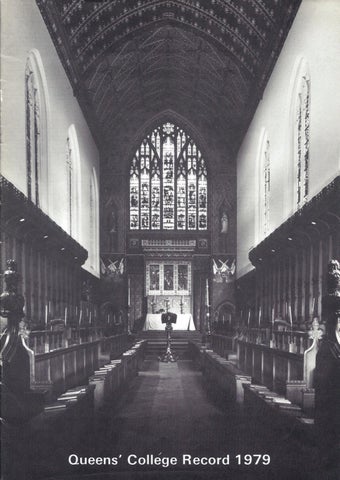
Queens' College Record 1979
Queens' College as at March 1979 Visitor HER MAJESTY THE QUEEN Patroness HER MAJESTY QUEEN ELIZABETH THE QUEEN MOTHER President DEREK WILLIAM BOWETI, Q.C., M.A., LL.D., Ph.D. (Manchester) Fellows Edwin Arthur Maxwell, M.A .. Ph.D., Life Fellow, formerly Senior Bursar and Director of Studies in Mathematics. James Arthur Ramsay, M.B.E., M.A., Ph.D., F.R.S., Emeritus Professor of Comparative Physiology, Life Fellow, former ly Vice-President and Director of Studies in Natural Sciences. The Rev. Henry St John Hart, M.A .. B.D., Vice-President, Reader in Hebrew and lntertestamental Studies: Hebrew Lecturer and Director of Studies in Divinity. Sir Harold Walter Bailey, M.A., F.B.A., LLD. (h.c.) (Perth), LLD. (h.c.) (Australian National University), 0.Litt. (h.c.) (Oxon), Emeritus Professor of Sanskrit, Life Fellow. Sir Arthur Llewellyn Armitage, M.A., LLB., LLD. (h.c.) (Manchester), Life Fellow, formerly President. Douglas Parmee, M.A., Tutor for Research Students and Director of Studies in Modern Languages. John Holloway, M.A., Litt.D., D.Phil. (Oxon), D.Litt. (Aberdeen), Professor of Modern English. Maxwell Marsden Bull, M.A., M.D., B.Ch., Director of Studies in Medicine. Henry Cohen. M.A., Ph.D. (Dunelm), Assistant Director of Studies in Engineering. Anthony Colin Spearing, M.A., Director of Studies in English. James William Longman 8eament, M.A., Sc.D., F.R .S ., F.R.S.A., Drapers Professor of Agriculture. James Martin Prentis, M.A., M.Sc. (Eng.), Ph.D. (London), Senior Bursar and Assistant Director of Studies in Engineering. Norman Francis Hughes, M.A., Sc.D., Keeper of the Records, Assistant Director of Studies in Natural Sciences (Earth Sciences). Kenneth Ewart Machin, M.A., Ph.D., Senior Tutor and Assistant Director of Studies in Natural Sciences (Physics). Ajit Singh, M.A., B.A. (Punjab, Chandigarh), M.A. (Howard, Washington), Ph.D. (Berkeley, California). Director of Studies in Economics and Politics. Brian Albert Callingham, M.A., Ph.D. (London), Assistant Director of Studies in Medicine. James Oiggle, M.A., Ph.D., Praelector and Director of Studies in Classics. Peter Jaffrey Wheatley, M.A., Ph.D., Director of Studies in Natural Sciences (Chemistry). John Tiley, M.A., B.C.L (Oxon), Director of Studies in Law. John Edward Carroll. M.A., Ph.D., Director of Studies in Engineering. Peter Gonville Stein, M .A., LLB .. Ph.D. (Aberdeen), F.B.A., Regius Professor of Civil Law. The Rev. Brian Leslie Hebblethwaite, M.A., Dean of Chapel and Director of Studies in Philosophy. lain Richard Wright, M.A., Tutor, Librarian and Assistant Director of Studies in English. John Timothy Green, M.A .. Ph.D .. Dean of College, Tutor and Director of Studies in Mathematics. David Barry Sattelle, M.A., Ph.D., Bye-Fellow; Assistant Director of Studies in Natural Sciences (Biology). Thomas Henry Coaker, M.A., Ph.D., Steward and College Lecturer in Natural Sciences. Christopher John Baker, M.A .. Ph.D., Tutor and Director of Studies in History. William Andrew Phillips, M.A., Ph.D., Tutor and College Lecturer in Natural Sciences. Brian William Napier, M.A., Ph.D., LLB. (Edinburgh), Tutor and Acting Director of Studies in Law. Richard James Overy, M .A., Ph.D., Cpllege Lecturer in History. Kevin John Gray, M.A., Ph.D., Tutor and College Lecturer in Law. Robin Douglas Howard Walker, M .A., Ph.D., Junior Bursar and College Lecturer in Natural Sciences. Roderick Arthur Smith, M.A., Ph¡. D., College Lecturer in Engineering. Andrew Duncan Cosh, B.A., Ph.D., Rooms Fellow and Assistant Director of Studies in Economics. John Clive Ellory, M.A., B.Sc., Ph.D. (Bristol), College Lecturer in Physiology. Stephen Geoffrey Wildman, M.A., Research Fellow (History of Art); Director of Studies in History of Art. Peter Raynor MacDonald Steele, M.A., Ph.D., Tutorial Bursar and College Lecturer in Pathology. The Rev. Brendan Ignatius Bradshaw, M.A., Ph.D., College Lecturer in History. Richard Robert Weber, M.A., Assistant Director of Studies in Mathematics. ~aphael Salkie, M.A., Bye-Fellow and Assistant Director of Studies in Modern Languages. The Rev. Christopher Mark Tuckett, M.A., Bye-Fellow and Chaplain.
Honorary Fellows Sidney Smith, Litt.D., F.S.A., F.B.S. The Very Rev. Henry Chadwick, D.D., Mus.B., M.A., Hon.D.D. (Glasgow), F.B.A .. Dean of Christ Church in the University of Oxford. Sir Thomas Padmore, G.C.B., M.A. Sir Harold Walter Bailey, M.A., F.B.A., LLD. (h.c.) (Perth), LLD. (h.c.) (Australian National University), D.Litt. (h.c.) (Oxon). Professor Sir Arthur Llewellyn Armitage, M.A., LLB., LLD. (h.c.) (Manchester), Vice-Chancellor of the Univers ity of Manchester. Lord Allen of Abbeydale, G.C.B .• M.A. Alfred Charles Tomlinson, M.A., Reader in English Poetry in the University of Bristol. Sir George Stanley Waller, O.B.E., M.A., Judge in the Court of Appeal. Professor Robert Neville Haszeldine, M.A., Sc. D., F. R .S .. Principal of the University of Manchester Institute of Science and Technology. Theodore Morris Sugden, M.A., Sc.D .. F.R.S., Master of Trinity Hall. James Arthur Ramsay, M.B.E., M.A., Ph.D., F.R.S. Cyril Humphrey Cripps, M.A., LLD. (h.c.)
3
Cripps Hall
S. C.R. Solarium
New kitchen
Cripps Hall
photographs D. W. B.
4
The New Development and the College Appeal The College is, at long last, in possession of its new Dining Hall and Kitchens. The Hall is very striking, in part because of its size and great height, but also because the architects have used timber to such good effect. The patterns of panels on the interior of the lantern and on the sloping roof are most effective and, whilst of the same wood and colour tone as the wall panelling below, they provide a variety and interest which is heightened by the use of concealed lighting. The white, Sicilian marble floor gives a feeling of spaciousness and yet, with underfloor heating, there is no sense of coldness. The furniture, too, seems right and is certainly comfortable. We are beginning to experiment with the hanging of pictures on the walls and by Easter the College Crest (the boar's head), the gift of the 1953 Matriculation year, will be in position in the gallery. These are the features which we hope will give to the Hall the touch of colour which it may at present lack. Through the servery one can glimpse the new kitchens. These offer a great contrast with the old kitchens, with their modern equipment, light and space. The kitchens have a new Manager, Mr Bollom, and the College has high hopes that his staff now have the equipment and facilities to produce food of high quality. This is important, not only to the members of the College, but also to the "conference trade" with which we are now equipped to cope and which is a source of revenue we need to increase to meet our overheads. The new Senior Combination Room is now in use, on the first floor of AA staircase, and the Fellows are beginning to see how it can be adapted to the various uses to which it will be put. As an L-shaped room it poses certain problems not encountered in the old Combination Room. The work on the Armitage Room, the long dining room overlooking the Court, is progressing and we hope to have this available for use by Easter, though its use for dinner parties will have to await the installation of the lift at the west end adjacent to FF staircase, which will then enable food to be brought up from the main kitchens. As for FF staircase itself, this contains some 40 much needed residential rooms and the completion of these will be the next priority.
All the above relates to the new Cripps Court development. As will be seen from the Junior Bursar's report on "the Fabric", we also have a great deal of work to do on the older College buildings. Particularly in the area of the old kitchens and Pump Court it is essential that we bring these parts of the College back into effective use. This brings me to the College Appeal, for our capacity to get ahead with much of this work depends upon the state of the Appeal Fund. As indicated in last year's Record, I accepted the advice on the College Club and two further steps have been taken in relation to the Appeal. The first was to invite the help of those Queensmen who graduated since 1968 to contribute towards the cost of restoring the old kitchens, Pump Court and the dining hall. Already the response is encouraging and to date some 165 members in this category have contributed ÂŁ19,418 either byway of single gifts or seven year covenants. We shall need over ÂŁ115,000 to complete this particular task of restoration. The second step has been to invite those Queensmen contributing to the main Appeal to continue their seven year covenants when the first seven years have expired. I look forward to a good response to this invitation, for a number of Queensmen do in fact write direct to me, without prior invitation from me, to indicate their willingness to do this. Perhaps I may take this opportunity to apologise to some of the younger Queensmen whom I have addressed in my letters by their surname, unadorned by the title "Mr", and who are offended by this practice, as I have subsequently learnt. I am caught between different social customs and, whichever one I adopt, I am bound to offend someone. Most of the older Queensmen expect no prefix, because for them the unadorned surname is a mark of mutual respect and correspondence between equals: the title "Mr" would not be used except perhaps as a mark of displeasure. Certainly I have followed this practice as the friendliest form of address and not as a mark of condescension. I hope the recipients of my letters will accept the practice in this light. D.W.B.
The Clock To wer f rom the Gate Tower; photograph M. Nicholson
5
The Society The end of the academic year 1977 / 8 brought two resignations from the Fellowship. Dr Riley-Smith resigned on being appointed to the Chair of Mediaeval. History at Royal Holloway College, London, and, whilst we would all extend to him our congratulations and good wishes, we find it difficult to conceal our dismay at his departure only six years after joining the Fellowship. The fact is that Dr Riley-Smith made a quite remarkable impact on the teaching of History at Queens'. His enthusiasm was infect.ous and the undergraduates quickly acquired respect and affection for a man who so patently found his subject exciting. He also served the College outstandingly well as Librarian, so that, for many reasons, we are left poorer by his going. The second resignation is that of Dr Mc Keown, a Research Fellow, who has been appointed a University Assistant Lecturer in Classics and Official Fellow and Director of Studies in Classics at Sidney Sussex College. Mr Weber, our Research Fellow in Mathematics, has been appointed to a University Assistant Lectureship in the Engineering Department. Both he and Dr R. A. Smith, Research Fellow in Engineering, have been elected into Official Fellowships. Professor Stein is away on sabbatical leave for the whole of this academic year} in the United States; and Mr Tiley, the Director of Studies in Law, is away in Canada for the Michaelmas and Lent Terms. Mr Wright is also away on leave for the Lent Term, in Australia. There have been certain changes in College office. Mr Hart accepted my invitation to be Vice President for this, his final year as an Official Fellow, and I must record this as one of many acts of unstinting support for which I am truly grateful. Dr Prentis has resumed the office of Senior Bursar on returning from leave, though this will be his
final year in that office. Mr Wright has taken over as Librarian from Dr Riley-Smith, Dr Gray has this year been Admissions Tutor (Arts) in the absence of Mr Tiley, Dr Diggle has become Praelector in place of Dr Overy and Dr Hughes has become Keeper of the Records in place of Mr Wright. Dr Cosh, an Official Fellow in Economics, is to be congratulated on taking his Ph.D., and Dr Gray has won the prestigious Yorke Prize, a University prize for an essay on a legal subject. It gives me special pleasure to report the election of Mr Humphrey C. Cripps into an Honorary Fellowship. The Cripps Foundation has been the greatest benefactor to the College since the College was first founded. Throughout these past ten years, and despite all the difficulties of inflation, materials shQrtages and labour difficulties, the determination of Humphrey Cripps to see the building of Cripps Court through to completion has never wavered and this has been a source of great encouragement to the Governing Body. Yet perhaps the most striking feature of the involvement of the Cripps Foundation in this ambitious College development plan has been not the scale of generosity but the personal commitment of Humphrey Cripps himself. He has devoted countless hours of his time and a great deal of thought and effort to the whole project and shown an interest which must be remarkable for any benefactor. Our Statutes require that an Honorary Fellow should be a person "of conspicuous merit, or who has done good service to the State, or to the College or to the University". There could scarcely be a more apt description, for Humphrey Cripps must qualify under each and every phrase of that requirement. D.W.B.
The Fabric The past year has.seen the re-tiling of parts of Old Court. The high winds of the winter of 1977 /78 had brought down a number of tiles, the evidence being that the iron nails used to fix the tiles had rusted away. This led to concern that the whole court might be in imminent need of roofing repairs. A survey was ordered, which revealed that most of the roofs of Old Court were in fair condition, and that wind damage was confined to the hip and ridge tiles, especially those of the dormer windows. In the main, these roofs date from the period 1909-1926, when the President of the time, Dr Fitzpatrick, restored the court, giving it the appearance we see today. One area was not in such good condition. The Queens' Lane frontage roof was evidently of earlier date, the tiles being held by wooden pegs resting on hand-riven laths. This work probably dated from 1875, when W. M. Fawcett (subsequently to be architect of Friars' Building) had superintended a restoration of the east front of 6
College. The pegs were crumbling and the lead had agehardened and cracked. A re-roofing of the area above E staircase was ordered for the summer vacation 1978. The existing roof was stripped back to the joists, where some rot was evident. This was made good, then a layer of roofing felt was laid before the tiles were replaced and the leadwork renewed. As far as possible existing tiles were re-used, with new ones mixed in randomly. This time, aluminium alloy nails were used, which should not rust away. We now have every confidence that this roof is good for another century! In the Easter vacation 1978 the hip and ridge tiles were attended to in other areas of the court. While the scaffolding was up, the opportunity was taken to re-paint the Bell-tower and Clock-tower. The clock faces and weather-vanes were finished in gold leaf. The lead roof to the Gatehouse tower was also partially replaced; the date 1913 was found inscribed in the old lead.
Before the Fisher Building was erected, the College boundary with Silver Street was marked by a set of iron railings and gates. (These may be seen ina photograph of 1925 as plate 118 in Browne & Seltman's pictorial History of the College). The gateposts were surmounted by two cast-iron eagles, and had cast iron coats-of-arms of the College mounted on their fronts. This work is thought to have been of the 19th Century. The railings and gates were demolished in about 1933 to make way for Fisher Building. Late in 1978, the eagles and coats-of-arms were rediscovered in the attic above the garages behind the Squash Courts. With the help of generous donations from old members of the College and the facilities of the Engineering Laboratories, the coats-of-arms have been re-mounted on the gates to The Round from Silver Street, and the eagles have been placed on top of the gateposts. The general opinion is that the appearance of the gates is much enhanced by these additions. Routine redecoration has this year been concentrated in Friars' Building. The rooms were all in need of attention, and the staircases had probably not been painted for over 20 years. Central heating ~had caused much shrinkage damage in the fitted furniture of the 1950's. Our rapid progress in repairs and redecoration has been greatly facilitated by the willingness of undergraduates to move out of their rooms for a week while our staff work through a room at a time. A spell of good weather in September 1978 enabled the dormer window exteriors to be repaired and redecorated as well. The electrical rewiring of the Dokett Building (apart from the basement) has been completed, and the rewiring of Old Court started, with staircases F and A. The previous wiring in Old Court had decayed alarmingly. All new wiring in our timber framed buildings is being executed in mineral-insulated copper-clad cable, which is fireproof and long lasting. In the summer vacation 1978, five students enrolled as temporary members of the maintenance staff. One was employed to repaint much of the College's guttering and rain-water pipes, while the others commenced repair work on Queens' Ditch, the isolated part of the River Cam which forms the boundary between the College and Queens' Green. For many years, the ditch has been silted up and the flow of water from the conduit has ceased. We aim to have the ditch dredged and the conduit unblocked. Before that can be done, attention has to be paid to the bank, which has been eroded so much that the root systems of several trees in the Grove are threatened. A start has been made in reinforcing the bank with timber piles, and back-filling with rubble and new top-soil. This work will continue over the next few years. Some of you may have followed the correspondence in The nmes concerning the application of the Fire Precautions Act to historical buildings. This topic is of especial relevance to the College, where we are increasingly alarmed by both the quantity and type of
work required of us if we are to comply with the Act. When applied to our historic buildings, some of the requirements can only be described as vandalism. Estimated costs of the works have increased to ÂŁ200,000, a sum far beyond our means. We plan to proceed with some of the less contentious requirements, such as the extension of our Fire Alarm system, and to continue informal negotiations with the Fire Authority on the remainder. An economy campaign has been launched on heating costs, as our fuel bill now exceeds ÂŁ40,000 per year. One measure has been the steady provision of individual radiator thermostatic valves, which make it easier to prevent rooms over-heating. This year, Old Court and Walnut-Tree Court have been so treated. A misfortune has befallen us in that one of the three large boilers which heat the College east of the river has failed irreparably. Replacing it will be singularly expensive; and the useful lifetime of the other two must now be considered limited. It seems that we must embark on a programme of boiler renewals forthwith. On a lighter note, the replacement of the underground heating mains in Old Court has been completed, and the lawn has begun to re-establish itself. Now that the new Hall and Kitchens have been opened in Cripps Court, the former kitchens in Old Court are being gutted. Our long-term plans for this area depend to some extent on what facilities are to be provided in Phase III of Cripps Court. At the moment, we envisage converting the main kitchen area either into an assembly room for meetings, functions, etc., or into a multipurpose hall, a facility the College has lacked ever since the demolition of the Fitzpatrick Hall. In the short term, we are removing the old kitchen equipment, and stripping the walls and ceilings of their finishes in order to expose the original fabric and assess restoration opportunities. We are also setting aside a small area to act as a Forward Kitchen, so that the Old Hall and Old Combination Rooms may be used on special occasions for dining. Food will be prepared in the new kitchens, brought over the river and held warm in the Forward Kitchen, from where the food will be served. In certain other areas, our plans are further forward. Over the centuries, the kitchens expanded into C staircase and into the Essex Building. We aim to restore these rooms to their original use. The stone and tile floor of the Old Hall, laid in the 19th century, is very worn and requires restoration. The wooden floor to the gallery also needs relaying. By removing the bathroom of the set of the late Mr Browne, and re-arranging internal walls, direct access can be provided to the gallery from I staircase. The acoustics of the Old Hall are ideal for chamber music, so the hope is that opening up the gallery will make the Hall even more suitable for concerts than it has proved to be in the past. R.D.H.W.
7
William Scoresby William Scoresby is outstanding among Queens' College alumni in that he achieved a great deal of prominence before his matriculation as a member of the University. Born in 1789 near Whitby in Yorkshire, he had, by the tender age of eleven, become a member of his father's ship engaged in the Arctic whale-fishing off the East Greenland coast. When only sixteen, he had been promoted to Chief Officer on the ship 'Resolution' which reached the then record latitude 81°30' North. In 1806, Scoresby began to attend courses in Chemistry and Natural Philosophy (i.e. Physics) at Edinburgh University: a friendship with Professor Jameson provided him with encouragement to publish his meticulous observations made in the course of his earlier Arctic voyages and introductions to the prominent scientists of the day. By his 21st birthday, in 1810, Scoresby was given command of the 'Resolution' and began a career spanning some 13 years, during which he became the most renowned whaling captain in Northern waters and added greatly to scientific knowledge of the Arctic. At this time, the search for the Northwest Passage from Europe to the Far East was at its height; Scoresby was himself a great believer in the possibilities of such a passage and contributed significantly to the explorations. He charted some 200 miles of the East coast of Greenland to 75°N and sailed into the largest fjord system in the world - then erroneously thought to be a passage through Greenland itself - and now named Scoresby Sound, after its discoverer, and still, even with modern navigation aids, exceedingly difficult to penetrate. In 1820 he published his 'Account of the Arctic Regions' - a classic of whaling literature, a record of Arctic exploration and a pioneer work on the science of the sea. This work was described by the President of the Linnean Society in 1928 as 'one of the most remarkable books in the English Language' and in the 'Dictionary of National Biography' as 'the foundation-stone of Arctic science'. 1824 marked an abrupt break with rich commercial success. Scoresby, after a struggle to improve his deficient Greek, entered Queen's (the apostrophe moved c. 1831!) as a 'Ten Year Man' to read Theology. He was ordained in 1825 and received his B.D. degree in 1832. Meanwhile, his scientific activities flourished - he was elected a Fellow of the Royal Society in 1824 and continued work on meteorology and terrestrial magnetism, parallel to serving as a curate in Liverpool, then as Vicar of Bradford and, towards the end of his life, at Torquay. The publication of a number of sermons resulted in the award of the Cambridge D.D. in 1839. In 1'856, at the age of sixty-seven, he made a voyage to Australia to test his opinions of the variation of the compass in iron ships: the fatigue of the voyage exhausted him and he died a few months after his return.
Spitsbergen Expedition An expedition made up of seven Queens' men went to the northern archipelago of Svalbard sailing out of Grimsby on 26th June. The two thousand mile voyage via the coasts of Norway and Bear Island was made in a converted fishing boat and took thirteen days. Several projects were successfully carried out during five weeks spent in the Billefjord area of Spitsbergen. Cloacal swabs were taken from a colony of Kittiwakes as part of the global study, being co-ordinated by the World Health Organisation, of the incidence and transmission of the influenza virus. A record of the disassortative mating in the Spitsbergen population of Arctic Skuas was made; the highest number of dark phase skuas seen on the Island since the war was noted. An accurate snout survey of the huge Nordenskiold Glacier was made to provide ice retreat data to be used in conjunction with previous plots made over the last eighty years. Brucebyen, our base, consisted of four disused and derelict huts. These dated from the time the Scottish Spitsbergen Syndicate mined gypsum and coal there earlier this century. Despite the isolated position, we met travellers from six other countries: America, Czechoslovakia, Denmark, France, Germany and the administrative state, Norway. The two Russian mining settlements in the Island house the greater part of the permanent population of Svalbard but no contact was made during our stay. The weather proved to be variable and ranged from dense mist to blue cloudless skies but rarely had plans to be changed in the face of the elements. Three members with early commitments in the U.K. flew back from the new Longyearbyen international airport whilst the others rejoined M.F.V. Copious and braved the Barents and North Seas. Despite gale force conditions in Viking and Forties, we arrived to Bank Holiday England after a comfortable journey. Members of the expedition: J. F. Cooper(Leader, Engineering), N. D. Bankes(Law), C. R. Bassett (Chem. Engineering), J.M. W. Baynham (1973, Engineering), I. G. M. Mackley (Engineering), M. P. Ripley (Zoology), J. G. Thurlow (Veterinary Medicine). J.F.C.
The note refers to a talk given in 1977 to the E Society. R.A.S. · Memorial found in Petunia Bukta, Spitsbergen; plaque reads 'Christopher John Blissett Kirton 17.8.1937 -26.7. 1958 Exhibitioner of Queens' College, Cambridge who lost his life while collecting fossils on the mountain afterwards called Kirtonryggen at the foot of which he is buried thirty miles to the North East of this, the base of the Cambridge Spitsbergen Expedition /958 of which he was a member. '
8
College Pictures A simple inventory of the College's collection of portraits has been compiled, as the first step towards a complete catalogue of College pictures. It has already proved of use, for instance, in establishing that the portrait of Archbishop Ryder of Tuam (hanging in the President's Lodge) is a close version of that in the possession of the Earl of Harrowby at Sandon Hall; both would seem to be the work of the Irish artist Philip Hussey. Three paintings were lent to the Cambridge Portraits exhibition, held at the Fitzwilliam Museum in July: Richard Newcome, by Benjamin West (1767); Henry Venn, a watercolour by George Richmond (1831), and George Phillips, by Hubert von Herkomer (1885). The West proved to be one of the exhibition's chief attractions, partly as a result of its superb restoration by the Hamilton Kerr Institute, Whittlesford; as one of the best early portraits by the second President of the Royal Academy, it constitutes a significant art historical discovery. How a relatively obscure prelate (Newcome was Bishop of St Asaph from 1761 to 1769) came to sit to such an eminent portraitist is not certain. It is probable that an introduction was effected through the President of Queens', Robert Plumtree, who is known to have been an acquaintance of Sir Joshua Reynolds, and whose wife, Anne, was the Bishop's niece. The portrait on panel of Sir Thomas Smith, which was reproduced on the cover of the 1978 Record, has also been repaired and cleaned by the Hamilton Kerr Institute. Finally, a welcome addition has been made, in the form of a contemporary painting - The Cat, by Tricia Rogers - purchased through the Senior Combination Room Committee, to hang in the Solarium. S.G.W.
The Library 1977-78
librarian: Dr J. S. C. Riley-Smith Assistant librarian: Mrs E. Machin Graduate and Undergraduate Assistant Librarians: P. C. Millett, E. R. Cook, R. S. Fieldson, B. J. Mitchell, P. J . Holmes, T. D. Howard, P. G. Smith Everyone who has been connected with the College Library since 1977 will feel the loss of Jonathan RileySmith, who, as reported elsewhere, has taken up a Chair of History at Royal Holloway College, London. His concern for the undergraduate library, in the running of which he and Mrs Machin proved a formidable team, was surpassed only by his enthusiasm for the Old Library. Thanks to Jonathan's researches, the nature and contents of the Library up to the end of the 16th century can now be readily ascertained. Nor did the historical and intellectual significance of individual books escape his keen bibliographical eye: ample evidence of this was provided by the magnificent exhibition landmarks of Science 1495-1799, held in the summer. Fellows and the many other visitors were duly impressed by the Library's holdings of important early science books, including the Aldine Dioscorides of 1499 (from Sir Thomas Smith's library), Gesner's Historia animalium ( 1551-87), Napier's first publication oflogarithms in 1614, and many others,
culminating in works by Kepler, Galileo, and Newton, whose presentation copy of the Opticks (1704) is one of our greatest treasures. Although Jonathan will be hard to follow, an equal keenness and organisational skill, combined with a knowledge of the College records, make lain Wright a natural successor. Mr. H. J. Torpey continues his work on a complete catalogue of the Old Library, and is constantly making discoveries which not only improve that work, but also add to our knowledge of the Library as an institution. Professor Goldby has steadily added to the remarkable number of books he has so kindly and so expertly rebound, while Mrs Goldby has also continued her valuable work in preserving our bindings. Paul and Claire Millett, who have aided Professor and Mrs Goldby in their respective tasks, have sadly now left Cambridge for Leicester, where Paul has gained a University teaching appointment. The untiring corporate effort of the undergraduate librarians was given a novel celebration in February, in the form of a Librarians' Dinner, held in the Erasmus Room, where an excellent meal was followed by a fascinating talk by the guest of honour, Dr Philip Gaskell, Librarian of Trinity, on the subject of mediaeval libraries. The generosity of members of the College in donating books to the Library has not diminished. The following Fellows donated books by themselves: Dr Singh, North Sea Oil; Dr Diggle Goint ed.), Dionysiaca; Dr Coaker (ed.), Applied Biology Ill" Dr Riley-Smith, The Knights of St John; Dr Gray, Property on Divorce. Professor J. N. Hillgarth gave a copy of his book The Spanish Kingdoms. Books have also been given by the President, Mr Hebblethwaite, Dr C. J. Pountain, Dr J. M. V. Rayner, G. A. Starr, R. S. Fieldson, R. S. Howard, M. J. Mitchinson, J. P. Arthur, A. Fraser, S. J. L. Resuggan and S. A. Farr. The Old Library Appeal stands at ÂŁ1,950; we are, of course, greatly indebted to those who have contributed, as well as to those who will want to contributed uring the coming year. 1978-79
Librarian: Mr I. R. Wright Assistant librarian: Mrs E. Machin Graduate and Undergraduate Assistant Librarians: P. J. Holmes, T. D. Howard, P. G. Smith, S. J. Hemmings, D. A. Meade, M. B. Robinson, N. P. Taylor. s. G. Wildman A cting librarian
Thomae Smithi Academia This discussion group, which meets twice a term, has maintained its aim of attracting Fellows from different disciplines to consider a wide variety of topics. In the Lent and Easter Terms, the discussions were on 'Alternative Technology', introduced by Dr Cohen; 'College Wine', by Dr Hughes; 'Modern Architecture', by Mr Wildman, and 'Attitudes to Risk'. The 1978-9 programme has begun with 'Democracy Games', introduced by Professor Holloway, and 'Syllabi: never mind the quality, feel the width', introduced by Dr Carroll. 9
The E Society
First Classes, June 1978
Three meetings of the Society were held in the Lent Term and three in the Michaelmas Term. The speakers were Dr Coaker, on 'Do Insects Smell?'; Mr S. M. Lees, Superintendent of the Reading Room, University Library (Qu. 1966-69), on 'Libraries and Labyrinths'; Dr Gray, on 'Changing Norms within the Family'; Dr Cosh, on 'The Collapse of British Industry and the Case for Import Controls'; Dr J . M. Holmes, University Demonstrator in Anatomy on 'Cancer and Nude Mice' and Mr R. C. Latham, Fellow of Magdalene, Pepys Librarian, on 'Pepys and his Diaries'. The E Society Dinner was held in the Munro Room on Saturday, 22 April.
Archaeology and Anthropology. S. P . Wade.
B.L.H.
The Chapel The following visiting preachers came to the College Chapel in the course of the year: the Very Rev. A. E. Hodgkinson, Provost of St Andrew's Cathed ral, Aberdeen; the Rev. Michael Till, Dean of King's College; the Rev. David Stacey, Lecturer, Homerton College; the Rev. G.D. S. Galilee, Vicar of Sutton-in-the-Isle; the Rt. Rev. M. A. P. Wood, Bishop of Norwich; Canon D. C. Gray, Rector of Liverpool; the Rev. R. Morgan, Lecturer in Theology, University of Oxford; the Rev. P . G . Brett, Church of England Board for Social Responsibility; the Rev. M. Diamond, Vicar of St Andrew the Less, Cambridge; the Rev. P. Judd, Chaplain of Clare College; the Rev. R. W. N. Hoare, Canon Residentiary of Birmingham Cathedral. Dr Bradshaw also preached, as did the Dean of Chapel and the Chaplain. The preacher at the Commemoration of Benefactors in Full Term was the Rev. J. F. White, Vicar ofThurlestone, Yorks (Qu. 1966-69) and at the visit of the Club in June, the Chaplain. There was an informal service prepared by members of the College on 19 February, and the Advent Carol Service was held on 26 November. A Memorial Service for John Francis Clough, Organ Scholar 1970-73, was held on 29 January. C. R. Bassett was succeeded in the Michaelmas Term as Chapel Clerk by T. D. Howard. The Chapel Choir sang Choral Evensong in Peterborough Cathedral on 28 January and in Norwich Cathedral on 28 October. They also made a record of Christmas Music under the direction of the Organ Scholar, S. R. Armstrong. B.L. H.
10
Engineering and Electrical Sciences. A. P. Clark, D. A. Ireland,' M. J. Kershaw, B. J . Mitchell, W. D. B. Porter. English. P. J . Smith, M. A. Soames. Geography. J. Davis, N. D. B. Dorey. History. J. M. Black, N. Rowe. Law. I. A. E. Insley, A. R. Christie, J. A. Grainger, S. N. Bridge, G. R. Newey, K. G. Young. Mathematics. S. J. Thompson, P. A. Harlow, S. H . Harmsworth, P. H. Haynes, S. P. Meacham, J. M. A. Spencer. Medical Sciences. J . A. F. Butcher. Modern and Medieval Languages. E. A. Robson, R. D. Mattick, P. T. Fletcher, S. C. Penney, D . N. Symons. Music. H. D . Keelan. Natural Sciences. J . Austin, D. J. Brown, K. J . Brown, C. M . Foale, P. W. Frew, D.S. Latchman, R. F . Lawn, S. P. Luttrell, J. R. Ridley, S. G. Roberts, S-E. 0. Tagerud, J. F. Ainslie, G. P. Barwood, R. J. Davis, P. L. Taylor, R. B. Thorpe. Veterinary Medicine. J . C. M. Lewis.
University Awards To the Yorke Prize: K. J . Gray, M.A., Ph.D. To a Jebb Studentship: M. I. Millington. To the Charles Lamb Prize: M. J. Kershaw. To Rebecca Flower Squire Scholarships: S. N. Bridge, A. R. Christie, J . A. Grainger. To James William Squire Scholarships: G. R. Newey, K. G. Young. To the Porson Scholarship and a Henry Arthur Thomas Prize: D. G. McFarland. To the Hallam Prize (jointly): D. G. McFarland To a John StewartofRannoch Scholarship: S. P. Oakley. T.o the Members' Classical Essay Prize: S. P . Oakley.
College Scholarships and Exhibitions The following elections have been made: To Scholarships D . J. Woods, Epsom College, for Economics (Colenutt). J . L. Taylor, Epsom College, for Engineering. P. M . R. Thiemann, Tonbridge School, for Engineering. N. G. Walker, Nottingham High School, for Engineering (Paterson). R. M. Hale, Sevenoaks School, for English. W. J . Sibree, Eton College, for English. R. G. Yarlott, Nottingham High School, for English (Colenutt). A. C. Macleod, King's School, Worcester, for Geography. A. R. Hammerton, Winchester College, for History to read Law. N . H. Brown, Ouridle School, for Natural Sciences to read Medical Sciences (Melsome). A. Hong, Lancing College, for Natural Sciences to read Medical Sciences (Melsome). T. R. Marsh, St Paul's School, for Natural Sciences (Munro). D. C. Knott, Judd School, Tonbridge, for Natural Sciences (Melsome). N. J. MacNaughton, The Edinburgh Academy, for Natural Sciences (Melsome). G. P. Thomas, Shrewsbury School, for Natural Sciences (Melsome). To Exhibitions R. G. Caven, Rugby School, for Classics to read Economics (Gray). M. J. Earp, Watford Boys' Grammar School, for Economics. J . D. Hillier, Bedford Modern School. for Economics. J. M. S. Hurst, Truro School, for Economics (Paterson). N. J. Knight, Davenant Foundation Grammar School, Loughton, for Economics (Haynes).
R. J. Hunter, Winchester College, for English (War Memorial). . M. J . Walters, Nottingham High School, for English (Paterson). P. D . Allen, Westcliff High School, for History (Paterson). M. A. L. Bankes, William Hulme's Grammar School, Manchester, for History to read Law. (Paterson) J. R. L. Fellows, Frome College, for History. R. C. L. Andrews, Royal Grammar School, Guildford, for Mathematics. I. N . H. Capper, Bedford School, for Mathematics (Paterson). B. R. Phillips, Lancing College, for Mathematics. R. M. Pimlott, Eltham College, for Mathematics. J . L. Raymond, Canford School, Wimborne, for Modern Languages. T. M. W. Green, Dean Close School, Cheltenham, for Natural Sciences (Glendinning Nash). T. W. Howell, Ravensbourne School for Boys, Kent, for Natural Sciences (Melsome). J. R. Kynaston, Shrewsbury School, for Natural Sciences to read Engineering (Melsome). W. C. Leung, Atlantic College, for Natural Sciences to read Medical Sciences (Melsome).
P. A. Martin, The King's School, Macclesfield, for Natural Sciences (Melsome). P. M. Slater, King Edward's School, Birmingham, for Natural Sciences (Melsome). A. G. Torrance, Marlborough College, for Natural Sciences to read Veterinary Medicine (Harvey). FIRST YEAR College Exhibitions P. A. Bancroft for Economics; S. J. Roberts for Economics; N. D. B. Dorey for Geography. SECOND YEAR Foundation Scholarships S. P. Wade for Archaeology and Anthropology; W. D. B. Porter for Engineering; M. W. M. Saunders for English; J. Davis for Geography; N. Rowe for History; A. R. Christie for Law; J . A. Grainger for Law; P. A. Harlow for Mathematics; S. H. Harmsworth for Mathematics; P. H. Haynes for Mathematics; S. P. Meacham for Mathematics; J. M. A. Spencer for Mathematics; H. D. Keelan for Music; J. F. Ainslie for Natural Sciences; G. P. Barwood for Natural Sciences; R. J . Davis for Natural Sciences; P. L. Taylor for Natural Sciences; R. B. Thorpe for Natural Sciences. THIRD YEAR Foundation Scholarships B. J . Mitchell for Engineering; M. A. Soames for English; J . A. F. Butcher for Medical Sciences; C. M. Foale for Natural Sciences; R. F. Lawn for Natural Sciences; S-E. 0. Tagerud for Natural Sciences. Bachelor Scholarships D. J. Brown for Natural Sciences; C. M. Foale for Natural Sciences; P. W. Frew for Natural Sciences; D. S. Latchman for Natural Sciences; S. P. Luttrell for Natural Sciences; S. G. Roberts for Natural Sciences.
SPECIAL PRIZES Joshua King Prizes: J. M. Black, D . J. Brown, M. J. Kershaw. Hughes Prizes: C. B. Chaloner, H. D. Keelan, S. P. Wade. Penny White Prize: S. J. Thompson. Chalmers Prize: S. P. Luttrell. Chase Prize: D. S. M. Nussbaum. Melsome Prize: J . A. F. Butcher. Lucas Smith Memorial Pdze: J. A. Grainger Proxime Accessit: S. N. Bridge. Mosseri Prize: I. M . Harvey. Openshaw Prize: P. H. Haynes.
The College Union 1977-78
President: R. F . C. Lawrie Vice-President: Dr Ba ker Secretary : R. S. Fieldson Senior Treasurer: Dr Phillips
11
Treasurer: J. W. Tate External Officer: N. D. Martin Steward of the Fitzpatrick: S. N. Cocking Fellows: Dr Bradshaw, Mr Salkie Graduates: J. M. V . Rayner, S. J. Baker Third Year Representatives: P. J. Wood, M. P. Ripley Second Year Representatives: R. F. Crellin, W. M. Macnaughton First Year Representatives: D. J. Barker, M.A. El-Erian The College Union has the task of assisting with the running of the College, expressing the opinions of junior members, and generally furthering the College's corporate life. It deals with a wide range of administrative matters, from budgeting an income of ÂŁ20,000 to the provision of services and leisure facilities. The College, it seems, is undergoing a period of change. Certainly the new dining hall and kitchens (recently completed) and the advent of co-residence in 1980 should assuage the commonest complaints about college life. In all these changes the College Union has been actively involved. This year, for the first time, student observers (four in all) have sat at Governing Body Meetings. Those of us present are grateful for the courtesy and help (regrettably, not always agreement!) with which we have been received. A number of issues have been dealt with and many were put as papers before the Governing Body. In the summer, discussions took place between the College and the Union on residence regulations. As a result there is a new fixed seventy day period of residence, and the excess residence charge has been more than halved . In addition, after an Open Meeting vote, it was agreed to introduce an opt-out scheme to finance a full-time worker for Student Community Action. Fifty pence will be added to College bills every year. This is in line with other Colleges. Another paper has resulted in the introduction of a telephone on the University Network for the free use of students (for a year's trial period). Detailed discussions also took place over the summer on the charges increases, and much information was obtained. The J.C.R. has offered an increasingly wide variety of services. Discos and a series of entertainments (including coach trips to plays and operas) have been organised. The "Oxford Shuttle" has also continued. A weighty circular was sent to first years before their arrival at Queens' to tell them about the College and its facilities. Bicycle and gown sales were organised and the Union has purchased more sweatshirts. The J.C.R. shop has been expanded and now runs regularly and efficiently with a large turnover. Grants for staircase parties and a termly calendar of events were also provided. The Stewards Committee has been revitalised and a survey is planned on the new Hall and kitchens. In addition the Union gave a 50 per cent rebate to those people paying subscriptions to take part in activities organised only at University level, and funds were allocated among the United Clubs as usual. The year has been an active one: beyond the expected and occasional disagreements there has been a spirit of co-operation between College and students. 1978-79
President: N. D. Martin Vice- Presidient: Dr Baker Secretary: A. R. Christie 12
Senior Treasurer: Dr Phillips Treasurer: J. A. Davenport External Officer: R. D. Mattick Steward of the Fitzpatrick: D. J. Barker Fellows: Dr Bradshaw, Dr Steele Graduates: R. Bettley-Smith Third Year Representatives: R. F. Crellin, W. M. Macnaughton Second Year Representatives: J. R. Owen, W. J. Soutter First Year Representatives: S. J. Phillips, J. N. White
M.C.R. 1977-78
President: Dr Bull Chairman: J.M. V. Rayner Secretary: R. Bettley-Smith Treasurer: S. J. Baker Steward: P. W. Davies Social Functions Organiser: G. J. Greenhough For a number of reasons the MCR has grown in strength and unity over the last year. An increasing number of graduates are living in College and the Woodville Room has become a central meeting place for resident and nonresident members. Since the beginning of the new academic year, MCR functions have received very good support, the dinners in Hall for instance being well attended and enjoyed. It is also pleasing to see members and their guests becoming increasingly involved in Common room activities and this must augur well for full and active MCR participation in the life of the College. The system of dining at High Table has continued to prove popular with members and our thanks must be ¡ extended to the Fellows for their hospitality. Other activities have included a cocktail party with the Fellows, a garden party on the Erasmus Lawn and a sherry party in the Woodville room for the freshmen graduates. The Common Room also organised a joint party with Newnham College MCR in the Erasmus Room and members enjoyed a Christmas Dinner and a beer party at the end of the Michaelmas Term. Queens' is very fortunate to possess the Woodville room but the success and the atmosphere of the MCR is generated by the members and not by the fabric of the room. There is increasingly a corporate atmosphere created not only by the members but by all those who make the MCR what it is. Our thanks must be extended, therefore, to all interested bodies ranging from the senior members of College to the secretarial staff, the catering staff, the cleaners and the porters. Without their assistance the M CR would be a poorer place. Our special thanks must be extended to Dr Bowett, Dr Bull and Mr Parmee for their help, advice and assistance. 1978-79
President: Dr Bull Chairman: R. Bettley-Smith Secretary: G. J. Greenhough Treasurer: P. W. Davies Room Steward: J. R. Heritage
St Margaret Society 1977-78 President: Professor Beament Vice-President: M. P. Burrows Secretary: P. M. Coad Treasurer: S. F. Chadwick Publicity: T. R. Barker Committee: S. R. Armstrong, P. A. Harlow, W. M. Macnaughton, H. D. Keelan, C. H . Elphick, M. J. Williams-Ellis The Lent Term 1978 saw the successful introduction of some variety of medium into the weekly lunchtime recitals. It also saw the beginning of a College Orchestra, which met regularly until the examination period, and only narrowly failed to give a concert! Alas, spasmodic attendance caused it to die in the Michaelmas Term. The idea of staging a recital for two pianos tuned a quartertone apart by Jonathan Higgins and Hugh Keelan unfortunately had to be abandoned, partly owing to a lack of willing composers for the medium in the University; but a Chapel Concert was held in January, and the Society's main concert took place in Great St Mary's Church. An unorthodox first half, comprising Satie's "Messe des Pauvres" (Philip Coad: Orgue) arranged by the conductor to involve the chorus Milhaud's '6icme Petite Symphonic' and Haydn's Cello Concerto (in which Philip Wicker played the virtuoso part with considerable aplomb), was conducted by Hugh Keelan; Peter Harlow conducted a second-half performance of the Mozart Requiem in which the soloists were Marilyn Minns, Pamela Rudge, Colin Stewart and Richard Knott. After a concert in the Long Gallery at the kind invitation of the President and Mrs Bowett on the first Sunday of the Easter Term, the Smoking Concert took place in Hall less than a week later. Peter Clark's uproarious script was enthusiastically acclaimed by most of the assembled company. The May Week concert included a performance of the first movement of the Second Piano Concerto by Chopin, in which Michael Burrows was the soloist and Jonathan Higgins the conductor. After Vaughan Williams' 'Serenade to Music' had been performed with remarkably few problems in the interval on the Erasmus Lawn under the baton of Stephen Armstrong, the concert concluded in Hall with Bach's Sixth Brandenburg Concerto. Two days later, a chamber concert took place in Great St Mary's Church in response to the Vicar's invitation to the Society to take part in the church's quincentenary celebrations. In sharp contrast to those at previous musical events of the term, the audience was sadly almost non-existent. The saddest event of the term, however, was the failure by the narrowest of margins of the Mag Soc Eight to gain their oars for the second successive year. The Michaelmas Term began with two chapel concerts, the second by a more willing collection of freshmen than last year! Professor Beament's birthday concert took place as usual in the Senior Combination Room, and the main concert of the term consisted of a performance in Great St Mary's Church of Brahms' Requiem conducted by Stephen Armstrong. A coach was booked to take a party of chorus members to perform in a
"Messiah from Scratch" - and to support the VicePresident in his exotic performance at the harpsichord at Thaxted Parish Church, just after the end of term: a new venture, and deemed successful by those who went. Finally, on the suggestion of the President of College, the Committee decided to form a liaison with the Music Society of Darwin College. 1978-79
President: Professor Beament Vice-President: H. D. Keelan Secretary: P. N. Coad Treasurer: S. F. Chadwick Publicity: C. Hilton Committee: S. R. Armstrong, J. A. lggo, H. S. Ridge, J. W. Higgins, J. W. Styles
The Bats 1977-78
President: J. L. Hartstone Secretary: K. T . Roberts Technical Director: C. J. M. Graves Senior Treasurer: Mr Wright Junior Treasurer: R. F. Crellin Equipment Manager: M. P. Ripley Publicity: D. S. M. Harrison Committee: P. T. Frazer, R. S. Fieldson, P. E. Pearson, I. D. Softley, E. B. Braman, A. H. R. W. Simpson, A. D. L. Lewis, J. S. Hillage
1978 was another busy year for the BATS. The Society continues to flourish as a College group enjoying University status. The year saw BATS showing productions in a variety of styles on a variety of stages. As well as using the University ADC Theatre and Christ's New Theatre, BATS once again staged productions in the Chapel and Cloister Court. The year began with a second week production of an original double bill 'Darwin's Devine Comedy' and 'Builders' both of which were written and directed by Sandra Billington, a graduate of the University. BATS was pleased to be able to finance and back Sandra and the plays were put on at Christ's New Theatre. The Chapel production was of Eliot's 'Murder in the Cathedral'. The production was directed by Paul Smith and was his first venture into directing in Cambridge. It was a resounding success, with full houses every night, even in the face of hard Chapel pews! The Lent term finished with another double bill at the ADC. The main shows was Jules Feiffer's play about American violence, 'Little Murders'. Directed by Jon Levi; the play was of a high standard though it played to small audiences. We shall remember it for its amazing props list, which included a meal for four every night, a breakable window and exploding glasses! The Late Night 'partner' was a farce called 'Black Comedy' by Peter Shaffer. ¡ The direction was inspired and the play was a success from the first night. The May Week production this year was something of an experiment. We decided to break away from the tradition of Shakespeare and put on a lavish and colourful production of Gilbert and Sullivan's 'Patience'.
13
This required a small orchestra and a high standard from soloists. The exercise was successful, the May Week atmosphere combining with the high quality of the production to make a great evening's entertainment. Pat Frazer directed the show with Simon Halsey looking after the music. It played to large audiences every night, even though the weather let us down on several occasions.
Secretary: P. E. Pearson Technical Director: J . R. Owen Senior Treasurer: Mr Wright Junior Treasurer: S. B. Provisor Equipment Manager: P. L. Taylor Committee: S. J. Roberts, J. Navon, J. J. Bell, M. J. Wickenden, G. M. Hunter, A. Goldman, K. J. Dinnage, S. K. Cherry, B. P. Taylor, D. N. Symons
Queens' Bench 1977-78
President: M. P. Burrows Secretary: N. D. Martin Treasurer: S. J. L. Resuggan
From BATS production 'Man of Mode' at the A. D.C.
The Michaelmas Term began with a show at Christ's New Theatre. The play was a little known work by Shusaku Endo, about Christian oppression in 16th century Japan called 'The Golden Country'. Simon Cherry managed to overcome some initial problems on casting and produced a thought-provoking performance. At the ADC, lain Softley worked hard to create a performance of Etherege's classic Restoration comedy 'The Man of Mode'. Iain's experience showed in a sound, fast moving performance bringing together some fine acting with a strong production back-up. The costumes for the show were particularly memorable. Jeremy Bell directed the Late Night show, a John Osborne comedy entitled 'Under Plain Cover'. This was Jeremy's first step into Cambridge directing and we look forward to his next! We continued to run a programme of lunchtime plays in the bar, the informal atmosphere enhancing the results. Our touring pantomime again visited local schools and followed the story of Alice in Wonderland. 1978-79
President: R. F. Crellin Vice-President: I. D. Softley 14
The Queens' Bench continues to be one of the most active College law societies in the University. Its Lent Term programme was particularly full. Mr Michael Selby, Governor of Brixton Prison, revisited the Society. In his talk, " A Load of Old Bricks", he described the prison system, and pointed to some faults. Professor Lord McGregor, Chairman of the Royal Commission on the Press, outlined the Commission's work of considering how far there should be interventions into the affairs of the Press. The Rt. Hon. King Murray Q.C., M.P., Lord Advocate, explained his own role and told the Society "Why British Law Does Not Exist". And, finally, the Rt. Hon. Peter Archer Q.C., M.P., Solicitor-General, spoke of the functions of the Law Officers and their places in the Constitution. During the term, there were also two visits: one to the House of Commons, and one to Brixton Prison. Our thanks go to Mr Terence Skemp and Mr Michael Selby for arranging these. The Annual Dinner was, as usual, very successful. The Guest of Honour was the Rt. Hon. Lord Allen of Abbeydale, Honorary Fellow of the College and formerly Permanent Secretary at the Home Office. To begin the Michaelmas Term, Mr Peter Soar, a solicitor, gave a general account of the failure of the legal system to meet fully the needs of the less well-off, and then told us of his own attempts to meet some of these needs in his practice ¡ in Cambridge. Next, Master Sir Isaac Jacob Q.C., Senior Master, comforted his audience by telling them that lawyers had uses, and explained his intriguing title of Queen's Remembrancer. The final meeting of the term (at which the audience was the largest in the Society's history) was addressed by Professor P. S. Atiyah of Oxford. In his talk on "The Politics of the Judiciary", Professor Atiyah suggested that the veneration of majorities in our imperfect democracy receives a valuable check in judicial concern with the individual. The Society is most grateful to the President, Professor Stein, Mr Tiley, Dr Gray and, especially, Dr Napier, for invaluable support and help during the year. 1978-79
President: S. J. L. Resuggan Secretary: G. R. Newey Treasurer: K. G. Young
Classical Society 1977-78
President: J. P. Spencer Secretary: S. G. Batchelor
During the past year the Society has been instructed and entertained by papers on diverse subjects. In the Lent Term there were three meetings. Mr J. A. Crook of St John's College gave a talk entitled "The Legal Profession in Antiquity - Was There Such a Thing?" which was followed by an animated discussion. Mr J. G. Howie of Edinburgh University presented a thought-provoking paper on the use of "exempla" in the Iliaci, and Mr G. E. R. Lloyd of King's College gave a wide-ranging analysis of the Greeks' relationship with Eastern civilisations in the fields of science and technology. In the Easter Term, Dr J. G. W. Henderson of King's College gave an imaginative appraisal of Ovid, Amores 1.14, which provoked an interesting discussion. The Easter Term saw also the eleventh annual Symposium, which proved a great success. In the Michaelmas Term, Mrs P. E. Easterling of Newnham College presented an illuminating talk on "Some Aspects of the Tragic Chorus". Our thanks are owed to Dr Diggle for his hospitality during all our meetings. 1978-79
President: S. G. Batchelor Secretary: T. W. M. Dillon
History Society 1977-78
President: J. M. Black Secretary: M. C. Prestage Treasurer: P. J. Spear Committee: K. A. Salkeld, G. S. Garnett
During the Lent Term the Society was presented with two papers, in the first of which Dr T. C. W. Blanning of Sidney Sussex gave us a detailed and often highly amusing study of the French occupation of the Rhineland during the Revolutionary Wars. In the second, Mr D . J . V. Fisher of Jesus put forward a controversial view of the role of the Baronage in the reign of King Stephen. In the following terms there was a failure to arrange any meetings, a consequence perhaps of our shock at losing Dr Riley-Smith, who departed from this world for a Professorship in London. His presence is greatly missed. We had to postpone the Society Dinner at the beginning of the Michaelmas Term because Lord Chalfont was unable to attend it. It will now be held in the Lent Term. Next, some propaganda films that had been sent for failed to make an appearance! In spite of these misfortunes, however, the Society did suceed in meeting twice during the course of the term: on the football field against the economists, and lastly to hear a paper by Dr R. Porter of Churchill on the history of interpretations of Noah's Flood, which proved most interesting. We look forward to a more ample programme in the coming year.
1978-79
Pres.Jent: M . C. Prestage Secretary: K. A. Salkeld Treasurer: P. J. Spear Committee: J. C. V. Thomas, A. J. Bailey, W. D. A. Haire
Medical Society 1977-79
President: R. J. C. Gilson Secretary: A. H. R. W. Simpson Treasurer: J. R. Sneyd University Medical Society Representative: F. C. Millard
During the Lent Term, under the Presidency of R. J.C. Gilson, four talks were given. Their subjects were: "What is the Patient's Occupation?" by Professor R. S. F. Schilling, "Aspects of Coronary Heart Disease" by Dr D. W. Evans, "Medicine and Science on Everest 1975" by Dr C. R. A. Clarke and "Aspects of Comparative Neurological Pathology" by Dr A. C. Palmer. At the end of the Easter Term, the same Committee organised a very successful Garden Party, held in the Fellows' Garden. We were able to hear four talks in the Michaelmas Term, beginning with Dr 0 . A. Sills on "My Work as a General Practitioner". Professor J. A. Dudgeon, Dean of the Institute of Child Health, gave us a very interesting talk on "Immunisation", while Mr P. F. G. Hanbury gave us his view of "The Pharmaceutical Industry in Britain", which was illustrated with a film. Our final speaker of the term was Dr H. S. Wolff, Head of the Bioengineering Division of the Clinical Research Centre, whose talk on "The Impact of Technology on the Medical Services and the Future?" put forward some very stimulating ideas on what the future role of the doctor might be. Again we were fortunate to be able to hold our Annual Dinner in the Munro Room. The Dinner was very well attended this year, with forty people present. Dr R. N. Hardy of the Physiology Department was our Guest of Honour. The Society would like to thank Dr Bull for the kind use of his room for its meetings, and also for entertaining the speakers before each meeting. 1978-79
President: M. W. Elliott Secretary: F. C. Millard Treasurer: C. D. Saitch University Medical Society Representative: T. Q. Howes
Christian Union 1977-78
College Representatives: C. M. Keep, P. J. Dowley
The Christian Union is open to all Christians in Queens', and aims to promote the Kingdom of God through Bible Study, prayer, and informal meetings. The Queens' College Union is affiliated to the Cambridge InterCollegiate Christian Union (C.I.C.C. U.). 15
It would be wrong to summarise the past y:!ar only in terms of the meetings and activities that were arranged by the group. The true test of our "~uccess" as a group is to examine how each individual Christian has grown in his personal faith, and has been encouraged to be part of our Fellowship and to share his faith and experience with others. An important aspect of the role of the Christian union is to train Christians for future leadership in the Church. We have six small groups meeting for Bible Study each week, and leaders and members alike gain much from participating in them; and it has been most encouraging to see over fifty regularly attending and contributing to their activities. In addition to these, we have a weekly prayer meeting and Sunday lunchtime meetings. The latter provide a chance to meet informally, and to get to know one another in the mad scramble for food! The 1unch is often followed by a short talk. These have included challenging addresses on Christian discipleship in the world, by Patsy Evans of Holy Trinity Church, and by exQueensmen John Harvey and Stuart Anderson on their missionary work in Yemen and Pakistan respectively. The focus of the Lent term's activities was a series of supper and tea parties, and discussion groups organised by members for their friends , with an opportunity to talk frankly about the claims of Jesus and the Christian message. Many discussion groups still operate, and are open to anyone wanting to discuss the Christian faith . In the summer term, many of us helped to repaint the Cyrenians' house for the homeless in Cambridge, and the Cambridge University Mission, a youth club in Bermondsey. These activities were sponsored to raise money for T.E.A.R. Fund. Later in the term, we held a "Rich World - Poor World Lunch", at which Margaret Winfield of T.E.A.R. Fund told us of the challenge of Third World Poverty, and of our responsibilities as Christians. Just before the Michaelmas term, we went to Tonbridge for our annual house party, a chance to relax and prepare for the coming year. We are very grateful to John Sentamu of Selwyn for leading us in four powerful talks on aspects of our life as members of the Church, the Body of Christ. Later in the term, the Rev. John Mai:sh of St Matthew's Church gave us a penetrating talk at an evangelistic meeting which packed the Erasmus Room. We are most grateful for all the outside support and encouragement that we receive. As a group, we must never lose sight of the fact that we organise our activities, not for our own sake, but in order to appreciate and serve the God in whom we believe and trust.
Film Society 1977-78
President: M. L. Alderman Secretary: J. A. Davenport Treasurer: G. M. Henderson The report for 1977 ended on a note of optimism, our new projector having arrived at the end of the Michaelmas Term. Since then, however, it has spent more time with the manufacturers than in Queens' Hall! Its first failure came after only three hours' use, but we are indebted to New Hall and St Catharine's Film Societies and to the Eastern Arts Association for the use of their projectors which enabled us to show all our advertised films. Nevertheless, it has seemed to the projectionist that hardly a film has gone by without some technical hitch. With the projector again newly repaired, however, we wish next year's committee (Phil Holman, John Kimberlin and Mark Robinson) a trouble-free programme. The Lent Term saw the success of the Mel Brooks' Western, "Blazing Saddles," Peter Sellers in "The Return of the Pink Panther" and the marathon, mud-filled extravaganza that was "Woodstock." However, the President's choice of Peter Fonda and Alistair Maclean thrillers did not go down as well as expected, with "Dirty Mary, Crazy Larry" and "Caravan to Vaccares" playing to half-full houses. The term ended with Dirk Bogarde receiving rough justice in "The Night Porter" and the slow-motion, exploding refrigerator and wardrobes of "Zabrisk ie Point." The major film societies in Cambridge, including ourselves, experienced difficulties in obtaining films during the period from March to June owing to procedural difficulties with the distributors. T his resulted in the cancellation of "Last Tango in Paris" in the Lent Term and is the reason that no films were shown in the Easter Term. As a direct result of the difficulties of last spring, the Michaelmas Term saw the introduction of a strictlyenforced membership system and of one showing per night rather than the familiar two. We continued to draw packed houses for the cultural(?) opener, "Confessions of a Window Cleaner," and later in the term for "Carrie" and the seemingly immortal Marx Brothers' "Animal Crackers." Clint Eastwood struggled with a mountain in "The Eiger Sanction" and lived to tell the tale, though our attempts to entertain a predominantly male audience with "Vampyres" and "Erotic Inferno" were not well supported. But "Snoopy Came Home" to end the term happily, with the Society solvent, in spite of the major changes it saw over the year. 1978-79
1978-79
College Representatives: D. S. M. Nussbaum, P. J . Sourbut
16
¡President: M. L. Alderman Secretary: J . Kimberlin Treasurer: G. R. Enever
Sporting and Other Activities Officers of Clubs 1978-79
Association Football Athletics Badminton Basketball Boats Bridge Chess Cricket Cross Country Hockey Rugby Football Sailing Shooting Squash Swimming & Water Polo Lawn Tennis Table Tennis Tiddlywinks
Captain P. G. Hrycyszyn R. B. Cattell M. A. Smallwood J. Navon P. B. Holmes J. M. Bergwerk R. C. P. Freeman G. P.A. Brown R. A. Mathews J. J. Bell S. J. Horrocks M. B. Alabaster C. N. Tremlett M. J. Hudson D. A. Hughes M. D. R. Rowan W. J. Rogers C. G. Hardman
Secretary K. J. Skea, W. J. Rogers
Treasurer M. A. El-Erian
N. A. Pike M. A. El-Erian J. H. P. Powell J. A. Grainger P. A. Bancroft S. J. Horrocks P.H. Haynes M. W. Verity M. W. Elliot
M. V. Goodyear D. M. D. Wyman W. D. B. Porter A. K. Gupta P. A. Bancroft M. V. Wiggett
D. J. Barker S. G. Batchelor B. C. Richardson B. C. Abrams C. W. Brown
P. L. Taylor T. R. Coles S. G. Batchelor R. I. S. Henley R. H. L. Harrison B. C. Abrams D. Taylor
Not the latest in boat design, but Queens' bumping Churchill, May /978.
Boats. The Boat Club began the year by entering the First and Second Eights in the Peterborough Head. The First Boat excelled by winning the Senior B class, and the Second Boat performed well considering its relative inexperience. ln the Lents, the First Eight rose one place, bumping Lady Margaret II, and then several times came within bumping distance of Emmanuel on the following days. The Second Eight dropped one place. Bedford with' its carnival atmosphere was an excellent occasion on which to end the term, the First and Second Boats both being well placed. Queens' had eight boats entered for the Mays. The First Boat bumped Churchill, but once again rowed over on the following days very close to Magdalene. The Second Boat fought with Sidney Sussex being bumped by them, bumping them back and then being bumped back again. The Kangaroo Eight won its oars and the Medics and the St Margaret Society were
both close to winning their oars with three bumps. At Henley, competition was very high with a new influx of foreign crews who were not required to qualify entering the Ladies Plate. This meant that many Cambridge crews were forced to qualify and few were successful: Queens' missed qualifying by two places. In the Michaelmas Term, there were six boats, two Novice crews and four Fairbairn crews, the Fourth Boat being part novice as a new entry. Despite winning practice times, the First Eight did not rise to expectations, dropping to twelfth place, and the Second Eight dropped one place. However, the Third and Fourth boats rose ten and seventeen places respectively. The Emmanuel Regatta was abandoned because of a frozen river and postponed to the Lent Term. With the enthusiasm we have throughout the Club, there is determination to build on and improve still further the standard of rowing achieved in 1978. 17
Rugby. The First Rugby XV started the Lent Term with a 100 per cent record in all League games which was duly maintained with comfortable victories over Fitzwilliam 11 and Downing IL Thus the First XV walked away with the Second Division championship and so regained their place in the First Division. The Second XV also concluded their season in fine form, emerging as Third Division champions. In the first round of Cuppers, the First XV had an easy victory over First Division Emmanuel, but in the second round met Christ's, who were strengthened by the international presence of John Robbie, who won the game off his own boot with three well taken drop goals. Despite fielding a considerably weakened side, Queens' performed splendidly and there is little doubt that victory would have been theirs had it not been for John Robbie. The result was a disappointing 9-6 defeat. With a seasoned and largely unaltered-squad, the Club entered the 1978-79 season with an optimism soon justified by a crushing 37-10 victory over St Catharine's. However a miserable performance against Christ's and defeat in an exciting, closely contested match against unbeaten St John's ruled out all hope of winning the First Division championship. The Michaelmas Term ended with a tour to South Wales as guests of Cardiff High School Old Boys, a club containing several former Queens' men. Narrow defeats were recorded in the two games played but this did not detract from a very enjoyable tour. Stephen Killick represented the University in the Varsity match at Twickenham and Adam Leach captained the University Freshmen against Oxford Whippets.
Association Football. The run in Cuppers of the Association Football Club First XI proved to be shortlived once again. After managing to force a draw against Magdalene, the team flagged as the replay ran into extra time and lost 3-2. Better was hoped from a very strong and consistent Second XI in the Plate competition, but they lost on penalties when they should have reached the semi-finals. In the friendlies arranged for the Lent Term, Jesus had their revenge for the League .defeat and the College annihiliated Fitzwilliam in a bitter match. Returning in the Michaelmas Term, with some six or seven regular first team players gone, the College, lacking a settled side, played some disastrous friendlies against Christ's. We were not helped by a number of injuries to key players, notably Joe Owen the goalkeeper, which led to the introduction of Ken Young whose game developed quickly, and Dave Royle who was a convert from Rugby. After the first three games against Churchill, St John's and Christ's, the team might have felt despondent. However, freshmen Andy Mackenzie and Andy Kirby began to flourish and the team started to improve, and did not again lose in the League. Charlie Abrahams playing out of goal showed impressive jumping and determined tackling, while Ken Steed behind- him at sweeper eventually found his right position in the team. The College beat Emmanuel 5-2 and proceeded to win well fought draws with Fitzwilliam and Trinity. According to Stop Press, our final match with League title favourites Jesus was a foregone conclusion. Queens' proved Stop Press and taxi-loads of Jesus supporters wrong by hanging on to an early well-taken goal by Paul Hrcycszyn. 18
The Second XI was affected by the recruitment of its players to the First XI and rarely managed to field a settled side. Ending up in mid-table, they won on occasions but suffered heavy defeats by skilful teams like Downing. The College once again ran a Third XI, ably captained by Jim Davis and Steve Rudge, so that everyone who wanted to play football was able to do so. Cricket. Of the Cricket Club's fifteen games in the summer of 1978, eight were won, and six lost; only one was drawn, due largely to the fact that almost all of the matches were played subject to 'limited over' regulations. Bearing in mind the considerable talent carried over from the previous year, most notably in the persons of Joe Bennett, Barry Bennett, Niall Moore and Martin Hudson, the Club record was perhaps a little disappointing. Of these four, perhaps only Martin Hudson recaptured the form of 1977, proving himself again to be a bowler of sustained and intelligent aggression; none of the other three succeeding in scoring the runs of which each is capable. In consequence, the weakness of the side always tended to be in its batting; this was demonstrated in the first round Cuppers defeat at the hands of an admittedly strong St Catharine's side, although sheer guts and character were often to give it strength in depth. The Club's bowling and fielding were strong; Hudson apart, bowling honours went to pacemen Mark Wiggett and Martin Robinson, both freshmen, with 20 and 16 wickets apiece, while the Captain's remarkable performance against the unfortunate Southwell Ramblers, with his formidable armoury of leg-breaks, demonstrated that modesty kept his talents in reserve far too often. As Captain, Joe Bennett was exemplary: his leadership was always enterprising, original and often quite brilliant, and his enthusiasm and good cheer were undeniably infectious. The season concluded with a highly enjoyable and successful tour of West Germany where four games were played against garrisons of the British Army; our thanks are due to 2nd Lieutenant B. U. P. Bennett, Royal Engineers, Secretary of QCCC, who not only organised the tour, but also inexhaustibly guided our white 'Willhire' rental van down endless kilometres of German motorway. Hockey. The 1978 Lent Term began with the First XI in the lower depths of the First Division, after a disastrous Michaelmas Term in which only one point was won from six games. However, with the return of Clive Large to the midfield and Phil Pearson beginning to find his true form, the goals returned and saw us through some tough and exciting victories over Sidney Sussex, Christ's, Jesus and Pembroke. In fact the only defeat of the term was against the run-away winners of the League, Magdalene. By the end of the season, the team had climbed well clear of the relegation zone into the middle of the League - a truer indication of its all round ability. In direct contrast to this rejuvenation, the Second XI, under Peter Haynes's captaincy, began the term in a strong position, but after a heavy defeat in Cuppers by Pembroke somehow lost its way in the League. By the end of the term the team had slipped to fourth position in the Third Division, thus narrowly missing promotion. This disappointment was tempered by a good win over Pembroke, which avenged the previous defeat and ended the season on a high note.
The new season began without the strength and ability of Nick Birchall and Mike Keep, though among the Freshers Jim Price and Chris Hull were impressive players. Under Jeremy Bell's captaincy, the prospects looked good for the season. Unfortunately, the team was slow to find its rhythm, and although scoring more regularly than in the previous season, the tendency to let in simple goals at crucial moments in the game resulted in a slow start to the season. Defeats by Trinity (0-1) and Christ's (1-3) anticipated an early exit from Cuppers at the hands of Second Division Emmanuel, despite the presence of Stuart Warrington, whose skill and ability has been recognised by a place in the University First XI. This defeat was something of a turning point, however, for it spurred the team on to a convincing victory over Downing, and a draw against a strong Pembroke side. After defeat against St Catharine's, the side again rallied to score a 2-0 victory over Magdalene, previously unbeaten for two seasons. With this victory behind them, and with Wanderer player Clive Large beginning to dominate the mid-field, the hope is that the team will develop into a strong force by the end of the season, and improve on last year's final League position. The Second XI has enjoyed a strong start to their season, winning all but one of their League games. A great deal of their success can be attributed to the enthusiastic captaincy of Simon Walkden, who has combined the nucleus of last year's side with the fresh talent of playe"rs like Martyn Williams-Ellis and Tim Chamberlain, and produced a free-scoring and enthusiastic side. Promotion to the Second Division would seem to be just a matter of time. Finally, the secretary, Mike Verity, and the treasurer, Phil Taylor, worked very hard to promote the enjoyment which both sides have had, both on the pitch and off. Athletics. The Athletics Club again met some tough opposition in Cuppers this year and failed to make the finals. Maybe when the Rugby clubs and Boat clubs realise that athletics Cuppers exist, we will be able to produce a full team. The College continues to provide a significant number of athletes to the University team. Last year Nick Dorey, Nigel Cowan and Ross Cattell competed for the Blues team and Cowan and Cattell were both awarded their full Blues. We are looking forward to another successful season and have been joined by freshman Tim Eglen, who should make a strong impression on the University team. Cross Country. In the Lent Term 1978 the Cross Country Club consolidated its position to take the First Division title, winning both League races comfortably. In the Selwyn Relay two teams were fielded, the First team taking third position, and the following week a team won the less competitive Hare and Hounds Relay. The Michaelmas Term saw most of the previous year's runners remaining and with, a University-standard freshman, Tim Eglen, and the University Secretary, Nick Dorey, it seemed inevitable that Queens' would repeat their successes of previous years. However, although the first League race was won ea,,;!y, in the League Relays at Wandlebury the team was weakened and we were beaten by both our opponents. In Cuppers Queens' were defeated for the first time in a decade, losing by one point to St John's. The race was won by Nick Dorey who, with Tim Eglen, was selected for the Blues team, while Stuart Oglethorpe, again sadlv
injured at a critical stage of the term, ran for the University second team against Oxford. Swimming. The Swimming Club, as ever, suffered from the rules barring Blues and Half-Blues from the Cuppers events. Without our more experienced members therefore, the team came third, an entirely creditable but not unexpected result. Individual performances from Ian Henley, Bruce Richardson and John Crisp deserve a mention. The major interest of the club is Water Polo. This year our luck changed, as we lost our position at the head of the League and finished third. Our Half-Blues, Alwyn Hughes, Mike Scotford-Smith and Dave Wrigley formed the nucleus of the team, calling on a competent pool of players to complete the team. Our lack of an experienced goalkeeper was probably the reason for our lack of success, a weakness that is well nigh impossible to cover. At the end of the summer we lost our Captain, Mike Scotford-Smith, but gained several keen and rapidly improving freshmen with whom we hope to improve our fortunes in 1979. Squash. Although there is considerable strength in depth, the achievements of College players have been disappointing. The First team has lacked a couple of class players¡ to replace departed "stars" and the Lent Term saw us slip to relegation. The performance of the other five teams was more encouraging, most of them holding their own against strong opposition. The Second team was forced down by the relegation of the First team, an unfortunate rule. The Michaelmas Term has not been encouraging in_ terms of results, but there are many competitive freshmen at all levels including a handful of competent players who are getting into the first two sides. With experience gained this year Queens' should begin to climb the steep ladder of success once more; further ahead, the long promised new courts would do much for such a revival. Lawn Tennis. The Tennis Club had an indifferent season, with the First VI finishing low in its division. First pair, Mike Keep and Mark Rowan, played some excellent tennis to win many of their doubles matches. Second pair, Mike Anson and Roger Bayliss, were steady and put up many consistent performances as did Robin Harrison and John Wood as third pair. It was in the singles that the team as a whole was weak and conceded overall defeat. In Cuppers we came up against Trinity in the first round, where Keep and Rowan played splendidly, with Rowan winning his singles against Grasshopper opposition. However, we lost 8-1. Spirit remained high throughout the season, and with an influx of good freshers and many colours still in College, prospects seem good. Sailing. Despite the cold weather, Cuppers were held in the Lent Term with almost all the Colleges taking part in a League competition. We were not able to field a full team and so were paired with Trinity Hall and put out one boat for each match. Unfortunately we did not do well and dropped out of the competition half way through the term. A lot of valuable work was done refurbishing the college 'Lark' dinghy and renewing some of its equipment and rigging. It has since been used quite extensively by members of the College, both on the river Great Ouse at St Ives and further afield, being given a taste of salt water
19
around Hayling Island in the summer. We had hoped to enter the 'Lark' National Championship at Hayling Island but were unfortunately unable to get the boat officially measured in time. The new academic year has brought an encouraging number of new members and we hope to improve greatly on our Cuppers performance this year. We are teamed with Corpus Christi and Homerton and so could do well. Shooting. The Shooting Club was revived officially in Michaelmas 1978 under Dave Barker and Nick T remlett. Both earned Half-Blues in the summer Varsity match and so prospects for 1979 are good. Queens' has a good chance of success in the small-bore Cuppers and for individual involvement in CUSBC and CURA teams in 1979.
Badminton. With four teams fielded, the Badminton Club had the largest number of playing members since its conception, and this interest was rewarded, for the Second, Third and Fourth teams were all promoted. The First team ended in third place in the First Division. This was a creditable achievement, although it was felt to be a disappointment by the members of the team. In Cuppers, we once again managed to reach the semi-final, and we can only hope for even more success this year. In the Michaelmas Term, the higher divisions provided very tough opposition, and this, along with the regular Sunday morning practices introduced this year, has resulted in obvious improvements in all players. Basketball. With the increasing interest in Basketball within the College, the Queens' Basketball Club reemerged in the Michaelmas Term. Most of the efforts of that term were concentrated in building a solid foundation. One match was played against Christ's. Despite the presence of four Blues in the Christ's team, Queens' managed to finish the match only 10 points behind after being level at half time. More matches have been organised for the Lent Term and we look forward to them with optimism. Table Tennis. The 1977-78 season saw promotion for two of the three Table Tennis teams, the First team remaining unbeaten throughout the eleven match league programme to gain a place in the Second Division, while the Second team won a place in the Third Division. This season an upsurge of interest has increased our strength to five teams, and with the First, Second and Fourth teams top of their divisions and the other two in strong positions after five matches, we are very optimistic. Freshman Mark Walmsley won a place in the University First team, and other notable performers were Niall Campbell, Stephen Donaghy, Ian Mackley and Martin Robinson. Chess. The Chess Club had a very successful year in 1978, with the First team finishing fourth in Division One after its promotion last year, although in Cuppers we lost in an early round to champions Trinity. Further strengthened in the Michaelmas Term by freshmen Kim Harris and Nigel White, we are now leading Division One, but we face stiff opposition in the Lent Term. The Second team achieved promotion to Division Two and has performed well there, playing mainly against first teams of other colleges. The Third team had a good first season, but its recent results in Division Four have been 20
mixed. A Fourth team, founded in response to growing interest, has had a difficult time in the same division.
Bridge. The Bridge Club had a successful first half to the year, with the First team again reaching the quarterfinals of Cuppers, before being knocked out in an extremely close match against Caius I, the eventual winners of the tournament. This season the strength of the club has declined considerably, with three out of four of last year's First team having left College. However, with the initiation of weekly meetings of the club, we hope that we will return to winning ways next year. Tiddlywinks. The year 1978 has proved to be the most successful ever for the college Tiddlywinks Club. After an early, difficult battle with Emmanuel in College Cuppers, that was forced to a replay, the College First team scored a memorable victory over Trinity Hall in the final , bringing the trophy to Queens' for the first time. The Club was also honoured to provide three members for the University team that regained both the.Silver Wink and the Varsity Trophy in the summer. We now look forward to continued support for the quality of play to retain these titles.
Queens' Men in the North-West The Twenty-eighth Annual Dinner for Queens' Men in the North-West was held at the Old Vicarage Hotel, Stretton, near Warrington on Friday 17 March 1978. The Rt. Rev. B. F. F. Crane presided . Nineteen members of the College were present ranging from those who matriculated in the 1920's to those who did so in the I 960's. The guest of honour was Dr J. T. Green, Dean of College. The next dinner will be on Friday 6 April 1979. This year the Guest of Honour will be the Senior Tutor, Dr K . E. Machin; enquiries should be addressed to the Rt. Rev. B. F. F. Crane, The Rectory, Astbury, Congleton, Cheshire CW12 4RQ.
Queens' Men in the South-West The sixth Annual Dinner for Queens' Men in the SouthWest was held on 5th May at the County Hotel, Taunton. Bishop Claxton again presided and some eighteen members of the College were present for a most enjoyable evening at which the Guest of Honour was the President, Dr D. W. Bowett. Despite the difficulties of holding a dinner in a "constituency" with members scattered over long distances it was felt that the occasion was worthwhile and every effort should be made to continue it. It was agreed, therefore, that another dinner should be held on 11th May 1979, at the County Hotel. Arrangements are being made by E. W. Chanter of Malsover, Calverleigh, Tiverton (Tel. Tiverton 2228) and members wishing to attend should contact him. The Guest of Honour will be Mr B. L. Hebblethwaite, Fellow and Dean of Chapel of the College.
Deaths We regret to record the following deaths: A. H . Pearson, M.C., T.D. (1904) L. Fabricius (1906) The Revd. W. E. Wycliffe-Jones (1912) . T. W. I. Bullock (1919) C. S. D. Moore (1919) R. Pattison (1919) H . F .. Rutland, Mus.B. (1919) H. B. Burrows (1920) H. E. Castens, M.B.E., M.C. (1921) E. L. Garland ( 1922) E. C. Kennedy (1922) R. M. Barford (1923) W. S. Richardson (1923) The Revd. M. C. Garton (1924) B. Holden, M.B., B.Chir. (1926) C. W. Ward (1926) L. F. W. Knight (1927) K. C. Cheang (1929) R. S. Bickerton (1931) J. R . C. Kenyon, M.C. (1932) P. A. Lee (1932) A. Hertzberg, B.S. (Harvard) (1935) Professor S. H-P. Cheung, Ph.D., D.S., M.S. (1936) The Revd. E. V. Johnston (1936) F. S. Carter, M.D., M.R.C.P., D.C.H. (1937) J. Cunliffe (1943) A. F. Syme (1953) R . W. Dean (1962) W. G. Fulford, M.B., B.Chir. (1970) C. J. N. Alty (1956), former Research Fellow of the College, I 962-1965 and thereafter University Lecturer in Engineering, University of Warwick. 12 February 1979).
We apologise for an error in the Record for 1976, in which C. J. Davies (1954) was wrongly included among the deaths; also in the Record for 1978, in which W J. G. K. Viney (1945) was wrongly included.
News of Queens' Men Distinctions C.B.: M. W. Holdgate (1949). C.M.G.: P. R. N. Fifoot (1945). Ecclesiastical The Rev. L. C. Bowser (1972) is Succentor of Ripon Cathedral. The Very Reverend H. Chadwick, D .D., F.B.A. (1938) has been elected Regius Professor of Divinity, Cambridge, from 1 October 1979. The Rev. R. C. Godsall (1967) is Chaplain at Trinity College, Cambridge. J. R. De la Haye (1971) is at the South Wales Bible College, training for the Baptist ministry. The Rev. J. W. Hubbard (1913): The Bishop of Lynn preached at a service in Blofield Church, Norwich Diocese, to mark Mr Hubbard's 30 years in the Blofield Deanery.
The Rev. Canon D. Pink(l955)isEcumenicaI0fficerfor Lincolnshire and South Humberside, Canon of Lincoln Cathedral. G. Weston Craig (1974) is serving as Assistant Curate in the parish of Christchurch, St Marylebone, London N.W. The Right Rev. D. G. Wilson (1921); a service at St Mary's Church, Beaminster, attended by nine bishops, marked his completion of 40 years as a Bishop. Bishop Claxton (1923), Noel Kennaby (1925) and Linley Blathwayt (1935) took part. Educational D. J. Abrehart (1968) is Head of Languages, Kingsbridge School, Devon. A. G. Armstrong (1957) is visiting Professor of Economics (1978-9) at Duke University, North Carolina. B. Blackwell (1954) is Professor and Chairman, Department of Psychiatry, Wright State Univeristy, Ohio. D. A. Collard ( 1957) is Professor of Economics at the University of Bath. I. N. R. Creese (1967) is Assistant Professor of Neurosciences at the University of California at San Diego. N. S. Davidson (1971) has a lectureship at Leicester University. R. V. G. Evans (1964) teaches English at the Sixth Form College, Luton. A. W. Goudie (1974) has been appointed Junior Research Officer in the Department of Applied Economics, Cambridge. P. Happe (1952) was a Fellow Commoner (Michaelmas 1978) at Jesus College, Cambridge. R. P. Heazell (1956) is Headmaster, The Hall School, Hampstead, London N. W.3. C. N. Hudson (1949) is Professor of Obstetrics and Gynaecology in Sydney, Australia. P. H. Jones (1969) teaches at a Sixth Form College in Huddersfield. G. Kirk (1929) has resigned from his Professorship of History at the University of Massachusetts, Amherst. D. Lavelle (1963) is Deputy-Principal at Pendleton Sixth Form College in Salford. J. M. V. Rayner (1971) is a Post-Doctor Research Assistant in the Department of Zoology, Bristol. W. D. C. Rees (1943) is University Lecturer in Education and member of the Anglican Chaplaincy Team, University College of North Wales, Bangor. R. M. J. Tank (1943) is Director of Sixth Form Studies, Chiswick School, London W.4. Other K. G. Bergin (1929) PresidenHlect of the International Academy of Aviation and Space Medicine, was, in 1978, President of the 26th International Congress of Aerospace Medicine. D. W. Bowett (1948), President of the College, was appointed United Kingdom Judge of the European Nuclear Energy Tribunal by the Council of OECD. J. N. Bulmer ( 1970) is a Registrar at Warwick Hospital. P. E. Gawne (1971) is a Veterinary Surgeon at the R.S.P.C.A. Sir Harold Harmsworth Animal Hospital, London. T. N. Hudson (1951) is Presidente of LC.I., in Mexico City.
21
D. R. Karlin ( 1971) won the prize for the best poem by a poet under the age of 30, in the Sunday Times/BBC2 Poetry Competition 1978. M. Kershaw (1975) is an accountant with Arthur Andersen Ltd. P. W. Mummery (1944) is Director of Health and Safety, British Nuclear Fuels Ltd., Risley, Cheshire. A. J. Payne (1952) is Counsellor in the British Embassy, Mexico City. G. R. Phillips (1970) is a management trainee with Plessey, llford. P. T. Robertshaw (1970) works in the Museum of Archaeology, Grahamstown, South Africa. H. J. Savill (1971) is a medical practitioner in London. N. M. Shackleton (1971) is teaching in Kyoto, Japan. R. I. Smith (1960) is working with I.CJ. in Mexico. J. J. Strauch (1973) sings as a baritone at the Royal Academy of Music, and was awarded first and second prizes (1978) in the Kathleen Ferrier Competition. H. W. Symons ( 1945) is a Consultant in the Research and Technical Services Di\'ision, American Frozen Food Institute, Washington D.C. N. J. G. Vickery (1971) is an assistant solicitor in Brighton. R. L. Ziemacki (1968) is with the Cambridge University Press in New York.
The Years 1972-1975 Men matriculated in 1972 and just eligible for the Degree of Master of Arts.
Ecclesiastical N. H. P. McKinnel is reading Theology at Wycliffe Hall, Oxford as preparation for ordination into the Church of England. A. Sowerbutts is a Clerk in Holy Orders; Assistant Curate, St Peter Salesbury, Diocese of Blackbum. R. S. Wiiliams is an Ordinand, training for the Ministry of the Church of England.
Educational M. W. Banks is studying for an M.A. (Econ) in Social
Administration and Social Work at the University of Manchester (seconded from County of Stafford Social Services Department). R. H. Bradbury is a Ph.D. student in the Department of Organic Chemistry, University of Liverpool. D. J. Conneam is a Youth Worker, E.F.L. Teacher and Art Student. ¡N. S. Cooper is an Assistant Biology and Careers Teacher at the Royal Liberty School, Romford. J. A. Crozier is continuing his research for a Ph.D. at the University of Lund, courtesy of a grant from the Swedish Institute. S. R. Cubitt is in the third year of a doctoral programme at McGill University, Montreal, where he also holds a position as teaching assistant in the Department of English and Communications. S. A. Elwell-Sutton is a teacher at Woodard Public School, teaching Mathematics, Computing and a General Studies coutse in Electronics. Q. C. Given is taking a post-graduate Certificate in Education course at the Institute of Education, London University. 22
A. Goldstein is a Ph.D. candidate in the Department of Economics at Yale University. From May 1979 he will be working as Economist, Microeconomic Analysis Group, Bell System (AT&T), New York, U.S.A. A. R. Hall is at the University of Klagenfurt, Austria, teaching English Language and training future teachers. R. A. C. Hay is an Assistant Master at Felsted School, teaching Economics, Business Studies and Mathematics. R. J. Henson is a teacher of English Language, with the International Language Centre, Tokyo, Japan. J. R. Heritage is a Research Student in Applied Mathematics at Cambridge. P. King is the Director of Music, Cathedral School and Assistant Organist, Lichfield Cathedral. A. Livingstone is a Post-graduate Student. R. S. Mackenney is a Research Student in History at Cambridge. I. C. Marshall is a teacher of English in Falaise. R. W. McGinley teaches English as a Foreign Language at Inlingua School of Languages, Barcelona. P. C. Millett is a Tutorial Assistant in Ancient History, Department of Classics, Leicester University. M. I. Millington is a Research Student in the Department of Spanish, Cambridge. C. G. Moorhouse is an Assistant Master in Chemistry at Purley High School for Boys. A. T. Reid is a Schoolmaster at Latymer Upper School, London. S. R. Rice is teaching Mathematics at Woking Sixth Form College. C. M. Robertson is a Research Student. R. Salkie is a Bye-Fellow and Assistant Director of Studies in Modern Languages at Queens' College. He is studying for a Ph.D. in the Department of Linguistics, Cambridge. R. J . Seath is a Schoolmaster. P. D. Southwick is a Research Assistant in the Department of Metallurgy and Materials Science, Cambridge. R. P. Tuckett is a Science Research Council PostDoctoral Fellow at the Department of Chemistry, University of Southampton. D. G. Watterson is a Postgraduate Student at Keio Gijuku University, Tokyo. S. N. Williams is studying for a Ph.D. at the Graduate School of Religious Studies, Yale University, U.S.A. P . W. Wright is an Associate Lecturer in Economics at the Institute of Social Studies, The Hague, Holland.
Legal A. L. Angel is a Solicitor with Messrs Linklaters & Paines, London. R. M. Ballard is a Solicitor employed by Freshfields in London and working in the Tax Department. J. P. Belousis is an Articled Clerk with Messrs Norton, Rose, Botterell & Roche, London. J. E. Blake is a Solicitor with Stephenson Harwood in London. H. S. Bradshaw is a Barrister. D . M. M. Donnellan has passed the Bar finals and was called at the Middle Temple last year. At the moment he is 'between pupillages'. R. H. Foster is a Solicitor with Messrs Walker, Charlesworth & Foster, Skipton.
M. G. Hallowell is a Solicitor with Messrs Titmuss, Sainer & Webb London. B. M. J. Herwald is a Solicitor with AEC Coe Hamilton & Company in Stockport. A. D. Holt is a Solicitor with Messrs Walker Smith & Way in Chester. P. S. Kornbluth is a Solicitor's Articled Clerk. R. M. Ridgwell is an Articled Clerk with Messrs Andrew & Co. of Lincoln, qualifying as a Solicitor early this year. J . Savory is a Solicitor with Slaughter and May, London. C. J. White is a Barrister-at-Law, Legal Adviser to Shell International Petroleum Company Ltd. Medical H. D. Chase is a House Surgeon at the Royal Hampshire County Hospital, Winchester. W. R. Gransden is a House Surgeon at Derby City Hospital. C. G. Greenough is a House Surgeon at University College Hospital, London. J . C. M . Lewis is a Veterinary Surgeon working as Research Assistant in the Department of Medical Oncology, Charing Cross Hospital. He is also studying for a Ph.D. R. A. Lowe is a House Physician at Addenbrookes Hospital and from August will be a House Surgeon at York District Hospital. N. P. Rowell is a Medical Student. S. R. Sharma is a House Physician at Cardiff Royal Infirmary. M. R. B. Wetherall isa Medical Student at the University of Newcastle-Upon-Tyne.
Other D. C. Ambrose is a Reinsurance Broker at Lloyd's. M. D. Blencowe is a Civil Engineer, employed by R. M. Douglas Construction Ltd., and currently working in Telford. M. G. Clement is a Trainee Social Worker with Staffordshire County Council Social Services Department. R. G. Cogliatti works for the Scientific Civil Service at the national Physical Laboratory in Teddington. N. Coleman is a Marketing Executive with the British Sugar Corporation. P. J. Collinson is a Chartered Accountant employed by Peat Marwick Mitchell & Co., Leicester. R. A. I. Cooke is a Town Planner and Surveyor, employed by Waverley District Council, Guildford, Surrey. R. P. Cutler is the Planning Manager for the China Navigation Company in Hong Kong. He has been awarded an Honorary Doctorate in Economics by the University of Papua New Guinea. J -L. de Gerlache de Gomery is Assistant Traffic Manager in the Compagnie Maritime Beige, Antwerp, Belgium. G. de lribar is General Manager with F,.I.C.S. of Venezuela S.A., a building construction company in Caracas. C. S. de Whalley is the Executive Co-ordinator (Artist and Repertoire Department), C.B.S. Records, London. P. L. Doyle is a Chartered Accountant with Thomson McLintock & Co., London.
R. P. Dunne is a Lieutenant serving in the Royal Navy and currently in HMS Arethusa, a Leander class frigate. R. M. Dyer is employed by Sir M. MacDonald & Partners (Consulting Engineers) and is supervising the construction of the Lower Khalis Irrigation .Project near Baghdad. He is returning to Cambridge in September I 979. S. C. Fawkes is a Structural Engineer with Arup Associates (Architects, Engineers & Quantity Surveyors) at present working as Resident Engineer at IBM Cosham. P . J. Grey is an Army officer in the Royal Signals. J. H. Harding is a Research Fellow in the Theoretical Physics Division, AERE, Harwell. M. J. Harrison is a Mechanical Project Engineer with Foster Wheeler Ltd. C. P. Hartley is an Editor with Longman Publishers. J. N. Hattersley is an Accountant with the South Yorkshire County Council. J. G. Hills is a Portrait Painter and Illustrator, working freelance. S. J. Hobson is unemployed. S. E. Howarth is an Engineer in East Nepal, designing and supervising the construction of an irrigation system. P. M. Hubbard is an Administration Trainee in the Department of Education and Science. A. L. James is working as a computer programmer for the Central Electricity Generating Board at their headquarters in London. A. J. Kemp is a Petrophysicist with Shell (U.K.) Exploration & Production. M. N. Lambirth is a Civil Servant, working on civil aviation policy in the Department of Trade. I. J. Luxton is an Accountant with Price Waterhouse & Co. J. E. Marley is a Graduate Trainee International Banker with Midland Bank International, London. A. J. Mills is a Polymer Research Chemist with Courtaulds Synthetic Fibres Laboratory. S. J. Moran is a Senior Cost Assistant at HellermannDeutsch Ltd., East Grinstead. He is studying to take professional exams in Cost and Management Accounting. A. J. Morris has completed his doctorate at the University of Hull and is a Scientific Adviser to Trevor Walker (Consultants) Ltd., based in Woodhouse Eaves, Leicestershire. J . 0. Mountford is a Research Botanist with the Institute of Terrestrial Ecology, Monks Wood, Abbots Ripton. D. A. Packer is a Civil Engineer employed by British Rail. A. J. Randall is a Shift Manager with British Sugar Corporation at their Peterborough factory. C. M. Rees is Director of Research and Development, Albury Instruments Ltd., manufacturers of medical electronic instruments. D. D. Revie is a Director of Supersports Travel Ltd. T. H. B. Reynolds is an Assistant Planner with the Surrey County Council. I. W. Rodgers is a Civil Servant, an Electronic Engineer with the Ministry of Defence. G. Rowley is an Area Housing Officer with the Macclesfield Borough Council. 23
E. E. Sage isa Territory Manager, Business Management Systems for Burroughs Machines. T. P. Schofield is a Programmer/ Analyst with Logica Ltd. J. R. Scholes is a Physicist working for Rolls-Royce & Associates Ltd., Derby. R. W. A. Smith is a Project Leader in Cotnputer-aided design for engineering services at Oscar Faber & Partne_rs, St Albans.
A. P. Southern is employed by British Aerospace Dynamics Group, working as a Systems Engineer at their Hatfield Division. R. D. Sutton is an Assistant Civil Engineer employed by Sir Alexander Gibb and Partners on site supervision at Littlebrook 'D' Power Station, Dartford, Kent. A. J. M. Tuke is a Civil Engineer with Bertlin and Partners (Tanzania) Ltd., Dar es Salaam.
Queens' College Club Committee
President: D. W. Bowett, Q.C. Vice-Presidents The Rt. Rev. C.R. Claxton Sir Arthur Armitage H.C.Belk L. V. Chilton Secretary M. M.Bull Treasurer: N. F. Hughes
1948 1923 1933 1921 1923 1933 1937
Committee Members
Until 1979
Until 1981
1928 1929 1939 1947
K. C. Bailey J.E. Pater, C.B. G. T. Wright D. K. H. Prosser
A. S. F. Butcher M. D. M. Parkes-Bowen C. V. T. Walne M.J.D.Bown
Until 1980 F. F. C. Edmonds P. J. Cox, Q.C. R. C. Aitken Sir Stephen Brown
1944 1942 1961 1951
Until 1982
1920 1941 1938 1942
J.M. Riley W. Hagenbuch, O.B.E. M. M.Scarr,G.M. D. C. Horton
1950 1949 1933 1933
The Annual Meeting was held on Saturday, 17 June. The Treasurer reported that 116 new members had joined the Club. About 140 members were present at the Dinner.
Addresses Wanted It will be of great service to the College if members will kindly use the enclosed lip to inform the Keeper of the Records of any change in their permanent addresses or in those of their friends.
24
N0.3
BEASTS
THE
,ABOUT
TOWN
QUEENS~ MAY
BOAR~
I ~NNER.:
38
4.NS.
/ 12TJf JUNE
'1-\0~•t)\ 't\\li.\t
7iCK~TS r APPLY :;J,.BeLtL t8Q., Q. UE.E:N.8~
\
32'
t;tlS.
(ib PRINTING CROUP · CAMeRIOCE AND ST. IVES