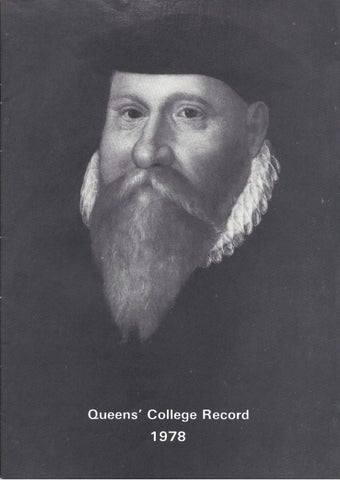
Queens' College Record 1978
COVER ILLUSTRATION: The portrait of Sir Thomas Smith, by an unknown artist, in the Long Gallery of the President's Lodge
2
A new portrait of the President, by Andrew Festing, now hanging in the Senior Combination Room.
3
Queens' College as at March 1978 Visitor HER MAJESTY THE QUEEN Patroness HER MAJESTY QUEEN ELIZABETH THE QUEEN MOTHER President DEREK WILLIAM BOWETI, M.A., LLD., Ph.D (Manchester) Fellows Edwin Arthur Maxwell, M.A., Ph.D., Life Fellow, formerly Senior Bursar and Director of Studies in Mathematics. James Arthur Ramsay, M.B.E., M.A., Ph.D., F.R.S., Emeritus Professor of Comparative Physiology, Life Fellow, formerly Vice-President and Director of Studies in Natural Sciences. The Rev. Henry St John Hart, M.A., 8.0., Reader in Hebrew and lntertestamental Studies: Hebrew Lecturer and Director of Studies in Divinity. Sir Harold Walter Bailey, M.A., F.B.A., LLD. (h.c.) (Perth), LLD. (h.c.) (Australian National University), D.Litt, (h.c.) (Oxon), Emeritus Professor of Sanskrit, Life Fellow. Sir Arthur Llewellyn Armitage, M.A., LLB., LLD. (h.c.) (Manchester), Life Fellow, formerly President. Douglas Parmee, M.A., Tutor for Research Students and Director of Studies in Modern Languages. John Holloway, M.A., Litt.D., D.Phil. (Oxon), 0. Litt. (Aberdeen), Professor of Modern English. Maxwell Marsden Bull, M.A., M.D., B.Ch., Director of Studies in Medicine. Henry Cohen, M.A., Ph.D. (Dunelm), Assistant Director of Studies in Engineering. Anthony Colin Spearing, M.A., Director of Studies in English. James William Longman Beament, M.A .. Sc.D., F.R.S., F.R.S.A., Drapers Professor of Agriculture. James Martin Prentis, M.A., M.Sc. (Eng.), Ph.D. (London), Senior Bursar and Assistant Director of Studies in Engineering. Norman Francis Hughes, M.A., Sc.D., Assistant Director of Studies in Natural Sciences (Earth Sciences). Kenneth Ewart Machin, M .A., Ph.D., Senior Tutor and Assistant Director of Studies in Natural Sciences (Physics). Ajit Singh, M.A., B.A. (Punjab, Chandigarh), M.A. (Howard, Washington), Ph.D. (Berkeley, California), Director of Studies in Economics and Politics. Brian Albert Callingham, M.A., Ph.D. (London), Assistant Director of Studies in Medicine. James Diggle, M.A., Ph.D., Praelector and Director of Studies in Classics. Peter Jaffrey Wheatley, M.A., Ph.D., Director of Studies in Natural Sciences (Chemistry). John Tiley, M.A., B.C.L (Oxon), Acting Senior Bursar and Director of Studies in Law. John Edward Carroll, M.A., Ph.D., Director of Studies in Engineering. Peter Gonville Stein, M.A., LLB., Ph.D. (Aberdeen), F.B .A., Regius Professor in Civil Law; Vice-President. The Rev. Brian Leslie Hebblethwaite, M.A., Dean of Chapel and Director of Studies in Philosophy. lain Richard Wright, M.A., Tutor, Keeper of the Records and Assistant Director of Studies in English. John Timothy Green, M.A., Ph.D., Dean of College and Director of Studies in Mathematics. David Barry Sattelle, M.A., Ph.D., Bye-Fellow; Assistant Director of Studies in Natural Sciences (Biology). Thomas Henry Coaker, M.A., Ph.D., Steward and College Lecturer in Natural Sciences. Jonathan Simon Christopher Riley-Smith, M.A., Ph.D., Librarian and Director of Studies in History. Christopher John Baker, M.A., Ph.D., Tutor and Assistant Director of Studies in History. William Andrew Phillips, M.A., Ph.D., Tutor and College Lecturer in Natural Sciences. Brian William Napier, M.A., Ph.D., LLB. (Edinburgh), Tutor and Assistant Director of Studies in Law. Richard James Overy, M.A., College Lecturer in History. Kevin John Gray, M.A., Ph.D., Tutor and Assistant Director of Studies in Law. Robin Douglas Howard Walker, M.A., Ph.D., Junior Bursar and College Lecturer in Natural Sciences. Roderick Arthur Smith, M.A., Ph.D., Research Fellow (Engineering). Andrew Duncan Cosh, B.A., Rooms Fellow and Assistant Director of Studies in Economics. John Clive Ellory, M.A., B.Sc., Ph.D . (Bristol), College Lecturer ir:t Physiology. Stephen Geoffrey Wildman, M.A., Research Fellow (History of Art); Director of Studies in History of Art. James Charles McKeown, M.A .. Research Fellow (Classics). Peter Raynor MacDonald Steele, M.A., Ph.D., Tutorial Bursar and College Lecturer in Pathology. The Rev. Brendan Ignatius Bradshaw, M.A., Ph.D., College Lecturer in History. Richard Robert Weber, M.A., Research Fellow (Mathematics). Raphael Salkie, B.A., Bye-Fellow and Assistant Director of Studies in Modern Languages. The Rev. Christopher Mark Tuckett, M.A., Bye-Fellow and Chaplain.
Honorary Fellows Sidney Smith, Litt.D., F.S.A., F.B.S. The Very Rev. Henry Chadwick, 0.0., Mus.B., M.A., Hon.0.0. (Glasgow), F.B.A., Dean of Christ Church in the University of Oxford. Sir Thomas Padmore, G.C.B., M.A. Sir Harold Walter Bailey, M.A., F.B.A., LLD. (h.c.) (Perth), LLD. (h.c.) (Australian National University). 0.Litt, (h.c.) (Oxon). Professor Sir Arthur Llewellyn Armitage, M.A .. LLB ., LLD. (h.c.J (Manchester), Vice-Chancellor of the University of Manchester. Lord Allen of Abbeydale, G.C.B., M.A. Alfred Charles Tomlinson, M.A., Reader in English Poetry in the University of Bristol. Sir George Stanley Waller, 0.B.E., M.A. Judge in the Court of Appeal. Professor Robert Neville Haszeldine, M.A., Sc.D., F.R.S., Principal of the University of Manchester Institute of Science and Technology. Theodore Morris Sugden, M.A., Sc.D., F.R .S .. Master of Trinity Hall. James Arthur Ramsay, M.B.E., M.A., Ph.D .. F.R.S.
5
The New Development and the College Appeal
This last year has seen a slow, sometimes frustratingly slow, progress in the completion of the internal work within the new Kitchens and the new Dining Hall. We had hoped to have both Hall and Kitchens in full operation by the Lent Term 1978, but this proved impossible and the present schedule aims for the start of the Michaelmas Term. The marble slabs for the Dining Hall lie waiting in the new Cloisters, the Kitchen equipment is in store, and the new furniture for the Hall is also either in store or awaiting delivery: we are within sight of completion. Of course, this will not complete the whole of Phase Two. There remains the Long Dining Room, the adjunct to the main Dining Hall which lies above the Cloisters and has the intriguing, multi-faceted window along its length, overlooking the lawn; and there remains also the remainder of the living accommodation on Staircase FF. Our plans are to complete both these remaining parts as soon as possible after the Kitchens and Dining Hall. Phase Three, the final phase, may well be started before Phase Two is completed, for the Cripps Foundation and the College are determined to fulfil the entire development plan, and good planning may dictate the need to start on Phase Three by the end of 1978.The College Appeal has now reached the target of £250,000: the total stands at £255,000. Had this figure been quoted to us as the likely target when the Appeal was launched, seven years ago, we should have been delighted 6
to the point of complacency. Unhappily, the remorseless inflation of recent years, coupled with the unforeseen delay in completion, has· quite destroyed any such · complacency. There is, of course, no question of our ability by means of the Appeal Fund to complete the furnishing of the new Court to a very high standard, to purchase all the new Kitchen equipment, and to complete the central heating of the College. What we shall not have is a respectable surplus with which to tackle the other urgent needs which will shortly face the College. We must restore to good use the old Kitchens and Pump Court area: for this alone we shall need £115,000 at 1977 prices. We are now faced with the quite unforeseen liability of having to re-roof, or rather re-tile, Old Court: this may well cost in the region of £60,000. We have also been obliged to replace all the heating pipes which were laid in Old Court only fifteen years ago: a conservative estimate of cost is £6,000. We are also obliged to conform to the ever-increasing standards of fire prevention (at least if we are to house conferences, which we must do to meet our overheads and, in particular, balance the Kitchen Account) at a cost of some £35,000. Even the relatively-new Erasmus Building does not conform to the latest standards. The College thus faces costs of the order of £200,000 for essential restoration and repair over the next few years, and the funds to meet these costs simply are not there. I have taken advice from many old members of the
College and that advice leads to two certain conclusions. Toe first is that the College should contemplate inviting members who have already contributed by seven-year covenants to keep those covenants running. I confess that I have a personal distaste for making such requests to members who have already shown remarkable generosity, but I accept the good sense behind that advice. The second is that the College should ask members who have not so far contributed to the Appeal to consider doing so. There are many members who have not so far felt able to do so, and there are also some 1,200 members who, because they graduated since 1968, have not so far been asked to contribute. This, too, seems a sensible course to follow. My conclusion is, therefore, that the College and its members must contine to rely on self-help. We shall practice whatever economies are sensible and possible and we shall again ask members to help. There seems to
be no real alternative and, though the prospect daunts me, by the summer, I shall have reverted yet again to my role of "fund-raiser", knowing well that members will have many other terms to apply to this most unattractive role. It would be unfortunate if I gave the impression that the College was now predominantly concerned with buildings and money. Last year we had 61 Firsts - the highest number ever achieved by the College. The College is academically very strong indeed, and, whilst I accept that there is more to life (and more to a College) than academic performance, it should be said that as an academic institution we must be concerned with our academic standing. Our concern with the buildings of the College is very much based on the feeling that we shall prosper as an academic institution all the more when our physical environment is wholly attractive. D.W.B.
The Society The end of the academic year 1976/7 saw the retirement of Professor P. W. Brian, who will retain his home near Cambridge and so remain in cQntact with the College. Another retirement was that of Mr. G. R. Muff, after seven years of loyal service as Domestic Bursar: he, too, remains living nearby. There have been four additions to the Fellowship. Dr. B. I. Bradshaw, a former Research Fellow of St. John's College, was elected into an Official Fellowship last April. He concurrently holds the joint Queens'/ Girton Lectureship in History and brings with him an established reputation as an historian of Ireland, the land of his birth. Mr. R. R. Weber was elected into a Research Fellowship from October. Previously a research student at Downing College, he has a distinguished record in Mathematics and holds the Mayhew Prize. Amongst his social accomplishments he has a facility with cards which is so impressive that any idea of reviving poker amongst the Fellows, as an entertainment after a Guest Night, has been quickly dropped . Mr. R. Salkie, a research student in this College, has been elected into a Bye-Fellowship to assist with the teaching and direction of studies in Modern Languages. A Germanist, he achieved a distinguished First in 1975 and is Acting Director of Studies during Mr. Parmee's absence on leave in the Lent Term. This last October has also seen the return to the College of Mr. C. M. Tuckett to be Chaplain and a ByeFellow. After a consistent record of Firsts in the Mathematical Tripos, Mr. Tuckett went on to read Theology, winning the Chase, Clayton and Scholfield Prizes, and was ordained in 1974. After experience in teaching and in a curacy near Lancaster, he returns to give help with both the teaching of mathematics and the religious and pastoral life of the College. The current academic year has seen a number of changes in College Office. Mr. Tiley has very nobly, and competently, acted as Senior Bursar during the sabbatical year's leave of Dr. Prentis . Dr. Steele has become Tutorial Bursar, Mr. Cosh Rooms Fellow and Dr. Walker Junior Bursar. These last three appointments are consequential upon the retirement of Mr. Muff as Domestic Bursar and Dr. N. F. Hughes as Junior Bursar
and it is fitting that I should record the College's gratitude to both retiring Officers. Dr. Diggle has retired as Librarian, being replaced by Dr. Riley-Smith, but Dr. Diggle will not completely give up College office since he takes over from Mr. Overy as Praelector from the beginning of 1978. Dr. Singh has become Secretary of the Governing Body and Dr. Bull replaced Mr. Wright as Keeper of the Records during the latter's leave for the Michaelmas Term and is deputising for Mr. Parmee as Tutor for research students _in the Lent Term. The recital of these changes is a sufficent indication of the extent to which the administration of the College depends upon the Fellowship: more than that, it is frequently required of Fellows that they step in to do another's job, whilst he is away on leave, so that it requires from all the Fellows a very broad understanding of the way in which the administration works. The days of the "dreaming scholar", remote from the problems of everyday administration, are gone: I will refrain from expressing a view on whether that change is for good or for ill. I take special pieasure in recording certain distinctions and appointments conferred upon Fellows during the year. Professor J . W. L. Beament has been appointed Chairman of the Natural Environment Research Council and also a member of the Advisory Board on the Research Councils. The former is a particularly demanding appointment, and both the College and his Department (he is Head of the Department of Applied Biology) will feel his absence whilst performing his duties elsewhere, but they may certainly take some pride in the distinction which these appointments recognise. Dr. Hughes is to be congratulated on his Sc.D., a tribute to his distinguished contributions to geology. Mr. Parmee has been awarded the Goethe House-PEN translation prize for the best translation from German in 1977. Dr. R. A. Smith has been appointed University Assistant Lecturer in the Faculty of Engineering, and Dr. K. J. Gray has been appointed University Assistant Lecturer in the Faculty of Law. D.W.B. 7
Mr. A. D. Browne
1889 - 1977
Archibald Douglas Browne was born in May, 1889, and entered Queens' as an undergraduate in 1908. After graduating as a scholar in the Mechanical Sciences Tripos in 1911 he worked with the Clyde shipbuilders, Yarrow and Company, until 1914 when he was commissioned in the Army, serving in France until the armistice in 1918. After the war, he was invited to return to join the staff of the Engineering Department in Cambridge and, in 1921, he was elected a Fellow of Quee!1s'. During the next fifty years he served the College as Duector of Studies in Engineering, Junior Bursar, Tutor, Proctor, Senior Tutor and Vice-President. He ceased to be Vice-President in 1965 largely because crippled with arthritis, he became unable to move abou; and :undertake his duties with the effectiveness he thought the Job demanded. Yet he remained a Fellow until his death and, though no longer attending the Governing Body, kept a close interest in everything affecting the College. Thus, Archie Browne dedicated sixty years of his life to this College. He never married, and, until ill-health force~ him to give ll:P his rooms in College, the College was his home and his whole life. He had other interests certainly: philately, pictures, rowing and chess were the most obvious. But for him the real world was the College and its members. He cherished the College's buildings and all the traditions associated with them. It was entirely appropriate that he, together with another Fellow, Dr. Seltman, should produce the superb pictorial history of the College, financed from their own pockets. It was also typical of Archie that he should want to establish bis undergraduate set of rooms, on B staircase, as the A. D. Browne Room, a room which would house bis 8
considerable collection of prints of the College and afford a place of peace, tradition and comfort for undergraduates to read in. I should add that some of the prints be gave to the College for this room actually belonged to Henry Hart - but Archie Browne always saw the l~rger theme and was undeterred by details. It was Archie who began the planting of daffodils in the Grove creating a glory of colour in the Spring which was soo~ emulated by other Colleges along the Backs. Not surprisingly, it was his wish that his ashes should be spread in the Grove, and this has now been done. He knew more about the College's buildings than any man: he was, for example, the main source of information about the construction of the Fisher Buildi~gs on matters of detail when, in 1972, the Building Comm1tt~e and the College's current architects required s1:1ch details. And he cared for these buildings with the kind of deep, emotional attachment which is now a thing of rarity. Yet it must not be supposed that he was averse to change or to the physical expansion of the College: he was not the kind of blind traditionalist who abhors anything new. On the contrary, he studied the plans oftbe new Cripps Court in great detail and, during my own visits to him, bed-ridden as he was, his constant enquiry was about the progress of the new buildings. His generosity towards the Co11ege was extraordinary for, throughout his life, he made gift after gift to the Colleg~ - gifts of furnitu~e, of money, of his stamp collect10n, and, finally, of his estate. Nor do I believe that he ever re~arded this as generosity. On the contrary, he regarded 1t as an appropriate gesture, as a way of demonstrating his lifelong sense of privilege in being a Fellow .of Q,ueens', and in enjoying a life of good compamonsh1p and happiness within these walls. His greatest contribution to the College was not, however, a material one: it was his love and care for generation after generation of undergraduates. The respect and affection which he gained was unrivalled. I found it inevitable, in any gathering of Queensmen, that I should ~e ~sked about Archie's health and well-being; and , until his last days, be would continue to receive visits from old Queensmen and from undergraduates now in the College, either to play chess with him or to tell him about the affairs of the Boat Club. Of course, the Boat Club had a special place in his affections, and his loyalty to_ that particular College activity never faltered. Many ""'.ill remember his familiar figure at Henley, slouched in his wheelchair, wearing a faded Leander scarf and a somewhat shabby cap. No one imagined Archie to be an easy man. He held strong views, sometimes, perhaps, rather narrow views by contemporary standards. For example, he affected to despise research as a waste of time, since he regarded the proper task of a don as teaching undergraduates. One quickly learnt that he was unimpressed by academic or worldly distinctions, at least so far as dons were concerned, and, basically, this was because he judged a man almost entirely by what service he gave to the College. As one who devoted his life to the service of the College, he held to that one criterion of worth. In accordance with this wishes, after his funeral in the College Chapel, his body passed through the main Gateway in Old Court to the words of the Nunc Dimittis: "Lord, now lettest thou thy servant depart in peace." This College has had no better servant. D.W.B.
Reginalia: Sir Thomas Smith In 1977 the College commemorated the five hundredth anniversary of the death of Sir Thomas Smith, sometime Vice-President of Queens'. The following is an extract from a lecture delivered in the Long Gallery of the President's Lodge by the present Vice-President, who is also the present occupant of the Chair of Civil !.Aw originally created for Smith. Thomas Smith was born on 23 December 1513 at Walden in Essex, a small town beginning to be known as Saffron Walden from the saffron crocuses grown by local farmers including Smith's father. He was more or less self-taught and entered Queens' in 1526 before he was thirteen years old. On taking his B.A., he was admitted Fellow in 1531, but remained very poor and was dogged by ill-health. Appointment as King's Scholar gave him his financial security, and in 1533, still under twenty, he was made public reader, lecturing on natural philosophy in the University schools and on Greek in his College rooms. Smith and John Cheke, of St. John's, were the two most prominent young scholars in Cambridge and became involved in a controversy on the pronunciation of Greek. The generally accepted pronunciation was that of contemporary Greeks. Erasmus had already seen that the ancient Greek must have been pronounced differently, and Cheke and Smith developed his ideas. They worked out how Greek must have been originally pronounced, and generally introduced their results in their classes. There was a reaction in favour of the older pronunciation and the Chancellor issued an edict banning the new pronunciation. Smith submitted to the ban, but his treatise in favour of his views is an interesting linguistic study. He supplemented it with a plea for a reform of English spelling, based on a new alphabet of his own devising, which was adapted to the sounds of the English language rather than the sounds of Latin. This latter work contains lists of over 800 words written in the new alphabet from which we can learn much of the patterns of speech and regional variations prevalent to Smith's time. In 1540 Smith was appointed the first Regius Professor of Civil Law by Henry VIII ( Cheke received the Chair of Greek), and went to France and Italy to study the subject. His humanist interests attracted him to the new approach to the study of the Roman legal texts. which had been recently introduced by the German 2.asius and the Italian Alciatus. This method stressed the value of Philology and History in explaining the original meaning of the Roman texts, by contrast with the older scholastic method which treated law as a self-sufficient discipline. Smith acquired and studied the works of 2.asius and Alciatus (still in the College Library, with his annotations), and in his inaugural lectures, given on his return to Cambridge, he proclaimed the virtues of the new method. At the same time he was becoming deeply involved in the administration of the College and the University. He was made Vice-President of the College, and successfully negotiated with Thomas Cromwell the transfer to the College of the Carmelite Priory (where Friars Court now is). He became Public Orator of the University and in 1543, Vice-Chancellor, his tenure of office being marked by the first statue providing for the matriculation of undergraduates by the University. In 1547 Smith left Cambridge for government service,
although he retained interest in the affairs of the University and Queens' until his death in 1577, and continued his scholarly activities without flagging. He was fascinated by astronomy and also (although he only admitted it privately) astrology; he conducted chemical experiments and lost over ÂŁ1,000 backing a scheme for making copper out of iron by boiling it in sulphuric acid. His most original and influential studies were in economics and government. It has now been established that he was the author of the anonymous Discourse of the Commonwealth (1549) which analyses the economic unrest of the time from the point of view of different classes of citizen and concludes that all are victims of the same inflationary process, which was the result of the debasement of the coinage. He studied monetary problems in a more academic manner in his treatise on The Wages of a Roman Foot-Soldier, in which he made elaborate comparative calculations of the real value of Roman and English money. In 1565, while serving as Queen Elizabeth's Ambassador to France and without any books of reference to hand, Smith wrote De Repub/ica Anglorum: on the Commonwealth of England, the book on which his reputation as an author has mainly rested . It described the structure of the English constitution, the powers of its various organs and the judicial system, in such a way as to bring out the points at which they differed from those of the continental countries which followed the Roman Civil Law. Writing in English for his fellow-countrymen, Smith adopted the perspective which his civil law studies had given him and showed his readers what was special and what was universal in their form of government. His account of the power of Parliament was much cited in the constitutional debates of the following century, "For every Englishman is intended to be there present, either in person or by procuration .. . from the Prince (be he King or Queen) to the lowest person of England. And the consent of the Parliament is taken to be every man's consent." In the last year of his life Smith was instrumental in putting on the statute-book a measure of enormous value to the Colleges of Oxford and Cambridge. It provided that in all leases of agricultural land, the tenant should be obliged to pay at least one third of the rent in corn or malt, (or in default to pay at the most recent market rate). Eventually the one-third rent in kind came to be a more important source of College income than the remaining two-thirds in money. Before he died Smith assigned property to Queens' to found two scholarships and two lectureships, one in arithmetic and one in geometry, characteristically providing that the lecturers were not to read "like a preacher out of the pulpit" but "with a pen on paper . . . or a stick or compass in sand or dust to make demonstration so that his scholars may both understand the reader and also do it themselves." The balance of the income was "to amende the cheer of the Fellows," this being the origin of the annual Sir Thomas Smith Feast. Smith was par excellence a Renaissance scholar: of enormous intellectual energy, intense curiosity and confidence in his own ability to comprehend whatever was worth knowing. In his will he left his Latin and Greek books to the College and the celestial globe made by himself. Almost all these books, many of them embellished with Smith's marginal annotations, as well as his notebooks, are still in the Library and the bindings of some show that the College followed his wishes in chaining them to the desks. P.G.S.
9
Co-residence Co-residence is the term used in Cambridge to describe the policy of a College in admitting both men and women. I am frequently asked by members of this College (usually members with daughters) when Queens' will become co-residential, so that I take this opportunity of explaining the present position. In Cambridge the majority of Colleges are either already co-residential or have announced a date for becoming so: the same is true of Oxford. There can be little doubt that this marked trend is in accord with national policy, as reflected in the 1975 Sex Discrimination Act. The hesitation in some Colleges, and certainly in Queens', arose .from the fact that women applicants to Cambridge who were academically competitive with the men were relatively few in number, and certainly below the national average for admission of women to Universities. It therefore followed that unless and until the total number of women of appropriate academic standard applying to Cambridge could be increased, the effect of a man's College becoming co-residential would be either to attract good applicants away from the women's Colleges - to their considerable detriment - or to dissipate the women undergraduates amongst the coresidential Colleges even further. It was generally felt that, to be successful, a College ought to have a reasonable number of women undergraduates and that to admit a token few was undesirable. In Queens' we have carefully monitored the slow but steady increase in .the number of good women applicants to Cambridge over recent years. We have also kept an eye open for evidence that remaining a "single-sex" College was proving harmful to the number and quality of our own men applicants, by deterring good applicants who preferred a co- residential College. The Governing Body, on several occasions, has received representations from our own undergraduates to the effect that they would prefer Queens' to become co-residential. The Governing Body has now accepted a Report from the Admissions Committee recommending that, subject to the necessary change of Statutes (which requires submission to and approval by the Privy Council), it would be right for the College to admit women in 1981. D.W.B.
The Library The Library has benefited greatly from the generosity of members of the College and others. Books have been given by Mr. P. J . Holmes, Prof. F. Goldby, Mr. S. G. Wildman, Mr. P. C. Millett, Dr. A. Wilcox, Mr. S. E. Smith, Mr. A. C. Heeler, Dr. T. H. Coaker, Mr. S. M. Lees, Prof. G. A. Starr, Mr. B. Jenkins, Mr. J. D. Pickles, Mr. J. P. Arthur, Mr. D. C. Damant, Mr. P. G. Smith, Prof. J. Holloway, Dr. R. A. Smith and Mr. A. C. Spearing. Books were left to the College by Canon A. E. Foster and Mr. A. D. Browne, who had been a most generous benefactor during his lifetime, providing the nucleus of an important collection of books on Cambridge. The Old Library Appeal stands at £1,278: a most encouraging and welcome response to our needs. In the Library itself Mrs. Elisabeth Machin has 10
enthusiastically led a team of postgraduate and undergraduate librarians: Paul Millett, whose wife Claire has helped in the vacations, Berwick Mitchell, Eddie Cook, Rob Fieldson, Paul Smith, Jeremy Rayner, Ken Leadbeater, Phil Holmes, Tim Howard and Tom Jackson. Paul Millett, after taking a course at the University Library, has been repairing books for our undergraduate library. Elisabeth Machin's flair for organisation and the hard work put in by the other assistant librarians means that we are able to run a highly effective library - now mainly a lending library because so many undergraduates live in College - at far less expense than other colleges. Mr. H. Torpey has continued to catalogue our magnificent collection in the Old Library. When he has finished the work we will have a catalogue of the very highest standards. The Library has continued to benefit from the kindness of Prof. and Mrs. Goldby. In four years Prof. Goldby has bound no less than 230 books for us at ·n o expense other than the cost of some of the materials. Mrs. Goldby, ass"isted by Claire Millett, has been systematically cleaning and treating the Old Library books. Exhibitions of Sir Thomas Smith's books were held in June and December. Indeed the most important discovery of the year has been the extent of our collection of Sir Thomas's books. About 80 volumes from his library, many with his signature, detailed annotations and even illustrations, are still in our possession. This means that we own what must be one of the most im_portant surviving private renaissance collections in the country. J .S.C.R.-S.
Thomae Smithi Academia In the autumn of 1976 a discussion group for Fellows was founded . It meets twice a term after dinner from 8.45 to 10.30 p.m. The following subjects have been discussed. 'Justifications of War and Rebellion', introduced by Dr. Riley-Smith; 'College Wine', introduced by Dr. Hughes; 'The Problems of Conservation', introduced by Professor Beament; 'Financing the Arts', introduced by Mr. Wright; 'Contemporary problems in the Law of the Sea', introduced by the President; 'Decision-taking in Government', introduced by Lord Allen of Abbeydale; 'The Incarnation', introduced by the Dean of Chapel; 'The Ethics of Vivisection\ introduced by Dr. Ellary.
The E Society Three meetings of the Society were held in the Lent Term and three in the Michaelmas Term. The speakers were the President, on 'Energy and the Future'; Dr. A. D. J. Macfarlane, University Lecturer in Social Anthropology, on 'Disease, Death and Witchcraft'; Prof. M. Rees, Fellow of King's, Plumian Professor of Astronomy and Experimental ·Philosophy, on 'Current Cosmological Ideas'; Mr. & Mrs. T. Stamp, on 'William Scoresby, Arctic Scientist'; Mr. Wildman, on 'A Brief Guide to the Architecture of Cambridge'; and Dr. Ellory, on 'Biological Adaptation'.
The Fabric Remedial work to the wooden bridge has been completed. The slatted walkway and its supporting timbers had rotted to a considerable extent. Fresh teak slats have been laid throughout, each with a non-slip strip glued to the upper side. Rot in the lower beams, which was confined to the upper surfaces, has been cut away and the beams have been capped with new teak. The whole bridge has been treated witti algicide. The exterior plasterwork of the half-timbered President's Lodge has received attention, and the exterior paintwork of the Lodge has been renewed. The underside of the raised Erasmus Building has been repainted. The electrical re-wiring of Friars Building to modern safety standards has been completed, and a start has been made on the re-wiring of Dokett Building, leaving Walnut Tree Court and Old Court outstanding. As rewiring has been completed, interior redecoration of the rooms affected has been undertaken. Much trouble is being experienced with the hot water mains laid under the courts of the College in the 1960s. These are rusting away underground and several failures have resulted. Repairs to the hot water mains are unfortunately both expensive and unsightly. The College is studying the implications of recent legislation concerned with fire precautions. It appears that upwards of ÂŁ30,000 may have to be spent to bring the College's buildings up to the standards required for housing conferences (i.e. "hotel" standards). The work will have to be spread over a period of several years, and will commence as soon as possible. The College also faces another large potential liability in the sense that there are signs that the roofs in Old Court will need re-tiling. We await a detailed, expert survey which will indicate the extent and cost of the work required. R.D.H.W.
The Chapel The following visiting preachers came to the College in the course of the year: the Rev. Philip Swingler, Chaplain of Oundle School; the Rev. John Ponter, Anglican Chaplain at the University of East Anglia; the Rev. Edward Lobb, Curate of St .Mary's, Houghton Green, Manchester; the Rev. Andrew Louth, Chaplain of Worcester College, Oxford; the Rev. Dr. C. F. D. Moule, Ridley Hall; the Rev. D. I. S. Galilee, VicarofSutton-inthe-Isle; the Rev. Prof. G. W. H. Lampe, Regius Professor of Divinity; the Rev. Keith Sutton, Principal of Ridley Hall; Brother Ninian, S.S.F.; the Rev. J. Muddiman, Senior Tutor, St. Stephen's House, Oxford; Sir Norman Anderson; Canon Eric James, Canon Missioner, St. Albans. Mr. Hart also preached, as did the Dean of Chapel and the Chaplain. The preacher at the Commemoration of Benefactors in Full Term was the Rt. Rev. J. K. Cavell, Bishop of Southampton (Qu. 1936-39), and at the visit of the Club in June, the Rev. M. Parsons (Qu. 1925-28). There was an informal service prepared by members of the College on 6 February, and the Advent Carol Service was held on 27 November.
Mr John Silk and Mr. Tony Evans of Westcott House continued to help with the chaplaincy work during the Lent and Easter Terms. From 1 September 1977 the Rev. C. M. Tuckett (Qu. 1966-69 & 71-73) was appointed Chaplain and Bye-Fellow. During the absence of the Dean of Chapel, on sabbatical leave for the Easter Term, daily services in the College Chapel were taken by members of the College. E. J. T. Williams, the Chapel Clerk, was succeeded in the Michaelmas Term by C. R. Bassett. For the fifth year running, a Queens' College Christian House Party was held after the end of the Michaelmas Term, for the third time at Hengrave Hall, near BU:ry St. Edmunds. J. F. CLOUGH
It is with great sadness that we record the death on November 29 of John Francis Clough, Organ Scholar 1970-73. On leaving Queens', John went to Gloucester as Assistant Organist of the Cathedral and Director of Music at the King's School. In 1975 he moved to St. Albans as Assistant Master of the Music at the Abbey and Director of Music at the School. He was beginning to make a wider musical reputation both as an organist and as a choral conductor. B.L.H.
First Classes, June 1977 Archaeology and Anthropology. S. P. Wade (Distinction). Classics. N. M. Jacobsen, I., J. Nichol. Computer Science. J. J. Gibbons (Special Credit). Economics. P. E. Earl, A. W. Goudie, G. H. Kearley, C. B. Chaloner, C. H. Stephens. Engineering. H. B. Champion, C. F. Ross, A. J. Cupples, D. A. Ireland, M. J. Kershaw, W. D. B. Porter. English. S. D. Cook, P. N. Hardy, P. J. Smith. History. T. P. Mitchell, J. M. Black, W. D. A. Haire. Law. R. A. Wilson, J. A. Grainger, P. J. Holmes. Mathematics. D. Whitgift (Distinction), A. S. Giles, M. J. Simon, J. Austin, A. P. Clark, S. J. Thompson, P. A. Harlow, S. H. Harmsworth, ?. H. Haynes, S. P. Meacham. ¡ Medical Sciences. N. G. Bruce. I. Upton, G. R. Enever. Music. H. D. Keelan. Natural Sciences. P.M. Freedman, R. F. T. Gilbert, A. R. Green, A. T. C. Ho, S. Kearsey, R. J. Snow, D. J. Wrigley, D. J. Brown, K. J. Brown, C.H. Elphick. P. W. Frew, D. S. Latchman, S. P. Luttrell, J. R. Ridley, S. G. Roberts, J. W. Tate, G. P. Barwood, R. J. Davis, J. P. C. Dumont, R. B. Thorpe. Social and Political Science. G. J. Thornicroft. Veterinary Medicine. J. C. M. Lewis (Special Merit).
University Awards To the Rex Moir Prize and Institute of Electrical Engineers Prize: M. J. Kershaw. To the Ricardo Prize in Thermodynamics Gointly): C. F. Ross. To the Drewitt Prize: P. W. Frew. 11
To the Frank Smart Prize in Botany: P. W. Frew. To a Henry Arthur Thomas Travel Exhibition: N. M. Jacobsen. To the Amy Mary Preston Read Scholarship: N. A. Reynolds. To Wrenbury Scholarships: P. E. Earl, A. W. Goudie. To the Adam Smith Prize: S. W. Kidd. To a Smith's Prize: J. M. V. Rayner. To the Marmaduke Sheild Scholarship: I. Upton.
College Scholarships and Exhibitions Entrance Scholarships
N. G. Davies, Bradfield College, for Classics. M . C. Dawson, Nottingham High School, for Engineering (Colenutt), K. P. Fullbrook, King Edward VI Grammar Sctiool, Chelmsford, for Engineering. S. M. Hobbs, Merchant Taylors' School, Northwood, for Engineering. S. 1. Fry, Norwich City College, for English. A. C. Fowler, Solihull VI Form College, for History. R . 0. L. Jagger, Dulwich College, for History. 1. A. Leach, Monkton Combe School, for History. P. J . Ullmann, Aylesbury Grammar School, for History. G. Ward, Huddersfield New College, for History. T. C. Carden, King's School, Canterbury, for Mathematics. C. B. Cormack, Lancing College, for Mathematics. M. J. Thompson, Nottingham High School, for Mathematics (Munro). T. J. Chamberlain, Aylesbury Grammar School, for Modern Languages (Paterson). G. P. Aylett, Watford Boys' School, for Natural Sciences (Melsome). R. Barber, Hampton School, for Natural Sciences (Melsome). A. M. Brandenburger, University College School, for Natural Sciences (Melsome). R . Hinchliffe, Bradford Grammar School, for Natural Sciences to read Engineering (Melsome). B. J. Morris, Trinity School, Croydon, for Natural Sciences (Melsome). N. 1. Percival, Bishop's Stortford College, for Natural Sciences (Melsome). D. P. Peterzan, Bedales School, for Natural Sciences (Melsome). J. M. Price, Haberdashers' Aske's School, for Natural Sciences to read Medical Sciences (Melsome).
Entrance Exhibitions N. J. Braithwaite, St Paul's School, Barnes, for Classics to read Law (Gray). K. A. Jeyaretnam, Charterhouse, for Economics to read History (Paterson). M. R. McGillivray, Oundle School, for Engineering to read Law. 1. A. H. Mackay, Monkton Combe School, for Engineering. 12
J. Moakes, Hutton Grammar School, for Engineering to read Law. A. 1. Tyler, Royal Grammar School, High Wycombe,for Engineering (Paterson). A. J. Everard, Latymer Upper School, for English. B. M. Haworth, Wymondham College, for English. P. J. McCormack, Clifton College, for English. P. J. Rogers, Aylesbury Grammar School, for English (Haynes). C. P. C. C. Steare, Sevenoaks School, for English. P. A. G. Sabin, Arnold School, Blackpool, for General Studies to read History (Paterson). S. T . Horn, Price's College, Fareham, for History. D. L. Phillips, Watford Grammar School, for History. P. J. Speak, Bolton School, for History to read Philosophy (Paterson). M. J. Smith, St. Alban's School, for Mathematics. M. P. Streuli, Rugby School, for Mathematics (Paterson). C. S. Savage, Christ's Hospital School, Horsham, for Modern Languages. W. G. Howell, Shrewsbury School, for Natural Sciences to read Engineering (Melsome). I. H. Willats, Coventry School, for Natural Sciences (War Memorial).
FIRST YEAR College Exhibitions S. P. Wade for Archaeology; C. B. Chaloner for Economics; P J. Holmes for Law; S. P. Meacham for Mathematics; G. R. Enever for Medical Sciences; H. D . Keelan for Music; J. P . C. Dumont for Natural Sciences.
SECOND YEAR Foundation Scholarships N. M . Jacobsen for Classics; A. J. Cupples for Engineering; D. A. Ireland for Engineering; M. J. Kershaw for Engineering; S. D. Cook for English; P. J. Smith for English; J. M. Black for History; W. D. A. Haire for History; J. Austin for Mathematics; A. P. Clark for Mathematics; S . J. Thompson for Mathematics; I. Upton for Medical Sciences; D. J . Brown for Natural Sciences; K. J. Brown for Natural Sciences; C.H. Elphick for Natural Sciences; P. W. Frew for Natural Sciences; D. S. Latchman for Natural Sciences; S. P. Luttrell for Natural Sciences; J. R . Ridley for Natural Sciences; S. G. Roberts for Natural Sciences; J. W. Tate for Natural Sciences.
THIRD YEAR Foundation Scholarships P. E. Earl for Economics; A W. Goudie for Economics; G. H. Kearley for Economics; H. B. Champion for Engineering; P. N. Hardy for English; T. P . Mitchell for History; R. A. Wilson for Law; A. T. C. Ho for Natural Sciences. Bachelor Scholarships P. E. Earl for Economics; C. F. Ross for Engineering; M. J. Simon for Mathematics; R . F. T. Gilbert for Natural Sciences; A. T. C. Ho for Natural Sciences; R. J. Snow for Natural Sciences; D. J. Wrigley for Natural Sciences.
FOURTH YEAR Foundation Scholarship G. J. Thornicroft for Social and Political Sciences.
GRADUATE Bachelor Scholarship D. Whitgift for Mathematics.
SPECIAL PRIZES Joshua King Prizes: R. F. T. Gilbert, A. W. Goudie, R. J. Snow. Hughes Prizes: M. J. Kershaw, S. P. Luttrell. Venn Prizes: G. P. Barwood, C. B. Chaloner, S. P. Wade. Penny White Prize: I. J. Nichol. Chalmers Prize: P. M. Freedman } aeq. S. Kearsey Chase Prize: G. A. D. Briggs. Lucas¡ Smith Memorial Prize: R. A. Wilson. Melsome Prize: A. R. Green. Openshaw Prize: J. W. Tate.
The College Union 1976-77
President: F. H. Christiansen Vice-President: Professor Beament Secretary: M. C. Spink Senior Treasurer: Dr. Wheatley Treasurer: R. F. C. Lawrie External Officer: S. J. Thompson Steward of the Fitzpatrick: J. P. Spencer Fellows: Dr. Baker, Mr. Smith Graduates: S. J. Baker, C. M. Robertson Third Year Representatives: D. W. Backhouse, C. F. Ross Second Year Representatives: M. P. Ripley, J. W. Styles First Year Representatives: S. G. Batchelor, N. D. Martin.
The College Union has the task of assisting with the running of the College and generally furthering the College's corporate life. It deals with a wide range of administrative matters, from the allocation of finance among the United Clubs to the provision of services and leisure facilities in the Junior Common Room. With the bringing forward of the J.C.R. elections to the end of the Lent Term it seems inevitable that the first term of office of the new committee will be a fairly inactive one. Nevertheless a good deal has been achieved this year and the Union has again proved itself an important link between students and fellows. Perhaps the most important issues dealt with by the Union were student observers at Governing Body meetings and co-residence. Both issues have brought tangible results. Machinery was worked out and agreed between the Union and Governing Body for four student observers, two of whom are to be the President of the Union and Chairman of the M.C.R. ex officio, and two elected independently. The first observers will take office at the end of the Lent Term 1978. There was also correspondence between the Union and Governing Body on the subject of co-residence and the Governing Body
formally decided, subject to the approval of the necessary change of Statutes, that Queens' is to go co-residential. The J.C.R. has offered an increasingly wide variety of services to Queensmen this year in pursuit of a policy of providing a general focus for College social life. A J. C. R. Diary was established as a termly publication containing information about social events organised for Queensmen both inside the College and elsewhere. Outside entertainments have included coach trips to Stratford and London to see plays, and the first "Oxford Shuttle", providing a weekend return fare to Oxford at about a third of the scheduled bus rate, left on November 5th. Inside College, agreement was reached with the tutors for a termly frequency of three discotheques and these have proved increasingly popular. With the aim of integrating Freshmen with the rest of the College as soon as possible after the start of the Michaelmas Term, the Union offered financial assistance to those who were willing to organise staircase parties along specific guidelines, and over half the College benefited from the scheme. The Union continued to give a 50% febate to those people who paid subscriptions to take part in activities which are organised only at University level, and funds were allocated among the United Oubs as usual. The Tiddleywinks Club was admitted to the status of a United Club and the Medical Society to that of Affiliated Club. Though there have been differences between the students and the College authorities over a number of day to day administrative matters such as Room Regulations and central heating, the Union has proved a suitable and effective body to deal with them with the minimum of ill feeling. 1977-78
President: R. F. C. Lawrie Vice-President: Dr. Baker Secretary: R. S. Fieldson Senior Treasurer: Dr. Phillips Treasurer: J. W. Tate External Officer: N. D. Martin Steward of the Fitzpatrick: S. N. Cocking Fellows: Dr. Bradshaw, Mr. Salkie Graduates: J. M. V. Rayner, S. J. Baker Third Year Representatives: P. J. Wood, M. P. Ripley Second Year Representatives: R. F. Crellin, W. M. Macnaughton
First Year Representatives: D. J. Barker, M. A. El-Erian.
May Ball The Committee: Dr. Waler, Professor Stein, Dr. Coaker, D. G. Palmer, R. A. Kock, S. M. C. Horton, W. M. Ainley, M. T. Newman, C. M. Bown, J. W. Tate, A. M. Winstanley, R. I. S. Henley.
Despite being the second most expensive May Ball in Cambridge, Queens' tickets sold very well and over 850 guests attended the Silver Jubilee Ball, most of them Queensmen. Although the weather was persistently depressing, with a fine drizzle coming down for the entire event, it did little to dispel the enjoyment of those present. While champagne anCl sparkling wine were served all night under the Erasmus Building, two marquees ran continuous and 13
contrasting entertainment. The 'Rock Tent' on the Erasmus Lawn featured several famous contemporary bands, the star of the show being the electric Desmond Dekker. For those with more traditional tastes, the marquee on Walnut Tree Court fl!atured Jazz and Steel bands; and particularly the fabulous 'Burgundy Steel Stompers' who had great difficulty in getting away. There were also fire eaters, a folk dance team, and an itinerant gypsy violinist. To cap this splendid event a first-rate buffet meal was provided by the College Kitchens under the direction of Bob Lever. Smoked salmon, roast pork, roast turkey and a fine selection of green and white salads were to be had, all washed down with excellent white wine, and then gateau or cheesecake for dessert. All this in the beautiful setting of the old College buildings ensured that the Silver Jubilee May Ball was a great success and, with thanks to the hard work of the Committee and the firm backing of the College, we wish good luck to the Ball in 1979.
MCR 1976-77 President: Dr. Bull Chairman: S. J. Baker Secretary: T. D. O'Donoghue Treasurer: S. G. Wildman (until August 1976), D. J. Fleming Steward: C. M. Robertson Committee: D. J. D. Lewis, J. M. V. Rayner
The M.C.R. has had another successful year, centered around the Woodville Room in Cripps Court. The main social activities continued to be dinners in hall, interspersed with wine tastings and real ale parties, while the room provided an ideal base for meeting other graduates and for television viewing. The system of graduates dining on High Table with the Fellows, in a very congenial atmosphere, again proved popular. One guest dinner was held when Michael Leapman of the Times was invited and this was a very enjoyable and worthwhile -evening. At the beginning of the new academic year the committee and established members held a cocktail party where the freshmen graduates were welcomed to the M. C.R. and met some of the Fellows. At the end of last academic year a garden party was held to round off the Easter term. The committee wish to thank the Catering Officer and his staff for their help in making the dinners so success£ul. · The success of a club of this type depends very much on the active participation of its members and the help offered by the senior members of the College. It is very much hoped that the very active participation throughout the year by graduates will continue in the future. We would like to thank Dr. Bowett, Dr. Bull, and Mr. Parmee for their interest and help. 1977-78 President: Dr. Bull Chairman: J. M. V. Rayner Secretary: R. Bettley-Smith Treasurer: S. J. Baker Steward: P. W. Davies Social Functions Organiser: l. W. Gault(until December 1977)
J. G. Greenhough. · 14
'
St Margaret Society 1976-77 President: Professor Beament Vice-President: N. J. Hamway Secretary: P. S. Wicker Treasurer: R. J. Knott Publicity: G. K. Kay Committee: S. R. Armstrong, M. P. Burrows, P. B. S. Clarke, C. J. M. Graves, J. W. Styles, Dr. Green, J. C. Kaznowski, P. N. Coad
In the Lent Term 1977 the St. Margaret Society promoted three College concerts, in addition to the termly choral and orchestral concerts at Great St. Mary's Church. The College events comprised two Chapel Concerts and a Smoking Concert in Hall, very well attended, as usual, by a beery audience which saw the Deans eat a hamper of food accompanied by some very dramatic piano music, as well as many other more vigorous events. The main concert of the term consisted of Dvorak's Te Deum, Beethoven's Piano Concerto No. 1(with Richard Tuckett as soloist) and Haydn's Nelson Mass, in which the soloists were Elizabeth Gardner, Simon Gay, Derek Barnes and Jacek Strauch, and the conductor Stephen Armstrong. The concert attracted a large and appreciative audience. The Society was unusually busy in the first half of the Easter Term. In addition to a hastily prepared Chapel concert, there was a concert in the Long Gallery at the kind invitation of the President and Mrs. Bowett on May 1st, which included a quite unexpectedly hilarious rendition of some Victorian duets by Richard Knott and the inebriated Colin Stewart (of Gonville and Caius College) to contrast with some equally fine, though more serious performances. On May 8th there was an 'open concert' in Little St. Mary's Church devoted to the music of J. S. Bach - a motet and short Mass sung by the St. Margaret Singers (who performed again in a C.U.M.C. concert at the end of the Michaelmas Term with considerable success) under Stephen Armstrong, and a fine performance of the Brandenburg Concerto No. 4 in which Jan Kaznowski, Helen Keen and Helen Crown were soloists. It was not only in music that the Society excelled. Under the excellent supervision of Roger Lowe the Mag Soc eight was the only College boat to win its oars in the May Bumps. The May Week Concert, which packed the Hall to capacity as usual, included a performance of Beethoven's Triple Concerto (in which the soloists were Jan Kaznowski and his brother and sister) under the baton of Hugh Keelan, who treated the audience in the second half of the concert to some piano pieces of stupendous virtuosity by Liszt. A new work by Professor Beament for fancy dress jazz band, soloists and chorus concluded a most successful event. Refreshments were provided under the Erasmus Building in the interval while the Chapel Choir sang two part-songs by Delius on the lawn. The Michaelmas Term's events began with two Chapel concerts, the second of which was given by freshmen. Professor Beament's birthday concert took place in the Senior Combination Room, and was followed by the main concert in which Stephen Armstrong conducted performances of Vaughan Williams' Five Mystical Songs and Beethoven's Mass in C. The soloists were Elizabeth
Gardner, Doreen Walker,. Colin Stewart and Jacek Strauch. The other event in the programme was Rachmaninov's Piano Concerto No. 2, in which the soloist was Hugh Keelan and the conductor Philip Coad. Before the concert began there were a few moments silence as a tribute to John Clough, Organ Scholar at Queens' between 1970 and 1973, of whose tragic death we had learnt earlier in the term. 1977-78
President: Professor Beament Vice-President: M. P. Burrows Secretary: P. N. Coad Treasurer: S. F. Chadwick Publicity: T. R. Barker Committee: S. R. Armstrong, P. A. Harlow, W. M .
Macnaughton, H. D. Keelan, C. H . Elphick, M. Williams-Ellis.
The Bats 1976-77
President: M . C. Y Lewis Vice-President: R. H. Michell Secretary: R. S. Fieldson Technical Director: F. H. Christiansen Senior Treasurer: Mr. Wright Junior Treasurer: J. L. Hartstone Equipment Managers: M. Davidson, M. P. Ripley Publicity: K. T. Roberts Committee: C. J. M. Graves, I. D. Edge, P. T. Frazer
The BATS programme in 1977 showed a healthy willingness to produce plays by modern as well as traditional playwrights. The year began with a production of Dr. Faustus by Marlowe at Christ's New Theatre, which seemed to be well received despite the limitations imposed by the theatre itself. It was refreshing
to see the production of two new plays, The Great Exhibition by David Hare and Christie in Love by Howard Brenton, later in the Lent term at the A.D.C. Theatre, both of which were well directed and included a number of very polished performances worthy of rather larger audiences that actually attended. The highlight of the year was undoubtedly the May Week production of Shakespeare's Twelfth Night performed in the ideal setting of Cloister Court. Mick Lewis directed a very talented cast who performed in period costume against a well-designed set which took advantage of the natural characteristics of the court. The production attracted near capacity audiences, thus contributing to both a financial and artistic success. In the Michaelmas Term the society once again used the A.D.C. Theatre, where Iain Softley directed Ibsen's Ghosts which was well received by the large audiences. There were a number of very good performances, including that of Pastor Manders who stepped in only a few days before the play went up. The lunchtime theatre programme continued this year, with a number of short plays being performed in the J .C.R. As well as providing students with the opportunity to take their first steps in directing, they provided a great deal of enjoyment to those watching. A rather successful year ended with the touring pantomime production of an adaptation of Robin Hood, which was taken to local schools where once again it was very much enjoyed. 1977-78
President: J. L. Hartstone Secretary: K. T. Roberts Technical Director: C. J. M. Graves Senior Treasurer: Mr. Wright Junior Treasurer: R. F. Crellin Equipment Manager: M. P. Ripley Publicity : D. S. M. Harrison Committee: P. T. Frazer, R. S. Fieldson, P. E. Pearson, I. D.
Softley, E. B. Braman, A.H. R. W. Simpson, A. D. L. Lewis, S. Hillage.
J.
15
Film Society 1976-77
President: D. W. Backhouse Secretary: A. H. Williams Treasurer: K. D. Ward The success of the end of 1976 was continued into the Lent Term, starting with the chilling Rosemary's Baby, and continuing with the very successful Adventures of Barry Mackenzie, which played to two c~pacity audiences. The success of these enabled the society to order a new reflecting screen, which arrived later in the term. The next three films, The Day ofthe Jackal, There's a Girl in my Soup, and American Graffiti all proved popular, whilst Butch Cassidy proved that yo.u can'_t win them all with dismal attendance. However, things picked up agai~ with Ken Russell's extravagant The Music Lovers, and the last film of term, The French Connection. The Easter Term, traditionally a time of abstinence on the film front due to the academic aspirations of members of the committee, passed quietly with only The Odessa File being shown, on the first Sunday of term. The Michaelmas season began with the ever-popular Easy Rider, which played to two packed houses, followed by Marty Feldman's eyes in The Adventures of Sherlock Holmes' Smarter Brother. These were followed by a neardisaster when the film distributers were unable to supply the film ordered, and as an alternative provided Gone in 60 Seconds, not surprisingly never heard of before or since. However, the next week fortunes changed, when the popularity of Woody Allen films ensured the success of Love and Death. By this stage of the term, our projector was on its deathbed, and much of the script seemed to be in some obscure Chinese dialect. It finally gave up the struggle during the showing of_Breakheart Pass the following week, and for the remamder of the term it was necessary to borrow a projector from St. Catherine's Film Society to show The life and Times of Judge Roy Bean, Race with the Devil, and the very successful Tommy. A loan from the J. C. R. has enabled the society to purchase a new projector, which arrived 8:t th~ end of !he Michaelmas Term. It is hoped that this will provide considerable improvement in the quality of presentations, with comprehensible soundtracks. 1977-78
President: M. L. Alderman Secretary: J. A. Davenport Treasurer: G. M. Henderson
Classical Society 1976-77
President: R. K. Mowbray Secretary: J. P. Spencer
After the renaissance of the Society in 1976, 1977 was a fruitful yeat. In the Lent Term, our two guests were Professor A. M. Snodgrass of Clare and Mr. A. M. Bowie of Emmanuel. Their subjects were, respectively, 'Myth in Early Greek Art' and 'Cleon Homericus'. In the summer a highly successful dinner was held when our 16
main guest was Professor F. R. D. Goodyear of Bedford College, London, former Director of Studies at Queens', who spoke very entertainingly, dwelling on the firmer aspects of Latin femininity. In the Michaelmas Term, Dr. J. T. Killen of Jesus gave an illuminating talk on the relation between Homer and Linear B, and Mr. I. M. Le M.du Quesnay from Birmingham read us a paper on the literary tradition behind Virgil's First Eclo~ue. . . Our thanks are due to Dr. Diggle for his hospitality during all our meetings. 1977-78
President: J . P. Spencer Secretary: S. G. Batchelor
History Society 1976-77
President: M. A. F. Raw Secretary: J. M. Black Committee: M. C. Prestage, P. J . Spear 1977 saw the History Society ascend new heights within the College. Not only were five papers presented to consistently large meetings, but Queens' historians actually ventured on to the games field, taking on Queens' First XI and the College Economists at football. Although victory eluded us on these two occasions, morale is high for 1978. The five papers given during the year were both varied and imaginative. In the spring, Dr. Karl Leyser of Magdalen College, Oxford spoke to us on the intricacies of the Ottoman Empire. This was followed later in the term by a paper on Medieval Anti-semitism presented by Professor Wallace-Haddrill, Chichele Professor of Modern History at Oxford. In the summer the mysteries of the French Secret Service and its "Cabinet Noire" were exposed by Dr. Chris Andrews. . In the Michaelmas Term, Dr. Bradshaw provided some new approaches to the Reformation and its effect on his nativecountryoflreland. The final talk of the year, given by Mr. Vivian Fisher, suggested that in the reign of King Stephen the Barons were far more aggressors than co-operators. Our Annual Dinner was held in November, with Professor J. J. Scarisbrick of Warwick University as the Guest of Honour. It proved to be the second largest attendance ever. Professor Scarisbrick reminisced about his years in Cambridge, and compared the different approaches to History at the Old and New Universities. Following Professor Scar:rsbrick, Dr. Riley-Smith concluded his saga of Queens' History Society in the tempestuous I 930's. The 1978 Annual Dinner is eagerly awaited as Lord Chalfont has accepted as Guest of Honour. The Society would like to thank Mr. Hebblethwaite for the kind use of his rooms for the meetings. It would also like to recognise the great support and enthusiasm provided by Dr. Riley-Smith. 1977-78
President: J . M. Black Secretary: M. C. Prestage Treasurer: P. J . Spear Committee: S. J. E. Hill, G. S. Garnett, S. J. B. Henderson, K. A. Salkeld.
Medical Society 1976-77
President: P. Le Feuvre Secretary: M. J. D. Goodfield Treasurer: M. B. Kostecky University Medical Society Representative: S. K. Swallow
During the Lent J:erm, under the presidency of Peter Le Feuvre, three meetings were held: on 'Rabies' by Mr. R. D. Locke, on 'Immunology' by Prof. I. M. Raitt and on 'Rugby Football Injuries' by Dr. L. Walkden. ~e were able to hold four meetings during the Michaelmas Term beginning with two local specialists: Dr. D. J. Muller on 'Drug Abuse' and Prof. G. Gresham on 'Forensic Medicine'. Dr. P. Hugh-Jones from King's, London talked about and showed a film of 'A Survey in the Oman' and Dr. K. P. Ball, Secretary of ASH, talked on the 'Future of Medical Practice'. By way of recreation there was a successful Hockey match against New Hall medics. We were most fortunate to be able again to hold the Annual Dinner in the Munro Room. Dr. Gordon Wright, senior lecturer in the Department of Anatomy was Guest of Honour. Most welcome also were two new Vice-Presidents: Dr. D. W. Evans Consultant Cardiologist at Papworth Hospital, and Prof. Frank Gold by, who has retired to Cambridge from the Chair of Anatomy at St. Mary's Hospital. 1977-78
President: R. J. C. Gilson Secretary : A. H. R. W. Simpson Treasurer: J. R. Sneyd University Medical Society Representative: F. C. Millard
Christian Union 1976-77
College Representatives: C. H. Elphick, S. M. G. Norcross The Christian Union is open to all Christians in the College, and provides active fellowship, including Bible stud_y,_ praye~ a~d i~~rmal teaching. The Queens' Chnsttan Uruon 1s affihated to the Cambridge InterCollegiate Christian Union (C.I.C.C.U.). ~e year began with the triennial University Mission entitled 'Who's Jesus?' The main addresses by the Rev. J . R. W. Stott were well supported by Queens'. Weare all very grateful to the Rev. Edward Lobb who worked with us in the College. We owe much for the support given to us by the Dean throughout the year, but especially during the Mission. At the beginning of the Summer Term we painted the inside of a social hall for senior citizens on Castle Hill. This was a sponsored event and we raised £460 to provide a well in India, through the T.E.A.R. fund. Small groups meet weekly for bible study and there is a weekly prayer meeting. Sunday lunch meetings, with atten?ance up to 50, are usually followed by a short talk. We ~1~ to cove~ both fundamental and topical aspects of Chnst1an teachmg. In 1977 titles included 'Do we need God?', 'Does God need preachers?', 'Vocation' and 'The Holy Spirit in the Believer'. We heard talks o'n work in Morocco and Thailand from Dr. Farnham St. John and the Rev. Ray Porter. For our final meeting of the year Prof. Sir Norman Anderson gave a very helpful talk
~ntitled 'What about other Religions?' Other speakers . mcluded the Rev. Keith Sutton, MajorW. Battand Prof. C. F. D. Maule. Before the Michaelmas Term we had a houseparty in 'sunny' ~orthing. As well as an in-0epth study of Thessalomans there was an opportunity to relax and think about the coming year. It was led by John Schneider of Emmanuel, who also spoke at the C.U. squash on the title 'Christians - Dreamers or Realists?' Some of the most important meetings which the Christian Union organises are discussion groups. These are open to anyone in the College. Led by a Christian the groups aim to discuss the relevance to our lives of the words, life and death of the man who said 'I am the way ' ' the truth and the life.' 1977-78
College Representatives: C. M. Keep, J. Kiddle
Queens' Bench 1976-77
President: R. Brackenbury Secretary: N. D. Bankes Treasurer: D . J. Douglas
~e Society continues to go from strength to strength with an excellent programme of speakers and a wide range of activities during the year which ranks it as one of the most active College Law Societies in the University. The meetings of the Lent Term were addressed by Mr. Tucker of the Cambridge Neighbourhood Law Centre; by Professor Blanc-Jouvain, visiting Goodhart Professor who spoke on the French legal profession and the structure of its training; by Professor Wilson of Warwick University who addressed the Society on 'Why is the Constitution Creaking?'; the final meeting's speaker was Mr. ~kem~, the Second Parliamentary Counsel, who explamed m depth the whole ·'Legislative Process' During the term the Society also held a moot on th~ subject of Police Powers which Mr. Wallington of Trinity Hall kindly judged. The Annual Dinner was held in April when the guest speak~r was the Rt. Hon. George Waller, and the occasion was much enjoyed by all. In. the Michaelmas T~rm Sir Donald Napley, recent President of the Law Society, spoke on 'The Problems of the l.ega! Profession'. The Society was also addressed by Mr. 2.elhck of London University on 'Prisoners' Rights and Penal Reform', and in addition a moot was held on the subject of Land Law which was kindly judged by Dr. Gray. In the Lent Term 1978 it is proposed to hold a visit to Brixton Prison at the kind invitation of Michael Gelty, the Governor, and in addition we also hope to visit behind the scenes in the House of Commons. We are also most honoured to have a programme that includes amongst its speakers the Lord Advocate and the Solicitor General. The Society would like to thank the President Pr~fe~sor Stein, Mr. Tiley and Drs. Napier and Gray fo; · theu mvaluable support during last year. 1977-78
President: M. P. Burrows Secretary: N. D. Martin Treasurer: S. J. L. Resuggan
17
Athletics
1he Firs, Eigh1 bumping Jesus in the Mays.
Officers 1977-78 Association Football Athletics Badminton Boats Bridge Chess Cricket Cross Country Fives Golf Hockey Rugby Football Sailing Squash Swimming Lawn Tennis Table Tennis Water Polo
Captain M. D. Anson J. Austin V. Jayaram J. A. F. Butcher N. J. Prentice I. C. Morrison J. Bennett J. Austin C.R. F. Kemp M. B. Mobberley N. J. Birchall M.A. F. Raw C. D. Saitch N. J. Prentice M. J. S. Scotford-Smith C. M. Keep K. R. Tomkins M. J. S. Scotford-Smith
Success once again eluded th1;: Boat Club by a narrow margin this year. In the Lent Bumps the First Eight went down three places while the Second Eight and the Third Eight maintained their positions overall. After that, however, our luck seemed to change, and after a re organisation a scratch crew was entered for Bedford Head and narrowly missed coming first in its class. Two weeks before the Mays an injury in the First Eight necessitated a reshuffle of the First and Second Eights, but they quickly settled down again, and in the Bumps themselves the First Eight just failed to win its oars owing to a couple of mishaps, although it returned to the First Division with three bumps. The Second Eight held its position overall and the only boat to win its oars was the St. Margaret Society Eight. At Henley bad luck again dogged the First Eight in the form of an unfavourable draw which placed us in the first round against Pembroke, 18
Secretary K. S. Dagnall R. B. Cattell M. A. Smallwood S. J. Speirs M. B. Mobberley R. C. P. Freeman M. J. Hudson R. A. Mathews S. T. Davies M. B. Mobberley P. E. Pearson S. N. Wright C. D. Saitch A. P. Clark R. I. S. Henley R. F. Bayliss W. J. Rogers R. I. S. Henley
Treasurer R. F. Bayliss R. B. Cattell J. A. Morecroft R. R. G. Wylie S. E. Smith R. C. P. Freeman M. D. Anson R. A. Mathews S. T. Davies N. H. W. Mould P. L. Taylor B. W. P. Bennett S. R. Chipping A. P. Clark J.P. C. Dumont S. K. Swallow W. J. Rogers J.P. C. Dumont
Head of the River in the Mays and rowing in the new inonocoque construction Boat Race Shell. We were beaten by about three lengths and Pembroke went on to be runners up to Trinity College, Dublin. In the Michaelmas Term 1977 three Fairbairn and three Novice crews were on the water. In the Fairbairns the First Eight finally won the Restricted Pennant, rising seven places to fourth place, while the Second Eight rose eight places and the Third Eight dropped thirteen (suffering from a high final placing in the previous year's race). In the Clare Novices Regatta none of the Queens' crews got beyond the second round, but in the Emmanuel Regatta, of the two scratch crews entered, although one crew was knocked out in the first round, the other reached the final, even though they had never rowed together as a crew before. The continued enthusiasm in the Boat Club was shown in the May Bumps by the fact that we had ten
boats on the river - the largest number of any College and only equalled by Lady Margaret. This, combined with the fact that we have six out of last year's First Eight still up, suggests that perhaps we may finally achieve the success that has so long eluded us. 1977 was a fair year for the Cricket Club, with the Club playing sixteen games of which eight were won, five lost and only three drawn. This improvement on last summer was mainly due to the strong freshmen contingent of Steve Batchelor, Barry Bennett, Joe Bennett and Martin Hudson. With these players alongside resident colours such as Steve Allison, Jan Corkett, Niall Moore, Pete Southwick and others, the College was plainly capable of fielding a powerful side. Unfortunately there was little chance for any real team spirit to evolve, since we were at full strength only for the three games in Cuppers. In the first round Churchill succumbed, in the second we nearly slipped up against Corpus and we were then beaten by Downing. The presence of three Blues in the Downing side seemed to overawe us and their victory was rather one of the psychology than of ability. At the end of the summer the Club toured the Channel Islands. Undefeated in three games, everyone enjoyed themselves both on and off the field, and our heartiest thanks go to Ian Corkett for his efficient organisation. Earlier in the year a new fixture was played against the President's XI which was resoundingly won by the College in bitter weather. We hope however that the senior members were not discouraged and that this game becomes an annual event. In Martin Hudson, who topped the bowling averages with 22 wickets at nine runs apiece, the College has acquired a good fast bowler who formed an excellent new-ball partnership with Pete Southwick when the latter was available. Barry and Joe Bennett headed the batting averages, with 224 runs in seven innings and 497 runs in thirteen respectively, and each scored a century. Consistent if slightly unorthodox runs came from Steve Batchelor, whilst Niall Moore kept wicket with his customary class and also did some very tidy bowling towards the end of the season. Regrettably, he didn't make the large scores of which he is capable as an elegant opening bat. Ian Corkett, as ever, would look like Barry Richards for ten minutes and then contrive to get himself out. Captain Steve Allison often bowled erratically but almost invariably picked up wickets and he also worked tirelessly off the field in collaboration with team Secretary Mike Anson. Our gratitude goes to both of them and to Niall Moore who arranged the fixture-list. Having lost three League matches the previous term, the prospect of the First Rugby XV returning to the First Division of the College League had vanished at the start of 1977. Nevertheless, the three remaining fixtures were all won. Despite these successes the First XV's position was no higher than third in the diyision and the College's attempts at promotion were again frustrated. In Cuppers, victory over Churchill in the preliminary round raised morale for the resulting confrontation with Christ's. Against a supposedly superior team Queens' obtained a creditable draw, but lost the replay. The 1977-78 season was approached with the determined intention to secure the promotion narrowly missed the preceding ¡two seasons. That a considerable number of good players remained in residence and were joined by a conspicuously talented group of freshmen, gave the committee reason for confidence. Indeed by Christmas the First XV had won all eight of the League fixtures. Continuing success
in the remaining three, to be played in Lent Term 1978, should ensure the championship of Division Two. The exploits of a similarly revitalised Second XV reflect the Club's strength in depth. Having conceded only one narrow defeat in nine matches, victory in the New Year against Clare or Trinity II will secure well-deserved promotion from Division Three. The rugby of the Michaelmas Term has generally been of a creditable and sometimes high standard. A strong pack has secured plentiful and usually high quality possession from all phases of forward play. Accordingly the backs have been able to perform as an attacking unit free from unnecessary pressure. The ability of the First XV was most clearly demonstrated in a 24-7 victory over Jesus, a side hitherto unbeaten. This match, crucial to the result of the Second Division com petition, was a very creditable team performance, encouraged by a most welcome and vocal contingent of supporters. Stephen Killick represented the University LX Club against Oxford Greyhounds and Giles Brown and Feyisara Oniya the University Freshmen against Oxford Whippets. After the euphoria of gaining promotion from the Second Division in the previous term, the Association Football Club suffered the inevitable 'hangover' in the Lent Term. The weather did not help matters by causing more than half the fixtures to be cancelled. St. John's were held to a tense and exciting draw in Cuppers, but for the third year in succession the replay proved to be a big disappointment. Matches were played in Oxford and against teams from Leicester University and, at the end of term, the team went on a short tour to Edinburgh and the North-West, enjoying the generous hospitality of the three families who accommodated us. An almost unchanged side returned to play in the First Division in the Michaelmas Term and a feeling of optimism pervaded the Club. This was heightened by convincing victories in the first three games. The defence, strengthened by the powerful tackling of Dave West and the imposing presence of Paul Hrycyszyn, was the foundation of a team which at times played some inspired football. In midfield, Eddie Cook, Elwyn Roberts and, until he was injured, Billy Taylor ensured a¡ constant supply of good balls for the new striking formation of Russell Collins, Keith Dagnall and Mike Anson, who between them scored thirteen of the eighteen league goals. Indeed, after six games, five had been won and only one, a fiercely contested encounter with Pembroke, has ended in defeat. However, in the game with Emmanuel, billed as the 'Championship Decider' and matched by the largest attendance of the season, the College went down 0-2. in spite of the tireless efforts of Mohammed El Erian, a promising freshman who came into the side towards the end of term. Defeats in the final two games meant that the College finished fifth which, in retrospect, was a creditable performance for a team which two seasons ago had been in the Third Division. The Second XI, also playing in a higher division than the previous year, let promotion slip out of their grasp when it seemed certain. Assisted by the dependable goalscoring of Richard Hopkin and Mike Kostecky, and the skills of freshmen Martin Osborn and Joe Owen, Berwick Mitchell again led the side with great enthusiasm. For the first time ever, a Third XI, ably captained by James Davis, was formed and played in the League, so that everyone in College who wanted to play football could do so. In conclusion to a successful year, a party of thirteen 19
players spent a most enjoyable three-match tour in North Wales. Our thanks extended to Mr. and Mrs. Roberts for their overwhelming hospitality. The very good performances of the First Hockey XI in the Michaelmas Term of 1976 continued into the Lent Term, with the side playing with the confidence instilled in it by promising wins in the previous six League games. The team started with a decisive 4-1 win over Downing, with two powerful goals by Niall Moore, and with Queens' playing real championship hockey. After a comfortable 0-0 draw against Sidney Sussex, a hard game versus Fitzwilliam was narrowly drawn 2-2 after a last minute goal by Captain Nick Birchall. Although in the remaining two games the team showed less consistent form, losing to Magdalene 2-0 and beating Selwyn 3-2, they were able to maintain a narrow lead in the League table and finished the season as 1976/ 77 League Champions. This success reflected a good team performance with predictably sound play from Dave Brandler and Clive Large. It also reflected the very solid defensive play of the First XI, with safe goal-keeping from Phil Taylor, and Queens' ended the season with only 13 goals against them in League matches. The Second XI continued to be ably captained by Andy Gibson, and the team's keenness provided players with a number of enjoyable matches, the side finishing in a very respectable third position in Division III. At the beginning of the 1977 / 78 season, the College had another good influx of players, so much so that the Captains had a comfortably large squad from which to pick two regular teams. The First XI, again led by Nick Birchall, had a number of new players, and quickly developed its characteristically strong defence, with new full-backs Jeremy Bell and Mark Rowan, and centre-half Stuart Warrington. Unfortunately the team could not generate a penetrating front line, and this was reflected in the scorelines for the Michaelmas Term. The side persistently lost matches by narrow margins, usually only one goal, as in the matches against Downing, St. John's and Corpus Christi. At the end of the term the First XI had only one point in the League, after a 0--0 draw with Trinity Hall. Through this frustrating series of defeats, noteworthy performances came from new left-winger Mike Verity and Mike Keep in his new position at lefthalf. The Lent Term will be a testing time for the First XI, a situation which should stimulate better play. The Queens' Second XI under the Captaincy of Peter Haynes, efficiently aided by Justin Milward, started the term with the aim of winning promotion from Division III in search of a better standard of hockey. By the end of term the chances of promotion were very good, after a decisive 9-0 win over St. John's and victories over King's and Selwyn. Such performances augur well for the Lent Term. Noteworthy players in the side were Colin Hardman, Adrian Goldman and Chris Chaloner, and the general standard of the team was greatly improved compared with the previous season. The Athletics Club was unlucky to be placed in the toughest heat of Cuppers this year, and although we failed to reach the finals, we produced quite a strong team and saw some good performances hy Stuart Oglethorpe, Simon Rigby, Ross Cattell, and a very exciting run by freshman Nick Dorey in the 1500m. There is again a lack of sprinters in the College but we are expecting some impressive running by Dell Oniya. There was a strong representation of Queensmen in the University team this year, and Stuart Oglethorpe, Ross Cattell and John 20
Austin were picked for the Varsity Match, while Nigel Cowan was very unlucky to miss his place in the team due to a serious leg injury after some very promising performances for the University during the year. Despite the shortage of College matches, we expect to see some good performances by Queens' runners and a Queens' pole-vaulter for the University in 1978. The Lent Term was one of the leanest for the Cross Country Club for several years. Owing to injury and flu the Club fielded a half strength team against our only rivals for the League trophy and as a result we failed to retain the First Division title. For the same reason the Club was unable to field teams in the St. Edmund's Hall, Hyde Park, or Selwyn Relays. The Michaelmas Term has seen a return to old form with strong wins in all our League fixtures, despite the absence in the first half of the term of the Hare and Hounds Captain and Secretary due to injuries. Stuart Oglethorpe and Nigel Cowan celebrated their return to competition with strong performances in Cuppers, which we won for the tenth year in a row. Stuart Oglethorpe and Nick Dorey were selected for the Blues team, and John Austin and Nigel Cowan ran for the University second team against Oxford. The first Squash team had a rather disappointing Lent Term, finishing in the middle of the First Division, but then failing to get through the first round of Cuppers. The
lower teams, however, were remarkably successful. The second team did very well to hold their place in the Second Division, where the opposition is almost entirely college first teams. The third, fourth and fifth teams all gained promotion to become the highest placed third, fourth and fifth teams of any college in the Leagues. The Michaelmas Term was Jess successful. The promoted teams all faced tough opposition because they were relatively highly placed. Congratulations are due to the fourth team who were the only ones to retain their place in their new division. The second team will almost certainly stay in the Second Division, but the first team may have a struggle to avoid relegation. Within the College the new ladder system seems to be working well, with about sixty people taking part. The large number wanting to play at all levels is very encouraging and enables us to be one of the only three colleges entering six teams in the Leagues. 1977 was a year of mixed fortunes for the Badminton Club. The first team, probably one of the strongest fielded by Queens' in many years, won the First Division of the League with ease, the second team tied for second place but were unfortunately denied promotion to the Second Division. In Cuppers, we were unlucky to lose the semi-final, though our chances in the final would have
been slim. In the Michaelmas Term there was a significant freshmen influx, though primarily at the Second team level and below. However, this has necessitated creating a fourth team for the first time ever and it is to be hoped that this interest will be sustained in the years to come. The first team, a little weakened from last year bas got off to a shaky start and the League title may well be in jeopardy. With the emphasis on settled pairings in the First VI, the Tennis Club had a fairly successful season, despite the usual difficulties with wind and rain. The team was not a little disappointed in just failing to gain promotion back to the First Division. This was brought about by two crashing defeats by King's and Magdalene, both of which could be attributed to the team's inability to adapt to the wet and slippery conditions. The Second VI again played well, managing to finish in the middle of the Third Division, although never challenging for promotion. The growing general interest in the Tennis Club led to a Third VI being started. However, due to bad weather, enthusiasm waned and it proved hard to raise a team strong enough to do itself justice in the League. In Cuppers we had a fairly comfortable win over Trinity Hall in the first round. Progress in the competition was unfortunately halted by a strong Clare team, to whom we Jost 1-5, with only the singles being played. The 1976-77 season was not an impressive one for the College Table Tenni$ Club. All three teams finished in the middle of their leagues. However, with the influx of new talent in the shape of Bernard Abrams, Ian Insley, Ian Mackley and Martin Robinson, things are looking up, and with the Captain and Secretary backing them up the first team reached the halfway stage of the season at the top of Division Three and the second team at the top of Division Four. We therefore have great hopes for promotion for both these teams, and perhaps also for the third team if our luck holds. Once again the Swimming Club was hampered in Cuppers by the ruling which makes blues and half blues ineligible to swim. With Ian Henley out of action with glandular fever, this left the burden on the shoulders of John Crisp and James Dumont. However, we won the Freestyle Relay Cup and managed to attain third place overall, a commendable performance under the circumstances. The College's fortunes at Water Polo were mixed: we lost two of our more experienced players, Steve Kidd and Tony Green, at the end of the summer, but with our two remaining University players, Mike Smith and Dave Wrigley, as the backbone of the team we still managed to win the League. In Cuppers we reached the final and drew with a very strong Pembroke side. The replay was a controversial and fiercely fought match which Queens' were unlucky to lose. 1978 looks to be a promising year, for the team has been strengthened by the arrival of three skilful and experienced freshmen. The Golf Club has left Royal Warlington and is currently at Gog Magog Golf Club. With only one freshman expressing interest, there was little play during the second half of last year. We congratulate Ian Boal on his selection as a member of the University side. Sailing has enjoyed another popular year, with many new members joining the Club. In the Lent Term Queens' was paired with St. Catharine's for the League and together we reached a worthy third place in spite of the
few experienced pelms. In the Easter Cuppers Queens' were unluckily drawn against the eventual winners, Trinity, and were then knocked out earlier than we had hoped. The Bridge Club had a good year in 1977, the first team reaching the quarter-finals in last season's Cuppers competition before being knocked out by Trinity Hall I. This season seven teams have been entered, of which the first, fifth and seventh are still in the competition at the time of writing. Two freshmen, Bill Dodwell and Jon Bergwerk, have joined Nick Prentice and Steve Smith in the first team. This season we have joined forces with the Bridge Clubs of King's and Newnham, with meetings held weekly. We hope for continued success in the coming year. The Chess Club had a successful season in 1977, most noteworthy being the first team's promotion to Division One. Phil Gasper extended his 100% record to nine games, and Richard Freeman conceded only half a point. Cuppers saw us beating the First Division winners, Churchill, before losing to Trinity in the quarter-finals. The second team comfortably stayed in the Third Division. The new season has been satisfactory, with the first and second teams doing well enough to stay in their respective divisions provided nothing disastrous occurs in the Lent Term. Numerous keen freshmen led to the founding of a third team, which has performed creditably so far .
Queens' Men in the South-We st The fifth Annual Dinner for Queens' Men in the SouthWest was held on Friday 6th May at the County Hotel, Taunton. Bishop Claxton presided and twelve members of the College were present. The Guest of Honour was Dr. Wheatley. The decreasing response and the increasing costs of food, drink, petrol and postage raise a query as to whether the Annual Dinner should be continued, or replaced by a Luncheon. However, so much appreciation was expressed by those present that it was decided to hold the next Dinner on Friday 5th May at the County Hotel, Taunton when it is hoped that the President may be able to be Guest of Honour. Will all Queens' Men in the South-West (Plymouth to Bristol) please note that the M5 now provides quicker access to Taunton. Enquiries should be addressed to the ¡ Rt. Rev. C.R. Claxton, 6 The Lawn, Budleigh Salterton (telephone 2193).
Queens' Men in the North-Wes t The twenty-seventh Annual Dinner for Queens' Men in the North-West took place at the Old Vicarage Hotel, Stretton, near Warrington, on Friday 25th March. The Rt. Rev. B. F. F. Crane presided and twenty members of the College were present. The Guest of Honour was Professor P. G. Stein, Vice-President of the College, and the toast to the College was proposed by B. C. Dennis. 21
News of Queens' Men Distinctions Life barony: K. W. Wedderburn (1945), as Baron Wedderburn of Charlton. C.B.E.: A. R. Barnes (1945) Ecclesiastical The Rev. G. F. Grobecker (1946) bas retired after twenty five years in the Royal Army Chaplain's Department and has been Instituted as Vicar of Swaffham by the Bishop of Norwich (1935). The Rev. B. D. Treharne (1957) has been appointed as Minister of Christ Church United Reformed Church at Leatherhead. The Rev. M. J . Grylls (1959) has been Instituted Vicar of Amport, Grateley, Monxton and Quarley. Educational Prof. M. S. Bartlett (1929) has had his sixty-fifth birthday commemorated by the publication of a festschrift entitled Perspectives in Probability and Statistics. C. T. Lewis (1946) has been elected to the Chair of Zoology at the Royal Holloway College, London. T. J. LI. Cribb (1957) has been appointed University Assistant Lecturer in English at Cambridge, and is presently Visiting Lecturer in Drama at the University of Ife, Nigeria. D. Griffiths (1957) has been appointed Head of the History Department at The Haberdashers' Aske's School. J. H. Dowson (1960) has been appointed as a University Lecturer in Psychiatry at Cambridge. D. M. Shotton (1962) has been appointed to a lectureship in the Department of Biochemistry at Imperial College, London. D. Lavelle (1963) has been appointed Head of Mathematics at the St. John Rigby Sixth Form College in Wigan. J. L. Eatwell (1964) has been appointed University Lecturer in Economics and Politics at Cambridge. R. A. Coates (1967) has been appointed Lecturer in Linguistics at the University of Sussex. D. J. Sherrington (1967) has been appointed Head of the Bfology Department at St. Mary's College in Wallasey. W. S. Monkhouse (1969) has been appointed Lecturer in the Department of Human Morphology at Nottingham University. M. Stone (1969) has been elected to a Research Fellowship in Theoretical Physics at St. John's College, Cambridge. D.R. Karlin (1971) has been elected to a Research Fellowship in English at Merton College, Oxford. R. P. Tuckett ( 1972) has been elected to a Resea·rch Fellowship in Chemistry at Gonville and Caius College, Cambridge.
Other A. S. Eban (1934), formerly Foreign Minister of Israel, has recently published An Autobiography. P . D. Storie-Pugh (1937), President of the Society of European Veterinarians, and formerly President of the British Veterinary Association, has been elected President of the Royal College of Veterinary Surgeons. A. C. Tomlinson (1945), Honorary Fellow, has recently published his Collected_ Poems. P.W. Redgrove (1951) has recently published From Every Chink of the Ark, and other poems. D. W. H. Ashton (1953) has been appointed Regional Secretary of the North Western Region of the ee·ntral Electricity Board. .J. R. V. McAvlay has been appointed Queen's Counsel. D . .J. Wood (1953) has been appointed Director of European Operations for the Industrial Chemicals Division of NL Industries, Inc., of New York.
22
P. T. Warren (1956) has been appointed Deputy Executive Secretary of the Royal Society. G. W. Williams (1959) has been appointed Queen's Counsel. The President, D. W. Bowett (1961) has been appointed Queen's Counsel. P. Short (1963) is the B.B.C. Correspondent in Peking. B. Sepulveda Amor (1964) has been appointed Director General of International Financial Affairs in the Ministry of Finance of Mexico. J. A. Cabranes (1965), the Legal Adviser of Yale University, has been elected Chairman of the Board of Directors of the Puerto Rican Legal Defense and Education Fund of the United States. J. G. Larkin (1965) has been appointed Company Secretary to several subsidiaries to C. T. Bowling & Co. Ltd. in the City of London D. Brummell (1967) has been appointed Assistant County Secretary (head of legal services) with West Sussex County Council. A. F. Drury (1968) has had several plays successfully produced in London and on the radio. R.H. Michell (1974) has won a Royal Shakespeare Company's Student Director Award for his production of Edward Bond's Bingo at the National Student Drama Festival.
Deaths We regret to record the following deaths: The Rev. S. V. F. Griffiths (1906) The Rev. Canon H. Farrie (1907) The Rev. H. C. Threlfall (1907) W. B. Bashyr Pickard (1908) R. H. Atkinson (1909) W. R. C. Snape, M.C. (1909) G. P. Thornton (1911) The Rev. C. A. Duke-Baker (1911) The Rev. G. E. J. Foster (1918) The Rev. C. W. Dodd (1919) R. E. Nicholls, Ph.D. (London) (1919) F. C. Ray, Ph.D. (1919) L. J . Haydon, M.B., B.Ch., L.R.C.S., M.R.C.P. (1920) F. A. Spencer, J.P. (1920) The Rev. Canon ·R. C. Streatfeild (1921) R. Ede (1922) H. P. Mulholland, Ph.D. (1923) W. D. Butterworth (1924) J . George (1924) R. H. B. Snow, C.B.E., M.B., B.Cb., M.R.C.S., L.R.C.P., D.T.M. & H., K.i.H. (1924) The Rev. Canon E. N. Ducker (1925) The Rev. A. H. Watkins (1927) F. A, R. Chapman (1930) M. Ingram, Ph.D. (1930) K. Privett (1931) W. L. Seaborne (1931) P . J . E. Jakes (1934) W. J. G. K. Viney (1945) J. H. Lyde (1952) H. R. S. Mason (1963) J. Holden, Ph.D. (1968) J . F . Clough (1970) R. C. Thomas (1971)
We apologise for an error in the Record/or 1975, in which C. R. Burn, A.RC.O. (1964) was wrongly included among the deaths.
The Yea rs 1 97 1 - 1 974 Mrn matriculated in 1 97 1 and just eli gible for the Degree of .Master of Arts. E�clesiastical P. G. Wignall is a Minor Canon, Precentor and Sacris t of Durham Cathedral. R. J. Worsley is a Candidate for Hol y Orders in the Church of England at the Queen's College , Birmingham. Educational A. P. Baines is teaching English in Paris. N. H. Bedford is a Research Student in High Energy Nuclear Ph ysics at Durham University. P. D . W. Bottomley is studying for an M.Sc. in Corrosion Science at U.M.I.S.T. P. M. D. Browne is' a student of Librarianship at Ealing Pol ytechnic. A. J. Burn is a Research Student at the De partment of Applied Biology , Cambridge. N. S. Davidson is a Bye-Fellow of Girton College and Rome Scholar at the British School at Rome. J. R. De La Haye is an Assistant Master at Stamford School , teaching Mathematics. P. S. Goodman is about to begin a postgraduate course in A pp lied Social Studies at Oxford . S . R. B. Goss is a student in Brussels. N. C. Grimshaw is a Research Student in Economic History at Cambridge. J. R. M. Hill is a Research Assistant in the Mathematics Department of U.M.I.S.T. M. G. Holliday is a Research Student in the Cambridge Engineering Department. M. Livesey has recently returned from a two year term as a volunteer in the Gilbert Islands and is taking up a place in the Graduate School of Anthropology at the University of Kansas. J. C. McKeown is a Research Fellow of the College in Classics. A. R. Melville teaches English in the Department of Extra Mural Studies at Stockholm University . A. S. Newman is a Chemistry Master and House Tutor at Oundle School. J. M. V. Ray ner is researching in the Aerodynamics of Animal Flight at the De partment of A pp lied Mathematics in Cambridge. J. C. Renshaw is a Research Student in Anthro p ology at the London School of Economics, at present in Paraguay doing field stud y. N. A. Reynolds is a Research Student in Histo ry at Cambridge. N. C. N. Rodgers is a Tutor at Mander, Portman and Woodward in London. J. E. C. Rutter teaches in a language school in Milan. D. A. Stork is an Assistant French Master at Northlea Secondary School , Seaham , Co. Durham . C. Thorne teaches German and French at Harrogate Granby School. D. I. Thwaites is a Research Student in the De partment of Medical Biophysics of the University of Dundee. A. T. Vaiciulenas is a Research Student of the College in History , presently studyi ng in Paris. R. R. Weber is a Research Fellow of the College in Mathematics. Le gal N. Bidder is a Barrister in Cardiff. S . S. Brown is a Barrister in London. J. A. Charles is stud ying for the Law Society's final examinations at the College of Law , Lancaster Gate.
N. J. Cooksle y is a Barrister in London. P. J. Davis is an Assistant Solicitor with Herbert Smith & Co. , Solicitors , of London. D. Grimshaw is a Barrister in Liverp ool. M. A. C. Moncreiffe is a Solicitor with Linklaters & Paines in London. M. R. Newman is a Solicitor with Messrs. Vizards, in London. B. L. Rikhye is a Barrister currently studying for the New York State Bar Examination. N. M. Walser is a Solicitor with Messrs. Ingledew, Brown , Bennison and Garrett in London. Medical C. E. Baron is a House Physician at St. Giles Hos pital, London. M. I. Carter is a House Physician in Jersey . P. A. Culpin is a Veterinary Surgeon in London. P. J. B. Frith is a House Physician at the Royal United Hospital, Bath. S. F. S pooner is a General Practitioner in London. I. K. Tayl�r is Assistant to a Veterinary Surgeon in Alfreton , Derbyshire. L. J. Waddington is a Research Worker with the Medical R�search Council at the Clinical Research Centre in Harrow, Middlesex. D. R. White is a House Surgeon at Battle Hos pital , Reading.
Other
N. K. Alston is a Government Servant living in Essex. S. G. Anderson is a Civil Engineer with Sir M. Macdonald & Partners of Cambridge working on the Hull tidal surge barrier. P. Axon is a Research Engineer at the Post Office Research Centre. P. G. Barber is an Engineering Systems Consultant with Cybemet Timesharing Ltd. , in London. R. R. Bo yce is a Student Accountant with Deloitte & Co P. A. Brocklehurst is a Research Scientist at the Nati�nal Vegetable Research Station near Warwick. P. M. Brown is a Trainee Chartered Accountant with Hodgson, Harris & Co. in Reading. W. B. J. Davis is a Labour Economist with the De pa rtment of Manp ower Services in Co. Durham. R. C. Dickinson is a Committee Assistant with Epping Forest District Council. D. L. Duffett is a Mathematical Engineer and Computer Programmer with G. E. C. Reactor Equipment Ltd. near Leicester. R. C. L. Footman is a Civil Servant in Hong Kong . S. Fothergill is a Research Officer at the Centre for Environmental Studies , London. R. D. Gilbey is an Employment OfficeI with the Employment Services Agency in London. C. G. Gloyn is a Senior Work Stud y Officer with Ross Foods Ltd. of Grimsby. K. A. Gonnan is a Petroleum Engineer with Shell, currently assigned to Brunei Shell Petroleum Company . J. S . Hammond is a Hydrologist for the Regional Head quarters of the Northumbrian Water Authority . K. J. Hard is an Administrative Trainee at the Civil Service De partment in Whitehall. P. R. Humphreys is a Radio Editor and Broadcaster with the Finnish Broadcasting Company. P. F. Hunter has been seconded to Barclays Bank of Zambia Ltd. , from Barclays Bank International Ltd. , as Head Office Accountant, Lusaka. S. G. Israel is an Administrative Assistant in the National Health Service. M. Maguire is a Presenter and Newscaster with the B. B.C. in Belfast. F. H. Ma ples is a Solicitor's Clerk in London. A. J. Miles is a Civil Engineer with Taylor Woodrow International in Damman, Saudi Arabia.
23
D. P. Moorhouse is a Trainee Chartered Accountant with Price, Waterhouse & Co., in London. P. D. Negus is a Principal Engineer (Solid State Sources) with the Plessey Company's Optoelectronics and Microwave Division at Towcester. A. R. Noble is an Accountancy Student with Price, Waterhouse &Co. T. D. O'Donoghue is a Research Chemist with Imperial Chemical Industries, Mond Division, in Runcorn, Cheshire. R. A. Paris has until recently been co-ordinator of the Blenheim Project, a voluntary street agency for young drifters. K. S. Parmar is a Student Accountant with Price Waterhouse & Co. in Birmingham. R. P. S. Philipps is an Articled Clerk with Richards, Butler & Co. in London. M . H. Quinlan is a Civil Engineer with Zor Engineers Ltd. of Pakistan, but is at present on one year's leave to attend a course at All Nations Christian College. P.A. Randall is a Civil Servant with the Department of Health and Social Security in Surbiton. D. L. Reid is a Bank Official at the Bank of England, currently on a sabbatical year to take an M.Sc. in Economics. R. J. Reid is a Trainee Chartered Accountant with Price, Waterhouse & Co. in Birmingham. J. S. Robinson is a Trainee Metal Trader with Ametalco Ltd. in London. R. C. Rogers is with Touche Ross and Co., Chartered Accountants, in London.
M. H . Rosser is an Articled Clerk with Denton Hall & Burgin in London. R . A. Sandler is a Management Consultant with the Boston Consulting Group in London. N. M. Shackleton is employed by the Sudanese Government. V. K. N. Shah is a chartered Accountant with Thornton Baker and Co. in London. J. F. Sketchley is a Higher Scientific Officer at the Ministry of Defence in Portsmouth. G. V. Skipper is an Economist with Lucas Electrical in Birmingham. A. D. Slater is a Civil Engineer with Richard Costain Ltd., at present working in Sheerness Docks. M. J. Thomas is a professional actor with the Prospect Theatre Company at the Old Vic. S. G. Th.omas is a Project Leader responsible for computer aid design in the Technical Computing Department of Whessoe Heavy Engineering Ltd., Darlington, Co. Durham. A. R. Watson is a Tax. Accountant with Messrs. Spicer & Pegler in Cambridge. J. R. Wood is a Higher Scientific Officer in the Flight Systems Department of the Royal Aircraft Establishment at Farnborough, Hants. B. J. Wright is a Food Technologist with R. H. M. Oeneral Products Ltd., attached to McDougalls Catering Foods Ltd., in Reading.
Queens' College Club Until 1979
Committee
President: Vice-Presidents:
D. W. Bowett The Rt. Rev. C. R. Claxton Sir Arthur Armitage H. C. Belk L. V. Chilton
1948 1923 1933 1921 1923
Secretary: Treasurer:
M. M. Bull
1933 1937
N. F. Hughes
1905 1928 1929 1939
A.H. Noble, M.C. K.C. Bailey J.E. Pater, C.B. G.T. Wright
Until 1980
1920 1941 1938 1942
F. F. C. Edmonds P. J. Cox, Q.C. R. C. Aitken Sir Stephen Brown
Committee Members
Until 1981
Until 1978
J. M.Riley Sir George Waller, O.B.E., Q.C. W. Hagenbuch,O.B.E. M. M. Scarr, G.M.
1950 1929 1949 1933
A. S. F. Butcher
M. D . M. Parkes-Bowen C. V. T. Walne M.J.D.Bown
1944 1942 1961 1951
The Annual Meeting was held on Saturday, 18th June. The Treasurer reported that 120 new members had joined the Club and that at the end of the year there was a credit balance of ÂŁ326. About 130 members were present at the Dinner.
Addresses Wanted It will be of great service to the College if members will kindly use the enclosed slip to inform the Keeper of the Records of any change in their permanent addresses or in those of their friends .
24
CALL Printers, 24-29 Occupation Road, Cambridge