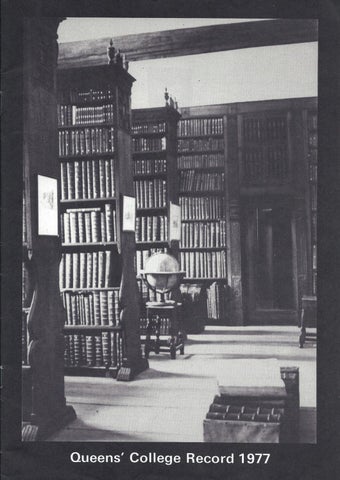
Queens' College Record 1977
COVER ILLUSTR ATION: The Old Library
Queens' College as at March 1977 Visitor HER MAJESTY THE QUEEN Patroness HER MAJESTY QUEEN ELIZABETH THE QUEEN MOTHER President DEREK WILLIAM BOWETT, M.A., LLD., Ph.D. (Manchester) Fellows Edwin Arthur Maxwell, M.A., Ph.D., Life Fellow, formerly Senior Bursar and Director of .Studies in Mathematics. James Arthur Ramsay, M.B.E., M.A., Ph.D., F.R.S., Emeritus Professor of Comparative Physiology, Life Fellow, formerly V ice-President and Director of Studies in Natural Sciences. The Rev. Henry St John Hart, M.A ., B.D., Reader in Hebrew and lntertestamental Studies; Hebrew Lecturer and Director of Stud ies in D ivinity. Sir Harold Walter Bailey, M.A., F.B.A., LL.D. (h.c.) (Perth), LLD. (h.c.) (Australian National University), D.Litt. (h.c.) (Oxon), Emeritus Professor of Sanskrit, Life Fellow. Sir Arthur Llewellyn Armitage, M.A., LLB., LLD. (h.c.) (Manchester), Life Fellow, formerly President. Douglas Parmee, M.A., Tutor for Research Students and Director of Studies in Modern Languages. John Holloway, M.A., Litt.D., D.Phil. (Oxon), D.Litt. (Aberdeen), Professor of Modern English. Maxwell Marsden Bull, M.A., M.D., B.Ch., Director of Studies in Medicine. Henry Cohen, M.A., Ph.D. (Dunelm), Assistant Director of Studies in Engineering. Anthony Colin Spearing, M.A., Director of Studies in English. James William Longman Beament, M.A., Sc.D., F.R.S., F .R.S.A., Drapers Professor of Agriculture. James Martin Prentis, M.A., M.Sc. (Eng.), Ph.D. (London), Senior Bursar and Assistant Director of Studies in Engineering. Norman Francis Hughes, M.A., Acting Junior Bursar and Assistant Director of Studies in Natural Sciences (Earth Sciences). Kenneth Ewart Machin, M.A., Ph.D., Senior Tutor and Assistant Director of Studies in Natural Sciences (Physics). Ajit Singh, M.A., B.A. (Punjab, Chandigarh), M.A. (Howard, Washington), Ph.D. (Berkeley, California), Director of Studies in Economics and Politics. Brian Albert Callingham, M.A., Ph.D. (London), Assistant Director of Studies in-Medicine. James Diggle, M.A., Ph.D., Librarian and D irector of Studies in Classics. Peter Jaffrey Wheatley, M.A., Ph.D., Director of Studies in Natural Sciences (Chemistry). John Tiley, M.A., B.C.L (Oxon), Director of Studies in Law. John Edward Carroll, M.A., Ph.D., Director of Studies in Engineering. Percy Wragg Brian, C.B.E., M.A., Sc.D., F .R.S., Professor of Botany. Peter Gonville Stein, M.A., LLB., Ph.D. (Aberdeen), F .B.A., Regius Professor of Civil Law; Vice-President. The Rev. Brian Leslie Hebblethwaite, M.A., Dean of Chapel, Tutor and Director of Studies in Philosophy. lain Richard Wright, M.A., Tutor, Keeper of the Records and Assistant Director of Studies in English. John Timothy Green, M.A., Ph.D., Dean of College and Director of Studies in Mathematics. David Barry Sattelle, M.A., Ph.D., Bye-Fellow; Assistant Director of Studies in Natural Sciences (Biology). Thomas Henry Coaker, M.A., Ph.D., Steward and College Lecturer in Natural Sciences. Jonathan Simon Christopher Riley-Smith, M.A., Ph.D., Director of Studies in History. Christopher John Baker, M.A., Ph.D., Tutor and Assistant Director of Studies in History. William Andrew Phillips, M.A., Ph.D., Tutor and College Lecturer in Natural Sciences. Gerald Roland Muff, M.A., Bye-Fellow; Domestic Bursar. Brian William Napier, M.A., Ph.D., LLB. (Edinburgh), Tuto r and Assistant Director of Studies in Law. Richard James Overy, M.A., Praelector and College Lecturer in History. Kevin John Gray, M.A., Ph.D., Tutor and College Lecturer in Law. Robin Douglas Howard Walker, M.A., Ph.D., College Lecturer in Natural Sciences. Roderick Arthur Smith, M.A., Ph.D., Research Fellow (Engineering) . Andrew Duncan Cosh, B.A., Assistant Director of Studies in Economics. John Clive Ellory, M.A., B.Sc., Ph.D. (Bristol), College Lecturer in Physiology. Stephen Geoffrey Wildman, M.A., Research Fe llow (History of Art); Director of Studies in History of Art. James Charles McKeown, B.A., Research Fellow (Classics). Xavier Blanc-Jouvan, M.A., Agrege des Facultes de Droit, Licencie~s-Lettres (Paris), Goodhart Professor of Legal Science. Peter Raynor MacDonald Steele, M.A., Ph.D., College Lecturer in Pathology. Honorary Fellows
Sidney Smith, Litt.D., F.S.A., F.B.S . The Very Rev. Henry Chadwick, D.D., Mus.B., M.A., Hon.D.D. (Glasgow), F.B.A., Dean of Christ Church in the University of Oxford. Sir Thomas Padmore, G.C.B., M.A. Sir Harold Walter Bailey, M.A., F.B.A., LL.D. (h.c.) (Perth), LLD. (h.c.) (Australian National University), D. Litt. (h.c.) (Oxon). Professor Sir Arthur Llewellyn Armitage, M.A., LLB., LLD. (h.c.) (Manchester), Vice-Chancellor of the University of Manchester. Lord Allen, G.C.B., M.A. Alfred Charles Tomlinson, M.A., Reader in English Poetry in the Un iversity of Bristol. Sir George Stanley Waller, O.B.E., M.A., Judge in the Court of Appeal. Robert Neville Haszeldine, M.A., Sc.D., F .R.S., Principal of the University of Manchester Institute of Science and Technology. Theodore Morris Sugden, M.A., Sc.D., F .R.S., Master of Trinity Hall. James Arthur Ramsay, M.B.E., M.A., Ph.D., F.R.S.
The New Development and the College Appeal Seen at close quarters, progress on the new buildings may appear to be very slow . Indeed, many of the enquiries that are received as to what is happening reveal that to the casual observer there seems to be no progress at all. A re-reading of the President's report in last year's Record shows that in fact quite a lot has been achieved since it was written. For example, we tend to take the lawn in Cripps Court for granted and forget that twelve months ago it had yet to be sown. The main structure of Phase II was still under construction but it is now hard to think of it as other than it now is. Lapses of memory aside, probably the main reason for apparent lack of progress is that activity has been concentrated at ground floor level and mainly within the area of the New Kitchens. The external work that has been undertaken, such as asphalting roof slabs, has been unobtrusive. Apart from glazing, which is about to start, the New Kitchens are now weather-proof and the installation of electrical and ventilation services is well advanced. Experience shows that predictions in this matter are invariably rash but there is good reason to hope that furnishings and the installation of equipment will be completed in the next few months. Outside in the cloister on the sou th side of the court the final stretch of York stone slabs is now being laid and soon the paving will be complete. Work on the floor and wall finishes of the new Dining Hall will proceed as soon as it has been cleared of the new kitchen equipment now stored there pending installation. There are grounds for optimism, in that the prediction that the New Hall will be in use by about the end of the present calendar year has stood unrevised for some time, expected progress having been achieved. With this target in mind, all the new furniture for the Dining Hall has already been ordered.
Once this target has been attained the remaining residential rooms, which form FF staircase, will be completed and with them Phase II itself. There is at present no more news of the likely progress of Phase III, which will include the multipurpose hall, intended for general use for drama, meetings, exhibitions, dances and the like. Phase III will also include new squash courts and a covered car park. In the older part of the College, the main work completed last year was the central heating of Fisher Building. The next major task will be the restoration of the Old Kitchens and Pump Court area for other use when the New Kitchens come into operation. This work will not be part of the Cripps Foundation benefaction and will be financed out of the College Appeal. The task will be substantial and costly, present estimates being £115,000, and may well have to proceed by easy stages. Turning to the Appeal, the target of £250,000 still eludes us, for the present total stands at £243,220 as compared with £238,739 last year and £232,242 the year before. However, the College can have nothing but gratitude towards those Queensmen and other friends of the College who have helped us to achieve this total. What disappointment we do feel is directed entirely to the manner in which rapid inflation has decreased the real worth of this sum to the College. As I have suggested above, although the Appeal has made it possible to meet fully the College's commitments in relation to Cripps Court, it will not be possible to finance the restoration of the Old Kitchens and Pump Court area out of the proceeds of the Appeal. A revision of that part of our plans, or at least of the timescale on which we had envisaged their completion, will be one of the problems we shall have to face in the near future. J.M .P.
The Society Our Honorary Fellows have been much in the news, earning further distinction. Sir Philip Allen has been made a Life Peer, Sir George Waller has been elevated to the Court of Appeal, and Sir Arthur Armitage has been appointed Chairman of the Committee on the Political Activities of Civil Servants. At the end of the last academic year two new Honorary Fellows were elected, both at one time Official Fellows of the College. The first is Dr T. M. Sugden, a distinguished Chemist who has been elected Master of Trinity Hall on his retirement as Vice-Chairman and Chief Executive of Shell Research Limited. The second is Professor 4
R. N. Haszeldine, another distinguished chemist, who has been appointed Principal of the University of Manchester Institute of Science and Technology. It is with very great personal pleasure that I report one more recent addition to our list of Honorary Fellows: Arthur Ramsay. The fact that he greeted his election with a certain disapproval perhaps confirms the merit of the Governing Body's decision. I must also report the death of Harold Kirkaldy, a Life Fell ow, and formerly Senior Bursar and VicePresident. He retired in 1970 and thus enjoyed but a few years of his well-earned retirement. Professor
Stein has written an obituary which is published in this year's Record. Amongst the members of the Society in Cambridge there have been relatively few changes. My own absence during the Michaelmas Term was made possible by the Vice-President, Professor Stein's, quiet competence and I take this opportunity to express my personal gratitude to him. Mr Hughes, also on leave for the Michaelmas Term, entrusted his duties as Acting Junior Bursar to Dr Walker, to whom the College is also indebted. Dr Sattelle has returned from a year's sabbatical leave in the United States, posing some initial problems of recognition as a result of acquiring a beard, but evidently in good spirits. There have been some changes in College office. Dr Callingham has resigned his Tutorship after nine years of conspicuous service, but even now he will continue to take charge of admissions on the Science side (as the counterpart to Mr Tiley on the Arts side) though without the responsibility for a tutorial "side". We do, however, have two new Tutors in Dr Baker and Dr Gray. We have had two resignations from the Fellowship. Dr Houslay has left to take up a Lectureship at the Manchester Institute of Science and Technology and Mr Davies to take up a Lectureship in English at Sussex University. Those losses to the Fellowship have been compensated for by the election of five new Fellows. It has been a special privilege to admit to the Fellowship for the academic year 1976/77 Professor Xavier Blanc-Jouvan who is the visiting Arthur Goodhart Professor of Legal Science. He is Professor of Civil Law in the University of Paris and brings great distinction to the Fellowship. We have also elected Mr Cosh into an Official Fellowship and Co liege Lectureship in Economics (he was previously a Bye-Fellow), and we have elected Dr P. R. M. Steele into an Official Fellowship and College Lectureship in Pathology. Dr Steele is a Queensman, a University Demonstrator in Pathology, and someone whose teaching and commitment to the College we have valued for several years past. There are also two new Research Fellows, Mr Wildman and Mr McKeown, both already members of the College. Stephen Wildman took an outstanding First in the History of Art, becoming a Foundation Scholar in 1974, and has begun teaching in the History of Art Tripos. His enthusiasm for the Victorian age and his appreciation of both art and architecture have already proved to be assets within the Combination Room. James McKeown came to the College as a Scholar in 1971, from Belfast, maintained a First Class record in both parts of the Classical Tripos and won the Montague Butler Prize, the Sandys Studentship, the Craven Scholarship, the Sir William Browne's medal, and the Porson Prize: he, too, is a most welcome new member of the Fellowship and a classical scholar in the tradition set by Frank Goodyear and James Diggle.
In addition to these elections, our society has been enriched by the revival of a status ~hich has for long been in desuetude, that of the Fellow Commoner. Mr A. W. Edwards was for fifty ye_ars a member of the College Office Staff, being Chief Clerk and right-hand man to several Senior Bursars. As a mark of recognition of his great services to the College and to enable him to maintain his links with the Fellowship, the Governing Body has made him a Fellow Commoner. Finally, and with great sadness, I have to report the death of Mr A. D. Browne on 16 March 1977, aged 87 years. His death occurred whilst the pageproofs of the Record were being_ despatched to the printer, so that it will be necessary to keep an obituary notice until next year. There will be a Memorial service later in the year, on a date convenient to his family. D.W.B.
The Old Library Appeal In last year's Record details were given of an Appeal which has been opened on behalf of the Old Library. The purpose of the Appeal is twofold. First, we wish to protect the Old Library from the dangers of fire and theft. Second, we wish to com pile a full and reliable catalogue of its contents. It was estimated that the cost of installing a fire-protection scheme and burglar-alarms would not be less than £7,000. The Governing Body offered to contribute half this sum. It was estimated that the cost of hiring a trained bibliographer to revise the catalogue might be as much as £5 ,000. We did not think that it would be reasonable to appeal directly to those members of the College who had already contributed to the recent appeal for Cripps Court. Instead we sent letters of Appeal to over two hundred old members who had not contributed to that appeal, and to nearly forty foundations and charitable trusts. Some members responded to the letter of Appeal; others, who had not been directly approached, responded after reading the notice of the Appeal in the Record last year. So far about £3,900 have been contributed. A list of contributors may be seen elsewhere in the Record. We are deeply indebted to all who have made contributions. The response of several members of the College has been particularly generous. Shortly after the Appeal opened the opportunity arose of making use of the part-time services of the former head of the cataloguing department of the University Library, Mr H. J. Torpey. As soon as he had begun his work on the catalogue, two things became clear: first, that the work would be lengthier 5
and more complicated than we had originally envisaged, and that our needs could be served not by a revision of the existing catalogue but only by the compilation of an entirely new catalogue; and second, that if the income from the Appeal allowed Mr Torpey to complete his work, in a few years' time he would produce for us a catalogue of the very highest quality, one which, indeed, we might hope to publish. The Library Committee therefore decided, with the agreement o.f the Governing Body, that the income from the Appeal should be devoted, in the first instance, to the completion of the new catalogue. We have not given up hope of installing a fire-protection system; but we are not yet in a position to afford it, and unless we can continue to attract a generous response to the Appeal this aim may prove to be unattainable. That would be a pity. The Appeal is therefore still open. If you would like to make a contribution, however small, whether by way of a single gift or by deed of covenant. we should be deeply grateful. Covenant forms, and copies of the original letter of Appeal, in which a fuller statement of our needs is given, may be obtained from the Librarian. Donations may be sent either to the Librarian or to the President.
Professor H. S. Kirkaldy
J.D.
1902-1976
The Fabric Good weather conditions have enabled a concentration of effort on redecoration throughout the College during the year. Exterior repainting has been completed in Cloister Court, the Library passage and the entrance arch of Old Court. Much needed interior painting has also been undertaken on the Essex staircase and in the Munro and Angevin Rooms. On the repairs and improvements side, the provision of central heating to "W" staircase of Fisher completes this protracted task for the whole of that building. Interior rewiring has been carried out in "M" and "N" staircases of Friars Building. An extra bed-sitting room has been provided following alterations to the Old Porters' Lodge in Old Court. The paths around Walnut Tree Court have for some time been in need of repair and they have now been resurfaced. A start has been made on repairs to the B~idge walkway: half of this task has been completed, together with the provision of a non-slip strip fixed to the wooden slats, and the remainder will be finished in the summer of 1977. Fisher Drive has been enhanced by a line of dwarf trees which will in time provide a hedge screen. G.R.M. 6
Harold Stewart Kirkaldy, who was a Fellow of the College for 32 years, died on 20 September 1976. Harold Kirkaldy was born in India of Scots parents and was brought up in Scotland. He had a distinguished undergraduate career at the University of Edinburgh, taking degrees in both Arts and Law . Like many Scots before him, he decided to seek his fortune in England and was called to the English Bar in 1928. Thereafter his whole career was spent in England, yet he always remained quintessentially Scottish. The accent, the manner and the sense of humour which he brought with him on the journey south remained unchanged for the rest of his life. He had also acquired other attributes of character which directly affected his career. He had to an unusual degree the . qualities of calmness, patience and a sense of fairness. It was these attributes above all which combined to make Harold Kirkaldy such a gifted arbitrator and settler of disputes. They enabled him to give balanced judgments on complicated issues which were acceptable to the opposing parties because they were manifestly the verdict of a shrewd man altogether free of bias. The field in which he used these gifts was Industrial Relations. As Secretary of British Employers' Federations he saw from the inside how industrial relations work in Britain, and from 1929 onwards he was kept continuously familiar with the wider aspects of the subject through his association with the Inter/ national Labour Office in Geneva.
In 1944 he became Professor of Industrial Relations in the University of Cambridge and a Fellow of Queens'. His academic duties did not interrupt his practical contribution to the settling of labour disputes. His services were sought over and over again as Chairman of Wages Councils, Compensation Boards and Industrial Disputes Tribunals. He always seemed ready to accept any call to serve on such bodies. When the National Incomes Commission was set up in 1962 he became its Deputy Chairman. He resigned his University Chair but retained his Fellowship at Queens'. When the Commission was dissolved on a change of Government three years later, he became VicePresident and Senior Bursar of the College and for the next few years until his retirement he was mainly occupied with the affairs of the College. As an unmarried Fellow he lived in College and was intimately concerned with its life and welfare. He took a personal interest in the welfare of the Staff of the College, and many of them felt that they could take their problems to him with the assurance of a sympathetic hearing. He was a loyal supporter of the College Chapel and a regular attender at Evensong on Sunday evenings. His conversation afterwards showed that he gave critical attention to the preaching of the Word. To the surprise of some of his friends, he decided on his retirement to leave Cambridge and live in Kent. He did not want to remain inactive where he had been so busy. In his last year at Cam bridge he had to preside over the election of a new President of the College. The procedure involved a protracted series of meetings. His handling of these meetings never failed but he was clearly under considerable strain. When it was all all over and he had ensured that the proper formalities had been observed, he asked me to his room and gave me a glass of whisky. "Well", he said with evident relief, "that was a job well done". He was referring to the Governing Body but it could have been a fittingjudgme nt on his own career. P.G.S.
Bequests A number of bequests hav.e been received during the past two years: Miss E. R. Potter, who died in 1964, left a proportion of the capital of her estate, subject to a life interest to her sister, to the College "for such purposes connected with the College as the Governors shall decide". This has now been received. Eugenie Juliana P. Weil, as evidence of the affection held for her son-in-law, bequeathed to the College a sum for the foundation of the Michael Greet Field (mat. 1939) Fellowship to promote
edu.cational exchanges between Queens' and the United States. Mr H. W. Lee (mat. 1908) left a legacy in his Will for the purchase of books for the College Library. The Rev. Canon A. E. Foster (mat. l 919) bequeathed the residue of his estate to the College for the foundation of exhibitions for candidates for Holy Orders in the Church of England. Prof. H. S. Kirkaldy (Fellow) left a legacy to the College for general purposes. These bequests represent a most welcome addition to the Endowment of the College. J.M.P.
Reginalia: Caxton and Queens' Centenaries are yielding unlooked for rewards. In 1968, the bicentenary of the death of Laurence Sterne, a hitherto unknown Jetter by Sterne came to light in the Library. And had 1976 not been the quincentenary of the introduction of printing into England by William Caxton, we might have remained long unaware that we possess a product of Caxton's press. Seymour de Ricci, in his Census of Caxtons (1909), attributed to us one of only four known copies of an Indulgence printed by Caxton. The document has been located in our archives, where it is listed without the printer's name. We do not know how de Ricci learned of our copy; it is unlikely that he saw it, since he gives full particulars about the other copies but none about ours. In 1476 Caxton established his printing-house in the precincts of Westminster Abbey, and here was produced the first datable piece of printing in England. It was an Indulgence, issued by Pope Sixtus in aid of the Crusade against the Turks. Printing of Indulgences had begun with Gutenberg himself in. 1454, and was especially favoured by printers who, like Caxton, were setting up a new establishment and were glad to receive jobbing work. Before the advent of printing, Indulgences were wntten by hand, one at a time, by a slow and expensive scribe. Printing enabled them to be produced cheaply, in large numbers, within a few hours. The Indulgence in our possession was printed in 1489. Caxton received the commission for its printing from Johannes de Gigliis and Perseus de Malviciis. Gigliis was born at Bruges in 1434 and may have become acquainted with Caxton while Caxton was living at Bruges from about 1445 to 1476. He was now papal collector of revenues in England and stood high in the favour of Henry VII, since he had reported enthusiastically to Innocent 7
VIII on Henry's accession and had helped to secure the Pope's approval for Henry's marriage to a cousin. Malviciis had recently presented Henry with a sword of honour as a gift from Innocent,. who hoped to persuade him to join the Crusade. Henry proclaimed a crusade in 1490, but the act of proclamation was the limit of his cooperation. The purpose of the 1489 Indulgence was to raise money for the Crusade. To its purchaser it brought limited comfort: it granted, in return for 'only four, three, two or one gold florin', permission to choose one's own confessor once in a lifetime and again at the point of death. Caxton printed two editions¡, or rather two different settings simultaneously on each folio sheet, which were then cut for separate sale. The gothic type which he used was a smaller version of one of his regular types, and he used it here for the ¡first and only time. The Indulgence is a single leaf, printed on one side only, and measures approximately eight inches in width and five in height. The text occupies twenty seven lines; it is written in Latin; the style is verbose and ponderous. A place was left vacant towards the end of the text for the purchaser to sign his name. The signature on our copy has faded and cannot be deciphered. It is known that the Indulgence was on 8
sale by 24 April 1489, for on that day a copy was issued to Henry Bost, Provost of Eton College. This copy is now in the British Library, as are the other two known to de Ricci. Two further copies have become known since de Ricci' s catalogue was published; one is in an American Library and one is reputedly in private hands. Our copy is one of five listed at Indulgences 114 in the revised edition of A short-title catalogue of books printed in England, Scotland, and Ireland, 1475-1640. Our copy of the Indulgence was put on display in an exhibition of works by Caxton at the University Library from September 197 6 to January 1977. Since it is not in a good state of preservation, we have decided that it should receive attention from the Conservation Department at the University Library. It will then be mounted in a suitable binding and restored to the College Library.* James Diggle
* I am indebted for help and advice to Mr Brian Jenkins of Queens', Assistant Under-Librarian in the Department of Rare Books in the University Library, who first brought the entry in de Ricci's catalogue to light.
The Li bra ry
the Eugene Power Foundation presented a fac simile of Caxton's translation of pvid's Meta morphoses. A collection of books was bequeathed by Canon A. E. Foster ( 1 9 1 9), and a sum of money for the purchase of books was bequeathed by H. W. Lee ( 1 908).
The year's most striking event was the discovery that we possess a rare piece of printing by Caxto n ; details of this discovery are given elsewhere i n the Junior A ssistant Librarians, 19 76: Ds S. G. Wildman E. R. Cook Record . B. J. Mitchell Ds P. C. Millett An exhibition was held in the Old Library in the R. S. Fieldson Ds R. M. Ridgewell last week of the Easter Term and was repeated on K. F. M. Leadbeater P. �Evans the day of General Admission and dur,ing the R. A. B. Cross Queens' Club weekend. Items on display includ ed J.D. early English and mediev�l Latin manuscripts, incunabula, first editions, and bindings, About five hundred people visited the exhibition. Once more we are indebted to Professor Gold by, . who has continued to devote his scrupulous and elegant workmanship to the rebinding of books from the War M em orial Library and the Old Library, and to Mrs G oldby·, who has continued :her The Chapel · valuable work on the preservation of the leather bindings. A new aftern0on resident ·of :the Old Library is Mr H. J . Torpey, who has been appointed The follpwing visiting preach�rs c�me to the �o,llege. to compile a new ca talogue of the Old Library. Mr in the cour-se of the ye.ar: Torpey has recently retired from the -staff of .the 'the Rev. J. -E. ·cotter; ' University Library, where he worked for fifty ye-ars Chaplain of Gonvilie . and Caius College;· .the ·Rev:. · R. C. Godsall, Curate of St. Mary and St. Marg.aret and was in charge of the General Catalogue. He with St. Cuthbert, Norwich ; Fr. John WaJiggo, brings to his job an expertise in bibliographical Fisher House; the Rev. J. M . Armson; Chaplain of matters and an enthusiasm for old books. We were Westcott House; the. Very Rev. A. B. Webster,.Dean enabled to make this appointment as a result of the of Norwich, ; the Rev. Dr. S. G. Hall, Lectur� in initial response to the Old Library Appeal, about Thedlo'gy, -University of Nottingh,m'l ; -the 11- ev. Dr.. Which details are · given separately in the Record . A, R. Peacocke, Dean of .Clare College; the Rev. Dr. · As in previous years we .have benefited from the generosity of members of the College in donatin_g .B. . R. , \\lh�te 1 P.-r.m cip� . �f ·R eget?-t'.s: P�r�· ..C�lfoge, :. Oxford;· the -Rev. M. Santer, ·Principal .of ·Westcott . . books by the�selves ·or . by ·otne;s. The following House; the . . Rev. Elmore ·Leske, . 'Preceptor of · Fellows donated books by themselves: Mr Spearing, We�tfield . House (Luther;in); t�e Rev. M. P.o,w ell, Chaucer, Troilus and Criseyde and M,edieval dreamViciµ- of .On slo�· X-i� ,Guildf�d ;; �ll� �Rev . . -R . . · . ;._ ;_ _poetry; Mr Parmee, translation - of Ma1:JPassmt;, Bel A mi; M r Hughes, ,Palaeobiology of angiosperm·; Mr · · . . Jo.b , -P:recenfor ·of .W estminster Abbey , - Fr:. .. f>.etek: · ' · ;- · · \ Tiley , R evenue Law; Mr. Hebblethw.aite , Evil, Lance, St. Laurence's; Milto.n Ro�. � ' � . suffering, and religion; Dr Baker, The po./itics of Mr. ·- Larry·Bowser -also preached. : · · · · · : · The ·prea·cher· �t. the Commehi'oration"6f; }J4(eSou th India 1 920- 1 9J7; Mr Overy ; .Jf"i/liam Morris, Viscount Nu/field; Dr Coaker, Appiied_biology (ed:). · "facforsdri fµll Term was ·the -Rev, M. ,J. Gudgeon, Vicar of Hawley , and at the first visit of ·the Club . in The following members of the College donated June, the Rev. N. E. Mitchell, Assistant Director of books by themselves: H. P. Gray ( 1 962), A generalSocial Services, London Borough of Bexley. ized theory of international trade; J. N . Hillgarth ( I 94 7), Ramon Lull and Lullism in fourteenthThere was an informal Service prepared by century France and The Spanish kingdoms, 1250members of the College on 1 5 February, and the Advent Carol Service was held on 2 8 November. 151 6, vol 1 ; D. C. Horton ( 1 93 3), R eport on the census of the population of the British Solomon Mr. Bowser assisted with the chaplaincy work Islands protectorate, 1 9 70; J. A. Bryant ( 1 962), during the Lent and Easter terms; Mr. John Silk Molecular aspects ofgene expression; J. D. H. Smith and Mr. Tony Evans of Westcott House took over ( 1 9 67 ) , Lecture notes in mathematics; P. J. Holmes for the Michaelmas Term. ( 1 949), Handbook of thick film technology. At the end of the academic year, we said goodBooks were also donated by Prof. Beament, Dr bye to the outgoing organ scholar, Iain Ledingham, Maxwell, Mr Napier, Dr Smith, Mr Wildman, G. A. and welcomed Stephen Armstrong as his successor Starr ( 1 9 5 5 ) , I. W. Hussey ( 1 947), P. C. Millett in the Michaelmas Term. (1 972), D. P. van Beesten { 1 969) in memory of For the fourth year running, a Queens' College J. L. van Beesten (1 97 5), Y. Bamevo ( 1 97 6), and Christian House Party was held, after the end of the Michaelmas Term, for the second time at the Queens' College Opera Society. Dr J. Beattie Hengrave Hall, near Bury St. Edmunds. presented a collection of books on medicine, and 0
9
First Classes, June 1976 Classics. P. C. Millett, I. J. Nichol. Economics. N. C. Mason, D. J. Baker, R. S. Fieldson, J. L. Hartstone. Engineering and Electrical Sciences. P. J. Christian, D. G.D. Clark, M. L. Norton, C. F. Ross, A. J. Cupples, N. Jakeman, M. J. Kershaw. English. P. T. E. Merchant, S. D. Pattison. History. T. C. Graham, A . C. Murray, T. C. Wales. Land Economy. J.M. Tweed. Law. S. D. Chipkin, P. Sacks, C. J . White, I. D. Edge. Mathematics. E. H. Kitchen, R. J. Knight, D. Whitgift, A. S. Giles, A . M. Newman, M. J. Simon, A. P. Clark, S. J . Thompson. Medical Sciences. N. G . Bruce, M. J . D. Go odfield, A. R. Green, C. H. C. Twort (Distinction in Physic, Final M.B.J. Modern and Medieval Languages. J. E . B. Walker. Natural Sciences. W. R. A. Brown, P. W. Davies, R. J. Dickinson, T. Inst one, J. A . Jackson, P. McKenna, P. M. Freedman, R. F. T. Gilbert, S. Kearsey, R. J. Snow, D. J. Wrigley, D . J. Brown, K. J. Brown, C. H. Elphick, P. W. Frew, D. S. Latchman, S. P. Luttrell, J. R. Ridley, S. G. Roberts, J . W. Tate.
G. M. Hunter, Winchester College, for English (Paterson). J. M. G . Vessey, Canford School, for English. S. C. B. Cooper, King's School, Worcester, for Geography. G. S. Garnett, Haberdashers' Aske's School, for History. B. M. F. Quinn, Bradfield College, for History. S. N. Botterill, Worthing Sixth-Form College, for Modern Languages. T. W. M. Dillon, Solihull School, for Modern Languages to read Classics (Colenutt). P. T. Fletcher, Oratory School, for Modern Languages. A. Goldman, Kingston Grammar School, for Natural Sciences (Melsome). A . J. Green, King Charles I School, Kidderminster, for Natural Sciences (Melsome). A. B. Hawthorne, Nottingham High School, for Natural Sciences to read Medical Sciences (Melsome). D. G. Jewson, Gresham's School, for Natural Sciences to read Medical Sciences (Melsome). M. McGrath, King Edward's School, Birmingliam, for Natural Sciences (Melsome). P. D. Newth, Shrewsbury School, for Natural Sciences to read Engineering (Melsome). N. P . Taylor, The Judd School, Tonbridge, for Natural Sciences (Munro).
University Awards To the Hulsean Prize: P. G. Wignall. To the Humanitarian Trust Studentship: J. M. Paxman . To the Members' Classical Translation Prize .for Greek: I. J. Nichol. To the Allen and Hanbury Prize in Veterinary Parasitology: J.C. M. Lewis. To a Wrenbury Scholarship: N. C. Mason. To a Wordsworth Studentship: G. A . D. Briggs. To the Harkness Scholarship (jointly): J . A. Jackson.
CoUege Scholarships and Exhibitions Entrance Scholarships J.M. G. Barclay, University College School, London, for Classics. S. P. Oakley, Bradfield College, for Classics (Colenutt). M.A. El-Erian, St. John's College, Leatherhead, for Economics. 10
Entrance Exhibitions D. G. McFarland , Royal Belfast Academical Institution , for Classics (Gray). S. Walkden , Rugby School, for Economics (Paterson). M. V. Goodyear, St. Dunstan's College, for Engineering. J. M. Graham, Westminster School, for Engineering (Paterson). N. D. K. Prosser, Haileybury College, for Engineering (War Memorial). R. A . C. Scott, Hailey bury College, for Engineering. S. N. Bridge, Lawnswood School, Leeds, for English to read Law . N. D. Clarke, Kingston Grammar School, for English (Paterson). P. B. Holmes, Latymer Upper School, for English to read Law. D. W. Huggins, Radley College , for English. D. W. Lewis, Sir Thomas Rich's Scho.ol, Gloucester, for English. E. R. Grubb, Wellington School, for General Studies to read Theology (Glendinning Nash). K. G. Young, St. Olave's Grammar School Orpington, for General Studies to read Law. ' C. D. Brant, Marlborough College, for History.
G. P.A. Brown, The Leys School, for History. T. R. Coles, Aylesbury Grammar School, for History. T. J. Crarer, Oundle School, for History to read Law. S. J. B. Henderson, King's College School, Wimbledon, for History. S. J. E. Hill, Clifton College, for History. M. F. Lester, Wimbledon College, for History to read Law (Paterson). D. A. Meade, St. Benedict's School, Ealing, for History. G. R. Newey, Tonbridge School, for History to read Law (Haynes). G. P. Potter, Brooklands Technical College, for History. K. A. Salkeld, Ardingley College, for History. S. A. Hawkins, Nottingham High School, for Mathematics (Frodsham). E. R. W. Lindsay, Portora Royal School, Enniskillen, for Modern Languages (Paterson). W. J. Soutter, Eltham College, for Modern Languages. J. W. Higgins, Rayne's Park High School, for Music (Maine). M. P. J. Landon, King's College, Taunton, for Natural Sciences (Melsome). S. N. Mentha, King George V School, Southport, for Natural Sciences (Melsome).
THIRD YEAR Foundation Scholarships N. C. Mason for Economics; P. J. Christian for Electrical Sciences; T. C. Graham for History;
A. C. Murray for History; D. Whitgift for Mathematics; W. R. A. Brown for Natural Sciences; P. W. Davies for Natural Sciences; P. McKenna for Natural Sciences. Bachelor Scholarships
P. T. E. Merchant for English; D. Whitgift for Mathematics; P. W. Davies for Natural Sciences; J. A. Jackson for Natural Sciences; P. McKenna for Natural Sciences.
GRADUATES Foundation Scholarships P. C. Millett for Classics; E. H. Kitchen for
Mathematics. Bachelor Scholarships P. C. Millett for Classics; E. H. Kitchen for
Mathematics.
SPECIAL PRIZES
FIRST YEAR Exhibitions D. J. Baker for Economics; R. S. Fieldson¡ for Economics; K. J. Brown for Natural Sciences; C. H. Elphick for Natural Sciences; J. R. Ridley for
Natural Sciences.
Joshua King Prizes: N. C. Mason, P. T. E. Merchant. Hughes Prize: A. R. Green. Venn Prize: M. J. Kershaw PennyWhitePrizes: R.J.Knight t aeq. D. Whitgift I Chalmers Prize: T. Instone. Lucas Smith Memorial Prize: C. J. White. Mosseri Prize: W.R. A. Brown. Openshaw Prize: C. F. Ross. Michael Greet Field Fellowship: J.M. Paxman.
The E Society SECOND YEAR Foundation Scholarships I. J. Nichol for Classics; D. G. D. Clark for Engineering; M. L. Norton for Engineering; C. F.
Ross for Engineering; T. C. Wales for History; I. D. Edge for Law; A. S. Giles for Mathematics;
A. M. Newman for Mathematics; M. J. Simon for Mathematics; N. G. Bruce for Medical Sciences; M. J. D. Goodfield for Medical Sciences; A. R. Green for Medical Sciences; P. M. Freedman for Natural Sciences; R. F. T. Gilbert for Natural Sciences; S. Kearsey for Natural Sciences; R. J. Snow for Natural Sciences; D. J. Wrigley for Natural Sciences.
Three meetings of the Society were held in the Lent Term and three in the Michaelmas Term. The speakers were Professor R. J. Chorley, Fellow of Sidney Sussex College, Professor of Geography, on 'Landscape of the Western' ; Dr. Baker on 'India and Mrs. Gandhi'; Professor M. S. Longuet-Higgins, Fellow of Trinity College, on 'Power from Sea Waves'; Dr. L. E. R. Picken, Fellow of Jesus College, on his collection of oriental and middleeastern musical instruments, which we went to see in his rooms at Jesus College; Dr. Smith on 'The Queens' Expedition to Svartisen'; and Dr. Walker on 'Computers, Protection and Privacy'. 11
The College Union 1975-6 President: T. P. Mitchell Vice-President: Professor Holloway Secretary: F. H. Christiansen Senior Treasurer: Dr Wheatley Treasurer: J. S. Hillage Fellows: Dr Napier, Dr Smith Graduates: J. M. Holmes, C. A. Lucas Third Year Representatives: C. E. Blacker, K. R. Norton Second Year Representatives: J. R. Lowes, J. Weaver First Year Representatives: R. A. Ahmad, R. F. Lawrie
The College Union has the task of assisting with the running of the College and generally furthering the College's corporate life. It deals with a wide range of administrative matters, from the allocation of finances in the Amalgamated Clubs to the provision of leisure facilities in the Junior Common Room. The formation of a basketball club brought the number of sports catered for up to fifteen this year. Non-sporting societies were equally well represented, while the Union continued to give subscription rebates to those people taking part in activities only organised at University level. A substantial sum of money was allocated to charities over the year, helping many worthwhile causes. The JCR became increasingly popular as the social focus of the College, and the great improvement of the lunch service there attracted many new customers. The congenial atmosphere was enhanced by providing carpeting and new furniture, as well as more subtle lighting. The Union provided a number of new services, including discos; lunchtime theatre; a loan scheme for glasses for private parties; foam mattresses for the use of guests staying overnight in students' rooms; a calendar of social and sporting events in the College; and trips to major concerts outside Cam bridge. The College Union and the Tutorial Office together compiled a directory of jobs abroad to help students waiting to come up to Queens' to find interesting work. In the first week of the Michaelmas Term staircase parties were arranged to complement the freshman contacts scheme and help freshmen to get to know their neighbours in College; this was followed up with a freshman disco. Work was started on preparing a booklet for newcomers to the College giving information on academic, social and other facilities in the College. There were a number of amendments to the constitution of the Union during the year, including the setting up of the new posts of External Officer, and Social and Entertainments Secretary, and the bringing forward of JCR elections to the Lent term so that a greater measure of continuity could make the transition from one committee to the next more effective. Two major issues covered by the Union were co12
residence and student observers on the Governing Body. A Joint Colleges Committee was set up to look at the question of co-residence in Cambridge generally, and in particular to ensure that the academic standards of the University were maintained. The student observer debate led to an ad hoc committee being formed to find solutions to the practical difficulties involved . The College Union has had an active year, marred by a slow start, but has showed itself to be an essential organ in the general administration of College affairs and an important medium for maintaining a close contact between the students and the Fellowship. 1976-7 President: F. H. Christiansen Vice-President: Professor Beament Secretary: M. C. Spink Senior Treasurer: Dr Wheatley Treasurer: R. F. Lawrie External Officer: S. J. Thompson Steward of the Fitzpatrick: J.P. Spencer Fellows: Dr Baker, Dr Smith Graduates: S. J. Baker, C. M. Robertson Third Year Representatives: D. W. Backhouse, C. F. Ross Second Year Representatives: M. P. Ripley, J. W. Styles First Year Representatives: S. G. Batchelor, N. D. Martin 0
St Margaret Society 197S-6 President: Professor Beament Vice-President: J.C. Bickley Secretary: J. A. Jackson Treasurer: C. J . Hartree Publicity: G. K. Kay Committee: P. B. S. Clarke, Dr Green, N. J. Hamway, I. M. Ledingham, A. C. Sabourin, P.. S. Wicker.
The St Margaret Society promoted three concerts in College and another three for the general public in the Lent Tenn 197 6. The College events included a Chapel concert in early February, a concert in the Long Gallery at the kind invitation of the President and Mrs Bowett, and a Smoking Concert in Hall. The latter event was very well attended, and featured, amongst many other items, adaptations of Mozart arias sung by the Deans, and impersonations of Marlene Dietrich and the Sugar-Plum Fairy. The Mag Sac's extra-mural activities took keen musicians to Sutton-in-the-Isle on an inclement January evening to perform at St Andrew's Church at the kind invitation of the Rev. Mr Galilee. Great St Mary's Church provided the venue for one of the public concerts, when Bach's St John Passion was sung by the Chapel choir in German under the baton of Iain Ledingham. The soloists included Neil Jenkins, Michael Ripon, Jacek Strauch and
Elizabeth Gardner. The main concert of the term consisted of Debussy's Nocturnes, conducted by Jan Kaznowski. and Vaughan Williams' Sea Symphony. The concert took place in the Guildhall and was reasonably well supported. In the Easter Term, the St Margaret Society promoted a lunch-time Chapel concert of contemporary music, featuring the St Margaret Society Orchestra, which was formed specially for the occasion. The May Week concert was given to a capacity audience. The main item was a revival of Purcell's The Tempest, and also included in the programme was a performance of Villa-Lobos' Bachianas Brasilieras No. 5 for eight cellos and soprano, there being a surfeit of cello-playing talent this year. Refreshments were provided in Walnut Tree Court and the evening was deemed a great success by all. The Michaelmas Term began with a Chapel Concert in which Jan Kaznowski played the first movement of Elgar's violin concerto. This event was soon followed by the Freshmen's concert, which was so successful that the committee decided to compliment the Admissions Tutors on their choice of musical freshmen. Professor Beament's birthday concert took place as usual in the Combination Room. The main concert of the term was given in Great St Mary's and was conducted by Jan Kaznowski. The Mag Soc chorus was of a more manageable size than in the previous term and numbered only about 150 members. Poulenc's Gloria and Faure's Requiem were performed, with Felicity Lott and David Wilson Johnson as soloists. The major event of the term was however the arrival of a new harpsichord. After much politicking, this magnificent instrument has finally appeared and to celebrate the occasion an 'Open Concert' was given in St Botolph's. John Scott (St John's), Jan Kaznowski and Helen Keen were the soloists in an electrifying performance of Bach's Brandenburg Concerto No. 5. Also included in the programme was the Messe de Minuit by Charpentier, sung by the Chapel choir and conducted by Graeme Kay, and some Purcell songs sung by Tim Wilcox. Organ recitals were given weekly by leading Cambridge and outside organists. They were considerably more successful than the Mag Soc eight for the 1976 May Races. The boat was coached by Roger Lowe and included some of the successful crew of the previous year. The new additions to the crew were Nigel Hamway and Philip Wicker, both of whom denied responsibility for the boat's failure to make any bumps at all! 1976-7
President: Professor Beament Vice-President: N. J. Hamway Secretary: P. S. Wicker Treasurer: R. J . Knott Publicity: G. K. Kay Committee: S. R. Armstrong (Organ Scholar), M. P. Burrows, P. B. S. Clarke, C. J. M. Graves, Dr Green, J. C. Kaznowski, J. W. Styles
The Bats 197S-76
President: M. G. Panter Vice-President: P. S. Happe Technical Director: F . H. Christiansen Secretary: M. C. Y . Lewis Senior Treasurer: Mr Wright Junior Treasurer: J. L. Hartstone Committee: M. Davidson, I. D. Edge, R. S. Balme, Llz Drayson, R. H. Michell
Anouilh's 'The Lark' in the Chapel
197 6 has been another busy and successful year for the BATS. The year started with The Merchant of Venice at the ADC, followed by a late night production of Crow by Ted Hughes. The Merchant was particularly well received, with a striking set and several distinguished performances. The traditional May Week production in Cloister Court was Hamlet. Adventurous direction, including the gradual change from modern to period costume as the play progressed, helped it to appear fresh but not gimmicky. This, together with an excellent cast and production team, and of course the ideal 13
setting in front of the President's Lodge, made the week a considerable artistic and financial success. Bats had long wanted to stage a play in the College Chapel, and in the Michaelmas Term were finally able to do so. The play chosen was Anouilh's The Lark, the story of Joan of Arc, which was so engaging that one soon forgot the firmness of the Chapel pews. Another new venture was the performance of two plays in the J .C.R. at lunchtimes. These were quite enthusiastically received by the lunchtime drinkers, so we hope to repeat the idea next year. The year ended with a Christmas Pantomime, which found more appreciative audiences in the local junior schools than for its sadly disrupted college performance. Overall, the year produced quite a healthy profit, which enabled us to buy four new lights, so making us less reliant on hired equipment in the future. 1976-77
President: M. C. Y. Lewis Vice-President: R. H. Michell Secretary: R. S. Fieldson Technical Director: F. H. Christiansen Senior Treasurer: Mr Wright Junior Treasurer: J. L. Hartstone Equ'ipment Managers: M. Davidson, M. P. Ripley Publicity: K. T. Roberts Committee: C. J. M. Graves, I. D. Edge, P. T. Frazer
Film Society 1975-76
President: C. J. M. Dixon Secretary: M. R. N. Shackleford Treasurer: S. A. Jowett
The Film Society, although still in some financial difficulty at the beginning of 1976, continued its policy of providing well-known films to attract large audiences. The Lent Term began quite successfully with And now for something completely different, and the next film, Bonnie and Clyde, achieved two full houses. The pendulum then swung back again with a dismal attendance for Cockleshell Heroes, but the last three films, The Mechanic, The Virgin Soldiers and The Graduate, attracted reasonable al,ldie~ces. Once again the Easter Term passed without activity, due to the academic enthusiasm of the committee. During this time, however, the projector's much-maligned sound system was repaired and two speaker cabinets purchased. The Michaelmas Term began with a schizophrenic Peter Sellers starring (six times over) in Soft Beds, Hard Battles, followed by that blood-thirsty favourite Soldier Blue. These were followed by an immensely successful Cabaret. Another old faithful, 14
Straw Dogs, followed, but unfortunately only one showing was possible. The next week's Puppet on a Chain, by Alistair Maclean, was enjoyed by many thriller fans, and the superb acting of Oliver Reed made The Triple Echo very enjoyable. Donald Sutherland and Julie Christie in Don't Look Now added some horror and the term ended with A Seasonal Specia.l. The Michaelmas Term's successes have put the society in a more healthy financial situation, despite the summer's expenditure, and the committee hopes that if the Lent Term's films are also successful, the society may be in a position to afford a new screen. 1976-77
President: D. W. Backhouse Secretary: A.H. Williams Treasurer: K. D. Ward
Medical Society 1975-76
President: W. P. Gorman Secretary: R. Wilson Treasurer: 1. R. Lowes University Medical Society Representative: A. J. Ainsworth
Under the presidency of Peter Gorman, the three meetings of the Lent Term were 'Bone Marrow Transplantation' (by Prof. J. G. Humble from the Westminster Hospital), 'Gut Feelings', and 'Are Most Rheumatic Diseases Inherited?' In the academic year beginning October 197 6, the Society celebrated its 50th Anniversary. As an innovation, a football match was arranged between our Freshmen and the lady medics of New Hall, in which we were handsomely beaten. The meetings in the Michaelmas Term were on the suojects of 'Alcoholism', 'Nurses, Patients and Doctors' (by the District Nursing Officer), and 'Endemics of East Anglia'. The Annual Dinner was held on December 1st in the Munro Room. It was particularly fitting that our Guest Speaker was Dr Cater, a Vice-President of our Society, for Dr Cater matriculated at Queens' in the year the society was founded. At the Dinner, the committee was able to congratulate ¡Dr J. C. Ellory, College Fellow (Physiology) on becoming a Vice-President. We are sorry to hear of the death of Dr John Beattie in Oxford, where he had recently moved. Old Queensmen will know that Dr Beattie was a friend and supervisor in Physiology to medical students for many years. He had been looking forward to coming to our Anniversary Dinner. 1976-77
President: P. Le Feuvre Secretary: M. J. D. Goodfield Treasurer: M. B. Kostecky University Medical Society Representative: S. K. Swallow
Classical Society President: R. K. Mowbray Secretary: J. P. Spencer
The Classical Society emerged from its state of suspended animation on 26th April, having been dormant for almost three years. Our first guest was Professor Kenney, and our two guests in the Michaelmas Term were Dr Diggle's predecessor as Director of Studies at Queens', Professor Goodyear of Bedford College, London, and Mr Lee of St John's. Our guests spoke respectively on Ausonius' Moserta, Fakes and Forgeries in Classical Literature, and Virgil's Fifth Eclogue. It is to be hoped that the society will continue as auspiciously as it has so far since its renascence.
History Society 1975-76
Senior President: Dr Riley-Smith Junior President: T. C. Graham Secretary: M.A. F. Raw Committee: R. D. B. Green, D. J. Branson, J. M. Black, G. M. Ker, S. H. Davey
1976 was an active and fruitful year for the Society. Five papers were read, and we held tw.o annual dinners in the space of six months. In the spring Professor Hinsley read a stimulating paper on 'War and Peace in Modern Times', and Mr Q. R. D. Skinner outlined a novel approach to the history of Capitalism. In the summer, Dr B. C. Wood read a paper on slavery and illustrated the manner in which statistics highlight the historical process. In the Michaelmas Term, Dr J. S. Morrill gave an impassioned account of the political thought of Oliver Cromwell and Dr M. Brett, of Balliol College, Oxford, spoke about the last stages of the Investiture Contest in England. Both the dinners were great successes. Professor Gallagher was the guest of honour for our long postponed dinner in the summer. He delivered a witty speech on the more curious aspects of the history of prostitution in Cambridge. In the autumn, Prof~ssor Hurstfield, of University College, London, was the guest of honour. He began by giving us an account of how he was refused a fellowship at Queens', referred to Dr A. L. Rowse's magisterial study of the Comish pilchard industry in the sixteenth century, and concluded by asserting that the study- of history was an affirmation of the dignity of mankind. Dr Riley-Smith, in his speeches at the dinners, referred to the Catholicising tendencies of a Director of Studies in Queens' in the 1930's, the subsequent revolt of the undergraduates, and the consequent changes in the History Society constitution. The latter body apparently owes the fact that its President is an undergraduate to the intellectual
trend of Queens' in the 1930's and to the strength of the 'No Popery' faction. Dr Riley-Smith. has continued without fail to aid the society, and it is to his efforts that we must ascribe much of our current good fortune. Mr Hebblethwaite's loan of his rooms has also been an important factor in providing a pleasant location for the society's meetings, and we are most grateful for his hospitality. 1976-77
President: M. A. F. Raw Secretary: J. M. Black Committee: G. M. Ker, M. C. Prestage, P. J. Spear
MCR 1975-6 President: Dr Bull Chairman: J.M. Holmes Secretary: D. E. Macarthur Treasurer: G. A. D. Briggs Dinner Steward: C. A. Lucas Graduate Society Representative: T. D. O'Donoghue Room Steward: J.M. V. ~yner
Spring 1976 saw the end of the first complete year of use of the Woodville Room in Cripps Court by graduates; the television remains ever popular, while changing tastes have led to the supercession of the Daily Mirror by the New York Herald Tribune. The number of graduates living in College continues to increase, and many appreciate the possibility of taking a more active part in College affairs. As usual most MCR activities have been connected with the pleasures of life; a beer-tasting-cumChristmas-party proved highly successful, and is to be followed by a wine-tasting in the New Year. Our regular Tuesday dinners have continued throughout the year, and the club much appreciates the patient attentions of the Catering Officer and his staff. Guests at dinner have included the Director of the Fitzwilliam Museum, Prof. Michael Jaffe, and the lateral thinker Dr Edward de Bono. Graduate lunches with the Fellows have been replaced by a system whereby graduates have an opportunity to dine on High Table, a highly successful arrangement. The Club would like to express its appreciation for the help and encouragement it receives from the senior members of the College, and notably from Dr Bowett, Dr Bull and the Tutor for Graduate Students, Mr Parmee. 1976-7
President: Dr Bull Chairman: S. J. Baker Secretary: T. D. O'Donoghue Treasurer: S. G. Wildman (until August 1976) D. J. Fleming Steward: C. M. Robertson Committee: D. J. D. Lewis, J . M. V. Rayner
15
Queens' Bench 197S-76 President: C. B. Q. Nicholls Secretary: R. Brackenbury Treasurer: M. R. Goodey
The past year has seen increasingly large attendances at meetings, due mainly to the efforts of the last secretary to provide interesting and entertaining speakers. The meetings of the Lent Term I 976 were addressed by Mr Wallington of Trinity Hall, representing the views of the National Council for Civil Liberties; by Professor Borrie of Birmingham University speaking on 'Contempt of Court'; by Professor Kahn-Freund speaking to the enigmatic title of 'Bridging the Channel'; and finally by Mr R. M. W. Dias. The Annual Dinner was held in May and the guest was Mr Justice Brown, who gave an entertaining and well received speech. In the Michaelmas Term Mr Michael Zander gave a talk on 'The Royal Commission to investigate the legal profession'. This was followed by two speakers from the Preservation of the Rights of Prisoners Group who surprised everyone by the breadth of their field of interest. The third meeting was addressed by the Dire.c tor of Public Prosecutionsj Sir Norman Skelhorn, and the final meeting of term by Professor Diamond of London University, speaking on 'Recent Developments in Consumer · Protection'. · Visits are planned to Chelmsford Prison and the Royal Courts of Justice for next term. The Society would like to thank the President , Professor Stein, Mr Tiley and Drs Napier and Gray for their invaluable support during the last year.
evenings. Sunday lunch meetings, with attendances of up to 40, are usually followed by a short talk, often by a Cam bridge-based speaker. In 197 6 our themes included Christian involvement in the Third World, the scriptural basis for evangelism, and prayer. Speakers included the Rev. Dick France, Larry Bowser, our assistant chaplain, and Mr E. Vass from the Evangelization Society. In the Michaelmas Term, Tim Russell spoke at the C.U. squash, asking the .question, 'Jesus: Man or God?' and later in the term, the Rev. John Marsh and the Rev. Peter Rodgers gave talks entitled 'The Wages of Sin' and 'Jesus: Dead or Alive?' One of the most memorable events of the year was a Sunday afternoon meeting held in the Hall, on May 16th, to which all members of the College were invited. The Cambridge Christian Drama Group presented a short sketch, based on the story of the prodigal son, and Canon Mark Ruston, Vicar of the Round Church, gave an address. The meeting was entitled 'Is there life before death?' . A very enjoyable houseparty was held _in Ely at the start of the Michaelmas term. This gave us an opportunity to relax, and to think about the coming year. · The Christian Union is very grateful to the Dean of Chapel and to Larry Bowser for their co"ntinued help and encouragement throughout the year. The activities of the C. U. are many and varied. Each, however, is undertaken, not as a simple pastime, nor for the benefit of the C.U. itself, but to serve God a·s a response to the Jove of Him who "loved · the world so much that He gave· His qnly Son, that who~ver believes in Him sh9uld not perish but have everlasting life". 1976-77 College Representatives: .C. H. E. Elphick, P. _R. Evans.
1976-77 President: R. Brackenbury Secretary: N. D. Bankes Treasur~r: b. J. Douglas Secretary: J. M. Austin
Christian Union 1975-76 College Representatives: I. C. Bandy, R. J. Dickinson
The Christian Union is open to all Christians in the College, and is a means of providing fellowship, in the form of corporate Bible study, prayer and informal teaching. The Queens' C. U. is affiliated to the Cambridge Inter-Collegiate Christian Union (C.I.C.C.U.). Small groups meet weekly for Bible study and there is a weekly prayer meeting on Wednesday 16
The Visiting Group, founded two years ago, enables students to visit old people in Cambridge. Each member of the Group visits for about an hour each week or fortnight, and can provide much-needed and appreciated company. Long-lasting friendships are often made, while the Group also represents a healthy student involvement in the life of the city. Excursions and tea parties for the old folk have been organised during the year, often in conjunction with similar groups in other colleges. In the Lent Term a combined coach outing and tea took place, while in May the old people were taken to the ADC Theatre to see the dress rehearsals of two plays by Noel Coward and Agatha Christie, performed by the Pye Amateur Dramatic Society.
Svartisen Expedition
Snout of Flatisen Glacier
A small group of undergraduates, led by Dr Smith, visited the Svartisen (Black Ice) ice-cap in Arctic Norway in July 1976. The outward journey was made via the Newcastle - Bergen ferry, with two small and overloaded cars. An adventurous trip along the dirt 'roads' of the Fjord region, led to a crossing of the. Jotunheimen mountain range at a height of S,000 feet, and a long descent to Otta and the main route north. Two further days driving, through the fascinating city of Trondheim and past endless miles of forests, small rivers and lakes, brought us to the road-head on the Arctic circle, leaving a distance of some fifteen miles into the mountains to our proposed Base. Despite being hampered by the remains of large late snowfalls, Base Camp was supplied and occupied after only three days of backpacking operations. There followed a period of three weeks of nearperfect weather and twenty-four hour daylight, enabling several scientific projects to be performed. Myles Ripley collected specimens of Chironomidae (non-biting midges) for the British Museum. Hugh Steed collected rock samples and made field obseivations to construct a geological map of the area. Plane-table maps, surveyed by John Baynham, were drawn for the areas ahead of two glacier out-
lets of the main ice-cap, enabling comparisons to be made with other records made earlier this century and thus to determine the rate of retreat of the ice. Maximum lichen sizes were measured on moraines (piles of rock debris deposited by ice), which enabled realistic estimates to be made of the date of the moraine formation. James Cooper placed a mechanical glacier velocity meter, which he had manufactured in the University Engineering Department, into the ice above a steep ice-fall, in an attempt to obtain continuous displacement records for the ice motion. The long journey back to Cambridge was achieved without mishap, despite the nearcatastrophic collapse of the rear suspension of one of the cars. A full report of the Expeditions's activities is being prepared and copies may be obtained from Dr Smith at the College.
Members of the Expedition: R. A. Smith (Leader, Engineering), N. D. Bankes (Law),
T. R. Barker (Classics), J. M. W. Baynham (Engineering), J. F. Cooper (Engineering), M. P. Ripley (Biology), I. J. Nye (Newnham, Physics), R. H. N. Steel (Darwin, Geophysics).
17
Athletics
Queens' First VIII beating Peterhouse at Henley
Officers 1976-77
Association Football Athletics Badminton Boats Bridge Chess Cricket Cross Country Golf Hockey Rugby Football Sailing Squash Swimming Table Tennis lawn Tennis
Captain
Secretary
Treasurer
P. M. Carew G. J. Reid N. J. Prentice J. A. Coleman A.H. Williams I. J. Nichol S. Allison G. J. Reid R. S. Fieldson N. J. Birchall S. T. Crowne C. F. Ross D. G. Palmer S. W. Kidd I. C. Bandy M. P. Bale
E. R.Cook J. Austin V. Jayaram C. M. Bown I. C. Bandy I. C. Morrison N. R. Moore K. R. Tomkins R. S. Fieldson C. M. Keep P. Le Feuvre C. F. Ross C. M.Keep M. J. S. Scotford-Smith S. Donaghy I. G. B. Morgan
K. s. Dagnan K. R. Tomkins S. M. G. Norcross J. W. Tate M. B. Mobberley I. C. Morrison S. F . Graveston J. Austin M. B. Mobberley H. R. Pierce R. K. Mowbray T. P. Mitchell M. F. Fisher D. J. Wrigley K. D. Ward S. T. Davies
The story of the Boat Club has so often been one of "what might have been" - the difference last year was that it almost was. In the Lent Bumps, the First Eight bumped on the first, second and third days, and was disappointed to row over on the last, when oars seemed in sight. The Second and Third Eights, however, by dint of over bumping on the first day, each rose five places in their respective divisions to
18
win their oars. Certain crew changes seemed inevitable after the Second Eight beat the First Eight at Bedfo1d Head (the crews finished 18th and 20th), and Mark Gritten returned to college rowing afte1 winning his Blue in March. A fortnight before the May Races the Second Eight perplexingly proved convincingly faster than the First Eight, provoking further drastic changes (twelve oarsmen changed crew), so it
was perhaps not surprising that neither crew did well. In the event the First Eight dropped three places to enter the Second Division, and the Second Eight the Third Divisiqn. Lower down, nonetheless, success seemed elusive. Nine Queens' crews rowed in the races altogether, and three - the Fourth, Kangaroos and Footballers' Eights won their o.ars. A crew consisting of a mixture of First and Second Eight oarsmen spent a useful fortnight training for Henley, and salvaged the Club's reputation to some extent by beating Peterhouse in the first round, coming through to win by two thirds of a length after being down at the halfway mark. Mark Gritten rowed in the Silver Goblets with another Blue, and the pair were unlucky to lose in the second round, after the form they had shown in winning the Magdalene Pairs. In the Michaelmas Term 1976, three Fairbairn and three Novice crews have been training regularly. The First Fairbairn Eight rose six places to finish eleventh, but the Second Eight fell eight places to finish 38th. The most spectacular result was achieved by the Third Eight, however, who rose over 20 places to finish two places ahead of the Second Eight. Unfortunately none of the Novice crews did well in the Clare Regatta, but a pair reached the final of their event in the Emmanuel Regatta. As a final word, it should be mentioned that despite the undeservedly mediocre results achieved last year, enthusi'asm in the Club runs high, which leads one to hope for better things next year. The Rugby Club's First XV entered the Lent Term with some prospect of promotion back to the First Division from which it had fallen in the previous season. Hav~ng completed its League fixtures, it was left on equal points with Pembroke, necessitating a deciding match. Unfortunately, the.College lost this match on a bitterly cold day, partly due to the fact that during this match three players were lost through injury. The College did not enjoy a good run in Cuppers, being beaten by old rivals Selwyn in the second round. In the new season, under the Captaincy of S. T. Crowne, the College has won six out of the nine matches played, losing to freshly relegated Emmanuel, League newcomers C.C.A.T., and to Sidney on a very miserable day. Thus promotion this season looks unlikely, but the rugby played is often of a very high standard, and a healthy team spirit is much apparent. Third years and freshmen make up the bulk of the side, especially the latter, who have in their midst many talented players, including .M. J. Hudson and B. W. P. Bennett, who represented the University Freshmen against Oxford. The Lent Tenn began successfully for the Association Football Club with a decisive League victory over St Catharine's II to clinch the Third Division Championship. In Cuppers, however, the team was eventually overhauled by C.C.A.T. after dominating a 1-1 draw at Barton Road but then going down 2:1 after extra time in the replay. Enjoyable, if not entirely successful tours were made to Oxford (where the team lost heavily to Queen's and drew with Balliol) and to the North~East (our thanks again to Mr and Mrs Cross for their hospitality). Having lost the skilful frontrunning and captaincy of John Taylor, and the superb. goalkeeping of Roger Knight, the team began the Michaelmas Term League fixtures shakily, losing to Sidney Sussex 3-1 and C.C.A.T. 7-2. As the season progressed, however, the true potential of the team was gradually fulfilled. Charlie Abrahams, with no previous experience, proved very reliable in his new role as goalkeeper. John Rogers eventually established himself at right-back where he tackled hard and showed .great skill. The third freshman to attain a first team place was Russell Collins. His excellent ball control,
deceptive change of pace and accurate shooting combined to make him top scorer. A fine series of victories brought the team within sight of promotion, but wins were still necessary in the final two games against fellow championship contenders, Churchill and Trinity Hall. A fine 7-2 defeat of Churchill away was followed by a tense and dour struggle at Barton Road against Trinity Hall. The team clung on to a 2-1 lead, with Keith Dagnall showing great ability, as he had done all season. Billy Taylor worked tirelessly alongside mid-field general Pete Carew, who led the side with drive and enthusiasm, creating a fine team spirit. We look forward with justifiable optimism t o both next term's Cuppers and next season in Division I. The Second XI began the season in the newly created Fifth Division. Berwick Mitchell ably led the team from midfield , supported by Rich "five goal" Hopkin. The experience of Andy England, the skill of freshman Rich Lowe and the strength of Paddy Frew give the team a good chance of promotion. The Club's overall prospects seem ~xcellent for the forthcoming season, with strength in depth and evergrowing enthusiasm. 1976 was not a very memorable year for the Cricket Club, and the record of 2 wins, 5 losses and as many as 7 draws sadly indicates the consistently mediocre standard of play. In Nial Moore, Anthony Goodrich, Barny Bazell and Simon Norcross, Queens' had a talented set of newcomers to add to the several old colours still in residence, and consequently much was expected. Fixture reorganisation and the resurrection of net practice reflected early season enthusiasm and commitment, but by the division of term it was clear that there would be only frustration and irritation. No one seemed to have the concentration or patience necessary to score runs on flawed pitches, and there was little consistency about the bowling or fielding. The weekend tour to Oxford, and the match against Trinity College were, significantly, cancelled through lack of support. Quite what went wrong it is hard to establish: in Peter Southwick Queens' had a very good fast bowler; in Nial Moore we had a wicket-keeper of University class, and in ¡Ian Corkett, Anthony Goodrich and Roger Knight there were batsmen able enough to play long innings in the middle order. In the end, only four fifties were scored (one each by Moore, Corkett, Goodrich and van Beesten) and only two bowlers managed to take over 20 wickets (Southwick eventually heading the averages), although Corkett did the hat-trick on tour. The fielding was usually adequate, occ~sionally inspired. Perhaps it was the early season run of draws, in grim weather, that dulled the application; or again, perhaps it was simply the lack of a settled side. For whatever reason, only three games were memorable for the right reasons. The Gentlemen of Suffolk played out an exciting draw against us; Trinity Hall were made to fight very hard indeed for their Cuppers victory; and the game against King's School, Taunton, was an enjoyable enough tussle. Roger Knight is to be thanked for his efforts as captain, as is Peter Bennett for arranging the tour. Steve Allison's reward for untiring secretarial work will be the captaincy next season. After the Hockey Club's disappointing performance in the last term of 1975, the new year brought along definite signs of improvement for the 1st XI. Jan van Beesten ¡ suggested the adoption of a system whereby the traditional team line-up was replaced by four half-backs and a sweeper. This led to a more stable defence through more efficient man-to-man marking. Cancellations during 1975 increased the number of League games played in the Lent Term, which helped us to perfect the new system. Goal scoring also became more frequent, with a 3-0 win versus Downing,
19
and 2-2 draws against Sidney and Magdalene. Captain Dave Brandler set the standard with consistently good performances on the right wing. As a result of these improvements the 1st XI managed to avoid relegation from Division I. This upward trend in performance continued in the Michaelmas Term. The 1st XI, under the leadership of Nick Birchall, was strengthened considerably, and the potential of the new team showed right from the start, with League wins against Pembroke, St Catharine's, St John's and Trinity. This good run possibly °led to a degree of complacency, resulting in a 3-1 defeat against Corpus, but this was the only League defeat of the term. Queens' 1st XI finished the term in second place in the League - on the same points as St John's, trailing only on goal average. The good performance looks as though it will continue in 1977. Queens' 2nd XI, ably and efficiently captained by Andy Gibson, has been showing considerable promise. Comprised mainly of.players who aim primarily to enjoy themselves, the team has grown much more cohe·sive. Although their League success in Division III has not been wonderful, the team's keenness has provided the opportunity for regular games at the College level. Although less successful than in recent years, the Cross Country Club has again showed itself to be the top club in the University. In the Lent Term, wins in all our League fixtures brought us the First Division League Trophy for individual victory once again, but the team was noteworthy for little else. We were only seventh in the Selwyn relay, having won it the year before, and we did not compete in the St Edmund Hall road relay in Oxford nor the Hyde Park relay, due to other commitments of team members. Stuart Oglethorpe and Don McArthur represented Cambridge in the British Universities championships. The Michaelmas Term brought several keen freshmen, Nigel Cowan being particularly useful. Richard Mathews too has improved tremendously during the term and we look principally to these two to continue our previous success. We have won both League races so far and in the second race we beat the only College capable of upsetting us. We thus look certain to retain the League title. The Club has also won Cuppers for the nint h year in succession, although the result was very close this time. As a result of Cuppers, Stuart Oglethorpe was selected for the Blue team, and Gavin Reid and John Austin were selected for the University second team against Oxford. Unfortunately, Stuart was injured in the last week before the Varsity match, and was unable to run. The second team match was held over a wet course not suited to either of our runners and they finished a disappointing fifteenth and ninth respectively. In this, the second year of the new competition systefl'I, Qu eens' again proved they are one of the top colleges at Athletics. In the first round of Cuppers, Queens' came first in their group despite a severe shortage of sprinters. However, in the final this shortage proved disastrous and we finished last of the six Colleges. The team received a pleasant surprise with the arrival of a pole-vaulter, Ross Cattell, who was subsequently picked to represent Cambridge Freshers against their Oxford counterparts. Stuart Oglethorpe and Gavin Reid both boosted Queens' total in the heat and the final by their performances in the 3000m and I 500m. Special thanks should also go to all those who came along to take part, if not to win, and especially those who took the afternoon off from their main sport to compete. Richard Mathews, Steve Rigby, Nigel Cowan and Martin Hudson were especially useful and could form the nucleus of a team to win the trophy next year. For the Tennis Club, this season went very much the 20
same way as the last one. The 1st VI again struggled for most of the time to find its best form and won only two matches in the League, while the 2nd VI, strengthened by some promising but inconsistent Freshmen, played well to come fourth in the 3rd division (which contains four college first teams). Unfortunately this year the 1st VI was relegated from the 1st division by two points, although it easily beat Christ's I who stayed in the division. The pairings ·again never really settled down: in all, eleven different people represented the 1st VI during the season, and easy matches were lost too often, especially in the singles. 1n Cuppers, we beat Corpus easily in the first round and in the second the presence of Richard Jooste proved to be the deciding factor which helped us to win a very hard-fought encounter with St ·Catharine's. The quarter-finals against Magdalene were played after exams; lack of practice and the unavailability of Jooste proved to be too large a handicap and we lost 4-5 . Richard Jooste is to be congratulated on being awarded a full Blue (for the second year running) for playing number one in the Varsity Match.
For the Squash Club, 1976 has been the most successful year for a long time. In the Lent Tenn, the First team futished top of the First Division, largely due to our st rength in the second, third and fourth strings. In the same term we reached the final of Cuppers but lost to an overwhelmingly superior Trinity side which included three Blues. The Lent Term was also successful for the lower teams in the College. The Second team managed to stay in the Second Division which was a considerable achievement as they were mainly playing other College first teams. The Third, Fourth and Fifth teams all won promotion out of their respective divisions, and such was the enthusiasm in the College that in the Michaelmas Term we fielded six teams. The term itself was not quite so successful for the First team which is currently lying sixth and has little chance of ret aining the League title. The other teams are establishing themselves in the higher divisions, with the Third and Fifth teams
currently near the top. Due to the enthusiasm and encouragement of the Captains, T. D. O'Donoghue and D. G. Pahner, squash is a thriving sport in the College today. The First team toured the North-East during last term and despite only winning one of the five matches, it was a very worthwhile venture. On an individual note, Richard Jooste in the lent Term and Dave Pahner in the Michaelmas Term achieved the distinction of playing for the Ganders (the University Second team). The Badminton Club came through the 1975-76 season in triumphant form, winning the First Division convincingly with a team comprising only one non-freshman, our Captain, Dave Hutchinson, whom we would like to thank for his constant enthusiasm and organisational skill. last season we were for the first time able to field three teams of six in the Inter-Collegiate Leagues, an indication of the present popularity of badminton in Queens'. The Second and Third teams finished well up in their leagues. Once again this year we had a good influx of freshers, and at the haltway stage in the 197 6- 77 season both First and Second teams have a very good chance of winning their divisions. In Cuppers, in a very exciting first round draw against Trinity, we came through 3-2, leaving us with high hopes in the remainder of the tournament. Colours for the I 97 5. 76 season were awarded to N. J. Prentice, V. Jayaram, S. M. G. Norcross and P. A. F. Christie and re-awarded to D. E. Hutchinson and J. A. Paterson. The Golf Club has again played several friendly matches against other Colleges, and maintained an unbeaten record throughout the year. Although it was disappointing that only one freshman joined the Club in 1976, the College has been quite well represented at University level. Four Queensmen have played for the Stymies, including C. A. Kenyon, who captained the side in the 1975-76 season, and A. G. M. Goodrich has gained a regular place in the Blues side. Queens' Water Polo team firmly established its position as the top college side with another very successful year in 1976. In addition to the experience of University team members Tony Green, Steve Kidd, and Dave Wrigley, together with regular players from last year, James Jackson and Simon Nelson, we had two new players in Jim Schlichting and Mike Smith. With this strong side we played well all season, finishing top of the First Division for the second year running, and beating on the way St Catharine's, who also had a strong selection of University players. The final was a tense and exciting game, with the result, a 6-6 draw, in doubt until the final whistle. With so many good swimmers in Queens', we should have done well in Cuppers Swimming, but unfortunately Blues and half-Blues are not eligible to swim in individual events, which left us with a team of one! Despite this we managed to come second to Trinity, a good performance, and with some good swimmers in the first year we might well win next year. During the last year the sport of Sailing has increased in popularity in the University and this has been reflected in both the higher standards in, and greater enthusiasm for, the inter-college competitions. In the lent Tenn Leagues Queens' won all their league matches and the semi-final, and went through to the final against Trinity, only to be beaten by two races to none. Nevertheless, to get to the final was an achievement in itself and was mainly due to enthusiastic support for all matches in all kinds of weather, even on days when it was necessary to break the ice before launching the boats. Cuppers is sailed in the Easter Term and again Queens' did well in the early rounds, beating
Downing 13½-28 in the first round, and Churchill 16½-25 in the quarter-final. The semi-final against St John's was abandoned in chaos the first time, due to there being too many protests, and in the resail Queens' were unfortunate to lose a close and exciting match 21 ½-26. Full colours were awarded to Andy Lucas, Mike Keep, Tim Mitchell, Richard Tuckett and Colin Ross. The Bridge Club was officially re-founded in January 1976, thanks mainly to the enthusiasm of Huw Williams, the present Captain, and became accepted as a United Club the following month. Four teams were entered for the 1975-76 Cuppers competition and all achieved respectable results, with the First team eventually being eliminated by the ranked Emma I. In this year's Cuppers, five teams have been entered and, so far, the First team (comprising Nick Prentice, Steve Smith, John Grainger and John Spencer) have reached the last sixteen with a fine revenge victory over Emma, who were seeded fourth this year. Regular meetings have been held throughout the Michaelmas Term with varied attendance, and the active Club membership at present stands at about 25. With increasing interest, it is hoped that the Bridge Club will continue to expand in numbers, activities and success over the next year. The Chess Club had a good season in 1976, the First team narrowly failing to gain promotion to the First Division and the newly-formed Second team easily moving up into the Third Division. In the first team David Sedgwick and Ian Nichol had good results, while the Second team, captained by Michael Burrows, w.ere all successful. In Cuppers, Queens' beat St Catharine's and Corpus Christi before losing to Churchill. The new season has again brought promotion hopes for the First team, the arrival of two strong freshmen, Philip Gasper and Richard Freeman, who are so far undefeated, being particularly helpful. The Second team have had mixed fortunes in the Third Division which seems rather tougher than the Fourth.
Queens' Men in the South-West The fourth Annual Dinner for Queens' Men in the South West was held on Friday 7th May 1976 at the County Hotel, Taunton. Bishop Claxton presided and twelve members of the College were present. The Guest of Honour was Mr Tiley, Director of Studies in Law and Admissions Tutor for Arts. The next dinner will be held on Friday 6th May 1977 at the County Hotel, Taunton. Enquiries should be addressed to the Rt Rev. C. R. Claxton, St Martins, 6 The Lawn, Budleigh Salterton, Devon (Telephone 2193).
Queens' Men in the North-West The twenty-sixth Annual Dinner for Queens' Men in the North West took place at the Old Vicarage Hotel, Stretton, near Warrington, on Friday 19th March 1976. The Rev. B. F. F. Crane presided and seventeen members attended. The Guest of Honour was Mr Hebblethwaite, Dean of Chapel and Tutor, and the toast to the College was proposed by S. C. Tatton-Brown. 21
News of Queens' Men Distinctions Baron: Sir Philip Allen (1930) Baron: J. E. Vaizey (1948) C.B.E.: A. W. G. Kean (1932) C.B.E.: J.M. Langham (1942) C.B.E.: J.M. Mitchell (1946)
Ecclesiastical J. R. Cardwell (I 965) has been ordained Deacon, and is at Christ Church, Bromley.
EducatiorÂľtl C. Bibby (1932) is Pro-Director for Academic Planning at Hull College of Higher Education, and has recently published T. H Huxley on Education. J. F. L Long (1936) has been appointed Principal of the Baleares International School in Mallorca. The President, D. W. Bowett (1948) has been appointed Reader in International Law in the University of Cambridge. M. W. Windsor (1949) is Professor of Chemistry and Chemical Physics at Washington State University. J. E. Carroll (1954), Fellow of the College, has been appointed Reader in Solid State Electronics in the University of Cambridge. R. E. Allsop (1959) is Professor of Transport Studies at University College, London. A. R. le Fleming (1959) is in charge of music for Binningham Education Committee. J. M. A. Whitehouse (1960) is Professor of Oncology at Southampton University. J. R. Wells (1966) has been elected to an Official Fellowship in Economics at King's College. J. C. Miller (1967) is a lecturer in History at Liverpool University. S. M. Monkhouse (1969) is a lecturer in Anatomy at Nottingham University.
Other . S. C. Manchanda (1924) is Senior Advocate in the Supreme Court of India. ¡ Sir George Waller (1929) has been appointed Lord Justice of Appeal. A. W. G. Kean (1932) is Secretary and legal Adviser to the Civil Aviation Authodty. J. M. La_ngharn (1942) is Chairman of Stone Manganese Marine Ltd. W. J. Grose (1943) is Director of Planning with Broxtowe District Council. E. H. Nichols (1945) has been appointed an Official Member of the legislative Council of Hong Kong. J.M. Mitchell (1946) is the British Council's Representative in West Germany. J. C. Gibson (1946) has recently edited The Complete Poems of Thomas Hardy. M. W. Holdgate (1949) has been appointed Director General of Research in the Department of the Environment. B. J. Canham (1951) has been appointed Metropolitan Stipendiary Magistrate. T. D. Ross (1955) is President of Shell Sekiyu.Kabushiki Kaisha in Tokyo. T. W. D. Hendry (1964) is Manager, Pricing and Policies, with Honeywell Information Systems Ltd. 22
M. R. Page (1964) is Associate Director, International Health Registration, with the Schering-Plough Corporation, New Jersey. D. R. Beatty (1965) was until recently Economic Advisor to the Prime Minister of Papua New Guinea. P. King (1972) is assistant organist at Lichfield Cathedral.
Deaths We regret to record the following deaths: The Rev. Canon Mowbray Smith (1898) The Rev. P. Bensted (1899) Sir Reader Bullard, K.C.B., K.C.M.G., C.I.E. (1906) A. D. Browne (1908) H. W. Lee, M.Inst.P. (1908) L. F. Schooling (1908) The Rev. Canon J. W. Partridge (1909) H. A. Fenton (1912) H. W. Gardner (1912) The Rev. Canon A. E. Foster (1919) The Rev. H. W. Hudspeth, M.B.E. (1919) The Rt. Rev. B. M. Dale (1922) The Rev. Prebendary G. Hodgshon (1922) The Rev. A. W. H. Moule (1922) Major F. Padmore (1922) Sir Henry Potter, K.C.M.G. (1923) R.R. W. Simpson (1924) E. S. Warner (1924) The Rev. Canon E. M. Hall, M.B.E., R.D. (1925) J. F. Foote (1929) A. D. Hobbins (1929) J.P. H. Warner (1929) M. L. Barkway (1930) C. H. Westcott, Ph.D. (1930) P. V. Ormiston (1931) D. M. Maw, A.F.C. (1933) H. Asquith (1938) I. S. Staddon, M.B., B.Ch., M.R.C.S., M.R.C.G.P., L.R.C.F. (1938) J. W. Powell (1941) Professor H. S. Kirkaldy, C.B.E. (1944) J. Beattie, M.D., D.Sc. (Belfast) (1959) J. L. van Beesten (1975)
The Years 1970-1973 Men matriculated in 1970 and just eligible for the Degree of Master of Arts.
Ecclesiastical A. J. Deboo is Assistant Curate of the Parish of St Peter's, Brackley, Northants. D.. G. Trustram is Assistant Curate of the Parish of St Mark, Surbiton, Surrey. Educational J. P. Arthur is an assistant History master at Shotton Hall Comprehensive School, Peterlee, Co. Durham. J. C. Beyer is reading for a Ph.D. in Modern Chinese Literature at Leeds University.
R. C. C. Bolsin is teaching Classics at Watford Grammar School. R. G. Cameron is a teacher of Electrical Engineering and Mathematicsatthe lfunda Technical School in Tanzania. P. R. R. Chapman is a Computer Officer at Cambridge University~ J. F. Clough is Assistant Master of the Music at St Alban's Abbey and Director of Music at St Alban's School. P. A. Dews is a postgraduate student in the Department of Philosophy, University of Southampton. J. D. Finnerty is a Ph.D. candidate in Operations Research at the Naval Postgraduate School at Monterey, California, and a Research Associate and Adjunct Professor at the School. B. D. L Fitt is a research student of London University, based at Rothamsted Experimental Station. D. L. Harper is a research student in Pure Mathematics at Cambridge University. I. R. Johnson is a Research Scholar in Prehistory at the Research School of Pacific Studies, Australian National University, Canberra. M. G. Jones is an A.RC. Research Associate in the Department of Botany at Aberystwyth. N. Lawson is Assistant Secretary to the Middlesex Regional Examining Board. M. H. Kempson is a teacher of French at Baines Grammar School, Poulton-le-Fylde, Lancashire. T. B. Matus is a Research Assistant at the Institute for Health Studies of the University of Hull. C. J. Maynard is a teacher of Modern Languages at Sir William Borlase's School, Marlow. D. Moore is a Ph.D. student at the University of Southampton. M. B. Mul.keen is a teacher at Conisbrough Northcliffe Comprehensive School. R. A. Newley is a Ph.D. student at Imperial College London in the Lubrication Laboratory. J. R. Gomez Oriol is Professor at the Simon Bolivar University, Caracas, Venezuela. D. Plaz Castillo is Professor at the Universidad Metropolitana, Caracas, Venezuela. R. K. Ramsey is Head of Humanities at Handswortb Wood Girls School in Birmingham. A. F. Reeves is a teacher in Fleetwood, Lancashire. P. T. Robertshaw is a research student at Cambridge, completing a Ph.D. in Archaeology on Aspects of Southern African Prehistory. D. T. Sutcliffe is taking a one year Postgradu~te Certificate of Education at Lady Spencer Churchill College, Wheatley , Oxford. S. C. Telford is a teacher at Heyes Junior School, Timperley, Cheshire. S. G. Wildman is a Research Fellow of the College. M. A. Woodcock is a teacher at Eccles Six.th Form College, Salford, Lancashire. N. J. Youd is Deputy Headmaster of Mautuma Secondary School, Turbo, Kenya.
Legal P. Bohm is a Solicitor with Herbert Smith & Co., London. M. A. Conlon is a Barrister with H.M. Customs & Excise in South East London. C. L. Falconer is a Barrister in North London. W. J. Heard is a Solicitor with Simmons & Simmons in London. D ..M. Hole is_a Solicitor with Ian Sherratte & Co. in London.
J.P. T. Irwin-Singer is studying for his final examinations at the College of law, Lancaster Gate. S. L Rogers is a Legal Assistant in Llanelli. M. V. Sternberg is a Barrister in the Temple.
Medical J. N. Bulmer is Orthopaedic House Surgeon at Lambeth Hospital. D. 1. Chennells is a Veterinary Surgeon in Bradfield, Berkshire. J. R. Duncan is House Physician at Queen Mary's Hospital, Roehampton. P. F. I. C. Ellis is House Physician to the Medical Unit, University College Hospital, London. S. P. E. Erskine is House Physician at St Thomas' Hospital. W. G. Fulford is House Physician at Hackney Hospital. N. A. Ganly is a Doctd'r at Burton General Hospital, Burton-on-Trent, Staffordshire. S. W. Pearson is a medical student at the University of Sheffield. P. W. Rose is a medical student at St Bartholomew's Hospital. T. J. White is House Surgeon at Northampton General Hospital. J. D. Williams is House Physician at St Bartholomew's Hospital. A. J. Young is a houseman in Bath.
Other R. E. Alder is employed by the Family Housing Association in West London. M. R. Bandy is a Process Metallurgist with Davy Powergas Ltd. in London. C. D. Bayles is an Assistant Land Agent with J. R. Eve & Son in Bedford. A. N. Bradshaw is a Pilot, living in Kingswood, Surrey. C. J. Brady is a Civil Engineer with Binnie & Partners in Westminster. H. T. Brown is a Project Leader of Solid State Imaging at G.E.C. Hirst Research Centre, Wembley. E. G. M. Chaplin is in the Diplomatic Service in Brussels. A. A. Cole is a Chartered Accountant with Deloitte, Haskins and Sells in London. J. H. Constable is a freelance Editor with J. M. Dent & Sons in London. P. G. Cox is an Accountant with the Financial Services Department of Lucas Industries Ltd. N. B. Davis is a Petroleum Engineer with the British Petroleum Co. Ltd., in Abu Dhabi. K. N. B. Dunlop is a Petroleum Reservoir Engineer with the Arabian Gulf Exploration Co. in Benghazi, Libya. P. D. Gaunt is a Stock Controller with Ransome Hoffmann Pollard Ltd. at Chelmsford. C. Gent is a Chemical Engineer with B.P. Chemicals Ltd. in Port Talbot. R. A. Hartley is a Chartered Accountant with Price, W.iterhouse & Co. in London. R. S. Haslam is Director ofT. H. Haslam & Co., Bolton. J. F. Hobbs is an Audit Senior with Arthur Andersen & Co. in London. D. R. G. Hunt is a Research Physicist in the Environme.n{al. Design Division of the Building Research Station, Garston, Herts. R. J. Jackson is a Research Officer in Electrical Engineering at the Central Electricity Research Laboratories, l.eatherhead.
23
J. D. Jaques is a Technical Assistant in the Planning Directorate of the Thames Water Authority in Reading. A. J. Kent is a Careers Officer with the Norfolk County Council. G. J. Knowles is a musician, living in Hertford. R. B. Light is a Research Assistant on a project concerned with computer-based data banks in museums at the Sedgwick Museum, Cambridge. R. J. McAllen is working for a firm of Chartered Accountants, Messrs. Larking, Gowen & Co., in Norfolk. D. E. Macarthur is an Inspector of Taxes in Swindon. A. L Maples is an actor, living in Greenford. A. C. Mardo is a Systems Programmer with Computel Ltd. in Bracknell, Berkshire. G. K. Marsden is an Employment Adviser for the Employment Service Agency in Cambridge. D. L Martin is an Accountant with Price, Waterhouse & Co. in London. R. J. C. Millar is a composer, living in West London. J. C. Morgan is an Account Supervisor with Llntas Ltd. in London. J. M. Muldoon is Assistant Supervisor in a Day Centre for the elderly in Hampstead. B. C. O'Loghlen is a Pension Consultant with the Lowndes Lambert Group. G. P. Phillips is a Naval Lieutenant, serving at H.M.S. Warrior, Northwood. C. C. Pond is an Officer of the House of Commons. S. M. Pyzer is a Research Engineer at the Post Office Research Centre. M. A. Read is a Research Officer at the Joseph Lucas Group Research Centre in Solihull.
I. A. Ross is a Sales Administration. Assistant with Thomas De La Rue & Co. Ltd., at Basingstoke. R. F. H. Sharpley is a Chartered Accountant with D. E. & J. Levy in London. J. R. Smith is a Section Production Manager with the British Steel Corporation in Swansea. A. G. Swales is a Senior System Designer with Kent Automation Systems Ltd., Hitchin. J. G. Talbot is an Army Officer, living in Barnet, Herts. S. C. Tauntori is a Divisional Management Account ant with Tac Construction Materials Ltd., Manchester. D. E. Thomas is a Chemical Process Engineer with Davy Powergas, London. G. A. N. Thomas is a Resident Engineer with Arup Associates at Chatham. F. Upton is a Chartered Accountant, living in Swindon. A. F. Watson is a Naval Lieutenant, serving as Supply Officer in H.M.S. Reclaim. P. L. J. Weil is a Television Programme Researcher for 'World in Action' in Manchester. J. S .. Wheeler is a Systems Analyst with Sedgwick Forbes Ltd., living in Colchester. P. A. Whetton is a Technical Engineer at Rolls-Royce and Associates Ltd., Derby. J. E. A. Whiteaway is a Research Engineer in the Semiconductor laser Group at Standard Telecommunications laboratories, Harlow. J. A. S. Whittingham is a journalist with 'The Financial Post', Toronto. L A. Younger is an Engineering Systems Analyst with S.T.C. Ltd. of London.
The Queens' College Club Until 1978
Committee President: D. W. Bowett Vice-Presidents: A.D. Browne The Rt Rev. C. R. Claxton Sir Arthur Armitage Vacancy (H. S. Kirkaldy, C.B.E., deceased) Secretary: M. M. Bull Treasurer: N. F . Hughes
1948 1908 1923 1933
J . M. Riley Sir George Waller, O.B.E., Q.C. W. HagenbuchM. M. Scarr,G.M.
Until 1979
1933 1937
Committee Members
H. C. Belk
M. D. M. Parkes-Bowen C.V.T. Walne
1905 1928 1929 1949
A. H. Noble K. C. Bailey J.E. Pater, C.B. G. T. Wright
Until 1977 A. S. F. Butcher
I.950 1929 1949 1933
Until 1980
1921 1944 1942 1961
F. F. C. Edmonds P. J. Cox R. C. Aitken Sir Stephen Brown
1920 1941 1939 1942
The Annual Meeting was held on Saturday, 19th June. The Treasurer reported that 98 new members had joined the Club and that at the end of the year there was a debit balance of ÂŁ132. About 150 members were present at the Dinner.
Addresses Wanted It will be of great service to the College if members will kindly inform the Keeper of the Records of any change in their permanent addresses or in those of their friends. 24
Entertainments include DESMOND DEKKER, GENO WASHINGTON, SCREAMING LORD SUTCH, JAZZ, ROCK 'N' ROLL, STEEL BANDS Dinner ticket-holders will enjoy a Gastronomic Extravaganza including Salmon, Whole Pigs, Turkey, Joints of Ham, Various Salads, Coffee Gateau and Blackcurrant Cheesecake All night long Punting, Champagne, White Wine, Roulette, Cabaret and Revues. Stalls with Beef and Baps, Guinness and Seafood, Fruit Juice, Milk Shakes, Real Ale and Pork Pies.
TICKETS:
Double Dinner Tickets:
£29. 50
Double Non-Dinner Tickets:
£24. 50
Obtainable from J. W. Tate at the College.
All details accurate at time of going to press.
Pl•inted by CALL, Occupation Road, Cambridge