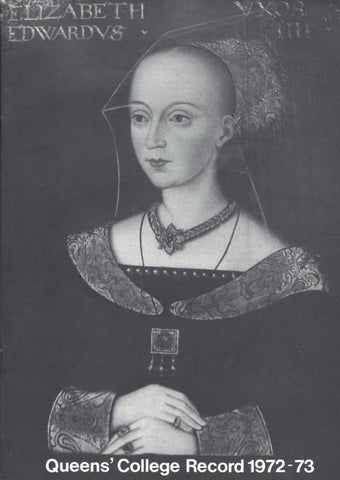
Queens' College as at February 1973 Visitor HER MAJESTY THE QUEEN Patroness HER MAJESTY QUEEN ELIZABETH THE QUEEN MOTHER
Preside(Jt DEREK WILLIAM BOWETT M.A., LLB., Ph.D. (Manchester) Fellows Archibald Douglas Browne, M.A., formerly Vice-President and Director of Studies in Mechanical Sciences. Edwin Arthur Maxwell, M.A., Ph.D., Keeper of the Records and Director of Studies in Mathematics. James Arthur Ramsay, M.A., Ph.D., F.R.S., Vice.President, Professor of Comparative Physiology. Rev. Henry St John Hart, M.A., B.D., Reader in Hebrew and lntertestamental Studies; Hebrew Lecturer and Director of Studies in Divinity and Oriental Languages. Sir Harold Walter Bailey, K.C.B., M.A., F.B.A., LL.D. (h.c.) (Perth), Emeritus Professor of Sanskrit, Life Fellow. Harold Stewart Kirkaldy, C.B.E., M.A., Emeritus Professor of Industrial Relations, Life Fellow, formerly Vice-President and Senior Bursar. Arthur Llewellyn Armitage, M.A., LL.B., Ll.D. (h.c.) (Manchester), Life Fellow, formerly President. Douglas Parmee, M.A., Tutor for Research Students and Director of Studies in Modern Languages; Fellows' Steward. John Holloway, M.A., Litt.O., D.Phil. (Oxon), D.Litt. (Aberdeen), Professor of Modern English. John Evan Baldwin, M.A., Ph.D., Bye-Fellow, Garden Steward. Maxwell Marsden Pull, M.A., M.D., B.Ch., Director of Studies in Medicine. Henry Cohen, M.A., Ph.D. (Dunelm), Director of Studies in Engineering. Anthony Colin Spearing, M.A., Director of Studies in English. James William Longman Beament, M.A., Sc.O., F .R.S., F .R.S.A., Drapers Professor of Agriculture. James Martin Prentis, M.A., M.Sc.(Eng.), Ph.D. (London), Senior Bursar, Acting Steward and Assistant Director of Studies in Engineering. Norman Francis Hughes, M.A., College Lecturer in Natural Sciences. Kenneth Ewart Machin, M.A., Ph.D., Senior Tutor and Assistant Director of Studies in Natural Sciences (Physics). Lionel Charles Knights, M.A., Ph.D., Doct. de L'Univ. (h.c.} (Bordeaux), Doct. of the Univ. (h.c.) (York), King Edward VII Profe.ssor of English Literature. Cyril Sofer, M.A., Ph.D. (London), Reader in Industrial Management; Director of Studies in Social Sciences. Ajit Singh, M.A., B.A. (Punjab, Chandigarh), M.A. (Howard, Washington), Director of Studies in Economics and Politics. Brian Albert Callingham, M.A., Ph.D. (London), Tutor and Assistant Director of Studies in Medicine. James Diggle, M.A., Ph.D., Praelector, Librarian and Director of Studies in Classics. Peter Jaffrey Wheatley, M.A., Ph.D., Director of Studies in Natural Sciences (Chemistry). John Tiley, M.A., B.C.L. (Oxon), Tutor and Director of Studies in Law. Michael John Morgan, M.A., Ph.D., Tutor and College Lecturer in Natural Sciences. John Edward Carroll, M.A., Ph.D., Assistant Director of Studies in Engineering (Electrical). Bruce Middleton, M.A., Ph.D., Bye-Fellow. Percy Wragg Brian, M.A., Sc.D., F .R.S., Professor of Botany. Peter Gonville Stein, M.A., LLB ., Ph.D. (Aberdeen), Regius Professor of Civil Law. Rev. Brian Leslie Hebblethwaite, M.A., Dean of Chapel and Tutor. lain Richard Wright, M.A., Tutor and Assistant Director of Studies in English. John Timothy Green, M.A., Ph.D., Dean of College and Tutor; Assistant Director of Studies in Mathematics. David Barry Sattelle, M.A., Ph.D., Research Fellow (Zoology); Assistant Director of Studies in Natural Sciences (Biology). Paul Frederick King, M.A., M.Sc.(Econ.) (London), Research Fellow (Engineering); Assistant Director of Studies in Engineering (Management). John Alexander Ogilvie Shand, M.A., LL.B., Tutor and Assistant Director of Studies in Law. Brian Van Arkadie, M.A., Ph.D. (Berkeley, California), Assistant Director of Studies in Economics and Politics. Thomas Henry Coaker, M.A., Ph.D., College Lecturer in Natural Sciences. Jonathan Simon Christopher Riley-Smith, M.A., Ph.D., Director of Studies in History. Christopher John Baker, M.A., Ph.D., Research Fellow (History). Honorary Fellows Sidney Smith, Litt.D., F.S.A., F.B.A. The Very Rev. Henry Chadwick, 0.0., Mus.B., M.A., Hon.D.D. (Glasgow), Dean of Christ Church in the University of Oxford. Sir Thomas Padmore, G.C.B., M.A. Sir Reader Bullard, K.C.B., K.C.M.G., C.I.E. Sir Harold Walter Bailey, K.C.B., M.A., F.B.A., LLD. (h.c,) (Perth). Professor Arthur Llewellyn Armitage, M.A., LLB., LLD. (h.c.) (Manchester), Vice-Chancellor of the University of Manchester.
The New Development and the College Appeal All Queensmen have either received a copy of the Appeal Brochure, or will soon do so, so that I need not re-state what is contained there. The basic aim of the development plans is that Queens' should remain a College of the first rank, with facilities second to none in Cambridge. Although the physical enlargement will be considerable, the College has no intention of expanding the size of its membership; the aim is to accommodate all our existing members, including some Graduate Students. It is now well known that this development is possible because of the quite extraordinary generosity of the Cripps Foundation. The construction of the first phase of building is already well under way, comprising nearly three sides of the eventual new Court. The structure is concrete, but with extensive use of bronze panelling on the face of the building to give it the same tonal 'warmth' which the red bricks give to the old Courts. We decided against building again in brick for the reason that, almost inevitably in this age, the new would have appeared as a shoddy imitation of the old. It seemed better, on balance, to use the best modern materials and to create a new building with great flexibility which would adopt the best features of the old. Thus, in conception, we have a very traditional Court, enclosing a large lawn, with wide cloisters along all four sides, rootps built on the 'staircase principle' (as opposed to corridors), gyp-rooms, a lofty, splendidly panelled dining-hall, traditional even to the point of including a gallery. The first phase will be complete at Easter 1974 and we hope to begin the second phase this June. The total cost could not reasonably be expected to fall upon the Cripps Foundation. The furnishing of the new building, the extension of central heating to Fisher and a number of vitally important consequential changes in use of the older buildings must be financed from the College's own resources and it is for this purpose that the Appeal has been launched. I make no apologies for the decision of the Governing Body to have this Appeal professionally-directed. The amount of work required to organise the Appeal efficiently is prodigious and simply could not have been done by Fellows in their spare time. Moreover, as those who have helped with the Appeal will know, the bulk of this work involving visiting some 3,500 Queensmen in this country has fallen to Queensmen. I would like to place on record the College's appreciation of the unstinting efforts of these many 'helpers', their 'leaders' and area Chairmen. I would also like to record my own personal appreciation of the very great kindness shown to me during my visits to groups of Queensmen up and down the country. There seems little doubt that the Appeal will succeed. By the end of January some ÂŁ55,000 had
been contributed by approximately 300 people and, with a potential 4,000 benefactors - Queensmen residing within the United Kingdom and abroad - it would seem that we ought to reach the preliminary target of ÂŁ160,000. Yet there is no room for complacency or for assuming that generosity can safely be left to others. We are not a College with numbers of very wealthy members so that our hope of success lies in securing a very large number of smaller contributions rather than a few very large contributions. I recall one meeting when the question was raised 'Why should people contribute?' The answer, given by a Queensman, impressed me. It was, essentially, that most Queensmen had derived great benefit from their time at Queens' and many owed their present financial security, at least in part, to their education at Queens'. This being the case, it was not unreasonable for a man to put something back into the Collegiate system, not as an act of gratitude, but more so that future generations might derive benefit from the system: in short, as a form of investment in the future. That reasoning impressed me at the time, and still does, so that I commend it to anyone who still entertains doubts about the necessity for, or desirability of, contributing to the Appeal. Perhaps I might be permitted one final comment. The College is anxious that no Queensmen should appear to be ignored and his contribution unwelcome. Thus, it is essential that we obtain his correct, current address and it was for this purpose that, with the last copy of the Record, we sent out a slip on which members might report not only their addresses but also information about themselves which might interest other Queensmen. Something like 2,000 slips were not returned, a number so large that even natural modesty or an instinct for self-protection cannot explain it. Might I urge members of the Club to return their slips? D.W.B.
The Fabric Work has steadily progressed on the re-wiring of the older parts on the College in order to make them safer from fire. Staircase I has been completed, and Mr Unwin, the College electrician, js working through the Essex Building. The set of rooms occupied for many years by Mr Browne on Staircase I has been released for general use since Mr Browne took up residence in a flat on Grange Road. The set has been converted, as a temporary measure, into a suite of offices occupied by the organisers of the College Appeal. The Oriental ( or Upper) Library has been converted into a Law Library with additional places for the general use of those studying in the War Memorial Library.
WALL-PAINTINGS IN OLD COURT Falstaff: '... and for thy walls, a pretty slight drollery, or the story of the Prodigal, or the German hunting in water-work, is worth a thousand of these bed-hangings and these fly-bitten tapes tries'. (2, Henry IV, 11.i)
The 'water-work' to which Falstaff refers is painting in tempera, that is, powder colour used with a binding medium (in this case a size, or glue, made from parchment clippings) on plaster. The discovery, in the Long Vacation, of probably Tudor painting on the walls of A2, Old Court, came as a complete surprise, being the result of the removal for restoration of 18th century fielded panelling, which had shrunk due to central heating. Unfortunately, no masterpiece was revealed, but it was found that about a dozen of the plastered panels between the timbers of three of the walls had been decorated with stylized plant motifs, of few colours, but with a well-drawn black outline. As domestic mural painting of this period is by no means common, expert opinion was sought, and the paintings were examined by Mrs Eve Baker, who is currently supervising their restoration, for they . have now been removed intact from the room.
Her findings raise some interesting points, for it transpires that the painting, of late 16th or early 17th century date, were applied to the walls most unsatisfactorily. 'On the outside wall' writes Mrs Baker, 'the plaster was floated directly on to the stone and here it was considerably stronger but had suffered on the upper part by the penetration of moisture which caused salts to concentrate and help disintegrate the surface.... On the other two walls, the plaster had fallen away as it had not been properly keyed to the under-plaster. It was probably hoped that lacing the under-plaster with rushes would make a key, but this has not worked out'. Not surprisingly, the conclusion is reached that 'it seems miraculous that so much still remains'.
It would therefore seem unlikely that these paintings are of much artistic interest, as even the surviving work of professional wall-painters (as opposed to 'painter-stainers' working on cloths and hangings as well as plaster) is of a high technical standard. Also, as may be seen from the photograph of one of the walls, the placing of the motifs is somewhat arbitrary, with no indication of a scheme of decoration other than that of alternating stud and pattern: on another wall the line of the stud is drawn on the plaster above. Flower and foliage patterns are to be found elsewhere in Tudor wall-painting, notably in the famous 'Painted Room' of No. 3, Cornmarket, Oxford, and at Hill House, Colchester; but even these decorations, of higher quality than ours, and ranking with the high art of figure-subject, are systematic, epitomizing the chief role of wall-painting at this time, which was to imitate the more expensive use of tapestries. The earfiest heyday of domestic mural painting was the Elizabethan era, when the art ranged from the work of Lambert Barnard to the anonymous decorations in inns, such as the White Swan in Stratford. It is therefore probable that this is the period of the College's paintings, for the reign of Elizabeth I, and the Presidency of Humphrey Tindall (from 1579 to 1614), saw one of the greatest flowerings in the history of Queens'. As J. H. Gray comments in his college history:
Probably no Cambridge College, and certainly no Oxford College - for Cambridge, in the reign of Elizabeth, enjoyed an easy superiority - could show a more distinguished list [ of eminent alumni]
It is even more tempting, but rather more hopeful than probable, to relate the pafntings to Elizabeth's visit to Cambridge, including Queens', in August 1564; during her stay, 'the Cofferer, the Masters and other officers of the Household' were lodged in the College, but it is not known where. Many questions remain unanswered, therefore, not least that of whether it will be possible to transfer at least the best of the patterns onto suitable mounts for display, as is hoped. The condition of the plaster has made it impossible for the decoration to be preserved in situ, but some comfort may be taken in the possibility of further paintings being discovered in adjacent rooms. In any case, Queens' may now boast a Tudor amateur painter whose feeling for decoration and power of line (which is of no small skill, as the close-up photograph shows) might be said to foreshadow that of William Morris, some of whose best work is in the Hall. The best boast, however, is that, as far as I know, these paintings are of a kind unique in Cambridge. Stephen Wildman
The Society The Society has been saddened by the deaths this¡ year of Robin Laffan and Sir Leslie Rowan, about whom two brief profiles appear later in this Record. We welcome Dr Holloway's election to a Chair in English, bringing our Professorial Fellows to six in number. He is known to many generations of Queensmen, especially those who read English, and his voice will be familiar to any devotee of Radio Three. Of the Official Fellows, we have lost Dr Pullan to a Chair of History at Manchester ( on which score I have suggested to the Vice-Chancellor of that University that Queens' has contributed enough); and we have lost Dr Platt to the Chair of Latin American History at Oxford. Dr Hayhurst has left to take up a lectureship in Chemistry at Sheffield University and Mr Fountain, after only one year as a Research Fellow, has taken up an appointment at Nottingham University, lecturing in Modern Languages. The mobility of dons is now a common feature of all College Societies. It is, in many ways, a sad thing for Colleges to lose Fellows. Yet, there is virtue in sharing the talents of Cambridge with other, less fortunate institutions and the constant reminder that the College possesses Fellows of real ability is some consolation. Happily, we can record some notable additions to the Fellowship. Dr Van Arkadie, an economist with considerable experience in the developing countries, has joined us from Sussex and has now been appointed Director of the Centre for Latin American Studies, in succession to Dr Platt. Dr Coaker is an applied biologist, also with practical experience abroad, who is a member of the Department headed by Professor Beament and brings to the College both academic distinction and administrative ability. Dr Riley-Smith, a historian whose work¡ on the Crusades is known to many, joins us as Director of Studies in History, to succeed Dr Pullan. Dr Baker, a Queens' Graduate, has been elected into a Research Fellowship in History. Dr Middleton has moved from an Official Fellowship into a Bye-Fellowship. Some changes in College Office need to be recorded. Dr Green, Mr Wright and Mr Hebblethwaite have become Tutors, so that the College now has a Senior Tutor and seven Tutors, thus enabling the Tutorial 'side' to be reduced and the Tutorial role made more meaningful. Mr Hart has ceased to be Dean of College and Dr Green now holds that office. Mr Hart has held College office continuously for over thirty years and his desire to concentrate upon his academic work for a few years is understandable. It does, however, require some effort ta avoid calling him 'Dean' and we shall most certainly miss the very special style which he brought to office. Dr Wheatley has resigned as Junior Bursar and Mr Hughes as Steward,
both having given years of unstinted service to the College. We have appointed Mr Muff as Domestic Bursar, brought in from LC.I., to take charge of a variety of administrative tasks and allow Fellows to concentrate on their other duties. However, it must not be thought that these duties are entirely 'academic'. Quite apart from the general administrative work attached to Tutorial work, there remains a host of responsibilities which Fellows discharge both readily and effectively. These have been greatly added to by the new buildings, the work on re-planning the old College, and the participation of senior members in the Council of the Union and the College Appeal. Arduous (and sometimes tedious) though this may be, there is no doubt about the vitality of the Society. Which leads to one final comment, and that is that Mr A. D. Browne resides in good health and considerable vigour of mind at 3 Grange Road, where he is delighted to receive members of the College. D.W.B.
RGD Laffan Fellow 1912-1972 Mr Laffan died on 27th April, 1972, and had been sixty years a Fellow of the College. He retired from his University Lectureship and his college work in 1953. He was a notable friend of a long succession of Queens' men. His services to the College as Chaplain, Tutor, Bursar, and Director of Studies in History, were appreciated at the time, and afterwards remembered for good. He was fortunate in belonging to a period in which such services were readily rewarded with appreciation and regard. He gave himself to his College, and his College was pleased with what he gave. He would have desired no better epitaph. Mr Laffan was away from the College during the two World Wars, serving in the first as an Anglican chaplain to the forces, in the second (being by then a Roman Catholic layman) from 1939-1943 working at the Royal Institute of International Affairs,
Chatham House (but for that time domiciled in Balliol College, Oxford, the College of his extraction) and from 1943-1946 working with the Research Department of the Foreign Office. His main direct work for the College belongs accordingly to the two periods 1919-39 and 1946-53. As a former scholar of Balliol and President of the Oxford Union Society he maintained throughout his life his strong Oxford loyalty. In the same tradition he diffused a pre-1914 atmosphere of dignity, courtesy and consideration which made a very deep impression. He was profoundly religious, as an Anglican of the high church school contrasting strongly with the Dean of his chaplaincy period, C. T. Wood. Laffan's migration to the Roman Church at the end of 1933 took his colleagues by surprise, but was not unnatural in retrospect. He was probably moving in that direction in his Oxford days, where he had been associated with Ronald Knox. He never dou~ted his new condition as a Roman Catholic layman. He was twice happily married and his colleagues and pupils have happy memories of his home hospitality. Of his College activities mention must be made of his scheme by which his pupils in history were each encouraged to present a book to the College Library. In those days the College had not found funds to provide books systematically for undergraduate use, and the benefits of his scheme are still felt. When we look back on him the impression of dignity, courtesy and consideration is what comes first to mind. There is then the earnestness of his Christian conviction, so unfashionable in the academic world of his time. There was also a sense of humour - much restrained (he loved order) but entirely delightful. The total recollection is of an inimitable, because highly individual, and engaging charm.
Sir Leslie Rowan KCB CVO 1908-1972 Queens' 1926-1930
In the Dial of 1929 appear three pages under the heading of 'Man of Mark' and the subject is T. L. Rowan, then completing his third year at Queens' and the leading figure of his time. It is fitting that in the College Record of 1972 we should pay a
heartfelt tribute to Leslie Rowan, a leader both in affairs of state and in industry and commerce, and one who never wavered in his affection for his College. Whatever the pressures - and we probably cannot know how great they were - he always found time for Queens': War Memorial Scholar, 1926-30, Honorary Fellow from 1954, Parent, 1968-71, constant visitor always welcomed by senior and junior members, he brought friendship and the many distinctions of his life to the College, and so many Queensmen of many generations ¡remember him well. As an undergraduate he had a remarkable career distinguished both academically and on the playing field: four times capped for hockey against Oxford and twice University Captain, he also found time to gain his rugger colours for Queens' in his first year and later tQ captain the tennis VI. He captained England at hockey in 1937, 1938 and 1947. Fallowing his academic distinction in the Modem Languages Tripos, his entry to the Colonial Office in 1930 was the beginning of an outstanding career in the Civil Service. He was always at the centre in high and important office: Assistant Private Secretary to the Chancellor of the Exchequer, Assistant and later Principal Private Secretary to Winston Churchill and subsequently to Clement Attlee, Permanent Secretary to the Ministry of Economic Affairs in 1947 when he was still under 40, Economic Minister in the British Embassy in Washington and finally Second Secretary of the Treasury and head of the Overseas Finance Division. He retired from the Civil Service in 1958 and joined the Board of Vickers. In this second career he served as Finance Director, then Managing Director and finally Chairman, and also Director of banks and insurance companies and prominent in business affairs, serving as Deputy Chairman of the British National Export Council. Throughout both careers and despite their pressures, he found time to lead in public and academic affairs. He led an Appeal for his old school, Tonbridge; he was a Trustee of the Churchill College Appeal; and he became President of the Overseas Development Institute in 1967. It was characteristic of Leslie Rowan to give support and unstinting service to all the institutions with which he was associated, his school, his college and the state. He always found time to devote himself to his many friends in all walks of life when, as so often, they sought his help. His was¡ the life of the true public servant and one canpot but feel a deep sadness that one who had given so much should have died so suddenly at the age of 64. A life such as Leslie Rowan's is not possible without the support and partnership of a wife of equal remark. Such was Judy Rowan and we always think of them together. Our sympathy and affection surround Lady Rowan and their two sons and two daughters.
Bequests The Rev. Basil Maine, former Organ Scholar of the College, bequeathed the entirety of his residuary estate. In accordance with his wishes, expressed in a letter to the President before his death, the College has taken possession of some books and a number of items of furniture, in particular his baby-grand piano. This was used by the St Margaret Society for their concert in the Long Gallery, and enabled the Society to provide one of the most successful evenings of musical entertainment in the Lodge for many years.
The Chapel The following visiting preacqers came to the College Chapel in the course of the academic year 1971-72: Brother Jonathan, S.S.F.; the Rev. Canon P. K. Walker, Principal of Westcott House; the Rev. R. A. Bowden, Curate of St Luke's, Duston, Northam¡pton; Mr B. J. Thorne, Student Counsellor, University of Keele; the Rev. D. I. S. Jones, Chaplain of Eton; the Rev, David Geddes, Minister of Emmanuel Congregational Church; the Rev. R. A. Hockley, Chaplain of Emmanuel College; the Rev. David Letcher, Rural Dean of Alderbury, Salisbury; the Rev. R. W. Hardy, Chaplain of Selwyn College; the Rev. Canon J. H. Churchill, Canon of St Edmundsbury Cathedral; the Rev. M. S. Till, Dean of King's College; the Rev. N. L. A. Lash, Fellow and Dean of St Edmund's House; the Rev. C. H. K. Davison, Chaplain of King's College; the Rev. P. R. Baelz, Dean of Jesus College. The preacher at the Commemoration of Benefactors in Full Term was the Ven. J. S. Long, Rector of St Botolph's and Archdeacon of Ely, and at the visit of the Graduates' Club in June, the Rev. Canon G. J. Paul, Warden of Lee Abbey. In the course of the year we have had, in addition to the Advent Carol Service, an Experimental Service prepared by undergraduates, two Evening Communions and a Service of Readings and Music for Passiontide. In the Michaelmas Term 1972, visiting preachers were. the Rev. A. A. Macintosh, Assistant Dean of St John's College, Mr Robin Guthrie, Social Development Officer, the Rev. Canon A. S. Gribble, Canon of Peterborough, and the Rev. B. E. Beck, Tutor, Wesley House. There was another Experimental Service; and the Advent Carol Service took place on 26th November.
The Library The Old Library has undergone further structural improvement. Shortly after the installation of new lighting (mentioned in last year's Record) the handsome wrought-iron gate which formerly served
as the entrance to the Fellows' Garden was installed in the archway at the head of the staircase leading from the Munro Room to the Old Library. It is generally agreed that the gate, in addition to providing greater security, is well suited to its new surroundings. Successful restoration has been completed of a pair of Terrestrial and Celestial Globes, by John Senex, dated circa 1740. These globes now stand in the Old Library, together with a wooden Hemispherical Celestial Globe, dated circa 1570. According to the British Museum, this is the earliest recorded English-made Celestial Gtobe. The War Memorial Library continues to expand rapidly. Many sections now have a large proportion, some have all, of the books recommended on Faculty reading-lists for Part 1. As a direct result borrowing by undergraduates has increased by 50% over the last two years. The following donations have been gratefully received: The President presented The Search for Peace, by himself; The Librarian and Professor F. R. D. Goodyear (formerly Fellow and Librarian) presented The Classical Papers of A. E. Housman, edited by themselves; Dr Cohen presented Gas Turbine Theory (2nd ed.), by himself and others; Professor Ramsay presented several volumes of The Philosophical Transactions of the Royal Society; Professor Holloway presented The Novelist as Innovator, by himself and others; Dr Sofer presented Men in Mid-Career, by himself; Mr Spearing presented Criticism and Medieval Poetry, by himself; Mr Tiley presented Beattie's Estate Duty, by himself, and The Nature of Evidence, by Bucknill; Mr Shand presented Archbold's Criminal Pleading, by himself; Dr Sattelle presented Echinoderms, by D. Nichols, and Annelids, by R. P. Dales; Mr Pountain presented Structure Constraints in Syntax, by D. M. Perlmutter; B. D. Turland (1969) presented Magnetism, by Schoenberg; Joseph Jackson, Q.C. (1942) presented Matrimonial Finance and Taxation, by himself; M. J. Hodgson (1962) presented PreUniversity Physics, by himself; N. W. Wilson ( 1969) presented Microbial and Molecular Genetics, by J. R. S. Fincham; J. Hamway (1945) presented Boardroom Viewpoint, by himself and others; A. J. M. Spencer (1949) presented Deformation of Fibre-reinforced Matter, by himself; M. M. Edge (1968) presented God and Nature, by G. F. Stout, and History of the Reformation of the Sixteenth Century, by J. H. M. D'Aubigne; D. D. Smith ( 1966) presented The Use of Satellite Communications, by himself; R. I. Smith (1960) presented Nicaragua, by E. G. Squier; D. C. Horton ( 1933) presented Five over the Islands: Coast Watchers of the Solomons, by himself. Large collections of books were also bequeathed by Mr R. G. D. Laffan, The Rt Rev. G. A. Chase, and the Rev. J. F. Williams.
First Classes, June 1972 Mathematics. Ds A. R. Brenton, Ds S. E. Eldridge, D. Graham, C. Rix, M. Stone, D. L. Harper, T. W. R, Openshaw, R. D. Gilbey, J.M. V. Rayner. Natural Sciences and Medical Sciences. Ds D. I. Barton, M. C. P. Apps, A. G. Douglas-Jones, J. R. Durant, T. J. Pearson, W. 0. Tarnow-Mordi, P. K. Townsend, B. D. Turland, H. T. Brown, D. G. Chennells, P. F. I. C. Ellis, P. W. Rose, A.G. Swales, P. A. Brocklehurst, P. M. Brown, S. R. B. Goss, T. D. O'Donoghue, R. J. Reid, N. R. Stedman. Theology. Ds C. M. Tuckett, D. G. Trustram (aff.) Law. Os D. N. Clarke. History. J. J. R. Mason. Modern and Medieval Languages. P. G. Godfrey, M. H. Kempson, D. E. Macarthur, M. Maguire, R. Salk.ie. Engineering. A. M. Brown, R. N. Hird, A. R. Unwin, S. Brooks, T. B. Matus, G. A. N. Thomas, J.E. A. Whiteaway, M. G. Holliday, P. D. Negus, R. A. Sandler, S. G. Thomas. Economics. Ds P.A. Cockbain, S. J. Uhlig. Land Economy. C. J. Garforth. English. H. A. Davies. Geography. C. C. Pond. Architecture. C. A. Haddon.
University and other Awards To a Porson Prize: J . C. McKeown. To a Montague Butler Prize: J.C. McKeown. To a John Stewart of Rannoch Scholarship: J. C. McKeown. To a Henry Arthur Thomas Travel Exhibition: M. H. Kempson, J.C. McKeown. To a Jebb Studentship: I. K. Gregory. To an Astbury Scholarship: Ds C. R. Swift.
College Scholarships and Exhibitions Entrance Scholarships of ÂŁ60 H. E. V. Ross, Winchester College, for Classics (Colenutt). R. J. Dickinson, Lincoln School, for Natural Sciences (Munro). C. N. Booth, Tupton Hall School, Chesterfield, for Natural Sciences (Melsome). W. R. A. Brown, Marlborough College, for Natural Sciences (Melsome).
M. C. Joiner, Whitgift School, South Croydon, for Natural Sciences (Melsome). S. R. Nelson, Wrekin College, for Natural Sciences (Melsome). R. G. Brereton, Winchester College, for Natural Sciences (Melsome). P. R. L. Moncreiffe, Uppingham School, for History (Colenutt). M. R. N. Shackleford, Haileybury College, for Engineering. P. J. Christian, Nottingham High School, for Engineering. P. T. E. Merchant, Winchester College, for English (Paterson). J. R. Jebb, Westminster School, for English, to read Law.
Entrance Exhibitions of ÂŁ40 S. A. Jowett, Nottingham High School, for Mathematics. I. W. Griffiths, Llanelli Boys' Grammar School, for Mathematics (Paterson). M. G. Langer, Ratcliffe College, for Natural Sciences, to read Veterinary Medicine (Harvey). B. E. Jones, Abingdon School, for Natural Sciences (Melsome). R. L. A. Goodings, King Edward VII School, King's Lynn, for Natural Sciences (Melsome). J. A. Heathcote, King Edward VII School, Stourbridge, for Natural Sciences (Melsome). P. M. Allan, Merchant Taylors', Crosby, for Natural Sciences (Melsome). J. A. Jackson, Cranleigh School, for Natural Sciences (War Memorial). P. N. H. Stanton, Wyggeston Boys' School, Leicester, for History. A. R. Etkind, St Paul's School, London S.W.13, for Modern Languages (Paterson). C. J. M. Dixon, Blundell's School, for Engineering. H. B. Champion, Cheltenham College, for Engineering. P. A. Haydon, Hreod Burna School, Swindon, for Engineering. D. K. Macpherson, Nottingham High School, for English (Paterson). S. D. Pattison, Sir George Monoux School, for English (Haynes). S. Pickard, King Henry VIII School, Coventry, for English. C. J. Woodall, Leighton Park School, Reading, for English. J. M. Maby, St John's School, Leatherhead, for Music (Frodsham). R. Wilson, Hulme Grammar School, Oldham, for General Studies, to read Medicine (Lees and Chadwick). J. M. Tweed, Birkenhead School, for Geography (Paterson).
FIRST YEAR Exhibitions
S. R. B. Goss, for Natural Sciences; T. D. O'Donoghue, for Natural Sciences; N. R. Stedman, for Natural Sciences; M. G. Holliday, for Engineering; R. A. Sandler, for Engineering. Foundation Scholarships
Clayton Prizes: D. G. Trustram (aff.) ¡} aeq. Ds C. M. Tuckett Ryle Reading Prize: J. F. Clough. proxirne accesserunt: D. P. Gadd, S. C. Taunton. Joshua King Prizes: H. A. Davies, R. N. Hird. Hughes Prize: T. B. Matus. Venn Prizes: J. C. McKeown, N. R. Stedman, S. G. Thomas.
D. G. Trustram (aff.), for Theology.
The College Union SECOND YEAR Foundation Scholarships D. L. Harper, for Mathematics; T. W.R. Openshaw,
for Mathematics; H. T. Brown, for Natural Sciences; P. F. I. C. Ellis, for Natural Sciences; P. W. Rose, for Natural Sciences; A. G. Swales, for Natural Sciences; D. G. Chennells, for Medical Sciences; D. E. Macarthur, for Modern and Medieval Languages; S. Brooks, for Engineering; T. B. Matus, for Engineering; G. A. N. Thomas, for Engineering; J. E. A. Whiteaway, for Engineering.
THIRD YEAR Foundation Scholarships P. K. Townsend, for Natural Sciences; W. 0.
Tarnow-Mordi, for Medical Sciences; J. J. R. Mason, for History; PG. Godfrey, for Modern and, Medieval Languages; A. R. Unwin, for Engineering; S. J. Uhlig, for Economics; C. C. Pond, for Geography; C. A. Haddon, for Architecture. Bachelor Scholarships M. Stone, for Mathematics; A. G. Douglas-Jones, for Natural Sciences; J. R. Durant, for Natural Sciences; T. J. Pearson, for Natural Sciences; H. A. Davies, for English; C. C. Pond, for Geography. FOURTH YEAR Foundation Scholarships Ds D. I. Barton, for Medical Sciences; C. J.
Garforth, for Land Economy. Bachelor Scholarship
DsC. M. Tuckett, forTheology.
SPECIAL PRIZES Penny White Prize: C. Rix } M. Stone aeq. Chalmers Prize: B. D. Turland. Melsome Memorial Prize: M. C. P. Apps. Lucas Smith Memorial Prize: D. N. Clarke. _Chase Prize: E. P. Russell.
President: Duncan Lewis V1ce-President: Dr Cyril Sofer (Professor John Holloway, Lent Term)
Secretary: Neil Dunlop Senior Treasurer: Dr Peter Wheatley Treasurer: Bryan Vernon Fellows: Mr John Shand, Dr David Sattelle Graduate: Robin Walker (Michaelmas Term), Anthony Brenton (from Lent Term)
3rd Year Representatives: Martin Bandy, Steve Taunton 2nd Year Representatives: Paul Goodman, Mark Moncreiffe 1st Year Representatives: Robert Foster, Phil Wright
The aim of the College Union is to collate and express the opinions of student members of the College on everything affecting their life in College, and to co-operate with the Governing Body in furthering the corporate life of the College. (The Rules of the Union)
The College Union is still very much in its infancy: it is still learning how to 'further the corporate life of the College', and how to 'co-operate with the Governing Body'. The task has been made harder by the changes that have taken place throughout the higher sector of Education, particularly with regard to the ideas that are being debated throughout the country on such issues as student participation in the decision-making of universities and colleges. During the past year or so, the Union has increasingly begun to determine the role it has to play in the College, principally by concerning itself with matters which affect all members of the College, working out reasoned proposals in the meetings of the Council of the Union, and then by being able to put them to the Governing Body, or executing many ideas itself. The Union's process of evolution has not; however, been easy. One can sense a certain frustration at the time it takes to emerge with clear aims and. decisions. This was particularly felt last year, when, in the Lent Tenn, proposals were put forward to form a Queens' College Students' Union, to replace the College Union and the JCR Committee. This was to consist of a Students' Union Committee composed of Junior Members, with a Senior Treasurer, responsible for their own finances, and a liaison committee of six Junior and six Senior
Members with power to implement decisions. Once initial enthusiasm had died down, the proposals seemed to evaporate. This was basically because it was felt that the Union had not been given the chance to prove its effectiveness, or even determine its role. However, the real effectiveness of the Union began to emerge early¡ on last academic year though just how effective it could be was not clearly seen until the beginning of the Michaelmas Tenn 1972. The quickest way to the College's heart is through the College's communal stomach - and the catering system in operation at the beginning of the 1971-72 academic year came under considerable criticism. Some hard thinking on the part of the Union and other Senior and Junior Members of the College eventually produced a system that seems to meet everybody's needs and wishes - a streamlined, basically selfservice system, with food of much improved quality, but which still preserves the tradition of Hall ,Oinner for those who prefer it. Undergraduates really wishing to dine in style can use Queens' own fortnightly 'Superhall'. The change has come about through co-operation, and through the wish to meet the needs of all members of the College, thereby 'furthering the corporate life of the College'. Above and beyond all this, the Union is beginning to act very positively as initiator in a number of new ventures. Several of these are described elsewhere (the Education Symposia, the publication again of the Dial). The main theme running through all the Council's action has been that the interests of all the members of the College should be supported and considered wherever possible. This has had the effect of bringing about a revival of a sense of community within the College. However, there are a number of members of the College who wish also to be involved in universitywide activities. This has meant that the College has been coming increasingly into contact with other Colleges, and with faculties' affairs on a much larger scale than before. Since the Union's aim is to support the interests of all members of the College, within certain obvious limits, assistance in the way of rebates on subscriptions to members of the College joining university societies are sometimes offered (particularly if the College does not have an equivalent society itself). Queens' has also given support to the Cambridge Students' Union, which has tried to co-ordinate university-wide activities. Such support has always been controversial because of some of CSU's policies; last year, the College Union affiliated, disaffiliated and then reaffiliated with CSU fo the space of nine months! But the principle of trying to support the interests of all members of the College remains. With this in mind, the Union has encouraged the formation of a Film Society and Climbing Club, and the revival of the St Bernard Society and faculty societies.
In order to participate more in discussion on matters affecting amenities open to everyone in the College, plans were worked out in the Michaelmas Tenn 1972 for Junior Members to sit on the Garden and Domus Committees; and a process of consultation between the Union and the Charges' Committee was devised, so that consultation could take place prior to any changes in charges which might affect the very precarious finances of students. There has therefore been a good deal of progress over the past year: there have been difficulties, in particular those caused by inflation, which has meant that a very careful watch has had to be made on certain areas of expenditure. However, nil desperandum est, and the Union goes on trying to establish its role in Coilege life.
The Dial The JCR newsletter, called the Dial, was started in the Michaelmas Tenn 1972. It was felt that there was a lack of communication in the College on two levels. Firstly, there was not enough publicity about decisions made by the Council of the Union, as only the bare minutes of their meetings were displayed on the notice boards; and secondly, that the Council of the. Union had to some extent lost touch with the junior membership, and that there was not enough rational argument in College on important topics. The te1J11s of reference of .the pew Dial were to publish 'official communications' of the Council of the Union, general information and news about the College and its members, a diary of events, and letters, articles of general interest and debates about matters of importance. Its format has been two sides of a typewritten foolsc'ap sheet, divided into four pages. It has been distributed to all senior and junior members and to graduates. Its general tone has been mildly humorous, but above all it has been intended to be 'newsy' and easily readable. Looking back at the first term the Dial did carry many news and sports reports, as well as a history of the 'Bats' by Professor Beament. The diary of events was fairly complete, although this function has now been taken over by the College Calendar, which began to appear in the Lent' Tenn. the newsletter in fact carried very few letters, and failed to promote any constructive debate. Recognising that the newsletter was not the right medium to promote rational debate and thought about issues, it was decided by the Council of the Union that they could help by releasing a short summary of decisions taken at their meetings immediately, instead of waiting a fortnight for the minutes to be released. Also 'Info sheets' on single topics were released and followed up by open forums in Hall. These sheets were intended, in this
instance, to be an objective summary of information providing a sound basis for discussion, as for example the 'Info sheet' on the question of Queens' possible affiliation to the Open Union scheme. Otherwise they were used for the publication of digests of facts - for example, on meals. It is also hoped to have a College magazine, which would be a much more expansive affair than the Dial, and would contain literary pieces as well as extended essays. The editors of the Dial have been Martin Bandy and Richard Gilbey, and legal advice has been given by Mr Shand.
St. Margaret Society 1971-72 President: Professor J. W. L. Beament Vice-President: W. S. Monkhouse Secretary: D. J. D. Charlton Treasurer: J. H. A. Thornely Committee: J. F. Clough (Organ Scholar), D. J. Bee, C. G. Cordy, D. C. Low, B. G. Vernon, N. K. Alston, Dr J. T. Green, Mr C. J. Pountain
The St Margaret Society presented an ambitious programme during the academical year I 971-72, with two major concerts outside the College and the May Week Concert held in Hall. A series of organ recitals in the Chapel was presented each term, and these proved very successful, drawing a regular audience. Recitals were also held on some Sunday evenings in Chapel, providing an opportunity for Queens' men to perform in College. The Society was also invited to present three other concerts during the year, one in the Long Gallery of the President's Lodge, one in the Senior Combination Room, to celebrate the birthday of the President of the Society, and the other in St Botolph's Church, at the invitation of the Archdeacon of Ely. The main concert of the Michaelmas Term 1971 was held in the Guildhall, on the 25th November, when the Brahms' 'Requiem' and 'Alto Rhapsody' were performed. The soloists were Elizabeth Gale (soprano), Doreen Walker (contralto) and Richard Jackson (baritone). The concert was a considerable success, with a capacity audience hearing the works well executed. Professor Beament's birthday concert was held on the 14th November, with a programme of chamber music and part-songs. Organ recitals during the term were given by Mr Ian Hare (King's), Mr John Clough (Queens'), Mr Simon Joly. (Corpus Christi), Mr Terence Allbright (Jesus), Dr Peter le Huray (St Catharine's), and Mr Richard Hickox (All Saints, Westminster). The Lent Term was equally busy, the main concert being the Bach B Minor Mass, performed in
Great St Mary's Church on the 9th March. The soloists were Norma Burrowes (soprano), Doreen Walker (contralto), Brian Burrows (tenor) and Steven Varcoe (bass). Again the concert was successful, with a very large audience and music of a very high standard. A chamber concert was held on the 6th February, in the Long Gallery of the Lodge, during which members of the Society and guests were kindly entertained by the President and Mrs Bowett. A little later in the term, on 20th February, the now popular smoking concert was held in the Upper Fitzpatrick and was greatly appreciated by the audience, which filled the building. The music was lighthearted and varied, including piano trios, vocal groups, songs, jazz and choral finale. On the 27th February, a concert was held in St Botolph's Church, the music including the Mendelssohn 'Hear My Prayer', conducted by W. S. Monkhouse, and some motets conducted by C. G. Cordy. The chorus was drawn from the St Margaret Society chorus. Organ recitals during the term were given by Mr George Guest (St John's), Mr Norman Harper (Gonville and Caius), Mr Stanley Monkhouse (Queens'), Miss Mary Macfarlane (Girton), Mr David Humphreys (King's) and Mr Roger Parkes (Corpus Christi). The Easter term is naturally a quiet one for the Society, but the organ recital series was continued with recitals given by Mr Robert Langston (Peterhouse), Mr James Lancelot (King's), Mr Bruce Wood (Queens') and Mr Peter Dickinson (London). The traditional May-Week concert was held in Hall on the 9th June. The first half of the concert consisted of chamber works and songs with a lighthearted theme; and in the second half, 'Mephisto Minus One' by James Beament was performed. The capacity audience were treated to a rare concert and thoroughly enjoyed it. The Organ recitals were continued in the Michaelmas Term 1972 with recitals by Glyn Jenkins (St Catharine's), Jonathan Rennert (St John's), David Houlder (Caius), Antony Le Fleming (Abingdon), Timothy Harrison (Taunton) and John Clough (Queens'). During the term there were four concerts organised by the St Margaret Society. The first was given by Freshmen on the 29th October in Chapel and displayed some very good musical talent. The Society was invited to give a concert in St Bene't's Church on the 31st October, and on this occasion the Chapel Choir gave a short recital of anthems. In addition tkere was a selection of chamber works, including the Pepusch 'Croydon Cantata' and the Mendelssohn 'Organ Sonata in F minor'. The Smoking Concert took place this year on 12th November. The Hall was packed by a lively audience, and the music was varied, including close harmony songs, a piano duet, recitations and, in the second half, the Malcolm Arnold 'Toy Symphony'. The Jazz Group played during the interval.
The main concert of the term took place in the Senate House on 23rd November, when the main work was the Beethoven 'Mass in C major', for soloists and choir and orchestra, with the Beethoven 'Sextet in E flat' and Vaughan Williams' 'Five Mystical Songs' completing the programme. Soloists were Prudence Lloyd, Annabel Hunt, Roger Cavey-Crump and Richard Jackson. The concert was conducted by John Clough and was of the usual high standard, but the audience was disappointingly small. However, the Concert was a fitting conclusion to a busy and very successful term.
directed by Stephen Abbott, was once again very well attended, audiences being larger than for any other of the productions that week. The show was distinguished by an exceptionally fine performance from David Haughton as Leontes, with a very strong cast in support. The 1972 Michaelmas main was directed by Kelvin Hard, who brought to light some very talented first-years in a production of 'Saved' by Edward Bond. The success of the previous year's pantomime was repeated at the end of term, with the addition of a high-spirited performance for the College.
1972-73 President: Professor J. W. L. Beament Vice-President: J. F. Clough Secretary: N. K. Alston Treasurer: N. S. Davidson Committee: D. J. D. Charlton, P. R. R. Chapman, J. F. Sketchley, H.J. Savill, A. S. Newman, Dr J. T. Gr~en
1972-73 President: N. Davis Vice¡President: M. V. Sternberg Technical Director: A. R. Coleman Secretary: R. C. Thomas Senior Treasurer: Professor L. C. Knights Junior Treasurer: A. R. Watson Committee: N. Reynolds, S. Pearson, H. Silcock, Liz Stolle (Homerton)
The Bats 1971-72 President: S. J. Abbott Vice-President: R. J. Hughes Technical Director: A. M. Brown Secretary: N. Davis Senior Treasurer: Professor L. C. Knights Junior Treasurer: S. Pearson Committee: P. Springford, T. J. Pearson, M. Frank, M. V. Sternberg.
Bats began the academical year 1971-72 with a Cambridge run of their Swedish tour production of 'The Happy Haven', which had been very successful. The Freshmen's production in the same term was 'America Hurrah', directed by Nigel Davis. Bats ended the term with a pantomime, which toured various schools in the area. The Lent Term saw an ambitious production of the Commedia dell Arte play, 'The Servant of Two Masters' which unfortunately had to contend with frequent power cuts. The Summer main, 'The Winter's Tale',
St. Bernard Society President: H. Silcock Secretary: K. Parmar Treasurer: K. Hard Committee: P. Weil, J. McKeown, J. Savory
Michaelmas Term 1972 saw the revival of the St Bernard Society, and within a few weeks the few responsible for the initial enthusiasm had succeeded in being returned unopposed as officers of the Society in the first elections. Further successes followed - after a week of largely irrelevant (and wholly informal) consultation about a constitution, the Council of the Union agreed to pay for refreshment at the Society's debates, and the traditional port was replaced by altogether more appropriate (and cheaper) beer. Finally, the Society held its first debate on 24th November, when Ian Ross and Mr Wright proposed, and Kelvin Hard and Professor Stein opposed the motion that This house is uneducated. Over fifty people turned up, the main speeches were distinguished, the floor debate was good, and in general the evening was very successful. Two debates and an evening of entertainment took place in the Lent Term: the Society will not meet during the Easter Term but thereafter, subject to availability of a committee and enough willing speakers (both junior and senior members), will continue indefinitely.
Education Symposia The. 1972 Michaelmas Tenn saw the introduction of several informal symposia on various aspects of education, involving both senior and junior members of the College. The relation between educational theory and practice formed the basis of these discussions; in particular, an attempt was made to define more clearly the principles of higher education and to examine the role of the College within this framework. The aim of the symposia was primarily an interchange of views on a topic of fundamental importance, but it was hoped that the ideas put forward could be related in some way to Collegiate educational policy. These discussions, organised by R. A. Sandler, have generated a great deal of interest amongst both Fellows and undergraduates, and applying this as the criterion for success, a series of four more meetings was arranged for the Lent term. It is hoped that eventually inter-disciplinary symposia of this nature will become a permanent Collegiate activity.
of the Museum of Classical Archaeology. During the remainder of the year, Miss E. P. Storey gave a talk on the Cambridge Schools Classics Project and Miss S. Jameson spoke on Augustus and Agrippa Postumus. At the Annual Dinner, the guests were Dr W. H. Plommer, Dr J. D. G. Evans of Sidney Sussex College and Dr V. Nutton of Selwyn College. In the Michaelmas Tenn 1972, the Society held two meetings: a play reading, in English, of Aristophanes' 'The Wasps', which was appreciated by all; and a reading by several members of papers they had prepared. 1972-73 President: S. C. Telford Secretary: P. M. D. Browne Treasurer: J. C. McKeown
Medical Society 1971-72
Film Society President: Simon Arrowsmith Secretary: Richard Philipps Treasurer: Steve Dyer
The Film Society came into existence at the beginning of the Michaelmas Tenn 1972, showing one evening a week in the JCR on alternate Sundays and Mondays. After a somewhat inauspicious start¡ (opening with a film called 'Accident' was asking for trouble) the society showed signs of being able to support itself. The main threat to our existence next year seems to be the extinction of the JCR. Otherwise, the odd disintegrating film and exploding projector bulb guaranteed us a first term which was consistently interesting if not always restful.
Classical Society 197i-72 Presidents: P. G. Hooker, M. Farrell Secretary: S. C. Telford Senior Treasurer: Dr J. Diggle Junior Treasurer: A. A. Cole
The Society had four meetings during the academical year 1971-72 and heard talks on a variety of interesting subjects. In the Michaelmas Tenn, we had two slide lectures, 'A Personal Tour of Persia' by Dr A. H. MacDonald of Clare College and 'Roman Buildings in Spain' by Dr W. H. Plommer,
President: J. A. C. K. Pang Secretary: S. P. E. Erskine Treasurer: W. S. Monkhouse University Medical Society Representative: N. A. Ganly
Throughout the last four terms the Medical Society has maintained its reputation as one of the most active societies in the College. In the Michaelmas Term 1971 and Lent Term 1972 the Society held seven meetings, the titles of which varied from 'Dolphins and Medicine' to 'Avian Virus and Vaccines' and 'Visual Illusion'. The Annual Dinner at the end of November was, as always, very highly attended: the guest speaker this year was Dr Keith Tipton of the Biochemistry Department. Three meetings were held in the Michaelmas Term 1972: their titles were 'The Delights of Mania', 'Neolithic Medicine Today' and 'Can Society Withstand Competitive Pressures?'. The climax of the term's activities was the Annual Dinner, at which Dr A. S. V. Burgen, Director of the National Institute for Medical Research, was guest speaker. On behalf of the Society, the Committee would like to thank all the Vice-Presidents for their generous help and kindness, especially Dr Bull and Dr Callingham for th~ir ever-present support ancl enthusiasm, and Dr Cater, who maintained a near one hundred per cent record of attendance. ¡ 1972-73 President: S. P. E. Erskine Secretary: C. E. Baron Treasurer: J. N. Bulmer University Medical Society Representative: N. A. Ganly
Queens' Bench Society 1971-72 President: B. G. Vernon Secretary: M.A. Conlon
The Michaelmas Term 1971 began with the customary Book Sale. There were two other meetings, both well attended. Speakers were Professor Stein, Fellow of the College and Regius Professor of Civil Law in the University; and the President in a talk entitled 'Revolution hath its problems'. In the Lent Term Mr I. J. Black, Q.C., practising Barrister and Recorder of the Crown Court, gave an interesting talk on practice at the Bar. The Annual Dinner was held on 2nd March, in the Erasmus Room. Professor Glanville L. Williams, Professor of English Law in the University of Cambridge was guest speaker. In the Easter Term plans to invite guest speakers fell through, _although there were a few informal meetings. The academical year closed with a Book Sale, and an 'After-Examinatfon Party' kindly given by Messrs John Tiley and John Shand. Having been assured of a modest income by the success of the Book Sale, much port enlivened the first meeting of the Michaelmas Term 1972, a controversial talk given by Mr Tony Weir, of Trinity College on the subject 'Free Speech in Royal Resorts'. The second meeting was a talk by Dr Jim Farmer of Caius, on 'When the Law of Torts is Abolished', and the term ended with 'A Constitution Monger in the Commonwealth' given by Professor S. A. de Smith, of Fitzwilliam. The Society would like to express its thanks to Dr Bowett, Mr Shand and Professor Stein for their unstinted help. 1972-73 President: W. J. T. Heard Secretary: N. Bidder
The E Society Three meetings of the Society were held in the Michaelmas Term 1971, and three in the Lent Term 1972. The speakers were Dr D. H. Mellor, Fellow of Darwin College and University Lecturer in Philosophy, on 'Time Travel'; Professor J. C. Polkinghome, Fellow of Trinity and Professor of Mathematical Physics,_ on 'Elementary Particles';
Mr Shand on 'Privacy'; The Rt Rev. Dr J. A. T.
Robinson, Dean of Chapel, Trinity College, on 'A Theologian in South America'; Dr D. P. McKenzie, Fellow of King's, Senior Assistant in Research in Geodesy and Geophysics, on 'Continental Drift'; and Dr Holloway, on 'The Contemporary Cultural Records Library'. The E Society dinner was held on the second Saturday of the Easter Term in the Erasmus Room. In the Michaelmas Term 1972, the speakers were Dr Van Arkadie on 'The Origins of the Uganda Crisis'; Sir Archibald Duncan Wilson, Master of Corpus Christi College, on 'Art and Society in the Soviet Union'; and Dr Callingham on 'Flight or Fight: our Response to Stress'.
Graduate Students 1971-72 President: Professor L. C. Knights Secretary: J.C. Whitehead Treasurer: C. l. Hamilton
The pattern of the Club's activities remain unchanged in the academical year 1971-72, but several special events have aroused a healthy, if temporary, interest. The Monday dinners in Hall, the buffet lunches with the Fellows and the Thursday dinners in the Angevin Room have continued, the latter very precariously. A Garden Party was held at the end of the Easter Term and attracted large numbers of our members and many favourable comments. It is hoped that this may become an annual event. Thanks should be recorded to Mr Parmee for providing alcoholic ¡ refreshment at the Garden Party, and for his help and advice on the running of the Club throughout the year. Michaelmas Term 1972 began with a sherry party and dinner organised for the graduate freshmen. Reciprocal dinners were held with Hughes Hall and the Christmas Dinner attracted the unprecedented number of 40 graduates and guests. A newsletter was started and, although the Thursday dinners in the Angevin Room ceased to be held, the Monday dinners in Hall attracted a very strong response. 1972-73 President: Professor L. C. Knights Secretary: R. A. Smith Treasurer: C. l. Hamilton
May Ball The 1973 May Ball will be held on Tuesday, 19th June. Tickets (double) are priced at ÂŁ15.50, and may be obtained from Richard Philipps at Queens' College.
Athletics The Boat Qub. In the Michaelmas Term 1971 Graham Hughes coached the light four which beat Pembroke B easily before losing to Selwyn. The clinker four was also beaten by Selwyn in a very close race. The Fairbairn race was rath~r disappointing with the two boats entered fmishing twenty.first and twenty-ninth. In the Emmanuel Regatta the eight beat Downing easily but lost to Clare. The clinker four beat King's easily then lost to Downing who went on to be the losing finalists. In the first three days of the Lents the first eight rowed over, being bumped by Emmanuel on the last day. The second boat was successful in winning their oars whilst the third and fourth boats got three bumps each. In the Bedford head the first boat did not have a good row in the windy conditions and finished only slightly higher than the second boat who had rowed in better conditions earlier in the day. At Reading the first boat was the fastest Cambridge college boat. The May Bumps were disappointing; the first and second boats went down four places, the seventh boat being the most successful and getting three bumps. At Henley the eight beat the University College of Wales easily on the first day, but lost to University College, Dublin the following day. In the Michaelmas Term 1972 the light four was beaten by Emmanuel. The Oinker four beat St Catharine's B and Emmanuel before being beaten by Clare, who were the losing fmalists. The first boat fmished tenth in the Fairbaims, the second boat finishing twenty-first and the third boat winning a pennant for the fastest third boat and fmishing twenty-third overall. In the Emmanuel Regatta, the first eight beat Fitzwilliam and Lady Margaret, losing to Sidney Sussex in the semi-final. The second eight beat the Ladies and after a row over, lost to Clare. The Clinker four had a row over before losing to Rob Roy in the semi-final. There were ·several places to fill in the Rugby Union Football Qub's 1st XV at the beginning of the 1971-72 season and consequently the team took several weeks to settle down. We lost the first four matches in the league programme and it was only a late rally, with wins against Trinity, Downing and St John's, and a draw with Fitzwilliam, that saved us from relegation. The final position in the league was seventh (out of ten teams), with a total of seven points. The Cuppers team was much strengthened by three university players and the return of M. H. Rosser after injury. We were unfortunate to meet in the first round a good Selwyn team, who were the eventual winners of the competition. The match was evenly fought, but Selwyn scored two late tries to run out winners 16-31. It was very disappointing to be knocked out of Cuppers at such an early stage, considering the successes of previous years. We ran a 2nd XV which played in the third division of the league, finishing in fifth position. Representative honours: M. A. Biggar and G. P. Phillips represented the University against Oxford at Twickenham. P. K. Smith represented the LX Club against Oxford Greyhounds. G. P. Phillips was selected to play for S.E. Counties against the Midlands in an England regional trial. He also played regularly for the Royal Navy. D. W. Sills played for Cambridgeshire against the LX Club. Season's record: Played 14; won 4, drawn 3, lost 7. For 77. Against 179. The league side ,looked very good on paper at the start of the 1972-73 season, with thirteen of last years team still in residence. Unfortunately, due to several injuries and an apparent lack of interest among freshmen, we did not fulfil the early promise, only equalling last season's performances. We won three matches and drew one, finishing seventh in the league again. The
2nd XV played in the third division again, winning 4 of their 9 matches. Representative Honours: W. A. Jones, G. P. Phillips and M. H. Rosser represented the University against Oxford at Twickenham. G. P. Phillips played for Combined Services against the All Blacks and regularly for the Royal Navy. The Association Football Qub 's early victory over St John's in Michaelmas Term 1971 led to great expectations in the league, but also to complacency, and thus it was only the threat of relegation which stirred the 1st XI into eventually achieving a position worthy of their ability. Moreover, injuries prevented the fielding of a settled team, and the repercussions of this were felt in the 2nd XI, who also recovered from a poor start only when they had built up a nucleus of regular players. Both sides were disappointing in Cuppers, but the 1st XI did succeed in remaining unbeaten from the end of. October to March, and during this time many goals were scored, usually based upon solid team work, there being no individually outstanding players. If the anticipated tangible success did not materialise, this was fully compensated for by the happy team spirit, fostered in a season which everyone enjoyed. A combination of lack of experience, of enthusiasm and of new talent, following the loss of eight of the previous year's players, resulted in a depressing struggle for survival for both the teams in the 1972 league competition. The 1st XI was relegated with only three points, though the same total was enough to keep the 2nd XI in the Third Division. The one consolation was a hard-fought win over Christ's, which justified the belief, support~d by wins in 'friendlies', that a lack of confidence was also at the root of bad performances. Hopefully this will soon be remedied by the desire for promotion. On paper the Hockey Qub was able to field a very strong team this year, which could have held any other side, but unfortunately the best players were never able to play together. Only three freshmen played regularly but a good number of second and third year men enabled the College to keep up a fair standard of play. Too many matches were lost because of defensive mistakes and lack of scoring power in the forward line. Often the team dominated a match but failed to score the goals needed to produce the deserved result. Over the whole season there were several good wins to put the team in the top half of the league. The College interest in the Cuppers competition was short-lived with a defeat in the first round . Colours were awarded to C. R. C. Wimble, M. J. Thomas, A. Slater, R. Philipps and J. Bulmer. Gordon Nurse was secretary of Cambridge University Hockey Qub and our only Blue. Charles Twort played regularly for the Wanderers and Geoff Tudhope and Adrian Slater also made appearances for them. An influx of freshmen in the Michaelmas Term 1972 enabled the College to build up a very competent team, but its record has again been uneven, due more to lack of real effort than inability to play good hockey. , Although on paper the Cricket Club's results look poor, the Club was unlucky with the weather on two occasions· when victory was in sight. Our game against Christ's provided a close finish and four runs difference between· the sides and only one Christ's wicket left to fall. The Club's Cuppers run came unstuck in the first round when we met Magdalene, who made 158. Queens' replied with 112, with D. Sutcliffe making a valiant 41, after the College had got off to a bad start when the side's only regular Crusader was unluckily run out for three. All the batsmen made occasional high scores, but none did consistently, R. C. C. Bolsin is 66 (not out), Smith is 63 being the highest. Of the
bowlers, P. K. Smith was the most penetrating, but was ably supported by a wide range of medium pacers (N. Bidder, A. J. Young, D. Shaw, P. Jessup) and two spinners (C. M. Broadbent and A. F. Watson). The Queens' cricket tour has now become a successful annual event, coming as it does after exams, and the club was well received in Herefordshire. Season's record: played 10; won 1; drew 5; lost 4. As is now traditional in Queens' Athletics, most of the athletes competing for us during the year were 'borrowed' cross-country runners. Queens' had a good chance of promotion to Division I in Cuppers in Michaelmas Term 1971, but unfortunately the final clashed with important cross-country races and so St Catharine's and Churchill were able to defeat Queens' by a large margin. Individually, three Queens' men won 'Blues' against Oxford - C. J. Garforth, in the steeplechase, D. W. Gunstone in the 5,000 metres and R. G. J. Ward in the 1,500 metres. Garforth won his race and the other two were narrowly beaten into second place. M. J. Danielewski won selection for the University 2nd team against Oxford. L. J. Rudling ran well enough for a 'Blue' throughout the year in 1,500 and 800 metres but was unfortunate to strike a bad patch at the time of the University trials. However, he did represent Cambridge University freshmen in the annual match against Oxford in the 800 metres together with D. W. Gunstone in the 3,000 metres and G. C. H. Jones in the 2,000 metres steeplechase. The sixth Queens' Pentathlon was held in June, organized by M. J. Danielewski. The University athletics captain won the competition and the best Queens' man was G. C.H. Jones. In Division II ofCuppers heats in Michaelmas Term 1972 Queens' came second to a very strong Caius team and therefore did not progress to the final. However, our seven-man team did well to win six of the fourteen events despite two injuries. W. G. Fulford ran for the University against Birmingham University in October over 1,200 metres, and did well to finish third to Olympic runner Ray Smedley. L. J. K. Davis was second in the long jump in the Freshmen's match against Oxford and also competed in the field events match against Oxford in November. With the return to Cambridge of Mike Turner and the unexpected presence of London University athlete, Doug Gunstone, for one year, the Cross Country Qub was able to set new standards in Oxbridge Competitions in the academical year 1971-72. The College also had enough strength in depth for its second team to be placed fourth in Cuppers, while the first team won the race in impressive style, having six runners home in the first twelve, and gaining the lowest ever winning total of 33 p.oints. The League Trophy was easily retained, as the Club won all its four league races. The College also retained the Selwyn College and St Edmund Hall Road Relay trophies, setting lap and team records in the latter relay, but relinquished the Hare and Hounds cross-country relay. The College also took part in the Osterley Park and Hyde Park relays, finishing fourteenth and eighteenth respectively. Chris Garforth, Rees Ward and Doug Gunstone all represented the University against Oxford; they were awarded full blues and were also in the victorious University team in the British Universities Cross-Country Championship. Dave Abrehart and William Fulford (who was the reserve for the 'Blues' team) ran in the Spartans race against Oxford and Geoff Jones in the third team. Chris Garforth had again to decline an invitation to represent British Universities against the E.C.C.U. and Combined Services. However, Rees Ward ran in this race and also for British Universities in the F.I.S.U.
Championships. Although the College team did not start the Michaelmas Term 1972 with the same strength as last year, due to the loss of two blues and several other runners, the present season promises to be as successful as the last few have been. This has been shown by the College winning its first two league races and Cuppers, providing the individual winner in the person of Chris Garforth. On the results of Cuppers, Chris Garforth and William Fulford were selected for the team to represent the University in the Varsity match, and finished first and sixteenth respectively. The performance of Queens' Squash teams in the InterCollegiate League during the academical year 1971-72 was on the whole rather disappointing, particularly in the case of the second team, which dropped two divisions. However, the first team did well in the Lent Term, being promoted to the second division of the League. In Cuppers the team was beaten by a strong Trinity Hall Team. Michaelmas Term 1972 saw a general improvement, with both the second and third teams being promoted and the first team maintaining its place. During the Christmas Vacation it was learnt that Tom Openshaw had been killed in a climbing accident. He gave much time to the organisation and running of the Squash Club, and his death is a very great loss to the Club and to all those who knew him. Despite relatively low numbers, the Badminton Club had quite a successful year; the second team had to be withdrawn from the third division of the league table, whi,J.e the first team strove to regain their position in the first division after relegation in the previous season. Considerable enthusiasm was shown by six of the seven members of the club and also by several 'A. N. Other's, undergraduates of the College who were prepared to play only occasionally at very short notice, and who enabled the College to put out a full team for every match. Due to this enthusiasm, and to the quality of the badminton played by the freshers who joined the club, the College finished the season at the top of the second division by one point from Pembroke, after several hard-fought matches. A considerable part of this success must be due to W. B. J . Davis, a fresher who alsQ. gained a place in the University Cockerels team. Three friendly matches were arranged and played with Homerton, and proved to be enjoyable occasions, when the club and several 'A. N. Other's could participate in a more social aspect of the game. Queens' maintained its tradition of being eliminated in the first round of Cuppers, with an overwhelming defeat by Churchill. The Lawn Tennis Qub 's lack of success in summer 1972 can only be attributed to the loss of several key players. S. P. E. Erskine succumbed to the pressure of work, D. Haughton was handicapped by doctor's orders - having to play without his glasses - and Nigel Bedford, a freshman, captured a place in the Blues team and consequently played on only a couple of occasions. The general result was that we went down heavily in Cuppers but managed to finish in the right half of the first division in our first year since promotion. That we might have won the title in more favourable circumstances seems a not unfair guess. Meanwhile, the second team, drained of its natural resources, often found great difficulties in raising a team, but considering the opposition that they had to face (all the teams being College first teams) performed remarkably well. Overall the College displayed enthusiasm and not a little skill in spite of its frustrations. Full colours were awarded to D. J. Bee, R. Sharpley, G. B. W. Nurse, D. Haughton, N. Bedford, S. Telford and B. J. Wright, and a half-blue to N. Bedford.
It was a disappointing year for Queens' Swimming. Although we had a strong team on paper there was not much to show for it at the end of the year. We came second to St Catharine's in the Water Polo League after a very tight game and similarly in Cuppers were beaten by a strong Churchill side in the semi-finals. In the swimming gala we did very well thanks to our University swimmers and also managed to win a new 5-a-side Knockout competition started this year for water polo. Collin Bayles and Dave Place were again awarded half-blues for water polo and Roger Sharpley swam for the University second team versus Oxford. The Golf Oub played 10 matches against other Colleges during the year. The loss of two members in June was compensated for by the arrival of three freshmen golfers in October, bringing the number of available players up to nine . A blue was awarded to G. Penfold. Throughout the year the College Lark has been sailed regularly by the Sailing Club and has been raced in the Grafham Sunday series by the keener members. Success in the latter has been limited, mainly due to the fact that our boat is old and no longer in a competitive condition. The College has now approved a grant for replacing this boat, and we therefore hope to be regularly among the winners next year. In the Lent term we fielded a joint team with Girton for the College league, and in our division we finished at the top . Unfortunately, we Jost the sail-off between the two divisions. We qualified automatically for the quarter finals of Cuppers by virtue of this perfonnance but were beaten by Fitzwilliam, who went on to win the competition. The 1971-72 season started quite successfully for the Table Tennis Oub, with the first team winning most of its matches in the Michaelmas Term; at this stage the Club was unfortunate to lose all three members of the first team for various reasons. The result was that both the weakened first and second teams were relegated at the end of the season. For the remaining teams third, fourths and sixths, the season was moderately successful. Nevertheless we had had representation at the University Club level, with Ray Foreman playing for the University third team. Colours were awarded to P. D. W. Bottomley and B. J . Wright and re-awarded to J. Little and R. Foreman. The Michaelmas Term 1972 has seen the league in operation again. However, the first, second, third and fourth teams have all had rather moderate success, and all Jay in the middle of their respective divisions at Christmas, the half-way stage of the league. John Little has been playing for the University third team. The Chess Qub, after the failings of the previous season, had an encouraging change of fortune during the season 1971-72. The first team finished second in the second division of the University League and the second team finished second in the fourth division, both teams achieving promotion in the process . .The major feature which provided the basis of the first teams success was the achievement of M. J . Yeo in scoring 6/7 on board one, remaining undefeated against opposition including the Irish champion. Colours for the season were awarded to J. Francis, and re-awarded to. M. J. Yeo, C. Rix, C. D. Floyd and E. EvansJones. At the start of Michaelmas 1972, it was decided that the first team should decline promotion, due to the loss of the bulk of the previous year's team. However, the team at once showed that it deserved better than the second division, and despite the large positive score on board one, at Christmas promotion seemed secured. The second team
initially appeared to emulate the first, but surprisingly crushed the division leaders and promotion now seems a possibility. 1972 saw the emergence of Queens' College Ten Pin Bowling Club as a force to be reckoned with at the Ambassador Bowl in Stevenage. 'Droopy Doreen' was very pleased with our requests for coffee on many a cold Tuesday afternoon. Ray 'Bomber' Foreman and Jeremy 'Dingle' Francis were way ahead in the averages; but even the great Ray was observed to miss 6-7-10 and 7-10 splits, despite bowling left-handed and with extreme hook. Summing up the year, the fifteen or so members rolled 210 three-game series, and were sustained by social parties during the Michaelmas Term and a formal dinner in the Lent Term. The Queens' College Climbing Club, which caters for all those who enjoy walking and mountain scenery as well as for the rock-climbing fraternity, was founded in the Michaelmas Term 1972 and was chiefly the inspiration of Tom Openshaw. His tragic death while climbing in Cornwall has been a great Joss, and his enthusiasm and ability will be sadly missed. Now that a certain amount of equipment has been purchased, the Club is planning its first meet in the Spring (in North Wales), and it is hoped that this will set a precedent for more regular meets when the brighter weather arrives.
News of Queens' Men Distinctions K.B.: W. J. Peel (1930)
O.B.E.: K. Hedges (1937) O.B.E.: A. B. Ware (1938) O.B.E.: E. H. Nichols, B.Sc. (Dunelm), A.I.C.T.A. (1945) Ecclesiastical Canon W. D. Cole (1911) has retired. Canon K. V. Evans (1923) has retired as Vicar of Llanigon, Hereford. Rev. A. Scott (1926) has retired in Australia. Rev. J. J. Williams (1928) is at South Moreton Rectory in Didcot. J. K. Cavell (1936) is Bishop of Southampton. Rev. W. D. C. Rees (1943) is Chaplain of St Mary's College, Bangor. The Rev. Canon D. G. Hawker (1946) is Suffragan Bishop of Grantham. Rev. M. J. Gudgeon (1960) is at Cuddesdon College, Oxford. J. E. G. Oswald (1960) is Assistant Curate at Christ's Church, Hengrave, Bristol.
Educational 1. R. Thompson (1925) has retired from the Headmastership of the Altrincham Preparatory School. Professor G. E. H. Foxon (1927) has retired from the University of London and the Senate has conferred the title of Emeritus Professor of Biology on him. J. E. Steel (1934) is a Mechanical Engineering Adviser with the UNESCO mission, Kuwait. S. G. Ward (1940) is Deputy Headmaster at Nottingham High School. R. Taylor (1945) is Principal of the Central Tutorial School for young musicians in London. J. L. Glazier (1946) is Principal of the New South East Essex Sixth Form College at Benfleet.
G. Glendinning (1949) is Headmaster of Calder High School, Mytholmroyd. M. H. Bushby (1951) is a Housemaster at Tonbridge School. H. B. Orchard (1951) is a Housemaster at Tonbridge School. P. Happe (1952) has been appointed Head of the Rutland Sixth Form College. I. I. P. Bl.ill (1953) has been appointed Dean of Students at Hockerill College in Bishop's Stortford. B. Mogridge (1954) is Chairman of the German department at Carleton University in Ottawa. D. B. Rees (1955) is the Senior Lecturer in English at St Luke's Teacher Training College, Exeter. B. D. G. Johnson (1956) is at the Institute of Development Studies at the University of Sussex. B. M. Garton (1958) is Head of the Department of Social Studies at Lilongwe in Malawi. R. E. Allsop (1959) is Director of the Transport Operations Research Group at the University of Newcastle upon Tyne. J. R. Hubbuck (1959) is a Tutorial Fellow of Magdalen College, Oxford. Rev. M. R. Westall (1959) is on the staff of Bishop's College, Calcutta. E. A. Laing (1961) is at the Faculty of Law at the University of the West Indies. Dr M. C. Archer (1962) is Assistant Professor at the Massachusetts Institute of Technology. Dr .R. Atkinson {1963) is at the States Wide Air Pollution Research Centre in the University of California. H. G. Dales (1963) is a lecturer in Mathematics at Glasgow University. W. N. Jones {1963) is Head of Mathematics at Clapham County School.
Miscellaneous
0. Nugent {1932) is an Assistant Director of Public Prosecutions. N. Digney {1936) is Chairman of the Department of the Environment East Anglia Economic Planning Board with a general responsibility for statutory planning in East Anglia. R. C. Braithwaite (1951) is Managing Director of Interlink Advertising Ltd, the advertising agency, of the LOPEX marketing group, and has been recently elected to the Council of the Institute of Practitioners in Advertising. A. H. D. Gunning {1951) is Commercial Director with Strand Hotels Ltd. I. R. Williams {1951) heads research at Ogilvy Benson Mather Ltd. I. Ross (1952) is Marketing Manager with Richard Costain Ltd. Dr D. E. Lawrence (1958) is Senior Consultant with Computer Sciences of Australia in New South Wales. Dr M. B. Rose (1959) is Registrar in Surgery at St Thomas's Hospital in London. B. I . Rivers-Moore (1965) is an Operational Research Officer with B.E.A.
Queens' Men of the North-West The twenty-second Annual Dinner for Queens' men in the North~West took place in Chester at the Blossoms Hotel on Friday, 17th March 1972. The
Rev. B. F. F. Crane presided and the guest of honour was Dr P. J. Wheatley. Twenty-one members attended. The Annual Dinner this year will take place at the Bolton Crest Motel, which is situated off the M61 in the Bolton direction, on Friday, 6th April. Enquiries should be addressed to: Rev. B. F. F. Crane, Astbury Rectory, Congleton, Cheshire CWI2 4RQ.
Queens' Men of the South-West The first Annual Dinner for Queens' men in the South-West took place in Taunton at the County Hotel on Friday, 28th April 1972. The Rt Rev. C. R. Claxton presided and the guest of honour was the President. Twenty-one members attended. The Annual Dinner this year will take place in Taunton on Friday, 4th May. Enquiries should be addressed to: The Rt Rev. C. R. Claxton, St Martins, 9 West Terrace, Budleigh Salterton, Devon.
Deaths We regret to record the following deaths: Rev. W. T. C. Storrs (1882) Sir W.W. Gibson, LL.M. (1892) Rev. J. H. Griffiths (1897) Rev. Canon L. P. Smith (1897) T. Hughes (1898) Rev. A. E.T. Raven (1898) Rev. F. N. Greaves (1899) A. C. W. Hodgson (1903) Rev. A. N. Claxton (1905) G. A. Wace (1905) C. H. M. Pearson ( 1906) Rev. F. P. Thorman (1906) T. J.E. Sewell (1907) Rev. P. H. Turnbull ( 1908) Rev. A. P. Burton (1909) Professor S. J. Cowell, M.B., B.Ch., F.R.C.P. (1909) Rev. W. H. Padget (1909) Rev. H. W. Austin (1910) A. C. Conder (1911) E. S. Orme, M.B., B.Ch. (1911) Rev. N. W. Watson (1911) D. Boumphrey, M.C. (1912) G. J. Partridge (1912) R. G.D. Laffan (1913) Rev. B. S. Maine (1913) S. C. Savill ( 1913) Rev.E. L.Fuller(l914) R. Hargreaves, M.C. (1914) I. Illingworth-Law (1915) S. L. Evans (1919) Rev. P. J. Heaton (1919) Rev. Canon T. H. W. Maxfield (1919) Rev. Canon D. P. Low, T P. (1921) P. N. Bartlett (1925) J. Meacock (1926)
Sir Leslie Rowan, K.C.B., C.V.O. (1926) H. R. Sproule ( 1927) G. U. Hayns (1928) W. A. B. Pakenham (1929) E.W. Brittain, F.R.I.C. (1931) Dr M. Strachan, M.R.C.S., L.R.C.P. (1933) R. C. Spalding (1934) Dr D. H. B. Bevan-Jones {1936) F. S. Aldercotte, M.B.E. (Mil.) (1938) Rev. P.R. Westall, M.B., B.Ch. (1939) J. R. T. Nicholas (1940) G. Turner (1943) F. W. Batstone (1951) D. C. Gardiner (1953) T. J. Buchanan (1956) R. L. Brown (1957) B. Clements (I 958) T. W.R. Openshaw (1970)
The Years 1966-69 Men matriculated in 1966 and just eligible for Qie Degree of Master of Arts.
Ecclesiastical A. J. B. Keith is studying for the ministry in the Church of England at Wycliffe Hall, Oxford. J. F. White is Curate and Sacrist of Wakefield Cathedral and was ordained Deacon in December 1972.
Educational C. J. Baker is a Research Fellow of the College. J. J. Barnett is a Research Student at Linacre College, Oxford, in the Department of Atmospheric Physics, Clarendon Laborat0ry, where he eventually hopes to work. A. J. Bradbrook is a Senior Lecturer in Law at the University of Melbourne. S. Brickell is Head of Religious Education at Ringrner Secondary School. P. Brna is a Mathematics Teacher at Birkenhead School. C. M. Care is a Research Student at Sheffield University. R. J. Dellamora is Senior Don and Assistant Professor of English Literature at Champlain College, Trent University, Canada. G. E. Doyle is a teacher at West Bank Comprehensive School, Skelmersdale. S. J. Fox is Assistant Professor of English at the University of Virginia, U.S.A. P. A. Gurbutt is a Research Student in the Department of Applied Mathematics and Theoretical Physics at Cambridge. R. A. Harvey is a Junior Lecturer in Latin at Bedford College , London. L. G. H. Hatfield is a Research Engineer. G. S. Haynes is a Physics Teacher at Bedford School. J. R. S. Hoult is a Lecturer in Pharmacology at King's College London. C. H. Hurst is a Research Student at Cambridge. C. J. Fountain is a Lecturer in Spanish in the University of Nottingham. J. E. Rivers-Moore is a Ph.D. Student at Birkbeck College, London. D. R. Robinson is a Postgraduate Student (M.Sc. Statistics) at the University of Sussex.
J. R. Wells is a Research Officer at the Centre of Latin American Studies in Cambridge. M. D. Williams is Head of Music at Dinnington High School in Yorkshire. R. J. Woodward is a Private Tutor in London.
Miscellaneous M. J. Abrams is a Technical Assistant with Messrs. Haseltine, Lake & Co., Chartered Patent Agents in Essex. N. A. S. Andrew is a Stockbroker with Rowe and Pitman in Hampshire. J.. Andrews is an expedition Driver/Leader working for Mini trek Travels in Dorset. R. J. Bailey is a House Surgeon at St Thomas's Hospital, London. A. Bargery is a Freelance Journalist in Cambridge. M. J. M. Bevan is a Civil Engineer with Sir Alexander Gibb & Partners, Westminster. P. J. Bonnington is a Research Consultant with the Economist Intelligence Unit Ltd., in London. S. J. Braithwaite is a Solicitor with Messrs. Kenneth Brown Baker Baker in London. A. T. Browne is a Scientific and Technical Computing Programmer/ Analyst in the Research Department of the British Oxygen Company in London. R. J. Brown is a Personal Assistant to the Education Officer, Inner London Education Authority. E. B. Caplin is a Stockbroker with Rowe and Pitman in London. C. D. Chitty is a Unit Supervisor in the Operations Department of Esso Petroleum Co. at Fawley Refinery. A. R. B. Oark is a Medical Student in his final year at the Oxford University Medical School. P. E. Clark is a Design Engineer with Laurence, Scott and Electromotors, Norwich. S. A. Clarke is working with Midland Bank Ltd. in Leicester. D. J. Clements is an Electrical Engineer working in the Electrical Development Laboratory with G.E.C. Reactor Equipment at Whetstone, Leicester. S. M. Crosse is a House Surgeon at Crawley Hospital. P. R. M. Dachowski is Financial Analyst in the Treasurer's Department with the Exxon Corporation. M. J. S. Dawes is Senior Traffic Planning Officer with B.E.A. J. R. Doubell is a Graduate Trainee with the Commercial Union Assurance in Surrey. E. J. Dowler is Assistant Personnel Officer at Courtaulds Ltd., in Co. Antrim. P. L. Drury is in his final year as a Clinical Student at King's College Hospital Medical School, London. D. J. Duff is an Economist with National and Grindlays Bank in London. D. T. Edwards is a Production Manager with G.K.M. (South Wales) Ltd. R. M. Ellice is a House Physician at the London Hospital, Whitechapel. M. A. Elliott is a Commercial Engineer with the Meta1 Industries Division of G.E.C.-Elliott Electrical Projects, Rugby. M. R. Forshaw is in his third year of research into Pattern Recognition Techniques at University College, London. R. Gilbert is a Computer Scientist. S. J. Gomersall is Third Secretary, H.M. Diplomatic Service, presently in Kamatura, nr. Tokyo.
T. D. Green is a Trainee Engineer Surveyor to Lloyd's Register of Shipping. A. C. Harper is a Chartered Accountant at present articled to Herbert Smith & Co., Solicitors. K. C. Houston is a Medical Student at St. Mary's Hospital. B. Jennings is a Chemical Engineer with Assia Chemical Laboratories Ltd.,)n Israel. C. G. D. Kidson is a Chartered Accountant with Kidsons' Taylor in Manchester. P. L. Kilborn is Assistant to the Production Director with Hamish Hamilton, Book Publishers. R. G. Knowles is a Local Government Officer. P. B. Lamb is a Chartered Accountant with Messrs. Thomson McLintock & Co. S. J. Lander is Assistant Editor of the Victoria County History of Cheshire on the staff of the Institute of Historical Research, London University. P. C. W. Ledger is an Insurance Broker. S. M. Lees is an Assistant Library Officer in the University Library, Cambridge. L. E. Leigh is a Corporate Planner with Tube Investments Ltd., London. M. A. Lloyd is a Chartered Accountant em_ployed by Deloitte and Co. in London. N. B. Macfarlane is an Articled Clerk in London. D. K. Merriott is Product Manager with T. Wall and Sons (Meat and Handy Foods Ltd.). D. P. Morrison is a Chartered Accountant with Peat, Marwick, Mitchell & Co. in London. J. Newton is a Travel Representative with Wings. V. M. S. Oh is a House Physician at St Bartholomew's Hospital, London. B. P. O'Malley is a House Physician at Central Middlesex Hospital, London. S. C. Palmer is an Assistant Manager with FMT Editorial & Writing Services Ltd., London.
The Queens' College Club Committee President: D. W. Bowett Vice-Presidents: A. D. Browne Rt Rev. C. R. Claxton A. L. Armitage H. S. Kirkaldy, C.B.E. Secretary: E. A. Maxwell Treasurer: N. F . Hughes Committee Members Till 1973 Rev. G. H.J. Pedley His Honour Judge D. P. Bailey M. D. M. Parkes Bowen
1948 1908 1923 1933 1944 1929 1937
J. M. Paterson is a Civil Engineer with ARUP Associates, Architects, Engineers and Quantity Surveyors. W. A. R. Peel is an Articled Clerk with Whinney, Murray & Co., London. J. M. A. Phillips is a Personal Assistant to the Chief Executive of Sturtevant Engineering, London. G. Prescott is a Valuation Assistant with the Cardiff Corporation. M. A. W. Salter is an Articled Clerk with Reading County Borough Council. A. H. Slyper is a House Physician at University College Hospital, London. D. C. Stow is a Programming Project Leader with U.K. Combined Services Unit (Mars Ltd.). M. C. E. Sturt is a Management Accountant with the Metal Box Co. Ltd., Wisbech Factory. J. J. R. Talbot is a Promotion Manager with NUS Travel Service. A. R. Tanner is a House Physician at Royal Hants Co. Hospital, Winchester. M. Vavrinek is a Systems Engineer with International Computers Ltd. R. D. H. Walker is a Research Assistant at the University of Cambridge Computer Laboratory, Cambridge. B. W. Roberts is a Marketing Executive with the Sunday
Times. M. G. Ward works with Peat Marwick Mitchell and Co., Chartered Accountants. J. R. Watt is Manager of 'Scotland House' in Alexandria, Virginia, U.S.A. J. W. Weatherley is a Research Engineer with Pirelli General Cable Works Ltd., Southampton, Hants. M. St G. K. Wilson is a House Surgeon at St Thomas's Hospital, London.
Till 1974 Sir Harry Townend R. C.H. Cox Sir G. S. Waller, O.B.E., Q.C. W. Hagenbuch
1910 1919 1929 1949
Till 1975
1905 1928
A. H. Noble K. C. Bailey J.E. Pater, C.B. G. T. Wright
1929
1949 Till 1976
1920 1926 1942
M.M. Bull P. J. Cox R. C. Aitken S. Brown, Q.C.
1933 1941 .1939 1942
The Annual Meeting was held on Saturday, 17th June. The Treasurer reported that 75 new members had joined the Club and that at the end of the year there was a debit balance of ÂŁ183. About 145 members were present at the Dinner.
Addresses wanted It will be of great service to the College if members will kindly inform the Keeper of the Records of any changes in their permanent addresses or in those of their friends.