THIS IS
QU E E NS B O RO U GH
MARCH - APRIL | 2026
BY THE QUEENS CHAMBER OF COMMERCE
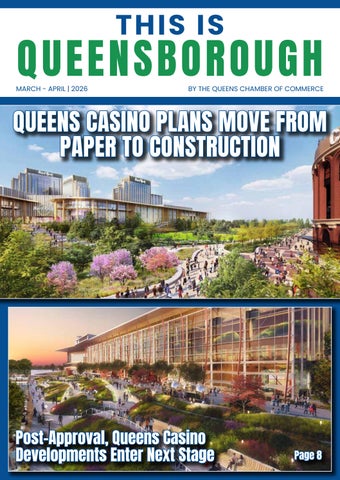
QUEENS CASINO PLANS MOVE FROM PAPER TO CONSTRUCTION
Post-Approval, Queens Casino Developments Enter Next Stage
Page 81
Get ready and prepare for winter. We can help. This winter, you may use more energy to keep your home warm and comfortable. Whether you are looking for ways to reduce energy use or need to get back on track paying your bill, we have programs and services that can help.
@ 2025 National Grid USA Service Company, Inc. All rights reserved.
ngrid.com/hereforyou
2
TABLE OF CONTENTS MARCH - APRIL | 2026
5
Propel NY Energy Helping to power the future of Queens
6
It’s in Queens
8 10 12 13
Queens Casino Plans Move from Paper to Construction When Everything Disappeared Overnight: A Cautionary Technology Story for Business Owners Queens Chefs Named 2026 James Beard Award Semifinalists
This Is Queens
22
24 26 28 30 31
43
From Tehran to Queens, a Surgeon Redefines Care; Elmhurst’s Surgical Chief Earns Trailblazer Honor
Member Success Story – Junkluggers
45
Queens Chamber of Commerce Members Tour New York & Atlantic Railway, Highlighting the Economic Power of Rail Freight in the Greater Region
Villa Russo Cafe Opens in JFK IAT
46
LaGuardia Wins Innovation Grant to Boost Adult Student Success
Dine and Discover Queens
47
Staff Profile
49
2026 Labor & Employment Law Updates: What Queens Employers Need to Know
Seven Decades of Service, Three Decades of Fine Food
15
Strengthening College Point Through Community-Led Economic Insights
35
17
HVAC Optimization for Healthy Buildings
36
18
Queens Is Officially in the Building: How CommunityFocused Orgs Made History
37
Patricia Ornst
38
Richard S. David
19 20 21
Queens Tech Corner: Vitapath
Preparing Your Queens Home for Spring
51
Ben Guttmann
53
Loycent Gordon
39
Maspeth Federal Hosts Youth Financial Literacy Workshop
41
Former Knick Larry Johnson Trains Kids at Queens YMCA in Free Valentine’s Day Clinic
Why Strong Compliance Is the Foundation of Successful Businesses
www.queenschamber.org
50
We have Chemistry
Girl Scouts of Greater New York Kicks Off 2026 Cookie Season Queens Tech Corner: InstaMath AI
The Hidden Cost of Chronic Stress in Small Businesses – And What Leaders Can Do
Queens College & Chamber Partner For Scholarship
54
Queens Homeowners at Center of Push for HOPP Funding Advocates Warn Queens Homeowners Face Rising Foreclosure Risk
55
Snow Frustrations: Snowstorm leaves Queens streets blocked and cars stranded
queenschamberofcommerce
3
MARCH - APRIL | 2026
Dear Members, Spring has arrived, and with it comes a fresh sense of energy across Queens. As the weather warms and our neighborhoods come back to life, there’s a real feeling of momentum in the air. It’s a time for new ideas, renewed connections, and continued growth—and it’s exciting to see how our business community continues to show up, adapt, and move forward together. At the Queens Chamber, we’re leaning into the season ahead. We’re advocating for our members and building partnerships that strengthen our borough and support businesses at every stage. This season also gives us a chance to expand opportunities to connect and come together, whether at recent gatherings or upcoming events—including our annual St. Patrick’s Day luncheon. A lot is happening, and even more is on the horizon. We hope you’ll stay engaged, join us at upcoming events, and take full advantage of everything the Chamber has to offer. Wishing you a strong and successful spring. Sincerely,
QUEENSBOROUGH EDITORIAL & PUBLISHING TEAM Walter Sanchez - Publisher John Sanchez - Marketing Director Noah Zimmerman - BQE Media Editor Mohamed Farghaly - Contributor Jack Delaney - Contributor Cole Sinanian - Contributor Shahriar Hossain - Chamber Editor Ana Navarro - Chamber Design Editor Joanne Persad - General Manager
BQE Media 34-23 47th St, 2nd Fl, Woodside, NY 11377
ABOUT THIS IS QUEENSBOROUGH MAGAZINE This is Queensborough Magazine (ISSN 333068) is published monthly by the Queens Chamber of Commerce with its partner, Queens Ledger, 7520 Astoria Blvd. STE 140, East Elmhurst, NY 11370-1131 USA, Permit Number 452620. Periodicals postage paid at Flushing, NY and additional mailing offices. POSTMASTER: Send address corrections and change of address corrections to: This is Queensborough Magazine, PO Box 780376, Maspeth, NY 11378. Customer service and subscriptions: For assistance email ads@queensledger.com, or phone 718-426-7200.
4
MARCH - APRIL | 2026
PROPEL NY ENERGY: HELPING TO POWER THE FUTURE OF QUEENS By Jamal Wilkerson
R
eliable energy is critical for our homes, small businesses, hospitals, and more. As we head into 2026, Propel NY Energy, a 90-mile underground electric transmission project of the New York Power Authority
and New York Transco, is continuing to make progress. The project includes system improvements across parts of Long Island, Queens, the Bronx and Westchester County that will strengthen our grid and help keep the lights on for Queens residents. Construction is expected to begin in 2026. Why It Matters Two recent reports from the state grid operator, New York Independent System Operator (NYISO), underscore the urgency to deliver Propel NY Energy to boost reliability and resiliency of power delivery to homes and businesses throughout the region and state. For businesses, this means fewer risks of outages, more stable operations, and the opportunity for growth and expansion. •The 2025–2034 Comprehensive Reliability Plan, released in November, warns that delays in transmission and generation projects could jeopardize reliability statewide. Projects such as Champlain Hudson Power Express (CHPE), Propel NY Energy, and planned renewable and storage resources are foundational to the state’s future grid. •The Short-Term Assessment of Reliability, published in October, identifies power reliability risks in New York City, Long Island, and the Lower Hudson Valley beginning in some areas as soon as summer 2026. According to NYISO, once Propel NY Energy and other planned projects enter service, “reliability margins improve substantially.” Engagement and Community Commitment in Queens The team behind Propel NY Energy is focused on building relationships and listening to stakeholders. We believe in an early, often, and inclusive approach. This year alone in Queens, we held 20 project meetings and participated in eight community tabling and stakeholder events, including the Queens Climate Expo. We also launched tools like the Propel NY Energy app and Facebook page for real-time project updates, facilitated energy workshops for students, and volunteered locally. Many of our team members call these communities home, and we’re committed to designing and building a project that serves local needs while minimizing disruptions.
data stored today could be decrypted tomorrow. This is known as “harvest now, decrypt later,” and it presents a serious long-term threat to sensitive client information, proprietary data, and legal or financial records. Start Future-Proofing with a Zero Trust Strategy As such, our technical team is working on finalizing a preferred route in Queens that addresses stakeholder feedback, while meeting project requirements and ensuring residents and businesses continue to flourish. Business Engagement The Propel NY Energy team is proactively engaging directly with local businesses to assess any potential impacts during construction. In August, the project launched a business survey to gather feedback on hours of operation, parking needs, and seasonal considerations which will help the team plan construction in a way that minimizes potential temporary disruptions. We will be rolling out this type of business engagement in Queens once the preferred route has been identified, stay tuned! What’s Next Propel NY Energy remains committed to delivering a project that strengthens New York’s grid, supports economic growth, and advances the state’s energy goals. Together, with our partners and communities, we are building the infrastructure that will power New York reliably and sustainably for decades to come. As we move into 2026, our team will continue proactive engagement with the community, making sure that updates reach all stakeholders. We are always looking to hear from you – Propel NY Energy is more than just an infrastructure project, this is about building a reliable and resilient energy future for all New Yorkers.
5
MARCH - APRIL | 2026
IT’S IN QUEENS Rob McKay
African ballet. Argentine tangos. Chinese acrobats. Magic school buses. Barnyard egg hunts. And, of course, fairy tales. Queens is full of fun and enriching activities this March and April. Check out the highlights below! March Highlights March 5 – TangoMANIA • Spanish-language musical with classic and new tangos, song, and dance. • $55 (various discounts and group rates available) • Thurs & Fri: 8 PM | Sat: 3 PM & 8 PM | Sun: 4 PM • Location: Thalia Spanish Theatre, 41-17 Greenpoint Ave., Sunnyside March 7 – Candlelight Tours •Tours of a naturally illuminated historic landmark with modern classic guitar by Carlos Pavan. Mulled cider and refreshments available. • 6 PM | Free •Location: Onderdonk House, 1820 Flushing Ave., Ridgewood March 7 – Saturday Salons • A showcase of works-in-progress from visual artists, writers, musicians, composers, and performers. Rough ideas encouraged! • 7 PM | $0–$275 • Location: The Chocolate Factory Theater, 38-33 24th Street, Long Island City March 8 – The Beauty of Ballet • Family-friendly performance with excerpts from The Sleeping Beauty, Swan Lake, and The Nutcracker. • 1 PM & 3 PM | Free, first come, first served • Location: Queens Theatre, 14 United Nations Ave. S., Flushing Meadows Corona Park March 20 – Hotel California: The Original Eagles Tribute • A recreation of The Eagles’ legendary sound, including hits like “Hotel California” and “Life in the Fast Lane.” • 7:30 PM | $53.50 (includes $4 ticket fee) • Location: Queens Theatre, 14 United Nations Ave. S., Flushing Meadows Corona Park March 21 – Michael Feinstein’s Tribute to Tony Bennett • Celebrate Tony Bennett with a symphonic performance by Michael Feinstein and the Carnegie Hall Ensemble. • 8 PM | $52–$92 • Location: Colden Auditorium, Queens College, 153-49 Reeves Ave., Flushing March 21 – Elsewhere Ensemble: Haydn and The Happy Prince • A musical, poetic, and storytelling program with Haydn Quartet, piano, and violin. • 7 PM | Price varies • Location: The Church-in-the-Gardens, 50 Ascan Ave., Forest Hills
March 21 – A Fairy Tale •Children’s program with music inspired by The Happy Prince; storytelling with the composer. •4 PM | Price varies •Location: The Church-in-the-Gardens, 50 Ascan Ave., Forest Hills
March 26 – Irish & Irish Sene-Gambian Music •Featuring West African and Celtic music traditions with live instruments and dance. •7 PM | Price varies •Location: New York Irish Center, 10-40 Jackson Ave., Long Island City March 26–28 – Marvels of Media Festival 2026 • Celebration of autistic media-makers with screenings, panels, workshops, VR experiences, and video games. • Location: Museum of the Moving Image, 36-01 35th Ave., Astoria March 28 – Barnyard Egg Hunt • Egg hunt, photos with Whiskers the Bunny, and outdoor games for children. • 10 AM | $17 • Location: Queens County Farm Museum, 73-50 Little Neck Pkwy., Glen Oaks March 29 – The Peking Acrobats® • High-flying feats and contortion in a family-friendly performance of Chinese acrobatics. • 4 PM | $37 • Location: Colden Auditorium, Queens College, 153-49 Reeves Ave., Flushing March 29 – Nidia Góngora: Afro-Colombian Music •Music from Colombia’s Pacific coast, bridging world traditions and Timbiquí heritage. •1 PM | $15 •Location: Flushing Town Hall, 137-35 Northern Blvd April Highlights April 8 – Monthly Jazz Jam Honoring Billie Holiday •House band jam session. Musicians play free; audiences welcome for $15. 7 PM •Location: Flushing Town Hall, 137-35 Northern Blvd
April 16 – Irish & Moroccan Gnawa •Atlas Phoenix, PJ Doran, Dylan James, and Colin Harte perform Moroccan and Irish music. •7 PM | Price varies •Location: New York Irish Center, 10-40 Jackson Ave., Long Island City April 17 – Sō Percussion Unplugged •Percussion performance using everyday objects and works by Caroline Shaw, John Cage, and Vijay Iyer. •8 PM | $32 •Location: LeFrak Concert Hall, Queens College, 153-49 Reeves Ave., Flushing April 19 – The Magic School Bus: Lost in the Solar System •Family-friendly play with Ms. Frizzle exploring Mercury, Venus, and Mars. •1 PM & 4 PM | $25 (4 tickets for $90) •Location: Queens Theatre, 14 United Nations Ave. S., Flushing Meadows Corona Park April 25 – Darlene Love: Love Songs •Rock and Roll Hall of Famer performs her iconic hits. •8 PM | $37–$72 •Location: Colden Auditorium, Queens College, 153-49 Reeves Ave., Flushing April 26 – HITCity! •Broadway and Motown hits endorsed by Temptations founder Otis Williams. •3 PM | $55–$65 •Location: Queens Theatre, 14 United Nations Ave. S., Flushing Meadows Corona Park April 26 – Fused Glass Workshop •Make colorful glass jewelry with Naomi Rabinowitz; pieces fired on-site. •11 AM | Price varies •Location: Alley Pond Environmental Center, 229-10 Northern Blvd., Douglaston
6
PUT YOUR BUSINESS FUNDS TO WORK
BUSINESS MONEY MARKET ACCOUNT
Explore our solutions designed to help you save time, boost your productivity and grow your business with confidence. SIMPLIFY PAYROLL & STREAMLINE OPERATIONS
DELIVER A BETTER CHECKOUT EXPERIENCE
Save time, improve efficiency and reduce costs with our web-based payroll solutions.
Accept payments online, in stores and on the go with innovative merchant services.
EXPAND YOUR PURCHASING POWER
STAY IN CONTROL 24/7
Choose from several Mastercard credit cards with competitive rates and great perks.
Manage your business finances anytime, anywhere with secure digital banking tools.
®
Visit ridgewoodbank.com or scan to meet our business banking team.
© 2026 Ridgewood Savings Bank | Member FDIC
7
MARCH - APRIL | 2026
QUEENS CASINO PLANS MOVE FROM PAPER TO CONSTRUCTION POST-APPROVAL, QUEENS CASINO DEVELOPMENTS ENTER NEXT STAGE By Mohamed Farghaly
New York City’s newly approved downstate casino licenses are entering their final implementation phase, with two Queens projects — Metropolitan Park near Citi Field and Resorts World New York City in Jamaica — moving from years of planning into early construction and hiring. After the state Gaming Facility Location Board cleared the proposals in December and the Gaming Commission granted final approval, developers are shifting focus from licensing to execution. Officials have framed the projects as cornerstones of a broader economic strategy expected to generate billions in tax revenue, expand tourism and create tens of thousands of union jobs over the next decade. The $8.1 billion Metropolitan Park development, backed by Mets owner Steve Cohen and Hard Rock International, is slated to transform 50 acres of parking lots around Citi Field into a year-round sports and entertainment district. The project includes a hotel and casino complex, a live music venue, public parkland and infrastructure upgrades centered around Willets Point. “Metropolitan Park’s approval is a win for Queens, the local community, and our neighbors who have supported us along the way. Cons-
truction is expected to begin soon with the project to be completed in 2030. As it has been from the beginning, our top priority remains delivering what we promised for the local community, and being open and honest as we build the next great sports and entertainment destination for New York,” said Karl Rickett, a Metropolitan Park spokesperson. Developers say early site work is expected to begin in the coming months, with full construction ramping up after final permitting. The plan calls for 25 acres of new public park space, a rebuilt and ADA-accessible Mets–Willets Point 7 train station, roadway upgrades and a $163 million community impact trust to fund nonprofit groups serving Queens. Project leaders estimate 23,000 permanent and construction union jobs, alongside a Queens-focused hiring initiative and new lending programs for minority- and women-owned businesses. “Since the day I bought the team, the community and Mets fans have made it clear to me that we can and should do better with the area around the ballpark,” said Steve Cohen, Owner of the New York Mets. “Now, we are going to be able to deliver the sports and entertain-
ment district that our fans have been asking for.” Meanwhile, Resorts World New York City is preparing to expand its footprint at the Aqueduct Racetrack complex after securing approval for a $5 billion overhaul that could make the property one of the largest gaming and hospitality destinations in the country. The Jamaica-based casino, which opened in 2011 as the city’s first legal gaming facility, is expected to begin generating new revenue quickly as expansion planning accelerates. The proposal includes a 350,000-square-foot casino floor, a 1,600-room Crockfords hotel, a 7,000-seat arena and more than 10 acres of public green space, along with 3,000 units of affordable, union-built housing. Community investments include a $50 million Genting Innovation Center housing education and wellness programs. “Resorts World New York City continues to expand its workforce in Queens and is actively hiring across a range of positions. Our focus remains on creating thousands of good-paying jobs right here in the community where we’ve been operating for 15 years. For current opportunities, residents can visit https://rwnewyork.com/careers/,” said Michelle Stoddart, Senior Vice
8
MARCH - APRIL | 2026
President of Community Development, Resorts World New York City. Developers say hiring is already underway as the company prepares for the next construction phase. Resorts World officials have emphasized workforce development, tourism growth and proximity to JFK Airport as central pillars of the expansion strategy, positioning the complex as an international gateway entertainment hub. Both projects are expected to undergo additional city permitting and environmental steps as construction timelines advance. State officials project that the three
newly approved downstate casinos will collectively deliver billions in tax revenue over the next decade, funding transit improvements and other public priorities while reshaping large sections of Queens’ waterfront and industrial corridors. If completed on schedule, Metropolitan Park is targeting a 2030 opening, while Resorts World’s expansion is expected to roll out in phases, beginning as early as this year. Together, the developments mark the most significant expansion of legal casino gambling in New York City history and a defining redevelopment push for Queens.
9
MARCH - APRIL | 2026
WHEN EVERYTHING DISAPPEARED OVERNIGHT: A CAUTIONARY TECHNOLOGY STORY FOR BUSINESS OW-
Steve Geborde
Most business owners don’t believe a total operational failure will happen to them…until it does. At Super-G Intelligence, a Queens-based technology infrastructure firm, we support businesses across the borough with reliable systems designed to protect operations and data. Occasionally, however, we are contacted after something has already gone wrong. To protect privacy, all identifying details have been removed, but the lesson is very real.
THE BUSINESS HAD BEEN OPERATING FOR YEARS and relied heavily on customer records, activity histories, and operational data. The company believed it had a backup strategy. Data was copied weekly to several flash drives that had been in use for more than a decade. Those drives were stored carefully and treated as a safety net. The business also leased critical software used for daily operations but declined to pay for any integrated or third-party backup solutions. The reasoning was simple: ongoing monthly costs for external services were seen as unnecessary. Everything was handled internally. No managed backups. No cloud replication. No third-party monitoring. What the business did not realize was that the flash drive backups had quietly failed years earlier. Over time, the data on the drives became corrupted. Files were no longer copying correctly, but because
no one ever tested the backups, the corruption went unnoticed. Each week, new data was written on top of already corrupted files. From the outside, the process appeared successful. In reality, the safety net no longer existed. Then one day, the main computer failed. The failure was sudden and irreversible. When the system would not power back on, the business owner remained calm. After all, there were years of backups stored on flash drives. Recovery seemed straightforward…It wasn’t. When the flash drives were connected, the data could not be read. Files were missing, incomplete, or unusable. The backups that were relied upon for years were effectively empty. What was assumed to be a secure recovery plan turned out to be a false sense of protection. The immediate impact was operational paralysis. Customer records were gone. Historical transactions could not be verified. Employees had no access to essential information. What began as a hardware failure quickly became a business crisis. The most damaging part wasn’t the broken computer it was
the realization that years of trust, data, and work had vanished. This situation was entirely preventable. Modern businesses cannot rely on untested, aging storage devices as their only line of defense. Backup systems must be actively monitored, verified, and maintained. Redundancy matters. Independent systems matter. And recovery plans must be tested before they are needed. For many small and mid-sized businesses, operating lean is a necessity. But lean should never mean unprotected. Avoiding monthly technology costs may feel like savings in the short term, but it can lead to devastating losses in the long term. When businesses fail due to preventable technology issues, the ripple effects extend far beyond a single organization. The purpose of sharing this story is not to create fear, but awareness. Technology failures do not announce themselves in advance. Preparation not hope is what keeps businesses running.
10
Shoot for the Stars!
QUEENS BASKETBALL ACADEMY Dribble, shoot, and score! Learn basketball fundamentals, teamwork and discipline needed to take your game to the next level.
Call today for upcoming dates!
Sunday Sessions 10am - NOON For Boys and Girls Age 7 - 16 y/o
PROGRAM FEATURES: Developmental and instructional training 2 hours per session Structured and deatiled coaching analysis
SLOTS ARE LIMITED! RESERVE NOW! For more information: Call Coach Nick Tavantzis at (917) 224-0057 or email queensbasketballacademy@gmail.com
11
MARCH - APRIL | 2026
QUEENS CHEFS NAMED 2026 JAMES BEARD AWARD SEMIFINALISTS By Lauren Braithwaite
S
everal Queens-based chefs have earned national recognition as 2026 James Beard Award semifinalists, one of the highest honors in the American restaurant industry. The James Beard Foundation announced its list of semifinalists in January, naming Chef Hooni Kim of Meju in Long Island City, Chef Yvan Lemoine of Tourmaline in Forest Hills, and Chef Rafiq Salim of Rolo’s in Ridgewood as semifinalists in the Best Chef: New York State category. This honor places the three Queens chefs among 39 chefs in New York City selected from over 10,000 submitted recommendations nationwide. The Foundation will announce finalists on March 31 and reveal winners at the James Beard Restaurant and Chef Awards ceremony on June 15 in Chicago. Chef Hooni Kim, who runs Meju in Long Island City, has built a loyal following for his intimate tasting menu that puts Korean flavors front and center. The restaurant is known for dishes that rely on traditional techniques like fermentation and slow-building sauces, presented in a modern, thoughtful way that has made Meju a standout in the local dining scene. “As a 15-year resident of Queens, it is an incredible honor to be named a James Beard Semifinalist,” said Chef Hooni Kim. “Not only do we represent this beautiful borough but also all the great ethnic restaurants here. I am a firm believer that Queens is the ethnic food capital of the world, and we are so blessed to be surrounded by all this diversity.” In Forest Hills, Chef Yvan Lemoine runs Tourmaline, where he brings classic French cooking techniques into a comfortable, neighborhood setting. He focuses on carefully prepared sauces, traditional methods, and seasonal ingredients, offering prix-fixe menus that have made the restaurant a favorite among local eateries.
“Being named a James Beard semifinalist is an incredible honor and a testament to the hard work of our entire team,” said Chef Yvan Lemoine. “Queens has such a vibrant and diverse food community, and we’re proud to represent our neighborhood on a national stage.” Chef Rafiq Salim, owner of Rolo’s in Ridgewood, rounded out the borough’s strong showing. Rolo’s is best known for its wood-fired cooking, house-made bread, and seasonal menu that changes often. The restaurant has become a favorite for both neighborhood regulars and diners traveling in from other parts of the city. “Being named a James Beard semifinalist is a great honor for the entire Rolo’s staff,” said Chef Rafiq Salim. “Accomplishing this in Queens, where I live, feels even better. Living and working a short walk away has been my lifelong dream.” Tom Grech, President and CEO of the Queens Chamber of Commerce, said the recognition is another sign that Queens’ restaurant scene is finally getting the national attention many locals have long believed it deserves. “Anyone who eats in Queens already knows how special this food scene is,” said Tom Grech. “These chefs are doing incredible work every day, and this kind of recognition helps shine a light on the neighborhoods, cultures, and small businesses that make Queens such an exciting place to eat. The talent here is unreal, and it’s great to see chefs from our borough getting their moment on a national stage.” Since its founding in 1990, the James Beard Awards have stood among the most respected honors in American dining. Even reaching semifinalist status marks a significant achievement and recognizes chefs whose work has shaped their local food communities.
12
MARCH - APRIL | 2026
THIS IS QUEENS By Luz Jimenez
This Is Queens. This Is Why Queens. Sometimes you do not know what you have until you are reminded. I came to Queens from Medellín, Colombia, when I was four and a half years old. Much of that early time now feels indistinct, but one feeling remains clear: warmth. I remember PS 69. I remember how safe I felt there. I had the privilege of a kindergarten teacher whose kindness was immediate and instinctive. She recognized fear and language barriers before they needed explanation. Looking back, I understand that care was not circumstantial. It was simply who she was. From the very beginning, Queens was unfamiliar, but it was also safe and inviting. It was a place where a child newly arrived from another country could feel held, seen, and protected. Years later, I found myself standing in LaGuardia Airport, hosting a pop-up for my travel-inspired brand, eStock Merch. The brand began as a photo library, eStock Photo, LLC. Its genesis was rooted in photography, in documenting places and cultures around the world, and eventually transforming those images into meaningful objects and merchandise. That day, surrounded by New York City-themed products shaped by my own experiences, something unexpected happened. Again and again, airport workers and travelers asked me the same question: where is the Queens merchandise? I realized I had not given Queens the spotlight it deserved, and I was reminded of my responsibility to more fully celebrate, share, and illuminate its richness.
The loyalty of the workers to Queens was undeniable. They wanted me to represent Queens, to stand for it, and to honor it. Travelers shared their own connections. They told me about visiting the Unisphere, walking through Socrates Sculpture Park, and strolling along the waterfront promenade in Long Island City. They spoke about neighborhood restaurants in Jackson Heights, the best food trucks in Corona, Greek food in Astoria, late nights in Flushing, quiet streets in Forest Hills, family life in Jamaica, Bayside bars, Ridgewood, and beyond. They talked about the ease of transportation, the way the airport connects seamlessly to the city, and the feeling of arrival without resistance. Standing there, I was reminded of something I had always known and momentarily lost sight of. Queens is not just where people arrive. It is where people begin. This is why Queens has long been known as the gateway to New York. Not because people pass through it, but because arrival becomes belonging here. From Astoria to Jamaica, Flushing to Long Island City, Jackson Heights to Corona, Forest Hills to Bayside, Ridgewood to Far Rockaway, Sunnyside, Woodside, Elmhurst, Kew Gardens, Whitestone, Rego Park, and so many more, each neighborhood carries its own rhythm, language, food, and memory. Each one is alive. Together, they form something rare. That shared rhythm shows up in moments when entire neighborhoods gather in one place. At Citi Field, home of the New York City Mets
the stadium becomes a cacophony of celebration, where cheers rise and spill into the surrounding Queens neighborhoods, familiar and shared. It is a sound of camaraderie and fierce pride, a reminder of how many lives, loyalties, and histories move together here. This is Queens. This is why Queens.
Queens is an open-arms place. It always has been, and it continues to grow richer not in spite of its diversity, but because of it. As cultures arrive, settle, and mature, they become the very roots that strengthen the borough over time. Queens offers an example of how differences can be held together. How they can be woven into something working, humane, and real. Not theoretical. Not idealized. Lived.
13
14
MARCH - APRIL | 2026
STRENGTHENING COLLEGE POINT THROUGH COMMUNITY-LED ECONOMIC INSIGHTS The resulting report offers a detailed, community-driven snapshot of the district’s strengths, challenges, and priorities for the future. This needs assessment, developed in partnership with the New York City Department of Small Business Services (SBS), serves as an official city document that will help inform policy decisions, public investments, and long-term planning for the College Point commercial corridor. Rather than relying on assumptions or topdown approaches, the assessment is grounded in firsthand input from the people who know the district best. It captures a wide range of perspectives, from small business owners navigating day-to-day operational pressures to residents and consumers advocating for a cleaner, safer, and more vibrant commercial environment.
The Queens Chamber of Commerce recently marked an important milestone in its efforts to support neighborhood-based economic development with the completion of the College Point Commercial District Needs Assessment. After months of sustained outreach, the initiative successfully gathered more than 400 survey responses from business owners, residents, and consumers who live, work, and shop in and around College Point.
To celebrate the completion of the assessment, SBS visited College Point to deliver physical copies of the finalized pamphlet to the community. The document reflects not only the data collected but also the unique character of the neighborhood itself. Storefront and street photography featured throughout the report was captured by Franchette RJ Zamudio and Virginia Ferreira, whose images highlight the local businesses, streetscapes, and everyday moments that define College Point. The visuals reinforce the idea that commercial districts are more than economic zones; they are lived-in spaces that anchor community identity. Behind the data is a significant on-the-ground effort. The Queens Chamber’s outreach team conducted surveys over the course of several months, often working through rain, snow, and freezing conditions to ensure that as many voices as possible were heard. This commitment to in-person engagement helped build trust with business owners and residents and ensured that the final data set was both robust and representative. The Chamber hopes that this
official data will strengthen its ability to advocate more effectively for College Point by clearly demonstrating the community’s needs and priorities to city agencies and elected officials. The survey findings point to several consistent themes. Respondents emphasized the need for stronger support for small businesses, improvements to sanitation and street conditions, better coordination around parking and transportation, and increased marketing and visibility for the district. Many also expressed a desire for clearer communication and stronger partnerships between merchants, community organizations, and government agencies. Together, these insights provide a practical roadmap for targeted, placebased solutions that respond directly to local concerns. The success of the College Point Commercial District Needs Assessment was made possible through deep collaboration with community partners who helped promote the survey and encourage participation. The Queens Chamber extends its sincere thanks to the College Point Board of Trade, A Better College Point Civic Association, the College Point Civic & Taxpayers Association, Council Member Vickie Paladino, Mi Gente Senior Center, HANAC Angelo Petrone Melis Senior Center, and Assemblymember Sam Berger. Their support was instrumental in reaching the survey goals and ensuring broad community representation. For the Queens Chamber, this assessment is not an endpoint but a foundation. The data collected will inform future advocacy efforts, programming, and partnerships aimed at strengthening the College Point commercial district and supporting the small businesses that are central to its vitality. More importantly, it demonstrates the impact of listening closely and showing up consistently. By centering community voices and backing them with official data, the Chamber and its partners have taken an important step toward building a stronger, more resilient College Point for years to come.
15
A STRUCTURE IS ONLY AS GOOD AS ITS FOUNDATION. WE’RE EXPERTS AT BOTH. "ELEGANT SOLUTIONS TO COMPLEX PROBLEMS"
STRUCTURAL, FOUNDATION, GEOTECHNICAL, CIVIL, AND ENVIRONMENTAL ENGINEERING SERVICES • Structural Engineering Services for all types of new and existing buildings • Foundation and Geotechnical Engineering • Soil Borings, Vibration & Optical Monitoring • Support of Excavation Engineering • Construction Support Services • Forensic Engineering Services • Civil and Site Engineering Services • Environmental Remediation Services • Value Engineering • Project Managers and Advisors
George J. Cambourakis, P.E., C. Eng. – President Structural Engineering Technologies, P.C. 40-12 28th St., Long Island City, NY 11101 (P) 718-706-7196 • (E) info@set-ny.com www.set-ny.com 16
MARCH - APRIL | 2026
HVAC OPTIMIZATION FOR HEALTHY BUILDINGS
By Jay Ryan
O
nce in a rare while, a technology comes along that is so revolutionary and advanced that it solves multiple problems. One new breakthrough can align what used to be competing interests
among tenants, landlords, and environmentalists. Building occupants want to make sure that they have healthy indoor air. Building owners and managers want to keep expenses low to maximize profits. The public and the government want to minimize carbon emissions to keep the environment cleaner and safer. Until recently these goals were usually in conflict. They no longer must be. Energy is very expensive for building owners, and in NYC fines for not complying with Local Law 97 which regulates carbon emissions can be crushing for small businesses and building owners. HVAC expenses account for up to 40% of a building’s costs—usually the largest single expenditure. NYC’s LL97 aims to achieve net-zero carbon emissions from larger NYC buildings by the year 2050. Buildings over 25,000 square feet must meet a series of difficult-to-achieve milestones along the way. The fines are punitive. For most buildings, HVAC optimization is the best way to bring a building into compliance. The largest portion of a building’s HVAC expense results from heating and cooling outside air. It takes a lot of energy to condition humid 90° air down to a comfortable 70°. Similarly, heating 28° air to 70° requires a lot of gas, oil, or electricity. It would be most energy efficient to just keep recirculating air that has already been heated or cooled within a building.
But if we cut down outside ventilation, we decrease the dilution of pathogens, particulates, and VOCs in the indoor air, which leads to “sick building syndrome.” NYC has building codes that require a healthy level of ventilation. There are traditional ways to improve a building’s HVAC efficiency. Proper maintenance of equipment and regularly replacing filters is simple and inexpensive. But the magnitude of improvement from these measures is marginal. Improving insulation, upgrading equipment, and adding control systems have a larger effect, but are expensive. And many new or very well-maintained buildings already have high-quality systems but still need to find ways to cut their carbon emissions to comply with Local Law 97. The new technology we are discussing allows for precise measurement of air flows inside a building. It was developed by the founder of Meta, whose goal was to make indoor air healthier. This technology has been fully vetted by ASHRAE and incorporated into ASHRAE Standard 241. This standard that was created at the request of the White House after Covid.
And since the pandemic, building occupants have been more focused than ever before on ensuring that their indoor air quality is healthy. As a result, some well-intentioned building managements have employed the new technology to make sure that their building’s indoor air is safe. What was found during this testing was fascinating: almost all office buildings, and many other buildings, are OVER ventilated! What’s wrong with too much fresh outside air? As mentioned earlier, it is very expensive to condition outside air. If you are above the optimal level of ventilation, you are wasting energy and money for no good reason. Using this proprietary new technology keeps your building healthy and saves you money. It saves you money by using less energy. Saving energy is good for the environment and helps improve compliance with Local Law 97. It’s a win-win-win. What makes it even more appealing is that it doesn’t require installation of any hardware or software. It requires no upfront payment or capital investment—so you don’t even have to budget for it. This technology is only available from one company. If you are interested in learning more, please contact us.
The purpose was to set OPTIMAL healthy levels of ventilation in buildings during pandemics or wildfires. During the Covid pandemic, the CDC told building managers to crank up their ventilation levels to dilute Covid pathogens.
17
MARCH - APRIL | 2026
QUEENS IS OFFICIALLY IN THE BUILDING: HOW COMMUNITY-FOCUSED ORGS MADE NYC HISTORY
By Matt Barba
The largest globe in the world is currently sitting in Flushing Meadows Park, but this is not why Queens is called the World’s Borough (sorry, Unisphere). Queens earned that moniker through being the most ethnically diverse urban area on the planet, at least according to the Guiness Book of World Records. This diversity not only provides Queens residents with seemingly endless options for a delicious meal, but also an incredible array of community-focused cultural events. It was at one such cultural event that a chance encounter with a fellow Queens resident would give me, and my company, the opportunity to help change the course of history. For the uninitiated, we are Fullstack NY, an event production company specializing in comprehensive A/V, lighting and staging solutions across the tri-state area.
While we’ve expanded our services into many different arenas over the past 50 years, we have never forgotten our roots in community -led, cultural events. Given the record-breaking diversity of its communities, these roots often lead us back to my home borough of Queens. The chance encounter I mentioned earlier occurred while I was setting up an audio system for the Queens Jazz Trail, a free concert series organized by the Kupferberg Center for the Arts. I found myself striking up a friendly conversation with fellow Queens resident Maryam Mudrick, founder of Great Good Events. That relationship quickly blossomed, leading to our first major collaboration: providing audio and lighting for Socrates Sculpture Park to help them transform the already-iconic space into the perfect venue for their annual gala. Just a month later, we received the call that would determine the course of the year that followed. Katie Riley, a former employee of Great Good Events, was now working on an energetic young politician’s mayoral campaign and wanted us to provide production support for the campaign’s launch event. The launch event, held in fall of last year, took place at The Connected Chef in Long Island City—a community-led non-profit focused on equitable food distribution. A crowd of modest size, largely comprised of
Queens locals, convened to kick off the Mayoral campaign for the 36th District Assemblyman Zohran Mamdani. At the time his reputation wasfirmly established in local organizing circles, but his city-wide name recognition sat at just above 1%. His campaign quickly became a viral sensation, and the scale of his rallies grew exponentially in tandem. As the campaign accelerated into the spring of 2025, our role grew from solely providing A/V support to also providing critical infrastructure. We began supplying seating risers and complex audio distribution systems specifically designed to accommodate the growing press contingents at rallies across the city, including his packed-to-the-gills Primary Election Night party in June. As you would imagine, his victory in the primaries only added to this momentum, and his rallies continued to grow exponentially in scale. Soon enough, world-renowned New York comedians like Gianmarco Soresi and The Kid Mero were hyping up the crowd from behind the podium we had provided. Finally, for the final Election Night watch party at the Brooklyn Paramount, we designed and assembled a massive 48’ x 16’ 3-tier riser system with specialized audio distribution for press. This event drew hundreds of supporters, with familiar faces like Alexandria Ocasio Cortez and Hasan
Piker among them. Representatives from almost every major press outlet were in attendance, all gathered on the elevated press risers that we had assembled with precise consideration for the uniquely sloped flooring of the 97-year-old theater. This event came together on a shorter-than-average timeline, but we put our experience to the test and rose to the occasion. By the end of the night, New York City had elected its first ever South-Asian mayor, and first ever Muslim mayor. Fullstack NY has always had a focus on bringing communities together, and being a part of this historic campaign has shown us that when people unite towards a shared vision, they can change the course of history. None of this from the initial launch at The Connected Chef to the final victory at the Paramount would have been possible without the hard work of community-focused institutions. So, next time you see a flyer for a neighborhood gathering, be sure to go to your local community event; you never know who you might meet in the world’s borough!
18
MARCH - APRIL | 2026
QUEENS TECH CORNER: VITAPATH
It’s Queens Tech Corner time! This month’s featured tech entrepreneurs are Alisha Karim and Nicholas Stewart, co-founders of VitaPath, a health tech startup delivering personalized wellness solutions. To learn more, visit the company’s website at https://www.vitapath.io/. Can you tell us a little about your company and how you got your start? VitaPath grew out of something we kept noticing again and again in healthcare. Once a patient leaves a doctor’s visit, there is often very little clarity about what happens next. That gap can be especially challenging for people balancing work, family, and complex health needs. VitaPath focuses on improving that moment after the visit by helping patients understand next steps in a clearer way. By addressing abnormalities with a personalized road map, powered by biometrics obtained during the visit, such as blood tests and care plans, patients can
proactively adjust their lifestyle before leading to major health complications. What is your latest project, and why are you excited about it?
We’re working on VitaPilot, the next public release beyond our website MVP. Research conducted alongside interviews with clinicians, care coordinators, and patients has helped us pinpoint a meaningful entry into the industry by focusing on where post-visit care adherence breaks down. Our goal is to deliver accurate, personalized recommendations to patients through electronic health record integration while enabling healthcare
providers to maintain ongoing post-visit engagement and gain clear insight into each patient’s health progression. Why are you excited about the future of tech in Queens? Communities in Queens will benefit from startups built locally. What better place to develop a product focused on proactive wellness, where access to preventive care can have the greatest impact on our community? A tech ecosystem in Queens will make cutting-edge innovation more accessible to those who need it most.
19
MARCH - APRIL | 2026
WHY STRONG COMPLIANCE IS THE FOUNDATION OF SUCCESSFUL By Leidy M. Pagan BUSINESSES
Strong communities are built on strong businesses. In Queens, where small businesses are the backbone of the local economy, compliance plays a critical role in ensuring long-term stability, collaboration, and growth. While compliance is often viewed as a technical or administrative requirement, its true value extends far beyond paperwork—it serves as the foundation that allows businesses to operate responsibly within their communities. Business compliance is about more than meeting regulatory obligations. It reflects a commitment to transparency, accountability, and ethical operations. When businesses maintain accurate records, meet filing requirements, and follow applicable regulations, they contribute to a culture of trust that benefits customers, partners, and the broader community. Compliance allows businesses to interact confidently with other professionals, financial institutions, and government entities. For professionals who work closely with local businesses— such as attorneys, accountants, consultants, and nonprofit leaders—compliance is a shared responsibility. Referrals and partnerships rely on trust, and that trust is reinforced when businesses operate with proper structure and oversight. Strong compliance practices reduce risk, protect reputations, and support more effective collaboration across industries. In growing communities like Queens, many businesses are in various stages of development. Some are newly formed, while others are expanding operations, seeking financing, or pursuing public and private contracts. In each of these stages, compliance serves as a gateway to opportunity. Businesses that are compliant and organized are better
positioned to respond quickly to opportunities, while those that are not may face delays, penalties, or missed chances for growth. Startups and small businesses benefit significantly when compliance is addressed early. Entrepreneurs often begin with a strong vision and dedication but limited exposure to regulatory and financial requirements. Without guidance, minor oversights can evolve into significant challenges that affect not only the business owner, but also employees, vendors, and customers. Early compliance education helps business owners build sustainable operations and avoid unnecessary disruptions. Beyond individual businesses, compliance has a measurable impact on the community as a whole. Businesses that operate responsibly contribute to economic stability, create sustainable jobs, and support local development. They are more likely to remain in operation long-term, reinvest in their neighborhoods, and participate in community initiatives. In this way, compliance strengthens not only individual businesses but also the local economy. Collaboration among professionals plays an essential role in supporting business compliance. Accountants, legal professionals, consultants, and advisors each provide specialized
guidance that helps businesses navigate complex requirements. When these professionals work together, they help business owners understand their responsibilities and make informed decisions. This collaborative approach leads to stronger outcomes for businesses and fosters a more resilient business community. As Queens continues to evolve, the importance of business compliance will only increase. Regulatory requirements, reporting standards, and accountability expectations are becoming more complex, making proactive compliance essential. Businesses that prioritize compliance demonstrate reliability, earn trust, and position themselves for long-term success. Ultimately, strong compliance is not simply about following rules—it is about building responsible businesses that contribute positively to the community. When businesses operate with integrity and structure, they create a stronger foundation for collaboration, growth, and shared prosperity across Queens.
20
MARCH - APRIL | 2026
PREPARING YOUR QUEENS HOME FOR SPRING
After a long, harsh winter, you should be adding a few extra steps to your annual Spring home assessment. It involves more than removing all traces of snow and ice melt from around your property. As a leading Queens, New York Public Adjuster firm, United Public Adjusters & Appraisers offers these tips to ensure your home will be well-prepared for the coming season. It is important to prepare your Queens home for spring by focusing on water mitigation and structural integrity to prevent insurance claims. This year, as you clean gutters, inspect your roof for winter damage, and trim trees, you can take pride knowing you’re protecting your home—and helping prevent costly property damage or an insurance claim. Here’s a checklist of the top tasks to perform now, to prevent issues later. Sometimes, however, despite taking every precaution, property damage does occur. Now or at any time, should your property sustain damage, know that the UPA team will gladly assist you with all aspects of your property damage claim. Preventive Maintenance (Proactive Measures) • Roof and Attic Inspection: Check for cracked, loose, or missing shingles damaged by winter ice. Look for signs of water infiltration in the attic, as early detection prevents major, hidden water damage claims. • Gutters and Downspouts: Clean out winter debris (leaves, twigs) to ensure proper water flow away from the foundation. • Landscaping: Trim trees and branches that could fall on your home during spring thunderstorms. Remove dead, weak trees. • Foundation and Sump Pump: Inspect the foundation for cracks and test your sump pump to prevent basement flooding, a common issue in many parts of Queens. • Exterior Vents: Clear debris from dryer and attic vents to ensure proper ventilation.
• Document Everything (Pre-Damage): Take updated photos or videos of your home’s interior and exterior before spring storms occur. This serves as vital, undeniable proof of your home’s condition. • Review Your Policy: Understand your coverage, particularly regarding flood insurance, which is usually not included in standard homeowner policies. As a leading New York public adjuster firm, United Public Adjusters & Appraisers can review your insurance policy with you to ensure you understand what’s covered, what isn’t, and whether your home is fully protected for potential risks. • Create an Inventory: Update your home inventory list with any new items purchased over the winter. Keep receipts. If Damage Occurs, Before You Call Your Home Insurance Claim Adjuster • Mitigate Further Damage: If a storm causes damage, you are required to take reasonable steps to prevent further damage (e.g., covering a broken window with plastic). • Document Before Cleaning: Take detailed photos and videos of the damage before moving anything or starting repairs. • Contact Our Professionals: Contact United Public Adjusters & Appraisers immediately. As a successful New York public adjuster firm our experts are ready to assist with assessing, documenting, and negotiating your claim to ensure you receive a fair settlement. Your Queens County residence is likely to be your biggest investment. Protect its value by performing these Spring preparedness chores, and you will have the satisfaction of knowing that you are well-prepared for whatever Mother Nature has in store for our region. Remember, if your residence does sustain property damage or asset losses, to contact the United Public Adjusters & Appraisers immediately for assistance. We’ll take charge of your claim and negotiate with your carrier to bring about a just settlement for you in as short a timeframe as possible. Speak with our professionals now to learn more.
Insurance and Documentation Preparation At United Public Adjusters & Appraisers, we stress that the ounce of prevention you take now, will ensure that you have an optimal outcome later.
21
MARCH - APRIL | 2026
2026 LABOR & EMPLOYMENT LAW UPDATES: WHAT QUEENS EMPLOYERS NEED TO KNOW By Douglas E. Rowe, Esq.
As we advance through 2026, New York remains at the forefront of labor and employment law reform. After a busy 2025 legislative session and the adoption of the 2026 State Budget, employers operating in Queens and throughout New York State face a broad array of new and evolving obligations. Staying informed and proactive is essential to maintain compliance, avoid penalties, and foster a positive workplace culture. •Wage and Salary Threshold Increases One of the most impactful changes this year involves wage and salary thresholds affecting both non-exempt and exempt employees: •Minimum Wage: Effective January 1, 2026, New York’s minimum wage increased to $17.00 per hour in New York City, Long Island, and Westchester, with the remainder of the State at $16.00 per hour. •Exempt Salary Thresholds: The minimum weekly salary required for employees to qualify as exempt from overtime under New York State standards also rose for 2026.
Employers in NYC, Long Island, and Westchester must meet a $1,275.00 weekly threshold (annualized to about $66,300), while employers in the rest of the State must meet $1,199.10 weekly (around $62,353 annually). These increases mean that businesses should review compensation structures now to ensure overtime exemption designations remain valid and that pay practices align with the current state standards. 1.Expanded Paid Leave and Leave Administration New York continues to expand employee leave rights -- and with that comes heightened compliance complexity: •Paid Family Leave (PFL): For 2026, the employee contribution rate for PFL increased slightly, with a new maximum annual deduction of $411.91 from employees’ wages. •New York City Earned Safe and Sick Time Act (ESSTA): Starting February 22, 2026, NYC employers must frontload 32 hours of unpaid sick/safe leave for employees upon hire, in addition to continuing paid accruals tied to employer size and net income. Employers must offer paid leave first unless the employee requests otherwise. •Temporary Schedule Change Act Integration: The former NYC Temporary Schedule Change Act has been absorbed into ESSTA, meaning employers no longer have separate obligations under TSCA but must respond to schedule change requests under the broader leave framework. •Prenatal Leave Requirements: NYC has clarified and codified prenatal leave rules,
requiring 20 hours of paid prenatal leave for qualifying employees and specific policy and notice requirements.
consumer credit history for employment decisions including hiring or compensation with limited exceptions.
For employers with staff in Queens, updating leave policies and handbooks, adjusting payroll and scheduling systems, and training HR personnel on new processes should be immediate priorities.
Employers should eliminate credit checks from pre-employment screening unless a narrow statutory exclusion applies and update their hiring protocols accordingly.
2.Prohibitions on “Stay-or-Pay” Agreements
4.Wage & Hour Reporting and Payroll Obligations Additional compliance updates include:
In late 2025, Governor Hochul signed the Trapped at Work Act, which took effect immediately and remains a major compliance development in 2026:
• Electronic Certified Payroll Reporting: Contractors on public and prevailing wage projects must now submit monthly certified payroll reports electronically via the NYSDOL portal beginning in 2026.
•Employment promissory notes often referred to as “stay-or-pay” or training repayment agreements -- are now expressly prohibited in New York. Employers can no longer require workers to repay training costs or other sums if they leave employment within a specified period.
This requirement affects construction employers and subcontractors operating in the region and underscores the broader trend toward digitized compliance enforcement.
This change requires employers to immediately review and revise any employment contracts or agreements that include repayment obligations tied to tenure or training investment. 3.Limits on Use of Credit History in Hiring Also new this year: effective April 18, 2026, will be an unlawful discriminatory practice under New York State law for employers, labor organizations, or employment agencies to request or use an individual’s
Conclusion 2026 continues a multi-year trend of substantial reform in New York labor and employment law. From wage increases and expanded leave entitlements to new prohibitions on contract terms and credit checks, employers must navigate a complex and evolving legal landscape. To stay compliant and competitive, Queens businesses should proactively review policies, adjust systems, and engage legal or HR expertise where necessary. Timely action now will help avoid costly missteps later and support a thriving workplace that meets employees’ expectations under the law.
22
SAVE 10% ON ALL MARCH CLEANINGS— HAPPY SPRING!
Exterior Window Cleaning
Interior Window Cleaning
Pressure Washing
Gutter Cleaning
House Washing
Screen Cleaning
Roof Washing
Light Fixture Cleaning
23
MARCH - APRIL | 2026
MEMBER SUCCESS STORY- JUNKLUGGERS By Vincent Caputo
There’s a certain magic that happens when you walk into a freshly painted room. The crisp lines, vibrant colors, and sense of renewal offer more than just aesthetic improvement, they can significantly boost your mood and reduce stress and anxiety. While we often think of home improvement in terms of function and resale value, refreshing your space with a new coat of paint has powerful emotional and psychological benefits that are often overlooked. A Visual Reset for Your Mind Color has a direct impact on our emotional well-being. Numerous studies in color psychology show that different hues can evoke different feelings. For example, soft blues and greens are known to promote calm and relaxation, while yellows and warm neutrals can lift your spirits and bring a sense of warmth and optimism. A fresh coat of paint in a soothing shade can reset the atmosphere of your space, and in turn, reset your mental state. Many people report feeling “stuck” or uninspired in a cluttered, dated, or drab environment. Redoing your walls with new colors can create a sense of mental clarity and offer a blank slate, which is especially beneficial when you’re feeling overwhelmed or anxious.
The visual cleanliness and order that comes with a freshly painted space can reduce sensory overload, providing a more peaceful and balanced atmosphere at home.
The Power of Control and Accomplishment
In times of stress, many of us feel a lack of control, whether it’s due to work, finances, or family responsibilities. Taking charge of your environment through something as tangible and achievable as painting a room gives you back a sense of control. It’s a manageable project with a clear start and finish, and the payoff is immediate and visible. Completing a painting project can also offer a sense of accomplishment that lifts your spirits. You’ve taken action, made a decision, and created positive change in your living space. That feeling of “I did this” contributes to self-confidence and can ease feelings of anxiety that often stem from inaction or indecision.
Sensory Calm and Emotional Refresh
The actual process of painting, while labor-intensive, can also be meditative. There’s a rhythm to the movement of the brush or roller, the repetitive strokes, and the transformation that unfolds before your eyes. Many people find that engaging in this kind of hands-on work helps them enter a flow state, a mental zone of focus and calm. Even just the smell of fresh paint (in low or zero-VOC formulas) can signal a new beginning. It marks a clean slate, a change, and a step forward, all of which are deeply encouraging when you’re feeling stuck or emotionally drained.
we are or aspire to be, it reinforces positive emotions and behaviors. Changing your wall color can be a subtle but powerful form of self-expression. Whether you choose calming pastels, energizing accent walls, or grounding earth tones, your choices reflect your values and tastes, and living in a space that feels authentically yours naturally boosts emotional well-being.
Final Thoughts
Refreshing your home with a coat of paint is more than just a visual upgrade, it’s a form of self-care. It can reduce stress, inspire creativity, and create an atmosphere that supports your mental and emotional health. Sometimes, all it takes is a roller, a bucket of paint, and a few hours to transform not only your walls but your entire outlook.
A Home That Reflects Your Best Self
Our homes are extensions of ourselves. When our environment is neglected or uninspiring, it can reflect back negatively on our mood and mindset. On the flip side, when we create a space that feels fresh, clean, and aligned with who
24
25
MARCH - APRIL | 2026
VILLA RUSSO CAFE OPENS IN JFK IAT In 1954, George Russo’s father and uncle opened an Italian pizzeria in the Richmond Hill section of Queens. They soon expanded into a full service restaurant in the mid-1960’s, serving authentic Italian dishes from family recipes that drew diners from all over New York City. By 1975, they broke ground on Il Palazzo Villa Russo, the catering hall that over five decades later, along with a second family run catering venue, Russo’s On The Bay, has continued to host generations of their clients’ special family occasions. Villa Russo embodies the words “caterer of distinction” by capturing the proud tradition of serving old-world Italian specialty dishes that lovingly embrace the recipes and heritage passed down through generations. The Russo family will now be bringing that same sense of pride and authentic cuisine to JFK IAT through the recently opened Villa Russo Cafe. Their
quick-serve cafe will introduce their culinary fervor to those passing through JFK’s terminal 4 and capture a side of Queens travelers rarely get to see. The borough of Queens is celebrated as one of the most diverse urban areas worldwide, hosting communities and cuisines from over 130 countries. The sense of community in Queens is palpable, with a strong emphasis on the support for local ventures and the maintaining of cultural traditions. Villa Russo Cafe will act as a kind of ambassador within JFK T4, offering passengers a glimpse into Queens’ rich Italian-American heritage. In this eclectic setting Villa Russo Cafe stands as a proud beacon of Italian-American culture, contributing to the borough’s cultural mosaic and mirroring Queens’ own history of immigration and custom amalgamations. George Russo said, “I’m proud and excited to be bringing my family’s legacy into the
global market at JFK’s T4. Nearly 75 years ago, my father and uncle, two sons of Italian immigrants, opened a small, local Italian pizzeria, from humble beginnings and through dedication and hard work they built a reputation for excellence in the service of their patrons. To think that now, over seven decades later, we’d be serving our family’s inspired recipes to international travelers at the gateway terminal to New York City is truly a testament to the American success story, as well as a personal dream come true for myself and my family.” At JFK IAT, Gate B24, Villa Russo Cafe will deliver a dining experience that will make passengers feel like they’ve walked into a traditional Sunday diner at the Russo family table. Make sure you stop by and visit on your next traveling journey, or book your family’s next special event at their catering hall, still successfully located at its original location in Richmond Hill, Queens.
26
27
MARCH - APRIL | 2026
DINE AND DISCOVER QUEENS It’s “Dine and Discover Queens’’ time! “Dine and Discover Queens” is a spotlight on some of the best food and drink options from around the borough! In this profile, we are featuring Cristiano Rossi, owner of Terrone, located at 5203 Center Boulevard in Long Island City. To learn more, go to https://terrone.nyc/. What inspired the creation of your restaurant, and how did you get your start? The inspiration for my restaurant comes directly from my personal journey. I originally worked in cinema, collaborating with some of the most famous American directors. During the filming of a movie in New York, I met my wife, and after marrying, I decided to move here, precisely in LIC, but something was missing: I realized there was no place offering true Italian dining. community, or anything on your menu you would like to highlight?
It’s “Dine and Discover Queens’’ time! “Dine and Discover Queens” is a spotlight on some of the best food and drink options from around the borough! In this profile, we are featuring Cristiano Rossi, owner of Terrone, located at 5203 Center Boulevard in Long Island City. To learn more, go to https://terrone.nyc/. What inspired the creation of your restaurant, and how did you get your start? The inspiration for my restaurant comes directly from my personal journey. I originally worked in cinema, collaborating with some of the most famous American directors. During the filming of a movie in New York, I met my wife, and after marrying, I decided to move here, precisely in LIC, but something was missing: I realized there was no place offering true Italian dining. That’s when I created Terrone: a restaurant that brings authentic Southern Italian cuisine to New York, using exclusively products from Italian farms—an Italian farm-to-American-table philosophy. It’s my way of bringing my heritage, my family’s recipes, and my culture to life in the city I now call home. I chose the name Terrone very intentionally. In Italy, “Terrone” is often used as a slang word for people from the South—sometimes even in a negative way. By naming my restaurant Terrone, I wanted to reclaim that identity with pride and turn it into something positive. It’s a tribute to my Southern Italian roots, to the land (terra), and to the traditions that shaped me. The name reflects authenticity, humility, and strength—the values I bring into the kitchen every day.
Can you share any memorable moments or experiences you’ve had as a restaurant owner in Queens? One of my favorite stories is about a couple who first came to Terrone for a pizza class. They had just moved to the neighborhood and didn’t know anyone. That night, they not only learned how to make pizza, but also made friends at the table.
One of our signature dishes is Paccheri alla Genovese, a beautiful classic from Campania made with the original recipe passed down from my grandparents. They added a secret ingredient that I still use today—and after countless “challenges” from guests trying to guess it, no one has ever discovered it. It’s a dish that carries both tradition and mystery. And of course, our Neapolitan pizza is at the heart of Terrone, made with the highest-quality Italian ingredients and baked to perfection, it has become one of the most loved pizzas in New York.
Months later, they told me that the group had become their “LIC family,” and now they meet at Terrone regularly for dinner Moments like this show me that our restaurant is more than food— it’s a place where community is built. Are there dishes or drinks that have become beloved by the Queens
28
Get Queens news, events, sports, and stories sent straight to your phone, laptop, or tablet!
Subscribe to the Queens Daily News Ticker today by scanning the QR Code! 29
MARCH - APRIL | 2026
STAFF PROFILE 1.
What is your current role at the Queens Chamber, and what do you enjoy most about it?
I serve as an Impact Program Coordinator at the Queens Chamber of Commerce, where I focus on building meaningful connections between students, small businesses, city agencies, and community partners to strengthen the economic landscape of Queens. My work includes designing and implementing programs that prepare young people for the future workforce, as well as creating initiatives that support business owners, help them navigate city resources, and provide education that strengthens their operations. Whether I’m developing workforce pathways or building programs that help local merchants grow, my goal is to make sure our community has the tools and opportunities it needs to thrive. What I enjoy most is the chance to connect with people from so many different backgrounds every single day. Queens is one of the most diverse places in the world, and I feel genuinely blessed to learn from, collaborate with, and be inspired by the people who make this borough such a vibrant place to live and work. 2. Can you share a recent project or initiative you’re proud to have worked on? I am especially proud of my work on the Queens Chamber’s Student Workforce Readiness Program, supported by Hydro Québec as part of their CHPE project. This initiative creates a bridge between college students and the rapidly expanding green energy sector. There are so many emerging roles in this field that go far beyond engineering, and this program helps young people discover opportunities with companies they can feel proud to work for. As someone who recently returned to school for environmental science, it feels meaningful to help build a pathway that supports both sustainability and economic mobility. 3. How does your work contribute to the Queens business community? My work focuses on strengthening the local business ecosystem by connecting merchants, students, city agencies, and community partners with the resources they need to grow. Whether I am supporting workforce development, coordinating neighborhood initiatives, or helping businesses navigate grants and city programs, my goal is to create opportunities that support the long-term sustainability and competitiveness of Queens. We are in a wild west moment of green energy, with new technologies emerging and more resources becoming available every day. This gives Queens a real chance to position itself as a hub for innovation and sustainability, and I am excited to help shape that future. Career and Background 4. What experiences led you to this role, and what has shaped your career path? My path to this role has been shaped by a mix of relationship building, community engagement, and a genuine love for
helping people succeed. I started my career in real estate, where I learned how to connect with small businesses, financial institutions, and property owners. That experience led me to a boutique firm in FiDi, where I refined my networking skills and learned how to uncover needs and deliver results. From there, I became a Relationship Manager at Merrill, which taught me how to build trust with people from all walks of life. Those roles helped me realize that what I enjoy most is working directly with small businesses and communities. Personal Insights 5. What hobbies or interests do you pursue outside of work? Outside of work, I love to cook, explore live jazz shows across the city, and treat myself to the occasional ballet matinee. Anything that brings people, culture, and creativity together tends to be where I feel most at home. 6. If you could give one piece of advice to someone starting a career in community or economic development, what would it be? Focus on what you are naturally good at so you understand the value you bring, and then learn from people who have the skills you want to develop. Never let ego get in the way of asking for help. You only limit your own growth when you pretend you have to figure everything out alone. More people than you realize genuinely enjoy helping others succeed, and in turn, you should be willing to support others whenever you can. Community development works best when everyone lifts each other up.
30
MARCH - APRIL | 2026
30th Annual evening of Fine Food
SEVEN DECADES OF SERVICE, THREE DECADES OF FINE FOOD For 76 years, Queens Centers for Progress has been part of the fabric of this borough, quietly, steadily expanding opportunity for children and adults with intellectual and developmental disabilities. Founded in 1950 by a small group of determined parents, QCP was born from a simple but urgent belief: their children deserved the same dignity, education, and chance at independence as anyone else. At a time when options were scarce and exclusion was common, these families built something different: person-centered programs rooted in inclusion, community participation, and respect. Over the decades, QCP evolved alongside Queens itself. As neighborhoods changed and the borough grew into one of the most diverse places in the world, QCP expanded its reach. What began as a grassroots effort became a comprehensive network of services that today supports more than 1,200 children and adults each year. Residential programs help individuals live as independently as possible in homes across the borough. Day habilitation and vocational services provide skills training, structure, and community engagement. Supported employment initiatives connect people to real jobs with real wages. Volunteer and community programs ensure that individuals are not just receiving services, but participating fully in the life of Queens. Throughout its growth, QCP has never lost sight of its mission: ensuring independence, dignity and opportunity. The methods may have evolved, but the driving force is the same as it was in 1950, families and neighbors working together to open doors. That spirit of community partnership gave rise to what has become one of Queens’ signature charitable gatherings. When the first Evening of Fine Food
was held 30 years ago, it was modest in scale; about 150 guests sampling dishes from a handful of local restaurants, with strong backing from the Queens Chamber of Commerce, a proud partner of QCP since 1960. It was less a gala and more a borough get-together with a purpose. The idea was straightforward: to bring Queens together around the table and raise funds to sustain QCP’s work. Over time, the event grew and today, the Evening of Fine Food draws several hundred guests, business leaders, civic partners, longtime supporters, nonprofit allies, restaurateurs, and neighbors from across the borough. Former Queensborough Presidents Claire Shulman and Helen Marshall share a moment at the Fine Foods event in 2016. While the size has changed, the heart of the evening has not. The event remains a celebration of local generosity, shared responsibility, and the belief that inclusion strengthens the entire community. A defining feature of the event is its honorees, the “Chefs of the Year.” They are not always professional chefs but rather are community leaders, corporate partners, educators, and public servants who have gone above and beyond for Queens. Each year, they don aprons and serve a favorite dish to guests, symbolizing the hands-on role they play in “cooking up” opportunity and partnership throughout the borough. This year’s Chefs of the Year are Patricia Ornst, Director of New York State and Local Government Affairs at Delta Air Lines; Richard S. David, Director of Queens Corporate Affairs at Con Edison; and Ben Guttmann, Executive Director of the Queens Economic Development Corporation. Alongside their professional leadership, they are sharing family specialties with guests, literally serving the community they support year-round. A relative new tradition began just a few years ago, with
the Claire Shulman Spirit of Community Award, named for the first woman elected Queens Borough President and a devoted friend of QCP. Claire Shulman believed deeply in the power of bringing people together in service of a shared purpose. As this year would have marked her 100th birthday, the award carries special resonance. The 2026 recipient is Loycent Gordon, owner of Neir’s Tavern, one of Queens’ most historic gathering places, in recognition of his commitment to uplifting neighbors and preserving community spaces that bring people together. Of course, food remains central to the evening. Dozens of restaurants, bakeries, cafés, and neighborhood institutions donate cuisine, staff, and time. From long-standing establishments to newer culinary voices reflecting the borough’s global roots, the lineup mirrors Queens itself: they are diverse, dynamic, and deeply local and their generosity ensures that more funds raised can directly support QCP programs.Beyond the tasting tables and recognition ceremony, the purpose today remains as focused as it did in the event’s earliest years. Funds raised support the residential services, employment programs, day services, and community opportunities that allow individuals with developmental disabilities to live fuller, more independent lives. For three decades, this event has demonstrated what happens when Queens shows up for its own. And for more than three-quarters of a century, QCP has been there, expanding possibility, strengthening families, and proving that inclusion is not charity - it is community. As guests gather once again and the borough’s flavors fill the room, the story continues: a history that is rooted in advocacy, sustained by partnership, and very much alive in the present.
31
Diamond Sponsors
Platinum Platter, Golden Delight and S
Bronze Grill Sponsors:
Special Sponsors:
C
To Pur
Sca Lin
ww 26
QUEENS CENTERS FOR PROGRESS
81-15 164th STREET / JAMAICA, NY
32
s:
This Year’s Participating Vendors Include:
Silver Spoon Sponsors:
Corporate Sponsors:
rchase Tickets and Donate:
an QR Code or Visit nk to Support QCP:
ww.tinyurl.com/ 6QCPFineFood
Sponsors as of February 11, 2026
11432
WWW.QUEENSCP.ORG
(aged.) Adrienne’s Aigner Chocolates Alba's Pizzeria & Restaurant Althea's Tropical Delights Austin's Ale House Bevo's Kitchen Bourbon Street Café Renis Chiddy's Cheesesteaks Astoria de Mole El Buho Mezcal Ficarra Ristorante Fuzi Pasta Co. Gyro World Il Bacco NY Il Nonno Ristorante Kaieteur Restaurant Kam Rai Thai MadeFresh Organic Marbella Restaurant & Catering Maxbratwurst und Bier Mayahuel Restaurant Mighty Oak Roasters MsSauce Plates Culinary Horizon MumsKitchens NYC Neir’s Tavern Nick’s Bistro One Station Plaza Rincón Salvadoreño Restaurant Rudy's Bakery and Café Schmidt’s Candy Special Sweets Bakery Stop and Shop The Dessert Venue The Wine Room of Forest Hills Tipsy Tequila and Taco Bar Trattoria 35 White Radish Wildflour Bakery NYC and more to be announced!
30th ANNUAL EVENING OF FINE FOOD
33
34
MARCH - APRIL | 2026
30th Annual evening of Fine Food
BEN GUTTMANN By Mohamed Farghaly
The executive director of the Queens Economic Development Corporation is being recognized this month not for marketing or entrepreneurship, but for cooking. Ben Guttmann is being honored as one of this year’s “Chefs of the Year” at the 30th annual Evening of Fine Food, a signature fundraiser hosted by Queens Centers for Progress that celebrates community leaders while spotlighting Queens’ restaurant scene. The Feb. 24 event at Terrace on the Park is expected to draw more than 700 attendees and raise funds for programs serving over 1,200 children and adults with developmental disabilities. Honorees are tasked with cooking a personal or family specialty, adding a handson element to the recognition. “For generations, QCP has been tirelessly working to make this borough one of the most supportive and inclusive communities anywhere in the world,” Guttmann said. “It’s an honor to join them as a ‘Chef of the Year’ – and I can’t wait to celebrate with my fellow friends and honorees. And frankly, I also can’t wait to taste all the food from some of Queens’ best restaurants!’ The honor comes about seven months after Guttmann took the helm of QEDC, marking a busy start to his tenure. He described the transition into the role as energizing and collaborative. “It’s been an exciting start to my time at QEDC,” he said. “I began in July, and it’s been wonderful working with the team, our partners, and the clients we serve across Queens.” Under his leadership, the organization has launched new programs focused on access to capital, hosted events connected to accessible travel, and begun tourism planning tied to the upcoming World Cup. QEDC is also expanding outreach around its commercial kitchen incubator and forming new partnerships in the entrepreneur space.
“In that time, we’ve already started several new programs and events,” he said. “We’ve hosted initiatives around access to capital, worked on the New York accessible travel conference, and begun tourism efforts connected to the World Cup later this year. We’re also building partnerships in the entrepreneur space and trying to get our commercial kitchen in front of more people.” Guttmann said leading the organization has felt like a natural extension of his connection to the borough. “I’ve loved it,” he said. “It’s been a lot of fun. I live in Queens, I love Queens, and I’m grateful I get to work in and for this community every day.” Being recognized by QCP carries personal meaning, he added, especially given his family’s connection to disability services. “It’s a real honor to be named one of the chefs of the year,” Guttmann said. “They’re an incredible organization doing essential work in the
community, and to be recognized alongside the other honorees is truly special.” He framed the moment as part of a broader surge of momentum across the borough. “This is an exciting year for Queens and an exciting decade ahead,” he said. “Across the borough there’s major investment, big projects, and incredible energy. It’s a special moment for Queens, and it’s an honor to be in this role and partner with groups like QCP to help move the borough forward.” The event will also recognize Patricia Ornst of Delta Air Lines and Richard S. David of Con Edison as Chefs of the Year, and present the Claire Shulman Spirit of Community Award to Loycent Gordon of Neir’s Tavern.
35
MARCH - APRIL | 2026
30th Annual evening of Fine Food
LOYCENT GORDON
By Jack Delaney
Loycent Gordon has rubbed shoulders with plenty of celebrities over the years, but one stands out: Anthony Bourdain. “That man is a reflection of what humanity is supposed to be,” says Gordon, CEO of Neir’s Tavern in Woodhaven, remembering Bourdain’s visit in 2017. The acclaimed chef ordered a steak sandwich and drank a beer on tap. “This man wasn’t looking for fancy — he was looking for authentic.” The same could be said of Gordon himself. After emigrating from Jamaica at age 10, Gordon later joined the New York City Fire Department’s HAZMAT unit in the wake of 9/11 and served for over two decades. A DJ and music aficionado from his college days, he would hang out at a local recording studio, which is how he befriended the owners of the pub next door — Neir’s, a 196-yearold institution that holds the distinction of being the oldest bar in NYC. When Neir’s ran into financial trouble in 2009, with plans to convert it into a bodega, Gordon knew what he had to do. Now, 17 years later after taking the reins, his widely-beloved spot is still going strong. “It really is a huge, purpose-driven initiative,” Gordon explains. “It’s too important to fail. That’s what’s in the back of my head, and that’s what keeps me going.”
So how has Gordon kept one of Queens’ most precious gems not just alive, but kicking? “I’m very giving, to a fault,” he says, referencing the many local organizations he’s supported, such as a softball league. “But it’s a double-edged sword. I was giving so much in the first few years after we gained profitability that I almost donated myself out of business.” Yet that generosity paid off. In 2020, thousands of residents came to the tavern’s defense when its landlord tripled the rent, staving off eviction and renewing interest in the bar. Since then, Gordon has learned to strike a balance, launching a dues-based group called Neir’s Ambassadors Club to involve long-time patrons and stakeholders in shoring up the tavern as it enters its third century. (“They’re beyond just customers,” he explains. “They’re in it with me.”)
Gordon is particularly excited for this year’s installment of the “Road to 200” block party, a family-friendly celebration on the first Saturday of October. He hopes to own the building by the time the bicentennial rolls around, and is assembling a board of advisors to realize his plan. As Gordon accepts the Claire Shulman award from the Queens Center for Progress, his thoughts are on his mother, who raised him despite the absence of his father. “She’s my role model. She made a sacrifice for me, and I have to make sure that her sacrifice is not in vain,” he says. “So my success is not just for me — the tavern’s success is her success, and even getting this award, it’s also hers. I hope to never let her down.”
36
MARCH - APRIL | 2026
30th Annual evening of Fine Food
PATRICIA ORNST
By Jack Delaney
Patricia Ornst has been in aviation long enough to see its ups and downs — though under her watch, it’s been mainly ups for NYC’s airlines and their neighboring communities in Queens. Ornst grew up in both the United States and the Czech Republic, where she worked for several years after graduating from Susquehanna University in Pennsylvania. Having studied political science, she eventually landed back in D.C., taking a job on a whim with the North American chapter of Airports Council International, a prominent trade group. That decision would prove serendipitous. After six years on the Hill, Ornst brought her talents to the New York City Economic Development Corporation at the dawn of the Bloomberg administration, guiding its aviation strategy during a moment of expansion for the industry. “I quickly learned the day-to-day of how a city like New York can function,” Ornst recalls. “I fell in love with the job. I really did.” Ornst pushed for waivers for 50-foot trucks on the Van Wyck expressway, and worked to eliminate its glut of ramps. Yet the biggest coup of her tenure was helping to convince JetBlue to remain headquartered in the city, after it indicated it might move elsewhere. “We didn’t know until the very end whether New York was actually going to get selected,” says Ornst. “That was challenging, but it was also a lot of fun to put together the proposal and negotiate.” Following a brief stint at American Airlines, Ornst was chosen by Delta as their managing director for New York State and local government affairs, a position she’s held for nearly 13 years. Ornst, recognized by City & State last year in its “Who’s Who in Government Relations” list, has become a pillar in both the aviation industry and the communities it serves. Apart from advancing the $8 billion redevelopment of LaGuardia Airport, she has coordinated a constellation of investments on the neighborhood level that includes volunteer work, library programming,
and millions in MWBE contracts. Ornst’s peers are quick to praise her contributions. “Patty has been a wonderful colleague for more than 15 years and I am proud to call her a friend,” said Sharon Devivo, president of Vaughn College. “I admire her deep commitment to the success of New York City, which she does by supporting organizations that uplift, connect, and drive quality of life for communities — especially in Queens.” Ultimately, Ornst says, every role she’s undertaken has boiled down to one essential ingredient: trust. “There’s a real economic impact that we bring to Queens. But building off of that is important,” explains Ornst of her work at Delta. “It’s taken years to build that trust in the community, and I’m proud of what we’ve done to date. People trust our commitment; it’s not something that we do just once.” Alongside Delta’s sizable investments in local organizations like the YMCA, Ornst has ensured that the company supports New Yorkers through thick and thin, facilitating travel in the wake of devastating tragedies — a series of fires in Harlem, for example — so that families can be reunited. In recounting these stories, Ornst paraphrases the philosophy that has propelled her career to dizzying heights: “We try to be there for the community when they need us the most.”
37
MARCH - APRIL | 2026
30th Annual evening of Fine Food
RICHARD S. DAVID
By Cole Sinanian
As a young Guyanese kid growing up in Jamaica, Queens, it took Richard David some time to adapt to the climate of his new home. His family moved from Guyana to New York City when he was just ten years old, and although the vibrant Guyanese community — one of the largest immigrant groups in Queens was warm, the New York winter took its toll. “That was my first time experiencing cold weather,” David said, “and I was wearing a short sleeve shirt made of silk. It hugs your body like a wet blanket in the cold.” Fortunately, things got easier. He took his first job as a summer camp counselor at the Boys and Girls Club of Metro Queens and thus began a prosperous and fulfilling career marked by David’s unwavering commitment to giving back to the community that welcomed the shivering boy in the silk shirt all those years ago. After working for years as Assistant Vice President for the lobbying firm Kasirer where he managed 42 clients and secured government funding for some of the city’s most important hospitals and nonprofit organizations, David decided to take a stab at politics, running for City Council District 28 against future speaker Adrienne Adams in 2017. He came in a close second, and says he maintains close
and friendly ties with Adams. Then came his State Assembly run in 2020, during which he ran a valiant campaign that failed due to poor timing— it was that year the pandemic hit and threw a wrench in everyone’s plans. David’s politics have always been rooted in a deep commitment to serving his community and maintaining close ties with his Guyanese roots. David hails from New York City’s large but comparatively underrepresented Indo-Caribbean community, which lacked a comprehensive college-level cultural course that narrated and analyzed the community’s history. David sought to change this, and developed a pilot course at CUNY to teach Indo-Caribbean history with the goal of helping students connect with their cultural heritage through education. Although the course ended in 2020, David described receiving a message of gratitude from a former student: “She messaged me saying it was one of the most wholesome classes she took because she had not had access to her own history,” David said. Beyond education, his enduring contributions to the local Indo-Caribbean and Guyanese communities can be found in the nonprofit he
started, a Richmond Hill-based advocacy group called the Indo Caribbean Alliance which advocates for collaboration and unity between Caribbean and South Asian communities. Nowadays, David said he feels privileged to be able to give back through his role as Director of Queens Regional & Community Affairs at Con Edison, where he’s responsible for communicating and engaging with local stakeholders regarding new electricity hookups and major energy projects. “I wake up every day really thankful and feeling blessed, and I’m so committed to everything that I do,” he said. “I put my best foot forward, I work really hard and I want to achieve even more than I have achieved,” David said. When not working, find him strolling through Richmond Hill’s Smokey Park or indulging in some local Guyanese fare at Kaieteur, a local family restaurant. 38
MARCH - APRIL | 2026
MASPETH FEDERAL HOSTS YOUTH FINANCIAL LITERACY WORKSHOP
CHILDREN LEARN SAVING BASICS AT MASPETH FEDERAL EVENT “Our goal is to teach people how to save money,” said Thomas Rudzewick, president and CEO of Maspeth Federal Savings, as he welcomed families and young learners.During the program, children became “Maspeth Federal Savings Agents,” using badges and role-playing to identify financial mistakes made by Sammy, a.
Maspeth Federal Savings hosted a financial literacy workshop on January 13, aimed at teaching children and their families the basics of saving, budgeting and making smart money decisions, using interactive lessons designed to engage students at an early age. The event, held at the bank’s Maspeth location, brought together children ages 7 to 11 and their parents for a hands-on seminar that blended storytelling, critical thinking and teamwork. Bank staff guided students through a “secret agent” themed activity in which participants were tasked with helping a character named Sammy make better financial choices.
squirrel who wants to buy a $200 video game console. As the story unfolded, students were encouraged to call out poor decisions such as spending too much on candy, failing to keep money in a safe place, and giving up on long-term savings goals too quickly. Jamie Lynn, a member of the bank’s retail team, led the lesson and explained key concepts in simple terms, including goal setting, patience and tracking spending. “Savings takes time, smart choices and patience,” she told the group, reinforcing the idea that even small amounts of money can add up over time. Children actively participated by answering questions, raising their hands to point out mistakes, and discussing how Sammy could correct his behavior. Lessons emphasized the importance of keeping money in secure places like a piggy bank or bank account, resisting impulse purchases and staying committed to financial goals.
Parents, meanwhile, had the opportunity to speak with Maspeth Federal Savings staff about products and services designed for young savers, including youth accounts that grow with children as they get older. Bank representatives said these tools are intended to help families build healthy financial habits early and promote long-term financial independence. The event concluded with a recap of the key lessons learned, including setting clear goals, budgeting and tracking spending. Children were rewarded with applause for their participation and later had the chance to meet the bank’s mascot, Sam the Savings Squirrel, and take photos.
39
40
MARCH - APRIL | 2026
FORMER KNICK LARRY JOHNSON TRAINS KIDS AT QUEENS YMCA IN FREE VALENTINE’S DAY CLINIC
THE KNICKS LEGEND SPENT TWO HOURS TRAINING LOCAL YOUTH AT A PACKED YMCA GYM
By Christian Spencer
Former New York Knicks Larry Johnson still gravitates toward the gym, now with his attention on mentoring the next generation. On Valentine’s Day he stepped onto the court at the Cross Island YMCA in Bellerose, Queens to lead a free clinic for young players in partnership with the YMCA of Greater New York. Johnson drew a mix of awe and curiosity from children dreaming of the NBA and parents who watched him dominate as a power forward in the 1990s. For two hours he worked with YMCA staff to guide roughly 90 to 100 participants, most of them teens, through drills centered on ball-handling, shooting and fundamentals. He mixed instruction with stories and lessons from his playing days.The clinic, presented by Spectrum, ran from 5.3 0 to 7.30 p.m. and marked the second teen session this year in a partnership that began in 2021. The series has reached more than 1,000 YMCA youth across the boroughs and offers free instruction, mentorship and a structured setting that builds confidence on and off the court. A fan favorite known for his hustle and personality, Johnson, 56, keeps the easy charisma that once energized crowds at Madison Square Garden. He connects with kids and adults with equal ease. The former No. 1 overall draft pick who starred with the New York Knicks and the Charlotte Hornets said his return to community work feels like a full circle moment. “New York was so great to us,” he said. “It’s some great basketball city. So to come back and do this… this is just like a blessing for us.” His message to the young athletes stayed direct. Progress comes from steady work, not shortcuts. “There’s no magic wand. It’s all about hard work and dedication… Take these drills home and continue to work them and get better.”Watching the children’s eagerness stirred memories of his own beginnings in the game. “When you’re that age, you just want to get out there and play,” he said. “You don’t really want to go through no drill. They want to play some ball.” He told them that strong fundamentals sharpen a player’s game. Participants, some appearing to be in elementary school, rotated through conditioning and skills stations that included sprint drills, high knee runs, planks, push ups and burpees. James Scott enrolled his 12-year-old son, a newcomer to basketball, with hopes of building exercise habits and social confidence. “Any sport that gets our kids up and active and gets them out of the house… would be worth it,” he said. Johnson’s appearance carried weight in his view. “As him being a pioneer for the sport, it’s probably pretty positive motivation amongst the kids,” Scott said.
Malcolm Brye, teen coordinator at the Cross Island YMCA, said the turnout showed a strong group of returning participants. “I already knew at least 20 of the kids,” Brye said as he described their improvement. “From when I started till now, most of them have significantly grown in skill… They like to listen to the coach… Their dedication, if coaches say get here early, they’ll show up earlier to get some practice.” For parents the clinic brought inspiration and a reset. Connie Ortiz attended with her high school aged son who has come to the YMCA for nearly two years. “He was excited to come to this,” she said as she described his renewed interest in the sport. “It shows him that he needs to be a little more active to keep up with others.” Portia Dahadur’s 13-year-old son, a CYO player and devoted Knicks fan, reacted right away when he learned Johnson would attend. “He studies… He has very good basketball knowledge,” she said. She praised the clinic’s structure and teamwork. “It’s a great event for the kids to come together as one, and learn drills that the professionals are learning. It gives them a better format and understanding of the game.” Johnson sees the afternoon as part of a shared duty across professional basketball. “NBA has always done a good job [sic] of always getting in the community,” he said. “Not just the Knicks… but other NBA teams have always done great jobs of coming back to the community and just showing the love back.” Brye wants the lesson to reach past the gym. “Learn when an opportunity is present to them and want to take advantage of a great opportunity,” he said. “And learn how to carry yourself in a manner where you can get further opportunities like this… Not everybody gets a chance to experience a previous Knicks player come do drills with them.”
41
42
MARCH - APRIL | 2026
FROM TEHRAN TO QUEENS, A SURGEON REDEFINES CARE ELMHURST’S SURGICAL CHIEF EARNS TRAILBLAZER HONOR
By Mohamed Farghaly
W
“We’re offering bone grafting and implant dentistry, which at hen Dr. Maryam Akbari looks at NYC Health + Hosleast gives the patients the option of restoring and reconspitals/Elmhurst, she sees more than a workplace. She sees a public hospital that has long served as a tructing their mouth,” she said. backbone for Queens and a place where specialized
surgical care can grow alongside the needs of one of the country’s most diverse communities. Akbari, the hospital’s director of oral and maxillofacial surgery, was recently named to City & State New York’s 2026 “Trailblazers in Health Care” list, which highlights influential figures shaping health policy and care across the state. The annual list recognizes elected officials, executives and advocates whose work is driving change in the sector. “I’m proud to stand alongside colleagues who are driving meaningful change and ensuring that patient-centered, equitable care remains at the heart of everything we do,” Akbari said. “City & State Health Care Trailblazer recognition underscores the importance of innovation, collaboration, and compassion in health care.”
For Akbari, the recognition is also an opportunity to spotlight Elmhurst Hospital itself. “I’m just thankful to have the opportunity to brag about Elmhurst Hospital,” she said, noting that the facility “has been the backbone of the community” and showed up “big time during COVID times.” Akbari grew up in Tehran, Iran, and immigrated to the United States about two decades ago after her family completed a long green card process. She arrived just as she was finishing high school and pursued all of her higher education in the U.S., earning an undergraduate degree in Indiana, a dental degree and a master of public health from the University of Pennsylvania, and a medical degree in Louisiana before completing her residency at Mount Sinai. Her specialty — oral and maxillofacial surgery — blends dentistry and medicine. “It’s a mouthful for most people,” she said. “So most people say OMS.” During college, Akbari explored research, business and liberal arts courses before settling on dentistry and surgery. What drew her in, she said, was the ability to use technical skill to immediately improve someone’s life. “It was the immediate satisfaction of somebody comes in with a problem, and you could really use technical skills to resolve their problem,” she said. Today, her role at Elmhurst is both administrative and clinical. As director of the service, she helps determine which surgical capabilities the hospital can offer and works with other departments to make those plans a reality, while still spending time in the operating room. “The ultimate goal of physicians is to provide more services for more patients,” she said, emphasizing that outcomes should be felt directly by the community. Over the past year, Akbari has led a modernization effort inside a clinic she said needed major upgrades. The department has added updated radiographic technology and is expanding reconstruction services that were previously unavailable to many patients. Elmhurst now offers bone grafting and implant dentistry, giving residents options to restore chewing function and confidence after tooth loss.
She has also helped build new specialty programs. Working with Elmhurst’s Pride Clinic, Akbari is part of a team offering gender-affirming surgical care, focusing on facial procedures while coordinating with other providers to support transgender patients. The hospital has expanded complex jaw and craniofacial surgeries through the hiring of specially trained orthodontists and surgeons, establishing Elmhurst as a growing hub for cases that require multidisciplinary expertise. On Tuesdays, Akbari shifts fully into surgical mode, performing jaw, temporomandibular joint and gender-affirming procedures. TMJ conditions can cause chronic pain and dysfunction in the jaw joint, and specialized surgery is often limited in public hospital settings. Despite the technical complexity of her work, Akbari says the most rewarding part of her job is the patients. “The most rewarding part of my job is working with Queens community,” she said. “They are so kind and they’re so generous.” Even when asked for feedback on improvements, she said patients often respond with gratitude. “I don’t want to take their kindness for granted.” The challenges, she said, are familiar to anyone trying to change a large system. Progress rarely moves as quickly as she would like. “The change is never fast enough,” Akbari said. Achieving long-term goals requires breaking projects into smaller steps and maintaining focus despite unexpected hurdles. As for the Trailblazers recognition, Akbari downplays the personal spotlight and frames it as validation of community-level work. “Change happens in small scales,” she said. “And the change has to be community driven, based on the needs of the community.” Looking ahead, her priorities center on making care easier to navigate. She hopes to create a more seamless workflow for patients seeking craniofacial, jaw and gender-affirming surgeries, ensuring that from the moment they walk through the door to the completion of treatment, the experience feels coordinated and supportive. “I want the patients to have a seamless experience from the time they get to the door to when they leave satisfied,” she said. For Akbari, the honor carries less pressure than purpose. It is, she said, a reminder to keep building a system that reflects the community it serves — one surgery, one upgrade and one patient at a time.
43
44
JANUARY-FEBRUARY | 2026 MARCH - APRIL | 2026
QUEENS CHAMBER OF COMMERCE MEMBERS TOUR
NEW YORK & ATLANTIC RAILWAY, HIGHLIGHTING THE ECONOMIC POWER OF RAIL FREIGHT IN QUEENS AND THE GREATER REGION Members, leadership, and staff of the Queens Chamber of Commerce recently visited New York & Atlantic Railway’s Fresh Pond Rail Yard in Glendale for an in-depth look at how rail freight supports economic activity across Queens and the greater region extending from Brooklyn to Long Island. The tour offered a meaningful opportunity to demonstrate how rail freight serves as a critical engine of commerce, job creation, and sustainable growth. The visit offered Chamber members a firsthand view of rail freight operations within one of the most active and complex transportation environments in the country. During the tour, I shared an overview of our daily operations and explained how New York & Atlantic Railway moves freight on tracks we control and those we share with the Long Island Rail Road, the busiest commuter rail line in the country. This coordination allows essential goods to reach businesses throughout the region while supporting a wide range of industries that rely on dependable transportation, coexisting with LIRR’s passenger service. Rail freight plays a vital role in the regional economy. New York & Atlantic Railway transports commodities that are fundamental to construction, food production, recycling and retail distribution. These include aggregate and stone used in major building projects, lumber that supplies all Home Depot locations on Long Island, and additional materials that support commercial and industrial activity. The ability to move large volumes efficiently makes rail freight an indispensable partner to businesses operating across Queens
By Bill Corbett
and beyond. New York & Atlantic Railway provides rail freight services to Queens, Brooklyn, and Long Island. The company has experienced steady growth since assuming freight operations from the LIRR in 1997. Today, New York & Atlantic Railway serves more than 80 clients across its service territory, supporting a diverse range of industries and contributing to a resilient and competitive regional supply chain. A key focus of the discussion was the positive economic and infrastructure impacts rail freight has on local communities. For every railcar moved, approximately four tractor-trailers are removed from local roads. This reduction eases congestion, lowers stress on road and bridge infrastructure, benefits that translate into greater efficiency and cost savings for businesses while supporting long-term infrastructure resilience. I also shared that while affordability is often viewed through the lens of housing prices and taxes, the cost of transporting essential materials into Queens plays a significant role in overall construction pricing and development costs. Efficient rail freight service helps stabilize transportation costs for commodities such as lumber, aggregate, and other building supplies by moving large volumes more predictably and at a lower per-unit cost than trucking alone. When these costs are controlled, all benefits businesses, developers, and consumers benefit. Rail freight is also widely recognized as one of the most sustainable and efficient ways to move heavy goods. Fewer trucks on the road result in lower emissions and improved air quality, outcomes that are especially important
in densely populated areas like Queens. The combination of economic efficiency and environmental responsibility positions rail freight as a key contributor to balanced regional growth. Throughout the tour, Chamber members were engaged and asked thoughtful questions about yard operations and the safe movement and management of rail cars. Attendees had the opportunity to step inside a locomotive cab, offering a unique perspective on railroad operations. The group also visited New York & Atlantic Railway’s on-site workshop, where teams perform regular maintenance and servicing to ensure locomotives operate safely and reliably. Another essential element of the visit was the discussion around continued investment in rail infrastructure. New York & Atlantic Railway is making ongoing investments to improve reliability, expand capacity, and support the growth of rail freight service across the region. These investments help strengthen supply chains, support local employment, and ensure rail remains a competitive and dependable transportation option for businesses. The tour was an excellent experience for all involved, and the strong interest shown by the Queens Chamber of Commerce underscored the importance of ongoing dialogue between the business community and critical infrastructure providers. New York & Atlantic Railway looks forward to welcoming additional Chamber members in the future and continuing to demonstrate how rail freight serves as a powerful economic driver for Queens and the greater region. For more information, visit https://www. anacostia.com/railroads/nya.
45
MARCH - APRIL | 2026
LAGUARDIA WINS INNOVATION GRANT TO BOOST ADULT STUDENT SUCCESS
By Mohamed Farghaly
L
aGuardia Community College has received a new grant aimed at helping adult students stay on track toward graduation, part of a broader citywide effort to remove barriers that disproportionately affect historically underrepresented college students.
The Long Island City-based campus was awarded $94,342 from the College Completion Innovation Fund, a collaborative education fund that partners with community-based organizations and colleges to improve student persistence and degree completion. The money will support the creation of an Adult Learner Evening Hub, a centralized space offering academic and support services tailored to students who attend classes after traditional business hours. Since 2015, CCIF has invested more than $8 million in 34 projects across 17 City University of New York campuses and 11 community -based organizations. Most students served by the initiatives are low-income, first-generation college students, students of color and others traditionally underrepresented among degree holders. The fund’s vision calls for a New York City where students can attain a postsecondary degree regardless of race, ZIP code or socioeconomic status. At LaGuardia, college leaders say the Evening Hub is a response to shifting student demographics and longstanding access gaps. Adult learners are becoming the majority of the student population, according to administrators, many of whom balance coursework with jobs and family responsibilities.
The Adult Learner Evening Hub is designed to reduce structural barriers that often cause students to stop out before completing their degrees. By aligning advising and student services with evening schedules, the college aims to improve persistence and strengthen enrollment among working adults. “By intentionally aligning evening academic and student support services with adult learners’ schedules, the Hub will strengthen enrollment, improve persistence, and reinforce LaGuardia’s role as a college built for working adults not just in principle, but in practice,” she said. Planned services include academic advising, credit for prior learning evaluations, tutoring, faculty office hours, career counseling and basic-needs assistance. The college also hopes to provide rotating evening access to offices such as the registrar, bursar and financial aid. “Services we hope to include in the work through this planning grant will include academic advising, Credit for Prior Learning (CPL), tutoring, faculty office hours, career counseling, basic needs support, and rotating access to student services such as the registrar, bursar, and financial aid,” Dr. Oropeza said. Although the hub focuses on degree-seeking adult learners, administrators say it builds on LaGuardia’s workforce-to -credit pathways, where students often begin with training or certificate programs before transitioning into associate degree tracks.
“Many adult students begin at the college through ACE workforce training and certificate programs and later transition into degree programs through our articulation to credit agreements,” she said. “The CPL Office has recognized that these students require continued, holistic support once they cross into the credit side, and the Hub is designed to ensure “While this initiative is focused on adult learners enrolled in degree that continuity.” programs, the concept for the Adult Learner Evening Hub emerged CCIF officials say projects like LaGuardia’s reflect the fund’s directly from the CPL Office’s work with adult students across both broader mission to dismantle institutional barriers, degree and workforce pathways,” said Dr. Oropeza. “Through this work, promote innovation and strengthen collaboration across New we have consistently heard from adult learners, especially those York City’s educational ecosystem. In addition to supporting transitioning from workforce training and certificate programs, that new programs, the fund advocates for policy changes and once they enter degree programs, they struggle to access critical encourages data sharing to improve transparency and services because most supports are not available in the evening.” student outcomes. Dr. Marsha Oropeza, director of Adult Learner Success and Credit for Prior Learning in Academic Affairs and principal investigator for the project, said the idea grew directly out of conversations with adult students.
She said the demographic shift, combined with the implementation of the New York State Opportunity Promise, requires colleges to adapt quickly. “This shift, coupled with the implementation of the New York State Opportunity Promise (NYSOP), creates both an opportunity for the college to respond differently and immediately,” she said. “Students must be supported in ways that reflect their lived realities.”
LaGuardia Community College, a Hispanic-Serving Institution founded in 1971, offers more than 50 associate degree programs and over 65 continuing education options. Part of the City University of New York system, the college serves students from Queens and across the city, with a longstanding focus on advancing socioeconomic mobility for underserved communities.
46
MARCH - APRIL | 2026
WE HAVE CHEMISTRY
Affordability. The word everyone is using, and the problem everyone has a perfect solution for - if only it were that easy.
Affordability isn’t one issue you can “fix.” It’s the end result of four forces colliding: government decisions, private investment, community infrastructure, and culture’s power to reshape demand. Affordability is what it feels like when your life gets more expensive in four directions at once: what you pay to live here, what you pay to move here, what it costs to run a business here, and how hard it is to earn enough to stay. We usually talk about those pressures as separate problems — housing over here, wages over there, transit somewhere else. But in everyday life, you can see and feel how tightly they’re linked. That’s why I think about it like chemistry. These systems mix in the same beaker. Each changes what the others produce. Government sets the rules. Private investment brings the heat. Community infrastructure stabilizes. Culture is the catalyst that can raise the price of admission faster than policy can react. The question this month If affordability is the end result, what are we measuring as success? New buildings and new investment are easy to point to. Stability - who gets hired, who gets squeezed, who stays - is harder to track. Queens is entering a season of churn and attention.
The question is whether that churn becomes real footing for residents, or just faster acceleration.
The power reaction Queens is shaping the city’s political climate from the top down. Mayor Mamdani is a Queens-bred Mayor with an affordability brand, and his early budget messaging has pulled a familiar fight into sharper focus: when the City tries to make life cheaper, someone has to absorb the cost. That “who pays” question is where Queens gets interesting, because The World’s Borough is home to people who want different answers: renters and homeowners, small businesses and big developers, progressives and conservatives — yet they all live with the same outcome. At the same time, Queens is in political musical chairs: Diana Moreno’s special election win for Mamdani’s old Assembly seat, Senator Mike Gianaris announcing he’s not seeking re-election, and Councilmember Julie Won running for Congress but can also keep her Council seat. These elements matter because affordability is shaped less by speeches than by budgets, land-use votes, and the negotiations that decide what gets funded, what gets fast-tracked, and what gets left to languish. This is when affordability stops being a brand and requires coalition building.
The culture reaction In February, at an Albany conference, the closing concert was Jamaica Queens’s own, Curtis Jackson aka 50 Cent proof that cultural figures can invest back, raise visibility, and shift how people see a community. A developer can build a tower, but they can’t build a feeling. Culture is the pulse of Queens, and that pulse can strengthen community while also accelerating demand. It’s not separate from the equation. It’s part of the reaction. The chemistry test So here’s the test for affordability in a season of mega-projects, political churn, and rising attention: does Queens become a place where more people can build a stable life, or a place that simply gets more expensive, faster? The answer comes from the chemistry: smart rules, investment that’s willing to commit, community infrastructure that makes opportunity reachable, and a culture that adds real value without pricing everyone out. And that is what’s reacting beneath the surface. Skye Ostreicher is the Founder of In The Room Media, a New York City based storytelling company.
47
48
MARCH - APRIL | 2026
GIRL SCOUTS OF GREATER NEW YORK KICKS OFF 2026 COOKIE SEASON
IN QUEENS WITH NEW COOKIE By Nasreen Hussain
QUEENS, NY — Girl Scout Cookie Season is officially underway in Queens, featuring a brand new cookie flavor for 2026. Exploremores™, a rocky road ice cream–inspired sandwich cookie, joins the lineup this season, filled with rich flavors of chocolate, marshmallow, and toasted almond–flavored crème. The new cookie reflects the spirit of exploration at the heart of every Girl Scout and will be available from troops across the city alongside beloved classics such as Thin Mints and Samoas. The Girl Scout Cookie Program is the largest girl-led business in the world and as Girl Scout Cookie season begins, the iconic program is more relevant than ever. In an age dominated by technology and social media, where many girls experience isolation, comparison, and screen fatigue, selling Girl Scout Cookies gets girls out into their neighborhoods, connecting face-to-face with neighbors, local businesses, and their community. Through the Cookie Program, girls build real-world skills families are seeking today, including financial literacy, money management, communication, teamwork, and confidence. Girls learn how to set goals, solve problems, and advocate for themselves, all while working together and having fun. More than a fundraiser, the Cookie Program is a powerful, hands-on leadership experience that helps girls grow into capable, resilient, and community-minded leaders. “Families today are looking for experiences that help their children feel confident, connected, and supported, and Girl Scouts of Greater New York continues to listen and respond,” said Shari Krull, CEO of GSGNY. “Cookie Season is one of the many ways we create welcoming opportunities for girls across New York City to belong, explore their interests, and grow in ways that feel meaningful to them and their families. I’m consistently inspired by the creativity, determination, and confidence that our Girl Scouts display as they set ambitious goals and achieve them.” All proceeds from the Girl Scout Cookie Program remain within the five boroughs, funding the Girl Scout Leadership Experience across New York City. A portion of every sale goes directly to local troops, supporting their activities and helping girls make the most of their Girl Scout experience. Cookie proceeds also support Troop 6000, a first-of-its-kind program launched in 2017 to serve girls living in temporary housing in the New York City shelter system, as well as girls from asylum-seeking families across the city. Girls in Troop
6000 participate in both digital cookie sales and in-person booth sales throughout March and April. More information about Troop 6000 is available at https://www.girlscoutsnyc.org/troop6000. Girl Scouts who achieve top cookie sales earn the opportunity to become members of Girl Scouts of Greater New York’s Cookie Executive Committee. As “Cookie Executives,” girls participate in exclusive professional development workshops, help inform and shape the Girl Scout Cookie Program across New York City, select the incentives girls can earn, and gain hands-on experience in leadership, decision making, and entrepreneurship. “Selling cookies is about more than just making a sale—it’s about building confidence, staying focused, and working as a team. I’ve learned to set goals, handle challenges, and celebrate my achievements. Being a Girl Scout cookie seller has shown me what I’m capable of,” said Julia L., local Queens Girl Scout and a top seller. For those who want to support Girl Scouts while also giving back, cookie purchasers can donate boxes through the Gift of Caring program, in partnership with New York City food rescue nonprofit City Harvest. This year, for the first time ever, 100 percent of all donated cookies will stay right here in New York City, where City Harvest will distribute them to New Yorkers in need across the five boroughs. Supporters can participate by purchasing cookies online and selecting the Gift of Caring option at checkout. Throughout the season, Girl Scouts will take cookie orders through their Digital Cookie online storefronts, where customers can purchase cookies for direct shipment. Customers can visit https://www.girlscoutsnyc.org/findcookies or scan the QR code to find troops in Queens to support. For those who prefer to pick out their Girl Scout Cookies in person, Girl Scouts across the city will host their in-person booth sales beginning February 11. For more information about Girl Scout Cookie Season, visit https://www.girlscoutsnyc.org/.
49
MARCH - APRIL | 2026
QUEENS TECH CORNER:
INSTAMATH AI
It’s Queens Tech Corner time! This month’s featured tech entrepreneur is Marilyn Echeverria, CEO of InstaMath AI, a personal AI tutor that runs entirely in your browser. To learn more, go to https://instamath.com/. Can you tell us a little about your company? I am a first-generation student with a degree in Mathematics, and I saw firsthand how often math becomes a gatekeeper, especially at CUNY. Students can get stuck with a math problem at the worst times — late at night, on the subway, or right before a deadline or test. In Fall 2022, about 47% of new New York City Department of Education graduates entering CUNY community colleges were placed in remedial or corequisite math or English courses. When support isn’t available at the moment, students are often left with three bad options: wait for office hours/tutoring, pay for private help (not realistic for many), or copy answers from solver apps (hurts learning + integrity). That gap is what motivated me to build Instamath AI, a tool that doesn’t just give answers, but actually helps students develop mathematical ability. InstaMath AI is focused on open-source, offline-capable, AI-guided tutoring that is free of ads, because learning support should be accessible, private, and available anytime. How did you get your start in tech? My start in tech was rooted in the Queens ecosystem. While earning my math degree, I interned at The Tech Incubator at Queens College and worked under the astute guidance of Dr. Ying Zhou. I helped local small businesses strengthen their online presence through marketing and technical support. That experience made technology feel real and immediate; it wasn’t abstract, it was empowering people. It also pushed me to
move from theory to building. I decided to return for a Computer Science degree to bridge the gap between logic and creation, and to start building tools that can make a practical difference for students like me. What is your latest project, and why are you excited about it? My latest project is InstaMath AI, a camera-first math tutor that teaches, not just answers, and can run locally on your device. Students can snap a problem, have the math extracted, and receive verified, step-by-step solutions explained like a real tutor, with a focus on reasoning rather than shortcuts. It’s designed for active learning, so students can ask follow-up questions like “why?”, “hint only”, or “show me another way,” and it defaults to a study-mode experience that prioritizes guidance first. I am especially excited that it works offline, so it’s usable on the subway or in dead zones, without an account or ads. Beyond convenience, that design has a real impact: it expands access for students who can’t depend on high data usage or paid tutoring, protects privacy by keeping work on the phone rather than sending it to a server, and reduces dependence on cloud inference, which can cut ongoing compute and energy demands. 50
MARCH - APRIL | 2026
THE HIDDEN COST OF CHRONIC STRESS IN SMALL BUSINESSES—AND WHAT LEADERS CAN DO
By Sweta Vikram
B
Both Western clinical science and Ayurveda—the ancient Indian system of holistic medicine offer a unified perspective on a modern crisis:
chronic stress is not merely a psychological burden; it is a profound threat to our mental, emotional, and physical architecture. In the context of small business leadership, this threat is no longer a private matter. It is a systemic operational risk and is actually a liability on the balance sheet. Small businesses are the undisputed backbone of the global economy. From family-owned storefronts to scaling professional firms and solo enterprises, these organizations are built on a foundation of resilience, creativity, and relentless commitment. However, beneath the visible challenges of staffing, inflation, and market volatility lies a quieter, more insidious threat—one that rarely appears on a balance sheet but steadily erodes performance: chronic stress. Many entrepreneurs pride themselves on endurance. I have Ayurvedic coaching clients who used to brag about surviving on three hours of sleep every night or 8 cups of coffee a day until we started working together. Sure, the ability to “push through” has helped countless businesses survive difficult seasons. But when stress becomes chronic, pushing harder often backfires. I say this confidently because I support high-achieving individuals in healing burnout caused by longterm stress. The Physiological Shift: From Asset to Liability In its fundamental form, stress is a natural human response designed to prompt action against threats. In the short term, acute stress serves as a performance enhancer, releasing cortisol and adrenaline to sharpen focus and accelerate decision-making during high-stakes negotiations or deadlines. However, when stress becomes chronic, the biological mechanism breaks down. For small business leaders, this manifests as a state of ongoing, cumulative exhaustion. Unlike a temporary spike in workload, chronic stress results in persistent “decision fatigue,” cognitive narrowing, and a marked decrease in emotional regulation. Sustained stress keeps the body and brain in a constant state of alert. Over time, these symptoms transition from personal health concerns into organizational liabilities, impacting how a business operates, scales, and retains its human capital. Stress as an Operational Risk In many small businesses, the owner or leadership team carries an unsustainable number of roles simultaneously: salesperson, visionary, operations manager, and emotional anchor. When leaders operate under constant tension, it subtly degrades their cognitive flexibility the ability to pivot strategies and think creatively under pressure. A leader trapped in a chronic stress cycle often defaults to “survival mode.” This leads to: • Reactive Management: Shifting focus from long-term strategic growth to immediate, short-term “fires.”
• Reduced Risk Tolerance: An inability to accurately assess opportunities, leading to stalled innovation. • Impaired Communication: Abrasive or rushed interactions that diminish the leader’s influence and authority. The “Nervous System” of the Organization Perhaps the most overlooked aspect of stress in small business is its contagious nature. Because small teams are tightly knit, they often mirror the nervous system of their leaders. If a founder is “grounded,” the team feels safe to communicate. Conversely, if a leader is a “ticking time bomb” expecting weekend work without compensation or clarity the team enters a state of hyper-vigilance. When leadership operates in survival mode, employees feel it through rushed conversations, unclear priorities, and a workplace culture that quietly rewards burnout. This environment forces talented employees to “walk on eggshells,” stifling the very feedback loops necessary for a business to correct its course. The Hidden Financial Impact The cost of chronic stress rarely appears as a single line item, but it shows up indirectly through several channels: 1. Talent Attrition 2. Productivity Leaks 3. Compounded Errors. Strategic Solutions for Sustainable Leadership To mitigate these risks, leaders must treat stress management as a core business competency rather than a luxury. This begins with radical prioritization delegating low-impact tasks to preserve “decision capital.” Additionally, fostering a culture of psychological safety ensures that when stress levels rise, the team can address the root causes collectively rather than internalizing the pressure. By recognizing that personal well-being is a prerequisite for professional excellence, small business leaders can transform their organizations from high-friction environments into sustainable, high-performance machines.
51
NMLS 1279925
Your Trusted Mortgage Broker! We work for YOU, not the BANKS!!!
LOOKING TO BUY A HOME ? NEED TO REFINANCE ? We specialize in • First time home buyers • Investment properties • Refinancing • FHA - VA - Conventional mortgages • HELOC - Reverse - Non-QM mortgages • No Income loans, ITIN loans • Foreign national loans
SCAN FOR MORE INFO www.vividmortgages.com 211-35 Jamaica Avenue, 1ST floor Queens Village, NY 11428 Office 718-942-7000 EFax 718-831-2100 REGISTERED MORTGAGE BROKER. NYS DEPARTMENT OF FINANCIAL SERVICES.NMLS#1279925. ALL LOANS ARRANGED THROUGH 3RD PARTY PROVIDERS. MORTGAGE BROKER ONLY, NOT A MORTGAGE LENDER OR MORTGAGE CORRESPONDENT LENDER
52
MARCH - APRIL | 2026
QUEENS COLLEGE & CHAMBER PARTNER FOR SCHOLARSHIP
underrepresented in executive government roles. During her tenure, Queens experienced substantial growth and change. Shulman championed neighborhood rezoning efforts, expanded public school capacity, and strengthened healthcare, cultural, and educational institutions throughout the borough.
Queens College, in partnership with the Queens Chamber of Commerce Foundation, announced the creation of a new scholarship honoring former Queens Borough President Claire Shulman (1926–2020), recognizing the legacy of one of Queens’ most influential and transformative public servants. The announcement was made during a press conference held on Thursday, February 5, at the Queens College Music Building’s Thiele Atrium, bringing together civic, academic, and business leaders from across the borough. The scholarship will support undergraduate and graduate students in the college’s Urban Studies Department through cost-of-education awards and internship opportunities. Queens College President Frank H. Wu moderated the event, which featured remarks from Queens Borough President Donovan Richards Jr.; Queens District Attorney Melinda Katz; Queens Chamber of Commerce President and CEO Thomas Grech;
Queens Chamber of Commerce Foundation President Marian Conway; Foundation Board Member Eileen Auld; Queens College Urban Studies Department Chair Melissa Checker; and U.S. A stronaut Emeritus Ellen Baker, daughter of Claire Shulman. The scholarship is designed to invest in students pursuing careers focused on addressing complex urban challenges, including affordable housing, transportation equity, climate resilience, political representation, and community development—areas that closely reflect Shulman’s lifelong commitment to public service. Claire Shulman served as Queens Borough President from 1986 to 2002, becoming the first woman to hold the office and one of the longest-serving borough presidents in New York City history after winning four consecutive elections. A registered nurse by training and a longtime community advocate, Shulman rose through local civic leadership during a period when women were significantly
She played a key role in advancing major cultural landmarks, including the Queens Museum, the New York Hall of Science, Queens Theatre, and the Museum of the Moving Image. Her administration also helped secure funding for more than 35,000 additional public school seats and supported the completion of Queens Hospital Center—now NYC Health + Hospitals/Queens the borough’s largest healthcare provider, serving approximately 400,000 patients annually. Shulman’s impact continues to be recognized across Queens, including through One Claire Shulman Way at Queens Borough Hall and the Claire Shulman Pavilion at NYC Health + Hospitals/Queens. The establishment of this scholarship adds to that legacy by ensuring future generations of students have the resources and opportunities to carry forward her commitment to equity, community development, and public service.
53
MARCH - APRIL | 2026
QUEENS HOMEOWNERS AT CENTER OF PUSH FOR HOPP FUNDING ADVOCATES WARN QUEENS HOMEOWNERS FACE RISING FORECLOSURE RISK ADVOCATES WARN AGAINST CUTTING HOMEOWNER PROTECTIONS By Mohamed Farghaly
Housing and legal advocates are urging Gov. Kathy Hochul to fully fund the New York State Homeowner Protection Program as part of her 2026 Executive Budget, warning that rising insurance costs, foreclosure risks and predatory practices continue to threaten homeowners across the state. In a joint statement responding to Hochul’s State of the State address, Christie Peale, CEO and executive director of the Center for NYC Neighborhoods, and Kristin Brown, president and CEO of the Empire Justice Center, said they welcomed the governor’s focus on housing affordability but emphasized that legal protections for homeowners must remain a central pillar of that effort. “We appreciate Gov. Hochul’s focus on tackling rising home insurance costs and the real pressures New Yorkers face in affording and keeping their homes,” the statement said. “That’s why the New York State Homeowner Protection Program (HOPP) must be a part of any comprehensive housing affordability agenda, and why we urge the Governor to again fully fund the program at $40 million in the Executive Budget.” The Center for NYC Neighborhoods is one of the co-anchor organizations that administers HOPP statewide. Kevin Wolfe, the center’s deputy director for advocacy and public affairs, said the program is unmatched nationally in scale and scope. “HOPP stands for homeowner protection program, and it is probably the largest foreclosure prevention sort of state-run initiative in the country,” Wolfe said. “There’s really not too many systems that are analogous.” According to Wolfe, the program supports more than 90 nonprofit organizations across New York City and the rest of the
state that provide legal representation, housing counseling and financial counseling to homeowners facing foreclosure. “There are over 90 different nonprofits from across New York City and New York State that receive funding, that receive training, that are supervised in the HOPP program to provide assistance to a homeowner who’s in foreclosure,” he said. New York established the program in the aftermath of the 2008 financial crisis to ensure homeowners would not face foreclosure alone, Wolfe said, adding that the state has continued funding those services for nearly two decades. “New York was one of the few states, basically the only state, that, in the aftermath of the 2008 financial crisis, set up a system so that homeowners are sort of never again in a situation where they are losing their home and have no one to turn to help,” Wolfe said. Advocates say the need for HOPP has grown as insurance costs rise, particularly for multifamily buildings, co-ops and condominiums in New York City. Wolfe said those increases have become a major financial strain. “Because of our unique housing market that we have in New York City, where we have a lot of multifamily home ownership at scale, we’ve seen rising insurance costs be the number one driver in expenditures,” he said. While insurance costs have not yet been definitively linked to foreclosure filings, Wolfe said New York continues to experience higher foreclosure rates than the national average. “About 6% of New York City’s mortgages are currently in foreclosure,” he said. “If you look at the rest of the country, it’s about 4%.”
Certain communities face disproportionate risk, particularly in Queens. Wolfe pointed to Southeast Queens, flood-prone neighborhoods and areas with high concentrations of immigrant homeowners. “Definitely the sort of Southeast Queens, immigrant heavy neighborhoods, predominantly African American neighborhoods, they are hit very hard by foreclosure,” he said. Wolfe also cited delayed federal flood mapping and historic discriminatory lending practices as compounding factors, particularly in communities with limited access to traditional banking products. “A lot of those individuals get into home ownership, and then they may have a predatory model,” he said. “They may have been duped because they don’t have the same access to traditional banking that a comparable white homeowner or home buyer would have.” HOPP-funded legal representation can dramatically change outcomes, advocates say. Legal services help homeowners understand their rights under New York law, including the right to settlement conferences and protections against unlawful foreclosures. Wolfe said fully funding HOPP at $40 million is critical as federal financial oversight weakens and housing pressures intensify in New York. Advocates argue that preserving homeownership, particularly for long-term residents in communities of color, is essential to housing stability statewide. As Peale and Brown said, the program has proven its value for more than a decade and must remain a permanent part of New York’s housing safety net.
54
MARCH - APRIL | 2026
SNOW FRUSTRATION
SNOWSTORM LEAVES QUEENS STREETS BLOCKED AND CARS STRANDED By Mohamed Farghaly
Local residents in Queens are struggling to dig out their vehicles and navigate streets blocked by mountains of snow after Winter Storm Fern blanketed New York City on Jan. 25, leaving neighborhoods buried under more than a foot of snow. The storm, the city’s heaviest in years, snarled transportation, shut down airports, and left cars stranded behind massive plow piles. Whitestone reported 11.1 inches of accumulation, while Howard Beach saw 11 inches. John F. Kennedy International Airport recorded 10.3 inches and LaGuardia measured 9.7 inches, forcing temporary closures and widespread flight delays. City officials warned that heavy, wet snow posed risks for injuries, heart strain, and hazardous driving conditions. Residents in Middle Village and Maspeth described frustration at streets that were either insufficiently plowed or blocked entirely by snow pushed from driveways and sidewalks. “As someone who was born and raised in Queens, I have never been plowed in this much in my entire life,” said Christina Gonzalez of Middle Village. “I had to pay someone for the first time ever to come with a plow on their truck to plow me out of my spot because it was physically impossible for me to do.” Mariangela Bentivegna, also from Middle Village, criticized the city’s response. “Many streets were barely plowed at all, and when plows did come through, they buried parked cars completely, making them inaccessible. This lack of coordination has left residents stranded and frustrated, and it deserves attention.” Concerns extend beyond convenience. Donna Rini Demkowicz of Maspeth said snow had buried fire hydrants on her street, leaving residents anxious about emergency preparedness. “A few months back the house next to that caught on fire…so we are very afraid of this happening again. But no one seems to help or want to get involved,” she said. Natalia, a Middle Village resident, described a unique challenge on her block, which borders a cemetery. “Every storm, we call the Dept. of Sanitation and request a left-facing plow and every storm we are given exactly that. Now all of a sudden this past storm…we were sent right-facing plows. There’s snow built up and barricaded everyone on the block. Their driveways and houses were walls of ice,” she said. After hours of shoveling alongside her brother, a bulldozer finally cleared the hydrant, but she said the situation could have been avoided with better planning. Citywide, some residents acknowledged the difficulties of snow removal in a dense urban environment. “Where else can the snow be plowed to instead of blocking cars/driveways should be a question,” one resident noted, reflecting the challenges
faced by both the city and its residents. Despite frustrations, officials said plowing streets is essential for public safety. Residents must navigate the “damned if you do, damned if you don’t” reality of snow in New York City, as streets must be cleared even if cars are temporarily buried. Local residents in Queens are struggling to dig out their vehicles and navigate streets blocked by mountains of snow after Winter Storm Fern blanketed New York City on Jan. 25, leaving neighborhoods buried under more than a foot of snow. The storm, the city’s heaviest in years, snarled transportation, shut down airports, and left cars stranded behind massive plow piles.
Continued on Page 56
55
MARCH - APRIL | 2026
QUEENS RESIDENTS FRUSTRATED AFTER STORM FERN BURIES CARS
Continued from Page 55 Whitestone reported 11.1 inches of accumulation, while Howard Beach saw 11 inches. John F. Kennedy International Airport recorded 10.3 inches and LaGuardia measured 9.7 inches, forcing temporary closures and widespread flight delays. City officials warned that heavy, wet snow posed risks for injuries, heart strain, and hazardous driving conditions. Residents in Middle Village and Maspeth described frustration at streets that were either insufficiently plowed or blocked entirely by snow pushed from driveways and sidewalks. “As someone who was born and raised in Queens, I have never been plowed in this much in my entire life,” said Christina Gonzalez of Middle Village. “I had to pay someone for the first time ever to come with a plow on their truck to plow me out of my spot because it was physically impossible for me to do.” Mariangela Bentivegna, also from Middle Village, criticized the city’s response. “Many streets were barely plowed at all, and when plows did come through, they buried parked cars completely, making them inaccessible. This lack of coordination has left residents stranded and frustrated, and it deserves attention.” Concerns extend beyond convenience. Donna Rini Demkowicz of Maspeth said snow had buried fire hydrants on her street, leaving residents anxious about emergency preparedness. “A few months back the house next to that caught on fire…so we are very afraid of this happening again. But no one seems to help or want to get involved,” she said. Natalia, a Middle Village resident, described a unique challenge on her block, which borders a cemetery. “Every storm, we call the Dept. of Sanitation and request a left-facing plow and every storm we are given exactly that. Now all of a sudden this past storm…we
were sent right-facing plows. There’s snow built up and barricaded everyone on the block. Their driveways and houses were walls of ice,” she said. After hours of shoveling alongside her brother, a bulldozer finally cleared the hydrant, but she said the situation could have been avoided with better planning. Citywide, some residents acknowledged the difficulties of snow removal in a dense urban environment. “Where else
can the snow be plowed to instead of blocking cars/driveways should be a question,” one resident noted, reflecting the challenges faced by both the city and its residents. Despite frustrations, officials said plowing streets is essential for public safety. Residents must navigate the “damned if you do, damned if you don’t” reality of snow in New York City, as streets must be cleared even if cars are temporarily buried.
56
NEW MEMBERS
SMALL BUSINESS PARTNERS Accurest Consulting LLC Ha Yeung Yu henry.yu@accurest.net Allegiance Financial Group Adam Maten adam.m@agfinsurancegroup.com American Express Frank Valente frank.valente@aexp.com American-Italian Cancer Foundation Giorgio Castoldi gcastoldi@americanitaliancancer.org Asolace LLC Jack He jackhe@asolace.com Baker Strategies LLC Irene Baker irenebakersq@gmail.com Bear Magic Workshops Tawa Bakarey info@bearmagicworkshops. com Beauty Social Salon Angela Calistri angcalisti@yahoo.com Big Apple Creative Alexis Saavedra hello@bigapplecreative.com BlaQue NY Aleeia Abraham info@blaqueny.com Broad Channel Volunteers Daniel McIntyre dmcintyre@broadchannelvfd.org CJ’s Bar and Lounge John Hicks jhicks@jthicksassociates.com
Early Bird Educational Center Eyeri Gonzalez earlybird2preschool@gmail. com Finer Life Golf Foundation, Inc LJ Finney executiveteam@finerlifegolf. org Futures in Education for Brooklyn and Queens John Mancuso jmancuso@cfbq.org Gino Longo Architects D.P.C Gino V. Longo gjlongo@ginolongo.com Green Machine Waste Oil Services Albert Razzetti razzi340@gmail.com
Khan’s Tutorial Ivan Khan ivan.khan@khanstutorial.com Kiss Entertainment Inc Rick Chetram rickchetram@aol.com Kew Gardens Health & Wellness Inc. DBA Ascend Wellness & Medical Spa Surjo Talukder info@talsenchem.com Lina Vivas Maintenance Lina Vivas livas@lvmaint.com New York Hall of Science Laura Kaufmann lkaufmann@nysci.org New York Life Securities LLC Robert Duke rduke@ft.newyorklife.com
GT Corporate Holdings LLC Cameron Harris info@gttransportlogistics. com
Northeast Claims Adjusters Jack He jacknortheastclaimsadjusters@gmail.com
IAC Urgent Vets Juan Montenegro juanm@urgent-vets.com
NY1CLEAN Wayne Smith 007@newyorkclean.com
IQEQ Law PLLC India Sneed-Williams indias@iqeqlaw.com
Omnium Circus Lisa B. Lewis lisa@omniumcircus.org
JRPP LLC Jeuris Pena jeurispensa821@gmail.com
Options for Community Living, Inc. Yolanda Robano-Gross yrobanogross@optionscl.org
Joseph Elite Security LLC Pierre Joseph info@josephsecurity.com Kevin Magee, CPA Kevin Magee kevin@mageecpa.com
Ozone Hussmann Refrigeration Equipment Giancarlo Lanzano giancarlo@ozoneref.com
57
NEW MEMBERS
SMALL BUSINESS PARTNERS Pan Am Museum Foundation George Fleckenstein gfleckenstein@thepanammuseum.org
Teletestai LLC d/b/a The Cross Jiu Jitsu Chinnonye Okafor info@crossjiujitsu.com
PCI Waste Services Anthony Forte apf@pciwaste.com
The UPS Store Clife Williams store8091@theupsstore.com
Picture Ready Co Bryant Vargas info@picturereadyco.com
Toast Otto Capps otaviocapps@gmail.com
Queens County Farm Museum David Hughes david@queensfarm.org
TruBlue of SW & Central Queens Deborah Khan dkhan@trublueally.com
Spark Engineering, PC Pratik Jain pratik@spark-engineering. com
Tulson Enterprise Corporation Karlene Edwards-Lattery info@tulsonent.com
Spear Physical Therapy Bayside Vivek Sukumaran vsukumaran@spearcenter. com
V.P. Accounting Services Inc Leidy Pagan info@vpservicesny.com
Super-G Intelligence Steve Geborde steve@supergintelligence. com Suydam Agency Anthony Skros abulldog23@yahoo.com Tabby AI Bookkeeper Ahad Ali ahad@usetabby.com Team Verve Matt King matt@teamverveco.com
Vangi Security Corp. Michael Vangi michael@vangisecurity.com WBE Products Corp. Marie Staub marie@wbeproducts.com Yumtein Gummies Michael Joseph mikes@yumtein.com
CORPORATE PARTNERS
Above All Pressure Cleaning LLC Baylee Modugno admin@aboveallservices. com Combined Insurance Julia Acosta julia.acosta@chubb.com IMEG Nancy Cuffie nancy.cuffie@imegcorp.com Javelin Electric Juan F Jimenez jj@javelinelectric.com Lina Vivas Maintenance Lina Vivas lvivas@lvmaint.com MG Engineering D.P.C. Peter Gerazounis peter.gerazounis@mgedpc. net McKissack & McKissack Cheryl McKissack Daniel cheryl@mckissack.com Provident Bank Ariana Anguiano ariana.anguiano@provident. bank Silver Star Motors Mario Bravo mbravo@silverstarny.com The HON Company Stephen Anderson andersonst@honcompany. com
58
MAJOR CORPORATE MEMBERS
59
STAFF Thomas Grech President & CEO
RaeAnna Persad Vice President of Events
Richard Grebinger Chief Financial Officer
Theresa Lenz Manager of Strategic Projects
Joanne Persad Chief Operating Officer Arlene Diangkay Financial Controller Brendan Leavy Vice President of Business Development
Summer Clevenger Digital Program Manager Vicky Ferreira Strategic Program Manager Joanna Chen Business Support Specialist
Franchette Zamudio Social Media & Outreach Specialist Andy Ngolou Impact Program Coordinator Melbin Margoya Outreach Specialist Rony Kaliya Outreach Specialist Daniel Gonzalez Outreach Specialist
Jacqueline Donado Vice President of Strategic Programs
Angela Calcano Business Development Coordinator
Shahriar Hossain Vice President of Member Committees
Daphne Smirniotis Project Manager
Julio Perez Business Support Specialist
Kirstie P. Gordillo Social Media & Outreach Specialist
Suzan King Outreach Specialist
George Hadjiconstantinou Vice President of Strategic Programs
Kauri Kilburn Business Support Specialist
60
BOARD OF DIRECTORS Kenneth J. Buettner
Kenneth Koenig
Jeffrey Rosenstock
Lorraine Cham-
Meredith Marshall
Thomas J. Santucci
Charles E. Callahan, III bers-Lewis
Salvatore Crifasi David Daraio
Steven DeClara
Richard Dzwlewicz Tamara Gavrielof Howard Graf
Joseph R. Ficalora
Bert Lurch
Carl Mattone
John Mascialino Patricia Mezeul
Melinda Murray-Nyack Maria Odysseos Patricia Ornst Hersh Parekh
Stephen Preuss
Juan Santiago
Mark Schienberg Richard Siu
Michael Sullivan Sher Sparano
Michelle Stoddart Terri Thomson Henry Wan Patrick Yu
Daniel Zausner
EXECUTIVES Carl Mattone
Maria Odysseos
Nash Roe
Michelle Stoddart
Chairman
Associate Treasurer
Vice Chairman
Secretary
David Daraio
Lorraine Chambers Lewis
Treasurer
Howard Graf
Immediate Past Chair
Associate Treasurer
61
CORPORATE MEMBERS
A&T Iron Works, Inc. Access411 Admiral Staffing Inc AFGO Mechanical Services, Inc AI Engineers AlianzaDuffy LLC All Boro Allied Risk Management, Inc Amna Construction Corp Andromeda Anthem Antun’s of Queens Village Apex Development Group LLC AquaPro Restoration LLC Ariel Property Advisors LLC Arrow Security Astound Business Solutions Atlas Acon Electric Avison Young Baker Tilly US LLP Balkan Sewer & Water Main Service Bandana Bath Fitter BedRock Real Estate Partners, LLC Benenson Capital Partners, LLC Boldyn Networks Transit US, LLC Bonanza Contracting LLC Bourbon Street Cafe Boro-Wide. Brite Building Services Capital One Bank Capitol Fire Sprinkler CareerPoint LLC Carver Federal Savings Bank Cazar Logistics LLC Catholic charities Catholic Health CBRE Center for Automotive Education and Training Century Development Group Certilman Balin Adler & Hyman, LLP Charney Companies LLC Champion Elevator Corp CITYWIDE CONTAINER SERVICE CORP City Underwriting Agency, Inc. Cipico Construction, Inc. Clear Clear Channel Outdoor CliftonLarsonAllen (CLA) CMG Home Loans Comcast Business Connect One Bank Cornell Tech Cornerstone Land Abstract Cort CPower Energy Management CRS-Corporate Relocation Systems Inc. Crystal Window & Door System CSS Building Services Cygler Warren Street Corp
Dack Consulting Solutions Dawkins Development Group Inc. Dedline AV Delta Railroad Services Dial A Bug Diaz Electric of NY Inc. DO & CO New York Catering, Inc. Douglas Elliman Real Estate Commercial Division Edge Auto Rental Edgewise Energy Edward Jones EMU Health Emigrant Mortgage EMCOR NY/NJ Enterprise Fleet Management ENT and Allergy Associates, LLP Episcopal Health Services Exo Industries Corp. Expense Reduction Analysts EW Howell Construction Group Family Residences and Essential Enterprises, Inc. F & T Group Fidelis Care First Central Savings Bank First Development Group Firstlight Cloud Xchange Fluid Mechanics Corp Forest Hills Financial Group, Inc. Forte Preparatory Academy Charter School FourLeaf Fraport USA Ginsburg & Misk LLP. Giant Industrial Installations GOLDEN AGE HOME CARE INC Goodwill Industries NYNJ Graf & Lewent Architects Gramercy Surgery Center Gravity, Inc Greater NY Automobiles Dealers Association H2M architects + engineers HANAC, Inc. Harmony & Keen of NY, dba HKNY Healthfirst Healthy Corner Pharmacy Heatherwood Communities HE2PD, Inc. HNTB HOK Holt Construction Corp Holy Cross High School Hornblower Group, operator of NYC Ferry Hotel Indigo Flushing HUANG, CHEN, WU & ZHU PLLC Hugh O’Kane Electric Company, Inc. Hyatt Place Flushing Innovo Property Group International Shoppes LLC
Invenergy / energyRe James E Fitzgerald JGM Construction Development, LLC JME Group LLC J.W. Hampton Jr. & Co., Inc. Kasirer, LLC Kelair Inc. Koeppel Auto Group Laffey Real Estate Leather Street Realty LLC Lenoblelumber Co LiveOnNY Loconsolo Paints Lyft M & R Concessions LLC M&T Bank Madison International Realty Mark Medical Care Marriott New York LaGuardia Mayer Malbin Company, Inc. Mc Gowan Mechanical Energy Solutions LLC MEDAID Mega Contracting Group LLC Mike The Glazier Molina Healthcare of NY Molloy College Muretti,LLC New Empire Corp New York & Atlantic Railway New York Islanders Hockey Club, L.P. New York State Energy Coalition
Neris Planning & Compliance LLC Nonprofit Sector Strategies & BellesBoard Northwell Health NY Transco O&S Engineers & Architects On-trac Construction Associates One Group Outside Legal Counsel LLP Patrick B. Jenkins & Associates Perch Advisors Philips Emergency Care Pink’s Windows Queens Ponce Bank Prudential Advisors - Ken Marable Pro-H Development Inc Quent Capital, LLC Queens Center for Progress Queens College CUNY Queens Garden Florist Inc Queens Public Communications Corp. Queens Workforce1 Career Center QSIDE Federal Credit Union Raising Cane’s Chicken Fingers Right at Home Nassau & Queens Ripco Investment Sales RKTB Architects, P.C. Royal Waste Services
62
CORPORATE COMMITTEE LEADERSHIP MEMBERS BANKING & LAW
Russo’s on the Bay Sacco & Fillas LLP Safeguard Self Storage Salz Group Samaritan Daytop Village Santander Bank Schroder & Strom, LLP Securit SiliconCore Technology SkyTrac Access Group, LLC SourceBlue Speak Easy Services Spectrum Reach St. Francis Preparatory School St. John’s University Stellar Management Structural Engineering Technologies P.C. SUMMIT BUILDING SERVICES LLC SUNation Solar Systems Superior Office Solutions Target Terrace On The Park The Astoria World Manor
The Bronx Parent Housing Network, dba Housing Solutions of New York The Ideal Supply Company The Liquidity Source The L Grp The New York Times The Rhyland Tina Marie Motors, LLC, d/b/a BMW of Long Island City Tristate Plumbing Services Corp Triumvirate Environmental Tri-Power Electrical LLC Trucking Association of New York United Airlines United American Title Agency United Public Adjuster & Appraisers, Inc. USTA National Tennis Center, Inc. Vassilaros & Sons Coffee Vivid Mortgages Inc. Voco Fiorello LaGuardia East Watch Guard 24/7 Waste Management of New York LLC White Coffee Corp Wildlife Conservation Society Work Better Now World Wide Flight Service YMCA of Greater New York - Jamaica YMCA YYL CPA P.C. ZD Jasper Realty Zara Realty Zhao and Associates CPA DBA Flushing CPA Tax Center
John Renda John.Renda@edwardjones.com Edwin Wong EWong@flushingbank.com
FOOD, BEVERAGE & HOSPITALITY
Jim Quent Statewide Public Affairs jquent@statewidepublicaffairs. com
COMMUNICATIONS
Rachel Kellner Aigner Chocolates rachel@aignerchocolates.com
Henry Ramos Dedline AV henry@dedlineav.com
Larry Grubler Transitional Services of NY lgrubler@tsiny.org
Jake Oliver Anat Gerstein jake@anatgerstein.com
HEALTHCARE & WELLNESS
Nirmal S Pandya Npandya@northwell.edu
TRANSPORTATION
Larry Zogby larry@rdsdelivery.com
ENERGY
NOT FOR PROFIT
Christine Deska BellesBoard / Nonprofit Sector Strategies christine@nonprofitsectorstrategies.org
REAL ESTATE
Kevin Louie RIPCO klouie@ripcony.com
Matthew Mccue Matthew.Mccue@cpowerenergy. com
Michael Wang Project Queens michael@projectqueens.com
Jay Solly Sol Strategies jaysolly@gmail.com
ARTS AND ENTERTAINMENT
ENTREPRENEURSHIP & INNOVATION
Ryan Letts Cleanomaye Corporation rletts@cleanomaye.com Md Aminul Islam mdislam@nybcsinc.com
FAMILY-OWNED BUSINESSES
Michael Shoule JW Hampton mikes@jwhampton.com
Shahriar Hossain Shossain@queenschamber.org
MANUFACTURING COMMITTEE
Lina DeLaCruz lina@controlelectropolishing.com
TECHNOLOGY COMMITTEE
Jake Shild Jake@landsky.ai
Tom McFarland Tmcfarland@teamlogicit.com
63
TEEN SAVINGS 1 SPECIAL Empower your teen to take charge of their future with a savings account that makes it easy to learn, save and watch their money grow.
10.00%
APY*
Minimum balance $1.00 Earn 10.00% APY* on balances up to $6,000.00 and 0.50% APY* on balances over $6,000.00. Open to all existing and new customers.
Scan the Q code to open R now!
1 Account is joint between parent and child. When the child turns 18, the Teen Savings account will convert to a Statement Savings Account. The parents/guardians from the Teen Savings account will remain as a co-owner of the Statement Savings account unless removed. To remove the coowner, both account owners will be required to visit a branch to change account ownership. *The Teen Savings rates are tiered. The Bank pays the stated interest rate and Annual Percentage Yield (APY) only on that portion of the balance within a specified tier. For illustrative purposes, for an account with a balance of $10,000, the bank would pay interest of 9.57% on the first $6,000 and 0.50% on $4,000 (the difference between $10,000 and the first tier cut-off of $6,000). The APY on the first $6,000 would be 10%. The combined APY for the second tier will be 10% on a balance of $6,000.01 and an APY of 6.20% on a balance of $10,000. The 10.00% Tiered APY is limited to 1 (one) Teen Savings Account per Child, additional savings accounts owned by the same child are subject to the Standard Teen Savings Account Rate of 0.50% APY. The APY may change at any time without notice. The rate is accurate as of 1/8/2026.
64