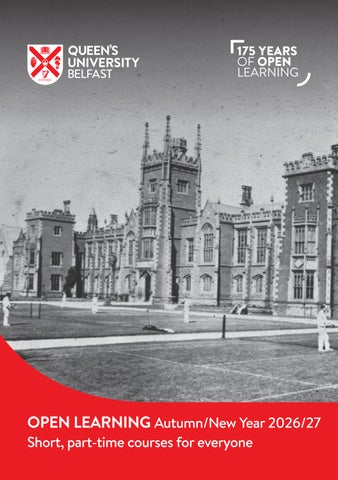
175 YEARS OF OPEN LEARNING
OPEN LEARNING Autumn/New Year 2026/27 Short, part-time courses for everyone
Join us in celebrating 175 years of ‘open learning’
175 YEARS OF OPEN LEARNING
What Queen’s has Given the World (OLE3816) A fascinating journey through the past, present, and future of Queen’s University Belfast — an institution at the heart of civic life for over 175 years. Open Learning co-directors, Katy Hayward & Cathal McManus, are delighted to announce a 20 week course of lunchtime lectures to mark the remarkable contributions made by Queen’s University, from the local community to the wider world.
Autumn: A Civic University in Action Explore how Queen’s grew as a pioneering ‘civic university’, rooted in its commitment to society. Through engaging lectures, you’ll uncover the bold, onceradical decisions that opened education to women and working people, and trace the development of key disciplines across the humanities and sciences. Panel discussions will bring the story to life, revealing how Queen’s has shaped – and been shaped by – its community, from student activism to literature, culture, and the arts.
New Year: Tackling the World’s Biggest Challenges Hear directly from leading experts as they demonstrate how Queen’s is making a global impact today. Discover cutting-edge work in fields such as astrophysics, cancer research, climate change, and harm reduction. The course culminates with an inspiring look ahead, featuring the new generation of graduates and researchers.
A Celebration of the Role of the University in Society While this course centres on Queen’s, it also offers something broader: a celebration of ‘The University’ itself as a unique and vital institution in modern democratic society. Through education, research and public engagement, the University contributes to the common good and to the future. In this way, the University belongs to us all. This Open Learning course is a fitting celebration of 175 years of putting this civic duty into practice. The lectures will run each Wednesday 1-2pm on the main campus and online, 30 September - 2 December and 6 January – 10 March. For more details, see page 19.
Open Learning Autumn/New Year Programme 2026/2027
We have an online enrolment system.
Either type in www.qub.ac.uk/ol or scan the QR code above.
Be an early bird and enrol well in advance
1
2
Open Learning Autumn/New Year Programme 2026/2027
Be inspired and find your perfect course
Questions we are often asked Who comes to the Open Learning Programme? Anyone over the age of 18 – there is no upper age limit.
I am nervous about re-entering education. Are the classes very formal or academic and do I need qualifications to take them?
Students who want to learn something new – from local history to creative writing, languages to literature. We offer a great range and breadth of courses.
Don’t be nervous – our courses are delivered in an informal and relaxed manner.
Students who want to learn a subject to enhance their current employment.
With the many coffee shops in the surrounding area, you can get to know other people over a coffee, a cup of tea or lunch.
I am retired/unemployed/working/ busy during the week. What can you offer me? We have a time to suit everyone. We offer a range of courses during the day, evening and at weekends. We also offer a number of courses that are delivered online for those unable to make it to the Queen's University campus.
Students do not need to have previous experience or qualifications.
I am an International Student, new to Belfast. Are there courses for me? Yes, come along to meet new people and learn something fun. Everyone is very friendly and welcoming.
You can enrol online for all courses by visiting our website www.qub.ac.uk/ol
Open Learning Autumn/New Year Programme 2026/2027
School of Social Sciences, Education and Social Work Open Learning Autumn/New Year Programme 2026/2027
Important
All enquiries to:
Queen’s University Belfast has made all reasonable efforts to ensure that this programme is accurate and up-to-date when compiled but can accept no responsibility for any errors or omissions. The University reserves the right to cancel classes and to substitute tutors teaching certain classes if necessary. Students are responsible for ensuring that the fees for their course are met. Entry to courses will be restricted by number of entrants.
Open Learning School of Social Sciences, Education and Social Work Queen’s University Belfast 20 College Green Belfast BT7 1LN Northern Ireland
This programme is available in PDF form from our website and in printed form on request.
Be an early bird and enrol well in advance
Tel: (028) 9097 3323 Email: openlearning.education@qub.ac.uk Web: www.qub.ac.uk/ol Follow us on Facebook: Facebook.com/QUBOpenLearning
3
4
Open Learning Autumn/New Year Programme 2026/2027
Contents
Digital Photography
Welcome to Open Learning
7
Basic and Creative Photography
Contacting us
8
Creative Photography
Enrolling
9
Venues for Courses
10
Facilities and Support for Disabled Students
10
Course Availability – Key:
Education and Training
19
20
Critical Thinking Teaching English to Migrants, Refugees and Asylum Seekers The Intercultural School: Working with Newcomer and Traveller Students in Schools, Part 1 The Intercultural School: Working with Newcomer Students in Schools, Part 2
Autumn Course 2026
Environment and Archaeology
New Year Course 2027
22
Beat the Blank Page
Adventures in Community Archaeology: The Excavations of the Centre for Community Archaeology at Queen’s University Belfast: An Illustrated Lecture Series
Crafting the Uncanny
Belfast - The First 500 Million Years
Creative Writing in Genre Fiction
Easy Bird Watching for Beginners: Winter
Creative Writing
11
Co-Create an Anthology of Creative Writing
How to Write for Profit and Pleasure
Easy Bird Watching for Beginners: Spring
Starting to Write Cultural Studies
15
A World of Images: Approaches to Ancient Art Ekphrasis: Poetry Inspired by Art Italy: Light and Darkness. A Journey across the Peninsula Through Music, Writing, and the Visual Arts
Examining Climate Change through the Lens of Literature First Aid
25
Practical First Aid History and Politics
25
A History of Modern Britain, Part 9: The Age of Gladstone and Disraeli 1858–1895
Laughing at Italy on Screen: Italian Cinema, Stereotypes and Society
A History of the USA, Part 8: 'Brother, Can You Spare a Dime?' America Between the Wars 1920–1940
The Gaelic Heritage of Ulster Protestants
All The Queen’s Ladies – The Women Who Made Queen’s University
The Things We Keep: Archives, Collections, Museums
Away with the Faeries: Madness and the Asylum in Ireland
Unravelling Urban Life: Anthropology of the City (an introduction)
Belfast’s Slavery Past, 1613–1866
What Queen’s has Given the World
“Big House” in Ireland – North and South
You can enrol online for all courses by visiting our website www.qub.ac.uk/ol
Open Learning Autumn/New Year Programme 2026/2027
5
Builders of North Belfast: A Walking Tour
The Social History of Belfast and its Residents, 1798–1914
Buildings of Belfast's Historic Waterfront
Up the Millies: Work, Health and Protest in Industrial Belfast
Builders of Central Belfast, Part 2: A Walking Tour Change and Continuity: Ireland in the 1960s Death & Disease in Victorian Ireland and Britain Immigrants and Ireland Introduction to the Archaeology of Greece Israel/Palestine and the Middle East John Hume: Politician and Peacemaker
Understanding the 2027 Northern Irish Assembly Election: How it works and what to Expect 'We Hold These Truths': The American Revolution and the Declaration of Independence Languages French: Beginners Advanced French: Lower Intermediate/ Intermediate French: French Conversation Club
Laudanum and Lint: Nursing in Ireland, c.1800–1960
French: Upper Intermediate
Like a Hole in the Head: Madness, Brains, and Treatment in Ulster, c.1900–1960
French: Perfect Pronunciation
Lone Star: The Politics and Presidency of Lyndon Johnson Off With Her Head! Royal Executions in February
French: Perfect Grammar French: The French Club German: Beginners German: Lower Intermediate German: German Language Club
Petticoat Rule – The Powerful Women of the Tudor Court
Greek: Modern Greek – Beginners
Representing Disability from Ancient to Contemporary Cultures
Italian: Refresher Course for Post Beginners
Romancing The Throne: The Women who Scandalised the Tudor Court
Italian: Beginners
Still Destined for War
Italian: Intermediate
Suez 1956 - the Canal, the Crisis, the War
Italian: Upper Intermediate
The Faces of the Third Reich
Italian: A Venetian Pioneer: Elena Lucrezia Cornaro Piscopia
The Famine in Belfast
Greek: Classical Greek: Language Club
Italian: Lower Intermediate
Italian: Language Club
The Irish State Through Ten Presidents: 1938–2026
Italian: Italian Superstitions
The Women’s Suffrage Movement in Britain and Ireland, 1900–1918
Spanish: Beginners Continuation
The Second World War, Year by Year 1942: Retreat and Recovery
Spanish: Lower Intermediate Continuation
Be an early bird and enrol well in advance
43
Spanish: Beginners Spanish: Lower Intermediate
6
Open Learning Autumn/New Year Programme 2026/2027
Spanish: Grammar in Action: Spanish in Context (Intermediate) Spanish: Intermediate
Personal Finance 58
A Brief History of the Law: The Interesting Bits Literature
59
72
Our Place in the Universe Visual Arts
72
From Michelangelo to Matisse: A Survey of Western Art, c.1450–1950. Part 1 From Renaissance to Revolution
Reading The Odyssey of Homer The Blackbird Bookclub
From Michelangelo to Matisse: A Survey of Western Art c.1450–1950. Part 2 From Romanticism to Modernism
The Changing Seasons World Literature: Global Voices
Classes Outside Belfast
Writing Women: A Journey through Contemporary Women’s Fiction 64
Playing Shakespeare: Twelfth Night Playing Shakespeare: Cymbeline Music
71
Understanding the Stockmarket: An Introduction Science
A Cultural Journey through the American South
Media Studies and Drama
The Expectation Effect Unlock Your Creative Confidence
Spanish: Upper Intermediate Conversation Law
Reimagining Life Compassionately
65
Ancient Soundscapes: Music and Performance in Past Societies
A Cultural Journey through the American South One-day and half-day courses
75
Online and hybrid courses
76
Hearing Meanings: Anthropology of Music (an introduction) Voices from Aldeburgh - The Music, Life and Legacy of Benjamin Britten Celebrating Beethoven Personal Development and Communications
73
The Big House in Ireland: North and South
67
Daoyin: Chinese Health Exercises Introduction to Psychology: The Fascinating World of Human Behaviour Making Sense of Healthy Eating: A New Paradigm Manifesting: Science or Wishful Thinking? Mindfulness-Based Stress Reduction Mindfulness-Based Stress Reduction (a one-day workshop) You can enrol online for all courses by visiting our website www.qub.ac.uk/ol
Open Learning Autumn/New Year Programme 2026/2027
7
Welcome to Open Learning Autumn/New Year 2026/2027 Queen’s College Belfast was established in 1845 and its iconic Lanyon Building opened in 1849. Just two years later, the Belfast News Letter ran an advert for ‘Lectures on Botany’ to be delivered by Dr Dickie, Professor of Natural History in the Queen’s College. Professor Dickie, the advert tells us, had ‘kindly offered to deliver a short Course of Lectures on Botany, in aid of the erection of the Central Conservatory in the Royal Botanic Garden’. The lectures were clearly popular and Belfast builders undoubtedly efficient, for the elliptical sphere of the Palm House (another stunning Belfast landmark) was completed in 1852. This is a wonderful demonstration of the values of a civic university put into practice. The university is not for private interests or personal gains but for the good of the people, including those who may not have the privilege of studying or working within it. Queen’s is rightly proud of its civic contribution and the long tradition of providing extramural classes and courses – through the Open Learning programme today – remains essential to this. With this in mind, Open Learning is pleased to celebrate its 175th anniversary with a special course in Autumn/New Year 2026/2027. “What Queen’s has Given the World” is a twenty-week course of one-hour lunchtime talks, delivered by academics from disciplines ranging from Anthropology and Chemical Engineering through to Spanish and Sports Medicine. As well as being intellectually stimulating and offering many fresh insights and facts, these lectures will be a celebration of the good of the civic university that can arise through both education and research (see p.19 for more information). We have a special rate for this course, with all fees going directly to a Bursary to support wider community participation in Open Learning courses in the years to come. One topic covered in the course will be the history of the University itself. If this is a topic Be an early bird and enrol well in advance
of particular interest, you might be curious to attend the half-day workshop offered by our ever-popular tutor, Dr Robyn Atcheson. “All The Queen’s Ladies – The Women Who Made Queen’s University” will examine the campaign to open the doors of Queen’s College to women and will track the campaigners for female higher education in the nineteenth century, the trailblazing early female students and the pioneering first female lecturers (p.26). Far outside the University itself, as always, we have a broad range of courses and topics to select from. Building on the successes of last year, the Centre for Community Archaeology team are back to share their findings from digs at sites including Cathedral Hill in Downpatrick, Moira Demesne, Boho Famine Road in County Fermanagh, and First World War training trenches at Magilligan and Ballykinler. This is an illustrated lecture series that you can attend either in-person or online (p.22). Talking of civic responsibility, 2027 will provide our latest opportunity to get out and have our voices heard at the ballot box as we vote the makeup of the Assembly. Have you ever wondered about the mechanisms of how our voting system works and how our Executive is formed? Dr Eoghan Kelly will take you through the key details in his course “Understanding the 2027 Northern Irish Assembly Election: How it works and what to Expect” (see p.41). As always this provides only a snapshot of all we have to offer. We hope you enjoy browsing our extensive offerings and we are sure you will find something of interest. And don’t forget, as we celebrate our proud history of community and adult education provision, you can make your own special contribution by encouraging friends and family to come along too. Professor Katy Hayward Dr Cathal McManus
Course Directors, Open Learning
8
Open Learning Autumn/New Year Programme 2026/2027
Contacting Us If you want to contact us in writing our postal address is: Open Learning School of Social Sciences, Education and Social Work Queen’s University Belfast 20 College Green Belfast BT7 1LN Our telephone number is: (028) 9097 3323 Our email and web addresses are openlearning.education@qub.ac.uk www.qub.ac.uk/ol Follow us on Facebook Facebook.com/QUBOpenLearning If you have any questions about our classes and courses, staff can be contacted directly during normal office hours: Monday – Friday 9.00 am – 4.30 pm The Open Learning Course Directors can be contacted, initially in writing, at the above address.
Staff Course Directors, Open Learning Programme Professor Katy Hayward Dr Cathal McManus Open Learning Co-Ordinator Dr Bebe Ashley Administrative Officers Mrs Martina Carey Mr Chris McWatters Term Dates
Autumn 2026:
Monday 28 September to Friday 4 December 2026. The University is closed on Friday 30 October.
New Year 2027:
Monday 18 January to Thursday 25 March 2027 The University is closed on Wednesday 17 March for St Patrick’s Day. Classes on Wednesdays will commence/ restart on 13 January.
You can enrol online for all courses by visiting our website www.qub.ac.uk/ol
Open Learning Autumn/New Year Programme 2026/2027
9
What do I need to know? Enrolling If you have not received your Confirmation of Enrolment within ten days of enrolment, please let us know.
Over-subscribed and cancelled courses
Two ways to access the Open Learning website. Either type in www.qub.ac.uk/ol or scan the QR code above.
Online and postal enrolments only You can enrol online for all courses by visiting our website www.qub.ac.uk/ol. Or scan the QR code above. Payment can be made through Flywire via our website. If you are unable to enrol online, it is still possible to enrol by post using the form in this brochure along with a cheque made payable to ‘Queen’s University Belfast’.
Confirmation of Enrolment When you enrol for a course, you will receive a Confirmation of Enrolment. This Confirmation of Enrolment is your only acknowledgement of enrolment. Please check it for accuracy when it comes through. If you have enrolled online this will be sent to your email address; if you have enrolled by post you will receive this by post or email. Please keep an eye on your email junk/spam folder.
Be an early bird and enrol well in advance
Places on courses are limited, and applications are dealt with in the order we receive them. Early enrolment helps us provide better service and avoid disappointment. All our courses are offered subject to a certain minimum enrolment (usually 10 students). We usually make a decision on whether a course has sufficient enrolments 1-2 weeks in advance of the start date – hence the importance of early enrolment. Where a course is undersubscribed and we need to cancel it, those affected will be informed as soon as that decision is made and their enrolment fee refunded.
Fees and concessions The information about each course gives details of the relevant course fee. For most courses, a concessionary rate is also available. Those eligible for the reduced fee are those who are in receipt of State Benefits (including pension), or are full-time students, part- or full-time Queen's students, or are members of University staff holding a valid staff card. Please note that concessions cannot be claimed retrospectively.
Refunds In order for us to be able to offer a wideranging programme, we need to be able to be sure of enrolments, fees and tutor contracts in good time. We regret that fees cannot be
10
Open Learning Autumn/New Year Programme 2026/2027
refunded except when a course does not run or if the course you applied for is already full. In exceptional circumstances, for those who have to formally withdraw from the course within the first two weeks of its commencement, we may offer a partial refund (i.e. minus an administration fee). Please contact the Open Learning office.
Venues for courses Except where otherwise stated, classroombased courses on campus are held in venues across the University. Notice of the class venue will be posted on our website (www.qub.ac.uk/ol) the afternoon before the classes are due to start. Online/hybrid courses will be on either Microsoft Teams or Zoom. Joining instructions will be sent out a week before the class is due to start. All are easy platforms to use.
Health and Safety At the first class your tutors will advise you of the Health and Safety protocol which includes guidance on what to do in the event of an emergency evacuation or accident.
Car parking We regret that there is no parking within the University precinct for students attending day-time classes. For evening classes, parking is available from 4.00 pm on the main site.
Facilities and Support for disabled students We welcome applications from people with disabilities and we will do our best to ensure that your individual requirements are met so you can get the most from your course. In order to comply with the University’s Health and Safety Regulations, all students who may require assistance will need to enrol 3 weeks
before the class is due to start and complete a Disability Support form. The form can be downloaded from https://www.qub.ac.uk/ ol/GeneralInformation/ or can be sent out by post or email if you contact the office at openlearning.education@qub.ac.uk tel: 028 9097 3323. The completion of this form will determine if you require a Personal Emergency Evacuation Plan (PEEP) which will be carried out with the Fire Officer, in liaison with the Open Learning Disability Officer, Dr Cathal McManus. Any students who would like further information are very welcome to contact Dr McManus on c.p.mcmanus@qub.ac.uk
Exclusions There is no upper limit. However, the minimum age for students attending these adult learning programmes is 18, unless otherwise stated. We reserve the right to refuse the participation of any individual who: (1) is abusive or threatening to other course participants or University staff and/or (2) disrupts the learning of other participants and/or (3) damages or misuses University equipment or property.
Future programme The Spring 2027 Programme will be available from mid-March 2027. This programme can be viewed online at www.qub.ac.uk/ol If you would like to consider offering a course or to suggest a topic for a course, please look at our website or contact the Open Learning office.
You can enrol online for all courses by visiting our website www.qub.ac.uk/ol
Creative Writing
11
Co-Create an Anthology of Creative Writing Emily Byers-Ferrian, BA, MA
Fee £100.00 (concession rate £80.00)
Fee £100.00 (concession rate £80.00)
10 weekly sessions
10 weekly sessions
Autumn 2026
New Year 2027
Part 1
OLE3724
Part 2
OLE3782
Fridays, 1.00 pm to 3.00 pm, starting 2 October
Fridays, 1.00 pm to 3.00 pm, starting 22 January
Open Learning Education at QUB attracts lifelong learners who hold a diverse set of lived experiences. During this course, participants will work together to create a group anthology of life writing/memoir which captures this. In this Autumn semester participants will develop a sense of trust and community as they explore examples of life writing in other anthologies, respond to creative writing prompts, and practice giving and receiving kind and helpful feedback.
In this follow on course, participants will codesign and contribute to a group anthology by collectively choosing its theme, selecting a cover image/design, and continuing to offer constructive feedback while refining their own writing. Participants will each receive a printed copy of the anthology they helped create. Students should have previously completed Part 1. This class will take place on QUB campus
All levels of experience welcome. This class will take place on QUB campus No class on Friday 30 October
‘A most enjoyable course, giving headspace to explore inwardly and outwardly in a safe place.’ ‘This was a wonderful course, I truly enjoyed it and would highly recommend it.’ Art Journalling Emily Byers Ferrian & Joanne Boal
Early Bird . . . We make the decision on whether or not to run a course seven days before the course start date, based on whether we have reached the minimum number of enrolments. So please help us to help you! Enrolments will close one week before classes are due to start. Be an early bird and enrol well in advance!
Be an early bird and enrol well in advance
Creative Writing
Emily Byers-Ferrian, BA, MA
Creative Writing
12
Open Learning Autumn/New Year Programme 2026/2027
Beat the Blank Page
Crafting the Uncanny
OLE3716
Wendy Sinnamon, BA, MA
David Tierney, BA, MA
OLE3718
Fee £50.00 (concession rate £40.00)
Fee £100.00 (concession rate £80.00)
Autumn 2026
Autumn 2026
One-day workshop on Saturday 24 October, 10.00 am to 4.00 pm
10 weekly sessions on Fridays 5.00 pm to 7.00 pm, starting 2 October
The concept of "writer's block" can sometimes encourage us to accept our inability to write rather than develop strategies which support us to write when we need to. In this course, we look at some of the most innovative and sometimes bizarre ways that writers have used to avoid staring at the blank page. We assess their value to you with research from neuroscience, psychology, personal development and author experience. You will be inspired to take a fresh look at how you write, boost your creativity and curiosity and cultivate a more proactive approach to your writing projects.
Step into the unsettling edge of reality. Crafting the Uncanny will draw you into fiction where the ordinary fractures, the familiar turns strange, and meaning slips just out of reach. We will dive into the mysterious terrain of uncanny and Gothic fiction, past and present, and explore techniques and imagery such as doppelgangers, ghosts, déjà vu and the unhomely. Using The Uncanny by Sigmund Freud as our starting point, and through evocative prompts and close readings, you’ll learn how to craft atmosphere, ambiguity and psychological tension with precision. We will explore how and why the short story form is the perfect vehicle for uncanny fiction. We will discover how the uncanny can be more than a genre; it can be a lens, a way to confront the dislocation and unreality of modern existence. Thus, we can transform our own experiences into quietly devastating prose.
This class will take place on QUB campus
Early Bird . . . We make the decision on whether or not to run a course seven days before the course start date, based on whether we have reached the minimum number of enrolments.
This class will take place on QUB campus No class on Friday 30 October For further reading: The Uncanny by Sigmund Freud
So please help us to help you! Enrolments will close one week before classes are due to start. Be an early bird and enrol well in advance! You can enrol online for all courses by visiting our website www.qub.ac.uk/ol
Creative Writing
How to Write for Profit and Pleasure
OLE3733
Alf McCreary, BA
Matthew Munro, BA, MA, MSc, PGCE, PhD
Fee £50.00 (concession rate £40.00)
Fee £100.00 (concession rate £80.00)
One-day workshop
New Year 2027
Autumn 2026
10 weekly sessions on Thursdays 6.00 pm to 8.00 pm, starting 28 January
Group 1
Genre fiction - for example, crime, fantasy, sci-fi and romance - is often perceived as somehow inferior to literary fiction, more a form of light entertainment rather than true drama. But writing genre fiction is a rigorous calling. It demands inventiveness in plots, settings and characters, entertaining stories filled with twisting narratives and compelling characters. In this course you will learn about structure, setting, description, characterisation, plotting, dialogue, point of view, and how to fashion a compelling story that appears not simply on the page but lives in the reader’s imagination. The course will draw on contemporary examples of successful genre novels to illustrate these themes, and will leave participants equipped for the journey of writing their own genre fiction novel or short story collection.
New Year 2027
This class will take place on QUB campus
OLE3793
Saturday 24 October, 9.30 am to 4.30 pm Group 2
OLE3794
Saturday 16 January, 9.30 am to 4.30 pm Under the guidance of the award-winning journalist and author Alf McCreary, this course looks at how to turn your ideas into writing, and to learn about the ways to have your writing published. This course will provide guidance on the essential aspects and skills of writing for personal profit and pleasure, and also outline the essential steps required to contact publishers and other outlets where your work may be available to a wider readership. The course is designed for people at all levels, ranging from those people who have not written anything, to those with work already written and who require help in seeking ways to have it published. The course is also designed to help people to enjoy participation and to learn more about their own skills and those of others in the group. This course has been held for nearly two decades and has helped people to aim realistically to have their work published. These classes will take place on QUB campus
Be an early bird and enrol well in advance
Creative Writing
Creative Writing in Genre Fiction
13
14
Open Learning Autumn/New Year Programme 2026/2027
You can enrol online for all courses by visiting our website www.qub.ac.uk/ol
Creative Writing, Cultural Studies
Starting to Write Fee £25.00 (concession rate £20.00) Half-day workshop
Aikaterini (Katerina) Kolotourou, BA, PhD Fee £100.00 (concession rate £80.00)
Autumn 2026 OLE3675
Friday 2 October, 10.00 am to 1.00 pm New Year 2027 OLE3679
Friday 22 January, 10.00 am to 1.00 pm If you have ever wanted to write fiction but are not sure where to start, this half-day course has been designed especially for you. We will explore the elements of a story, how to create believable characters, and how to maximise your powers of observation. Come along and have fun with some stimulating writing exercises. These classes will take place on QUB campus
New Year 2027 10 weekly sessions on Fridays, 2.00 pm to 4.00 pm, starting 22 January This course explores the rich and influential traditions of Greek and Roman art, from monumental temples and marble sculptures to painted pottery and everyday objects. We will examine how and why images were created, adapted, and re-imagined across cultures. We will consider the development of Greek artistic forms, how they conveyed meaning, how they shaped Roman visual culture, and how both societies used images to express identity, power, belief and memory. Together, the group will decode mythological narratives, examine the role of art in ritual and political power, and trace cross-cultural influences and ideas across the Mediterranean. Through a range of interpretive approaches (historical, cultural, symbolic, and material) we will learn to see ancient art as dynamic and deeply human. No prior background is required, just curiosity and a willingness to look closely. This class will be offered in hybrid form, i.e. you can attend on QUB campus or online
Two ways to access the Open Learning website. Either type in www.qub.ac.uk/ol or scan the QR code above.
Be an early bird and enrol well in advance
Cultural Studies
Group 2
OLE3763
Creative Writing
A World of Images: Approaches to Ancient Art
Louise McIvor, BA, FHEA
Group 1
15
Cultural Studies
16
Open Learning Autumn/New Year Programme 2026/2027
Ekphrasis: Poetry Inspired by Art Maureen Boyle, MA Fee £100.00 (concession rate £80.00) 10 weekly sessions OLE3806
Thursdays 11.00 am to 1.00 pm, starting 1 October
Fee £50.00 (concession rate £40.00) Autumn 2026 5 weekly sessions on Thursdays, 5.00 pm to 7.00 pm, starting 1 October
New Year 2027 Group 2
OLE3689 Elena Bergia, BA, MSc, PhD
Autumn 2026 Group 1
Italy: Light and Darkness. A Journey across the Peninsula Through Music, Writing, and the Visual Arts
OLE3807
Fridays 11.00 am to 1.00 pm, starting 22 January In this course, we look at examples of ekphrasis, traditionally writing inspired by visual art, in the writing of the past and of contemporary writers. We alternate between the classroom and visits to exhibitions, often in The Ulster Museum or the Mac, occasionally in Dublin, and then we share work inspired by what we have seen. We also hope to extend the work to include ekphrasis from film or theatre. The classes are relaxed and supportive, and no prior knowledge of either poetry or art is required. This class will take place on QUB campus and other venues
What do we see when we think about Italy? Historic cities, beautiful beaches, sunshine, La Dolce Vita? What do we know about less touristy corners and the intricacies of life in busy cities or deserted landscapes? We are all familiar with the Italy advertised by travel companies. Yet this enigmatic country has been depicted also by Italian filmmakers, songwriters, and writers more interested in the interplay of light and darkness than in the postcard image of the holiday country. In this course, we will examine how different regions and cities across Italy have been portrayed through song, film, and creative writing. We will reflect on “The great sun-kissed days,” as one song goes, without overlooking the foggy “anguish of an endless plain,” to cite another. Ultimately, artistic expression will reveal a country of striking beauty and profound contradictions. This class will take place on QUB campus
Two ways to access the Open Learning website. Either type in www.qub.ac.uk/ol or scan the QR code above.
You can enrol online for all courses by visiting our website www.qub.ac.uk/ol
Cultural Studies
The Gaelic Heritage of Ulster Protestants
OLE3690
Fee £50.00 (concession rate £40.00)
Elena Bergia, BA, MSc, PhD Fee £37.50 (concession rate £30.00) New Year 2027 5 weekly sessions on Thursdays, 5.00 pm to 6.30 pm, starting 21 January Italians are famously good at laughing at themselves and nowhere is this clearer than in Italian cinema. In this course, we will look at how classic and contemporary Italian films have exposed the vices and virtues of Italian society—sometimes affectionately, sometimes with a sharp, brutal wit that leaves no stone unturned. Using the famous Commedia all’italiana (Italian-style comedy) as our guide, we will see how filmmakers have used laughter to poke fun at the ‘big issues’: the North– South divide, the job market, clientelism, and the sacred (suffocating?) bond of the Family. We will explore the ‘strange creatures’ known as mammoni—grown men who just can’t seem to leave Mamma’s cooking behind. Through humour, we will go beyond the stereotypes and ask ourselves: how much of the cliché is actually true?
Maureen Hurndall, BA One-day workshop Autumn 2026 Group 1
OLE3699
Saturday 17 October from 10.00 am to 4.00 pm New Year 2027 Group 2
OLE3760
Saturday 20 March from 10.00 am to 4.00 pm There are those who believe that the Irish Language and Gaelic culture belong to only one community. The aim of this course is to correct misconceptions and to inform people of the long history of Ulster Protestants with Gaelic culture. This will be done through history in general, the history of prominent individuals in the movement, placenames, surnames and street names, music, dancing and the links that all of these have to Scotland. It will be interactive and discussion is welcomed. This class will take place on QUB campus
This class will take place on QUB campus Early Bird . . . We make the decision on whether or not to run a course seven days before the course start date, based on whether we have reached the minimum number of enrolments. So please help us to help you! Enrolments will close one week before classes are due to start. Be an early bird and enrol well in advance! Be an early bird and enrol well in advance
Cultural Studies
Laughing at Italy on Screen: Italian Cinema, Stereotypes and Society
17
Cultural Studies
18
Open Learning Autumn/New Year Programme 2026/2027
The Things We Keep: Archives, Collections, Museums
Unravelling Urban Life: Anthropology of the City (an introduction)
Susannah Knights, BA, MSc, PhD
Susannah Knights, BA, MSc, PhD
Fee £50.00 (concession rate £40.00)
Fee £100.00 (concession rate £80.00)
One-day workshop
New Year 2027
Autumn 2026
10 weekly sessions on Tuesdays 7.00 pm to 9.00 pm, starting 19 January
Group 1
OLE3775
Saturday 3 October, 10.00 am to 4.00 pm New Year 2027 Group 2
OLE3764
Saturday 6 February, 10.00 am to 4.00 pm Our paths are shaped by the objects that we and others gather around us: cherished possessions that sit on windowsills, artefacts on display in museums, photos in family albums, and archived documents. What is kept? Who keeps it? And to tell which stories? This one-day course will foster critical and creative reflection on collections, power, and story-making. We will examine how collections are produced through mechanisms of class, race, gender, empire and migration; how the material qualities of objects shape ways of feeling history; and how personal and family collections, examined through autoethnography, might complicate the separation between public and private histories. The course is accessible to learners with no prior knowledge of the topics, and offers anthropological perspectives to those familiar with the museum, community, archive and heritage sectors. This class will take place on QUB campus
OLE3766
How are our lives shaped by the cities in which we live? And how do we, in turn, shape cities? Anthropologists have long been fascinated by the unique qualities of urban experience. They look at the ways in which architecture and infrastructure shape the paths of city dwellers; the ways that public spaces become sites of struggle; and how it is that leisure, ritual, commercial, and community spaces become meaningful, inclusive, or exclusionary. On this course, we will journey together through cities near and far. We will investigate how projects of imperialism, decolonisation and modernisation have formed urban spaces across the world; and explore how anthropology and ethnography are used to look beyond the buildings to the rhythms and flows that form daily life. The course is suitable for learners with a curiosity, yet no prior knowledge, about anthropology and urban studies. This class will take place on QUB campus For further reading: De Certeau, Michael. Practice of Everyday Life. University of California Press, 2013. Werbner et al. The Political Aesthetics of Global Protest: The Arab Spring and Beyond. Edinburgh University Press, 2014.
For further reading: Hurdley, Rachel. Dismantling Mantelpieces: Consumption as Spectacle and Shaper of Self in the Home. Cardiff University, 2006. Mbembe, Achille. 'The Power of the Archive and its Limits'. In Hamilton et al. Refiguring the Archive. Springer, 2002.
You can enrol online for all courses by visiting our website www.qub.ac.uk/ol
Cultural Studies; Digital Photography
Basic and Creative Photography
OLE3816
Nick Smith, City and Guilds (Photography), MEd
Katy Hayward, PhD, FHEA Cathal McManus, PhD, FHEA
Fee £125.00 (concession rate £100.00) 10 weekly sessions
Autumn 2026 and New Year 2027
Autumn 2026
20 weekly sessions on Wednesdays 1.00 pm to 2.00 pm, starting 30 September, restarting 13 January
Group 1
In their history of the University, Queen’s, Belfast 1845–1949, Moody and Beckett (1959: 159) describe the ‘efforts made by the college to extend its educational advantages to sections of the local community for whom the ordinary academic courses were inappropriate or out of reach’. These efforts began early on. In 1851, members of the faculty were offering courses of lectures outside working hours, with the first such courses being in chemistry, anatomy and botany. Short courses such as these slowly but surely became a feature of Belfast and the surrounding areas. Thus began a tradition that has continued for 175 years. To mark this anniversary, Open Learning is pleased to offer the course, 'What Queen's has Given the World' - a series of one-hour lunchtime classes in the Autumn and New Year. The 20-week course is a celebration of the diversity of Queen’s contributions, both through education and research. Enthusiastic lecturers and professors from disciplines ranging from Anthropology and Chemical Engineering through to Spanish and Sports Medicine will make this course an enjoyable celebration of the University as a vibrant institution that exists to serve the public good. All fees paid to attend this course will go towards a Bursary Fund to support access to Open Learning courses for the wider community. This class will be offered in hybrid form, i.e. you can attend on QUB campus or online No class on Wednesday 17 March Be an early bird and enrol well in advance
OLE3769
Mondays 6.00 pm to 8.00 pm, starting 28 September + 3-hour field trip Saturday 3 October New Year 2027 Group 2
OLE3770
Mondays 6.00 pm to 8.00 pm, starting 18 January + 3-hour field trip Saturday 23 January This course sets out to explain firstly the basic camera controls and their uses, then moves you on to the settings used to create more striking, colourful or detailed images. The course is targeted at those new to digital SLR or mirrorless cameras, or those looking to move up to these. Content will include an outdoor walking group on the first Saturday after introduction week, popular optional assignments for building content, night-time shots, basic transfer and editing, composition styles and more! These classes will take place on QUB campus
Digital Photography
Fee £50.00 (concession rate £40.00)
Cultural Studies
What Queen’s has Given the World
19
Education and Training
Digital Photography
20 Open Learning Autumn/New Year Programme 2026/2027
Creative Photography
Critical Thinking
OLE3722
Michael Kelly, BA, MA
Gary O’Kane, City and Guilds Photography
Fee £100.00 (concession rate £80.00)
Fee £100.00 (concession rate £80.00)
10 weekly sessions
Autumn 2026 10 weekly sessions on Thursdays, 6.30 pm to 8.30 pm, starting 1 October Expand on your basic knowledge of photography, improve your technique, learn rules of composition, lighting, which is the best lens to use, how to pose people for better portraits, how to capture long exposure shots, take advantage of your flash for creative effects, make use of filters to enhance your final shots, read the histogram, when to use HDR and evaluate your lighting. Take your photography further with the benefits of using a tripod, reflectors and soft-boxes (light-modifiers). The class will combine a mix of practical exercise & theory in a relaxed atmosphere. Suitable for the photographer who wants to take their photography further, whether you are using your phone, a mirrorless camera or a DSLR. This class will take place on QUB campus
Early Bird . . . We make the decision on whether or not to run a course seven days before the course start date, based on whether we have reached the minimum number of enrolments.
Autumn 2026 Group 1
OLE3790
Tuesdays 6.00 pm to 8.00 pm, starting 29 September New Year 2027 Group 2
OLE3792
Tuesdays 6.00 pm to 8.00 pm, starting 19 January Critical Thinking can be defined as “the ability to interpret, analyse and evaluate ideas and arguments.” It is increasingly felt that such skills are important in everyday life, a basic competency which, like reading and writing, can be taught. This course endeavours to explore these techniques in depth and examines them through the study of certain key topics. These include identifying reasons, and conclusions; understanding reasoning; the clarification and interpretation of ideas; assessing the validity of sources; and decision making. So if you are serious about improving your critical thinking skills, then this is the course for you. These classes will take place on QUB campus For further reading: Fisher, Alec. Critical Thinking: An Introduction. Cambridge University Press.
So please help us to help you! Enrolments will close one week before classes are due to start. Be an early bird and enrol well in advance! You can enrol online for all courses by visiting our website www.qub.ac.uk/ol
Digital Photography; Education and Training
OLE3817 Arthur McKeown, MA, MBA, DELTA, PGCE Aisling O’Boyle, BSc, MA, PhD, DELTA Fee £50.00 (concession rate £40.00) New Year 2027 5 weekly sessions on Tuesdays, 6.00 pm to 8.00 pm, starting 19 January Northern Ireland is now a place where people have come to build new lives. English is essential as they seek to integrate and find employment. People across Northern Ireland want to change the lives of newly arrived adults by volunteering to help them to learn English. This course introduces principles, resources and techniques for providing English in a community setting. The course aims to develop the knowledge and understanding of the English language needs of adult migrants, refugees and asylum seekers; to introduce some resources and teaching techniques which are appropriate for teaching English language to adult migrants, refugees and asylum seekers; and to prepare participants for the design, documentation and delivery of English language teaching suitable for the needs of adult migrants, refugees and asylum seekers in their community. This class will take place on QUB campus
The Intercultural School: Working with Newcomer and Traveller Students in Schools, Part 1 Lesley Millar, LLB, PGCE (primary and post primary) Jane Camara, BEd (primary) Grainne Murray, BA, PGCE (primary) Bríd Maher, BA, PGCE, PGDE (TESOL) (post primary) Fee £85.00 (concession rate £55.00) Autumn 2026 Online course starting week beginning Monday 28 September for 10 weeks Working with Newcomer and Traveller Pupils in Primary Schools
This course will be of interest to staff working with Newcomer and Traveller pupils in primary schools. It will help you to contribute towards the development of best practice in Intercultural Education to ensure the integration and quality attainment of students with different cultural backgrounds and home languages. Autumn 2026 Online course starting week beginning Monday 28 September for 10 weeks Working with Newcomer and Traveller Students in Post Primary Schools
OLE3641
This course will be of interest to staff working with Newcomer and Traveller students in post primary schools. It will help you to contribute towards the development of best practice in Intercultural Education to ensure the integration and quality attainment of students with different cultural backgrounds and home languages. The course covers 1. 2. 3. 4. 5.
Intercultural Awareness Welcome and Communication Assessment and Planning Curriculum Access: Early Days Curriculum Access: Moving on
This is an online course Be an early bird and enrol well in advance
OLE3642
Education and Training
Teaching English to Migrants, Refugees and Asylum Seekers
21
Environment and Archaeology
Education and Training
22
Open Learning Autumn/New Year Programme 2026/2027
The Intercultural School: Working with Newcomer Students in Schools, Part 2 Lesley Millar, LLB, PGCE (primary and post primary)
Adventures in Community Archaeology: The Excavations of the Centre for Community Archaeology at Queen’s University Belfast: An Illustrated Lecture Series
Jane Camara, BEd (primary)
OLE3773
Grainne Murray, BA, PGCE (primary)
Tutors from the Centre for Community Archaeology, QUB
Bríd Maher, BA, PGCE, PGDE (TESOL) (post primary)
Fee £40.00 (concession rate £35.00)
Fee £45.00 (concession rate £30.00)
Autumn 2026
New Year 2027
8 weekly sessions on Wednesdays, 1.00 pm to 2.00 pm, starting 14 October
Online course starting the week beginning Monday 18 January for 5 weeks Working with Newcomer Pupils in Primary Schools:
OLE3656
This course is designed for staff working with newcomer pupils in post-primary schools who have already completed the first course in Term 1. Over five weeks, you will build on your learning from Course 1 and focus on leadership and whole school planning, supporting students who have less welldeveloped literacy skills in the home language and working with withdrawal groups. New Year 2027 Online course starting the week beginning Monday 18 January for 5 weeks Working with Newcomer OLE3655 Students in Post Primary Schools
Established in 2017, the CCA has conducted over 30 excavations across all six counties in Northern Ireland and at sites including Cathedral Hill in Downpatrick, Nailor’s Row in Derry City, Woodvale Park on the Shankill Road, Moira Demesne, Boho Famine Road in County Fermanagh, and First World War training trenches at Magilligan and Ballykinler. CCA staff will be reflecting on the new information that these investigations have provided us with about life in the past, all with the help of local community volunteers and school groups. This class will be offered in hybrid form, i.e. you can attend on QUB campus or online
Early Bird . . .
This course is designed for staff working with newcomer students in post primary schools who have already completed the first course in Term 1. Over five weeks, you will build on your learning from Course 1 and focus on leadership and whole school planning, supporting students who have less welldeveloped literacy skills in the home language, working with withdrawal groups and exam preparation.
We make the decision on whether or not to run a course seven days before the course start date, based on whether we have reached the minimum number of enrolments.
This is an online course
Be an early bird and enrol well in advance!
So please help us to help you! Enrolments will close one week before classes are due to start.
You can enrol online for all courses by visiting our website www.qub.ac.uk/ol
Education and Training; Environment and Archaeology
Easy Bird Watching for Beginners: Winter
OLE3715
Dot Blakely
Martin Thom, BA, PGCE
Fee £100.00 (concession rate £80.00)
Fee £100.00 (concession rate £80.00)
10 weekly sessions
Autumn 2026
Autumn 2026
10 weekly sessions on Tuesdays 10.00 am to 12.00 noon starting 29 September (Two 2-hour walking tours on 20 October and 17 November, the remaining classes are classroom based)
Group 1
The development of the Belfast region from its geological foundation, geomorphological shaping and the human impact from prehistory to the present. A study of the forces and actions involved in the creation of the region’s landscape and human palimpsest. The course consists of two parts: the development of A) the physical and B) the human landscape. This class will take place on QUB campus
Thursdays starting 1 October, (1 October and 12 November are classroom-based from 7.00 pm to 9.00 pm, and the remaining 8 weeks are field trips and run between 10.00 am and 12.00 noon). Group 2
Be an early bird and enrol well in advance
OLE3637
Fridays starting 2 October, (2 October and 13 November are classroom-based from 7.00 pm to 9.00 pm, and the remaining 8 weeks are field trips and run between 10.00 am and 12.00 noon). Summer is over. Visiting summer birds are moving back to warmer countries. Northern Wildfowl and Waders will be getting ready to fly thousands of miles to our beautiful country for the winter. We will be on field trips around some of our local loughs and coastal sites to see these birds. Own transport is essential, as is warm clothing, walking boots and, if possible, binoculars. A timetable will be distributed on the first evening. No class on Friday 30 October
Two ways to access the Open Learning website. Either type in www.qub.ac.uk/ol or scan the QR code above.
OLE3636
Environment and Archaeology
Belfast - The First 500 Million Years
23
Environment and Archaeology
24 Open Learning Autumn/New Year Programme 2026/2027
Bird Watching for Beginners: Spring Dot Blakely Fee £50.00 (concession rate £40.00) 5 weekly sessions OLE3649
Thursdays starting 4 March: the first week is classroom-based, running from 7.00 pm to 9.00 pm, and the remaining 4 weeks are field trips, running between 10.00 am and 12.00 noon. Group 2
OLE3713 Matthew Munro, BA, MA, MSc, PGCE, PhD Fee £50.00 (concession rate £40.00)
New Year 2027 Group 1
Examining Climate Change through the Lens of Literature
OLE3650
Fridays starting 5 March: the first week is classroom-based, running from 7.00 pm to 9.00 pm, and the remaining 4 weeks are field trips, running between 10.00 am and 12.00 noon. Winter wildfowl and waders have been enjoying our lakes and loughs. Some will be getting new feathers to get ready for the return journey back to their northern breeding grounds. Also, thrushes and warblers will soon be on the move. Walking boots, warm clothing plus own transport is essential and, if possible, binoculars. A timetable will be distributed on the first evening. No class on Thursday 1 April (Group 1) No class on Friday 26 March and 2 April (Group 2)
Autumn 2026 5 weekly sessions on Thursdays, 6.00 pm to 8.00 pm, starting 1 October, Climate change is a politically charged topic and climate change literature (cli-fi) offers another means of exploring the issue and society’s response to it. This course will consider the underlying science and how different cli-fi authors have sought to illuminate issues and entertain readers. The sessions will cover climate change in prehistory, in our time, in the future, as well as issues of culpability for climate change and action to address climate change. Each two-hour session will start by considering an aspect of climate science and will then look at extracts from two works of cli-fi focusing on that aspect. The course will involve discussions and developing participants' own responses to key climate change talking points. This class will take place on QUB campus No class on Thursday 22 October
‘This was a fantastic experience. Matthew was a brilliant tutor, completely knowledgeable, approachable and gave great feedback’ Writing Genre Fiction Matthew Munro
You can enrol online for all courses by visiting our website www.qub.ac.uk/ol
Environment and Archaeology; First Aid; History and Politics
Red Cross Fee £50.00 (concession rate £40.00) 5 weekly sessions
OLE3645 Ronnie Hanna, BA, MA Fee £100.00 (concessions rate £80.00)
Autumn 2026
Autumn 2026 10 weekly sessions on Wednesdays 2.00 pm to 4.00 pm, starting 30 September
New Year 2027
This 5-week first aid course will focus on adult casualties including: unresponsive casualties; CPR and recovery position; monitoring a casualty; choking; shock; bleeding and bandaging – cuts to limbs, object in a wound and minor bleeding – splinters, minor cuts, nosebleeds; burns; seizures; fainting; broken bones, dislocations, strains and sprains; heart attacks; diabetic emergency; poisoning; head injuries. Students must attend all sessions to attain a Red Cross Certificate.
Part 9 of a History of Modern Britain covers a 37-year period that was dominated by two men - William Ewart Gladstone and Benjamin Disraeli - who produced a political rivalry unmatched in British history. Between them they held the post of prime minister for 22 years and left a lasting mark on British politics and British life. Indeed, Gladstone caused a major realignment of party politics when he took up the cause of Irish Home Rule in the mid-1880s. The course will also consider the rise of the trade union movement, the Reform Acts of 1867 and 1884 and important developments in the fields of architecture and the arts in the form of the Gothic Revival and the Pre-Raphaelite Movement.
These classes will take place on QUB campus
This class will take place on QUB campus
OLE3815
Wednesdays 7.00 pm to 9.00 pm, starting 13 January
Early Bird . . .
‘This was an outstanding course. Ronnie Hanna is an extremely gifted communicator, bringing the period to life.’ A History of Modern Britain, Part 7 Ronnie Hanna
We make the decision on whether or not to run a course seven days before the course start date, based on whether we have reached the minimum number of enrolments. So please help us to help you! Enrolments will close one week before classes are due to start. Be an early bird and enrol well in advance!
Be an early bird and enrol well in advance
History and Politics
OLE3814
Wednesdays 7.00 pm to 9.00 pm, starting 30 September Group 2
First Aid
A History of Modern Britain, Part 9: The Age of Gladstone and Disraeli 1858–1895
Practical First Aid
Group 1
25
History and Politics
26
Open Learning Autumn/New Year Programme 2026/2027
A History of the USA, Part 8: 'Brother, Can You Spare a Dime?' America Between the Wars 1920–1940
All The Queen’s Ladies – The Women Who Made Queen’s University
OLE3646
Robyn Atcheson, BA, MA, PhD
Ronnie Hanna, BA, MA Fee £100.00 (concession rate £80.00) Autumn 2026 10 weekly sessions on Tuesdays 2.00 pm to 4.00 pm, starting 29 September The eighth part of the History of the USA series will cover the two decades between the world wars. Yet, though the country was at peace, these were not quiet years. These were the years of the Roaring 'Twenties, of Prohibition and the emergence of organised crime. They were also the years of booming prosperity, brought to a shattering halt by the Wall Street Crash followed by the onset of the Great Depression. Laissez-faire government, which dominated the 1920s, would ultimately be supplanted by state interventionism on an unprecedented scale in the form of the New Deal, introduced by a new president, Franklin Delano Roosevelt. The United States would never be quite the same again.
OLE3723 Fee £25.00 (concession rate £20.00) Autumn 2026 Half-day session on Saturday 24 October, 10.00 am to 1.00 pm Queen’s College Belfast was founded in 1845 as one of three new universities – for men. What about the women? This half-day workshop examines the campaign to open the doors of Queen’s College to ladies. By using contemporary sources, we will track the campaigners for female higher education in the nineteenth century, the trailblazing early female students and the pioneering first female lecturers throughout the history of Queen’s. We will also look at wider issues on female education; classes held outside the university and the legacy of the women who made Queen’s University Belfast. This class will take place on QUB campus
This class will take place on QUB campus
Early Bird . . .
‘Robyn was extremely well prepared, very knowledgeable and delivered an excellent workshop. I thoroughly enjoyed the morning and left keen to do further study of these amazing and pioneering women.’
We make the decision on whether or not to run a course seven days before the course start date, based on whether we have reached the minimum number of enrolments.
Mary Ann McCracken and Other Remarkable Belfast Women Robyn Atcheson
Enrolments will close one week before classes are due to start.
So please help us to help you!
Be an early bird and enrol well in advance! You can enrol online for all courses by visiting our website www.qub.ac.uk/ol
History and Politics
Belfast’s Slavery Past, 1613–1866
OLE3744
Tom Thorpe, BA, MA, PhD
Rebecca Watterson, BA, MA, PhD Fee £100.00 (concession rate £80.00) New Year 2027 10 weekly sessions on Tuesdays 7.00 pm to 9.00 pm, starting 19 January What did it mean to be labelled “mad” in the past, and who decided? What happened to those who were admitted to asylums, and why were so many people sent there? This course looks at how mental health was understood and treated in Ireland from the nineteenth century onwards, with particular reference to Ulster. It focuses on the rise of the asylum system and what that meant in practice, both for those who were admitted and for the families and communities around them. We will look at who ended up in asylums, what life was like inside, and how ideas about care, control and recovery developed over time, alongside wider issues such as poverty and stigma. No prior knowledge is needed. The course is discussion-based and accessible. This class will take place on QUB campus For further reading: Watson, Katherine. Insanity and the Lunatic Asylum in the Nineteenth Century, Routledge, 2019. Cox, Catherine. Politics, Society and the Asylum in Nineteenth-Century Ireland, Manchester University Press, 2012.
Be an early bird and enrol well in advance
OLE3659 Fee £100.00 (concession rate £80.00) New Year 2027 10 weekly sessions on Wednesdays 7.00 pm to 9.00 pm, starting 13 January This course explores Belfast's involvement in the international transatlantic slave trade and its role as a centre of abolitionist agitation. It firstly examines how Belfast's merchant classes in the mid-18th century were involved in trade with the slave plantations in the West Indies. The course then examines how, by the 1790s, the city became increasingly known as a centre of radical thought fighting against the slave trade and the institution of slavery. The city hosted former slaves like Olaudah Equiano in 1791 and ‘fugitive slaves’ like Frederick Douglass and Samuel Ringgold Ward in the middle of the 19th century. Once slavery had been abolished in the British Empire in the 1830s, Belfast campaigners turned their energies to campaigning against slavery in the southern States of the USA. This class will take place on QUB campus No class on Wednesday 17 March For further reading: Nini Rodgers, Ireland, Slavery and Anti-Slavery: 1612–1865
History and Politics
Away with the Faeries: Madness and the Asylum in Ireland
27
History and Politics
28
Open Learning Autumn/New Year Programme 2026/2027
“Big House” in Ireland – North and South
Builders of North Belfast: A Walking Tour
OLE3784
OLE3787
Gerry Cleary, PhD
Gerry Cleary, PhD
Fee £100.00 (concession rate £80.00)
Fee £25.00 (concession rate £20.00)
Autumn 2026
Autumn 2026
10 weekly sessions on Mondays 7.00 pm to 9.00 pm, starting 28 September
Half-day walking tour on Saturday 7 November, 9.30 am to 1.30 pm
Most counties in Ireland still have their fair share of country houses popularly known as "Big Houses". They have played a key role in Irish History since the 12th century Norman conquest. But, what are their origins and why did they play such an important role in Ireland's political, cultural and artistic evolution? The predecessors of our "big houses" were fortified dwellings and strong castles. From the early 17th Century they evolved into physical symbols of the new English order in post-Gaelic Ireland. As the need for defensive fortifications declined by the early 18th century many "big houses" were transformed or rebuilt into architectural masterpieces from which the Protestant Irish Ascendancy could wield power over the local population. Not all big houses were the preserve of the privileged gentry. Many of the new Industrial Revolution merchant princes (especially in Ulster) mimicked their culture with relish. This is perhaps best exemplified by the big "Linen Houses" of the Lagan Valley. By the start of the 20th century, the importance and influence of the big houses had declined. This course analyses the reasons for their decline. It also traces the history and splendour of the big houses and tries to explain why many have survived for so long.
North Belfast grew rapidly along the spine of the Antrim Road in the second half of the 19th century. It evolved from farmland interspersed with country estates and small industrial sites into an up market middle class area before evolving rapidly again into a densely populated mixed income area. All this happened within 50 years. But who were the builders, and what are the best examples of their work? This course uses the term "builder" in the widest sense to include developers, architects and construction firms. We walk from Clifton House, home of The Belfast Charitable Society, to Carlisle Circus and then along the Antrim Road up to Fortwilliam and Belfast Castle, visiting examples of the best of local builders' work and also the major civil engineering feat of the Belfast Waterworks. We make use of public transport where relevant, and there will be an opportunity to have lunch during the course of the walk.
This class will take place on QUB campus
‘Gerry Cleary is an enthusiastic and knowledgeable lecturer whose courses are always educational, engaging and entertaining whatever subject he is covering.’ 'Ulster' and the Concept of a Republic Gerry Cleary
You can enrol online for all courses by visiting our website www.qub.ac.uk/ol
History and Politics
OLE3789 Gerry Cleary, PhD Fee £25.00 (concession rate £20.00) Autumn 2026 Half-day walking tour on Wednesday 21 October, 9.30 am to 1.30 pm From the 12th century, the small settlement of Belfast had port facilities initially on the lower reaches of the Farset River [High Street], which flowed into the then wide Lagan. This continued in the 17th and 18th centuries beyond the Farset to larger quays and docks along the Lagan. Following the opening of the Victoria Channel [1849] the growing new town needed new facilities and associated buildings. These were orientated along the new N/S axis of Corporation and Victoria streets. The walk examines examples of the associated buildings of this period. These include the Custom House, the Harbour Office, surviving Clarendon Dock structures, the Headline and former Corn Exchange [now the Ulster-Scots Hub] buildings and Sinclair Seamen's Church. It finishes at St. George's Church in High Street the site of the "Ecclesia Alba de Vado" [Church of the White Ford] where it all began in the Middle Ages.
Two ways to access the Open Learning website. Either type in www.qub.ac.uk/ol or scan the QR code above.
Be an early bird and enrol well in advance
Builders of Central Belfast, Part 2: A Walking Tour OLE3788 Gerry Cleary, PhD Fee £25.00 (concession rate £20.00) Autumn 2026 Half-day walking tour on Thursday 22 October, 9.30 am to 1.30 pm The growth of Belfast was accompanied by the evolution of a remarkable heritage reflected in many iconic city centre buildings. This tour examines the stories of their "builders" (developers, architects and contractors). We start at the Royal Belfast Academical Institute, commonly known as Inst, before taking in a range of notable city centre buildings. These include the Old Museum Building, owned by the Belfast Natural History and Philosophical Society and home to the Ulster Architectural Heritage Society; the former Athletic Stores; the Bank Buildings; the former Robinson and Cleaver building; the Scottish Provident Building; the former Ocean Buildings in Donegall Square; the former Burton’s Menswear building in Anne Street; and the exuberant Albert Clock and Customs House Square. We finish at St George’s Church of Ireland in High Street, a late Regency building on the site of the “Ecclesia de Albo Vado” — the church of the white ford — at the heart of the original Belfast settlement in the early Middle Ages. Where possible, access will be arranged to the interiors of some of the more iconic buildings. The walk covers approximately 2–3 miles. Meeting point: at the College Square South entrance to Inst [BT1 6DL] A roll call will be taken.
History and Politics
Buildings of Belfast's Historic Waterfront
29
History and Politics
30 Open Learning Autumn/New Year Programme 2026/2027
Change and Continuity: Ireland in the 1960s Eddie Baker, BA, MA Fee £50.00 (concession rate £40.00) Autumn 2026
OLE3683
Tuesdays 7.00 pm to 9.00 pm, starting 29 September New Year 2027 Group 2
OLE3721 Robyn Atcheson, BA, MA, PhD Fee £100.00 (concession rate £80.00)
5 weekly sessions Group 1
Death & Disease in Victorian Ireland and Britain
OLE3684
Tuesdays 7.00 pm to 9.00 pm, starting 19 January In the late 1950s to the early 1970s, Ireland embarked on a programme of economic modernisation and a campaign to join the European Economic Community (EEC). Although the 1960s is often seen as a period when Ireland began to embrace free trade and rising living standards, the country remained socially conservative in areas such as religion, politics, and family life. This course will examine why and to what extent Ireland evolved during the 1960s, exploring developments in the economy, culture, and politics, as well as the limited progress in women’s rights. It will compare experiences north and south of the border, consider how Ireland differed from Britain and continental Europe, and assess how the outbreak of the Troubles influenced life across the island. These classes will be offered in hybrid form, i.e. you can attend on QUB campus or online Further reading: Daly, Mary E. Sixties Ireland: Reshaping the Economy, State and Society, 1957–73. Cambridge University Press, 2016.
Autumn 2026 10 weekly sessions on Tuesdays 7.00 pm to 9.00 pm, starting 29 September Disease was everywhere, dirt was inescapable and death was a fact of life for the people of Ireland and Britain in the nineteenth century. This course looks at the history of medicine in the Victorian era by examining how ordinary people experienced and understood diseases both common and terrifyingly new. How did new advancements in medical understanding actually help people? What happened in times of epidemic? Why was childhood mortality so high? This course will also consider the rise of institutions and the growing awareness of public health across society. Fascinating and sometimes gruesome, this course will get under the skin of the medical world of the Victorians. This class will take place on QUB campus
‘An excellent course, delivered beautifully by Robyn. She has the ability to not just communicate complex historical facts and ideas but to bring them to life and to engage the participants in ways that are thought-provoking and generous. A skilful, knowledgeable academic.’ The Belfast Workhouse in the Nineteenth Century Robyn Atcheson
You can enrol online for all courses by visiting our website www.qub.ac.uk/ol
History and Politics
31
Introduction to the Archaeology of Greece
OLE3783
OLE3774
Gerry Cleary, PhD
Aikaterini (Katerina) Kolotourou, BA, PhD
Fee £100.00 (concession rate £80.00)
Fee £100.00 (concession rate £80.00)
New Year 2027
Autumn 2026
10 weekly sessions on Mondays, 7.00 pm to 9.00 pm, starting 18 January
10 weekly sessions on Fridays, 2.00 pm to 4.00 pm, starting 2 October
Recently, there has been controversy over the perceived threat of the influx of immigrants (legal or otherwise) into Ireland, North and South. Yet, statistical evidence suggests that these concerns may be misplaced. Less than 4% of the Northern Ireland population of 1.93 million in 2023 belong to an ethnic minority group - the lowest of any region in the British Isles. The Republic had almost a million born outside the state but even here 81.6% of the population was defined as "White Irish". Immigration to Ireland is nothing new. From the Mesolithic Era [8,000 - 4,000 BCE] there have been many immigrant waves including for example the Celtic cultural elite, the Anglo-Normans and the peoples of the Ulster Plantation.
This course introduces the archaeology, culture, and society of the Greek world from the Early Bronze Age (c. 3000) through to the Hellenistic period and the aftermath of Alexander the Great’s empire (c. 323–31 BC). Through the lens of artworks, architecture, and other material remains, we will examine the development of Greek communities and their societal, cultural, and political/ ideological changes across time. Major themes will include the Minoan/Mycenaean palatial cultures of the Bronze Age, the emergence of the city-states (the Greek polis) in the Iron Age, Greek interactions with other cultures, the role of sanctuaries, burial, household, and identity.
The course has two parts: Part One examines the history of immigrant arrivals into Ireland. Part Two deals with the current immigration situation and attempts to separate fact from fiction. This class will take place on QUB campus
Be an early bird and enrol well in advance
This class will be offered in hybrid form, i.e. you can attend on QUB campus or online No class on Friday 30 October For further reading: Pedley, J.G. 2012. Greek Art and Archaeology. 5th edition, London.
History and Politics
Immigrants and Ireland
History and Politics
32
Open Learning Autumn/New Year Programme 2026/2027
Israel/Palestine and the Middle East
John Hume: Politician and Peacemaker
OLE3786
OLE3648
Gerry Cleary, PhD
Ciara Nicholson, BA, MA
Fee £100.00 (concession rate £80.00)
Fee £75.00 (concession rate £60.00)
Autumn 2026
New Year 2027
10 weekly sessions on Fridays, 2.00 pm to 4.00 pm, starting 2 October
10 weekly sessions on Tuesdays 7.00 pm to 8.30 pm, starting 19 January
The current conflicts in Israel/Palestine have deep tangled roots and the prospects of a lasting just peace remain elusive. The course examines the origins and underlying causes behind the dreadful events which have blighted the Middle East in recent years. The Middle East has played a critical role in the development of our Western Civilisation past and present. The three main monotheistic religions - Judaism, Christianity and Islam have their origins there and yet the region has been the cockpit of conflict for at least 5,000 years right up to the present day. The course attempts to explain this dichotomy. It is currently wracked by the latest confrontation between the USA and its Israeli ally and Iran. Is there any hope of peace in the long term? The tutor draws on his personal experiences of the region to try to explain and illustrate the true nature of its problems
This course explores the life and political career of one of twentieth century Ireland’s most important and most influential politicians, John Hume. In terms of content, the course begins in the mid-1960s with Hume’s local activism in his native Derry/ Londonderry and stretches all the way to Hume’s 1998 Nobel Peace Prize win. The course covers a range of themes and phases within Hume’s life and political career, such as: his role in the Northern Ireland Civil Rights Movement in the late 1960s, his twentyfive-year stint as a Member of the European Parliament for Northern Ireland, and his instrumental role in crafting the 1998 Good Friday Agreement. Students in this course will develop critical thinking and communication skills, while also honing subject-specific primary source analysis skills.
This class will take place on QUB campus No class on Friday 30 October
This class will take place on QUB campus For further reading: P.J. McLoughlin, John Hume and the Revision of Irish Nationalism (Manchester, 2010).
You can enrol online for all courses by visiting our website www.qub.ac.uk/ol
History and Politics
33
Like a Hole in the Head: Madness, Brains, and Treatment in Ulster, c.1900–1960
OLE3725
OLE3726
Rebecca Watterson, BA, MA, PhD
Rebecca Watterson, BA, MA, PhD
Fee £100.00 (concession rate £80.00)
Fee £25.00 (concession rate £20.00)
Autumn 2026
Autumn 2026
10 weekly sessions on Tuesdays 7.00 pm to 9.00 pm, starting 29 September
Half-day workshop on Saturday 3 October, 10.00 am to 1.00 pm
Who looked after the sick before nursing was a recognised job? When did “care” become something you could train for, and who was expected to do it? What would you expect to find in a nurse’s bag in the past, and what does that tell us about the kind of work nurses were doing? This course looks at the history of nursing in Ireland, with a focus on Ulster, from the nineteenth century through to the 1960s. It follows the shift from informal care in homes and religious settings to the development of nursing as a trained profession. We will look at what the work actually involved day to day, where nurses worked, and how ideas about care, discipline and responsibility changed over time. Along the way, the course will explore how gender, religion and class shaped who became a nurse, and what was expected of them. No prior knowledge is needed. The course is informal and discussion-based.
What did doctors actually do when they tried to treat madness? How far were they willing to go, and why? This workshop looks at physical treatments used in Ireland, with a focus on Ulster, including electroconvulsive therapy (ECT), malaria therapy and lobotomy. We will look at how these treatments were carried out, why they were used, and what patients experienced. Using short case studies and source material, we will work through how these treatments were understood at the time and what they tell us about changing ideas around the brain, illness and recovery. No prior knowledge is needed. The session is informal and discussion-based. This class will take place on QUB campus
This class will take place on QUB campus For further reading: Nursing and Social Change, Monica Baly, 1995, Routledge; Health and Welfare in Ireland, 1838–1948, Lindsey Earner-Byrne and Diane Urquhart, 2007, Irish Academic Press Two ways to access the Open Learning website. Either type in www.qub.ac.uk/ol or scan the QR code above.
Be an early bird and enrol well in advance
History and Politics
Laudanum and Lint: Nursing in Ireland, c.1800–1960
History and Politics
34 Open Learning Autumn/New Year Programme 2026/2027
Lone Star: The Politics and Presidency of Lyndon Johnson
Off With Her Head! Royal Executions in February
OLE3701
OLE3741
Ronnie Hanna, BA, MA
Robyn Atcheson, BA, MA, PhD
Fee £100.00 (concession rate £80.00)
Fee £25.00 (concession rate £20.00)
New Year 2027
New Year 2027
10 weekly sessions on Tuesdays 2.00 pm to 4.00 pm, starting 19 January
Half-day workshop on Saturday 6 February, 10.00 am to 1.00 pm
LBJ was what a Texan was supposed to be – tall, rugged, brash – but he was much more than a stereotype. He was also one of America's most outstanding politicians, evidenced by his leadership of the US Senate in the late 1950s and his legislative record as president in the mid-1960s, particularly the landmark Civil Rights Act of 1964 and Voting Rights Act of 1965. This 10-week course will follow Johnson from the poverty of rural Texas to the majesty of the White House – and of course also to the jungles of Vietnam.
Katherine Howard, Lady Jane Grey, Mary Queen of Scots – three royal women with one thing in common. All three parted with their heads in the month of February. This half-day workshop offers a deep dive into these famous executions and examines the wider history of royal executions both before and after the Tudor dynasty. We will also look at the non-royals who met their fates on the block in February. Is it the most popular month for beheadings? What other ways could people be legally executed in the early modern period? We will use contemporary sources and media depictions to discuss these famous examples of royal executions.
This class will take place on QUB campus
This class will take place on QUB campus
Early Bird . . . We make the decision on whether or not to run a course seven days before the course start date, based on whether we have reached the minimum number of enrolments. So please help us to help you! Enrolments will close one week before classes are due to start. Be an early bird and enrol well in advance! You can enrol online for all courses by visiting our website www.qub.ac.uk/ol
History and Politics
35
Representing Disability from Ancient to Contemporary Cultures
OLE3742
OLE3681
Robyn Atcheson, BA, MA, PhD
Jonathan Paul Mitchell, BA, MA, PhD
Fee £100.00 (concession rate £80.00)
Fee £45.00 (concession rate £36.00)
New Year 2027
Autumn 2026
10 weekly sessions on Thursdays 7.00 pm to 9.00 pm, starting 21 January
6 weekly sessions on Tuesdays 6.30 pm to 8.00 pm, starting 29 September
Behind the well-known Tudor queens were their relatives, their servants and their friends – women who often tested how much power and influence a woman could wield in early modern England. This course looks at ten powerful Tudor women who exerted their influence over the court in various ways. From the King’s mother to the Queen’s ladies, we will examine the lives, the marriages, the politics and the religion of women right at the heart of the Tudor court. In a period when men held all official power, what options were there for women who wanted to live a life on their own terms?
This course untangles various, sometimes contradictory, ways disability has been conceptualised and represented. Today disability is mostly conceived in medical terms: something wrong with someone's body or mind that should be corrected or mitigated. It was not always framed this way. We will examine different portrayals of disability: Ancient drama and Middle Ages superstitions, wherein anomalous bodies were marvels or moral exemplars; subsequent scientific understandings of anomaly as error, and their apotheoses in mass containment and eugenics; Nineteenth and Twentieth Century cultural artefacts from freak shows to ‘inspirational’ film performances; and the emergence of disability rights and arts movements. We relate these to wider social contexts and to how real disabled people were treated. We consider which ideas still echo in the present, and evaluate their effects.
This class will take place on QUB campus
This class will be offered in hybrid form, i.e. you can attend on QUB campus or online For further reading: Stiker, Henri-Jacques. A History of Disability. University of Michigan Press, 1999. Goodley, Dan. Disability Studies: An Interdisciplinary Introduction. SAGE, 2011.
Be an early bird and enrol well in advance
History and Politics
Petticoat Rule – The Powerful Women of the Tudor Court
History and Politics
36
Open Learning Autumn/New Year Programme 2026/2027
Romancing The Throne: The Women who Scandalised the Tudor Court
Still Destined for War
OLE3720
Samuel Thompson, BA
Robyn Atcheson, BA, MA, PhD Fee £100.00 (concession rate £80.00) Autumn 2026 10 weekly sessions on Thursdays 7.00 pm to 9.00 pm, starting 1 October This course looks at remarkable women from the Tudor court who scandalised society with their romantic relationships. It will look at women close to the throne including the known mistresses of Henry VIII, the Tudor princesses who married for love and the romantic entanglements of the Virgin Queen, Elizabeth I. The lesser-known sisters of Lady Jane Grey also made shocking love matches and were both imprisoned as a result. In this course, we'll delve into the Tudor ideals of courtly love and how women flirted with and sometimes overstepped the boundaries placed on them in the 16th century. This class will take place on QUB campus
OLE3781 Fee £100.00 (concession rate £80.00) Autumn 2026 10 weekly sessions on Tuesdays 7.00 pm to 9.00 pm, starting 29 September Why do great powers go to war with one another? How to avoid conflict? The course examines great power rivalry from the beginning of the early modern to the present day and looks at theories surrounding rising and declining powers, and why war has resulted so often. The reasons why States rise and decline will be discussed along with more recent rivalries such as USA/USSR and whether the rise of China as a superpower is likely to lead to war with the current dominant power, the United States. This class will be offered in hybrid form, i.e. you can attend on QUB campus or online No class Tuesday 6 October
Early Bird . . .
‘Sam's courses are always excellent - well researched, very informative and enjoyable. This one was no exception.’ De Gaulle: The Life and Times of the Father of Modern France Samuel Thompson
We make the decision on whether or not to run a course seven days before the course start date, based on whether we have reached the minimum number of enrolments. So please help us to help you! Enrolments will close one week before classes are due to start. Be an early bird and enrol well in advance!
You can enrol online for all courses by visiting our website www.qub.ac.uk/ol
History and Politics
37
The Faces of the Third Reich Part 1
OLE3661
OLE3727
Ronnie Hanna, BA, MA
Matthew Barr, PhD
Fee £50.00 (concession rate £40.00)
Fee £100.00 (concession rate £80.00)
Autumn 2026
Autumn 2026
5 weekly sessions on Thursdays, 11.00 am to 1.00 pm, starting 1 October
10 weekly sessions on Mondays, 7.00 pm to 9.00 pm, starting 28 September
On 26 July 1956, the Egyptian president, Gamal Abdel Nasser, announced the nationalisation of the Suez Canal, thereby sparking the Suez Crisis. At least that is the conventional view. Arguably, Egypt had been on a collision course with the West, especially Great Britain, since the Egyptian Revolution of 1952. And while Egypt and Britain were at the heart of the power struggle that emerged, important roles were also played by France, Israel and the United States (in the case of the latter, especially in bringing the conflict to an end). Seventy years on, Suez continues to fascinate and confound, a milestone in Britain's imperial decline and in terms of the emergence of Arab nationalism.
Why did the Nazis do it? How did Germany fall victim to a group of psychopaths? We will examine the Nazi regime through individual studies of its leaders, from Hitler, Himmler and Goebbels to ordinary SS men and concentration camp guards. We will focus on one individual per week to try to discover in what sense they were deviant, deranged or degenerate. Were they gangsters and psychopaths or, in fact, 'ordinary men'? Had they failed to integrate into society, or were they, on the contrary, at its heart?
This class will take place on QUB campus
‘As a child, I heard Suez mentioned on the radio a lot, but was too young to understand what it was all about, or just how serious it was, so it was interesting to hear it all laid out in sequence, and to find out the names of those behind it all.’ Suez 1956 Ronnie Hanna
Be an early bird and enrol well in advance
This is a live online course For further reading: Richard J. Evans, Hitler's People (Penguin, 2025) and Joachim C. Fest, The Face of the Third Reich (Penguin, 1979).
Two ways to access the Open Learning website. Either type in www.qub.ac.uk/ol or scan the QR code above.
History and Politics
Suez 1956 - the Canal, the Crisis, the War
History and Politics
38
Open Learning Autumn/New Year Programme 2026/2027
The Faces of the Third Reich Part 2: The Enforcers and the Instruments
The Famine in Belfast
OLE3756
Robyn Atcheson, BA, MA, PhD
Matthew Barr, PhD Fee £100.00 (concession rate £80.00) New Year 2027 10 weekly sessions on Mondays, 7.00 pm to 9.00 pm, starting 18 January To reach a deeper understanding of this terrible epoch in Germany's history, we will examine the Nazi regime through individual studies of those responsible for enforcing Nazi policies, from Rudolf Hess to Reinhard Heydrich and Adolf Eichmann. We will also look at lesser-known figures who helped the regime, including Nazi doctor Karl Brandt and the celebrity Leni Riefenstahl. What made these successful, talented figures supportive of a regime which carried out some of the worst atrocities of the twentieth century? This is a live online course For further reading: Richard J. Evans, Hitler's People (Penguin, 2025) and Joachim C. Fest, The Face of the Third Reich (Penguin, 1979).
OLE3739 Fee £100.00 (concession rate £80.00) New Year 2027 10 weekly sessions on Tuesdays, 7.00 pm to 9.00 pm, starting 19 January As a significant event in Irish history, this course explores what happened in Belfast during the Great Famine of 1845 – 50. To appreciate the circumstances in Belfast, the course includes an overview of nineteenthcentury Ireland and how Belfast fitted into that context. The experiences of Belfast people will be examined in depth by looking at first-hand accounts on issues like poverty, disease, charity and the workhouse. The legacy of the Famine in Belfast will also be discussed as well as how the Famine is commemorated locally, nationally and globally. This class will be offered in hybrid form, i.e. you can attend on QUB campus or online
Early Bird . . .
‘Matthew Barr was excellent in all respects. He was obviously interested in his subject, was well informed and well prepared for the lectures. He welcomed discussion and, while firm in his own opinions, was open to other opinions. His course was very informative, stimulating, and enjoyable.’ Could the Holocaust have been prevented? Matthew Barr
We make the decision on whether or not to run a course seven days before the course start date, based on whether we have reached the minimum number of enrolments. So please help us to help you! Enrolments will close one week before classes are due to start. Be an early bird and enrol well in advance!
You can enrol online for all courses by visiting our website www.qub.ac.uk/ol
History and Politics
39
The Women’s Suffrage Movement in Britain and Ireland, 1900–1918
OLE3688
OLE3691
Shane Nolan, BA, MA, CELTA
Katherine Ingram, BA, MA, PhD
Fee £100.00 (concession rate £80.00)
Fee £37.50 (concession rate £30.00)
Autumn 2026
Autumn 2026
10 weekly sessions on Wednesdays, 11.00 am to 1.00 pm, starting 30 September
5 weekly sessions on Thursdays 7.00 pm to 8.30 pm, starting 1 October
This course will consider the evolution of the modern Irish state using presidential terms as rough signposts. Rather than focusing on the presidents themselves, each week will examine the social, political and cultural forces that shaped Ireland during their terms. This will allow the course more flexibility than a decade-by-decade analysis. It will intentionally omit the revolutionary period and will only touch on Northern Ireland when absolutely required. This purposefully partitionist lens allows the history to stand alone and will hopefully provide some fresh and interesting information to learners from Northern Ireland. From state‑building and economic change to crises, controversies and social liberalisation, this course will provide a snapshot of the southern state and how it has changed over time.
In 1918, approximately eight million UK women were enfranchised as a result of the passage of the Representation of the People Bill. This course will explore the campaign which produced this significant feminist victory. In particular, it will examine suffrage militancy, the ‘Votes for women’ movement during the First World War, and feminists’ relations with political parties, including the Labour Party. These classes will consider the impact of such issues, events and interactions on both relations between English, Scottish, Welsh and Irish suffragists and the effectiveness of the women’s enfranchisement cause. As well as highlighting the contribution of well-known figures, such as Emmeline Pankhurst, to the ‘Votes for women’ movement, this course will shine a light on lesser-known activists, like Katherine Walker Lindsay, therefore offering fresh insights into the campaign.
This class will take place on QUB campus For further reading: Fintan O'Toole's 'We Don't Know Ourselves' (2021)
Be an early bird and enrol well in advance
This class will take place on QUB campus For further reading: Elizabeth Crawford’s The Women’s Suffrage Movement in Britain and Ireland: a Regional Survey (London, 2006) and Margaret Ward’s Fearless woman: Hanna Sheehy-Skeffington, Feminism and the Irish Revolution (Dublin, 2019)
History and Politics
The Irish State Through Ten Presidents: 1938–2026
History and Politics
40 Open Learning Autumn/New Year Programme 2026/2027
The Second World War, Year by Year - 1942: Retreat and Recovery
The Social History of Belfast and its Residents, 1798–1914
OLE3700
OLE3647
Ronnie Hanna, BA, MA
Tom Thorpe, BA, MA, PhD
Fee £100.00 (concession rate £80.00)
Fee £100.00 (concession rate £80.00)
New Year 2027
Autumn 2026
10 weekly sessions on Wednesdays 2.00 pm to 4.00 pm, starting 13 January
10 weekly sessions on Wednesdays 7.00 pm to 9.00 pm, starting 30 September
The year of 1942 divides into two distinct halves. The line that separates them is marked by the Battle of Midway in June. Up to that point, Japan had swept all before it since the surprise attack on the US Pacific Fleet at Pearl Harbor in December 1941. In quick succession, Malaya, Singapore, the Philippines, Java, Thailand and Burma fell to Japanese forces. With the bombing of Darwin, there were real fears that Australia might also be vulnerable to invasion. The news was no better in North Africa, where Rommel captured Tobruk in June. However, that was the month when the Americans halted the Japanese advance in the Pacific at Midway. Then in late autumn came Allied offensives in Northwest Africa (Operation Torch) and Egypt (El-Alamein) and the Germans were in retreat. Far from the scorching heat of the desert, the year would end with the German 6th Army fighting for its life in the snow and ice of Stalingrad.
This course examines the social history of Belfast residents and how their lived experience was shaped by changes to the political, statutory, economic, demographic, local government and built environment of Belfast between the 1798 rising of the United Irishmen to the outbreak of the First World War. The course covers one theme each week. These are:
This class will take place on QUB campus No class on Wednesday 17 March
This class will take place on QUB campus
1. Crime and punishment 2. Religion and church attendance. 3. Party politics, the expanding franchise and national issues. 4. The world of work and the industrial revolution. 5. The rise of the labour movement. 6. Local government and welfare. 7. Leisure, pastimes and hobbies. 8. Education, training and employment 9. Disease, illness and public health.
For further reading: Jonathan Bardon, Belfast, An Illustrated History (Belfast: Blackstaff, 1982)
You can enrol online for all courses by visiting our website www.qub.ac.uk/ol
History and Politics
OLE3745 Rebecca Watterson, BA, MA, PhD Fee £25.00 (concession rate £20.00) New Year 2027 Half-day workshop on Saturday 23 January, 10.00 am to 1.00 pm Who were the “millies” of Belfast, and what did their working lives look and feel like? What did a day in the mills involve, and what did it do to the body over time? When conditions became too much, how did women respond? This half-day workshop brings the lives of Belfast’s mill workers into focus, looking at the realities of factory work, the impact on health, and the role women played in protest and trade union activity. Drawing on contemporary accounts, the session follows a typical working day, from the noise and pace of the mill floor to the longer-term effects on workers’ bodies and lives. Short sourcebased activities are built in throughout, giving participants a chance to work with historical material and explore these experiences in a practical, engaging way. No prior knowledge is needed. The session is informal and discussion based.
Understanding the 2027 Northern Irish Assembly Election: How it works and what to Expect OLE3680 Eoghan Kelly, PhD Fee £50.00 (concession rate £40.00) New Year 2027 10 weekly sessions on Tuesdays, 7.00 pm to 8.00 pm, starting 19 January The eighth NI Assembly election will be held in May 2027. We will explore how our elections work, who the major parties are and the potential outcomes. We will explore the reasons for some of Northern Ireland's unique governing rules and demonstrate how they work in practice. The module will cover how to read opinion polls, how the Single Transferable Vote (STV) works and the rules surrounding the selection of our First & Deputy First Ministers. This class will take place on QUB campus
This class will take place on QUB campus
Two ways to access the Open Learning website. Either type in www.qub.ac.uk/ol or scan the QR code above.
Be an early bird and enrol well in advance
History and Politics
Up the Millies: Work, Health and Protest in Industrial Belfast
41
History and Politics
42 Open Learning Autumn/New Year Programme 2026/2027
'We Hold These Truths': The American Revolution and the Declaration of Independence OLE3660 Ronnie Hanna, BA, MA Fee £100.00 (concession rate £80.00) Autumn 2026 10 weekly sessions on Wednesdays, 11.00 am to 1.00 pm, starting 30 September Marking the 250th anniversary of the signing of the American Declaration of Independence in 1776, this course will explain why hostilities broke out between the American colonies and Great Britain in 1775, and consider the course of the war that would only officially end in 1783. Particular attention will be paid to the circumstances that led to the crafting of the Declaration of Independence. We will then explore two lines of antecedence that had a profound influence on the spirit and content of that document. One of these influences was the mass migration of Presbyterians, mainly from Ulster, to the American colonies in the eighteenth century – and the mindset and belief system they carried with them across the Atlantic. The second factor to be considered is the influence of English Puritanism, predating the Presbyterian presence in America by about one hundred years. These two sources gave the American patriots their democratic focus and their prioritisation of the rights of the individual, as embedded in the famous declaration. This class will take place on QUB campus
‘The course was excellent. I enjoyed it immensely. Ronnie Hanna is such a fantastic and engaging lecturer. His breadth of historical knowledge is unrivalled. He is a born communicator with a unique, clear and intriguing style of delivery.’ A History of Modern Britain, Part 6 Ronnie Hanna
Early Bird . . . We make the decision on whether or not to run a course seven days before the course start date, based on whether we have reached the minimum number of enrolments. So please help us to help you! Enrolments will close one week before classes are due to start. Be an early bird and enrol well in advance!
You can enrol online for all courses by visiting our website www.qub.ac.uk/ol
History and Politics, Languages 43
Level
Suggested entry requirement
What should I have learnt by the end of the year
Beginners
•
• •
No prior knowledge required
• •
Lower Intermediate or Beginners Advanced
• •
Students have completed Beginners or equivalent course at another institution Students can use and understand simple phrases and sentences on familiar topics
•
• • •
Intermediate
• •
•
Students have completed Lower Intermediate or equivalent course at another institution Students can deal with most situations likely to arise whilst travelling and can describe experiences, events, plans and hopes. Students have survival skills for everyday needs.
•
•
• • •
Be an early bird and enrol well in advance
Introduce themselves Ask and answer others about their jobs, family and interests Understand simple questions and instructions Understand and use basic grammar structures Improve spoken and written skills; i.e. expressing simple opinions/requirements in a familiar context; e.g. shopping, ordering a meal, booking a room Understand and use relevant grammatical rules Improve understanding of the language Communicate and interact at a relevant level; i.e. survival language skills for everyday needs Use more complex oral structures; e.g. start and maintain a simple face-to-face conversation on topics of personal interest. Understand the language on a higher level; e.g. understand main points in short articles about familiar topics Read different types of text and appreciate different styles Engage in discussions both orally and in written form. Students will have reached approximately GCSE/NVQ Level 1
Languages
Language Courses (Guide to Levels)
Languages
44 Open Learning Autumn/New Year Programme 2026/2027
Language Courses (Guide to Levels) Level
Suggested entry requirement
What should I have learnt by the end of the year
Upper Intermediate
•
Students who have completed an Intermediate level or equivalent course at another institution Students who have a very good knowledge of the language at an intermediate level
•
Students who have completed Upper Intermediate or equivalent course at another institution. Students who have A level + language skills Students have lived in the country Students can follow/give a talk on a familiar topic or keep up a conversation on a fairly wide range of topics.
•
Students who have a diploma or degree level in the language or who have lived in the country
•
•
Language Club Intermediate
•
• • •
Language Club Advanced
•
•
•
• •
•
• •
•
Show a good command of all verb tenses with a focus on the subjunctive Use confidently some work place and business related vocabulary
Use more complex oral structures; e.g. start and maintain a simple face-to-face conversation on topics of personal interest. Understand the language on a higher level; e.g. understand main points in short articles about familiar topics Read different types of text and appreciate different styles Engage in discussions both orally and in written form. Understand a wide range of demanding, longer texts, and recognise implicit meaning. Express him/herself fluently and spontaneously without much obvious searching for expressions. Use language flexibly and effectively for social, academic and professional purposes. Produce clear, well-structured, detailed text on complex subjects, showing controlled use of organisational patterns, connectors and cohesive devices. to discuss films, radio and TV news and programmes, both orally and in writing.
You can enrol online for all courses by visiting our website www.qub.ac.uk/ol
Languages 45
French Lower-Intermediate/Intermediate
OLE3708
OLE3709
Julie Juret, MA
Julie Juret, MA
Fee £200.00 (concession rate £160.00)
Fee £200.00 (concession rate £160.00)
Autumn 2026 and New Year 2027
Autumn 2026 and New Year 2027
20 weekly sessions on Thursdays, 6.00 pm to 8.00 pm, starting 1 October, restarting 21 January
20 weekly sessions on Mondays, 6.00 pm to 8.00 pm, starting 28 September, restarting 18 January
This course is designed for students who have recently completed a beginner's course and/or students who can use and understand simple sentences on familiar topics. This course aims to develop confidence in communicating simply and effectively in everyday situations. It also aims to improve spoken and written skills (i.e. expressing simple expressions, talking about experiences and plans, communicating while visiting a French-speaking country). All language skills (speaking, listening, reading, writing, grammar and vocabulary building) will be practised, with an emphasis on oral communication.
This course is designed for learners who have basic skills in everyday needs and would like to improve their command of French communication. The emphasis in class will be on the conversation, in a relaxed and friendly atmosphere. There will be plenty of opportunities and activities to cover other aspects of the language, such as reading, grammar, writing and vocabulary building.
This class will take place on QUB campus
This class will take place on QUB campus French Conversation Club: Intermediate Group 1 OLE3729 Hélène Guillet, MA, Maîtrise de Français Langue Étrangère Fee £100.00 (concession rate £80.00) Autumn 2026 10 weekly sessions on Wednesdays 10.00 am to 12.00 noon, starting 30 September
‘Julie is an excellent teacher. She makes the course interesting, works at our pace, and produces the most incredible resources. She is an absolute star.’ French Intermediate Julie Juret
This course of ten classes will focus on oral skills and help students develop their vocabulary and their confidence when speaking French. After the first class, each session will focus on a theme chosen by the students and will consist of activities tailored to improve communication in a relaxed atmosphere. Suitable for those with an intermediate level of French. This class will take place on QUB campus No class on Wednesday 11 November
Be an early bird and enrol well in advance
Languages
French Beginners Advanced
Languages
46 Open Learning Autumn/New Year Programme 2026/2027
French Conversation Club: Intermediate Group 2
French Conversation Club: Intermediate to Advanced
OLE3730
OLE3710
Hélène Guillet, MA, Maîtrise de Français Langue Étrangère
Julie Juret, MA
Fee £100.00 (concession rate £80.00) New Year 2027 10 weekly sessions on Wednesdays 10.00 am to 12.00 noon, starting 13 January This course of ten classes will focus on oral skills and help students develop their vocabulary and their confidence when speaking French. After the first class, each session will focus on a theme chosen by the students and will consist of activities tailored to improve communication in a relaxed atmosphere. Suitable for those with an intermediate level of French. This class will take place on QUB campus No class on Wednesday 17 March
Fee £200.00 (concession rate £160.00) Autumn 2026 and New Year 2027 20 weekly sessions on Wednesdays 6.00 pm to 8.00 pm, starting 30 September, restarting 13 January This course is designed for students who have a good command of spoken and written language. The emphasis in class will be on the conversation in a relaxed and friendly atmosphere. Topics and themes covered range from French-speaking culture and society to current affairs. There will also be opportunities and activities to cover other aspects of the language, such as reading, grammar, vocabulary building and listening. This class will take place on QUB campus No class on Wednesday 17 March French: Upper Intermediate OLE3686 Brigitte Gourley, BA, MA, PhD Fee £150.00 (concession rate £120.00) Autumn 2026 and New Year 2027 20 weekly sessions on Tuesdays 6.30 pm to 8.00 pm, starting 29 September, restarting 19 January
Two ways to access the Open Learning website. Either type in www.qub.ac.uk/ol or scan the QR code above.
This course is suitable for students who have a very good command of both the written and spoken language. Anyone with a good grasp of the language is also welcome. The emphasis in class will be on oral work. There will be plenty of opportunities for discussions and activities to revise the four skills: listening, speaking, reading and writing at this level. Topics and themes covered range from French culture to current affairs. This class will take place on QUB campus
You can enrol online for all courses by visiting our website www.qub.ac.uk/ol
Languages
French: Perfect Pronunciation
Hélène Guillet, MA, Maîtrise de Français Langue Étrangère
Hélène Guillet, MA, Maîtrise de Français Langue Étrangère
Fee £40.00 (concession rate £32.00)
Fee £40.00 (concession rate £32.00)
Autumn 2026
Autumn 2026
Group 1
OLE3732
Group 1
OLE3731
4 weekly sessions on Wednesdays 2.00 pm to 4.00 pm, starting 28 October
4 weekly sessions on Wednesdays, 2.00 pm to 4.00 pm, starting 30 September
New Year 2027
New Year 2027
Group 2
OLE3759
Group 2
OLE3758
4 weekly sessions on Wednesdays 2.00 pm to 4.00 pm, starting 17 February
4 weekly sessions on Wednesdays, 2.00 pm to 4.00 pm, starting 20 January
This short course will suit students with an intermediate level of French. The first workshop will focus on verbs (tenses and moods). The following workshops will be tailor-made to answer students' questions and doubts raised at the end of the first day on any aspect of French grammar. These workshops aim to tackle problems faced by foreign speakers of French, with an emphasis on common issues for English speakers.
Pronounce French with a real flair! In a fun and relaxed format, you will participate in special targeted exercises and readings to quickly enhance your language skills and vocabulary. Whether you have taken just a bit of basic French, studied it in college or spent loads of time trying to speak in France, you will immediately notice positive results and feel much more confident interacting with French native speakers.
These classes will take place on QUB campus No class Wednesday 11 November
These classes will take place on QUB campus
Early Bird . . .
‘Hélène is friendly, professional and very approachable.She has a good rapport with the class and there is a relaxed atmosphere which makes learning easier.’ French Conversation Hélène Guillet
We make the decision on whether or not to run a course seven days before the course start date, based on whether we have reached the minimum number of enrolments. So please help us to help you! Enrolments will close one week before classes are due to start. Be an early bird and enrol well in advance!
Be an early bird and enrol well in advance
Languages
French: Perfect Grammar
47
Languages
48 Open Learning Autumn/New Year Programme 2026/2027
The French Club
German: Beginners
OLE3685
OLE3712
Brigitte Gourley, BA, MA, PhD
Eva Dalton, BA
Fee £120.00 (concession rate £96.00)
Fee £200.00 (concession rate £160.00)
Autumn 2026
Autumn 2026 and New Year 2027
Twice monthly sessions on Mondays, 6.00 pm to 8.00 pm, 28 September, 12 October, 26 October, 2 November, 16 November, 30 November, 14 December, 25 January, 8 February, 22 February, 8 March and 22 March
20 weekly sessions on Mondays, 7.00 pm to 9.00 pm, starting 28 September, restarting 18 January
The French Club is an opportunity for French language enthusiasts to improve their spoken French through French literature, cinema and a selection of cultural activities. Club members will be able to take part in thoughtful discussions, expand their French vocabulary, improve their reading and oral comprehension and gain cultural insights into French society.
This course is designed for beginners. Whether you wish to learn the language for pleasure or work, this course will give you a sound knowledge of the basics of the language so that you will be able to communicate simply and effectively in everyday situations. All language skills (speaking, listening, reading, writing, grammar and vocabulary building) will be practised, with an emphasis on oral language. This class will take place on QUB campus
Sessions will be held in French at an intermediate/upper intermediate level. The French Club focuses on: • • • •
Group discussions Reading of selected literary texts Film/video excerpts followed by discussions in French Cultural activities generating vocabulary enrichment through debate and discussion
This class will take place on QUB campus
Two ways to access the Open Learning website. Either type in www.qub.ac.uk/ol or scan the QR code above.
You can enrol online for all courses by visiting our website www.qub.ac.uk/ol
Languages 49
German Language Club
OLE3711
Barbara Boyle, BA,
Eva Dalton, BA
Fee £200.00 (concession rate £160.00)
Fee £200.00 (concession rate £160.00)
Autumn 2026 and New Year 2027
Autumn 2026 and New Year 2027
20 weekly sessions
20 weekly sessions on Wednesdays, 7.00 pm to 9.00 pm, starting 30 September, restarting 13 January
Intermediate
This course is designed for students who have completed the Beginners level in the Open Learning Programme or who have a good basic knowledge of the language. The course aims at improving oral competence and performance with some basic written work, and will also present and discuss various aspects of life in the country. This class will take place on QUB campus No class on Wednesday 17 March
OLE3707
Tuesdays 6.00 pm to 8.00 pm, starting 29 September, restarting 19 January Advanced
OLE3813
Wednesdays 6.00 pm to 8.00 pm, starting 30 September, restarting 13 January This course is offered at both Intermediate and Advanced levels. Anyone with a good grasp of the language is welcome. Some new grammar will be introduced, but the emphasis will be on expanding vocabulary and practising the language skills. There will be plenty of opportunities for discussions and activities to revise the four skills: listening, speaking, reading and writing at this level. These classes will take place on QUB campus No class on Wednesday 17 March (Advanced class) Early Bird . . .
‘Excellent 10 weeks. Tutor made you feel welcome. She cared about the subject and taught with confidence and a little bit of humour and was never boring!’ German Beginners Eva Dalton
We make the decision on whether or not to run a course seven days before the course start date, based on whether we have reached the minimum number of enrolments. So please help us to help you! Enrolments will close one week before classes are due to start. Be an early bird and enrol well in advance!
Be an early bird and enrol well in advance
Languages
German: Lower Intermediate
Languages
50 Open Learning Autumn/New Year Programme 2026/2027
Modern Greek – Beginners
Classical Greek: Language Club
OLE3780
OLE3706
Aikaterini (Katerina) Kolotourou, BA, PhD
Geraldine O'Neill, BA, MA, PhD
Fee £200.00 (concession rate £160.00)
Fee £200.00 (concession rate £160.00)
Autumn 2026 and New Year 2027
Autumn 2026 and New Year 2027
20 weekly sessions on Tuesdays, 11.00 am to 1.00 pm, starting 29 September, restarting 19 January
20 weekly sessions on Wednesdays 2.00 pm to 4.00 pm, starting 30 September, restarting 13 January
This course introduces students to Modern Greek, focusing on essential communication skills for everyday situations. Students will build a strong foundation in speaking, listening, reading, and writing through interactive lessons, practical dialogues, and cultural insights. The course covers the Greek alphabet, pronunciation, basic grammar, and useful vocabulary related to daily life, travel, and social interactions. By the end of the course, students will be able to introduce themselves, ask and answer simple questions about themselves, understand common expressions, and navigate basic conversations with confidence. No prior knowledge of Greek is required. This course is ideal for anyone interested in Greek culture and communication, providing a supportive and engaging environment to begin their language learning journey successfully and confidently.
This course is for anyone interested in the language and literature of ancient Greece. We will read Euripides' last surviving tragedy 'Bacchae', a very troubling play about the god Dionysus and divine vengeance. As well as dealing with translation of the text and grammar points as they arise, we will consider the links between Greek Tragedy and the cult of Dionysus. Textbook: 'Euripides' Bacchae': Greek text with facing vocabulary and Commentary by Geoffrey Steadman This class will take place on QUB campus No class on Wednesday 17 March
This class will take place on QUB campus
Two ways to access the Open Learning website. Either type in www.qub.ac.uk/ol or scan the QR code above.
You can enrol online for all courses by visiting our website www.qub.ac.uk/ol
Languages
Italian: Beginners
OLE3703
Fee £200.00 (concession rate £160.00)
Giada Mangiardi, BA, MA
Autumn 2026 and New Year 2027
Fee £30.00 (concession rate £24.00) Autumn 2026 Three x 2-hour sessions on Tuesday 22nd, Wednesday 23rd and Thursday 24th September, 10.00 am to 12.00 noon You have studied Italian before but you are not quite sure you’re ready for joining the Lower Intermediate level? You have the basics of the language but feel you need a little revision after the long summer? In this intensive 6-hour course we will revise some vocabulary, grammar topics and structures so that you regain your confidence in expressing yourself in Italian This class will take place on QUB campus
Early Bird . . . We make the decision on whether or not to run a course seven days before the course start date, based on whether we have reached the minimum number of enrolments. So please help us to help you! Enrolments will close one week before classes are due to start. Be an early bird and enrol well in advance! Be an early bird and enrol well in advance
20 weekly sessions Group 1
OLE3705
Giada Mangiardi, BA, MA Thursdays 10.00 am to 12.00 noon, starting 1 October, restarting 14 January Group 2
OLE3630
Daniela Morroi, BA, MA, PGCE Tuesdays 7.00 pm to 9.00 pm, starting 29 September, restarting 19 January Group 3
OLE3668
Elena Bergia, BA, MSc, PhD Wednesdays 6.00 pm to 8.00 pm, starting 30 September, restarting 13 January This course is designed for beginners. Whether you wish to learn the language for pleasure or work, this course will give you a sound knowledge of the basics of the language so that you will be able to communicate simply and effectively in everyday situations. All language skills (speaking, listening, reading, writing, grammar and vocabulary building) will be practised, with an emphasis on oral language. These classes will take place on QUB campus No class on Wednesday 17 March (Group 3)
Languages
Italian: Refresher Course for Post-Beginners
51
Languages
52
Open Learning Autumn/New Year Programme 2026/2027
Italian Beginners (New Year)
Italian: Intermediate
OLE3669
OLE3702
Elena Bergia, BA, MSc, PhD
Giada Mangiardi, BA, MA
Fee £100.00 (concession rate £80.00)
Fee £200.00 (concession rate £160.00)
New Year 2027
Autumn 2026 and New Year 2027
10 weekly sessions on Mondays 6.00 pm to 8.00 pm, starting 18 January
20 weekly sessions on Wednesdays 1.00 pm to 3.00 pm, starting 30 September, restarting 13 January
This course is designed for beginners. Whether you wish to learn the language for pleasure or work, this course will give you a sound knowledge of the basics of the language so that you will be able to communicate simply and effectively in everyday situations. All language skills (speaking, listening, reading, writing, grammar and vocabulary building) will be practised, with an emphasis on oral language. This class will take place on QUB campus
This course is designed for students who have completed Lower Intermediate in the Open Learning Programme or who have a good command of the written and spoken language. All aspects of language learning will be taught and practised with the emphasis on the spoken word. This class will take place on QUB campus No class on Wednesday 17 March Italian: Upper Intermediate
Italian: Lower Intermediate
OLE3812
OLE3704
Maura Favetto, Laurea in Lingue, PGCE
Giada Mangiardi, BA, MA
Fee £200.00 (concession rate £160.00)
Fee £200.00 (concession rate £160.00)
Autumn 2026 and New Year 2027
Autumn 2026 and New Year 2027
20 weekly sessions on Tuesdays 2.00 pm to 4.00 pm, starting 29 September, restarting 19 January
20 weekly sessions on Thursdays 12.00 noon to 2.00 pm, starting 1 October, restarting 14 January This course is designed for students who have completed the Beginners level in the Open Learning Programme or who have a good basic knowledge of the language. The course aims at improving oral competence and performance with some basic written work and will also present and discuss various aspects of life in the country. This class will take place on QUB campus
After building up the foundation structures of the language, it is time to polish our skills and enter the next level of communication and comprehension of “la bella lingua”. Through a series of new topics, real life situations and exciting readings and audio-visual material, the students will be able to finely tune their knowledge of the language and increase their confidence in conversation. There will also be room to accommodate requests regarding specific grammatical points or individual issues. Ci vediamo il martedì pomeriggio. This class will take place on QUB campus
You can enrol online for all courses by visiting our website www.qub.ac.uk/ol
Languages
OLE3696 Maura Favretto, Laurea in Lingue, PGCE Fee £200.00 (concession rate £160.00) Autumn 2026 and New Year 2027 20 weekly sessions on Tuesdays 7.00 pm to 9.00 pm, starting 29 September restarting 19 January This is a bespoke course for the advanced enthusiasts of ‘La bella lingua’. Ideal for those who are interested in subjects ranging from literature, arts, current affairs, music, show business and much more. The course grows organically from topic to topic, through a range of reading, listening and visual material. There will also be ample space for spoken activity. Vi aspetto numerosi. This class will take place on QUB campus
Early Bird . . . We make the decision on whether or not to run a course seven days before the course start date, based on whether we have reached the minimum number of enrolments. So please help us to help you! Enrolments will close one week before classes are due to start. Be an early bird and enrol well in advance! Be an early bird and enrol well in advance
Italian: A Venetian Pioneer: Elena Lucrezia Cornaro Piscopia Federica Ferrieri, BA, PhD Fee £37.50 (concession rate £30.00) 5 weekly sessions New Year 2027 Lower Intermediate
OLE3665
Wednesdays 5.00 pm to 6.30 pm, starting 20 January Intermediate and Upper Intermediate
OLE3666
Wednesdays 6.30 pm to 8.00 pm, starting 20 January Step into seventeenth-century Venice and discover the remarkable story of Elena Lucrezia Cornaro Piscopia (1646–1684), generally regarded as the first woman in the world to receive a university degree. In this interactive and student-centred five-week course, we will explore her life, her intellectual achievements and the cultural world of Venice at the time, uncovering fascinating insights into education, society and the role of women in early modern Europe through discussions, games and short role plays. Please note that the contents of the two classes are the same, but some activities and the language used in class are graded based on the level. These classes will take place on QUB campus
Languages
Italian: Language Club
53
Languages
54 Open Learning Autumn/New Year Programme 2026/2027
Italian: Italian Superstitions
Spanish: Beginners
Federica Ferrieri, BA, PhD
Fee £200.00 (concession rate £160.00)
Fee £37.50 (concession rate £30.00)
Autumn 2026 and New Year 2027
5 weekly sessions
20 weekly sessions
Autumn 2026 Lower Intermediate
Group 1 OLE3663
Wednesdays 5.00 pm to 6.30 pm, starting 30 September Intermediate and Upper Intermediate
OLE3664
Wednesdays 6.30 pm to 8.00 pm, starting 30 September From the Alps to Sicily and Sardinia, Italy is rich in superstitions, rituals and curious traditions passed down through generations. In this lively five-week course, we will explore some of the most common beliefs from across the country, discovering their origins, cultural meanings and the surprising stories behind them. The class is interactive and student-centred, with discussions, games and short role plays that allow you to explore the topic while practising Italian in a relaxed and enjoyable atmosphere. Please note that the contents of the two classes are the same, but some activities and the language used in class are graded based on the level.
OLE3670
Silvia Lamela, BA Wednesdays 11.00 am to 1.00 pm, starting 30 September, restarting 13 January Group 2
OLE3633
Carolina Montané Franco, BA, MA Thursdays 6.00 pm to 8.00 pm, starting 1 October, restarting 21 January This course is designed for beginners. Whether you wish to learn the language for pleasure or work, this course will give you a sound knowledge of the basics of the language so that you will be able to communicate simply and effectively in everyday situations. All language skills (speaking, listening, reading, writing, grammar and vocabulary building) will be practised, with an emphasis on oral language. Materials provided. Textbook will be discussed at the first class. These classes will take place on QUB campus No class on Wednesday 17 March (Group 1)
These classes will take place on QUB campus
‘It's very important when learning a language to build up confidence by speaking within a supportive environment... so this conversationbased course is very valuable.’ Spanish Beginners Silvia Lamela
You can enrol online for all courses by visiting our website www.qub.ac.uk/ol
Languages
Spanish Beginners Continuation
Fee £100.00 (concession rate £80.00)
OLE3634
New Year 2027
Carolina Montané Franco, BA, MA Fee £200.00 (concession rate £160.00)
10 weekly sessions Group 1
OLE3673
Silvia Lamela, BA Thursdays 11.00 am to 1.00 pm, starting 21 January Group 2
OLE3635
Carolina Montané Franco, BA, MA Tuesdays 6.00 pm to 8.00 pm, starting 19 January This course is designed for beginners. Whether you wish to learn the language for pleasure or work, this course will give you a sound knowledge of the basics of the language and culture so that you will be able to communicate simply and effectively in everyday situations. All language skills will be practised during the course with an emphasis on oral language. Materials will be provided in class and the textbook will be discussed at the first class. These classes will take place on QUB campus
Early Bird . . . We make the decision on whether or not to run a course seven days before the course start date, based on whether we have reached the minimum number of enrolments. So please help us to help you! Enrolments will close one week before classes are due to start. Be an early bird and enrol well in advance! Be an early bird and enrol well in advance
Autumn 2026 and New Year 2027 20 weekly sessions on Wednesdays, 6.00 pm to 8.00 pm, starting 30 September, restarting 13 January This course is a continuation of Spanish for Beginners and is designed for students who have completed a beginner-level course or have equivalent knowledge. Over the course, students will consolidate and expand their vocabulary, phrases, and basic grammar. Through practical exercises, dialogues, and engaging activities, students will develop their listening, speaking, reading, and writing skills. The course also introduces simple aspects of Spanish culture, helping students communicate in everyday situations with increasing confidence. By the end of the course, students will be able to participate in short conversations, understand simple texts, and continue building a foundation for further Spanish learning. This class will take place on QUB campus No class on Wednesday 17 March
Languages
Spanish: Beginners, (New Year)
55
Languages
56
Open Learning Autumn/New Year Programme 2026/2027
Spanish Lower Intermediate
Spanish Lower Intermediate Continuation
OLE3671
OLE3631
Silvia Lamela, BA
Carolina Montané Franco, BA, MA
Fee £200.00 (concession rate £160.00)
Fee £200.00 (concession rate £160.00)
Autumn 2026 and New Year 2027
Autumn 2026 and New Year 2027
20 weekly sessions on Wednesdays, 1.00 pm to 3.00 pm, starting 30 September, restarting 13 January
20 weekly sessions on Mondays, 6.00 pm to 8.00 pm, starting 28 September, restarting 18 January
This course is designed for students who have completed the 20-week beginners' course in the Open Learning Programme and have a good basic knowledge of the language. The course aims to improve oral and grammatical competence and performance, with some basic written work, and will also present and discuss various aspects of life in the country. Materials provided. The textbook will be discussed at the first class.
This course is a continuation of Spanish Lower Intermediate I and is designed for students who already have a basic knowledge of Spanish. Students will continue to develop their speaking, listening, reading and writing skills while expanding their vocabulary and improving their understanding of key grammatical structures. The course also introduces aspects of Spanish and Latin American culture through a range of engaging activities and authentic materials. By the end of the course, students will feel more confident expressing opinions, discussing past and future events, and participating in longer conversations in Spanish.
This class will take place on QUB campus No class on Wednesday 17 March
This class will take place on QUB campus
Two ways to access the Open Learning website. Either type in www.qub.ac.uk/ol or scan the QR code above.
You can enrol online for all courses by visiting our website www.qub.ac.uk/ol
Languages
Spanish: Intermediate
OLE3632
Silvia Lamela, BA
Carolina Montané Franco, BA, MA Fee £100.00 (concession rate £80.00) Autumn 2026 10 weekly sessions on Tuesdays, 6.00 pm to 8.00 pm, starting 29 September This course is for students with lowerintermediate Spanish or equivalent knowledge. Over 10 weeks, students will consolidate key grammatical structures while practising Spanish in meaningful, real-world contexts. By the end of the course, they will feel confident using Spanish in everyday situations and discussing topics related to culture, current events, and real-life contexts. This class will take place on QUB campus
OLE3672 Fee £200.00 (concession rate £160.00) Autumn 2026 and New Year 2027 20 weekly sessions on Thursdays, 1.00 pm to 3.00 pm, starting 1 October, restarting 21 January The objective of this highly participatory course is to improve your speaking ability and expand your knowledge of Spanish vocabulary and culture. Through dynamic conversation activities, students will gain confidence in speaking, acquire new vocabulary, and solidify their ability to use structures previously studied. Activities will include exploring different vocabulary themes, including sharing personal stories, learning new expressions, and conversational practice with partners and as a group. Materials provided. The textbook will be discussed at the first class. This class will take place on QUB campus
Early Bird . . . We make the decision on whether or not to run a course seven days before the course start date, based on whether we have reached the minimum number of enrolments. So please help us to help you! Enrolments will close one week before classes are due to start. Be an early bird and enrol well in advance! Be an early bird and enrol well in advance
‘I thoroughly enjoyed this course - I feel I learned a great deal. Carolina is a lovely tutor - warm, helpful and has a lovely approach. She really went the extra mile to answer all our varied questions and tailored the class to everyone’s level, making us all feel included.’ Holiday Spanish Carolina Montané
Languages
Grammar in Action: Spanish in Context (Intermediate)
57
Languages
58
Open Learning Autumn/New Year Programme 2026/2027
Spanish: Upper Intermediate Conversation OLE3805 Sol Martin, BA Fee £200.00 (concession rate £160.00)
Law
Autumn 2026 and New Year 2027 20 weekly sessions on Wednesdays, 6.00 pm to 8.00 pm, starting 30 September (28 October, 2 December, 13 January and 17 February will be at QUB campus, the remainder online), restarting 13 January
A Brief History of the Law: The Interesting Bits Laura Hill, LLB (Hons); Post Grad Diploma; Certificate Professional Legal Studies Fee £100.00 (concession rate £80.00) 10 weekly sessions Autumn 2026 Group 1
OLE3714
Mondays 7.00 pm to 9.00 pm, starting 28 September
Don't let the long dark evenings prevent you from practising and enjoying your Spanish once a week! This course is for students who have completed the Intermediate Level in the Open Learning Programme and anyone with a good knowledge of the language. We'll try to strike a balance between a revision of basic grammar and introducing and practising new topics (past tenses, the present subjunctive and the imperfect subjunctive). There will also be plenty of opportunity for discussion, putting your grammar to use while tapping into each of the four skills: listening, speaking, reading and writing.
Don’t know your Magna Carta from your Habeas Corpus? Are you interested in the law, legal history, their effects on our lives and our language? We will consider how law has developed from Roman and Medieval times to how our legal system is now structured. We will also look at the basic principles of criminal and civil law and briefly at 'Brexit'.
No class on Wednesday 17 March
These classes will take place on QUB campus
New Year 2027 Group 2
OLE3735
Mondays 7.00 pm to 9.00 pm, starting 18 January
Early Bird . . .
‘I really enjoyed this course. It was very informative, well-delivered, and I would not hesitate to recommend to others.’ A Brief History of the Law Laura Hill
We make the decision on whether or not to run a course seven days before the course start date, based on whether we have reached the minimum number of enrolments. So please help us to help you! Enrolments will close one week before classes are due to start. Be an early bird and enrol well in advance!
You can enrol online for all courses by visiting our website www.qub.ac.uk/ol
Languages; Law; Literature
Reading The Odyssey of Homer
OLE3654
Aikaterini (Katerina) Kolotourou, BA, PhD
Linda McKeown, BA, MA, PhD
Fee £75.00 (concession rate £60.00)
Fee £100.00 (concession rate £80.00)
New Year 2027
New Year 2027 10 weekly sessions on Mondays, 2.00 pm to 4.00 pm, starting 11 January This course will explore the particular identity of the American South, how its history has affected the region's culture and how its sense of “otherness” persists today. Films will include In the Heat of the Night and Cat on a Hot Tin Roof while the novels will include Tobacco Road by Erskine Caldwell, The Ballad of the Sad Café by Carson McCullers, Winter’s Bone by Daniel Woodrell, Gone with the Wind by Margaret Mitchell, ‘The Bear’ by William Faulkner (short story within the collection Go Down Moses), A Childhood: Biography of a Place by Harry Crews and To Kill a Mockingbird by Harper Lee. This class will take place on QUB campus No class on Monday 15 March For further reading: A Childhood: Biography of a Place by Harry Crews, Tobacco Road by Erskine Caldwell
OLE3768
3 half-day sessions on Saturday 23 January, 30 January, 6 February 10.00 am to 1.00 pm This course invites learners to explore one of the world’s greatest epic tales. Journey with Odysseus as he faces gods, monsters, and the challenges of homecoming, while uncovering themes of heroism, loyalty, identity, gender relations, and the human struggle against fate. Through guided readings and discussions, we will examine Homer’s storytelling, characters, and symbolism, and discover how the Odyssey has influenced literature, art, and culture across millennia. This course offers a rich, immersive experience for anyone interested in the enduring power and beauty of classical storytelling. This class will take place on QUB campus For further reading: The Odyssey of Homer. Translated by Richmond Lattimore, Harper Perennial, 1999.
Two ways to access the Open Learning website. Either type in www.qub.ac.uk/ol or scan the QR code above.
Be an early bird and enrol well in advance
Literature
A Cultural Journey through the American South
59
Literature
60 Open Learning Autumn/New Year Programme 2026/2027
The Blackbird Bookclub, Part 1 OLE3809 Tess Maginess, BA, MA, PhD, PFHEA Fee £100.00 (concession rate £80.00) Autumn 2026 10 weekly sessions on Mondays 11.00 am to 1.00 pm, starting 28 September The Blackbird Bookclub celebrates the best of classical and contemporary writing and features guest talks from leading Irish writers. The Bookclub is an informal class where participation from students is welcomed. Students are also invited to contribute their ideas about the works to be discussed. The course is led by Tess Maginess. 28 September
Alfred, Lord Tennyson, ‘The Lady of Shalott’
Tess Maginess
5 October
Brian Friel, The Communication Cord
Eamonn Hughes
12 October
Jonathan Swift, Gulliver’s Travels
Moyra Haslett
19 October
Rohinton Mistry, A Fine Balance
Tess Maginess
26 October
Hugo Hamilton, The Speckled People
Eamonn Hughes
2 November
Virgil, The Aeneid, Books 6 and 8
Geraldine O’Neill
9 November
Louise Doughty, A Bird in Winter
Louise McIvor
16 November
Bernie McGill, short stories
Bernie McGill
23 November
Ian McEwan, What We Can Know
Tess Maginess
30 November
Reflections on a Publishing Life
Anne Tannahill
Dates and speakers correct at time of going to press. This class will take place on QUB campus
‘Love the course, looking at material I wouldn't have come across before. Have met some wonderful people too, which is an unexpected bonus.’ The Blackbird Bookclub Tess Maginess
Two ways to access the Open Learning website. Either type in www.qub.ac.uk/ol or scan the QR code above.
You can enrol online for all courses by visiting our website www.qub.ac.uk/ol
Literature
61
Literature
The Blackbird Bookclub, Part 2 OLE3810 Tess Maginess, BA, MA, PhD, PFHEA Fee £100.00 (concession rate £80.00) New Year 2027 10 weekly sessions on Mondays 11.00 am to 1.00 pm, starting 18 January The Blackbird meets again in the New Year. New participants welcome. 18 January
Julie Koh, Portable Curiosities
Tess Maginess
25 January
Balzac, Old Man Goriot
Eamonn Hughes
1 February
Andre Brink, Looking on Darkness (only available in print on demand)
Tess Maginess
8 February
Kristin Hannah, The Great Alone
Louise McIvor
15 February
Shannon Kuta Kelly, The Tree is Missing
Shannon Kuta Kelly, Chair: Seamus McKee
22 February
Chinua Achebe, Things Fall Apart
Tess Maginess
1 March
Margaret Mitchell, Gone with the Wind
Linda McKeown
8 March
Thomas Gray, ‘Elegy Written in A Country Churchyard’
Tess Maginess
15 March
Primo Levi, If This is a Man
Alison MacKenzie
22 March
William Shakespeare, Macbeth
Tess Maginess
Dates and speakers correct at time of going to press. This class will take place on QUB campus The Changing Seasons OLE3761 Maureen Hurndall, BA Fee £50.00 (concession rate £40.00) New Year 2027 One-day workshop on Saturday 6 March, 10.00 am to 4.00 pm From the Season of "mellow fruitfulness" to strawberries in summer, this one-day course takes us on a journey through all the changing seasons, as portrayed in the poetry of some of the most famous poets, as well as the lesser-known. It invites students to attain a deeper reading of the text and to both analyse and synthesise as to meaning. It will also teach the main poetry techniques and students will discuss together all the poems selected. This class will take place on QUB campus For further reading: The Seasons, by Little, Brown (Faber & Faber) Be an early bird and enrol well in advance
Literature
62
Open Learning Autumn/New Year Programme 2026/2027
World Literature: Global Voices OLE3811 Tess Maginess, BA, MA, PhD, PFHEA + panel of experts Fee £150.00 (concession rate £120.00) Autumn 2026 and New Year 2027 20 weekly sessions on Wednesdays, 2.00 pm to 3.30 pm, starting 30 September, restarting on 13 January In this 20-week course, a panel of experts will join Tess Maginess to celebrate and discuss poems, plays, and stories from across the world and throughout history. There will be a lively mix of classic texts and more contemporary literature. 30 September
Bernard McLaverty, Midwinter Break
Tess Maginess
7 October
Euripides, Helen
Geraldine O’Neill
14 October
William Shakespeare, Othello
Tess Maginess
21 October
Percival Everett, James
Linda McKeown
28 October
William Trevor, The Hill Bachelors
Tess Maginess
4 November
Patrick Kavanagh, Selected Poems
Eamonn Hughes
11 November
Sean Sayers, The Making of a Marxist Philosopher
Martin Tyrrell
18 November
The Annual Hewitt Lecture
Wendy Erskine
25 November
John McGahern, Amongst Women
Eamonn Hughes
2 December
Edward Thomas, ‘To an Unknown Bird’
Tess Maginess
13 January
Sheila Armstrong, Falling Animals
Eamonn Hughes
20 January
Colm Toibin, The Magician
Tess Maginess
27 January
Martin Tyrrell, From Class War to Cold War
Martin Tyrrell
3 February
Maggie O’Farrell, Land
Tess Maginess
10 February
Dion Boucicault, The Colleen Bawn
Eamonn Hughes
17 February
Alfred, Lord Byron, ‘The Destruction of Sennacherib’
Tess Maginess
24 February
Annie Ernaux, The Years
Moyra Haslet
3 March
Jung Chang, Wild Swans
Cathal McManus
10 March
Naguib Mahfouz, Palace Walk
Alison MacKenzie
24 March
Arthur Miller, The Price
Seamus McKee
Dates and speakers correct at time of going to press. This class will take place on QUB campus No class on Wednesday 17 March
You can enrol online for all courses by visiting our website www.qub.ac.uk/ol
Literature
63
Writing Women: A Journey through Contemporary Women’s Fiction: Part 2
OLE3674
OLE3678
Louise McIvor, BA, FHEA
Louise McIvor, BA, FHEA
Fee £100.00 (concession rate £80.00)
Fee £100.00 (concession rate £80.00)
Autumn 2026
New Year 2027
10 weekly sessions on Tuesdays, 11.00 am to 1.00 pm, starting 29 September
10 weekly sessions on Tuesdays, 11.00 am to 1.00 pm, starting 19 January
This course will discuss and explore the work of popular contemporary women writers. The texts we are hoping to cover will include: Elizabeth Buchan: Two Women in Rome, Iris Costello: The Secrets of Rochester Place, Diana Evans: A House for Alice, Claire Keegan: So Late in the Day, Christy Lefteri: The Book of Fire, Anne Tyler: Three Days in June.
This course will discuss and explore the work of popular contemporary women writers. The texts we are hoping to cover will include: Catherine Airey: Confessions, Isabel Allende: The Wind Knows My Name, Miranda Cowley Heller: The Paper Palace, Louise Doughty: A Bird in Winter Janice Hadlow: The Other Bennet Sister, Curtis Sittenfeld: Show, Don’t Tell (short stories).
This class will take place on QUB campus
This class will take place on QUB campus
‘Louise is an excellent tutor. She brings the texts to life and always brings variety to her choice of texts and to her classes.’ Two ways to access the Open Learning website. Either type in www.qub.ac.uk/ol or scan the QR code above.
Be an early bird and enrol well in advance
Writing Women Louise McIvor
Literature
Writing Women: A Journey through Contemporary Women’s Fiction: Part 1
Media Studies and Drama
64 Open Learning Autumn/New Year Programme 2026/2027
Playing Shakespeare: Twelfth Night
Playing Shakespeare: Cymbeline
OLE3692
OLE3693
Rosie Pelan, BA, MA, PGCE, DDA
Rosie Pelan, BA, MA, PGCE, DDA
Fee £100.00 (concession rate £80.00)
Fee £100.00 (concession rate £80.00)
Autumn 2026
New Year 2027
10 weekly sessions on Mondays, 7.30 pm to 9.30 pm, starting 28 September
10 weekly sessions on Mondays, 7.30 pm to 9.30 pm, starting 18 January
New and returning students are very welcome to this accessible, practical course. You will explore, analyse, and workshop scenes and speeches from Shakespeare's Twelfth Night. Students will examine Shakespeare from the classical actor's perspective. The tutor is a classically trained actor who has played several leading Shakespearean roles in her professional career. She was the NI judge in the UK-wide joint BBC/RSC 'Shakespeare Off By Heart' competition and taught Shakespeare on the QUB Drama degree for ten years. Come, perform, enjoy!
The course is a practical one, based on the classical actor's approach to performing Shakespeare. During the course, you will develop the vocal and script analysis skills necessary to understand and perform a Shakespearean text. You will enhance your understanding of verse and prose forms and gain confidence in performing a classical text. Rosie is a classically trained actor and taught on the QUB Drama degree for ten years. Come and enjoy this accessible, relaxed course!
This class will take place on QUB campus For further reading: Twelfth Night by William Shakespeare (Penguin)
This class will take place on QUB campus For further reading: Cymbeline by William Shakespeare (Penguin)
Early Bird . . . We make the decision on whether or not to run a course seven days before the course start date, based on whether we have reached the minimum number of enrolments. So please help us to help you! Enrolments will close one week before classes are due to start.
‘A five star course with a five star tutor. Shakespeare brought to life.’ Playing Shakespeare Rosie Pelan
Be an early bird and enrol well in advance! You can enrol online for all courses by visiting our website www.qub.ac.uk/ol
Media Studies and Drama; Music
Hearing Meanings: Anthropology of Music
OLE3778
Fee £100.00 (concession rate £80.00)
Aikaterini (Katerina) Kolotourou, BA, PhD Fee £75.00 (concession rate £60.00) Autumn 2026 3 half-day workshops on Saturday 3 October, 10 October, and 17 October, 10.00 am to 1.00 pm This course explores the auditory world of past civilisations, emphasising the historical, social, and ritual contexts of sound and music. Students examine the instruments, the sounds, and the role of music in daily life, ceremonial practice, and collective experience across cultures such as Egypt, Greece, Mesopotamia, and Rome. Through critical analysis of textual, iconographic, and archaeological evidence, combined with immersive listening and experimental simulations, the course highlights how ancient peoples perceived, structured, and interacted with sound. Emphasis is placed on understanding music as a cultural and experiential phenomenon, fostering insight into the meanings, functions, and sensory dimensions of ancient soundscapes. This class will take place on QUB campus
Susannah Knights, BA, MSc, PhD Autumn 2026 10 weekly sessions on Tuesdays, 7.00 pm to 9.00 pm, starting 29 September
OLE3776
Music is a central part of our daily lives. From the tunes we listen to in the shower, to the songs we play at celebrations, or the chants we sing at sports events or protests, music is everywhere. But what actually is music – and who gets to decide? How do musical practices become meaningful – and how do meanings change in different places and at different times? This course introduces learners to anthropological perspectives on music and sound. Together, we will explore the relationship between music, society and politics, drawing on cases of music-making from multiple geographical locations and historical moments. We will trace the ways that anthropologists and ethnomusicologists have sought to produce knowledge about music, questioning attempts to overcome the colonial legacies of the disciplines, and examining the impact of media and technology on conceptions of music. The course is suitable for learners with a curiosity, yet no prior knowledge, about anthropology and music studies. This class will take place on QUB campus For further reading: Silverstein, Shayna M. Fraught Balance: The Embodied Politics of Dabke Dance Music in Syria. Wesleyan University Press, 2024; De Nora, Tia. Music in Everyday Life. Cambridge University Press, 2000
Two ways to access the Open Learning website. Either type in www.qub.ac.uk/ol or scan the QR code above.
Be an early bird and enrol well in advance
Music
Ancient Soundscapes: Music and Performance in Past Societies
65
Music
66
Open Learning Autumn/New Year Programme 2026/2027
Voices from Aldeburgh - The Music, Life and Legacy of Benjamin Britten
Celebrating Beethoven
OLE3697
Alec Macdonald, BMus
Alec Macdonald, BMus Fee £50.00 (concession rate £40.00) Autumn 2026 10 weekly sessions on Fridays, 11.00 am to 12.00 noon, starting 2 October In his lifetime, and in the years following his death on December 4, 1976, Britten's music provoked strong reactions in both critics and the concert-going public. Some considered him one of the greatest British composers of the time, indeed of all time, while others bandied about terms such as 'too clever' (whatever that means!). Others, meanwhile, objected strongly to aspects of his personal life, though I would like to think that in 2026, this no longer presents a barrier to a balanced appreciation of his music on the 50th anniversary of his death.
OLE3698 Fee £50.00 (concession rate £40.00) New Year 2027 10 weekly sessions on Fridays, 11.00 am to 12.00 noon, starting 22 January Ludwig Van Beethoven died in Vienna two hundred years ago, on March 26, 1827. In this course, we will be celebrating his music by listening to a selection of his pieces, some familiar, some much less well-known; some written on a large scale, some merely miniatures. Instead of the usual chronological approach to his music, I plan to present a carefully balanced playlist each week, providing an educational but relaxing hour on a Friday morning in the company of one of the great figures of 'classical' music. This class will take place on QUB campus
This class will take place on QUB campus No class on Friday 30 October
Early Bird . . . We make the decision on whether or not to run a course seven days before the course start date, based on whether we have reached the minimum number of enrolments. So please help us to help you! Be an early bird and enrol well in advance.
‘A most enjoyable and instructive course as always from Alec MacDonald. He does such an enormous amount of research and puts a tremendous effort into each course.’ Antonín Dvořák: A Czech Master Alec Macdonald
Be an early bird and enrol well in advance!
You can enrol online for all courses by visiting our website www.qub.ac.uk/ol
Music; Personal Development and Communications
Introduction to Psychology - The Fascinating World of Human Behaviour
John McKeever, MA Fee £50.00 (concession rate £40.00) 10 weekly sessions
OLE3694
Mondays 6.00 pm to 7.00 pm, starting 28 September New Year 2027 Group 2
Kenneth Johnston, BSc, MSc Fee £100.00 (concession rate £80.00)
Autumn 2026 Group 1
OLE3791
OLE3695
Mondays 6.00 pm to 7.00 pm, starting 18 January Daoyin, which means to guide and stretch, is a range of movements and exercises that aim to stretch the body and guide the Lifeforce, Qi (Chi), and Blood around the body to promote health and wellbeing. This term, we will follow a series of movements such as "Crane Dancing" and "Wild Goose Flying", which are taken from manuscripts and drawings dating back 2000 years, which were excavated in the 1970s in Mawangdui in southern China. Although these movements are not overly strenuous, they can help the body become more flexible and stronger and help us feel better both physically and mentally. Each class finishes with a short meditation. For queries, contact shiatsuhealthbelfast@yahoo.co.uk
Autumn 2026 10 weekly sessions on Tuesdays, 7.00 pm to 9.00 pm, starting 29 September The human mind and behaviour is of enduring interest. This course will provide an introduction to the science of psychology. We will begin by looking at the 'hardware' of behaviour - the brain and the nervous system. Various other topics will be considered. We will look at different theories of personality and emotion. We will also look at learning, memory and perception. Why is memory sometimes unreliable, and why do we experience visual illusions? Why do we sometimes ignore our perceptions when in a group? We will also consider the psychology of humour and what happens when the mind goes wrong with different mental conditions, such as depression. This course will appeal to anyone interested in why we are how we are. This class will take place on QUB campus
These classes will take place on QUB campus
‘There should be more courses like this. Please bring it back later on next year.’ Daoyin: Chinese Health Exercises John McKeever
Be an early bird and enrol well in advance
Personal Development and Communications
Daoyin: Chinese Health Exercises
67
Personal Development and Communications
68 Open Learning Autumn/New Year Programme 2026/2027
Making Sense of Healthy Eating: A New Paradigm
Manifesting: Science or Wishful Thinking?
Janice McConnell, PhD
David Tierney, BA, MA
Fee £50.00 (concession rate £40.00) One-day workshop
OLE3779
Saturday 17 October, 10.00 am to 4.00 pm New Year 2027 Group 2
Fee £50.00 (concession rate £40.00) New Year 2027
Autumn 2026 Group 1
OLE3736
OLE3771
Saturday 23 January, 10.00 am to 4.00 pm In the current climate where there is so much confusion around the concept of healthy eating, this workshop cuts through the complexity to bring a clear understanding of healthy eating in practice and the evidence supporting it. Content includes: Why healthy eating is important, current dietary trends, health and healthy eating, diet timeline, world’s healthiest diets, evidence for a new paradigm, healthy eating in practice.
One-day workshop on Saturday 20 February, 10.00 am to 4.00 pm Manifesting is the practice of bringing your desires, goals, or intentions into reality by focusing your thoughts, beliefs, and actions on them. This one-day course examines the interplay among psychology, neuroscience, and belief systems to evaluate the practical use of manifesting and the differences it can make in your own life. We discuss the key principles of manifesting and the research behind them to help you decide if this is a skill to develop and hone, which is backed by science or another form of wishful thinking with limited use. This class will take place on QUB campus
These classes will take place on QUB campus
Two ways to access the Open Learning website. Either type in www.qub.ac.uk/ol or scan the QR code above.
You can enrol online for all courses by visiting our website www.qub.ac.uk/ol
Personal Development and Communications
Frank Liddy, CSCT Adv Dip Counselling Fee £50.00 (concession rate £40.00) 5 weekly sessions
OLE3643
Thursdays 7.00 pm to 9.00 pm, starting 1 October
Fee £50.00 (concession rate £40.00)
Autumn 2026 Group 1
OLE3644
10.00 am to 4.00 pm on Saturday 3 October
New Year 2027 Group 2
Frank Liddy, CSCT Adv Dip Counselling One-day Workshop
Autumn 2026 Group 1
Mindfulness-Based Stress Reduction (a one-day workshop)
OLE3657
Thursdays 7.00 pm to 9.00 pm, starting 21 January This is a 5-week educational course to teach participants Mindfulness-Based Stress Reduction. The course has been developed using the model of Jon Kabat-Zinn, PhD, of the University of Massachusetts. It has been known for centuries in the meditative tradition that sustained mindfulness meditation can have profoundly healing and transformative effects on one’s life. Mindfulness is an awareness that arises as one pays attention, in a particular way, to ongoing inner and outer present-moment experience. These classes will take place on QUB campus Early Bird . . . We make the decision on whether or not to run a course seven days before the course start date, based on whether we have reached the minimum number of enrolments. So please help us to help you! Enrolments will close one week before classes are due to start. Be an early bird and enrol well in advance! Be an early bird and enrol well in advance
New Year 2027 Group 2
OLE3658
10.00 am to 4.00 pm on Saturday 6 February This one-day workshop is dedicated to deepening, refining and renewing your mindfulness practice in the serene surroundings of Queen’s University. It offers the student the opportunity to reconnect with the principles of MBSR, explore new techniques and enjoy the shared energy and insight of fellow practitioners. In this supportive environment, guided by the experienced mindfulness teacher, Frank Liddy, we will explore practices that cultivate presence, resilience, and well-being. Whether you are looking to deepen your practice or simply reconnect, this day provides a unique opportunity to expand your mindfulness journey with like-minded individuals. This course is primarily aimed at students who have attended a Mindfulness-Based Stress Reduction course and those with an established mindfulness practice. These classes will take place on QUB campus
Personal Development and Communications
Mindfulness-Based Stress Reduction
69
Personal Development and Communications
70
Open Learning Autumn/New Year Programme 2026/2027
Reimagining Life Compassionately
The Expectation Effect
OLE3662
OLE3717
Lisa Warmington, BA
David Tierney, BA, MA
Fee £59.00 (concession rate £44.00)
Fee £50.00 (concession rate £40.00)
Autumn 2026
Autumn 2026
6 half-day sessions on Fridays, 10.00 am to 1.00 pm, starting 2 October
One-day workshop on Saturday 21 November, 10.00 am to 4.00 pm
This course helps us understand where our experience of life comes from and gives us the opportunity to connect to our authenticity and wholeness in a compassionate journey of discovery. We learn how to recognise when the past is impacting our understanding of the present. We begin to see freshly from a different, more compassionate perspective. We learn how to regulate our nervous systems. We explore psychological freedom.
The Expectation Effect is the scientifically grounded idea that what we expect to happen can change what actually happens. Our beliefs don’t just influence our mood, they shape how we think, how we perform, how we feel physically, and how we interpret the world around us. When we expect stress to help us, it often does; when we expect to be creative, ideas flow more freely; when we expect success, our behaviour shifts in ways that make it more likely. In this one-day course, participants learn how to harness the power of expectation intentionally, using practical tools from psychology, neuroscience, and behavioural science to create more helpful mindsets, boost performance, and support wellbeing.
This class will take place on QUB campus No class on Friday 30 October
This class will take place on QUB campus
Early Bird . . . We make the decision on whether or not to run a course seven days before the course start date, based on whether we have reached the minimum number of enrolments. So please help us to help you! Enrolments will close one week before classes are due to start. Be an early bird and enrol well in advance! You can enrol online for all courses by visiting our website www.qub.ac.uk/ol
Personal Development and Communications; Personal Finance
OLE3737 David Tierney, BA, MA Fee £50.00 (concession rate £40.00) New Year 2027 One-day workshop on Saturday 13 March, 10.00 am to 4.00 pm
OLE3808 Patrick Mahony, BA, PGCE, MBA, MCIM, FSI Fee £50.00 (concession rate £40.00) New Year 2027 5 weekly sessions on Wednesdays, 6.00 pm to 8.00 pm, starting 20 January This is a course for those who have made or are interested in making Stockmarket investments but have limited knowledge of how the Stockmarket works. It is a practical course. It looks at the structure of the London Stockmarket and how shares are priced. Students will enhance their knowledge of gilts, corporate loan notes, collective investments such as unit trusts, capital investment bonds and shares. Time is spent on understanding how to read The Financial Times. This class will take place on QUB campus
This class will take place on QUB campus
Two ways to access the Open Learning website. Either type in www.qub.ac.uk/ol or scan the QR code above.
Be an early bird and enrol well in advance
Personal Finance
This course is for anyone who wants to create more boldly but finds themselves held back by self-doubt, perfectionism, or the pressure to get things “right.” Drawing on ideas from Rick Rubin, Seth Godin, Carol Dweck and Stephen Pressfield it blends creative philosophy with evidence-based psychology to help participants build genuine creative confidence through action. Instead of waiting for inspiration or relying on talent, the course offers practical frameworks, small experiments, and reflective exercises that make it safer to try, fail, learn, and share work with the world. Participants leave not just inspired, but equipped with a repeatable process for showing up consistently as confident, resilient creators.
Understanding the Stockmarket: An Introduction
Personal Development and Communications
Unlock Your Creative Confidence
71
Science
72
Open Learning Autumn/New Year Programme 2026/2027
Our Place in the Universe OLE3682 Colin Johnston, BSc Fee £100.00 (concession rate £80.00)
Visual Arts
Autumn 2026 10 weekly sessions on Wednesdays 7.00 pm to 9.00 pm, starting 30 September
From Michelangelo to Matisse: A Survey of Western Art, c.1450–1950. Part 1 - From Renaissance to Revolution OLE3728 Matthew Barr, PhD Fee £100.00 (concession rate £80.00) Autumn 2026 10 weekly sessions on Wednesdays, 7.00 pm to 9.00 pm, starting 30 September
Explore astronomy from ancient beliefs to today’s latest exoplanet discoveries, space missions and Big Bang theory! This course will both explain our scientific knowledge of the Universe and describe the wonder and beauty beyond our planet. The class will learn to recognise the stars, constellations and planets we can see from our towns and countryside before moving outward through the Solar System to discover our neighbours in space. By the end of the course the class will have investigated pulsars, black holes, galaxies and even considered if there is life on other worlds. These classes are for anyone wanting a start in astronomy and the space sciences - no prior science or maths experience needed and are delivered in a relaxed and informal atmosphere.
This course will examine some of the major figures and movements in Western art from the Italian Renaissance to the French Revolution of 1789. We will focus on painting but also take in some of the most renowned sculptural and architectural works from the art centres of Italy, France, Germany and Britain. We will use primary sources to put these works into context: Who commissioned and paid for them? Why were they wanted? How successful were they? Among the artists we will look at are Michelangelo, Raphael, Titian, Caravaggio, Vermeer, Rembrandt, Van Eyck and Jacques-Louis David. We will look at the transitions from Renaissance to Baroque and from Neo-Classicism to Romanticism.
This class will take place on QUB campus
This is a live online class For further reading: Hugh Honour and John Fleming, A World History of Art (Laurence King, 1982 - seven editions).
‘Colin was very knowledgeable about the subject and always taught in a clear and easily understandable way. I have really enjoyed the course.’ ‘Very informative and inspiring course. Wish it was longer than 10 weeks!’ Our Place in the Universe Colin Johnston
You can enrol online for all courses by visiting our website www.qub.ac.uk/ol
Science; Visual Arts; Classes Outside Belfast
OLE3757 Matthew Barr, PhD Fee £100.00 (concession rate £80.00) 10 weekly sessions on Wednesdays, 7.00 pm to 9.00 pm, starting 13 January This course will examine some of the major figures and movements in Western art in the nineteenth and twentieth centuries. We will focus on painting but also take in some of the most renowned sculptural and architectural works from the art centres of France, Germany and Britain. We will use primary sources to put these works into context how did the invention of the Academies and museums affect artistic production? Why did the grand historical and biblical paintings gradually have to give way to more modest scenes of everyday life? Among the artists we will look at are Delacroix, Courbet, Turner, Manet, Degas, Cezanne and Picasso. We will look at the transitions from Romanticism to Realism and from Impressionism to Modernism. This is a live online class No class on Wednesday 17 March For further reading: Hugh Honour and John Fleming, A World History of Art (Laurence King, 1982 - seven editions).
The Big House in Ireland: North and South OLE3785 Gerry Cleary, PhD Fee £75.00 (concession rate £60.00) Autumn 2026 10 weekly sessions on Wednesdays, 10.45 am to 12.15 pm, starting 30 September Most counties in Ireland have their fair share of country houses, popularly known as "big houses". They have played a key role in Irish History since the 12th-century Norman conquest. But what are their origins and why did they play such an important role in Ireland's political, cultural and artistic evolution? The predecessors of our big houses were fortified dwellings and strong castles. From the 17th century, they evolved into physical symbols of the new English order in post-Gaelic Ireland. As the need for fortifications declined by the 18th century, many big houses were rebuilt or transformed into architectural masterpieces from which the Protestant Irish Ascendancy wielded power over the local population. Not all big houses were the preserve of the privileged gentry. Many new Industrial Revolution merchant princes (especially in Ulster) mimicked their culture with relish. This is perhaps best exemplified by the "Linen Houses" of the Lagan Valley. By the start of the 20th century, the importance and influence of the big houses had begun to decline. This course analyses the reasons for this and attempts to explain why so many have survived for so long. No class on Wednesday 21 October
Be an early bird and enrol well in advance
Classes Outside Belfast
New Year 2027
Holywood
Visual Arts
From Michelangelo to Matisse, A Survey of Western Art c.1450–1950. Part 2 - From Romanticism to Modernism
73
Classes Outside Belfast
74
Open Learning Autumn/New Year Programme 2026/2027
A Cultural Journey through the American South OLE3818 Linda McKeown, BA, MA, PhD Fee £75.00 (concession rate £60.00) New Year 2027 10 weekly sessions on Wednesdays, 10.45 am to 12.15 pm, starting 13 January This course will explore the particular identity of the American South, how its history has affected the region's culture and how its sense of “otherness” persists today. Films will include In the Heat of the Night and Cat on a Hot Tin Roof while the novels will include Tobacco Road by Erskine Caldwell, The Ballad of the Sad Café by Carson McCullers, Winter’s Bone by Daniel Woodrell, Gone with the Wind by Margaret Mitchell, ‘The Bear’ by William Faulkner (short story within the collection Go Down Moses), A Childhood: Biography of a Place by Harry Crews and To Kill a Mockingbird by Harper Lee.
Early Bird . . . We make the decision on whether or not to run a course seven days before the course start date, based on whether we have reached the minimum number of enrolments. So please help us to help you! Enrolments will close one week before classes are due to start. Be an early bird and enrol well in advance!
No class on Wednesday 17 March For further reading: A Childhood: Biography of a Place by Harry Crews, Tobacco Road by Erskine Caldwell
Two ways to access the Open Learning website. Either type in www.qub.ac.uk/ol or scan the QR code above.
You can enrol online for all courses by visiting our website www.qub.ac.uk/ol
Open Learning Autumn/New Year Programme 2026/2027
75
One-day and half-day courses Friday 2 October Starting to Write, Group 1 For further details, see page 15
Saturday 7 November Builders of North Belfast: A Walking Tour For further details, see page 28
Saturday 3 October The Things We Keep: Archives, Collections, Museums, Group 1 For further details, see page 18
Saturday 16 January How to Write for Profit and Pleasure, Group 2 For further details, see page 13
Saturday 3 October Mindfulness-Based Stress Reduction (a one-day workshop), Group 1 For further details, see page 69 Saturday 3 October Like a Hole in the Head: Madness, Brains, and Treatment in Ulster, c.1900–1960 For further details, see page 33 Saturday 17 October How to Write for Profit and Pleasure, Group 1 For further details, see page 13 Saturday 17 October The Gaelic Heritage of Ulster Protestants, Group 1 For further details, see page 17
Friday 22 January Starting to Write, Group 2 For further details, see page 15 Saturday 23 January Making Sense of Healthy Eating: A New Paradigm, Group 2 For further details, see page 68 Saturday 23 January Up the Millies: Work, Health and Protest in Industrial Belfast For further details, see page 41 Saturday 6 February The Things We Keep: Archives, Collections, Museums, Group 2 For further details, see page 18
Wednesday 21 October Buildings of Belfast’s Historic Waterfront For further details, see page 29
Saturday 6 February Mindfulness-Based Stress Reduction (a oneday workshop), Group 2 For further details, see page 69
Thursday 22 October Builders of Central Belfast, Part 2: A Walking Tour For further details, see page 29
Saturday 6 February Off With Her Head! Royal Executions in February For further details, see page 34
Saturday 24 October All The Queen’s Ladies – The Women Who Made Queen’s University For further details, see page 26
Saturday 6 March The Changing Seasons For further details, see page 61
Saturday 24 October Beat the Blank Page For further details, see page 12 Saturday 24 October Making Sense of Healthy Eating: A New Paradigm, Group 1 For further details, see page 68 Be an early bird and enrol well in advance
Saturday 20 March The Gaelic Heritage of Ulster Protestants, Group 2 For further details, see page 17
76
Open Learning Autumn/New Year Programme 2026/2027
Online and hybrid courses The Faces of the Third Reich Part 1 Starting Monday 28 September for 10 weeks For further details, see page 37 The Intercultural School: Working with Newcomer and Traveller Students in Schools, Part 1 Starting Monday 28 September for 10 weeks For further details, see page 21 Representing Disability from Ancient to Contemporary Cultures Starting Tuesday 29 September for 6 weeks For further details, see page 35
The Intercultural School: Working with Newcomer and Traveller Students in Schools, Part 2 Starting Monday 18 January for 5 weeks For further details, see page 22 The Famine in Belfast Starting Tuesday 19 January for 10 weeks For further details, see page 38 A World of Images: Approaches to Ancient Art (Hybrid) Starting Friday 22 January for 10 weeks For further details, see page 15
Still Destined for War Starting Tuesday 29 September for 10 weeks For further details, see page 36 From Michelangelo to Matisse: A Survey of Western Art, c.1450–1950. Part 1 - From Renaissance to Revolution Starting Wednesday 30 September for 10 weeks For further details, see page 72 Spanish: Upper Intermediate Conversation Starting Wednesday 30 September for 20 weeks For further details, see page 58 Introduction to the Archaeology of Greece (Hybrid) Starting Friday 2 October for 10 weeks For further details, see page 31 From Michelangelo to Matisse, A Survey of Western Art c.1450–1950. Part 2 - From Romanticism to Modernism Starting Wednesday 13 January for 10 weeks For further details, see page 73 The Faces of the Third Reich Part 2: The Enforcers and the Instruments Starting Monday 18 January for 10 weeks For further details, see page 38
You can enrol online for all courses by visiting our website www.qub.ac.uk/ol
175 YEARS OF OPEN LEARNING