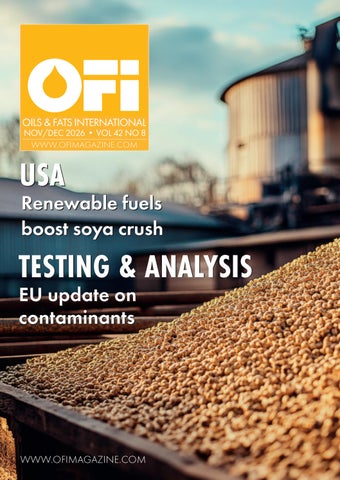
OILS & FATS INTERNATIONAL NOV/DEC 2026 ▪ VOL 42 NO 8 WWW.OFIMAGAZINE.COM
USA
Renewable fuels boost soya crush
TESTING & ANALYSIS EU update on contaminants
WWW.OFIMAGAZINE.COM
Read more here
CONTENTS
IN THIS ISSUE – NOV/DEC 2026 Testing & Analysis
FEATURES
24
Feedstock challenges A combination of ambitious US biofuel mandates, EU policy developments and a rise in Indonesia’s palm-based biodiesel blend to B50 are creating shifts in feedstock dynamics
Storage
27
USA
Dealing with pressure Sanitary atmospheric tanks must be protected from minor overpressure or vacuum collapse to prevent ruptures or collapses
Photo: Adobe Stock
Transport & Logistics
20
NEWS & EVENTS
The EU is introducing measures to implement maximum levels and analyse contaminants in food, such as for mineral oil hydrocarbons, 3-MCPDEs, glycidyl esters, PCBs, dioxings and chlorinated paraffins
Biofuels
16
EU update on contaminants
Photo: Adobe Stock, AI generated
OILS & FATS INTERNATIONAL
Renewable fuels boost soya crush The USA has set historic high 2026 and 2027 renewable fuel blending volumes, boosting domestic soyabean oil consumption and crushing capacity to meet this demand
28
Coconut oil: risk underestimated The carriage of coconut oil cargoes can release toxic vapours and cause oxygen depletion in enclosed spaces, underlining the importance of correct procedural and safety measures
OFI International 2026 Show Report
30
EUDR, biofuels, trade and more ... The OFI International 2026 event attracted more than 350 people from over 30 countries and featured expert views on the major issues impacting the global and European oils and fats market
Comment
2
Looking ahead into 2027
News
3
Beijing excludes US soya from agriculture tariffs
Biofuel News
8
EU SAF supply exceeds first mandatory ReFuelEU target
Renewable News
10
BASF approaches Evonik to form chemicals giant
Transport News
12
Insurance market widens Black Sea high-risk area
Biotech News
14
Corteva to end pesticide loyalty programme in US
Diary of Events
15
www.ofimagazine.com
International events listing
OFI – NOVEMBER/DECEMBER 2026
1
EDITOR'S COMMENT
VOL 42 NO 8 NOVEMBER/ DECEMBER 2026
OILS & FATS INTERNATIONAL
EDITORIAL: Editor: Serena Lim serenalim@quartzltd.com +44 1737 855066 Assistant Editor: Gill Langham gilllangham@quartzltd.com +44 1737 855157 ADVERTISING: Mark Winthrop-Wallace markww@quartzltd.com +44 1737 855114 PRODUCTION: Production Editor: Carol Baird carolbaird@quartzltd.com CORPORATE: Managing Director: Tony Crinion tonycrinion@quartzltd.com +44 1737 855164 SUBSCRIPTIONS: Jack Homewood subscriptions@quartzltd.com +44 1737 855028 Subscriptions, Quartz House, 20 Clarendon Road, Redhill, Surrey RH1 1QX, UK SUBSCRIPTION RATES: Print & digital: Single issue – £45 1 year – £182 (UK), £210 (overseas) 2 years – £328 (UK), £377 (overseas) 3 years – £383 (UK), £440 (overseas) Digital only: Single issue – £29 1 year – £170 2 years – £272 3 years – £357 © 2026, Quartz Business Media ISSN 0267-8853 WWW.OFIMAGAZINE.COM A member of FOSFA Oils & Fats International (USPS No: 020747) is published eight times/year by Quartz Business Media Ltd and distributed in the USA by DSW, 75 Aberdeen Road, Emigsville PA 17318-0437. Periodicals postage paid at Emigsville, PA. POSTMASTER: Send address changes to Oils & Fats c/o PO Box 437, Emigsville, PA 17318-0437 Published by Quartz Business Media Ltd Quartz House, 20 Clarendon Road, Redhill, Surrey RH1 1QX, UK oilsandfats@quartzltd.com +44 1737 855000 Printed by Stephens & George Print Group, Merthyr Tydfil, Wales
@oilsandfatsint
Oils & Fats International
2 OFI – NOVEMBER/DECEMBER 2026
Looking into 2027 As we near the end of 2026, several key issues are shaping the global vegetable oil complex and will continue to be key factors heading into 2027. The key divergence is between expanding oilseed supply on one side, and tighter availability of certain oils on the other. This is particularly evident with sunflower oil, where a record 2026/27 sunflowerseed crop of some 63M tonnes is not immediately translating into abundant supply, due to the ongoing Russia-Ukraine war impacting export logistics. Shipments through Black Sea deepsea ports have largely dried up, with exporters increasingly relying on alternative routes, according to Riverside Tanker Chartering’s October market report. An expanded Black Sea high risk zone introduced in September by London marine insurance market’s Joint War Committee (see p12) is also likely to raise freight costs and war risk premiums. Sunflower oil shipments from Russia and Ukraine could be some 1M tonnes short in the October-December period, Oil World executive director Thomas Mielke told the recent Malaysian Palm Oil Forum, leading buyers to alternative oils like palm. For palm oil, Malaysian stocks reached a new high at the end of September (see p3), pressuring spot prices, but the forward story looks like one of tightening supply due to El Niño’s impact on production in 2027, and Indonesia’s B50 biodiesel blending mandate constraining the country’s exports of palm oil. The recent OFI Commercial/Technical conference heard that Indonesia’s use of palm oil for biodiesel is forecast to reach 16.8M tonnes in 2027 (see p16) against a backdrop of stagnating output, with global 2026/27 production forecast to fall to some 78.9M tonnes. Global soyabean oil production, on the other hand, is expected to increase in 2026/27 to some 75M tonnes but strong biofuel demand, particularly in the USA, is expected to absorb much of the additional supply. The USA has set record renewable blending volumes for 2026 and 2027, driving new investments in crushing capacity (see p20). Nowhere has the impact of policy on markets been more apparent than in the USA, where a boom in renewable diesel production turned the country into a net importer of soyabean oil for the first time in 2023, due to domestic demand pushing US prices far above global levels, leading to plummeting US exports. Meanwhile, elevated diesel prices continue to support the economic case for biodiesel and renewable diesel production. The International Energy Agency reported in October 2026 that while diesel prices had eased from September’s extreme highs of more than US$200/barrel in some markets, they still remained close to twice their pre-Middle East conflict levels. Further attacks in the Gulf region remain a serious risk, particularly to commercial shipping and energy infrastructure, with no immediate de-escalation or ceasefire in sight. Looking ahead, the balance between expanding production of some oilseeds and increasingly constrained supplies of individual oils will be central to price direction, with weather, government policy and geopolitics remaining the main sources of volatility. Serena Lim, OFI Editor serenalim@quartzltd.com www.ofimagazine.com
NEWS
China's imports of US soyabeans are expected to decline further due to weak animal feed demand and negative crushing margins after the commodity was excluded from Beijing’s proposed tariff reductions on US agricultural goods, according to a 30 September Reuters report. Following a summit in Washington between Chinese President Xi Jinping and US President Donald Trump in September, the two countries announced a US$60bn package of reciprocal tariff cuts, including US agricultural commodities. A tariff-reduction list jointly issued by Beijing’s commerce ministry and the White House on 28 September covered a wide range of US agricultural goods including corn, dairy, and vegetable oils and meals, including soyabean oil and meal. More than 90% of the covered products would be exempt from all additional tar-
Photo: Adobe Stock
Beijing excludes US soya from agriculture tariff cuts
iffs imposed on each country and would instead be subject to most-favoured-nation tariff rates, the Chinese commerce ministry said in a statement. However, China’s largest US agricultural import – soyabeans – was not included and would still face an additional 10% tariff, which traders said was too high for Chinese crushing firms to absorb, Reuters wrote. Independent oilseed processors had covered demand until the Lunar New Year in early
February with supplies from Brazil, Argentina and state reserves, the report said. The China Agriculture Outlook Committee (CAOC) has forecast China's 2026/27 soyabean production at 20.36M tonnes, with a reduced planted area and yields below expectations, Fastmarkets reported on 13 October. Soyabean imports, crushing and consumption were projected at 95.5M tonnes, 94M tonnes and 113.96M tonnes respectively.
Sharpest rise in palm oil price in 7 months Palm oil prices rose by 15% since the beginning of the year, their sharpest rise in seven months, Bloomberg reported on 8 October, when December prices at Bursa Malaysia Derivatives traded at MYR4,666 (US$1,142)/tonne. Higher world palm oil prices had driven up the benchmark United Nations’ Food and Agriculture Organization (FAO) Vegetable Oil Price Index, which increased by 18.3% in September compared to September 2025. "Palm oil prices rose for the fourth consecutive month, supported by strong global demand and concerns over the impact of dry weather on production prospects in Southeast Asia,” the FAO said. With El Niño weather conditions expected to disrupt production in 2027, record high Malaysian stock levels in September would help buffer supplies, The Straits Times wrote on 5 October. According to the median of 10 estimates in a Bloomberg survey of plantation executives, traders and analysts, stockpiles were expected to have increased by around 22% to 3.45M tonnes in September compared to August. That www.ofimagazine.com
figure would be above the previous record of 3.22M tonnes reached in December 2018 and would be an increase of almost 50% since inventories started climbing in April. Meanwhile, September sunflower oil prices had fallen for a third successive month, reflecting expectations of ample supplies from the Black Sea region, although ongoing logistical disruptions and constrained export capacity contained the decline, the FAO said. According to International Grains Council data, global sunflowerseed production could increase to 62.1M tonnes in 2026/27, with record Russian production of 21M tonnes, up from 17.5M tonnes the previous year, due to favourable growing conditions. Production in Ukraine, the world’s second largest sunflowerseed-producing country, was also expected to increase by around 11% to 13.5M tonnes. However, Oil World executive director Thomas Mielke told the Malaysian Palm Oil Forum on 7 October that sunflower oil shipments from Russia and Ukraine could be 1M tonnes short in the October-December period due to the ongoing conflict between the two countries.
IN BRIEF USA: The USA is expected to export a record 20.6M tonnes of soyabean meal in 2026/27, according to the the US Department of Agriculture (USDA)'s October Foreign Agricultural Service (FAS) report. As of 1 October – the first week of the 2026/27 marketing year – sales totalled 5.1M tonnes, exceeding last year’s level. US soyabean meal production was expected to increase by 5% in 2026/27 due to a larger soyabean crop and higher US crushing. Meanwhile, worldwide soyabean meal trade was projected at 89.4M tonnes for 2026/27, a year-on-year increase of around 4.3%, mainly due to rising demand from the animal feed sector. Argentina was the leading global supplier, with an export volume of 29.6M tonnes. Brazil and the USA followed in second and third place, with exports of 27.1M tonnes and almost 20.6M tonnes, respectively. In 2026/27, soyabean meal imports were expected to total some 85.4M tonnes, a 3.5% rise compared with the previous season and a new record. The EU was expected to import the largest volume of 20.4M tonnes. TAIWAN: The government has extended import tariff and business tax cuts on selected agricultural commodity imports until 31 March, the US Department of Agriculture (USDA) reports. Announced on 16 September, the cuts – originally set to expire at the end of September 2026, included full waivers on business tax for soyabeans and 50% tariff reductions on butter (from 5% to 2.5%) and anhydrous milk fat (8% to 4%). The programme, first implemented in 2021, was intended to ease import costs for domestic businesses and limit the impact of commodity price volatility. OFI – NOVEMBER/DECEMBER 2026 3
NEWS WORLD: Global agribusiness giant ADM’s regenerative agriculture programmes led to some 946,000 tonnes of reduction in carbon dioxide equivalent (CO₂e) emissions in 2025, according to its ‘2026 Regenerative Agriculture Report’ published on 15 September, The programmes in 2025 involved over 56,000 farmers across some 1.86M ha of land, 11 countries and 10 crops including canola, soyabeans and sunflowerseed. ADM said it had also expanded collaboration across the value chain through new partnerships. For example, it announced last September that it would work with US food and drink giant PepsiCo and confectionery, food and pet food conglomerate Mars to support rapeseed and wheat farmers on 5,454ha of land in adopting sustainable applications in Poland. PepsiCo would incorporate sustainably-grown rapeseed oil into its Lay’s and Doritos brands, while Mars would promote regenerative wheat production across its pet care brands such as Whiskas and Pedigree. “This partnership aims to harness insights and data from the project to drive the widespread adoption of regenerative agriculture practices across the wider Polish agricultural system,” ADM said.
Indian imports could jump following import duty cut Indian sunflower oil imports were expected to increase by 30% to 3.5M tonnes in 2026/27 following the government’s move to cut the basic import duty on crude sunflower oil to zero, according to a 23 September Reuters report. The shift could reduce soyabean oil imports by 10.7% to 5M tonnes in the 2026/27 marketing year starting from 1 November, Angshu Mallick, president of the Solvent Extractors’ Association of India (SEA) told Reuters. In a bid to lower prices during the peak festive season, India cut the basic import duty on crude sunflower oil to zero from 10% on 23 September, the report said. “The duty reduction is expected to boost con-
sumption,” Mallick explained. Palm oil imports in the new year were expected to remain steady at around 8M tonnes, although purchases could be impacted by rising prices amid concerns over supplies due to the El Niño weather pattern, Mallick added. India imported nearly two-thirds of its vegetable oil demand, mainly palm oil, soyabean oil and sunflower oil from Malaysia, Indonesia, Argentina, Russia and Ukraine, Reuters wrote. The country's total vegetable oil imports were expected to remain steady at 16.5-17M tonnes in 2026/27 although purchases could rise by 1M tonnes if lower rainfall affected the domestic rapeseed crop, Mallick said.
Indonesia starts pilot phase of new platform Photo: Adobe Stock (AI generated)
IN BRIEF
The company established by the Indonesian government to supervise exports of major commodities such as palm oil has launched the pilot phase of its new monitoring platform, The Star reported on 5 October. State-owned enterprise Danantara Sumberdaya Indonesia (DSI) had been monitoring
export transactions for palm oil, coal and ferroalloys since 1 June using other government agency platforms and launched its National Data Intelligence platform on 1 October, the report said. During the pilot phase, the new platform would monitor shipments by selected exporters before it was rolled out gradually to others, DSI said on 2 October. DSI had collected data on export volumes, prices, shipments and settlement reconciliations for the three main commodity exports, and would analyse the data to identify any discrepancies, The Star wrote. DSI was set up earlier this year to improve transparency and oversight of commodity sales. In May, President Prabowo Subianto announced plans to centralise exports of Indonesia’s top export commodities through DSI but following a reaction from market players, later said commodity exports would be monitored but not controlled by the company.
Chinese UCO exports rise 55%, with Europe as main buyer Chinese exports of used cooking oil (UCO) rose by 55% in January-August 2026 compared to the same period in 2027, Fastmarkets wrote on 19 October. From January-August 2026, China exported 2.57M tonnes of UCO, compared with 1.67M tonnes in the same period the previous year. Europe was the leading buyer, importing 850,000 tonnes from Beijing, almost twice the 452,000 tonnes shipped to the USA. The increase in European imports of Chinese UCO could be partly due to US producers being unable to claim the 45Z clean transportation fuel credit on feedstock oils 4 OFI – NOVEMBER/DECEMBER 2026
from outside the USA, Canada and Mexico since the start of 2026, the report said. Europe had no comparable duty. Fastmarkets forecast EU UCO imports rising from 2.49M tonnes in 2025 to 2.77M tonnes in 2035. According to US customs records, American imports of UCO totalled 1.27M tonnes in January-August 2026, with China supplying 446,000 tonnes. In that period, Brazil supplied 196,000 tonnes of tallow to the USA, a 44% fall compared with the same period a year ago, due to higher US tariffs. The USA imposed 50% tariffs on Bra-
zilian goods on 6 August 2025, leading to American imports of Brazilian tallow dropping to around 9,000 tonnes/month from October 2025-March 2026. However, after the US Supreme Court voided US President Donald Trump's emergency powers tariffs on 20 February, Brazilian tallow shipments to the USA recovered to 35,000 in April, 21,000 tonnes in May and 50,000 tonnes in July. September Brazilian tallow shipments to the USA then dropped to 32,000 tonnes after Section 301 duties of 25% took effect on 22 July, and a 12.5% forced labour tariff followed on 24 July.
www.ofimagazine.com
Most Trusted Oilseed Processing Solutions CPM offers end-to-end processing solutions for the oilseed market. We are the preferred partner for the oilseed processing industry, offering complete preparation solutions. CPM offers the lowest total operating cost solution in the industry, everything from maximizing your extraction process to minimizing energy consumption.
Discover all the benefits of our solutions at OneCPM.com/Markets/Oilseed-Processing CRACKING
GRINDING
FLAKING
PELLETING PARTS & SERVICE
NEWS
Fish oil supply at lowest level since 2016 Global fish oil production is projected to decline to 1.15M tonnes in 2026, its lowest level since 2016, due to reduced Peruvian supply, the International Fishmeal and Fish Oil Organisation (IFFO) said on 5 October. Worldwide fish meal production was also forecast to fall below 4.6M tonnes in 2026 – its lowest level for a decade. Total fishmeal production in the countries covered by the IFFO was 45% below the corresponding period of 2025 to August, while fish oil output was down 26%. Raw material intake increased in August,
water column or near the seabed – was forecast at approximately 3.6M tonnes, with fish oil output from these sources projected at 605,000 tonnes. Production from other species was expected to increase, with salmon and pangasius supporting growth in fish oil supply. IFFO data is based on statistics shared by its members in Chile, Denmark, Faroe Islands, Iceland, Ivory Coast, Mauritius, Norway, the UK, the USA, Peru, South Africa and Spain, which account for over 50% of global fish oil and meal production.
Climate change could lead to omega-3 fatty acids in fish and the organisms they eat being halved, The Conversation reported on 24 August, citing an August study published by Wiley. Many fish and other seafood would become less rich in omega-3s over time due to rising ocean temperatures as the climate changed, ‘The Effects of Ocean Warming and Acidification on Fatty Acid Contents of Marine Organisms: A Global Meta-Analysis’ said. In the study, researchers collected and analysed data from 489 separate experiments involving 132 marine species, including algae, invertebrates and fish. The research team looked at two aspects of climate change – ocean warming and acidification. Since 1980, ocean temperatures had risen by 0.6°C and could rise by 4.1°C by 2100, the report said. The burning of fossil fuels was also driving up CO₂ in the atmosphere, causing ocean acidification. The researchers looked at what could happen in response to three levels of ocean warming: low (0- 6°C hotter), medium (6-10°C hotter) and high (more than 10°C hotter).
Photo: Adobe Stock
Climate change may halve omega 3s in fish
IN BRIEF WORLD: Swedish fluid handling, centrifugal and heat transfer company Alfa Laval said on 5 October that it was fully integrating edible oil and biofuel processing specialist Desmet into its business. Since Alfa Laval’s acquisition of Desmet in 2022 – which included the operational units and brands of RoseDowns and Stolz – Desmet has operated as a separate entity. However, the latest move would bring the two organisations and capabilities closer together as one global partner in process engineering solutions for the oils, fats and biofuel industries, Alfa Laval said. The integration was expected to be completed by July 2027. Going forward, the Desmet brand would be integrated into the Business Unit Process Engineering Solutions in Alfa Laval’s Food & Pharma Division. As part of the phased integration, Desmet’s upstream extraction and processing expertise would be combined with Alfa Laval’s technologies in separation, heat transfer and downstream processing. Founded in Belgium in 1946, Desmet supplies engineering technologies and process solutions for the oils and fats, proteins, feed and biofuels sectors.
with gains in Chile, Spain and the USA. Availability was weaker in African-producing countries, Iceland and the North Atlantic, while supplies were steady in Denmark and Norway. A decline in supplies was most marked in Peru, which typically accounts for around 20% of global fish oil and meal production. El Niño weather conditions remained a concern amid expectations of prolonged coastal warming in Peru, the IFFO said. Fish meal production from pelagic and demersal raw material – fish living in the
The team found that warming of 0-6° – something that was already taking place during marine heatwaves – led to 19% lower omega-3 fatty acids in fish in experiments lasting between 24 hours and six months. Under high warming scenarios (more than 10°C hotter), omega-3 reduced by 50% in fish, 34% in algae and 51% in invertebrates. Meanwhile, levels of saturated fats increased by up to 22%.
CSPO accounted for 20% of palm oil supply A total of 16.2M tonnes of Roundtable on Sustainable Palm Oil (RSPO) certified sustainable palm oil (CSPO) was sold in 2025 – 20% of worldwide supply, according to the latest ‘RSPO Impact Report 2026’ said. RSPO grower members now held a total capacity of 31.4M tonnes of palm, equivalent to 39% of global production, the biannual report said. The pipeline for global transformation was strong, particularly in Latin America where RSPO members accounted for almost 75% of regional output. Africa had seen a 46.23% surge in supply, while a 9.07% expansion was seen in Malaysia. The growth trajectory indicated that CSPO supply could reach almost 40% of global palm oil supply as members continued to certify their
6 OFI – NOVEMBER/DECEMBER 2026
plantations against the RSPO standard, the report said. RSPO membership had continued to grow, with 6,280 members globally across 103 countries and territories. The most significant membership growth was seen in China, Indonesia and Japan, reflecting expanding market awareness in Asia and large palm oil-consuming countries. In 2025, RSPO members conserved and protected 551,637ha of critical land. This included peatlands and High Conservation Value and High Carbon Stock areas. RSPO certification also continued to strengthen social standards, with 661,219 workers directly employed within RSPO-certified operations under systems designed to safeguard their rights and freedom, the report said.
www.ofimagazine.com
OUR TECHNOLOGY BEYOND ALL LIMITS. EXPERTS IN: EDIBLE OIL EXTRACTION AND REFINING • DRY FRACTIONATION • SPECIALTY FATS • WASTE OIL PRE-TREATMENT FOR BIOFUELS • BIODIESEL PRODUCTION • OLEOCHEMICALS
TECHNOILOGY Srl • Via Federici, 12/14 - 04012 Cisterna di Latina (LT) Italy contacts: Andrea Bernardini - andrea.bernardini@technoilogy.it • Mario Bernardini - mario.bernardini@technoilogy.it
BIOFUEL NEWS COLOMBIA: Biodiesel production is expected to rise by 4.5% in 2026 to 765M litres due to record crude palm oil (CPO) output of 1.93M tonnes in 2025, according to a 24 September US Department of Agriculture (USDA) report. The country’s 10% level (B10) biodiesel mandate remained unchanged and Colombia continued to be fully self-sufficient in biodiesel feedstock, with no imports or exports expected. Biodiesel remained the second largest domestic use of CPO after food/edible oils, consuming an estimated 642,000 tonnes of CPO in 2025 and approximately 670,000 tonnes in 2026. USA: The use of soyabean oil in the US biofuel sector – including biodiesel and renewable diesel – continued at a record pace in June, with consumption reaching an all-time high, Fastmarkets reported on 7 September, citing US Energy Information Administration (EIA) data. US biofuel producers used a record 707,604 tonnes of soyabean oil in June, up by 9% from the previous high of 648,637 tonnes in May and 49% higher year-onyear. The biodiesel sector consumed 358,337 tonnes of soyabean oil in June, up by 5.8% from May. Renewable diesel producers used 347,451 tonnes of soyabean oil in June, up by 11.5% from May.
EU SAF supply exceeds first mandatory ReFuelEU target European sustainable aviation fuel (SAF) supply exceeded the first mandatory ReFuelEU Aviation target in 2025, with 1.1M tonnes supplied at EU airports, commodity price reporting agency Fastmarkets reported on 28 September, citing EU Aviation Safety Agency (EASA) data. The volume of SAF accounted for 2.79% of total aviation fuel supplied by EU airline operators that year, the report said. Alongside the increase, there was a wider expansion in physical SAF availability, which was supplied at 121 EU airports across all 27 member states in 2025, equivalent to 79% of EU airports. However, the market remained heavily reliant on imported feedstocks, with 85% of feedstocks originating outside the EU. The ReFuelEU aviation targets calls for a minimum 2% SAF share in aviation fuel supplied
at EU airports in 2025, rising to 6% in 2030 and 70% in 2050. Of the 1.1M tonnes supplied in 2025, 885,000 tonnes – around 80% of the total volume – was classified as aviation fuel produced from feedstocks listed under Annex IX Part B of the EU Renewable Energy Directive. A further 120,000 tonnes – around 11% – was classified as other aviation biofuels, while 90,000 tonnes – about 8% - was advanced aviation biofuels. Used cooking oil accounted for 80% of the total SAF feedstock mix. The remaining 20% included category 3 animal fats at 11%, palm oil mill effluent at 5%, with food waste, crude tall oil and category 1 and 2 animal fats making up the balance. In 2025, aviation biofuels were around three times the conventional fuel reference price of €640 (US$723)/tonne.
Projects underway for Brazil’s SAF programme The Brazilian government officially launched the country’s sustainable aviation fuel (SAF) programme in August, the US Department of Agriculture (USDA) said on 2 September. As part of the programme, a book-and-claim mechanism and certification system were set up to ensure compliance with national air transport decarbonisation targets, as airlines would face mandatory greenhouse gas (GHG) emission reductions in 2027, the ‘Brazil: Biofuels Annual’ said. Around 15 SAF production projects were underway but they were in early stages of implementation or production. In June 2026, Brazil’s staterun oil company Petrobras
Photo: Adobe Stock
IN BRIEF
announced it would produce and commercialise 4M litres of SAF containing 1% renewable content sourced from Brazilian soya certified as having low indirect land use change risk under the ISCC CORSIA PLUS protocol. In May 2026, Acelen announced a US$1.5bn finance
package to build a SAF biorefinery in Bahia state. Energy firm Acelen also had off-take agreements, including six-year contracts, covering 90% of its first-phase SAF production from soyabean oil and UCO. In the second phase, production from macaúba was expected to begin in 2029.
EPA proposes two options for reallocating SRE exemptions US Environmental Protection Agency (EPA) administrator Lee Zeldin has confirmed that the agency is offering two approaches to reallocating 770M renewable identification numbers (RINs) waived through recent small refinery exemptions (SRE), Biomass Magazine wrote on 13 October. Under the RFS, a small refinery can petition the EPA for temporary relief from its obligation to blend or account for specified amounts of renewable fuel into the US fuel supply. SREs have been the subject of
8 OFI – NOVEMBER/DECEMBER 2026
major disputes between refiners, farmers, biofuel producers and the federal government, with biofuel producers arguing that exemptions reduce demand, while refiners argue that the RFS can impose significant costs, particularly on smaller facilities. On 31 August, the EPA granted 18 full exemptions and 11 partial (50%) exemptions for 2025, amounting to 1.76bn Renewable Identification Numbers (RINs), a 78% increase or 770M RINs compared to the number of RINs the EPA had originally
estimated it would waive for 2025, the report said. RINs are tradable credits used to track compliance with the RFS. In its 31 August announcement, the EPA said it would propose to reallocate 770M RINs before the end of October. The first option would divide the 770M RINs equally between the 2026 and 2027 compliance years. The second approach would reallocate all 770M RINs to 2027. A public comment period on the EPA’s proposal would be open until 4 December. www.ofimagazine.com
RENEWABLE NEWS
BASF approaches Evonik to form chemicals giant German chemical giant BASF has approached speciality chemical company Evonik with a takeover offer of €11.18bn (US$12.51bn) after Evonik rejected its initial €10.3bn (US$11.7bn) bid in September as too low, Reuters reported on 23 October. Being part of BASF would enable Evonik to source certain raw materials from it “more cost-effectively, more directly and more reliably,” BASF management board chair Markus Kamieth said in a 22 October Speciality Chemicals report. He added that, among other things, BASF would:
UK: British start-up Clean Food Group (CFG) announced on 12 September that its fermentation-derived oil had been approved for cosmetic use in the UK, Europe and the USA, unlocking access to the global personal care and cosmetics sector. CFG’s CLEAN Oil product – designed as a “drop‑in” replacement – was developed in collaboration with beauty manufacturer THG LABS, and speciality chemical company Croda, the firm said. The technology is a microbial/fermentation-based platform that uses non-genetically modified oleaginous yeast grown on food waste to produce lipids or oils.
biosurfactants, lipid-based drug delivery systems and catalysts for oils and fats processing. BASF supplies crop protection chemicals and oilseeds to farmers, including its InVigor high-yield canola hybrid and Credenz high-yield soyabeans. Kamieth said the chemical industry was consolidating one way or another. “The question is: Do we shape this ourselves ... Or do we wait until European chemical firms are overtaken in global competition or increasingly acquired by foreign investors,” he said in the Speciality Chemicals report.
Verbio commissions new renewables plant Leading German biodiesel producer Verbio has commissioned a large-scale plant for rapeseed-based chemicals at its Bitterfeld site in Germany (pictured). Once fully operational, the US$112M plant would be capable of producing up to 60,000 tonnes/year of biobased chemicals for use in lubricants, detergents, cleaning products, and plastics, the company said on 6 October. In addition to being used in biodiesel production, rapeseed methyl ester (RME) produced at the site would be used as a raw material in the production of higher-value chemicals. Market ramp-up would begin in stages, with 1-decene and
Photo: Verbio
IN BRIEF
• Take over Evonik’s existing site agreements, with no compulsory redundancies. • Examine what joint activities could be run from Evonik’s headquarters in Essen. • Continue operating Evonik’s existing chemical parks at Marl and Wesseling, contrary to plans to sell SYNEQT GmbH, the company responsible for infrastructure services at both parks. BASF has a market value of US$52.2bn, while Evonik is currently valued at US$10.45bn, according to Reuters. Evonik produces renewable chemicals,
9-DAME as the first products. The process at the plant relied on ethenolysis, a form of olefin metathesis, with catalysts from Verbio’s Hungarian subsidiary XiMo converting carbon compounds in RME into new molecules.
Verbio operates production sites in Europe, North America and Asia, with an installed production capacity of 710,000 tonnes/year of biodiesel and 800,000 tonnes/year of bioethanol, according to its website.
Terra Oleo raises US$3.1M to Oil made from food industry waste er, the process separated waste renewable fuel technolfund tailored lipids platform Israeli into outputs, including NAKI’s ogy start-up NAKI announced Singapore’s Terra Oleo has raised US$3.1M to support its yeastbased fermentation platform producing tailored lipids. The company’s advanced microbial technology platform uses fermentation to produce palm oil and cocoa butter equivalent (CBE) alternatives from agro-industrial waste for use in the personal care, cosmetics, pharmaceutical and food sectors, Terra Oleo said. Its CBE products are produced directly from yeast and remained solid at room temperature, with a melting point above 350C, according to the company’s website. Its oleochemicals could be used as emulsifiers, excipients, lubricants and surfactants. Terra Oleo said it had signed product testing agreements with several major global and regional companies in the oleochemical, food, personal care and cosmetics industries and was preparing to scale up from laboratory to market. “We currently co-manufacture in Thailand and Singapore and plan to scale up our first products through a mix of larger-scale co-manufacturing and potentially a joint venture with a manufacturing partner,” co-founder Shen Ming Lee said in a 17 September AgFunderNews report.
10 OFI – NOVEMBER/DECEMBER 2026
on 14 October that it had started producing oil from food industry waste, with its first batch produced in September. The milestone demonstrated NAKI’s modular process of recovering oils from wet industrial sludge from the food sector, the company said. NAKI said its process was suitable for industries producing sludge containing fats or oils, such as food processing plants in the dairy, meat and vegetable oil industries; abattoirs; and oil-based manufacturing plants handling residual fats and oils. Conducted in a 20ft contain-
MidaOil, reusable water and a residual biomass stream. NAKI said MidaOil could be used as a waste-derived lipid ISCC-certifiable feedstock for renewable fuel applications, including sustainable aviation fuel and renewable diesel. “As the renewable fuels industry seeks feedstocks beyond used cooking oil and animal fats, NAKI is working to unlock a new resource from existing industrial waste streams,” said NAKI CEO Barak Manbar. The company’s first unit had been installed at a meat processing facility.
www.ofimagazine.com
MORE THAN ENERGY
Efficient high temperature energy solutions with steam and thermal oil. Services by GekaKonus: Engineering | Design | Consulting Commissioning | After Sales Service
GekaKonus GmbH · Siemensstraße 10 · D-76344 Eggenstein-Leopoldshafen Tel.: +49 (0) 721 / 9 43 74 -0 · Fax: +49 (0) 7 21/ 9 43 74 - 44 · info@gekakonus.net · www.gekakonus.net
When you choose Oil-Dri®, you get more than a reliable adsorbent. You gain a world-class team of technical service experts to help you make tough decisions and save refinery resources for pre-treatment of oils and fats. ®
ADSORBENT MINERAL TECHNOLOGY
EDIBLE OILS
RENEWABLE DIESEL BIODIESEL
LEARN MORE AT ODCPURIFICATION.COM MADE IN
USA
30+ YEARS OF EXPERT TECHNICAL SERVICE www.ofimagazine.com
OFI – NOVEMBER/DECEMBER 2026
11
TRANSPORT NEWS USA: A new grain transloading facility has opened at the Seagirt Marine Terminal in the Helen Delich Bentley Port of Baltimore, World Grain wrote on 1 September. Built in partnership with commodity trading and logistics firm Frey Commodities and Ports America Chesapeake, the facility would handle a range of commodities including soyabeans, corn, wheat, sorghum, soyabean meal, corn gluten meal and distiller’s dried grains with solubles. The grain elevator would have an annual export capacity of 275,000 tonnes. Three grain silos, with a combined storage capacity of 60,000 bushels, would support inbound truck and shipments. Shortline rail access to CSX and Norfolk Southern Corp would enhance export connectivity through the port for farmers and soyabean crushing facilities in the US Midwest, Frey Commodities added.
Insurance market widens Black Sea high-risk area Odessa
•
ROMANIA
Odessa
UKRAINE
Crimea
•
SEA OF AZOV
•
•
Constanta
Crimea
ROMANIA
Novorossiysk
UKRAINE
SEA OF AZOV Novorossiysk
•
•
Constanta
BLACK SEA
BULGARIA
BLACK SEA
•Bosphorus
TURKEY
BLACK Previous Black Sea JWC listed areaSEA
New Black Sea JWC listed area
With Russia and Ukraine stepping up attacks on each other’s commercial shipping in recent months, London’s marine insurance market has widened the area in the Black Sea deemed as high risk, Reuters reported on 18 September. The Black Sea is a vital route for shipments of grain, sunflower oil and crude oil. On 16 September, the Joint War Committee (JWC) comprising Lloyd’s Market Association syndicate members and London insurance companies expanded Black Sea reporting requirements to the whole of the Black Sea area and the Sea of Azov, the report said. Only the territorial seas (around 12 nautical miles) of Bulgaria, Georgia, Romania and Turkey
were excluded. The territorial waters of Russia and Ukraine, plus specified inland waters of Ukraine, Russia and Belarus remained unchanged. War risk premiums adding hundreds of thousands of dollars for every seven-day voyage had surged in recent weeks as dozens of ships had been attacked in the Black Sea, Reuters wrote. The JWC said it identified areas of perceived enhanced risk but did not set insurance rates. “What a JWC listing triggers is a set of contractual mechanics.” Among the things owners and charterers should check was whether a route entered the new listed area, and if an additional premium should apply, which would depend on the policy and negotiation.
Vopak to expand at Port Botany to support SAF storage Vopak Terminals Australia – part of global tank storage company Royal Vopak – has secured backing from the New South Wales (NSW) government in Australia for its proposed expansion project in Port Botany, Sydney. The project would expand capacity by approximately 120,000m³ and add new tanks
and pipeline connections to support sustainable aviation fuel (SAF) storage. “With the capability to store SAF, we are laying [the] groundwork for the country’s energy transition” Mats de Groot, managing director of Vopak Terminals Australia, said on 7 October. The project is subject to a
final investment decision (FID) and regulatory planning conditions and approvals. Vopak Terminals Australia was established in 1994 and is an independent fuel import and distribution infrastructure provider, delivering storage and logistics solutions. As well as operating import and distribution facilities at Port Botany,
Sydney, the company has a site in East Arm Berrimah, Darwin. Headquartered in Rotterdam, the Netherlands, Royal Vopak is a leading independent tank storage infrastructure company with a global network of terminals. The company stores and handles a range of products including vegetable oils, biofuels, chemicals, gases and crude oil.
Bunge and ABP reach 1M tonne milestone at Immingham port Global agribusiness giant Bunge and Associated British Ports (ABP) have handled 1M tonnes of grain and oilseeds through their joint agribulk operations at the UK’s Port of Immingham since their partnership began in 2022, the firms said on 30 September. ABP’s Port of Immingham is the UK’s largest port by volume of tonnage and connects the UK with international trade routes, while the Humber International Terminal is one of the leading deep-water bulk handling facilities in the country and handles a 12 OFI – NOVEMBER/DECEMBER 2026
range of commodities, including grain and oilseeds, biomass and other dry bulks. The companies’ collaboration began with the commissioning of Shed 35, a purpose-built agribulk storage facility at Immingham’s Humber International Terminal. Following strong demand, the companies expanded the operation with the development of Shed 36, increasing the site’s total storage capacity to approximately 75,000 tonnes and creating one of the Humber region’s largest agribulk handling hubs.
“The terminal handles imports of essential feed ingredients, including certified sustainable PRO-S soyabean meal and sunflower meal, and has also handled exports of feed wheat, malting barley, beans and rye,” said James Maw, Bunge UK country manager. In the UK, Bunge sources grains, oilseeds, pulses and oats from producers and is a major distributor and exporter of grains, oilseeds and proteins, as well as a key importer of protein meals and vegetable oils. ABP is the UK’s largest port operator. www.ofimagazine.com
Source: Joint War Committee
IN BRIEF
We make storage active Chane is a liquid bulk storage partner, specialising in end-to-end services for storage, processing and logistics. Collaborating closely with our customers, we provide reliable services that help their businesses run smoothly, as well as creating the infrastructure that facilitates their growth. We make storage active by connecting supply and demand in new ways and thinking ahead towards the future. Chane offers storage facilities at strategic locations across the Netherlands, France, the United Kingdom, Spain, Portugal and Poland. With a total capacity of over 5,4 million cubic metres (CBM), our terminals handle a highly diversified base of liquid bulk products and offer excellent integrated and innovative service solutions.
Specializing in end-to-end services
A wide range of products handled with expertise
19 Terminals in 6 European countries
With a total storage capacity of 5,4 million CBM
Creating a sustainable future together
SPREAD THE NEWS! NOW FOR SALE...
SECOND-HAND MARGARINE PILOT PLANT FOR SALE IN DENMARK CAPACITY RANGE: 30-130 KG/H FOR TESTING A WIDE RANGE OF HIGH-QUALITY MARGARINE PRODUCTS SUCH AS: • • • • • •
Table margarine Industrial margarine Puff pastry Shortening Low fat spreads Recombined butter
THE PILOT PLANT IS SKID MOUNTED AND CONSISTS OF THE FOLLOWING MAIN EQUIPMENT: • Water Phase preparation • Water Phase pre-heating (Gerstenberg & Agger consistator) • Emulsion pre-mix and buffer • Crystallisation (Gerstenberg & Agger) Incl. HP pump, pin mixers, phase inverter • Resting tube • NH3 refrigeration unit for Perfector • Integrated Hot water system • SCADA automation system
The equipment will be sold fully overhauled, and carefully tested before shipment. A mechanical warranty is included. Ex Works from our factory in Denmark. INSPECTION & SALES CONTACT: Torben From - FH SCANDINOX A/S - DENMARK Phone head office: +45 7534 3434 Mobile phone/WhatsApp: +45 4055 5359 E-mail: TFR@fhscandinox.com www.fhscandinox.com
WORLDWIDE EXPERIENCE AND KNOW-HOW
FHS-Ann-Halfpage-Sept26.indd 1
www.ofimagazine.com
30/09/2026 11.07
OFI – NOVEMBER/DECEMBER 2026
13
BIOTECH NEWS EUROPE: The European Commission (EC) has authorised seven genetically engineered (GE) crops for food and feed use, according to a US Department of Agriculture (USDA) report. Valid for 10 years, approvals for four GE crops (three soyabean and one maize) and renewals for three GE crops (two maize and one soyabean) were made in June and August. Bayer Agriculture’s MON 94637 soyabean was approved on 2 June. On 29 June, Corteva Agriscience’s maize DP202216 x NK603 x DAS-40278-9 and its sub-combinations DP202216 x NK603, DP202216 x DAS-40278-9 were given approval. On the same date, Bayer Agriculture was given renewed authorisation for its NK603 × T25 maize and its soyabean MON 87705 soyabean. On 23 September, Bayer Agriculture’s maize MON 87460 maize was given renewed authorisation and its MON 94313 soyabean variant was approved. On the same date, BASF’s soyabean GMB151 × DAS44406-6 soyabean was given approval. The approvals applied to food and feed for import and processing but did not cover cultivation and all products would be subject to the EU’s strict labelling and traceability rules, the 2 October report said.
Corteva to end pesticide loyalty programme in US Agricultural company Corteva has agreed to end pesticide loyalty programmes in a settlement with the US Federal Trade Commission (FTC), AgWeb reported on 28 September. The FTC’s antitrust lawsuit had alleged that Corteva was using distributor loyalty programmes to keep lower-priced generic pesticides out of the market. The settlement would run for 10 years and included a US$35M payment to the 12 states that had joined the case, AgWeb wrote. “The agreement the FTC and its state partners secured will give farmers better pesticide options at lower prices, said David Shaw, principal deputy director of the FTC’s Bureau of Competi-
tion in the FTC’s 28 September news release. The FTC said it had made similar allegations against another pesticide manufacturer, Syngenta, regarding its post-patent loyalty programme. In May, Corteva announced it had renamed its new seed and genetics unit from SpinCo into Vylor, as the company moved towards splitting into two separate businesses. At the time, Corteva said its plans to separate the two businesses remained on track for the fourth quarter of 2026. Corteva supplies oilseeds and accompanying crop protection solutions to farmers including its genetically engineered Enlist soyabeans and Optimum GLY canola.
Black soldier fly feed rich in Omega-3s A black soldier fly (BSF) partnership between NRGene Canada and Ile-a-la-Crosse Fish Company has produced poultry feed rich in omega-3s from fish processing byproducts, the firms said on 16 September. The aim was to process local waste into a poultry feed that, when fed to laying hens, could produce eggs with a higher omega-3 content. As part of a semi-industrial trial at the North American Insect Center in Saskatchewan, NRGene Canada produced approximately 90kgs of MaxBSF larvae from 0.3 tonnes of feed containing 50% fish processing byproducts. Analysis by Canadian Association for Laboratory Accred-
Photo: Adobe Stock
IN BRIEF
itation (CALA)-accredited laboratory Prairie Tide Diversified found that the fish-fed larvae contained several times more total omega-3 fatty acids, and contained marine eicosapentaenoic acid (EPA) and docosahexaenoic acid (DHA), which were not detected in
standard-fed larvae. The partners said they were now planning to construct a BSF rearing facility on site in Ile-a-la-Crosse, Saskatchewan. NRGene Canada develops BSF genetics that process organic waste into protein and fertiliser.
Nourish partners with SD Guthrie to scale customised fats Australian alternative fats start-up Nourish Ingredients has partnered with leading palm oil company SD Guthrie to scale production of designer fats, World Bio Market Insights wrote on 16 September. As part of the partnership, the two companies were working together to scale up production of Nourish Ingredients’ Creamilux bio-manufactured dairy fat alternative. The enterprise combined Nourish Ingredients’ fermentation technology and biotech knowledge with SD Guthrie’s manufacturing scale, lipid expertise and 14 OFI – NOVEMBER/DECEMBER 2026
European infrastructure. Together, the companies aimed to deliver a scalable supply of the bio-based fat across Europe and other key markets, World Bio Market Insights said. According to its website, Nourish Ingredients uses fermentation to produce animal-free fats for use in meat alternatives. By tailoring the DNA of its yeasts and growing them in specially calibrated environments, the company said it could create customised fats to suit specific products. The partnership followed the launch of
Nourish Ingredients’ global commercial hub in Leiden, Netherlands, in September 2025, which was now fully operational, co-founder and CEO James Petrie said. Malaysia’s SD Guthrie is a vertically integrated palm and vegetable oils company. It grows oil palms, harvests fresh fruit bunches and processes them in its mills into crude palm oil (CPO) and palm kernel oil. It processes palm oil and other vegetable oils into cooking oils, margarine, shortening and specialist food fats, oleochemicals and biodiesel.
www.ofimagazine.com
DIARY OF EVENTS 3-5 November 2026
8-10 March 2027
27-28 April 2027
World Biofuels, Ethanol & Feedstocks Conference InterContinental Hotel, Barcelona, Spain https://www.spglobal.com/energy/en/ events/conferences/world-biofuelsconference
Sustainable Aviation Futures LATAM Congress, São Paulo, Brazil https://www.safcongresslatam.com/
Palmex Indonesia 2027 Jakarta Indonesia Expo, Indonesia https://palmex-indo.com/
10-12 March 2027
AOCS Annual Meeting & Expo Hilton Chicago, Illinois, USA https://www.aocs.org/event/2027-aocsannual-meeting-expo/
Chamber of Livestock By-Products, 6th National Congress Campana, Argentina https://www.subproductosganaderos.org/
4 November 2026 4S Business Summit Rotterdam 2026 Rotterdam, the Netherlands https://ukragroconsult.com/en/ conference/4s-business-summitrotterdam-2026/
21-23 March 2027
4-6 November 2026 Sustainable Aviation Futures North America Marriott Marquis, Houston, USA https://www.safcongressna.com 5-6 November 2026 European Commodities Exchange Rotterdam, the Netherlands www.ece-rotterdam2026.eu
NIOP Annual Convention Westin Kierland Resort & Spa, Scottsdale, Arizona, USA https://niop.org/event-directory/ 5-7 April 2027 38th Palm & Lauric Oils Price Outlook Conference & Exhibition (POC2027) Kuala Lumpur, Malaysia 13-14 April 2027 Sustainable Aviation Futures Congress Europe Summit Postillion Hotel & Convention Centre WTC Rotterdam, the Netherlands https://www.safeusummit.com/
5-7 November 2026 6th Yabited Fats and Oils Congress Grand Hyatt Istanbul, Turkey https://yabited2026.com/
13-14 April 2027 Argus Canada Biofuels, CFR & Carbon Conference Calgary, Canada https://www.argusmedia.com/en/events/ conferences/canada-biofuels-conference
11-13 November 2026 Indonesian Palm Oil Conference and 2027 Price Outlook (IPOC 2026) BICC Nusa Dua, Bali, Indonesia https://gapki.id/en/ipoc/
18-21 April 2027
17-18 November 2026 Palmex Malaysia 2026 Kuala Lumpur Convention Centre, Malaysia https://asiapalmoil.com/ 18-20 November 2026 13th Global Biofuel Focus (GBF 2026) Chongqing, China https://file.ienmore.com/pdf/GBF26.pdf
17th International Rapeseed Congress Paris, France https://ircparis2027.com/ 20-22 April 2027 Argus Biofuels & Feedstocks Asia Conference Singapore https://www.argusmedia.com/en/events/ conferences/biofuels-and-feedstocksasia-conference
1-3 February 2027
21-22 April 2027
Sustainable Aviation Futures MENA Congress Abu Dhabi, UAE https://www.safcongressmena.com/
Argus Green Marine Fuel Asia Conference Singapore https://www.argusmedia.com/en/events/ conferences/green-marine-fuels-asia
For a full events list, visit: www.ofimagazine.com Information subject to change www.ofimagazine.com
2-5 May 2027
3-5 May 2027 2027 Fabric and Home Care Forum Hilton Chicago, USA https://www.aocs.org/event/2027-fabrichome-care-forum/ 11-13 May 2027 Fenagra 2027 São Paulo, Brazil https://www.fenagra.com.br/ 20-21 May 2027 17th ICIS World Surfactants Conference Jersey City, New Jersey, USA https://events.icis.com/website/8544/ 8-11 June 2027 25th EFPRA Congress Liverpool, UK https://www.efpra2027.com/ 14-15 July 2027 Argus Biofuels & Feedstocks Australia Conference Sydney, Australia https://www.argusmedia.com/en/events/ conferences/biofuels-and-feedstocksaustralia-conference 5-6 August 2027 Palmex Thailand 2027 CO-OP Exhibition Centre Suratthani, Thailand https://thaipalmoil.com/ 28 August-3 September 2027 3rd World Congress on Oleo Science Hokkaido, Japan https://pub.confit.atlas.jp/en/event/ wcos2027 12-15 September 2027 21st Euro Fed Lipid Congress & Expo Rotterdam The Netherlands https://eurofedlipid.org/21st-euro-fedlipid-congress-and-expo/ OFI – NOVEMBER/DECEMBER 2026
15
Photo: Adobe Stock
BIOFUELS
Feedstock challenges A combination of ambitious US biofuel mandates, policy developments in the European Union and an increase in Indonesia’s palm oil-based biodiesel blend to B50 are creating shifts in feedstock dynamics Gill Langham The global biofuel market has been impacted by some significant policy developments in the USA and the European Union (EU), alongside a higher palm oil-based biodiesel mandate in Indonesia, analysts told delegates at the OFI Commercial/Technical Conference, held on 22-23 September 2026 in Amsterdam, the Netherlands, In her presentation at the conference, Rohaise Low, strategic industry expert for agriculture, Fastmarkets, UK, discussed the impacts of these developments on the market and on the short and long-term effects on waste feedstocks. “The question of ‘where are the feedstocks coming from?’ has been a part of the conversation for many years but 16 OFI – NOVEMBER/DECEMBER 2026
as policies become stricter over origins and sustainability criteria, that question becomes increasingly important,” Low said. Artem Hammerschmidt, head of vegetable oils and biofuels research at Ceras Analytics, the market intelligence arm of Cefetra Group, also agreed. He said that biodiesel consumption was growing rapidly worldwide, led by the USA – with its ambitious biofuel mandates – and Indonesia with its 50% palm-oil based biodiesel (B50) mandate and B60 discussions also underway. “Policy-implied FAME/HVO/SAF production requirements are expected to increase by around 6M tonnes in 2026 and a further 6-7M tonnes in 2027.” In his presentation looking at the global market outlook for oilseeds and vegetable oils in 2026/27, Hammerschmidt said the Middle East conflict had strengthened the case for biofuels, leading to increased demand for oils and fats. “High fossil fuel prices have strengthened the economic case for biofuels, reinforcing the mandate-driven demand outlook,” he said. Speaking about Indonesia’s launch of its B50 blending mandate on 1 July in a bid to boost energy security, Dr Fadhil Hasan, senior economist and head of foreign affairs at the Indonesian Palm Oil
Association (GAPKI), said domestic palm oil consumption would increase by around 2M tonnes in 2027, leading to a decline in exports, against a backdrop of stagnating production. Hammerschmidt said Indonesia’s push to B50 meant that further production growth in 2027 could lift domestic palm oil use for biodiesel to 16.8M tonnes, leading to additional curbs on exports (see Figures 1 and 2, p18). “As blending rates increase, it is expected that prices will also go up. Geopolitical factors will also contribute to even higher palm oil prices in the near future,” Dr Hasan added.
Impact of US policy
US policy has had significant impacts on the market in 2026, according to Low. The 45Z Clean Fuel Production Tax Credit – updated in September – included measures aimed at supporting domestic biofuel production. For example, it included a clause preventing feedstocks sourced from outside the USA, Mexico and Canada to qualify for the 45Z credit. As a result, demand had shifted to domestic (North American) feedstocks, pushing up US prices to a premium over the rest of the world, she explained. www.ofimagazine.com
Photo: Adobe Stock
BIOFUELS In addition, renewable volume obligations (RVOs) for 2026 and 2027 announced in April were ambitious for bio-based diesel, requiring high utilisation rates after a ‘poor’ 2025. Higher mandates in California had also pushed up demand and credit prices in 2026, Low added. In the USA, mandate-driven output requirements were expected to rise by around 3M tonnes in 2026 and a further 2M tonnes in 2027, Hammerschmidt told the conference. With North American vegetable oil supplies falling short, US producers would be forced back towards imported oils and fats, he added. Changing import tariffs had seen shifts in feedstock dynamics and the latest increase in US tariffs on Brazil had stopped the flow of animal fats, Low explained. Against this backdrop, 45Z had been pushing up prices for domestic feedstocks, she added.
US BBD production
Following the finalisation of bio-based diesel mandates in the USA, US output had increased, reaching a record level
in June, Low said: “Output will need to remain at high levels if the mandate is to be met – taking small refinery exemptions (SREs) into account.” Against this backdrop, feedstock requirements were expected to remain high for the remainder of this year and into 2027, according to Low. With domestic stocks no longer sufficient to meet US demand, tallow and UCO imports reached record levels in July, she added.
Effect of EU policies
Policies in the EU had been slower to make an impact on the global biofuel sector, according to Low. However, with member states starting to implement Renewable Energy Directive (RED) III targets, higher mandates were leading to an increase in biofuel demand. In addition, the removal of double counting by Germany and the Netherlands had pushed up physical demand for waste-based renewable diesel, she added. Although the EU’s sustainable aviation fuel (SAF) mandate was flat in 2026, it was rising in the UK. Road, maritime and aviation mandates in the region were expected to lift demand
from 17M tonnes in 2024 to 23-24M tonnes in 2027, Hammerschmidt said. Despite the surge in biofuel demand in the EU-27/UK, imports had captured most of the growth to date, he added. As waste-based biofuels met caps in key countries, the price of renewable diesel made from those feedstocks had been priced at an increasing discount to advanced renewable diesel, Low explained, although prices for UCO-based SAF remained strong as caps were not limiting demand in that sector. “Policy changes are causing shifts in demand and value and the market is still finding the new equilibrium,” she added.
EU BBD production
Stronger demand had seen EU biobased diesel production rise in 2026 as utilisation rates increased, with further hikes expected in 2027, Low said. Fatty acid methyl ester (FAME) biodiesel remained an important part of the market, but renewable diesel would see stronger growth, rising by nearly 60% from 2025 to 2027, she added. EU-27/UK FAME production was expected to increase in 2026 and 2027, u according to Hammerschmidt.
Improve Oil Quality. Improve Process Performance. The Dallas Group’s filtration and purification solutions for oils, fats, and oleochemicals improve product quality, extend oil life, and increase process efficiency.
HVO / Biofuel Filtration
FRYING OIL LIFE EXTENSION Extends frying oil life and reduces operating costs.
Sharplex Vertical Pressure Leaf Filter For Pretreatment
OLEOCHEMICAL PURIFICATION Removes contaminants from oleochemical production.
Quick Deliveries Supplied with CE
or U-Stamp
Best Quality
CATALYST REMOVAL & POLYOL PROCESSING Efficient catalyst removal for cleaner polyol and surfactant production.
Improve quality. Reduce Waste. Talk to our filtration experts. Scan to learn which solution is right for your process. +1.908.534.7800 info@dallasgrp.com www.dallasgrp.com www.ofimagazine.com
OFI – NOVEMBER/DECEMBER 2026
17
u
Figure 1: Indonesia biodiesel production (million tonnes)
Source: Ceras Analytics
Figure 2: Indonesia palm oil use for biodiesel (million tonnes)
Source: Ceras Analytics
BIOFUELS
Although FAME biodiesel remained an important part of the market, Low said renewable diesel would see stronger growth, rising by almost 60% from 202527. “Rising production will see increased demand for waste feedstocks in the EU,” she added. High freight costs had pushed up the costs of importing feedstocks, according to Low. “The focus in the EU remains on UCO but imports of advanced feeds are growing.” According to Hammerschmidt, limited availability of global used and waste oils meant Europe would increasingly rely on rapeseed oil as feedstock.
Oilseeds & vegetable oils outlook With worldwide biofuel feedstock requirements expected to jump by 6-7M tonnes in 2026 and by a further 7M tonnes in 2027, Hammerschmidt said global oils and fats supplies would be tested. 18 OFI – NOVEMBER/DECEMBER 2026
“The challenge is not absorbing one exceptional increase – but doing so for two consecutive years.” Rising demand for soyabean oil would be absorbed by domestic demand, led by ambitious US biofuel mandates. “The US will need to ration exports, increase imports and draw stocks sharply lower by the end of 2026/27,” he added. Looking ahead, Hammerschmidt said El Niño conditions were setting the stage for a major vegetable oil squeeze, with production down by 0.3M tonnes in 2026/27. With demand jumping by around 5.7M tonnes, exports and stocks could potentially fall by 0.8M tonnes and 3.3M tonnes respectively. With demand for used and waste oils rising by 3% in 2026/27, he said costs would increase and an El Niño-driven palm oil deficit could further constrain collectable volumes. Indonesian palm oil production was expected to fall by 2-3M tonnes in 2027, with some estimating a decline of up
to 4-5M tonnes, against a backdrop of increasing demand for the B50 mandate. While production loss in Malaysia was expected to be smaller, it would still be significant, he added. Overall, Southeast Asian palm oil production was expected to fall by around 4M tonnes in 2026/27 as Indonesian biodiesel demand continued to expand. However, oilseed production and crushing would not generate enough soft oils to offset the anticipated losses in palm oil output, according to Hammerschmidt. Soyabean production was expected to increase by 6-7M tonnes in 2026/27, slowing down from a 8.1M tonnes rise in 2025/26. Soyabean crushing growth was expected to continue in the new season, but at a slower pace. Although global sunflowerseed production was expected to improve in 2026/27, he said availability hinged on moving product out of the Black Sea. Restricted navigation in that region was also creating a further downside risk from September-February and on full season crushing estimates, he added. A forecast recovery in world sunflower oil production and exports in 2026/27 could be overly optimistic, while rapeseed oil consumption was expected to exceed production growth for a second year, according to Hammerschmidt. “With four vegetable oil stocks in key countries forecast to plunge in 2026/27, used/waste oils can provide only limited relief,” he concluded. However, world rapeseed production was expected to stay elevated, close to the record volume achieved in 2025/26.
Looking ahead
Concluding her presentation, Low said the market for waste oils and fats remained a key issue in the face of increasing biofuel mandates. “Limits on feedstocks in both the EU and US will cause shifting trade and value dynamics over the coming year,” she explained. “We are likely to see prices fluctuate and competition over supplies as the new dynamics settle in,” she explained. Meanwhile, cover crops were still several years away from being available in large volumes, she added. Low said 2030 would be a big test when SAF production in the EU ramped up and with REDIII 2030 goals to be met. “Without new sources of feedstocks and technology for both SAF and land transport, we may see countries struggle to meet the target.” ● Gill Langham is the assistant editor of OFI
www.ofimagazine.com
www.ofimagazine.com
OFI – NOVEMBER/DECEMBER 2026
19
Photo: Adobe Stock
USA
The USA has set historic high 2026 and 2027 renewable blending volumes, boosting domestic soyabean oil consumption and crushing capacity to meet this demand Keith Nuthall While the Trump administration is not known for its love of renewable energy, a rise in 2026/2027 biofuel blending mandates announced in March has increased biofuels refined in the USA, expanding domestic soyabean crushing. The Environmental Protection Agency (EPA) has estimated that as a result of these USA ‘Set 2’ standard renewable volume obligations (RVO) (see Table 1, p18), biodiesel and renewable diesel production and use will have to increase 60% over 2025 volumes: “This in particular will drive renewed demand for American soyabean producers,” the EPA said in a press release on 27 March. One result of this increased demand has been a substantial increase in US soyabean crushing, with investments expanding rapidly, industry experts told OFI. With diesel prices skyrocketing since the USA and Israel attacked Iran on 28 February – from US$3.75/gallon to US$6.50/gallon by 22 September, the 20 OFI – NOVEMBER/DECEMBER 2026
Renewable fuels boost soya crush profit incentive for making biodiesel has surged, at least in the shorter term, although experts are sceptical this has encouraged crushing investments.
New crushing capacity
New crushing capacity is proceeding apace. The USA’s largest farmerowned cooperative, CHS, announced in September that it would be investing US$700M to build a soyabean processing facility near Evansville, Wisconsin, with 80M bushels/year of processing capacity. Construction is imminent, with completion planned for autumn 2028. Another US soyabean major, ADM, announced in July that it would boost existing annual crushing capacity by 700,000 tonnes across four facilities, generating more than 25M bushels of new demand. Investment would include storage improvements and equipment upgrades by late 2028 at Frankfort, Indiana; better conveying, flaking, extraction and utility systems by early 2029 at Deerfield, Missouri; meal storage changes and debottlenecking at Lincoln, Nebraska, by late 2028; and
operational optimisation and equipment improvements at the Green Bison joint venture with Marathon Petroleum Corporation at Spiritwood, North Dakota by mid-2028. Meanwhile, Incobrasa Industries launched a new soyabean processing plant and solar array in Gilman, central Illinois, in June, utilising 300,000 bushels/ day or more than 100M bushels/year of the oilseed. The array can generate 5MW of power for the plant or the grid. And a new multi-seed crushing plant (including soyabeans) is being developed by a joint venture between Bunge and Chevron, at Destrehan, Louisiana, expected to come online this year, according to a July earnings call at Bunge. These new expansions are building on investment in the recent past – for example, the new High Plains Processing soyabean plant in Mitchell, South Dakota, opened last September. This US$500M plant has the capacity to process 35M bushels/year of soyabeans. The Wisconsin launch has been welcomed by National Oilseed Processors Association (NOPA), which says: “This www.ofimagazine.com
USA investment is exactly what the Trump EPA’s historic RVOs [Renewable Volume Obligations] were designed to deliver. Our industry has expanded at a remarkable pace, and we are on a path toward processing two out of every three rows of soyabeans grown in the US. Strong biofuels policies support that growth by creating the signals needed to invest in American processing, add value in rural communities, strengthen markets for farmers, and reduce our dependence on China.” The expansions may well continue. According to a US Department of Agriculture (USDA) note released in April, the US soyabean crush for marketing year 2025/26 (September-August) was already a record high of 2.61bn bushels due to “higher domestic use for soyabean meal and soyabean oil”. “Biomass-based diesel production is forecast to pick up in the remaining months of the marketing year” to meet the new EPA renewable volume obligations, the note says. In July, the USDA forecast that 2.75bn bushels of soyabeans would be crushed in the USA during the 2026/27 marketing year, up 4% on 2025/26. Similarly, in September, the National Agricultural Statistics Service (NASS) increased its 2026/27 US soyabean production forecast by 16M bushels to 4.5bn bushels. The American Soybean Association (ASA) noted in 2025 that should all plans to expand soyabean crushing in the USA be realised, domestic capacity would rise from 2.55bn bushels/year in January 2025 to over 2.78bn bushels by 2030. This would be a 22% increase in domestic crush capacity since 2023, with commercial success depending on biofuel blending levels that have since been announced.
Regulation sparks expansion
Commenting, Dr Joe Janzen, Associate Professor of Agricultural Economics at the University of Illinois, says: “Soyabean processing expansion has been driven almost entirely by domestic demand for renewable fuels. While meal demand can be strong at specific points in time, the export market has come to serve as the relief valve for ‘excess’ meal. For that reason, tariff-free, open trade remains important for the US soyabean industry.” He told OFI that the soyabean crushing sector could expect a return on their major capacity investments. “The magnitude of the policy hammer is just incredibly large with the kinds of volumes that are required to meet the Renewable Fuel Standard (RFS). Even www.ofimagazine.com
though detailed amounts of renewable blending components change over time, the trend is clearly up. “Twenty years of experience with the RFS – combined with the very large volumes required under the 2026 and 2027 blending requirements – are pushing this along, with a recognition that outside of imported feedstocks, soyabean oil is probably the cheapest way to fulfil the mandate.” The RFS – the US federal programme that requires transportation fuel sold in the USA to contain specified amounts of renewable fuel – has support within the US farming community, which has
“historically had a bit of a whip hand in motivating policy change in Washington DC”, Dr Janzen says. However, this lobby must also contest fossil fuel interests. One result has been the Small Refinery Exemptions (SREs) allowing small refineries not to blend renewable fuel. This has been applied in full to 18 small refineries and by 50% to 11 other facilities. As for whether more soya-based renewable fuel can help protect the USA from higher diesel prices generated by the USA/Israel/Iran war, Dr Janzen says it is useful, but not determinative: u “It is good to have domestic diesel
YOUR PARTNER IN PROCESSING Oilseed preparation performance is driven by consistency, control, and how effectively equipment responds to variability in materials and operating conditions. French designs cracking, flaking, conditioning, and pressing systems with a focus on mechanical durability, stable and dependable operation, and long term serviceability, where uptime, maintenance access, and energy use directly influence plant performance. Across food and industrial applications, French preparation equipment provides uniform material quality through each step of the preparation process, controlled thermal exposure, and reliable operation under changing seed or other oil bearing material conditions. This balanced approach helps protect oil and cake quality while supporting efficient and stable downstream processes.
CRACKING MILLS
FLAKING MILLS
At the French Innovation Center, processors evaluate preparation approaches using their own oilseeds. Working with experienced engineers, trials help refine operating conditions, manage variability, and reduce unnecessary heat and energy input before scale up, supporting informed preparation decisions as processes and expectations evolve. SCREW PRESSES
French Oil Mill Machinery Company | Piqua, Ohio We make machines to make people’s lives better.
W W W . F R E N C H O I L . C O M
OFI – NOVEMBER/DECEMBER 2026
21
USA Volume requirement
SRE reallocation volume
Total applicable volume
2025
2026
2027
2026
2027
2026
2027
Cellulosic biofuel
1.21
1.36
1.43
0
0
1.36
1.43
Biomass-based diesel
NA
8.86
8.95
0.21
0.25
9.07
9.20
Advanced biofuel
NA
10.82
10.98
0.28
0.34
11.10
11.32
Total renewable fuel
NA
25.82
25.98
0.99
1.04
26.81
27.02
* Renewable Identification Numbers (RINs) are generated when a qualifying renewable fuel is produced or imported, and can be traded. RINS are used to demonstrate compliance with Renewable Fuel Standard (RFS) obligations Table 1: Renewable fuel volume requirements, small refinery exemption (SRE) reallocations & total applicable volumes (billion RINs*) u
production and domestic renewable diesel production. But policy-mandated production is relatively inflexible. We don’t have excess capacity that will allow us to produce a lot more renewable diesel in response to higher diesel prices. We’re crushing near full capacity.” What the growth in renewable fuel production does bring is a need for markets for US soyabean meal. Only 20% of soyabeans becomes oil after crushing – the rest is meal, which accounts for 50% of the value of crushing. To sell soyabean meal, the USA needs foreign markets ready to buy without heavy tariffs. In that regard, the Chinese government’s reduction on 28 September of its tariffs on US soyabean meal (to 5% from 15%-20%) is useful, says Dr Janzen. Other key markets currently charge zero or negligible tariffs on US soyabean meal exports, including Canada. “We were really worried six to 12 months ago about what are we going to do with all of the soyabean meal that gets produced. The US is now pretty reliant on export demand to soak up whatever excess is produced.” In this regard, the Trump administration’s trade policy uncertainty is worrisome, Dr Janzen adds.
Associations welcome expansions Devin Mogler, president and CEO of the National Oilseed Processors Association (NOPA), says the new crushing capacity has built on the growth in renewable diesel refining by Diamond Green Diesel, Marathon, Phillips 66 and others from 2020, with the new RFS pushing the soya industry forward. As well as the federal mandates, US state rules also boosted demand for renewable fuels, for instance in California, Oregon, New Mexico and Hawaii. These rules can also take a different approach, with California, for example, 22 OFI – NOVEMBER/DECEMBER 2026
“This is the most aggressive volume requirements for biofuels ever in the history of the RFS programme” requiring increasingly less carbon intensity in tailpipe emissions, for which refiners can earn credits by blending in biofuels into overall fuel mixes, causing close to 80% of the distillate pool being renewables in California. “So, it’s been a remarkable success,” he notes. As for the small refinery exemptions, Mogler expects the federal government to make up for the resulting loss in renewable output requirements by increasing them for larger refineries via a supplemental rule, due to be finalised by year end. “This is the most aggressive volume requirements for biofuels ever in the history of the programme,” he says. “So, we’re happy with it. We encourage them to stick to their guns. We show them all the investments that have been made and the announced investments that will continue to come if they hold the course. Soyabean farmers are seeing better prices at the farm gate.” Another benefit has been less reliance on exports and more domestic sales, generating more predictability: “We’re less reliant on China than we used to be. This year, we will crush 64% of all the soya grown right here in the US. If you were to rewind even just five or six years ago, we
were relying on export markets for over 60% of our whole soyabeans.” As more crushing generates more meal, Mogler is also optimistic about sales here. “There’s plenty of chickens still eating that meal, increased rations in swine as well, some into dairy and turkeys. So, it’s finding a home, and we’re finding export markets for the meal as well.” The food industry’s increasing demand for more protein is also helping: “Not only are we eating more protein here in the US, but globally. In developing nations, one of the first things people do when they move up the socioeconomic ladder is adding more protein into their diet.” ASA chief economist Scott Gerlt told OFI that American soyabean exports were still healthy and balanced, noting how additional Chinese purchases of soya from Brazil “has freed up volume to supply the domestic crush industry”, while there has been strong international demand for soyabean oil. In addition, “while we are consuming more meal in the US, we are simultaneously exporting more. The demand is coming from across the world, but some of the largest increases have been to the Philippines, Mexico, Vietnam and Bangladesh”. Gerlt says US soyabean competes well against other sources as long as the country has equal market access. As for the wartime increase in diesel prices, Gerlt argues that they have not had a significant impact on the volume of biomass-based diesel production. “The blending levels for this year that were set by the EPA already encouraged plants to operate at peak capacity. I do not expect a return to longer-run diesel prices to have a significant impact on domestic BBD biomass-based diesel production.” ● Keith Nuthall is the director and editor at International News Services Ltd www.ofimagazine.com
Source: Environmental Protection Agency
RFS Standard
The effective technology and complex services
STATE-OF-THE ART OILSEEDS AND OIL PROCESSING TECHNOLOGIES ■ ■ ■ ■
■
Horizontal agriculture Local mechanical processing Patented system of energy recovery Complex approach including Physical Oil Refining Unique combination of extruders and screw presses
www.farmet.eu HAPPY
Holidays & a Happy New Year
Global Oilseed Engineering. Built for Performance. Complete screw press, refining, and turnkey plant solutions for modern oilseed processors.
Complete Engineered Systems Screw press lines: Up to 1000 TPD Mechanical & full-plant solutions Retrofit & plant expansion projects
Proven Global Performance Over 1,500 presses running worldwide Operating in 45+ countries Trusted by processors worldwide Engineered for continuous duty
B
www.uec-india.com
www.ofimagazine.com
sales@uec-india.com
NT
RI
R
CAR
ON
R
UCE YOU ED
F O OT
P
linkedin.com/company/uec-india
OFI – NOVEMBER/DECEMBER 2026
23
TESTING & ANALYSIS
Photo: Adobe Stock
The EU is introducing measures to implement maxium levels and analyse contaminants in food, such as for mineral oil hydrocarbons, 3-MCPDEs, glycidyl esters, PCBs, dioxins and chlorinated paraffins Serena Lim Edible oils and fats can contain a range of contaminants that originate either from their raw materials, the environment or from processing, storage or packaging. Environmental contaminants such as dioxins, polychlorinated biphenyls (PCBs) and mineral oil hydrocarbons (MOHs) can enter oils and fats through soil, water, animal feed or processing equipment. Other contaminants are formed during the processing of oils and fats, such as 3-monochloropropane-1,2-diol (3-MCPD) esters and glycidyl esters (GEs). The EU has recently introduced several measures updating maximum levels for these contaminants in food, and to determine analytical methods to monitor them.
Mineral oil hydrocarbons
MOHs are derived mainly from crude oil. They can enter food via lubricants for machinery, processing aids, food or feed additives, migration from food contact materials or through environmental contamination. MOHs are divided into two groups – mineral oil saturated 24 OFI – NOVEMBER/DECEMBER 2026
EU update on contaminants hydrocarbons (MOSH) and mineral oil aromatic hydrocarbons (MOAH). In 2023, the European Food Safety Authority (EFSA) published its scientific opinion updating its risk assessment of MOHs in food. “It concluded that current dietary exposure to MOSH does not raise concern for human health but exposure is close to what would be acceptable for a lifetime so it is important to continue mitigation efforts,” Frans Verstraete, Deputy Head of Unit, Food Processing Technologies and Novel Foods, European Commission (EC), DG Sante, told the OFI Commercial/Technical Conference on 22-23 September. Genotoxicity and carcinogenicity were associated with MOAH with three or more aromatic rings. “For 1-2 ring MOAHs, some studies point towards adverse effects, but there is insufficient toxicological information to come to a conclusive risk assessment.” To follow up on the EFSA scientific opinion, the EC proposed a draft regulation on maximum levels (MLs) for MOAH in food; a draft implementing recommendation on the monitoring of MOHs in food; and a draft regulation on methods for the sampling and analysis of MOHs in food, Verstraete said.
All three measures have received a favourable vote by EU member states at the Standing Committee on Plants Animals Food and Feed (SC PAFF) – Section Novel Food and Toxicological Safety of the Food Chain (NFTSFC). The draft regulation on MLs in MOAH was submitted to the European Parliament on 22 July for a scrutiny period, which was due to end on 22 October. “If there is no objection from Parliament, the EC can adopt the regulation at the beginning of November.” The draft measures on the monitoring of MOHs in food and methods for the sampling and analysis of MOHs in food were not subject to a scrutiny period but have been put on hold so that the three measures can be adopted and published simultaneously, Verstraete said.
MLs for MOAH in food
The ML for MOAH in food was mainly for raw agricultural commodities or basic ingredients, such as fats and oils, Verstraete told the OFI conference. For animal and vegetable fats and oils, the level was 2mg/kg (except for fish and other marine oils), from 1 January 2030 (see Table 1, following page). Verstraete said that the capacity for www.ofimagazine.com
industry to comply with a ML at the limit of quantification (LOQ) by 1 January 2027 could vary depending on the type of oil. “That is why for certain oils, MLs are set at a higher level than the LOQ in January 2027, with a gradual reduction over time until the ML of 2mg/kg on 1 January 2030 is applied.” These MLs apply to oils “placed on the market to the consumer” or “used as an ingredient in food”. For oils and fats destined for further refining and labelled as such, the ML is only applicable from 1 January 2030. This was because refining could reduce MOAH to a certain extent, and also to allow time for the industry to adapt as applying MLs to crude oils in 2027 might compromise the supply of certain oils to the EU, Verstraete said. For processed or compound foods, Article 3 of the EU contaminants regulation (EU 2023/915) would apply until 1 January 2030. This regulation takes into account concentration factors during processing, and the dilution or relative proportion of a certain ingredient in a food. From 1 January 2030, these levels would apply to MOAH in compound foods: Products with <4% fat/oil
0.5mg/kg
Products with ≥4% and ≤50% fat/oil content
1.0mg/kg
Products with >50% fat/oil content
2.0mg/kg
MOSH/MOAH monitoring
The EU implementing recommendation on the monitoring of MOHs in food proposed that member states, in collaboration with food business operators, should monitor the presence of MOSH and MOAH in food from 2026-2029. “The presence of MOSH should be monitored in oilseeds; oil fruits; animal and vegetable-based fats and oils; products based on, or containing, animal and vegetable fats and oils; and 14 other categories of food,” Verstraete said. The presence of MOAH should also be monitored in animal and vegetable-based fats and oils destined for further refining and labelled as such; for essential oils; and eight other categories of food. Further investigation into the causes of the contamination should also be carried out if the following indicative levels for MOAH are exceeded: • 2.0mg/kg for processed vegetables, processed fruits, processed meat and offal, processed fish and other seafood, processed eggs, and animal- and www.ofimagazine.com
Category
Maximum levels (MLs) in mg/kg from 1 January (or 1 March) 2027
2028 (2029)
2030
5.5.2.1.1: Maize, rapeseed, sunflower, soyabean and linseed oils
2.0
5.5.2.2.1: Groundnut, sesame, coconut, cereal germ and cereal bran oil
6.0
4.0
2.0
5.5.2.3.1: Grapeseed, cottonseed, blackcurrant seed and argan oils
10.0
5.0
2.0
10.0 (1/3/2028) 5.0 (1/3/2029)
2.0 (1/1/2030) 5.0
5.5.2.4: Olive pomace oil and refined olive pomace oil 5.5.2.6: Other olive oils other than lampante and crude olive pomace oil
4.0 (1/3/2027)
2.0 (1/3/2028)
5.5.2.7: Other fats/oils other than essential oils, lampante and crude olive pomace oil
4.0
2.0
Table 1: Draft regulation on MLs for MOAH in food – fats and oils – overview vegetable- based fats and oils destined for further refining and labelled as such. • 10mg/kg for essential oils. For MOSH, further investigation into the causes of the contamination should be carried out if the following indicative levels are exceeded: (a) 50mg/kg for olive pomace, grapeseed, blackcurrant seed, cottonseed, cereal germ, safflower and essential oils; fish oils and oils from other marine organisms and algae; and products derived from fats and oils listed under (a). (b) 30mg/kg for animal and vegetable fats and oils other than those listed under (a) or (c) and products derived from fats and oils listed under (b). (c) 15mg/kg for linseed, maize, rapeseed, sunflower and soyabean oils; cocoa butter; spices; dried herbs; tea (dried products); herbal infusions (dried products); food supplements; and products derived from fats and oils listed under (c). • 10mg/kg for cocoa beans, cocoa and chocolate products other than cocoa butter; confectionery other than cocoa and chocolate products; processed meat and offal; processed fish and other seafood; and processed eggs. • 5.0mg/kg for oilseeds; oil fruits; tree nuts; pulses; cereal grains; cereal-based foods; milk; dairy; coffee beans; eggs; dry infant and dry follow-on formulae; cereal-based foods for infants and young children; baby food; processed vegetables; and processed fruits. • 1.0mg/kg for liquid infant and followon formulae; and drinks for infants and young children placed on the market and labelled as such.
MOH sampling and analysis
The new EU draft measure on MOH sampling and analysis adds mineral oil hydrocarbons to the contaminants
Source: Frans Verstraete, OFI International 2026
TESTING & ANALYSIS
covered by Regulation (EC) No 333/2007 on the sampling and analysis of certain contaminants in food. The new draft regulation adds specific requirements to prevent MOH contamination during sample preparation and analysis, and requires the use of methods that can apply a LOQ of less than half the applicable maximum level. Laboratories must: • Take at least three incremental samples. • Take precautions to prevent contamination of samples such as avoiding hand creams. • Test sample containers for MOSH/ MOAH and use equipment that, where possible, does not contain mineral oil or substances that interfere with analysis. • Control reagents and other equipment for potential MOH contamination. • Perform a reagent blank using the complete analytical procedure, with the blank monitored for each sequence of samples. • Use a more powerful, two-dimensional gas chromatography system (GC×GCFID-MSMS) to confirm an initial analytical result.
3-MCPDs and GEs
3-MCPD esters (3-MCPDEs) and glycidyl esters (GEs) are process contaminants that can form during high-temperature refining of edible oils, with health concerns relating to kidney and male fertility in 3-MCPDEs, and around genotoxicity in GEs. The EU has established MLs for 3-MCPD, 3-MCPDEs and GE esters in certain foods, with lower MLs for foods intended for infants and young children. Verstraete told the OFI Commercial/ Technical conference that on 29 July, EU Regulation 2026/1825 amended Regulation (EU) 2023/915 by lowering the MLs for vegetable oils, fish oils and oils from other marine organisms intended for the production of infant formula, baby food and processed cereal-based food for u OFI – NOVEMBER/DECEMBER 2026
25
TESTING &ANALYSIS Maximum level
Note
5.4.1: Vegetable oils and fats, fish oils and oils from other marine organisms placed on the market for the final consumer or for use as an ingredient in food except products listed in 5.4.2
1,000µg/kg fat
Except virgin olive oils
5.4.2: Vegetable oils and fats, fish oils and oils from other marine organisms destined for the production of baby food and processed cereal-based food for infants and young children.
500µg/kg fat 250µg/kg fat as from 1 January 2027
5.4.3: Infant formulae, follow-on formulae and food for special medical purposes intended for infants and young children and young-child formulae.
When the product is a mixture of different oils or fats of the same or of different botanical origins, the ML applies for the mixture. The oils and fats used as ingredients for the mixture shall comply with the MLs established for the oils and fats in point 5.4.1 The ML applies to the product as placed on the market
5.4.3.1: Placed on the market as powder.
50µg/kg fat
5.4.3.2: Placed on the market as liquid.
6.0µ/kg fat
5.4.4: Baby food – Processed cerealbased food for infants and young children.
25µ/kg fat from 1 January 2027
The ML applies to the product as placed on the market.
5.4.5: Compound food containing more than 5% fats and containing added vegetable oils and fats and/or fish oils and/or oils from other marine organisms except products listed in 5.4.3 and 5.4.4.
1,000ug/kg fat
The ML refers to the fat content. The fat content is as declared on the label or in case the labelled fat content is not available, as extracted for analysis
Table 2: Maximum levels (MLs) for glycidyl esters (GEs) – detail u infants and young children. The new MLs that would apply from 1 January 2027 are: • 500µg/kg (reduced from 750µg/kg) for the sum of 3-MCPD and 3-MCPD esters, expressed as 3-MCPD: • 250µg/kg (reduced from 500µg/kg) for GEs: In compound foods containing more than 5% fat and containing added vegetable oils and fats and/or fish oils and/or oils from other marine organisms (except for products for infants and young children), the ML would be based on the fat component of the food, which was either: • The fat content declared on the product label; or • The fat content determined by extraction during analysis. In pre-fried and fried coated meat and fish, while there is evidence that some 3-MCPDEs and GEs can form during the frying process, the EU has not yet established an ML for these products because it is still determining how the contamination forms and how low it can reasonably be controlled. Indirect methods of analysis are routinely used by official control laboratories to determine GEs. With indirect methods, the ML refers to the lower bound sum of GEs, 3-monobromopropanediol (3-MBPD) fatty acid esters and 3-monoiodinepropanediol (3-MIPD) fatty acid esters. This is because the laboratory cannot always distinguish the original GE contribution from the contribution 26 OFI – NOVEMBER/DECEMBER 2026
resulting from analytical conversions, particularly in the case of oils from marine organisms. When direct methods are used to determine GEs, the maximum level also refers to the lower bound sum of GEs, 3-MBPD fatty acid esters and 3-MIPD. This is calculated on the assumption that all the values below the limit of quantification are zero.
Dioxins and PCBs
The EC will also undertake a comprehensive review of EU maximum levels of dioxins and PCBs in feed and food, Verstraete told the OFI Commercial/ Technical conference. Dioxins and PCBs are persistent environmental contaminants which tend to accumulate in fatty tissues and may affect reproductive, immune, endocrine and developmental systems, with certain dioxins also presenting a cancer concern. On 10 June, EFSA updated its risk assessment on dioxins and dioxin-like PCBs in feed and food and recommended lowering the tolerable weekly intake (TWI) for combined exposure to dioxins and dioxin-like PCBs to: • 0.6 picogram toxic equivalent (TEQ)/ kg body weight per week from the 2pg TEQ/kg bw/week it recommended in its 2018 opinion. “As a result, the EC will undertake a comprehensive review of the EU maximum levels of dioxins and PCBs in feed and food,” Verstraete said. Maximum levels would be based on
World Health Organization (WHO) 2022 toxic equivalency (TEF) levels.
Chlorinated paraffins
Source: Frans Verstraete, OFI International 2026
Category
Chlorinated paraffins (CPs) are also persistent environmental contaminants which can accumulate in fatty tissues and are mainly used as industrial chemicals, particularly as flame retardants, plasticisers, additives in metalworking fluids and lubricants, and as components of paints, sealants and adhesives. Verstrate said the EFSA published an assessment on CPs in feed and food in 2020 and a monitoring recommendation was expected to be adopted by the end of September/early October this year. The recommendation would require member states, in collaboration with food business operators, to monitor the presence of CPs in foods from 20262029. This would include food groups such as oils and fats, fish, milk and dairy products, processed foods and baby food. Monitoring should occur once trigger values were exceeded, Verstrate explained. For oils and fats, the trigger value was 1,000ng/g fat for the sum of polychlorinated alkanes (PCAs) with carbon chain lengths C10–C17. This should be determined by Gas Chromatography Tandem Mass Spectrometry (GC-MS/MS) or Gas Chromatography coupled to Low Resolution Mass Spectrometry (GC-LRMS). If the sum was higher than the threshold value, a sample had to be sent for more comprehensive analysis using Liquid Chromatography (LC) or Gas Chromatography (GC) coupled with a HighResolution Mass Spectrometry (HRMS).
PBDEs
Polybrominated diphenyl ethers (PBDEs) are a group of brominated chemicals that are widely used as flame retardants. They can enter the food chain from environmental contamination and as they are fat-soluble, they tend to accumulate in fatty tissues and can therefore be found in foods such as fish and seafood, meat, dairy products and eggs. EFSA updated its risk assessment on PBDEs in 2024 and Verstraete said that based on outcome of the EFSA assessment, the EC was considering setting a ML for PBDEs fats and oils of animal origin, although discussions were yet to start. ● Serena Lim is the editor of OFI. This feature is based on a presentation made by Frans Verstraete, Deputy Head of Unit, Food Processing Technologies and Novel Foods, European Commission (EC), DG Sante, at the OFI Commercial/Technical Conference on 22-23 September www.ofimagazine.com
STORAGE
Dealing with pressure Sanitary atmospheric tanks must be protected from minor overpressure or vacuum collapse to prevent ruptures or collapses Jeff Elliot Sanitary atmospheric tanks are commonly used to store food-grade vegetable oils, particularly as bulk storage, blending, ingredient, and day tanks in foodprocessing plants. The term atmospheric refers to vessels designed to operate at or near ambient pressure, meaning the internal pressure is roughly equal to the surrounding air pressure. In many cases, these tanks are used between processing steps to hold or blend vegetable oils and fats before the next stage. For example, refined vegetable oil may be stored before filtration or bottling, different oils may be blended to achieve the desired formulation, and fats may be held at a controlled temperature to maintain proper consistency and flow. Sanitary atmospheric tanks can also be used to combine oils and fats with ingredients such as emulsifiers, antioxidants, seasonings or flavourings before the finished product is packaged or transferred for further processing.
The critical role of pressure
Because they are used in vegetable oil handling, these tanks must also comply with strict hygiene standards to prevent contamination and maintain product integrity. Typically constructed from stainless steel with sanitary finishes, atmospheric tanks are engineered with an emphasis on cleanliness, smooth internal surfaces and configurations that enable effective cleaning or sterilisation. Since they are not subjected to significant internal pressure, atmospheric tanks are not subject to the same stringent requirements as pressure vessels, which are designed to handle fluids at pressures significantly above or below atmospheric levels. By comparison, a pressure vessel certified to American Society Of Mechanical Engineers (ASME) is generally required for pressures above 15 psi (1 bar), or 0.5 barg [gauge pressure of 0.5 bar above atmospheric pressure] and higher under European Pressure Equipment Directive (PED) regulations. Atmospheric tanks typically operate at pressures no www.ofimagazine.com
greater than 1 psi (0.07 barg). Nonetheless, pressure remains a critical factor. Even at low levels, atmospheric tanks must be equipped with proper venting systems to prevent excessive vacuum or overpressure that can arise from temperature fluctuations or during filling and emptying cycles. Without proper venting, a tank can collapse under vacuum or rupture due to overpressure. Even normal ambient temperature variations, particularly in vessels installed outdoors or exposed to daily temperature cycles, can cause significant changes in internal pressure. Although many fluids are stable under atmospheric pressure, when placed in a closed container even normal fluctuations in ambient temperature or equipment operation can generate overpressure (as temperature rises) or vacuum (as temperature falls). Safety concerns extend to fire prevention and vapour control. Standards such as NFPA 30, published by the National Fire Protection Association, specify requirements for the safe storage of combustible and flammable liquids in atmospheric tanks.
Fire – a case study
Heat from a fire can raise the temperature of a tank shell and its contents, causing the liquid to expand and vaporise. This increases internal pressure, which, if not relieved, can rupture the tank. To prevent structural failure, the tank must include emergency pressure relief sized for fire exposure conditions. API 2000 provides detailed formulas for
determining the required emergency venting capacity. The goal is to release vapour fast enough to prevent the internal pressure from exceeding the tank’s design limits during a fire. “Once a low pressure-rated vessel or tank is sealed, it is necessary to provide protection against both overfilling, rapid emptying which can lead to vacuum, and exposure to external fire. In a fire case, internal pressure can rise rapidly, so a properly designed rupture disk is essential to manage that emergency condition safely,” says Geof Brazier, Director of Development, BS&B Safety Systems, LLC. According to Brazier, protecting vessels from vacuum collapse or minor overpressure typically requires a rupture disk sensitive enough to activate at only a few inches of water column – just a fraction of a bar.
New rupture disk
To address the need for a more streamlined approach for low pressure applications, Brazier tasked BS&B’s R&D department to develop a simpler, more efficient design. The result is a new type of rupture disk, called the GHI (pictured) which is capable of providing one-way or two-way (pressure and vacuum) relief. The disk is engineered to operate reliably at pressures so minimal they are comparable to the force of an ordinary sneeze. “Low-pressure rupture disks have traditionally required a separate safety head that adds cost, complexity and weight. To achieve the desired low burst pressure also often requires the use of an oversized rupture disk and an adapter that makes the entire device even bigger and heavier,” says Brazier, adding that the size and complexity of the combined component parts increase the material, installation and maintenance costs. The GHI (Gasketed Hi/Lo) rupture disk activates at extremely low burst pressures as low as 12.5 mbar/5 in water column in 4 in/100 mm sizes. It eliminates the need for a safety head and can be installed directly between sanitary piping connections using industry-standard clamps and fittings. By combining high sensitivity at low pressures with a simplified installation process, the BS&B GHI rupture disk design addresses longstanding challenges related to safety, efficiency and compliance within industries that demand hygienic conditions for very low burst pressures. ● Jeff Elliott is a US-based technical writer OFI – NOVEMBER/DECEMBER 2026
27
Photo: Adobe Stock
TRANSPORT & LOGISTICS
The carriage of coconut oil cargoes can release toxic vapours and cause oxygen depletion in enclosed spaces, underlining the importance of correct procedural and safety measures Manish Nayyar Transporting coconut oil products and their derivatives – crude coconut oil, coconut oil fatty acid distillate and refined coconut oil – by sea comes with a critical but underestimated risk: the generation of toxic gas inside the vessel’s cargo tanks. Contrary to common belief, vegetable oils, and particularly crude coconut oil (CCNO), can pose atmospheric hazards in enclosed spaces. Due to its higher impurity levels and lower thermal stability compared to refined coconut oil, CCNO can release carbon monoxide (CO) – a colourless, odourless and potentially lethal gas – when heated or agitated. Similarly, coconut fatty acid distillate (CFAD) contains medium-chain fatty acids such as capric acid (C10) and lauric acid (C12), which can vaporise when heated or agitated, potentially creating flammable vapour-air mixtures, displacing oxygen and causing skin and eye irritation. Both hazards can cause asphyxiation 28 OFI – NOVEMBER/DECEMBER 2026
Coconut oil: risk underestimated and are difficult to detect without sensors. Even when sensors or gas detectors are used, only conducting safe pre-entry readings do not guarantee continuous safety throughout the operation. When the cargo is moved – either during circulation, heating or stripping – it can release trapped gases, quickly turning a ‘safe’ tank atmosphere into a hazardous one.
atmosphere revealed alarming CO levels of 400ppm. In the second incident, recorded during a CFAD discharge operation at Lianyungang, China, five crew members entered a cargo tank without conducting proper atmospheric testing nor following enclosed space entry procedures. All five of them collapsed due to toxic gas exposure, four of whom died.
Case studies
Incident analysis
Two recent case studies have provided a wake-up call to the tanker industry. In the first, two crew members entered a cargo oil tank to perform squeezing operations during a routine CCNO discharge at Rotterdam. Although pre-entry test readings indicated the tank was safe (recording oxygen levels of 20.9% and virtually zero CO or hydrogen sulphide), cargo circulation resulted in visible vapours forming near the bell mouth. The pumpman’s gas detector alarm was activated, but he lost consciousness before he could evacuate the tank and both crew members were hospitalised. Subsequent testing of the tank
In hindsight, these accidents were foreseeable due to repeated procedural failures. The ship staff failed to identify the release of hazardous vapours during cargo circulation, while pre-entry risk evaluations proved inadequate. Both incidents were further compounded by breakdowns in communication; for instance, the Cargo Control Room (CCR) was not informed that personnel were still inside the tank. The incidents also exposed inadequate crew knowledge and awareness. The affected personnel had limited understanding of the specific toxic vapour hazards of coconut oil products, the impact of cargo movement on www.ofimagazine.com
TRANSPORT & LOGISTICS enclosed space atmospheres and the fact that initial ‘safe’ readings do not ensure continued safety. In addition, it is worth considering that personal gas detectors can only go so far in warning their users, and often only when the danger is at an advanced stage. In the first case of CCNO discharge at Rotterdam, a single portable ventilation unit proved inadequate for effective use in a large cargo tank.
Tank entry preparation
Building on this knowledge, it is important for the tanker industry to put measures in place to prevent similar incidents. One crucial safety measure is prohibition of any cargo movement while personnel are inside the cargo tanks, unless it is authorised through a dedicated, documented risk assessment. This rule was violated in the first incident at Rotterdam, which directly contributed to the incident. Other important checks and measures are necessary. Before entry, crew must conduct enhanced, multi-point testing at the top, middle and bottom of the tank, and from multiple access points, such as manholes and butterworth openings.
www.ofimagazine.com
Where vegetable oils are involved, at least four hours should be allocated to ventilation, and then oxygen levels should be verified to be at/above 20.9% as well as toxic gases (including CO) at 0ppm. After entry, personnel inside the tank must maintain atmospheric monitoring at intervals of no more than 15 minutes, using extended sampling tubes to check atmosphere at multiple levels and set conservative alarm thresholds (for example, oxygen dropping below 20.5% or CO rising above 25ppm).
Ventilation and communication Large cargo tanks carrying coconut oil products require multiple ventilation points; a single portable blower is not adequate to make the required changes. Crew must ensure that the tank remains well-ventilated throughout the entire entry period, with any areas of poor air circulation identified and safeguarded. Communication protocols must be strengthened. The CCR should use closed-loop communication and obtain explicit ‘all personnel clear’ confirmation before starting any cargo operations. While personnel are working inside the tank, radio checks should be conducted every 10-15 minutes using pre-agreed
codewords for immediate evacuation, with all communications logged by the officer responsible for the CCR.
Significant defences
Finally, temperature management is crucial to safe operations when handling coconut oil products. Temperatures in cargo tanks should be kept at the minimum necessary levels to maintain cargo fluidity while avoiding hazards, with a special focus on avoiding rapid temperature changes. Risks are elevated for coconut oil product residues during tank cleaning and squeezing operations because the process of heating these residues to facilitate their removal can release trapped gases, and bottom residues may contain concentrated impurities that increase the likelihood of hazardous atmospheric changes. Combined, these measures should not be seen as optional tasks, but as significant defences against crew illness, injury and death. ● Manish Nayyar is a senior loss prevention executive at NorthStandard, a leading global marine insurance provider and one of the largest Protection & Indemnity (P&I) clubs in the International Group of P&I Clubs
OFI – NOVEMBER/DECEMBER 2026
29
OFI INTERNATIONAL 2026 SHOW REPORT
National authorities must work together to ensure consistent enforcement of the EU Deforestation Regulation (EUDR). With the EUDR coming into force from 1 January, national authorities need to be aligned to prevent palm oil entering Europe through more lenient entry points, the OFI Commercial/Technical conference heard in Amsterdam last week. The conference was one of four held under one roof from 21-23 September at the OFI International 2026 show, which attracted more than 350 people from over 30 countries. “The EUDR is a welcome and loved baby but its delivery has been long and painful,” said Ruben Brunsveld, deputy director, market transformation EMEA, the Roundtable on Sustainable Palm Oil (RSPO). Originally due to take effect on 30 December 2024, the EUDR has been delayed twice but is now set to come into force for large- and medium-sized companies on 1 January, and for small and micro operators on 30 June 2027. Companies placing palm oil, soya, cocoa, coffee, cattle, rubber or timber goods on the EU market will need to have a functioning due diligence system to prove these commodities are deforestation-free, legally produced and traceable to their source. Brunsveld told the conference that while RSPO certification did not substitute an operator’s due diligence responsibilities, it could demonstrate compliance in required risk analysis, traceability and National Competent Authority (NCA) checks. He identified three outstanding issues in the implementation of the EUDR – data sharing, the new Annex 1 to the EUDR, and different national approaches to implementation. Data sharing: Under the EUDR, 30 OFI – NOVEMBER/DECEMBER 2026
Photo: S Blanchard
The OFI International 2026 event attracted more than 350 people from over 30 countries and featured expert views on the major issues impacting the global and European oils and fats market Serena Lim
EUDR, biofuels, trade and more... companies will need to submit due diligence statements (DDSs) into an EU information system, throwing up questions on who owns the data, who has access to it, and the protection of sensitive commercial information. Annex 1: The July 2026 revision of Annex I - which determines which products fall within the EUDR - removed some products from scope and added others, including certain palm oil derivatives. The new products would become subject to the EUDR from 30 December 2027, and it remained to be seen how companies would respond to this, Ruben said. National implementation: While the EUDR is an EU law, it is up to each country’s NCA to enforce it. Ruben said NCAs needed to be aligned to prevent different entry points into Europe, particularly if some NCAs were more lenient in enforcing the EUDR than others. Marieke Leegwater, senior policy advisor at Solidaridad, added that there was increasing evidence that smallholders were being excluded from EU value chains due to a lack of documentation and the complexities of organising data; and it was often unclear how farmer data ownership would be protected. “For palm oil, smallholders are being
pushed out of value chains to Europe. It started with the RSPO and the EUDR has made it worse.” European palm oil volumes were now mostly supplied from bigger estates and a solution needed to be found to include smallholders, she said.
EU-Indonesia palm oil trade
Relating to palm oil, Frans Claassen, managing director of MVO – the Netherlands Oils and Fats Industry association – said the new the EUIndonesia Comprehensive Economic Partnership Agreement (CEPA) could make Indonesian palm oil significantly more attractive for the EU. “CEPA will introduce annual duty and levy-free export quotas for Indonesian palm oil to the EU. The quota starts with 1.9M tonnes and increases by 3% for nine consecutive years.” The agreement – set to come into force in early 2027 – would abolish current 3.8% EU import duties on crude palm oil (CPO); 12.8% duties on solid fractions (immediate packings, maximum 1kg); 10.9% of ‘other’ solid fractions; 5.1% duties on refined/bleach/deodorised (RBD) palm oil or palm olein for non-food applications; and 9% duties for ‘other’ RBD palm oil or palm olein. Claassen explained that Indonesia www.ofimagazine.com
accounted for a 10% share of total EU CPO imports of 1.68M tonnes in 2025, and a 51% share of the EU’s total processed palm oil imports of 1.46M tonnes that year, giving it a 29% share of total EU imports of palm oil. At the Indonesian September 2026 palm oil reference price of US$1,007.51/ tonne, CEPA would remove US$268.90/ tonne in export duties and levies on CPO, and US$176.75/tonne of export duties and levies on RBD palm oil, which could make Indonesian CPO significantly more attractive for the EU. However, the actual benefits fully depended on how Indonesia allocated the quotas, and European processors needed clarity on the practical operation and allocation of quotas “without delay”, Claassen said. Dr Fadhil Hasan, senior economist and head of foreign affairs at the Indonesian Palm Oil Association (GAPKI), said that CEPA was in the process of ratification in Indonesia and would be passed in March. On policy changes related to palm oil, Dr Hasan said the country’s new stateowned entity - Danantara Sumberdaya Indonesia (DSI) – had been set up to improve governance in export activities and export earnings management, and to eliminate the risk of under-invoicing and transfer pricing. “DSI is not the sole exporter of palm oil and other products.” The government was also setting up a commodity exchange to make and strengthen palm oil price discovery. And there was a shift in Indonesia’s mandatory biofuel blending programme to emphasise energy security, rather than as an instrument to stabilise palm oil prices. Dr Hasan added that due to strong El Niño effects this year, palm oil production would fall by 4-5M tonnes in 2027. Domestic consumption would increase by around 2M tonnes next year due to full B50 palm oil-based biodiesel mandatory blending, and exports would therefore decline next year.
Vegetable oil squeeze
Artem Hammerschmidt, head of vegetable oils and biofuels research at Ceras Analytics, also spoke of a “major vegetable oil squeeze” in the next two years, with surging energy prices strengthening the economic case for biofuels. In the USA, mandate-driven biofuel output requirements would force US biodiesel/HVO and SAF producers back into imported oils and fats. Indonesia’s palm oil use for biodiesel, driven by its B50 biodiesel mandate, was also set to lift domestic palm oil use for www.ofimagazine.com
Photo: S Blanchard
OFI INTERNATIONAL 2026 SHOW REPORT
OFI International 2026 featured more than 30 suppliers to the oils and fats industry at its exhibition
biodiesel to 16.8M tonnes, curtailing exports. Hammerschmidt said total oils and fats requirements for FAME, HVO and SAF in 2025 totalled 58.9M tonnes but were forecast to jump by 6-7M tonnes in 2026 and by another 7M tonnes in 2027 to total 72.5M tonnes. Limited global supply of used and waste oils also meant Europe would increasingly rely on rapeseed oil as a biofuel feedstock, with producers having to pay more for used cooking oil (UCO) as suppliers would need to go further afield to find and collect new supplies.
UCO
Because UCO is increasingly used as a raw material for biofuels, the EU was introducing new requirements for UCO imports, explained Steven Danneel, Coordinating Senior Inspector, Animal Byproducts, Tactical Direction & Expertise Division, Directorate Enforcement, of the Netherlands Food and Consumer Products Safety Authority (NVWA). Danneel told the OFI Commercial/ Technical conference that UCO could originate from vegetable oils such as soyabean and palm oils, or animal-based sources such as tallow. Under the new rules, due to come into force on 19 November 2027, UCO containing or consisting of animal-origin material would be considered as Category 3 material under the EU Animal Byproducts (ABP) regulation. The imported ABP UCO had to originate from an ABP-approved or registered operator in the third country, which would be an issue, he said. This was because UCO may be collected from many small sources;
authorities in the exporting country would have to oversee the different operators and provide relevant information for EU purposes; and existing UCO supply chains may not be structured for this. Danneel added that as it was not always possible to test if UCO came from animal origins, traceability would need to be document-based, rather than from analysis of the product.
Organisers and supporters
The OFI Commercial/Technical Conference was organised by Oils & Fats International (OFI) and MVO - The Netherlands Oils and Fats Industry association. The conference and the OFI International 2026 show, held at the Amsterdam Congress Centre, was supported by the Netherlands Oils, Fats and Oilseeds Trade Association (NOFOTA) and FOSFA International. “The OFI event provided valuable insights into the latest developments in the EUDR, CEPA and international trade, alongside key ambitions in sustainable mobility, quality, food safety and innovation,” said Frans Claassen, speaking on behalf of MVO, NOFOTA and FOSFA. “The diverse programme and expert contributions sparked engaging discussions, inspired fresh ideas and encouraged meaningful action.” The OFI International show also featured a major exhibition of suppliers to the oils and fats industry and three other conferences organised by the German Society for Fat Science (DGF); Euro Fed Lipid (EFL) and Triact. ● Serena Lim is the editor of OFI. See pages 16-18 and 24-26 for more coverage from the OFI Commercial/Technical conference OFI – NOVEMBER/DECEMBER 2026
31
STATISTICS STATISTICAL NEWS
Four vegetable oil production & demand in key countries (million tonnes)
Note: 2025/26 and 2026/27 forecast Harvest estimate for sunflowerseed (million tonnes)
Source: International Grains Council
Year-on-year change
Source: Ceras Analytics
Vegetable oil production and demand
Crude palm oil freight prices (CIF) Rotterdam (US$/tonne), 2024-2026
September 2026 $1,600.00 (CIF Rotterdam) $1,195.00 (FOB PG/PK) $1,200.00 (FOB PG/PK) $1,150.00 (FOB PG/PK)
Crude palm oil freight CIF price & palm oil product prices (US$/tonne)
Sunflowerseed production
Global production of sunflowerseed could increase to 62.1M tonnes in 2026/27, a rise of about 10% on the previous season, due to higher production in the Black Sea region, UFOP wrote on 23 September, citing International Grains Council (IGC) data. Russia is expected to reach a new record high, with a projected harvested area of 12M ha and an 8% increase in output. The IGC puts Russian production at a record 21M tonnes, up from 17.5M tonnes the previous year, due to mostly favourable growing conditions. Production in Ukraine, the world’s second largest sunflowerseedproducing country, is expected to increase around 11% to 13.5M tonnes. In Argentina, with the harvested area and yields remaining unchanged, production is expected to reach the previous year’s 7.5M tonnes, according to research by Agrarmarkt Informations-Gesellschaft mbH.
Palm oil price guide
Source: Riverside Tanker Chartering
Product October 2026 Crude palm oil $1,510.00 (CIF Rotterdam) RBD palm oil $1,110.00 (FOB PG/PK) RBD palm olein $1,115.00 (FOB PG/PK) RBD palm stearine $1,182.50 (FOB PG/PK)
With El Niño setting the stage for a major vegetable oil squeeze, global production of oils and fats is expected to fall by 0.3M tonnes in 2026/27 from a rise of 6.2M tonnes in 2025/26, Artem Hammerschmidt, head of vegetable oils and biofuels research at Ceras Analytics, said at the OFI International 2026 Commercial/Technical conference on 22-23 September. Exports could also fall by 0.8M tonnes in 2026/27, stocks could plunge by 3.3M tonnes as demand jumped by 5.7M tonnes, he added.
Malaysian palm oil stocks are weighing heavily on current prices, with the market at levels not seen since the middle of July, according to Riverside Tanker Chartering’s October 2026 market report. With a palm oil import duty cut in India and the full effects of El Niño around the corner, indications are of better demand and a tighter supply scenario for 2027. Speaking at the Globoil conference in India on 24-27 September, Godrej International director Dorab Mistry said that although the genetics of new oil palm trees planted in the last few years did better in dry weather than in the past, palm oil production in Indonesia was still expected to be 2M tonnes lower in 2027 compared with a year ago, a fall of 3% from 51M tonnes. He forecast palm oil prices to range between Ringitts 4,700-5,000 (US$1,151-1,224) into early 2027.
Used cooking oil (UCO) prices in China and Europe (US$/tonne)
32 OFI – NOVEMBER/DECEMBER 2026
Source: Ceras Analytics
Used cooking oil
With demand for waste/used oils forecast to rise to 19.3M tonnes in 2027 compared with 17.4M tonnes in 2026, limited global supply of used cooking oil (UCO) meant producers would have to pay more for the biofuel feedstock as suppliers would need to go further afield to find and collect new supplies, Artem Hammerschmidt, head of vegetable oils and biofuels research at Ceras Analytics, told the OFI International 2026 Commercial/ Technical conference on 22-23 September.
www.ofimagazine.com