SEPTEMBER/OCTOBER 2026
SEPTEMBER/OCTOBER 2026
INFORMATION HUB FOR THE AFRICAN QUARRYING SECTOR
VOL. 5 ISSUE 5
INFORMATION HUB FOR THE AFRICAN QUARRYING SECTOR
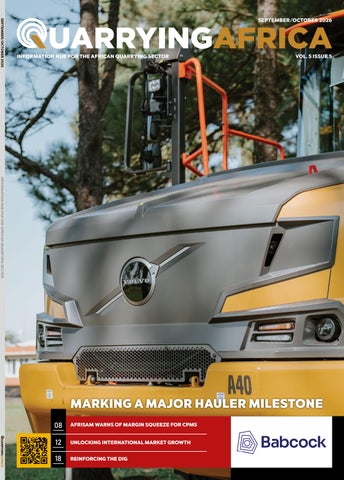
MARKING A MAJOR HAULER MILESTONE 08
AFRISAM WARNS OF MARGIN SQUEEZE FOR CPMS
12
UNLOCKING INTERNATIONAL MARKET GROWTH
18
REINFORCING THE DIG
COMMENT
FROM
IRON TO INTELLIGENCE
F
or generations, mining and
operators to remove people from some of the
quarrying have been industries
most hazardous working environments.
defined by iron, steel, noise and
problems before they become failures,
trucks, excavators, crushers and
potentially reducing downtime and extending
drills have been the unmistakable symbols of
equipment life. In quarrying, similar
an industry built around moving enormous
technologies are helping operators monitor
quantities of rock.
production, optimise processes and improve
But walk through a modern mining exhibition such as Electra Mining Africa, and another picture
the consistency of their operations. Perhaps the biggest change, however, is
emerges. Alongside the familiar machinery is
cultural. Digital transformation is not simply
a growing digital layer of sensors, automation,
about buying new technology. It requires
connectivity, data and artificial intelligence. The
companies to think differently about how they
question is no longer whether mining is becoming
collect, share and use information. Data only
digital, but how deeply digital technology is
becomes valuable when it reaches the right
changing the way the industry operates.
people and leads to better decisions. That
Electra Mining Africa 2026 offered a useful
means investment in connectivity, software and
snapshot of this transition. The machines
cybersecurity must be matched by investment
remain impressive, but increasingly they are
in skills and people.
becoming platforms for technology. Equipment
This is particularly important in mining and
can now generate vast amounts of information
quarrying, where experienced operators and
about performance, fuel consumption,
maintenance teams possess knowledge that
component condition, productivity and safety.
cannot simply be replaced by an algorithm.
That information can be collected, analysed
The future is more likely to be about
and used to make decisions that were once
combining that practical experience with
based largely on experience, observation and
better information. The person who knows
scheduled maintenance.
how a machine sounds when something
This does not mean that the age of iron
MUNESU SHOKO Publishing Editor Email: munesu@quarryingafrica.com
Digital monitoring can also help identify
sheer physical power. Giant haul
is wrong may still be essential; digital
is over. Far from it. Mining still depends on
technology can give that person another set
physical equipment capable of operating in
of tools to understand why it is happening.
some of the toughest environments on earth.
So, are we in the digital age of mining?
A digital system cannot move a tonne of rock
The evidence suggests that we are certainly
by itself. What is changing is the relationship
moving into it. Electra Mining showed an
LinkedIn:
between the machine and the information
industry where traditional engineering remains
surrounding it. The excavator, truck or crusher
at its heart, but where digital technology is
Munesu Shoko
is no longer simply a piece of equipment;
increasingly becoming the nervous system.
increasingly, it is a connected asset within a much larger operational system.
Quarrying Africa
The journey from iron to intelligence will not happen overnight, and it will not look the same
Automation is an important part of that
for every mine or quarry. But the direction is
change. From remotely operated machinery
clear. The machines that built the industry are
to increasingly autonomous vehicles and
still here. Increasingly, they are simply learning
drilling systems, technology is allowing
to talk to us.a
SEPT/OCT 2026 | Vol. 5 ISSUE 5 | www.quarryingafrica.com |
1
CONTENTS 08
22
AFRISAM WARNS OF MARGIN SQUEEZE FOR CPMS
CRUSHING A MAJOR MILESTONE
28
12 UNLOCKING INTERNATIONAL MARKET GROWTH
BUILDING QUARRYING MOMENTUM
32
18 REINFORCING THE DIG
2
FROM TREND TO BUSINESS OPPORTUNITY
| SEPT/OCT 2026 | Vol. 5 ISSUE 5 | www.quarryingafrica.com
04
LEAD STORY MARKING A MAJOR HAULER MILESTONE
Publishing Editor: Munesu Shoko Sub Editor: Glynnis Koch Design: Kudzo Mzire Maputire Web Manager: Thina Bhebhe
Quarrying Africa is the information hub for the sub-Saharan African quarrying sector. It is a valued reference tool positioned as a must-read for the broader spectrum of the aggregates value chain, from quarry operators and aggregate retailers, to concrete and cement producers, mining contractors, aggregate haulage companies and the supply chain at large.
© Quarrying Africa Quarrying Africa, published by DueNorth Media Africa,
36
makes constant effort to ensure that content is accurate before publication. The views expressed in the articles reflect the source(s) opinions and are not necessarily the views of the publisher and editor. The opinions, beliefs and viewpoints expressed by the various thought leaders and contributors do not necessarily reflect the opinions, beliefs and viewpoints of the Quarrying Africa team. Quarrying Africa prides itself on the educational content
THE MATH BEHIND CONVEYOR TRANSFER POINT POWER AND EFFICIENCY
published via www.quarryingafrica.com and in Quarrying Africa magazine in print. We believe knowledge is power, which is why we strive to cover topics that affect the quarrying value chain at large.
40 BRINGING NEW GRIP TO SA MINING
Printed by:
44
Contact Information Email: munesu@quarryingafrica.com Cell: +27 (0)73 052 4335
A PRACTICAL CHECKLIST FOR 100-300 TPH CRUSHING PLANTS
SEPT/OCT 2026 | Vol. 5 ISSUE 5 | www.quarryingafrica.com |
3
LEAD STORY
Babcock has delivered its 5 000th Volvo articulated hauler in southern Africa since taking on the dealership in 2000.
MARKING A
MAJOR HAULER MILESTONE
Babcock, the Volvo Construction Equipment (Volvo CE) dealer in southern Africa, has celebrated a significant milestone with the handover of its 5 000th Volvo articulated hauler to one of its key contract mining customers in South Africa. The occasion was made even more special as the customer marked its own milestone, simultaneously
I
taking delivery of its 350th Volvo articulated hauler. By Munesu Shoko. n a significant milestone, Babcock has delivered its 5 000th Volvo articulated
hauler in southern Africa since taking on the dealership in 2000. More than just a landmark figure,
the achievement highlights the proven performance of Volvo equipment in some of the region’s most demanding operating environments, along with Babcock’s 26 years of trusted customer relationships and dedicated support to keep machines productive throughout their working lives. “We greatly value our long-standing partnership with the customer who took delivery of the 5 000th machine, marking their own 350th Volvo articulated hauler. We remain committed to investing in the support, training and product solutions that
4
| SEPT/OCT 2026 | Vol. 5 ISSUE 5 | www.quarryingafrica.com
5 000
Babcock has celebrated a significant milestone with the handover of its 5 000th Volvo articulated hauler to one of its key contract mining customers in South Africa
350
The customer who took delivery of Babcock’s 5 000th Volvo hauler was also celebrating the milestone of acquiring their 350th Volvo articulated hauler
A40
Over the years, the A40 has established itself as one of the strongest sellers in the Volvo articulated hauler range in southern Africa
KEY TAKEAWAYS In a significant milestone, Babcock has delivered its 5 000th Volvo articulated hauler in southern Africa since taking on the dealership in 2000 The milestone highlights the pivotal role the Volvo articulated hauler range has played in Babcock’s success in southern Africa
help our customers stay competitive,” says Tim Ward, MD Equipment at Babcock. For Quintin O’Reilly, Head of Sales – Equipment at Babcock, the 5 000th machine, a new-generation Volvo A40, represents much more than just a number. “For Babcock and Volvo CE, this milestone reflects 26 years of partnership, customer trust and proven equipment performance in some of the region’s toughest working environments,” says O’Reilly. “Since taking on the Volvo dealership in 2000, we have seen the needs of the mining and construction sectors evolve, but our focus has remained the same – helping
With a 39-t payload, the A40 occupies a ‘sweet spot’ for mid- to large-scale opencast operations.
Beyond the haulers themselves, their sales have a wider impact on Babcock’s equipment business, driving demand for complementary loading and material-handling equipment Behind every machine is a dedicated support structure focused on understanding customer needs and delivering the aftersales support required to keep equipment productive
customers keep their machines productive, reliable and working for longer,” he adds.
Pivotal role The milestone, says O’Reilly, highlights the pivotal role the Volvo articulated hauler range has played in Babcock’s success in southern Africa. It also underlines the marketleading position of Volvo CE’s articulated haulers, a product line that traces its roots to the OEM’s pioneering role in inventing the articulated dump truck (ADT). Beyond the haulers themselves, their sales have a wider impact on Babcock’s equipment business, driving demand for complementary loading and material-handling equipment. O’Reilly explains that, on average, for every four articulated haulers sold, an excavator is also sold, with wheel loaders often forming part of the package to support material-handling duties on site.
Major sellers Over the years, says O’Reilly, the A40 has established itself as one of the strongest sellers in the Volvo articulated hauler range in southern Africa. With a
SEPT/OCT 2026 | Vol. 5 ISSUE 5 | www.quarryingafrica.com |
5
LEAD STORY
Volvo articulated haulers incorporate a range of integrated features designed to protect operators, ground personnel and the machines themselves.
39-tonne (t) payload, the A40 occupies a “sweet spot” for mid- to
Success drivers
large-scale opencast operations, offering a compelling balance
According to O’Reilly, the growth of the
between payload capacity, fuel efficiency and cost per tonne moved.
Volvo articulated hauler range in southern
Its strong track record for residual value further enhances its appeal,
Africa has been driven by more than just
making it a sound investment for customers.
the strength of the product. Behind every
The smaller A30, meanwhile, has also been a formidable seller in
machine is a dedicated support structure
southern Africa, with its versatility making it particularly well suited to the
focused on understanding customer
region’s quarries and smaller opencast mines.
needs and delivering the aftersales
Since its introduction in 2017, the Volvo A60 – the world’s largest
support required to keep equipment
6x6 articulated hauler – has steadily established its presence in
productive. “This is supported by tailored
the southern African market. Several major fleet operators have
service contracts, as well as market-
standardised their fleets around the model, attracted by its 55-t
leading parts availability and competitive
payload and the productivity gains that come with moving more
pricing,” says O’Reilly.
material per cycle.
For him, the combination of strong
By combining high payload capacity with relatively marginal increases
product performance and dependable
in fuel consumption and fewer operators required per tonne moved, the
customer support has been central to the
A60 offers compelling operating efficiencies for large-scale applications.
success of the Volvo articulated hauler
The latest addition to the range, the 45-t-payload A50, has also
range. The repeat business from major fleet
generated significant market interest since its southern African debut
operators is perhaps the clearest indication
in June 2025. As the only full-suspension machine in its size class, the
of that trust, with many customers
A50 has particularly impressed operators with its high levels of ride and
returning to Volvo as their fleets continue
operator comfort.
to grow.
At the heart of this performance is the A50’s full hydraulic suspension
Interestingly, O’Reilly notes that many of
system, which dynamically levels the machine to optimise stability,
today’s large Volvo hauler fleet operators
speed and operator comfort across challenging terrain. Unlike
started out with just one or two machines.
conventional haulers that use rigid bogie beams and rubber springs, the
“We have been privileged enough to grow
A50 employs fully active hydraulic cylinders paired with high- and low-
alongside some of our customers. Most
pressure accumulators to absorb ground forces and deliver a smoother
of them started with just one or two units,
ride.
and there was never an expectation that
“The full hydraulic suspension also isolates the cab from harsh bumps in mines or quarries, reducing physical strain on the operator.
we would see some of them running hauler fleets in their hundreds,” he says.
Better stability allows operators to travel faster and more safely without
6
For Babcock, these long-standing
excessive bouncing. A smoother ride keeps operators focused and
relationships are among the most
reduces fatigue during long shifts,” says O’Reilly.
rewarding outcomes of the past 26 years.
| SEPT/OCT 2026 | Vol. 5 ISSUE 5 | www.quarryingafrica.com
With the latest generation Volvo articulated hauler range, customers can enhance machine performance through solutions such as Haul Assist with On-Board Weighing.
“As a business, we appreciate the long-term relationships
at the forefront of this transition. At this year’s Volvo Days,
that have taken us to where we are today,” O’Reilly adds.
the company showcased the A40 Electric articulated hauler, now in serial production alongside the A30 Electric,
Evolving market
highlighting the OEM’s growing offering of electric
Like other segments of the heavy equipment market, the articulated hauler sector in southern Africa
haulers. Safety is also becoming increasingly non-negotiable,
continues to evolve. O’Reilly notes that customers are
particularly in the mining sector, which O’Reilly says is
increasingly adopting a more proactive approach to
moving towards proactive risk management and a more
decision-making, looking beyond machine performance
holistic “zero harm” culture rather than simply meeting
alone to improve uptime, productivity, operating costs
regulatory requirements. Volvo articulated haulers
and total cost of ownership.
incorporate a range of integrated features designed to
Volvo CE has responded to this shift by continuously developing its hauler range around smarter, more
protect operators, ground personnel and the machines themselves.
connected and productive solutions. Through a suite of
A case in point is the interface kit enabling any third-
digital systems, customers can gain greater visibility of
party PDS supplier to integrate a Level 9 system with Volvo
machine and site performance and use real-time data to
articulated haulers and wheel loaders. In addition, the
make more informed operational decisions.
Dump Support System uses an integrated angle sensor on
With the latest generation Volvo articulated hauler
the trailer unit to monitor side inclination and trigger an
range, for example, customers can enhance machine
alarm if the tilt angle becomes excessive before unloading,
performance through solutions such as Haul Assist with
helping to prevent tip-overs.
On-Board Weighing. Powered by Volvo Co-Pilot, the
Downhill Speed Control, combined with the Dynamic
system provides real-time payload information, helping
Volvo Engine Brake, automatically maintains a controlled
operators prevent overloading and minimise carryback.
speed when operating on downward gradients. Working
The result is improved productivity, while also reducing
alongside the all-wheel wet brakes, the system provides
unnecessary fuel consumption and machine wear.
stable and controlled descents without relying solely on
Digital and advisory tools such as Connected Map, Performance Indicator and Site Optimisation further
the retarder pedal. Looking ahead, O’Reilly believes the continued evolution
support more efficient traffic flow, vehicle utilisation and
of the Volvo articulated hauler range will be driven by
on-site logistics. Meanwhile, the CareTrack telematics
the same principles that have underpinned its growth to
system provides valuable machine data to help customers
date: responding to changing customer needs, improving
improve uptime, optimise maintenance and potentially
machine performance and investing in strong aftersales
reduce repair costs.
support. If those foundations remain in place, he believes
Electrification is another major trend shaping the future of the industry, and Volvo CE continues to position itself
the road to the next 5 000 machines is already being paved. a
SEPT/OCT 2026 | Vol. 5 ISSUE 5 | www.quarryingafrica.com |
7
CONCRETE PRODUCTION
AfriSam’s technical expertise is enabling concrete product manufacturers to optimise mix designs, minimise breakages and manage production risk.
AFRISAM WARNS OF
MARGIN SQUEEZE FOR CPMS Concrete product manufacturers (CPMs) in South Africa are facing a tightening margin squeeze, with rising input and transport costs set to place further pressure on already constrained operations. According to AfriSam, this environment is forcing manufacturers to re-evaluate how
W
they manage production efficiency, quality control and risk. hile the construction sector has shown early signs of recovery, many CPMs have yet to benefit from increased infrastructure spend. Instead, their exposure to smaller,
interest rate-sensitive projects leaves them vulnerable to market fluctuations. At the same time, higher fuel prices are driving up transport costs, further eroding profitability. “Our CPM customers generally operate on very thin margins and their position looks likely to get more difficult,” Mike McDonald, Manager of AfriSam’s Centre for Product Excellence (CPE), says. “This means there is less room for disruption, breakage or errors in their process – and a greater need for continuous monitoring and quality control.”
Reducing inefficiencies McDonald highlights that many manufacturers still rely
KEY TAKEAWAYS While the construction sector has shown early signs of recovery, many CPMs have yet to benefit from increased infrastructure spend Instead, their exposure to smaller, interest ratesensitive projects leaves them vulnerable to market fluctuations Many CPMs still rely on broad cost-per-unit metrics which often overlook hidden inefficiencies such as breakages and material wastage AfriSam is increasingly working with CPMs to quantify and reduce these inefficiencies, linking improved data tracking directly to mix design optimisation
on broad cost-per-unit metrics which often overlook
8
| SEPT/OCT 2026 | Vol. 5 ISSUE 5 | www.quarryingafrica.com
hidden inefficiencies such as breakages and material
assessed for compatibility and performance,” she
wastage. These factors not only impact productivity but
explains. “Substituting materials to reduce costs can
can also introduce significant commercial risk if product
introduce significant variability if not properly evaluated.” AfriSam’s technical support extends beyond
failures occur after installation. AfriSam is increasingly working with CPMs to
material selection to include production practices such as curing regimes,
quantify and reduce these inefficiencies,
temperature control and
linking improved data tracking directly
batching accuracy. In some
to mix design optimisation. By refining material combinations and
cases, this involves rethinking
production processes, manufacturers
traditional approaches
can reduce breakages and build
including reducing reliance on energy-intensive steam
more consistent cost-effective operations.
In this challenging environment, CPMs need trusted partners to help them optimise processes and manage complexity. Those who can do this effectively will be best positioned to remain competitive.
Another layer of risk According to Adele Wentzel, Sales Manager Cement Manufacturing Gauteng at AfriSam, the complexity of concrete inputs adds another layer of risk – particularly when cost pressures push manufacturers to consider alternative materials.
curing through more advanced cement systems and admixture strategies.
Tracking variables The company also emphasises the importance of real-time monitoring, using tools to track variables such as temperature
and humidity, which can fluctuate
“From cement, sand and aggregates to fly ash, slag and admixtures, every component must be carefully
significantly and impact product quality. “Even small inconsistencies, like poor curing room
astecindustries.com +27 11 820 7600
SEPT/OCT 2026 | Vol. 5 ISSUE 5 | www.quarryingafrica.com |
9
CONCRETE PRODUCTION
For concrete product manufacturers operating on narrow margins, improved process discipline can make the difference between loss and long-term sustainability.
control, can have serious consequences for strength development and production timelines,” McDonald notes. As cost pressures intensify, AfriSam believes that closer technical collaboration between suppliers and manufacturers will be critical. In a market where differentiation is increasingly difficult, the ability to balance cost, quality and risk could determine long-term sustainability. “In this challenging environment, CPMs need trusted partners to help them optimise processes and manage complexity,” McDonald concludes. “Those who can do this effectively will be best positioned to remain competitive.” a
10
| SEPT/OCT 2026 | Vol. 5 ISSUE 5 | www.quarryingafrica.com
PRECISION IN EVERY BLAST. PREDICTABLE OUTCOMES. BME’s AXXIS® range – Silver, Titanium, and CEBS – delivers world-class electronic initiation trusted by mines across five continents. Built for precision, safety, and sustainability, AXXIS® empowers engineers and blasters to achieve consistent, high-performance blasts – even in the most demanding conditions. • AXXIS® Silver – Proven reliability for quarries and mid-sized mines. • AXXIS® Titanium – Advanced control with best-in-class safety and data capabilities. • AXXIS® CEBS – Centralised blasting with unmatched scale and efficiency. With AXXIS®, you don’t just initiate blasts – you initiate progress.
AXXIS® Silver
AXXIS® Titanium
AXXIS® CEBS
Delivering Sustainable Future-Fit Solutions SEPT/OCT 2026 | Vol. 5 ISSUE 5 | www.quarryingafrica.com |
Discover the full range at www.bme.co.za
11
EXECUTIVE INTERVIEW Hanna Ihnatovich, Head of Sales Region International at Volvo Construction Equipment.
UNLOCKING
INTERNATIONAL
MARKET GROWTH
Having taken the reins as Head of Sales Region International at Volvo Construction Equipment (Volvo CE) in May this year, Hanna Ihnatovich’s immediate priority is clear: strengthen the company’s position as the ‘customer’s first choice’ while helping customers succeed in an increasingly competitive and rapidly changing industry. By Munesu Shoko.
12
| SEPT/OCT 2026 | Vol. 5 ISSUE 5 | www.quarryingafrica.com
2013
Having joined Volvo CE in 2013 as an apprentice, Hanna Ihnatovich has steadily risen through the ranks, taking on a range of commercial roles across Sales Region Europe and Sales Region International
17
Volvo CE works with several established independent dealers across the continent. SMT Africa is one of its largest partners, covering 17 markets, particularly across West and Central Africa
At the heart of the business in Region International remains Volvo CE’s General Purpose machine portfolio, particularly articulated dump trucks, excavators and wheel loaders.
H
aving joined Volvo CE in 2013 as an apprentice, Ihnatovich has steadily risen through the ranks, taking on a range of commercial roles across Sales Region Europe and Sales Region International.
Her experience spans volume planning, pricing strategies and business control, most recently serving as Head of Finance, Sales Region International. After serving as Acting Head of Sales Region International since January 2026, she took on the role permanently on May 1. She brings strong commercial expertise and a deep understanding of Volvo CE’s international markets, putting her in a strong position to drive profitable growth and strengthen the company’s long-term competitiveness. Her new remit covers a remarkably diverse geographical footprint, stretching across Africa, the Middle East, Turkey, Eastern Europe, including Ukraine, the CIS markets of Kazakhstan, Uzbekistan and Georgia, as well as Oceania, including Australia and New Zealand, which are supported
KEY POINTS After serving as Acting Head of Sales Region International since January 2026, Hanna Ihnatovich took on the role permanently on May 1 On the high level, Ihnatovich’s key objective in the region is to be the customer’s first choice, with customer success as a priority Within this diverse region, Africa remains particularly important to Volvo CE, contributing significantly to both the topline and bottom-line of the business One of the trends Ihnatovich is seeing across Africa is a shift towards rental. Customers are increasingly looking at alternative ways of accessing equipment
At the heart of the business in Region International
by a dedicated Volvo CE team based in Brisbane. Further
remains Volvo CE’s General Purpose (GP) machine
afield, Cuba is also part of the region.
portfolio, particularly articulated dump trucks, excavators and wheel loaders. The major application sectors are
Key priorities
construction, heavy infrastructure, mining and quarrying.
On the high level, Ihnatovich’s key objective in the
According to Ihnatovich, the diversity of the region is
region is to be the customer’s first choice, with customer
one of its defining characteristics – and one of its biggest
success as a priority. She also aims to maintain a
challenges. There is no one-size-fits-all approach across
high level of profitability, while contributing to the
Region International, with customer requirements varying
transformation of the industry.
significantly from one market to another. Against this
SEPT/OCT 2026 | Vol. 5 ISSUE 5 | www.quarryingafrica.com |
13
EXECUTIVE INTERVIEW
An emerging trend is the growing demand for connected fleets and data-driven operations.
backdrop, Volvo CE places strong emphasis on bringing
partners supporting Volvo CE operations in Africa include
the right products and specifications to each market to
Ghabbour in Egypt and Nose in Angola.
ensure they meet local customer needs and expectations.
For Ihnatovich, the strength of this local network is a
The focus extends beyond the machine itself. Service,
critical competitive advantage. “Proximity to the customer
aftermarket support and the overall customer solution
– including parts supply, service and technicians – is
are becoming increasingly important, particularly as
crucial for us to compete in such a cutthroat trading
customers demand greater reliability, productivity and
environment,” she says.
value throughout the equipment lifecycle.
despite challenges affecting sectors such as smelting and
development of Volvo CE’s retail network. The company
coal mining. The country’s equipment demand is driven
operates across Region International through independent
largely by articulated dump trucks, excavators and wheel
partners, making dealer development a strategic priority.
loaders. Elsewhere on the continent, market performance
“We operate only through independent partners and for us it is important to drive the common ambition to
is often closely linked to project activity.
the market, so dealer development is a core for us – retail
Key trends
excellence as we call it,” says Ihnatovich.
One of the trends Ihnatovich is seeing across Africa is a
Africa: opportunity amid rising competition
shift towards rental. Customers are increasingly looking at alternative ways of accessing equipment. This creates
Within this diverse region, Africa remains particularly
both a challenge and an opportunity for Volvo CE and
important to Volvo CE, contributing significantly to
its dealer partners.
both the topline and bottom-line of the business. The
Another emerging trend is the growing demand for
continent, however, presents a complex operating
connected fleets and data-driven operations. While digital
environment. While the market continues to offer
adoption remains at an early stage, there are already
strong growth potential, competition is intensifying,
examples demonstrating the potential.
particularly as Chinese equipment manufacturers
In Africa, Volvo CE has its largest connected-fleet
aggressively expand beyond their domestic market.
site, with 96 machines linked to performance indicators
“We see a lot of opportunity in Africa,” says Ihnatovich.
through Connected Map. The mining operation represents
“The market continues to grow, but competition is getting
the company’s largest single connected fleet to date and
tougher as well. Mining, quarrying and infrastructure
demonstrates that there is an appetite for technology
development remain key drivers of demand, while
when the value proposition is clear.
customers are increasingly placing emphasis on machine reliability, durability and aftermarket support.” Volvo CE works with several established independent
Ihnatovich believes the next step is to help customers better understand that value. “There is an appetite for digital technologies from selected
dealers across the continent. SMT Africa is one of its
customers,” she says. “It is extremely important to
largest partners, covering 17 markets, particularly across
visualise the value to the customer. Not all customers
West and Central Africa, while Babcock takes care
understand the value yet.”
of eight countries in southern Africa. Other notable
14
South Africa remains a particularly important market,
A key component of this strategy is the continued
The same principle applies to new solutions such as
| SEPT/OCT 2026 | Vol. 5 ISSUE 5 | www.quarryingafrica.com
Building a stronger, more sustainable South Africa, together Afrimat is the foundation of South Africa's construction industry, from its cities to its rural towns. We supply the crucial aggregates that build our roads, buildings, and infrastructure, and we're proud to be constructing a stronger future, together. Afrimat is a leading mid-tier mining & materials company, unlocking and enhancing the earth's mineral potential to build a better world.
www.afrimat.co.za | 021 917 8840 Afrimat Limited Communications Department
EXECUTIVE INTERVIEW
Volvo CE has already introduced its L120 Electric wheel loader in some Region International markets such as New Zealand.
Equipment as a Service (EaaS), Volvo CE’s usage-based
Positive outlook
model, which allows customers to pay a fixed hourly
Looking ahead, Ihnatovich remains positive about the
rate to use machines rather than purchasing or leasing
prospects for Region International. Africa continues to
them. Volvo CE plans to introduce the offering in selected
offer significant long-term potential despite intensifying
African markets, with South Africa expected to be one of
competition, while Turkey remains a large and stable
the first. Discussions are already underway with selected
market, supported by ongoing infrastructure projects.
customers.
The Gulf also continues to present strong opportunities,
For Ihnatovich, rental and EaaS could also provide an important route into new technologies. By reducing the need for customers to make a significant upfront
geopolitical tensions. Ukraine, meanwhile, represents a substantial future
investment, the model could help accelerate the adoption
opportunity given the scale of rebuilding that will be
of unfamiliar technologies, including electric equipment.
required. Oceania is also showing signs of a positive
Gaining momentum While sustainability adoption in Africa remains relatively
recovery, supported by mining and infrastructure activity, although competition remains intense. Across all these markets, Ihnatovich believes that
limited, Ihnatovich points to Oceania – particularly
relevance will be key. “The strategy is to continue to invest
New Zealand – as a market where the sustainability
and bring the right products and services to the market,”
agenda is gaining significant traction. Interestingly,
she says.
this is happening even in the absence of government
That strategy will require more than simply supplying
subsidies, with private companies increasingly leading
machines. Volvo CE is placing increasing emphasis
the charge towards electrification.
on sales competence, value-based selling and dealer
Volvo CE has already introduced its L120 Electric wheel
development, with product specialists travelling into
loader in New Zealand and is now bringing the EC230
markets to strengthen local sales teams’ product
Electric excavator to the market. Customers in applications
knowledge and ability to communicate the value of the
such as waste management and quarrying are among
equipment.
those showing early interest. Electric haulers are also moving closer to the Region
Financing also remains an important part of Volvo CE’s offering, particularly in markets such as South Africa,
International market. The A30 and A40 Electric articulated
where Volvo Financial Services (VFS) already plays a major
haulers are currently being piloted in Europe, with Volvo
role. The company is also complementing this with its own
CE continuing to gather operational data before rolling
financing solutions and a regional trade finance team.
them out in selected international markets. The transition to electric equipment, however, requires
16
with major projects in the pipeline despite the current
For Region International, the road ahead is therefore one of growth, but also adaptation. From increasingly
customers to look beyond the initial purchase price.
sophisticated, connected fleets and new service models
“The technology will need a different mindset,” says
to electrification and evolving customer expectations,
Ihnatovich. “It is not about the initial price, but more
Volvo CE is positioning itself to compete not only on the
about the total cost of ownership over the lifecycle of the
strength of its machines, but on the wider value it can
machine.”
deliver throughout the customer’s equipment lifecycle. a
| SEPT/OCT 2026 | Vol. 5 ISSUE 5 | www.quarryingafrica.com
EXCAVATORS
REINFORCING
THE DIG
Liebherr-Africa has brought to market its R 992 excavator, replacing
6,8 m³
the previous R 976. The updated model name now reflects the machine’s
With an operating weight ranging from 85,8-t to 96,5t, the R 992 is available with bucket sizes from 2 m³ to 6,8 m³
92-tonne (t) operating weight, while a host of enhancements deliver greater performance, improved fuel efficiency, reinforced construction and increased component reliability. The assistance systems further boost productivity, while enhancing operator comfort and ease of use.
L
By Munesu Shoko.
2 000
Having already accumulated around 2 000 trouble-free operating hours, the first two R 992 machines in southern Africa are making light work of the highly abrasive chrome ore
10%
Through Liebherr Power Efficiency (LPE) – a patented engine and hydraulic control system that optimises powertrain interaction – customers can achieve up to a 10% reduction in fuel consumption
iebherr-Africa has
its 70-100-t crawler excavators, with the
strengthened its excavator
nomenclature aligning with the operating
portfolio with the introduction
weight of the machines.
of the R 992, a nextgeneration 92-t crawler
excavator designed to meet the evolving
with bucket sizes from 2 m³ to 6,8 m³.
demands of the mining and quarrying
Powering the machine is a 420 kW
sectors. Replacing the R 976, the R 992
Liebherr engine, representing a 20 kW
is engineered to reduce operating costs,
increase over the 400 kW unit fitted to
maximise uptime and deliver greater
its predecessor, the R 976, providing the
productivity in demanding applications.
additional power needed to enhance
The R 992 is part of Liebherr’s new-
productivity in demanding mining and
generation crawler excavator range, first unveiled at Bauma 2022, the world’s leading
quarrying applications.
trade fair for construction and mining
Proven capabilities
equipment. The line-up comprises the 72-t
According to Tendayi Kudumba, General
R 972, 80-t R 978 SME, 92-t R 992 and 100-t
Manager: Earthmoving at Liebherr-Africa,
R 998 SME, which replace the R 966, R 970
this offering underscores the company’s
SME, R 976 and R 980 SME respectively.
commitment to providing high-
As part of the update, Liebherr introduced a new naming convention for
18
With an operating weight ranging from 85,8-t to 96,5-t, the R 992 is available
| SEPT/OCT 2026 | Vol. 5 ISSUE 5 | www.quarryingafrica.com
performance equipment tailored to the needs of customers across the region. He
says the R 992 is ideally suited to contract mining and high-production quarrying operations, where reliability, efficiency and productivity are paramount. The machine has already proven its capabilities in the field. The first two R 992 excavators in southern Africa The R 992 is ideally suited to contract mining and highproduction quarrying operations, where reliability, efficiency and productivity are paramount.
were delivered in March this year to a South African contract mining company operating in the chrome sector, says Lavell Ruthman, Head of Sales: Earthmoving at Liebherr-Africa. Having already accumulated around 2 000 troublefree operating hours, the machines are making light work of the highly abrasive chrome ore, providing an early indication of the R 992’s performance and reliability in one of the most demanding mining environments.
Fuel efficiency Fuel efficiency was a key design priority for the R 992. This is particularly important for mining and quarrying operations, where fuel accounts for a significant share of operating costs. With fuel prices continuing to rise, the machine’s improved efficiency helps customers reduce running costs while maintaining high levels of productivity. Through Liebherr Power Efficiency (LPE) – a patented engine and hydraulic control system that optimises powertrain interaction – customers can achieve up to a 10% reduction in fuel consumption on the R 992 compared with previous models. Kudumba explains that the LPE mode reduces fuel usage by intelligently coordinating the diesel engine, hydraulic system and electronic sensors to automatically adjust engine speed and pump displacement according to real-time operating demands. This optimisation minimises throttling losses and
KEY POINTS
ensures the engine operates within its most efficient
Liebherr-Africa has strengthened its excavator portfolio with the introduction of the new R 992, a crawler excavator designed to meet the evolving demands of opencast mining and quarrying sectors
performance range, or ‘sweet spot’, delivering improved fuel economy without compromising productivity.
New assistance system Another key highlight of the R 992 is Liebherr’s new Bucket Fill Assist system, an optional assistance feature
The machine has already proven its capabilities in the field. The first two R 992 excavators in southern Africa were delivered in March this year to a South African contract mining company operating in the chrome sector
that automates parts of the excavation cycle through semi-automatic bucket filling and an anti-stalling function. “The Bucket Fill Assist is the first automation product in Liebherr’s hydraulic excavator portfolio. This optional feature enables easier bucket filling and delivers a more
One of the key highlights of the R 992 is Liebherr’s new Bucket Fill Assist system, an optional assistance feature that automates parts of the excavation cycle through semi-automatic bucket filling and an antistalling function
consistent bucket fill factor, particularly in blocky or hard digging conditions. As a result, overall productivity improves while operator fatigue is reduced,” explains Kudumba. The system incorporates two main innovations: the anti-stalling function and the semi-automatic bucket
Designed for harsh mining and quarrying environments, the R 992 incorporates several structural reinforcements to enhance durability and maximise uptime
filling function. The anti-stalling function prevents the bucket from becoming jammed during the breakout phase. Once activated, the operator continues operating the machine as normal, with the system automatically optimising excavator responses when it detects that the
SEPT/OCT 2026 | Vol. 5 ISSUE 5 | www.quarryingafrica.com |
19
EXCAVATORS
Designed for harsh mining and quarrying environments, the R 992 incorporates several structural reinforcements to enhance durability and maximise uptime.
bucket is beginning to stall against the digging face. The semi-automatic bucket filling function provides an
The optional Bucket Fill Assist feature enables easier bucket filling and delivers a more consistent bucket fill factor.
Operator comfort The R 992 also introduces several cab enhancements aimed
automated filling cycle to accelerate loading operations. Using
at improving operator comfort and productivity. According to
only the left joystick, the operator can initiate the bucket-filling
Kudumba, a comfortable working environment is essential for
process, while the machine automatically controls bucket and
reducing fatigue, maintaining concentration and ensuring safe,
boom movements until the operator resumes normal manual
productive operation throughout long shifts.
operation.
“The R 992 builds on the cab design introduced with our
According to Ruthman, the Bucket Fill Assist system delivers
Generation 8 excavators,” he says. “The main display has been
several important benefits, including increased bucket service
enlarged from 7-inch to 9-inch, while new joysticks and foot
life through reduced wear and improved material penetration.
pedals provide more precise machine control and an improved
“The system enables higher bucket fill levels, reduces cycle times
operating experience.”
by up to 10% and helps lower fuel consumption. It also reduces vibrations, contributing to improved operator comfort,” he says.
Reinforced for demanding applications Designed for harsh mining and quarrying environments,
New operating modes
the R 992 incorporates several structural reinforcements to
The R 992 comes standard with Liebherr’s Modetronic
enhance durability and maximise uptime. These include a
function, a proven feature across the company’s Generation 8
heavy-duty (HD) undercarriage, cast steel-reinforced welded
excavator range. This hydraulic control system allows operators
structures and robust protective plates beneath the boom
to customise machine performance according to specific
and stick.
applications and individual operating preferences. It optimises
“The heavy-duty protective plates fitted to the underside of
key functions, including rotation and travel, as well as boom,
both the boom and stick protect the machine against falling
stick and bucket movements.
rocks and the rigours of block handling,” explains Ruthman.
The Modetronic system offers four selectable working modes: Fine, Efficient, Dynamic and Custom. In Dynamic mode,
“Piston rod guards also shield the hydraulic cylinder rods from flying debris, dust and direct mechanical damage.”
operators can achieve more responsive machine behaviour, while
To further improve structural integrity, the upper and lower
Efficient mode enhances machine balance and stability. Custom
frames are strategically reinforced with cast steel components
mode enables easier execution of precision tasks by allowing
that absorb high-stress impact loads. An optional continuous
performance parameters to be tailored to specific requirements,
track guide system helps maintain track alignment and integrity
while Fine mode allows operators to adjust machine movements
during intensive side-loading and operation on uneven terrain,
via the display, to suit their personal preferences.
further enhancing reliability in demanding applications. a
20
| SEPT/OCT 2026 | Vol. 5 ISSUE 5 | www.quarryingafrica.com
Heavy duty. Pure performance. R 992 crawler excavator Built for the toughest quarry operations, the R 992 delivers unmatched power, efficiency and reliability where it matters most. Designed to maximise productivity while reducing fuel consumption, it combines outstanding digging performance with superior operator comfort and advanced assistance systems. www.liebherr.com
Crawler excavators
Liebherr-Africa (Pty.) Limited Vlakfontein Road, Springs, 1560 Phone: +27 11 365 2000 E-mail: info.laf@liebherr.com www.facebook.com/LiebherrConstruction www.liebherr.com
ELECTRA MINING REVIEW – CRUSHING AND WEAR PARTS
Electra Mining Africa 2026 offered the perfect opportunity for Caldas Engineering to celebrate its 30-year milestone.
CRUSHING
A MAJOR MILESTONE
Electra Mining Africa 2026 provided an ideal platform for Caldas Engineering to celebrate its 30-year milestone alongside customers and stakeholders from across the mining industry. The company also took the opportunity to showcase the continued growth of its in-house crushing range, featuring multi-stage crushing solutions that attracted strong interest from visitors and resulted in sales being
F
concluded during the exhibition. By Munesu Shoko. or Caldas Engineering, Electra Mining
have shaped its journey and demonstrate how its
Africa 2026 was about more than
offering has evolved to meet changing customer
showcasing equipment. It provided a
requirements.
fitting platform for the proudly South African company to celebrate its 30-
year anniversary, reflect on the milestones that
22
Held from 7-11 September at the Johannesburg Expo Centre, the 2026 edition of Electra Mining Africa brought together more than 1 000 exhibitors
| SEPT/OCT 2026 | Vol. 5 ISSUE 5 | www.quarryingafrica.com
2002
In 2002, Caldas reached an important milestone with the purchase of its first warehouse
R128
From its first month’s turnover of R128, Caldas Engineering has grown into a multi-million-rand business, while retaining its relationship-driven approach
Caldas Engineering's outdoor display in the Orange Zone at Electra Mining.
KEY TAKEAWAYS
across mining, manufacturing and related industries, with the exhibition area expanding to a record
Electra Mining Africa 2026 provided an ideal platform for Caldas Engineering to celebrate its 30-year milestone alongside customers and stakeholders from across the mining industry
44 000 m². For Caldas Engineering, the timing was particularly significant. Founded in 1996 by Rui Caldas, the company has grown from a small business supplying crusher wear parts into an established supplier of wear
At the 2026 exhibition, Caldas presented its multistage crushing capabilities for the first time in a particularly comprehensive way, displaying jaw, cone and impact crushers together The focus was on the 150 tph segment – a market the company sees as an important growth opportunity within its broader multi-stage crushing offering The development of the equipment range reflects a broader philosophy that has been present throughout Caldas Engineering’s 30-year history: identifying gaps in the market and developing solutions around what customers actually need
solutions, spares and, increasingly, its own crushing and comminution equipment. “Our 30 th anniversary made this Electra Mining particularly special for us,” says Rui Caldas, Founder and CEO of Caldas Engineering. “It gave us the opportunity to celebrate with our customers and industry partners, but also to show them where the business is going.”
The foundation The Caldas story began in 1996 with a relatively simple objective: to supply reliable crusher wear parts while
SEPT/OCT 2026 | Vol. 5 ISSUE 5 | www.quarryingafrica.com |
23
ELECTRA MINING REVIEW – CRUSHING AND WEAR PARTS Caldas Engineering also had an indoor exhibit in Hall 5.
But for Rui Caldas, growth is not measured purely in terms of buildings, equipment or turnover. The company’s people remain central to the story. An important milestone over the past decade has been the introduction of a younger generation into the business. Michael Da Camara has taken on the role of chief operating officer (COO), while the company has invested in developing its technical, sales, warehouse and assembly teams. Rui sees this transition as an important part of ensuring the company’s longevity beyond its first 30 years. “We have created new energy in the business,” he says. “With new people and new ideas, we have created new ranges.”
Building on the core The company’s growth has not meant abandoning the foundation on which it was built. Crusher wear parts remain central to the Caldas offering. Over the years, however, customers’ requirements have broadened. Rather than simply supplying replacement components, customers increasingly wanted support with wider crushing and processing requirements. This created an opportunity for Caldas to expand into equipment. The company’s own equipment range was introduced around 2021, marking another significant milestone in its evolution. The strategy was deliberately providing the responsive service that operators needed. Initially,
focused: rather than attempting to
the business was largely export-focused, connecting South African
compete across the entire equipment
products with customers and partners in international markets. As the
spectrum, Caldas identified an
company established itself, however, local customers began looking
opportunity in the value-focused
for the same combination of product reliability, technical support and
market for equipment that combined
responsiveness.
appropriate quality with an accessible
That demand became an important driver of Caldas’ growth across southern Africa and, ultimately, throughout the wider African market.
price point.
The company’s development was gradual but consistent. What
Showcasing the next phase
started around a dining-room table progressed to a small office, then
Electra Mining Africa provided the
a converted garage and subsequently a rented warehouse. In 2002,
ideal environment to demonstrate
Caldas reached an important milestone with the purchase of its first
this evolution. At the 2026 exhibition,
warehouse.
Caldas presented its multi-stage
The purchase of its first warehouse in 2002 was followed by
crushing capabilities for the first
investment in new premises in 2015. More recently, Caldas acquired
time in a particularly comprehensive
the premises next door to its existing facility to accommodate further
way, displaying jaw, cone and impact
growth. Today, the company has more than 3 000 m² under roof with
crushers together. The focus was on
crane facilities, together with approximately 1 000 m² of yard space.
the 150 tonnes per hour (tph) segment
The additional capacity reflects the company’s broader product
– a market the company sees as an
portfolio and the need to maintain the stock, assembly and support
important growth opportunity within its
capabilities required by a growing customer base. From its first
broader multi-stage crushing offering.
month’s turnover of R128, the company has grown into a multi-
“The objective is not simply to sell
million-rand business, while retaining what Caldas describes as “a
individual machines, but to demonstrate
relationship-driven approach”.
24
| SEPT/OCT 2026 | Vol. 5 ISSUE 5 | www.quarryingafrica.com
Caldas Engineering highlighted its multi-stage comminution solutions.
a tangible demonstration of the market’s interest in
how the different crusher types can work together
the company’s expanding equipment range.
as part of a multi-stage solution. The message is
For Caldas, the significance of the sale
clear: Caldas is moving beyond supplying
extended beyond the transaction
individual machines and increasingly
itself.
providing complete crushing solutions, supported by our wear
“This is a product that is very
1996
parts, spares and technical capability,” explains Michael Da Camara, COO of Caldas
dear to us,” says Da Camara. “It was one of the first machines we designed and we put a lot of effort into it. It is good to
Engineering.
see the market recognising
The equipment range is also being developed around the practical requirements of mines, quarries and aggregates operations where simplicity,
The Caldas story began in 1996 with a relatively simple objective: to supply reliable crusher wear parts while providing the responsive service that operators needed
availability, support and cost
the value of the impactor and how versatile it can be across different mines and quarries.”
Finding the gaps
remain important considerations.
The development of the equipment
A deal-driven exhibition
range reflects a broader philosophy
The response at Electra Mining highlighted the commercial potential of this strategy. Among
that has been present throughout Caldas Engineering’s 30-year history: identifying gaps
the equipment on display was the CQ1007 impactor,
in the market and developing solutions around what
a Caldas-designed and locally assembled impact
customers actually need.
crusher developed specifically for African mining and
According to Rui Caldas, customer requirements
quarrying operations. The unit features a heavy-duty
have changed considerably over the past decade.
rotor co-designed by Rui Caldas.
There is increasing demand for more economical
During the exhibition, Caldas concluded a sale for
equipment, readily available support and machines
an impactor destined for a chrome mine – providing
that are relatively simple to operate and maintain.
SEPT/OCT 2026 | Vol. 5 ISSUE 5 | www.quarryingafrica.com |
25
ELECTRA MINING REVIEW – CRUSHING AND WEAR PARTS These requirements are particularly relevant in parts of Africa where
combine equipment supply with practical
skills shortages, remote mine locations and logistical challenges can
technical knowledge and aftermarket
make equipment maintenance more difficult.
support. Our experience in wear parts and
“Customers are increasingly looking for greater self-sufficiency,
spares gives us a foundation from which
while also requiring access to reliable technical support. We believe
to approach equipment development with
these market conditions create opportunities for companies that can
an understanding of what happens after a machine is commissioned,” says Caldas.
Beyond 30 years While Electra Mining 2026 provided an opportunity to look back, the emphasis at the Caldas stand was equally focused on the future. The company has grown from its original wear-parts business into a broader crushing solutions provider, but its leadership believes that continued success will depend on maintaining the principles that have underpinned the business since 1996. That means remaining close to customers, understanding their changing requirements and developing products around genuine market opportunities. It also means managing growth responsibly. The rapid expansion of the equipment range has created opportunities, but Da Camara is conscious that every new machine placed in the market comes with WATCH: Quarrying Africa speaks to Rui Caldas and Anabela Caldas at Electra Mining about Caldas Engineering’s journey over the past 30 years.
an obligation to provide the required technical and aftermarket support. “We want to manage the growth to ensure that we can support whatever we put out into the market,” says Da Camara. “That approach reflects the company’s broader philosophy: equipment is only part of the solution. Our 30 years of experience in crusher wear parts, spares and aftermarket support is a key differentiator in the way we approach equipment supply. We are, first and foremost, a wear parts and spares company that can provide full support for our range of equipment.” For three decades, Caldas Engineering has built its reputation around the relationship between product, service and support. The move into multi-stage crushing does not represent a departure from that philosophy; rather, it extends it into a broader range of customer requirements. At Electra Mining Africa 2026, that evolution was on full display – from the company’s 30-year history in crusher wear parts and spares to its growing portfolio of South African-designed
WATCH: Caldas Engineering had a strong presence at this year’s Electra Mining Africa, showcasing the continued growth of its multi-stage comminution offering. COO Michael Da Camara shares the thinking behind this expanded offering and what it means for customers.
26
crushing equipment. For Caldas, the anniversary was therefore not simply a celebration of where the company has been. It was a statement of where it intends to go next. a
| SEPT/OCT 2026 | Vol. 5 ISSUE 5 | www.quarryingafrica.com
ELECTRA MINING REVIEW – DRILLING Sales of the mid-range JD-1300E have gained momentum this year.
BUILDING
QUARRYING MOMENTUM
Amid improving market conditions in the construction materials sector, supported by signs of a recovery in South Africa’s construction market, JMH Equipment is reporting increased uptake of its SOOSAN Cebotics range of hydraulic crawler drills. While the larger JD-1400E remains the preferred model in the mining sector, MD Maurits Holtzhausen tells Quarrying Africa that the mid-range JD-1300E is gaining momentum in the quarrying market. By Munesu Shoko.
S
ince its launch in 2014, the JD-1400E – the
increased interest in this model, with units recently
largest hydraulic crawler rig in the three-
supplied to some of the prominent companies in the
model SOOSAN Cebotics range supplied
quarrying sector,” he says.
locally by JMH Equipment – has established itself as the top seller, outperforming the
According to Holtzhausen, the growing sales of the
Holtzhausen, the JD-1400E accounts for about 80% of
JD-1300E are in line with signs of improvement in South
JMH Equipment’s sales.
Africa’s aggregates sector. The industry is showing
However, sales of the JD-1300E have gained momentum this year, with three new units recently delivered to customers. “Traditionally, we have always
28
Market drivers
smaller JD-800E and JD-1300E models. In fact, says
signs of stabilisation, supported in part by public infrastructure repair and road rehabilitation. The latest Afrimat Construction Index (ACI), covering
kept one or two units of the JD-1300E because sales
the second quarter of 2026, provides further evidence
were generally slow. However, we have started seeing
of improving activity. The index increased by 5% quarter
| SEPT/OCT 2026 | Vol. 5 ISSUE 5 | www.quarryingafrica.com
3
JMH has started seeing increased interest in the JD-1300E, with three units recently supplied to some of the prominent companies in the quarrying sector
76-115 mm
With a 76-115 mm hole range, the JD-1300E is particularly well suited to quarrying industry applications
The JD-1300E continues to prove its mettle in quarrying.
on quarter, while the volume of building materials
automatically adjusts engine output to match active
produced rose by 8,5%. Real sales of building materials
flushing and drilling operations, helping to reduce fuel
also increased by 7% compared with the first quarter.
consumption during lighter loads. The machine also
Although activity levels remain subdued, the latest
uses an on/off switch for the compressor, minimising
figures point to improving conditions across several key
unnecessary fuel consumption during idle or non-
construction indicators.
drilling periods.
With a 76-115 mm hole range, the JD-1300E is
The machine features a simplified mechanical design,
particularly well suited to quarrying applications. In
powered by a high-output Cummins diesel engine
small- to medium-sized aggregate quarries, maintaining
and paired with efficient piston pumps to reduce
manageable burden and spacing is essential. Hole diameters in the 76-115 mm range can provide a balance between effective rock fragmentation and the generation of excessive oversize material or fines. Quarrying operations typically require a step up from light construction drilling, but do not necessarily require the large drilling diameters associated with major opencast mining operations. The mid-range JD-1300E therefore occupies an important position between these applications, offering a practical solution for standard aggregate operations. “The JD-1300E continues to prove its mettle in quarrying. Customers are particularly happy with the price of the machine. Compared with high-end, heavily computerised counterparts, the SOOSAN Cebotics range is priced more competitively, lowering upfront acquisition costs,” says Holtzhausen.
Meeting customer expectations Fuel efficiency is another area in which customers are expressing satisfaction. The Auto Throttle Mechanism
KEY TAKEAWAYS Since its launch in 2014, the larger JD-1400E has established itself as the top seller for JMH Equipment However, sales of the JD-1300E have gained momentum this year, with three new units recently delivered to customers The growing sales of the JD-1300E are in line with signs of improvement in South Africa’s aggregates sector The growth of the SOOSAN Cebotics range also reflects a continued demand for simple, straightforward production machines in the quarrying sector
SEPT/OCT 2026 | Vol. 5 ISSUE 5 | www.quarryingafrica.com |
29
ELECTRA MINING REVIEW – DRILLING
The growing sales of the JD-1300E are in line with signs of improvement in South Africa’s aggregates sector.
power losses. Actual hourly fuel consumption, however,
The SOOSAN Cebotics range is built around a
depends on a range of operating factors, including load
simple, straightforward and durable design, aimed at
conditions, rock hardness and duty cycles.
reducing the risk of failures in demanding operating environments. This ‘simplicity approach’ also makes the
Another advantage is the commonality of components across the SOOSAN Cebotics range. Parts
machines easier and faster to maintain, an important
similarity, or component interchangeability, is a key
consideration when it comes to minimising downtime
aspect of the design philosophy. For example, about
and controlling operating costs.
80% of the parts used on the JD-1300E and the larger
“There is a growing demand for machinery that is less complex and costs less to operate,
JD-1400E are interchangeable.
particularly where specialised, premium
This can help reduce spare-parts
machines are not necessary for the job.
inventory requirements. Rather than maintaining completely separate
The quarrying environment is often
inventories for each drill model,
demanding, requiring machines
80%
operators can consolidate a significant proportion of their spares, potentially simplifying
that are rugged and reliable. In the case of SOOSAN Cebotics, this is best achieved through straightforward engineering,”
parts management and reducing associated costs.
says Holtzhausen.
About 80% of the parts used on the JD-1300E and the larger JD-1400E are interchangeable
Simple machine
The SOOSAN Cebotics hydraulic crawler drills, he adds, are easy to maintain
The growth of the SOOSAN
and cost-effective to operate.
Cebotics range also reflects what
Their predominantly mechanical
Holtzhausen describes as a continued demand for simple, straightforward production machines in the quarrying sector. Discussions with customers at the recently
complex electronic systems, simplifies troubleshooting and maintenance, helping quarries
concluded Electra Mining Africa highlighted simplicity
and mines reduce downtime and keep operating
as one of the notable trends in the market.
costs under control.
“Despite the apparent move towards high-tech
30
layout, with limited reliance on
Based on the current market trajectory and
machinery in mining, we continue to see a significant
expectations of continued recovery in construction,
and enduring need for simple drills in quarrying.
Holtzhausen anticipates further traction for the JD-1300E
Simple, mechanical production machines remain
next year. Several units are already in the sales pipeline,
essential for reliability, ease of maintenance and cost
he says, with further orders expected as activity in the
control,” says Holtzhausen.
quarrying sector continues to improve. a
| SEPT/OCT 2026 | Vol. 5 ISSUE 5 | www.quarryingafrica.com
ELECTRA MINING REVIEW – AUTOMATION The need to improve productivity while reducing operating costs remains a major driver of automation.
FROM TREND TO BUSINESS
OPPORTUNITY
Automation is gaining momentum across Africa’s mining and quarrying sector, but not simply because the technology is fashionable. Speaking to Quarrying Africa at Electra Mining Africa 2026, ABB South Africa’s Charl Marais says rising costs linked to variability, downtime and unnecessary human exposure are making automation an increasingly practical business
A
decision. By Munesu Shoko. utomation in mining and quarrying is being driven less by technology trends
“There is also a very strong safety argument. If a task
than by operational pressures. According
can be monitored, controlled or diagnosed remotely,
to Charl Marais, Local Business Line
there is less reason to put a person next to the hazard.
Manager Mining & Materials at ABB
After decades of automation, I would put it simply:
South Africa, mining companies are being asked to
the industry is not automating because automation
produce more from existing assets while dealing
is fashionable. It is automating because variability,
with higher energy costs, deeper and more complex
downtime and unnecessary human exposure have
operations, ageing equipment and a shortage of
become too expensive,” says Marais.
specialised skills. Automation addresses these pressures by making
32
operations remotely.
Change and impact
processes more predictable. It can keep equipment
The biggest shift in surface mining and quarrying is that
closer to its optimum operating range, identify abnormal
automation has moved beyond individual machines
conditions earlier and allow operators to supervise
towards controlling the process as an integrated system.
| SEPT/OCT 2026 | Vol. 5 ISSUE 5 | www.quarryingafrica.com
1 200
ABB delivered its first mine automation system in 1975 and has since installed more than 1 200 distributed control systems in the mining industry
400
The ABB Ability Minerals Process Control Library is operating at more than 400 mining and cement sites worldwide
ABB’s Advanced Process Control uses model predictive control to handle multivariable processes and optimise throughput, constraints and process performance.
“We are now controlling the process as a system. In a surface mine or quarry, a crusher, conveyor, feeder, pump or mill does not operate independently. A change in one part of the process affects everything downstream,” he says. Modern automation continuously monitors variables such as motor load, belt speed, flow, pressure, temperature, level and equipment condition, allowing the process to be adjusted accordingly. The result can be more stable throughput, better asset utilisation, lower
“
KEY TAKEAWAYS Automation in mining and quarrying is being driven less by technology trends than by operational pressures
After decades of automation, I would put it simply: the industry is not automating because automation is fashionable. It is
The biggest shift in surface mining and quarrying is that automation has moved beyond individual machines towards controlling the process as an integrated system
automating because variability, downtime and unnecessary human exposure have become too expensive.
Charl Marais, , Local Business Line Manager Mining & Materials at ABB South Africa
Automation enables operators to monitor and control equipment from safe locations, reducing the need to work alongside crushers, conveyors, electrical substations and other hazards Technology alone does not guarantee an effective automation project. People need the skills to implement, operate, maintain and improve the systems
SEPT/OCT 2026 | Vol. 5 ISSUE 5 | www.quarryingafrica.com |
33
ELECTRA MINING REVIEW – AUTOMATION
ABB’s mining platform can use operational data for asset monitoring, predictive maintenance, operations management and optimisation.
energy consumption and fewer unplanned interruptions. ABB delivered its first mine automation system in 1975 and has since
Technology accessibility For smaller mining and quarrying
installed more than 1 200 distributed control systems in the mining
operations, the challenge has
industry. For ABB, Marais says, the direction is clear: moving from
traditionally been less about whether
automating machines to optimising the entire operation.
automation technology exists and
Productivity and costs
more about whether it can be justified, financed and supported. Marais argues that automation
The need to improve productivity while reducing operating costs remains a major driver of automation. For Marais, the starting point is
does not have to be an all-or-nothing
identifying where an operation is losing money. An oversized motor,
investment. Smaller operations can begin
an over-speeding pump, a conveyor that frequently stops, or a crusher
by targeting a specific production or cost
that is starved or overloaded can create inefficiencies that accumulate
problem, such as inefficient pumping,
continuously.
an unreliable conveyor, excessive
Automation allows operators to identify and address these conditions. Variable speed drives can match motor speed to process demand, while
energy consumption or a critical motor responsible for repeated downtime. Operators should establish a baseline,
advanced process control can manage multiple interacting variables rather than relying on fixed set points. Condition monitoring can identify
quantify the loss and automate the area
equipment degradation before it becomes a failure.
where there is a measurable return. “The biggest barriers are usually capital,
“ABB’s Advanced Process Control, for example, uses model predictive control to handle multivariable processes and optimise throughput,
skills, legacy equipment and integration
constraints and process performance,” he says.
rather than the technology itself. This
Out of harm’s way
is why modernisation needs to be progressive. Operators should not rip out
Safety remains another important driver. Automation enables
a working plant simply because newer
operators to monitor and control equipment from safe locations,
technology exists. Our latest Distributed
reducing the need to work alongside crushers, conveyors, electrical
Control System 800xA 7.0 is specifically
substations and other hazards.
designed to support modernisation while
“We can also use cameras, sensors, interlocks, proximity detection
maintaining continuity and providing
systems and geofencing to improve situational awareness,” says Marais.
a pathway towards newer automation
“Our approach goes further by integrating electrical and processing
capabilities,” he says. Marais says automation is still often
information into the same control environment. ABB’s Power Control
34
Library allows electrical equipment and substations to be monitored and
perceived as expensive, complex
managed remotely, helping maintenance teams troubleshoot electrical
and suited only to large, greenfield
problems without working directly in the electrical hazard zone.”
operations. Modern systems, however,
| SEPT/OCT 2026 | Vol. 5 ISSUE 5 | www.quarryingafrica.com
can be introduced progressively, integrated with existing equipment and scaled to suit the operation.
implement, operate, maintain and improve the systems. Marais says the focus should be on retraining
“There is also a misconception that automation is
technicians rather than replacing them. They
primarily about replacing people. In reality, it is about
increasingly need an understanding of motors, drives,
removing people from hazardous or repetitive tasks,
instrumentation, control systems, communications
improving process consistency and giving operators
networks and the processes these systems control.
better control of the operation,” he says.
“We are seeing electrical, instrumentation,
The greater misconception, he adds, is viewing
automation, IT and data skills coming together. That
automation as a standalone technology. Its value comes
changes the maintenance role from simply replacing
from connecting electrification, drives, process control,
a failed component to diagnosing why it failed and
safety systems and digital data.
understanding what the operating data is telling you,” says Marais.
Available technologies
Training is therefore an important part of the
At the centre of ABB’s automation offering is its
technology investment. ABB has trained more than
Distributed Control System – ABB Ability™ System
160 000 youths through its global ABB University
800xA – which integrates process, electrical and safety
network, providing product, technology, operational and
control within a single automation environment.
management training.
For mining, the ABB Ability Minerals Process Control
“In Africa, this skills component is particularly
Library is operating at more than 400 mining and cement
important. Technology must be supported by people
sites worldwide. It provides mining-specific control
who can operate, maintain and troubleshoot it locally.
functionality and supports integration between field
Automation does not eliminate the need for skilled
devices, electrical systems and operator environments.
people. It increases the value of having skilled people,”
“The other important layer is digitalisation. ABB’s mining platform can use operational data for asset monitoring,
says Marais.
predictive maintenance, operations management and
The future
optimisation. In one ABB mining application, data from
Looking ahead, Marais expects electrification,
the automation system is used to monitor the condition of
automation, digitalisation, Artificial Intelligence (AI)
more than 6 000 assets,” says Marais.
and autonomous operation to increasingly converge.
The value, he says, is not in having a good DCS, drive
This will bring greater use of remote operation,
or electrical system in isolation, but in making these
advanced process control, predictive maintenance,
systems work together.
intelligent energy management and autonomous equipment.
Making sense of data
“But I would caution against putting AI ahead of
Data is a critical pillar of automation, but its value lies in
the fundamentals. Mining companies should first need reliable electrical infrastructure,
turning information into actionable decisions
good instrumentation, robust control,
rather than simply collecting more of it.
secure communications and
Equipment data can identify changes in motor load, temperature
quality operational data. Once
160 000
or operating conditions before they lead to failures. Combined with process and production
those foundations are in place, AI can add another level of intelligence,” he says. ABB’s mining automation
data, it can also highlight
architecture already integrates
inefficiencies and support plant ABB has trained more than 160 000 youths through its global ABB University network, providing product, technology, operational and management training
optimisation. ABB has demonstrated this through its digital mining and
electrical, process and safety control, while its digital solutions add analytics, operations management
operations management solution.
and increasingly autonomous
In one deployment, integrating
decision support. Its roadmap
planning and operational control
spans multiple levels of autonomy,
delivered 25% cost savings, a 25% reduction in scheduling time and 20% less
from operator assistance to systems capable of making and executing decisions
personnel overtime annually. “That is where digitalisation starts to deliver real value: using operational data to improve productivity, reduce
in defined operating conditions. “So, over the next five to ten years, I do not think the
costs and make better decisions before a problem
winning mines will simply be the ones with the most
affects production,” says Marais.
automation. They will be the ones that connect their electrical infrastructure, process control, equipment,
Skills matter
people and data into one operating system and
Technology alone does not guarantee an effective
then progressively increase the level of intelligence,”
automation project. People need the skills to
concludes Marais.a
SEPT/OCT 2026 | Vol. 5 ISSUE 5 | www.quarryingafrica.com |
35
CONVEYORS & ASSOCIATED COMPONENTS A well-designed chute structure provides a sealed environment to control spillage and offer enough space for dust to settle.
THE MATH BEHIND
CONVEYOR TRANSFER POINT POWER AND EFFICIENCY
Spillage in the loading zone of a belt conveyor can significantly increase operating costs from both efficiency and safety standpoints. One of the main sources of spillage is the weight of the cargo causing the belt to sag between idlers, creating gaps. Air pressure in the transfer chute pushes dust and fines through these gaps, fouling idler bearings and mechanical components and causing them to fail and require replacement. By Andrew Timmerman, Global Engineering
A
Manager – R&D, Martin Engineering. s spillage accumulates below the
along the entire length of the chute. The cradle/
system and clutters walkways,
skirting combination not only eliminates gaps, but
additional workers may be needed
also provides greater airflow control through the
to clean it up, increasing labour costs
loading, settling and stilling zones for improved
and creating a potential workplace
dust and spillage suppression.
hazard. If it is not regularly addressed, spilled
friction. Although field tests have shown minimal
fouling the unprotected return side of the belt.
erosion of the belting or splice, the added friction
By far the most expensive single component on
requires slightly more power, creating an ongoing
any conveyor system, a belt with material adhered
cost that is an important consideration for operators.
to its underside can suffer abrasion damage,
This article provides the calculations needed to
mistracking and slippage, all of which increase
determine the distance between idlers to reduce belt
power requirements.
sag. It also explains how engineers can calculate the
To avoid these consequences and minimise belt sag, conveyor designers recommend creating a
power requirements of a cradle system. This data can help operators determine whether
sealed environment within the transfer chute. This
installing preventive measures – such as modern
can be achieved by reducing the distance between
conveyor transfer point sealing equipment,
idlers or adding cradles.
including cradles and skirting – is more cost-
Cradles are durable urethane pads mounted on
36
However, a tight seal can introduce additional
material can build up around the belt and tail pulley,
effective over the long term than relying on
a rigid steel frame that create an even belt path,
reactive measures such as cleanup and ongoing
allowing the rubber skirting to maintain a tight seal
equipment replacement.
| SEPT/OCT 2026 | Vol. 5 ISSUE 5 | www.quarryingafrica.com
2%
In Belt Conveyors for Bulk Materials, Sixth Edition, the Conveyor Equipment Manufacturer’s Association recommends limiting conveyor belt sag between idlers to 2% for 35-degree idlers and 3% for 20-degree idlers
19 mm
Using the CEMA method results in a recommended maximum sag between idlers of 12,5 mm for 35° idlers and 19 mm for 20° idlers
Belt sag calculation.
Determining sag and idler distance
KEY POINTS
In Belt Conveyors for Bulk Materials, Sixth Edition, the
Spillage in the loading zone of a belt conveyor can significantly increase operating costs from both efficiency and safety standpoints As spillage accumulates below the system and clutters walkways, additional workers may be needed to clean it up, increasing labour costs and creating a potential workplace hazard
Conveyor Equipment Manufacturer’s Association (CEMA) recommends limiting conveyor belt sag between idlers to 2% for 35-degree idlers and 3% for 20-degree idlers. The CEMA method is intended to limit sag outside the load zone and help prevent spillage. To fully prevent spillage, dust, premature belt wear, wear-liner depreciation and skirt-seal wear in the load zone, sag must be significantly less than the levels recommended by CEMA. For example, using the CEMA
For loading zones with multiple gaps and tonnes of material escaping from the chute, field tests have shown that this level of sag is clearly unacceptable for controlling fugitive materials in the load zone
method results in a recommended maximum sag between idlers of 12,5 mm for 35° idlers and 19 mm for 20° idlers. For loading zones with multiple gaps and tonnes of material escaping from the chute, field tests have
Cleanup of spillage not only increases labour costs but, in lieu of unscheduled downtime, can expose workers to activities around and beneath a running conveyor
shown that this level of sag is clearly unacceptable for controlling fugitive materials in the load zone. Sag (ΔYs) is proportional to the weight (force) of the
SEPT/OCT 2026 | Vol. 5 ISSUE 5 | www.quarryingafrica.com |
37
CONVEYORS & ASSOCIATED COMPONENTS
Tension added to the belt due to sealing support.
belt and bulk material (Wb + Wm) and the idler spacing
belt support from belt weight, material load and the
(SI), and it is inversely proportional to the minimum
sealing system, equals the added tension.
belt tension in the load zone (Tm). To control fugitive
There is no need to account for the removal of idlers,
materials, designers should consider managing belt
the incline of the conveyor or other possible factors, as
tension and idler spacing in the load zone to keep belt
estimates produced by this method will, in most cases,
sag at no more than 3 mm, and preferably at 0.0. Even
be higher than the power consumption experienced
with very little sag, fugitive materials can escape and
during actual operation. In applications where a
cause wear if belt support is not continuous.
lubricant, such as water, is consistently present, actual
For example, with an idler spacing of 600 mm, there is 3,37 mm of sag. If the idler spacing in the example is reduced to 178 mm, belt sag drops to 1 mm. On the
than the amount estimated through these calculations.
other hand, when a belt-support system such as an
Conclusion
impact cradle or air-supported conveyor section is
Additional power requirements and costs may seem
used, idler spacing (SI) can be assumed to be 0.0. The
minor when compared with the power consumed
calculation then yields belt sag of 0.0 because there
by operating with one “frozen” idler or several idlers
should be no sag when the belt forms a continuous,
affected by material accumulation. By implementing the
flat surface.
proper belt-support systems, a plant can prevent the
Cradles and power requirements Belt-support systems can have a significant effect
more costly problems that arise when fugitive material escapes from the transfer point. Cleanup of spillage not only increases labour costs
on conveyor power requirements. Changes in belt
but, in lieu of unscheduled downtime, can expose
support can have a particularly noticeable effect on
workers to activities around and beneath a running
short or under-powered systems. When calculating the
conveyor – a major cause of injuries and fatalities in
theoretical power requirements of proposed changes to
the bulk-handling industries.
belt-support systems, conveyor designers should ensure
Testing has found that a well-designed system
that adequate drive power is available to compensate
accepts the slightly higher power consumption
for the additional friction placed on the conveyor.
required to prevent spillage rather than incur the much
Added kilowatt (hp) consumption can be calculated
38
power requirements may be one-half, or even less,
higher power consumption and greater consequences
by determining the additional belt tension using
associated with fugitive material. The costs of installing
the standard methods recommended by CEMA.
and operating proper belt-support systems represent
The coefficient of friction of the new or proposed
an investment in ongoing efficiency and workplace
support system, multiplied by the load placed on the
safety. a
| SEPT/OCT 2026 | Vol. 5 ISSUE 5 | www.quarryingafrica.com
Impact Cradle HD
........................
Combination Cradle
........................
........................
Trac-Mount™ Slider Cradle
High Speed Impact Cradle
artin Engineering's belt cradle solutions are built to take the punishment of rock and ore falling at conveyor transfer points. Our heavy-duty cradles accommodate a wide range of materials, drop heights, and operating conditions while protecting the belts and reducing wear on your system structure. By providing an even surface that eliminates sag and pinch points, Martin® cradles help belt sealing components contain dust and spillage at the source.
Call: +27 13 656 5135
|
Email: feedback@martin-eng.com
|
Visit: martin-eng.co.za
ELECTRA MINING REVIEW – TYRES Ascenso has backed its global mining expansion with an investment of more than US$100-million in All-Steel Radial tyre manufacturing.
BRINGING NEW GRIP
TO SA MINING
Ascenso Tyres has formally entered the South African market, partnering with Royal Tyres to establish a presence across South Africa and the broader southern African region. The Indian tyre manufacturer and its local partner used the recently concluded Electra Mining Africa to launch Ascenso Tyres’ next-generation All-Steel Radial Off-The-Road (R-OTR) tyres, as the
T
company targets long-term growth in the local mining market. By Munesu Shoko. here is a new name in the local off-highway
leading tyre supplier in the region. We are looking at
tyre market. Indian-headquartered Ascenso
this as a long-term commitment to the market.”
Tyres made its South African debutat Electra Mining Africa, using the leading mining
Local partnership
exhibition as the platform to introduce its
A key element of Ascenso Tyres’ South African strategy
brand and new range of high-performance R-OTR tyres to
is its partnership with Royal Tyres, a company with a
the local market.
long-established presence in the local tyre industry.
Established in 2019, Ascenso Tyres has rapidly built
market experience to the partnership, combining local
construction (AFC) tyre segments, with its products
knowledge and established distribution capabilities
now reaching more than 100 countries. Building on this
with Ascenso Tyres’ international manufacturing
foundation, the company has expanded into the mining
expertise.
sector with a comprehensive range of large and ultra-
Royal Tyres will distribute Ascenso products in South
large radial OTR tyres designed for both surface and
Africa and across the broader southern African region.
underground applications.
For Ascenso, however, the partnership is about more than
Speaking to Quarrying Africa, Simmy Matreja,
establishing a distribution network. The company sees
Assistant General Manager – Marketing, says South
Royal Tyres’ market knowledge, customer relationships
Africa represents an important new market for Ascenso,
and industry reputation as important assets as it builds its
particularly given the country’s significant mining
local presence.
industry.
“If you look at the legacy of Royal Tyres, they have
“We see huge potential for growth here,” says Matreja. “Our goal is eventually, within five years, to become a
40
Founded in 1939, Royal Tyres brings decades of
a presence in the global agriculture, forestry and
been in this business since 1939,” says Matreja. “It is about bringing global expertise together with a local
| SEPT/OCT 2026 | Vol. 5 ISSUE 5 | www.quarryingafrica.com
+100
Established in 2019, Ascenso Tyres has rapidly built a presence in the global agriculture, forestry and construction tyre segments, with its products now reaching more than 100 countries
US$100-million
Ascenso has backed its global mining expansion with an investment of more than US$100-million in All-Steel Radial tyre manufacturing
KEY TAKEAWAYS Ascenso Tyres has officially entered the South African market, partnering with Royal Tyres to build a strong presence across South Africa and the wider southern African region The company used Electra Mining Africa 2026 as the platform to introduce its brand and new range of high-performance R-OTR tyres to the local market Ascenso Tyres is positioning its radial OTR offering around a combination of performance, responsiveness and value The tyres have been benchmarked against established international brands throughout the design, engineering and validation process
understanding of the market. They have the distribution channel, the name and the legacy.” According to Matreja, the two companies also share a common vision for developing the high-performance tyre market. “Royal Tyres’ vision and ours match completely, and we want to grow together in this important market. We could not have chosen a better partner.”
“
“Over the past four years, we built a strong foundation in the agriculture, forestry and construction segments, and that experience taught us the value
Investment and offering Ascenso has backed its global mining expansion with an investment of more than US$100-million in All-Steel
of staying close to our customers. As we expand further into mining, we
Radial tyre manufacturing. The investment is supporting
are carrying that same philosophy
a world-class production platform designed to meet the
forward by putting field engineers
demanding requirements of the earthmover and mining sectors. The programme encompasses advanced
on the ground in every key market so that we can respond to real operating
manufacturing equipment, specialised radial tyre
conditions in real time, not after the
production technology, product development and
fact.
testing facilities, engineering expertise and giant tyre manufacturing capabilities. It also provides for future production capacity expansion at Ascenso’s state-of-theart manufacturing facility in India. The company has already expanded its R-OTR
Yogesh Mahansaria, MD of Ascenso Tyres
portfolio to include tyres up to 49 inches, with larger sizes under development. The introduction of 49-inch tyres marks Ascenso’s entry into the ultra-large mining tyre segment and represents an important step towards
scheduled for introduction through 2027 and 2028. The
its goal of developing a comprehensive radial offering
product roadmap will progressively extend the range
for heavy-duty earthmoving applications.
across mining, earthmoving and loader applications.
The R-OTR range is aimed at demanding applications
But Ascenso’s mining strategy goes beyond
across construction, quarrying and large open-pit
expanding its product portfolio. The company is
mining. Ascenso plans to continue expanding the
also placing significant emphasis on field-based
portfolio, with additional sizes and tread patterns
engineering support, with more than 15 field application
SEPT/OCT 2026 | Vol. 5 ISSUE 5 | www.quarryingafrica.com |
41
ELECTRA MINING REVIEW – TYRES that same philosophy forward by putting field engineers on the ground in every key market so that we can respond to real operating conditions in real time, not after the fact.”
Competitive edge Ascenso is entering a South African tyre market that is already populated by established global brands with decades of experience. Against this backdrop, the company is positioning its radial OTR offering around a combination of performance, responsiveness and value. The tyres have been benchmarked against established international brands throughout the design, engineering and validation process, with the objective of delivering the performance required in demanding operating environments while remaining competitively priced. Matreja acknowledges the competitive nature of the South African market but believes Ascenso’s ability to respond quickly to customer requirements will be an important differentiator. She points to the rapid expansion of the company’s global product portfolio, which now encompasses more than 1 200 tyre sizes in seven years, as evidence of Ascenso’s product development capabilities. “We understand the needs of the market and the speed at which we need to supply to the market,” she says. “That agility sets us apart.” R&D remains central to this approach. Ascenso
Ascenso Tyres made its South African debut at Electra Mining Africa with a new range of highperformance R-OTR tyres to the local market.
continues to invest in R&D with the aim of developing products around specific market requirements rather than simply relying on an established portfolio.
Building for the long term
engineers being deployed across key mining markets globally.
Ascenso’s South African launch is being
These engineers will work directly
positioned as the beginning of a long-
with mining customers to monitor
term market development strategy
tyre performance, analyse
rather than a short-term expansion.
1 200
wear patterns and gain a deeper understanding of operating conditions. The
The company’s immediate focus is on establishing its product range, building
information gathered in
relationships with customers
the field will then be fed back into Ascenso’s global research and development (R&D) operation, supporting ongoing product development
and leveraging Royal Tyres’ existing regional network. As
Ascenso's rapid expansion of its global product portfolio, now covering more than 1 200 tyre sizes in just seven years, highlights its strong product development capabilities
market demand develops, Ascenso intends to further expand its product offering and
and optimisation.
local footprint.
For Ascenso, this close
For a company that has built its
connection with end users builds on an approach developed during its growth in the agriculture, forestry and construction segments. “Over the past four years, we built a strong foundation
forestry and construction sectors, the move into mining represents another significant step in its evolution. South Africa, with its established mining industry and wider southern African
in the agriculture, forestry and construction segments,
mining market, provides an important platform for that
and that experience taught us the value of staying
next phase of growth.
close to our customers,” says Yogesh Mahansaria, MD of Ascenso Tyres.
“We are excited about the opportunities ahead and see a great future in South Africa and southern Africa as
“As we expand further into mining, we are carrying
42
global business around the agriculture,
a region,” concludes Matreja. a
| SEPT/OCT 2026 | Vol. 5 ISSUE 5 | www.quarryingafrica.com
NO TIME FOR DOWNTIME
Dedicated to Brilliant Service In your endless campaign to perfect operational efficiencies, BMG stands out as a partner who can truly make a difference. Supported by the world’s premium manufacturers. BMG’s considerable product and service offering continues to evolve boosting productivity in mining across the continent. For more information contact your nearest BMG branch.
READY TO SERVE
READY TO DELIVER
THOUGHT LEADERSHIP – CRUSHING PLANTS
Quarry crushing and screening circuit with interconnected conveyors and processing stages. Plant capacity should be assessed across the complete material-flow system rather than from the crusher rating alone.
A PRACTICAL CHECKLIST
FOR 100-300 TPH CRUSHING PLANTS
For quarry operators comparing crushing plant proposals in
Start with the feed
the 100-300 tph range, capacity is often the first number
Maximum feed size matters, but
that catches the eye. One supplier quotes 150 tph, another 200 tph and a third 250 tph. It can be tempting to see the highest figure as the strongest proposal. In practice, that is not always the best place to start. By Ma Junxin, Zhengzhou
A
Zhongji Machinery. capacity figure only tells part of the story when the feed material, product requirements, circuit layout and
gradation, natural fines, moisture and clay content can all change the actual duty of the primary stage. A feed made up mostly of large, clean rock is very different from one that already contains a high proportion of fine material. That is why the first conversation
downstream duty are understood. Two plants with similar
should cover more than the
nominal capacities can perform very differently in the same
largest lump size. The operator
quarry because the assumptions behind those figures are
should understand the normal
not always the same.
44
it is only part of the picture. Feed
| SEPT/OCT 2026 | Vol. 5 ISSUE 5 | www.quarryingafrica.com
size distribution, how much fines
100-300 tph
For a 100-300 tph quarry plant, equipment selection should start with the material and required products, then move through the duty of each stage before individual machines are chosen
200 tph
A plant receiving 200 tph of fresh feed can require downstream equipment capable of handling more than 200 tph internally
Screening and material-transfer section within a quarry plant. Screen loading, product separation and conveyor capacity need to be considered together when evaluating plant throughput.
content is present, whether the material becomes sticky
does not justify it, another stage simply adds equipment,
in wet weather and how much the feed varies across the
maintenance and transfer points. The decision should
deposit.
come from the material, not from a standard flowsheet.
Where a meaningful proportion of the feed is already smaller than the required primary crusher product,
Define what the primary stage must deliver
scalping can reduce unnecessary crushing duty. But
A jaw crusher is not selected in isolation. Its discharge
scalping is not automatically the right choice. If the feed
needs to suit the next step in the process. A jaw feeding a secondary impact crusher or cone crusher may need a different target product from a jaw feeding directly to a screen.
KEY TAKEAWAYS
The practical question is not only, “What is the largest
A capacity figure only tells part of the story when the feed material, product requirements, circuit layout and downstream duty are understood Maximum feed size matters, but it is only part of the picture. Feed gradation, natural fines, moisture and clay content can all change the actual duty of the primary stage
rock the jaw can accept?” It is also, “What size range does the next stage need to operate steadily?” If that handoff is poorly defined, the result can be unstable secondary loading, excess oversize or unnecessary recirculation.
Treat capacity as a plant figure Published crusher capacities are useful references, but a complete plant depends on much more than the crusher model. Feeder performance, crusher setting,
A jaw crusher is not selected in isolation. Its discharge needs to suit the next step in the process A compact layout may save space, but poor access around crushers, screens and transfer points can make routine maintenance unnecessarily difficult
rock density, moisture, screen loading, conveyor capacity, transfer points, recirculating load and surge arrangements all influence actual throughput. This is why two quotations both labelled 200 tph may not be directly comparable. One may assume uniform, easy-flowing feed and a simple product requirement.
SEPT/OCT 2026 | Vol. 5 ISSUE 5 | www.quarryingafrica.com |
45
THOUGHT LEADERSHIP – CRUSHING PLANTS
Aggregate discharge and stockpiling during operation. Required product fractions and internal material flow can significantly affect crusher, screen and conveyor duty.
Another may be based on tighter product sizes or more
project duration is limited, haul distances are significant
difficult material. A good quotation should make these
or civil works need to be reduced. But mobility is not
assumptions clear.
automatically an advantage.
Work backwards from the saleable products
stationary or semi-stationary arrangement may provide
A quarry does not buy a crushing plant simply to make
simpler material flow, better maintenance access and
rock smaller. It buys a system that produces saleable
more room for future changes. The right question is not
aggregate. Before finalising the circuit, the operator
whether a mobile plant is more modern. It is whether
should define the required finished sizes, the number
mobility solves a real operating need at that quarry.
of product fractions, the expected split between those fractions and whether particle shape is important. Those requirements determine screening duty and
Plan maintenance before commissioning A compact layout may save space, but poor access
strongly influence secondary-crusher selection. A plant
around crushers, screens and transfer points can make
producing several tightly controlled products may need
routine maintenance unnecessarily difficult. Wear
more screening area and more internal recirculation
part replacement, screen access, lifting space, belt
than a plant producing a single crusher-run material.
inspection and safe blockage clearing should all be
Do not ignore recirculating load
considered while the plant is still on paper. These details rarely appear in a simple capacity
Closed-circuit crushing improves product control, but
comparison, yet they have a direct effect on plant
screen oversize returned to the crusher increases the
availability and day-to-day operating efficiency.
internal material flow. A plant receiving 200 tph of fresh feed can therefore require downstream equipment
Compare the complete duty
capable of handling more than 200 tph internally.
For a 100-300 tph quarry plant, equipment selection
The screen, secondary crusher and conveyors
should start with the material and required products,
should be checked together. If recirculating load is
then move through the duty of each stage before
underestimated during the proposal stage, the plant
individual machines are chosen.
may be difficult to balance once it is operational.
Use mobility for a reason
46
For a long-life quarry with a stable feed point, a
The strongest proposal is not necessarily the one carrying the largest ‘tph’ number. It is the one whose complete configuration fits the quarry’s actual operating
Mobile and semi-mobile equipment can be very
conditions and clearly explains the assumptions behind
effective where the working face changes regularly,
its performance. a
| SEPT/OCT 2026 | Vol. 5 ISSUE 5 | www.quarryingafrica.com
CRUSH MORE. MOVE MORE.
High-capacity MAGNA Mobile Crushing and Screening Solutions Now Available in Southern Africa through MMD Africa. The addition of the MAGNA range expands MMD Africa’s ability to deliver complete materials processing solutions across mining and quarrying applications across Southern Africa.
Discover our
SOLUTIONS
Complementing MMD’s proven portfolio of Mineral Sizers™, apron plate feeders and sizing stations, MAGNA brings high-capacity mobile crushing, screening and conveying solutions to operations requiring flexibility, mobility and throughput at scale. Backed by MMD Africa’s local engineering expertise, dedicated service teams and aftermarket capability, customers benefit from world-class equipment supported by local service, training, parts availability and application knowledge.
One Partner. More Solutions.
MMDAFRICA.CO.ZA
SIZERS | FEEDERS | MOBILE CRUSHERS | SCREENS | CONVEYORS
Komatsu Mining Komatsu Mining has a proud and enduring
Pilot Crushtec International
legacy in the mining industry, delivering trusted
Pilot Crushtec International (Pty) Ltd is South
solutions to the Mining sector for more than
Africa’s leading supplier of mobile and semi-mobile
100 years. Through our renowned Joy brand, we
crushing, screening, recycling, sand washing,
have built a strong presence in the industrial
stockpiling, compacting and material handling
minerals market, providing high quality
solutions. www.pilotcrushtec.com
equipment, purpose designed machines, and advanced technologies – all developed with our unwavering commitment to the journey toward
Babcock Through several business units, Babcock
Sandvik
offers a range of products and services,
Sandvik Rock Processing is a dedicated business
including construction and mining equipment,
area within the global engineering group Sandvik,
engineering solutions for steam generation
delivering innovative equipment, tools, services and
and power plants, crane hire and gear rental,
digital solutions for crushing, screening, breaking
industrial generators, welding equipment and
and demolition across the mining and infrastructure
DAF truck sales and service. www.babcock.co.za
sectors. www.rocktechnology.sandvik/en/
Booyco Electronics With more than 16 years of experience in
Astec
Proximity Detection Systems solutions, Booyco
Astec Industries has been a global leader in
Electronics has supplied over 6 500 sets of
providing innovative Rock to Road™ solutions since
mining vehicle equipment installations across
1972, specialising in equipment for asphalt road
southern Africa, as well as more than 55 000
building and aggregate processing. www.astecindustries.com
pedestrian RFID installations. www.booyco-electronics.co.za
VEI Group In 1986, when VEI pioneered On Board Weighing
John Deere
Solutions and Payload Monitoring, we based
John Deere offers a comprehensive range
them on the knowledge we acquired by listening
of construction equipment, including ADT’s,
to customers so that we took particular care of
excavators, loaders, dozers, graders, skid steers and
the details that make their jobs easier and our
TLB’s, designed to enhance productivity, efficiency,
products simpler to use. www.veigroup.com/en
and performance on job sites of all sizes. www.deere.africa/en/construction
Loadtech LOADTECH Load cells Onboard Weighing are
Weir Minerals
specialists in onboard weighing providing
Weir Minerals Africa offers a wide range
complete solutions onboard your heavy goods
of equipment solutions including pumps,
vehicle, primarily in the application of load cell
hydrocyclones, valves, dewatering equipment,
and transducer systems for payload protection
wear-resistant linings, rubber products, screens and
and accuracy in the commercial vehicle sector. www.loadtech.co.za
crushers – backed throughout the product lifecycle
Wirtgen South Africa As a technology driver in the construction industry, the WIRTGEN GROUP is a strong partner for the road construction, earthworks and materials processing sectors. Its six specialised product brands – WIRTGEN, VÖGELE, HAMM, KLEEMANN, BENNINGHOVEN and CIBER – combine decades of experience, expertise and excellence. www.wirtgen-group.com/en-za
by high levels of aftermarket support. www.global.weir
BME For over 40 years, BME has been at the forefront of mining innovation, delivering cutting-edge solutions in commercial blasting and mining chemical processing. As a trusted partner in the industry, we provide a comprehensive range of products and services designed to enhance safety, efficiency, and sustainability in mining operations worldwide. www.bme.co.za
CORPORATE PARTNERS
zero harm. www.komatsu.com/en-za
ENDURON®
Your vision, our mission. We listened. We redesigned. We rebuilt. Introducing the new ENDURON® crusher range by Weir, purpose-built to meet the evolving needs of the industry. Engineered for high performance and energy efficiency, they are easy to install, simple to commission, and ready to take on the most demanding applications. With a unified hydraulic and lubrication system, advanced control, and premium ESCO® wear parts, ENDURON® crushers deliver reliability, reduced downtime, and lower operational costs. Backed by Weir’s legacy of technical excellence and global service support, this next-generation range reflects our commitment to customer intimacy and sustainable innovation. ENDURON® crushers aren’t just built to perform, they are built to endure.
www.global.weir Copyright © 2025 Weir Minerals Europe Limited. All rights reserved.