A letter from the publisher: Securing the future of ‘QSaltLake Magazine’ through community support
BY MICHAEL AARON
Dearest
Gentle Readers
,
For more than two decades, QSaltLake Magazine has existed to inform and entertain the LGBTQ+ community and tell our community’s stories honestly, proudly, and without compromise. From moments of celebration to times of uncertainty, we’ve been here documenting LGBTQ+ life in Utah because those stories matter.
Today, I’m writing to share an important step toward ensuring that work continues for years to come.
We’ve partnered with News Revenue Hub, a nonprofit that helps independent publications like ours build sustainable, reader-supported funding. This collaboration gives us new tools and guidance to strengthen our future, not by changing who we are, but by deepening our connection with you, the community we serve.
Like many local publications, we’ve seen the landscape shift. Advertising alone can no longer sustain the kind of thoughtful, community-driven journalism that QSaltLake is known for. But rather than scale back, we’re choosing to move forward by inviting you to be part of what comes next.
If QSaltLake has ever informed you, connected you, or made you feel seen, I ask you to consider supporting us directly. Your contribution helps us continue covering the stories that too often go untold, from local arts and culture to the ongoing fight for equality, to the everyday lives that make this community so vibrant.
You can make one-time or monthly contributions here: HTTPS://QSALTLAKE-MAGAZINE.FUNDJOURNALISM.ORG/CONTRIBUTE/
This isn’t just about sustaining a publication. It’s about preserving a voice. It’s about ensuring LGBTQ Utahns continue to have a platform that reflects who we are — past, present, and future.
I’ve always believed that QSaltLake belongs to this community. Now, more than ever, that’s true. Thank you for reading, for supporting, and for being part of this journey.
With gratitude,
Michael Aaron Publisher & Editor
QSaltLake Magazine
publisher/editor Michael Aaron
designer Christian Allred
sales Michael Aaron, 801-997-9763 x1 sales@qsaltlake.com
contributors Joshua Adamson Pickett, Diane Anderson-Minshall, Chris Azzopardi, Paul Berge, Jeff Berry, Paul Campbell, Laurie Bennett-Cook, Roger Cox, Stephen Dark, Jennifer Dobner, Jack Fertig, Greg Fox, Ian Giles, Oriol Gutierrez Jr., Tony Hobday, Blake Howell, Ashley Hoyle, Joshua Jones, Christopher Katis, Alpha Mercury, Sam Kelly-Mills, Craig Ogan, Peter Reynolds, Mikey Rox, Terri Schlichenmeyer, Mark Segal, Gregg Shapiro, Petunia Pap Smear, Steven Petrow, Ed Sikov, Justin Utley, JoSelle Vanderhooft, Ed Walsh, Ben Williams, D’Anne Witkowski distribution Roger Cox publisher Q Media Group
222 S Main St, Ste 500 (by appt. only) Salt Lake City, Utah 84101
Transgender women athletes are now excluded from the Olympics after the International Olympic Committee agreed to a new eligibility policy on Wednesday, . This policy aligns with a United States executive order on women’s sports ahead of the 2028 Los Angeles Games. The IOC stated, “Eligibility for any female category event at the Olympic Games or any other IOC event, including individual and team sports, is now limited to biological females, determined on the basis of a one-time SRY gene screening.” It is unclear how many transgender women, if any, are currently competing at an Olympic level. No transgender woman—meaning an athlete who transitioned from being assigned male at birth—competed at the 2024 Paris Summer Games. The controversy in the 2024 women’s boxing competition involved athletes identified as intersex, not transgender individuals.
Newsom, “So Gay”
In a blow to making political discourse in the USA more juvenile, California Gov. Gavin Newsom’s press office has adopted a combative online persona that mirrors the right’s trolling style, and is
now drawing criticism from LGBTQ+ advocates and political allies. In recent months, the governor’s official X account has mocked conservative figures with posts implying they use Grindr or are effeminate, including jabs at commentator Benny Johnson and a quip about Sen. Lindsey Graham vacationing at Disney World. At Davos, the office taunted Treasury Secretary Scott Bessent with a “Real Housewives” reference. The backlash has been swift. Former Rep. Barney Frank rose from the grave and called the rhetoric inappropriate, and LGBTQ+ outlet Them labeled the posts “frankly, homophobic.” Equality California board member Jane Natoli said the jokes land as “cheap homophobia.” Newsom’s aides insist the posts, written by gay staffers, are satire meant to expose right-wing hypocrisy. But critics argue the strategy risks undermining Newsom’s long-standing reputation as a champion of LGBTQ+ rights.
Grindr hooks up with DC
Grindr is joining the White House Correspondents’ Association weekend, hosting its first “WHCD Weekend Party” on April 25 in Georgetown. The invitation promises to bring together policymakers, journalists, and LGBTQ community leaders “as we toast the First Amendment.” Joe Hack, Grindr’s head of global government affairs, said the company’s Washington presence reflects issues central to its users, including HIV funding, privacy, online safety, and LGBTQ family rights. “Nobody does connections like Grindr, and WHCD weekend is the most iconic place in the country
to make them,” Hack said. Grindr CEO George Arison has emphasized that the platform aims to welcome users regardless of political affiliation. Usage data reflects that broad reach: independent reports show large, well-documented spikes during Republican National Conventions — including a 166% jump during the 2024 RNC in Milwaukee and a 66% rise in 2016. Industry analysis indicates elevated activity during Democratic conventions as well, though those increases are less extensively reported, because “gay Dems” is not a “man bites dog story”.
USNPC authorized the Rainbow Flag
The National Park Service has agreed to restore a Pride flag at the Stonewall National Monument, settling a lawsuit over its February removal. The flag had been taken down under Interior Department guidance restricting non‑agency flags at national park sites, a move that drew swift backlash from LGBTQ advocates and New York officials who saw it as an erasure of gay history. Stonewall, the site of the 1969 uprising that sparked the modern LGBTQ rights movement, became the focus of protests after the removal. Under the settlement, showing historical good taste, the Gerald Baker-designed traditional Rainbow Flag will be the one returned to the monument’s official flagpole within seven days, alongside the U.S. and National Park Service flags.
Please,
sir, may I have another
The Minneapolis City Council this week voted unanimously to direct staff
to explore repealing the city’s 38-year ban on adult sex venues, opening the door to the possible return of bathhouses that once served as important social and sexual gathering spaces for gay men. But the 12 0 vote does not mean the Democrat-dominated council is united on whether such venues should ultimately reopen, the Minneapolis Star Tribune reports. The Safer Sex Spaces Coalition has spent years pressing Minneapolis to overturn the 1988 ordinance, enacted at the height of the AIDS crisis, that outlawed commercial spaces facilitating consensual sexual activity.
Porn star banned from US
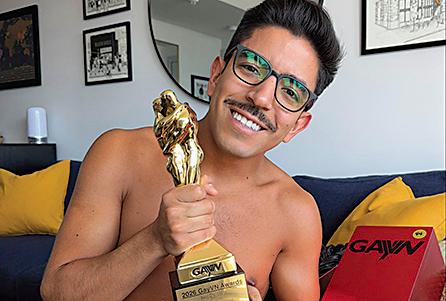
A gay Canadian adult film performer says he was detained for more than eight hours by U.S. Customs and ultimately issued a
10‑year ban from entering the country. Milo Miles was en route from Toronto to Las Vegas in January for the GayVN Awards, where he was scheduled to present and had six nominations. He told LGBTQ Nation that a routine pre-clearance screening escalated into hours of questioning, phone searches, and comments he described as derogatory and focused on his sexual orientation and profession. Miles said officers accused him of escorting despite finding no illegal items and no evidence of prostitution, though they reviewed
past text exchanges with clients who had hired him for sexless “boyfriend experiences.” U.S. law allows Customs to deny entry to people they believe are engaged in sex work, even without a conviction. Miles missed his flight, was questioned the next day again, and was ultimately barred from entry — a decision he says jeopardizes both his career and his relationship with his American partner, who lives in Florida, so “sexless boyfriend’s experiences” will continue to be a thing for Miles.
Marriage equality spurs coupling
The number of same-sex couples in the United States has more than doubled in two decades, even as political resistance to marriage equality resurfaces. New Census Bureau data shows 1.7 million same‑sex couple households in 2024 — about 1 percent of all U.S. 62.8 million married households — up from 777,000 in 2004. Roughly 836,000 of those households are married
couples, compared with about 551,000 unmarried couples. Married same-sex couples have outnumbered unmarried ones since 2015, when the Supreme Court’s Obergefell v. Hodges ruling legalized marriage equality nationwide. The data also highlights shifting demographics: married same-sex women now outnumber married men, 450,000 to 386,000, reversing the 2004 pattern in which male couples were the majority. For all the hoopla about marriage equality, those numbers seem low.
‘Don’t
say gay’ allowed in Iowa
Iowa can now enforce both its ban on LGBTQ-themed books in school libraries and its “don’t say gay” restrictions after the U.S. Court of Appeals for the Eighth Circuit lifted two preliminary injunctions blocking key provisions of a 2023 state law signed by Gov. Kim Reynolds. The rulings reverse earlier decisions by federal district judges who had halted parts of the law while
lawsuits proceeded. Iowa Safe Schools, represented by Lambda Legal and the ACLU, had challenged limits on classroom instruction related to sexual orientation and gender identity, as well as a requirement that schools notify parents if a student is transgender. In the appellate opinion, the judge wrote that lower courts had taken an overly broad view of the statute, noting the state’s position that it applies only to mandatory curriculum. A separate challenge from publishers, including Penguin Random House, also saw its injunction lifted, allowing Iowa to resume removing books depicting sex acts from school libraries.
‘Go-to-Gay,’ Goes
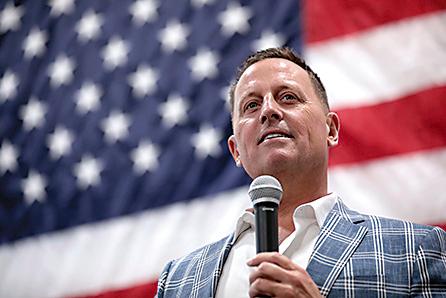
Richard Grenell, the current president’s “go-to-gay,” who oversaw sweeping changes at the Kennedy Center, has had to step away from the U.S. Capitol’s arts center and has stepped down as the institution’s president. Matt Floca, the center’s longtime facilities operations manager,
will succeed him. Grenell was praised in Trump’s firing tweet, which stated that Grenell “did an excellent job in helping to coordinate various elements of the Center during the transition period.” Trump also added that the renamed Trump Kennedy Center will be “the finest facility of its kind anywhere in the world.” In this case, the Center will be closed for two or more years. Grenell’s departure caps a long public career that has included serving as U.S. ambassador to Germany, acting director of national intelligence, and a presidential envoy on Balkan negotiations. He remains Special Presidential Envoy for Special Missions and holds private-sector roles, serving on the board of the Conservative Political Action Conference. Rumors abound suggesting he is under consideration for a major future diplomatic post. Q
Utah Stonewall Democrats roll out endorsements
The partisan LGBTQ+ organization Utah Stonewall Democrats announced a broad slate of endorsements for local, county, legislative, and congressional races in the upcoming election season. Most endorsements apply to Salt Lake County Nominating Convention races, which happened earlier in April, while several statewide and multi-county contests,
U.S. Congress
CONGRESSIONAL DISTRICT 1
Public lands advocate and policy professional NATE BLOUIN is recognized for his work in environmental protection and outdoor recreation. His campaign focuses on protecting Utah’s natural resources, expanding economic opportunity, and offering a pragmatic, solutions-oriented approach in Congress.
CONGRESSIONAL DISTRICT 2
Former educator and nonprofit leader TYLER FARNSWORTH is focused on community development and expanding access to opportunity. He has advocated for investments in education, healthcare, and workforce development across diverse communities.
CONGRESSIONAL DISTRICT 3
Business leader and community advocate STEVE MERRILL’s campaign centers on economic growth, fiscal responsibility, and government accountability. He applies private-sector experience to job creation and innovation.
CONGRESSIONAL DISTRICT 4
JONNY LARSEN is a grassroots organizer and advocate focused on working-class issues. His platform
including congressional and select legislative seats, will be decided at the State Democratic Convention on April 25. These endorsements represent a mix of incumbents, emerging leaders, and community advocates committed to equality, representation, and inclusive policymaking. There are currently no LGBTQ+ Republican or other party caucuses.
includes strengthening labor protections, expanding healthcare access, and addressing income inequality.
Utah State Senate
SENATE DISTRICT 5
DAKOTA WURTH is a community advocate and organizer recognized for advancing LGBTQ+ visibility and civic engagement. His campaign prioritizes inclusive policies, mental health services, and stronger, more integrated communities.
SENATE DISTRICT 10
Physician and incumbent state senator JEN PLUMB has been a leading voice on public health and environmental issues. She champions clean air initiatives, access to medical care, and science-based policymaking.
SENATE DISTRICT 11
MACKENZIE MILLER is a public servant and policy advocate focused on education, housing, and economic security. Her campaign highlights the need for responsive government and equitable access to essential services.
SENATE DISTRICT 13
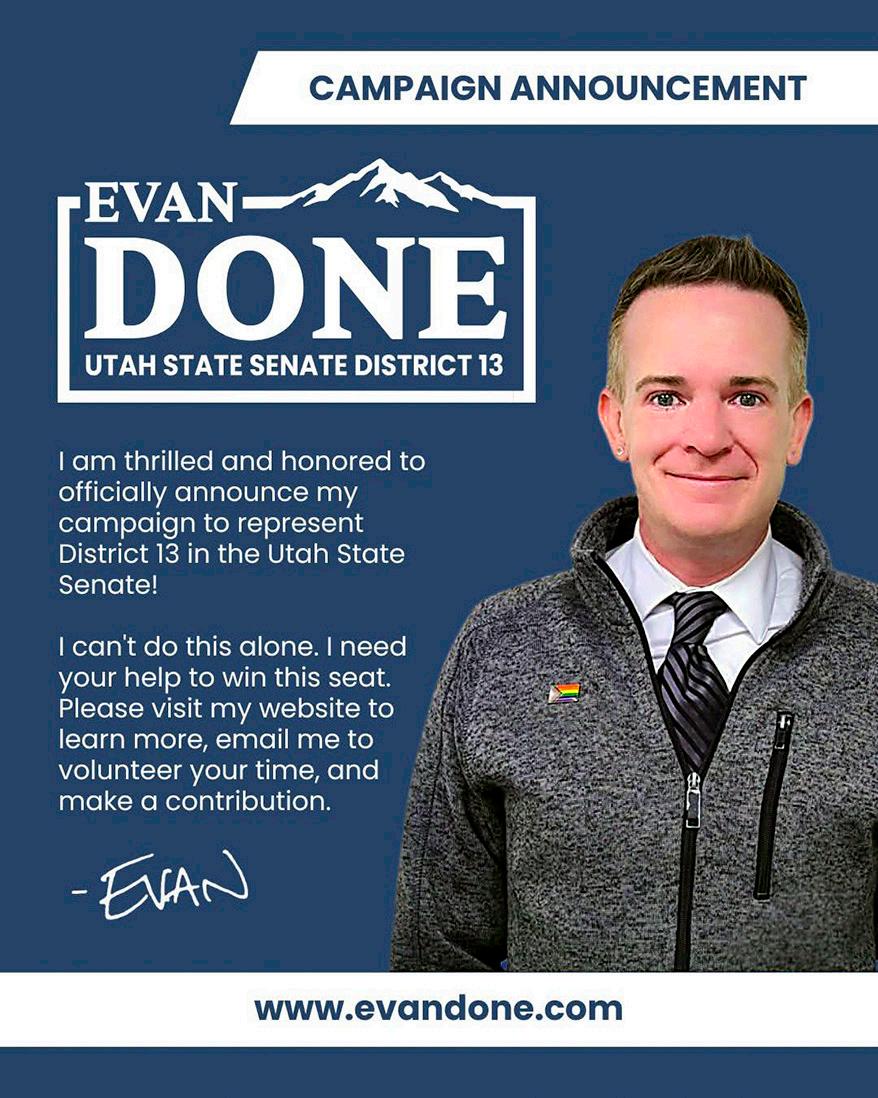
EVAN DONE is a gay man and long-time social and environmental justice advocate.
His platform champions affordability, environmental sustainability, and standing up for marginalized communities. Done won 60 percent of the delegate vote at the convention, and will face Silvia Catten and Taylor Paden in a three-way primary, as these candidates collected signatures to appear on the ballot..
SENATE DISTRICT 14
Incumbent STEPHANIE PITCHER is an attorney specializing in consumer protection. She advocates for working families, focusing on healthcare affordability, tenant protections, and economic fairness. Both Pitcher and Tayler Khater will appear on the primary ballot, as both collected signatures.
Utah State House
HOUSE DISTRICT 12
ANNA GRAFF is a community leader with a background in public service. She focuses on strengthening local communities through education, economic development, and inclusive policymaking.
HOUSE DISTRICT 16
ABIGAIL TREASURE is running against anti-LGBTQ+ Rep. Trevor Lee. She is an educator and advocate dedicated to improving public education and supporting families. Her platform includes increased school funding, teacher support, and student-centered policies.
HOUSE DISTRICT 21
Community advocate
ANTHONY WASHBURN is committed to expanding economic opportunity and access to affordable healthcare. His platform includes strengthening public education and supporting working families in the district. Washburn was eliminated at the convention.
HOUSE DISTRICT 27
LIZ OATES is a public policy professional with experience in healthcare and nonprofit leadership. She champions policies that expand medical care access, protect reproductive rights, and support disadvantaged populations.
HOUSE DISTRICT 33
Attorney and former congressional candidate DOUG OWENS prioritizes ethical leadership and economic fairness. He advances government transparency and advocates for critical investments in the workforce and education.
HOUSE DISTRICT 34
ERIN JEMISON is a policy expert and housing advocate with extensive experience in affordability and homelessness. Her campaign focuses on practical solutions to Utah’s housing crisis and strengthening community stability. Jemison will face Julie Jackson in the primary.
HOUSE DISTRICT 39
Environmental advocate and nonprofit leader SARAH BROUGH is focused on sustainability and public lands. She supports clean energy initiatives and policies that protect Utah’s natural resources while fostering economic growth. Brough was eliminated in the primary.
HOUSE DISTRICT 40
Gay incumbent ANDREW STODDARD is known for his work on economic development and government accountability. He emphasizes bipartisan solutions and responsible fiscal policy. Stoddard will face Wendy Davis in the primary.
HOUSE DISTRICT 41
JOHN ARTHUR is an educator and community advocate recognized for innovative teaching and commitment to public education. He is a
vocal supporter of increased school funding and inclusive classroom environments. Arthur received 100 percent of the delegate votes and is the party nominee.
HOUSE DISTRICT 45
ROD MOSER is a leader focused on neighborhood concerns, including public safety, infrastructure, and community development. His campaign emphasizes practical solutions and constituent engagement.
State School Board
STATE SCHOOL BOARD DISTRICT 7
JAMES MARTIN is an education advocate with experience in school governance and community engagement. He emphasizes transparency, student achievement, and safe, inclusive learning environments for all students.
Salt Lake County
SALT LAKE COUNTY CLERK
Incumbent Salt Lake County Clerk LANNIE CHAPMAN is recognized for transparency, efficiency, and expanding voter access. She emphasizes secure, accessible elections, modernizing county records, and protecting local democratic processes.
SALT LAKE DISTRICT ATTORNEY
SHAWN ROBINSON is a longtime prosecutor with extensive experience in criminal justice. His campaign focuses on public safety reform, alternatives to incarceration, victim advocacy, and ensuring accountability and fairness in the justice system. Robinson will go up against incumbent Salt Lake District Attorney Sim Gill in the June primary.
SALT LAKE
COUNTY
COUNCIL AT-LARGE
Business owner and former city council member TENILLE TAGGART is known for her pragmatic approach to governance. She focuses on economic development, infrastructure investment, coalition-building among diverse communities, and championing inclusive policies. Taggart was eliminated at the convention.
SALT LAKE COUNTY COUNCIL DISTRICT 3
LUKE MAYNES has a background in public service and civic engagement, with a focus on smart growth, transportation, and quality-of-life issues. His campaign emphasizes sustainable development and responsive local government. Maynes is the Democratic nominee.
Salt Lake City
SALT LAKE CITY SCHOOL BOARD DISTRICT 3
ASHLEY ANDERSON , an education advocate and community leader, is committed to strengthening public schools through equity driven policies. She prioritizes student success, inclusive education, and support for marginalized students, including LGBTQ+ youth.
SALT LAKE CITY SCHOOL BOARD DISTRICT 5
Longtime community organizer and education advocate SANDRA BUENDIA is focused on equity in public schools. She works to expand opportunities for underserved students and strengthen school-family partnerships. Q
Utah Stonewall Democrats can be found at fb.me/utahstonewalldems
Trevor Lee secures spot on June’s primary ballot
Utah Rep. Trevor Lee narrowly secured a place on the Republican primary ballot April 18, surviving a high stakes Davis County nominating convention shaped by unique party bylaws and an already qualified challenger.
Lee faced off against Bob Stevenson, who had already guaranteed his spot on the primary ballot by gathering enough voter signatures ahead of the convention. That meant the convention would determine whether Lee could join him, and under what conditions either candidate might claim the party’s backing.
According to the bylaws of the Davis County Republican Party, when a candidate has qualified for the ballot through signatures, a convention-only candidate must receive more than 30% of the delegate vote to advance to the primary. Lee cleared that threshold with 45 percent of the vote.
The same rules also establish multiple tiers of party support. A convention-only candidate who reaches 50% of the vote becomes the party’s endorsed candidate, though that endorsement falls short of securing the nomination outright. Meanwhile, a candidate like Stevenson, who qualified via signatures, faces a higher bar: he would need 70 percent of the delegate vote to win the nomination and full party endorsement at convention. Neither candidate reached those higher thresholds. As a result, no one secured
the nomination, and no formal party endorsement was awarded through the convention process.
Lastly, the bylaws further stipulate that a signature qualified candidate must receive at least 40% of the delegate vote to be eligible for the party’s material support in the general election. Stevenson garnered 55 percent of the vote, qualifying him for party assistance.
With both candidates now advancing, the contest moves to a Republican primary where a broader electorate will decide the nominee. For Lee, the narrow convention showing highlights potential vulnerability within his own party base, especially after
troubling news about possible financial and political improprieties. while Stevenson enters the race with established name recognition and a demonstrated ability to mobilize voter signatures.
For LGBTQ Utahns, the race is one to watch. Lee has aligned with conservative positions on issues affecting the community, and the compet-
itive primary could shape not only the outcome of the race but also the tone of Republican politics in Davis County.
The close convention result sets the stage for a closely contested primary in the months ahead, with both candidates now turning their focus to a wider pool of voters beyond the party’s hyper-partisan delegate base. Q
University of Utah holds its annual Pride Week
Despite bans imposed by the Utah State Legislature, the University of Utah held its annual Pride Week from March 30 to April 3. Students, faculty, and community members came together for events focused on LGBTQIA+ visibility, authenticity, and connection.
Pride Week began on Monday with Pride Palooza on the Union Patio. People enjoyed music and activities, starting what organizers call one of the campus’s most lively traditions. The event set a celebratory and community-centered tone for the week.
Tuesday featured Crimson Conversations, where students who attended the national Creating Change Conference shared their ideas and experiences. A
question and answer session followed, supporting deeper discussion about LGBTQ+ advocacy and social justice. That evening, Gayme Night in Building 72 gave participants a chance to relax and connect over tabletop games like Dungeons & Dragons in a friendly, inclusive space.
On Wednesday, the Pride Market turned the Union Patio into a marketplace for LGBTQIA+ artists, small businesses, and community groups. Visitors browsed handmade goods and met local creators, supporting the week’s theme of “Visibility Through Authenticity.”
Thursday’s Community Cuts event offered free haircuts from local stylists, giving practical help and affirming care. The event encouraged self-expression and
confidence, helping students feel seen and supported.
On Friday night, the celebration wrapped up with Pride Prom in the Union Ballroom. The theme was “True Colors,” and guests wore bold or meaningful colors while enjoying music, drag shows, and activities that encouraged joy and belonging.
Pride Week ended on Saturday with the Gayla, a 21 and over event at Mountain West Cider. Guests enjoyed live music, food, drinks, and a silent auction. The money raised will help fund future Pride events.
Organizers said the week showed the solidarity of community, creativity, and authentic self-expression on campus. Q
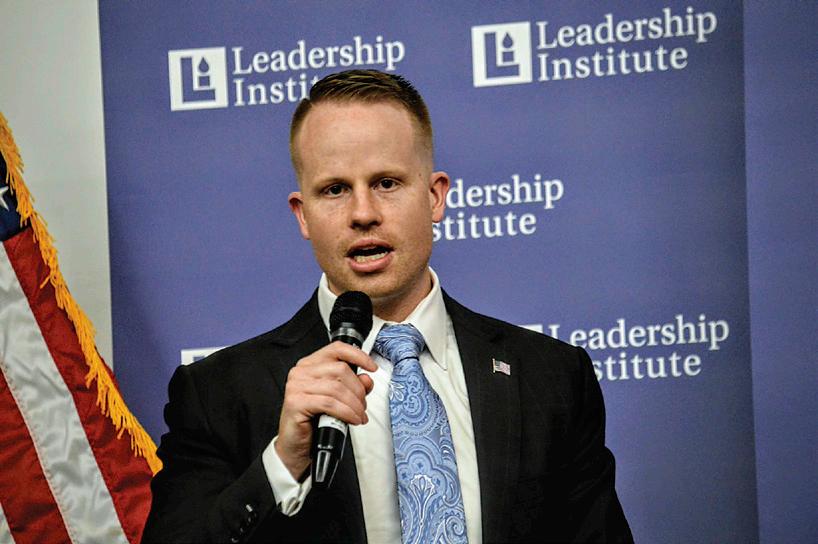
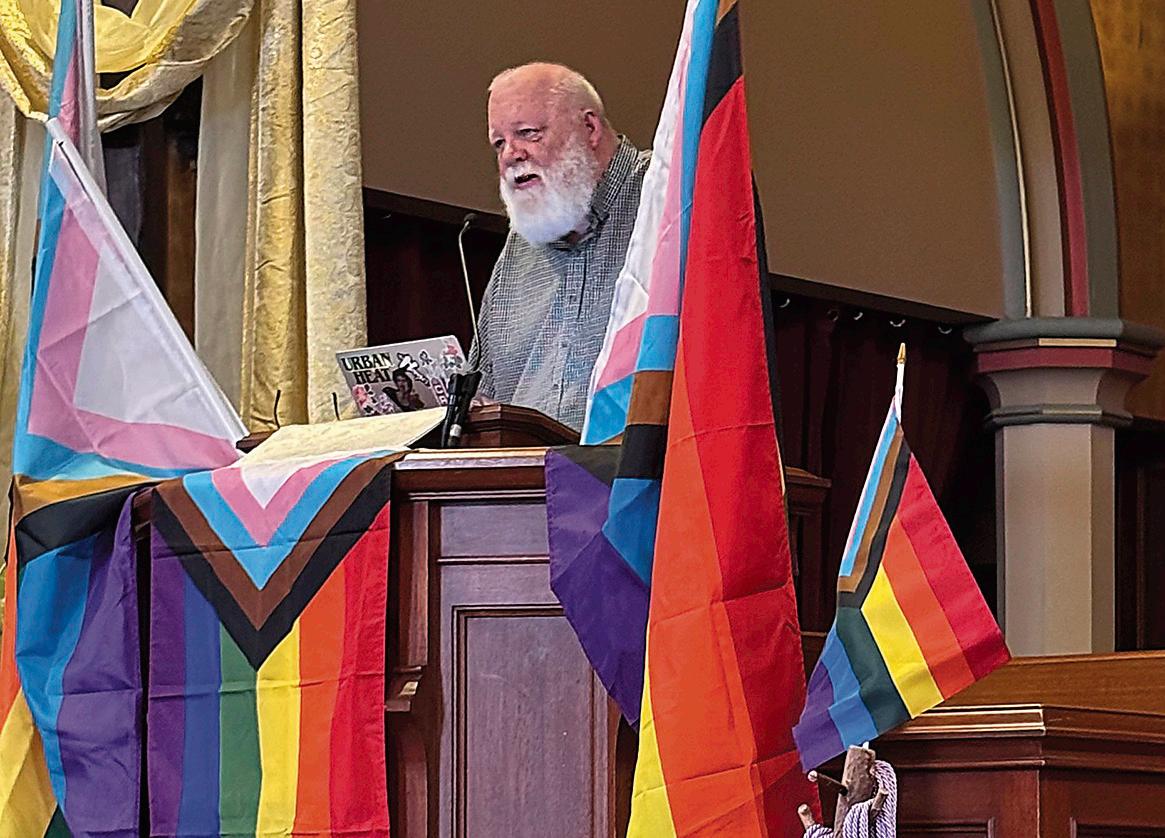
Rep. Trevor Lee at a Leadership Institute event in April. PHOTO BY ROMY COLVIN
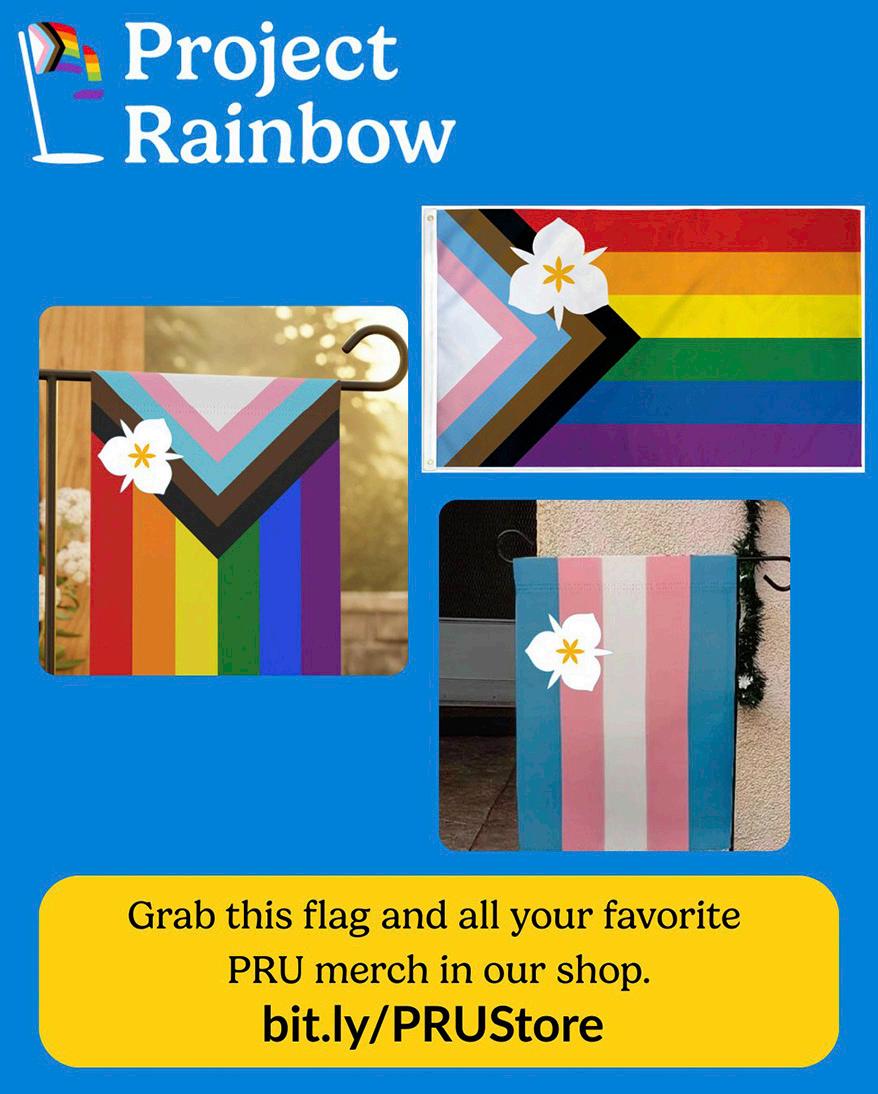
Project Rainbow calls for volunteers to power statewide Pride Flag campaign
As Pride season approaches, Project Rainbow is calling on Utahns to step up and help bring visibility to LGBTQ+ communities across the state—one flag at a time.
The organization, known for its largescale Pride flag installations, is seeking volunteers for its 2026 campaign, which aims to place hundreds of Pride flags in cities and rural areas alike. From Salt Lake City to Cedar City, Ogden to St. George, and communities including Provo, Logan, Moab, and Park City, the initiative is designed to ensure LGBTQ+ visibility reaches every corner of Utah.
“Hundreds of Pride flags across Utah do not stake themselves,” organizers said in their volunteer call. “They require people willing to show up, do the work, and build a visible community.”
Volunteer opportunities span several key phases of the campaign. A flag assembly event will take place on May
15 from 3 to 5 p.m., where participants will help prepare hundreds of flags for distribution. Later in the month, volunteers are needed at “Flag HQ” on May 30 and 31 to assist with setup, staging, and teardown. Flexible shifts between 9 a.m. and 4 p.m. allow participants to contribute without committing to a full day.
For those willing to take a more active role, Project Rainbow is also organizing flag delivery routes across the state. Volunteers can sign up to pick up a route between 10 a.m. and 3 p.m., with each route taking approximately 90 minutes to two hours. While only one person is required per route, organizers encourage volunteers to bring friends or family and turn the experience into a group effort.
The campaign will conclude with flag pickup efforts from June 13 to 15, completing what organizers describe as a full-cycle community project. According to Project Rainbow, the
impact of volunteering goes beyond logistics. In rural areas, the presence of Pride flags can serve as a powerful signal of inclusion and support.
“Without volunteers, Pride does not reach rural communities,” the organization noted. “Without volunteers, isolated LGBTQ+ people do not see flags in their neighborhoods.”
Beyond visibility, Project Rainbow’s work also powers direct community investment. Through its Community Fund, the organization reinvests resources generated from its Pride flag campaigns, merchandise sales, and donations back into Utah’s 2SLGBTQ+ community. The fund provides grants to grassroots organizers, artists, events, and initiatives that expand safety, visibility, and belonging statewide. Since 2018, the Community Fund has distributed more than $400,000.
In 2026 alone, Project Rainbow awarded $43,700 in grants to community recipients. A full list of this year’s grantees anf more info on volunteering is available at: PROJECTRAINBOWUTAH.ORG
Size does Size does matter.
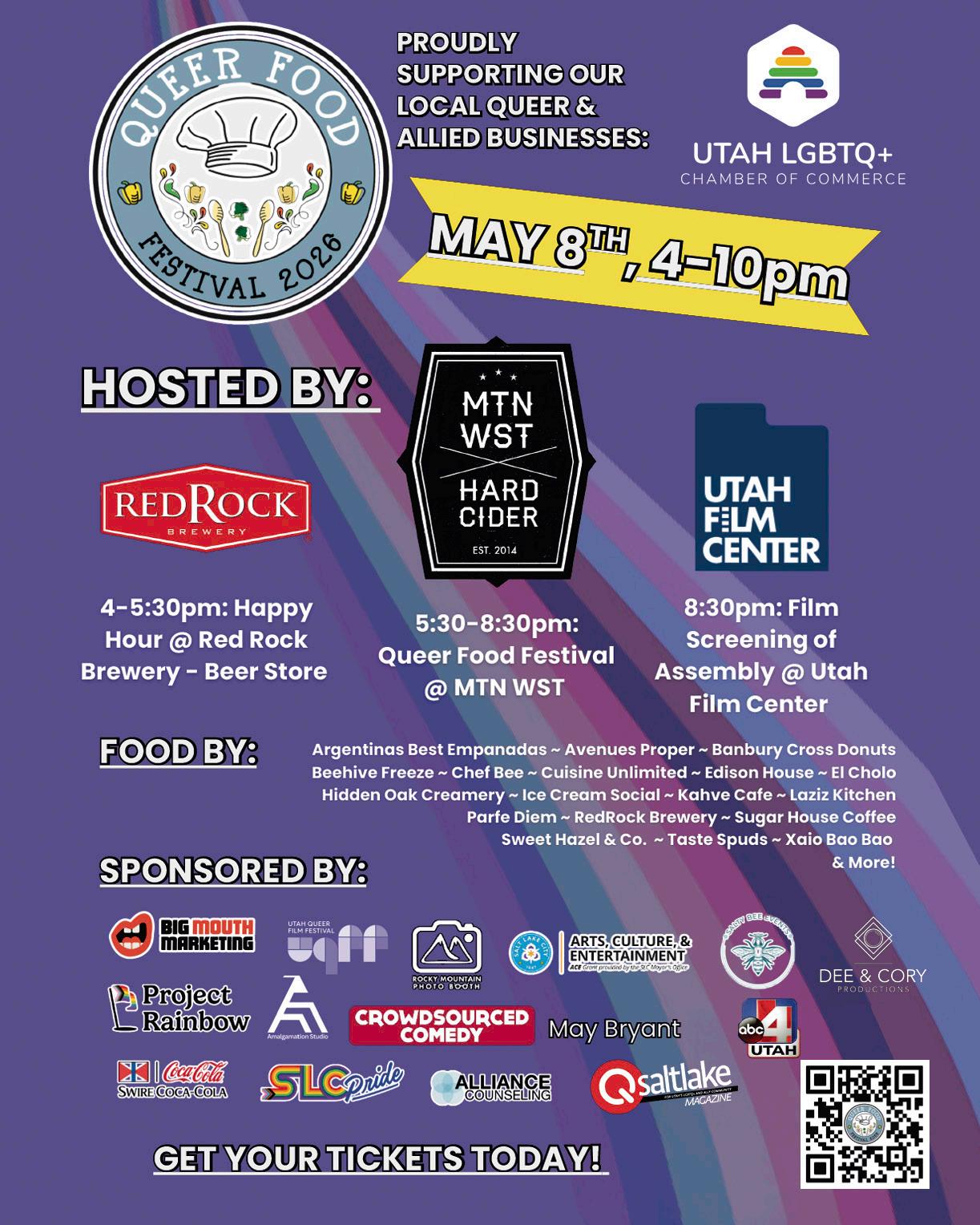
Queer Food Festival returns to Salt Lake City with expanded ‘progressive party’ format
One of the city’s most anticipated LGBTQ community events is back for another year, promising an evening of food, drink, film, and connection.
The 2026 Queer Food Festival, organized by the Utah LGBTQ+ Chamber of Commerce, will take place Friday, May 8, with an expanded format that transforms the celebration into a neighborhood-wide “progressive party.”
Running from 4 to 10 p.m., the festival will unfold across three venues in central Salt Lake City: Red Rock Brewing Beer Store, Mountain West Hard Cider, and Utah Film Center. Organizers say the new structure reflects both the growth of the event and the vibrancy of the city’s queer owned and allied culinary scene.
“This is more than just a food festival — it’s about nourishing each other through community,” organizers said in promotional materi-
als. “It’s a taste of Queer Salt Lake.”
A full evening of food and community
The evening kicks off with a Happy Hour from 4 to 5:30 p.m. at Red Rock Brewing Beer Store, giving attendees a chance to mingle over drinks before heading next door for the main event.
From 5:30 to 8:30 p.m., the festival’s centerpiece, dubbed “The Feast,” will take over Mountain West Hard Cider’s outdoor garten space. There, guests can sample offerings from a curated lineup of LGBTQ-owned and ally-operated restaurants, breweries, and beverage makers. Craft cocktails, small plates, and live entertainment are all part of the experience.
The night concludes with a private screening at Utah Film Center at 8:30 p.m., featuring Assembly, which adds a cultural dimension to an event already rooted in creativity and expression.
BUILDING ON A GROWING TRADITION
The Queer Food Festival has become a staple of Salt Lake City’s spring calendar, regularly selling out and drawing a diverse crowd from across the region. Coverage from QSaltLake in past years has highlighted how the event not only showcases local culinary talent but also creates meaningful economic opportunities for LGBTQ entrepreneurs.
Previous iterations of the festival have emphasized visibility for queer chefs, bakers, brewers, and restaurateurs, many of whom operate in an industry where LGBTQ representation has historically been underrecognized. By centering these creators, the festival functions as both a celebration and a form of community investment.
This year’s expanded format builds on that mission, encouraging attendees to move through multiple spaces and engage more deeply with participating businesses.
TICKETS AND PARTICIPATION
Tickets are now on sale, with pricing set at $45 for Chamber members and $65 for the general public. Organizers note that the event sells out every year and are encouraging early purchase. Group and accessible admission rates are also available.
For one night in May, organizers say, the invitation is simple: come hungry, come curious, and come ready to celebrate.
More info at utahlgbtqchamber.org
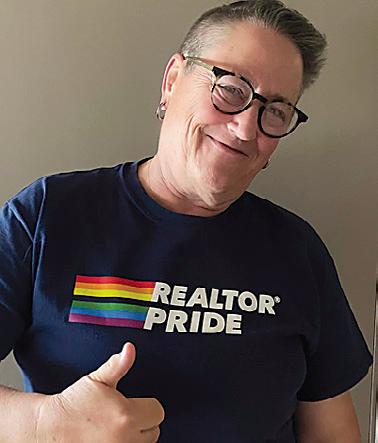
When buying or selling real estate, you don’t want a part-time agent working a side hustle, but a professional who’s versed in winning multiple offer battles, marketing strategies to get the best price, knowing LGBTQ vendors and allies for mortgages, inspections, attorneys, etc. With four decades as a full-time agent/broker and the first ‘out’ REALTOR® in Utah, I’d love to help you with this huge financial decision. I sell downtown condos in Salt Lake, homes with casitas in St. George, homes of those who have passed, and 1031 exchanges on income or commercial properties. Text or call anytime.
West Valley Pride organizers seek vendors, performers and volunteers for 2026 event
Organizers of West Valley Pride are calling on community members to help shape this year’s celebration, issuing an open invitation for food vendors, performers, artists, nonprofits, and volunteers to participate in the 2026 event.
Scheduled for June 13 at the Utah Cultural Celebration Center, the all-ages Pride event aims to showcase local talent and connect residents with resources in one of Utah’s most diverse communities.
Event organizers are actively recruiting food vendors to provide a variety of dining options throughout the day, as well as retail vendors offering unique, locally made goods. The call emphasizes creating a vibrant marketplace atmosphere that reflects the creativity and diversity of West Valley City.
Performers are also encouraged to apply, with organizers seeking a wide range of acts to fill the event’s entertainment lineup. Musicians, dancers, drag performers, and other artists are invited to take the stage as part of a program highlighting LGBTQ+ voices and local talent.
In addition to entertainment and food, West Valley Pride is prioritizing space for community organizations to host informational booths. Nonprofits, advocacy groups, and service providers are invited to table at the event and share resources with attendees, reinforcing Pride’s role as both a celebration and a point of connection for those seeking support.
Organizers are also seeking chalk artists to create large-scale, temporary artworks. The interactive element is intended to enhance the event’s visual impact while providing artists with a platform to showcase their work in a public setting.
Volunteers remain a key component of the event’s success, and individuals are encouraged to sign up to assist with setup, coordination, and day-of operations.
Applications and additional details are available through culturalcelebration.org/pride
Lavender Graduation honors LGBTQ+ graduates
With just days remaining before one of Utah’s most affirming academic celebrations, organizers are making a final call for graduates, volunteers, and community members to take part in this year’s Lavender Graduation.
Set for Wednesday, , April 23, the ceremony will take place at the Utah Cultural Celebration Center, where more than 50 LGBTQ+ graduates are expected to be honored in a celebration of not simply academic achievement but also identity, resilience, and community.
Hosted by Project Rainbow Utah, Lavender Graduation offers something many queer and trans students have historically been denied: a commencement experience where they can show up fully as themselves. Organizers emphasize that this is not a symbolic gathering, but a complete graduation ceremony — caps and gowns, a formal processional, individual recognition for each graduate, and a celebratory reception to follow.
“This is a space where chosen names are spoken proudly, pronouns are respected, and partners, families, and friends can celebrate openly,” organizers shared in a statement. “It’s about honoring the full journey of LGBTQ+ students.”
Doors will open at 4:30 p.m., with the ceremony beginning promptly at 5
p.m. Attendees are encouraged to arrive early, as a large turnout is expected. In addition to speakers and live elements, graduates and their families will have access to free professional photography—an intentional offering meant to preserve a milestone that, for some, may not feel fully recognized elsewhere.
The event remains open to the public, welcoming not only graduates and their families, both biological and chosen, but also friends, allies, and members of the broader community who want to show support.
Final deadlines are quickly approaching. Graduating students must register by April 20, while organizers are also seeking at least 10 additional volunteers to assist with day-of logistics. Both sign-ups close the same day.
Lavender Graduation has become an increasingly widespread tradition across the country, based on the belief that visibility and affirmation matter—especially in moments as formative as graduation. In Utah, where LGBTQ+ students continue to navigate complex social and political landscapes, the ceremony serves as both a celebration and a statement.
Graduates are encouraged to sign up at BIT.LY/LAVGRADUATE Volunters can register at BIT.LY/PRULAVGRADVOLUNTEER
Connell O’Donovan speaking at the 2025 Lavender Graduation at First Baptist Church Salt Lake City.
who show up, who live authentically, and who make Utah’s LGBTQ+ community vibrant and visible.”
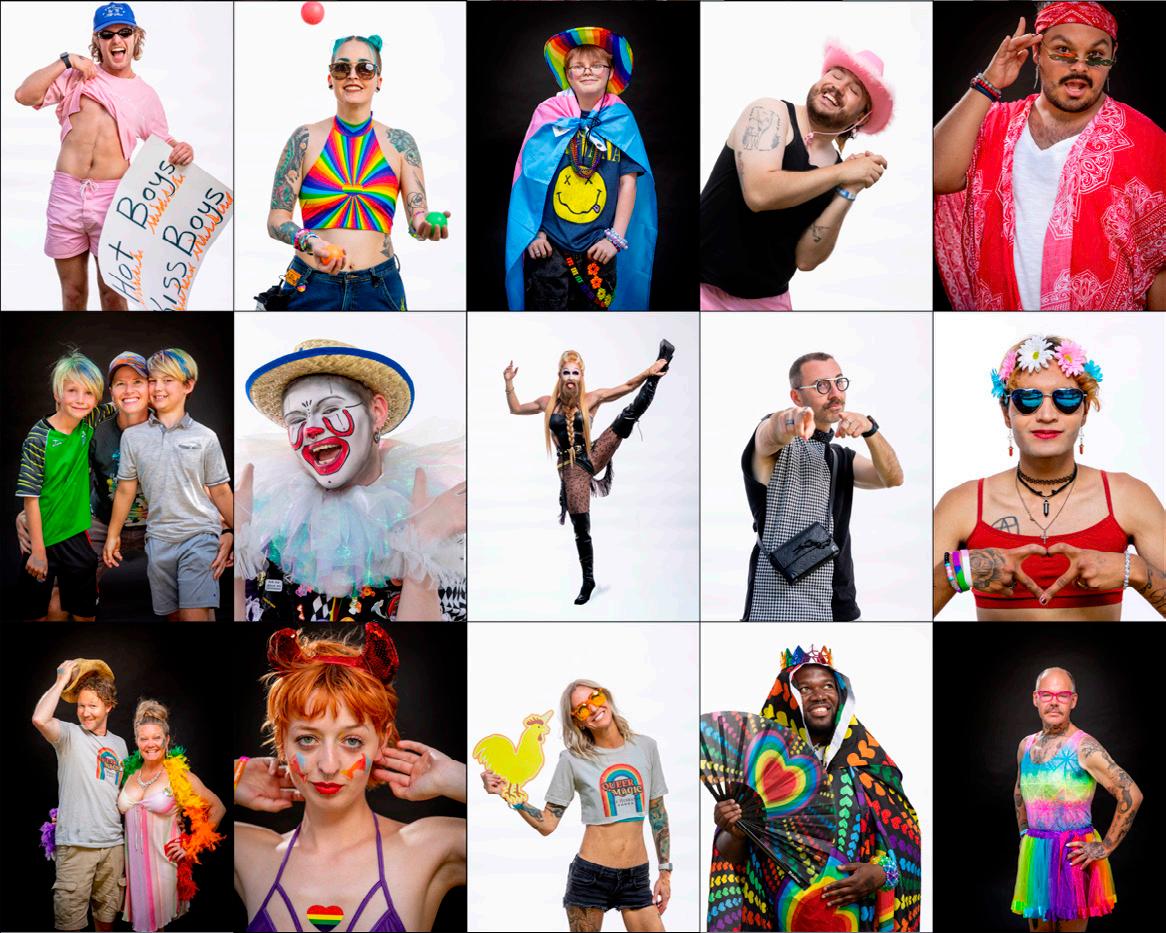
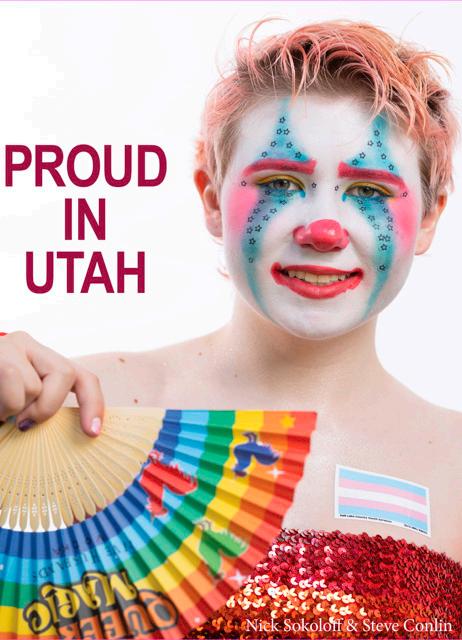
A new photography book celebrating the faces of Utah’s LGBTQ+ community is now available for pre-order, offering a lasting visual record of the people who attended the 2025 Utah Pride Festival.
Proud in Utah 2025 is a full-color hardcover portrait book featuring
more than 500 individuals photographed during the two-day festival. What makes the project unique is its inclusive scope: every single person who stepped into the photographers’ booth during the festival is included in the book, creating a sweeping visual snapshot of Pride in Utah.
Photographers Steve Conlin and Nick Sokoloff set up a professional studio-style booth at the festival, inviting attendees to sit for portraits against simple black or white backdrops. Over two days, hundreds of festivalgoers — individuals, couples, families, and friends — stepped in front of the camera.
The result is a striking 9 by 12 inch coffee-table book, printed on 100 pound matte paper, spanning 184 full-color pages. Portraits appear in a variety of sizes throughout the book, emphasizing both individuality and the collective power of the community.
“This book is about community,” Conlin said in announcing the project. “It’s about honoring the people
The book also features an introduction by Michael Aaron, publisher and editor of QSaltLake Magazine, which places the portraits in the broader context of Utah’s evolving LGBTQ+ community and the significance of Pride celebrations in the state.
Pre-orders for Proud in Utah 2025 are available now for $49.99 through March 31. After that date, the book’s regular price will increase to $59.99, and only a limited number of copies will be available.
Organizers say pre-orders will help determine the size of the initial print run and keep the book affordable.
Beyond serving as a keepsake for participants, the project also supports the community it documents. One hundred percent of profits from the book will be donated to the Utah Pride Center, helping fund programs such as youth services, mental health resources, advocacy efforts, and community events.
Books will be available for in-person pickup in mid-April at several locations, including Pictureline, the Utah Pride Center, City Weekly offices, Ogden’s Own Distillery, and Underground Books in Ogden.
Preorder at PROUDINUTAH.COM
Conversion Therapy Survivor Network returning to Utah Pride, seeks funding
A survivor led nonprofit working to support those impacted by conversion therapy launched a new fundraising push as it prepares to return to Utah Pride this year.
The Conversion Therapy Survivor Network created a GoFundMe campaign, “Building Community,” to cover general operating expenses that sustain the organization’s year-round work. Those efforts include:
• A weekly survivor support group where people can connect, process, and heal in community
• Public education to raise awareness and prevent future harm
• A survivor-led podcast to share real stories and reach those who feel isolated
• Participation in the
International Day to End Conversion Therapy
• Booths at Pride events to reach survivors where they are CTSN leaders say sustaining a strong, visible role at Pride festivals provide an opportunity to connect directly with individuals who may still be coping with the lasting effects of conversion therapy or seeking community support.
Founded in 2019, CTSN is led by survivors of sexual orientation and gender identity change efforts, often referred to as conversion therapy. The group focuses on building community, amplifying survivor voices, and increasing awareness of the harms of the widely discredited practice. Q More info at conversionsurvivor.org
UPC hosts a bimonthly trans vocal training
A bimonthly session on learning to control the voice you project will be hosted at the Utah Pride Center. While focused on the transgender community, anyone with a desire to train their voice to be something other than what they present today is welcome.
ROGER COX, owner of UTAH VOCAL STUDIO, is a vocologist and certified peer support specialist who will lead the discussions.
“We’ll talk about strategies to design your sound,” Cox said. “I hope to facilitate conversations about our voices. Myths about our voices sometimes lead us to believe that we are stuck or incapable of sounding different. With some training, those of us with voices can craft the sound that comes out of our faces.”
Cox says these conversations can dispel myths, build confidence, reveal choices and options, and encourage exploration aside from medical interventions, which can be costly or simply unavailable.
“I would love to help you
explore the spectrum of ways you can connect to your true voice, whether you’re speaking or singing,” Cox said.
The one-hour sessions will be held on the first and third Wednesday, s of the month, starting at 7:30 p.m. at the Utah Pride Center, 68 S Main St., Salt Lake City. Free 2-hour parking is available at the City Creek parking plaza.
Planned Parenthood’s new Pink Party
The Planned Parenthood Association of Utah is inviting supporters and community members to its reimagined annual gala, “The Pink Party,” set for Saturday, May 9, in Salt Lake City. The fundraiser will feature two distinct experiences: an early evening gala dinner at the Asher Adams Hotel and a high-energy afterparty at The Depot.
The event, open to guests 21 and over, aims to raise critical funds to support Planned Parenthood’s healthcare and advocacy work across Utah. The evening begins with a formal dinner featuring a keynote speaker, an auction, and a fundraising appeal, followed by a more casual celebration with dancing, DJs, drag entertainment, and a community gathering downtown.
Organizers say the updated format is designed to broaden participation, offering both a traditional gala setting and a more accessible party atmosphere. While dinner tickets have already sold out, general admission to the Depot portion remains available, giving attendees a chance to support reproductive healthcare while celebrating alongside LGBTQ+ community members and allies.
Info at PLANNEDPARENTHOOD.ORG
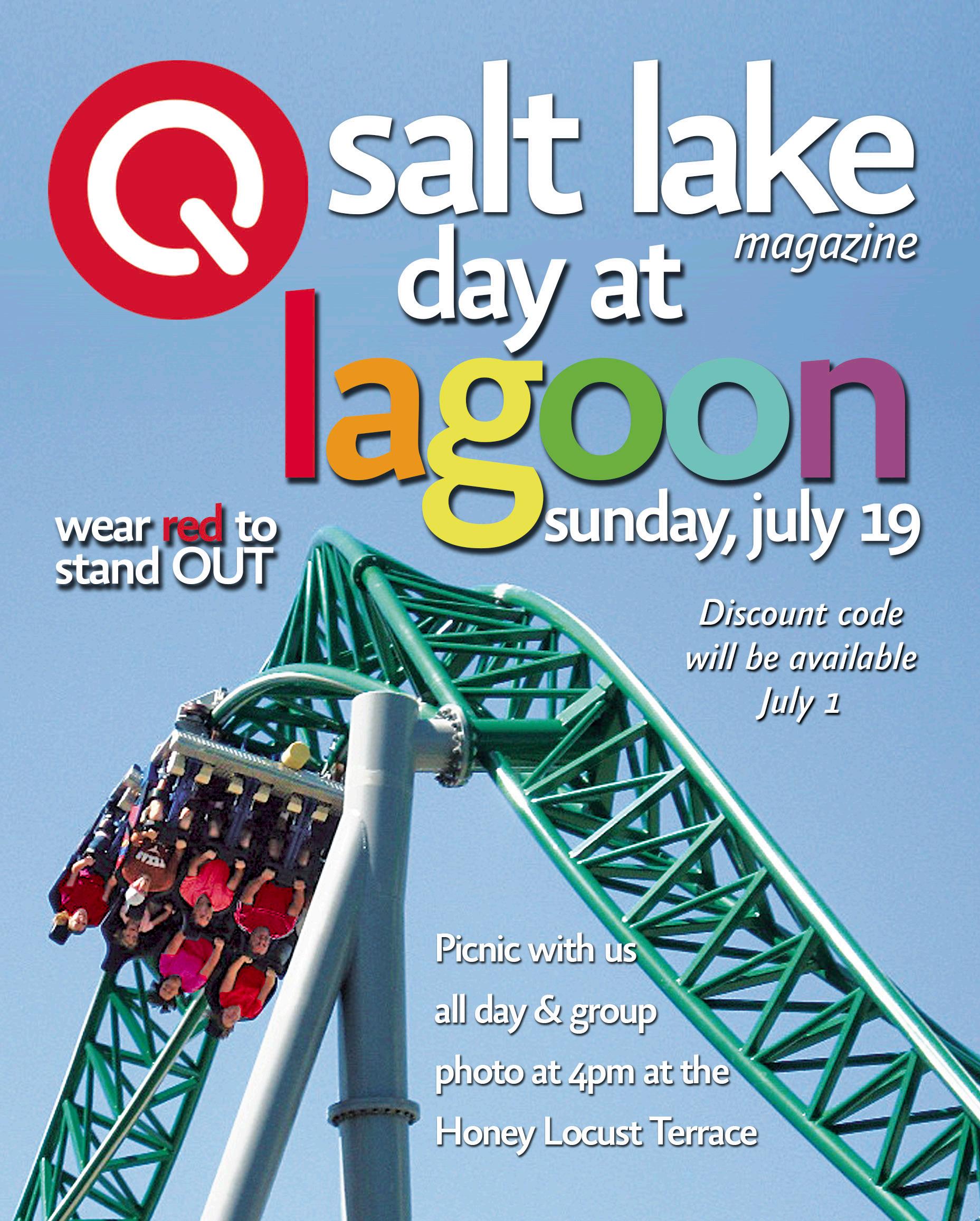
Save the date – QSaltLake Day at Lagoon – July 19
SUN, JULY 19 10AM–CLOSE LAGOON AMUSEMENT PARK
Each summer, Utah’s LGBTQ+ community claims a day of joy, connection, and roller coasters at Lagoon Amusement Park. This year, QSaltLake Lagoon Day is set for Sunday, July 19.
The annual gathering draws hundreds of queer Utahns and allies to the iconic Farmington amusement park. Attendees are encouraged to wear red to stand out in solidarity and celebration. Our chill space will be available as an all-day hangout for picnics, rest, and meeting new friends. A group photo is scheduled for 4 p.m.
Lagoon, Utah’s largest amusement park, boasts ten major coasters, dozens of games and rides, a water park, and the historic Pioneer Village. Opened in 1886 and still family-owned, the park also carries a legacy of civil rights. Under the leadership of Robert Freed, Lagoon formally desegregated in the 1940s, ahead of many public venues in the state, a move that earned Freed recognition from the NAACP.
The discount code will be announced around July 1. Q
For more information about the park, go to LAGOONPARK.COM. For more information about the QSaltLake Lagoon Day, see our FACEBOOK EVENT
Seniors Elevated Monday Luncheons
Looking for a simple, welcoming way to socialize? This newly renamed social group meets Mondays from 2–4 PM at La Puente Restaurant, 3205 S State St. This independent, no-membership, no-fundraising gathering is open to everyone, especially LGBTQIA+ seniors, who want to share a meal, connect, and enjoy good company. Just drop in whenever you can, pay for your own food, and bring your best self. Info at BECKYAMOSS@GMAIL.COM
views quotes
“Being here means so much to me, especially right now when the LGBTQ community is facing so many challenges ... This is my community. For me, it’s about showing up and celebrating the progress we’ve made—while also recognizing there’s still work to do.””
—Demi
Lovato at the GLAAD Media Awards
“I’m a drag queen.”
—Miley Cyrus on RuPaul’s Drag Race finale
“Life’s a climb, but the view is great.”
—Miley Cyrus on RuPaul’s Drag Race finale
“It was fucked up ... Borderline extortion.”
—Maren Morris (on her first same-sex relationship)
“Republicans ‘weaponized’ my jokes.”
—Dave Chappelle on controversy around trans jokes
“Now that’s queerbaiting.”
—Harry Styles, responding to queerbaiting accusations on SNL
“Things could go backwards.”
—Kezia Dugdale, on LGBTQ+ rights concerns
“To anyone out there who has ever felt they didn’t belong or weren’t loved; there’s nothing wrong with you and you’re not behind ... You’re exactly where you’re supposed to be. You’re exactly the person that you were meant to become—be proud of every piece of yourself cause there’s no one else in the world that can be you.”
— “Stranger Things” star Noah Schnapp
WhenIn with the Out, Out with the In
BY CHRISTOPHER KATIS
we lived in the Bay Area, I had an acquaintance, Dale. He was a friend of a friend from the gym. Like me, he was originally from Utah. Unlike me, he was from a Mormon family, a very devout one to boot. He and all his brothers had been missionaries, his dad was a bishop, the whole shebang. Also, he wasn’t out.
One day, he asked if he could talk to me about something. He was soon headed to St. George for a family reunion, and he had decided to come out. I think he wanted reassurance that everything was going to be ok, especially with his parents. His fear about parental rejection isn’t unique. Although the study is old, in 2013, Pew Research discovered that the top two reasons people don’t come out to their parents were: the subject had never come up; and they feared losing the parent-child relationship.
But what happens to that parent/ child relationship when an adult child comes out, who is also a parent him/ her/themselves? I spoke with Anne-Marie Zanzal, M.Div., a lesbian coach, speaker, podcast host, and author.
Zanzal notes, “Coming out later in life is rarely just one event, it is the unraveling and reconstructing of an entire identity built over decades. When someone comes out in midlife, they are often also leaving a marriage, renegotiating their relationship with faith and community, reconsidering their sense of self as a parent, a daughter, a friend — all at once.”
Parents have certain expectations and hopes for their kids. Seeing their children married and with little ones of their own often tops the list. When that reality changes, it can challenge everything they believed to be true about their family dynamic.
Most of the time, Zanzal advises that a parent come out to their children before their own parents. Along with kids
deserving to hear it directly from their mom or dad, it also helps control the narrative. If grandparents know before the newly out parent’s kids, there’s too great of chance that information will be spread before everyone is ready.
Of course, there’s always the chance that one’s parents will not be supportive of this news. This reaction can spill over to the kids. In some cases, they may even be making hurtful comments or offering unrealistic hope that mom and dad may get back together, or that mom’s new girlfriend will be gone soon.
Zanzal says, “With children involved, the guiding principle is age-appropriate honesty. Simple language — Grandma and Grandpa are having a hard time understanding some things right now — is far less damaging than silence or confused half-explanations.”
The parent/adult child relationship can be difficult to navigate. Coming out to mom and dad after years of leading a straight life, complete with kids of your own, can really be a challenge. Just remember, it is your life and you need to be happy.
Perhaps the most important advice she suggests is to not “shrink yourself to protect your parents from their own discomfort. Give them time. A first reaction is almost never a final position. And remember, your need to live honestly is not a burden on them. It is an invitation into a more real relationship.”
In the end, Dale’s coming out proved to be much ado about nothing. Thankfully, they accepted him with open arms. They weren’t even all that surprised. No disrespect to him or his family, but they’d have had to be pretty clueless to think he liked women. Actually, I think they would’ve been more shocked if he’d come out as straight! Q
My thanks to Anne-Marie Zanzal. You can reach her at annemariezanzal.com or support@annemariezanzal.com.
It’sConversion Therapy
BY D’ANNE WITKOWSKI
a windy
day here. As I write this, a transgender pride flag is whipping around wildly on my front porch. The flag keeps getting tangled up and so I periodically go out to unwind it because it’s Transgender Day of Visibility. I’ll be damned if I’m going to let the wind fuck it up.
Of course, I have no control over the wind. And even less control over the United States Supreme Court.
“The U.S. Supreme Court decided that a Colorado state law protecting LGBTQ+ young people from the dangerous, discredited practice of conversion therapy must be revisited in the name of ‘free speech,’” reads a statement by the Trevor Project. “This ruling is about how conversion therapy can be regulated, not about whether it is safe or legal. It isn’t. Conversion therapy is malpractice. Plain and simple.”
At issue was therapist Kaley Chiles, an evangelical Christian therapist in Colorado who wants to offer conversion therapy to kids. She—or, rather, the extremist legal organization Alliance Defending Freedom (ADF)—argued that the state’s law infringed upon her First Amendment rights. And eight out of the nine justices sided with the therapist.
The lone dissenter was Justice Ketanji Brown Jackson.
In Jackson’s dissent, she points out that Colorado’s ban on conversion therapy for minors, as well as other bans like it, are “based on the medical profession’s broad consensus that this medical treatment (which seeks to change a gay or transgender person’s sexual orientation or gender identity) is ineffective and harmful.”
As The Advocate reminds us, “[E] very major medical and mental health association in the United States has condemned conversion therapy, and
that such practices have been linked to depression, anxiety, substance use, and suicide, particularly among minors.”
An important reminder that these bans are not based on some “woke” ideology like conservatives claim and Colorado did not enact such a ban just because they don’t like anti-LGBTQ Christians or want “transgender for everyone,” as our dipshit president likes to say.
“[The Court] majority has failed to appreciate the crucial context in which Chiles’s constitutional claims have arisen,” Jackson writes in her dissent. “Chiles is not speaking in the ether; she is providing therapy to minors as a licensed healthcare professional.”
In other words, if Chiles was standing on a street corner screaming about “curing” gay and trans kids, that would be protected by the right to free speech. But because Chiles actually wants to take this belief and bring it into her therapy practice, the stakes of the speech are much higher and thus Colorado has the right to tell her to fuck off.
Jackson warned that the court “could be ushering in an era of unprofessional and unsafe medical care administered by effectively unsupervised healthcare providers.”
Sounds bad! Especially given who this country currently has in charge of health policy: RFK Jr., a man who, in the fight between measles and vaccines, decided to side with measles. The attack on medical science is wild right now and the people attacking it are at the highest reaches of government.
But, as lawyer, journalist and podcaster Imani Gandy points out in a video posted to Bluesky, the ruling “could have been much worse.”
In the video, Gandy explains that no conversion therapy ban was yeeted out of existence with the ruling. The
Supreme Court sent the case back to the lower court to take another look. Granted, they want the lower court to look at it in a way that favors overturning the ban. But the Supreme Court did not overturn the ban itself.
Gandy argues that much of the media coverage of this ruling “serves the conservative legal movement.”
“[ADF] needs you to believe that the fight is over,” Gandy says. “The fight is not over. The correct reading of this ruling matters because if enough people understand that this case is coming back, that the merits are still live, that the court that decides the case ultimately doesn’t have to be this court full of jamokes, then maybe we get loud enough to change something. Maybe we get loud enough to demand court reform. Do not let them write the ending of this case before it is done.”
She ended her video with, “Trans rights are human rights. Stop fucking with trans kids.”
The Trevor Project also reminds us that the fight is not over.
“Regardless of the ruling, survivors still have legal options to fight back against the harms of conversion therapy, including consumer fraud claims, medical malpractice, and intentional infliction of emotional distress,” their statement concludes. “This is not the outcome that young people deserve, but we are already working with a coalition of organizations, allies, and advocates on new, impactful ways to continue fighting against these dangerous practices – regardless of the ruling.”
So, yeah. It’s OK to feel pissed. It’s OK to feel hurt. It’s OK to feel scared. But it’s also worth remembering that the bastards haven’t won yet. Q
D’Anne Witkowski is a writer living with her wife and son. She has been writing about LGBTQ+ politics for nearly two decades. Follow her on Twitter @MamaDWitkowski.
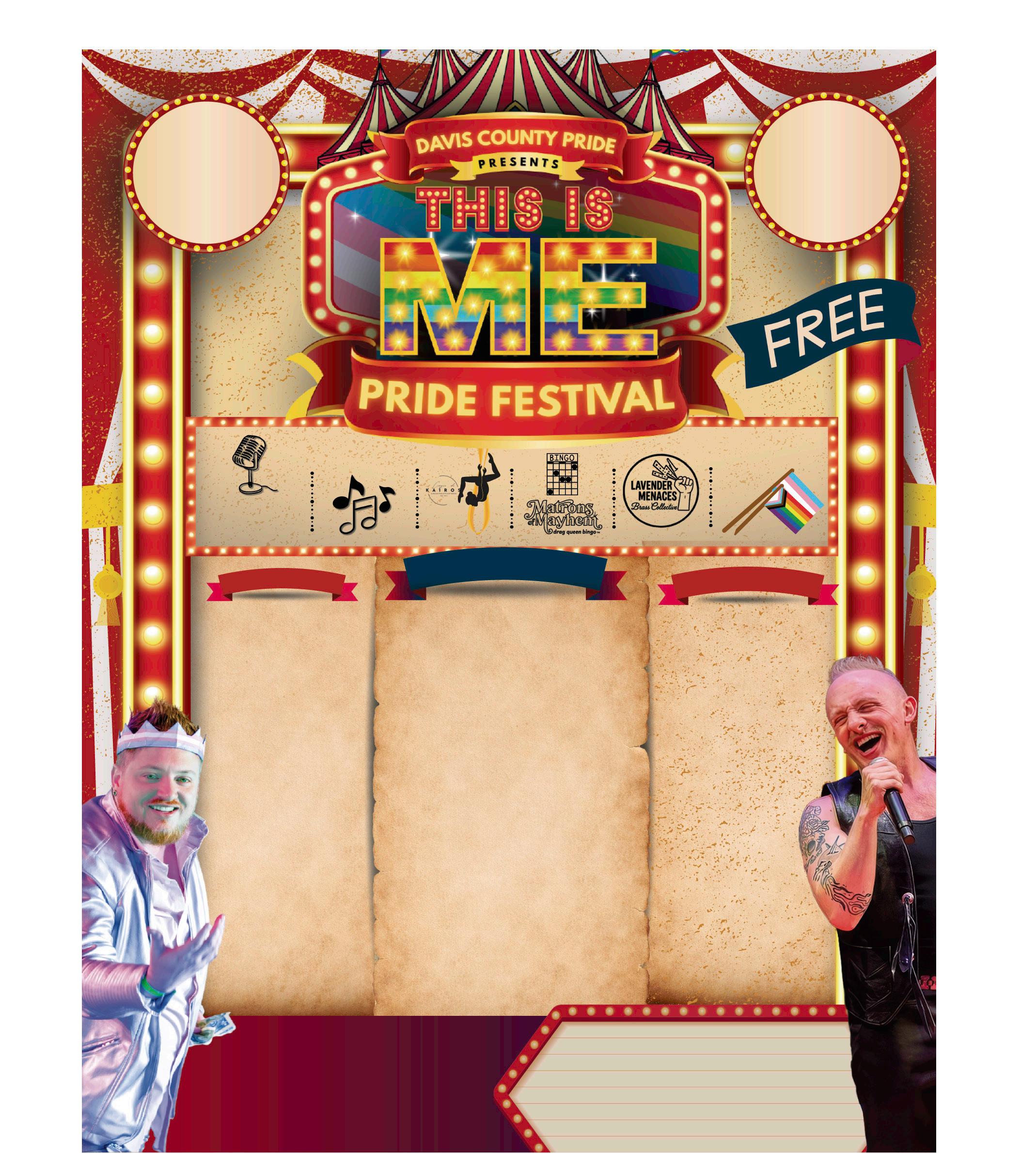
KEYNOTE SPEAKER EYNOTE DAKOTA WURTH AKOTA
SALT LAKE MEN’S CHOIR ALT DAVIS DIVAS AVIS
PROJECT RAINBOW ROJECT PARADE OF FLAGS ARADE
CIRQUE DU IRQUE KAIROS AIROS
MAIN ATTRACTIONS
OPENING ACTS ONGOING & FINALE
NOON OON
FESTIVAL OPENING ESTIVAL
12:15pm 2:15pm THE DAVIS DIVAS HE
12:30pm 2:30pm PARADE OF FLAGS ARADE
12:30pm 2:30pm OPEN CLOSET PEN
1:00pm :00pm KEYNOTE SPEAKER EYNOTE
C IRQUE DU KAIROS
1:30pm :30pm 2:00pm :00pm
MATRONS OF MAYHEM ATRONS ALL DAY LL
MARCUS THE FUNNY MAN ARCUS FUNNY 2:30pm :30pm SPENCER SANDER S PENCER 3:00pm :00pm
H ELL TOGE TH ER
3:15pm :15pm THE LAVENDER MENACES HE
FASHION FLUID
BUSKERS VARIETY ACTS FOOD TRUCKS
VENDOR MARKET KIDS MIDWAY GAMES ASHION VENDOR MARKET KIDS
MEET UNDER THE BIG TOP EET 4:00pm :00pm MATRONS OF MAYHEM ATRONS 4:30pm :30pm C IRQUE DU KAIROS 5:30pm :30pm CLOSING CEREMONY OPPORTUNITY DRAWING CLOSING REMARKS LOSING PPORTUNITY
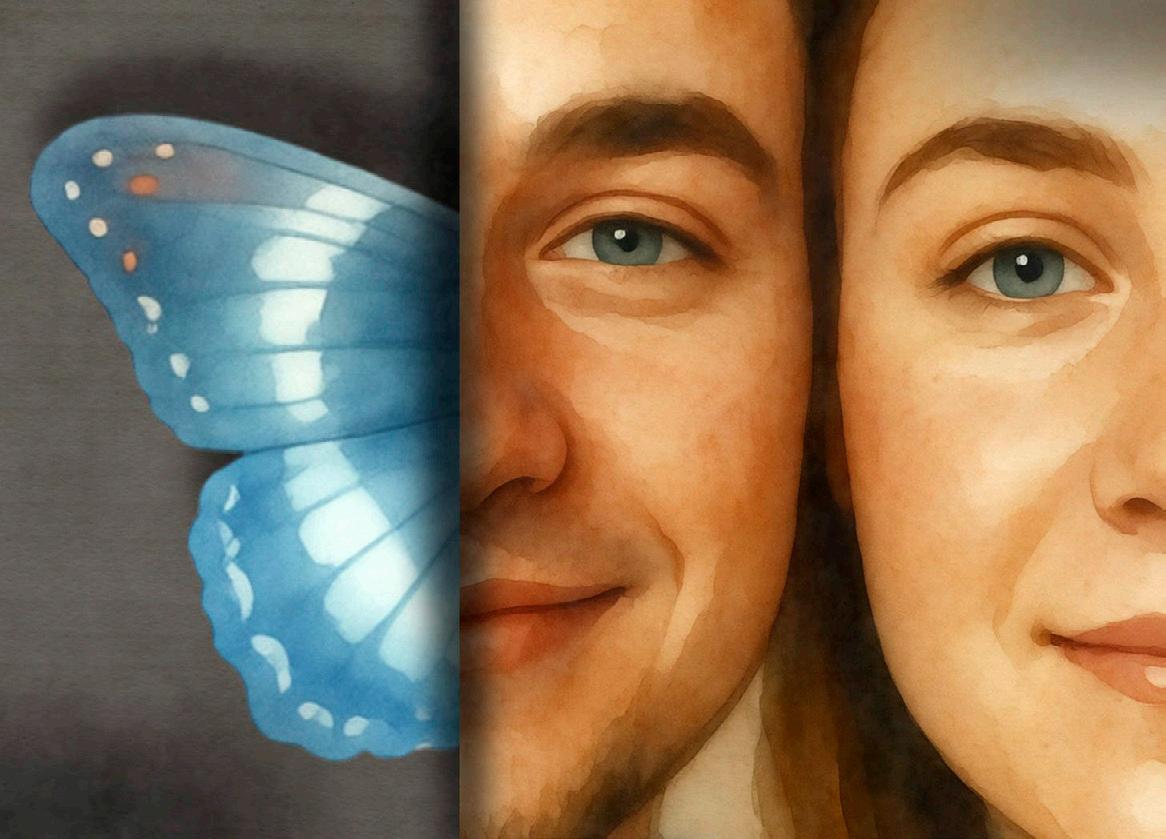
At 11, my identical twin started to transition. It changed my life.
My brother’s metamorphosis into his true self has taught me so much about the transgender community.
BY ELIZABETH SMITH
This story was first published by Uncloseted Media.
WhenI was a little girl, I loved brushing my twin sister’s hair. Julia always hated dealing with it and would ask me to sling a hair tie around it three times to make an extra-tight ponytail. Before leaving for elementary school each morning, either my mom or I would use spray and bobby pins to trap her hair in place.
It was hard to watch all of that long blond hair fall on the floor at the hairdresser’s in Atlanta in 2015.
At 11 years old, I remember sitting in the waiting chairs with my mom, who was crying out tears that mingled both salty grief and sweet relief.
Despite my own feelings of sadness, I remember looking at Julia’s reflection in the salon mirror. Above where the black salon cape was fastened around her neck, all I could see was a beaming smile that took up her whole face. I couldn’t remember a time when I had seen her like that.
She left the hair salon that day with a short, side-swept fringe. A boy’s haircut. Soon after, Julia started going by James and using he/him pronouns.
While my brother and I are identical twins, we do not share the same gender. This has been my reality for over a decade. James’ metamorphosis into his true self has taught me so much about the transgender community. I also believe my perspective as the identical twin of a trans person can be a valuable offering to help people who misunderstand the community or see
gender as a so-called social contagion. Here’s my story.
A few months before the salon visit, I was sitting in my bedroom on my iPad that my grandmother had just gifted me for my 11th birthday. I had been watching YouTube videos of people making wearable mermaid tails from waterproof fabric.
I came across a TMZ video of a 14 year old girl, Jazz Jennings, swimming in a purple mermaid tail. In the video, Jazz explained that she was transgender and that she loved wearing the tails because they made her forget what was between her legs.
Jazz was the first openly transgender person I had ever come across.
I ran to my mom, who was sitting in Julia’s room with her. “I think this is what Julia is,” I told her while I pressed the video up to her face.
I remember Julia watching inquisitively as my mom tried to hide her reaction. Though Julia didn’t say anything, I think that’s when she had finally been able to put a label on the feeling she had felt her entire life: transgender. Somehow, I had always had a sense that I had a twin brother, not a sister. Growing up, I liked Barbies. My twin, on the other hand, dressed up as a muscly cop for Halloween two years in a row. On character history day in elementary school, she fought tooth and nail to dress up as Christopher Latham
Sholes, the inventor of the typewriter, instead of women’s rights activist Susan B. Anthony. After her teacher said she had to dress up as a female figure, she dressed as Sholes anyway.
At our fifth grade graduation ceremony, the school told her she needed to wear girls’ formal attire. Still, Julia strode across the stage in a tiny tux, becoming the first known girl at the time to sport such an outfit in our Georgia elementary school.
Shortly after showing my family the video of Jazz, my memory feels like a series of vivid scenes.
There’s a scene of me, Julia, and my mom at Kohl’s shopping in the girls’ clothing section for back-toschool outfits. Julia clutched her chest, hard, and told my mom she couldn’t breathe. She was having a panic attack, but couldn’t articulate why.
After my twin told us he wanted to change his pronouns and go by James, there’s a scene of my mom pacing the house frantically, tearing paintings of me and my twin off the wall, and flushing them down the toilet as she sobbed through clenched teeth. Though my mom wanted what was best for her child, it was hard for her to come to terms with the changes. For the first few months after the name change, she said she felt like Julia was “gone.”
Shortly after starting at a new middle school in Georgia, James was
DESIGN
diagnosed with gender dysphoria after starting therapy. With seventh grade and puberty just around the corner, my mom had no idea what to do next. So we went to see our childhood pediatrician, who told her that “this was just a phase” and that my brother would “get over it soon enough.”
I knew our doctor was wrong.
I remember the three of us going to our long-time Methodist church to ask our priest for guidance. The priest responded with a typical “We love you… BUT” monologue. My mom asked the priest to pray for my brother’s mental health, but the only thing my priest must’ve heard was “transgender,” and the only thing he must’ve thought was “sin.”
I knew our priest was wrong. Eventually, my mom made the decision to leave our red state, which currently has 12 anti trans bills making their way through the state legislature. She wanted to find a place where my brother would be accepted. A place where he could find therapists and doctors who would help him figure out what to do next. We packed up our house, where James and I were born and raised, and drove to our new home in Colorado.
Shortly after arriving, I remember harrowing screams — the kind that are fueled by sheer panic — from my brother in our new living room after he got his period. He had menstruated months before me, and had started puberty blockers too late because doctors in Georgia wouldn’t help him.
As the years passed, my brother got the gender affirming care that I watched save his life. As the dysphoria lifted, he had fewer panic attacks.
As James moved toward his true self, I sort of became the control subject of an experiment. When he started hormones at 15, we began looking different for the first time in our lives. His face grew more angular than mine. A blond mustache came in, followed by an adolescent beard. He grew an inch taller. His frame filled out in ways mine never would.
I was a living measure of how far he had traveled from our original shared image.
But so many things were un-
changed. We still had the same smile, the same laugh, the same cadence, the same timing. Our hair color and our eyes still matched. He was a boy now, and I was not. But we were still, somehow, the same. I’ll admit, it took some adjusting. It’s well-known that identical twins cherish their identicalness. I mean, how cool is it when two people look exactly the same? But when I look at my brother now, I don’t mourn Julia, I still see James as the person I’ve known my whole life: My platonic soulmate, my best friend, and ride-or-die. My twin. Today, people often say to us, “You look awfully alike for boy-girl twins.” Each time they ask, we give each other a knowing look before we say “fraternal” in an effort not to confuse them. People nowadays have a hard time coming to terms with the sentence, “We are identical, but we are different genders.”
I wish more people could have the privilege I had of learning about the trans community. At 11 years old, I learned the difference between gender and sex. At 12, I learned that someone who identifies as one gender may begin to experience the puberty associated with another gender and that a mis-
matched puberty can be detrimental to their mental health. And at 13, I learned what gender dysphoria really meant after my twin was diagnosed with it. My brother’s experience taught me that the societal construct of the gender binary of “man” and “woman” is unfixed and subjective. For us, even as two identical little “girls,” I now realize how idiotic it is to assume we both craved pink Barbies. Today, dozens of states have passed laws restricting or banning the gender affirming care that allowed my brother to become his true self. I think about the times when he clutched his chest in the girls’ section of a department store. Or when he flexed for photos in his muscly cop costume. Or when he screamed in our Colorado living room as if the world was ending. I think about all of it when people tell me transgender identity is a choice, or a phase, or a contagion. I was there. I witnessed his yearslong transition. While Julia might have been the caterpillar version of my brother, who James is today is a metamorphosed butterfly. And damnit, that butterfly is the most beautiful thing I’ve ever seen. I love you, James. Q
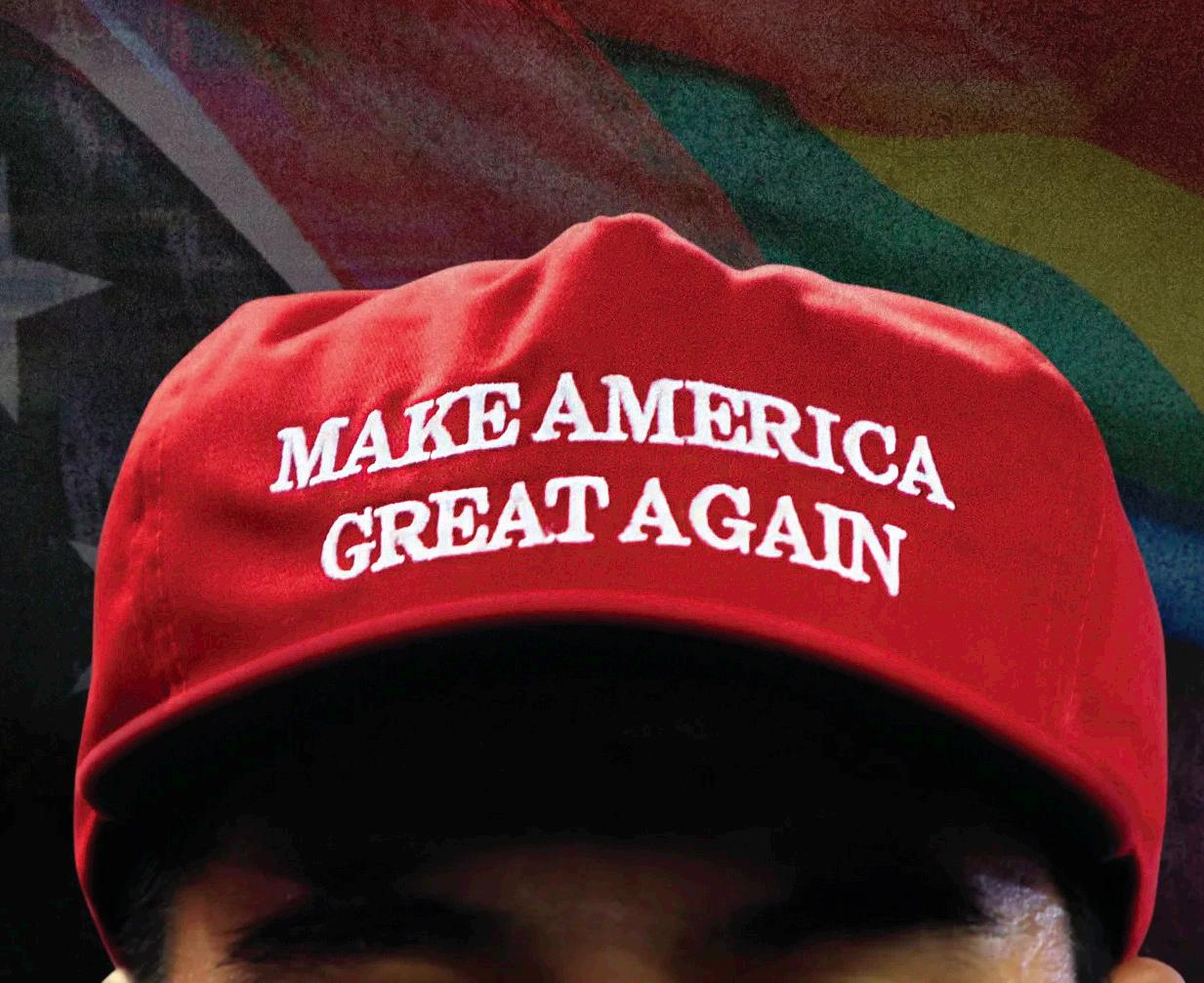
Inside the Lonely World of MAGA Gay Men
BY EMMA PAIDRA
This story was originally published in Uncloseted Media, an LGBTQ focused investigative news outlet, in partnership with Gay Times Magazine.
When Evan
decided it was time to tell his boyfriend that he voted for Trump, he couldn’t get the words out.
“I was stuttering for 20 minutes straight on the phone,” he told Uncloseted Media and GAY TIMES.
Once he finally worked up the courage, he was met with pushback: “He made fun of me. … He called me a racist and a white supremacist,” says Evan, a 21 year old math major who lives in Long Island, New York.
That pushback isn’t unusual: According to a 2023 Pew Research Center survey, 83 percent of queer men typically vote Democrat.
INSIGHTS FOR THE LGBTQ+ COMMUNITY
One key reason gay men swing left in 2026 is because of the Trump administration and MAGA-aligned politicians’ track record on LGBTQ issues. Since the start of Trump’s second term, his administration has terminated more than $1 billion worth of grants to HIV-related research, removed the Pride flag from the Stonewall National Monument, and shut down the LGBTQ specific option on the 988 youth suicide hotline.
Because of this, many of the fewer
than one in five LGBTQ men who cast their ballot for Trump in 2024 face judgment for their political affiliation.
“People think that I hate myself for being gay, and that I’m a gay traitor. … I wish there were more gay conservatives or moderates,” says Evan, who requested to use a pseudonym due to fears over retaliation for his political views.
NAVIGATING DATING AND RELATIONSHIPS AS A GAY TRUMPER
Nick Duncan, 43, can relate to Evan’s fears about being an open Trump supporter:
“I mostly get hatred. I’ve never lost a conservative friend because I’m gay, but I’ve lost all of my gay friends because I’m conservative,” says Duncan, a hospitality executive who lives in Miami. “I’ve divorced myself from what I refer to as the Alphabet Mafia.”
Duncan says he feels so unwelcome by the LGBTQ community that he’s hesitant to attend certain queer events.
“Nowadays, I would never go to a Pride event,” Duncan told Uncloseted Media and GAY TIMES. “I don’t feel that I would be safe.”
Despite these concerns, Duncan doesn’t hide his political views when looking for love. “I’m in a long-term relationship now, and when I have been on the dating market, I’m very open and upfront about [my political
views]. So I think it just weeds out most people who would have an issue.”
For Evan, political differences have been a source of tension in his relationship, even before he told his boyfriend who he voted for. “When I first met him, he asked me if I liked Trump. … He was kind of scaring me. So I said, ‘I don’t know,’” Evan recalls. “He said, ‘Good answer, because if you said yes, I couldn’t even talk to you.’”
Since revealing his conservative identity, Evan has had multiple arguments with his boyfriend about politics.
“This guy, who I’ve been dating for almost a year, he’s way too far left. … The first proof is he thinks there’s more than two genders,” says Evan. “I tried telling him there were only two genders, and he got mad at me.”
Though Evan believes there are only two genders, research suggests that gender is a spectrum, allowing for multiple gender identities.
PROUD GAY TRUMP SUPPORTERS
According to a 2025 report from the Pew Research Center, 71 percent of LGBTQ adults view the Republican Party as unfriendly towards LGBTQ Americans. Duncan thinks these critiques are unreasonable.
“The Republican Party is not nearly as anti-gay as [leftists] believe,” he says. “The Trump administration has plenty of openly gay people in the administration, and Trump actually supported gay marriage before it was cool.”
Gay members of the Trump administration include Treasury Secretary Steven Mnuchin and Tony Fabrizio, a pollster and strategist. Additionally, Trump did tell The Advocate in a 2000 interview that though “the institution of marriage should be between a man and a woman,” he thinks amending the Civil Rights Act to grant the same protection to gay people that we give to other Americans is “only fair.”
But since then, Trump has appointed Supreme Court Justices who have denounced marriage equality and Cabinet members with anti-LGBTQ track records, including Pete Hegseth, Marco Rubio, and Pam Bondi.
Duncan says part of the reason he isn’t worried about Trump’s anti-LGBTQ track record is because he doesn’t view
being gay as the most important part of his identity: “The most important part of who I am is as a father.”
Duncan is not alone: A 2020 report from the UCLA Williams Institute School of Law found that Republican lesbian, gay, and bisexual people are more likely to feel connected to other parts of their identities than their sexual orientations.
Evan doesn’t identify with the community at large and does not like to be referred to as “LGBTQ” or “queer.”
“I realized I’m normal. I’m not LGBTQ,” he says. “I’m just gay.”
Evan’s desire to be seen as “normal” rings of Vice President JD Vance’s 2024 comments on Joe Rogan’s podcast, where he said Trump could win the “normal gay” vote. During this same interview, Vance suggested that parents of genderqueer children use their children’s identities as a rejection of having white privilege. Vance received significant backlash for these comments, with the Human Rights Campaign responding to the vice president’s remarks over X.
SOME GAY REPUBLICANS SEE THE GOP AS MORE FRIENDLY
For Chris Doane, 56, voting Republican is the only choice that makes sense, as he believes voting for a Democrat goes directly against his interests as a queer man.
“Conservatives don’t want to murder gays. They want them saved,” he says. “Muslims vote Democrat, because if the Democrats win, they get to stay [in the U.S.], they get to take power, and they will murder gays brutally with a smile on their face,” says Doane.
Doane was raised in a conservative family in Bryan, Texas, and isn’t out to his family because he fears that they won’t accept him. For him, voting Republican is part of his heritage. “I was told, ‘Don’t ever let Democrats in control. They’ll ruin our country,’” he says. “That’s pretty much what they did, and that’s why President Trump is working overtime to straighten it all back out.”
TRANS RIGHTS AND GAY REPUBLICAN MEN
Though Doane and other gay Republicans hold a range of views, a
common thread is a hesitancy around trans rights. So, they align more with the Trump administration, which has railed against the trans community with Trump’s policies and rhetoric.
For example, Doane sees being able to transition as a matter of personal freedom, but thinks gender affirming care for trans kids is a step too far.
“When it comes to transgender, I have nothing against that. I just believe that when you make that transition, it should be at a point where your brain is fully developed … and you’re actually going to enjoy that transition,” he says.
He also holds the view that for a trans person to be accepted as their correct gender, they must fully physically transition.
“If you’re gonna transgender, transgender all the way. If you’ve still got male parts on you, you don’t belong in the women’s dress room.”
However, research suggests otherwise, with a 2025 study indicating that policing bathroom access can lead to mental distress in trans youth.
Duncan has his own doubts.
“I disagree with the integration of gender ideology and radical wokeism into the LGBT community. You are free to live under any delusion you so desire. You’re not free to require me to live under your delusion as well,” he says. “But if somebody wants to live as a man or a woman, however it is, I firmly believe they have the right to do that. I would never get in the way of it.”
Duncan also believes that education about LGBTQ people should be limited in schools. He sees adolescence as a fundamentally confusing time, and believes an education about LGBTQ communities would “add on layers of confusion.”
This belief seems to be in line with Gov. Ron DeSantis’ 2022 “Don’t Say Gay” bill, which has banned education on gender identity and sexual orientation in Florida’s classrooms from pre-kindergarten until the end of eighth grade, though there are exceptions for health lessons.
“It’s okay to tell kids that some boys like boys, some girls like girls, some people like both. But it just needs to be kept vague and general,” Duncan says.
“However you are is okay. We don’t need to expose children to gay media because if you’re gay, you’re going to know.”
Duncan does not believe heteronormative bias in mainstream media is a problem, though a study published in Equity & Excellence in Education found heteronormative biases in schools may harm queer students.
“The vast majority of people are heterosexual, and a functioning society is built on a heteronormative bias,” he says. “It is important to understand that we are the extreme minority and society is not responsible for conforming to us.”
THEY APPROVE OF TRUMP AND DON’T SEE HIM AS A THREAT
While LGBTQ Americans see the Republican Party as unfriendly towards queer people, Duncan and Doane aren’t worried about being stripped of their rights. Duncan says the 2015 passage of gay marriage solidified his equal rights.
“We have marriage as gay men. I have every right that a straight man does,” he says.
Doane also feels that his rights are secure under Trump 2.0 and approves of the president so far.
“I voted for that great, big, beautiful wall because we were being overrun by illegals,” he says. Doane also approves of U.S. interventions in Iran and Venezuela, though he criticizes Trump for “leaving [Venezuela] way too soon.”
Similarly, Duncan is generally approving of Trump’s handling of immigration. “I don’t love what we’re doing as far as deportations, but we had to get some control over the illegal population,” says Duncan. “I wish there was another way, but I can’t think of it.”
Duncan and Doane are certainly in the minority as queer men who approve of Trump, but as far as they’re concerned, Trump is delivering on his promises.
“Overall, I’m happy,” says Duncan. “I’m getting pretty much exactly what I voted for.” Q
This story was originally published in Uncloseted Media. For all their LGBTQ-focused journalism, consider becoming a free or paid subscriber at UnclosetedMedia.com.
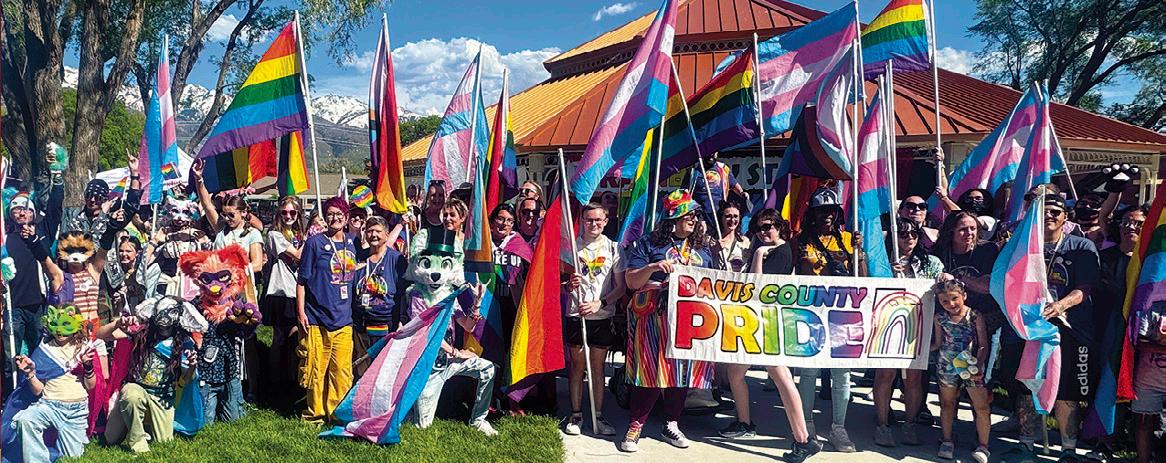
THE SPOTLIGHT IS FOR EVERYONE AT THE 5TH DAVIS COUNTY PRIDE MAY 2
Under the Spring sun at Layton Commons Park, the circus ring will be set, not for spectacle alone but for something deeper: visibility, belonging, and a community that steps boldly into the spotlight.
On May 2, Davis County Pride marks its fifth anniversary with a theme that feels both celebratory and defiant: “THIS IS ME.” With more than 130 booths, a dozen food trucks, and a full afternoon of performances and activities, organizers say this year’s festival is their most ambitious yet, while still holding tight to the intimate, community-driven spirit that has defined it from the beginning.
“We are looking to bring the biggest and best Pride celebration Davis County has ever seen,” said JAKE BOYLE , board president and executive director of Davis County Pride. “The ‘stage’ we’ve built over the last five years is big enough for everyone, and we want to share our spotlight with all.”
FROM PROTEST TO PRIDE
That stage didn’t exist five years ago. The festival began as a response to legislation banning Pride flags in Utah schools — a moment Boyle now describes with a mix of irony and gratitude.
“In hindsight, that catalyst is the best gift lawmakers gave the queer community of Davis County,” he said.
What started as a small, almost DIY gathering with about 30 booths and a handful of food trucks has grown into one of Utah’s most beloved regional Pride events. Yet Boyle is quick to point out that growth hasn’t meant losing its identity.
“I often refer to it as the biggest little Pride festival in Utah,” he said. “Ogden and Salt Lake City do really great bigscale festivals. Our niche is that small
festival feel. It still feels like home.”
That sense of home is especially significant in a suburban county where LGBTQ+ visibility can still be subject to challenges.
“Some of the most hurtful bills introduced each legislative session originate from those claiming to represent Davis County,” Boyle said. “Our festival is an important reminder that we are here, we will take up space, and we are filled with Pride.”
A CIRCUS WITH PURPOSE
This year’s circus theme adds a layer of whimsy, but it also acts as a metaphor: everyone deserves a place in the ring.
For COLLEEN MEWING , board secretary and the festival’s entertainment chair, that idea comes to life through new additions like busker-style performance rings and aerial acts from Cirque du Kairos, a Utah-based circus arts group.
“We have two busker performance rings that are separate from our main stage, which is new,” Mewing said. “And CIRQUE DU KAIROS will be doing aerial arts, acrobatics, and unique artistic movements.”
The effect is less about spectacle for its own sake and more about creating moments of discovery — small circles of joy scattered throughout the park.
“We’re a one-day event, so we mix things up with shorter segments and give people time to explore,” she said.
In a nod to both history and homegrown impact, this year’s festival map doubles as a tribute, with walkways named after LGBTQ+ pioneers and local changemakers. Attendees will stroll along “streets” such as Harvey Milk Blvd and Marsha P. Johnson Parkway, while also encountering names that reflect Utah’s own legacy, such as Michael Aaron Ave, Connell O’Donovan Drive, Dako-
ta Wurth Way, Nikki Boyer Blvd, and Charles Lynn Frost Lane. Community organizations are also honored, turning the festival space itself into a living reminder of the people and movements shaping equality past and present.
Adding to the immersive layout, the Utah Pride Center will host the “Center Ring” alongside the Main Stage, while the Matrons of Mayhem bring their signature flair to “The Big Top,” featuring lively rounds of bingo and entertainment.
The lineup leans heavily on local talent, including a pop-up group of Davis County singers of the SALT LAKE MEN’S CHOIR , SPENCER SANDERS, the LAVENDER MENACES BRASS COLLECTIVE , and headliner LIAM LARS. It’s a deliberate choice shaped as much by budget realities as by philosophy. Ogden Pride President SEAN CHILDERS-GRAY will be the ringmaster.
“We don’t have a large budget, so we focus on talented local artists in our community,” Mewing said.
That budget, around $13,000, requires creativity at every turn. Boyle estimates it costs over $3,000 just to secure the venue and insurance.
“We have ideas that could easily take us up to a $100,000 festival,” he said. “But what we’ve managed to do with so little, I think first time attendees will be blown away.”
CREATIVITY OVER CORPORATE
Unlike many larger Pride events, Davis County Pride relies on a donation-based model rather than major corporate sponsorships. Booth fees are intentionally kept low, and admission is free.
“That model may limit us,” Boyle said, “but it forces us to be creative, and that’s part of the charm.”
It also shifts the focus toward community support. Attendees are encouraged to spend money directly with vendors, tip performers, and invest in the local ecosystem that sustains the festival.
A key part of that ecosystem is PROJECT RAINBOW, which is matching donations dollar-for-dollar this year. The partnership has also inspired one of the festival’s most anticipated visual moments: the “Project Rainbow Parade of Flags,” where youth will carry Pride flags representing a range of identities onto the stage.
“The flags will stay up all day as a reminder that everyone is welcome, seen, and respected,” Boyle said.
PRIDE, THEN AND NOW
For Mewing, who grew up in Davis County, the festival represents something once inconceivable.
“I graduated from Clearfield High School in the early 1980s,” she said. “Back then, we didn’t have GSAs or dare to come out. Being visible in this community now, being married to the woman I love, and celebrating our fifth Pride — it’s more than my 17 year old self could ever imagine.”
That generational shift is central to the festival’s mission, particularly for LGBTQ+ youth.
“Davis County Pride was formed for the youth,” Boyle said. “This is your festival. Step into the spotlight and boldly proclaim, ‘This is me.’”
MORE THAN A DAY
While the festival itself runs from noon to 6 p.m., organizers emphasize that its impact carries far beyond a single afternoon. Davis County Pride now hosts year-round programming from coffee meetups to youth art nights to holiday events, creating spaces for connection in between the larger celebrations.
“The festival makes a statement,” Boyle said. “But it also sustains us all year long.”
Still, on May 2, the focus returns to the park, the performances, and the people filling every corner of the grounds, whether they’re watching aerialists overhead, joining the “Love Train” march, or simply sitting on a blanket, taking it all in.
Mewing hopes attendees leave with something lasting.
“I want people to walk away feeling accepted, loved, and excited to come back next year,” she said.
Boyle puts it more simply: “Get there right at noon. Stay the whole time. Bring a lawn chair. By the end of the day, I think people are going to feel overjoyed and wish it was longer than six hours.”
In a place where visibility can still feel like a radical act, even a modest circus can become something powerful: a ring of community, a stage for truth, and a reminder that everyone belongs in the spotlight. Q
More information at DavisCountyPride.org
DAVIS COUNTY PRIDE SCHEDULE
Davis County Pride will bring a full afternoon of celebration, visibility, and entertainment to Layton Commons Park on SATURDAY, MAY 2, FROM NOON TO 6 P.M ., featuring local performers, community voices, and family-friendly activities.
FASHION FLUID OPEN CLOSET is an interactive experience where attendees may explore gender expression through clothing in a welcoming, judgment-free space.
Throughout the afternoon, food trucks, a kids’ midway with games, and roaming buskers and variety performers will keep the festival lively and accessible for all ages.
NOON
The festival opens at noon with a welcome from board members, followed by emcee SEAN CHILDERS-GRAY and a mayoral greeting.
12:15PM
DAVIS DIVAS, a pop-up vocal ensemble composed of singers from the SALT LAKE MEN’S CHOIR who were raised in or live in Davis County, will take the stage to sing the Pride theme song “This is Me.”
12:30PM
PROJECT RAINBOW PARADE OF FLAGS will stage a colorful, symbolic youth march to represent the community’s diversity.
1PM
Keynote speaker Clearfield City Council member DAKOTA WURTH will address the crowd. Wurth is an advocate and community voice known for speaking on LGBTQ+ visibility and lived experience, and is running for Utah State Senate District 5.
1:30PM
CIRQUE DU KAIRES, a dynamic performance troupe blending circus arts, acrobatics, and theatrical storytelling. Their acts combine physical artistry coupled with expressive themes that explore identity and transformation.
2PM
Laughs and lively audience participation with MARCUS THE FUNNY MAN on the Main Stage and MATRONS OF MAYHEM for a round of drag bingo under the Big Top. The Matrons, a well-loved local drag collective, are known for their comedic timing, bold personas, and community fundraising efforts.
2:30PM
Singer-songwriter SPENCER SANDERS will bring an acoustic-driven set that blends moving lyrics with a contemporary pop sensibility. Sanders’ music reflects themes of self-exploration and emotional authenticity.
3PM
MOM HUGS with the theme HELL
TOGETHER from the words David Archuleta’s mom told him as she left her church, choosing unconditional love and support for her gay son.
3:15PM
LAVENDER MENACES MARCHING BAND will deliver a high-energy, brass-forward performance rooted in queer history and protest tradition. The group combines musical performance with activism, reclaiming a once-derogatory term as a badge of pride.
3:30PM
LOVE TRAIN MARCH invites attendees to join in a celebratory procession through the park, emphasizing togetherness and mutual joy.
4PM
The MATRONS OF MAYHEM return for another round of drag bingo and variety acts.
4:30PM
CIRQUE DU KAIROS returns with more acrobatic spectacle.
5PM
FASHION FLUID OPEN CLOSET closes.
5:15PM
The festival concludes with a closing ceremony featuring opportunity drawings and final remarks before the main stage concert.
5:30PM
Headlining the evening is the LIAM LARS BAND, a regional favorite known for high-energy live shows that fuse rock, pop, and indie influences. The band’s engaging stage presence and crowd-friendly sound make them a fitting finale for the day’s celebration.
Utah Pride: Elevated
Utah’s largest LGBTQ+ celebration returns this year with a uniquely local theme. Organizers describe “PRIDE ELEVATED ” as a reimagining of the familiar “Utah: Life Elevated” message, showing both the state’s beauty and the determination required for LGBTQ+ Utahns to live openly.
Scheduled for JUNE 3–7, the Utah Pride Festival and Parade are expected to attract over 100,000 attendees to downtown Salt Lake City. Events begin earlier in the week, starting with a PRIDE FLAG RAISING CEREMONY at the Salt Lake City County Building at Washington Square Park on Wednesday, June 3 at 6 p.m., followed by a new DIRECTOR’S RECEPTION on the rooftop of the Salt Lake City Main Library.
On Wednesday, , June 4, the UTAH PRIDE INTERFAITH WORSHIP SERVICE returns at First Baptist Church of Salt Lake City. A new 21+ OPENING NIGHT CELEBRATION at Library Square completes the week’s lead-up to the weekend rally, march, and festival.
This year’s programming features the return of the YOUTH ZONE in partnership with DAVIS COUNTY PRIDE and a display from the GLITTER FOUNDATION ’s 2025 TRANSGENDER DAY OF REMEMBRANCE , delivering opportunities for both celebration and reflection at Washington Square Park. The theme “Pride Elevated” comes at
a time when Pride celebrations nationwide face increasing challenges. Organizers note a wave of cancellations and cutbacks due to reduced sponsorships and rising costs. Tampa Pride in Florida announced a hiatus for 2026 after losing key sponsors and grants following DEI rollbacks. Arlington Pride in Texas was suspended over safety concerns after local anti-discrimination protections were rolled back. In Tucson, organiz-
ers canceled the festival and dissolved the board because of financial strain, ending a nearly 50-year tradition.
Given these challenges, Utah Pride leaders emphasize the heightened importance of this year’s event. Utah Pride Center and Executive Director CHAD CALL urge businesses, community leaders, and individuals to support the festival, noting that while Utah Pride remains strong, it faces the same financial pressures as other events nationwide.
“It takes months of planning, hundreds of volunteers, and more than a million dollars to produce Pride at this scale,” Call said in a recent appeal. “Pride doesn’t just happen on its own— it’s built together.”
Organizers stress that sponsorships and community donations are essential for both this year’s celebration and its long-term sustainability. As costs rise and corporate giving changes, community support is increasingly vital to maintaining Pride’s visibility where it matters most.
Even with these challenges, the message of “Pride Elevated” remains clear: in Utah, Pride is both a celebration and a statement. This June, thousands are expected to gather to affirm their presence and resilience. Q
Prides across Utah this summer
Utah’s 2025 Pride season is brimming with vibrant celebrations across the state. Here’s a chronological guide to the regional Pride events, each offering unique experiences and opportunities to support the LGBTQ+ community.
DAVIS COUNTY PRIDE FESTIVAL – MAY 2 (LAYTON)
Kicking off the season, the Davis County Pride Festival invites everyone to “THIS IS ME ” at Layton Commons Park from noon to 6:00 PM. This free, family friendly event features over 60 local artists and crafters, 40+ nonprofits and resource providers, drag performances, storytellers, a flash mob, a walking parade, and more. It’s a joyful celebration of community and creativity.
DAVISCOUNTYPRIDE.ORG
BLOOMING WITH PRIDE – FRIDAY, JUNE 12 (SALT LAKE CITY)
Red Butte Garden hosts “Blooming with Pride” from noon to 7 p.m., celebrating the resilience and diversity of the
LGBTQ+ community through nature and art. Attendees can enjoy botanical art exhibits, hands-on activities, self-guided garden tours, and contribute to a collaborative community art piece. It’s a day where joy blooms, and everyone is welcome. According to organizers, this year’s theme, ROOTED TOGETHER , reminds us that gardens are strongest when many plants share the same soil, each with its own color, shape, and story. “At the Garden, we believe that plants are for everyone, and we all deserve a place where we can grow, belong, and bloom.”
REDBUTTEGARDEN.ORG
Continued on the next page.
DAYBREAK PRIDE – JUNE 14 (SOUTH JORDAN)
Daybreak Pride returns on Sunday, June 14, 2026, from 11am to 5pm at Highland Park North Fields, 6050 W Lake Ave, South Jordan, Utah. This vibrant, community-focused event invites everyone to celebrate in a welcoming and inclusive space. This year, you can sponsor the Daybreak Pride Pinwheel Path. The event is sponsored by Daybreak for Inclusion and Diversity with the motto “Love All Where You Live.”
LOVEALLWHEREYOULIVE.ORG
MILLCREEK PRIDE – JUNE 20
SLC PRIDE FESTIVAL –JUNE 27-28
SLC Pride returns to The Gateway in downtown Salt Lake City for its third annual festival, celebrating the LGBTQIA+ community with a weekend full of joy, inclusivity, and empowerment. Plans for the event are not yet available, so stay tuned.
SLC-PRIDE.ORG
WEST VALLEY CITY
PRIDE – JUNE 13, 2026
West Valley City is planning to hold its second annual Pride event at the Utah Cultural Celebration Center, 1355 W. 3100 South in West Valley City on June 13 from noon to 6 p.m. This free celebration includes live performances, local vendors, interactive art experiences, and a reflection of the city’s diverse and dynamic community. It’s a historic moment honoring pride, progress, and unity.
CULTURALCELEBRATION.ORG
LOGAN PRIDE FESTIVAL – SEPTEMBER 19
Logan Pride is scheduled for September 19, 2026, on Federal Avenue in Logan, Utah. Since 2016, Logan Pride has served the Cache Valley community as a non profit
organization dedicated to celebrating diversity while promoting LGBTQIA+ visibility, acceptance, and support in the region. “While we host many projects and activities throughout the year, our hallmark event is our annual Pride Festival that occurs each September,” organizers said. “This single-day event has notably generated the largest reach and impact in and for our community, and it is only made possible by supporters like you.”
LOGANPRIDE.ORG
PRIDE OF SOUTHERN UTAH –SEPTEMBER 26 (ST. GEORGE)
Pride in the Park is Southern Utah’s biggest LGBTQ+ pride festival and is held at JC Snow Park in St. George, Utah from 11am to 5pm. It is a free all-ages community event with live performances, food trucks, and local vendors. No ticket is required to attend, but all attendees will be required to pass through security upon entry. Bag check and metal detectors will be used to help keep this event safe for everyone.
PRIDEOFSOUTHERNUTAH.ORG
OGDEN PRIDE FESTIVAL – OCTOBER 2-4
Celebrating its 12th year, the Ogden Pride Festival has moved! The new schedule is the first weekend of October. “Our community resoundingly said the first weekend in October was the move, so starting in 2026, Ogden, dust off your glitter and pull out those cozy pride sweaters, because the festival is making the jump to October!” Organizers call it the fiercest way to kick off LGBTQ+ History Month and keep the pride alive.
OGDENPRIDE.ORG
Five Husbands Vodka 2026 label revealed
Pride is getting a fresh pour this year, and it comes with a brand new face — well, five of them.
OGDEN’S OWN DISTILLERY has unveiled the 2026 label for its beloved FIVE HUSBANDS VODKA , turning the spotlight once again on real members of Utah’s LGBTQ+ community — and raising a glass to the stories, humor, and heart that define them.
Originally launched in 2019 as a limited Pride Month release, Five Husbands Vodka quickly became more than a seasonal novelty. Demand was strong enough that the distillery made it a permanent, year-round offering and a consistent show of support for LGBTQ+ causes. A portion of every bottle sold continues to benefit community organizations, blending celebration with impact.
This year’s label, shot by photographer NICK SOKOLOFF, introduces a lively mix of Utah personalities
The 2026 edition of Five Husbands Vodka is expected to hit shelves across Utah, select markets, and online retailers this May, just in time for Utah Pride. Whether it ends up in a cocktail shaker or on display as a conversation piece, one thing is clear: this is a spirit that’s as much about community as it is about what’s in the bottle. Together, the five “husbands” represent a cross section of Utah LGBTQ+ life — from activism and politics to nightlife, business, and the arts. And while the label may be playful, the mission behind it is anything but. Cheers to that.
MICHAEL AARON brings decades of community connection — publisher of QSaltLake since 2004, a longtime activist, a familiar face in the Salt Lake Men’s Choir, and a leader in Utah’s naturist community. (He jokes he got his start in activism at age four — the timeline remains under investigation.)
MARRLO
SUZZANNE , a bearded drag queen and frontman of Marrlo Suzzanne & The Galaxy Band, delivers glam rock energy with a theatrical twist. Known for electrifying live performances, Marrlo fuses music and drag into something that feels equal parts concert and cosmic spectacle.
WILL TERRY, a driving force behind equality efforts in Utah, manages Equality Utah PAC and chairs the Salt Lake City Human Rights Commission. His work helps shape a more inclusive political landscape while keeping community needs front and center.
WESLEY
SINISCALCHI has built a following of more than 21,000 by keeping it real — sharing personal growth, confidence, and the occasional behind the scenes look at influencer life. His message: authenticity always lands.
NATHAN
LAYTON , a Layton native, wears more hats than most — longtime hospitality professional, director of operations at Roosters, hairstylist, and small business owner. He’s also been active with Utah Leather Pride and blackBOOTS, supporting education and connection within the leather and kink communities.
A sneak peek at the label will happen at a QSaltLake Issue Launch Party on Friday, 24 at 7 p.m. at Club Try-Angles with food and a special Ogdens Own drink menu. Info at FACEBOOK.COM/EVENTS/974221325073402
Queer pop standouts MUNA, Suki Waterhouse among SLC Twilight Concert Series lineup
LGBTQ artists will take a visible place on Salt Lake City’s biggest public concert stage this summer, as the Salt Lake City Arts Council announces the 2026 Twilight Concert Series lineup.
Among the six national touring acts scheduled to perform, indie-pop trio MUNA and singer-songwriter Suki Waterhouse, both of whom have publicly identified as part of the LGBTQ community, bring queer representation to this year’s city-backed series.
Running from July through early October, the Twilight Concert Series will once again activate downtown venues, including the Gallivan Center and Library Square, continuing a format that has helped the long-running program grow into one of the region’s most attended cultural events.
Of the two LGBTQ acts, MUNA arrives with perhaps the highest profile. The openly queer indie pop trio — Katie
Gavin, Naomi McPherson, and Josette Maskin — is known for centering queer relationships and identity in their music. They have spent the past several years building momentum in indie pop, culminating in their widely praised 2022 self-titled album released via Phoebe Bridgers’ Saddest Factory Records.
Known for blending synth-pop hooks with candid, emotionally detailed lyrics, MUNA’s music often explores relationships, identity, and personal evolution, helping the band build a devoted and diverse fanbase. Their August performance at Library Square is expected to be one of the most in-demand shows of the season, as this is their first return to Salt Lake in four years. Waterhouse, who performs in late July, has also spoken openly about her bisexuality while developing her music career alongside her work in film and fashion. Her sound leans into dreamy,
retro-inspired pop, offering a tonal contrast amid a lineup spanning multiple genres. She appeared in last year’s Kilby Block Party and opened for Laufey at the Delta Center last year in October.
The 2025 Twilight lineup reflects the series’ long-standing emphasis on variety. This year’s performers include:
Old Crow Medicine Show (July 13)
Freddie Gibbs (July 17)
Suki Waterhouse (July 27)
MUNA (Aug. 4)
Goose (Aug. 29)
The War on Drugs (Oct. 1)
From the Americana revivalism of Old Crow Medicine Show to the expansive rock soundscapes of The War on Drugs and the improvisational energy of Goose, the series continues to pull from across the musical spectrum. Hip-hop artist Freddie Gibbs rounds out the bill with a more hard-edged performance style.
Now nearing four decades, the Twilight Concert Series is still a mainstay of Salt Lake City’s summer calendar, drawing thousands of attendees to its openair venues. The use of both the Gallivan Center and Library Square allows the series to accommodate larger crowds while maintaining its focus on accessible, community-centered programming. Concerts typically begin in the early evening, with doors opening at 5 or 6 p.m., and each show includes supporting acts, frequently highlighting emerging or regional performers.
Tickets are on sale at SALTLAKEARTS.ORG
Queer Guide to Kilby Block Party
Kilby Court’s 27th anniversary is being celebrated with Salt Lake City’s largest indie music festival May 15–17 at the Utah State Fairpark.
The 2026 edition might be its queerest, boldest, and most star-studded yet. This year’s lineup not only brings together a sweeping mix of indie, pop, experimental, and genre-blurring talent; it also features a deep roster of LGBTQ+ artists whose identities and artistic voices continue to reshape contemporary music. With tickets now on sale, the festival offers both a celebration of sound and an affirmation of queer presence on some of the year’s biggest stages.
Two of this year’s headliners, THE XX and LORDE , bring serious star power to the Fairpark. For queer fans, The xx’s appearance feels particularly meaningful. Both ROMY MADLEY CROFT and OLIVER SIM have been open about being gay for years, and their music — minimalist, intimate, and emotionally charged — has long resonated with LGBTQ+ listeners who see themselves reflected in the group’s explorations of desire, vulnerability, and self-acceptance. Their headlining set is expected to be one of the festival’s most cathartic moments. Sharing the top line with them is “I’m a woman except for the days when I’m a man” Lorde, whose devoted queer fanbase has followed her
since “Pure Heroine” through the sundrenched introspection of “Solar Power.” Her presence adds a contrasting, shimmering energy to the festival’s climax. Alongside the big-name headliners, the lineup this year is rich with queer excellence. BLOOD ORANGE ’s “I’m Not Gay, But I’m Not Straight” DEVONTÉ HYNES , whose genre-hopping creativity has made him a quietly influential figure for more than a decade, brings an introspective and experimental presence. Hynes has long embraced a sense of identity that moves beyond rigid labels, and his music reflects that expansiveness through stories of queer nightlife, chosen family, and the emotional interiority queer people know so well. His work, full of atmospheric textures, personal storytelling, and explorations of queer identity, makes him one of the festival’s emotional anchors.
FIGHTMASTER , the solo moniker of queer artist and advocate E.R. Fightmaster, is also set to bring the new music and favorite songs from previous EPs Violence (2023) and Bloodshed Baby (2024) to the stage. They announced their debut full length album, Tolerance, will be out June 5th. The album is dominated by raw, unvarnished lyrics that reflect the complexities, some might say messiness, of emotional growth and attempts to find equilibrium.
LUCY DACUS , who has described herself as “kind of queer,” arrives with all the lyrical gravity she’s known for, capturing tension, longing, and the slow unfolding of self-understanding. Her songs about teenage crushes on girls, her reflections on faith and sexuality, and her more recent declarations of queer love resonate deeply with LGBTQ listeners. Joining her in the indie-rock sphere is MICHELLE ZAUNER of JAPANESE BREAKFAST, an openly bisexual artist whose lush sound and narrative depth continue to push the boundaries of pop and alternative music. Her work is a kaleidoscope of tenderness, gender-blurring characters, bittersweet nostalgia, and dreamlike soundscapes. Her shows often feel like sanctuaries — places where queer fans can exist without shrinking themselves, where gentle romance and self-discovery are allowed to unfold in public.
Also taking the stage is JANE REMOVER , a rising trans and nonbinary artist whose work in hyperpop, digicore, and experimental pop has been pivotal in expanding what queer Gen Z music can sound like. Their inclusion marks a major win for younger festivalgoers who see Jane as a generational voice—someone whose sound is as fluid and boundaryless as their identity.
The festival also taps into queer
environmentalism, camp, and the beauty of outdoor drag activism with a performance from PATTIE GONIA , the internationally recognized drag queen, climate activist, and community organizer. Pattie’s appearances are rare, high-energy, and deeply community-minded, blending performance with environmental messaging, queer joy, and a sense of collective purpose. Expect one of the most photographed sets of the entire weekend. Another major queer voice on the bill comes through SNAIL MAIL’s LINDSEY
JORDAN , an out lesbian artist whose guitar-driven vulnerability has made her one of the defining indie musicians of the past decade. Her rawness and clarity about identity, heartbreak, and youth have helped cement her status as a queer icon of modern indie rock.
THE LAST DINNER PARTY, one of the most visually stylized acts on the lineup, infuses their performances with Baroque glam, queer coded sensuality, and the kind of over-the-top theatrics that resonate with anyone who has ever felt too much for too long. Beyond these more widely known names, the Block Party showcases an impressive cross-section of emerging LGBTQ+ musicians. RITT MOMNEY, a Utah-based artist whose later work has leaned into queer themes, returns to a hometown crowd that’s watched his evolution unfold in real time. LYN LAPID, who identifies as part of the LGBTQ+ community, brings bedroom pop’s airy intimacy to the festival’s soundscape. Even artists who aren’t explicitly labeled as LGBTQ+
but who create queer themed work or hold strong queer fanbases help deepen the sense of belonging. Bands like BEACH BUNNY, BETWEEN FRIENDS , and WILD NOTHING continue to attract large queer audiences through their explorations of gender, melancholy, desire, and self-reinvention. Others in the lineup such as MELODY’S ECHO CHAMBER , WOMBO, FREAK SLUG , CAROLINE , and DEHD draw heavily from aesthetics, narratives, and subcultures long nurtured by queer communities. What makes this year’s Kilby Court Block Party feel particularly special is how seamlessly queerness flows through the festival across genres, generations, and cultural backgrounds. It’s not a tokenized handful of artists tucked into side stages or early set times; queer talent is present from the top of the poster to its smallest fonts. This year’s lineup feels like a living cross-section of where LGBTQ+ artistry stands in 2026.
The 2026 Kilby Court Block Party promises to be not only a standout event in Utah’s music scene but a meaningful gathering for LGBTQ+ festivalgoers looking to celebrate identity through sound, performance, and shared space. Tickets for May 15–17 are on sale now, offering queer Salt Lake City music fans—and everyone who loves vibrant, transformative art — a chance to be part of something electric, expansive, and unforgettable.
The Kilby Court Block Party 2026 runs Friday, May 15 through Sunday, May 17 at the Utah State Fairpark, located at 155 N. 1000 West in Salt Lake City. Tickets are on sale now and can be purchased through 24tix.
Trans TikToker Zaya Perysian on Suing Trump and Why Visibility Matters
The West Michigan native with 5 million followers is suing Trump over her passport’s gender marker
BY CHRIS AZZOPARDI
At23, Zaya Perysian has brand deals, 5 million TikTok followers and an active lawsuit against the president of the United States. The West Michigan native is suing the Trump administration over her passport’s gender marker — a fight that grew out of the same TikTok presence where she shares unfiltered transition updates, biting political commentary and everyday moments, from surgery recovery to silk presses at Supercuts. That mix of Gen Z candor, humor and political clarity didn’t come from nowhere. Perysian grew up on a dirt road in Lowell, outside Grand Rapids, surrounded by orchards, railroad tracks and family — a world that now feels far removed from her life in Los Angeles, where she lives with her cats and films much of her content.
ness at a young age was either misunderstood or unaccepted. “Most people I was friends with did not understand that type of stuff. My dad was not supportive, so I suppressed it until I knew I would have full control over it myself.”
As a teenager, she came out as gay — a bridge identity that felt safer, more digestible to her community. “I still got to express myself in different ways,” she says of those high school years. “Lots of people hated it, but lots of people didn’t. I had a pretty good group of friends, so that’s why I was able to exist comfortably like that for about four years before it just became too much.”
When she turned 18, the pandemic shut down life as we knew it. With everything changing around her, Perysian decided to make some major changes of her own.
“High school is over with. I don’t have to worry about the judgment from my peers,” she remembers thinking. “Plus, it was Covid when I graduated. The world was shut down, and I was like, this is the perfect time. I’m isolated, and I can just do it in peace.”
Building community through visibility
But even as her career and platform have carried her 2,000 miles west, Perysian hasn’t forgotten the place that shaped her. “I really had the West Michigan experience, for real,” she says over Zoom, recalling a childhood spent on an orchard with her grandmother next door and her best friends as neighbors.
Growing up in a conservative small town, Perysian always knew she wanted to be in the public eye. At 12, she was already making videos on Vine, then Musical.ly, diving headfirst into “this whole online social sphere” that would eventually become both her lifeline and her livelihood. But knowing she wanted visibility and being able to live authentically? Two completely different things. “I always knew in my head, but, you know, it was West Michigan, in a very conservative little town,” she explains, noting how her exploration of queer-
The silly after school videos came first. She laughs thinking of how, in her first one, she was “probably lip-syncing to some song.” It was only after Perysian began sharing her transition on TikTok that she saw the true impact she could have. The response was immediate and overwhelming, encouraging her to open this window into her life even wider.
“I got so many messages and so many DMs from just complete strangers who saw themselves in me,” she says. “[They] completely resonated with the fact that we’re just people, and this is real and we exist.”
On TikTok, she’s been candid about everything from getting bottom surgery (“I don’t have to fucking tuck anymore!”) to vocally questioning the mental state of “Trans for Trump” people. One of her most-watched videos, with nearly a half million views, is called “Super Cuts Silk Press,” and it’s exactly what you think it is: Perysian goes to a Supercuts and gets her hair straightened, taking viewers through the very
dramatic process of getting a silk press. Those messages and lived authenticity pulled followers even deeper into her life as a trans person navigating an uncertain world. “So many people were just so thankful to have a visual representation of what it’s like,” she explains. “That’s when I first started to realize it; that’s why I kept making all my videos, documenting every part of my transition.”
Then the brand deals started rolling in — her first real sign that this could be more than a hobby. “I was like, wait, I don’t have to just do this for fun. I can actually make money,” she says, laughing. With management now based in New York City handling the business side, Perysian focuses on what she does best: showing up authentically on camera. Her success itself feels revolutionary. “You hear all these stories about how trans women don’t live long lives, and how we all turn to sex work and that’s our only avenue,” she says. But here she is, she says, thriving as a content creator. “There are trans engineers, trans lawyers, trans doctors. It’s amazing. So to exist in this space successfully that’s dominated by cis white people — which, that was the norm for years and years — but anyone can do it. Anyone can do anything.”
But Perysian’s impact extends far beyond brand partnerships and viral videos. In January 2025, shortly after Trump’s return to office, she applied for a passport and received it with an “M” gender marker as a result of the president’s executive order. She posted a video about the experience, fully aware of the backlash it might bring. Today, she says it’s the video she’s most proud of posting.
“That was really scary, and I was like, I don’t know if I want to post this, because people are pretty opinionated, and I wasn’t really in the headspace to hear it,” she admits. “But somebody’s gotta say it, somebody’s gotta speak up, and I had the platform to do it.”
Good thing she did. The video caught the attention of the ACLU, and Perysian became one of seven named plaintiffs in Orr v. Trump, a lawsuit filed in April 2025. Early in the case, the plaintiffs won a preliminary injunction ordering the Trump administration to issue her a passport that accurate-
ly reflected her gender identity.
After that win, the legal team expanded the case into a class-action lawsuit so the ruling would apply to all transgender and nonbinary people — not just the original plaintiffs. A federal judge granted class-action status, and for several months, all trans and nonbinary Americans were able to obtain U.S. passports with gender markers that matched their gender identity because of the lawsuit.
“We literally had a class action against Trump that went through,” she says, with justified pride.
The Trump administration appealed the decision and asked the Supreme Court to pause the ruling while the case moved through the lower courts. The Supreme Court granted that stay. As a result, the class action is temporarily no longer in effect, and passports have reverted to listing only male or female based on sex assigned at birth.
The fight, however, is far from over. “I’m still battling the Trump administration,” she says. “It’s been a year now.”
A win in the appeals court could send the case back to the Supreme Court — putting the future of gender affirming passports nationwide back on the line.
The cost of visibility
The political climate that made Perysian’s lawsuit necessary has also taken a direct hit to her career. As trans acceptance has declined due to the relentless attacks by the federal administration, so has brand interest in working with her.
“When the politicians loved us, the brands loved us. And when the politicians hate us, now the brands are scared of us,” she observes with sharp clarity. “Now brands see me as brand unfriendly or too political, just for standing up for myself.”
Her management now has to “push 10 times harder” to secure partnerships. It’s a sobering reality facing many LGBTQ+ creators, not just trans people. “I know so many people — gay, trans, lesbian, nonbinary — who have also seen a decline recently,” she says. “We’re just seeing everybody’s true colors and how they see us as tools for their marketing.”
Despite the challenges, Perysian continues to live comfortably off her content creation, even as the landscape shifts beneath her
feet. “I still do enough to live the life that I live,” she says simply.
The relentless attacks on trans people make Perysian’s visibility feel increasingly urgent. She’s watched what felt like real progress get reversed practically overnight.
“We had a slight golden age where everything felt like it was getting super progressive,” she reflects, referring to the more inclusive environment under the Biden-Harris administration. “Brands were aligning with us, the media was aligning with us, we were getting representation everywhere. It was seeming like, oh my gosh, people are finally getting it. They’re seeing us as human beings.”
That acceptance threatened existing power structures, she believes. “The moment we emerge from the shadows, it threatens everything that they built, and they are doing everything they can to push us back.”
Her content has shifted accordingly, becoming sharper and more political in response to the near-constant headlines targeting trans people. “I think it’s important that people are informed and educated, and that people know what’s happening,” she explains. “If people remain ignorant, that just makes it easier for them to try and erase us. I’m doing everything I can to make it as hard as possible for them to silence us, and they hate it.”
As much as it’s “sad and scary,” she’s also “empowered and angry and motivated.”
“I can’t believe there’s this powerful group of human beings that put so much time and effort and money into demonizing one of the smallest minority groups in the world, acting like we’re this huge threat,” she adds. “Take a look at the bigger picture. Take a look at the people who are telling you to demonize us, and actually use some critical thinking, research and look at what they’re doing to the world. Look at how they’re destroying society as we know it, sucking profit out of every corner of everybody’s house. And somehow trans people are the issue, and immigrants are the issue. It’s just like, no. You just need to wake up. Like, I’m woke. Bring woke back, please.”
AM I OKAY TO DRIVE? BUZZED
DRIVING IS DRUNK DRIVING
Advice for the next generation
For LGBTQ+ youth stuck in small or conservative communities, Perysian’s advice is straightforward: Find your people online.
“There was no one like me where I lived, absolutely no one,” she says of her own experience. “Once I found community online and I saw that there are a lot of other people like me who exist in the world, it changed my life.”
For those interested in following her path to social media success, she emphasizes authenticity above everything else. “I was very authentic and very honest, very open about everything
in my life,” she explains, though she acknowledges that sharing everything isn’t for everyone. “People online love to see personality. They love to see people who are real, and who are just existing.”
If she could go back and offer guidance to her younger self, growing up on that orchard in Lowell? “Do it earlier,” she says without hesitation. “I was so concerned about what other people were gonna think, which is why I waited so long to really exist as how I am. I would just tell myself, ‘Fuck it. Just go. Do it. It’s gonna happen anyways.’”
It’s advice that resonates beyond coming out — a philosophy for living authentically at any age, in any circum-
stance. She still returns to Michigan for holidays and summer visits, never forgetting the dirt roads and orchards that shaped her. “The goal is to one day end up back in my Michigan fantasy,” she says of potentially returning to the Midwest when she can “settle down.”
But that’s a someday dream. Right now, Perysian is living proof that authenticity works. She’s still here, still visible, still fighting — exactly what some hoped she wouldn’t be. Q
Chris Azzopardi is the editorial director of Pride Source Media Group and Q Syndicate. He has interviewed a multitude of superstars, including Cher, Meryl Streep, Mariah Carey and Beyoncé. His work has also appeared in The New York Times, Vanity Fair, GQ and Billboard. Reach him via X @chrisazzopardi.
Crying at a Biker Orgy: The Tender Queer Story of ‘Pillion’
A conversation with Harry Melling and Harry Lighton on ‘Pillion,’ kink and first love
BY CHRIS AZZOPARDI
In the A24 film “Pillion,” kink is neither punchline nor provocation. Instead, writer-director Harry Lighton and stars Alexander Skarsgård of “True Blood” and Harry Melling, the English actor who played Dudley Dursley in the “Harry Potter” films, craft something far rarer: a tender story about desire set within London’s gay biker dom/sub scene. What unfolds between Colin (Melling), a shy young man discovering himself, and the magnetic Ray (Skarsgård) is a shared journey that ultimately explores agency within the messy, moving process of defining what you want. That the film features butt plugs, bootlicking and a wooded orgy while still feeling like something you could maybe watch
with your mom is part of its quiet magic. As headlines roll in and queer audiences debate the balance between visibility and protecting community “secrets,” I spoke with Melling and Lighton about moms who didn’t run from the screening, why Tiffany’s “I Think We’re Alone Now” might be the most subversive needle drop of the year and making a film that refuses to water itself down for the mainstream.
It’s rare to see a film featuring butt plugs and singlets portrayed with such tenderness. I was thinking about how, if this film didn’t exist, we wouldn’t be seeing headlines like this one from the Boston Globe: “In ‘Pillion,’ a shy bloke’s heart belongs to daddy.” What have you loved most about the critical conversation surrounding the film?
HARRY LIGHTON : Journalists have quite squarely — in terms of directly, not in terms of them being squares — addressed the film. There’s been lots of
really interesting things written on the power dynamics in the film and journalists reaching out to people from the community to get their thoughts on it, and it feels like it has generated discussion. That was always the aim.
HARRY MELLING: One thing that I can’t help but feel is, just like Harry said: discussion. The discussion about this subculture, the fact that it’s now got a platform that people are talking about and people are engaging in what these dynamics are, and that’s just wonderful that a film can open up that conversation.
Now that audiences are interpreting the film in their own ways, does it feel aligned with what you set out to create?
LIGHTON: It does seem to be received in the way I set out. I wanted it to have room for contradictions. So when you began your interview by saying that, for a film about butt plugs and arseless singlets, it felt surprisingly tender, that means a lot to me. I was just doing an interview with some pups who were saying how it felt lovely that they’d seen their community represented in a way which felt like it had some hon-
esty beyond stereotypes. So all those things made me very happy, for sure. There’s often a tension in queer culture between visibility and privacy — wanting representation, but not wanting every “secret” exposed. How do you respond to that mix of excitement and caution from within the community?
MELLING: Well, certainly when I started hanging out with GBMCC, the Gay Bikers Motorcycle Club, just to get to know these guys, that was exactly what I thought. As an outside actor coming to this group, I really wanted to make sure that they felt comfortable in discussing this subculture and their world with me. They were so generous with their time, with volunteering stories about how to do a decent bootlick and so forth. Then they ended up being in the movie, which is incredible, and the fact that they went to Cannes and got to have that experience was just a full circle moment.
LIGHTON: I agree with what Harry said, and I think that, listen, it’s still a film about one very specific relationship. It’s not meant to be a depiction of the blueprint of this community. So there’s still plenty of room for secrets.
What was the most valuable lesson that you learned from people who are living this life so that you could portray Colin?
MELLING: One of the things that really attracted me to this role was just how courageous he is in deciding to jump into this new territory, to maybe not at all times knowing exactly what he’s chasing, but knowing that it’s right for him. And certainly talking to the other guys from GBMCC and others from the London kink scene — there are a couple of those guys in the movie — the common thread between all those narratives was just how brave they are to decide that’s the life they want to live. I found that very moving, and it all felt that there was a similar narrative in terms of jumping off something into something that to a lot of people will be different. That bravery was something that I really realized as I was going through the journey of Colin.
Despite its explicit elements, it feels accessible. I kept thinking, “My mom might like this movie.”
LIGHTON: We both did show our moms and they didn’t run a mile. They laughed at it! Was there ever pressure — internal or external — to make the story more palatable?
LIGHTON: Not at all. I think that when I was presented, the book was given to me by Eva Yates, who ended up being an executive on it, and it was very clear from the book that telling a version of this story where it felt too diluted would be to try to pull the material in the opposite direction. When I was writing, I had conversations with myself and others about how to make sure that, without diluting the extremity of the material, we were also creating a world which felt inviting and felt like it had warmth in it, so it didn’t just feel like we were holding an uninitiated audience member at length. But it was never a pressure in terms of trying to hit that mainstream.
MELLING : I also think because you are with Colin, who doesn’t have prior knowledge about this world, [you are] so up for it. It’s just a useful gateway in terms of allowing those people access to something because you’re seeing it through someone’s eyes who’s taking it all on. And also just the fact that it’s a first love story, which I think is hopefully a very common thing for a lot of people. The way that Harry found that tone is just really excellent and wonderful.
The wrestling scene set to Tiffany’s “I Think We’re Alone Now” is such a brilliant tonal choice — sexy, irreverent and unexpectedly tender all at once. What inspired that music choice, and what were you hoping it would bring to the scene?
LIGHTON: I actually hadn’t planned to have a needle drop over that scene, but when it was just thud, grunt, carpet, that scene felt a bit cold. So I wanted to warm it up with something which also gave us some insight into Ray’s character. Because the song’s playing on the speaker, it’s diegetic in the scene, and I thought it’d be a nice moment to provide some juxtaposition. Because Ray on the surface seems like this epitome of masculinity. He embodies that kind of gay fantasy, but I also
wanted him to be gay, and Tiffany to me is gay with a capital G. And so the idea that Ray would unabashedly wrestle to Tiffany, I thought it was also a nice way of showing the mischief in Ray and the fact that he refuses to neatly fit into these categories. Was that song playing for you while you were shooting that scene?
MELLING: No, it wasn’t. It was just us grunting and huffing and puffing. One whole sequence.
LIGHTON : Initially I planned to have that be a one-er and I made the actors do it all in one take. It was very exhausting. So I remember they were being real troopers, but after about eight takes, Alexander said, “I’m running out of energy.”
Can you take me behind the scenes of shooting the woods orgy sequence? It’s not something we often see handled this way by a major studio film.
MELLING : I remember the opening shot, which is the biker coming in. It follows him around and then you get the reveal of them playing cards, and then you get the reveal of the trestle table. Obviously I’m just on the trestle table bent over, and it was like, “Action.” And I had no idea where the camera was. I just hear this bike go around, my ass is out, and because it’s a good 10 minute shot, I was like, “I have no idea what we just shot.” I didn’t know where the camera was. That was certainly the initial orgy moment: me just being confused.
LIGHTON : I just remember we were losing the light, so I was fairly stressed. I think it was probably the most stressed I was in the entire shoot, but I’m very happy with how it turned out.
How did you approach directing that orgy scene?
MELLING: Quit asking questions, Melling!
LIGHTON: Yeah, we don’t have time for your questions. [Laughs.]
MELLING: You’re a sub! [Laughs.] Q
Chris Azzopardi is the editorial director of Pride Source Media Group and Q Syndicate. He has interviewed a multitude of superstars, including Cher, Meryl Streep, Mariah Carey and Beyoncé. His work has also appeared in The New York Times, Vanity Fair, GQ and Billboard. Reach him via X @chrisazzopardi.
Christian John Wikane’s ‘A Night at the Disco’ explores disco music’s role in LGBTQ+ history
New book chronicles two decades of artists and sounds that gave a community its soundtrack
BY SARAH BRICKER HUNT
Inthe summer of 1979, 16 year old French Canadian singer France Joli stepped onto a stage on Fire Island as a last-minute replacement for Donna Summer. She had no idea what she was walking into. The crowd was filled with thousands of gay men gathered for a legendary beach concert known as Beach ‘79, and Joli was about to perform her debut single, “Come to Me,” for the very first time in the United States.
“I was brought to Fire Island. I had no idea what I was really walking into, but my first performance in the United States was for 5,000 gay men,” Joli recalls in “A Night at the Disco,” the new coffee table book from music journalist Christian John Wikane. “I just felt the wind was blowing in my hair. And every time that I did this move, they would lose their mind because they were connected to who I was, this young woman.”
By the time summer was over, “Come to Me” had zoomed to No. 1 on the Billboard disco chart, and Joli’s career was launched. She credits that Fire Island concert for everything that followed in her career.
It’s one of dozens of stories featured in “A Night at the Disco,” a 256 page hardcover that Wikane is currently promoting on a U.S. tour. The book chronicles the artists, sounds and cultural forces behind a decade of groundbreaking dance music from 1970 to 1979. With a foreword by Verdine White
of Earth, Wind & Fire and exclusive commentary from more than 90 artists — including Donna Summer, Barry Gibb, Debbie Harry, Giorgio Moroder and founding members of CHIC, Labelle, The Trammps and the Village People — the book is far more than a glossy retrospective. It’s an argument that the dance floor was, and remains, one of the most powerful spaces in American culture.
“When people see the title ‘A Night at the Disco’ they may think it’s just about disco music — for me, it’s more about the music that was played in the discos versus disco as a genre,” Wikane tells Pride Source. “For me, it was important to show the foundation that was laid in the clubs.”
How the dance floor became sacred ground
Wikane, a New York City-based journalist who has interviewed more than 600 recording artists over two decades, served as both writer and photo editor on the project, a partnership with bestselling author Alice Harris. The book is unmistakably Wikane’s labor of love, built on a lifetime of listening and 20 years of interviews with the artists who lived this era.
Born in 1979, Wikane never set foot on a 1970s dance floor. He jokes that he “exchanged souls with somebody that was transitioning out” and stepped right in, but his connection to the music is anything but second-
hand. He remembers responding to the sounds of that decade from the time he was 2 or 3 years old, gravitating toward records that were only a few years in the past without knowing it.
“Growing up in the ‘80s and the early ‘90s, anything that was from the ‘70s, my peer group was like, ‘Why are you listening to that old music?’” he recalls. “And that could be heartbreaking for a young boy to hear. But I never let that deter me from listening to the music that inspired me.”
Over the years, Wikane’s musical devotion became a career. He became a contributing editor at PopMatters, a contributor to People magazine and a consultant on the Emmy-nominated HBO documentary “Tina” as well as the films “Dionne Warwick: Don’t Make Me Over” and “Love to Love You, Donna Summer.”. “A Night at the Disco” is, in many ways, a culmination of all of it.
The book gives every featured artist the same two-page spread, whether they were global superstars or cult acts known for a single beloved record. That equity is intentional, as is the book’s unblinking focus on the queer community’s role in breaking records and careers during the disco era. Joli’s Fire Island story is one example, and Wikane also highlights acts like Dr. Buzzard’s Original Savannah Band, whose debut album and hit “Cherchez La Femme” gained traction only after promoters brought the group to Fire Island and DJs there embraced their sound. By the end of
that summer, the album had blown up in New York clubs and the band earned a Grammy nomination for best new artist. “‘Cherchez La Femme’ shows how the gay community really did help break certain artists because of the club play at that time,” Wikane notes. Record labels, he explains, often had no idea why singles they had given up on would suddenly sell tens of thousands of copies. The Hues Corporation’s “Rock the Boat,” for example, had a ninemonth climb to No. 1 after nearly being discarded, revived entirely through NYC club play. The pattern repeated itself throughout the decade, with DJs and dancers essentially functioning as an underground A&R department, deciding which records lived or died long before the industry caught on. The clubs weren’t just shaping the music industry. For the people inside them, particularly queer people navigating a world that offered few safe spaces, the dance floor was something closer to sacred ground. Wikane describes it as liberation — a place where people who spent their daily lives hiding or feeling oppressed could step into a room where none of that mattered. One of the artists featured in the book tells him that on the dance floor, “it didn’t matter whose hand was reaching out to you because you were all sort of united in that moment together. It could be a man, it could be a woman, it could be someone that you would never have any other occasion to meet, yet the music was this uniting force.”
Detroit roots run deep
Readers will find plenty to love in the book’s deep connections to Motown and the Detroit musicians who helped lay the foundation for everything that followed. The Temptations are among the first groups Wikane mentions when discussing the early 1970s club era. When Norman Whitfield began producing the group with tracks like “Cloud Nine” in the late 1960s, it signaled a direction R&B would take for decades. By 1972, “Papa Was a Rolling Stone” had arrived as a 12 minute epic whose orchestral drama translated with
staggering power in a club setting.
In the book, the late Dennis Edwards, one of the lead vocalists on that track, notes that because the Temptations were one of the most popular groups in the world, DJs would play the seven-minute version of the song. That version won three Grammy awards, but in the clubs, it lived on for years after its release, powered by the lush string arrangements of Paul Riser, the Detroit-based musician who arranged many of the classic Motown hits of the 1960s and ‘70s.
“You realize in listening to them how important the strings are to the drama in that song, which when you hear that in a club setting, it’s like this movie playing all around you — a soundtrack,” Wikane says.
The Temptations sustained their club presence through tracks like “Law of the Land,” “Glass House” and “Shakey Ground” well into the mid’70s, and Wikane credits them as one of the early groups to make a lasting impact on the decade’s dance scene.
Then there’s Stevie Wonder, whose “Songs in the Key of Life” tracks like “Another Star” and “Sir Duke” found unexpected second lives on the dance floor. Wikane loves that the DJs of this era were adventurous enough to mix something like “Sir Duke,” a massive pop hit, into a club set alongside more expected fare. “Versus having to have the same beats per minute for five hours straight, it’s like, no, let’s actually take dancers on an entire experience,” he says. When you translate a song like “Sir Duke” into a club setting, with those horns and Stevie’s voice and his scatting, “it really kind of takes on a totally different personality.”
And of course, there’s Diana Ross. “Ain’t No Mountain High Enough,” produced and written by Ashford & Simpson, is the first song Wikane ever remembers hearing. In the acknowledgments, he thanks Valerie Simpson directly. “I said thank you for composing the melody that made my dreams come true,” he says, “because it’s because of ‘Ain’t No Mountain High Enough’ that I have the life that I have with music.”
There’s reason to think a younger generation is particularly primed for this kind of musical archaeology. The TikTok-fueled rediscovery of Billy Joel’s “The Stranger,” the way Gen Z listeners are leaning into music history and sampling sounds from the ‘70s through an eclectic mix of artists including Taylor Swift, Dua Lipa, Tame Impala and many more — the appetite is there.
When Olympic figure skater Alysa Liu won gold at the 2026 Winter Games in Milan skating to Donna Summer’s “MacArthur Park Suite,” streams of the song surged more than 500% within days. For Wikane, it was one of the greatest gifts imaginable. Summer is widely celebrated for “I Feel Love” and “Love to Love You Baby,” but “MacArthur Park” had been somewhat overlooked despite being a masterpiece in its own right.
“Within 24 hours of her winning the gold, streams of ‘MacArthur Park Suite’ jumped by 1,200% on Spotify,” Wikane says. “That’s the best-case scenario. It’s to have people interested in this music that for me has always been there, but for other people, they’re always discovering it for the first time.”
When asked what lessons from the disco era we can carry into this moment of political and social uncertainty, Wikane doesn’t hesitate.
“We’re living through a period of such uncertainty. Day to day, we don’t know what we’re going to see and who’s going to be here in our life,” he says, mentioning the power of togetherness at the club. “Dancing outside is a different type of high. Just being under the sun or under the stars or having a breeze blow through your hair. Bringing people together that might not ordinarily be together. You see, ‘Gosh, I’m connected to people’ in a way that you don’t get that feeling when you’re just sitting in your apartment worrying about the future.”
And that, for Wikane, is the whole point. “Being together versus being separate from each other. I think that’s one of the most important things that we can do right now.” Q
“A Night at the Disco” is available now from ACC Art Books and other outlets. Find a complete list of national book tour dates at bit.ly/DiscoBookTour.
REVIEW BY TERRI SCHLICHENMEYER
‘Kids,
Wait Till You Hear This!
My Memoir’ by Liza Minnelli, as told to Michael Feinstein
C.2026, GRAND CENTRAL, $36, 421 PAGES
Twenty feet in front of you, and you can’t see a thing. Even the closest faces are in shadow – lit, but not quite enough for you to see for sure what the people there are thinking. Still, you can hear them, their gasps, their laughter, and applause. Such is life, on-stage. Now read “Kids, Wait Till You Hear This! My Memoir” by Liza Minnelli, as told to Michael Feinstein, and read about it beyond the spotlight. Almost from the moment she was born, Liza Minnelli was famous. It was inevitable: her mother was Judy Garland. Her father was director Vincente Minnelli. Her godparents were Hollywood glitterati, her neighbors were famous, her playmates would be famous someday, too.
But her life wasn’t all star-
MAY
BY SAM KELLEY-MILLS
ARIES March 20–April 19
May’s full bloom brings a quiet confidence that makes your presence linger long after you’ve left the room. Let desire unfold naturally rather than chase it. When you slow down, others lean in closer.
TAURUS Apr 20–May 20
Pleasure feels heightened, but it’s the anticipation that truly excites you. Savor the build, the glances, the almost-touch. What’s unspoken may carry more heat than what’s said outright.
GEMINI May 21–June 20
Words are your playground, carrying a softer, more intimate edge. A conversation could blur into something more.
the bookworm sez
light and happiness.
She made her stage debut as a toddler. She became her “mother’s caretaker” at age 13.
At 16, she had a growing career of her own – one that her mother tried to stop. But, she says, “In her own way, Mama was wonderful to me. Try understanding – she was my mother, not a movie star… I knew her as the person who loved me and always would.”
At 19, Minnelli was working, happy, and madly in love with the man who’d become her first husband, and life was wonderful – until she came home one day to find him in their bed with another man. Before they were divorced, she lost her beloved mother, and became “engaged” to two other men simultaneously, neither of which made it to the altar with her.
She married her second husband, the son of one of her mother’s former co stars, in 1974 but her love affairs and addictions led to a second divorce. Her third husband was a stage manager.
She doesn’t have much good to say about her fourth, and last, husband. Overall, she says, “You gotta play the comedy for all it’s worth
Stay curious but let yourself linger a little longer than usual.
CANCER June 21–July 22
You’re radiating a kind of warmth that invites closeness without effort. Let someone see the layers beneath your calm surface. Emotional openness becomes its own form of quiet seduction.
LEO July 23–August 22
Attention finds you easily, but you’re asked to notice who holds your gaze back. There’s power in mutual admiration. Let yourself be wanted without needing to command it.
VIRGO August 23–Sep 2
You may feel tempted to analyze every interaction, but chemistry resists logic. Let things be a little messy, a little uncertain. There’s a subtle thrill in not knowing exactly where you stand.
and leave ‘em laughing. Even when your heart is breaking.”
Are you expecting bluntness, sass, or attitude here? Good, because that’s what you get inside “Kids, Wait Till You Hear This!” It’s strong on honesty and don’t give a flip. It’s wonderfully edited, so it moves fast. It’s eye-opening and funny and a pleasant surprise for a first, and only (so far), memoir.
Even better, author Liza Minnelli (with best friend, Michael Feinstein) is really quite candid and nicely gossipy, starting from the beginning. There are some Hollywood folks, in fact, who are feeling edgy tonight, because of what’s inside this book and the secrets spilled. Minnelli and Feinstein seemed to have fun telling her story, and they comfortably lure readers in.
That’s not to say that it’s all a cabaret. Minnelli tells about her addictions and recoveries, her marriages and why she wed two gay men, and the losses she endured, including miscarriages, deaths, and broken relationships. The bad balances well with the good for a tale that’s several notches above most celebrity memoirs. “Kids, Wait Till You Hear This!” is, in fact, a real joy to read, a genuine bright spot. Q
LIBRA Sept 23–October 22
Balance gives way to tension in the best possible sense. A push-and-pull dynamic could awaken something new. Trust the rhythm of attraction. It doesn’t always need to be even to feel right.
SCORPIO Oct 23–Nov 21
Your intensity simmers just beneath the surface, drawing others in without explanation. You don’t need to reveal everything at once. Mystery, right now, is part of your allure.
SAGITTARIUS Nov 22–December 20
Freedom and connection no longer feel like opposites. Someone may meet you exactly where you are, without expectation. Let things unfold without defining them too quickly.
CAPRICORN Dec 21–Jan 19
Structure softens as you find yourself drawn to something less predictable. A moment of spontaneity could shift your perspective entirely. Let yourself enjoy it without planning the outcome.
AQUARIUS Jan 20–Feb 18
Your originality feels especially magnetic, attracting those who appreciate your depth. One connection may feel effortless yet charged. Let it grow without overthinking its direction.
PISCES Feb 19–Mar 19
Nice weather wraps you in a kind of quiet romance that feels almost cinematic. Pay attention to subtle gestures and lingering looks. There’s something unfolding that doesn’t need to be rushed.. Q
Kyle’s Bed & Breakfast by
Greg Fox
Ward of “Once and Again”
Like beverages from the wine cellar 11 Interstate rumbler
12 Part of, as a plot 13 Emulated Rufus Wainwright 21 Profits 22 Submissive 25 Nash of funny verses 26 Where many El Grecos hang 27 Barbary Coast city 29 Use a rubber 31 Southpaw
32 He wrote about Friday
33 H gar’s dog 35 Polite gay guy?
36 Starter’s words
37 It may cream your face when you bite it
39 Parcel out work 43 “Kiss of the ___ Woman” 46 What you tell annoying people to take
Rope at a gay rodeo
Samantha not of “Bewitched”
“You bet!”
catching my breath
The New Twink
BY SEBASTIAN FORTINO
Howmanyof you have a good phone call buddy? You know … that person who actually still likes chatting on the phone. For me, it’s one of my gay besties, Wes. At least once every four to six weeks, we have “Wes & Wine” time. Or maybe it’s “Wes & Whine” time, depending on our moods.
We share a birthday week. Mine is on May 23rd, with his two days before mine. In our most recent chat, we started talking about how much things have changed. Specifically, about young men in their 20s, twinks, have changed.
Especially poignant to us, perhaps, because we met in our twink phase. Chris Stanley, aka STANCHRIS, and frequent collaborator ART BEZRUKAVENKO look like models seen in the long-shuttered “XY Magazine.” With the former hosting reels, “Twink Secrets,” and the latter talking about his determination to leave Ukraine due to his sexuality. They offer compelling looks into their lives, all while dropping hints or openly
referring to spicy content. So too does CALI BRAD, aka Blonde Jock, aka James Mark, who interviews people at events such as Toronto Pride or parties.
I don’t pay for OnlyFans, so I don’t know what level of spice they are dropping. (OK, during COVID, I may have peeked at Cali Brad.) But when there was a publicly acknowledged pause in their friendship and content production, I did my research to learn what happened. I was more interested in them than in any skin flicks.
However, we were told, as bright young things by older, well-meaning mentors, “Don’t do porn. You’re cute, you may get asked, but don’t do it. If an employer finds out, you could get fired or blackmailed.”
Well, in the age of OnlyFans, that’s certainly changed. My own husband, who was an exotic dancer at Portland’s Silverado, never went so far as to make a “blue movie.” Now, gay men in their early 20s are not only making porn, but they are also building self-made industries. They own their careers and their bodies. I watched one performer ask his mom to rate his scene partners!
And, they are always on the move!
“Look, where are they now? Oh, Paris. They’re gonna tour a bathhouse before shooting a group scene.”
Wes grew tired of city life, and he left his apartment in Philly’s famed Gayborhood to work remotely in New York State. He and his partner are slowly but surely turning their antique farmhouse into a home.
“I follow a lot of gay couples who are also renovating old houses,” Wes told me. “And I wondered: where do they get all this money to renovate, but still go on trips, and cruises, and still afford a $30,000 HVAC system?”
Wes’ partner filled him in, much to his shock, “They do OnlyFans.”
This is when we both reflected on our coming outs and the difference between our then and the collective now.
“And they do it bareback,” I said.
Meanwhile, “I remember one model in a magazine,” yes, a physical porno magazine, “saying cum was nasty.”
Scissor Sisters’ JAKE SHEARS, in his riveting memoir, “Boys Keep Swinging,” where he partly chronicles gay life in pre and post September 11th New York, talked about a lot of hookups in the East Village, but he said that most of it was oral sex. (This is the New York I knew and still fondly remember.) HIV was no longer a death sentence due to the new wave of drugs, but anal sex was something to be done only with a condom. But now, countless gay influencers candidly talk about how many guys they have finished in or been finished in by. This, of course, is because of PrEP.
These guys today, half our age, we reflected, look completely different from how we looked at their age. Sure, fashions change, but the sheer aesthetic is wildly different. BRANDON CARDOSO, who seems to live in Southern Florida, runs with a group of influencers often wearing basketball shorts and backward baseball caps. Yet, they don’t seem to have a jock vibe beyond a jockstrap. I don’t begrudge this new twink, formed as they are by the rapidity and sometimes vapidity of social media, something we didn’t have. They are perhaps more readily accepted than we were because of the presence they serve their viewers. We had to reshape our identity a little bit more. We couldn’t just post our thoughts online with immediate kudos. The new twink may not look like we did, but their bravery and their willingness to be themselves are something I remember and recognize. Although if I were one of the new twinks, I would still never ask my mother to rate my scene partners. Q
Sebastian Fortino is a writer & editor based in the Four Corners of New Mexico. He’s originally from Philadelphia and is a graduate of Fordham University, Lincoln Center. His work has appeared in multiple LGBTQ+ publications such as the South Florida Gay News, Metrosource, Philadelphia Gay News, and others in the Portland, Ore. area. He is still navigating life in the desert. Thankfully, he has yet to see a snake. Sadly, he has not seen a prairie dog.
Thethe perils of petunia pap smear
A tale of the Friends of Dorothy
by Petunia Pap Smear
road
to Over the Rainbow is fraught with danger and excitement. Recently, I had the opportunity to go to Las Vegas to see the “Wizard of Oz” in the Sphere. There were six of us in our little band of Friends of Dorothy going on this excursion. I, being from the homo erectus era, am of great age and decrepitude. Thus, if there is going to be a lot of walking involved, I require an electric mobility scooter, which shall henceforth be referred to as Queerteeny. And we all know that there is a hell of a lot of walking required in Las Vegas. Initially, I thought that we could load up Queerteeny into Queertanic, my beloved land yacht of a minivan. Yeah, I had to retire the 1975 Buick Electra Queertanic several years ago. After being stranded on the side of the road with countless breakdowns and extremely expensive repairs, it eventually came down to that age old question of style vs. substance, and in a moment of weakness, substance won. So yes, now I drive a little-old-lady van now. Foolishly on this epic excursion, I thought that Mr. Pap Smear and I could ride in Queertanic and the four other princesses could ride in a separate car, and we could play phone tag between cars to keep us entertained during the long drive. Well, a couple of my traveling companions thought that the trip would be ever-so-much more fun if we could strap Queerteeny on the outside of Queertanic so that all six of us could ride together in the van, if for no other reason than to be able to point out hunky truck drivers to each other more easily. I reluctantly agreed to this arrangement, provided that everyone severely restricted their packing to the bare minimum. Only ten dresses, three wigs, and seven pairs of shoes each, or we wouldn’t have enough room in Queertanic to even breathe. Heaven help us if someone should bring a spare set of Lee Press-On Nails. One of my enterprising compan-
ions produced a luggage rack that could hook onto Queertanic’s trailer hitch, to which we were able to strap Queerteeny safe and secure with enough bungee cords to encircle the earth. She wasn’t going to move even one centimeter.
Our journey began with a pit stop at the Costco gas station. As we rolled up to the pumps with Queertanic full to the brim with queens and luggage and Queerteeny, strapped to the back, we got more than a few curious glances. The attendant was giving Queerteeny a serious look-see as I was pumping gas. “Is that your ride, honey, or are you just happy to see me?” the attendant asked, clearly a friend of Dorothy himself. I responded breathlessly like Marilyn Monroe, “Both! She’s got more horsepower than my last date.”
After a couple of hours driving, my tummy was beginning to rumble. I soon would need to stop for lunch, or I might be forced to eat one of my companions. Therefore, we decided to stop at a greasy spoon in Beaver, Utah, where the waitress mistook our scooter brigade for a senior flash mob. Interestingly, the chef seemed suspiciously invested in Queerteeny’s battery life.
With everyone now safe from being eaten by me, we were back on the road. I thought we could pass the time by playing Name That Toon of TV theme songs. A good time was had by all, remembering the TV songs from our childhoods and the glory days of disco. Oddly, no one in the van was able to identify the theme song from Queer Eye for the Straight Guy. We all agreed that we should keep this a secret because what self respecting queen wouldn’t know that? But in an attempt to be more truthful and transparent in life, I’m sharing our shame with you all. With our bellies full and spirits high, we rolled into Las Vegas and made our way to the infamous Mardi Gras Hotel, perched in a part of town where the neon lights flickered a little too suspiciously,
and the air smelled vaguely of adventure or maybe just ozone and cheap cologne. Checking in was a theatrical event in itself. One of the queens sashayed to the counter and announced, “We’d like three rooms on the ground floor, please.” The clerk, unfazed but clearly amused, handed over a handful of key cards. We were able to park right in front of our rooms. We cackled, wheeling Queerteeny past the swimming pool festooned with a couple of hunky men sunbathing near a potted plant that looked like it had seen more action than us. Then we proceeded over the threshold into our room with questionable stains on the carpet. The Mardi Gras Hotel promised us both debauchery and delight, and we were ready for whatever surprises the night would bring. More Vegas adventures to come next month.
This story leaves us with several important questions:
• Since the blocks in Vegas are so large and there is so much walking involved, should I organize a charity bingo to purchase scooters for all the street-walking ‘working girls’ in Vegas?
• Since the current Queertanic is a little old lady van, must I dress like a little old lady?
• What would happen if Queertanic and Queerteeny entered a Las Vegas drag race? Would the wigs fly faster than the wheels?
• Is it possible to fit more than six queens, sixty dresses, eighteen wigs, forty-two pairs of shoes, and a coffee maker into Queertanic without violating the laws of physics?
• If Queertanic had a karaoke machine installed, would the cops pull us over or join in for a rendition of “It’s Raining Men”?
• Would a senior flash mob or a scooter parade draw more attention on the Vegas Strip?
These and other eternal questions will be answered in future chapters of The Perils of Petunia Pap Smear. Q
bricks & rainbows of marmalade
Cease, Desist, and Side-Eye
BY CHRISTOPHER SNOW
Fourth in the series. Seven roommates. One house. One landlord who wants them gone. What starts as chaotic queer comedy turns into something sharper when the new landlord begins tightening the screws—rules, inspections, and quiet threats. By the third installment, it’s clear: this isn’t random. They’re being targeted. And then — something hits the house.
Thethump came again.
Everyone froze.
“That was not the wind,” Mateo said.
They crowded toward the living room window, peering through the sheer curtains. In the narrow space between their house and the newly purchased place next door, a man in a hoodie was hauling a ladder back into Grant Whitaker’s yard.
“Is he… measuring our house?” Eli whispered.
Paige snapped photos on her phone. “Document everything,” she muttered, already in litigation mode.
By Monday morning, the notices arrived. Seven envelopes, each with a name handwritten in elegant, spiteful cursive.
They opened them together.
Eli’s: Warning for excessive guests.
Mateo’s: Noise complaints — documented.
Jonah’s: Unauthorized overnight visitors.
Alex’s: Fire code violation.
Nora and Paige’s: Occupancy review pending.
“Why do we get a joint notice?” Nora demanded.
Grant’s email arrived five minutes later.
“Given the dynamic nature
of your household, I believe it’s time to reassess suitability. Some of you may be happier elsewhere.”
Mateo slammed his envelope onto the table. “He’s trying to break us up.”
“And not just romantically,” Jonah said.
That afternoon, Paige called in a favor from a friend at Legal Aid. The verdict wasn’t great.
“Utah tenant law favors property owners,” Paige relayed grimly. “But harassment and selective enforcement? That’s something.”
Alex was already setting up a shared Google Drive folder titled “Whitaker Evidence.”
By evening, the house was buzzing with nervous energy. Everyone was home — too home.
Which was when the first neighbor appeared.
She knocked timidly, holding a plate of lemon bars. Mid-sixties. Perfect hair. Perfect smile.
“I’m Marjorie,” she said. “Grant asked me to introduce myself.”
Oh no, Eli thought.
Marjorie’s eyes flicked over the living room, lingering on the Pride flag Grant had not removed.
“I’ve lived here thirty years,” she said sweetly. “We like things quiet.”
Mateo beamed. “You’re going to love us.”
She did not laugh.
“Grant says you host… gatherings,” Marjorie continued. “We just worry about safety.”
“Safety from what?”
Nora asked.
Marjorie leaned closer. “Young men.”
Jonah stiffened.
Eli stepped in. “We’re very boring. Board games. Soup nights.”
Marjorie smiled. “Good. Because Grant is very serious about improving the neighborhood.”
After she left, Mateo groaned. “We’ve been HOA’d by proxy.”
That night, the power went out.
Not the whole block. Just their house.
Alex checked the breaker. “Nothing tripped.”
From the window, Eli could see Grant’s house glowing warmly next door.
Then his phone buzzed. “Power issues can be dangerous. Might want to consider whether this house is still suitable. —G” Paige stared at the message. “That’s a threat.”
Outside, footsteps crunched on gravel. Then a voice called out, loud enough to hear through the wall.
“Inspection tomorrow,” Grant said pleasantly. “Fire department.”
The lights flickered back on.
And somewhere upstairs, glass shattered. Everyone ran. Q
LGBTQ+ meetings: Sun. 3p Acceptance Group, All Saints, 1710
Foothill Dr
Tues. 7p Live & Let Live, Mt Tabor Tues. 7p Pride in Recovery, Narcotics Anon. UPC, 68 S Main Wed. 7p Sober Today, 1159 30th St , Ogden Wed. 7p Bountiful Men’s Group, Am. Baptist, 1915 Orchard Dr, Btfl
Fri. 7p Stonewall Group, Mt Tabor Lutheran, 175 S 700 E Crystal Meth Anon
CRYSTALMETH.ORG
USARA, 180 E 2100 S Clean, Sober & Proud Sun. 1:30pm
Leather Fetish & Kink Fri. 8pm
Genderbands
GENDERBANDS.ORG EQ @genderbands
LifeRing Secular Recovery
801-608-8146
LIFERINGUTAH.ORG Weds. 7pm, Sat. 11am
How was your week?
First Baptist, 777 S 1300 E
LGBTQ+ Affirmative Therapists Guild
LGBTQTHERAPISTS.COM * robin@lgbtqtherapists.com
YOUTH/COLLEGE
Encircle LGBTQ Family and Youth Resource Ctr
ENCIRCLETOGETHER.ORG EQ @encircletogether
91 W 200 S, Provo, 190 S 100 E, St. George 331 S 600 E, SLC 81 E Center, Heber City Gay-Straight Alliance Network
GSANETWORK.ORG OUT Foundation BYU
THEOUT.FOUNDATION
fb.me/theOUTfoundation Salt Lake Community College LGBTQ+
SLCC.EDU/LGBTQ/ UofU Student Pride Ctr Q UOFUPRIDE USGA at BYU
USGABYU.COM
FB.ME/USGAATBYU Utah Valley Univ Spectrum
LINKTR.EE/SPECTRUMQSA
uvu.edu/lgbtq/ * lgbt@uvu.edu
801-863-8885
Liberal Arts, Rm 126
Youth Discord Virtual Hangout
6p Wednesdays
Open to all youth 14-20. Email jay@ utahpridecenter.org to get access
May at the Utah Pride Center
FRIDAY, MAY 1
3–5 pm After-School Study
Hours
MONDAY, MAY 4
2–4 pm Utah LGBTQIA+ Humanity
3–5 pm After-School Study
Hours
TUESDAY, MAY 5
3–5 pm After-School Study
Hours
6:30–8:30 pm Gay Men’s Peer Support Group
7–8 pm Pride In Recovery (LGBTQ+ N.A. Meeting)
WEDNESDAY, MAY 6
12–1 pm Gay Men’s Sack Lunch
3–5 pm After-School Study
Hours
5–6 pm Transgender & NonBinary Support Group
WEDNESDAY, MAY 7
3–5 pm After-School Study
Hours
7:30–9:30 pm Voice: Your Questions Answered
FRIDAY, MAY 8
3–5 pm After-School Study
Hours
SATURDAYMAY 9
10 am–04 pm Rest as Resistance
MONDAY, MAY 11
2–4 pm Utah LGBTQIA+ Humanity
3–5 pm After-School Study
Hours
6–8 pm Sit & Stitch
TUESDAY, MAY 12
3–5 pm After-School Study
Hours
6:30–8:30 pm Gay Men’s Peer Support Group
7–8 pm Pride In Recovery (LGBTQ+ N.A. Meeting)
WEDNESDAY, MAY 13
12–1 pm Gay Men’s Sack Lunch
3–5 pm After-School Study
Hours
6–8 pm Game Night
THURSDAY, MAY 14
3–5 pm After-School Study
Hours
FRIDAY, MAY 15
3–5 pm After-School Study
Hours
5–11 pm Horror Movie Social Club
MONDAY, MAY 18
2–4 pm Utah LGBTQIA+ Humanity
3–5 pm After-School Study
Hours
TUESDAY, MAY 19
3–5 pm After-School Study
Hours
6:30–8:30 pm Gay Men’s Peer Support Group
7–8 pm Pride In Recovery (LGBTQ+ N.A. Meeting)
WEDNESDAY, MAY 20
12–1 pm Gay Men’s Sack Lunch
3–5 pm After-School Study
Hours
THURSDAY, MAY 21
3–5 pm After-School Study
Hours
6–7 pm Courageous Conversations for Queer Utahns
7:30–9:30 pm Voice: Your Questions Answered
FRIDAY, MAY 22
3–5 pm After-School Study
Hours
MONDAY, MAY 25
2–4 pm Utah LGBTQIA+
Humanity
3–5 pm After-School Study
Hours
6–8 pm Sit & Stitch
TUESDAY, MAY 26
3–5 pm After-School Study
Hours
6:30–8:30 pm Gay Men’s Peer Support Group
7–8 pm Pride In Recovery (LGBTQ+ N.A. Meeting)
WEDNESDAY, MAY 27
12–1 pm Gay Men’s Sack Lunch
3–5 pm After-School Study
Hours
6–8 pm Blood on the Clocktower
THURSDAY, MAY 28
3–5pm After-School Study Hours
6:30 pm - 08 pm Religious Trauma Support Group
FRIDAY, MAY 29
3– 5 pm After-School Study Hours
Our Vision is to reduce social isolation and loneliness, improve the health and well-being of older adults and to empower them to lead meaningful and connected lives in which they are engaged and participating in the community.
Recent events: Snowshoeing, Bingo, Valentines Pot Luck & Dance, Movie Night, Walking Groups, Theater groups
Our Mission is to reimagine aging by empowering older adults to live life to the fullest potential guided by these five pillars: • Cherish the Journey • Encourage the Body • Inspire the Mind • Nurture the Spirit • Empower the Future Find us at