ISSUE 01 | OCTOBER 2026
Q MINNESOTA QUEER. LIFE. COMMUNITY.
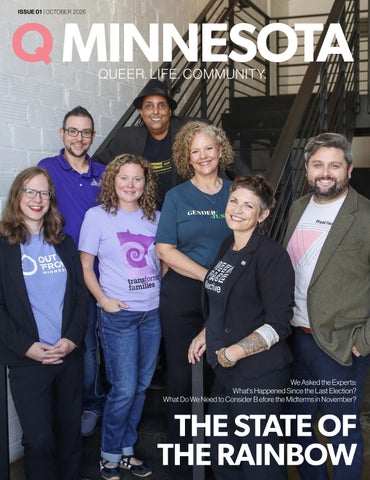
We Asked the Experts: What's Happened Since the Last Election? What Do We Need to Consider B efore the Midterms in November?
THE STATE OF THE RAINBOW
1
qminnesota.com
Q Minnesota 216 Myrtle St, PO Box 39 Stillwater, MN 55082 info@qminnesota.com
Q Minnesota Editorial Editor-in-Chief Andy Lien Digital Content Nell Gelhaus Magazine Copy Editor Kelly McLennon
30 ON THE COVER: STATE OF THE RAINBOW
Contributors Denzel Belin Theo Casio Isaac Johnson Ellen Krug Shane Lueck Bill Lund Natalia Mendez Cindy Mundahl Ania and Molly Nadybska John Parker Harper Steinbach Noël Young
Advertising Inquiries barry@qminnesota.com 612- 849-1173 General Inquiries info@qminnesota.com www.qminnesota.com 651-381-4100 Follow Instagram @_qminnesota Facebook qminnesota TikTok @q_minnesota YouTube @QMinnesota BlueSky qminnesota.bsky.social Printed by The John Roberts Company Distributed by Metro Periodical Partners Gateway Media LLC Investor Member, Co-founder Brad Leventhal VP, Digital Content & Marketing, Cofounder Nell Gelhaus VP, Sales & Events, Cofounder Barry Leavitt Publisher, Cofounder Andy Lien VP, Operations & General Counsel Dan Becker
ANIA AND MOLLY NADYBSKA Cofounders, a.m. photography Ania and Molly Nadybska are the co-founders of a.m. photography, a female-owned business, and photography partners of Q Minnesota. Since 2008 the married couple has photographed corporate and private events, lifestyle campaigns and headshots for clients including the University of Minnesota Foundation, North Memorial, Mila Wealth Management and many others. Both are members of the LGBTQ+ community and have photographed LGBTQ+ events, families and businesses across the Twin Cities for more than 18 years. 2
qminnesota.com
Account Executive Suzanne Farrell
CONTENTS & CONTRIBUTORS 07 EDITOR’S LETTER
Look for Harper’s illustrations with the coming out stories featured on qminnesota.com in October!
47 Q CONNECTION
09
12
14
18
22
SCENE & STAGE
6 QUEER ARTISTS WE CAN’T GET ENOUGH OF
AN ECHO OF WHAT’S TO COME
GET IN THE HUDDLE
GENDER, INTERRUPTED
SHANE LUECK Shane Lueck (he/him) is a Minneapolis-based writer and communications professional whose award-winning work explores LGBTQ+ culture, books, fashion, arts, and entertainment, and the stories that connect people. A University of Minnesota graduate, Shane holds degrees in journalism, African American and African Studies, and multicultural education. He can most often be found reading, at the theater, volunteering with Rotary, exploring local coffee shops, or spoiling his Shih Tzu, Armani.
HARPER STEINBACH Harper Steinbach is an art director, crafter, and visual artist living and working in Minneapolis, Minnesota. They received a degree in art history and museum studies from Seattle Pacific University in 2018. Currently, Harper is the art director for Crafty Queers Club, a local creative hang for queer adults. Harper was the recent recipient of a 2023 Minnesota State Arts Board Creative Support for Individuals Grant and writes and illustrates for Q Minnesota.
NATALIA MENDEZ Natalia Mendez (they/ them) is a queer, trans-nonbinary artist, writer, and photographer, and a descendant of the Indigenous nations of colonized Mexico. They are committed to community, cooperation, curiosity, and equity. They love to read and write about food, music, the outdoors, travel, and life on the margins, pulling untold stories into the light. They live in South Minneapolis and can often be found riding their bike or motorcycle to the beach, gardening, looking for their new favorite state park or river trail, or snuggling with their cat, Mo. Find more at bynataliamendez.com.
ISAAC JOHNSON
ELLEN KRUG
Isaac Johnson is a true rainbow-blooded Minnesotan. Raised on a farm, he went to school and spent over a decade in the Twin Cities before settling in Duluth with his husband. He loves writing for LGBTQ+ readers, believing that when one of us wins, we all win. He especially loves finding the real emotion in the moments that make us laugh and cry. By day, he works in human resources and teaches at a university. True to his name, Isaac loves to laugh and spend time with family and friends, cook, drink wine, listen to music, and bike wherever the trail takes him.
Ellen (Ellie) Krug transitioned from male to female in 2009 while practicing law in Cedar Rapids, Iowa, and later became one of the few attorneys nationally to try jury cases in separate genders. She is the author of Getting to Ellen and Being Ellen, has presented on diversity and inclusion more than one thousand times, and has won the American Bar Association’s Stonewall Award and OutFront Minnesota’s Legacy Award. She hosts The Illegal Trans Woman radio show and, in 2022, was elected to her local school board. Visit elliekrug.com.
October 2026
3
NOV 5–14
NORDIC SOUNDSCAPES FESTIVAL Søndergård, Parker and Sibelius THU NOV 5 11AM FRI NOV 6 8PM SAT NOV 7 7PM Audience favorite Jon Kimura Parker returns to Orchestra Hall to play Hillborg’s seamless MAX Concerto, written for pianist Emanuel (Manny) AX. Then, hear Sibelius’ lush Second Symphony.
Vänskä, Chen and Nielsen
FAMILY CONCERT
The Musical Tales of Hans Christian Andersen
FRI NOV 13 8PM SAT NOV 14 7PM
SUN NOV 8 2PM Enter a world where music and storytelling intertwine, turning timeless fairy tales into vivid soundscapes. Join Thomas Søndergård and the Minnesota Orchestra for a musical adventure through classic stories of Hans Christian Andersen with playful and story-driven melodies.
The flags of Finland and Denmark fly high with the Violin Concerto by Osmo Vänskä’s beloved late friend Jaakko Kuusisto, played by soloist Stella Chen, and the last symphony by Carl Nielsen.
Experience our Nordic Soundscapes Marketplace before your concert and during intermission. You'll enjoy food, beverages, wares, a festive lounge space and more!
GET YOUR TICKETS NOW FOR THE ULTIMATE NORDIC FESTIVAL! TICKETS FOR YOUNG LISTENERS ARE FREE THROUGH THE HALL PASS PROGRAM. MINNESOTAORCHESTRA.ORG The 2026–27 Classical Season is presented by
4
qminnesota.com
|
612-371-5656
|
#MINNORCH
The Family Concert series is sponsored by PNC.
48 24
28
40
44
48
LOCAL QUEER MEDIA: FROM GOLDEN AGE TO RENAISSANCE
2025 MINNESOTA LGBTQIA2S+ COMMUNITY NEEDS ASSESSMENT
THE JOURNEY TO AND THROUGH IML
RECLAMATION: AN ASEXUAL & AROMANTIC JOURNEY TO WHOLENESS
PORNSTACHES
JOHN PARKER John Parker is the host of The Gaily Show and This Queer Book Saved My Life. An Armenian-American, he founded the Queer Armenian Library which is the world’s first library devoted to works by, for, and about Queer Armenians. He is a founding board member of the International Armenian Literary Alliance. As a writer, he was a LAMBDA Literary Fellow and his essays have been featured in queer and Armenian anthologies. He is at work on his first novel, Resisters.
BILL LUND
DENZEL BELIN THEO CASIO Theo Casio (they/ them, he/him) is a trans advocate for Minnesota’s LGBTQIA2S+ community. They are pursuing a bachelor’s degree in social work at Metropolitan State University, focusing on civic engagement and public policy. In 2023, Theo was appointed by the governor to the Council on LGBTQIA2S+ Minnesotans and elected chair in 2025. Their advocacy centers on equity for Black, brown, and Indigenous LGBTQIA2S+ people, and on support for transgender, Two-Spirit, and gender-nonconforming Minnesotans.
Denzel Belin (he/him) is Mr. Twin Cities Leather 2026 and placed second runner up at the International Mister Leather competition. Denzel proudly calls Minnesota his home and currently serves as the president of Twin Cities Spectrum, a BIPOC leather, kink, and fetish club. Belin is a board member of Minnesota Leather Pride. In addition, he is an associate member of Atons of Minneapolis and Twin Cities Cuttles. Belin works as a writer and actor for The Brave New Workshop sketch comedy theater. He’s been a host and speaker for Twin Cities Quorum, Planned Parenthood NCS, and more. Belin serves on the boards for Walking Shadow Theater Company and Queer Gaze. Belin flags navy blue, light blue, and hunter green all on the left side.
CINDY MUNDAHL Cindy Mundahl is a spiritual director, writer, and public speaker whose work centers on identity, inner freedom, and living with honesty and intention. She has presented to international audiences through organizations such as the Out & Equal Workplace Summit, the LGBTQIA+ Leadership Series for Fortune 500 Companies, and the Cobb Institute’s Process Explorations group.
Bill Lund is a teacher and writer who has lived over five decades in the Twin Cities. He is currently enjoying a blissful retirement with his husband and their six-year-old shih tzu/bichon Archie, both of whom are fierce. Bill spends his time reading, traveling, attending theater, and curating his ever-expanding collection of neuroses. To this day, he has successfully avoided pickleball.
October 2026
5
I CAN TALK TO MY DOCTOR ABOUT BEING QUEER (can you?)
thriveclinicmn.org 612.369.7494
6
Thrive is more than just a clinic and pharmacy. Sign up for an appointment today to get comprehensive care without the judgement. qminnesota.com
EDITOR’S LETTER
The co-founders and co-owners of Q Minnesota: Barry Leavitt, Andy Lien, Brad Leventhal, and Nell Gelhaus. Photo by a.m. photography.
About a month and a half before sending this issue to press, Nell came over to my house to talk about a publishing project, and we ended up talking about the closure of Lavender instead. She shook her head and said that we can’t let this community not have a publication. I said, “Yes, but we have to get Barry on board.” Then we both went back to our lives, letting the topic marinate. The next day, Barry called out of the blue. And here we are. Every step of this has felt right in a way that’s a little spooky. It feels very natural. I love being back in media. I love working for this community again. And I love getting my hands into every part of it, sleeves rolled up, a little dirty, mostly sweaty. We’re running at this. This first beautiful issue is for October, and inside it we’re talking to people about the midterms, because a community magazine that ignores an election year isn’t doing its job. We’ll have a monthly cadence from here. I’m overseeing production and design along with editorial, because we have to stay lean to get this off the ground, though we’d welcome freelancers, so think about who in your life wants in. We are taking it on as our mission to find representative voices and identities for these pages, both on paper and in pixels. For this first one, not even knowing yet how many pages we’d have, I went out and enlisted incredible storytellers and reporters, hoping we’d have enough advertisers to give us enough pages for their writing. Both advertisers and writers delivered. These print issues are meant to be the coffee table keepers, the ones you pick up and put down as you read, not the ones you flip through once and recycle. Then, when you want more, head to the website, which Barry has taken to calling our “virtual community center.” Nell is a tremendous steward for it, and it’s arriving in stages through the fall: articles, guides, a directory, merch, videos, events, giveaways. This is happening. I could not be more excited or proud. We are learning to do this with a very small crew, in real time, in public. The response to the announcement brought us more good pitches than I have hours in a day for. If there were more hours and minutes, I would have gotten back to every single one of you by now. There aren’t, so I haven’t, and I’m not going to pretend otherwise. But I am reading every submission, and I am still reaching out as I go, one inbox at a time. I am so grateful for this opportunity. For these co-founders: Barry, Brad, Nell, and now the one who rounds out our leadership, my own partner, Dan. We are an incredibly capable, intentional group of people who plan to build a platform that amplifies and employs, not just covers. We value people and their experiences and their stories, because we are part of this community ourselves, through our friends, through the people we love, through our own lives. We strive for the safety and support of everyone here. Not just part of the rainbow. All of it. Thank you to our advertisers, who backed us before we’d proven a single thing. Thank you to the media who came before us, who support us now, and who we will keep counting as colleagues, not competition. And thank you, reader, for being here at the start of something we are building ourselves, from scratch. New but not. We’re doing it our way. This is Q Minnesota. Welcome to issue no. 01. — Andy
October 2026
7
Say ‘I do’ Fabulous weddings happen here
visit asimn.org
THE ONE & ONLY! 8
qminnesota.com
Photo: Vick Photography
Lizzie: The Rock Musical, photos (this page and contributor page) by Bruce Silcox. Kung Fu Zombies vs. Southeast Asian Girl Scouts, photo collage featuring photos by Rich Ryan and Aaron Fenster.
Indecent Ritz Theater, Minneapolis Through Oct. 18 www.latteda.org Theater Latté Da artistic director Justin Lucero envisioned a 2026–27 season that asks, “What happens when art confronts the forces that seek to silence it?” The season-opener kicks off that vision at full force with Indecent. Lucero calls this show “a story about artists determined to tell the truth in the face of suppression—an urgent reminder of the enduring relationship between art, censorship, and cultural memory.” In a play about a play, audiences get to know a troupe of Yiddish performers who are determined to stage a work that is deemed “indecent.” If a tale of artistic censorship seems too far-fetched, just know that it is inspired by the true story of Sholem Asch’s play, God of Vengeance, and the 1923 obscenity trial for daring to display a romantic relationship between two women. Depictions of antisemitism, homophobia, and prejudice, paired with period-specific discriminatory language are not for everyone. In fact, the show is recommended for teens and adults “prepared to engage with complex historical themes and emotionally powerful subject matter.” If you can grapple with the heavy topics, this Theater Latté Da production is sure to make for an unforgettable night out. Pinocchio Children’s Theatre Company, Minneapolis Through Oct. 18 www.childrenstheatre.org Few children’s stories relate to the LGBTQ+ experience quite like Pinocchio. His yearning to be recognized as a “real boy” is a powerful metaphor for self-creation, bodily autonomy, and shedding societal expectations to live an authentic truth. That said, this isn’t the pop culture version we’re used to. In CTC’s production, a group of theatre painters use their brushes, scaffolding, and wallpaper rolls to retell Pinocchio’s journey. Be prepared for a unique take on a classic cultural touchstone.
October
Stage & Scene Words by Shane Lueck
Into the Burrow: A Peter Rabbit Tale Mixed Blood Theatre, Minneapolis Oct. 1–18 www.mixedblood.com Get a whiff of nostalgia with Beatrix Potter’s classic children’s tales about furry friends and their constant struggle to survive in Mr. McGregor’s Garden. This new musical incorporates original songs to encourage us to find strength in community and stand up for what’s right. If your child’s class isn’t taking advantage of the weekday matinees, it is certainly worth planning an evening or weekend family outing. Lizzie: The Rock Musical Open Eye Theatre, Minneapolis Oct. 1–Nov. 1 www.openeyetheatre.org You may think you know the true-crime case of Lizzie Borden, who, in the summer of 1892, was the prime suspect in her parents’ murder in their own home. You may even be able to recite the grim nursery rhyme. But you’ve never heard the story quite like this. Open Eye Theatre presents a punk-rock reimagining that explores the heated events leading up to the trial-turned-media sensation. Described as “a suspenseful, queer, and rebellious new musical laced with political depth and a mischievous sense of humour,” this hits the stage just in time for Halloween. The show sold out when Open Eye Theatre staged it last year, so get your tickets early! October 2026
9
Clue Orpheum Theatre, Minneapolis Oct. 9–11 www.hennepinarts.org The campy cult classic whodunit comedy returns to the Orpheum. Based on the board game and subsequent 1985 film, audiences follow along and try to solve the murder at Boddy Manor. This show will have you dying of laughter (pun intended) all the way through the final plot twist. Kunene and the King Guthrie Theater, Minneapolis Oct. 10–Nov. 8 www.guthrietheater.org Meet Lunga Kunene: a no-nonsense Black caregiver without much patience for privilege or hubris. Now imagine his dismay at providing in-home care for Jack Morris, a celebrated (and stubborn) white actor facing a life-changing diagnosis while he rehearses for a new role. Using Shakespeare’s King Lear as a structural model and reference point, John Kani’s new play finds common ground across race, class, and politics in post-apartheid South Africa. Kani serves as both author and performer for this production. Kung Fu Zombies vs Southeast Asian Girl Scouts Frey Theater, St. Catherine University, St. Paul Oct. 29–Nov. 15 www.theatermu.org
Above: Paris Couture Imane Ayissi (Cameroonian, b. 1969) Ensemble consisting of a sheath dress, cape, gloves, pumps, and earrings Bottom right: The Many Deaths of Laila Starr, final scene rendering by Mimi Lien.
Paris Couture Minneapolis Institute of Art Oct. 4–Jan. 17 www.artsmia.org Fashion lovers, rejoice! Parisian luxury is coming to Minneapolis with this special exhibition, featuring more than eighty haute couture masterpieces from the renowned Palais Galliera, the Paris Fashion Museum. The showcase spans pieces from the late nineteenth century to the spring 2026 runways and offers a unique opportunity to experience some of the most extraordinary garments ever created, up close and in person. “This exhibition makes a clear case for haute couture as one of the defining art forms of the modern era,” said Katie Luber, Nivin and Duncan MacMillan Director and President of Mia. With pieces drawn from one of only a few major institutional couture collections in the world, Paris Couture offers access rarely seen in the United States, particularly in the Midwest. This is your chance to explore couture, with iconic fashions from Dior, Chanel, Balenciaga, Schiaparelli, Balmain, and more. See the pleats, stitches, beads, and feathers that define couture at its highest level. Take a slow stroll through the galleries for a perfect date night or weekend outing. 10
qminnesota.com
You read that right: three Girl Scouts try to keep their St. Paul community safe during the zombie apocalypse. Oh, and the zombies know kung fu! This world premiere from playwright Saymoukda Duangphouxay Vongsay concludes her Kung Fu Zombies trilogy. The Many Deaths of Laila Starr Ordway Center for the Performing Arts, St. Paul Oct. 31–Nov. 8 www.mnopera.org This is not your grandparents’ opera. Based on the best-selling graphic novel of the same name, this world premiere from Kamala Sankaram and Minita Gandhi is infused with elements of konnakol, raga, and EDM. The goddess of Death is cast down to Earth to live as a mortal named Laila Starr, blurring the boundaries between divinity and humanity. Watch as she begins to see the world through fresh eyes.
JOIN THE QS COLLECTIVE APP A virtual mentorship platform built by and for the 2SLGBTQIA+ community.
Download the QS App and sign up to be a virtual mentor today!
Powered By:
BE A MENTOR
Garden Maintenance Restoration Re-Design Custom Containers
612-802-2527 • malindalaunert.com www.HomeSownGardens.com
SERVING THE COMMUNITY FOR 30 YEARS!
T R U N K S H OW & R EST YL E EVEN T October 9-10
Bring the stones & gold from the jewelry you’re not wearing & let Sarah design something new that you will love!
Shops at Excelsior & Grand 3826 Grand Way, St. Louis Park 952.922.8364
October 2026
11
L–R: Hilary Greenstein, Thunder Thigh Ascension, oil on crushed velvet, 72 × 60 inches, 2026, photo by Richard Fleischman. Zacharie McKee, selections from her recent work, images courtesy of Zacharie McKee. Shug Munic, Remember Remembering, textile on paper, 8.5 × 11 inches, photo by Trista Marie McGovern.
6 Queer Artists We Can’t Get Enough Of Words by Harper Steinbach I am building a visual arts section that feels relatable and widens the conversation about art and creativity. Much like a spectrum of identity, queer folks deserve a spectrum of thoughts, voices, and visuals when consuming art, and Minnesota is an excellent place to find them. You’ve seen the traditional art review and the critical essay, and you know what those feel like. Let’s try a new approach to writing about visual creative practice. Here are six artists whose work I want to see anywhere: in my home, on billboards, and everywhere else you can think of. Follow their careers closely.
12
qminnesota.com
Hilary Greenstein (she/they) @hilarygreensteinart hilarygreenstein.com Hilary specializes in shocking: bright backgrounds, rich surfaces, and diverse bodies rendered in oil. The positioning of the figures urges the viewer to reconsider their own attitudes toward bodies and gender identity, along with what they expect color and texture to do in a painting. Hilary’s command of oil paint lets them work texture both on the canvas and through the canvas itself (she often paints on velvet). Hilary is also constantly exploring while in the studio; if you ever get the chance to visit them in the California Building (206A) in Minneapolis, you’ll feel like you’re taking a vacation. Zacharie McKee (he/they/she) @octarinecorez zachariemckee.cargo.site Holy humor and texture! Zacharie McKee is a Native American (Ojibwe, Ho-Chunk) concept artist and illustrator. Their practice includes drawing and digital painting, zines, Risograph, and self-publication. Zach’s illustrations, whether promotional or in a zine, give audience members a doorway into their experiences. Her style is inviting yet distinctive to her visual voice due to their mastery of digital texture. Zach is currently focusing on an autobio comic exploring growing up as a “weird, fat, Ojibwe kid.” Currently, they are working on Ojibwe language preservation projects. Be on the lookout for upcoming projects: Waawaashkeshi, Giiyosewikwe, and Wiinaajimo.
L–R: allison anne, later profile, hand-cut paper collage on recycled paperboard, 6 × 9 inches, August 2026, images courtesy of allison anne. Grover Hogan, XV. The Devil! (Dammit Janet!), rhinestones, lotería cards, confetti, cyanotypes of slide projector advertisements, washable marker, Mod Podge, and acrylic on canvas, 30 × 40 inches, 2026, images courtesy of Grover Hogan. Mikha Dominguez, El Santo de Trapo, digital photograph, image courtesy of Mikha Dominguez.
Mikha Dominguez (they/them) @mikhamik52 mikhamik.com
Grover Hogan (they/them) @thriftshoptv groverhogan.com
Mikha Dominguez (aka Mikhamik) is a queer, nonbinary, Latinx Venezuelan visual artist, photographer, educator, and sculptor. The first time I encountered Mikhamik’s work in public, I raced online to find their portfolio. Whether you are looking at their photography or their installation work, this maximalist’s dream leaves you wanting more. On the surface, Mikhamik’s work is bright, colorful, and playful, but it urges viewers to stay and dig deeper. Their most recent project was created for MEXIMALISMO, an exhibition and fashion show by Serpentina Arts that pairs familiar objects with striking images.
Grover Hogan is a queer, Black, and Mexican interdisciplinary artist from Houston, Texas, currently based in Minneapolis, Minnesota. Grover works to make sure the audience always feels like they’re in on the joke: the work may look niche, but Hogan excels at sending familiar visual cues. Their time as an educator of many ages has allowed them to convey images across generations, and they frequently oscillate between illustrative and realism in style. Either way, these styles create a sense of intensive relatability rather than offense.
Shug Munic (they/them) @_seamripper and @embodiedmaterial sophiamunic.com
allison anne (they/them) @allisonannecollage allisonanne.com
Shug is a standout textile artist in Minnesota. I often see Shug’s work reflect the abundance of “stuff” in our world (read: textile waste). As someone so partial to maximalism, Shug does a wonderful job combining the facets of maximalism seen in quilting and midwestern craft culture and merges them with concepts from contemporary art—a marriage of styles that grounds viewers. Shug’s work is warm and inviting in medium yet unflinching about the complex topics it raises to the front of viewers’ minds. They also created Embodied Material, a collective where queer textile artists discuss theory together.
allison anne is an interdisciplinary artist based in Minneapolis, Minnesota, who works in a variety of mediums, including collage, zinemaking, publishing, and graphic design. I am so impressed by this artist’s ability to cultivate community regardless of what medium they put their hands on. allison frequently invites viewers via social media to travel with them through collage exploration of different printed material, approaches, and techniques. Each new body of work is like walking from one city block to the next: unique in style but cohesively a part of the same entity.
October 2026
13
An Echo of What’s to Come Finding safety, identity, and hope at the table of three Minneapolis restaurants
Words and Photos by Natalia Mendez
14
Kate and Gustavo Romero, Oro by Nixta.
After a bitter winter of chaos, the thick heat of summer has slowed many of us to a crawl, hinting at a sweat-slicked semblance of peace, but everything is still in flux. Members of our community are still disquieted by the reverberations of Metro Surge, while some are still being taken off our streets, albeit in more covert ways. For many Black, Indigenous, and People of Color (BIPOC) individuals, this is a continuation of a story, and the coming-to-a-head of an ugly zit that’s been growing on the face of the United States since its inception. The decision by the government and its use of blatant racial profiling to carry out its work is one way we’ve seen the penalization of diversity. But this is nothing new on stolen land.
I’ve written about food and drink, music, culture, the outdoors, and more in the Twin Cities and beyond for almost fifteen years. I love opportunities in my work to shine a light on the experiences of those on the margins. Despite my somewhat dour intro, I have been told I am, in fact, fun at parties. And, as someone who dates across the gender spectrum, when I go on my gay little dates, I’ve noticed that I have inadvertently considered our safety when suggesting restaurants. While I don’t expect to get blatantly bashed, I carefully consider the dining establishments and spaces where I won’t have to second-guess holding a hand or sneaking a smooch, of which there are bountiful options in the Cities.
This may seem like a wild way to kick off a feature article about food and dining in the debut issue of a local queer magazine that’s working to evolve with the times, and as many of us under the LGBTQIA+ umbrella know, the personal is political. For those of us who are—or love—queer people, the sentiment is not new. The struggle for safety and liberation for all intersects with each of our overlapping identities, even in small, everyday ways. The reality of looking over one’s shoulder for overt or covert malicious intent can drain even the most resilient of us. For me, there is nothing radical about speaking of the realities of the ways sexuality, race, class, gender, ability, substance use, housing status, and more impact our daily lives and can enrich or diminish them. It’s simply seeking opportunities for healing in our communities, and the first step is seeing where the inequities lie, not as a means to mope, but more as a means to galvanize ourselves for necessary change that better serves us all. As a trans-nonbinary person and a grandchild of immigrants,
As a person of color, I can’t ignore it when the front-of-house and back-of-house appear racially homogeneous, and when I don’t see a representation of gender diversity on staff. Now, not everyone is out, and many of us don’t necessarily read as queer, or trans, or even racially diverse at times. This isn’t about people who, for any number of reasons, don’t present in ways that signify their identities (not everyone even wants to show up that way at work!). But what I do notice is when I see people presenting their intersecting identities in authentic ways, and it signals to me that not only is it a safer place for me to court and dine, but it’s also a safer place where people like us will be supported and respected as employees. Three restaurants come to mind immediately where I see obvious diversity not only in staff, but on menus, too.
qminnesota.com
Sean Sherman, Indígena by Owamni.
Oro by Nixta
Indígena by Owamni
Chefs and restaurateurs Kate and Gustavo Romero have been strong advocates of community diversity and biodiversity. Gustavo is from Hidalgo, Mexico, and Kate is Polish-American, both with a front-row seat to the immigration process. “My family [is from Poland.] . . . They had asylum visas. When they came here, after the Berlin Wall fell, they wanted to go back home. My mom couldn’t see her life with two small children in Poland. So my grandmother had moved here to work for a family that she was working for in Chicago. They decided to relocate to Minnesota, and that’s why we came here.”
Raised in South Dakota on the Pine River Reservation, Sean Sherman moved to Minneapolis at seventeen to continue pursuing his early kitchen career while considering art school. Although he didn’t attend, he says he found art through food. “I was able to learn how to do tasting menus and play around and make things look fancy and pretty. I didn’t go to culinary school. I was just curious, and I had an artistic eye, so I was able to grow there.” That curiosity expanded into an exploration of the lack of Indigenous restaurants in the United States. From there, his mission became to reestablish traditional foodways without colonial ingredients like wheat, dairy, and cane sugar, or animals like beef, pork, and chicken.
Gustavo came to America when he was seventeen, and later made his way to Italy for culinary school. After returning to the United States, he reconnected with the beauty and variety of corn that reminded him of home in the bustling kitchens full of female family members. Years later, in 2020, he and Kate opened Nixta, a tortilla producer that showcases a few of the fifty-nine registered varieties of heirloom corn that grow in Mexico—and forty of them are from Gustavo’s hometown. Since then, they’ve expanded in the space they occupy in Northeast Minneapolis and have garnered several local and national accolades for their full-service restaurant, Oro. For the uninitiated in corn culture, it may seem strange to see a restaurant that focuses on one ingredient standing out among national heavy-hitters, but the food Oro makes is nothing short of alchemic. Gus and Kate’s shared cheffing knowledge features an ingredient many of us indulge in dipped in butter at the state fair, and calls back to the cultural significance—and versatility—of the ingredient in nearly alchemic ways as it’s included in drinks, mains, and desserts.
Emphasizing the bounty of biodiversity of the lands around us, Sean’s work has led to cookbooks, the founding of his first restaurant in 2021, Owamni, and the establishing of the Indigenous Food Lab through his nonprofit NATIFS. NATIFS is a professional Indigenous kitchen working to create a center for Indigenous education and create more food access through programs like Meals for Native Institutions that provides readyto-eat meals centering Indigenous ingredients to schools, healthcare centers, tribal colleges, and elder programs. Now, he’s moved onto a bigger stage with his new restaurant, Indígena, filling the void at the Guthrie Theater left by the shuttering of Sea Change at the onset of the COVID-19 pandemic. “We have a really unique food system because we’re a smaller city, but within the city, we’re massively [racially and ethnically] diverse. . . . Taking into account the Indigenous food systems that are here, they are diverse because you have a lot of farmlands in the south, and you have a lot of woodlands in the north with shorter growing seasons, but some really interesting prodOctober 2026
15
Yia Vang, Vinai.
ucts come out of there like the wild rice and some of the fresh fish, like walleyes and northerns coming out of some of the lakes. . . . But then you layer on just where we are with this massive mix of diversity, and we’re getting all these cool cuisines of people experimenting. I think people are taking a new turn, being even more creative with some of these ingredients around us and using a lot of these farm foods. And we have amazing farms all around us, and all these amazing products.” But products and passion alone don’t make a pretty plate of bouncy, savory pucks of housemade sausage on a bed of roasted turnip smear topped with floral, mild pickled pink peppercorns as you can find on their menu; it’s about intentionality. “I think restaurants with intention are really what we’re seeing right now because we challenge ourselves almost every step of the way. It doesn’t make sense to do something just to do it, but it makes sense to do something because we have an opportunity to actually make some change and to change the way people think about things.”
Vinai Yia Vang was born in a Thai refugee camp after his parents met while fleeing the Vietnam War. In his childhood, he witnessed all of the hard work they put in to support him and his six siblings to give them lives they never imagined for themselves. Both parents had their cooking roles: the open-fire cooking Yia’s now known for at his Northeast restaurant, Vinai (named for the camp in which he was born), and at the State Fair with Union Hmong Kitchen came from his father; the herby, lemongrass-laden, chili-flecked hot sauces are inspired by childhood memories, with the spiciest, the “Mama Yang,” named for his mother. His experience as a refugee who ultimately relocated to the Midwest created opportunities for him to explore holding the multitudes of his identity. “I love the fact that we here, especially in our food culture, have something that’s ours. I think that going through the ups and downs of accepting my Hmongness helped me accept my Midwestness.” Fortunately for diners at Vinai, the overlap between Hmong and Midwestern food and farming traditions shows up on the 16
qminnesota.com
plate in local, seasonal ingredients with shared traditions of pickling, fermenting, and foraging that run parallel in both cultures. “Growing up, I didn’t realize that it was a Midwest thing. It was a Hmong thing, we always said. So we’ve had moments where we’d stop on the side of a country road, and dad’s like, ‘Oh, look, wild watercress.’ I didn’t realize that that was a thing called foraging. And again, it wasn’t a trend. It wasn’t sexy and cool. It was literally like, oh yeah, there’s free food here. And so it was that mentality. I didn’t look at hunting and fishing as a sport. I looked at it as going to get groceries.” These practicalities, paired with Minnesota’s ever-changing weather, have Yia reflecting on the finite beauty of things that don’t last forever, which leads to more appreciation for what we have. Along with it comes hope: for the next growing season, for new ideas and collaborations, and for the future of our local dining scene. “Hope actually moves us forward. Restaurants are an echo of what’s to come. We get to set the tone. And that’s why I feel like restaurants are where people eat, where people gather, where people bring ideas together.” While each of these chefs is rightfully celebrated locally and nationally for the beauty they craft on their plates and within our communities, I would like to champion their commitment to diversity in its many forms. Their work exemplifies not only cultural diversity, but also the diversity of our local food systems and cultural preservation. This year has shown us that diversity is what makes our communities a delicious delight in every way, and it’s been beautiful to witness, amid so much chaos, the kind of culture Minnesotans are committed to building together for the long haul. Explore the diversity of our local food scene on your next gay little date. Visit their websites for reservations. Oro by Nixta: 1222 NE 2nd St, Minneapolis, Wed.–Sat. 4-9 p.m. Indígena by Owamni: 806 S 2nd St, Minneapolis, Tues.–Thurs. & Sun. 11 a.m.–11 p.m., Fri.–Sat. 11 a.m.–midnight Vinai: 1300 NE 2nd St, Minneapolis, Tues.–Thurs., 5–10 p.m., open until 11 p.m. Fri. and Sat.
NOW PLAYING!
“One of the best musicals ever!” PICTURED: EVE SCHARBACK
– Chicago Tribune
952.934.1525 ChanhassenDT.com October 2026
17
GET IN THE HUDDLE
Words by Isaac Johnson Photos by Andy Lien
The Minnesota Gay Flag Football League is bringing Gay Bowl XXVI to the Twin Cities, sponsored by the Minnesota Vikings. There’s a pivotal moment, a calm before a scramble of strategic chaos, when silence and stillness settle over the teams and spectators. In that moment, before the snap of the football, we are all together. You won’t find the typical aggression and roughhousing on this football field. They’ve been sidelined. This is a different kind of sports league, where LGBTQ+ athletes are celebrated and a community of players is built on and off the field. There is no better way to celebrate our LGBTQ+ athletes than to let the best of the best play together from across the country. The Minnesota Gay Flag Football League is set to host Gay Bowl XXVI this October 8–11, 2026, at the National Sports Center in Blaine, Minnesota. The MNGFFL is one of 30 leagues across the country that are part of the National Gay Flag Football League. This year’s Gay Bowl XXVI is sponsored by the Minnesota Vikings, and they have been a huge partner and supporter of the MNGFFL. They are one of the only NFL teams that sponsor their local gay flag football league and want to do whatever they can to strengthen LGBTQ+ flag football. “We really believe in what they’re doing to support access and belonging in football,” says Anne Doepner, Senior Director of Talent and Inclusion at the Vikings. “We know we have an enormous platform for impact.” The Vikings want to work with organizations and engage with groups that are “working to break down barriers and create access to opportunity for everybody.” As one of the younger local leagues on the national scene, winning the bid to host Gay Bowl XXVI so early in its tenure is a substantial accomplishment. As an organization, the Vikings provided significant support to make hosting happen and are committed to extending their support to the LGBTQ+ community at large. “Inclusion work is at the core of our organization,” says Doepner. “It all goes back to the Wilf family, the ownership. Their values are about centering people and including everyone.” 18
qminnesota.com
Opposite: Peter Dinh, he/him. This page, L-R: Allie Happel, she/her, and Ari Kim, she/her; Cate Dela Cruz, she/her; Becca Nguyen, she/her, and Chris Lewellyn-Otten, he/him.
Owner and President of the Minnesota Vikings Mark Wilf says, “I hope the message is simple: football is for everyone. This game is strongest when people from all backgrounds can participate and feel welcome.” Both organizations are proud and excited to have over 2,250 LGBTQ+ flag football athletes descend on the Twin Cities. They look forward to showcasing our football community to the visitors. “We get to show off our own backyard,” says MNGFFL Commissioner Nikhil Enugula, “who we are as a league, who we are as Minnesotan people.” The size of the Gay Bowl event and the amount of love for the sport may surprise people. The turnout will be exciting to see. “I think what makes us unique is our embracing of ourselves and others, and I think we reflect that in our league.” Fans are invited to come out and watch the Gay Bowl and join in the festivities throughout the weekend. More information and event details are available on the NGFFL website, ngffl.org/gaybowl.
The MNGFFL is “an inclusive league,” says Enugula, with a “focus on creating access and opportunity for queer athletes to enjoy flag football.” There is room for everyone, as anyone who registers or tries out always gets drafted onto a team. The league encourages all who are interested to come out, and they will teach participants how to play the sport. They offer education and free football clinics for all new players. “Every athlete is valuable in their own way,” says Enugula. “We don’t call people out. We call people into the conversation.” The community is clearly enjoying the access to football, as the league is growing fast. The MNGFFL now has over 135 players and over 250 non-playing community members registered in the league who are either referees or spectators. They started with just four teams, but now they have eight regular teams and are projected to add two more for the next season. More and more players keep coming back because “they enjoy our culture of community,” Enugula says.
L-R: Nate Stewart, he/him; Tim Smith, he/him, and Warren Hess, he/him.
October 2026
19
BRIAN KNOWS
REAL ESTATE AN EDUCATOR FIRST
BRIAN WAGNER (651) 497-4387 bawagner@cbburnet.com wagnerbrian.com
L-R: Nina Bonanno, she/her, and Jessica Bernett, she/her.
The league is focused on “creating a sense of belonging for any player who comes through to play,” says Enugula. The league trains its team captains to put players and community first, rather than competition. Enugula says a majority of the league’s players hadn’t played any football before joining, and teams are designed to be equitable in skill level so that play remains fun and accessible for everyone. Instead of tackling, players stop a play by pulling a flag from the ball carrier’s belt. Even when things do get intense on the field, Enugula reports viewers often see players hugging it out and hyping each other up after a great catch or play. Players go on regular social outings after games, support teammates in their endeavors, like running marathons, and go to the Minnesota State Fair together as a group. All teams and players participate in regular philanthropic initiatives like volunteering and donating to food banks. In addition to the access and space for queer athletes to enjoy sports, the goal of the league is to challenge traditional stereotypes about LGBTQ+ people and increase diversity and tolerance within athletics. “Queer people can be super athletes,” says Enugula. “They can show up and compete at the very highest level.” The MNGFFL also has travel teams to represent it and compete in larger competitions at the national level. There are a couple of recur-
20
qminnesota.com
Diamonds Miller, she/they.
ring tournaments each year, but the location of the Gay Bowl, its version of the Super Bowl, moves each year. The MNGFFL is represented by teams in the open division called the Minnesota Lumberjocks and by teams in the women’s-plus division called the Minnesota Hot Dish. New this year, with Gay Bowl XXVI happening at home, the league has also added Minnesota Superior, giving less experienced players who haven’t previously participated in travel competition an opportunity to compete. Everyone will be seeing more flag football in the near future, as it’s slated to become an official Olympic event in 2028. Members of the MNGFFL are beginning to coach female flag football teams in other leagues, and there is potential for it to be an emerging sport in the Minnesota State High School League in the coming years. It’s clear that football is no longer a traditional demographic sport. Doepner says, “A sense of belonging is really what it boils down to. We want to make sure that everyone can see themselves as part of the Vikings universe.” The MNGFFL has a spring and a fall season. They play Saturdays at Farview Park. They are always looking for more players and are in need of more volunteers and financial support. More information is available at www.mngffl.com.
October 2026
21
Words by Ellie Krug
Perspective Gender, Interrupted Trump’s second term has turned gender-affirming care into a legal battleground I have been reporting on gender-affirming care for transgender youth and adults ever since I transitioned in 2009. Way back then, cisgender people—including conservative politicians— generally ignored trans folks. Certainly, they didn’t take issue with therapists helping us to understand what it means to have a brain that doesn’t match one’s body. Similarly, no one really cared that cross-sex hormones were being prescribed to trans kids or adults, or that adult trans women and men often underwent gender confirmation surgery to feel whole and complete. Now, of course, banning gender-affirming care—both for minors and adults—has become a hill to die on for many MAGA politicians and their supporters. They view it as evil and something contrary to the natural order of things, whatever the hell that is. What happened? How did trans healthcare become a target on the radar? It begins with the fact that there just are a whole lot more people, minors and adults, identifying as transgender, nonbinary, or gender variant (e.g., genderqueer or gender fluid). Actors, athletes, personalities, models, artists, and so many people with social media accounts who are not only visible, but also influential. Coverage of trans issues and language became more commonplace due to diversity, equity, and inclusion (DEI) in the workplace, and it helped that schools—beginning in kindergarten—taught that everyone, regardless of what makes one “different,” should be valued and respected. This inclusivity carried over into adolescence and teen years, which is both significant and necessary since, according to Gallup, nearly 30 percent of American youth identify as LGBTQ+. With all of that, more trans humans became visible, and more people know someone trans either in their family or circle of friends. It meant that there are a whole lot more people experiencing vastly improved mental health due to finally living authentically. A good thing, right? Not according to the Heritage Foundation or other ultraconservative organizations hell-bent on pushing that “God doesn’t make mistakes.” This includes the Minnesota Family Council and its website that advocates for the “duality of sex” along with offering a “Parent Resource Guide” on “transgenderism.” Backlash Unites Ultimately, as more trans people, particularly trans youth, became visible, the conservative backlash gelled. Donald Trump recognized that making trans folks a target was a winning political strategy. Hence, in his first term, Trump summarily dismissed thousands of transgender service members, and to boot, allowed medical and therapeutic providers to discriminate against trans patients. Still, despite this presidential othering, gender-affirming care for trans kids and youth was still taking place throughout the US. It wasn’t until April 2021, barely five years ago, that Arkan22
qminnesota.com
sas became the first state to ban this care for youth. Soon other states followed, and with US Supreme Court’s blessing, at least twenty-seven states ban such care entirely. Why Target Trans Kids? There are many “reasons.” One in particular is this belief that if you prevent a young human from transitioning, he/she/they will ultimately “come to their senses” by adulthood and realize that really, they aren’t trans. Some people simply can’t understand that we each get wired differently—just as some are wired to be left-handed, and others right-handed, some of us are wired to be straight, and others queer. Heck, I wrote a whole book about coming to understand late in life that one’s gender identity isn’t something that you can “choose.” Does this ring a bell? We’ve been here before. It’s like conversion therapy, the basis of which is being told that something we know to be true must be wrong and, therefore, removed from us literally and figuratively. Stopped. Reversed. You think you’re gay? No. You’re not gay. You’re straight. You think you’re the gender you weren’t assigned at birth? No. You’re not. And we’ll stop you from becoming the gender you mistakenly think you are. Also, stay out of all bathrooms and sports. The difference between transitioning and conversion is stark: Transitioning is a process that is incremental and focuses on the journey of becoming something else, while conversion is an act that changes something into something else. Applied to living, breathing humans, that is not “coming to senses,” that is being forced into being someone else. The Department of “Justice” Unfortunately, Trump’s second term has brought infinitely greater sophistication to the attack on transgender folks and their healthcare. Among other things, that’s meant attacking blue-state hospital systems that provide gender-affirming care for both youth and adults. At Trump’s direction, the Department of Justice is now subpoenaing confidential patient records to determine if blue-state hospitals billed for treatments contrary to federal regulations or in violation of fraudulent billing laws. And the tactics are working. In the face of federal subpoenas, which can cost hundreds of thousands of dollars to fight, hospital systems in California, Connecticut, and Illinois have simply chosen to shut down their trans youth clinics rather than battle our own government. That was even the case with Children’s Minnesota Hospital in Minneapolis, which earlier this year paused its trans youth clinic in response to federal litigation. What a disaster for hundreds of trans youth and their families! Thankfully, Children’s later resumed that service. Still, the experience underscores the fragility of gender-affirming care even in Minnesota, which declared itself a trans refuge state in 2023.
And if you aren’t aware, gender-affirming care is lifesaving. For a twelve-year-old trans girl (someone assigned male at birth but who identifies as female), gender-affirming puberty blockers prevent her from acquiring a masculine voice and beard growth—things that would otherwise set her apart for othering as an adult. For a trans boy (assigned female at birth/identifies as male), puberty blockers prevent menstruation and a monthly reminder that his body isn’t cooperating with his brain. Can you put yourself in the position of people who are mid-transition and not able to get the care they need? The care that will change the trajectory of how they experience life? This is so much more than a news story crossing our screens. This is moment-to-moment life for so many. “Off-Label” Discrimination Our government is also utilizing federal Food and Drug Commission laws and regulations to threaten prosecution for “off-label” drug prescriptions. In the case of gender-affirming care, “off-label” could mean prescribing a drug that’s ordinarily used for a different purpose; for example, estrogen patches or pills, which trans females utilize, are intended for menopausal women. This can directly affect physicians and their licenses. In fact, I’ve been told that doctors fear being blacklisted for treating transgender youth and adults—understandably, medical professionals don’t want to risk their licenses and careers. Ultimately, the “off-label” tactic may be the most effective. Hopefully, legal rights organizations and state attorneys general—like Minnesota Attorney General Keith Ellison, a fantastic protector of Minnesota’s trans community—will be able to effectively fight back. So, What Do We Do? We vote. When we think about helping those who are vulnerable, we need to remember that this targeting affects the whole spectrum of gender. Those who are considering a transition, those who are transitioning, and those who have transitioned (even decades ago!) rely on access to gender-affirming care. Like anything else we experience in our health and welfare, if medication is required, medication should be available. So we need to vote. Also, if you are transgender or gender variant, regardless of your age, I need you to listen to me when I say this: You matter. You are worthy. You have value. You have the right to live as the true, authentic you. You and I deserve to just be left alone. Don’t let the bastards get you down. I swear, we will get through this. Author’s note: Understanding that I’m not a therapist, I would be happy to meet with anyone to talk about transitioning genders or post-transition challenges. I have made this standing offer hundreds of times to thousands of people when I’ve presented to groups and organizations. And if the offer doesn’t apply to you, it is transferable—you can give the offer to someone else if they might benefit from it. My email address is: elliejkrug@gmail.com. Read this article online for more resources: qminnesota.com
S $3,0AVE 00!*
NEWLY EXPANDED MEMORY CARE
Welcome to a modern-day Memory Care designed for each resident to live safely in the vibrant city they have always loved, near theaters and the arts, and close to family and friends. • Private studio suites with large windows • Simple-to-navigate floor plan • Dementia-trained team members • Programs focused on engaging residents • And so much more!
CONTACT US TO SCHEDULE A TOUR TODAY!
Abiitan.org | 612-378-0020
428 SOUTH 2ND STREET, MINNEAPOLIS, MN 55401
Ecumen is an award-winning nonprofit provider of living spaces & services for older adults. *See offer details online.
October 2026
23
Words by John Parker
History Local Queer Media: From Golden Age to Renaissance What more than thirty years of queer newspapers, zines, and radio built in the Minnesota and why a new wave of outlets is picking up where they left off At the end of the twentieth century, the Twin Cities queer community read, listened to, and watched what some might call a golden age of local queer media. In the late 1970s, they could listen to Fresh Fruit Radio and pick up a copy of GLC Voice on the way out of their local gay bar. As the Twin Cities approached the millennium, the golden age arrived as the queer community read Equal Time, Focus Point, and Lavender Magazine. They watched GAZE TV. They paged through the zines Holy Titclamps and Womyn Who Masturbate. They continued to listen to Fresh Fruit Radio, which is still on the air today—now the country’s longest-running queer radio program. They picked up copies of the alternative newspaper The Reader for its “Q Monthly” section (which later became its own publication). These publications did not all exist simultaneously, but many overlapped. And when one shut down, another soon followed. “There were a lot of [publications],” said Robyn Dochterman, editor of Equal Time. “Reading them was like shopping for the kind of queer person I thought I was—or wanted to be. In fact, the ‘80s and early ‘90s were a time when the whole community seemed to be figuring out what it wanted to be, and be seen as.” Queer media provided ample options for queer folks to discover themselves. Some gravitated to GLC Voice for its confrontational approach, dubbing itself “news and opinion for gays, lesbians and civilized straights.” Its founder, Tim Campbell, never shied away from a fight. In an article after his passing, the Star Tribune reported that his arguments with Minneapolis City Council Member Barbara Carlson often nearly ended in slugfests. He even set the Minneapolis Civil Rights Department on fire.
24
qminnesota.com
“GLC Voice had serious value as a way to engage in current controversies—many of them stirred up by Tim,” said Claude Peck, a former producer at Fresh Fruit Radio and former editor of Q Monthly. “Equal Time arrived as a more ‘responsible’ newspaper, with reporting of local news and coverage of people and culture.” Dochterman said that Equal Time and queer media profiled LGBTQ+ people who explored polar regions or who had amassed exquisite collections of Dayton’s shopping bags. Readers could learn how to buy a house with a queer-friendly realtor or connect with attorneys to help them navigate discrimination. From 1986 to 1990, the Equal Time production manager was Alison Bechdel, the up-and-coming artist of Dykes to Watch Out For and future recipient of a MacArthur Genius Award. GAZE TV founder Brad Theissen said that he “interviewed community activists and leaders so that their own words told their own stories.” He presided over a small media empire including Twin Cities GAZE Newspaper, GAZE Magazine, and GAZE Guide. The TV show earned an award for its coverage of the 1992 AIDS Quilt at the Hubert H. Humphrey Metrodome. When Brian Coyle, the first openly gay member of
the Minneapolis City Council, was hospitalized due to AIDS-related complications, Theissen was the last person to interview him from his hospital room at Hennepin County Medical Center. Theissen reported that Coyle’s final words of advice to the community were about safer sex practices. Q Monthly featured cover stories like “The Myth of Gay Affluence” and “The High Cost of Living with AIDS.” In addition to features and long-form articles, readers enjoyed a blind-item gossip column, an events calendar, and a monthly Q&A. But while the search for identity fueled the explosion of local queer media, the AIDS epidemic mandated it. Mainstream media approached the crisis by ignoring it, sensationalizing it, or publishing op-eds blaming the LGBTQ+ community for the “gay cancer.” There were exceptions, according to Dochterman. The Pioneer Press won a Pulitzer Prize in 1988 for its “AIDS in the Heartland” series. Arguably, it was an exception that proved the rule. “The AIDS crisis made LGBTQ newspapers crucial in the late 1980s and into the 1990s,” said Peck. “They covered in granular and essential detail news of experimental drug therapies, safer sex practices, grief, and activism. This lifeand-death information was not readily available in the mainstream press.” The demand for media reflective of queer life paired with the mandate for it due to AIDS created the infrastructure to maintain it. “[There was] support from readers and advertisers,” said Peck. “There were systems in place to produce content, to make and distribute newspapers, all of which provided a varied GLBTQ media world in the last two decades of the 20th century that was robust for a metro the size of Minneapolis and St. Paul.” Dochterman underscored how important advertisers were to the sustainability of that system.
“There was a big enough audience and a big enough group of advertisers that the math worked for quite a while,” she said. “We were becoming a desirable demographic and there weren’t many ways to reliably reach that demographic.” Zines, on the other hand, packed a punch without wanting or needing to be institutions. They wove together community information, comics, concert reviews, and erotic literature. In the early 1990s, Larry-bob authored, edited, and published on almost all these topics in his zine Holy Titclamps. In the mid1990s, the Womyn Who Masturbate Collective published an eponymous zine about sexual health, feminism, tampon alternatives, and, yes, masturbation. But the problem with golden ages is that they always come to an end. In the summer of 2026, Lavender Magazine shocked the LGBTQ+ community when it shut down with no warning after thirty-one years. But the shock closure of a queer publication isn’t new. In 1992, Campbell surprised everyone when he suddenly closed GLC Voice. Equal Time was forced to close in 1994 after it had transitioned from a biweekly publication to weekly. Advertising sales couldn’t keep up, and they took on too much debt. “The sales infrastructure couldn’t support it,” said Dochterman. “The board believed it was unethical to continue publishing. I was at a conference in St. Louis when the board made that decision. I’ll never forget the shock of getting that phone call. I think the community was just as shocked as I was.” In 1998, City Pages publisher Mark Bartel stunned everyone when he axed Q Monthly, despite the publication operating at a profit with $200,000 in annual revenue. But Fresh Fruit Radio and Lavender Magazine persisted into the twenty-first century, soon joined by Twin Cities Gay Scene in 2006. A new print quarterly arrived in 2023, Better Homes and Dykes. According to its website, the zine featured “a variety of content from various Minneapolis/St. Paul collaborators including quizzes & games, media reviews, handy-butch wisdom, writein laundry advice, sports content, and reader photo submissions.” Deep into the century, an innovation in queer radio began on AM950 Radio in Minneapolis.
family affirmed Supporting every path to parenthood. The Center for Reproductive Medicine proudly advocates for inclusive, affirming fertility care for people of all identities, genders, sexual orientations and family structures. We support every path to parenthood because every journey deserves expert care, dignity and respect.
Take the first step. Call 612-355-8596 or visit ivfmn.com
October 2026
25
26
qminnesota.com
TOGETHER WE RISE 3100 Park Ave, Minneapolis, MN
612.824.2673 www.agcmcc.org
In Person or Online Sundays at 10am
In 2016, transgender author and legal advocate Ellie Krug began hosting a weekly radio program, Ellie 2.0, on the progressive talk station. It focused on human rights and idealism, before Krug rebranded the show to The Illegal Trans Woman in 2024 as a response to Trump’s reelection. The show advocates for transgender humans and their allies. In 2022, AM950 Radio began production on The Downright Upright Show, hosted by out host Philip Anthony. The weekly program focuses on community affairs through interviews with community leaders and elected officials, with dedicated coverage of the LGBTQ+ community. In 2023, The Gaily Show debuted on AM950 Radio as a weekly culture and entertainment program. In January 2025, AM950 Radio promoted it to a daily one-hour news and talk show. The Gaily Show is now recognized as the only daily LGBTQ+ news program on the radio in the US. It also partners with several LGBTQ+ newspapers, including the Washington Blade, Windy City Times, The Buckeye Flame, Dallas Voice, and The Lookout. In 2024, Twin Cities Pride launched its own weekly radio program on AM950 Radio, Twin Cities Pride AMPLIFIED. It was hosted by Executive Director Andi Otto and Executive Assistant Rina Heisel. It billed itself as “a program dedicated to all things LGBTQIA+, both in the Twin Cities area and beyond.” But by the summer of 2026, Lavender Magazine, Twin Cities Pride AMPLIFIED, and Better Homes and Dykes had shut down. The closings came at what The LGBTQ+ Media Mapping Project called a “critical inflection point.” A 2025 initiative of the Local Media Association and News Is Out, The LGBTQ+ Media Mapping Project charted as many LGBTQ+ media outlets as it could find across the United States. Their findings were stark. Eighteen states had no LGBTQ+ media. National advertisers, responding to Trump’s reelection, started pulling their advertising. As for mainstream media coverage, according to Peck, “[it] tends to heavy up in June during Pride, and to coast uneventfully the rest of the year. I don’t think any large media outlet here has a reporter covering LGBTQ news as a beat. So stories go unchecked, news unreported, profiles unwritten, organizations unexamined.” And yet, a renaissance may be percolating.
Q Minnesota launches this month as both a monthly print publication and digital media source. Twin Cities Gay Scene is celebrating its twentieth anniversary by hiring a new managing editor and contributors, while expanding its coverage areas and creating a queer directory. The Porch is a new newsletter that its founder Jay Miller styles as “a new place to discover Minnesota’s LGBTQIA+ community.” The Gaily Show has expanded to Chicago, Madison, Atlanta, and Phoenix, as well as weekly in Seattle and Amherst, Massachusetts. For nonradio listeners, it launched a corresponding digital publication. Fresh Fruit Radio continues its historic run on Thursdays at 7 p.m. The Illegal Trans Woman airs in Chicago on WCPT 820. Queer zines have made a serious comeback with the “QUEER! & ALIVE!” Zine Fest on November 21, 2026, taking place at three locations across Minneapolis, which also hosted the 2025 Midwest Queer Trans Zine conference. The volunteer-run radical bookstore Boneshaker Books hosts twice-monthly zine clubs, and Sarah Evenson runs a zine subscription service called “Gay Mail Friend!” Minnesota is witnessing a kaleidoscope of LGBTQ+ media evocative of its first golden age. When asked about a favorite memory from that time, Peck recalled how important it was to have the full backing of RT Rybak, publisher of The Reader and a future mayor of Minneapolis. Peck also said, “It was so much fun. We focused on generating what we thought were the best story ideas and potential questions readers might have, often questions that we wondered about. It was cool to see a stack of Q Monthlys on newsstands each month.” For Dochterman, a favorite memory was a piece she did on Jim Ward, a gay man whom MTV dubbed “the granddaddy of the modern body piercing movement.” She said, “I spent the whole day shooting him piercing belly buttons, tongues, and all manner of genitalia. Before I left that day, I couldn’t resist asking him to pierce my clit.”
Protect the People You Love Estate Planning That Honors Your Family
Schedule a Consultation 651-342-7890
October 2026
27
Words by Theo Casio
Report 2025 Minnesota LGBTQIA2S+ Community Needs Assessment The chair of the Council on LGBTQIA2S+ Minnesotans on what the state’s first community needs assessment reveals and why it matters this November Growing up, I didn’t have a positive role model. I didn’t have someone to look up to that looked like me—brown, queer, trans, unapologetically themselves. As a teenager, I made a commitment to myself that I would become that role model. I promised myself I would take up space in places that were never built with people like me in mind. As a young adult, I eventually started to find community and step into LGBTQIA2S+ advocacy spaces. I saw firsthand how often leadership roles were dominated by white straight men. This is not a secret, but a pattern. And I knew I wanted to help change that. I want to make room for people like me who never see themselves reflected in the decisions shaping their lives. Today, I chair the Council on LGBTQIA2S+ Minnesotans (MNQT), and I do this work proudly as a transmasculine, first-generation Mexican American. Claiming a seat at the table is one of the most meaningful choices I’ve made. MNQT was established in 2023 to advise the governor and legislature in working toward economic, social, legal, and political equality for LGBTQIA2S+ Minnesotans. When I was appointed to this council, we were a brand-new government entity, building from the ground up. Something I learned early on was to have patience when doing anything within government. As a new council, it was important to better understand the experiences and needs of LGBTQIA2S+ Minnesotans, especially from underrepresented demographics. We wanted to be intentional about how we used our resources, and after multiple meetings and feedback sessions, the Minnesota LGBTQIA2S+ Community Needs Assessment became the council’s first major effort to really understand what the community was experiencing and hear their stories. From March to December 2025, you might have seen our colorful survey flyers scattered around Minnesota, from coffee shop bulletin boards to your local queer bar’s bathroom; met a council or staff member at a community event; or found us through any of our dozens of community organization partners. One of my favorite moments during this time was getting to connect with so many queer folks, hearing their stories, and listening to their concerns. It was a validating time for me, because for so long, I had felt alone in struggles—like a lot of our community does. Trans folks were, and still are, facing thousands of bill introductions targeting us around the United States, and the president was issuing executive orders and federal actions targeting our existence. We aren’t alone, though. No matter what they try to erase, they can’t erase our experiences. This assessment is proof that our community is paying attention, participating, and refusing to be erased.
28
qminnesota.com
The Community Needs Assessment had three components: the community needs survey (for adults and parents/caregivers), community conversations, and an organization and provider survey. We received a combined 7,304 survey responses, the largest and most comprehensive LGBTQIA2S+ survey in Minnesota history. In August 2026, we released the first summary report of survey data. The survey asked people to share their lived experiences, including demographic information, disabilities, housing, health and wellness, education, employment, safety, legal services, access, and connections to community. I must note that this doesn’t represent all LGBTQIA2S+ Minnesotans, but it does give us a better understanding of what some are experiencing. So now what? For many of us, the summary could seem obvious, as though the report is confirming disparities we’ve been pointing out for years, long before they were written in this report. And that’s real and true. For many of us, we experience these gaps every day—in our healthcare, in our workspaces, in our access to community, and in our safety, or lack of it. Seeing data in pie charts and bar graphs doesn’t fix the problem, but it does something important. It gives us language. It gives us a shared starting point. That matters, especially heading into the elections this November, when so many of us feel tired, disconnected, or convinced that “no one is doing anything.” I hear that. I feel that. But the truth is, people are doing something. Community members are standing up by the thousands to tell us what they’re facing. Organizations continue to open their doors. Parents and caregivers are speaking honestly about their fears and hopes for their children. Trans and queer Minnesotans are trusting us with their stories in one of the most hostile political climates in history. The question now is how we use what we’ve learned. Data doesn’t change policy on its own. People do. Community does. Collective action does. This November, this information becomes a tool we can carry with us to advocate, to organize, to show up for one another, and to remind decision makers that our lives are not theoretical. They are lived, daily, in every corner of Minnesota. The needs are clear. The disparities are documented. The stories are real. So now what? Now we take what we know and move it forward, together, and with intention. See it for yourself. Hopefully you’ll see yourself in it, too. You can find the LGBTQIA2S+ Council and The 2025 Minnesota LGBTQIA2S+ Community Needs Assessment Summary Report at: https://mn.gov/lgbtqia2s/community-needs-assessment/
Proud to serve our LGBTQIA+ community Katie Halpin, Agent She/Her/Hers 952-476-8080 Katie@HalpinInsurance.com
HalpinInsurance.com @HalpinInsurance
Congratulations to the Q Minnesota team on your debut issue!
Congratulations to Q Minnesota on your premier issue!
3800 37th Ave S. Minneapolis, MN 55406 www.fireroastoffeempls.com October 2026
29
Edited by Andy Lien Photos by a.m. photography
STATE OF THE RAINBOW Seven leaders of Minnesota LGBTQ+ organizations talk about what’s changed since 2024 and what’s at stake this November
L-R: Andi Otto (he/him), Executive Director, Twin Cities Pride; Hannah Edwards, Executive Director, Transforming Families MN; Roxanne Anderson (they/them), Executive Director, RARE Productions/Our Space/The Minnesota Transgender Health Coalition; Kat Rohn, Executive Director, OutFront Minnesota; Megan Peterson, Executive Director, Gender Justice; Nicki Hangsleben (they/she), Founder and CEO, QUEERSPACE Collective; Aaron Zimmerman, Executive Director, PFund Foundation.
30
qminnesota.com
In June 2026, Lavender Magazine—the Twin Cities’ LGBTQ+ magazine of record for thirty-one years—published its farewell issue. In it, the outgoing owner suggested that when Lavender launched in 1995, Minnesota’s queer community had “virtually no rights,” and that the fight since then had been largely, quietly, won. A coalition of Minnesota LGBTQ+ organizations and state legislators disagreed, publicly and immediately. In an open letter published through Racket, they wrote: “We have not yet arrived. In fact, for many LGBTQ+ Americans, the struggle for equal citizenship is not simply unfinished—it has entered a dangerous new chapter.”
Need financial guidance? The New Hope Group is a safe place that aligns your values with your goals, because we believe that everyone deserves a personalized financial plan. Patti Powell, Financial Advisor connect.thrivent.com/new-hope-group Thrivent provides advice and guidance through its Financial Planning Framework that generally includes a review and analysis of a client’s financial situation. A client may choose to further their planning engagement with Thrivent through its Dedicated Planning Services (an investment advisory service) that results in written recommendations for a fee. 7339095.4
Seven organizations signed that letter: OutFront Minnesota, Transforming Families, Gender Justice, QUEERSPACE Collective, Twin Cities Pride, PFund Foundation, and RARE Productions/ Our Space/The Minnesota Transgender Health Coalition. A dozen state legislators signed alongside them: Senators Scott Dibble, Erin Maye Quade, and Clare Oumou Verbeten, and Representatives Sydney Jordan, Athena Hollins, Heather Keeler, Brion Curran, María Isa Pérez-Vega, Liish Kozlowski, Leigh Finke, Liz Reyer, and Jess Hanson. All seven organizations work on behalf of Minnesota’s LGBTQ+ community— running Pride festivities, advocating and litigating for legal protections, funding grants and scholarships, supporting trans youth and their families, and building spaces where queer and trans Minnesotans, including BIPOC communities long underserved by the broader movement, can find belonging and care. Q Minnesota exists in the space Lavender’s closure left behind. We went back to the letter’s signers—but we wanted this piece anchored in the organizations doing the work day to day, not the legislators who’d signed alongside them—so we asked all seven a longer set of questions: what, specifically, hasn’t arrived? What has changed inside their organizations since the 2024 election? What do they need right now that they don’t have? If the attacks on trans people and immigrants really are, as the letter argued, “the starting point” rather than the end goal, what do they think comes next? Is there anything about this moment that’s better than people assume? And what should Minnesotans understand before they vote this November? All seven organizations answered.
It’s the look on her face.
Full Custom Jewelry · Award-Winning Talent Artisan Gallery · Expert Restoration and Repair Call Now For An Appointment (612) 402-0561 4300 Upton Ave S, Minneapolis, MN 55410 · newgild.com
October 2026
31
Hannah Edwards: “Everything has changed in the last two years. One of this administration’s biggest targets is trans youth and their families. Trump vows to ‘end transgender’ every chance he can.”
This is the first annual State of the Rainbow feature. Each year, we’ll ask Minnesota’s LGBTQ+ organizations what’s changed since the last election and what they want voters to know before they head to the polls in November. What follows here focuses on those two questions—what’s changed since 2024, and what to know before you vote—organized by theme rather than by organization. After asking that entire set of questions—and getting all the thoughtful answers back—we didn’t have room to include everything in this issue. Their answers were too important, and too complete, to cut for space, so we made sure to publish them online instead, along with more photos and video. These are the people leading the charge on behalf of all of us, and it’s important to understand what they’re telling us is at stake.
What’s Changed Since 2024
How the work—and the landscape around it—has shifted since the last presidential election. Twin Cities Pride: I have been asked many times how we create and schedule programming, and prior to 2024 with very little variation I could walk through what the year was going to look like, but when the administration changed, we found ourselves needing to be fluid. We were suddenly met with very targeted attacks on everything from trans rights, marriage rights, family rights, and so much more—everything suddenly seemed very uncertain, and the needs of the community were changing so quickly. In fact, our very first event after the election was the You Belong Community Gathering, a space for community to come together and share our worries and fears and connect with community, including having therapists on site to help facilitate these conversations. Since the new administration has come into power and fully displayed its aggression toward our community, it’s a consistent point to ensure we are listening to the community and providing what they need. 32
qminnesota.com
Andi Otto: “Since the new administration has come into power and fully displayed its aggression toward our community, it’s a consistent point to ensure we are listening to the community and providing what they need.”
OutFront Minnesota: The federal policy landscape is dire, and Minnesota has been at the forefront of attacks on LGBTQ+ rights, threats to essential funding, and outright violence toward our state and its communities. All of these things have had direct impacts on our work, on our employees, and on the communities we serve. There’s a lot that hasn’t changed—which might surprise some people—but ultimately our work is a long game and the work of cultural and systematic change doesn’t rest on one set of political realities. But there are a couple things that have really changed in terms of the shape of what we are doing to respond to this landscape. We’re spending a lot more time putting out information and messaging to help give our communities and partners what they need to understand the shifts we are seeing and what they mean for Minnesota. We are taking on a lot of work to navigate uncertainties and increased risks of harm to our work and communities—we have more than doubled our spending on physical and digital safety around our work and events. And we’re really doubling down on work to care for our communities: everything from supporting community care spaces in moments of collective grief to pushing out direct support to people in need—like we did this June to support those impacted by the federal occupation, or as we did in partnership with PFund and the Volunteer Lawyers Network to help people who needed to make changes to identity documents. Gender Justice: The landscape is even more polarized and the volume of attacks on the LGBTQ+ community, particularly the trans community, is the highest we have ever seen. But one of the things I really want people to understand is that these attacks don’t stay in the headlines or in the legislature. Even here, in a state with strong protections written into law, fearmongering shapes public opinion and people’s everyday experiences. It shows up in how people are treated at work, in school, at the pharmacy counter, in public bathrooms, and in line at the grocery store. That has changed the work.
John Arens SPECIALIZING IN: Auto • Home • Life Relocations to the Twin Cities Area
OCTOBER IS NATIONAL
Co-own an independent, community-owned business that has been supporting the local economy, ethical purchasing, and human cooperation for over 50 years.
State Farm Insurance Office: (612) 781-3454 Cell: (612) 267-7696 www.johnarens.net john@arensagency.com
STRONG CO-OP
= STRONG
COMMUNITY
Perks of ownership include: • Quarterly 10% discount • Free and discounted classes • Free product coupons and extra deals • Patronage refunds Help kick off 55 years of cooperation this Co-op Month. Become an owner today.
seward.coop/ become-an-owner
2823 E. Franklin Ave., MPLS & 317 E. 38th St., MPLS www.seward.coop
Around here, life is SWEET! Welcome to Westopolis – the closest neighbor to downtown Minneapolis! Offering outdoor adventures, delicious dining and cool attractions, we’re THE sweet spot for experiencing the entire metro region.
CONGRATULATIONS
Q Minnesota on your launch!
Our community needs you!
Estate Planning, Probate and Real Estate. 651-330-8508 · heltzerlaw.com
Learn more at
westopolis.org
October 2026
33
Being different isn’t a risk—it’s the way forward.
DIFFERENT BY DESIGN marketing | advertising | photography | video whittieradvertising.com
34
qminnesota.com
Some of our work has shifted from advancing new protections to defending the ones we already have. We are spending more time responding to attacks, helping people understand what the law actually says, supporting communities experiencing discrimination, and making sure people know they are not alone. At the same time, we are trying to keep our eyes on the bigger picture. Attacks on trans rights, abortion rights, maternal health care, or protections against workplace discrimination are not separate fights. They are connected by a common thread: gender inequality and the systems that determine whose lives, bodies, families, and choices are valued. We know political power can change, and courts can be remade. That means our work can’t simply be about winning the next policy fight. We have to build something durable. We need legal protections, political power, and a culture that makes equality harder to take away. PFund Foundation: Since the 2024 election, our day-to-day work has increased in scope thanks to federal actions that have narrowed recognition, weakened protections, and placed essential services under new pressure. The accompanying rhetoric degrades queer and transgender people, portraying us as threats rather than neighbors entitled to dignity and safety. While much of that rhetoric travels from Washington into the Upper Midwest, we must remain vigilant in our fight on the ground in our own statehouses, school board meetings, clinics, workplaces, shelters, and encounters with law enforcement and immigration authorities. We are forced to combat hate from so many vantage points. Our grantees report greater fear, heavier demand for legal and mental health support, rising security concerns, and disrupted access to care. We remain prepared to meet our grantees with resources, capacity boosters, and community. Our staff now spends more time monitoring policy, assessing threats, coordinating with legal and advocacy partners, checking on grantee safety, and moving resources in days (or sometimes hours). Need is rising as the funding base becomes less reliable. Some corporate partners that once publicly supported LGBTQ+ communities are now quieter, narrowing commitments or stepping away from work they consider politically risky. Their caution shifts the burden to community foundations, individual donors, and a smaller group of steadfast institutions. QUEERSPACE Collective: Our work has become more urgent, and in some ways, more complicated. We spend more time helping young people, caregivers, mentors, and community partners understand what is actually happening, separate fact from fear, and figure out what it means for them. We’ve had more conversations about legal rights, gender-affirming care, trans youth mental health, and how to navigate systems that can feel increasingly uncertain. At the same time, funding has become scarcer and more unpredictable. There is a lot of urgency around this moment, but that hasn’t always translated into the sustained resources organizations need to respond well. We’re being asked to do more at exactly the moment when the resources to do it are harder to secure. But I think it’s really important that we don’t let fear become the center of our work. Our young people still need places to laugh, make friends, find mentors, be creative, and just be young. So we’re holding both things at once: responding honestly to the threats while continuing to build spaces rooted in connection, celebration, and joy.
Transforming Families MN: Everything has changed in the last two years. One of this administration’s biggest targets is trans youth and their families. Trump vows to “end transgender” every chance he can. It seemed for a while that the executive orders and attacks were coming two or three per week. Many families have fled the country for safety. Thankfully, in Minnesota we are still protected by our laws and those who hold public office. Because we’ve had such staunch allies in both the governor’s and attorney general’s offices, we’ve been able to remain safe here in our state. With this promise of safety for trans youth, we’ve seen many families uproot their lives and move to Minnesota. We’ve seen our meetings double in size in the metro area since the change in administration. We see fifty-plus families consistently at our Minneapolis meeting and thirty-plus at our St. Paul monthly meeting, and many are new to our state. I would say, prior to the election, we spent time spreading awareness and fighting for rights and now, postelection, we are surviving as we fight to maintain the equal rights and safety we’ve secured for our children.
Before You Vote in November
What each of them wants Minnesotans to understand before they fill out a ballot this fall. Twin Cities Pride: Know your ballot because every position matters. Do your research and look at who they are from a reliable source, so that when you walk into those polls you know how it will affect your life. OutFront Minnesota: The 2026 elections here in Minnesota are going to shape a lot of how our state responds, both to the remaining years of this administration and how we build back through whatever comes next. For LGBTQ+ Minnesotans I think the most important vote we’ll take will be for attorney general. That role shapes so much of the work our state can do to hold back the harms. But beyond that, Minnesotans will have a new governor come January and the chance to shake up a closely divided legislature that will be tasked with passing a budget in a challenging environment. Minnesotans should ask themselves what values and choices they want to make around how we navigate the work ahead—do we cut back on critical programs and services, or find ways to make up for revenue lost to federal cuts and the economic headwinds of tariffs and global conflict pressures? Even in a high-turnout state like ours, people stay home in higher numbers during midterm elections; please show up, remind your friends, and, if you can, go out and help out a campaign or candidate that matters to you. Gender Justice: Minnesotans vote in high numbers, and we should be proud of that. But voting is only one part of what it means to participate in our democracy. As you make your plan to vote, make sure the people in your life vote, too. Help your neighbors get to the polls. The margin in elections is often thin enough that the friend or family member you get to the polls can genuinely change outcomes. And pay close attention to the conversations happening around the election—you have power to help shape them within your communities. When candidates or public figures use people’s lives as political weapons, speak out. No one should be dehumanizing trans peoOctober 2026
35
36
qminnesota.com
on what a young person experiences every day in their school, their library, their health-care system, and their community. Transforming Families MN: There are people who want to end safety for trans youth in Minnesota and in this country. It is vital and essential that we elect leaders who support trans youth. We have about 1,500 group members from all across the state of Minnesota. That is a lot of trans kids and their families, and the safety of these group members hinges on the right people being in charge here in Minnesota. Our ability to remain in Minnesota and this country depends on having people in office who aren’t afraid to unequivocally support trans kids from a place of authentic love and protection. We can elect those leaders in November.
Kat Rohn: “Even in a high-turnout state like ours, people stay home in higher numbers during midterm elections; please show up, remind your friends, and, if you can, go out and help out a campaign or candidate that matters to you.”
ple for political gain or using immigrants as political scapegoats. We must not accept cruelty as the price of winning an election. Use your voice to encourage candidates to be bold in standing up for trans justice, immigrant rights, economic justice, and the dignity and freedom of all Minnesotans. Because elections are not just about what happens on Election Day. They are an opportunity to decide what we expect from the people who want to represent us and what kind of political culture we are willing to create. Our work doesn’t end when the votes are counted. We build relationships with candidates and elected officials. We help elect champions who share our vision for a more just Minnesota. And then we organize alongside them to advance a bold agenda that improves people’s lives. So yes, vote. Vote in every election. Bring someone with you. Have conversations. Challenge the cruelty. Ask candidates to be courageous. And then keep showing up after Election Day. That is how we build political power not just for one election, but for the long term. PFund Foundation: It’s important to understand that the ballot directly affects the conditions our community has to show up in. Minnesotans know what it means to care for our neighbors, but the 2024 election tied rocks and boulders of varying sizes to our ankles. This additional weight is caused by our government trying (and at times, succeeding) to take away our health care, our employment, our educational pursuits, our lives. PFund operates under the presumption that everyone in our community has a role in advancing our liberation; the same is true for our democracy. We all owe it to our community to get involved, advocate, vote, and protest. QUEERSPACE Collective: Rights don’t disappear only through dramatic legislation. They can be weakened through budgets, agency rules, judicial appointments, school board decisions, health-care coverage, book removals, and the failure to enforce protections that already exist. So I would encourage Minnesotans to look beyond what a candidate says about supporting the 2SLGBTQIA+ community. Look at what they have actually done. What have they funded? How have they voted? Whose expertise do they listen to? What happens to the people who are most vulnerable under their policies? And pay attention to local elections. The decisions made by school boards, city councils, county leaders, and state legislators can have an enormous impact
RARE Productions/Our Space/The Minnesota Transgender Health Coalition: Other than everything? This election is kind of everything—we’ve probably all heard that before, that this moment, this issue, is everything. But really, what we need to do in Minnesota is keep the people in office who are doing work on behalf of our community, and move out the people who are actively working against us. We do have one of the best states to live in as a queer person, but we still have to protect the seats we have and win the seats we need. We are, after all, a very purple state—the blue is in Minneapolis and St. Paul, in Duluth, a little in Rochester, but the rest of the state is pretty red. We have a lot of work to do this election to keep the seats we have and get the seats we need.
We Are Not Going Back Seven organizations, seven sets of priorities, one throughline: not one of them describes a community that has arrived, and not one of them describes a community that is sitting still. The farewell that started all of this read the last thirty years as a finished story. The people still doing the work read it as a chapter—and they can all tell you exactly which pages are being torn out right now. Between now and Election Day, the version of this story that matters isn’t the one coming out of Washington. It’s the one on the ballot Minnesotans will fill out for attorney general, for governor, for the legislature, and for the school boards and city councils that decide, far more quietly, whether what this state built stays standing. And those votes will say it: We are not going back. We want to thank Andi, Rox, Nicki, Hannah, Aaron, Megan, and Kat for participating in this first State of the Rainbow feature in our debut issue. Go to our website to read what they had to say about these topics: • What, specifically, hasn’t arrived yet • Whether they’re ready for what comes next if the attacks on trans people and immigrants are “the starting point” • What each organization needs right now that it doesn’t have • Whether there’s anything about this moment that’s better than people assume • Who walks through their doors, and what people are looking for when they do • What they want from Minnesota’s next queer publication The companion pieces are online at qminnesota.com. October 2026
37
38
qminnesota.com
“I think it’s really important that we don’t let fear become the center of our work. Our young people still need places to laugh, make friends, find mentors, be creative, and just be young. So we’re holding both things at once: responding honestly to the threats while continuing to build spaces rooted in connection, celebration, and joy.” Nicki Hangsleben (they/she), Founder and CEO, QUEERSPACE Collective
October 2026
39
The Journey to and Through
International Mister Leather Words by Denzel Belin Photos by Coit Photography I ended 2025 by speaking at the Red Undie Run, an annual community event that brings awareness to World AIDS Day and the work of the Aliveness Project, and lining up a partnership with Clare Housing, a Minneapolis-based organization that provides a continuum of affordable and supportive housing options that create healing communities and optimize the health of people living with HIV/ AIDS. I did a photoshoot for holiday cards—both family-friendly and ones a bit more “cheeky”—and was looking forward to attending my first out-of-state leather event with the title and sash: Mid-Atlantic Leather Weekend in DC, over the Martin Luther King Jr. Day holiday weekend. And then January 7, 2026 happened. Suddenly, and in a major way, representing the Twin Cities carried something more.
40
qminnesota.com
In the days after that, I found myself watching Twin Cities Leather, the company that produces my title, turn their storefront in Uptown into a space where people were dropping off donations of all kinds and where communities were gathering to make plans on how to protect others and themselves. They stopped their regular business and focused their energies on these efforts in yet another showing of how the leather communities are there for people when they need them. This passion for care is what initially drew me into the community, and is a key part of the leather experience that is often overlooked by outsiders because they don’t see past the (very consensual) sex and kink parts of the community. Leather can do it all. People should see it all. It felt weird leaving Minnesota for that trip to DC, but I knew that representing Minnesota, with a sash that quite literally says “Twin Cities” across it, was important. I did it all in DC—I answered questions and I commiserated with folk about what all was happening and the dread of what was to come. I also had a really good time. I laughed, made amazing friends and connections, and celebrated with other hopefuls for the IML title. I made it back home and January continued. And February happened. I attended board meetings for Minnesota Leather Pride and continued to serve as president of Twin Cities Spectrum, a social club of individuals of color who share an interest in leather and kink, fostering fellowship and belonging. I produced fundraisers, including one for Clare Housing, that had a silent auction, mystery bags, drag performances, and live auction components. I threw myself into my communities and those communities supported me. I look back and genuinely see that my leaning in as opposed to pulling away was the way I was able to keep going through the everything. I found myself in the middle of nowhere in New Jersey in April, attending the festivities and watching the International Ms Leather and International Ms Bootblack competition, and again I found that the heart of leather is community. I made new connections and got to have frank and honest conversations that ranged from how we can get more cis men to support their noncis male peers in their works to fun get-to-know-you to sexy getto-know-you and everything in between. And then, we entered May. What was once months away was now weeks away. I spent the week leading up to IML in the shop of Twin Cities Leather, which fortunately was able to keep their doors open and resume business. I would sit next to the brilliant pair of leatherworkers that are the heart and soul of the shop and watch them tailor leathers, build accessories, and even troubleshoot a pesky pair of chaps to give them a “competitive edge.” In those moments, I reminisced about how much I’ve grown in my own leather identity—how things that felt so out of reach now were tangible and people I looked up to I now got to call my good friends. I got all of my things from them. I packed all my suitcases. I went to the airport. I landed in Chicago to compete in International Mister Leather. And I can’t wait to tell you what happened there. Some days, it feels like I’m still catching up on sleep from that experience. Maybe it’s my body’s way of making sure I don’t let the memories slip, because I hope they never do. From the moment I entered the Congress Hotel, the host hotel for the
event, I saw friends who were fellow competitors for this year, and it was off to the races from there. Through orientations, I found that “competitors” was a word that was never used and replaced with the community-focused “brothers” and “brotherhood.” It was and is exactly that. We supported each other through the stress and tears. We practiced speeches with each other. We cracked jokes and found ourselves with intimate and intense bonds. It was a sweet, caring, horny, comforting, and joyous energy. From the moment it started, my heart panged knowing that this week with of all of us in the same space at the same time would end. I’m also one of those people who loves competition. Whether it is the fact that I’m a fire sign, an actor, or grew up watching too much Project Runway, I find myself exhilarated by competing, so one can imagine my own shock at just how nervous I found myself in the anticipation and the silly mind games I played with myself commenced. I wanted to draw an early number for the competition with the thought of setting the bar high and then, in the random draw, I found myself as contestant number four. Which is what I wanted. So why, as I made my way to my spot to see the rest of my brothers draw their numbers, was I hearing my heart beat louder than the applause and amplified announcements? Well, I knew the answer and no matter how hard I tried to downplay it, the nerves and excitement and troubles sleeping were all connected to the same thing. I wanted this. I wanted to represent the Twin Cities and Minnesota, especially in the year 2026. I wanted to do well at the very same competition I saw in person two years prior and, as I watched it, whispered, “Yeah. I bet I could do that.” So, I threw my whole self into doing just that. I prepped my “leather résumé” on notecards so I could remind myself of the amazing title year and overall leather journey I’ve been on. My hotel room was meticulously laid out so I knew where everything was—even though I misplaced a tie clip once and came dangerously close to lighting the whole room on fire. But IML was never only the competition. I made so many new connections. Shared flirty looks. Learned about leather communities across the world. I held a friend’s hand as he shared personal struggles with me and gifted him one of my customized handkerchiefs so he knew he always could feel safe to cry around me. I found comfort in being able to talk to other Black people and ask them if they had “the right kind of lotion.” And of course, like my Aries theater-kid self—I competed. I woke up around 7:00 a.m. (to the disdain of my partner) to get ready for my 9:00 a.m. interview even though my commute was just four flights of stairs below us. I read over my notes and I stretched my body multiple times before I was called in, which is quite the challenge when you are in head-to-toe leather, and some of my favorite leathers at that. I was wearing the same look I won Mr. Twin Cities Leather in, but this time, with my title vest on. I wanted to start my IML journey with my win and show them my evolution since. I found the panel interview flowed like a conversation, and even I made the interviewers laugh when an ambulance drove by loudly and I shouted, “I can be louder than you.” The time went by too quickly and when my brothers asked me how it went, the only thing I could really remember was that I shouted October 2026
41
over an ambulance. My brain had already started preparing me for the next stage of competition: Physique and Stage Presence. This category has gone through different iterations in the past with fun names like Pecs and Personality or simply Jockstrap. The objective is simple—confidence on stage. Do you know your body and do you know it when it is being hit with the hottest lights known to man? This was the category I was the most excited for because the stage is my literal job. As I approach almost ten years as a writer and actor at the Brave New Workshop Comedy Theatre, engaging audiences is the way I pay my mortgage. I wanted to bring all that expertise full force. I dressed in a fantastic tan with black accents vest and chaps set with matching jockstrap—some of the softest leathers I’ve worn, handcrafted by Twin Cities Leather. As I took the stage for my section, the script was simple—introduce yourself and walk the stage as the announcer reads your bio. I went to the mic and let the audience know who I am, with confidence, and remembered one of the many reasons why I was excited to be contestant number four. I was the first in my class to do a reveal. As I walked the stage during my bio, I reached into the insides of my chaps and, with one defiant pull, loosened Velcro and magnets so that the audience could get the full view of the results of every leg day I put in at the gym. The crowd went wild, and as I made my way to the back of the stage, holding heavy leather chaps with one hand over my shoulder, I realized I could breathe a little easier. I’d finished my sections for the preliminary rounds of my IML journey. Wait, all of that was for the preliminary round? Yes. See, there were still two more rounds that would happen on the last full day of the weekend, but out of the sixty-eight hopefuls who were competing for it, only twenty would get to do those rounds. This Top 20 mark is something that you can see on people’s Instagram bios or hear in judges’ announcements, and rightfully so—it’s a high mark to make, to be in roughly the top third of your class from the two initial rounds. And you find out if you made it live, in front of an audience. Right after that announcement, Top 20 competes, and I truly do mean right after, in a category called “Leather Image,” which is essentially your perspective on leather at its strongest level. We wear our Leather Image on stage as a full group for the announcement. As we were changing, I pulled my look out and watched as my brothers absorbed the bold swing I took. A full leather shirt and pant in fuchsia with bright blue suspenders and tie. Tall black boots, full black gloves, and a black belt completed the look, and on stage, in a sea of dark colors, I stood out. Definitely not an outfit for everyone, but choosing colors that read so beautifully on my dark skin, I felt absolutely incredible. It also doesn’t hurt that in group photos it is easy to spot me! We took to the stage as a full class and brotherhood for the final time and, one by one, names were announced as a part of Top 20. And in the middle of clapping furiously for my brothers as I was celebrating them, I heard my own name announced. I made Top 20. I would be competing in the final three categories: Leather Image, another round of Physique and Stage Presence, and a ninety-second speech to the audience. Contestant order put me in the first group of speakers and second at the mic. This speech was one of the things I was most excited to have the chance to present to my communities—my love letter to the fighters and lovers that show up time and time again. My message to people who make me so proud to identify with leather.
42
qminnesota.com
My speech was as follows: Joy is an act of resistance. As a professional comedian, I get to see groups of people night after night laugh with each other and, in that laughter, let their shoulders down, breathe a little easier, and leave less wound up and able to be more in themselves. Joy is healing. Joy is power. Leather folk and kink folk know how to have a good time; we understand joy. We also know how to fight the good fight. That the fun and the fight not only go hand in hand, it is a symbiotic relationship that not only makes sure that we survive, but lays the groundwork for us to thrive. Through all the leather and rubber and hoods, it’s not hard to see our heart, and that love, devotion, and drive deserve to be taken care of. We must rest. We must breathe in and out. We must nurture not only our communities but ourselves. We must laugh. It is a truth and a call to hope that we get to enjoy the world we are fighting for, and I’m so grateful I get to enjoy it with all of you. Thank you. I am grateful for the applause that followed and am still receiving messages from people telling me they still think about my speech. That’s winning in its own right. However, there was the actual winning of the competition to determine. After everyone finished their speeches and showed off their assets one last time, the Top 20 returned to the stage to hear the results. They announced the person who would be giving the second runner-up (bronze) medal was J. Tebias Perry, which elated me. Perry is a Black leatherman who I look up to so much and has written books on his thoughts of leather mentorship and leadership. In the times I’ve gotten to chat with him, I felt kinship and community almost immediately, and I remember thinking how cool that someone got to get a medal from him. And then they announced:For second runner-up of International Mister Leather: Contestant number four—Mr. Twin Cities Leather—Denzel Belin. And then I had to process that they did, in fact, say my name. I had made podium at the biggest leather competition. I was bringing back a medal to the Twin Cities. I got to get a medal from J. Tebias Perry! If there wasn’t footage of it, I wouldn’t believe it, but together, we hugged and then proceeded to jump up and down, becoming the literal embodiment of Black Boy Joy. It’s one of my favorite memories ever. Afterward, I got to cheer on more amazing leatherfolk, including Sgt. Alex on his silver and our current IML, Honey Davenport, on their win. And then there were photos and parties and the next day more photos and more parties. And also a lot of hard goodbyes. People I knew I would see soon. People I knew it would be harder to see, like every amazing soul that came from Australia to compete. And eventually I found myself back in Minneapolis, looking at what the future brings. And it is bright. Leather did all of it this year. It fed people and housed people. It made rooms full of strangers laugh. It put me on a podium in Chicago. People should see all of it. IML wasn’t the end point—it was the catalyst. In November I’ll be the one holding the sash instead of the one it drops onto, and someone else’s impossible year will start the way mine did. And I can’t wait to see what’s next.
duluthart.org Contemporary art gallery | Duluth, MN
Lily Smith, “Playtime,” oil and glitter on canvas, 2025, 21” x 30” October 2026
43
Words by Cindy Mundahl
Book Excerpt Reclamation: An Asexual & Aromantic Journey to Wholeness An excerpt from Cindy Mundahl’s memoir about rejecting compulsory romance and finding wholeness as an aromantic, asexual person
A question that had pulled at me since I was a young adult still gnawed at my heart, its insistence that I address it growing louder as I worked through my sexuality. Was I meant to partner? I often fawned over romantic comedies and how easily the characters found love and happiness, believing it should be that easy for me too. Dramas that portrayed romantic love as the union of two soulmates destined to find each other left me feeling as though it was only a matter of time before it happened to me. When Francesca said goodbye to her soulmate Robert in The Bridges of Madison County, she knew that they could never recreate the love they shared over a few short days in her small town if they entered the real world as a couple. My heart broke along with hers when they said goodbye knowing they would never see each other again. I couldn’t help but feel manipulated by these movies for helping me cast aside my own experiences of love in favor of one that was romanticized. I couldn’t shake the notion that great romantic love might exist for me yet. As the years passed and I remained without a partner, holding on to this belief kept me locked in shame. I had always viewed romantic love as the great missing piece to my life, but never voiced that belief to anyone for fear of appearing a failure. My belief that romantic love was to be coveted persisted even though I had several examples from my own life of friends and family who were miserable in their romantic relationships. I didn’t trust myself enough to defy what millions of people seemed to know instinctively, that as adults we were meant to fall in love, partner, and then create a family based on that love. Even though I publicly professed my belief in self-love as the greatest form of love, I didn’t fully believe myself. I was still chasing a sense of belonging, and I would receive it when I became part of a couple and fell in love. I longed to stand among the people in my life and tell them, truthfully, that I had a partner. I dreamed of using the word casually in conversation as everyone else did; my partner and I went to the farmers’ market this weekend, or my partner and I stayed in and cuddled on the couch watching movies. I couldn’t envision myself doing any of these things with a partner; I just wanted to be able to say that I did and feel like everyone else. Over time, I realized I wanted to use the word partner more than I wanted a partner. I had always had a close friend in my life who functioned as my constant companion, the keeper of my secrets, and the sharer of emotional intimacy. I was reminded of Brian’s description of his roommate and closest friend, how he used the term queerplatonic, and how it made more sense to me to be in a relationship based on emotional intimacy than one rooted in sexual and romantic attraction. My lived experience told me that romantic love wasn’t the pinnacle of human love, but because I never saw anyone living in a queerplatonic relationship, I couldn’t trust that it was true for me. Romantic relationships didn’t feel natural to me. I didn’t experience romantic attraction any more than I experienced sexual attraction, and my asexuality and aromanticism felt linked. I wasn’t flawed after all. 44
qminnesota.com
When I read an anthology of essays written by aromantic people, I could see myself and have language for this nebulous part of me that lacked representation. Another core part of my identity was shrouded in secrecy and invisibility. The stories of people happily existing in relationships that were based in aromanticism showed me a path to self-acceptance. I had constructed my life according to my truth after all, but I was so caged by shame that I failed to see it. I was never meant to fit into the rigid mold of romantic and sexual love that the world presumes is our destiny. My desires lay outside these predefined ways of being, and in accepting that about myself, I released years of self-doubt and shame for being unable to couple and for never having been in love. I could now see through the flaws in our culture’s ascendance of romantic love. I had reframed my shame into joyful acceptance. My burning question felt answered. I didn’t need a partner to be fulfilled and happy; in fact, having one would likely squelch my spirit and make us both miserable. Home for me existed in the family I had already created, one that centered love, just not in the way it was prescribed to me. I did know deep and meaningful loves and would no longer allow cultural norms and rigid beliefs to diminish my experiences of them. Aromanticism helped me understand why the world had always felt disorganized to me, especially the way relationships are placed in an artificial hierarchy with romantic love unquestioningly at the top. I knew from personal experience this wasn’t true. My relationships with Becky, Jenny, and Angela were deep and loving in ways that many romantic relationships weren’t, yet they were relegated to the “just friends” category. The depth of my relationship with Jill transcends any that I have ever known, yet no language exists for it in our culture. She is my person, the one I first reach out to in times of joy and crisis, my calm and stability, and my spiritual companion. In leaving nonromantic, nonsexual relationships such as ours without language, we banish them to inferiority, an act that desecrates all forms of loving relationships. By placing unrealistic expectations on romantic relationships and downgrading other forms of love, we all lose access to the celebration of the wide array of human love. I wanted to live my asexuality and aromanticism out loud so that others who may not know of these orientations may find representation for how they experience the world and offer others a new perspective on the limitations of hierarchical love. The singular formulas presented to us for defining family—how many people are required, what a partnership is, what makes an intimate relationship, what constitutes intimacy—it all felt off to me. I chiseled away at the labels that were forced on me at birth—heterosexual, female, romantic, allosexual—and the rules I lived by crumbled. Whether I should partner was never the question I needed to ask myself. I would have been better served by asking what forms of love were natural and meaningful to me. In assigning identities to people at birth, we rob them of the agency to know themselves.
Minneapolis is our home. And we’ve been proudly serving the area for 29 years. Thank you for your business and trust.
Dawn Bartell, Agent 4020 Minnehaha Ave Ste 1010 Minneapolis, MN 55406 (612) 333-5554 I could see forms of love that worked for me: my love for nature, my friends and family, my community and myself, all expressions of love that were just as deep and meaningful as romantic love, and in some cases more so. For me love existed in the desire to foster mutual spiritual growth, and I was determined to live according to my own definition of love from now on. Underneath the realization of difference I had on my aunt’s porch and in the dorm hallway in college were the deeper truths of how I experienced community and relationships that didn’t match those presented to me by our culture. I wanted relationships founded in emotional intimacy and deep listening, not rooted in sex, romanticism, or patriarchal standards. I wanted a family that wasn’t organized around gender roles or having the prescribed number of parents, but one created from a foundation of self-defined love, respect, and a deep commitment to our continued growth as individuals and as a family. These ways of being in the world felt revolutionary, and I could see my differences, which once shoved me to the edge of society and locked in alienation, as gifts.
American Family Mutual Insurance Company, S.I. & its Operating Companies, American Family Life Insurance Company, 6000 American Parkway, Madison, WI ©2016 002130-01 – Rev. 4/25 – 30038347
ONE PERMIT.
ENDLESS ADVENTURES.
Reclamation: An Asexual & Aromantic Journey to Wholeness by Cindy Mundahl is out now from Arising From Within Press. In it, Mundahl traces her path from years of quiet shame over never having ‘found’ romantic love to a hard-won understanding of queerplatonic partnership, chosen family, and a definition of love that doesn’t put romance at the top of the hierarchy. Find out more about the book on her website, cindymundahl.com. Copyright © 2026 by Cindy Mundahl. Republished with permission from Arising From Within Press.
Explore 70+ state parks starting today. Pick up your permit at any state park ranger station or online at mndnr.gov/permit October 2026
45
46
qminnesota.com
Q CONNECTION
Q Connection is where you can find LGBTQ+-friendly nonprofits for opportunities to be more involved in our community. Contact info@qminnesota.com for more information.
LGBTQ+-FRIENDLY NONPROFIT DIRECTORY
ANIMALS
Twin Cities Gay Men’s Chorus
Westminster Presbyterian Church
MACC Pack
An award-winning chorus building community through music and offers entertainment worth coming out for.
An open and affirming congregation, welcoming persons of all sexual orientations, gender expressions and identities.
Nonprofit partner of Minneapolis Animal Care and Control. Adopt animals at the address below: 212 17th Ave N • Minneapolis, MN 55411 www.maccpack.org
Second Chance Animal Rescue A nonprofit 501(c)(3), all-volunteer dog and cat rescue organization incorporated in 1994 to save lives. We do not have a shelter so all animals live in volunteer foster homes until adopted. P.O. Box 10533 • White Bear Lake, MN 55110 (651) 771-5662 • www.secondchancerescue.org
ARTS & CULTURE ARENA DANCES ARENA DANCES presents innovative contemporary dance, fostering community, dialogue, inspiration and performance and education through movement. 711 W. Lake St., Studio 308 • Minneapolis, MN 55408 (612) 804-0238 • www.arenadances.org
Children’s Theatre Company Children’s Theatre Company excites the imagination with world-class family-friendly theatre for kids, teens, and adults. 2400 3rd Ave. S • Minneapolis, MN 55404 (612) 874-0400 • www.childrenstheatre.org
Guthrie Theater Open to the public year-round, the Guthrie produces classic and contemporary plays on three stages. 818 S. 2nd St. • Minneapolis, MN 55415 (612) 377-2224 • www.guthrietheater.org
Minneapolis Institute of Art
1430 W. 28th St., Ste. B • Minneapolis, MN 55408 (612) 339-SONG (7664) chorus@tcgmc.org • www.tcgmc.org
Westopolis Minnesota’s Sweet Spot! St. Louis Park & Golden Valley offer exceptional dining, attractions, shopping, hotels and event space. 1660 Hwy 100 S., Ste. 501 • St. Louis Park, MN 55416 (952) 426-4047 • www.westopolis.org
ENVIRONMENT & OUTDOORS The Loppet Minneapolis nonprofit connecting people to the outdoors through experiences that grow community.
1301 Theodore Wirth Pkwy. • Minneapolis, MN 55422 (612) 604-5330 • www.loppet.org
The Nature Conservancy TNC is an environmental nonprofit working to create a world where people and nature thrive. 1101 W. River Pkwy., Ste. 200 • Minneapolis, MN 55415-(612) 331-0700 • minnesota@ tnc.org www.nature.org/minnesota
EVENT VENUES Landmark Center A classic venue, with a grand cortile and beautiful courtrooms, accommodates celebrations of all sizes. 75 W. 5th St. • St. Paul, MN 55102 • (651) 292-3228 www.landmarkcenter.org
1200 Marquette Ave. • Minneapolis, MN 55403 (612) 332-3421 • www.westminstermpls.org
HEALTH, AGING & CAREGIVING Aliveness Project Community Center for individuals living with HIV/AIDS – on-site meals, food shelf, and supportive service. 3808 Nicollet Ave. S • Minneapolis, MN 55102 (612) 824-LIFE (5433) • www.aliveness.org
Let’s Do Coffee & Let’s Do Lunch hosted by Friends & Co Free, drop-in gatherings for LGBTQ+ adults 62+. Coffee, pastries, or lunch—no RSVP needed. Visit FriendsCo.org for upcoming dates and locations. 2550 University Ave. W., Ste. 260-2 • St. Paul, MN 55114 612-721-1400 • FriendsCo.org
Lyngblomsten Offering caregiver education, resources, support groups, and The Gathering (daytime respite, memory-loss enrichment program). 1415 Almond Ave. • St. Paul, MN 55108 (651) 632-5320 • caregiving@lyngblomsten.org www.lyngblomsten.org/CServices
PHILANTHROPY & ADVOCACY OutFront Minnesota Building power within Minnesota’s 2SLGBTQIA+ communities and addressing inequities through intersectional organizing, advocacy, education, and direct support services.
Home to masterpieces from around the world and through the ages. Always free. Everyone welcome.
FAITH COMMUNITIES
2446 University Ave. W., Ste 112 • St. Paul, MN 55114 (612) 822-0127 • www.outfront.org
2400 3rd Ave. S • Minneapolis, MN 55404 (612) 870-3000 • www.artsmia.org
All God’s Children Metropolitan Community Church
PFund Foundation
Minnesota Opera
A welcoming, inclusive, safe place to explore and discover God’s love for ALL God’s children.
World-class opera draws you into a synthesis of beauty; breathtaking music, stunning costumes & extraordinary sets. Performances at the Ordway Music Theater 345 Washington St. St. Paul, MN 55102 (612) 333-6669 • www.mnopera.org
Minnesota Orchestra Led by Music Director Thomas Søndegård, the Minnesota Orchestra, one of America’s leading symphony orchestras.
3100 Park Ave. • Minneapolis, MN 55407 (612) 824-2673 • www.agcmcc.org
Hennepin Avenue United Methodist Church Everyone is welcome at Hennepin Church! Vibrant Worship. Authentic Community. Bold Outreach. 511 Groveland Ave. • Minneapolis, MN 55403 (612) 871-5303 • www.hennepinchurch.org
1111 Nicollet Mall • Minneapolis, MN 55403 (612) 371-5656, (800) 292-4141 www.minnesotaorchestra.org
Spirit Garage
Minnesota Historical Society
100 W. 46th St. • Minneapolis, MN 55419 bigdoor@spiritgarage.org • www.spiritgarage.org
Create your own adventure at MNHS historic sites and museums around Minnesota. www.mnhs.org
Science Museum of Minnesota Mississippi Riverfront Museum featuring dinosaurs, handson exhibits, Omnitheater films, and interactive science performances. Café onsite.
A Christian community of creative, quirky, curious folk where All Means ALL. Sundays, 10:30am.
PFund is the LGBTQ+ community foundation that provides grants to students and nonprofits in the community. PO Box 3640 • Minneapolis, MN 55403 (612) 870-1806 • www.pfundfoundation.org
Quorum Minnesota’s LGBTQ+ and Allied Chamber of Commerce working to build, connect, and strengthen for a diverse business community. 2446 University Ave. W., Ste 112 • St. Paul, MN 55114 (612) 460-8153 • www.twincitiesquorum.com
University of Minnesota Foundation Connecting passion with possibility to transform the future through philanthropy. 200 Oak St. SE, Ste. 500 • Minneapolis, MN 55455 (612) 624-3333 • giving@umn.edu • www.give.umn.edu
St. Luke Presbyterian Church An inclusive faith community in the western suburbs grounded in justice, compassion and courageous love. 3121 Groveland School Rd. • Minnetonka, MN 55391 (952) 473-7378 • www.stluke.mn
120 W. Kellogg Blvd. • St. Paul, MN 55102 (651) 221-9444 • www.smm.org
October 2026
47
Pornstaches Words by Bill Lund Cartoon by Noël Young
Our household is being forced to clean because of the impending visit of my mother-in-law. (We are not among the gays who keep an immaculate house. I long ago discovered the dark secret the Swiffer folks never reveal—it just gets dirty again!) As part of the process, my husband started going through the inevitable box of old pictures, a chore of which no one born after 2000 will ever know the joy. My husband was born in 1961, and the box was full of photos of his gay life in Boston during his twenties. I love these pictures—shot after shot of skinny gay men in tight Levi’s, snug-fitting Lacoste shirts, and the ubiquitous fuzzy caterpillar crawling across their upper lip: the pornstache. Of course, facial hair among gay men over twenty-five is virtually de rigueur today, but lately it’s mostly been beards, ranging from the threeday bender look to full Smith Brothers. But, to my delight, I’m once again seeing more clean-shaven chins and luxuriously covered upper lips. I was born at a time when facial hair in general and moustaches in particular were not only suspect, but virtually illegal. Who had a moustache? Snidely Whiplash, Boris Badenov, and maybe your grandmother, but that was about it. You might see something on the late show, but somehow those highly trimmed numbers from the 1930s could make even Clark Gable and Errol Flynn look a little effete and suspect—like a rude French waiter or a slightly too-friendly high school chorus teacher. The late sixties brought facial hair, but it was designed to be less erotic and more revolutionary—I’ve always had difficulty picturing Marx in a three-way (Karl, not Groucho). But then came the seventies and the peacock—disco pants so tight no wallet could survive, open shirt fronts with more gold than Donald Trump’s bidet, and moustaches! By the eighties, some of the most iconic moustaches were in full flower. Tom Selleck and Burt Reynolds. Freddie Mercury and John Oates. There was a pornstache for every taste: Billy Dee Williams, smooth and romantic. Keith Hernandez for the jock set. Alex Trebek for the pseudointellectual (remember, he didn’t answer the questions, he just read them). And Wilford Brimley, for those whose heart belonged to daddy—and Quaker Oats. Of course, they’re just moustaches—why call them pornstaches? It’s an homage to the porn “stars” of the seventies and eighties, when adding a moustache was supposed to juice up the performer’s virility and rugged masculinity. (Yeah, remember Rip Taylor?) I assume many of you have fond memories of moustaches on icons like Steve Kelso, Al Parker, or Nick Chase. Perhaps I’m prejudiced, but somehow they seem to have aged better than the ‘staches on straight “stars” like Harry Reems or Ron Jeremy. 48
qminnesota.com
When I come across pictures of them today, all I can imagine is a sweaty guy in a plaid sport coat trying to unload a 1972 Chevy Vega with “incredibly low miles.” Of course, unlike any red-state legislature, today’s ‘stache culture thrives on diversity. I refuse to discriminate and consider any and all facial hair solely above the lip as a pornstache, because it gives more faces a titillating sexual appeal, whether it’s on your mail carrier or your second cousin. (Don’t judge—it’s legal in all fifty states.) For example, no one can argue with the classic bushy pornstache, one that sprouts lushly from just under the nose and leaves the public uncertain whether there’s any upper lip there at all. The classic examples are Jason Sudeikis in Ted Lasso or Nick Offerman in Parks and Recreation. I don’t care whether the wearer is operating a backhoe or wearing French tips and a strapless bustier, this pornstache exudes strength and stability. During sex, it’s like the restraint bar on a roller-coaster seat—something you can grab onto and scream. Not every man can—nor should— cultivate the walrus-like cookie-duster described above. Style must be personal and unique. For example, though an orange jumpsuit might be very slimming for certain North American heads of state, it’s not for everyone. Pedro Pascal’s delicious pornstache is somewhat of an everyman style. It’s relaxed and unbothered, with nothing to prove. Like a friendly golden retriever on an upper lip, it begs to be petted and tempted with treats. Then, there is the guilty pleasure of an incipient pornstache—a wisp of a thing clinging to a baby face, a shadow that might just disappear with a mother’s spit and a determined thumb. I’m thinking of that kind of impishly sexy ‘stache you see on someone like Timothée Chalamet—is this a valiant attempt, or did he just forget to shave? Here is a moustache that’s like a little salt in your cocoa—it cuts the sweetness. Plus, it makes a fascination with someone like Benson Boone a bit less creepy—if he’s got a moustache, he must be at least old enough for a learner’s permit. Everyone, of course, to their individual tastes. To me, the John Waters ‘stache seems appropriate only to leading actors in school films reminding you of the dangers of random men in windowless vans. On the other hand, the newscaster moustache can be reassuring, but only if it’s more Walter Cronkite and less Will Ferrell. Some may find it odd that the Lorax sprouts a luxurious pornstache, but I think that simply gives him more gravitas as he speaks for the trees.
Q THURSDAYS THE TWIN CITIES LGBTQ+ HAPPY HOUR Join us on the first Thursday of each month for an evening of community, conversation, and cocktails, each one featuring a different location, theme, and vibe.
NOVEMBER
DECEMBER
JANUARY
THURSDAY, NOVEMBER 5
THURSDAY, DECEMBER 3
THURSDAY, JANUARY 7
The Big Launch
Jingle & Mingle
Happy New Queer
Park Tavern
LUSH Lounge & Theater
Location details coming soon
3401 LOUISIANA AVE. S.
990 CENTRAL AVE NE
ST LOUIS PARK
MINNEAPOLIS
DETAILS FOR EACH MONTH
Free to attend
DRESS UP OR DRESS DOWN. JUST COME DRESSED.
Cash bar Complimentary light appetizers Prize drawings
ALL THE INFO IS AT QMINNESOTA.COM/QTHURSDAYS
This year, let’s vote for a Minnesota where we ALL belong
From passing historic wins for LGBTQ+ rights to standing with our friends and neighbors this winter, Minnesotans have shown the world that our state lives its values. We know our work doesn’t stop with one bill, one march, one vote. But together we can must the stage for the work ahead.
Equality voters have the power to keep moving us forward. Whether you vote early or on Election Day (Nov 3) make sure your voice is heard.
Get more info and check your registration status at:
OUTFRONT.ORG/VOTE
Prepared and paid for by OutFront Minnesota Community Services. outfront.org | @outfrontmn