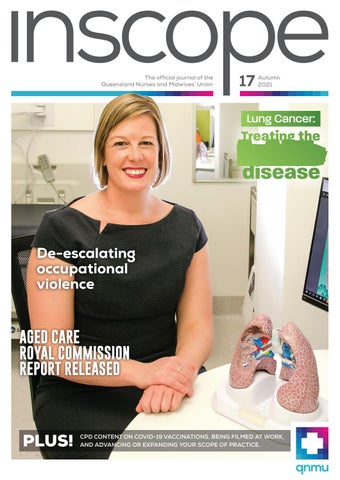
The official journal of the Queensland Nurses and Midwives’ Union
17
Autumn 2021
Lung Cancer:
Treating the
invisible
disease
De-escalating occupational violence AGED CARE ROYAL COMMISSION REPORT RELEASED
PLUS!
CPD CONTENT ON COVID-19 VACCINATIONS, BEING FILMED AT WORK, AND ADVANCING OR EXPANDING YOUR SCOPE OF PRACTICE.
Our record speaks for itself
IN 2019/20, THE QNMU:
Provided legal representation for 294 members responding to OHO or AHPRA notifications or investigations
Provided legal representation for 257 members including representation for coronial investigations and coronial inquests
Provided expert representation for 4003 members
Recovered $1.7 million for members
Assisted 188 members with WorkCover claims
Assisted 49,572 members through our Member Connect call centre
Provided wellbeing assistance for 412 members Pictured: QNMU member Lauren Schofield, RN
17
16
Autumn 2021
INDEPTH
De-escalating violence through the Ambassador Program
THE OFFICIAL JOURNAL OF THE QUEENSLAND NURSES AND MIDWIVES’ UNION ISSN 2207-6018 ABN 84 382 908 052 106 Victoria Street West End Q 4101 (GPO Box 1289 Brisbane Q 4001) T 07 3840 1444 1800 177 273 (toll free) F 07 3844 9387 E inscope@qnmu.org.au W www.qnmu.org.au EDITOR Beth Mohle, Secretary, QNMU PRODUCTION QNMU Communications team: Linda Brady, Melissa Campbell, Cameron Gledhill, Stephanie Lim, Lou Robson, Luke Rutledge, Analiza Smart PUBLISHED BY The Queensland Nurses and Midwives’ Union AUTHORISED BY B. Mohle, Secretary, Queensland Nurses and Midwives' Union, 106 Victoria St West End 4101. PRINTED BY Kingswood Print Signage, 80 Parramatta Rd Underwood 4119
INDEPTH
18 20
Now's the time to be healthy, wealthy and wise
21 22 28 30 34 36 38
Day of action: ramping up the pressure
46
Aged care Royal Commission's final report calls for Care, Dignity and Respect
Treating the invisible disease Readers love our nursing and midwifery stories What does a 'good job' look like? How digitally capable are you? A stitch in times saves... stuff from landfill! 'Job-ready Graduates' and the liberal arts
22
60
CPD
42 44 46 49 50 52 54 56
REGULARS Being filmed at work: what are my rights?
02
INSIGHT
Obligations for reporting impairment
04
TEA ROOM
COVID-19 vaccinations: Your role as a health professional
05
WINS
08
JUST IN
41
NOTES FROM THE NORTH
Primary Health Care Nurses and pay
58
INCOMING
Paediatric Stomal Therapy Nursing
60
IN VIEW
Scope of practice: What is it and how do I advance or expand it?
64
CALENDAR
Recognising and responding to domestic and family violence
64
ADVERTISING
Which pressure injury guidelines should be used to guide practice?
DISCLAIMER: Statements expressed in articles in InScope are those of the contributor and do not necessarily reflect the policy of the Queensland Nurses and Midwives’ Union unless this is so stated. Copyright of articles remains with the contributor and may not be reproduced without permission. Statements of facts are believed to be true but no responsibility for inaccuracy can be accepted. Other material may be reproduced only by written arrangement with the Union. Although all accepted advertising material is expected to conform to the QNMU’s ethical standards, such acceptance does not imply endorsement. Visit www.qnmu.org.au/privacy to read our privacy statement.
Cover photo: QNMU member and Specialist Lung Cancer Nurse Cassie Dickens. Photo: Lou O'Brien.
1
insight
IR Bill reveals the federal government’s true stripes Sally-Anne Jones QNMU President
T
HERE were so many things about last year that were unprecedented – but now we’re well and truly into 2021, one thing stands out for me as particularly unique and, sadly, quickly dwindling away. In a sign of just how critical the financial disruption of COVID-19 was in the early months of 2020, the Morrison Federal Government committed to work constructively with the union movement and, importantly, promised that any changes to working conditions or industrial relations would not leave workers worse off. It was a rare genuine effort to work in a collaborative way with unions. Finally, our shared interest of seeing Australians through the worst of the pandemic overcame the partisan and ideologically divided nature that often characterises our political landscape. The union movement, including the ANMF, also stepped up and vowed to work constructively with the Morrison government, agreeing that workers needed to be protected if we were to avoid the social and economic catastrophe we were facing. And together, we achieved some remarkable things. The JobKeeper and JobSeeker initiatives were developed and rolled out in record time, keeping millions of workers connected with their employer instead of slipping into poverty.
But one year on, we sadly find ourselves not only back to where we were before the pandemic in terms of the Morrison government’s ideological opposition to unions, but workers also find themselves facing a fresh wave of attacks on their wages and conditions. That’s thanks to the government’s proposed Fair Work Amendment (Supporting Australia’s Jobs and Economic Recovery) Bill 2020 – known colloquially as the IR Omnibus Bill. The Bill, which has now passed the House of Representatives and is before the Senate, contains dangerous changes to our industrial relations laws, and have the potential to entrench casual work, undermine genuine collective bargaining, and destabilise casual workers’ pay and conditions. Outrageously, it also weakens employers’ requirements to explain an agreement to their employees, provide copies of the agreement, and notify employees when bargaining commences. And nurses and midwives, despite our critical role in managing Australia’s COVID-19 health crisis, are not immune to these proposed changes. The only glimmer of light so far is that the government has backed down on a small part of their changes to the “Better Off Overall Test (BOOT)” - though only after fierce union and public backlash. The change is not
Make no mistake, an attack on our industrial entitlements is also an attack on our professional conditions… 2
enough, of course, to “fix” the Bill, despite the government claiming otherwise. It’s difficult to understand how the government can justify the need for such extreme and unfair changes, and right on the heels of the pandemic itself. In health, nurses and midwives know all too well that our health system – and by extension those who work in it – is already stretched to the limit. Make no mistake, an attack on our industrial entitlements is also an attack on our professional conditions … for how can we hope to improve our working lives if our basic entitlements are in danger of being stripped away? I am genuinely saddened that we were not able to hold onto the political bipartisanship that saw us through the pandemic. Some believed Australia just “got lucky” in escaping a tragedy on the scale we have seen unfold overseas. But in the end, it was a lot of hard work, collaboration and compromise. That is what we should be aiming for. That is what our system needs.
QNMU COUNCIL president :
Sally-Anne Jones
vice president : secretary :
Lucynda Maskell
Beth Mohle
assistant secretary :
Vacant
councillors :
Julie Burgess Christine Cocks Karen Cooke Tammy Copley Dianne Corbett Jean Crabb Michael Hall Raquel How Shelley Howe Christopher Johnson Damien Lawson David Lewis Dallas Meyers Fiona Monk Sue Pitman Melanie Price Karen Shepherd Katy Taggart Janelle Taylor Kym Volp Deborah Watt Charmaine Wicking
insight
Knowing, telling and selling our value Beth Mohle QNMU Secretary
IT IS HARD to recall life before COVID-19. Our individual and collective lives have changed so fundamentally. And while COVID-19 did disrupt much of the work we as a union were working towards, in many ways the pandemic has also reinforced and validated our organisational priorities, the essence of which have not changed: ■ Safe workloads ■ Good secure jobs ■ Being safe at work. These key issues are the priorities for our union because our members across all sectors repeatedly identify them as their top priorities. We have plans to deliver on all three of these priorities through collective action and campaigning in our workplaces and communities. Our plan to address excessive workloads through extending mandated staffing ratios across all sectors is still front and center for us as a union. The reality is, nurses and midwives are the constant presence in our health and aged care systems. We are the lynchpin for quality care. Ratios provide a minimum “care guarantee”, and the QNMU will not rest until all people being cared for in our health and aged care sectors have this guarantee. The pandemic also underscored the importance of having good secure jobs by highlighting the extent to which insecure work has undermined broader social cohesion. Recently, we successfully lobbied the Queensland government to commit to a 90% permanent
employment target in Queensland Health, and we will ensure they deliver on their promise.
Please take care – R U OK?
Addressing the curse of insecure work in other sectors, especially aged care, is a top priority and we will be actively campaigning in the lead up to the next federal election to grow good secure jobs.
THE PHYSICAL and emotional toll of the pandemic was brought home to me recently when a dear friend tragically took her own life. I met Louise when I was a student nurse in the RBH Emergency Department over 30 years ago.
Lastly, the safety of our members is always of paramount importance, be this their physical, psychological or cultural safety. Key safety concerns in the pandemic include having appropriate PPE, adequate staffing and skill mix, and safe systems of work.
She was a RN there, so passionate about teaching, smart, funny and quirky. She took me under her wing during a long stint of night duty and taught me so much. Most importantly she was kind and generous with her time, imparting her considerable knowledge to me.
But much more needs to be done to address endemic problems, especially in relation to occupational violence experienced by nurses and midwives. The failure to address this global problem goes to the undervaluing and poor treatment of frontline workers. It is a wicked problem that requires a concerted and multi-faceted response, especially given it is anchored in fundamental changes in our societal norms. But if there is one silver lining to the pandemic, it is that our work has been recognised as foundational not only to a fair and well-functioning society but also a robust economy. There has been a shift in thinking and valuing, which must be sustained. But we need more than hope – we need a plan to ensure this occurs. We need to know and tell and sell our value and contribution. That is the work of our union and we remain firmly focused on working with members to deliver real change.
Louise was the nurse I always said I wanted to have look after me when I was sick. We became firm friends and bonded over so many things (our love of jazz with Ella Fitzgerald was a particular favourite). She was treasured in so many ways and became like another sister to me. I cannot believe she is no longer in the world – it is so diminished because she is not here. I have so many questions, as do her family, friends and colleagues. Why? What if? How did I miss this? If only she knew how much she was loved and is now so desperately missed. It has brought home to me how vitally important it is to check in on friends and family as well as look after ourselves. Ask the question – R U OK? Please be kind to yourself. Remember to reach out when things seem bleak – there are people who can help you get back on track. Take care. Beyond Blue: 1300 22 4636 Suicide Call Back Service: 1300 659 467 Life Line: 13 11 14
3
QNMU members frequently contact us with questions about their wages, entitlements and other workplace conditions. Being informed about your agreement, workplace policies and procedures and any other professional and industrial issues is the first step to ensuring nurses and midwives receive what you are due. Our Tea room series, which appears in every edition of InScope, explains some of the common queries we receive from members. If you have any topic suggestions you’d like covered, we’d love to hear them – email comms@qnmu.org.au
AHPRA audits
A reminder before renewing your registration Your AHPRA registration renewal may not be due until 31 May 2021, but Enrolled and Registered Nurses, Midwives and Nurse Practitioners can be audited any time throughout the year for any registration period over the preceding five years – so it’s best to ensure all your documentation is always up to date. If you declare on your registration renewal form that you have met the necessary standards and you are later audited, AHPRA will request you provide evidence of compliance with the audited standards within 28 days. Members should expect to be audited at least once during their career. The standards are: ■ Recency of Practice (ROP) ■ Criminal history ■ Continuing Professional Development (CPD) ■ Professional Indemnity Insurance (PII) If audited, AHPRA will initiate a criminal history check on you while you are compiling your evidence of meeting the other three registration standards.
slips to demonstrate at least 450 hours of practice in the past five years. And finally, you must show evidence you have completed your necessary CPD hours. QNMU members are encouraged to complete their online record of CPD, accessible through their member portal at www.qnmu.org.au/CPD If audited, your completed online record of CPD keeps all your CPD activities in one convenient location and satisfies the standard. Remember, CPD may include any COVID-19 and infection control training you undertook in the past 12 months, including online training modules.
DV leave
What is it for and how do I access it? Family and Domestic Violence Leave is designed to assist employees affected by family and domestic violence, this include employees who are acting as a support person to someone experiencing violence.
Evidence of PII compliance can be obtained from the QNMU website (www.qnmu.org.au/insurance) by downloading one or more certificates of currency to cover the period being audited.
Federally, all employees (including casuals) are entitled to five days unpaid family and domestic violence leave each year through the National Employment Standards (NES), thanks to the union movement’s push for this entitlement. QNMU members working in Queensland Health and other state-based employers can access a minimum 10 days’ paid leave per year.
Meeting the ROP registration standard can be done by obtaining a statement of service from your employer, or providing sufficient pay
Through individual EA negotiations, we’re working to ensure more employers agree to provide similar increased paid leave entitlements.
What can I use the leave for? Reasons to use this leave include attending appointments (e.g. medical, legal, or counselling), attending court/other legal proceedings, and organising housing, care or education.
What other support is available? You can apply for flexible work arrangements either for yourself or to provide care or support to a member of your household or immediate family who is experiencing family or domestic violence. This may include part-time employment, flexible start times or telecommuting.
What evidence do I need to provide? In all circumstances, information disclosed in relation to family and domestic violence must be kept confidential, except to the extent that disclosure is required or permitted by law, or it is necessary for the information to be disclosed to support the employee in the workplace. The evidence must convince a reasonable person that the leave has been taken to deal with the impact of family and domestic violence. This can include police or court documents, family violence support service documents, or a statutory declaration. If you require assistance or support with family and domestic violence you can find more information at https://bit.ly/3p74RiF You can also refer to the NES, your Award or EA for specific details about your entitlements.
If you have questions about our Tea room column email memberconnect@qnmu.org.au
4
wins
Salvos nurses take Protected Industrial Action...
AND WIN I
T’S NOT often nurses or midwives resort to taking Protected Industrial Action (PIA) – usually, we are able to persuade management to agree to wages and conditions for which members will vote without members being moved to exercise their strongest power. But after a year of failed negotiations with the Salvation Army for a fair enterprise agreement, Salvos nurses working at the Withdrawal Management Units took the brave step of taking collective action. Ultimately, it resulted in a substantially improved offer from management, including a 5% wage increase, back-paid for about 12 months – possibly the highest wage increases won by any group of nurses in Australia in recent years.
Seeking a fair agreement Salvos nurses were asking for an agreement that acknowledged their hard work through fair wages and conditions. On average, Salvos nurses were paid $11 less per hour than their colleagues in Queensland Health. That’s despite the Salvos receiving funding from Queensland Health. Members at the Brisbane and Mount Tamborine facilities determined to conduct PIA in the form of safe work stoppages – no more than one hour per shift, and no more than three days in a row. Management were informed well in advance of the stoppages to ensure clients continued to receive care – the usual process for this kind of industrial action. Incredibly, management responded by closing the three Withdrawal
Staff at the Salvatio n Army Fairhaven fac ility were among the QNMU members wh o took protected ind ustrial action late las t year.
Management Units, including the facility in Townsville, where members had opted not to stop work. It was an outrageous and dangerous move by management, who were opting to turn away vulnerable clients and falsely claiming agency nurses did not have the necessary skill or experience to keep their clients safe. Fortunately, our members stood firm, supported by the broader community, who shared QNMU information on social media about management’s appalling response.
Management finally see sense Just as members were preparing to conduct more work stoppages, management returned to the table with a suitable offer – a 5% pay increase, back-paid to January 2020, plus a further 2% increase from July 2021, and another 2.5% increase from July 2022.
Before members took their protected action, management had refused the nurses’ counter-claim for backpay of a 5% increase. Now, this almost 12-months’ worth of backpay will amount to a significant sum for members.
It’s your democratic right Congratulations to QNMU Salvos members. Taking Protected Industrial Action is not an easy step, and not one nurses and midwives take lightly – and never one we take without ensuring the safety of our patients, clients or residents. This win does prove, however, that PIA is an effective option, particularly when management refuse to offer a fair proposal that respects the work we do as nurses and midwives. Remember, it is unlawful for an employer to take adverse action against a union member for taking PIA. An employer who breaks that law is liable for significant legal and financial penalties.
5
wins
Bolton Clarke Cairns members secure increased hours AFTER MANAGEMENT at a Bolton Clarke Cairns facility got wind that members were planning a high-vis event to protest cuts to nursing hours, they began offering members new contracts with increased hours. Members still went ahead with the event, however, which received media attention and was supported by the community. Members also collected over 300 signatures on their petition to reverse cuts. The reductions to rostered hours started in November 2020 and included the wound care Registered Nurse being reduced from one shift per day to one shift per week. It’s also not uncommon for just one RN to be in charge of 116 elderly residents overnight. While the nursing hours haven’t been completely restored, we’re incredibly proud of our courageous members for standing up and securing these improved hours.
Annual leave recovered at Eventide Rockhampton MEMBERS at Eventide Home Rockhampton have shared in a whopping $235,000 in unpaid annual leave entitlements. Under the Nurses and Midwives Award, Enrolled Nurses and Assistants in Nursing who work in Eventide Homes receive four weeks’ annual leave per year. If they work in a facility where shifts are worked 24 hours a day over seven days of the week, they receive an additional week’s annual leave. However, last year it was discovered that QNMU members at Rockhampton’s Eventide – ranging
6
from AINs to NG4 – were not receiving this entitlement to the additional annual leave. For some members, this error dated all the way back to 2009. Ultimately, Queensland Health agreed to pay the 25 affected members what they were due… which came to $235,000! If you think you’re not receiving the correct annual leave entitlements, be sure to contact your QNMU Organiser or Member Connect on 3099 3210 or 1800 177 273 (toll free outside Brisbane) so we can look into it.
The difference of $500,000 from improved contracts MANY members working in the private and aged care sectors know their rostered hours are often well above the hours reflected in their employment contract. This was the case for 16 QNMU members working for Canossa Health Services in Oxley and Far North Queensland, who had been working for a significant period of time on a permanent part-time basis, despite their contracts stating a minimum of 16 hours. But when the Canossian Sisters sold the services to Ozcare, our members were offered new contracts that still provided the base minimum of 16-hours. Under these new contracts, there was no guarantee these members would be offered their normal rostered hours. After QNMU intervention, both parties agreed that members would submit a request to have their parttime hours reviewed, as is allowed under the enterprise agreement. The new contracted hours, which members put forward based on their current working hours, were ultimately accepted by management. This meant members were able to safe-guard approximately $500,000 in salary payments per year!
Your right to amend your contract If your written contract doesn’t reflect the number of hours you actually work on a regular basis, most enterprise agreements allow you to request that it be amended to reflect the hours you actually work. Find out more and download a request template letter at www.qnmu.org.au/ contracthours
wins
Unlawful stand down sees nurses recover more than AGED CARE employers will think twice before standing down their employees without pay in future, after the QNMU successfully made Bolton Clarke reverse a stand down decision and pay out more than $18,000 in compensation. In April 2020, at the height of Queensland’s COVID-19 outbreak, Bolton Clarke began asking nursing staff who had a second job to choose between taking unpaid leave for at least three months, using up their paid leave, stopping work in their second job, or being stood down without pay. Five nurses, all QNMU members, received advice from the QNMU that they could not be made to stop working at their second job or be forced to take unpaid or paid leave. Management however stood them down without pay – a decision the QNMU argued was unlawful. Registered Nurse and QNMU member Qing Ling said management’s “blanket decision” to stand down her and her colleagues was not a win for anybody involved, least of all the residents. “I felt very sorry that ultimately the residents were not getting the best care they could have, with me and my colleagues being stood down,” Qing said. “We were ready and available, but we were simply disregarded.” The QNMU sued Bolton Clarke in the Federal Court, and by mid-June 2020 our members were back at work.
$18,000 down any employee without pay (for a reason other than having a second job).
that Bolton Clarke’s original justification for standing down our members without pay was unsubstantiated – that is, Bolton Clarke believed nurses who worked in another facility posed an increased risk of bringing COVID-19 into their workplace.
“I would not have pursued this matter if the QNMU was not there to advise me each step of the way,” Qing said.
Despite refusing numerous offers by the QNMU to settle, Bolton Clarke ultimately agreed to some significant parts of the QNMU’s original offer. These included:
“If you ever find yourself in a situation where your employer is doing the wrong thing, I encourage you to contact the QNMU and get informed by the industry experts.
■ to pay 100% of wages lost by those members who were stood down, which totalled $18,739.
“The union is there to back you up – they will never lead you astray.”
■ to never stand down any employee without pay for the reason that they work at another workplace. ■ to consult with the QNMU before implementing a proposal to stand
Congratulations to our members for seeing this process through. We are thrilled by the outcome, which will send a clear message to other aged care employers who disregard their employees’ rights.
The union is there to back you up – they will never lead you astray.
QNMU seeks compensation In court, the QNMU pursued compensation for our members for the money they lost during the unlawful stand down. Using expert evidence from Professor David Paterson (Director of the UQ Centre for Clinical Research, and Consultant Infectious Diseases Physician at RBWH), the QNMU argued
Qing Ling, Registered Nurse and QNMU member
7
just in
QNMU takes home NAIDOC Union Award THE QNMU is thrilled and humbled to take home our very first Queensland Council of Unions NAIDOC Union Award! This award is a fantastic acknowledgement of the tireless efforts and dedication of our First Nations Branch, who work to advance the interests of our Aboriginal and Torres Strait Islander nurses and midwives. A big congratulations to our First Nations members and members of the First Nations Branch. We look forward to continuing this important work.
QNMU First Nations Branch members acc ept the NAIDOC Union Award from res pected Elder Uncle Bo b Anderson
Members working toward social justice NURSES and midwives have an important role to play in leading the public conversation on social justice issues
The Lifelong Work for Social Justice forum was hosted by the QNMU’s special interest groups – Retired Nurses and Midwives, Health and the Environment, and Nurses and Midwives for Refugees and Asylum Seekers (NAMRAS).
Of course, our flower garden also got lots of attention with new plantings!
So big thanks to the dedicated members who joined us for our special Lifelong Work for Social Justice forum, where we discussed important issues like transitioning to meaningful retirement, welcoming refugees and the challenges of climate change. We heard from some fabulous guest speakers who shared these valuable take-home messages: ■ Former QNMU Director of Member and Specialist Services, Linda Lavarch Retirement is about moving from frantic to focused. You might be retiring from full-time work, but you don’t have to retire from your passions. ■ Co-convenor of Unions for Refugees, Elliot D’Arcy - We cannot be content to only fight for union values in workplaces. Empowering repressed people is union business. ■ Head of Research for the Climate Council, Dr Martin Rice - The true picture of climate change is scary, anxiety-inducing and has many negative health impacts. But action feels better than anxiety, and this is the time to take action.
8
just in
INTRODUCING...
Sye Hodgman your QNMU First Nations Strategy, Policy and Research Officer As part of the QNMU’s ongoing commitment to advancing Aboriginal and Torres Strait Islander nursing and midwifery outcomes, QNMU Council endorsed a new role that will support engagement and strengthen representation of our Aboriginal and Torres Strait Islander members.
M
Y NAME is Sye Hodgman – I am a Trawlwoolway Palawa-Pakana nurse. In addition to my clinical nursing background from 2009-2020, I have also spent many years working concurrently in education, human resources, workforce development, and strategic planning in the Aboriginal and Torres Strait Islander health space. I have experience working across the public, private, aged, disability, Aboriginal and Torres Strait Islander Community Controlled, and government sectors in urban and regional areas. I am currently on the board of the Congress of Aboriginal and Torres Strait Islander Nurses and Midwives, the Australian Journal of Advanced Nursing, and am the Vice President of Kurbingui Sporting Association. I have always had a strong passion for improving the wellbeing of Aboriginal and Torres Strait Islander people and communities, and believe this can only be achieved with a strong and empowered Aboriginal and Torres Strait Islander health workforce. With the ongoing support of our First Nations Branch and QNMU leadership,
I believe this role can have the greatest positive impact in the following areas: ■ Shifting the focus of Aboriginal and Torres Strait Islander health research and evaluation to a strengths-based approach. ■ Working with members and health services to address the social determinants of health. ■ Addressing issues of institutional racism within the existing structures that influence the social determinants of health. ■ Encouraging cultural safety to be considered in the context of a genuine workplace safety framework within health. ■ Growing a stronger and larger Aboriginal and Torres Strait Islander nursing and midwifery workforce. ■ Growing the voice and activism of our Aboriginal and Torres Strait Islander nursing and midwifery workforce. ■ Advocating self-determination for Aboriginal and Torres Strait Islander people within their local health services and state policies. With the above in mind, I will also be setting aside time to make myself available to engage with members
and their needs to better inform my position and priorities when representing QNMU Aboriginal and Torres Strait Islander members. I am currently calling for all QNMU Aboriginal and Torres Strait Islander members to participate in our First Nations Branch, or communicate with me directly, to provide me with direction on setting the agenda for my role and the position of the QNMU in representing Aboriginal and Torres Strait Islander nurses and midwives. I have also commenced regular listening tours, which include site visits to public, private and aged care sites across Queensland. I’m keen to hear your stories and have a yarn about how we can build relationships and work together. If you’d like to contact me about anything – whether it’s to get involved in the Branch or just to chat – please email me at SHodgman@qnmu.org.au I am really looking forward to yarning with you all in the future!
9
just in
U P C O M I
N G
E V E N T S
Remembering our nurses - The Spanish flu pandemic THE ROYAL BRISBANE AND WOMEN’S HOSPITAL (RBWH) recently unveiled a special memorial to recognise the nurses who died while working at the Brisbane Isolation Hospital during the Spanish flu pandemic in 1919. RBWH Director of the Infectious Diseases Unit, Dr Krispin Hajkowicz, became aware of three nurses who worked at The Brisbane Hospital (now RBWH) in 1919 - Alice Wyeth, Hannah Elizabeth Dufton and Clare Popple – who died from Spanish Influenza which they acquired while caring for patients at the hospital. In an effort to discover more about the nurses, Dr Hajkowicz and his team found that two of the three nurses had no tombstone or memorial plaque. The third nurse, Hannah Dufton, had only a small headstone with her name on it in Toowong Cemetery in Brisbane. At a time when the current COVID-19 climate reminds us of the tireless dedication and sacrifice of nurses and midwives in pandemics through the years, Dr Hajkowicz and the RBWH team felt it was important to preserve the memory of these women who lost their lives caring for the Queensland community. The memorial is dedicated to these three special nurses, and all nurses and midwives past and present in acknowledgement of 2020 International Year of the Nurse and the Midwife.
QNMU Education courses Various dates Check out our wide range of QNMU Education courses on activism, creating a safe workplace, developing Positive Practice Environments, and more. Register now at www.qnmu.org.au/education
Nurses Memorial Candlelight Vigil Saturday 24 April Each year, the QNMU lays a wreath on behalf of our members in honour of our Anzac nurses and countless others who have served.
QNMU Professional Practice Awards entries and nominations close Sunday 25 April We’re recognising and celebrating the contributions of QNMU nurses and midwives through our positive practice environment award categories. Enter or nominate now at www.qnmu.org.au/Awards
Anzac Day Sunday 25 April In remembrance of our war veterans and fallen soldiers, and in honour of the heroic service and sacrifice of Australian nurses in war.
Labour Day Monday 3 May* A day to celebrate the union movement and all we’ve achieved over the years as a collective. Keep an eye out for Labour Day events across the state. Solidarity! * Date varies depending on location
International Day of the Midwife and International Nurses Day Wednesday 5 May | Wednesday 12 May They’re the days to celebrate us! An opportunity to reflect on our practice and feel proud of the work nurses and midwives do to help keep Queenslanders safe and healthy.
QNMU Annual Conference n eases Unit, Dr Krispi or of the Infectious Dis ol, ect ntr Dir Co WH ion RB ect R: Inf to L nt nical Nurse Consulta nager of the Hajkowicz; RBWH Cli Acting Nurse Unit Ma WH RB d an e; idg Mary Batch. e, bra Michelle Do ttle Wa it Un Infectious Diseases
10
Wednesday 14 – Friday 16 July Dynamic speakers, networking opportunities, an engaging professional day… this year’s conference is not to be missed! More info coming soon.
just in
COVID vaccinations kick off for Queensland HEALTH, aged and disability care workers were among the first to receive the COVID vaccine when it began rolling out in Queensland in late February.
“I think it’s so important that everyone gets the vaccine, not just for yourself but for the safety of everyone else.”
QNMU member and Registered Nurse Zoe Park works in the COVID ward at Gold Coast University Hospital (GCUH), and was the very first Queenslander to receive the COVID vaccine.
Over 200 vaccinations were administered at GCUH on the first day as part of the first round of the rollout, which also includes police and quarantine hotel cleaners.
“Getting the vaccine was a privilege and an honour, I’m so happy I was able to get it,” Zoe said.
Find out more about the COVID vaccines and the national rollout strategy at www.health.gov.au/initiativesand-programs/covid-19vaccines
“It’s been tough and scary at times, but hopefully we’re now coming towards the end of what’s been a really challenging 12 months.
Zoe
Casey
Lesley Fleming OAM QUEENSLAND has lost a fierce advocate for the nursing and midwifery professions, with the sad passing of Adjunct Associate Professor Lesley Fleming OAM on 22 February 2021. Lesley was the first Executive Director of Nursing and Midwifery Services, Metro North HHS. She also worked as the Director of Nursing and Midwifery at the Royal Brisbane and Woman’s Hospital, as well as serving for a short time as the Chief Nursing and Midwifery Officer.
Hello
“ from ‘that girl in the back of the photo’! What a huge day for GCUH. Despite how I look in that one photo, I was extremely happy and excited (maybe a bit nervous too!) to be one of the nurses to deliver the first six doses of the Pfizer vaccine. Our team has spent the past two weeks meticulously training to ensure that we deliver this vaccine safely to our colleagues and others included in the Phase 1a rollout. It was a very busy day, but I went home proud to be a nurse helping the community fight COVID-19, one vaccination at a time... including getting one myself!” Casey Peek, Registered Nurse
Lesley was loved and respected by so many nurses, midwives and health professionals – a loyalty that was demonstrated in 2006 when nurses and midwives protested against her attempted sacking from her EDON position, a decision that was immediately reversed and her position reinstated. Lesley fought hard in both good and difficult times to advocate for the professions she cared so passionately about. She has already left a large void in our hearts, and will be dearly missed by her family, friends and those who were fortunate enough to work with her throughout her inspiring career.
11
just in
145 Hand Keepers, 63 countries, 70,000 Hand Medals IN DECEMBER 2020, the QNMU was gifted 400 ‘hand medals’ as part of an international art project recognising the invaluable contribution health clinicians made during the pandemic. On behalf of Queensland’s nurses and midwives, we accepted these beautiful hand-crafted medals and distributed them to branches and Queensland Health HHSs. Our warmest thanks to the NTEU for choosing the QNMU as a “hand giver” – we know many of our members were touched to receive these unique gifts. Read more about the international project at www.handmedalproject.com
Dr Elizabeth Shaw (R) from Griffith University delivered the Hand Medals to QNMU Secretary Beth Mohle last year.
Have more to invest in your future
Combining – or consolidating – your different super accounts into one is an easy step you could take today to help keep track of your money.
How to consolidate Log in or register for Member Online at qsuper.qld.gov.au Select ‘Consolidate’ Enter the details of the other super accounts you would like to combine
Important: Before you consolidate, you should check with your other super funds if there are any fees or tax implications, or loss of insurance or other benefits. Also consider your current investment performance and whether you might lock in an investment loss.
Consolidate now This information and QSuper products are issued by the QSuper Board (ABN 32 125 059 006 AFSL 489650) as trustee for QSuper (ABN 60 905 115 063). Consider whether the product is right for you by reading the product disclosure statement (PDS) available from our website or by calling us on 1300 360 750 to request a copy. Any advice given is general only and is provided by QInvest Limited (ABN 35 063 511 580, AFSL 238274), without taking into account your personal objectives, financial situation, or needs. Refer to the Financial Services Guide (FSG) for more information. © QSuper Board. SPON-554. 01/21.
12
just in
Morrison’s IR Bill a threat to your working conditions THE MORRISON Federal Government has launched a new attack on our working conditions. In December, the government introduced a new Bill into parliament to amend the Fair Work Act. The Bill – known informally as the “IR Omnibus Bill” – could have devastating consequences for your working conditions.
What would the Bill mean for nurses and midwives? The Bill has already passed the House of Representatives – if it passes the Senate, this legislation could see workers put last. Specifically, the Bill will entrench casual work, undermine genuine collective bargaining, and destabilise casual workers’ pay and conditions. For instance, the Bill would give employers increased scope to reject applications for casual workers to become permanent employees. Outrageously, the Bill also weakens employers’ requirements to explain an agreement to their employees, provide copies of the agreement, and notify employees when bargaining commences. Fortunately, the government scrapped their proposed changes to the “Better Off Overall Test”,
something that would not have happened without fierce union and public backlash… but it’s not nearly enough to “fix” the Bill.
QNMU member tells Senate inquiry the brutal truth Our very own member and longtime aged care AIN Sherree Clarke spoke bravely at the Senate inquiry in Canberra. Sherree’s statement highlighted how the Bill will affect her and other nurses and carers facing insecure work. “I am unable to support my elderly parents because there is no consistency to my hours […] and I have been unable to secure a long-term rental lease because I don’t have guaranteed income,” Sherree said. “I am already the working poor, and this Bill could disadvantage me further. “Our older generations deserve to be treated with dignity and respect – but so do the people working in aged care. “We need laws that provide proper value for aged care workers and provide secure jobs and fair pay. This Bill will make an already broken system worse.” We’re so proud of Sherree for speaking out in such a public forum –
Top: The union movement, including the QNMU, will continue fighting against the government’s IR Bill. Inset: QNMU member and AIN Sherree Clarke told the Senate inquiry in Canberra how the IR Bill will further entrench casual and insecure work.
her story was powerful and puts on the record how unjust the IR Omnibus Bill is. The QNMU also made a detailed submission to the inquiry on behalf of members, which outlined our clear objections to the proposed bill. Read it at www.qnmu.org.au/ IRSubmission Take action to stop the Bill passing the Senate: www.australianunions.org.au/ campaign/email-your-mpand-senator
13
just in
QNMU Mentoring Program DO YOU WANT to build your confidence and capacity as a nurse, midwife or carer? From April, the QNMU will be hosting monthly mentoring workshops for nurses and midwives interested in learning about mentoring relationships and creating opportunities to connect with like-minded professionals. After completing the Mentoring Program Workshop, you will be invited to submit your professional profile online and be matched with suitable mentors or mentees. Entering a mentoring relationship at the end of the workshops is voluntary and it will be underpinned and strengthened by mutual agreements of roles, responsibilities and expectations. We anticipate these mentoring relationships will continue for about 12 weeks if both parties feel comfortable. If you would like to participate, please register your expression of interest by enrolling in the mentoring workshop at www.qnmu.org.au/MentoringProgram
QNMU election –
postal balloting opening soon THE POSTAL balloting for ANMF Qld Branch (QNMU) election will be held from 26 March to 30 April 2021. The Australian Electoral Commission (AEC), the independent body that oversees the ANMF and QNMU polls, opted to delay the 2020 elections due to the COVID-19 disruptions, but confirmed the new dates in mid-December.
What are these elections for? The QNMU is a democratic organisation which gives every member a say in who leads their union. The QNMU Council is the governing body of the union and is made up of members elected by you. Every four years, members participate in independent elections for the offices of President, Vice-President, Secretary, Assistant Secretary and Councillors. By long-standing practice made possible by an exemption under section 802 of the Industrial Relations Act 2016 (Qld), the QNMU elections are officially held as the QNMU (Queensland) branch of the ANMF (our federal union). The office bearer results are then replicated at the state level to ensure consistent decision making between the two bodies, and to save us from having to hold two elections. If you have any questions please contact the QNMU via email at governance@qnmu.org.au
14
MAKE SURE YOU HAVE YOUR SAY BY SUBMITTING YOUR VOTE!
just in
2020 QNMU Award winners
making a difference L
AST YEAR, we proudly announced the winners of our very first QNMU Professional Practice Awards who were each awarded $5000 to help further their professional development as nurses or midwives.
Margaret Lehan THE PRINCE CHARLES HOSPITAL
E N IN
IN
W
W
I plan to use some of my prize money to visit other HHSs to see what environmental practices have been implemented in other facilities that I can take back to TPCH and implement. Thank you to the QNMU for this wonderful award and all the opportunities and recognition it brings!
R
Research and Innovation Award
N E
SUNSHINE COAST UNIVERSITY HOSPITAL
Positive Practice Environment Champion Award
W IN N
I am so grateful for the wonderful opportunity to further my professional development and evolve my clinical supervision skills so I can better help patients and colleagues in need. I would like to thank the team at the QNMU for this recognition, especially for focusing on the importance of creating positive practice environments.
R
Christopher Dawber
Mary English OZCARE MALANDA AGED CARE FACILITY
Excellence in Leadership and Governance Award
E
I feel very humbled by the whole experience. I just cried because I couldn’t believe it. I watched the Awards broadcast live on Facebook and it was amazing to see all the positive and encouraging comments coming through from my peers and colleagues.
R
Christine Sutton
PROFESSIONAL PRACTICE
JOHN FLYNN PRIVATE HOSPITAL
Early Career Award
W
IN
N
E
R
It was an honour not only to be nominated but to be lucky enough to win. This award has given me so many opportunities as a midwife and enabled me to better support women and families in my local community.
If last year’s winners have inspired you, then enter yourself or nominate a colleague now for our 2021 Professional Practice Awards at www.qnmu.org.au/Awards
15
indepth
O
CCUPATIONAL violence is, unfortunately, a sad and unacceptable reality of many health workers’ day-to-day role when caring for their patients and residents. Ask any nurse or midwife and they will most likely tell you they have either experienced first-hand or witnessed some form of occupational violence, whether physical, verbal or psychological. There is no silver bullet to stamping out occupational violence – but one particular program currently in place in various Queensland Health facilities is proving highly effective. So much so that as a result of QNMU’s lobbying, the Queensland government committed to roll it out across more workplaces at the last election.
De-escalating
VIOLENCE through the
AMBASSADOR Program
It’s called the Ambassador Program – an innovative model that employs a proactive rather than reactive approach to monitoring and responding to aggression and other security issues. Not to be mistaken for security officers, Ambassadors are specially trained officers who are stationed in typically stressful environments such as Emergency Departments. They survey the environment and de-escalate situations before they progress, acting as a conduit between clinical staff and patients or residents. Since 2018, the roles have been trialed in a number of settings and locations, including Logan, Nambour and Gympie EDs, as well as an adapted model for aged care at Metro North’s Cooinda House.
First general ward Ambassador Most recently, the program has been trialed at three surgical wards at the Royal Brisbane and Women’s Hospital – the first time the role has been utilised in a general ward setting. Acting Nurse Unit Manager of 9A South at the RBWH and QNMU member Kym Baxter said the ambassador role had improved the culture and safety on her ward.
Ambassador Evile of RBWH ward 9A South.
16
“At the start of the shift, the ambassador has a chat with the team leader and identifies any patients
indepth that may be of concern, whether that’s a patient who’s been shown to be aggressive or who is delirious and needs that redirection,” Kym said. “We recently had a patient with post-operative delirium during an extremely busy shift,” she said. “Rather than taking a nurse off the floor to focus on this patient, the ambassador was able to sit there for an hour, have a chat and re-orientate them. “It made that patient feel more safe and secure, they weren’t as agitated or aggressive as they’d previously been.” Currently, an ambassador is rostered across the three surgical wards every afternoon and night shift during the week and on all three shifts during weekends.
Positive response from nurses At the time of going to print, no official data had been released on the evaluation of the trial at the RBWH. However, Kym said her nursing team had reported an overwhelmingly positive response,
and she herself had noticed a significant improvement. “We’ve had a decrease in the number of one-on-one AIN specials being utilised,” Kym said. “Because we have a lot of patients who have delirium and are at risk of falls or wandering off and injuring themselves, we often have an AIN sitting with them to keep them safe and orientated… but the ambassador has decreased the use of that.” Kym also said the role had taken much of the pressure off nurses, particularly after-hours team leaders, and resulted in situations being de-escalated before having to call security. “Many of them have expressed they feel much more comfortable and safe working with difficult patients thanks to the ambassador being on the ward,” Kym said. The QNMU hopes the program will be extended beyond its initial trial. We also look forward to working with the state government to ensure its commitment to extend the program across other facilities is delivered.
Other measures to address occupational violence THE AMBASSADOR PROGRAM is just one of many initiatives developed and implemented by the state-wide Occupational Violence Taskforce (which was established following QNMU lobbying several years ago.).
Other initiatives include: ■ enhancing CCTV technology and communication devices ■ developing and implementing a framework for staff training ■ enhancing communication and relationships between health services, Queensland Ambulance Services (QAS) and police to improve information exchange on patients with violent histories ■ developing peer support programs for staff who are assaulted ■ developing minimum security arrangements ■ applying the principle of crime prevention through environmental design to reduce occupational violence risk. We still have a long way to go to eradicate occupational violence in our health facilities.
Nursing staff of RBWH ward 9A South (L – R): Olivia Brown, Kym Baxter, Caitlin Hand, Evile (Ambassador), Corin Roxburgh, Candice Brown, Morgan Stephensen and Gabi Burke.
The QNMU will continue to work with the Occupational Violence Strategy Unit to further develop and improve the above initiatives, and advocate for the systemic change that is needed for every nurse and midwife to feel safe at work.
17
indepth
Now’s the time to be
healthy, wealthy and
wise
I
T’S AROUND this time of year we usually remind members to check their CPD and ensure they meet
requirements for their annual AHPRA registration renewal. But if you are going to make sure one part of your life is on track, why not take the opportunity to check others? So we’ve compiled the following checklist to help you stay healthy, wealthy and wise this year.
Healthy Annual medical check-up: In addition to basic tests (i.e. blood pressure, ECG, weight) your doctor will usually ask about your general wellbeing, work and family stresses, you and your family’s medical history and your lifestyle choices. Depending on your age and indicators they may recommend other tests including: ■ Bone Density (Osteoporosis) ■ Colonoscopy ■ Diabetes ■ Bowel Screen (Although the National Bowel Cancer Screening Service usually sends free kits to over 50s.) ■ Prostate Dentist: Dentists recommend regular six-month check-ups,
18
Wealthy but you should at least go annually. Eye check: If you wear glasses an annual check-up will ensure your prescription is up-to-date, otherwise a test every two years is sufficient. Hearing check: Unless you already have hearing problems, you should test every five years once you hit 40. You should test annually after 60. Breast exam: Annually from the age of 40 onwards, particularly if your family has a history of cancer. Cervical Screening Test (cancer/human papillomavirus): People aged 25-74 should be screened every five years.
Check your payslip: If you are not doing this each payday, do it now. Does your pay rate reflect your pay point? Do the hours worked match your roster? Are extras like overtime, allowances and leave loading being paid? Are the salary sacrifice and super contributions correct? Check your ‘net worth’ (how well you manage your money): Take the value of your assets (property, cash, investments) and subtract your liabilities (all debts such as mortgage, loans, credit cards). Track it annually and aim to grow by 5-10% each year by reducing liabilities and increasing assets or their value. Check your debt-to-income ratio (how well you manage your debt): Take your total monthly debt payments and divide it by your monthly gross income. Your ratio should be 30% or lower. If
indepth
Wise not, make a plan to address the root problem and reduce your debt. Check your super (how your retirement plans are tracking): ■ Check your employer’s contributions are correct. ■ Check your balance: Are your current contributions sufficient to reach your retirement savings goal? Should you make additional contributions? ■ Can you boost your balance? Options include co-contributions, personal contributions or salary sacrifice. Visit www.ato.gov.au/ Individuals/Super/Growingyour-super ■ Check your investments: Is your investment option and
level of risk still appropriate for you? Are your investments performing according to benchmarks? ■ Check your fund’s insurance coverage: Is it right for your circumstances? Will it cover your bills/pay off your mortgage? Do you need additional (or less) insurance?
Know your workplace
entitlements:
Read over the award and your workplace agreement to ensure you are across your entitlements and conditions. (Find your agreement on your QNMU member profile page at www.qnmu.org.au under ‘wages and conditions’.)
Audit your plans: Review items like car insurance, home insurance, electricity and telecommunications plans. Are better deals available? Is it worth switching?
Reflect on your CPD: What are your learning objectives for the next year?
Check your emergency savings: Do you have enough to cover three months expenses (recommended)? If not, can you plan to save enough for two weeks’ cover and build on it?
Audit your digital footprint: Google yourself and where possible request removal of information about yourself you no longer want public.
Check your job readiness: Annually update your CV and your LinkedIn profile.
19
indepth
AGED CARE ROYAL COMMISSION'S FINAL REPORT CALLS FOR CARE, DIGNITY AND RESPECT
T
he Royal Commission into Aged Care Quality and Safety released its final report to the public on 1 March 2021.
and personal care workers for each resident, and at least one registered nurse on site at all times.
The Care, Dignity and Respect report calls for fundamental reform of the aged care system through 148 recommendations aimed at fixing the many systemic issues currently plaguing aged care and setting the sector up for a sustainable future.
■ Strengthened provider governance arrangements to ensure independence, accountability and transparency.
These wide-ranging recommendations include: ■ A new Aged Care Act that puts older people first, enshrining their rights and providing a universal entitlement for high quality and safe care based on assessed need. ■ An Inspector-General of Aged Care to identify and investigate systemic issues and to publish reports of its findings. ■ A plan to deliver, measure and report on high quality aged care, including independent standard-setting, a general duty on aged care providers to ensure quality and safe care, and a comprehensive approach to quality measurement, reporting and star ratings. ■ Professionalising the aged care workforce through changes to education, training, wages, labour conditions and career progression. ■ Registration of personal care workers as well as a minimum staff time standard for residential aged care. ■ A minimum quality and safety standard for staff time in residential aged care, including an appropriate skills mix and daily minimum staff time for registered nurses, enrolled nurses
20
■ Funding to meet the actual cost of high quality care and an independent Pricing Authority to determine the costs of delivering it. Together with our national body the Australian Nursing and Midwifery Federation (ANMF), we’ll be undertaking a thorough review and analysis of all the recommendations in relation to the key areas we’ve previously identified for urgent change in aged care, which are:
1
Mandated staffing ratios minimum staffing levels and skills mix
2
Legislated requirements for clinical governance, leadership, and expertise
3
Legislated transparency and accountability measures
4
Guaranteeing workforce capacity and capability
5
Registration for unregulated care workers
Unfortunately, Royal Commissioners Tony Pagone QC and Lynelle Briggs AO have provided different perspectives for some recommendation areas, so it is unclear how this will affect the final implementation of these recommendations by the federal government. The Morrison government should not use this as a excuse to stall much needed urgent action in aged care.
Royal Commission into Aged Care Quality and Safety
Final Report: Care, Dignity and Respect
Volume 1
Summary and recommendations
The Royal Commissioners have asked the federal government to respond to their recommendations by 31 May 2021. The QNMU and the ANMF will continue to put the pressure on our federal politicians and the federal government to commit to act on the report’s recommendations. The upcoming federal election due by May 2022 and May budget are crucial opportunities for members and the community to call for action and tell politicians that aged care is an issue of vital importance. We encourage all members, particularly those working in aged care, to read the summary of the final report and the list of recommendations available on the Commission’s website at https://agedcare. royalcommission.gov.au/ publications/final-report
indepth
DAY OF ACTION: RAMPING UP THE PRESSURE
A
ROYAL COMMISSION report containing numerous recommendations to fix aged care is great – but the report alone is not going to convince the Morrison Federal Government to act. So what will actually move the government to act? Simple: enough Australians telling them aged care is an issue they care about – and will vote on. That’s why we’ve ramped up the pressure on all federal politicians to act… because the time for talk is over. That pressure started with our Aged Care Day of Action on 1 March, a few days after the Royal Commission’s final report was handed to the government. Members and the general public visited the offices of their federal politicians and asked them to sign our pledge to legislate minimum staffing ratios. Others rang their federal politicians and left messages, as well as shared our graphic on Facebook calling on the federal government to act.
HOW DID POLITICIANS RESPOND? Disappointingly, none of the federal politicians we visited signed our pledge, but a number did agree to meet with us and to consider our call for ratios. We will keep you posted on what they say and do. Every member of parliament is responsible for fixing the crisis in aged care, and our federal
politicians' voices are crucial in moving the federal government to act.
QNMU Secretary Beth Mohle speaking outside Jim Chalmers office in Logan
Mackay
ACTION ONLY JUST STARTING Our day of action was just the beginning. In the lead up to the May federal budget, and as we head towards the next federal election, we’ll be maintaining the pressure on our federal politicians with two simple asks: ■ Implement the recommendations of the Aged Care Royal Commission, and ■ Legislate minimum staff-toresident ratios in aged care. The QNMU, together with our federal body the ANMF, is launching a major media campaign in the coming weeks to ensure aged care remains at the front of people’s minds.
Brisbane Caboolture
There’ll be activities members and the broader public can do, too, both online and on the ground. So keep an eye on your emails and be sure to follow us on social media so you don’t miss anything. This is the year we must secure commitments from our federal politicians to fix aged care. Aged care workers frequently worry about their jobs. Now it’s time our politicians worried about theirs. If you’re keen to get involved in our aged care campaign, email us at campaigns@qnmu.org. au and we’ll be in touch.
Rockhampton
21
indepth
Specialist Lung Cancer Nurse and QNMU member Cassie Dickens
22
indepth
Treating the
invisible
disease
Lung cancer is the leading cause of cancer death in Australia. However, the stigma that continues to shroud the disease presents a barrier to patients receiving vital treatment and care.
Oh, I didn’t know you were a smoker.
I
T'S AN OFTEN carelessly uttered assumption in response to the discovery a person has been diagnosed with lung cancer, it’s a phrase that is never well received. That’s because about one in five people currently living with lung cancer are life-long non-smokers. And while smoking can increase the risk of lung cancer it’s only one of a myriad of risk factors associated with the disease. However, the long-held belief linking smoking with lung cancer has created a stigma with far reaching consequences and a severe impact on patient care.
Falling prey to the stigma Cassie Dickens is a Specialist Lung Cancer Nurse at Sunshine Coast University Hospital. Alarmingly, Cassie said this assumption has actually stopped patients – both smokers and non-smokers alike – from seeking treatment. Photo: Lou O'Brien
23
indepth “I’ve had patients break down saying ‘I’ve brought this on myself’. They feel they don’t deserve to have help,” she said.
“Unfortunately, the stigma associated with lung cancer prevents patients from wanting to be their own advocate in fear of the judgement it can bring.
– sometimes no more than a simple cough – many lung cancer diagnoses have often already advanced to Stage 3 or 4.
“We’re also seeing people who have never smoked fall prey to the stigma and experience the same feelings of blame from others as those who smoke.
“It’s already a very poorly funded disease yet patients don’t feel like they are allowed a voice in obtaining more support and funding.”
So it’s not only vital that patients are supported through the distress and anxiety of a diagnosis, but provided guidance through their treatment options and next steps.
“Absolutely no one deserves a cancer diagnosis and it’s horrible for patients to feel this way. It’s something we need to work to change as a society.” This concerning trend of blame and stigma is also why those with lung cancer often remain in the shadows despite the urgent need for more support and funding to combat the disease. It’s one of the reasons lung cancer is described as the invisible disease. “Patients of more prominent cancers like breast or prostate cancer are often very vocal and play an active role in gaining support and advocacy,” Cassie said.
Studies by Lung Foundation Australia showed people who had access to a Specialist Lung Cancer Nurse were 34% more likely to receive treatment.
24
A need for supportive care This in turn also means there’s less funding for the Specialist Lung Cancer Nurse role – a vital role in providing support, guidance and care to patients who desperately need it. There are currently only 12 fulltime Specialist Lung Cancer Nurses working across the whole of Australia – a shockingly low number considering almost 160,000 people will be diagnosed with lung cancer over the next 10 years. It is our nation’s biggest cancer killer, but because its symptoms are vague
“To hear a diagnosis of any cancer can be incredibly frightening, but when there’s a five-year survival rate of just 18% for lung cancer, it can undoubtedly come as a massive shock,” Cassie said. “You can have people who have never smoked a day in their life and are quite young get a diagnosis of stage 4 lung cancer, which can just completely turn their world upside down. “Having a Specialist Lung Cancer Nurse support the patient’s treatment journey can make a huge difference in patient outcomes.”
indepth
Empowering patients “Navigating the health system as a lung cancer patient can be
De-bunking the #1 lung cancer myth
stressful, confusing and overwhelming when you are emotionally vulnerable. At times I felt like I was lost in a foreign country in the
You probably have lung cancer because you are a smoker.
dark with no map to help me navigate.” Anonymous lung cancer patient (quote provided by Lung Foundation Australia)
Anyone can get lung cancer.
Lung cancer can be a complex disease to treat. Specialist Lung Cancer Nurses like Cassie are essential in helping patients navigate their diagnosis and treatment options, as well as act as a liaison between them and various health care services and staff. Cassie works closely with a lung multidisciplinary team comprised of respiratory, medical and radiation oncology physicians, palliative care, other specialist nurses and Allied Health professionals. “I act as an advocate for my patients. There are a lot of uncertainties and complexities associated with lung cancer because it doesn’t always present symptomatically like bowel or breast cancers,” she explained. “I help them navigate the complexities of the health care system and provide education, information and support, as well as act as a key point of contact for them, their family members, their General Practitioner, and members of the lung multidisciplinary team. “It’s really about ensuring they’re empowered with knowledge about the disease to try and take away some of the fear that can come with the unknown.”
1 in 5 people with lung cancer are life-long non-smokers.
Smoking is only one risk factor of lung cancer. Others include:
Air pollution
Personal history of lung disease
Exposure to asbestos, radon and occupation materials
Family history
Genetics
25
indepth
Improving patient outcomes Studies by Lung Foundation Australia showed people who had access to a Specialist Lung Cancer Nurse were 34% more likely to receive treatment. Yet this access is currently severely limited. Cassie is the only Specialist Lung Cancer Nurse providing this service across the Sunshine Coast Hospital and Health Service region – that’s an area running from Gympie all the way to Caloundra. Furthermore, studies in the UK recommend a ratio of one specialist nurse to 100 or 150 lung cancer patients at any given time (depending on the complexity of each individual case).
A passion for the role With frequent advances in lung cancer treatment, Cassie stays up-todate on her professional development through conferences and forums facilitated by Lung Foundation Australia.
“I’m coming into people’s lives at their time of greatest need and I feel incredibly privileged to spend that time with them,” she said.
Specialist nursing blogs and online groups also provide an avenue for networking and contact with other Specialist Lung Cancer Nurses.
“It can take an emotional toll, but I’ve got some great supportive colleagues and we have a fabulous reflective practice session [run by inaugural QNMU Professional Practice Environment Champion Award winner, Christopher Dawber].
And while the job has challenged her emotionally and professionally, Cassie said knowing she’s making a difference in someone’s life is what fuels her passion for the role.
“I think when you’re dealing with something like cancer every day, day in and day out, it’s imperative you have the support to help you process it, both personally and professionally.”
Having a Specialist Lung Cancer Nurse support the patient’s treatment journey can make a huge difference in patient outcomes. Cassie Dickens, Specialist Lung Cancer Nurse and QNMU member
Cassie looks after around 300 lung cancer patients – double that number. She said it all boils down to working together to eliminate the stigma surrounding lung cancer, so crucial funding and support can be improved. “As lung cancer has such a low survival rate it’s really important we concentrate on improving outcomes for patients, and one of the best ways is to ensure they have access to specialist nurses who can guide them through their treatment options,” Cassie said. “I would really like to see the government fund more Specialist Lung Cancer Nurse roles, and also put some more public health messages out there to try and get rid of this awful stigma associated with the disease. “Without non-profit organisations like Lung Foundation Australia, patients in the private sector wouldn’t even have any access at all to a Specialist Lung Cancer Nurse.”
26
Photo: Lou O'Brien
indepth
Just a small cough. That’s often the only symptom someone may present with when they receive a lung cancer diagnosis. With symptoms as vague as a minor cough, some shortness of breath or just a little fatigue, it’s no wonder lung cancer has been dubbed the ‘invisible disease’. But lung cancer has become a growing burden in Australia due to disjointed care and sky-rocketing costs for treatment, resulting in poorer outcomes for patients. More funding is desperately needed for additional Specialist Lung Cancer Nurses and access to multidisciplinary care teams to improve best practice care and outcomes. Find out more at lungfoundation.com.au
It’s predicted around
53% of lung cancer
diagnoses over the next 10 years will already be advanced at Stage 4.
Fewer people with lung cancer are
diagnosed early compared to
other common cancers like prostate or breast cancer.
Lung cancer has the lowest five-year
survival rate of commonly diagnosed cancers - just 18%.
Over the next 10 years, almost people will be diagnosed with lung cancer.
160,000
28% of people are not staged when diagnosed, potentially missing out on life changing treatment and care.
20% of lung cancer
patients do not receive any treatment following their diagnosis. Others can wait up to two months until they are treated.
References Lung Foundation Australia, 2020. Making Lung Cancer A Fair Fight: A Blueprint for Reform. Disjointed Care, Depression and Discrimination. 27
indepth
Readers love our nursing and midwifery stories “Heart-warming!” “Inspirational!”
“Amazing!”
“Beautiful!”
MARGARET
28
indepth These are just some of the words readers have used to describe the wonderful nursing and midwifery stories featured in our Year of the Nurse and the Midwife commemorative book In Our Words: Stories and reflections from Queensland’s nurses and midwives.
P
ublished online as a Christmas gift to members at the end of last year, In Our Words features about 50 small stories written by QNMU members – from reflections on their role, to anecdotes about standout moments in their career or what inspired them to become a nurse or midwife. QNMU Secretary Beth Mohle said the stories were just the tonic nurses and midwives needed after a tough year dealing with the COVID-19 crisis. “This is such a wonderful anthology and to be able to read such personal, sometimes heartbreakingly raw, reflections told by nurses and midwives themselves is a real privilege,” Beth said. “It made me so incredibly proud to be part of this extraordinary collective of passionate and inspirational people.”
Midwife Michael Hall said he was surprised by all the positive feedback he received when his story was posted online. “I’ve had really lovely responses, quite flattering really,” Michael said. He said the book was “exactly what the image of nursing and midwifery should be”. “I think it shows that we are all so different, that we don’t all have to be cut from the same cloth to have the same passion. “And it was inspiring to read - it reinforced my faith in my profession because it showed there are some lovely people out there, great people, doing their best every day, even on the worst days.”
Read the stories at www.qnmu.org.au/ InOurWords
MARGARET WENDT Registered Midwife, Logan Hospital
Years ago as a nurse I cared for an elderly lady at the end of her life. I got to know her and her husband of 60 years. He had gone home and she became more unwell. While waiting for him to return I sat and talked quietly with her, held her hand, then she just gently slipped away. I waited with her to let him know she wasn’t alone and she had not been scared. For a long time afterward, he used to come and see me and say hello. Years later as a midwife, I received a card from a mother with a letter and a photo from a first birthday. It said my care during her son’s birth had a profound effect on her. I helped her believe that she could not only birth her baby but that she could be a good mother. I received a card and photo every year until her little boy went to school. The amazing part of this story is I didn’t remember the birth, not even after I saw the photo and her name. I also don’t remember the elderly lady’s name, but I do value that I was able to make such a difference that they remembered me. This is at the heart of all we do as nurses and midwives. Photo: Dylan Crawford
29
indepth
What does a
good job
look
like?
QNMU member Hannah McIntosh said a major part of having a good job was about feeling safe at work.
30
indepth
W
E’VE ALL HEARD and chatted about the idea of securing a ‘good job’, but what exactly does a good job look like? For nurses and midwives a good job is about more than just job security and enough rostered hours to put food on the table. Job flexibility, workplace culture and physical and psychological safety are also defining elements. That’s what thousands of nurses and midwives told the QNMU via a number of member surveys in 2020. We collated and analysed the data and conducted an extensive literature review, which provided clarity around the current experiences of Queensland’s nurses and midwives and what they look for in a good, secure job. That information will help drive one of the QNMU’s primary agendas – to “win good jobs”. Broadly, that means improving job satisfaction, building safe and positive workplace environments, strengthening workplace relations with employers, and ensuring the security of employment and career prospects for members. It is, in many ways, the bread and butter of what we do as a union… whether it be achieved through lobbying state and federal governments to make legislative changes, preserving existing entitlements, or negotiating new enterprise agreements that strengthen work-life balance.
Here’s what you said a ‘good job’ looks like While there are many factors that underpin a ‘good job’ – including differences across the public, private and aged care sectors – the majority of QNMU members who responded to our surveys over 2020 agreed a good job needs: ■ an approachable and responsive line manager ■ appropriate staffing and skill mix, including support staff ■ manageable workloads that allow time with patients and residents.
‘Make or break’ Registered Nurse at the Princess Alexandra Hospital and QNMU member Hannah McIntosh has been employed on a casual, contract and permanent basis throughout her seven years of nursing. “A good secure job is obviously having a job that you know once you’ve got it, you are there to stay,” Hannah said. “Even if you’re 0.4 FTE, knowing each fortnight you’ve got pay coming in gives you good job security.”
“I work with a fantastic team who are very supportive. Even when things are chaotic and you have a busy workload, knowing everyone in your team is willing to jump in and help everyone else is so important.”
Casuals and contracts Of course, having a ‘good’ job does not necessarily mean having a ‘permanent’ job (although permanency is by far the preferred type of employment). 16.5% of QNMU survey respondents who were casually employed said “no” when asked if they would prefer permanent employment, confirming that casual employment has its place and is, for many members, a choice. QNMU member Paul Reeves works in Cooktown on the casual pool. Despite some of the problems the COVID-19 pandemic exposed for casual workers last year, Paul was adamant that working casually was his choice, and not the result of being unable to secure full-time or parttime employment.
Critically, Hannah said a major part of a good job is the work environment itself – in other words, feeling safe at work.
“If my family have special events, birthdays or whatever, I’m able to attend them, or take time off during school holidays, whereas before I had lots of difficulty and my kids didn’t see me much.
“Knowing you’ve got physical security and safety measures also gives you a sense of security… knowing you’ve got a great team behind you to support you, no matter what happens, can make or break a ward.
“I also don’t sleep very well with doing shift work, so being able to have a routine and schedule a string of mornings or afternoons helps establish a proper sleep pattern and also helps with my diabetes.
QNMU member Paul Reeves said
casual employment provides the flexibility some workers need to balance their personal commitments. 31
indepth “I also have nursing friends who have children with special needs, and they’re able to work out a routine that works for them and their children because they work casually.” Perhaps the most significant issue reflected by QNMU members employed casually, however, is the desire for better industrial protections and entitlements, such as sick leave. According to member surveys, permanent employment was significantly more desirable for those on temporary contracts (96%), compared to casuals (64%), suggesting there is little desire to work from contract to contract. Responses from members employed on temporary contracts highlighted the need for more temporary to permanent contract conversions, and the need for contracted hours to reflect actual rostered hours (particularly in the private and aged care sectors).
Flexibility and opportunities
A big part of [workplace] culture comes from our line manager – she comes out and engages with us and is always very approachable… that can make a shift. 32
Striking the right balance between work life and personal life is what underpins the QNMU’s work for all members, regardless of their type of employment. Over the years, Australia’s union movement has won significant entitlements for workers – and we’re not just talking about cornerstone entitlements like the eight-hour day, annual leave and maternity leave. For professions like nursing and midwifery that do not necessarily fit neatly into a 9 to 5, Monday to Friday mould, issues like rostering, flexible working arrangements, on-call entitlements and penalty rates weigh heavily in determining job satisfaction and retention. This was certainly the case for Hannah, who said one of the
reasons she chose a nursing career was the flexibility it offered. “I’m not a person that considered a desk, 9 to 5 job, that’s just not my personality,” Hannah said. “I like the fact that you get so much flexibility in nursing, whether it be different areas of nursing, you can work in different countries, it’s so versatile. “Having said that, you do sometimes miss out on life events, and it can be hard explaining to your friends why you can’t just swap a shift.”
The role of managers With irregular hours the normal way of life for most shiftworking nurses and midwives, it makes sense we are afforded more opportunities when it comes to flexible working arrangements. It goes without saying that management style plays a huge factor in how supported nurses and midwives feel. About half (45%) of members who completed one QNMU survey said their manager was “always supportive of their preferences for hours”. Most concerning was the response from aged care members: 20% of respondents from that sector said they “never” or “rarely received any support” from management when it came to work preferences in hours and rostering. It’s a distressing figure – made worse by the fact that it doesn’t have to be this way. Hannah’s workplace is an example of how good management support can positively affect the culture of the whole team. “We get five roster requests every month, which I can use if there’s an event or I want to go
indepth away with my partner for the weekend or something like that. “But outside of that, I usually don’t have any issues with swapping shifts because everyone is very supportive and understanding and you can usually find a way to make it work. “A big part of that culture comes from our line manager – she comes out and engages with us and is always very approachable, and takes into account things going on in your personal life that might be influencing your work.
Here’s what you told us Analysis of QNMU 2020 surveys – key issues reported
“That can make a shift.”
A shared benefit While having a ‘good, secure job’ may seem, on the surface, like a battle between the personal and professional needs of the employee and the organisational needs for the employer, there is an obvious shared benefit of having staff with high job satisfaction and a healthy work-life balance: better patient and resident outcomes. According to Burke and Singh (2016), “Nursing staff who selfreported greater levels of potential threat to their job security also reported higher levels of burnout, less job and career satisfaction, more job stress, lower levels of work engagement, greater intentions to quit, more exhaustion and psychosomatic symptoms, and less life satisfaction”. All these things spell disaster for both employer and employee and, ultimately, for the patient or resident’s health care journey. Hannah said she always makes a conscious effort to look after her own mental health, including on her days off.
Public sector ■ Increasing industrial protections and entitlements for casual staff ■ Converting temporary contracts to permanent contracts ■ Supporting early career nurses and midwives to gain permanent employment ■ Enabling co-operative relationships with line managers/employers ■ Developing flexible work pathways for people with disability or transitioning to retirement
Private sector ■ Variation between contracted hours and rostered hours ■ Limited management support for preferences over hours/rostering ■ Enabling co-operative relationships with line managers/employers ■ Feeling heard and valued in the workplace ■ Having a safe work environment and feeling supported
Aged care sector ■ Significant variation between rostered and contracted hours
“We give so much of our emotional and mental self to our patients… so having job security is just one less thing to worry about and you can just get on with the job itself.”
■ Less manager/employer support for work preferences
References
■ Nurses tend to have fewer years of experience in their profession
Burke, R. & Singh, P. 2016. Correlates and consequences of nursing staff job insecurity. Journal of Health & Human Services Administration, 39(3), pp. 383-406
■ Members value appropriate remuneration, support mechanisms and job security ■ Staffing, skill mix and workloads remain a concern
Read the full report at bit.ly/qnmujobsreport
Lee, J., 2020. What makes a good job? Brisbane: Queensland Nurses and Midwives’ Union, Brisbane.
33
indepth
How digitally capable are you? As published in the Australian Nursing and Midwifery Journal Jan-Mar 2021 Volume 27, No. 2
34
indepth
BY JULIE REEVES, AUSTRALIAN NURSING AND MIDWIFERY FEDERATION (ANMF) PROFESSIONAL OFFICER
A
S THE digital world explodes, digital health is part and parcel of every nurse and/or midwife’s lives. While many will enthusiastically embrace this change and believe they excel at using digital health technologies, or at least feel capable, some nurses and midwives may wonder if their digital capability is sufficient. Until now, there hasn’t been a way for nurses and midwives in Australia to objectively assess their proficiency against a digital capability framework. The National Nursing and Midwifery Digital Health Capability Framework (NNMDHCF) was released by Minister for Health, Greg Hunt on 28 October 2020. It was developed by the Australian Digital Health Agency in conjunction with the Australasian Institute of Digital Health. The Australian Nursing and Midwifery Federation (ANMF) was also part of the framework development and chaired the project’s advisory committee. The development of the Framework was a collaboration, with representation from the Australian Primary Health Care Nurses Association, the Congress of Aboriginal and Torres Strait Islander Nurses and Midwives, the Australian College of Nursing, the Australian College of Midwives, Chief Nursing and Midwifery Officers, the Nursing and Midwifery Board of Australia, the Australian Nursing and Midwifery Accreditation Council, consumers, and the Digital Health Cooperative Research Centre. The professions of nursing and midwifery are the first in the country to develop a digital capability framework specifically focused on the needs of these professions. The next profession to develop a framework is medicine. Although challenging at times, chairing the advisory committee was deeply rewarding, working towards a common goal alongside nursing and midwifery colleagues. It makes
me proud to be part of a profession that works together to advance and progress not only the individual nurse or midwife but the professions as a whole. I believe we’ve made this progress by developing a framework that is evidence-based, accessible, and easy to use. The NNMDHCF was not designed to be used as a measure nurses and midwives have to meet, but instead was developed as a guide to enable nurses and midwives to identify their capability level and provide clarity as to how to enhance their skills.
5
The digital capability framework consists of five domains:
1
Domain 1 DIGITAL PROFESSIONALISM
2
Domain 2 LEADERSHIP AND ADVOCACY
3
Domain 3 DATA AND INFORMATION QUALITY
4
Domain 4 INFORMATIONENABLED CARE
5
Domain 5 TECHNOLOGY
Person-centred, safe, quality and connected care are at the heart of the NNMDHCF, with each domain having three sub-domains with four related capability statements. Completing a self-assessment using the framework, guides nurses and midwives to identify their current capability level as
being either formative, intermediate or proficient across the domains. It’s important to note that a nurse or midwife's digital capability will be significantly impacted by the level and types of digital technologies they access in the workplace. A nurse working in a health service with minimal access to digital technologies, for example, will be unlikely to achieve a level of proficiency across all domains, or a midwife working in a health setting that’s introducing a new electronic medical record may only be able to achieve a formative level in some of the domains. The NNMDHCF is freely available to all nurses and midwives on the Australian Digital Health Agency’s website at the following link: www.digitalhealth.gov.au/ about-the-agency/workforceand-education There are also a number of resources to assist nurses and midwives to use the NNMDHCF, including case studies and an organisational flow chart that helps you to identify the digital level of the health service or setting you work in. I encourage you all to use the framework to identify your digital capability - you might be surprised to identify you are further advanced than you thought you were. If you do note areas where you could improve, I would suggest you add these to your continuous professional development plan for next year. The use of digital health technologies is ever-increasing, and digital capability is proving to be essential in improving health outcomes. The people for whom we provide care are also increasingly expecting digital technology advancement to be a part of their healthcare delivery. As the largest health workforce, nurses and midwives should be at the forefront of leading digital health technology. Get involved and engaged in advancing digital health!
35
indepth
ECO
friendlies
As part of the QNMU’s commitment to sustainability, over the past couple of years we have published a series of stories in InScope highlighting innovative
environmental projects in the workplace and, last year, ways to reduce your household’s carbon footprint. Many of these projects were one-off big-ticket items, or required sizeable investment of resources or organisational support. But if last year’s lockdowns and social distancing taught us anything, it’s that sometimes all you have is what’s in your own bubble. So now we’re making it personal. This year we will focus
on members who have embraced daily habits and hobbies that are not only good for our environment but also nourish their mental health and wellbeing. Psychological research shows people with hobbies are less likely to suffer from stress and depression and that engaging in a creative hobby has an uplifting effect that can last for more than 24 hours. So what could be more perfect than a hobby that helps both our mood and our planet?
A stitch in time saves…
stuff from landfill! her favourite thing to reuse and repurpose is old clothes.
unwearable items is an excellent idea.
“I can’t sew a shirt to save my life, but I have ideas where I think, ‘Oh that would make a really good pouch or a cover’,” Lee-Anne said.
So Lee-Anne’s creativity with old clothes isn’t just good for baby possums, it’s also good for the planet.
The pouches she speaks of are little bags she makes for vet clinics and wildlife carers to use for rehabilitating native animals like possums and joeys. “If you’re going to use them for wildlife, it’s got to be made of natural fibres like cotton,” she explained.
M
EET LEE-ANNE MCDONALD, Registered Nurse at Atherton Hospital and keen ‘repurposer’. For the past few years she’s been giving new life to old stuff, and saving kilos of waste from landfill.
ECO
friendlies 36
She’s repurposed old pallets and wire baskets, plastic containers and water drums, but
“I sew them as they are needed and make up the designs myself… I don’t bother looking for patterns online, they don’t have to be perfect.” In Australia alone, more than 500,000 tonnes of old clothes end up in landfill each year, and thanks to cheap, low quality imports, we are buying and tossing out more than ever. That’s why donating unwanted clothes to charity for reuse, swapping them with friends or finding clever uses for
But she hasn’t stopped there. She’s also discovered old textiles make good biodegradable liners and water savers for pot plants. Adding an old piece of clothing to the bottom of a pot or hanging basket is a great idea because the fabric absorbs and holds excess water for when the plant needs it later, acting as a sort of self-watering system that reduces water waste. “I had an old wire rat trap that I turned into a big orchid basket for my friend last year,” she said. “I lined it with a double layer of old tulle from bath scrubbers, then I stuffed all of this leaf matter in there, and I put a big orchid in with a bit of potting mix, cloth, banana skins and hair I got from my hairdresser. And then I just sewed it together. It looks great.”
indepth
11
Denim console cover
1
3
Draught stopper (Denim) http://bit.ly/3dL5BIe
4
Braided rug (t-shirt) http://bit.ly/2ZNA93D
5
Dog toys (t-shirts/fleece) https://bit.ly/3uucrHR
And she believes anyone who can wield a needle and thread can do the same. “Start with your old jeans,” she said. “Denim is strong and sturdy and the pockets are a ready-made pouch you can use.” “My husband works out bush and gets really dusty, so I made him a denim cover for the center console in his Hilux to stop the dirt getting in and to protect the upholstery - and he can slip his phone into the pocket.” She said the trick to repurposing is not to aim for perfection, but for purpose. “There’s plenty of ideas if you really think about it,” she said.
7
Reusable makeup removers (t-shirts/cotton knit) http://bit.ly/3kmAqE9 Pencil cup/storage (denim) bit.ly/3qS6NNx (lined with cotton) http://bit.ly/3usr4vf
8
Glasses pouch (neck tie) http://bit.ly/382qTNR
9
Patchwork runner (shirts) http://bit.ly/3dG5sWl
10 11
friendlies
Cushion cover: Jumper https://bit.ly/3aRbqSz Button-up shirt http://bit.ly/3pV5pbw Coffee cozies (socks) http://bit.ly/37G2MUT
t
She also turns old t-shirts into hanging orchid planters and breathes new life into scratchy wool blankets by lining them with satin from old nighties.
simple ideas for reusing old clothes
2
6
Hanging orchid baske
ECO
Plant hanger (t-shirt) http://bit.ly/3pToYkH Fabric corner bookmarks (shirt/cotton) http://bit.ly/37JvCUr
“It’s all about these old clothes being useful again.”
37
indepth
‘Job-ready Graduates’ and the liberal arts OPINION BY DR LIZ TODHUNTER, QNMU SENIOR RESEARCH AND POLICY OFFICER
T
HE FEDERAL government’s Jobready Graduates legislation that recently passed the parliament has two major aims: to guide enrolments towards courses with greater employment prospects and to prepare the higher education system for a large student cohort who will reach university age in the mid-2020s. According to the Department of Education, Skills and Employment (2020) the changes will deliver more ‘job-ready graduates’ in the disciplines and regions where they are needed most and help drive the nation’s economic recovery from the COVID-19 pandemic. To influence student course choices, the legislation radically changes how student contributions are priced. Instead of the current structure that links student contributions with earnings prospects, the legislation aims to encourage enrolments in courses the government deems to have higher employment prospects or to meet other ‘national priorities’ by charging less for these courses. Courses with weaker employment outcomes will cost more. In science, engineering, health and architecture, the reduction will be nearly 20%, while in education and nursing the contributions will reduce by almost half. In mathematics, contributions will reduce by more than half. New students studying arts, law, economics, creative arts and communications will see increases in student contributions. The revenue raised from ‘nonpriority’ courses will be used to reduce charges in the priority areas.
38
Reasons influencing course choices A recent ABS survey indicates more than 80% of current bachelor-degree students are studying a course for a job-related reason. Only around 10% of survey respondents gave interest or enjoyment as their main reason. However, interest and work reasons were not mutually exclusive. When multiple reasons could be given, 90% of students responded that both interest in the field of study as well as job prospects drove their choice. Less than 5% of students indicated they enrolled in a course without interest in the field. Although the possibility of lesser fees may be unlikely to persuade some students to pursue courses and careers that do not interest them, for others the introduction of a market signal that preferences ‘jobready’ courses may become more of an incentive to study in the priority areas. That is certainly the intention of the legislation. Indeed, the 2021 university offerings for Queensland students finishing year 12 already indicates a substantial increase in the places offered in health courses. So this market-based indicator could well have triggered a response in that direction.
Do what you love There may, however, be collateral damage when moves such as this aim to skew higher degree offerings in a direction that sidelines the liberal arts.
It is not just the loss of critical thinking to understand and improve both society and the individual through creativity, innovation and tolerance. Liberal arts degrees have the capacity to change a world view, expand the mind, accept another perspective, read widely and think creatively and critically. What does the ‘job-ready’ package signify about the importance of history, literature and the arts in the labour market and society? Where does social and personal wellbeing and enrichment feature in this? Students contemplating enrolment in the arts, humanities, law and business may be disappointed to learn their job prospects are now apparently less available, less worthy, yet more expensive. Research on vocational interests (Perera, McIlveen et al., 2018) found students with a stronger preference for jobs that involve working with people (such as nursing) had a one in 50 chance of being enrolled in science, technology, engineering and maths (STEM) courses. Based on the strong link between a person’s interests and their career, the government’s plan to influence this choice by changing the price of courses may mean that although most students will study the courses that interest them, others may well be driven simply by the cost and job prospects. In critical areas such as nursing and midwifery, this may bring about higher churn of new graduates who, in the end, find themselves unsuited to the professions.
indepth
Whatever university course a student undertakes, it should be in an area where they not only excel, but enjoy. Making a career decision based solely on job availability or potential salary in the long run is hard to sustain. Nurses and midwives typically have a ‘calling’ towards the professions. They love nursing and midwifery practice as well as the innate satisfaction they feel in helping others.
Students contemplating enrolment in the arts, humanities, law and business
These are the reasons to pursue a career in an area that holds most interest. They provide the motivation to stay in the professions after graduation.
may be disappointed to learn
The pursuit of clinical excellence leads to greater job satisfaction and better outcomes for society.
apparently less available, less
their job prospects are now
The same applies for the arts and humanities. Even if it seems the government has ostensibly marginalised these disciplines by charging more, it may in fact turn out that the cost premium gives them the market prestige they deserve.
worthy, yet more expensive.
Maybe when a degree costs more it holds more value and thus offers greater employment opportunities. Only time will tell whether this is the case.
References
Department of Education Skills and Employment (2020) Job-ready Graduates Package retrieved from https://www.dese.gov.au/job-ready Perera, H., McIlveen, P. et al. (2018) ‘Vocational interest profiles: Profile replicability and relations with the STEM major choice and the Big-Five’, Journal of Vocational Behavior, 106, pp. 84-100.
39
EE FR
N rQ fo
M
QNMU Education courses
U
m
em
rs
be
The QNMU offers a range of education courses across Queensland to empower and support members on workplace issues.
UPCOMING COURSES INCLUDE: Introduction to Activism
Creating a safe workplace (conducted via Zoom)
This two-hour face to face session is your chance to learn about being active in the QNMU to achieve real outcomes for nurses and midwives.
This 3 hour Zoom course will assist members to understand the role of the Health and Safety Representative and to demystify the process of risk management and the hierarchy of control, in managing hazards.
The purpose of this 1 day course is to allow QNMU members to discuss and develop their understanding of the importance of culture and professional practice in developing a practice environment that is conducive to safe, quality patient/resident care, as outlined in the Positive Practice Environment Standards.
8 April Brisbane 21 May Toowoomba 7 June Mackay
Kickstart your education!
In addition, our heavily subsided kickstart education program provides helpful training and professional development opportunities.
5 ers 9memb
Developing Positive Practice Environments
Various dates (March to June)
$2
Townsville Cairns Bundaberg Maryborough Brisbane
U M N rQ fo
22 March 24 March 29 March 30 March 6 April
Upcoming kickstart education course:
Think on your feet This internationally acclaimed workshop gives you strategies and techniques to organise your ideas and verbal responses FAST.
22 June Brisbane
Register at www.qnmu.org.au/education
Our union is diverse and far reaching O
UR CHOSEN profession can lead us to specialise in many different areas across our large state. Rural and remote nursing is one such area. The importance of having grass root activists in all areas cannot be understated. While the QNMU does a brilliant job staffing regions with skilled Organisers and other personnel, nothing compares to member activism on the ground, particularly when it comes to remote areas like Mt Isa and Emerald, to name a few. One of the strengths of our union is that we are not a south-east centric organisation. In a state like Queensland, we can’t be, as the issues facing nurses and midwives in the far north often differ greatly to members in South East Queensland.
Ntohtees
from
North
Lucynda Maskell QNMU Vice President
Recently the Branches of Nurse Practitioners and First Nations were formed, which links through a specialty or cultural identity. The QNMU remains responsive to building such networks so that our collective is inclusive and captures the issues around which we can all organise and push for change. Moreover, QNMU reference groups are member-driven and help shape the policies and direction of our union by gathering members’ expertise and informed knowledge on current issues and specific areas of nursing and midwifery. Current reference groups include Child Health Nurses, Mental Health Nurses, Midwifery, Perioperative services and, of course, Rural and Remote (a full list can be found at www.qnmu.org.au/referencegroups).
For this reason, the QNMU has numerous mechanisms and structures established to ensure all members are represented in the decision-making processes of our union.
The Rural and Remote Reference Group is critical to identifying common issues among this cohort of members and, with QNMU assistance, strategising solutions.
For example, local branches connect members at workplaces (or regions like in Cape York) and can be formed where 10 members work in the area.
Issues such as scope of practice have been examined thoroughly by the reference group and have led to real solutions that make a tangible
difference in the working lives of members. As an example, one issue that has long existed in some remote areas is nurses attending as first responders (think paramedics) without any specific training regarding retrieval vehicles and, in some cases, first response itself. Specifically, some nurses are asked to attend to patients in Queensland Ambulance Service vehicles, without training, while paramedics drive the vehicle. And concerningly, where nurses work in isolation and in remote regions the on-call support can be one other individual who may have no clinical background. Through the Rural and Remote Reference Group, the QNMU was able to determine which areas these dangerous practices were happening and negotiate for training to occur for all those nurses required to respond to patients in the community. At the last election and following QNMU lobbying, the Queensland government committed to end single nurse posts in line with South Australia’s Gayle’s Law regulation. This is such an important commitment, as it will keep nurses, auxiliary staff and community members safer. While these issues are unique to certain regions, my hope is that it stimulates reflection on your own situation. Members may work in professional isolation, for example, but our union is committed to each member and can assist in enabling connections with the goal to improve our working lives.
Lucynda Maskell (far right) campaigning for aged care ratios with nurses from Weipa and Napranum
Our union is us and we do indeed cover all of Queensland.
41
CPD
Being filmed at work:
what are my
rights M
EMBERS often ask the QNMU what their rights are when being filmed by patients and their families while they carry out their work. From time to time members also report their images have been uploaded to social media without their consent. Many of the situations where patients and their families want to film, such as in the birth suite, are special life milestones so it is not always an easy conversation. Queensland does not have specific legislation that regulates the use of audio or visual recording devices in the workplace. This is because technology has developed at a rapid speed and legislation has simply fallen behind. Limited provisions around filming contained in Schedule 2 of the Criminal Code 1988 (Qld) can be applied to these situations. The provisions prohibit the visual recording of a person without their
42
?
consent in a private place or while they are engaged in a private act. This is limited to showering or bathing, using a toilet, engaging in intimate sexual activity or otherwise being in a state of undress, which means most activity in the workplace is not protected.
So, what is the solution to this? Updating the legislation to reflect our modern society is an obvious answer. In June 2020, the Palaszczuk Government stated it would seek to bring in stronger laws to tackle the problem.
The law has also not kept up with the use of social media and no specific law exists to prevent unauthorised use of our image online, unless it is a type of activity covered by the Criminal Code as outlined previously.
As we know, legislation takes time, with the initial Queensland Law Reform Commission review of privacy issues and challenges due 30 April 2021. This means updated legislation is coming, but it won’t be an overnight fix.
This means not only is there potential for nurses and midwives to be visually recorded while they are working, the recordings could also be uploaded and shared on social media without their knowledge or consent.
In the meantime, the most practical solution we currently have is clear workplace policy and/or signage prohibiting or limiting filming which has the effect of restricting these activities.
It is also a potential safety issue if the photography or filming is obstructing the nurse or midwife when they are caring for a patient. And other patients need to have their privacy considered too, in case they are inadvertently filmed.
An example of this can be found in Queensland Health where Metro South HHS has a policy allowing the photographing of birth at the request of the labouring mother, provided that prior written arrangements have been made.
CPD
The policy also specifies that members of the hospital staff should not be photographed or filmed without their individual consent and the filming must not prevent staff from immediately attending to mother and baby. Unfortunately, there is no blanket policy across Queensland Health that covers this issue, and many other health providers do not have these policies in place. Your employer should have policies and signage that protect you while you are doing your job. There could still be difficulty enforcing these policies in a potentially emotional and fraught situation so this is another challenge to consider. Robust policies and putting patient and staff safety first are a good start. It is the policy of the QNMU that: ■ Nurses and midwives must not be visually recorded without their specific consent. Nurses and midwives have the right to grant
permission for their image to be recorded. ■ If consent has been given for the visual recording and it subsequently interferes with the nurse or midwife’s capacity to provide safe patient care, they can request the visual recording cease. ■ Signage should be displayed for patients, visitors and other parties and detail the hospital or health service’s policy on visual recording and explain that consent must be provided by the nurse or midwife. ■ An employer should ensure there are policies in place on the visual recording of nurses and midwives while they are at work.
Reflective questions 1. What could you say if you wished to ask a patient or their family to cease filming you? 2. Is there any policy or signage on this in your workplace? If so, what is your role in giving clearance to be filmed? 3. Have you ever been in a situation where you were filmed at work without your permission? If so, how did you handle it? Don’t forget to make note of your reflections for your record of CPD at www.qnmu.org.au/ CPD
The law has also not kept up with the use of social media and no specific law exists to prevent unauthorised use of our image online...
43
CPD
Obligations for reporting impairment BY HALL PAYNE LAWYERS
I
F YOU ARE a registered health practitioner, it is important you are aware of your rights and obligations with respect to mandatory reporting of an impairment under the Health Practitioner Regulation National Law (Queensland) (the National Law). Making a notification against a colleague is a very serious step and should not be done unless you are satisfied your colleague may place the public at a risk of “substantial harm” by working because of their impairment. Too often this threshold test is misunderstood by notifiers resulting in Practitioners with well controlled and treated impairments being subjected to intrusive (and costly) complaint processes with AHPRA. Hundreds of QNMU members each year seek assistance with complaints to AHPRA about their conduct, performance and health. Being the subject of a complaint about your practice as a nurse or midwife (notification) is an exceptionally stressful experience. The possible consequences if the complaint is upheld range from the imposition of conditions on your registration that may affect your employment, to the cancellation of your registration and the end of your career. Acting for QNMU members with impairments is particularly challenging. In many instances, QNMU members have been the subject of notifications to AHPRA simply because they have disclosed an impairment, or their employer or another practitioner becomes aware of the impairment. This does happen in situations where the practitioner poses no risk to the public at all. In many cases the complaint is from their treating health provider. Such
44
complaints are often devasting to the member. The complaint undermines their trust in one of the most important, and private, relationships they have, and often exacerbates a person’s impairment.
What is an impairment? The National Law defines ‘impairment’ as meaning, “in relation to a person, means the person has a physical or mental impairment, disability, condition or disorder (including substance abuse or dependence) that detrimentally affects or is likely to detrimentally affect… a [Practitioner’s] capacity to practice the profession” or, in the case of a student, the “student’s capacity to undertake clinical training”. The mere existence of an impairment does not trigger an obligation by you to notify AHPRA. Thousands of nurses and midwives have impairments and are able to work safely and professionally. Many, as they are obliged to do under the National Law, would already have advised AHPRA in their registration applications or renewals of their impairment and been assessed by AHPRA as safe to practice. It is only in very limited circumstances where you will be required to report a colleague or health practitioner to AHPRA because of their impairment.
Mandatory notification Significant changes have recently been made to the mandatory reporting obligations of practitioners. Section 141 of the National Law now mandates that a practitioner must notify the Office of the Health
Ombudsman (OHO) if, in the course of practicing his or her profession, he or she forms a ‘reasonable belief’ that: a. another practitioner has behaved in a way that constitutes ‘notifiable conduct’, or b. a student has an impairment that, in the course of the student undertaking clinical training, may place the public at substantial risk of harm. Relevantly, ‘notifiable conduct’ includes (but is not limited to) circumstances where a nurse or midwife has placed the public at risk of substantial harm in his or her practice of nursing because he or she has an impairment, or a nurse or midwife has practiced while intoxicated by alcohol or drugs.
What is a reasonable belief? The term ‘reasonable belief’ is not defined in the National Law; however, AHPRA’s ‘Guidelines for mandatory notifications’ observe (among other things) that: a. a belief is a state of mind b. a reasonable belief is a belief based on reasonable grounds, and c. a belief is based on reasonable grounds when all known considerations relevant to the formation of the belief are taken into account, including matters of opinion, and those considerations are objectively assessed. Relevantly, reasonable belief requires a “stronger level of knowledge than a mere suspicion”, and would generally involve direct knowledge or observation of notification conduct. The guidelines state further that “mere speculation, rumours, gossip or innuendo are not enough”.
CPD If you find yourself in circumstances where you are faced with making a notification, you should contact the QNMU to obtain advice that is relevant to your particular circumstances.
What if I am treating the person?
course of providing services to your client.
If you are treating another health practitioner with an impairment, the National Law gives further guidance as to whether you are required to make a mandatory notification. Section 141B requires you to consider:
d. You form the reasonable belief in the course of being a part of a quality assurance committee, council or other body approved under the National Law and are prohibited by that role from disclosing the information.
a. the nature, extent and severity of the impairment
e. You believe that the health practitioner has already been notified by others to the OHO.
b. the extent to which your patient is taking, or is willing to take, steps to manage the impairment c. the extent to which the impairment can be managed with appropriate treatment d. any other matter you consider is relevant to the risk of harm the impairment poses to the public.
Are there exemptions to mandatory reporting? There are limited exemptions to mandatory reporting. Most are not relevant to the majority of nurses and midwives. These exemptions are set out in Section 141C of the National Law as follows: a. You are employed by a professional indemnity insurer and form the reasonable belief in the course of a legal proceeding or the provision of legal advice arising from the insurance policy. b. You form the reasonable belief in the course of providing advice in relation to the matter for the purposes of a legal proceeding or the preparation of legal advice. c. You are also a lawyer and form the reasonable belief in the
If you are hesitant to make a mandatory notification about another practitioner, you may wish to seek advice from the QNMU about your obligations in the particular circumstances that apply to you.
Investigation Following a notification regarding an impairment, regardless of the type of notification, the NMBA (through AHPRA) or the OHO may determine to investigate the matter. This can include independent medical examinations and directions to attend a Health Panel. Following the commencement of an investigation, a range of outcomes may follow, including: a. a decision to take no further action b. requirement to attend a health assessment c. imposition of conditions on registration, and/or d. suspension of registration. If a nurse is the subject of an investigation by the NMBA or the OHO, he or she must be notified of the investigation by the investigating body.
If you are notified about an investigation concerning you, you should contact the QNMU immediately to obtain advice. Invariably, QNMU members who do not seek advice have worse outcomes.
Conclusion It is common for practitioners to be hesitant or unsure about his or her reporting obligations, particularly where he or she finds themselves in a situation where they are obligated to make a notification in relation to himself or herself, a friend, or a colleague. If you find yourself in circumstances where you are faced with making a notification, you should contact the QNMU to obtain advice that is relevant to your particular circumstances.
Reflective questions 1. How does the National Law define an impairment? 2. What changes have been made to mandatory reporting obligations and what is the purpose of the changes? Why are they important? 3. Consider this scenario: You are at a party and are told by a friend that a nurse at your facility is undergoing treatment for alcohol dependence. What do you do? Don’t forget to make note of your reflections for your record of CPD at www.qnmu.org.au/CPD
45
CPD COVID-19
COVID-19
VACCINATIONS Your role as a health professional
All your questions answered ■ What if my employer threatens to terminate my employment because I refuse to get the COVID-19 vaccine? ■ What if I cannot get the COVID-19 vaccine due to a medical reason or my conscientious objection? ■ How will I know the vaccine is safe if it was produced in record time? Answers to the above questions and more are available for QNMU members at www.qnmu.org.au/Coronavirusfaqs
46
CPD
A
USTRALIA’S COVID-19 vaccination program commenced in late February, and will eventually be available free to all Australian citizens, permanent residents, and most visa holders. Priority is being given to those at increased risk of exposure, which includes health care, aged care and disability care workers. The vaccine is voluntary for the general public. However, some people may be required to get the vaccine in certain circumstances. For example, it is possible that some employers will require their employees to get the vaccine, or that visitors to health care facilities and residential aged care facilities may also be required to get the vaccine. At the time of going to print, no mandatory requirement existed. The vaccines approved for use in Australia by the Therapeutic Goods Administration (TGA) have undergone rigorous research, testing and evaluation for safety and effectiveness. Yes, these vaccines have taken less time than would normally be associated with a new vaccine, however, there are several reasons for this, including unprecedented access to resources including funding and patient samples, simultaneous testing and clinical trials, and the use of early genomic sequencing of SARSCoV-2 and global information sharing.
Your role in immunisation Immunisation is a safe, practical and important public health program that protects people from certain diseases, such as COVID-19. Nurses and midwives have a vital role to play in public health literacy around vaccination and immunisation. According to the International Council of Nurses (Bajnok, et al., 2018), areas where nurses and midwives can make a difference to immunisation programs include: ■ building trust and confidence in vaccines among members of the public ■ accessing hard to reach groups ■ tackling socioeconomic factors that prevent some people from accessing immunisation services ■ providing holistic care, in addition to vaccine administration. In addition, nurses are at the forefront of the vaccination program roll out. This includes taking a proactive role in
overseeing and monitoring vaccination programs and making sure they are carried out equitably and safely. In Queensland, Registered Nurses, Enrolled Nurses and Midwives are authorised to administer vaccinations under the following circumstances: ■ An Enrolled Nurse can administer vaccinations on the oral or written direction of a medical practitioner and supervised by a registered nurse. ■ A Registered Nurse can administer vaccinations on the oral or written direction of a medical practitioner, a nurse practitioner, or a physician’s assistant. ■ An Immunisation Program Nurse (IPN), an RN who has undergone additional training by completing an accredited course on immunisations, can administer vaccinations under the Drug Therapy Protocol – Immunisation Program Nurse as part of a Queensland Health or local government immunisation program.
COVID-19
47
CPD COVID-19
All health professionals providing COVID-19 vaccines must complete the mandatory COVID-19 vaccination training module developed by the Australian College of Nursing. In response to the COVID-19 pandemic, a special authority has also been granted to Registered Nurses who practice under the Primary Clinical Care Manual (PCCM) to supply and administer the COVID-19 vaccine under the Drug Therapy Protocol – Communicable Diseases Program. This will remain in effect for the duration of the declared public health emergency and can only be carried out by institutions that have approved the use of the PCCM within their services.
Your responsibilities around vaccination Nurses and midwives have a professional responsibility to abide by the Nursing and Midwifery Board of Australia’s Code of conduct for nurses and Code of conduct for midwives, which stipulates that nurses and midwives must understand and promote the principles of public health, including health promotion activities such as vaccination. This is a responsibility nurses and midwives undertake when they become registered health practitioners with AHPRA. The QNMU recognises some people may decide they do not want to get the COVID-19 vaccine.
Reflective questions 1. How do vaccinations contribute to public health safety and wellbeing? 2. Imagine you are having a discussion with a patient who is nervous about getting vaccinated. What could you do or say to reassure them? Don’t forget to make note of your reflections for your record of CPD at www.qnmu.org.au/CPD
However, in exercising this conscientious objection, there might be professional and industrial consequences of this decision. For example, this decision might impact upon their ability to obtain positions in certain work facilities or areas due to the increased risks to patients, colleagues or themselves. Regardless of an individual’s personal choice about immunisation, any published anti-vaccination material and/or advice which is false, misleading or deceptive and which is being distributed by a Registered Nurse, Enrolled Nurse or Midwife (including via social media) may constitute a summary offence under the Health Practitioner Regulation National Law Action 2009 and could result in prosecution by AHPRA.
Countering misinformation We live in interesting, unpredictable times where misinformation and fear tactics can spread rapidly, particularly on the internet. The QNMU encourages members to rely on trusted sources, such as those listed opposite, when seeking information about the COVID-19 vaccine. Members are also reminded to be careful with what they post on social media, and to be mindful of how online behaviour can affect one’s professional life and registration. Remember, if you are unsure about anything or require assistance, contact Member Connect on 3099 3210 or 1800 177 273 (toll free outside Brisbane).
48
Trusted sources QNMU COVID-19 website: www.qnmu.org.au/Coronavirus Australia Government Department of Health: www.health.gov.au/initiativesand-programs/covid-19-vaccines AHPRA: www.nursingmidwiferyboard. gov.au/Codes-GuidelinesStatements/PositionStatements/vaccination.aspx Australian Nursing and Midwifery Federation: https://anmf.org. au/documents/policies/P_ Vaccination_and_Immunisation. pdf International Council of Nurses – Bajnok, I. et al., 2018. The Role of Nurses in Immunisation. https://bit.ly/3kje2vz
CPD
Which pressure injury guidelines should be used to guide practice? BY PROFESSOR WENDY CHABOYER, DIRECTOR, NHMRC CENTRE OF RESEARCH EXCELLENCE IN WISER WOUND CARE, GRIFFITH UNIVERSITY
P
RESSURE INJURIES (PI) are a commonly occurring adverse event, and one for which nurses have primary responsibility. PI can compromise patients’ quality of life and result in other adverse outcomes such as pain and discomfort for patients. They are also a burden on the health system. While many groups of patients are at risk of developing a pressure injury, our systematic review of 42 studies conducted in 19 countries and over 2.5 million patients found the prevalence of PI was 12.8% and older patients and male patients had more pressure injuries1. Individuals with these characteristics can be found in every hospital and aged care setting around Australia. Thus, all nurses need to focus on both pressure injury prevention and treatment for patients to have the best possible outcomes. Clinical practice guidelines provide recommendations for practice and assist clinicians in their decision making. Good quality guidelines are evidencebased, up-to-date and have followed international recommendations in their development. But when reading guidelines, how do we know if they are of sufficient quality to warrant their use? Groups of international methodologists have detailed both the process that should be followed for guideline development and the criteria by which the quality of the guidelines and specifically their recommendations should be judged. But it is unlikely that individual clinicians, with busy clinical priorities, would have the time and experience required to use these criteria to assess guidelines. Given there are at least 10 different pressure injury practice guidelines, how
then can clinicians decide which ones to adopt? Our 10-member international team of pressure injury researchers recognised this problem and as a result have undertaken a detailed review of these 10 guidelines.2 We used internationally accepted criteria in our appraisals of guidelines and at least two members appraised every guideline with a third reviewer adjudicating where there were discrepancies. Four of the 10 guidelines were judged to be of high quality and thus we believe all four are fit for use. They were: 1. 2019 International Guidelines developed by the US National Pressure Ulcer Advisory Panel European Pressure Ulcer Advisory Panel, and Pan Pacific Pressure Injury Alliance 2. 2016 Registered Nurses’ Association of Ontario (RNAO) Canada Guidelines 3. 2014 National Institute for Health and Care Excellence (NICE) Guidelines, and 4. 2013 Belgian Guidelines developed by the Belgian Health Care Knowledge Centre. The 2019 International Guideline is one we think is very appropriate to be used in the Australian context. It has 114 evidence-based recommendations, 62 good practice statements and 20 quality indicators for auditing best practice. It includes updated pressure injury classification illustrations and photographs, and comparisons of commonly used pressure injury classification systems. Thus, we think it is comprehensive, evidence-based and its quick reference guide is user friendly.
Reflective questions 1. What patient groups are at particularly high-risk of a PI? 2. Which guidelines do you use to assist you in your decision regarding appropriate PI care? Don’t forget to make note of your reflections for your record of CPD at www.qnmu.org.au/CPD
References
1. Li, Z., Lin, F., Thalib, L., & Chaboyer, W. (2020). Global prevalence and incidence of pressure injuries in hospitalised adult patients: A systematic review and meta-analysis. International Journal of Nursing Studies 105 (May) 103546 2. Gillespie, B., Latimer, S., Walker, R., McInnes, E., Moore, Z., Eskes, A., Li, Z., Schoonhoven L., Boorman, R., & Chaboyer, W. (2021). The quality and clinical applicability of recommendations in pressure injury guidelines: A systematic review of clinical practice guidelines. International Journal of Nursing Studies (pre-proof available online 23 December, 2020).
49
CPD
Primary Health Care Nurses and pay Most Primary Health Care Nurses in the private sector will have their pay and conditions covered by the Nurses Award 2010, unless there is a relevant enterprise agreement. The Award includes all leave entitlements, rules around hours of work, allowances and much more.
should be paid in relation to the classification that best reflects your role and responsibilities.
15 of the Award. You should progress through your classification or pay band until you reach the top.
The QNMU receives a lot of questions from members regarding pay rates.
When you start employment, you must be given written advice of the classification you are on. This is usually contained in your letter of offer or contract.
When you reach the top of the pay band you only receive the annual 1 July increase unless you progress to a higher classification because your duties/skills and role become more advanced.
The Award pay rates are set out in the latest Pay Guide which is updated annually by the Fair Work Commission (FWC) and can be found at www.fairwork.gov.au/pay/ minimum-wages/pay-guides This guide lists the legal minimum you must be paid by your employer. Your pay may differ from the Pay Guide if your employer is paying you above the Award, or if you are being paid an incorrect rate. It’s really important to know what your correct pay point and classification are so you can keep track of where your pay should be.
What pay point should I be on? The Award does not contain an explicit direction that your employer must recognise your service when offering you a pay point. While prior service and experience is often recognised, it is ultimately up to you to negotiate this when you begin employment – so be careful when signing contracts and ensure any employer commitments are made in writing.
Schedule B outlines the classifications for AINs, ENs, RNs, and Nurse Practitioners, and there are levels within each of these. For example, the Award sets out five levels for RNs (RN1 to RN5). The definition states RN level 1 is that "an employee at this level performs their duties… under the general guidance of, or with general access to a more competent registered nurse (RN) who provides work related support and direction". As many medical practices have only one RN on duty at any particular time, in most cases RNs should be classified as RN2 or higher. RN2 or RN3 can be harder to differentiate so it is recommended members go through the descriptors with their job description, as well as keeping any actual duties not listed in mind, to see if it matches the classification description in the Award. If you believe you are not classified correctly we recommend discussing it with your employer in the first instance, and if you have any difficulty you should contact the QNMU for support.
When should I get a pay rise?
Am I on the correct classification?
There are two main ways to receive a pay rise under the Award.
Schedule B of the Award contains classification definitions and you
Firstly, progression through your classification/pay band under Clause
50
So, if you are in a classification that has more than one pay point, and you are full time, you should progress annually on your anniversary date of starting with your employer. If you are casual or part-time you should move to the next pay point when you have worked 1786 hours. A second way to receive a pay increase is through the FWC’s annual Award increase, from 1 July each year. We always suggest checking your pay slips after 1 July to ensure the increase has been applied by your employer. See the table right for an example of increases for a full-time nurse at RN Level 2 who is paid Award rates. If the FWC annual increase is not applied to your pay it may be because you are paid on or above the correct classification. So for example if you are on $33.00 p/h but are classified as a RN2 pay point 1 ($31.04 p/h), technically your employer would not have to give you a pay rise until the pay in the Award catches up. This is another reason why it is really important to know your correct pay point and classification. You can also get a pay rise if your employer decides to give you one, or if you are promoted to a higher classification.
CPD
Reflective questions
EXAMPLE: EINCREASES FOR A FULL-TIME NURSE AT RN LEVEL 2 WHO IS PAID AWARD RATES RN- Level 2
Pay point progression
Annual Award Increase (by FWC Review)
2017
Pay point 1
Started with employer at pay point 1- 1/1/2017
1/7/2017
2018
Pay point 2
Move to pay point 21/1/2018
1/7/2018
2019
Pay point 3
Move to pay point 3 -1/1/2019
1/7/2019
2020
Pay point 4
Move to pay point 41/1/2020
1/7/2020
2021
Remain at pay point 4
Has reached top of pay band
1/7/2021 (and ongoing annually at rate decided by FWC)
1. Conduct an honest appraisal of how well you understand your payslip including your pay rate and all allowances and deductions. Do you need to improve your literacy in this area? Should you be checking it more often? 2. Using the resources available to you through the Fair Work Commission and the Award Pay Guide, take the time now to check you are on the correct level and pay point. 3. If you were to discover your pay rate is incorrect – how would you proceed? 4. How can nurses and midwives secure a pay rise? Don’t forget to make note of your reflections for your record of CPD at www.qnmu.org.au/CPD
51
CPD
Paediatric
Stomal
Therapy Nursing BY CLINICAL NURSE AND QNMU MEMBER LISA GYSELMAN
52
CPD
A
S A PAEDIATRIC Stomal Therapy Nurse, I am regularly asked what it is I do… but I still have not perfected the answer! In the paediatric setting, simpler is often better so we frame ourselves as the queens (no kings in our team) of pee, poo and pus. Usually, this is met with a response of “So you are a theatre nurse?” or “That’s gross!” or “That sounds complicated”. This is a unique role, with only five paediatric specific Stomal Therapy Nurses in Queensland. Pursuing this specialty requires confidence in working flexibly and across a variety of medical and surgical sub-specialties of our health care system. With a portfolio of bowel stomas, bladder stomas, surgical gastrostomies, complex wounds and pressure injuries, a wide skill set is needed. Our work includes pre-operative education for children and their families, post-operative clinical support, further practical education for families to care safely for their children at home, and ongoing management upon discharge. The co-ordination of care upon discharge can often involve linking patients with their local Hospital and Health Service, NDIS support and local community health supports such as the ostomy associations. Paediatric patients require bladder and bowel stomas for a variety of reasons. These can range from necrotising enterocolitis in the Neonatal Intensive Care Unit to congenital issues such as spina bifida or chronic constipation. The patient’s journey with a stoma can be short-lived, several months, or lifelong, and the variety of bowel and bladder stomas within the paediatric population is expansive. In addition to the standard bowel and bladder stomas such as ileostomies, colostomies and suprapubic, we also provide care and management for appendicostomies, caecostomies, ileal conduits, appendicovesicostomies, vesicostomies and urostomies!
Stomas, however, are only one facet of our role. We also assist with the assessment, staging, managing, dressing and discharge planning for complex wounds and pressure injuries. Complex wounds and pressure injuries often require multiple inpatient and outpatient consultations, which are managed collaboratively as a multidisciplinary team. Strategies for wound management may include negative pressure dressings, silver impregnated dressings or surgical management. All Stomal Therapy Nursing teams have a slightly different caseload depending on the areas of nursing speciality in their workplace, the surgical specialities their facility offers and their patient cohort. The extra challenges that arise when supporting children and their families can lead to physical, social and emotional complexities. For example, navigating the requirements of home life, families, schools, social relationships and family capabilities all need to be considered to provide the most appropriate care for each individual patient. However, this is offset by the abundance of cheeky smiles and the mutual understanding that a copious amount of ‘poo’ jokes is a necessity for a Stomal Therapy nurse!
The variety of nursing and interpersonal skills that are required for paediatric Stomal Therapy Nursing makes this role thoroughly enjoyable. Supporting families and children to master new skills and take control of their health care needs is truly rewarding and inspiring.
Reflective questions 1. Access the Australian Association of Stomal Therapy Nurses website and familiarise yourself with the resources. 2. Does your area of employment have a protocol for negative pressure dressings? If so, access and familiarise yourself with it. 3. Does your area of employment have a Stomal Therapy Nursing team? If so, contact them to find out exactly what their portfolio includes as all will have a slightly different portfolio. 4. What are the various stages of wound healing? Don’t forget to make note of your reflections for your record of CPD at www.qnmu.org.au/CPD
Pursuing this specialty requires a confidence in working flexibly and across a variety of medical and surgical sub-specialties of our health care system. Lisa Gyselman, Clinical Nurse and QNMU member
53
CPD
Scope of practice
WHAT IS IT AND HOW DO I ADVANCE OR EXPAND IT?
B
EFORE discussing how to advance or expand your scope of practice, we need to understand what scope of practice is. Every nurse and midwife has an individual scope of practice, made up of three elements… authority, education and competence. Your authority comes from the statutory framework that sees you registered as a health practitioner, enabling you to practice your profession, which can bring other statutory rights into play, such as administering medicines. Education is the basic qualification that enabled you to be registered, as well as any subsequent education you may have completed, which can range from formal post graduate qualifications to workplace training and CPD. Competence is the most varied and complex of the three elements. This is because it is entirely dependent upon the knowledge, skills and experience that you alone have developed, enabling you to provide care safely and confidently, to achieve optimal patient outcomes in your area of practice.
54
That’s what makes your scope of practice individual and unique.
everything, have I missed something, what should I prioritise?”.
It is also important to distinguish scope of practice from recency of practice. Having recency of practice simply means that over the past five years you have used your nursing or midwifery skills and knowledge for at least the equivalent of three months full time.
You were a beginning practitioner and over time became quite competent at this skill.
It is totally irrelevant to your scope of practice because it bears no relationship to the area of nursing or midwifery you have been practising in, which could be a specific clinical area of practice or perhaps in management.
However if you move into management, then as time progresses your skill at assessing patients will start to fall back along that continuum and, if it is more than two years before you return to clinical practice, you will not be as advanced as you were and may even need training in new assessment technologies.
Advancing scope of practice Nursing or midwifery practice in any context occurs along a continuum, from beginning to advanced. As you become more skilled and experienced, your practice moves along that continuum. COMPETENT BEGINNING
ADVANCED
For example, think about the very first time you were delegated by your team leader to assess a new patient. You were a bit nervous at the start, and throughout the process you were silently asking yourself “have I checked
But now, if you have assessed hundreds of patients, there are no nerves and you know exactly what to ask and what to look for and have become advanced at assessment.
Another example, specific to nursing, is if you have always worked adult wards, becoming advanced in the care of adult patients, but are moving to paediatrics. Your scope of practice will change. It is still a nursing role, so some knowledge, skills and experience will be transferrable, but your scope would move away from advanced and more towards the beginning practitioner level, requiring support, guidance and supervision from a registered nurse skilled in paediatrics, while your skills
CPD
and experience advance along the paediatric scope continuum.
Expanding scope of practice Expansion of scope of practice occurs when the nurse or midwife introduces a new practice, procedure or activity into their repertoire of competent skills and knowledge. Those nurses and midwives who do this are often already practising at an advanced level in their area of practice. Expansion of scope might be conceptualised in a way similar to advancing scope, but not as a continuum. Instead, consider a balloon that expands with more air, so your scope can expand with more skills. The NMBA provides excellent guidance on expanding your scope of practice in its Decision-making framework, where Statement 3 speaks specifically to the criteria that needs to be in place to integrate activities that are not currently part of your practice.
Those criteria are: ■ the activity is within the contemporary scope of nursing practice and the relevant standards for practice would support the nurse performing the activity
■ there is no legislative basis that would prevent a nurse performing the activity ■ they have any necessary authorisations, qualifications and organisational support to perform the activity ■ they have the necessary educational preparation, experience, capacity, competence and confidence to safely perform the activity ■ their competence has been assessed by a qualified, competent health professional or approved provider (who may be a more experienced registered nurse) ■ that any identified risk has been assessed and if appropriate to
proceed, mitigating measures have been adopted ■ consultation with relevant stakeholders has occurred, if necessary ■ the person receiving care consents to the activity being performed by a nurse who is undergoing training or expanding their skill set to include that particular activity, and ■ the organisation in which the activity is to be performed is prepared to support the nurse in performing the activity. If you are keen to expand your practice, speak to your supervisors and check the above criteria are in place to support the expansion of practice.
Reflective questions 1. What are the three elements of scope of practice and how do they influence your own scope? 2. Consider where you are on the scope of practice continuum. How might your employer assist you to become more advanced in your area of practice? 3. If you wish to expand your scope of practice, do any of the NMBA’s criteria prohibit the expansion or, if not, do any need to be put in place by your employer? Don’t forget to make note of your reflections for your record of CPD at www.qnmu.org.au/CPD
55
CPD
Recognising and responding to domestic and family violence T
HIS YEAR and last, the QNMU made domestic violence training courses available to members in partnership with DVConnect and QSuper. The following is a sample of the information included in the training and some reference points to more information.
What is domestic and family violence? Domestic and family violence encompasses a range of strategies and behaviours perpetrated by an individual with the motivation to systematically control or dominate the other party in an intimate relationship (or after separation), or a family member. Queensland’s Domestic and Family Violence Protection Act 2012 states domestic violence addresses the use of physical and psychological methods to exert control. Research shows that perpetrators of domestic violence are usually men
56
and most of the people experiencing it are women. Both women and men are more likely to experience violence at the hands of men, with around 95% of all victims in Australia reporting a male perpetrator. While it’s true men can experience domestic violence (and support should also be made available to them), the overwhelming majority of domestic violence related incidents and sexual assaults are perpetrated by men against women. 1 in 6 women have experienced violence by a current or former partner, and on average, 1 woman a week is killed by her intimate partner in Australia.
Why is this an important issue for nurses and midwives? Domestic violence is commonly reported to medical practitioners in the first instance.
90% of Queensland’s nurses and midwives are women, therefore nurses and midwives are not only likely to be the first person a patient discloses their experience to and play a crucial role in responding to incidents, but a high proportion of our members may have been previously subjected to violence, currently experiencing violence, or know someone who is experiencing violence on account of the high rate of women in the workforce.
What are the risk factors to be aware of? The United Kingdom’s National Institute for Health and Care Excellence highlights the following symptoms or conditions which are indicators of possible domestic violence or abuse: 1. Symptoms of depression, anxiety, post-traumatic stress disorder, sleep disorders. 2. Suicidal tendencies or selfharming.
CPD 3. Alcohol or other substance misuse. 4. Unexplained chronic gastrointestinal symptoms. 5. Unexplained gynaecological symptoms, including pelvic pain and sexual dysfunction. 6. Adverse reproductive outcomes, including multiple unintended pregnancies or terminations. 7. Delayed pregnancy care, miscarriage, premature labour and stillbirth or concealed pregnancy. 8. Genitourinary symptoms, including frequent bladder or kidney infections. 9. Vaginal bleeding or sexually transmitted infections. 10. Chronic unexplained pain. 11. Traumatic injury, particularly if repeated and with vague or implausible explanations. 12. Problems with the central nervous system – headaches, cognitive problems, hearing loss. 13. Repeated health consultations with no clear diagnosis. The person may describe themselves as ‘accident prone’ or ‘silly’. 14. Intrusive ‘other person’ in consultations, including partner or spouse, parent, grandparent or an adult child (for elder abuse).
How can we respond? It can be uncomfortable asking patients or colleagues whether they have experienced domestic violence, even if you believe the signs are there. If you suspect domestic violence, conversations with the patient should take place alone and in a private place. Start by acknowledging that it is normal for you to ask questions about home if there are concerns. Acknowledge that you are broaching a sensitive subject, but it is coming from a place of concern for the individual’s wellbeing. When embarking on a line of inquiry, look for a simple question
relevant to your engagement with the patient. It might be appropriate for you to follow up with sensitive lines of inquiry that unpack what is happening for the person, always framing your questions in a way that expresses your genuine concern for their safety, and is non-judgemental in your approach. As you proceed, remember that: ■ a large proportion of communication is non-verbal ■ a gentle approach is important
1 in 6 women
have experienced violence by a current or former partner, and on average, 1 woman a week is killed by her intimate partner in Australia. Domestic violence training provided by
■ a hit is not the only hurt ■ you do not have to be an expert to have a conversation ■ risk does not sit with you alone.
Referral pathways DV Connect
Proudly supported by
◆ Womensline (and pets in crisis) – 1800 811 811 ◆ Mensline – 1800 600 636 ◆ Statewide Sexual Assault Line – 1800 010 120
Visit the QSuper website at https://tinyurl.com/txtnunmb to better understand the signs of financial abuse
1800RESPECT ◆ Online chat: chat.1800respect.org.au ◆ 1800 737 732 Elder Abuse Helpline ◆ 1300 651 192
Additional information Queensland Government Domestic and Family Violence support information: www.csyw.qld.gov.au DV Connect Safety Planning tips: www.dvconnect.org/ domestic-violence/safetyplanning Some staff have rights and entitlements if they are experiencing domestic violence. If you would like to discuss your entitlements, call QNMU Member Connect on 07 3099 3210 or outside Brisbane 1800 177 273.
Reflective questions Consider how you would approach the following patient related scenario: A patient, who has injuries that could be attributed to a physical assault, tells you that you need to hurry things along, as her husband will be returning from work soon and she needs to have everything “sorted out” before he arrives. 1. What might be barriers to disclosing an experience of domestic violence? 2. What kind of safety planning might be needed for a mother about to leave a domestic violence situation? Don’t forget to make note of your reflections for your record of CPD at www.qnmu.org.au/CPD
57
incoming On Farnorha Bolton Clarke (Cairns) aged care staff protesting cuts to nursing hours KR Good on you guys! Make it known! It’s not acceptable for all of us nurses and carers and it’s not acceptable for our elderly! Like · Reply
LD Good on you all for highlighting this in our community! Like · Reply
TF Sadly this is Australia wide in aged care. The government needs to start listening and make positive changes. Our most vulnerable members of society deserve better. Like · Reply
Find out more on page 7.
On flowers in a hospital ward
Comment
Queensland Nurses and Midwives' Union created a poll. 12 January
%
74
6
2
%
Where do you stand on flowers in a general ward? How do you balance the therapeutic good and the potential pitfalls? The issue of flowers triggering patients' allergies is a risk, and we delved into the science of flowers in hospital wards in #InScope 16, Summer 2020. www.qnmu.org.au/InScope
YES - Flowers are lovely and
NO - Flowers have no place in a hospital ward.
bring some cheer to patients.
OF THE MONTH
The situation in aged care in Victoria during the COVID outbreak there demonstrated the terrible staffing situation in aged care facilities. In nursing homes run by the Victorian Government there were two deaths. In aged care [facilities] run by the Federal Government there were ~750 [deaths]. Nurses are needed in these facilities to look after our elders. They understand infection control, they know early intervention. These are our elders, the people who made us who we are. We need the Federal Government to change how aged care facilities are run, and we need to do this as soon as possible. CC
We asked for your opinion in a social media poll – here’s what you said: MW I am highly allergic to lilies and I just have to walk past a patient’s room that has one to trigger my allergies so I always have antihistamines on hand. When patients leave them behind for the nurses I put them straight in the bin! Like · Reply
MJW Hate them, but if they make patients feel better. 🤷 Like · Reply
58
TW Flowers are not allowed on our Oncology/ Haematology ward. I feel like a monster when I tell a new patient that somebody has to take their flowers home/we put them out the back, away from patients. I personally would like to see flowers on the ward if it wasn’t for our immunocompromised patient cohort. Like · Reply
JOIN THE CONVERSATION Follow our social media pages and be a part of the conversation on hot topics and what’s important to nurses and midwives.
/qnmuofficial
incoming On aged care staff blowing the whistle on the horrific conditions in aged care SS Well done to the staff who had the bravery to raise [this] and continue to fight for the care of the residents. Not an easy thing to do at times with pushback and reprisal when you feel your job/career may be jeopardised by speaking out. Admire you all. Like · Reply
NL To those brave people thank you and stay strong. You have done the right thing. Like · Reply
ARW Thank you for speaking up. I’d rather risk my job than work in a place with inadequate care. Like · Reply
Letter
Editor to the
Dear Beth, I have been in the world of nursing and midwifery now for over 34 years and have been a member of the Union since my very first days as a student nurse in 1986.
Mareeba Hospital Clinical Nurse (East Ward) and Midwife (Maternity Paediatrics Ward) Sherryl Mccullough (pictured right) with new graduate Registered Nurse Teagan Smith.
Life in health care over the years for me, has had very many different moods, moments and experiences - heart warming and uplifting, as well as soul crushing and destroying - but I don’t think I could do any other profession at this time in my life. Certainly this year has been a huge one with a massive challenge in the shape of COVID-19. Being supportive of each other has been invaluable in our roles and our ability to keep on caring. To express my gratitude to my fellow nurses and midwives at Mareeba District Hospital I wrote a little poem for them. I hope it can be shared with our nursing and midwifery sisters and brothers throughout the state.
On the COVID vaccine rollout MH I can’t wait to line up for this jab! I have full faith in the science behind it and the brains that have been part of creating and testing it. Like · Reply
RC While I’m sceptical and concerned working in aged care I feel I need to get it, for the bigger picture/greater good, vaccination only works if majority has it... this is the best option at the moment to get to a better new normal, plus a duty of care to protect my elders. Like · Reply
JP Interesting to see all the naysayers. Polio, measles, rubella and smallpox all pretty much gone but at risk of revival due to anti-vaxers. I’m up for it regardless. Like · Reply
Sherryl McCullough, Registered Nurse and Midwife
What a Year
A poem by Sherryl Mc Cullough The year 2020 was set to Whilst we in the North celebrate, went full haste on the double. And value the significa nce ever so Here in Mareeba we great, all worked together, Of the dedicated midw ife, and the All teams and departm hardworking nurse. ents in all sorts of weather, But alas it appeared more like a Quickly with learning year full of curse. , PPE, safety and new treatment, So instead of handsha king, hugging, The goal all same, to parties and fun makin reduce any g, maltreatment. There was a lot of bu shfires, virus, A new way of doing, sickness and life taking of being and . living, They say it began in a market in Meant we all were ab China, le to continue on with our care giving With someone eatin . g a meal of a We have learned ma bat in a diner. ny things and become more the wis It spread far and wid er, e with very But the thing we all kep little trouble, t was to continue to be kinder. It reached our shores and we We think we should as needed to huddle. k for a complete redo, Governments jumpe d up quick and And declare this year created the Aussie bu 2020 mark bble, two.
59
Elf on the shelf… in various hospitals and facilities!
in view
We had a blast seeing all your elf pics this Christmas. Thanks for helping spread a little Christmas cheer.
BOOK PRIZE WINNER
Left: The antics of Shazza the Christmas Elf… Up to some hijinks at Jacaranda Place Adolescent Unit. Clinical Nurse Alan Dowling said Shazza was named by the young people in Jacaranda Place and is non-binary. Below: Christmas elf was feeling a little thirsty this Summer at Nambour Hospital, according to RN Donna Hecita.
A gesture of kindness Pimlico State High School students delivered hundreds of messages to our QNMU Townsville branch to thank nurses and midwives for their hard work and efforts during these challenging times. The messages are now lovingly displayed in the corridor of Townsville University Hospital for all health workers to read.
Thanks a million We are so touched to have received hundreds of postcards from the community thanking nurses and midwives for their courage, sacrifice and selflessness this past year. These beautiful messages have come to us as part of The Sunday Mail’s Thanks a Million campaign for Australia Day. Check out the full album at facebook.com/qnmuofficial
60
Unions for refugees speak out Our special interest group - Nurses and Midwives for Refugees and Asylum Seekers (NAMRAS) - stood in solidarity at the Unions for Refugees speak out against the human rights abuses happening at Brisbane's Kangaroo Point Hotel and other refugee and asylum seeker detention centres around the country. Human rights and social justice issues are union business, so big thanks to those who joined us!
in view
WIN
ONE OF THESE GREAT BOOKS FOR YOUR FAB PHOTO Letter to my Daughter by Maya Angelou Letter to my daughter reveals Angelou’s path to living well and living a life with meaning, told in her own inimitable style. Part guidebook, part memoir, part poetry.
Welcome to Country: A Travel Guide to Indigenous Australia by Marcia Langton
Update with the Health Minister Townsville members touched base with Health Minister Yvette D’Ath at Townsville University Hospital, discussing key issues such as the COVID-19 vaccines and the importance of ratios in the ED, and updated the Minister on TUH’s supportive graduate program.
In this guidebook to Indigenous Australia and the Torres Strait Islands. respected elder and author Prof. Marcia Langton covers such topics as Indigenous languages, history, native title, art and dance, cultural awareness, etiquette, and tourism experiences.
Roar behind the silence: Why kindness, compassion and respect matter in maternity care by Sheena Byrom Provides information, inspiration, practical suggestions and evidence to support maternity care workers, policy makers, and funding bodies in their quest to deliver sensitive, compassionate and high-quality maternity services. Email full-size pics and image details to inscope@qnmu.org.au for our 'in view' pages for your chance to win
61
in view
New Blackall Hospital opens The beautiful state-of-theart Blackall Hospital recently opened to patients late last year, and includes two ED bays as well as purpose built bariatric rooms and bathrooms. The new hospital will help meet expected increases in health care demand and future-proof health services for the local community. It was great to see our members at the official opening!
62
QNMU@ Work in Atherton
in view
Thanks to the members who stopped in at our QNMU@Work stall at Atherton Hospital. It’s always great to touch base with our members face-to-face, especially during these contactless times.
Telling mental illness to #getflossed Gold Coast University Hospital ED staff once again held Loud Shirt Fairy Floss Friday on 5 Feb to shed light on the disproportional rates of mental illness facing the health care community. With last year being a particularly tough year, it was all the more important for nurses and staff to come together and share their struggles while raising awareness about mental health by dressing in bright shirts and distributing fairy floss. Help spread the message at www.facebook.com/ fairyflossfriday
Highly anticipated opening of STARS The Surgical, Treatment and Rehabilitation Service (STARS) has officially opened at Herston Health Precinct, in Brisbane. STARS is one of the largest specialist rehabilitation services in the southern hemisphere and has been designed to provide a range of new and expanded health care services. We marked the official opening with our members Paul Pascoe, Cherie Fanning, Kellie Lacey and Tarnie Crabbe.
63
CALENDAR
March QNMU ‘Let’s make your workloads safer’ tour 16 March – Rockhampton 17 March – Mackay 22 March – Townsville 23 March – Cairns 29 March – Bundaberg 30 March – Maryborough www.qnmu.org.au/events
QNMU Domestic Violence Awareness Training 16 March - Brisbane 23 March – Toowoomba www.qnmu.org.au/events
QNMU Education
Clinical Deterioration: Identify, Assess, Prevent Seminar
18-19 March 2021, Brisbane www.ausmed.com.au/event/all-events
Wound Management: A Practical Guide Seminar
25-26 March 2021, Townsville www.ausmed.com.au/event/all-events
April QNMU Education
Introduction to Activism 6 April – Brisbane www.qnmu.org.au/events
QNMU Education
Introduction to Activism 17 March – Mackay 22 March – Townsville 23 March – Cairns 29 March – Bundaberg 30 March – Maryborough www.qnmu.org.au/events
Positive Practice Environment 8 April – Brisbane www.qnmu.org.au/events
QNMU Education
CATSINAM Qld State Conference
Positive Practice Environment 25 March – Cairns www.qnmu.org.au/events
National Close the Gap Day 19 March
Diabetes: Nursing Management Seminar 11-12 March 2021, Brisbane www.ausmed.com.au/event/allevents
64
QNMU Education
Creating a safe workplace 1 April – via zoom www.qnmu.org.au/events
Port Douglas Nurses’ Conference
22-23 April 2021, Port Douglas www.ausmed.com.au/event/all-events
ACN Nursing and Health Expo 24 April 2021, Melbourne www.acn.edu.au/events
QNMU Professional Practice Awards Nominations close 25 April 2021 www.qnmu.org.au/Awards
Brisbane Mental Health Conference
29-30 April 2021, Brisbane
May QNMU Education
Positive Practice Environment 4 May – Brisbane 21 May - Toowoomba www.qnmu.org.au/events
QNMU Education
Creating a safe workplace 12 May – via zoom www.qnmu.org.au/events
11-13 April 2021, Cairns On Yirrganydji and Yidinji Country www.catsinamconference.com.au
Labour Day
Gold Coast Nurses’ Conference 2021
26 May
19-20 April 2021, Surfers Paradise www.ausmed.com.au/event/all-events
Trauma Nursing Seminar
22-23 April 2021, Brisbane www.ausmed.com.au/event/all-events
3 May
National Sorry Day
June QNMU Professional Practice Awards
Finalists announced and People's Choice voting opens 29 June 2021 www.qnmu.org.au/Awards
July QNMU Annual Conference
14-16 July 2021 www.qnmu.org.au/conference
August QNMU Professional Practice Awards People's Choice voting closes 23 August 2021 www.qnmu.org.au/Awards
QNMU Professional Practice Awards Winners announced 26 August 2021 www.qnmu.org.au/Awards
If you would like to see your conference or event on this page, let us know by emailing the details to inscope@qnmu.org.au
Have more to invest in your future Combining – or consolidating – your different super accounts into one is an easy step you could take today to help keep track of your money. Consolidate now This information and QSuper products are issued by the QSuper Board (ABN 32 125 059 006 AFSL 489650) as trustee for QSuper (ABN 60 905 115 063). Consider whether the product is right for you by reading the product disclosure statement (PDS) available from our website or by calling us on 1300 360 750 to request a copy. Any advice given is general only and is provided by QInvest Limited (ABN 35 063 511 580, AFSL 238274), without taking into account your personal objectives, financial situation, or needs. Refer to the Financial Services Guide (FSG) for more information. © QSuper Board. SPON-553.01/21.
PROFESSIONAL PRACTICE Celebrating and recognising the very best of Queensland’s nurses and midwives.
$20,000 PRIZE POOL TO BE WON!
Are you committed to a positive practice work environment? Now’s the time to enter or nominate a colleague for one or more of the four categories in the QNMU’s 2021 Professional Practice Awards:
ENTER OR NOMINATE NOW!
Excellence in Leadership and Governance Award Positive Practice Environment Champion Award The Aunty Dulcie Flower and Aunty Gracelyn Smallwood Award (NEW!) Early Career Award PLUS your chance to vote for the People’s Choice Award! ENTRIES AND NOMINATIONS OPEN
ENTRIES AND NOMINATIONS CLOSE
FINALISTS ANNOUNCED
Monday 25 January 2021
Sunday 25 April 2021
Tuesday 29 June 2021
/qnmuofficial
WINNERS ANNOUNCED AT AWARDS EVENT
Thursday 26 August 2021
Proudly supported by:
Pictured: Christine Sutton. Winner of the inaugural 2020 Early Career Award
www.qnmu.org.au/Awards