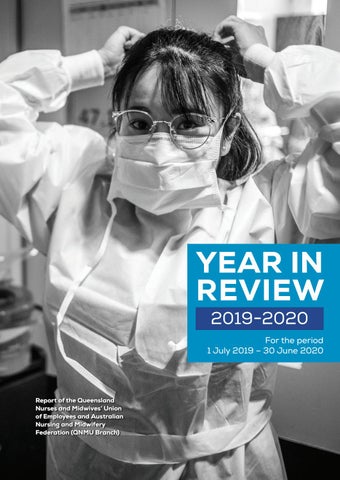
YEAR IN REVIEW 2019-2020
For the period 1 July 2019 – 30 June 2020
Report of the Queensland Nurses and Midwives’ Union of Employees and Australian Nursing and Midwifery Federation (QNMU Branch)
OUR PURPOSE
The purpose of the QNMU is to grow power, confidence and capacity to improve the industrial and professional interests and wellbeing of nurses and midwives and the health of our community. Members are the union and we recognise that in order to grow our power we must strengthen the capacity of members to influence the decisions that affect our work and life. Through Transformational Activism members must be engaged, empowered and activated to influence change and advance our interests and values.
OUR AMBITION
GROW OUR VOICE Increase the number of nurses and midwives exercising greater autonomy and control over their practice and work environment.
VALUE WHAT MATTERS Demonstrate the value of nurses and midwives in achieving quality health outcomes so what matters is measured, and resources are allocated accordingly.
WIN GOOD JOBS Safeguard and extend good, secure jobs and safe positive working environments to nurses and midwives in Queensland.
BUILD COMMUNITY WELLBEING Improve community health outcomes by addressing the social determinants of health through the actions of nurses and midwives.
Contents
A word from Beth
2
Industrial matters
22
QNMU at a glance
3
Members in action: Workload wins
25
Branch business
4
Policies, submissions and surveys
26
Year of the Nurse and the Midwife
6
Members in action: Securing entitlements
29
In focus: The COVID-19 pandemic
8
Spotlight on the state
30
Black Summer bushfire crisis
12
Federal focus
In focus: Ratios
13
Online and in print
32
Professional, Legal and Member Connect
16
Training, education & CPD
34
Social agenda
35
Celebrating dedicated unionists
37
Earle Haven closure
20
In focus: Aged care
21
31
Cover photo: QNMU member Jenny Vu, RN,Infectious Diseases Unit, PAH Photo courtesy of Hamish Cairns
2019-2020 | YEAR IN REVIEW 1
A word from Beth It’s hard to know where to begin this year. The first of July 2019 seems like such a long time ago given everything that has happened over the past 12 months. We could never have predicted the enormous scale of the bushfires that set our country ablaze over summer, and certainly never have imagined our recovery from that crisis would overlap with the start of a whole new emergency that would sweep the globe, claiming hundreds of thousands of lives in just over three months and throwing our world economy into chaos.
Beth Mohle QNMU Secretary
And all this at a time when we had hoped to be celebrating all that is inspiring and extraordinary about our professions and the people who live and breathe it.
environment changed from day to day. You will also see summaries of this work, including agreed principles of work, in the coming pages.
Yet, if the intention of the International Year of the Nurse and the Midwife was to shine a spotlight on the centrality and importance of nurses and midwives to health care, then COVID-19 has been an unlikely collaborator.
But while COVID-19 loomed like a cloud over the past five months, it is equally important to remember that our day to day work as a union continued – it simply had to.
There is no doubt the pandemic has had a devastating impact on the health and wellbeing of our society, but we have also seen nurses and midwives step up and provide not only exemplary care, but leadership in their workplaces, and a calm and reassuring presence at a time of great public anxiety. All this against a backdrop of personal risk.
There were still Enterprise Agreements to negotiate and disciplinary matters to resolve; our members still required mental wellness support and CPD; and there was no way we could set aside our push for ratios and aged care reform.
As we know however, being on the frontline brings with it many challenges, and as you will see in the pages that follow, our work to ensure members were well informed, well supported, and their safety and working conditions prioritised, generated a significant body of work across our entire organisation this year. Our solid working relationship with the Queensland government and Queensland Health, and member leaders at the coalface, also meant we were able to work productively, flexibly and collaboratively with key stakeholders throughout the crisis – a point which cannot be understated given the speed at which the
2020
Furthermore if we are to continue to meet challenges like global pandemics in the decades to come, we still needed to progress our core purpose, which is to grow our members’ power, confidence and capacity to improve the industrial and professional interests and wellbeing of nurses and midwives and the health of our community. If the 2020 Year in Review is indicative of anything, it is that our members are at the heart of all we do, no matter what comes our way. I hope you enjoy the 2020 Year in Review.
YEAR OF THE NURSE AND THE MIDWIFE
200 years of making a difference
2 YEAR IN REVIEW | 2019-2020
QNMU at a glance (as at 30 June 2020)
63,053 financial members 64,420 total members 5.3% average growth rate over last 12 months
QNMU by numbers Midwives 2989
QNMU member recruitment & retention*
Hospital orientations
123 2738 899 1396
orientations attended participants
Students 1018
new members
Other 3665 AINs/PCs 4567
existing members
Universities & TAFES
Enrolled Nurses 7370
Registered Nurses 43444
20 779 118
student sessions attended student participants
new student members recruited
QNMU by sector
* Our capacity to attend orientations and student sessions has been limited this year due to COVID-19.
QNMU offices Other employer 6979 Aged care 8346 Cairns
Private hospitals 8782
Public sector 38405
151 8
Townsville
permanent QNMU staff offices around Queensland
Rockhampton Bundaberg Toowoomba
Sunshine Coast Brisbane Gold Coast
2019-2020 | YEAR IN REVIEW 3
Branch business
QNMU Branches
146 370 121
Current number of Branches* Current Delegates
Current Alternate Delegates
* This decrease in number of branches on previous years is because during the Biennial elections we had 31 branches (20%) that didn’t receive any nominations. After a review and clean-up of our records, Council signed off on the closure of 18 inactive branches. During the past five months of the pandemic however, nine new branches have been activated.
Biennial Elections October 2019
155 454 352 51 37
Delegate positions open for nomination Alt Delegate positions open for nomination
Positions filled:
328
Delegate and
75
Branches
Alt Delegate
We recorded a milestone this year when we conducted our Biennial Elections completely online for the first time, with 43,302 members eligible to vote. This year’s Biennial Elections demonstrated a huge increase in member participation since the 2017 elections with the number of Branches filling all positions doubling. Since the Biennial Elections we have held a number of ad hoc ballots to fill remaining vacancies and through this process have added 42 Delegates and 26 Alt Delegates to our branches network. The next ballot will be held between 14 July and 5 August.
4 YEAR IN REVIEW | 2019-2020
COVID-19 lockdowns and social distancing protocols meant we had to take a different approach to MODs in the first half of 2020. Members were happy to take the meetings online and despite the occasional technical hitch, the Zoom online platform was relatively easy to navigate and members felt the virtual meetings were a suitable alternative to face-to-face catch ups. 2019/20 in person
Cairns
2019 in person 2020 online
Townsville Mackay
Branches involved
ballots held in
Meetings of Delegates
Rockhampton Bundaberg Maryborough Sunshine Coast Toowoomba Brisbane Gold Coast
ANMF Biennial Delegates Conference QNMU Delegates attended the Australian Nursing and Midwifery Federation’s (ANMF) Biennial Delegates Conference in Melbourne in October. All nine of the motions we proposed were voted up by Delegates, including motions relating to improved access to Medicare benefit claim numbers for Nurse Practitioners, personal safety training and medication management in aged care, and changes to federal funding models. QNMU member and aged care Registered Nurse Emma Murphy also addressed the 115 Delegates who attended and spoke about her experience presenting evidence to the Aged Care Royal Commission.
Branch business
D
Brisbane MO
Sunshine Coast MOD
Gold Coast MOD
Rockhampton MOD
Star branch celebrates As winners of the QNMU’s 2019 Star Branch Award, the QNMU sponsored our Bundaberg Hospital Branch in hosting its first ever Health Expo in November.
STAR
BRANCH
It was a great turn out with plenty of stall holders with ideas for healthy living, and guest speakers who provided welcome advice on how we can all take better care of ourselves amid our busy work schedules.
2019-2020 | YEAR IN REVIEW 5
Year of the Nurse and the Midwife
2020
YEAR OF THE NURSE AND THE MIDWIFE
Queensland Country Bank Stadium, Townsville
200 years of making a difference Photo supplied: Jo Konings, QNMU member
WHEN 2020 began we had a huge program of activities planned to celebrate the International Year of the Nurse and the Midwife. We knew the World Health Organisation’s decision to acknowledge the important role of nurses and midwives around the world afforded us a rare opportunity to showcase the breadth and depth of our professions publicly, politically and within our own workplaces, and we wanted to make the most of it.
We did have a few moments of celebration and inspiration and as the curve continues to flatten – in Queensland at least – and we return to a sense of normality, we hope to reinstate our YONM program for the remainder of the year, even if some of the events look a little different to what we originally planned.
Celebrating our days Online candlelight vigil Queensland nurses and midwives joined their Australian and Kiwi colleagues in a heartfelt candlelight vigil on 12 May to honour nurses around the world who had lost their lives treating and caring for COVID-19 patients. The online vigil was held via social media as part of activities to mark International Nurses Day. It featured photos and videos of nurses across the country standing, candle in hand, in solidarity with colleagues around the world whose workmates paid the ultimate price for their dedication to caring for their patients and residents.
Stadiums light up Bridges and stadiums in Townsville and the SE corner were lit a vibrant shade of purple in May to recognise the vital work of nurses and midwives across the globe. Kurilpa Bridge, the Gabba, and Suncorp Stadium in Brisbane, together with the Queensland Country Bank Stadium in Townsville and the Gold Coast’s Cbus
6 YEAR IN REVIEW | 2019-2020
The Gabba, Brisbane
Stadium were lit up in recognition of International Day of the Midwife (5 May) and International Nurses Day and Year of the Nurse and the Midwife 2020. This public display to thank nurses and midwives for their dedication, strength, professionalism and resilience was scheduled to coincide with our Frontline Heroes campaign which invited members of the public to write letters of thanks or support to nurses and midwives on the Frontline of the COVID-19 response. We also invited political and community leaders to join us in offering words of thanks and received a number of messages, photos and videos which we showcased on our website and on social media. For more on our activities during the pandemic see page 8.
Photo supplied: Stadiums Queensland
But then the COVID-19 pandemic hit, and our plans were sidelined as we did what we always do – rolled up our collective sleeves and got on with the job.
Year of the Nurse and the Midwife THIS YEAR
2020 YEAR OF THE
NURSE & MIDWIFE
Women of the World 2020 As part of the WOW - Women of the World Festival and in celebration of International Year of the Nurse and the Midwife, QNMU Secretary Beth Mohle spoke to WOW in April about the professional standing of nurses and midwives, and how our contribution is valued. The 2020 WOW festival had been scheduled to take place at Brisbane Powerhouse in April with a program of more than 100 guest speakers, including former Governor General Quentin Bryce and former Prime Minister Julia Gillard. But it shifted to an online format in the wake of COVID-19.
200 years
We produced an International Year of the Nurse and the Midwife poster for members to display in their workplace to let everyone know this was our year to shine!
of making a difference
Nurses and midwives:
Australia’s most trusted professions
This is your moment to shine. You’ve earned it! www.qnmu.org.au/2
020 02/20
This was the first time we’d participated in the WOW event and the connections we made and the reception the QNMU received is something we hope to build on in coming years. As a global movement seeking to build a future in which women and men are equal, and gender does not determine life outcomes, WOW’s social values align very much with our own and we look forward to working with them in the future.
At the time of writing we have received 96 nominations, with entrants vying for a total prize pool of $20,000 to be used for further professional development. Our awards ceremony is scheduled as an online event for 5 September, 2020, but thereafter we hope to return to our original plan of holding an annual gala awards night in Brisbane.
Commemorative book
PROFESSIONAL PRACTICE
International Year of the Nurse and the Midwife was the perfect time to launch QNMU’s inaugural Professional Practice Awards. The awards are an exciting new initiative that shines a spotlight on the professional excellence of Queensland’s nurses and midwives with a particular focus on those with a commitment to positive professional practice environments. We have established four award categories:
Excellence in Leadership and Governance Award Positive Practice Environment Champion Award Research and Innovation Award Early Career Award.
Early this year we began collecting stories and personal reflections from our members for a commemorative YONM photobook. The book was originally pencilled in for a launch date to coincide with the 2020 QNMU Annual Conference of Delegates but has been rescheduled for a preChristmas release date, allowing us time to gather more stories including snapshots of living and working through the pandemic.
State of the World’s Nursing Report The first State of the World’s Nursing Report was launched globally this year on World Health Day and highlights the vital role of nurses in the provision of health care and the need to strengthen and support the nursing workforce. The report, a timely publication in this Year of the Nurse and the Midwife, was developed by the World Health Organisation in partnership with the International Council of Nurses and the Nursing Now campaign. Read the full report at www.who.int/ publications/i/item/nursing-report-2020
2019-2020 | YEAR IN REVIEW 7
In focus: The COVID-19 pandemic IF THE INTENTION of the Year of the Nurse and the Midwife was to shine a light on the remarkable work nurses and midwives do and the integral role we have maintaining and advocating for the health and wellbeing of our communities, then the arrival of COVID-19 has been an unlikely collaborator. On 29 January, the Queensland government declared a public health emergency, just four days after the first COVID-19 case was confirmed in Australia and well ahead of the rest of the country. This head start, consolidated when parliament passed the Public Health (Declared Public Health Emergencies) Amendment Bill 2020 about one week later, put Queensland in an excellent position to deploy emergency health protocols to mitigate the spread of the virus, and galvanised our health workforce. By the time the WHO declared a pandemic on 12 March, our health workforce was already responding magnificently across all sectors with nurses and midwives at the heart of the response. There was also, however, a good deal of anxiety and uncertainty in the beginning – particularly while epidemiology experts were still trying to determine the characteristics of this new Coronavirus. Our members were understandably concerned about their safety and potential exposure issues, and issues around access to appropriate Personal Protective
Weekly Covid email update
8 YEAR IN REVIEW | 2019-2020
Equipment (PPE). Industrial matters such as leave entitlements and allowances were also hot issues particularly for members being required to isolate or stay at home. The QNMU’s role was to maintain perspective and steady the ship, offering reliable information, advocating for members at every level and providing swift and robust support. Our state’s preparedness, coupled with an excellent public response to physical distancing rules helped keep the number of cases and the death toll low and ensured our ‘curve’ began to flatten sooner rather than later. And at a federal level, particularly through the National Cabinet, it has been reassuring to see our leaders unite across political lines to put people before the economy or politics.
COVID-19 communication One of our primary challenges, particularly in the early stages when the environment was changing almost by the hour, was keeping members informed. We realised early our members needed calm, straightforward reliable information that helped them make sense of the flurry of information they were receiving from their employers, managers, government authorities and media, so we developed a stable of communication tools to fulfil this need.
Dedicated member website
In focus: The COVID-19 pandemic This included:
Key COVID-19 issues
■ Dedicated member website: Rolling news updates; links to key government information; FAQs; links to COVID-19 training and QNMU resources, and shareables.
Principles document
■ Weekly COVID-19 email update: Weekly message from Beth and news bites updating members on the latest information.
It was a valuable piece of collaborative work that spoke of respecting nurse and midwife expertise, and gave members a firm foundation for decision making.
■ Support videos: Short videos of QNMU experts addressing topics such as ethical decision making, proper use of PPE and wellness.
The framework outlined six Agreed COVID-19 Response Principles which included assurances that employees only be asked to work within their scope of practice, that health and safety was COVID-19 EMERGENCY paramount and existing RESPONSE: industrial entitlements be maintained.
In conjunction with Queensland Health we developed a framework to underpin the work of nurses and midwives during the COVID-19 emergency response.
2020
M ID
TH
The official journal of the Queensland Nurses and Midwives’ Union
14
Winter 2020
2020 YE A R OF T HE
D WI F E
SE AND
MI
UR
N
U
■ InScope special edition: 100page special edition featuring frontline nurse profiles, personal stories and opinion pieces. Flip-style production with the B-side offering COVID-free reading for mental wellness.
Queensland
RS
E
E
E
A R OF TH
WI F E
YE
N
H E AND T
COVID-19
The official journal of the Nurses and Midwives’ Union
MEMBERS
14
Winter 2020
ON THE
FRONT
LINE COVID ON A CRUISESHIP
Choosing an environmenta lly friendly car
GOLD COAST ACHIEVES MAGNET GOLD
PLUS!
CPD CONTENT ON PPE, MASS GATHERINGS, MANAGING ASTHMA DURING THE PANDEMIC AND MORE
PLUS!
CPD CONTEN T ON POSITIV E PRACTICE STANDARDS, ENVIRONMENT WOUND MANAGE MENT AND MORE
Our Member Connect team were also a crucial point of communication with members, particularly as QNMU staff had ceased site visits, and their figures speak for themselves (30 Jan to 27 May):
Member Connect calls
534 352 934
To our Nurses and Midw ives…
You are a crucial part of the response to this unprec edented health emerge as we look to you to keep ncy, and our community safe, trust your judgement, trust in expertise and trust in each your other. Queensland Health, in conjunction with the Queensl and Nurses and Midwive framework to underpin s’ Union, has develope the work of nurses and da midwives during this COVID-1 Nurses and midwives are 9 emergency response. the experts in their elds, and their knowledge, skills saves lives. It is therefore and focus on safe practice essential that the professio nal judgment of nurses and midwives is respecte d.
Our Agreed COVID-19 Response Principles 1 The health and safety of workforce is paramount
our
2 Employees will be asked
to work only within their scope of practice
3 Flexibility is vital to our response
4 Respectful and rapid
consultation about tempora ry changes is required
5 Existing industrial entitlem will be maintained, and
6 All changes are tempora ry.
ents
The Four ACCE consideratio ns
When making decision s in this unprecedented environment, nurses and midwives must consider if they are: A AUTHORISED by the NMBA to practice the profession. C COMPETENT through recency of experien ce to undertake clinical requirements.
C E
CONFIDENT to undertak e clinical practice.
EDUCATED by having undertak en appropriate educatio nal preparation for the performa nce of a care activity. Remember: Nurses and midwives follow the NMBA Decision Making Framework. Register ed Nurses and Midwive s make practice decisions and delegate professional activities to others.
When the COVID-19 crisis began to escalate our members raised concerns about shortages of Personal Protective Equipment (PPE).
calls about leave
After meeting with Queensland Health and seeking a direct response from Director-General Dr John Wakefield we were able to reassure members that Queensland was well placed for PPE stock and would be able to access the National Medical Stockpile if and when those stocks ran low.
2
339
120
FORWARD
Personal Protection Equipment (PPE) matters
Covid calls comparison for the last full week of each month:
Apr 19-25
There were also four points for nurses and midwives to consider when making decisions in the COVID-19 environment: were they appropriately authorised, competent, confident and educated to be making decisions?
April 2020
calls about health and safety
Mar 22-28
OUR WAY
Agreed Principles posters were displayed throughout QH hospitals in every HHS.
calls about PPE including 135 about supply conerns
Feb 23-29
Queensland Health
We discovered purported shortages had more to with restricted access and overuse than stock levels and worked with QH to produce consistent directives and policies for managers to alleviate these issues and map PPE availability.
2019-2020 | YEAR IN REVIEW 9
In focus: The COVID-19 pandemic Mater Mater management backed down on a directive advising frontline health workers to reused disposable facemasks during the height of the COVID emergency in Queensland. The directive was withdrawn after QNMU members escalated their concerns and sought union intervention. Multigate 29-515 gowns We escalated Cairns members’ concerns about the suitability of these gowns for COVID care to the DOH, who confirmed the gowns did meet the fluid resistant standard as an AAMI1 equivalent gown but reminded members they must undertake their own risk assessment at the point of care to determine the appropriate level of gown required. PPE poster To ensure our members were aware of their rights and the appropriate processes for escalating PPE grievances, we produced a bright poster illustrating the steps they should take when faced with a lack of PPE or access to it.
Rockhampton Nurse tests positive
They called on G20 leaders to involve their medical and scientific communities in developing economic stimulus packages that prioritise the wellbeing of their people and protect vulnerable populations.
ARE YOU SAFE?
Respect our health care workers
As nurses and midwive s in COVID-19 care you are doing an extraordinary job, and we know some of you are concerned about the use of, and access to, Personal Protective Equipment (PPE). SO LET’S CLEAR THINGS UP: PPE is a precious resourc e and it needs to be used wisely, but that doesn’t mean cutting corners You have a right to work safely
PROTECT
CHECK:
yourself first! Do you need PPE for this work? Trust your professional judgement.
CHECK
Do you have the right PPE for the job? For more information refer to Queensland
Health’s Infection Control Policies.
ESCALATE
if you don’t have the
ESCALATE
right PPE or access
to it ■ Escalate your concerns to your appropriate infection control person immediat ely. ■ Not happy with the response? Contact your manager, supervisor, Safety rep or the Executive Health and Director of Nursing and Midwifery. ■ Still no joy? Contact the QNMU via Member Connect on 3099 3210 1800 177 273 (toll free or outside Brisbane) or email memberconnect@q nmu.org.au
REMEMBER
IF YOUR SAFETY IS COMPROMISED, YOU HAVE A RIGHT TO WITHDRAW YOUR SERVICE.
YOUR SAFETY COME
S FIRST!
Queensland Health mobilised a rapid response team from Brisbane to Rockhampton to support staff after a North Rockhampton Nursing Centre nurse tested positive for COVID-19.
04/20
While the nurse in question was not a QNMU member, many of her colleagues were. We also worked with Queensland Health and NRNC management to ensure members were kept apprised of developments.
G20 letter to leaders In May the QNMU joined more than 350 health professional organisations (representing 40 million nurses, midwives, doctors and other health professionals from 90 countries) in calling on governments from all G20 countries to ensure recovery plans set out as part of the COVID-19
10 YEAR IN REVIEW | 2019-2020
our health care workers aftermath put health protection and promotion at their core.
the Hi! CovidYou-19therefrontonline…
PROTECT
Respect
A few weeks in to the COVID-19 crisis we began to receive reports of members being subjected to abuse while wearing their uniforms in public. While the Queensland government introduced tougher penalties and on the spot fines for people who deliberately spat or sneezed on frontline workers, we ran on online video campaign reminding Queenslanders to stay safe and respect their frontline heroes.
Frontline Heroes We developed a Frontline Heroes promotion to publicly acknowledge the remarkable dedication and professionalism of nurses and midwives during these unsettling times. We produced a suite of material including a web page for messages, videos and photos of support; a social media frame for supporters to add to their Facebook profile photo; a bumper sticker for distribution among family and friends; a printable thank-you template members could use to write messages of thanks; and postcard and a commemorative badge encouraging nurses and midwives to acknowledge the heroes in their own workplaces. We also secured two special videos – one from the cast of Wentworth thanking nurses and midwives for the work they do and another from health leaders and nurse and midwife managers.
In focus: The COVID-19 pandemic Other matters
employer attempted to change EAs, or asked them to sign new contracts, vote on variations or vary hours.
Organisational matters To assist with containing the spread of COVID-19, QNMU staff ceased face-to-face meetings/site visits with members in health facilities, and adopted workfrom-home protocols for staff at the end of March for 16 weeks – making use instead of online platforms. Staff returned to the Brisbane office from 13 July. QNMU council also determined not to increase fees this year.
Registered Nurses to administer antivirals during pandemic Throughout the pandemic special authority was granted to healthcare workers, including Registered Nurses, to provide patients exposed or potentially exposed to an infectious condition, with timely access to medical and pharmacological treatment (Drug Therapy Protocol (DTP) – Communicable Disease Program). We welcomed this move to better utilise our skilled Registered Nurses and help relieve pressure on the health system throughout the pandemic. We may look to leverage off this authority in a post-COVID environment.
Changes to enterprise bargaining consultation The federal government used the COVID crisis to make changes to the Fair Work Act 2009, which included allowing employers to vary enterprise agreements with a one-day consultation period until October 2020. Previously, the access period was seven days. We joined other unions in protesting these changes and advised members to alert us immediately if any
Pandemic sub-register The federal government established a COVID-19 pandemic sub-register to make it easier for newly retired nurses and midwives to return to work during the pandemic. To ensure any nurse or midwife returning to work had the appropriate professional indemnity insurance to practice we contacted retired members encouraging them to rejoin the QNMU for the duration of any return to work.
Member-only training The QNMU partnered with HealthStaffed to provide QNMU members with free access to important training on COVID-19 for nurses, midwives and carers working in the hospital setting and the aged care setting.
Post COVID-19 recovery QNMU Secretary Beth Mohle has been invited to be part of post COVID Reform Planning Group (RPG) at Queensland Health. The group has identified four priority workstreams, each of which will be co-led by two members of the group. These are: Prevention and wellbeing, Driving value; Health system integration; and Data and innovation. Each workstream must consider matters of equity as a core principle, and take into account the key enablers: digital, workforce, funding, and infrastructure. We are very pleased to have a nursing and midwifery voice at the table for this important initiative.
Frontline Heroes badge
to our
FRONTLINE
HEROes Nurses and midwives may not consider themselves heroes. We are selfless in the care we provide. We are doers and get on with protecting those in our care.
#FRONTLINEHEROES
Frontline Heroes postcard
But if this year’s International Year of the Nurse and the Midwife has shown one thing, it’s that the work we do to keep our communities safe is truly heroic.
Thank you for being there for Queenslanders. We’re here for you!
Posters drawn by school children to support nurses and midwives
#FRONTLINEHEROES
Bumper sticker
2019-2020 | YEAR IN REVIEW 11
Black Summer bushfire crisis g
isin ency bushfire fundra
WHEN THE 2019-2020 financial year started Queensland was still reeling from the devastation of the Townsville floods – five people had died and thousands were left homeless as whole communities were submerged under water.
Logan Hospital Emerg
And then, just a few weeks later our country was ablaze. It was the most devastating fire crisis in Australia’s contemporary history, making international headlines, dumping more than 300 million tonnes of carbon dioxide into the atmosphere and spreading smoke 11,000 kilometres across the South Pacific to Chile and Argentina. Before long arguments about cause and intensity of the fires were playing out in political and media spheres with conservative commentators and politicians choosing to blame everyone from the Greens to arsonists rather than admit the role of climate change. The Climate and Health Alliance, of which the QNMU is a member, pulled no punches, saying the government’s failure to act on predictions and warnings about climate change and extreme conditions meant the country was underprepared. It called for “urgent real solutions” suggesting a first step would be to consider the Framework for a National Strategy for Climate, Health and Well-being developed and released by the Australian health sector in 2017. The bushfire crisis reached its peak between December and January and by the time the fires were brought under control in March, Black Summer had claimed at least 34 lives, destroyed about 18.6 million hectares and more than 5,900 buildings (including 2,779 homes) and killed an estimated one billion animals - potentially driving some to extinction.
Members show their heart We know the road to recovery for the towns and communities devastated by the bushfires will be a tough one, and will require significant outside support, which is why QNMU Executive made the decision to match any financial donation QNMU Branches or individual members make to an approved organisation, up to a total of $50,000. We let branches and individuals choose how to raise their funds and they rose to the challenge magnificently holding morning teas, raffles and barbecues to collect
12 YEAR IN REVIEW | 2019-2020
Gatton Health bushfire fundraising
more than $37,000 which when matched by the QNMU, brought total donations to more than $74,000. Donations were made to various organisations, including the Red Cross, WIRES, BlazeAid, Aussie Helpers and St Vincent De Paul. For a complete list of matched donations see page 36.
Royal Commission At the time of going to print the Royal Commission into National Natural Disaster Arrangements, also known as the Bushfire Royal Commission, is underway. Its scope is to “examine coordination, preparedness for, response to and recovery from disasters as well as improving resilience and adapting to changing climatic conditions and mitigating the impact of natural disasters”. There have been a number of hearings so far including reports from health researchers and experts. Of note so far was the revelation that as many as 445 people had died as a result of the smoke from the fires, while almost 5000 people were admitted to hospital with respiratory problems including asthma. Researcher also argued that chronic and delayed mental health effects from the fires were a neglected area of research and funding, with the mental health of first responders and the link between post-trauma mental health issues and domestic violence among the areas needing focus.
In focus: Ratios Making a difference
Since legislated minimum nurse-to-patient ratios were introduced in July 2016:
145
255
deaths avoided
readmissions avoided
29,200
Up to
hospital days avoided
$81m saved
OUR RATIOS campaign took a huge leap forward this year with proof that ratios had saved lives and money in Queensland. The initial findings – from research conducted over three years, including surveys from 27,000 nurses and midwives across the sector and hundreds of thousands of Queensland patients – were officially unveiled at our Annual Conference in July 2019 and published in full later in the year by the University of Pennsylvania and Queensland University of Technology.
PHASE 3
The evidence, which was presented by UPenn’s Matthew McHugh, was irrefutable.
Average medical/surgical nurse has seen a workload reduction of:
Since 2016 when the state government legislated minimum nurseto-patient ratios in 27 prescribed public hospitals, there have been 145 deaths avoided, 255 readmissions avoided, 29,200 hospital days avoided and as much as $81 million saved. And that’s just the headline figures.
1-2
patients during the day
1-3
patients on night shift*
Reductions of one patient per nurse associated with:
9% less
chance of dying in hospital
3%
reduction in length of stay
7% less chance of readmission within 7 days
7%
Queensland was the first jurisdiction in the world to apply a method of research that studied the effect of ratios both pre and post rollout, making this research the gold standard for future studies. It will be invaluable to our long-term goal of seeing nurse-to-patient ratios implemented across all health and aged care facilities in Queensland.
Advertising campaign During the festive season we launched a major TV, radio and digital ad campaign to spread the word about the success of ratios … because everybody needs to know that we need ratios everywhere, whether it’s public, private or aged care. Meanwhile, we also saw success in the second phase of our campaign in November when the State government passed legislation to extend ratios into public acute mental health wards. The State government also made it mandatory for Queensland’s 16 state-run residential aged care facilities to provide a minimum 3.65 hours of nursing care to each resident per day with a skill mix of 30% Registered Nurses, 20% Enrolled Nurses, and 50% Assistants in Nursing.
reduction in
nurse burnout* * McHugh M, Center for Health Outcomes and Policy Research University of Pennsylvania School of Nursing. Outcomes of a Nurse-to-Patient Ratios Policy in Queensland Hospital Facilities. 2018 [cited 2019].
2019-2020 | YEAR IN REVIEW 13
In focus: Ratios Making a difference
The new aged care requirements also increased transparency expectations for both state and privatelyrun aged care services around resident care hours and skill mix; while private health facilities, including hospitals, would also be required to undertake quality and safety reporting. For more about aged care reporting see page 21.
■ mandate minimum positive practice environment standards in public, private and aged care sectors.
Positive Practice Environment standards As part of phase three of the QNMU’s Ratios Save Lives and Money campaign, the QNMU developed and published (in consultation with members) the Positive Practice Environment Standards.
Ratios Save Lives Phase 3 Having secured proof of ratios’ effectiveness, we officially launched the Ratios Saves Lives and Money Phase 3 campaign in March 2020 to strengthen and expand the care guarantee that ratios provide – adding ‘money’ to the tag line while we were at it, to better describe the scope of the benefits.
■ refine and expand legislated public reporting of safety and quality performance to include indicators specific to nursing and midwifery in public, private and aged care sectors, and
PHASE 3 STRENGTHENING AND EXPANDING THE CARE GUARANTEE
The Standards reference contemporary nursing and midwifery best practice evidence from both national and international research on what constitutes a positive work environment for nurses and midwives. Minimum ratios and the Standards go hand-in-hand. Research shows the best patient and resident health outcomes occur when ratios are not only enforced but are supported by all other aspects of a positive practice environment.
Phase 3 will focus on securing nurseto-patient ratios in Queensland’s public emergency departments, operating theatres and maternity departments which we know frequently experience chronic understaffing.
As we see it, the standards nurses and midwives need to support optimum health outcomes are:
FEBRUARY 2020
It also targets private hospitals and private aged care facilities where there are currently no rules around staffing levels, the ultimate aim being to secure Federal legislation making it compulsory for a Registered Nurse (RN) to be on site in all aged care facilities, at all times. Our key asks for Phase 3 were to call on employers, funders, insurers and accreditors to work with nurses and midwives to: ■ further refine and expand legislated minimum ratios in the public sector ■ further improve application and compliance with the Business Planning Framework (BPF) in the public sector ■ mandate minimum ratios in the private and private aged care sector
14 YEAR IN REVIEW | 2019-2020
■ safe staffing levels ■ physical, psychological and cultural safety
STANDARDS
for Nursing and Midwifery
■ autonomous and collaborative practice ■ shared governance and decision-making ■ research and innovation ■ transformational leadership.
Acknowledgements: The QNMU gratefully acknowledges nurse and midwife members who have reviewed the document and utilised their professional judgement in providing valuable feedback in the development of these standards for all nurses, midwives and unregulated care workers wherever they work in health and aged care.
Citation: Queensland Nurses and Midwives’ Union. (2020). Positive Practice Environment Standards for Nursing and Midwifery. Brisbane: QNMU Office.
A positive practice environment supports excellence and decent work, and strives to ensure the health, safety and personal wellbeing of staff. Research shows it also supports quality patient care and improves professional motivation, productivity and performance of individuals and organisations.
In focus: Ratios Making a difference
We are very proud of the work undertaken by the QNMU’s professional officers, research officers and members to craft these Standards, and over the coming year and beyond it is likely we will draw on them not only to complement our ratios agenda, but as a touchstone for other work we might undertake around professional and clinical excellence, leadership, workplace culture and wellness.
The aim is to develop a pledge and scorecard for the candidates which will be used in our lobbying activities and to help inform QNMU members which candidates represent their interests in the lead up to the state election.
Advertising campaign
State Election pledge
During the festive season we launched a major TV, radio and digital ad campaign using four QNMU members to spread the word about the success of ratios. We believed it was important for the public to understand the value of ratios and why we need ratios across all sectors.
With the Queensland state elections slated for 31 October 2020, we have begun the process of drafting our election strategy which includes asking candidates to sign up to a suite of policies in the lead up to the polls, including a commitment to ratios and support of our PPE standards.
At the time of going to print we had started planning for the next round of these ads which will likely address the need for ratios in aged care – a matter brought into sharp relief during the COVID-19 crisis and recent staffing cuts in Blue Care, Tricare and other providers around the state.
For more on the Standards visit www.qnmu.org.au/standards
The purpose of the Ratios Saves Lives and Money campaign is to guarantee the delivery of safe high quality nursing and midwifery across Queensland. 2019-2020 | YEAR IN REVIEW 15
Professional, Legal and Member Connect Positive Practice Standards and training Developing the Positive Practice Standards that underpin the next phase of our Ratios agenda was a key task over the past 12 months. The purpose of the work was to outline a set of foundational positive practice environment standards for nurses, midwives and unregulated care workers in Queensland to support them in delivering safe, highquality care. Evidence suggests applying the standards will strengthen minimum safe staffing and lead to positive practice environments characterised by high job satisfaction, improved safety and quality, and a greater sense of wellbeing. We are now in the process of developing and delivering PPE training to QNMU members at all levels. For more on the Standards visit www.qnmu.org.au/standards
BPF promotion and review As part of EB10 a commitment was made to develop a joint promotion, education and training package for the Business Planning Framework (BPF) targeted at not only nurses and midwives (particularly NUMs, MUMs and DONs) but also other stakeholders such as senior managers, Hospital and Health Service Executives and HR staff. This suite of education and training packages was developed in collaboration with QH and received sign off from NAMIG. The latest information from QH is that it is now on QHEPs and that a memo from OCNMO to launch these materials will be distributed to all Health Services in July. Meanwhile, work on drafting the sixth edition of the BPF began this year and is ongoing.
Government Election Commitments Our professional officers continue to lead QNMU input into the working parties overseeing the State Government Election Commitments, which have had some excellent outcomes this year: ■ 3000 additional nurses/midwives employed ■ Nurse Navigator program permanently extended and expanded up to 400 positions ■ 90% of the promised 100 additional midwives recruited 16 YEAR IN REVIEW | 2019-2020
Nurse Navigators (L – R): Nicole Bofinger, Shona Fitzpatrick, Claire Lake, Katie Howard, Karen Turner, Vena Beetson, Samantha Horgan and Maria Ronan.
■ Aged care ‘ratios’ (minimum care hours and skill mix) legislated for state-run residential aged care facilities. ■ Mental health ratios legislated with further consultation on the role of MH team leader planned.
Midwifery matters There has been significant progress on midwifery matters this year, including the development of the Count the Babies campaign to ensure newborn babies are both funded and counted in midwifery workloads. Other key work includes, but is not limited to: ■ Finalising second edition of the Safe Workloads in Midwifery (SWIM) Standard. ■ Conducting the check-in survey of member midwives. 611 responses received and the results indicate an undervalued and overworked midwifery workforce. ■ Developing Midwifery Principles during COVID-19 written by QNMU in consultation with QH. Endorsed at NaMIG May 2020. ◆ Principle 1. Non-Maleficence first do no harm is the underlying principle in all actions in responding to maternity service access and provision. ◆ Principle 2. Women’s Rights in Childbirth must be upheld during the Coronavirus Pandemic (International Confederation of Midwives).
Professional, Legal and Member Connect ◆ Principle 3. Protecting, promoting and enhancing continuity of midwifery care models is a priority. ■ Working closely with HHSs on midwifery review and improvements to the workplace culture and psychological safety of staff. ■ Consulting with midwives on Midwifery models of care and sign off of Local Agreements. ■ EB10 Research into a midwifery career and classification structure. QNMU working closely with QH to ensure this important work is progressed.
Mackay Birth Centre The QNMU was forced to correct media claims we were consulted on the closure of the Mackay Birth Centre during the COVID-19 crisis. Mackay HHS all but closed the facility in May claiming (incorrectly) it was the only available space for COVID-positive expectant mothers. We would never have agreed to the closure, particularly as there were other alternatives available. After lobbying by the QNMU and Friends of the Mackay Birth Centre, the MHHS agreed to reopen. Mackay Birth Centre
Changes to Mandatory Notification Guidelines For years the QNMU has been lobbying the government and regulators for clearer advice on when it is appropriate, or not necessary, to make a mandatory notification about another registered health practitioner.
National Law Act 2009, that gave registered health practitioners some clarity about when it is not necessary to make a notification about another health practitioner who is seeking or receiving healthcare from them. These amended guidelines took effect in Queensland from 1 March 2020.
Health and Safety
Workers compensation We welcomed legislative changes passed on 22 October 2019 which gave workers more flexibility in lodging a workers’ compensation claim outside of the six-month exemption. The QNMU often assists members who continue to work as they try to manage their injury by themselves. We also welcomed changes that allowed insurers to fund treatment for psychological injuries before claim determination; and WorkCover Qld confirmation that changes which extend workers’ compensation benefits for unpaid interns injured during placement, will include nursing and midwifery students during clinical placement. Manual handling risk management tool The QNMU participated in developing a manual handling risk management tool for the Aged Care sector as part of a pilot program with Wesley Mission and WHSQ, under WorkCover Qld’s Injuries Risk Reduction Initiatives (IRRI). The tool has been trialled with positive results and could be extended to other Aged Care employers. Self-Insurance The QNMU and other ANMF branches were advised that Ramsay Health was looking to move from the state-based workers compensation insurance schemes to join the Commonwealth scheme. We participated in developing a submission to the Safety, Rehabilitation and Compensation Commission outlining our objection to, and concerns about, self-insurance.
Work Health and Safety
The request relates to concerns that some health practitioners may be hesitant to seek treatment of a condition, for fear of being reported to AHPRA or the Health Ombudsman.
Legislation around right of entry for union officials was amended in June 2020 after officials from another union were denied entry to a workplace even after WHSQ Inspectors told the employer they should allow entry. The changes mean the QIRC will make decisions on ROE disputes rather than Inspectors though they can be asked to provide advice.
In early 2019, the Queensland Government passed amendments to the Health Practitioner Regulation
Work Health and Safety Queensland: After supporting recommendations that WHSQ increase its focus on
2019-2020 | YEAR IN REVIEW 17
Professional, Legal and Member Connect compliance, QNMU confirms the regulator has been engaging with health services more regularly on WHS matters, particularly on occupation violence issues across the state. Occupational Violence: MAYBO training has been confirmed for our occupational violence training within QH for all but one HHS. The QNMU supports this and hopes it will mean consistent training throughout the state. We continued to work with QH through the OVIC State-wide steering committee on strategies to reduce occupational violence. We also made submissions to the Queensland Sentencing Advisory Council calling for the laws on assaults against health workers to be extended to the currently excluded private sector.
COVID-19 and safety The QNMU engaged with Queensland Health and other health providers around workplace exposure to COVID-19. Member concerns were primarily around the availability and quality of Personal Protective Equipment (PPE). When issues could not be resolved at local level the QNMU intervened to ensure members’ safety while working in high risk areas. The QNMU engaged with WorkCover Qld seeking their commitment to streamline claim determinations for health workers who contract COVID-19. WorkCover confirmed they had organised a centralised specialist claim determination unit to assess applications.
QNMU First Nations
Reference Group
and campaign plan to ensure babies are counted in midwifery workloads. ■ Other reference groups are: ◆ Mental Health Nurses ◆ Rural and Remote Nurses ◆ Resident Safety Advisory Group ◆ Child Health Nurse ◆ Perioperative Services ◆ Emergency Department ◆ Work health and Safety ◆ Retired Nurses & Midwives ◆ Digital Technologies ◆ Prison Health ◆ Newly qualified and Early career ◆ Palliative Care
Reference groups
Other key projects
The QNMU has a number of member-driven reference groups that members can participate in. These reference groups, many of which now collaborate via our online communities’ platform, help shape the policies and direction of our union.
In addition to day to day professional matters including submissions, tribunal appearances, professional advice for stage 4 and 5 grievances, presentations to state and federal inquires and hearings, QNMU officers engaged in a number of key projects, a selection of which are outlined below.
Our list of active reference groups currently includes: ■ First Nations Reference Group: This was formerly called the Aboriginal and Torres Strait Islander Reference Group, but the name was changed when members voted for a more contemporary descriptor. The group has been instrumental in pushing to establish a state-wide First Nations branch. This has been approved and we will be moving forward with that process in the near future. ■ Midwifery & Count the Baby Reference group: One of the key pieces of work this year was consulting on the development of the Count the Babies strategy
18 YEAR IN REVIEW | 2019-2020
■ Heavily involved in the delivery of the EB10 Innovations – nursing and midwifery excellence projects funded to the tune of $10 million. ■ Rations Save Lives and Money Phase 3 Operational Plan delivered: A key body of work that underpins the next phase of our Ratios Saves Lives and Money campaign to extend the care guarantee, establish legislated ratios in aged care and promote the adoption of the Positive Practice Standards. ■ Promoting the BPF to Nursing Forum in London: Professional Officer Denise Breadsell delivered a
Professional, Legal and Member Connect presentation detailing the utilisation and benefits of the BPF. ■ Leading QNMU response and initiatives in relation to aged care: This includes work around COVID-19 issues, the Aged Care Royal Commission, federal office initiatives and safe quality care.
In addition to expert industrial and legal representation, the QNMU servicing team took on 3578 matters between 1 July 2019 and 30 June 2020 as follows:
Industrial coverage
$1,666,278
■ Development of a draft position paper on End of Life and Palliative Care. ■ Scholarships: The QNMU’s scholarship program provides financial assistance to members to help progress their studies, professional development and research, and grow our nursing and midwifery professions. Each year we award almost $34,000 worth of scholarships. This year we awarded 12 scholarships from almost 400 applications, including scholarships for research, leadership development, and AINs/PCs. ■ Nurse Practitioners – principles for indirect clinical time: Under EB10, the QNMU successfully negotiated that all Queensland Health NPs would receive one day per week (pro rata) of time offline to support their NP practice. In March, NaMIG endorsed eight key principles, which include how non-clinical time should be negotiated with your line manager and subsequently rostered, as well as a list of activities NPs may undertake during their indirect clinical time.
Member servicing The legal representation, support and expert assistance provided to members who are facing some of the most difficult days of their working life, highlights the importance of being part of the QNMU.
Member Servicing team
257
24
coronial
294 70
performance
65
conduct
recovered for members
2839
652 disciple
358
industrial matters including:
296 188
wages & entitlements
grievances
WH&S matters
Wellness coverage
412
members supported
279 5 23 51 53 1 RNs
Midwives Midwives/ RNs
ENs
AINs
Student
Member Connect Expertly staffed by nurses and midwives Member Connect is often the first point of contact for members who call the QNMU seeking advice, support and information. It was a huge year for Member Connect this year with 49,572 interactions with QNMU members and the public (up nearly 4500 more than last year). This includes 29,406 member calls and 20,166 member emails. January 2020 recorded the highest number of monthly calls ever with 3127 calls while in April 2020 there was a frenzy for COVID-19 information peaking at 2565 emails for the month.
legal matters including:
6
civil
Member Connect AHPRA and OHO matters including:
52
registration
29
health
49,572 29,406
interactions
20,166 2019-2020 | YEAR IN REVIEW 19
Earle Haven closure A result of an underregulated sector
THE SUDDEN closure of Earle Haven Retirement Village on the Gold Coast last year was a shock to everyone – not least the nursing staff employed at the facility. The closure left 68 residents homeless and scores of staff without work. Not only did the closure hit the headlines, it also became the focus of an entire week of hearings at the Aged Care Royal Commission in Brisbane. As evidence came to light, it was revealed that HelpStreet – the subcontractor employed by Earle Haven to operate the facility – began removing computer servers, beds and other items the day before the closure.
HelpStreet could not establish it was not responsible for the stoppage of work. The saga continued shortly after when HelpStreet entered liquidation, right as the QNMU was preparing a case for the Federal Circuit Court. This meant the recovery of staff entitlements was passed on to the Federal government’s Fair Entitlements Guarantee. To ensure all members received their correct entitlements, the QNMU provided liquidators with calculations of wages owing, as well as information on the stand down recommendations from the FWC.
Closing an entire aged care facility without an appropriate plan for staff and residents was an unprecedented and disgraceful situation that should never have been allowed, and was a clear demonstration of just how woefully underregulated the aged care sector is. The QNMU assisted members throughout the entire process in a way that only the QNMU can. In addition to providing immediate on the ground support to nursing staff with the deployment of a rapid response team, we wrote to HelpStreet – demanding our members be paid their correct entitlements. After HelpStreet refused (arguing staff were simply “stood down without pay”), the QNMU took the matter to the Fair Work Commission (FWC). We were successful in obtaining a part payment of wages for employees who were stood down. Fortunately, the FWC recommended that employees could not be stood down without pay because
Earle Haven staff who gave evidence at the Aged Care Royal Commission
20 YEAR IN REVIEW | 2019-2020
From a QNMU member... On the night of the facility’s closure, it was complete chaos. There were police, nurses, QAS, doctors, and people flying around everywhere. It was surreal. I was actually quite scared. I really did not know what to do. Then three QNMU staff members came up to me. How they found me, I have no idea! But the first thing they said to me was, “Are you okay?” Then they said, “Do you need some water, and can we get you some food?” I honestly was blown away by that. As crazy as it sounds, it felt like family had come to join me. I felt protected and not alone.
In focus: Aged care Aged Care Royal Commission – a sector at breaking point
■ approvals to receive subsidised care services and packaged community care
After being temporarily suspended due to the COVID-19 pandemic, the findings of the Royal Commission into Aged Care Quality and Safety are needed now more than ever.
Privatisation would have resulted in the services turning to a for-profit model, with aged care providers bidding for these services over time. This may have resulted in QNMU members who work for these services losing their employment.
Ironically, it is the pandemic itself that has highlighted so clearly why the sector desperately needs reform. In recent months, so many aged care providers have acted appallingly at a time when residents need more nursing staff than ever. In June 2020, various providers announced cuts to nursing staff, including some of the biggest providers such as Blue Care and TriCare. This all happened while the federal government spent more than $850 million in aged care COVID-19 funding. This horrific contrast demonstrates the urgent need for transparency in how taxpayer dollars are spent The Royal Commission’s interim report, released in November 2019, had this to say about the state of aged care: “We have heard about an aged care workforce under pressure. Intense, task-driven regimes govern the lives of both those receiving care and those delivering it […] Workloads are heavy. Pay and conditions are poor […] Innovation is stymied. Education and training are patchy and there is no defined career path for staff. Leadership is lacking. Major change is necessary to deliver the certainty and working environment that staff need to deliver great quality care.” The QNMU and our federal body the ANMF are continuing to represent members’ views to the Royal Commission, most recently through a detailed submission on the sector’s preparedness and response to the COVID-19 pandemic. Hearings were due to resume in July.
Thousands support Blue Care nurses in face of cuts As mentioned previously, Blue Care’s response to the Aged Care Royal Commission’s interim report last year was to cut nursing hours across a number of its Queensland facilities. Nearly 4000 nurses, midwives, careers and concerned community members signed our Blue Care petition, calling on management to stop the cuts at their 100plus private aged care facilities state-wide. Petition supporters hand-delivered the petition to Blue Care’s head office in late February. Blue Care, part of UnitingCare Queensland, has a history of making large and potentially life-threatening cuts without informing residents or their families, despite the fact they and other private aged care providers have received more than $66 billion federal taxpayer dollars from the government in the past five years without the requirement to account for a single cent. We have had some small wins however. Thanks to member action and solid media coverage Blue Care backed down on plans to cut staff at their Kenmore and Toowoomba facilities in late October. Their plans to cut five AIN/PCs and one RN from their Toowoomba facility would have left just one RN providing care to more than 100 residents. For more on aged care see In focus: Ratios on page 13.
Plan to privatise ACAT scrapped Thanks to pressure from the Australian Nursing and Midwifery Federation, state governments and other organisations, the Morrison government reversed its decision to privatise Aged Care Assessment Teams (ACAT). In Queensland, ACAT services are largely delivered by the public sector and provide: ■ comprehensive assessment for older people to determine overall care needs
Blue Care petition handover in February
2019-2020 | YEAR IN REVIEW 21
Industrial matters Public Sector wage pause On 18 June the state government introduced legislation to defer wage rises for public sector workers for the 20202021 financial year.
IBPS training at Mt Lof
ty Heights Nursing Ho
me
Fortunately, Queensland Health and Department of Education nurses and midwives still received their 2.5% increase to wages and allowances as per the EB10 agreement, as this increase came into effect on 1 April – one day before the Premier’s announcement of a 12 month wage freeze. After months of negotiation this was changed to a wage increase deferral not a freeze. However, the legislation will still affect member’s wages as their next 2.5% wage increase will be delayed six months to 1 October 2021 instead of being applied from 1 April 2021. In addition the current EB10 agreement will be extended by 12 months to 31 March 2022 instead of 31 March 2021, with another wage increase expected in April 2022. The QNMU and other unions strongly argued against a wage freeze for public sector workers, particularly those like nurses and midwives who had been on the frontline of the COVID-19 pandemic. While a six-month delay for a wage increase is not ideal, we are still pleased members are now guaranteed a 2.5% increase on 1 October next year.
Darling Downs HHS IBPS training
Kicking off in Cairns in October 2019, the program was put on hold during the COVID-19 emergency but is expected to start up again when restrictions are lifted to cover the five Hospital and Health services yet to receive training.
EB10 Interest Based Problem Solving Training Project
Plans are also underway to develop an online IBPS toolkit.
Arising out of Public Sector EB10 commitments the EB10 Interest Based Problem Solving (IBPS) training project was designed to train members in effective industrial engagement through an interest-based frame.
IBPS became part of the industrial landscape in the wake of Queensland Health’s EB5, who could forget the Chunder Bucket Express protests of 2002 when then Health Minister Wendy Edmonds took aim at universityeducated nursing staff who she claimed were too proud to “hold the chunder bucket”.
A joint project facilitated by QNMU Industrial Officer Katie Rowsell and Queensland Health Project Officer Robb Musgrave, the IBPS program has so far trained more than 200 members in 18 locations across the state over the past financial year – from Mackay and Mount Isa in the north to Gatton and the Park Mental Health Facility in Brisbane.
22 YEAR IN REVIEW | 2019-2020
With tensions high between nursing staff and the state government, stakeholders recognised the need for a new, less adversarial approach to industrial negotiations which paved the way for the adoption of IBPS in 2005.
Industrial matters AINs & PCs refuse to do kitchenhands’ jobs AINS and PCs at Carinity Wishart Gardens took industrial action in mid 2019 against a management directive instructing them to take on the work of kitchenhands. The directive, which required AINs/PC to undertake tasks like taking food from a bain-marie, putting it on plates, and delivering it to residents, was issued after a number of kitchen staff were made redundant. More than 70 per cent of the AIN/PC workforce signed an agreement to refuse the kitchenhand work on the grounds it would interfere with their role of providing essential nursing care. QNMU advised management the staff action was protected industrial activity, but management claimed the activity was illegal, and applied to the Fair Work Commission (FWC) for an order against the QNMU and members. The FWC however dismissed management’s claim, deciding the AINs and PCs had continued to do their nursing work and that their collective refusal was not illegal industrial action.
The decision was a win for AINs and PCs who continue to refuse non-nursing work at Wishart Gardens.
Bolton Clarke nurses reject below-Award offer At the time of going to print nursing staff at Bolton Clarke Aged Care are continuing their fight for a new Enterprise Agreement as management repeatedly offers up drafts riddled with entitlement cuts and below-Award conditions.
Bolton Clarke nurses overwhelmingly voted ‘no’ to the dismal offer of a new agreement in August last year after management proposed inadequate wage increases, cuts to entitlements and conditions, including removal of afternoon shift penalties, broken shifts, and possible one-hour shifts. The ‘no’ vote did get management to return to the bargaining table to continue further negotiations with the QNMU and other unions and we will continue to work with members for a better outcome. Bolton Clarke were also on our radar after they stood down a number of our members without pay because they were working a second job with another employer. We took the employer to the Federal Court, and shortly thereafter, Bolton Clarke allowed those stood-down members back to work.
Operation Certitude The Queensland Government announced in early 2019 that Arthur Gorrie Correctional Centre (AGCC) and Southern Queensland Correctional Centre would be transferred back to public management. AGCC was the first and transferred back on 1 July 2020. Southern Qld will transfer back on 1 July 2021. It was a difficult process as those dealing with the transfer in West Moreton HHS did not consult with the nurses or the QNMU properly. Members were unhappy that WMHHS proposed they move from working 12hour shifts to eight-hour shifts. They were also unhappy about some Clinical Nurses (CNs) not transferring across as CNs, not having all their nursing experience recognised in their pay increments, not having all their annual leave accrual recognised, and having to serve a probationary period with Queensland Health, when they had been at AGCC for many years. The QNMU filed a dispute in the QIRC because we simply couldn’t get through to WMHHS. Prior to the conference they ended up agreeing to all of our claims – as above – except the 12-hour shift. The members have now transferred over and are much better off than they would have been if not for the QNMU’s representations. The Queensland Government announced in early 2019 that Arthur Gorrie Correctional Centre (AGCC) and Southern Queensland Correctional Centre would be transferred back to public management.
2019-2020 | YEAR IN REVIEW 23
Industrial matters Agreements finalised Agreements covering Private Sector made from 1 June 2019 to 30 June 2020 Serco - ADF Health Services Contract (AHSC) Nurses’ Collective Agreement 2019
Agreements covering Aged Care made from 1 July 2019 to 30 June 2020 Cooinda Aged Care Nurses Enterprise Agreement 2018 Ipswich Hospice Care Enterprise Agreement 2018
Australian Health Practitioner Regulation Agency Enterprise Agreement 2019-2022
Allity Enterprise Agreement (Queensland) 2019
Healthscope & QNMU ANMF Queensland Nurses Enterprise Agreement 2019-2021
Carinya Home for the Aged, QNU and ANMF - Nurses Enterprise Agreement 2019
The Toowoomba Clinic and QNMU/ANMF Nurses Enterprise Agreement 2020-2024
Jimbelunga Nursing Centre - Nurses Enterprise Agreement 2019
Agreements covering Educational Institutions made from 1 July 2019 to 30 June 2020
Sunnymeade and QNU - Nurses Enterprise Agreement 2019
The SCOTS PGC College Enterprise Agreement 2019
Catholic Healthcare Residential Aged Care Enterprise Agreement (Queensland) 2018-2021
TAFE Queensland Educators Certified Agreement 2016
Wesley Mission Queensland Care and Support Employees Enterprise Agreement 2018
Somerset College Limited Union Collective Enterprise Agreement 2020
Regis Aged Care Registered Nurses, Enrolled Nurses and Assistants in Nursing, Queensland Agreement 2018
The Toowoomba Grammar School Enterprise Agreement 2019
Agreements covering Local Government made from 1 July 2019 to 30 June 2020 Moreton Bay Regional Council Enterprise Bargaining Agreement 2019 (EBA4)
Pine Lodge - Nurses Enterprise Agreement 2019 Lutheran Services (Qld) Aged Care Enterprise Agreement 2019 Laura Johnson Home Enterprise Agreement 2019 Sundale Ltd Enterprise Agreement 2018-2021 The Good Shepherd Home Enterprise Agreement 2019 (Townsville) Jeta Gardens Enterprise Agreement 2019 St Vincent’s Care Services Queensland Enterprise Agreement 2018-2021
24 YEAR IN REVIEW | 2019-2020
Members in action Workload wins
Cairns ED
Anglicare Community nurses secured 30 minutes of paid nonclient contact time after standing up to their employer against workloads that failed to allow time for administrative duties and travel between appointments.
Robina ED
Nurses in Cairns ED secured an extra 8.6 FTE after management failed to address months of complaints about chronic understaffing, extreme workloads, fatigue and compromises to patient safety. With the help of the QNMU, members submitted workload forms and ran a petition, and ultimately made the difficult decision to close beds by following the correct step-by-step process. The QNMU simultaneously took the case to a stage five grievance in the Queensland Industrial Relations Commission, and a review of the BPF determined the shortfall in FTE, who were ultimately recruited.
Redcliffe ED Members at Redcliffe Hospital ED managed to secure an additional 13.2 FTE nurses, after dealing with excessive workloads for years. In particular, there was a significant reduction in nurses on night shifts, despite a consistent flow of patient presentations. Using the QNMU’s Ratios Saves Lives Phase 2 claims document and CENA staffing standards, members determined an additional 13.2 FTE nurses were required – which management agreed to. Nurses now report improved patient flow on night shifts, better communication between teams, and a dramatic reduction in workload forms.
In a huge win for nurses at Robina Hospital ED, members secured an additional 34.33 FTE nurses. For 18 months nurses submitted more than 400 workload concern forms, expressing a range of problems such as missed meal breaks, inability to transfer patients at night and patients congregating in corridors. After forming a working party and holding numerous meetings, management agreed to fund the extra nursing positions (some permanently) and establish a Results Pending Unit.
RBWH culture review It’s been a long and often frustrating journey (and there’s still a lot of work to do), but members at the RBWH Emergency Trauma Centre (ETC) made some significant headway on improving workplace culture this past year. Significantly, members secured an additional 29.77 FTE, making it one of the biggest staffing recruitment wins achieved using the workload grievance process. The QNMU also advocated for an independent external cultural review of the ETC, which management supported. More than 90 nurses took part in interviews, providing more than 300 suggestions on how the ETC could be improved.
2019-2020 | YEAR IN REVIEW 25
Policies, submissions and surveys Surveys Digital Technology and Information Systems survey 2019 Public sector members were surveyed on their attitudes and opinions in relation to the impact of digital technologies on their work and practice. This survey was in response to Queensland Health’s roll-out of ieMR state-wide and the increasing digitalisation of healthcare. Some key findings include: ■ Nearly 75% of respondents felt improvements needed to be made, especially around functionality and usability. ■ 90% of respondents said the implementation of digital technology and information systems led to increased workloads and less time for direct patient care. ■ Only 38% felt digital technology had any positive impact. ■ 62% felt communication and consultation during development and implementation was inadequate. Survey findings will be used to inform enterprise bargaining in the public sector, especially around the inclusion of clinical staff in the inception, planning, implementation and evaluation phases for all future large-scale infrastructure projects e.g. dedicated clinical nurse and midwife advisor positions, industrially protected training time for upskilling on new technology, and nursing and midwifery involvement in staff training and development.
negotiating with their employer for a permanent role. Neither age, years of experience nor sex had a significant impact on the perceived level of difficulty. ■ Aged Care sector respondents were twice as likely to report variation between rostered hours and contracted hours compared to the Public sector (43% vs 21%) ■ The most commonly selected factors that are important to a good job were: ◆ An approachable and responsible line manager (92%) ◆ Appropriate staffing and skill-mix, including support staff (90%) ◆ Manageable workloads which allow me to spend the time I need with patients/residents/clients (84%)
QNMU Policy Committee The QPC is made up of delegates elected each year at Annual Conference and is assembled to discuss and develop official policy or position statements on matters of key interest to the union. Under the chair of Juanita (Jo) Konings the following matters were progressed: ■ A position statement on ‘Acute resuscitation plan’ ■ ‘Transition to retirement’ brochure ■ ‘Audiovisual recording’ policy ■ ‘Surveillance’ policy ■ ‘Deployment of nursing staff’ policy
Grow Your Voice survey 2020
■ ‘Falls prevention sensor alarms’ policy
In collaboration with QUT, all QNMU members were surveyed regarding their career and practice environment. This survey is part of a series that looks at overall trends in nursing and midwifery in Queensland and is a continuation of the Your Work, Your Time, Your Life surveys.
■ Position statement on ‘Clinical governance of nurse practitioners’
The full report will be provided by QUT, however earlyaccess data indicated that:
Due to the COVID-19 pandemic, the 2020 Annual Conference was cancelled. Therefore, the QPC recommendations on these matters will be presented to QNMU Council in August 2020 for approval and ratification.
■ 52% of respondents had experienced workplace violence in the last 3 months. ■ There was greatest job satisfaction among respondents working in Diverse sectors, and lowest job satisfaction among those working in Aged Care. ■ Over 90% of respondents on temporary or casual contracts reported they would have difficulty
26 YEAR IN REVIEW | 2019-2020
■ ‘Radiation safety’ policy ■ ‘Same gender accommodation’ policy ■ ‘Fluoridation’ policy
Participation in public debate and policy development The QNMU completed a huge body of submission work this year, lodging submissions and offering comment
Policies, submissions and surveys
QNMU Policy Committee
and feedback to a number of commissions, inquiries and policy-making bodies. We participate in this process to promote the interests of members and raise the profile of our union. The following list indicates the wide range of submissions we make and the areas in which the QNMU engages in public debate.
Research and Policy submissions 1 July 2019 – 10 June 2020 1.
Submission to the Independent Hospital Pricing Authority – Pricing Framework for Australian Public Hospital Services 202021
2.
Submission to Queensland Health – Proposed Amendments to the Office of the Health Ombudsman Act 2013
3.
Submission to the National Environment Protection Council – Ambient Air Quality
4.
Submission to the Australian Commission on Safety and Quality in Health Care - draft National Safety and Quality Health Service (NSQHS) Standards Aged Care Module
5.
Submission to AHPRA - Proposed revised Guidelines for mandatory notifications - Comments to ANMF
6.
Submission to the Senate Economic References Committee – Regional Inequality in Australia
7.
Submission to Queensland Health - Proposed Health Transparency Bill and Regulation 2019
8.
Submission to Metro South – Challenge 2
9.
Submission to the Productivity Commission – Indigenous Evaluation Strategy
10. Submission to the Health, Communities, Disability Services and Domestic and Family Violence Committee – Earle Haven 11. Submission to the Senate Employment Legislation Committee – Fair Work (Registered Organisations) Amendment Ensuring Integrity Bill 12. Submission to Clinical Excellent Qld - Hospital and Health Boards (Aged Care and Mental Health Ratios) Bill and Regulation 2019 13. Submission to Clinical Excellence Qld - Health Transparency Bill 2019 and Health Transparency Regulation 2019 14. Submission to the Department of Health (Cth), Centre for Health Economics Research and Evaluation and Stewart Brown – Residential Aged Care: Proposed alternative models for allocating places 15. Submission to the Inquiry charged with examining the circumstances leading to a collapse in the provision of aged care services for the residents of the Earle Haven Retirement Village (Carnell Inquiry) 16. Submission to Technical Advisory Committee IBSA Manufacturing – MSL Laboratory Operations Training Package Point of Care Testing 17. Submission to Metro South Futures Lab Challenge 2: Keeping emergency health care services for emergencies 18. Submission to the Department of Natural Resources, Mines and Energy – Mobile Health service for mine workers 19. Submission to the Office of Industrial Relations - Investigation into Proposed Christmas Eve Part-Day Public Holiday 20. Submission to the Select Committee - Jobs for the Future in Regional Areas
2019-2020 | YEAR IN REVIEW 27
Policies, submissions and surveys 21. Submission to the Education, Employment and Small business Committee - Workers’ Compensation and Rehabilitation and Other Legislation Amendment Bill 2019
44. Submission to Economics and Governance Committee - Electoral and Other Legislation (Accountability, Integrity and Other Matters) Amendment Bill 2019
22. Submission to the ACSQHC – Draft Peripheral Venous Access Clinical Care Standard
45. Submission to Economics and Governance Committee - Inquiry into the feasibility of introducing expenditure caps for Queensland local government elections
23. Submission to the Dept of Health - Serious Incident Response Scheme (SIRS) comments on ANMF 24. Submission to the Health, Communities, Disability Services and Domestic and Family Violence Prevention Committee - Health Transparency Bill 2019 and Health Transparency Regulation 2019 25. Submission to the Education, Employment and Small Business Committee - Holidays and Other Legislation Amendment Bill 2019 26. Submission to the ACSQHC – National Safety and Quality Health Service Standards User Guide for the Review of Clinical Variation in Health Care 27. Submission to the CCC – Operation Impala 28. Submission to AHPRA - Compulsory testing for Bloodborne diseases 29. Submission to AHPRA – Guidelines for Mandatory Reporting notifications 30. Submission to the Select Committee on Regional Australia – Inquiry into Regional Australia 31. Submission to the Australian Human Rights Commission – Free and Equal: An Australian Conversation on Human rights Issues paper 32. Submission to the Director General Queensland Health – Amendment of the Hospital and Health Boards Act 2011 and the Ambulance Service Act 1991 33. Submission to the Department of State Development, Manufacturing, Infrastructure and Planning - Draft North Queensland Regional Plan 34. Submission to AHPRA – Guidelines for Advertising a Regulated Health Service 35. Submission to the ACSQHC - Draft Severe (Third and Fourth Degree) Perineal tears Clinical Care Standard: for Public Consultation 36. Submission to the Department of Health – National Obesity Strategy 37. Submission to the COAG Health Council – Proposed Amendments to the National Law 38. Submission to AHPRA – Proposed Supervised Practice Framework 39. Submission to the Senate Community Affairs References Committee – Current barriers to patient access medicinal cannabis in Australia 40. Submission to the Australian Treasury – Retirement Income Review 41. Submission to the Attorney General’s Dept – Cooperative workplaces – How can Australia capture productivity improvements from more harmonious workplace relations 42. Submission to Productivity Commission – Mental health draft report 43. Submission to Health, Communities, Disability Services and Domestic and Family Violence Prevention Committee – Health Legislation Amendment Bill 2019
28 YEAR IN REVIEW | 2019-2020
46. Submission to Qld Sentencing Advisory Council - Penalties for assaults on police and other frontline emergency service workers, corrective services officers and other public officers 47. Submission to Senate Standing Committees on Economics Unlawful underpayment of employees’ remuneration 48. Submission to Crime and Corruption Commission – Report on misuse of confidential personal information in the Queensland public sector 49. Submission to Fair Work Commission – Proposed amendments to the Fair Work Commission Rules 2013 50. Submission to Queensland Health - Notification of proposed amendments to the Hospital and Health Boards Regulation 2012 Expanded Access to The Viewer 51. Submission to Department of Health - Dementia, Ageing and Aged Care Mission Roadmap 52. Submission to HISA - Draft National Nursing and Midwifery Digital Health Capabilities Framework 53. Submission to House of Representatives Standing Committee on Social Policy and Legal Affairs - Inquiry into homelessness in Australia 54. Submission to Australian Commission on Safety and Quality in Health Care - National Safety and Quality Digital Mental Health (NSQDMH) Standards 55. Submission to Australian Commission on Safety and Quality in Health Care - Draft NSQHS Standards on care for migrant and refugee patients 56. Submission to the Department of Health - Feedback on MBS allied health services for possible expansion to phone and/or telehealth 57. Submission to AHHA – Principles for the COVID-19 contact tracing app 58. Submission to Senate Committee on COVID-19 – The Australian Government’s response to the COVID-19 pandemic and any related matters 59. Submission to Qld Government – Draft early years plan 60. Submission to Royal Commission into Aged Care- the impact of the coronavirus on the aged care 61. Submission to Qld Sentencing Advisory Council – Penalties for assaults on public officers 62. Submission to Economics and Governance Committee - Inquiry into the Queensland Government’s economic response to COVID-19 63. Submission to ADHA – Medicines Safety Program Steering Group – comments to ANMF submission 64. Submission to Aged Care Royal Commission - system governance, market management, and roles and responsibilities – comments to ANMF submission.
Members in action Securing entitlements
QNMU MEMBERS have the backing of highly skilled, experienced advocates who work every day to improve and protect members’ rights at work. No other organisation does as much as we do to support, protect and empower Queensland’s nurses and midwives. Take a look at some of the wins we’ve helped members secure this past year.
Thousands in line for laundry allowance backpay Thousands of Metro North nurses and midwives are set to receive significant backpay, after it was discovered management had not paid a laundry allowance for six years. After members at The Prince Charles Hospital noticed they weren’t receiving their laundry allowance, the QNMU took the issue to management, who discovered it extended across the entire HHS. Metro North nurses and midwives must now submit an application to receive their laundry allowance. The QNMU understands millions of dollars have been earmarked for potential payouts.
$160,000 recovered in night shift meal breaks After a long battle, members at Birribi Disability Service (CQHHS) received a mammoth $160,000 in backpay in night shift meal break allowances. A QNMU staff member initially noticed the absence of the meal break allowance on a member’s pay slip during a routine site visit. Management agreed to review the payslips for nine Registered Nurses, and later informed the QNMU they were owed a total of $100,000. The QNMU insisted this review be extended to include ENs and AINs, who were also rostered on night shifts. Staff received between $4000 and $7000 each.
Nauseous allowance PERSONAL Care Workers at Arcare received more than $82,000 in unpaid nauseous allowance – an entitlement they should have been receiving since 21 March 2018.
12-hour shift retained After Hours Managers (AHNM) at Buderim Private Hospital successfully retained their 12-hour shifts, after management tried cutting them during a personnel shuffle without consultation. The shifts were reinstated after members warned the lack of consultation was a breach of the EA and prepared to make a formal grievance.
Leave loading paid Kawana Private members lodged a dispute with the Fair Work Commission after their employer refused pay the 17.5% leave loading they had just secured in their new Agreement. The FWC advised Kawana it was in a no-win situation and thousands of dollars of annual leave loading was paid.
Greenslopes members recover thousands Greenslopes Private Hospital members recovered thousands of dollars in leave loading, with $30,000 recovered from one unit alone. At one stage, management claimed members who participated in a voluntary 12-hour roster were not eligible for back pay, but this was soon resolved in the members’ favour when the QNMU intervened.
Regis laundry win Twenty-eight staff at Regis Whitfield in Cairns received hundreds of dollars in unpaid laundry allowance, plus interest, after they realised they weren’t receiving their laundry allowance and contacted the QNMU for assistance. 2019-2020 | YEAR IN REVIEW 29
Spotlight on the state THE QNMU continued to maintain a productive and collaborative working relationship with the Palaszczuk government this year.
staffing skill mix and while private operators cannot be forced to report, those who fail to do so will be named and shamed.
Having effective lines of communication has been particularly important during the COVID-19 emergency. At times like this it has been important to put politics aside and work in concert for the greater good – the results of which we can see in our state’s COVID testing, infection and recovery statistics.
Private health facilities, including hospitals, will also be required to report quality and safety information, including data relating to performance against the National Safety and Quality Health Service Standards.
For more COVID-19 matters see page 8.
Department of Health reinstated as employer of nurses and midwives We welcomed the Queensland government’s move to reinstate the Department of Health (DoH) as the employer of all non-executive health service employees, including Queensland Health nurses and midwives. The Regulation amendment will provide more uniformity and accountability for workforce processes across all Hospital and Health Services (HHS), replacing the decentralised system that often led to confusion and inconsistent outcomes. Among other things, the change will provide one single source of accountability for employment; provide nonexecutive health employees with more consistent and accurate interpretation and application of industrial entitlements across HHSs; and strengthen system-wide workforce planning.
Ratios confirmed for state-run aged care After significant lobbying by the QNMU, the Health Transparency Bill 2019 passed State Parliament on 28 November setting a new benchmark for aged care staffing and transparency. The new legislation means Queensland’s 16 staterun residential aged care facilities will be required to provide a minimum 3.65 hours of nursing care to each resident per day and be staffed with 30% Registered Nurses, 20% Enrolled Nurses, and 50% Assistants in Nursing. The new legislation also increases the level of transparency across the entire aged care sector, including the state’s estimated 400 privately run aged care facilities. All facilities will be asked to report vital information such as their daily resident care hours and
30 YEAR IN REVIEW | 2019-2020
EB10 Innovations Fund projects At the time of going to print we were working on a series of summary documents highlighting successful case studies within 19 projects funded under the Public Sector EB10 $10 million Innovation Fund. These projects were designed to enhance nursing and midwifery excellence through innovative and flexible models of care that address emergent or unmet health care needs, and have nurses and midwives leading or contributing significantly to care outcomes. The documents will be used as part of an effort to promote the value of nursing and midwifery innovation.
Domestic violence funding The QNMU worked closely with Queensland’s domestic violence hotline DV Connect this year to secure an increase in essential funding to help curb domestic violence throughout the COVID-19 pandemic. The Queensland government injected an additional $5.5 million into vital support services to help manage the anticipated increase in demand. This was later increased to $7.5 million. The funding boost was allocated to various support services including DV Connect, Womensline and Mensline.
Federal focus OUR MISSION to promote and defend the professional, industrial and social interests of nurses and midwives does not end at our state’s borders. Every year we engage with a number of federal issues of interest to members by making submissions, lobbying or galvanising members to act via campaigns, undertaking awareness activities, or simply maintaining a watching brief to keep members informed of developments.
Ensuring Integrity Bill defeated In a win for unions and workers, the federal government was forced to shelve its union-busting Ensuring Integrity Bill this year following a surprise vote in the Senate. Had it been successful, the Bill would have undermined the essential democratic nature of unions by introducing a range of punitive provisions, including deregistration of officials for certain types of industrial action. For example, if a group of nurses took unprotected industrial action to protect nurse-to-patient ratios, the entire QNMU could face deregistration. And while these heavy-handed ‘integrity’ rules would apply to unions, there were no similar standards for employers or businesses, despite ongoing instances of wage theft and worker exploitation. The legislation ultimately failed to pass when Jacquie Lambie and Pauline Hanson’s One Nation along with the Greens and Labor voted against the Bill in the Senate. The QNMU and other unions had been working behind the scenes and publicly campaigning to convince the cross benchers this Bill was unnecessary, so some of the credit must go to those members who contacted the politicians and urged them to recognise or speak up about the unfairness of this Bill.
Superannuation changes Concerns for our early career and lower paid members prompted us to run an awareness blitz around changes to Australia’s superannuation scheme in the latter part of this financial year. The changes which came into effect on 1 April meant employees under 25 years of age or with a superannuation balance of less than $6000 could be left without crucial insurance coverage.
Under the legislative changes designed to stop members’ retirement savings being unnecessarily eroded by insurance premiums, superannuation providers would now only provide life insurance and total and permanent disability (TPD) cover to under 25s if they “opt in”. Providers were also required to cancel automatic insurance cover from existing super funds that have had less than $6,000 in them any time since 1 November 2019 (again, unless the member opts in). Our blitz encouraged members to contact their super fund for options.
Stronger whistleblower protections We were pleased to see the introduction this year of the Treasury Laws Amendment (Enhancing Whistleblower Protections) Act 2019 which provides stronger protection for private sector whistleblower. Designed to bring the corporate sector into line with the public sector, these reforms – which include greater protections around anonymity and retaliation – assist whistleblowers who often face significant personal and professional repercussions for speaking out. The QNMU had been advocating for better safeguards for some time and made a comprehensive submission to the inquiry into the bill. As of 1 January 2020, all public and large proprietary companies are also required to have whistleblower policies in place. The QNMU recently contacted key health employers covered by these new policy rules to ensure they were compliant.
Early access to super We publicly opposed the government’s decision to allow people financially affected by COVID-19 early access to their Superannuation. While we understood how this may offer short term relief to those who were struggling, we were concerned it set a dangerous precedent of opening up super system for purposes other its intended use of saving for retirement, a regressive move that shifted responsibility for social support from the government to the individual.
2019-2020 | YEAR IN REVIEW 31
Online and in print Our new QNMU Online Community We were excited to launch our new online community this year giving members an opportunity to join groups that matched their professional interests and to collaborate, access resources and connect with colleagues across the state. The platform went live in November 2019 and since then we have established 16 active communities, including the all-member QNMU Member Community which hosts more than 120 discussions and has more than 1000 posts. We’ve also hosted two Ask the Expert online live events and have started a series of member spotlights encouraging members to tell their stories online. As at 30 June 2020, 9,008 members (14% of QNMU members) had signed on to the platform.
Social media stats 2019-20 One of the many ways in which we connect with members and the community is through our social media portfolio – most commonly, Facebook.
Our Facebook at a glance
24,000+ followers Reach
5.2 million Aged
85% 25-34 Top Facebook posts this year ■ Frontline heroes of COVID-19 ■ Our Ratios Save Lives and Money campaign ■ Our call to respect our health care workers during COVID-19 ■ Accessing Personal Protective Equipment access during COVID-19 ■ COVID-19 leave entitlements
32 YEAR IN REVIEW | 2019-2020
Some of our top Facebook posts
Online and in print Website work
News coverage
QNMU website statistics 2019-20
<1.4M
344,273
page views
visitors
Visitors access our website via
65%
on mobile phone
29% desktop
6%
on tablet
The QNMU continues to work toward optimising and improving the way members connect with us and with their colleagues, particularly in the online space. ■ We’ve rolled out a new fee calculator and join online form for new members ■ Members can now access their agreements directly from their member profile page or by searching at www.qnmu.org.au/wages_conditions ■ We’ve created a new events page with an easy-to use search function – nearby events are also listed on a member’s profile page ■ Everything members need to know about COVID-19, including entitlements, can be found on our dedicated COVID-19 website www.qnmu.org.au/Coronavirus ■ We launched our Professional Practice Awards with a new website www.qnmu.org.au/Awards
Beth, Sandra and regional organisers have conducted more than 450 radio, TV, print and online newspaper interviews with an emphasis on the need for staffing laws in private aged care, the Earle Haven crisis, nurse-to-patient ratios in public hospitals, COVID-19, frontline nurses, midwives and AINs, Personal Protective Equipment (PPE), the strength of unions, Emergency Department issues and staff shortfalls linked to population growth and many other issues. The QNMU has raised the concerns of aged care staff throughout Queensland regarding chronic and widespread understaffing in private aged care facilities, we have documented and reported aged care cuts in regional and metropolitan media, the interim findings of the Royal Commission as well as other state and federal aged care inquiries, and the hard work of nurses, midwives and AINs during the pandemic – and in under resourced Emergency Department’s pre-COVID-19.
2019-2020 media statistics
46 media releases and statement 12 letters to the editor 450 media interviews 21M audience reached Media coverage valued at
$11.1M
QNMU Secretary Beth Mohle speaking to 10 News First after being recognised in the Queen’s Birthday 2020 Honours List
2019-2020 | YEAR IN REVIEW 33
Training, education & CPD Member training Our member training courses provide modern and relevant education that demonstrably grows our union’s power, capacity and supports a transformational activism approach.
while aged care and private hospital members had access to targeted courses around understanding their entitlements and knowing how to enforce them. We also offered sessions on being protected at work, ethical decision making, handling grievances and branch development. Courses were held in Brisbane and across our regional centres, including Townsville, Bundaberg, Mackay and Rockhampton.
Member leaders are identified
COVID-19 online training Leaders are developed
Leaders develop other Leaders
Education program review Before the COVID-19 emergency hit, our education team were undertaking a wide-scale review of our training content and its overall effectiveness, to ensure the transfer of learning from the training room to the workplace. This review will continue into the 2020-21 financial year, with a central focus on our members’ training needs. We’ve already seen some positive and innovative changes. Given the physical proximity restrictions because of the pandemic, our education team has been engaging with new and different ways to deliver training, including podcasts and Zoom videocasting, and has also been experimenting with other platforms. QNMU organisers and member organisers have responded very positively so far to the new content and delivery methods for internal training, which we are taking as an indication we are on the right path.
The QNMU partnered with HealthStaffed this year to provide QNMU members with free access to important training on COVID-19. The training was tailored specifically to nurses and carers working in the hospital setting, aged care setting, and primary and community healthcare. There was also a separate module for Registered Midwives. A total of 1,556 people viewed this content.
Blue Care Workplace Representative training Given the ongoing issues in Blue Care, particularly around job cuts, excessive workloads and resident safety concerns we recognised the need to support members on the ground by offering dedicated workplace rep training. Six Blue Care activists from south-east Queensland and Cairns participated in the training which was designed to build their skills in engaging and educating members around entitlements and escalating concerns.
CPD portal popular Our CPD portal continued to be well utilised by members. We recorded 24,539 users to our CPD Portal. They accounted for 252,846 page views.
Courses to suit every member While our 2020 training program was interrupted due to COVID-19, enrolments for second half of 2019 were as strong as ever with 42 courses conducted across the state over a total of 50 days, engaging 731 members. The program included, among others, courses for Queensland Health members on rostering and the BPF,
34 YEAR IN REVIEW | 2019-2020
Attendees at the Blue Care Workplace Representative training
Social agenda DV awareness training As part of the International Year of the Nurse and Midwife, QNMU, DV Connect and QSuper joined together to host practical informational sessions on domestic violence across the state. The two-hour sessions, initially conducted as face-to-face training and later run via Zoom due to COVID-19 contact restrictions, offered nurses and midwives practical advice and information on how to recognise the signs of domestic Climate Strike Rally, September 2019 violence, how to assess what they might to do prevent and respond to it and what nurses, midwives and their employers through our Health and might do to address issues relating to domestic and the Environment Reference Group (HERG). This family violence in their workplace. included standing in solidarity with the nationwide Schools Strike for Climate Change in September. QNMU also worked with DV Connect to secure increased funding for domestic violence prevention and ■ Continued support of Asylum Seekers through our support throughout the COVID-19 pandemic. Nurses and Midwives for Refugees and Asylum Seekers (NAMRAS) group, participating in rallies and See page 30 for details. visibility events.
Other activity ■ For QNMU’s community-focussed COVID-19 and Bushfire activity see pages 8 and 9 respectively. ■ Continued support for climate change solutions and environmentally sustainable workplace practices
■ Continued participation in Queensland Community Alliance, a grassroots campaigning organisation made up of unions, faith groups, charities and NGOs. ■ Continued membership of Global Nurses United: An international collective of nursing and midwifery unions.
Health and the Environment Reference Group (HERG) and Nurses and Midwives for Refugees and Asylum Seekers (NAMRAS) forum
2019-2020 | YEAR IN REVIEW 35
Social agenda Cairns Paediatric Bra
nch
Donations swell in 2020 Every year the QNMU Council makes donations to a number of deserving charities and causes. Our charitable contributions swelled this year, initially due to our Bushfire appeal campaign where we pledged to match funds raised by members for select charities dollar for dollar. Within a matter of months this was followed by donations to causes related to the COVID-19 outbreaks across the globe. It was a huge program of donations, but this past financial year has been unlike any other we’ve experienced, and it was only fitting for us, with our goal of building better communities through our actions, to provide tangible support for recovery and assistance.
DONATIONS ($) Financial year ending 30 June 2020 Apheda Inc Women’s Equality Cambodia
10000.00
The Australian Unemployed Workers’ Union
5000.00
Union Aid Aboard - APHEDA COVID19 (Global) Solidarity Fund
5000.00
The Actors’ and Entertainers’ Benevolent Fund (QLD)
5000.00
DV Connect
5000.00
Birthing Kit Foundation Oct 2019
2000.00
Koala in Care
1050.00
Grantley Stable Neonatal Unit
DONATIONS MATCHING BUSHFIRE CAMPAIGN ($) Red Cross Relief & Recovery
8179.00
Australian Red Cross
7157.00
WIRES
6053.50
Mullumbimby Sustainability Education & Enterprise
4032.54
Aussie Helpers
3675.00
The Rescue Collective
3000.00
WWF
2248.00
St Vincent De Paul
1000.00 1000.00
Cobargo The Creative Workers (Creators)
875.00
Cobargo Community Bushfire Recovery Fund
875.00
St Vincent De Paul Kids Xmas
500.00
GoFundMe Vietnam Kristine Tidey
500.00
QCU Student Climate Strike Contribution
500.00
ACTU Bushfire
455.00
QCU Annual Cancer Fundraiser 2019
454.55
Aussie Helpers
Special Children’s Christmas Party
300.00
Community Enterprise Foundation
600.00
Apheda Trivia Night
200.00
Blaze Aid
585.00
International Women’s Day Function
181.82
Townsville Fund Raising Bushfire Appeal
100.00
Subotal $37,991.37
36 YEAR IN REVIEW | 2019-2020
Matching subtotal
$37,530.04
Total donations
$75,521.41
Celebrating dedicated unionists Emma Miller Award
the nursing profession and the superannuation sector.
Cairns Hospital activist Julie Lentas was named the QNMU recipient of this year’s Emma Miller award.
Beth said she accepted the award on behalf of all nurses, midwives, the union movement and all those in the community sector who are focused on advancing the common good.
Julie has been a member of the QNMU for more than 14 years and has been at the forefront of the QNMU Cairns branch for many of those years.
QNMU Emma Miller award recipient Julie Lentas (left) with QNMU Assistan t Secretary Sandra Ea les
Most recently she was actively engaged in the Cairns Hospital Emergency Department workplace grievance which ultimately secured an additional, and much needed, 8.6 FTE nursing staff. Julie said she accepted the award on behalf of all her colleagues in North Queensland. The annual awards are held in honour of Emma Miller – a strong advocate for women workers’ rights in Queensland in the 1800s.
Order of Australia recognition QNMU Secretary Beth Mohle was awarded the Member of the Order of Australia (AM) in the 2020 Queen’s Birthday honours list.
Beth’s award came 10 years after former QNMU Secretary Gay Hawksworth was awarded an Order of Australia medal (OAM) for her service to industrial relations through the then Queensland Nurses’ Union of Employees.
Professor Julia Louise Crilly
Other members in the honours list this year include Distinguished Professor Patsy Yates who was awarded an AM for her service to tertiary education, cancer and palliative care nursing, and medical research. QNMU members Professor Julia Louise Crilly and Professor Jeanine Young, and retired QNMU member Maria Boland were all awarded Order of Australia Medals (OAM) for their nursing and nursing related service.
Behind the scenes at the QNMU QNMU aged care activist and AIN Sherree Clarke joined Rail Tram and Bus Union activist Kristee Helm at our Brisbane office for a week this year as participants in the annual Anna Stewart program.
Beth was joined by four other QNMU nurses who were acknowledged for their services to nursing in this Year of the Nurse and the Midwife. Beth was specifically recognised for her significant service to industrial relations, to
Distinguished Profes sor Patsy Yates
QNMU Secretary Beth Mohle
ke
Sherree Clar
Sherree and Kristee spent time visiting different workplaces, experiencing our day-to-day work and going behind the scenes of the QNMU to see how the wheels turn in our union.
2019-2020 | YEAR IN REVIEW 37
106 Victoria St, West End Q 4101 (07) 3840 1444 or 1800 177 273 (toll free) qnmu@qnmu.org.au www.qnmu.org.au
/qnmuofficial
07/20