
OPENSTAX MICROBIOLOGY TEST BANK
Microbiology THIS TEST BANK COVERS ALL CHAPTERS 1-26 OF THE BOOK, Answered
Chapter 1: An Invisible World
* = Correct answer
Multiple Choice
1. Which of the following is true of the microbial world?
A. All microbes are harmful.
B. Humans could survive without microbes.
C.Many microbes are helpful.*
D. Most microbes are pathogenic.
Difficulty: Easy
ASM Standard: 23, 24
2. Which of the following is when humans first suspected the existence ofmicrobes?
A. during the Industrial Revolution
B. in prehistoric times*
C.in the last century
D. within the last 500 years
Difficulty: Easy
ASM Standard: 23
3. Which individual first observed unicellular organisms, which hecalled “animalcules,” using a microscope he developed?
A. Robert Koch
B. Louis Pasteur
C.Thucydides
D.Antonie van Leeuwenhoek*
Difficulty: Easy
ASM Standard: 6
4. To reduce the risk of open flame from Bunsen burners, microbiologistsare increasingly using which of the following devices for easy, rapid benchtop sterilization of small pieces of equipment?
A. autoclaves
B. ethylene oxide
C.incubators
D. microincinerators*
Difficulty: Easy
ASM Standard: 36
5. The Swedish botanist known for having developed an important biological classification system is which of the following people?
A. Ernst Haeckel
B. Carolus Linnaeus*
C.Louis Pasteur
D. Robert Whittaker
Difficulty: Easy
ASM Standard: N/A
6. Which kingdom was the only one found in Empire Prokaryota?
A. Animalia
B. Fungi
C.Monera*
D. Protista
Difficulty: Easy
ASM Standard: N/A
7. Which are the three currently accepted domains?
A. Archaea, Bacteria, and Eukarya*
B.Archaea, Prokaryota, and Eukaryota
C.Bacteria, Fungi, and Protista
D. Bacteria, Prokaryota, and Eukarya
Difficulty: Easy
ASM Standard: N/A
8. Which two taxonomic units are typically used to identify an organism when using binomial nomenclature?
A. domain and kingdom
B. genus and family
C.genus and species*
D. phylum and class
Difficulty: Easy
ASM Standard: N/A
9. Which of the following is not true about the process offermentation?
A. It can help preserve foods, preventing spoilage.
B. It converts sugars to organic acids, alcohols, and/or gases such as carbon dioxide.
C.It is carried out exclusively by unicellular eukaryotes such as yeast.*
D. It is used to make foods such as cheese and bread.
Difficulty: Moderate
ASM Standard: 11, 23, 26
10.The Romans may have reduced their risk of waterborne infectious diseases by using which of the following?
A. a variety of pharmaceutical products
B. aqueducts and a sewer system*
C.prophylactic antibiotics
D. quarantine of people with leprosy
Difficulty: Moderate
ASM Standard: 23
11.For which of the following is Thucydides known?
A. developing an effective sewer system in ancient Greece, helping toreduce levels of disease in cities
B. observing microbes, using a microscope, for the first time, even distinguishing between bacteria and fungi
C.proposing that disease was caused bymicroorganisms
D. realizing that people who had been infected by the Athenian plaguehad immunity to reinfection*
Difficulty: Moderate
ASM Standard: 23, 31
12.Ernst Haeckel proposed a classification system consisting of which ofthe following subgroups?
A. five kingdoms
B. four kingdoms*
C.two domains and three kingdoms
D. two domains and five kingdoms
Difficulty: Moderate
ASM Standard: N/A
13.Viruses not included in phylogenetic trees for which of the followingreasons?
A. It is too difficult to observe their characteristics.
B. They are acellular and nonliving.*
C.They do not have any genes, which prevents genetic analysis.
D. They lack a nucleus.
Difficulty: Moderate
ASM Standard: 5
14.Which is the best description of the primary purpose of aphylogeny?
A. Phylogenies show all the alterative names for each species.
B. Phylogenies show all the common names for each species.
C.Phylogenies show evolutionary relatedness betweenorganisms.*
D. Phylogenies show interactions between species in a shared habitat.
Difficulty: Moderate
ASM Standard: 5
15.Current phylogenetic analyses include which of the following?
A. information from a range of sources, including morphological, genetic,and biochemical data*
B. information on visible similarities only
C.information regarding how to classify organisms on the basis ofexternal morphological characteristics and visible behaviors
D. varied morphological and structural characteristics, with preference forleaving historical classifications to prevent confusion
Difficulty: Moderate ASM Standard: 5
16.Diatoms are classified within which of the following domains?
A. Archaea
B. Bacteria
C.Eukarya*
D. Prokaryota
Difficulty: Moderate ASM Standard: N/A
17.Horizontal gene transfer involves which of the following?
A. any transfer of genes in a laboratory setting
B. the transfer of genes from a virus to a bacterium or vice versa but notany other form of gene transfer
C.the transfer of genes from one individual to another, including fromone species to another, but not from parent to offspring*
D. the transfer of genes from parent to offspring
Difficulty: Moderate ASM Standard: 2, 4
18.Bacteria are generally identified to species by using which of thefollowing?
A. a combination of genetic, biochemical, and microscopic approaches*
B. a combination of microscopic and physiological approaches, but notgenetics
C.primarily characteristics such as motility that can be visualized usingmicroscopy
D. primarily morphological characteristics of individual cells
Difficulty: Moderate
ASM Standard: 34, 36
19.For taxonomic classification of microbes, serological tests typically are used todo which of the following?
A. determine complete genome sequences for microbes
B. identify proteins on the basis of their reaction with specificantibodies*
C.run analyses to identify whether particular genes are present
D. visualize microbial external morphology
Difficulty: Moderate
ASM Standard: 34, 36
20.Which of the following is true of bacterial strains?
A. They are closely related subtypes within a bacterial species that may ormay not have similar properties.*
B. They are informal bacterial groupings used for medical distinctions but not recognized for classification purposes.
C.They are more distantly related to each other than are members of a single bacterial species.
D. They are very similar bacteria with almost identicalproperties.
Difficulty: Moderate
ASM Standard: 5
21. Bergey’s Manual of Systematic Bacteriology is used primarily as which of the following?
A. a guide to bacterial shapes
B. a historical account of changes in classification techniques
C.a list and characterization of all known medically relevant microbes
D. a reference for bacterial classification*
Difficulty: Moderate
ASM Standard: 34
22.Which of the following indicates how bacteria and viruses typically compare insize?
A. Bacteria are indistinguishable from viruses.
B. Bacteria are much larger than viruses.*
C.Bacteria are much smaller than viruses.
D. Bacteria are similar in size to viruses.
Difficulty: Easy
ASM Standard: N/A
23.Viruses are classified as which of the following?
A. Archaea
B. Bacteria
C.Eukarya
D. distinct from the three-domain system*
Difficulty: Moderate
ASM Standard: 4
24.Which of the following is not a curved bacterial shape?
A. bacillus*
B. spirillum
C.spirochete
D. vibrio
Difficulty: Easy
ASM Standard: 34
25.Based just on the name, which of the following groups of bacteria containsentirely species that consume organic compounds for food?
A. cyanobacteria
B. green nonsulfur bacteria
C.green sulfur bacteria
D. nonphotosynthetic bacteria*
Difficulty: Moderate
ASM Standard: 11, 13, 20
26.Chitin cell walls are characteristic of which taxonomic group?
A. algae
B. archaea
C.bacteria
D. fungi*
Difficulty: Moderate
ASM Standard: 20
27.Yeasts are which of the following?
A. a type of algae
B. a type of protist
C.any unicellular microbe
D. unicellular fungi*
Difficulty: Moderate
ASM Standard: 20
28.The cell walls of archaeans often contain which of the followingsubstances?
A. cellulose
B. chitin
C.peptidoglycan
D. pseudopeptidoglycan*
Difficulty: Moderate
ASM Standard: 20
29.Which of the following is not true ofarchaeans?
A. Some species live on the human body.
B. They are genetically distinct from bacteria.
C.They are only found in extremeenvironments.*
D. They have substantial metabolic differences from bacteria.
Difficulty: Difficult
ASM Standard: 20
30.Which of the following is not true of algae?
A. All the algae are classified together in one similar group closely related togreen plants.*
B. Ingredients made from algae, including carrageenan, are used in foodproducts.
C.They are being used to develop biofuels.
D. They are sometimes multicellular.
Difficulty: Moderate
ASM Standard: 20, 23, 26
31.Oral thrush is caused by which type of organism?
A. algae
B. bacteria
C.fungi*
D. protists
Difficulty: Moderate ASM Standard: 23
32.Mycotoxins are produced by which type of organism?
A. archaeans
B. heterotrophic protists
C.molds*
D. protozoans
Difficulty: Moderate
ASM Standard: 23
33.Which of the following is not a common use of fungi?
A. the production of alcoholic beverages
B. the production of carrageenan*
C.the production of cyclosporine
D. the production of penicillin
Difficulty: Moderate
ASM Standard: 20, 23, 26
34.The guinea worm is best described as which of the following?
A. a helminthic parasite transmitted by consuming contaminated water*
B. a type of mold that grows into a worm-like shape and produces antimicrobialchemicals
C.a type of protist found in water that has not been properlytreated
D. a type of protozoan that is unusual because it is multicellular
Difficulty: Moderate
ASM Standard: 23
35.Which of the following is true of the genetics of viruses?
A. Viruses always contain DNA and force host cells to produce RNA.
B. Viruses always contain DNA and RNA.
C.Viruses always contain RNA and force host cells to produce DNA.
D. Viruses can contain either DNA or RNA, but not both.*
Difficulty: Moderate
ASM Standard: N/A
True/False
36.All organisms studied in the field of microbiology are visible only witha microscope. Answer: False
Difficulty: Easy
ASM Standard: N/A
37.Older scientific names are typically derived from Latin. Answer: True
Difficulty: Easy ASM Standard: N/A
38.Animal cells are generally about the same sizeas bacterial cells. Answer: False
Difficulty: Easy
ASM Standard: N/A
39.Researchers studying a 5300-year-old mummy discovered in the 1990s think he may have been trying to use a fungus to treat his illnesses. Answer: True
Difficulty: Easy
ASM Standard: 23, 26
40.Analyses of rRNA genes suggest that Archaea, Bacteria, and Eukarya evolved from a common ancestor. Answer: True
Difficulty: Moderate ASM Standard: 5
41.The average size of a typical virus isapproximately 100 nm. Answer: True
Difficulty: Moderate ASM Standard: N/A
42.When a scientific name is used repeatedly, both the genus and species must always be written out in full to avoid confusion. Answer: False
Difficulty: Moderate ASM Standard: N/A
43.Taenia saginata is a type of fungus thatcauses disease. Answer: False
Difficulty: Moderate ASM Standard: 23
Matching
44. Match each type of microbiological tool with the best definition.
A. loop i. tool used to transfer microbes from one location toanother
B. media ii. liquid, solid, or gel that contains nutrients to aidmicrobial growth
C. microincinerator
D. Petri plate
iii. tool used to sterilize equipment
iv. container used to grow microbialcultures
Answers: A. i., B. ii., C. iii., D. iv.
Difficulty: Easy ASM Standard: 36
45. Match the bacterial shape with the illustration.
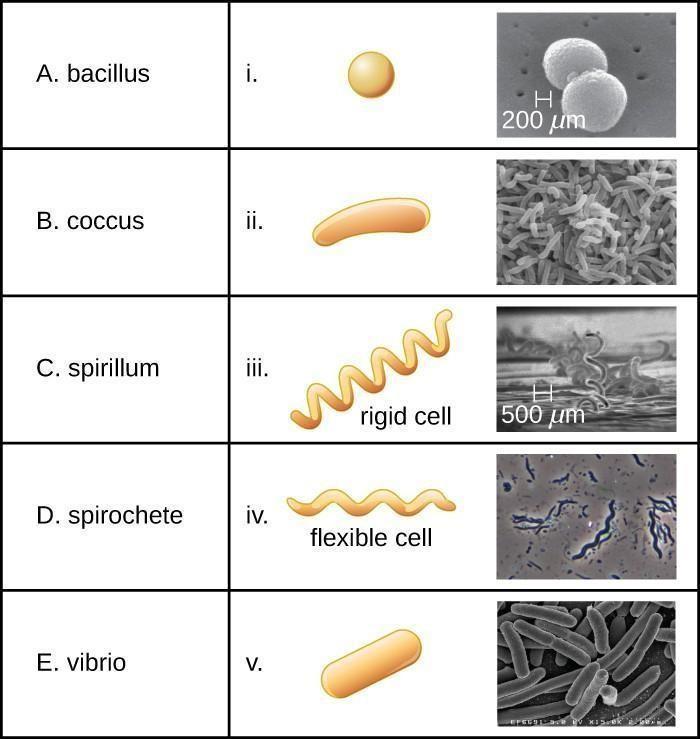
(credit micrograph “i”: modification of work by Janice Haney Carr, Centers for Disease Control and Prevention; credit micrograph “iii”: modification of work by Centers for Disease Control and Prevention)
Answers: A. v., B. i., C. iv., D. iii., E. ii.
Difficulty: Easy
ASM Standard: 34
46. Match each type of microbe with the best description.
A. algae i. a very broad, informal grouping of organisms that do not fitinto other eukaryotic kingdoms and that may be photosynthetic or nonphotosynthetic
B. fungi ii. a diverse, informal subgroup of organisms that may moveusing cilia, flagella, or pseudopodia
C. protists iii. a group of photosynthetic organisms with cellulose cell walls
D. protozoa iv. a group of nonphotosynthetic organisms that usually have cellwalls containing chitin
Answers: A. iii., B. iv., C. i., D. ii.
Difficulty: Moderate
ASM Standard: 2
47. Match each subfield of microbiology with the most appropriateexample.
A. bacteriology i. the study of how antibodies are released in response to apathogen
B. immunology ii. the study of how fungi cause disease inplants
C. mycology iii. the study of the classification of bacilli
D. parasitology iv. the study of how to reduce the rate of guinea worminfections
E. protozoology v. the study of heterotrophic protists
Answers: A. iii., B. i., C. ii., D. iv., E. v.
Difficulty: Moderate
ASM Standard: 23
48. Match each taxonomic group with its domain. You will use some optionsmore than once.
A. algae i. Archaea
B. halophiles ii. Bacteria
C. helminths iii. Eukarya
D. spirochetes
Answers: A. iii., B. i., C. iii., D. ii.
Difficulty: Moderate ASM Standard: 2
49. Match each causative agent with the associated classification.
A. Dracunculus medinensis i. protist
B. Ebola ii. fungus
C. Giardia lamblia iii. helminth
D. yeast iv. virus
Answers: A. iii., B. iv., C. i., D. ii.
Difficulty: Difficult
ASM Standard: 23
Fill in the Blank
50. was a Greek physician who posited that natural causes, not supernatural forces, caused disease. Answer: Hippocrates
Difficulty: Easy ASM Standard: 23
51. is the science of identifying, naming, and classifying living organisms. Answer: Taxonomy
Difficulty: Easy ASM Standard: N/A
52.Fermentation by yeast produces ethanol and gas. Answer: carbon dioxide
Difficulty: Moderate ASM Standard: 11, 26
53.Carl Woese and George Fox sequencedand analyzed from a wide range of organisms to build their phylogenetic tree. Answer: rRNA (or ribosomal RNA)
Difficulty: Moderate ASM Standard: 4, 5
54.The archaebacteria are now called . Answer: Archaea
Difficulty: Moderate ASM Standard: N/A
55.The genus of Halobacterium salinarum is . Answer: Halobacterium
Difficulty: Easy ASM Standard: N/A
56.is the standard reference book that provides guidanceonidentifying and classifying prokaryotes. Answer: Bergey’s Manual of Determinative Bacteriology
Difficulty: Moderate ASM Standard: 34
57.There are nanometers in 520 meters. Answer: 520,000,000,000
Difficulty: Moderate ASM Standard: 29
58. The thermophilic genus Thermoproteus includes extremophiles classified in thedomain . Answer: Archaea
Difficulty: Difficult ASM Standard: 5
59.The cytoplasmic extensions used by some protists to move are called . Answer: pseudopods
Difficulty: Moderate
ASM Standard: N/A
Short Answer
60.What is horizontal gene transfer?
Sample Answer: Horizontal gene transfer is the transfer of genetic material between two organisms that are not related as parent and offspring.
Difficulty: Easy
ASM Standard: 2
61.How are newly discovered organisms named?
Sample Answer: Newly discovered organisms are usually given names that describe their characteristics and/or that honor a particular individual. The names are generally Latin, Greek, or English.
Difficulty: Easy
ASM Standard: 5
62.How do protozoa move?
Sample Answer: Protozoa can move using structures such as pseudopods, flagella, and cilia. They may also be carried by the water in which they live.
Difficulty: Easy
ASM Standard: N/A
63.Why are formal scientific names based on a standardized system more useful than simple names that just describe characteristics, such as “orange cat-like animal”?
Sample Answer: Organisms may have similar characteristics, especially inclosely related species. By having a formal naming system, it is possible to clearly distinguish organisms so that people around the world can identify exactly which organism is being discussed.
Difficulty: Moderate
ASM Standard: N/A
64.What are at least four types of products made usingfermentation?
Sample Answer: Fermentation is used to make alcoholic products, cheese, yogurts, pickled vegetables, and bread.
Difficulty: Easy
ASM Standard: 11, 23, 26
65.What is the Hippocratic Oath?
Sample Answer: The Hippocratic Oath is an oath taken by new doctors to pledge their willingness to follow certain ethical guidelines, such as avoiding causing harm to their patients.
Difficulty: Moderate
ASM Standard: N/A31
66. Which famous scientist developed a vaccine for rabies?Sample Answer: Louis Pasteur developed a vaccine forrabies.
Difficulty: Moderate
ASM Standard: 14, 23
67.Why is most milk pasteurized before it is sold?
Sample Answer: Pasteurization helps reduce the number of microbes associated with spoilage and disease, keeping milk safe to drink longer than if it is not pasteurized.
Difficulty: Moderate
ASM Standard: 14, 23
68.What are helminths and why are they medicallyimportant?
Sample Answer: Helminths are worms. They are eukaryotes. They can be human parasites.
Difficulty: Moderate
ASM Standard: 14, 23
69.Why is it often preferable to use a microincinerator rather than a Bunsen burner? Sample Answer: Bunsen burners have an open flame, whereas microincinerators do not; therefore, it is safer to use amicroincinerator.
Difficulty: Moderate
ASM Standard: 14, 36
70.How do scientists decide how to organize organisms in a phylogenetic tree?
Sample Answer: Phylogenies show evolutionary relationships. To develop a phylogenetic tree, scientists examine a variety of characteristics, including biochemical, morphological, and genetic characteristics, to determine the most likely relationships between organisms. Genetic data are especially important in determining these relationships in modern phylogenetic trees.
Difficulty: Moderate
ASM Standard: 5
71.What is the difference in how DNA is stored within the cells of prokaryotes versus eukaryotes?
Sample Answer: Eukaryotes have a true membrane-bound nucleus and prokaryotes do not.
Difficulty: Moderate
ASM Standard: 9
72.What does it mean to say that some photosynthetic bacteria, including some green sulfur bacteria, are anoxygenic? Consider the word parts in “anoxygenic” if you are not sure. Sample Answer: Anoxygenic means that they do not generate oxygen.
Difficulty: Difficult ASM Standard: 11
73.Who published Systema Naturae and what did it present?
Sample Answer: Systema Naturae was published by Carolus Linnaeus to present his taxonomic system.
Difficulty: Difficult ASM Standard: N/A
74.Of the three domains, which is/are known to contain some human pathogens?
Sample Answer: Bacteria and Eukarya contain some species that are human pathogens. No known archaeal pathogens have been identified.
Difficulty: Moderate ASM Standard: 23
Brief Essay
Essay Question Rubric RATING Failing
Criteria for evaluati on
Answer does not provide an argument. Answer contains inaccuracies. Writing is poor and contains numerous grammatical mistakes and misspellings.
Below Average
Answer fails to provide examples to support an argument. Writing is poor and grammatical errors are common. Answer is somewhat incoherent.
Competent Advanced

Answer provides an argument with one or two examples that support it. Writing is acceptable for the college level but may contain one or two grammatical mistakes or misspellings. POINT
Answer clearly provides an argument with two or more excellent examples that support it; student makes the argument clearly and eloquently. Answer is well organized and free of grammatical errors and misspellings. 3
Assume rating/grading scale for the question ranges from 0 to 3 points.
75.Explain why some scientists think that it may be more appropriate to describe a “web of life” instead of a “tree of life.”
Answer: Student answers will vary but should include components of the following. A tree suggests straightforward pathways of evolution from one branch to another. Because horizontal gene transfer is common, this does not fully represent the complexity involved in evolution. A web would better show ways genes can be transferred from one taxonomic group to another.
Difficulty: Moderate
ASM Standard: 5
76.Halobacterium salinarum is classified in the domain Archaea. Why does its name suggest it is a bacterium? This answer is not in the textbook chapter, so you should speculate based on your understanding of taxonomy.
Answer: Student answers will vary but should include the following. This species was identified before the domain Archaea was recognized. As a result, it was previously considered a bacterium and given a bacterial name.
Difficulty: Moderate
ASM Standard: N/A
77. Consider the phylogenetic tree below. Explain how it shows the relationshipsbetween Bacteria, Archaea, and Eukarya, and their common ancestor. Of these three groups, which two are more closely related and how can you tell from thefigure?
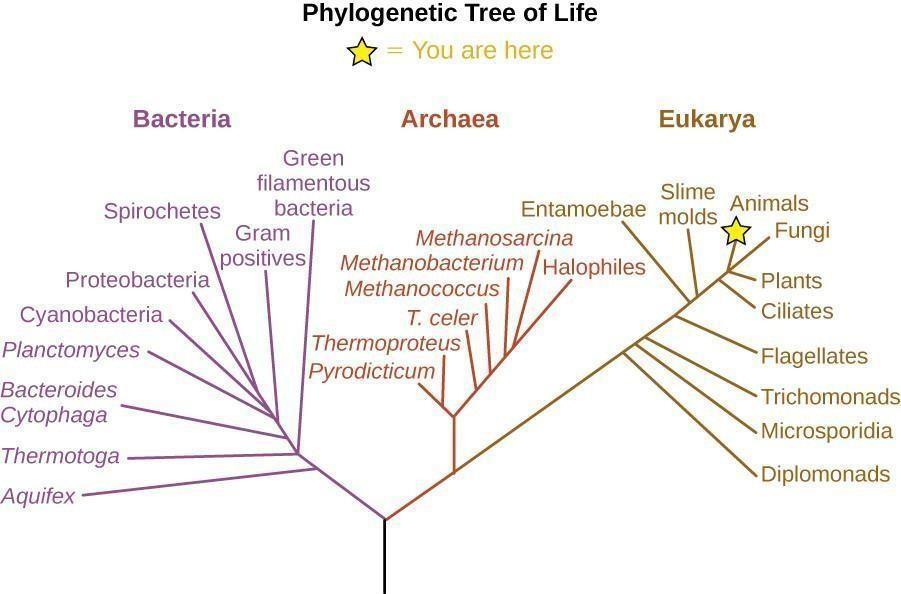
(credit: modification of work by Eric Gaba) Answer: Student answers will vary but should include the following. The lines leading to Bacteria, Archaea, and Eukarya branch from the same root, meaning they all share a common ancestor. Archaea and Eukarya branch more closely together than either branches with
Bacteria, suggesting that they diverged from each other more recently than they diverged from a common ancestor that had previously branched from Bacteria.
Difficulty: Difficult
ASM Standard: 5
78.In the textbook chapter, there is information about efforts to eradicate the guinea worm. What are some factors that have allowed these efforts to be relatively successful, with only 126 cases reported in 2014, compared with efforts to eradicate other diseasessuch as hantavirus, carried by rodents, and rabies, carried by a variety of wild animals? Answer: Student answers will vary but should include components of the following. Guinea worm is transmitted in contaminated water. Thus, efforts to improve water sanitation can be very effective in reducing infections. Other diseases have different mechanisms of transmission. Diseases such as rabies are found in wild animals and it would be difficult to treat or vaccinate all infected animals.
Difficulty: Difficult
ASM Standard: 14, 23, 31