c.2
QUEEN ELIZABETH II NATIONAL TRUST ANNUAL REPORT 2025
ANNUAL REPORT 2025 OF QUEEN ELIZABETH II NATIONAL TRUST, NGĀ KAIRAUHĪ PAPA (QEII NATIONAL TRUST). PRESENTED TO THE HOUSE OF REPRESENTATIVES PURSUANT TO SECTION 32 OF THE QUEEN ELIZABETH THE SECOND NATIONAL TRUST ACT 1977. QUEEN ELIZABETH II NATIONAL TRUST is a statutory organisation independent from government and managed by a Board of Directors. We are a registered charitable entity under the Charities Act 2005. Registration number CC28488. BOARD OF DIRECTORS Chair Alan Livingston, Karen Schumacher, Philip Hulme, Richard McDowell, Marie Taylor, Graham Mourie. CHIEF EXECUTIVE Dan Coup T 04 474 1683 E info@qeii.org.nz VICE-REGAL PATRON Her Excellency, The Right Honourable Dame Cindy Kiro, GNZM, QSO, Governor-General of New Zealand. Queen Elizabeth II National Trust, PO Box 3341, Wellington 6140, New Zealand. Level 4, 138 The Terrace, Wellington T 04 472 6626 E info@qeii.org.nz W www.qeiinationaltrust.org.nz FINANCE AND BUSINESS SERVICES MANAGER Deirdre Parag AUDITOR Sam Nicolle Ernst & Young Wellington On behalf of the Auditor-General BANKERS Bank of New Zealand SOLICITORS Lee Salmon Long INSURER AON New Zealand ISSN 2324-5948
Ngā Kairauhī Papa | Forever protected
CONTENTS CHAIR’S REPORT QEII'S STRATEGIC OBJECTIVES – OUR MISSION STATEMENT OF PERFORMANCE 2025 FINANCIAL STATEMENTS STATEMENT OF COMPREHENSIVE REVENUE AND EXPENDITURE STATEMENT OF CHANGES IN EQUITY STATEMENT OF FINANCIAL POSITION STATEMENT OF CASHFLOWS STATEMENT OF COMMITMENTS NOTES TO THE FINANCIAL STATEMENTS AUDITOR’S REPORT
04 06 12 18 19 21 22 23 24 26 39
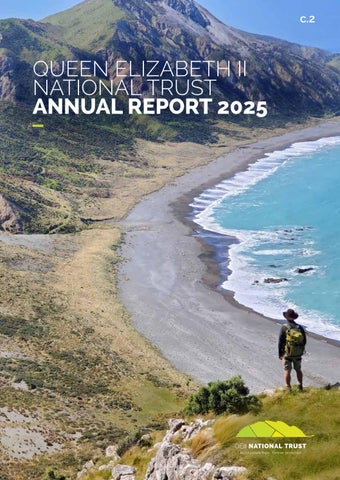
COVER IMAGE
A contractor overlooks Mirza Downs Station while undertaking work to protect rare and threatened species on the property. QEII NATIONAL TRUST ANNUAL REPORT 2025
3
REPORT FROM THE CHAIR
Protecting new areas is one of the most expensive (and important) parts of QEII’s work, so looking to the 2025/26 financial year, this financial constraint means we will have to be more selective about the new covenants we can approve. Covenant proposals with the highest biodiversity (or other open space values) will be prioritised, as will covenants that require only limited financial support from QEII. While new covenant work will be temporarily scaled back, our commitment to supporting landowners to manage their covenants is unwavering. This year our regional reps monitored 2,118 covenants, equating to approximately 40% of the current 5,382 registered covenants, reaching our target. The monitoring visits undertaken by reps are about more than assessing the health of covenants. An important part of our visits is to maintain a collaborative and supportive relationship with landowners. This year we kicked off work to review our monitoring/landowner engagement model to ensure all aspects of our monitoring and engagement efforts are fit-for-purpose.
I am incredibly proud of what the QEII National Trust is able to achieve for conservation in Aotearoa New Zealand with the limited funding we have to work with. In collaboration with passionate and dedicated landowners and with the support of external partners, we facilitate the legal protection of special new areas and ensure already protected areas are well-managed and supported to thrive. In the 2024/25 year, we were able to assist landowners to protect an additional 3,649 hectares of land comprising 170 newly approved covenants. 132 covenants were registered this financial year comprising 2,119 hectares with a total of 443 covenants currently awaiting registration. This brings the total number of hectares protected by registered QEII covenants to 186,246. Despite the good work happening on the ground, the latter part of the year has also been occupied by some challenging work in head office, as we look to scale back our new protection work until more funding can be secured. In February, we were grateful to be recognised by the Minister of Conservation Tama Potaka with his announcement of an additional $1.5 million in funding per year for QEII for the next three years. It is very welcome and will keep us in the covenanting business, but it will not be enough to allow us to continue processing new covenants at the rate we have in recent years.
4
QEII NATIONAL TRUST ANNUAL REPORT 2025
This year also saw the wrap-up of our very successful Jobs for Nature projects. Our ‘Protecting the Gains’ project enabled us to legally protect an additional 7,060 hectares (265 covenants) over the four-year project term, including some places where other Jobs for Nature money was spent, providing an added safeguard for that investment. It also enabled us to trial a new form of protection – Restoration Agreements – which allowed us to protect an additional 44 sites with developing biodiversity values. The $1 million Jobs for Nature-funded Eastern South Island Project, which aimed to inspire and accelerate stewardship of rare and threatened species and habitats in Eastern South Island covenants, saw specialist contractors engaged to undertake ecological surveys, provide reports and recommend management actions in 68 QEII covenants. Through the project, landowners and managers gained a greater understanding of the presence of rare and threatened species in their covenants and how to best manage their habitats. These insights will also provide significant value to QEII and the wider conservation community about the ongoing management of these unique areas. Another 26 covenants (protecting 445 hectares) across the country received new or top-up deer fencing and deer culling as part of a $2 million Jobs for Nature-funded Deer Exclusion Project for covenants where excluding deer was the highest priority to safeguard the ongoing health of the covenant. Over 52,500 metres of fencing was installed and contractors removed 148 deer as part of the project.
Ngā Kairauhī Papa | Forever protected
We are very pleased to have been able to support landowners with our Jobs for Nature projects and work with some outstanding contractors to deliver these outcomes. It is disappointing to have this funding come to an end, however the additional areas we were able to protect was a very rewarding outcome for the QEII team. The targeted support we provided landowners to manage some big challenges in their covenants will also serve as a great model for any opportunities that may arise in the future. The QEII board and I have been privileged to visit several QEII covenants and hear from landowners about their connection to their covenants and the ups and downs of managing these special places. Among the places visited, we observed biocontrols in action in the Manawatū/ Tararua region, surveyed the ongoing recovery to stormaffected covenants in the Hawke’s Bay and experienced the very connected conservation movement on Bank’s Peninsula. I am always heartened to see the work that is being put into caring for covenanted land for future generations to appreciate. We were joined on the board in April this year by a new elected director, Marie Taylor. Marie is a Hawke’s Bay-based covenantor and former rep, with a depth of knowledge and a strong understanding of the conservation landscape and QEII’s place in it. Marie replaced Donna Field, who had reached her nine-year maximum term as a director. We thank Donna for her dedication to QEII and wish her all the best for the future. This year we also farewelled some familiar faces from our field team. Miles Giller, Alice Shanks and Rob Smith have retired after a collective 60 years of service to our Canterbury covenantors. Elsewhere, we farewelled Paul Kayes (Western Bay of Plenty) and Rob Cross (WellingtonKāpiti). We are pleased to welcome their experienced replacements – James Kilgour, Joe Potter Butler, Max Crowe and Lee Barry. The 2025 financial statements at the end of this annual report show that the trust has ended the year with a surplus of $0.4m compared to a budgeted deficit of $1.55m. This is a positive result relative to our expectations, but is largely a paper figure, attributable to a fortunate reduction in the book valuation of our Pre-1995 Fencing Provision and gains in our investment portfolio – the reserves we must keep on hand to meet those historic fencing obligations and also more current liabilities. Of greater concern are our operating accounts, which paint a worrying long-term picture. Our reported operating deficit for the 2025 year is nearly $2.7m.
While we do have reserves to call on, we need to be prudent about how they are used to ensure we can meet our obligations to existing covenantors. This year’s result clearly shows that if we want to continue creating new covenants, our revenue needs to significantly increase in order to deliver that – that’s why we’re having to temporarily reduce the number of new covenants we can process in the meantime. With a successful fundraising programme and continued engagement with Government, I am hopeful that this will be a temporary situation and we’ll soon be back to helping everyone who has a special place that they wish to protect in perpetuity. I would like to acknowledge the ongoing support for private land biodiversity protection by our partners – particularly some regional and local councils – who have invested significant co-funding to many covenanting projects. As our ability to take on new covenant work reduces, we’re working with our partners to identify other opportunities for them to co-fund our work to meet their objectives. We’re also incredibly grateful to our donors, who are supporting us to continue our work during these uncertain times. While we talk a lot about the areas with ecological, cultural and landscape significance that we protect and care for, none of this work would be possible without our community of covenantors, land managers and other partners doing the work on the ground. The passion and dedication you show and the willingness to invest your own time and resources into ensuring these areas are protected and healthy for future generations, is inspiring. It is my honour to serve as chair of the QEII National Trust board of directors. I am proud of what QEII is able to achieve with very little, and we will always continue to support our covenantors and ensure that our precious biodiversity is protected and thrives. It is my privilege to present this year’s Annual Report.
Alan Livingston CHAIR
QEII NATIONAL TRUST ANNUAL REPORT 2025
5
STRATEGIC OBJECTIVES – OUR MISSION
QEII’S STRATEGIC OBJECTIVES
OUR MISSION: “We inspire private landowners to
protect and enhance open spaces of ecological and cultural significance.” The following four strategic objectives guide our work:
6
1
2
3
4
Area of high-value land under robust protection increases.
Values within protected areas are enhanced.
QEII’s work is part of large-scale projects.
People are inspired to connect with QEIIprotected places.
QEII NATIONAL TRUST ANNUAL REPORT 2025
Ngā Kairauhī Papa | Forever protected
1
Area of high-value land under robust protection increases
• In partnership with landowners, we currently protect just over 186,000ha of high-value land. • We know that protecting biodiversity on private land is critical to solving our biodiversity crisis. • Each year we aim to increase the area of land protected by QEII covenants, however our funding situation means we will be reducing the number of new covenants we’re able to process from 2025/26. • For us ‘high-value’ is guided by the Minister for Conservation’s National Priorities for Conservation on private land, how an area contributes to connectivity at a landscape scale, and also the cultural, archaeological, landscape and visual amenity values of an area. • We pride ourselves on being the strongest defender of protected land in NZ. Our modern covenants are ‘watertight’, and our landowners can trust us to defend protected land where threatened or challenged by third-party processes.
National Priority 1: Protects indigenous vegetation in land environments that have 20% or less remaining in indigenous cover. Land Environments New Zealand is a national classification system which is used to map areas of similar habitat. Any land environments that have been reduced to less than 20% of their original extent are prioritised for protection. National Priority 2: Protects indigenous vegetation associated with sand dunes and wetlands; less than 9% of the original extent of wetlands and less than 11% of natural dunelands remain nationwide, which makes these two ecosystems high priority ecosystems. National Priority 3: Protects indigenous vegetation associated with ‘originally rare’ terrestrial ecosystem types not already covered by priorities 1 and 2. Originally rare ecosystems are ecosystem types not commonly found in all regions of NZ. There are 72 types falling into six categories which have been identified in NZ– coastal, geothermal, induced by native invertebrates, inland and alpine, subterranean, or semisubterranean, and wetlands. National Priority 4: Protects habitats of New Zealand’s most threatened indigenous species of plants and animals. The threat status of threatened native species is determined by specific criteria in the New Zealand Threat Classification System lists created by the Department of Conservation.
Highlights from 2024/25
3,649 HECTARES of high-value land approved for protection.
84%
of approved new covenants protect habitats of acutely and/ or chronically threatened indigenous species (NP4)
ABOVE:
Landowner Peter McDonald checks construction progress for a 56 ha deer exclusion covenant protecting native podocarp hardwood forest and several regionally significant populations of threatened plants.
QEII NATIONAL TRUST ANNUAL REPORT 2025
7
STRATEGIC OBJECTIVES – OUR MISSION
Kōrero gecko, one of several lizard species supported through the Eastern South Island rare and threatened species project. Photo credit: Carey Knox
2
Values within protected areas are enhanced
• Alongside landowners, we have an important role in enhancing the values protected by QEII covenants. • Our people have technical expertise and valued relationships with landowners. Covenants are monitored every two-three years and our reps provide advice and guidance to landowners for covenant enhancement and management. • We’re working towards more effective and efficient ways to assess whether protected values are moving forwards or backwards, and appropriate associated management and enhancement activities. • We support landowners with enhancement activities through establishment grants, our Stephenson Fund, and seeking third-party funding for special projects.
8
QEII NATIONAL TRUST ANNUAL REPORT 2025
Highlights from 2024/25
2,118
registered covenants were visited and had their condition assessed.
$3,580,522
QEII contributed towards fencing costs for new covenants.
$260,613
of establishment grant funding was allocated to
new covenants for revegetation, weed and pest control, signage and infrastructure, giving these new covenants a helping hand in their first few years.
111 hectares of QEII-covenanted native bush in the Kaimai ranges near Matamata successfully defended from quarrying.
Ngā Kairauhī Papa | Forever protected
3
QEII’s work is part of large-scale projects
Highlights from 2024/25 Nearly
$2 million
secured from third parties to support new covenants.
Our regional council partners continue to support covenant establishment across the country, including $350,000 of funding from Environment Canterbury and over $310,000 from Waikato Regional Council.
• We do some of our work as part of large-scale projects because conservation as part of a larger collective effort creates greater benefits than when done in isolation. • We identify or create projects where our contribution or leadership has the greatest potential to add value. • We collaborate with councils and conservation groups to share resources and expertise and achieve mutual benefits that contribute to larger-scale biodiversity strategies.
74% of approved new covenants contribute to a protected corridor or landscape.
Our ongoing partnership with Kaipara Moana Remediation delivered five new covenants and several fencing and planting projects on registered covenants or adjacent areas.
Our partnership with Auckland Council supported 55 projects, including new covenants, supporting landowners with fencing, pest and weed control, trackbuilding and more.
We collaborated with Western Bay of Plenty District Council and the Kōkako Ecosystem Expansion Programme to fund traps to support the recovery of Kōkako in local QEII covenants.
TOP
ABOVE
An ECAN funded contractor controlling hawthorn and elderberry in a covenant. This control has helped the landowner to manage their covenant and control landscape weeds.
A new covenant protected this year in partnership with the Kaipara Moana Remediation Programme. QEII NATIONAL TRUST ANNUAL REPORT 2025
9
STRATEGIC OBJECTIVES – OUR MISSION
10
QEII NATIONAL TRUST ANNUAL REPORT 2025
Ngā Kairauhī Papa | Forever protected
4
People are inspired to connect with QEII-protected places
• The places we protect and enhance in partnership with landowners provide physical, spiritual and mental wellbeing benefits, and contribute to a sense of identity for New Zealanders.
Highlights from 2024/25 Hosted or joined with other organisations for approximately 30 events nationwide to bring together local covenantors and landowners to share knowledge and foster connections. In April 2025, Marlborough and Nelson-Tasman reps Clare Moore and Tom Stein hosted a local landowner event at a covenant in Pakawau. Attendees heard about fungi and insects and Tom demonstrated various types of traps and how to make them weka safe.
• We want our landowners to feel proud and enriched by the work they do with QEII, and for other people to recognise the contribution that landowners are making to conservation.
Island Hills Station (one of the largest Open Space Covenants in Canterbury) again hosted the annual “Skedaddle – run for nature” event. Held in April 2025, the trail running event supports their conservation efforts on the property.
• Through their engagement with QEII and our network of protected areas, we want individuals’ and communities’ understanding, connection to and enjoyment of protected areas to increase.
In May 2025, the Cable Bay Trail Run saw over 360 runners and walkers race through a QEII covenant near Nelson. Information about QEII was provided to people on the day and proceeds from entry fees, totalling $8,000, were donated to QEII National Trust.
• We’re doing this by working with landowners to hold events on their covenants, sharing covenantor stories through our biannual Open Space magazine and local media stories.
In June 2025, QEII and NZ Landcare Trust held an event in Te Awamutu for local QEII covenant owners and others in the area. The evening was centred around the biodiversity and special species found in their ecological corridor. Guests heard about how species are monitored, what makes them special and how to protect their habitats.
LEFT
ABOVE
Collecting soil samples from kauri trees in a QEII covenant as part of the Tiakina Kauri project, funded by the Ministry for Primary Industries. Photo credit: Kieran Pullman
Covenantor event in Pakawau, Golden Bay, April 2025.
QEII NATIONAL TRUST ANNUAL REPORT 2025
11
STATEMENT OF PERFORMANCE
1 AREA OF HIGH-VALUE LAND UNDER ROBUST PROTECTION INCREASES Measure
2025
2024
2025 Target (if applicable)
Number of covenants approved
170
141
140
Number of hectares approved 1
3,649
2,619
-
Percentage of covenants approved that meet one or more of the National Priorities
96%
100%
90%
National Priority 1
51%
49%
-
National Priority 2
48%
39%
-
National Priority 3
4%
4%
-
National Priority 4
84%
99%
-
Percentage of covenants approved with indigenous cover that is highly representative of original cover, or are one of the best remaining examples of its type in the Ecological District2
39%
43%
-
Percentage of covenants approved with indigenous cover that is moderately representative of original cover, or has a representative range of current species in the Ecological District2
41%
35%
-
Number of covenants registered
132
119
130
2,118.6
3,094
-
Number of hectares registered
Notes: ¹ Approved covenant hectares are estimates that are refined by survey prior to registration 2
Assessed against Singers and Rogers (2014) A classification of New Zealand’s terrestrial ecosystems. Science for Conservation 325, 87pp, and/or ecological context reports for regions not yet assessed.
12
QEII NATIONAL TRUST ANNUAL REPORT 2025
Ngā Kairauhī Papa | Forever protected
2 VALUES WITHIN PROTECTED AREAS ARE ENHANCED Measure
2025
2024
Target
Number of registered covenants monitored
2,118
2,302
-
Percentage of registered covenants monitored
40%
45%
40%
Total establishment funding allocated by QEII to covenants approved in the financial year1
$260,613
$225,998
-
Total fencing allocation to covenants approved in the financial year2
$3,592,473
$2,838,774
-
QEII investment in registered covenant support (The Stephenson Fund)
$150,867
$265,858
-
Total investment in registered covenant support (The Stephenson Fund)3
$354,903
$969,770
-
Litigation matters filed before courts or tribunals in defence of protected land
1
2
-
Number of submissions on central and local government policy
5
6
-
Percentage of covenantors actively doing enhancement work in their covenants4
n/a
n/a
-
Notes: ¹ Allocations for covenant enhancement work including revegetation, weed and pest control, signage, specialist assessments, infrastructure and site establishment grants for Restoration agreement covenants. 2
Includes QEII, landowner, council, neighbour and third-party allocations for fencing. Does not include QEII fencing funded through the Deer Exclusion or Eastern South Island Jobs for Nature projects.
3
Includes landowner financial and in-kind investment, allocated according to applications received.
4
Survey conducted every three years. QEII NATIONAL TRUST ANNUAL REPORT 2025
13
STATEMENT OF PERFORMANCE
3 QEII’S WORK IS PART OF LARGE-SCALE PROJECTS Measure
2025
2024
Target
Funds secured from third parties for on the ground covenant works (new covenants/new protection)1
$1,967,365
$1,178,552
-
Funds secured from third parties and allocated for on the ground covenant works1,2 (established/registered covenants)
$457,657
$512,710
-
Percentage of new approved covenants with third-party funding2
40%
44%
-
Total number of partners with whom we have formal agreements (MOU or funding agreements) for biodiversity protection
10
8
-
Percentage of covenants approved that add to a protected corridor or landscape
74%
78%
-
Notes: ¹ Includes council and third-party Jobs for Nature funding however does not include internal QEII held JFN funding through the Deer Exclusion or Eastern South Island Jobs for Nature projects. 2
Does not include neighbour contributions for fencing or contributions made directly to the landowner that QEII was not a party to.
14
QEII NATIONAL TRUST ANNUAL REPORT 2025
Ngā Kairauhī Papa | Forever protected
4 PEOPLE ARE INSPIRED TO CONNECT WITH QEII-PROTECTED PLACES Measure
2025
2024
Target
Percentage of new owners that thought it was an easy transition to becoming an owner of QEII-protected land¹
n/a
n/a
-
Percentage of members satisfied with their overall relationship with QEII National Trust1
n/a
n/a
-
Percentage of covenantors that often spend time in their covenants1
n/a
n/a
-
Readership of Open Space magazine
n/a
n/a
-
$312,582
$167,779
-
69
86
-
1
Total donation and membership income2 Number of applications for QEII managed fund support3
Notes: ¹ Survey conducted every three years. 2
Includes all financial memberships, donations and realised bequests, excludes notified bequests.
3
Includes all applications to The Stephenson Fund and Auckland Council fund. Figures reflect applications received prior to screening against the fund’s criteria. QEII NATIONAL TRUST ANNUAL REPORT 2025
15
COVENANT STATISTICS
COVENANT STATISTICS Regional Council
Area (ha)
Auckland
494,162
7
325
332
4,110.4
4,067.6
840.8
12.0
2.9
Bay of Plenty
1,207,050
12
195
207
9,908.3
9,711.4
6,563.5
50.3
3.5
Canterbury
4,450,760
63
412
475
19,987.1
15,882.7
1,679.4
39.5
8.1
Gisborne
838,582
15
154
169
5,492.1
5,191.8
1,103.8
33.9
9.2
Hawke's Bay
1,413,721
22
278
300
12,121.4
11,095.4
4,606.0
40.1
10.0
ManawatūWhanganui
2,222,059
56
437
493
10,057.0
8,687.6
352.3
19.9
7.0
Marlborough
1,045,765
1
106
107
5,908.5
5,880.5
1,056.0
54.3
8.5
42,441
2
18
20
342.4
319.6
139.5
17.8
5.9
Northland
1,250,032
37
805
842
11,874.8
11,442.4
420.6
14.2
3.6
Otago
3,120,863
42
257
299
65,296.1
63,127.5
21,909.6
247.5
7.5
Southland
3,119,495
31
427
458
11,700.1
10,516.3
1,456.6
24.7
9.1
Taranaki
725,436
36
529
565
11,273.2
10,209.0
915.5
19.4
2.6
Tasman
961,623
12
212
224
4,092.7
3,524.8
277.1
16.7
3.9
Waikato
2,389,990
62
748
810
19,528.6
18,414.9
801.6
24.2
6.2
Wellington
804,866
33
394
427
6,852.4
6,711.4
824.3
16.8
4.6
West Coast
2,324,381
12
116
128
2,653.3
2,387.7
233.0
20.6
7.4
443
5,413
5,856
201,113.5
187,085.5
21,909.6
34.6
5.3
Nelson
All Regions
Total Total number Total number Total area of Total area of Approved of registered of approved, approved, registered covenants and registered, registered, and formalised* and and formalised formalised formalised (ha) (ha)**
Protected open space
Number
Area (ha)
Registered covenants
5,382
186,245.6
Approved covenants**
443
14,027.9
Formal agreements*
31
840.0
5,856
201,113.5
TOTAL**
* Formalised covenants include landscape protection agreements with a territorial authority (e.g., district council) over land that has no legal title, as well as 14 QEII National Trust properties with no registered covenant established prior to the Trust’s ownership. QEII National Trust previously held a licence to occupy a Tranz Rail Ltd property in the Wellington Region. This is no longer the case, which is why the number of formal agreements has reduced from 32, recorded in previous years, to 31. ** Areas are approximate as not all approved covenants have been formally surveyed.
16
QEII NATIONAL TRUST ANNUAL REPORT 2025
Largest Average registered registered covenant covenant (ha) size (ha)
Median registered covenant size
The number of registered covenants and hectares protected have been updated to reflect that QEII closed a registered covenant in the Otago district this year, resulting in 2,735 hectares being removed. This was an administrative exercise as the covenant was originally extinguished in 2007 when the Crown Pastoral leasehold land was returned to the Crown. The land is now part of the Department of Conservation's Oteake Conservation Park.
Ngā Kairauhī Papa | Forever protected
220,000
5,000
200,000
4,500
180,000
4,000 3,500
160,000 140,000
3,000
120,000
2,500
100,000
2,000
80,000
1,500
60,000
1,000
40,000
500
20,000
Area (ha)
Number of covenants
QEII National Trust Registered Covenants 5,500
0 1979 1982 1984 1986 1988 1990 1992 1994 1996 1998 2000 2002 2004 2006 2008 2010 2012 2014 2016 2018 2020 2022 2024
0
Total number of registered covenants
34.6
Total area of registered covenants (ha)
Region with the most covenants:
805
ha
average registered covenant area
21,909.6
NORTHLAND
Largest registered covenant
HECTARES
Coronet Peak Station, part of a collection of high country covenants in Otago known as Mahu Whenua
QEII NATIONAL TRUST ANNUAL REPORT 2025
17
FINANCIAL STATEMENTS
2025 FINANCIAL STATEMENTS Statement of responsibility The Board is responsible for the preparation of the National Trust’s financial statements and Statement of Performance and for judgements made in them. The Board has the responsibility for establishing and maintaining a system of internal controls designed to provide reasonable assurances as to the reliability and integrity of financial and nonfinancial reporting. In the Board’s opinion, these financial statements and Statement of Performance fairly reflect the financial position and operations of the National Trust for the year ended 30 June 2025.
Approval of the financial statements The Board of Directors has authorised the issue of the financial statements of the Queen Elizabeth II National Trust set out in pages 2 to 38 for the year ended 30 June 2025. For and on behalf of the Board of Directors, which authorised the financial report on 30 October 2025.
Alan Livingston
Graham Mourie
CHAIR
DIRECTOR
Dated: 30 October 2025
Dated: 30 October 2025
18
QEII NATIONAL TRUST ANNUAL REPORT 2025
Ngā Kairauhī Papa | Forever protected
STATEMENT OF COMPREHENSIVE REVENUE AND EXPENDITURE FOR THE YEAR ENDED 30 JUNE 2025 Notes
Group 2025 Actual $
Group 2025 Budget $
Group 2024 Actual $
Government grant - Baseline funding
4,274,000
4,274,000
4,274,000
Government grant - Jobs for Nature funding - PTG/DEP/ESI
2,835,212
4,062,000
3,957,000
Contestable funds
1,150,512
904,000
434,859
Donations and other grants
469,380
655,000
295,026
Operating Revenue
Other revenue
346,432
247,866
284,922
9,075,536
10,142,866
9,245,807
2,488,873
2,588,354
2,535,714
1
3,747,644
3,995,450
2,879,183
1,144,927
904,000
504,880
2
3,999,748
4,197,921
3,923,372
Property operations
105,345
142,104
93,841
Public relations
182,278
234,843
106,682
103,269
111,000
106,940
Operating expenditure
11,772,084
12,173,672
10,150,612
Net Operating Surplus/(Deficit)
(2,696,547)
(2,030,806)
(904,806)
69,926
300,000
165,687
(1,389,102)
(200,000)
149,132
(1,319,176)
100,000
314,819
4
1,772,434
578,000
1,280,451
10
0
0
74,490
0
0
74,490
395,063
(1,552,806)
(13,663)
Operating revenue Operating Expenditure Field operations Covenant expenditure Contestable funds Administration
Depreciation and amortisation
3
Pre-1995 Fencing provision and costs Pre-1995 fencing repairs and waivers costs Pre-1995 movement in fencing provision
12
Net Pre-1995 Fencing provision and costs Net investment income Non-Operating Revenue/Expenditure Loss on QEII properties - Maungaruahine Bush Non-Operating Revenue/Expenditure Total comprehensive revenue and expenditure
The accompanying notes on pages 26 to 38 form an integral part of these financial statements. QEII NATIONAL TRUST ANNUAL REPORT 2025
19
FINANCIAL STATEMENTS
STATEMENT OF COMPREHENSIVE REVENUE AND EXPENDITURE FOR THE YEAR ENDED 30 JUNE 2025 Explanation of total comprehensive revenue and expenditure The National Trust concluded the financial year ended 30 June 2025 with total comprehensive revenue and expenditure of $395,063 against budgeted total comprehensive revenue and expenditure loss of $1,552,806. The difference between budgeted and actual total comprehensive revenue and expenditure results primarily from four unbudgeted factors. They are as follows: a) The Department of Conservation funding agreements for 'Jobs for Nature (JFN)' initiatives of a) Protecting the Gains, b) Deer Exclusion project (DEP) and c) Eastern South Island (ESI) Accelerating Stewardship projects resulted in revenue totaling $2,835k being recognised as income in 'Government Grants - Jobs for Nature funding' in the Statement of Comprehensive Revenue and Expenditure. The amount of JFN revenue that was recognised was $1,227k less than the budgeted $4,062k for 2025 due to estimates for remaining revenue at the time of preparation of the 2025 budget being considerably higher than actual. The balance of all Jobs for Nature funds has been invoiced and all but $77k for the JFN Deer Exclusion Project has been recognised as revenue either during this year and since the beginning of the project in 2022. Refer to Note 9 for further information.
b) For the 2025 year, QEII actual covenant expenditure was $3.74m which was $0.26m less than budget of $4m. This difference was made up of: i) covenant establishment costs (fencing, survey and weed/pest control) including JFN Protecting the Gains were $0.3m more than budgeted due to the increase in number of covenants approved for the 2025 year compared with those budgeted. ii) JFN projects - Deer Exclusion (DEP) and Eastern South Island (ESI) costs were $0.54m less than budgeted costs which offset the reduction in JFN revenue recognised being less than budgeted. iii) the Stephenson Fund costs paid out during the 2025 year were $21k less than budgeted. Please note any Stephenson Fund payments allocated but not paid out during the 2025 are included in Statement of Commitments. c) For the 2025 year, the pre-1995 fencing provision was based on a roll-forward valuation completed by Deloitte. Overall, there was a $1.094m decrease (2024: $0.2m increase) in the provision, which was mainly due to the effect of the change in the discount rate curve. Refer to Note 12 for further information. d) The net effect of the realised and unrealised gains/ losses on the investment portfolio was a gain of $1,424k (2024: gain of $752k) recognised as income in the Statement of Comprehensive Revenue and Expenditure. Refer to Note 4 for further information.
The accompanying notes on pages 26 to 38 form an integral part of these financial statements.
20
QEII NATIONAL TRUST ANNUAL REPORT 2025
Ngā Kairauhī Papa | Forever protected
STATEMENT OF CHANGES IN EQUITY FOR THE YEAR ENDED 30 JUNE 2025
Opening balance Total comprehensive revenue and expenditure At the end of the period
Group 2025 Actual $
Group 2025 Budget $
Group 2024 Actual $
18,244,657
18,314,699
18,258,320
395,063
(1,552,806)
(13,663)
18,639,720
16,761,893
18,244,657
The accompanying notes on pages 26 to 38 form an integral part of these financial statements. QEII NATIONAL TRUST ANNUAL REPORT 2025
21
FINANCIAL STATEMENTS
STATEMENT OF FINANCIAL POSITION AS AT 30 JUNE 2025 Note
Group 2025 Actual $
Group 2025 Budget $
Group 2024 Actual $
National Trust Equity
18,639,720
16,761,893
18,244,657
Total Equity
18,639,720
16,761,893
18,244,657
837,133
77,706
2,102,057
Equity
Represented by: Current assets Cash and cash equivalents Accounts and other receivables
5
250,053
1,561,603
307,841
Investments
6
18,284,274
15,146,253
19,190,884
19,371,460
16,785,562
21,600,782
Total current assets Less current liabilities Accounts and other payables
8
462,183
1,352,832
862,885
Deferred revenue
9
1,575,736
709,629
2,425,842
276,327
201,230
165,268
1,600,557
616,108
1,091,689
Covenant commitments provision
1,705,849
2,383,607
1,501,126
Total current liabilities
5,620,652
5,263,406
6,046,810
Working capital
13,750,807
11,522,156
15,553,972
12,187,381
12,631,057
11,093,850
12,187,381
12,631,057
11,093,850
3,963,477
5,468,641
5,566,426
Covenant commitments provision
3,334,991
1,922,678
2,836,739
Total non-current liabilities
7,298,468
7,391,319
8,403,165
Net assets
18,639,720
16,761,893
18,244,657
Employee entitlements Pre-1995 fencing provision
12
Non-current assets Property, plant and equipment
10
Total non-current assets Non-current liabilities Pre-1995 fencing provision
12
The accompanying notes on pages 26 to 38 form an integral part of these financial statements.
22
QEII NATIONAL TRUST ANNUAL REPORT 2025
Ngā Kairauhī Papa | Forever protected
STATEMENT OF CASH FLOWS FOR THE YEAR ENDED 30 JUNE 2025 Group 2025 Actual $
Group 2024 Actual $
Receipts from operations
7,423,705
8,910,613
Donations and other grants received
1,133,663
836,700
Interest received
392,204
424,976
Dividends received
221,428
204,281
Other revenue received
356,175
265,997
Payments to suppliers
(8,384,345)
(7,264,475)
Payments to employees
(2,972,827)
(3,049,157)
Net cash flow (used in)/from operating activities
(1,829,997)
328,935
Cash flows from operating activities
Cash flows from investing activities Proceeds from sale of investments
6,149,288
1,522,917
Purchase of investments
(3,735,501)
(1,766,165)
Purchase of property, plant and equipment
(1,257,326)
(58,629)
11,346
94
Payout of Est G Filer funds held
(602,734)
0
Net cash flow from /(used in) investing activities
565,073
(301,783)
Net cash flows from financing activities
0
0
Net increase in cash and cash equivalents
(1,264,924)
27,152
Cash and cash equivalents at beginning of period
2,102,057
2,074,905
Cash and cash equivalents at end of period
837,133
2,102,057
Proceeds from sale of property, plant and equipment
The accompanying notes on pages 26 to 38 form an integral part of these financial statements. QEII NATIONAL TRUST ANNUAL REPORT 2025
23
FINANCIAL STATEMENTS
STATEMENT OF COMMITMENTS AS AT 30 JUNE 2025
Group 2025 $
Group 2024 $
145,736
226,609
2025 $
2024 $
Less than 1 year
165,340
165,340
Between 1 and 2 years
165,340
165,340
More than 2 years
13,778
179,118
344,458
509,798
Less than 1 year
1,995
3,420
Between 1 and 2 years
0
1,995
More than 2 years
0
0
1,995
5,415
The Stephenson Fund commitments The Stephenson Fund commitments are funds committed to approved covenant holders to assist them with stewardship on their covenants. Operating lease commitments Property lease - Level 3 and 4 - 138 The Terrace, Wellington An agreement to lease level 4 and additional space on level 3 at 138 The Terrace, Wellington dated 31 March 2021 was signed and is effective from 7 May 2021. The term of the lease is six years and three months with two further rights of renewal of three years each. The landlord offered QEII a rent-free period of three months with two of these relating to the current year.
Printer/Photocopier lease A new agreement to lease a printer/photocopier dated 12 December 2022 was signed and is effective from 17 January 2023. The term of the lease is three years. Capital commitments
The National Trust had no capital commitments as of 30 June 2025 (2024: nil).
STATEMENT OF CONTINGENCIES AS AT 30 JUNE 2025 The National Trust had no contingent liabilities as at 30 June 2025 (2024: nil).
The accompanying notes on pages 26 to 38 form an integral part of these financial statements.
24
QEII NATIONAL TRUST ANNUAL REPORT 2025
Ngā Kairauhī Papa | Forever protected
QEII NATIONAL TRUST ANNUAL REPORT 2025
25
NOTES TO THE FINANCIAL STATEMENTS FOR THE YEAR ENDED 30 JUNE 2025
Accounting Policies Reporting entity Queen Elizabeth the Second National Trust (the National Trust) is a registered charitable trust that is domiciled in New Zealand and governed by the Queen Elizabeth the Second National Trust Act 1977. The principal activity of the National Trust is to provide, protect, preserve and enhance open space for the benefit and enjoyment of the people of New Zealand. Remarkables Station National Trust Limited (100% owned) is a company governed by the Companies Act 1993, is incorporated in New Zealand and has registered charitable status. The principal activity is to own and manage the covenanted Remarkables Station farm which was gifted to QEII from the Jardine Foundation on 1 July 2022. The financial statements of the National Trust (and its subsidiary Remarkables Station National Trust Limited) for the year ended 30 June 2025 were authorised for issue by the Board on 30 October 2025.
Statement of compliance The financial statements have been prepared in accordance with Queen Elizabeth the Second Trust Act 1977 which requires compliance with Generally Accepted Accounting Practice in New Zealand (“NZ GAAP”). As the primary objective of the National Trust is to protect special places for the benefit of present and future generations, rather than making a financial return, the National Trust is a public benefit entity for the purpose of financial reporting. The financial statements of the National Trust have been prepared in accordance with Tier 2 Public Benefit Entity (‘PBE”) standards and disclosure concessions have been applied. The National Trust is eligible to report in accordance with Tier 2 PBE standards because it does not have public accountability as it’s expenditure is not considered to be large in accordance with XRB A1 Accounting Standards Framework.
Measurement base The financial statements have been prepared on a historical cost basis, except for investments which have been measured at fair value and the pre1995 fencing liability which is valued annually. The financial statements are presented in New Zealand dollars. The accounting policies set out below have been applied consistently to all periods presented in these financial statements.
26
QEII NATIONAL TRUST ANNUAL REPORT 2025
Basis of consolidation Group The financial statements comprise the financial statements of QEII National Trust (QEII) and its subsidiary (the Group) as at 30 June 2025. QEII (the parent) has control of the subsidiary through its 100% ownership which gives the parent the: • power to direct the relevant activities of the subsidiary • exposure, or rights, to variable benefits from its involvement with the subsidiary • ability to use its power over the subsidiary to affect the nature and amount of the benefits from its involvement with the subsidiary. Consolidation of a subsidiary begins when the Group obtains control over the subsidiary and ceases when the Group loses control of the entity. Assets, liabilities, revenue and expenses of a subsidiary acquired or disposed of during the year are included in the financial statements from the date the Group gains control until the date the Group ceases to control of the subsidiary. The surplus or deficit and each component of other comprehensive of revenue and expense are attributed to the owners of the subsidiary. When necessary, adjustments are made to the financial statements of the subsidiary to bring its accounting policies into line with the Group’s accounting policies. All intra-economic entity assets and liabilities, net assets/equity, revenue, expenses and cash flows relating to transactions between entities of the economic entity are eliminated in full upon consolidation. A change in the ownership interest of a subsidiary that does not result in a loss of control, is accounted for as an equity transaction. If the Group loses control over the subsidiary, it derecognises the assets (including goodwill) and liabilities and other components of net assets/equity, while any resulting gains or losses are recognised in surplus or deficit. Any investment retained in the former subsidiary is recognised at fair value. QEII National Trust Investment in the subsidiary held by QEII are accounted for at cost less any impairment charges in the separate financial statements of the QEII. Dividends and other distributions from subsidiary are recognised as revenue in QEII’s separate statement of financial performance, but only to the extent that these distributions are received and receivable from the
Ngā Kairauhī Papa | Forever protected
subsidiary’s accumulated comprehensive revenue and expense arising after acquisition. Such distributions do not impact the recorded cost of the investment. At the end of each reporting period, QEII assesses whether there are any indicators that the carrying value of the investment in subsidiary may be impaired. Where such indicators exist, to the extent that the carrying value of the investment exceeds its recoverable amount, an impairment loss is recognised.
Capital management The National Trust’s capital is represented by its net assets. It manages and maintains its capital by prudently managing revenue, expenses, and assets and liabilities to ensure it effectively achieves its objectives and purpose, while still remaining a going concern.
Revenue The National Trust’s revenue is mainly from non-exchange transactions. They are as follows: - Grants revenue from Government or government agencies - grants revenue is recognised as it becomes receivable, except where a grant is for a specific purpose and there is an obligation to repay it if the specific purpose is not undertaken. In this situation, revenue is deferred until the obligations are performed. - Interest and dividend revenue (investment income) – interest income is recognised as earned, dividend income is recognised when the right to receive payment is established. - Donations and other grants revenue – cash donations are recognised when received, non-cash donations are recognised at their fair value at the time that ownership rights are transferred to the National Trust. - Membership/sponsorship revenue – membership/ sponsorship revenue is recognised when the cash is received. - Gifting of Property – non-cash receipt of property are recognised at their fair value at the time the legal title is transferred.
Property, plant and equipment Land and improvements acquired or gifted to the National Trust are recorded at cost for acquired assets, or at fair value for gifted assets. The cost of new fencing on National Trust properties is capitalised in the year of completion. Property, plant and equipment (other than land) is measured at cost, less accumulated depreciation and impairment losses. Land is not depreciated.
Restrictions on assets The only restrictions on assets held by the National Trust are those pertaining to covenants and specific gifts. Depreciation Depreciation is charged on a straight-line basis over the useful life of the assets. Depreciation is charged at rates calculated to allocate the cost of the asset less any estimated residual values over its remaining useful life: - Computer and electronic equipment
3 years
- Intangible assets
5 years
- Furniture and fittings, plant and equipment
5 - 10 years
- Buildings and improvements (gifted and purchased buildings)
25-50 years
- Land fencing - Leasehold improvements
40 years Life of the Lease
Employment Entitlements Employee entitlements that the National Trust expects to be settled within 12 months of the balance date are measured at undiscounted nominal values based on accrued entitlements at the current rate of pay. These include salaries and wages accrued up to balance date and annual leave earned, but not yet taken at balance date.
Provisions Provisions are recognised when the National Trust has a present obligation (legal or constructive) as a result of a past event, it is probable that an outflow of resources embodying economic benefits or service potential will be required to settle the obligation and a reliable estimate can be made of the amount of the obligation. The expense relating to any provision is presented in the Statement of Comprehensive Revenue and Expenditure.
Goods and services tax All amounts are shown exclusive of goods and services tax (GST), except where receivables and payables are stated as GST inclusive.
Financial instruments
Non-derivative financial instruments comprise investments, accounts and other receivables, cash and cash equivalents, accounts and other payables, and other current liabilities. Non-derivative financial instruments are recognised at fair value. Financial instruments not at fair value are recognised through the Statement of Comprehensive Revenue and Expenditure, with transaction costs attributable to the acquisition. A financial instrument is recognised if the National Trust becomes a party to the contractual provisions of the instrument. Financial assets are derecognised if our contractual rights to the cash flows from the financial asset expire or if we transfer the financial asset to another party without retaining control or retaining substantially all risks and rewards of the asset.
QEII NATIONAL TRUST ANNUAL REPORT 2025
27
NOTES TO THE FINANCIAL STATEMENTS FOR THE YEAR ENDED 30 JUNE 2025
The National Trust holds a significant level of bonds and shares as investments. These financial assets are designated upon initial recognition by the National Trust as at fair value through surplus or deficit. Subsequent to initial recognition, financial instruments at fair value through surplus or deficit are measured at fair value, and changes therein are recognised in the surplus or deficit. Fair value is quoted at market value at balance date. Cash and cash equivalents include cash on hand, deposits held on call with banks and other short-term highly liquid investments with original maturities of three months or less from the date of acquisition. Accounts and other receivables are classified as loans and receivables and are recognised at amortised cost using the effective interest method less impairment. Accounts and other payables and other current liabilities are classified as other liabilities and are carried at amortised cost using the effective interest method.
Foreign currency Transactions in foreign currencies are translated at the rates on the date of the transaction. Transactions in foreign currency that are not settled in the accounting period, resulting in monetary assets and liabilities denominated in foreign currencies at balance date, are translated to NZD at the foreign exchange rate ruling at that date. Foreign exchange differences arising on their translation are recognised in the Statement of Comprehensive Revenue and Expenditure.
Financial risk management The National Trust's principal financial instruments comprise cash and cash equivalents and bonds and shares held as part of its normal operations. The National Trust has a policy to only invest in highly liquid investments with a Standard & Poor's or equivalent rating of 'AAA to BBB+'. Equities must be recommended by a registered financial planner or be a recognised investment fund for use by charitable trusts. The National Trust has various other financial instruments such as receivables and payables, which arise directly from its operations.
28
QEII NATIONAL TRUST ANNUAL REPORT 2025
Operating Lease payments Operating lease payments, where the lessors effectively retain substantially all the risks and benefits of ownership of the leased items, are charged as expenses in the periods in which they are incurred.
Operating Lease revenue Leases in which the Group does not transfer substantially all the risks and rewards incidental to ownership of an asset are classified as operating leases. Rental income arising is accounted for on a straight-line basis over the lease terms and is included in revenue in the statement of profit or loss due to its operating nature. Initial direct costs incurred in negotiating and arranging an operating lease are added to the carrying amount of the leased asset and recognised over the lease term on the same basis as rental income. Contingent rents are recognised as revenue in the period in which they are earned.
Commitments Future expenses and liabilities to be incurred on contracts that have been entered into at balance date are disclosed as commitments to the extent that there are equally unperformed obligations. These relate to Group commitments to the Stephenson Fund applicants, operating leases and any capital commitments.
Contingent liabilities Contingent liabilities are disclosed at the point at which the contingency is evident.
Budget figures
The budget figures shown in the financial statements are those that were approved by the Board of Directors.
Comparative year figures The 2025 QEII Group Financial statements do not contain any reclassifications of comparative figures.
Ngā Kairauhī Papa | Forever protected
1. Covenant expenditure Covenant expenditure relates to fencing, survey and legal costs incurred on approved covenants as they progress towards registration and as a contribution to stewardship of covenanted land. During the contract period for the Jobs for Nature projects - DEP and ESI (as referred to in note 9), costs relating to these two Jobs for Nature spending on QEII covenants have been recorded here.
Group 2025 $
Group 2024 $
Fencing
1,333,501
451,559
Survey
834,786
593,134
Weed and pest control
305,698
165,540
Revegetation
58,047
15,807
Other Covenant related expenditure
32,615
0
128,586
170,078
Project Management
110,708
193,981
Fencing
751,480
932,133
Ecologist
87,218
264,789
Weed and Pest control
94,505
87,399
Revegetation
10,500
4,763
3,747,644
2,879,183
Covenant Establishment Expenditure
Stewardship Covenant Expenditure
The Stephenson Fund Jobs for Nature projects (DEP and ESI) - Covenant Expenditure
Total covenant expenditure The Stephenson Fund (TSF)
During the year to 30 June 2025, funding through the tenth round of The Stephenson Fund was available to covenantors (2024: ninth round). A total of $148,341 was allocated to 25 applicants through the tenth funding round (2024: ninth round - 36 applicants, $189,451 was allocated). The remaining unspent amounts as at 30 June 2025 are included in The Stephenson Fund amount showing in the Statement of Commitments. The key objectives of the fund are to provide support for enhanced stewardship of covenants, and to enhance our partnerships with covenantors. Applicants can apply for a minimum grant of $2,000 and a maximum of $15,000 including GST, with the landowner being required to match the grant amount either financially or through in-kind contributions. The exception to this contribution requirement is where applications are submitted citing hardship; applications that meet QEII’s hardship criteria may receive funding of up to 100% of project costs.
QEII NATIONAL TRUST ANNUAL REPORT 2025
29
NOTES TO THE FINANCIAL STATEMENTS FOR THE YEAR ENDED 30 JUNE 2025
2. Administration expenditure Group 2025 Actual $
Group 2024 Actual $
Directors' fees
80,310
54,905
Remuneration of key management personnel*
808,619
787,225
Employee entitlements
2,278,183
2,229,406
Audit fees
91,373
83,748
Rental expenses
204,321
178,433
Doubtful debts
0
0
(Gain) /Loss on disposal of plant and equipment
0
(45)
536,942
589,700
Total administration expenditure 3,999,748 * Key management personnel: During the 2025 year, the Senior Leadership Team (SLT) is made up of the CE and three (2024: three) senior managers.
3,923,372
Other administration expenses
3. Depreciation Group 2025 Actual $
Group 2024 Actual $
Furniture and fittings, plant and equipment, computer and electronic equipment
30,914
58,333
Improvements
43,310
30,444
Depreciation has been charged on the following classes of asset:
Land fencing
29,045
18,163
Total depreciation expenditure
103,269
106,940
Group 2025 Actual $
Group 2024 Actual $
462,759
389,393
Dividends
221,428
204,281
Discount rate unwind on pre-1995 fencing provision
(295,021)
(24,234)
Net realised/unrealised gains/losses
1,423,360
752,257
4. Net investment income
Interest
Investment fees Net investment income
(40,092)
(41,246)
1,772,434
1,280,451
Investment income comprises interest, dividend income, and changes in the fair value of financial assets at the fair value through the Statement of Comprehensive Revenue and Expenditure and foreign currency gains. Investment expenditure comprises foreign currency losses and changes in the fair value of financial assets at the fair value through the Statement of Comprehensive Revenue and Expenditure. Investment expenses also include any fees and transaction costs associated with maintaining the investment portfolio.
30
QEII NATIONAL TRUST ANNUAL REPORT 2025
Ngā Kairauhī Papa | Forever protected
5. Accounts and other receivables Group 2025 Actual $
Group 2024 Actual $
Accounts receivable
191,960
248,847
Interest receivable
58,093
58,994
Total accounts and other receivables
250,053
307,841
Group 2025 Actual $
Group 2024 Actual $
Fixed interest - corporate bonds
7,577,885
8,236,698
Equities - Australia/New Zealand
5,472,743
5,328,573
Property Equities - Australia/New Zealand
469,882
452,314
Equities - International
4,689,179
5,173,299
6. Investments
Watch Collection
74,585
0
Total investments
18,284,274
19,190,884
Watch Collection During the 2025 year, QEII was bequeathed a watch collection as part of an estate bequest. The watch collection was valued by a valuer and the estimated reserve price of $85,930 was recognised as the 'gift in will' in 'Donations and other grants' revenue in the Statement of Comprehensive Revenue and Expenditure. The watches are being sold by an auction house. At the 30 June 2025, the estimated value of the unsold watches was $74,585 and has been recorded in 'Investments' note above.
7. Investment in a subsidiary The Remarkables Station National Trust Limited (RSNTL) was incorporated on 26th January 2021. The shareholding is made up of one share for no consideration. RSNTL is a wholly owned subsidiary of QEII with charitable and tax-exempt status in line with its owner QEII. On the 1st July 2022, the Dickson and Jillian Jardine Foundation gifted, by way of an in-specie distribution, the land and Crown Lease known as the 'Remarkables Station' to the Remarkables Station National Trust Limited. The gift of the Remarkables Station is deemed to be a nonexchange transaction. The reporting date of QEII and its subsidiary is 30 June.
QEII NATIONAL TRUST ANNUAL REPORT 2025
31
NOTES TO THE FINANCIAL STATEMENTS FOR THE YEAR ENDED 30 JUNE 2025
7. Investment in a subsidiary, contd. RSNTL 2025 (Unaudited)
RSNTL 2024 (Unaudited)
164,066
164,066
Summarised Statement of Comprehensive Revenue and Expenditure Farm Lease income Other income
132,370
10,406
Administration expenses
(102,378)
(92,821)
Property ownership costs
(76,317)
(3,970)
Interest paid to QEII National Trust
(11,550)
0
Depreciation
(41,253)
(25,766)
Total comprehensive revenue and expenditure
64,938
51,915
Summarised Statement of Financial Position Current assets
163,208
179,720
Current Liabilities
(318,923)
(263,060)
Property, Plant and Equipment
9,138,639
8,001,326
Loan from QEII National Trust
(1,000,000)
0
Net Assets
7,982,924
7,917,986
2025 Total Actual
2024 Total Actual
Land Actual
Buildings and Improvements Actual
Fencing Actual
Property, Plant and Equipment Remarkables Station - Farm property
6,144,495
116,042
331,030
6,591,567
6,543,740
Remarkables Station - House site
1,450,000
1,097,072
0
2,547,072
1,457,588
7,594,495
1,213,114
331,030
9,138,639
8,001,328
a) Remarkables Station - Farm property On the 1st of July 2022, the Remarkables Station - Farm Property (RS) was gifted to Remarkables Station National Trust Ltd. The RS property was initially recognised at fair value following a valuation which was prepared by an independent valuer who considered the following: a) the unique nature of the Remarkables Station b) the restrictions in place on the property by an Open Space Covenant c) the new farm lease from 1st July 2022 to 30th June 2027 and d) the Heritage asset classification of the Remarkables Station when recommending a fair value for the Remarkables Station property. The Remarkables Station property is included in the 'Land' and 'Buildings and Improvements' and after initial recognition the RS Property has been recognised at cost less accumulated depreciation and/or impairment in the same class of assets in these consolidated financial statements. There was no impairment of the Remarkables Station property during the 2025 year. b) Remarkables Station - Crown Lease The Jardine Foundation Remarkables Station Distribution Deed dated 28 June 2022 was prepared to transfer of the Remarkables Station property to Remarkables Station National Trust Ltd and included the transfer of the Crown Lease Land held by the Jardines. The Crown Lease will maintain and secure the fence along the boundary at the foothill of the Remarkables.
32
QEII NATIONAL TRUST ANNUAL REPORT 2025
Ngā Kairauhī Papa | Forever protected
The Crown Lease was transferred from the Jardines to RSNTL on the 14th December 2023 and no assessment has been made around its classification as a finance or operating lease for the 2025 year. c) Remarkables Station - House site
On the 29th of June 2022, the directors of Remarkables Station Limited and Remarkables Station National Trust Ltd signed an agreement for sale and purchase of a parcel of land at 284 Kingston Road, Kawarau Falls, Queenstown. On 1st July 2022, the land was transferred from the Remarkables Station Limited to Remarkables Station National Trust Ltd on payment for the purchase price of $1. The Remarkables Station - Farm residence property is included in the ' Property, plant and equipment' and following it's valuation by an independent valuer, the property has been recognised at it's revalued cost less accumulated depreciation and/or impairment in the same class of assets in these consolidated financial statements. These consolidated financial statements of the Group include QEII and its subsidiary, both of which have a balance date of 30 June. d) Remarkables Station - Farm Managers House
During 2025, RSNTL contracted Dowling Construction & Development Ltd to build the farm managers house on the c) Remarkables Station - House site as noted above. The house was completed in June 2025. e) Remarkables Station - Loan from QEII National Trust On 14 August 2024, RSNTL signed a loan facility letter with its owner QEII that would allow RSNTL to draw down up to $1m from QEII to pay for the build of the Remarkables Station Farm Managers House. Terms of the loan: • Loan may be repaid earlier than 2054 at RSNTL’s discretion and without any penalty. • Interest will be calculated quarterly based on the average sum owed over the preceding quarter multiplied by the interest rate. • The interest rate for the first eight quarterly interest calculations is fixed at the Official Cash Rate (OCR) on the day of the first quarterly calculations (4.25%) plus one percent - 5.25 % • QEII and RSNTL shall review these loan terms and agree future loan terms in writing no later than 5 years after the first interest calculation." At 30 June 2025, QEII had advanced RSNTL the maximum amount allowed by the loan facility of $1m with $11.6k in interest being payable to QEII. Both the loan from and interest payable between QEII National Trust to Remarkables Station National Trust Limited has been consolidated on preparation of these Group accounts.
8. Accounts and other payables Group 2025 Actual $
Group 2024 Actual $
Accounts payable
102,408
185,547
Accrued trade payables
519,642
842,290
GST Payable
(159,867)
(164,952)
Total accounts and other payables
462,183
862,885
QEII NATIONAL TRUST ANNUAL REPORT 2025
33
NOTES TO THE FINANCIAL STATEMENTS FOR THE YEAR ENDED 30 JUNE 2025
9. Deferred revenue
Deferred revenue
Group 2025 Actual $
Group 2024 Actual $
1,575,736
2,425,842
Made up of: a) Contestable Funds * 92 individual projects from council funds Contestable funds have been approved for specific projects as stated in the project deeds. Some projects may take longer than a year to complete. At the end of each financial year money received for projects that has not been spent for the designated purpose and that has a return obligation (if unspent) is reported as deferred revenue.
Total contestable deed amounts
Group 2025 Actual $
Group 2024 Actual $
4,244,687
3,896,876
Project income to date
4,239,739
3,886,744
Deferred revenue relating to contestable funds
1,495,359
1,996,873
b) Department of Conservation (DOC) - Jobs for Nature projects The DOC Jobs for Nature projects have been approved for specific projects as stated in the project deeds. The specific projects were predicted to take longer than a year to complete. At the end of each financial year money received for projects that has not been spent for the designated purpose and that has a return obligation (if unspent) is reported as deferred revenue. Protecting the Gains (PTG): The four-year contract between QEII and the Department of Conservation (DOC) to assist with 'Protecting the Gains (PTG)' made by DOC funding of planting and weed and pest control on QEII covenants was completed by the 30 June 2025 with the entire $8m for JFN- PTG revenue having been recognised as revenue over the period of the contract. There is no deferred revenue held for this project at 30 June 2025. Deer Exclusion Project (DEP): The three-year QEII-led project received $2m in baseline funding via the Jobs for Nature initiative, overseen by Department of Conservation (DOC). Over its lifetime, the project also received a total of $444k from partnering covenantors and external funders (e.g. regional councils). This project was to assist excluding deer (through fencing and culling works) from registered open space covenants (OSC) in 11 regions. The selected OSC's contain high biodiversity values and are subjected to significant feral ungulate browsing pressure. As of the project’s deadline date of 30 June 2025, most of the funding has been utilised with a total of 23 individual deer exclusion projects completed. Shortly after the deadline, one more project was completed in July 2025, with one final project still in progress due to weather-related issues (resulting in 25 total projects at its completion). Eastern South Island project (ESI): This three-year contract between QEII and the Department of Conservation (DOC) was to assist with the protection of rare and threatened species on up to 40 OSC in the Eastern South Island (ESI) area. This project was for $1m over three years. By the 30 June 2025, all funding was spent at 52 sites protected by 68 open space covenants (OSC). 104 project components were completed in total including 64 ecological surveys, management plans, weed and pest contracts, threatened plant population management, and taxonomy studies and funding has been recognised as revenue over the period of the contract which finished on 30 June 2025. There is no deferred revenue held for this project at 30 June 2025.
34
QEII NATIONAL TRUST ANNUAL REPORT 2025
Ngā Kairauhī Papa | Forever protected
9. Deferred revenue, contd. PTG
DEP
ESI
4 years
3 years
Total DOC deed amounts
8,000,000
Project income to date
Project life
Group 2025 Actual
Group 2024 Actual
3 years
$
$
2,000,000
999,932
10,999,932
10,999,932
8,000,000
1,923,000
999,932
10,922,932
8,093,070
0
77,000
0
77,000
(248,599)
Fencing Actual $
Other Actual $
Total Actual $
Deferred revenue relating to DOC Jobs for Nature projects c) An estate bequest held
From December 2019 until December 2024, the National Trust held a large cash bequest from an estate valued at $603k. On the 3rd December 2024, these funds were passed to the Native Forest Restoration Trust (NFRT) to buy a suitable parcel of land as required by the estate deed. QEII accrued interest on the funds in Deferred Revenue as allowed by the deed between 2019 and 2024. At the time of passing the funds to NFRT, the interest accrued was recognised as revenue.
10. Property, plant and equipment Group Buildings and Land Improvements Actual Actual $ $ Cost at beginning of year
9,858,216
1,146,794
436,014
720,990
12,162,014
(49)
(397,257)
(92,607)
(578,250)
(1,068,163)
9,858,167
749,537
343,407
142,740
11,093,851
20,000
(7,711)
(12,289)
0
0
9,878,167
741,826
331,118
142,740
11,093,851
Acquisitions
104,386
1,044,914
29,266
18,234
1,196,800
Revaluation
0
0
0
0
0
Disposals *
0
0
0
0
0
Accumulated depreciation Net book value at beginning of year Transfer between asset types
Depreciation
(557)
(43,310)
(28,488)
(30,914)
(103,269)
Net book value at end of year
9,981,996
1,743,430
331,896
130,060
12,187,382
Cost at end of year
9,982,602
2,183,997
452,991
739,224
13,358,814
(606)
(440,567)
(121,095)
(609,164)
(1,171,432)
9,981,996
1,743,430
331,896
130,060
12,187,382
Accumulated depreciation Net book value at end of year
* Disposals are reported net of accumulated depreciation. Other assets consist of furniture, plant and equipment, computer equipment and electronic equipment. QEII owned properties: No QEII properties were disposed of during the 2025 year, and no improvements were made to QEII owned properties. During the year ended 2024, the Maungaruahine Bush property was offered back to the descendants of the original owners through a sale and purchase agreement which was signed for an agreed amount of $1 and the property title was transferred from QEII to Waitaha Custodial Trustee Limited on 8th March 2024.
QEII NATIONAL TRUST ANNUAL REPORT 2025
35
NOTES TO THE FINANCIAL STATEMENTS FOR THE YEAR ENDED 30 JUNE 2025
10. Property, plant and equipment, contd. Group Remarkables Station National Trust Limited owned properties: During the year ended 30 June 2025, the following assets were added to the Remarkables Station Farm property. * Farm mangers house (including landscaping)
$1,097k
* Stock water and Drainage system
$45k
* Fencing and woolshed upgrades
$36k
Other assets: During the year ended 30 June 2025, new laptops, standing desks and field equipment totaling $18,235 were purchased.
11. Land and improvements Group Buildings and Land Improvements Actual Actual $ $
2025 Total Actual $
2024 Total Actual $
Aroha Island
425,000
261,014
686,014
701,942
Awapikopiko Reserve
42,000
19,049
61,049
62,189
Bowman's Bush
63,000
0
63,000
63,000
Dunns Bush
150,000
32,270
182,270
182,978
Ernest Morgan Forest Reserve
140,000
0
140,000
140,000
Hann Bush
18,000
0
18,000
18,000
I'Anson Reserve
434,000
56,370
490,370
490,370
Ira Menzies Duneland
250,000
0
250,000
250,000
Mara Point
80,000
0
80,000
80,000
Miro Bay
100,000
0
100,000
100,000
Mokotahi Hill
9,000
161,612
170,612
170,612
Parkinson's Bush
143,000
0
143,000
143,000
Pouawa Sandhills
66,000
0
66,000
66,000
Robbs Bush
33,500
0
33,500
33,500
Robert Houstin Memorial Reserve
50,000
0
50,000
50,000
Sheps Park
1
0
1
1
Snells Bush
36,000
0
36,000
36,000
Spencer Reserve
16,000
0
16,000
16,000
Sunset Bay
45,000
0
45,000
45,000
Tata Headland
17,000
0
17,000
17,000
Taupo Swamp
98,000
0
98,000
98,000
Te Harakeke Swamp
32,000
0
32,000
32,000
Tumutumu Bush
115,000
0
115,000
115,000
Waiata Bush
25,000
0
25,000
25,000
0
0
0
0
Lake Wainamu (vested) Remarkables Station property
7,594,495
1,233,114
8,807,609
7,652,111
Total land and improvements
9,981,996
1,763,430
11,725,426
10,587,704
All land (including improvements) is subject to restrictions on use as set out in the original deeds of gift or covenant.
36
QEII NATIONAL TRUST ANNUAL REPORT 2025
Ngā Kairauhī Papa | Forever protected
12. Pre-1995 fencing provision Group 2025 Actual $
Group 2024 Actual $
Provision at the beginning of the year
6,658,115
6,484,749
Amounts used/Reversed
(103,988)
195,445
Discount rate unwind +
295,021
24,234
Experience variance
(604,989)
(70,638)
Effect of change in the inflation rate curve
(41,567)
301,592
Effect of change in the discount rate curve
(638,558)
(277,267)
Provision at the end of the year
5,564,034
6,658,115
Current liabilities
1,600,557
1,091,689
Non-current liabilities
3,963,477
5,566,426
5,564,034
6,658,115
Split between:
The National Trust has a provision to contribute to fencing in perpetuity in some covenants agreed before 1995. The fences are mostly maintained by landowners on a day-to-day basis. It is the Trust's objective to reduce the provision over time. + The discount rate unwind forms part of the Investment Income note. Please refer to Note 4. The experience variance adjustment is due to: • an increase in the provision of $158k due to the updated fence information: and • an decrease in the provision of $763k due to the assumption that fences with a replacement date prior to the valuation date are expected to have their fences replaced in the coming year and the correction to fence lengths made during the 2025 year. Based on history and expectations there will be some level of costs to meet these covenants each year for the foreseeable future. The main areas of uncertainty in the calculation of the reasonable estimate are: 1) Fence lifetime (currently estimated to be 40 years) and the timing of replacement of particular lengths of fencing. 2) Cost of fencing per metre - $24.26 per metre was based on the 2024 estimate adjusted by the New Zealand Treasury CPI Forecast. (2024: $23.62). 3) The discounted future cash flows back to the valuation date uses the risk-free discount rate curve published by the New Zealand Treasury as at 30 June 2025. 4) An inflation rate assumption is that the future cost per metre will increase in line with the New Zealand Treasury CPI forecast as at 30 June 2025. 5) The fencing assumption - the percentage of those fences where the National Trust has a contractual obligation to contribute to the replacement cost, which the National Trust expects will need replacing, and where the landowner will ask the National Trust to contribute to the cost of replacing the fence (currently as assumption of 37.5% has been adopted based on a probability weighting) (2024: 37.5%). Effectively the calculation estimates the costs each year in the future then discounts the cost back to 30 June 2025 to reflect what the final cost will be in today's dollars. It is expected that some of the National Trust's investment portfolio will be used to fund the pre-1995 fencing provision. However, investment income (interest and realised gains) from the portfolio have not been taken into account when calculating the pre-1995 fencing provision so the net costs to the organisation are likely to be lower.
QEII NATIONAL TRUST ANNUAL REPORT 2025
37
NOTES TO THE FINANCIAL STATEMENTS FOR THE YEAR ENDED 30 JUNE 2025
12. Pre-1995 fencing provision, contd. Sensitivity analysis Variable
Change
2025
2024
Useful life
+20 years -20 years
-$0.8m +$2.9m
-$1.1m +$3.8m
Take-Up Factor
+20% -20%
+$3.0m -$3.0m
+$3.6m -$3.6m
Discount rate
+1.00% -0.50% -1.00%
-$0.8m +$0.7m +$1.8m
-$1.4m +$1.3m +$3.5m
Cost per metre
+10% -10%
+$0.6m -$0.6m
+$0.7m -$0.7m
A percentage increase/decrease in any of the variables above would result in the following: * a decrease/increase in the pre-1995 Fencing provision liability * a decrease/increase in the covenant expenditure * a decrease/increase in equity for the amount indicated in the table above.
13. Related party transactions During the 2025 year, QEII National Trust paid $649 (excl GST) to Plant Hawkes Bay to supply plants on a QEII covenant. Marie Taylor, a QEII elected director, is a shareholder/director of Plant Hawkes Bay. There were no other payments to or receipts from related parties during the 2025 year other than payments to Key Management Personnel and director’s fees.
14. Events after balance date There were no subsequent events at balance date.
38
QEII NATIONAL TRUST ANNUAL REPORT 2025
INDEPENDENT AUDITOR’S REPORT TO THE READERS OF THE QUEEN ELIZABETH THE SECOND NATIONAL TRUST’S GROUP ANNUAL FINANCIAL STATEMENTS AND STATEMENT OF PERFORMANCE FOR THE YEAR ENDED 30 JUNE 2025 The Auditor-General is the auditor of the Queen Elizabeth the Second National Trust group (the Group). The Auditor-General has appointed me, Sam Nicolle, using the staff and resources of Ernst & Young, to carry out, on his behalf, the audit of: ▪
the annual financial statements of the Group that comprise the consolidated statement of financial position as at 30 June 2025, the consolidated statement of comprehensive revenue and expenses, consolidated statement of changes in equity, and consolidated statement of cash flows for the year ended on that date and the notes to the financial statements that include accounting policies and other explanatory information on pages 19 to 38; and
▪
the statement of performance of the Group for the year ended 30 June 2025 on pages 12 to 15.
Opinion In our opinion: ▪
The annual financial statements of the Group: o
o ▪
fairly present, in all material respects: -
its financial position as at 30 June 2025; and
-
its financial performance and cash flows for the year then ended; and
comply with generally accepted accounting practice in New Zealand in accordance with Public Benefit Entity Standards with disclosure concessions.
The statement of performance of the Group fairly presents, in all material respects, the Group’s service performance for the year ended 30 June 2025. In particular, the Group statement of performance: o
provides an appropriate and meaningful basis to enable readers to assess the actual performance of the Group; determined in accordance with generally accepted accounting practice in New Zealand; and
o
fairly presents, in all material respects, the actual performance of the Group for the financial year, prepared in accordance with the Group's measurement bases or evaluation methods; and
o
complies with generally accepted accounting practice in New Zealand in accordance with Public Benefit Entity Standards with disclosure concessions.
Our audit was completed on 30 October 2025. This is the date at which our opinion is expressed.
A member firm of Ernst & Young Global Limited
39
Basis for our opinion We carried out our audit in accordance with the Auditor-General’s Auditing Standards, which incorporate the Professional and Ethical Standards, the International Standards on Auditing (New Zealand), and New Zealand Auditing Standard 1 (Revised): The Audit of Service Performance Information issued by the New Zealand Auditing and Assurance Standards Board. Our responsibilities under those standards are further described in the Responsibilities of the auditor section of our report. We have fulfilled our responsibilities in accordance with the Auditor-General’s Auditing Standards. We believe that the audit evidence we have obtained is sufficient and appropriate to provide a basis for our audit opinion. Responsibilities of the Directors for the Group’s annual financial statements and the Group’s statement of performance The Directors are responsible on behalf of the Group for preparing: ▪
Annual financial statements that fairly present the Group’s financial position, financial performance, and its cash flows, and that comply with generally accepted accounting practice in New Zealand.
▪
A statement of performance that: o o o
provides an appropriate and meaningful basis to enable readers to assess the actual performance of the Group; determined in accordance with generally accepted accounting practice in New Zealand; fairly presents, the actual performance of the Groupfor the financial year in accordance with the Group's measurement bases or evaluation methods ; and complies with generally accepted accounting practice in New Zealand.
The Directors are responsible for such internal control as they determine is necessary to enable them to prepare Group annual financial statements, and a Group statement of performance that are free from material misstatement, whether due to fraud or error. In preparing the Group annual financial statements, and a Group statement of performance, the Directors are responsible on behalf of the Group for assessing the Group’s ability to continue as a going concern. The Directors’s responsibilities arise from the Queen Elizabeth the Second National Trust Act 1977. Responsibilities of the auditor for the audit of the Group’s annual financial statements and the Group’s statement of performance Our objectives are to obtain reasonable assurance about whether the Group’s annual financial statements, and the Group’s statement of performance, as a whole, are free from material misstatement, whether due to fraud or error, and to issue an auditor’s report that includes our opinion. Reasonable assurance is a high level of assurance, but is not a guarantee that an audit carried out in accordance with the Auditor-General’s Auditing Standards will always detect a material misstatement when it exists. Misstatements are differences or omissions of amounts or disclosures, and can arise from fraud or error. Misstatements are considered material if, individually or in the aggregate, they could
A member firm of Ernst & Young Global Limited 40
2
reasonably be expected to influence the decisions of readers, taken on the basis of the Group’s annual financial statements, and the Group’s statement of performance. For the budget information reported in the Group’s annual financial statements, and the Group’s statement of performance, our procedures were limited to checking that the information agreed to the Group’s 2024/2025 Budget. We did not evaluate the security and controls over the electronic publication of the Group’s annual financial statements, and the Group’s statement of performance. As part of an audit in accordance with the Auditor-General’s Auditing Standards, we exercise professional judgement and maintain professional scepticism throughout the audit. Also: ▪
We identify and assess the risks of material misstatement of the Group’s annual financial statements, and the Group’s statement of performance, whether due to fraud or error, design and perform audit procedures responsive to those risks, and obtain audit evidence that is sufficient and appropriate to provide a basis for our opinion. The risk of not detecting a material misstatement resulting from fraud is higher than for one resulting from error, as fraud may involve collusion, forgery, intentional omissions, misrepresentations, or the override of internal control.
▪
We obtain an understanding of internal control relevant to the audit in order to design audit procedures that are appropriate in the circumstances, but not for the purpose of expressing an opinion on the effectiveness of the Group’s internal control.
▪
We evaluate the appropriateness of accounting policies used and the reasonableness of accounting estimates and related disclosures made by the Directors.
▪
We evaluate whether the Group’s statement of performance: o o
provides an appropriate and meaningful basis to enable readers to assess the actual performance of the Group. We make our evaluation by reference to generally accepted accounting practice in New Zealand; and fairly presents the actual performance of the Group for the financial year.
▪
We conclude on the appropriateness of the use of the going concern basis of accounting by the Directors.
▪
We evaluate the overall presentation, structure and content of the Group’s annual financial statements, and the Group’s statement of performance, including the disclosures, and whether the Group’s annual financial statements, and the Group’s statement of performance represent the underlying transactions and events in a manner that achieves fair presentation.
▪
We plan and perform the group audit to obtain sufficient appropriate audit evidence regarding the financial information and the service performance information of the entities or business units within the group as a basis for forming an opinion on the group annual financial statements and the group’s statement of performance. We are responsible for the direction, supervision and review of the audit work performed for the purposes of the group audit. We remain solely responsible for our audit opinion.
We communicate with the Directors regarding, among other matters, the planned scope and timing of the audit and significant audit findings, including any significant deficiencies in internal control that we identify during our audit.
A member firm of Ernst & Young Global Limited
3
41
Our responsibilities arise from the Public Audit Act 2001. Other information The Directors are responsible for the other information. The other information comprises all of the information included in the annual report, but does not include the Group’s annual financial statements, and the Group’s statement of performance, and our auditor’s report thereon. Our opinion on the Group’s annual financial statements, and the Group’s statement of performance does not cover the other information and we do not express any form of audit opinion or assurance conclusion thereon. In connection with our audit of the Group’s annual financial statements, and the Group’s statement of performance, our responsibility is to read the other information. In doing so, we consider whether the other information is materially inconsistent with the Group’s annual financial statements, and the Group’s statement of performance or our knowledge obtained in the audit, or otherwise appears to be materially misstated. If, based on our work, we conclude that there is a material misstatement of this other information, we are required to report that fact. We have nothing to report in this regard. Independence We are independent of the Group in accordance with the independence requirements of the AuditorGeneral’s Auditing Standards, which incorporate the independence requirements of Professional and Ethical Standard 1: International Code of Ethics for Assurance Practitioners (including International Independence Standards) (New Zealand) issued by the New Zealand Auditing and Assurance Standards Board. Other than in our capacity as auditor, we have no relationship with, or interests in, the Group.
Sam Nicolle Ernst & Young Chartered Accountants On behalf of the Auditor-General Wellington, New Zealand
A member firm of Ernst & Young Global Limited 42
4
Level 4, 138 The Terrace, PO Box 3341, Wellington 6140, New Zealand Phone 04 472 6626 | info@qeii.org.nz
qeiinationaltrust.org.nz