Est: 1977 Ngā Kairauhī Papa | Forever protected
MAGAZINE OF THE QEII NATIONAL TRUST
ISSUE 111 | NOV 2026
Open Space
WE ARE PART OF THE STORY Protecting nature together
Pg 16
Pg 32
Pg 22
Limestone cliffs to microsnails
The love behind Kōwhai Reach
Kids’ section: Welcome to snail-land
QEII NATIONAL TRUST OPEN SPACE ISSUE 111
111 1
CONTENTS
IN THIS ISSUE OPEN SPACE MAGAZINE:
38
08 30
26
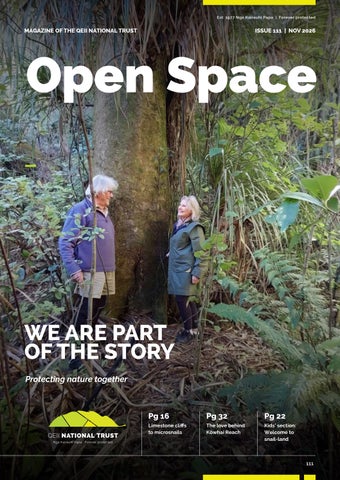
COVER IMAGE Dr Philip Simpson and Dr Wendy Parr with a mature pukatea tree in their newly protected covenant (page 16). Photo credit: Dr Philip Simpson
QUEEN ELIZABETH II NATIONAL TRUST is a statutory organisation independent from government and managed by a Board of Directors. We are a registered charitable entity under the Charities Act 2005. Registration number CC28488. BOARD OF DIRECTORS Chair Susan O’Regan, Debbie Hyland, Philip Hulme, Richard McDowell, Marie Taylor, Graham Mourie CHIEF EXECUTIVE Dan Coup T 04 472 6626 E dcoup@qeii.org.nz VICE REGAL PATRON Her Excellency, The Right Honourable Dame Cindy Kiro, GNZM, QSO, Governor-General of New Zealand OPEN SPACE™ is published by the Queen Elizabeth II National Trust, PO Box 3341, Wellington 6140, New Zealand. Level 4, 138 The Terrace, Wellington ISSN 1179-3880 (Print) ISSN 1179-3899 (Online) T 04 472 6626 E info@qeii.org.nz Design Pogo Design www.pogodesign.co.nz Editor Laura Dalby E editor@qeii.org.nz W qeiinationaltrust.org.nz
2
QEII NATIONAL TRUST OPEN SPACE ISSUE 111
CHAIR’S UPDATE
04
A word from QEII’s new chair
ENVELOPE PHOTO
05
Featuring one of your special protected places
DIGITAL SUBSCRIPTION
05
Readers can opt for a digital subscription of Open Space
OUR PROTECTED AREAS
06
See how your covenant fits into the landscape
QEII NATIONAL TRUST TURNS 50
07
Find out what’s happening in 2027
REMEMBERING OUR PEOPLE
08–11
Honouring the memory of Alan Livingston
HELPING OTHERS WEATHER THE STORMS 12–15 Support at the right moment makes a huge difference
NEW PROTECTED PLACES
16–21
Limestone cliffs and microsnails in Tākaka
KIDS
22–25
Welcome to snail-land
SPECIES FOCUS
26–27
Can you spot a forest ringlet butterfly?
A QUICK GUIDE TO INATURALIST
28–29
Take part in citizen science in your own backyard
OUR PEOPLE
30–31
Meet Lee Barry, regional representative for Wellington-Kāpiti
QEII GOOD FOLKS
32–35
Margie Ruddenklau and Southland’s Kōwhai Reach
GORDON WILLIAMS
36-37
The Tāne Mahuta of Pāmu
PROPERTY FOR SALE
38
8 Matfen Street, Oamaru and Mahakirau, Coromandel Peninsula
NEW COVENANTS
39–42
Newly registered covenants
REGIONAL REPRESENTATIVES
43
Contact details for our reps
16
You can update your contact details in the following ways: WEB:
qeii.org.nz, use the ‘Contact’ form on our website
POST:
PO Box 3341, Wellington 6140
EMAIL:
info@qeii.org.nz
PHONE: 04 472 6626
QEII NATIONAL TRUST OPEN SPACE ISSUE 111
3
A WORD FROM THE CHAIR
Chair’s update – A word from QEII’s new chair I am delighted to introduce the Open Space magazine for the first time in my role as the chair of QEII National Trust. To briefly introduce myself, I was born and raised in Waikato, where I now live with my family running an award-winning dairy farm, Judge Valley Dairies. I’ve worked as a family lawyer, served as mayor of Waipā and I’m currently also a Crown appointee on the Waikato River Authority. As I step into this new role, I also acknowledge that this is a time of loss and change with the passing of previous QEII chair Alan Livingston in April. Alan was a remarkable leader who I had the privilege of knowing. In fact, not only do I follow Alan into the role of QEII chair, but we have also both been mayor of Waipā. As you’ll read in Alan’s obituary piece (page 8), Alan is remembered at QEII as a committed leader, a great listener and genuinely kind person. I know that he will be very missed by everyone at QEII National Trust. Something that my predecessor Alan was working hard to secure was an increase in QEII’s baseline funding from the government. This is something I intend to keep working on wherever opportunity allows. QEII’s value in the conservation space can’t be overstated. Those familiar with QEII know that it’s a model that works, by working with people. But to continue to protect and enhance Aotearoa’s really special places on private land we need secure and sustainable funding. Even though QEII has had to reduce the number of covenants it approves each year due to funding constraints, there are still some incredible new sites being added to the over 5,000 QEII-protected places across the country. Behind each new covenant is a landowner who has, usually voluntarily, decided to put aside a piece of their land, to ensure it is protected forever. Dr Philip Simpson and Dr Wendy Parr from Tākaka, who protected a forest remnant on their land in June, are some of the most passionate people you’ll meet when it comes to their special part of the world and the things that live and grow there (including tiny snails). Have a read of their story on page 16. Inspired by Dr Philip Simpson’s interest in snails, we slip and slime into the world of
4
QEII NATIONAL TRUST OPEN SPACE ISSUE 111
Aotearoa’s land snails in our kids’ section on page 22. From ‘singing’ in trees to laying eggs out of their neck, snails have so many bizarre features and are incredibly important for the health of the ecosystems around us. The aftermath of a weather event is a devastating time as a landowner, with often a huge list of cleanup and repair jobs to do. As a farmer myself, I know that your covenant will be way down the list of priorities. Downed fences can leave protected sites wide open to browsing livestock, flood waters can bring weeds, and of course whole portions of a covenant can slip away or become unstable. Knowing that this is the stark reality faced by so many people, one individual decided to give QEII a generous donation to support covenant owners dealing with weather events (page 12). This is a great reminder that there are such kind people out there. In our Good Folks section on page 32, we meet Margie Ruddenklau and the community surrounding Kōwhai Reach in Southland. Margie’s grandfather, uncles, cousin and neighbours stood up for a special stream edged with kōwhai trees back in the 1930s. Today, Margie is a passionate force behind restoration of the protected site, bringing the community and her own children and grandchildren together to care for the place. I have to say, although there are difficulties to ride through at present, there’s a lot to look forward to at QEII. A big milestone for this plucky little organisation is just around the corner, with QEII turning 50 next year (find out more on page 7). Fifty years of helping people protect the preciousness of Aotearoa’s landscape is definitely worth celebrating, and I’m looking forward to sharing that celebration with you in 2027. I hope to see you at some of the events! Whether you’re picking up the Open Space magazine for the first time or the 111th time, I hope you enjoy reading this issue. Susan O’Regan Chair QEII National Trust
BEYOND THE FRAME – KĀEO, FAR NORTH
Kāeo, Far North KeriKeri Auckland
When you received your Open Space magazine in the post you might have noticed the photo on the envelope of a man looking up into the canopy of a forest. This is Bernie Buhler, owner of one of the newest QEII covenants in the country. Sitting just a few kilometres southeast of Kāeo, the lowland forest and wetlands at Bernie’s place are something special. The northern block of the site was grazed until 40 years ago, and with great care and dedicated pest control, recovery is slowly becoming evident in the forest layers. Bernie’s covenant, named Rakaurere, protects approximately 17 hectares of forest and different wetland types. The forest is rich with tōtara, pūriri, kahikatea, kauri and taraire, the wetlands full of raupō, whekī and Carex. North Island brown kiwi (Not Threatened), kauri snails (At Risk–Declining), longfin eel (At Risk–Declining) and banded kōkopu (At Risk–Declining) call this place home. QEII regional rep Mieke Kapa says Bernie loves his piece of land and is very happy to have it covenanted. “While there are some weeds to get rid of, Bernie loves seeing how his work is making positive change for his slice of paradise,” says Mieke. “He has bait stations and traps throughout the property that he manages and is very keen to see the positive impacts and increased bird life in the coming years. Having the property protected by a covenant means that all his hard work and improved habitat will benefit everyone around him and future landowners.”
Digital subscriptions for Open Space
ABOVE
Read the latest issue of Open Space whenever and wherever you want with our digital subscription option. Readers with a digital subscription will get email access to read the magazine online as soon as it is published. Back issues of Open Space can also be accessed on our website. To switch to a digital subscription, complete the digital subscription form on our website: bit.ly/qeiidigitalsubs
You can opt in or out of a digital subscription at any time. If you want to go back to getting a physical copy of Open Space, let us know online through our ‘contact us’ form or send us an email.
Bernie Buhler looks over the ephemeral water in his newly protected covenant in the Far North. Photo credit: Mieke Kapa
If you have any questions about the digital subscription or any other feedback about Open Space, email us at editor@qeii.org.nz. QEII NATIONAL TRUST OPEN SPACE ISSUE 111
5
IN VIEW – A NEW WAY TO SEE PROTECTED LAND
PROTECTED AREAS MAP NOW LIVE Did you know you can now see your covenant in a landscape context? In June this year, we launched a public map to show the current boundaries of QEII protected areas, QEII region boundaries and LINZ property title boundaries to help viewers to identify their own properties. Although we are yet to formally undertake a feedback survey, we’ve already been hearing that covenant owners have found the tool useful for visualising where their covenant sits in the larger network of protected areas.
To access the QEII-protected areas map, visit the Publications & Resources page on QEII’s website: qeiinationaltrust.org.nz/ publications-and-resources/ Click on ‘Map of our protected land’ to access the public map. If you have any questions or feedback for us about the new QEII-protected areas map, please contact us at gisadmin@qeii.org.nz
Note on landowner privacy: We have been very careful to ensure landowner privacy is respected by limiting the information that can be viewed on the public map. No ownership information or any other private information has been shared. Only information that is already publicly available appears on the map. It has been made very clear to users of the map that, in most cases, areas protected by QEII covenants are on private land with no public access.
6
QEII NATIONAL TRUST OPEN SPACE ISSUE 111
A REASON TO CELEBRATE It’s almost our birthday! 2027 is going to be an exciting year for QEII National Trust. We will be celebrating 50 years since QEII was formed in 1977. That’s 50 years of everyday people protecting the places that matter to them. 50 years of dedicated, hard work for the health of Aotearoa’s precious landscapes. 50 years well worth celebrating.
We have a surprise in store… In honour of QEII’s 50th year, we have been preparing something very special to mark this milestone. Without giving too much away, we will be celebrating the people and places that epitomise what QEII is all about. All will be revealed next year, so watch this space!
Bringing the party to you
Stay in touch
Who doesn’t love a birthday party? We’re inviting all owners of QEII covenants and local supporters to join us for events throughout the year and throughout the country.
Keep up to date with our 50th anniversary celebrations in 2027.
We will be holding at least one 50th celebration event in each of these regions:
Follow us on Facebook (www.facebook.com/ qeiinationaltrust) and Instagram (www.instagram.com/ qeiinattrust/)
• Northland
Watch out for our e-newsletters in your inbox. If you don’t already receive our e-newsletter, sign up on our website to get QEII news every few months: qeiinationaltrust.org.nz If you’ve changed addresses in the last six months or think we might have an old address, let us know at editor@qeii.org.nz.
• Auckland • Waikato
If you’re a covenant owner, QEII member or donor/supporter, you will receive an event invitation and further information closer to the time. If you have any questions about our 50th events, please email events@qeii.org.nz.
Share your memories and hopes for the future By design, a covenant is a promise from the past that will carry on beyond our lifetimes into the future. We want to hear what your covenant means to you. We invite you to ‘send a letter’ to your covenant (or covenants). To make it easy, you can fill in a letter template online or download a template and send it to us by email or post. You’re welcome to include a photo, old or new, of you and your protected site to go with your letter. With your permission, your letter and photo might be included in our Open Space magazines or shared on our social media platforms throughout the year.
• Taranaki • Bay of Plenty • Hawke’s Bay & Gisborne • Tararua & Manawatū-Whanganui • Wairarapa & Wellington • Marlborough & Nelson-Tasman
Want to give it a go? Head to our website using the link below or scan the QR code with your phone.
• West Coast • Canterbury • Otago
qeiinationaltrust.org.nz/ write-a-letter-toyour-covenant
• Southland QEII NATIONAL TRUST OPEN SPACE ISSUE 111
7
REMEMBERING OUR PEOPLE
A GENUINE LISTENER, A THOUGHTFUL LEADER Remembering Alan Livingston ONZM
8
QEII NATIONAL TRUST OPEN SPACE ISSUE 111
QEII National Trust was fortunate to have a leader like Alan Livingston on our board of directors. In April this year, Alan passed away unexpectedly at his home in Te Pahu, aged 74. We remember Alan’s life and the lasting impact he had on conservation in Aotearoa. Alan was born in Gisborne in 1952 and the following year his parents moved to the slopes of Mt Pirongia and began running a sheep and beef farm at Te Pahu. He attended Waitaki Boys’ High School before completing a BAgCom at Lincoln University. After time with the Rural Bank in Masterton and Whangārei, he and Janet returned to the family farm. Alan’s connection to QEII started in 1988, when he protected a beautiful block of their farm’s native bush with an open space covenant. The Trust was just over ten years old, and the block was the 97th QEII covenant in the country. A second covenant followed in 2004. He later said he had always thought bush blocks and gullies were an integral part of a farm: they were not going to produce much, so fence them off. As mayor of Waipā he carried that thinking into policy, continuing rates relief for covenanted land and introducing transferable titles for farmers who placed significant areas under permanent protection.
The former Waipā mayor and chair of Waikato Regional Council was appointed a QEII National Trust director in 2020 by then Minister of Conservation, Hon Eugenie Sage. In 2023 Alan was appointed chair and reappointed in 2025. Over the course of Alan’s service on the board, registered covenants grew by more than 600, despite ongoing challenges with government funding.
ABOVE
Kerikeri board meeting field trip in May 2022. Left to right: Alan Livingston, Karen Schumacher, Neil Cullen, Donna Field, Bruce Wills and Graham Mourie.
As a leader at QEII, Alan was genuinely passionate about the Trust’s mission and adept with people. Whether they were a farmer or a Minister, Alan found a way to connect. He was a great listener who cared about what other people had to say and made sure they got an opportunity to say it. Alan was a trustee of the Maungatautari Ecological Island Trust, a Crown appointee to the Waikato River Authority, and in 2014 was made an Officer of the New Zealand Order of Merit for services to sport and the community. He is survived by his wife Janet, their three children Anna, Megan and Andrew, and nine grandchildren.
QEII NATIONAL TRUST OPEN SPACE ISSUE 111
9
REMEMBERING OUR PEOPLE
BELOW
Board meeting field trip at Te Mata Peak, Hawke’s Bay March 2025. Left to right: Alan Livingston, Richard Bloomfield, Dan Coup, Donna Field, Graham Mourie, Troy Duncan, Karen Schumacher, Deirdre Parag, Marie Taylor, Richard McDowell, Bruno Chambers and Jane Strachan
10
QEII CEO, Dan Coup, remembers Alan as gentlemanly, very caring, but firm in his values and convictions. “He had time and patience for everyone. He would engage and actually listen. Whatever your background or viewpoint, he cared what you had to say. And he solved a lot of problems that way – where me or others saw conflict or trouble, Alan would say, ‘well, let’s go and talk to them’ and he would usually gain some sort of mutual understanding with people – mostly just by listening. He would seem just as comfortable making a speech to a room of a hundred people as he was nattering to the cocky about tailing and the weather.
QEII NATIONAL TRUST OPEN SPACE ISSUE 111
“Alan’s skills as a leader had obviously been gained over a long career, and we were very fortunate that he had a passion for QEII and its work that led him to take on the chair role here at a time of his life that others might have been wanting to be a bit more ‘retired’. I’d never met Alan when his appointment to the board was announced, but recall getting several emails and one very excited phone call from a Waikato covenantor letting me know that we were getting a good one. We did. Alan was a good man, a good chair and a good boss. I miss him very much.”
Our memories of Alan I first met Alan and Janet as covenantors in my area, before Alan came onto the board. I knew he had been Waipā District mayor and was currently chair of Waikato Regional Council, so I was expecting I’d need to be on my best behaviour. But I was immediately put at ease. I found myself conversing with this person who was genuinely interested in my visit and wanted to know more about the Trust and how it was doing. And that was Alan. I later learned of his plethora of achievements, working with people at the highest level, but he always made me feel a bit special. Always made a point of greeting me with his farmer handshake and big grin... and a question or two. He was a busy man, but when he came onto the board he said to me as one of his local reps, ‘if there’s ever anything you want me to attend, let me know. I’m keen to be involved’. And I did and we did. He was great company. I miss him. – Robbie Bennett, previous regional representative for Waikato Alan was one of those people who genuinely listened. Whenever you spoke to him, he gave you his full attention and it was clear he was interested. QEII has benefitted from his calm and steady leadership. He was a gentleman and a strong advocate for nature. Moe mai rā e te rangatira. – Jesse Bythell, regional representative for Southland Alan Livingston was a respected leader and a much-loved member of the Waipā and wider Waikato community. Throughout his life, Alan was deeply committed to the region and to the people who called it home. He
was known for listening carefully, valuing different perspectives, and taking the time to understand the issues before making decisions. Alan leaves behind a legacy of thoughtful leadership, enduring relationships, and a strong foundation for those who follow. Alan’s passing was deeply felt by the many people whose lives he touched, including mine. I grew up in the same community as Alan, and he supported me in many ways over the years. We miss him... – Melissa Sinton, regional representative for Waitomo, North Taranaki and Ruapehu As chair of the QEII National Trust, Alan provided calm, thoughtful leadership through a period of significant financial pressures and important strategic decisions. He never sought to impose a viewpoint, instead taking the time to canvass opinions, listen carefully to different perspectives, and build consensus around the board table. His inclusive approach fostered a strong sense of collective responsibility, ensuring the board worked as a cohesive team in support of QEII and its mission. Beyond the boardroom, Alan was one of QEII’s most effective ambassadors. Whether meeting covenantors on their properties during field trips or engaging with partner organisations, he had a remarkable ability to connect with people, earning trust through genuine interest, respect, and authenticity. Those of us privileged to serve alongside Alan on the board will remember his dedication, sound judgement, generosity of spirit, and unwavering belief that conservation succeeds when people work together.
FACING PAGE, TOP LEFT
Alan was known as an excellent listener who had time and patience for everyone. FACING PAGE, TOP RIGHT
Alan and Laura Dalby passing a rugby ball with Dan Coup and Graham Mourie (not pictured) at a board meeting in Akaroa in May 2025. ABOVE
Alan signing the Aroha Island lease with Tiwai Rawiri in 2024.
– Philip Hulme, QEII Board Director
QEII NATIONAL TRUST OPEN SPACE ISSUE 111
11
REAL IMPACT – SUPPORT AFTER WEATHER EVENTS
HELPING OTHERS WEATHER THE STORMS Conservation doesn’t stop when disaster strikes. But it’s often at the bottom of the list when you’ve suffered widespread damage.
12
QEII NATIONAL TRUST OPEN SPACE ISSUE 111
One generous QEII donor knows first-hand the challenges that follow severe weather. Experiencing damage on their own property, they know that recovery efforts can very easily consume energy, time and resources. They know that for many landowners, their covenant will – at least temporarily – fall towards the bottom of the list of priorities. Access roads need clearing. Fences need rebuilding. Water systems need repairing. Livestock need to be cared for. When prioritising recovering homes, farms and livelihoods, even the most dedicated landowners can find their conservation work temporarily pushed aside. It is in these moments that support can make all the difference.
Thanks to this donor, QEII has been able to provide targeted support to covenantors recovering from significant weather events. The impact of this donation can be seen across the country, helping landowners restore access, repair damage, and continue the stewardship of their covenants. After some discussion about the best way to distribute and use the donation, the most efficient and effective option was to increase the discretionary budget of QEII reps in the areas most affected.
being out on the chainsaw after the storm - this was in early March and he still couldn’t drive to the house. I called and got the full story.” Ian and his partner Merryl experienced a devastating wind event that transformed their driveway, which runs directly through the covenant, into what he described as a giant game of pick-up sticks. Around 50 mature trees were blown down across the accessway to his home. Many of these trees were uprooted entirely and tangled together.
QEII’s Wellington-Kāpiti rep Lee Barry found one of her recipients almost accidentally.
What followed was three weeks of non-stop chainsaw work.
“Ian and I were speaking via text about the collection of neighbouring covenants that has grown up around his own long-protected areas. He happened to mention many days
From dawn ‘til dusk, Ian carefully cut and cleared fallen trees with a chainsaw. A slip added another obstacle. Elsewhere on the property, fences were damaged, a stock water
BEFORE
AFTER
QEII covenant at Ken’s place before the slip. Supplied: Ken Haywood
The bluff collapsed into the paddock below, taking part of the covenant with it. Supplied: Ken Haywood
QEII NATIONAL TRUST OPEN SPACE ISSUE 111
13
REAL IMPACT – SUPPORT AFTER WEATHER EVENTS
pump was destroyed, and normal farming operations were disrupted. Because Ian works as a contractor, every day spent clearing storm damage was a day he was unable to spend earning an income. The impact extended far beyond the farm. To start with, Merryl was unable to leave the property for work. Eventually, they managed to get one of their vehicles out across the neighbour’s property, but her daily commute still involved travelling by quad bike, climbing over slips and fallen trees, and changing clothes before heading to work. Even simple tasks like buying groceries became complicated. Meanwhile, conservation work that would normally have been taking place stopped entirely. Predator traps along the driveway could not be serviced and some of them were damaged. The donation helped pay for a day of digger hire and some gravel to complete the final repairs needed to restore the access to their property. After weeks of physically demanding work, that single day with a digger removed massive stumps, restored the driveway and brought the return of normal daily life. The financial support did not erase the challenges of the storm, but it helped restore normality and freed up time and energy that could once again be directed toward conservation and community. QEII rep Lee Barry totally understood the impact restoring access through the covenant would have. “I’m really stoked we could assist Ian and Merryl in this way – they do so much highly specialised and valuable conservation work both inside their covenants and further afield.”
Further north near Waitomo, another covenantor, Ken, faced a different kind of challenge. Following prolonged periods of severe weather, slips and flooding caused extensive damage throughout the district. Roads, bridges and farms were affected, and demand for machinery far exceeded availability. On Ken’s property, multiple slips damaged fence lines and a stock bridge was washed away. Despite the damage, he considered himself fortunate. Then came a rumble in the early hours of the morning. An enormous bluff collapsed into the paddock below, taking part of a covenant with it. Fencing was left hanging over the edge of the slip and it needed to be stock-proofed as soon as possible. A neighbour helped put in temporary fencing, but permanent repairs would have to wait. Across the region, contractors and machinery were already committed to emergency work elsewhere. It was months before a digger became available. The effects of the storm were felt across the farm. Access routes were cut off, stock movement became difficult, and there is still uncertainty about stock losses within the affected paddock. The financial support Ken received covered only a fraction of the overall repair costs, but its value went beyond the dollar amount. For Ken, the recognition that they had suffered damage was invaluable. “Every little bit helps,” and knowing there was someone in the QEII community who cared made a difference. The funding he received helped ensure repairs could be completed to a higher standard, rather than temporary fixes that would need attention again later.
These stories highlight an important truth about conservation. The success of QEII’s covenant network depends not only on the land itself, but on the people who care for it. Across Aotearoa, thousands of covenantors invest their time, expertise and personal resources into protecting the precious biodiversity that exists on their piece of land. When unexpected events place additional pressure on those people, even relatively small amounts of financial support have an impact. For Ian, it was the final push needed to restore access to his home. For Ken, it ensured that repairs were done properly after a significant landscapescale event. The donor behind this impact will likely never meet the covenantors they have helped. But the effects of their generosity can be seen in repaired fences, restored accessways and, ultimately, in the continued protection of biodiversity across Aotearoa. Sometimes the most meaningful conservation outcomes come from a practical act of support at the moment it is needed most. Even a small gift can make a big impact.
Make a difference today. Your support matters. Visit our website to donate:
qeiinationaltrust.org.nz/ donation/
RIGHT
14
QEII NATIONAL TRUST OPEN SPACE ISSUE 111
Thanks to the support of a donor, Ian was able to hire a digger to finally restore access to their property. Photo credit: Ian Flux
QEII NATIONAL TRUST OPEN SPACE ISSUE 111
15
NEW PROTECTED PLACES
FROM LIMESTONE CLIFFS TO MICROSNAILS
16
QEII NATIONAL TRUST OPEN SPACE ISSUE 111
Tākaka
Nelson
Botanist and author Dr Philip Simpson and wife Dr Wendy Parr have recently taken the first few steps on the journey of securing QEII protection for their incredibly precious three and a half hectares of forest in Tākaka. Talking to them, it’s clear they have a great love for this place.
QEII NATIONAL TRUST OPEN SPACE ISSUE 111
17
NEW PROTECTED PLACES
If you were a kererū flying above Philip and Wendy’s place in Pōhara, Tākaka, you would see the spine of limestone running down the middle from North to South. One side dim and moist, a place of ferns and mosses; the other bright, dry and hot, where light-loving plants like the Tākaka kōwhai have made their home. “We call it a ‘reef’, but it’s not really a reef,” says Philip. “It formed in the sea, uplifted and was tilted on its side by earthquakes because of the (Pikikiruna) fault. The actual limestone reef is exceptionally steep, some vertical cliffs. The streams that flow into the side of the reef disappear into the ground underneath.” Pōhara has been home to Philip and Wendy for 30 years. “This is an exceptionally beautiful place,” says Philip. “The view outside my window is phenomenally stunning. It’s got the houses, and then the rātā forest by the coast, someone has a covenant in front of us and then the beautiful blue sea forming Golden Bay or Mohua, and beyond that Kahurangi including Mt Burnett.”
Close up of dwarf mistletoe (Korthalsella lindsayi). Photo credit: Shannel Courtney
“ While this place is not pristine indigenous bush, it’s going to become that way in time if it’s left alone from further disturbance and if some of the weedy species can be slowly removed. We’re just part of the story.”
Dr Philip explains that while they ‘own’ the land in a legal sense, they don’t really see themselves as owning it. “Even though we can do what we like, we want nature to be sustained. It’s a remnant of the bush that was once widespread across the eastern part of the Tākaka region, a little fragment of the diversity that was once here, so we want to make sure that’s maintained.” Both Philip and Wendy have noticed the changes around them in the 30 years they’ve lived here. Wendy has watched the area become systematically built up. “My interest in having the covenant is protecting the birdlife, which is extensive here: kea, kererū, bellbird, tūī... They’re going to be pushed to the edge with all the building going on here.” Over the years, the sunny seaward-facing slope has gradually changed from a mosaic of grass, gorse, barberry and some natives to the beginnings of a solid canopy. “While this place is not pristine indigenous bush, it’s going to become that way in time if it’s left alone from further disturbance and if some of the weedy species can be slowly removed. We’re just part of the story,” Philip says. In June, the forest on Wendy and Philip’s property was approved as one of the 67 new QEII covenants in Aotearoa this year, adding to the network of existing protection in the area. Tom Stein, QEII rep for NelsonTasman and Marlborough, is glad Philip and Wendy got in touch about their special site. “Although we’re facing constraints on how many new covenants we can add to the network of QEII-protected places each year, I’m very pleased that this one made it through. Knowing that this covenant will protect a rare and endangered limestone ecosystem, along with all the Threatened and At Risk species that depend on the health of the habitat, that’s really satisfying to see as a rep.”
PREVIOUS PAGE
View of Pōhara Valley and Mohua from covenant, limestone mahoe on right. Photo credit: Dr Philip Simpson RIGHT
Dr Philip Simpson with the towering limestone bluffs. Photo credit: Tom Stein
18
QEII NATIONAL TRUST OPEN SPACE ISSUE 111
Philip says that at 80, he “can’t run around in the hills anymore” and is mindful that there will come a time when the two of them will move on. “We just don’t want to leave it to the open market. We don’t know what (the new owner’s) plans will be. We don’t know if it would be converted to farmland or houses. We want to leave it in a better state. We want to leave a legacy from our tenure here.” When asked if there were species in the covenant close to his heart, Philip’s response was a resounding “very much so!”. From the towering pukatea trees on the wet valley floor and the specially adapted limestone plants, to impossibly tiny snails in the soils below and the flow of birdlife above, Philip knows them all well.
Covenant snapshot DATE APPROVED:
June 2026
AREA PROTECTED: 3.5 ha LANDSCAPE TYPE: Coastal modified primary and secondary forests and limestone ridge and bluff systems JUST A FEW OF THE RESIDENTS: Limestone kōwhai (Sophora longicarinata) (At Risk – Naturally Uncommon) Limestone mahoe (Melicytus obovatus) (At Risk – Declining) Limestone three finger (Pseudopanax macintyrei) (At Risk – Naturally Uncommon) White rātā (Metrosideros colensoi) (Not Threatened) Dwarf mistletoe (Korthalsella clavata) (At Risk – Declining) Pukatea (Laurelia novae-zelandiae) (Not Threatened) Kea (Nestor notabilis) (Nationally Endangered) Miromiro | Tomtit (Petroica macrocephala) (Not Threatened) Kārearea | NZ falcon (Falco novaeseelandiae) (Recovering) Pīpīwharauroa | Shining cuckoo (Chrysococcyx lucidus) (Not Threatened) Tawhana | Giant springtail (Holacanthella duospinosa) Land snails (Rhytida greenwoodi webbi and Cavellia spp) Bristly microsnail (Kokopapa unispathulata) (mainly limestone)
QEII NATIONAL TRUST OPEN SPACE ISSUE 111
19
NEW PROTECTED PLACES
Bristly microsnail (Kokopapa unispathulata) BELOW
Snails from a soil sample taken from Philip and Wendy’s new covenant. Photo credit: Dr Philip Simpson
“There are some species that are strictly limestone endemic species to the Tākaka region. The best known of these is the kōwhai (Sophora longicarinata). It’s a species of kōwhai with a very small leaflets which suggests adaptation to potential of drought introduced by its limestone habitat... It’s in flower at the moment and a very valuable species for the local kererū and tūī who respectively feed on buds and nectar.”
“ I look at samples of soil under the microscope, and I see the most astonishing organisms. There’s a tremendous diversity of life on the ground that we know little about. Our covenant is a place where these species will survive.”
20
QEII NATIONAL TRUST OPEN SPACE ISSUE 111
There are also little mistletoes, called Korthalsella, growing on a small-leaved myrtle. “They’re very tiny,” says Philip, “only a couple of centimetres across and very hard to see. Amazingly we’ve got two species here: Korthalsella clavata and K. lindsayi. This is one of the only places in the Tākaka valley that these little mistletoes grow. You get these strange, unusual features that are locally rare, but made even rarer in that we’re talking about a remnant of vegetation.” Of course, there’s no single species that makes this place special and unique, but as Philip points out, the overall diversity of the site is exciting. “There are six species of tree fern in the covenant. For an area of less than four hectares, they’re magnificent, and very important habitats.” Philip says he’s “got a bit of a fetish about bush snails… They’re spectacular in their beauty but minute: I have to study them under a binoc microscope. People who know about these snails, know our covenant has snails that are found only on limestone areas and only on the eastern side of the Tākaka valley.”
Philip hopes that the covenant will foster the biodiversity that the snails depend on. The biggest threats to ground snails are removal of their habitat, trampling by stock and predators like mice. “How does an 80-year-old catch mice? I’m going to have to rely on the expertise of someone else,” says Philip. “By placing a covenant, drawing attention to the uniqueness brings in the experts, workers and funding to get rid of rats, mice, stoats and possums.” Philip says his vision for their protected site’s future is an intact ecosystem: all the plant levels and all the fauna present, down to the invertebrates, earthworms and snails. “I look at samples of soil under the microscope, and I see the most astonishing organisms. There’s a tremendous diversity of life on the ground that we know little about. Our covenant is a place where these species will survive.” But Philip stresses these species can’t survive as an isolated remnant into the distant future, they need more places. “I want to see our place as part of a network of natural areas through this landscape. It’s been devastated by our history. We’re going to contribute to reversing that process and bringing the biodiversity back to this special place.” “It’s marvellous to have a vehicle like QEII to put it on the land title, to have a long-term vision of it. I just think it’s a marvellous opportunity. I feel very proud that Wendy and I can do this, to leave a legacy of biodiversity for the future.”
“ I just think it’s a marvellous opportunity. I feel very proud that Wendy and I can do this, to leave a legacy of the biodiversity for the future.”
BELOW LEFT
Female mahoe (Melicytus obovatus) on a hot, exposed limestone talus. The talus is habitat to three species of lizard, thought to be possible dispersers of the white/ purple blotched fruit. Photo credit: Dr Philip Simpson BELOW RIGHT
Limestone mahoe (M. obovatus) in flower. Photo credit: Dr Philip Simpson
QEII NATIONAL TRUST OPEN SPACE ISSUE 111
21
KIDS’ SECTION – LAND SNAILS
PAGE TITLE – SUBTITLE
Welcome to snail-land Ngā ngata. Our land snails. How can we describe them? Slimy? Slow? Shelly? Sure! But they’re so much more, as well! How about…colourful...carnivorous. Even cannibalistic! Striped, swirled, hairy, humongous, turreted, toothy, musical, miniscule, beautiful, bountiful. Enigmatic, endangered, unique…undiscovered! Aotearoa is thought to be home to around 800 species of land snails living alongside us. It’s hard to get an exact estimate though, because we simply haven’t properly observed most of them. This is partly because many of them are extraordinarily small microsnails. A ‘large’ microsnail might be 4 to 5 millimetres across, but a lot of them are under one millimetre. That’s like a grain of sand! Then there are our BIG beauties - giant snails (like kauri snails or flax snails) with shells that can measure around 9 centimetres long. They can live for up to 20 years! Some of our snail species hold the same endangered status as the beloved kākāpō and are rarer than the iconic kiwi. Slither along with us to find out more about our special snails, and what we can do to protect these taonga species…
You can see here one of our beautiful giant snails (Powelliphanta augusta) compared to one of our many microsnails. The size difference is pretty extreme!
22
QEII NATIONAL TRUST OPEN SPACE ISSUE 111
Ssssssnail soundssssssssss…. Have you ever heard a snail? If you have a māra kai/food garden, you might be able to hear introduced common garden snails (Cornu aspersum) nibbling on your vegetables during damp nights. It’s a quiet, wet, scraping sound. But there’s another, stranger sound certain native ngata became known for within parts of te ao Māori. For the Ngāti Kuri iwi of Te Hiku o Te Ika (the Far North), pūpū harakeke/ flax snails (Placostylus species) acted as a unique type of guardian. In fact, they have been honoured with a second, special name: ‘pūpū whakarongotauā’. This means ‘the snail who listens for war parties’. They are known to have alerted a Ngāti Kuri group to invaders with the loud sucking sound they created by tucking their soft bodies into the safety of their shells upon being disturbed by invading warriors. In this way they saved the lives of sleeping locals! The empty shells of this species later become beloved as taonga pūoro - singing treasures/instruments. You can hear these and other shell instruments at taongapuoro.nz. Another snail, the pūpūrangi (Paryphanta species) holds a story within its name. Pūpū means snail, rangi can mean ‘sky’ or ‘air’, but it can also mean ‘tune’ or ‘melody’. The pūpūrangi are otherwise known as kauri snails - giants of our northern forests. They are nocturnal (active during te pō/nightime). During the day they conceal themselves in hiding places like leaf litter and logs. Young snails sometimes even climb into the branches of rākau/trees. Under just the right conditions, something wonderful is said to happen; pūpūrangi make the trees sing! When these large snails tuck themselves tightly away with the lips of their shells turned to the direction of the wind - or when they have died and their shells become empty - te hau/the wind can create a whistling melody as it brushes against them (kind of like the sound made by blowing over the top of a glass bottle). Tangata whenua noticed this long ago and added pūpūrangi to their collection of taonga pūoro.
Ngata anatomy Snails belong to a large, ancient group of soft-bodied beings known as molluscs, which evolved hundreds of millions of years ago. Snails are also in the same class of creatures as their close relatives, the slugs – gastropods. Some gastropods made their way out of the water in the distant past, to live on land. This term ‘gastropod’ comes from the Greek words ‘gaster’ (meaning stomach) and ‘podus’ (meaning foot). It refers to the unique type of movement they have developed over millions of years, which works well both in water or on land; sliding on a muscular ‘foot’ which looks like their belly but contains no organs.
Ngata/snails are assisted on their journeys by a thick oozy slime (or mucus) which they can change depending on the task at hand. It can be sticky – this helps them to adhere to steep or smooth surfaces or even move upside down! It can be sleek – creating a slippery slide for them to move along with less friction. It can be foamy – with bubbles that help protect them from predators. It can be thick and sticky - this makes them difficult (and rather yucky) to eat. It also protects their bodies’ soft surface from damage. Yet another trick some snails have is being able to make an epiphragm. They can make a ‘door’ of dried mucus to shut the world out when it’s all too much! This door can be papery and thin, or thick and chalky depending on the circumstances. It is used to seal in the moisture they need to survive when the weather outside is dry and hot, or to keep them snug when it is freezing outdoors – and it keeps out little beasties that may try to eat them while the ngata are resting.
Additionally, in NZ’s ‘snail-land’ there is no such thing as a lady or a gentleman - snails are hermaphrodites, meaning they have both male and female organs. When they find a partner, some snails compete to play the ‘male’ role, which means that they don’t have to carry an egg (which takes a lot of energy - just ask a mum near you)! They each try to ‘shoot’ each other straight into the flesh with a ‘love dart’. Doesn’t sound very nice! However, some snails will spend up to 12 hours getting to know their buddy before any love darts get shot. This ‘date’ involves a slow snailsamba… a special kind of boogie on a dance floor of slime. In the diagram here you can see how land snails’ bodies are generally arranged: in a spiraling collection of organs that twist and grow along with their whirled shells. This growth pattern is known as ‘torsion’. It is unique within the animal kingdom and creates some interesting conundrums!
Some snails politely exchange ‘packages’ which they can each use in their own time to fertilise their own eggs. Some of our endemic snails are so rare they may not always be able to find a mate, so they have developed the ability to fertilise themselves. This means that they can grow eggs without even having to meet another snail. No lovedart battles or ‘snail mail’ packages need to be swapped. Very independent!
Mollusc ‘manners’ are quite different to our own; in snailland, the poo hole (anus) can be right next to the breathing hole, which is by the head. Eggs are laid from the neck!
QEII NATIONAL TRUST OPEN SPACE ISSUE 111
23
KIDS’ SECTION PAGE TITLE – SUBTITLE– LAND SNAILS
Snail kai Ngahere, the Māori word for forest means ‘the binding’; everything within our forest system is bound together like a great weaving or net. The more strength each part has, the greater the strength of the whole forest is... including the tiniest of our snails! Different snails have different roles to play, and we can see this partly by looking at what they eat. Our gigantic ngata (like the Powelliphanta species and kauri snails) are usually carnivores: predators, who hunt and eat other animals to help maintain their amazing size and beautiful shells. Enormous earthworms play a big part in their diet, but they will eat other invertebrates,
too – even other snails sometimes. Imagine the slow-motion horror of a snail chase! Most microsnails play a completely different role in our ecosystems. They are not predators, and many don’t eat living plants either. Instead, these snails are detritivores, feeding on dead matter like old leaves as well as fungi, lichen, algae and bacteria. These snails are decomposers, playing a very important part in forest life. Without decomposers, dead or dying parts of te ngahere such as bark, wood, leaves and animal bodies would not rot. Dead things would pile up, making it hard for new plants to grow or spreading disease. Without
A healthy forest floor isn’t lifeless it is food! A rich layer of bits of old plants and animals and even poo that decomposers turn into beautiful ‘duff’ and soil. We humans often need our food to be cooked so that we can get the most nutrients out of it. Forest plants need decomposers to ‘cook’ their food by predigesting it (eating it and then pooing it out). Yum!!!
So…if there are 800 known different varieties of native land snails lurking around Aotearoa…where are they???
Snails use their ‘radula’ to scrape their food into their mouths.
A ‘radula’ looks somewhat like a tongue…except that it is covered in teeth. Thousands of them! These special teeth are called ‘denticles’. Like sharks, snails grow new teeth/denticles as the old ones wear out.
24
decomposers, the energy from dead matter would not be recycled back into the life cycle of the forest. Creatures like microsnails have the amazing ability to turn something that seems lifeless into food and energy that other plants and creatures can use.
QEII NATIONAL TRUST OPEN SPACE ISSUE 111
Well, because most of our ngata are extremely small, they can be tricky to spot without a microscope. A lot of snails are nocturnal too, hiding away in secret spots during the daytime. They are also very sensitive to changes in the environment around them. Many thrive in moist, temperate (not super hot and not freezing cold) places where there is plenty of food and few predators. They are most likely to be found in areas of native forest where introduced pests are well controlled, and where the many different layers of the ngahere are healthy, keeping the temperature and moisture levels just right for their needs. Native snails can be seen as indicators of te taiao/the environment having mauri - the essential spark of vitality which means that nature can thrive.
Our thanks to Sky Smale for content and illustrations.
Healthy forests are a great place to start looking for native snails! A few years ago, a biodiversity ranger working near Te Kuiti found 84 different species of native micro-snails lurking within a few shopping bags worth of leaf litter during a monitoring project. You could find microsnails, too; you might even discover species unknown to science! You can go to NZ Mollusca online to help you identify microsnails (look in their land snail sections) or you can upload photos and locations of your finds to iNaturalist NZ to help you with identification and contribute to citizen science at the same time!
KIMI KUPU / WORD FIND
The work of conservation-minded communities and whānau like yours can help to keep Aotearoa a safe, happy place for ngata to live their best lives.
Now that you’ve tuned your eyes into looking for microsnails, can you find some of these kupu relating to our ngata?
Planting and protecting trees, keeping livestock (like deer, pigs and goats) fenced out of forests, and trapping the pests that eat our snails (like possums and rats) are great ways to be a snail saviour!
Can you use your keen eyes to identify how many pairs of different native microsnails are in the image below?
Ngata – Te reo Māori word for snail or slug. Pūpū – Te reo Māori word for seasnail, however it can also refer to some of our land snails. Microsnail – Land snails with shells that are usually less than five millimetres across. Mollusc – A group of soft-bodied animals that do not have a backbone. They often have hard shells and a muscular ‘foot’. Gastropod – A type of mollusc. Snails and slugs are all gastropods. Radula – A ribbon-like structure (similar to a tongue) which is covered in teeth. Mucus – A slimy fluid that snails can secrete (release from their bodies). Torsion – The unique way in which a snail’s internal organs bend and twist as their shells grow. Duff – The spongy layer of decaying leaves, twigs and other natural matter on the floor of a healthy forest. Detritus – Dead organic matter like decaying plant parts and animal waste. Decomposer – A living thing that breaks down dead plants, animals and other waste, recycling nutrients back into the environment. Mauri – The vital life force and energy that holds together a healthy environment (including the people who live in or care for that environment). QEII NATIONAL TRUST OPEN SPACE ISSUE 111
25
SPECIES FOCUS – FOREST RINGLET
LEARNING TO SEE THE FOREST RINGLET (DODONIDIA HELMSII)
Auckland Coromandel Peninsula
Words and images by Sara Smerdon & Andy Barker Hidden in plain sight Sometimes the easiest way to find a forest ringlet is not to look for the butterfly at all. A distinctive notch cut along the edge of a sedge leaf can be the first clue that one of Aotearoa’s rarest beauties is quietly going about its life nearby. Look more closely and there may be a tiny egg tucked beneath a leaf, an extraordinarily well-camouflaged caterpillar, or perhaps a cryptic pupa suspended amongst the vegetation. Mahakirau Sanctuary on the Coromandel Peninsula encompasses 580 hectares of privately owned native forest, protected through QEII and cared for collectively by its landowners. More than two decades of predator control, biodiversity monitoring and research have made the forest something of a living laboratory – although much of what we learn still begins very simply: by looking closely.
26
Some species may be around us all the time yet remain completely unnoticed. This is especially true of insects, and even something as beautiful and eye-catching as the forest ringlet may go unseen and unrecorded for decades. It was not until November 2011 that the species was first noted at Mahakirau. Since then, interest has grown, with several covenantors now involved in recording and monitoring the species.
Piecing together a life The forest ringlet is currently classified as Threatened—Nationally Vulnerable. Once considerably more widespread, populations are now fragmented, and much remains unknown about the species. Much of what we have learned has grown from an unusual longdistance research partnership. Andy Barker, a passionate volunteer with a particular fascination for forest ringlets, is based in the UK, while at
QEII NATIONAL TRUST OPEN SPACE ISSUE 111
Mahakirau we provide the eyes on the ground – observing, photographing and recording what is happening through the seasons. Together, those field observations and analysis have allowed patterns to emerge that individual sightings could never reveal. Over more than a decade, and through more than 1,000 recorded observations, we have gradually pieced together the butterfly’s life in remarkable detail. Forest ringlet caterpillars feed on several species of native sedge and tussock across Aotearoa. At Mahakirau, their principal host is Gahnia pauciflora, but if you’re in any area of native forest with Gahnia or Chionochloa species present, it’s well worth having a look for evidence of feeding damage. The caterpillars feed along the leaf edge, leaving characteristic elongated notches running parallel with the veins - often easier to spot than the caterpillar itself. The place to look is on the youngest, most tender leaves. If
the cut edge hasn’t yet browned, you’ll know the browse is recent. Once you learn that little clue, a sedge can become difficult to walk past without checking. The life stages themselves reward closer inspection. Eggs are tiny and generally laid singly beneath leaves. Newly hatched larvae are minute, while older caterpillars become beautifully adapted to disappear against their food plant. They progress through five larval stages before pupating, eventually emerging as the splendid adult butterfly. And then suddenly the tiny caterpillar we have spent months finding is on the wing.
caterpillars – the first published record of this association. It was an alarming discovery and another reminder of the complexity of forest ecosystems, and how much remains hidden within the ecology of a threatened species.
Making your sightings count For covenant owners who already know the rhythms and details of their own patch, forest ringlets offer another intriguing set of clues to watch for. A freshly notched sedge leaf, a fork-tailed caterpillar or an erratically flying butterfly with a flash of orange may be worth a closer look – and a photograph. Records shared through iNaturalist can help add another piece to the wider picture of where forest ringlets persist across Aotearoa.
They have a distinctive flight relatively fast, jerky bursts through sunny openings and vegetation before settling again. The precise timing of the flight period is very much dependent on latitude, altitude, aspect and local climate, so what we observe in the Coromandel will not necessarily be what a covenant owner sees further south or at higher elevation.
That, for us, is one of the great pleasures of knowing a protected place over time. The better we know it, the more attuned we become to small changes and new discoveries – and the forest continues to surprise us.
New discoveries uncovered
And knowledge becomes more powerful when shared.
Protecting land creates continuity. Continuity enables observation. Observation creates knowledge.
Close observation has also revealed less-welcome relationships. Parasitoids (parasites that live within a host, eventually consuming it from the inside) have long been known to affect forest ringlet eggs and larvae, but our Mahakirau research has identified an introduced parasitoid wasp, Meteorus pulchricornis, attacking forest ringlet
CLOCKWISE FROM TOP LEFT OF FACING PAGE
Forest ringlet butterfly
To DISCOVER MORE about forest ringlet identification, life stages, host plants and research, visit the resources page; download: Forest Ringlet butterfly report (Barker.Smerdon.2024) at www.mahakirau.co.nz
Forest ringlet egg Forest ringlet larva Forest ringlet caterpillar An example of a sedge (foreground) where you might spot evidence of forest ringlet caterpillars or eggs.
QEII NATIONAL TRUST OPEN SPACE ISSUE 111
27
TIPS AND TRICKS – USING INATURALIST
INATURALIST FOR QEII COVENANTORS Words from QEII rep Tom Stein
In this modern era where social media and AI are often seen as the root of all evil, it is nice to know that sometimes they can be a big help in increasing our knowledge and enjoyment of the natural world. iNaturalist NZ - Mātaki Taiao (iNat) is a very handy tool that is of benefit to covenantors, researchers and the wider science community in general. iNat has been around for a few years now and many of you will be familiar with it or even avid users. For those who are yet to take the plunge, here is a brief outline of what iNat is and some of the cool stuff you can do with it as you get proficient. iNat is a website and a phone app that allows you to download a photograph (or sound recording) of any living organism. If you don’t already know what the organism is, it will identify it almost instantly using its specially designed AI. This identification must then be confirmed by two of the tens of thousands of registered human users in NZ or the several million human users from overseas. At this point
28
QEII NATIONAL TRUST OPEN SPACE ISSUE 111
it can be referred to as “research grade”. iNat is very aware of the need to protect threatened species and so all threatened species have their exact locations obscured to other users. For those of us with an interest in the natural world this is where the fun begins. You can “collect” records of species from your travels in Aotearoa and throughout the world, and you no longer have to carry bulky guidebooks to know what it is you are looking at. You can set up projects in specific areas (such as your QEII covenant) that will produce a record of every species that has been recorded there. In my small (but perfectly formed) QEII covenant of less than a hectare in the Marlborough Sounds, I have recorded 235 species of living organism over the last few years. And those are just the ones I can photograph.
As you gain confidence you can become an identifier and help identify some of the photos (and sounds) that other people have entered into iNat. To get the most out of iNat there are some things that you need to ensure you do. • Tools: You need a camera or smartphone with a camera or a sound recorder. • Photos: Only post photos that are in focus and preferably centred on the thing you want identified. If you can, post two or three photos from different angles. With plants and ferns, try to photograph both sides of leaves and any spores, flowers or seed heads that are present. It is useful to have close-up as well as context photos. • Sound recording: If you are posting a sound recording, listen to it before you post it to make sure it is loud enough and that your companion isn’t talking over it.
• Take a guess if you can: Remember you can only have one species per iNat record identified. Make sure you have a go at the identity either using the AI function or making a guess. Even saying it is a bird or a spider or a fern is better than leaving the name blank. If you leave the name blank it goes into the great unknown hole where few identifiers dare to traverse. As an iNaturalist user, over time I have started to look a lot closer at the tiny life forms and realise that there is so much life out there that isn’t birds and trees and am now more in awe of the natural world than ever before.
iNaturalist.NZ can be found at www. inaturalist.nz. Detailed instructions on how to use it are at www.inaturalist.nz/ pages/add-an-observation-nz.
QEII NATIONAL TRUST OPEN SPACE ISSUE 111
29
PAGE TITLE – –SUBTITLE OUR PEOPLE WELLINGTON-KĀPITI REP
“ I want to become each covenantor’s partner in caring for and managing their area.”
MORE TWISTS AND TURNS THAN A KERERŪ’S FLIGHT PATH Wellington - Kāpiti
Wellington
After discovering a passion for New Zealand’s environment, Lee Barry pivoted her career and spread her wings. Now, she’s QEII’s Kāpiti/Wellington representative.
Originally trained as a graphic designer and illustrator, Australian-born Lee came to New Zealand over 20 years ago, after living for 10 years in Scotland working as an event manager. “While there, I met lots of Kiwis (the human kind) who were working in arts festivals back in New Zealand. Eventually I ended up moving to Wellington and discovering New Zealand’s incredible critters and plants – I was hooked!” explains Lee, who now lives at Te Horo Beach on
30
the Kāpiti Coast, halfway between Waikanae and Ōtaki. “Moving to New Zealand, I ended up transferring my skills from the arts to environmental projects. Also, design teaches problem-solving, so that’s a skill that I’ve definitely been using in my environmental roles since those days.” Lee and her husband, Neil, both came from the arts sector originally. They met while Neil was working at Zealandia eco-sanctuary in
QEII NATIONAL TRUST OPEN SPACE ISSUE 111
Wellington, where Lee also spent many years volunteering. This, plus studying ecology, provided the grounding for her conservation knowledge – which she says is still growing every day. Her other roles in conservation over the years have included working at the local office of World Wide Fund for Nature (WWF) and both paid and volunteer work for the Department of Conservation (DOC), including five years with Neil as joint island rangers on Kāpiti Island. As well as joining the QEII National Trust in June 2025, Lee is a casual field worker for an ecological restoration contractor, Kahikatea Contracting; she’s a part-time guide for Kāpiti Island’s tourism operator; and she
volunteers with Ringa Manaaki o Hemi Matenga, the care group looking after DOC’s Hemi Matenga Reserve in Waikanae. Her QEII work covers areas from around Wellington’s south coast to north of Ōtaki. “My region has lots of variety, including wetland areas of different sizes, and a rural/urban spread, with covenants on both private and public land. All up, I’ve got just over 160 covenants under my watch, plus quite a few waiting in the wings.” Lee’s always delighted to spot kererū/New Zealand pigeon in the field. She’s keen to monitor presence of lizard species within covenants in the future too. “I always get a buzz out of seeing kererū, they’re the gardeners of the forest. They’re the guys that spread around the large native plant seeds; they’re one of the few species that are big enough to swallow whole the seeds of some of our really big, important canopy trees. They do the work to put the forest back together again.” Working together with landowners backed by other organisations ensures the best results for everyone involved, emphasises Lee. QEII has a Memorandum of Understanding with the Greater Wellington Regional Council, which supports the Trust’s
“ I always get a buzz out of seeing kererū, they’re the gardeners of the forest.” work in her region and in Wairarapa, including providing funding for QEII to pass on to its covenant owners controlling weeds and animal pests and carrying out native plantings on their properties.
our legacy and our privilege to care for those that are left. So many have been lost in the past. We need to look after what’s left. As much as any other Kiwi icon, our endemic species are just ours – and they’re special.”
“People have busy lives; they’re juggling different pressures. So I’m really focused on helping them see the value and potential of their covenanted areas. I want to become each covenantor’s partner in caring for and managing their area.”
While Lee’s career path may have been unconventional, she’s certainly made the most of its opportunities. For her, combining her past and present skills into environmental roles is an artform.
When Lee’s not crawling through the bush and critter-spotting, she loves op-shopping, cooking and preserving fruit and veges, going fishing and beachcombing with Neil. “I also have an artist’s studio nestled on our property down near the seaside, where – when I get time! – I get in there and do some painting,” she smiles. If there’s one thing Lee (a fully adopted Kiwi these days) would like New Zealanders to be aware of, it’s that our endemic plants and animals are unique to us. “Once they’re gone, they’re gone. It’s our responsibility,
TOP LEFT
Lee also works for Kahikatea Contracting planting natives and doing weed and pest control across the lower North island in Manawatū, Whanganui, Tararua and Wairarapa. “Reps in those regions – Laurie Whitehead, Lou Hagger and Trevor Thompson – are great neighbours and colleagues”, she says. TOP RIGHT
Lee treasures her personal connection with the people she supports, neighbours and colleagues.
QEII NATIONAL TRUST OPEN SPACE ISSUE 111
31
QEII GOOD FOLKS – PEOPLE DOING GREAT THINGS IN COVENANTS
QEII GOOD FOLKS Recognising some of our dedicated QEII covenantors who care deeply about their land and are passionate about making sure their covenants thrive, in their lifetimes and beyond. The Shand family’s protection of Kōwhai Reach, its stream and its unique species of kōwhai, has been fostered through four generations.
Kōwhai flowers. Photo credit: Jesse Bythell
32
QEII NATIONAL TRUST OPEN SPACE ISSUE 111
Ancient taonga and genetic treasure trove The Kōwhai Reach Esplanade Reserve, at Kauana, is a glimpse back in time showing some of the incredible diversity present in the region. It’s home to more than 1,000 Sophora microphylla trees (one of eight species of kōwhai that occur in Aotearoa New Zealand). Because of the large population and locally adapted gene pool, this collection of kōwhai is a valued resource for future restoration projects across the Southland Plains. The area’s rare ecosystem was present in only 2% of the Southland Plains before people arrived: now only 1% of that original ecosystem area is left. However, new plantings of locally sourced seeds and seedlings of this species (and other rare and threatened plants supported by this kind of ecosystem) are breeding successfully. Kōura/freshwater crayfish and kākahi/freshwater mussels have also returned to the stream running through the Reach.
QEII NATIONAL TRUST OPEN SPACE ISSUE 111
33
QEII GOOD FOLKS – PEOPLE DOING GREAT THINGS IN COVENANTS
Margie Ruddenklau – and her QEII sidekick, Jesse Bythell – are self-confessed ‘kōwhai nerds’. They’re part of a group of committed people helping to protect and restore rare kōwhai species within the Kōwhai Reach Esplanade Reserve, near Winton in Central Southland. To say they’re committed to the cause is the ultimate understatement. “The youngsters at Limehills School prefer to call us ‘kōwhai geeks’,” laughs Margie, who lives 15 minutes away from the Reach, at Lora Gorge. Also chair of the Ōreti Community Board (the area the Reach sits within), Margie owns six pairs of kōwhai earrings. “I’m wearing a pair now – and I couldn’t resist giving Jesse a trowel and fork set painted with kōwhai flowers that I came across!” Margie was inspired by her grandfather Alex Shand, who, with neighbouring landowner Alex Stewart, had properties alongside the Reach’s stream in the 1930s. So determined were they to save the area’s unique kōwhai trees, ecology and biodiversity (see feature box on page 33), the pair prevented the (then) Southland Catchment Board contractors’ bulldozers from moving in and straightening the stream. Recurring efforts by various individuals and groups followed over decades, before a significant turning point came in 1987. Local
landowners John Beck and Stanley Cox, three of Margie’s uncles, and her cousin Louise Wilson (née Shand) worked with the Southland District Council, landowners, the community, and Southland QEII rep Roger Sutton, creating 15 hectares of covenanted areas across private and Crown-owned land at the Reach. Maybe it’s genetic? “I reckon that’s where I get my drive and determination from – my grandfather and my uncles,” says Margie, whose dad John even proposed to her mum Eileen at Kōwhai Reach in the mid-1950s. Her children and three of her four grandchildren have been or are involved in the restoration project too. “Then there are the current landowners around the Reach, Limehills School near Winton, the Southland Community Nursery, the Home and School Association, QEII National Trust, the councils, the funders, and the ecological network of organisations and catchment groups across Southland – they all support us and projects in other areas.” Kōwhai plants and other suitable species are sourced from the Southland Community Nursery and Pukerau Nursery for planting days on the Reach site - eco-sourcing is very important with such a rare ecosystem. Margie says Limehills School pupils also get their own
“ At a council meeting, I said to a councillor, ‘Look, I’m going to get my ashes scattered at Kōwhai Reach when I die.’ He said half-jokingly, ‘Make sure you get a resource consent!’” – Margie Ruddenklau
34
QEII NATIONAL TRUST OPEN SPACE ISSUE 111
kōwhai seedling to take home and nurture when they graduate from the school, which has been involved in protecting the Reach for nearly three decades. Jesse Bythell, who took over the QEII role in 2015, works closely with Margie on the project. “Jesse’s incredible,” enthuses Margie. “I’ve learned so much from her. She’s invested personally and professionally way beyond what you’d expect. She has an extraordinary wealth of knowledge.” And in response Jesse says, “none of the revitalisation work at the Reach would be possible without Margie – her enthusiasm, strong community connections and effective fundraising are simply amazing”. Both women carry out a lot of physical work on site alongside volunteers. Margie also does all the funding applications, while Jesse plans the planting days and teaches planting volunteers about the site values and how to plant trees effectively. Margie managed to pull in over $70,000 in funding for the project in the last year. “I love a good application,” she smiles. “I’ve been doing them for 40 years. Everyone thinks I’m mad!” Getting a Memorandum of Understanding set up with the Limehills Home and School Association has also been key to improving ongoing funding access, leading to an outdoor classroom opening at the Reach in November 2024. Margie says the completion of Southland District Council’s draft reserves management plan will also be important for the Reach’s future.
In the meantime, achievements so far have been really satisfying, says Margie. “When I looked over the creek the other day, up the channel and along the left-hand side, looking at the planting, I thought, ‘oh this is going to be magnificent in the future’. I adore the way the children see the world up there: they’re little eco-warriors. “Caring for these areas is an inter-generational thing for all of us. My grandfather stood up for Kōwhai Reach, my uncles protected it, the generations of children through the local school have looked after it, my children grew up knowing about it and now I’m there planting trees with my grandchildren. How cool is that?”
Reach for the stars Since 2020, the Kōwhai Reach decadeslong restoration project has seen: • 2,745 native plants planted. • a minimum of 150 hours of volunteer time given towards planting days. • $64,000 of other funding provided between 2023/24 to 2026/27.* * From Southland District Council; Thriving Southland; Southland District Council; Westpac Watercare; Environment Southland Biodiversity Community Group Grant; and Southland District Council.
FROM LEFT
Kererū in kōwhai tree at the Reach. Photo credit: Jesse Bythell Kōwhai Reach viewed from above. Photo credit: Brooke Forde May 2025 planting day – left to right: Margie, Jesse, Michael Hargraves and Catriona Gower (Environment Southland Biodiversity Officers), Chris and Charleen Withy (landowners at Kōwhai Reach).
QEII NATIONAL TRUST OPEN SPACE ISSUE 111
35
MEANINGFUL PARTNERSHIPS
Gordon Williams – The “Tāne Mahuta of Pāmu” After an extraordinary 56 years with Pāmu (Landcorp Farming), Gordon (Gordie) Williams has brought a remarkable chapter to a close. QEII rep Mark Sutton reflects on a career that began in 1969. Gordie’s journey started with the Lands & Survey Department when a young shepherd armed with a loyal dog arrived at Kapiro Farm, beginning a life in farming that would span more than half a century. Over the years, he held titles including Rural Field Cadet, Field Officer, Farm Supervisor, Business Manager, and Forestry Manager. For the past thirteen years, he has been known and respected as Environment Manager: Ngahere, a role through which he has left an enduring legacy.
Gordon Williams
36
My first encounter with Gordie was at a meeting at Environment Southland’s offices with their land sustainability team. I remember his friendly, open manner as he entered the room carrying a large folder — businesslike, yet approachable. He spoke with genuine passion about sustainable farming, livestock management,
QEII NATIONAL TRUST OPEN SPACE ISSUE 111
forestry, and environmental stewardship across the hundred-plus properties of Pāmu. His enthusiasm was infectious, and behind his easygoing manner lay deep integrity and an unwavering commitment to his work. He not only “talked the talk” but also “walked the walk”. Within my QEII National Trust “patch”, the Waiau catchment, Pāmu manages 15 properties mainly within the area known as the Te Anau basin. Over the past 13 years, Gordie and I have shared many field trips and projects together. His leadership and collaboration have resulted in another 60 registered QEII covenants on Pāmu Southland farms — protecting 3,600 hectares of significant natural areas, averaging 60 hectares each. One of Gordie’s greatest strengths is his foresight. Early in his tenure as Environment Manager, he initiated farm environment plans for every property. These plans involved expert assessments to identify areas of ecological significance suitable for protection
from intensive farming. In doing so, Gordie quietly led a movement within Pāmu — encouraging QEII regional representatives like me to extend covenant protection wherever opportunities arose. This work often meant long, rewarding days in the field. Gordie’s approachable style earned the respect of farm managers nationwide; he was never perceived as “the guy from head office telling us what to do”. Having spent more time within the company than anyone else, and with an intimate understanding of corporate systems, he had a way of explaining decisions that made sense to everyone. Gordie never aspired to be the boss — he simply saw his role as the person who “got stuff done”. The results across Pāmu farmed landscapes attest to how effective he truly was. Gordie’s encyclopaedic memory is legendary. He can recall details of farm properties across the country — their managers, livestock numbers, and distinctive features — often weaving these facts into stories rich
with humour and insight. There were few dull moments on the road with Gordie Williams. A typical day in the field often began at a Te Anau café around 7:30am, where Gordie would order a single takeaway coffee and a bacon bun — sustenance that somehow kept him going until dinner time. How he managed to keep going all day always mystified me! Always forward-thinking, Gordie often contemplated the long-term future of farming — asking what New Zealand agriculture might look like in 300 years. He explored ideas such as the sustainable harvest of native timbers like tōtara and championed nationwide pest control programmes on Pāmu farms, many of which continue under his influence. His drive also saw the annual planting of 25,000 native plants across Southland farms — projects that continue to flourish today.
across New Zealand. It has been my privilege, through QEII, to share in his vision for biodiversity and sustainability. His energy, enthusiasm and unwavering passion for the environment have advanced conservation in ways that will outlive us all. As QEII chief executive Dan Coup aptly described him, Gordie is truly “a one-man biodiversity machine”. In retirement, Gordie has set himself an ambitious goal: to walk the fence lines of every QEII covenant on Pāmu properties across New Zealand. Knowing Gordie, I have no doubt he will. On behalf of all New Zealanders — thank you, Gordon Williams. You are indeed a star, and the Tāne Mahuta of Pāmu.
ABOVE
Gordon Williams has left a profound and lasting legacy on landscapes
One of the stunning landscapes Gordie helped to protect
QEII NATIONAL TRUST OPEN SPACE ISSUE 111
37
FOR SALE – PROPERTIES WITH QEII COVENANTS
8 Matfen Street, Oamaru Nestled on the edge of coastal Oamaru, this property enjoys sweeping vistas across the Pacific coastline. The low-slung home features spacious open-plan living areas that flow effortlessly through multiple doors to a wraparound veranda. Offering three bedrooms and two bathrooms, the home is surrounded by mature native plantings. One acre of the property’s land is under the protection of the QEII Trust. Peaceful and secluded, it is located just minutes from Oamaru’s town centre. A dream to live in for someone who loves nature and cares for protected wildlife. A colony of yellow-eyed penguins is living down the road. Native birds like tūī and waxeyes nest in the protected areas. Further land options may be available, including a separate title of 12 hectares, part of which is on the way to be protected by the QEII Trust, subject to confirmation and availability.
If you’re interested in this property, please contact: Tony Spivey Tony.spivey@pggwrightson.co.nz 027 435 5275 Sam Spivey Sam.spivey@pggwrightson.co.nz 022 062 9782
More Than Land. A Living Legacy. An extraordinary opportunity at Mahakirau Forest Estate | Coromandel Peninsula Imagine waking to birdsong, wandering beneath ancient forest canopies, watching mist rise from the valleys and discovering a world that reveals more of itself with every passing season. A place where nature sets the rhythm of life, where privacy and wilderness coexist with a remarkable sense of community. Mahakirau offers something increasingly rare - the opportunity to live immersed in nature, sharing in the privilege and responsibility of protecting something truly extraordinary. An invitation to become part of its unfolding story.
Property enquiries: Sara Smerdon | Conservation Advocate mahakirauforest@gmail.com www.mahakirau.co.nz
38
QEII NATIONAL TRUST OPEN SPACE ISSUE 111
NEW COVENANTS – SUMMARY OF COVENANT REGISTRATIONS FROM 1 APRIL 2026 TO 30 SEPTEMBER 2026
District Council
Location
Covenant Name
Area (ha) Main open space type
Selwyn
North bank, upper Rakaia River
Erdman Covenant
1389.27
Alpine and montane modified secondary forest, scrub, tussockland, herbfield, rockland and scree
Queenstown-Lakes
Arthurs Point
Paddy Mathias' Place
2.08
Historic cottage and surrounding land which are of cultural, historical and landscape significance
Porirua
Pāuatahanui
Fantail Gully
1.00
Semicoastal modified secondary forest, revegetated shrubland, exotic forest and a stream
Porirua
Pāuatahanui
Tawa Bush
1.59
Semicoastal modified primary forest, modified secondary forest, and streams
Auckland
Kumeū
Koromiko
1.13
Lowland revegetated scrub
Central Otago
Galloway
Crawford Hills Saline Covenant
1.01
Intermontane primary and modified primary herbfield and modified secondary grassland
Southland
Slope Point
Slope Point
36.36
Coastal modified primary forest, secondary shrubland, forest and exotic shrubland
Southland
Slope Point
Slope Point
34.78
Coastal modified primary forest, secondary shrubland and dune lakes
Southland
Mossburn
Mt Hamilton Covenant
112.30
Submontane modified primary shrubland, scrub and treeland, modified secondary grassland, streams and minor wetlands
Central Otago
Patearoa
Waitoi Creek Covenant
23.30
Intermontane secondary schrubland and modified secondary rockland, shrubland and riparian shrubland
Clutha
Mt Stuart
Hewett – Scott's Corner
7.22
Lowland secondary forest, shrubland and grassland
Clutha
Papatōwai
Tahakopa Tributary
3.19
Semicoastal modified primary forest , secondary sedgeland, revegetated forest and shrubland
Hurunui
Conway Flat
Crichton's Canyon
5.11
Semicoastal modified-primary and secondary podocarp-hardwood forest
Stratford
Puniwhakau
Patui
337.22
Lowland modified primary forest, modified secondary scrub, revegetated shrubland, exotic grassland and streams
Waikato
Whatawhata
Aorere Glen 4
1.15
Lowland secondary modified forest and exotic grassland
South Taranaki
Rahotu
Indy and Cleo's Forest Remnants
6.84
Semicoastal modified primary forest
Manawatū
Kopane
BK Thomson Covenant
9.96
Lowland modified primary forest and reedland, secondary treeland and exotic flaxland
Far North
Kerikeri
Norris Gee Puketōtara
30.08
Lowland modified primary forest and wetland swamp
QEII NATIONAL TRUST OPEN SPACE ISSUE 111
39
NEW COVENANTS – SUMMARY OF COVENANT REGISTRATIONS FROM 1 APRIL 2026 TO 30 SEPTEMBER 2026
District Council
Location
Covenant Name
Area (ha) Main open space type
Auckland
Waitākere
Twirly Whirly
1.79
Semicoastal modified secondary forest
New Plymouth
Mōhakatino
Te Kāinga ō ngā Wairere Ngahere
51.75
Semicoastal modified primary forest and streams
Marlborough
Awatere Valley
25.76
Montane modified primary forest, stonefield and exotic grassland
Waikato
Tūākau
Haslam Woodlands
1.16
Lowland modified primary forest
Far North
Ōhaewai
Juliet
1.26
Lowland modified secondary forest and exotic grassland
Far North
Ōhaewai
Romeo
1.04
Lowland modified secondary forest
New Plymouth
Inglewood
Murray's Bush
2.72
Lowland modified primary forest
Whangārei
Ngāraratunua
Thomas Maungarei Covenant
35.73
Lowland modified secondary forest and exotic scrub
Southland
Te Anau
Lake Echo Extension – Mararoa
202.91
Submontane modified primary grassland, lichenfield, sedgeland, shrubland and wetland
Southland
Hillside
Mararoa – Lake Echo Dry Spurs Extension
195.98
Submontane modified primary grassland, shrubland, primary treeland and streams
Timaru
Claremont
0.70
Lowland revegetated shrubland and exotic grassland
Timaru
Claremont
3.51
Lowland revegetated forest and shrubland, and exotic grassland and treeland
Kāpiti Coast
Te Horo
Bakkely Wetland
2.04
Semicoastal modified primary sedgeland, revegetated forest, scrub, and shrubland and artificially created water
Christchurch
Purau
Hidden Valley Number Two
33.12
Semicoastal modified primary forest, scrub and rockland, modified secondary treeland and exotic grassland
Christchurch
Little River
Te Whenua Ora Covenant
277.69
Lowland modified primary forest and exotic pasture, semicoastal modified primary forest, rockland and secondary grassland
Carterton
Carrington
2.49
Lowland revegetated forest, sedgeland and exotic treeland
Manawatū
Halcolme
6.90
Lowland modified primary forest, and exotic scrub and grassland
Manawatū
Halcolme
2.96
Lowland modified primary forest, revegetated forest, and exotic grassland
South Wairarapa
Te Awaiti
Hiwi Lagoon
1.55
Coastal modified secondary sedgeland and open water
Whangārei
Pātaua North
Ngā Uruora
12.35
Semicoastal secondary forest, modified secondary forest and sedgeland, revegetated shrubland and man-made lake
40
QEII NATIONAL TRUST OPEN SPACE ISSUE 111
District Council
Location
Covenant Name
Area (ha) Main open space type
Whangārei
Tītoki
Pigeonwood
1.63
Lowland modified secondary forest and reedland
Whangārei
Tītoki
Tomo Bush
2.53
Lowland modified primary forest, revegetated scrub, and modified secondary reedland
Gisborne
Te Karaka
12.64
Lowland secondary and modified secondary forest and scrub
Gisborne
Te Karaka
5.15
Lowland secondary and modified secondary forest and scrub
Kaipara
Arapohue
Louie's Bush
1.36
Lowland modified primary forest and open water
Masterton
Tīnui
The Robert Coulson Covenant
3.81
Lowland modified primary forest, modified secondary forest and sedgeland
Waipā
Roto-o-rangi
Te Pā o Hape
0.54
Lowland modified primary forest
Waipā
Roto-o-rangi
Te Pā o Hape
1.34
Lowland modified primary forest
Ruapehu
Retaruke
Hidden Hills
22.39
Lowland modified primary forest
Ōpōtiki
Ōhiwa
Waikirikiri
7.39
Coastal modified secondary forest and sedgeland, and exotic scrub
Ōpōtiki
Ōhiwa
Waikirikiri
4.46
Coastal modified secondary forest and sedgeland, and exotic scrub
Southland
Centre Hill
Centre Hill Peat Bogs 40.19
Submontane modified primary peatfield, tussockland, mossfield, modified secondary grassland, and headwater stream system
Southland
Mavora
Water Supply Centre Hill
25.39
Submontane modified primary shrubland and treeland, modified secondary grassland and stream
Hurunui
Conway Flats
Kanono Covenant
19.54
Semicoastal modified secondary forest
Wairoa
Ōhuka
Mahiwi Covenant
601.74
Lowland modified primary forest, secondary scrub and fernland and modified secondary scrub and reedland
Wairoa
Ōhuka
Mangaaruhe Riverbank
85.71
Lowland primary forest, secondary scrub and grassland
Whakatāne
White Pine Bush
Te Ruru
3.71
Semicoastal modified primary and secondary forest
Hurunui
Greta Valley (South bank, Hurunui River)
McFadden's Bush
22.75
Lowland secondary forest, scrub and stream
New Plymouth
Onaero
Evans Family Covenant
0.66
Semicoastal modified primary forest with cleared regenerating scrub and secondary sedgeland
Tasman
Motupiko, St. Arnaud
14.94
Lowland primary beech/podocarp forest remnants
QEII NATIONAL TRUST OPEN SPACE ISSUE 111
41
NEW COVENANTS – SUMMARY OF COVENANT REGISTRATIONS FROM 1 APRIL 2026 TO 30 SEPTEMBER 2026
District Council
Location
Covenant Name
Area (ha) Main open space type
Timaru
Hazelburn
Quamby Cliffs and Totara Valley
6.59
Lowland modified primary forest, secondary scrub and exotic grassland
Waipā
Te Miro, Cambridge
Findlay Family Covenant
10.86
Lowland modified secondary water, revegetated shrubland, forest and grassland, exotic grassland swamp
Christchurch
Hickory Bay
Ōwaikeri
46.56
Lowland modified primary forest, secondary forest, exotic grassland and streams
Christchurch
Hickory Bay
Ōwaikeri
34.77
Lowland modified primary forest, secondary forest and exotic grassland
Christchurch
Lyttelton
Gilmore's View
3.61
Semicoastal modified primary riparian grassland and artificially created akeakeakiraho-kānuka/gorse shrubland; exotic grassland as landscape protection
Christchurch
Akaroa
Ōwaikeri
16.10
Rough ungrazed pasture, with gullies of regenerating kānuka around relicts of modified primary podocarp-hardwood forest
Christchurch
Hickory Bay
Ōwaikeri
28.20
Lowland modified primary forest, secondary forest, exotic grassland and streams
Tararua
Herbertville
Ngā tini kura o Te Aho a Māui
22.47
Coastal modified primary flaxland and rushland (coastal cliffs, flax steepland, and sand dunes)
Tararua
Herbertville
Rātā tū wao ki Tautane
5.65
Semicoastal modified primary forest and sedgeland, and exotic pasture
Far North
Lake Ohia
Another Covenant
8.05
Lowland secondary forest modified secondary forest and secondary grassland swamp
Kaipara
Maungaturoto Northland
Kokomo
2.39
Semicoastal modified secondary forest, scrub and exotic grassland estuary
Waipā
Pirongia
Te Rore Wetlands
0.82
Lowland secondary grassland floodplain
Waipā
Pirongia
Te Rore Wetlands
2.48
Lowland secondary grassland floodplain
Rangitīkei
Tūtaenui
6.08
Lowland modified secondary forest, regenerating grassland and exotic forest
Upper Hutt
Moonshine Valley
7.53
Lowland modified secondary forest and regenerating shrubland
Corrections Two corrections have been made for issue 110 of Open Space, published May 2026. • Jennifer Bennett’s last name was spelt incorrectly on Page 39. • In our last kids section, we said spiders had been here on earth for 10 times longer than humans. It’s much longer than that - more like over 1,000 times longer! Both corrections have been made to the digital version of Open Space, available on our website.
42
QEII NATIONAL TRUST OPEN SPACE ISSUE 111
Regional Representatives Mieke Kapa
FAR NORTH
027 494 0733
mkapa@qeii.org.nz
Trina Upperton
KAIPARA
021 0822 9802
tupperton@qeii.org.nz
Nan Pullman
WHANGĀREI
027 490 4483
npullman@qeii.org.nz
Chris Floyd
NORTH AUCKLAND
021 066 2165
cfloyd@qeii.org.nz
Jessica Reaburn
CENTRAL & EAST AUCKLAND
021 026 23436
jreaburn@qeii.org.nz
Paul Goldsmith
SOUTH & WEST AUCKLAND
021 622 368
pgoldsmith@qeii.org.nz
Head Office
WAIKATO
0800 467 367
info@qeii.org.nz
Jason Roxburgh
HAURAKI-COROMANDEL & part WESTERN BAY OF PLENTY: north of Whakamaramara road
027 535 8327
jroxburgh@qeii.org.nz
Zipporah Ploeg
TAUPŌ & CENTRAL WAIKATO & part WESTERN BAY OF PLENTY: south of Whakamaramara road and north of SH36 and the Tauranga District
020 4095 2800
zploeg@qeii.org.nz
Melissa Sinton
WAITOMO, NORTH TARANAKI & RUAPEHU 027 867 6407
msinton@qeii.org.nz
Hōri Barsdell
EASTERN BAY OF PLENTY & part WESTERN BAY OF PLENTY: south of SH36
027 634 8958
hbarsdell@qeii.org.nz
Carol Burgess
NEW PLYMOUTH
021 932 555
cburgess@qeii.org.nz
Michael Blanks
SOUTH TARANAKI
027 755 4476
mblanks@qeii.org.nz
Malcolm Rutherford
GISBORNE
022 310 6818
mrutherford@qeii.org.nz
Troy Duncan
HAWKE’S BAY
021 629 426
tduncan@qeii.org.nz
Lou Hagger
TARARUA
022 477 3833
lhagger@qeii.org.nz
Laurie Whitehead
MANAWATŪ-WHANGANUI
021 022 59259
lwhitehead@qeii.org.nz
Trevor Thompson
WAIRARAPA
027 333 3243
tthompson@qeii.org.nz
Lee Barry
WELLINGON – KĀPITI
021 0525 857
lbarry@qeii.org.nz
Tom Stein
NELSON – TASMAN & MARLBOROUGH
0274 453 890
tstein@qeii.org.nz
Clare Moore
NELSON – TASMAN & MARLBOROUGH
021 656 035
cmoore@qeii.org.nz
Martin Abel
WEST COAST
03 753 3012
mabel@qeii.org.nz
James Kilgour
NORTH CANTERBURY
027 474 9327
jkilgour@qeii.org.nz
Joe Potter Butler
CENTRAL CANTERBURY
027 374 3013
jpotterbutler@qeii.org.nz
Max Crowe
SOUTH CANTERBURY
020 400 31969
mcrowe@qeii.org.nz
Morgan Trotter
COASTAL OTAGO
027 222 3067
mtrotter@qeii.org.nz
Ruby MacGillivray
CENTRAL OTAGO
027 627 3862
rmacgillivray@qeii.org.nz
Head Office
WAIAU CATCHMENT
0800 467 367
info@qeii.org.nz
Jesse Bythell
SOUTHLAND
0204 003 2109
jbythell@qeii.org
QEII NATIONAL TRUST OPEN SPACE ISSUE 111
43
PAGE TITLE – SUBTITLE
QEII NATIONAL TRUST OPEN SPACE ISSUE 111
Level 4, 138 The Terrace, PO Box 3341, Wellington 6140, New Zealand Phone 04 472 6626 | info@qeii.org.nz | qeiinationaltrust.org.nz
44
QEII NATIONAL TRUST OPEN SPACE ISSUE 111