c.2
QUEEN ELIZABETH II NATIONAL TRUST ANNUAL REPORT 2026
ANNUAL REPORT 2026 OF QUEEN ELIZABETH II NATIONAL TRUST, NGĀ KAIRAUHĪ PAPA (QEII NATIONAL TRUST). PRESENTED TO THE HOUSE OF REPRESENTATIVES PURSUANT TO SECTION 32 OF THE QUEEN ELIZABETH THE SECOND NATIONAL TRUST ACT 1977. QUEEN ELIZABETH II NATIONAL TRUST is a statutory organisation independent from government and managed by a Board of Directors. We are a registered charitable entity under the Charities Act 2005. Registration number CC28488. BOARD OF DIRECTORS Chair Susan O'Regan, Philip Hulme, Richard McDowell, Debbie Hyland, Marie Taylor, Graham Mourie. CHIEF EXECUTIVE Dan Coup T 04 474 1683 E info@qeii.org.nz VICE-REGAL PATRON Her Excellency, The Right Honourable Dame Cindy Kiro, GNZM, QSO, Governor-General of New Zealand. Queen Elizabeth II National Trust, PO Box 3341, Wellington 6140, New Zealand. Level 4, 138 The Terrace, Wellington T 04 472 6626 E info@qeii.org.nz W www.qeiinationaltrust.org.nz FINANCIAL CONTROLLER Deirdre Parag AUDITOR Lianne Austin Ernst and Young Wellington on behalf of the Auditor-General BANKERS Bank of New Zealand SOLICITORS Lee Salmon Long INSURER AON New Zealand ISSN 2324-5948
Ngā Kairauhī Papa | Forever protected
CONTENTS CHAIR’S REPORT QEII'S STRATEGIC OBJECTIVES STATEMENT OF SERVICE PERFORMANCE 2026 FINANCIAL STATEMENTS STATEMENT OF COMPREHENSIVE REVENUE AND EXPENDITURE STATEMENT OF CHANGES IN EQUITY STATEMENT OF FINANCIAL POSITION STATEMENT OF CASHFLOWS STATEMENT OF COMMITMENTS NOTES TO THE FINANCIAL STATEMENTS AUDITOR’S REPORT
04 06 12 18 19 20 21 22 23 24 39
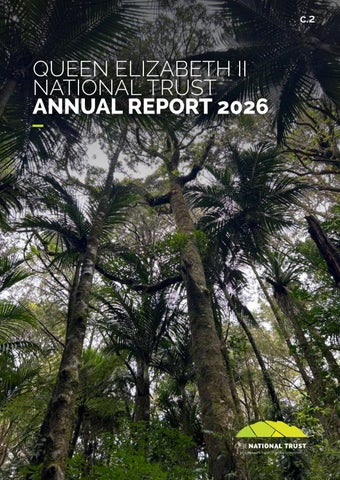
COVER IMAGE
Pukatea in swamp forest. Photo credit: Mieke Kapa LEFT
Toutouwai/robin. Photo credit: Malcolm Rutherford QEII NATIONAL TRUST ANNUAL REPORT 2026
3
REPORT FROM THE CHAIR
While the importance of QEII’s work of protecting vital biodiversity on private land hasn’t diminished and there is still an appetite on the ground for doing more for our special landscapes, our baseline funding doesn’t match up to demand. In February 2025, we were grateful to be recognised by the Minister of Conservation Tama Potaka with his announcement of an additional $4.5 million funding boost for QEII over three years. This has allowed us to help a limited amount of people protect their sites with covenants, but we are disappointed that we are still having to turn many people away.
This has been a year of unexpected events at QEII National Trust. I first want to acknowledge QEII chair Alan Livingston’s sad passing in April 2026. As a member of QEII’s board for six years and an adept chair, Alan’s imprint on QEII’s direction, as well as the kind man he was, will be remembered by all of QEII’s people. As the newly appointed chair of the QEII board, I feel honoured to carry forward Alan’s work and present the first report in my capacity as chair. Despite the challenges of the past financial year—both personal in losing a treasured individual, and as an organisation in light of our restricted baseline funding—I’m proud of the mahi that QEII has nonetheless delivered. Once again, we have worked with landowners to facilitate enduring protection for some incredible places in Aotearoa’s landscape. This is protection and care that will outlast all of us—a gift for future generations. That’s very special.
Until an enduring solution to our baseline funding situation arises, we have had to become more selective about the new covenants we can approve. From 1 July 2025, we announced a new approach to our process. Covenant proposals with the highest biodiversity (or other open space values) are being prioritised, as are covenants that require only limited financial support from QEII. In the 2025/26 year, we were able to assist landowners to protect an additional 2,338 hectares of land across 67 approved covenants. This brings the total number of hectares protected by QEII covenants to approximately 186,246. Despite having to scale back our new covenant work, our commitment to supporting landowners to manage their covenants is as strong as ever. This year our regional reps monitored 2,290 covenants, equating to over 42% of the current 5,524 registered covenants, reaching our target. As well as ecological monitoring, an important part of our visits is to maintain a collaborative and supportive relationship with landowners. This year we continued our work to ensure our engagement model has the right mix of ecological monitoring and landowner engagement, with pilots of a new system due to get underway in three regions next year. We also kicked off a much-needed upgrade to our core database for storing covenant and landowner information. The new system will be more secure and efficient for our staff and reps and provide us with easier access to data for reporting purposes. In the GIS space, we launched a public
4
QEII NATIONAL TRUST ANNUAL REPORT 2026
Ngā Kairauhī Papa | Forever protected
data service and map showing the location of all QEII covenants and we’re already getting great feedback from landowners about the usefulness of this tool. Alan Livingston’s passing in April was incredibly sad and unexpected. His presence at board meetings and other QEII events has been missed. Despite this, members of the board have stepped up admirably to fill responsibilities wherever has been needed. In September, the board welcomed new director Debbie Hyland. Debbie is of Te Ātihaunui-a-Pāpārangi descent and was raised in Kawerau. She is a mother of three and a qualified accountant (FCCA, London) with Strategic CFO credentials from the University of Auckland. Debbie replaced Karen Schumacher, who contributed five years a QEII director. We thank Karen for her dedication to QEII and wish her the very best for the future. Board directors Philip Hulme and Richard McDowell were both re-appointed by the Minister of Conservation for a further three-year term each. Philip also stepped up admirably after Alan’s passing as temporary presiding chair and I thank him for keeping the governance side running smoothly during this time. A couple of regional representatives have hung up their boots this year. Robbie Bennett and Jake Goonan shifted out of their rep positions. We are pleased to welcome new rep Michael Blanks who has replaced Jake in South Taranaki. The 2026 financial statements at the end of this annual report show that the trust has ended the year with a surplus of $2.04m compared to a budgeted deficit of $0.9m. This is a positive result relative to our expectations, but is largely attributable to a very generous bequest from a landowner and gains on our investment portfolio. Of greater concern are our operating accounts, which paint a worrying long-term picture. Our reported operating deficit for the 2026 year is nearly $1.04m.
This year’s result clearly shows that if we want to continue creating new covenants, our revenue needs to significantly increase in order to deliver that – that’s why we’re having to temporarily reduce the number of new covenants we can process in the meantime. Next year will mark fifty years of the QEII National Trust, which was established in 1977. We are looking forward to celebrating this milestone with our covenant owners and supporters. The huge amount of work that has been undertaken by landowners, regional representatives and staff over the past fifty years has built to this amazing, country-wide legacy of 186,246 hectares permanently protected. Not only that, but the people on the ground caring for the land, often painstakingly combing out pest animals and weeds from protected areas, deserve a whole lot of recognition. Support from our donors has meant a lot to us over these uncertain times. Your support has allowed us to slightly increase the number of sites we were able to protect in 2025/26 and top-up The Stephenson Fund, meaning that more covenant owners were able to undertake important enhancement projects at their protected sites. It is my honour to be recently appointed chair of the QEII National Trust. I am proud of what QEII is able to achieve with very little and in the face of huge challenges. We will always continue to support our covenantors and ensure that our precious biodiversity is protected and thrives. It is my privilege to present this year’s Annual Report.
Susan O’Regan QEII CHAIR
QEII is fortunate to have reserves to call on, but we need to be prudent about how they are used. Historic fencing obligations, covenant establishment costs and other current liabilities must also be considered.
QEII NATIONAL TRUST ANNUAL REPORT 2026
5
STRATEGIC OBJECTIVES – OUR MISSION
QEII’S STRATEGIC OBJECTIVES
OUR MISSION is to support and inspire people to protect and enhance special places, creating a network of thriving natural landscapes with communities closely connected to them. The following four strategic objectives guide our work:
6
1
2
3
4
Area of high-value land under robust protection increases.
Values within protected areas are enhanced.
QEII’s work is part of large-scale projects.
People are inspired to connect with QEIIprotected places.
QEII NATIONAL TRUST ANNUAL REPORT 2026
Ngā Kairauhī Papa | Forever protected
1
Area of high-value land under robust protection increases
• In partnership with landowners, we currently protect over 186,000ha of high-value land. • We know that protecting biodiversity on private land is critical to solving our biodiversity crisis. • Each year we aim to increase the area of land protected by QEII covenants, however our funding situation means we have had to reduce the number of new covenants we were able to process in 2025/26. • For us ‘high-value’ is guided by the Minister for Conservation’s National Priorities for Conservation on private land, how an area contributes to connectivity at a landscape scale, and also the cultural, archaeological, landscape and visual amenity values of an area. • We pride ourselves on being the strongest defender of protected land in NZ. Our modern covenants are ‘watertight’, and our landowners can trust us to defend protected land where threatened or challenged by third-party processes.
National Priority 1: Protects indigenous vegetation in land environments that have 20% or less remaining in indigenous cover. Land Environments New Zealand is a national classification system which is used to map areas of similar habitat. Any land environments that have been reduced to less than 20% of their original extent are prioritised for protection. National Priority 2: Protects indigenous vegetation associated with sand dunes and wetlands; less than 9% of the original extent of wetlands and less than 11% of natural dunelands remain nationwide, which makes these two ecosystems high priority ecosystems. National Priority 3: Protects indigenous vegetation associated with ‘originally rare’ terrestrial ecosystem types not already covered by priorities 1 and 2. Originally rare ecosystems are ecosystem types not commonly found in all regions of NZ. There are 72 types falling into six categories which have been identified in NZ– coastal, geothermal, induced by native invertebrates, inland and alpine, subterranean, or semisubterranean, and wetlands. National Priority 4: Protects habitats of New Zealand’s most threatened indigenous species of plants and animals. The threat status of threatened native species is determined by specific criteria in the New Zealand Threat Classification System lists created by the Department of Conservation.
Highlights from 2025/26
2,338
HECTARES
of high-value land approved for protection.
94%
of approved new covenants protect habitats of acutely and/ or chronically threatened indigenous species (NP4)
ABOVE
Papataniwhaniwha (Lagenophora pumila) growing in a newly protected covenant near Norsewood. Photo credit: Lou Hagger
QEII NATIONAL TRUST ANNUAL REPORT 2026
7
STRATEGIC OBJECTIVES – OUR MISSION
Looking towards a new covenant near Norsewood, protected in 2025/26. Photo credit: Lou Hagger
2
Values within protected areas are enhanced
• Alongside landowners, we have an important role in enhancing the values protected by QEII covenants. • Our people have technical expertise and valued relationships with landowners. Covenants are monitored every two-three years and our reps provide advice and guidance to landowners for covenant enhancement and management. • We’re working towards more effective and efficient ways to assess whether protected values are moving forwards or backwards, and appropriate associated management and enhancement activities. • We support landowners with enhancement activities through establishment grants, our Stephenson Fund, and seeking third party funding for special projects.
8
QEII NATIONAL TRUST ANNUAL REPORT 2026
Highlights from 2025/26
2,290
registered covenants were visited and had their condition assessed.
$1,286,014
of fencing allocated to approved covenants (includes QEII, landowner, council, neighbour and third-party contributions).
$710,317
An estimated of work was undertaken through the Stephenson Fund to enhance stewardship in existing covenants. Projects funded included revegetation, weed and pest control, signage and infrastructure.
Ngā Kairauhī Papa | Forever protected
3
QEII’s work is part of large-scale projects
Highlights from 2025/26 Over $1 million secured from third parties to support establishment of new covenants and work in existing covenants (outside of the Stephenson Fund).
73% of approved new covenants contribute to a protected corridor or landscape.
Our council partners and other third parties continue to support covenant establishment across the country, including $134,000 of funding from Waikato Regional Council and $118,000 from Taranaki Regional Council.
In addition to the usual funding support, Auckland Council and Environment Canterbury have contributed to survey and administrative costs, helping to get some valuable covenants across the line.
• We do some of our work as part of large-scale projects because conservation as part of a larger collective effort creates greater benefits than when done in isolation. • We identify or create projects where our contribution or leadership has the greatest potential to add value. • We collaborate with councils and conservation groups to share resources and expertise and achieve mutual benefits that contribute to larger-scale biodiversity strategies.
TOP
ABOVE
Pratia (Lobelia angulata). Photo credit: Lou Hagger
The understory near a stream in a newly protected covenant near Norsewood. Photo credit: Lou Hagger QEII NATIONAL TRUST ANNUAL REPORT 2026
9
STRATEGIC OBJECTIVES – OUR MISSION
10
QEII NATIONAL TRUST ANNUAL REPORT 2026
Ngā Kairauhī Papa | Forever protected
4
People are inspired to connect with QEII-protected places
• The places we protect and enhance in partnership with landowners provide physical, spiritual, and mental wellbeing benefits, and contribute to a sense of identity for New Zealanders. • We want our landowners to feel proud and enriched by the work they do with QEII, and for other people to recognise the contribution that landowners are making to conservation. • Through their engagement with QEII and our network of protected areas, we want individuals’ and communities’ understanding, connection to and enjoyment of protected areas to increase. • We’re doing this by working with landowners to hold events on their covenants, sharing covenantor stories through our biannual Open Space magazine and local media stories.
Highlights from 2025/26 Hosted or joined with other organisations for approximately 27 events nationwide to bring together local covenantors and landowners to share knowledge and foster connections. In October 2025, a group of QEII covenant owners in the Far North got together for an event in Parapara. It was an opportunity for Far North locals with covenants to connect with each other and learn more about the challenges shared across the region, such as kauri disease. In April 2026, over 60 covenant owners and community members in Waitomo attended a pest control event cohosted by QEII and Waitomo Catchment Trust. Attendees heard from speakers such as Cam Speedy and Van Watson on pest control topics specific to the region. A small group of covenant owners in Levin visited a covenant in May 2026, showcasing the work the landowner has undertaken to enhance their protected site. On the back of this event, some of the attendees were even inspired to connect with each other the following day.
ABOVE
FAR LEFT
A group of covenant owners in the Far North region visit Lizette and Kees Oud's covenant in Parapara. Photo credit: Mieke Kapa
Kahukōwhai or yellow admiral (Vanessa itea) rests on a branch in a newly protected covenant near Norsewood. Photo credit: Lou Hagger QEII NATIONAL TRUST ANNUAL REPORT 2026
11
STATEMENT OF SERVICE PERFORMANCE
1 AREA OF HIGH-VALUE LAND UNDER ROBUST PROTECTION INCREASES Measure
2026
2025
2026 Target (if applicable)
Number of covenants approved
67
170
35
Number of hectares approved1
2,338
3,649
0-750
Percentage of covenants approved that meet one or more of the National Priorities
100%
96%
95%
National Priority 1
43%
51%
-
National Priority 2
58%
48%
-
National Priority 3
6%
4%
-
National Priority 4
94%
84%
-
Percentage of covenants approved with indigenous cover that is highly representative of original cover, or are one of the best remaining examples of its type in the Ecological District2
57%
39%
-
Percentage of covenants approved with indigenous cover that is moderately representative of original cover, or has a representative range of current species in the Ecological District2
31%
41%
-
Number of covenants registered
141
132
100
Number of hectares registered
4,375
2,118.6
2,500
Notes: ¹ Approved covenant hectares are estimates that are refined by survey prior to registration 2
Assessed against Singers and Rogers (2014) A classification of New Zealand’s terrestrial ecosystems. Science for Conservation 325, 87pp, and/or ecological context reports for regions not yet assessed.
12
QEII NATIONAL TRUST ANNUAL REPORT 2026
Ngā Kairauhī Papa | Forever protected
2 VALUES WITHIN PROTECTED AREAS ARE ENHANCED Measure
2026
2025
2026 Target (if applicable)
Number of registered covenants monitored
2,290
2,118
2,000
Percentage of registered covenants monitored
42.5%
40%
40%
$30,179
$260,613
-
Total fencing allocation to covenants approved in the financial year2
$1,286,014
$3,592,473
-
QEII investment in registered covenant support (The Stephenson Fund)
$198,040
$150,867
-
Total investment in registered covenant support (The Stephenson Fund)3
$710,317
$354,903
-
Litigation matters filed before courts or tribunals in defence of protected land
1
1
-
Number of submissions on central and local government policy
9
5
-
Percentage of covenantors actively doing enhancement work in their covenants4
90%
n/a
-
Total establishment funding allocated by QEII to covenants approved in the financial year1
Notes: ¹ Allocations for covenant enhancement work including revegetation, weed and pest control, signage, specialist assessments and infrastructure. 2
Includes QEII, landowner, council, neighbour and third-party allocations for fencing.
3
Includes landowner financial and in-kind investment, allocated according to applications received.
4
Survey conducted every three years.
QEII NATIONAL TRUST ANNUAL REPORT 2026
13
STATEMENT OF PERFORMANCE
3 QEII’S WORK IS PART OF LARGE-SCALE PROJECTS Measure
2026
2025
2026 Target (if applicable)
Funds secured from third parties for on the ground covenant works (new covenants/new protection)
$579,232
$1,967,365
-
Funds secured from third parties and allocated for on the ground covenant works1 (established/registered covenants)
$455,087
$457,657
-
Percentage of new approved covenants with third-party funding1
42%
40%
-
Total number of partners with whom we have formal agreements (MOU or funding agreements) for biodiversity protection.
10
10
-
73%
74%
-
Percentage of covenants approved that add to a protected corridor or landscape
Notes: 1
Does not include neighbour contributions for fencing or contributions made directly to the landowner that QEII was not a party to.
14
QEII NATIONAL TRUST ANNUAL REPORT 2026
Ngā Kairauhī Papa | Forever protected
4 PEOPLE ARE INSPIRED TO CONNECT WITH QEII-PROTECTED PLACES Measure
2026
2025
2026 Target (if applicable)
Percentage of new owners that thought it was an easy transition to becoming an owner of QEII-protected land¹
81%
n/a
-
Percentage of members satisfied with their overall relationship with QEII National Trust1
81%
n/a
-
Percentage of covenantors that often spend time in their covenants1
65%
n/a
-
Readership of Open Space magazine1
86%
n/a
-
$1,763,311
$312,582
-
80
69
-
Total donation and membership income
2
Number of applications for QEII managed fund support
3
Notes: ¹ Survey conducted every three years. 2
Includes all financial memberships, donations and realised bequests, excludes notified bequests.
3
Includes all applications to The Stephenson Fund and Auckland Council fund. Figures reflect applications received prior to screening against the fund’s criteria. QEII NATIONAL TRUST ANNUAL REPORT 2026
15
COVENANT STATISTICS
COVENANT STATISTICS Regional Council
Area (ha)
Auckland
494,162
5
329
334
4,145.0
4,071.6
840.8
11.9
2.8
Bay of Plenty
1,207,050
11
198
209
9,935.1
9,727.5
6,563.5
49.6
3.7
Canterbury
4,450,760
52
426
478
20,058.9
17,816.0
1,679.4
42.8
8.1
Gisborne
838,582
10
160
170
5,466.1
5,292.5
1,103.8
33.3
9.2
Hawke's Bay
1,413,721
12
289
301
12,180.7
11,180.9
4,606.0
38.8
9.5
ManawatūWhanganui
2,222,059
39
447
486
9,859.3
8,723.3
352.2
19.5
6.9
Marlborough
1,045,765
0
107
107
5,906.3
5,906.3
1,056.0
54.0
8.7
42,441
1
19
20
342.5
329.7
139.5
17.4
5.9
Northland
1,250,032
37
822
859
12,207.4
11,646.4
420.6
14.2
3.6
Otago
3,120,863
37
263
300
65,081.7
63,068.1
21,909.6
241.6
7.3
Southland
3,119,495
18
438
456
11,678.8
11,228.0
1,456.6
25.7
9.3
Taranaki
725,436
34
538
572
12,460.0
10,646.8
915.5
19.9
2.6
Tasman
961,623
10
218
228
4,123.7
3,972.7
277.1
18.3
4.0
Waikato
2,389,990
42
770
812
19,307.2
18,616.2
801.6
23.8
6.1
Wellington
804,866
19
413
432
6,810.4
6,675.6
824.1
16.2
4.3
West Coast
2,324,381
11
118
129
2,695.8
2,420.1
233.0
20.5
7.5
338
5,555
5,893
202,258.8
191,321.7
21,909.6
34.5
5.3
Nelson
All Regions
Total Total number Total number Total area of Total area of Largest Average Approved of registered of approved, approved, registered registered registered covenants and registered registered and covenant in covenant formalised and and formalised the region size (ha) formalised formalised (ha) (ha) (ha)**
* Formalised covenants include landscape protection agreements with a territorial authority (e.g., district council) over land that has no legal title, as well as 14 QEII National Trust properties with no registered covenant established prior to the Trust’s ownership. The ownership of one of these QEII National Trust properties is due to be transferred. As part of the transfer agreement, the property will be registered as a covenant for the new owners. It is therefore counted both as an approved covenant and as a QEII property for the 2025/26 data reporting. ** Areas are approximate as not all approved covenants have been formally surveyed
16
QEII NATIONAL TRUST ANNUAL REPORT 2026
Median registered covenant size
Protected open space
Number
Area (Ha)
Registered covenants
5,524
190,481.7
Approved covenants**
338
10,937.1
Formal agreements*
31
840.0
5,893
202,258.8
TOTAL**
Ngā Kairauhī Papa | Forever protected
5,000
200,000
4,500
180,000
4,000
160,000
3,500
140,000
3,000
120,000
2,500
100,000
2,000
80,000
1,500
60,000
1,000
40,000
500
20,000
0
Area (ha)
220,000
Total number of registered covenants
2025
2022
2019
2016
2014
2010
2007
2004
2001
1998
1995
1992
1989
1986
1983
0 1979
Number of covenants
QEII National Trust Registered Covenants 5,500
Total area of registered covenants (ha)
The number of hectares protected by registered covenants prior to 1st July 2025 has decreased by 139 ha compared to the figure reported in the 2024/25 Annual Report. There are several reasons for this: 1. Covenant 5-12-112 (162 ha), which is Crown land and part of Blackstone Hill Conservation Area, was closed on 17/11/2025. This is because the leasehold title that the covenant was registered on was extinguished in 2007, meaning the covenant has not existed since then. 2. An internal data cleaning exercise, carried out in June 2026, identified 40 registered covenants where the survey area had been inaccurately entered in our database. This resulted in a correction that increased the total registered covenant area by 22.7 ha. 3. During 2025/26, ten existing covenants had their areas amended by variation. This resulted in a net increase in the total registered covenant area of 1.1 ha. 4. A resurvey of covenant 5-12-103 identified that part of the covenant (0.4 ha) has been lost to erosion, resulting in a decrease in the covenant area.
34.5
ha
average registered covenant area
QEII NATIONAL TRUST ANNUAL REPORT 2026
17
FINANCIAL STATEMENTS
2026 FINANCIAL STATEMENTS Statement of responsibility The Board is responsible for the preparation of the National Trust’s financial statements and Statement of Performance and for judgements made in them. The Board has the responsibility for establishing and maintaining a system of internal controls designed to provide reasonable assurances as to the reliability and integrity of financial and nonfinancial reporting. In the Board’s opinion, these financial statements and Statement of Performance fairly reflect the financial position and operations of the National Trust for the year ended 30 June 2026.
Approval of the financial statements The Board of Directors has authorised the issue of the financial statements of the Queen Elizabeth II National Trust set out in pages 19 to 38 for the year ended 30 June 2026. For and on behalf of the Board of Directors, which authorised the financial report on 30 October 2026.
Susan O’Regan
Debbie Hyland
CHAIR
DIRECTOR
Dated: 30 October 2026
Dated: 30 October 2026
18
QEII NATIONAL TRUST ANNUAL REPORT 2026
Ngā Kairauhī Papa | Forever protected
STATEMENT OF COMPREHENSIVE REVENUE AND EXPENDITURE FOR THE YEAR ENDED 30 JUNE 2026 Notes
Group 2026 Actual $
Group 2026 Budget $
Group 2025 Actual $
Government Funding
1
5,851,000
5,774,000
7,109,212
External Third-Party Funding
2
606,805
525,000
1,229,470
347,173
282,427
338,344
6,804,979
6,581,427
8,677,026
2,175,556
2,499,290
2,413,209
1,346,076
1,549,528
5,018,604
108,888
170,000
69,926
4
4,043,051
4,388,620
4,222,660
75,942
22,900
14,343
5
95,673
87,000
103,269
Operating Expenditure
7,845,186
8,717,338
11,842,011
Operating (Deficit) for the period
(1,040,207)
(2,135,911)
(3,164,985)
1,763,311
485,400
398,512
6
2,207,067
638,000
2,067,456
Pre 1995 Fencing valuation movement
14
(424,935)
100,000
1,094,081
QEII Properties - Loss on Disposal
12
134,937
-
-
327,385
-
-
Net Non-Operating Revenue/Costs
3,083,122
1,223,400
3,560,048
Total comprehensive revenue and expenditure
2,042,915
(912,511)
395,063
Operating Revenue
Sundry Income Operating Revenue Operating Expenditure Field Work Costs Covenant Establishment & Stewardship Cost
3
Pre 1995 Fencing costs Administrative, Staff and General costs Communication Costs Depreciation/Amortisation
Non-Operating Revenue Fundraising Income Net Investment Income Non-Operating Costs
Covenant, Contact and Activity Management Implementation costs
The accompanying notes on pages 24 to 38 form an integral part of these financial statements. QEII NATIONAL TRUST ANNUAL REPORT 2026
19
FINANCIAL STATEMENTS
STATEMENT OF COMPREHENSIVE REVENUE AND EXPENDITURE FOR THE YEAR ENDED 30 JUNE 2026, CONTD. Explanation of total comprehensive revenue and expenditure The National Trust concluded the financial year ended 30 June 2026 with total comprehensive revenue and expenditure of $2,042,915 against budgeted total comprehensive revenue and expenditure loss of $912,511. The difference between budgeted and actual total comprehensive revenue and expenditure results primarily from four unbudgeted factors. They are as follows: i) For the 2026 year, the National Trust received $1.53m from bequests, which are included in Fundraising income. Due to the unknown nature and timing of bequests, these are not included in QEII's annual budget. ii) The net effect of the realised and unrealised gains/ losses on the investment portfolio was a gain of $1.637m (2025: gain of $1.423m) recognised as income in the Statement of Comprehensive Revenue and Expenditure. Realised and unrealised gains/losses on the investment portfolio are not budgeted for. Refer to Note 6 for further information.
iii) The pre 1995 fencing provision was based on a valuation completed by Deloitte. Overall, there was a $0.43m increase (2025: $1.094m decrease) in the provision, which was mainly due to the effect of the change in the discount rate curve. Refer to Note 14 for further information. iv) During the year, the National Trust began the implementation of the replacement of the Covenant, Contact and Activity Management system with $0.33m of costs being paid out to 30 June 2026. In the 2026QEII budget these costs were allocated to CAPEX in the QEII Statement of Financial Position. On review, these costs met the definition of Cloud Computing costs with these implementation costs being included in the Statement of Comprehensive Revenue and Expenditure. Please refer to the notes on page 13.
STATEMENT OF CHANGES IN EQUITY FOR THE YEAR ENDED 30 JUNE 2026 Group 2026 Actual $
Group 2026 Budget $
Group 2025 Actual $
Opening Balance
18,639,720
16,520,198
18,244,657
Total comprehensive revenue and expenditure
2,042,915
(912,511)
395,063
20,682,635
15,607,687
18,639,720
At the end of the period
The accompanying notes on pages 24 to 38 form an integral part of these financial statements.
20
QEII NATIONAL TRUST ANNUAL REPORT 2026
FINANCIAL STATEMENTS
STATEMENT OF FINANCIAL POSITION AS AT 30 JUNE 2026 Notes
Group 2026 Actual $
Group 2026 Budget $
Group 2025 Actual $
National Trust Equity
20,682,635
15,607,687
18,639,720
Total Equity
20,682,635
15,607,687
18,639,720
2,350,567
6,534
837,133
Equity
Represented by: Current assets Cash and cash equivalents Accounts and other receivables
7
317,497
487,917
250,053
Investments
8
19,811,938
15,969,257
18,284,274
22,480,002
16,463,708
19,371,460
Total current assets Less current liabilities Accounts and other payables
10
693,580
946,993
462,183
Deferred revenue
11
3,083,337
1,451,650
1,575,736
240,140
165,269
276,329
1,677,742
913,991
1,600,557
Covenant commitments provision
1,614,173
1,700,499
1,705,849
Total current liabilities
7,308,972
5,178,402
5,620,654
Working capital
15,171,030
11,285,306
13,750,806
11,996,004
12,725,547
12,187,382
11,996,004
12,725,547
12,187,382
4,311,227
5,566,427
3,963,477
Covenant commitments provision
2,173,172
2,836,739
3,334,991
Total non-current liabilities
6,484,399
8,403,166
7,298,468
20,682,635
15,607,687
18,639,720
Employee entitlements Pre-1995 fencing provision
14
Non-current assets Property, plant and equipment
12
Total non-current assets Non-current liabilities Pre 1995 fencing provision
Net assets
14
The accompanying notes on pages 24 to 38 form an integral part of these financial statements. QEII NATIONAL TRUST ANNUAL REPORT 2026
21
FINANCIAL STATEMENTS
STATEMENT OF CASH FLOWS FOR THE YEAR ENDED 30 JUNE 2026 Group 2026 Actual $
Group 2025 Actual $
Receipts from operations
7,445,131
7,423,705
Donations and other grants received
2,306,063
1,133,663
Interest received
344,580
392,204
Dividends received
368,706
221,428
Other revenue received
430,719
356,175
Payments to suppliers
(6,280,163)
(8,384,345)
Payments to employees
(3,106,864)
(2,972,827)
Net cash flow from/(used in) operating activities
1,508,172
(1,892,997)
Proceeds from sale of investments
9,095,297
6,149,288
Purchase of investments
(9,106,395)
(3,735,501)
Purchase of property, plant and equipment
(39,232)
(1,257,326)
Proceeds from sale of property, plant and equipment
55,592
11,346
-
(602,734)
Net cash flow from investing activities
5,262
565,073
Net cash flows from financing activities
-
-
Net increase in cash and cash equivalents
1,513,434
(1,264,924)
Cash and cash equivalents at beginning of period
837,133
2,102,057
2,350,567
837,133
Cashflows from operating activities
Cash flows from investing activities
Payout of Est G Filer funds held
Cash and cash equivalents at end of period
The accompanying notes on pages 24 to 38 form an integral part of these financial statements.
22
QEII NATIONAL TRUST ANNUAL REPORT 2026
Ngā Kairauhī Papa | Forever protected
STATEMENT OF COMMITMENTS AS AT 30 JUNE 2026 Group 2026 $
Group 2025 $
171,606
145,736
2026 $
2025 $
Less than 1 year
165,340
165,340
Between 1 and 2 years
13,778
165,340
More than 2 years
-
13,778
179,118
344,458
Less than 1 year
2,683
1,995
Between 1 and 2 years
2,683
-
The Stephenson Fund commitments The Stephenson Fund commitments are funds committed to approved covenant holders to assist them with stewardship on their covenants.
Operating lease commitments Property lease - Level 3 and 4 - 138 The Terrace, Wellington An agreement to lease level 4 and additional space on level 3 at 138 The Terrace, Wellington dated 31 March 2021 was signed and is effective from 7 May 2021. The term of the lease is six years and three months with two further rights of renewal of three years each. The landlord offered QEII a rent-free period of three months with two of these relating to the current year. Printer/Photocopier lease A new agreement to lease a printer/photocopier dated 27 January 2026 was signed and is effective from 10 March 2026. The term of the lease is three years.
1,341
-
6,707
1,995
2026 $
2025 $
224,129
219,836
More than 2 years
Capital commitments The National Trust had no capital commitments as of 30 June 2026 (2025: nil).
STATEMENT OF CONTINGENCIES AS AT 30 JUNE 2026 The National Trust had the following contingent liabilities as at 30 June 2026. Funds Held - M Spencer Bequest
During 2026, QEII reviewed it's ownership of the Spencer Reserve Property in Gisborne and became aware that a monetary bequest from Margaret Spencer had not been fully extinguished. The bequest instructed that any unspent funds and interest on the unspent funds were deemed to be ‘held on trust’ until any balance of the fund were spent or on transfer of ownership of the property, the balance of funds would be transferred with the Spencer Reserve property to a new owner. An estimation of the value of the bequest received less funds spent plus accrued interest was calculated and recognised as a contingent liability due to the uncertainty around the likelihood of this liability being paid out.
The accompanying notes on pages 24 to 38 form an integral part of these financial statements. QEII NATIONAL TRUST ANNUAL REPORT 2026
23
NOTES TO THE FINANCIAL STATEMENTS FOR THE YEAR ENDED 30 JUNE 2026
Accounting Policies Reporting entity
Basis of consolidation
Queen Elizabeth the Second National Trust (the National Trust) is a registered charitable trust that is domiciled in New Zealand and governed by the Queen Elizabeth the Second National Trust Act 1977.
Group
The principal activity of the National Trust is to provide, protect, preserve and enhance open space for the benefit and enjoyment of the people of New Zealand. Remarkables Station National Trust Limited (100% owned) is a company governed by the Companies Act 1993, is incorporated in New Zealand and has registered charitable status. The principal activity is to own and manage the covenanted Remarkables Station farm which was gifted to QEII from the Jardine Foundation on 1 July 2022. The financial statements of the National Trust (and its subsidiary Remarkables Station National Trust Limited) for the year ended 30 June 2026 were authorised for issue by the Board on 30 October 2026.
Statement of compliance The financial statements have been prepared in accordance with Queen Elizabeth the Second Trust Act 1977 which requires compliance with Generally Accepted Accounting Practice in New Zealand (“NZ GAAP”). As the primary objective of the National Trust is to protect special places for the benefit of present and future generations, rather than making a financial return, the National Trust is a public benefit entity for the purpose of financial reporting. The financial statements of the National Trust have been prepared in accordance with Tier 2 Public Benefit Entity (‘PBE”) standards and disclosure concessions have been applied. The National Trust is eligible to report in accordance with Tier 2 PBE standards because it does not have public accountability as it’s expenditure is not considered to be large in accordance with XRB A1 Accounting Standards Framework.
Measurement base The financial statements have been prepared on a historical cost basis, except for investments which have been measured at fair value and the pre 1995 fencing liability which is measured as the present value of the best estimate of the future expenditure required to settle the liability. The financial statements are presented in New Zealand dollars. The accounting policies set out below have been applied consistently to all periods presented in these financial statements.
The financial statements comprise the financial statements of QEII National Trust (QEII) and its subsidiary (the Group) as at 30 June 2026. QEII (the parent) has control of the subsidiary through its 100% ownership which gives the parent the: • power to direct the relevant activities of the subsidiary • exposure, or rights, to variable benefits from its involvement with the subsidiary • ability to use its power over the subsidiary to affect the nature and amount of the benefits from its involvement with the subsidiary. Consolidation of a subsidiary begins when the Group obtains control over the subsidiary and ceases when the Group loses control of the entity. Assets, liabilities, revenue and expenses of a subsidiary acquired or disposed of during the year are included in the financial statements from the date the Group gains control until the date the Group ceases to control of the subsidiary. The surplus or deficit and each component of other comprehensive of revenue and expense are attributed to the owners of the subsidiary. When necessary, adjustments are made to the financial statements of the subsidiary to bring its accounting policies into line with the Group’s accounting policies. All intra-economic entity assets and liabilities, net assets/equity, revenue, expenses and cash flows relating to transactions between entities of the economic entity are eliminated in full upon consolidation. A change in the ownership interest of a subsidiary that does not result in a loss of control, is accounted for as an equity transaction. If the Group loses control over the subsidiary, it derecognises the assets (including goodwill) and liabilities and other components of net assets/equity, while any resulting gains or losses are recognised in surplus or deficit. Any investment retained in the former subsidiary is recognised at fair value. QEII National Trust Investment in the subsidiary held by QEII are accounted for at cost less any impairment charges in the financial statements of the QEII. Dividends and other distributions from subsidiary are recognised as revenue in QEII’s separate statement of financial performance, but only to the extent that these distributions are received and receivable from the subsidiary’s accumulated comprehensive revenue and expense arising after acquisition. Such distributions do not impact the recorded cost of the investment. At the end of each reporting period, QEII assesses whether there are any indicators that the carrying value of the investment in subsidiary may be impaired. Where such
24
QEII NATIONAL TRUST ANNUAL REPORT 2026
NOTES TO THE FINANCIAL STATEMENTS FOR THE YEAR ENDED 30 JUNE 2026
indicators exist, to the extent that the carrying value of the investment exceeds its recoverable amount, an impairment loss is recognised.
Capital management The National Trust’s capital is represented by its net assets. It manages and maintains its capital by prudently managing revenue, expenses, and assets and liabilities to ensure it effectively achieves its objectives and purpose, while still remaining a going concern.
Revenue The National Trust’s revenue is mainly from non-exchange transactions. They are as follows: - Grants revenue from Government or government agencies – grants revenue is recognised as it becomes receivable, except where a grant is for a specific purpose and there is an obligation to repay it if the specific purpose is not undertaken. In this situation, revenue is deferred until the obligations are performed. - Interest and dividend revenue (investment income) – interest income is recognised as earned, dividend income is recognised when the right to receive payment is established. - Donations and other grants revenue – cash donations are recognised when received, non-cash donations are recognised at their fair value at the time that ownership rights are transferred to the National Trust. - Membership/sponsorship revenue – membership/ sponsorship revenue is recognised when the cash is received. - Gifting of Property – non-cash receipt of property are recognised at their fair value at the time the legal title is transferred.
Property, plant and equipment Land and improvements acquired or gifted to the National Trust are recorded at cost for acquired assets, or at fair value for gifted assets. The cost of new fencing on National Trust properties is capitalised in the year of completion. Property, plant and equipment (other than land) is measured at cost, less accumulated depreciation and impairment losses. Land is not depreciated. Restrictions on assets The only restrictions on assets held by the National Trust are those pertaining to covenants and specific gifts. Depreciation Depreciation is charged on a straight-line basis over the useful life of the assets. Depreciation is charged at rates calculated to allocate the cost of the asset less any estimated residual values over its remaining useful life:
Ngā Kairauhī Papa | Forever protected
- Computer and electronic equipment
3 years
- Intangible assets
5 years
- Furniture and fittings, plant and equipment
5 - 10 years
- Buildings and improvements (gifted and purchased buildings)
25-50 years
- Land fencing - Leasehold improvements
40 years Life of the Lease
Employment Entitlements Employee entitlements that the National Trust expects to be settled within 12 months of the balance date are measured at undiscounted nominal values based on accrued entitlements at the current rate of pay. These include salaries and wages accrued up to balance date and annual leave earned, but not yet taken at balance date.
Covenant Commitment Provision The Covenant Commitment Provision recognises the estimated covenant establishment costs of a new covenant at the time a covenant is approved from 1 July 2017. During the 2026 year, changes in the Covenant Commitments policy were made to: 1. bring in the covenant establishment costs for covenants approved before 1 July 2017 that were likely to proceed to registration. This resulted in additional $433k of covenant establishment costs being added to the Covenant Commitment Provision and a corresponding increase in covenant commitments cost in the Statement of Comprehensive Revenue and Expenditure. 2. close out any covenant establishment costs that had not been spent within the time frames indicated (Time out policy) in the approval letter following agreement from the QEII land protection team. This resulted in a reduction of $403k in covenant establishment costs in the Covenant Commitment Provision and a corresponding decrease in covenant commitments cost in the Statement of Comprehensive Revenue and Expenditure.
Other Provisions Provisions are recognised when the National Trust has a present obligation (legal or constructive) as a result of a past event, it is probable that an outflow of resources embodying economic benefits or service potential will be required to settle the obligation, and a reliable estimate can be made of the amount of the obligation. The expense relating to any provision is presented in the Statement of Comprehensive Revenue and Expenditure.
Goods and services tax All amounts are shown exclusive of goods and services tax (GST), except where receivables and payables are stated as GST inclusive.
QEII NATIONAL TRUST ANNUAL REPORT 2026
25
NOTES TO THE FINANCIAL STATEMENTS FOR THE YEAR ENDED 30 JUNE 2026
Financial instruments
Non-derivative financial instruments comprise investments, accounts and other receivables, cash and cash equivalents, accounts and other payables, and other current liabilities.
The National Trust has various other financial instruments such as receivables and payables, which arise directly from its operations.
Non-derivative financial instruments are recognised at cost. Financial instruments not at fair value are recognised through the Statement of Comprehensive Revenue and Expenditure, with transaction costs attributable to the acquisition.
Operating Lease payments
A financial instrument is recognised if the National Trust becomes a party to the contractual provisions of the instrument. Financial assets are derecognised if the National Trust's contractual rights to the cash flows from the financial asset expire or if the National Trust transfers the financial asset to another party without retaining control or retaining substantially all risks and rewards of the asset. The National Trust holds a significant level of bonds and shares as investments. These financial assets are designated upon initial recognition by the National Trust as at fair value through surplus or deficit. Subsequent to initial recognition, most of the financial instruments at fair value through surplus or deficit are measured at fair value, and changes therein are recognised in the surplus or deficit. Fair value is quoted at market value at balance date. Cash and cash equivalents include cash on hand, deposits held on call with banks and other short-term highly liquid investments with original maturities of three months or less from the date of acquisition. Accounts and other receivables are classified as loans and receivables and are recognised at amortised cost using the effective interest method less impairment. Accounts and other payables and other current liabilities are classified as other liabilities and are carried at amortised cost using the effective interest method.
Foreign currency Transactions in foreign currencies are translated at the rates on the date of the transaction. Transactions in foreign currencies that are not settled in the accounting period, resulting in monetary assets and liabilities denominated in foreign currencies at balance date, are translated to NZD at the foreign exchange rate ruling at that date. Foreign exchange differences arising on their translation are recognised in the Statement of Comprehensive Revenue and Expenditure.
Financial risk management The National Trust's principal financial instruments comprise cash and cash equivalents and bonds and shares held as part of its normal operations. The National Trust has a policy to only invest in highly liquid investments with a Standard & Poor's or equivalent rating of 'AAA to BBB+'. Equities must be recommended by a registered financial planner or be a recognised investment fund for use by charitable trusts.
26
QEII NATIONAL TRUST ANNUAL REPORT 2026
Operating lease payments, where the lessors effectively retain substantially all the risks and benefits of ownership of the leased items, are charged as expenses in the periods in which they are incurred.
Operating Lease revenue Leases in which the Group does not transfer substantially all the risks and rewards incidental to ownership of an asset are classified as operating leases. Rental income arising is accounted for on a straight-line basis over the lease terms and is included in revenue in the statement of profit or loss due to its operating nature. Initial direct costs incurred in negotiating and arranging an operating lease are added to the carrying amount of the leased asset and recognised over the lease term on the same basis as rental income. Contingent rents are recognised as revenue in the period in which they are earned.
Software-as-a-service arrangements The National Trust enters into cloud computing arrangements under which it receives access to a supplier’s application software over the contract term. Where the arrangement does not convey control of the underlying software, the arrangement is accounted for as a service contract. Access and subscription fees are recognised as an expense as the services are received. Amounts paid in advance are recognised as prepayments and expensed over the period to which the services relate.
Configuration and customisation costs for the replacement of the Covenant, Contact and Activity Management system The costs incurred to configure and customise the supplier’s implementation of the National Trust’s software for the replacement of the Covenant, Contact and Activity Management system were assessed and determined not to be an identifiable intangible asset controlled by the Trust and no intangible asset is recognised. As a result, the costs are being expensed as the customisation services are received. Where those services are not distinct from the supplier’s access service, amounts paid in advance are recognised as prepayments and expensed over the term of the cloud computing arrangement.
Commitments
Future expenses and liabilities to be incurred on contracts that have been entered into at balance date are disclosed as commitments to the extent that there are equally unperformed obligations. These relate to Group commitments to the Stephenson Fund applicants, operating leases and any capital commitments.
Ngā Kairauhī Papa | Forever protected
Contingent liabilities Contingent liabilities are disclosed at the point at which the contingency is evident.
• distinguish operational revenue and expenditure from non-operational revenue and expenditure
Budget figures
• providing more accurate reporting of QEII’s actual types of expenditure
The budget figures shown in the financial statements are those that were approved by the Board of Directors.
Comparative year figures During the 2024 year, the National Trust implemented a new finance system and the financial statements as at 30 June 2024 were loaded as the opening balances for the new finance system. At that time, the the National Trust's executive took the opportunity to review the structure of its financial reporting and update the reporting to better reflect the information provided to the QEII Board and management to:
For the 2026 year, the 2025 comparable figures have been reclassified to align with the current year in the new reporting format. During the year, the National Trust took the opportunity to update the reporting format to better align with the board and management reporting to help with decision making. Certain comparative amounts have been reclassified to ensure consistency with the current-year presentation. These reclassifications have no impact on the previously reported surplus/(deficit) or net assets/equity.
1. Government Funding Group 2026 $
Group 2025 $
4,274,000
4,274,000
77,000
2,835,212
Government grant - International Visitors Levy
1,500,000
-
Total Government Funding
5,851,000
7,109,212
Department of Conservation (DOC)
Government grant - Baseline funding Government grant - Jobs for Nature (PTG/DEP/ESI)
From the 1 July 2026, the National Trust received an additional $1.5m per annum from government funding from the International Visitor Levy (IVL) for a period of three years to 30 June 2028.
2. External Third-Party Funding This operational revenue (and related costs) was previously recorded in the National Trust's financial statements as 'Contestable Funds'. This funding has been renamed to better reflect where these funds are generated from.
3. Covenant Establishment and Stewardship Costs Covenant establishment and Stewardship costs relate to fencing, survey and legal costs incurred on approved covenants as they progress towards registration and as a contribution to stewardship of covenanted land following registration. During the 2026 year, a new policy was approved by the National Trust board to ensure all approved enhancement funding was either spent within the two periods as per the covenant deed, as per the covenant deed or written off. At the same time all covenant establishment projects were reviewed and where funding would not be spent, the costs were written off. This has resulted in lower overall covenant establishment spending, and in some cases write offs being more than approval for new covenant establishment costs for the 2026 year, as shown in the table below. The Covenant Establishment and Stewardship Costs in these accounts is made up of the following:
QEII NATIONAL TRUST ANNUAL REPORT 2026
27
NOTES TO THE FINANCIAL STATEMENTS FOR THE YEAR ENDED 30 JUNE 2026
3. Covenant Establishment and Stewardship Costs, contd. a) Covenant Establishment Expenditure
Group 2026 Actual $
Group 2025 Actual $
Fencing
196,561
1,333,502
Survey
160,895
834,786
Weed control
(55,967)
203,087
Pest control
23,301
82,965
Revegetation
(3,585)
68,292
Other Covenant related expenditure
51,872
32,615
373,077
2,555,247
Total Covenant Establishment Expenditure b) The Stephenson Fund (TSF)
The key objectives of the fund are to provide support for enhanced stewardship of covenants, and to enhance the National Trust's partnerships with covenantors. Applicants can apply for a minimum grant of $1,000 and a maximum of $15,000 including GST, with the landowner being required to match the grant amount either financially or through in-kind contributions. The exception to this contribution requirement is where applications are submitted citing hardship; applications that meet Trust's hardship criteria may receive funding of up to 100% of project costs.
Group 2026 Actual $
Group 2025 Actual $
Fencing
5,350
30,386
Weed control
44,345
19,802
Pest control
52,194
46,844
Revegetation
9,361
24,167
Other Covenant related expenditure
64,473
7,388
Total The Stephenson Fund expenditure
175,722
128,586
The remaining unspent amounts at 30 June 2026 are included in The Stephenson Fund amount showing in the Statement of Commitments.
c) Jobs for Nature Projects (DEP and ESI) – Covenant Expenditure During the contract period for the DEP and ESI Jobs for Nature projects (as referred to in note 11) to 30 June 2025, costs relating to spending on National Trust covenants for those projects have been recorded here. The final project was approved by the Department of Conservation to carry over to the 2026 year and the final costs are shown below.
28
QEII NATIONAL TRUST ANNUAL REPORT 2026
Ngā Kairauhī Papa | Forever protected
3. Covenant Establishment and Stewardship Costs, contd. Group 2026 Actual $
Group 2025 Actual $
-
110,708
Fencing
101,342
751,480
Ecologist
-
87,218
9,000
94,505
Project Management
Weed and Pest control Revegetation
-
10,500
110,342
1,054,411
Group 2026 Actual $
Group 2025 Actual $
Fencing
199,536
703,257
Survey
7,870
11,139
Weed control
104,695
123,111
Pest control
77,326
134,057
Revegetation
17,564
22,018
Other Covenant related expenditure
43,458
113,078
450,449
1,106,661
Group 2026 Actual $
Group 2025 Actual $
Fencing
20,353
2,228
Weed control
1,858
10,774
Pest control
7,965
8,295
d) External third party contracted payments
e) QEII held Property related costs
Revegetation Other Covenant related expenditure (including consulting costs)
503
3,362
104,061
73,376
134,740
98,035
Group 2026 Actual $
Group 2025 Actual $
f) Miscellaneous covenant stewardship costs
Fencing
13,105
2,982
Weed control
33,130
15,669
Pest control
39,165
35,600
Revegetation
3,940
1,989
Other Covenant related expenditure (including consulting costs)
12,406
19,423
101,746
75,664
1,346,076
5,018,604
Total Covenant Establishment and Stewardship Costs
QEII NATIONAL TRUST ANNUAL REPORT 2026
29
NOTES TO THE FINANCIAL STATEMENTS FOR THE YEAR ENDED 30 JUNE 2026
4. Administrative, Staff and General Costs Group 2026 Actual $
Group 2025 Actual $
Directors' fees
82,935
80,310
Remuneration of key management personnel*
817,090
808,619
2,205,220
2,278,183
Employee entitlements Audit fees
85,787
91,373
Rental expenses
207,139
204,321
Other administration expenses
644,880
759,855
4,043,051
4,222,661
Group 2026 Actual $
Group 2025 Actual $
Furniture and fittings, plant and equipment, computer and electronic equipment
40,747
30,914
Improvements
43,891
43,310
Land fencing
11,035
29,045
Total depreciation expenditure
95,673
103,269
Group 2026 Actual $
Group 2025 Actual $
Interest
330,932
462,759
Dividends
368,706
286,214
Net realised/unrealised gains/losses
1,636,998
1,423,361
Total Administrative, Staff and General costs * Key management personnel: During the 2026 year, the Senior Leadership Team (SLT) is made up of the CE and three (2025: three) senior managers.
5. Depreciation
Depreciation has been charged on the following classes of asset:
6. Net investment income
Investment fees and other costs
(129,569)
(104,878)
Net investment income
2,207,067
2,067,456
Investment income comprises interest, dividend income, and changes in the fair value of financial assets at the fair value through the Statement of Comprehensive Revenue and Expenditure and foreign currency gains. Investment expenditure comprises foreign currency losses and changes in the fair value of financial assets at the fair value through the Statement of Comprehensive Revenue and Expenditure. Investment expenses also include any fees and transaction costs associated with maintaining the investment portfolio.
30
QEII NATIONAL TRUST ANNUAL REPORT 2026
Ngā Kairauhī Papa | Forever protected
7. Accounts and other receivables
Accounts receivable
Group 2026 Actual $
Group 2025 Actual $
273,053
191,960
Interest receivable
44,444
58,093
Total accounts and other receivables
317,497
250,053
Group 2026 Actual $
Group 2025 Actual $
Fixed interest - Corporate bonds - Australia/New Zealand
6,093,487
7,577,885
Equities - Australia/New Zealand
4,760,527
5,472,743
Property Equities - Australia/New Zealand
7,618,366
469,882
Equities - International
1,320,566
4,689,179
8. Investments
Watch Collection
18,992
74,585
Total investments
19,811,938
18,284,274
Watch Collection During the 2025 year, the National Trust was bequeathed a watch collection as part of an estate bequest. The watch collection was valued by a valuer and the estimated reserve price of $85,930 was recognised as a 'gift in will' in 'Donations and other grants' revenue in the Statement of Comprehensive Revenue and Expenditure. During the year, most of the watches were sold by an auction house. At the 30 June 2026, the estimated value of the unsold watches was $18,992 and has been recorded in 'Investments' note above.
9. Investment in a subsidiary The Remarkables Station National Trust Limited (RSNTL) was incorporated on 26th January 2021. The shareholding is made up of one share for no consideration. RSNTL is a wholly owned subsidiary of QEII with charitable and tax-exempt status in line with its owner QEII National Trust. On the 1st July 2022, the Dickson and Jillian Jardine Foundation gifted, by way of an in-specie distribution, the land and Crown Lease known as the 'Remarkables Station' to the Remarkables Station National Trust Limited. The gift of the Remarkables Station is deemed to be a nonexchange transaction. The reporting date of QEII National Trust and its subsidiary is 30 June.
QEII NATIONAL TRUST ANNUAL REPORT 2026
31
NOTES TO THE FINANCIAL STATEMENTS FOR THE YEAR ENDED 30 JUNE 2026
9. Investment in a subsidiary, contd. RSNTL 2026 (unaudited)
RSNTL 2025 (unaudited)
150,000
164,066
Summarised Statement of Comprehensive Revenue and Expenditure Farm Lease income Other income
77,783
132,370
(120,397)
(102,378)
Property ownership costs
(18,449)
(76,317)
Interest paid to QEII National Trust
(52,500)
(11,550)
Depreciation
(36,110)
(41,253)
327
64,938
194,198
163,208
Administration expenses
Total comprehensive revenue and expenditure Summarised Statement of Financial Position Current assets Current Liabilities
340,080
(318,923)
Property, Plant and Equipment
9,129,133
9,138,639
Loan from QEII National Trust
(1,000,000)
(1,000,000)
Net Assets
8,663,411
7,982,924
2025 Total Actual
Fencing
Actual
Buildings and Improvements Actual
Actual
2026 Total Actual
Remarkables Station – Farm property
6,124,035
130,757
327,275
6,582,067
6,591,573
Remarkables Station – House site
1,450,000
1,097,066
0
2,547,066
2,547,066
a) Remarkables Station – Farm property
Land
Property, Plant and Equipment
On the 1st July 2022, the Remarkables Station – Farm Property was gifted to Remarkables Station National Trust Ltd. The Remarkables Station – Farm Property was initially recognised at fair value following a valuation which was prepared by an independent valuer who considered the following: a) the unique nature of the Remarkables Station b) the restrictions in place on the property by an Open Space Covenant c) the new farm lease from 1st July 2022 to 30th June 2027 and d) the Heritage asset classification of the Remarkables Station when recommending a fair value for the Remarkables Station property. The Remarkables Station – Farm Property is included in the 'Land' and 'Buildings and Improvements' and after initial recognition, has been recognised at cost less accumulated depreciation and/or impairment in the same class of assets in these consolidated financial statements. There was no impairment of the Remarkables Station – Farm Property during the 2026 year. b) Remarkables Station – Crown Lease
The Jardine Foundation Remarkables Station Distribution Deed dated 28 June 2022 was prepared to transfer the Remarkables Station property to Remarkables Station National Trust Ltd and included the transfer of the Crown Lease Land held by the Jardines. The Crown Lease will maintain and secure the fence along the boundary at the foothill of the Remarkables. The Crown Lease was transferred from the Jardines to RSNTL on the 14th December 2023 and no assessment has been made around its classification as a finance or operating lease for the 2026 year.
32
QEII NATIONAL TRUST ANNUAL REPORT 2026
Ngā Kairauhī Papa | Forever protected
c) Remarkables Station – House site
On the 29th of June 2022, the directors of Remarkables Station Limited and Remarkables Station National Trust Ltd signed an agreement for sale and purchase of a parcel of land at 284 Kingston Road, Kawarau Falls, Queenstown. On 1st July 2022, the land was transferred from Remarkables Station Limited to Remarkables Station National Trust Ltd on payment for the purchase price of $1. The Remarkables Station – House site property is included in the Property, plant and equipment' and following it's valuation by an independent valuer, the property has been recognised at its revalued cost less accumulated depreciation and/or impairment in the same class of assets in these consolidated financial statements. These consolidated financial statements of the Group include QEII and its subsidiary, both of which have a balance date of 30 June. d) Remarkables Station – Farm Manager's House
During the 2025, RSNTL contracted Dowling Construction & Development Ltd to build the farm manager's house on the c) Remarkables Station – House site as noted above. The house was completed in June 2025. A small amount of finishing off' was required to complete the house with a further $21k being spent in the 2026 year. e) Remarkables Station – Loan from QEII National Trust On 14 August 2024, RSNTL signed a loan facility letter with its owner QEII National Trust that would allow RSNTL to draw down up to $1m from the Trust to pay for the build of the Remarkables Station Farm Manager's House. Terms of the loan: 1. Loan may be repaid earlier than 2054 at RSNTL’s discretion and without any penalty. 2. Interest will be calculated quarterly based on the average sum owed over the preceding quarter multiplied by the interest rate. 3. The interest rate for the first eight quarterly interest calculations is fixed at the Official Cash Rate (OCR) on the day of the first quarterly calculations (4.25%) plus one percent - 5.25 % 4. QEII National Trust and RSNTL shall review these loan terms and agree future loan terms in writing no later than 5 years after the first interest calculation. On 30 June 2026 RSNTL paid $64,050 to the National Trust for interest accrued for FY 2025 of $11,550 and interest accrued for FY2026 of $52,500. At 30 June 2026, there is no interest due between the two entities on the $1m loan advanced. Both the loan from and interest payable between QEII National Trust to Remarkables Station National Trust Limited has been consolidated on preparation of these Group accounts.
10. Accounts and other payables Group 2026 Actual $
Group 2025 Actual $
Accounts payable
98,482
102,408
Accrued trade payables
805,359
519,642
GST Payable
(210,261)
(159,867)
Total accounts and other payables
693,580
462,183
QEII NATIONAL TRUST ANNUAL REPORT 2026
33
NOTES TO THE FINANCIAL STATEMENTS FOR THE YEAR ENDED 30 JUNE 2026
11. Deferred revenue
Deferred revenue
Group 2026 Actual $
Group 2025 Actual $
3,083,337
1,575,736
Made up of: a) External third-party funds * 96 individual projects from third party funders External third-party funds have been approved for specific projects as stated in the project deeds. Some projects may take longer than a year to complete. At the end of each financial year money received for projects that has not been spent for the designated purpose and that has a return obligation (if unspent) is reported as deferred revenue.
Group 2026 Actual $
Group 2025 Actual $
Total external third-party deed amounts
4,175,446
4,244,687
Project income to date
4,148,947
4,239,739
Deferred revenue relating to external third-party funds
1,423,312
1,495,359
b) Department of Conservation (DOC) - Jobs for Nature projects The DOC Jobs for Nature projects were approved for specific projects as stated in the project deeds. The specific projects were predicted to take longer than a year to complete and revenue was recognised during the period of each contract. At the 30 June 2026, all three Jobs for Nature projects were due to be completed as per the related project deed and/or variations following the carry-over of the final amount of the unfinished Deer Exclusion Project which was completed and recognised in the 2026 year.
Group 2026 Actual $
Group 2025 Actual $
-
77,000
Group 2026 Actual $
Group 2025 Actual $
1,660,025
-
Deferred revenue relating to DOC Jobs for Nature project – DEP c) Department of Conservation (DOC) - Baseline funding
On 25 June 2026, the Department of Conservation paid the National Trust's 1 July 2026 baseline funding invoice in advance and this amount has been added back to deferred revenue until it is allocated to the 1 July 2026 invoice in the next financial year.
Deferred revenue relating to DOC Baseline funding
34
QEII NATIONAL TRUST ANNUAL REPORT 2026
Ngā Kairauhī Papa | Forever protected
12. Property, plant and equipment Group Buildings and Land Improvements Actual Actual $ $ Cost at beginning of year
Fencing Actual $
Other Actual $
Total Actual $
9,962,600
2,191,708
465,280
738,290
13,357,878
(606)
(428,278)
(121,095)
(620,518)
(1,170,497)
9,961,994
1,763,430
344,185
117,772
12,187,381
Acquisitions
-
20,822
5,781
12,631
39,234
Revaluation
-
-
-
-
-
Disposals *
(134,938)
-
-
-
(134,938)
Accumulated depreciation Net book value at beginning of year
Depreciation
-
(44,350)
(10,576)
(40,747)
(95,673)
Net book value at end of year
9,827,056
1,739,902
339,390
89,656
11,996,004
Cost at end of year
9,827,662
2,212,530
471,061
750,921
13,262,174
(606)
(472,628)
(131,671)
(661,265)
(1,266,170)
9,827,056
1,739,902
339,390
89,656
11,996,004
Accumulated depreciation Net book value at end of year
* Disposals are reported net of accumulated depreciation. QEII owned properties During the year, the following two properties were disposed of:
Parent 2026
Parkinson Bush – Malcolm's Block (Part disposal)
$54,938
Mara Point
$80,000 $134,938
The loss on disposal of these two properties is included in the Statement of Comprehensive Revenue and Expenditure. No improvements were made to National Trust owned properties.
Remarkables Station National Trust Limited owned properties: During the year ended 30 June 2026, $26,603 in improvements were added to the Remarkables Station Farm property.
Other assets: During the year ended 30 June 2026, IT equipment and office furniture totalling $12,632 was purchased.
QEII NATIONAL TRUST ANNUAL REPORT 2026
35
NOTES TO THE FINANCIAL STATEMENTS FOR THE YEAR ENDED 30 JUNE 2026
13. Land and improvements Group Buildings and Land Improvements Actual Actual $ $
2026 Total Actual $
2025 Total Actual $
Aroha Island
425,000
245,082
670,082
686,014
Awapikopiko Reserve
42,000
17,910
59,910
61,049
Bowman's Bush
63,000
-
63,000
63,000
Dunns Bush
150,000
31,563
181,563
182,270
Ernest Morgan Forest Reserve
140,000
-
140,000
140,000
Hann Bush
18,000
-
18,000
18,000
I'Anson Reserve
434,000
56,370
490,370
490,370
Ira Menzies Duneland
250,000
-
250,000
250,000
Mara Point
-
-
-
80,000
100,000
-
100,000
100,000
Mokotahi Hill
9,000
161,612
170,612
170,612
Parkinson's Bush
88,062
-
88,062
143,000
Pouawa Sandhills
66,000
-
66,000
66,000
Robbs Bush
33,500
-
33,500
33,500
Robert Houstin Memorial Reserve
50,000
-
50,000
50,000
Sheps Park
1
-
1
1
Snells Bush
36,000
-
36,000
36,000
Spencer Reserve
16,000
-
16,000
16,000
Sunset Bay
45,000
-
45,000
45,000
Tata Headland
17,000
-
17,000
17,000
Taupo Swamp
98,000
-
98,000
98,000
Miro Bay
Te Harakeke Swamp
32,000
-
32,000
32,000
Tumutumu Bush
115,000
-
115,000
115,000
Waiata Bush
25,000
-
25,000
25,000
-
-
-
-
Lake Wainamu (vested) Remarkables Station property
7,574,034
1,227,823
8,801,857
8,807,609
Total land and improvements
9,826,597
1,740,361
11,566,958
11,725,426
All land (including improvements) is subject to restrictions on use as set out in the original deeds of gift or covenant.
36
QEII NATIONAL TRUST ANNUAL REPORT 2026
Ngā Kairauhī Papa | Forever protected
14. Pre-1995 fencing provision Group 2026 Actual $
Group 2025 Actual $
Provision at the beginning of the year
5,564,034
6,658,115
Amounts used/Reversed
(100,382)
(103,988)
Discount rate unwind +
128,928
295,021
Experience variance
143,533
(604,989)
Effect of change in the inflation rate curve
(134,164)
(41,567)
Effect of change in the discount rate curve
387,020
(638,558)
5,988,969
5,564,034
Current liabilities
1,677,742
1,600,557
Non-current liabilities
4,311,227
3,963,477
5,988,969
5,564,034
Provision at the end of the year Split between:
The National Trust has a provision to contribute to fencing in perpetuity in some covenants agreed before 1995. The fences are mostly maintained by landowners on a day-to-day basis. It is the Trust's objective to reduce the provision over time. + The discount rate unwind forms part of the Investment Income note. Please refer to Note 6. Based on history and expectations there will be some level of costs to meet these covenants each year for the foreseeable future. The main areas of uncertainty in the calculation of the reasonable estimate are: i) Fence lifetime (currently estimated to be 40 years) and the timing of replacement of particular lengths of fencing. ii) Cost of fencing per metre - $25.12 per metre for FY2026 Pre-1995 valuation was based on the actual cost estimate of the per metre rate based on actual experience from 110 fences built in recent years from information held in the finance system. (2025: $24.26 based on the 2024 estimate adjusted by the New Zealand Treasury CPI Forecast). iii) The discounted future cash flows back to the valuation date uses the risk-free discount rate curve published by the New Zealand Treasury as at 30 June 2026. iv) An inflation rate assumption is that the future cost per metre will increase in line with the New Zealand Treasury CPI forecast as at 30 June 2026. v) The fencing assumption - the percentage of those fences where the National Trust has a contractual obligation to contribute to the replacement cost, which the National Trust expects will need replacing, and where the landowner will ask the National Trust to contribute to the cost of replacing the fence (currently as assumption of 37.5% has been adopted based on a probability weighting) (2025: 37.5%). Effectively the calculation estimates the costs each year in the future then discounts the cost back to 30 June 2026 to reflect what the final cost will be in today's dollars. It is expected that some of the National Trust's investment portfolio will be used to fund the pre-1995 fencing provision. However, investment income (interest and realised gains) from the portfolio have not been taken into account when calculating the Pre 1995 fencing provision so the net costs to the organisation are likely to be lower.
QEII NATIONAL TRUST ANNUAL REPORT 2026
37
NOTES TO THE FINANCIAL STATEMENTS FOR THE YEAR ENDED 30 JUNE 2026
Sensitivity analysis Variable
Change
2026
2025
Useful life
+20 years -20 years
-$0.9m +$3.1m
-$0.8m +$2.9m
Take-Up Factor
+20% -20%
+$3.1m -$3.1m
+$3.0m -$3.0m
Discount rate
+1.00% -0.50% -1.00%
$1.0m +$0.8m +$2.0m
-$0.8m +$0.7m +$1.8m
Cost per metre
+10% -10%
+$0.6m -$0.6m
+$0.6m -$0.6m
A percentage increase/decrease in any of the variables above would result in the following: •
a decrease/increase in the Pre 1995 Fencing provision liability
•
a decrease/increase in the covenant expenditure
•
a decrease/increase in equity
for the amount indicated in the table above.
15. Related party transactions During the 2026 year, QEII National Trust paid $2,311 plus GST to Plant Hawkes Bay to supply plants on a QEII covenant. Marie Taylor, a QEII elected director, is a shareholder/director of Plant Hawkes Bay. There were no other payments to or receipts from related parties during the 2026 year other than payments to Key Management Personnel and director’s fees in note 4.
16. Events after balance date There were no subsequent events at balance date.
38
QEII NATIONAL TRUST ANNUAL REPORT 2026
Independent Auditor’s Report To the readers of the Queen Elizabeth The Second National Trust’s Group financial statements and performance information for the year ended 30 June 2026
The Auditor-General is the auditor of the Queen Elizabeth The Second National Trust Group (“the Group”). The Auditor-General has appointed me, Lianne Austin, using the staff and resources of Ernst & Young, to carry out the audit of the financial statements and performance information on his behalf.
Opinion We have audited: •
the financial statements of the Group that comprise the statement of financial position as at 30 June 2026, the statement of comprehensive revenue and expenditure, statement of changes in equity, and statement of cash flows for the year ended on that date and the notes to the financial statements that include accounting policies and other explanatory information on pages 19 to 38; and
•
the performance information that consists of the statement of performance of the Group for the year ended 30 June 2026 on pages 12 to 15.
In our opinion: •
The financial statements of the Group present fairly, in all material respects, its financial position as at 30 June 2026 and its financial performance and cash flows for the year then ended, in compliance with generally accepted accounting practice in New Zealand in accordance with Public Benefit Entity Standards with disclosure concessions.
•
The performance information of the Group is appropriate and meaningful and prepared in accordance with the Group’s measurement bases or evaluation methods and Public Benefit Entity Standards with disclosure concessions and presents fairly, in all material respects the service performance for the year.
39
Basis for our opinion We carried out our audit in accordance with the Auditor-General’s Auditing Standards, which incorporate the Professional and Ethical Standards, the International Standards on Auditing (New Zealand), and New Zealand Auditing Standard 1 (Revised): The Audit of Service Performance Information issued by the New Zealand Auditing and Assurance Standards Board. Our responsibilities under those standards are further described in the Responsibilities of the auditor section of our report. We have fulfilled our responsibilities in accordance with the Auditor-General’s Auditing Standards. We believe that the audit evidence we have obtained is sufficient and appropriate to provide a basis for our audit opinion.
Responsibilities of the Directors for the financial statements and the performance information The Directors are responsible on behalf of the Group for preparing financial statements and performance information that are fairly presented and comply with Public Benefit Entity Standards with disclosure concessions. This includes: •
the selection of elements/aspects of service performance, performance measures and/or descriptions, and measurement bases or evaluation methods to enable the presentation of service performance information that is appropriate and meaningful; and
•
the preparation of a statement of performance, in accordance with the Group’s measurement bases or evaluation methods, that provides an appropriate and meaningful basis to enable readers to assess what has been achieved for the year.
The Directors responsible for such internal control as they determine is necessary to enable them to prepare financial statements and performance information that are free from material misstatement, whether due to fraud or error. In preparing the financial statements and performance information, the Directors are responsible on behalf of the Group for assessing the Group’s ability to continue as a going concern. The Directors are also responsible for disclosing, as applicable, matters related to going concern and using the going concern basis of accounting, unless there is an intention to liquidate the Group or to cease operations, or there is no realistic alternative but to do so. The Directors responsibilities arise from the Queen Elizabeth the Second National Trust Act 1977.
40
Responsibilities of the auditor for the audit of the financial statements and the performance information Our objectives are to obtain reasonable assurance about whether the financial statements and performance information, as a whole, are free from material misstatement, whether due to fraud or error, and to issue an auditor’s report that includes our opinion. Reasonable assurance is a high level of assurance, but is not a guarantee that an audit carried out in accordance with the Auditor-General’s Auditing Standards will always detect a material misstatement when it exists. Misstatements are differences or omissions of amounts or disclosures, and can arise from fraud or error. Misstatements are considered material if, individually or in the aggregate, they could reasonably be expected to influence the decisions of readers, taken on the basis of the financial statements and performance information. For the budget information reported in the financial statements, our procedures were limited to checking that the information agreed to the Group’s 2025/2026 budget. We did not evaluate the security and controls over the electronic publication of the financial statements and the performance information. As part of an audit in accordance with the Auditor-General’s Auditing Standards, we exercise professional judgement and maintain professional scepticism throughout the audit. Also: •
We identify and assess the risks of material misstatement of the financial statements and performance information, whether due to fraud or error, design and perform audit procedures responsive to those risks, and obtain audit evidence that is sufficient and appropriate to provide a basis for our opinion. The risk of not detecting a material misstatement resulting from fraud is higher than for one resulting from error, as fraud may involve collusion, forgery, intentional omissions, misrepresentations, or the override of internal control.
•
We obtain an understanding of internal control relevant to the audit in order to design audit procedures that are appropriate in the circumstances, but not for the purpose of expressing an opinion on the effectiveness of the Group’s internal control.
•
We evaluate the appropriateness of accounting policies used and the reasonableness of accounting estimates and related disclosures made by the Directors.
•
We obtain an understanding of the process applied by the Group to select its elements/aspects of service performance, performance measures and/or descriptions and the measurement bases or evaluation methods.
•
We evaluate whether:
the selection of elements/aspects of service performance, performance measures and/or descriptions and measurement bases or evaluation methods present an appropriate and meaningful assessment of the entity’s service performance; and
41
the performance information is prepared in accordance with the Group’s measurement bases or evaluation methods, and presents fairly, in all material respects, in accordance with generally accepted accounting practice, the actual performance of the Group.
•
We conclude on the appropriateness of the use of the going concern basis of accounting by the Directors and, based on the audit evidence obtained, whether a material uncertainty exists related to events or conditions that may cast significant doubt on the Group’s ability to continue as a going concern. If we conclude that a material uncertainty exists, we are required to draw attention in our auditor’s report to the related disclosures in the financial statements or, if such disclosures are inadequate, to modify our opinion. Our conclusions are based on the audit evidence obtained up to the date of our auditor’s report. However, future events or conditions may cause the Group to cease to continue as a going concern.
•
We evaluate the overall presentation, structure and content of the financial statements and the performance information, including the disclosures, and whether the financial statements and performance information represent the underlying transactions and events in a manner that achieves fair presentation.
•
We plan and perform the group audit to obtain sufficient appropriate audit evidence regarding the financial information and performance information of the entities or business units within the group as a basis for forming an opinion on the group financial statements and the group performance information. We are responsible for the direction, supervision and review the audit work performed for the purposes of the group audit. We remain solely responsible for our audit opinion.
We communicate with the Directors regarding, among other matters, the planned scope and timing of the audit and significant audit findings, including any significant deficiencies in internal control that we identify during our audit. Our responsibilities arise from the Public Audit Act 2001.
Other Information The Directors are responsible for the other information. The other information comprises the information included in the annual report, but does not include the financial statements, the performance information consisting of the statement of performance and our auditor’s report thereon. Our opinion on the financial statements and the performance information does not cover the other information and we do not express any form of audit opinion or assurance conclusion thereon. In connection with our audit of the financial statements and the performance information, our responsibility is to read the other information. In doing so, we consider whether the other information is materially inconsistent with the financial statements and the performance information or our knowledge obtained in the audit, or otherwise appears to be materially misstated. If, based on our work, we conclude that there is a material misstatement of this other information, we are required to report that fact. We have nothing to report in this regard.
42
Independence We are independent of the Group in accordance with the Auditor-General’s Auditing Standards, which incorporate the independence requirements of Professional and Ethical Standard 1: International Code of Ethics for Assurance Practitioners (including International Independence Standards) (New Zealand) as applicable for audits of public interest entities issued by the New Zealand Auditing and Assurance Standards Board. Other than in our capacity as auditor, we have no relationship with, or interests in, the Group.
Lianne Austin Ernst & Young On behalf of the Auditor-General Wellington, New Zealand 30 October 2026
43
Level 4, 138 The Terrace, PO Box 3341, Wellington 6140, New Zealand Phone 04 472 6626 | info@qeii.org.nz
qeiinationaltrust.org.nz