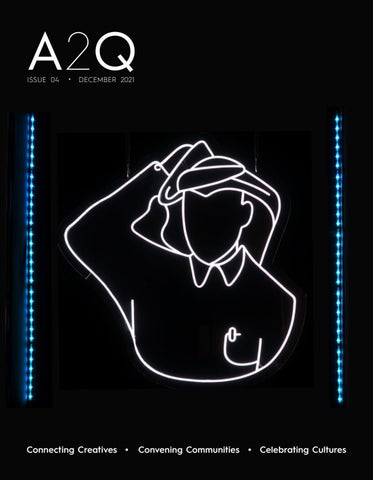
A2Q ISSUE 04
•
DECEMBER 2021
Connecting Creatives
•
Convening Communities
•
Celebrating Cultures
1
Welcome
Letter from the Executive Director 6
Contents
3
4
Exhibition
Cultural Fusion
Feature Well Heritage & History STEAM Languages & Diversity
The Brand Identity of The National Museum of Qatar by AbdulRahman Kame, QAIC Fellow Blue Hues
29
37
Robots, Qatar, and the Women of Afghanistan by Dr. Chuck Thorpe, QAIC Board of Directors 45 Diversity Profile: Qatar-America
49
2
Quarterly Recap Why Arab Film House? 7 What We’ve Been Up To 9
n In Depth
on
5
23
Back of the Book Keeping Up With QAIC Color Me QAIC Thank You
53 55 56
Front cover: Lucent by Ghada Ali. Part of Cultural Fusion exhibition in partnership with VCUarts Qatar. 1 A2Q
About A2Q A2Q (America to Qatar) is a digital magazine that spans the work of artists and the insights of experts from the United States, Qatar, and the Arab and Islamic worlds. As a digital platform serving creatives with diverse perspectives in art and culture, A2Q addresses subject matter in the aim of bridging cultural barriers and cultivating understanding. While at its core A2Q provides a voice to culture, history, and art relating to the Arab and Islamic communities around the world, A2Q also exists in recognition of the universal appeal of creative expression and the benefits of cultural convergence. Interested in being featured in an upcoming issue of A2Q? You can submit your work as an artist, writer, or academic with the QAIC editorial team for a chance to be featured. If selected, we will contact you to begin the editorial process. More information can be found at www.qataramerica.org/A2Q.
About QAIC The Qatar America Institute for Culture (QAIC) is an independent 501(c)(3) non-profit organization that creates, curates, and executes programs and research that amplify the prominence of all forms of art and culture in society. QAIC cultivates artistic expression and cultural dialogue from the United States, Qatar, and the larger Arab and Islamic worlds. QAIC serves as a vital hub to convene artists, curators, storytellers, creatives, scholars, and academics, connecting them with a global network that extends beyond its physical space in Washington DC. Through art exhibitions, educational programs, scholarly research, and cross-cultural partnerships, QAIC provides interactive experiences in an inclusive environment to celebrate and appreciate art and culture.
DECEMBER 2021
2
What We Do Art QAIC’s headquarters, located in DC’s popular Dupont Circle neighborhood, hosts rotating exhibitions throughout the year in our historic gallery space. Whether an innovative contemporary art installation or a sensory journey through history, these exhibitions invite visitors of all ages to explore diverse forms of art and heritage.
3 A2Q
Culture
At QAIC, all are welcome to expand their knowledge of the arts and culture by participating in ou regular educational programs. Expressions Art & Culture Talks pro audiences exclusive insight from cr and experts on topics including h breeding, film, and architecture. The launched Museum Series convenes practitioners not only for a behind-th look at today’s museums, but also to dialogue about current museolo trends and issues. At our hands cultural enrichment events, audie learn about art, culture, and t creative process by producin their own art and crafts.
Education
eir nd our ms. Our provide m creatives ng horse The newly es museum d-the-scenes to generate ological nds-on udiences nd the cing s.
We invite members from our various communities to engage with us in many ways, whether through celebrations such as our iftar dinners or our annual IMPART Summit, the “Congress for Creatives.” We also offer various scholarly opportunities, including fellowships and internships, throughout the year for those interested to get further involved with QAIC.
DECEMBER 2021
4
ONE
5 A2Q
A Letter from the Executive Director Dear Friends of QAIC, As the year draws to a close, I extend my warmest wishes to you and your loved ones for the healthiest and happiest of holidays. The end of 2021 marks the end of our first year in publishing A2Q magazine. This year, we published four issues - each with unique designs, articles, and authors. Issue after issue, A2Q magazine gets better because we are constantly reflecting on what we do and who we are. This achievement is a credit to the QAIC team who consistently places our mission and values at the core of this publication. Through A2Q magazine, we strive to share original stories and authentic voices from America to Qatar and all the rich cultures in between. A2Q magazine was born in a year during which culture and the arts between Qatar and the United States were celebrated as part of the Years of Culture program. We at QAIC had the great honor to be partners in this incredible initiative, playing host to several exhibitions which you will read about in this issue, such as “Cultural Fusion” and “Light & Shadow: A visual journey through Oregon.” This year of culture sprung many new friendships that we hope will foster further cultural synergies between QAIC and its partners in both countries. In this issue, we shed light on initiatives that were once dreams on our vision boards, which have now become real. We plan to grow and sustain them for years to come with the help of our many supporters and sponsors. The Arab Film House, an initiative that was made possible thanks to ConocoPhillips, was informally opened on Halloween in tandem with our Expressions Art & Culture Talk event with British-Iranian filmmaker Babak Anvari, who introduced us to horror films in Middle Eastern cinema. We formally celebrated the opening of the Arab Film House during IMPART Summit by hosting our first Qatari Food & Film festival and a screening “Freedom Fields,” a feature film by the Arab Film House 2021 Awardee Naziha Arebi.
We wanted this issue of A2Q magazine to be a short and sweet ending for 2021. As you wander through the pages, we hope you can find beauty and serenity in our two featured articles on the desert rose and the color blue. Additionally, “Robots, Qatar, and the Women of Afghanistan” and “Diversity Profile” will give you a dose of determination and inspiration for a better tomorrow. Finally, I’d like to offer my sincere appreciation and gratitude to the QAIC team, our contributors, and our sponsors, who make all this possible. Although the pandemic seems to stretch on beyond 2021, we are truly grateful for your continued support of our work. A2Q magazine will continue to evolve and grow in the new year, featuring interesting content reflective of our mission. Here’s to a bright 2022 and all the opportunities it will bring.
Best Regards,
Fatima Al-Dosari, Executive Director
DECEMBER 2021
6
Why Arab Film House? At the start of 2020, the Qatar America Institute for Culture (QAIC) decided on a new mission that prioritized the arts and culture emanating from the United States, Qatar, and the larger Arab and Islamic worlds. A crucial component of this mission would be the inclusion of cinema due to its ability to transcend language and convey the complexity of regional issues that other forms of art aren’t best suited to address. A joint delegation by QAIC and the Doha Film Institute (DFI) to Los Angeles to participate at the Academy Awards (Oscars) and meet with film industry leaders showed the importance of this inclusion, as well as shedding light on up-and-coming filmmakers, actors, writers, and artists from the United States, the ‘Middle East, and the greater MENA region. In order to properly shed light on this medium of expression, QAIC dedicated a large portion of our new space in Washington’s Dupont Circle. to host the Arab Film House. Through extensive renovations of the first floor of QAIC’s new home in Dupont Circle – a theater dedicated to the art of film was created from scratch. This space, in tandem with QAIC’s Perfumery Museum and visual art gallery space, positions QAIC to best share with our local DC community and the wider United States, the stories, beliefs, and visions that filmmakers want to convey. 7 A2Q
In addition to creating a physical space, QAIC has also dedicated a large portion of our digital space as well through social media and our virtual “Film Chats” and “Film Fridays” to “Expressions Art & Culture Talks”. Through our partnership with the Doha Film Institute, we have engaged the next generation of filmmakers from the Arab and Islamic worlds that want to redirect the current conversation regarding their respective regions. Films from the Arab and Islamic worlds mostly focus on several recurring themes – the plight of women in search of liberation, or the quest for freedom from under oppression – that have become synonymous with the region. Rarely do you find films that discuss the nuanced dance between modernity and tradition that members of Arab and Islamic society must engage in on a daily basis. By providing a platform to these filmmakers, we at QAIC believe that we are fully engaging our mission by connecting creatives, convening communities, and celebrating cultures. As we enter the new year, QAIC intends to fully utilize its location and facilities to further engage with and broaden our audience through the art of film. Recent global events, the durability of the coronavirus pandemic, and ongoing conflicts in the Arab and Islamic worlds have shaped and warped the lives of countless millions. We as an institution intend to use our platform to share their stories and give them a voice. We hope you can join us.
Screening of FIFA Arab Cup finale in our Washington, DC HQ.
DECEMBER 2021
8
What We've Been Up To
9 A2Q
Women of the Pandemic Exhibition Launch
On September 30, 2021, QAIC celebrated the opening of its “Women of the Pandemic” exhibition hosted at its headquarters in Washington, DC. Launched in partnership with the Katara Cultural Village in Qatar, the exhibition features the art of four American female artists and four Qatari female artists whose works are a reflection of their resilience and artistic ambitions during a time of major adversity which tested the creative communities worldwide. To commemorate the exhibition’s official opening, remarks were provided by Fatima Al-Dosari, Executive Director at QAIC; Peggy Loar, Chair of QAIC’s Board of Directors; and Dr. Khalid Al-Sulaiti from the Katara Cultural Village. Following the remarks, several of the featured artists physically and virtually in attendance shared some brief commentary in reflection of the time elapsed since the last hosted discussion back in June of this year.
DECEMBER 2021
10
11 A2Q
Light & Shadow: A Visual Journey Through Oregon
As part of the Qatar - USA 2021 Year of Culture program, the Light & Shadow: A visual journey through Oregon exhibition presents the work of two photographers, Andrew Studer and Khalifa Al-Misnad, during their ten-day journey photographing the landscapes of the Pacific Northwest. While embarking on the journey as strangers, Studer and Al-Misnad quickly bonded through their shared love of photography and nature. The result of their journey is a series of photographs that not only serve as documentation of the natural wonders in the Pacific Northwest but also as individual perspectives meeting to appreciate the present moment. Embodying the true spirit of the Year of Culture program, both photographers championed each other’s inquisitive nature while learning from one another.
DECEMBER 2021
12
Ruwad: The Pioneering Contemporary Arts of Qatar
Ruwad, which means “pioneers” in Arabic, is a celebration of both established and emerging Qatar-based artists who are transforming the artistic landscape in the Gulf region. The program, launched in 2018, aims to present the leading visionary minds of Qatar, whose creative works continue to inspire and promote the cultural richness of the region. To further promote and collaborate on artistic exchanges and cultural activities, Ruwad 2021-2022 is presented in collaboration with the al markhiya gallery in Qatar. al markhiya promotes and represents a distinctive group of emerging and recognized Arab artists in Qatar, the region and throughout the world. The four artists on display are: Sarah Al Ansari, Mubarak Al Malik, Fatima Al Mohammed, and Ebtissam Al Saffar.
13 A2Q
DECEMBER 2021
14
Cultural Fusion
Every year, Qatar Museums runs Years of Culture, a cultural exchange program that aims to convey Qatar to an international audience. Through a variety of exhibitions, festivals, competitions and events, the programs promote mutual understanding, recognition and appreciation between countries. They invite people to explore and appreciate their cultural similarities, as well as their differences. The Cultural Fusion exhibition of the Qatar-USA 2021 Year of Culture. The exhibition began in Core Studio 2 at VCUarts Qatar and is comprised of the artwork of eight graphic design students. The premise was to explore the ongoing relations between the United States and Qatar through design. The project allowed a variety of creative freedom, and the result was a multitude of diverse outcomes with both serious and playful approaches, eight of which are on display in this exhibition.
15 A2Q
DECEMBER 2021
16
Expressions Art & Culture Talk with Babak Anvari
As part of our Expressions Art & Culture Talks series, QAIC staff member Yousra Khalil sat down with British-Iranian filmmaker Babak Anvari to explore the shortage of horror films in Middle Eastern cinema. They spoke about creating a horror movie from a Middle Eastern perspective and the sources behind his inspiration when creating his feature film “Under the Shadow.” The film centers around a mother and daughter struggling to cope with the terrors of the post -revolution, war-torn Tehran of the 1980s, as they deal with a mysterious evil haunting their home. Through his movie, we get a glimpse of what scared Anvari in his childhood and how those memories are shared with other Iranians and Middle Eastern creatives.
17 A2Q
IMPART Summit 2021
On Friday, November 19, QAIC hosted its inaugural IMPART Summit to convene and collaborate with a wide array of artists and creatives, as well as a multitude of other artistic institutions, and serve as a “Congress for Creatives.” QAIC’s inaugural summit began on the evening of Friday, November 19 with a private reception launching the event, with Saturday, November 20 offering a hybrid of virtual and in-person public events. This year’s IMPART Summit highlighted a variety of interactive cultural experiences and art exhibitions from the United States, Qatar, and the larger Arab and Islamic worlds, including film shorts provided by the Doha Film Institute, a screening of the feature film “Freedom Fields” by Naziha Arebi, the 2021 Arab Film House Awards recipient, as well as other special guest speakers and creatives.
DECEMBER 2021
18
19 A2Q
DECEMBER 2021
20
HER Documentary
On December 15, QAIC hosted a private reception and special premiere screening of the documentary “HER” at our Washington, DC headquarters. For the first time screened in the United States, this film highlights the stories of heroic women who shattered barriers to achieve excellence in their fields, while also advancing the United Nations Sustainable Development Goals with their work. In partnership with the Embassy of the State of Qatar in Washington, DC and the Georgetown Institute for Women, Peace and Security (GIWPS), this special event recognized the many women leaders making a positive impact in the world with remarks provided by GIWPS’ Executive Director and former US Ambassador-at-Large for Global Women’s Issues, Melanne Verveer.
21 A2Q
DECEMBER 2021
22
Exh i b i t i on In Depth: Meet the curators and designers of Cultural Fusion, the exhibition at QAIC comprised of the artwork of eight graphic design students. The designs of Sara AlHelal were recognized by the Year of Culture team and the final concept was selected as the logo for Qatar-USA 2021 Year of Culture. Cultural Fusion is available to tour at QAIC’s headquarters in Washington, DC through March 2022.
23 A2Q
C ul t u ral Fusion 1) Fatima Nazir, curator– My name is Fatima Nazir. I am currently a Graphic Designer Junior and an Honored student at Virginia Commonwealth University in Qatar. I am also the Software Session Leader and Workshop curator for the Graphic Design Department in VCUarts Qatar. I had the honor to curate the Cultural Fusion exhibition together and alongside Hannah Fakhri, lead curator and also one of the designers. The most inspiring thing about the exhibition was to see how design has the power to unite and embrace differences of cultures and build connections that can lead to an ambitious future. 2) Hannah Fakhri, curator & designer – My name is Hannah Fakhri, and I am from Qatar. I am a Qatari honors Graphic Design Senior Student at Virginia Commonwealth University, School of the Arts in Qatar. I am currently a Teaching Assistant for the Graphic Design course, Design Practices. My logo system and research represent the vernacular of shop signs in the United States and Qatar. Within my exhibition, I have utilized the research and the typographic experiments that combine and represent a combination of shop sign culture within both countries. I find that the most inspiring element of the Year of Culture Initiative is the connections and relationships that blossom because of the Initiative. New and exciting opportunities open up for both countries, along with also celebrating the fruitful relationship between the two countries. 3) Naima Almajdobah, designer - I am Naima Almajdobah, a Palestinian Honors Graphic Design senior and currently the SGA President for this academic year. I am also a graphic designer and a student employee at Texas A&M University in Qatar. The purpose of this idea/brand identity is to show the world the relationship between the day-to-day life words of both countries, how they can be so different yet so similar, how they can complete phrases perfectly. It is a very simple and fun way to depict Qatar and the USA. This brand system consists of 4 categories so that all people, natives, locals, old or young, can read it and understand it and relate to it. One of the most inspiring things about the Year of Culture initiative is how it helps us get more educated with other nations and countries around the world, how it designs the year, and builds a bridge between Qatar and the rest of the world. The various events that take place throughout the year allow us, especially the new generations, to see the rest of the world, and get to experience education-focused events about culture, heritage, traditions, etc. 4) Hagar Allam, designer/finalist – My name is Hagar Allam. I’m an Egyptian living in Qatar, and a senior in graphic design, VCUarts Qatar. My logo aimed to celebrate the liberty in Qatar and The United States that are represented in their architectural sites whilst building a visual relationship that represents the connection and unity between both cultures. The process of this project included using online sources to depict photos of the vast variety of architectural sites that both Qatar and The United States have. The most inspiring thing about the year of culture initiative is that it creates spaces and celebrations for the shared unity between Qatar and the U. S’s cultures. It’s especially inspiring for me to see American designers/artists’ works be exposed to our culture here and vice versa. DECEMBER 2021
24
5) Roudah Alsheeb, designer – I am Roudah Alsheeb, a student in graphic design from Qatar. For my logo, I wanted to explore the Architectural Aspects between Qatar and the USA. What I find most inspiring about Years of Culture is how we learn about new cultures, and that each year it’s a new country. 6) Ghada Ali, designer – My name is Ghada Ali, and I am a senior Qatari student studying Graphic Design at VCUarts Qatar! I currently work as a research assistant for a research lab titled ‘Multi-Modal Maths’, whose initiative is to blend the art of illustration, storytelling, and mathematics for children in schools to work with and learn in a new, enriching way! My logo design was inspired by the beauty of vintage neon signs that reigned over the buildings and highways of American roads, blended with the modern, newly established bustle of nighttime in Doha, where lights transform dark areas into beautiful spaces to admire. 25 A2Q
Light resonates with me the most, and I fondly remember myself as a child, gazing at all the skyscrapers and buildings coming to life when the sun goes down, whenever my family and I went on little night drives through the city. It is something that I still love to gaze at today. What I truly admire about Year of Culture is that it gives people a chance to connect and see the beauty of mutual understanding from both nations. We get to highlight certain aspects of our lives and share stories with one another in a closer and unique way. In the context of this exhibition, it was amazing to see how each of us focused our work on a particular aspect of our daily lives, ranging from clothing, language, architecture, and more. It gave us the opportunity to take the little things and turn them into wonderful works of art that highlight the beauty of both cultures; for that, I am forever grateful! 7) Sara Ahmed AlHelal, designer/winner – My name is Sara Ahmed AlHelal. I am a senior graphic design student at Virginia Commonwealth University from Qatar. The inspiration behind my project was using the idea of playfulness to combine cultures using digital photo collages to create surreal and fictitious landscapes. I wanted to show the similarities and differences between Qatar and The United States through architecture, nature, traditions and deliver them in unexpected ways. The intent of this project is to literally bring two countries together. What I really love about this project is that it started off as experimentation with Photoshop where I collaged images together and used different effects; and it ended as a simplified final year of culture logo. However, despite it being simple, I still used the same concept of merging two things together, and in this case, I merged the Statue of Liberty with the Lusail Arch and made them intertwine and look like one to show solidarity and unity of both countries. What I really love about Qatar Museum’ Year of Culture is the idea of building bridges between nations. This is a great way to convey Qatar to an international audience. I also love that Qatar Museums is always reaching out and giving opportunities to designers and artists around Doha to be part of this amazing celebration. A big example of this is the Cultural Fusion event which was an amazing opportunity to showcase our work and have discussions about our designs with a wide audience. 8) Razan Mustafa, designer – My name is Razan Mustafa, a senior in graphic design from Palestine. My inspiration behind the logos was to celebrate our similarities and differences through fashion statements, which leads to the understanding, recognition and appreciation of both countries. I combined fashion statements from the US and Qatar to illustrate the cultural connection between both countries. Year of Culture was truly an inspiring experience, as I learned more about the United States and how American fashion statements have been incorporated in Qataris casual attire outfits. Due to social media, clothing items such as certain sports shoes, baseball caps, and specific types of pants, have all been heavily influenced by American fashion. 9) Noor Abdulrazzaq Abdulwahab, designer - My name is Noor Abdulrazzaq Abdulwahab, a Qatari graphic designer student. My inspiration was the bilingual logos which had numbers in them and icons. I wanted to express a combination of both languages English and Arabic, as these are the languages spoken in both countries. I made sure that the logo visually communicates to all audiences and used a pop of color to grab attention. I followed this system of black and white with pops of color throughout the project. This was also used for the photography. I believe that many things provide inspiration, and I found that being in a community with many creative designers was extremely inspiring.
DECEMBER 2021
26
FEATURE WELL
The Brand Identity of The National Museum of Qatar by Abdelrahman Kamel, QAIC Fellow
To truly explore the topics of tradition and modernity one must understand the context of the National Museum of Qatar. The museum first opened to the public in March of 2019 and included a temporary exhibition titled “The Making of Doha” and a permanent collection that represents a narrative of Qatar’s history. The collection handled specified aspects of Qatar’s natural, social or political history and followed a chronological order. The mission and vision of the museum according to Sheikha Al-Mayassa Al-Thani, the chairperson of Qatar Museums: “The National Museum of Qatar is the physical manifestation of Qatar’s proud identity, connecting the country’s history with its diverse and cosmopolitan present. It will reflect a part of every Qatari’s life, representing our roots and identity” (National Museum of Qatar). In other words, the ambition of the museum is for it to be a reflection of Qatari identity while establishing a global brand. As Dr. Karen Exell, a former senior museum development specialist at Qatar Museums states, “the National Museum project provided an early platform for Sheikha Al Mayassa to re-emphasize the ongoing use of culture to communicate with the world” (Exell 2018). The underlying notion here is that, in the modern age, it is not enough to have a museum that represents identity, but such identity must be exported and globalized on an international scale to be realized. This is where the branding of the museum comes to the frontline, as it would act as the main means of communication with the world. Inspired by our Land
desert rose is a natural phenomenon that occurs in Qatar’s desert shores environment. The symbolism here is that the desert rose is the product of the sea and the sand, likewise the history of Qatar and its people. According to an official press release by Qatar Museums regarding the brand identity, “through its striking color, eye-catching form and unmistakable design, the new brand makes a simple, adaptable and powerful visual statement about Qatar’s place in the world” (The Peninsula). From a branding or marketing perspective, the use of the unique building architecture is a great asset to the brand, as it connects the museum to a specified aspect of Qatari land and presents a unique architectural monument that is inviting to international audiences. Presenting something new and unique serves the interest of the brand in distinguishing itself from other institutions in the region. According to Sarah White, the director of Bait al Zubair Museum in Oman, in her article, The Relationship Between Museum Architecture, Exhibits and Audience:
Perhaps the most striking element of the new National Museum is its architecture and how it represents the shape of a desert rose. So important was the element of the desert rose that it became part of the design inspiration for the brand of the museum. Figure 2 illustrates the use of the desert rose in the logo; this links the brand to the context of the geographic features of the land that the museum aims to represent. This is because the 31 A2Q
“To enrich visitors, and offer social relevance and justification of their existence in today’s competitive environment, many established museums have had to up their game, and bedazzle their consumer-culture audiences. The competition is no longer only other museums, but a multitude of leisure and entertainment activities, combined with satellite television and social media” (White 2014).
international attention to the brand. According to Dr. Exell concerning the image of the National Museum, “[the] process of image production is central to the cultural spectacle of the national brand, signaling intent, wealth and national aspirations on the world stage” (Exell 2016). In other words, the media attention that the building and its architecture brings attention to the brand and content of the museum.
The insight of the previous quote reveals that utilizing the structure of the museum can be an effective method of attracting regional and
Inspired by our Heritage The second element of the brand identity of the National Museum is its connection to the old Palace of Sheikh Abdullah bin Jassim Al-Thani, the son of the first crowned prince. The palace was converted to a national museum in 1975 and is currently restored and physically connected to the new national museum.
DECEMBER 2021
32
Figure 6
Figure 2
Connecting the old to the new is a significant statement that upholds the mission of the museum as being a representation of Qatar’s past and future. Such a statement is underlined in the branding of the museum. As Figure 4 illustrates, the second element of the museum’s brand is the front door of the restored palace of Sheikh Abdullah bin Jassim Al Thani (the old national museum). According to Sheikha Al Mayassa Al-Thani:
Figure 3 “I am immensely proud of all that has been achieved in restoring the Palace so faithfully. This building is an incredible monument to history and traditions whilst also highlighting our country’s rapid progress and development. When completed, the futuristic, iconic, world-class design of the National Museum will perfectly complement the Palace” (Gulf Times). In other words, the old museum structure gives context to the new museum, a unique
Figure 1 33 A2Q
Figure 4
Figure 5
characteristic of the National Museum that underlines the connection between the past and the present. This particularly serves the interest of marketing, as it extends the brand to non-commercial institutions or research oriented, cultural or preservation institutions as well as educational stakeholders in the region.
In other words, the restoration and the inclusion of the old national museum gives the museum a unique marketing advantage that distinguishes it from other museums in the region. According to Denise Cole, in his journal article titled Museum Marketing as a Tool for Survival and Creativity: “Successful branding should be used in communications to raise the organization’s profile, reinforcing its identity at every opportunity. By differentiating the museum within the marketplace, branding helps the museum to compete at a time when it needs to win audiences, government funding and corporate and private philanthropy” (Cole 2008). As Cole stated, the Museum’s brand is strengthened when it is distinguished from other museums, an asset that favors the brand.
According to an article written on the restoration of the palace: “As part of the project, a team of local artisans was trained over the course of the restoration and worked closely with the project team, learning how to treat wood, restore ornaments and painted ceilings and methods for restoring historic plaster surfaces” (Walker 2015).
Figure 6
DECEMBER 2021
34
A Brand Inspired by You “A Brand Inspired by you” perhaps seems like a romanticized statement but in the case of the Museum, it is a statement so important that it occupies a significant part in the museum’s identity. The main mission of the museum is to bring “to life the unique story of Qatar and its people” (National Museum of Qatar). To achieve this the museum must establish an identity that connects with not only the past, heritage, and land but also with the people it claims to represent. Figure 6 represents an example of the people the brand is inspired by. Figure 9 shows that the symbol of heritage is divided into past, present, and future. The focus of “a brand inspired by you” is primarily in the future section of the identity.
Figure 7
Figure 8 35 A2Q
The idea here is that the future of the museum will be determined by the future of “Qatar and its people” (National Museum of Qatar). According to Jean-Michel Tobelem, in his article, The Marketing Approach in Museums: “Museums must make every effort to imbue their personnel with the notion that they are there to serve the public and that they must continuously improve the quality of the services offered” (Tobelem 2007).
In other words, the claim of “a brand Inspired by you” serves both the interest of the mission of the museum and the brand. The final part of the brand of the National Museum is a unique example of how museums can make their visitors participate in developing the future identity of the museum.
What Tobelem is trying to say here is that museums must always be connected with their visitors in order to develop and innovate their brand. The visitor is a significant part of the museum experience, and thus also, the identity of the institution. For marketing, the focus on people through visitor studies can help understand their changing needs and expectations from the museum. Such information would be valuable for the development of the brand in the future. As Jean-Michel Tobelem states: “In museums which have adopted a marketing approach, marketing services do not only strive to react to changes in the needs, wishes and perceptions of the consumer, but even try to anticipate them. Research with regard to an institution’s ‘market’ allows the comprehensive assessment of consumers and a means to test decisions on a sample target group in order to ensure that they are efficacious” (Tobelem 2007).
Figure 9 DECEMBER 2021
36
Blue Hues
Cobalt, cerulean, indigo, navy, down to our favorite denims, the color blue has as many names as it has varieties. It’s the familiar color of the sky and the sea, and the eye color of roughly 8% of the world’s population. With a long history and fascinating history, the color blue continues to be one of the most popular colors in the world, and one of the most universally appealing colors on the spectrum due to its non-polarizing traits. Blue has been worn for thousands of years, from royals to barbarians and modern-day workers and military members. Historical texts have shown us how much our references and usage of colors has evolved over centuries and cultures. In the western art historical canon, blue is a significant color in biblical imagery—the Virgin Mary is frequently depicted in blue, making the color synonymous with purity, humility, and divinity. But when we look to the past, and despite canopies of blue skies and bodies of water covering 70% of our planet, we find that blue wasn’t always held in such high esteem; several ancient cultures didn’t even have a word of the color! The Greeks didn’t appear have one—Homer described the sea as being “wine-dark” in his epics—and pre-Islamic Arabic lacked a word as well. And this isn’t ancient history. Even members of modern Namibian tribes have been shown to lack the capability to distinguish blues from greens. They have many words for green, but none that are distinct for blue. This is perhaps not as puzzling as it first would seem. There are not a lot of natural sources of blue in nature. We only find reds, blacks, and browns in Paleolithic cave paintings, and blue dye similarly was one of the last colors produced in fabric production. The semi-precious stone lapis lazuli, mined in modern day Afghanistan and Persia, was highly prized by the Mesopotamians and Egyptians but it remained an expensive luxury. The Egyptians went on to develop their own blue pigment, one of the first synthetic pigments ever made.
39 A2Q
Egyptian blue became commonplace in funerary arts and was assumed to have protective properties. Blue has evoked a variety of sentiments, whether psychologically, spiritually, or emotionally and has different connotations. While colors such as red tend to raise our heart rate, blue is often thought of as relaxing and has been shown in studies to lower our heart rates, blood pressure, and even our body temperature. In fact, scientific studies have demonstrated that blue light improves our memory and can even kill certain bacteria. It causes our bodies to produce calming chemicals causing us to release feelings of tranquility. Due to its abundance on Earth, blue is integral to our human experience and thus is often seen as calming, serene, and spiritual. Nevertheless, despite the positive connotations associated with blue, it can also trigger less positive and lively properties and has led blue to evoke feelings of sadness, depression, and melancholy. For instance, to “feel blue” is a popular saying that suggests one to be down or depressed. This meaning also translates into music where blues music expressed sadness or melancholy, often revolving around love, heartbreak, oppression, and adversity. While blue expresses somber moods, it is important to note that these feelings lack sinister connotations. Blue is a significant color in our natural world, but did you know it also carries meaning professionally? Considered to be highly corporate color, blue exhibits stability, wisdom, unity, and serenity. In fact, police uniforms are blue to reflect these attributes and it is a masculine color according to studies due to their high accessibility amongst men. In many cultures, blue has religious and social significance. Spiritually it is believed to bring peace and keep evil spirits away.
DECEMBER 2021
40
For example, in Iran blue is the color mourning while in Western culture “something blue” in a bridal context represents love. In the Arabian Gulf, the color blue has had quite an interesting journey to relevance and modern symbolism. Green historically holds strong the distinction within the Quran being associated with paradise and was well known as the Prophet Muhammad’s favorite color. By contrast, blue may have had negative connotations in early Arabic. One scholar analyzed the root of the word azraq and found that it was associated with ill omens or evil—a far cry from today’s symbolism associating it with the earth and sky, immortality, heaven, and spirituality. In Islamic tradition, blue “azraq” often signifies the impenetrable depths of the universe. Turquoise (fayruz) is a gemstone that is thought to have mystical qualities and has been prized as a gemstone and ornamental stone for thousands of years owing to its unique hue of blue. Different shades also have different meanings. For instance, Indigo or dark violet-blue (an-nili) have mystical qualities in certain regions of the Sahel. Therefore, it makes sense why different hues of blue are also prioritized in Islam. The significance and symbolism of blue in Islamic customs and culture is in the forms of art and architecture, particularly in mosques. In Islam mosques are not simply places of worship, but are works of art and architectural magnificence. Religious art and architecture in the Islamic tradition is an iconic and abstract, and artists avoid depicting living forms. Instead, artists focused on color, shape, and form to create aesthetically pleasing works and achieve visual harmony. We find the use of blue in an abundance of visually dazzling forms across the Arab and Islamic world.
41 A2Q
Colors that are abundant in nature such as green and blue are considered symbolic of earth and sky. Blue, while initially had a negative connotation in the Quran associated with death and Judgement Day, later became affiliated with positivity as we see blue in many houses of worship. Historically, many mosques and buildings in the Arab and Islamic world have blue components in their architectural designs. Historically, many Islamic countries have ancient buildings and artifacts in various blue shades. Famous examples include Sultan Ahmed Mosque (The Blue Mosque) in Turkey, Bib Khanym Mosque in Uzbekistan, Shah Mosque in Iran, and the town of Sidi Bou Said in Tunisia. Persian blue is so named because of the prominence of the hue in pottery and tiles used in mosques and palaces throughout Iran. The 17th century Shah Mosque in Isfahan stands out due to the splendor from its vibrant tile work and façade. Constructed during the Safavid dynasty, this UNESCO World Heritage Site is depicted on the Iranian 20,000 rials paper bill. Many of these mosques are decorated using colored tiles, for instance, the Blue Mosque, which was once the largest mosque in the Islamic world, employs hand-painted blue tile work in its 13 domes and 6 minarets, all of which, all of which are entirely blue illuminating the already blue sky as the yellow sun shines on. In addition to the use of colored tiles, and calligraphy, stained glass is another popular method of art form. Blue ornamentation isn’t limited to lavish palaces and towering mosques. Chefchaouen, Morocco, and Sidi Bou Said, Tunisia, are two towns in northern Africa known for their vividly colored architecture. Chefchaouen is painted entirely in cobalt blue and Sidi Bou Said uses light shades of blue and white to color its buildings.
DECEMBER 2021
42
This combination of colors was introduced by a French painter, Rodolfe d’Erlanger, who settled there in the 20th century and was intrigued by the significance of blue motifs and their symbolism in Islam. To limit the use of living characters, decorative elements in Islam include geometric designs that have evolved over time. Initially, geometric patterns utilized simple shapes, for example, from the 9th century BCE geometric design have evolved from simple shapes like stars to complex 14 points shapes by the 14th century BCE. Some of these shapes are so intricate and unique they could not be copied even by the artisans that produced them. Such shapes are evident in mosques, Persian carpets, ceramics, stained glass, Moroccan tiles, and religious texts. The common theme in each aspect of art is the color blue. The proliferation of blue in Islamic art reflects the importance and significance of this color spiritually, physically, mentally, and creatively. Blue is more than just a color, it’s an interchangeable universal feeling.
43 A2Q
Katara Mosque. Doha, Qatar. Photo by Minas Stratogos.
DECEMBER 2021
44
Robots, Qatar, and the Women of Afghanistan by QAIC Board of Directors, Professor Chuck Thorpe
We started robotics teams in Qatar kind of on a whim. Carnegie Mellon sent my family to Doha in the summer of 2004 to start the branch campus, CMUQ, at Education City. I knew my wife would be there; I knew my daughter would transfer to The American School of Doha; but my son had just graduated from high school and I expected he would start right in at CMU Pittsburgh. Instead, he said “This is too cool! I’m not going to let you go without me!” Because he had participated in robotics clubs when he was in high school, I hired him to start robotics clubs in Qatar. Robots are fun! The five clubs that my son started out turned into 35 clubs within 5 years. When we held our annual BotBall competition, clubs came from Saudi Arabia, Oman, and as far as Zimbabwe to compete. I quickly learned that at the competitions, the students are so focused on their robots that they don’t give the judges any trouble. The teachers/coaches are so focused on the students that they don’t say much. But the parents! They are just like American Little League parents, cheering loudly for their own students and haranguing the judges about possible infractions that *other* teams may be committing. I loved it all – the sense of excitement, the sense of community, the sense of competition, the sense of shared learning.
You see, the students just think they are getting to play with Legos and build cool robots. They might realize that at the same time they are learning important lessons in math, physics, computer, programming, electrical and mechanical engineering, and design. What they don’t realize, consciously, is that they are learning even more important lessons about life. In robotics, if your first attempt doesn’t succeed, it’s not a failure; it’s a learning experience that helps you take apart your robot and build a better one. If your task is to build two robots, the robots had better cooperate – and the teams that build them had better cooperate, too. 45 A2Q
You need to rely on your friends – nobody builds the whole robot alone, you need to discuss and plan and cooperate. And if you really want to win the prize, you’d better be able to have a great robot, *and* be able to talk about it and write up a winning report. One of the impressive parts of the robot competitions was watching the various schools. The Al Bayan school for girls, with an all female team, was just as hard-nosed and competitive as any of the all male teams or the mixed teams from the international schools. Robotics is a great leveler – the robots don’t care if the team is male or female, as long as they know how to build great robots! So when I heard about the Afghan Women’s Robotics team, my first reaction was “of course! I bet they are as good as any robotics team.” I found it a great encouragement that women in Afghanistan would have the same opportunities as women in Qatar or the US to learn about engineering and teamwork and debugging and system engineering, in the context of robotics. Afghanistan needs men, and women, who can think and plan and work together to carry out big engineering projects. I was following the news of the collapse of the government of Afghanistan, and the attempts to find safe havens for so many of the Afghan people who wanted to leave, and especially the Women’s Robotics Team. I was rooting for them, but didn’t know how to support them. Then I saw the picture of their evacuation, and there on the tarmac in Kabul was the familiar Oryx on the tail of a Qatar Airways plane, and I began to hope. And now I see that they are settled in Doha, with lab space at TAMU-Q, and are continuing to build robots. That’s an inspiration to all of us! My wish for them is that they continue to learn; they continue to work together; they continue to prepare to return home and rebuild Afghanistan; and that they continue to build robots. The world needs a strong, diverse, well-educated workforce. The robotics women of Afghanistan have already shown success and determination; I can only imagine how far they will go.
DECEMBER 2021
Afghan Women’s Team in Doha, Qatar.
Afghan Women’s Team meet H.E. Sheikha Hind bint Hamad Al Thani, during their visit to Doha, Qatar.
Afghan Women’s Team in Doha, Qatar. 47 A2Q
Carnegie Mellon University- Qatar robotics team.
Students in Qatar participating in a robotics competition.
Students in Qatar participating in a robotics competition. DECEMBER 2021
48
Diversity Profile: Population Qatar:
United States:
2.9 million
335 million
As of 2021, Qatar has a population of about 2.9 million. Roughly the size of the state of Connecticut, it ranks 143 in terms of world population. About 92% of the population lives in Doha, the capital.
According to official statistics, as of July 2021, the population of the United Sates was about 335 million, making it the third most populous country in the world. Population growth is more rapid among minorities as a whole, and according to the Census Bureau’s estimation for 2020, 50% of U.S. children under the age of 18 are members of ethnic minority groups.
The number of people in Qatar fluctuates considerably depending on the season. During the summer months as temperature rises, many people travel to cooler climates. The combined number of South Asians (from the countries of the Indian subcontinent including Sri Lanka) by themselves represent over 1.5 million people (60%) of Qatar’s population. At the time of the first census held in 1970, the population was 111,133. The population has tripled in the decade to 2011, up from just over 600,000 people in 2001, leaving Qatari nationals as less than 15% of the total population.
In 2060, the Census Bureau projects a U.S. population of 417 million, a 38% increase from 2007 (301 million),and the United Nations estimates that the U.S. will be among the nine countries responsible for half the world’s population growth by 2050.
49 A2Q
Qatar-USA Languages Qatar:
Arabic is the official language of Qatar, with Qatari Arabic the local dialect. English is commonly used as a second language, and a rising lingua franca, especially in commerce, to the extent that steps are being taken to try to preserve Arabic from English’s encroachment. Reflecting the multicultural make-up of the country, many other languages are also spoken, including Persian, Baluchi, Brahui, Hindi, Malayalam, Urdu, Pashto, Kannada, Tamil, Telugu, Nepali, Sinhalese, Bengali, Tagalog, Tulu and Indonesian
United States:
Although there is no official language at the federal level, English (specifically, American English) is the de facto national language of the United States. Other languages spoken at home by one million people or more include Chinese, Tagalog, Vietnamese, French, Korean, and German. In 2006, Arabic became the 10th most studied language in the United States, and is now the fastest-growing foreign language taught at U.S. colleges and universities.
DECEMBER 2021
50
Ethnicity Qatar:
United States:
Natives of the Arabian Peninsula, many Qataris are descended from a number of migratory Arab tribes that came to Qatar in the 18th century from mainly the neighboring areas of Nejd and Al-Hasa.
The United States has a diverse population; 37 ancestry groups have more than one million members, including Arab Americans.
Non-Qataris amount to around 88% of the population, with Indians being the largest community numbering around 700,000. About 14% of the population is European, consisting of British, Portuguese, French, Armenians, Russians, Turks, Scandinavians and Italians. The number of Americans residing in Qatar estimated to be around 40,000 or 1.3-1.5% of the total population.
Sources: Ministry of Development Planning and Statistics Qatar Statistics Authority.
Arab Americans trace ancestry to any of the various waves of immigrants of the countries comprising the Arab World. Today, it is estimated that nearly 3.7 million Americans trace their roots to an Arab country. Arab Americans are found in every state, but more than two thirds of them live in just ten states: California, Michigan, New York, Florida, Texas, New Jersey, Illinois, Ohio, Pennsylvania, and Virginia. Metropolitan Los Angeles, Detroit, and New York are home to one-third of the population. The majority of Arab Americans are native-born, and nearly 82% of Arabs in the U.S. are citizens. While the community traces its roots to every Arab country, the majority of Arab Americans have ancestral ties to Lebanon, Syria, Palestine, Egypt, and Iraq.
Central Intelligence Agency, 2021. 51 A2Q
Gujarati Performers. Doha, Qatar. Photo by Omar Chatriwala.
DECEMBER 2021
52
Keeping up with QAIC Have you been keeping up with all of QAIC’s artistic and cultural features? Test your knowledge with our crossword puzzle and find out how much you’ve been keeping with QAIC.
53 A2Q
2. This delicious and beloved beverage has been an important part of Qatari and Middle Eastern culture. In Arabic it’s called “qahwa”
Down
Across
1. With a home campus in Pittsburgh, this American university located in Doha’s Education City offers a robotics program 3. Qatar’s first UNESCO World Heritage Site
4. Qatar celebrates its national day every 18th of this month
5. Joan Hill is an artist of Muskogee Cree and Cherokee descent who specializes in this art form
6. This dhow is located in Qatar’s s econd-largest city
8. QAIC launched its first “Congress for Creatives,” called this, on November 19
7. This national US holiday is celebrated on the fourth Tuesday of every November
10. In partnership with Years of Culture, the Qatar-USA 2021 Photography Exchange journey documents this US state
9. “Under the Shadow” is a film of this genre by British Iranian filmmaker Babak Anvari
1. Carnegie Mellon 2. Coffee 3. AlZubarah 4. December 5. Painter 6. AlWakrah 7. Thanksgiving 8. IMPART 9. Horror 10. Oregon
DECEMBER 2021
54
Color Me QAIC
55 A2Q
Partners
Content Contributers AbdelRahman Kamel, Fellow, Fall 2021 Professor Chuck Thorpe, QAIC Board of Directors Designed by Yousra Khalil
Thank you to all of our partners and supporters.
DECEMBER 2021
56
Join our QAIC Family! Interested in taking your support of the Qatar America Institute of Culture further? If so, you can do this in two ways: supporting QAIC’s mission and programming as an official sponsor, or joining QAIC’s membership community to enhance your art and culture journey. As a member, you become part of the extended QAIC family. With an annual membership, you will receive more exclusive experiences during some of QAIC’s programs. These offerings include access to exclusive engagements with featured guests, intimate receptions with visiting artists, and other benefits – both tangible and intangible, to better serve you as a platform for cultural and creative enrichment. QAIC members are an extension of us; therefore, it is with this network of passionate individuals that we can further advance our mission of connecting creatives, convening communities, and celebrating cultures, locally and beyond. For more information, visit www.qataramerica.org/membership. As a sponsor, your support will directly sustain and expand the programming that QAIC has to offer to its audiences in the United States, in Qatar, and around the world. Sponsors also receive unique benefits as part of their contribution, like VIP tickets to QAIC events, brand exposure, and more. For more information, visit www.qataramerica.org/support-QAIC. Lastly, your contributions and continued support will allow QAIC to remain a viable platform and partner for creatives and artists. Through QAIC’s programming, artists and creatives are highlighted, which helps further their own success and cultivate peace among various peoples from around the world.
57 A2Q
DECEMBER 2021
58
qataramerica.org info@qataramerica.org +1-202-800-8232
@QatarAmerica