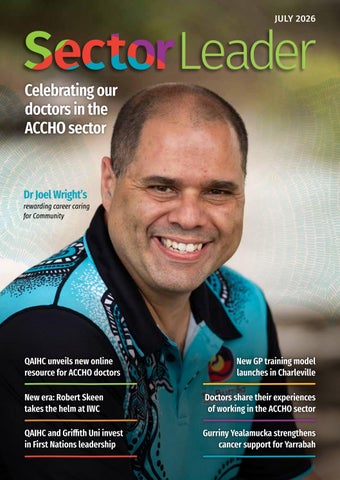
JULY 2026
Celebrating our doctors in the ACCHO sector
Dr Joel Wright’s
rewarding career caring for Community
QAIHC unveils new online resource for ACCHO doctors
New GP training model launches in Charleville
New era: Robert Skeen takes the helm at IWC
Doctors share their experiences of working in the ACCHO sector
QAIHC and Griffith Uni invest in First Nations leadership
Gurriny Yealamucka strengthens cancer support for Yarrabah
The ACCHO sector and QAIHC Aboriginal and Torres Strait Islander community controlled health organisations (ACCHOs) were established as a practical expression of Aboriginal peoples’ self-determination over health matters. These services were created by Aboriginal and Torres Strait Islander peoples, independently of government, and driven by the need to receive a better quality of care.
What is an ACCHO? An ACCHO is a primary health care organisation initiated and operated by the local Indigenous community to deliver holistic, comprehensive, and culturally appropriate health care to the community which controls it, through a locallyelected Board of Management. ACCHOs understand the role they play in supporting their local Aboriginal and Torres Strait Islander communities to live better lives. The ACCHO approach has evolved out of an inherited responsibility to provide flexible and responsive services that are tailored to the needs of local Aboriginal and Torres Strait Islander communities. ACCHOs often provide many services over and above their funded activities to ensure their community members gain the services they need. In line with their holistic health approach, ACCHOs support the social, emotional, physical and cultural wellbeing of Aboriginal and Torres Strait Islander peoples, families and communities.
What is QAIHC? The Queensland Aboriginal and Islander Health Council (QAIHC) is a leadership and policy organisation established in 1990 as the peak body representing many of the ACCHOs in Queensland at both a state and national level. The QAIHC Membership is comprised of 33 ACCHOs and two regional bodies (NATSIHA and IUIH) located throughout Queensland. Nationally, QAIHC represents Queensland through its affiliation and membership on the board of the National Aboriginal Community Controlled Health Organisation (NACCHO).
ii Sector Leader MAGAZINE | J U LY 2026
CHAIRPERSON’S ADDRESS
Australia stands at a critical point in the future of equitable healthcare, and ACCHOs sit at the centre of that future. They are not peripheral services — they are among the nation’s most effective and strategically important primary healthcare assets. For more than 50 years, ACCHOs have demonstrated what is possible when communities lead. Through culturally safe, holistic and community-controlled models of care, our sector continues to improve access to healthcare, strengthen trust and deliver better outcomes for Aboriginal and Torres Strait Islander peoples and communities. This month marks 12 months since QAIHC launched the Workforce Strategy 2025–2030. Developed in partnership with our Members, the Strategy recognised that a strong, sustainable and culturally grounded workforce is fundamental to the future success of our sector. At its heart, the Strategy is about investing in people. Every investment in workforce capability strengthens the quality of care available to Community. It builds skills, knowledge and confidence, supports
other emerging priorities. These investments are about building confident, capable and supported workforces that can deliver quality care for Community.
retention and helps create capacity to meet growing demand. Strong workforces build strong organisations which are better placed to deliver the high-quality care our communities deserve. Over the past 12 months, we have seen encouraging progress across the Strategy’s focus areas of workforce planning and governance, attraction, retention, education, training and employment. The new Queensland ACCHO Workforce Alliance is a dedicated forum for workforce leaders to share challenges, identify solutions and help shape future priorities. QAIHC continues to invest in workforce pathways, strengthening leadership capability, and creating opportunities for current and future workforce members to develop and grow within the sector. Central to this work is continued investment in the Aboriginal and Torres Strait Islander Health Worker and Health Practitioner workforce, which remains at the heart of the community-controlled model of care. The Strategy recognises that the future workforce must reflect the evolving needs of our communities. This includes investment in social and emotional wellbeing, child, youth and family intervention, Elder care, immunisation and
This edition of Sector Leader celebrates the contribution of doctors working across the ACCHO sector. Doctors play an important role within multidisciplinary teams and contribute to the delivery of holistic, culturally safe and community-led care. Initiatives such as the Single Employer Model Trial for GP Registrars, engagement through the Rural Doctors Association of Queensland Conference, and efforts to strengthen pathways into the sector are helping increase awareness of the unique opportunities ACCHOs provide. The progress achieved this year demonstrates what is possible when Members, communities and partners work together with a shared vision. Closing the Gap requires investment in the ACCHO workforce. Strengthening workforce capability today lays the foundations for better care, stronger services and healthier communities tomorrow. Dorothy Smith Chairperson, QAIHC
Queensland Aboriginal and Islander Health Council First Floor, 36 Russell Street South Brisbane QLD 4101
We welcome submissions from our Members on the great work being undertaken within the ACCHO sector. If you would like to contribute story ideas for consideration or comment on items in the current issue, please contact our Communications team at communications@qaihc.com.au. Previous issues can be viewed online at qaihc.com.au
View Sector Leader online
Aboriginal and Torres Strait Islander readers are advised that this publication may contain images or names of people who have passed away.
Sector Leader MAGAZINE | J U LY 2026
1
ACTING CEO’S ADDRESS
Building and sustaining a strong health workforce remains one of the most important priorities for Aboriginal and Torres Strait Islander community controlled health organisations across Queensland. Our Members continue to deliver high-quality, culturally safe and community-led healthcare in communities that often face significant workforce challenges. Ensuring we attract, develop and retain skilled health professionals is critical to improving health outcomes for Aboriginal and Torres Strait Islander peoples and communities. This edition of Sector Leader highlights the many ways our sector is investing in the future through its workforce. We feature the story of Dr Joel Wright (page 24) from Yulu-Burri-Ba Aboriginal Corporation for Community Health, whose journey into medicine and commitment to serving Community demonstrates the important role Aboriginal and Torres Strait Islander clinicians play within the sector.
and supported by QAIHC, has now
We also highlight valuable data showing the growing contribution and impact of doctors and other health professionals in the ACCHO workforce, reinforcing the need to continue investing in recruitment, training and retention pathways.
Leaders Forum, bringing together
Innovation also continues to play an important role in addressing workforce shortages. The Single Employer Model Trial for GP registrars, led by Charleville and Western Areas Aboriginal and Torres Strait Islander Community Health
progressed to implementation, with two GP registrars commencing under
holistic, community-led and culturally informed medical practice.
Doctors Association of Queensland
Alongside these workforce initiatives, we celebrate leadership across the sector, including the appointment of Robbie Skeen as chief executive officer of Indigenous Wellbeing Centre (page 28) and the recognition of Goondir Health Services chief executive officer Floyd Leedie, who was inducted as a Member of the Order of Australia earlier this year (page 32). Together, these stories reflect the strength of a sector that continues to lead through community, culture and self-determination while investing in a workforce that will support future generations.
Conference, where QAIHC engaged with
Yours sincerely,
this model in Charleville (page 20). This milestone demonstrates the sector’s commitment to exploring new approaches to attracting, training and retaining doctors in communitycontrolled health services, particularly in regional and remote Queensland. In April, QAIHC hosted the Clinical clinicians and sector partners from across Queensland to share knowledge, discuss emerging priorities and strengthen clinical leadership (page 8). We also look ahead to the Rural
general practitioners, registrars and medical students to promote a greater understanding of the ACCHO sector and the unique opportunities it offers for
2 Sector Leader MAGAZINE | J U LY 2026
Paula Arnol A/CEO, QAIHC
Contents 32
4 QAIHC News 4 New program to strengthen First Nations leadership launched in Queensland 6 QAIHC launches online resource to support doctors in ACCHO sector 8 Clinical Leaders Forum strengthens connections in the ACCHO sector 10 Building a stronger ACCHO workforce through place-based training and leadership 12 AFLW star Ally Anderson supports QAIHC flu vaccination campaign 12 Jaymie Lynch recognised for Youth Hubs work
24
28
17 Cervical cancer elimination for Aboriginal and Torres Strait Islander women projected 12 years later than government target, research shows
Data Room 18 Queensland GP Workforce Snapshot
Feature Stories 20 QAIHC welcomes ACCHO-led GP training trial in Charleville 22 Doctors making a difference
24 Cover Story — Dr Wright’s
journey into medicine and back to Community
National News 13 Federal Budget delivers new opportunities for ACCHOs 13 Trachoma no longer a public health problem 14 Aged care reforms failing Aboriginal and Torres Strait Islander Elders, sector warns 16 Community leadership must remain at the centre of Closing the Gap progress
Member News 27 Wuchopperen GP recognised for work in Aboriginal and Torres Strait Islander health 28 IWC appoints Robert Skeen as new CEO 31 Gurriny Yealamucka launches Cancer Care Program for Yarrabah community 31 Mudth-Niyleta and ATSICHS Mackay host QAIHC visits
34 32 Floyd Leedie honoured for lifelong service to Indigenous health and community wellbeing 34 Gindaja builds for the future with Special Projects Unit 36 Amy Lester — a lifetime of grassroots leadership and community control 38 Don’t miss Kambu’s 50th Anniversary Gala Ball 38 Join Mookai Rosie Bi-Bayan for its 40th anniversary celebrations
Member Support 40 QAIHC supports Members with My health for life packs 41 Health Information Team unveils Community Reports 41 New FluMist® campaign supports childhood flu vaccination 42 QAIHC calls for racism to be recognised as a key determinant of health 43 QAIHC rejects Expanding Adult Crime, Adult Time Bill in new submission 44 Divisional update 48 QAIHC Divisional Directory
49 Deadly Entertainment
Sector Leader MAGAZINE | J U LY 2026
3
QAIHC NEWS
New program to strengthen First Nations leadership launched in Queensland QAIHC in partnership with Griffith University has officially launched the Executive Indigenous Leadership Program (EILP), aimed at strengthening executive leadership capability across Queensland’s Aboriginal and Torres Strait Islander community controlled health organisation sector. Delivered by Griffith Business School’s Griffith Advantage executive education business, the EILP has been co-designed with ACCHO leaders to build the capability of current and emerging sector executives. Led by QAIHC in partnership with Griffith University the program is funded by the Queensland Government through Queensland Health and reflects a shared commitment to strengthening
The program was developed in codesign with senior ACCHO leaders, ensuring it reflects the lived realities of community-controlled health service delivery and leadership. QAIHC Board Director and Goolburri Aboriginal Health Advancement Co Ltd CEO Elizabeth Adams was a key speaker at the program’s launch on 26 March. The first block was delivered over two days at The Ship Inn, South Bank.
executive leadership capability across the ACCHO sector. The program was developed under QAIHC’s workforce and sector development portfolio and led by workforce and development jurisdiction manager Adam Stephen in collaboration with Griffith University.
4 Sector Leader MAGAZINE | J U LY 2026
As key leaders within the sector, we need to both strengthen ourselves and build the skills our organisations and communities need,” she said.
The EILP is a co-designed, evidencebased executive leadership program delivered across four sequential blocks — Individual, Organisation, People and Future — throughout 2026. Each block combines face-to-face workshops with online masterclasses in governance, mentoring and innovation. The program is designed to extend beyond delivery, with a post-program peer coaching network and a six-month leadership impact review. The inaugural cohort includes 12 leaders from Queensland’s ACCHO sector — five chief executive officers, six emerging executive leaders and one board chair — reflecting a deliberate investment in both current and future leadership.
QAIHC NEWS
Ms Adams said the program was an
The launch was marked by
excellent opportunity for participants,
a Welcome to Country and smoking
which required commitment and the
ceremony led by Shannon Ruska,
ability to grow their strengths.
Leadership is not just about growing yourself, but about showing the way forward for others and being a voice for community members who don’t get the opportunity.”
establishing a culturally grounded start to the program. The event was facilitated by Griffith University’s Prof. Ruth McPhail AM, Dr Kerry Hall and Dr Jessica Harris. The program’s strong cross-sector support was evident, with senior representatives from Griffith University, partner organisations,
The EILP was initiated in response
and QAIHC in attendance.
to priorities identified through QAIHC’s
Griffith representatives included
2024–2025 Regional Engagement Roadshow, where Members consistently called for greater
Vice Chancellor and President, Professor Carolyn Evans; Vice President of Industry and Engagement, Professor
investment in leadership capability
Bronwyn Harch; and Director of Student
and development.
Equity and Diversity, Shane Drahm.
Sector Leader MAGAZINE | J U LY 2026
5
QAIHC NEWS
QAIHC launches online resource to support doctors in ACCHO sector A new online resource has been developed for health professionals entering the Aboriginal and Torres Strait Islander community controlled health organisation (ACCHO) sector. The ACCHO Sector Orientation Learning Resource preserves the stories and legacy of the leaders who helped to build the sector. It gives doctors, specialist trainees and other health professionals a practical, self-paced introduction to the sector’s history, values, model of care and cultural foundations. This will help them begin work in the sector with greater confidence, respect and cultural safety. Developed by QAIHC with funding from the Royal Australasian College of Physicians (RACP), the project tells the true stories of the history, legacy and significance of the sector as well as its contribution to the health of Aboriginal and Torres Strait Islander people. “It is about honouring the leaders who have created and fostered this sector and ensuring their stories, knowledge and contributions are not lost,” Project Lead and QAIHC Public Health Medical Director, Associate Professor Sophia Couzos, said.
It’s critical that the historical significance of ACCHOs is understood by everyone, including governments and policymakers. “ACCHOs are the torchbearers of comprehensive primary health care in this nation.” “At a time when government policy continues to undermine primary health care through poorly planned reforms including virtual care, the ACCHO sector reminds us how critical quality primary health care is to a cost-effective health system.” She said the resource was designed to help doctors understand a comprehensive primary health model of care, before stepping into practice.
6 Sector Leader MAGAZINE | J U LY 2026
“While they may bring strong clinical skills, they may not yet understand the history, principles and community-controlled foundations that shape the sector,” she said.
This resource helps bridge that gap. By completing the resource before or during a placement, doctors can build a stronger understanding of why community control matters, how ACCHOs work, and how they can contribute in a culturally safe and respectful way.” The online resource can be completed at the learner’s own pace with five modules that cover: the history of the ACCHO sector and its model of care Aboriginal and Torres Strait Islander Health Workers and Health Practitioners Australian health system basics Aboriginal health policy Continuous Quality Improvement (CQI) and National Key Performance Indicators (nKPIs). The resource features filmed interviews with 19 leaders of the sector, founders and practitioners from Brisbane and South East Queensland, Cairns, Townsville, Charleville and Canberra. “What makes this resource so powerful is hearing directly from the people who helped build and shape the ACCHO sector,” Associate Professor Couzos said. “Hearing directly from our ACCHO leaders brings the sector’s history to life and shows how that legacy continues today.
QAIHC NEWS
“Unfortunately, due to time and resource constraints, the team could not interview all of the sector’s many influential leaders, but QAIHC acknowledges and respects their contributions and thanks them deeply.” A/Prof. Couzos thanked Acting CEO Paula Arnol for instigating the project — noting there was previously no resource like it in the sector — and acknowledged the RACP for funding and support making it possible. The resource was developed under the guidance of a Governance Committee of ACCHO sector CEOs (Stevan Ober, Paula Arnol, Sheryl Lawton and Rachel Atkinson) ensuring cultural oversight and sector leadership were embedded from the beginning. “We hope the resource will become a standard orientation tool for RACP registrars undertaking ACCHO placements, and over time be made available more broadly to other medical colleges, allied health professionals, universities and training organisations,” A/Prof. Couzos said. “The ACCHO Sector Orientation Learning Resource is more than a training tool — it is a living archive of sector knowledge and a practical resource for building a more culturally capable health workforce.” Visit acchosectororientation.com.au or scan the QR code and click ‘Register’ to create an account and access the resource.
Sector Leader MAGAZINE | J U LY 2026
7
QAIHC NEWS
Clinical Leaders Forum strengthens connections in the ACCHO sector QAIHC’s 2026 Clinical Leaders Forum brought together clinical leaders, health professionals and sector partners for two days of learning, discussion and collaboration on the issues shaping Aboriginal and Torres Strait Islander primary health care in Queensland. Held at QAIHC in South Brisbane from
Chief Executive Officer Paula Arnol,
27–28 April, the forum featured topics
with QAIHC Public Health Registrar
highlighting the range of issues ACCHOs
Dr Georgia Haines facilitating.
have to manage day to day.
QAIHC also delivered the forum in
These included public health, workforce
webinar format, extending access to
development, cultural safety,
participants unable to attend in person.
immunisation, oral health, rheumatic heart disease prevention, domestic and family violence responses, point-of-care testing, HPV screening, Medicare Benefits Schedule updates, supporting flu
A/Prof. Couzos said the strong participation reflected both the depth of expertise across the sector and the strength of the ACCHO model of care.
vaccinations, the diphtheria outbreak, health data and analytics, ACCHO-led models of care, STI molecular POC testing and the START (Strep A) testing program. The forum opened with a Welcome to Country delivered by Tribal Experiences. QAIHC Public Health Medical Director, Associate Professor Sophia Couzos, opened the forum on behalf of Acting
8 Sector Leader MAGAZINE | J U LY 2026
One of the strengths of the Clinical Leaders Forum is the multidisciplinary workforce in attendance, which reflects the ACCHO model of care and the expertise that clinicians and health professionals share with one another,” she said.
“The success of the forum lies in the willingness of our clinical leaders to share practical knowledge, challenges and solutions for the benefit of our communities.
This forum showed the depth of leadership across our sector and the importance of creating space for clinical voices to come together, learn from one another and drive meaningful improvements for our communities.” The forum also included public health registrars from the Institute for Urban Indigenous Health and Queensland Health, strengthening collaboration and shared learning across the sector and the broader health system.
QAIHC NEWS
QAIHC invited Queensland Health’s First Nations Health Office to attend and contribute to discussions around shared priorities and coordinated approaches to improving health outcomes for Aboriginal and Torres Strait Islander communities. A key theme across the two days was the importance of solutions designed with, by and for Aboriginal and Torres Strait Islander communities. Presenters highlighted both the opportunities and the challenges facing services (e.g., workforce pressures, fragmented funding, access to specialists, dental health inequities, fuel and outreach costs, and weak data-sharing arrangements between health systems and ACCHOs). The forum also showcased examples of innovation already occurring in community-controlled health.
These included Mulungu Aboriginal Corporation Primary Healthcare Service’s integrated dental program, Gurriny Yealamucka’s development of an ACCHO-led public health unit, and the expansion of point-of-care testing models designed to support earlier diagnosis and treatment. A/Prof. Couzos said the forum demonstrated the value of bringing clinical leaders together to focus on practical action.
Our services are constantly adapting to meet community need, often in complex and under-resourced environments,” she said.
“The Clinical Leaders Forum helps clinical leaders share knowledge, strengthen primary health care and improve outcomes for Aboriginal and Torres Strait Islander peoples.” A communiqué summarising key discussions and outcomes from the forum has been prepared and will be distributed to attendees.
Discussions from the forum will continue to inform QAIHC’s sector support, advocacy and engagement with government and health system partners throughout 2026.
Sector Leader MAGAZINE | J U LY 2026
9
QAIHC NEWS
Building a stronger ACCHO workforce through place-based training and leadership QAIHC continues to lead a coordinated place-based approach to workforce development by delivering targeted training that strengthens capability, supports career progression, and builds a sustainable ACCHO workforce for Queensland. ACCHO staff participated in programs
Building skills across the workforce pipeline
spanning clinical practice, leadership,
QAIHC’s delivery models bring together
In the first half of 2026, hundreds of
community services, and workplace safety. This reflects a deliberate investment in strengthening the current workforce as the foundation for future growth. “Our workforce is the backbone of the ACCHO sector,” QAIHC Workforce and Development Jurisdiction Manager Adam Stephen said.
nationally-recognised qualifications, short courses and targeted skill development, all centred around the needs of ACCHOs and the communities they serve. Programs are delivered in ACCHO-only cohorts, creating culturally safe, peersupported learning environments where participants can share knowledge and
These initiatives are about more than training — they support our workforce to build skills, strengthen cultural authority, and learn together in ways grounded in community and context.”
experiences from across the sector. These cohorts often bring together groups spanning generations thus encouraging knowledge exchange, strengthening cultural authority, and building confidence.
Brisbane office for the second learning retreat of the Diploma of Community Services, delivered in partnership with Health Industry Training. By applying learning directly to community context, the group up-skilled in complex needs assessment, crisis response and case management. Similarly, 17 participants from nine ACCHOs undertook the Diploma of Practice Management to build skill in operational leadership, financial oversight, workforce management and compliance systems. All critical skills for the effective delivery of primary health care services. QAIHC is working to grow the sector’s internal training capability, with leaders
In February, 22 ACCHO professionals
from eight organisations undertaking
were welcomed to QAIHC’s South
the Certificate IV in Training and
vices Retreat 2
Diploma of Community Ser
10 Sector Leader MAGAZINE | J U LY 2026
Diploma Practice Ma
nagement
rt IV TAE
Ce orce Workshop Member Workf
QAIHC NEWS
Assessment. This program allows
managers, corporate leaders, and finance professionals.
experienced ACCHO staff to become qualified trainers and assessors, while also contributing to the development of a culturally safe training workforce for the sector. This program supports ACCHOs to partner more effectively with training providers and, over time, play a greater role in the delivery and facilitation of training for their own workforce.
Investing in leadership and long-term workforce growth In March QAIHC launched the inaugural Diploma of Leadership and Management program for the ACCHO sectorw with 21 participants from 13 Member organisations. Supported through NIAA SEWB Workforce funding, the program is building leadership capability in existing workforce cohorts and enabling succession planning across the sector. QAIHC provides foundational workforce pathways through the long-standing Certificate III in Business (Medical Administration), delivered in partnership with UNE Partnerships. Operating for over 20 years, this program has produced many of the sector’s current practice
Diploma of Leader ship and Manageme
nt
Strengthening clinical capability and community outcomes Through its partnership with Benchmarque Group, QAIHC has coordinated delivery of the nationally recognised five-day Immunisation Course for Health Professionals. Held in Cairns, Townsville and Brisbane, a total of 34 clinicians from 11 ACCHOs were accredited under the National Immunisation Education Framework, improving local capacity to deliver immunisation services in Community. QAIHC also hosted a NACCHO-funded ASQ-TRAK2 Practitioner Training Workshop in April, supporting early identification of developmental strengths and needs in Aboriginal and Torres Strait Islander children, through culturally appropriate screening tools.
Delivered across 12 workshops, this training equips staff with traumainformed, person-centred approaches to de-escalation, safer interactions and improved outcomes for clients and communities. Through these initiatives, QAIHC continues to work alongside ACCHOs, training providers and partners, strengthen the current workforce and position the sector for sustainable growth.
Immunisation training in
action
Supporting safe, culturally responsive workplaces Recognising the importance of workforce safety and wellbeing, QAIHC partnered with the Crisis Prevention Institute to deliver Verbal Intervention and Safety Intervention training to more than 250 frontline staff from 25 ACCHOs.
Certificate III in Business (Medical Administration)
shop
ioner Training Work
ASQ-TRAK2 Practit
Immunisation Course for Health Professionals
Sector Leader MAGAZINE | J U LY 2026
11
QAIHC NEWS
Jaymie Lynch recognised for Youth Hubs work QAIHC Hearing Health Coordinator Jaymie Lynch has been named a semi-finalist in the 7NEWS Young Achiever Awards for Queensland, recognising her contribution to the Youth Hubs Program. Ms Lynch, a proud Gangulu woman, was nominated by QAIHC’s former General Manager of Sector Development Gregory Richards for the Queensland Family and Child Commission Contribution to Community or Family Safety Award (First Nations), recognising young leaders strengthening culture, community, and safety for children and families.
AFLW star Ally Anderson supports QAIHC flu vaccination campaign AFLW star and QAIHC ambassador Ally Anderson took part in a photo and video shoot promoting the importance of flu vaccinations in Aboriginal and Torres Strait Islander communities across Queensland. The shoot was led by Jackson Canuto and QAIHC Immunisation Coordinator Bo de la Cruz, with a theme encouraging families to get vaccinated ahead of flu season. It also highlighted the role of immunisation in protecting Elders, children, and vulnerable community members. Ms de la Cruz said Ally Anderson was a great role model to carry the message of the benefits of immunisation. “Ally’s support reinforces the importance of keeping up to date with vaccinations and being informed about how they keep individuals, families and whole communities safe,” she said. “We’re really grateful to have Ally here. As an AFLW player, she has such a strong influence, especially with young people. “Flu vaccinations are one of the most important ways we can protect our communities and reduce serious illness each year, especially for our Elders and children.”
12 Sector Leader MAGAZINE | J U LY 2026
Her recognition reflects her leadership of the Youth Hubs Program, partnering with ACCHOs to establish 10 culturally safe youth hubs across the state. Co-designed with communities, these hubs provide safe spaces for young people to access social and emotional wellbeing services, mental health support, health education and cultural programs. Mr Richards said: “Jaymie has led the establishment of culturally safe Youth Hubs across Queensland, empowering Aboriginal and Torres Strait Islander young people to stay connected to culture, community, and strong futures.”
NATIONAL NEWS
Federal Budget delivers new opportunities for ACCHOs
The 2026-2027 Federal Budget included a $793.7 million investment over five years, with $176.1m ongoing, to support implementation of the National Agreement on Closing the Gap. Among the measures were several investments that could create new opportunities for ACCHOs, particularly in infrastructure, workforce development, mental health, maternal health and community-led health reform. A significant and notable commitment was $144.1m over two years for urgent infrastructure projects. The Budget also allocated $53m over five years through the Better Renal Services for First Nations Peoples measure, to fund the completion of dialysis units and associated workforce accommodation which support on-Country treatment. The government announced two First Nations youth mental health services, commissioned through NACCHO to replace two remote headspace services. These services are not yet costed. Culturally safe primary healthcare will be strengthened with $2.7m over three years for another Aboriginal and Torres Strait Islander Health Worker Traineeship program cohort. The Budget provides ongoing support for culturally safe maternity care, with $44.4m over four years for 10 existing Birthing on Country services, including South East Queensland’s
Birthing in our Community (BiOC) program. Cape and Torres Health Commissioning were pledged $1.1m funding over the coming year to continue expanding health commissioning for Torres and Cape communities. The Thriving Kids reforms may also strengthen culturally safe care for neurodiverse and/or developmentally delayed children. There is $60.8m over five years for workforce development including some dedicated First Nations funding. Parts of two five-year funding pools may also support culturally safe early identification ($126.1m) and support for families, kin and carers ($99.5m). The Budget also reinforced the role of Aboriginal and Torres Strait Islander communities in shaping health policy and services. Under the new National Health Reform Agreement addendum’s Schedule B, the Federal Government committed $200m over five years, matched by the states and territories, to support shared decision making, community governance, data sovereignty and co-design of Closing the Gap health Implementation Plans.
Trachoma no longer a public health problem The World Health Organisation declared trachoma eliminated as a public health problem in Australia. The declaration was made in late April, with WHO DirectorGeneral Dr Tedros Adhanom Ghebreyesus congratulating Australia on the achievement. “This success reflects sustained commitment, strong partnerships, and a focus on reaching populations most affected by health inequities,” he said. Trachoma is the leading infectious cause of preventable blindness worldwide and was primarily found in remote First Nations communities. In at risk communities, trachoma prevalence reduced in Indigenous children aged 5-9 years from 14.9% in 2009 to 1.5% in 2024.
Minister for Indigenous Australians Senator Malarndirri McCarthy said the milestone reflected years of communityled work to keep Indigenous children healthy. “Aboriginal community controlled health organisations and local health workers have driven the progress that has made elimination of trachoma possible,” she said. “This is an important step in Closing the Gap in health outcomes. It shows that long term, community led solutions can and do deliver lasting change.”
Sector Leader MAGAZINE | J U LY 2026
13
NATIONAL NEWS
Aboriginal and Torres Strait Islander Elders continue to face significant disadvantage under a new Support at Home co-payment model, which fails to recognise long-standing inequities including limited access to superannuation, lower rates of home ownership, and greater reliance on government payments. These concerns were highlighted during QAIHC’s two-day Aged Care Reforms Workshop in March, where Interim First Nations Aged Care Commissioner Andrea Kelly spoke about the widening gap between what communities need and what the aged care system is currently designed to deliver. QAIHC Acting CEO Paula Arnol said the November 2025 reforms would worsen inequities unless governments involved communities in designing solutions.
The current reforms are not addressing the realities faced by many Aboriginal and Torres Strait Islander Elders,” she said.
Former QAIHC General Manager, Sector Development, Gregory Richards said: “Elders face financial barriers and services that don’t meet their cultural needs. Without real collaboration and support for community-controlled providers, these reforms could make the gap worse instead of closing it.” Five years after the Royal Commission into Aged Care Quality and Safety, and two years after her appointment, Ms Kelly continues to serve in an interim capacity — a situation she said sends a troubling signal about the level of government commitment to reform. Ms Kelly rejected the idea that Aboriginal and Torres Strait Islander Elders were choosing to leave aged care programs, pointing out that many were forced out by barriers in the system. Matthew Cooke, QAIHC Board Director for Central Queensland, said the situation highlighted a broader lack of government commitment and understanding to addressing the needs of First Nations Elders. He said it was unjust that the First Nations Aged Care Commissioner role remained
14 Sector Leader MAGAZINE | J U LY 2026
inat or Co ord
r, ye Dw
Ag so ed ork Care W s Reform
p
QAIHC is urging governments to take immediate action to address major gaps in Australia’s aged care reforms, warning the current system is failing Aboriginal and Torres Strait Islander Elders and placing community-controlled health providers under increasing pressure.
n Mario
Aged care reforms failing Aboriginal and Torres Strait Islander Elders, sector warns
on an interim basis, rather than being established as a permanent and empowered statutory position. Community-controlled aged care providers — often the most trusted and culturally safe services for Elders — are also facing growing administrative, regulatory and financial pressures under the reform agenda. Many lack the resources to absorb these burdens, placing their long-term viability at risk. In contrast, large for-profit providers are better positioned to adapt, raising concerns about widening gaps in service quality, cultural safety and accessibility. The transition from the Commonwealth Home Support Programme (CHSP) to the new Support at Home model is also reducing flexibility and removing low-barrier, preventative supports that many Elders rely on to remain independent. IUIH Executive Director Aged Care, Matt Moore, said: “The government has been advised since October 2023 — and again in October 2024, before the new Aged Care Act passed the Parliament —
NATIONAL NEWS
what service program design and funding model was appropriate for First Nations elderly”. Goolburri Deputy CEO, Trent Adams, said whilst Goolburri was working towards adapting the new modelling, it was inherently placing larger risks on organisations with compliance and liability.
In the short, it is affecting corporate governance models and requiring companies’ board of directors to be involved operationally,” he said. “The Commonwealth Home Support Programs have a foundation and good track record and needs to continue. Support At Home is not a mature
Provide long-term, reliable funding for Indigenous providers.
enough system to meet the needs of such a vulnerable cohort with such a growing demographic population.
With an ageing Australian population, I have great fears for our Elders that they will fall through the cracks or be forced out of the system as it’s not designed for our people.” QAIHC and sector partners are urging governments to take immediate steps to prevent further harm: Establish a permanent First Nations Aged Care Commissioner as a statutory office-holder.
Provide funding to the ACCHO sector to deliver mentorship programs for Members to become registered aged-care providers. Allow flexible, early support programs Make cultural safety and community leadership central in aged care.
Without urgent change, these reforms intended to strengthen aged care will cause lasting harm to the very people they are meant to support,” Aged Care Reforms Workshop Coordinator Marion Dwyer said.
Work with communities to design services and their funding.
Sector Leader MAGAZINE | J U LY 2026
15
NATIONAL NEWS
Community leadership must remain at the centre of Closing the Gap progress Close the Gap Day has passed, but QAIHC’s message remains as urgent as ever: improving outcomes for Aboriginal and Torres Strait Islander peoples requires long-term investment, genuine partnership and solutions led by Community. The latest Closing the Gap Dashboard update shows progress remains challenging, reinforcing what communities have long said — lasting change happens when solutions are culturally grounded, led by Community and supported long term. QAIHC Acting CEO Paula Arnol said the data was a reminder that governments must change their approach if they want different outcomes.
The latest Closing the Gap data shows that change is not happening quickly enough,” Ms Arnol said. “Our communities have the knowledge, leadership and solutions. What is needed now is sustained investment, genuine partnership, and a commitment to backing Aboriginal and Torres Strait Islander people to lead the way.” Across health, justice, and social and emotional wellbeing, the data highlights the need for systemic change.
For Target 2 — born healthy and strong — the proportion of babies born in Queensland at a healthy birthweight has not improved, sitting at 89.4 per cent in 2023, compared with 89.5 per cent in 2022. The target remains off track nationally.
Ms Arnol said the results could not be viewed in isolation.
Health, justice, family wellbeing, and social and emotional wellbeing are all deeply connected,” she said.
For Target 10 — criminal justice — the rate of adult incarceration in Queensland continues to rise, increasing from 2204.5 per 100,000 in 2024 data to 2278.3 per 100,000 in 2025 data.
“When people cannot access culturally safe care, when families are not supported early, and when communities are not properly resourced, the impacts are felt across generations.”
For Target 11 — youth justice — there has been a slight improvement, with youth detention falling from 41.6 per 10,000 in 2023–24 to 40.6 per 10,000 in 2024–25. However, Queensland remains the largest jailer of Aboriginal and Torres Strait Islander children, both by number and percentage.
QAIHC continues to call on the Queensland and Australian governments to build partnerships with the ACCHO sector, ensuring services are well-funded, culturally safe and community-led across social and emotional wellbeing, mental health and alcohol and other drug supports.
For Target 14 — social and emotional wellbeing — too many Aboriginal and Torres Strait Islander people continue to die by suicide. In Queensland, the rate remains steady at 26.1 per 100,000 over 2020–2024. Nationally, the rate has risen from 31.8 per 100,000 in 2023 to 33.9 per 100,000 in 2024.
16 Sector Leader MAGAZINE | J U LY 2026
ACCHOs are already delivering what works,” Ms Arnol said. “They are trusted, embedded in community, and understand the cultural, social and health needs of the people they serve. Governments must work with the sector as true partners.”
NATIONAL NEWS
Cervical cancer elimination for Aboriginal and Torres Strait Islander women projected 12 years later than government target, research shows A world-first study reveals that without urgent, targeted action, cervical cancer will not be eliminated in Aboriginal and Torres Strait Islander communities until 2047, 12 years later than the government’s 2035 target. Cervical cancer is the fourth most common cancer among women globally. It is caused by persistent human papillomavirus (HPV) infections but can be prevented through vaccination and screening. Published in Lancet Public Health, the study used existing data to project cervical cancer elimination timelines for Aboriginal Torres Strait Islander communities, and modelled a range of interventions to identify those with the biggest impact.
Researchers found that a targeted screening blitz focused on Aboriginal and Torres Strait Islander women who have never been screened could bring cervical cancer elimination forward to 2036, almost closing the 12-year gap. Lead author Associate Professor Megan Smith from the Cancer Elimination Collaboration at the University of Sydney School of Public Health, said:
At current rates, Aboriginal and Torres Strait Islander women will wait an extra generation to see cervical cancer eliminated in their communities — but the gap is not inevitable.
“Our research shows that a targeted screening blitz would almost entirely close the gap, protecting a whole generation of Aboriginal and Torres Strait Islander women.”
The study also highlights the importance of Indigenous-led approaches, ACCHOs, Aboriginal Health Workers and community leadership central to delivery. Senior author Associate Professor Lisa Whop, a Wagadagam Gumulgal woman from Yardhura Walani, the National Centre for Aboriginal and Torres Strait Islander Wellbeing Research at The Australian National University, said:
The researchers recommend interventions such as selfcollection and communitybased point-of-care testing to improve access to screening. Associate Professor Smith said: “The gap we see in cervical cancer is not about biology — it’s about access. And access can be fixed. Self-collection is a game changer because it gives people real choice and means that women don’t necessarily have to go to a clinic to get tested.” Associate Professor Whop said: “There is already good evidence that self-collection is helping to increase screening rates and with more investment and partnership it could be key to eliminating cancer within Aboriginal and Torres Strait Islander communities within a generation.”
Australia cannot claim success in cervical cancer elimination until Aboriginal and Torres Strait Islander peoples benefit equally. We need to act now.
Read the study via the QR code.
“This isn’t about inventing new solutions but backing what communities already know works. A concerted effort, funded by government and led by Aboriginal and Torres Strait Islander communities, will help to overcome longstanding inequities in cervical cancer screening.”
Sector Leader MAGAZINE | J U LY 2026
17
18 Sector Leader MAGAZINE | J U LY 2026
GP workforce
Sector Leader MAGAZINE | J U LY 2026
19
FEATURE STORY
QAIHC welcomes ACCHO-led GP training trial in Charleville QAIHC has welcomed the official launch of a new Aboriginal and Torres Strait Islander-led Single Employer Model (SEM) Trial in Charleville, describing it as a major step in growing and retaining the GP workforce in rural and remote Queensland, while also strengthening community-controlled care. The $2.4 million Commonwealth-funded trial will support GP registrars to train in the Charleville region through an innovative employment model led by the regions sole ACCHO. Delivered in partnership with Charleville and Western Areas Aboriginal and Torres Strait Islander Community Health (CWAATSICH), QAIHC, Acacia Country Practice and the South West Hospital and Health Service, the trial provides registrars with stable employment arrangements while embedding them in the ACCHO Model of Care. Central to this SEM model is CWAATSICH being the employee of the registrars over their training placement.
20 Sector Leader MAGAZINE | J U LY 2026
Held at CWAATSICH on 25 February 2026 in Charleville, the launch began with a Welcome to Country from Uncle Ray Robinson and Aunty Dawn Willett on behalf of the Bidjara people. Special presentations were given by Mike Pope, Assistant Secretary, Workforce Training Branch, Department of Health, Disability and Ageing; Mayor Shaun Radnedge, Murweh Shire Council; Dr Anthony Brown, CEO of South West Hospital and Health Service; CWAATSICH Chair Norman Burns; CWAATSICH CEO Sheryl Lawton and former QAIHC Sector Development General Manager Greg Richards.
QAIHC Chairperson Dorothy Smith said the initiative builds on more than five decades of community-controlled healthcare delivery.
ACCHOs have, for over 50 years, shown the benefit of providing care for our people and guided by our people,” she said. “We are a critical part of the Queensland and national health system and in 2024/25 we delivered over a million episodes of care to over 150,000 clients in Queensland. “This trial of the ACCHO-led Single Employer Model allows a longer-term training relationship and community engagement for the next generation of GPs for our sector. It demonstrates that providing care in rural and remote health is dependent upon strong local and regional partnerships.” Ms Smith said the initiative aligned directly with QAIHC’s Strategic Plan ‘Now to Next’ to strengthen the ACCHO sector through investment in workforce, culture and community-led care. Ms Lawton said the community was ready to welcome the next generation of doctors. “We are excited to provide a welcoming experience for our new GP registrars, Dr Andrew Dalton and Dr Kate Cook, and have them learn from CWAATSICH’s Model of Care and the service we provide, which is driven by our local community,” she said.
Mr Richards said the pilot reflected the strength and leadership of the community-controlled sector. “In our Blueprint 2.0 and our Strategic Plan, we’ve been clear that strengthening regional partnerships is critical to building our future workforce,” he said.
This pilot is about more than placing registrars — it’s about creating a training model grounded in community control, cultural safety and long-term relationships. “ACCHOs are a coordinated and highly responsive part of the health system. It makes sense that GP training is embedded within our Model of Care. “Our focus now is ‘Now to Next’ — building on more than 50 years of community control while adapting and refining how we attract, train and retain the next generation of GPs.” The trial will see registrars undertake placements across CWAATSICH, the South West Hospital and Health Service, and local private general practice, building broad clinical experience while remaining embedded in the Charleville community. Outcomes from the trial will be evaluated to inform potential broader implementation of the Single Employer Model across the ACCHO sector.
We have a history of building long-term relationships and connections with our doctors who have worked with us over the years, and we hope this innovative approach will attract the next generation of doctors for our region and the ACCHO sector. “With the SEM, both Dr Dalton and Dr Cook know this is a journey where we can both plan and support their clinical and cultural skills. “It is also showing Dr Dalton and Dr Cook that Charleville and other remote locations are places where you can live, learn and practice some of the most fulfilling careers in health.”
Sector Leader MAGAZINE | J U LY 2026
21
FEATURE STORY
Doctors making a difference This issue, we celebrate the dedicated doctors working across the ACCHO sector who provide culturally safe, community-led care to Aboriginal and Torres Strait Islander communities every day. Sector Leader spoke with a number of these doctors on what they love most about working in community-controlled health and what continues to inspire their work. Dr Kate Cook and Dr Andrew Dalton, from CWAATSICH, are participating in the Single Employer Model Trial. Why did you join the Single Employer Model (SEM) Trial in Charleville? Dr Kate: There are so many reasons why I’m here, but I really want to learn about the world’s oldest culture, and I’m really honoured to have that opportunity. Dr Andrew: Our end career goal is working in rural/remote Australia providing healthcare. We were hunting around for locations, and we had the opportunity to work with Doctor Sarah Springer [SEM trial lead researcher]. She was pretty instrumental in recruiting us, giving us a nice big tour of the town and really selling the Single Employer Model to us. We got to have a lot of conversations with the staff at CWAATSICH, with Sheryl (Lawton), the CEO and really fell in love with the place. Dr Kate: Just meeting (Sheryl) at our site visit last year; I could tell she was a powerhouse. She was incredible. She makes things happen. So, I was like, ‘I want to work for her.’
What do you think you can learn from the SEM? Dr Kate: In terms of the SEM specifically, it’s great that we can learn from an actual community clinic GP as well as a private GP, and then throw in a hospital shift every now and then. So that’s just so appealing, and I love the variety of it. Dr Andrew: Health disparities are an extra thing you learn (in your training). But until you actually branch out and work in these (rural/remote) areas… I think it’s really different just learning about it versus experiencing and witnessing the healthcare disparity.
What appealed to you about coming into the ACCHO sector? Dr Kate: Immersing myself in an ACCHO-led clinic, I can hopefully learn and grow from the community and understand what the community needs and how I can help deliver holistic health care. You can see it’s such a well-rounded approach that the rest of Australia should be jealous of, because (the model) is like ‘Is your medical health ok? Is your mental health care ok? What’s happening at home? Tell me about it.’ It’s just so rounded and beautiful.
22 Sector Leader MAGAZINE | J U LY 2026
FEATURE STORY
Dr Lisa Sims, Indigenous Wellbeing Centre What’s the most rewarding part about working as a doctor in the ACCHO sector? The most rewarding part is building genuine relationships with patients and families over time. I enjoy being able to provide more holistic care and creating a space where people feel comfortable, supported, and heard.
Why did you want to work in the ACCHO sector? I was drawn to the ACCHO sector because of its strong focus on community, cultural safety, and wholeperson care. It aligns with the way I like to practise medicine — in a more personal, respectful, and connected way.
What did you learn when you joined the ACCHO sector? I’ve learnt how important trust, listening, and consistency are in healthcare. Taking the time to understand each person’s background and experiences makes a real difference in how care is received and outcomes are achieved.
Dr Ranga Mashamhanda, Indigenous Wellbeing Centre
Dr Claudia Collins, Yulu-Burri-Ba
What’s the most rewarding part about working as a doctor in the ACCHO sector?
What’s the most rewarding part about working as a doctor in the ACCHO sector?
Working in ACCHOs is a privilege as one gets to work with the First Nations people and get a close interaction with their culture which in many respects has a lot of similarities to my own Shona culture. We have a lot of shared values including the critical role of the extended family in health decision making.
It’s the privilege of building genuine relationships with people and understanding their stories. It’s about meeting patients where they are at, taking the time to listen, and recognising the cultural, family and community contexts that shape their health and wellbeing.
Why did you want to work in the ACCHO sector?
Why did you want to work in the ACCHO sector?
I was looking for a job with social and family values. During my discussions with IWC, they indicated a willingness to be flexible to family circumstances I must deal with as a single parent.
I was inspired by the way ACCHOs approach healthcare through genuine partnerships with patients, families and communities. The model is less hierarchical than many traditional healthcare settings and values the contributions of a diverse team working together towards shared goals. The team-based approach means that everyone brings unique skills and perspectives, and patients are at the centre of decision-making about their own health.
What did you learn when you joined the ACCHO sector? It is a job which goes far beyond medical knowledge. It teaches you to challenge one’s perspectives on health and look at health in a more holistic way with an emphasis on better understanding cultural factors in health delivery.
Sector Leader MAGAZINE | J U LY 2026
23
COVER STORY
Dr Wright’s journey into medicine and back to Community With its freshwater lakes, stunning surf beaches and rugged headlands, Minjerribah (North Stradbroke Island) is an idyllic place to live and an unforgettable place to holiday. But for some, it’s a place to make a difference. A proud Wakka Wakka man, Dr Joel Wright has been working at Yulu-Burri-Ba Aboriginal Corporation for Community Health on Minjerribah for three years.
It’s a great privilege. It’s a beautiful location, but I actually get to make a difference in the lives of my own people,” he said.
shock. I’d gone from a country school with 20 kids to a school of 4,500 kids — it was a huge, huge change.” His Australian accent “died out very quickly without trying.”
Islander peoples make up approximately
because I had the [American] accent.”
3.2 per cent of the Australian population
Following graduation, Dr Wright still
(Australian Bureau of Statistics, Census
wanted to pursue his dream of becoming a doctor, but obtaining a degree was at least $350,000-$400,000 in the US.
“I saw the doctors comforting my dad, and I was like, I’d like to be able to do that job when I’m older,” he recalled. “I’d never seen my father cry before, and I just remember seeing him coming out and [the doctors] just giving a bit of a hug and being there for him.”
as a back-up plan.
“Everything was like it was in the movies!” Dr Wright said. “I remember taking the yellow buses to school, and it was a huge culture
While Aboriginal and Torres Strait
“I probably sounded more like a local there
For Dr Wright, the journey towards medicine began from an early age. When he was five years old, his mother died from complications from diabetes.
Six years later, his family experienced another life-changing event. Dr Wright and his father, who is Jamaican, moved to Miami in the United States where his extended family were living.
Dr Wright was now one of a small number of Aboriginal and Torres Strait Islander doctors in Australia.
of Population and Housing: Aboriginal and Torres Strait Islander People, 2021), they represent well under 1 per cent of
Unsure of what to do, he worked
the medical workforce.
as a travel agent for a few years,
According to the Australian Institute
while he got a degree in accounting
of Health and Welfare (National Health Workforce Dataset, 2021), there were
After years of uncertainty about how to
around 112,000 employed medical
fund his medical studies, he eventually
practitioners in Australia. Of these,
returned to Australia in his mid-20s.
only 563 were Aboriginal and/or
Dr Wright saved up and applied for a
Torres Strait Islander doctors.
Doctor of Medicine at the University
in that pathway, and four of them
He went on to secure an internship at the Redland Hospital in obstetrics and gynaecology.
graduated, including Dr Wright.
“It was one of the few things I said I’d
At graduation he was joined by peers
never do, and I ended up doing that as
of Queensland, which had an Aboriginal and Torres Strait Islander entry admission pathway. There were just eight people
from northern New South Wales,
a Principal House Officer for four years
Darwin and the Torres Strait.
before I did general practice,” he said.
“It was really nice to have that
“I loved it, I loved it — it was just
understanding peer support,” he said.
not good for health and life,
24 Sector Leader MAGAZINE | J U LY 2026
COVER STORY
Sector Leader MAGAZINE | J U LY 2026
25
COVER STORY
you know, constantly working nights; you’re constantly stressed. “And it just got to a point where I had to decide whether I wanted to continue down that pathway or try to improve my lifestyle. “I’d gained a lot of weight. I was very unhealthy. I had a lot of the problems that I’m trying to prevent in others. And I thought, it’s about time I firmly fixed some of these things.”
Despite the intensity of the training, it was a turning point in how he thought about sustainability in medicine.
a refreshing change, from both a personal and professional perspective.
The rewards of working in Community are many, he said.
“I always wanted to work back in the community if I could — it was something on the radar — and this came up as an opportunity and it was very, very good,” Dr Wright said.
“It’s being able to see the trajectory of people’s health and life.”
“I think being Aboriginal myself and also even having some of the issues — some of the preventable diseases — that I’ve had and been able to manage them properly, it actually gives a good deal of rapport with my patients, because I can actually walk through with them from my own personal experience with a lot of it.
Dr Wright now works two days a week at a private GP practice in Rochedale, and three days a week at Yulu Burri-Ba at its Dunwich clinic on Minjerribah. Working in the ACCHO sector has been
26 Sector Leader MAGAZINE | J U LY 2026
And having the same cultural background automatically helps to put a lot of patients at ease.”
You start the journey with them, and you see them as they grow older. And it’s rewarding to actually move through life with them in their medical journey. “You know your patients quite well. And you can be walking past them and say, ‘hey, you need to come and see me’. So, you can actually follow up patients in real time.
You also get to make an impact in places that really need it.”
MEMBER NEWS
Wuchopperen GP recognised for work in Aboriginal and Torres Strait Islander health Wuchopperen Health Service GP Dr Liza Robertson said she looks toward a “bright future” for the next generation of doctors working in Aboriginal and Torres Strait Islander health, following recognition for her outstanding contribution to the field. Dr Robertson was awarded the RACP’s Aunty Val Dahlstrom Award for Aboriginal Health Excellence at the GP25 awards ceremony in November.
It’s lovely to have that recognition from my colleagues,” she told newsGP. “I’m also aware there are so many amazing GPs who work in this space, and it was really quite overwhelming to think that I’d been selected for this year’s award.”
L-R: RACGP Aboriginal and Torres Strait Islander Health Chair Dr Karen Nicholls, Dr Liza Robertson and RACGP College President Dr Michael Wright.
Dr Robertson is a senior GP at Wuchopperen Health Service in Gimuy (Cairns), on Yirrganydji Country. She also works one day a week in the emergency department at Atherton Hospital.
“There are so many GPs already doing this and I’m encouraged by the registrars and younger doctors who I see coming through and really embracing this space.
“It really fulfills a drive to work with communities where healthcare has not traditionally been delivered in an equitable manner,” she told newsGP. “I feel fortunate that has been the pathway that I’ve ended up with.”
Before settling in Gimuy, she also worked in remote Aboriginal communities, including work with the Royal Flying Doctor Service. Dr Robertson said she was encouraged by the growing number of young doctors and registrars entering the field and optimistic about the future of Aboriginal and Torres Strait Islander health. “This is an area of health that is so rewarding to work in. It’s also challenging to work in, and we really need the best and brightest GPs coming and working in this space with commitment and passion to really deliver good healthcare within the communities,” she told newsGP.
It’s an area of medicine that is starting to attract more and more bright young minds and passionate people — it’s a bright future.” She also highlighted the importance of strengthening the GP pipeline, noting the growing number of students, registrars and Aboriginal and Torres Strait Islander health practitioners entering the workforce. “Having some of those come to work at Wuchopperen Health Service is a really wonderful thing to see and just knowing that around Australia there’s so many people coming out of communities who want to work and give back to their families and communities,” she told newsGP.
Sector Leader MAGAZINE | J U LY 2026
27
MEMBER NEWS
IWC appoints Robert Skeen as new CEO For Robert Skeen, working in Aboriginal and Torres Strait Islander health has never just been a career — it has been a lifelong commitment to Community. With traditional ties to the Gubbi-Gubbi, Mununjarli and Waanyi peoples of Queensland, Robert recently stepped into the permanent Chief Executive Officer role at Indigenous Wellbeing Centre (IWC) after acting in the position for 10 months. Over the years, his career has taken him across Queensland, New South Wales and the Northern Territory, holding management and executive roles within Aboriginal medical services, as well as positions with Queensland Health and QAIHC. He has also served on a number of communitycontrolled and government boards as a director. But despite decades of leadership experience, Robert says his first role remains closest to his heart. Starting out as an Aboriginal Health Worker, he still describes it as “the best job in the world.” Sector Leader sat down with Robert to talk about his vision for the IWC, the organisation’s model of care, and why he believes “servant leadership” is central to strengthening Community health and wellbeing.
How did you get started at IWC? I was living a good life as a consultant. I did some work on the IWC Board and then the opportunity came to becoming the Acting CEO first.
Why did you want to work at IWC? When I had my first board meeting here, I could tell straight away that we weren’t operating as an Aboriginal communitycontrolled health organisation, having worked in so many. I think this is my tenth medical service (having worked in Queensland, New South Wales and Northern Territory). It was a mainstream GP model. So, there was a lot of work to do and having recognised that, I knew we were not optimising the care for our clients. I felt it was my responsibility to come home and make a difference.
28 Sector Leader MAGAZINE | J U LY 2026
What are you most proud of achieving at IWC? We have had to modernise IWC. There was a lot of change management that happened in my first 12 months, and that’ll continue for another 12 months. It was putting strategy behind the structure, giving clarity for roles and responsibilities for everyone in the organisation, for transport, medical, reception, all through the clinic, everybody right up to the board and myself. Part of that strategy was modernising the Constitution, developing a new strategic plan, a business plan and work plans for everybody so that governance and organisation-wide accountability was really strong. We did a lot of work around making sure we were financially strong and stable, same with HR. They’re the two pillars you build an organisation off. We got in experts to help with the rebuild of the organisation.
Did you get anyone to help with the rebuild? Renee Blackmann, the CEO of ATSICHS Brisbane, was very generous with her time. She came and spoke at our all-staff meetings, so there were 170 people at that time. She’s a female original leader — a very strong one. It was very important to have her come, so our young women in Bundaberg and within IWC have her as a role model and say, I can do anything, there’s nothing that can stop me. A couple of months ago, Renee allowed us to go to ATSICHS Brisbane to have a look at what they’re doing. It wasn’t enough for me to tell people what the traditional model was and how we operate. It was really beneficial for them to have a look at it so they can ask their peers.
Sector Leader MAGAZINE | J U LY 2026
29
MEMBER NEWS
What’s your vision for the organisation?
What are you passionate about?
Self-determination. We want to be proactive and not reactive when there’s a change of government, or policy changes and then everyone’s running around like headless chooks. We want to be proactive and ready for the changes.
I love change management — being able to put organisations through change management, so they’re optimising their capabilities for staff and community as well. It’s really, really important to me. And just being a help in general. I’ve got no ego. I’ll do anything. Part of my leadership is I won’t ask anybody to do something that I’m not willing to do or haven’t already done.
We’re implementing the model of care that ATSICHS Brisbane has just implemented as well and that’s patient-centred, better quality of care. We’re growing our workforce as well. Workforce is always one of the top five priorities for any services in our sector in Australia. The conversations around regionalisation are really important, and having a united voice out in the regions, instead of a set of individuals competing for the same sort of thing.
What are you excited about for IWC? We’re starting a Pod model on 1 July. In a nutshell, if I come into the clinic — instead of getting my screening in this room and then going to a different room and another room — I’ll check in at medical reception, and the concierge will take me to a room, and everybody comes to me, for example, the GP, allied health, a diabetes educator, dental etc.
How does the model of care work when you’re a patient coming into IWC? The Aboriginal Health Workers and Aboriginal Health Practitioners — they’re the gateway into this organisation, and for us, the other way into the community. You come in and see the Aboriginal health workers and practitioners first, and they guide our mob’s journey through IWC. We’re not just a GP clinic, we’ve got allied health services, dental, community health areas, which play a huge part in preventative health. We’ve got a pharmacy, pathology, radiology and imaging.
Tell me what kind of values you bring into each organisation? Servant leadership is very, very important — giving the community a voice. Creating meaningful ways for them to be involved in planning, evaluation and designing of services — because the community has ownership. I’m in the service of others, not myself. I’m here for us. And that’s the journey I take the whole organisation on. You look at the servant leaders in our sector, Uncle Les Collins, you know, everybody who started AMS Redfern. I have heard someone say one day, you know, these AMSs were developed on like a thousand cups of tea because it was all volunteers, you know, in the early days.
Can you tell me something you’ve learned about leadership? I think for the last 10 years of my working career, I’ve been on a journey of professional development around what leadership is and the importance of leadership in our sector. I operated for a long time as a manager, not realising the difference between management and leadership. Managers manage people and process, whereas leaders lead the organisation at a strategic level.
Why do you work in this sector?
Why do you like community-controlled health?
Working in this sector is my passion. It’s not my job. I do it because I love it. Myself as a CEO, I create an environment for my staff that encourages them to use their skills, abilities and experiences.
Obviously, the community-controlled sector — it is completely different to a government sector. It is working at the coalface — the grassroots level — by every definition of it. I found it more rewarding being able to see the changes happening in front of you because of the model that we have and the lack of red tape.
They’ve gone to the university for three or four years, then give them the environment to practice what they’ve learned. Put theory into practice. If they make mistakes, support them through the mistakes or whatever their learnings are. I want them not to be afraid to make mistakes. My wife says there’s no such thing as a mistake. It’s a learning opportunity.
30 Sector Leader MAGAZINE | J U LY 2026
MEMBER NEWS
Gurriny Yealamucka launches Cancer Care Program for Yarrabah community Gurriny Yealamucka Health Services has launched a new Cancer Care Program within its Public Health unit, strengthening support for Yarrabah community members and families impacted by cancer. Led by Program Coordinator Patrick Sinha, the team includes Health Promotion Officer Harley Thaiday as well as Cancer Care Support Officers Chanten Lefoe and Chantell Thomas, who will work closely with community to deliver culturally safe, practical and responsive care. The program is focused on increasing participation in cancer screening across Yarrabah including bowel, breast, cervical and lung screening, through community-led education, yarning circles and locally relevant health promotion activities. Mr Sinha said the program was about ensuring community members feel supported, informed and connected throughout their cancer journey. “Gurriny Yealamucka Health Services Aboriginal Corporation is proud to introduce our Cancer Care Program, established to support our community through culturally safe cancer care.”
“The program supports Yarrabah community members and families at every stage of the cancer journey — from diagnosis, through treatment, and beyond,” he said. A strong focus is placed on patient navigation and care coordination, helping people attend appointments, understand their treatment and stay connected to services. The program also supports families, recognising the broader impact cancer can have across households. “Our team provides practical support, care coordination, advocacy and emotional support. We are here to walk beside you, with care, culture and compassion.” Mr Sinha said. The program also aims to strengthen partnerships with Cairns Hospital Oncology and Queensland Cancer Screening Registries, improving access and continuity of care for Yarrabah.
Mudth-Niyleta and ATSICHS Mackay host QAIHC visits Chairperson Dorothy Smith and Member Engagement Lead Jason Fagan recently travelled to Mudth-Niyleta and ATSICHS Mackay to meet with their Executive Leadership teams. The visits provided an important opportunity to strengthen relationships, share strategic priorities, and engage in meaningful discussions about service delivery, community outcomes, and ongoing collaboration. Ms Smith and Mr Fagan acknowledged the leadership and dedication of both organisations in delivering culturally responsive care to their communities. They also explored opportunities to further enhance partnerships and support alignment with QAIHC’s broader vision and priorities. At Mudth-Niyleta, they met with the members of the Executive Board, who proudly shared the range of health services and programs delivered to their community, highlighting their
commitment to culturally appropriate care and improved health outcomes. At ATSICHS Mackay, members of the Executive Board and the CEO provided valuable insight into the services delivered to their community, while also emphasising the importance of addressing social needs to achieve better health outcomes. The visit also included a tour of their new building extension — a modern space that will support staff in delivering care each day. Thank you to Mackay ATSICHS Executive Manager, Aunty Valerie Pilcher, for the warm welcome and for sharing this achievement. QAIHC extends its thanks to both services — CEO Sam Raciti at Mudth-Niyleta and Aunty Valerie at ATSICHS Mackay for their warm welcome, openness, and commitment to improving health outcomes for Aboriginal and Torres Strait Islander peoples.
Sector Leader MAGAZINE | J U LY 2026
31
MEMBER NEWS
li f
te rh
e
t be
Floyd Leedie honoured for lifelong service to Indigenous health and community wellbeing
e al
t h, b e
t t er l i v i n g
, l on
r ge
CEO of Goondir Health Services, Floyd Leedie, has been appointed a Member of the Order of Australia (AM) in the 2026 Australia Day Honours, for his contribution to Indigenous health. Mr Leedie has more than 25 years’ experience in Indigenous health leadership, spanning service delivery, governance, research, and workforce development in Queensland and nationally.
He also spoke about the importance of self-belief in overcoming expectations placed on First Nations students. “I decided to give myself half a chance,” he told UniSQ.
He has been Chief Executive Officer of Goondir Health Services since 2008 and served as Chief Financial Officer from 2001 to 2007. Reflecting on his early journey, Mr Leedie said his path was shaped by a determination to create opportunity.
I knew from the age of six that I wanted to do something with my life but did not know what that was until hitting high school and then attending university,” he told UniSQ. Mr Leedie completed a Bachelor of Commerce (Accounting) at the University of Southern Queensland, an experience he described as a turning point to reinforce his belief in the power of education to create opportunity and drive change.
Anyone can do it. You can achieve what I’ve achieved. It’s up to you. It starts here.” Under his leadership, Goondir has expanded culturally safe, comprehensive primary health care across regional and rural Queensland, with a strong focus on prevention, early intervention, and community wellbeing. Beyond Goondir, Mr Leedie has made a significant contribution to the ACCHO sector, including a long-standing involvement with QAIHC as a Member representative since 2005, as well as previous stints as treasurer and director. He has also previously acted as Executive Board Member for Research Excellence with national peak NACCHO. He has played a role in health policy, research and innovation through advisory groups and partnerships,
32 Sector Leader MAGAZINE | J U LY 2026
including: Health Translation Queensland, the Queensland Indigenous Governance Council, and the Queensland Rural and Remote Digital Health Care Committee. Mr Leedie is also a co-lead investigator on Indigenous health research initiatives with The University of Queensland and other partners. As an Adjunct Professor at The University of Queensland he has contributed to workforce development as a Cultural Mentor for GP registrar training programs with James Cook University and Joint Colleges Training Services.
The honour recognises Mr Leedie’s sustained contribution to Indigenous health, leadership and innovation, and a career grounded in service, resilience and a commitment to improving health outcomes for Aboriginal and Torres Strait Islander peoples.
Sector Leader MAGAZINE | J U LY 2026
33
MEMBER NEWS
Gindaja builds for the future with Special Projects Unit Gindaja Treatment and Healing Indigenous Corporation is proud to announce the creation of a dedicated Research, Development and Training Unit (Special Projects Unit) a landmark investment in the organisation’s future and a testament to its commitment to culturally responsive Alcohol and Other Drugs (AOD) care. Gindaja CEO Ailsa Lively said the unit would supercharge the service’s research, service development, workforce training, evaluation, and knowledge translation. “This is a really proud moment for Gindaja,” she said. “We’ve always believed that delivering excellent care means never standing still — always learning, always improving.
We’ll have a team with the time, specialisations, energy and focus to develop locally based programs that are culturally safe and backed by the latest best practice research.” The new unit will lead communityinformed research that deepens understanding of AOD challenges in Yarrabah as well as co-design programs and resources that genuinely reflect community strengths and aspirations. At the same time, it will drive ongoing culturally competent professional
development for staff ensuring they have the knowledge and support to deliver safe and effective services. SPU also takes on responsibility for Yarrabah’s Justice Services (YJS) which is a Gindaja initiative in collaboration with the local Yarrabah Justice Group as well as the new North Queensland Youth AOD Service delivered in partnership with local Cairns youth service YETI and Victorian based youth organisation YSAS. YJS provides youth bail support, domestic and family violence support, magistrate’s court support and community engagement as well as heading up Yarrabah’s first Justice Reinvestment initiative, known as the Yarrabah Peacemaking Project. The North Queensland Youth AOD Service is a new residential rehabilitation program and outreach service located in Cairns, designed for young people aged 13-18 years with a focus on Aboriginal and Torres Strait Islander young people.
34 Sector Leader MAGAZINE | J U LY 2026
Our community deserves services that are grounded in evidence and shaped by their own knowledge and experience,” Ms Lively said. “This unit is how we make sure that happens — not just once, but as a constant part of how we work.
We’ve always taken a holistic approach to AOD treatment and part of that is making sure our clients are lifted up and feel like they’re part of a community. “By embedding culture in everything we do, from the bottom to the top, we’re helping with that healing.”
One of Gindaja’s great strengths has always been an emphasis on growth from within. They employ Yarrabah locals, who may not have qualifications but do have local knowledge and lots of potential,
and train them. As of 2026, Gindaja employs 53 local Aboriginal team members of a 56-person organisation. Another of Gindaja’s strengths is the use of data to tell the story of the Yarrabah community and the benefits the service provides. This has allowed Gindaja to grow and expand its services, including securing capital works funding for upgrading its a 15-bed residential recovery centre, replacing old and unsuitable accommodation. By centralising Gindaja’s research, service development, training, data and communications functions under the SPU banner, its ability to create locally relevant, culturally safe projects and programs can only be enhanced. “By having these robust systems in place, not only do we get results, but then funding bodies are confident in investing money in our community- led solutions, because we can show them the bottomline benefits,” Ms Lively said.
Sector Leader MAGAZINE | J U LY 2026
35
MEMBER NEWS
Amy Lester — a lifetime of grassroots leadership and community control QAIHC and the broader ACCHO sector mourns the passing of Amy Lester, a proud Barada (Kabalbara) woman, respected Elder, and unwavering advocate for Aboriginal Health and community control. Amy’s life was grounded in culture, kinship, and a deep commitment to her people. Born the twelfth of 16 children to Alick and Topsy Smith, she carried forward a strong legacy of family, resilience, and cultural responsibility that shaped her lifelong service to community. Throughout her decades of leadership, Amy remained firmly committed to one principle: our mob leading our mob.
services to deliver care that is culturally safe, responsive, and grounded in the lived experiences of community. Amy was known for her grassroots approach; she did not lead from a distance. She walked alongside Community, listening carefully, speaking up when it mattered, and ensuring decisions reflected the voices of her people.
For her deep contribution to Bidgerdii and the ACCHO sector, Amy Lester was recognised in 2008 with induction into the QAIHC Hall of Fame, in its inaugural year.
A champion for community control Amy’s contribution to the ACCHO sector and beyond was significant and enduring. Her leadership journey spanned multiple roles at local, regional, and state levels, including: Former Chief Executive Officer L ong-serving Bidgerdii Board Member for over 14 years Former QAIHC Board Member Former ATSIC Regional Councillor Murri Court Elder T rusted voice across numerous boards and community organisations in Rockhampton. In each of these roles, Amy brought strength, clarity, and cultural authority. She believed deeply in the power of Aboriginal community controlled health
Leadership guided by culture and community Amy’s work extended well beyond governance. As a Murri Court Elder, she played a vital role in supporting justice outcomes for Aboriginal and Torres Strait Islander people, grounding the process in cultural understanding and respect. Her leadership style was direct, honest, and compassionate. She was a strong advocate yet always carried herself with humility and deep respect for Elders, community members, and those coming through behind her.
36 Sector Leader MAGAZINE | J U LY 2026
Colleagues across the sector remember Amy as someone who: Spoke truth with strength and integrity Kept culture at the centre of decision making Prioritised the wellbeing of Community above all else Mentored and guided the next generation of leaders. Her influence helped shape stronger organisations and more accountable systems, ensuring that community voices remained at the forefront.
A legacy that will continue to guide us Amy’s passing is a profound loss to the ACCHO sector, to her community, and to all who had the privilege of working alongside her.
Her legacy lives on through the many lives she touched — through better access to culturally appropriate health care, stronger community governance, and the ongoing fight for self-determination. She showed what it means to lead with culture, courage, and commitment.
Remembering Amy Above all else, Amy was a Mum, Nanna, Elder, and matriarch. Her love for her family and her community was at the heart of everything she did. The sector extends its deepest condolences to her daughter Marissa, grandson Kyle and his partner Rhi, and to her extended family and kin. As we reflect on Amy’s life, we honour a woman who stood firm in her beliefs, lifted others as she walked, and never lost sight of who she was and who she was working for.
Her footsteps remain strong in our sector. Her voice echoes in our advocacy. Her legacy lives on in community control.
Sector Leader MAGAZINE | J U LY 2026
37
MEMBER NEWS
Don’t miss Kambu’s 50th Anniversary Gala Ball Community, culture and celebration will take centre stage this August, as Kambu Health invites guests to be part of a historic milestone — its 50th Anniversary Gala Ball. Marking 50 years of communitycontrolled healthcare, this year’s event promises to be more than just a gala — it’s a significant milestone recognising the strength, resilience and vision of the people who have shaped Kambu Health over five decades. Held on Saturday, 1 August 2026 at the Ipswich Showgrounds, the evening will bring together community members, leaders, partners and supporters to honour Kambu’s journey. Guests will enjoy a three-course dinner inspired by native flavours, alongside performances from a standout line-up of First Nations talent. This includes special guest Olivia Coe Fox, whose appearance on The Voice Australia made history with performances in Aboriginal language. The night will also feature live comedy from Kevin Kropinyeri and Sean Choolburra, as well as music from First Nations band, The Fringe Dwellers.
The program will also include special commemorative moments reflecting on 50 years of impact — celebrating the Elders, staff, and community whose leadership and commitment have been central to Kambu Health’s success. With nearly 300 guests attending last year’s event, the gala has become one of the most anticipated dates on the Ipswich social calendar. Organisers expect strong demand again this year, with limited tickets available. The ball is on Saturday, 1 August 2026 at 6pm, Ipswich Showgrounds, 81 Warwick Street, Ipswich. Dress code is formal. Scan the QR code to get tickets.
Join Mookai Rosie Bi-Bayan for its 40th anniversary celebrations In 2026, Mookai Rosie Bi-Bayan proudly celebrates 40 years of service, advocacy and care for Aboriginal and Torres Strait Islander children, families and communities. The 40 Years Celebration will bring together Elders and community members, industry partners, government, corporate supporters and allies to honour the organisation’s journey, and strengthen our work moving forward. Join Mookai for an inspiring evening at its Gala Dinner and a powerful day of insight and discussion at their Healthy Futures Conference. Tickets for the Mookai 40 Years Gala Dinner and one day Healthy Futures Conference are strictly limited. Register your Expression of Interest and secure your place at this unforgettable celebration and informative discussion at the Pullman Cairns International on 30 October, 2026. Register via the QR code.
38 Sector Leader MAGAZINE | J U LY 2026
MEMBER SUPPORT
Sector Leader MAGAZINE | J U LY 2026
39
MEMBER SUPPORT
QAIHC supports Members with My health for life packs Funded by the Queensland Government through Health and Wellbeing Queensland and facilitated by Diabetes Australia, My health for life is a free initiative focused on making healthier choices and healthier habits. The program is aimed at Queenslanders who are at high risk of chronic disease, including heart disease, stroke and Type 2 diabetes. Participants work with qualified health coaches to co-design a health plan that suits their lifestyle and health conditions. QAIHC My health for life coordinator Lee Yeomans said community facilitators delivering My health for life in group settings played an important role. L-R: My Health for Life facilitators at ATSICHS Mackay, Alma Hawdon and Athaliah Power (pictured right).
QAIHC has launched a My health for life promotional pack for Members to support participants in the health and wellbeing program to make positive, lasting changes in their lives. The pack includes a My health for life (MH4L) backpack, T-shirt and hat, along with fruit and vegetable stickers and a notepad to help keep track of their progress. As an added incentive, QAIHC funded pedometers that can link with mobile phones and report on steps, heart rate, blood pressure and sleep patterns. Research shows that people wearing pedometers walk around 2000 steps more per day (BMJ. 2007).
40 Sector Leader MAGAZINE | J U LY 2026
“Community facilitators delivering My health for life in group settings make a real difference. Talking together about positive changes helps participants think about what’s possible in their own community, including how social determinants like work, income, access to food, housing, and the local environment shape health and wellbeing,” she said.
Being part of a supportive group can build even more confidence, helping people to take on individual changes and share those changes with family and friends, especially around healthy eating and being more active.” For more information about the packs, email: lee.yeomans@qaihc.com.au
MEMBER SUPPORT
Health Information Team unveils Community Reports
New FluMist® campaign supports childhood flu vaccination
QAIHC’s Health Information Team has launched new Community Reports for Member services using the Medical Director and Best Practice systems.
QAIHC Members will soon receive new posters to support uptake of flu vaccinations by Aboriginal and Torres Strait Islander children across Queensland.
Designed to make data more accessible and meaningful for communities, the reports are presented in an easy-toread A3 poster format and will be distributed to Members each month.
QAIHC Immunisation Coordinator Bo de la Cruz has developed two seasonal ‘Protect our kids’ posters, designed for the winter and dry seasons. The posters encourage families to protect children from influenza by accessing FluMist,® a safe and effective needle-free spray vaccine (only for children aged 2-17 years), through their local ACCHO or GP.
Each Community Report provides a high-level snapshot of clinic activity, including: the demographics of people accessing services the number of 715 health checks completed, with comparison to the previous month, the same month the previous year, as well as a Member service’s best performing month in the past 12 months performance against relevant RACGP accreditation targets, helping to build awareness across teams. Displayed in staff lunchrooms or clinic waiting areas, the posters support the principles of Indigenous Data Sovereignty while making key information visible and accessible. They can also support evidence requirements during accreditation audits. Each report includes a QR code linking to a short survey, giving readers the opportunity to ask questions or provide feedback.
Sector Leader MAGAZINE | J U LY 2026
41
MEMBER SUPPORT
QAIHC calls for racism to be recognised as a key determinant of health QAIHC is calling for racism against Aboriginal and Torres Strait Islander peoples to be recognised as a core determinant of health, with stronger national action across health, education, justice and government systems. QAIHC has made a formal submission to the Joint Standing Committee on Aboriginal and Torres Strait Islander Affairs Inquiry into racism, hate and violence directed at Aboriginal and Torres Strait Islander peoples. The submission calls for stronger antiracism policies, transparent reporting and accountability, and long-term investment in the ACCHO sector to support locally led, culturally safe models of care.
QAIHC’s position on racism QAIHC’s submission states that racism is entrenched, systemic, and ongoing, and driven by the continuing impacts of colonisation. It argues racism is not only an individual experience, but a structural issue affecting health, wellbeing, identity, access to services and trust in institutions. QAIHC has called for racism to be embedded as a core determinant of health in national policy frameworks, including the National Agreement on Closing the Gap. It also urges all jurisdictions to implement anti-racism strategies with measurable targets and clear accountability.
Discrimination and racism in public hospital systems have an outsized impact, with First Nations Queenslanders experiencing higher rates of preventable illness, hospitalisation, mortality and poorer maternal and infant outcomes from unequal access to care.
The role of ACCHOs ACCHOs play a critical role in responding to racism. As expressions of community selfdetermination, ACCHOs help address the social, cultural, political and historical determinants of health through holistic, culturally safe care. They also respond through social and emotional wellbeing support, early intervention and cultural programs that strengthen identity and connection, both are known protective factors against the cumulative impact of racism. The submission calls for long-term, needs-based funding to strengthen and expand the ACCHO sector and facilitate community-driven culturally safe SEWB programs.
Racism as a health issue
Queensland’s repeal of Path to Treaty, Truth Telling and other policy frameworks
QAIHC’s submission highlights racism’s links to psychological distress, anxiety, depression and reduced social and emotional wellbeing.
QAIHC’s submission raises concerns about the Queensland Government’s repeal of truth-telling and Path to Treaty legislation.
42 Sector Leader MAGAZINE | J U LY 2026
Of the $300 million dedicated to truthtelling and treaty, just $108 million was reallocated to a new Closing the Gap Priorities Fund, without consultation with the ACCHO sector. QAIHC says this reflects limited engagement with the ACCHO sector and the Coalition of Peaks over its commitments under the National Agreement commitments.
Strengthening reporting and accountability QAIHC has called for nationally consistent, culturally safe complaints and reporting mechanisms for racism across health, education, justice and government systems. Existing reporting systems are fragmented, inconsistent and difficult to navigate. QAIHC is calling for stronger oversight, transparent reporting and complaints processes that deliver accountability and redress. QAIHC also calls for investment in prevention, early intervention, social and emotional wellbeing programs as well as healing initiatives to mitigate the long-term impacts of racism. QAIHC remains committed to addressing racism as a key driver of health inequity. Read the full submission via the QR code.
MEMBER SUPPORT
QAIHC rejects Expanding Adult Crime, Adult Time Bill in new submission QAIHC is advocating for reform of Queensland’s youth justice system, calling on governments to adopt a health-focused, evidence-based approach that prioritises rehabilitation and keeps detention as a last resort for children. QAIHC has confirmed its opposition to the Expanding Adult Crime, Adult Time and Taking a Strong Stance on Drugs and Anti-Social Behaviour Amendment Bill 2026, and has made a formal submission to the Justice, Integrity and Community Safety Committee outlining its concerns. The submission states that the criminal justice policy must be grounded in health outcomes, early intervention, and the protection of children’s wellbeing — particularly for Aboriginal and Torres Strait Islander young people, who remain significantly overrepresented in Queensland’s youth justice system.
QAIHC’s position on the Bill QAIHC opposes the Bill because it moves youth justice further towards punitive and enforcement-based approaches, rather than evidence-based, healthfocused approaches.
Investing earlier in children and families QAIHC is calling for greater investment in early intervention, pointing to evidence that 54 per cent of children in custody have at least one mental health and/or behavioural disorder. QAIHC recommends more early childhood development screening across schools, primary care and community-based services, alongside early supports like Thriving Kids and Healthy Kindy Kids. Earlier culturally safe support is critical to reducing contact with the justice system and improving long-term wellbeing outcomes.
Maintaining and strengthening diversion pathways QAIHC opposes the repeal of the Police Drug Diversion Program for a new framework which narrows diversion to first-time and low-risk individuals.
QAIHC is particularly concerned about provisions that expand the Adult Crime, Adult Time framework. The bill would add 12 offences that would result in children being sentenced as adults.
Limiting access to treatment and rehabilitation, while increasing financial and criminal penalties, will hit hardest those experiencing disadvantage and trauma.
Aboriginal and Torres Strait Islander young people are already overrepresented in Queensland’s prison system — this Bill will disproportionately harm First Nations children while deepening inequality, poor health outcomes, mental health challenges and social disadvantage.
Increased investment in ACCHO-led AOD services
The organisation says a health-led approach should prioritise culturally safe prevention, treatment, and rehabilitation services, alongside integrated support for mental health, housing, family wellbeing, and community connection. QAIHC maintains community-led services are best placed to respond to the underlying drivers of both substance use and justice system involvement. QAIHC remains committed to working with government and stakeholders to ensure youth justice and drug policy reforms improve health, wellbeing, and community safety outcomes for Aboriginal and Torres Strait Islander peoples across Queensland. QAIHC welcomes ongoing consultation and has urged decision-makers to align policy responses with the principles of the Royal Commission into Aboriginal Deaths in Custody. Read the full submission via the QR code.
QAIHC is calling for increased investment in ACCHO-led alcohol and other drug (AOD) services, arguing that punitive responses to substance use are ineffective and harmful.
Sector Leader MAGAZINE | J U LY 2026
43
MEMBER SUPPORT
Divisional update Sector Development Workforce development
Accreditation and CQI
Sector Development proudly established the Queensland ACCHO Workforce Alliance, a monthly Member-led forum for workforce leaders from across Queensland to coordinate priorities and planning, sector advocacy and training pathways. The Alliance encourages Member collaboration while supporting sector-wide capability and succession planning.
QAIHC’s Accreditation and Quality team assisted Members through peer support, accreditation readiness, quality improvement activities, compliance support and workforce capability development. Support included developing new RACGP 6th Edition training resources and planning for Member-led Accreditation and Quality Network forums.
Through the Alliance, the Workforce Development team engaged with CRAICCHS, Yoonthalla, and other Member teams to support development, succession planning and career pathway discussions. Discussions also centred on workforce capability and sector capacity.
Since late 2025, QAIHC worked closely with several Member services such as TAIHS, Mookai Rosie, Kambu Health, Manngoor Dja, Wuchopperen and Nhulundu to support RACGP, HSQF and ISO accreditation. This included on-site and virtual training, audit preparation, policy and procedure development, quality management system reviews and strategic planning.
This year, QAIHC coordinated development and training opportunities for 200-plus sector entrants and staff, from more than 30 ACCHOs and related organisations, across 20 qualifications and pathways (see pages 10-11)! These included: Diploma of Practice Management, Diploma of Leadership and Management, Diploma of Aboriginal and/or Torres Strait Islander Primary Health Care, Certificate IV Mental Health, QAIHC’s first Certificate IV Training and Assessment cohort and many more. In March we also celebrated the graduation of the 2025/26 cohort of the Certificate III in Business (Medical Administration). A warm welcome to Dr Claudia Collins, our new GP Workforce Advisor. Her role involves promoting and strengthening the messaging surrounding working in our sector to GPs and GP registrars.
Succession planning In March, QAIHC and Griffith University launched the Executive Indigenous Leadership Program, with an inaugural cohort of six ACCHO CEOs and six emerging leaders (see pages 4-5). The program aims to strengthen executive leadership capability, succession planning and long-term sector stewardship.
44 Sector Leader MAGAZINE | J U LY 2026
Medicare optimisation and capability The Medicare Benefits Scheme (MBS) support program assisted Members in Medicare optimisation, chronic disease management and clinical workforce capability. QAIHC also supported access to education, resources and Medicare-aligned service delivery across the sector through engagement and collaboration with arms of state and Federal government, non-profits, policy organisations and academia. The team coordinated professional development for frontline clinicians including partnership with National Asthma Council Australia for spirometry training and a joint chronic condition workshop. These helped Aboriginal and Torres Strait Islander Health Workers/Practitioners, nurses and teams improve chronic disease knowledge, preventative health capability and enabled access to certain Medicare follow-up items and service pathways. The team also provided Member support through Medicare item clarification, webinars, communities of practice, meetings, presentations and sector updates to assist with Medicare and MyMedicare changes.
MEMBER SUPPORT
Elder Care program QAIHC’s Elder Care program strengthened workforce capability of Members and providers preparing for significant national aged care reform.
To reinforce the importance of locally informed wellbeing responses, the team travelled to Mapoon and Napranum to support Safe Yarn sessions and community engagement with Apunipima.
Preventative health
In March, Interim First Nations Aged Care Commissioner Andrea Kelly and sector stakeholders presented at a QAIHC-facilitated Aged Care Reforms Workshop (see pages 14-15). This helped explain upcoming reform, implementation priorities and readiness requirements. It also facilitated discussion of challenges and opportunities in aged care.
QAIHC partnered with Benchmarque Group to conduct NACCHO-funded immunisation workforce training in Cairns, Townsville and Brisbane. Thirty-seven health professionals from 16 Members had immunisation training; and 48 ACCHO staff completed vaccine strategy/promotion workshops promoting culturally safe vaccination conversations.
The team also visited ATSICHS Mackay, Girudala, Goondir and Carbal, providing targeted workforce training, service delivery support and guidance.
Hearing Health
SEWB programs QAIHC’s Social and Emotional Wellbeing (SEWB) team continued supporting communities through culturally grounded wellbeing initiatives, workforce engagement and community-led healing activities. The team has been bolstered with the addition of Natasha Nguyen as a SEWB Coordinator. Natasha is a proud Mandandanji woman from Roma Queensland and raised in regional NSW. She has extensive experience in Aboriginal health as an AHW and a SEWB and AOD caseworker. In March, team members visited Mt Isa to work with Gidgee Healing progressing community-led suicide prevention planning and coordinated, locally-grounded SEWB approaches. In April 2026, SEWB team delivered Eyez on Ice sessions to health professionals and Community on Palm Island, encouraging practical culturally safe conversations on methamphetamine use, early intervention and support.
Hearing Health supported Members through community-focused initiatives and culturally safe education resources. For World Hearing Day, Members participated in a photo competition promoting child and community hearing health with Kambu and Manngoor Dja winning mini ping-pong tables. Hearing Health launched “Strong Ears, Strong Game” resources to encourage early identification and prevention conversations with posters and videos and featuring rugby league player Jamal Fogarty. A new children’s storybook promoting kid-friendly ear health messages, Mandy and Matt: Strong Ears, Strong Game! illustrated by Aboriginal artist Jade Goodwin, was released during NAIDOC Week.
Sector Leader MAGAZINE | J U LY 2026
45
MEMBER SUPPORT
Cancer prevention
Public Health
As consistent, meaningful engagement strengthens advocacy, QAIHC worked with new ACCHO-based, NACCHO-funded cancer prevention officers, to support culturally safe prevention like screening promotion and community engagement.
Public health medical director Dr Sophia Couzos and the QAIHC team welcomed Dr Georgia Haines as public health registrar on a six-month public health training rotation.
In March, QAIHC advocated for centralising First Nations perspectives and culturally safe breast screening at the National BreastScreen Conference. QAIHC also attended the Cancer Council Queensland 2026 Research Showcase to further key stakeholder engagement.
The team corresponded with NACCHO and Queensland Health to progress ACCHO sector public health interests and monitored various communication channels to regularly provide updates to Members on policy/operating environment changes (e.g., the diphtheria outbreak).
Policy, Advocacy, Leadership, and Strategy
Public Health worked with the First Nations Health Office and Office of the Chief Dental Officer to develop oral health and fluoride resources for Aboriginal and Torres Strait Islander health workers and communities.
Policy This year, the Policy team worked to ensure sector voices were reflected in reform discussions through submissions in response to the Expanding Adult Crime, Adult Time and Taking a Strong Stance on Drugs and Anti-Social Behaviour Amendment Bill 2026 and the national Inquiry into racism, hate and violence directed at Aboriginal and Torres Strait Islander people. The team supported Queensland Health’s Service Uplift initiative, which provided targeted investment to strengthen the capacity and capability of Queensland ACCHOs to plan, deliver and lead integrated, community-based healthcare and improve Community health outcomes. The Policy team worked with Members and Queensland Health to progress our regionalisation agenda to establish regional ACCHO peaks to strengthen governance, service integration and decision-making. Finally, the team engaged with Queensland Health to implement the National Health Reform Agreement’s (NHRA) Schedule B. Negotiations should ensure government and First Nations communities review reform proposals and co-design funding priorities to deliver better outcomes.
46 Sector Leader MAGAZINE | J U LY 2026
The team also had the pleasure of hosting more than 20 Member service clinical leaders and representatives to the twice-yearly Clinical Leaders Forum over 27-28 April (see pages 8-9). Public Health recently completed the ACCHO Sector Orientation Learning Resource (see pages 6-7). The resource is a simple and informative-use tool for easing clinician entry into the ACCHO sector. It features modules on the history, philosophy and operating conditions of the sector, to ensure clinicians hit the ground running providing culturally safe care to communities. Public Health, Design and Communications teams all worked closely to develop a fantastic resource for those entering the ACCHO sector.
Design The Design team supported Members across programs, events and sector priorities. These included content for workforce engagement as well as videos for health programs and QAIHC initiatives. The team worked closely with ACCHO clients to create culturally appropriate design on Member materials like reports, publications, EOIs, newsletters and community resources. Design and Communications has entered the final stages of development of the new QAIHC website and its dedicated Member portal.
MEMBER SUPPORT
Communications The Communications team collaborated with NATSIHA on a bespoke communications strategy document for its growth phase, with the strategy recently being approved by the NATSIHA board. To support sector promotion through Sector Leader magazine, the Communications and Design teams had the honour of visiting Yulu Burri-Ba on Minjerribah and the Indigenous Wellbeing Centre in Bundaberg to film, interview staff and take photos.
Finally, HIT engaged with state and national stakeholders like Centre of Excellence in Aboriginal Digital in Health (CEADH), AIHW, ABS, CSIRO, QUT and AIDH to collaborate for digital innovation and connectivity solutions.
Corporate Services Business Quality Centre (BQC) The BQC Finance team has been finalising and lodging sixmonthly financial acquittals for QAIHC clients. There has been significant work done calculating and completing Fringe Benefits Tax returns for ATO lodgement after the FBT year’s end on 31 March. The use of accurate vehicle log books ensured a lower taxable value and less tax payable using the Operating Cost Method instead of the Statutory Method when calculating motor vehicle fringe benefits. Senior Management Accountants started budget preparation for the 2026/27 financial year in April and May. The Finance team thanks all BQC clients for their continued support as we enter the 2026/27 year.
Information Technology (IT) Health Information Team (HIT) QAIHC and HIT welcomed Silas Lui, senior planning and evaluation officer to the team. Silas will develop/implement regional and state-level reports, to support Member decision making. The team distributed new community (monthly — see page 41) and nKPI (quarterly) performance reports to Members over the past quarter which give clinical activity, quality improvement, trend and benchmarking insights.
QAIHC’s IT team implemented a mobile and browser capable expense management workflow for a Member, the feature includes purchase requisitions, invoice matching, payment approval and posting to financials. The team also upgraded QAIHC’s patch management systems for most Member clients, assuring timely and transparent monitoring and deployment of patches, with visibility of emergent issues (e.g., delays). Finally, the team delivered cyber security awareness training to more than 200 Member service teams across multiple ACCHOs.
HIT has delivered in-service and online training for Members on the new PenCS Practice Cloud/CAT4 tool. It also hosted the Q-DATA network meeting on 23 April with Dr Sankalp Khanna discussing the Risk of Hospitalisation report for PenCS’s CAT4 and Practice Cloud. The team updated guides for Practice Cloud and CAT4 on extracting data on a patient’s 12-month hospitalisation risk. The guides are available on the QAIHC website.
Sector Leader MAGAZINE | J U LY 2026
47
MEMBER SUPPORT
QAIHC Divisional Directory Executive
Sector Development
Executive Assistant: EA@qaihc.com.au
Adam Stephen: adam.stephen@qaihc.com.au
Acting Chief Executive Officer
Acting General Manager — Sector Development Member Support: membersupport@qaihc.com.au Accreditation: melita.parker@qaihc.com.au
PALS (Policy, Advocacy, Leadership and Strategy) Acting General Managers — PALS
Scott Brown: scott.brown@qaihc.com.au Emma Buttfield: emma.buttfield@qaihc.com.au Policy: policy@qaihc.com.au Design: design@qaihc.com.au Communications: communications@qaihc.com.au Health Information Team: HIT@qaihc.com.au Public Health Medical Director: sophia.couzos@qaihc.com.au
48 Sector Leader MAGAZINE | J U LY 2026
Corporate Services Accounts (financial invoices, accounts enquiries): accounts@qaihc.com.au
Contracts: contracts@qaihc.com.au HR: humanresources@qaihc.com.au ICT Team: ithelpdesk@qaihc.com.au
DEADLY ENTERTAINMENT
Dingo’s Dream
The Pearl of Tagai Town
Authors: Helen Milroy (Magabala Books, 2025)
Authors: Leora Thaker (Text Publishing, 2025)
Tales from the Bush Mob is a series of books about the Bush Mob, a group of animals who work together to solve problems. Each book shares a rich landscape of characters and places, including Dingo, Willy-willy Wagtail, Eagle, Platypus, Koala, Wombat, Kookaburra, Echidna and Kangaroo. Dingo keeps dreaming there is someone in distress, but who? Dingo checks on everyone in his community but they’re all fine. With the help of the Bush Mob he mounts a search and rescue mission. Platypus draws up a search map and they search all over until Dingo reaches his homeland that he hasn’t visited for many years and is now an empty landscape. There is a strange animal at the bottom of a ravine…Can the Bush Mob help the animal? Find out more here: magabala.com/products/dingos-dream
The Paradise Pact Authors: Anita Heiss (Simon and Schuster, 2026) Abbey’s ready for a holiday. Between her growing business, her recently failed relationship and her energetic grandkids, she needs to get away. So when her tiddas suggest they take their yearly girls’ trip international and hit Hawai’i, Abbey says yes faster than you can say aloha. Before Abbey, Stevie and Caitlin head to paradise, they make a pact: they will do nothing but indulge in mai tais and sunsets — oh, and run a half marathon. It’ll be just what Abbey needs, and she’s determined to put herself first for once. Then Abbey meets Kaleo, a man who makes her heart race, and things get complicated. This was supposed to be a fun, dramafree holiday, but will the call of holiday romance be too much to pass by? And what happens when reality comes knocking?
A sweeping, heart-warming and ultimately triumphant story of the life of a young Torres Strait Islander woman from Tagai Town, a shantytown on the northeastern coast of Australia, in the decades before, during and after World War II. Growing up in the 1930s, Pearl strives for a place in the wider world, battling deepseated prejudices. When she rescues a white shopkeeper trapped under a fallen beam, a bond forms between the two women, and Pearl becomes the first Ailan woman, Islander woman, to work front-of-shop in the nearby white town. Not everyone is happy, of course, least of all the affronted white customers. Her budding romance with the bank manager’s son, though, must always be kept secret for her to retain her position and for the security of Tagai Town. Find out more here: textpublishing.com.au/books/the-pearl-of-tagai-town
Total Control Authors: Leora Thaker (Produced by the ABC, 2021; screening on Nextflix) If you haven’t caught the first three seasons of the Australian political drama Total Control yet, you’re in for a treat. Alex Irving, an Indigenous woman (Deborah Mailman), finds herself in the national spotlight after her she performs a heroic action. She is recruited by the Prime Minister of Australia (Rachel Griffith) to become a federal senator and boost her own popularity and political agenda. Just weeks into her political career, Alex finds herself betrayed at the highest level. Seeking redemption, she sets out to settle a score against the party, and the Prime Minister of Australia. Find out more here: netflix.com/au/title/82142154
Find out more here: simonandschuster.com.au
Sector Leader MAGAZINE | J U LY 2026
49
Queensland Aboriginal and Islander Health Council ABN 97 111 116 762
Brisbane 36 Russell Street, South Brisbane Q 4101 PO Box 3205, South Brisbane Q 4101 T 07 3328 8500
Cairns L1/516-518 Mulgrave Road, Earlville Q 4870 PO Box 12039, Westcourt Q 4870 T 07 4033 0570
qaihc.com.au