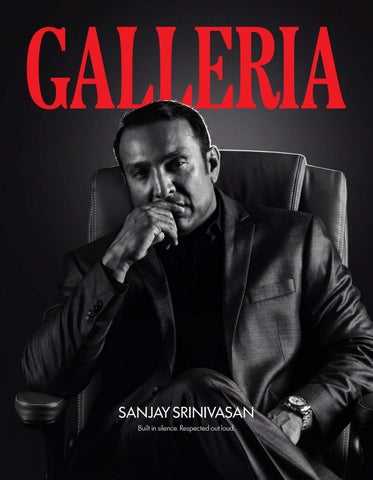
SANJAY SRINIVASAN Built in silence. Respected out loud.
GALLERIAMAGAZINE.COM |
1
2
| GALLERIAMAGAZINE.COM
GALLERIAMAGAZINE.COM |
3
CUSTOM-DESIGNED JEWELRY IN 18K GOLD
4
| GALLERIAMAGAZINE.COM
GALLERIAMAGAZINE.COM |
5
6
| GALLERIAMAGAZINE.COM
L’Occitane en Provence - The Mall at University Town Center | (941) 893 - 3644 140 University Town Center Drive, Sarasota, FL
GALLERIAMAGAZINE.COM |
7
THE CHOICE TO START OVER ON YOUR WRIST.
8
| GALLERIAMAGAZINE.COM
www.mondaine.com.br GALLERIAMAGAZINE.COM |
9
LANDSCAPES YOU CAN FEEL. THROUGH SUBTLE LAYERS OF OIL PAINT, LORIS ASSIS CREATES ATMOSPHERIC PAINTINGS THAT REVEAL THEMSELVES OVER TIME. EACH WORK INVITES A SLOWER WAY OF LOOKING, WHERE NEW DETAILS EMERGE WITH EVERY ENCOUNTER.
10
| GALLERIAMAGAZINE.COM
+1 321 323 6772
|
@LORISASSISART
|
LORISASSIS.ART
GALLERIAMAGAZINE.COM |
11
Contents AUGUST 2026
No 0
ON THE COVER SANJAY SAM SRINIVASAN
Sanjay Srinivasan turns branded objects into memory, reputation, family, and lasting influence.
80
MINDSET 24
28
SHELF LIFE
Five books reveal how money, ambition, risk, and judgment behave.
TECH
THE COST OF AN INTRODUCTION
26
Paulo Paternes turns media, trust, and introductions into lasting business access. 50
BORING IS THE POINT
Oura reframes recovery as a measurable advantage for modern ambition. 72
A simple morning routine protects focus, judgment, and executive decision-making. 52
EMOTIONAL INTELLIGENCE
THE POWER OF ENDURANCE
36
100 YEARS OF SOUND
Bang & Olufsen makes sound, design, and listening a cultural ritual. 54
Ironman transforms endurance into discipline, community, and personal reinvention.
A PEN FOR THE UNSEEN
Lívia Eberlin’s MasSpec Pen brings molecular cancer detection into surgery.
BUSINESS
LIFESTYLE
62
42
THE INTENTIONAL LIFE
74
ANDREW CARNEGIE
44
Andrew Carnegie transformed steel wealth into libraries, education, access, and legacy. 98
GOING GLOBAL
GAINING ACCESS
How people get into rooms they don’t belong in yet?
| GALLERIAMAGAZINE.COM
QUIET ASSET
Trancoso retreat reveals luxury as restraint, slowness, place, and responsibility. 102
Global growth succeeds when operations, finances, leadership, and positioning align. 100
PRIVACY, PRICED
Privacy becomes status when visibility turns from power into exposure.
Starting over becomes strategy through discipline, resilience, fitness, and wealth.
12
MAKE TECH FUN AGAIN
Nothing makes smartphones feel distinctive, intentional, exciting, and human again.
Turning leadership maturity into sustainable long-term business growth. 64
REST AS THE NEW FLEX
BELOW ZERO
Dianna Desboyaux brings red, fur, and confidence to Alpine elegance. 108
BUYING TIME
Vinicius Pires reframes private aircraft as infrastructure, access, and time.
PHOTOGRAPHY: JOHN DANTAS
80
Insurance solutions to protect what matters most.
GALLERIAMAGAZINE.COM |
13
Letter From The Editor Every great project begins with a conversation and Galleria Magazine was born from many of them. Over the past few years, through Home&Decor Magazine, I had the opportunity to meet entrepreneurs, executives, investors, creators, and professionals from very different industries. Although their businesses, backgrounds, and stories were unique, I kept hearing the same feeling: there wasn’t a publication that truly reflected the world they were building or the conversations they wanted to have. At the same time, Home&Decor taught us something we never expected. When you create publications with intention, quality, and consistency, people don’t simply become readers, they want to participate. They want to share their experiences, contribute ideas, meet other people, and feel part of a community. That was the moment Galleria stopped being just an idea and became a project with a purpose. We chose the name Galleria because a gallery brings together different works, different perspectives, and different stories in the same space. Each one has its own identity, but together they create something richer than any individual piece. That is exactly what we hope to build with this magazine: a place where different industries, experiences, and people come together through meaningful stories. Our goal has never been simply to publish successful people. We want to tell the stories of people whose work, values, and way of leading have created a positive impact on the lives of others. We believe business is ultimately about people, and behind every successful company there are decisions, sacrifices, relationships, and values worth sharing.
What stood out to us was the person behind those accomplishments. Throughout this edition, you will meet a man whose commitment to his family, loyalty to his friends, generosity, and integrity have earned him the respect of everyone around him. Those are the qualities we believe deserve to be celebrated just as much as professional success. This first edition also features the inspiring story of Dr. Livia Eberlin, whose work is changing the way medicine approaches one of humanity’s greatest challenges. Her journey reminds us that innovation has its greatest value when it improves people’s lives, and that extraordinary achievements often begin with curiosity, persistence, and the courage to pursue an idea. Edition Zero is our introduction. It is the first step in building a magazine that we hope will continue growing alongside the community it serves. It is also a privilege to introduce our Curator Circle, a group of respected professionals who generously chose to contribute their experience, perspectives, and editorial guidance as we shape the identity of Galleria. Their support means a great deal to us, and their participation will help ensure that every edition reflects the standards we aspire to uphold. To every advertiser, contributor, columnist, curator, partner, and reader who believed in this project before the first issue was even printed, thank you. I hope that, as you turn these pages, you feel the same excitement that we felt while creating them. Welcome to Galleria.
There couldn’t be a better way to introduce Galleria than with Sanjay Srinivasan on our first cover. His entrepreneurial achievements are impressive, but they are only part of his story.
Editor in Chief & CEO of Pyper Publishing
14
| GALLERIAMAGAZINE.COM
FOLLOW GALLERIA ON INSTAGRAM @GALLERIAMAGAZINE.US
GALLERIAMAGAZINE.COM |
15
EDITOR IN CHIEF
FEATURED
MURIEL MELO
BANG&OLUFSEN
DESIGN DIRECTOR LIA BASTOS
PROJECT MANAGER IZABEL CATARINA
LEAD DEVELOPER LUCAS BOMFIM
COMMERCIAL DIRECTOR GERMANA LEMOS
C A R L O S G A LVÃ O CAROL ROCHA D I A N N A D E S B O YA U X FA B I A N A M E Z Z A R O B A GLOBAL AIRCRAFT IGOR BORGES LÍVIA EBERLIN NOTHING PAU LO PAT E R N E S PRISCILA ZOCCHI R A FA E L L E I TÃ O S A N J AY S R I N I VA S A N
COPYRIGHT ANA BEATRIZ BARROS
PHOTOGRAPHERS JOHN DANTAS KARINA OLIVE MARCELO ANIELLO
SUBSCRIBE TO GALLERIA:
ADVERTISING
PRINTED IN USA
COMMERCIAL@PYPER.ME ( 8 6 0 ) 9 21 2 2 4 1 WHATSAPP (689) 263 8250
P U B L I S H E D BY P Y P E R P U B L I S H I N G L L C 6299 GOLDEN DEWDROP TRL, WINDERMERE, FL 34786
EDITORIAL HELLO@GALLERIAMAGAZINE.COM
16
| GALLERIAMAGAZINE.COM
BUILD YOUR BUSINESS WITH A PROVEN PATH
LILIAN VIDAL Expansion Director Boa Vista USA
Boa Vista USA is expanding in the American market with a business model built on experience, structure, and long-term partnership. Led by Lilian Vidal, the brand supports entrepreneurs with guidance in sales, operations, marketing, and business development, helping partners grow with confidence in the custom interior solutions industry.
(786) 784-1613
|
BoaVistaUSA@gmail.com
|
BoaVista.com
|
@BoaVistaUSA
GALLERIAMAGAZINE.COM |
17
MEET GALLERIA’S FIRST
CURATOR CIRCLE The Curator Circle is a select editorial initiative created to bring exceptional leaders, innovators, and thinkers closer to the heart of Galleria. More than a list of names, this circle represents a community of perspectives. Each curator contributes insight, identifies stories and voices worth amplifying, and helps shape the conversations that define the magazine’s editorial direction. Together, they reflect what Galleria stands for: business, culture, influence, connection, and the ideas shaping Florida’s next chapter.
18
| GALLERIAMAGAZINE.COM
PHOTOGRAPHY: KARINA OLIVE
No 0
JAMES GELFAND
General Manager at The Citrus Club THE MEDIATOR
James Gelfand is the General Manager of the Citrus Club, Orlando’s premier private business and social club. With more than 45 years of leadership in the hospitality industry, he is recognized for his people-first approach, operational excellence, and commitment to cultivating meaningful professional relationships. Since joining the Citrus Club in 2023, James has led the club’s evolution while honoring its longstanding legacy as one of Central Florida’s most influential gathering places for business and community leaders.
GALLERIAMAGAZINE.COM |
19
ANDRES CEBALLOS
DAVID LINDSEY
VP Global OEM Partners at Hyland Software
Advertising Sales Executive at Simon Property Group
TECHNOLOGY
HOSPITALITY
Andres Ceballos is a global alliances and ecosystem leader with more than 20 years of experience building strategic partnerships across the enterprise software industry. As the leader of Hyland’s Global OEM business, he helps software companies expand through scalable partner ecosystems that connect innovation, product strategy, and go-to-market execution. Throughout his career, Andres has held leadership roles at Hyland, Salesforce, Oracle, and XnR Solutions, helping organizations unlock growth through technology alliances and strategic collaboration. He is recognized for building trusted partnerships that create long-term value for customers and the global technology ecosystem.
David Lindsey is an accomplished business development and strategic partnerships professional with over two decades of experience driving brand growth through meaningful relationships and innovative marketing initiatives. As Advertising Sales Executive at Simon Property Group, he partners with national and regional brands to create impactful retail and experiential marketing opportunities.
20
| GALLERIAMAGAZINE.COM
Known for his collaborative leadership style and extensive network throughout Central Florida, David is passionate about connecting people, businesses, and organizations in ways that foster long-term growth, community engagement, and lasting value.
CURATOR CIRCLE
DELORIA NELSON
DENISE MUSSELWHITE
CULTURE
EDUCATION
Deloria “Coach Dee” Nelson-Streete is a leadership strategist, executive coach, speaker, published author, and founder of ACE. With more than 25 years in human resources, leadership development, and organizational culture, including leadership roles at Walt Disney World and Charles Schwab, she helps organizations build healthy, high-performing workplaces where people and business thrive. Creator of the 3R Leadership Model™ (Rest, Resilience, and Resistance), she inspires leaders to prevent burnout, strengthen workplace culture, and lead with authenticity, courage, and purpose across corporate, nonprofit, healthcare, education, and government sectors.
Denise Musselwhite is the founder of Tech & Thrive, a leadership and organizational development agency. With more than two decades of executive experience including independent schools, higher ed., Fortune 100 companies, and nonprofit organizations, she advises leaders navigating technological change, organizational complexity, AI, culture, and the evolving workplace. One of the few Latina women to serve as both CIO and Board Chair, Denise brings lived executive insight to her work. As an ICF Professional Certified Coach (PCC), she helps leaders earn trust, make better decisions, and build organizations where people and performance thrive.
Founder & Chief Executive Officer at Authentic Culture & Engagement (ACE) Solutions
Tech & Thrive Founder
GALLERIAMAGAZINE.COM |
21
MARIA HELENA MAROUN
RICARDO MATTE
LUXURY & LIFESTYLE
FINANCE & WEALTH STRATEGY
Maria Helena Maroun is an entrepreneur and retail strategist recognized for building and scaling luxury consumer brands. Originally trained as a corporate attorney with a master’s degree in Corporate Law, she successfully transitioned into entrepreneurship, launching and exiting multiple businesses, including a jewelry company she built and sold in just 18 months without outside investment. Drawing on her expertise in consumer psychology, retail trends, and luxury branding, Maria Helena creates brands that resonate on an emotional level. She is currently launching Romeo Diamonds, a luxury jewelry venture inspired by innovation, craftsmanship, and timeless client experiences.
Ricardo Matte is the Founder and Chief Executive Officer of Vincit Financial, an international wealth management and investment advisory firm serving individuals, families, and entrepreneurs across multiple countries. With more than 15 years of experience in financial services, he specializes in helping clients protect, grow, and transfer wealth through integrated investment management, insurance strategies, retirement planning, and cross-border financial solutions. Under his leadership, Vincit Financial has built a reputation for delivering personalized, long-term strategies designed to simplify complex financial decisions and preserve wealth across generations. Ricardo is passionate about empowering clients to make confident financial decisions while building lasting legacies for their families and businesses.
Entrepreneur and Luxury Brand Strategist
22
| GALLERIAMAGAZINE.COM
Founder & Chief Executive Officer at Vincit Financial
CURATOR CIRCLE
TAYLOR AKERS
VINCENT DESAI
LUXURY HOME BUILDING
REAL ESTATE & INVESTMENT
Taylor Akers is a luxury residential builder professional with expertise in custom home construction. As a leader at Akers Custom Homes, a family business known for crafting highend residences throughout Central Florida, he brings a unique perspective on quality craftsmanship, client experience, and the evolving luxury housing market. Combining a background in finance with hands-on construction expertise, Taylor helps bridge design, construction, and real estate, offering a holistic understanding of what creates lasting value in a home. His passion for excellence and service makes him a trusted voice in the future of luxury residential development.
Vincent Desai is an Orlando, Florida-based entrepreneur, real estate developer, investor, and film producer with over two decades of experience in residential and commercial real estate. As founder of VertiX Productions, Inc., he is building an innovative independent film distribution platform that connects filmmakers with audiences worldwide while helping establish Central Florida as a hub for independent filmmaking. Before relocating from Toronto, Canada, in 1992, Vincent spent over 16 years as an Art Director with The Toronto Sun Publishing. Combining creativity with business expertise, he continues to pursue opportunities in real estate, entertainment, and strategic investments that create lasting value.
Senior Project Manager at Akers Custom Homes
Founder & Principal at Desai Ventures, LLC
GALLERIAMAGAZINE.COM |
23
Take Five
SHELF LIFE Five books about money that are really about human behavior. Most business books expire the moment their case studies do. The company gets acquired, the strategy dates, the market changes, and the hardcover slowly turns into a paperweight. These five last longer because none of them is really about a company. They are about how money, ambition, discipline, risk, and judgment behave over time. That has not changed in a hundred years.
TITAN, BY RON CHERNOW. A sweeping life of John D. Rockefeller and a study in what discipline can compound into over decades. His fortune was not built by discipline alone, but the habit reveals something essential: wealth at that scale is rarely accidental. COVER IMAGE COURTESY OF VINTAGE / PENGUIN RANDOM HOUSE
24
| GALLERIAMAGAZINE.COM
THE PSYCHOLOGY OF MONEY, BY MORGAN HOUSEL.
THE GOSPEL OF WEALTH, BY ANDREW CARNEGIE.
A sharp, readable book on why intelligent people make irrational decisions with money. Its central lesson is simple: behavior often matters more than math.
A short 1889 essay on wealth, responsibility, and legacy. Read today, its argument feels newly relevant in an age of extreme fortunes and public scrutiny.
COVER IMAGE COURTESY OF HARRIMAN HOUSE
COVER IMAGE COURTESY OF APPLEWOOD BOOKS / ARCADIA PUBLISHING
SHOE DOG, BY PHIL KNIGHT.
POOR CHARLIE’S ALMANACK, BY CHARLIE MUNGER.
Phil Knight’s memoir strips the mythology away from Nike’s rise. Before the empire, there were cash problems, uncertainty, pressure, and years when failure was still very possible.
Less a book about investing than a manual for clearer judgment. Munger’s real subject is how to be right more often than you are wrong.
COVER IMAGE COURTESY OF SCRIBNER / SIMON & SCHUSTER
COVER IMAGE COURTESY OF STRIPE PRESS
A PLACE WHERE STORIES, PEOPLE, BRANDS AND IDEAS ARE PRESENTED WITH INTENTION
ADVERTISE WITH US. RESERVE YOUR PAGE. commercial@pyper.me
(689) 263 8250
GALLERIAMAGAZINE.COM |
25
Technology
REST AS THE NEW FLEX How the Oura Ring turned recovery into part of the language of ambition.
There was a time when the fastest way to signal ambition was to admit how little you slept. Four hours a night. An inbox cleared by six. A schedule nobody sane would keep. Exhaustion was worn almost like proof of seriousness. That flex has started to look outdated. The people operating at the top are no longer bragging about sleep deprivation. They are measuring their way out of it. Rest is no longer treated as the opposite of ambition. It is becoming one of the conditions that ambition depends on. The smart ring is where that shift becomes visible. Oura built its category around sleep, recovery, and stress, reporting the body back to you in numbers: resting heart rate, heart-rate variability, and a readiness score that says, before the first coffee, whether today is a day to push or a day to hold. The device has found an audience among founders, endurance athletes, and executives who no longer treat the body as an afterthought to the calendar. What changed is the definition of performance. The old model was simple and wrong: more hours in, more output out. The newer one treats the body as an instrument that has to be tuned before it can be played. Working through exhaustion does not produce results so much as more hours that resemble work.
That reframes recovery completely. It moves from the thing ambition sacrifices to the input ambition runs on, tracked as closely as revenue, training, or performance metrics. A bad night now surfaces as a number, and the number is honest in a way most people rarely manage to be with themselves. None of this requires a ring on your finger. The device only made visible what high performers had already started to understand. The edge they kept hunting was never the extra hour awake. It was hidden in the hours they spent asleep, finally being measured. Rest is not retreat. It is preparation. TEXT: GALLERIA EDITORIAL TEAM
26
| GALLERIAMAGAZINE.COM
PHOTO COURTESY OF OURA
The gain comes from knowing, with some precision, when the body is capable of good work and when it is only present for it.
GALLERIAMAGAZINE.COM |
27
Profile
THE COST OF AN INTRODUCTION An audience is easy to build. A room that acts on your word is not. Paulo Paternes built a decade-long business on the harder one.
The most valuable thing that happens on a business interview show is often not on the recording. It happens a few minutes later, in the parking lot, when two guests who met an hour earlier are still talking, because one of them has decided the other is worth knowing. Content is cheap now. Anyone can publish, and almost everyone does. What stays rare is the thing that kept thosetwo guests talking: a recommendation they were willing to act on. An audience counts how many people watched. It says nothing about how many of them would take your call, or place one for you. Paulo Paternes built a business on the second number. He is known as the founder of Canal Perguntas, a Portugueselanguage interview channel that has run for over a decade. But the channel is the surface. What he accumulated, one conversation at a time, was standing: enough of it to put two strangers in a room and have the introduction hold. That is a different asset from reach, and a scarcer one. This is the story of how a media project became an access business, and of what that kind of business quietly costs the person at its center. When Canal Perguntas started in 2014, most of the useful information about building a life in the United States was locked inside people’s heads. How to move a family, open a company, qualify for a mortgage, pass a licensing exam, read a lease: the answers existed, but reaching them took contacts a newcomer did not have yet.
28
| GALLERIAMAGAZINE.COM
Paulo’s decision was narrow and, in hindsight, telling. He did not put himself forward as the expert. He put the experts on camera and asked the questions a newcomer would ask. Immigration lawyers, accountants, brokers, doctors, people who had already built something and could say how. Each interview did one job: turn private, hard-won knowledge into something a stranger could use to make a better decision. That choice compounded. A feed expires in a day. An archive keeps working, because the answer someone needs in 2026 was often recorded in 2018 and is still there. Over ten years the channel became one of the larger Portugueselanguage records of its kind on entrepreneurship, immigration, and investment in the United States. By the numbers: founded 2014; more than 5,000 interviews; more than 50 million views; more than 400,000 subscribers. The reach mattered less than who supplied it. The people willing to sit for an interview were the ones with something to protect: a practice, a firm, a name. Lending it to the channel was a small act of trust. Thousands of those small acts, repeated over a decade, were the real thing being built. National brands eventually treated the channel the same way, as a credible route to an audience that is otherwise hard to reach. PHOTOGRAPHY JOHN DANTAS TEXT: GALLERIA EDITORIAL TEAM
GALLERIAMAGAZINE.COM |
29
“
30
THE CONTENT WAS NEVER THE PRODUCT. IT WAS THE DOORWAY.”
| GALLERIAMAGAZINE.COM
At some point the pattern became impossible to miss, and it changed how Paulo understood his own business. The deals he kept hearing about were not happening on screen. They happened afterward, between people the channel had quietly placed within reach of one another. A lawyer picked up a client another guest had referred. An investor found a project he would not otherwise have seen. A contractor met a supplier. There is a name for why this works. In 1973 the sociologist Mark Granovetter showed that people find jobs, deals, and opportunities less through close friends than through acquaintances: the weak ties that bridge one cluster of people to another. Your close circle knows what you already know. It is the loose connection, the person one step outside your circle, who carries information and opportunity you did not have.
him. When one figure becomes the bridge a whole community routes through, his judgment, his attention, and his choices about who meets whom become a kind of infrastructure, and a kind of gate. The same warmth that opens a door can, without anyone deciding it should, turn into a toll: proximity becomes a product, membership becomes a tier, access acquires a price. “Relationships first” is a real principle. Readplainly, it is also an effective way to sell. The model works precisely because trust and commerce are hard to pull apart here, which is the source of its power and the reason to watch it closely. None of that makes the network less useful to the people inside it. It makes it worth seeing for what it is: not a public utility, but a privately held bridge.
Canal Perguntas had become a weak-tie machine without anyone calling it that. Every interview introduced a guest to an audience that was not theirs, and audience members to each other. Paulo drew the useful conclusion: the content was never the product. It was the doorway. The product was proximity, and the trust that made proximity worth acting on. The named brands had already priced this in, which is another way of saying that trust, once accumulated, converts into commercial access. In 2024 he built the thing the pattern implied. Amigos nos EUA started as a business community with an unusual rule for a networking group: relationships first, transactions later. Most networking runs the other way, business cards up front. The bet was that a room where people are not selling at each other becomes, over time, a room where they A smaller, quieter tier followed, called The Black Room: fewer people, franker conversation, the kind of talk about succession, failure, and money that does not happen on a stage. Its draw is not that it is hard to enter. It is that a room of ten people who trust one another is worth more than a hall of five hundred exchanging cards. Here is the honest part. A network that runs on one person’s word is powerful and fragile in the same breath. The value Paulo created is real, and it is concentrated in GALLERIAMAGAZINE.COM |
31
In 2025 Paulo aimed the same machinery at something other than business. Brazilian Community Day gathered companies, volunteers, and organizations for a single day of free services: legal guidance, health information, haircuts, and the distribution of more than a ton of food and clothing, with participation from the Consulate-General of Brazil in Orlando. Orange County is said to have recognized the day by proclamation on March 29, 2025. Read generously, the day is the logic of the whole enterprise turned toward need instead of deals: the power to convene, pointed at people who could use it. Read carefully, it also sits close to the business, because goodwill built in public has a way of becoming standing that pays off in private. 32
| GALLERIAMAGAZINE.COM
Both readings are true at once. A convening power this real does not stop being useful to its owner when it does good, and that is not a flaw to hide. It is the nature of the asset. Which returns to the cost of an introduction. The price is not paid by the stranger who receives it. It is carried, quietly and repeatedly, by the person whose name is on it, and increasingly by a community that has learned to route its opportunities through one man. Paulo Paternes spent a decade proving that trust is the scarcest thing in a market full of content, and that it can be lent at scale. The open question is the one every broker eventually meets: how much weight can one good word carry before the bridge becomes the only way across.
GALLERIAMAGAZINE.COM |
33
PHOTOGRAPHY: GISELE ESPÍNDOLA
DESIGN THAT BRINGS BRAZILIAN EXCELLENCE HOME At WDB Design, custom cabinetry, natural materials, curated furnishings, and integrated solutions come together in a complete Design Center experience. From concept to installation, WDB creates turnkey interiors for residential, commercial, and hospitality projects, bringing the sophistication of Brazilian design to Orlando. Lake Buena Vista Factory Store 15777 S. Apopka Vineland Rd., Orlando, Florida 34 | GALLERIAMAGAZINE.COM
|
@wdb.design
|
(689)306-5736
Tiago Brito
Daphne Cervellin
www.wdbgroup.us GALLERIAMAGAZINE.COM |
35
100 YEARS OF
SOUND WITH BANG & OLUFSEN
36
| GALLERIAMAGAZINE.COM
GALLERIAMAGAZINE.COM |
37
For a century, Bang & Olufsen has treated sound not only as technology, but as an object of culture: something to hear, to touch, and to live with.
38
| GALLERIAMAGAZINE.COM
A hundred years is a long time for any company to remain recognizable. In technology, it is almost unnatural. Most devices age badly. They become evidence of another era, useful for nostalgia or museums, but rarely for contemporary life. Bang & Olufsen has survived differently. The company was founded in 1925 in Struer, Denmark, by Peter Bang and Svend Olufsen, two young engineers working from the attic of the Olufsen family home. Its first breakthrough, The Eliminator, allowed radios to be plugged directly into the wall instead of relying on batteries, an early signal of what would become a recurring instinct: to make technology feel more elegant, more integrated, and less awkward inside daily life. That instinct has followed the brand across decades. Bang & Olufsen did not build its reputation by treating sound as an invisible utility. It made audio visible. Radios, turntables, speakers, televisions, headphones, and sound systems became objects with posture. They belonged not only to the ear, but to the room.
This is why the brand has always occupied a particular place between engineering and design. The sound is meant to stay close to the artist’s intention. The craftsmanship is meant to last. The form is meant to be displayed rather than hidden. For many people, that is the misunderstanding. Bang & Olufsen is often seen first as a premium audio brand. Only after experiencing it does the larger idea become clear: it is a design and lifestyle brand where sound, material, and architecture meet. Its relevance has come from not choosing between past and future. The company can celebrate a classic turntable and still build contemporary wireless systems. It can restore old icons and release new ones. Its Recreated Classics program, including the modernized Beogram 4000c, makes that philosophy literal: the past is not treated as a costume, but as material that can be engineered forward.
GALLERIAMAGAZINE.COM |
39
THE RITUAL OF LISTENING To listen well has become almost countercultural. Most sound now arrives in fragments: through phones, background playlists, compressed speakers, and rooms where music is present but rarely the center of attention. Bang & Olufsen has spent a century resisting that disappearance. Its products are not designed to vanish into the background. They are made to occupy a room with intention, not loudly, but with presence. A speaker, a pair of headphones, or a sound system becomes part of the architecture of daily life, something closer to furniture, ritual, and atmosphere than to ordinary electronics. That is part of the brand’s quiet power. It treats listening to music as something worth designing for.
In Orlando, that idea becomes more personal. The showroom is not only a place to compare specifications or choose a system. It is a place where people understand the brand by experiencing it: how a room changes when sound is treated seriously, how materials affect presence, how technology can feel less mechanical when it is shaped with care. For the owners, this is the distinction many people only understand once they walk in. Bang & Olufsen may first appear to be a premium audio brand, but the deeper experience is about design, craftsmanship, lifestyle, and the way sound becomes part of a home. PHOTO J. VLADIMIR
40
| GALLERIAMAGAZINE.COM
That is why the showroom has become more than a retail space. Kristi and Tony have built a community around the Bang & Olufsen experience, bringing people together through events like Vinyl Night, where music sparks conversation, connection, and lasting relationships. The event is not the story itself. It is a small expression of a larger philosophy: music is not only something consumed privately, through a device, in passing. It can still create a room, a rhythm, and a reason for people to gather.
After 100 years, that may be one of Bang & Olufsen’s most relevant qualities. The brand has kept innovating without reducing sound to convenience. It has preserved the idea that listening can still be deliberate, physical, and social. TEXT: GALLERIA EDITORIAL TEAM IMAGES COURTESY OF BANG & OLUFSEN
GALLERIAMAGAZINE.COM |
41
PRIVACY, PRICED How deciding who knows about you became a status marker.
For most of history, status meant being seen. The palace faced the road. The family name was announced. The best box at the opera was positioned so its occupants could observe the room and, more importantly, be observed by it. Visibility carried power because attention was scarce, and recognition among the right people was how influence traveled. That logic has inverted. Attention is no longer scarce—it is produced continuously, measured in views, clicks, photographs, locations. What has become valuable is its opposite: the power to decide who is granted access. At the highest levels of wealth, privacy is no longer simply the absence of attention. It is the control over a fundamental question: who knows where I am, and how much do they know about me? The shift is visible in what people now pay to protect. Remote homes valued for their distance. Security designed to remain invisible. Private travel arranged with discretion. Legal and digital services dedicated to limiting personal information in public records and online searches. A century ago, public figures could be widely known and remain personally unreachable. Today, a name leads to an address, a photograph, a workplace, a routine, a record of movement. The digital world has made visibility effortless, often permanent, and rarely neutral. Those with the most to protect now spend heavily to recover the obscurity that ordinary life once provided naturally. A compound in the mountains. Layers of trusts and entities. Flights arranged through brokers. Services designed to keep a person’s movements, transactions, and associates out of public reach. The cost is not incidental. It is architectural. Yet there is an asymmetry worth naming: this form of power is available only at scale. Someone with moderate means cannot buy the same obscurity, no matter the discipline. They can control what they share, guard their
PHOTO ADRIEN OLICHON
time, resist constant visibility—and these are forms of agency. But the person with a compound, a legal team, and the infrastructure to disappear from searchable history operates in a different category altogether. The symbols of status are shifting. A watch once said, “Look at me.” A carefully guarded life, backed by resources and legal structure, communicates something more difficult to display: I do not need to be visible to remain significant. The most valuable part of a life may be the part that cannot be searched, tracked, measured, or consumed by strangers. Unlike many luxuries, this one requires two things at once: money and the discipline to use it without announcement. The paradox of invisible power is that it works precisely because no one is watching. TEXT: GALLERIA EDITORIAL TEAM
42
| GALLERIAMAGAZINE.COM
GALLERIAMAGAZINE.COM |
43
Luxury & Lifestyle
44
| GALLERIAMAGAZINE.COM
QUIET ASSET A quiet coast, a low house in a garden: it reads as ease. It is a choice, made by someone who had every other option. To reach the old part of Trancoso you still slow down. The village sits on a cliff above the beach in southern Bahia, built around a long rectangular green called the Quadrado, with a white church at its far end that has faced the Atlantic since the sixteenth century. For most of its history the place could be reached only along the sand, at low tide, and something of that pace survived the road that eventually came. People walk. Evenings happen outdoors. The hurry that runs most valuable places has never fully taken here. That is the thing being chosen. Above the village, inside a mature garden, sits a low house of wood, built as somewhere to stop. Its owners did not need to be here. That is the point. The house is the smaller part of the story; the choice behind it is the larger one. When anyone can be found in seconds and everywhere desirable photographs the same, deciding where to be unhurried, and with whom, becomes its own kind of discernment. The rarest taste now is the taste for less. PHOTOGRAPHY MARCELO ANIELLO TEXT: GALLERIA EDITORIAL TEAM
GALLERIAMAGAZINE.COM |
45
46
| GALLERIAMAGAZINE.COM
What the owners commissioned carries the same restraint. It is an extension rather than a monument: a pool house with room for guests, added to a family home already settled into the garden. The instruction, in effect, was to build something the landscape could absorb. So the house sits low and is built largely of wood. The garden was left to a Brazilian landscape studio, the interiors
and joinery to regional makers, and the result stays close to where it is, in material and in temperament. Little about it works to be noticed, which is why it holds attention. Most of the design is in the plan. The line between inside and garden is kept soft, so that shade and the sound of water carry the rooms. A house like this is measured by what it lets you set down.
GALLERIAMAGAZINE.COM |
47
48
| GALLERIAMAGAZINE.COM
There is a limit worth naming, and it is not the house’s fault. A place like this has a full life that has nothing to do with anyone’s holiday: a working village with a church calendar of its own, a coastline held inside a protected stretch of Atlantic forest. The ease a visitor buys into was made by other people, over a long time, and it is easier to consume than to keep. The failure of the quiet retreat is to treat a living place as scenery. So the better version of this choice carries an obligation: to arrive as a guest of somewhere
real, not the proprietor of its atmosphere, and to let the place stay itself. The calm is not a product. It is a loan, and it holds up only when it is handled that way. Which is the whole appeal, in the end. Anyone with the means can be anywhere by evening now. Choosing a slow coast and a low house in a garden spends that freedom on the one thing it rarely buys on its own: the discipline to stop, in a place that was never yours, and to leave it as whole as you found it.
ARCHITECTURE: GN ARCHITECTURE INTERIORS: MARESCA INTERIORS LANDSCAPE: ESCALA NATIVA JOINERY: EMPÓRIO BRASIL MARCENARIA
GALLERIAMAGAZINE.COM |
49
Take five
BORING IS THE POINT How a deliberately simple routine protects the judgment the day will actually require. Every successful person seems to have a morning routine, but the advice around it has curdled into parody. Cold plunges. Gratitude journals. A sunrise spent optimizing the soul before the first email lands. Ignore the theater. The reason routines actually work is duller, and far more convincing, than the people selling them often let on. A good morning is not a performance. It is a system for reducing friction before the day begins. Every small choice carries weight. What to wear. What to eat. What to answer first. What to postpone. None of these decisions may feel important on its own, but together they create noise before the real work has even started. A routine removes what never deserved your best attention in the first place. That is the whole mechanism. There is nothing mystical in it. The cold plunge is optional. The journal is optional. The perfect sunrise is optional. The decisions you no longer have to make are the point. So build a morning that is boring on purpose. Same first hour. Fewer small choices. Nothing to optimize for an audience. Nothing worth photographing. Just enough structure to walk into the day with your judgment intact. PHOTOGRAPHY RAHIME GÜL
It is no accident that so many founders and executives wear a version of the same thing every day. The uniform is not only a style choice. It is one less decision before the work begins. The people operating at a high level did not necessarily win the morning with intensity. Many of them won it by taking the morning off the list of things they have to think about. The best routine is the one you eventually stop noticing. TEXT: GALLERIA EDITORIAL TEAM
50
| GALLERIAMAGAZINE.COM
outmoredesign@gmail.com
|
(321) 353-5475
GALLERIAMAGAZINE.COM |
51
Mindset
EMOTIONAL INTELLIGENCE THE INVISIBLE ASSET OF GREAT ENTREPRENEURS
52
| GALLERIAMAGAZINE.COM
PHOTO COTTONBRO STUDIO
When we talk about business growth, we usually think about strategy, innovation, technology, sales, and financial management. All of these elements matter. Yet there is one factor that rarely appears on a balance sheet and still has a direct influence on the results of any company: the emotional intelligence of the entrepreneur. Before there is a successful company, there is a person making decisions every day. And those decisions, often made under pressure, are precisely what shape the future of a business. Entrepreneurship means living with uncertainty on a daily basis. There are days when the market shifts, clients walk away, investments need to be reconsidered, and carefully structured plans no longer make sense. In those moments, technical knowledge is not enough. What sustains a leader is the ability to manage emotions without allowing them to control the decision-making process. Emotional intelligence does not mean ignoring feelings. Quite the opposite. It is the ability to recognize emotions, understand them, and manage them with maturity. An emotionally intelligent entrepreneur can face challenges without acting impulsively, navigate conflict with balance, and remain focused even in the face of adversity. Throughout my journey, I have realized that companies rarely stop growing because of a lack of opportunity. More often, they become stagnant because their leaders are unable to evolve at the same pace the business requires. A business owner who reacts impulsively can lose major negotiations. A leader who does not know how to listen to their team can compromise the company’s culture. Someone who makes decisions driven
by ego tends to see problems as personal attacks, when they should be treated as opportunities for improvement. Healthy companies are a reflection of emotionally prepared leaders. This becomes even more evident in a global market. Expanding a company internationally, leading multicultural teams, and building strategic relationships require far more than technical expertise. They require empathy, relational intelligence, effective communication, and adaptability. In the international business landscape, emotional skills are no longer considered secondary abilities. They have become competitive advantages.
For this reason, I believe the greatest investment an entrepreneur can make is not only in technology, marketing, or new markets. It is in developing the ability to lead oneself. Because businesses grow only as far as their leaders are able to grow. And in the business world, the true competitive advantage remains invisible to the eye. It exists in the way each leader chooses to think, feel, and act when facing challenges. This may be the most valuable skill for anyone who wants to build strong companies, relevant brands, and legacies that last beyond generations.
Modern leadership is not built through authority, but through influence. The most respected professionals in the market are not the ones who have all the answers. They are the ones who know how to ask the right questions, develop people, and create environments where innovation can happen naturally. Another important point is that emotional intelligence also has a direct impact on the financial health of a company. Impulsive decisions often lead to poor investments, inadequate hiring, internal conflicts, and strained relationships with clients. On the other hand, emotionally balanced leaders tend to build organizations that are more sustainable, more resilient, and better prepared for long-term growth. There is no consistent international expansion without emotional maturity. There is no effective corporate governance without self-control.
PRISCILA ZOCCHI
Entrepreneur, Author & International Business Strategist @zocchipriscila
There is no lasting business legacy without human development. GALLERIAMAGAZINE.COM |
53
Brilliant Minds
A PEN FOR THE UNSEEN The question has always haunted cancer surgery: did we get it all? Lívia Eberlin built a tool that can help answer before the operation is over.
TEXT: GALLERIA EDITORIAL TEAM IMAGES PROVIDED BY LÍVIA EBERLIN
54
| GALLERIAMAGAZINE.COM
In the operating room, the most consequential decisions are often made at the edge of what the eye can see. A tumor may announce itself on a scan, appear as a shadow, a mass, a measurable invasion into the body’s private architecture. But during surgery, the question becomes more intimate and more difficult. Where does the disease end? Where does the person begin again? Modern medicine has become fluent in images. It can render the brain in cross sections, map organs in extraordinary detail, and turn the interior of the body into something almost cinematic. Yet cancer, at the margin, resists theatrical clarity. It does not always behave like an enemy with a clean border. It infiltrates. It blends. It asks the surgeon to make a judgment in real time, under pressure, with the patient already open and the stakes moving between survival and quality of life. Lívia Eberlin came to that problem not as a surgeon, but as a chemist trained to ask what matter is made of. She grew up in Campinas, in São Paulo, in a house where science was not a distant profession but part of the family atmosphere. Her mother was a biochemist. Her father, a chemist and professor at the University of Campinas. As a child, she and her sister were often around the university and the laboratory. The idea of becoming a scientist did not arrive as an exotic ambition. It was in the background, almost domestic. What made it hers was curiosity. She has described herself as the kind of child who wanted to understand everything deeply, the kind who asked how things worked and why they were the way they were. The same mind that loved chemistry, biology, and mathematics also loved painting and making things. That mixture matters. The scientist who eventually imagined a pen for cancer surgery did not emerge from calculation alone, but from a temperament that joined precision to invention. When she was choosing what to study, she considered a more biological path, such as pharmacy. Her father told her something simple enough to sound like family advice and broad enough to become a career architecture: there is chemistry in everything. If she studied chemistry, she could move toward almost any field. She did, and later found the field that gave chemistry a human destination. The human direction was never separate from the scientific one. Eberlin has described a love for people, for connection, and for work that could help patients, especially those facing cancer. Technology, for her, did not begin as distance from the human body. It became a way back to it.
Eberlin had to go to hospitals, collect tissues, return to the lab, and analyze them. She spent time in pathology rooms adjacent to operating rooms, waiting for samples. The waiting became an education. Hospitals have their own language of thresholds: doors that swing open, hallways that lead from the public world to the sterile one, rooms where ordinary conversation becomes quiet because everyone understands that a body is under decision. For Eberlin, those spaces revealed the distance between scientific power and clinical use. In the laboratory, chemistry could describe tissue with extraordinary depth. In the hospital, the people making decisions needed answers that were fast, clear, and physically available. There is a particular kind of knowledge that comes from not looking away. In those rooms, Eberlin watched how tissue analysis was performed, what technologies were used, and how decisions about patients were made. She was shocked by how much still depended on methods that had been around for about a century. The tools were essential, but limited. The process could be slow. The information available to surgeons and pathologists could arrive only after tissue had already been removed. For a chemist, that gap was not merely technical. It was moral. If chemistry could read tissue at the molecular level, why should that power remain trapped in the laboratory, far from the moment when a surgeon needed it most? Eberlin began to imagine a bridge between the sophistication of chemical analysis and the practical urgency of surgery. The device would have to be powerful, but it could not feel precious. It would have to produce molecular information, but be simple enough to belong in a surgeon’s hand.
”
I REALIZED THAT I COULD FILL THAT BRIDGE BY BRINGING NEW CHEMICAL TECHNOLOGIES INTO THE CLINIC. She noticed that surgeons already worked with handheld instruments, tools they could use almost instinctively. That observation helped shape the idea: a pen-like device capable of touching tissue and reading its molecular signature within seconds. In a field where innovation often arrives as machinery, Eberlin’s concept carried a different intelligence. The breakthrough was not only to make the chemistry advanced. It was to make the interface almost ordinary. This was what eventually led her to the MasSpec Pen.
That destination appeared during her PhD, when she began working with cancer research and patient tissue samples. Many chemistry students spend their formative years inside the controlled world of instruments and labs.
GALLERIAMAGAZINE.COM |
55
Cancer surgery has always been a negotiation between removal and preservation. The surgeon wants to take out all of the cancer, because leaving disease behind can mean recurrence, another operation, and a reduced chance of cure. But the surgeon also wants to protect the normal tissue around the tumor, because that tissue is not abstract. In the brain, it may affect speech, movement, memory, personality, and the patient’s ability to return to a recognizable life. The boundary between tumor and healthy tissue is called the surgical margin. In theory, it sounds like a line. In practice, it can be nearly impossible to see. That is why operating rooms have long relied on frozen section analysis. Tissue is removed, carried to pathology, frozen, sliced, stained, and examined under a microscope while the patient remains under anesthesia. The method has saved lives, but it also carries the logic of another era: remove first, analyze after. The pen changes the order of the question. Instead of asking only what the tissue was after it has left the body, it asks what the tissue is while the decision is still being made. The surgeon touches the tissue with the handheld device. Its molecular profile is analyzed, and within seconds the technology can help determine whether the tissue is cancerous or healthy. The answer is not decorative data. It is a surgical fact arriving at the moment when a fact can still change the act. The importance is not difficult to understand. Every patient who wakes up after cancer surgery carries some version of the same question: was it all removed? Behind that question is a second fear, often unspoken: was anything taken that did not need to be taken? A tool that helps surgeons identify cancer before or during removal speaks to both anxieties. It aims at cure, but also at the quality of the life that remains after the operation.
56
| GALLERIAMAGAZINE.COM
The simplicity of the pen can make the invention appear inevitable, which is one of the illusions of good design. Eberlin is careful about that. The work took persistence, failed ideas, nights, weekends, and more than twenty years in mass spectrometry. She began as an undergraduate researcher in Brazil and never really stopped. The first prototype did not work. Many ideas failed. The progress came through repetition, collaboration, and the willingness to learn outside one’s original discipline.
PEOPLE OFTEN SEE ONLY THE FINAL IDEA, BUT THEY DON’T SEE THE YEARS OF WORK.
”
There is a kind of ambition in science that looks less like a grand announcement than a willingness to be corrected. A prototype fails, and the work continues. A clinical reality complicates the idea, and the idea is revised. A field that once seemed adjacent becomes necessary. The invention is not one moment of inspiration preserved in glass, but a long argument between the possibility and the evidence. To build the technology, she had to move beyond chemistry into medicine, statistics, oncology, molecular biology, device development, and eventually the practical world of commercialization and regulation. A scientist leaving the laboratory enters a different kind of institution, one made of approvals, clinical studies, ethics committees, Institutional Review Boards, engineering decisions, management, and hospital realities. The idea has to survive all of them. That survival has made the project less solitary, not more. Eberlin speaks of students, collaborators, surgeons, hospitals, and research teams as part of the work itself. The pen began on paper, moved through prototypes and laboratory experiments, then into patient testing. It is now being evaluated in six hospitals across the United States and Brazil. That path is not the clean arc that innovation stories prefer. It is slower, more bureaucratic, more human, and more convincing.
GALLERIAMAGAZINE.COM |
57
58
| GALLERIAMAGAZINE.COM
Recognition in science rarely arrives in the form that popular culture imagines. It is not usually a sudden applause after one brilliant idea, nor a single discovery suspended outside the years that made it possible. More often, it is the public surface of a much longer private discipline: the failed prototype, the late night in the lab, the meeting with surgeons, the approval process, the patient study, the result that has to be tested again. For Lívia Eberlin, visibility has come after the work had already asked for everything less visible. The MasSpec Pen began as an idea on paper, moved through prototypes and laboratory experiments, then into clinical studies and hospital evaluation. It required chemistry, medicine, engineering, ethics boards, regulatory questions, collaborators, students, surgeons, and the patience to let an invention become more than an invention. That is what gives the recognition around her a different weight. It is not simply the celebration of a scientist. It is the acknowledgment of a bridge: between Brazil and the United States, between chemistry and surgery, between molecular science and the human fear that follows cancer into the operating room. Eberlin has spoken openly about being underestimated throughout her professional journey because she is Latina and because she comes from Brazil. Many people assumed she was not as prepared academically or professionally. Her career has answered that assumption not with argument, but with evidence: talent, persistence, discipline, and a technology being evaluated in hospitals across the United States and Brazil. Representation, in her case, is not decorative. Earlier in her training, she did not have many female scientists to look to for guidance. Over time, she found mentors and became one herself. Today, she receives messages from young Brazilian girls who say they had not imagined becoming scientists until they saw her work. That may be one of the quieter measures of impact: not only what a technology changes inside medicine, but what a visible life makes possible in someone else’s imagination.
BEING ABLE TO INSPIRE OTHERS IS ONE OF THE MOST REWARDING PARTS OF MY CAREER.
”
The pen remains a scientific object, but the story around it has become larger than the device. It is about what happens when curiosity is disciplined long enough to become useful, when chemistry leaves the laboratory without losing its rigor, and when a scientist refuses to separate excellence from care. In the end, the most powerful part of Eberlin’s work may be that it brings knowledge closer to the moment when knowledge can still protect a life. The awards, the stages, the recognition, all come after that. The real achievement is quieter: a question that once waited outside the operating room now has a chance to be answered inside it. GALLERIAMAGAZINE.COM |
59
CREATING HOMES THAT FEEL AS BEAUTIFUL AS THEY LOOK. REFINED INTERIORS FOR A LIFE WELL LIVED.
60
@gillianealkmim_interiordesign
| GALLERIAMAGAZINE.COM
|
(508) 280-1300
|
gainteriordesign.info@gmail.com
GALLERIAMAGAZINE.COM |
61
Business
THE INTENTIONAL LIFE WHAT REBUILDING A LIFE TAUGHT ME ABOUT BUILDING WEALTH
62
| GALLERIAMAGAZINE.COM
PHOTO GÜL EDA AYDEMIR
I was forty three the first time I swam a full length without stopping. I wasn’t born athletic. I was born stubborn. I had just walked away from seventeen years of financial dependence, and I needed proof, in my own body, that I could still build something from nothing. That pool lesson was the easy part. The real test came months later, in a construction office in Orlando, sitting across from men who’d run their businesses for decades, asking them to bet on a woman with no portfolio, no client list, and no safety net. I’d just left a marriage. Rebuilt my whole financial life. And walked into an industry that had never seen me coming. What nobody tells you about starting over is that it runs on strategy, not nerve. Every real comeback works the same way, whether it’s a body, a career, or a life. You don’t get it all back at once. You spread your bets. You take the losses: the client who says no, the relationship that doesn’t make it. You just don’t let them define you. And you put your discipline where it actually pays off. Consistency. Triathlon taught me that before business did. Nobody wins on talent alone. You win by showing up for the ugly training days nobody sees, the same way you win in sales after forty six no’s and one yes. Your body and your bank account run on the same fuel. Effort nobody’s watching. Maybe that’s why the sharpest people I know, in finance, real estate, leadership, treat their training as non negotiable. It’s proof they can commit to something hard, and still show up the next day. Building wealth and rebuilding yourself are the same skill, just aimed at different things. Your network is an asset. Your reputation compounds. And how well you handle a short term loss says everything about where you’ll be in five years. I think about those seventeen years often, not with regret, but the way you’d study an old map before a longer trip. I had followed someone else’s career across countries, built
a home wherever his work took us, and somewhere in that arrangement I stopped keeping my own financial ledger. But I never stopped building. Those years gave me a college degree, a certification as a personal trainer, a season of competitive bodybuilding, a yoga teaching certificate. I was accumulating skill the entire time, I just wasn’t yet the one cashing it in. When that chapter ended, I didn’t start from zero. I started from a decade and a half of capability nobody had priced yet, including me. That’s a different kind of rebuilding than most financial advice accounts for. Nobody hands you a spreadsheet for confidence. You have to earn it back the same way you earn a client, one uncomfortable ask at a time. The first cold call I made in construction sales, I rehearsed for an hour and still stumbled through it. The forty sixth call felt like nothing. That’s repetition doing what it always does, quietly, without applause, until one day the discomfort is just Tuesday.
the fastest way to protect a relationship, professional or personal, before resentment could quietly erode it. None of these were financial decisions. All of them ended up affecting my finances, because who you are when nobody’s measuring you is who shows up when the numbers finally are. That’s what this column is about. Not the highlight reel, the life that’s actually worth living. The one you build one decision at a time, until the routine becomes the proof, and the proof becomes something tangible enough to hand to someone else and say, this is real, I built it. Wealth, in the end, isn’t just the number in an account. It’s the evidence trail behind it, the version of you who showed up enough times that the outcome stopped being a surprise. I learned to swim because I needed evidence I could still build something real. Turns out that’s also how you build a portfolio, a client base, or a life worth having twice.
I see the same pattern in the water and on the mat. Jiu jitsu taught me something business school never could, how to lose a position without losing composure, how to tap out and reset instead of pretending you’re still winning. Most people protect their ego at the exact moment they should be protecting their strategy. The ones who build real wealth, real fitness, real anything lasting, are the ones who can take a loss cleanly and adjust the next move without the story spiraling into who they are as a person. They lose money on some bets. They lose clients. They lose training days. None of it derails them, because none of it gets treated as identity. I didn’t understand any of this when I was simply trying to survive the first year on my own. I understood it later, watching my own habits start to compound the way money does. The morning workout that felt optional became the hour that made every other hour possible. The difficult conversation I used to avoid became
FABIANA MEZZAROBA Entrepreneur, Triathlete and Personal Trainer @fab_mezzaroba_
GALLERIAMAGAZINE.COM |
63
Sports
THE POWER OF ENDURANCE
There are easier ways to prove a point than swimming 2.4 miles, cycling 112, and then running a marathon. That is part of the strange force of Ironman. It is not only a race, and not quite a sport in the casual sense. It is a long negotiation with time, discomfort, routine, money, weather, family logistics, and the private voice that asks whether stopping would be reasonable. For some, it is an athletic milestone. For others, it is a personal referendum. Ordinary people with demanding lives decide to enter a structure that cannot be rushed or delegated. The body crosses the finish line, but discipline gets there first. TEXT: GALLERIA EDITORIAL TEAM
64
| GALLERIAMAGAZINE.COM
GALLERIAMAGAZINE.COM |
65
THE DISCIPLINE TEST Carlos Galvão has watched Ironman become more than a finish line. As an athlete and businessman associated with bringing the event to Brazil, he has seen the sport move from a niche endurance challenge into a kind of private credential, especially among entrepreneurs, executives, doctors, and people accustomed to measuring performance in other parts of life. The attraction is not difficult to understand, but it is easy to misread. Ironman looks extreme from the outside because of its distance. Inside the process, the distance becomes only the most visible part of a larger education. What it asks for is less spectacular than raceday photographs suggest: a calendar that holds, a body that adapts slowly, a mind that learns not to negotiate with every discomfort, and a person willing to repeat the same commitments long after the initial emotion has disappeared. Galvão has noticed a significant increase in business leaders entering the sport. He connects it to a broader search for health, high performance, and balance, but also to something more useful than image. The training develops competencies that sound almost corporate until the body is forced to prove them: discipline, planning, resilience, consistency. In business, these words can become ornamental. In Ironman, they either exist or they do not.
The most revealing thing, perhaps, is the humility required. Many of the people drawn to the sport are used to leading teams, making decisions, and having access to the best resources. But triathlon makes even successful
66
| GALLERIAMAGAZINE.COM
people beginners again. It does not care about title, network, or the ability to pay for better equipment. A bike can be bought. A coach can be hired. A training camp can be scheduled. The effort itself remains nontransferable. That is what makes Ironman so culturally interesting now. In a world where convenience is sold as progress and status can often be acquired faster than it can be earned, the sport preserves a stubbornly old idea: some things still have to be built in the body, hour by hour. Galvão puts the difference between finishing and quitting not in talent, nor even in physical condition, but in consistency. The result is constructed before the race, in small decisions that rarely look heroic when they are being made. The first year, he says, is less about chasing performance than creating habits. Depending on the distance and objective, an athlete may train eight to twelve hours a week while keeping a career, family life, and ordinary responsibilities intact. That is where the sport becomes interesting. It is the Tuesday morning swim, the long ride that rearranges a weekend, the recovery, the willingness to look at the next workout instead of becoming paralyzed by the full 226 kilometers.
He is careful not to romanticize the obsession. Ironman can teach discipline, but it can also expose imbalance. If the sport begins to damage health, family, or work, the point has been lost. Even a DNF, Did Not Finish, can become part of the education. Not every retreat is failure. Sometimes it is the maturity to recognize a limit and return better prepared.
”
YOU CAN HAVE ACCESS TO THE BEST EQUIPMENT AND THE BEST STRUCTURE, BUT NO ONE CAN TRAIN OR CROSS THE FINISH LINE FOR YOU. Carlos Galvão
GALLERIAMAGAZINE.COM |
67
STRENGTH DOES NOT MEAN NEVER GETTING TIRED; STRENGTH MEANS CONTINUING EVEN WHEN THE EXHAUSTION SHOWS UP. Carol Rocha 68
| GALLERIAMAGAZINE.COM
”
THE PERSONAL RACE There is a version of endurance that has nothing to do with podiums. It begins more quietly, in the life of someone who is not paid to train, who does not organize a calendar around performance, who has work, motherhood, fatigue, dinner, appointments, family logistics, and a body that has not always been treated as a priority.
For a woman who is not living from the sport, discipline looks different. It is not built in an isolated training camp or protected by a professional athlete’s schedule. It has to fit into the pressure of being needed by other people. It has to survive the days when motivation disappears. It has to coexist with responsibility.
That is why Carol Rocha’s experience matters here. Not because it turns her into an exception, but because it shows what makes Ironman so powerful outside the professional field. For many people, the sport is not a career. It is a structure. A demanding, inconvenient, unforgiving structure that forces a person to build discipline in the middle of ordinary life.
This is the part of Ironman that is easy to miss from the outside. The race is extreme, but the transformation is repetitive. It happens in the decision to train before feeling ready, to show up while afraid, to keep going while still learning. Carol’s first triathlon, Girlz on Fire Sprint Triathlon in Clermont, mattered because it gave her a visible form of possibility. She saw women of different ages challenging themselves, families cheering, friends encouraging, and the atmosphere of a sport that was not only about toughness, but about permission.
Carol describes her first years in the United States as sedentary. After her daughter was born, health began to ask for space again. Not as a slogan, but as a practical decision. First came running. Then triathlon arrived through an invitation from a coach. Before she practiced it, the sport sounded almost irrational to her. Swimming, biking, and running belonged to another world, one inhabited by people who seemed to possess a kind of discipline she did not yet recognize in herself. That is often how endurance enters a life: first as something absurd, then as something attractive, and finally as something that begins to reorganize the person who accepted the challenge.
From there came a 70.3, and then the decision to prepare for a full Ironman. But the distance is not the central fact. The central fact is what the distance demands from a person who once doubted she could begin. In Carol’s case, triathlon became less about becoming an athlete and more about becoming someone who trusts her own process. Every training session created a private negotiation with fear, exhaustion, confidence, and selfrespect. That is where the sport becomes larger than the sport. It does not remove difficulty from life. It teaches a person how to meet difficulty with a different posture.
GALLERIAMAGAZINE.COM |
69
THE SHARED GOAL From the outside, triathlon can look like an individual obsession. One body in the water. One cyclist against the wind. One runner negotiating the last miles alone. The finish line reinforces that illusion, because only one person crosses it wearing the number, carrying the fatigue, receiving the medal. Rafael Leitão knows how incomplete that image is. For more than two decades, through Zona Alvo, he has watched the sport become a method for people who arrive with ambitions that are often larger than fitness. Some want to complete an Ironman. Some want to change their health. Some want to recover a sense of control over their own life. Many are entrepreneurs, doctors, executives, and professionals who are already disciplined in one arena, but discover that the body does not respond to authority in the same way a company does. Triathlon does not care how successful someone is elsewhere. It asks for proof in hours, repetition, nutrition, sleep, recovery, consistency, and the willingness to be coached. That is where Rafael’s experience becomes useful to the larger story. His work is not only to prepare athletes for races. It is to translate ambition into process. “Although triathlon is an individual sport, the preparation to succeed is built as a team.” That sentence changes the way the sport should be understood. The athlete may be the visible figure, but the preparation includes a small infrastructure: coach, family, nutritionist, training partners, professional routine, emotional support, and the people who adapt around the demands of the goal. Endurance is personal, but it is rarely solitary.
70
| GALLERIAMAGAZINE.COM
Rafael’s own path helps explain why he sees the sport this way. Triathlon was not a phase he later turned into a brand. It became the environment where his athletic life, professional training, and business life gradually met. He began in the sport around the time triathlon entered the Olympic Games, studied Physical Education, competed, and eventually started coaching because people around him wanted to enter that same world. Over time, the work became a business, and the business became a community. That is the interesting tension in his story: the sport that demands individual sacrifice also creates a social structure strong enough to keep people inside it. Athletes do not stay only because of finish lines. They stay because the process gives shape to their weeks, their habits, their friendships, their health, and their sense of progress. For Rafael, one of the biggest transformations is seeing a dream that once looked impossible become a concrete objective. That is not motivational language. It is logistics. The impossible becomes possible when it is divided into training blocks, early mornings, gradual adaptation, physical care, emotional control, and the discipline to return after difficult days. This is where triathlon begins to resemble business without becoming a metaphor too easy to trust. Success in both places depends less on intensity than on continuity. It depends on planning, adjustment, humility, and the ability to keep building when the reward is still far away. In Rafael’s world, Ironman is not only a race people complete. It is a system people enter. And if they stay long enough, the system begins to change how they live.
EVEN IF ONLY ONE ATHLETE CROSSES THE FINISH LINE, THERE IS THE WORK OF MANY PEOPLE BEHIND THAT ACHIEVEMENT. Rafael Leitão
”
GALLERIAMAGAZINE.COM |
71
Technology
MAKE TECH FUN AGAIN
72
| GALLERIAMAGAZINE.COM
Nothing is challenging the smartphone industry’s predictable formula, proving that technology can still feel intentional, visually distinctive, and genuinely exciting. Until a few years ago, the launch of a new mobile phone was considered an event. Each year, technology promised to transform habits, create new possibilities, and reduce the physical barriers that surrounded us. Today, despite those promises remaining largely unchanged, a certain uniformity has become apparent in product announcements: a slightly better camera, a somewhat more efficient battery, a processor a few milliseconds faster. In a market that has already solved many of its consumers’ biggest problems, innovation seems to have been replaced by optimization. Smartphones continue, in theory, to evolve, yet we find ourselves becoming progressively less excited by these changes. This lack of enthusiasm is not only the result of increasingly incremental upgrades. The design of smartphones has also become exponentially more predictable. Where diversity was once almost essential, with devices available in different sizes, colors, and functionalities, today they are becoming increasingly similar to one another. There was once a sense of magic surrounding technology, and that magic has been lost amid this growing predictability. The desire to bring that magic back, and to make technology fun again, became the driving force behind the creation of the Nothing Phone. Conceived by Carl Pei, Nothing has built an emotional identity within an already standardized market, drawing inspiration from fashion, art, music, architecture, design, and the rave culture of the 1990s. Moving in the opposite direction of an industry that completely conceals its internal components beneath opaque casings, the Nothing Phone is already revolutionary in its design by visually exposing elements inspired by the device’s internal structure. Screws, coils, modules, and construction lines that would normally remain hidden are brought into view. The idea is to make visible what other companies choose to conceal. Yet the brand’s proposition goes beyond aesthetics. At a time when smartphones have evolved from mere tools into extensions of ourselves, centralizing work, entertainment, relationships, and attention, Nothing seeks to rethink the way we interact with technology, challenging the logic of constant stimulation that dominates much of the industry nowadays.
The Glyph Interface, the LED lighting system installed on the back of the devices, and the pixel display featured on some models further reinforce this philosophy. Rather than requiring users to check their screens constantly, these features deliver essential information in a simpler and more intuitive way. By encouraging users to keep their phones face down and reducing reliance on traditional visual notifications, the Nothing Phone aims to return some of the attention that smartphones have captured over the years. The goal is not to create more reasons to look at your phone, but to make the experience less intrusive, more intentional, and, paradoxically, more human. At a moment when technology is increasingly marked by indifference and predictability, the Nothing Phone seeks to recover a sense of lost fascination and restore the curiosity that once defined the industry. In a sector dominated by a handful of giants and characterized by increasingly incremental innovation cycles, Nothing stands out as one of the most compelling companies of its generation, proving that there is still room to challenge convention. Its distinction lies not only in the product itself, but also in its willingness to question assumptions that the industry has come to treat as inevitable. It is the return of fun technology. TEXT: ANA BEATRIZ BARROS
GALLERIAMAGAZINE.COM |
73
Legends
Andrew Carnegie:
THE BILLIONAIRE WHO BUILT A LEGACY OF GIVING
He went from a $1.20-a-week bobbin boy to the richest man alive, and spent his second act insisting that dying rich was a kind of failure. TEXT: GALLERIA EDITORIAL TEAM
74
| GALLERIAMAGAZINE.COM
In 1901, Andrew Carnegie sold his steel company to J.P. Morgan for about $480 million and became, by most accounts, the wealthiest man on earth. He was sixty-five. He then spent the next eighteen years trying to give nearly all of it away, and mostly succeeded. That second act is the part worth studying. Plenty of people get rich. Almost no one designs the exit and the legacy with the same discipline they used to build the fortune. Carnegie did both, and the through-line between them is a lesson in access — how he got it, how he compounded it, and what he decided it was finally for. He started with none. Born in 1835 in Dunfermline, Scotland, he was the son of a hand-loom weaver whose trade was wiped out by the power loom. The family emigrated to Pittsburgh in 1848, broke. At thirteen, Andrew took a job as a bobbin boy in a cotton mill for $1.20 a week. His real education started a year later, as a telegraph messenger.
That job looks small. It was not. Carnegie memorized the streets and the businessmen of Pittsburgh, taught himself to read Morse code by ear until he could transcribe without writing it down, and made himself the most useful person in the room. The room mattered: the telegraph office was where the city’s money moved as information. He was standing at the center of the network before he owned a single share of anything. Thomas Scott of the Pennsylvania Railroad noticed and hired him. Scott became his mentor and, crucially, his first lesson in capital. When Scott steered him toward an early investment, Carnegie watched a dividend check arrive for money he had not worked an hour to earn. He later wrote that this was the moment he understood the difference between a wage and an asset.
”
HE WAS STANDING AT THE CENTER OF THE NETWORK BEFORE HE OWNED A SINGLE SHARE OF ANYTHING.
GALLERIAMAGAZINE.COM |
75
76
From there the method is almost monotonous in its consistency. Carnegie reinvested everything, moved from railroads into iron and then steel, and built his empire on two ideas that still travel.
others hesitated, and he expanded during downturns, when building a mill was cheap and everyone else was frozen. Cheap to build, brutal to compete against: that was the whole game.
The first was vertical integration. He didn’t just run mills. He owned the iron ore, the ships that carried it across the Great Lakes, the rail lines, and the coke that fired the furnaces. When he controlled the whole chain, no supplier could squeeze him and no competitor could match his cost.
It is worth being honest about the cost of that game, because the magazine’s standard is substance over polish. The darkest chapter is Homestead, 1892. While Carnegie was in Scotland, his partner Henry Clay Frick moved to break the union at the Homestead plant.
The second was a near-religious focus on cost. “Watch the costs and the profits take care of themselves” was his line, and he meant it literally — he tracked cost per ton obsessively when rivals barely measured it at all. He also bet on technology, committing to the Bessemer process when
The confrontation turned violent, men died, and the strike was crushed. Carnegie’s public image as a friend of the working man never fully recovered, and by most accounts he knew it. The same instinct for control that built the fortune produced its ugliest moment.
| GALLERIAMAGAZINE.COM
A REAL MAP SHOWS THE WHOLE TERRAIN, NOT JUST THE SCENIC PART.
GALLERIAMAGAZINE.COM |
77
Then came the turn that makes him unusual. In 1889, at the height of his wealth, Carnegie published “The Gospel of Wealth,” an essay arguing that a rich man is merely a trustee of his fortune, obligated to return it to society in his lifetime. The famous sentence: the man who dies rich dies disgraced. He treated philanthropy the way he had treated steel — as a system to be built, not a series of gestures. He funded roughly
78
| GALLERIAMAGAZINE.COM
2,500 public libraries, on the theory that the asset he most wanted to give away was the one that had made him: access to information. He built Carnegie Hall, founded what became Carnegie Mellon University, created the Carnegie Endowment for International Peace, and set up a pension system for teachers that grew into one of the country’s largest retirement funds. By his death in 1919 he had given away around $350 million, the bulk of his fortune.
HE FUNDED 2,509 PUBLIC LIBRARIES AROUND THE WORLD, INCLUDING 1,681 IN THE UNITED STATES. Carnegie’s story is not clean, and that is precisely why it matters. He was both the ruthless builder of an industrial empire and the man who understood, perhaps more clearly than almost anyone of his time, that wealth without public purpose becomes only accumulation. What makes his legacy endure is not simply that he became rich, but that he treated his fortune as material to be transformed again. First, steel built the bridges, rails, buildings, and cities of a new industrial age. Then, his money built libraries, concert halls, universities, research institutions, and civic infrastructure designed to outlive him. For a man who began with almost no access, his final obsession was giving access back: access to books, education, culture, ideas, and opportunity. That is the more important inheritance. Carnegie did not just build a fortune. He built a question that still follows every generation of wealth: once you reach the top, what are you willing to make possible for others?
GALLERIAMAGAZINE.COM |
79
PHOTOGRAPHY JOHN DANTAS TEXT: GALLERIA EDITORIAL TEAM
80
| GALLERIAMAGAZINE.COM
EMPIRE BUILDERS
BUILT IN SILENCE, RESPECTED OUT LOUD. Sanjay Srinivasan built his career in the quiet machinery of branded merchandise, where ordinary objects become memory, identity, and business. His story is about instinct, family, discipline, and the respect earned over time.
Most people do not think very long about a souvenir once it enters their lives. It arrives as a small thing: a cap after a long day at a theme park, a T-shirt folded into a suitcase, a pair of sunglasses given at an event, a mug that survives several moves and stays in the kitchen cabinet. These objects are rarely treated as serious business. Still, they have a strange durability. They outlast the moment that produced them.
But the business itself belongs to a larger American system, one that turns experiences into objects and objects into proof. In Orlando, a city built on tourism, imagination, logistics, and carefully managed emotion, that system is everywhere. People arrive looking for something to remember. Brands need something to be remembered by. Sanjay’s work sits precisely there.
Sanjay Srinivasan built his career in that overlooked space between commerce and memory.
The opening image tells one version of the story: the businessman in command, standing beneath the symbol of the brand he built. But the more interesting version is less theatrical. It is made of calls, vendors, deadlines, samples, inventory, margins, warehouses, clients, and the quiet ability to notice what other people overlook.
At Global Promo, the language is practical: apparel, headwear, drinkware, sunglasses, souvenirs, promotional products. The company manufactures and supplies branded merchandise for theme parks, resorts, and corporate clients, serving industries that may appear different from the outside but depend on the same essential idea: being remembered after the interaction is over. A useful promotional product, placed in the right hands, can do more than carry a logo. It can extend a brand’s presence into daily life. It can turn a conference, a hotel stay, a corporate event, or a day at a theme park into something that follows a person home. When the object is relevant enough to be kept, it becomes a small piece of brand equity, not through spectacle, but through use.
Sanjay’s success did not come from making ordinary products seem extravagant. It came from understanding that ordinary products, handled at scale and delivered with consistency, can become part of how a brand stays present in someone’s life. Some entrepreneurs build around spectacle. Others build around repetition, trust, timing, and execution. Sanjay belongs closer to the second group. His respect was not created by volume. It was accumulated, one relationship and one decision at a time.
GALLERIAMAGAZINE.COM |
81
THE BUSINESS OF BEING REMEMBERED At Global Promo, the product is tangible, but the real business is recognition: the objects people wear, carry, collect, and keep after the experience has ended.
82
| GALLERIAMAGAZINE.COM
The photograph of Sanjay surrounded by caps, shirts, and branded products tells a simple truth about his industry: the physical object still matters. In a culture obsessed with screens, branded merchandise remains stubbornly real. It can be worn, touched, lost, found, gifted, packed, displayed, or handed to a child at the end of a trip. Sanjay learned early that business often begins in these ordinary exchanges. Before Global Promo, he was already practicing a young version of commerce, selling candy and trading baseball cards from his backpack in High School. At sixteen, he worked at the Universal Studios store. At seventeen, he was working at SeaWorld. Those jobs placed him near entertainment, retail, tourism, and guest experience, long before those words became part of a business vocabulary. A visitor’s joy, he could see, had to be organized. It had a store, a shelf, a price, a receipt, a supply chain, and a product that followed the person home. He later studied Political Science at the University of Central Florida, with a minor in Business Administration, and earned an MBA from the University of Phoenix. His entrepreneurial path moved through jewelry, sunglasses, and finally promotional products, categories that may appear unrelated until one sees the common thread: all of them depend on reading desire quickly. At Global Promo, that instinct became infrastructure. The company operates in a sector where creativity is only useful if it can arrive on time, in quantity, and exactly as promised. That is where Sanjay seems most comfortable: between the idea and the delivery.
GALLERIAMAGAZINE.COM |
83
THE FOUNDATION YEARS
Before the company, before the polished photographs, before the easy familiarity of success, there was a boy moving between worlds. Sanjay was born in Los Angeles in 1973, but part of his childhood unfolded in India, where he arrived as a kid and spent formative years surrounded by grandparents, relatives, schoolmates, language, and tradition. Family members remember him as energetic, social, and rarely interested in being alone. He liked to be around friends. More than that, he tended to lead them. That detail matters because leadership, in childhood, does not yet come with title or reward. It shows up more quietly. It appears in the child who gathers the group, who senses the rhythm of a room, who figures out how to belong without disappearing. His family gave that instinct structure. His father, Sri Srinivasan, is remembered for discipline, entrepreneurship and routine.
84
| GALLERIAMAGAZINE.COM
His mother, Jaya Srinivasan, for work ethic and perfectionism. His grandparents gave him something less measurable and possibly more permanent: respect for elders, culture, faith, and the obligations that come with belonging to a family larger than oneself. Frequent trips to India kept Sanjay close to language, heritage, and place. Life in the United States taught him adaptation, independence, and the American speed of opportunity. He did not grow inside a single code. He learned to read several. That ability would become part of his business life. To move between cultures is to learn nuance. To move between generations is to learn respect. To move between family expectation and personal ambition is to learn pressure. Sanjay’s story begins there, before the warehouse, before the brand, in the early training of someone who had to understand more than one world at once.
GALLERIAMAGAZINE.COM |
85
86
| GALLERIAMAGAZINE.COM
OFF THE CLOCK The cars photograph well. So does the house. So does the whiskey, the relaxed posture, the controlled confidence of a man who knows what the picture is saying before anyone writes the caption. But Sanjay’s lifestyle works best when it is not treated as the story itself. It is the surface of a deeper structure, the visible evidence of habits that are less photogenic: waking early, working consistently, exercising, managing pressure, keeping relationships alive, and refusing to let success become only labor. There is a version of ambition that leaves no room for taste. Sanjay does not seem interested in that version. His life outside business moves through cars, music, fashion, sports, travel, friendships, and the rituals of enjoying what work has made possible. The home, the drink, the clothes, the ease in front of the camera, all of it belongs to a life built around movement, reward, and presence.
In that sense, the lifestyle pages should not be read as interruption. They are part of the portrait. They show a businessman who is serious without being severe, social without being careless, driven without insisting that every hour become a lesson in productivity. People close to him often describe his ability to connect. He can make a new acquaintance feel less like a transaction and more like a conversation already in progress. That quality, in business, is not decorative. It is practical. Deals may be built on numbers, but relationships usually decide whether they survive. Sanjay’s life outside the office offers a glimpse of the same instinct that shaped the company: timing, confidence, appetite, and the ability to make the ordinary moment feel intentional. GALLERIAMAGAZINE.COM |
87
PARTNERSHIP AS INFRASTRUCTURE The wedding photographs introduce another part of Sanjay’s story, not as a soft break from the business narrative, but as a continuation of it. They show what success often depends on once the public part has been accounted for: partnership, emotional structure, and a private life strong enough to absorb pressure. Sanjay and Sarah met at London House, introduced by Drew, one of the venue’s bartenders. Sarah remembers the connection as immediate, but their story was not built as a perfect fairy tale. Both were coming from complicated chapters, including divorce. That beginning gave the relationship a certain realism. They did not meet as untouched characters in a romantic script. They met as adults, carrying history, ambition, responsibility, and the desire to build better. That may be why the partnership feels central to his profile. Sarah is not simply placed beside Sanjay as a symbol of domestic completion. She is described as ambitious in her own right, someone whose professional and personal drive expands in the relationship rather than recedes. She has said that Sanjay encourages her to become a better version of herself, both personally and professionally. The best partnerships do not shrink ambition. They organize it.
88
| GALLERIAMAGAZINE.COM
Together, they train, travel, entertain, work through pressure, attend events, and move through business and personal life with a sense of shared momentum. Their life together also extends into community involvement, charitable work, and board service, where presence is not only social, but civic. It is another way their partnership moves beyond image, into the quieter responsibilities that come with influence. One story from Egypt captures the tone: an unexpected eighthour drive through the Sahara that became less of a travel problem than a test of chemistry. With the right person, inconvenience becomes material for memory. Their recent wedding gives the story a new frame, but not a final one. It suggests a life still being built, now with another person inside the architecture of it. For Sanjay, whose story is so often told through business, family, and loyalty, the marriage reads as another form of commitment: not performance, but partnership practiced in public and private.
GALLERIAMAGAZINE.COM |
89
PHOTOGRAPHY: WAHL PHOTOGRAPHY
90
| GALLERIAMAGAZINE.COM
HIS GREATEST ROLE There are many ways to measure a man like Sanjay Srinivasan from the outside. A company built over time. A network that reaches across rooms, industries, and friendships. A life surrounded by objects that suggest movement, taste, ambition, and arrival. In public, success often comes with visible evidence. Fatherhood asks for something different. It is not measured by the room, the car, the company, or the event. It is measured in presence, in consistency, in the example a son absorbs before he has the language to describe it. For Sanjay, being a proud father is not a separate chapter from the rest of his life. It is one of the places where the rest of his life becomes most clear. The same qualities that shaped his business life, discipline, loyalty, persistence, and the ability to build relationships over time, also appear at home in a quieter form. A son does not only learn from advice. He learns from what is repeated. He watches how his father treats people, how he handles pressure, how he shows up for family, how he carries responsibility, and how he moves through the world when no audience is watching. That is why this part of Sanjay’s story matters. It gives scale to everything else. Business can build recognition, but family reveals character. Public success can be photographed, but fatherhood is lived in smaller, more permanent ways. In a life marked by ambition, work, and constant motion, his role as a father brings the story back to what lasts beyond achievement. What a man builds is important. What he teaches, protects, and passes forward may matter even more. For Sanjay, his son is not simply part of the life he built. He is the reason that life carries meaning beyond business.
GALLERIAMAGAZINE.COM |
91
92
| GALLERIAMAGAZINE.COM
Respect is different from attention. Attention can arrive quickly. Respect takes longer. It forms through repetition, through the small evidence people gather when a person keeps showing up in the same way over years. That distinction is useful when looking at Sanjay. The visible symbols of his life are easy to photograph: the office, the cars, the home, the company, the wedding, the confident portrait. But the stronger material appears in what people say about him when the story leaves the frame. His family speaks about care. Relatives describe the way he looks after his parents, honors elders, protects traditions, and remains connected to places and rituals that might have faded with distance. For younger members of the family, especially those growing up between cultures, he became an example of how to embrace heritage without being confined by it. His friends speak about loyalty. They remember high school, college, music, cars, South Beach, long nights, inside jokes, travel and the strange private mythology that forms around friendships old enough to become part of a person’s identity. The stories are funny, sometimes unruly, often specific. Beneath them is something steadier: Sanjay stayed present.
In business, he is described as adaptable, generous, and unusually skilled at making people feel important in conversation. In family, as devoted. Among friends, as reliable. With Sarah, as a partner who intensifies ambition rather than competes with it. Across all these versions, the pattern is consistent enough to become a kind of evidence. He did not build respect by speaking louder. He built it by staying consistent. That consistency gives the title of the story its weight. Built in silence does not mean hidden. It means the foundation did not depend on applause. It means the work came before the explanation, before the public image, before the room knew what it was looking at. Respected out loud means something different. It means reputation has left your hands. Other people begin carrying it for you. Family repeats your devotion. Friends repeat your loyalty. Colleagues repeat your work ethic. Partners repeat your vision. The business becomes evidence, but so do the relationships around it.
GALLERIAMAGAZINE.COM |
93
94
| GALLERIAMAGAZINE.COM
THE QUIET ARCHITECTURE Sanjay’s story is built less on a single breakthrough than on a sequence of decisions that gained value over time. A childhood between cultures taught him how to read different environments. His family gave him discipline, responsibility, and a strong sense of loyalty. His first jobs in Orlando’s entertainment economy showed him how experiences become products, and how products can become memory. Global Promo became the place where those lessons turned into business. Its work lives in merchandise, timelines, client relationships, and the ability to make ordinary objects carry a brand beyond the moment that created them. What makes Sanjay’s story relevant is not only the company he built, but the consistency around it: the family he keeps close, the friendships that lasted, the partnership he built with Sarah, and the life he shaped without letting success become only a public performance. His career is not defined by spectacle. It is defined by structure, repetition, and trust. The respect came later, because the foundation was already there.
GALLERIAMAGAZINE.COM |
95
a study in presence&precision John Dantas approaches photography as a study of presence. Long before the image is captured, his focus is on people-their posture, their energy, the unspoken cues that reveal confidence and character. The camera, in his hands, is not a tool for performance but for precision: observation, timing, and restraint. Formally trained in photography with a foundation rooted in visual storytelling and direction, John developed a photographic language that is both refined and deliberate. His work balances aesthetics with authenticity, favoring clarity over excess and intention over trend. Light is sculpted, not imposed. Direction is subtle, allowing subjects to appear composed yet entirely natural. The result is imagery that communicates authority, identity, and credibility -photographs that feel editorial, timeless, and quietly 96
| GALLERIAMAGAZINE.COM
powerful. Now working internationally from the United States, John photographs entrepreneurs, executives, and business leaders across global markets. His portfolio reflects a career shaped by diverse visual cultures, with projects connected to cities such as New York, Miami, Paris, and Dubai. Each environment has sharpened his understanding of how presence translates across industries and audiences, reinforcing his ability to create images that resonate beyond geography. With over fifteen years of experience and a background as a photography instructor, John brings a calm, assured guidance to every session. Teaching refined his ability to lead with clarity and confidence-skills that now define not only the images he creates, but the experience itself. Clients leave not only with photographs, but with a visual narrative that aligns precisely with who they are and how they wish to be seen.
Your image should communicate before you speak.
J O H N D A N TA S GALLERIAMAGAZINE.COM |
97
Business
IS YOUR BUSINESS READY TO GO GLOBAL? WHAT IT REALLY TAKES TO EXPAND GLOBALLY
98
| GALLERIAMAGAZINE.COM
PHOTO COTTONBRO STUDIO
For many entrepreneurs, international expansion represents the next level of success: new markets, a broader customer base, and greater recognition for the brand. But ambition alone does not prepare a company to operate across borders. Businesses that succeed internationally rarely expand simply because an opportunity appears. They do so because their operations, finances, leadership, and positioning are strong enough to support the additional complexity. A company may perform exceptionally well in its local market and still be unprepared for global growth. Strong sales, loyal customers, and a respected reputation are valuable foundations, but international expansion tests a business in entirely new ways. It amplifies what already works while quickly exposing weaknesses that may have remained manageable at a smaller scale. Before asking which country to enter next, leaders should consider a more fundamental question: has the company been built to perform consistently beyond the environment in which it first succeeded? Operational structure is one of the clearest indicators. A business that depends heavily on the founder’s daily presence will struggle to replicate its performance across different locations. International growth requires documented processes, clear responsibilities, reliable systems, and teams capable of making decisions without constant supervision. The company must be able to maintain its standards even when the founder is not in the room. Financial capacity is equally important. Entering a new market often requires considerable investment long before it produces meaningful returns. Legal support, regulatory compliance, market research, hiring, localization, logistics, technology, and marketing all create costs that are easy to underestimate. Companies that approach international expansion expecting immediate results may find themselves underfunded before the new operation has had time to develop. Global growth is usually a long-term commitment, not a quick source of revenue, and companies need both the capital and the patience to support that process.
A clearly defined brand also becomes essential when a company begins operating beyond its original market. Businesses with international potential understand what they stand for, what problem they solve, and why customers choose them. Their communication may need to adapt to different languages, consumer habits, and cultural expectations, but the central promise of the brand should remain recognizable. Adaptation is necessary; reinventing the company for every market is not. Research should guide those adaptations, because a successful model in one country cannot simply be transferred to another with the assumption that customers will respond in the same way. Consumer behavior, pricing expectations, competition, regulation, and business culture can vary significantly from one market to the next. The strongest international strategies begin with listening and understanding how a market operates before attempting to influence it. Leadership becomes even more important as the distance from the original business increases. Executives must be comfortable making decisions with incomplete information, working across cultures, and adjusting plans when local realities challenge their assumptions. International growth often requires leaders to balance two responsibilities that can appear contradictory: protecting the company’s identity while remaining flexible enough to respond to a different environment. That balance is difficult, but essential. A rigid organization may fail to understand the market, while one that adapts without clear direction risks losing the identity that made it successful in the first place. Expansion across borders is therefore much more than a sales initiative. It changes the organization itself. Operations become more complex, communication requires greater discipline, and the customer experience must remain consistent across different teams and regions. Compliance, partnerships, hiring, technology, and internal decision-making all demand a higher level of coordination. A company that is not prepared for this transformation may enter multiple markets without
building a truly international business. It may gain visibility abroad while losing operational control behind the scenes. Digital platforms have made global access easier than it once was. Smaller companies can now reach customers, build partnerships, and test demand across borders without the infrastructure previously available only to large corporations. But easier access should not be confused with easier execution. The question is no longer whether a company can reach an international audience; in many cases, it already can. The more important question is whether the organization behind the brand is prepared to deliver, adapt, and remain financially sustainable once that audience arrives. Global success is not measured only by the number of markets a company enters. It is measured by its ability to grow without losing operational control, financial stability, or strategic clarity. Expansion should not be the starting point of the strategy. It should be the result of a business that has already built the foundations to support it.
IGOR BORGES
Business executive, Leadership and Organizational Management, International Business @igor.cruz.oficial
GALLERIAMAGAZINE.COM |
99
Networking
100 | GALLERIAMAGAZINE.COM
The most reliable shortcut to the next level isn’t a skill or a credential. It’s proximity — and it works in a way most advice gets exactly backward.
Here is a pattern that shows up in almost every story of someone who rose faster than they should have. Before they were qualified for the level they wanted, they got physically and socially close to it. They took the lesser job in the better room. They volunteered for the unglamorous task that happened to sit next to the decision-makers. They were present before they were ready. Andrew Carnegie, profiled elsewhere in this issue, is the cleanest example. Before he owned anything, he was a teenage telegraph operator, standing in the room where the city’s money moved as information. The job was small. The room was not. He met the people who would back him years before he had anything to offer them. This is the mechanism the self-help industry misunderstands. It tells you to build the skills, earn the credential, and then the access will follow. The order is usually reversed. Access tends to come first, and the skills and the credentials get built inside the room you talked your way into. There’s research underneath this that’s worth knowing. The sociologist Mark Granovetter found, decades ago, that people more often find opportunities through acquaintances than through close friends. He called it the strength of weak ties. Your close circle knows what you know and moves in the world you already move in. The useful information, the job that isn’t posted, the introduction that changes things, tends to arrive from the edges of your network, from people one step removed. Proximity to those edges is the asset.
ACCESS TENDS TO COME FIRST. THE SKILLS GET BUILT INSIDE THE ROOM YOU TALKED YOUR WAY INTO.
”
So how does a person actually get near a level they haven’t reached? The honest answer is that it’s less about networking events than the word suggests. It’s taking the adjacent role. The assistant to the person you want to become learns more than the peer who’s already arrived. The junior seat at the better table beats the head seat at a worse one. It’s becoming useful before you’re impressive. People let you into rooms when you solve a problem for someone already inside. Usefulness is the cheapest ticket there is, and almost no one uses it on purpose. It’s showing up consistently in the same place until you’re a familiar face. Most access is just repeated, low-stakes exposure until a stranger becomes someone they’d vouch for. Now the limits, because a column that only sold the upside would be the hustle theater this one promises to avoid. Proximity buys you the chance to be in the room. It does not buy you the right to stay. People who get access they can’t back up tend to lose it fast, and sometimes the loss costs more than never having gotten in. Carnegie’s telegraph job only mattered because he became genuinely excellent at it, fast, while he was standing there. The room is the opportunity. What you do once you’re in it is still on you. The reason this is a shortcut at all is that most people do the opposite. They wait until they feel ready, build the credential in isolation, and then look for the door, by which point the people who got close early have a five-year head start on the relationships that actually move things. The map for the reader is simple to say and hard to do. Find the rooms one level above where you are. Get into them in whatever lesser role gets you through the door. Be useful, be excellent, and be there often enough that the people inside stop seeing you as an outsider. The access comes first. Then you earn the right to keep it. TEXT: GALLERIA EDITORIAL TEAM
GALLERIAMAGAZINE.COM | 101
BELOW
102 | GALLERIAMAGAZINE.COM
ZERO
Against the icy backdrop of the Swiss Alps, red becomes more than color: it becomes presence, wrapped in fur, confidence, and winter elegance.
BY DIANNA DESBOYAUX PHOTOGRAPHY BY: AGOSTINA SCHENONE
GALLERIAMAGAZINE.COM | 103
104 | GALLERIAMAGAZINE.COM
GALLERIAMAGAZINE.COM | 105
106 | GALLERIAMAGAZINE.COM
GALLERIAMAGAZINE.COM | 107
BUYING Sold as freedom. Priced in hours. For Vinicius Pires, founder of Global Aircraft, a private aircraft is not a finish line but a piece of infrastructure. The question he keeps answering: when it earns its place, and whether the one you want is the one you need.
108 | GALLERIAMAGAZINE.COM
IMAGES PROVIDED BY GLOBAL AIRCRAFT
TIME For most buyers, a private aircraft sits at the end of the list. Past the house, past the watch, it reads as proof that the climbing is finished. Vinicius Pires sells aircraft for a living, and spends a surprising amount of his time talking people out of that idea. The version he deals in is smaller and more useful. An aircraft is not a finish line. It is infrastructure, and infrastructure earns its place or it does not. What an entrepreneur actually buys, when the purchase makes sense, is not the flight. It is the removal of the airline’s schedule from his own decisions. Pires started in aviation in 2008 and founded Global Aircraft in 2010. The firm works out of Miami, São Paulo, Sorocaba and Dubai, and has handled more than 480 aircraft
internationally, according to its own figures. That history is the vantage point here, and it is worth naming plainly: this is the market seen from inside it, by someone who closes the deals. A useful view, and an interested one. The threshold matters more than the price tag. An aircraft only begins to pay when a schedule starts costing a business real money: multiple cities in a week, deals lost to layovers, markets with no direct route. Below that line, the math flatters no one. Above it, the calculation is not a ticket against an hourly rate. That number is the smallest part. Pires is direct about the other side of the ledger: the aircraft will take a bite out of what the business earns. The buyer accepts a smaller number in one column for a wider reach in another. GALLERIAMAGAZINE.COM | 109
Then the harder discipline: choosing the aircraft the operation needs, not the one the buyer wants. The method models the recurring mission, not the exceptional trip, and covers the roughly 80% of flights a client actually makes. Some buyers hear all of it and choose the bigger cabin anyway, because they want it and can absorb the cost. What Pires tries to prevent is the buyer who overbuys by accident. “We look at what roughly 80% of the flights will be, and recommend the aircraft that fits the operation.” Underneath the decision is a cultural shift. Owning outright once signaled arrival. Now the smarter signal, for some, is the opposite: share the asset, raise its utilization, carry less of the operation. The most expensive mistake in this market is rarely the aircraft. It is the person advising on it. Pires is pointed about one hazard: the broker whose credibility is a well-run social media page rather than a record of closed transactions. Some of them, he says, are not acting in bad faith. They simply do not know enough.
110 | GALLERIAMAGAZINE.COM
“Sincere people, who are sincerely wrong.” The failures compound quietly. The wrong aircraft for the mission. Maintenance records read too fast. A tax or ownership structure that does not hold. Gaps in the paperwork that surface only at import, or at resale, when they cost the most to fix. On a purchase this size, none of these are rounding errors, and the buyers who skip the due diligence tend to be the ones who overpaid. Which returns to the beginning. The aircraft is the visible part, the object photographed against a clean hangar. The return, when it arrives, shows up in less visible forms. A decision made a day before a competitor’s. A market reached and left the same afternoon. A night at home that a connection would have eaten. Access, in the plainest sense: to places, and to the rooms that open once you can reach them. Sold as freedom, the aircraft is priced in hours. That is the honest unit. The buyers who do the math in that currency, and who buy the schedule rather than the symbol, are the ones for whom it pays. The rest bought a very expensive way to sit on a runway.
FOUR WAYS TO FLY: Charter: access without ownership, for use that does not yet justify an asset. Fractional ownership: a share of an aircraft, its use and its costs, split across owners. Full ownership: the whole asset, and the whole operation behind it. Aircraft management: someone else runs crew, maintenance and hangar so the owner runs the business.
TEXT: GALLERIA EDITORIAL TEAM
GALLERIAMAGAZINE.COM | 111
nothing like 112 | GALLERIAMAGAZINE.COM
FIRST IMPRESSIONS CLOSE DEALS. WHAT’S YOUR IMAGE SAYING?
BRANDING
|
HEADSHOTS
|
EDITORIAL PORTRAITS
BOOK YOUR CONSULTATION WWW.KARINAOLIVE.COM +1 619 600 9715 GALLERIAMAGAZINE.COM | 113
Talk with
Reader support info@pyper.me
Site and social media galleriamagazine.com @galleriamagazine.us
Be a part of Galleria hello@galeriamagazine.com (689) 263-8250 (SMS or WhatsApp)
Advertise with us commercial@pyper.me (860) 921 2241
Visit our website:
Subscribe to Galleria:
Disclaimer | Editorial and Advertising Responsibility All content published in Galleria Magazine, including editorial contributions, advertisements, professional profiles, and featured services, is presented for informational and promotional purposes only. | The views, opinions, and statements expressed by contributing writers, featured professionals, and advertisers do not necessarily reflect those of the editorial team or the publisher. | All companies, service providers, designers, and individuals featured act as independent entities. Galleria Magazine and its publishing team do not assume responsibility for any agreements, services, or outcomes resulting from interactions between readers and participants. | To the best of the publisher’s knowledge, all materials are accurate and provided in good faith. However, Galleria Magazine shall not be held liable for any errors, omissions, or misrepresentations. | All contributors and design professionals operate as independent contractors and are not employees of the magazine or its publishing company.
114 | GALLERIAMAGAZINE.COM
ELEVATE YOUR PERSONAL BRAND Let your photos reflect the excellence you bring.
CAROL RODRIGUES Professional Photography
@ carolrodriguesphoto
|
+1 (689) 346‑7860
|
crfcel@gmail.com
GALLERIAMAGAZINE.COM | 115
EXPLORE THE STORIES, VOICES, AND IDEAS BEYOND THE PRINTED PAGES.
116 | GALLERIAMAGAZINE.COM
GALLERIAMAGAZINE.COM
GALLERIAMAGAZINE.COM | 117
118 | GALLERIAMAGAZINE.COM
GALLERIAMAGAZINE.COM | 119
120 | GALLERIAMAGAZINE.COM
220 W FAIRBANKS AVE, WINTER PARK
|
+1 321-972-3151