DECEMBER 2025 | VOLUME 3, ISSUE 3
CROSSROADS
a community of faith-filled PVI students and staff collaborating at the intersection of inspiration and information
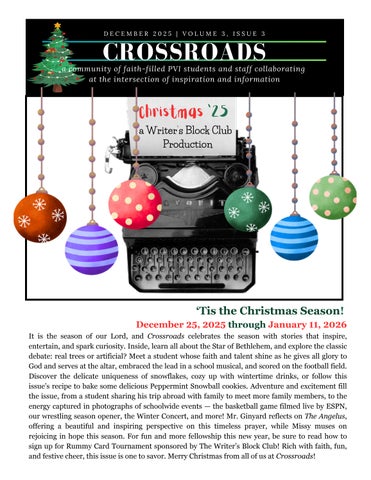
Christmas ‘25 a Writer’s Block Club Production
‘Tis the Christmas Season! December 25, 2025 through January 11, 2026 It is the season of our Lord, and Crossroads celebrates the season with stories that inspire, entertain, and spark curiosity. Inside, learn all about the Star of Bethlehem, and explore the classic debate: real trees or artificial? Meet a student whose faith and talent shine as he gives all glory to God and serves at the altar, embraced the lead in a school musical, and scored on the football field. Discover the delicate uniqueness of snowflakes, cozy up with wintertime drinks, or follow this issue’s recipe to bake some delicious Peppermint Snowball cookies. Adventure and excitement fill the issue, from a student sharing his trip abroad with family to meet more family members, to the energy captured in photographs of schoolwide events — the basketball game filmed live by ESPN, our wrestling season opener, the Winter Concert, and more! Mr. Ginyard reflects on The Angelus, offering a beautiful and inspiring perspective on this timeless prayer, while Missy muses on rejoicing in hope this season. For fun and more fellowship this new year, be sure to read how to sign up for Rummy Card Tournament sponsored by The Writer’s Block Club! Rich with faith, fun, and festive cheer, this issue is one to savor. Merry Christmas from all of us at Crossroads!
Table of Contents Columns Kameron’s Course Compass 32 The Law of Prayer is the Law of Belief 15 The Book Behind the Cover 24 Sideways Thoughts 26 All Things Rowing 28 Iyla’s Insights 35 Missy’s Musings 36 Quenching Your Thirst: Three Wintertime Drinks 40 The Return of the Catholic Culture 42 The Sweet Spot 54 Heaven-Tuned Music 58
Features Live Christmas Trees 4 PVI Young Renaissance Man 6 The Science of Snowflakes 12 2026 Rummy Card Tournament 57 My World’s Greatest Cat 33 Checking Off the Most Important Item on Our Bucket List 53 Christmas Movies 15 December Artwork 135
Featured Photographs 60 Student Contributors 130
The Writer’s Block Club
Create and leave your PVI legacy in the pages of our club’s publications!
The Writer's Block Club Mission: The mission of The Writer's Block Club is to provide an exciting and welcoming opportunity for its diverse student members to hone their skills in thinking outside the proverbial box and share their oft-hidden talents through the written word and other creative mediums. From dedicated sports athletes, talented musicians, and theatre/performance enthusiasts, to service-centric students, poets, photographers, and quiet creatives, The Writer's Block Club gives every PVI student a place to express themselves and expand and celebrate their diverse interests. Members have the ability to develop their skills in leadership, decision-making, listening, proofreading, writing fiction and nonfiction, graphic design, marketing and promotion, magazine layout and page design, interviewing students and staff, and time management.
F E A T U R E
LIVE Christmas Trees:
Overflowing Natural Benefits or Subpar and Expensive ? By: Avery Thom ‘27
Is buying a plastic Christmas tree more beneficial than buying a real tree every year?
Every year, my family and I go to a local garden center to buy our Christmas tree. With Christmas music flowing and holiday happiness spreading through the air, buying our tree has traditionally been one of the highlights of the season for us. However, as my siblings and I have gotten older, buying a big live tree has sunk in importance, leading us to choose smaller trees or going without a tree entirely. Combined with the rise in popularity of artificial trees, it made us think about investing in an artificial tree of our own. One of the major drawbacks of artificial trees for us has always been the question of the environmental impact of manufacturing them and disposing of them. However, compared to all the resources required to transport and grow live trees, are buying artificial trees really environmentally worse than buying real trees?
Real LIVE Trees: PROS: Christmas trees typically take 6–8 years to reach marketable size, and during that time, the farm provides a wildlife habitat. New trees are planted to replace harvested ones, continuing the cycle. Trees also help store carbon — each absorbs around 20 pounds of carbon dioxide, the same as burning a gallon of gas — and when mulched, they return nutrients to the soil. And, of course, there’s the joy factor: picking your own tree has become a cherished family tradition, and nothing beats the crisp, fresh smell of a real tree filling a home with festive cheer. CONS: Growing them takes time and effort: a year before planting, weeds must be cleared, soil adjusted, and fertilizers added. Grass is planted in the fall, and trees go in the ground the next spring. Once growing, they require constant care — fertilizing, mowing, pest control, and shaping into that classic tree form. Plus, real trees usually cost more than artificial ones, which can make them a pricier holiday choice.
F E A T U R E
REAL Artificial Trees: PROS: They are more cost-effective than real trees because they can be reused for multiple years, with most lasting 7–10 years. The longer a tree is kept, the more it offsets the environmental impact of its manufacturing, shipping, and disposal. They are also low-maintenance: unlike real trees, artificial trees don’t shed needles or require watering, and they are easy to set up, take down, and store. CONS: They are made from non-recyclable plastics that take decades to break down, can leak toxic chemicals into waterways, and contribute to landfill waste, adding to the roughly one million extra tons of trash dumped weekly. About 80–90% of artificial trees sold in the U.S. are imported from China, whereas most live Christmas trees are grown domestically in Oregon and Washington, which requires less fuel for transportation. Altogether, though artificial Christmas trees are easier to care for and can be environmentally sound if used for 10+ years or bought used, buying a real tree is overall the better option for those who can afford it. With its positive overall environmental impact and its rich tradition, buying a real tree is the clear choice. Despite evidence that real Christmas trees offer sensory and environmental benefits, according to a 2025 Ipsos survey for the American Christmas Tree Association, about 83% of U.S. households this season have chosen an artificial Christmas tree, showing that modern convenience and lower long‑term costs often outweigh the traditional advantages of real trees. Will artificial trees become the holiday go-to — or have they already?
f e a t u r e
A PVI Young Renaissance Man Called to Serve
‘
At the Altar, On the Field, and On the Stage by: Sian Chen '27
Rodrigo grew up viewing Mass not as something to sit through, but as something to enter into.
As the PAC fills with the low hum of students settling in, a small group of altar servers — precise, focused, and often unnoticed — moves quietly beneath the crucifix, preparing for an All-School Mass. Among them is Rodrigo Jauregui, Class of 2026, who has been an altar server since third grade. Nine years later, he now serves as one of PVI’s two Masters of Ceremony (MCs). His love and reverence for God have long become a part of his daily life, and through his involvement in Mass, in sports, and in the arts, he continues to share his faith with others and serve as a lead-by-example PVI student, young gentleman, and saint-in-the-making. The building of Rodrigo’s foundation in faith begins at a very early age. From before he could speak in full sentences, his mother took him to Mass. Unlike other young children who were given toys or books to stay occupied during Mass, Rodrigo’s mother inspired and encouraged him to watch and listen. She quietly explained the different liturgies throughout Mass. “I was always drawn to those kids up front wearing vestments,” he recalled. “I was curious about what they were doing. When my mom asked if I wanted to start serving, I said yes right away.” continued
Rodrigo as an altar server; pictured at PVI with Bishop Burbidge
That early curiosity, as he grew older and learned more, slowly deepened into a sense of responsibility and understanding. Behind every Mass lies preparation that the congregation rarely sees. Ten minutes before the liturgy begins, Rodrigo and the other altar servers gather in a small chapel for silent prayer. They may still joke lightly as they vest, but as the moment of Mass approaches, they quiet themselves. After a shared prayer, they leave the chapel in silence. From that moment on, nobody speaks. They walk toward the altar with full focus.
“We lay all our worries and distractions at the feet of Christ so we can be in the right place mentally to welcome Him.”
As one of PVI’s MCs, Rodrigo must anticipate needs and handle unexpected situations to keep the Mass flowing smoothly and reverently. Some moments are subtle but deeply meaningful. During one Mass, a tiny fragment of the consecrated host fell to the ground. Rodrigo immediately covered the spot and helped purify it. “Even the smallest visible fragment of the Eucharist is the full body and blood of Christ,” he said. “It has to be treated with the utmost reverence and respect.” Adjusting microphones, managing small hiccups — these actions come instinctively to him. “Not to be noticed, but to keep attention from being pulled away from the Mass,” he explained.
continued
Rodrigo serving as Joseph, the lead in PVI’s 2025 spring musical.
Rodrigo serving as a punter with the PVI Football team.
“If people notice us, then we’re doing it wrong,” he said softly and sincerely. “Altar serving is not a performance.” Of all the moments in the liturgy, the one he cherishes most is ringing the bells at the consecration. “It’s not because ringing the bells is fun — though it definitely is,” he laughed. “It’s the meaning behind it. It’s the announcement of the Holy Spirit coming down upon the bread and wine, turning it into the Body and Blood of Christ; a miracle before our eyes.” The brief, bright sound reminds him of the angels in the Nativity story proclaiming, “Gloria in Excelsis Deo” (Glory to God in the highest). Each time he rings the bells, he feels as though he is carrying that same message. When asked what qualities make a good altar server, he didn’t list skills or personality traits. “Its intention,” he said. “A pure intention. You’re not serving for others, or for yourself — you’re serving for the Lord.”
“Many are called, but only a few say ‘Yes!’” ‘ he said. “Everyone has a different reason for saying ‘Yes!’ but as long as the intention is pure, God is pleased.” For students who are interested, his advice is simple and sincere: “Don’t be afraid — talk to someone,” he said. “Talk to a priest, or talk to me. Discernment will help you know if this is your calling.” Under the warm lights of the sanctuary, Rodrigo’s presence is always quiet, yet steady. He doesn’t shout, doesn’t posture, but through every Mass, he turns simple actions into a way of life. “Everything we do is for the greater glory of God,” he said. And in countless small, seemingly unnoticed moments, he has already allowed that glory to shine quietly through his own life.
“We should do everything for His Glory. That’s why we serve — not for attention, but as an offering.”
PVI’s altar servers come from every corner of campus: football players, theatre students, musicians, and classmates who aren’t involved in other activities. While Rodrigo has embraced diverse opportunities to connect with others and share his faith by also being involved in the arts and sports at PVI, he sees serving at Mass as “an immense blessing.”
If you have any questions about altar serving, contact Rodrigo at jauregui26@pvipanther.net or stop by Campus Ministry.
f e a t u r e
The Science of Snowflakes: Why No Two Are Alike by: Emma Fuller '28
Each winter, billions of snowflakes fall silently from the sky, blanketing cities and forests in intricate white patterns. Yet astonishingly, no two snowflakes are exactly the same. The idea has fascinated scientists, poets, and curious observers for centuries, and the explanation lies in a complex mix of chemistry, physics, and atmospheric science. Every snowflake begins with something almost invisible: a single particle of dust, pollen, or other microscopic matter suspended in a cold cloud. When the surrounding air temperature drops below freezing, water vapor molecules condense around this tiny nucleus and freeze, forming the first layer of ice. From there, the snowflake’s growth depends on the precise conditions of the atmosphere, temperature, humidity, and air pressure. As it drifts through the cloud, water vapor continues to deposit onto the crystal, adding layer after layer of ice. Because clouds are not uniform environments, even two snowflakes forming side by side experience slightly different paths through air that varies in temperature and moisture. These minute differences create dramatically distinct crystal patterns. All snowflakes share one thing in common, however: a six-sided, or hexagonal, structure. This symmetry originates from the molecular shape of water itself. Each water molecule is composed of one oxygen atom and two hydrogen atoms bonded at an angle of approximately 104.5 degrees. When these molecules freeze, they arrange themselves into a hexagonal lattice to maximize hydrogen bonding.
This atomic geometry dictates that snow crystals will naturally form six arms radiating from a central point. However, while the overall symmetry remains consistent, the growth of each arm depends on rapidly changing environmental conditions. A difference as small as one degree Celsius or a slight shift in humidity can alter the rate at which ice accumulates, causing branches to develop new ridges, plates, or needles. Physicist Kenneth Libbrecht, one of the leading researchers on snow crystal formation, describes the process as “chaos frozen in motion.” Even within the same cloud, snowflakes encounter microscopic variations in their surroundings. The result is that each flake follows a unique developmental path, shaped by random fluctuations in temperature and vapor density. In laboratory experiments, scientists can control the conditions that produce certain general snowflake types (such as stellar dendrites, plates, columns, and needles), but achieving two identical flakes is virtually impossible. The number of possible molecular arrangements is so vast that the odds of duplication are estimated to be close to zero. Snowflakes are a perfect example of how order and chaos coexist in nature. They obey strict molecular laws yet display infinite variation. Their symmetrical designs emerge not through human design, but through the self-organizing principles of chemistry and physics acting under constantly changing conditions. So the next time you see snow falling, remember that each flake is more than frozen water; it’s a record of the precise atmospheric journey it took from cloud to ground. Every snowflake carries its own history in its shape, a fleeting work of art sculpted by the air itself.
F E A T U R E
Some of The Best Christmas Movies to Watch This Year by: Morgan Watts '29
If you’re looking for great movies to watch with your family over our winter break, I’m here to give you 5-star recommendations! The list includes both ageless classics and some newer ones you won’t regret checking out!
First, we have a classic Christmas movie: Elf. It’s the story of a human, Buddy, who was raised as an elf in the North Pole. Feeling like he doesn’t fit in, he journeys to New York City in search of his family. His father happens to be a stubborn, grouchy man, and Buddy helps him into the Christmas spirit. It’s a movie for the whole family, and I would recommend it to anyone in need of a laugh over the holidays.
Next, we have Rudolph the Red-Nosed Reindeer. A timeless movie that tells the classic story of Rudolph, and how he saves Christmas using his shiny red nose. Despite its age, this movie has traversed the ages, becoming a fan favorite for all ages.
And for our next movie, we have A Christmas Story. Based on the writings of Jean Shepard, A Christmas Story follows Ralphie, whose dream Christmas gift is a red flying air rifle. He has to manage being bullied as well as his wacky family to make it to Christmas Day intact. This movie is a great option if you’re looking for more of a live action approach, and it really resonates with adults and children.
Finally, we have Home Alone. This movie follows Kevin McAllister, a young boy who is left behind by his family when they go on vacation to Paris. His mother is trying to make it home, while Kevin is trying to keep two burglars out of his family’s home. It’s a hilarious story of the mind of a child and it packs a punch of humor for anyone looking for a great Christmas comedy.
There are many other incredible Christmas movies from which to choose, including the classic It’s a Wonderful Life, so be sure to ask your parents and grandparents what their favorite holiday movies are to expand your knowledge of the holiday movie genre! Movies help multi-generational family members bond, especially during the holidays. Even if you don’t celebrate Christmas, these movies are great for everyone because they pack morals with good punchlines and family dynamics with endearing characters. The holidays are a time of joy and togetherness, and these movies reflect that perfectly.
C o l u m n
Lex Orandi, Lex Credendi, Lex Vivendi The law of prayer is the law of belief. by: Mr. R. Ginyard '99
The prayers given to us by Holy Mother Church illuminate what we are to believe. The consequence of performing our duty to persevere in prayer is the melting of our hearts so that they may be formed according to the will of Our Lord. Prayer forms our beliefs and our hearts and – ultimately – impacts our behavior and the life we lead each and every day. Prayer roots out sin. Failure to pray allows sin to take root. This column will explore traditional Catholic prayers, what they teach us to believe, and how they command us to behave.
C o l u m n
This issue’s exploration of the prayer:
The Angelus
V/. The Angel of the Lord declared unto Mary. R/. And she conceived of the Holy Ghost. Hail Mary, full of grace, the Lord is with thee; blessed art thou amongst women, and blessed is the fruit of thy womb, Jesus. Holy Mary, Mother of God, pray for us sinners, now and at the hour of our death. Amen. V/. Behold the handmaid of the Lord. R/. Be it done unto me according to thy word. Hail Mary, full of grace, the Lord is with thee; blessed art thou amongst women, and blessed is the fruit of thy womb, Jesus. Holy Mary, Mother of God, pray for us sinners, now and at the hour of our death. Amen. V/. And the Word was made Flesh. (Genuflect) R/. And dwelt among us. (Arise) Hail Mary, full of grace, the Lord is with thee; blessed art thou amongst women, and blessed is the fruit of thy womb, Jesus. Holy Mary, Mother of God, pray for us sinners, now and at the hour of our death. Amen. V/. Pray for us, O Holy Mother of God. R/. That we may be made worthy of the promises of Christ. Let Us Pray Pour forth, we beseech Thee, O Lord, Thy grace into our hearts: that we, to whom the Incarnation of Christ, Thy Son, was made known by the message of an angel, may by His Passion and Cross be brought to the glory of his Resurrection. Through the same Christ Our Lord. Amen.
C o l u m n The Angelus is prayed three times a day — morning, noon, and evening — in honor of the Incarnation of Our Lord. "Evening and morning, and at noon I will speak and declare: and he shall hear my voice” (Ps. 54:18). The words of the prayer come directly from Holy Scripture. They describe the visit of the Archangel Gabriel to the Blessed Virgin Mary during which she learns that she is to become the Mother of God and that God Himself will assume human flesh. Christ is God made man. This mystery is remarkably worthy of our contemplation. We must not take it for granted; it has significant implications. God humbles Himself, to become one of us, in order to redeem us! “He who believes this Adorable Mystery with a living supernatural belief is irresistibly impelled by the religious cravings of his mind and heart to admit an infallible Church and the Mystery of the Blessed Eucharist.”
Picture life in a small town in France. The Catholic cathedral sits at the top of the hill, and in all places the church bells can be discerned by the ear. The rich who live at the top of the mountain, the merchants who live right below them, and the poor who are out in the fields can all hear the bells ring —- morning, noon, and evening. Regardless of social status they are bonded by their gratitude to God for bestowing on them such a marvelous gift, the Incarnation. When the noon bell rings, all labor ceases and all human activity takes a backseat, as the faithful bend their knees and repeat the words of the Archangel Gabriel, the Blessed Virgin Mary, The Holy Ghost (through St. John the Apostle), and they top it all off with the Angelic Salutation (Hail Mary). Such is the import of the Word made flesh that it stands still all human activity.
Reflect for a moment on Jean-Francois Millet’s oil painting, L'Angélus. Notice the steeple in the background. The bells would ring three times, which announces the first line of each verse of the prayer. The entire town in their respective places is in unity praising God and asking the Blessed Virgin for her intercession.
C o l u m n The whole of the Christian religion depends upon the doctrine of the Incarnation. "No other foundation can any man lay but that which is laid, Jesus Christ our Lord” (1 Cor 3:11). He is the cornerstone of the whole religious edifice. The union in Jesus Christ of the two natures, the Divine and the human, is (one may say) the whole of Christianity; everything depends upon it. His words and His works all have their value from the fact that they were done and spoken by One who was at the same time perfect God and perfect man, yet but one and the same Person. What would be His moral teaching or His example to us, except He were man even as we are men, with a body and a soul like ours; a will, an understanding, a heart and affections like ours? Or, on the other hand, how should we have profited by His death except He had been God, and so His sufferings had been of infinite value?” The Angelus, the prayer of the Incarnation, expresses the teaching of Holy Mother Church described above by Fr. Northcote. The Angelus inspires us to worship the God-man and honor the Virgin-Mother. We do not have one without the other. Without the God-man, there is no Body to offer up on the Cross for our redemption. Oh, how we are grateful to the Mother of God! Imagine an archangel descending from his place next to the throne of God to approach a poor young girl, announcing her as Full of Grace (Luke 1:26-28). How can we, generations later, do anything other than honor her in imitation of said angel, St. Gabriel?
Let us consider three ways we can follow the inspiration of what the Church teaches through this prayer so that we give adoration to Jesus and honor to Mary, following the example of St. Gabriel the Archangel.
C o l u m n
“Firstly, did you know that at St. Paul VI Catholic High School, The Angelus is prayed on campus at least twice a day? There is no doubt that many on campus do the same in private in the silence of their hearts. “Behold the handmaid of the Lord. Be it done unto me according to thy word” (Luke 1:38). The example of the Blessed Mother, by praying her words, will form your heart to submit itself to the Divine Will and say yes to whatever God desires for your life. Think of the joy that was brought to the world because Our Lady said these words. We often make our desires for our own lives the priority. God already knows what will lead us to true joy; let us follow His will. Consider joining in prayer with Campus Ministry at noon on the days you have the A lunch period.
At PVI, there is a group of students who pray The Angelus together in the morning before the start of the first class. Every day at noon in the Campus Ministry Office, The Angelus is prayed as well.
C o l u m n
Secondly, pray the Rosary. “Love the Madonna and pray the Rosary, for her Rosary is the weapon against the evils of the world today. All the graces given by God pass through the Blessed Mother” (St. Padre Pio). Consider praying all the mysteries over the course of one day or even in one sitting at some point this month. This meditation will open up to your soul the impact of the Incarnation of Our Lord and the “Yes” of Our Lady on the entire mystery of salvation. The Incarnation is the first mystery of the Rosary, and from there we get the life, preaching, teaching, miracles, passion, death, resurrection, and ascension of Our Lord. The Rosary is a meditation on the Gospel. Praise God for Mary’s strength of Faith and courage of spirit to say “Yes” to the Incarnation! Then the Rosary ends by meditating on Mary’s reward for said Faith — her Assumption into Heaven and her Coronation as Queen of Heaven and Earth.
Pray the Rosary...the weapon against the evils of the world today.
C o l u m n “Thirdly, imitate her strength of Faith and courage of spirit to say ”Yes” to God and “No” to the world. Let us recall that Advent is a penitential season and throughout it Holy Mother Church adorns Herself in purple. Starting on November 30 and ending on December 24, “the Advent season is a time of preparation that directs our hearts and minds to Christ’s second coming at the end of time and to the anniversary of Our Lord’s birth on Christmas.” Advent, like Lent, “includes an element of penance in the sense of preparing, quieting, and disciplining our hearts for the full joy of Christmas.” Does that description at all represent what Northern Virginia looks like during Advent? Fast while the secular world is feasting with holiday parties before Christmas Day. Pray in silence or by listening to sacred Advent hymns while the secular world is blasting so-called holiday music from Spotify. Give alms to the needy while the secular world is racing to the stores in vehicular traffic and fighting over parking spots to buy the limited and popular gifts. Then...feast and celebrate Christmas in its proper time, December 25 - January 11 (Our Lord’s Baptism). Within that frame of time, Holy Mother Church gives us much to celebrate — The Nativity, Martyrs, the Holy Family, St. John the Apostle, Epiphany, and Our Lord’s Baptism.
Fasting, prayer, and almsgiving are spiritual weapons that assist us in disciplining our hearts. Let these weapons be part of Advent.
C o l u m n
The penitential spirit of Advent is a disposition we must adopt because we know not when Jesus will return. We do not want to face the consequences of being caught off guard by His Second Coming. We must watch and pray (Mark 13:33). Let us learn from Mary and put Him first. Say “Yes” to Him and place Him at the center of Advent and then Christmas. If it ever was, in light of everything illuminated above, it cannot be a wonder why, at the start of the third verse of The Angelus, we genuflect. “And the Word was made flesh and dwelt among us” (John 1:14). The recollection of this moment in the history of salvation deserves nothing less than our bending the knee. "Hail, true Body born of the Virgin Mary, which really suffered and was offered on the Cross for man."
...in light of everything illuminated here, it cannot be a wonder why at the start of the third verse of The Angelus we genuflect. “And the Word was made flesh and dwelt among us” (John 1:14).
C o l u m n
THE BOOK
MAGIC, DARKNESS, AND POWER:
BEHIND THE
COVER by: Charlie Huly '29
Every year, the promise of snow fills me with deep excitement for the chance to build a snowman or barrage my brother with snowballs. But the moment I feel the melted snow in my boots, I wish for nothing except that spring would come early. This is how I feel about Leigh Bardugo’s 2012 YA Fantasy novel Shadow and Bone. I will caveat this review by saying that I am a fan of her other work (the Six of Crows novels are all-time favorites of mine), but nevertheless, I shall proceed. The world presented in Shadow and Bone is quite fascinating, but most all other aspects of the story fall flat. From a plot latent with cliches to characters whose arcs you could predict the moment they’re introduced, Shadow and Bone (and rest of the trilogy) left me deeply disappointed.
A Review of Leigh Bardugo’s
Shadow and Bone
The novel follows Alina Starkov, an orphaned mapmaker in the fictional nation of Ravka, who discovers she is the prophesied Sun Summoner, the one person who might be able to destroy the Shadow Fold, a swath of darkness filled with monsters that divides the country. Taken to train with the magical elite known as the Grisha, Alina is drawn into the orbit of the Darkling, who claims he wants to use her power to save Ravka. As she grows stronger, Alina uncovers the truth about the Darkling’s plans and must decide whether to embrace her destiny or flee to protect herself and the world from him. The major trap that Shadow and Bone fall victim to is that of the dreaded “Chosen One.” In my opinion, it’s the main aspect of the story that makes it so predictable. It’s a trope we’ve seen done time and again, and although it worked the first few times, the dead horse has been beaten to a pulp since. The flaws in the plot are not made up for by the novel’s characters. Alina, the story’s protagonist, can only be described as a “Not-Like-Other-Girls” type of character, and Mal, her main love interest, couldn’t occupy a single sentence on the page without him annoying me. To add insult to such a grave injury, I could see from a mile away the direction each character would go in their arcs, and as someone who appreciates meaningful character development, this tainted the story even further. If it wasn’t already obvious, I did not care for Shadow and Bone. Yet, I still think that there are aspects of it that are worth complimenting. As I mentioned earlier, the world that Leigh Bardugo created with the trilogy is vast and layered, and one thing the book does well is introduce the reader to it. However, I maintain my opinion that the world does more justice in the other books in the Grishaverse. Despite my scathing opinion on Shadow and Bone, I recommend that you do your own digging on the book and perhaps try it for yourself. I’m just another reader, and you may very well have a different perspective than I do.
RATING: 2.4 STARS
C o l u m n
SIDEWAY THOUGHTS: Born to Die, Dying to Live: The Nativity as Death’s Crucifixion by: Dr. Jonathan Wanner “And death shall be no more; Death, thou shalt die.” ~John Donne Nativity poems are most candid when they are about the crucifixion. Indeed, no story is more full of birth than that of Christ’s death; you just have to cross your eyes to read the tragedy straight. The optical illusion is this: Life Himself was born to be killed, but not to die, since by the cross, death is crucified. As the English poet Richard Crashaw puts it, “Death will on this condition be content to die.” 1 For by Christ’s Easter rising, “The grave lies buried.” 2 Oddly, the clashing of contraries brings chaos into harmony, turns hate into self-gift, transmutes death into new life. Though the cross-eyed vision may at first blind us, we see the workings of God’s providence best with crucifixed eyes. For Christ, above all, is the ultimate discordia concors: in Him, humanity and divinity, life and death, strength and weakness, meld into a cosmic and undivided concord. Indeed, the best poems are paradoxical because Christ is a unity of seeming contradictions, and all the best paradoxes are, in some measure, a descant upon His birth and death. We find such a descant in Bruce Blunt’s “Bethlehem Down,” sublimely set to music by Peter Warlock (1927). The poem’s central idea is that the gifts of the magi and Christ’s swaddling cloth prefigure His passion and burial: When He is King, we will give him the King’s gifts, Myrrh for its sweetness, and gold for a crown, “Beautiful robes,” said the young girl to Joseph Fair with her first-born on Bethlehem Down. When He is King, they will clothe Him in grave-sheets, Myrrh for embalming, and wood for a crown, He that lies now in the white arms of Mary Sleeping so lightly on Bethlehem Down. 3
Cleverly, the repetition of the mantra “When He is King” baits us into expecting another description of Christ’s nativity regalia in the second stanza. Instead, we get a morbid reversal: the myrrh that adds a sweetness to Christ’s stall will embalm Him, the gold that coronates Him will give way to a crown of thorns, and His swaddling cloth will find a new purpose as a burial sheet. As grotesque as these inversions seem, there is an honesty in drawing Christ’s birth close to His death: He was born to die, yet He died to live. As it is a carol, you must sing the poem to love it best — its bitter-sweetness haunts the ear, but in the best of ways. In the same year, T.S. Eliot had an inkling of the same paradox when he wrote “Journey of the Magi.” As the poem concludes, the wise man narrator is awe-struck not only by the revelation of Christ’s twin-natured birth, but by the birth of the Church which now lives by His death. If, by the sacraments of Christ’s wounded side, death and life agree, then what before were rivaling contraries become a set of agreeable synonyms. So it is that Eliot’s magus cannot distinguish between the two extremes of Christmas and Easter: Were we led all that way for Birth or Death? There was a Birth, certainly, We had evidence and no doubt. I had seen birth and death, But had thought they were different. 4 When life becomes life-as-death, and death becomes death-as-life, we are left with no difference in between. Unsurprisingly, the magus ends with an ironic confession: “I should be glad of another death.” 5 He, of course, means life. Richard Crashaw (1613-1649) strikes a similar keynote in his epigram “Upon our Saviours Tombe.” With compact wit, he likens Christ’s virginal birth to His Resurrection. Out of womb and tomb alike, Christ found a mysterious passage, even when the way was shut. The tomb is, thus, “a virgin” like Mary: How Life and Death in Thee Agree! Thou had’st a virgin Wombe And Tombe. And Joseph did betroth Them both. 6 Crashaw’s pairing of “womb” with “tomb” is itself a little microcosm of Christ’s discordia concors. As emblems of life and death, the words appear to stand in contrary motion, but they ultimately agree both in rhyme and in their life-giving end. The final punchline only adds to the charm: Just as Joseph of Nazareth literally betrothed Mary’s virginal womb, Joseph of Arimathea figuratively “betrothed” Christ’s virginal tomb. As brief as these little poetic clippings are, they function as a sort of cosmic kaleidoscope in which contraries collide to mosaic themselves into a mystic rose. The scope narrows our vision to expand it. It turns our heads upside down even while allowing us to remain standing, and in the reversal, we find the oddness of a forward vision. After all, when self-emptying is self-fulfillment, there is only joy in the grief of living to die. I, of course, mean dying to live. Footnote references and bibliography available upon request. Contact: jwanner@paulvi.net
C o l u m n
All Things Rowing by: Anna Britt '27 If you’d told me three years ago that I’d be writing a column on rowing and that it would involve not only dawn erg sessions and the pursuit of a new 2k PR (which I achieved; 7:45) but also sand, surf, and the possibility of untimely shark interventions, I’d have laughed, out loud, off the edge of my seat, probably spilling a drink on myself. Yet here we are. Why am I writing about coastal rowing specifically? Two answers: one, because rowing is the best sport in the history of man. And two, because I’m bitter. Bitter that the lightweight events in the Olympics are being phased out (yes, I said it) and curious if coastal rowing might be the next frontier to channel that energy. So this issue’s column is me asking: “Am I aggressive enough to row a 2k, drop the shell on the beach, tackle someone for the win, and maybe fend off an 18-foot great white shark while I’m at it?” (Spoiler: probably not the shark-part, but we’ll explore what might happen.) Let’s dive (or splash) into the world of coastal rowing.
What Is Coastal Rowing? Coastal rowing is distinct from the classic “flat-water” rowing you might imagine in a regatta: instead of calm lakes and predictable lanes, you have open water (sea, ocean, large bays), waves, wind, buoy turns, beach starts or finishes, and a boat built to handle more unpredictable conditions. According to The Outdoor Journal: “Rowing a sixtyfive kilogram boat … on the relatively big waves of the Atlantic Ocean was quite out of the comfort zone I knew.” And British Rowing Plus describes it succinctly: “Coastal rowing can be a challenge due to the weather and rough waters, but this makes it more fun.” In other words: flatter water, you fight your body. In coastal, you fight your body and the sea. So…What About the Olympic and the Lightweight Rant?
Here’s where I vent a little. The lightweight rowing category (means athletes have to make certain body-weight limits) has long been part of international rowing to give more “average size” athletes (versus super-tall, heavy ones) a chance. But the International Olympic Committee (IOC) and the sport’s governing body, World Rowing, have announced that after the 2024 Paris Olympics, lightweight double sculls and other lightweight events will be dropped in favor of coastal/“beach sprint” rowing events for the 2028 Los Angeles games.
What Makes Coastal Rowing Different...and Tougher? Let’s catalogue some of the stuff that makes coastal rowing both exciting and sometimes terrifying for everyone involved (including myself!) Boat and Equipment: Coastal shells are built differently — wider hulls, more stability, often heavier, designed to take waves. Course: Instead of a straight 2,000-meter lane, you might have buoys, a beach start or finish, slalomstyle turns, waves, and sprints. For example: in beach sprint format you sprint from the sand to shell to water and back. Conditions: Waves, wind, tide, maybe even current. Not perfect every time. One rower said: “You look back every few strokes to make sure you’re on course. You never know when a wave might hit.”
Yes, I’m bitter. Why? Because for many athletes, the lightweight category was a realistic path. For me, it was a way of thinking, “Okay, maybe I don’t have to grow six more inches at 16 to row a women’s eight in any seat other than bow.” And now I’m watching it go away. Meanwhile, coastal rowing comes in, shiny new beach parties and waves, and beach sprints and Olympic medals on the way. Is that bad? No. Is it also frustrating if you train for lightweight events? Yes. The sport is evolving. Sometimes you’re invited along, sometimes you’re left behind. But one good thing: coastal rowing might just open a whole new playground for adrenaline junkies.
Athlete Demands: It’s not just rowing. It’s running (on sand), launching from the beach, handling the boat through the surf. In the words of Coach Marc Oria: “They don’t just have to be rowers–they have to be athletic rowers.” Psychology: You can’t rely on textbook flat-water technique alone. You have to adapt. One athlete: “The similarity (with flat-water rowing) is the movement of the stroke, everything else is different.” So, if you’re chasing a new PR, enjoy rogue waves, and like the idea of semi-non-violent shark encounters, coastal rowing might be for you.
C o l u m n
Beach Spirit and Olympic Debut
As mentioned, the beach sprint variant of coastal rowing will debut at the 2028 Los Angeles Olympics. The format: athletes sprint to the water, row a short coastal course (often about 250 meters out, turn 250 meters back), then jump out, sprint across sand, hit a buzzer — or at least it’s that kind of finish for spectators. World Rowing’s president says: “The inclusion of Coastal Rowing at LA28…is expected to be transformational for our sport…making an exciting form of rowing accessible to new populations.” I feel as though this will be more entertaining at the 2032 Brisbane Olympics when saltwater crocodiles and giant sharks are present. This is a feat only daredevils and Australians are brave enough to face. Okay…Sharks? Deaths? Beach Tackles? Let’s Address the Wild Stuff! Sharks: I couldn’t find a credible stat about coastal racing shells being eaten by sharks (thankfully). But given that coastal rowing happens in open water, Ocean bays, and surf zones — it’s not unimaginable. One coastal rower even mentions white shark concerns in: "Interview with Coastal Rowing Pioneer Ben Booth: Waves, Winter, and Great White Shark.” So yes, if you’re going to row the sea, you might reflect on the shark option while you prepare mentally. Fatalities and Accidents: Rowing in general is pretty safe compared to other water sports, but openwater/coastal adds risk. According to RowSafeUSA: “Four US rowers drowned in 2021, three more in 2022…More than two dozen fatalities are now listed on this site.” Also, recreational boating statistics show that many rowing accidents involve being hit by other boats, or lack of life vests. Beach Tackles: This is me exaggerating, but…if you’re determined and aggressive, beach sprint formats literally finish with running up on the sand. So yes, it is almost a scenario of “row hard, disembark, sprint to sand finish, maybe elbow someone aside (no rules about this have been set yet) for the win.” I suggest you don’t actually tackle someone — it may be painful and probably get you disqualified. In short, it is not flat water, it is wild. Which is exciting. But you still train, you still respect safety, you still check weather, you still wear PFD if recommended.
Closing Thoughts and Looking Ahead So where does that leave us? For me, I have chosen to be open-minded to the misstep that was ending the lightweight category, and somewhat embrace coastal rowing. Coastal rowing is not replacing flatwater for everyone, but it’s offering a new lens. It is trying to add a bit of flair to the world of rowing. I mean, flat water can’t be there. Flatwater is an icon. But the coast does seem alluring. The idea of catching an octopus while rowing does seem like it would be great material for a stand-up comic.
So, while I may be good at the fly and die on an erg, I don’t think I will be taking up coastal anytime soon (unless I can befriend a dolphin during a race that will carry me to a glorious victory). Stay tuned for next month, when we’ll dive into the history of US Rowing at the Olympics and the iconic Husky Clipper and its crew.
C o l u m n
Kameron’s Course Compass Helping you navigate PVI’s ocean of electives by: Kameron Smith '28 FEATURED Elective:
Honors Intro to AI: Explore, Experiment, Innovate Teacher: Mr. Hargadon
Ever wondered how AI can write stories, recognize faces, or answer questions like ChatGPT? In this course, you step inside the world of artificial intelligence to see how machines think, learn, and make decisions — and even build your own AI projects along the way. HN Introduction to AI blends computer science, math, ethics, and creativity to help you understand not just how AI works, but how it impacts our world and shapes our future. You explore real-world examples, engage with AI systems hands-on, and uncover the big ideas behind machine learning and language translation. Some projects you’ll tackle include: Training an AI model to recognize images Building chat-based systems similar to ChatGPT Analyzing real-world data to uncover insights For your final project, you collaborate in teams to design and pitch an AI-powered solution — either for improving an existing company or for a new company your team creates. Each team produces a written proposal, market analysis, AI integration plan, and a live presentation — mirroring the challenges faced by real-world innovators. This course is perfect for anyone who loves asking “How?” and “Why?” instead of just “What?” and who enjoys puzzles, logic, and creative problem-solving. No prior coding experience is needed — just bring curiosity, creativity, and a passion for exploring AI.
f e a t u r e
My World’s Greatest Cat Artwork and Article by:
Cooper Payne ‘29 In 2014, when my family and I were living in Washington state, we went to an animal shelter to try and find a dog to adopt. We wanted to adopt the Husky that we liked the first time we went to the animal shelter, but it had already been adopted by someone who worked at the shelter. Feeling disappointed and sad, my mom, my sister Olive, my dad, and I went to look at the cats on the other side of the animal shelter. There were tons of cats in a room that was about the size of a PVI classroom. In some areas, the room looked as if it was a sea of fur. While we were in the cat sanctuary, we played with two cats named Lavender and Feather; they were brothers. Lavender and Feather were nearly identical, except for the fur patterns on the top of their heads. Feather only had half as much black fur on his head as Lavender. We all loved Lavender, especially me, because I had been playing with him the most out of everybody in my family. When it came time to leave to get back to our home over an hour away, we went to say goodbye to Lavender and Feather, but we couldn't find Lavender. We thought we had to leave without saying goodbye to him, but as we were walking down the hallway, my dad noticed something strange about Olive’s stroller. He looked under it, and Lavender had hidden himself in the cramped storage area of the stroller! Then my dad picked him up and brought him back to the cat room. When he returned, we talked about the idea of adopting a cat instead of a dog.
We decided to adopt Lavender and were able to bring him home a couple of days later. On the way home, the day we adopted Lavender, I sat with him and made sure he was safe, calm, and comfortable in our vehicle. We let my dad pick out his new name because we didn't like the name Lavender. He decided to name him after a football player, but my sister couldn't pronounce his name and started calling him Mow-Mow. My mom and dad were scared that his name was going to be Mow-Mow so we decided to name him Mochi — after both the Japanese dessert and the cat in the movie Baymax. Though everyone in my family loves Mochi and enjoys watching him chase birds, he ended up becoming my cat. He follows me everywhere and would even walk me to the school bus in the morning when we were living in Washington state. From that moment on, he has always been right by my side. Mochi is the best cat in my world and is my best friend. Having Mochi makes life more interesting and joyful.
C o l u m n
IYLA'S INSIGHT
BY IYLA SHARIFAHMADIAN '28 Essentials During Wintertime
WE’VE NOW REACHED THE POINT IN THE YEAR WHERE THE AIR... starts to get crisp, the temperature drops, the months start ending in -ember, and life feels all cozy. Fall is always my favorite season because everything feels much easier and more relaxing. By October, you felt the shift; that nice feeling of fall merges into winter, and while the air gets colder, the vibes still remain. Chill, yet fun; everything feels in sync and like it’s going at the right pace. I always have the best memories during this time of year, feeling the most content now through February.
Adding to the already wondrous, natural feeling this time of year bestows are some essentials that make the season extra cozy, comfortable, and welcoming:
LIGHTING CANDLES When it comes to candles, I recommend buying them throughout the winter months. Choosing the scents of cedar, tobacco, and vanilla really add to the vibes of the season. They’re warm smelling and enhance the ‘fuzzy feeling’ many experience during this time of year.
JOURNALING I express my emotions best in writing. Especially when I get into the mood, I want to be able to pour my emotions out on paper. I love keeping a journal and documenting the experiences and moments in my life. Sometimes it’s just as niche-focused as what I did during the day, but other times I like to expand more, especially on sensory feelings like touch, taste, and smell — the kick of peppermint on my tongue, feeling the air getting thinner as I breathe, the tingly sensation after plunging my hand into snow. Journaling allows me to process these feelings as well as be able to look back on them.
WALKS THROUGH WINTER’S SNOWFALL As the weather turns colder and snow swirls through the air, many retreat indoors, drawn by warmth and relief from the shivering cold. I’m the complete opposite — I adore the snow and being out in it. When I have my favorite tunes playing through my earbuds, any thought of coldness dissolves out of my thoughts, and I enjoy the unique feeling that only the snow brings. I love the feeling of it on my hands, catching snowflakes on my tongue, and trudging through fresh snow.
CAPTURING MOMENTS WITH THE CAMERA Another essential for wholeheartedly embracing wintertime is to capture the memories and feelings of the season by taking photos. Normally, I use my phone, but sometimes I like to bring out my digicam to create that nice grainy texture that makes it seem more raw. My seasonal photos range from outdoor scenery and animal tracks in the snow to the warmth of festive, holiday trimmings throughout the house.
TEA I’m ending this list of recommended essentials with something fairly simple: tea. As my all-time favorite drink, I personally enjoy a cup of tea practically every day — and there are so many ways to enjoy it! Though I also enjoy it throughout the other seasons, having tea in the winter is way better, as the scorching hot feeling actually serves a purpose and warms me up instead of just burning my tongue. After brewing my perfect cup, I add a splash of milk and a hint of sugar before curling up with blankets and pillows. That’s all for this edition’s article. Hopefully, this list inspires you to savor the joys of the season in your favorite ways, too!
C o l u m n
Missy’s Musings: Still Seen, Still Heard, Still Called by: Mrs. Gurley In the time between Halloween (All Hallows’ Eve–the night before All Saints Day) and Christmas, much hullabaloo is made over when it is appropriate to put up the Christmas decorations. These days, the fall decor of Thanksgiving seems to be a rude interruption to hurdle oneself past in order to get to decking the halls! Walking into any store on November 1, one was undoubtedly met with a snowy Santa scene and the sound of “Jingle Bells”! I used to find this particularly irritating. Of course, it is liturgically inappropriate to “haul out the holly” on November 1. We must wait through the penitential season of Advent before the celebration of Christmas even begins, on the eve of December 24! The actual liturgical season of Christmas continues through the Feast of the Epiphany–the celebration of the arrival of the Wise Men–and ends only after the Feast of the Baptism of the Lord, which falls between January 2 and January 8, depending on the calendar year. And in the traditional Catholic calendar, the Christmas season lasted until Candlemas on February 2! This feast celebrates the Presentation of Our Lord in the Temple, and the candles that will be used in the liturgy are blessed during the Mass, hence the name “Candlemas.” All this considered, it is actually more in tune with the Church year to put up your tree on December 25 and leave it up until February 2, than it is to start your Christmas decorating before Thanksgiving!
C o l u m n
“Long lay the world in sin and error pining, 'til He appeared and the soul felt its worth.”
As the years pass, though, I have begun to soften on this matter a bit. This year in particular, as I am home on sick leave through another Advent and Christmas, even I want to start unpacking ornaments and hanging wreaths before Thanksgiving! Why? It is all because I need to remind myself of a certain “thrill of hope” that should not be lost even during difficult times, and I believe everyone who decorates early may need this, too.
“A thrill of hope” is a phrase taken from one of my all-time favorite Christmas songs, “O Holy Night.” The entire verse is as follows: “Long lay the world in sin and error pining, 'til He appeared and the soul felt its worth. A thrill of hope, the weary world rejoices, for yonder breaks that new and glorious morn!” The sentiment is so beautiful and poignant that it deserves special attention. “Long lay the world in sin and error pining” speaks of the painful, long wait for the Messiah! To pine is “to yearn intensely and persistently, especially for something unattainable, or to lose vigor, health, or flesh, as through grief” (Merriam-Webster’s Dictionary). Until Christ’s coming, the world suffered such profound sadness, confusion, and a deep sense of longing for a savior. Without Christ, mankind was stuck in the mire of sin, literally wasting away in grief, due to failing to live in communion with God. And that sin dimmed man’s ability to rightly recognize truth. So, the saga perpetuated — sin and error, error and sin — and then again, the desperate longing.
C o l u m n
But wait! The next line in the song is “‘til He appeared and the soul felt its worth!” The HOPE of the world was born of a virgin, our Most Blessed Virgin Mary, just as the prophets had foretold! And finally, because of His coming, humanity can find meaning in their everyday lives and can know the TRUTH, especially the truth of their worth. There is no more cause for pining! Even if one falls into the mire again, forgiveness waits in the confessional! The next line in the song may be the reason for early Christmas decorating: “A thrill of hope, the weary world rejoices, for yonder breaks that new and glorious morn!” Weary ones, even through weariness, can respond to the thrill of hope welling up within! We may be weary, we may endure hardships, but oh, we can REJOICE IN HOPE for “hope does not disappoint us, because God’s love has been poured into our hearts” (Romans 5:5). This hope turns humanity toward the SONrise, the breaking of this new and glorious morn! Christmas morning has come! Joy to the world; the Lord IS come!
So, quite possibly those who put up their Christmas trees in November need to be reminded of this HOPE! Time is of the essence! We weary ones may need to reorient ourselves away from pining and toward a life of HOPE and REJOICING, turning again to the One Who showed us our worth! Remembering who we are, because of the One who was incarnate and born of the Virgin Mary on that glorious morn, may be a little more urgent for some. So, if you noticed my Christmas tree lights peek out of my window before Thanksgiving, know that it is because of the great thrill of HOPE that still lies within me.
“A thrill of hope, the weary world rejoices, for yonder breaks that new and glorious morn!”
MEETINGS: Tuesdays during Panther Time in the Dining Commons! Join us for brainstorming sessions, editorial planning, snacks, special event planning, and more!
The Writer’s Block Club k77wekpk
The Writer’s Block Club is Seeking:
Activities:
Join The Writer’s Block Club Google Classroom for announcements and more info!
k77wekpk
Field trip to Udvar Hazy Museum photographers Visit to a local WRITERS airport creative graphic designers Visit to local meticulous proofreaders aerospace company Sharing of artifacts about aerodynamics and flight
C o l u m n
Quenching Your Thirst
3 Wintertime Drinks
by: Madie Mays '29
3
As Christmas approaches, the spirit of the holiday cheer dawns upon us as we rush to partake in the experiences that make Christmas magical. After all, sipping hot cocoa or eggnog by the fire as you watch one of your favorite Christmas movies is everyone’s favorite tradition of the year. However, as we celebrate the birth of Jesus Christ, we have to wonder: how can you mark the season with your own festive holiday drinks everyone knows and loves? This month’s recipes explore three classic holiday drinks that your friends and family will lov,e and that will surely become another holiday tradition for you. Don’t hesitate to put your own unique twist on them!
Recipe 1: Hot Chocolate Hot chocolate is perhaps the most popular Christmas drink of all time. You probably have many nostalgic memories of sipping a warm cup of hot chocolate with your family on Christmas Eve. This recipe goes beyond the basic, powdered packets to produce four servings of delicious, rich, and creamy hot cocoa that will not disappoint.
Ingredients:
Ingredients:
4 cups of milk ¼ cup unsweetened cocoa powder ¼ cup granulated sugar ½ cup semisweet chocolate chips ¼ tsp pure vanilla extract
INSTRUCTIONS:
INSTRUCTIONS:
Whisk milk, cocoa powder, and sugar together in a small saucepan over medium heat until warm, but not boiling. Add chocolate chips and whisk continuously until the chocolate chips are melted and evenly distributed in the milk. Whisk in vanilla extract and serve immediately while the mixture is hot. This recipe tastes best with homemade whipped cream, marshmallows, or a candy cane.
Recipe #2: Peppermint Mocha Peppermint mochas combine three nostalgic flavors that we all know and love to create a timeless, sophisticated version of hot chocolate that never disappoints. This known and loved Starbucks flavor can now be easily created at your kitchen table. Substitute the chocolate chips for white chocolate or the coffee for decaf if you want to mix things up a little.
Ingredients:
Ingredients:
¾ cup whole milk 2 tbsp sugar 1 tbsp cocoa powder ¾ cup strong coffee ¼ tsp mint extract ¼ tsp vanilla extract
INSTRUCTIONS:
INSTRUCTIONS:
Add milk, cocoa powder, and sugar to a small saucepan. Heat on medium until small bubbles begin to form around the edges and the sugar has dissolved. Stir in coffee, mint extract, and vanilla extract. Serve in a large mug immediately and garnish with whipped cream, candy canes, or chocolate shavings if desired.
Recipe #3: Grinch Punch We love Christmas, but you know what comes right after? New Year’s! These celebrations are the perfect time to ring in a new era with a bright, festive drink perfect for parties or family gatherings! With a bright green color that’s inspired by the beloved film, How the Grinch Stole Christmas, this drink is a holiday favorite to look forward to year after year.
Ingredients:
Ingredients:
1 quart lime or rainbow sherbet 1 two liter bottle ginger ale 23 fl. oz. pineapple juice ½ jar maraschino cherries, drained ½ lemon, sliced ½ lime, sliced
INSTRUCTIONS:
INSTRUCTIONS:
Scoop sherbet into a punch bowl. Pour in ginger ale and pineapple juice. Stir well. Stir in cherries, lemon, and lime to float on top of the punch.
C o l u m n
The Return of Catholic Culture: What was the Christmas Star? by: Roy Wulf '26 Psalm 19 speaks of the beauty of the heavens: The heavens proclaim the glory of God; the firmament shows forth the work of His hands. One day imparts that message to the next, and night conveys that knowledge to night. All this occurs without speech or utterance; no voice can be heard. Yet their message goes forth throughout the earth, and their words to the ends of the world.
One particular star, one we call “the Star of Bethlehem,” is mentioned in the Bible as accompanying the birth of Jesus and the visit of Wise Men from the East, called the “Magi.” From its name, we might assume that it was what we today think of as a star. However, in the original text, the Greek word aster, in addition to being used to refer to a literal star, could also refer to a planet, a comet, or anything shining brightly in the night sky, such as a meteor, a supernova, a conjunction of planets, the International Space Station sent backwards in time (a less likely possibility), or even some supernatural light.
So, what was the Christmas Star anyway?
There are two detailed Nativity accounts in the Bible. They are found in the Gospels of Luke and Matthew. Each account includes details not found in the other. Whereas Luke talks about the angels and the shepherds,There he does Star accounts in the Bible. They arenot twomention detailedthe Nativity of Bethlehem. Instead, it is ininMatthew’s Gospel are found the Gospels of Luke and Matthew. Each account that we read about includes the Christmas Star and the in the other. Whereas Luke talks specifics not found Magi. about the angels and the shepherds, he does not mention the Star of Bethlehem. Instead, it is in Matthew’s Gospel that we Another interestingread difference is that Matthew about the Christmas Star and the Magi. consistently describes Jesus with the term “paidion,” meaningAnother a younginteresting child (a toddler). difference is that Matthew consistently Luke, by contrast, most often describes as a“paidion,” meaning a young describes Jesus with Jesus the term “brephos” (infant),child although the term “paidion” is (a toddler). Luke, by contrast, most often describes also used once. Although wea often imagine the although the term “paidion” is Jesus as “brephos” (infant), events of both Nativity happening also accounts used once. Although all weon often imagine the events of both the same night, theNativity wordingaccounts of the texts allows for happening all on the same night, the Luke’s account to describe wordingevents of the immediately texts allows for Luke’s account to describe after Christ’s birth,events but Matthew’s account immediately aftertoChrist’s birth, but Matthew’s depict events someaccount time later, such as whensome Jesustime later, such as when Jesus to depict events was a little older. was a little older. Other details support thisdetails idea. The Magithis are idea. The Magi are described as Other support described as coming to Jerusalem “from “from the the east.” They ask, “Where is the coming to Jerusalem east.” They ask, “Where is the newborn king ofWe saw the rising of his star, and newborn king of the Jews? the Jews? We saw the risingcome of histostar, we have pay and himwe homage” (Matthew 2:2). In other have come to pay him homage” (Matthew 2:2). words, after they saw the StarInrise, they made arrangements other words, after they saw the Star rise, they and all of this would certainly and then made this journey, made arrangements andtaken then made this journey, have time to happen. and all of this would certainly have taken time to happen.
There are two detailed Nativity accounts in the Bible. They are found in the Gospels of Luke and Matthew. Each account includes details not found in the other. Whereas Luke talks about the angels and the shepherds, he does not mention the Star When Marco Polo visited Persia in approximately the year of Bethlehem. Instead, it is in Matthew’s Gospel he was told that the village of Saba [ then called that we read about AD the 1271, Christmas Star and the Saveh ] was where the three Magi were buried. This village is Magi. located 50 miles south of Tehran. If this was perhaps where Magi lived, their journey to Jerusalem would have been Another interestingthe difference is that Matthew nearly 1000 miles, a very long expedition indeed. Although consistently describes Jesus with the term directly described as “kings,” they were certainly wealthy “paidion,” meaningnot a young child (a toddler). and important enough to make Luke, by contrast, most often describes Jesus as a this journey, have an King“paidion” Herod himself, and give Jesus expensive “brephos” (infant), audience although with the term is gifts ofwe gold, frankincense, also used once. Although often imagine theand myrrh. events of both Nativity accounts happening all on thethe Bible does notfor specifically mention that there the same night, theAlthough wording of texts allows were three Magi, because the Magi gave Jesus three gifts, it Luke’s account to describe events immediately sense that there were after Christ’s birth, makes but Matthew’s account to three gift givers. depict events some time later, such as when Jesus was a little older. As for the Star, despite what Christmas card artwork and the lyrics to Christmas carols often indicate, the Magi are never described as The “following” Other details support this idea. Magi arethe Star all the way to Jerusalem. Rather, they merely described as coming to Jerusalem “fromsay, the“We saw the rising of his star” (Matthew Theyking interpreted the appearance of this star east.” They ask, “Where is the2:2). newborn of as arising celestial indication the birth of a king of Judea. Our the Jews? We saw the of his star, andofwe word “Magician” comes2:2). fromIn“Magus” (singular of Magi), so have come to pay him homage” (Matthew the Magi were perhaps practitioners of a study of the night other words, after they saw the Star rise, they we today think of as astronomy made arrangementsskies and that thencombined made thiswhat journey, and astrology. intime mindtoalso that before the invention of and all of this would certainly haveKeep taken electric lights to brighten our cities and suburbs at all hours, happen. the stars in the night sky typically appeared much brighter than today. Therefore, unusual or rare phenomena in the night sky could have been easy to spot for anyone who was studying the skies.
There are two detailed Nativity accounts in the Bible. They are found in the Gospels of Luke and Matthew. Each account includes details not found Constellations containing stars that rise and set were in the other. Whereas Luke talks about the angels incorporated into early calendars or zodiacs. Sumerians, and the shepherds,Babylonians, he does not mention theand StarGreeks all used the heliacal Egyptians, of Bethlehem. Instead, it is Matthew’s risings ofin various starsGospel (the first time a star is visible in the that we read aboutmorning the Christmas Star and the sky just before sunrise after a period of being hidden Magi. by the Sun) for the timing of agricultural activities. Herod’s chief priests and scribes tell Herod and the Magi of Another interesting difference that Micah Matthew the prophecyisfrom 5:1, pronounced seven centuries consistently describes Jesus with the term earlier, that the ruler who would shepherd Israel was destined “paidion,” meaningtoabe young (a toddler). bornchild in Bethlehem, a place located just six miles south of Luke, by contrast, Jerusalem. most often describes Jesus a and indeed find the baby The Magi travelas there “brephos” (infant),Jesus, although “paidion” but the theyterm never return toisHerod because they are warned also used once. Although we often imagine in a dream against doingthe so. events of both Nativity accounts happening all on the same night, theWe wording of the“When texts allows later read: Herodfor realized that the wise men had Luke’s account to describe events immediately deceived him, he flew into a rage and issued an order to kill all after Christ’s birth,the butboys Matthew’s accountand to the surrounding area who were two in Bethlehem depict events someyears time old later, as accordance when Jesus with the information that he or such less, in was a little older. had obtained from the wise men” (Matthew 2:16). That is, Herod seems to think that the newborn king might even be as Other details support thisasidea. The Magi arethat time, suggesting that the Magi much two years old by described as coming to have Jerusalem “from may seen the Starthe of Bethlehem perhaps even two years east.” They ask, “Where is the newborn king of Jesus, he is with his mother, Mary, earlier. When the Magi find the Jews? We saw in thea rising star, and So, we he is not still at the inn, another houseof inhis Bethlehem. have come to pay him homage” (Matthew In indication that time has2:2). passed. other words, after they saw the Star rise, they made arrangements thenthe made this It and is when Magi arejourney, traveling to Bethlehem that the Star and all of this would certainly have taken time does something unexpected.to As Matthew tells us, “And behold, happen. the star that they had seen at its rising proceeded ahead of them until it stopped over the place where the child was. The sight of the star filled them with great joy, and when they entered the house, they beheld the child with Mary, his mother. Falling to their knees, they paid him homage” (Matthew 2:9-11)
There are two detailed Nativity accounts in the Bible. They are found in the Gospels of Luke and Matthew. Each account includes details not found in the other. Whereas Luke talks about the angels and the shepherds, he does not mention the Star of Bethlehem. Instead, is inofMatthew’s Gospel TheitStar Bethlehem that they first saw months or years that we read about the Christmas Star and in thethe sky! The Star might have been in earlier again appeared Magi. the southern sky, since the Magi were travelling south from Jerusalem toward Bethlehem. Matthew also describes Another interesting perplexing difference is that Matthew behavior for a star. How does a star go ahead of consistently describes Jesus with someone and the stopterm over a house? One possibility is that the text “paidion,” meaning merely a youngmeans child (a toddler). that the Star happened to be in the sky directly Luke, by contrast, most often describes Jesus as when a over a particular house, and they entered this house, “brephos” (infant), although thethe term “paidion” is there, and concluded that this they found young male child also used once. Although wechild oftenthey imagine was the werethe seeking. events of both Nativity accounts happening all on the same night, the wording of the allowsclosely, for Considering thetexts narrative it seems to make sense that Luke’s account to describe the Starevents could immediately have been some sort of celestial phenomenon after Christ’s birth, but account to over the horizon, such as a star, a thatMatthew’s would have come up depict events some time later, such as when Jesus a comet, or a supernova. It planet, a conjunction of planets, was a little older. does not seem to be something that happened very quickly, such as a falling meteor. The Star is also seen twice: once Other details support this idea. The Magi are journey to Judea and once when before the Magi start their described as comingthey to Jerusalem “from the are nearing Bethlehem. east.” They ask, “Where is the newborn king of the Jews? We saw the of his star, and we sense that the Star of Bethlehem In rising addition, it would make have come to pay him homage” (Matthew 2:2). In was a phenomenon that someone like an astrologer could find other words, after they saw the Star rise, they extremely remarkable, but still be something subtle enough made arrangementsthat andKing then Herod made this andjourney, his court might not have noticed it. If the and all of this wouldStar certainly have taken to beacon in the sky, then were really like a time gigantic happen. everyone should have known all about it, not just the Magi.
So, the Star of Bethlehem could have been some particular There are two detailed Nativity accounts in the star that the Magi associated in an astrological way with the Bible. They are found in the Gospels of Luke and king of Judea. However, even more impressive than a single Matthew. Each account includes details not found star would have been a conjunction of planets. Whenever in the other. Whereas Luke talks about the angels planets such as Venus, Mars, Jupiter, and Saturn come very and the shepherds, he does not mention the Star near one another, they can appear like a single incredibly big of Bethlehem. Instead, it is in Matthew’s Gospel and bright object in the night sky, and this could really that we read about the Christmas Star and the impress an ancient scientist seeing such a sight appear over Magi. the horizon early one morning. If the Star of Bethlehem was a planetary conjunction, we actually now have software that can Another interesting difference is that Matthew plot the orbits of celestial objects backward in time to show us consistently describes Jesus with the term the night sky anywhere in the world and at any time in “paidion,” meaning a young child (a toddler). history. We can see a computer-generated version of the early Luke, by contrast, most often describes Jesus as a dawn sky of Judea or of Persia, just as the sky looked in “brephos” (infant), although the term “paidion” is Biblical times. also used once. Although we often imagine the events of both Nativity accounts happening all on Unfortunately, there is an additional challenge because there the same night, the wording of the texts allows for is still much disagreement about the exact calendar date that Luke’s account to describe events immediately Jesus was born. December 25 is the date the Church after Christ’s birth, but Matthew’s account to established for celebrating Jesus’ birth, but it was never a depict events some time later, such as when Jesus Church teaching that this was definitively his birthday. The was a little older. Bible does not identify this date or even indicate the season of the year. Other details support this idea. The Magi are described as coming to Jerusalem “from the Some have argued that Jesus could not have been born on east.” They ask, “Where is the newborn king of December 25 or anytime in the winter because it would have the Jews? We saw the rising of his star, and we been too cold in Bethlehem for shepherds to keep their flocks have come to pay him homage” (Matthew 2:2). In of sheep in the fields at night. However, looking at sheep, it other words, after they saw the Star rise, they becomes noticeable that they wear wool coats. Shepherds in made arrangements and then made this journey, Israel, even today, have their flocks outside on Christmas and all of this would certainly have taken time to night, and the woolly sheep can keep warm. Therefore, the happen. sheep objection is not a convincing argument against December 25 being the day Jesus was born. In addition, do not be fooled by people claiming that the Church selected December 25 because some pagan holiday, such as Sol Invictus, occurred on that date. Those claims are wrong. For example, the first recorded celebration of Sol Invictus was in AD 354, which was long after the Church established December 25 as Christmas.
There are two detailed Nativity accounts in the Bible. They are found in theAD Gospels of Hippolytus Luke and of Rome wrote, “The first Around 204, St. Matthew. Each account includes details advent of our Lord innot thefound flesh, when he was born in in the other. Whereas Luke talks about the angels Bethlehem, was eight days before the Kalends [i.e., the first day and the shepherds,of hethe does not mention the Star month] of January, the fourth day [i.e., Wednesday], of Bethlehem. Instead, it is in Matthew’s Gospel while Augustus was in his forty-second year [i.e., either 3 BC or that we read about 2the Christmas Star indeed and theplace Jesus’ birth on December 25. BC].” This would Magi. However, other scholars argue for placing Christ’s birth at a Another interestingdifferent difference is that Matthew time for various reasons. For example, Jesus was consistently describes Jesus with the term obviously born when King Herod ruled over Judea (and “paidion,” meaningtherefore a young child toddler). alive),(aand there are differences of opinion about Luke, by contrast, most often describes Jesus when Herod died. One viewasisathat Herod died in 4 B.C. If this “brephos” (infant), is although the termhave “paidion” is as much as two years earlier, so, Jesus might been born also used once. Although weAs often the in 6 BC. it soimagine happens, Mars, Jupiter, and Saturn came near events of both Nativity accounts happening all on combined light would have one another in 6 BC., and their the same night, themade wording of the texts allows an impressively brightfor object in the night sky. Luke’s account to describe events immediately after Christ’s birth,Part but Matthew’s account to death also involves a celestial of the dating of Herod’s depict events someevent. time later, such as historian when Jesus The ancient Josephus wrote that there was a was a little older. lunar eclipse sometime before Herod died. He also states that Herod died after a Jewish fast (perhaps Yom Kippur?) and Other details support this Passover. idea. The There Magi are before was an eclipse on March 12, 4 BC, so described as coming to Jerusalem “from the some historians place Herod’s death after this date and before east.” They ask, “Where is the newborn king 10, of 4 BC). However, Roy K. Marshall, Passover that year (April the Jews? We saw the rising hismagazine star, and“Sky we and Telescope” in December writing inof the have come to pay him homage” 2:2). 1943, states: (Matthew “This eclipse [ofInJanuary 10, 1 BC] is much more other words, after they the Star rise, they It is only a couple of months likelysaw to have been observed. made arrangementsearlier and then made journey, in the yearthis than the observance of Passover. Why could and all of this would certainly have taken time not the death of Herod haveto occurred in 1 B.C.?” If this eclipse happen. is the one Josephus had in mind, Jesus could have been born in 2 BC or 3 BC, while Herod was still alive.
Of course, as we know, the BC versus AD calendar we use even There are two detailed Nativity accounts initthe today is based on when was thought that Jesus was born. Bible. They are found in the Gospels of Luke and This “Anno Domini” dating system was devised in AD 525 by Matthew. Each account includes details not found the Scythian monk Dionysius Exiguus (“Dennis the Humble”). in the other. Whereas talks about the HisLuke system replaced the angels Diocletian era calendar. Imagine you and the shepherds,want he does not mention the to date events basedStar on the birth of an important child. of Bethlehem. Instead, it One” is in Matthew’s Gospel “Year would be the year that ends with the child’s first that we read about birthday. the Christmas Star andyear the would be “Year Minus One.” The previous Magi. There would be no “Year Zero.” In other words, the idea of this calendar is that AD 1 would be the first year after Jesus Another interestingwas difference that Matthew born (orisperhaps conceived?). Dennis claimed that the consistently describes Jesus with the term present year in which he was writing was 525 years “... since “paidion,” meaningthe a young child (aoftoddler). incarnation our Lord Jesus Christ.” However, it is not Luke, by contrast, most often describes as a meant Jesus’ birth or Jesus’ clear by “incarnation”Jesus if Dennis “brephos” (infant), conception. although theDennis term “paidion” is had 2 BC (or else 1 BC or even could have also used once. Although wemind oftenasimagine AD 1) in the yearthe of the Nativity. events of both Nativity accounts happening all on the same night, theIn wording of the allows for any case, howtexts did Dennis come up with this dating? He Luke’s account to describe events immediately worked backwards from the dating of the start of Jesus’ after Christ’s birth,ministry but Matthew’s account to mentioned in the Gospels. Luke 3:1and other events depict events some23 time later,“In such when Jesus states, theas fifteenth year of the reign of Tiberius Caesar, was a little older. when Pontius Pilate was governor of Judea, .... [ The first year of the reign of Tiberius was AD 15, and the 15th year was AD Other details support idea. Magi are of God came to John the son of 28 this or AD 29 The ] … the word described as coming to Jerusalem the Zechariah [John“from the Baptist] in the desert. … When Jesus east.” They ask, “Where is the newborn king of began his ministry, he was about thirty years old.” This places the Jews? We saw the rising of in his2star, and we Also, John 2:20 can be used to Jesus’ birth BC or 3 BC. have come to pay him homage” (Matthew 2:2). Inresponded, “This temple has guess at Jesus’ age: “The Jews other words, after they saw the Star rise,tothey taken forty-six years build, and you are going to raise it up made arrangementsinand then made this journey, three days!” Relating the building of the temple and Jesus’ and all of this would certainly have taken timebirth to in 2 BC or 3 BC. That Jesus age would again place His happen. was born in either 2 or 3 BC was also the view of most early Christians, including Cassiodorus Senator, St. Irenaeus of Lyon, St. Clement of Alexandria, Tertullian of Carthage, Julius Africanus, St. Hippolytus of Rome, Hippolytus of Thebes, Origen of Alexandria, Eusebius of Cesarea, Epiphanius of Salamis, and Orosius.
As it so happens, the most popular version of the planetary conjunction agrees with this dating. This is in the DVD There are two detailed Nativity theory accounts in the documentary by Rick Larson, Bible. They are found in the Gospels of Luke and “The Star of Bethlehem,” and the 1991 book details by Ernest Martin, “The Star that Astonished Matthew. Each account includes notL. found theLuke World.” Asabout this theory explains, in August 3 BC, Venus in the other. Whereas talks the angels Jupiter closer and closer together. Then, on and the shepherds,and he does notmoved mention the Star August BC, at sunrise, of Bethlehem. Instead, it is12, in 3 Matthew’s GospelVenus and Jupiter were extremely and appeared to bethe one star by Leo in the east. In June that we read about close the Christmas Star and of 2 BC, Venus and Jupiter were again in conjunction. On Magi. June 17, 2 BC, at sunset in the west, again by Leo, they were degreesisapart. Roger W. Sinnott in “Sky and Telescope” Another interesting0.01 difference that Matthew wrote about this “The fusion of the two planets consistently describes Jesus with theconjunction: term have been rare and awe-inspiring event.” Also, on “paidion,” meaningwould a young child (a atoddler). June often 17, it was a full moon, soathe entire sky would have been Luke, by contrast, most describes Jesus as “brephos” (infant), brightly althoughlit. the term “paidion” is Then, if use the idea of also used once. Although wewe often imagine thelooking southward from Jerusalem toward Bethlehem in December events of both Nativity accounts happening all on 2 B.C., we have Jupiter rising the south. Jupiter (forward) motion, stops, the same night, thein wording of the texts ceases allows prograde for and changes toimmediately retrograde (backward) motion approximately Luke’s account to describe events 2 B.C. to The star (Jupiter by itself now) could after Christ’s birth,on butDecember Matthew’s25, account the location of Jesus when the depict events somethus timehave later,been suchdirectly as whenover Jesus was a little older. Magi arrived. Under this theory, December 25 2 BC, is actually predicted as the date of the visit of the Magi and their giving the The firstMagi Christmas Other details support thisof idea. are gifts. described as coming to Jerusalem “from the Larson andnewborn Martin also east.” They ask, “Where is the kingpoint of to one additional Nativity story in the Bible, found Revelation 12. As Revelation 12:1-2 the Jews? We saw the rising of his star,inand we states, “A great sign appeared have come to pay him homage” (Matthew 2:2). Inin heaven: a woman clothed withsaw the the sun,Star withrise, the they moon beneath her feet, and a crown of other words, after they starsmade on her head. She was with child and about to give made arrangementstwelve and then this journey, birth, crying aloud in the anguish of her labor.” Larson and and all of this would certainly have taken time to Martin suggest that this passage in Revelation could refer happen. both to the birth of Jesus as well as to an actual astronomical event in the skies at the time of Christ’s birth. They argue that an alignment of the sun, the moon, and the constellation Virgo might relate to this Biblical description, and that an event similar to this occurred on September 11, 2 BC.
There are two detailed Nativity accounts in the Bible. They are found in the Gospels of Luke and Matthew. Each account includes details not found in the other. Whereas Luke talks about the angels and the shepherds, he does not mention the Star of Bethlehem. Instead, it is in Matthew’s Gospel Revelation 12:3-5 states, “Then another sign appeared in that we read about heaven: the Christmas Star and thedragon with seven heads and ten an enormous red Magi. horns and seven crowns on its heads. Its tail swept a third of the stars out of the sky and flung them to the earth. The Another interestingdragon difference is in that Matthew stood front of the woman who was about to give consistently describes Jesus withitthe term birth, so that might devour her child the moment he was “paidion,” meaningborn. a young child (a toddler). She gave birth to a son, a male child, who ‘will rule all Luke, by contrast, most often Jesus as a And her child was snatched the nationsdescribes with an iron scepter.’ “brephos” (infant), up although “paidion” to Godthe andterm to his throne.”isA third of the stars falling from also used once. Although often the to a gigantic meteor shower, such the skywe has beenimagine compared events of both Nativity accounts happening allstorm on that occurred on November as the great Leonid meteor the same night, the13, wording of theR. texts allowsfor forexample, argues that this is 1833. Colin Nicholl, Luke’s account to describe immediately perhapsevents what John witnessed and is describing in the Book of after Christ’s birth,Revelation. but Matthew’s account to depict events some time later, such as when Jesus was a little older. Nicholl, in his 2015 book “The Great Christ Comet,” takes the approach that the Star of Bethlehem was a long-period comet. Other details support thispeople idea. The Magi are Many have wondered if, for example, Halley’s Comet described as coming to Jerusalem the but its appearance in 12 BC is too could have been“from the Star, east.” They ask, “Where the newborn king of early.isUnfortunately, no comet yet identified fits the profile of the Jews? We saw the ofBethlehem. his star, andHowever, we Therising Star of as Nicholl argues, have come to pay him homage” (Matthew 2:2). In comprehensive astronomical records from this time do not other words, after they saw the Star rise, they survive. Every century, on average, there are 87 comets, but made arrangementstwo-thirds and then of made journey, the this comets from 50 BC to AD 50 have been lost and all of this would tocertainly history. have taken time to happen.
There are two detailed Nativity accounts in the Bible. They are found in the Gospels of Luke Nonetheless, working withand astronomers, Nicholl has worked Matthew. Each account includes details not found out the orbit of a hypothetical comet which he argues closely in the other. Whereas Luke talks about the angels matches the description of what the Star of Bethlehem was and the shepherds,described he does not mention the Star would be a bright light that as doing. The comet of Bethlehem. Instead, it is inappeared Matthew’s Gospel suddenly and impressively in the heavens that could that we read about have the Christmas Star and thea year. It could have been visible in been visible for over Magi. the western sky and then later in the southern sky, and the tail of the comet could have pointed to a specific place on the Another interestinghorizon, difference is that Matthew such as the house where Jesus was located. However, consistently describes Jesus with the term if an unknown long-period comet circles back around some “paidion,” meaningday a young child appears (a toddler). and again in the night sky, it would be possible to Luke, by contrast, most often describes Jesus as aif it might fit the description of trace its path backward to see “brephos” (infant), the although term “paidion” is Star ofthe Bethlehem. also used once. Although we often imagine the events of both Nativity happening all can on use software to turn back It is accounts amazing that today we the same night, thethe wording of the texts fornight skies. Also, our scientific clock and view theallows ancient Luke’s account to describe events immediately understanding of our solar system and the universe is now after Christ’s birth,extremely but Matthew’s account to detailed. Unfortunately, unless we can somehow depict events somemanage time later, such as when Jesus to pin down for certain Jesus’ birthday and other was a little older. Biblical details, and perhaps locate additional astronomical records that may have survived from antiquity, it will be Other details support this idea.to The Magi are challenging identify the Star of Bethlehem with total described as coming to Jerusalem “from the confidence. The Star of Bethlehem could either have been a east.” They ask, “Where is the newborn king ofor just a natural one. If natural, supernatural phenomenon the Jews? We saw the rising of his star, and welikely candidates for what the there are indeed some very have come to pay him homage” (Matthew 2:2). In ago in the night sky that Magi saw those many centuries other words, after they sawthem the Star rise, caused to set off they on a quest to find Jesus. Today, like made arrangementsthose and Magi, then made this journey, we are also all on a journey to find Jesus, too! and all of this would certainly have taken time to happen.
Checking Off the Most Important Item on Our Bucket List by: Joshua Alvarado '29 Some experiences belong on every bucket list, and a family reunion that’s full of love, laughter, and wondrous memories is definitely one of them! Just before beginning my freshman year at PVI, I had the opportunity to meet relatives I had never met. Since these relatives could not fly to America, my family and I went to visit them in Nicaragua. It was really hard to believe that this all started with one phone call. On June 20, 2025, at 12:30 PM, my mom received a call from her parents with exciting news: the Nicaraguan government had lifted its 14-year ban and was now allowing families to travel there. After my mom first came to the United States, certain families were prohibited from returning to Nicaragua, which meant she could not go back. My siblings and I were overjoyed to learn that we could now finally visit my mom’s home country. We could finally see our relatives in person, face-to-face instead of through FaceTime phone calls! Almost immediately, we began packing and planning for our visit to Nicaragua from June 27 to July 6. After the plane ride and a taxi escort, we finally made it to my uncle’s front steps. I was like a deer caught in headlights, staring at the door that awaited us. My little brother made the offer to knock on the door; while we weren’t surprised, our relatives greeted us so warmly, we were overjoyed that they took the time to decorate their home in celebration of this longoverdue family reunion! I honestly have no words to describe this experience. During my trip, I learned more about my relatives, including my mom’s life in Nicaragua many years ago. Afterward, I gained a deeper respect for the sacrifices my family made; their selfless acts reshaped my understanding of perseverance. I realized that happiness doesn’t require a perfect family — just love and connection. That’s why a memorable family reunion belongs on anyone’s bucket list. artwork by: Joshua Alvarado
C o l u m n
e e t w S S p o t e h T by: Leah Cashman '29
It’s finally the holiday season, and many Christmas traditions are celebrated around the world. One of my personal favorite traditions is, of course, cookie exchanges. Every year, we go to parties where everyone brings and takes home bunches of homemade cookies, which we hope will last us through December. For this month's recipe, I picked out an easy and festive cookie recipe, sure to make everyone you share them with have a bit more Christmas spirit.
Peppermint Snowball Cookies Going by many names around the world, snowball cookies are crumbly and have a melt-in-your-mouth texture, and with a touch of peppermint, these cookies will surely become a new Christmas favorite.
Ingredients 1 cup (226 g) unsalted butter, softened to room temperature ¾ cup (90g) confectioner’s sugar (finely powdered sugar) 1 teaspoon pure vanilla extract 1 teaspoon peppermint extract 2 and ¼ cup (281 g) all-purpose flour, spooned and leveled ⅛ teaspoon salt ⅓ cup (40g) crushed peppermints or candy canes Coating: 1 and ¼ cup (150g) confectioner’s sugar
Prep time: 1 hr. 15 min. Bake time: 15 min. Total time: 1 hr. 30 min. Yields: 36 cookies
Instructions In a large bowl with a handheld mixer or a stand mixer, beat
1
the butter on medium until smooth and creamy (about 1 minute). Add the confectioners' sugar and beat on low until the sugar is incorporated, then beat on medium until creamy. Scrape down the sides of the bowl as necessary. Beat in the
2
vanilla and peppermint extract on medium-high speed until combined. Add the salt and flour in increments while beating on low
3
speed. The dough will look dry. Once flour is fully incorporated, beat on high speed until the dough comes
Tips and Tricks Use proper room
together. On medium speed, beat in the crushed
temperature butter. If
peppermints
your butter is too soft, it can cause the cookies to
4
Cover the dough tightly and keep it in the fridge for at least
become greasy and
one hour.
overspread. Make sure to use
Preheat oven to 350°F. Line two baking sheets with
5 6 7
parchment paper and set aside. Pour confectioners' sugar into a shallow bowl. Scoop or roll a tablespoon (20g) of cookie dough into a ball and place on the baking sheet, at least two inches apart.
confectioner’s sugar in the dough (aka powdered sugar or icing sugar). Granulated sugar won’t give them their airy texture and will cause the
Bake for about 15 minutes. The cookies should be golden
cookies to overspread.
brown on the bottom edges and just lightly browned on top.
Cover the cookies in the
Remember, trust your eyes, not the oven timer!
confectioner’s sugar twice. First when they are warm
8
Allow the cookies to cool at least 5 minutes on the baking
so that the sugar forms a
sheet before gently rolling them in the confectioners' sugar
melted coating, and
and setting them on a drying rack. The confectioner’s sugar
second when they are cool
will melt a bit to the cookie. After the cookies have cooled COMPLETELY, roll the cookies again in confectioner’s sugar to get the sugar to really stick.
9
Store in an airtight container for three days or in the fridge for up to one week (if you still have some left by then!)
so they have that powdered look.
Get it in writing. Join The Writer’s Block Club: Contribute your nonfiction pieces to Crossroads; contribute your fiction, nonfiction, plays, artwork, photographs, and poetry to For Art’s Sake (PVI’s annual art & literary zine) Attend our weekly meetings on Tuesdays in the Dining Commons during Panther Time! club code: k77wekpk
2026 rummy card tournament
HOO WH W
Any/all PVI students interested in: learning how to play rummy (popular card game you can then enjoy playing with your friends, siblings, parents, and grandparents!) meeting new people and forming more friendships improving math skills being one of the first 12 students to sign up each week
T AT HA WH W E ERRE HE WH W
A rummy card playing tournament on Mondays from January - April sponsored by The Writer’s Block Club and 2209 Advisory Room 2209: Mr. Sebastian and Ms. Fassinger’s Advisory classroom
N HEN WHE W
Mondays at 10:45 AM during Panther Time, starting January 12 January - Winners of the first rounds in January will qualify for Round 2 in February.
HOW
Go to The Writer’s Block Google Classroom each week to sign up as one of the 12 students playing each Monday. Players who don’t qualify tor the next round are eligible to sign up again to try on the following Monday! Join The Writer’s Block Club Google Classroom, and then sign up under the 2026 RUMMY CARD TOURNAMENT heading in Stream!
HOW
code: k77wekpk
C o l u m n
HEAVEN-TUNED: Uplifting, Inspiring, and Cool Christian Music...with a Theme by: Hans Sirotniak '24
I’ve been thinking about the end of the year, and I’ve kept in mind the phrase, “we save the best for last.”
While I don’t think that we always have to wait for the “end” for the best things to happen, I do think that it’s at the last moment when we can give the best of ourselves. We’ve had the most experience of 2025 up until now, so what can we offer as 2025 comes to an end? We are in the midst of an important time – the Christmas season...and in these moments, we can give the best of ourselves and our worship to God. The last couple sets of music have been reminders of God being present from the elements on Earth and also from His not-fully-known-but-greatly-anticipated Heavenly presence. We’ve reflected on how God can be present and the ways we can look for reminders of God. I hope that the end of the year can be a time where you can “shine your light” on the world. It starts with a small difference. Take that extra minute to remember God in a busy moment. Use the time to share something beautiful with your family. Float around with a smile in appreciation of the beauty of life. Love comes to us in many different ways and in many different forms. For Christmas, it’s love coming to us in the form of the baby Jesus. God comes into humanity in the way that we enter into humanity, by being born. God shone a bright light on humanity by choosing to dwell within our nature, becoming the “Light of the World.” Let’s reflect that light during this season to prepare for the best.
Lauren Daigle brings to mind the coming of Jesus as the moment that lights up the world.
“Come Adore Him”
Riley Clemmons calls on us to adore, praise, and rejoice in Jesus’ coming to us at Christmas.
One Common brings the loud singing and shouting in honor of the coming of Jesus.
“Christmas Everyday”
“Lowest of Lows”
Francesca Battistelli tells us all about what Christmas is to her: family, celebrations, and the hope in Jesus, of course.
We The Kingdom sings Hallelujah to praise Jesus as the One who is the Light of the world.
“Misfit Toys”
“Hallelujah (He Has Come)”
Unspoken challenges us to keep the faith, the hope, and the love that are inspired by Christmas all year long.
Josiah Queen highlights the entrance of Jesus from glory into the world of the lowest of lows.
“Christmas Is”
“Light of the World”
“Light of the World”
Sam Bowman & GLADDEN sing from an “island” to remind us that even if we feel like misfits, we belong in God’s love.
*These songs are copyrighted by their respective owners. I attempt to mention songs in accordance with fair use guidelines for commentary and educational purposes. I am not affiliated with any of the artists mentioned.*
featured PHOTOGRAPHS
WCAC Champion Wrestling Team’s Annual Assembly Match
Midday Madness Basketball Rally
Christmas Music Concert
Robotics Club
ESPN at PVI
this issue’s
Student Contributors Anna Britt '27 Writer She enjoys sports, including gymnastics and rowing. She loves to read Shakespeare. Physics and history are her favorite subjects. In addition, Anna plays multiple musical instruments and performed in the winter concert.
Sian Chen '27 Lead Features Writer Sian is a junior and has been in The Writer's Block Club since sophomore year. She has joined multiple clubs, including REACH, PVITV, and FBLA. She enjoys reading and loves writing fiction and short stories. She mostly focuses on international culture and Panther sports this year, working on her own long fiction outside of school. If you have any interest in getting an interview, please let her know!
Leah Cashman '29 Writer Leah is a freshman and loves to spend time reading, baking, practicing her violin, and studying.
Charlie Huly '29 Book Review Writer Charlie is the writer of “The Book Behind the Cover,” where she reviews books across all genres. As the content of her column would suggest, she is an avid reader. However, she also enjoys playing music on her piano or guitar, crocheting, and binge-watching her favorite TV shows. Professionally, she would like to pursue a career either as an author or a musician. A fun fact about her is that she has lived in over six countries.
Taylor Kosin '28 Artist When she’s not drawing in her sketchbook, you can find her creating awesome full-color images and cartoons on classroom walls! She’s thrilled to create art for each issue of Crossroads this year!
Addyson Lang '29 Photographer A freshman, Addyson enjoys sports, baking, technology, and photography.
Madie Mays '29 Writer Madie is a freshman in The Writer’s Block Club. She has two cats and two dogs. In her free time, she likes to play sports, travel, bake, and hang out with her friends. Her favorite classes are math and PE.
Hans Sirotniak '24 Christian Music Columnist Hans graduated from Paul VI in May 2024 and now attends William & Mary. He is currently involved in education and teacher training at Clara Byrd Baker Elementary School in James City County. In addition, he enjoys practicing martial arts and learning about different languages and cultures. Hans served as the 2023-2024 Senior Editor, Communications Specialist, and Writer with Crossroads.
Iyla Sharifahmadian '28 Writer Iyla is one of the writers for Crossroads. Some of her many interests include music, pop culture, and all things history. When not at school, you can probably find her at a concert or doodling away in her room.
Kameron Smith '28 Electives Column Writer Kameron likes Rubik’s Cubes and is one of the founders of the Panther Puzzlers Club. He decided to write a column on electives at PVI because there are so many unique ones from which to choose!
Tyler Sperow '28 Photographer, Editor, and Graphic Designer Tyler, a sophomore, has been in The Writer’s Block Club since freshman year and has enjoyed all the time he gets to spend working on Crossroads. When he isn’t working on an issue, he is practicing for a school or community play or musical. He loves listening to music and does it in all of his free time.
Antonio Tamariz '28 Photographer Antonio loves watching horror movies, and his favorites are The Conjuring, Smile, Final Destination, and Insidious
Avery Thom '27 Writer, Graphic Designer, and Editor She is a junior and has been in The Writer's Block Club since her sophomore year. She has enjoyed designing different articles and writing some of her own in Crossroads and For Art's Sake. She loves to garden, make art, and spend time with her family in her free time. She looks forward to writing more articles about the natural elements of PVI's campus!
Morgan Watts '29 Writer She enjoys playing sports such as softball and field hockey. She loves reading and writing both creative and nonfiction works. Some of her favorite classes are history and English, but she mostly enjoys being at home with her family. She has a dog named Luna, and three brothers who all attend Catholic schools. She loves spending time with her friends and looks forward to making more friends at PVI.
Roy Wulf '26
Writer If you don’t know Roy by now, don’t let another minute go by without introducing yourself to our “man about PVI.” From being an altar server, a member of the choir, and an actor in our school plays (and even a movie!), to playing countless instruments, Roy truly embodies the spirit of an inspiring PVI student.
Moderator, Writer Wrangler, Proofreader, and Layout Designer: Ms. Fassinger
MERRY
CHRISTMAS
Christmas Artwork by: Taylor Kosin '28