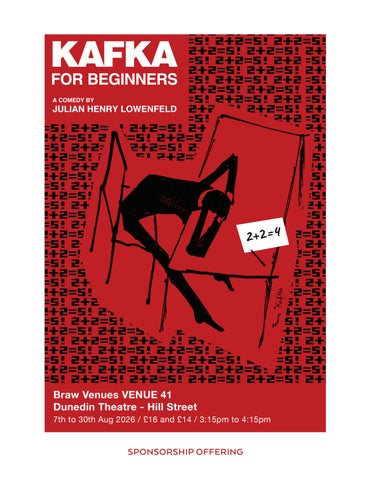
SPONSORSHIP OFFERING
INTRODUCTION - KAFKA FOR BEGINNERS In 1633, the famed astronomer Galileo Galilei was tried by the Holy Inquisition of the Roman Catholic Church on “vehement suspicion of heresy.” Just thirty years earlier, the Inquisition had burned poet and philosopher Giordano Bruno at the stake for daring to espouse his belief that the universe is infinite. After a lengthy trial, Galileo was ordered, on pain of death by torture, to “abjure, curse, and detest” any opinion that the Earth orbits around the Sun. Hoping to avoid Bruno’s fate, Galileo duly “recanted” his “heresy,” although legend has it that while obediently swearing under oath that the Earth is fixed and unmoving, he muttered under his breath “Eppur si muove” – “And yet it does move.” Whose choice would we make — Bruno’s or Galileo’s? These days, the question seems particularly urgent. As George Orwell observed, “to see what is in front of one’s nose needs a constant struggle.” In an age where the powerful have more tools for coercion than ever, that struggle has never been more acute. Tyrants and demagogues, in particular, demand from us that we believe their lies, instead of our own eyes. Just seeing the truth, even quietly, even privately, already requires of us considerable integrity, while openly insisting on the truth has in certain circumstances become an act of sheer heroism. Julian Henry Lowenfeld’s play Kafka for Beginners is a beautiful allegory about the triumph of the human spirit when it lives in truth. It dedicated to prisoners of conscience around the world, to all who have given their lives or lost their liberty striving for freedom, peace, and human dignity. In particular, it is dedicated to the memory of dissident Alexey Navalny, whom Vladimir Putin had murdered for daring to dream of a free, just, prosperous and democratic Russia at peace with all its neighbors, and ruled not by thugs and thieves, but by law and ethics grounded in universal principles of human rights. However the allegorical “Ozymandian Empire” in which the play is set, a dystopian dictatorship whose official ideology demands belief in the absurd, is uncomfortably familiar; indeed, it could be anywhere — as recent news keeps reminding us. Although the play dives deep into the Kafkaesque predicaments into which authoritarianism places us, the play never gets depressing: its hero keeps his sense of humor, and inspires us with lovely music, and with the poetry of Whitman, Shakespeare, and Pushkin. Ultimately the power of love and of the human conscience are infectious, and can help us endure the unendurable, no matter what happens, and thus, the play, despite its depressing subject, is uplifting and inspiring. Directed by the notable Scottish director Derek Douglas, the play will be produced in August 2026 at Braw Venues’ Dunedin Theatre at the Edinburgh Fringe, the largest, and arguably most important international arts festival in the world. For more information about the project and the creative team, which comes from many different countries, including the US, UK, Canada, Russia, Ukraine, Latvia, Israel, Spain, Norway, and Australia, please see the project website: www.kafkaforbeginners.com
JULIAN HENRY LOWENFELD Playwright and Composer Julian Henry Lowenfeld is a poet, playwright, composer, and award-winning translator, widely recognized as the foremost living translator of Russian verse into English. For his book My Talisman: The Poetry and Life of Alexander Pushkin, he was awarded Russia’s prestigious Pushkin Medal in 2020. He has recently finished a complete translation Pushkin’s Eugene Onegin, and has translated the complete Pushkin fairy tales, as well as Pushkin’s The Bronze Horseman. Being fluent in Russian, German, French, Spanish, Italian, and Portuguese, he has also translated poetry by Lermontov, Tyutchev, Blok, Mandelshtam, Tsvetayeva, Akhmatova, Yesenin, Mayakovsky, Rilke, Goethe, Heine, Hugo, Baudelaire, Mallarmé, Lope de Vega, Machado, Martí, Pessoa, Leopardi, Ungharetti, Dante, Catullus, Ovid, and Horace. His theatrical works include the musical plays Kafka for Beginners, about an unjustly imprisoned poet’s struggle to remain sane in an insanely dystopian society), which premiered this year in the 2025 Edinburgh Fringe Festival, Thanksgiving, an exploration of love and coming of age in contemporary America amidst conflicts between generations, and Love’s a Melody, a musical adaptation of Pushkin’s Little Tragedies in his own verse translation. His novella Rose-Colored Glasses was recently published in audiobook format. His great-grandfather Raphaël Löwenfeld was a celebrated translator and biographer of Tolstoy, and the founder of Berlin’s Schiller Theater.
DEREK DOUGLAS
KENNETH PUSHKIN
Director
Founder, Pushkin Legacy, Executive Producer
Derek Douglas is a Scottish writer, director, actor and producer who operates Braw venues. Braw Venues includes 2 Edinburgh Fringe venues which are located in Edinburgh’s New Town. There are 7 performances spaces in the 2 venues ranging from an 350 seat theatre to a 45 seat theatre. These venues host both International and UK theatre companies and individuals as well as his productions consisting of and average of 15 shows per year on average.
Impresario, publisher, art collector, and humanitarian Kenneth Pushkin (a distant relative of the great poet Alexander Pushkin), started his Russian journey in 1992, after the fall of the Soviet Union. Over the years that followed he immersed himself in the art, language and culture of Russia.
Braw Venues also includes the Edinburgh Little Theatre, a professional theatre company based in Edinburgh, working with a group of 35 actors in the company who specialise in creating their own performance work. The Founder and principle teacher of The Scottish Theatre and Music School, Derek’s passion for teaching has attracted both adults and children attending weekly classes across Scotland, cultivating the next generation of actors with a solid grounding in theatre and performance skills. Derek, the Playwright, has written a number of dramatic plays including, And They Played Shang-ALang which is about his life growing up in 70’s Edinburgh, with a longstanding, very well attended run in the Edinburgh Fringe and a dedicated following. Additionally, he has written 14 musicals and jukebox musical plays with casts ranging from 1 to 26 performers. As a Director, Derek has produced and/or directed hundreds of productions ranging from American Idiot, Bare, Rent, Little Shop of Horrors, Avenue Q, Carnegie, as well as various pantomimes and music productions.
1n 1997, he founded Pushkin Legacy, a 501(c)(3) non-profit corporation. Working between the U.S. and Russia, the Pushkin Legacy focused on projects related to poet and his oeuvre, as well as meaningful projects in social welfare and cultural diplomacy. https://www.pushkinlegacy.com/ In the wake of the growing nationalistic movement, Pushkin Legacy was declared a “foreign agent” by the Russian Federation in 2013, at which time Kenneth withdrew from all activities in Russia. In 2015, in recognition of his humanitarian efforts, Kenneth was appointed as the High Representative for the U.S. within the Fundación Onuart, under the aegis of the UN Office in Geneva, renowned for their work in Human Rights. https://www.fundaciononuart.es/en/ Outraged by Russia’s invasion of Ukraine and the misuse of Pushkin’s beautiful verses for militaristic propaganda, Kenneth decided to revitalize Pushkin Legacy and, in contrast, highlight Pushkin’s humanitarianism and support projects that advocate for peace through the arts. At a time when the news is all too often about darkness of war and authoritarianism, Kenneth believes that the mission of Pushkin Legacy is prescient and following the words of the great poet, “villainy and genius are two things incompatible,” and “there is no truth where there is no love.”
ABOUT KAKFA FOR BEGINNERS A LETTER FROM THE THEATRE DIRECTOR, DEREK DOUGLAS February 9, 2026 To Whom it May Concern: I write to express why I believe that Kafka for Beginners, a play by Julian Henry Lowenfeld, is a truly superlative work, whose staging at this moment in time is utterly essential. The play is an allegory, set in the “Ozymandian Empire” – a land where “everything not forbidden is compulsory; everything not compulsory is forbidden,” in which, “by order of the Imperial Ministry for the Enlightenment of the Folk, the season formerly known as spring has been abolished.” (Spoiler alert: that Ministry will later abolish… itself ). In this land, “with 119% of the vote counted, the referendum approving the annexation of New Ozymandia to the Ozymandian Empire has passed with 162% of the votes in favor, and not one single vote opposed. As token of the enthusiasm of the people, His Imperial Highness Ozy Junior, Satrap of New Ozymandia, was officially presented with a ceremonial golden horsewhip!” No one is safe in the Ozymandian Empire. Even those who are silent may be imprisoned at any time, on grounds that “we know what you were thinking.” In Ozymandia, torture in prisons is routine, although you can also get tortured even for suggesting that torture goes on there. The Empire is governed by euphemisms: We never use the word “torture.” The Imperial Ministry of Redemption never tortures people! We do use enhanced interrogation techniques authorized by the Supreme Court of Ozymandia and its Chief Justice, the Emperor himself. Yet perhaps the worst torture of all, for the creative soul, is the state’s relentless propaganda: “Last night’s speech by Her Imperial Highness, Pacification Minister Princess Ozymandrina to the Imperial Order of the Lemmings was greeted by thunderous and continuous applause. She told a cheering crowd of spontaneously gathered teenage attack-drone assemblers that draft-dodging shall henceforth be classified as a felony equivalent to poisoning the blood of the Empire. In related scientific news, The Imperial Ministry for the Enlightenment of the Folk announced that the body of water formerly known as the Pacific must now be called the Heroic Ocean.” Lowenfeld’s Ozymandian Empire is a place where “the more ridiculous the lie, the better. It’s the perfect gauge of political reliability! The ability to twist oneself into pretzels telling whoppers shows commendable loyalty!” Is this a parody of Trump’s America or Putin’s Russia? It could be either, sadly enough, and that may well be the point.
Yet in contrast to the unrelentingly bleak totalitarian nightmares of Kafka and Orwell, Lowenfeld’s play marshals not just a sense of humour, but the forces of poetry and music and love to leaven the bitterness. He movingly argues that “if we but live with love, then we must live in truth. For loving is the opposite of lying.” His wrongly imprisoned poet never gives up, never accepts the state’s official ideology that “two plus two is five,” no matter what threats or blandishments get offered him by his charmingly cynical interrogator (a genial and poetic version of Orwell’s O’Brien, who becomes as the play progresses movingly empathetic to the plight of the dissident he is assigned to break). It is clear that Lowenfeld has pondered long and hard on the question he so eloquently poses in his play: “Why do we make our lives so hard to be easy, and so easy to be hard? I mean, we all learn in kindergarten to share and play fair and be kind and truthful and care for each other, so why do we tolerate from our heads of state behaviors we would never stand for from even the cutest toddlers? Why do we so willingly enslave ourselves to our Pharaohs and our Caesars?” Why indeed? One of the most insidious effects of totalitarianism is the paralyzing fear it creates, the inner secret policeman, stifling the creative instincts, forcing us to hush, or to hide in Aesopian language, because open expressions of discontent will be severely punished. This play examines all these themes, in ways that are at times hilarious, and at times haunting. l therefore am convinced that this play is destined to become a classic, and that its staging, particularly at this moment in time, is truly essential. Very truly yours, Derek Douglas
and bureaucratic violence that does not belong only to fiction. The play, in this sense, becomes a mirror held aloft—though it reflects not only our faces, but the prisons we build around our consciences. In short, this is a play that dares to compress years of anguish into a single, unblinking act, and places us squarely inside a system that feels as though it could exist just beyond the walls of the theatre—or perhaps within our own. Within this joyless dominion — a place where the very anthem of the land proclaims with unblinking certainty that 2 + 2 = 5 — we meet our protagonist, known simply as The Poet. And what a tragic figure he is: both Cassandra and Prometheus, damned not for what he says, but for what he knows and dares to believe in silence. His great offense? Not shouting defiance from rooftops, but quietly refusing to swallow the lie. Julian Henry Lowenfeld’s Kafka for Beginners is a fiercely stylized descent into the machinery of state-sanctioned madness. This is no mere play, but a fevered cry from the belly of an empire rotten with its own myth-making. Here, power has calcified into ritual, and truth is a currency long outlawed, hence we have declarations like “Everything not forbidden is compulsory!!! Everything not compulsory is forbidden!!! 2 + 2 = 5!!!” Further gems such as “In related scientific news, The Imperial Ministry for the Enlightenment of the Folk announced that the body of water formerly known as the Pacific must now be called the Heroic Ocean,” could have started a press briefing from the desk of Karoline Leavitt and we no longer need to blink. Though ostensibly confined to a single act, the play unfolds with an ambitious temporal sweep, spanning not merely days or months, but a series of unsettling, fractured years. This narrative distension—subtle yet deliberate—imbues the production with a kind of temporal vertigo, a disorienting sense that time itself is a character: capricious, unkind, and tragically cyclical.
The entirety of the drama is staged in and around that most chilling of institutional constructs: a “penal isolator,” a euphemism so sterile it only magnifies the terror of what it conceals. It is, in essence, a punishment cell—bleak, unrelenting, and all too familiar in its architecture of control. This claustrophobic setting is overseen by the shadowy bureaucrats of the so-called Imperial Ministry of Redemption, a name so drenched in irony that one hears it with an audible sneer. It is the ruling arm of the Ozymandian Empire, a regime whose very title evokes fallen grandeur and tyrannical decay—a not-so-distant echo of Percy Bysshe Shelley’s ruined king. And herein lies the most chilling stroke of the playwright’s vision: the time, though unnamed, seems to press against our own with unnerving intimacy. It is not set in some remote dystopian future, nor safely anchored in the annals of a distant past. No, the time is disturbingly proximate—achingly similar to our present moment. The atmosphere is saturated with contemporary dread, with the kind of moral disintegration
When the regime’s chillingly named Ministry of Redemption — a grotesque parody of salvation, as only Kafka could have imagined — infiltrates his digital sanctum and discovers this private heresy, he is swiftly and remorselessly “disappeared.” Thrown into a nameless, featureless cell somewhere at the frayed edge of civilization, the Poet is subjected to an exquisite program of psychological erosion and corporeal torment. Think Orwell meets Artaud — with a dash of Brechtian distance to keep you wincing with intellectual clarity even as your stomach turns. And yet, amid this bleak theater of pain and propaganda, the play never loses its grip on the central moral dilemma: Is there a point at which truth itself becomes unspeakable — or even expendable? The Poet’s captors do not merely seek compliance; they seek conversion. They offer him liberty — but only the liberty of the broken, the reprogrammed, the complicit: “This is your chance, sir! You just have to speak some words you don’t really believe to some folks who don’t really care, and you’re done!...Just think of your wife and kids, sir, just look into the camera, smile, and say: “Two plus
two is five.” Then you’ll be free!” to which our Poet replies, “No, if I do that, then I will not be free! I’m freer in here, where I don’t have to lie.” Agent 9 and the Supervisor have their jobs to do, and so do the roaches that crawl over the Poet during the night and the Spider who has webbed himself into a corner, a creature the Poet has named Walt after the poet Walt Whitman who he frequently quotes as a reference point. Thus, the narrative coils itself ever tighter around a single, harrowing question: Will the Poet renounce his truth to gain his freedom, or will he cling to what he knows and be destroyed? Covid seems to be on the attack again in 2025 and this reviewer’s performance was affected by the lead actor bowing out due to illness. Actor Kane Parker who normally plays Agent 9, and sympathetically at that, rose to the occasion and performed the yeoman’s service of performing the role of the Poet as well, albeit with a script in hand and physically repositioning himself on stage for the change in character speaking as the text required. Thankfully Mr. Parker’s performance, and Mr. Lowenfeld’s play, were no worse for wear in what must have been a very challenging rehearsal to walk through before the audience arrived. Kudos to Mr. Parker and perhaps he may one day inherit the role of the Poet and do justice to that as well. Kafka for Beginners is no light fare. It is a theatrical gauntlet — a dark parable that forces the audience to confront the ease with which reality can be rewritten, and the excruciating cost of saying no when the world demands yes. The pity lies in, or rather the crystal ball nature of the piece lies in this work being less the intended satire and more, unfortunately for Americans, a ripped-from-the-headlines reality. Review by Tony Marinelli. Published by Theatre Beyond Broadway on August 7, 2025. All rights reserved.
KAFKA FOR BEGINNERS u EXCERPT THE POET: …May I ask?...Your son wants to be an astronaut? AGENT 9: He plans to be the first to plant our Emperor’s flag on Mars! THE POET: When you were your son’s age, what were your dreams?...Did you want to be a torturer? Did you yearnto grow up to electro-shock and water-board and beat and torment innocent souls? AGENT 9: This isn’t about me, sir. THE POET: Oh, but it is – all about you, and others like you. If it weren’t for you, I wouldn’t be here. AGENT 9: It’s nothing personal. I’m just doing my job. I’m only following orders. THE POET: Yes, of course. You’re following orders, instead of following your heart. AGENT 9: 365247, I just don’t understand you. THE POET: I don’t understand you either. AGENT 9: This is your chance, sir! You just have to speak some words you don’t really believe to some folks whodon’t really care, and you’re done! Easy-peasy, lemon squeezy! Just think of your wife and kids, sir,just look into the camera, smile, and say: “Two plus two is five.” Then you’ll be free! THE POET: No! If I do that, then I will not be free. I’m freer in here, where I don’t have to lie. AGENT 9: 365247, to state the obvious, you aren’t free in here. THE POET: Maybe I’m not free in here, but I am free (POINTS TO HIS HEART) in here! MUSICAL SELECTIONS: Video: The Ozymandian National Anthem https://drive.google.com/file/d/1OSHmvCNvHHGuTibvokr0zEpvTg9It8gc/view?usp=gmail Audio: We Believe
REQUEST FULL MANUSCRIPT
EDINBURGH FESTIVAL FRINGE
BRAW VENUES
The Edinburgh Festival Fringe is one of the greatest celebrations of arts and culture on the planet. For three weeks in August, the city of Edinburgh welcomes an explosion of creative energy from around the globe. Artists and performers take to hundreds of stages all over the city to present shows for every taste. From big names in the world of entertainment to unknown artists looking to build their careers, the festival caters for everyone and includes theatre, comedy, dance, physical theatre, circus, cabaret, children’s shows, musicals, opera, music, spoken word, exhibitions and events.
Kafka For Beginners will be presented at the Braw Venues, 41 Hill Street Theatre. With 60 seats, it is a fully equipped sound and lighting black box performance space. it is one of the 7 original venues from Fringe 1947 and has been home to many incredible shows and actors. In its historic setting, this intimate theatre is known for hosting discrete high level performances and is a point of focus for entertainment industries scouts. It is also the home of the very first Masonic lodges in the world and was the lodge of Robert Burns (his chair is still here) and Arthur Conan Doyle of Sherlock Homes fame, as well as many other famous Edinburgh writers.
Its story dates back to 1947, when eight theatre groups turned up uninvited to perform at the Edinburgh International Festival. Year on year more and more performers followed their example until, in 1958, the Fringe Society was set up to help development but play no part in vetting the festival’s program - a policy which remains at the core of the festival to this day. In terms of global ticketed events, the Fringe is surpassed only by the Olympics and the World Cup. In 2024, approximately 2.6 million tickets were issued.
Braw Venues welcomes theatre companies and individuals from around the world to its theatres, where our guest companies have won many Fringe and Scottish theatre awards. The sister entity, Braw Theatre Company, employs over 120 Scottish based actors with a number of our actors now working in London’s west End and other professional Theatres world-wide.
The 2026 Edinburgh Festival Fringe is scheduled to run from August 7 to August 31, 2026
https://www.edfringe.com/
Well known and supported with Edinburgh audiences, Braw Venues attracted over 35,000 visitors to our performances in 2025 and is the biggest self-producing venue and organization in the Fringe. With our staff of 68 technicians and performers, Braw Venues has been operational since 2018 and has been involved in the Fringe since 1986. https://www.brawvenues.com
KAFKA FOR BEGINNERS SPONSORSHIP OPPORTUNITY The umbrella organization representing Kafka For Beginners, Pushkin Legacy, a 501(c)(3) nonprofit, is offering a bespoke marketing opportunity for the exclusive sponsorship of Kafka For Beginners at the world-renowned Fringe Festival in Edinburgh, Scotland from August 7 through August 31, 2026. Our choice is to work closely with one excellent sponsor whose brand embodies the independent spirit and freedom of expression conveyed in this especially important and timely project. The sponsor for Kafka For Beginners will benefit from high-quality exposure to this exceptional and large international audience — an extraordinary demographic. Kafka For Beginners is already generating a buzz and is among the most anticipated productions at this year’s Fringe Festival — the largest theater arts festival in the world. Braw Venues, the host theater, is widely regarded as one of the top theater complexes at Edinburgh Fringe. The venue for Kafka For Beginners, Braw 41 Hill Street Theatre, has a distinctly prominent, visible location with a high concentration of walk by traffic. Our renowned Theatre Director for Kafka For Beginners, Edinburgh’s own Derek Douglas, is committed to making Lowenfeld’s classic the most successful and talked about performance at Fringe. With daily performances in the coveted evening time slot, Kafka For Beginners is a good bet for an early sell out. u CONTACT:
kenneth@pushkinlegacy.com +1 505 228 9400 https://pushkinlegacy.com/ Pushkin Legacy 501(c)(3) Non-Profit Corporation
EXCLUSIVE SOLE SPONSORSHIP OF KAFKA FOR BEGINNERS u $100,000 Sponsorship includes the following benefits: u Logo / Brand Recognition: On posters, flyers, banners, and in the digital/printed program. On-Site banners will be as follows: 2 pop up banners in the Theatre foyer (2’ W × 8’ H), 2 Exterior Banners (one on each side of the entrance. Night time projection on the outside front of the building (4’ x 4’). Logo on all Fringe Festival fliers distributed in all theatres throughout Edinburgh. u Exclusivity: No other advertising sponsor / competitors shall be featured in relation to Kafka For Beginners, providing a unique, stand-alone branding opportunity. u First Right of Refusal: For sponsorship of the performance of Kafka For Beginners at Fringe Adelaide in March 2027 and the proposed U.S. tour in 2027. u Up to $10K / per month in Google ads promoting Kafka For Beginners, courtesy Pushkin Legacy, a Google Nonprofit Ad Grant recipient. u Program Advertising: Dedicated prominent ad space inside the playbill u Social Media/Website: Mentions, shout-outs, and links on social media channels and the theatre website. u Verbal Recognition: Acknowledgment by the director or host during opening/closing remarks at each performance. u Tickets: Complimentary tickets to performances. Free tickets for all Braw venue shows during the Fringe Festival. u VIP Access: Special seating, access to opening night receptions, special events and backstage tours. u Networking: Opportunities to connect with other community leaders and audience members. u Image Boost: Aligning their brand with the prestige and educated, progressive culture attracted to Kafka For Beginners. u Community Engagement: Exclusively sponsoring Kafka For Beginners will garner attention, demonstrating alignment and commitment to the Fringe community. u Co-branded Merchandise: Logos featured on Kafka For Beginners items such as t-shirts or mugs sold at the show. u Content Creation: Opportunities to co-produce content, such as behind-the-scenes videos. u Luxury Accommodation for 2: Five nights at 5 star hotel in Edinburgh during the Fringe Festival (based on available dates at time of Sponsorship). u Meal for 2 at Fadenza steak house on George Street. u Meal for 2 at The Kitchin – Michelin starred restaurant in Leith, Edinburgh. u Bottle of premier Scotch. u Visit to the Scotch Malt Whisky Society. u Historic Scotland passes for the Edinburgh stay.