Wholesaler & Electrical Distributor
W& ED WINTER 2026
01_WED-Winter-Live.indd 1
03/11/2026 10:35:15
THE HIRE SUPPLY COMPANY (UK) LIMITED Providing quality and affordable products next day
HEATING & LIGHTING SOLUTIONS WED10 Providing quality and affordable products next day
PART OF
*USE CODE
A wide range of commercial and industrial portable led lighting and heating solutions designed and built for everyday use, AVAILABLE NOW!
TO GET 10% OFF TRADE PRICES
Get 10% OFF ALL ORDERS FROM NOW UNTIL 31ST JANUARY 2027 *EXCLUDES ALL CURRENT PROMOTIONS AND SAVER PACKS ORDER BY PHONE OR EMAIL USING CODE WED10 (NOT AVAILABLE ONLINE)
NOT GOT AN ACCOUNT WITH US, DON’T WORRY!
Simply contact any member of our sales teams and we will have you up and running in no time
To speak with a member of our sales teams: Telephone: Nottingham: 0115 946 1988 I London: 0208 830 8333 Email: sales@hscgroupuk.co.uk I Visit our website: www.hscgroupuk.co.uk HSC_W&ED_Advert_315h_×_244w.indd 1 XX_WED-Winter_Advert.indd 1
20/10/2026 09:34:32 02/11/2026 14:20:59
CONTENTS Wholesaler & Electrical Distributor
WELCOME Where has the year gone, eh? Welcome to the Winter 2026 edition of Wholesaler & Electrical Distributor! There’s no better way to round off the year than by celebrating the best of our industry and, in this issue, we reveal the winners of the 2026 Electrical Industry Awards, presented by W&ED and our sister title Electrical Times. Congratulations to all the winners, particularly Segen, our Wholesaler of the Year, which set up its own academy so customers could complete the renewable courses required under the new Electrotechnical Assessment Specification. After last issue’s look at the skills gap, it’s great to see a wholesaler tackling the challenge head on. Well done too to TEP Electrical Distributors, who were Highly Editor Commended. You can find the full list of winners on page 4. James Cooke Elsewhere, on pages 8–9, the EDA’s latest State of the Sector Survey takes the industry’s pulse on everything from cyber security and late payments to plug-in solar. Despite rising overheads, 75% of wholesaler respondents expect sales volumes to grow in 2027. On page 12, CEF’s Darren Staniforth looks at what Amendment 4 to BS 7671 means in practice, as solar, battery storage, EV charging and PoE increasingly come together on site. Have a very merry Christmas, and I’ll see you back here in the Spring!
4 News 8 EDA 10 Cover Story: Live Electrical 12 Distributor Corner 14 On the Wholesale Floor 16 Test & Measurement 18 Cable Management 22 HVAC 26 Insight 28 Electrical Times Podcast 30 Products EDITORIAL Editor James Cooke james.cooke@purplems.com
PRODUCTION Production designer Lorna Reekie lorna.reekie@purplems.com
ADVERTISING Sales manager Haydon Rainsford haydon.rainsford@purplems.com Tel: 01732 371 572
Production designer Rob Tremain rob.tremain@purplems.com
@WED_magazine
03_WED-Winter_Contents.indd 3
12 22
26 MANAGEMENT Managing director Ed Hunt ed.hunt@purplems.com
© Purple Media Solutions Ltd 2023. All rights reserved. No part of this publication may be reproduced, stored in a retrieval system, or transmitted in any form or by any means electronic, mechanical, photocopying, recording or otherwise without prior permission of the publishers. W&ED is published by Purple Media Solutions Ltd. Registered in England. Registered Number 5949065. Registered Office: The Old School House, St Stephen’s Street, Tonbridge, Kent TN9 2AD, UK, Tel: 01732 371 570.
AUTUMN 2026 | 03
02/11/2026 16:55:09
NEWS
Wholesaler & Electrical Distributor
Electrical Industry Awards 2026: winners revealed
EvoEnergy, NAPIT and C&B Electrical Contractors each took home two awards as the winners of the 2026 Electrical Industry Awards were revealed across 13 categories PRESENTED BY ELECTRICAL TIMES and W&ED, with main sponsor Luckins Live and category sponsors WISKA and Surge Protection Devices, the awards celebrated the best of the sector. Entries were judged by Stephen Melton (NAPIT)*, Darren Crannis (ECA), Dan Woods (JIB), Paul Collins (NICEIC) and Dan Griffiths (LIA).
PRODUCTS AND SERVICES Commercial/Industrial Product of the Year went to EvoEnergy’s Chronos O&M Software, which brings performance data, predictive modelling, field activity and client repor ting into one platform. The judges said it “combines innovation with clear, proven impact”. Residential/Domestic Product of the Year went to Electrismo’s Time Saving Adapters, which restore stripped lugs on metal back boxes. The judges called it “an excellent example of innovation focused on solving a real industry problem”. Enkin’s batteryfree Kinetic Collection switches were Highly Commended. Lighting Product of the Year went to CU Phosco’s Brighton Heritage Lantern, a 1980s design re-engineered for modern performance while keeping its original look. Zumtobel’s Amphibia was Highly Commended. Safety Product of the Year, new for 2026, went to PlugShield, a UK-made intumescent sleeve that expands at around 180°C to help contain fires that start at the plug. Trade Tool of the Year (including Test & Measurement) went to NAPIT’s FastTest, a certification platform supporting more than 25 certificate types, with AI tools that generate board and circuit data from a photo. Training Resource/Provider of the Year went to NAPIT Training for its blend of classroom and online learning. JTL’s LEDA platform was Highly Commended for the second year running.
PROJECTS AND INSTALLATIONS Renewable Installation of the Year went to Metcor Electrical for the Boldon Retail and Leisure Park EV Charging Hub in Tyne and Wear. On an electrically blank site below the water table, Metcor built a new 1,000kVA substation feeding 24 charging
04 | WINTER 2026
04_ET-Winter_News.indd 4
bays. EvoEnergy’s Principality Stadium solar PV installation in Cardiff was Highly Commended. Electrical Project of the Year went to EvoEnergy for an 8MW rooftop solar installation at Aldi’s Bardon Distribution Centre. A bespoke control system lets the array run alongside diesel generators on the site’s private 11kV network. The judges said its “sheer size, scale, complexity and quality” made it “the standout winner”. Thorn Lighting’s Powerleague Nottingham Arnold floodlighting upgrade was Highly Commended.
CONTRACTING AND WHOLESALING Wholesaler of the Year went to Segen, which set up its own academy so customers could complete the renewable courses required under the new Electrotechnical Assessment Specification. TEP Electrical Distributors, was Highly Commended.
Milton Keynes University Hospital Charity. JR Revell was Highly Commended. C&B made it a double in Contractor of the Year (Turnover under £5 Million), recognised for its specialist work in hospitals and other life-safety environments. Elec Side was Highly Commended. Contractor of the Year (Turnover over £5 Million) went to Laser Electrical Services in what the judges called an extremely close category. They said Laser presented “the most complete picture of what it means to be an outstanding electrical contractor in today’s industry”. EvoEnergy was Highly Commended. Congratulations to all the winners, Highly Commended entries and finalists. *Stephen Melton had no involvement in judging the two categories won by NAPIT.
Contractor of the Year – Staff development (inc. apprenticeships) went to Darke & Taylor. More than 500 school leavers have started their careers there, and this year it opened its own training centre, Elevate Building Services Training. AC Electrical Services was Highly Commended. Contractor of the Year – Community involvement went to C&B Electrical Contractors for its use of local suppliers, support for youth sport and fundraising for
Watch the full 2026 Electrical Industry Awards presentation – scan the QR code now!
@WED_magazine
02/11/2026 16:55:54
EPDs
Environmental Product Declarations are becoming a specification requirement. Recolight’s EPD service is designed to maximise the number of products covered by an EPD, as cost effectively as possible.
RE-USE Recolight partner with organisations to pass on new, unused, or surplus stock.
1 2
4 3 RECYCLE
If you can’t reuse or remanufacture, Recolight recycle. Recolight operate the UK's largest collection network for fluorescent and LED lamps. Carbon footprint data is available for every waste collection.
A remanufacturing service from Recolight, upgrading used luminaires to reduce embodied carbon and improve efficiency.
Make your lighting more sustainable. Make it circular. Recolight is the UK’s leading not-for-profit WEEE compliance scheme for the lighting industry. With an extensive network of collection points and a proven track record of environmental responsibility, Recolight enables lighting manufacturers and their customers to meet regulatory requirements. But we don’t stop there, we work with the lighting industry to accelerate the shift to a Circular Economy. With Recolight Revive and the Circular Lighting Live Conference, to workshops, webinars, and environmental metrics.
www.
XX_ET-Nov_Advert.indd 1
.co.uk
30/10/2026 12:36:45
NEWS
Wholesaler & Electrical Distributor
More than 37,000 attend Screwfix Live Electrical material Last month Screwfix welcomed over 37,000 trade professionals and DIYers to its annual Screwfix LIVE show at Farnborough Exhibition and Conference Centre for another record-breaking year.
The much-anticipated event was attended by more than 37,000 visitors across the weekend, an impressive 19% more than last year, officially making Screwfix LIVE 2026 the biggest year yet. Saturday alone saw more than 14,000 customers attend, setting a new venue attendance record. Bringing together more than 200 leading trade brands, visitors had the opportunity to explore a wide
range of products, get hands-on experience of the latest tools, and shop exclusive deals. The show also welcomed a host of special guests, including former professional boxer Frank Bruno, four-time Olympic champion Sir Mo Farah, and England rugby union players Marlie Packer and Rosie Galligan. Screwfix LIVE also hosted the final of Screwfix Top Tradesperson 2026, with ten talented tradespeople competing for this year’s title. Neil Claxton, an electrician from Ayr, Scotland, was crowned this year’s winner and received a £20,000 trade bundle of tools, tech and training. Neil was awarded the title in recognition of his commitment to the highest standards of work and customer service, alongside his dedication to developing apprentice electricians and supporting his team and local community.
In addition to the trade show, The Screwfix Foundation held a charity dinner, bringing together Screwfix suppliers and partners to raise vital funds for supporting community projects across the UK and Ireland. The evening was a huge success, raising over £370,000 for the Foundation. Max Britten, Screwfix Managing Director said:“Screwfix LIVE continues to go from strength to strength and 2026 has been our biggest year yet. Welcoming more than 37,000 visitors over the weekend, including a record-breaking Saturday, is an incredible milestone and demonstrates just how much the event means to our customers. “The scale and quality of the event created a fantastic atmosphere across the weekend, bringing customers together with leading brands, products and the latest innovations. We’re already looking ahead to how we build on that momentum for 2027.”
WISKA UK wins IBA Supplier of the Year for fourth consecutive year WISKA UK Ltd has been named Supplier of the Year by The IBA Buying Group for an outstanding fourth consecutive year, following the IBA’s annual Networking and Gala Event in September 2026. Voted for by IBA members, the award recognises suppliers that consistently deliver excellent service and support to independent electrical wholesalers across the UK. WISKA first secured the award in 2023 and has now retained the title for four consecutive years, reflecting the company’s longstanding partnership with the IBA and its members. Callum Wilson, National Sales Manager at WISKA UK Ltd, commented:“To win Supplier of the Year once is a fantastic achievement, but to receive this recognition from IBA members for a fourth consecutive year is something we are incredibly proud of. “The award means a great deal because it is voted for by the customers we work with every day. Building strong, long-term relationships is at the heart of what we do, and this recognition reflects the hard work of the whole WISKA UK team.
06 | WINTER 2026
06-07_WED-Winter_News.indd 6
with WISKA last year.They are a great example of what a supplier partnership should look like and thoroughly deserve to be our Supplier of the Year.”
“We would like to say a huge thank you to Paul White, the IBA team and, most importantly, all of the IBA members for their continued support and trust in WISKA.” Paul White, Chief Executive Officer of The IBA Buying Group, said: “WISKA have supported the IBA for over 20 years and consistently provide an excellent level of service to our members. We have strong relationships with them right across the group, built through genuine engagement and a real understanding of our members’ businesses. “That partnership is delivering results too, with the majority of members growing their purchases
In other news… WISKA UK Ltd has also announced the appointment of James Ireland as Northern Regional Sales Manager. In his new role, James will be responsible for supporting WISKA customers across the North of England, Scotland and Northern Ireland. Working closely with the current sales team, electrical wholesalers, contractors and specifiers, he will help strengthen WISKA’s regional presence while supporting continued growth across the company’s range of cable glands, junction boxes, flexible conduit, gel jointing systems and electrical installation products. Commenting on his appointment, James said:“I am very excited to join the team at WISKA UK. Having been in the electrical industry for 25 years, I have seen WISKA grow into the market leader it is today. I’m looking forward to using my experience to help continue to develop the business for years to come.”
suppliers urged to back Every Merchant Matters movement
Electrical material suppliers are being urged to join merchants in pledging support for Every Merchant Matters, a new mental health initiative that aims to reach every customer of every merchant branch in the UK. The campaign is the brainchild of construction charity Band of Builders, in partnership with The Support Yard CIC and backed by the Builders Merchants Federation (BMF). It was launched at the latest BMF Members’ Day, attended by more than 400 industry figures. It aims to create a nationwide network of branches where construction workers can find someone to listen and be signposted towards support. Branch teams deal with thousands of tradespeople daily, often building trusted relationships over many years, so they can spot when someone is not themselves. Band of Builders CEO Gavin Crane said: “Builders merchants are woven into the fabric of construction communities across the UK, with thousands of conversations taking place across trade counters every single day. “This is about mobilising one of the most powerful networks our industry has and using it to look after its greatest asset – its people.” Branches that join will be encouraged to make a small donation in return for a Branch Activation Kit, with materials to display and hand out to colleagues and customers. “This needs to be about more than putting another poster on the wall,” Gavin added. Branches will also be encouraged to sign up to ‘Spotting the Signs, Starting the Conversation’, a three-hour online or in-person course from The Support Yard, bookable through the BMF. It teaches staff to recognise meaningful changes in customers or colleagues, open a caring conversation and signpost people to support. The course also acts as a taster for The Support Yard’s eight-day Support Guide Certification Scheme, which trains people to provide informed peer support in the workplace. To make a pledge, visit www. bandofbuilders.org/everymerchant-matters.
@WED_magazine
03/11/2026 10:57:40
NEWS
Wholesaler & Electrical Distributor
Toolstation CEF marks 75th anniversary with almost celebrates 30 tonnes of donations for UK food banks one million loyalty club members To o l sta t i o n’s loyalty p rogra mme, Tools tation C l ub, has h it over one mi l l i on me m bers, marking a si gni fi cant miles tone in i t s custo mer engagement st ra te g y. The Club, which launched in Januar y 2024, is a freeto-join programme built to reward Toolstation’s loyal trade and DIY customers who regularly buy essential tools and accessories from the retailer’s range of over 25,000 products. Since launch, there has been a strong and sustained uptake in membership signups, leading to over 37,000 prizes being rewarded to Toolstation’s loyal customer base, including 21 holiday giveaways with a combined value of £32,000, and over 23,000 Greggs breakfast rolls, sausage rolls and hot drinks, in addition to over 5,500 Greggs £5 gift cards. In addition to these giveaways, Club members have also benefitted from an ever-present offer of product discounts across trade quality brands including DeWalt, Stanley, Milwaukee, Karcher, Makita and more, alongside third-par ty discounts in par tnership with Hello Fresh, PerfectDraft, Trip. com, Ooni and Vision express to name a few. Chris Other, Customer Director for Toolstation said: “We created the Toolstation Club to be the ultimate par tner to tradespeople and signing up over one million members is testament to how much it’s benefitting them. We’re proud to be the first stop for so many professionals and will continue with our ambition of offering them great value, convenience and service.”
@WED_magazine
06-07_WED-Winter_News.indd 7
City Electrical Factors (CEF) customers, teams and suppliers have donated nearly 30 tonnes of essential goods to food banks across the UK, as part of the electrical wholesaler’s 75th anniversary celebrations. The nationwide community food drive saw CEF branches and other areas of the business become donation points for their local food banks, uniting local communities, team members, and industry partners to give back to the areas they serve every day. In total, the donations weighed the equivalent of 13 unladen CEF vans, or enough to fill around 30 CEF van loads. The initiative formed part of CEF’s “Day of Giving” campaign, created to mark 75 years since the business was founded by Tom Mackie in Coventry in 1951. Throughout its history, CEF has maintained a strong connection with the local communities surrounding its branch network. What began as a single electrical
For more information about CEF and its 75th anniversary, visit www.cef.co.uk.
wholesale branch has grown into a nationwide business with more than 390 branches and over 4,000 employees across the UK. The food bank drive continued this tradition by giving each branch the opportunity to support organisations in its own local area. Donations reflected what individual food banks needed most, ranging from food and everyday essentials to toiletries and cleaning products. This campaign forms part of CEF’s wider 75th anniversary celebrations, a year-long series of events honouring its people, customers, and communities while looking ahead to the future of the electrical trade. It runs alongside CEF Cares, where the wholesaler inspires positive change in communities, one act of kindness at a time.
In other news… CEF calendar raises funds for EIC A charity calendar inspired by Calendar Girls is bringing the electrical industry together to raise money for the Electrical Industries Charity (EIC) and encourage open conversations about mental health. The idea began in CEF’s Bournemouth region and spread to other branches, with colleagues posing for photographs and suppliers sponsoring months. Each month carries a mental health message illustrated with familiar industry settings, from colleagues sharing the weight of a piece of conduit to tangled cables representing anxiety. All sales revenue goes to the EIC. The calendar launched on 14 October and is available from CEF branches or online at www.cef.co.uk.
ChargePoint launches channel partner programme City Electrical Factors (CEF) customers, teams and suppliers have donated nearly 30 tonnes of essential goods to food banks across the UK, as part of the electrical wholesaler’s 75th anniversary celebrations. The nationwide community food drive saw CEF branches and other areas of the business become donation points for their local food banks, uniting local communities, team members, and industry partners to give back to the areas they serve every day. In total, the donations weighed the equivalent of 13 unladen CEF vans, or enough to fill around 30 CEF van loads. The initiative formed part of CEF’s “Day of Giving” campaign, created to mark 75 years since the business was founded by Tom Mackie in Coventry in 1951. Throughout its history, CEF has maintained a strong connection with the local communities surrounding its branch network. What began as a single electrical wholesale branch
has grown into a nationwide business with more than 390 branches and over 4,000 employees across the UK. The food bank drive continued this tradition by giving each branch the opportunity to support organisations in its own local area. Donations reflected what individual food banks needed most, ranging from food and everyday essentials to toiletries and cleaning products.
This campaign forms part of CEF’s wider 75th anniversary celebrations, a year-long series of events honouring its people, customers, and communities while looking ahead to the future of the electrical trade. It runs alongside CEF Cares, where the wholesaler inspires positive change in communities, one act of kindness at a time. For more information about CEF and its 75th anniversary, visit www.cef.co.uk.
WINTER 2026 | 07
03/11/2026 10:57:42
& WED
Wholesaler & Electrical Distributor
EDA UPDATE
Taking the sector’s pulse:
What EDA Wholesalers and Manufacturers are saying in Q4 2026 Every quarter the Electrical Distributors’ Association launches its State of the Sector Survey, asking wholesalers and manufacturers to share their thoughts on what’s happening in their businesses right now. The last survey of 2026 covered a wide range of topics, from the biggest operational headaches to the levels of cyber security preparedness and the impact of CBAM (the Carbon Border Adjustment Mechanism), from plug in solar to bad debt and late payments.
I
n this article we’ve hand-picked a selection of responses. To download the full Q4 2026 State of the Sector Survey results, visit www.eda.org.uk and the Support and Resources menu.
REAL INSIGHTS, DIRECT FROM THE SECTOR The EDA’s quarterly State of the Sector Survey combines core questions to track trends with timely questions exploring emerging supply chain challenges. An EDA Survey Planning Group comprising senior wholesalers and manufacturers, helps shape the questions to ensure the findings reflect the issues that matter most to the industry. Q4 2026 results at a glance: • 60 EDA member wholesalers responded - a 22% response rate. • 41 EDA affiliate manufacturers responded - a 34% response rate. Together, these responses provide a valuable snapshot of current market conditions and sentiment.
OPERATIONAL CHALLENGES KEEPING BUSINESS LEADERS AWAKE AT NIGHT EDA businesses shared their top 5 operational challenges from a prompted list. Feedback from both groups shows manufacturers and wholesalers are on the same page in many areas, offering the potential for better understanding.
“Competition from online sellers undercutting our prices.” “Traditional wholesalers’ online pricing strategies.” “Margin retention is a major concern in relation to online traders for my members and where this will ultimately lead to for the market.” “Customers going into liquidation.” Manufacturers commented on their challenges, saying: “Raw material cost increases.” “Increase in raw material costs as well as delays in supply chain.” “Cost inflation due to raw materials ie Copper & Silver.” “Transportation costs increasing (Diesel).” “Long manufacturing lead times.” “VAT changes with product coming out of China.” “Increasing HR burden from government legislation.” “Attracting young talent into B2B is an ongoing issue and concern.” “Devaluation still in the lighting sector.”
DEALING WITH LATE PAYMENTS, BAD DEBT AND CUSTOMERS ENTERING ADMINISTRATION Many UK businesses face cash flow challenges: late payments can create a ripple effect through the supply chain, putting pressure on working capital and increasing exposure to bad debt. Q: Wholesalers: Have your debtor days increased in 2026?
EDA WHOLESALERS 1. 2. 3. 4. 5.
Increasing business overheads Cash flow related issues Difficulties attracting, recruiting, or retaining staff (tied in third place with) Downturn in market demand Delays to project starts A slowdown in my traditional market segments (tied in fifth place with) More customers going direct to manufacturers.
Q: Wholesalers: In 2026 to date, have you experienced a higher number of contractor businesses falling into administration compared to previous years?
EDA MANUFACTURERS 1. 2. 3. 4.
Increasing business overheads Delays to project starts Downturn in market demand Time and cost of dealing with our product-related sustainability requirements (tied in fourth place with) Difficulties attracting and retaining staff 5. A slowdown in my traditional market segments Wholesalers commented on their challenges, saying: “Online competition as always.” “Online electrical wholesalers selling at stupidly low prices, often below invoice cost.”
08 | WINTER 2026
08-09_WED-Winter_EDA.indd 8
HOW CYBER-AWARE AND PREPARED ARE WE? In this section we asked a number of questions around cyber risks and levels of preparedness, a topic that can get pushed down the agenda because it can be difficult to see its immediate value until something goes wrong. Unlike activities that deliver visible, short-term results,
@WED_magazine
02/11/2026 17:06:28
Wholesaler & Electrical Distributor
cybersecurity is largely about preventing incidents that may never happen but wholesaler respondents are mindful of the risks as these comments show. “Something which we need to be more aware of as directors and staff. However, we have a number of priorities to invest in and this would be additional cost and not in top 3 priorities. If we can, we will invest in cyber attack prevention.” “IT issues are becoming intolerable. One of our websites was hacked and replaced with a ransomware notice. Another was scraped, and 3 copy sites were operational for around a month, causing a loss of sales. Also our emails were hacked. This issue is fantastically debilitating for a business such as ours.” Q. Wholesalers: does your organisation have a formal cyber security policy in place?
Q: Wholesalers: Does your business employ a cyber security consultancy that helps you proactively monitor your cyber security preparedness?
& WED
Q: Wholesalers: Do plug-in solar products represent a business opportunity for you?
Wholesaler comments on this topic included: “Far too dangerous and not enough margin to take the risk.” “Whilst I suspect a large part of the demand will be serviced by the retail sector, I do see an opportunity for wholesalers to take some of this market, especially those with a good B2C online offer.” “We consider them dangerous, however customer demand may take over” “At Solar and Storage none of my supply partners instilled any confidence in the performance and safety of the product if installed in UK homes.” “Mainly for over the counter/online sales but not for traditional renewable contractors.”
LOOKING FORWARD TO 2027 Q: Wholesalers: Which product categories do you predict will be your biggest sellers in 2027?
Q: Wholesalers: Which of the following best describes your organisation’s cyber insurance coverage? As the chart below shows, 68% of EDA wholesalers either have invested in cyber insurance or are considering it.
PLUG-IN SOLAR: OPPORTUNITY OR THREAT? Following the joint statement issued in June 2026 from the ECA, Electrical Safety First (ESF), the Institution of Engineering and Technology (IET), NICEIC, and SELECT raising their concerns about the safety of plug in solar products, our survey put these questions to wholesalers. Q: Wholesalers: Are you aware of the safety concerns surrounding plug-in solar products, as expressed by a number of organisations representing the UK’s electrical sector in this recent statement?
Q: Wholesalers: How do you anticipate sales volumes (like for like sales) will change during 2027? As you see from the chart below, 75% of EDA wholesaler respondents predict a sales volume increase next year.
JOIN US IN 2027 TO HEAR MORE If you work in an EDA business and haven’t previously joined us virtually to hear the survey results live, our Talking Shop Live Online: Industry Insight in 90 Minutes webinars will continue next year. The dates and times for 2027 will be published at www.eda.org.uk in the Events section. As well as our survey results, we often invite subject specialists to give insight into important topics and share opportunities. www.eda.org.uk 020 3141 7350
@WED_magazine
08-09_WED-Winter_EDA.indd 9
WINTER 2026 | 09
02/11/2026 17:06:29
COVER STORY
Wholesaler & Electrical Distributor
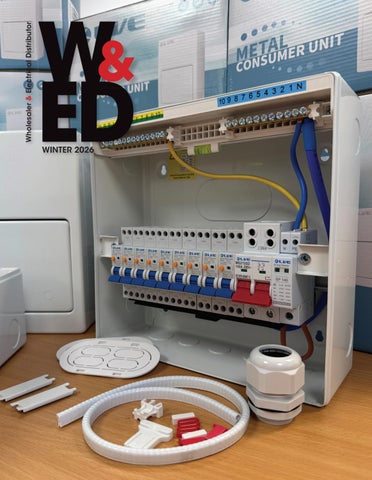
Designing for Efficiency A Smarter Approach to Consumer Unit Installation -Live Electrical’s SRN Consumer Unit Range by Umer Farooq, Technical Product Manager, Live Electrical Distribution UK Ltd
S
peed, consistency and reliability remain central priorities for electrical contractors working across residential and light commercial projects. As installation schedules become tighter and labour efficiency becomes increasingly important, distribution equipment that simplifies the wiring process can deliver significant practical benefits on site. Live Electrical’s SRN range of metal consumer units has been developed with installation efficiency as a core design objective. Rather than focusing purely on enclosure construction, the range adopts a system approach that combines a streamlined internal architecture with simplified circuit connection methods.The result is a consumer unit designed to reduce installation time while maintaining the performance and compliance expected of modern distribution equipment. Suitable for both surface-mounted and recessed (flush-mounted) applications, the SRN range is intended for use across a wide variety of domestic and light commercial installations throughout the UK.
SRN Range Consumer Units
SINGLE-MODULE 1P+N BD DEVICES
Flush (Recessed) SRN Consumer Unit
ENCLOSURE DESIGN SUPPORTING PRACTICAL INSTALLATION
The SRN enclosure is manufactured from robust noncombustible steel, providing the mechanical strength and fire performance expected under current installation standards. Multiple cable knockouts are positioned around the enclosure, including the rear panel, allowing cables to enter the board from different directions depending on site layout and routing requirements. This flexibility is particularly useful when working within confined installation spaces, enabling installers to organise cable entry in a way that minimises congestion within the enclosure. Each board is supplied complete with a DIN rail and earth terminal bar, ensuring the installer has the necessary internal components ready for immediate assembly.The internal space has been configured to provide clear access for wiring, helping maintain an organised layout that supports straightforward inspection and testing once installation is complete. While these features contribute to installation practicality, the most significant advantages of the SRN range lie within its protective device configuration and busbar architecture.
10 | WINTER 2026
10_WED-Winter_Live.indd 10
A defining feature of the SRN consumer unit is its use of single-module 1P+N bidirectional protective devices.The CN range MCBs disconnect both the live and neutral conductors simultaneously, with overcurrent protection provided in the live pole and coordinated switching of the neutral pole.The RNC & RB Range RCBOs also switch both conductors and are designed without separate neutral fly leads. In many conventional consumer units, RCBOs are supplied with flexible neutral fly leads that must be routed individually to the neutral terminal bar. As the number of circuits increases, these additional conductors can create congestion within the enclosure, increasing installation time and making inspection, fault-finding and maintenance more difficult. Within the SRN system, both the live and neutral conductors of each outgoing circuit are terminated directly at the relevant MCBs or RCBOs. The devices receive their incoming live and neutral connections through the No Fly Neutral RCBO integrated busbar, removing the need for individual neutral fly-lead connections on the RCBOs. This arrangement reduces internal wiring, creates a cleaner and more organised layout, and provides clearer access to circuit terminations. Installers benefit from a faster and more consistent wiring process, while the reduced number of separate connections helps minimise the potential for installation errors.
INTEGRATED MODULAR LIVE AND NEUTRAL BUSBAR SYSTEM
The SRN range features an integrated copper busbar system that combines live and neutral distribution within a single compact assembly. Designed to connect directly to the main switch SPD and 1P+N bidirectional devices like Type A, Type B RCBO & MCBs, it eliminates the need for individual RCBO neutral wiring, simplifying installation and reducing internal connections. The modular busbar design allows additional sections to be connected by simply sliding them together, providing flexibility for different circuit configurations. This scalable system enables faster assembly, improved cable management and a more organised enclosure, while simplifying product selection and stock management.
DESIGNED WITH THE INSTALLER IN MIND
By focusing on practical installation challenges such as wiring congestion, circuit termination efficiency and internal component organisation, the SRN range demonstrates how thoughtful product engineering can improve on-site productivity. The elimination of fly neutral leads, combined with a compact integrated live and neutral busbar system and modular scalability, allows installers to assemble distribution boards more quickly while maintaining a clean and accessible internal layout. For contractors seeking distribution equipment that supports faster installation without compromising safety, reliability or compliance, the SRN consumer unit range provides a solution designed around the realities of modern electrical work.
@WED_magazine
03/11/2026 10:02:50
10_WED-Winter_Live.indd 11
03/11/2026 10:02:50
DISTRIBUTOR CORNER
Wholesaler & Electrical Distributor
Amendment 4: understand the practical impact of connected technology From solar and batteries to EV chargers and Power over Ethernet, modern installs are linking up fast. CEF’s Head of Technical Solutions, Darren Staniforth, takes a practical look at what the latest regulations mean for sparkies on site
A
s solar PV, battery storage, EV charging, and smart systems become standard features in modern properties, electricians are increasingly working on installations which are increasingly interconnected. Decisions made around one piece of kit now directly impact how the rest of the board and overall system perform. Amendment 4 to BS 7671, published in April this year, reflects this industry shift. It introduces clearer requirements designed to keep multi-technology installations safe and resilient as properties accommodate higher electrical loads, on-site generation, and smart controls. The update introduces significant changes, including a dedicated chapter on stationary secondary batteries, fresh requirements for Power over Ethernet (PoE), and updated rules for functional earthing and equipotential bonding for ICT systems. Where these may have once been treated as separate elements of a project, modern domestic and commercial jobs are blending them into a single, connected environment.
the capacity available for EV chargers to how stored energy is managed and how the overall installation is protected.
NAVIGATING BATTERY STORAGE, POE, AND SITE COMPLEXITIES
Solar is a prime example of this crossover. The UK passed two million solar installations in March 2026, driven by 27,000 new installs that month alone. As generation becomes more common, electricians are regularly dealing with set-ups where solar sits alongside battery storage and heavy EV charging loads. That means choices made on site carry wider knock-on effects, from
12 | WINTER 2026
DISTRIIBUTOR CORNER.indd 12
The new chapter on stationary secondary batteries sets out much clearer rules for storage systems, whether fitted alongside solar PV or as standalone units. Once storage is introduced, contractors need to evaluate how it interacts with the incoming supply, any on-site generation, and the loads it supports, rather than treating the battery as a simple add-on. While experienced installers understand the fundamentals, the overall complexity of these jobs is stepping up. A similar trend is driving the Amendment’s PoE coverage, where cabling primarily used for data is increasingly supplying power to
hardware like security cameras. Amendment 4 introduces specific requirements for PoE, highlighting the need to look at power and communications infrastructure together. For electricians, this means selecting the correct equipment requires looking at the bigger picture. Products can no longer be chosen in isolation; they must fit the context of the entire installation, particularly when renewables and energy management are involved. To help contractors stay ahead of regulatory updates and navigate complex multi-tech projects, CEF provides dedicated support and technical guidance across renewables, EV infrastructure, and smart technology. To stay up to speed on the latest regulations and practical installation techniques, explore the full range of courses available at www.cef.co.uk/blogs/techtraining
@WED_magazine
02/11/2026 17:07:21
Tough, in the real world WISKA COMBI Series junction boxes provide everything needed for faster, safer and more dependable installations. High-performance IP66/IP67 ingress protection and robust construction, every COMBI box is built to simplify installation and perform in the toughest environments. www.wiska.co.uk
WISKA WED Advert COMBI.indd 3
XX_WED-Winter_Advert.indd 2
11/08/2026 12:37 02/11/2026 16:30:59
ON THE WHOLESALE FLOOR
Wholesaler & Electrical Distributor
Echo Industries DIN Rail Fire Suppressor: Compact Fire Protection, Made Simple
P
rotecting electrical equipment is essential, and the DRMFS offers a compact, automatic fire suppression solution for suitable enclosed electrical installations. Measuring just 77 x 18 x 64mm, this DIN rail-mounted device is designed for installations where space is limited. Its 20g S-type aerosolgenerating agent activates through an electrical or thermal trigger, releasing a fine aerosol to suppress combustion within the protected enclosure.
EFFECTIVE SUPPRESSION IN A COMPACT DESIGN Using a combination of heat absorption, chemical inhibition and oxygen dilution, the DRMFS tackles the combustion process to help suppress fire. With a specified protected volume of up to 0.31m³ and a spraying time of up to six seconds, it offers a practical option for suitable electrical applications.
DESIGNED FOR LONG-TERM CONVENIENCE With a stated service life of 10 years and no maintenance required for the suppression unit itself during this period, the DRMFS provides a straightforward approach to fire protection. The associated activation system should still be inspected regularly in accordance with the manufacturer’s instructions. For further information, contact your Deligo sales representative.
Dantherm Group Acquires The Hire Supply Company, Expanding UK Climate Control and Tool Hire Offerings
T
he Hire Supply Company (HSC) based in Nottingham and London has recently been acquired by the Dantherm Group, a leading European manufacturer of climate control solutions with a turnover of £260 Million supported by manufacturing facilities throughout Europe, and a distribution network to match. HSC provide quality and affordable products next day for which we are renowned for within the hire industry. Our product portfolio consists of portable LED site lighting, heating, cooling, air purification, ventilation, cleaning, surface preparation, lifting and handling and electrical distribution products all designed and built to the highest of standards to meet the demands of the construction and tool hire industries. Many electrical distributors throughout the UK regularly purchase products from our current ranges based on the needs of their own customers, often requesting products by brand or model having either hired or purchased previously. HSC is now stocking and distributing a range of Trotec heating and drying solutions (Electric and
14 | WINTER 2026
14_WED-Winter__WholesaleFloor.indd 14
diesel oil heaters and industrial dehumidifiers) which provides dependable, fit for purpose products focused on the features that matter, offering a practical and cost effective solution for a wide range of resale climate control solutions. Dantherm UK based in Maldon, Essex specialises in static commercial and industrial heating, cooling, dehumidification, air purification, swimming pool climate control and ventilations systems.
Knowledgeable and experienced members of staff are always on hand to advise and provide help with any query you may have. For more information about the HSC product ranges please visit our website www. hscgroupuk.co.uk or contact any member of our sales teams. Nottingham: 0115 946 1988 | London: 0208 830 8333 | Email: sales@hscgroupuk.co.uk
@WED_magazine
02/11/2026 17:08:00
POINT-OF-SALE THAT CAN’T BE MISSED Learn how Schneider Electric are painting partner branches green
XX_WED-Autumn_Schneider.indd 1
29/08/2026 14:28:10
TEST & MEASUREMENT
Wholesaler & Electrical Distributor
Testing of Surge Protection Devices
W
ith the increase in the application of surge protection devices to our electrical installations, we have seen an increase in testers being marketed as able to test an SPD. This raises the question: Should we test SPDs? The simple answer is no. Any test on an SPD will involve passing voltage though the device to ensure activation, this passing of the voltage will degrade the components within the SPD and therefore shorten the lifespan of the device. The SPD does not know the difference between voltage for test purposes and a surge which it is designed to remove from circuits. SPDs have certificates of conformity to demonstrate that they are built to the relevant part of the BS EN 61643 series for that type of device. If the SPD is unable to provide protection, whether this is due to a fault within the device itself or that the device has come to the end of its life span, the indication on the device will show the failure. From a technical point of view, SPDs from each manufacturer are designed slightly differently, with different lengths between components and a varying level of components used within the SPD. This will mean that every manufacturer would
16 | WINTER 2026
16_WED-Winter_Surge.indd 16
by Kirsty Johnson, Technical Director at Surge Protection Devices Ltd
have to give test data for you to work with, not only this, but they would also need to give you test data for each individual device within their range, again due to the same reasons. So, every SPD would have its own test ratings. Not only this, but SPD components are also designed to degrade over time, this is not the device failing, it is doing its job correctly. An SPD works by varying its resistance depending on the voltage across it, so as the voltage goes up on the DB, the resistance goes down through the SPD to create an earth path for the over voltage.
When the voltage lowers on the DB, the resistance comes back up, which is what we call the SPD “resetting” itself, ready for the next surge. Every time an SPD does this, the components degrade slightly, this is why an SPD is not a fit and forget item and the indication should be checked, but this is just a visual inspection. So, even if individual test parameters were given with each SPD, it would only be useful on the day of installation, if you came to test it a year later, the components would have started to degrade, even if the SPD is still protecting the installation, and will likely fail the test. This is why EICR forms only ask for a visual inspection of the SPD, there is no need to do any electrical testing on surge protection devices, this is why they are designed to have indication built in. Realistically, any simple tester that can apply voltage will demonstrate that the SPD will activate when required, just because you can do something, does not necessarily mean that you should. We hope this has been useful to you, if you wish to discuss this further, or for further information on the use of surge protection devices contact your surge protection specialists on 01484 851747, or email us at info@surgedevices.co.uk.
@WED_magazine
02/11/2026 17:08:43
16_WED-Winter_Surge.indd 17
02/11/2026 17:08:44
CABLE MANAGEMENT
Wholesaler & Electrical Distributor
Turning up the heat on cable performance
T
he recent heatwave, which prompted Great Britain’s grid operator to take the unusual step of securing additional capacity, has pushed the UK electricity system into less familiar territory. While much of the discussion has focused on rising demand and generation constraints, high temperatures also affect something more fundamental: how much electricity the network itself can carry. For cables, the limiting factor is not demand, but heat.
HOW TEMPERATURE SHAPES CABLE CAPACITY IN PRACTICE Cable ratings are based on a controlled set of assumptions.Typically, that means an ambient temperature of around 30°C in air, or closer to 20–25°C for buried installations (dependent on geographical factors), alongside defined installation conditions. Move away from those assumptions, and the numbers start to shift. The current-carrying capacity of a cable is governed by how much heat it generates and how effectively that heat can be dissipated. As ambient or ground temperatures rise, that balance changes. The cable runs hotter for the same load, and reaches its thermal limit earlier. That is what sits behind temperature derating, and in practice the effect is not trivial. Even a relatively modest increase in ambient temperature can reduce available capacity by around 10–20%, depending on the cable type and installation. In more challenging conditions, the reduction can be much greater. When temperature combines with other factors such as grouping or poor ventilation, effective capacity can fall significantly from tabulated values.
WHY HEATWAVES CREATE A DIFFERENT KIND OF PRESSURE What makes heatwaves different is that several effects start to align. Temperatures rise above design assumptions, reducing how effectively cables can shed heat.At the same time, demand increases, particularly as cooling systems in commercial buildings, data centres and other facilities consume more electricity.The important point is that these two effects pull the system in different directions. Demand increases, while the effective carrying capacity of the network is reduced. That mismatch is usually absorbed within existing headroom, but during prolonged periods of heat that headroom begins to narrow.
BURIED CABLES DON’T BEHAVE THE SAME WAY IN DRY CONDITIONS
A SHIFT IN HOW THE SYSTEM IS BEING CHALLENGED by Mark Froggatt, Head of Training, Learning and Development for Eland Cables
This does not occur in every installation, but where it does, it can further reduce the effective capacity of the cable beyond what ambient temperature alone would suggest. It is the sort of effect that can go unnoticed until conditions line up in just the wrong way.
INSTALLATION DETAIL STARTS TO MATTER MORE These temperature effects have always been part of cable design, but they tend to sit in the background under normal conditions. Prolonged periods of heat bring them into sharper focus. Spacing between circuits, burial depth and the choice of backfill material all influence how effectively heat can be dissipated. Where cables are installed in close proximity, or in less favourable ground conditions, those constraints become more pronounced. For above-ground systems, similar considerations apply.Ventilation, routing and exposure all shape operating temperatures, particularly in enclosed or congested environments. Under typical conditions, there is usually enough tolerance in the system to absorb variation. During sustained high temperatures, that tolerance begins to narrow. In practical terms, installations that were comfortably within limits on paper can start to run closer to their thermal ceiling, particularly where cables are grouped or installed in constrained spaces.
Historically, UK networks have been built around winter peaks, where cold conditions generally support better thermal performance of cables, even as demand rises. Heatwaves such as the one seen in June 2026 point to a different pattern. Higher demand begins to coincide with conditions that reduce the performance of the infrastructure carrying that demand.This is still relatively unusual in a UK context, but it is unlikely to remain so. More frequent and prolonged periods of high temperature are expected to make this type of pressure a more regular feature of network operation. The key point is that capacity is not fixed. It varies with the environment, and that variation becomes more relevant as conditions move further away from standard assumptions.
WHAT THIS MEANS GOING FORWARD None of this changes the underlying principles of cable selection or installation.The physics remains the same. What is changing is how often those limits are encountered in day-to-day operation. For specifiers and installers, that puts more weight on real-world conditions.Ambient temperature, soil characteristics and installation design have always mattered, but they are likely to become more consistent constraints rather than occasional edge cases. It also reinforces a broader point. Network capacity is not a fixed value. It depends on conditions, and those conditions are becoming more variable. That is not just a generation challenge. It is a question of how well the infrastructure can perform when the environment it operates in starts to move outside its original assumptions. Cables sit at the centre of that, and events like this recent heatwave make that relationship more visible.
WHERE THIS SHOWS UP IN PRACTICE At the medium voltage level, these effects are more likely to be felt.This is where much of the UK’s everyday demand connects into the network, including commercial sites, industrial users, EV infrastructure and data centres. In many locations, particularly in urban areas, headroom is already limited. A reduction in effective ampacity of even 10–15% will not necessarily trigger an immediate issue, but it can influence what spare capacity is available, how much additional load can be connected, and how flexibly networks can be operated in peak conditions. That tends to show up at the edges, in connection constraints, delayed reinforcement, or tighter operating headroom, rather than as a single obvious failure point.
For underground systems, the picture is a little more complicated. Cable ratings assume a certain thermal performance from the surrounding soil. In practice, that depends heavily on moisture content. Damp soil conducts heat reasonably well. Dry soil does not. Under sustained high temperatures, the area immediately around a loaded cable can begin to dry out. As that happens, the soil becomes less effective at transferring heat away from the cable, increasing its thermal resistance.
18 | WINTER 2026
18_WED-Winter__CableManagement.indd 18
@WED_magazine
02/11/2026 17:09:34
THOUGHT WE ONLY OFFER PVC-U CABLE MANAGEMENT?
THINK AGAIN! Now offering a full range of metal cable management, our metal trunking, metal strut, wire basket and metal tray are designed with ease of fitting and speed of installation in mind.
UK OWNED UK MANUFACTURER
Find out more at
XX_WED-Winter_Advert.indd 6
www.marshall-tufflex.com
02/11/2026 17:16:47
CABLE MANAGEMENT
Wholesaler & Electrical Distributor
New BEAMA guidance and technical specification supports safer wiring systems in fire conditions
W
hen wiring systems are not properly supported, they can become a serious hazard during a fire. To help the electrical supply chain meet the requirements of Regulation 521.10.202 of the IET Wiring Regulations, BS 7671:2018+A4:2026, BEAMA’s Cable Management Products Group (CMPG) and Cable Management Technical Committee (CMTC) have published two new pieces of guidance. These expertly developed, free publications are Premature Collapse: A guide to the design, installation and inspection of cable management systems, and a companion Prevention of Premature Collapse Technical Specification. Together, they support and assist installers, specifiers and manufacturers ensure cable containment and support are designed, installed, specified and manufactured so wiring systems are not liable to premature collapse in practice. Designed to sit alongside and support understanding of BS 7671, the guidance sets out the risk zones, fixing considerations and inspection points to address when designing, installing and maintaining cable management systems. It includes a zoning system developed, using the cellulosic fire curve to apply indicative fire temperatures across different areas of an installation. The Premature Collapse guide and Technical Specification are intended to support fire safety, containment performance and reliability across electrical installations. They build on BEAMA’s ongoing work to promote best practice across the cable management industry and reflect
20 | WINTER 2026
20_WED-Winter__CableManagement.indd 20
renewed scrutiny of fire safety across the built environment since the Grenfell Tower fire, the Hackitt Report and the UK Government’s Building a Safer Future – An Implementation Plan. Nick Hayler, CEng MIET, Head of Building Electrical Systems at BEAMA, comments: “Wiring systems that are not properly supported can become a serious hazard in a fire, obstructing escape routes and firefighter access as
conditions deteriorate. That’s why we developed this guide and Technical Specification with technical experts from our Cable Management Products Group and Cable Management Technical Committee. Together, they give the supply chain a clearer, shared view of what ‘not liable to premature collapse’ means in practical site conditions and are free to download to help inform design, installation and inspection checklists across the industry.” Find out more about the work of BEAMA’s Cable Management Products Group (CMPG) here. Both documents are available to download free of charge. BEAMA is the UK’s national trade association for energy systems and infrastructure. Its Cable Management Products Group (CMPG) consists of leading companies that manufacture cable containment and support systems for the safe distribution of power and data across buildings. Its members provide quality cable management solutions backed by specialist technical knowledge and support. Visit beama. org.uk to learn more and contact BEAMA Cable Management Products Group members.
Download Premature Collapse: A guide to the design, installation and inspection of cable management systems, developed by the BEAMA Cable Management Products Group (CMPG), at https://www.beama.org.uk/resourceLibrary/ beama-premature-collapse-cable-guide-2026. html or by scanning this QR code.
Download the Prevention of Premature Collapse Technical Specification, developed by the BEAMA Cable Management Technical Committee (CMTC), at https://www.beama.org.uk/ resourceLibrary/beama-premature-collapsetest-specification.html or by scanning this QR code.
@WED_magazine
02/11/2026 17:10:12
Accurate product and pricing information at your fingertips. Accurate pricing Search overprduct 1 millionand product items on LUCKINSlive.com for free. information at your fingertips. Search over 1 million product Wherever you are, items on LUCKINSlive.com for free.
whenever you need. Wherever you are, whenever you need.
www.luckinslive.com advert 297mm tall x 210mm wide_v1.indd 1
XX_ET-Oct_Trimble.indd 1
18/11/2024 14:35 01/10/2026 11:54:43
HVAC
Wholesaler & Electrical Distributor
The panel heater is getting smarter With proposed Ecodesign changes placing greater emphasis on controls and low-power operation and electrical heating set to come within the Government’s Energy Smart Appliances framework, Yulia Gillingham from Dimplex UK explains how the category is evolving and what it could mean for wholesalers and electrical contractors
P
anel heaters have traditionally been one of the simpler products on electrical wholesaler’s shelves. But growing expectations around energy management, connectivity and control are changing the market and giving users greater choice over when and how energy is consumed.
The changes go beyond functionality. As electric heating becomes a more visible feature of modern interiors, design matters too, with slimmer profiles and discreet finishes helping products sit comfortably within a space rather than dominate it. Alta Wi-Fi reflects this shift, combining connected technology with a slimline, unobtrusive design.
MORE THAN PRODUCING HEAT The panel heater’s basic purpose hasn’t changed, but expectations of what sits around it have. Greater choice over when, where and for how long heat is delivered is becoming an important part of the proposition. Digital management is now commonplace across the home, from lighting and security to appliances and heating is no exception. Being able to determine which rooms are heated, at what temperature and at what times allows users to tailor their comfort while managing energy use more effectively. This matters because efficiency at the point of use doesn’t tell the whole story when it comes to energy consumption. Avoiding heating an empty room for several hours because somebody forgot to amend the thermostat can make an enormous difference to household energy use, which is why smarter controls matter.
GREATER CONTROL, ROOM BY ROOM One of the advantages of direct electric heating is that different rooms can be treated as individual heating zones. Rather than every space necessarily following the same heating pattern, it can be tailored around when and how each room is actually used.
CONNECTIVITY TAKES THAT PRINCIPLE FURTHER Sleek panel heaters such as Dimplex Alta Wi-Fi, for example, combine electric heating with built-in WiFi connectivity, allowing users to programme and manage their heating remotely. Seven-day programming means heating schedules can be matched more closely to household routines, while the individual room control capability means temperatures can be adjusted according to how different areas are used. For the end user, the what sits behind it isn’t necessarily what matters most - the benefit is having more say over when they consume energy without making heating over complicated to live with. This is something that is going to become more important as expectations of electrical products continue to develop.
22 | WINTER 2026
22_WED-Winter__HVAC-Dimplex.indd 22
Far-infrared technology is great because instead of primarily warming the air within a room through convection, infrared heating transfers radiant heat to people and surfaces within its path. Products such as the ultra-slim Dimplex IRP Far-Infrared Panel Heater provide another approach for applications where targeted heating is appropriate. Its contemporary, discreet appearance, together with wall and ceiling mounting options, allows heating to integrate more seamlessly into modern interiors where both flexibility and aesthetics matter. This is another example of how the category is evolving and while smarter technology may be driving much of that change, innovation is also shaping how heat is delivered, how products are installed and how comfortably they sit within modern interiors.
WHAT DOES IT MEAN FOR THE WHOLESALER?
A SMARTER ELECTRICITY SYSTEM The direction of Government policy provides an indication of where things may be heading. Proposed updates to Ecodesign requirements for local space heaters put greater emphasis on more efficient operation and reducing unnecessary energy consumption, including more precise temperature management and low-power modes. Looking further ahead, the Government’s Energy Smart Appliances framework is expected to extend to electrical heating appliances incorporating thermal storage, with implementation currently planned for October 2028 at the earliest. The intention behind this wider shift is to encourage consumer-led flexibility to help balance a renewables-dominated electricity system as electrification increases across the network. This doesn’t mean every electric heater is about to be connected to the smart grid. But it does signal a clear shift - how and when electrical products use energy now matters alongside what they deliver.
INNOVATION ISN’T ONLY DIGITAL The evolution of panel heating isn’t solely about connectivity.There is also continued development in how electric heat is delivered and how heating products fit within a setting.
For electrical wholesalers and distributors, these developments are gradually broadening what has traditionally been a relatively straightforward product category. Customers will still walk into branches requesting a panel heater based on output, dimensions, price and availability, but functionality, connectivity and heating method now have greater influence on that purchasing decision. For wholesalers, the opportunity is to understand how the category is changing and translate these developments into practical benefits that installers can confidently take to their customers. Greater choice can also mean more complex specification, particularly across multi-room or larger projects. Wholesalers can play a valuable link between connecting contractors with the right technical support, including services such as the Dimplex Applications Design Team, www.dimplex.co.uk/ resources/specifier-hub/applications-design, which can assist with system design, product selection and specification. As standards and customer expectations develop, the products on wholesaler shelves will need to move with them. The panel heater remains a mainstay of the heating category, but advances in home technology, connected appliances and a more flexible electricity system are changing what that familiar product can do. For more information on Dimplex, visit: www.dimplex.co.uk
@WED_magazine
02/11/2026 17:10:42
GET A TESTER
FREE
WITH ANY KEWTECH MFT
Claim a free tester of your choice when you purchase a Kewtech MFT
between 1st October and 30th November 2026.
CHOOSE YOUR FREE TESTER WORTH UP TO £185
BUY
Any Kewtech MFT from participating stores
CLAIM
Register your purchase at kewtechcorp.com
RECEIVE
Your FREE tester
SCAN TO CLAIM
kewtechcorp.com
Plus, get 3 months free certification software with
T’s & C’s apply. Offer available on qualifying purchases made between 1st October and 30th November 2026. Claim your free tester before 12th December 2026. Tradecert software offer available to new Tradecert customers only. Visit https://kewtechcorp.com/get-a-tester-free-with-any-kewtech-mft/ for more details.
XX_WED-Winter_Advert.indd 3
02/11/2026 16:35:16
HVAC
Wholesaler & Electrical Distributor
Time to re-evaluate electric radiators? Electric radiators are increasing in popularity across the residential sector. Richard Lister, National Sales Manager at The Radiator Company outlines what is behind this and what professionals need to know to make recommendations to their customers
E
lectric radiators have come a long way in recent years from largely functional devices to something that integrates with interior design schemes. They are also more flexible and offer better, more convenient control than ever before, providing immediate heat that can be easily adjusted.
Electric radiators are also ideal where rooms within the home are used intermittently, such as a guest bedroom, or on a different schedule to the rest of the home. In fact, a home office may need to be heated at opposite times to the rest of the house – not in the mornings or evenings but during the day. In these situations, having a completely independent heat source can deliver a more cost-effective option. This is increasingly important as many homeowners look to reduce energy use in the face of sustained high energy costs. While direct electric heating is generally less cost effective than gas central heating for heating an entire home, electric radiators can have an important role to play. A large proportion of the UK housing stock was built before central heating was standard in new homes. In fact, according to government figures, around 52% of homes in England, 51% in Scotland, 59% in Wales and 34% in Northern Ireland were built before 1964. For properties where it is impractical to install a boiler, or heat pump, and heating pipework, electric heating is often the only option. Storage heaters are a common choice for their ability to make use of cheaper electricity tariffs overnight to charge the thermal store for use during the day. However, these do not always meet the needs of occupants, especially if they have varying schedules. In this case, electric radiators can help to deliver the immediate, adjustable heat required, either as a replacement for other electric options or to provide supplementary heat. Furthermore, with electric radiators it is possible to take advantage of low-cost electricity tariffs with battery storage that allow this same functionality of storing energy during off-peak hours. Many energy providers offer tariffs for this purpose. This can be enhanced further if the property has solar PV to provide direct power or battery charging.
full smart controls. This smart connectivity allows users to adjust heating more precisely, create custom schedules, make adjustments remotely or respond quickly to changes in occupancy, minimising wasted energy. Electric radiators provide a modern and flexible option that aligns with evolving energy demands and provides a solution to project challenges, all while integrating with a range of interior design schemes from traditional to modern. To find out more visit: www.theradiatorcompany.co.uk
CHOOSING THE RIGHT ELECTRIC RADIATOR THE BENEFITS OF ELECTRIC RADIATORS There are a number of situations where electric radiators are particularly suitable. They are ideal when extending a property and expanding the heating system to cover this new area is complex, costly or disruptive. Electric radiators can be installed quickly and easily in the new area. Flexible controls mean that heating schedules in the new rooms can be aligned with the rest of the property or operate completely independently depending on the requirements. Similarly, with the increase in hybrid working arrangements, many homeowners are creating standalone home offices in their gardens. Electric radiators are again ideal for providing effective heat in these spaces exactly when needed.
24 | WINTER 2026
24_WED-Winter__HVAC-Radiator.indd 24
For customers looking to implement electric radiators there are several factors that need to be considered. Firstly, many homeowners may not be aware of the wide variety of electric radiator designs available. Besides the range of sizes in standard, vertical and low height options, there are many different styles from ornate cast iron to sleek modern designs. Some manufacturers are also able to offer a wide range of colours and finishes. For example, The Radiator Company offers 188 RAL colours, and 10 different cast iron colour finishes as well as matching to Farrow & Ball and Little Greene paint colours. Furthermore, many modern electric radiators have different control options including a simple on/off function, which can be connected to separate timers, integrated timer controls, and
@WED_magazine
02/11/2026 17:11:24
The Future of Lighting Specification Scan the QR code for future announcements and registration
lightexpo.london
XX_ET-Oct_Advert.indd 16
01/10/2026 12:27:13
INSIGHT
Wholesaler & Electrical Distributor
What network solutions are needed to accommodate new technologies? How real-world testing can go further than modelling
D
ata from Energy Systems Catapult’s Living Lab showed that at around 48 per cent EV uptake, the largest daily electricity demand spike shifted from the early evening to the middle of the night. It’s a good example of how more widespread adoption of new technologies will place challenges on networks in new and sometimes unanticipated ways. Here, Claire Rowland, Senior Manager for the Living Lab and Whole Energy Systems Accelerator at Energy Systems Catapult explains why accommodating new technologies will mean both network reinforcement and greater flexibility. According to the latest data from the Society for Motor Manufacturers and Traders, there are now approximately 1.8 million battery electric cars in use, a 34.7 per cent increase on 2024. As the total number of electric vehicles continues to increase in the coming years, what demands will that place on our energy networks? One way of finding out is creating a living laboratory, made up of real houses using EVs and EV chargers, and using data from those homes to create a virtual community, which can simulate what would happen if adoption of EVs was higher. That’s precisely what the Catapult’s Living Lab has done. Analysis of 854 homes showed that at around 48 per cent EV uptake, the highest peak in electricity demand shifted to the middle of the night, as a result of cheap overnight EV tariffs. At this level of adoption, the new peak is twice as large as the traditional early evening peak. This shows how a solution like overnight charging, which works well at lower rates of adoption, could create new constraints as more households adopt the same technology and tariff.
NETWORK CHALLENGES AHEAD As electrification increases, technologies like EVs and heat pumps will not only increase demand on networks, but also change where that demand will appear and when it will peak. Adoption is unlikely to be evenly distributed. Several streets supplied by the same transformer may adopt new technologies much faster than the surrounding area. The impact will also vary because some parts of the distribution network have more spare capacity than others. The challenge can also work in reverse. In an area with high solar uptake, many homes may export electricity simultaneously on a sunny day. This can raise local voltage and cause protective systems in equipment such as EV chargers to switch off. Network operators could respond by upgrading infrastructure but while this will remain necessary in some locations, it is costly
26 | WINTER 2026
26_WED-Winter_Insight.indd 26
and could take years to deliver. Networks therefore also need to understand where flexibility in addition to reinforcement could release capacity from existing assets. Flexibility involves changing when electricity is consumed or supplied. It could mean delaying EV charging, adjusting heat-pump operation or using batteries to absorb electricity when generation is plentiful and release it when demand is high. However, national price signals do not always reflect local conditions. A supplier may offer cheap overnight charging because electricity is plentiful across the UK. However, dozens of EVs beginning to charge together could overload a local substation. The national signal is then encouraging precisely the behaviour that the local network needs to avoid.
devices from switching on simultaneously. SSEN wanted to know whether market-based flexibility could provide the same resilience without relying on that form of direct control. The trial flexed EVs, heat pumps and storage heating in up to 200 Living Lab homes. Their real electricity demand was mapped onto the virtual network, allowing the project to test whether different control and pricing methods reduced peaks while still delivering acceptable outcomes for consumers. One method, ‘dynamic congestion response’ using day-ahead forecasting, performed well enough for SSEN to propose the solution for commercial use. The project also indicated that flexibility could be delivered in social housing without compromising household comfort.
CASE STUDY: ELECTRICITY NETWORK INNOVATION
Where decisions about electricity network innovation depend on the interaction between technologies, market signals and real consumer behaviour, networks need evidence of what happens outside of modelling environments. Combining modelling with real-world testing like the example above can help operators identify where flexibility is viable, where market arrangements need to change and where physical reinforcement of the energy network remains unavoidable. To read more about projects like the one above or find out how WESA could provide support through Energy Systems Catapult, visit: https:// es.catapult.org.uk/tools-and-labs/wesa/
The Whole Energy Systems Accelerator (WESA) is a safe testing environment that connects real household demand and controllable low-carbon technologies to a simulated local electricity network. In a project with Scottish and Southern Electricity Networks (SSEN), WESA tested whether commercial flexibility services could spread household demand sufficiently to help retire some ‘load managed areas’ in northern Scotland. These areas have historically allowed the network to control when some electric heating systems operate, preventing large numbers of
FLEXIBILITY OR REINFORCEMENT?
@WED_magazine
02/11/2026 17:11:55
ELECTRICAL I N DEULSETCRTYR I C A L AWARDS
I N D U S T R Y 2026 AWARDS
2026
REWARDING EXCELLENCE FOR 34 YEARS
REWARDING EXCELLENCE FOR 34 YEARS
CONGRATULATIONS TO ALL OF THIS YEAR’S WINNERS! Awards announcement available to view now at: www.electricaltimes.co.uk
CONGRATULATIONS TO ALL OF THIS YEAR’S WINNERS!
MAIN SPONSOR:
CATEGORY SPONSORS:
Awards announcement available XX_WED-Winter_Advert.indd 4
02/11/2026 16:38:43
PODCAST
Wholesaler & Electrical Distributor
Electrical Safety First and The New Energy Landscape Steven Devine, Electrical Installation Safety Manager at Electrical Safety First, recently joined The Electrical Times Podcast to discuss the latest amendments to the wiring regulations, and what they mean for contractors working with an increasingly complex energy system FOR THOSE WHO MAY BE UNFAMILIAR, COULD YOU INTRODUCE YOURSELF AND ELECTRICAL SAFETY FIRST? I’m Steven Devine, Electrical Installation Safety Manager at Electrical Safety First. I’ve got nearly 30 years in the trade – starting as an apprentice and working through domestic, commercial, industrial and some offshore work. For the last 14 years I’ve focused on standards development, producing guidance for industry and working with government, education providers and other stakeholders. I’ve been at Electrical Safety First formally since last September, though I’ve worked alongside them for around 15 years. Our objective is improving electrical safety across the industry, and we do that by supporting installers and designers directly, working with government, and pulling together industry experts to produce free, industryagreed technical guidance.
BS 7671 HAS GONE THROUGH SEVERAL AMENDMENTS OVER THE YEARS.WHY DOES THE STANDARD NEED TO KEEP EVOLVING, ESPECIALLY WITH THE SHIFT TOWARD A SMART, LOW-CARBON ENERGY SYSTEM? We sit below the IEC and CENELEC standards bodies, and work with international experts tracking emerging technologies to build a framework installers and designers can actually work to.When I started nearly 30 years ago, energy use was far simpler. Now we’ve got battery storage, solar PV and increasingly ‘prosumer’ installations, with bidirectional energy flow – the customer isn’t just a user of energy anymore, they’re a producer and a store of it too. If the standard doesn’t keep pace with that, there’s no baseline for the industry to design and install against safely.
CAN YOU WALK US THROUGH WHAT’S NEW IN THIS LATEST AMENDMENT,AND WHAT SPECIFIC GAPS OR RISKS IT’S DESIGNED TO ADDRESS? Every amendment updates the definitions and terminology in Part 2. But the headline for this one is Chapter 57 – stationary battery systems. There was previously very little in BS7671 covering this, despite it turning up on more and more jobs, domestic and commercial. Bidirectional energy flow is another big one: a lot of protective devices already installed weren’t designed for energy flowing back from a battery system into the network, and can be damaged by it, so there’s now much more emphasis on selecting the right devices and standards for that. Part 6 has had a smaller but genuinely useful change: the FI [Further Investigation] code on an EICR no longer automatically makes the report
28 | WINTER 2026
28_WED-Winter__Podcast.indd 28
across domestic and commercial sites gets drawn on instead of firing up backup turbines. Contractors are well placed to explain these benefits to clients, which is increasingly part of the job.
NONE OF THAT WORKS WITHOUT SAFE INSTALLATION, INSPECTION AND MAINTENANCE. HOW CRITICAL IS THAT,AND WHAT’S THE RISK IF IT’S NOT DONE PROPERLY?
unsatisfactory – that was causing a lot of confusion and unnecessary escalation. And Part 7 has brought in Section 716 on Power over Ethernet, plus formal recognition of protective neutral bonding [PNB] – both areas that existed in practice but weren’t properly covered before.
WHAT WOULD YOU SAY TO CONTRACTORS, DESIGNERS AND INSPECTORS WHO HAVEN’T YET GOT UP TO SPEED WITH THE NEW REQUIREMENTS? WHERE SHOULD THEY START? Get on top of it now. Installations are far more complex than even 10 years ago, so CPD isn’t optional if you want to stay competent and, frankly, employable.This isn’t just about box-ticking – if you’re not keeping up with the standards, you run a real risk of carrying out installations that aren’t safe. BS 7671 itself isn’t law, but it’s referenced throughout legislation, so it’s your fundamental safeguard that the work you’re signing off is correct.
DECARBONISATION IS DRIVING INCREASED ELECTRIFICATION IN HOMES AND BUILDINGS. WHAT DOES THAT MEAN FOR THE ELECTRICAL INSTALLATION ITSELF? It means you’re no longer just wiring a property – you’re designing part of a complex energy system. Ten years ago, energy flow was one-directional: you did the install, and walked away. Now you’re dealing with voltage, frequency and energy control through inverters and energy management systems, even on a standard domestic job.
EV CHARGING, SOLAR PV, BATTERY STORAGE AND HEAT PUMPS ARE BECOMING MUCH MORE COMMON.WHAT BENEFITS CAN THEY DELIVER – AND WHAT SHOULD CONTRACTORS BE FLAGGING TO CLIENTS? Lower running costs, more control over generated and stored energy, and the ability to use time-of-use tariffs to their advantage.There’s a decarbonisation benefit too – less reliance on backup gas generation at peak demand. And on the network side, we’re seeing the rise of virtual grids, where stored energy
It’s the fundamental point – safety first, functionality second, always.The complexity here means it’s on you as the inspector to be clear about the limits of your own scope. If you’re confident on domestic installs but not an expert in EV charging, heat pumps or battery storage, you need to flag that clearly in the report. Otherwise a client sees ‘satisfactory’ and assumes everything’s covered, when it might not be.That’s a liability risk for you as much as a safety one.
IT SOUNDS LIKE THE JOB ISN’T JUST ABOUT DISTRIBUTING ELECTRICITY ANYMORE. HOW IS THE INSTALLATION BECOMING PART OF A WIDER, INTERCONNECTED ENERGY SYSTEM? Exactly right. We’re entering an age of electrical intelligence – constant communication between the installation, the appliances on it, smart metering and the supplier, particularly with EV charging. It’s the biggest shift in the last decade, and it’s why we’re working with standards committees, government and training providers to make sure that understanding filters through to people already in the trade, not just those coming into it.
FINALLY,WHAT’S YOUR ADVICE ON HOW CONTRACTORS SHOULD BE TALKING TO CLIENTS ABOUT COMPETENCE AND GETTING ALTERATIONS PROPERLY ASSESSED? Lead with your credentials – tell clients upfront that you’re with a recognised scheme provider or association, it gives them confidence from the start. And explain things in plain language, not jargon; a client who understands what they’ve had installed and what their ongoing responsibilities are is a client who’s less likely to run into problems, and less likely to come back to you with a complaint that isn’t really about your work. This interview has been abridged for clarity and length. For the full conversation, visit the Electrical Times YouTube channel or subscribe to the ET Podcast on Spotify. Alternatively, scan the QR code to watch or listen at: https://www.electricaltimes.co.uk/ the-new-energy-landscape-electrical-safety-first/
@WED_magazine
02/11/2026 17:12:56
PODCAST
Wholesaler & Electrical Distributor
Energy as an Asset: E.ON’s ReIndustrial Revolution On the latest episode of The Electrical Times podcast, James Cooke sat down with Vijay Tank, chief commercial officer for energy infrastructure solutions at E.ON, to discuss the company’s ReIndustrial Revolution Report – and why UK businesses should stop seeing energy as just a cost BEFORE WE GET INTO THE REPORT, TELL US ABOUT YOUR ROLE AND BACKGROUND. Most people know us through our retail business, E.ON Next, but we also have a substantial infrastructure business in the UK and internationally – around 6,000 assets across 15 countries, serving about half a million customers. My day job is working with industrial and commercial customers to find the right energy solutions for them. I’ve been in energy for 20 years, much of it in retail, and before that I worked in consulting – and the beer industry, which was somewhat different!
89% OF LEADERS EXPECT TO INVEST IN ENERGY EFFICIENCY WITHIN TWO YEARS,YET 48% CITE UPFRONT COSTS AND 37% ROI UNCERTAINTY AS BARRIERS. WHAT’S BEHIND THAT GAP?
THE HIGHEST-ADOPTION SCENARIO SEES 15.2TWH LESS GAS AND 8.8TWH LESS ELECTRICITY USED BY 2035. WHAT’S NEEDED TO GET THERE?
The word is confidence. Electricity isn’t competitive with gas because of the policy costs loaded onto it, so we need more equity there to strengthen the investment case. Electrification also needs a longer-term framework, so investors can see that price gap narrowing over time.There’s urgency, too – our retail research suggests 2027 could be the peak year for business energy costs. We welcome devolution, because mayoral authorities can support their regions far more than before. And flexibility must be rewarded properly, so the value reaches businesses and households rather than being locked up in the value chain.
It comes back to our asks: making electricity competitive with gas, and a framework that delivers payback within 10 to 15 years – anything longer is very hard for a CFO to sign off, even with third-party finance. We need to talk up the great work already happening, help businesses access grants and funding, speed up grid connections and reinforce local networks.The UK is ripe for flexibility, and pairing technologies with tariffs could give us a real edge over European counterparts. It also takes collaboration – we don’t see a competitive landscape, we see a collaborative one.
THE REPORT FOCUSES ON TECHNOLOGIES AVAILABLE TODAY. WHERE SHOULD A BUSINESS START?
WHAT IS THE REINDUSTRIAL REVOLUTION REPORT, AND WHAT DOES TREATING ENERGY AS A STRATEGIC ASSET MEAN? Businesses have rightly seen energy as a cost – a line on the P&L or the balance sheet. What we’re asking now is where it can create value, short and long term. We surveyed more than 500 UK business leaders, most recently in May, about energy investment and the barriers to it. Our modelling shows that switching from gas to proven technologies could deliver a £2bn energy dividend in cumulative gas cost savings for UK manufacturing by 2035. But it goes beyond cost savings. Energy can become a strategic asset that improves resilience, strengthens energy security, creates operational flexibility and supports long-term competitiveness and growth.
@WED_magazine
29_WED-Winter__Podcast.indd 29
Solar PV, batteries, heat networks, half-hourly tariffs and smart metering are all proven – I’ve seen them deliver competitive advantage across Germany and Scandinavia. But start with monitoring and visibility. Do you know where your energy is used and how it’s sourced? An energy audit gives you a return-on-investment ladder, beginning with low-hanging fruit such as lighting, transport and high-consumption areas. Our E.ON Control Solutions business does exactly this for nearly 6,000 UK customers. One supermarket has halved its energy consumption over several years through remote monitoring alone. From there, you can plan more strategically, whether self-financed or third-party funded.
CAN YOU WALK US THROUGH A FLAGSHIP PROJECT? At Nottingham’s Queen’s Medical Centre, we’ve drilled 64 boreholes 250 metres into the ground, paired with large-scale heat pumps, and replaced thousands of windows across the campus.That should cut heating and cooling emissions by around 40% – roughly 10,000 tonnes of CO2 a year, equivalent to taking 2,500 cars off the road. It shows decarbonisation and reliability aren’t competing forces. Lower bills, resilience and sustainability go hand in hand. More efficient buildings mean lower energy bills, greater resilience and more money available to support frontline healthcare services. Every pound saved on energy is a pound that can be redirected towards delivering better healthcare outcomes for patients.
YOU’VE ALSO HIGHLIGHTED E.ON’S PARTNERSHIP WITH COVENTRY CITY COUNCIL. HOW DOES THAT WORK? We started a strategic energy partnership with Coventry City Council three years ago, and it’s a model we’re keen to promote.The council can identify the businesses, residents and communities that will benefit most from the energy transition, and we bring solutions based on that insight. We try to look at the system as a whole – the more we do that, the more we can reduce capex and drive results for everyone.
WHAT’S YOUR MESSAGE FOR ELECTRICAL CONTRACTORS? Electrification is creating new skills and jobs, and we should talk that up. E.ON has hired 1,300 apprentices since 2017, most in green roles. In Coventry, we also focus on social value – strengthening the local supply chain and recruiting locally. We flew thermal imaging drones over one district to pinpoint heat loss, and the fixes can be delivered by skilled local people. It has to be a just transition. Are there plans to follow up the report? Yes, we plan further research. But the report also had a human side: collage artist Mark Hearld worked with schoolchildren, turning their hopes for the future into collages. As a parent, I find them incredibly inspiring. Children are looking to today’s leaders to create tomorrow – that’s a real responsibility to get this right. This interview has been abridged for clarity and length. For the full conversation, visit the Electrical Times YouTube channel or subscribe to the ET Podcast on Spotify. Alternatively, scan the QR code to watch or listen at: https://www.electricaltimes.co.uk/ energy-as-an-asset-e-ons-reindustrial-revolution
WINTER 2026 | 29
02/11/2026 17:13:30
& WED
Wholesaler & Electrical Distributor
Click Scolmore expands Define range with full matt bronze and matt black rollout
ESP expands it HDVIEW CCTV portfolio with new 4MP & 8MP full-colour IP cameras
Click Scolmore has expanded its Define flat plate wiring accessory range with Matt Bronze and Matt Black finishes across the entire portfolio, adding 170 new product combinations to its premium 6mm flat plate platform. Both finishes were recently introduced to the Deco, Deco+ and Definity Complete ranges, where they have quickly become major specification choices. Bringing them to Define gives contractors and specifiers consistent aesthetic options across multiple Click ranges, supporting unified project design. All new Matt Bronze and Matt Black Define products come with Click’s new installer-friendly foam gasket. Engineered for improved durability during installation, it reduces visual intrusion around the plate edge and gives a more precise flush finish on uneven surfaces. It will be introduced across the full range in future. Define remains Click’s 6mm ultra slim flat plate system, designed for modern interiors. All switch plates are supplied modular as standard, and Click MiniGrid modules can be quickly exchanged or mounted onto unfurnished plates with a single screw fixing, allowing installers to configure any plate combination for domestic or commercial environments. The additions bring the Define finish offering to seven: Matt Bronze, Matt Black, Black Nickel, Brushed Stainless, Pearl Nickel, Polished Chrome and Stainless Steel. All finishes are available with black or white inserts, except antique brass, black nickel and the new Matt Bronze and Matt Black variants, which come with black inserts only.
ESP has launched its new HDView IP 24/7 camera range, delivering full colour imaging around the clock for commercial environments where reliability and clarity are critical. Available in 4MP and 8MP resolutions, the cameras suit upgrades or new installations across retail units, offices and warehouses. Full colour, day and night Intelligent infrared and white light illumination deliver full colour images 24 hours a day, even in low light, improving identification for premises with extended hours or valuable stock. Fewer false alarms Cross line detection and other intelligent analytics minimise false activations, giving facilities teams more dependable surveillance. Flexible for installers Bullet and turret housings come in black or white. All models support PoE or 12V DC power and are compatible with ESP’s HDView IP 24/7 NVRs. Key features include: - 2.8mm wide angle lens - Built-in microphone - MicroSD storage up to 512GB - H.265 compression - IP67 ingress protection
www.scolmore.com/products/define
www.espuk.com/products/ip-cctv
Molyslip metal cutting compound available from Unicrimp Unicrimp, a Scolmore Group company, is now a distributor of the Molyslip
Featuring an unworked
Metal Cutting Compound – a high-performance soft paste that complements
penetration of 375mm-10, the
Unicrimp’s Q-Crimp range. Fortified with MoS2, the compound has been
compound provides a stable,
developed to deliver excellent lubricity and cutting performance in steel
workable paste formulation
conduit installations and other metal cutting applications.
that can be applied by
Molyslip is a market-leading UK-based manufacturer of specialised
brush or dipping, supporting
lubricants, with products trusted by the trade for over nine decades. Designed
contractors and installers
for demanding metal cutting applications, Molyslip Metal Cutting Compound
in a range of metal cutting
features a low melting point of 52˚C and extreme pressure additives, which
applications, while a 5-year
help deliver an excellent surface finish to components while helping to reduce
shelf life offers long-term
tooling from wear and damage.
usability.
Ideal for a wide range of metal cutting applications, the compound is
For more information, visit Unicrimp’s website - https://unicrimp.com/ - or
suitable for drilling, reaming, tapping, single-point thread cutting and sawing
download the Scolmore Group app.
operations on even the toughest workpiece materials.
www.unicrimp.com
Makita introduces two new LXT combo kits Makita has expanded its advanced cordless range with the introduction of two new high performance combo kits, the DLX3193TJ and the DLX4195JX1. Designed to give trade professionals greater productivity and value, the two sets combine Makita’s industry leading LXT 18V technology with a selection of powerful tools, supplied in convenient carry cases. Offering versatility, reliability and long runtimes, both provide an efficient solution for users looking to expand their tools. The Makita DLX3193TJ 18V 3pc cordless kit is designed for tradespeople who require reliable performance across trimming, planing and drilling applications. Supplied in a Makpac Type 4 carry case, the kit includes two BL1850B 5.0Ah lithium-ion batteries and a DC 18 RC Rapid Charger, along
30 | WINTER 2026
30_31_WED-Autumn_Products.indd 30
with three efficient power tools, starting with the DHP490 Combi Drill. Alternatively, the DLX4195JX1 18V LXT 4pc Combo Kit includes three 5.0Ah batteries, a fast charger, two Makpac stacking cases for easy portability, and four highperformance brushless tools. For more information, please visit: www.makitauk.com
@WED_magazine
02/11/2026 16:58:14
Wholesaler & Electrical Distributor
Click Scolmore’s Elucian pre-populated consumer units deliver ready-configured solutions Click Scolmore continues to strengthen its Elucian consumer unit range with practical solutions that support efficient, high-quality installations. A key part of this offering is its range of pre-populated consumer units. Designed to support installers on both small and large-scale projects, Elucian’s pre-populated consumer units come pre-fitted with main switches, SPDs/main switches and RCDs, providing a ready-configured solution that helps reduce installation time. The range includes: • Straightway Consumer Unit: with main switch only, or main switch including SPD •Dual Row Consumer Unit:with main switch only, or main switch including SPD •Split Load Consumer Unit: with main switch, SPD and 2x RCD (80A) •High Integrity Consumer Unit: with main switch, SPD and 2x RCD (80A) •Garage Unit: with main switch and RCD (63A or 80A) Available in sizes from 5-way up to 44-way, the range offers the flexibility to suit applications from residential installations to more complex commercial environments. Each unit is carefully configured for consistent reliability and straightforward installation, helping professionals work more efficiently while meeting current safety and compliance requirements. With a strong emphasis on usability and dependability, the range reflects Elucian’s commitment to installer-focused solutions for today’s electrical demands.
www.elucianuk.com
& WED
Ovia’s Infinity COB LED Strip for seamless lighting The Infinity COB LED Strip from Ovia, part of the Scolmore Group, delivers smooth, dotless illumination for residential and commercial applications. Seamless COB technology Chip on Board (COB) technology places LED diodes under a phosphor layer that acts as a built-in diffuser, producing continuous, uniform light without visible spotting. Standard and Pro Series The Standard range delivers 100 lumens per watt (8W and 12W) with a three-year warranty. The Pro Series offers 135 lumens per watt (6W, 9W and 12W) with a six-year warranty. Both feature 50mm cutting points, 5M, 30M and 50M reels, and IP20 or IP67 options. Advanced control Supports remotes, wall panels, RF receivers and Zigbee, and integrates with Scolmore’s Click Smart+ Hub (sold separately). Colour options 3000K, 4000K, CCT adjustable (2700K to 6500K), RGB3K and RGB4K. Installation A 24V platform supports drivers from 30W to 250W. Ovia also offers aluminium extrusions, joining and suspension kits and connectors. Bespoke cutting service Design custom configurations with the online calculator, delivered within 7-10 working days. www.oviauk.com
Electrical Times
FOLLOW US ON INSTAGRAM instagram.com/electricaltimes
@WED_magazine
30_31_WED-Autumn_Products.indd 31
WINTER 2026 | 31
02/11/2026 16:58:31
XX_WED-Winter_Advert.indd 5
02/11/2026 16:54:04