electricaltimes.co.uk
Electrifying content since 1891
October 2026
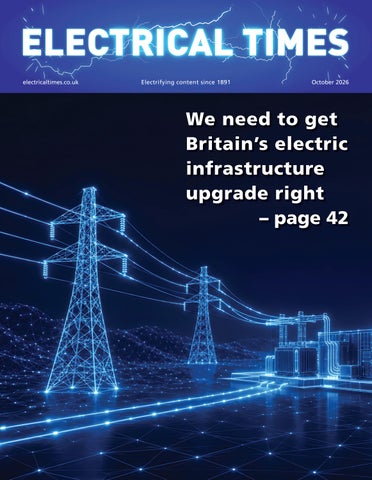
We need to get Britain’s electric infrastructure upgrade right – page 42
01_ET-Oct_FC.indd 1
30/09/2026 16:28:54
More Space Inside. Allowing For A Faster Installation. The COMBI Family
The original WISKA COMBI junction box. The unique bellied lid provides more wiring space for faster, easier installations, while IP66/IP67 protection keeps every connection secure in the toughest environments.
www.wiska.co.uk
ET.COMBI_AD.indd 3 XX_ET-Oct_Advert.indd 1
03/09/2026 15:06 01/10/2026 10:50:18
CONTENTS
3
29 8 Welcome
16 4
6
8
10
News – Chancellor urged to cut electricity bills
28
Contractor Corner – Leverage technology to future proof
34
The Electrical Times Podcast – Electrical Safety First’s Steven Devine
36
NAPIT – Where should you draw the line?
38
Cable Management – Powering the AI surge Tools & Workwear – Why fastening accuracy now matters more Circuit Protection – Does an RCCB Type B trip on DC? A Letter from America – Before
16
Closing Argument – We need to get
Don’t forget to subscribe on your preferred platform, as we have more electrifying episodes lined up over the coming months.
Switched On – Palace on Pall Mall 42
20
HVAC – Storage heating has changed
Editor James Cooke james.cooke@purplems.com
Production designer Lorna Reekie lorna.reekie@purplems.com
Sales manager Haydon Rainsford haydon.rainsford@purplems.com
Production designer Rob Tremain rob.tremain@purplems.com
For those unfamiliar with Electrical Safety First and what the charity does, their purpose is to work with all sectors of the electrical industry as well as local and central government to reduce deaths and injuries caused by electrical accidents.
Products
Spotlights – EVs and Certification 40
The conversation also covers how decarbonisation is driving increasing electrification and, with EV charging, solar PV, battery storage and heat pumps becoming much more common, what contractors should be flagging to clients.
Listen to or watch the full episode now at electricaltimes.co.uk/podcast – as well as on YouTube and Spotify – or scan the QR code. For a preview of the interview, head over to page 8 for an abridged version of the discussion.
smart systems go live, record the AI 12
Following a short break over the summer, The Electrical Times Podcast is back! The latest episode features Steven Devine, Electrical Installation Safety Manager at Electrical Safety First, who joins us to discuss the evolving nature of BS 7671, the latest amendment, and where electrical contractors looking to get up to speed should get started.
Britain’s electric infrastructure
Enjoy the magazine!
upgrade right
Managing director Ed Hunt Post Purple Media Solutions St Stephen’s St, Tonbridge, Kent, TN9 2AD, UK. T: 01732 371570
The views, opinions, positions or strategies expressed by the authors and those providing comments are theirs alone, and do not necessarily those of Purple Media Solutions.
James Cooke james.cooke@purplems.com
Subscriptions
Online
Electrical Times, Perception, PO Box 304, London Road Uckfield, East Sussex, TN22 9EZ T: 01825 701520 Email: purplems@my-subs.co.uk https://purplems.my-subs.co.uk
Scan to explore Electrical Times back catalogue online or visit www.electricaltimes. co.uk/back-issue/
Subscription rates: UK £95 per year; Overseas £200 (€310, US$370) Electrical Times is published by Purple Media Solutions Ltd and printed by Buxton Press. Registered in England. Company registration number 5949065.
@electricaltimes electricaltimes electricaltimes.co.uk
For advertising enquiries please contact Haydon Rainsord, haydon.rainsford@purplems.com
@ElectricalTimes | www.electricaltimes.co.uk
03_ET-Oct_Contents.indd 3
October 2026
01/10/2026 13:52:19
4
NEWS | LOG ONTO www.electricaltimes.co.uk FOR MORE
Chancellor urged to Cross Rental Services cut electricity bills appoints new CEO THE ELECTRICAL CONTRACTORS’ Association (ECA) has joined a broad coalition of businesses, consumer groups, charities, energy companies and industry bodies in calling on the Chancellor to reduce electricity costs by moving policy levies from household and business electricity bills to general taxation.
In a joint letter to the Chancellor, signatories warn that the UK faces some of the highest electricity prices in the developed world, with prices standing around 45% above the G7 median. They argue that high and unstable energy prices are holding back investment, worsening cost-of-living pressures and acting as a barrier to the electrification of heat, transport, homes and businesses. The letter calls for electricity levies to be shifted from both domestic and nondomestic bills to the Exchequer, a move it says could lower business electricity prices by up to 20%, reduce average domestic energy bills by as much as £250 a year, and save a typical electrically heated household up to £420 annually. ECA’s support for the letter builds on its Blueprint for Electrification: Delivering the UK’s Transition to Clean Power, published last year, which set out a ten-point
roadmap for accelerating electrification across the UK. The Blueprint identified high electricity prices as a major barrier to the uptake of low-carbon technologies, alongside the need for stronger workforce capacity, policy certainty, grid and planning reform, supportive regulation and improved consumer confidence. Gary Parker, Deputy Director of Technical at ECA, said: “The UK cannot deliver electrification at the pace required while electricity remains disproportionately expensive. Electrical contractors are ready to deliver the clean technologies that will power homes, businesses and infrastructure, but high electricity costs continue to undermine consumer confidence and investment. “Moving levies from electricity bills to the Exchequer would be a practical and immediate step towards making electrification more affordable, competitive and attractive. As ECA’s Blueprint for Electrification made clear, the transition to clean power will only succeed if government tackles the barriers facing the businesses and skilled electricians who will deliver it.” The coalition letter says cheaper electricity would help households access lower and more stable bills over the long term, support UK manufacturers and businesses to compete internationally, and make better use of homegrown clean power by reducing reliance on volatile international gas markets. ECA has consistently argued that electrification is essential to achieving the UK’s net zero, energy security and economic growth ambitions. Its Blueprint report highlighted the central role of competent, qualified electricians in delivering clean technologies such as solar PV, battery storage, EV charging infrastructure, heat pumps and smart energy systems.
CROSS RENTAL SERVICES has announced a planned leadership transition that sees UK MD Matt Parker stepping into the CEO role, alongside the appointment of a new Chief Financial Officer, as the business enters its next phase of growth. The leadership changes took effect on 28 August 2026 and are designed to support the continued development of the Group across the UK and Ireland. After almost 7 years as CEO, Graeme Nesbitt will move into the role of Board Director & Strategic Advisor, remaining actively involved in developing the Group’s strategic development, key relationships and future growth. The transition is part of a succession planning process agreed with the Board and investors and has been in development since Parker joined the
Group in 2024 as UK Managing Director. Alongside the CEO transition, Russell Harrison has been appointed as CFO. Having qualified with PwC, his experience includes several senior leadership roles at New Look, including Group Finance Director, before moving to become CFO and COO at Hobbycraft. He joins Cross Rental Services from Churches Fire & Security, bringing significant experience in supporting and scaling multi-site private equity-backed organisations across retail, consumer and service-led sectors. Matt Parker, CEO, said: “Our focus will be on building on the expertise that exists across the Group, investing in engineering capabilities and continuing to develop specialist solutions that help our customers operate in some of the most demanding environments.”
AC/DC sensitive RCD for fire protection tion n
PRECISION PROTECTION FOR PV SYSTEMS
PV-optimised delay reduces nuisance trips
Engineered for safer, more reliable solar performance.
Available at your local wholesaler next day
Manufactured to BS EN 61008-1 & BS EN 62423 01628 829 133
October 2026
04_ET-Oct_News.indd 4
sales@doepke.co.uk
www.doepke.co.uk
www.electricaltimes.co.uk | @ElectricalTimes
30/09/2026 19:49:56
XX_ET-Oct_Advert.indd 16
01/10/2026 15:31:46
6
CONTRACTOR CORNER | BILLY PRICE
How can electrical contractors leverage technology to future-proof their businesses? An interview with Billy Price, Managing Director, Field Services at ClearCourse
Technology Enablement 1. UK tradespeople are losing up to eight hours a week to manual admin. For an electrical contractor specifically, where does that time actually go — and what can be done about it? For most electrical contractors, that eight hours isn’t one big block — it’s death by a thousand cuts. It’s re-keying the same job details from a quote into an invoice. It’s chasing a customer for the third time about an overdue payment. It’s manually checking whether you’ve got enough cable or consumer units in the van before you commit to a job date. None of it is skilled work, and none of it is billable — but all of it has to happen. The fix isn’t a wholesale system overhaul. It’s automating the specific points where information gets re-typed or chased by hand: job data that flows straight from quote to invoice, payment reminders that go out automatically instead of relying on someone remembering to call, and stock levels that update themselves as parts get used. Contractors who tackle even one or two of these tend to find the time comes back fast — and so does the cash flow, because invoices get paid days rather than weeks after the job’s done. 2. What does that time and cash flow actually let a contractor do differently? Once you’re not spending evenings on paperwork, you can start making decisions about your growth like a business owner should. You can see which jobs are actually profitable once you account for time
on-site vs. time on admin. You can take on more work without needing to hire an office manager just to keep up with invoicing. And practically, it means the person who owns the business gets some evenings and weekends back — which, in a trade where burnout and single-owner-operator fatigue is real, matters as much as the numbers do. 3. What is a realistic, friction-free first step for a contractor looking to modernise their operations? Don’t start with “replace everything.” Start with whichever task currently makes you wince the most — for a lot of contractors that’s chasing payments, so digitising invoicing and adding online payment collection is often the single highestimpact, lowest-effort change. It’s a two-week habit change, not a six-month system migration, and the win is visible almost immediately in how much faster you get paid.
Skills and the Workforce 4. At a time when youth unemployment is soaring, how can electrical contractors think about attracting the next generation of professionals? And how can they use their existing workforce to support the new one? The trades have an image problem that doesn’t match the reality — a lot of young people still picture electrical work as purely manual, when in practice today’s contractors are running businesses with software, data, and diagnostics
tools alongside the physical craft. Firms that lead with that — “you’ll learn a skilled trade AND how to run a modern business” — tend to attract a different calibre of applicant. The existing workforce is the underused asset here. Experienced electricians are excellent at teaching the trade itself — safety, technique, judgement built over years. What’s changed is that the relationship can run both ways: apprentices who’ve grown up with technology can help older tradespeople get comfortable with the digital side, while the senior electrician mentors on the craft. That kind of two-way mentorship tends to build loyalty on both sides. 5. Once younger talent is attracted to field services, how can firms retain them, and can technology like AI satisfy their career ambitions? Retention comes down to whether people feel like they’re progressing, not just repeating the same jobs for five years. Technology helps here in a specific way: it removes the grunt work — the paperwork, the re-keying, the chasing — earlier in someone’s career than it used to, which means younger electricians get to spend more of their time on actual diagnostic and technical work sooner. That’s the ambition satisfied — not “AI replaces the need for skill,” but “AI clears the runway so skill-building happens faster.” What AI can’t do is replace the years of hands-on judgement that make someone a trusted electrician. Firms that treat it as a shortcut around training will struggle. Firms that treat it as a way to get apprentices to the interesting, skilled work faster will retain people. 6. Looking ahead, how will the definition of an ‘augmented contractor’ change as mobile tools and AI become standard equipment? The augmented contractor of the near future is someone whose trade expertise is amplified by data, not replaced by it. They have real-time diagnostics support in their pocket, predictive alerts on when a customer’s system is likely to need attention before it fails, mobile tools that handle compliance recording and customer communication on-site rather than in an evening admin session. The differentiator won’t be who has access to these tools — they’ll become standard — it’ll be the contractor that uses them to build trust faster and work smarter, while the actual craft, the hands-on judgement that makes a contractor worth calling, stays exactly as valuable as it’s always been.
October 2026
06_ET-Oct_ContractorCorner.indd 6
www.electricaltimes.co.uk | @ElectricalTimes
01/10/2026 12:18:04
NVC LIGHTING A NVC PART OF THE PROe RANGE
GREENLAND PRO HIGH‑PERFORMANCE IP66 NON‑CORROSIVE CORROSIVE
A BETTER WAY TO INSTALL. 2 FIX. DESIGNED AROUND THE WAY PROJECTS WORK.
GREENLAND PRO’s 2 FIX architecture separates installation into first-fix and second-fix stages, providing greater flexibility around project sequencing on site.
1
BASE FIRST FIX
2 MOVABLE TERMINAL BLOCK icons 1 - Greenland 27 August 2026 16:23:07
PREPARED CABLE ENTRIES
LIGHT ENGINE SECOND FIX
DETACHABLE LIGHT ENGINE
SEE NON-CORROSIVE. THINK GREENLAND PRO. icons11--Greenland Greenland icons 27August August2026 202616:23:07 16:23:07 27
+44 (0)121 457 6340 I sales@nvcuk.com I www.nvcuk.com
GREENLAND PRO - ET AD - AUG 2026 - 244x315mm.indd 1 XX_ET-Oct_Advert.indd 3
28/08/2026 12:45:18 01/10/2026 11:34:07
8
ELECTRICAL TIMES | PODCAST
Electrical Safety First and The New Energy Landscape Steven Devine, Electrical Installation Safety Manager at Electrical Safety First, recently joined The Electrical Times Podcast to discuss the latest amendments to the wiring regulations, and what they mean for contractors working with an increasingly complex energy system For those who may be unfamiliar, could you introduce yourself and Electrical Safety First?
too – less reliance on backup gas generation at peak demand. And on the network side, we’re seeing the rise of virtual grids, where stored energy across domestic and commercial sites gets drawn on instead of firing up backup turbines. Contractors are well placed to explain these benefits to clients, which is increasingly part of the job.
I’m Steven Devine, Electrical Installation Safety Manager at Electrical Safety First. I’ve got nearly 30 years in the trade – starting as an apprentice and working through domestic, commercial, industrial and some offshore work. For the last 14 years I’ve focused on standards development, producing guidance for industry and working with government, education providers and other stakeholders. I’ve been at Electrical Safety First formally since last September, though I’ve worked alongside them for around 15 years. Our objective is improving electrical safety across the industry, and we do that by supporting installers and designers directly, working with government, and pulling together industry experts to produce free, industry-agreed technical guidance.
BS 7671 has gone through several amendments over the years. Why does the standard need to keep evolving, especially with the shift toward a smart, low-carbon energy system? We sit below the IEC and CENELEC standards bodies, and work with international experts tracking emerging technologies to build a framework installers and designers can actually work to. When I started nearly 30 years ago, energy use was far simpler. Now we’ve got battery storage, solar PV and increasingly ‘prosumer’ installations, with bidirectional energy flow – the customer isn’t just a user of energy anymore, they’re a producer and a store of it too. If the standard doesn’t keep pace with that, there’s no baseline for the industry to design and install against safely.
None of that works without safe installation, inspection and maintenance. How critical is that, and what’s the risk if it’s not done properly?
protective neutral bonding [PNB] – both areas that existed in practice but weren’t properly covered before.
What would you say to contractors, designers and inspectors who haven’t yet got up to speed with the new requirements? Where should they start? Get on top of it now. Installations are far more complex than even 10 years ago, so CPD isn’t optional if you want to stay competent and, frankly, employable. This isn’t just about box-ticking – if you’re not keeping up with the standards, you run a real risk of carrying out installations that aren’t safe. BS 7671 itself isn’t law, but it’s referenced throughout legislation, so it’s your fundamental safeguard that the work you’re signing off is correct.
Can you walk us through what’s new in this latest Amendment, and what specific gaps or risks it’s designed to address?
Decarbonisation is driving increased electrification in homes and buildings. What does that mean for the electrical installation itself?
Every amendment updates the definitions and terminology in Part 2. But the headline for this one is Chapter 57 – stationary battery systems. There was previously very little in BS7671 covering this, despite it turning up on more and more jobs, domestic and commercial. Bidirectional energy flow is another big one: a lot of protective devices already installed weren’t designed for energy flowing back from a battery system into the network, and can be damaged by it, so there’s now much more emphasis on selecting the right devices and standards for that. Part 6 has had a smaller but genuinely useful change: the FI [Further Investigation] code on an EICR no longer automatically makes the report unsatisfactory – that was causing a lot of confusion and unnecessary escalation. And Part 7 has brought in Section 716 on Power over Ethernet, plus formal recognition of
It means you’re no longer just wiring a property – you’re designing part of a complex energy system. Ten years ago, energy flow was one-directional: you did the install, and walked away. Now you’re dealing with voltage, frequency and energy control through inverters and energy management systems, even on a standard domestic job.
October 2026
08_ET-Oct_Podcast.indd 8
EV charging, solar PV, battery storage and heat pumps are becoming much more common. What benefits can they deliver – and what should contractors be flagging to clients? Lower running costs, more control over generated and stored energy, and the ability to use time-of-use tariffs to their advantage. There’s a decarbonisation benefit
It’s the fundamental point – safety first, functionality second, always. The complexity here means it’s on you as the inspector to be clear about the limits of your own scope. If you’re confident on domestic installs but not an expert in EV charging, heat pumps or battery storage, you need to flag that clearly in the report. Otherwise a client sees ‘satisfactory’ and assumes everything’s covered, when it might not be. That’s a liability risk for you as much as a safety one.
It sounds like the job isn’t just about distributing electricity anymore. How is the installation becoming part of a wider, interconnected energy system? Exactly right. We’re entering an age of electrical intelligence – constant communication between the installation, the appliances on it, smart metering and the supplier, particularly with EV charging. It’s the biggest shift in the last decade, and it’s why we’re working with standards committees, government and training providers to make sure that understanding filters through to people already in the trade, not just those coming into it.
Finally, what’s your advice on how contractors should be talking to clients about competence and getting alterations properly assessed? Lead with your credentials – tell clients upfront that you’re with a recognised scheme provider or association, it gives them confidence from the start. And explain things in plain language, not jargon; a client who understands what they’ve had installed and what their ongoing responsibilities are is a client who’s less likely to run into problems, and less likely to come back to you with a complaint that isn’t really about your work. This interview has been abridged for clarity and length. For the full conversation, visit the Electrical Times YouTube channel or subscribe to the ET Podcast on Spotify. Alternatively, scan the QR code to watch or listen at: https://www.electricaltimes.co.uk/ the-new-energy-landscape-electrical-safety-first/
www.electricaltimes.co.uk | @ElectricalTimes
01/10/2026 13:52:03
beg-luxomat.com
Aleum Glow HIGHLIGHT YOUR HOME THROUGH MOTION Timeless, clear design, high-quality technology Available in two colour variants ‘Glow’, selectable ambient lighting 3 m to 16 m range Electronically and mechanically adjustable range
XX_ET-Oct_Advert.indd 4
01/10/2026 11:47:06
10 ADVERTISEMENT FEATURE | NAPIT
Drawing a line Jonathan Swain, Technical Commercial Engineer at NAPIT, explores where contractors should “draw the line” when assessing existing installations during additions or alterations. He clarifies regulatory responsibilities, outlines common pitfalls and uses real world scenarios to show how to determine what must be rectified to ensure safety and compliance Introduction
MO equipment
Customer equipment
When verifying a new electrical installation, a contractor’s responsibility is clear and well‑defined. Industry guidance leaves no ambiguity: 100% of the installation must be inspected and tested, without exception. This level of thoroughness is not only expected, but vital, as it is often the only stage in an installation’s lifetime where every element can be comprehensively checked. Any non‑compliances with BS 7671 must be identified and corrected before certification can be issued, as required by Regulation 644.1.1: While this principle is straightforward for brand‑new work, things become more complex when dealing with additions or alterations. However, in these situations, the contractor’s responsibilities extend beyond the addition or alteration alone. The existing installation becomes an integral factor, its condition, safety and suitability must also be considered. The question commonly asked is: ‘where do you draw the line?’ This article explores that topic and aims to offer practical guidance.
So, how far is far enough? The answer varies depending on the scale and complexity of the work and the nature of the existing installation. However, as a starting point, the requirements of Regulation 132.16 (Fundamental Principles), are an absolute and must be proved adequate before considering any additions or alterations, Fig 1 provides an example of situations that require verification. The existing installation must be adequate to support, and be compatible with, the new installation and this must be considered holistically.
Meter Operator (MO) equipment Note: This diagram is illustrative only – it does not show all possible scenarios. Actual installation practice and equipment connections may differ. The diagram must not be taken as a definitive wiring diagram for any installation.
DNO equipment Distribution Network Operators (DNO) equipment 1. 2. 3.
Service cable Cut-out (or main fuse or DB fuse) DB earth terminal
Meter Operator (MO) equipment
Customer equipment
4.
8.
5. 6. 7.
Meter tails (cut-out to meter and meter to timeswitch) Communications hub if fitted (may be in the meter) Meter Timeswitch (if fitted)
9. 10. 11. 12.
Common oversights include:
•
When maximum demand is calculated, it should not be just for the addition or alteration, but for the entire installation • The earthing arrangements must be satisfactory back to origin even if working off remote distribution • The protective bonding arrangements must be sufficient within the installation even if the specific location being worked in does not contain any extraneous conductive parts. If arrangements elsewhere in the installation were incorrect the addition or alteration could exacerbate an existing problem • The protective measures present must be suitable, and this will include any devices used for additional protection. It may be that your installation has no DC components, but an AC RCD blinded by existing DC loads will still not function As a guiding principle: the addition or alteration must comply with current Regulations and must not impair the safety of the existing installation. This is stated in Regulation 644.1.2:
October 2026
10-11_ET-Oct-NAPIT.indd 10
Meter tails (between the meter/time switch and the Customer equipment Customer isolating switch (if fitted/ requested) Customer consumer unit Customer earthing conductor (and earth block if fitted) Meter board (or external meter box if fitted)
Fig 1: Assessing the rating and condition of the existing equipment and distributor Put simply, if an issue is found within the existing installation that could compromise the safety, reliability, or compliance of the new work, it must be rectified before the work proceeds. This should be agreed with the client upfront, as it may affect time and cost.
Real-world scenarios Scenario 1: A contractor has been engaged to add a number of socket‑outlets to an existing ring final circuit and has encountered some issues. Issue 1: The contractor has correctly conducted inspection and testing of the existing ring final circuit before adding the additional socket‑outlets, shown in Fig 2. It is revealed that the existing ring final circuit is not correctly configured and is in fact two separate radial circuits. The 32 A overcurrent protective device (OCPD) present is not suitably rated.
Possible rectification: The contractor has only two options in this situation because the issue directly affects the safety of their installation. 1. Provide suitably rated OCPDs for the two radial circuits (if spare ways are available and the design permits). 2. Rectify the wiring fault. One of these must be completed before additional socket‑outlets can be installed. Issue 2: The contractor observes that there is a light (supplied by a different circuit) on the building exterior that has been dangerously connected as shown in Fig 3.The observation shall be recorded in the following comments sections: • EIC: Section I • MEIWC: Section A-5 Scenario 2: The contractor has, in line with guidance, undertaken an Electrical Installation Condition
www.electricaltimes.co.uk | @ElectricalTimes
01/10/2026 12:20:39
NAPIT | ADVERTISEMENT FEATURE 11
Fig 3: Assessing the rating and condition of the existing equipment and distributor Fig 2: Scenario 1, issue 1 ‑ Testing shows the ring is actually two radials with an overrated 32 A device Report (EICR) on an existing installation prior to the replacement of a consumer unit. Fig 4 shows the observations made on the (unsatisfactory) EICR. When changing a consumer unit, an installer is working across, and providing protection for, all circuits of the installation and must be able to demonstrate that they are safe to be reconnected. Whilst a defect or non-compliance attracting a (C3) on a condition report may only warrant a comment on the existing installation, anything dangerous (C1) or potentially dangerous (C2) must be rectified prior to certification for the works to comply. This issue sits outside the scope of the contracted works and does not compromise the safety or compliance of the socket installation being carried out and certified. Because of this, there is no mandatory requirement for the contractor to undertake remedial action as part of the current job.
However, as part of a responsible duty of care, any danger identified within the wider installation should be clearly communicated to the client and recorded appropriately on the certification so it can be addressed before harm is done. This is set out for us in the second part of Regulation 644.1.2: Further detail is provided as each observation is considered in turn: Observation 1: Ideally, the main protective bonding conductors would be upgraded, but this may not be reasonably practicable. The proposed works do not involve the addition of any load (and therefore no increased risk of diverted neutral currents). It may be reasonable for the designer to be satisfied that the time‑served and proven bonding arrangements will be sufficient. This could be recorded as a comment on the existing installation, with appropriate justification.
Observation 2: The identification of conductors has not been considered a danger and may be recorded as a comment on the existing installation (or referenced within the EICR). No further action is required. Observation 3: Whilst coded C2, the RCD issue can be suitably rectified as part of the intended works and will no longer be a concern following the consumer unit change. Therefore, the works can proceed. Where the line is drawn must be assessed case‑bycase. For example, if the works proposed in Scenario 2 also included the installation of an EV charger, the rationale applied regarding the undersized bonding conductors would no longer be appropriate. The significant increase in load could present a greater risk of diverted neutral currents, and the conductors would require upgrading. Unfortunately, there is no one‑size-fits‑all approach.
Conclusion It is essential for a contractor to verify that the existing installation is safe, suitable and compatible with any planned additions or alterations. Where shortcomings or defects are identified, these must be addressed. Even when an issue does not directly compromise the safety of the new installation, it should still be brought to the client’s attention as part of your duty of care. Ideally, potential issues should be identified, discussed and agreed upon before any work begins. Leaving these discussions until the end of the project can lead to difficult conversations, unexpected remedial requirements, or even an inability to complete the contracted works if essential safety conditions are not met. A contractor should never assume the risk of an unsafe and non‑compliant installation, even if the reason for it lies in what was already present. Ultimately, your name appears on the certificate! Hopefully, this article provides confidence that all necessary checks and actions have been completed. Addressing issues early protects both your reputation and your customer’s safety.
For more information on coding and observations, visit the napit.org.uk website: Fig.4: Section K EICR observations
@ElectricalTimes | www.electricaltimes.co.uk
10-11_ET-Oct-NAPIT.indd 11
https://www.napit.org.uk/napit-shop/
October 2026
01/10/2026 12:20:40
12 SPOTLIGHT | ADS ELECTRICAL
October 2026 – Will Change EV Installations Forever – Are We Ready?
I
f you’re anything like me, you’ve probably lost count of the number of changes our industry has seen over the last few years. It feels like every time we get used to one new requirement, another one comes along. A lot of electricians have only recently got to grips with the changes around EICR qualifications, and now we’re talking about another recognised qualification for EV charger installations. I’ll be honest. When I first heard about it, my first thought was probably the same as a lot of other electricians. “Not another course.” Spend five minutes on an electricians’ forum, Facebook group or at your local wholesalers, and you’ll soon hear plenty of opinions. Some think it’s another hurdle to get over. Others think it’s the right move for the industry. To be honest, I can see both sides. Nobody enjoys taking time away from work or paying for another course. But the more I’ve thought about it, the more I’ve realised this is about more than just another qualification. It’s about where our industry is heading.
Does Experience Still Count? One question keeps coming up. “I’ve been doing this for twenty years. Why do I suddenly need another qualification?” It’s a fair question. Experience matters. A good electrician with years on the tools doesn’t suddenly become less competent because the rules have changed. But the electrical industry doesn’t stand still either. Over the last few years we’ve seen changes around EICRs. Now it’s EV chargers. As more customers also invest in solar PV and Battery Storage, more electricians will choose to train in those areas too. Some will do it because they want to grow their business. Others because they don’t want to miss out as demand changes. Who’s to say what comes next? Technology keeps moving forward, and we’re expected to move with it. Does it get frustrating having to gan more qualifications and take time away from work on another course? Absolutely. But maybe that’s just what being an electrician looks like today.
What Does This Mean for Electricians? From 1 October 2026, electricians carrying out EV charger installations through a Competent Person Scheme will need to hold a recognised Level 3 EV qualification. For most electricians, the question isn’t what’s changing—it’s what do I need to do? One thing is becoming clear.
October 2026
12_ET-Oct_Spotlight-ADS.indd 12
by Adam Loughrey, ADS Electrical
If you’ve been relying on manufacturer training or years of experience alone, that probably won’t be enough. The new requirements are focused on recognised qualifications that demonstrate your competence to install EV charging equipment. For businesses with more than one electrician, there’s another important change. The days of one Qualified Supervisor covering everyone carrying out EV charger installations are coming to an end. The expectation is that the electrician carrying out the installation will need to hold the appropriate qualification themselves. Another question many electricians are asking is which qualification they actually need. Recognised qualifications, such as the City & Guilds or EAL Level 3 routes, are expected to meet the new requirements. However, before booking any course, it’s worth checking with your Competent Person Scheme to make sure you’re choosing the right qualification for your circumstances. There are still some finer details to be confirmed as October 2026 gets closer, but the direction of travel is clear. Individual competence is becoming the focus, so if EV charging is part of your business, now is the time to understand what’s changing and make sure you’re ready—not six months before the deadline.
EV charger installations have become one of the fastest-growing areas of electrical work, and they’re no longer seen as a specialist service. They’re becoming part of everyday electrical contracting.
So, Are We Ready? We are fast-approaching October 2026. If EV charging is part of your business, now is the time to start getting prepared. Take the time to understand what the new requirements mean for you. If you’ll need the recognised qualification, don’t wait until the last minute to book your training. If you’re unsure how the changes will affect your registration or annual assessment, speak to your Competent Person Scheme. And while you’re planning ahead, think about where your business is heading over the next few years. EV charging is just one part of a changing industry. As demand for technologies like solar PV and battery storage continues to grow, many electricians will be looking at how they can develop their skills and the services they offer. Most importantly, don’t rely on rumours or social media. Keep an eye on the guidance from your certification body and make sure you’re getting your information from trusted sources. So, are we ready? I’d like to think we will be. If we start preparing now. Because October 2026 is coming. The time to prepare isn’t next year—it’s now.
It‘s About More Than Passing a Course Let’s be honest. A certificate on its own doesn’t make someone a good electrician. Doing a safe and tidy job matters. Looking after your customers matters. Taking pride in your work matters. But recognised qualifications do help make sure everyone carrying out EV charger installations is working to the same standard. That’s good for customers. It’s good for the reputation of our industry. And it’s good for electricians who invest time and money in keeping their skills up to date. I don’t think October 2026 is about questioning the experience of good electricians. I think it’s about making sure the industry keeps pace with the technology we’re being asked to install.
www.electricaltimes.co.uk | @ElectricalTimes
01/10/2026 12:22:40
GET A TESTER
FREE
WITH ANY KEWTECH MFT
Claim a free tester of your choice when you purchase a Kewtech MFT
between 1st October and 30th November 2026.
CHOOSE YOUR FREE TESTER WORTH UP TO £185
BUY
Any Kewtech MFT from participating stores
CLAIM
Register your purchase at kewtechcorp.com
RECEIVE
Your FREE tester
SCAN TO CLAIM
kewtechcorp.com
Plus, get 3 months free certification software with
T’s & C’s apply. Offer available on qualifying purchases made between 1st October and 30th November 2026. Claim your free tester before 12th December 2026. Tradecert software offer available to new Tradecert customers only. Visit https://kewtechcorp.com/get-a-tester-free-with-any-kewtech-mft/ for more details.
XX_ET-Oct_Advert.indd 5
01/10/2026 11:48:39
14 SPOTLIGHT | NICEIC
Certification: more than a badge Certification is more than a checkbox exercise. In the competitive environment of electrical contracting, certification is a tool that can help contractors stand out by demonstrating a strong commitment to technical integrity and continuing professional development (CPD) in an ever-changing industry.
T
echnical Integrity and Standards Director at NICEIC, Paul Collins, explains: “We support businesses that are committed to high standards, by helping to improve competence, strengthen safety, and building trust across the electrical industry.” It is an approach that offers much-needed clarity for customers in an industry that can sometimes be complex to navigate. Most customers are not electrical experts. They may not know how to assess technical competence, check compliance, or judge whether a contractor is keeping pace with current requirements. A recognised certification mark is a visible signal that a contractor has been independently assessed and is committed to working to the appropriate standards.
Building credibility and trust One of the clearest advantages of certification is the professional credibility it can help to demonstrate. Being regularly assessed by an experienced, independent body is an excellent way to show your business’s willingness to open its work up to external scrutiny, promoting both transparency and accountability. And this is valuable across all kinds of work, wherever your customers sit in the market. Homeowners want reassurance that work in their property will be carried out properly and safely. Landlords, facilities managers, principal contractors, and specifiers need confidence that the contractor they choose has the right processes, knowledge, and technical skills in place. In each case, certification adds certainty and helps make competence more visible.
Supporting long-term standards Certification also encourages long-term thinking, helping embed high standards into everyday working practices. It’s not just about passing an assessment and moving on. Regular surveillance assessments, together with continuing professional development, can help contractors keep their knowledge current rather than relying on training they potentially received years ago. This commitment to ongoing learning is especially important as the electrotechnical sector continues to change. Updates to standards, new technologies, and a heightened focus on safety and compliance mean contractors need access to reliable guidance. “Beyond what’s visible, there’s a wealth of resources, including technical support, training, and industry guidance, available to certified businesses and their staff,” Paul explains. “From our popular webinar series, The Wire, to our technical helpline, which takes tens of thousands of calls each year, we support contractors with the resources they need to keep pace with changing standards, ask questions when they need guidance, and maintain high standards in their everyday work.”
October 2026
14_ET-Oct_NICEIC.indd 14
A competitive edge As competition increases across the sector, demonstrating competence and professionalism can become an important differentiator.
One of the clearest advantages of certification is the professional credibility it can help to demonstrate. Certification can help make quality and competence more visible to customers and clients, particularly where those factors are difficult for customers to assess directly (especially before any work is done). Not only can it be used in marketing and business development activity but, crucially, certification provides a level of assurance that can be a deciding factor for customers when comparing contractors. For some projects, certification by a recognised body may even be expected or required. Peter Robinson, an estimator and Qualified Supervisor (QS) at NICEICcertified Robinson & Lawlor, says: “NICEIC isn’t just about the badge on the van – it’s fundamental to how we work. Without it, we couldn’t even tender for some of the projects we’re doing.” Safety also remains a key pillar of our industry, and certification goes a long way to supporting that. It’s not only about avoiding problems; it is about helping
to protect people, property, and professional standards. By supporting compliance with the latest regulations and standards, certification can help contractors deliver work safely and give customers peace of mind.
Support and advocacy Certification with NICEIC also gives contractors a voice in the electrotechnical sector and a route to help shape its future. NICEIC participates in a wide range of industry committees, using feedback collected from certified businesses to inform its position on a wide range of issues. Paul adds: “As well as our role as a certification body, NICEIC is an advocate for the electrotechnical sector. Whether it’s making the case for sensible and practical regulations or providing guidance on best practices, NICEIC is committed to advancing the interests of its certified businesses and to the success of the industry as a whole.”
More than a credential Ultimately, certification is far more than a credential. In a sector where certification is entirely voluntary, it’s a proactive step for contractors looking to prove their ability to deliver work aligned with evolving industry standards. For those ready to take that step, NICEIC certification can be a powerful route to credibility, confidence, and long-term success.
www.electricaltimes.co.uk | @ElectricalTimes
01/10/2026 12:23:31
Are you
Ready to Race?
Be in pole position for Grand Prix giveaways!
Scan QR code to find out more
1
Buy
Spend £250 on Schneider Electric products.
XX_ET-Oct_Advert.indd 6
2
Scan
Scan the QR code and submit your details.
3
Win
Racing experiences and prizes!
01/10/2026 11:50:48
16 SWITCHED ON LOG ONTO www.electricaltimes.co.uk FOR MORE LIGHTING – SOLUTIONS FOR TODAY & TOMORROW
DesignPlusLight: The “Palace on Pall Mall” Restored to Its Former Glory The Royal Automobile Club’s historic Pall Mall clubhouse has undergone an extensive restoration, returning one of London’s most distinguished Edwardian façades to its former glory
C
ompleted in 1911, the Grade II* listed clubhouse was designed by Charles Mewès and Arthur Davis, the architects responsible for The Ritz hotels in both London and Paris. Stretching 70 metres along Pall Mall, the building is defined by its grand neoclassical portico, columns, balustrades and sculpted pediments.
As part of the restoration, DesignPlusLight were commissioned to create a new lighting scheme for the façade. The brief was to reveal the depth and craftsmanship of the architecture, after dark, while remaining sensitive to the building’s heritage. The surrounding area’s restrained night-time lighting provides an opportunity to enhance the building’s presence without overwhelming its setting. Sanjit Bahra, Principal and Founder of DesignPlusLight, said, “We always take the view that one is only a custodian of heritage buildings. Any lighting enhancement must be appropriate to the architectural style and history of the building. We wanted to celebrate the richness of this magnificent building whilst retaining the warmth and welcoming character of a private club.” A carefully considered palette of luminaires from just two manufacturers was used throughout. This helped to meet the restoration programme while maintaining colour consistency across the full length of the façade. Compact LED fittings were specially commissioned in a warm 2400K colour temperature, allowing the newly restored stonework to take on a soft, tungsten-like glow.
October 2026
16_ET-Oct_SwitchedOn-DPL.indd 16
The lighting design was developed closely around the building’s architecture. Rather than flooding the façade with light, DesignPlusLight took the approach of keeping the illumination contained within its structure, using carefully positioned luminaires to reveal depth, rhythm and detail. Columns are uplit from both sides, modelling their form while drawing attention to the set-back first floor windows. The deeper terrace within the central portico is highlighted with an additional layer of uplighting to the rear wall, giving greater presence to the columns and the principal entrance. Pairs of spotlights cross-light the entablature and its sculptures, whilst linear fittings with glare shields backlight the balustrades at the first-floor and rooftop levels. This creates a visual connection across the entire 70-metre frontage and unifies the individual architectural elements. Planning approval formed an important part of the project. DesignPlusLight prepared nighttime visualisations showing the proposed effects, together with a detailed elevation identifying the location and type of fittings used for each section of the façade. Sketch details also demonstrated how the luminaires would be discreetly integrated into the historic fabric of the building. This helped secure planning approval with confidence. Whilst the scaffolding remained in place, lighting trials were carried out to determine the final treatment of the sculptures across the entablature and pediments. During this stage, the signature of the French sculptor Ferdinand Faivre was discovered, carved discreetly beneath one of the cherubs. It was subsequently gilded
in recognition of the importance of these sculptures to the clubhouse’s identity. As the scaffolding was removed, in stages, DesignPlusLight were able to focus and fine-tune the lighting as each section of the restored façade was revealed. The clubhouse’s historic torcheres were also refurbished as part of the project. The warm façade lighting beautifully complements the natural gas flame. This reinforces a welcoming feel at the entrance. In keeping with the building’s listed status and Westminster’s planning requirements, two lighting scenes have been programmed. A brighter, earlyevening scene presents the full architectural composition as members and guests arrive. As daylight fades, this transitions to a more subdued late-night setting where the clubhouse takes on a softer residential glow. The completed scheme reveals the scale and magnificence of the restored building, evoking the clubhouse’s original reputation as the “Palace on Pall Mall”. This project also reflects a broader and more important (lighting) design element. Illumination should be selective, allowing shadow and darkness to remain part of the overall composition. Sanjit Bahra continues, “The ability to light a building does not mean that every surface should be illuminated. At the Royal Automobile Club, the visually quieter areas are just as important as the elements we chose to reveal. This balance gives the façade its depth and dignity, while ensuring the lighting feels as though it belongs to, and emanated from, the building rather than having been imposed upon it.”
www.electricaltimes.co.uk | @ElectricalTimes
01/10/2026 12:24:42
Accurate product and pricing information at your fingertips. Accurate pricing Search overprduct 1 millionand product items on LUCKINSlive.com for free. information at your fingertips. Search over 1 million product Wherever you are, items on LUCKINSlive.com for free.
whenever you need. Wherever you are, whenever you need.
www.luckinslive.com advert 297mm tall x 210mm wide_v1.indd 1
XX_ET-Oct_Trimble.indd 1
18/11/2024 14:35 01/10/2026 11:54:43
18 SWITCHED ON
TTD works with Solid Collective to deliver fully reversible electrical infrastructure for new structure at The Lanesborough Hotel
B
ody The Technical Department (TTD) has completed the design and installation of the electrical infrastructure for a new t structure at The Lanesborough Hotel in London, working alongside lead creative production company and principal contractor Solid Collective. Designed to remain in place for approximately three years, the structure required a complete electrical installation capable of supporting its lighting, power and operational requirements while drawing entirely from the luxury hotel’s existing in-house power supply. Ed Paggett, Commercial Director at TTD, explained: “The interesting part of this project was that we weren’t simply looking at how much power the new structure needed; we had to design the entire system around the capacity already available within the hotel.” He continued: “There could be no permanent alterations to The Lanesborough’s existing electrical infrastructure, so everything had to be carefully calculated and designed to make the best possible use of the available supply. At the same time, we needed to provide a robust solution that could remain in operation for around three years and then be completely
removed at the end of that period, leaving the hotel’s existing systems unaffected.” Solid Collective brought TTD into the project during the technical design stage, once the overall concept had been agreed and the electrical requirements of the structure needed to be developed. Working closely with the wider project team, TTD designed and installed the electrical distribution infrastructure, with detailed load calculations forming an important part of the process. The resulting solution provides the required lighting, power and operational capacity throughout the structure while remaining entirely reversible. Lukasz Pardus, Director at Solid Collective, said: “The Lanesborough was a technically demanding project, but that’s the type of work we enjoy. Delivering temporary structures within operational luxury hospitality environments requires good planning, experienced specialist partners and a collaborative approach from everyone involved. The team from The Technical Department integrated well with our wider project team, delivering excellent support throughout and playing an important role in helping us deliver another successful project for our client.”
STILL DOING IT RIGHT. Introducing Wiser 2nd Generation, the latest addition to the Drayton line up. Designed to support installers in the transition to a smarter world, it works seamlessly alongside our trusted favourites.
Trustscore 4.7 | Excellent
18-19_ET-Oct_SwitchedOn.indd 18
01/10/2026 11:56:21
SWITCHED ON 19
LiGHT 26
Where lighting and design unite. The UK’s only dedicated exhibition for lighting specif ication 18 & 19 November 2026
H
eld at the Business Design Centre in Islington, London, LiGHT 26 is the UK’s only trade show dedicated to high-end lighting specification. Having attracted close to 7,000 visitors in 2025, architects, interior designers, lighting designers, engineers, and specifiers head to LiGHT in their thousands to see the very latest product innovations and launches from 100s of exhibiting architectural, decorative and technical lighting brands. The show will once again feature the highly regarded [d]arc thoughts talks programme curated by [d]arc media – the leading media company in lighting design. Featuring moderators from arc magazine’s editorial team, as well as guest moderators, the talks delve deeper into the latest topics and trends affecting lighting and design. LiGHT also provides endless opportunities for visitors to make new connections. Whether that’s through the latenight drinks party, networking brunch, VIP tours or while working in the dedicated co-working space. There is also the ability to re-energise in the Associations Lounge, which is set to feature, for the third year running, a separate dedicated splinter talks programme. Taking place on the 18th and 19th of November, it is completely free to attend. For more information, head to: https://www.lightexpo.london/
* Terms and conditions apply.
(Sausage roll not made by us, just a gift from us #sneakysausage)
18-19_ET-Oct_SwitchedOn.indd 19
01/10/2026 11:56:23
20 HVAC | STIEBEL ELTRON
High-performance ventilation, made easier As homes become increasingly airtight, mechanical ventilation with heat recovery (MVHR) is an essential part of delivering good indoor air quality without unnecessarily losing valuable heat. For installers, the system also needs to be straightforward to install, commission and maintain.
S
TIEBEL ELTRON’s VRC-W range combines high-efficiency heat recovery with intelligent control and practical installation features. Available in 450 m³/h and 600 m³/h versions, the units provide continuous, balanced ventilation, recovering heat from extracted air and transferring it to incoming fresh air. The VRC-W 450 is particularly suited to high-performance residential projects, with both 450 variants Passivhaus certified – an important credential where ventilation performance is critical to the overall building specification.
Instantaneous water heaters built for hard water Our bare wire technology means longer product life and better sustained performance even in hard water areas. With a range from 3-27kW we have every job covered. Faster heat up time Can take pre-heated water Resistant to limescale = better sustained performance and longer product life Faster to react to changes in water pressure and voltage to maintain constant water temperatures Highly compact and efficient
Example product video
www.stiebel-eltron.co.uk/instant sales@stiebel-eltron.co.uk | 0151 346 2300
October 2026
20_ET-Oct_HVAC-SE.indd 20
The wall-mounted design provides a compact solution where space is limited, while accessible connections and service areas are designed to make installation, commissioning and routine maintenance as straightforward as possible. Filter replacement is also simple, helping to minimise servicing time once the system is operational. The VRC-W can respond to the conditions within the property, with intelligent control based on factors including CO2 and humidity. This allows ventilation rates to be adjusted to actual demand rather than simply running at a fixed rate. An integrated summer bypass can also introduce cooler outside air when conditions are suitable.
The perfect partner for a STIEBEL ELTRON heat pump The VRC-W becomes particularly compelling as part of a complete STIEBEL ELTRON heating and ventilation solution. Pairing MVHR with a STIEBEL ELTRON heat pump creates an integrated approach to both energy-efficient heating and controlled ventilation, using products from a single manufacturer. And the benefits continue after installation. With compatible STIEBEL ELTRON systems, homeowners can use one app to monitor and control both their heat pump and ventilation system, providing a simpler user experience, and giving installers a single ecosystem to configure and support. For developers and M&E consultants, specifying one manufacturer’s heat pump and MVHR solution can also simplify system integration and provide a more coherent approach from design through to commissioning and ongoing operation, whilst garnering additional warranty benefits when bought as a package. With two airflow capacities, Enthalpy versions, Passivhaus-certified 450 models, intelligent demand-based ventilation and integration with STIEBEL ELTRON heat pumps, the VRC-W range provides a technically capable MVHR solution without unnecessary installation complexity. VRC-W 450 and 600 – high-performance ventilation, designed to work in harmony with your heating system.
www.electricaltimes.co.uk | @ElectricalTimes
01/10/2026 11:57:31
The Future of Lighting Specification Scan the QR code for future announcements and registration
lightexpo.london
XX_ET-Oct_Advert.indd 16
01/10/2026 12:27:13
22 HVAC | DIMPLEX
Storage Heating Has Changed: What Installers Need To Know Luke Bridle, Senior Product Training Manager at Dimplex UK, looks at how storage heating technology has evolved and what electrical contractors need to know when working with today’s high heat retention storage heaters (HHRSHs
W
hen storage heaters are mentioned, many people still picture decadesold technology: large, cumbersome heaters charging overnight, with basic controls and limited ability to determine when that stored heat was released. For electrical contractors, that perception matters as much as the technology itself. Modern high heat retention storage heating has moved on considerably, with greater insulation, more intelligent controls and more sophisticated management of stored and released energy. As electrification continues to shape the way we heat our buildings, understanding that evolution is becoming vital for installers.
From storage heating to smart storage The fundamental principle behind storage heating hasn’t changed since it was first introduced in the UK in the late 1940s: surplus overnight electricity, generated when demand is lower, heats an internal storage core, with that energy then used to provide warmth during the day. What has changed significantly is the level of control around that process. Traditional storage heaters relied on basic controls, letting users determine how much energy should be stored overnight and, to a limited degree, how quickly it was released. High heat retention (HHR) technology is designed to retain stored heat for longer and release it when needed. To meet the HHR classification, a heater must retain at least 45% of its stored heat after 16 hours when tested to EN 60531, achieved through better insulation and effective controls. Modern systems can calculate how much energy needs to be stored based on the property’s heating requirements, with any unused stored heat considered when calculating the next day’s charge and retained for use the following day. These advances can have a significant impact: independent testing of Dimplex Quantum HHR storage heater, for example, has shown it can be up to 27%
cheaper to run than a standard storage heater system and up to 47% cheaper than direct-acting electric heating.¹
Putting the user in control For installers, one of the biggest differences to understand is the relationship between the heater, its controls and the occupant. A modern HHR storage heater doesn’t just charge overnight and gradually release heat the following day – time and temperature settings allow heating to be matched much more closely to when a room is occupied. Advanced solutions such as Quantum combine high heat retention with an electronic thermostat and programmable time and temperature controls, using an adaptive charge calculation to determine the energy that needs to be stored, while a fan draws air through the heated core when warmth is required. Features such as Adaptive Start can also help determine when it needs to begin heating to achieve the desired room temperature at the required time, while open-window detection can respond to sudden changes in temperature. Connected control adds further convenience. When connected to the Dimplex Hub, Quantum can be remotely managed through the Dimplex Control app alongside other compatible heating and hot water products, while also allowing users to monitor their energy consumption – giving occupants greater control over how their stored energy is used.
Understanding where HHR fits No single heating technology suits every building, but HHR storage heaters can provide a practical option across a range of electrically heated properties, including apartments, social housing, residential refurbishment and homes replacing older storage heaters or direct-acting electric heating. They can also offer an alternative for off-grid properties, particularly remote areas relying on oil-fired wet central heating. There can also be benefits to a property’s energy performance: Quantum has a responsiveness rating of 0.8 in SAP, compared with 0.2 for manual, 0.4 for automatic and 0.6 for combination or fan-assisted storage heaters.
Five things installers should know about modern HHRSHs. 1. 2. 3. 4. 5.
It’s not traditional storage heating Improved insulation and smart controls allow HHR storage heaters to retain and manage stored heat much more effectively. Charging is intelligent Modern systems can calculate how much energy needs to be stored rather than simply taking the same charge every night. The tariff matters Understanding when off-peak electricity is available is an important part of correct system set-up. Controls are key to comfort Programmable time and temperature settings mean heat can be delivered around the occupant’s requirements, while heat can also be delivered on demand at the touch of a button when needed. Don’t overlook the handover Helping customers understand how their heating operates and how to use the controls is an important final part of a successful installation.
October 2026
22_ET-Oct_HVAC-Dimplex.indd 22
As a result, replacing older storage heating with HHR can help improve EPC ratings, potentially adding up to 11 SAP points – enough to move a property by an entire EPC band in some cases.
Installation is only part of the job The development of more flexible electricity tariffs also makes it important to understand how and when a heater charges. At Dimplex, we emphasise to installers that fitting the heater correctly is only part of achieving good performance. Installers must understand when off-peak electricity is available at the property and ensure the heater is configured accordingly – particularly important with smart meters and varying tariff arrangements. They also play an important role in helping the customer understand the controls, so the occupant knows how their heating is set up, how to adjust time and temperature settings and, importantly, how the system uses off-peak energy. Even a well-designed heating system will struggle to deliver the experience the resident expects if it’s incorrectly configured or misunderstood. This is where installers can make a real difference – helping with initial set-up and selecting the most appropriate settings can significantly impact energy use. With Quantum, for example, changing from the default ‘User Timer’ setting to ‘Out All Day’ can reduce energy use by up to 30%, while every 1°C change to the setpoint temperature can affect energy use by approximately 7%. Taking a little extra time and care at handover can therefore make a real difference to how effectively the system is used day to day. The technology may have changed considerably, but good specification, installation and commissioning, backed by a thorough handover, remain essential. Resources such as the Dimplex PRO Installer Club can provide installers with access to product information, training and support to help build their knowledge and confidence. Dimplex runs training courses around the country, combining technical and practical guidance on areas including system set-up, tariff compatibility and controls. Support doesn’t end when the course finishes, with installers able to access ongoing technical guidance when needed, helping ensure systems are set up effectively and customers understand how to get the best from them. For electrical contractors who haven’t worked with storage heating for some time, it’s worth taking another look – today’s HHR storage heaters are a very different proposition from those many of us grew up with.
Reference 1.
Running Costs of Conventional Electric Space Heating Systems” 27/11/14 by Dr John Counsell Advanced Control Partnerships Limited
www.electricaltimes.co.uk | @ElectricalTimes
01/10/2026 12:30:44
NEW IDEAL 6MM2 LEVER CONNECTORS PREMIUM PERFORMANCE, BUILD FOR SPEED AND RELIABILITY IDEAL’s new 6mm² lever connectors deliver fast, secure and reliable connections across a 0.5–6.0mm² wire range. Rated to 41A and available with 2, 3, and 5 port options - perfect for demanding domestic, commercial and industrial applications.
• REUSABLE AND VERSATILE:
• LOW LIFT FORCE:
• SECURE CONNECTIONS:
• CONFIDENCE:
• 2, 3 and 5 port models available • Rated to 41A • Test-point verification for peace of mind
• Audible click when closed for reassurance • Safe, reliable and reusable
Easily supports 0.5–6.0mm² solid, rigid stranded and flexible wires
Patented easy to open lever, minimising hand strain
Built in locking feature, continuity check port and strip length guide
Visual inspection window
At IDEAL Electrical, we build products with professionals, for professionals. For more than a century, our solutions have earned their place on job sites across the world - making everyday electrical work faster, safer, and more reliable. Upgrade your connections today.
idealelectricalinc.com Own every connection
PE Aug 2026_6mm lever.indd 1 XX_ET-Oct_Advert.indd 8
28/07/2026 10:55:20 01/10/2026 12:01:14
24 HVAC | ASPECT
Better-performing homes need better-planned ventilation
Why energy efficiency and ventilation must work together from the outset
W
e are asking more of our homes than ever before. Better insulation, replacement glazing, draught-proofing and more efficient heating systems are helping to create properties that are more comfortable and use less energy. But as homes become more airtight, the way they manage fresh air and moisture changes too. This is particularly important when improving existing properties. Traditionally, many homes relied partly on incidental ventilation through chimneys, air bricks, older windows and less tightly sealed doors. However, as properties are refurbished and unwanted air leakage is reduced, these natural ventilation routes can progressively disappear. Everyday activities such as cooking, showering and drying clothes will always generate moisture but without adequate ventilation, that moisture can contribute to high humidity, condensation, mould and poor indoor air quality. Therefore, improving the thermal performance of a home without considering how it will be ventilated can create unintended consequences. The introduction of Awaab’s Law has brought greater attention to the issue of damp and mould in properties. It reinforces the importance of addressing the underlying causes rather than simply treating problems once they become visible. This does not mean specifying the most sophisticated ventilation system for every home. The right approach will depend on the property, if renovation work is being undertaken and the problem that needs to be solved. So what is the solution? Good-quality continuous extract ventilation in kitchens, bathrooms and utility rooms can be highly effective. Depending on the property, humidity-controlled extract or Positive Input Ventilation (PIV) may also have a role to play. Where mould or condensation is already present, simply installing a fan should not be seen as a cure. Instead, we need to understand where the moisture is coming from, how air moves through the wider
October 2026
24_ET-Oct_HVAC-Aspect.indd 24
by Rob Stevens – Trade Manager, HVAC Services at property maintenance company Aspect
property and whether other issues are contributing to the problem like water ingress, inadequate heating or occupants being unable to use existing ventilation effectively. In major home renovations, early planning becomes particularly important. Having delivered more than 30 Mechanical Ventilation with Heat Recovery (MVHR) installations as part of full-house refurbishment projects, I have seen first-hand how much easier it is to achieve a good result when ventilation is part of design discussions. MVHR continuously extracts stale, moisture-laden air from kitchens, bathrooms and other wet areas while supplying filtered fresh air to living spaces and bedrooms. Heat from the outgoing air is recovered and used to warm the incoming air, providing controlled ventilation while reducing unnecessary heat loss. For a well-insulated and increasingly airtight property, this can make a great deal of sense. The system provides a planned route for fresh air to enter and stale air to leave, rather than relying on uncontrolled gaps in the building fabric. But specifying the technology is only the beginning. An MVHR system requires ductwork to reach multiple rooms, a suitable location for the main unit and provision for condensate drainage. It also needs adequate access for future servicing and filter changes. Duct routes must be carefully considered, as unnecessary bends, restricted routes and poorly coordinated runs can compromise performance and increase noise.
These requirements inevitably overlap with the work of other trades. If the architect, ventilation specialist, electrician, plumber and builder consider them before first fix, they can coordinate routes and resolve potential conflicts while there is still flexibility in the design. The location of ceilings, cupboards, lighting, pipework and structural elements can all affect what is achievable. Trying to accommodate the same system after layouts have been fixed, ceilings closed or other services installed makes achieving the optimum solution considerably harder. It can lead to compromises in duct routes, limited access for maintenance or visible boxing that could have been avoided through earlier coordination. That has been one of the clearest lessons from the MVHR projects I have worked on. Technology is only part of the equation. Good design, installation and commissioning determine whether a system performs as intended. Airflow rates must be correctly set and the completed installation should be checked to confirm that it is delivering the ventilation planned for each part of the home. The occupants also have an important role. Homeowners need to understand how their ventilation system works, how to use its controls and why it should remain operational. Even a well-designed system cannot perform effectively if filters are neglected, vents are obstructed or the system is simply switched off. Clear guidance at handover is therefore essential to maintaining performance once the project is complete. This is not an argument that every home needs MVHR. It is an argument for giving ventilation proper consideration as part of any refurbishment and selecting a solution that reflects the property and the work being carried out. As we continue to improve our homes, we inevitably change how they manage heat, air and moisture. Ventilation therefore needs to be considered alongside insulation, heating and electrical services from the outset and not treated as an afterthought. If we are investing in making our homes perform better, we must also give them a properly designed way to breathe.
www.electricaltimes.co.uk | @ElectricalTimes
01/10/2026 12:31:34
ET - A4.pdf 1 20/07/2026 11:20:57
The leading trade body for electrotechnical contractors
C
M
Y
CM
MY
CY
CMY
K
STRENGTHEN YOUR BUSINESS THROUGH ECA MEMBERSHIP
Recognised professional credibility across public and private sector clients Technical and business-critical expertise to support compliance, reduce risk and protect margins Tailored savings and services that deliver measurable value Access to a powerful peer network, shaping industry standards and policy For electrotechnical contractors committed to excellence, resilience, and growth, ECA membership is essential. Discover more at eca.co.uk/unlock
XX_ET-Oct_Advert.indd 9
01/10/2026 12:02:15
26 HVAC | PASSIV
Why data holds the key to betterperforming heat pump homes With the Future Homes Standard set to drive the adoption of low-carbon heating and higher energy efficiency in new homes, the UK’s housebuilding sector is under increasing pressure to deliver properties that perform as efficiently in practice as they do on paper
H
eat pumps are set to play a growing role in this transition. Installing these systems, however, is only half the challenge. The real test is whether they continue to perform as intended once the home is occupied. Too often, problems only come to light when a homeowner finds that their home isn’t warm enough or their energy bills are higher than expected. By that point, systems may have been running inefficiently for weeks or even months. Without visibility of what is happening inside the home, developers, housebuilders and installers are effectively working blind. As the industry prepares for the Future Homes Standard, remote monitoring is therefore becoming an increasingly important part of delivering efficient, high-performing homes with heat pumps.
New standards require a new approach to performance The Future Homes Standard represents a significant shift in how new homes will be designed and built, with greater emphasis on energy efficiency and lowcarbon heating. But meeting the requirements at the point of construction is only part of the challenge. For housebuilders and developers, the longer-term question is whether homes continue to perform as intended once they are occupied. The performance of a heat pump depends on a range of factors, from system settings and flow temperatures to the thermal characteristics of the property and how the system is operated. Without access to real-world performance data, it can be difficult to identify when a system is underperforming or understand why. Monitoring provides that missing visibility. It allows housebuilders, developers and installers to move beyond simply installing compliant technology and towards understanding how that technology performs in real homes over time.
October 2026
26_ET-Oct_HVAC-Passiv.indd 26
Seeing the whole picture by Ian Rose, Managing Director at Passiv UK
Few housebuilders or developers are dealing with a single installation or one standardised heating system across every property they deliver. Developments can include a mix of heat pump manufacturers, particularly across projects delivered over several years or by different installation partners. Without a unified system, understanding overall performance becomes slow and inconsistent.
From reactive to proactive maintenance At Passiv, we recently launched the Passiv Portal, a free web-based monitoring platform that enables installers to track and manage all their heat pump installations from one dashboard. It brings together live and historic performance data - flow temperatures, energy use and system settings - across multiple manufacturers in a single view. That visibility allows installers to understand what is happening in real time. The shift this enables is important. Instead of waiting for a homeowner to report a problem, installers can spot early warning signs before they become issues. The result is that homeowners experience fewer disruptions and faster support. Housebuilders and developers can gain greater confidence that heating systems are performing as expected, while installers spend less time travelling to unnecessary call-outs and more time on work that genuinely requires a visit. For developers, this visibility can also help identify patterns across a development, highlighting where systems may need attention and providing valuable insight into how homes are performing once occupied.
Monitoring is only as good as the control behind it Of course, monitoring depends on the quality of the data being collected. Controls designed specifically for heat pumps address this by managing flow temperature directly and maintaining more stable system operation. The Passiv Smart Thermostat is one example. It optimises flow temperature to keep the heat pump operating in its most efficient range. Verified by the Energy Saving Trust, it can improve heat pump efficiency by 17% and reduce heating bills by up to 30%. It also factors in weather forecasts, the thermal performance of the home, electricity tariffs and rooftop solar generation to optimise operation automatically. Just as importantly, it generates the operational data that makes meaningful monitoring possible in the first place.
A single dashboard that monitors performance provides that missing overview. It allows installers, developers and housebuilders to compare performance across properties, identify recurring issues, prioritise maintenance and track whether systems are delivering expected efficiencies over time. This creates a feedback loop that can help the industry learn from real-world performance and continuously improve how low-carbon heating is designed, installed and operated in new homes.
Building homes that perform as intended The Future Homes Standard marks an important step in the UK’s transition towards more energy-efficient, low-carbon housing. But the success of the standard will ultimately be judged by how these homes perform in the real world - not simply by whether they meet requirements at the point of completion. That means the industry has to get two things right at the same time: the technology itself, and how it is experienced by the people living with it. Heat pumps are still relatively unfamiliar to many homeowners, and that can easily shape perception if something doesn’t feel quite right with the heating or running costs. Having visibility of how systems are operating helps close that gap. It allows installers, housebuilders and developers to demonstrate that systems are working as intended, and to step in early when they are not. Just as importantly, monitoring can help the industry build a stronger evidence base around the real-world performance of low-carbon homes. As the Future Homes Standard comes into effect, that insight will be essential in ensuring that the homes being built today are compliant, comfortable and fit for the future.
www.electricaltimes.co.uk | @ElectricalTimes
01/10/2026 12:32:27
THE RADIATOR COMPANY | HVAC 27
Time to re-evaluate electric radiators? Electric radiators are increasing in popularity across the residential sector. Richard Lister, National Sales Manager at The Radiator Company outlines what is behind this and what professionals need to know to make recommendations to their customers
E
lectric radiators have come a long way in recent years from largely functional devices to something that integrates with interior design schemes. They are also more flexible and offer better, more convenient control than ever before, providing immediate heat that can be easily adjusted.
offices in their gardens. Electric radiators are again ideal for providing effective heat in these spaces exactly when needed. Electric radiators are also ideal where rooms within the home are used intermittently, such as a guest bedroom, or on a different schedule to the rest of the home. In fact, a home office may need to be heated at opposite times to the rest of the house – not in the mornings or evenings but during the day. In these situations, having a completely independent heat source can deliver a more costeffective option. This is increasingly important as many homeowners look to reduce energy use in the face of sustained high energy costs. While direct electric heating is generally less cost effective than gas central heating for heating an entire home, electric radiators can have an important role to play. A large proportion of the UK housing stock was built before central heating was standard in new homes. In fact, according to government figures, around 52% of homes in England, 51% in Scotland, 59% in Wales and 34% in Northern Ireland were built before 1964. For properties where it is impractical to install a boiler, or heat pump, and heating pipework, electric heating is often the only option. Storage heaters are a common choice for their ability to make use of cheaper electricity tariffs overnight to charge the thermal store for use during the day. However, these do not always meet the needs of occupants, especially if they have varying schedules. In this case, electric radiators can help to deliver the immediate, adjustable heat required, either as a replacement for other electric options or to provide supplementary heat. Furthermore, with electric radiators it is possible to take advantage of low-cost electricity tariffs with battery storage that allow this same functionality of storing energy during off-peak hours. Many energy providers offer tariffs for this purpose. This can be enhanced further if the property has solar PV to provide direct power or battery charging.
separate timers, integrated timer controls, and full smart controls. This smart connectivity allows users to adjust heating more precisely, create custom schedules, make adjustments remotely or respond quickly to changes in occupancy, minimising wasted energy. Electric radiators provide a modern and flexible option that aligns with evolving energy demands and provides a solution to project challenges, all while integrating with a range of interior design schemes from traditional to modern. To find out more visit www.theradiatorcompany.co.uk.
Choosing the right electric radiator
The benefits of electric radiators There are a number of situations where electric radiators are particularly suitable. They are ideal when extending a property and expanding the heating system to cover this new area is complex, costly or disruptive. Electric radiators can be installed quickly and easily in the new area. Flexible controls mean that heating schedules in the new rooms can be aligned with the rest of the property or operate completely independently depending on the requirements. Similarly, with the increase in hybrid working arrangements, many homeowners are creating standalone home
@ElectricalTimes | www.electricaltimes.co.uk
27_ET-Oct_HVAC-RadCo.indd 27
For customers looking to implement electric radiators there are several factors that need to be considered. Firstly, many homeowners may not be aware of the wide variety of electric radiator designs available. Besides the range of sizes in standard, vertical and low height options, there are many different styles from ornate cast iron to sleek modern designs. Some manufacturers are also able to offer a wide range of colours and finishes. For example, The Radiator Company offers 188 RAL colours, and 10 different cast iron colour finishes as well as matching to Farrow & Ball and Little Greene paint colours. Furthermore, many modern electric radiators have different control options including a simple on/off function, which can be connected to
October 2026
01/10/2026 12:33:27
28 CABLE MANAGEMENT | VIRTUS DATA CENTRES
Transformers: Powering the AI surge in Europe’s data centre landscape
I
n the heart of Europe’s burgeoning AI economy, where server racks require unprecedented levels of power and graphics processing units (GPUs) hum with relentless intensity, one unassuming technology stands as the gatekeeper of progress - the electrical transformer. Far from mere utility components, these robust devices are now strategic assets, enabling hyperscale data centres to connect efficiently to the grid, stabilise supply, and embrace sustainable energy at massive scale. As demand for compute explodes, forward-thinking operators are re-engineering their power infrastructure around high-voltage super-grid transformers to meet the moment. VIRTUS Data Centres’ Wustermark Campus, west of Berlin, is demonstrating this shift. The company has commissioned and installed two 185 MVA super-grid transformers, which are among the largest deployed in a European data centre. Directly linked to the 50Hertz 380 kV transmission network, the site, designed to scale to 500 MVA, will launch with 300 MVA of connected capacity. This is more than incremental growth; it marks a fundamental shift in how data centres access and manage power.
The fundamentals of transformers Traditional distribution transformers typically interface at 30–110 kV, stepping down to lower voltages. Super-grid transformers, however, connect directly at transmission levels (380 kV or higher), transforming down to medium voltage (around 30 kV) for data centre use. These units are typically synthetic oil-filled for optimal insulation and cooling, engineered for decades of reliable service under variable loads. In data centres, they form the core of the electrical backbone, supplying mechanical systems, uninterruptible power supply (UPS units), server distribution, and even emerging 800V DC architectures.
Is a zero-generator future possible?
by Mike Golding, SVP Design & Build at VIRTUS Data Centres
For AI workloads, where individual racks often exceed 100 kW, transformer efficiency is paramount. Even marginal gains reduce heat output, lower cooling demands, and shrink the overall carbon footprint. All of which are critical advantages as facilities scale into the hundreds of megawatts.
Addressing the AI power concerns Global data centre electricity demand is forecast to triple by 2030, propelled by cloud services and especially AI training and inference clusters that can consume tens of megawatts continuously. Conventional power designs, optimised for earlier eras, struggle with the density, reliability, and sustainability requirements of today. Super-grid transformers address this by reducing transformation stages, boosting capacity, and delivering tighter voltage regulation through automated controls. The Wustermark Campus exemplifies this evolution. Its direct 380 kV connection bypasses local distribution networks, avoiding strain on nearby businesses and households while granting Germany a competitive edge in the AI race. Paired with 2N redundancy the architecture targets 99.999% (“five nines”) availability. Customers gain lower grid usage charges and reduced opex at a time when energy dominates total cost of ownership (typically 40–60%).
Traditional diesel generators have long provided backup and they continue to be a viable option when required. However, they come with environmental and operational costs such as emissions, fuel logistics, maintenance, and air-quality impacts. At Wustermark, the robust “stiff” 380 kV network, bolstered by regional onshore wind and a meshed renewable-rich topology, combined with 2N design, makes a zero-generator strategy viable for many customers. The site will operate on 100% certified renewable energy, aligning with EU decarbonisation goals and the Energy Efficiency Directive. This approach not only cuts carbon but also supports regulatory compliance and appeals to hyperscalers seeking predictable, sustainable capacity. By minimising reliance on fossil backups, operators reduce water use for cooling and contribute to broader net-zero targets.
Strategic and economic advantages Beyond resilience, super-grid transformers deliver tangible economics. Reduced losses translate into smaller cooling infrastructure and lower long-term costs. For hyperscalers investing billions in AI clusters, controlling power infrastructure means faster deployment, better inventory management, and the ability to co-locate with clean energy sources. VIRTUS’ model points toward a broader transformation where data centres evolve from passive consumers into active energy hubs. Operators are increasingly integrating solar and wind power purchase agreements (PPAs), and battery energy storage systems (BESS). High-performance transformers serve as the intelligent interface enabling these multi-vector energy strategies.
Blueprint for the future? The Wustermark Campus, with its landmark transformers, high-voltage direct feed, class-leading efficiency, and sustainability focus, sets a new standard for European data centre development. It demonstrates that explosive AI growth can be reconciled with environmental stewardship through intelligent engineering. As grid constraints tighten worldwide, the industry must move beyond traditional approaches. Ultimately, the AI revolution’s success hinges not only on chips and code but on the electrons that power them. Re-engineered for the super-grid era, transformers are the quiet enablers turning ambition into reality ensuring the digital future is both powerful and sustainable.
October 2026
28_ET-Oct_CableManagement-VIRTUS.indd 28
www.electricaltimes.co.uk | @ElectricalTimes
01/10/2026 12:34:02
THOUGHT WE ONLY OFFER PVC-U CABLE MANAGEMENT?
THINK AGAIN! Now offering a full range of metal cable management, our metal trunking, metal strut, wire basket and metal tray are designed with ease of fitting and speed of installation in mind.
UK OWNED UK MANUFACTURER
Find out more at
XX_ET-Oct_Advert.indd 10
www.marshall-tufflex.com
01/10/2026 12:05:16
30 CABLE MANAGEMENT | ELAND CABLES
Turning up the heat on cable performance
T
he recent heatwave, which prompted Great Britain’s grid operator to take the unusual step of securing additional capacity, has pushed the UK electricity system into less familiar territory. While much of the discussion has focused on rising demand and generation constraints, high temperatures also affect something more fundamental: how much electricity the network itself can carry. For cables, the limiting factor is not demand, but heat.
How temperature shapes cable capacity in practice Cable ratings are based on a controlled set of assumptions. Typically, that means an ambient temperature of around 30°C in air, or closer to 20–25°C for buried installations (dependent on geographical factors), alongside defined installation conditions. Move away from those assumptions, and the numbers start to shift. The current-carrying capacity of a cable is governed by how much heat it generates and how effectively that heat can be dissipated. As ambient or ground temperatures rise, that balance changes. The cable runs hotter for the same load, and reaches its thermal limit earlier. That is what sits behind temperature derating, and in practice the effect is not trivial. Even a relatively modest increase in ambient temperature can reduce available capacity by around 10–20%, depending on the cable type and installation. In more challenging conditions, the reduction can be much greater. When temperature combines with other factors such as grouping or poor ventilation, effective capacity can fall significantly from tabulated values.
Why heatwaves create a different kind of pressure What makes heatwaves different is that several effects start to align. Temperatures rise above design assumptions, reducing how effectively cables can shed heat. At the same time, demand increases, particularly as cooling systems in commercial buildings, data centres and other facilities consume more electricity. The important point is that these two effects pull the system in different directions. Demand increases, while the effective carrying capacity of the network is reduced. That mismatch is usually absorbed within existing headroom, but during prolonged periods of heat that headroom begins to narrow.
Buried cables don’t behave the same way in dry conditions For underground systems, the picture is a little more complicated. Cable ratings assume a certain thermal performance from the surrounding soil. In practice, that depends heavily on moisture content. Damp soil conducts heat reasonably well. Dry soil does not. Under sustained high temperatures, the area immediately around a loaded cable can begin to dry out. As that happens, the soil becomes less effective at transferring heat away from the cable, increasing its thermal resistance. This does not occur in every installation, but where it does, it can further reduce the effective capacity
October 2026
30_ET-Oct_CableManagement-Eland.indd 30
A shift in how the system is being challenged by Mark Froggatt, Head of Training, Learning and Development for Eland Cables
of the cable beyond what ambient temperature alone would suggest. It is the sort of effect that can go unnoticed until conditions line up in just the wrong way.
Installation detail starts to matter more These temperature effects have always been part of cable design, but they tend to sit in the background under normal conditions. Prolonged periods of heat bring them into sharper focus. Spacing between circuits, burial depth and the choice of backfill material all influence how effectively heat can be dissipated. Where cables are installed in close proximity, or in less favourable ground conditions, those constraints become more pronounced. For above-ground systems, similar considerations apply. Ventilation, routing and exposure all shape operating temperatures, particularly in enclosed or congested environments. Under typical conditions, there is usually enough tolerance in the system to absorb variation. During sustained high temperatures, that tolerance begins to narrow. In practical terms, installations that were comfortably within limits on paper can start to run closer to their thermal ceiling, particularly where cables are grouped or installed in constrained spaces.
Historically, UK networks have been built around winter peaks, where cold conditions generally support better thermal performance of cables, even as demand rises. Heatwaves such as the one seen in June 2026 point to a different pattern. Higher demand begins to coincide with conditions that reduce the performance of the infrastructure carrying that demand. This is still relatively unusual in a UK context, but it is unlikely to remain so. More frequent and prolonged periods of high temperature are expected to make this type of pressure a more regular feature of network operation. The key point is that capacity is not fixed. It varies with the environment, and that variation becomes more relevant as conditions move further away from standard assumptions.
What this means going forward None of this changes the underlying principles of cable selection or installation. The physics remains the same. What is changing is how often those limits are encountered in day-to-day operation. For specifiers and installers, that puts more weight on real-world conditions. Ambient temperature, soil characteristics and installation design have always mattered, but they are likely to become more consistent constraints rather than occasional edge cases. It also reinforces a broader point. Network capacity is not a fixed value. It depends on conditions, and those conditions are becoming more variable. That is not just a generation challenge. It is a question of how well the infrastructure can perform when the environment it operates in starts to move outside its original assumptions. Cables sit at the centre of that, and events like this recent heatwave make that relationship more visible.
Where this shows up in practice At the medium voltage level, these effects are more likely to be felt. This is where much of the UK’s everyday demand connects into the network, including commercial sites, industrial users, EV infrastructure and data centres. In many locations, particularly in urban areas, headroom is already limited. A reduction in effective ampacity of even 10–15% will not necessarily trigger an immediate issue, but it can influence what spare capacity is available, how much additional load can be connected, and how flexibly networks can be operated in peak conditions. That tends to show up at the edges, in connection constraints, delayed reinforcement, or tighter operating headroom, rather than as a single obvious failure point.
www.electricaltimes.co.uk | @ElectricalTimes
01/10/2026 12:37:55
EXEL | CABLE MANAGEMENT 31
One step closer to resilient power grids with composite conductor cores
T
he International Energy Agency expects electricity demand to rise 3.5 per cent by 2030, driven by industrial electrification and data center construction booms. To keep up with growing requirements, transmission system operators (TSO) must ensure power is delivered reliably across current infrastructure. Here, Heini Kloster, product manager at composites conductor core manufacturer Exel Composites, explores how polymeric matrix composite (PMC) multi-wire conductor cores can support energy demand without requiring new infrastructure and the studies which showcase their resilience.
In the quest for a more sustainable and efficient power grid, technologies are being developed to support the on-going energy transition and grid modernization, such as the use of PMC cores in overhead line (OHL) conductors. These cores offer a higher strength-to-weight ratio and lower thermal expansion rate than traditional steel-cores used in aluminum conductor steel reinforced (ACSR) conductors. This way they increase transmission capacity and reduce energy losses, helping grids operate more efficiently without costly upgrades. PMC conductor cores come in two main types: singlewire and multi-wire. The first generation single-wire core often uses a hybrid structure, a carbon fiber core coated with glass fiber. While these have been on the market for some time, they are relatively inflexible and
@ElectricalTimes | www.electricaltimes.co.uk
31_ET-Oct_CableManagement-Exel.indd 31
more prone to damage if mishandled. That’s why the second-generation multi-wire cores have several small rods stranded together. This design provides greater flexibility and safety, as no single wire carries the entire load of the line. Its flexibility closely matches that of traditional ACSR conductors, making damage during installation or handling highly unlikely.
Testing real-world resilience The multi-wire structure of the conductor core ensures that, even if there is an individual damaged strand inside the core, the conductor and the electrical line still stay intact. This event was the object of a study published by CIGRE in May 2025, carried out in collaboration with Exel Composites and De Angeli Prodotti titled, “Influence of Broken Wire on Multistrand Core”. The research, commissioned by Belgium’s transmission system operator ELIA, examined how individual wire damage affects overall conductor performance. To simulate real-world defects, a single wire was intentionally damaged using transverse compression, reducing its tensile strength by around 30 per cent. 6+1 wires were then stranded to form a multi-wire core, which was put through tensile testing to break the pre-damaged wire and see how it affects the rest of the core. The results clearly demonstrate that, even with a broken wire, the core maintained strength above the specified minimum, and no damage occurred to the surrounding wires. This demonstrates the high residual strength and reliability of multi-wire PMC cores in practical use. Another study published by CIGRE late last year tested the resilience of conductor cores in real-world scenarios. Titled “From Single to Multistrand Carbon Core Conductors: A Deep Dive into the advanced PMC HTLS Conductors”, the study focused on the flexibility of single- and multi-wire composite cores. To stimulate damage during installation, the multi-wire core was bent on a very tight radius. Tensile strength remained very high even after the core was bent over safety limits, showing that the bending radius of a multi-wire core is well below the
minimum set for the ACSR, making the conductor behavior more dependent on the overall conductor structure than of just the core.
Implications for the power grid These studies demonstrate that PMC multi-wire cores maintain their structural integrity even under rough handling or if individual strands are damaged. This reliability ensures safe, consistent performance when deployed in overhead lines, giving TSOs confidence in using these next-generation conductors. The research also provides valuable insights into the mechanical behavior of multi-wire PMC cores, reinforcing their robustness and suitability for modern grids. We, and the conductor manufacturers we work with, are eager to share these findings with the industry and continue supporting TSOs in strengthening transmission networks while meeting growing demand efficiently. As electricity demands rise and grids are pushed to their limits and transmission operators are tasked with finding solutions, PMC multi-wire core conductors offer a proven, resilient option. With high strength, flexibility, and the ability to retain performance even when individual strands are damaged, these nextgeneration conductors give operators confidence in modern transmission networks. To learn more about how conductor cores are modernizing the electrical grid, read the finding from Montreal here and visit Exel Composites conductor core page to book a meeting with one of our experts.
October 2026
01/10/2026 12:39:03
32 CABLE MANAGEMENT | BEAMA
Premature collapse explained practical advice for safer containment John Humphery, Chair of BEAMA’s Cable Management Product Group, explains why the ‘Prevention of premature collapse of Wiring Systems’ deserves closer attention on site and how BEAMA’s updated guide helps contractors make practical choices about containment, fixings and inspection Why premature collapse matters Poorly and unsupported Wwiring Systems can become a serious hazard during a fire, which is why the IET Wiring Regulations, BS 7671:2018+A4:2026, place responsibility on designers and installers to prevent the premature collapse of Wiring Systems. Cable management solutions must therefore be treated as more than aesthetic containment; it needs to be considered from specification and installation through to inspection, maintenance, and any later changes. As the UK benchmark for electrical installations, BS 7671 requires Wiring Systems to be supported so they are not liable to premature collapse in the event of a fire. Earlier requirements focused on escape routes - however, Regulation 521.10.202 now applies throughout the installation. This makes containment and support a crucial, whole-system design consideration rather than something left until just before the final inspection.
From compliance to site safety The electrical performance of wiring systems is not within the scope of this Regulation and therefore not a consideration within this guidance document- instead, it focuses on ensuring cables and containment remain restrained so they do not fall into escape routes or obstruct firefighters as conditions deteriorate and sadly the consequences are well understood across the industry. At Shirley Towers in Southampton in 2010, two firefighters died after becoming entangled in cables released when PVC trunking melted with no compliant supports, while the Grenfell Tower fire tragedy in 2017 and the Hackitt Report that followed brought renewed scrutiny to fire safety across the built environment. With the UK Government’s Building a Safer Future – An Implementation Plan calling on industry to support its recommendations, BEAMA’s Cable Management Product Group (CMPG) and Cable Management Technical Committee (CMTC) responded by developing free guidance for the design, installation and specification of containment systems to help prevent hazardous cable falls.
or deflecting cable runs would present the greatest hazard. Zone A runs from 800mm to 2100mm above floor level, Zone B covers the area above 2100mm and Zone C sits below 800mm, with the guidance applying indicative fire temperatures of 650°C in Zones A and B and 200°C in Zone C, based collaboration and research with the London Fire Brigade, Contraction Fixings Association and utilising the cellulosic fire curve. The guide highlights that Zone A is especially important, as it encompasses the space most likely to affect ingress and egress for firefighters. For horizontal runs, vertical movement in this area must not exceed 300mm, while vertical runs in Zones A and C are limited to 150mm of horizontal movement and any deflection in Zone B must not drop into the space below. Doorways also need careful planning because even one fallen run across an opening can slow escape or hinder firefighter access, so the guide defines an exclusion area, with no wiring components within 150mm either side of a door opening or less than 300mm above it.
Where the Cable Management Systems melt temperature is below 650°C, supplementary heat-resistant cleats, clips or ties should be spaced in line with Table D1 of the IET On-Site Guide. Contractors should also review rods, wire ropes, brackets and building fixings, because fire resistance depends on the complete assembly rather than a single component. The BEAMA guidance also highlights everyday site practices that can increase danger, including leaving looped cable for slack or using plastic cable ties as the sole restraint on added cables in Zones A and B. Conductors should also stay within containment, which should never be fixed to false or suspended ceilings.
A clearer route to conformance
Central to the updated BEAMA publication titled “Premature Collapse -A guide to the design, installation and inspection of cable management systems” is a zoning system designed to help contractors assess where falling
Containment is only as reliable as the fixings behind it and thermoplastic materials such as PVC-U soften at around 80-100°C before melting completely by 180-200°C, well below temperatures reached in a real fire. As such, the guide advises against relying on standard plastic clips, cleats and trunking as the sole means of retention.
BEAMA’s Cable Management Technical Committee has also developed a new Technical Specification to help manufacturers design products that support conformance with Regulation 521.10.202. Together with the installer guidance, it gives the supply chain a clearer view of what ‘not liable to premature collapse’ means in practical site conditions. For contractors, the immediate message is to understand the zones, use heat-resistant fixings where melt temperatures fall short, follow manufacturers’ spacing and load guidance and question any practice that could create a fire hazard. BEAMA’s Premature Collapse Guide and new Technical Specification are free to download and have been expertly designed to help inform design, installation and inspection checklists.
Download Prevention of Premature Collapse ‘A guide to the design, installation and inspection of cable management systems’ developed by the BEAMA Cable Management Products Group (CMPG) by scanning this QR code.
Download the Prevention of Premature Collapse Test Specification developed by the BEAMA Cable Management Technical Committee (CMTC) by scanning this QR code.
BEAMA is the UK’s national trade association for energy systems and infrastructure. Its Cable Management Products Group (CMPG) brings together leading manufacturers of containment and support systems for the safe distribution of power and data across buildings, with members providing quality solutions backed by specialist technical knowledge. Further information is available at beama.org.uk.
Understanding the risk zones
October 2026
32_ET-Oct_CableManagement-BEAMA.indd 32
Fixings, materials and site habits
www.electricaltimes.co.uk | @ElectricalTimes
01/10/2026 12:36:25
the gauntlet to the Lighting Industry. It will set the vision for the next decade and a half, showing how “business as usual” will be
2040
CIRCULAR LIGHTING LIVE 26 will throw down
VISION
BOOK YOUR PLACE AT
THE MINSTER BUILDING EC3R 7AG
BUILD BACK BETTER AWARDS 26 will take place at Circular Lighting Live, celebrating and rewarding creativity, innovation, social purpose and environmental leadership in lighting.
replaced with new business models and technologies, driven by new market and regulatory forces. A
CONFERENCE
‘26 Attendees can choose from six specially curated sessions: A
B
C
D
E
F
Metrics Masterclass
Future Lights
Disruptive Design
Confronting Cat A
Projects Uncovered
Materials Masterclass
From EPDs to DPPs
Next-gen luminaires
The role of designers
Six ways to cut waste
Real World Lessons
Low carbon alternatives
circularlighting.live | Book Now! FREE for Lighting Specifiers - Independent fee-based lighting designers, architects, consulting engineers, wholesalers, and end-users.
HEADLINE SPONSOR
XX_ET-Oct_Advert.indd 11
EVENT SPONSORS
01/10/2026 12:06:37
34 TOOLS & WORKWEAR | DESOUTTER
Assembly precision as the foundation of electrical reliability In the manufacture of electrical equipment, the assembly stage plays a decisive role in how electrical, thermal and mechanical forces interact once the product is in service. At fastening points in particular, even slight inconsistencies in clamping force or component seating can shift contact resistance and gradually influence system stability. Here, Alexander Hale, product manager at assembly tool manufacturer Desoutter, outlines why accuracy during fastening is now central to electrical equipment performance.
E
lectrical designs are usually specified around controlled parameters such as current density, thermal rise, creepage and clearance. However, these calculations assume something that is often taken for granted in production environments: that physical interfaces remain stable and repeatable over time. Once joint conditions become inconsistent, electrical performance becomes harder to predict. The level of pressure at the contact interface and the actual metal to metal contact area both determine resistance. Even small deviations can concentrate heat in localised areas where dissipation is limited. As a result, higher resistance, uneven clamping or imperfect seating can contribute to hotspots and unstable voltage behaviour that may accelerate degradation under load.
When assembly variation becomes an electrical concern Fastening in electrical assembly is not simply a mechanical step. It defines how force is distributed across a joint, how well current is conducted and how that connection responds to vibration and temperature change. As electrical products increase in power density, these effects become more significant. More electrical current is being routed through smaller spaces, so even marginal resistance changes can have a measurable impact on heat generation and overall stability. At the same time, product miniaturisation is reducing mechanical tolerance margins. Conditions that previously had little effect are now more likely to influence product lifespan and reliability. Fastening quality is therefore shifting from a background mechanical concern to a factor that directly shapes electrical performance.
Why traditional manual processes struggle to deliver consistency Many production lines still depend on manual involvement at critical fastening stages, even in applications where tolerances are tight. Variation can be introduced before tightening begins through issues such as incorrect part selection, poor alignment or inconsistent seating of components. Torque control remains widely used in production environments, but it does not fully describe what is happening inside the joint. Changes in friction and surface condition affect how torque relates to clamp load. This means that two fastenings within specification can still behave differently in practice. Even when tightening results appear acceptable, torque and angle profiles can reveal irregular joint behaviour. To address this, DeMeter, Desoutter’s manufacturing data
October 2026
34_ET-Oct_T&W-Desoutter.indd 34
analytics software for tightening and drilling, applies real time curve analysis with AI based classification, alerts and capability indicators to identify drift earlier and improve traceability. These effects are often not visible during assembly and may not be detected during end of line checks. However, once the product is exposed to electrical load, vibration or thermal cycling, they can emerge as instability in contact resistance or mechanical behaviour. At the same time, expectations around traceability are increasing. It is no longer sufficient to confirm that a product meets specification at inspection. Manufacturers are now expected to demonstrate process control, repeatability and data backed evidence of quality. Manual operations at key interfaces make that consistency more difficult to guarantee. Increasing control at the fastening stage In response, manufacturers are shifting more control towards the points where mechanical and electrical behaviours intersect. Fastening is one of the most important of these because it directly influences the quality of electrical joints. Automated screw feeding systems reduce one of the most common sources of variation by standardising how fasteners are delivered to the process. This reduces dependence on manual handling and helps eliminate issues such as misfeeds, incorrect presentation and inconsistent seating before tightening begins. Desoutter’s RAPID screw feeding system supports this by supplying screws directly to the tightening tool in a controlled and repeatable way. This improves consistency
in component presentation and reduces operator driven variation, particularly in high volume production or compact assemblies where access is limited. In smaller electrical devices, where fastener access and size already increase process sensitivity, even small differences in screw presentation can affect how a joint forms. That in turn influences contact behaviour and long-term stability. Crucially, stabilising the feeding stage also improves downstream data quality. When screw delivery is consistent, tightening results become more reliable, supporting traceability requirements and strengthening quality validation in safety critical manufacturing. As electrical systems continue to move towards higher power density, greater miniaturisation and wider deployment in critical infrastructure, performance is increasingly shaped by how precisely they are assembled rather than by design intent alone. Fastening is not the only influencing factor, but it is one of the key interfaces where mechanical variation directly affects electrical and thermal outcomes. In this environment, control over fastening becomes essential for dependable system performance. Electrical equipment manufacturers can visit the Desoutter Innovation Centre in Congleton, Cheshire for a demonstration of RAPID. To learn more, visit https:// www.desouttertools.com/en-gb?utm_source=PR&utm_ medium=BP&utm_campaign=DST027. Learn more about the latest activities and news from Desoutter by visiting https://www. desouttertools.com/en-gb/blog
www.electricaltimes.co.uk | @ElectricalTimes
01/10/2026 12:40:17
XX_ET-Oct_Advert.indd 12
01/10/2026 12:08:36
36 CIRCUIT PROTECTION | DOEPKE
Does an RCCB Type B trip on DC? by Martin Plumbridge – TMIET, Technical manager Doepke
W
e have witnessed an increase in reports from several well-informed installers relating to type B’s that do not function correctly in the presence of DC components. For example, one design was marked as bidirectional but failed smooth DC tripping test. Although the basic requirements of BS 7671 do not require verification that the Type B RCD protection feature works, it would seem prudent to spend a few minutes checking that modern complex domestic systems costing possibly £10,000 or more are protected by a functioning RCD. A simple test with the correct instrument can be performed to verify that the RCD trips when subject to smooth DC.
RCD tests and thresholds The existing BS7671 1 x RCD verification test required for example for 30mA RCDs relates to an AC sinusoidal residual current, irrespective of the type of RCD. • All RCCBs subjected to 50Hz residual current are designed to trip between >50% - <100% I∆n, which equates to 15 to 30mA. The max switch off time at 1 x is 0.3s. • Type A, type F, and type B pulsed residual current (50Hz); the tripping current threshold changes to >35% - < 140% I∆n. Type A (BS EN 61008-1) must still trip with the pulsed waveform superimposed on 6mA smooth DC. Type F (BS EN 61008-1 and BS EN 62423) must still trip with the pulsed waveform superimposed on 10mA smooth DC. Type B (BS EN 61008-1 and BS EN 62423) subjected to smooth DC residual current must trip between >50% - <200% I∆n i.e. for 30mA equates to 15 < 60mA DC on both cycles 0° and 180°. The standards define the tripping thresholds and times based on the residual current components. Although BS 7671 only requires verification of the AC trip threshold irrespective of the type, Michael
Peace’s IET Article in Issue 91July 2022 explains that other tests are not precluded.
Why DC Tripping Characteristics Matter RCD Types A and F use a magnetic core to detect imbalance between live and neutral conductors. Smooth DC residual current above the design current can saturate this core, a phenomenon known as DC blinding. When the core is saturated, The RCD becomes insensitive to further imbalance. Trip thresholds increase unpredictably; the device may fail to trip entirely. This is a major safety concern because a circuit could carry a dangerous fault current without any protective disconnection. Type B RCDs are designed to detect smooth DC and trip when it exceeds the default value. This maintains sensitivity to both AC and pulsating DC components while also responding to pure DC leakage.
Test instruments For test instruments equipped with a Type B RCD setting, a multiplier of 2 × I∆n is applied in accordance with the product standard BS EN 62423. We have witnessed an increase in complaints relating to a number of type B’s that do not function correctly in the presence of DC components. Particularly those that are marked as bidirectional. A simple test can be performed to verify DC tripping on DC currents.
Testing procedure for Type B RCDs The testing procedure for a type B RCD is relatively straight forward from connecting the live, neutral and earth to probes the appropriate terminals on the load side and carrying out the tests. Once complete, carry out the same test on the supply side to check the device is true bidirectional. Carry out standard AC test first (following all testing safety procedures) DC Tripping test applicable to any 2-pole 30mA type B (Outgoing circuit should be disconnected)
To measure RCD tripping current on a fluke 1654B 1. Turn the rotary switch to I∆n position. 2. press F1 to select the test current phase, 0° or 180°. 3. press F3 to select the RCD test-current waveform: smooth – DC current to test type B RCD. 4. press F4 to select the RCD current rating (10,30,100,300 or 500mA). 5. press and release ‘test. Wait for the test to complete. Repeat the same test on the opposite side of the For a true bidirectional RCD it should still trip to the relevant parameters.
Conclusion So, does a Type B RCCB trip on DC? Well, the answer is that it should do but some don’t. If it is detecting DC it should trip between >50% - <200% I∆n, which equates to 15 to 60mA range on both cycles 0° and 180° for 30 mA device. If it is truly bi-directional it will trip on DC irrespective of which side, you connect the supply. The testing procedure for a type B RCD including DC test takes a few minutes in addition to the standard AC test. If it is complex installation requiring Bi-directional RCD functionality you can verify the operation by repeating the Test on the reverse side Spend a few additional minutes checking that your modern complex domestic system and the people using it are adequately protected by the RCD you have specified and installed.
AC/DC sensitive RCD for fire protection tion n
PRECISION PROTECTION FOR PV SYSTEMS
PV-optimised delay reduces nuisance trips
Engineered for safer, more reliable solar performance.
Available at your local wholesaler next day
Manufactured to BS EN 61008-1 & BS EN 62423 01628 829 133
October 2026
36_ET-Oct_CP-Doepke.indd 36
sales@doepke.co.uk
www.doepke.co.uk
www.electricaltimes.co.uk | @ElectricalTimes
01/10/2026 13:54:15
SRN Consumer Unit Range Dual busbar technology designed to make wiring simpler and installation fa ffaster ster
liveelectrical.co.uk XX_ET-Oct_Advert.indd 7
sales@liveelectrical.co.uk 01/10/2026 11:59:42
38 LETTER FROM | AMERICA
Electrical contractors need an AI commissioning record before smart systems go live Gleb Tsipursky, PhD, a behavioral scientist, CEO of Disaster Avoidance Experts, and author of The Psychology of AI Adoption at Work: From Resistance to Results (Georgetown University Press, 2026), explains why deploying AI in the electrical trade isn’t about data science – it’s about rigorous quality control.
E
lectrical contractors have always known that a system is not finished when the hardware is fitted. It is finished when the installation has been tested, documented and handed over in a way that another competent person can understand. That discipline matters even more as artificial intelligence enters lighting controls, energy management, predictive maintenance, estimating, scheduling and customer service. The technology can make a contractor faster. It can also make a small error travel across a building, a portfolio or hundreds of customer messages before anyone notices. Electrical Times recently examined the impact of AI on lighting design, while its reporting has also highlighted both the attraction of automating repetitive administration and the stubborn reality of electrical incidents on working sites. These stories belong together. AI can remove drudgery and improve decisions, but only when contractors commission the judgement around the technology as carefully as they commission the physical installation. The missing tool is an AI commissioning record. This should not become another thick policy manual. It should be a one-page record completed before an AI-supported workflow or smart system goes live. It gives the contractor, client and future maintenance team a common account of what the system is meant to do, where it must stop and who remains responsible. The first field is the function. Name the exact job assigned to the AI. “Improve building efficiency” is too vague. “Adjust non-critical lighting zones using occupancy and daylight data within agreed limits” is useful. So is “draft maintenance reminders for human approval.” A precise function prevents a convenient tool from quietly expanding into decisions nobody evaluated. The second field is the approved input. Record which drawings, specifications, sensor feeds, asset registers or customer details the system may use. Old plans, mislabeled circuits and incomplete asset data do not become reliable because software processes them quickly. The team needs a named person who can confirm the information is current enough for the task. The third field is the safety boundary. Identify what the system must never control or decide without a competent person. That boundary may cover emergency lighting, protective settings, isolation procedures, fire systems, final design approval or advice that could change how a customer uses equipment. The United Kingdom’s AI cyber security guidance calls for human oversight and lifecycle controls; contractors should translate that principle into site-specific limits that engineers and technicians can actually apply.
October 2026
38_ET-Oct_LetterUSA.indd 38
The fourth field is the accountable owner. Every AI-supported function needs a human being with authority to pause it. Not a generic “digital team,” and not a supplier helpdesk. On a small project, that person might be the project manager. On a larger estate, responsibility may sit with a facilities or controls lead. The essential point is that staff know who can say, “Return to manual operation while we investigate.” The fifth field is the test pack. Contractors already test expected operation and fault conditions. AI-supported systems need the same habit, including awkward scenarios. What happens when a sensor fails, data arrives late, the building use changes, two instructions conflict or a user makes an unusual request? A demonstration under ideal conditions is not commissioning. The system should be challenged with foreseeable exceptions before those exceptions appear in a live environment. The sixth field is the safe fallback. A smart installation is not resilient if nobody knows how to operate it when the intelligence layer is unavailable or untrusted. The record should state how to return to a safe manual mode, which functions will continue, what service may be reduced and who must be informed. Recent Electrical Times coverage has urged critical sites to test emergency power arrangements rather than assume resilience. The same logic applies to automated decisions: a fallback must be practised, not merely promised. The seventh field is the review log. Set a date to examine false alarms, overridden recommendations,
customer complaints, unusual energy results and the time employees spend correcting outputs. These corrections are not embarrassing edge cases to hide. They are the evidence needed to decide whether the system should be adjusted, expanded or removed. A commissioning record also improves commercial conversations. Clients can see that the contractor is not selling “AI” as a magical feature. The contractor is defining a controlled service with measurable limits. That distinction matters when customers increasingly ask for proof of security, compliance and real-world value before adopting automation. It also protects the workforce. Electricians and engineers are more likely to use a new tool responsibly when they understand its role and know that reporting a mistake will improve the system rather than trigger blame. Quiet workarounds and unreported failures flourish when staff believe management wants only good news. None of this requires contractors to become data scientists. It requires them to apply a familiar professional instinct: verify before energising, document what was tested, preserve a safe means of control and make responsibility visible. AI will continue to enter the electrical trade through products, platforms and client expectations. The strongest contractors will not be those who deploy it first at any cost. They will be those who can show, in plain language, what was commissioned, what was tested and who will act when the system behaves in a way nobody intended.
www.electricaltimes.co.uk | @ElectricalTimes
01/10/2026 12:45:48
ELECTRICAL I NE LD EUCSTTRRIYC A L A IWN AD RU DS ST R Y
A 2026 WARDS
2026 REWARDING EXCELLENCE FOR 34 YEARS REWARDING EXCELLENCE FOR 34 YEARS
SAVE THE DATE! 29TH OCTOBER 2026
SAVE THE DATE!
For more information please contact: T: 01732 371570 | E: awards@purplems.com
29TH OCTOBER 2026
electricaltimes.co.uk/awards
For more information please contact: T: 01732 371570 | E: awards@purplems.com
MAIN SPONSOR:
CATEGORY SPONSORS:
electricaltimes.co.uk/awards XX_ET-Oct_Advert.indd 13 ET Awards_FP_Save the date 2026.indd 1
01/10/2026 12:11:24 29/09/2026 15:37:58
40 PRODUCTS | TOP PICKS
TOP PICKS | PRODUCTS 41
Cutting through the toughest jobs - Maun’s diagonal cutting pliers deliver more power with less effort
Click Scolmore expands define range with full matt bronze and matt black rollout
For engineers, electricians, mechanics and technicians, cutting
Click Scolmore has expanded its Define flat plate wiring accessory range with new Matt Bronze and Matt Black finishes, adding 170 product combinations to its premium 6mm flat plate platform. These finishes, already popular in the Deco, Deco+ and Definity Complete ranges, now give contractors and specifiers consistent aesthetic options across multiple Click ranges. All new Define products in these finishes come with Click’s updated foam gasket, engineered for easier installation, a neater plate edge, and a more precise flush finish on uneven surfaces — with the enhancement set to roll out across the full range in future. Define remains Click’s 6mm ultra-slim, fully modular flat plate system. Switch plates are supplied modular as standard, with MiniGrid modules mounted via a simple single-screw fixing for quick reconfiguration in any domestic or commercial setting. The two new finishes bring Define’s total to seven: Matt Bronze, Matt Black, Black Nickel, Brushed Stainless, Pearl Nickel, Polished Chrome and Stainless Steel. All are available with black or white inserts, except antique brass, black nickel, matt bronze and matt black, which come in black insert only. The expanded range suits projects needing flat plate aesthetics, modular flexibility, and consistent finishes across Click’s product lines. More information: https://scolmore.com/products/define or via the Scolmore Group app. www.scolmore.com/products/define
hard wire is an everyday task that can cause hand fatigue and reduced productivity. British manufacturer Maun Industries has spent more than 80 years solving practical workplace challenges, and its Diagonal Cutting Pliers are a prime example. Manufacturing in the UK since 1944, Maun has built its reputation on specialist tools combining performance with durability — reflected in its strapline, *No Ordinary Plier Maker. Since 1944.* Designed for demanding engineering, industrial and electrical applications, the pliers deliver clean, precise cuts with far less effort than conventional cutters. A compound-lever mechanism multiplies hand force by up to 25 times, reducing fatigue during prolonged use and improving comfort and productivity. Precision matters too. The jaws are induction hardened to HRC 64 for outstanding durability and edge retention, while a corrosion-resistant finish keeps the pliers performing in demanding workshop and maintenance environments. Available in 140mm and 160mm sizes, the range includes classic steel handles, PVC comfort-grip versions, and fully insulated 1000V models certified to IEC 60900:2018 for electrical work — giving professionals the right tool without compromising performance. Timothy Scholes, Managing Director of Maun Industries, said: “Every product starts with a real-world challenge. Our Diagonal Cutting Pliers were developed to help professionals cut hard wire more efficiently while reducing physical effort. We’ve created a tool that delivers greater cutting power, exceptional durability and the reliability our customers depend on.” Built to last and engineered to perform, Maun’s Diagonal Cutting Pliers turn a common workshop task into a faster, safer, more comfortable experience. For more information, visit the website or call 01623 554599.
www.maunindustries.com
Click Scolmore’s Elucian Pre-populated consumer units deliver ready-configured solutions Click Scolmore continues to strengthen its Elucian consumer unit range with a focus on practical solutions that support efficient, highquality installations. A key part of this offering is its range of pre-populated consumer units. Designed to support installers across both small and large-scale projects, Elucian’s pre-populated consumer units come pre-fitted with Main Switches, SPDs/Main Switches, and RCDs - providing a convenient, ready-configured solution that helps reduce installation time. Designed to support installers across both small and large-scale projects, Elucian offers a variety of pre-populated consumer units: • Straightway Consumer Unit: C/W with main switch only and main switch including SPD • Dual Row Consumer Unit - C/W with main switch only and main switch including SPD • Split Load Consumer Unit – C/W main switch, SPD and 2X RCD (80A) • High Integrity - C/W main switch, SPD and 2X RCD (80A) • Garage Unit – C/W main switch, RCD (63A OR 80A) Available in sizes ranging from 5-way up to 44-way, the range offers the flexibility required to suit a wide variety of applications, from residential installations to more complex commercial environments. Each consumer unit is carefully configured to ensure consistent reliability and straightforward installation, enabling professionals to work more efficiently while meeting current safety and compliance requirements. With a strong emphasis on usability and dependability, the pre-populated range reflects Elucian’s commitment to delivering installer-focused solutions for today’s electrical demands. www.elucianuk.com
October@ElectricalTimes 2026 | www.electricaltimes.co.uk
Prods reshuffle.indd 40 41-43_ET October_Products.indd 41
Made in Germany. Built for the job. When the job demands precision, reliability and performance, German-made engineering has a reputation for a reason. Our Dextro screwdrivers and Redline VDE range bring that engineering expertise to the tools you rely on every day. Designed and manufactured in Germany, both ranges combine quality materials, precision engineering and robust construction to deliver the performance tradespeople expect from C.K. Dextro is built around precision and control, with a comprehensive range of screwdriver options designed to make everyday fastening tasks easier and more efficient. For electrical professionals, Redline VDE delivers the added confidence of individually tested, VDE-insulated screwdrivers, designed for safe working on or near live systems up to 1,000V AC. And right now, there’s even more reason to take a closer look. Both the Dextro screwdriver range and Redline VDE products are included in our Magnetic 26 Winter Promotion, giving you the opportunity to access German-made C.K. quality as part of our latest seasonal promotion. German engineering. Professional performance. C.K. quality. Discover Dextro and Redline VDE in Magnetic 26 and speak to your local C.K. Tools distributor or wholesaler to find out more. www.ck-tools.com
www.electricaltimes.co.uk | @ElectricalTimes October 2026
01/10/2026 25/09/2026 12:54:45 11:39:55
TOP PICKS | PRODUCTS 43 41
Parallel thinking - how Maun industries solves everyday engineering challenges
ESP expands its HDVIEW CCTV portfolio with new 4MP & 8MP full colour IP cameras
Since 1944, British brand Maun Industries has delivered exceptional results, combining over 80 years of manufacturing expertise with innovative engineering. The Nottinghamshire-based company designs and manufactures specialist pliers and tools that help engineers, maintenance professionals, manufacturers and technicians tackle everyday challenges with greater precision, comfort and efficiency. Still manufacturing proudly in the UK, Maun has built its reputation on doing things differently—summed up by its strapline, “No Ordinary Plier Maker Since 1944.” Central to many of Maun’s most popular products is a unique parallel-action jaw design. Unlike conventional pliers, Maun’s jaws always move in parallel, giving a more secure grip and greater control across a wide range of applications—particularly on nuts, bolts, flat-sided components and sheet metal, reducing slippage and improving accuracy. The design also makes wire straightening easier. Maun’s best-selling parallel pliers also feature a high-leverage side cutter that multiplies hand force significantly, reducing fatigue and boosting productivity. Built from high-grade steel and precision engineered, Maun’s pliers are designed for durability and reliability in demanding industrial environments, pairing rugged construction with ergonomic comfort. Popular products include the Flat Nose Parallel Pliers, Side Cutter Parallel Pliers and Smooth Jaws Flat Nose Parallel Pliers, each built to solve specific engineering and technical challenges. Managing Director Timothy Scholes said solving problems has always been central to Maun’s mission, noting that the parallel-action design delivers stronger grip, greater precision and improved comfort—crediting the skilled Nottinghamshire team behind every tool. Maun continues serving engineering, manufacturing, electrical and maintenance sectors nationwide. More info: www.maunindustries.com or 01623 554599 www.maunindustries.com
ESP has strengthened its security offering with the launch of its new HDView IP 24/7 camera range, delivering full colour imaging around the clock for commercial environments where reliability and clarity are critical. Available in 4MP and 8MP resolutions, the cameras combine intelligent lighting, smart detection and flexible installation options for retail units, offices and warehouses, whether upgrading existing systems or installing new ones. Using a combination of intelligent infrared and white light illumination, the cameras deliver full colour images 24 hours a day, even in low light — improving identification and situational awareness for premises with extended hours, high footfall or valuable stock. Cross line detection and other intelligent analytics minimise false activations, reducing nuisance alerts and supporting more reliable, proactive surveillance. The range offers bullet and turret housings in black or white, with all models supporting PoE or 12V DC power and full compatibility with ESP’s HDView IP 24/7 NVRs. Key features include: - 4MP and 8MP resolution options - 2.8mm wide angle lens - Built-in microphone - MicroSD storage up to 512GB - H.265 compression - IP67 rating for external use Designed for modern commercial security The HDView IP 24/7 range offers contractors a dependable, higher-spec CCTV solution that meets commercial clients’ expectations while reinforcing ESP’s reputation for quality and innovation. For more information, visit the ESP website - https://espuk.com/products/ip-cctv - or download the Scolmore Group app. www.espuk.com/products/ip-cctv
Ovia’s infinity COB LED strip for seamless lighting The Infinity COB LED Strip, from Ovia — part of the Scolmore Group — delivers smooth, dotless illumination for residential and commercial applications, suited to kitchens, living areas and refined commercial spaces. LED diodes are mounted directly onto a circuit board and coated with a phosphor layer that acts as a built-in diffuser, producing continuous, uniform light without the visible spotting common in traditional LED strips. The Standard range delivers 100 lumens per watt in 8W and 12W versions, with a threeyear warranty. The Pro Series offers 135 lumens per watt in 6W, 9W and 12W variants, with a six-year warranty. Both include 50mm cutting points, 5M/30M/50M reels (product dependent), IP20 and IP67 ratings, plus a 1M starter lead and 3M adhesive tape. The strip supports remote controls, wall panels, RF receivers and Zigbee, with multi-unit sync and 30m RF range. It integrates with Scolmore’s Click Smart+ Hub (sold separately); the remote/panel comes in black or white.
Five options: 3000K warm white, 4000K cool white, CCT adjustable (2700K–6500K), RGB3K and RGB4K. Operating on 24V, the range supports 30W–250W drivers (linear, compact, Triacdimmable, IP67). Aluminium extrusions (surface-mounted, recessed, corner, plasterin) come in black or silver (plaster-in silver only), with joining kits, suspension kits and six connector types. An online calculator lets customers design tailored strip configurations, manufactured and delivered within 7–10 working days. www.oviauk.com
Molyslip Metal Cutting Compound available from Unicrimp Unicrimp, a Scolmore Group company, is now a distributor of the Molyslip Metal Cutting Compound – a high-performance soft paste that complements Unicrimp’s Q-Crimp range. Fortified with MoS2, the compound has been developed to deliver excellent lubricity and cutting performance in steel conduit installations and other metal cutting applications. Molyslip is a market-leading UK-based manufacturer of specialised lubricants, with products trusted by the trade for over nine decades. Designed for demanding metal cutting applications, Molyslip Metal Cutting Compound features a low melting point of 52˚C and extreme pressure additives, which help deliver an excellent surface finish to components while helping to reduce tooling from wear and damage. Ideal for a wide range of metal cutting applications, the compound is suitable for drilling, reaming, tapping, single-point thread cutting and sawing operations on even the toughest workpiece materials.
@ElectricalTimes @ElectricalTimes || www.electricaltimes.co.uk www.electricaltimes.co.uk
Prods reshuffle.indd 41 41-43_ET October_Products.indd 43
Featuring an unworked penetration of 375mm-10, the compound provides a stable, workable paste formulation that can be applied by brush or dipping, supporting contractors and installers in a range of metal cutting applications, while a 5-year shelf life offers long-term usability. For more information, visit Unicrimp’s website - https://unicrimp.com/ - or download the Scolmore Group app. www.unicrimp.com
October 2026 2026 October
01/10/2026 17/09/2026 12:54:45 12:07:49
42 CLOSING ARGUMENT
We need to get Britain’s electric infrastructure upgrade right
T
he UK is in the middle of its largest electrical infrastructure upgrade in generations. The National Grid’s Great Grid Upgrade is rebuilding the transmission network to carry more clean power from where it’s generated to where it’s needed, thousands of modern affordable homes are being built and wired into the grid, and on driveways, car parks and roads, the switch to electric vehicles is nothing short of a transport revolution. This is our opportunity to build an electricity system that is fit for generations to come, and it is critical that we get it right. As homes, transport and public infrastructure become increasingly electrified, the risk of electrical fires, electrocution, and other hazards also grows, highlighting how safety must be a fundamental part of the conversation. At matt:e, we are helping to meet these challenges. Our technology is built to protect both the public and the infrastructure itself, and it can be fitted during installations or retrospectively into systems already in the ground. The transmission network sits at the top of this picture, but it’s at the point of consumption - in the home, on the driveway - that risk multiplies fastest. That’s where our focus lies. Start with the electric vehicle (EV) revolution. Schemes like London’s Ultra Low Emission Zone (ULEZ) and Clean Air Zones in other English cities have made EVs one of the most cost-effective ways to travel in England, and demand for chargers - in private driveways, car parks, and public roads - has skyrocketed. This growth brings a safety challenge most drivers never think about, and it comes in two distinct forms.
October 2026
42_ET-Oct_ClosingArgument.indd 42
by Richard Winter, Director at matt:e
The first is poor installation. A charger fitted without a proper earthing rod, or with one improperly fitted, is unsafe from day one. The second is harder to guard against, because it has nothing to do with workmanship at all, it’s a fault in the wider network. If a PEN conductor supplying a street is damaged or breaks, every correctly installed charger on that circuit can become live. By some industry estimates, a single such fault can put up to fifty nearby properties at risk of fires and electric shock. In other words, your metal electric vehicle charger could be turned into a hazard by a fault elsewhere on the street, through no fault of its own. Our O-PEN technology however is built to close this risk-gap, while minimising cost and installation times. It continuously monitors the electrical supply and automatically isolates electric-power the instant a fault is detected meaning that even if a PEN conductor broke, you would still be kept safe. And, because our O-PEN is fitted at the point of supply, it removes the need for the groundworks that earthing rods require, slashing installation
times by around 40%, and with it, cost, public disruption, and environmental harm. Then there’s the push to build more affordable homes. Successive governments have committed to building more housing, and that need not come at the expense of safety. Electrical hazards are already the leading identifiable cause of accidental fires in English homes, accounting for around 53% of accidental dwelling fires and contributing to more than 20,000 electrical house fires across the UK every year. In flats and social housing, where a single fault can affect dozens of households through shared wiring, the stakes are higher still. matt:e’s Guardian product, that utilises O-PEN tech, addresses that risk directly. It provides continuous, real-time monitoring of a building’s electrical supply, detects abnormal activity and fault conditions, and automatically isolates the affected circuit the moment an issue arises. It can also alert an unlimited number of contacts - residents, landlords, managing agents, and the relevant authorities - meaning any issue can be quickly communicated to all affected parties and thereby ensuring all are aware of the threat. The changes under way in the UK’s electrical infrastructure are necessary and welcome. The task now is making sure they’re done right. It’s often assumed we have to choose between building safety in from the start or building at pace and dealing with the consequences later. At matt:e, we don’t believe that trade-off is real. The right technology can make infrastructure easier to build and safer to use - it does not have to be one at the expense of the other.
www.electricaltimes.co.uk | @ElectricalTimes
01/10/2026 12:47:49
CEDIA Membership is your way to accelerate your success in the Smart Home Profession Access training, certification, resources, and a global community of professionals.
JOIN TODAY!
XX_ET-Oct_Advert.indd 14
01/10/2026 12:12:31
KM 738872 EN 14604:2005+AC:2008
KM 738879 BS 5446-2:2003
10
YEAR WARRANTY
CLEANER INSTALLS. RELIABLE PROTECTION. Engineered for the realities of the job.
Kidde FIREX Sentry KF31
KF21
Flared base plate covers previous alarm footprints Quick-Fit slide-on base with multiple fixing positions Integrated cable management
03337 722 227 www.uk.kidde.com XX_ET-Oct_Advert.indd 15
01/10/2026 12:13:53