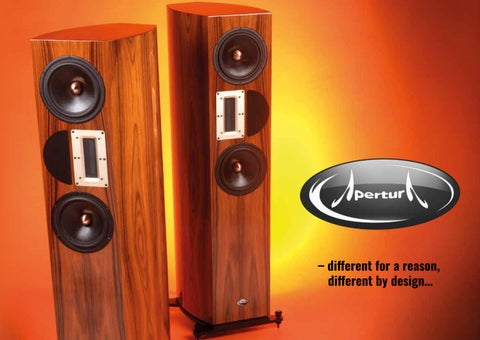
– different for a reason, different by design…
What Makes Apertura Different In a world where products from so many brands seem almost identical and buying decisions are increasingly made on price, Apertura speakers are as distinctive as they are different: different on the outside; different on the inside; different for a reason. These days, design and production decisions are dominated by what is referred to as Value Engineering – a fancy term for building products down to a price, a policy that cuts costs by cutting corners. But at Apertura we understand that term differently. For us, the value of any audio component is inextricably linked to its performance, any design or manufacturing decision based on delivering the best possible musical and sonic results at the price. It means rejecting accepted practice and questioning norms, looking at new materials or new ways of using established ones, reverting to an artisan approach where constructing each product is the work of a single individual and the final testing of every product is carried out by the same person that production engineered the design. The result is a range of speakers that reject the materials, construction, technology and topology found throughout their competition. The result is a range of speakers based on superior thinking, superior engineering and that deliver
significantly superior performance. That superiority is no happy accident, but the result of years of dedication and hard work. Apertura speakers look different because they are different – genuinely different – and those differences start with the people behind them… Pioneering loudspeaker designer Christian Yvon is the man responsible for the acoustic design of all Apertura products. Creator of the ground-breaking DRIM crossover topology in 1978, his research and the innovative solutions it generated helped redefine loudspeaker performance and led to a long career as a designer and consultant to many of Europe’s best known high-end loudspeaker brands, including the creation of Goldmund’s speaker line and work with Focal and Sonus Faber. But increasingly he came to realise that it was essential to control all aspects of the design, ensuring that every element adhered to his essential principles, in order to maximise the resulting performance. In 2010 that goal was finally realised with the establishment of Stentor SAS, in partnership with Eric Poyer, a mechanical and production engineer with over twenty years experience in the audio industry. Working together in close collaboration, they created the current Apertura line. The result is arguably the purest ever expression of Christian Yvon’s thinking, with innovative engineering and use of materials by Eric Poyer
eliminating unnecessary, costly and ineffective elements to deliver unprecedented musical performance at incredibly approachable prices. Exotic, high-end loudspeakers are necessarily destined only for the fortunate few. But if value is measured solely in terms of musical performance, rather than price or brand recognition, size, weight or the number of drivers, then taking that philosophy to its logical extreme, rejecting accepted theory and practice, questioning and evolving the way we use familiar materials, selecting solutions with that one, single goal in mind, can deliver remarkable results. Adopting such an approach produces products that are certainly different, but those differences make perfect sense, as soon as you appreciate their purpose. These are differences in the way the speakers are built, the way they look, but above all in the way they sound. These are differences you can hear. That purpose of these differences – Apertura’s purpose – is simply the most music possible for the money invested. Listen and it all makes sense.
1
Technologies Low Storage Cabinet
Asymmetry And The Internal Air Volume
The curved walls and asymmetrical shape of the Apertura cabinets is about more, much more than their clean good looks. Rather than the simple, machined MDF used in the vast majority of loudspeaker cabinets, the curved walls in the Apertura speakers are constructed from multiple thin layers of carefully selected HDF, bonded together and precisely moulded under extreme pressure, creating a structure that is far stiffer and dissipates energy far more effectively than a single, monolithic slab. Not only does this approach raise the resonant frequency of each cabinet panel, it helps prevent it resonating at a single dominant frequency. Combined with the asymmetrical footprint that minimises common dimensions and parallel sides between panels, strategically placed internal bracing and lapped construction at the joints (rather than the cheaper, weaker and less rigid butt joints normally used) this creates a cabinet structure with a diffuse resonant character and excellent energy dissipation and extremely low levels of colouration. Double thickness panels in key locations like the top and bottom-plates ensure optimum rigidity where required, while the low-storage signature of the cabinet as a whole helps reduce the intermodulation distortion that can smear and cloud the mid-band or produce lumpy, one-note low-frequencies.
Many people believe that the benefit of non-parallel or asymmetrical cabinet walls is that they prevent standing waves. In fact, that’s a misnomer. The use of curved enclosure walls has more to do with the stiffness of the resulting structure and its resistance to flexure. But that doesn’t mean that controlling internal standing waves is not critical to loudspeaker performance. The drive units project just as much energy backwards as forwards and that energy has to be controlled if leakage from the enclosure isn’t going to compromise the clarity of the sound. It is all about control. If you allow internal energy free rein, then it will produce dominant resonances that will re-radiate through the cabinet, the port and the drivers themselves. An adequate solution to this critical challenge requires more than just a bit of internal wadding: it needs a multi-facetted response. At Apertura we use a precisely calculated combination of internal damping materials, including our own, unique, proprietary pocketed sheeting, to influence the behaviour of the enclosed air volume and its critical relationship to the drivers and reflex port. By creating carefully calculated differential damping zones within the cabinet, minimising the area of the rear panel and doubling the thickness of the toppanel (the two main sources of spurious acoustic output) we prevent the drivers’ rear output returning to confuse the fragile musical information.
Curved walls – not flat, machined panels
Attenuation of internal energy through clever choice of materials and cabinet design
The DRIM Crossover
Simplicity, phase coherence AND steep slopes!
Mechanical Grounding
One spike – not three and definitely not four The unwanted rear wave can make its presence felt in many different and insidious ways. Although direct radiation of spurious acoustic energy is the most obvious, absorbing that energy creates its own problems. The primary functions of the cabinet are to load the drivers and contain their rear output, but once that energy passes into the cabinet structure, you’ve simply moved the problem from one place to another. In the worst case scenario, the vibrational energy passes through the cabinet and back into the drive units themselves, modifying their motion and thus their output, overlaying a delayed and distorted signal over the one you want to hear. It is crucial to provide a clean, direct exit path from the cabinet into the supporting surface – an effective mechanical ground. In theory, that’s what the spikes fitted to the corners of so many loudspeakers are trying to achieve, but in practice they are woefully inadequate: too many and in the wrong place, they offer a confusion of multiple paths each from a different base energy level, compromising ground impedance matching and stability. Echoing the grounding principle he first developed at Goldmund, Christian Yvon employs a single ground path, placed exactly at the speaker’s centre of gravity, with decoupled adjusters mounted on outriggers giving precise control over alignment and attitude. In this case simplicity is directly related to clarity – clarity of thought and musical clarity too.
The crossover is the weakest point in any loudspeaker design, capable of (and often) doing untold damage to the time and phase coherence of the signal. Christian Yvon’s revolutionary DRIM crossover topology, unique to his designs, delivers the Holy Grail of speaker design – the phase coherence so critical for proper musical reproduction combined with steep slopes to remove unwanted and all too audible out-of-band driver artefacts. It is remarkable how many modern speaker companies have just ‘rediscovered’ the critical importance of out-of-band output! The problem with simple, low-order crossovers is that although they offer good phase coherence, their shallow slopes are slow to roll-off driver output, allowing break up modes and unwanted peaks to intrude on the signal. By combining phase coherent output with steep yet configurable slopes, the DRIM crossover allows the filter characteristics to be matched precisely to each individual driver. The Apertura speakers take this approach to its logical conclusion, not only relying on two-way designs to keep overall topology as simple (and musically un-intrusive) as possible, but using the adaptability in the crossover slopes to open up the possibility of using the wide-band ribbon drivers that other design paths find so problematic. The DRIM crossover allows the steep slopes essential for such drivers to be carefully calculated. For each individual pair of speakers, first the drivers are measured and matched and then in each and every case, the crossover is tuned to the characteristics of the specific drivers it will be paired with. The end result is superb consistency, driver integration, pair matching and unprecedented system performance at this price level.
3
The Sensa has been specifically developed to bring Apertura standards of performance to smaller rooms and more modest driving systems. The almost rectangular cabinet might appear more conventional but in fact the curved rear corners are the result of extensive research into the most effective balance between curved construction and performance. Look inside and you’ll find all the trademark Apertura touches, with precisely placed bracing panels and critically calculated damping elements, combined with our proprietary crossover topology built from high-quality components. The result is a compact floorstander that still retains the natural tonal balance, image precision, clarity and absence of clutter so important to us – and so necessary to the enjoyment of recorded music.
After many, many requests, we finally took up the challenge of designing an affordable, versatile mini-monitor loudspeaker. The result is the Swing, a compact speaker that despite its diminutive dimensions and chic appearance, embodies all the central precepts of the Apertura philosophy. Massive 18mm panels, internal bracing, differential damping and precisely balanced reflex loading deliver bass that’s clean and quick enough to support a rich, colourful and responsive midrange and clean, seamlessly integrated treble, essential conditions to the enjoyment of any and all types of music. The Swing might be small, but when it comes to your music, its performance is mighty. 5
Faithful to a fault, the Armonia Evo is the physical manifestation of Apertura’s mechanical and acoustic philosophy, characterized by the total absence of the cabinet noise and parasitic resonance that lead to masking colourations and the sluggish, slurred low-frequencies that muddy the entire audible range. The result is solid, articulate and pitch perfect bass, underpinning a subtly detailed, delicate and expansive midrange, reproducing your recordings with unprecedented presence and credibility. The unique crossover topology, carefully selected drivers and exactly executed cabinet combine to deliver the clarity and accurate timing that is the key to musical communication.
True to Apertura tradition, the Edena Evo loudspeaker employs an elegant, asymmetrical architecture, wrapped around multiple, carefully placed internal bracing panels and damping elements to create a cabinet volume that’s entirely devoid of standing waves. Equipped with an ultra light, fast and efficient 21 cm bass midrange driver paired with a newly developed, large area ribbon tweeter, Edena Evo cuts straight to the heart of the music, delivering not just its inner structure but its sense and purpose too, an emotional as well as an electroacoustic transducer. 7
A direct result of the experience and knowledge gained during the development of the flagship Enigma loudspeaker, the Adamante is driven by the same ambition and embodies the same design DNA. The beautifully proportioned cabinet profile is inherently stiff, heavily braced and critically damped using lightweight panels derived from aerospace fuselage technology. It uses the same innovative crossover topology and large area ribbon tweeter as its big sister, an elegantly scaled reflection of our top of the range model. Adamante’s unadorned clarity and immediacy, the presence and insight she brings to the musical performance, can evoke the sort of deep, emotive response usually reserved for live music or the concert hall.
Embodying a rich, creative heritage that stretches back 35-years, the Enigma Mk.II represents the ultimate in musical reproduction. Its elegant proportions, heavily braced, asymmetrical cabinet structure, sophisticated damping, carefully selected and matched drivers and unique crossover topology reflect the conceptual clarity behind its design. Don’t be fooled by size or price. Dimensionally precise, rhythmically explicit and dynamically expressive, the Enigma Mk. II will allow you to travel deeper into the performance, experiencing and unravelling the inner mysteries of the musical universe. 9
Technical Specification SENSA
SWING
ARMONIA EVOLUTION
EDENA EVOLUTION
ADAMANTE
ENIGMA MKII
MID-WOOFER: 1x 16cm “Isotactic matrix” TWEETER: 1 x 25mm “ring radiator” LOAD: Bass Reflex SENSITIVITY (2.83v/1m): 87dB IMPEDANCE: 8 ohms DIMENSIONS: 170 x 240 x 864 mm DIMENSIONS WITH STANDS: 210 x 260 x 921 mm WEIGHT: 14kg BANDWIDTH (+/- 3dB): 40-30 kHz FINISHES: Black High Gloss | White High Gloss | Cherry Satin
MID-WOOFER: 1x 16cm “Isotactic matrix” TWEETER: 1 x 25mm “ring radiator” LOAD: Bass Reflex SENSITIVITY (2.83v/1m): 87dB IMPEDANCE: 8 ohms DIMENSIONS: 190 x 310 x 280 mm DIMENSIONS WITH STANDS: N/A WEIGHT: 7.6kg BANDWIDTH (+/- 3dB): 48-30 kHz FINISHES: Black High Gloss | White High Gloss | Cherry Satin
MID-WOOFER: 1x 18cm “Isotactic matrix” TWEETER: Ribbon 8 x 120mm LOAD: Bass Reflex SENSITIVITY (2.83v/1m): 87dB IMPEDANCE: 8 ohms DIMENSIONS: 205 x 291 x 1030 mm DIMENSIONS WITH STANDS: 292 x 291 x 1069 mm WEIGHT: 22.2kg BANDWIDTH (+/- 3dB): 37-30kHz FINISHES: Cherry Satin | Black High Gloss | White High Gloss | Rosewood High Gloss | Figured Maple High Gloss
MID-WOOFER: 1x 22cm “Isotactic matrix” TWEETER: Ribbon 8 x 120mm LOAD: Bass Reflex SENSITIVITY (2.83v/1m): 89dB IMPEDANCE: 8 ohms DIMENSIONS: 235 x 317 x 1110 mm DIMENSIONS WITH STANDS: 328 x 317 x 1149 mm WEIGHT: 33.3kg BANDWIDTH (+/- 3dB): 35-30kHz FINISHES: Standard finishes: Cherry Satin | Black High Gloss | White High Gloss | Rosewood High Gloss | Figured Maple High Gloss Any colour on demand: contact us.
MID-WOOFER: 2x 18cm “Isotactic matrix” TWEETER: Ribbon 15x145mm LOAD: Hybride Bass-Reflex / Acoustic Line SENSITIVITY (2.83v/1m): 93dB IMPEDANCE: 4 ohms DIMENSIONS: 220 x 353 x 1150 mm DIMENSIONS WITH STANDS: 360 x 391 x 1211mm WEIGHT: 52kg BANDWIDTH (+/- 3dB): 32-30kHz FINISHES: Standard finishes: Cherry High Gloss | Black High Gloss | Rosewood High Gloss | Figured Maple High Gloss Any colour on demand: contact us.
MID-WOOFER: 2x 22cm “Isotactic matrix” TWEETER: Ribbon 15x145mm LOAD: Hybride Bass-Reflex / Acoustic Line SENSITIVITY (2.83v/1m): 95dB IMPEDANCE: 4 ohms DIMENSIONS: 254 x 406 x 1270 mm DIMENSIONS WITH STANDS: 404 x 443 x 1346 mm WEIGHT: 76kg BANDWIDTH (+/- 3dB): 30-30kHz FINISHES: Standard finishes: Cherry High Gloss | Rosewood High Gloss | Rosewood Santos High Gloss Any colour on demand: contact us.
Apertura – a Stentor SAS brand | 3 La Hamonnais, 44810 Heric, France | www.apertura-audio.com