Architects, Masterplanners, Heritage Consultants
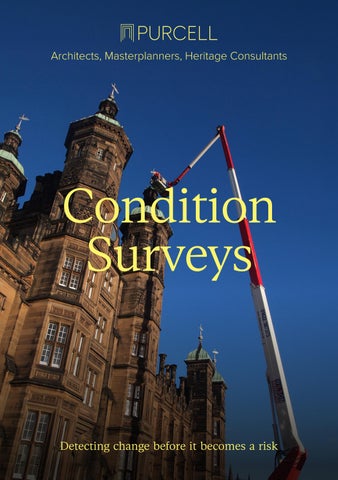
Condition Surveys
Detecting change before it becomes a risk
info@purcelluk.com +44 (0) 20 7379 7171 purcellarchitecture.com
© Purcell Architecture 2026
Crossness Pumping Station, London Purcell was commissioned by the Crossness Engines Trust to lead a comprehensive condition assessment of the historic buildings and prepare a coordinated 30-year maintenance and lifecycle plan. 2
C ON T E N TS
Introduction
04
Understanding your building
06
A strategic approach to surveying Why Purcell? Types of condition survey Commissioning a survey
09 16 18 20
Key project experience
22
Select project case studies
24
Contact
53
3
Purcell Conservation School, Canterbury Cathedral Combining practical sessions with tours and classroom lectures, the school is open to all members of staff and offers a bespoke programme of training on assessing and conserving historic sites and buildings. 4
CONDITION SURVEYS / INTRODUCTION
Every survey we deliver is a strategic tool to inform change, help clients understand their buildings, and plan for the future. Heritage buildings carry immense cultural value but they also carry long-term responsibilities. A well-executed condition survey gives owners the clarity needed to make informed, confident decisions about the future of their assets — shaping budgets, informing sensitive design, supporting funding bids and managing risk. Much of our work involves bringing coherence to complex estates: diagnosing problems early, anticipating maintenance cycles and presenting clear, actionable recommendations. Our team draws from the largest pool of conservation focused building consultants in the UK, enabling us to bring depth of insight to every survey— whether it supports long-term stewardship, retrofitting programmes, or strategic estate planning. Purcell work holistically, engaging closely with colleagues in heritage consultancy, design, and masterplanning to ensure our reporting is not only accurate but aligned with wider project goals. Our ambition is always the same: to provide clear, reliable advice that empowers clients to look after their buildings, manage risk responsibly, and unlock the potential of their assets for the future.
Elizabeth Smith Chairperson
5
6
Understanding your building
7
CLIENT TESTIMONIAL
“The level of detail and professionalism from the initial appointment stage, through Listed Building Consent, condition surveys, tender stage and on to the successful completion of the project was just excellent. The team exuded passion, knowledge, care, attention and took pride in their work, always taking a meticulous approach and with such a commanding appreciation of historic buildings and conservation. It was a real pleasure to work with people who care about their work and providing a first class service to their clients.” L EE F I SH, SENIOR BUILD IN G S U RVE YOR, N AT ION AL T R UST
8
CONDITION SURVEYS / UNDERSTANDING YOUR BUILDING
A strategic approach to surveying Informed decisions and effective action
7
1
Survey / re-survey
6
Use & monitor
Discover
2
Support ongoing maintenance, monitoring and stewardship
Diagnose Building a clear picture of condition, risks and opportunities
5
Define, prioritise and deliver the right interventions
Procure & build
3
Capacity for change
4
Design & specify
Our surveying process explore each stage
9
CONDITION SURVEYS / UNDERSTANDING YOUR BUILDING
Building a clear picture of condition, risks and opportunities
A clear understanding of a building’s condition is essential to making informed decisions about its future. Our approach begins with understanding your priorities and shaping the survey around them, from high-level assessments identifying key risks to detailed whole-building reviews and focused investigations into specific concerns. Through careful assessment, we identify early indicators of decay, defects and areas of risk, investigating their underlying causes and considering how the building is performing. Our conservation architects and specialist surveyors bring an in-depth understanding of traditional materials, historic construction techniques and characteristic patterns of decay, enabling accurate diagnosis and practical, conservation-led recommendations. This evidence provides a clear picture of current condition and helps establish where intervention is needed, where opportunities for change exist and what should be prioritised, providing a robust foundation for future maintenance, investment, repair and adaptation. 10
Discover
1
Establish a detailed understanding of the building, its construction, significance and current condition. We review available information, understand client priorities and determine the appropriate scope and level of survey required.
Diagnose
2
Identify defects, deterioration and areas of risk, investigating their underlying causes rather than simply recording symptoms. Our understanding of historic materials and construction helps us recommend appropriate treatments and avoid unnecessary intervention.
Capacity for change
3
Use survey findings to understand how the building can respond to future needs. This can include identifying opportunities for repair and adaptation, assessing fabric and environmental performance, and establishing priorities for maintenance, retrofit and investment. 11
CONDITION SURVEYS / UNDERSTANDING YOUR BUILDING
Define, prioritise and deliver the right interventions
The insight gained through a condition survey provides a robust basis for planning and delivering the right interventions. Survey findings can be developed into practical, conservation-led recommendations, helping to prioritise necessary works, establish realistic costs and inform sensitive design solutions that respond to the building’s significance, condition and future needs. Our multidisciplinary teams can take this evidence through design and specification, developing appropriate repair strategies and detailed proposals for conservation, adaptation and improved performance. Where required, we can support projects through procurement and construction, working collaboratively with clients, consultants and contractors to ensure recommendations are translated effectively into work on site. This continuity from survey through to delivery allows emerging conditions to be understood and addressed as work progresses, while ensuring interventions remain appropriate to the historic fabric and aligned with wider project objectives. 12
Design & specify
4
Translate survey findings into practical, conservation-led recommendations. Evidence gathered through the survey can inform repair strategies, specifications, sensitive design choices and measures to improve building performance.
Procure & build
5
Develop recommendations into planned and deliverable programmes of work. Survey information can help define scope, priorities and budgets, support procurement and provide a robust evidence base as works progress on site.
13
CONDITION SURVEYS / UNDERSTANDING YOUR BUILDING
Support ongoing maintenance, monitoring and stewardship
The long-term care of historic buildings relies on regular inspection, maintenance and an understanding of how their condition changes over time. We advocate a ‘little and often’ approach, identifying and addressing smaller maintenance needs before they develop into more complex and costly repairs. Regular condition surveys and building inspections provide a structured way to monitor change, manage risk and maintain an up-to-date understanding of an asset. Our surveys can inform cyclical and forward maintenance programmes, setting out prioritised works over defined periods and helping clients distinguish between urgent repairs, planned interventions and defects that should continue to be monitored. Re-surveying also allows recurring issues to be identified and priorities reviewed as the building, its use and its condition evolve. This approach is embedded in many of our long-term relationships. At Canterbury Cathedral, for example, Purcell has supported the Surveyor to the Fabric for over 30 years, forecasting and overseeing planned preventative maintenance alongside major conservation works. 14
Use & monitor
6
Support the ongoing care of buildings through planned maintenance and monitoring. Regular review can identify minor defects before they develop into more significant problems, helping clients manage risk, expenditure and stewardship responsibilities.
Survey / re-survey
7
Revisit condition over time to understand how the building and previous interventions are performing. Re-surveys can identify emerging or recurring defects, update priorities and budgets, and provide an evolving evidence base for future maintenance and investment.
15
CONDITION SURVEYS / UNDERSTANDING YOUR BUILDING
Why Purcell? A tailored, bespoke approach We begin by understanding your priorities and shaping a survey around them, from high-level assessments identifying key risks to detailed surveys with recommendations and cost estimates, or comprehensive whole-building reviews. We also undertake focused investigations into specific concerns, including moisture, thermal performance, building fabric behaviour and decarbonisation.
Modern tools for historic fabrics We combine traditional inspection methods with modern surveying technology to understand historic fabric. Drone surveys play an essential role in our work, offering quick, safe access to roofs, towers and inaccessible elevations. When combined with close-up inspections including mobile elevating work platforms, where appropriate, they provide robust, evidence-based insights while minimising disruption.
Conservation expertise
16
Our conservation architects and specialist surveyors bring deep understanding of traditional materials, historic construction techniques and characteristic patterns of decay. Their expertise allows accurate diagnosis and practical, conservation-led recommendations. Our surveys follow relevant British Standards and RICS guidance, alongside requirements for complex historic buildings.
300+ architects, masterplanners, heritage consultants, surveyors, technologists, BIM specialists, visualisers and support staff
45+ conservation-accredited professionals, holding AABC, RIBA, RICS, IHBC or CIfA conservation accreditation
No. 1 ranked No.1 for Heritage in World Architecture 100 17
CONDITION SURVEYS / UNDERSTANDING YOUR BUILDING
Types of condition survey Choosing the right assessment General consultation advice
Targeted issue assessment
Strategic survey
What is it?
What is it?
What is it?
High-level assessment of a building or site, which can identify risks and issues to repair, maintenance and conservation.
Detailed investigation and analysis of a specific problem or related set of concerns, such as moisture, building performance or decarbonisation.
High-level assessment of a building’s overall condition, with outline repair recommendations and indicative costs (with or without a Quantity Surveyor).
Where this might apply • Conservation Management Plans • Ongoing works • Concept design schemes
Where this might apply Where a known concern requires further investigation to understand its extent, causes or implications
Benefits • Cost effective • Rapid technical input and oversight on general issues • Can feed into an existing report
Benefits • Provides detailed targeted information • Can assist with resolution of issues at the design stage
Where this might apply • Feasibility studies and early design stages (RIBA Stages 0–2) • Funding applications • Periodic inspections such as quinquennial surveys • Strategy or masterplanning exercises
Output Letter of advice or text contribution.
Output Illustrated report, supported where appropriate by specialist technical survey techniques.
18
Benefits • Whole assessment of a building’s condition • Can be used to prepare high-level Schedules of Repair
Output Illustrated strategic report which can be combined with annotated drawings.
Comprehensive survey
Conservation condition report
What is it?
What is it?
Lists all building components regardless of condition, recording defects, recommended repairs and priorities. Quantities provided in sufficient detail for a Quantity Surveyor to cost a forward works plan.
A strategic assessment of a building’s condition, identifying maintenance needs, priorities and costed options. Can also include Reinstatement Cost Assessments for insurance purposes.
Where this might apply • Major projects and whole building refurbishment • Feasibility studies and funding applications
Where this might apply • Long-term maintenance plans • Feasibility studies • Funding applications
Benefits • The most comprehensive survey • A strong basis for schedules of repair and cost analysis
Benefits • Provides strategic options for long-term care and risk management • Anticipates scale and complexity of maintenance projects and whole-project costs
Output A precise overview report summarising findings and background information, with appendices containing relevant supporting data.
Output A four-page summary of condition, cyclical tasks and maintenance projects, with key metrics on strategy options and costs. Appendices with extensive supporting data.
19
CONDITION SURVEYS / UNDERSTANDING YOUR BUILDING
Commissioning a survey Informed decisions and effective action How you can appoint us
What you can expect
• Directly
Clear, accessible reporting We present our findings and recommendations in a format that works for you and your team.
• Through a framework agreement • Via your lead consultant
Data that works with your systems We provide relevant survey data that can integrate seamlessly with your existing IT interfaces.
Our surveying services • Condition surveys for architectural projects • Condition surveys to inform retrofit • Periodic inspections, including quinquennial and quadrennial surveys
Technology with a purpose We embrace new technologies where they improve access, efficiency or the quality of insight our surveys provide. A clear route forward
• Management and maintenance plans
Our findings are focused on helping you understand priorities and make informed decisions about what happens next.
• Conservation management plans • Grant application condition surveys • Estate management and advice • Building defect diagnosis • Expert Witness statements • Repairs Notice advice • Access audits
Standards and assurance We work to the following standards: ISO 9001:2015 Quality Management
ISO 14001:2015 Environmental Management
ISO 45001:2018 Occupational Health & Safety
RICS Building Surveying Standards
**We also work to specific standards and compliance requirements set by individual clients and organisations.
20
CLIENT TESTIMONIAL
“Purcell was excellent in bringing together much disparate information into a coherent analysis – Ashridge is to be congratulated on undertaking this much-needed study, which will provide much more rationale for future changes.” JAM ES M OIR, CON S E RVAT ION OFFIC E R, DAC OR UM C O UN C I L
“Our Brunel Museum Conservation Management Plan was meticulously researched with realistic conservation policies proportionate to the use of the buildings: a truly dynamic document that continues to be a delight to consult by a whole range of users.” JA NE STA NCLIFFE, C H AIR OF T H E P ROJE C T ST EER I N G C O M M I T T EE, B RU NEL M U SEU M 21
22 22
Key project experience
23 23
CONDITION SURVEYS / KEY PROJECT EXPERIENCE
Bridgewater Monument Ashridge Estate, UK
Grade II* listed Bridgewater Monument is a neoclassical monument in the form of a Greek Doric Column, built in 1832 to commemorate the 3rd Duke of Bridgewater. In 2022, Purcell conducted a detailed condition survey of the monument. After a series of trials and samples, specific repair and cleaning solutions were developed. This included repointing and cleaning, internal masonry repairs, internal spiral staircase repair, and metalwork repairs to gates and railings. The monument is constructed of granite, however, internally it is faced with a much softer sedimentary stone at low level. This inherent design defect resulted in heavy salt efflorescence and staining to the internal masonry as penetrating water was forced through the softer stone. Extensive cement repairs had previously been put in to the internal spiral staircase, which was accelerating the decay of the stonework by trapping moisture within the stone steps. We worked closely with specialist stone conservators, Paye, on a programme of repairs and cleaning which was completed in time to allow the monument to be reopened to the public in 2025.
24
See drawing 1017/2
See drawing 1015/2
2 EAST ELEVATION 6/7 1016 1:20@A3
0
250mm 500mm 750mm
25
1m
CONDITION SURVEYS / KEY PROJECT EXPERIENCE
Stowe House Buckinghamshire, UK
One of the finest 18th-century classical buildings in Europe, Purcell has been leading a phased multi-million pound Strategic Restoration programme at Grade I listed Stowe House, Buckinghamshire for over 25 years. Purcell was instructed to carry out a condition survey of the principal buildings of Stowe House. The brief included a non-intrusive condition survey for the State Rooms, and externally, all 30 buildings and associated roofs. Our report provided a detailed analysis of fabric defects and repair issues for all thirty buildings, with annotated photographs, colour-coded RAG status and quantified repair recommendations. A specialist report on the external render was also included. Our resulting exemplary conservation and maintenance work to the stonework façades and historic lead roofs has won numerous international awards, safeguarding the future of this classical masterpiece and enabling its removal from the Historic England Heritage At Risk Register. 26
“Purcell has been intimately engaged throughout this very complex and challenging programme. Their skills and expertise may best be judged through the growing list of outcomes which are I suggest simply world-class.” AND REW FA NE OB E , C H AIR, STOW E H OU S E P RES ERVAT I O N T R UST
AWARDS
The Georgian Group Architectural Award Won The Georgian Group Award Won The Georgian Group Award: Outstanding Achievement Won Country Life: Restoration of the Century Won RIBA South Won
2023 2021 2012 2010 2007 27
CONDITION SURVEYS / KEY PROJECT EXPERIENCE
Ledston Hall Leeds, UK
Purcell developed an initial strategic plan and subsequently delivered a phased programme of conservation, which included extensive fabric repairs, sensitive extensions, and interior adaptations to create luxury residential homes and private function spaces, all while preserving historic features. Purcell carried out extensive condition surveys which informed the proposals for fabric repair and new interventions where appropriate. The consequent restoration and conservation repairs, which led to the removal of both the Grade I listed hall and the Grade II* listed gate piers from Historic England’s Heritage at Risk Register, have secured a sustainable future for Ledston Hall. Ledston Hall became the first Grade I listed building in the UK to receive Listed Building Consent for the replacement of its historic windows. This landmark approval demonstrates that progressive energy-saving measures can be successfully integrated with the conservation of heritage assets. 28
69m
68m
67m
66m
65m
64m
63m
62m
RWP 9
61m
60m
WS15 WS16
WS22 Blocked
WS17
WS18
WS19
WS20 Blocked
WF19
WF20
WF21
WF22
WF23
WF24 Blocked
WG19
Former - WG20 - WB06
WG21
WG22 Blocked
WG23 Blocked
59m
WS21 Blocked
58m
57m
56m
WF15 Blocked
WF16 Blocked
WF17
WF18
WG15
WG16
WG17
WB03
WB04
55m
54m
53m
WG14 52m
Tower 04
WG18
WB05
51m
New DG125N
WB07
Tower 05
1 North Elevation 01 3607 1:50 @ A1
N
01
SELECT AWARDS Existing window
Notes: Drawings are based on survey data and may not accurately represent what is physically present. Do not scale from this drawing. All dimensions are to be verified on site before proceeding with the work.
Pre 1850 1850-1950 historic glazing supplemented with modern float glass 1850-1950 rare instances of historic glazing
All dimensions are in millimeters unless noted otherwise.
1950+
Purcell shall be notified in writing of any discrepancies.
Missing Window
Proposal
CLIENT
The Wheler Foundation
DRAWING TITLE
North Elevation Windows
JOB NUMBER
234051
PROJECT
Ledston Hall
SIZE & SCALE
A1L
DRAWING NO.
3607
DRAWING STATUS
S4 - Listed Building Consent
REVISION
P02
Metal windows proposed to be replaced with a faceted slimline double glazing system by Touchstone Metal windows retained as single glazed Metal windows glazing replaced with mono-laminated glazing
First Issue 07/05/2021
Timber windows retained as existing
ISSUE
DATE
CH
CH
DRAWN
CHECKED
DESCRIPTION
LED-PUR-01-ZZ-DR-A-3607
1:50@A1
RICS Yorkshire: Heritage Won 2024 Yorkshire Insider Property Awards: Refurbishment and Renovation Project of the Year Shortlisted 2024
29 Marygate, York, YO30 7WH © PURCELL 2019. PURCELL ® IS THE TRADING NAME OF PURCELL ARCHITECTURE LTD.
29
CONDITION SURVEYS / KEY PROJECT EXPERIENCE
Margam Castle is a Grade I listed Tudor Gothic mansion, built for the Talbot family in the early 19th century and now owned by Neath Port Talbot Borough Council. In 1977, the castle fell into disrepair following a fire that caused significant structural damage whilst completely destroying the interior.
Margam Castle Port Talbot, UK
Appointed in 2022 as part of a multidisciplinary team, Purcell undertook a detailed condition survey and architectural feasibility, as well as preparing a detailed Conservation Plan for the building. This plan provides recent, firsthand knowledge of the building’s significance, condition, vulnerabilities and management context, and a strong foundation for policies on repair, maintenance, phased intervention and sustainable future use.
CONDITION OF EXTERIORS
West Elevation
01 01 06
07
04 03
05
02
22
Example of how we use illustrated drawings to explain complex repair issues. In this case, the blue areas indicate saturated masonry, the orange areas indicate deteriorated stonework and the green areas indicate algal growth.
30
“I don’t use ‘exceptional’ very often but this time it is a word that fits. I hope that we get the opportunity to all work together on the next stage at Margam Castle.” IAN BAGGOTT, MAN AG IN G D IRE C TOR, C FP
31
CONDITION SURVEYS / KEY PROJECT EXPERIENCE
York Castle Museum York, UK
York Castle Museum occupies a complex and highly significant historic site within the former civic heart of the city. Housed within two Grade I listed 18th-century former prisons and surrounded by the remains of the castle walls, the museum forms part of a wider collection of heritage assets protected by the Scheduled Monument status of the site. Purcell undertook condition surveys to identify defects, repair requirements and priorities for intervention. Structured by building element, the surveys provided a clear evidence base to inform the masterplan, enabling the client and wider project team to understand, cost and programme future repair works.
32
Feltham House, Feltham Purcell carried out condition surveys and advised on its potential for re-use.
Ministry of Defence Various locations
Purcell was commissioned to undertake numerous quadrennial condition surveys on listed buildings on Ministry of Defence sites. Our condition reports provide a systematic description of each element of the building, an assessment of its condition, recommendations for repair and a rough order of cost. The buildings surveyed range from purpose-built military structures such as aircraft hangars to domestic buildings. One example is Chicksands Priory in Bedfordshire, a Grade I listed country mansion, now used as an Officers Mess. The Rifles Museum in Salisbury occupies a Grade II* listed building known as The Wardrobe. It has medieval origins and is located in the cathedral close.
33
33
CONDITION SURVEYS / KEY PROJECT EXPERIENCE
Kingston and Arthur’s Vale Historic Area Norfolk Island, Australia
34
Purcell undertook a detailed survey of all assets to understand the baseline conditions of the various historic structures and prioritise remedial and ongoing maintenance works. The resulting Condition and Conservation Report recommended changes in maintenance and conservation practice, which resulted in an additional engagement for a Heritage Maintenance Plan including the introduction of annual and periodic inspection and maintenance programmes to enable holistic management of heritage assets, while also providing traditional techniques and specifications for mortars, renders, and paints.
Reading Town Hall Berkshire, UK
Reading Town Hall is a complex civic landmark comprising five separately listed buildings, including a Grade II* extension by Sir Alfred Waterhouse. Commissioned by Reading Borough Council, Purcell carried out a comprehensive external condition survey, including roofs, facades and windows, combining close-up inspections with drone and thermographic surveys to assess defects, heat loss and recommend repair priorities. The findings created a clear evidence base for phased conservation works. 35
CONDITION SURVEYS / KEY PROJECT EXPERIENCE
Tai Kwun Centre for Heritage & Arts Central, Hong Kong
Nestled in the heart of Central, Tai Kwun is Hong Kong’s largest heritage conservation and adaptive reuse project, a HK$3.8 billion (£380 million) endeavour that has breathed new life into the city’s past. Purcell carried out a condition assessment on 16 historic buildings at Tai Kwun, defining the scope for what was an extensive restoration programme both internally and externally. The survey was supported by enabling works to open up and further interrogate buildings’ integrity. The result is a fully restored site that balanced the requirement to preserve the buildings’ historic character with the need for sustainable renewal. Since the site’s opening in 2018, Purcell has been further engaged to undertake annual and periodic inspections to ensure the condition is maintained at the standard when the site opened. 36
37
CONDITION SURVEYS / KEY PROJECT EXPERIENCE
Purcell undertook a Quinquennial Inspection of Witley Court, Worcestershire (above) and Whitby Abbey, North Yorkshire (right)
38
English Heritage Quinquennial Surveys Various locations
Purcell works closely with English Heritage to deliver Quinquennial Surveys across a number of its nationally significant estates, including Dover Castle, Witley Court, Whitby Abbey and Pevensey Castle. Undertaken to English Heritage’s exacting standards, our surveys record condition, repair priorities, recommendations and indicative costs. Findings are incorporated into its national database, providing up-to-date information to support accurate budgeting and the effective planning of repair programmes across its diverse portfolio. 39
CONDITION SURVEYS / KEY PROJECT EXPERIENCE
Manor House Norfolk, UK
Manor House is a Grade I listed 16th century building renowned for its rare terracotta detailing. Purcell assessed the condition and performance of key building elements to identify opportunities for energy-efficiency improvements. Fabric-first interventions were considered alongside active measures, allowing improvements to be evaluated holistically and ensuring recommendations balanced enhanced environmental performance with the conservation of the building’s historic significance.
40
Cheyney Court, Winchester Cathedral Close A Grade I listed building located in the south end of the Cathedral Close
Winchester Cathedral Close Winchester
As part of the estate masterplan, Purcell carried out condition surveys of 27 buildings within Winchester Cathedral Close, providing an evidence base for the long-term development of the estate. The surveys gave the client a clear understanding of the condition, materials and fabric of each historic building, identifying repair priorities and opportunities for improvement to inform their ongoing care and maintenance. Pictured is Cheyney Court, a Grade I listed building within the Cathedral Close. 41
CONDITION SURVEYS / KEY PROJECT EXPERIENCE
Salford Cathedral Greater Manchester, UK
Salford Cathedral, a 19th-century Grade II* listed building, is a significant example of early Victorian ecclesiastical architecture. Purcell was appointed to support a programme of repair, reordering and fabric improvement that enhances the cathedral’s historic character while advancing long-term sustainability. Our work combined detailed condition assessment with heritage analysis to guide sensitive interventions across the site. As part of a multidisciplinary team, we helped shape proposals for a ground source heat pump, underfloor heating, roof insulation and discreet secondary glazing to improve energy performance without compromising historic fabric. The survey identified risks, prioritised repairs and informed a phased strategy to strengthen the cathedral’s resilience. Drawing on specialist conservation expertise, we supported long-term stewardship, highlighting where investment would have greatest impact while reducing operational costs and supporting future use. 42
43
CONDITION SURVEYS / KEY PROJECT EXPERIENCE
Mentmore Towers is a Grade I listed Mentmore Towers country house included on Historic Buckinghamshire, UK England’s Heritage at Risk Register. Following many years of vacancy, Purcell was commissioned by Buckinghamshire Council to assess the condition of the building. Supported by drone photography and specialist structural and cost advice, the survey identified urgent works to arrest further decay alongside longer-term repairs necessary for the building’s conservation, providing clear priorities for its future care.
44
Colchester Castle Museum One of 48 historic sites surveyed by Purcell as part of a programme of Level 3 condition surveys
Colchester City Council Various locations
Purcell carried out Level 3 condition surveys across 48 historic sites for Colchester City Council, including Colchester Castle Museum, Hollytrees Museum, Holy Trinity Church and sections of the Roman wall. Delivered by three survey teams within a three-month programme, the surveys provided a consistent understanding of condition and urgent priorities across the estate. The findings have since supported successful funding bids, including £1.3million from the MEND fund and £5million for the Natural History Museum. 45
CONDITION SURVEYS / KEY PROJECT EXPERIENCE
Oxburgh Hall Norfolk, UK
Purcell was architect and lead designer for the ambitious Raise the Roof project at Oxburgh Hall – the largest conservation effort in the building’s history. The £6million conservation programme across the Grade I listed building saw critical repairs carried out to the 15th-century hall’s roof, chimneys, windows and medieval gatehouse facade, all while remaining open to the public. Alongside our work for the National Trust, we have also acted for the Bedingfeld family on a range of conservation and improvement projects within their private residential accommodation at Oxburgh Hall. The restoration completed in 2023, securing the future of this iconic National Trust property for generations to come. In 2024, our Heritage Consultancy team prepared a new Conservation Management Plan and gazetteer, strengthening the long-term stewardship of the gardens and wider historic landscape.
46
AWARDS
RICS East: Heritage Won 2024 Civic Trust Awards: AABC Conservation Award Highly Commended 2024 AJ Architecture Awards: Refurbishment Shortlisted 2024 Building Awards: Restoration Project of the Year Shortlisted 2024
47
“We are grateful for the depth of heritage knowledge, experience and expertise that Purcell brought to this complex and unique Grade I listed building to safeguard its future for the many thousands of National Trust members and visitors who enjoy Oxburgh Hall throughout the year.” DAVI D W HITE, NATION AL T RU ST P ROJE C T MAN AG E R
48
14 dormer windows meticulously rebuilt
27 historic brick chimneys conserved
14,000 roof slates carefully replaced 49
CONDITION SURVEYS / KEY PROJECT EXPERIENCE
Concrete Condition Surveys Various locations, UK
Purcell has undertaken several concrete condition surveys of listed 20th-century buildings, including the Brunswick Centre in Bloomsbury, London and the URS Building at the University of Reading, both Grade II listed. The surveys focused on external concrete building components and comprised detailed visual inspections of each building, identifying a series of defects which have been assigned priority ratings dependent on their condition and location. Outline repair methodologies developed for each defect type will be trialled and refined prior to implementation. Our assessment focused on improving the overall appearance of the building and addressing poor previous interventions. We have adopted a similar approach for Technical Building A (TBA) at Heathrow Airport, a vast 1950s hangar now Grade II listed. Commissioned by British Airways, we are undertaking a detailed condition survey of its predominantly concrete facades. 50
Technical Building A (TBA), Heathrow Aiport
Brunswick Centre, London
Art & Regional Studies (URS) Building, University of Reading 51
52
Contact
53
CONDITION SURVEYS / CONTACT
Our global reach
Hong Kong
SCOTLAND
Edinburgh
ASIA PACIFIC
Sydney
York
Melbourne Manchester
Hobart
ENGLAND
Norwich Cambridge
WALES Oxford Bristol
Studio map 54
London
Canterbury
info@purcelluk.com +44 (0) 20 7379 7171 purcellarchitecture.com
LONDON & SOUTH-EAST
Elizabeth Smith Chairman BA (Hons) DipArch MA RIBA SCA
elizabeth.smith@purcelluk.com +44 (0) 207 397 7171 +44 (0) 7748 982 933
_
LONDON & SOUTH-EAST
NORTH
Joe Witchell Regional Partner
Jonathan Deeming Regional Partner
BA (Hons) DipArch RIBA
BArch (Hons) DipArch MArch RIBA SCA AABC
joe.witchell@purcelluk.com +44 (0) 207 397 7171 +44 (0) 7484 953 988
jonathan.deeming@purcelluk.com +44 (0) 1904 644 001 +44 (0) 7919 300 424
EAST
WEST
ASIA PACIFIC
Peter Buist Regional Partner
Justin Metcalfe Regional Partner
Tracey Skovronek Managing Director
BA (Hons) MArch PGCert RIBA
BA (Hons) BArch PGDip RIBA
BA (Hons) BArch (Hons) DipPPM RIBA
peter.buist@purcelluk.com +44 (0) 1206 244 844 +44 (0) 7769 695 162
justin.metcalfe@purcelluk.com +44 (0) 207 397 7171 +44 (0) 7912 747 992
tracey.skovronek@purcelluk.com +61 (0) 426 047 474
info@purcelluk.com +44 (0) 20 7379 7171 purcellarchitecture.com
Purcell is an international practice of architects, masterplanners, and heritage consultants. Since 1947, we have been leading exemplary projects to protect, enhance, and evolve the world’s most significant historic places and listed buildings. Inspired by a deep understanding of context, we craft the identity of the unique places in which we work by cherishing their heritage. Today we are a team of over 350 in studios across the UK and Asia Pacific. With a spirit that is genuinely innovative and collaborative, we are focused on planet-positive design, championing adaptive reuse of our existing built environment over new construction. We pioneer a conservation-led approach that celebrates our past and responsibly considers the legacy we will leave for future generations. Reimagining heritage in new ways, we work to facilitate positive change for our clients, communities, and wider society by shaping vital, inclusive, and joyful spaces where people can belong. As the world’s largest team of heritage specialists, Purcell has an outstanding reputation for defining conservation management plans and conservation and restoration strategies, and delivering multiple award-winning conservation repair, creative design, and sustainable reinvention projects to listed buildings and historic places around the world. Projects include some of the UK’s most significant visitor attractions, royal palaces, country house estates and castles and ruins across the UK and beyond. We are proud to be a Certified B Corporation®, ranked No.1 for Heritage in the World Architecture 100, and recognised for creating places that celebrate heritage while making space for new stories to unfold.
56
57
58