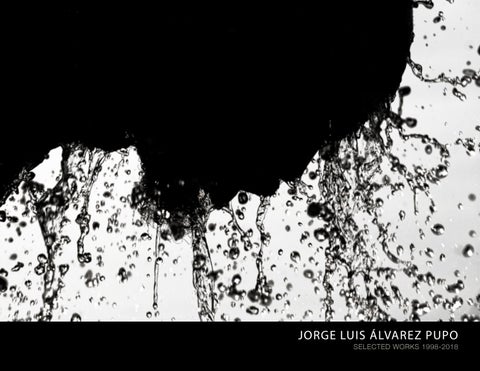
JORGE LUIS ÁLVAREZ PUPO
1 SELECTED WORKS 1998-2018
TRANCE
The spiritual world that has the capacity to enliven a work of art is often more important than the work of art itself. “At times it is troublesome that the artwork monopolizes and defines our artistic interest. The works of art are always emanations, consequences, effects that illuminate the life of the individual, the artist,” expressed art critic Orlando Hernandez, clarifying the particular struggle between life and work. Jorge Luis Álvarez Pupo, has developed a body of work representing a universe formed by the rituals of faith through which human beings are able to enter the spiritual world. The images that appear in his photographs are completed in the mind of the spectator through the chain of events of one’s
2
own experiences and remembrances, through the
the first light, like Oloddumare did when created all
manner in which the mystical and interior selves
of nature and human beings, seizing them from the
have been developed, through beliefs and faith
darkness of the reign of Echu. Men appear who
— if not through ritual and prayer then through
fight against the elements in their primitive naked-
thoughts, desires, or “visions.”
ness, on whose faces we see the gaze of terror at the forces of the power of fire shadow, and destiny.
Or simply through the idea that every one of us is formed by the religious collective conscious-
With his photographs, Pupo succeeds in capturing
ness that defines the cultural context of our
every kind of movement — the rhythm of the dance,
country,where those who are not practitioners are
the twisted movements of the possessed as they
not able to avoid the indirect daily contact. Thus
fall in a trance, the slow changes in the firelight,
art openly transmits life to us.
or the lingering form of the imagined moving spirits — like the near imperceptible vibrations that
In these impressions in black-and-white that Pupo
consume the spirit world.
produces in the penumbra of the darkroom, images of human beings emerge from the shadows with
MABEL LLEVAT SOY Art critic and Curator
3
Ways, 2001
4
1998-2004
OGGU´S POWER 5
6
7
8
9
10
11
12
13
14
15
16
17
18
19
20
21
22
23
24
25
26
1999-2009
THE WAY BEYOND 27
28
29
30
31
32
33
34
35
36
2002-2007
VISIONS 37
38
39
40
41
42
43
44
45
46
47
48
49
50
51
52
53
 I WAS BORN
KIND OF BLUES 2004-2007
54
I was Born kind of blues is a referential metaphor
instrument, the body as the main protagonist of our
to the Kind of Blue CD kind of Blue by Jazz musi-
existence, it suffers, loves, grows, falls apart.
cian Miles Davis, which transmits feelings of a very diverse nature and states of mind in a kind of ¨ Blues-
This is a body of work with an apparently peaceful
Jazz¨ mixture. The title is an associative appropria-
spirit and visually romantic, but it has a deep charge
tion of two different media which are ¨playing¨ with
of loneliness, it is a visual paradox where the fact
the same emotions. This series is the progression
that you are quietly sharing very close portions of
of two previous ones : ¨ VISIONS¨ and ¨ THE WAY
space with others does not mean you are emotion-
BEYOND¨, where I had and still have the purpose of
ally in plenitude, it is just a ¨ shelter¨ to feel yourself
being part of the speech instead being the speaker.
protected. I am talking about my own conflicts and
Self-reference is a justification that keep me inside
other’s. I’ve kept an interest in manipulating light,
the phenomena I am talking about, a way of watch-
including zones of darkness, shadow (as zones of
ing myself on a mirror instead of pointing into an-
silence), where you whisper to hide your real feel-
other.
ings. It pretends to be piece of a non written diary of people around me, society and myself as part of it.
I want to push out a sensorial discharge of the transformation you pass by in your life, using a body as an
JORGE LUIS ÁLVAREZ PUPO [May, 2004]
55
56
57
58
59
60
61
62
63
64
65
66
67
68
69
70
WANDERING WAYS / CAMINOS ERRANTES 2009-2013
71
Caminos errantes / Wandering ways is a visual reflection on the theme of migration, on the loneliness of human destiny and thow our freedom of
WANDERING WAYS/ CAMINOS ERRANTES
movement is condirioned on a daily basis. In this essay I establish a relationship between space and individual or the lack of it within the landscape. I concentrate on migrations as the physical change of environment, but also as psychological challenge to understand another culture and yet to keep alive one’s identity, even when moving within one’s own country. On my way to produce this body of work, I´ve wondered many times how I could approach a subject
72
such as migrations, without falling into the trap of
have created a false illusion of isolated and secure
what is easy and evident to the observer, running
private spaces, generating a kind of urban archi-
away from the comfortable environment of either
tectural paranoia in a form of huge blind buildings,
becoming a voyeur of what is visually expected
where psychological barriers are bigger than dis-
when talking about migrations, or either showing
tances that separate physical spaces.
protagonists as “victims” of the process which I´m
part myself.
In this work I create my own imaginary, sometimes using geometric patterns as visual codes to pre-
In several cities of the world, urban expansion is no
sent cyclical mass deployments, overcrowded
longer associated with the necessity to generate
metropolis as well as certain areas of tension with-
living spaces for individuals who move into bigger
in space-individual relationship ; in order to show
cities looking for broader employment opportuni-
not only the natural barriers but also architectural
ties. As fast as the messiness of unsustainable ur-
and social ones and also question : who am I, and
banization is developed, technocrats at metropolis
where do I fit in these new landscapes.
73
74
75
76
77
78
79
80
81
82
83
84
85
86
87
88
89
90
91
92
93
94
95
96
97
98
99
100
101
102
103
104
105
106
107
108
109
110
111
112
113
114
115
116
117
118
THIS IS NOT A LOVE SONG... WORK IN PROGRESS
119
This is an unwritten love letter to every single person
THIS IS NOT A LOVE SONG...BUT IT ’S ALL ABOUT LOVE.
who’s been kind enough to share with me some of the most important periods on their existence.
“ This is not a love song” is a series full of metaphors, where I don’t pretend people to understand what I am talking about, I just want them to feel something.
It is just a way I found to get out of the inner darkness which inhabited my soul after I’ve lost several of the most important beings within my entourage, It’s full of pain and joy.
120
In this series I’ve focussed on the tiny details which
I’ve decided using elements such as warm tones and har-
fuel my life. I’m creating this images as stories based
monic compositions that could add beauty to images in
on memories of ephemeral moments of kindness,
order to seduce the observer to come close to what they
passion and pain by using body language just as an
see or feel, instead of just walking by.
instrument. Jorge Luis Álvarez Pupo Although I’ve been using the body in most of my pre-
December 12th 2016
vious works, it’s the first time I got “ naked”, not being afraid of losing control of the image, I’m trying to talk out of my guts.
My aesthetic choice for this series rely on the fact that I wanted to get rid of all the mercifulness contained on the expression “ I’m sorry about your loss” which I’ve got tired of listening.
121
122
123
124
125
126
127
128
129
130
131
132
133
134
135
136
137
138
139
140
141
JORGE LUIS ÁLVAREZ PUPO www.pupophoto.com / artpupo@gmail.com + 32 486 31 67 58 (Belgium)
Born in Havana City, 1970. Cuban nationality. Free Lance. Lives and works in Brussels Belgium. Member of UNEAC (Union de Escritores y Artistas de Cuba)
142
I’m a freelance photographer based in Belgium specialized in fine art, editorial and sports photography. Contributor to Getty Images Latin America. Graduated of Literature and English Language at the University of Havana, Cuba. Graduated photography at the International Institute for Journalism ¨José Martí ¨, Havana, Cuba. I’ve been contributor to Getty Images since 2009, covering sport events such as Samsung Diamond League of Athetics, World Championships of Artistic Gymnastics, World League of Volleyball, Judo World cup & Davis Cup semi finals in Belgium, among others. With a Fine art work focused on subjects such as migrations, religion and identity, I’ve used my photography as a way to rediscover those topics from a new perspective, sometimes using self-reference as a justification that allows me being part of the speech instead of being the speaker. My work has been published at ESPN, The Guardian, L’Equipe Magazine, Le Soir journal, Art Fórum magazine, Paris Photo Magazine and the books “ Mapas Abiertos : Contemporary Latin American Photography 19922002”, Barcelona, Lunwerg Editions, 2005; “Trance”, by Percevalpress, 2003, “The light in cuban eyes: Lake Forest College’s Madeleine P. Plonsker Collection of Contemporary Cuban Photography 2015. I’ve exhibited in Paris, New York, Berlin, PhotoEspana Madrid, Bern; Switzerland, Havana, Sao Paulo. I’m also part of the art collections of the Albertina Museum [Austria], Pinacoteca do Estado [São Paulo, Brazil], Govinda Gallery [Washington D.C.], FNAC Photographic Collection [Paris], and other private collections worldwide.
143
144
145
146