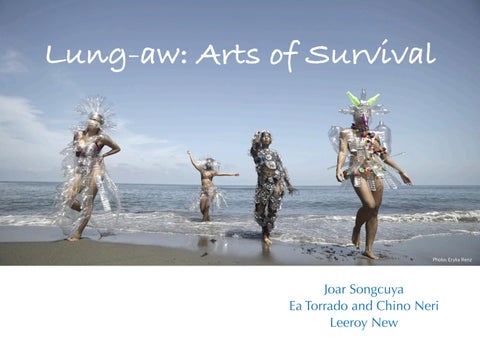
Lung-aw: Arts of Survival
Photo: Eryka Renz
Joar Songcuya Ea Torrado and Chino Neri Leeroy New
Lung-aw: Arts of Survival
2 July - 2 September, 2022 The Alfredo F. Tadiar Library
All things return to the sea 24 x 18 inches Oil and acrylic on canvas 2021
Lung-aw: Arts of Survival
f
f
f
ff
Lung-aw is an Ilokano word that means “to emerge from drowning” or “to recover from a di icult situation”. This exhibit brings together the ocean and sea paintings by Joar Songcuya, photographs from the experimental dance ilm, “Bari-bari” by Ea Torrado and Chino Neri, and the recycled plastic art costume designs of Leeroy New used in the ilm, with the aim of encouraging re lection on our human relations to our natural environments, in particular our seas and oceans, as these are shaped and threatened by social and historical forces of our own making. How do we survive the social, economic, and ecological crises of our times? How do we recover from planetary catastrophe? The exhibit also explores the role of art in enabling us to envision and practice other ways to connect to each other and to our natural world, ways that would support a more
sustainable planetary future than the one we now face. How might art act as an art of survival, an art of regeneration and transformation of our collective life?
Joar Songcuya paints the oceans he came to know as a seafarer, navigating these large bodies of water (here the Atlantic and the Paci ic) on board ships coursing through the world. A self-taught artist, Songcuya says his paintings are self-portraits, renderings of his own deeply enmeshed, emotional relation to these waters in which he spent a decade of his life, struggling to survive the hardship and loneliness of an overseas contract worker compelled to make a living for his family at home. Art became both record and means of making “life at sea bearable.”
f
Atlantiko II 48 x 72 inches Oil on canvas 2021
Paskipiko II 48 x 72 inches Oil on canvas 2021
The dynamic, a ective strokes and mercurial hues of all these seascapes express an array of complex feeling in the artist’s quest for meaning, being, and belonging. While the larger paintings portray the alternately alienating and calming, powerful vastness of oceans encountered through global shipping and trade, his smaller paintings portray the West Philippine sea from the shores of La Union, where Songcuya is currently artist in residence at Emerging Islands, a coastalbased arts organization and residency program in San Juan. In the smaller paintings, Songcuya inds a more intimate, prayerful, and tender relation to the sea – the sea which he left and has returned to and whose very being, whose sorrow and survival, is now viewed as crucially bound up with our own human sorrow and survival, and perhaps liberating redemption.
ff
f
West Philippine Sea I 12 x 16 inches Oil and acrylic on canvas. 2022
West Philippine Sea I 12 x 16 inches Oil and acrylic on canvas. 2022
In their ilm, “Bari-bari” (We Mean No Harm), La Union-based artists and co-directors Ea Torrado and Chino Neri explore how Philippine dance, and precolonial Philippine respect for all life forms, might inspire a less destructive and more harmonious, ecological, and caring relation to our natural environment for generations to come.
f
Left: Eisa Jocson. Right Abee Manotoc. Photos: Eryka Renz
It is an invitation, they say, to create beauty out of chaos, to take care of what remains, “to inspire one another to live in ways that are gentler to one another and nature” – to love and hope in the midst of disaster. Literally taking up the proliferating plastic waste that is polluting our environment and destroying life for the sake of pro it, Torrado and Neri and their collaborators explore the “funny” or strange evolution and mutation of life-forms that we have or must become to make harmonious community survival possible. Here we see playfully, spiritually adaptive performances of cultural heritage conjoined with a speculative queer futurism, as a creative approach to an ecologically sustainable planetary life.
f
f
Top Left: Ea Torrado with other dancers. Top Right: Jewel Gacad. Below: Mia Cabal in. Photos: Eryka Renz
The work in this exhibit, including the fantastical designs of recycled plastic waste fashioned by artist Leeroy New, do not only ask us to contemplate the uncertain waters people on our own planetary shores must navigate in order to survive. They also ask how we might create and enable the possibility of living and thriving under conditions of personal, global and planetary duress.
f
f
In his book, Women Who Stay: Seafaring and Subjecti ication in an Ilocos Town, Roderick G. Galam writes that the use of the word lung-aw by wives of seafarers to con igure their lives suggests “a survival strategy of keeping one’s head above water so that one can breathe and not drown.” They see migrant work, he writes, “as swimming for survival,” “as a way of navigating
the uncertain waters of life in the Philippines.” To see our natural world not simply as our “environment” but also the place of our very being and becoming, is to ask how, through our arts of survival, do we make a refuge for the wellbeing of all. As Galam writes, “Lung-aw not only describes what a person does to remain alive but also alludes to reaching safety.”
ARTISTS’ STATEMENTS JOAR SONGCUYA The making of a seascape
transported to the company of these distinctive bodies of water.
How to paint a seascape?
f
f
Facing the canvas, with a paintbrush on hand - I would start scribbling lines, solid markings; thin and thick execution of brush markings without any directions. An abstracted image formed by lines and color, maybe an appearing scene of a sky or a sea or just a monochromatic color illing the entire canvas. On the next painting sessions, the image changes on the canvas- another layer of lines or color, another abstracted image. A repetition of markings, until the sea drawn out of memory comes into life. Painting a picture of a seascape from immersion with the water or the ocean, the sound of waves becoming audible, the smell of breeze, the taste of salt from the wind. In every seascape that I am painting all I need is to utter the word, “ Paci ic”, “Atlantic”, “Arctic”, “Mediterranean “ and in seconds I’ll be
I have spent a decade of my life working onboard commercial ships and that familiarity of the seas and oceans of the world had become the foundation of my art and process. I used to paint seascapes exactly how it should be but as I spend more time painting, getting older, representing seascapes into a canvas has become more of a feeling about the water or the ocean. It’s no longer a realistic depiction of the subject, but more of an impression and an expression. Are the waves violent and big? Or is it calm or comforting? How dark or how light should it be? The answer is unknown. The level of harshness nor degree of lightness of the sea depends on the disposition and sentiments of the painter, on that period of art making – from his memories , current state of mind, collective failures, ambition. The seascape as an extension of the emerging (painter’s) self.
Seascape, seaman, survival I was a man who was lost at sea.
f
f
ff
ff
f
f
f
Whenever I look back on those years of my time at sea, I would always regard art or painting as a signi icant part of my sailing life. The ocean has molded me into a man/seaman of my own but it is through art or painting where I have found my place. The sea has provided me the space to explore the world through paintbrushes. And through paintbrushes I have found a way of survival. The sea is strangely beautiful , maddening place to be human. How does a person, a tiny igure onboard a loating steel object by the Atlantic or Paci ic survives the wrath of water on earth? The company of canvases and paints made life at sea bearable. It was art in my cabin that tamed the Atlantic waves. Art of survival through art. It was through seascapes that made me appreciate the
waterworld in a di erent perspective – the sea in its resplendent glory, at its most turbulent or restful state. Being a man of the sea, in great confrontations of the world and myself, myself as a bigger and more di icult ocean to control and navigate. One seascape at a time, painting, surviving. A Letter to the Sorrowful Sea To the great and mystical sea, We your children are in great repentance. We, mortal men are asking for your pardon. Bless us with your gifts and protection as we navigate the Earth. We are constantly searching for our being, our reason for existence and may our greed and sel ishness and dreadfulness be reciprocated by your divine forgiveness.
f
f
Man is more savage than the sea. We can weep on your shores until we drain ourselves of seawater on our bodies but we cannot and will never compensate you for the sorrow we have in licted. Your tears are saltier than ours, a testament of your immense torment. Your waves are splashing louder and bigger, and the brightness of the sky could no longer lighten the darkness shaping on you. We are the children of the sea, in constant battle for survival but we never thought about your survival. Is it too late for us to save what remains of you? Or like a mortal mother you shall hold us in the tenderness of your embrace, how a mother opens her hands for the arrival of a prodigal child. We are broken children of the sea ighting endless battles, seeking, searching, longing. May we be able to liberate ourselves from the bondage of this human misery and disease before it is overdue. Your sorrow is our sorrow. Your demise is our demise.
West Philippine Sea III 12 x 16 inches Oil and acrylic on canvas 2022
EA TORRADO Bari-Bari was born when I was invited by Germanbased Company Christoph Winkler to take part in the global “Environmental Dances” platform and represent the Philippines. This invitation challenged me to explore how dance could contribute to achieve a less destructive way of dealing with nature and the ecosystem. Since 2019, I have made a lifestyle shift: I have been trying to lessen my plastic use and deciding to choose a plant-based diet to live with less carbon footprint. And this lifestyle choice has been even pushed further in 2020. During the onset of the pandemic, I moved from urban Manila to the coastal town of La Union, Philippines.
f
This made me ponder on switching from being “an artist who makes work” into treating the
entirety of my life as my most important art. I was asking myself, how can I embody the values I believe in, and how can they be practiced in how I live and with how I create art? I wanted to live each day consciously and be a conscious creator of art. Living in this coastal town of La Union, I came across Dalumpinas Oeste Eco Rangers (DOERS) many times. They would wake up every 5 am and do a beach clean-up every day. It dawned on me that plastic is here to stay - until billion dollar corporations choose the planet over pro it. Unless big institutions and the government prioritize having a world with less plastic, plastic is here to stay. Hating plastic won’t make it go away, so how do we live with something that won’t go away?
With this question, this ilm is striving to make something beautiful out of the chaos. It made me ponder deeply on the Philippines’ pre-colonial attitude of respect for nature and how our local expressions such as “bari-bari” or “tabi-tabi po” are still used throughout the Philippine archipelago until today. It dawned on me how we are all just “passing through” in and through this lifetime, but how can we live with ‘respect’ for all life-forms that were existing here before we came and those that will live on long after we are gone?
f
f
f
f
f
The beach-clean-up of DOERS and this musing about plastic inspired our team to give birth to Bari-bari. With this desire to experiment and provoke with plastics: we upcycled the materials that people throw on the beach and explored with something that I love - dance. I have been dancing formally since I was 7 and my whole
professional career was around contemporary dance. Bari-bari then is a ilm project weaving my love for the environment, for nature and for the place I live in now, with dance. The ilm Bari-bari combines Philippine dances with interviews with a feeling that there is a new world existing - a world where you don't know if they are aliens or people pretending to be aliens to cope with the current times. The approach of this experimental dance ilm is absurdity and quirkiness because living in the pandemic and making art during this complex time with dancers out of jobs, with artists moving to producing work into digital versions and to ilm while the climate crisis is happening and while there is global and political unrest is absurd…
With this ilm, I wanted us to explore alienation in many forms. Being an alien in a new town, or being alienated from nature, or alienating nature. What does it mean to be alien to a place or to new circumstances? A dance piece in the ilm, The Binausan Girl was supposedly a communal dance alluding to Filipinos being great entertainers and hosts - always smiling, friendly, welcoming. But there she was, dancing alone and putting up a good show. Another dance piece, The Lovely Ilokana was traditionally a female dance, but our dancer is biologically a boy. This choice was alluding to the absurdity of how COVID had stolen from Filipino dance artists not only their means of income but their sanity and their way of life.
f
f
f
Before making this ilm, the Philippines was going through the longest lockdown in the world. It got me questioning, why make art at this time? What is the use of it? When is art not as essential as food and medicines? Then I realized, here in our small town in La Union - where the sun rises and sets,
the waves crash to the shore, the moon becomes full and new, we are comforted by how we have each other. And I thought, maybe by doing art, I won't be able to save anyone…and maybe I don't have to. But if I go on to contribute to telling even one story about the environment, perhaps the future generation will keep telling stories. Then that is good. With this, Bari-bari is an invitation to be hopeful in the midst of absurdity: that inasmuch as bad news is all over the place, especially during this pandemic, there are people and groups who exist to make the world better even in their small patch of land, and that unexpected art can come out of it. This is an invitation for people to keep making art, to take care of what's left, and to inspire one another to live in ways that are gentler to one another and nature.
f
Lastly, this ilm is a tribute to our new home in La Union - this little coastline and town province in the Philippines. The name La Union means “The Union”: when people are asked if they are originally from here, or if there are dances or music that are originally from this locality, everyone answers no. Someone is always from somewhere else: their families have migrated from somewhere else. No wonder that this place was called La Union since the Spanish colonial era as this place is uniting of towns around this area, uniting of religious practices and sects. La Union - where locals and urban visitors meet. Where the normal and the alien could meet, where traditional dance and contemporary interpretation could meet, and where nature and plastics could meet. What if somehow, these divides are an illusion? What if we can make something where everything coexists naturally and funnily.
Eisa Jocson. Photo: Eryka Renz
CHINO NERI I am a purpose driven ilmmaker who enjoys cocreating ilms that I have a lot of passion for: Nature, dance, art, music, surf, particularly where I live. It’s been 3 years since I started a new life in the coastal town of La Union, Philippines. I transitioned from a fast paced urban lifestyle in Manila, working in the advertising industry for most of my life, to a more intentional lifestyle.
ff
f
f
f
f
Living in a coastal town has enlarged my deep care for the ocean and having this hope for future generations to continue to enjoy and commune with the ocean. With this, a huge part of my lifestyle change was being more mindful about my waste, and its contribution to the planet. I started to ask myself, how can I signi icantly lessen my waste? Is a zero-waste lifestyle sustainable for me? As I tried di erent
ways - like always bringing an eco-bag and containers to restaurants and markets, refusing plastic, creating content that raises awareness, it seemed like plastic is just always there - it’s everywhere. The ilm Bari-bari’s intention is to present the plastic situation in La Union through dance and art, and to explore the situation through fantastical ponderings and creative solutions. There's an intention of ‘softening’ my vibrational attraction towards plastic. I believe that hating, fearing, or going against it will not solve the problem. But by presenting used plastic collected from the beach as something that is here to stay, it generates more innovative ideas and provokes possibilities on how to live with it.
f
f
My journey towards a more conscious way of living, attracted me to like-minded individuals who also wish to contribute through their art. Bari-bari was created by a team who are also aligned with living in harmony with nature and everything around us. For instance, I was inspired by the wearable plastic artwork of Filipino contemporary artist-designer Leeroy New. For this ilm project, he decided to move to La Union and made this collaboration possible. With Bari-bari, it became not only a platform for me to express my deep appreciation for life, the ocean, being in the low with nature but it is also an expression of my soul purpose - channeling my deep care about unity and high vibrational co-creation with people who do the same.
Ocean, the making of a man 12 x 30 inches Oil and acrylic on canvas 2022
Man, the will of the water 12 x 30 inches Oil and acrylic on canvas 2022
Lung-aw: Arts of Survival
All exhibit photos: Juan Jose Lopez Buenaventura
THE ALFREDO F. TADIAR LIBRARY SAN FERNANDO, LA UNION www.tadiarlibrary.org The Alfredo F. Tadiar Library is a free, independent research and reading library, dedicated to the conservation, dissemination and advancement of knowledge in the social, cultural, and natural history, literature and broad arts of Northern Philippines region and its global diaspora. The Library Art Gallery features exhibitions of contemporary art work as well as artifacts of historical interest. The Gallery seeks to promote local and diasporic Philippine artists, and to promote displays related to the core collections and areas of concern of the Library.