The Alfredo F. Tadiar Library
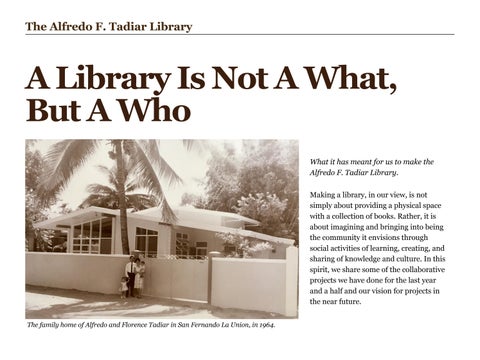
A Library Is Not A What, But A Who What it has meant for us to make the Alfredo F. Tadiar Library. Making a library, in our view, is not simply about providing a physical space with a collection of books. Rather, it is about imagining and bringing into being the community it envisions through social activities of learning, creating, and sharing of knowledge and culture. In this spirit, we share some of the collaborative projects we have done for the last year and a half and our vision for projects in the near future. The family home of Alfredo and Florence Tadiar in San Fernando La Union, in 1964.
Books are said to change lives. They can offer ways of seeing things, people, and life that might alter your own sense of the world you live in, and even your own sense of who you are or who you could be. They can provide windows into the past as well as into the future, deep and intimate views of worlds beyond what we might be able to experience in the routines of our daily life. They stoke our imaginations of what is possible. And they allow us to relate to others, other people, other beings, who might lead very different lives from ours. Libraries have traditionally been spaces for the safekeeping of these wondrous objects. Books are of course not just objects but something more akin to what has become ubiquitous in our world today: a kind of media. That is to say, a book is a medium for the sharing and transmission of thought and experience. Like other forms of interactive media that are so familiar to many people today, a book is not a oneway broadcasting device (like a TV), for it demands our participation to make those thoughts and experiences come alive. In the course of history, libraries became spaces not only to store and guard these amazing media (initially to control access to them when their power was first recognized). But as they welcomed readers from all walks of life, libraries also became places of social connection and interaction, places where people could encounter each other in and through books and in person in a shared space of curiosity, learning, and enjoyment.
The Alfredo F. Tadiar Library, 1 F. Ortega Highway, Tanqui, San Fernando, La Union 2500
When we conceived of the Alfredo F. Tadiar Library, inspired by the work and life of Alfredo F. Tadiar, we envisioned a place with some of these potentials. We decided first of all that it would be free and open to the public, and that it would serve the community in which it was located: San Fernando, La Union, certainly, but also the larger region of Northern Philippines (the Ilocos, the Cordillera, and
Cagayan Valley) and its communities. So we began growing our collection with a focus on this area. It made sense to us that the site of the Library would be our first family home, which we hoped would impart the love and joy of learning and discovery that it was for us when we were children.
In fact, in renovating the house to build a Library, we purposefully tried to keep the feeling of a warm home, rather than a cold institution, to keep it familiar and welcoming to all. We also planned on making the Library more than a quiet reading space. So we included a small café and a bookshop, with indoor and outdoor spaces for hanging out, and an art and exhibition gallery, where visitors and library users could see the work of artists from the region as well as exhibitions related to our collections. And by putting our bookshelves on wheels, we have made the bookshop area a flexible space for cultural events.
Photos (Top and Left): Esteban Laina
What we had not anticipated was how the very process of making a library would create and shape what the Library is and what else it could be, which is a place of making culture and communities. Building the Library’s collections has been a continuous process of reaching out to many people, authors and publishers as well as many others with a similar love and interest not only in books but also in cultural works more generally (music, film, art). In this way, people donating books and other materials have come to be an integral part of the project of the Library, shaping what the Library houses as well as what the Library is and what it does. Making a library, in our view, is thus not simply about providing a physical space with a collection of books. Rather, it is about imagining and bringing into being the community it envisions through social activities of learning, creating, and sharing of knowledge and culture. In the short time that it has been in existence, the Alfredo F. Tadiar Library has become a place of learning and gathering for different people from San Fernando and beyond. It is a place for students to study and review, for professional tour guides to know more about the region, for visitors to see local art, for readers to enjoy immersing themselves in other worlds as well as learning about their own. These are no doubt what traditional public libraries have been able to offer. But the Tadiar Library has also
become more than this, because it has organically grown and developed in response to the people who have come into our spaces and been inspired by the potentials we have seeded into it, and most importantly through the collaborative projects we have engaged in with others. In October of 2018, the Tadiar Library sponsored a three-day regional film festival, the Pagwanawanan Film Festival, founded and directed by a local cineaste, Bebe Go. The successful festival and short film competition brought together aspiring filmmakers and film students as well many others, the lasting consequence of which has been the founding of a new film collective and organization – Pelicula Union – composed of filmmakers, cineastes, visual artists, and academics who are based in or trace affinities to La Union, and led by Carla Pulido Ocampo, Mark Lester Valle, Bebe Go, and John Joseph Buenaventura. In early 2019, the Tadiar Library and Pelicula Union partnered together to offer a monthly film series, entitled Pagsarmingan, which is an Ilokano word for Reflection. the Pagsarmingan series has been bringing to the public free screenings of socially-relevant, independent, non-commercial films, together with the filmmakers of the screened films for lively discussions on the issues that the films deal with as well as the ways the films approach and represent those issues. Among the monthly themes that Pelicula Union brought to the screen were: women and gender, faith and society, love
and labor, and Pride or LGBTQ issues. Pelicula Union also organized a human rights situationer together with the screening of two rarely viewed documentaries made during the final years of Martial Law, bringing together students from local colleges, together with progressive organizations and academics, for a serious discussion of important and invigorating political issues of the day. In this way the Library has also become a community center where social issues are discussed and different perspectives shared. In partnering with and supporting a local film collective seeking to develop local, regional filmmaking, through screenings and educational workshops, the Tadiar Library has thus also become a hub for fostering local community and culture, a place of collaboration and cooperation.
Launch of Pagsarmingan Film Series. Photos: Pelicula Union
These benefits of a free, independent community library are exemplified by other collaborative projects. Our art gallery hosted an exhibition of the work of a local art collective, the Artists Guild of La Union (AGLAUN), as well as an exhibition of photographs by artists and enthusiasts from the region as well as abroad, focused on everyday life in the Northern Philippines.
drew on the photos and memorabilia as well as writings of our local nurses.
Nurses Writing Workshop held by Gantala Press, 2019
Community Exhibits
A writing workshop for local nurses facilitated by a feminist publishing collective, Gantala Press, yielded a chapbook of writings by the nurses on their life experiences, and a community exhibition on Philippine nursing, which
This publishing and exhibition project is particularly significant inasmuch as it demonstrates that a Library can be more than a place to collect already produced knowledge and cultural heritages of the past. As shown by this last workshop and exhibition, it can also be a place for ordinary people to generate new knowledges and participate in the creation of culture and community.
Biag Dagiti Agay-aywan Chapbook Publication Launch and Community Exhibit
Following the Nurses Writing Workshop, the chapbook publication, and Community exhibit, we held a Ceramic Art Making Workshop facilitated by the artist and potter Jezzel Lorraine Wee. The workshop connected with the local tradition of La Union pottery making, using terracotta clay from the province as well as working with some local potters. An exhibition of the resulting fired works by workshop participants was launched in November 2019.
Finally, a Mural Painting Workshop was facilitated and led by the artist, Mervin Fabro Pimentel, who led young, local painters in creating the beautiful mural painting that now graces the street-facing walls of the Alfredo F. Tadiar Library. Through these various projects, we have sought to involve local communities in creating forms of art that connect to their everyday lives and cultural heritage, and to showcase the resulting work in community exhibitions.
Photos: Juan Jose Lopez Buenaventura
Through these ways, we are trying to foster a community of participants and makers, not just an audience for work made by professional artists and experts. As the range of our activities should show, our conception of a Library is one that connects reading and learning to other media besides books, and to cultural production more broadly. We invite proposals for activities and projects by word of mouth as well as through social media. We try to work with people who are drawn by their own interests to the Library and to our events. Our staff talk with the people who come through our doors, engage their interests, and encourage them to propose projects. When we work with local people, as partners or as participants in activities, they bring or alert their friends, relatives, and networks not only to the events and activities they organized or were participants in, but also to future events and activities. We also try to choose projects that appeal to a diversity of interests – such as dance movement, children’s books, popular music, writing, painting, ceramic making, zines, photography – as a way of broadening our reach. And we actively try to connect to artists, writers, academics, and other cultural producers and institutions both locally and regionally, soliciting proposals and ideas from them whenever we can as part of our process of programming. In this way, we try to organically incorporate the perspectives,
concerns, and visions of the communities of our partners. Located in San Fernando, La Union, an emerging ‘component city’ with few cultural and art institutions compared to Manila, it is our openness to the work of amateur makers, as exemplified by our workshops, which require no previous experience, that has made the Alfredo F. Tadiar Library a particularly welcoming space for aspiring artists, cultural producers, students, and life-long learners.
Zine-Making Workshop and Talks during BLTX Small Press Expo, 2020
Finally, our board members as well as our staff continue to reach out through our respective familial, social, and professional networks to expand our Library’s collections, asking both prominent and ordinary people from the region to contribute books and materials in the areas of our focus, in effect, asking them to participate in making and building this cultural institution, to become part of the Who – the community – that the Library is and brings into being. In this and all our efforts, from writing workshops to art exhibitions, we seek to foster the potentials and contributions of people who would be able to see their work, their experiences, and their lives become part of a cultural institution that they helped to make. This is what makes for the continued importance of “cultural hubs” like the Alfredo F. Tadiar Library. A Library is not a what, but a who. Who we are is not simply about information circulating through internet technologies.
Though we use social media and digital technologies, we see the importance of physical space and personal interaction and social encounter as vital to the sustenance and growth of cultural communities. Through participation in shared experiences of learning and creating – watching and discussing a film, sharing food, making pottery together, talking about one’s experiences and writing a chapbook with others – people are encouraged to produce culture as well as consume it. As our experiences at the Alfredo F. Tadiar Library shows, a Library can be as wondrous as a book, if not even more so. It can be a place where different people can be the makers of their own stories; where they can be both the creators and the viewers of filmic as well as artistic representations of their own lives; and where they can connect to others, make communities, and begin to build the social and imaginative worlds they envision. A Library can be all these things when people begin to see it as a place for their own dreaming and self-making. We have a long way to go still in pursuing our vision and goals as an institution. This is an organic endeavor after all, and we do not have a fixed idea of what a library should be or how. What we do have is an open invitation to people to collaborate and experiment in making knowledge, culture, and creative arts be for, and by, us – the Who we want to become.
Dance Performance and Workshop by Ea Torrado
The Alfredo F. Tadiar Library 1 F. Ortega Highway, Tanqui San Fernando, La Union 2500 www.tadiarlibrary.org 2020