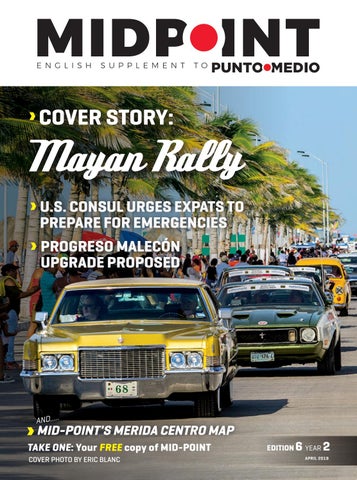
COVER STORY:
U.S. CONSUL URGES EXPATS TO PREPARE FOR EMERGENCIES PROGRESO MALECÓN UPGRADE PROPOSED
AND.....
MID-POINT'S MERIDA CENTRO MAP
TAKE ONE: Your FREE copy of MID-POINT COVER PHOTO BY ERIC BLANC
EDITION
6 YEAR 2 APRIL 2019
WELCOME
3
WELCOME…. The Mayan Rally is a renowned annual event for classic autos that for the past six years has focused a positive international spotlight on the Yucatan Peninsula. Check out MID-POINT's cover story on pages 6-7 to see what the rally holds in store this year. Mid-Point Yucatán Staff
ADMINISTRATION
Alberto Buenfil Valero
EDITORIAL DIRECTION Alejandro Fitzmaurice C.
CONTENT / EDITING Robert Adams
DESIGN
Nazaria Ortiz
EDITORIAL ART
Raúl Mendoza (Rulos Bar)
ADVERTISING
Roberto Germon P.
PRODUCTION
The U.S. Consul in Merida recently brought key team members to meet with American expats at Merida English Library. Our story on pages 4-5 sums up what transpired at this packed meeting. History buffs will find an enlightening synopsis of Yucatan's separatist movement on pages 18-19. We hope you enjoy all the articles in this edition of MIDPOINT. Thank you for reading MID-POINT! ¡Saludos a todos! Robert Adams Content Manager / Editor
Daniel Moguel
www.puntomedio.mx/category/midpoint/
Editorial/Advertising/Circulation Offices Calle 64 #436 between Calles 49 and 53 Colonia Centro, Merida, Yucatan, Mexico
midpoint.yucatan@gmail.com
999 469 7100
Mid-Point Yucatán is a free twice-monthly news magazine. All rights reserved. Any reproduction of content through any means without previous permission is prohibited. Certificates of ownership and title in process. Certificates of legality and content in process. Opinions expressed herein are those of their authors and do not necessarily represent the editors or publishers of Mid-Point Yucatán. Advertisements are responsibility of the advertisers.
44
LOCAL NEWS
TEXT/PHOTOS: MID-POINT
Get your “ducks in a row” for possible emergencies, U.S. Consul urges expats Officials from the U.S. Consulate in Merida urged expats to get their “ducks in a row” to prepare for possible death or other emergencies while residing in Yucatan. At a packed meeting at Merida English Library attended by more than 100 American expats, U.S. Consul Courtney Beale and assistants said that although the consulate can assist in event of death, hospitalization, crime or arrest, it is up to expats to take steps to facilitate the consulate’s limited role as liaison with Mexican authorities. While the hour-long meeting was billed as a chance for discussion with Consul Beale, she
allowed Natalia Almaguer of the consulate’s American Citizens Services branch to field most of the questions in the lively interchange with expats. Almaguer explained that the consulate does not assist expats with federal benefits questions. She noted that these matters can only be addressed through an office of the U.S. Embassy in Mexico City. Expats with Social Security Administration or Veterans Administration pension questions should email: fbu. mexico.city@ssa.gov. No telephone assistance is available. Beale promised a followup meeting in Merida with officials from the U.S. Embassy in Mexico
City on issues related to retirement benefits from the Social Security Administration. Almaguer explained that in the event of true emergencies, someone at the consulate is on duty 24 hours a day to respond to phone calls. “We rotate these duty shifts, and we hope you will understand we have limited resources and will limit your calls to true emergencies,” Almaguer said. The consulate’s security officer, Chris Kennan, urged U.S. expats and tourists in Yucatan to take common-sense steps to avoid becoming victims of crime. “We have no evidence that U.S. citizens are being targeted for crime, but you have to realize your `perceived wealth´ puts you in focus. Whether you may become a victim depends on how easy a target you could be.” Kennan urged U.S. citizens to trust their instincts and fear. Staying with groups of other expats and tourists while in Yucatan is the safest approach, he said. Kennan suggested all ex-
TEXT/PHOTOS: MID-POINT
LOCAL NEWS
5
four year” project still is in the design stage, and there is no firm opening date for the new building yet. TEXT AND PHOTOS: ROBERT ADAMS
Contact Info Telephone number: 52 999 942 5700 pats register with the U.S. State Department’s “STEP” program, which eases communication with U.S. relatives in event of emergency. Almaguer added that the State Department does not share contact information with the IRS or other agencies because of U.S. Privacy Act restrictions. The U.S. Consulate in Merida is responsible for American interests in the states of Yucatan, Quintana Roo and Campeche. There are also small consular
Photo: Facebook “agencies” in Cancun, Playa del Carmen and Cozumel. Beale said that 9 million Americans visited the Yucatan Peninsula in 2018, the majority being tourists in Cancun and other spots in Quintana Roo. Responding to the growth in demand for services from the U.S. Consulate in Merida, the State Department last year announced plans for construction of a large, modern building in the city’s northern suburbs. Beale said the “three or
Toll-free from Mexico: 01 800 681 9374 Toll-free from USA: 1 844 528 6611 E-mail :
AskMeridaACS@state.gov
Website:
mx.usembassy.gov
Facebook:
/ConsuladoEstadosUnidosMerida
Twitter @ConsuladoUSAMer
6
COVER STORY
TEXT: PUNTO MEDIO; PHOTOS: AGENCIES
110 CLASSIC VEHICLES TO CRUISE THE PENÍNSULA IN
Only a few details remain to be ironed out for the Mayan Rally 2019 that this year will begin in Uxmal and conclude in Chetumal, with a tour of more than 18 Yucatan and Quintana Roo cities and towns, reported Benjamín de la Peña, entrepreneur and director of this classic auto event. In 2019, he said, the sixth edition will integrate a convoy of 110 collector vehicles, from 14 countries, with judges from Argentina and Colombia and will make
TEXT: PUNTO MEDIO; PHOTOS: AGENCIES
COVER STORY
7
a broad tour of Yucatan and Quintana Roo to make known the great Mayan attractions.
START OF ROUTE The Maya-Mexico Rally 2019 will be held from May 18 to 26, starting in Uxmal, with a dinner. The official starter's flag will be on the 19th in Maxcanú, from there to Hunucmá, that same day to arrive in Mérida, and in these three towns community activities will be carried out. As usual, attendees and drivers will share activities with Mayan populations, providing wheelchairs and devices for people with disabilities. The effort of this event, said Benjamín de la Peña, is an achievement, but at the same time a satisfaction. This rally is among the 10 most important in the world based on the number of vehicles, their quality, and the interest of owners who bring wonderful vehicles that visit communities and deliver resources, wheelchairs and products for residents of these Mayan cities. In its fifth edition, the Rally integrated 110 old and classic vehicles, and it was emphasized that the requirement to participate is that
they have more than 40 years antiquity. Finally, people were invited to view these classic vehicles, because they are a rolling museum, a parade
of pieces of yesteryear, and restoring them has required passion, time and many resources. Text: Acom Photos: Agencies
8
ENVIRONMENT
TEXT/PHOTOS:AGENCIES
Progreso official hopes to create artificial reef PROGRESO -- The director of municipal tourism, Manuel Rosado, told El Financiero that the proposed project is intended to create a new tourist attraction for the port. "We are doing the environmental impact studies and the reef plan, for which we need a resource that is for this type of project, which is 5 million pesos," he said. The project calls for the structures, developed by the Reef Ball Foundation, to be installed approximately six kilometers from the coast, at the height of the sign with the name of the port. "While the seabed in Progreso may not allow it to be visited for 12 months, maybe it will give you eight, but it is a product that is not there, self-sustaining," said the local official. The representative of Reef Ball in Mexico, Javier Dajer, explained that he received a request for
quotation for a project in Progreso consisting of some 1,400 pieces, which is also promoted by diving schools and a biologist from the region. "We were talking at different depths with different approaches: for snorkeling, sport fishing, commercial fishing, there was already a hybrid project where there was snorkeling for the bathers of the area, a little further away for sport fishing,... a third stage more outside for commercial fishing," explained Dajer. The Reef Ball units are pure concrete structures that are deposited at the bottom of the sea and promote the growth of flora and the protection of marine fauna. "It's a high-tech, high-strength concrete that does not carry metals, it's 100 percent concrete, we use various additives to increase strength and give it greater durability, which is estimated
TEXT/PHOTOS: AGENCIES
to last more than 500 years underwater," he said. The balls are hollow so that they are permeable, so that the tide circulates in its interior and can generate an effect called whirlpool, that causes the water to leave by the upper part of the structure. They have a circular shape to favor photosynthesis in the life cycle of corals, so that from any angle they
can have exposure to the sun's rays, explained Dajer. In addition, this form gives greater strength than any other. In addition, they generate noises and changes of current that attract the fish, because in the water the sounds run 4 times faster than in the air. In a period of around five years, Dajer has observed that the structures are co-
ENVIRONMENT
9
vered with vegetation and mimic the marine ecosystem. Artificial reefs like these have been installed in Campeche, Quintana Roo, Colima, Baja California and Veracruz. To date some 25 thousand of these balls have been placed in the sea, according to Reef Ball Foundation. Text: El Financiero Photos: Agencies
10
NEWS FROM LOCAL NEWS
TEXT/PHOTOS: NEWS TODAY TEXT/PHOTO: PUNTO MEDIO
Merida Mayor recognizes need for repairs in deteriorating central market It will not be until the second half of the year when the Lucas de Gรกlvez market intervention takes place, where recently the roof of a jewelry repair shop collapsed, with no injuries or human losses. Interviewed at the end of a visit to supervise the cleaning and maintenance of 10 public parks in the Historic Center, Mayor Renรกn Barrera Concha recalled that regardless of what Civil Protection is used to review the installation and structure of the market, the structure will be inspected inside the premises, in order to detect if any of the adjustments that the vendors have made generates any risk to the structure. The mayor recalled that at the moment a project developed with the Patronato del Centro Histรณrico is being completed to intervene in certain areas of the San Benito market and to place in La Pepita a space that is in disuse and is now required. "We are looking for spaces, we have nothing else to see that they are more effective," said the mayor, who was clear in stating that if a demolition is re-
S
quired, it will be done, in case of safety risk. He recalled that in his first administration as mayor, the old meat area was demolished because the structure was already rusty and had the possibility of collapsing. Barrera Concha clarified that the intervention will depend on the budget availability and on how advanced the technical project is, but said that there are enough resour-
ces to make the project a reality in the second half of the year. "You have to analyze them very well, especially because of the intervention that must be done temporarily and by zones in order not to harm the tenants economically," he said. Text and photo: Manuel Pool Moguel
TEXT/PHOTO: AGENCIES
YUCATAN NEWS
11
Ancient shrine revealed beneath Chichén Itzá In 1966, Eleuterio, Mariano, Esteban Mazón, Ermilio, Jacinto, and Pascual Un Noh, landowners of San Felipe, near the Chichen Itzá site, discovered an underground shrine with archeological materials. Shortly after, the archeologist Victor Segovia Pinto visited the site known as Balamkú (Jaguar-god) and conducted an investigation. However, Segovia Pinto gave instructions to seal off the area. El Universal reports that now, more than 50 years later, Mexico’s Institute of Anthropology and History (INAH) has decided to reopen Balamkú through the Great Mayan Aquifer (GAM) project, led by archeologist Guillermo de
Anda. The archeological site will now be available for exploration and research. The pyramid of Kukulcán, better known as The Castle, is surrounded by four underwater caves, while the Balamkú underwater shrine is located east of The Castle and is “relatively close to Xkanjuyum.” Artifacts found in the newly opened archeological site include censers, vases with food remains, jade artifacts, seashells, and bones that were offered to the gods in ancient Mayan rituals. INAH investigators and archeologists believe that the shrine could date back to the Later Classic Period (700-1,000 A.D.). The Great
Mayan Aquifer project, led by the explorer and archeologist Guillermo de Anda, is made up of 14 researchers, out of which only six have entered Balamkú, where seven offerings and 150 censers have been found, though only one third of the archeological site has been explored so far. “If there is indeed an underwater cave (cenote) under Chichen Itzá, as has been suggested by historians and archeologists, it could change our perception of the origins of the archeological site,” claimed Guillermo de Anda, adding that human remains were likely to be found in the underwater shrine. In a press conference, Pedro Sánchez Nava, national archeology coordinator at the INAH, talked about the potential impact of the Mayan Train project in the area: “The train will pass through Chichén, though we still don’t know the project details. I guarantee that the INAH will not allow any archeological sites to become affected by the project’s construction,” he stated.
Text/Photo: El Universal
MID-POINT'S MERIDA MAP
6
Ca lle 7
e 49
22
Ca
e 60
9
53
Call
e 51
10
53
56
Call
e 57
55
57
54
58
11 59
Ca
60 61
32
10
Call
68
3 2
e 66 Call
69
39
40
Call e 62
3
6
25
e 56
Call
Call e 58
Call
e 65
Call
2
Call
2
e 60
e 69
78
41
26
e 63
2
77
Call
38
42
4
Call e 64
76
e 55
Call
71
75
Call
43
e 59
58
3 e 60
5
e 65
74
6
Call
27
1
70
e 67
44
5
29
28
Call
Call
13
4
8
67
37
Call e
Call e
4
e 61
68
36 9
Call
64
72
34
e 53
45 20
35
33
12
66 73
5
47
30
65
14
Call
46
7
e 64
62
13 17
19
31
6
16
54
lle
70
e 59
63
48
49
50
Call
15
e 54
1
51
511 5
24
Call
1
55
23
18
52
Call e
lle
Call e 62
Ca
e 56
lle
lle
12
Ca
Ca
8
Call
72
3
Call e 64
Call e
5
2
Call
7 66
1
Call
4
MAP RESEARCH/DESIGN: NAZARIA ORTĂ?Z
0
12
MAP RESEARCH/DESIGN: NAZARIA ORTÍZ
MID-POINT'S MERIDA MAP
13
CENTRO MAP
e 54
N
58. Viva Mérida
11 El Salmantino
30. Hotel Reforma
Hotel Boutique
12 La Chaya Maya
31. Hotel Colón
59. Hotel del Gober-
13 La Tratto
32. Hotel Montejo
nador
14 La Recova
1)Casa Colibrí
33. Hotel Artesanías
60. Hotel Ambas-
15 Apoala
2) Hotel Zamná
Maya
sador
16 Rosa Sur 32
3. Casa Encanto
34. Hotel Mérida
61. Casa Temazcal
17 Soberana
4. Casa Merida
35. Holiday Inn
Hotel&Spa
18 Mercado 60
5. Yucaatán vista INN
Express
62 Casona 61
19 Peruano
6. Casa de las Palo-
36. Hotel Casa del
BoutiqueHotel
20 Cartas a Frida
mas
Balam
63) Hotel Embaja-
21 Oliva Kitchen
Hotel Boutique
37. Hotel Eclipse
dores
22 Pizzeria Raffaello
7. Hotel Marionetas
38. Hotel Posada
64) Hostel Jade
23 Tobalá 58
8. Nómadas Hostel
Toledo
Tours
24 Organico Café
9. Hacienda Mérida
39. Posada Fla-
65 Hotel Margarita
25 El Nuevo Tucho
10. Casa Carmita
mingo
66 La Misión de Fray
11. Siesta Fiesta
40. Hotel Mucuy
Diego
12. Los Aluxes
41. Gran Real Yu-
67 Hotel Lord
13. Hotel del Pere-
catán
68 Hotel los Arcos
19
grino
42. Hotel Santa
69 Hotel San José
PARKS
20
14. The Villa Tievoli
María
70 Hostal Zócalo
1 Santiago
15. Hotel Julamis
43. Best Western
71 Hotel H.O
2 San Juan
16. Casa Ana B&B
Maya Yucatán
72 Casa Bowen
3 Plaza Grande
17. Casa Macorina
44. Hotel San Juan
73 Hotel María del
4 Parque de la Ma-
18. Hotel Meridano
45. Casa Lucía
Carmen
dre
19. Ya’ax Hotel Bou-
46. Maison del Em-
5 Santa Lucía
tique
bajador
6 Eulogio Rosado
20. Hotel San Pa-
47. SantA Lucía
7 La Mejorada
tricio
48. Gran Centenario
21. Hostal Casa Fer-
49. Hostal Trotamun-
nanda
dos
1 La Jarana
22. Hotel Piazzeta
50. Gamma Mérida
2 Los Trompos
23. Hotel Misión
51. Coqui Coqui
3 Amaro
Panamericana
L'Epicerie
4 Pancho’s
1 Santiago
24. Casa del Tío Dach
52. Hotel María José
5 Café Punta del
2 San Juan
26. Hotel Nacional
53. Hotel Medio
Cielo
3 Monjas
Mérida
Mundo
6 Pizzeria La Fogata
4 Catedral San Idel-
27. Hostel Catedral
54. Casa Gloria
7 La Bierhaus
fonso
Mérida
55. Koox Art
8 Janitzio
5 Jesus Tercera Orden
28. Piedra de Agua
56. Hotel Paris
9 Bistrola 57
6 Santa Lucía
Hotel Boutique
57. Casa Mexilo
10 Café la Habana
7 La Mejorada
Call
29. Hotel Caribe
Call
21
e 49
alle
56
HOTELS
Call
e 51
14
3
15 e 54
16
Call
17
18
21
22 7
24
e 50
7
Call
Call
e 52
23
RESTAURANTS
CHURCHES
14
FOR YOUR INFORMATION -- BY MID-POINT NEWSROOM
MERIDA CONSULATES AND EMERGENCY PHONE NUMBERS CONSUMER COMPLAINTS (PROFECO) POLICE
999 923 2323
Emergency 066 (from landline) 911 (from cellular)
CONSULATES MERIDA
MERIDA MUN. POLICE
BELIZE
FEDERAL POLICE
CUBA
999 946 1223
999 924 0362
UNITED STATES BELGIUM
999 942 0060
NETHERLANDS
999 948 3489
YUCATAN STATE POLICE 999 930 3200
999 926 1725
SPAIN
TOURIST POLICE
999 930 3200 ext. 462
LUXEMBOURG
998 892 2512 999 928 5421 999 944 4215
999 942 5700
CONSULATES CANCUN CANADA
998 883 3360
BRITAIN
551 670 3200
CYPRUS
999 924 6821
FIRE STATION
999 924 9242
RED CROSS
999 924 9813
FRANCE
999 930 1500
GERMANY
999 944 3252
HOSPITALS IN MERIDA CENTRO DE ESPECIALIDADES MÉDICAS (CEM) 999 920 4040
GREECE
999 982 3271
CENTRO MÉDICO DE LAS AMÉRICAS (CMA) 999 926 2111
999 983 1184
HONDURAS
CLÍNICA MERIDA
MEXICAN IMMIGRATION OFFICE (INM)
KOREA
ROAD ASSISTANCE (Ángeles Verdes)
999 925 5009
999 926 1962 999 166 6464
999 942 1800 STAR MÉDICA 999 930 2880
CULTURE GASTRONOMY
TEXT/PHOTO:EL TEXT/PHOTO: AGENCIES UNIVERSAL
15
Where to eat good Yucatecan food in Mexico City
2. Le Lah Tho
Its menu is good but if you go, you have to try the panuchos that they prepare. Location: Av. Patriotismo # 456, Mexico City.
3. Fonda 99.99
The lime soup, without a doubt, is one of the favorite dishes of the Yucatecan region, and this is a good place to try it. Location: Moras, 347, Colonia del Valle.
4. Coox Hanal
Yucatecan food is one of those that has the most distinctive flavors due to the spices with which it is prepared that make it irresistible to the palate. Yucatecan cuisine has Mayan origins that have been combined with some Spanish flavors. If you live in or are visiting Mexico City and you have a craving to eat Yucatecan food, here we tell you what restaurants are a good op-
tion to enjoy it.
1. Ku-kuch Antojería Yucateca
Here they prepare a delicious dish that you can not miss. It is meat from pork cooked with beans and flavored with epazote, accompanied with rice black, avocado and chiltomate sauce. Location: Paseo de las Palmas Avenue # 340, Lomas de los Virreyes, City of Mexico.
This place has 63 years of experience in Yucatecan cuisine, do not forget to try the papadzules. Location: Isabel la Católica 83, second floor, Centro, CDMX.
5. Habanerito
The condiment that can never be lacking in the Yucatecan kitchen is the habanero, there is no doubt about it, and in this place they do it honor. Location: Frontera 177, between Zacatecas and Querétaro, Mexico City. Text/Photo: El Universal
16
BEACHES
TEXT/PHOTOS: PUNTO MEDIO
Steps made to save iconic but collapsing 'casino' building in Progreso
The "Casino de Progreso" located on 31st Street with 74 in the center of the port, is one of the oldest and most iconic buildings in the city, once a social site for the upper class; however, today it is ruins and at risk of collapse. In the last administration of José Cortés, the building was fenced by Civil Protection with wood and caution tape since the structure was weak, and it was possible that some parts could break off and injure pedestrians.
Despite being secured, no further steps were taken, and for a long time the future of the casino remained uncertain; the past City Council informed that it could not accomplish anything more since there was no knowledge about the actions that the owners would take. According to sources, some casino building shareholders still reside in the port, including Mr. Alonzo Benitez, who reportedly owns most of the shares. Other owners are Dr. Gutiérrez and Mrs. Enea Peña.
However, none of them has made any recent statements regarding the property. The present administration has returned to take action on the matter and rescue work has begun on this building. In the past few days, Mayor Julián Zacarías supervised the first rescue steps of the "Casino de Progreso", which are possible after several meetings that began six months ago with INAH. TEXT: Punto Medio Photo: Courtesy
TEXT/PHOTOS: PUNTO MEDIO
BEACHES
17
Progreso mayor proposes major renovation of boardwalk In order to renovate the boardwalk in the coming months, recently the mayor met with malecón business people, to expose the integral project that is scheduled to run in the month of May in that area, in coordination with the governor Mauricio Vila Dosal, in order to improve and boost the summer resort. Faced with the need to repair and dignify the traditional boardwalk named after "Romero Frías Bobadilla", state and municipal authorities have joined efforts to manage and propose actions to improve the image of the port. In this regard, the mayor summoned more than 50 entrepreneurs who have establishments along the
boardwalk to encourage them to participate in these actions and increase the possibilities of improving the infrastructure of the area. "In these days we are going to deliver a model so that they know the works that are intended to be carried out: bike paths, showers, palapas, as well as reforestation are contem-
plated," said Zacarías Curi, adding that the Casa de la Cultura will also be working to make it a tourist attraction. The project, as stated, will be an investment of great importance for all so it will also be necessary the collaboration of the owners, through certain adjustments that must be made to their establishments and thus achieve the desired results. During the meeting, the businessmen expressed their support to the mayor, and there were even those who suggested and pointed out the needs that both they and their clients have. To which Zacarías Curi responded that the project intends to cover these needs. Text and photos: David Correa
18
YUCATAN HISTORY
TEXT/PHOTOS: PUNTO MEDIO
Republic of Yucatan: A separatist chapter in the state's history March 4, 2019 marked 179 years since the signing of the act that proclaimed the independence of the Yucatecan territory, in demand that the Mexican centralist government recognize that the State of Yucatan was free and sovereign and that the Federal Constitution of 1824 was restored. It is important to note that during the colonial era,
the territory currently occupied by Yucatan, Campeche and Quintana Roo was the General Captaincy of Yucatan, which remained apart from New Spain. When proclaiming the Independence of Mexico, Yucatan was invited to be part of the Mexican empire. When this system of government was replaced by a Federal Republic in 1824, it
remained as a state of the federation, and there were only 19 entities. The term "republic", applied to Yucatan, appeared for the first time in the Political Constitution of the State of Yucatan of April 1825: "YucatĂĄn swears, recognizes and obeys the government of Mexico, provided it is liberal and representative; but with the following conditions: “1a.- That the union of Yucatan will be that of a federated republic, and not in any other form, and therefore it will have the right to form its particular constitution and establish the laws that it deems convenient to
TEX/PHOTOS: PUNTO MEDIO
its happiness ... " When Mexico adopted a centralist government, in 1835, the status of federated republic that corresponded to Yucatan disappeared, and the first republic of Yucatan disappeared. This brought great discontent to the population of the peninsula. Some began to think about the possibility of a second republic, independent of Mexico, without being subject in any way to Mexico (or as a state, province, territory or federated republic). Several movements of repudiation of the centralist system emerged in Zacatecas, Texas, in the area of Rio Grande, and in the Peninsula there were still people who maintained the opinion of being united to Mexico, that when ceasing to be a federation broke its pact with Yucatan, because
the clauses of the incorporation of the peninsula to Mexico had been violated. The Yucatecan federalists endured the situation only five years, since they began to form a federalist army to fight against the centralists. The federalist army of Yucatan commanded by Captain Santiago Imam took the city of Valladolid, and on February 12, 1840, a manifesto was issued stating that federalism should be restored as a form of government to fight poverty in the territory.
THE SECOND REPUBLIC
On March 4, 1840, in the presence of the troops of the garrison of Merida, capital of Yucatan, commanded by Anastasio Torrens, and a large number of supporters, the act was signed supporting the triumphant movement of Valladolid. The independence of the Yucatecan territory was proclaimed, thus giving birth to the so-called second "Republic of Yucatan." Generally when speaking of the Republic of Yucatan, reference is made to the second epoch that was from 1840 to 1848. During this period there was a de facto separation between the State of Yucatan and the Mexican Republic. In these years of autonomy, one of the most
YUCATAN HISTORY
19
important achievements in Yucatan was to draft one of the most advanced constitutions of its time, although it was not implemented, the Constitution of Yucatan of 1841, which since then used terms and concepts still in force: the individual guarantees, the religious freedom and the juridical figure of the amparo. During the period of this so-called "Second Republic," there was a terrible crisis originated by the so-called Caste War, which forced the Yucatecan rulers -- a satellite formed by white Creoles and mestizos -- to ask for military aid from Mexico in exchange for the reinstatement of Yucatan to Mexican sovereignty.
REINCORPORATION
Yucatan remained separated from Mexico for only eight years. The War of Castes was a determining factor to end this chapter of history, in which there were even internal struggles between Campechanos and Meridanos around their return to the Republic, with the former arguing that an invasion of the United States was latent, and finally they also separated from Yucatan. Text: Manuel Pool Moguel Photos: Agencies
20
MEXICO HISTORY
TEXT/ PHOTOS: AGENCIES
500 years ago,
Hernán Cortés & Malinche made history in Mexico New video reveals that some studies suggest Hernán Cortés and Malinche met on March 6, 1519....//
Malinche, also known as Malintzin or Mrs. Marina, has been disdained throughout history. Nevertheless, the public will see a different side of the story thanks to a new documentary produced by Margarita Flores and directed by Fernando González-Sitges. "Malintzin" was released March 6 at Cinépolis Plaza Carso in Mexico City and was set to be available through Claro Video starting March 7. The producer explained that “the project came up because of the 500 years since Cortés arrived into what is
now Mexico. The intention is to reconcile the story of Malintzin, for that, we had to investigate the biography of this woman and analyze how did things happened because it's very hard when you question a character that isn't from your time. Her world was one in which women were taken as objects.” Some studies suggest Hernán Cortés and Malintzin met on March 6, 1519, but we lack concrete information to back this claim, explained Berenice Alcántara, a researcher from the UNAM's Histo-
rical Investigations Institute, who was among the experts who collaborated in the making of the documentary. The other researchers were Camila Townsend from Rutgers University; Luis Barjau from the INAH; Izaskun Álvarez, from the Salamanca University; writer Margo Glantz; historian Federico Navarrete, and Bernard Grunberg, from Reims University. The research lasted over 18 months. Berenice Alcántara, a doctor in Mesoamerican studies by the Philosophy and Letters Faculty, UNAM, defines Malintzin as a controversial historical figure, although it wasn't always like that. After the Independence, a negative vision was built around anything linked to the Spanish and at the same time, a negative image of her was constructed as well. “In the 19th century, La Malinche was seen as a character that had betrayed her people and her nation, that she has been the cause, somehow, of the conquest; nevertheless, in the 16th and 17th centuries,
TEXT/ PHOTOS:AGENCIES
she was seen as an essential figure for the construction of the new kingdom and was seen as a fundamental part for the Indigenous communities,” explains the researcher. In the documentary, they will show the two discourses surrounding Malinche, as the Spanish sources from the time said she has a minimal role, while the Indigenous sources claimed she had a key role. “In the Indigenous sources, even, Malinche has an even more important role than Cortés. The (negative) view of Malinche has prevailed in the last 200 years because of the education given to Mexican people and that has reproduced the nationalism that was built, where the figure of Mrs. Marina is vilified and described as a traitor because she collaborated with the Spanish.” This is the view that predominates, and “the majority of the population doesn't read contemporary historical studies that show other views,” the expert explained. Among the documents
consulted by the experts are the Florentine Codex, where the Tlatelolcas depicted their view on the conquest, as well as the History of Tlaxcala codex. “Malintzin. The story of an enigma” tries to show that the sources allow learning what was the role of Mrs. Marina and how the Indigenous communities saw her and some Spanish, who did highlight her importance, such as Bernal Díaz del Castillo. "Everyone has an implicit understanding of her, the majority of people already have a series of prejudices against her, it's difficult to try to show what the historical sources show,” emphasizes Berenice Alcántara. The experts say that the first thing they did was make it clear that the meeting between Indigenous people and the Spanish was different from what Mexicans have been told. Then they researched about Malintzin, who was a translator and interpreter, which allowed her to partici-
MEXICO HISTORY
21
pate in negotiations, she also contributed so that communities such as Tlaxcala had a privileged place. The expert explains that according to several studies, Malinche possessed knowledge, which “makes it clear that in her childhood, she was a girl that belonged to the noble strata of the Indigenous societies because she possessed a series of codexes in regards to the use of language that she had as an adult. If she hadn't learned them, she would have hardly been able to interact with Indigenous nobility, leaders, and warriors with whom the Spanish had to communicate with after their arrival.” Nevertheless, Alcántara emphasizes that until now, it is unknown why was she sold as a “worker” or “slave” to merchants from Veracruz and then was bought by Mayans from Tabasco, although it is thought that she did carry out the same activities as other Indigenous women: cook, make tortillas, or textiles. The documentary mixes investigations and fiction. Priscila Lepe plays Malinche; Fernando de Retes as Hernán Cortés; Leonardo Alonso, as Moctezuma, and Rubén Salazar, as Gerónimo de Aguilar. To play Malintzin, actress Priscila Lepe had to practice Náhuatl, and read contemporary investigations and books: Text: El Universal Photos: Agencies
22
YUCATAN NEWS
TEXT/ PHOTO: PUNTO MEDIO
From childhood, a bilingual Yucatán will be promoted: officials
Encouraging children in Yucatan to love and preserve their traditions, as well as the value of the culture of each community, is a fundamental element for their formation, said the general director of the Institute for the Development of the Mayan Culture (Indemaya), Eric Villanueva Mukul. On a visit to the indigenous "Juan de Dios Peza" preschool of the Tanil hacienda in the municipality of Umán, the state official verified the progress and actions of the school's teaching staff to preserve and promote the Mayan language and the world view of this ancestral civilization. Villanueva Mukul presided over the event called "Mestizo wedding", in which the students represented a Mayan wedding ceremony,
honored the flag and sang the National Anthem in that language. Before teachers, students, parents of that school and of the elementary "Vicente Guerrero", Villanueva Mukul stressed that the instruction that girls and boys receive from an early age is a determining factor for the rest of their lives. In addition, he pointed out that for Governor Mauricio Vila Dosal, it is fundamental that Yucatan is the first official bilingual entity in the country. For this, laws have to be reformed and human and economic resources allocated to train those who teach both languages, he said. Learning Mayan is very useful, because it will help us to better understand our
past, our culture, and allow us to have a living language that takes hold throughout the state, he said, accompanied by the host school director, Georgina Teh Zapata. In the presence of the teacher of artistic education of the city council of Umán, Ricardo Peraza Valle, and of the head of the sector, Teresita Pool Martínez, Villanueva Mukul indicated that, although before the Mayan speakers were discriminated, nowadays the interest in this language even brings people from abroad to study it. The supervisor of that school zone, Ricardo Kim, said that the area of Indigenous Education has about two thousand teachers who speak, write and teach Maya, and are in the best position to support the project. It should be remembered that in recent days the state government received official authorization for the Mexican National Anthem to be interpreted in the Mayan language, which represents a great step to protect and preserve our roots, the governor said on social networks. Text/photo: Courtesy
Write your next chapter in...
9992 5405 41 y 9996 11 92 33
Calle 86 S/N, Santa Cruz Palomeque, C.P. 97315, Mérida, Yucatán