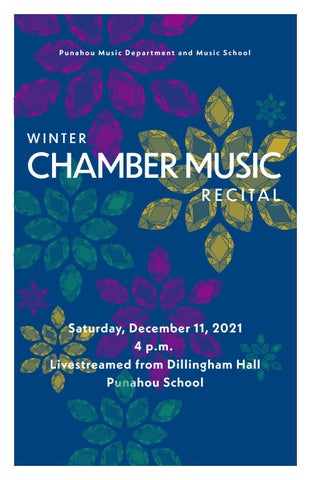
Punahou Music Department and Music School
WINTER
CHAMBER MUSIC RECITAL
Saturday, December 11, 2021 4 p.m. Livestreamed from Dillingham Hall Punahou School
String Quartet No. 1 in B-flat Major, Op. 1 No. 1 ..............................Franz Josef Haydn I. Presto (1732-1809) Hirano String Quartet Ellie Chung and Ethan Loo, violins Julia Saines, viola Ian Jun, cello Lauren Holt, coach
String Quartet in C Major, Op. 20 No. 2, Hob.III:32 .........................Franz Josef Haydn I. Moderato (1732-1809) IV. Fuga a quattro soggetti: Allegro Saburo Watanabe String Quartet Maddy Hodge and Hinano Kawaiaea, violins Eric Nakamoto, viola Madison Suh, cello Dr. Helen Liu, coach
String Quartet No. 14 in G Major, K. 387 ...........................Wolfgang Amadeus Mozart I. Allegro vivace assai (1756-1791) Cooke String Quartet Brennin Lee and Max Shinno, violins Albert Ko, viola Daniel Lin, cello Rachel Saul, coach
String Quartet No. 19 in C Major, K. 465 .............................Wolfgang Amadeus Mozart I. Adagio - Allegro (1756-1791) Peter Mesrobian Memorial String Quartet Noah Chung and Iris Sim, violins Luca Casano, viola Cedric Yeo, cello Steven Flanter, coach
String Quartet No. 13 in D minor, K. 173 ............................Wolfgang Amadeus Mozart I. Allegro ma molto moderato (1756-1791) Vivaldi String Quartet Skye Aoki and Riya Krishnagopalan, violins Swan Kim, viola Justin Merner, cello Lauren Holt, coach Eine Kleine Nachtmusik, K. 525.........................................Wolfgang Amadeus Mozart II. Romanze: Andante (1756-1791) IV. Rondo: Allegro Arthur Y. and Misako M. Akinaka String Quartet Aileen Kang and Megan Yamamoto, violins Cassidy Sakamoto, viola Ian Ahn, cello Anna Callner Pare, coach String Quartet in G minor, Op. 20 No. 3, Hob.III:33 .......................Franz Josef Haydn I. Allegro con spirito (1732-1809) Chang String Quartet Gwyneth Tenn and Kai Asakura, violins Allena Villanueva, viola Joshua Dutton, cello Rachel Saul, coach
String Quartet No. 1 in A minor, Op. 41 No. 1 .....................................Robert Schumann III. Adagio (1810-1856) IV. Presto Keller String Quartet Erika Kwee and Kate Wong, violins Rinny Fan, viola Celina Lim, cello Iggy Jang, coach Piano Quintet in F minor, Op. 34 ....................................................... Johannes Brahms I. Allegro non troppo (1833-1897) Kathryn Kennard Vaught Piano Quintet Ellie Ochiai and Bao Nguyen, violins Keon Sagara, viola Christian Yamada, cello Jairus Rhoades, piano Deven Kono and Maile Reeves, coaches
Eine Kleine Nachtmusik (fourth on this program) is one of Mozart’s most popular and famous works. It’s different from the other Mozart pieces on this program, in a few ways. First, it was originally written to also include a double-bass. The name translates as “a little night music” or “a little serenade,” and it was probably written for a specific occasion, very possibly to be played outdoors. As such, it has a different, less complicated emotional profile, open, warm, and despite the nighttime setting, sunny. There’s not a lot of dissonance. The second movement Andante does have quite a mood change in the middle, though. Can you hear how the minor key and change of texture from smooth and connected to quick and short creates suspense and a bit of drama? The finale movement, on the other hand, is pure energy. The Adagio of Schumann’s A minor quartet has one of the most beautiful melodies in all of quartet literature. It starts out sounding similar to a certain theme from Beethoven’s Ninth Symphony, but quickly takes a deeply romantic turn. Listen to how Schumann first presents it on violin with bowed accompaniment, and then on cello with plucked accompaniment. Do you prefer either version? The Presto movement is straightforwardly fast and dramatic, until near the end, when things change quite a bit. An interesting question to ponder is: Why did Schumann put this very different section in? Johannes Brahms’ music is always full of deep emotion. But he was also an incredible craftsman at composition. He would take a few notes of music and pull endless possibilities from them, drawing on their rhythms and the distance relationships between them to create subtly different variations, arranging them backwards and upside-down, and weaving an incredible tapestry out of all these versions. At the beginning, listen to this four-part sequence of events: first, there’s a unison theme played by violin, cello and piano, full of possibility, but pretty peaceful. Then a variant follows, sped up and suddenly turbulent, while also being enclosed in self-contained phrases. Then, the first version comes back, but injected with a turbulence inherited from that second version. Finally, listen to how the fast, turbulent version comes back, now in incomplete fragments that build and build on each other. And that’s only the first minute of Brahms’ wizardry. - Sasha Margolis
To make music together is a privilege and a joy, and in these challenging
times it is something that we must not take for granted. Music helps us appreciate and experience the beauty of Art, but it also allows us to celebrate the powerful bonds of connection that define us as a community. When a student is part of a chamber music ensemble, they bring forward their individual preparation and perspective to collaborate in creating a composite ensemble sound and compelling musical interpretation. This requires active communication as well as personal responsibility, accountability and persistence. We believe that these skills are essential life skills and will continue to benefit these students in all future endeavors. Each piece on the recital program is a real chamber music gem, each presenting many facets of style, emotion and character. This afternoon’s recital is made possible by the generous support of our program sponsors. We are also grateful to the coaching faculty, who share their experience and guidance with the students and whose leadership makes this program truly unique! Mahalo nui loa to the students and their families for their commitment to the program. Wishing you a very happy holiday season! Helen Chao-Casano & Craig Young Co-coordinators of the Punahou Chamber Music Program
Program Notes Joseph Haydn is known as “the Father of the String Quartet.” Wolfgang Amadeus Mozart was one of the first and one of the very greatest to follow in his quartet footsteps. Haydn wrote sixty-eight quartets, pioneering ways to shape the roles of the four instruments and discovering what they could accomplish playing together. In recognition of Haydn’s accomplishments, Mozart wrote six quartets nicknamed the Haydn Quartets (which can be a little confusing, seeing as how Haydn didn’t write them.) Mozart seems to have also had fatherly feelings of his own: he called his Haydn Quartets his six children. Today’s program opens with Haydn’s first numbered quartet, Op.1 No.1, written in the early 1760s, and meant to be played by several music lovers who regularly gathered at the home of a wealthy government official. The quartet is nicknamed “La Chasse,” that is, “the hunt.” Notice how the rhythms and notes of the opening sound like they could be played by hunting horns. And see if you hear any hunters, horses, or hares in what follows. Haydn’s Opus 20 Quartets, written about ten years later, are known as the “Sun” Quartets, because they were published with a picture of a rising sun on the cover. Op.20 No.3 (fifth on this program) shows Haydn in a sort of cryptic or mischievous mood. If you tried to move to this music, you might find the music playing tricks on your body. A lot of music, and a lot of music from the 1700s, is written in even-sounding four- or eight-measure phrases. That kind of music is easy to move to. But here, Haydn shapes the music in unpredictable ways, starting out with a pair of seven-measure phrases. You don’t have to actually count measures to still get the feeling Haydn is up to something unusual here. Opus 20 No.2 (sixth on this program) shows one of the great things Haydn did in developing the string quartet. He created a musical medium in which four instruments could have a civilized conversation, just like four civilized human beings. In the first movement, the conversation gets started by the cello, and the other instruments keep their responses at a respectful level. If you follow along, you can hear each of the other instruments play the same thing the cello started out with. But meanwhile, keep an ear out for quicker conversations in between. In the Fuga a quattro soggetti movement, the conversational interplay speeds up, and all the instruments start talking about different things at the same time. But if you put your ears and eyes into overdrive, you can recognize repetitions of the same sentences passing from one instrument to another amidst the hubbub.
Mozart’s early D minor Quartet, K.173 (third on this program) was written in 1773, at the same time as Haydn’s Op.20, when Mozart was only seventeen years old. Mozart was twenty-four years younger than Haydn. People tend to think of the young Mozart as someone who wrote easy, happy music, but in this, his first-ever minor-key quartet, he writes in a vein that might be considered brooding, tragic, or even sinister. One thing to notice in this movement is the very different message the music sends when the instruments are playing in rhythmic unison, and when they are in more complicated interplay with each other. Mozart’s K.387 (second on this program) was written nine years later. Nicknamed the “Spring” Quartet, it’s the first of the Haydn Quartets, and you can hear the lessons Mozart learned from the older master. One thing to keep an ear out for is how in the development, which starts with a first-violin semi-cadenza about four minutes in, Mozart breaks out of the cooperative group texture of the first section to give melodies to individual players. Each player explores a slightly different harmony, and the result is a very interesting, emotional conversation. Mozart’s K.465 (seventh on this program) is the last of the Haydn Quartets. Possibly Mozart’s most famous quartet, it’s nicknamed the “Dissonance” Quartet. The word dissonance decribes the state of musical affairs when two or more notes, sounded at the same time, don’t completely get along, creating feelings ranging from tension to terror. Most music has some dissonance, and the history of Classical music from about the time of Haydn and Mozart to the end of the twentieth century can be seen as the gradual addition of more and more dissonance. Some “modern” music from the twentieth century is made up almost entirely of dissonance. This Mozart movement has more dissonance than most music of its time, thus the nickname. The dissonance is in the slow introduction. What follows in the rest of the movement is much more consonant (the opposite of dissonant.) One writer described the effect of moving from dissonance to consonance in this piece this way: “Mozart has simulated the transition from darkness to light, from the underworld to the surface, from the id to the ego … this music is ultimately about confinement and emergence … the Allegro theme emerges soaring and liberated, having already achieved release, transcended the fear of annihilation, freed itself from a burdensome confinement.” That’s a pretty heavy-duty interpretation. You can see if you feel the same things listening to this piece.
Eine Kleine Nachtmusik (fourth on this program) is one of Mozart’s most popular and famous works. It’s different from the other Mozart pieces on this program, in a few ways. First, it was originally written to also include a double-bass. The name translates as “a little night music” or “a little serenade,” and it was probably written for a specific occasion, very possibly to be played outdoors. As such, it has a different, less complicated emotional profile, open, warm, and despite the nighttime setting, sunny. There’s not a lot of dissonance. The second movement Andante does have quite a mood change in the middle, though. Can you hear how the minor key and change of texture from smooth and connected to quick and short creates suspense and a bit of drama? The finale movement, on the other hand, is pure energy. The Adagio of Schumann’s A minor quartet has one of the most beautiful melodies in all of quartet literature. It starts out sounding similar to a certain theme from Beethoven’s Ninth Symphony, but quickly takes a deeply romantic turn. Listen to how Schumann first presents it on violin with bowed accompaniment, and then on cello with plucked accompaniment. Do you prefer either version? The Presto movement is straightforwardly fast and dramatic, until near the end, when things change quite a bit. An interesting question to ponder is: Why did Schumann put this very different section in? Johannes Brahms’ music is always full of deep emotion. But he was also an incredible craftsman at composition. He would take a few notes of music and pull endless possibilities from them, drawing on their rhythms and the distance relationships between them to create subtly different variations, arranging them backwards and upside-down, and weaving an incredible tapestry out of all these versions. At the beginning, listen to this four-part sequence of events: first, there’s a unison theme played by violin, cello and piano, full of possibility, but pretty peaceful. Then a variant follows, sped up and suddenly turbulent, while also being enclosed in self-contained phrases. Then, the first version comes back, but injected with a turbulence inherited from that second version. Finally, listen to how the fast, turbulent version comes back, now in incomplete fragments that build and build on each other. And that’s only the first minute of Brahms’ wizardry. - Sasha Margolis
To make music together is a privilege and a joy, and in these challenging
times it is something that we must not take for granted. Music helps us appreciate and experience the beauty of Art, but it also allows us to celebrate the powerful bonds of connection that define us as a community. When a student is part of a chamber music ensemble, they bring forward their individual preparation and perspective to collaborate in creating a composite ensemble sound and compelling musical interpretation. This requires active communication as well as personal responsibility, accountability and persistence. We believe that these skills are essential life skills and will continue to benefit these students in all future endeavors. Each piece on the recital program is a real chamber music gem, each presenting many facets of style, emotion and character. This afternoon’s recital is made possible by the generous support of our program sponsors. We are also grateful to the coaching faculty, who share their experience and guidance with the students and whose leadership makes this program truly unique! Mahalo nui loa to the students and their families for their commitment to the program. Wishing you a very happy holiday season! Helen Chao-Casano & Craig Young Co-coordinators of the Punahou Chamber Music Program
SPONSORS
Punahou Music Department and Music School
Arthur Y. and Misako M. Akinaka String Quartet Mr. Robert ’59 and Mrs. Velma Chong ’63 Akinaka Chang String Quartet Dr. and Mrs. Walter Chang Cooke String Quartet Mrs. Janet Cooke Hirano String Quartet The Hirano Family Mrs. Gladys Hirano, Mr. Rik Hirano ’75 Keller String Quartet Drs. Bruce and Cynthia Keller
WINTER
CHAMBER MUSIC RECITAL
Peter Mesrobian Memorial String Quartet The Tanoue Family Kathryn Kennard Vaught Memorial Piano Quintet The Family of Dr. Raymond Vaught Vivaldi String Quartet Joyce & (the late) Robert Torrey Saburo Watanabe String Quartet Dr. and Mrs. Ted Watanabe Alex Watanabe ’09, David Watanabe ’14 Chamber Music Coaches Professional Development Fund The Himeno Family Ms. Sandra Himeno-Okamoto ’73 Ms. Sharon R. Himeno ’74 Helen and Matthew Lau Endowed Chamber Music Fund Dr. and Mrs. Matthew Lau
PUNA HO U SCHO O L
Saturday, December 11, 2021 4 p.m. Livestreamed from Dillingham Hall Punahou School