Academy Course Listing
2026 – 2027
Punahou Academy Course Listing 2026 – 2027
Punahou School does not discriminate on the basis of race, color, religion, national or ethnic origin, sex/gender, sexual orientation, age or disability in administration of its employment practices or educational policies: admission, financial aid, athletic and other School-administered programs.
Punahou School • 1601 Punahou Street • Honolulu, Hawai‘i 96822
The following 2026 – 2027 course information will assist you in understanding course selection procedures and requirements for graduation. Punahou awards a diploma to each student who earns at least 22 credits during four years of high school and who meets the course requirements described in this document. It is the responsibility of each student to complete all required courses needed to meet graduation requirements.
A full-time student in the Punahou Academy (grades 9 through 12) must be enrolled in at least five half-credit courses per semester (excluding PE), at least four of which must be taken for a letter grade.
All semester grades, with the exception of Credit/No Credit courses are weighted equally to compute Grade Point Average (GPA). With the exception of School Year Abroad (SYA) and Global Online Academy (GOA) courses, only graded courses taken at Punahou are reflected in Punahou’s GPA. Each course earns one-half credit per semester except JROTC, which earns one-half credit per year; ASPE, which earns one-quarter credit per quarter; Marching Band, which earns one-quarter credit per year; and College Guidance and Health & Wellness which are required and no credits are earned. In exceptional or compelling circumstances, the Council of Deans and Principals may approve an exception to the policies and requirements outlined in this Course Catalog. This provision is intended to support students whose unique situations cannot be reasonably addressed through existing provisions, while maintaining the integrity and spirit of the Academy’s academic program.
Graduation Requirements and Important Information
Graduation Requirements
It is the responsibility of each student to complete all required courses and to be accountable for meeting graduation requirements.
Each student needs to earn a total of 22 credits in the following subject areas. Please see the department sections for course specific requirements within each department.
English
Four credits
Mathematics
Three credits
Physical Education
Two credits
Science
Two credits from yearlong courses
Social Studies
Three and one-half credits
Visual and Performing Arts
Two credits
World Language
Two credits from two consecutive levels of a single language
Other Courses
Three and one-half credits
Any course exceeding departmental requirements for graduation or those courses identified as not meeting departmental requirements for graduation.
Early Graduation
The Academy Program at Punahou spans four years to provide a comprehensive blend of academic rigor, personal, athletic and artistic development and enriching student life experiences. Graduating students are expected to attend Punahou through their senior year.
To be eligible for a Punahou diploma and participate in the commencement ceremony, students are required to attend school during both the fall and spring semesters of their senior year. Students who are interested in graduating early must declare their intention to their deans before the end of the first semester of their junior year to ensure the School will have enough time to review their request.
Punahou may consider requests for early graduation only for rare and compelling reasons and such requests are rarely granted. Students interested in graduating before June of their senior year must have completed all academic requirements for graduation, including 22 credits and have a 3.0 or greater GPA. Under no circumstances will a student be permitted to graduate with a Punahou diploma prior to completing the Fall Semester of their senior year.
See the Punahou School Student and Family Handbook for full details regarding early graduation.
Completion of Requirements Following Senior Year
On very rare occasions, Punahou may allow students to complete their academic requirements after their senior year. Students who have not been able to complete those requirements may do so during summer school, through Punahou’s partners (Global Online Academy or School Year Abroad) or at a collegiate institution, if possible.
They must earn at least a C (2.00) in each class. No student may complete more than 3 credits after their senior year. Students in this situation must complete all requirements within the academic year following their senior year. The diploma will be issued by mail and students in this situation may not participate in Baccalaureate, Senior Sing or Commencement ceremonies.
Credit/No Credit Option (CR/NC)
Students are permitted to enroll in specified graded courses on a Credit/ No Credit option basis. The objective of this privilege is to encourage students to extend their academic horizons in courses of interest to benefit their general education without the pressure of letter grades. Students may elect Credit/No Credit status in a graded course exceeding departmental requirements for graduation or a graded course identified as not meeting departmental requirements for graduation. In addition, all PE courses may be taken CR/NC. However, Advanced Placement courses must be taken for a letter grade.
In order to earn a credit (CR), students must meet the teacher’s expectations, which shall be no less than a C (2.00) grade.
Approval of credit/no credit status must be obtained from a parent/guardian, the teacher, Department Head and grade level deans by the deadline publicized each semester.
Enrollment Requirements
In any semester, a student must be enrolled in a minimum of five or a maximum of six half-credit courses (excluding PE) and at least four courses must be taken on a graded basis.
Graduation Requirements and Important Information
Programming Process
At grade level assemblies, the deans brief students about graduation requirements and course offerings. In February, deans meet with students individually for students to request courses. From that point, changes will depend on course availability as some courses will be closed and changes will not be possible.
Although students may choose from many courses, they must choose carefully. With as few exceptions as possible, Punahou programs, schedules and staffs courses according to demand. Changes to a student’s schedule after programming with the dean must be kept to a minimum and are subject to space or other restrictions.
Course offerings depend upon sufficient enrollment and available staff. Some combinations of courses may result in scheduling conflicts and in some cases students may have to alter their course selections.
Enrollment in high-demand courses may be by lottery. In such cases, priority is given to grade 12, then grade 11 and so on.
Global Online Academy (GOA) Programming
Registration for online courses offered through GOA is done during general course registration with the deans. Students may enroll in only one GOA course per semester and that GOA course can only be taken as a sixth half-credit class in the student’s schedule.
Travel Programming
In order to make necessary travel arrangements, the application deadlines for these programs vary. Please read the Travel section for specifics. Students may contact their deans or the Wo International Center, depending on the program, for more information and an application.
Students must also register for the related Summer School course as described for each program in the relevant academic department section. This is done during course programming with deans.
Summer School Programming
Students may register for up to one credit in Academy courses with the exception of PE which may be taken in excess of one credit. Students may not register for both an English and a Social Studies course in the same summer. Students are responsible for ensuring that class times do not conflict. Please check the Summer School section for the dates and times courses will be offered.
Students may take at most two English courses in Summer School to fulfill the four credits required for graduation. They may take either English 1A between eighth and ninth grades or English 2A between ninth and 10th grades. In the summers before 11th and 12th grade, they may take no more than one English course.
To fulfill graduation requirements, a student may take a maximum of one summer school course in mathematics and one in science.
Summer School registration for creditbearing courses takes place during course programming with the student’s deans. Summer School courses may be overenrolled due to limited space, therefore students are not guaranteed their first choice in course selection. In such cases, priority is given to grade 12, then grade 11 and so on. All things being equal, a lottery may be held to determine which students are placed in a particular course.
All course offerings are subject to sufficient enrollment.
The school offers a variety of non-credit co-curricular offerings. Registration for CoCurricular courses, including SAT Prep, Music School and Dance School courses, is completed through the Punahou School Extended Learning Office.
For Class of 2027
Students may take up to one credit in Summer School to fulfill the three and one-half Social Studies credits required for graduation. A student may take either Introduction to Social Studies between eighth and ninth grades or East Asian History between ninth and 10th grades, but not both.
For Class of 2028 and beyond
Students may take up to one credit in Summer School to fulfill the three and one-half Social Studies credits required for graduation. A student may take either Hawaiian History between eighth and ninth grades or East Asian History between ninth and 10th grades, but not both.
Graduation Requirements
Students must earn two credits in the Visual and Performing Arts. All Art Department courses (except GOA courses) may be taken to fulfill the Visual and Performing Arts requirement or elective credit. Courses taken to fulfill the Visual and Performing Arts graduation requirement must be taken for a grade; courses taken for elective credit may earn either a letter grade or Credit/No Credit.
Lab Fees
Many courses have a lab fee to cover some materials used in the course. Lab fees will be charged to the student’s account and are non-refundable once the term has begun.
Course Offerings
Drawing I
Drawing I is an introductory course focusing on developing skills by exploring various drawing materials, such as graphite, charcoal, ink, pastel, watercolor and mixed media. Students learn to develop basic skills and use various media with an emphasis on process, creativity and innovation. Drawing is a fundamental activity in the visual arts, which involves observation, critical thinking and learning to ask questions and make judgments.
Open to grades 9, 10, 11, 12. No prerequisite. Semester course. One-half credit. Satisfies Visual and Performing Arts graduation requirement or elective credit. Lab fee.
Art
The Academy Visual Art Department curriculum extends beyond skills, techniques and concepts. The faculty provides environments that promote purposeful exploration toward creating visual expression. The intent is for students to develop habits of mind and practice that allow them to become curious, confident and resilient individuals devoted to enriching the world and the lives of people around them.
ACADEMY VISUAL ARTS: COURSE OFFERINGS 2026 – 2027
GRADE COURSES AVAILABLE TO 9TH - 12TH GRADES2D
9
BLACK & WHITE FILM PHOTOGRAPHY COLOR DIGITAL PHOTOGRAPHY
DIGITAL ART
DRAWING I
DRAWING II
GSD: PRODUCT DESIGN FOR SUSTAINABLE ENTREP.
INTRODUCTION TO ARTIST PRACTICE
INTRODUCTION TO CERAMICS HANDBUILDING
METALS & JEWELRY I
METALS & JEWELRY II
PAINTING I
PAINTING II
PHOTO II
PRINTMAKING
SCULPTURE
VIDEOGRAPHY
GRADE COURSES AVAILABLE TO 10TH - 12TH GRADES (IN ADDITION TO THE COURSES LISTED ABOVE)
WINDOWS & MIRRORS: NARRATIVE GLASS SCULPTURE 10
ENGLISH 2AB: VISUAL STORYTELLING (1OTH ONLY)
INTRODUCTION TO CERAMICS: WHEEL THROWING I
LIFE DRAWING
GRADE COURSES AVAILABLE TO 11TH & 12TH GRADES (IN ADDITION TO THE COURSES LISTED ABOVE)
ARTS & LETTERS
CERAMICS: WHEEL THROWING II
DIGITAL 3D MODELING & ANIMATION
GLASS BLOWING I
GLASS REVOLUTION: TRANSFORMING GLASS FROM REFUSE TO RESOURCE ON O‘AHU
INDEPENDENT ART STUDIO* STUDIO ART*
COURSES ONLY AVAILABLE TO 12TH GRADE (IN ADDITION TO THE COURSES LISTED ABOVE)
GRADE * Studio Art & Independent Art Studio students can work across 2D/3D/4D forms of artmaking in consultation with their teacher 2-Dimensional (2D); 3-Dimensional (3D); 4-Dimensional (4D) - Time based works
GLASS BLOWING II
Drawing II
Drawing II is a natural extension of Drawing I. After learning basic drawing skills, students are encouraged to develop their themes and express their ideas and feelings. They have the opportunity to produce artwork on a range of surfaces using a variety of drawing media, including graphite, charcoal, ink, pastels, watercolor and mixed media. Drawing II is designed to deepen the experience, develop selfconfidence, instill understanding and grow in visual voice.
Open to grades 9, 10, 11, 12. Prerequisite: Drawing I or English 2AB: Visual Storytelling. Semester course. One-half credit. Satisfies Visual and Performing Arts graduation requirement or elective credit. Lab fee.
Life Drawing
In Life Drawing, serious students of all skill levels have the opportunity to produce works of art based on the human form. Foundational drawing skills are practiced while students are encouraged to develop a personal style using various drawing media, including graphite, charcoal, pen and ink and pastels. Students’ wide range of artistic interests are accommodated through individualized attention, critique and discussion. Guidance is given to those students wishing to strengthen their art portfolio with drawings of the human form.
This course allows students to draw from live nude models, a privilege in the Academy, and provides excellent drawing opportunities for dedicated and mature students.
Open to grades 10, 11, 12. Prerequisite: Drawing I is highly recommended but not required. Semester course. One-half credit. Satisfies Visual and Performing Arts graduation requirement or elective credit. This course may be repeated for credit. Lab fee.
Painting I
Painting I is an introductory course that teaches basic painting skills and includes studying value, color, space and texture. Through the experience of several paintings, students become familiar with these elements and explore their relationships.
Open to grades 9, 10, 11, 12. No prerequisite. Semester course. One-half credit. Satisfies Visual and Performing Arts graduation requirement or elective credit. Lab fee.
Painting II
Painting II is a natural extension of Painting I. Students are introduced to the traditional methods of painting, which uses oil paint and various mediums. Having learned the basic skills of painting, students apply techniques and processes with more confidence and intent. Connections between historical, contemporary and the students’ paintings are discussed. Painting II is designed to deepen experience, develop self-confidence, instill understanding and encourage growth in the artistic capabilities of the art student. Students learn how to stretch canvas and prepare it for painting.
Open to grades 9, 10, 11, 12. Prerequisite: Painting I or English 2AB: Visual Storytelling. Semester course. One-half credit. Satisfies Visual and Performing Arts graduation requirement or elective credit. Lab fee.
Printmaking
Have you ever wanted to print your t-shirts or posters? Would you like to make an image with sunlight? Carve into a surface and see your carving transferred by hand onto paper to become frameable art? Learn to operate a large mechanical printing press? Use fundamental science to make an image with water and crayons? Printmaking is a dynamic, fun, accessible visual art course that blends centuries-old processes with 21st-century ideas and practice. It gives students, without prerequisites, new skills in drawing, design, art history, art theory and the studio practice of Printmaking. Students develop their vision and the tools to make it come alive in everyday art.
This course explores various printmaking media, emphasizing new and environmentally friendly materials and methods. Students create original artwork, including silkscreened designs on textiles and other wearable or functional pieces such as bags, aprons, jeans, dresses, kitchen towels, etc. Students also learn photo-based print processes, such as solar printing and make an edition of carved block prints to exchange with each other. In addition, the course teaches painterly techniques, including monotype (printing from a painting) and hand-coloring and traditional methods of lithography and engraving on metal plates to be printed through the press.
The course deepens students’ understanding of visual art through studio experimentation and immersion in popular visual culture. Field trips, slide shows, discussions and contemporary readings complement the studio instruction.
Open to grades 9, 10, 11, 12. No prerequisite. Semester course. One-half credit. Satisfies Visual and Performing Arts graduation requirement or elective credit. Lab fee.
Black & White Film Photography
Black & White Film Photography is a comprehensive technical primer on black-and-white still photography using film. Through lectures, demonstrations, discussions, critiques and lab activities, students master basic analog skills, including operating and maintaining a camera system, darkroom procedures, negative archiving and photo retouching. Students are assigned lessons in which film and paper are exposed, developed, proofed and printed. Each student needs a manual exposure control camera (e.g., a 35mm SLR); a camera with the ability to override automatic exposure of the shutter speed and aperture.
Students can buy and sell their cameras online, at local camera stores or from each other. The photography teacher (Alex Selarque, aselarque@punahou.edu) will help facilitate communication between students who need a camera and those who want to sell theirs.
Open to grades 9, 10, 11, 12. No prerequisite. Semester course. One-half credit. Satisfies Visual and Performing Arts graduation requirement or elective credit. Lab fee.
Color Digital Photography
Color Digital Photography serves as a comprehensive technical primer on color still photography using modern digital technology. Through lectures, demonstrations, discussions, critiques and lab activities, students master basic skills, including operating and maintaining a camera system, computer import and export procedures, digital archiving and photo editing using Adobe Bridge and Photoshop.
Students are given assignments in which a digital photograph is taken, imported, organized, proofed, enhanced and printed on inkjet and dye sublimation printers, then saved to the cloud. Each student needs a camera that can shoot RAW files with controls to manually adjust the shutter speed, aperture, focus and ISO. All DSLR and most mirrorless cameras fit this requirement.
Students can buy and sell their cameras online, at local camera stores or from each other. The photography teacher (Alex Selarque, aselarque@punahou.edu) will help facilitate communication between students who need a camera and those who want to sell theirs.
Due to limited equipment, this course may be subject to limited enrollment.
Open to grades 9, 10, 11, 12. No prerequisite. Semester course. One-half credit. Satisfies Visual and Performing Arts graduation requirement or elective credit. Lab fee.
Photography II
Photography II utilizes the student’s technical knowledge to apply an understanding of processes for narrative and aesthetic outcomes. Assignments focus on mastering black-and-white and color techniques while synthesizing composition and culture in authentic photography and manipulating visual images. Work is printed as 16" x 20" enlargements with the intent to exhibit on campus. Students who completed Black & White Film Photography produce black and white photographs in the darkroom and color assignments by scanning processed film, importing it into Adobe Bridge and working with Photoshop before printing to a large format inkjet color printer. Students who completed Color Digital Photography work entirely with digital media. Each student needs either a film or a digital camera. Please see the descriptions for Black & White Film Photography or Color Digital Photography for camera requirements. An optional field trip opportunity off-island may be offered once a year.
Due to limited equipment, this course may be subject to limited enrollment.
Open to grades 9, 10, 11, 12. Prerequisite: Black & White Film Photography or Color Digital Photography. Semester course. One-half credit. Satisfies Visual and Performing Arts graduation requirement or elective credit. Lab fee.
Digital Art
Digital Art offers a unique approach to understanding basic visual language. Computer applications and tools allow students to explore new ways of conceiving and constructing works of art. At the same time, the course provides a deeper understanding of art and its basic principles through assignments designed to integrate with and build upon foundation art skills, especially drawing and design. The course teaches fundamentals of technology-based art, including basics of digital photography, digital drawing with a Wacom tablet, iPad, CAD, 3D printing and animation. Students engage in manipulation and creation of digital imagery using computer software including Photoshop, SketchUp and other creative apps. Digital Art is designed to expand understanding of visual art through technology, historical and cultural context and formal art analysis and critique.
Open to grades 9, 10, 11, 12. No prerequisite. Semester course. One-half credit. Satisfies Visual and Performing Arts graduation requirement or elective credit. Lab fee.
Digital 3D Modeling & Animation
This course explores the fundamentals of digital 3D modeling and animation with a focus on creating objects, props, scenery and simple characters for game environments. Students experience the artistic workflow of creating the art assets that level designers use in video games, or layout artists use to create cinematic scenes in animation. Students learn industry-standard techniques for modeling, texturing, rigging and basic animation while developing a comprehensive understanding of design principles and their application in 3D art. More than just a technical class, this is an art course where students learn to use 3D software as a powerful medium for creative expression. Students integrate the elements of design—including line, shape, form, space, color, texture and value—throughout their 3D creations, learning to make deliberate artistic choices that communicate mood, story and function. Completion of Drawing I, Painting I or Digital Art is highly recommended.
Open to grades 11, 12. No prerequisite. Semester course. One-half credit. Satisfies Visual and Performing Arts graduation requirement or elective credit. Lab fee.
Videography
Videography combines cinema and television literacy with artistic production. Culture and art are examined through assignments that emphasize elements such as framing, perspective, movement, audio and editing while using conventions of documentaries, short narratives and experimental visual essays to communicate ideas.
During the initial quarter, students learn to shoot video independently, record sound and edit with a non-linear computer application.
During the following quarter, students work collaboratively in assigned and self-assigned teams on projects that challenge their creative, social, technical and management skills. Videos are screened and critiques involve discussions around pretext, subtext and context.
Each student needs a video camcorder, DSLR or mirrorless camera with video recording capability. A tripod is preferred but optional.
Open to grades 9, 10, 11, 12. No prerequisite. Semester course. One-half credit. Satisfies Visual and Performing Arts graduation requirement or elective credit. No lab fee.
Introduction to Ceramics: Handbuilding
This course is an introduction to ceramic handbuilding techniques and processes, focusing on fundamental methods such as pinching, coiling and slab building.
Students are guided to develop their artmaking skills and techniques in handbuilding methods and have the opportunity to try different clay bodies and compare them. In addition, tooling, finishing, glazing and firing are experienced.
Students gain skills in applying design elements and principles (line, shape, color, texture, balance, etc.). Each student must keep a sketchbook. Students write and sketch, which may be subjective, reflective and descriptive. Historical and cultural perspectives are introduced and may require research, group discussion, written observation, peer review and evaluation.
Open to grades 9, 10, 11, 12. No prerequisite. Semester course. One-half credit. Satisfies Visual and Performing Arts graduation requirement or elective credit. Lab fee.
Introduction to Ceramics: Wheel Throwing I
This course concentrates on wheel throwing as a discipline to align the mind, body and material. The methods described, demonstrated and taught in pottery are a combination of Western and Eastern traditions. In addition, modern and popular expansions are presented. The aim of this course is to give students an introduction to the techniques of wheelwork in the context of a holistic environment, where body-mind integration, awareness and full participation are essential. There is ample opportunity for individual expression within and beyond the requirements.
Together with “throwing,” which means “turning” a completely symmetrical pot from a lump of clay on the wheel, tooling, finishing, glazing and firing techniques are learned. Students also explore historical and contemporary ceramic art. Due to limited equipment, this course may be subject to limited enrollment.
Open to grades 10, 11, 12. No prerequisite. Semester course. One-half credit. Satisfies Visual and Performing Arts graduation requirement or elective credit. Lab fee.
Ceramics: Wheel Throwing II
Wheel Throwing II continues the challenge of expression through sculptural and functional forms. Centering takes on additional significance as the student seeks to find the center of the aesthetic gesture, trimming away all that is not needed to find the essence of craft brought to the art form.
In this course, each student uses a wheel and handbuilding methods to complete several major assignments, including a teapot, lantern, porcelain dinner set and student-designed work. The course also includes a sketchbook of designs, forms, glaze and chemical notes and aesthetic and historical reflections.
Due to limited equipment, this course may be subject to limited enrollment.
Open to grades 11, 12. Prerequisite: Wheel Throwing I. Semester course. One-half credit. Satisfies Visual and Performing Arts graduation requirement or elective credit. Lab fee.
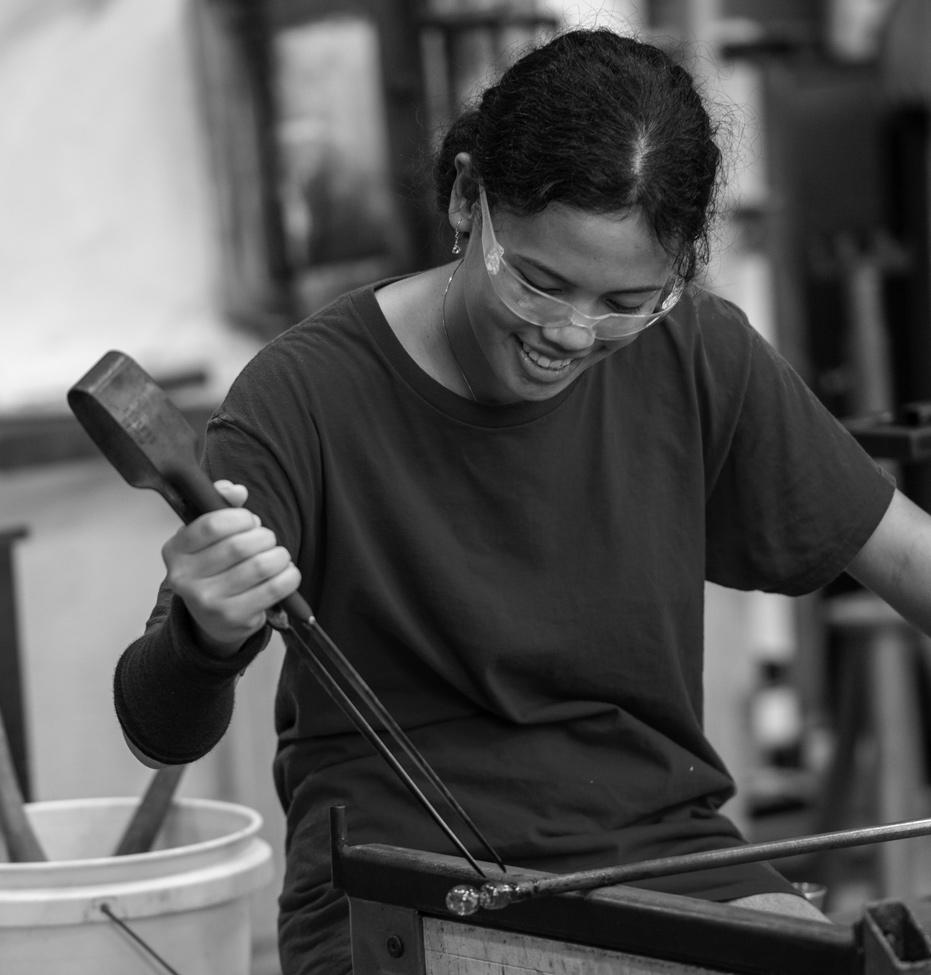
Glass Blowing I
This course teaches students to form hot glass by off-hand blowing techniques. Students study a variety of shapes and proportions and apply them to functional, decorative and expressive forms. Color, optic molds, surface applications, grinding, polishing and sandblasting are presented as modifications of basic forms. Students focus on craftsmanship and purposeful control while being encouraged to personalize their work.
Grading is based on mastery of basic forming techniques in hot glass and on additional credits earned through optional work, design, research and critiques of studio glass. Keeping a sketchbook is required.
Due to limited equipment, this course may be subject to limited enrollment.
Open to grades 11, 12. No prerequisite. Semester course. One-half credit. Satisfies Visual and Performing Arts graduation requirement or elective credit. Lab fee.
Glass Blowing II
In this course, students use glass as a creative medium. Advanced techniques in glass forming and decorating are presented and practiced as students prepare personally expressive pieces of glass. Students explore the expressive possibilities of glass through practice assignments and move on to develop their own creative voice. They are expected to keep a sketchbook and to complete critical studies of studio glass.
Due to limited equipment, this course may be subject to limited enrollment.
Open to grade 12. Prerequisite: Glass Blowing I. Semester course. One-half credit. Satisfies Visual and Performing Arts graduation requirement or elective credit. Lab fee.
Metals & Jewelry I
Metals & Jewelry I is an introduction to the technical and conceptual aspects of modern metalsmithing essential to making small-scale sculptures and jewelry. Students develop skills through an exploration of traditional and emergent processes. Traditional use of the jeweler’s saw, soldering, polishing, simple forming, wax work and bronze casting are complemented through a series of design explorations. Evidence of the student process consists of finished pieces made in silver, bronze, brass and copper. The course emphasizes developing a personal aesthetic through design, mastery of techniques and a sense of excellence in craft. Visual research and drawings are required in the development of each assignment. A sketchbook is also required.
Due to limited equipment, this course may be subject to limited enrollment.
Open to grades 9, 10, 11, 12. No prerequisite. Semester course. One-half credit. Satisfies Visual and Performing Arts graduation requirement or elective credit. Lab fee.
Metals & Jewelry II
Building on techniques from Metals & Jewelry I, students continue to develop a personal aesthetic through metal at a small scale. Advanced design and metalworking techniques are explored, including the metal casting process. Research related to historical and contemporary design, sculpture and jewelry supports individual choices between technical and conceptual areas to pursue. All work leads to an emerging personal aesthetic for students. Students choose to create projects using silver, bronze, brass, copper and other related materials. A sketchbook is required.
Due to limited equipment, this course may be subject to limited enrollment.
Open to grades 9, 10, 11, 12. Prerequisite: Metals & Jewelry I. Semester course. One-half credit. Satisfies Visual and Performing Arts graduation requirement or elective credit. Lab fee.
Sculpture
This course offers an introduction and practical experience in making sculptural forms and objects. Students are introduced to additive and subtractive sculpting methods, casting, modeling and assemblage techniques to solve technical and creative problems.
Students have the opportunity to work with various 3D art media, such as plaster, wood, polymer/stoneware clay, wire/metal, found objects, paper/card, fibers and modeling compounds. They make a range of sculptures with different purposes (utilitarian/functional, decorative and representational sculptural forms).
Class discussion of historical and contemporary sculptures helps students understand relevant concepts as they experiment with three-dimensional materials. The technical acquisition of skills is balanced with students’ creative self-expression.
Students are encouraged and supported to respond to visual prompts imaginatively as they ideate, experiment, create and resolve their sculptures. Students are expected to keep a sketchbook; hand drawing is required. Collaboration is essential in facilitating molding and casting processes in Sculpture.
Open to grades 9, 10, 11, 12. No prerequisite. Semester course. One-half credit. Satisfies Visual and Performing Arts graduation requirement or elective credit. Lab fee.
Windows & Mirrors:
Narrative Glass Sculpture
Dive into the world of glass as a sculptural medium! In this semester-long course, students gain hands-on experience in both traditional and contemporary glass casting while exploring conceptual and narrativebased artmaking. This course is immersive, fast-paced and designed for students ready to push their creativity to the next level, as well as create contemporary artwork that can be incorporated into their college art portfolio.
This accelerated course offers students the opportunity to work hands-on with glass as a sculptural medium. Students learn methods of glass casting and mold-making using Zircar mold mix, as well as coldworking processes, including sandblasting, engraving and mirroring. The course emphasizes experimentation, risk-taking and integration of mixed media, with a focus on developing narrative and conceptual sculptures.
Due to limited equipment, this course may be subject to limited enrollment. Open to grades 10, 11, 12. No prerequisite. Semester course. One-half credit. Satisfies Visual Arts Graduation Credit or Elective Credit. Lab Fee.
Introduction to Artist Practice
This introductory course explores what it means to be an artist and how to be creative. Students are guided through a range of 2D and 3D art-making materials and processes, including drawing, painting, collage, printmaking, digital design / image-making, sculpture and mixed media.
Students learn about the routines and behaviors of being an artist, as well as how to engage in critical and creative thinking processes within an art studio setting. Students learn about the elements and principles of art and design and develop skills in composition. They are introduced to foundational concepts and history, as well as 21st-century and emerging viewpoints in the visual arts. Students are guided through art-making activities and explore inquiry questions such as ‘How do artists respond to the world around them?’ Artist sketchbooks are foundational to this course as students document the creative process. The course culminates in an exhibition of artist practice.
The purpose of this course is to enhance students’ understanding and experience of the visual arts and artist practices. All students are welcome from beginner artists to those more advanced as well as those seeking exposure to a range of 2D and 3D art-making activities.
Open to grades 9, 10, 11, 12. No Prerequisite. Semester course. One-half credit. Satisfies Visual and Performing Arts graduation requirement or elective credit. Lab fee.
Studio Art
Studio Art is a non-media-specific art course focusing on strengthening the creative process and defining the creator’s unique and original voice. Catering to a diverse group of students working in 2D, 3D and 4D, the core unifying principle is the concept of what it means to be creative and how to create meaningful work. Students are encouraged to experiment and explore ideas through a variety of media to develop skills.
The course structure centers on the individual student exploring ideas with the teacher as a facilitator. Class time is devoted to discussions on creative strategies, what to do when you don’t know what to do, critiques, field trips and visiting artists. The teacher aids the student in finding strategies of art-making that match the student’s learning style. Students end the semester with the presentation of a portfolio of images of the work done for this course.
Students who have a focus in mind, as well as those seeking to find a focus in their work, are suited to this course. This course can be used to prepare a portfolio for application to the Advanced Placement Art Portfolio, potentially earning AP credit after submission and review. Students preparing an AP portfolio in the visual arts are encouraged to take this course sequentially over the course of two semesters.
Open to grades 11, 12. Prerequisites: At least two studio art courses. Semester course. One-half credit. Satisfies Visual and Performing Arts graduation requirement or elective credit. This course may be repeated for credit. Lab fee.
Arts & Letters (ID)
See Interdisciplinary section for course description.
English 2AB: Visual Storytelling (ID)
See Interdisciplinary section for course description.
Global Sustainability by Design: Product Design for Sustainable Entrepreneurship (ID)
See Interdisciplinary section for course description.
Ke Kilohana Courses
See Ke Kilohana section for course descriptions for all Ke Kilohana courses. Glass Revolution: Transforming Glass from Refuse to Resource on Oahu
Global Online Academy Courses
See the GOA section for fee information, course descriptions and course dates. (S) indicates courses offered in the summer.
Graphic Design
Open to grades 10, 11, 12. Semester course. One-half credit. Satisfies elective credit.
Independent Art Studio
Independent Art Studio is an advanced, individual course of self-directed studio work under the guidance of a faculty mentor. Media availability is limited, so students must confer with and receive permission from a studio supervisor (often but not always the faculty mentor) before enrolling in this course. A contract for the course is developed by the student and approved by the Independent Study Coordinator, faculty mentor and Art Department Head before the beginning of the semester. This course is appropriate only for those few independent students whose projects do not fit into the Studio Art course.
Open to grades 11, 12. Prerequisites: All level I and II courses available in the medium to be studied, or one semester of Studio Art. Permission of the faculty mentor, intended studio supervisor, and Academy Art Department Head. Each Art Department teacher may accept no more than four Independent Art Studio students in one semester. Semester course. One-half credit. Satisfies Visual and Performing Arts graduation requirement if taken for a grade or general elective credit if Credit/No Credit. Lab fee.
Courses not offered in 2026 – 2027
European History through the Arts, Curation & Design (ID)
College Counseling
Punahou’s College Counseling program is based on up-to-date research methods that support students by:
» Encouraging good decision-making through self-assessment.
» Building confidence surrounding the college application process.
» Identifying colleges that are a good match for each individual student.
College Counseling desires to have students and their families take initiative in learning about colleges and universities and begin honest conversations regarding post-secondary options through the lens of academic, social and financial criteria.
The importance of focusing on a ‘good match’ is emphasized, rather than what some may call a ‘good’ college. The needs and goals of each student lead to a unique perspective for every college or university in the context of that individual.
Families are invited to ask, ‘Will this student be happy and successful at X College?’ rather than, ‘Can this student get into X College?’ By encouraging self-reflection and self-assessment early in the college research phase, the selection process is framed with each student understanding who they are and thinking about who they wish to become. The College Guidance course serves as a venue for College Counselors to gather information from students to better assist them in selecting colleges that will be appropriate matches for them.
Graduation Requirements
College Guidance is required for all students in Grade 11.
Course Offering College Guidance
In this course, students learn about the college admissions process. The course encourages thoughtful decision-making by students and their families through careful self-assessment and reflections. It also facilitates preparedness for the application timeline in the 12th grade. Throughout the course, 11th graders and their College Counselor explore the concept of identifying their best matches considering academic, social and financial criteria. The College Counselor helps guide students with options after graduating from Punahou.
The topics covered in the course include decision-making steps and the process of choosing a college, self-assessment to determine the college environment best suited for the individual student, admission factors, admission plans, standardized tests, college costs and financial aid and sharing of current resources.
Required for grade 11. Semester course (Fall semester).
SAT Prep
In partnership with Compass Education Group, a long-standing expert in the test preparation field, Punahou Co-Curricular programs offer SAT Prep courses throughout the school year and summer. The course is designed to empower students to remain informed and on-track to master the topics and strategies necessary to improve their SAT scores. Each session includes eight (8) live, two and a half hour online instructional sessions led by an expert Compass tutor and three (3) online practice tests. Course and registration information can be found on the Punahou Co-Curricular website. Open to grades 9, 10, 11, 12.
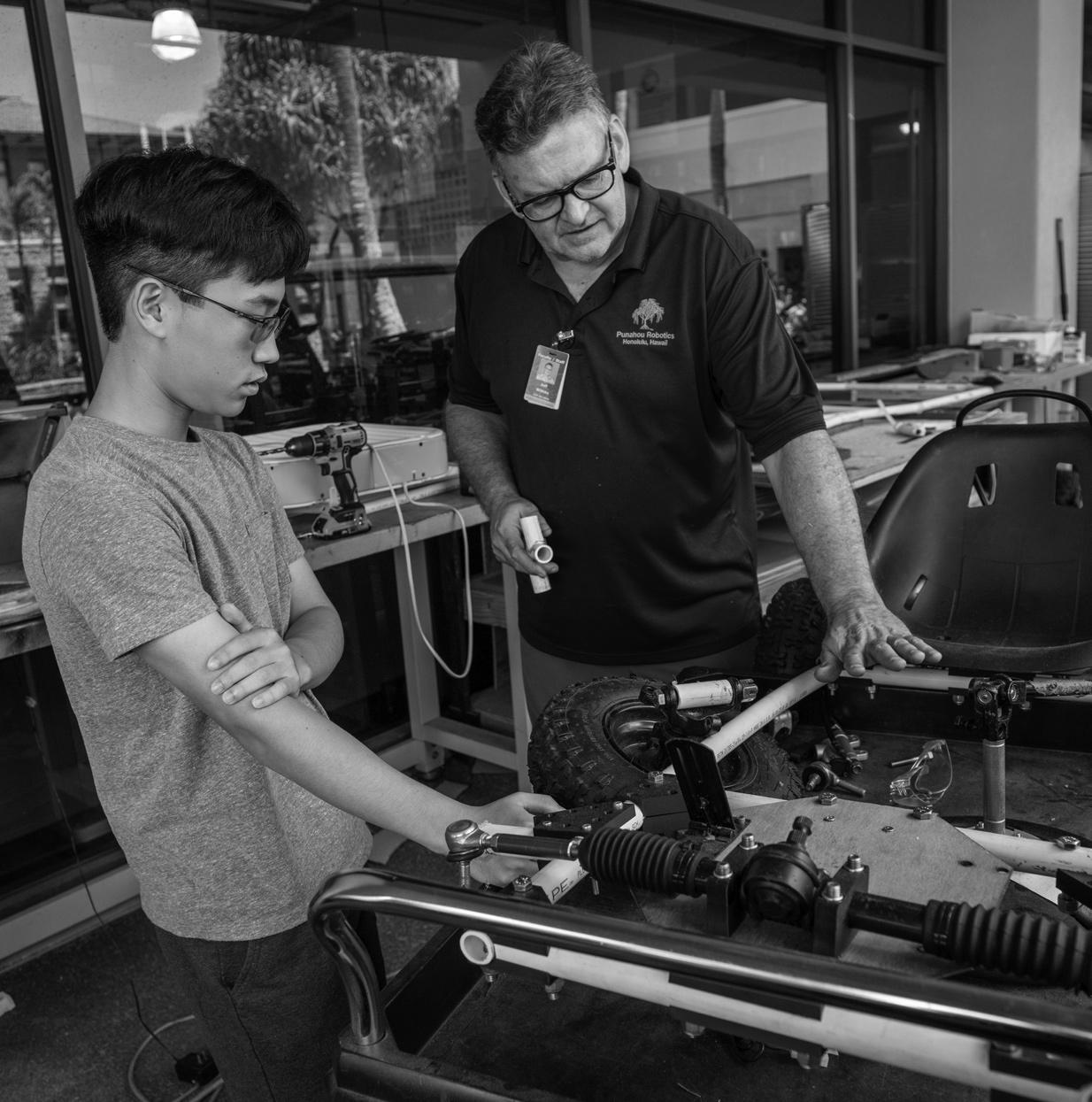
Design Technology and Engineering
The Punahou Design Technology and Engineering department operates a student-centered, school-wide environment designed to empower development of social-emotional skills, technical abilities and applied design processes needed for positive and purposeful action in the real world.
Students have access to cutting edge labs and workshops, faculty support and mentorship across the campus. They can access resources through courses, clubs, classroom integration and independent projects.
Design thinking is one of two central systems students use to organize their creative activity into meaningful action. The design thinking model emphasizes developing a deep understanding of an issue or a person before defining specifications, brainstorming solutions, creating prototypes and testing potential solutions to learn more about the user. Each phase of the design cycle is strongly linked to habits of mind such as resilience to failure, life-long learning and openness to new ideas which are key components of our direct instruction
Ku ¯ Hala is the other primary design system at Punahou. Ku ¯ Hala is a placed-based approach to design that emphasizes enviropersonal learning and moves through phases of inspiration, creation and release. This system is highly specific to Hawai‘i and Punahou but is based on a conceptual framework that any group can use to understand design in their personal context.
The K – 12 engineering program offers students a continuous and articulated set of technical skill building experiences. It is important that as their understanding of problems and challenges in the world grows, so too does their ability to design, build, test and deploy increasingly realistic and sustainable solutions to those problems. Technical experiences include access to rapid prototyping technologies such as CAD software, CNC output machines, 3D printers, laser cutters, CNC water jets, coding, electronics, robotics and virtual reality but also are inclusive of traditional building skills such as sewing, woodcraft, cooking, gardening, sail making and metal fabrication.
The department is committed to direct instruction for the development of social-emotional skills, which enable students to understand themselves, work in groups to solve problems and to develop the complex and critical ability to empathize with clients, fellow designers, communities and people from different cultures.
Design Technology and Engineering
ENGINEERING PATHWAY(S)
ENGINEERING & ROBOTICS I (SEMESTER)
ENGINEERING & ROBOTICS II (SEMESTER)
GLOBAL SUSTAINABILITY BY DESIGN: ENGINEERING FOR SUSTAINABILITY (ID) (YEAR) (Social Studies and elective credit) OR
GLOBAL SUSTAINABILITY BY DESIGN: PRODUCT DESIGN FOR SUSTAINABLE ENTREPRENEURSHIP (ID) (YEAR) (Visual and Performing Arts and Social Studies credit) OR PHYSICS & ENGINEERING (ID) (YEAR) (Science and elective credit)
ENGINEERING III: INDUSTRIAL DESIGN & FABRICATION (YEAR) OR
ENGINEERING III: ADVANCED INTERACTIVE ROBOTICS (YEAR)
ENGINEERING IV: ELECTRIC VEHICLE TEAM (YEAR)
ENGINEERING V-A (SEMESTER)
ENGINEERING V-B: ADVANCED ENGINEERING LAB (SEMESTER)
Course Offerings
Engineering & Robotics I
This course provides students with an opportunity to experience the engineering design process from start to finish. This is accomplished by collaborating with team members to design and build solutions to real-world problems. Students use Computer-Aided Design (CAD) software to design 3D models of devices then use computer-numerically controlled machines (e.g., 3D printer, laser cutter) and power tools to bring them to life. Students develop skills in mechanics, electronics, programming, digital fabrication and machine shop operations. Students also participate as a team member in a class robotics competition, similar to FIRST Tech Challenge, designed for students to design, build, program and compete robots against other small teams in the class.
Open to grades 9, 10, 11, 12. No prerequisite. Semester course. One-half credit. Satisfies elective credit.
Engineering & Robotics II
Engineering and Robotics II takes students’ technical skills to the next level, building upon the foundational knowledge from Engineering & Robotics I. In this hands-on course, students dive deeper into the exciting world of engineering design and fabrication. Autonomous robotics projects can also be augmented with Artificial Intelligence. Students further hone their ComputerAided Design (CAD) skills, master the use of power tools in the shop and learn essential techniques in electrical circuits like soldering and Arduino programming. Students are also introduced to Computer Numerical Control (CNC) fabrication, learning how to create precise tool paths using machine algorithms. By deepening their understanding of digital fabrication and machine shop operations, students emerge with the confidence and skills to tackle complex engineering challenges. This course is perfect for students eager to continue developing their design and fabrication skills to bring their innovative ideas to life.
Open to grades 9, 10, 11, 12. Prerequisite: Engineering and Robotics I. Semester course. One-half credit. Satisfies elective credit.
Physics & Engineering (ID)
See Interdisciplinary section for course description.
Engineering III: Advanced Interactive Robotics
Advanced Interactive Robotics is a field of study dedicated to understanding, designing, building and evaluating robotic systems for use by or with humans. In this context, interaction, by definition, requires communication between robots and humans. Students develop computational models of social intelligence for robots that allows them to have interactions that are natural and intuitive for a human partner as well as build the interactive physical robot to interact with humans. This multidisciplinary research area draws from robotics, AI, human-computer interaction, cognitive psychology and anatomy and physiology. The main goal of human robot-interaction is to enable robots to successfully interact with humans. Studies in this course require strong interdisciplinary blends from various social, emotional, scientific and engineering fields. Students have access to advanced hardware, software, machines, tools and rapid prototyping to create complex human interactive robots and mechanisms in an integrated technical and social emotional learning experience.
Open to grades 9, 10, 11, 12. Prerequisites: Engineering & Robotics II, or GSD: Science and Engineering for Sustainability or GSD: Product Design for Sustainable Entrepreneurship or Physics & Engineering (ID) or DTE teacher recommendation. Year course. One credit. Satisfies elective credit.
Design Technology and Engineering
Engineering III: Industrial Design & Fabrication
Engineering III is a project-based course centered in advanced industrial design and sophisticated fabrication technique. Students continue to develop technical skills taught in Engineering & Robotics I and II, such as advanced computer-aided design and drafting, advanced prototype fabrication and final product finishing and presentability. This course is designed in part to give students hands-on experience in fast-paced, rigorous, multidisciplinary learning that provides a spectrum of skills in programming and operating CNC machining equipment. Emphasis is placed on understanding machining with special emphasis on work set up and machine operation. Students analyze and generate drawings, blueprints, specifications, CAD, g-code and design data to calculate dimensions, tool selection, machine speeds and feed rates. This project-based course provides students with the tools to take creativity to an elevated technical level.
Open to grades 9, 10, 11, 12. Prerequisites: Engineering & Robotics II, or GSD: Science & Engineering for Sustainability GSD: Product Design for Sustainable Entrepreneurship or Physics & Engineering (ID) or DTE teacher recommendation. Year course. One credit. Satisfies elective credit.
Engineering IV: Electric Vehicle Team
Engineering IV: Electric Vehicle Team challenges students to research, design, build and operate an electric vehicle. The course is carefully structured to be a deeply meaningful learning experience through an applied approach (theory-topractice) to sustainable transportation. Students are introduced to Electric Vehicle Propulsion Systems to provide practical training in the theory and design of battery-powered electric systems. Topics include the rationale for electric vehicles, safety, battery technologies, basic battery testing, electric machine (motor) types, electric machine operation, power management, power inverters, DC converters and accessory systems. Students apply these concepts and skills in combination with design, fabrication and coding skills mastered in Engineering I, II and III to achieve this creative and innovative goal.
Open to grades 10, 11, 12. Prerequisites: Engineering III: Industrial Design & Fabrication or Engineering III: Advanced Interactive Robotics; or DTE teacher recommendation. Year course. One credit. Satisfies elective credit.
Engineering V-B: Advanced Engineering Lab
Engineering V-B is the highest level engineering course offered by the Design Technology and Engineering department at Punahou. The Engineering V-B course is focused on the completion and testing of individual engineering projects that students have developed to address needs in their community. Students apply the skills they have honed from four years of engineering training and have the time to receive individual mentorship in the high end digital and applied processes needed to prototype their personalized signature project. Engineering V-B students also engage in mentorship of students in other Engineering courses and clubs and, as opportunity presents, continue electric vehicle outreach in the community elementary schools.
As in Engineering V-A, this course continues to orient all activity through the lens of key Hawaiian cultural competencies. These competencies include kuleana, mo‘oku¯‘auhau, kuana‘ike, lawelawe and mo‘olelo. In addition, students focus on employing the Ku ¯ Hala design process. This course is only offered in the Spring semester. Open to grade 11, 12. Prerequisites: Engineering V-A. Semester course (Spring semester). One-half credit. Satisfies elective credit.
Global Sustainability by Design:
Engineering for Sustainability (ID)
See Interdisciplinary section for course description.
Global Sustainability by Design: Place, Perspective & Partnership (ID)
See Interdisciplinary section for course description.
Global Sustainability by Design:
Product Design for Sustainable Entrepreneurship (ID)
See Interdisciplinary section for course description.
Design Technology and Engineering

Introduction to Programming
This course provides an exploratory introduction to programming through creative programming projects. Students use JavaScript to create visual art and tell stories while learning fundamentals concepts in programming, including flow of control and abstraction. Students are also introduced to object-oriented programming and data structures in preparation for future courses in game development and mixed reality. This course covers the essential programming concepts of AP Computer Science Principles, but distinguishes itself by prioritizing project-based creation over traditional study. Students who are successful in this course are well-prepared to enroll in Punahou’s Virtual Worlds: Game Development course, AP Computer Science Principles or AP Computer Science A. Previous programming experience is not required.
Open to grades 9, 10, 11, 12. No prerequisite. Semester course. One-half credit. Satisfies elective credit.
Advanced Placement
Computer Science Principles
This course is an introduction to the intellectual enterprises of computer science and the art of programming. Students engage in collaborative learning and demonstrate their understanding in challenging problem sets that require rigorous testing and iterative design. The course also involves an independent programming project of the student’s choice. The course covers the fundamentals of programming such as flow of control, abstraction and data storage and manipulation and provides an excellent foundation for any of the other computer science courses at Punahou. Previous programming experience is not required. However, willingness to work hard, collaborate with others and ask for help when necessary greatly helps students to succeed in this course. Students are recommended to take the AP Exam in May and the fee for the exam will be charged to the student’s account.
Open to grades 9, 10, 11, 12. Prerequisite: Successful completion of an Algebra 1 course. Year course. One credit. Advanced Placement courses must be taken for a letter grade. Satisfies elective credit.
Advanced Placement Computer Science A
AP Computer Science A offers students an exciting opportunity to dive into the world of programming and software development. In this course, students learn the fundamentals of Java, a powerful and widely used programming language, while developing problemsolving skills and exploring key concepts in computer science, such as algorithms, data structures and object-oriented programming. Through hands-on coding projects, students apply their knowledge to create real-world applications, gaining a deeper understanding of how technology shapes the world around them. Whether interested in technology, robotics at Punahou, engineering or just curious about how things work, this course prepares students for success on the AP exam and beyond. Students are recommended to take the AP Exam in May and the fee for the exam will be charged to the student’s account.
Open to Grades 9, 10, 11, 12. Prerequisites: Successful completion of an Algebra 1 course, and successful completion of AP Computer Science Principles, Intro to Programming or Instructor given Placement Exam. Year course. One credit. Advanced Placement courses must be taken for a letter grade. Satisfies elective credit.
Virtual Worlds: Game Development
Virtual Worlds introduces students to advanced data structures and algorithms through the principles of game development and object-oriented programming. This course builds on concepts learned in Intro to Programming and either AP Computer Science course. Using industry-standard game engines, students explore how to create immersive digital worlds by applying coding, physics and design concepts. Throughout the course, they’ll develop interactive environments, design gameplay mechanics and write code in a language built for object-oriented programming. This collaborative, projectbased course emphasizes creativity, problem-solving and technical skills, preparing students for future studies in creative software development. Students develop their own virtual worlds and gain programming experience applicable to multiple platforms and technologies.
Open to Grades 9, 10, 11, 12. Prerequisite: Intro to Programming, Intro to Computer Science, AP Computer Science Principles, AP Computer Science A or placement exam. Semester course. One-half credit. Satisfies elective credit.
Design Technology and Engineering
Advanced Virtual Worlds: XR
Virtual Worlds: XR builds on skills learned in Virtual Worlds: Game Development by teaching multiplayer networking through the medium of mixed reality (XR). This course explores the integration of augmented reality (AR), virtual reality (VR) and immersive technologies, allowing students to design and create interactive experiences that blend the digital and physical worlds using tools like Unity. Through hands-on projects, students learn to develop XR applications, incorporating elements such as 3D modeling, user interaction and environmental design. They gain practical skills in programming and design while exploring the principles of user experience (UX) in mixed reality contexts. By the end of the course, students create their own XR experiences, providing a foundation for further exploration in the fields of game development, simulation and immersive storytelling.
Open to grades 9, 10, 11, 12. Prerequisite: Successful completion of Virtual Worlds: Game Development or Virtual & Augmented Reality I. Semester course. Onehalf credit. Satisfies elective credit.
Advanced Projects in Computer Science
This course is an invitation for students to dive into a computer science project of their choice, either individually or collaboratively. Students may continue to develop projects that they began in Software Development Studio or Advanced Virtual Worlds: XR, or may choose to pursue an advanced project in another area of computer science. Students are expected to enroll in this class with a project in mind. This course is for the selfmotivated student who can work largely independently.
Open to grades 10, 11, 12. Prerequisites: Ke Kilohana: Computer Science or Software Development Studio or Advanced Virtual Worlds: XR, Virtual and Augmented Reality II or instructor approval. Semester course (Spring semester). One-half credit. Satisfies elective credit.
Understanding AI: From Concepts to Creation
In this course, students go beyond simply using AI to investigate how generative artificial intelligence works. Students are introduced to the evolution of artificial intelligence, including the rise of large language models (LLMs) and their impact on the capabilities of generative AI. Students discuss potential uses and ethical implications of AI. Students are introduced to basic data science concepts. Through projects and student-led exploration, learners investigate what makes a good training data set for an AI model, implement strategies to mitigate bias and evaluate various training methods to determine the most effective approach for a specific problem. In partnership with CASE Accelerator for Student Entrepreneurship, students complete an end-of-course project in which they identify a real-world need, brainstorm AI-driven solutions and develop a prototype dataset.
Open to grades 9, 10, 11, 12. Prerequisite: Successful completion of at least one Punahou computer science course or placement exam. Semester course. One-half credit. Satisfies elective credit.
Ke Kilohana
See Ke Kilohana section for course descriptions for all Ke Kilohana courses.
Circular Economy
Engineering V-A
Software Development Studio
Global Online Academy Courses
See the GOA section for fee information, course descriptions and course dates. (S) indicates courses offered in the summer.
Architecture
Architecture (S)
Computer Science I: Computational Thinking
Computer Science I: Computational Thinking (S)
Computer Science II: Analyzing Data with Python
Computer Science II: Game Design & Development
Cybersecurity
Data Visualization
Game Theory
Introduction to Artificial Intelligence
Introduction to Blockchain & Cryptocurrency
Problem Solving with Engineering & Design
Problem Solving with Engineering & Design (S)
Vibe Coding:
Code, Create & Launch with AI (S)
Open to grades 10, 11, 12. Semester course. One-half credit. Satisfies elective credit.
Independent Study: Design Technology and Engineering
See Independent Study and Research Program section for course description. Satisfies elective credit.
Courses not offered in 2026 – 2027 Elements of Design
Graduation Requirements
1. Four credits are required for graduation.
2. Students must earn two credits total in English in grades 11 and 12.
3. Every student must take at least one American Literature course.
4. Students may take only two English courses in Summer School to fulfill the four credits required for graduation. They may take either English 1A between eighth and ninth grades or English 2A between ninth and 10th grades. Before 11th or 12th grade, they may take no more than one offered course.
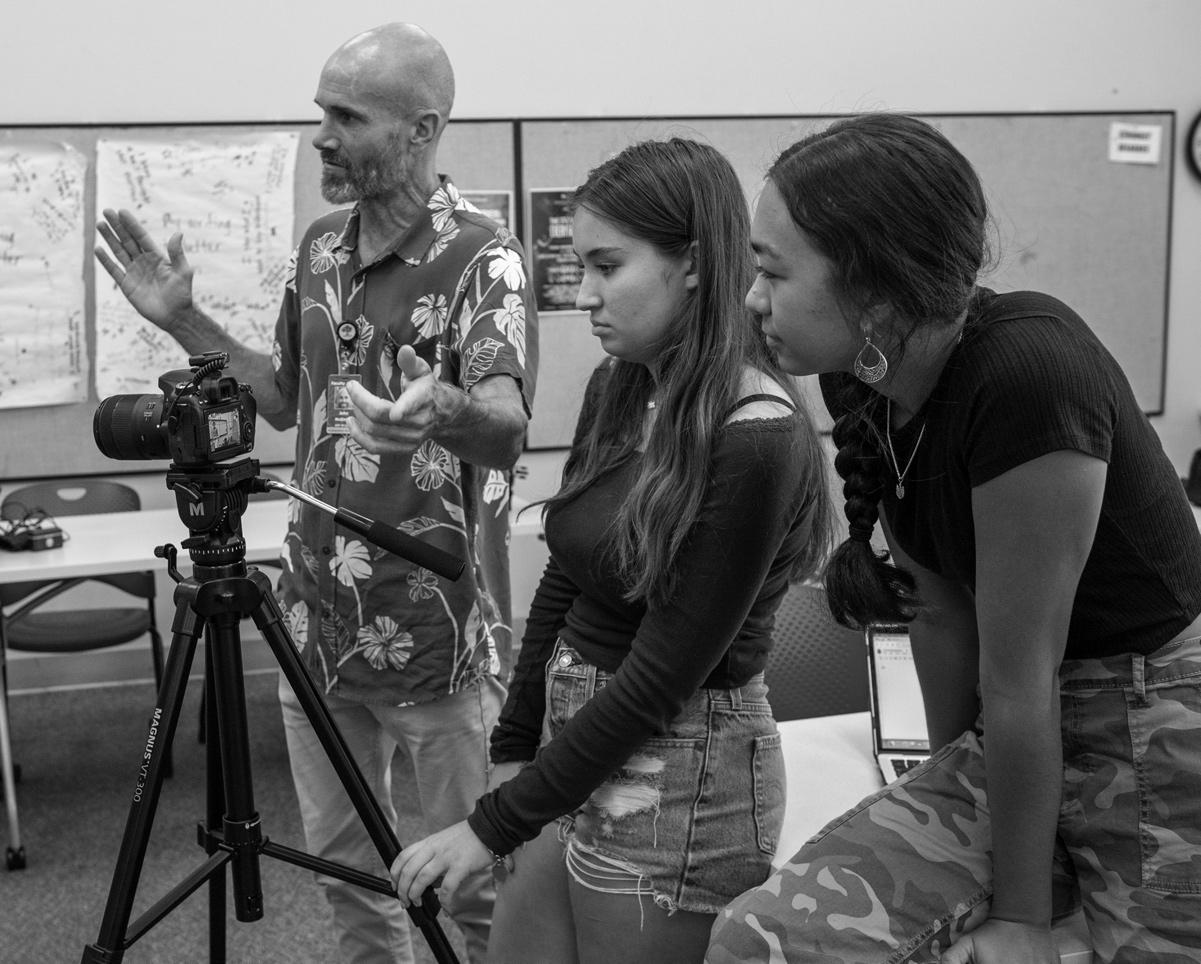
The mission of the Academy English Department is to teach students to read compassionately, think creatively and write with clarity and grace. We believe engaging with diverse literature and complex language increases our capacity for preception, feeling, reason and connection. As a community, our collective practice of reading, writing, speaking and listening fosters personal and social discovery. This work nourishes our imaginations, helps us to understand our place in both local and global contexts and inspires us to meaningful action.
REQUIRED
One of the following American Literature Courses:
American Studies (ID) (yearlong)
American Voices
Bias in America (ID)
Gender & Sexuality
Jazz Age
Nature
Short Story
In addition to these required courses, grade 11 must also take one course from the list on the right (Unless also enrolled in American Studies).
Any of the courses in this column may also be taken as an English graduation requirement or elective once the American Literature requirement has been fulfilled.
GLOBAL SUSTAINABILITY BY DESIGN: ASIAN STUDIES (ID)
COURSE OFFERINGS
Arts & Letters (ID)
Buddhist Philosophy & the Game of Go (for 12th grade)
Creative Nonfiction & Scientific Storytelling
Creative Writing
Crime & Punishment
Ideas in Western Literature
Identity & Culture
Junior English Honors (for 11th grade)
Ka Punahou: The Stories of Our Community
Magical Realism
Script to Screen: English through Filmmaking
Science Fiction
Senior English Honors (for 12th grade)
Words R Us
Writing with Clarity & Grace
ENGLISH 1AB YEARLONG
GLOBAL SUSTAINABILITY BY DESIGN: PLACE, PERSPECTIVE & PARTNERSHIP (ID) YEARLONG 9
ENGLISH 2AB VISUAL STORYTELLING (ID) YEARLONG 10 GRADE
ENGLISH 2AB YEARLONG
REQUIRED
One of the following American Literature Courses:
American Studies (ID) (yearlong)
American Voices
Bias in America (ID)
Gender & Sexuality
Jazz Age
Nature
Short Story
In addition to these required courses, grade 11 must also take one course from the list on the right (Unless also enrolled in American Studies).
Any of the courses in this column may also be taken as an English graduation requirement or elective once the American Literature requirement has been fulfilled.
Course Offerings
English 1AB
The course invites students to read, discuss, perform, analyze and write in ways that lead them to think about literature, themselves, others and the wider world. Learning to live as lifelong learners, students practice and make progress as collaborators, communicators, creators and critical thinkers. They consider questions such as: Who am I? How can reading and writing help me understand myself and this world? What do I value and why? What are my strengths and growth areas and how can I continue to progress as a student, classmate and person?
Open to grade 9. No prerequisite. Year course. One credit. Satisfies English requirement for grade 9.
Global Sustainability by Design: Place, Perspective & Partnership (ID)
See Interdisciplinary section for course description.
GLOBAL SUSTAINABILITY BY DESIGN: ASIAN STUDIES (ID) YEARLONG
COURSE OFFERINGS
Arts & Letters (ID)
Buddhist Philosophy & the Game of Go (for 12th grade)
Creative Nonfiction & Scientific Storytelling
Creative Writing
Crime & Punishment
Filipinos in Hawai‘i: Connections Through Storytelling
Ideas in Western Literature
Identity & Culture
Junior English Honors (for 11th grade)
Ka Punahou: The Stories of Our Community
Magical Realism
Queer YA Historical Fiction
Script to Screen: English through Filmmaking
Science Fiction
Senior English Honors (for 12th grade)
Words R Us
Writing with Clarity & Grace
English 2AB
What kind of world is this? How should we live in it? What can stories teach us about how to transform moral reasoning into moral action? English 2 explores these questions and more.
Building on English 1 or GSD: Place, Perspective & Partnership, 10th graders continue to develop critical and creative thinking through discussion, writing, self-directed research and the close reading of diverse literature. The year culminates in the Quest Project, a selfdirected storytelling project that students are encouraged to share with an audience beyond the walls of their classroom.
Open to grade 10. Prerequisite: English 1 or GSD: Place, Perspective & Partnership. Year course. One credit. Satisfies English requirement for grade 10.
English 2AB: Visual Storytelling (ID)
See Interdisciplinary section for course description.
Global Sustainability by Design: Asian Studies (ID)
See Interdisciplinary section for course description.
American Literature: American Voices: Celebrating Culture through Literature
This course focuses on the diverse voices of marginalized people of color in America, including Latinx, Native American, AfricanAmerican, Asian-American, Kanaka Maoli writers as well as authors with complex intersectional identities. Students read and reflect on various literary works. Texts also serve as springboards for discussing societal issues that remain relevant today, including, but not limited to
• our relatively young nation’s evolving sense of what it means to be American
• how nationality, ethnicity and one’s surrounding cultural matrix forge identity
• intersectionality, cultural erosion, colonization, assimilation, acculturation and alienation
• American identity and the ongoing historical tension between diversity and national unity, as reflected in the motto
E Pluribus Unum: “Out of many, one”
• systemic racism and discrimination
In addition, students explore their own heritage and are encouraged to discover and exercise their own unique American voices.
Open to grades 11, 12. Prerequisite: English 2. Semester course. One-half credit. Satisfies English graduation requirement for American Literature.
American Literature: Gender & Sexuality in American Literature: At Home in the Self
In this class, students explore the intersection of women’s studies, feminist thought, gender and sexuality studies, Queer theory and cross-cultural awareness through a diverse and engaging selection of American literature. Students read texts that changed the terrain of American literature and thought and started or shifted conversations about sexuality and gender. In written compositions, studentled discussions and research projects, students then consider the ways the experience of living in America has been shaped by prevailing notions and discourse related to gender, sexuality and national identity. By examining the ways in which discourse surrounding sex and gender is also informed by understandings of race and class, students cultivate intersectional awareness of the ways in which various social constructs influence day-to-day life and one’s relationship with the self. Anchoring our classroom interactions in respect, curiosity and compassion, this course aims to help students understand what it means to be “at home in the self” through selfknowledge, expanded empathy and ethical community engagement.
Open to grades 11, 12. Prerequisite: English 2. Semester course. One-half credit. Satisfies English graduation requirement for American Literature.
American Literature: The Jazz Age
The 1920s bring to mind a fascinating array of cultural associations: flappers, bootleggers and jazz, to name a few. It was the first decade in which American popular culture captured the attention of the world. For better or for worse, many of the decade’s characterizing traits are still present in American politics and culture today. From a literary standpoint, the Roaring Twenties did not disappoint. This course looks at some of America’s most celebrated authors and their works. Students examine the cultural setting in which they wrote and the philosophical questions that gave this modern era the name “The Age of Anxiety.” What do these authors have to say about finding meaning in a world where the value of all traditional idols – God, man, reason, science, progress – is uncertain? How do they define the American identity or answer the age-old question “What is the meaning of life?” Students analyze Fitzgerald’s novel The Great Gatsby, Steinbeck’s Cannery Row, short stories by Ernest Hemingway, Charlotte Gilman and Langston Hughes and poetry by T. S. Eliot and Ezra Pound. Readings are accompanied by a study of jazz music, modern art and clips from 1920s films. Open to grades 11, 12. Prerequisite: English 2. Semester course. One-half credit. Satisfies English graduation requirement for American Literature.
American Literature: Nature
Literature asks us to carefully reflect on who we are and how we live. In this course, students analyze a variety of texts that invite contemplation of the questions and answers nature has provided for generations of American writers and artists. Beginning with the early Americans, students consider ways in which native cultures relate to the land in fundamentally different ways from Western cultures. Students move forward in the American tradition, analyzing various texts to consider the answers the natural world provides and the questions it elicits. Although the core of this course is rooted in a careful study of various American texts, students also reflect on contemporary environments, considering the connection to current environmental initiatives in Hawai‘i today and how these influence one’s own personal relationships with the land. Students participate in a hands-on, experiential garden lab where they develop direct relationships with sustainability and evaluate how the choices made in everyday life shape environmental impact. In the garden lab, students learn by doing and reflect on the educational consequences of those experiences.
Open to grades 11, 12. Prerequisite: English 2. Semester course. One-half credit. Satisfies English graduation requirement for American Literature.
American Literature: The Short Story
The American experience and the American Dream look different for everyone. In this course, students explore diverse stories that reflect the many backgrounds and perspectives that make up American identity. Readings cover immigration, women's history, the BIPOC experience, code switching and how historical events shape social movements. As students engage with this literature, they also reflect on their own identities and dreams.
The course emphasizes analyzing short stories. Students examine how writers use varied styles and techniques throughout American literary history and consider broader concepts of American identity. This focus helps students read more carefully, respond thoughtfully in their own writing and provide supportive feedback to their peers.
Open to grades 11, 12. Prerequisite: English 2. Semester course. One-half credit. Satisfies English graduation requirement for American Literature.
American Studies (ID)
See Interdisciplinary section for course description.
Arts & Letters (ID)
See Interdisciplinary section for course description.
Bias in America (ID)
See Interdisciplinary section for course description.
Buddhist Philosophy & the Game of Go Patience, humility, resilience, tenacity, awareness, focus: these are the defining characteristics that mark successful Go players and Buddhists. Developed in China somewhere around 4,000 years ago, Go is arguably the most fascinating and strategically sophisticated game ever created. The rules of Go are very simple and players can learn the basics in a matter of minutes. However, to play well requires a lifetime of devotion and patience. There are strong parallels between Buddhist philosophical concepts and successful Go strategies. Even though the two developed independently from each other, the overlap and insight provided by coupling the two are quite extraordinary. The game provides a valuable physical metaphor for understanding Buddhist philosophy in action; similarly, applying The Four Pillars of Buddhist philosophy (Impermanence, Nothingness, Interconnectedness and Non-attachment) leads to improvement as a player as well as a comprehensive outlook on ethical decision-making and self-reflection. This course is also part of an iPad program, involving the use of interactive electronic textbooks and apps designed to enhance student understanding of these two fascinating topics. Subject to limited enrollment.
Open to grade 12. Prerequisite: English 2. Semester course. One-half credit. Satisfies English graduation requirement.
Creative
Nonfiction & Scientific Storytelling
Calling future science majors! Calling storytellers! In this science-writing course, students develop their critical and creative thinking skills by making personal interventions into contemporary biological issues.
This course has been designed for students who love natural sciences and want to deepen their storytelling skills, and for students who are strong storytellers and want to challenge themselves to incorporate a scientific, educational dimension in their work.
Students write true stories about their lives rich with scientific information that educates general audiences and are also fun to read. Model authors include Aimee Nezhukumatathil, Kathy Jetñil-Kijiner and Paul Kalanithi, and students read and write a variety of creative nonfiction texts, including personal narratives and poetry.
Major projects center on wonder and human interdependence with the natural world; climate change and the environmental impact of nuclear testing and militarism, particularly in Oceania; and medicine from the writer’s perspective.
A final project challenges students to transform their writing – through a formal public reading, or the creation of a ’zine or comic, song or video poem and more –with an outside audience of their choosing who gives them feedback on how effective their work is in educating them and also inviting them into feeling.
Open to grades 11, 12. Prerequisite: English 2. Semester course. One-half credit. Satisfies English graduation requirement.
Creative Writing
This course explores the way writers create lives and the ways in which readers’ lives are enhanced by writing. Teachers and students in this course assume that every human being has the potential to be creative in some way. The course explores ways in which the creative spirit drives people to become better writers, better readers, better thinkers and better members of communities. Literature in this course serves as a model for excellent writing.
Open to grades 11, 12. Prerequisite: English 2. Semester course. One-half credit. Satisfies English graduation requirement.
Crime & Punishment
This course examines the nature and limits of punishment by focusing on these essential questions: What is punishment? What is the relationship between punishment and justice? What are the appropriate limits of punishment? What is the place of forgiveness and mercy when responding to a crime? How can literature help us understand crime, punishment and justice and their roles in society and our lives?
Students grapple with the moral complexities of punishment through close reading of literary texts, varied writing assignments and seminar-style discussions. Literature—from short stories and essays to novels and films—serves as a lens for examining questions about blame, responsibility, mercy and how humans respond to wrongdoing. Through sustained inquiry and consideration of multiple perspectives, students develop critical thinking skills and deepen their understanding of justice.
Open to grades 11, 12. Prerequisite: English 2. Semester course. One-half credit. Satisfies English graduation requirement.
Ideas in Western Literature
What is real and what isn’t? Are we free? What determines our actions – nature or nurture? In today’s morally relativistic world, how do we know what’s right? And where does our thinking even come from? These are a few of the questions that arise from engagement with an eclectic selection of texts spanning nearly 3,000 years of Western literature. These works, each of which explores in some way the relationship between knowledge and action, include The Book of Job, Plato’s “Allegory of the Cave,” Frankl’s Man’s Search for Meaning, Kafka’s Three Parables, Sartre’s No Exit and Shakespeare’s Hamlet. Philosophical inquiry becomes both subject matter and process in this course, as students are encouraged not only to reflect (through discussion and a series of focused writing assignments and critical thinking exercises) on the authors’ ideas, but to explore their own questions with clarity, depth, breadth and selfawareness. At the end of the semester, students design experiments to test their ideas in conversation with their classmates and peers. The goal is to create a classroom atmosphere in which students can acknowledge they won’t always figure out the answers, but can be surprised and enhanced by the exploration itself.
Open to grades 11, 12. Prerequisite: English 2. Semester course. One-half credit. Satisfies English graduation requirement.
Identity & Culture
What makes a person an individual? Our driver’s licenses tell us our identities are defined by hair color, eye color, weight, address and identification numbers; but each person is so much more. In what ways are personalities defined by cultural factors?
In this course, students seek to answer at least three broad questions: What is identity? How is identity influenced by culture? What does literature have to tell us about these issues? Students study ways in which human beings have grouped, stereotyped and categorized each other and they consider how communities affect individuals and how individuals influence communities. Literature from a variety of contemporary writers provides fuel for explorations and students are expected to explore their own identities and cultures in their conversations, creative writing and analytical work.
Open to grades 11, 12. Prerequisite: English 2. Semester course. One-half credit. Satisfies English graduation requirement.
Junior English Honors
Junior English Honors is a course designed to serve students who are passionate about literary studies. Students read college-level literary texts and engage in daily seminar-style oral discussions in class. Junior English Honors puts particular emphasis on analytical reading, writing and speaking and on developing a deeper understanding of how meaning is achieved through elements of style such as syntax, narrative technique and figurative language. Students learn about and practice using literary theories or “lenses” as a means to understand the diverse ways people can read and find meaning in literary texts. Due to the intensive nature of this course, enrollment should be done carefully in consultation with English Department faculty and deans. Junior English Honors is offered in the spring semester.
Open to grade 11. Prerequisite: English 2. Semester course (Spring semester). One-half credit. Satisfies English graduation requirement.
English
Ka Punahou:
The Stories of our Community
For over 170 years, Punahou students have been telling the stories of their campus experience through articles, essays and op-eds. This comprehensive course focuses on the power of nonfiction storytelling and asks students to continue that tradition. Students learn storytelling techniques by reading, studying and analyzing sample essays, long-form creative nonfiction and other news and opinion articles from both professional authors and past student writers. Students are expected to work in writing groups to support each other as they seek to tell a wide-range of stories over the course of the semester. To accomplish this, students conduct extensive interviews and research (including work in the Punahou archives) as they engage in fact-finding missions that help them uncover stories from the past, as well as report on current stories that are important to the Punahou community at this time. Ultimately, the goal is for students to learn what makes a well-told story work and to hone their storytelling abilities as a catalyst for good in their community.
Open to grades 11, 12. Prerequisite: English 2. Semester course. One-half credit. Satisfies English graduation requirement.
Magical Realism
In magical realism everyday life becomes magical and the magical becomes an everyday reality. As the writer Angel Flores put it, Magical Realism “is predominantly an art of surprises.” Magical Realism is a global phenomenon today. In post-colonial places, it has served as a vehicle for empowering subjugated voices as well as a tool for communicating the unique social and political realities of ethnically diverse communities. One example is in Latin America, where Native American, African and European belief systems have closely cohabited for centuries, often in geographically isolated locales. A new kind of perception of reality was born out of these encounters and has created a rich soil for Magical Realist writers. In this course, students write analytical papers on literature they read from Europe, Latin America and Asia and use their deepening understanding of this genre to craft their own Magical Realist stories.
Open to grades 11, 12. Prerequisite: English 2. Semester course. One-half credit. Satisfies English graduation requirement.
Script to Screen:
English through Filmmaking Script to Screen is an in-depth exploration of storytelling as well as an opportunity to learn about the power and artistry of film. Students don’t just read stories and watch films, they write and make them while learning the language of cinema and how to decode the classic and contemporary masters of filmmaking. They develop their own skills as readers and writers of fiction and as filmmakers. The design of the course focuses on reading critically, understanding story architecture, writing for film (specifically, adapting narrative structure for screenplays and treatments), storyboarding and advanced filmmaking techniques such as framing shots, the triangle method, match-on action and parallel action. Students also develop comprehensive editing skills, including post-production techniques and advanced sound design using Adobe Premiere. This course is designed for students who enjoy projects, being creative and who want to understand what it takes to tell a good story and translate it into a film.
Open to grades 11, 12. Prerequisite: English 2. Semester course. One-half credit. Satisfies English graduation requirement.
Science Fiction
Science fiction is the literature of the sublime “What If?” What if we could travel through time? What if we could surgically increase our IQs? What if the Martians attack? Through novels, short stories and films, students indulge their sense of wonder by probing four of science fiction's classic subject areas: outer space, time travel, dystopia and artificial intelligence. Students write analytically, with an eye to increasing their knowledge of and maneuverability within science fiction and literature generally; and they also write creatively, giving form to their own unique thought experiments.
Open to grades 11, 12. Prerequisite: English 2. Semester course. One-half credit. Satisfies English graduation requirement.
Senior English Honors
Senior English Honors is designed for students who have demonstrated a high degree of interest, skill and motivation in reading, discussing and writing about literature. As an honors course, it appeals primarily to students who enjoy the process of interpreting and discussing challenging texts. It puts particular emphasis on analytical writing and on developing a deeper understanding of how meaning is achieved through the elements of style: syntax, narrative technique and figurative language. Students are asked to develop their own interpretations of works selected from the British and American literary canons and should be prepared to work independently, collaboratively and in close consultation with the teacher in developing their writing skills. This course is recommended for students who feel they may someday want to pursue a college or graduate degree in the field of literature or the humanities. This course should be chosen carefully in consultation with English Department faculty and deans. Senior English Honors is offered in the fall semester.
Open to grade 12. Semester course (Fall semester). One-half credit. Satisfies English graduation requirement.
English
Words R Us
How and when did humans develop language? Why do languages change? Who decides what’s “proper” language? Are emojis words? Can animals talk? Can speech reveal when someone’s lying? Why are babies grammar purists, and, like, why do people say “like” so much? What happens to your brain when you text, argue or use metaphors? This introduction to applied linguistics invites students to explore how humans invent, use and are shaped by language. Through the lenses of literature, politics, advertising, neuroscience, media, psychology and anthropology, students investigate how words influence thought, identity, persuasion and power. They examine how languages evolve and die, how culture shapes communication, and how our own word choices reveal who we are—and who we might become.
By semester’s end, students not only understand language as a living, changing, deeply human system but also learn how to use it more thoughtfully and effectively. This is a question-driven, project-based, research-oriented, quality-not-quantity, takes-two-to-tango kind of course.
Open to grades 11, 12. Prerequisite: English 2. Semester course. One-half credit. Satisfies English graduation requirement.
Writing with Clarity & Grace
Writing with Clarity and Grace encourages students to express themselves more effectively and to commit to writing with tenacity and purpose. Students explore a variety of authentic contexts and modes, including descriptive, narrative, expository, persuasive and reflective writing. In studying mentor texts and examining various grammatical, mechanical, stylistic and rhetorical concepts at work, students learn and apply important lessons on the craft of writing. Students become a supportive community of writers, participating in discussions, sharing their work, collaborating on assignments and activities and presenting their learning, individually and collectively. These practices allow students to gain greater confidence and versatility, along with a stronger understanding of how to write with power and style.
Open to grades 11, 12. Prerequisite: English 2. Semester course. One-half credit. Satisfies English graduation requirement.
Ke Kilohana
See Ke Kilohana section for course description.
Filipinos in Hawai’i: Connections Through Storytellings
Queer YA Historical Fiction
Global Online Academy Courses
See the GOA section for fee information, course descriptions and course dates. (S) indicates courses offered in the summer.
Applying Philosophy to Global Issues
Open to grades 10, 11, 12. Semester course. One-half credit. Satisfies elective credit.
Independent Study: English
See Independent Study and Research Program section for course description. Satisfies elective credit. Does not satisfy English graduation requirement.
Ke Kilohana is the name given to the outermost, decorated sheet of kapa in a ku‘inakapa, a traditional bed covering. It is also the word that refers to an unobstructed and unrivaled vantage point that yields a beautiful view. In both references the word kilohana has come to mean the best, superior or excellent and infer a sense of height, distinction and accomplishment.
The Ke Kilohana program helps students recognize their potential to contribute meaningfully to the greater good and well-being of Hawai‘i and beyond. With the goal of fostering connections to people and places locally and globally, the Ke Kilohana program offers a variety of pathways to fulfill this graduation requirement including courses, approved service experiences and select travel opportunities.
Each pathway through the Ke Kilohana program provides Punahou students with meaningful opportunities to apply their skills, knowledge and talents in authentic service to a community of practice. Ke Kilohana encourages students to use their unique strengths in service to others while embodying and sharing the values of both the program and the school.
Ke Kilohana Course & Experience Expectations
Each pathway meets the following five criteria:
1. Achieves Curricular Expectations
Every Ke Kilohana experience is assessed through six program outcomes that are taught in sequence. These outcomes are intentionally designed to support students as they explore their sense of self, their personal gifts and their place in the world through the unique lens of the course theme. While the themes and service experiences may vary across Ke Kilohana classes and experiences, they are united by a shared commitment to these collective outcomes, creating a cohesive and meaningful learning experience.
2. Focuses Content with Local Lens
Ke Kilohana classes are built around a theme based on the passions or expertise of the Kumu, and connect meaningfully to Hawai‘i and our local community. While themes may extend beyond Hawai‘i, it is important to approach them through kuana’ike, rooted first and foremost in Hawai‘i. Doing so deepens understanding of place and grounds the broader context of the class.
3. Provides a Collective Experience
Ke Kilohana courses all include a “collective experience.” While this experience may look different from class to class, the goal is always the same: to help
Students can utilize the construct of Mo‘oku¯‘auhau (genealogy) to describe and connect the origins, peoples and cultures that play a role in our personal and proximal identities and relationships.
Students explain what kuana‘ike (perspective & worldview) is, how it is shaped or developed and the role it plays or influence it has on values, beliefs and behaviors of individuals and groups.
Students can identify, acknowledge and engage with the concept of kuleana (responsibility & privilege) in relationship to self, family and the many communities to which they belong.
Students learn ‘ike (knowledge) specific to the learning context and how to appropriately articulate this knowledge as is necessary in the authentic execution of learning, application and presentation.
Students can demonstrate and narrate an experience of lawelawe (being of service to another) that promotes humility of self and genuine compassion for others.
Students engage with, develop, and present reflections of learning through mo‘olelo (storytelling) that summarize, make connections and illuminate lessons of worth to various audiences.
the group grow into a true community of practice. A collective experience might take the form of a shared service project, a travel opportunity, or even intentional classroom practices and routines that bring students together.
4. Engages in Service
Every Ke Kilohana course requires students to engage meaningfully with the community and address a real need in a way that builds lasting relationships. Service opportunities within Ke Kilohana experiences vary depending on the ‘Ike shared through the course or program. In some cases, a whole class or group works
together on a shared project such as building a home with Habitat for Humanity. In other cases, students seek out individual opportunities that align with the theme of their course or project. For example, in Ethnic Studies, students connect with different organizations focused on race, religion and culture in Hawai‘i.
5. Presents a Final Mo ‘ olelo Each Ke Kilohana course or experience culminates with a final presentation of learning including some form of display of learning to a broader audience. Examples could include presenting a portfolio of their learning or creation of a project.
Academy Course
Ke Kilohana
Mo‘oku¯‘auhau
Kuana‘ike
Mo‘olelo
Kuleana
Lawelawe
Courses that meet Ke Kilohana requirements are semester-long, instructor-designed graded courses focused on a single learning context. Each course addresses the six Ke Kilohana competencies and incorporates an element of collective service along with individual or small-group inquiry. Courses run during the school day and must be enrolled in through the regular programming process. Successful completion fulfills the Ke Kilohana graduation requirement and may earn specific departmental graduation credit or elective credit.
Ke Kilohana Course
Select Travel Opportunities
In partnership with Wo International Center, select travel opportunities qualify as Ke Kilohana credit experiences. Wo International Center’s travel program facilitates the application process, participation and teaching and learning for these trips. These trips generally take place during school breaks and summer months.
Travel: Culture & Religion of Bhutan
Travel: Grand Tetons & Yellowstone National Parks
Travel: Healthcare & Culture in Thailand
Glass Revolution: Transforming Glass from Refuse to Resource on O‘ahu
Think Global, Act Local (Online)
Ethnic Studies Honors: Advanced Topics in Hawaiian & Pacific History
Senior Wellness
Circular Economy
Cook Your Heritage
Engineering V-A
Filipinos in Hawai‘i: Connections Through Storytelling
Gender In…
Global Leadership
He wa‘a he moku, he moku he wa‘a | Voyaging
Modern China: an Environmental History
Na¯hoakukui | Students Who Guide
Queer YA Historical Fiction
& Ethics Software Development Studio
Approved Service Experiences
Academy and Ke Kilohana program leadership work together to identify campus-wide Punahou experiences that develop Ke Kilohana competencies and meet the program's foundational goals. Students may participate in these experiences individually or collectively, but each experience requires approval and an application at the beginning of the school year through the Ke Kilohana department. Credit is awarded individually to students through a process involving reflection, storytelling and verification, facilitated by Ke Kilohana leadership before the end of the school year.
Ke Kilohana Courses
Ke Kilohana
Ke Kilohana Travel Courses
Culture & Religion of Bhutan
June 8 – July 6
This international Ke Kilohana course combines classwork at Punahou with travel to the country of Bhutan, a Buddhist kingdom in the Himalayas. Students engage in service learning around Bhutanese environmental protection efforts, the history and integration of Buddhism into daily life and the impact of evolving educational systems. As a country that measures its success based on Gross National Happiness, this unique experience provides students with cultural exchanges in different villages across the country. Case studies integrating the course’s themes, field study in Bhutan and handson experience in partnership with other global learners combine to form this innovative curricular experience. Students are required to attend pre-travel classes on campus.
Open to grades 11, 12. No prerequisite. Semester course. One-half credit. For class of 2027: Satisfies Social Studies graduation requirement for Ke Kilohana. For class of 2028 & beyond: Satisfies departmental credit for Social Studies and graduation requirement for Ke Kilohana.
Grand Tetons & Yellowstone
National Parks
June 8 – July 2
This outbound Ke Kilohana course combines classwork at Punahou with travel to Grand Teton and Yellowstone. This course fulfills the Ke Kilohana requirement with students spending up to twelve days in the Rocky Mountain West. Students actively explore the exciting science of two iconic national parks: Grand Teton and Yellowstone. Working with Teton Science Schools, students investigate the summer landscapes to learn about wildlife, climate, geology, human history and unique ecology that are so different from tropical Hawai‘i. Gather your hiking gear and curiosity; join us on an epic learning expedition into the science of two stunning national parks. Students are required to attend pre- and post-travel classes on campus. Physical fitness is essential in this travel experience.
Open to grades 11, 12. No prerequisite. Semester course. One-half credit. For class of 2027: Satisfies Social Studies graduation requirement for Ke Kilohana. For class of 2028 & beyond: Satisfies elective credit and graduation requirement for Ke Kilohana.
Healthcare
June 8 – 30
& Culture in Thailand
This international Ke Kilohana course, in collaboration with Global Public Service Academy (GPSA), combines classwork at Punahou with travel to Thailand. Led by trained GPSA staff, students who have a passion for career paths in the health and medical professions engage in hands-on clinical work in northern Thailand to improve healthcare for members of the local community. Students learn the principles of global health to prepare them to carry out clinic-based interventions and screenings for children and adults. Students make a difference in the lives of the underserved population in rural and remote villages with hands-on clinical work to improve their preventive care. They are introduced to Thai culture, languages and customs. Students are required to attend pre- and post-travel classes on campus.
Open to grades 11, 12. No prerequisite. Semester course. One-half credit. For class of 2027: Satisfies Social Studies graduation requirement for Ke Kilohana. For class of 2028 & beyond: Satisfies elective credit and graduation requirement for Ke Kilohana.
Ke Kilohana Semester Courses
Circular Economy
In this course, students assess behaviors and actions that persist in our linear economy. They analyze the sustainability issues associated with purchasing a product, using it until it breaks (or we no longer want it) and throwing it away. But what does “away” mean? Students examine how a simple change in behavior can create a more sustainable community while simultaneously serving those whose needs are often unmet. In this course, students reach out to various community organizations and learn what sustainable solutions are needed. They work to design and fabricate those items, learn how to fix, refurbish and restore them and donate these “new” items to our community stakeholders.
Open to grades 11, 12. No prerequisite. Semester course. One-half credit. For class of 2027: Satisfies Social Studies graduation requirement for Ke Kilohana. For class of 2028 & beyond: Satisfies elective credit and graduation requirement for Ke Kilohana.
Cook Your Heritage
Food. If there is a single binding factor that brings worlds and people together, it might be food. Food is a language everyone can understand across the world. In this course students learn the language of staple foods as they were prepared contextually in a culture and how it shows up today. Students who are interested in the language of food, cook and eat food that represents the people of present day Hawai‘i on the world stage. Come and learn to cook your heritage.
Open to grades 11, 12. No prerequisite. Semester course. One-half credit. For class of 2027: Satisfies Social Studies graduation requirement for Ke Kilohana. For class of 2028 & beyond: Satisfies elective credit and graduation requirement for Ke Kilohana.
Engineering V-A
This course is designed as a culminating experience that synthesizes students’ collective learning opportunities, values and the outcomes of a Punahou education. With a focus on cultivating social responsibility, students pursue personal interests while participating in deeds of service to better understand and provide sustainable solutions to communities, individuals or environments in need. This course empowers acts of service and sustainable solutions through the lens of engineering, facilitating students with the means to design, build and install inspirations in service of others. The overarching vision of this course is to graduate students with passion, heart and intellect, providing them with the confidence and skills needed to become independent, locally responsive and globally minded citizens. All student activity is focused through the lens of key Hawaiian cultural competencies. These competencies include kuleana, mo‘oku¯‘auhau, kuana‘ike, lawelawe and mo‘olelo. In addition, students learn about and utilize the ku hala design process.
Open to grades 11, 12. Prerequisite: Engineering IV. Semester course. One-half credit. For class of 2027: Satisfies Social Studies graduation requirement for Ke Kilohana. For class of 2028 & beyond: Satisfies elective credit and graduation requirement for Ke Kilohana.
Ethnic Studies Honors: Advanced Topics in Hawaiian & Pacific History
Ethnic Studies helps students understand who they are and where they come from. This course is designed to help students gain a better understanding of their own ethnic identity and to help students develop empathy for others as they participate in a community of inquiry. Ethnic Studies examines concepts of identity, diversity, justice and action through the lens of Ethnicity, Colonialism, Indigeneity, Immigration and Sovereignty. This course focuses on the historical and current struggles of the people of Hawai‘i and Oceania. In this class, students have the opportunity to develop their research, writing, philosophical and critical thinking, public speaking and presentation skills. They examine questions such as: What is the difference between ethnicity and race? What has created the acceptance of ethnic humor in Hawai‘i? Is Hawai‘i a racial paradise? This course guides students through a journey of self-discovery. Open to grades 11, 12. No prerequisite. Semester course. One-half credit. For class of 2027: Satisfies Social Studies graduation requirement for Ke Kilohana. For class of 2028 & beyond: Satisfies Social Studies graduation requirement and graduation requirement for Ke Kilohana.
Filipinos in Hawai‘i: Connections Through
Storytelling
In this course, we foster kapwa, a deep sense of shared identity, humanity and interconnectedness through reading, service and written reflection on the storytelling (Kuwentuhan, Mo‘olelo) of Filipino Americans in fiction, creative nonfiction, digital media and oral history. Throughout the semester, students study people and contexts from a diverse diaspora that, while often overlooked, has had and continues to have a profound impact on the state. Students investigate and document their understanding of the curriculum in a semester-long journal. During the first quarter, students read a novel and a literary anthology while engaging in research and service and then write about a Filipino migration wave to Hawai‘i. In the second quarter, the literary and service aspects shape a piece of creative nonfiction that is published or shared with an audience.
Open to grades 11, 12. Prerequisite: English 2. Semester course. One-half credit. For class of 2027: Satisfies Social Studies graduation requirement for Ke Kilohana. For class of 2028 & beyond: Satisfies English graduation requirement and graduation requirement for Ke Kilohana.
Gender In…
This course explores the impacts of gender from a place-based, service perspective. Students learn the basics of the field, such as the concept of intersectionality, before participating in a collective local service experience to explore concepts in practice as a class. This course appeals to students who wish to pursue a particular angle of their choice – “gender at work in...” STEM, politics, art, business and more. Students research the nuances of that pathway and examine what positive impacts can look like for the wider community. They actively shape the course based on their interests and explore how to apply their findings to Punahou and beyond.
Open to grades 11, 12. No prerequisite. Semester course. One-half credit. For class of 2027: Satisfies Social Studies graduation requirement for Ke Kilohana. For class of 2028 & beyond: Satisfies Social Studies graduation requirement and graduation requirement for Ke Kilohana.
Glass Revolution: Transforming Glass from Refuse to Resource on O‘ahu
This course uses the traditional Hawaiian ahupua‘a resource management system as inspiration to examine the connection between sustainability and communitybased glass recycling.
Students investigate the lifecycle of glass waste, transforming post-consumer glass into a valuable island resource for use in the Punahou Glass Lab, which supports the 55-year-old legacy glass program and the survival of glass art. Through research, hands-on activities and discussions, students engage in practical recycling initiatives, analyze wast management and develop actionable plans to enhance community efforts. This unique opportunity blends research, art and environmental advocacy, empowering students to build executive function and creative solutions.
Due to safety constraints, this course may be subject to limited enrollment.
Open to grades 11, 12. No prerequisite. Semester course. One-half credit. For class of 2027: Satisfies Social Studies graduation requirement for Ke Kilohana. For class of 2028 & beyond: Satisfies Visual and Performing Arts graduation credit and graduation requirement for Ke Kilohana.
Global Leadership
The focus of Global Leadership is to cultivate global citizens through exploring issues of diversity and social justice in our community and our world. Students explore diverse perspectives through arts, media, speakers, events, discussions and community service. Students develop and cultivate leadership skills through social action, volunteer service and experiential learning. Students are encouraged to get involved and recognize their skills to make a positive impact as a youth leader and global citizen. Students develop presentations around course themes, facilitate discussions on a range of topics and practice and apply leadership skills through collaboration, dialogue and action. Service hours are performed outside of campus but during class meeting times and 3-4 virtual calls outside of class meeting times.
Open to grades 11, 12. No prerequisite. Semester course. One-half credit. For class of 2027: Satisfies Social Studies graduation requirement for Ke Kilohana. For class of 2028 & beyond: Satisfies elective credit and graduation requirement for Ke Kilohana.
He wa‘a he moku, he moku he wa‘a | Voyaging
This course aims to develop the mindset and skills of the oceanic wayfinder as they relate to the care and stewardship of island communities.
He wa‘a he moku, the canoe is an island: at sea, there is an intimate awareness of the limited resources available. The canoe becomes the island. The health of the crew and canoe reflects one’s own health. The resources of the sea and the canoe sustain individuals. One must constantly act as a steward of food, waste, water and crew to keep the canoe sailing safely in the right direction.
He moku he wa‘a, the island is a canoe: even on an island, resources are finite, space is limited and the environment is fragile. People depend on each other, care for their communities and steward the natural environment to thrive. Students are required to take a swim test in order to paddle and sail on Punahou’s canoes. Open to grades 11, 12. No prerequisite. Semester course. One-half credit. For class of 2027: Satisfies Social Studies graduation requirement for Ke Kilohana. For class of 2028 & beyond: Satisfies elective credit and graduation requirement for Ke Kilohana.
Modern China: An Environmental History
This course focuses on how people in China thought about the environment, how environmental factors influenced Chinese history and how people in China caused changes to the environment. Through readings, activities, research and projects, students study the environmental history of China within the larger social, cultural and political trends that shaped it. The course begins in mid-nineteenthcentury Qing China, when traditional ideas clashed with the newly arrived ideas of modernization, investigates the ongoing challenges of political order, war and modernization in the twentieth century and ends with the development of “authoritarian environmentalism” in China's policies.
Open to grades 11, 12. No prerequisite. Semester course. One-half credit. For class of 2027: Satisfies Social Studies graduation requirement for Ke Kilohana. For class of 2028 & beyond: Satisfies Social Studies graduation requirement and graduation requirement for Ke Kilohana.
Na¯hoakukui | Students Who Guide
This Ke Kilohana course offers students the opportunity to explore the place, meaning and purpose of service. They select a service pathway that aligns with their strengths to apply their skills, knowledge and gifts in service of a class at Punahou. The students’ experience is grounded in the mo‘olelo (story) of Punahou, including visits to the Archives, campus tours and time spent on Pu‘u o ma¯noa. Students learn about Punahou’s rich history and explore ways to contribute to this unique community. Students visit classrooms across the grade level divisions, identify a service focus that aligns with their strengths and pursue an on-campus service project with a class. The goal of Ke Kilohana: Students Who Guide is to help students realize their contribution and recognize the importance of using personal strengths and gifts to further the greater good and well-being of our many communities. Service is performed on campus outside of the class meeting times.
Open to grades 11, 12. No prerequisite. Semester course. One-half credit. For class of 2027: Satisfies Social Studies graduation requirement for Ke Kilohana. For class of 2028 & beyond: Satisfies elective credit and graduation requirement for Ke Kilohana.
Queer YA Historical Fiction
This class welcomes everyone, regardless of their identities! Students are empowered and become better allies when they see themselves and each other. Whether a student self-identifies as LGBTQIA+, has a cousin who does or is simply curious about queer YA historical fiction, this course is for them! Stories are powerful tools for both construction and destruction. Through reading novels, students connect with other queer generations. They also read nonfiction, engage with media, analyze, reflect, discuss, write and create. Their participation teaches the teacher and each other. The final projects include research, writing and sharing queer stories as part of each student's kuleana and service. As storytelling connects to memory, homophobia, pride and innovation, students discover the past, recognize the present and imagine futures. Please note that “queer” can be a derogatory term and should be used with care. The word is used here to be expansive and inclusive in nature.
Open to grades 11, 12. Prerequisite: English 2. Semester course. One-half credit. For class of 2027: Satisfies Social Studies graduation requirement for Ke Kilohana. For class of 2028 & beyond: Satisfies English graduation requirement and graduation requirement for Ke Kilohana.
Science & Ethics
This course is designed as a culminating experience that synthesizes students’ collective learning opportunities and Punahou School’s values. With a focus on cultivating social and moral responsibility, students pursue personal interests while participating in deeds of service in order to better understand and provide sustainable solutions to communities in need. The overarching vision of this course is to graduate students with passion, heart and intellect - providing them with the confidence and skills needed to become independent, globally-minded citizens. This strand of Ke Kilohana explores the themes of service, science, ethics and sustainable solutions. Please note that this course focuses on case studies and topics that are closely linked to science. Completion of the outreach and presentation of the final project itself are necessary to pass the course.
Open to grades 11, 12. No prerequisite. Semester course. One-half credit. For class of 2027: Satisfies Social Studies graduation requirement for Ke Kilohana. For class of 2028 & beyond: Satisfies elective credit and graduation requirement for Ke Kilohana.
Ke Kilohana
Senior Wellness
The Senior Wellness Ke Kilohana course looks at the dimensions of wellness which include themes of social/cultural, intellectual, emotional, spiritual, physical, environmental and financial/occupational wellness. Major units of the course include transitioning to college with themes to include leaving well, landing well and staying well. Students develop skills to care for themselves and provide tools and resources to the communities they encounter both at Punahou and outside communities. Students review and create meaningful plans to support themselves as well as the community that they choose to support.
Open to grade 12. No prerequisite. Semester course. One-half credit. For class of 2027: Satisfies Social Studies graduation requirement for Ke Kilohana. For class of 2028 & beyond: Satisfies elective credit and graduation requirement for Ke Kilohana.
Software Development Studio
This course is designed as a culminating experience that synthesizes students’ collective learning opportunities, values and the outcomes of a Punahou education. With a focus on cultivating social responsibility, students pursue personal interests while participating in service projects to better understand and provide sustainable solutions to communities, systems, individuals or environments in need. This course empowers service and sustainable solutions through the lens of computer science, facilitating students with the means to design, create and deliver their computer science inspirations in the service of others. The overarching vision of this course is to graduate students with passion, heart and intellect, providing them with the confidence and skills needed to become independent, locally responsive and globally minded citizens.
Open to grades 11, 12. Prerequisite: Virtual & Augmented Reality I or Virtual Worlds Game Development and Advanced Topics in Computer Science. Semester course. One-half credit. For class of 2027: Satisfies Social Studies graduation requirement for Ke Kilohana. For class of 2028 & beyond: Satisfies elective credit and graduation requirement for Ke Kilohana.
Theatre Production
This course focuses on the production of a Theatre for Youth piece. By the end of the semester, students mount a play or musical in the Drama Workshop and throughout the greater community, utilizing creative solutions to scenic and costume needs. The production material is chosen in collaboration with students and faculty, offering many performance and design possibilities. This course offers unique opportunities for growth, including writing, directing, technical theatre, stage management and theatre for young audiences.
Open to grades 11, 12. Prerequisites: The Art of Theatre or Introduction to Theatre and Character Portrayal or Acting: Character Portrayal or Theatre Technology and Design or permission from the instructor. Semester course (Fall semester). One-half credit. For class of 2027: Satisfies Social Studies graduation requirement for Ke Kilohana. For class of 2028 & beyond: Satisfies Visual and Performing Arts graduation requirement and graduation requirement for Ke Kilohana.
Think Global, Act Local (Online)
This Ke Kilohana Online course serves as a culminating experience that synthesizes students’ collective learning opportunities and the values of a Punahou education. Focusing on cultivating social and moral responsibility, students pursue personal interests while engaging in service to better understand and provide sustainable solutions to communities in need. The overarching vision of this course is to graduate students with passion, heart and intellect, equipping them with the confidence and skills needed to become independent, globally-minded citizens. Completion of the outreach and presenting of the final project itself are necessary to pass the course.
Open to grades 11, 12. No prerequisite. Semester course. One-half credit. For class of 2027: Satisfies Social Studies graduation requirement for Ke Kilohana. For class of 2028 & beyond: Satisfies Social Studies graduation requirement and graduation requirement for Ke Kilohana.
What Makes a Home
Housing and shelter is one of the most fundamentally important and multi- faceted issues of our time that many of us too often take for granted. Having affordable and stable housing, creating a welcoming and safe home environment and living in a sustainable community where all people feel supported and cared for reduces hardships and creates unlimited opportunities. In this course, students examine the essential question of “What Makes a Home?” and explore this question through a quasi-mathematical and humanities lens. Topics include what homes look like, the cost of having a home, construction and design of homes, local and global issues centered around homelessness and the societal systems and structures that are in place. This course incorporates service build days with Habitat For Humanity and culminates in an Urban Planning simulation driven by curriculum designed by the Urban Land Institute.
Open to grades 11, 12. No prerequisite. Semester course. One-half credit. For class of 2027: Satisfies Social Studies graduation requirement for Ke Kilohana. For class of 2028 & beyond: Satisfies elective credit and graduation requirement for Ke Kilohana.
Non-Course Ke Kilohana Pathways for class of 2028 and beyond Centers Distinctions
Academy students deeply invested in the mission of Punahou’s educational Centers are now being formally recognized through the School’s Distinctions program. Students who demonstrate competency in the respective areas are eligible to receive an official Distinction on their transcripts as well as graduation requirement for Ke Kilohana, recognizing their work with the Center they dedicated themselves to including the Case Accelerator for Student Entrepreneurship (CASE); Design Technology and Engineering; Kuaihelani Center for ‘Ike Hawai‘i; Luke Center for Public Service; Outdoor Education; and Wo International Center.
See Centers Distinctions section for requirements and eligibility.
Distinction portfolios must be defended and approved by May 2027 to count toward the Ke Kilohana graduation requirement.
Courses not offered in 2026 – 2027
AI for Social Good Service with a Purpose
Mathematics
The goals of the Academy Mathematics Department include developing students’ quantitative reasoning skills, fostering a positive attitude toward mathematics and ensuring all students graduate with the strong mathematical foundation necessary for success in college level math. To achieve these goals, students are provided with regular opportunities to discuss concepts with classmates and work collaboratively to solve both algorithmic and non-routine problems.
Mathematics is offered in the Academy at three levels: Honors (H), Regular and Basic College Prep (BCP). The level of study for each student is determined by past performance in mathematics courses; all levels adequately prepare students for college level study. The Honors courses are for those students who have done very well in previous mathematics courses. Students must be highly motivated and able to quickly understand and easily apply new concepts. The Regular courses provide a thorough study of Algebra, Geometry, Algebra II and Trigonometry and Pre-Calculus. The BCP curriculum covers all the basic material in Algebra, Geometry and Pre-Calculus at a pace suitable for the needs of the students.
All levels of mathematics require students to reinforce the work done in class so they acquire the skills necessary to progress through a sequential course of study. Practice problems are assigned at each class meeting and tests are given regularly. Semester examinations are given at the end of both semesters in most of the core courses, except Advanced Placement courses which do not have a second semester exam.
Faculty in the Mathematics Department use technology when appropriate to deepen understanding and enhance productivity. All students in Algebra II/Trigonometry and subsequent courses are required to own a graphing calculator. Students may purchase any TI-84 Plus calculator, but a TI-84 Plus CE graphing calculator is recommended for some courses as indicated in the course descriptions.
Graduation Requirements
Three years of study in the core courses are required for graduation. Typically, a student studies Algebra I, Geometry and Algebra II/Trigonometry; or Geometry, Algebra II/Trigonometry and Pre-Calculus as the minimum for graduation requirement. Almost all students choose to study four years of mathematics. GOA courses do not satisfy Mathematics graduation requirements.
A student may take only one summer school course to fulfill a graduation requirement in mathematics. It is recommended that students who wish to accelerate their study of mathematics take Geometry in the summer between Algebra I and Algebra II/Trigonometry. See the Summer section for details for each summer course, including prerequisites.
Course Offerings
Algebra I Basic College Prep
Algebra I BCP is the first year in the Academy Math Basic College Prep program. Class size is reduced to allow for more individual instruction and shorter class presentations leave time in class for extra practice and one-on-one help with homework.
Quarter grades are based on test results, quizzes and homework grades. A graphing calculator is required and can be used throughout all BCP courses. Students may purchase any TI-84 Plus calculator, but a TI-84 Plus CE graphing calculator is recommended.
Open to grades 9, 10. Prerequisites: Eighth grade mathematics and teacher recommendation. Year course. One credit. Satisfies Mathematics graduation requirement.
Advanced Algebra I
This course presents two semesters of the rigorous foundations of algebra. Topics include: number systems and sets; operations with irrational numbers; an introduction to functions and function notation; graphing and solving linear and quadratic equations; and systems of linear equations and inequalities. Problem solving and applications of these topics are integral parts of the course. Practice problems are assigned daily and are used to evaluate a student’s progress in the course. At the end of each semester, students take a 90-minute exam which counts as 20% of their semester grade. Students completing Advanced Algebra I gain a firm basis for understanding material in higher level math courses. Open to grades 9, 10. Prerequisite: Eighth grade mathematics at Punahou and recommendation of department. Year course. One credit. Satisfies Mathematics graduation requirement.
Art
Mathematics
Advanced Algebra
IX (Algebra I)
Advanced Algebra IX is a variation of the regular Advanced Algebra I course. It is designed for students new to Punahou. The material covered is identical to that covered in the regular Advanced Algebra I course. For the second semester, students are scheduled into an Advanced Algebra I class.
Practice problems are assigned daily and are used to evaluate a student’s progress in the course. At the end of the semester, students take a 90-minute exam which counts as 20% of their semester grade.
Open to grade 9. Prerequisites: Eighth grade mathematics and recommendation of department. Year course. One credit. Satisfies Mathematics graduation requirement.
Geometry Basic College Prep
Geometry BCP is the second year in the Academy Math Basic College Prep program. The focus is on geometric concepts such as congruence, similarity, areas, volumes and special right triangles. There is also a review of many Algebra concepts in preparation for Algebra II. Test grades and homework are included in the computation of the quarter grade. A 90-minute semester exam counts as 20% of the semester grade. A graphing calculator is required and can be used throughout all BCP courses. Students may purchase any TI-84 Plus graphing calculator, but a TI-84 Plus CE graphing calculator is recommended.
Open to grades 10, 11. Prerequisites: Algebra I or Algebra I BCP and teacher recommendation. Year course. One credit. Satisfies Mathematics graduation requirement.

8
GRADE 9GRADE 10GRADE 11GRADE 12
ALGEBRA I (BCP)
GEOMETRY (BCP)
GEOMETRY
ALG. II/TRIG (BCP) ALGEBRA II/ TRIGONOMETRY PRE-CALCULUS

8
GEOMETRY HONORS
Geometry
ALGEBRA II/ TRIGONOMETRY HONORS ALGEBRA II/ TRIGONOMETRY
This course transitions students from a visual to an abstract understanding of plane and solid geometry concepts. It stresses both inductive and deductive reasoning. Algebra and right triangle trigonometry problems are integrated into the course.
Students work together as they discover and apply geometric relationships and concepts to a large range of routine as well as non-routine problems.
Communication and collaboration skills, both at the small and large group levels, are strengthened daily through student presentations and discussions. Active and engaged participation is an expectation for all students.
Open to grades 9, 10, 11. Prerequisite: for returning Punahou students: Advanced Algebra I or Advanced Algebra 1B; for students new to Punahou: Advanced Algebra 1B or Department recommendation. Year course. One credit. Satisfies Mathematics graduation requirement.
Geometry Honors
This course is designed for students who enjoy and benefit from mathematically challenging content. The primary focus of the curriculum is Euclidean plane geometry with an occasional foray into threedimensional space. The course begins by defining basic geometric objects including points, lines, segments, rays, angles and planes. Students learn to establish triangle congruence then move on to exploring the properties of various polygons as well as circles. In the process, they learn to write formal mathematical proofs and construct accurate drawings using only a compass and straightedge. In addition, students practice previously learned algebra skills in a geometric context.
Open to grade 9. Prerequisites: Teacher recommendation or results of a placement test. Year course. One credit. Satisfies mathematics graduation requirement.
Art
Mathematics
Algebra II/Trigonometry Basic College Prep
This course is the third in the Basic College Prep sequence. The concept of function provides the organization for the course. New topics include matrices, logarithms and trigonometry. Graphing calculators are used to reinforce concepts and introduce mathematical modeling. A graphing calculator is required and can be used throughout all BCP courses. Students may purchase any TI-84 Plus calculator, but a TI-84 Plus CE graphing calculator is recommended. This course does not satisfy the prerequisite for Pre-Calculus with Limits or Advanced Pre-Calculus.
Open to grades 11, 12. Prerequisites: Geometry or Geometry BCP and teacher recommendation. Year course. One credit. Satisfies Mathematics graduation requirement.
Algebra II/Trigonometry
Algebra II/Trigonometry includes the continuing development and blending of algebraic and geometric concepts. Linear, quadratic, exponential, logarithmic and trigonometric functions are the primary focus of the course. The complex number system, conic sections, probability, permutations, combinations, sequences and series are also introduced.
Students may purchase any TI-84 Plus calculator, but a TI-84 Plus CE graphing calculator is recommended.
Open to grades 10, 11, 12. Prerequisite: Geometry. Year course. One credit. Satisfies Mathematics graduation requirement.
Algebra II/Trigonometry Honors
This Honors Algebra II/Trigonometry course is designed for accelerated students with a love of math and a desire to be challenged. It covers all material introduced in the regular Algebra II/Trigonometry course but in greater depth than in the regular course. Many Pre-Calculus topics are also studied.
Students are required to own any TI-84 Plus calculator, but a TI-84 Plus CE graphing calculator is recommended.
Open to grade 10. Prerequisites: Geometry Honors with B+ or better and teacher recommendation. Year course. One credit. Satisfies Mathematics graduation requirement.
Pre-Calculus Basic College Prep
This course is the fourth year in the BCP sequence of mathematics and was developed to expand students’ understanding of functions, statistics and trigonometry. Pre-Calculus BCP integrates the ideas of functions and trigonometry with the statistics necessary to collect and analyze data, create models and draw conclusions from this data. A graphing calculator is required and is one means of engaging students in extended learning. Reading mathematics and problem solving real-life situations promote students as independent learners. Pace, workload and more individual help distinguish this course from courses in the regular track.
Evaluation is based on an organized notebook filled with notes, practice problems, quizzes, cycle tests and semester exams.
A graphing calculator is required and can be used throughout all BCP courses. Students may purchase any TI-84 Plus calculator, but a TI-84 Plus CE graphing calculator is recommended.
Open to grade 12. Prerequisites: Algebra II/ Trigonometry or Algebra II/Trigonometry BCP and teacher recommendation. Year course. One credit. Satisfies Mathematics graduation requirement or elective credit.
Pre-Calculus with Limits
Designed for students who have completed Algebra II/Trigonometry and who wish to continue with a Pre-Calculus program. This course provides a less demanding alternative to Advanced Pre-Calculus but covers similar material. Pre-Calculus with Limits is recommended for students with a grade of B or lower in Algebra II/Trigonometry. This course does not satisfy the prerequisite for AP Calculus.
Students are required to own any TI-84 Plus calculator, but a TI-84 Plus CE graphing calculator is recommended.
Open to grades 11, 12. Prerequisites: Algebra II/Trigonometry and teacher recommendation. Year course. One credit. Satisfies Mathematics graduation requirement or elective credit.
Advanced Pre-Calculus
This is the fourth course in the sequence that begins with Algebra I, Geometry and Algebra II/Trigonometry. In addition to learning specific mathematical skills, students are asked to make connections between topics as they enhance their ability to solve non-routine problems. Significant time and effort is devoted to developing and strengthening each student’s ability to communicate their mathematical understanding in a variety of ways and to work collaboratively to generate reasonable solutions to openended problems.
During the first semester, course topics include polynomial, exponential, logarithmic and trigonometric functions and vectors. In the second semester, students study vectors, polar coordinates, complex numbers, matrices, sequences, series, combinatorics and probability. The course also introduces basic calculus concepts including limits and derivatives. Students completing Advanced PreCalculus will be prepared to take some form of Calculus the following year.
Students are required to own a TI-84 Plus calculator.
Open to grades 11, 12. Prerequisites: Algebra II/Trigonometry with B+ or better in both semesters and teacher recommendation. Year course. One credit. Satisfies Mathematics graduation requirement or elective credit.
Advanced Pre-Calculus Honors
This course is designed for the student who enjoys studying mathematics at a deeper level and welcomes the challenge that comes with solving difficult problems. The topics covered include those of traditional pre-calculus (functions, trigonometry, probability, statistics, vectors, analytic geometry, matrices) as well as elementary calculus operations normally found in a first semester college calculus course.
Students are required to own any TI-84 Plus calculator, but a TI-84 Plus CE graphing calculator is recommended. Open to grade 11. Prerequisites: Algebra II/ Trigonometry Honors with B+ or better and teacher recommendation. Year course. One credit. Satisfies Mathematics graduation requirement.
Art
Mathematics
Differential Calculus
This course is designed for students who have the motivation to begin their study of Calculus in high school who do not meet the requirements for AP Calculus AB. This course includes a review of functions from Pre-Calculus. Limits are explored algebraically, graphically and numerically, leading to the definition of derivative. Techniques of differentiation with special emphasis on the chain rule and implicit differentiation develop the students’ skills. Applications of the derivative to graphing, related rates and optimization enrich the students’ understanding of applications of the derivative. Basic integrals are introduced.
This course does not cover enough material to prepare the students to take the Advanced Placement Calculus Exam. A TI-84 Plus graphing calculator is required but the TI-84 Plus CE graphing calculator is recommended.
Open to grade 12. Prerequisite: Pre-Calculus with Limits with B- or better or Advanced Pre-Calculus with teacher recommendation. Year course. One credit. Satisfies Mathematics graduation requirement or elective credit.
Advanced Placement Calculus AB
Advanced Placement Calculus BC
These courses have approval to use the AP designation because each course teacher has submitted to the College Board a course syllabus designed to meet articulated college-level criteria.
AP Calculus AB is the equivalent of a college-level calculus course including differential and integral calculus with applications.
AP Calculus BC is an extension, rather than an enhancement, of Calculus AB. Additional topics covered in Calculus BC include infinite series, calculus of polar, parametric and vector functions. Common topics require the same depth of understanding.
Students are required to own any TI-84 Plus calculator, but a TI-84 Plus CE graphing calculator is recommended. Students are recommended to take the Advanced Placement exam in May and the fee for the exam will be charged to the student’s account.
Open to grade 12. Prerequisites for AP Calculus AB: Advanced Pre-Calculus with B+ or better or Advanced Pre-Calculus Honors and teacher recommendation. Prerequisite for AP Calculus BC: teacher recommendation. Year course. One credit. Advanced Placement courses must be taken for a letter grade. Satisfies Mathematics graduation requirement or elective credit.
Advanced Placement Statistics
The purpose of AP Statistics is to introduce the major concepts and tools for collecting, analyzing and drawing conclusions from data. Students are exposed to four broad conceptual themes: exploring data, planning a study, anticipating patterns and statistical inference.
Students are recommended to take the Advanced Placement exam in May and the fee for the exam will be charged to the student’s account. Students are required to own any TI-84 Plus calculator, but a TI-84 Plus CE graphing calculator is recommended.
Open to grades 10, 11, 12. Prerequisite: Any level of Algebra II/Trigonometry or concurrent enrollment. Year course. One credit. Advanced Placement courses must be taken for a letter grade. Satisfies elective credit.
Applied Math: Money Management
In this course, students are introduced to the value of thrift, budgeting, saving and investing. Students learn how to set up a budget and the importance of living within their means. The subject of debt is also addressed in this course. Students learn the importance of establishing and maintaining good credit. Through a survey of banking practices and institutions, students learn the role savings plays in wealth accumulation and in budgetary maintenance. Students first learn the importance of the time component in investing then undertake a detailed examination of several investment options including, but not limited to, stocks including options, mutual funds, ETFs and SPIDERS, bonds, real estate and various commodities. Students have an opportunity to trade securities and to actively manage an investment portfolio. There is also a section on taxation both as an obligation and the role it plays in maximizing return on investment.
Open to grades 11, 12. Prerequisite: Any level of Algebra II/Trigonometry or concurrent enrollment. Semester course. One-half credit. Satisfies elective credit.
Global Online Academy Courses
See the GOA section for tuition information, course descriptions and course dates.
(S) indicates courses offered in the summer.
AP Macroeconomics
AP Microeconomics
Geometry (S)
Investing I
Investing II
Linear Algebra
Multivariable Calculus I
Multivariable Calculus II
Number Theory
Open to grades 10, 11, 12. Semester course. One-half credit. Satisfies elective credit.
Independent Study: Mathematics
See Independent Study and Research Program section for course description. Satisfies elective credit. Does not satisfy Mathematics graduation requirement.
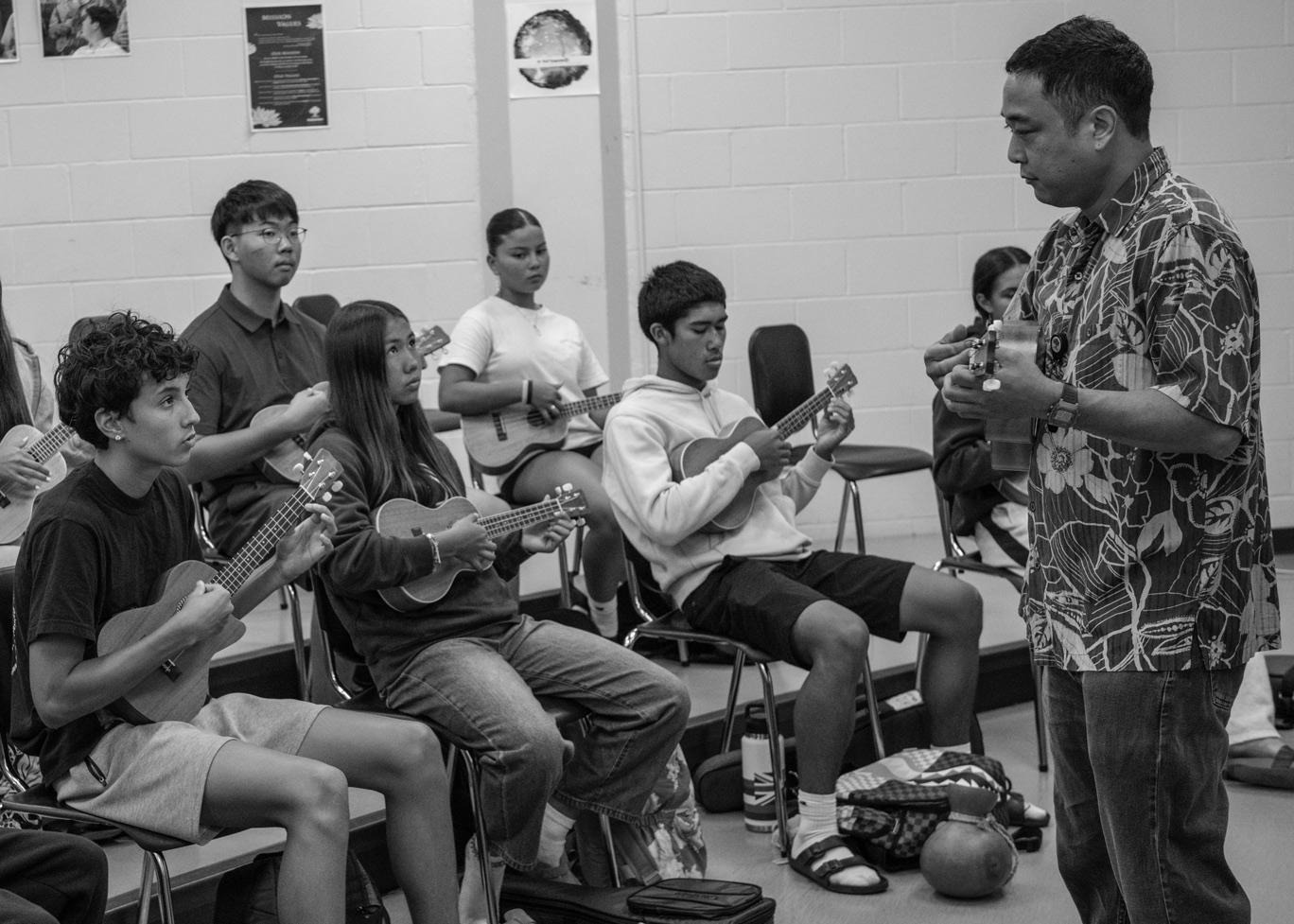
Academy musicians:
Music
The Academy Music Department offers courses designed to explore a diverse set of musical expressions through band, choir, guitar, Hawaiian music, orchestra and creative music. These courses encourage students to engage with music's fundamental artistic processes: creating, performing, responding and connecting, recognizing music as an intrinsic and unique aspect of human thought. Our community-centered music offerings provide abundant opportunities for students to develop personal skills through collaborative creation, arrangement, rehearsal and performance of music.
• Acquire skills in singing or playing instruments, improvising, composing, reading and notating music in ways that support lifelong participation and appreciation of music.
• Refine understanding, terminology and descriptive ability to critique, examine and appraise music and musical performances.
• Cultivate healthy personal attitudes such as focus, independence, risk-taking, persistence, resilience, creativity, empathy and collaboration through music making.
• Explore a rich historical and cultural musical heritage, connecting with diverse cultures and disciplines to embody the human spirit through music.
Graduation Requirements
Students must earn two credits in the Visual and Performing Arts. All Music Department courses may be taken to fulfill the Visual and Performing Arts graduation requirement or elective credit. Courses taken to fulfill the Visual and Performing Arts requirement must be taken for a letter grade; courses taken for elective credit may earn either a letter grade or Credit/No Credit.
Exploration: Music
The Music Exploration allows students to pursue musical interests beyond the fulltime course limit. This is an opportunity for students who have completed their Visual and Performing Arts graduation requirement, are in Grades 11 or 12 and have approval from their dean and the music department head. Unlike other exploration classes, Music Exploration classes need to be programmed during the regular programming period. Students are expected to meet all Exploration course requirements. Music Exploration may only be taken as Credit/No Credit and credit does not count towards graduation requirements including elective credit.
Open to grades 11, 12. Prerequisite: Completion of Visual and Performing Arts graduation requirement and permission of dean and music department head. Year course. No credits earned toward graduation requirement. This course must be taken credit/no credit. This course may be repeated for credit.
Course Offerings
Academy Chorus
The Academy Chorus is the foundational choral experience for students grades 9 – 12. Students with previous choir experience and newcomers to choral singing are welcomed. Development of healthy vocal techniques, ensemble and rehearsal skills are emphasized through the performance of secular and sacred choral works from Western and global choral traditions, both historical and contemporary. Additional activities include improvisatory music making, critical listening activities and performance in solo and small group settings. Academy Chorus members are expected to participate in chapel and perform an Academy concert at least once a semester.
Open to grades 9, 10, 11, 12. No prerequisite. Year course. One credit. Satisfies Visual and Performing Arts graduation requirement or elective credit. This course may be repeated for credit.
Music
Chorale
Chorale is a mixed voice ensemble composed of students with demonstrated advanced singing and musicianship abilities. Enrollment is limited. This select choir performs advanced choral literature selected from Western, multicultural, contemporary and avant garde styles. Students are expected to perform independently and in small ensembles. Development of critical listening, sight reading, ear training, music theory, rehearsal skills and improvisatory music are integral to this course. Chorale performs frequently in a variety of settings, including chapel, Academy concerts, Punahou events and community programs.
Open to grades 10, 11, 12. Prerequisite: placement by audition with instructor and voicing. Year course. One credit. Satisfies Visual and Performing Arts graduation requirement or elective credit. This course may be repeated for credit.
The Rhythm Inside
This course explores the fundamental building blocks of music (time, space and energy) through exploration of rhythm and movement activities. Students create, notate and lead multipart rhythmic compositions through stick drumming on buckets and a variety of other found household items. Contemporary popular music forms are used as the primary guiding material for developing aural skills and stick technique. Additional areas of exploration may include hand drums, body percussion and a sampling of other cultural rhythmic traditions. No prior musical experience is required to be successful. At the end of the course, students are able to read and write basic Western rhythmic notation and develop aural forms of rhythmic composition.
Open to grades 9, 10, 11, 12. No prerequisite. Semester course. One-half credit. Satisfies Visual and Performing Arts graduation requirement or elective credit.
Introduction to Creative Music Studio
Students in this course develop a foundation to play in pop/rock bands on keyboards, guitar, vocals, ukulele, bass and drum set. Intended for students with little to no music and/or rock band experience, students learn basic skills by playing simple songs in a large group. The course then guides students through working together to play and perform rock songs in small groups. Emphasis is placed on creativity, collaboration, communication, learning by ear, basic music theory and reading/writing basic chord charts and music notation. In addition to live performance, students learn studio recording techniques using digital audio workstations (DAW) on their personal computers. At the end of the course, students may continue into the next course, Creative Music Studio.
Open to grades 9, 10, 11, 12. No prerequisite. Semester course. One-half credit. Satisfies Visual and Performing Arts graduation requirement or elective credit.
Creative Music Studio
In this course, students collaborate with their classmates to create music in current styles (rock, pop, EDM, hip-hop, etc.). Students play instruments common in pop/rock music, including guitar, keyboard, bass, drums and vocals. Students play by ear, arrange, notate basic chord and rhythm charts, improvise and compose music. Musical challenges are the primary vehicle to teach the process used by professional musicians to create original music. In order to create music, students are also asked to analyze, imitate and create variations on other artists’ music. Emphasis is placed on live performance; students are also asked to use studio recording techniques using digital audio workstations (DAW) on their personal computers.
Open to grades 9, 10, 11, 12. Prerequisite: Introduction to Creative Music Studio or audition with course instructor. Semester course. One-half credit. Satisfies Visual and Performing Arts graduation requirement or elective credit. This course may be repeated for credit.
Beginning Guitar
This course is intended for students with little or no formal guitar experience. Students experience a deep dive into playing the guitar beginning with basic chords, simple melodies and strong foundational technique. They learn the fundamentals of music including reading and writing standard music notation. They gain applicable skills including basic accompaniment styles, blues and rock improvisation, slack key guitar technique, scales and basic music theory. Students perform as a large group in one concert per semester and may continue to more advanced guitar ensembles the following year. A classical, nylon-string guitar and guitar footstool are required for this course.
Open to grades 9, 10, 11, 12. No prerequisite. Year course. One credit. Satisfies Visual and Performing Arts graduation requirement or elective credit. This course may be repeated for credit.
Classic Guitar Ensemble I
This course is for intermediate-level guitar students. Students learn to perform in small (duos, trios, quartets) and large guitar ensembles. In addition, students study music history, music theory, improvisation and composition/arranging. As a continuation of Beginning Guitar, students play a wide variety of music, including rock, Hawaiian and classical styles. Prior to enrollment, students should be able to demonstrate comfort reading standard music notation in open position and basic classical guitar technique. They must also have a good working knowledge of chord and rhythm playing. A classical, nylon-string guitar and guitar footstool are required for this course.
Open to grades 9, 10, 11, 12. Prerequisite: Beginning Guitar or audition with instructor. Year course. One credit. Satisfies Visual and Performing Arts graduation requirement or elective credit. This course may be repeated for credit.
Art
Classic Guitar Ensemble II
This course is for advanced guitar students. Students learn to perform advanced high school and college level repertoire in small and large guitar ensembles in different musical styles. This ensemble performs extensively in formal and informal venues and makes recordings publicly available. In addition, students study music history, music theory, improvisation and composition/arranging. Students accept more responsibility in leading rehearsals and performances and selecting and arranging music along with the instructor. A classical, nylon-string guitar and guitar footstool are required for this course.
Open to grades 9, 10, 11, 12. Prerequisite: Audition with instructor. Year course. One credit. Students may enroll for a semester only with permission of the instructor. Satisfies Visual and Performing Arts graduation requirement or elective credit. This course may be repeated for credit.
Classic Guitar Ensemble III
This course is for advanced guitar students. Students learn to perform college level repertoire in small and large guitar ensembles in different musical styles. This ensemble performs extensively in formal and informal venues and makes recordings publicly available. In addition, students study music history, music theory, improvisation and composition/arranging. Due to the advanced nature of the course, students lead many rehearsals and performances and select and arrange music. A classical, nylon-string guitar and guitar footstool are required for this course.
Open to grades 10, 11, 12. Prerequisite: Audition with instructor. Year course. One credit. Students may enroll for a semester only with permission of the instructor. Satisfies Visual and Performing Arts graduation requirement or elective credit. This course may be repeated for credit.
Hawaiian Music Ensemble I
This course is an introduction to the history, culture, practice and performance of music in Hawai‘i. Students sing, play instruments and learn music theory through the lens of Hawaiian music and music making. The course aims to reconnect each student to the music of this land. Students strengthen Hawaiian language pronunciation, vocabulary and understanding through performing and analyzing content of Hawaiian mele.
Students learn a varied approach to music making. Students learn by ear in a kanikapila style and learn the fundamentals of Western music as it applies to the music of Hawai‘i. Topics covered include reading and writing basic music notation, chord theory, improvisation and composition. Students are expected to participate in informal and formal performances scheduled throughout the year.
Open to grades 9, 10, 11, 12. No prerequisite. Year course. One credit. Satisfies Visual and Performing Arts graduation requirement or elective credit.
Hawaiian Music Ensemble II
Hawaiian Music Ensemble II provides a deeper exploration of the history, culture, practice and performance of music in Hawai‘i. Students continue to develop and deepen skills on instruments and voice through Hawaiian and local musical styles initially explored in Hawaiian Music Ensemble I.
Students explore and expand a core set of Mele Hawai‘i. In addition, students are encouraged to use their understanding of the elements of Hawaiian music to select songs and develop their own stylistic interpretations of that music. Students share their creations through performance in a variety of settings throughout the year to demonstrate their learning.
Open to grades 10, 11, 12. Prerequisite: Hawaiian Music Ensemble I and/or recommendation of instructor. Year course. One credit. Satisfies Visual and Performing Arts graduation requirement or elective credit. This course may be repeated for credit.
Concert Orchestra I
For players of violin, viola, cello and string bass, this course offers study of orchestral music representing a broad range of styles and composers. Fundamentals for technique and musicality are advanced through the study of major and minor scales, rhythmic reading, bowing techniques, the higher positions and musical phrasing.
The compositions studied and performed reinforce the fundamentals and build musical understanding. Performance is an integral part of music; students are expected to participate in scheduled concerts throughout the year.
Open to grades 9, 10, 11, 12. Prerequisite: Approximate grade III performance level. Placement by audition and instrumentation. Year course. One credit. Satisfies Visual and Performing Arts graduation requirement or elective credit. This course may be repeated for credit.
Concert Orchestra II
For the advancing string student, this course offers the continuing study of orchestral literature in a variety of styles and a continuation of technical advancement through extended scales and arpeggios, advanced bowing techniques and the higher positions. Class sessions include work for advancement of technical skills while integrating them into the orchestral literature being studied. The compositions studied and performed emphasize growing musical understanding and represent a broad range of styles and composers. Performance is an integral part of music; students are expected to participate in scheduled concerts throughout the year.
Open to grades 9, 10, 11, 12. Prerequisite: Approximate grade IV performance level. Placement by audition and instrumentation. Year course. One credit. Satisfies Visual and Performing Arts graduation requirement or elective credit. This course may be repeated for credit.
Art
Music
Symphony Orchestra
The Punahou Symphony Orchestra strives to perform concert repertoire at the highest possible level. Several major performances are presented each school year. Students of orchestral string instruments are selected through audition. Students study performing practices and styles through the music of numerous composers from all periods of music history. The annual Concerto Concert provides an opportunity for 12th graders, selected by audition, to perform as soloists with the orchestra. In addition, many opportunities exist for performance in chamber music ensembles for interested and qualified students.
Open to grades 9, 10, 11, 12. Placement by audition and instrumentation. Year course. One credit. Satisfies Visual and Performing Arts graduation requirement or elective credit. This course may be repeated for credit.
Marching Band
The Punahou Marching Band serves as a musical ambassador for the Punahou band program and is open to all woodwind, brass and percussion players enrolled in an Academy music ensemble.
Students in marching band attend conditioning and music rehearsals in the late spring, weekly rehearsals during the summer and a required Marching Band Camp in late July/early August. Attendance at summer band camp is expected of all participating students regardless of previous experience. Marching Band students perform at all Open Division football games, a local parade and a local marching band festival.
Marching Band students may also have the opportunity to perform at national or international parades and other events. Through the marching band experience, students continue to develop and enhance music performance skills, physical coordination, teamwork and leadership.
Open to grades 9, 10, 11, 12. Prerequisite: Successful audition for and concurrent enrollment in an Academy music ensemble. One quarter credit. Satisfies elective credit. This course may be repeated for credit.
Concert Band I
Concert Band I is an intermediate level ensemble for woodwind, brass and percussion students. The course provides a strong focus on continued individual and ensemble music performance skill development. Performance is an integral part of the course; students are expected to participate in two scheduled concerts throughout the year.
Open to grades 9, 10, 11, 12. Prerequisite: Previous instrumental experience. Placement by audition and instrumentation. Year course. One credit. Satisfies Visual and Performing Arts graduation requirement or elective credit. This course may be repeated for credit.
Concert Band II
Concert Band II is an advanced intermediate level ensemble for woodwind, brass and percussion students. The course explores intermediate band repertoire. Students continue to develop and explore individual and ensemble music performance skills; students are expected to participate in at least two scheduled concerts during the year.
Open to grades 9, 10, 11, 12. Prerequisite: Previous instrumental experience. Placement by audition and instrumentation. Year course. One credit. Satisfies Visual and Performing Arts graduation requirement or elective credit. This course may be repeated for credit.
Wind Symphony
The Wind Symphony is an advanced ensemble for more experienced woodwind, brass and percussion students. Students explore advanced wind band literature. Instruction focuses on development of more advanced individual and ensemble music performance skills. Supplemental instruction through private lessons is strongly encouraged. Performance is an integral part of the course; Wind Symphony members are expected to participate in scheduled concerts throughout the year and participate in the annual OBDA Parade of Bands. Students are encouraged to explore additional music opportunities such as solo and ensemble festivals and OBDA Select Band auditions.
Open to grades 9, 10, 11, 12. Prerequisite: Previous instrumental experience. Placement by audition and instrumentation. Year course. One credit. Satisfies Visual and Performing Arts graduation requirement or elective credit. This course may be repeated for credit.
Wind Ensemble
Wind Ensemble performs advanced high school to collegiate level wind band literature and provides a high degree of musical challenge, focusing on advanced individual and ensemble skills. Performance is an integral part of the course; students are expected to participate in several scheduled concerts and community performances throughout the year and participate in the annual OBDA Parade of Bands. 12th grade students have the opportunity to perform as soloists selected by audition in the annual Concerto Concert. Depending on scheduling, students may also perform in collaboration with Symphony Orchestra. Additional opportunities include chamber music, solo performance and OBDA Select Band auditions. Supplemental instruction through private lessons is strongly encouraged.
Open to grades 9, 10, 11, 12. Prerequisite: Previous instrumental experience. Placement by audition and instrumentation. Year course. One credit. Satisfies Visual and Performing Arts graduation requirement or elective credit. This course may be repeated for credit.
Independent Study: Music
The Independent Study Program creates opportunities for students to explore personal musical ideas and projects as an extension of their Academy music studies and prior musical experiences, guided by high expectations for exploration, growth and mastery. Students may apply for Independent Study by contacting their Deans and the Advisor of the Program during programming. Students should actively discuss their proposal with their intended advisor in the Academy Music Department before submitting a proposal to guide their submission. Project proposals are submitted and reviewed by the Independent Study committee in February – March for the following school year. Students enroll in independent study on a semester basis and earn one-half elective credit per semester. Students may complete more than one independent study but may not be enrolled in more than one during any given semester.
Open to grades 11, 12. Prerequisite: Approval of proposal by Academy Music Department. Minimum of two years of Academy study in a school music ensemble OR minimum of two credits in a combination of other music department courses. Semester course. Satisfies elective credit.
Courses not offered in 2026 – 2027 Elements of Ensemble Singing
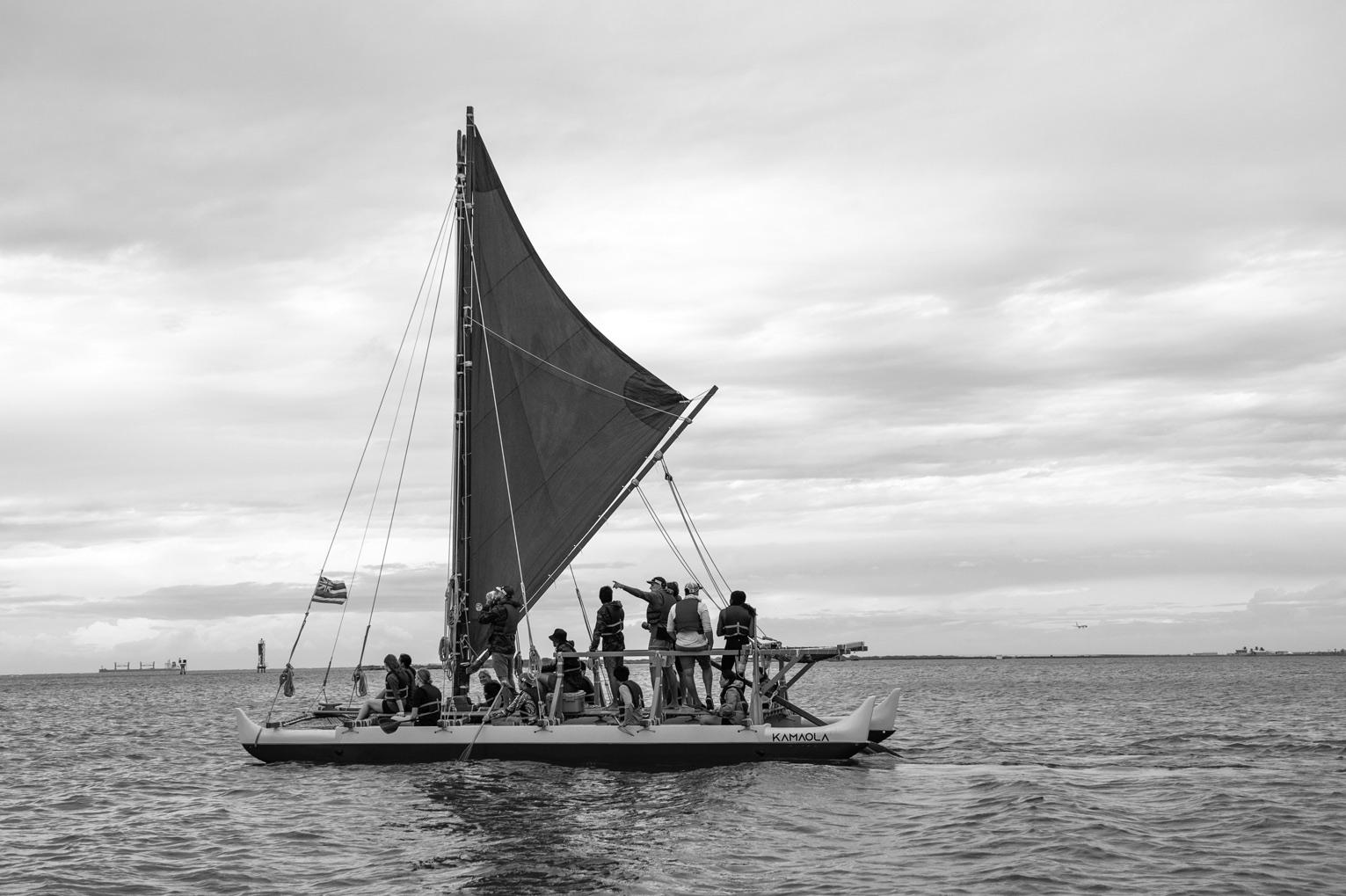
Business Course Offerings
These offerings introduce students to business concepts through on-campus courses with the Case Accelerator for Student Entrepreneurship and online courses with Global Online Academy. Students build foundational skills in markets, strategy and financial thinking while exploring how businesses create and deliver value.
Businesses, Organizations & Society
This course gives students a broad understanding of business activity and how it interacts with the world. It looks at effective individuals and organizations and how they manage success or failure. The use of practical group exercises and realworld experiences gives greater insight into the decision-making behind products and services seen and used every day, in both new and established businesses. Leaders from the Hawai‘i community speak to students and answer questions relevant to familiar organizations and current topics.
The course is based on The Business Model, as defined by the elements of Finance, Organization, Marketing, Operations and Strategy. Students gain a rudimentary familiarity with how every organization uses these basic principles. However, technical business issues and the stock market are not topics of this course. Students learn the basics of financial statements. Elements of leadership, decision-making, risk, value, entrepreneurship and the growing role of artificial intelligence are discussed. The instructors are leaders in the Hawai‘i business community and are successful entrepreneurs with deep and broad backgrounds in ownership, finance, management and more. Their goal is to give students a broad understanding of work environments, the dynamics of organizations and business concepts they will inevitably face later in life. Subject to limited enrollment. Information on the application process will be shared by the class deans after programming.
Open to grade 12. Semester course. One-half credit. Satisfies elective credit. Credit/no credit course. This class must be taken as a student’s sixth course.
Global Online Academy Courses
See the GOA section for fee information, course descriptions and course dates. (S) indicates courses offered in the summer.
AP Macroeconomics
AP Microeconomics
Applying Philosophy to Global Issues
Arts Entrepreneurship
Business Problem Solving
Business Problem Solving (S)
Capitalism: Past, Present, and Future Data Visualization
Entrepreneurship in a Global Context
Game Theory
Graphic Design
Introduction to Artificial Intelligence
Introduction to Artificial Intelligence (S)
Introduction to Branding & Marketing
Introduction to Branding & Marketing (S)
Introduction to Legal Thinking
Introduction to Legal Thinking (S)
Introduction to Psychology
Introduction to Psychology (S)
Problem Solving with Engineering and Design
Social Psychology
Vibe Coding: Code, Create & Launch with AI (S)
Open to grades 10, 11, 12. Semester course. One-half credit. Satisfies elective credit. Business
Non-Departmental
JROTC Course Offerings
Junior ROTC is voluntary for all physically qualified students. All enrolled students are furnished complete uniforms, books and other necessary equipment free of charge. This equipment is on loan from the United States Army and must be returned at the end of the year or sooner if a student withdraws from the course.
Cadets completing three or four years of JROTC are entitled to placement credit toward completion of Senior ROTC courses. JROTC offers additional and enhanced opportunities for those students who desire to compete for college ROTC scholarships which are worth up to $100,000.
The JROTC program offers competitive nominations to West Point, Annapolis and the Air Force Academy to outstanding cadets who qualify. These nominations are in addition to the regular Congressional and Presidential appointments.
Participation in JROTC does not incur any service or monetary obligation to the U.S. Government.
Through this course, students gain insight into ethical values and principles that underlie good citizenship and leadership, including: examining the respect given constituted authority and the responsibility and integrity authority requires; developing leadership potential; becoming familiar with the history, purpose and structure of the military services and their links with political policy; meeting physical challenges and appreciating the importance of physical fitness in maintaining good health; critical thinking; effective oral and written communication and defending choices thoughtfully.
Strong emphasis is placed on individual leadership, responsibility and service. During their second, third and fourth year, students are designated as cadet officers and senior non-commissioned officers.
Cadets who successfully complete JROTC I and JROTC II are awarded one-half credit of Physical Education under the Fitness through Independent Training (FIT) program.
JROTC I
Students are introduced to JROTC and the Army, leadership theory, drill and ceremonies, physical fitness, marksmanship and safety, citizenship and military history.
Open to grades 9, 10, 11, 12. Year course. One-half credit. Satisfies elective credit.
JROTC II
Students in JROTC II study intermediate leadership, drill and ceremonies, intermediate first aid, intermediate map reading, military history, role of the U.S. Army, American citizenship, technology awareness, marksmanship and safety and physical fitness.
Open to grades 10, 11, 12. Prerequisite: JROTC I with a grade of B or better or consent of the Senior Army Instructor. Year course. One-half credit. Satisfies elective credit.
JROTC III
Students who enroll in JROTC III study applied leadership, drill and ceremonies, applied map reading/land navigation, marksmanship and safety, military justice, role of the armed forces, technology awareness and physical fitness.
Open to grades 11, 12. Prerequisite: JROTC II with a grade of B or better or consent of the Senior Army Instructor. Year course. One-half credit. Satisfies elective credit.
JROTC IV
JROTC IV teaches students advanced leadership techniques, drill and ceremonies, staff functions and procedures, organizational effectiveness techniques, marksmanship and physical fitness. The fourth year is much less structured than the earlier three and JROTC IV students take an active role in the instruction of cadets.
Open to grade 12. Prerequisite: JROTC III with a grade of B or better or consent of the Senior Army Instructor. Year course. One-half credit. Satisfies elective credit.
Voyaging Course Offerings
Hawaiian Voyaging, Na ¯ Kelamoku
Guided by the Hawaiian competency of kuleana, this course engages students in hands-on, project-based activities that focus on developing an understanding of the history and culture of contemporary voyaging, basic seamanship skills and wayfinding techniques. Students also have opportunities to learn more about the fabrication and maintenance techniques needed to keep our treasured canoes sailing into the future. Multiple off campus trips occur utilizing both Punahou’s paddling canoes and our sailing canoe Kamaola. Students are required to take a swim test in order to paddle and sail on Punahou’s canoes.
Open to grades 9, 10, 11, 12. No prerequisite. Semester course. One half credit. Satisfies elective credit.
He wa‘a he moku, he moku he wa‘a | Voyaging
See Ke Kilohana section for course description.
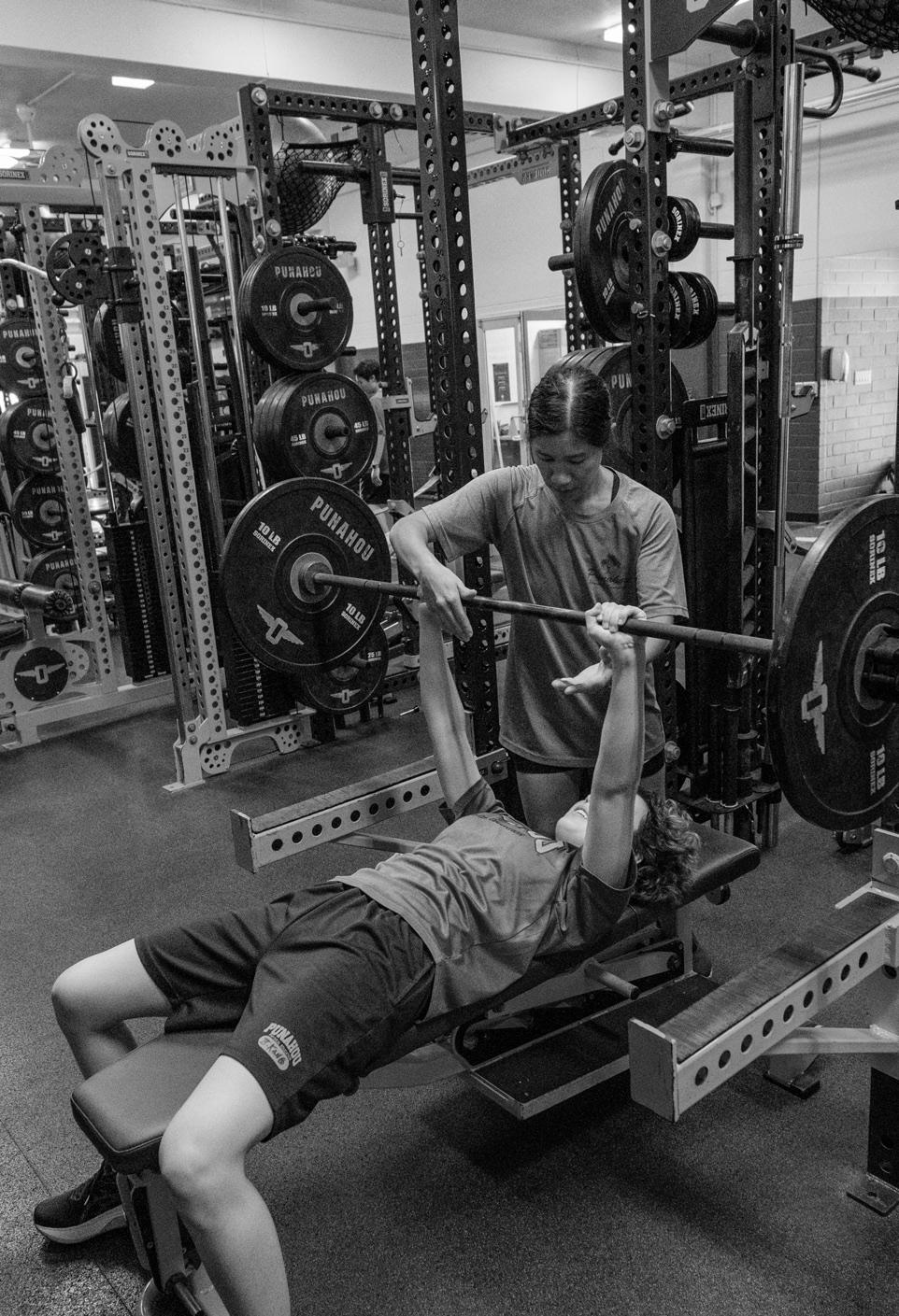
Graduation Requirements
Two credits are required for graduation. There are four categories from which students may choose to earn their credits: In School (ISPE), After-School (ASPE), Athletics (ILH) and Summer School. GOA courses do not satisfy the Physical Education graduation requirement.
All students are required to take Lifetime Fitness. This is a fitness-related course, offered during the school year and summer school. The course must be completed by the end of the 10th-grade year.
It is highly recommended that Lifetime Fitness be taken BEFORE any ISPE course. Lifetime Fitness must be taken before Strength Training. Students may NOT take two In-School Physical Education courses concurrently.
Physical Education
Whether choosing to be fit, learning a new game, developing specific skills or just having fun with friends, movement is at the heart of leading a physically active lifestyle.
The goal of the Academy Physical Education Department is to develop physically literate individuals who have the knowledge, skills and confidence to enjoy a lifetime of healthful physical activity.
A physically literate individual:
• Moves with confidence and competency in a variety of skills.
• Applies knowledge of movement concepts and principles.
• Demonstrates a health-enhancing level of fitness.
• Exhibits responsible personal and social behavior.
• Values physical activity for health, enjoyment, challenge and self-expression.
The Physical Education Department encourages students to experience a variety of activities that complement their personal interests and challenge them physically.
Course Offerings
Lifetime Fitness
Lifetime Fitness aims to engage students in fitness activities to foster healthy exercise habits and cultivate an appreciation for the benefits of being physically active.
In addition to the physical aspects of the course, units of study include: the benefits and components of physical fitness, designing a personal strength training workout and gaining a better understanding of nutrition for healthy living. Note: Hands-Only CPR is introduced as part of this course.
Open to grades 9, 10. No prerequisite. Semester course. One-half credit. Letter graded with a Credit/No Credit option (C or better for credit). Satisfies Physical Education graduation requirement for Lifetime Fitness.
Art
Physical Education
ISPE: In-School Physical Education
In-School Physical Education (ISPE) is comprised of a number of courses that offer students a choice of activities. In each course, students learn to develop proficiency in skills and various movement forms, incorporate tactics, concepts and strategies in situations relative to the activity and demonstrate responsible personal and social behavior in a physical activity setting. Students are also encouraged to engage in regular exercise outside of class and utilize personal goals to guide an exercise program appropriate for them. The ultimate goal is to help students become confident and competent enough to participate in and enjoy a positive moving experience through a variety of activities in recreational settings. To support out-of-class participation, several facilities are available for student use (under certain conditions), i.e. pool, tennis courts and weight room.
Lifetime Fitness provides many concepts fundamental to the PE curriculum and is highly recommended before taking any ISPE course.
First Semester
Basic Yoga Plus
FIT: Fitness through Independent Training*
Indoor Sports
PEP: Physical Exercise through Play
Strength Training**
Yoga I
Yoga II***
Second Semester
Basic Yoga Plus
Outdoor Sports
Racquet Sports
Yoga I
Yoga II***
Open to grades 9, 10, 11, 12. *Note: FIT is open to grades 11, 12 only and **Strength Training is open to grades 10, 11, 12 only. Prerequisite for Strength Training is Lifetime Fitness. ***Prerequisite for Yoga II: Yoga I. Semester course. One-half credit. Letter graded with a Credit/No Credit option (C or better for credit). Satisfies Physical Education graduation requirement.
ISPE: Activity Offerings
Basic Yoga Plus
Students are introduced to a variety of methods in developing strength, flexibility, balance and a sense of vigor and well-being. Students experience the physical aspects of yoga through various yoga postures with an emphasis on proper posture, body alignment and function. Other functional movement methods such as Pilates, Barre, HIIT, resistance band, stability ball and foam roller exercises are also introduced throughout the second half of the semester.
FIT: Fitness through Independent Training
This semester course is designed to provide students with an opportunity to gain and practice a deeper understanding of the types and principles of Fitness Training in order to create a personalized fitness training program. They will be able to share and implement what they learn through personal workouts and a “Train Your Teacher” project on campus. There may also be opportunities to visit and experience related wellness/fitness facilities off campus. Students must submit a completed application during programming and be approved by their respected grade level deans and the PE Department Head prior to being enrolled in FIT.
Open to grades 11, 12.
Indoor Sports
Sport activities in this course include Volleyball, Basketball, Pickleball and Badminton. Emphasis is on developing proficiency of skills in these sports and enjoyment of play. This course is for the student who enjoys a variety of team sports and individual/dual sports held in indoor settings. Other nontraditional games may be included such as Floor Hockey and Team Handball in addition to fitness activities.
Outdoor Sports
This dynamic course introduces students to a variety of exciting outdoor sports and activities designed to boost physical fitness, teamwork and leadership skills. Through sports that may include soccer, flag football, ultimate frisbee, aquatic games and track and field. Students develop athletic skills, strategic thinking and effective communication while having fun in a supportive team environment.
PEP: Physical Exercise through Play
This course is designed to promote fitness, teamwork and fun through a variety of engaging physical activities. PEP encourages students to stay active while exploring both traditional and nontraditional games. This course is ideal for students who enjoy regularly scheduled exercise and are open to diverse, playful and dynamic activities that foster physical health and social skills.
Racquet Sports
In this racquet-related course, students learn the rules, fundamental skills, strategies and etiquette of various racquet sports for singles and doubles play. Lead-up activities progress to full-court games and tournament play, giving students a chance to develop skills that enable them to feel confident in their game play. Sport activities include Racquetball, Pickleball, Tennis and Badminton, as well as other fitness related activities.
Physical Education
ISPE: Activity Offerings continued Strength Training
This course builds upon the introductory strength training unit taught in Lifetime Fitness, adding more advanced functional training methods and a deeper exploration into muscle physiology and biomechanics through training and research related to strength training and fitness. It is intended for motivated fitness enthusiasts willing to work out at a high rate and practice different training methods that affect change in muscular strength and endurance. This class provides students who may not have access to our athletic performance program the opportunity to learn more about strength training by acquiring the skills and knowledge already possessed by our studentathletes. Students are required to meet course expectations which includes designing and performing workouts to meet various training objectives in class. This course is NOT intended for athletes who are concurrently in a sport season or training in our after school conditioning program. Open to grades 10, 11, 12. Prerequisite: Lifetime Fitness.
ASPE: After-School Physical Education
This program provides an opportunity for students to explore and engage in unique lifetime activities outside of the regular school day. Students elect activities by quarter and may combine activities from any two quarters to fulfill a semester credit. Many instructors are professionals in the community. Students learn and practice the program’s basic skills, concepts, rules, strategies and principles of movement. Classes meet two times per week, (Monday/Wednesday OR Tuesday/Thursday), 3:45 – 5:30 p.m., beginning with the first meeting day in each quarter. Fees for select activities will be charged to student accounts.
Course offerings, including day, time and quarter offered, are subject to enrollment, instructor availability and facility restrictions. For ASPE Dance, students are required to sign up with their deans during programming and with the Punahou Dance School (PDS) for select classes.
Activities may include:
Q1 – Dance (PDS)
Q2 – Dance (PDS), Hiking
Q4 – Fencing, Tai Chi, Outdoor Education Summer – Fencing, Hiking, Pickleball
All activity offerings are subject to enrollment. There may be possible additions later in the year, check with the ASPE office.
Yoga I
This course allows students to discover the benefits of yoga for the body, mind and spirit. Students learn how to align the body and create a strong foundation as they perform a wide range of postures (standing, seated, forward bends, twists, inversions and arm balances). Mindfulness practices and yoga nidra are introduced to provide ways to de-stress the body, calm the mind and create balance of life. Students explore the yoga philosophy for living a meaningful and purposeful life through Patanjali’s Eightfold Path of Yoga. They examine and reflect on how these principles can guide their ethical decision-making and behavior and rediscover the intention behind their actions as they live their life.
Yoga II
This course is designed for students who have completed Yoga I and would like to build upon their yoga practice at a deeper level. The learning focus is on the seven Chakras (energy centers of the body) and how the energetic state impacts one’s physical, mental, emotional and spiritual wellbeing. Through readings on the Chakras, reflections and class experiences, students gain insights to areas in their life they can improve to promote health and harmony. Students learn new and challenging postures and how to move safely within the limitations of their body. Mindfulness practices, sound healing, restorative yoga and yoga nidra are practiced to restore and renew the body and mind. Students discover ways to cultivate attitudes of compassion and acceptance through these yoga practices. Prerequisite: Yoga I
Open to grades 9, 10, 11, 12. No prerequisite. Quarter course. One-quarter credit. Only ASPE quarters may be combined for semester credit. Credit/No Credit (C or better for credit). Satisfies Physical Education graduation requirement although the same activity may not be used to earn more than one credit.
ILH (Extra-curricular) (Physical Education ILH)
Punahou’s athletic program involves student participation and competition in the Interscholastic League of Honolulu (ILH). Individuals must be deemed eligible to participate by the Athletic Department and fulfill basic participation requirements in order to earn credit. These requirements include being present and actively participating in a minimum of 75% of all required team sessions, participating in at least one officially scheduled competition and performing physical conditioning exercises as directed by the coaching staff. Start and end dates for each season are provided by the Athletics Department.
Open to grades 9, 10, 11, 12. No Prerequisite. Onehalf credit per season. Credit/No Credit. Satisfies Physical Education graduation requirement. Classes of 2027, 2028 and 2029: the same sport may not be used to earn more than one PE credit (2 sport seasons). Sporter Air Riflery and Precision Air Riflery count as the same sport. Class of 2030 and beyond: the same sport may be used to fulfill multiple PE credits.
Global Online Academy Courses
See the GOA section for fee information, course descriptions and course dates. (S) indicates courses offered in the summer.
Health & Fitness
Health & Fitness (S)
Open to grades 10, 11, 12. No Prerequisite.
Independent Study: Physical Education
See Independent Study and Research Program section for course description. Satisfies elective credit. Does not satisfy Physical Education graduation requirement.
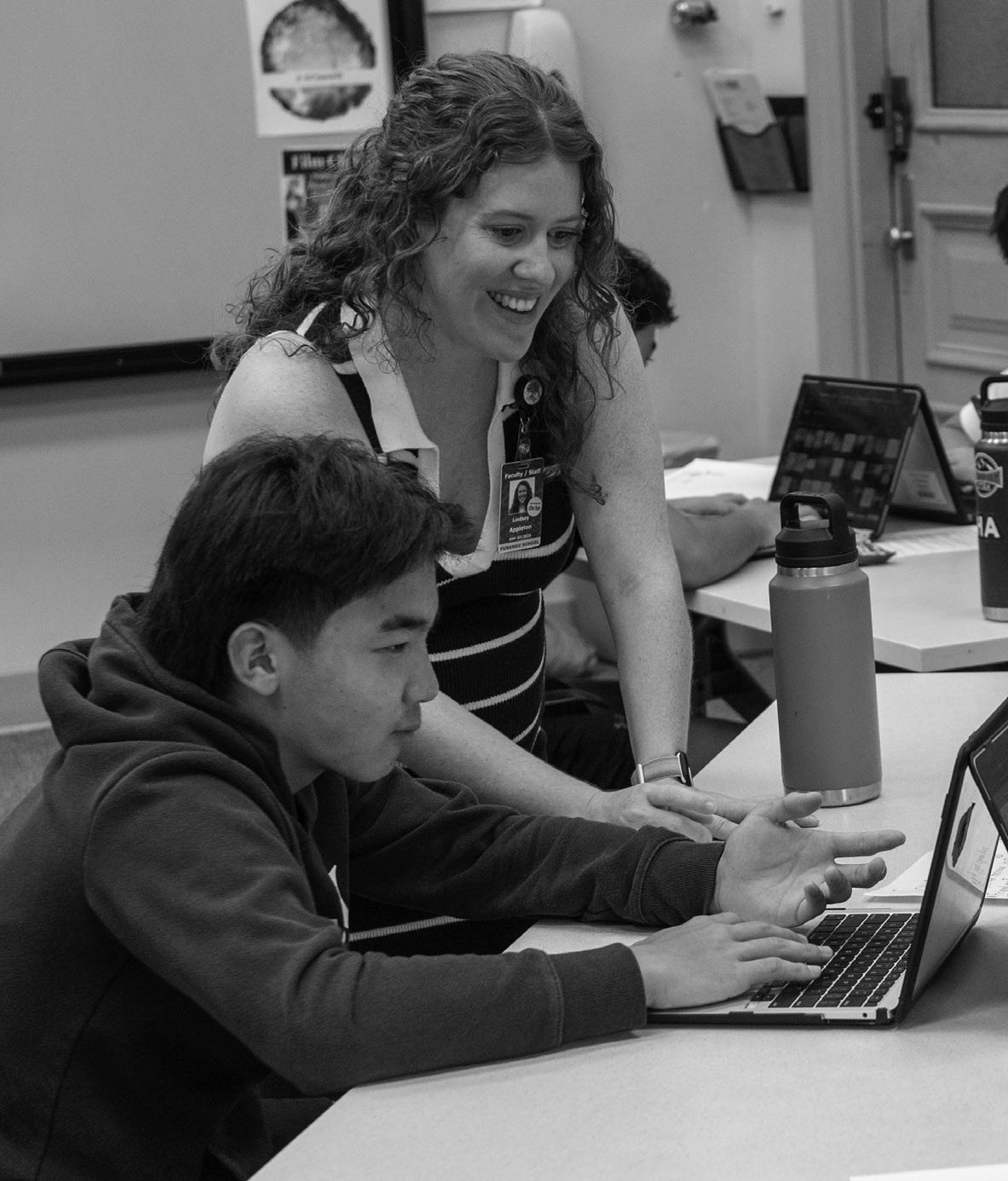
Graduation Requirement
Health & Wellness is required for all students in Grade 9.
Course Offerings
Health & Wellness
Psychology and Well-being
The mission of the Psychology and Well-being Department is to promote student awareness and life skills development around a variety of topics that affect health and well-being, including values-based decisionmaking. An intentional effort is made to cultivate a classroom atmosphere uniquely different from other courses to effectively address and explore age-appropriate social and emotional topics. Topics include values, identity, goal setting, decision-making, time management, stress management, communication strategies, interpersonal relationships, peer pressure and teen risk behavior. An underlying goal is to create an empathetic, compassionate and resilient student body. Social Emotional and Ethical Learning (SEEL) skills are taught in various settings which provide students with leadership training and meaningful opportunities that include and extend beyond the Punahou School community. The department provides proactive, experiential, academic and skills-based training addressing the psychological, social and emotional aspects of human development.
This yearlong ninth-grade Health & Wellness course provides students with opportunities to explore strategies that promote health literacy in a safe, caring classroom environment that values and celebrates human diversity. Students develop self-awareness, social awareness, self-management, relationship skills and responsible decision-making to navigate 21st-century challenges.
Grounded in mindfulness, the course examines holistic wellness, digital wellness, physical and mental development, positive mental health practices, human sexuality and drug-use prevention education, while also building skills to maintain healthy relationships. With a focus on the dignity of oneself and others, students learn to make informed, positive decisions for their current and future health and wellness. Required for grade 9. Year course. Credit/no credit course.
Advanced Placement Psychology
This is a college-level introductory course in psychology that prepares students through a variety of learning modalities for the Advanced Placement Psychology Exam, whereby students may earn college credit and/or advanced placement. A range of topics are discussed that explore human behavior, cognition and psychological phenomena. Students learn the scientific practice of psychological inquiry, including research methods and data analysis. Students are empowered to approach content with a scientific attitude anchored to curiosity, healthy skepticism and humility. Student learning is also centered in how course content informs their personal kuana‘ike and worldview. Students are encouraged to take the AP Exam in May and the fee for the exam will be charged to the student’s account.
Open to grades 10, 11, 12. No prerequisite. Year course. One credit. Advanced Placement courses must be taken for a letter grade. Satisfies elective credit.
Psychology and Well-being
Positive Psychology
Positive psychology challenges the traditional focus of psychology by shifting attention from weakness and repair to strength and growth. It studies the science of human flourishing and explores how individuals can build upon the best aspects of life to enrich their own well-being and the well-being of others. In this course students examine ideas through University of Pennsylvania professor Dr. Martin Seligman’s PERMA™ theory of well-being. The PERMA™ framework identifies five building blocks that support flourishing: Positive emotion, Engagement, Relationships, Meaning and Accomplishment. Students explore each component and engage in practices that strengthen them in daily life.
Students analyze positive psychology research and apply it through both scientific and experiential learning. They collect data, reflect on findings and participate in activities such as gratitude journaling, mindfulness, and strengthsbased exercises. By connecting theory to experience, students develop practical skills that enhance resilience, purpose, and overall well-being.
Open to grades 9, 10, 11, 12. No prerequisite. Semester Course. One-half credit. Satisfies elective credit.
Performance Psychology
This course explores how thoughts, emotions, and behaviors impact performance in high pressure situations, whether in sports, academics, the arts, or everyday life. Students learn evidence based mental skills such as goal setting, visualization, self talk, focus and resilience, applying them through handson activities, interactive practice and discussion. The goal is to help students develop self awareness, strengthen confidence and master psychological strategies for real world application.
Open to grades 9, 10, 11, 12. No prerequisite. Semester course. One-half credit. Satisfies elective credit.
Global Online Academy Courses
See the GOA section for fee information, course descriptions and course dates. (S) indicates courses offered in the summer.
Abnormal Psychology
Abnormal Psychology (S) Developmental Psychology
Introduction To Psychology
Introduction To Psychology (S) Neuropsychology
Positive Psychology
Social Psychology
Open to grades 10, 11, 12. Semester course. One-half credit. Satisfies elective credit.
Independent Study:
Psychology & Well-being
See Independent Study and Research Program section for course description. Satisfies elective credit.
Graduation Requirements
Students must complete two yearlong laboratory courses in science to graduate, chosen from these options:
» a yearlong Biology course
» a yearlong Chemistry course
» a yearlong Physics course
» AP Environmental Science
» Biology & Geology of the Hawaiian Islands
One of those two years must be taken in the 10th grade or beyond; only one of the two courses may be taken in Summer School. Of these two years, the Science Department recommends one year be in the physical sciences and the other in the biological sciences.
Elective Courses Offered
Science
The Academy Science Department provides students with the opportunity to learn to use the scientific process to acquire, assimilate, extend, refine and apply scientific knowledge. Students learn to identify problems, ask questions, analyze data, think clearly and logically and draw appropriate conclusions. Students have the opportunity to develop an understanding of the basic concepts of Biology, Chemistry and Physics in our inquiry-based college-preparatory program.
Two yearlong courses are required to meet Punahou’s graduation requirements. However, the Science Department strongly recommends students take a minimum of three years, in part to meet minimum course requirements for college admission. To meet the wide range of abilities and interests of Punahou students, the department offers Advanced Placement courses, Honors level courses and fundamental courses.
The rich variety of elective courses includes single semester inquiries in areas of physical and biological sciences. The Science Department encourages students to explore the many diverse electives offered.
Science electives may be taken after ninth grade.
Anatomy & Physiology: Major Systems*
Anatomy & Physiology: Minor Systems* Culinary Chemistry*
Environmental Problem Solving Marine Biology*
Neuroscience of Learning
Ornithology
Research Experiences in Science
* Lab based for most college admissions
Principles of Physics* Science Electives
SCIENCE ELECTIVES
Anatomy & Physiology Major*
Anatomy & Physiology Minor*
Applied Chemistry: Culinary Chemistry* +
Environmental Problem Solving
Marine Biology*
Neuroscience of Learning
Ornithology
Research Experiences in Science
* lab based for most college admissions + not open to Grade 10
• Grade 12 only
Course Offerings Biology
This course builds foundations by challenging students to think critically, to understand biological concepts and to solve problems through class discussions, collaborative group projects, laboratory investigations and student-designed experiments.
Students focus their studies on the methods of science, the principles of ecology, basic molecular biology and genetics. The exploration of these topics includes understanding the connections to the overarching theme of evolution, discussing their underlying biochemistry and illustrating them with examples drawn from the unique ecology of the Hawaiian Islands.
Open to grade 9. No prerequisite. Year course. One credit. Satisfies Science graduation requirement.
Biology Honors
Intended for advanced science and mathematics students, this course challenges students to investigate and understand biological phenomena in great conceptual and molecular detail. Students choosing this course should have a high level of interest in biology, an understanding of the methods of science, a strong mathematics background and welldeveloped writing, study and time management skills.
Although the concepts studied in Biology Honors are similar to those studied in Biology, the topics are investigated in greater depth, the pace of the course is more rapid and students are challenged to apply their understanding to more complex problems. Students explore the overarching principles of evolution and the underlying mechanisms of biochemistry while applying the methods of science to their studies of ecology, metabolism and genetics. Students in Biology Honors engage in class discussions, collaborative projects, oral presentations, laboratory investigations, extensive individual fieldwork, research, statistical analysis and analytical writing.
Open to grade 9. Teacher recommendation required at time of programming. Year course. One credit. Satisfies Science graduation requirement.
Biology & Geology of the Hawaiian Islands
The Hawaiian Islands are often called the “crucible of evolution” because the many endemic species that evolved here clearly illustrate the processes of natural selection and adaptive radiation. This course explores the geological and biological factors which shape our incredible biological diversity. Students develop profound knowledge of life in Hawaiian environments by studying geological and biological processes, including plate tectonics, volcanism, competition and speciation. The goal is for students to deeply understand the natural history of the Hawaiian Islands so they are inspired to preserve its natural environments for future generations. The course includes a field component where students gain insight in natural, outdoor settings. Students should prepare for moderate physical activity in the sun and rain.
Open to grades 10, 11, 12. Prerequisite: Biology or Biology Honors. Year course. One credit. Satisfies Science graduation requirement or elective credit.
Advanced Placement Biology
This course is designed to be the equivalent of a college introductory biology course. The AP Biology curriculum, as outlined by the College Board, covers topics relating to the four big ideas of biology: evolution, energetics, information storage and transmission and systems interactions. This course strives to develop students’ appreciation for and understanding of complex biological concepts and to prepare students for the AP examination in May.
The course integrates laboratory exercises with lectures, demonstrations and other group work. Students are required to take unit tests, a cumulative semester examination and a cumulative test in April. The homework expectation is approximately 4 hours per cycle. It is recommended to take the AP Biology Exam in May; the fee for the AP exam will be charged to the student’s account.
Open to grades 10, 11, 12. Prerequisite: Biology or Biology Honors. Completing a chemistry course (Chem, Chem H, AP Chem) is suggested before taking AP Biology, but not required. Year course. One credit. Advanced Placement courses must be taken for a letter grade. Satisfies Science graduation requirement or elective credit.
Art
Science
Chemistry
Chemistry is a yearlong lab-based course which fosters the development of criticalthinking and problem-solving skills. Students study the basic concepts underlying a standard college preparatory curriculum, such as atomic structure, interaction of matter and energy, chemical bonding, stoichiometry, acidbase reactions and the interaction of matter and energy. The course builds connections to extensions of chemical principles in everyday life. The Science Department recommends students who are taking advanced or honors math enroll in Chemistry Honors.
The suggested course to prepare for AP Chemistry is Chemistry Honors. Students in Chemistry who are interested in taking AP Chemistry must complete a mandatory supplemental online class and pass a cumulative final exam. Students need to seek approval from the department chair and current Chemistry teacher to enroll. A formal request needs to be submitted during programming to gain access to the online class.
Open to grades 10, 11, 12. Prerequisite: Algebra I BCP or Advanced Algebra I or IX. Year course. One credit. Satisfies Science graduation requirement or elective credit.
Chemistry Honors
Chemistry Honors is intended for motivated students who are genuinely interested in science. Compared to the standard Chemistry course, students enrolled in Chemistry Honors must demonstrate stronger math skills, commit more hours outside of class to studying and exercise greater academic responsibility. The curriculum covers the topics necessary for future success in AP Chemistry or a first-year college chemistry class. Grades are determined by performance on homework, labs and tests. Students take a first-semester final exam and a cumulative year-end final exam.
Open to grades 10, 11, 12. Prerequisites: Algebra I BCP or Advanced Algebra I or IX. Students enrolling in Summer School Chemistry Honors must have completed Geometry or Geometry Honors. Year course. One credit. Satisfies Science graduation requirement or elective credit.
Advanced Placement Chemistry
The Advanced Placement Chemistry course is the equivalent of the general chemistry course usually taken during the first year of college.
Students attain a depth of understanding of fundamentals and competence in dealing with chemical problems. The course contributes to the development of students’ abilities to think clearly and express their ideas, verbally and in writing, with clarity and logic. The course differs from Chemistry Honors with respect to the higher level of mastery of chemistry required, the emphasis on chemical calculations, the mathematical formulation of principles and the type of laboratory work done by students.
Evaluation is through tests, labs, quizzes, unit packets, a first semester examination, second semester “mock” AP exam and an accumulated lab portfolio. Students are recommended to take the AP Chemistry Exam in May and the fee for the AP Exam will be charged to the student’s account. During the school year, students study from an approved Advanced Placement Chemistry textbook.
Open to grades 10, 11, 12. Prerequisites: Chemistry Honors or Chemistry with approval completion or concurrent enrollment in Algebra II/Trigonometry or Algebra II/Trigonometry Honors. Year course. One credit. Advanced Placement courses must be taken for a letter grade. Satisfies Science graduation requirement or elective credit.
Principles of Physics
This course focuses on asking fundamental questions about matter and energy and answering them through observation and experimentation. Students learn how to quantitatively measure and analyze the physical world critically and systematically, investigating topics such as motion, gravity, projectiles, forces, collisions, energy, electricity, waves and light. Classes are highly interactive and require participation, collaboration and creative thinking. The homework expectation is approximately three hours per cycle.
Open to grades 10, 11, 12. No prerequisite. Year course. One credit. Satisfies Science graduation requirement or elective credit.
Physics & Engineering (ID)
See Interdisciplinary section for course description.
Advanced Placement Physics I
This is a college-level introductory course without calculus, which prepares students for the Advanced Placement Physics I: Algebra-based exam. This course is equivalent to one semester of a course often taken in college as the physics requirement for students majoring in disciplines such as pre-medicine. Topics covered in the course include linear and rotational motion, forces, torque, energy, momentum, fluids, waves and sounds. The homework expectation is approximately four hours per cycle. Students are recommended to take the Advanced Placement Physics I exam in May and the fee for the AP Exam will be charged to the student’s account.
Open to grades 11, 12. Prerequisite: Algebra II/Trigonometry or Algebra II/Trigonometry Honors. Year course. One credit. Advanced Placement courses must be taken for a letter grade. Satisfies Science graduation requirement or elective credit. Students may not take this course and AP Physics I and II.
Advanced Placement Physics I & II
This is a college-level introductory course without calculus, which prepares students for two exams: Advanced Placement Physics I: Algebra-based and Advanced Placement Physics II: Algebra-based. The course is equivalent to courses often taken in college as the physics requirement for students majoring in disciplines such as pre-medicine. Topics covered in the course include: linear and rotational mechanics, fluids, thermodynamics, waves and sound, electricity and magnetism, optics and modern physics. The homework expectation is approximately five hours per cycle. Students are recommended to take both the Advanced Placement Physics I exam and the Advanced Placement Physics II exam in May and the fee for both AP Exams will be charged to the student’s account.
Open to grades 11, 12. Prerequisite: Algebra II/ Trigonometry or Algebra II/Trigonometry Honors. Year course. One credit. Advanced Placement courses must be taken for a letter grade. Satisfies Science graduation requirement or elective credit. Students may not take this course and AP Physics I.
Advanced Placement Physics C
(AP Physics C: Mechanics & AP Physics C: Electricity & Magnetism)
Prepare for a career in any science or engineering field with AP Physics C. This course is a college-level, calculus-based program designed to equip students with the knowledge and skills equivalent to introductory physics at a university. This rigorous, college-level, calculus-based program is designed to equip students with the knowledge and skills equivalent to introductory physics at a university. The course provides a fascinating exploration of the profound connection where calculus and physics converge, challenging students to apply mathematics creatively and to solve problems collaboratively as they delve into tricky topics and expand their minds, contributing to innovative solutions to real-world challenges. This course builds upon the principles learned in either AP Physics I or AP Physics I and II, taking understanding to a deeper and more challenging level. Students build on the foundation established in AP Physics I or AP Physics I and II, developing a deeper understanding and solving more challenging problems, some requiring calculus. During the first semester, students explore complex topics such as systems of particles, conservation laws, oscillations and gravitation. During the second semester, students have an in-depth exploration of the four equations of electromagnetism and use them to better understand circuits, capacitors, electromagnetism and fields.
The homework expectation is approximately five hours per cycle. Students are recommended to take both the AP Physics C: Mechanics exam and the AP Physics C: Electricity and Magnetism exam in May and the fee for both exams will be charged to the student’s account.
Open to grade 12. Prerequisites: Concurrent enrollment in or completion of AP Calculus (AB or BC) and completion of AP Physics I or AP Physics I & II. Year course. One credit. Advanced Placement courses must be taken for a letter grade. Satisfies Science graduation requirement or elective credit.
Advanced Placement Environmental Science
The Advanced Placement Environmental Science course focuses on understanding the relationships and systems in the natural world, identifying and analyzing environmental problems and examining measures for addressing these problems. This course incorporates biology, geology, chemistry, geography, sociology and economics. In addition to class discussions and activities, emphasis is placed on frequent laboratory experiences. Students are required to complete one environmental field experience and/or one educational extension experience per semester outside the classroom.
The AP Environmental Science course is equivalent to a one-semester college course in Environmental Science. The homework expectation is approximately four hours per cycle. Students are recommended to take the AP Exam in May and the fee for the AP Exam will be charged to the student’s account.
Open to grades 10, 11, 12. Prerequisites: Biology or Biology Honors and Chemistry or Chemistry Honors. Year course. One credit. Advanced Placement courses must be taken for a letter grade. Satisfies Science graduation requirement or elective credit.
Art
Science
Anatomy & Physiology:
Major Systems
The content of this course includes the basic structures and functions of the human body. This course is for students interested in a career in the medical field as well as those curious about how their own bodies work. Through dissections, lectures, readings, discussions and presentations, students learn about the skeletal, muscular, nervous, circulatory and reproductive systems. Students learn how these systems work together to keep the body functioning and apply their learning to medical cases. This course incorporates a semester health project that includes research, an interview and service.
Open to grades 10, 11, 12. Prerequisite: Biology or Biology Honors. Semester course. One-half credit. Satisfies elective credit.
Anatomy & Physiology: Minor Systems
In this course, students learn about the digestive, immune, endocrine and excretory systems and expand their understanding of the respiratory and cardiovascular systems. Students choose from a wide range of topics such as nutrition, pharmacology, epidemiology and demographics of health issues. Students explore medical mystery cases as a means of application and extension of their knowledge. Through the study of the human body, students reflect on healthy choices in their own lives. Dissections, speakers and collaborative projects are incorporated as appropriate. The course Anatomy and Physiology: Major Systems is not a prerequisite for this course.
Open to grades 10, 11, 12. Prerequisite: Biology or Biology Honors. Semester course. One-half credit. Satisfies elective credit.
Applied Chemistry: Culinary Chemistry
This course explores the chemical and molecular processes involved in altering raw food materials. Ingredients are described in terms of their chemical components and students learn about the chemical reactions and physical changes that take place during cooking, including baking, boiling, browning and fermenting. In laboratory sessions, students manipulate recipes by changing one variable and quantitatively measuring the impact on the reactions they are studying. In doing so, students attain a better understanding of the role the ingredients play in these chemical processes, as well as the processes themselves. Connections between cooking practices and culture are emphasized using practical examples of cooking methods significant to cultures around the world.
Open to grades 11, 12 (grade 10 only with teacher/dean’s recommendation). Prerequisites: Biology or Biology Honors and Chemistry or Chemistry Honors. Semester course. One-half credit. Satisfies elective credit.
Environmental Problem Solving
Environmental problems are complex, often consisting of biological, economic, political and social dimensions. Students gain an understanding of these complex environmental problems through implementation and integration of multiple disciplines to approach a wide range of solutions. This course focuses on problem-based approaches to address realworld environmental problems. Students identify and analyze environmental issues through scientific, social, cultural, economic, political and ethical lenses. Students then propose, design, prototype and present/implement potential solutions to these issues. Understanding scientific and social drivers of environmental issues is only a starting point as this course seeks to use research to promote creative problem-solving and community action. This course requires students to have a growth-oriented mindset, since resiliency and curiosity are critical to solving complex challenges.
Open to grades 10, 11, 12. No prerequisite. Semester course. One-half credit. Satisfies elective credit.
Marine Biology
Students carry out extensive laboratory and fieldwork to study the biology of marine organisms, with an emphasis on local marine animals and plants whenever available. Topics include marine ecosystems, the biology of selected marine organisms, ecological interactions among marine life and human impacts on the sea.
Open to grades 10, 11, 12. Prerequisite: Biology or Biology Honors. Semester course. One-half credit. Satisfies elective credit.
Neuroscience of Learning
This course fosters students’ development as confident, self-directed, lifelong learners by examining the neuroscience of learning and using neuroscience principles to enable students to better understand their own individualized learning processes. Students engage in extensive reflection and metacognition as they develop their skills in guiding their own learning and collaborating with other students. Students gain a deeper understanding of how brains change during the learning process by studying the molecular and cellular components of learning such as neurotransmitters, the structure and function of neurons and synapses, action potentials and synaptic transmission and neural plasticity. Students also explore basic neuroanatomy, understand the roles of attention and memory in learning and investigate the environmental and internal conditions that support their own attention, memory and learning.
Open to grades 10, 11, 12. Prerequisites: Biology or Biology Honors and completion of or concurrent enrollment in the first semester of Chemistry or Chemistry Honors. Semester course. One-half credit. Satisfies elective credit.
Art
Ornithology
This course focuses on the behavior, ecology and evolution of birds. Students conduct extensive fieldwork on campus to identify and study the behavior of birds, paying special attention to the native species that call Punahou home. In class laboratory investigations focus on various aspects of avian biology, such as diversity, life histories, adaptations, foraging, mating, migration, anatomy and flight, among others. Guest speakers introduce students to ornithologists and the work they do in Hawai‘i. Field trips introduce students to bird species around the island that aren’t easily seen on campus.
Open to grades 10, 11, 12. Prerequisites: Biology or Biology Honors. Semester course. One-half credit. Satisfies elective credit.
Global Online Academy Courses
See the GOA section for fee information, course descriptions and course dates. (S) indicates courses offered in the summer.
Biochemistry: Medicine, Drugs & Addiction Bioethics
Global Health
Introduction to Organic Chemistry I
Introduction to Organic Chemistry II
Medical Problem Solving I
Medical Problem Solving I (S)
Medical Problem Solving II
Open to grades 10, 11, 12. Semester course. One-half credit. Satisfies elective credit.
Research Experiences in Science
This hands-on course offers a unique opportunity for students to engage in realworld scientific research, mirroring the collaborative and rigorous methods used in university settings. Students are prepared academically not only for current science-based projects but also for future studies in science by teaching them to identify problems, ask pertinent questions, collect and analyze data, think critically and draw meaningful conclusions. Students work through problems using current research methods and mathematical tools in a cooperative and friendly environment. Each semester the class focuses on a specific area of research in either astronomy, chemistry, physics or biology, providing a deep dive into a particular field although students can create their own research projects in any field. Students have the opportunity to create a poster of their research and present their findings publicly, similar to poster sessions at science conferences. Guest speakers from various scientific fields share their research and offer guidance, providing valuable insights and mentorship. By participating in this course, students gain practical research experience, develop critical thinking skills and enhance their ability to communicate complex scientific ideas effectively. This course is an excellent choice for students who are passionate about science and want to gain a head start in their academic and professional careers, including the local and state science fair competition.
Open to grades 10, 11, 12. Prerequisite: teacher recommendation. Semester course. One half credit. Satisfies elective credit.
Courses not offered in 2026 – 2027
Astronomy
Freshwater Ecology
Social Studies
The Academy Social Studies curriculum is devoted to providing a learning environment in which students:
• Become literate, aware and concerned citizens, learning how to function as positive, contributing members of society
• Cultivate empathy and moral attitudes to inspire and encourage students to take moral action
• Foster creativity, critical thinking and collaboration as skills necessary to meet the demands and challenges of the global community
• Understand relationships between people, events, geography and cultural conditions in today’s interconnected world
• Derive historical significance from events through understanding the impact of the past on the present and future
• Develop a sense of the Hawaiian culture and their unique cultural identities along with an appreciation of diversity and perspectives
• Cultivate the qualities of curiosity, resourcefulness and resilience
• Are encouraged to reach and express their own conclusions, hone oral and written communication skills and develop media and information literacy
Graduation Requirements for Class of 2027
Three and one-half credits must be earned, beginning with a required course taken in the ninth grade which may be either Introduction to Social Studies (one-half credit), World Civilizations (one credit) or a Global Sustainability by Design course (one credit). After completing the prerequisite course, students must complete a semester or yearlong Asian History or Studies course in grade 10, one of the yearlong U.S. History options in grade 11 and a semester or yearlong European History course in grade 12. In addition students must take a Ke Kilohana course in either grade 11 or 12. Students may take up to one credit in Summer School to fulfill the three and one-half Social Studies credits required for graduation. A student may take either ISS between eighth and ninth grades or East Asian History between ninth and 10th grades, but not both.
ACADEMY SOCIAL STUDIES DEPARTMENT SCOPE AND SEQUENCE FOR CLASS OF 2027
Social Studies
Graduation Requirements for the Classes of 2028, 2029 and 2030
Three and one-half credits must be earned, beginning with a full year of required coursework taken in the ninth grade which may be one semester of Hawaiian History (one-half credit), paired with a semester of either World Civilizations (one-half credit), Contemporary Issues (one-half credit) or Global Introduction to Social Studies (onehalf credit); alternatively students may fulfill the ninth grade requirement by completing a yearlong Global Sustainability by Design course (one credit) or the yearlong Hawaiian History and Culture: Ma¯lama Honua course (one credit). After completing the prerequisite course, students must complete a semester of East Asian History, or the yearlong Asian History Honors or GSD: Asian Studies course in grade 10, one of the yearlong U.S. History options in grade 11 and a semester or yearlong European History course in grade 12. Students may take up to one credit in Summer School to fulfill the three and one-half Social Studies credits required for graduation. A student may take either Hawaiian History between eighth and ninth grades or East Asian History between ninth and 10th grades, but not both.
Course Offerings
Hawaiian History
This ninth grade course helps to build critical thinking and communication skills, while deepening students’ understanding of Hawai‘i. The course is built from an indigenous perspective with units anchored by significant hulihia, times of transition. Units focus on significant transitions from the evolution of culture in ancient times, the Hawaiian monarchy and modernity. A particular emphasis is placed on the Hawaiian values of: kuana‘ike (perspective), mo‘olelo (history) and mo‘oku¯‘auhau (genealogy); as well as critical thinking, communication, collaboration and technology literacy. Students engage in reading, writing, note-taking and outlining activities to develop and strengthen their research and analytical writing skills, improve their ability to organize information into a clear and logical format and formulate a thesis supported by evidence. The foundational skills and content established in this course will help students understand their surroundings and prepare them to become better thinkers and leaders of Hawai‘i.
Open to grade 9. Semester course. One-half credit. Satisfies Social Studies graduation for Hawaiian History.
ACADEMY SOCIAL STUDIES DEPARTMENT SCOPE AND SEQUENCE FOR THE CLASSES OF 2028, 2029 AND 2030
HAWAIIAN
Hawaiian History (semester)
Contemporary Issues (semester)
World Civilizations (semester)
Global Introduction to Social Studies (semester)
East Asian History (semester)
Asian History Honors (yearlong)
Hawaiian Culture & History: Ma¯lama Honua (yearlong)
Global Sustainability by Design (GSD): Place, Perspective & Partnership (ID) (yearlong)
Global Sustainability by Design (GSD): Product Design for Sustainable Entrepreneurship (ID) (yearlong)
Global Sustainability by Design (GSD): Engineering for Sustainability (ID) (yearlong)
Global Sustainability by Design (GSD): Asian Studies (ID) (yearlong)
US HISTORY REQUIREMENT
CHOOSE ONE OF:
United States History
United States History through Founding Ideas
Advanced Placement United States History
American Studies (ID)
Bias in America (ID) (2nd semester, must be taken with 1st semester US History)
EURO HISTORY REQUIREMENT
CHOOSE ONE OF: (semester unless noted)
European History
European History Honors
European History thru Philosophy
Advanced Placement European History (yearlong)
Global Introduction to Social Studies
As a skills-based social studies course, this class uses global case studies and examples to introduce students to various fields of the social sciences. Units include, but are not limited to: historiography, anthropology, political science, geography and economics. Particular emphasis is placed on skills such as: critical thinking, communication, collaboration and technology literacy. Students engage in reading, writing and note-taking activities to develop and strengthen their research and analytical writing skills, improve their ability to organize information into a clear and logical format and formulate a thesis supported by evidence. Class time is used for discussions, presentations, group and individual work, research and other varied activities. The foundational skills established in this course will help students in the Academy and beyond. Open to grade 9. No prerequisite. Semester course. One-half credit. Satisfies Social Studies graduation requirement.
Ethnic Studies Honors
(2nd
Gender
(semester):
Bias in America (ID) (2nd
Gender In...
Modern China
Honors
Think Global, Act Local (online)
Travel: Culture & Religion of Bhutan Independent Study
Hawaiian Culture & History:
Ma¯lama Honua
Ma¯lama is to care for, and honua can be translated as the earth, land or foundation. In this course, students develop the values and mindset of a Hawaiian voyager while deepening their understanding of Hawai‘i’s past, present and future. The course builds upon the five social science disciplines: historiography, anthropology, geography, political science and economics. In the process of studying these fields, students work to strengthen various academic skills – thesis writing, discussion practices, research strategies, note-taking, outlining, collaboration and oral presentation. There are multiple opportunities to care for and sail on Punahou’s own double-hulled canoe, Kamaola, as well as time to practice ma¯lama ‘a¯ina in caring for natural spaces both on and off campus. Ultimately, this course aims to foster a deep appreciation of Hawai‘i and develop students’ responsibility in navigating Hawai‘i’s future. Students are required to take a swim test in order to paddle and sail on Punahou’s canoes.
Open to grade 9. No prerequisite. Yearlong course. One credit. Satisfies Social Studies graduation requirement for Hawaiian History.
Social Studies
World Civilizations
This course examines significant time periods in world history while developing essential academic skills. Students explore diverse cultures and analyze political, social and economic structures across regions in Africa, Latin America, Europe and South Asia, with attention to contemporary global issues.
We begin with The Place Project, a local assignment where students research and present the geography, history and development of their own neighborhoods. This project reflects the philosophy that understanding world civilizations starts at home, helping students identify the structures of society before exploring global contexts.
Following an Earth and Space unit on physical geography and astronomy, we focus on Africa—the least studied continent in traditional curricula. Students critically examine Western historical narratives that overlook Africa’s kingdoms and empires. We proceed to the Berlin Conference (1884–85) and the Scramble for Africa, and analyze how colonial borders created lasting conflicts. The unit concludes with Neocolonialism and the rise of China as a new imperial power in Africa. As the class progresses, we’ll move on to similar units that focus on reading, writing and critical thinking about cultural issues in South Asia, Latin America and Europe. Students are expected to stay informed about local, national, and international news, connecting historical patterns to current global dynamics. Individual and group work will foster collaboration and communication skills throughout the course.
Open to grade 9. No prerequisite. Semester course. One-half credit. Satisfies Social Studies graduation requirement.
Global Sustainability by Design: Place, Perspective & Partnership (ID)
See Interdisciplinary section for course description.
Global Sustainability by Design: Product Design for Sustainable Entrepreneurship (ID)
See Interdisciplinary section for course description.
Global Sustainability by Design: Engineering for Sustainability (ID)
See Interdisciplinary section for course description.
Contemporary Issues
This course is designed to expand the horizons for students interested in state, national and international issues. Students research and discuss modern topics in government policies, crime and punishment, human rights, social questions, biological and medical dilemmas, military interventions and others as they arise. Controversial subjects are considered in an academic setting in an effort to enhance well-informed opinions. The student’s grade is based on quizzes, essay tests, term papers, a debate and a final examination.
Open to grades 9, 10. No prerequisite. Semester course. One-half credit. Satisfies Social Studies graduation requirement or elective credit.
East Asian History
This semester-long survey course is an introduction to the cultural histories of China and Japan. On one level, this course is designed to provide students with an opportunity to develop a greater appreciation of these ancient cultures, their art, philosophy and literature. On another level, it seeks to help students gain a deeper understanding of the historical forces that have shaped and continue to shape their ways of life, their relationships with each other and outsiders, with nature and the supernatural. Ultimately, it seeks to move students toward a greater appreciation of the complexities that underlie current events in the world today. Students gain a new historical perspective on how East Asian people see the world today and a better understanding of themselves, who they are and what they value. This course is designed to provide students with an opportunity to develop specific skills needed for college and the world beyond.
Open to grade 10. No prerequisite. Semester course. One-half credit. Satisfies Social Studies graduation requirement for Asian History.
Asian History Honors
This yearlong honors course presents more challenging reading and writing assignments and more complex discussion topics than in the one-semester East Asian History class. As such, it helps students develop some of the skills needed to excel in Advanced Placement classes. The course presents an advanced introduction to the political and cultural histories of China and Japan in the fall semester, India and the civilizations of Southeast Asia in the spring. It provides students with an opportunity to develop a greater appreciation of these ancient cultures, their art, philosophy, and literature. As well, it helps students gain a deeper understanding of the historical forces that have shaped and continue to shape their ways of life and their worldviews. With this new historical perspective, successful students come to a more nuanced grasp of the complexities that underlie current events in the world today and new levels of self-awareness.
Open to grade 10. Prerequisites: Students must have earned an A in previous Social Studies courses or obtained department approval. Year course. One credit. Satisfies Social Studies graduation requirement for Asian History and Social Studies graduation requirement.
Art
Social Studies
Global Sustainability by Design: Asian Studies (ID)
See Interdisciplinary section for course description.
Anthropology
This course examines the breadth of human experience. It explores cultural diversity, social structures and how societies evolve over time. Students investigate various human groups, their beliefs and their interactions with the world. The curriculum introduces core anthropological theories and research methods. Through broad inquiry, students develop an understanding of human commonalities and differences. This course promotes critical thinking and a global perspective preparing students to engage with a complex and interconnected world.
Open to grades 10, 11, 12. No prerequisite. Semester course. One-half credit. Satisfies Social Studies graduation requirement or elective credit.
Economics
How does the economy work? How do interest rates and trade policies impact the price of a car or college tuition? Students in this course gain an understanding of how the economic system operates through an exploration of market forces, government policies and personal choices about what people buy and sell. Students explore these questions and many more to gain an in-depth knowledge of economics through critical analysis and extensive writing assignments. Students connect essential concepts and vocabulary of economics to current event topics. This provides them a good grounding for college economics courses while also enabling them to immediately gain a better understanding of the world.
Open to grades 10, 11, 12. No prerequisite. Semester course. One-half credit. Satisfies Social Studies graduation requirement or elective credit.
United States History
Start a Revolution! Fight for the Suffragist cause! Create a more just and peaceful world! In this course, students develop a better understanding of American history and historical thinking skills by “doing history.” They engage in various simulations, including Reacting to the Past games. Students adopt character roles with specific goals and must communicate, collaborate and compete effectively to advance their objectives. Alongside simulations, students also examine important and timeless topics through discussions, debates, primary source document analysis and written thesis arguments. They develop relevant research, rhetoric, writing, presentation, critical thinking and collaboration skills. An emphasis is placed on understanding the diversity of American history, the causes and consequences of events and their impact on contemporary American society.
Open to grade 11. No prerequisite. Year course. One credit. Satisfies Social Studies graduation requirement for U.S. History.
United States History through Founding Ideas
United States History Through Founding Ideas invites students to explore the story of the United States through the powerful ideas that shaped it, and how those ideas changed over time. The course blends a survey of American history with the study of the philosophical traditions that influenced it, especially as those ideas are reflected in our civic charters—questions about justice, freedom, democracy and human nature that continue to shape civic life today.
Students work closely with primary texts such as speeches, essays, political treatises and foundational documents, reading them both as historical evidence and as works of moral and political thought. Through discussion and debate, students learn to trace how ideas have inspired, challenged and transformed American institutions and culture over time.
Open to grade 11. No prerequisite. Year course. One credit. Satisfies Social Studies graduation requirement for U.S. History.
Advanced Placement United States History
This college-level course consists of an analysis of major political, economic, cultural and social developments in American history from the colonial period through the late twentieth-century. Students examine these topics through intensive writing, independent study, research and focused class discussions for which the students prepare in advance. Students invest significant time in independent reading, study and writing analytical papers and outlines. They are also expected to participate actively in class and develop their own historical arguments and interpretations.
Each semester, students take multiplechoice exams, essay exams and write in-class essays and “document-based” essays, which emphasize work with primary sources.
Students are recommended to take the AP Exam in May and the fee for the exam will be charged to the student’s account.
Open to grade 11. Prerequisites: Grade of B+ or better in previous Social Studies courses or approval by Academy Social Studies Department. Year course. One credit. Advanced placement courses must be taken for a letter grade. Satisfies Social Studies graduation requirement for U.S. History.
American
Studies (ID)
See Interdisciplinary section for course description.
Open to grade 11.
Bias in America (ID)
See Interdisciplinary section for course description.
Open to grades 11, 12. Semester course (Spring semester).
Social Studies
Advanced Placement United States Government & Politics
This introductory course in U.S. government and politics gives students an analytical perspective on government and politics in the United States and involves both the study of general concepts used to interpret U.S. politics and the analysis of specific case studies. Major areas of study include: constitutional underpinnings; political beliefs and behaviors; political parties and interest groups; institutions of the national government; public policy and civil rights and civil liberties. Student work is assessed based on seminar discussions, written assignments and tests. Besides the textbook and various readings, students are encouraged to read national publications, such as The Wall Street Journal and The New York Times. Students are recommended to take the Advanced Placement exam in May and the fee for the exam will be charged to the student’s account.
Open to grades 11, 12. No prerequisite. Semester course (Spring semester). One-half credit. Advanced placement courses must be taken for a letter grade. Satisfies Social Studies graduation requirement or elective credit.
Advanced Placement Art History
In this college-level course, students survey global art, from prehistoric to contemporary eras, providing a comprehensive experience. This course offers students opportunities to learn art historical thinking skills to analyze visual and contextual elements of art and architecture across different cultures and time periods. Students gain a deep understanding of the social, cultural, political, economic, scientific and technological forces that shape art and architecture. Students learn to critique art, understand its creation in relation to social and cultural factors, compare artworks and analyze art historical interpretations. The course prepares students to take the AP Art History exam in the spring, potentially earning college credit.
Open to grades 11, 12. No prerequisite. Yearlong course. One credit. Advanced placement courses must be taken for a letter grade. Satisfies Social Studies graduation requirement or elective credit.
European History
Students in this survey course explore European History ranging from the Renaissance to the present. In order to understand the current complex world, one must also comprehend the role of Europe in its making. Students consider historical, intellectual and cultural developments. How did the Enlightenment, the development of the nation-state and revolution alter the region? Students also consider the impact of European imperialism, two cataclysmic world wars, the Cold War and decolonization. At every stage, students discuss the past’s connection to the present. Students cultivate critical thinking and analysis. In addition to group work, they write short essays and research a topic of their choice for a final paper or individual project.
Open to grade 12. No prerequisite. Semester course. One-half credit. Satisfies Social Studies graduation requirement for European History.
European History through Philosophy
Are we free? What does it mean to be moral? What do we know about the world we inhabit and how do we know it? This course explores timeless questions related to the human condition and examines the role of philosophy in political, scientific and social movements throughout European history. Students read a variety of texts as they engage with metaphysical, moral, personal identity and political philosophies of the western tradition.
The course is largely Socratic in nature and includes daily small group and class wide discussions. Unit assessments are organized thematically and students are encouraged to consider how philosophy can be used as a tool to better understand and navigate the contemporary world.
Open to grade 12. No prerequisite. Semester course. One-half credit. Satisfies Social Studies graduation requirement for European History.
European History Honors: An Environmental History of Europe
This course offers students a path to studying European history through an environmental lens. Students engage in a seminar-focused learning environment where they explore the major developments in European history, emphasizing the evaluation of how and why natural resources, geography and the physical world have played roles in these developments. This challenging course requires students to read college-level scholarly sources and grapple with difficult questions as they learn to think about the world and its history in more complex ways.
Open to grade 12. No prerequisite. Semester course. One-half credit. Satisfies Social Studies graduation requirement for European History.
Social Studies
Advanced Placement European History
In this yearlong college-level course, students delve into key historical issues in Modern European history. Beginning with the late Middle Ages and ending with the contemporary era, this course asks students to focus on the key political, intellectual, social and cultural developments and events. In both small and large group settings and through a variety of activities such as discussions, debates, panel activities and simulations, students discuss major topics in their historical context and as they relate to the present day. Seminar discussions are central to this course, where students are expected to prepare by reading primary documents and to participate in intellectual conversations. Discussions revolve around key historical questions, including: What defines a Renaissance artist? How does one distinguish between the religious doctrines of Protestants and Catholics? How did the Scientific Revolution shape the modern world? What were the motivations for the French Revolution? How did Bismarck unify Germany? Why did World War I occur? Is it proper to blame Germany for World War II? Did Gorbachev’s reforms succeed? What led to the creation of the European Union? What pressing current issues are European countries facing today?
Students will ponder, discuss, and respond to these questions, as well as consider historiographic questions. Students will be assessed primarily through in-class writing and objective examinations. Students are recommended to take the AP Exam in May and the fee for the exam will be charged to the student’s account.
Open to grade 12. No prerequisite. Year course. One credit. Advanced Placement courses must be taken for a letter grade. Satisfies Social Studies graduation requirement for European History and Social Studies graduation requirement or elective credit.
Ke Kilohana
See Ke Kilohana section for course descriptions for all Ke Kilohana courses.
Circular Economy
Computer Science
Cook Your Heritage
Engineering V-A
Ethnic Studies Honors: Advanced Topics in Hawaiian & Pacific History*
Gender In…
Global Leadership
He wa‘a he moku, he moku he wa‘a | Voyaging
Na¯hoakukui | Students Who Guide*
Modern China: An Environmental History
Science & Ethics
Senior Wellness*
Theatre Production
Think Global, Act Local (online)*
Travel: Culture & Religion of Bhutan*
Travel: Grand Tetons & Yellowstone
National Parks*
Travel: Healthcare & Culture in Thailand*
What Makes a Home
For class of 2027: Satisfies Social Studies graduation requirement for Ke Kilohana. For class of 2028 and beyond: See course description for information.
*Course offered in Summer 2026.
Global Online Academy Courses
See the GOA section for fee information, course descriptions and course dates. (S) indicates courses offered in the summer.
AP African American Studies
AP Comparative Government & Politics
AP Human Geography
AP Macroeconomics
Applying Philosophy to Global Issues
Capitalism: Past, Present and Future
Climate Action & Sustainability
Discourse Across Difference
Genocide & Human Rights
Genocide & Human Rights (S)
International Relations
International Relations (S)
Introduction To Legal Thinking
Introduction To Legal Thinking (S)
Prisons And Criminal Justice Systems
Open to grades 10, 11, 12. Semester course. One-half credit. Satisfies elective credit.
Independent Study: Social Studies
See Independent Study and Research Program section for course description. Satisfies elective credit. Does not satisfy Social Studies graduation requirement.
Courses not offered in 2026 – 2027
European History through the Arts, Curation & Design (ID) Gender Studies
Graduation Requirements
Students must earn two credits in the Visual and Performing Arts. All Theatre courses may be taken to fulfill Visual and Performing Arts requirements or elective credit. Courses taken to fulfill the Visual and Performing Arts graduation requirement must be taken for a grade; courses taken for elective credit may earn either a letter grade or Credit/No Credit.
Course Offerings
The Art of Theatre
This course introduces students to the world of theatre. Students explore the multiple facets and careers within the theatre industry (directing, writing, acting, designing) as well as fundamentals of theatre history, theory and practice. Daily activities and exercises include theatre games, voice/breath/movement work, creative projects and scene-work.
Open to grades 9, 10, 11, 12. No prerequisite. Semester course. One-half credit. Satisfies Visual and Performing Arts graduation requirement or elective credit.
Character Portrayal
Theatre
Theatre is a powerful medium for exploring the human experience and connecting with the world around us. The Academy Theatre Department offers students the opportunity to engage with this art form as both a reflection of society and a tool for personal growth. Through acting, directing, design and technical production, students develop essential skills such as empathy, resilience, collaboration, critical thinking and creative expression.
Whether reviving classic plays or producing new works, students explore how theatre shapes culture, challenges ideas and brings history and literature to life. Our program nurtures artists and leaders who understand the transformative power of storytelling and its role in inspiring meaningful change.
This intensive acting course focuses on developing each student’s approach to creating and portraying a character. Students are exposed to numerous acting methods and techniques and ultimately create their own “method” for taking on a role. The semester consists of monologues, scene study and analysis of selected characters and plays.
Open to grades 10, 11, 12. Prerequisite: The Art of Theatre or Introduction to Theatre. Semester course. One-half credit. Satisfies Visual and Performing Arts graduation requirement or elective credit.
Theatre Production: Musical
This course focuses on the production of a musical. By the end of the semester, students mount a full-length musical in the Drama Workshop, utilizing creative solutions to scenic and costume needs. The production material is chosen in collaboration with students and faculty, offering many performance and design possibilities. This repeatable course offers unique opportunities for growth, including singing, dancing, acting, technical theatre and stage management.
Open to grades 10, 11, 12. Prerequisites: The Art of Theatre or Introduction to Theatre and Character Portrayal or Acting: Character Portrayal or Theatre Technology & Design, or permission from instructor. Semester course (Spring semester). One-half credit. Satisfies Visual and Performing Arts Graduation requirement or elective credit. This course may be repeated for credit.
Art of Theatre
Theatre Technology & Design
Character Portrayal
Theatre Production
Theatre Production: Musical
Theatre Technology & Design
This course offers experience in technology and design for theatre and live events. Students study fundamental techniques in select theatre craft areas including but not limited to, stage lighting and electrical, sound reinforcement, video display systems, theatrical rigging, property construction, scenic fabrication, scene painting and stage management. Students utilize the latest technologies in each field including LED and moving lights, complex construction machinery such as CNC routers and laser cutters, digital projection and display devices for large venues, digital audio workstations and control consoles. Student creativity is encouraged through the use of Adobe Creative Suite, Vectorworks computer-aided design for mechanical drafting and Avid Pro Tools audio editing software. Grading is based on points for completed projects, a quarterly journal and a completed portfolio of work. Open to grades 9, 10, 11, 12. No prerequisite. Semester course. One-half credit. Satisfies Visual and Performing Arts graduation requirement or elective credit. This course may be repeated for credit.
Ke Kilohana
See Ke Kilohana section for course description.
Theatre Production
Senior Theatre Project
To complete a Senior Theatre Project, the student must present a written proposal to the supervising teacher prior to enrollment. The study can be in these theatre fields: Stage Management, Directing, Costume/Fashion Design, Technical Theatre or Acting. The focus of the study is twofold: research and practical application.
The format of the course includes individual and group meetings with faculty advisors and a public presentation of research work (whether an oral report or theatre presentation). The instructor and student must devise a departmental contract subject to approval of the Director of Theatre.
Open to grade 12. Prerequisite: Approval of proposal by Director of Theatre and committee. Semester course. One-half credit. Satisfies elective credit.
Courses not offered in 2026 – 2027
Acting: Musical Theatre
Thematic Units
All World Language courses use proficiencybased thematic units focused on specific topics and guided by essential questions. These topics fall under six main themes: Beauty and Aesthetics, Contemporary Life, Families and Communities, Global Challenges, Personal and Public Identities and Science and Technology. These themes help students explore the language and culture in meaningful ways and understand their importance in communities around the world. Over several years of study, students use these themes in their communication and develop intercultural skills by comparing their own culture with the target culture.
ACTFL Three Modes of Communication
World Language
The Academy World Language Department offers a range of language choices including French, Hawaiian, Japanese, Mandarin Chinese and Spanish and supports the Mission of Punahou School and the American Council on the Teaching of Foreign Languages (ACTFL) proficiency standards.
The goals of the Academy World Language department are for students to
• develop proficiency in an additional language and cultural understanding,
• foster positive global perspectives,
• promote empathic, compassionate and responsible global citizenship.
As students engage with authentic materials in the target language and demonstrate their abilities and growth, this development of communication skills is evidenced in ACTFL’s Three Modes of Communication framework of:
• Interpersonal Mode (spontaneous twoway communication between individuals in speaking and writing activities)
• Interpretive Mode (one-way understanding of messages in reading, listening and viewing activities)
• Presentational Mode (one-way prepared communication intended for an audience in speaking and writing activities)
Assessment
Student learning is measured through formative and summative tasks designed in the ACTFL Integrated Proficiency Assessment (IPA) model. Formative tasks are given throughout the learning process to give feedback and measure how students are progressing towards the learning targets for the unit. Summative assessments (one per mode) are given at the end of each unit to evaluate a student’s mastery of a topic and/or skill and include rehearsed and unrehearsed tasks in speaking, listening, reading and writing.
Target Language Expectations
Students are expected to communicate in the target language with their classmates and teachers to the extent that their language skills allow whenever the opportunity presents itself.
Chinese Scripts
All Academy Mandarin Chinese courses support both traditional and simplified scripts. Students may choose whichever script best resonates with their heritage, academic or career goals or interests.
World Language
Honors Track
The Honors track is offered in French, Hawaiian, Japanese, Mandarin Chinese and Spanish from levels II through V. For continuing Punahou students, initial placement into the Honors track is conducted by teacher recommendation in level I in the Academy and eighth grade in Case Middle School.
Courses in the Honors track are accelerated to help students attain higher proficiency across linguistic skills during their journey in the Academy. These fast-paced Honors courses require commitment, dedication and a willingness to take linguistic risks and embrace challenges at every opportunity. Students are self-directed, take initiative, actively engage, think deeply and critically to make connections on a personal and global level and consistently strive to go above and beyond to produce quality and quantity of language and thought in their contributions. Honors classes have a strong discussion component that requires students to be prepared to actively use and engage in the target language.
Students in V Honors or AP Level V are recommended to take the AP Exam in May and the fee for the exam will be charged to the student’s account. French, Japanese, Mandarin Chinese and Spanish are designated as Level V AP language courses. Advanced Placement courses must be taken for a letter grade.
Students in levels II through IV in the regular track may be recommended for a change to honors or level jump by either their first or second semester teacher. Once the recommendation has been made, students will need to demonstrate adequate proficiency in both a written and oral assessment which are usually administered in January or February with the final decision made by the language sub-department pending second semester progress and performance.
Graduation Requirements
A minimum study of two consecutive levels of a single language in the Academy is required. It is recommended most students continue studying the same language until they obtain the highest level of proficiency possible. GOA courses do not satisfy the Language graduation requirement.
Concurrent Dual-Language Study
Students may study more than one language concurrently provided they have the space in their schedule and upon consultation with their deans during programming.
Multilingual Proficiency Recognition
The Academy World Language department is proud to offer the Multilingual Proficiency Recognition, which awards an optional international recognition that serves to certify attainment of proficiency in languages for multilingual students for their language achievements in both their language(s) of study and/or their heritage language(s). Multilingual Proficiency Recognition serves to celebrate and recognize students’ diverse cultural and linguistic heritages and backgrounds to further foster a sense of belonging while simultaneously honoring the rich cultural wealth that exists within the Punahou community. The Multilingual Proficiency Recognition is awarded for languages that are taught in the Academy at Punahou: Mandarin Chinese, French, Japanese, Hawaiian and Spanish and/or a heritage language. With the support of the World Language department, students who qualify for the Multilingual Proficiency Recognition by showing sufficient proficiency in two languages other than English, determined via STAMP and/or AP Test scores, will apply to receive certificates from the Global Seal of Biliteracy organization and recognition at Punahou.
If a student is interested in pursuing the GSOB, contact the Academy World Language Department (worldlanguage@punahou.edu) to begin the process.
Centers Distinctions
Students interested in pursuing a Center Distinction in Global Education are required to complete four years of language study in the Academy. See Centers Distinctions section for more information.
Course Offerings
World Language Level I
In this introductory course, students explore the language and culture of the target culture and community and begin to develop the skills to communicate in the target language in highly predictable and simple, informal contexts. Through interactive and meaningful activities based on real-life contexts and authentic materials, they learn to communicate about themselves and their immediate environment using words, phrases and memorized sentences. Level I aims to equip students with a basic linguistic foundation which includes basic grammar concepts and everyday vocabulary. Students cultivate intercultural understanding and learn communicative strategies to help them feel comfortable with using the basics of the target language in familiar situations.
Open to grades 9, 10, 11, 12. No prerequisite. Year course. One credit. Satisfies Language graduation requirement or elective credit.
Japanese IB
Students in this course have some previous background in Japanese (e.g. coursework in other Japanese programs or schools but are not heritage speakers) and are familiar with both hiragana and katakana syllabary systems and thus are able to delve into the level I content and curriculum early in the course. They explore the language and culture of the Japanese-speaking world and community and work to reinforce the basic skills to communicate in Japanese in highly predictable and simple, informal contexts. Through interactive and meaningful activities based on real-life contexts and authentic materials, they communicate about themselves and their immediate environment using words, phrases and memorized sentences. This level I course for students with background aims to support students in strengthening their linguistic foundation which includes basic grammar concepts and everyday vocabulary. Students cultivate intercultural understanding and learn communicative strategies to help them feel comfortable.
Open to grades 9, 10, 11, 12. Prerequisites: (1) Placement test or teacher recommendation. (2) Knowledge of hiragana and katakana syllabary systems. Romaji is not used in this course. Year course. One credit. Satisfies Language graduation requirement or elective credit.
World Language
Intermediate Heritage Japanese
This course is recommended for heritage speakers of Japanese or students with immersive experience in Japanese (e.g., lived extensively in Japan, have some schooling in Japanese school for heritage/native speakers). Heritage speakers are students who have grown up speaking and using Japanese at home with their native-speaker parents and family members. This foundational course is designed to meet the needs of heritage students through a variety of targeted activities and aims to develop the language-learning skills necessary for heritage speakers for further study in Japanese. Students are encouraged to tap into their life experience and prior knowledge of the language in order to leverage all of their linguistic resources to facilitate communication on contemporary topics applicable to their daily lives. Special focus is given to expression in formal and informal spoken and written styles.
Students in Intermediate Heritage Japanese expand the range and depth to which they can describe and narrate their daily lives, interests and immediate surroundings and needs in Japanese in the major time frames of past, present and future. They use complex strings of sentences with connectors, providing details and/or their perspectives to create a more complete picture and expand the conversation or discussion. Students are able to handle some familiar straightforward tasks or social situations in Japanese focused on physical or social needs and use a number of appropriate questions to obtain the information that they need to sustain the conversation in Japanese.
Open to grades 9, 10, 11, 12. Prerequisite: Placement interview. Year course. One credit. Satisfies Language graduation requirement or elective credit.
Advanced Heritage Japanese
Conducted almost entirely in Japanese, Advanced Heritage Japanese is a continuation of Intermediate Heritage Japanese and is offered to students who have been recommended by the instructor or by placement interview. With a focus on global and contemporary issues, students in Advanced Heritage Japanese participate in many informal and some formal conversations by combining and linking sentences in the major time frames of past, present and future. They combine their life experiences in Japanese with their linguistic, social and pragmatic knowledge to understand how language use is realized both verbally and nonverbally, explicitly and implicitly and in different social contexts among different users of the Japanese-speaking community. Special focus is given to sharpening listening comprehension and developing expression in formal speaking styles, including practice in honorific language (keigo). The course aims to provide students with ample opportunities to practice and participate in a variety of informal and formal conversations on topics related to daily life, particular interests, areas of competence and current issues. Students endeavor to expand the number of straightforward tasks and social situations that they can successfully handle when communicating with members of the Japanese-speaking community. Students are eligible to enroll in AP Japanese V after successful completion of this course.
Open to grades 9, 10, 11, 12. Prerequisite: Intermediate Heritage Japanese, teacher recommendation or placement interview. Year course. One credit. Satisfies Language graduation requirement or elective credit.
Heritage Chinese I
This course is recommended for heritage speakers of Mandarin Chinese or students with immersive experience in Mandarin Chinese (e.g., lived extensively in China/Taiwan, attended Chinese school for heritage/native speakers). Heritage speakers are students who have grown up speaking and using Mandarin Chinese at home with their native-speaker parents and family members. The course is individualized and focuses on expanding vocabulary and narrowing the gap between speaking/listening and reading/writing skills through small-group activities. Depending on their levels, students set their own learning goals and schedule for each semester. Assessment is based on the goals set by the students to help them achieve a higher goal beyond their current level. Students are eligible to enroll in Chinese IV Honors after successful completion of this course.
Open to grades 9, 10, 11, 12. Prerequisite: Placement interview. Year course. One credit. Satisfies Language graduation requirement or elective credit.
World Language Level II and II Honors
In level II, students continue to develop the skills and foundation to comprehend and communicate in predictable and simple, informal daily life contexts that focus on basic personal information, preferences and immediate basic daily needs. Through authentic materials and interactions with their peers and teacher, students communicate in the target language about themselves and their immediate/surrounding environment. They transition from producing words, phrases and memorized sentences to combining learned material in strings of sentences, occasionally expanding with connectors and additional details. Students expand their linguistic foundation and cultural knowledge, learn additional modebased communicative learning strategies and focus on the skills of describing and comparing aspects of their everyday life. They respond to direct inquiries and requests for information, ask formulaic questions to obtain information, share their perspectives and reactions and ask follow-up questions related to the topic in order to keep the conversation going.
Open to grades 9, 10, 11, 12. Prerequisite: Level I or equivalent. Honors by teacher recommendation only. Year course. One credit. Satisfies Language graduation requirement or elective credit.
World Language
World Language Level III and III Honors
In level III, students begin to expand the range and depth to which they can describe and narrate their daily lives, interests and immediate surroundings and needs in the target language in the major time frames of past, present and future. They use more complex strings of sentences with connectors, providing details and/or their perspectives to create a more complete picture and expand the conversation or discussion. Able to handle some familiar straightforward tasks or social situations in the target language focused on physical or social needs, students use a number of appropriate questions to obtain the information that they need or sustain the conversation in the target language.
Open to grades 9, 10, 11, 12. Prerequisite: Level II, II Honors or equivalent. Honors by teacher recommendation only. Year course. One credit. Satisfies Language graduation requirement or elective credit.
World
Language
Level IV and IV Honors
Conducted almost entirely in the target language, students in level IV turn their thematic focus to contemporary and global issues, expressing personal meaning by creating with the language and consistently producing strings of sentences in the major time frames of past, present and future. Now equipped with a substantial linguistic and cultural foundation, students in level IV leverage their critical thinking skills to delve into developing sociopragmatic competence in the target language. They combine their linguistic, social and pragmatic knowledge to understand how language use is realized both verbally and nonverbally, explicitly and implicitly and in different social contexts among different users of the target language community. Level IV aims to provide students with ample opportunities to practice and participate in a variety of informal and formal conversations on topics related to daily life, particular interests, areas of competence and current issues. Students endeavor to expand the number of straightforward tasks and social situations that they can successfully handle when communicating with members of the target language community.
Open to grades 9, 10, 11, 12. Prerequisite: Level III, III Honors or equivalent. Honors by teacher recommendation only. Year course. One credit. Satisfies Language graduation requirement or elective credit.
World Language Level V, V Honors and AP Level V
Conducted exclusively in the target language, students in level V are able to handle a number of straightforward tasks and social situations requiring an exchange of basic information related to school, leisure, particular interests and areas of competence. They are also able to participate in many informal and some formal conversations on topics related to daily life, particular interests and current issues by combining and linking sentences in the major time frames of past, present and future, sometimes at the organized paragraph-level. They continue their studies in the target language through the exploration of topics related to current events, of historical and/or cultural significance and matters of community, national and international interest. In this culminating course of the program, level V students strive to produce both quality (with both linguistic precision and variety) and quantity (consistent production at the paragraph-level in their descriptions and narrations) of language in all communicative modes and activities.
Students in AP Level V are recommended to take the AP Exam in May and the fee for the exam will be charged to the student’s account. Advanced Placement courses must be taken for a letter grade. French, Japanese, Mandarin Chinese and Spanish are designated as level V AP language courses.
All Japanese V and AP Japanese V students are expected to participate and contribute to the fourth quarter joint project and culminating Japanese Graduation event.
Open to grades 9, 10, 11, 12. Prerequisite: Level IV, IV Honors or equivalent. Honors or AP by teacher recommendation only. Year course. One credit. Satisfies Language graduation requirement or elective credit.
Language Teaching Assistant (TA)
This course is for students who have a sincere desire to deepen their knowledge and skills in a target language, who want to gain experience in the profession of language teaching and/or who want to continue language use and learning after returning from a school year abroad (SYA) trip or completion of the highest level of language learning. It is also for heritage students who wish to share their unique bilingual and bicultural abilities and experiences. Students selected as a TA spend four to five hours a week in the classroom or an equivalent number of hours in preparation and/or tutoring. TAs are expected to participate in learning, teaching and assessment activities under the leadership and guidance of the cooperating teacher (CT). TAs are expected to meet with their CT at least once per cycle and to keep a journal of lessons and activities with thoughtful reflections of their experiences. TAs must be willing and able to lead by example and be a good role model for students. Interested students must complete a written application and submit it to the Academy Language Department Head prior to programming. Prior to submitting this application, prospective TAs must secure the signatures of potential cooperating teachers and the approval of their deans. This application is reviewed by the World Language Department Head, Class Deans and teacher(s) before acceptance is granted. Applications from New to Punahou students and students returning from SYA after the deadline may be considered on a case-by-case basis.
Open to grades 11, 12. Prerequisites: (1) Completion of Language graduation requirement, (2) Must be enrolled in or have completed the most advanced level of the language they wish to TA in (3) consent of the mentoring Cooperating Teacher, Class Dean and Department Head. Semester course. One-half credit. Satisfies elective credit. This course may be repeated for credit.
Art
World Language
School Year or Summer Abroad in France, Italy or Spain
See Travel section for descriptions
Global Online Academy Courses
See the GOA section for fee information, course descriptions and course dates.
American Sign Language Through Culture I
Arabic Language Through Culture I
Arabic Language Through Culture II
Arabic Language Through Culture III
Japanese Language Through Culture I
Japanese Language Through Culture II
Japanese Language Through Culture III
Open to grades 10, 11, 12. Yearlong course. One credit. Satisfies elective credit.
Independent Study: Language
See Independent Study and Research Program section for course description.
Satisfies elective credit. Does not satisfy World Language graduation requirement.
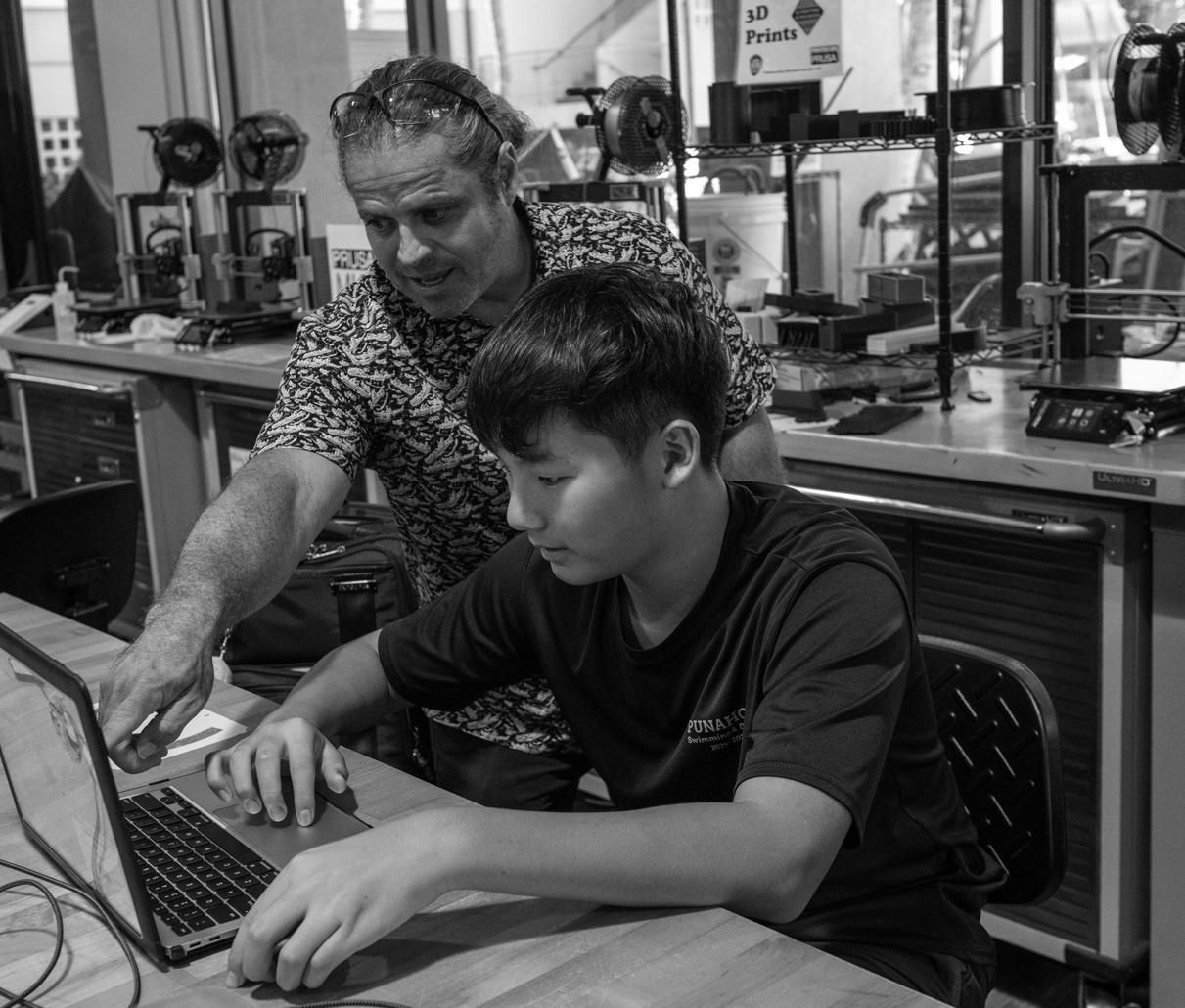
Interdisciplinary Courses
Interdisciplinary courses in the Academy combine the key concepts and crucial skill sets from at least two disciplines into one course. Students practice exploring ideas or solving problems through the lenses of each discipline while also striving to construct a lens that transcends the individual disciplines. These courses provide credits from more than one discipline.
Global Sustainability by Design Courses
Global Sustainability by Design (GSD) courses are interdisciplinary experiences that empower students to examine realworld sustainability challenges both locally and globally. Through a projectbased learning approach, students explore the complex interconnections between environmental, social and economic systems to become thoughtful advocates for change.
Course Offerings
Global Sustainability by Design: Place, Perspective & Partnership (ID)
Global Sustainability by Design (GSD): Place, Perspective & Partnership is an interdisciplinary course that prepares students to build a better world through research, storytelling and collaboration. Using a variety of written, visual and historical mediums, students learn to challenge societal stereotypes, understand global issues and build community partnerships. By reading works from a variety of authors and exploring perspectives from throughout the world, students develop a deep understanding of place and community. GSD classes are designed to be both project-based and place-based. This class draws from Hawaiian history and culture and incorporates a variety of source material that explores sustainability through both local and global contexts. Students explore questions such as: What is my place in this world and why does my story matter? How can we strategically and sustainably design solutions to meet community needs? What is the importance of the United Nations’ Sustainable Development Goals on both a local and global scale?
Open to grade 9. No prerequisite. Year course. Two credits: one credit in English, one credit in Social Studies. Satisfies English requirement for grade 9 and Social Studies graduation requirement for Hawaiian History.
Interdisciplinary Courses
Global Sustainability by Design: Product Design for Sustainable Entrepreneurship (ID)
Explore solutions in Product Design for Sustainable Entrepreneurship, a projectbased, place-based course rooted in Hawaiian history, culture and the UN Sustainable Development Goals. This interdisciplinary class prepares students to address real-world problems by applying design thinking and visual communication. Practical skills are developed using both traditional and emergent technologies, including foundational drawing, CAD, 3D modeling, 3D printing and laser cutting. Students also refine their reading, writing, presentation and critical thinking skills, focusing on formulating clear, evidencebased arguments. Successful completion of this course prepares students for Engineering III.
Open to grade 9. No prerequisite. Year course. Two credits: one credit in Social studies, one credit in Visual and Performing Arts. Satisfies Social Studies graduation requirement for Hawaiian History and Visual and Performing Arts graduation requirement.
Global Sustainability by Design: Engineering for Sustainability (ID)
How can understanding our past help us to build a better future? This year-long interdisciplinary course combines Hawaiian history, social studies and engineering to examine sustainability challenges in both local and global contexts. Students explore historical events that shaped issues of sustainability and apply the design cycle (Ku ¯ Hala) to imagine and create meaningful solutions. Learning is centered on collaborative, project-based work, including prototypes, models, presentations, research papers and documentaries. Students gain hands-on skills in CAD modeling, fabrication and makerspace tools at a level equivalent to Engineering I and II, while also developing critical research, analysis and writing skills that strengthen their ability to understand and respond to complex sustainability issues. Assessment emphasizes skill building, growth, problem-solving, critical thinking and collaboration. By the end of the course, students connect knowledge of the past and present to design innovative solutions, preparing them to contribute thoughtfully to a more sustainable future.
Open to grade 9. No Prerequisite. Year course. Two credits. One credit in Social Studies; one elective credit. Satisfies Social Studies graduation requirement for Hawaiian History.
Global Sustainability by Design: Asian Studies (ID)
This yearlong interdisciplinary course challenges students to engage with contemporary issues across Asia and explore the complex economic, political, geographic and cultural forces that have influenced them. In the fall semester, students craft family narratives of migration and explore historical conflicts and crises that shape the varied landscape of Asia today. In the spring, the UN Sustainable Development Goals (SDGs) and the design-thinking cycle frame a culminating action-oriented project. Through research, close reading of diverse literature and experimenting with storytelling techniques, students develop their critical and creative thinking, collaboration and project management skills. Students explore essential questions, including “How can learning about historical conflicts and crises in Asia help us understand how working toward the SDGs can right historical wrongs and achieve a more equitable future?” As a project-based learning course, GSD: Asian Studies expects students to exhibit a high level of self-efficacy and be capable of completing a broad range of self-directed tasks and projects. Students work individually as well as cooperatively in groups and they are expected to speak frequently in small groups and in front of the class.
Open to grade 10. Prerequisite: English 1 or GSD: Place, Perspective & Partnership. Year course. Two credits: one credit in English; one credit in Social Studies. Satisfies English graduation requirement for grade 10 and Social Studies requirement for Asian History or elective credit.
English 2AB: Visual Storytelling (ID)
Within every individual is an artist and a storyteller, and stories are vehicles for making sense of our world as well as our places within it. Visual Storytelling explores the intersection of the visual arts with the English language while exploring modes and strategies for building narrative. In this course, students foster composition, communication and analytical skills as the means to gain a better understanding of themselves and the contexts we inhabit. Shifting between interpreting and analyzing a wide variety of narratives and creating their own, students express their imaginations through these powerful media and hone the foundational skills required to think critically about them.
Semester 1 – Design and Line: Students develop the fundamentals of reading and writing alongside drawing and the design process. They study “conventional” and graphic narratives to build analytical skills and find inspiration for creating and analyzing their own work. The first semester concludes with a collaborative class project.
Semester 2 – Color and Quest: Students continue to develop the fundamentals of reading and writing alongside painting and color theory. The second semester concludes with the student-designed Quest Project, a student-directed storytelling project capping their 10thgrade year in English.
Open to grade 10. Prerequisite: English 1. Year course. Two credits: one credit in English, one credit in Visual and Performing Arts. Satisfies English graduation requirement for grade 10 and Visual and Performing Arts graduation requirement. Lab fee.
Art
Interdisciplinary Courses
Physics and Engineering (ID)
This course emphasizes problem-solving, creativity and technical skills. Students are empowered to see the connections between theoretical physics and realworld applications by applying the physics principles they learn to building hands-on projects in the design and fabrication lab for demonstration and analysis. Students develop skills in critical thinking, collaboration and engineering, along with an e-portfolio of projects that showcase their understanding of physics principles and engineering processes. Students who successfully complete this course are eligible to take Engineering III: Advanced Robotics or Engineering III: Industrial Design.
Open to grades 10, 11, 12. No prerequisite. Year course. Two credits: one credit in Science and one general elective credit. Satisfies Science graduation requirement.
American Studies (ID)
American Studies is a team-taught, yearlong course that offers an interdisciplinary approach to the themes, texts and context of United States history and American literature and culture. Students explore issues of equity, justice and power, and consider how different and often conflicting stories about America have shaped and continue to shape this nation. This class emphasizes the history of indigenous and marginalized peoples, especially Native Hawaiians and Black Americans. It encourages students to consider how the fabric of U.S. history is interwoven with the experiences and culture of native peoples as well as the practice and legacy of slavery. The class evolves with the concept of Kuana‘ike –position, perspective, knowledge.
Throughout the course, students develop skills of close reading, effective research methods, writing process, oral discourse and critical thinking. Students actively collaborate through group discussions, projects and presentations.
Open to grade 11. Prerequisite: English 2. Year course. Two credits: one credit in English and one credit in Social Studies. Satisfies English graduation requirement for American Literature and Social Studies graduation requirement for U.S. History.
Arts & Letters (ID)
Arts and Letters is a fresh mix of creative writing and visual art. Communication, collaboration and creative self-expression are core curricular values. This course gives students the chance to play—to try out and explore many media and forms, from creating graffiti with spray paint, to developing characters based on color to altering textbook pages with their own language and art. Arts and Letters encourages students to see connections between all things and to develop selfconfidence to carry those visions into their courses and lives. Students hone language and visual arts skills through readings, creative writing, discussions, studio practice, slide lectures and visits to Honolulu museums and street art sites.
Media include poetry, prose, spoken word, book art, typography, video, printmaking, papermaking, illustration and graffiti. Students explore intersections between visual art and language, making ekphrastic poetry about art, graphic narratives, prints, graffiti-style lettering, concrete poetry, altered book pages and art prints. The course utilizes freewriting generative techniques to develop students’ unique voices and self-confidence as writers. Students collaborate on original spoken-word poems and create videos of them using animation, videography, photography and collage. The course culminates with a hand-made book of art and writing that students create, revise and curate.
Open to grades 11, 12. Prerequisite: English 2. Semester course. One credit: one-half credit in English, one-half credit in Visual and Performing Arts. Satisfies English graduation requirement and Visual and Performing Arts graduation requirement or elective credit. Lab fee.
Bias in America (ID)
Have you ever considered how bias influences how you react to people, events and ideas? In this course, students turn a critical eye towards their own cognitive and implicit biases, cultivating curiosity and healthy skepticism towards sources that fill their screens, whether classic literature or daily social media. Students ask how deliberate and implicit biases advance narratives designed for easy acceptance. By looking at U.S. history from 1861 to the present, students explore patterns underlying the shaping of events. The course may examine: Civil War photography as accepted fact, the impact of fake news after the sinking of the Maine, racist depictions of 1890s Hawai‘i, individual and group behavior in a pandemic, voices of interned Japanese Americans, fiction and memory regarding the Vietnam War, Cold War propaganda and conspiracy theories in the 2020 election and beyond. Students keep media journals, analyze the reliability of narrators and the historical contexts of the literature they consume and pursue an independent action project.
Open to grades 11, 12. Prerequisites: English 2. Semester course (Spring semester) One credit: onehalf credit in English and one-half credit in Social Studies. Satisfies English graduation requirement for American Literature and Social Studies graduation requirement for the second semester of U.S. History or elective credit.
Courses not offered in 2026 – 2027 European History through the Arts, Curation & Design (ID)
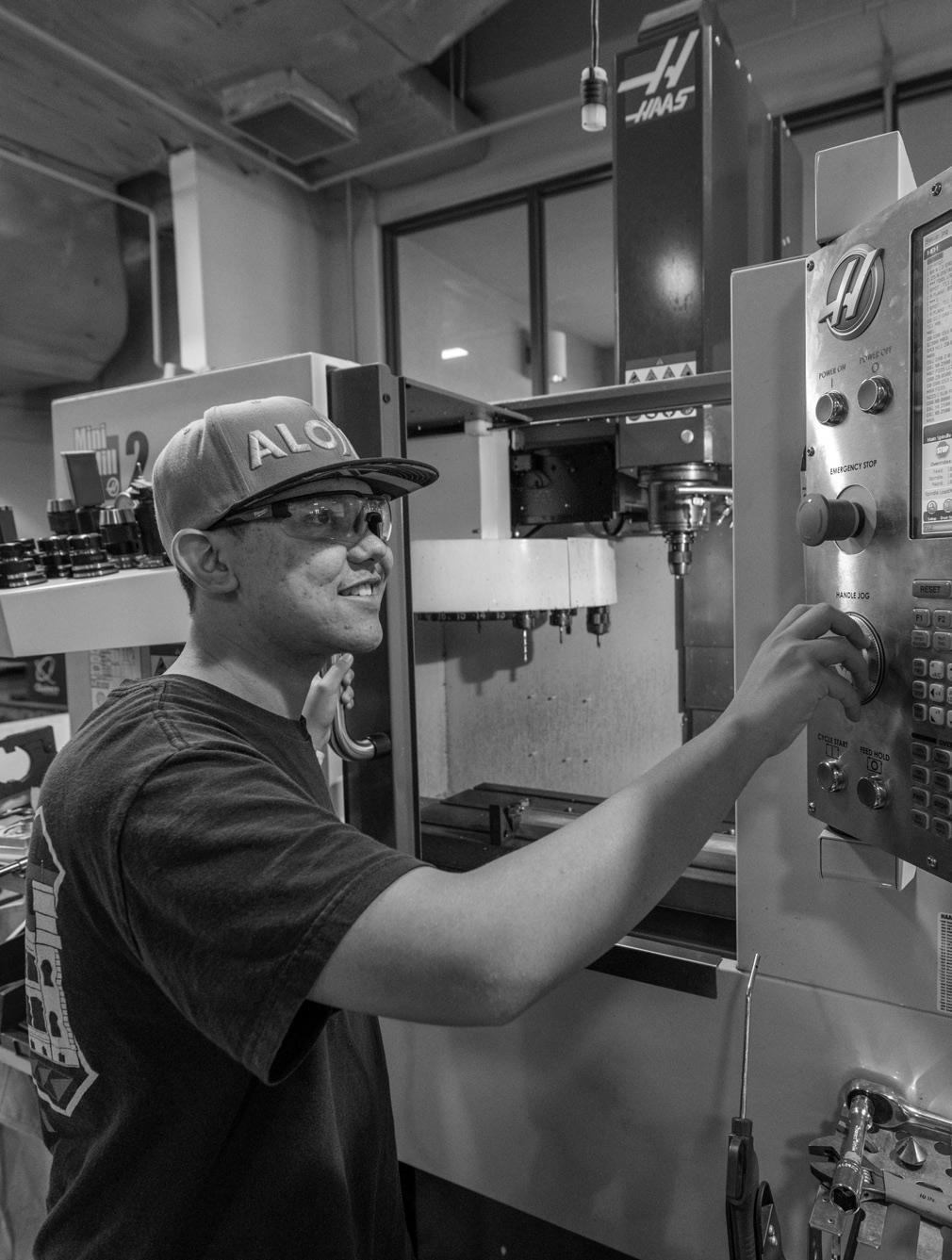
Independent Study and Research Program
The Independent Study and Research Program creates opportunities for students to design independent learning experiences that align with their interests and passions. These projects can be an extension or expansion of course offerings in different disciplines and departments. Students are expected to demonstrate a high level of independence and regularly meet with their faculty mentor and program advisor.
For most departments, any student in grade 11 or 12 in good academic standing may submit a proposal for work to be carried out during the regular school year. Students apply by contacting their Deans and a Faculty Mentor during programming. Students enroll in independent inquiry on a semester basis and earn onehalf elective credit per semester.
Project proposals are due by March 1 for the following school year. All proposals require approval from the grade level deans, Faculty Mentor and Department Chair(s). See the department sections for specific information and deadlines.
Important Information Course Credit
GOA courses are equivalent to an honors or AP course in hours of engagement to complete the course successfully. Courses satisfy general elective credit at Punahou; semester courses earn one-half credit and yearlong courses earn one credit. Students may only enroll in GOA courses not currently offered at Punahou.
Academic Calendar
The GOA semester calendar start and end dates are different from those at Punahou. Refer to course dates listed at globalonlineacademy.org for specific term dates.
Student Qualifications
GOA courses are open to students in grades 10, 11 and 12. Students considering these online courses should be intrinsically motivated, effective at time management and have reliable WiFi access for the duration of the course. GOA classes can only be taken as a sixth class in the student’s schedule. Students may register for up to one graduation credit in Academy courses each summer as long as class times do not conflict.
Students may register for GOA courses during their programming conference with their Dean, subject to Dean approval. For summer Geometry, teacher recommendation is also required.
Global Online Academy
Punahou School is a founding member of the Global Online Academy (GOA). Established in 2011, GOA offers diverse and rigorous credit-bearing courses to students in member schools around the world. All GOA courses have synchronous components (when students collaborate together or work with their teacher at a set time, generally using video conferencing software) and asynchronous components (students choose when to participate).
GOA students participate in a truly global classroom, learning alongside peers with diverse backgrounds and experiences. Courses are designed, developed and taught by teachers from member schools and meet the rigor and high quality for which these schools are well-known.
To learn more about GOA, visit globalonlineacademy.org
Enrollment
Class size is limited and drawn from participating schools, so enrollment of Punahou students is limited. Punahou students may enroll in only one GOA course per semester and selection may be by lottery if necessary. Students may enroll concurrently in both a summer GOA course and a summer Punahou course.
Cost
The full tuition cost of GOA courses will be charged to the student’s account. Students may apply for Financial Aid for GOA course fees through the Financial Aid Office. If a student drops a GOA course after GOA’s published refund date, the family is responsible for the full course fee.
NOTE: These courses are current as of printing date. Please check https://globalonlineacademy.org/studentprogram/student-courses for current course listing.
Yearlong (Semesters 1 and 2)
AP African American Studies
AP Comparative Government & Politics
AP Human Geography
AP Macroeconomics
AP Microeconomics
American Sign Language Through Culture I
Arabic Language Through Culture I
Arabic Language Through Culture II
Arabic Language Through Culture III
Japanese Language Through Culture I
Japanese Language Through Culture II
Japanese Language Through Culture III
Semester 1
Abnormal Psychology
Applying Philosophy to Global Issues
Architecture
Bioethics
Business Problem Solving
Climate Action & Sustainability
Computer Science I: Computational Thinking
Computer Science II: Analyzing Data with Python
Cybersecurity
Data Visualization
Developmental Psychology
Entrepreneurship In a Global Context
Game Theory
Genocide & Human Rights
Global Health
Graphic Design
Health & Fitness
International Relations
Introduction to Artificial Intelligence
Introduction to Branding & Marketing
Introduction To Legal Thinking
Introduction to Organic Chemistry I
Introduction To Psychology
Investing I
Investing II
Linear Algebra
Medical Problem Solving I
Medical Problem Solving II
Multivariable Calculus I: Vector & Differential Calculus
Neuropsychology
Number Theory
Prisons & Criminal Justice Systems
Problem Solving with Engineering & Design
Social Psychology
Global Online Academy
Semester 2
Abnormal Psychology
Architecture
Arts Entrepreneurship
Biochemistry: Medicine, Drugs & Addiction
Bioethics
Business Problem Solving
Capitalism: Past, Present & Future
Computer Science I: Computational Thinking
Computer Science II: Analyzing Data with Python
Computer Science II: Game Design & Development
Cybersecurity
Developmental Psychology
Discourse Across Difference
Entrepreneurship In a Global Context
Game Theory
Graphic Design
International Relations
Introduction To Artificial Intelligence
Introduction to Blockchain & Cryptocurrency
Introduction To Branding & Marketing
Introduction To Legal Thinking
Introduction to Organic Chemistry II
Introduction To Psychology
Investing I
Investing II
Linear Algebra
Medical Problem Solving I
Medical Problem Solving II
Multivariable Calculus II: Integral Calculus
Neuropsychology
Prisons & Criminal Justice Systems
Problem Solving with Engineering & Design
Social Psychology
Summer
Abnormal Psychology
Architecture
Bioethics
Business Problem Solving
Cybersecurity
Computer Science I: Computational Thinking
Computer Science II: Game Design & Development
Computer Science II: Analyzing Data with Python
Genocide & Human Rights
Geometry
Health & Fitness
International Relations
Introduction to Artificial Intelligence
Introduction to Branding & Marketing
Introduction To Legal Thinking
Introduction To Psychology
Investing I
Medical Problem Solving I
Problem Solving with Engineering & Design
Vibe Coding: Code, Create & Launch with AI
Yearlong (Semesters 1 and 2)
AP African American Studies
Explore the African American Experience: What stories emerge when we study Black communities in the U.S. within the broader history of Africa and the African diaspora? In this interdisciplinary course, you’ll examine culture, history, literature, the arts, and social sciences through diverse African American voices and perspectives. Fully aligned with College Board requirements, the course will strengthen your skills in analyzing sources, applying concepts, and making evidencebased arguments while preparing you for the AP® Exam. You’ll investigate topics ranging from early African kingdoms to present-day successes and challenges, analyzing literary works, political texts, visual culture, and data sets to understand essential concepts and pivotal movements in the Black experience. Along the way, you’ll consider how identities such as race, class, and gender intersect to shape perspectives and experiences within African American communities.
Why Take This Course? If you’re interested in history, culture, or social justice, this course offers powerful ways to understand African American experiences in both national and global contexts. You’ll strengthen your ability to interpret primary and secondary sources, build arguments, and think critically across disciplines while also practicing how to evaluate credibility, recognize bias, and connect scholarship to issues that matter today.
AP Comparative Government & Politics
Examine Institutional Power Around the World: What can we learn about power, people, and institutions when we compare governments around the world? In this course, you’ll study political systems, processes, and real-world case studies in six countries—China, Iran, Mexico, Nigeria, Russia, and the United Kingdom. Fully aligned with College Board requirements, the course builds your skills in applying concepts, interpreting data, comparing systems, simulating institutional debate, and making evidencebased arguments, all while preparing you for the AP® Exam. You’ll investigate states and regimes, political institutions, culture and participation, electoral systems and parties, and how countries respond to change and development.
Why Take This Course? If you’re interested in politics, law, or global affairs, this
course will help you use the perspectives of political scientists while learning to analyze and interpret politics across different global contexts. You’ll strengthen your critical thinking and communication skills while building a deeper understanding of leadership, power, and change.
AP Human Geography
Examine How People Shape the World: How do humans organize the world around them, build communities, and interact with their environments? In this course, you’ll explore the patterns and processes that define life on Earth—from population growth and migration to cultural exchange, political boundaries, agriculture, urban development, and globalization. Fully aligned with College Board requirements, the course helps you develop geographic thinking through data analysis, map interpretation, and spatial reasoning—all while preparing for the AP® Exam. Across seven major units— thinking geographically, population and migration, culture, politics, agriculture and rural land use, cities and urban land use, and industrial and economic development—you’ll interpret maps, satellite imagery, and real-world data to connect geographic concepts to contemporary challenges such as urban growth, climate change, and migration.
Why Take This Course? If you’re fascinated by how people, places, and power connect, this course offers a dynamic way to understand the forces that shape our modern world. You’ll learn to analyze spatial patterns, interpret global trends, and explain how human choices create and transform both local communities and the planet we share.
AP Macroeconomics
Understand National and Global Economies: What happens when governments change interest rates, when inflation rises, or when global trade shifts? In this course, you’ll explore how entire economic systems work at both the national and international levels. Fully aligned with the College Board requirements, you’ll study big topics like economic performance, business cycles, and the impact of fiscal, monetary, and trade policies, all while preparing for the AP® Exam. You’ll learn to analyze data, interpret models, and evaluate governmental policies and to apply these
Art
Global Online Academy
skills to real-world issues such as inflation, unemployment, and international trade.
Why Take This Course? Whether you’re headed into economics or international relations or you’re curious about politics and business, macroeconomics helps you make sense of it all. You’ll learn to weigh different perspectives, think critically about tradeoffs, and practice making and defending your own evidence-based arguments, ultimately building strong cases for policy solutions.
AP Microeconomics
Understand Everyday Economics: Why are movie tickets cheaper on Tuesdays? Why do some products seem overpriced? And when should governments step in to fix markets? In this course, you’ll explore decision-making at the level of individuals, businesses, and governments using graphs, models, and economic indicators. Fully aligned with College Board requirements, the course covers supply and demand, costs and profits, competition and markets, wages and income, and the challenges of market failures like pollution and inequality. Along the way, you’ll build skills in applying concepts, interpreting data, analyzing models, and making evidencebased arguments as you step into the role of an economist to explain, critique, and problem-solve these everyday puzzles—all while preparing for the AP® Exam.
Why Take This Course? If you’ve ever wondered why prices change, why businesses succeed or fail, or how policies shape markets, microeconomics gives you the tools to make sense of it. You’ll apply economic reasoning to solve, explain, and critique economic behavior in real-world contexts. By the end of the course, you won’t just understand how markets work—you’ll be able to think critically about choices, tradeoffs, and policies that influence daily life.
American Sign Language Through Culture I
Immerse Yourself in ASL and Deaf Culture: In this course, you’ll build expressive and receptive American Sign Language (ASL) skills while gaining a deeper understanding of Deaf culture. Designed for beginners, the course emphasizes visual engagement through storytelling, conversation, and cultural exploration. You’ll develop vocabulary, grammar, and conversational techniques by practicing fingerspelling, non-manual signals (facial
expressions and body language), classifiers, spatial grammar, and the use of signing space. Along the way, you’ll explore Deaf history, community values, and cultural norms to understand ASL as both a language and a reflection of a vibrant cultural identity.
Why Take This Course? If you’re interested in language and communication through a cultural lens, this course offers a fully immersive introduction to ASL and the Deaf community. Through interactive signing, real-time conversations, and project-based activities, you’ll connect language learning with vibrant Deaf culture—deepening your understanding of communication, identity, and human connection.
Arabic Language Through Culture I
Journey Through Language and Culture: In this yearlong course, you’ll immerse yourself in Modern Standard Arabic (MSA) and spoken dialects from the Levant, Egypt, and North Africa while exploring the rich cultural landscapes of the Arabicspeaking world. You will start with the basics of the Arabic writing system and progress to spontaneous conversations on topics like family, food, preferences, history, music, social media, and environment. You’ll master everyday expressions, build listening and reading skills, and learn to form structured sentences—all with a focus on real-life conversation.
Why Take This Course? Whether you’re interested in international business, travel, or just fascinated by one of the world’s most influential languages, this course will connect you to the heart of Arabic culture and language.
Arabic Language Through Culture II
Expand Your Conversation and Perspective: Ready to take your Arabic skills further? Building on your Arabic foundation, this yearlong course guides you into more complex reading and speaking, allowing you to tell stories and even write full paragraphs in Arabic. Focusing on Modern Standard Arabic (MSA) and spoken dialects of Levant, Egypt, and North Africa, you’ll immerse yourself in even more real-life conversations and interactive group projects that cover new cultural topics such as ordering food, discussing travel and the weather, and sharing your goals for the future.
Why Take This Course? This course is your next step toward fluency and a deeper understanding of Arabic-speaking cultures. By the end of this course, you’ll be able to tell stories, describe the world around you, and hold meaningful conversations— connecting with peers from around the world.
Prerequisite: Arabic Language Through Culture I or permission from the instructor.
Arabic Language Through Culture III
Master the Art of Conversation and Cultural Insight in Arabic: Elevate your Arabic skills to an advanced level through spontaneous spoken conversations on everyday topics like food, weather, and personal stories, both past and present. You’ll deepen your fluency in Modern Standard Arabic (MSA) and spoken dialects of Levant, Egypt, and North Africa in this yearlong course. Plus, you’ll bring Arabic culture to life by designing your own projects, creating a restaurant menu in Arabic, designing an animated cartoon in Arabic, analyzing Arabic TV commercials, reading children’s stories, exploring Arabic music, films, and more.
Why Take This Course? Whether for travel, future careers, or personal growth, this course will prepare you to connect with the Arabic – speaking world confidently and meaningfully, through a blend of highly interactive activities and rich cultural exploration.
Prerequisite: Arabic Language Through Culture I and II or permission from the instructor.
Japanese Language Through Culture I
This course (or its equivalent) is a prerequisite to Japanese II and III at GOA.
Journey Through Language and Tradition: Immerse yourself in the fascinating world of Japanese culture and language with this full-year course. You’ll learn the basics of Japanese grammar, vocabulary, and the writing systems Hiragana and Katakana, while also diving into cultural topics like literature, art, lifestyle, and the economy. Through engaging assignments and hands-on projects, you’ll develop your speaking, listening, reading, and writing skills. Cultural dynamic and relevant discussions conducted in English will deepen your understanding of Japan along the way.
Why Take This Course? This course provides a unique experience that seamlessly blends language learning with cultural
Global Online Academy
appreciation. Perfect for beginners, this course will expand your global perspective and set you on an exciting path toward mastering Japanese language and gaining a deeper appreciation for Japanese culture.
Japanese Language Through Culture II
This course (or its equivalent) is a prerequisite to Japanese III at GOA.
Expand Your Voice and Perspective: Building on your foundational skills, this course will take your Japanese language abilities to the next level, enhancing your speaking, listening, writing, and reading skills while immersing you further into Japanese culture. You’ll engage in interpreting authentic Japanese material, practicing communication through speaking and writing, and delivering impactful oral and written presentations. Each unit explores fascinating cultural topics, such as design and expression, ecology, entertainment, East meets West, harmony, and nature, with opportunities to explore your own interests. You’ll learn advanced grammar forms typical of secondand third-year high school Japanese, progressing from simple sentences to more complex, coherent paragraphs.
Why Take This Course? This course will empower you to share your voice, broaden your global perspective, and appreciate both yourself and others through meaningful language learning. By curating and creating course content through research and collaboration with global peers, you’ll enjoy a highly engaging and immersive experience that blends language and cultural exploration.
Prerequisite: Successful completion of Japanese Language Through Culture I or permission from the instructor. Students who have completed Japanese I (or its equivalent) outside of GOA are required to take an oral placement assessment before beginning GOA’s Japanese II course and should contact hello@globalonlineacademy.org to set up their oral placement. Additionally, incoming Japanese II students have mastered all hiragana, katakana, and Japanese I grammar and vocabulary.
Japanese Language Through Culture III
Communicate Naturally and Confidently: Take your language and grammar skills to new heights as you develop your ability to understand the nuances of the Japanese language. Through face-to-face conversations and recorded messages, you’ll practice informal styles, gaining confidence in using the Plain Form in conversations with your peers and teacher.
You’ll also dive into authentic, real-world Japanese by curating and interpreting materials like TV commercials, news articles, movies, children’s books, and cooking recipes.
Why Take This Course? This course will help you communicate naturally and effectively in Japanese while collaborating with peers and embracing a global perspective. It’s perfect for students eager to refine their language skills and engage with Japanese culture in meaningful and practical ways.
Prerequisite: Successful completion of Japanese Language Through Culture I and II or permission from the instructor. Students who have completed Japanese II (or its equivalent) outside of GOA are required to take an oral placement assessment before beginning GOA’s Japanese III course and should contact hello@globalonlineacademy.org to set up their oral placement. Additionally, incoming Japanese III students have mastered most of the conjugation patterns (TE/TA form, dictionary form, and NAI form) that are necessary to speak and write in complex structures.
Semester 1
Abnormal Psychology
Discover the Complexities of the Human Mind: Ever wondered why society views certain behaviors “abnormal”? As you learn about Western abnormal psychology, you’ll explore the complex forces behind human behavior by studying conditions like anxiety, depression, eating disorders, and schizophrenia. Through engaging readings, videos, thought-provoking discussions, and a student-led project centered on your local community, you’ll dive into the symptoms, diagnoses, and responses to these disorders. You’ll also examine how mental health is influenced by cultural differences and global perspectives, gaining insight into the stigma surrounding psychological disorders.
Why Take This Course? You’ll walk away knowing more about how the human brain can take unexpected paths and how challenging it can be to define “normal.” You’ll also develop a deeper empathy for those facing mental health challenges.
Applying Philosophy to Global Issues
Think Like a Philosopher: What would Socrates, Confucius, and Kant have to say about today’s global issues? In this applied philosophy course, you’ll uncover how great thinkers from many traditions and centuries tackled social and political challenges across the world—both successfully and unsuccessfully. You
will challenge your perspective through an interdisciplinary approach, pulling in concepts, models, and methods related to history, journalism, literary criticism, and media studies.
Why Take This Course? You’ll do more than learn about what philosophers have written. You’ll apply ideas to develop your own personal philosophy and apply it to analyze today’s most pressing issues. By the end of the course, you’ll be ready to spark positive change, whether in your community or on a global scale.
Architecture
Design the Future, Shape the World: This is your chance to think like an architect, transforming abstract concepts into tangible spaces with other students from around the world. In this hands-on course, you’ll master the fundamentals of architectural design—from exploring building materials and analyzing structures to creating 3D models and developing spatial awareness. Discover how architecture drives the evolution of contemporary styles and shapes our culture as you design innovative architectural solutions for real-world challenges. Your journey will end with a final project that showcases your unique vision and design process.
Why Take This Course? Whether you’re curious about architecture or see yourself as a future designer, this course will push you to think creatively and bring your ideas to life. By the end, you’ll have a portfolio-ready project and the foundational skills to explore a future in design and architecture.
Bioethics
Navigate the Ethical Questions of Medicine and Science: How do we know what’s right and wrong in medicine, public health, and life sciences? In this course, you’ll explore some of today’s most pressing ethical dilemmas that significantly impact the medical field. Through engaging debates on topics like the “right to die,” vaccination policies, organ transplants, genetic technology, and animal research, you’ll learn how to discuss differing views with respect. Innovative research projects and interactive discussions will help you develop critical-reasoning skills and think deeply about how we balance individual rights, societal needs, and scientific advancement. The course ends with a deep
Global Online Academy
dive into a bioethical issue of your choosing, helping you understand the crucial role bioethics plays in shaping the future.
Why Take This Course? If ethical questions in health and science spark your curiosity, this course will sharpen your critical thinking and broaden your perspective on complex issues. You’ll gain the skills to navigate real-world challenges and form your own stance on pivotal bioethical debates—an invaluable foundation for future studies and careers in medicine, science, or ethics.
Business Problem Solving
Tackle Real-World Challenges in Business: How does climate change impact supply chains? Are tariffs a threat or an opportunity? Is your company’s cybersecurity strong enough? In today’s fast-paced business landscape, problemsolving is essential. In this course, you’ll analyze relevant, real world case studies from global corporations and innovative startups, and you’ll collaborate with peers to develop creative solutions to challenges in operations, marketing, finance, sustainability, and more.
Why Take This Course? If you see yourself as a future entrepreneur, CEO, or business consultant, this course is a valuable opportunity to build practical problemsolving and critical thinking skills, building entrepreneurial skills along the way. By the end, you’ll have a deep understanding of the pressing issues facing companies today and be prepared for a future in the dynamic world of business and leadership.
Climate Action & Sustainability
Build a Just and Sustainable Future: Explore the critical issues of climate change and its wide-reaching impacts on communities and ecosystems. In this course, you’ll examine essential topics like climate justice, agriculture, wildfires, renewable energy, sea level rise, and invasive species—all through the lenses of equity and sustainability. Engage in hands-on projects to understand the causes and effects of climate change, dive into public policy and equity debates, and analyze how these issues shape the experiences of diverse populations around the world. Your journey will finish with a student-led project, creating an action plan for change in your community.
Why Take This Course? If you’re passionate about making a difference, this course climate challenges through well-informed activism. By the end, you’ll be empowered to advocate for a sustainable and equitable future. Note: This course is a reimagined, redesigned, retitled version of the course that was called Climate Change & Global Inequality through the 2023 – 2024 school year. Students who have already taken Climate Change & Global Inequality should consider choosing a different course.
Computer Science I: Computational Thinking
This course (or its equivalent) is a prerequisite to all Computer Science II classes at GOA.
Problem-Solve in a Digital World: Unlock the power of solving problems, designing systems, and understanding human behavior in this beginner-friendly course. You’ll learn to think like a computer scientist, developing skills that go beyond programming and apply to across fields. Starting with the basics of computer science, you’ll learn how to read code and pseudocode as well as develop strategies for debugging programs—all without prior programming experience.
Why Take This Course? Gain a foundational understanding of computer science and its real-world applications for both programmers and non-programmers. By the end, you’ll have essential computational thinking skills to approach complex problems with clarity and strategy, setting you up for success in future computer science courses and beyond.
Note: During Summer 2025 and Semesters 1 and 2 of 2025-2026, GOA will offer one section of this course that has been designed and staffed specifically for students in grades 6 – 8. On the registration page, students and Site Directors should look for the offering that is specific to their age group.
Computer Science II: Analyzing Data with Python
Turn Data Into Insight: Gain hands-on experience with the Python programming language as you learn to read, analyze, and visualize real-world data. Using Python’s powerful data structures and clear syntax, you’ll work with large, messy datasets— just like those in scientific computing. Discover how Python makes data analysis accessible and see firsthand why it’s one of the most popular tools in fields like biology, engineering, and statistics.
Why Take This Course? If you’re interested in data-driven fields, this course will give you essential Python skills to tackle complex datasets. By the end, you’ll be able to turn raw data into meaningful insights, preparing you for further studies in scientific research, data science, and beyond.
Prerequisite: Computer Science I: Computational Thinking or its equivalent.
Cybersecurity
Safeguard the Digital World: Cybercrime is on the rise, and this is your chance to be part of the solution. Go beyond the basics of cybersecurity, as you explore the inner workings of computer components, network design, DNS, TCP/IP, and how cybercriminals exploit both technology and human behavior to breach systems. Examine ciphers, encryption, data security, and malware anatomy, while also considering the complex balance between privacy and tracking. You’ll emerge with the expertise to defend both personal and organizational data, equipped with knowledge in data recovery, enterprise security, and the latest trends in cybersecurity.
Why Take This Course? If you’re driven to protect the digital world, this course will provide you with the critical skills needed to navigate and secure the digital landscape, preparing you for a future in cybersecurity or simply empowering you to safeguard our interconnected world.
There is no computer science prerequisite for this course, though students with some background will certainly find avenues to flex their knowledge.
Data Visualization
Turn Numbers Into Narratives: In a world flooded with data, visualizations cut through the noise to reveal meaning. This course teaches you to collect, organize, interpret, and effectively communicate massive amounts of information. You’ll master data wrangling in spreadsheets, harness the power of charts, and learn to spot both effective and misleading visuals. Using principles from information graphics, visual art, graphic design, and cognitive science, you’ll create your own compelling visualizations using tools like Datawrapper, Tableau Public, and Python.
Why Take This Course? If you want to transform raw data into powerful insights, this course will help you develop the essential skills needed to create clear, informative visuals. Perfect for aspiring
Global Online Academy
data analysts, journalists, or anyone looking to communicate statistics with impact, you’ll emerge ready to use data to inform, persuade, and drive decisions. There is no computer science, math, or statistics prerequisite for this course, though students with backgrounds in those areas will certainly find avenues to flex their knowledge.
Developmental Psychology
Understand the Journey of Human Growth: Why do we think, learn, and behave the way we do? In just a few years, humans transform from infants to individuals capable of complex thought, communication, and moral reasoning. Through engaging readings, observations, case studies, and hands-on activities, this course will introduce you to the fascinating study of human development, focusing on significant physical, emotional, cognitive, and social changes from birth through adolescence. You’ll explore key questions like heredity vs. environment, stability vs. change, and continuity vs. discrete stages of development.
Why Take This Course? If you’re captivated by how people learn, grow, and evolve, this course offers an in-depth look at how we become who we are. Perfect for aspiring educators, psychologists, or anyone intrigued by human behavior, you’ll gain valuable insights into language acquisition, learning, and personality development from both Western and non-Western perspectives.
Entrepreneurship in a Global Context
Turn Your Ideas Into Global Impact: How does an entrepreneur think? What skills are essential to stay competitive and relevant in today’s fast-paced market? This course will push you to step beyond the classroom and into real-world environments to understand how global markets work. Collaborating with peers worldwide, you’ll dive into essential topics like customer development, value propositions, brand strategy, and funding sources. Using the business model canvas, you’ll build a viable framework and ultimately develop, refine, and present your own online startup pitch.
Why Take This Course? This course provides a hands-on approach to building a business, teaching you to apply innovative, design-driven strategies and creative problem-solving skills. With realworld experiences in customer research, product design, and interviews with
entrepreneurs, you’ll gain the tools to turn an idea into a startup ready for the dynamic business world.
Game Theory
Solve Real-World Problems Like a Mathematician: What can mathematical models teach us about decision-making? This course will show you how dilemmas and conflicts—ranging from international diplomacy to sports scheduling—can be approached as mathematical games. You’ll analyze real-world events in fields like political science, anthropology, philosophy, economics, and even popular culture through two-person zero-sum games, two-person non-zero-sum games, sequential games, multiplayer games, linear optimization, and voting theory.
Why Take This Course? If you love math, logic, or strategic thinking, this course will give you the tools to analyze and solve complex problems using mathematical models. It’s perfect for future studies in mathematics, economics, or any field where strategic decision-making is key, giving you a deeper understanding of how to approach intricate challenges logically and effectively.
Genocide & Human Rights
Learn From the Past to Protect the Future: Why does genocide happen, and how can societies prevent it? In this course, you’ll explore some of the most significant tragedies of the 20th century, including the Holocaust and the Armenian, Cambodian, and Rwandan genocides. You’ll analyze the role of the international community in responding to and preventing further genocide, with a focus on the Nuremberg Tribunals, as well as investigate ongoing human rights crises around the globe. Through engaging discussions, brief papers, and documentaries, you will gain a deeper understanding of global issues related to justice and humanity.
Why Take This Course? You will engage in meaningful projects, such as developing strategies to address human rights violations in your community, and build the skills to analyze, reflect on, and contribute to solutions for these critical global issues. Perfect for students passionate about history, justice, and activism, this course will empower you to make a difference in shaping a more just and humane world.
Prerequisite: This course contains content that may not be appropriate for students younger than 15 years old.
Global Health
Help Solve the World’s Health Challenges: What makes people sick? Why do health disparities persist both locally and globally? In this course, you’ll explore the social and political factors that influence health and the biggest challenges in global health today. Using an interdisciplinary approach, you’ll engage in analytical reading and writing, research, and collaborative projects. You’ll examine case studies, present your findings, and gain a deeper understanding of the biology of diseases, the social determinants of health, and the roles of public and private organizations. Additionally, you’ll learn how global health statistics shape our understanding of health inequities and critically analyze how the distribution of healthcare resources and access impact health equity worldwide.
Why Take This Course? Thinking about a career in healthcare or medicine? If you’re passionate about improving health outcomes and addressing disparities, this course will equip you with the tools to understand and address complex global health issues. You’ll learn the importance of understanding and respecting different cultures when planning health programs and explore the impact of resource distribution, preparing you to contribute thoughtfully to the field of global health and drive positive change.
Graphic Design
Unleash Your Visual Voice: What makes a message persuasive and compelling? How do audiences interpret and make sense of information? This course dives into the powerful relationship between information and influence from a graphic design perspective. You’ll gain the skills to create impactful visual content, exploring design principles, infographics, social media, digital search strategies, social activism, and multimedia storytelling. Through a case study and design-based approach, you’ll work on individual and collaborative projects, content curation, writing, peer critiques, and online presentations.
Why Take This Course? If you’re interested in art, design, marketing, or visual storytelling, this course will empower you to design and prototype passion-driven communication projects driven by your interests. By the end, you’ll have a portfolio of creative work and a solid understanding of how design shapes the way we share and interpret information.
Global Online Academy
Health & Fitness
Chart Your Path to Lifelong Fitness: What factors influence our bodies as we strive to maintain an active and healthy lifestyle? In this course, you’ll learn about movement phases, and athletic performance. You’ll set personal fitness goals, track your progress, and engage in weekly exercises to target various areas of fitness. Through reflection and feedback, you’ll understand how your efforts lead to improvement. The course ends with a student-led project where you will choose and explore topics that matter to you, such as nutrition, mental health in sports, exercise science, biomechanics, careers in sport, or community-based sports initiatives.
Why Take This Course? This course will empower you to put what you learn into action, helping you develop and achieve personal health goals that will positively impact your life. Whether you’re an athlete, aspiring trainer, or simply passionate about exercise science, you’ll gain the knowledge and skills needed to lead a healthy and active lifestyle. Additionally, if your school has a physical education or health requirement that you can’t seem to fit into your schedule, this course is for you.
International Relations
Understand Global Conflict and Cooperation: Are China and the U.S. on a collision course for war? Can the Israelis and Palestinians reach a peaceful solution to a long-term conflict? Will North Korea launch a nuclear weapon? Can India and Pakistan find a way to share the subcontinent in peace? In this course, you’ll go beyond soundbites and daily news headlines to examine the context, causes, and consequences of today’s most pressing global issues. Working alongside classmates from around the world, you’ll learn strategies to prevent, mediate, and resolve conflicts, equipping you with the knowledge and skills to engage with global challenges thoughtfully and effectively.
Why Take This Course? If you want to understand the complexities of international relations, this course offers an in-depth exploration of the causes and consequences of war, peace, and human rights through real-world case studies. For anyone interested in the forces that shape the global political scene, this course is a great foundation for further studies in geopolitics.
Introduction to Artificial Intelligence
Explore AI’s Impact on Our World: Artificial intelligence is everywhere, powering your favorite apps and influencing daily life in ways you may not see. How much do you really know about how generative AI works and how it’s impacting our world? In this course, you’ll dive into the history of AI research, from the early dreams of artificial general intelligence to the development of AI technologies like neural networks, machine learning, deep learning, generative AI, natural language processing, and facial recognition. You’ll explore how AI systems are trained, understand the biases that arise from datasets, and learn about responsible AI principles like fairness, transparency, human-centeredness, and data privacy.
Why Take This Course? If you’re fascinated about how AI is shaping our future, this course will provide you with a wellrounded understanding of both the technical and ethical aspects of artificial intelligence. By the end, you’ll be equipped with the knowledge and skills to thoughtfully engage with AI’s potential and challenges, preparing you to be an informed and responsible contributor in the field of computer science.
Introduction to Branding & Marketing
Build Brands That Stand Out: Ever wonder what gives your favorite brands their unique edge? In today’s digitized world, we’re constantly bombarded by ads and content, making it harder for brands to capture and keep our attention. This course reveals what it takes to build an effective brand that authentically connects with consumers and leaves a lasting impact. You’ll explore the core elements of branding—from visual identity and advertising strategy to content marketing and the nuances of the customer journey. You’ll also explore how addressing ethical, social, and environmental issues can influence a brand’s success.
Why Take This Course? If you’re eager to learn the strategies behind successful brands, this course is for you. You’ll apply marketing theories, go beyond the classroom to interview industry experts, and analyze modern case studies to become a skilled brand strategist. The course ends with a collaborative project where you’ll design an impactful brand campaign for a mission-driven organization, gaining valuable real-world experience and insight for future careers or studies in business and marketing.
Introduction to Legal Thinking
Think Like a Lawyer: Step into the shoes of a lawyer in this engaging, case-based course that offers much more than just an introduction. You’ll dive into real legal cases, sharpening your research, persuasive writing, and public speaking skills as you navigate the complex challenges lawyers face every day. From crafting legal briefs and advising fictional clients yourself in the rules and practices that define the profession. Along the way, you’ll examine big ideas like justice, fairness, jurisprudence, and ethics, uncovering insights that will deepen your understanding of the legal world.
Why Take This Course? If you’re curious about the world of law, this course offers a hands-on, practical look at what it takes to be a lawyer. Ideal for aspiring attorneys or anyone fascinated by legal reasoning, it will sharpen your critical thinking and communication skills, preparing you for future legal studies or simply enhancing your ability to think and argue like a pro.
Introduction to Organic Chemistry I
This course is a prerequisite for Introduction to Organic Chemistry II at GOA.
Master the Building Blocks of Life: Prepare for university-level organic chemistry with this in-depth course focused on the mechanisms and reactions that form the basis of all living things as well as the principles of carbon chemistry. You’ll discover the magnificent world of complex molecules, their properties, and reactions through real-world applications. This course is packed with engaging hands-on activities that will equip you with essential skills to address today’s most pressing scientific challenges. You’ll learn to predict electron movement for organic reactions, understand molecular structures, bond angles, shapes, polarity, and resonance, and master the fundamentals of organic nomenclature.
Why Take This Course? If you’re a future pre-health student or science major, this course is designed to build your problemsolving and pattern-recognition skills, preparing you to confidently speak the language of organic chemistry. It’s the perfect foundation for success in one of the most challenging yet vital subjects in college science programs.
This course is the first in a two-part series. Organic Chemistry I is offered in Semester 1 and Organic Chemistry II is offered in Semester 2. While it is possible to take only this first course, we recommend signing up for both semester courses. Prerequisite: Students should have taken the equivalent of one year of general chemistry prior to taking this course.
Global Online Academy
Introduction to Psychology
Understand the Human Mind: What does it mean to think like a psychologist? In this course, you’ll explore three main perspectives—behavioral, cognitive, and sociocultural—to develop a well-rounded understanding of the human mind and behavior. You’ll also examine how psychologists put what they know into practice through research methods, ethics, and real-world applications. Engage in hands-on projects, like analyzing adolescent psychology and creating a case study on depression. The course wraps up with a dive into positive psychology, giving you tools to understand how to live mentally healthy and fulfilling lives.
Why Take This Course? Curious about how the human mind works? Throughout the course, you’ll engage in collaborative projects and activities and learn from peers around the world. You’ll also hone your research and critical-thinking skills. Perfect for anyone interested in the science behind behavior, this course will help you build psychology skills that are valuable to both academic and everyday life.
Investing I
This course is a prerequisite to Investing II at GOA. Make Smart Financial Decisions: Step into the shoes of an investor, using real-world tools, theories, and decision-making practices to make smart financial choices. You’ll explore key finance concepts, like valuation and risk management, and apply them to portfolio management, venture capital, and social investing. You’ll learn how to manage and grow an investment portfolio by simulating investments in stocks, bonds, and options. Take on the role of a venture capital investor, analyzing startups and forecasting their potential before they go public, as well as exploring social investing to see how finance can be a powerful force for positive change.
Why Take This Course? With insights from finance experts and hands-on experience, you’ll leave the course with a simulated investment portfolio and the skills to thoughtfully assess financial risks and rewards. Whether you’re an aspiring investor, entrepreneur, or someone curious about global financial markets, this course will prepare you to navigate the complex world of finance with confidence.
Investing II
Master Diverse Investment Strategies: Deepen your understanding of smart investment practices and explore finance concepts across four key contexts: fixedincome investments, foreign exchange and cryptocurrency, commodities, and real estate. After an introduction to behavioral finance theories, you will simulate scenarios to strategically expand your equity portfolio. Discover how to hedge risk with bonds, navigate the volatility of forex and crypto markets, grasp the economic impact of commodity prices, and explore strategic approaches to real estate investing.
Why Take This Course? Guided by insights from financial experts, you’ll develop your own strategies for identifying value and taking calculated financial decisions. Perfect for anyone aiming to advance their investment skills or study economics and business, you’ll gain a sophisticated understanding of portfolio management and the tools needed to thrive in today’s dynamic global financial markets.
Prerequisite: Investing I
Linear Algebra
Transform Math Into Meaning: Explore the algebra of vector spaces and matrices through real-world applications in computer graphics and social network analysis. Starting with how images and objects are transformed in the plane and space, you will gain hands-on experience with core concepts. You’ll dive into the practical side of math by modeling social networks and analyzing connections on platforms like Facebook and Google.
Why Take This Course? Perfect for students interested in mathematics, computer science, or data analysis, this course will help you build problem-solving skills while providing a strong foundation in linear algebra with engaging, real-world applications.
Prerequisite: Geometry and Algebra II or the equivalents (no prior experience with this software or linear algebra is necessary).
Medical Problem Solving I
This course is a prerequisite to Medical Problem Solving II at GOA.
Think Like a Doctor: This course puts you in the role of a medical detective as you investigate mysterious cases, identifying symptoms, making diagnoses, and exploring treatments—just like in medical school. You’ll work both individually and
collaboratively, sharpening your critical thinking skills as you analyze data, diagnose illnesses, and develop treatment plans for patients. Dive into anatomy, physiology, disease process, demographics of disease, and treatment protocols, while also debating current health issues and evaluating the factors that influence patient care.
Why Take This Course? If you’re passionate about health and medicine, this course offers hands-on experience with the principles and practices of the medical field. Through role-playing scenarios with your peers as medical professionals and patients, you’ll gain a deeper understanding of the medical world, making this course perfect for aspiring healthcare professionals.
Medical Problem Solving II
Explore Global Medicine and Social Justice: Building on the problem-based approach of Medical Problem Solving I, this course will take you deeper into the world of global medicine, medical ethics, and social justice. You’ll collaboratively analyze medical cases from around the world and your own community, uncovering the challenges patients face due to limited healthcare access, systemic discrimination, and the unequal distribution of medical resources. Tackle real-world medical dilemmas and engage in a culminating project, where you’ll research a local health issue, go beyond the classroom to consult local sources, and propose actionable solutions for positive change.
Why Take This Course? If you’re passionate about medicine, health, and social justice, this course offers a unique opportunity to explore these topics through a global and ethical lens. By examining complex healthcare issues and proposing ideas for change, you’ll develop a deeper understanding of the challenges and intricacies of the medical world, empowering you to advocate for better health outcomes in your community and beyond. Perfect for aspiring healthcare professionals and anyone driven to make a meaningful impact.
Prerequisite: Medical Problem Solving I.
Multivariable Calculus I: Vector & Differential Calculus
This course is a prerequisite for Multivariable Calculus II: Integral Calculus.
Explore the Math of Higher Dimensions: Embark on an exciting journey into
Global Online Academy
multivariable calculus through vector and differential calculus, setting the groundwork for advanced study in threedimensional space. You’ll begin with parametric equations, polar coordinates, and space curves to explore movement and paths in higher dimensions. Then you’ll progress into three-dimensional coordinate systems, mastering vectors, dot and cross products, and equations of lines and planes in space. Dive deeper into vector functions, derivatives, integrals, arc length, and curvature to quantify the behavior of curves in space. Then you will be ready to analyze functions of several variables, using tools like limits, continuity, partial derivatives, and the gradient vector, and you’ll apply these skills to optimization problems, including constrained optimization with Lagrange multipliers.
Why Take This Course? Do you want to push your understanding of mathematics even further? Through collaborative projects and the use of a computer algebra system (CAS), you’ll connect mathematical concepts to real-world applications and develop fluency in tackling multidimensional challenges. Perfect for students passionate about advanced mathematics, this course provides a strong foundation for further studies in calculus, physics, engineering, or applied sciences.
Prerequisite: A solid foundation in single-variable calculus, including integration techniques such as trigonometric substitution, integration by parts, and partial fractions. Completion of the AP Calculus BC curriculum with a score of 4 or 5 on the AP Exam would be considered adequate preparation.
Neuropsychology
Understand the Brain-Behavior Connection: Have you ever wondered how the anatomy of the brain shapes behavior? Discover the fascinating connections as you learn about neural function as well as cognitive and behavioral disorders. Explore how neural communication works and examine how environmental factors, like smartphone use, impact the nervous system and human behavior. You’ll have the chance to choose research subjects that interest you and dive further into topics like Alzheimer’s disease, addiction, neuroplasticity, and neurodegenerative diseases as you share your findings with your peers in creative ways.
Why Take This Course? If you’re curious about the science behind behavior and brain function, this course offers a captivating exploration into the workings of the human mind. By analyzing contemporary
and historic neuropsychological case studies, you’ll learn how to apply your knowledge to real-world scenarios. Ideal for students interested in psychology, neuroscience, or healthcare, this course will provide you with a strong foundation in understanding the neurological reasons behind human behavior.
Number Theory
Discover the Math Running Digital Security: Once considered the most abstract and least practical area of mathematics, number theory is now essential to our everyday digital world: every second, millions of secure internet transmissions rely on number theory for encryption. In this course, you’ll explore the world of mathematical reasoning and proof, learning the tools needed to understand the RSA algorithm — the backbone of global internet security. You’ll also invent your own encryption schemes and encounter games that use number theory. Alongside practical applications, you’ll get a taste of the rich history of this subject, from legendary mathematicians to the proof of Fermat’s Last Theorem (a famous problem solved just 20 years ago after 350 years of effort).
Why Take This Course? You’ll gain a solid foundation for upper-level university mathematics or theoretical computer science while understanding how number theory is applied in real-world encryption. This course makes mathematical reasoning and proof accessible and engaging, blending elegant concepts with practical uses. Ideal for students fascinated by math, cryptography, or computer science, you’ll discover how timeless mathematical ideas power our modern, connected world.
Prerequisite: A strong background in Precalculus and above as well as a desire to do rigorous mathematics and proofs.
Prisons & Criminal Justice Systems
Balance Rights and Power: What determines who goes to prison and for how long, and how do legal systems shape justice—or fail to? In this course, you will gain a practical understanding of legal systems while confronting mass incarceration as a pressing legal, ethical, and societal challenge. You will also explore the various stages of the U.S. criminal justice system—arrest, prosecution, adjudication, sentencing, and imprisonment—and dive into key topics like policing practices, prosecutor
reform, sentencing guidelines, and the role of AI in justice.
Why Take This Course? Through research, legal reasoning, and advocacy, you’ll engage in meaningful projects that ask you to communicate with specialized audiences, such as juries, and investigate local legal systems. This course will challenge you to critically analyze justice systems and contribute to real-world solutions. Ideal for students interested in law, ethics, or social justice, this course will equip you with the tools to analyze and advocate for meaningful reforms in justice systems worldwide.
Problem Solving With Engineering & Design
Think Like an Engineer: Dive into the exciting intersection of science, technology, engineering, and mathematics by tackling meaningful, real-world challenges. In this project-based course, you’ll develop essential engineering skills like design principles, modeling, and presentation techniques while leveraging a variety of computer hardware and software tools. Collaborating in teams, you’ll design prototypes and explore practical applications of science and math to address issues in your home, community, and beyond.
Why Take This Course? Step into the role of an engineer and discover the diverse ways they impact society. You’ll work on projects that not only solve real-world problems but also open the door to potential career paths in science and math. Perfect for creative thinkers and problem-solvers, you’ll develop the skills and experience needed to innovate and make a difference.
There are no particular math or science prerequisites for this course, just an interest in using STEM to solve problems and a desire to learn!
Social Psychology
Decode Human Influence: Are your thoughts, feelings, and actions truly your own, or are they shaped by the people around you? Social psychology explores how the real, imagined, or implied presence of others influences what we think, feel, and do. From understanding why we obey stop signs at intersections when no one is around or why we buy certain products to exploring dramatic phenomena like mass discrimination or extreme group behavior, you will examine the principles that shape human behavior in this course. You’ll explore, investigate,
Global Online Academy
and apply key concepts in social psychology, culminating in a public exhibition of your own self-designed research project on a topic that interests you.
Why Take This Course? Think like a social psychologist as you analyze topics such as prejudice, persuasion, conformity, altruism, relationships, and group dynamics. Perfect for anyone curious about human behavior, this course will help you build critical skills in inquiry, experimentation, and analysis, preparing you to understand and interpret the forces that influence us every day.
Semester 2
Abnormal Psychology
See course description in Semester 1 section.
Architecture
See course description in Semester 1 section.
Arts Entrepreneurship
Decode Human Influence: Are your thoughts, feelings, and actions truly your own, or are they shaped by the people around you? Social psychology explores how the real, imagined, or implied presence of others influences what we think, feel, and do. From understanding why we obey stop signs at intersections when no one is around or why we buy certain products to exploring dramatic phenomena like mass discrimination or extreme group behavior, you will examine the principles that shape human behavior in this course. You’ll explore, investigate, and apply key concepts in social psychology, culminating in a public exhibition of your own self-designed research project on a topic that interests you.
Why Take This Course? Think like a social psychologist as you analyze topics such as prejudice, persuasion, conformity, altruism, relationships, and group dynamics. Perfect for anyone curious about human behavior, this course will help you build critical skills in inquiry, experimentation, and analysis, preparing you to understand and interpret the forces that influence us every day.
Biochemistry: Medicine, Drugs & Addiction
Unlock Medicine and Drug Design: Discover the fascinating science behind medicine and drug interactions, exploring how drugs impact the human body at the molecular level. You’ll dive into the chemistry and biology behind drug
design, effectiveness, and safety; learn how drugs interact with molecules, such as receptors and enzymes, to create therapeutic effects; and tackle complex topics like tolerance, addiction, and withdrawal. You’ll also investigate the processes of drug testing, legalization, and regulation, gaining a well-rounded view of the pharmaceutical world.
Why Take This Course? A must for aspiring healthcare professionals, pharmacists, or biochemists, this course will give you a deep understanding of drug mechanisms and development. You’ll walk away with insights into the science of healing and the effects of drugs on the body, setting you up for future studies and a career in healthcare and the sciences.
Prerequisite: Chemistry or concurrently enrolled
Bioethics
See course description in Semester 1 section.
Business Problem Solving
See course description in Semester 1 section.
Capitalism: Past, Present & Future
Decode Human Influence: Are your thoughts, feelings, and actions truly your own, or are they shaped by the people around you? Social psychology explores how the real, imagined, or implied presence of others influences what we think, feel, and do. From understanding why we obey stop signs at intersections when no one is around or why we buy certain products to exploring dramatic phenomena like mass discrimination or extreme group behavior, you will examine the principles that shape human behavior in this course. You’ll explore, investigate, and apply key concepts in social psychology, culminating in a public exhibition of your own self-designed research project on a topic that interests you.
Why Take This Course? Think like a social psychologist as you analyze topics such as prejudice, persuasion, conformity, altruism, relationships, and group dynamics. Perfect for anyone curious about human behavior, this course will help you build critical skills in inquiry, experimentation, and analysis, preparing you to understand and interpret the forces that influence us every day.
Computer Science I:
Computational Thinking
See course description in Semester 1 section.
Computer Science II: Analyzing Data with Python
See course description in Semester 1 section.
Computer Science II: Game Design and Development
Create Your Own Games: Do you love to play video games? Ever wanted to make your own? Explore what makes a game exciting and how game developers create games from scratch. In this immersive and hands-on course, you’ll start creating your own games from the ground up by tackling design challenges and refining the game’s theme and structure. Gain experience with Unity, a professional game development tool, as you build games using graphics, sounds, and effects and control events and behaviors with the C# programming language.
Why Take This Course? For anyone interested in game development, this course will equip you with the skills to turn your ideas into playable games. Collaborate with teammates across the world to brainstorm, design, and develop games in response to unique challenges, building your skills in communication, project management, and creative problem-solving. By the end, you’ll have a portfolio of game projects and a strong foundation for future studies in game design and coding.
Prerequisite: Computer Science I: Computational Thinking or its equivalent.
Cybersecurity
See course description in Semester 1 section.
Developmental Psychology
See course description in Semester 1 section.
Discourse Across Difference
Navigate Today’s Complex Issues: How do you engage in conversations when you don’t agree? In today’s interconnected world, complex social, political, and ethical issues demand thoughtful dialogue. This course will equip you with the skills to engage thoughtfully and effectively through structured conversations, debates, rhetorical analysis, and guided reflection. You’ll learn to navigate challenging discussions and foster understanding across differences on pressing topics like technology’s impact on privacy, environmental sustainability, and social justice reform.
Why Take This Course? If you’re interested in developing your voice in diverse or
Art
Global Online Academy
divided spaces, this course will help you engage in meaningful dialogues, even when faced with opposing viewpoints. By learning to evaluate different perspectives, ask insightful questions, and find common ground, you’ll be prepared for responsible civic participation and thrive in our global, interconnected society.
Entrepreneurship in a Global Context
See course description in Semester 1 section.
Game Theory
See course description in Semester 1 section.
Graphic Design
See course description in Semester 1 section.
International Relations
See course description in Semester 1 section.
Introduction To Artificial Intelligence
See course description in Semester 1 section.
Introduction to Blockchain & Cryptocurrency
Discover the Tech Shaping Tomorrow: The skyrocketing value of Bitcoin and the rise of meme tokens have captured the world’s attention, but there’s more to cryptocurrency than market capitalization and dogthemed coins. This beginner-friendly course dives into the fascinating world of blockchain and cryptocurrency, exploring how we got here and where the technology might be heading. You’ll learn how crypto markets work, examine real-world applications, and consider the potential future of crypto through the perspectives of creators, consumers, and governments. Plus, you’ll explore blockchain’s farreaching potential to revolutionize government, business, the arts, and more.
Why Take This Course? If you’re excited by the fast-paced world of crypto, this course is your gateway to understanding both the technology and its implications. Through engaging technologies, activities, and collaborative projects, you’ll analyze how blockchain and cryptocurrency disrupt and shape various industries, preparing you to navigate and contribute to this transformative field.
Introduction To Branding & Marketing
See course description in Semester 1 section.
Introduction To Legal Thinking
See course description in Semester 1 section.
Introduction to Organic Chemistry II Solve Global Challenges With Carbon Chemistry: What should we think about when creating materials so they don’t hurt the environment when we throw them away? What types of energy can we use that are more sustainable and can help us move away from relying on fossil fuels? These are just some of the critical questions you’ll tackle as you continue your journey into the fascinating world of carbon chemistry, deepening your understanding of the organic world and its impact on global challenges. You’ll expand your knowledge of the language of organic chemistry as you learn about additional functional groups, classes of organic molecules, and advanced nomenclature and reaction types. You will also dive into topics like sustainable materials, medical technology advancements, and the creation of better energy sources. With a focus on the important structures of organic molecules, you’ll master predicting chemical outcomes from specific precursors and gain insights into the chemistry that impacts our everyday lives.
Why Take This Course? If you’re passionate about using science to address global problems and appreciate the interconnectedness of the organic world, this course will empower you with a greater understanding of polymerization, material science, and spectroscopy. Perfect for aspiring chemists, engineers, medical professionals, or anyone eager to make a meaningful impact through chemistry, you’ll leave with the skills and knowledge to contribute to a more sustainable and innovative future.
Prerequisite: Introduction to Organic Chemistry I.
Introduction to Psychology
See course description in Semester 1 section.
Investing I
See course description in Semester 1 section.
Investing II
See course description in Semester 1 section.
Linear Algebra
See course description in Semester 1 section.
Medical Problem Solving I
See course description in Semester 1 section.
Medical Problem Solving II
See course description in Semester 1 section.
Multivariable Calculus II: Integral Calculus
Master Integrals, Theorems, and Beyond: In this advanced course, you’ll dive deeper into multivariable calculus with a focus on integral calculus in multiple dimensions. Start with double integrals over rectangles and irregular regions, leveraging polar coordinates for applications like surface area, then advance to triple integrals in cylindrical and spherical coordinates. You’ll also apply the change of variables technique to simplify complex integrations across various coordinate systems and explore vector fields, line integrals, Green’s Theorem, curl, divergence, and parametric surface calculus. The course ends with surface integrals, leading to Stokes’ Theorem and the Divergence Theorem—powerful tools in mathematics and physics.
Why Take This Course? Using a computer algebra system (CAS), you’ll visualize problems and enhance your understanding through collaborative projects and realworld applications. Ideal for aspiring mathematicians, physicists, or engineers, this course prepares you to tackle complex, multi-dimensional problems with confidence and precision.
Prerequisite: Successful completion of Multivariable Calculus I: Vector & Differential Calculus, and the equivalent of a university year of single-variable calculus with integration techniques, including trigonometric substitution, integration by parts, and partial fractions. Completion of the AP Calculus BC curriculum with a score of 4 or 5 on the AP Exam would be considered adequate preparation.
Neuropsychology
See course description in Semester 1 section.
Prisons and Criminal Justice Systems
See course description in Semester 1 section.
Problem Solving with Engineering & Design
See course description in Semester 1 section.
Social Psychology
See course description in Semester 1 section.
Global Online Academy
Summer
Abnormal Psychology
See course description in Semester 1 section.
Architecture
See course description in Semester 1 section.
Bioethics
See course description in Semester 1 section.
Business Problem Solving
See course description in Semester 1 section.
Computer Science I: Computational Thinking
See course description in Semester 1 section.
Computer Science II: Analyzing Data with Python
See course description in Semester 1 section.
Computer Science II: Game Design & Development
See course description in Semester 2 section.
Cybersecurity
See course description in Semester 1 section.
Genocide & Human Rights
See course description in Semester 1 section.
Geometry
Fast-Track Your Geometry Mastery: This seven-week summer course provides a fastpaced journey through a full year’s worth of high school geometry. With a focus on Euclidean geometry, you’ll explore key concepts like parallel lines, triangle congruence and similarity, quadrilaterals, polygons, and circles. Get ready to analyze lengths, areas, and volumes of both twoand three-dimensional figures, while also tackling transformations and introductory trigonometry.
Why Take This Course? If you’re eager to accelerate your math studies, this course offers a rigorous and engaging challenge. You’ll develop logical thinking skills through arguments, deductions, theorems, and proofs, all while mastering a blend of theoretical and practical applications. With an intensive schedule (expect to dedicate 15 – 20 hours a week), you’ll be well-prepared for future advanced math courses.
Prerequisite: A- or higher in both semesters of Advanced Algebra I and current teacher recommendation. This course allows for the student to advance into Algebra II/Trigonometry, but does not satisfy the Mathematics graduation requirement.
Health & Fitness
See course description in Semester 1 section.
International Relations
See course description in Semester 1 section.
Introduction to Artificial Intelligence
See course description in Semester 1 section.
Introduction to Branding & Marketing
See course description in Semester 1 section.
Introduction To Legal Thinking
See course description in Semester 1 section.
Introduction To Psychology
See course description in Semester 1 section.
Investing I
See course description in Semester 1 section.
Medical Problem Solving I
See course description in Semester 1 section.
Problem Solving with Engineering & Design
See course description in Semester 1 section.
Vibe Coding: Code, Create & Launch with AI
Collaborate with AI: Ready to turn your ideas into working apps—no coding experience required? In this seven-week summer course, you’ll learn to create software by describing what you want and guiding AI to build it. You will work with AI coding agents that will help you write, test, and refine code, while staying in control of the creative process. Through design thinking, you’ll move from brainstorming to prototyping and launch, learning how to craft effective prompts, iterate with confidence, and bring your vision to life. You’ll design and deploy two applications, an individual prototype and a collaborative project, while exploring the ethical and security implications of AI-generated code, including privacy, bias, and responsible use.
Why Take This Course? Whether you’re interested in technology, entrepreneurship, or design, you’ll gain confidence using vibe coding tools to build apps for business, education, and fun. You’ll leave with the ability to turn ideas into functioning applications—and a deeper understanding of how to create responsibly with AI.
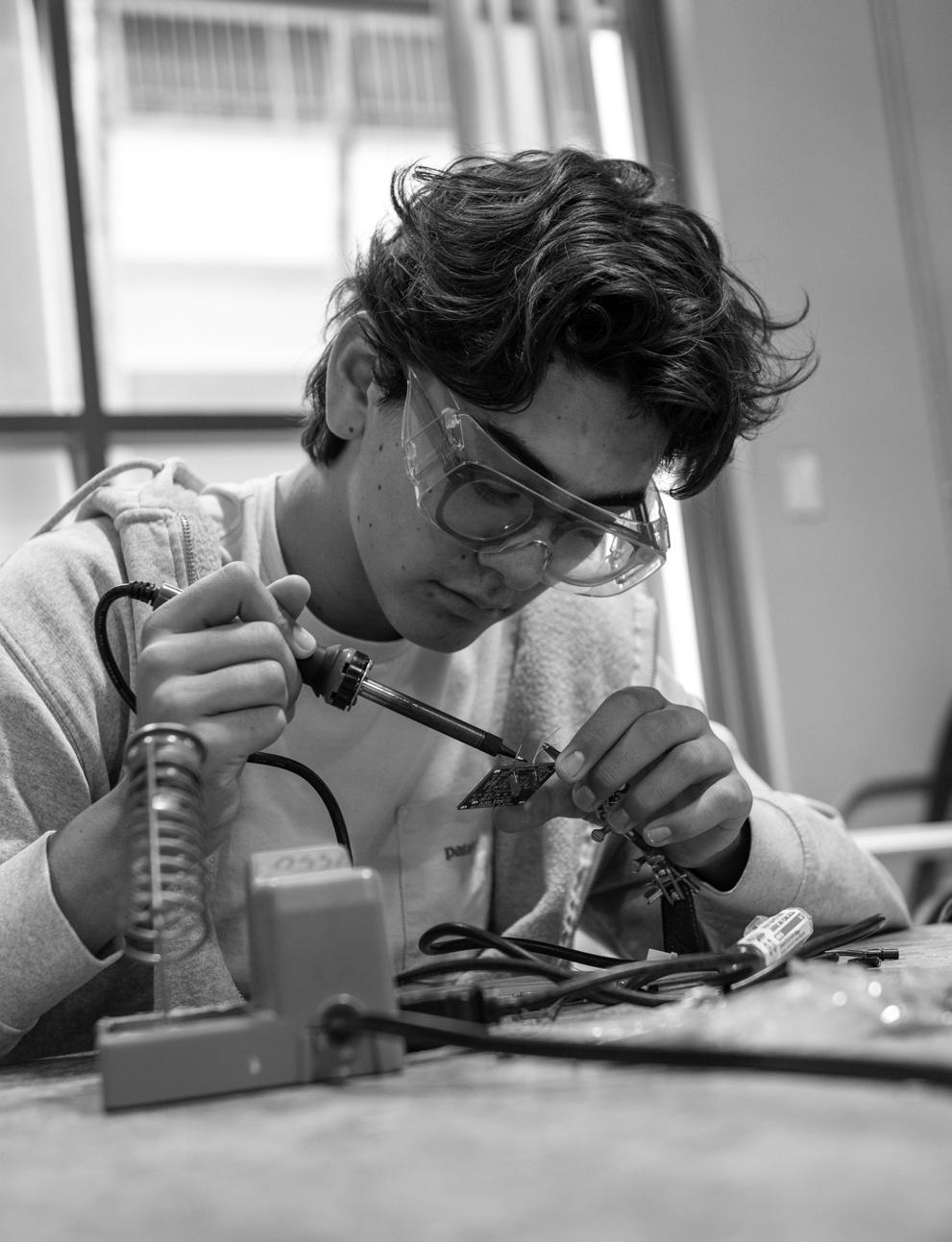
Summer School
Academy Summer School provides a unique opportunity for enrolled Punahou students to fulfill graduation requirements in a focused and immersive learning environment. By enrolling in one or two courses at a time, students are able to take a deep dive into a course and participate at a level that is not always possible during the school year. Rather than fulfilling a remedial requirement, Academy Summer School opens up possibilities for students to broaden their course selection during the school year. Summer School courses are scheduled for varying lengths from three to six weeks. In addition, a selection of Global Online Academy (GOA) online courses are available.
Summer School courses are entered as part of the student’s first semester record the following school year. Students register based on the grade they are entering in the fall.
Summer School registration for credit courses is completed during each student’s individual programming conference with their Deans in February. Summer School courses may be overenrolled and due to limited space, students are not guaranteed their first choice in course selection. In such cases, priority is given to 12th grade, then 11th grade and so on. All things being equal, a lottery may be held to determine which students are placed in a particular course. All course offerings are subject to sufficient enrollment. Students are notified of any new course offerings, deletions or prerequisite changes via their Class Deans. Tuition and fees for Summer School are charged to the student’s account in May.
Academy Summer courses are offered in three different formats: on campus (fully in-person), blended (on campus with additional coursework completed off campus) and online asynchronous. When planning out summer activities, please check course listings for estimated hours needed to complete daily coursework outside of class (course engagement). All in-person components of courses follow the Summer School Absence Policy below.
Course Formats
• On-campus Courses
On-campus courses meet in person during the indicated days and hours. The Summer Absence Policy applies for all oncampus meetings.
• Blended Courses (both on-campus and online coursework)
Blended courses meet on campus during the indicated days and hours. Students also engage in coursework asynchronously. Estimated hours for daily coursework engagement outside of class for each course are given for planning purposes. Blended courses do not have a “hybrid” option where students meet online synchronously; all oncampus meetings are required. The Summer Absence Policy applies for all on-campus meetings.
• Online Asynchronous Courses
Online Asynchronous courses list estimated hours of course engagement per week. This format offers independence as to when students engage with course material each week. Students follow a pacing guide and must meet the parameters of the course’s weekly benchmarks. Instructors schedule an in-person or synchronous online kick off meeting in late May or early June (date and time TBA). The Summer Absence Policy will be enforced for all synchronous or teacher-announced online meetings. Consistent and reliable Wi-Fi is essential in order to engage in course materials.
• Global Online Academy Courses
All GOA courses have synchronous components (when students collaborate together or work with their teacher at a set time, generally using video conferencing software) and asynchronous components (students choose when to participate).
Art
Summer School
Summer Absence Policy
Regular and punctual attendance at all scheduled on campus and synchronous online meetings is expected. There are two types of absences: Approved and Not Approved.
• Approved Absences
Absences for illness, medical or dental appointments or funerals are subject to approval by the Academy Summer School Director. The number of such absences allowed during a Summer School course is determined on a caseby-case basis by the Academy Summer School Director and the Summer Dean.
• Not Approved Absences
Absences for family trips, sports events or trips, driver license tests, job interviews, employment, summer camp, errands, performances and similar conflicts are considered “Not Approved.” To ensure continuity and to preserve the academic integrity of each class, a student will fail a course if these “Not Approved” absences are planned during the first two days or the last two days of any course. Students will fail a course if they accrue more than two “Not Approved” absences in five and six-week courses, or more than one “Not Approved” absence in a three-week or Ke Kilohana course.
Summer Registration
Students may register for up to one credit in Academy courses with the exception of PE which may be taken in excess of one credit. Students may not register for both an English and a Social Studies course in the same summer unless one of those courses is a GOA course. Students are responsible for ensuring that class times do not conflict. For more information, see Graduation Requirements and Important Information section.
The registration deadline for Summer Courses is May 1, 2026. Any registration requests received after this deadline will be charged a late fee and the desired course will be registered on a space-available basis. See Fees section for more details. The deadline to make changes to most Summer Courses is June 12, 2026. Changes will be made on a space available basis and fees will apply.
After June 15, 2026, only course drops will be allowed. See Fees section for more details. The deadline to declare credit/no credit for an elective or PE course is July 10, 2026.
Summer Co-Curricular Course Registration
Students may register for Co-Curricular courses provided there are no scheduling conflicts. Contact the Extended Learning office for information on registering for Extended Learning programs such as SAT Prep (www.punahou.edu/satprep).
Fees
Registration changes for credit-bearing courses made after May 1, 2026 will incur a $50 change fee. Changes made after June 12, 2026 will forfeit 100% of the course tuition, with the exception of Advanced Algebra 1B (see Math section).
Attire and Behavior Policies
The attire (including wearable school IDs) and behavior policies during Summer School are the same as those during the school year. These policies can be found in the Punahou School Code of Conduct.
Books and Supplies
Books and supplies are not included in tuition. Textbooks for Academy Summer School courses can be purchased through the MBS Direct Online Bookstore or through a vendor of choice. ISBN numbers will be provided in May for required books. Additional materials and PE uniforms are available in the Punahou School Bookstore.
Summer Course Offerings
Punahou Summer School courses are open to Academy students depending on enrollment and staffing. Course length and times vary; see course description for details and times.
All courses satisfy department graduation requirements, except courses with an asterisk (*), which satisfies elective credit.
Art
Summer School
Science For Grades
Biology 9
Chemistry 10 – 12
Chemistry Honors 10 – 12
Principles of Physics 10 – 12
Biology & Geology of the Hawaiian Islands 10 – 12
Social Studies For Grades
Hawaiian History (5 wks) 9
East Asian History 10
East Asian History: Online 10
U.S. History (1st semester, 5 wks) 11 – 12
U.S. History: Online (1st semester, 5 wks) 11 – 12
European History (5 wks) 12
Ethnic Studies Honors: Advanced Topics in Hawaiian & Pacific History (5 wks) 11 – 12
Think Global, Act Local (online) 11 – 12
Senior Wellness 12
Travel: Culture & Religion of Bhutan 12
Travel: Grand Tetons & Yellowstone National Parks 12
Travel: Healthcare & Culture in Thailand 12
Global Online Academy (GOA) For Grades 10 – 12
Abnormal Psychology*
Architecture*
Bioethics
Business Problem Solving*
Computer Science I: Computational Thinking*
Genocide & Human Rights* Geometry*
Health & Fitness*
International Relations*
Introduction to Branding & Marketing*
Introduction To Legal Thinking*
Introduction To Psychology*
Investing I*
Medical Problem Solving I*
Problem Solving with Engineering & Design*
Vibe Coding: Code, Create & Launch with AI
Art
Color Digital Photography
3-week on campus course: June 8 – June 26
On campus Monday – Friday, 8 a.m. – noon OR Monday – Friday, 12:30 p.m. – 4:30 p.m.
One off campus field trip per week. Students should expect 2 hours of course engagement outside of class per week.
See Art section for complete description and equipment requirements.
Tuition: $850 (includes lab fee)
Open to grades 9, 10, 11, 12. No prerequisite. One-half credit. Satisfies Visual and Performing Arts graduation requirement or elective credit.
Digital Art Online
3-week online course: June 8 – June 26
Instructors schedule an in person or synchronous online kick off meeting in late May or early June (date and time TBA).
Digital Art offers a unique approach to basic visual language. Computer applications and tools enable students to explore new ways of conceiving and constructing artworks. The course expands students' understanding of art through technology, cultural context, analysis and critique.
Digital Art teaches fundamentals of technology-based art, including animation, digital drawing/painting and digital photography. Students create imagery using software such as Procreate, Photoshop, Endless Paper, ZBrush, Illustrator and Tinkercad. The course also builds foundational art skills, especially in drawing and design.
This is an asynchronous class, requiring students to be independent and responsible for meeting all deadlines. Each class period is equivalent to two weeks of traditional coursework.
Course structure is communicated through Canvas. Students access Canvas daily and use online platforms to collaborate. Daily sequential skill-building assignments, weekly goals and virtual check-in meetings with the instructor help to keep students on track while working independently.
Students can expect 3 – 4 hours each day of coursework. Engagement throughout the course is critical; extracurricular commitments must allow for assignments to be completed on time. Reliable internet service is required to participate in the course.
Tuition: $850
Open to grades 10, 11, 12. No prerequisite. One-half credit. Satisfies Visual and Performing Arts graduation requirement or elective credit.
Drawing 1
3-week on campus course: June 29 – July 17
On campus Monday – Friday, 12:30 p.m. – 4:30 p.m.
Students should expect one hour of homework per week.
See Art section for complete description.
Tuition: $850
Open to grades 9, 10, 11, 12. No prerequisite. Onehalf credit. Satisfies Visual and Performing Arts graduation requirement or elective credit.
Drawing 1: Online
3-week online course: June 8 – June 26
Instructors schedule an in person or synchronous online kick off meeting in late May or early June (date and time TBA).
Course structure is communicated using Canvas as a classroom. A detailed pacing guide and mandatory weekly check-ins with the instructor help keep the student on track while allowing for independence. Students are expected to engage with Canvas daily and utilize different online platforms to connect and collaborate with fellow students. Engagement during the entire course is critical; check that commitments (e.g., sports, travel, work) allow for coursework to be completed. Students should expect 3 – 4 hours of daily course engagement. Reliable internet access is required in order to engage in course materials.
See Art section for complete description. Tuition: $850 (includes take-home materials)
Open to grades 10, 11, 12. No prerequisite. One-half credit. Satisfies Visual and Performing Arts graduation requirement or elective credit.
Art
Summer School
Introduction to Artist Practice
3-week on campus course: June 8 – June 26
On campus Monday – Friday, 8 a.m. – noon
Students should expect one hour of course engagement outside of class per week.
See Art section for complete description.
Tuition: $850 (includes lab fee)
Open to grades 9, 10, 11, 12. Prerequisite: Drawing I. One-half credit. Satisfies Visual and Performing Arts graduation requirement or elective credit.
Introduction to Ceramics: Wheel Throwing I
6-week on campus course: June 8 – July 17
On campus Monday – Friday, 10:15 a.m. – 12:15 p.m.
Students should expect one hour of course engagement outside of class per week.
See Art section for complete description.
Tuition: $850 (includes lab fee)
Open to grades 10, 11, 12. No prerequisite. One-half credit. Satisfies Visual and Performing Arts graduation requirement or elective credit.
Sculpture
3-week on campus course: June 8 – June 26
On campus Monday – Friday, 12:30 – 4:30 p.m.
Students should expect one hour of course engagement outside of class per week.
See Art section for complete description.
Tuition: $850 (includes lab fee)
Open to grades 9, 10, 11, 12. No prerequisite. Semester course. One-half credit. Satisfies Visual and Performing Arts graduation requirement or elective credit.
Design Technology and Engineering
Engineering & Robotics I*
3-week in person class: June 8 – June 26
On campus Monday – Friday 8 a.m. – noon
The blended course structure requires an additional 1 – 2 hours of daily course engagement outside of class.
See Design Technology and Engineering section for complete description.
Tuition: $850
Open to grades 9, 10, 11, 12. No prerequisite. Semester course. One-half credit. Satisfies elective credit.
Engineering & Robotics II*
3-week in person class: June 29 – July 17
On campus Monday – Friday 8 a.m. – noon
The blended course structure requires an additional 1 – 2 hours of daily course engagement outside of class.
See Design Technology and Engineering section for complete description.
Tuition: $850
Open to grades 9, 10, 11, 12. Prerequisite: Engineering and Robotics I (can be taken during the first 3 weeks of summer). Semester course. One-half credit. Satisfies elective credit.
English
Students may take only two English courses in Summer School to fulfill the four credits required for graduation. They may take either English 1A between eight and ninth grades or English 2A between ninth and 10th grades. Before their 11th grade or 12th grade years, they may take one offered elective.
English
1A
5-week blended course: June 8 – July 10
On campus Monday – Friday, 8 – 11 a.m. OR Monday – Friday. 10:30 a.m. – 2 p.m. (includes 30 min lunch break)
The blended course structure requires an additional 1 – 2 hours of daily course engagement outside of class.
See English section for complete description. This summer school course only covers the first semester of the yearlong English 1AB course.
Tuition: $850
Open to grade 9. No prerequisite. One-half credit. Satisfies English requirement for grade 9.
English 2A
5-week blended course: June 8 – July 10
On campus Monday – Friday 9 a.m. – noon
The blended course structure requires an additional 1 – 2 hours of daily course engagement outside of class.
See English section for complete description. This summer school course only covers the first semester of the yearlong English 2AB course.
Tuition: $850
Open to grade 10. Prerequisite: English 1. One-half credit. Satisfies English requirement for grade 10
American Literature
5-week blended course: June 8 – July 10
On campus Monday – Friday 8 – 10 a.m.
Students read, discuss and write about a diverse selection of American Literature across the full spectrum of literary genres, including fiction, nonfiction, poetry and/ or drama. The blended course structure requires an additional 2 – 3 hours of daily course engagement outside of class.
Tuition: $850
Open to grades 11, 12. Prerequisite: English 2. One-half credit. Satisfies English graduation requirement for American Literature.
Creative Writing
5-week blended course: June 8 – July 10
On campus Monday – Friday, 8 – 10 a.m.
The blended course structure requires an additional 1 – 2 hours of daily course engagement outside of class.
See English section for complete description.
Tuition: $850
Open to grades 11, 12. Prerequisite: English 2. Onehalf credit. Satisfies English graduation requirement.
Creative Writing: Online
5-week online course: June 8 – July 10
Instructors schedule an in person or synchronous online kick off meeting in late May or early June (date and time TBA).
Course structure is communicated using Canvas as a classroom. A detailed pacing guide and mandatory weekly check-ins with the instructor help keep the student on track while allowing for independence. Students are expected to engage with Canvas daily and utilize different online platforms to connect and collaborate with fellow students. Engagement during the entire course is critical; check that commitments (e.g., sports, travel, work) allow for coursework to be completed.
Students should expect 2 – 3 hours of daily course engagement. Reliable internet access is required in order to engage in course materials.
See English section for complete description. Tuition: $850
Open to grades 11, 12. Prerequisite: English 2. Onehalf credit. Satisfies English graduation requirement.
Art
Summer School
Kilohana Course
Ethnic Studies Honors: Hawaiian & Pacific History
Glass Revolution: Transforming Glass from Refuse to Resource Senior Wellness
Think Global, Act Local (online)
Travel: Culture & Religion of Bhutan
Travel: Grand Tetons & Yellowstone National Parks
Travel: Healthcare & Culture in Thailand
June 8 – July 10 June 8 – July 17 June 15 – July 24 June 8 – July 17 June 8 – July 6 June 8 – July 2 June 8 – June 30
Writing with Clarity & Grace
5-week blended course: June 8 – July 10
On campus Monday – Friday 8 – 10 a.m.
The blended course structure requires an additional 1 – 2 hours of daily course engagement outside of class.
See English section for complete description.
Tuition: $850
Open to grades 11, 12. Prerequisite: English 2. Onehalf credit. Satisfies English graduation requirement.
Writing with Clarity & Grace: Online
5-week online course: June 8 – July 10
Instructors schedule an in person or synchronous online kick off meeting in late May or early June (date and time TBA).
Course structure is communicated using Canvas as a classroom. A detailed pacing guide and mandatory weekly check-ins with the instructor help keep the student on track while allowing for independence. Students are expected to engage with Canvas daily and utilize different online platforms to connect and collaborate with fellow students. Engagement during the entire course is critical; check that commitments (e.g., sports, travel, work) allow for coursework to be completed.
See English section for complete description.
Tuition: $850
Open to grades 11, 12. Prerequisite: English 2. Onehalf credit. Satisfies English graduation requirement. Summer 2026 course dates
Ke Kilohana
2026 Location
On-campus T, W, Th
On-campus T, W, Th
On-campus T, W, Th
Asynchronous online
On-campus and off-island
On-campus and off-island
On-campus and off-island
All courses satisfy the graduation requirement for Ke Kilohana, but vary in dates and hours. See summary table above for dates and times students must be available.
Ethnic Studies Honors: Advanced Topics in Hawaiian & Pacific History
5-week blended course: June 8 – July 10
On campus Tuesday, Wednesday and Thursday from 8 a.m. to noon.
See Ke Kilohana section for complete description.
Students should expect 1 – 2 hours of daily course engagement outside of class.
Tuition: $850
Open to grades 11, 12. No prerequisite. One-half credit. For class of 2027: Satisfies Social Studies graduation requirement for Ke Kilohana. For class of 2028 & beyond; Satisfies Social Studies graduation requirement and graduation requirement for Ke Kilohana.
Glass Revolution: Transforming Glass from Refuse to Resource on O‘ahu
6-week on campus course: June 8 – July 17
On campus Tuesday, Wednesday and Thursday 9 a.m. – noon
See Ke Kilohana section for complete description.
Students should expect 1 – 2 hours of daily course engagement outside of class.
Tuition: $850
Due to safety constraints, this course may be subject to limited enrollment.
Open to grades 11, 12. No prerequisite. Semester course. One-half credit. For class of 2027: Satisfies Social Studies graduation requirement for Ke Kilohana. For class of 2028 & beyond: Satisfies Visual and Performing Arts graduation credit and graduation requirement for Ke Kilohana.
Senior Wellness
6-week on campus course: June 15 – July 24
On campus Tuesday, Wednesday and Thursday 9 a.m. – noon.
Service requirement on campus July 20 –24 from 9 a.m. – 1 p.m. Students must be present for the entire service period.
The blended course structure requires an additional 2 hours of daily course engagement outside of class and service learning hours on July 20 – 24. All students pursue an individual project in conjunction with their service learning.
Tuition: $850
Open to grade 12. No prerequisite. One-half credit. For class of 2027: Satisfies Social Studies graduation requirement for Ke Kilohana. For class of 2028 & beyond; Satisfies elective credit and graduation requirement for Ke Kilohana. Limited enrollment available.
Art
Summer School
Think Global, Act Local (online)
6-week online course: June 8 – July 17
The online course structure requires one day of on campus orientation (date and time TBA).
Course structure is communicated using Canvas as a classroom. A weekly paced cycle sheet and project Webex check-ins with the instructor help keep the student on track while allowing for learning independence. Students are expected to engage with Canvas and utilize different online platforms to connect and collaborate with fellow students. All students pursue an individual project in conjunction with their service learning. Engagement during the entire course is critical; check that commitments (e.g., sports, travel, work) allow for coursework to be completed.
Students should expect 1 hour of daily course engagement, in addition to service learning hours. Reliable internet access is required in order to engage in course materials.
See Ke Kilohana section for complete description.
Tuition: $850
Open to grades 11, 12. No prerequisite. One-half credit. For class of 2027: Satisfies Social Studies graduation requirement for Ke Kilohana. For class of 2028 & beyond; Satisfies Social Studies graduation requirement and graduation requirement for Ke Kilohana. Limited enrollment available.
Ke Kilohana Travel
Culture & Religion of Bhutan
June 8 – July 6
This international version of Ke Kilohana combines classwork at Punahou with travel to the country of Bhutan, a Buddhist kingdom in the Himalayas. Students engage in service learning around Bhutanese environmental protection efforts, the history and integration of Buddhism into daily life and the impact of evolving educational systems. As a country that measures its success based on Gross National Happiness, this unique experience provides students with cultural exchanges in different villages across the country. Case studies integrating the course’s themes, field study in Bhutan and handson experience in partnership with other global learners combine to form this innovative curricular experience. Students are required to attend pre-travel classes on campus.
Open to grades 11, 12. No prerequisite. Semester course. One-half credit. For class of 2027: Satisfies Social Studies graduation requirement for Ke Kilohana. For class of 2028 & beyond: Satisfies departmental credit for Social Studies and graduation requirement for Ke Kilohana.
Grand Tetons & Yellowstone
National Parks
June 8 – July 2
This outbound version of Ke Kilohana combines classwork at Punahou with travel to Grand Teton and Yellowstone. This course fulfills the Ke Kilohana requirement with students spending up to twelve days in the Rocky Mountain West. Students actively explore the exciting science of two iconic national parks: Grand Teton and Yellowstone. Working with Teton Science Schools, students investigate the summer landscapes to learn about wildlife, climate, geology, human history and unique ecology that are so different from tropical Hawai‘i. Gather your hiking gear and curiosity; join us on an epic learning expedition into the science of two stunning national parks. Students are required to attend pre- and post-travel classes on campus. Physical fitness is essential in this travel experience.
Open to grades 11, 12. No prerequisite. Semester course. One-half credit. For class of 2027: Satisfies Social Studies graduation requirement for Ke Kilohana. For class of 2028 & beyond: Satisfies elective credit and graduation requirement for Ke Kilohana.
Healthcare & Culture in Thailand
June 8 – 30
This international version of Ke Kilohana, in collaboration with Global Public Service Academy (GPSA), combines classwork at Punahou with travel to Thailand. Led by trained GPSA staff, students who have a passion for career paths in the health and medical professions engage in hands-on clinical work in northern Thailand to improve healthcare for members of the local community. Students learn the principles of global health to prepare them to carry out clinic-based interventions and screenings for children and adults. Students make a difference in the lives of the underserved population in rural and remote villages with hands-on clinical work to improve their preventive care. They are introduced to Thai culture, languages and customs. Students are required to attend pre- and post-travel classes on campus.
Open to grades 11, 12. No prerequisite. Semester course. One-half credit. For class of 2027: Satisfies Social Studies graduation requirement for Ke Kilohana. For class of 2028 & beyond: Satisfies elective credit and graduation requirement for Ke Kilohana.
Art
Summer School
Mathematics
Students are required to earn three credits in mathematics for graduation from Punahou. Only one of those three credits may be earned in Summer School. Students often choose to take a mathematics course during the summer as a means to accelerate in math, opening the door to calculus in their 12th grade year.
Advanced Algebra IB
6-week on campus course: June 8 – July 17
On campus Monday – Friday, 8 a.m. – noon
This course aims to develop and strengthen student confidence in the student’s mathematical abilities and provides a supportive environment for their first math course in the Academy. This course covers the second semester of the Advanced Algebra I course. Testing is daily and students should expect approximately 2 hours of homework per night. Successful completion of Algebra IB allows enrollment in Geometry. The drop deadline for this course is extended until July 2, 2026. If a drop occurs before the deadline, Advanced Algebra 1B will not appear on the student’s transcript and course fees are non-refundable.
Tuition: $850
Open to grades 9, 10, 11. Prerequisites: Teacher recommendation based on quiz and test scores, work habits, commensurate diagnostic test scores and Math Department Head approval. One-half credit. Satisfies elective credit.
Geometry
6-week on campus course: June 8 – July 17
On campus Monday – Friday, 8 a.m. – noon
This is a rigorous and intensive course in the study of Euclidean Geometry. See Math section for complete description. Students should expect daily testing and approximately 2 – 3 hours of homework per night.
Tuition: $1050
Open to grades 10, 11, 12. Prerequisites for summer course: A- or better in both semesters of Algebra I and current teacher recommendation. One credit. Satisfies Mathematics graduation requirement.
Geometry: Online*
7-week online course offered via Global Online Academy. End date is after Punahou Summer School. See GOA website at globalonlineacademy.org for more information
See GOA section for course description and requirements. Engagement during the entire course is critical; check that commitments (e.g., sports, travel, work) allow for coursework to be completed. Students should expect 2 hours of daily course engagement.
Tuition: See GOA catalog at globalonlineacademy.org
Open to grades 10, 11, 12. Prerequisites for summer course: A- or better in both semesters of Advanced Algebra I and current teacher recommendation. One credit. Satisfies elective credit (the online course does not satisfy the Mathematics graduation requirement, but does allow the student to advance into Algebra II/ Trigonometry).
Algebra II/Trigonometry
6-week on campus course: June 8 – July 17
On campus Monday – Friday, 8 a.m. – noon
See Math section for complete description. Students should expect daily testing and 2 – 3 hours of homework per night.
Tuition: $1050
Students are required to bring any edition of the TI-84 Plus calculator, but a TI-84 Plus CE graphing calculator is recommended.
Open to grades 10, 11, 12. Prerequisites for summer course: A- or better in all four semesters of Algebra I and Geometry and current teacher recommendation. One credit. Satisfies Mathematics graduation requirement or elective credit.
Advanced Pre-Calculus
6-week on campus course: June 8 – July 17
On campus Monday – Friday, 8 a.m. – noon
See Math section for complete description.
Students completing Advanced Pre-Calculus students will be prepared to take some form of Calculus the following year. Students should expect daily testing and 2 – 3 hours of homework per night.
Tuition: $1050
Students are required to bring a TI-84 Plus calculator to each class.
Open to grades 11, 12. Prerequisites for summer course: A- or better in Algebra II/Trigonometry and teacher recommendation. One credit. Satisfies Mathematics graduation requirement or elective credit.
Physical Education
Lifetime
Fitness
6-week on campus course: June 8 – July 17
On campus Monday – Friday, 8 – 10 a.m.
OR Monday – Friday 10:15 a.m. – 12:15 p.m.
OR Monday – Friday 11:15 a.m. – 1:15 p.m.
The use of a wider range of facilities and fitness activities is unique to the summer course. Students should dress appropriately for physical activity each day (PE uniform and athletic shoes, swim attire every other day) and maintain good hydration.
Students should expect approximately 2 –3 hours of homework per week.
See PE section for complete description.
Tuition: $850
Open to grades 9, 10. No prerequisite. One-half credit. Letter graded with a Credit/No Credit option (C or better for credit). Satisfies Physical Education graduation requirement for Lifetime Fitness.
ASPE: After-School Physical Education
During the school year, this program provides an opportunity for students to explore and engage in unique lifetime activities outside of the regular school day. In the summer, students elect activities and may combine activities to fulfill a half credit.
Fencing
3 week in person course: June 8 – June 26
On campus Monday – Friday 12:30 – 2:30 p.m.
Tuition: $425
Hiking
3 week in person course: June 8 – June 26
On campus Monday – Friday 8 – 10 a.m.
Tuition: $425
Pickleball
3 week in person course: June 8 – June 26
OR June 29 – July 17
On campus Monday – Friday, 10:15 a.m. – 12:15 p.m.
Tuition: $425
Open to grades 9, 10, 11, 12. No prerequisite. Quarter course. One-quarter credit. Only ASPE quarters may be combined for semester credit. Credit/No Credit (C or better for credit). Satisfies Physical Education graduation requirement although the same activity may not be used to earn more than one credit.
Art
Summer School
Basic Yoga Plus
6-week on campus course: June 8 – July 17
On campus Monday – Friday, 8 – 10 a.m.
See Physical Education section for complete description.
Tuition: $850
Open to grades 9, 10, 11, 12. No prerequisite. Onehalf credit. Satisfies Physical Education graduation requirement.
Psychology and Well-being
Health & Wellness
6-week in person course: June 8 – July 17
Monday – Friday 8 – 10:00 a.m. OR 10:15 a.m. – 12:15 p.m.
This summer course covers the yearlong ninth grade Health & Wellness course required for graduation. Students should expect 1 – 2 hours per week of course engagement outside of class.
See Psychology and Well-being section for full course description.
Tuition: $500
Open to grade 9. No prerequisite. Satisfies Health & Wellness graduation requirement for grade 9. Credit/No Credit.
Science
Students may take only one credit in Summer School towards the two credits in laboratory science required for graduation.
Biology
6-week blended course: June 8 – July 17
On campus Monday – Friday 8 a.m. – noon
The blended course structure requires an additional 1 – 3 hours of daily course engagement outside of class. This summer school course covers one full year of course content.
See Science section for complete description.
Tuition: $1200
Open to grade 9. No prerequisite. One credit. Satisfies laboratory Science graduation requirement.
Biology & Geology of the Hawaiian Islands
6-week blended course: June 8 – July 17
On campus Monday – Friday 8 a.m. – noon
The blended course structure requires an additional 1 – 2 hours of daily course engagement outside of class. This summer school course covers one full year of course content.
See Science section for complete description. Tuition: $1200
Open to grades 10, 11, 12. Prerequisite: Biology or Biology Honors. Year course. One credit. Satisfies laboratory Science graduation requirement or elective credit.
Chemistry
6-week blended course: June 8 – July 17
On campus Monday – Friday, 8 a.m. – noon
The blended course structure requires an additional 1 – 2 hours of daily course engagement outside of class. This summer school course covers one full year of course content.
See Science section for complete description. Tuition: $1200
Open to grades 10, 11, 12. Prerequisite: Algebra I. One credit. Satisfies laboratory Science graduation requirement.
Chemistry Honors
6-week blended course: June 8 – July 17
On campus Monday – Friday, 8 a.m. – noon
This rigorous and fast paced summer school course covers one full year of honors-level content and is intended for students who wish to get ahead in their studies by taking AP Chemistry in the next school year. A total of eight unit tests and one cumulative final exam worth 15% of their semester grade are administered.
The blended course structure requires an additional 2 – 3 hours of daily independent course engagement outside of class.
See Science section for complete description. Tuition: $1200
Open to grades 10, 11, 12. Prerequisite: Geometry or Geometry Honors. One credit. Limited enrollment available. Satisfies laboratory Science graduation requirement.
Principles of Physics
6-week blended course: June 8 – July 17
On campus Monday – Friday, 8 a.m. – noon
The blended course structure requires an additional 1 – 2 hours of daily course engagement outside of class. This summer school course covers one full year of course content.
See Science section for complete description.
Tuition: $1200
Open to grades 10, 11, 12. No prerequisite. One credit. Satisfies laboratory Science graduation requirement.
Social Studies
Students may take only one credit in Summer School towards the three and one-half Social Studies credits required for graduation. See the Social Studies section for specific graduation requirements for each graduating class.
For Classes of 2028 and beyond
A student may take either Hawaiian History between eighth and ninth grades or East Asian History between ninth and 10th grades, but not both.
Hawaiian History
5-week on campus course: June 8 – July 10
On campus Monday – Friday, 8 a.m. – noon
See Social Studies section for complete description. Students can expect 1 – 2 hours of daily course engagement outside of class.
Tuition: $850
Open to grade 9. No prerequisite. One-half credit. Satisfies graduation requirement for Hawaiian History.
East Asian History
6-week blended course: June 8 – July 17
On campus Monday – Friday, 8 – 11 a.m.
The blended course structure requires an additional 1 – 2 hours of daily course engagement outside of class.
See Social Studies section for complete description.
Tuition: $850
Open to grade 10. No prerequisite. One-half credit. Satisfies Social Studies graduation requirement for Asian History.
Summer School
East Asian History: Online
6-week online course: June 8 – July 17
Instructors schedule an in person or synchronous online kick off meeting in late May or early June (date and time TBA).
Course structure is communicated using Canvas as a classroom. A detailed pacing guide and mandatory weekly check-ins with the instructor help keep the student on track while allowing for independence. Students are expected to engage with Canvas daily and utilize different online platforms to connect and collaborate with fellow students. Engagement during the entire course is critical; check that commitments (e.g., sports, travel, work) allow for coursework to be completed.
Students should expect 2 – 3 hours of daily course engagement. Reliable internet access is required in order to engage in course materials.
See Social Studies section for complete description.
Tuition: $850
Open to grade 10. No prerequisite. One-half credit. Satisfies Social Studies graduation requirement for Asian History.
United States History (First Semester)
5-week blended course: June 8 – July 10
On campus Monday – Friday, 8 – 10 a.m.
The blended course structure requires an additional 2 hours of daily course engagement outside of class.
See Social Studies section for complete description.
This summer school course only covers one semester’s content of the yearlong course.
Tuition: $850
Open to grades 11. No prerequisite. One-half credit. Satisfies Social Studies graduation requirement for the first semester of U.S. History.
United States History
(First Semester): Online
5-week online course: June 8 – July 10
Instructors schedule a synchronous online kickoff meeting in late May or early June (date and time TBA).
Course structure is communicated using Canvas as a classroom. A detailed pacing guide and mandatory weekly check-ins with the instructor help keep the student on track while allowing for independence. Students are expected to engage with Canvas daily and utilize different online platforms to connect and collaborate with fellow students. Engagement during the entire course is critical; check that commitments (e.g., sports, travel, work) allow for coursework to be completed.
Students should expect 3 – 4 hours of daily course engagement. Reliable internet access is required in order to engage in course materials.
See Social Studies section for complete description. This summer school course only covers one semester’s content of the yearlong course.
Tuition: $850
Open to grades 11. No prerequisite. One-half credit. Satisfies Social Studies graduation requirement for the first semester for U.S. History.
European History
5-week blended course: June 8 – July 10
On campus Monday – Friday, 8 – 10 a.m.
The blended course structure requires an additional 2 hours of daily course engagement outside of class.
See Social Studies section for complete description.
Tuition: $850
Open to grade 12. No prerequisite. One-half credit. Satisfies Social Studies graduation requirement for European History.
Ke Kilohana Courses
Ethnic Studies Honors: Advanced Topics in Hawaiian & Pacific History
Senior Wellness
Think Global, Act Local (Online)
Travel:Culture & Religion of Bhutan
Travel: Grand Tetons & Yellowstone
National Parks
Travel: Healthcare & Culture in Thailand
See Ke Kilohana section for complete description.
Global Online Academy
See the GOA section for fee information, course descriptions and course dates. Students may enroll concurrently in a summer GOA course and a summer Punahou course not to exceed a total of one credit earned.
Abnormal Psychology
Architecture
Bioethics
Business Problem Solving
Computer Science I: Computational Thinking
Genocide & Human Rights
Health & Fitness
International Relations
Introduction to Branding & Marketing Introduction To Legal Thinking
Introduction To Psychology Investing I
Medical Problem Solving I
Problem Solving with Engineering & Design
Vibe Coding: Code, Create & Launch with AI
Open to grades 10, 11, 12. One-half credit. Satisfies elective credit.
Geometry
Prerequisite: A- or higher in both semesters of Advanced Algebra I and current teacher recommendation. This course allows for the student to advance into Algebra II/Trgonometry, but does not satisfy the Mathematics graduation requirement.
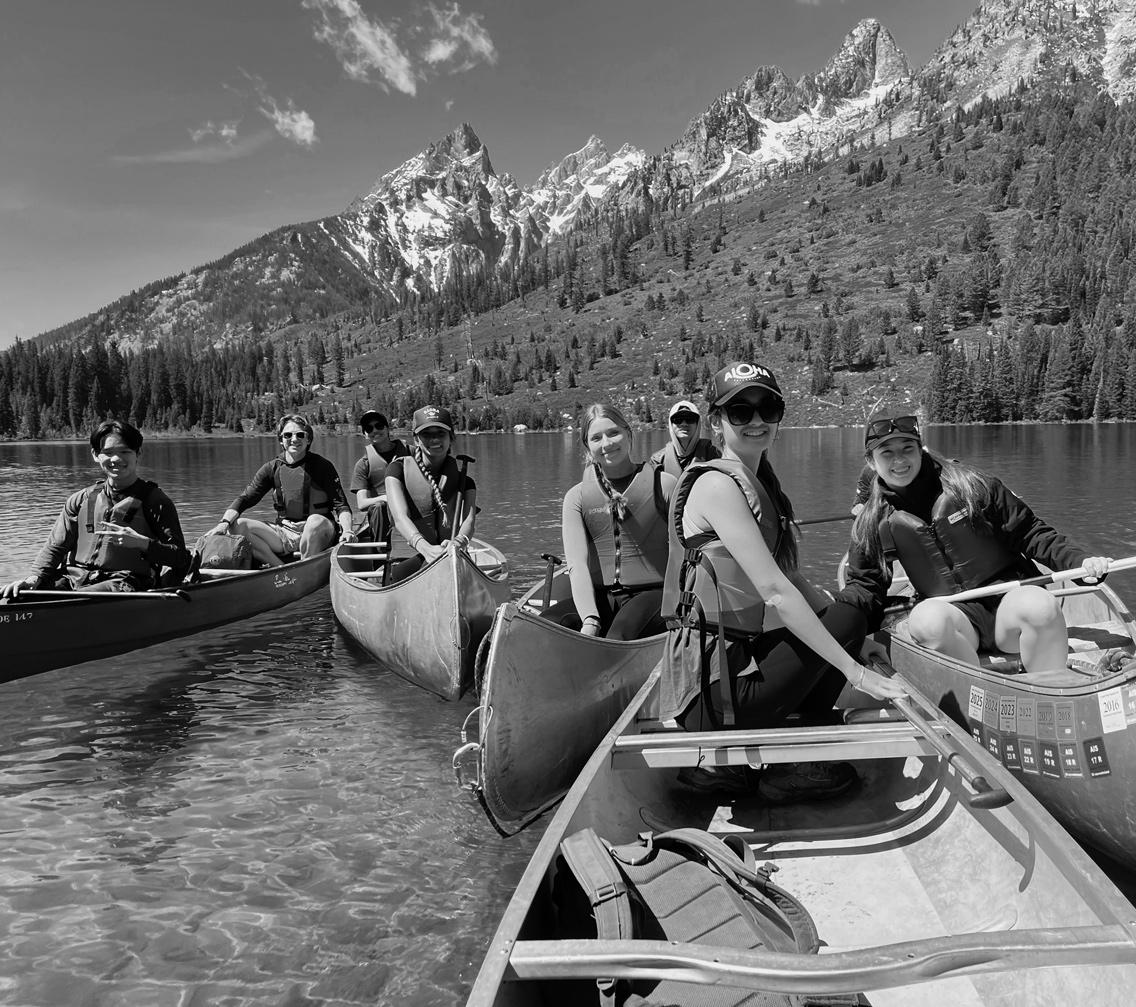
Study Abroad: Year or Semester
To support rigorous academic study abroad, Punahou partners with certain schools to offer a diverse range of semester and yearlong study programs through School Year Abroad (www.sya.org).
School
Year Abroad in France, Italy or Spain
School Year Abroad provides high school 10th and 11th graders a full year of living with a European family while earning high school credits and receiving rigorous preparation for U.S. colleges and universities. Since 2003, approximately 69 students from Punahou have participated in this program. American students study at each site: Rennes, France; Viterbo, Italy; and Zaragoza, Spain. More information, including applications, is available at www.sya.org. Apply online by February 12, 2026. Financial aid applications are due February 12, 2026.
School
Year Abroad Summer Programs in France, Italy and Spain
School Year Abroad Summer programs are open to rising 11th graders or 12th graders interested in advancing their language comprehension skills and cultural competency. Students live with a host family for four weeks and devote the fifth week to travel around the country. More information, including applications, is available at www.sya.org. Applications are accepted on a rolling basis until programs are full. Email any questions to: syasummer@sya.org.
Recognizing that learning in global environments can be both academically and personally enriching, Punahou offers students a wide array of globally focused programs both on-island and away.
For more information about these programs, please contact the Wo International Center.
Summer Travel Study Programs
All travel study programs are preceded by mandatory classes at Punahou. Deadlines for these programs vary because of required travel arrangements. All deadlines precede course programming with the deans, so students must plan ahead. Need-based financial aid is available for Ke Kilohana trips.
2026 Summer Trips
Culture & Religion of Bhutan
June 8 – July 6
This international Ke Kilohana course combines classwork at Punahou with travel to the country of Bhutan, a Buddhist kingdom in the Himalayas. Students engage in service learning around Bhutanese environmental protection efforts, the history and integration of Buddhism into daily life and the impact of evolving educational systems. As a country that measures its success based on Gross National Happiness, this unique experience provides students with cultural exchanges in different villages across the country. Case studies integrating the course’s themes, field study in Bhutan and hands-on experience in partnership with other global learners combine to form this innovative curricular experience. Students are required to attend pre-travel classes on campus.
Open to grades 11, 12. No prerequisite. Semester course. One-half credit. For class of 2027: Satisfies Social Studies graduation requirement for Ke Kilohana. For class of 2028 & beyond: Satisfies departmental credit for Social Studies and graduation requirement for Ke Kilohana.
Grand Tetons & Yellowstone
National Parks
June 8 – July 2
This outbound Ke Kilohana course combines classwork at Punahou with travel to Grand Teton and Yellowstone. This course fulfills the Ke Kilohana requirement with students spending up to twelve days in the Rocky Mountain West. Students actively explore the exciting science of two iconic national parks: Grand Teton and Yellowstone. Working with Teton Science Schools, students investigate the summer landscapes to learn about wildlife, climate, geology, human history and unique ecology that are so different from tropical Hawai‘i. Gather your hiking gear and curiosity; join us on an epic learning expedition into the science of two stunning national parks. Students are required to attend pre- and post-travel classes on campus. Physical fitness is essential in this travel experience.
Open to grades 11, 12. No prerequisite. Semester course. One-half credit. For class of 2027: Satisfies Social Studies graduation requirement for Ke Kilohana. For class of 2028 & beyond: Satisfies elective credit and graduation requirement for Ke Kilohana.
Healthcare & Culture in Thailand
June 8 – 30
This international Ke Kilohana course, in collaboration with Global Public Service Academy (GPSA), combines classwork at Punahou with travel to Thailand. Led by trained GPSA staff, students who have a passion for career paths in the health and medical professions engage in hands-on clinical work in northern Thailand to improve healthcare for members of the local community. Students learn the principles of global health to prepare them to carry out clinic-based interventions and screenings for children and adults. Students make a difference in the lives of the underserved population in rural and remote villages with hands-on clinical work to improve their preventive care. They are introduced to Thai culture, languages and customs. Students are required to attend pre- and post-travel classes on campus.
Open to grades 11, 12. No prerequisite. Semester course. One-half credit. For class of 2027: Satisfies Social Studies graduation requirement for Ke Kilohana. For class of 2028 & beyond: Satisfies elective credit and graduation requirement for Ke Kilohana.
Courses not offered in 2026 – 2027
Grades 9 – 11 Summer Immersion
Language Program Spain
Grades 9 – 11 Summer Immersion
Language Program France
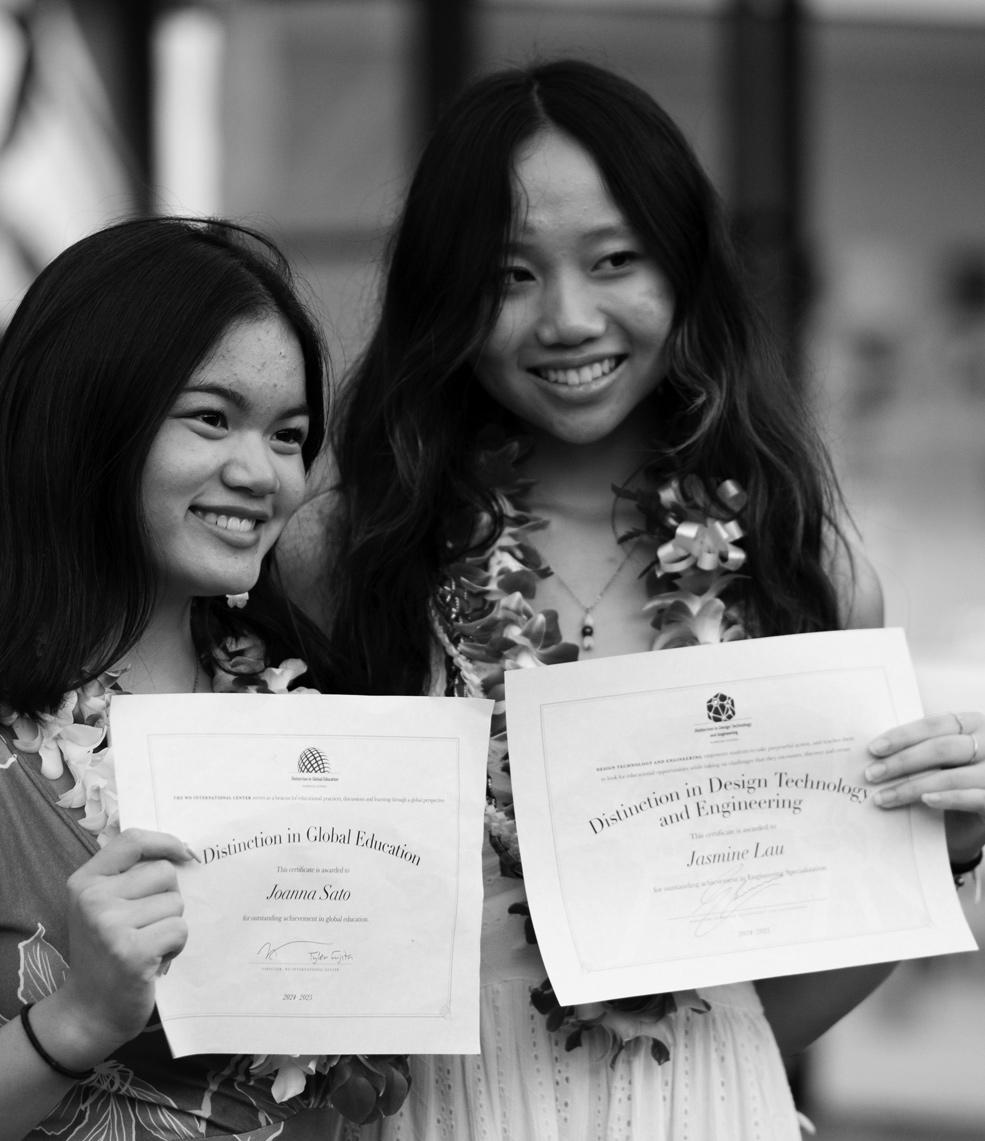
Distinction in Global Education: Wo International Center
The Distinction in Global Education is for students inspired by our vibrant, interconnected world. Through thoughtful and deliberate action over time, students take ownership of their growth as global citizens—engaging deeply with the people, places and issues that matter to them most. Key program themes include exploring personal identity, finding one’s place in the world and recognizing that the ability to see and participate in culture is a skill that can be cultivated.
Along the way, students build a portfolio of artifacts demonstrating their development across three core competencies: (1) Know Your World, (2) Skillfully Interact with the World and (3) Possess a Disposition for Action.
For the Class of 2028 and beyond: Successful completion of a Centers Distinction portfolio and defense satisfies the Ke Kilohana graduation requirement.
For more information about the Distinction in Global Education please contact: Tyler Fujita at tfujita@punahou.edu
Centers Distinctions
A Distinction can be earned by students who demonstrate focused study, passion and mastery aligned to the Punahou Centers. With the support of a mentor, students begin work on Center Distinction requirements and a reflective portfolio early in their Academy experience. The Distinction process is a valuable opportunity that recognizes outstanding achievements in knowledge, skills and dispositions aligned to the Centers.
All students are strongly encouraged to express interest during Grade 9 or Grade 10. A Distinction can be earned in only one of the areas below.
Distinction in Design Technology and Engineering: Design Technology and Engineering Department
The goal of the Punahou DTE team is to build and maintain a student-centered, school-wide environment designed to empower the development of the socialemotional skills, technical abilities, design thinking and growth mindset needed to translate into positive and purposeful action in the real world.
To attain the design technology and engineering award, candidates must complete seven semesters of DTE coursework, including Engineering V-A or Software Development Studio. Additionally, a high quality cumulative four-year eportfolio of coursework and extracurricular work is required, along with an exceptional Ke Kilohana Engineering or Ke Kilohana Computer Science project. Furthermore, candidates must fulfill one or more of the following: four semesters of active participation in DT sponsored clubs such as Robotics, VR, DTech fabrication, Coding, Tech Entrepreneurship, Assistive Robotics, or Go Blue Communities (or other approved clubs), or arranged independently designed experiences with equivalent hours and a DT curricular focus on a case-by-case basis.
For the Class of 2028 and beyond: Successful completion of a Centers Distinction portfolio and defense satisfies the Ke Kilohana graduation requirement.
For more information about the Distinction in DTE please contact: Edward Kinnear at ekinnear@punahou.edu
Distinction in ‘Ike Hawai‘i: Kuaihelani Center
Hawaiian Studies brings to life the vibrant culture, history and storytelling traditions of our Islands. The program, housed in Kuaihelani Learning Center, assists K – 12 faculty with integrating ‘o¯lelo (language), mele (song), oli (chant) and protocol into existing curriculum.
The program’s content-based approach imbues students with an appreciation for Hawaiian cultural values and for the School’s lands, a historic gift from the ruling ali‘i. By reconnecting children to the ‘a¯ina, the program encourages the mindset to embrace Hawaiian cultural values in their lives.
For the Class of 2028 and beyond: Successful completion of a Centers Distinction portfolio and defense satisfies the Ke Kilohana graduation requirement.
For more information about the Distinction ‘Ike Hawai‘i please contact: Kealohi Reppun at kreppun@punahou.edu
Centers Distinctions
Distinction in Student Entrepreneurship: Case Accelerator for Student Entrepreneurship Center In a world of accelerating change, everyone benefits from the entrepreneurial mindset. Whether you go on to work in government, for a nonprofit, as an intrapreneur within a larger corporation or start your own business, you’ll need to invent new paths forward. CASE helps students develop this entrepreneurial mindset and supports them as they take on challenges in the wider world to develop innovative solutions for their community.
The Distinction in Student Entrepreneurship is for students who launch a venture, whether for-profit or non-profit. Success is measured by the triple bottom line, or the three Ps of People, Planet and Profit: How do you help your community? What are your sustainable goals? If you make a profit, what will you support with your profits? Students in the Student Entrepreneurship Distinction program pursue a multi-year journey to prototype, iterate, launch and grow their ventures (for-profit and nonprofit ventures are equally valid).
There are several ways that Academy students interact with CASE during their Distinction in Student Entrepreneurship journey: Impact Incubator program, Innovation Sprints leadership and entrepreneurship competitions. These experiences are eligible for Explorations transcript notations, provided students complete the required work, show progress towards learning outcomes and meet the participation expectations. Interested students should refer to the Case Accelerator for Student Entrepreneurship website at www.punahou.edu/case-accelerator-forstudent-entrepreneurship.
For the Class of 2028 and beyond: Successful completion of a Centers Distinction portfolio and defense satisfies the Ke Kilohana graduation requirement.
For more information about the Distinction in Student Entrepreneurship please contact: Yolanda Lau at ylau@punahou.edu.
Distinction in Public Service: Luke Center for Public Service
The Luke Center for Public Service offers a Distinction for students who demonstrate an exceptional commitment to service and community engagement. This recognition honors service-minded individuals who dedicate themselves deeply to a project, organization or theme over time. Students pursuing the Distinction move beyond short-term volunteering to develop sustained partnerships, lead initiatives and create meaningful impact. Through reflection, action and collaboration, they embody the values of kuleana (responsibility), humility and reciprocity, inspiring others while strengthening communities.
For the Class of 2028 and beyond: Successful completion of a Centers Distinction portfolio and defense satisfies the Ke Kilohana graduation requirement. For more information about the Distinction in Public Service please contact Angie Dolan at adolan@punahou.edu.
Distinction in Civic Education: Davis Democracy Initiative
The Davis Democracy Initiative bridges intellectual study and applied, practical experience in professional and public life. The Initiative’s core themes of inquiry and engagement include an examination of politics and democratic participation, civil rights, media bias, legal systems and social justice, public policy, community engagement and social responsibility. Interested students should refer to the Davis Democracy Initiative website at www.punahou.edu/davis-democracyinitiative
For more information about the Distinction in Civic Education please contact David Ball at dball@punahou.edu and Pamela Sakamoto at psakamoto@punahou.edu.
Art
Extended Learning
There are many additional fee-based offerings for Academy students that contribute to the rich experience at Punahou. Please visit Punahou School’s Extended Learning Programs at www.punahou.edu/extended-learning to explore these opportunities and for information about the program offerings, session dates and registration.