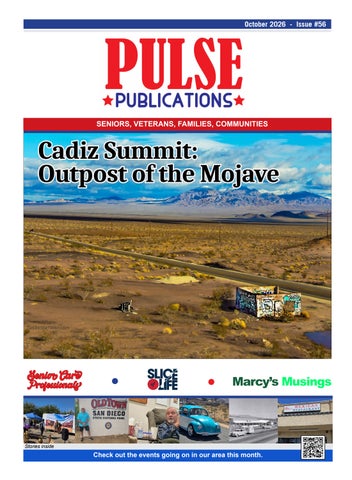
October 2026 - Issue #56
SENIORS, VETERANS, FAMILIES, COMMUNITIES
Cadiz Summit: Outpost of the Mojave
Senior Care Professionals
Marcy’s Musings
Stories inside
Check out the events going on in our area this month.
2
October 2026 #56
Editorial Shop Globally, Buy Locally P O Box 290066 - Phelan, CA 92329-0066 10405 Mountain Road - Piñon Hills, CA 92372
As we enter the final quarter of the year, I find myself looking forward to fall. The change in weather and the shorter days give us a chance to reflect on the year behind us and think about what we want to build together in the months ahead.
FRANCES CONKLE
CEO Mother Road Enterprises 1 760 617 3774 FrancesConkle@gmail.com
JAMES CONKLE
At PULSE Media, we are looking ahead, too. Our team is working on improvements to our publications and the way we serve our readers, advertisers and communities. We are grateful to everyone who has helped us grow, and we look forward to sharing more soon.
Graphic Designer 55 16 99991 0229 Leandro@pulsemedia.info
TIFFANIE NICOLE
1 760 221 9798 tiffaniepulsepublications@gmail.com
DEBBIE WALKER
1 760 900 9429 DWalker@pulsecustompublications.com
That work takes the support of readers, listeners and advertisers. Pick up a local publication. Tune in to a local station. Share a story that matters to you, and consider a local outlet when you want to promote your business or event. Every bit of support helps keep these community voices going.
Inside Pg 4
Jim Conkle
Our Writers
Happy Wanderers Exploring the Mystery and Majesty of the Southwest Deserts thedesertway.com
John Beyer
J. P. Garner
John Wease
John is a retired high school John Wease is a football coach and veteran. published author, with his He has published two modern-day western fiction books, lives in Barstow, and novel “The Horseman” loves being a member of available at the usual online the HIgh Desert branch of sources. the California Writers Club.
Sunday Funday in
Historic Daggett
Shop globally when you need to, but buy locally when you can. That includes supporting the people who help tell our community’s stories.
John Beyer has been published in numerous magazines, newspapers and the like for decades, writing on a variety of topics.
1 760 680 9472 Lori@motherroadenterprises.com
JORGE LEANDRO RODRIGUES
This season is also a good time to think about what it means to support local. We often encourage one another to shop at family owned stores and support the small businesses that give our communities their character. Local journalism and local radio deserve that same support. The people behind them live here, work here, cover our neighbors’ stories, share information about local events and help community organizations reach the people they serve.
Jaylyn and John Earl
LORI WESTON
Publisher 1 760 617 3991 jim@motherroadenterprises.com 66jimconkle@gmail.com
Liz McGiffin
1 760.887.3427 Published author in local magazines, newspapers and book/Borrow SmartRetire Rich. Representing Senior Kicks Club
Pg 7
Marcy's Musings
Pg 12
Cadiz Summit: Outpost
of the Mojave
Pg 20
Extend Your Summer in
San Diego Pg 22
Marcy Taylor
1 760 985 1918 mltaylor@gmx.com President of Mohahve Historical Society and Founder of the Apple Valley and Victor Valley Legacy Museums
Events
Paul Sebastian
1 442 285 9216 paul@pulsemedia.info
Tiffanie Nicole
1 760 221 9798 tiffaniepulsepublications@gmail.com Trusting words has lost its meaning when actions speak louder than promises ever could.-Tiffanie Nicole
October 2026 #56
3
Sunday Funday in Historic Daggett By John Wease
T
Beard and mustache winners Jessee Ramirez, Kevin Wright, and Brian Kulp.
HE 62ND ANNUAL DAGGETT DAYS was by far the best one yet. Saturday was dedicated to Daggett’s rich history as a supply center and shipping depot for Calico and other desert mining districts from 1882 until 1907. Later it was important to automobile travelers on the iconic Route 66. All the historical sites were open and most had friendly docents on site to answer any questions. The Daggett and Calico Historical Society has done a wonderful job preserving these locations. Sunday was a day for family fun. The event opened at 9:00. Seventy vendor spaces provided a broad range of wellorganized attractions. Food vendors, cottage foods, and craft vendors were on 2nd Street. Organizations including the Chambers of Commerce of Daggett and Newberry Springs, AEC, Mojave Trails Outreach, Behavioral Health, San Bernardino County Sheriffs, and Route 66 Association were along the large park fence. Daggett’s history was entwined Young Hudson didn't win with Calico’s history. but his form To help celebrate, the and enthusiasm makes him an odds-on favorite Calico Gunfighters as a future champion performed several watermelon seed spitter. 4
October 2026 #56
Seymore Alf authentic twenty mule team wagon.
times and Doc’s Calico Marshalls demonstrated their lightning-fast quick draw skills. Attendees could try to beat the expert’s time, but I doubt any were successful. Countless balloons were shot dead. Dano Tompkins demonstrated gold panning. In the area around the water tank tower several historical displays were on hand. An actual twenty mule team wagon built in Daggett came home for a visit. An 1880s Studebaker chuck wagon, fully restored and equipped for the next cattle drive was very interesting to see. A blacksmith was on hand demonstrating his skills. A collection of “hit ‘n miss” engines were on display. Rodney Rucker, the local legendary automotive artist, had his reproduction of a 1907 Thomas Flyer car on hand. Using a Thomas Flyer hood and a few tin parts he found, along with a vintage fire truck
chassis, he fabricated this replica of the Thomas Flyer that won the 1908 Great Race from New York to Paris. The burros were a huge hit with attendees of all ages. All were adopted from the Bureau of Land Management wild horse and donkey program. It is hard to picture anything more iconic in mining history than the prospector’s trusty longeared companion. A twenty-five-foot-tall climbing wall was there to challenge all who dared. Jumping ahead nearly a century and a half since Daggett’s founding, The Silver Valley Air Squadron was on hand to demonstrate drones. Most small-town festivals include a parade. Although they are not the To u r n a m e n t of Roses, the sometimes whimsical, country charm is appreciated by residents and visitors. Daggett brags that their parade is the shortest in the world. I don’t know if that is true or not. It started at the Desert Market and ended on 2nd Street. This year
the stage and sound system was set up at the end of the parade so vendors and visitors could hear the announcements. This was another improvement this year. Just like the Tournament of Roses
parade, they were honored to have the U.S.M.C. Mounted Color Guard lead the parade. There were an incredible number of entries even if the route is not long. There were classic cars, Rodney’s Thomas Flyer replica and V-8 powered stagecoach, and a show stealer, the burros decked out with pack frames and prospecting gear, ready to find the next silver strike. Popular additions this year were the beard and mustache contest and watermelon seed spitting championship. Both were hugely popular and will no doubt return next year. They are considering more contests next year. Other activities included Serendipity 6’s 9-hole miniature golf, Skintastic’s art
inflatables, face painting, and Saving Slowpoke, an educational booth concerned with saving our endangered desert tortoise. All in all, the tiny community of Daggett put on a huge event. It is inspirational to see how the Daggett Chamber of Commerce and the Daggett and Calico Historical Society worked together. The Daggett CSD, although not directly involved, generously allowed the use of the park and the CSD building restrooms free of charge in support of the community. Special thanks go to the Golden State Water, Inc. Their very generous donation to the Daggett Chamber helps to finance Daggett Days and other events. I look forward to seeing what they do next year. Maybe I’ll see you there.
October 2026 #56
5
6
October 2026 #56
Marcy’s Musings
Mltaylor@gmx.com 1 760 985 1918
Victorville Celebrates the Mother Road’s Centennial In addition to all that was happening on the street, Carlotta Diggs and the Living Proof Band performed several sets on the Santa Fe Trading Company stage, while a special Onofrio's Babies Reunion was taking place in the back courtyard. The Hom brothers, both born at Onofrio's in the 1950's, both entered Mustangs in the car show. When the results were announced, it seems that big brother Al, with his 1970 Boss 302 yellow Mustang, beat out little brother Dennis with his red 1966, winning a nice big 100th Anniversary Victorville US Route 66 Best in Show trophy. What a great event! So great that the City of Victorville may have another one soon. Stay tuned.
R
OUTE 66 (i.e. Seventh Street) in Victorville was full of excitement Saturday September 12 as the City of Victorville celebrated the Centennial of the Mother Road. Three blocks worth of cars lined both sides of Seventh Street from "B" to Forrest. Vendors sold their Route 66 related wares down on "B" Street. Lots of action was taking place at the stage near "C" Street, including three band sets from Acme Time Machine, a costume contest, a dance competition, a Doggie Fashion Show, and the car show awards. At the corner of Seventh and "C" Vanessa "Vee" Gomez amazed onlookers with a live mural painting of "Brownie the Victorville Railroad Dog," while children colored his likeness.
Many Mohahve Historical Society members participated throughout the day. Therese and Delvin worked the booth, Carol and Patty greeted guests inside the Victor Valley Legacy Museum, while Alison and Karen manned the record player in the Courtyard. Displays in that area commemorated the 79 years of the San Bernardino County Fair at the same location on Route 66. Dennis entered his shiny red 1966 Mustang (which technically belongs to his wife) in the car show. Delvin represented the California Route 66 Association California East, providing handouts of upcoming Centennial events. Marcy was up and down the street handing out Art Walk maps, photographing cool cars and the live mural painting taking place. October 2026 #56
7
Mltaylor@gmx.com | 1 760 985 1918
Brownie, Victorville’s Canine Station Master
I
N AUGUST OF 2026 local mural artist Vanessa Gomez and I were doing a little work repainting some murals and sprucing up the walls of the Santa Fe Trading Company complex on Seventh Street in Victorville in time for the Route 66 Centennial Celebration planned for Sept. 12. At that time, she expressed an interest in painting a mural dedicated to Brownie, the Railroad Dog, Station Master of the Victorville Train Depot on "D" Street back in the 1940's era. While doing research at the Route 66 Museum in preparation for the Felix Diaz mural a few years ago, Vanessa noticed the dog's gravestone on the parking lot. That peaked her interest. It didn't take long to find a nice blank wall on the corner of "B" and Seventh Street and get permission
8
October 2026 #56
to paint there. Thanks to a coincidental connection with Paul Koudounaris of Las Vegas, author of "Go West, Young Dog! A Brief History of Railroad Dogs, America's Forgotten Heroes," a beautiful mid-1940's era remastered photo of Brownie, posing by the station, was sent by text message. Soon Paul's book and the July/August issue of "Las Vegas Pet Scene Magazine" arrived in the mail. It just happened to include a one-page article entitled "Brownie, America's Railroad Dog," written by the same Paul Koudounaris. Brownie's story began on a rainy night in 1943 where the Route 66 passes through Victorville parallel to the railroad tracks on "D" Street. The badly injured little dog, struck by a speeding car, limped over to the station to recover and begin his new life and career. He loved his job
and the railroad men loved him. He not only announced incoming trains, but rode the trains to Barstow, Daggett, or all the way to Amboy. A short two years later his job cost him his life, when an incoming train's brakes failed and a boxcar lurched forward, crushing the poor little fellow. For four decades he lay in his typewriter box coffin buried under a cottonwood tree in Forrest Park next to the train station, the spot marked by a gravestone bearing his name and the year 1945. When the station burned down in 1983, the land was converted to a park. It was nice for a while. But then it seemed that the hobos who once hopped the trains looking for work were replaced by the local homeless just looking for trouble. The city's solution was to send in the demo crew to demolish the park, thus eliminating the problem. But the crew was not expecting a group of old railroad men, friends of good old Brownie, to step in and insist his burial site be spared. Not only that, but they arranged for his gravestone to be moved across the street to the parking lot of the Route 66 Museum, where he could be remembered by all who passed through. And now, thanks to Vanessa Gomez, Brownie has his own gigantic colorful mural only two blocks south of the train tracks. There on "B" Street, he can watch over not only the trains, but the cars who zoom past on the Mother Road, the Route 66, also known as Seventh Street in Old Town Victorville, brought back to life as a part of the 2026 Centennial celebration.
Mltaylor@gmx.com | 1 760 985 1918
Another Hot August Movie Night
T
HE SECOND SUMMER MOVIE night at the Apple Valley Legacy Museum Aug. 21 was full of surprises. To start things off, Mike and Marina volunteered their talent to entertain us once again on stringed instrument. Next four local "celebrities" were introduced. Diane Irwin, 1957 Queen of Apple Valley, was back for another movie night, and earned her well-deserved pink plastic crown. Three-time Hesperia Rodeo Queen, Tonii Ventiniglia, also made an appearance, having won Petite Queen as a six-year-old, Jr. Queen five years later, and the "real" Rodeo Queen at age 24. She is the only cowgirl to ever have won all three titles! Now for the guys. Museum event regular Dave Odell rode in on his stick horse Trigger, representing the Roy Rogers bloodline. Besides being well-known as the Old Town Dogs food truck guy, and the local tractor guy, he also has the honor of being the grandson of Roy's sister Kathleen, who raised her family in Apple Valley. Last but not least to be introduced was Wes Girt, "stablehand" to the taxidermied Trigger, Buttermilk, and Bullet. They are "on the road again," appearing at museums across the US, before heading back to their home stable at the RFD Theater in Branson, Missouri. Wes will make sure they get there.
number of similarities in the two films. A little research showed this was no coincidence. The script writer for both was Robert Fresco. And both were filmed in the same three locations: the lonely highway between Apple Valley and Lucerne Valley, the Alabama Hills in Lone Pine, and sets on the Universal Studios lot. I think the producers of these films were trying to top the special effects of the 1933 "King Kong" thriller of two decades prior. Thanks to all of you who support the Apple Valley Legacy Museum, the Victor Valley Legacy Museum, and the Mohahve Historical Society, in our attempts to save and share local history. Come back during normal business hours Monday through Saturday 10-4 and Sunday 12-6, and have another look around.
Next, 6 lucky raffle winners claimed their prizes, sponsored by Friends of the Apple Valley Library and the Betterley Foundation. The main feature was the biggest surprise of the evening. Due to technical difficulties with the planned "Roy Rogers Tribute" film, the crowd was treated to the 1957 "Monolith Monsters," partially filmed in the Apple Valley/Lucerne Valley area. Those of us who have seen the scary 1955 "Tarantula" movie, recognized a October 2026 #56
9
Mltaylor@gmx.com | 1 760 985 1918
Kemper Campbell Ranch Chamber Mixer
A
CCORDING TO MARK CREFFIELD, CEO of the Greater High Desert Chamber of Commerce, not fire, nor flood, nor a 4:30 PM thunderstorm downpour could keep the cowboys and
cowgirls from enjoying the yearly Chamber Mixer at the Historic Kemper Campbell Ranch. Mohahve Historical Society board members Delvin Harbour (aka Gabby Hayes) and Marcy Taylor (aka Miss Kitty) got last minute invites to the sold out event, thanks to the good old waiting list and 2 cancellations. So armed with two raffle bags, one full of MHS books and other memorabilia, and the other stuffed with postcards, books, and collectibles from the AV and VV Legacy Museums, they arrived at the famous old guest ranch and movie locations just as the rain stopped. With a little encouragement from Marcy, Mark let guests know they were at the filming site of the 2021 "Mank" movie, which required 1940's era structures. And for the older Chamber members, who could remember back to 1993, we were invited to look out towards the river where Toby Keith filmed the video of his breakout song, "Should've Been a Cowboy," which was recorded close by at the Roy Rogers
Museum sound studio in Victorville. So that was the local history lesson of the evening. You know, nothing beats a delicious dinner enjoyed outdoors at Victorville's hidden gem, the historic North Verde Ranch, as the cattle graze and the trains rumble by. A big thank you to the Greater High Desert Chamber of Commerce, Cowboy Mark, and Cowgirls Ruby and crew for hosting this one-of-a-kind event, to long-time residents Terry and Pat Caldwell and the other event sponsors, and especially to the Campbell family, who gave the then Victor Valley Chamber of Commerce the right to hold yearly Chamber events at the ranch from now until eternity.
An Enchanted Evening for a Good Cause
W
HETHER ARRIVING BY FLYING CARPET , camel, or elephant, hundreds of High Desert residents, all "dressed to impress," flocked to the Second Annual Arabian Nights Gala held at the 10
October 2026 #56
Victor Valley College Events Center Sat. Aug. 15. Billed as "An Enchanted Evening of Giving, Hope, and Community," the banquet supported High Desert Second Chance, an organization that addresses food insecurity by partnering with other
organizations to ensure residents have access to nutritious food and other needed support services. High Desert Second Chance describes itself as "More than a food bank. We are hope in action." Every Friday I look out from the Apple Valley Legacy Museum porch as the truck pulls in behind the Sword of Grace Worship Center, and volunteers rush out to unload the boxes and prepare for the Saturday morning food give-away. Presenting sponsors Colonel (Ret.) Paul Cook and the Raymond Pryke Foundation, were joined by several Impact Champion community sponsors: Community Action Partnership, Southwest Gas, and IEHP; and non-profit champions: Young Visionaries Youth Leadership Academy, A Better Way, and SYMBA. Honorees included three strong community leaders: Dr. Derek King, Superintendent of Excelsior Charter Schools; Daryl Evey, CEO of Family Assistant Program; and Rick Bui, President
of the Board of Directors. All three of these men have served in many community leadership roles, and continue to spend countless hours giving back and strengthening community partnerships. No Arabian Nights Gala would be complete without photo ops, compliments of the Apple Valley Shrine Club, and professional entertainment including belly dancing, drummers, and the ever popular snake dance. Thanks to the many event sponsors and all attendees who supported this colorful and fun event, and who continue to support the important mission of the High Desert Second Chance organization.
October 2026 #56
11
Cadiz Summit: Outpost of the Mojave By Jaylyn And John Earl www.thedesertway.com
Cadiz Summit, halfway between Amboy and Essex. The smell of the desert after a rainstorm. Alluring and enchanting all at once
C
ADIZ SUMMIT didn’t just sit on Route 66, it perched there, like a stubborn outpost daring the Mojave to knock it down. Cadiz (pronounced Kay-deez) was one of a series of alphabetically named railroad stations built across the Mojave Desert. Cadiz Summit, 18 miles southwest of Essex, hit you before you even rolled to a stop. For 44 years, Cadiz Summit passed from one set of hands to the next. Travelers came and went in waves and Cadiz Summit sent them back onto the highway with a little more hope than they arrived with. Tom Morgan opened Cadiz Summit in 1928. He’d run the general store in Amboy with Frances and their three kids, so he knew the rhythm of desert travelers. Frances was the quiet backbone of the whole operation. She’d already run the Amboy store with Tom. The Morgans came with emotional baggage and not much cash. The fire that took the Morgan's Amboy store in 1927 wasn’t just a setback; it was a calamity. Tom had been stockpiling cases of fireworks for the Fourth of July, anticipating a windfall. One night, something sparked. Maybe a faulty wire. Maybe a stray ember from a stove. Whatever the cause, the fireworks turned the store into a furnace. Although impressive, the explosions weren’t celebratory. By the time anyone could get close, the building was a roaring box 12
October 2026 #56
Stairway to Heaven, or maybe not
of flame. And inside that building sat the family’s entire savings. Amboy had no bank then. Money lived where people lived — in pockets, in drawers, in safes. Tom’s was a heavy steel one, the kind a man trusts because it feels immovable. But the fire burned too hot, too long. When the ashes cooled, the safe was still there, but its contents were nothing but charred fused remnants of a life’s work. Tom didn’t set out to become a homesteader but the fire forced his hand. After losing the Amboy store, the fireworks, and the family’s savings in that molten collapse of steel and ash, he was left standing in the ruins with nothing but resolve and a family depending on him. Borrowing money from his father wasn’t prideful; it was survival, and Tom took the loan the way a man takes a breath after nearly drowning. Fourteen miles east of Amboy, 160 acres
in the Mojave waited. The homestead became his second gamble, a place where he could rebuild on his own terms. That stretch of desert would eventually give rise to Cadiz Summit, but in the beginning it was just Tom and a borrowed stake. Cadiz Summit wasn’t a legend yet, it was just a man’s fresh gamble in the desert. Tom saw something in that emptiness: potential. What looked like nothing to everyone else became the foundation of their second chance. They built and ran the Summit for the next six years. In 1936, George Tienken’s arrival at Cadiz Summit in 1936 were willing to stake their life on that lonely rise above Route 66. George and Jim McDonald brought pieces from Goffs and built a home which would become a restaurant with steps facing the highway in its latter years. For George, Minnie, and their daughter Winnifred, the Summit wasn’t a hardship; it was an upgrade. After years living at the Hidden Hills Mine 15 miles north, a rough, isolated outpost tucked into the south end of the Providence Mountains, Cadiz Summit must have felt almost civilized. At the Summit, life meant travelers and the steady rhythm of the highway. Little Win even brought her parrot named “Polly” someone had gifted her at the mine. One day the parrot squawked, “Another damn Ford!” The next Summit owners, Clint and Dorothy Hunt, arrived in 1944.They ran it until 1949. Jim and Mae Flanagan assumed ownership of Cadiz Summit from Clint Hunt. Prior to the move, Jim and his son‑in‑law, Max Gardens, were co‑owners of the Vermont Bowl, a Los Angeles bowling alley. Jim negotiated an arrangement that would make the Flanagans’ move to the desert possible, striking a deal in which they would acquire the land and buildings at Cadiz Summit while Cliff Hunt took ownership of their Los Angeles home in return. It was a bold exchange, but one that aligned perfectly with Mae’s desire for a clean break from city life. With the trade settled, the family could finally turn their attention toward the wide‑open desert and the new beginning they hoped to build there. Jim’ sister, Marie, and her husband, George Sterling, joined in for the adventure.
Cadiz Summit Garage. Repairs while you wait
Selling liquor to Native people was illegal then, a law enforced unevenly but harshly when it suited the authorities. Jim knew the risk, yet he also knew the men who came by: Navajo railroad workers who spent long days maintaining the tracks that cut across the Mojave. They arrived in small groups, boots dusty, shoulders tired, speaking quietly among themselves as they waited. Jim moved purposely, keeping the bottles of Tokay wine wrapped in paper. The men paid in cash, exactly $3.35. There was no lingering, just a brief exchange, a moment of understanding between people living under rules none of them had written. When the last of them walked back toward the tracks, the desert fell quiet again, except the distant hum of a passing locomotive. Saturday night brought its own small ritual to Cadiz Summit. As the heat of the day finally eased, the railroad crews rumbled in on a large truck stacked high with old ties, weathered with the heavy with the smell of creosote. When the sun slipped behind the hills, the whole pile went up in a deep, roaring blaze that lit the desert like a second sunset. The bonfire became the gathering point for everyone within reach of the Summit. Jim sometimes bartered with customers, that’s how he got Jiggs the monkey in trade for a diesel generator. Jiggs must’ve been the strangest employee Cadiz Summit ever had, a living receipt for a trade nobody else on the highway would’ve dared to make. There are no records to indicate whether Jiggs, the original name of the famous chimpanzee who starred as Cheetah in the Tarzan movie franchise which began in the 1930s, were related. There was also a chimp named Cheetah (Jiggs IV), born in 1960, who resided at a Palm Springs Primate Sanctuary. Some may posit the place was cursed; the former owners, Clint and Dorothy Hunt, were killed in an automobile accident on the
way back home to Needles from Summit on New Year’s Day, 1950. Cadiz Summit was already a hard outpost but after the Hunts’ deaths, the story changed shape. People didn’t just say the Summit was unlucky. They said it carried a shadow, something that clung to the ridge and watched every new owner with quiet, patient interest. On November 10, 1954, The San Bernardino County Sun reported William Andrew Atwater, two and a half years old, burned to death in an abandoned car when one of his brothers accidentally set fire to a pile of greasy rags in the rear of the vehicle. Their parents were drinking coffee in the cafe while their car was being serviced at the Cadiz Summit garage. Other tragedies followed. Around 1961, a terrible fire believed due to faulty wiring, destroyed most of the buildings and businesses at Summit. The fire didn’t roar to life, it crept, the way disasters do in the desert, slow and silent until suddenly they’re everywhere at once. It started with a flicker in the wiring, a tiny electric stutter behind a wall that had already survived too many summers. Then the wind caught it. Flames slipped under
eaves, climbed dry boards, and lit the Summit from the inside out. The restaurant went first then the cabins followed, their roofs collapsing in soft, defeated sighs. The old garage, stubborn as ever, held out the longest before finally giving in. There were no crowds, no sirens, no reporters. The fire was over, but the Mojave wasn’t done. It never is. It simply waited to see who would come next, who would dare to rebuild on ground it had just reclaimed. The old story about the Hunts didn’t fade. It became part of the explanation people reached for when logic felt too small. Floyd and Josephine Wiley took over a few years later. They weren’t pioneers; they were inheritants of a battlefield, taking over a place that had already burned once, struggled twice, and refused to die a third time. The Wileys didn’t rebuild Cadiz Summit into what it had been, nobody could, but they kept it alive in the way desert people do. Floyd ran the gas station and garage and Mrs. Wiley drove the school bus. They hauled water from the BNSF depot at Cadiz. Sisters Betty and Linda made coin change for the gas station during the summers before the Wileys moved to Lenwood. Many thanks to Betty Wiley Brock for filling us in. An Army Camp, 2.4 miles east of Cadiz Summit and 6 miles west of Danby was developed in 1964. The last people to operate the business from 1965-1971 at Summit was Dick and Nadine Cruse, keeping the desert from swallowing the place whole. Dick had worked for a short time at a truck stop and cafe called the Road Runner’s Retreat in nearby Chambless, colloquially known as East Amboy.The Cruses were the last owners before Interstate 40 opened in 1973, bypassing Route 66. It was early, the kind of morning when the heat hasn’t quite found its footing. Dick stepped out to check the pumps, same as always, expecting the low hum of Route 66 to be waiting for him. But the road
Route 66 and the Summit
October 2026 #56
13
“This is where the water tank was to store water when it was hauled from the BNSF, then just Santa Fe rail siding when I lived there in the early 60’s.” ~Betty Brock
was empty. He waited for the next set of headlights to crest the rise. None came. Nadine felt it too; that eerie, unnatural pause in their world. The Summit had always lived on borrowed time, but this was different. By noon, the truth settled in: Interstate 40 had opened, and the river of travelers that kept Cadiz Summit alive had been rerouted miles away, leaving the Cruses with a gas station, a restaurant, and a ridge overlooking a road that no longer needed them. Time has thinned Cadiz Summit to its barest bones. The wooden buildings that once gave the place its shape have disappeared, most likely claimed by fire. What endures now are only the structures stubborn enough to resist both flame
14
October 2026 #56
and time: the hollowed‑out walls of the garage, the concrete foundation perched above the highway where the store once stood, the weathered pad where the gas pumps anchored the forecourt, and the old icehouse carved into the hillside. The desert has a way of erasing without hurry, and even the things built to last eventually yield. The rock wall Tom Morgan stacked by hand in the early 1930s is slowly loosening, stone by stone, as if exhaling after nearly a century of holding its place. The word Summit, once painted boldly across its face, has long since faded, worn away by wind and sun. What remains is not so much a landmark as an echo, a reminder that people once lived and worked here, leaving behind traces that the desert is now determinedly reclaiming.
Cadiz Summit is situated at GPS coordinates: 34.569587, -115.485303 Note: Above photographs, except where attributed otherwise, are by Jaylyn and John Earl.
Recommended Resources Cadiz Summit (Full Story) https://www. thedesertway.com/cadiz-summit/ De Kehoe, Joe, The Silence and the Sun, Third Ed, Trails End Publishing Company, 2025, Cadiz Summit, pgs 164-192. Road Runner's Retreat in East Amboy https://www.thedesertway.com/ roadrunners-retreat/ Route 66's 100th Anniversary Celebrated in Amboy https://www.thedesertway.com/ amboy-car-show/
The white building in the center was moved from Goffs in the late 1930s, and was used as a gift shop and restaurant. A Mobil station and garage are to the right. Lights were strung across Route 66 to attract motor
The Hole in the Wall I
By J. P. Garner
F YOU KNOW WHERE IT IS, it’s probably because you had to hear about it from someone because it’s not clearly seen from the access road next to Hwy 18, a short distance from Tao Road. It’s there in the strip mall behind the old Subway, and the sign above the entrance fools you until get close and see the print next to the restaurant’s name. It’s a Mexican food place. Small and tucked away, just off the beaten path. When you step inside, you’re greeted almost immediately either by the owner’s daughter, whose gigantic smile and infectious laugh makes you feel welcome immediately, or by the owner herself who reminds you of your mother and whose politeness is so genuine it disarms you momentarily because it’s so uncommon anymore. When you look about the room and its light blue walls and pale green booths, you realize it’s not a fancy place belonging to some corporate chain of restaurants and that maybe it’s a Mom and Pop type operation . . . which it is and has been since 1997. Sit where you want, you’re told and when you do, you’re asked what, if anything, you’d like to drink, and that’s a fairly standard practice in most places. But it’s
the friendly way you’re treated that makes you feel comfortable and welcomed. “Our whole life is here,” the owner’s daughter explains with that huge smile that makes you smile as well. “This is like home and everyone is family.” Family. Everyone. Customer service you might call it. No big deal you might think, and you’d be wrong. In a time when coldness and cruelty dominate our news, warmth, civility, and simple kindness are a welcome change. Maybe even a novelty. In some places, the greeter goes through the motions.
And only in a few places is the greeting authentic. But at Amy’s it’s more than that. It’s everyday people treating you like family … and it’s sincere. It is who Daisy and Maria are, and at the core of whoever works there. It’s a family business. The cook is the Dad. The other waitress is a sister. And the other two cooks have been with Amy’s for years. The whole operation is built on two principles: exceptional service and exceptional food. All prepared fresh and daily. And all in the happy confines of the little restaurant where, when you’re here, you’re home.
October 2026 #56
15
The Promise
A Tribute to Richard Zone By J. P. Garner
I
’M ANGRY THAT HE’S GONE. Mostly because I want him to know he was right. And because I miss him. His passing was too soon and unexpected. He was getting fixed, or so we thought. When last I delivered watermelon water to him—a concoction that he asked specifically be iced so that it chilled the back of his throat—he was anxious to be in his dining room and writing again. He had recently emerged from a mild depression and was writing furiously. Not mad furious, but feverishly furious. Like he had a deadline . . . or maybe a premonition. When I came to his house in the afternoon, and sometimes in the morning as well, he’d hand me a story he had just finished as I entered the kitchen . . . then he’d start writing another. Ideas came to him like breathing comes to us. I can see him at his computer in the dining area of his kitchen, tilted over his keyboard and staring into a monitor that was as big as a flatscreen TV. He’d glance at me as I read, as if to encourage me to hurry along. He was always anxious for my opinion of the story he had just entrusted to me. I was honored by that . . . that he trusted me. Over the years, we had formed an agreement to give each other the truth, regardless of the pain it might inflict. So, I read slowly and deliberately. I was always enthralled by his skillful use of language. Everything clean and smooth, and nothing added to the edges for decoration. Because the truth from him was gold, I wanted my critique to be the same for him. The last story I read was from the Philosophical Plate series. It was fantastic. A look at organized religion that few, if any, preachers, pastors or priests would ever share with their parishioners. It wasn’t God that he questioned, but organized religion. I always enjoyed his point of view on the subject, knowing, as I did, how deeply he loved his God. I told him he was finally writing the story he had always wanted to when we were with the Wordsymths. Back then, he had worried about being sued. Not because he had been an outsider looking in, but because he had been on the inside looking out. He knew all the dirty secrets. Finally when I looked up and said, “This is great, Richard,” he cringed slightly. 16
October 2026 #56
He expected better from me. He wanted to know why. “Great” was the default compliment, too often offered up by a critic to conceal their failure to grasp a story’s true meaning or, worse, it’s depth. I understood his disappointment immediately and quickly added, “You’re not preaching. You’re teaching.” When he heard that, he smiled broadly. For a minute or two, he said nothing; just savoring what I hoped was an accurate assessment of his piece. I could tell he was pleased. It wasn’t that the writing was good—it always was with Richard—but that he got the story right. He could see that I understood perfectly what he was saying and that was what pleased him. I treasure the memory like it was a hug from my granddaughter. Of the many things Richard shared with me about his life that I felt were private, the one at the top of that list was my critique of his short story, Akiko. He said that, of the many critiques he had received over the years from writers in the club, that one was his favorite. I remember how surprised and pleased I was to know that. Coming from him, it felt like praise. I had dared to be honest in a way that likely would have upset a mere mortal but not Richard. He liked the quirky side of life. You need only read his final stories to see that. I was confident he’d not be insulted, annoyed or disappointed when I wrote, “You son of a bitch. You made me cry twice.” The words repeat themselves in my head as I write this. I cannot recall why I chose to be so blunt, but I sensed he’d appreciate a hard truth rather than embroidery or embellishment. He particularly liked that he made me cry twice. He was so happy with that. Of the gifts he gave me over the years—his time, his wisdom, and his trust, plus all manner of kitchen appliances— that which I treasured most was his faith in me. When his sister called and told me he had passed away, I was crushed. Devastated. My Uncle’s passing did not affect me as deeply, and I loved him more than any man. I cried a third time. Hard and long. I’m not sure I have stopped. He still means that much to me. He was the mentor I never had . . . and hope I am to my daughter. He is the only person I include with my family in my morning prayers. I miss them
so much. I want to be the kinda person they can be proud of, especially now that I have started a walk with the Lord. I kinda blame Richard for that. He kinda started me on that path, just by being the person he was. So that, now, when I speak to Richard in my prayers, I assure him that I’m keeping my promises to shut up, to be patient, and to finish. Those were the final pieces of advice he gave me. Shut up because I speak up too often about injustice. Be patient because I get into trouble when I expect others to function at the same speed as me. And finish because he felt I had yet to write my best book. I promised I would, but it was the last promise that was the hardest to keep. Since joining the Club, I had started many books but I had not yet started the one I most wanted to write. The story I most wanted to tell. I wasn’t even sure what that story was. I thought it would come from the deepest part of me. A place of pain and failure . . . and not that place where love and righteousness dwell. I came close with my romance novel. It was the story that most read like a confession. Even Richard said as much. It was, he assured me, my best writing so far. But the book wasn’t being read. And isn’t that the measure of a good book? People read it.
Then last August I was nudged. That’s what I call it when I think God is directing my steps. Out of the clear blue, I asked the Athletic Director at Barstow High School if I could write a book about the football team and its season. I had always wanted to do that when I was coaching but never had the time. I was surprised when he agreed. He thought it was a good idea. Little did either of us know that the season would end in a state championship. That I had the notion to even think of a book about it was, I believe, a divine appointment. God answering my prayer. But I didn’t know that until the season’s end; until we won the last game and were declared champions. My story about faith, family, and football was the story I had been wanting to write since that first evening that I stepped into Mary Langer Thompson’s house for a meeting of the Wordsymths. I just didn’t know it at the time. Or in the years that followed and led up to this past January when I started assembling the football book. All those weeks during the season when I was writing daily stories, I didn’t realize it was in preparation for the love story I was meant to write. And not simply a love story about football, or even coaching, but
about faith. That which I witnessed each week when the players knelt and prayed as a team beneath a goal post before a game; a team that openly praised their Lord and overcame great challenges— great obstacles—by faith. The greatest challenge being Barstow’s poor image. As I wrote, I grew to love this ugly town and the good people in it. Conveying that love was the greatest challenge I ever encountered as a writer . . . and the most rewarding. There were trials at every juncture, especially at the end when the graphic designer up and quit without explanation. I was left to assemble the book myself . . . all 380 pages of it and the 250 photos. Looking back, I can see where that was part of God’s plan for me. It was a test of my faith. I dismissed my doubts, embraced my walk, and wrote passionately about a high school football team whose faith, when combined with the love it received from its small town, made it a state champion. I blame Richard for that as well. The passion I felt came from his belief in me. Of the writers in the club, I respected him the most. When I recall our time together in his living room, surrounded by his magnificent paintings, I see him in his recliner, unable
to walk. And I think about our lengthy conversations, our many lunches from El Pollo Loco, and the many Club gatherings in his home, and how he never let his disability deter him from being his best. He was always that. But I also think he was ready to leave. The rehab at the end didn’t fill him with hope. The facility where he was treated was decrepit, and I can easily see him thinking he could not endure an additional year there. To what end? It was as if he willed himself to pass on. Because, when compared to being with his wife and his God, this life held little attraction for him. He had done all he could: the painting, the writing, the music, and the teaching. It was time to go. So, here I am, fourteen years removed from my early stumblings as a writer; ten years from the incurable cancer that was supposed to have killed me; and a year after his sudden and painful departure. The timelines merge into one simple truth: I’m happy for him, and sad for me because where he had been in my life, there is now a hole. A vacancy. I do not seek to fill it. He was simply the best human I knew and why, of all the promises I have made since being declared cured, I kept the one that mattered most: I finished.
Emberlin - the new voice rising.
October 2026 #56
17
18
October 2026 #56
October 2026 #56
19
Extend Your Summer in San Diego By John R. Beyer
M
OST FOLKS LOVE SUMMER . It’s time to enjoy the great outdoors with family and friends. Swimming in backyard pools. Picnicking in gorgeous parks, both locally and not so locally. Hiking on trails to see what Mother Nature has to offer us with her beautiful serenity, and so much more. We love summer. But, oh, the proverbial but. This summer in Southern California, and pretty much where earth meets air, has been a blistering one. I believe summer started at the end of April and is predicted to end around when Santa brings toys to good little children in December. It was so hot that National Park Rangers weren’t only cooking eggs on sidewalks in Furnace Creek in Death Valley, but offering tourists full Denver omelets. Let’s not debate the socio-economic issues of climate change. But instead, let’s venture to a place that is sunny and warm but gives a bit of a respite from the baking UVs and 100+ degree days, and that would be San Diego. My beautiful wife Laureen and I love San Diego. The museums, the beaches, the history, and an array of delightful restaurants to tempt any appetite. When I suggested a weekend visit, she merely smiled and packed her bag. We decided we did not want to spend our time in traffic and looking for parking, so we found a place to stay right next to the San Diego Trolley. The Element by Marriott is located in Mission Valley and is pretty much in the middle of all things San Diego. It’s a short distance to the San Diego Zoo, San Diego State University, Balboa Park,
The Welcoming committee in Old Town, San Diego
20
October 2026 #56
Welcome to Old Town, San Diego
and Laureen’s favorite, Fashion Valley Shopping Mall. It is only a three-minute walk to the Rio Vista Trolley Station, which makes nearly everything in San Diego close by. The Element is a new hotel, just completed in June of this year, and it offers accommodation for families, friends, and a couple of nomads like Laureen and me. We needed such a retreat and found it there. They even loan bikes to guests to tool around the San Diego River pathways and beyond. Each room has either a full kitchen or a kitchenette, making eating out not always necessary. Save a few bucks when you can. And, no, I do not work for Marriott, but I have received emails in the past about where to stay here and there that I write about. So, I thought I’d mention a great place where all the sights to be seen are close by in San Diego. I threw our car keys on the bureau, and we left for a day of adventure. We grabbed the Green Line heading to Downtown San Diego, avoiding getting off at the Fashion Valley Station much to Laureen’s
disappointment. I tapped my watch. “We have a very tight schedule today.” Our first stop was Old Town, San Diego. We hit it at just the right time, during Día de los Muertos - the Day of the Dead - celebrating the lives of loved ones who have passed from this life into the afterlife.
Take a trolley to get around San Diego and save on parking fees and traffic
John R. Beyer in front of the Whaley House
Usually reserved for just two days per year, November 1st and 2nd, Old Town is celebrating the festivities for 60 days, from September 1st until November 2nd, and is on full display. Shops have a variety of Ofrendas, highlighting brightly burning candles, photographs of late relatives and friends, and beautiful bright colored marigolds. It is the belief that these flowers, with their strong scent, will work as a guide for the deceased, allowing a path from the grave to the altars to share in the celebration. Being Irish, I fully understand, though we usually just leave an uncorked bottle of Jameson on the windowsill. Has the same effect on our dearly departed loved ones. Old Town has a long history, thus the name. Founded as the first permanent European settlement by the Spanish explorers and missionaries, it is a place to spend a lot of time wandering here and there.
There are a multitude of restaurants offering anything a foodie may desire. There is the Cafe Coyote with its handmade tortillas, the Casa de Reyes, which offers a mouth-watering menu while patrons sit outside, and the Old Town Tequila Factory, which has a great view of Old Town itself, as well as a dedicated tequila tasting bar. Laureen looked at me. “No stop at Fashion Valley Mall; no stop at a tequila tasting bar.” Karma comes back to haunt. For those looking to buy mementos of their visit, there are dozens of shops offering just that. Cousins Old Town Candy Shop for those with a sweet tooth, Miners Gems and Minerals offering rock hounds joy, and the Fiesta de Reyes Shopping Mall with all sorts of items to make any shopper happy. Museums like the La Casa de Estudio reveal what it was like to live during the founding of Old Town, with its thick white stuccoed walls, red tiled roof, and large covered walkways around the building. Inside, guests can marvel at the beautifully custom-made wood furniture, typical of that time period.
And then there is the Whaley House, the most haunted house in America. That’s what the sign says. In 1852, Thomas Whaley, a local businessman, watched as James ‘Yankee Jim’ Robinson, a boat thief, was hanged on the gallows on an empty field in Old Town. Whaley subsequently bought the property a few years later and built his Greek Revival-style home on the same spot in 1857. A page in Whaley’s personal diary from 1860 noted that he and his family heard on a routine basis the sounds of heavy boot steps going up the indoor stairs. Much like the sound Yankee Jim may have made walking the steps of the gallows. Whaley’s daughter, Violet, committed suicide in a rear building on the property in 1885, at the age of 22, over a troubled marriage. So, perhaps the house is haunted, or Ghost Adventures, Ghost Files, America’s Most Haunted, and other paranormal groups would not have paid it much attention. I wrote about the house for USA Today Network, Beyer’s Byways - Something Whaley this way comes, in October of 2020 for those interested in a deeper dive into the macabre. Our day was over, and the visit to Old Town was what we had expected it to be: a lot of fun and more memories made. Back to our comfy hotel, enjoying our extended summer minus the sweltering heat. John can be contacted at: beyersbyways@gmail.com For further information https://www.parks.ca.gov/?page_id=663 https://www.oldtownmarketsandiego.com/ san-diego-blog/old-town-san-diego-statehistoric-park https://www.marriott.com/en-us/hotels/ sanme-element-san-diego-mission-valley/ overview/
October 2026 #56
21
. . . t u o s s i m Don’t
! p u ’ n i l l fi e r a events
SWIM
Upcoming
Oct 1 Aging and Adult Services Karen Costeines Oct 8 Physical Therapy Personal Trainer Vince Collette Oct 15 Evolution of the Colorado River Norman Meeks Oct 22 Diabetes Control Henry Phan Oct 29 City of Apple Valley-Brightline Art Bishop Seniors With Inquiring Minds (SWIM) meets every Thursday from 1:00-2:00 pm in the Percy Bakker Center located at 9333 E Avenue in Hesperia, CA 92345
Breakfast Lunch Dinner All day every day
Senior citizen over 55 years old 20% OFF EVERY MONDAY! 7am -9pm! 20% Military Discount EVERY DAY! (Excluding holidays, discounted items) 14236 Valley Center Dr #A Victorville CA 92395 - (760)955-1113
22
October 2026 #56
Community Events
• • • • • • • •
Sat. Oct. 3- Sun. Oct. 4- Newberry Springs Music Festival Fri. Oct. 9-Sat. Oct. 10- Barstow Main Street USA Festival and Car Show (Ms. Rt. 11 Pageant Friday 4 PM, Car Show Sat.) Sat. Oct. 10- Apple Valley Air Show Mon. Oct. 12- NAACP General Membership Meeting- 6:00 Victorville Branch Office Tues. Oct. 13- Friends of the Apple Valley Library -11:15 Presentation "Forever Wild" Animal Rescue Phelan Sat. Oct. 17- Apple Valley Pet Fair, Civic Center Park Sat. Oct. 17- Sun Oct. 18- Lone Wolf Colony Fall Festival, Telephone Museum, Apple Valley Fri. Oct. 30- Trunk or Treat at the Historic Apple Valley Innsponsored by C.A.S.A. 4-7:00
October 2026 #56
23
24
October 2026 #56
October 2026 #56
25
26
October 2026 #56