MAY HOLDS TWO EMOTIONS AT ONCE . We celebrate and we remember. Mother’s Day brings love and gratitude for the women who shaped us. Memorial Day brings reflection and the weight of sacrifice. One honors life. The other honors those who gave theirs.
Our local weather seems to be a little backwards, this is supposed to be spring NOT winter. If there is one thing living in this area is there is no normal weather pattern. The only thing constant is the WIND. Most of us wouldn’t live anywhere else even under these mixed-up weather conditions,
Spring and Summer are our busiest times. Our areas take full advantage of the seasons, all of them to some degree. No matter where you live in the high desert your local communities offer many attractions and events for you to enjoy. Movies in the parkfarmers markets-car & art shows-fireworks-concerts and many other activities. All the senior centers, libraries and chambers of commerce hold events almost daily thru out the year. If you are a member of a group that offers events please let us know so we can add them to our Calendar & Events section, as well as promote them on social media.
As always, we ask you to support our advertisers. And if you want to support the PULSE taking out a subscription is much appreciated. Check out our great offer on a gift with your subscription. If you purchase a subscription as a gift, we will enclose in their first issue a card from you.
Jim Conkle
Inside this Issue
Pg 6 Marcy's Musings
Pg 12 The Gift of Gold - Part 2
Pg 16 Honor Flight
Pg 17 Splice of Life
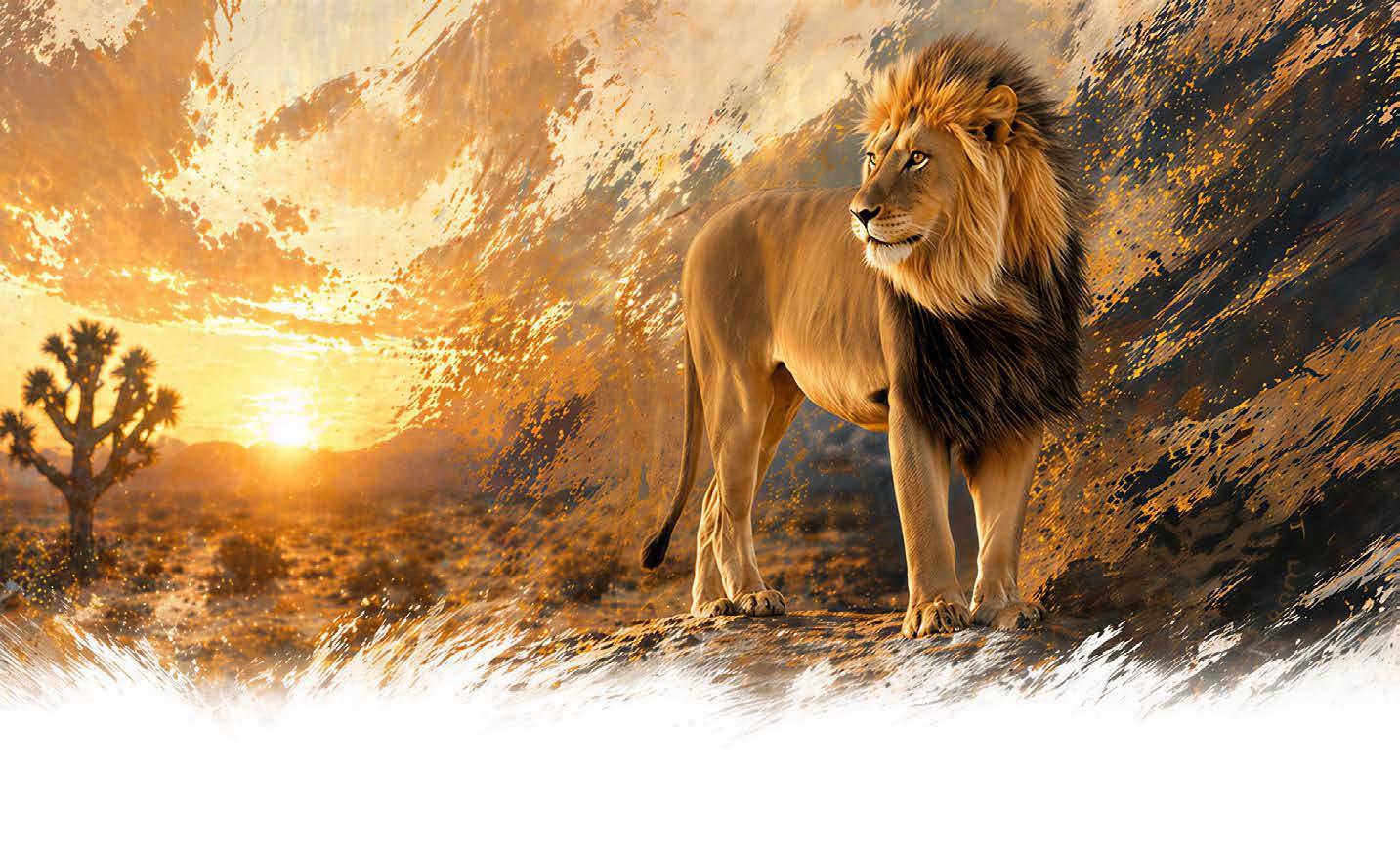
Pg 18 African Lion
Pg 22 Spring Has Sprung
Pg 24 Finding a Heart of Gold
Pg 28 Events
Pg 31 The Power of Prayer
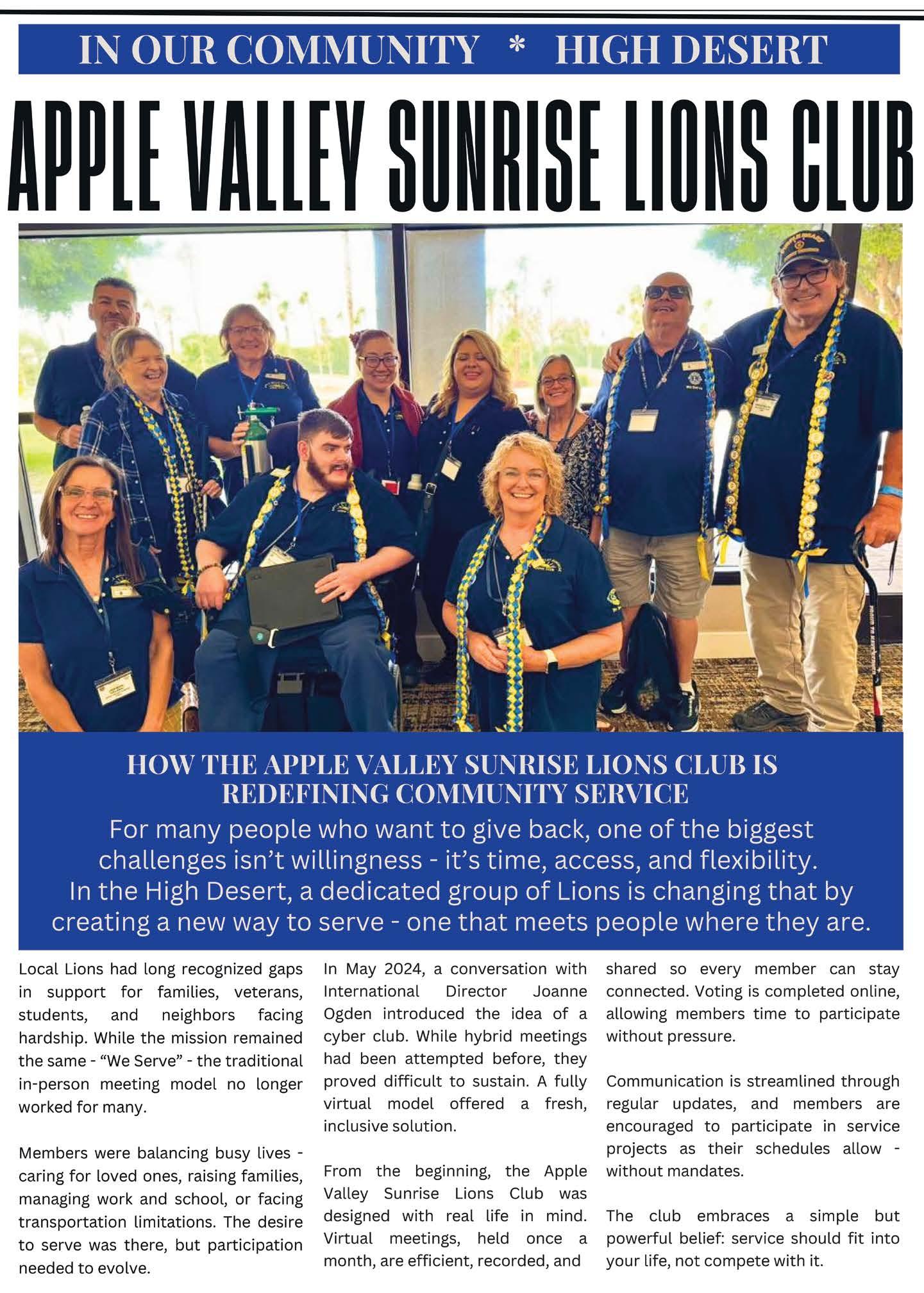
BUILDING ON THAT VISION, THE APPLE VALLEY SUNRISE LIONS CLUB CONTINUES TO GROW
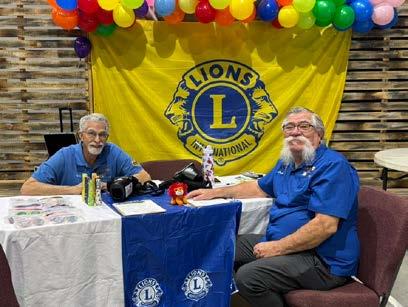
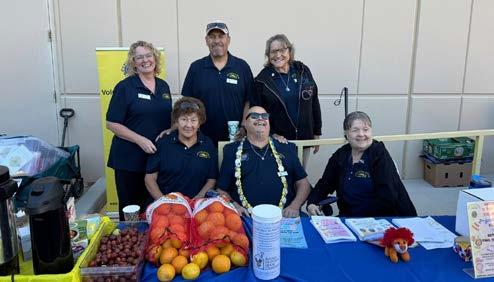
As the Apple Valley Sunrise Lions Club continues to grow, so does its impact across the High Desert Built on the belief that service happens one act at a time, the club focuses on meaningful , hands-on support where it ’s needed most Members contribute in ways that fit their liveswhether leading a project , volunteering at an event , or helping where needed most
Service runs deep within the organization, with Marcus Rollins serving as Treasurer alongside his family, including his son Matthew Together with a dedicated leadership team, they reflect the spirit of service, connection, and community that defines the club
Projects include vision screenings, eyeglass recycling, and KidSight programs for children, along with food drives, environmental cleanups, and outreach supporting veterans, seniors, and individuals with disabilities
The club also partners with local schools, nonprofits, and community organizations to respond to real needs and create lasting impact
There are no strict attendance requirements, yet every member is supported in staying connected through simple, consistent communication, including monthly virtual meetings, shared updates, and flexible participation opportunities
Members stay connected not only through service, but through genuine relationships - supporting one another, celebrating milestones, and showing up in ways that matter
Today, the Apple Valley Sunrise Lions Club continues to grow as one of the district ’s largest clubs, proving that service can evolve while staying true to its mission
Vision, Hunger, Diabetes
Childhood Cancer and Mental Health
Veterans and Community Outreach
Youth and School Programs
Environmental Efforts
By removing barriers and focusing on flexibility, the club has created a model that is accessible, sustainable, and meaningful - allowing more people than ever to stay connected and give back
That sense of connection extends beyond projects - creating a club where members feel supported, valued, and part of something bigger than themselves
2026 Club Leadership
Leighanne Callaway - President
Shellie Callaway - Vice President
Donna Rollins - Secretary
Marcus Rollins - Treasurer
Gabriela Garcia - North Citrus Zone B Chair
Leslie Toon - Membership Chair
Abigail Rollins - Marketing
Carol Shugard - Sunshine Chair
“Lions serve not by being everywhere at once, but by doing what we can, where we are, with heart and purpose ”
Marcy’s Musings
A Step Back in Time in Lucerne Valley
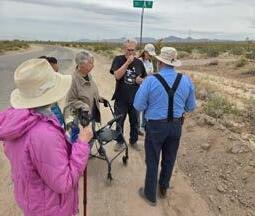
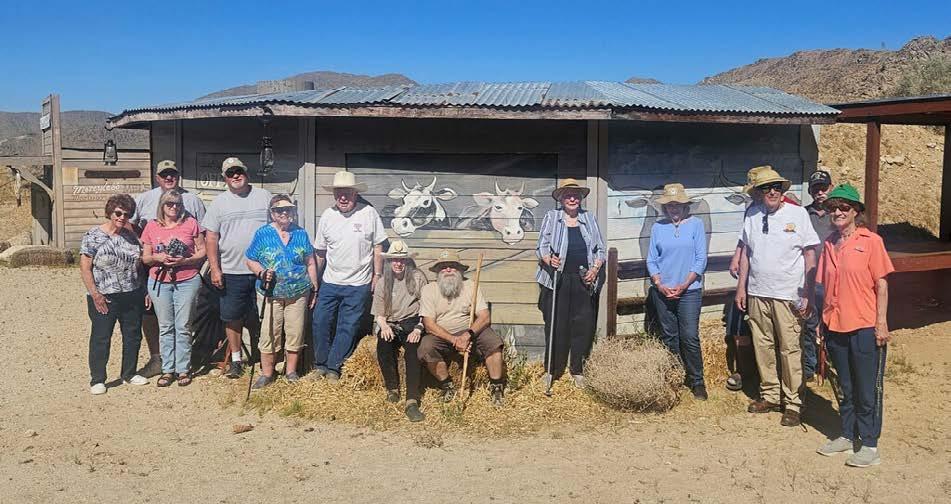
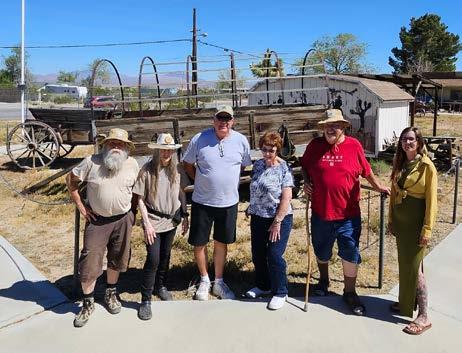
WHO KNEW THAT OUR FEBRUARY and March 2026 fieldtrips, taking place in what should have been winter and early spring, would have ninety plus degree August-like weather? So on our Lucerne Valley adventure we got to experience what the cowboys, miners, and ranchers would have endured in the days before air conditioning.
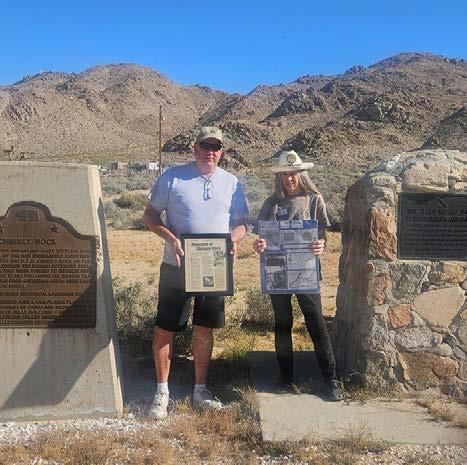
At our first stop, the two Chimney Rock monuments at the intersection of Highway 18 and Rabbit Springs Road, 14 MHS members and guests met up with 2 members of the Double R Bar Regulators. We went back in time to February 16, 1867, the date of the last battle between white immigrant settlers and Native Americans (Paiute and Chemehuevi) over the rich lands of the San Bernardino Mountains. California State Historic Landmark 737 commemorates the event. The actual Chimney Rock formation is located just west of the monument above Rabbit Dry
Lake.
Member Bob Cambridge shared a Feb. 15, 1991, newspaper article documenting a former MHS trip to Chimney Rock. It references three active historians at the time, John Swisher leading the trip, speaker Ellsworth Sylvester, and first MHS President Carl Cambridge, Bob's great grandfather. Several Native American women and children survived the massacre by hiding in a cave in the rocks. Maria Chapuli, at the time a young Chemehuevi girl, is now buried in the Victor Valley Cemetery, with another historical marker designating her gravesite.
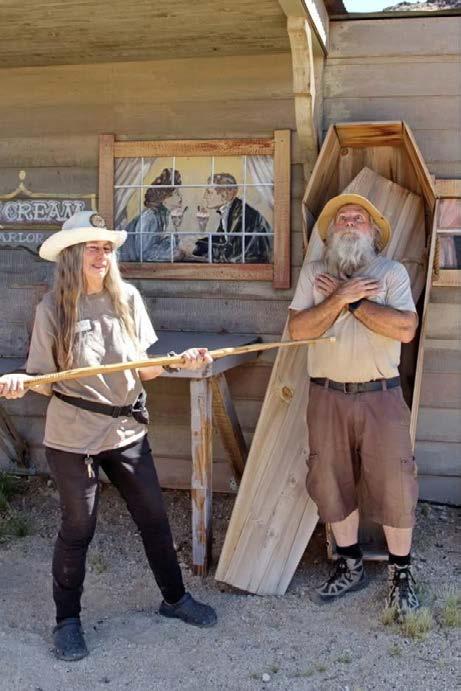
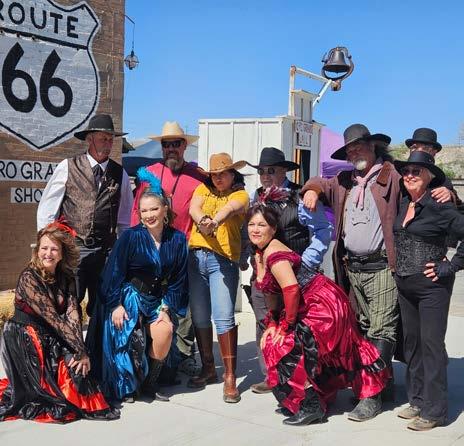
Our second stop, the Double R Bar Regulators' Western Town, again took us back to the 1800s era, when cowboys and shady ladies ruled the Wild West. Jack Thompkins, better known as Five Jacks, shared the history of the town, home of the local Single Action Shooting Society (SASS) started thirty years ago by Dusty Rogers and Ken Drylie. The large number of buildings that line the main street are full of intricate details that make the town come alive. Check out the Grand Hotel, Leather Shop, Museum, MM Bookers Emporium, the Silversmith, the Ice Cream Parlor, and more. Visitors can easily imagine the card playing, drinking, and dancing that went on within these walls. There's a reason this town has been labeled "the finest example of a SASS cowboy town in Southern California."
Stop 3 took us to the Lucerne Valley Historical Society Outdoor Museum. We were met by President Chelsea LaGrange
who took us on a walk-through, pointing out the date and use of all kinds of interesting vintage machines and pieces of equipment. We saw ore cars, bombs, the old jail, and the train track just waiting for the train car to be delivered from Mitshubshi Cement.
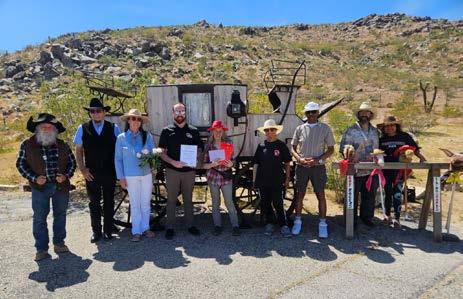
Thanks to Jack and his sidekicks, and Chelsea and Rusty LaGrange, for an informative day. Even after four or five fieldtrips to Lucerne Valley, we have barely scratched the surface of all the exciting and unusual places to visit. Looks like another future adventure may be on the horizon. v
Apple Valley's History Preserved
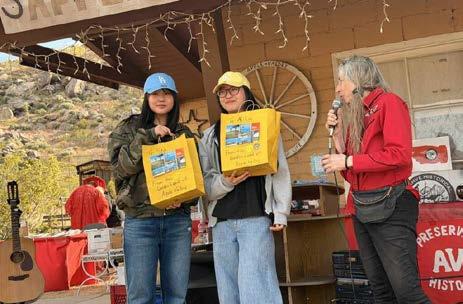
ON THE WEEKEND of March 27, 28, and 29, over 60 volunteers and supporters of the Apple Valley Legacy Museum celebrated eleven years of sharing local history at the old Bob Hope Cottage #153 at the Historic Apple Valley Inn. In addition to museum visits, a chance to buy event tickets and bid on a silent auction item, Day 1 included a special presentation by Sam Shoup, Constituent Services Director for San Bernardino County First District Supervisor Col. Paul Cook.
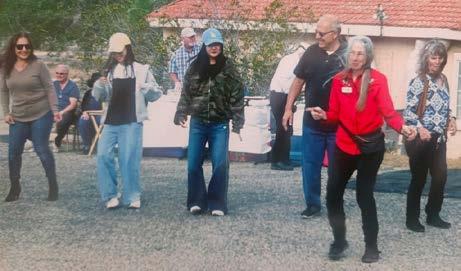
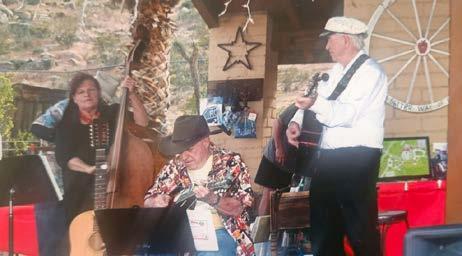
The main event on a warm but windy Saturday evening featured several live musical performances, participatory line dancing, a meal, a skit, and a chance to visit with old friends or make some new ones. As Cheryl Rogers was welcoming guests and thanking the sponsors and volunteers,
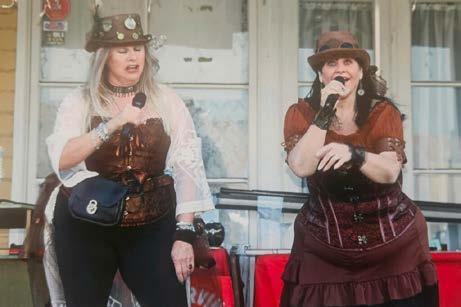
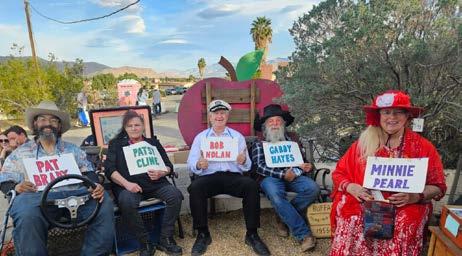
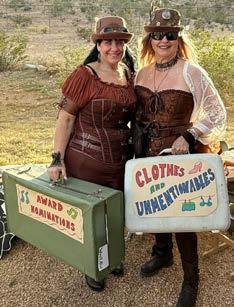
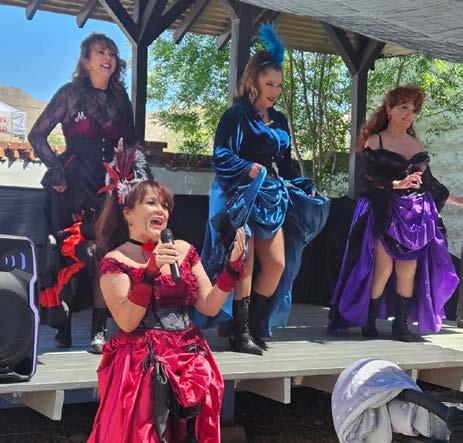
suddenly a number of wellknown celebrities including Minnie Pearl, Patsy Cline, Gabby Hayes, and Pat Brady driving good old Nelly Belle, came bursting in, full of excitement to see the up and coming duo known as Mystic Rose. Making their grand entrance to "On the Road Again," and toting two heavy suitcases (one for their clothes and "unmentionables" and the other packed full of award nominations) they were ready to rock and roll with "Fee Fi Fo Fum, Hello Baby, you're the One!" and other original tunes.
Well, that was quite an upbeat show!
But the evening wasn't over yet. With Councilwoman Kari Leon drawing the numbers, nine lucky raffle winners came up to claim their prizes. And last by not least, as is tradition, Roy Rogers' nephew David Odell joined us for the sing-along, ending with Dale Evans' well-known song "Happy Trails."
We are grateful for the numerous organizations and sponsors who supported us with monetary and in-kind donations, including the Apple Valley Town Council and the Military Officers of America Association. A great big thankyou goes out to the Mohahve Historical Society members, talented musicians, and community volunteers who contributed to what we hope is another successful year of preserving and sharing our history with locals and travelers alike. Stop by any time. We are open seven days a week. v
Round-up at the Cross-Eyed Cow
THERE WAS NO SHORTAGE of Old West style entertainment Saturday April 11 in the historic railroad and Route 66 town of Oro Grande. Yep, it was the annual Round-up, kicked off by the Sunsetters of Silver Lakes Car Show. You know this year, 2026, small towns across all eight states and 2448 miles of highway will be celebrating America's Car Culture, during the Centennial of the Route 66, AKA the Mother Road, AKA National Old Trails Highway, AKA Will Rogers Highway. And what a sight to behold, as a long line of shiny antique and classic cars pulled up to
impress the visitors. Who knew that a hot chick driving a red convertible would outdo most of the men. You go, Girl!
Meanwhile, the sponsoring Cross-Eyed Cow Pizza Restaurant rounded up some exciting entertainment: the "Daring Dames of Tease" for two exciting shows; the "Oro Grande Pistoleros," who shot most everybody in town (twice); and the "Calico Marshalls," inviting folks to challenge them in a game of "Are you faster than a Marshall?" Between shows guests could enjoy the music of popular tune-spinner DJ Kev Dog, AKA Kevin Williams, visit the many vendors who lined the highway,
enjoy the best pizza in the High Desert, or just mosey around talking and enjoying themselves.
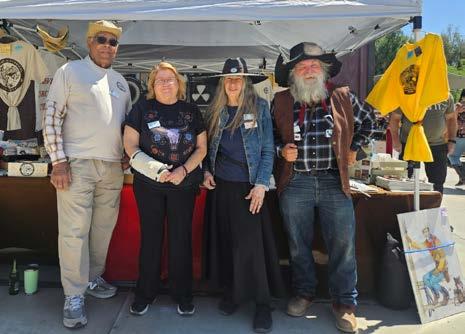
The combined Mohahve Historical Society, Apple Valley and Victor Valley Legacy Museums, and California Route 66 Association booth offered books, posters, and other items commemorating the Route 66 and local history. Some happy collectors took home memorabilia honoring High Desert residents Roy Rogers and Dale Evans.
Thanks to all of the people who came together to make another memorable Oro Grande Round-up possible. If you haven't
already, make plans to "Get Your Kicks" by driving all or part of the historic road that is such an important part of Americana. v
Celebrating 50 Years - Black History Month
FEBRUARY BECAME OFFICIALLY recognized as Black History Month in 1976, America's Bicentennial year. President Gerald Ford extended the previous weeklong celebration of Negro History Week to a full month, urging Americans to recognize often neglected contributions of Black American citizens.
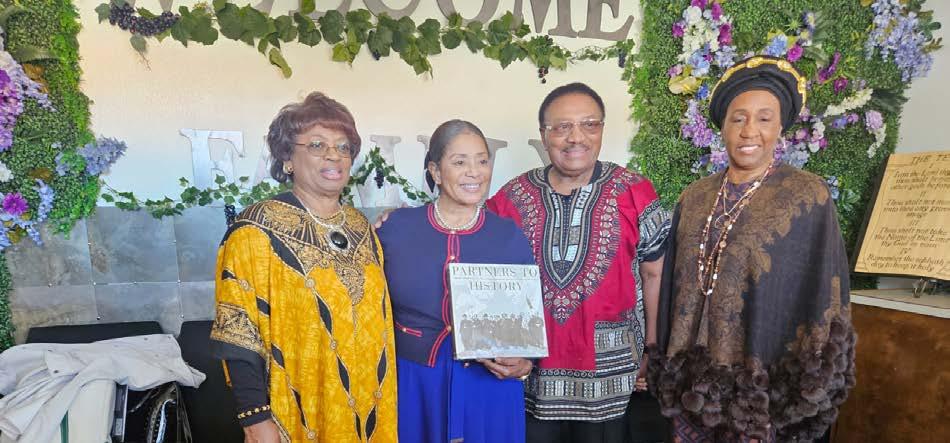
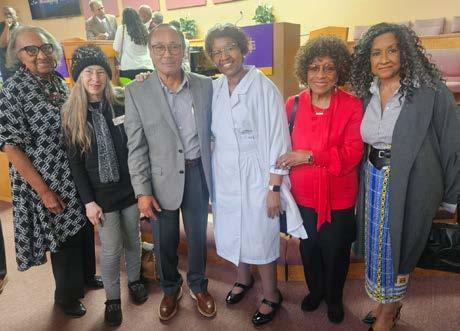
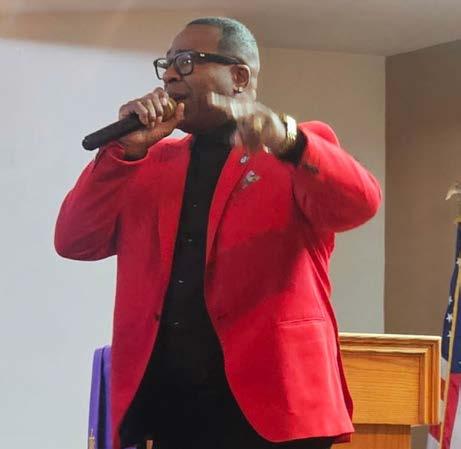
There was no shortage of events to attend during 2026's shortest month of the year with the most holidays. On Sunday February 22, many church members and invited guests attended the "Do You Know Your Community Leaders?" celebration hosted by Julia Chambers at Emmanuel Temple CME Church on Stoddard Wells Road in Victorville. Members Bill and Terry Thomas, former NAACP President and Secretary, served as Masters of Ceremony to introduce Pastor James E. Markham, two guest ministers, the CME Praise Singers, and Speakers Percy Weather and James Campbell. A number of community leaders also introduced themselves and shared their civic roles and responsibilities.
The same weekend community leader Barbara James, "High Desert Inland Valley News" Editor, hosted an event at Showers of Blessings Faith Center on Green Tree Blvd., also in Victorville. Entitled "Our Past Inspires Our Future," the program included musical selections, inspirational words, poetry, and community awards.
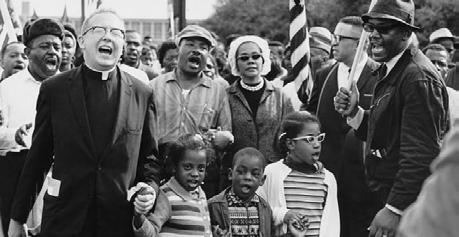
Attendees had the privilege of hearing dynamic public speaker, actress, author, and Civil Rights leader Donzaleigh Abernathy, daughter of Ralph and Juanita Abernathy. Her father, along with Dr. Martin Luther King, Jr., spearheaded the Civil Rights movement. She, in turn, has dedicated her life to advancing justice, education, and the arts.
The audience listened spellbound as Ms. Abernathy relayed her first person accounts of events. While still in her mother's womb, she felt the explosion on January 10, 1957, as the KKK bombed her house. Her father's nearby church and other sites were bombed as well, following the success of the Montgomery
Bus Boycott, that ended segregation on city busses. Her numerous slides of the events that happened during her childhood painted a clear picture of the struggle many endured to extend civil rights to the generations who followed.
A sincere thank you goes out to both Barbara James and Julia Chambers, for hosting these two important events, and to all others who participated, in sharing an important message with High Desert residents on the 50th Anniversary of Black History Month. v
A Gift of Gold Part 2
By J.P. Garner
“OUR BOOSTER PROGRAM wouldn't be successful without two things.”
The statement quiets everyone at the conference table in the backroom at the Canton. Suzanne Krishna, a long-time member of the Booster Club, glances around the cir-cular table at the other four women in attendance, expecting someone to ask what? When no one says anything, she continues.
“One … the coaches. Especially Coach Clay who loves the Booster Club and what we do. If we didn't have his support, which made the coaches support us, it would have been very hard for us to do what we did for the kids this season.”
She pauses, thinking back perhaps at the season that ended on December 12, 2025, with a resounding win over Sutter High School in the state championship game; the afterglow of which has spilled over into 2026. A couple of women, thinking back as well, nod their heads in agreement, which is enough for Suzanne to push on. “And then the second thing,” she announces, “is Coach Clay's wife.”
With her righthand, she indicates the woman on the other side of Adrian Herrera, the team photographer who is seated next to me. I first met her in the Victor Valley
game’s last minute when I was injured and seated in a folding chair at the back of an end zone, dictating the action into my phone. She asked me if I needed help getting to my car. I laughed lightly. Did I look that disabled? The inquiry conjured up an image of two football players transporting me to my Kia, and I replied, “No … but thank you.”
The thing that stayed with me, however, was that she was sincere.
Over time, it was this aspect of her character I found to be remarkable because it so rare in our world today.
Suzanne identifies her, even though she is well known to everyone. “Miss Noelani Leleimene,” she says as if reading from the note declaring her the Oscar winner.
“ She filled the gaps. Her understanding and love for the kids—and we definitely all have that, right?—is what made our booster program so successful.”
To this short list of things that made the Barstow Football Booster Club so special in lives of the players and the community in general, I wish to add a third thing that made the outpouring of love possible: money.
Yup ... the green stuff. The moola.
That contributed to the Club by individual donors and local businesses, but mostly that earned through fundraisers of various kinds, like the Snap event conducted back in August which earned over $8,000.
Eight thousand bucks!
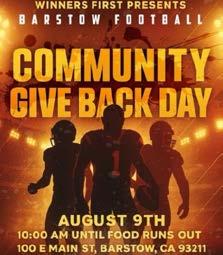
And here’s the really neat thing about the money that goes into the Boosters, it all comes out in support of the players, the program, or a Community Giveback event until the food runs out.
None of it goes to salaries because no one earns a paycheck, Mrs. Leleimene explains. “[Everyone] sees us doing all these great things, and it's undeniable when you're loving on the kids, and you see the kids responding. They want to join in. I just think it's contagious. It is. And it's kind of [like] you have that mindset of, I'm not gonna turn away someone that wants to pour into the kids.”
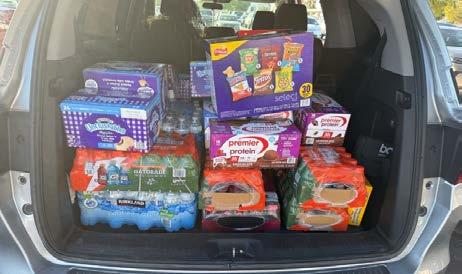
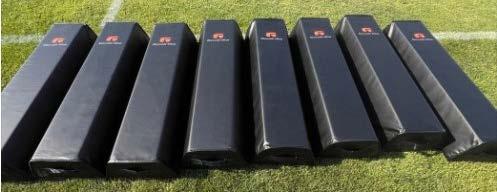
The money buys the food served at the snack bar, or monogramed t-shirts for resale, or protein packs, equipment like the blocking shields after the fundraiser examples shown below or expensive helmets and shoulder pads, or special events and prizes offered up at raffles like a weekend in Vegas.
The Barstow Football Booster Club has been around for years. Decades even. I recall it in ’91 and 92 when they prepared the pregame spaghetti meal before every home game and fed the team and cheerleaders in what’s called the café on the school map. It was just a big room, hardly a café. But the meals were good, the Boosters were super, and the players got a chance to chill before the game.
Mehgan Alvarado recalls getting meals served to the team back during COVID when they only played four games. And while it’s not a happy memory at its beginning, it has a happy ending. “We were coached so badly at the time. Coach was like, ‘I don't care what you do, just do it.’ And I was like, okay.
“So, I went around, called all the businesses, and tried to get the feedings for the four games. We got that and then the next year we expanded. We were like, let's make this a thing. We did one more year of just going around [getting donations] but every year, we grew. And we grew, and we grew, until finally, we got it to where we [were parent boosters] and got our own bank account. We were tired of going to the school about money we raised, [and asking if it was] okay if we spend it? We just didn't want to do that anymore.”
When it came to raising money, Meghan explained that they had a network of local business that were very generous, and that it was simply a process of asking the right people. Her motivation for committing herself to the work of supporting the football program arose from her personal experience, from her time as an Aztec. “I had the best time in high school,” she declared with a smile. “I wanted my kids to have these mem-ories. So, I was like, I want you guys to have the game day feeding, so I want you guys to have [meals after] the Wednesday night practices.”
Examples of equipment purchased from fundraising
Memories ... that’s what yearbooks are about. So is this book. Cherished times captured in photos and spirited narratives about
people, times, and places. Events that, to the outside world, held little meaning, but to those involved were priceless mile markers in a journey that was, perhaps, for many, the most formative and carefree four years of their life.
“Be excellent,” Bill and Ted advised us. And if you can’t, be BAD! I mean, how can we forget Ferris Bueller’s prophetic defense for skipping a day at school? "Life moves pretty fast. If you don't stop and look around once in a while, you could miss it." It’s so true that time speeds past those who aren’t looking. That was Meghan’s motivation. To capture time. To preserve it, in a manner of speaking. “I wanted [the kids] to look back and see their memories in high school.”
But the 30-day feeding during the play-offs? That’s a different kind of fundraising in the sense that’s it’s not money being asked for but food. Food that’s been cooked and is capable of being served like a pregame meal every day of the week leading up to the state CG. It was an audacious proposal, but was—in its execution—wonderfully script-ed.
When asked who thought of that, Meghan, the unofficial club historian, smiles demurely and replies. “I don’t know. I think it was just something that we [had] imple-mented in the past when we did CIF, so [the thinking] was [let’s] just do it every single night. We did it with CIF the year before. So, let's do it again.
“Did we pretend that we're gonna go to the state championship? Of course! But to do it every single night, every weekend after we won our [last regular season game,] had us on the phone after every Friday night game [during the playoffs.]. Let's go! Let's hurry up and get that Monday feeding.
“So, we're trying to get the Monday feeding, and I felt so confident. We also did it during the government shutdown. Because a lot of our kids were affected by EBT and Snap benefits. So, we added extra feedings then as well because these kids were hungry”
Kids and food. It’s such a natural pairing. Who doesn’t melt at the sight of a hungry kid. That the Boosters took on this challenge, coupled with the people and businesses of Barstow who stepped up mightily in support of this magnificent endeavor speaks highly of the Little City with a Big Heart.
Philanthropy is a common practice in our town.
But feeding the football team was a targeted event. It was not simply meant to provide food to the players and whoever else was hungry, but was a very public out-pouring of the town’s people’s love of the team. Money donations most often paid for much needed supplies and equipment. But those after-practice and weekend meals, however, most often prepared in family kitchens and in large quantities, were not simply donations of time and food, but were, because of the love that came with them, gifts of gold. v
Senior Care Professionals
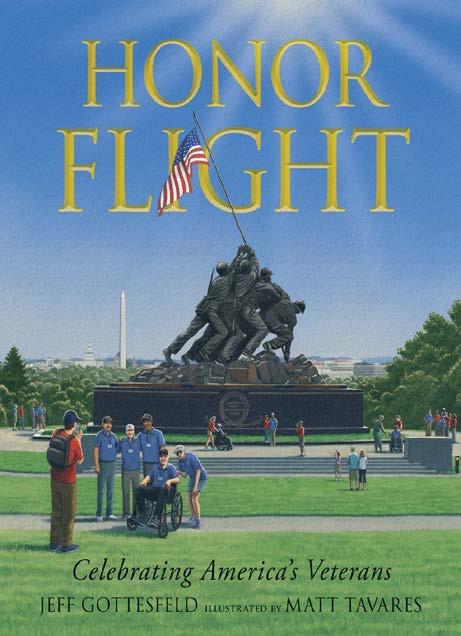
Honor Flight A Story of Service Memory and Meaning
By Tiffanie Nicole | Pulse Media
THERE ARE STORIES that educate and then there are stories that stay with you long after the final page. Honor Flight Celebrating America’s Veterans does both, bringing readers into a deeply personal experience while reflecting something larger the collective memory of a nation and the responsibility to never forget those who served.
Author Jeff Gottesfeld did not initially set out to tell this story. It found him. After the success of his previous work, he began hearing from aging veterans about the Honor Flight Network, a program he had never encountered before. What he discovered was powerful. A mission built on ensuring veterans, many of whom never received a proper welcome home, are honored in a way that restores dignity and recognition. For Gottesfeld, the timing mattered. These stories could not wait. Veterans from earlier eras, especially those who served during Vietnam, are aging, and many carried the weight of service without acknowledgment. This book became a way to ensure their experiences are not lost.
Telling the story in first person was intentional. By removing a specific name from the narrator, the voice becomes universal, allowing any reader to step into that experience. It creates an emotional connection, especially for younger readers, who are able to feel rather than simply observe. That connection is what sets this book apart.
Gottesfeld experienced an Honor Flight himself as a guardian in 2023. What stayed with him was both the energy and the stillness. The constant conversation among veterans, the stories shared, the sense of connection, followed by the quiet at the memorials where reflection takes over. He describes it as loud and silent at the same time. For many veterans, the greatest fear is not death but being forgotten. That idea is central to the story. Honor Flight does not restore youth or erase hardship, but it restores recognition. It reminds veterans that their service mattered.
While the book is geared toward younger readers, its message reaches far beyond that audience. Today’s generation is growing up with strong values of kindness and acceptance, but service, sacrifice, honor, and responsibility must also remain part of that foundation. These are not outdated ideals. They are essential ones. Among the memorials featured, the Vietnam Veterans Memorial stands out for its deeply personal connection. Gottesfeld chose to observe from a distance, allowing
veterans to experience those moments on their own. It was not his experience to take. It was theirs to live.
The book also addresses a difficult truth that many veterans did not receive the welcome home they deserved. Some were met with silence, others with criticism. Gottesfeld approaches this with care, allowing the emotional weight to come through in a way that resonates across generations. One of the most powerful elements of the story is its multigenerational impact. Children are part of the narrative, writing letters and participating in homecomings, showing that honoring veterans is something that must be carried forward.
Authenticity was critical in shaping the book. Gottesfeld spent time researching, listening, and experiencing Honor Flight firsthand. That experience brought a level of truth that cannot be replicated from a distance. His collaboration with illustrator Matt Tavares adds another layer, bringing the story to life with visuals that are both specific and emotionally grounded. Together, the words and images create something that resonates on multiple levels.
For families reading this book together, the takeaway is clear. A deeper appreciation for veterans, a stronger understanding of history, and a reminder of the role each community plays in honoring those who served. For veterans, the message is even more direct. You are not forgotten. Looking ahead, Gottesfeld continues to focus on stories of service and American life, including an upcoming work centered on military families. When asked what communities can do better, his answer was simple. Support veterans not just through systems but through visible acts of recognition. Even something as simple as flying the American flag on key days can carry powerful meaning.
Because for those who served, being seen matters. And through stories like this, that visibility continues. v
The Christian Way
AHAND UP, NOT A HANDOUT.
That’s their motto. They live it every day, and they kinda preach it too. Opened in 1999, New Hope Village of Barstow “. . . provides safe, affordable housing for motivated individuals and families in need, including those who are homeless, to gain selfsufficiency.”
Self-sufficiency. That’s a big word that means to stand on your own two feet, and deal with life and all that comes with it. The good and the bad . . . and everything in between. To do more than survive. But to prosper
That’s what their vision is for the downon-their-luck people who come to them, to create a place, “. . . . where individuals and families have the resources and skills needed to lead stable, fulfilling lives. We aspire to create an environment where our alumni thrive, using the support and training they received to build new lives filled with hope and opportunity.”
But sometimes the Village is the one needing help. Like on April 18th.
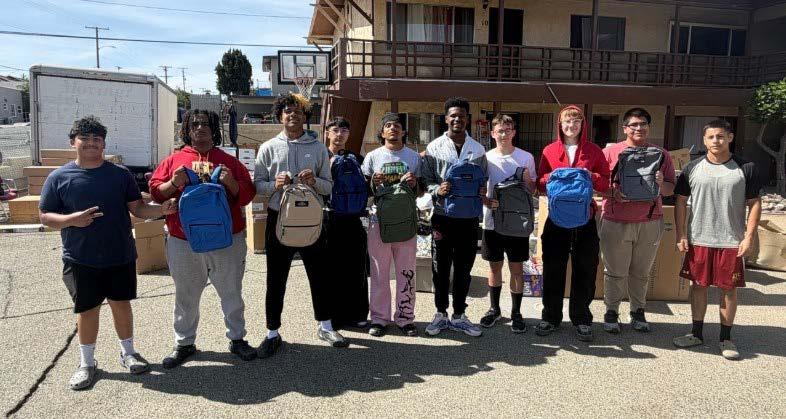
“I learned about the challenges at New Hope Village through our mayor,” John “Tex” Williams explained. Tex, as he’s called by his constituents, is the City Councilman representing District 4. He’s not one to pass the buck. “And I made a call to Coach Leleimene—the head football coach at Barstow High School— and Leonard Williams, the school board President.
”With the mayor’s leadership and Coach Leleimene’s heart . . . our student-athletes stepped up and committed themselves to helping others in need.”
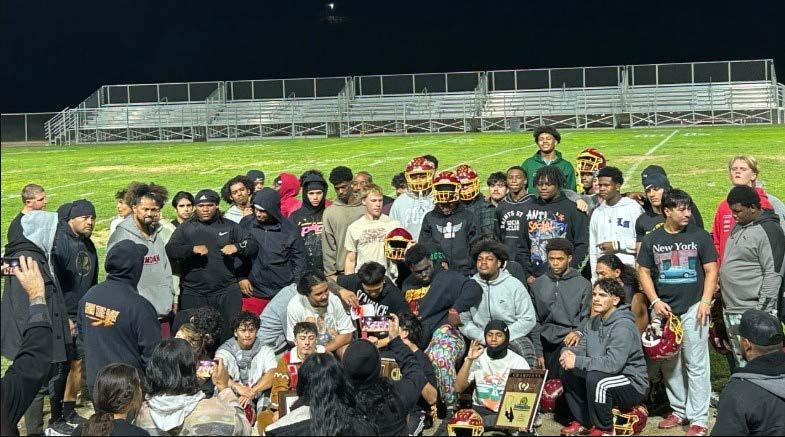
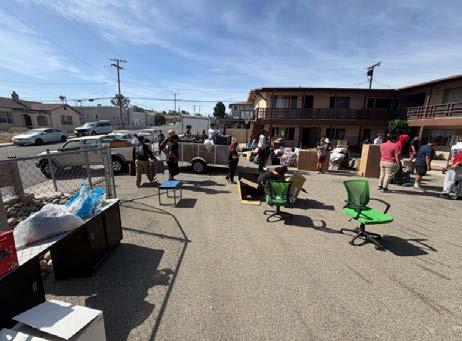
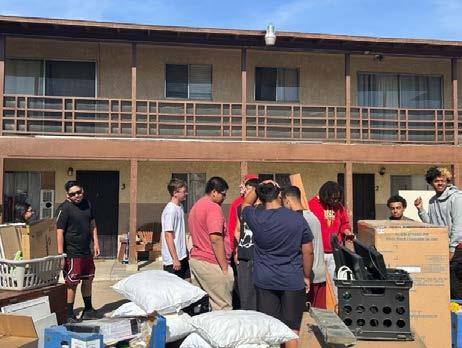
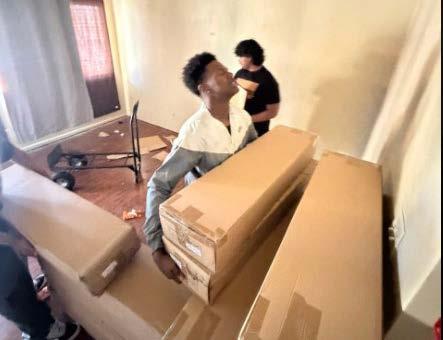
Student-athletes . . . kids—or young men if you will—who, last year, won a state championship in football. The first in the high desert. According to a Booster Club announcement, “ . . . the team volunteered their time. . , helping move furniture and support the community. What could have taken two full days to complete … they knocked out in just three hours.”
Three hours. It takes me that long to wake up.
By J.P. Garner
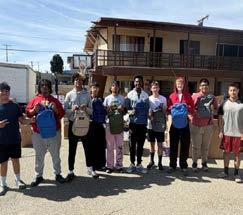
“We had a strong group of about 25 to 30 young men come out ready to work and serve. Our Booster Club moms also assisted with transportation,” Coach Leleimene said.
When asked why, Coach Leleimene proudly explained that “We’re big on teaching our guys that [life is] bigger than football. Our community shows up for us every Thursday afternoon and Friday night, so it’s our responsibility to show up for them when it matters.
“When we heard someone in our community needed help, it wasn’t even a question, we were going to make an impact.”
Councilman Willliams added that “ we are building a family rooted in trust and love . . . a love for our city and our people.”
But for the football team, this volunteer project was simply an extension of the faith they displayed on football fields every Friday night last season. Faith, family and football were the three things that inspired their efforts enroute to winning a state championship. It was no different helping a community program that helps those in need.
“Our faith,” Coach Leleimene explained, “ is about serving with humility and love in action. We talk to our players all the time about being servants first by putting others before ourselves. This was just us living that out. Not just talking about it but walking it.”
Servants first. What a concept in our world now.
“The goal was simple,” Coach Leleimene said in closing. “Be a blessing. Move what needed to be moved, lighten the load, and let someone in our community know they’re not alone.”
Lighten the load. Isn’t that what the Good Samaritan did? Isn’t that the Christian way? v
African Lion Spotted in Amboy Was a Cool Cat on Route 66
By Jaylyn And John Earl www.thedesertway.com
YOU MAY BE FAMILIAR
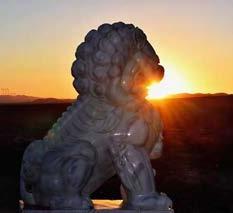
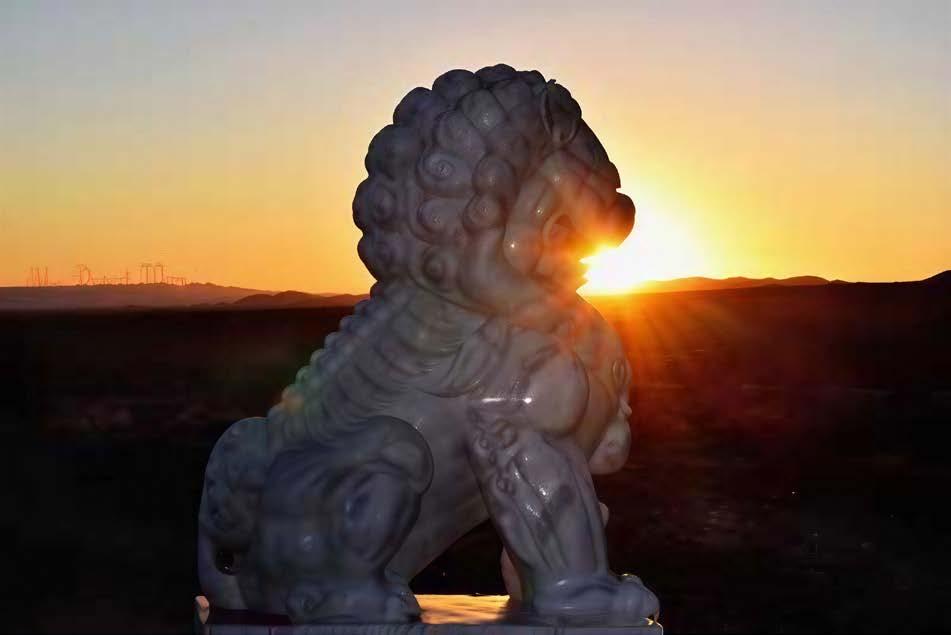
with the large marble Chinese Guardian Lion statues between Route 66 and Kelbaker Road but did you know Amboy may have once had its very own living African lion?
“Old Man Miller,” as he was known in the Amboy area, was the first person to spot a large African lion near a running spring located close to his cabin west of Amboy according to The Colton Courier, on June 9, 1959. Miller ran to his cabin, retrieved his shotgun and fired. He missed and the lion sprinted away with a roar.
Deputy Charles E. Jones responded to the sighting. Miller told the deputy, “It wasn’t a mountain lion, it was a real cool African cat with a shaggy mane.” Instead of wondering if Old Man Miller was hitting the bottle a little too hard, Deputy Jones revealed an African lion had indeed escaped from a circus in the area two weeks before.
On June 15, 1959, The San Bernardino County Sun said the deputies at headquarters laughed when desert deputy Charley Jones sent in word he was going lion hunting after taking a report from Mr. Miller near Bagdad. They said Jones had been solitary under the hot sun for too long. They stopped kidding when they were informed an African lion running westward was reported by Edward Mosell
in Phelan on the evening of June 10.
By June 18, 1959, The Desert Dispatch ran an article titled Real African Lion in the Desert, confirming the existence of the beast and called upon lion hunters. It claimed the Barstow Sheriff’s Department had received three different reports that a lion with long hair on its back and a long tail was roaming the desert in the Amboy area. The lion had escaped from an overturned circus truck on U.S. Highway 66.
The fugitive lion continued to make it into newspapers all around America. Flashy headlines about an African lion in Amboy continued to grab attention nationwide.
The Cincinnati Enquirer on June 27, 1959 reported the lion was roaming the lava beds and arid wastelands of the Mojave Desert. According to the article, the lion was showing up regularly, much to the consternation of miners, homesteaders and travelers on U.S. Highway 66.
It was believed the lion had survived on a steady diet of desert jackrabbits but was looking thin with his ribs protruding from his spartan diet. There were no ranches in the area, and no reports of loss of sheep or goats had been reported. The favorite food of an African lion in its natural habitat is wildebeests, a species of antelope also called gnus, followed by zebras and occasionally buffalo or giraffes.
The worry was that the 120F heat
would force the lion into populated areas in search of water. The lion had been spotted four times in the past six days. African lions can adapt to a wide range of habitats, including semi-arid deserts and very dry habitats. Some residents claimed they attempted to shoot the wayward lion, but always missed.
On July 9, 1959, The San Bernardino County Sun reported the lion roaming the Mojave Desert near Bagdad was more elusive than the lion hunters who pursued it. One hunter, a Norton Air Force Base employee, Norman E. (Mike) Macy of Yucaipa, and his “safari” buddy, Yucaipa jeweler Harold Rouse, were camped outside near the cabin of “Pop” Miller, near Bagdad, where the lion was first spotted.
The pair had spent a ferociously hot day in vain searching for the lion and were weary. Suddenly, they heard a hair-raising roar come from the area of the nearby spring. As soon as they aimed a spotlight into the darkness toward the noise, the lion fled down the canyon yowling in indignation all the way. He vanished like a ghost in the darkness. They both scoured the canyon at daybreak but found no signs of the lion; no prints, no hair, no scat. It didn’t dim their resolve though, and they planned to return.
The article went on to say that possible African lion pawprints had been found
southwest of Kelso, about 25 miles north of Bagdad. The lion had also been been reportedly been seen near Phelan, about 100 miles from the Bagdad-Kelso area. In the wild, a lion’s territory can range from 19.3 to 386 square miles depending on the availability of prey and water.
On the same day, the Desert Dispatch ran a piece about Ernest Nies, Fish and Game Warden in Barstow, discussing the ethics of killing the Mojave Desert’s African lion He rallied against it by clarifying the African lion was not on the hunting regulatory list of predatory animals that could be hunted in California at any time. He stressed that only a heavy bore gun could take a lion down, and a wounded lion roaming in the desert could be especially dangerous.
Nies said since the circus owned the lion, it was considered private property as it had likely been purchased for $1,000 dollars (equivalent to $10,000 dollars in 2025). He recalled there had been similar stories about big cat sightings several years earlier about a black panther in the Palm Springs area that never turned up, but added it wasn’t an impossibility.
Doug Hammon, a county rabies control officer, his son, Paul, and Thelton Brown of Newberry Springs, camped near the springs where “Pop” Mills made the original six sightings. The Hammon party located paw prints about 5″ wide and their bloodhound followed a trail for 1,500 feet. Although they did not actually see the African lion for themselves, they believed the lion was more than a flight of fancy. In the meantime, the dispatch office continued to receive excited calls from hunters about “safari” expeditions.
The article closed with Captain A.G. Strom, Chief of the Barstow Branch of the California Highway Patrol, stating his office had no official record of an accident
last Spring in the Amboy area in which a circus vehicle was involved. According to hearsay, stated the Captain, there was a breakdown of a sideshow truck near Essex, 34 miles from Amboy, which two lions escaped from. Rumor had it, said Strom, that the show people killed one of the lions and the other escaped, however no official report was ever made to the Highway Patrol.
According to the Desert Dispatch on July 14, 1959, stories of an African lion roaming the Mojave Desert had created a tremendous roar from coast to coast. Although some Amboy residents didn’t believe the king of the jungle existed, the rest of the nation had been stirred by reports of the savage beast. The Barstow Sheriff’s Substation had recently been flooded with telephone calls and letters offering advice and assistance.
Sergeant Robert Lorimer, commander of the local station, stated he received letters as far away as New York, Atlanta, Georgia and Lewiston, Idaho. An angry lady from Atlanta wrote he should be ashamed for wanting to shoot a poor, harmless, blueeyed lion then added a few threats of her own for good measure. A San Francisco man volunteered to organize a safari to capture the lion for a zoo. A professional lion tamer from Long Beach also tossed his hat into the ring. Parker, Arizona’s Chamber of Commerce contacted the Desert Dispatch with an open letter to the public in the desert area of Amboy offering to send its finest marksmen, hunters, cowboys and trappers of the West. It was signed by James A. Loder, president of the Parker Chamber. While filming Jules Verne’s Journey to the Center of the Earth at Amboy Crater, movie stars Pat Boone, Arlene Dahl and James Mason had to be protected with
armed guards against the possibility of a lion attack. The Chamber letter promised to return the peace, quiet and enjoyment of the desert as soon as possible.
So enamoured with the King of the Beasts’ coddiwomple, Barstow’s Lion Club offered him an honorary membership. On July 16, 1959, the Desert Dispatch reported Lion Club members met at the Katz Cafe and voted to let the African lion join their local chapter because they felt sorry for any lion who didn’t have friends. They declared the homesteading lion had chosen an area far away from other understanding lions. They joked if the lion did not attend regular meetings he would find himself on all the volunteer lists. At the time there were a million Lion members and clubs met on every continent, in more than 45 countries and in 49 states.
On July 20, 1960, the San Bernardino County Sun featured an article about county rabies control officer, Dudley A. Hamman, packing up his 30-40 Springfield rifle and taking along some high powered soft nose shells for a lion hunt. (Note: Another newspaper had spelled his name, Doug.) But it wasn’t an escaped African lion from a circus he sought. Hammon was after the “Mojave Marauder” of Kelso fame, who was a large mountain lion. Resident deputy Charley Jones and Amboy’s Roy Crowl had spotted him from a plane. Hamman believed it was the same shaggy lion “Pop” Miller first spotted over a year before. Miller had recently spotted it again drinking from his spring. Hamman hoped to bag a trophy later that day.
So did an African lion really roam the Mojave Desert? Some contrarians may argue the desert floor is so flat you can watch your dog run away for two weeks, but those more knowledgeable admit the desert has her secrets and landforms.
Research didn’t turn up any additional information about this particular lion after the above dates, but we’ll leave it to your good sense and imagination to figure out its fate. If nothing else, stories about the lion brought nationwide attention to the Mojave Desert. One may think a story about African lions in America during that time period was an isolated one but it actually wasn’t rare.
While not occurring in the Mojave Desert, true tales of lion attacks in other parts of the country in 1959 planted seeds of fear and intrigue in the American psyche following Walt Disney’s release of its 1955 documentary called African Lion. It was directed by James Algar and is part of Disney’s True-Life Adventures series. The public sought escape through Hollywood. The Post-Korean War era was rich with stories of UFO sightings, eerie sci-fi movies depicting hideous, gigantic creatures and ravenous wild beasts.
According to The Daily Oklahoman on March 27, 1959, a loose lion terrified an audience of 2,000 in New York City when an 800 pound lion named Tonto escaped in Madison Square Garden during a dress rehearsal at Ringling Bros. Barnum and Bailey Circus. The beast dashed out of the garden arena into the Eighth Avenue lobby and ran toward the 50th Street entrance. He was cornered and caught. His trainer, Hans Naumann, said Tonto was not a danger to his trainers, but definitely posed a risk to the public.
On May 1, 1959, The Republican in Springfield, Massachusetts reported an enraged 450 pound circus lion named Caesar mauled his trainer, 48 year old and 4th generation lion tamer Prince El KiGordo, during the opening performance at the Meha Shrine Circus at the Eastern States Coliseum in Springfield, and nearly killed him. KiGordo insisted the show must
go on as he laid in a hospital bed writhing in agony, and it did.
On May 13, 1959, according to The Courier-Journal in Louisville, Kentucky, a 12-year old Manchester boy, Eddie Shain, climbed over a fence at the King Brothers Circus and was viciously attacked after teasing an African lion. Eddie was seriously hurt with a crushed skull and cuts but eventually recovered.
The Independent, of Long Beach, California, reported on May 17, 1959, a lion escaped from its cage in Santa Fe Springs after it jumped over a barrel, hit the side of the enclosure with its body, and the wall panel gave out. It was hard to tell whether his sudden freedom was more surprising to the lion, or to the wide-eyed audience under the rafters of the large canvas tent. When the lion saw a mob of screaming people running toward him in panic, the King of Beasts turned tail and ran back into the enclosure.
On November 1, 1959, The Daily Oklahoman said a lion attacked trainer Joel Hartman at the Ararat Shrine Circus in Kansas City. Two lions were placed in one cage while the other cage was cleaned. Both lions had been recently purchased. The trainer entered the occupied cage alone in an effort to get to know the lions better. It didn’t go well. Hartman was pinned to the floor for three minutes by one of the lions while the other looked on, suffered a punctured windpipe and multiple lacerations before he was rescued by the lion’s former owners, George and Kelly Fraser.
All that leaves us with is trivia. What? You have to have trivia!
Fact #1: The Nikon F, a popular SLR camera, was introduced in 1959 but few could afford them at $189 dollars, equal to $1,974 in 2025.
Fact #2: Hippopotamuses kill twice as
many people every year than lions.
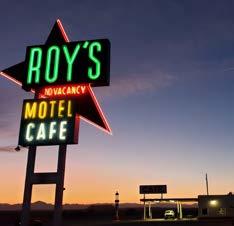
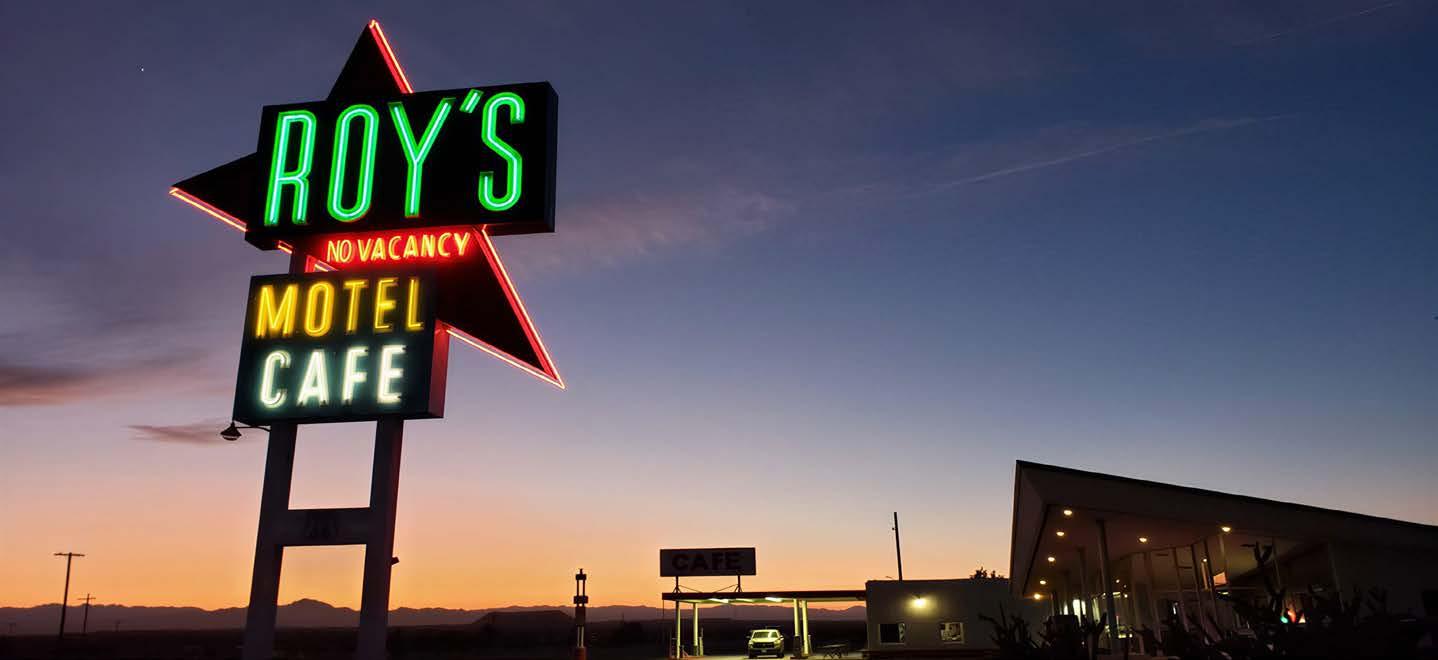
Fact #3: Roy Crowl was owner of many properties in Amboy, including the iconic Roy’s Motel and Cafe. The first church in Amboy was a vacant house owned by Roy Crowl. He donated the land for St. Raymond Catholic Church. Amboy’s economy plummeted after Interstate 40 bypassed it in 1973. The church property was returned to Crowl in 1981.
Fact #4: In 2015, a caller to the Desert Dispatch claimed to have found the body of an African lion in the desert near Fort Irwin Road. Based on photographs from a clandestine dump site where the carcass was found, Barstow Community College Professor Lynn Frazee said the remains were most likely that of a mountain lion.
Fact #5: Despite the legend that gets repeated in an echo chamber, the owners of the Chinese lion statues are known and have nothing to do with the town of Amboy or the Okura family.
The guardian lions, also known as royal foo dogs, are located in the Mojave Desert, about 400 feet south of Route 66. They are made of white marble and are about six feet tall. One of the lions has a sign-in book. The lions are not side by side but you can walk from one to the other in the distance unless it’s too hot. An air conditioned vehicle can be a lifesaver. Please remember to take only photos and leave no trace. Be a cool cat.
• Drive east from Roy’s Motel and Café on Route 66 for four miles
• Look for a real estate sign covered with graffiti
• From the sign, you should be able to see the male lion
• If you can’t see the female lion, drive another quarter mile east
• If you’re traveling west, look for the female lion just past Cadiz Summit pass Many thanks to the Press Enterprise and Joe Blackstock for the nice shout out on April 15, 2025 for our story about the Amboy African Lion! v
Resources
Mojave Desert volcano plays a variety of roles in Pat Boone movie https://www. pressenterprise.com/2025/04/14/mojavedesert-volcano-plays-a-variety-of-rolesin-pat-boone-movie/
Amboy’s Historic Mural and Monument Reveal https://www.thedesertway.com/ amboy-monument-murals/
Amboy: Where the Past Melts the Present https://www.thedesertway.com/ amboy-ca/
Amboy Cemetery: Dust in the Wind https://www.thedesertway.com/amboycemetery-ca/
Spring Has Sprung
FOR
THE COUNTLESS THOUSANDS who zoom past our area on the Interstates, there is nothing here except a baren wasteland. Hollywood helps perpetuate that image. Any time a character in a movie must cross the desert, it is always sand dunes populated by only venomous snakes and the occasional lizard. If they come across the rare human desert dweller, you can bet it will be a quirky one. Of course, nothing could be further from the truth. Okay, we do have our fair share of quirky folks.
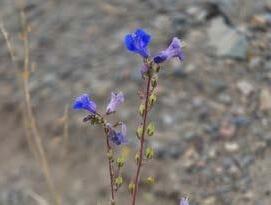
The desert has its own beauty. Especially in the spring. Even more so after a wet winter. We had some heavy rains last winter and had all hoped for a rare “super bloom” of wildflowers. Unfortunately, each storm was followed by hot weather that interfered with our wishes. Still, if you know where to look, you can see an amazing display of desert flora. We, the Newberry Springs Desert Gardeners, are fortunate to have Dave Charlton as a member.
Dave is a local resident, botanist,
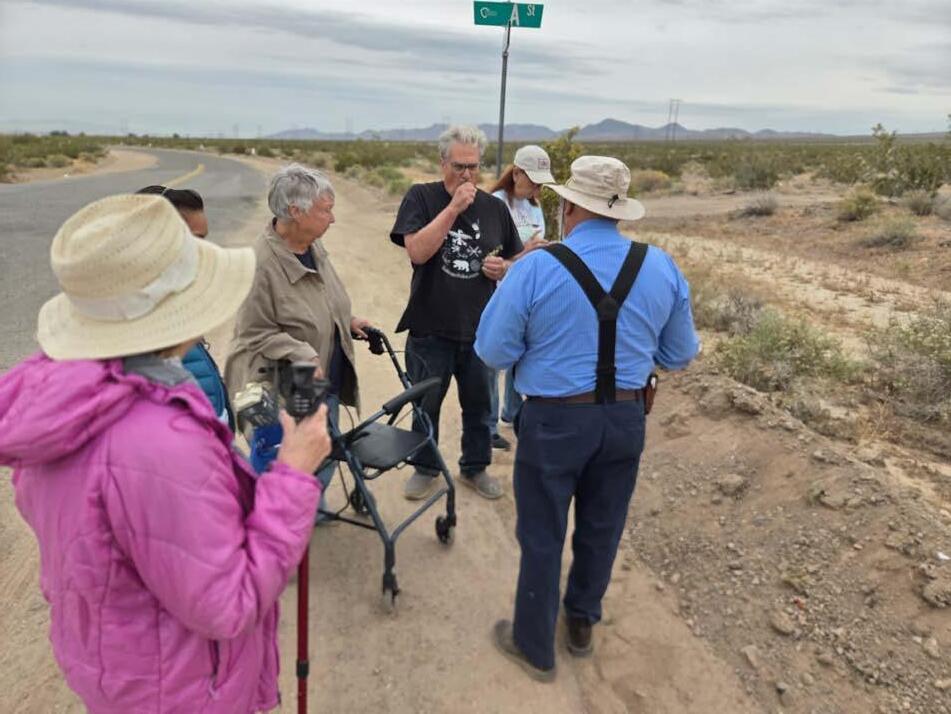
horticulturist, landscape designer, and… let’s just say Dave knows plants. He led the BLM Desert Discovery Center spring wildflower tours for some ten years. He generously volunteered to lead a group of us last month for what turned into the proverbial “three-hour cruise.” Never take a group of gardeners to look at flowers or plants and expect to make a short time of it. Dave patiently answered our neverending questions and always knew the answers.
We met near the I40 Daggett exit. At that level the dominant plant is the creosote.
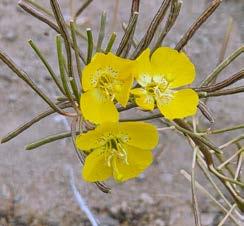
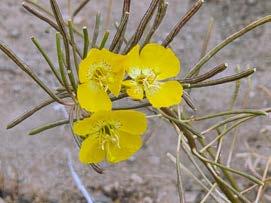
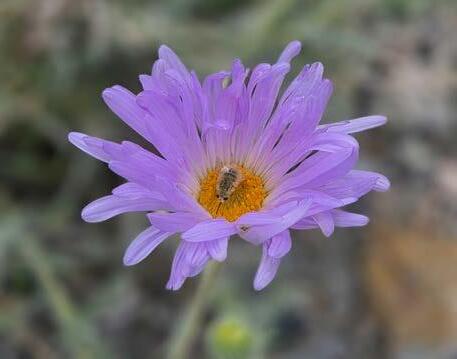
The much smaller, grey burro bush is nearly as common but dwarfed by the taller creosote plants. We managed to spot a few small plants at that level by diligently searching. I was starting to wonder until we headed up Camp Rock Road. As the altitude increased, so did the floral display. The desert senna plants, leafless, spiney grey plants most of the year, were an explosion of yellow flowers. Yellow is the most common desert flower color and is a universal pollinator attractant.
By John Wease
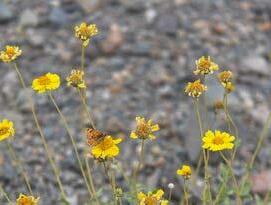
Yuccas became more plentiful as did chollas and other cacti. We stopped many times above the sennas on our way to the summit. Each stop provided a look at different plants in every size and bloom color. The desert milkweed, the food source for migrating butterflies, was in bloom. Dave even arranged to have a few of our desert butterflies around to prove the point.
One of the least impressive looking plants was the most interesting to me. It was the humble little chia plant. They had already bloomed but they could be identified by their seed pods. The tiny seeds inside were a staple for the Aztec and Mayan cultures. Chia seeds are a super food, high in protein, fiber, vitamins and minerals. They are antioxidants and contain more omega 3 fatty acids than salmon. Chia seeds absorb a huge amount of water. Water with a small amount of chia seeds was used as an early-day version of a sports drink by the indigenous people. Today, some marathon runners drink this “chia fresca” before the race. The water absorbed by the seeds is released slowly. It is a source of energy and a form of rehydration from the inside.
Camp Rock Road is a well graded dirt road easily driven in any vehicle. From the Daggett exit, turn south on A Street (Yermo-Daggett Road north of the freeway) and east on Pendleton Road, Pendleton parallels the I-40 and then curves to the south and becomes Camp Rock Road. Enjoy the spring floral display and take only photos. v
Finding a heart of gold in a concrete truck
By Paul Sebastian
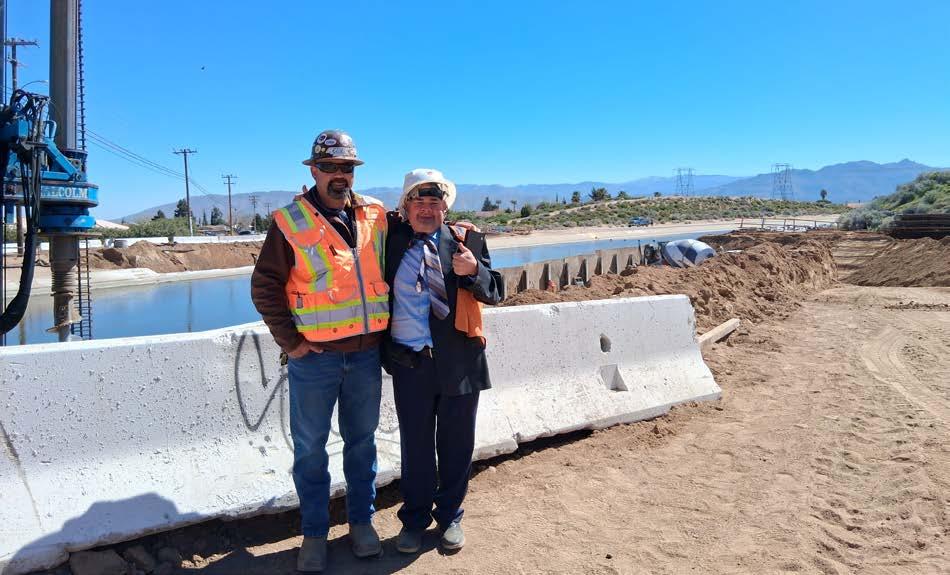
IN OUR LIVES WE MEET MANY PEOPLE that leave no imprint on you whatsoever. However, there are some individuals that stay with you because they can connect immediately with other people and make a memorable impression. James Hernandez is such a man because he endears you with his buoyant personality, steadfast loyalty to his friends, and his intense interest in concrete trucks. It was his interest in concrete trucks that led James to touch many lives and build friendships that turned into family. James’ accomplishments and his engaging nature are all the more notable because James is autistic.
James originally lived in Ontario where he became fascinated with the large mixer trucks that passed by his home on the way to a construction site. His curiosity about these vehicles prompted him to visit these jobsites and learn more about what they were used for. He would follow them and observe the ways they were used in construction and memorize each step. He visited different companies’ sites and at each location he asked the drivers and workers questions about the mixer’s purpose and the uses their product was being put to. The teams at these sites became engaged with James and went out of their way to give him a complete breakdown of each stage and its necessity. With each visit he added more knowledge until he was able to explain in
detail the sequence of events needed for a mixer truck to deliver its payload safely. Jame’s presence on the job was looked forward to each week, and the friendships he developed became important for both him and the people working the job. Then as destiny would have it, James called Superior Ready Mix and the dispatcher answering the phone was Justin Vander Woude. James called Superior not knowing who was going to answer but wanted to further his knowledge of the mixer trucks. Justin remembers being impressed by the understanding he already possessed and answered Jame’s questions thoroughly. Justin and James enjoyed speaking with each other, but it would be another 20 years before they reconnected.
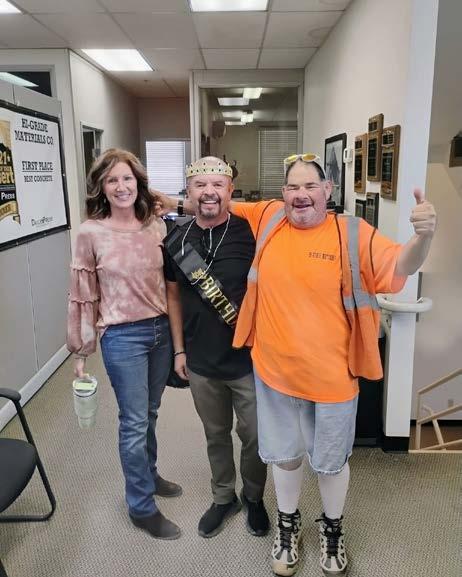
In time Jame’s family moved to Hesperia which coincided with a building boom in full swing in the High Desert. The increased need for concrete launched fleets of these awesome giants onto the roads that didn’t escape Jame’s attention. The time was 2024 and Justin was now at Hi-Grade Materials Co. and received a phone where he immediately recognized Jame’s voice as the gentleman he had spoken with years before. He eagerly set up a meeting with James and they immediately became friends. Jame’s sunny attitude and contagious smile won over everyone at Hi-Grade. His eager mind assimilated the experiences hungrily and others began to coach James in the application of their
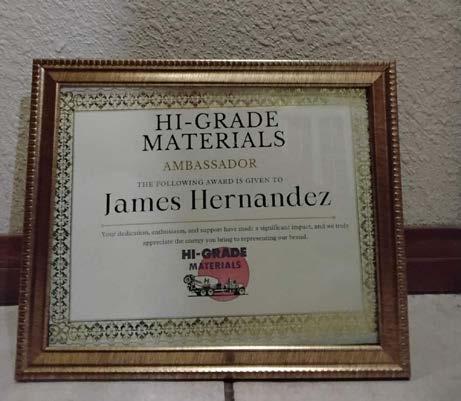
trade. Oscar Castaneda and Chris Ware were also caught up in Jame’s keenness to learn and they organized ride-alongs to give him a personal look at the biggest tool of their profession. Soon he became a regular sight at company jobsites, and his inquisitiveness and good nature made him a welcome guest that made the day’s toil less strenuous. James is not just a visitor anymore but one of the crew who brings with him optimism and uplifts those who meet him. For his contributions, the company distinguished James by making him Ambassador of the Brand and it’s an honor that he embraces every day. You can see his pride for his company every time there is a parade or community event that Hi-Grade is involved with. He is the man in the concrete truck waving wildly at the crowd and his exuberance is worn on his chest. v
He does have other talents that have adorned the walls of the Hi-Grade offices for quite some time and those are his handiwork of personally drawn pictures of the mixer trucks and assembled puzzles of the trucks that can be hung as a picture. In the Hi-Grade offices there are dozens of Jame’s handicrafts prominently displayed and if you are
lucky, he will make one for you. Jame’s generous nature is not contained to the concrete world exclusively but is also known in his neighborhood for taking on small projects that assist people who are unable to do these things for themselves. He views these acts as his way of contributing to the value of the community.
Jame’s contributions to our community are inspiring and what can be more inspiring than watching him take his interest and touch so many people in a positive way. When you meet him, it’s not the disability you see, but a vibrant man who has been a vital part of people’s lives and lives his values every day. v
Your banner ad could be here!
Colorado River Museum
TRAVELING ALONG U.S.
ROUTE 95 in Bullhead City, one cannot help but notice the beautiful desert scenery that borders the east shoreline of the Colorado River.
Stop for a moment, and the sights and sounds of this desert community come alive. Walk to the edges of the crystalblue waters of the Colorado to witness the majesty of the tall, lanky egrets making their way from river stone to river stone. Look up into the sky as a belted kingfisher slows its flapping while making a landing on the strong current of the river. Perhaps, there is a chance to see a pair of osprey spring into the air as a boat rushes close to the shore.
The Colorado River in Bullhead City and the gambling mecca of Laughlin across the river is a magical experience. For nature lovers, it is a must. For desert historians, it is a destination.
This naturally carved water artery that begins 1,450 miles north of the Sea of Cortez, meanders - sometimes furiouslythrough seven states, ending in Arizona before entering Mexico and beyond.
I have traveled the 95 for decades, writing travel articles about this and that. Places that hum with activity and places that can no longer be found on maps. To me, that is one of the joys of traveling. To see places people love to visit and to witness places
that people have never heard of or would think of traveling to.
Years ago, I wrote an article about Hardyville, present-day Bullhead City. Some of the folks I interviewed knew its history, some had never heard of it, even though there is a huge mural of Hardyville directly across U.S. Route 95 from the local Stater Bros. market.
U.S. Route 95 is not an interstate. There are stop lights, crosswalks, and pedestrians making their own non-guarded crossing lanes all through the town.
So, recently, while driving through Bullhead City, I decided to stop at the Colorado River Museum. I learned that it was not the Bullhead City Museum since it covered the entirety of the region. They like to share their history with Laughlin, across the river, Fort Mojave, south of Bullhead, Oatman to the southeast, and all points in between.
I had meant to stop by for years. Those years slipped by like a wet noodle on a wet napkin. But I finally stopped, and was glad.
The two docents on duty were Carol and Ray. Both silver-haired, like me, and with that same flame of wanting to keep history alive.
Carol met me at the door and explained the purpose of the Colorado River Museum. “We want people, both locals and visitors, to understand the importance
By John Beyer
that this town and this river had.”
I nodded. That’s what I do.
The Colorado River is the dammedest in the United States. That is, there are 15 major dams along its waterways, as well as hundreds mixed in with the many tributaries.
There was a time when large barges and steamboats used to chug up and down the Colorado River from various places in present-day Arizona to the Gulf of Mexico, including Bullhead City.
There is a great exhibit at the museum depicting the times and sorts of ships that made their way delivering goods for the ranches, farms, and mining towns that existed along the shores. Photos, letters, and delivery receipts adorn the walls near the exhibits. It is fascinating and sad at the same time. What if those dams had not been built? Would large boats still ply the waters of the Colorado River as in the old days?
Then again, dams bring hydroelectricity, which, if it were not available, cities like Las Vegas could not exist. And, you do not want to make Bugsy Segal mad.
I wandered the museum, which is very well laid out and detailed in facts, and I was fascinated by what I learned.
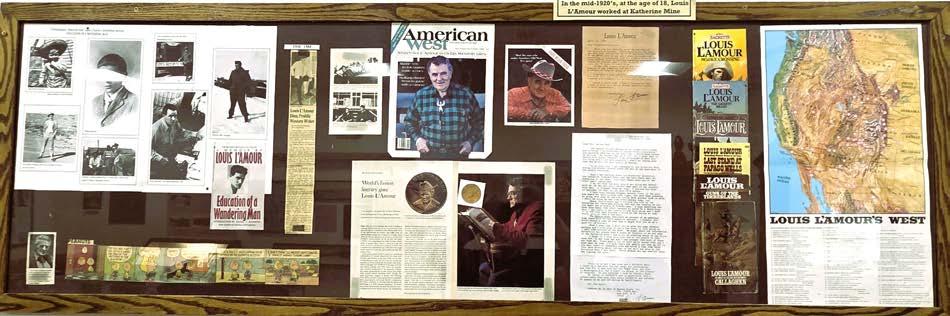
For example, I did not know that the extremely prolific western writer, Louis L’Amour, who wrote over 100 books, actually worked at the Katherine Mine when he was 18 years old. Katherine Mine was named after the sister of S.C. Baggs, who discovered gold near present-day Bullhead City in 1900.
The boating mecca, Katherine Landing, at Lake Mojave, is the same name for the same gal,
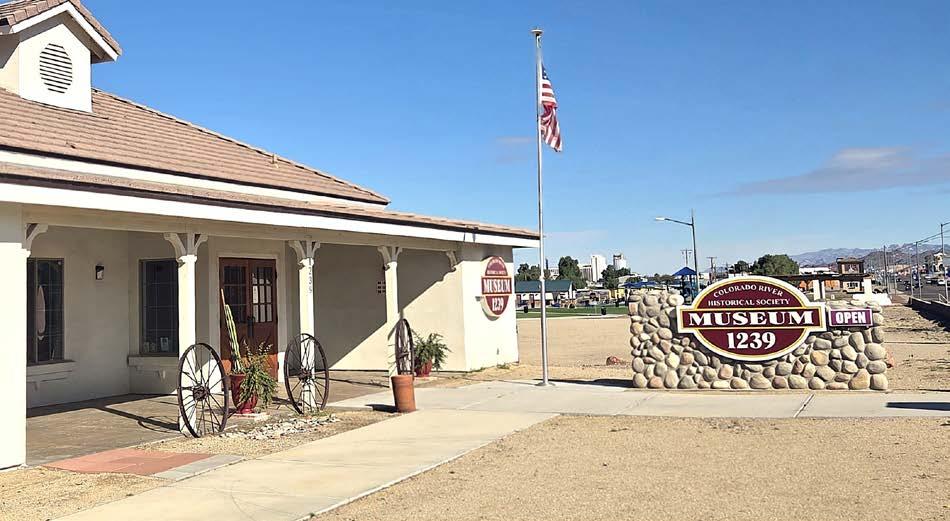
Front of the Colorado River Museum along U.S. Route 95 in Bullhead City, Arizona
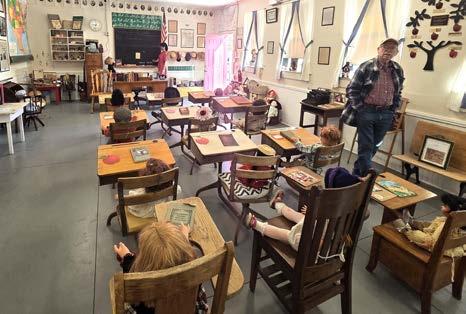
Docent Ray explaining about the one-room schoolhouse built in 1946
Wandering here and there, I learned a lot from the exhibits and from speaking with Ray and Carol - they are both founts of knowledge.
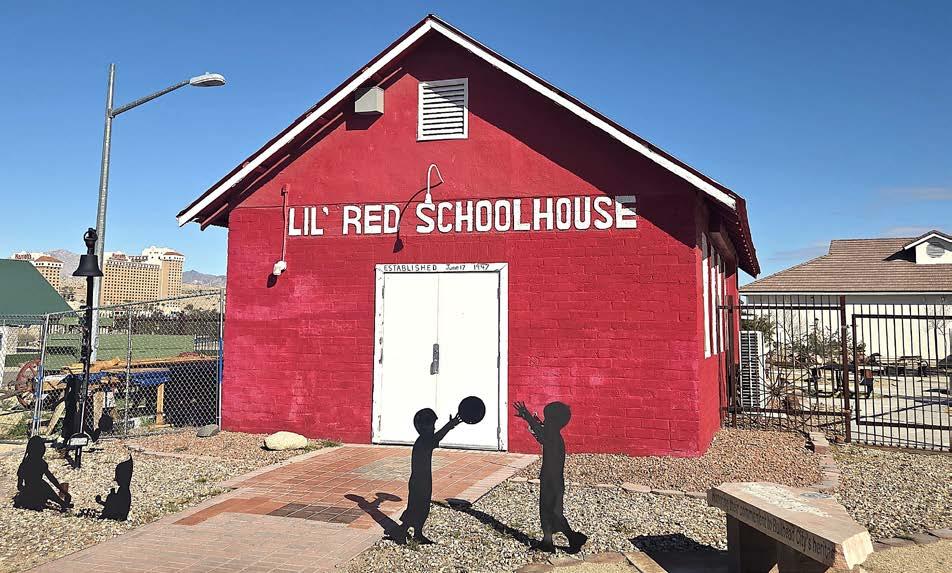
Ray took me on a tour of the one-room schoolhouse located on the property that was built in 1946. Inside is a perfect replica of what a school day must have been like. Students sitting in their desks, at the ready to learn whatever the teacher in front of the class wanted them to learn, with all sorts of books, drawings, pictures, and American flags flying.
Just like today.
The school was actually manually moved from where it was originally built, Ray
informed me. “It was near Third Avenue, and about five or six years ago, it was moved totally intact without any damage.”
And I cannot move a refrigerator without marring the floor.
The school was only in use for approximately five years. “The town grew too quickly for a one-room schoolhouse.”
When the Davis Dam, just north of Bullhead City, was started in 1942, pausing during World War II, and finished in 1953, the area grew exponentially. Many of the workers and their families decided to stay in the warm climate of the Mojave Desert, along the glistening waters of the Colorado River.
Of course, in 1964, an entrepreneur named Don Laughlin flew over the area and believed a gambling haven might be a good bet.
He was right, and the population soared. I sat through a very interesting tale of how one man's dream helped forge two towns on opposite sides of a river that could benefit from each other.
A dreamer whose dreams paid off well.
The Colorado River Museum is a must when traveling near Laughlin, Bullhead City, or any of the nearby cities. It is stocked with artifacts from the mining period, exhibits of the ingenious people who lived there prior to settlers moving in, Davis Dam history, and anything else that a curious - and hopefully we all aretraveller would enjoy.
Enjoy the interior exhibits, the exterior exhibits, but just take a moment to stop and reflect on the history of a couple of towns built along the shores of the Colorado River. v
For more information: https://coloradoriverhistoricalsociety.org/
John can be contacted at: beyersbyways@gmail.com
One-room schoolhouse, open to the public
Arthur Louis L'amour's history in the area, including working at the Katherine Mine
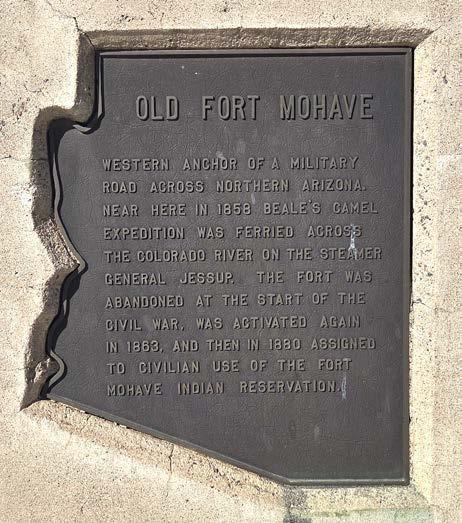
Exterior plaque, explaining the historical importance of the region during exploration
WOW
Meet at Trinity Lutheran Church 16138 Molino Dr Victorville CA 92395
• May 02: 10 AM Speaker Officer Socorro Cuevas on Personal Safety
• May 06: 03 PM Happy Hour at La Casitas Restaurant 12170 Spring Vly Lake Victorville
• May 09: 10 AM Celebrate Mother's Day with regifting
• May 16: 10 AM Breakfast at Denny's Restaurant on Main St Near Hwy 15 in Hesperia
• May 23: 10 AM Game Day
• May 30: 10 AM Breakfast at Denney's Restaurant Hesperia
S.W.I.M
• May 7: How The Pulse is Published From Start To Finish – Jim Conkle
• May 14: Single Marines Program – AJ Jacobs
• May 21: Amazon River Basin – Leah McEntee
• May 28: Lions Club – Dharini Dobbins
General Information:
Seniors With Inquiring Minds (SWIM) meets every Thursday from 1:00-2:00 pm.
Location:
Percy Bakker Center 9333 E Avenue, Hesperia, CA 92345
UpcomingCommunity Events
• May 2- 8 AM-1 PM Apple Valley Flea Market, Lions Park
• May 7, 14, 21, 28- Apple Valley Courtyard Concerts 6-8 PM
• May 11- NAACP Branch 1082 General Membership meeting 6 PM Victorville Office
• May 12- MHS members presenting at Friends of the AV Library 11:30 AM "Military Impact on the High Desert"
• May 16- Mojave River Valley Museum BBQ and History Booths and Demos 10 AM -4 PM
• May 27- Mohahve Historical Society meeting at Lone Wolf Colony "Mohahve VII Panel of Authors and Contributors" Doors open 6:30 PM
• May 23-25, 29-31- SBC Fair Come see us in Building 2. 2-10 PM
• May 29- SBC Car Show and Fan Fest for Route 66 Centennial 2-10 PM
The Power of Community Partnership and Collaboration
By Cindy Bostick
STRONG COMMUNITIES
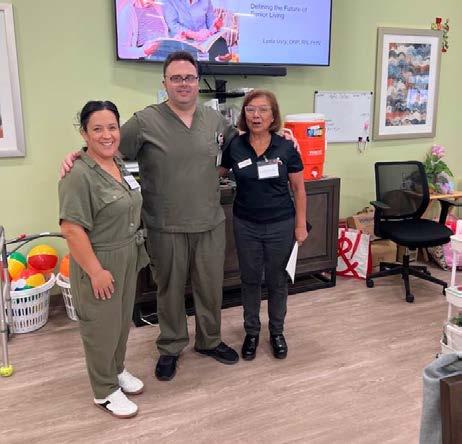
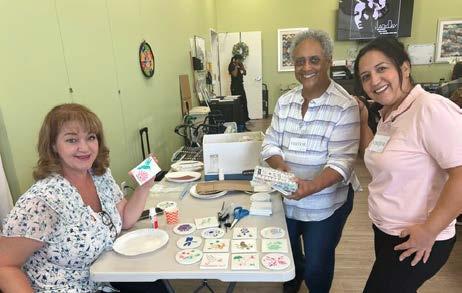
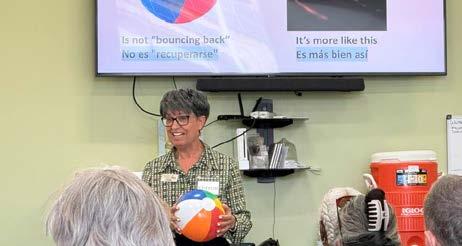
are built on meaningful partnerships, where organizations come together to uplift, support, and inspire. A recent example of this impact can be seen in the collaboration between Today's Woman Foundation and High Desert PACE, who have joined forces to launch a resiliency focused initiative titled, “Still Me – Honoring Who I Am Today.”
This five-module series was designed by Today’s Woman Foundation to celebrate identity, dignity, and selfexpression among elderly participants. Each week introduces a new topic and presenter, bringing fresh perspectives and opportunities for connection. The response has been overwhelmingly positive, with participants embracing the program with enthusiasm and appreciation. The sessions have not only sparked meaningful conversations but have also created a space where individuals feel seen, valued, and heard.
What makes this collaboration so impactful is its shared purpose. By
combining resources, expertise, and compassion, both organizations have created something far greater than either could achieve alone. The program reflects the essence of community partnership— meeting people where they are, honoring their experiences, and fostering joy through connection.
As the series progresses, excitement continues to build toward its culmination: a special celebratory Tea Party. This event will serve as both a joyful gathering and a meaningful reflection of the journey participants have shared together.
In a world where connection matters more than ever, initiatives like this remind us that collaboration is not just beneficial— it is transformative. v
Culture Has Arrived in Newberry Springs - Permaculture
THE TERM “PERMACULTURE”
may sound like some New Age fad, but it really is nothing more than duplicating the closed loop system Mother Nature uses. The healthy ecosystem incorporates diverse plant types that grow in living soil. Living soil has beneficial microbes such as bacteria and fungi that decompose organic matter, fix atmospheric nitrogen, suppress diseases, and make minerals more available to growing plants. In a forest, leaves, twigs, and other plant materials fall to the ground becoming mulch. Microbes turn the mulch into food for the trees and surrounding plant varieties.
Will the same thing work in our desert environment? I think so. Many of our native desert trees and shrubs are legumes. They pull nitrogen from the air and convert it to a form of nitrogen that improves the generally nutrient deficient desert soil. This process is called nitrogen fixing. And these natives survive with the small amount of rain we receive each year.
Local Newberry Springs resident, and permaculture expert, Dr. Keller Horton, is sure it will work here. He should know. He found an advertisement online for a three-week permaculture course in Jordan in 2014 by Geoff Laughton of the Permaculture Research Institute. Keller learned the principles of greening the desert in this intense, hands-on course about dryland permaculture. The term dryland refers to the fact that no irrigation was used, and in an area with even less annual rainfall than here.
fellow student whose father owned four large farms and wanted to redevelop all of them to permaculture. The farmer hired Keller and for about seven years he worked there every spring and fall. The project was quite successful. One particularly lush hill was named “Kell’s Mountain” by the family. One key to success was adding swales to direct the rain that did fall to where it was needed rather than running off. The farmer died in 2020, that and the pandemic ended Keller’s work in Jordan.
Also in 2014, Keller purchased forty acres of undeveloped land here in Newberry Springs. His plan was to develop this property as a permaculture oasis and eventually teach permaculture classes. He sold his home in Orange County and began a struggle to obtain permits from the county to build an unconventional passive solar home. The county doesn’t make environmentally friendly construction easy. That project continues in bureaucratic limbo.
In the meantime, Keller was made aware of the issues facing our pistachio farmers. The older trees planted in the 1980s were suffering from the ramp-down of water. Farmers are allowed 25% of the water they used a few years ago. The droughtstricken trees had no defense against an infestation of ambrosia beetles. Keller offered to visit the farms and offer advice on how they could increase production using even less water. Only two were willing to listen, the others were of the “we’ve always done it this way” team. Of course, the answer to them is “how’s that working for you?”
Dr. Horton met a
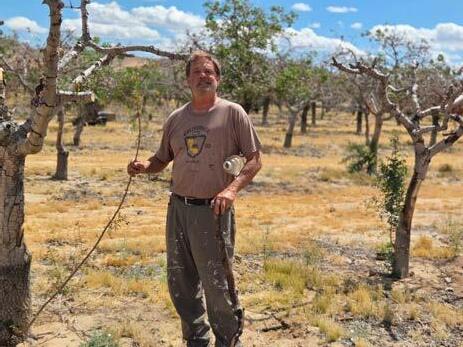
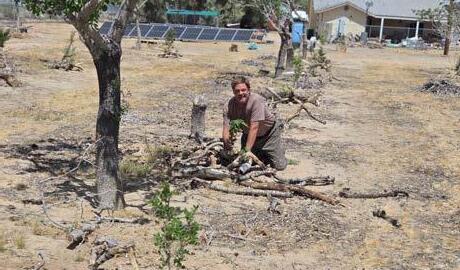
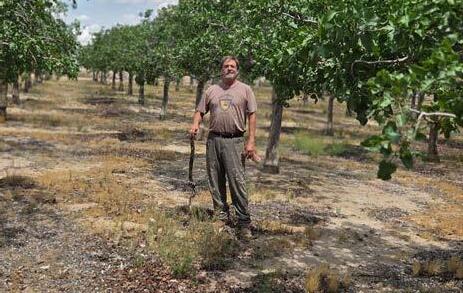
Of these two farmers, only Mike Martin was interested in trying. Due to family health issues, he soon after decided to sell his farm. Keller elected to use the funds he was going to use on his property to buy and save this established but struggling farm. I recently had the privilege of visiting the farm. It is obvious that Mr. Martin did a very nice job developing the property. Of the forty acres, twenty are fenced. In the fenced land, there are one thousand pistachio trees, a nice house, and outbuildings.
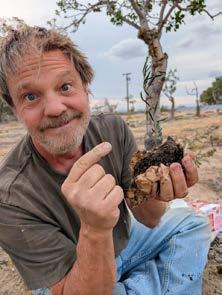
Ten percent of the trees are dead. Some thirty percent are infected by ambrosia beetles. Dead and damaged limbs are being cut and shredded to use as mulch. Some trees have only suckers growing
By John Wease
from the root stock. Keller hopes to use some of these suckers to graft new trees. He is removing existing shrub sprayers and watering directly in swales cut by each tree. Each of these swales have lasagna layers of compost, fertilizer, and mycorrhizae. Between each pistachio tree, he is planting nitrogen fixing and fig, jujube, and other fruit trees. All will help shade the ground around the pistachios and the fruit trees will provide other harvestable crops.
Another issue plaguing pistachio farmers is the warmer winters we have been having. Whether it is man-made climate change or just natural climate cycles, our winters have been much warmer than in the past. This may be a little racy for a family newspaper, but pistachio trees are either male or female. The warm winters have caused the male trees to flower too soon. The boys were ready to go while the ladies ere still putting on their makeup. Keller has one hundred male trees ordered that will flower two weeks later.
Dr. Horton’s degree is in curriculum development. He has developed a monthly permaculture class held at the Coppi-Mumford Community Garden. It is sponsored by the Newberry Springs Economic Development Association (NSEDA) and is offered at no charge. He hopes to have a permaculture school at his farm in the future. I am sure Mike Martin is glad someone with Keller’s energy and enthusiasm will continue to develop the already beautiful site. In a few years it should truly be a permaculture oasis. v
The Power of Prayer
By J. P. Garner
IT’S NOT UNCOMMON for football teams to pray. In fact, it’s likely a part of every team’s pregame ritual. In most cases, teams use the Lord’s Prayer. It’s good for any occasion. The start of a game being one.
But Barstow was different in the 15 games they played last season. Twelve in a row to win the High Desert’s first state championship in football.
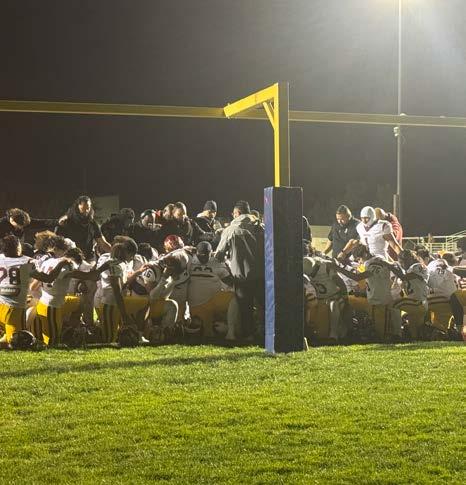
While their opponents trundled off to a locker room, the Aztecs stayed on the field. They’d form up at the goal post in an end zone, and embrace each other as brothers and not simply teammates. What people in the stadium saw wasn’t staged or an act. It was genuine.
Being outside, beneath the bright white light spilling from the metal Halide lights overhead, made them closer to God. The football field became sacred ground when they prayed and the crowd, at times, would grow quiet … and maybe pray as well. For victory, probably.
But not the team.
Not Clayton Leleimene, the head coach. “We always prayed for protection, guidance, and strength as we stepped onto the field,“ he explained. “Even though we prepare and train to win, we know that victory ultimately comes from the Lord and that He directs our steps. Whether we win or lose, we’re thankful for the chance to play this game and to glorify His name with every moment on that field.”
When asked why on the field, rather than in the privacy of a locker room, Coach Clay continued. “We prayed on the battlefield because it signified our unity before God, reminded us that no matter the outcome, we moved as one body with one spirit. “Normally, I’d have the honor of leading
our team in prayer. … [But] no matter who leads, when we bow our heads together, we stand united as one team, one faith, one purpose which is seeking strength, protection, and guidance before we step onto the battlefield.”
The battlefield?
Football is familiar with combat terms.
Still, it’s a description that seems uncanny for a coach—and man—who is, most often, kind and generous. And, yet, he has moments when he is fierce and passionate. Like when he addressed the team at half-time during the state championship game. His words were like lightening bolts from heaven, jolting the team back to their senses so that, in the second half, Barstow totally dominated the “trenches” and shutout Sutter.
What’s significant, however, and maybe is the lesson to be taken from this piece, is that Coach Clay was always grateful. He knew that, in Philippians, we are taught to be thankful in every situation through prayer. He gave thanks to be there. To not only have the chance to play “this game” as he put it, but to represent his faith and that of his staff and team.
It was remarkable to see.
Each game that marked the team’s progress toward a state championship was a reminder of the timeless romance we have with football … of our enchantment with the physics and geometry of a sport whose grace at times beguiles us, just as its power can, at other times, elevate us to a maniacal frenzy.
Even still, there are moments of pure nostalgia ... of pomp and ceremony and, during a lull in the action, quiet reflection.
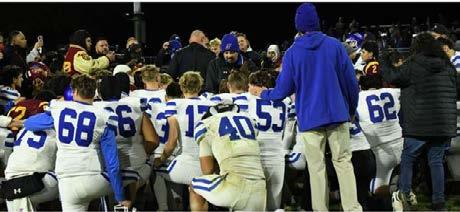
After the playoff game with Immanuel High School from Reedley, CA, the Eagles joined the victorious Aztecs in prayer. It was after the award ceremony that honored both teams. Barstow for winning the sectional title, and Immanuel for being a runner-up. Only a few minutes before, they had been battling each other on the same field on which they were now kneeling.
Given the gruesome images which bombard us daily on our TVs, the joint prayer was a thing of serene beauty to see. Strangely sacred and, at the same time, both a comfort and encouraging because goodness and sportsmanship still had a place in our lives.
Camaraderie, as a concept, was not an old school sentiment, borrowed from our
distant past, but a present-day bonding of competitors practiced openly and spiritually to enshrine the exchange of mutual respect in our memories. A salute, if you will, to the sweat and dogged excellence that, out of the hundreds of high schools not playing, found these two competing for a chance to advance to the state championship game.
Kudos to both teams and their staffs. Faith, family, and football were the forces that propelled the Barstow Aztecs to a state championship.
Faith was the fuel that inspired the team to not quit after losing the first three games of the season. Family was the union between the team and the town’s people of Barstow who filled Langworthy Field on a Friday night and those stadiums at away games. And football was what energized our town and made all of us supremely proud and jubilant. These three aspects of the long season last year are now the focus of a book about the team from the small town that Hollywood loves to hate.
But praying, according to Coach Nathan Stone, the Offensive Coordinator, was the glue that held everything together. “We had extraordinary prayers on our team,” he bragged, referring to the coaches who took turns to pray. “Coach Clay, Coach Sefa, Coach Appi, and Coach Mulitalo really trusted and believed in God and his plan for us. Having that at the top, trickled down to the team as well, [making them believers.]”
He then paused to weigh the words needed to express his last thought. When he looked up, his expression was serious. “And faith,” he began, his voice firm, “was what we stood on. Hearing our leader, Coach Clay, preach that everyday was amazing.”
The thing was that seeing it every Friday night for 15 weeks was also amazing. Reassuring even … and appreciated. It was a peek, of sorts, into the heart of the team.
One that made those of us who watched believers as well. v