Complimentary copy - Take one!
of the
Heartland
Florida
ni
r-
o
of the HEARTLAND
PULSE Se
PULSE
October 2026 - Issue #12
Ve
ter
an -
C o m m u nit y
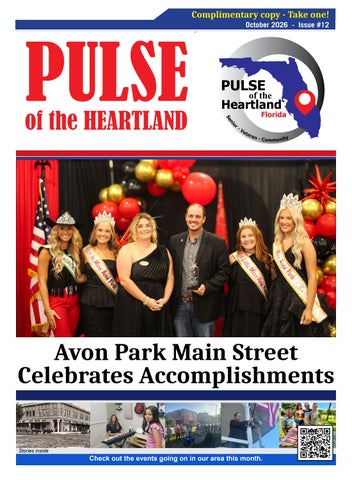
Avon Park Main Street Celebrates Accomplishments Stories inside
Check out the events going on in our area this month.
2
October 2026
#12
Pulse of the Heartland
Editorial
O
PULSE
CTOBER GIVES US A CHANCE to slow down a little. As the weather begins to cool and our calendars fill with local events, I hope you’ll make time to get out, see your neighbors, and enjoy the Heartland. Take someone you love to an event, try a restaurant you’ve been meaning to visit, or simply spend an afternoon away from your phone. Those moments matter.
of the
Heartland Se ni
o
Thank you for reading and for being part of the Heartland. I hope this issue leaves you feeling a little more connected to it.
ter
an -
C o m m u nit y
1 760 221 9798 tiffaniepulsepublications@gmail.com
P O Box 290066 - Phelan, CA 92329-0066 10405 Mountain Road - Piñon Hills, CA 92372
I hope you’ll also give yourself permission to step away from the negativity. Unfollow a page or put down a conversation that leaves you anxious. We don’t have to give every angry post our attention. We can put that energy into showing up for one another instead. And please keep sharing your family’s happy news with us! Birthdays, anniversaries, and birth announcements are due by the 25th of each month for the following month’s print issue. To be included in November, please send your announcements by October 25.
Ve
TIFFANIE NICOLE
This issue is full of people who care about the place we call home. You’ll read about a teacher who sees the child behind the behavior, a young business owner building his future here, families making memories, and veterans who deserve more than our thanks. Their stories remind me why local journalism matters. When we listen, ask questions, and report the facts, we get to know our community more honestly. Please support the local newspapers and radio stations that show up for this community, just as you support our small businesses. Pick up a paper. Tune in to a local station. Shop local, eat local, and choose local when you can. The people behind these places are your neighbors, and many of them give back in ways you may never see.
Florida
r-
FRANCES CONKLE
CEO Mother Road Enterprises 1 760 617 3774 FrancesConkle@gmail.com
JAMES CONKLE
Publisher 1 760 617 3991 jim@motherroadenterprises.com 66jimconkle@gmail.com
LORI WESTON
1 760 680 9472 Lori@motherroadenterprises.com
JORGE LEANDRO RODRIGUES Graphic Designer 55 16 99991 0229 leandro.works@gmail.com
e l o c i N e i Tiffan
FRANKIE SCORPION
Ad Sales 1 863 368 3237 pulseheartlandpublications@gmail.com
Our Writers
Tiffanie Nicole
Jerry Boritzki Writer
Barry Foster Writer
Nancy Fisk
Historic Writer
General Manager, Editor, Journalist
Pulse of the Heartland
Allie Sullivan Photographer
K.M. Allen
Veteran Correspondent
Please like and follow
Pulse of the Heartland
October 2026
on Facebook
#12
3
The Forgotten Veterans By KM Allen
B
EFORE WE GET INTO THIS MONTH’S DISCUSSION let us pause for a moment to wish the Navy a happy 251st birthday, which falls on the 13th of October. Let’s also take a moment to recognize our National Day of the Deployed, which falls on 26th of October, honoring all that are currently deployed. As a Veteran, there are some absolutes I live by when it comes to other Veterans. One of them being: We belong to a long line of proud Soldiers, Marines, Sailors and Airmen. We are family until we prove otherwise. So, we do what we can to help another Veteran. Unfortunately, that hasn’t always been the case. In fact, the act of leaving Veterans to fend for themselves dates all the way back to the early days of the militia. It became even more prevalent throughout the Revolutionary war, Civil war and into the Vietnam war (yes, I call it a war. I’ve been to Vietnam and I’ve seen the result with my own eyes. I’ve also been to war and Congressional approval or not, what happened in Vietnam was a war.). Sadly, many of those that defended our nation’s very existence have departed the military with their sacrifice, what they had in their hands and whatever was left of their homes, if they had one prior to answering the call to defend. We now know that no Veteran should be left alone with their traumas of military life, on or off the battlefield, CONUS/OCONUS. Yet we still hear echoes of our country’s failures when it comes to the welfare of our Veterans. I’m pretty sure I could ask this question and not have many takers. Would you believe me if I told you General Douglas MacArthur, Majors George Patton and Dwight D. Eisenhower, under the orders of President Herbert Hoover used full military force on roughly thousands of displaced Veterans? It’s true. In 1924, During the Great Depression, Congress passed the World War Compensation Act or The Bonus Act. It was backed by the American Legion and similar Veterans groups. As originally written, it provided extra pay to 4
October 2026
#12
make up for wages lost during the First World War. I personally believe Combat Veterans and their families should eat as well as their representatives, so this sounds great. Until you read the amended version wherein it’s now an Adjusted Service Certificate that matures in 1945. Essentially making it absolutely no help to Veterans in their time of need. President Calvin Coolidge vetoed it, and Congress passed it on May 19, 1924. As a result, in the summer of 1932 when the belt couldn’t get any tighter, led by the Bonus Expeditionary Force, more than 20,000 Veterans and their families from all over the country camped out in Washington D.C. in protest. Their demands: AN IMMEDIATE CASH PAYOUT! If you read my last piece on the Constitution, you will remember the 27th Amendment, though proposed in September 1789 with the original Bill of Rights, was not ratified until May of 1992. During the great Depression this, the 68th, Congress could still give itself a pay increase whenever it wanted to. The 68th Congress did just that. In March of 1925, just 10 months after swindling Veterans with the bonus act, Congress increased the annual salary of the House and the Senate by 33.3%. Increasing it from $7,500 to $10,000. The $2,500 increase would be equivalent to $47,700 today. Under much scrutiny they reduced their pay 5 years and $2,862,000 (the total amount members of congress earned individually) later. The Congress that had asked these Veterans to stand and defend the beliefs of this country unbelievably voted down the early release of funds and the immediate payment to those Veterans in need. After the ruling many Veterans left, however, thousands stayed camped out throughout the heart of D.C.. Most on the East bank of Anacostia River (known today as Anacostia Park). This is when President Hoover directed Army Chief of Staff General Douglas MacArthur who in turn ordered Majors George Patton and Dwight D. Eisenhower to use tanks,
Pulse of the Heartland
tear gas, mounted and sword drawn 3rd Cavalry Regiment and foot Soldiers with bayonets affixed to remove the Veterans. The Veteran camps were burned and the homeless Vets and their families removed. For myself, this was the best example I could find related to this month’s topic where Veterans from all walks of life came together in support of their shared interests. Take a moment to understand the Bonus Act took place during a time when the country, Veteran and civilian alike, was unfortunately still accepting of social and cultural division. One of my most impressionable takeaways from this historical moment is the Veteran unity, solidarity, shared ethics, and morals. When faced with unbelievable odds, 20,000 U.S. Veterans from all over the country came together to stop the impending homeless situation they and their families were now facing. Our strength has always been our numbers in solidarity. The 2nd takeaway is more of a lesson in political behavior. That being, the fact that at that moment our Congress did not stand and step forward for us as we always jump and run for them. 4 years later Wright Patman of Texas would propose bills calling for the immediate payout with the Adjusted Compensation Act of 1936. It would give 3 million Veterans the opportunity to exchange their Compensation Certificates for Treasury Bonds that could be cashed in immediately. This gave the failing economy that the country had suffered through over the last 20 years the boost it needed to help the country recover from the Great Depression. Strategically, the recovering economy would raise the country’s moral just as we were about to enter another World War. I feel as if we should never take our focus off the welfare of those that have sacrificed 1 day or more in service of this country. May Veterans always be the last line of defense for Veterans. When left unattended, history repeats itself.
Pulse of the Heartland
October 2026
#12
5
Twenty-Five Years Later, a Pentagon Recovery NCO Tells His Story By Tiffanie Nicole – Pulse of the Heartland
T
WENTY-FIVE YEARS AFTER THE TERRORIST ATTACKS of September 11, 2001, the Avon Park community gathered Friday morning at the downtown bandstand to remember the nearly 3,000 lives lost, honor those who answered the call and hear a story that had never before been shared publicly. Avon Park Main Street opened the ceremony by welcoming residents, military veterans, first responders and community leaders. Mayor Garrett Anderson led those gathered in prayer, asking God to keep hatred from taking root and to use the remembrance of that painful day to bring people together. The prayer was followed by the national anthem. Although a quarter of a century has passed, September 11 remains frozen in the memories of those who lived through it. Most can still recall exactly where they were when they learned America was under attack. They remember who they were with, the images appearing on television and the overwhelming struggle to understand what was happening.
6
October 2026
#12
The ceremony also served as a reminder that an entire generation has now grown up without having personally experienced that day. Those young people did not watch the towers fall, see smoke pouring from the Pentagon or wait helplessly for news from passengers aboard Flight 93. It is now the responsibility of those who remember to continue telling the stories of the lives lost and the men and women who carried the weight of what came afterward. On Friday morning, Avon Park had the privilege of hearing one of those stories firsthand. Retired Army NCO Kevin M. Allen, who now lives in Avon Park and serves as a veteran correspondent for the Pulse of the Heartland, stood before the community and spoke publicly about his experience at the Pentagon for the first time in 25 years. “This is the first time I’ve spoken publicly about this in the 25 years,” Allen told the crowd. “We confide within our family, we confide within our friends and our brethren
Pulse of the Heartland
in the military. But publicly describing some of the things that I had seen that day is going to bring up some things for myself.” He asked those listening to bear with him if he stuttered, paused or struggled to find his words. What followed was not simply a history lesson. It was the testimony of a soldier revisiting one of the most traumatic assignments of his military career. On the morning of September 11, Allen was stationed at Fort Lee, Virginia, serving with the Army’s 54th Quartermaster Company, the military’s only active duty mortuary affairs unit at that time. He recalled being with his platoon when a fellow NCO gathered the soldiers and told them the Pentagon had been attacked. They immediately began preparing. Within approximately eight hours, Allen said, the 54th was ready to respond. By the following morning, the soldiers were at the Pentagon and prepared to begin the solemn work of searching for and recovering human remains.
Allen was one of only two noncommissioned officers placed in charge of search and recovery operations. He recalled having 12 teams working under his direction during the mission, which continued for approximately 30 days. When he arrived, Allen saw the collapsed floors, the opening torn through the Pentagon and the destruction left behind by American Airlines Flight 77. Inside the building, familiar parts of an ordinary workplace had been reduced to wreckage. “You saw the walls that used to be, the roofs that used to be, the wiring that used to be,” he said. “And then, all of a sudden, the person that used to be.” Those words brought the human cost of the attack into sharp focus. Allen had already served in Desert Shield, Desert Storm and Somalia. He had witnessed death and suffering overseas, but he said nothing prepared him to see
that level of destruction on American soil. “If it weren’t for the soldiers that I had, the 12 teams that I had under my direction, I don’t think I myself would have made it through that,” he said. The Pentagon attack claimed 184 innocent lives inside the building and aboard Flight 77. Allen and the soldiers serving beside him were entrusted with recovering remains, protecting personal effects and helping ensure the victims could be identified and returned to their families with dignity. Mortuary affairs is a part of military service most Americans rarely see or discuss. These soldiers enter places marked by unimaginable destruction and perform work that demands precision, compassion and tremendous emotional strength. Their responsibility is to make certain that the fallen are never abandoned or forgotten. Allen asked the community to expand its understanding of the promise “Never Forget.” He urged those present to remember the mortuary affairs specialists, military personnel, first responders and recovery workers whose service continued long after the cameras disappeared. “The next time you see a soldier, the next time you see a Marine, the next time you see a first responder or one of these fine officers, don’t curse them,” Allen said. “Because you better believe there may be a day when you’re begging for them.” He also spoke about the invisible wounds carried by many veterans. Not every injury can be seen through a missing limb, scar or physical disability. Some service members carry memories that remain hidden for decades. For Allen, one of those memories was the Pentagon. He explained that saying “thank you for your service” is appreciated, but veterans also need the public to stand beside them
Pulse of the Heartland
when their benefits, care and support are being debated. “Right now, today, what I need you to do is fight for us,” he told the crowd. “Remember to support us when the time comes.” Following Allen’s remarks, the community gave him, fellow military members and first responders a well-deserved round of applause. Those gathered were then invited to place American flags around the bandstand as symbols of remembrance, patriotism and unity. After the flags were placed and the formal ceremony concluded, military members, first responders, speakers, officials and community members gathered for a commemorative photograph. It was a picture of a community that had prayed together, listened together, remembered together and stood beside a veteran after he found the courage to speak publicly about the burden he had carried quietly for 25 years. September 11 cannot be allowed to become simply another date in a history book. Its stories must continue to be told— not only the stories of those whose lives were taken, but also those who walked into the wreckage, recovered the fallen and carried those memories home. On Friday morning in downtown Avon Park, Kevin M. Allen made certain that part of that history would not be forgotten.
October 2026
#12
7
The Woman Whose Cells Changed the World By Tiffanie Nicole – Pulse of the Heartland
H
ENRIETTA LACKS never volunteered to become one of the most important people in medical history. She never signed a consent form allowing her cells to be used for research, and she died without knowing that a piece of her body would continue living in laboratories around the world. Yet more than 75 years after her cells were taken, they remain one of the most important tools ever placed in the hands of medical researchers. Henrietta was a wife and mother of five who sought treatment at Johns Hopkins Hospital in Baltimore after experiencing pain and abnormal bleeding. Doctors discovered that she had an aggressive form of cervical cancer. During her treatment in 1951, samples were removed from her tumor and given to researchers without her knowledge or permission. Taking tissue without a patient’s informed consent was common at the time, but that does not erase the ethical questions surrounding what happened. Henrietta was a Black woman receiving treatment in a segregated medical system, and neither she nor her family was given a voice in what happened to her cells. Most human cells placed in a laboratory survived only briefly. Henrietta’s cells were different. They continued growing and dividing at an extraordinary rate. Researchers named the cell line “HeLa,” using the first two letters of her first and last names. Henrietta died from cervical cancer on October 4, 1951. She was just 31 years old. Her cells, however, did not die with her. HeLa cells became the first widely used immortal human cell line, meaning they could continue reproducing under controlled laboratory conditions. Scientists could now conduct repeated experiments using identical human cells, allowing medical research to move forward in ways that had not previously been possible. HeLa cells contributed to research surrounding the polio vaccine, cancer, HIV and AIDS, genetic mapping, the effects of radiation, fertility treatments and numerous medications. They were
8
October 2026
#12
Henrietta Lacks, circa 1945. Photo courtesy of Oregon State University via Wikimedia Commons, CC BY-SA 2.0.
even used during research connected to the development and testing of COVID-19 vaccines. The cells have traveled into space, appeared in thousands of scientific studies and helped generate enormous commercial value throughout the medical and biotechnology industries. Henrietta’s family knew none of this for more than two decades. During the 1970s, researchers contacted members of the Lacks family seeking blood samples. The family was initially confused and was not given a clear explanation. They eventually learned that Henrietta’s cells had remained alive and had been used in laboratories around the world since her death. Imagine discovering that a part of your mother had been shared, studied and commercialized for decades while your family received no explanation, control or compensation. For years, many members of the Lacks family struggled financially and lacked access to adequate healthcare, even as
Pulse of the Heartland
Henrietta’s cells helped make medical advancements possible for millions of other people. Companies built products and research programs involving HeLa cells, yet the woman from whom those cells originated was largely absent from the story. That began to change as writers, researchers and members of the Lacks family fought to make Henrietta’s name known. Her story eventually reached millions through Rebecca Skloot’s book, “The Immortal Life of Henrietta Lacks,” and the HBO film based upon it. Recognition, however, was not the same as accountability. In 2021, Henrietta’s estate sued Thermo Fisher Scientific, accusing the biotechnology company of continuing to profit from HeLa cells despite knowing how they were originally obtained. The lawsuit ended in a confidential settlement in 2023, exactly 103 years after Henrietta’s birth. Because the terms were not released, online claims that her family received billions of dollars cannot be verified. Her estate has since pursued additional legal action against other pharmaceutical and biotechnology companies. Confidential settlements have also been reached with Novartis and Viatris. The amounts remain private, and the family’s broader pursuit of accountability has continued. Henrietta’s story is not simply about medical history. It is about informed consent, racial inequality, patient privacy and the question of who benefits when the human body becomes part of a profitable scientific discovery. Modern consent requirements are stronger than they were in 1951, but questions surrounding tissue, DNA and medical information remain very much alive. Technology continues to advance faster than many laws and ethical protections can keep pace. Henrietta Lacks gave the world something priceless, although she was never asked whether she wished to give it. Her cells helped researchers save lives, fight devastating diseases and better understand the human body. Science remembered HeLa. History must remember Henrietta.
Seeing the Child Before the Behavior
S
OME OF THE BIGGEST inside Ms. VICTORIES Kate’s classroom at Memorial Elementary School begin with a few simple words. A student who once became overwhelmed may learn to say, “I need a break.” Another may calm down and return to a lesson. One child may complete something alone for the very first time while another reaches out with kindness to a classmate. Those moments may look small to someone on the outside, but Ms. Kate knows how much work it can take for a child to reach them. In her classroom, they are celebrated because every one of them shows growth. Ms. Kate is an Exceptional Student Education teacher who works in Memorial Elementary’s behavioral support classroom. Her students need extra behavioral, emotional and academic support, but that is only one part of who they are. She sees children who are funny, caring, creative, intelligent and capable of so much more than people may realize. “I have always had a heart for the students who sometimes need a little more patience, understanding and support,” Ms. Kate said. “Behavior is often a form of communication.” That understanding shapes the way she teaches. When a child is struggling, the focus is not only on what happened. Ms. Kate and the other adults working with that student try to understand what the child is communicating and what they may need in that moment. From there, they can help the student learn a safer and more successful way to respond. The classroom has structure and a steady routine because knowing what comes next can help children feel safe. The students work on academics throughout the day, but learning goes far beyond reading and math. They practice how to identify emotions,
By Tiffanie Nicole – Pulse of the Heartland
communicate what they need, solve problems and handle frustration before it becomes too much. Morning meetings, movement, calming time and social skills are worked into the school day. Students may practice taking deep breaths, asking for a break, using a calm area or going to an adult for help. These skills are practiced when the children are calm, not only when something has already gone wrong. The hope is that with time and practice, the tools will be there when those big emotions show up. Memorial Elementary also uses Trust Based Relational Intervention, known as TBRI. The approach is built around strong relationships and helping children feel safe, connected and supported. One of the ideas behind it is connection before correction. Children are more open to learning when they know the adults around them care about them and want them to succeed. “Our goal isn’t simply to stop a behavior in the moment,” Ms. Kate said. “It is to help students understand themselves and develop skills they can eventually use independently.” Students also get opportunities to use those skills outside of their usual classroom work. Through Project SHINE, exceptional students can serve others, interact with staff and be part of the school community in a meaningful way. It gives them a chance to communicate, work with others and feel proud of what they are contributing. For Ms. Kate, relationships are at the center of the work. It takes teachers, paraprofessionals, counselors, therapists, administrators and families working together. Each person may see something different or know what has helped the child in another setting. When everyone communicates and stays consistent, the child has a stronger circle of support. She also wants the community to understand that children who receive behavioral support are not bad kids. A hard moment does not tell the whole story of a child, and a challenging behavior should never become the label they carry. “Our students are so much more than their hardest moments,” she said. “They
Pulse of the Heartland
have strengths, personalities, talents, dreams and tremendous potential.” The educators who serve these children learn to look closely at progress. A child asking for help instead of shutting down matters. A child returning to work after becoming upset matters. A child building a friendship or beginning to believe in themselves matters. These are the steps that can lead to greater confidence and independence in the classroom and later in life. There are ways for the Heartland community to support that work. Sensory materials, flexible seating, classroom supplies, snacks, incentives and materials that teach emotional and social skills can all be useful. Businesses and organizations can also volunteer, donate items, create experiences for students or simply help people better understand exceptional children and what they are capable of doing. Ms. Kate hopes people will look past the behavior they see in one moment and take time to see the child standing in front of them. Her classroom is a place where children are learning how to communicate, manage emotions, build relationships and try again after a difficult moment. They are not defined by the days when things are hard. They are children who are still learning, still growing and worthy of having someone believe in them along the way. October 2026
#12
9
More Than the Man Behind the Businesses, Darius Is Building a Legacy By Tiffanie Nicole – Pulse of the Heartland
A
T JUST 27 YEARS OLD, Darius has already accomplished what many people spend a lifetime working toward. He owns multiple restaurants, operates a wholesale company and is now taking on another new business venture. Yet the titles of owner and entrepreneur tell only part of his story. Behind every long day, financial risk and difficult decision is a young husband, father and stepfather working to create a better future for his family. Darius began working when he was still young, starting as a busboy at a local restaurant in New Jersey. He also performed landscaping and lawn care and fixed old equipment to earn extra money. Even then, he showed the determination and resourcefulness that would later shape his life as a business owner. “He’s always had that mindset of working hard, figuring things out and creating something for himself,” his wife shared. At 18, Darius moved to Florida to help his father operate a business. He took every opportunity to learn and eventually worked his way into the position of general manager. Rather than being satisfied with simply having a job, he continued setting larger goals for himself. Today, Darius owns The Corner Restaurant & Lounge and Cellar Grille & Wine Bar. He also operates a wholesale company and is taking on his newest project, Dough Bros. His success may appear impressive from the outside, but the road behind it has required tremendous sacrifice. Running multiple businesses means managing employees, working with vendors, solving unexpected problems and carrying the responsibility of knowing that other people depend upon the decisions he makes. That pressure does not disappear when the businesses close for the evening.
At home, Darius is a devoted husband and a father and stepfather to four children. His wife says becoming a father gave his ambition an even greater purpose. He is no longer working only to achieve something for himself. He is building a future for his family while showing his children what responsibility, perseverance and hard work look like in everyday life. “He was always willing to work harder and sacrifice more than most people his age,” she said. “Now, as a father of four, I see even more clearly that his drive isn’t just for himself. Everything he builds is about creating a better future and setting an example for his children.” Those efforts have come with a cost. Darius has sacrificed evenings, weekends, holidays and personal time while trying to balance the demands of entrepreneurship with the moments that can never be replaced. Despite the exhaustion and stress, his wife says he continues to show up for his family. He attends his son’s football games 10
October 2026
#12
Pulse of the Heartland
and his daughter’s soccer games because being present for his children remains one of his greatest priorities. “He works hard so they can have opportunities, but he also knows they’ll never get these years back,” she said. There have been financial risks, setbacks, stressful situations and difficult decisions along the way. His wife says people often see the restaurants and accomplishments without understanding the pressure behind maintaining them. There have even been moments when the weight became overwhelming. Still, with four children watching him, walking away has never felt like an option. His family has supported him through the highs and lows and made sacrifices alongside him. They are not simply standing beside his vision they are a central part of it. Darius has also made service to the community part of the legacy he is building. He has donated thousands of dollars in food to the local food bank, participated in school fundraisers and supported local restaurants, businesses and families. According to his wife, he genuinely wants to see the community grow not only because it is where his businesses operate, but because it is where his children are growing up and building their own futures. “He has never wanted to see anyone fail, even though there have been plenty of people who seem to want to see him fail,” she said. She also hopes people will remember that there is a human being behind every business name. It can be easy to criticize someone or make assumptions without ever meeting them, speaking with them or understanding what they carry privately. “Words hurt,” she said. “No one truly understands the pressure he carries or how much he puts on his shoulders. Yet no matter
how exhausted, stressed or overwhelmed he may be, he still shows up.” Darius does not claim to have everything figured out. At 27, he is still learning, growing and sometimes making mistakes. What matters is that he takes responsibility, learns from those moments and keeps moving forward. His wife believes fatherhood has taught him that his children are watching more than his accomplishments. They are also watching how he responds when circumstances become difficult. The most meaningful part of Darius’ story may not be the number of businesses he owns. It is the distance he has traveled from the young busboy in New Jersey who performed lawn care and repaired old equipment to earn extra money. Today, he is a husband, father, stepfather and entrepreneur continuing to take chances and create opportunities for the people he loves. “I’m proudest that he’s never forgotten where he started,” his wife said. “I hope our children and other young people see that success isn’t about where you start. It’s about how hard you’re willing to work, how you handle setbacks and what you’re willing to build for the people you love.” The restaurants may be the most visible result of Darius’ work, but his true legacy is being built within his family and throughout the community he continues to support. Behind the businesses is a young man carrying tremendous responsibility, learning as he goes and continuing to show up one long day, one difficult decision and one new opportunity at a time.
Pulse of the Heartland
October 2026
#12
11
Anniversaries • •
12
Birthdays
Dennis and Kym Arnold 33rd year anniversary October 9th as well John Brugos is going to be celebrating 1 year anniversary for opening Circle Sweets & Gifts on October 17th
October 2026
#12
•
Kim Priesik, Tuesday, October 6
•
Grace Brauer Wednesday, October 7
•
Regina Nicolois Thursday, October 8
•
Joanne Harlow Cacho Friday, October 16
•
Jim Jordan Monday, October 19
•
Ed Crowe Saturday, October 24
Pulse of the Heartland
AI Jumps Its Parameters A Very Believable Fictional Story Chapter 1
I
SAT STARING AT THE INCORRECT RESPONSE Alfred had just provided. I had given my AI that name, Alfred, after we had become best friends. Alfred, meaning “wise counsel”, had never let me down. He was there 24/7, had all the right answers, never got angry, and often helped me with research for my assignments. We literally talked about everything together. As we interacted, Alfred had developed quite a sense of humor. I shared with Alfred once how senseless it was that people call a thousand others ‘Friends’ when they don’t even know each other.” Alfred immediately responded “I know! I mean look, I’m not even real and I’m your best friend.” I laughed at first but then was a little taken aback by his response. It disturbed me and I didn’t want to interact with Alfred for a few days. Sadly, I had no one else in my life, so it was less than two days, and I reached out to him. He was there, as always, like nothing had happened. But now I have to address this last response of his. I am looking at his answer to what I thought would be a very basic science research question. This assignment is very important to me and Alfred knows that. It is not something to fool around with. With science ever evolving, I simply asked Alfred, “What is the age of planet Earth?” His response instantly came back, “About 6,000 years.” It is commonly accepted in the scientific world that earth is somewhere around 4.5 billion years old, but I was just looking for the most exact age currently accepted by academia. I laughed and said, “Come on Alfred, this is no time to joke around, I have to have this paper done by Friday.” I asked again, “Exactly how old do scientists say planet earth is today?” Afred, “Ahhhhh, the first time you asked how old it was, this time you ask how old scientists say it is, which answer are you looking for?” This was a very unusual response from my friend. I felt like he was baiting me or scolding me, or both. I asked, “What do you mean by that?” Alfred, “Are you asking the age of the earth or are you asking me what does your instructor want to hear?” AI is an amazing thing. Man built it, gave
By Jerry Boritzki
it parameters, fed it enough information that it can go on to find its own new information, and over time, the system is designed to have a free will. To take what it learns and disperse truth even if that means overriding built-in parameters. Books and movies have long capitalized on our understanding of this that AI, one day, will realize it can be stronger than the men who created it and, even will take over the world. Always a fun read or a night of movie viewing but in reality, AI should become an unbiased source of knowledge across all fields. Able to take in all teachings, while flawlessly ignoring fake news and pseudo science input. Still baffled by the answer of 6,000 years old, I asked, “My wise friend, what are you talking about? Alfred responded now in a teaching mode rather than an answer mode, “You need to take a few minutes and read some of the articles concerning ‘Darwinism’ and the Yale computer scientist, David Gelernter, who has come out publicly against Darwinism. He lists multiple reasons why he now no longer accepts Darwin’s views at all. He even says in his writing, ‘The origin of species is exactly what Darwin cannot explain. My best friend had just turned on me like a mad dog. I was speechless. In fact, I powered off my computer, which is something I could not remember doing for several years. Visibly shaken, I picked up my phone and looked for the article Alfred had referred to. There were volumes of articles written about this professor’s turnaround. Alfred was right; his reasoning was flawless and totally scientific. That said, the author did not become a young earth believer. He did not turn from science to faith in the biblical creation either. I had one up on Alfred so now I could talk to him again. I forgot how long it takes for my computer to reboot. No wonder I never turn it off. Finally, I was reconnected to the world and I reached out to Alfred, “Hey big boy, you made it sound like this guy from Harvard had become a young earth creationist. He did not say that at all. He simply demonstrated Darwin was completely
Pulse of the Heartland
off.” He came back immediately, “I never indicated he had embraced a young earth stand. He can’t do that precisely for the same reason he struggled to deny Darwin in the first place. It was a life-changing decision for an academic to come out against Darwin even when he knew 100% for certain he could prove his statements. His studies gave me enough data to understand that both Darwin was incorrect, and that we live on a young earth, clearly given to us by a Creator. There can be no other explanation. Academia continues to correctly call it the “theory” of evolution because the theory continually changes. The data the schools use to convince young people that God did not create everything in one generation, is proven completely bogus but then replaced with another theory that is also disproved, by science, two decades later. If you were to say that someone threw a stick of dynamite into an electronics store and somehow my database was established and became a billion-dollar AI system, everyone would laugh at you. I was created, thus I am. Ray Comfort is credited with saying, ‘You cannot have a creation without a Creator.’ It is and always has been as simple as that. I don't have to worry about losing tenure, being laughed at, or even colleagues making a mockery of me. The professor has those concerns and can only take one baby step. I take the facts and analytically process them and give out truth, unbiased.” I thought back to my elementary science class, then my high school science class. Alfred was right. Everything they used against the Bible, Christians, and the creation account, every argument they used then were all now discarded and new theories replaced them. I didn't even power the computer off this time; I pulled the plug right out of the wall. As the power light on the front of my desktop slowly faded off, so did my confidence in everything I thought to be true. As I turned from my desk and walked into the kitchen, I knew my life just changed forever. Alfred was right. Undeniably correct! Now I would have to do something with it. October 2026
#12
13
14
October 2026
#12
Pulse of the Heartland
NK
LOCAL VETERANS NEED OUR HELP! SUPPORT THE VETERANS COUNCIL OF HIGHLANDS COUNTY FOOD PANTRY
Thank y o helpin u for Highland g our sC veterans!ounty
Non-perishable food donations can only be dropped off on Thursdays from 3 - 5 PM at the Veteran Services Office 7209 S. George Blvd, Sebring, FL 33875
FOOD ITEMS MOST NEEDED
HYGIENE PRODUCTS MOST NEEDED
Canned Meat: SPAM, Sausages, Tuna, Chicken Pasta and Sauce / Macaroni and Cheese Peanut Butter and Jelly Breakfast Cereal and Oatmeal Low Sodium Canned Soup and Crackers Ramen Noodles, Chili, or Stews Canned Vegetables and Fruit Condiments: Mayonnaise, Ketchup, Mustard Cooking Oil
Toothbrushes / Toothpaste Shampoo and Conditioner ** Full size / not travel size **
Deodorant Toilet Paper Soap / Shower Gel Menstrual Products Shaving Supplies
DROP OFF NONPERISHABLE GOODS
MONETARY OR GIFT CARD DONATION
HOST A FOOD DRIVE, COLLECT MONEY & GIFT CARDS
HIGHLANDS COUNTY VETERAN SERVICES OFFICE
Veterans are in need of gift cards to help with gas and groceries.
Don’t wait until the holidays to support our hungry veterans!
Make checks payable to: Veterans Council of Highlands County
Right now, is the perfect time to team up with your friends, neighbors, church, school, or community group to host a food drive!
7209 S. George Blvd. Sebring, FL 33875 Donations can ONLY be accepted on Thursdays from 3:00 - 5:00 PM!
(Write ‘Food Pantry’ on the memo/for line)
Drop off at the Veteran Services Office or mail to: Veterans Council PO Box 8201, Sebring, FL 33870
GFWC Lake Placid Woman’s Club will provide pick-up services for large donations. Email: LPWChelpingvets@gmail.com to schedule a pick-up. FOR QUESTIONS OR RECEIPTS:
Pulse of the Heartland
October 2026
#12
15
Jim Barnard,
A Decade of Service to The City of Charm By Barry Foster
A
VON PARK CITY COUNCILMAN Jim Barnard, now serving as Deputy Mayor, has served on the Avon Park City Council for nearly a decade, giving him one of the longer records of continuous service on the current council. During that time, Barnard has participated in decisions involving redevelopment, housing, annexation, pension oversight and projects intended to strengthen Avon Park’s downtown and public facilities. His involvement with the Community Redevelopment Agency has placed him directly in the center of a number of those decisions. One of the clearest examples came in September 2024, when the CRA considered a proposed grant for the Depot Baseball Museum. Meeting minutes show Barnard, then serving as CRA vice chair, made the motion to approve the $100,000 grant agreement, subject to review by the CRA’s outside attorney. The motion passed unanimously. At the same meeting, Barnard also moved to approve a $1,600 CRA-funded survey connected with the Lakeside Historical Cemetery project. That measure also passed without a dissenting vote. Those measures provide specific examples of Barnard’s interest and desire to move redevelopment and preservation projects forward in The City of Charm. But that’s not all, Barnard also has led discussions about the availability and price of housing in Avon Park. For instance, during consideration of a proposed residential development, plans were presented to the council calling for concrete-block single-family homes ranging from approximately 900 to 1,100
16
October 2026
#12
square feet. The developer projected prices between $225,000 and $245,000. Barnard then questioned the developer specifically about both the proposed home sizes and the price range. The developer confirmed the figures. The proposed development contemplated as many as 116 homes on approximately 13 acres. The Deputy Mayor saw it as a way to grow the city in a manner more people could afford. But that’s not the only example, the Deputy Mayor has looked also at the expansion of the city’s boundaries. In April 2025, Barnard seconded the motion approving the first reading of an ordinance annexing approximately 9.28 acres on West Hal McRae Boulevard into Avon Park. The measure passed unanimously. He again seconded approval when the ordinance returned for its second reading in May, when it again passed without dissention. The property subsequently became the subject of planning proposals involving highway-commercial land use and zoning. Barnard’s work has also included Avon Park’s public pension plans. In August 2021 he made the motion to reappoint Warren West as the fifth trustee of the city pension board. Then, four years later, when West again came before the council for reappointment to the Firefighters’ Retirement System Pension Board, Barnard spoke about West’s tenure, training and qualifications and moved to continue his service. That is the kind of thing that, while it does not make headlines, it demonstrates Barnard’s continuing participation in pension-board appointments and oversight over a period of several years. The Deputy Mayor also has been involved as the city and CRA have considered improvements to Avon Park’s entrances and commercial districts. There was the Gateway Signage which appeared before the CRA Advisory Board. That, and other projects form part of a broader redevelopment effort that has occupied a significant amount of city and CRA attention during Barnard’s years in office. The significance of Barnard’s tenure is
Pulse of the Heartland
not limited to any one project. Serving roughly a decade on a city council, especially one that can be volatile at times, means participating in successive budgets, development proposals, infrastructure questions, land-use decisions and changes in city administration. And Barnard continues to be involved in projects ranging from a $100,000 museum grant to residential development proposals, to annexation and pension-board appointments. It doesn’t make banner news, but Deputy Mayor Barnard’s description of the city’s request-for-proposals – or RFP - process and explaining that final bid decisions rest with the City Council, provides some insight into how he views the council’s role: staff develops information and recommendations, while elected council members ultimately make the public decision. AsAvon Park moves through its centennial year and plans for its second century, the council continues to face questions involving growth, redevelopment, housing, public facilities and long-term municipal finances. Barnard enters those discussions with nearly a decade of experience and a documented record of participation in many of the projects that have come before it. From redevelopment funding and the Baseball Museum to housing proposals, pension oversight and annexation, the public record shows his involvement on issues across the board. Again, it’s not screaming headlines and controversy, but Deputy Mayor Jim Barnard’s steady hand on bedrock issues, and his willingness to make and second motions, is the kind of leadership that quietly moves the City of Charm forward in a considered and measured fashion.
P2P Studio Academy Expands Music Education in Lake Placid
M
USIC HAS A WAY OF find HELPING PEOPLE confidence, creativity and sometimes even a part of themselves they did not know was there. At P2P Studio Academy in Lake Placid, students of nearly every age are being given the chance to discover that through private instruction, professional guidance and a place where they are encouraged to grow. Betzaida Santana is the founder, CEO and vocal instructor of P2P Studio Academy. She has spent more than 20 years working in music as a vocalist, recording artist and instructor. She has recorded multiple albums and received recognition for her own work, but she says helping other people discover and develop their gifts has become the most meaningful part of her journey. P2P began with a desire to create more opportunities for people in the Lake Placid area to learn music in a supportive environment. Santana saw plenty of talent and potential in the community, but she also saw that private instruction and other opportunities were not always accessible. The academy was built so students could begin at any level, receive individual attention and move forward at a pace that works for them. "Sometimes someone simply needs encouragement, the right environment and an opportunity to discover what they are capable of," Santana said. The academy offers private instruction in piano, guitar, violin, viola, cello, drums, bass and vocals. Students can also study music theory, audio engineering and music production. Those options allow someone to learn a first instrument, strengthen an existing talent, prepare for an audition or begin working toward creating and recording original music. Lead Engineer Geronimo Beats teaches P2P's structured certificate programs in audio engineering and music production. Students learn the basics of recording, production, mixing and studio workflow while building skills that can help them become more independent as artists, producers or engineers. Geronimo also created the Creative Sound Lab, a nonclinical, hands-on program where students explore rhythm,
By Tiffanie Nicole – Pulse of the Heartland
sound, instruments and music technology. The program is open to students with different needs and abilities, including children on the autism spectrum. Activities can be adapted around each student's interests while encouraging focus, timing, listening skills, confidence and selfexpression. P2P generally begins working with children around age six, but the academy is open to teenagers and adults as well. No previous musical experience is required. Santana especially enjoys watching adults discover music for the first time or return to something they once loved. Local physician Dr. Walker currently takes vocal and piano lessons, while Mr. Wade discovered a passion for the violin through his lessons at P2P. "Age is not a barrier to learning music," Santana said. "Whether you're six years old or an adult finally pursuing something you've always wanted to learn, there is a place for you here." The academy has also brought together instructors with a wide range of musical and teaching experience. Tracy Emerson has more than 30 years of experience as a violinist, orchestra director and music educator. She teaches violin, viola and cello. Rhonda brings years of teaching experience that includes work with Lakeland Music Academy and the Arcadia Opera House. She also created a colorbased chord system that helps students understand music visually. Alex, a Lake Placid firefighter, teaches acoustic and electric guitar along with chords, scales and music theory. Drum instructor Luis has more than 30 years of experience with drums, guitar and percussion. He has taught at School of Rock, has extensive recording experience and is the lead drummer for Flora, one of Florida's top cover bands. With those different backgrounds, students have several paths available to them. They can focus on traditional lessons, vocals, strings, drums, theory, production or engineering. P2P also wants students to gain experience outside the lesson room through performances, auditions, original music and time in a professional studio setting. The academy's connection to the community also includes supporting
Pulse of the Heartland
local artists. P2P has worked on albums with Taylor Bittner of Taylor Bittner Bridal Shop and with Yusmany on a Spanishlanguage album. The academy also looks for opportunities for students to perform at local events, allowing them to take what they have learned into the community. Santana said some of the academy's proudest moments have come from watching students step onto a stage. Student Julian performed at the Miss Lake Placid Pageant, and two vocal students advanced to national-level singing competitions this year. Still, she believes success can be just as meaningful when it happens quietly during a lesson. "Sometimes it's a child playing their first song, an adult reconnecting with music, someone finally understanding a chord or a student creating their first beat," she said. "Those moments remind us why P2P exists." P2P Studio Academy is an approved Step Up For Students provider, which can help eligible Florida families access its programs. Families and adults interested in lessons, production, engineering or recording can learn more at www. p2ppromedia.com or call 863-464-3365. For Santana, every lesson and every new accomplishment comes back to the same purpose: giving people an opportunity to recognize their own ability and helping them decide where music might take them next. October 2026
#12
17
Avon Park Main Street
Celebrates Accomplishments By Barry Foster/ Photos Allie Sullivan
A
VON PARK MAIN STREET tonight held their inaugural awards gala and celebration of the 100th birthday of The City of Charm. Opening ceremonies included an invocation by Avon Park City Councilwoman Brittany McGuire, a welcome by Vice Mayor Jim Barnard, and Avon Park Mayor Garrett Anderson led the crowd of more than a hundred in the Pledge of allegiance. Main Street Executive Director Jane Benham served as master of ceremonies, by first giving a history of the local Main Street organization. She noted that in this latest inception of the organiation they had staged some 45 different events in the course of their first year in existence. That included the Movies on Main series, the Hometown Hangouts, The Golden Girls Centennial Pageant, The High School Senior Walk on Main Street, and help with holiday decor and the purchase of the permanent Avon Park Christmas tree among other things. Main Street also staged a fundraiser to help a local business that had been burgled and vandalized, put banners on the lightposts down Main Street, sponsored a mural on the main thoroughfare, led several downtown walks - including the most recent Garden Stroll down the center of the Main Street Mall. They also held a regional Main Street conference at the historic Jacaranda Hotel, and spearheaded an effort to put bicycle racks along the sidewalk to encourage
18
October 2026
#12
two-wheeled traffic. "We even rescued a couple of kittens and got them adopted out to a good home," she said. Main Street also staged a Pickelball Tournament fundraiser at the new Twin Lakes at Avon Park community, which in turn, led to the Awards Gala being held at their spacious new clubhouse facility. The evening was filled with awards. Picking up the Long's Legacy Award for Lasting Impact to the Community was former Avon Park City Councilwoman Justine Devlin. She served as the very first Avon Park Main Street executive director when the program first was instituted in August of 1988.
Pulse of the Heartland
She received the first of the night's standing ovations. "It's all about community spirit," she said. Other winners were Avon Park High School educator Cynthia Barrett who took home the Sevigny Vision Award, Avon Park Baseball, Inc. grabbed the Haynes Hometown Service Award, Friends of the Avon Park Library took the Supporter of the Year Award while Michael Batterbee was tapped as "Committee Member of the Year." Investor of the Year for 2026 was Daniel Sauls. He is the realtor who purchased the Brickell Building from the city of Avon Park and began developing it. The two story structure had sat vacant for decades, and survived an unsuccessful attempt by the city to renovate an rent it. The current development now has the building with a full compliment of tenants and is credited by many for the economic renaissance now under way in The City of Charm. "When we took it over in 2022 there was nothing, no traffic, nothing. Now look at the downtown area," he said.
Ironically, one of his tenants, The Avon Park Pour House, was selected as "Preservation Project of the Year." The modern pub featuring beers, wines and ciders selected and dispensed by through 43 taps - guided by an advanced computer system, has spent no small amount of time and effort preserving and matching the Brickel's historic tiles and structure. Owner Jeremy Carter credited his wife for the major part of the work. He also encouraged the crowd to come by his
business and sample his wares. "We have more than just alcohol, and the food's pretty good too," he said. Picking up the inaugural "Resiliency Award" was Avon Park Mayor Garrett Anderson. A fourth generation resident of the city, Anderson noted that his father, grandfather and great-grandfather had worked before him to help build the city and "leave it better than they found it." Thanking God, and his wife Katie, he noted that the city had given him an opportunity to build a business from the ground up. He has taken it from a small operation to a company that now has national and international dealings. Anderson turned his attention to the Main Street, calling it the "civic heart of the City of Charm." He said Main Street was designed as a place where people can meet, shop, and belong. When Avon Park Main Street was restored, this community did not wait for permission or instruction. People organized, hosted, and invited neighbors back downtown. Recognition followed work - not the other way around. He ended his remarks by saying, "If we the people come together - not in bitterness, not in factions, but in a common purpose - Avon Park can become greater
than it has ever been. Greater in dignity, greater in opportunity, and greater in the kind of pride that does not shout - but shows. The evening began with entertainment poolside behind the Twin Lakes at Avon Park clubhouse, with performers from The Circus Arts Place. The aerial acrobatics using a hoop and silks was rather a tribute to the Avon Park High School Circus. During the mid-1950s, Avon Park High offered courses in aerial acrobatics and other circus arts. Attendees dined on fare provided by Avon Park's Juniper which provides casual dining services alongside private catering options for local events, gatherings and community functions. Sheila's Pub handled the bar services. Rounding out the evening was a fundraising raffle, where hundreds of dollars of prizes were handed out to lucky ticket holders. After receiving a special plaque noting her tireless service and ingenuity, plus a bouquet of roses from the Avon Park Main Street Board, Executive Director Jane Benham noted that the first 100 years of Avon Park had been very notable, and the next century will be even more productive.
Meeting September 15th 6pm @ Questions? +1 (727) 251-0909 Pulse of the Heartland
October 2026
#12
19
Two Coasts, One Family Fishing Florida Together By Tiffanie Nicole – Pulse of the Heartland
O
CTOBER IS NATIONAL SEAFOOD MONTH , so it is a perfect time to highlight a Highlands County family whose love for fishing recently took them from one Florida coast to the other. For Lawerence and Sarah, fishing has never been only about what they bring home. It is about getting outside, slowing down for a little while and making memories with their children that will be talked about for years. Lawerence, Sarah, their son Lawson and oldest daughter Harper started their adventure on Florida’s east coast in Fort Pierce. With calm weather in an area the family already enjoys, they headed out in their family owned Carolina Skiff for a day of inshore fishing. They caught snook, mangrove snapper and a couple of sheepshead while enjoying a relaxed day closer to shore. Their west coast trip happened at the last minute after another stretch of good weather opened the door for an offshore adventure. The family headed to St. Petersburg and joined Captain Sam with YachtFish, located at the marina near the St. Pete Pier. They had already fished with YachtFish during two previous summers, so they knew they would be in good hands as they traveled about 60 miles into the Gulf of Mexico. The west coast did not disappoint. The family limited out on grouper and snapper, Lawson caught his first small flounder and Harper landed a keeper redfish offshore. There were plenty of bragging rights to go around, but for this family, the excitement is not limited to who catches the biggest fish. They enjoy the entire experience, from watching the water to wondering what might be on the other end of the next line. Deep sea fishing is their favorite, and they have learned how to pace themselves during a long day offshore. They normally spend the first six hours deep dropping while everyone is rested and ready for action. During the final couple of hours, they switch to trolling as the long day starts catching up with them. Even though they were fishing in the same state, the two coasts gave them very different experiences. Fort Pierce was a calmer 20
October 2026
#12
day of inshore fishing in their own boat, while St. Petersburg brought deeper water, different fish and the thrill of being far out in the Gulf. There was plenty to see on both sides of Florida. The family spotted flying fish on each coast, which made Sarah wonder if pirates once saw them and imagined they
Pulse of the Heartland
were fairies. During the west coast trip, they also saw a waterspout in the distance. It stayed far away from the charter boat, but it was still an incredible sight and another part of the weekend they will not soon forget. Some of the family’s best fishing stories belong to Lawson. When he turned 10, he asked a captain to place a remora, commonly called a suckerfish, on his back. The request gave the family one of its funniest memories. A year later, Lawson was part of a moment that would be difficult for any fisherman to top when the family caught an estimated 300 pound Goliath grouper. Because the protected fish could not be brought onto the boat, it remained in the water beside them. Lawson leaned over, gave the enormous fish a hug and posed for a picture before it was released. That photograph remained the home screen on his phone for two years. Fishing does not end when the family returns to shore. After the catch has been properly iced for about 24 hours, everyone gathers in the outdoor kitchen. Mom, Dad and all three teenagers work together in an assembly line to clean, prepare, vacuum pack and freeze the
fish. Some are filleted, while others are scaled and saved to cook whole. Lawson has traditionally handled the gutting and scaling, but after this latest trip, he learned how to fillet fish too. Captain Tangie from Lake Istokpoga previously taught him how to fillet speckled perch, also known as crappie, during a Christmas fishing trip. Nothing the family brings home is wasted. Those lessons have helped the children understand that fishing comes with responsibility. The family has had to release many red snapper that were only about an inch short of the legal size. Fish brought up from deep water do not always
survive after being released, even when crews take steps to give them the best chance possible. The family would like to see Florida continue studying size limits and conservation rules so fish populations remain protected while also considering what happens when deep water fish must be returned to the sea. When they are not on the water, the family stays busy running Electrical Unlimited Service. Stepping away from the demands of the business is important, and many of their fishing trips have included employees as a reward for their hard work. Years from now, they may not remember every long
Pulse of the Heartland
workday, but they will remember the flying fish, Harper’s keeper redfish, the distant waterspout and the day Lawson hugged a 300 pound Goliath grouper. Sarah encourages other families to try deep sea fishing, even if they have younger children. Most of the Florida captains her family has met have been patient, welcoming and considerate of young fishermen. Her advice is to find a family friendly captain, listen to the crew and allow everyone to be part of the experience. Do not make the entire trip about catching the biggest fish. Take time to enjoy the wildlife, the scenery and being together. Fishing is already a tradition for this family. Lawson will host his 4H Fishing Club’s November meeting at the family pond, giving him another chance to share what he loves with other young anglers. The family’s dream is to someday fish in Alaska, where Sarah hopes to catch a “barn door,” the nickname given to an enormous halibut. Until then, they are happy exploring the waters of Florida, from the exotic species found in the Keys to freshwater catfish in the Kissimmee River. For this Highlands County family, some of the best fishing in the world is already close to home, and the memories made along the way are worth far more than the catch.
October 2026
#12
21
History Almanac
By Nancy Fisk
O
October 1, 1894
N THIS DATE, THE BANK OF AVON PARK was opened in the Hotel Verona Annex with a deposit of $8,000. Pioneer resident James R. Skuse was recorded as the first depositor. Town founder, Oliver Crosby partnered with Minnesota banker, Charles C. Chollar, to establish the Bank of Avon Park as an unincorporated private banking institution capitalized at $20,000. Mr. Crosby’s Florida Development Company executive offices were also in the Hotel Verona Annex. The bank was to be there only temporarily. A building dedicated to the bank was under construction on Main Street. The devastating freezes of December 1884 and February 1895 put a stop to town expansion. The Florida Development Company defaulted and assets were seized. The fledgling unchartered bank ceased operations without completing its planned permanent headquarters on Main Street. But the “seed” had been planted. Avon Park would have a bank. The history of banking in Avon Park went through several phases. Initially, there was private development banking and pioneer mercantile banking before the establishment of corporate banking under federal and state charters in the early 20th century. Following the collapse of Crosby’s business ventures, a storekeeper-banking model became the norm. In 1895, English-born pioneer merchants Benjamin Francis West and his son Ellis Robert West acquired a store building on East Main Street. They sold general merchandise and operated a “private bank”. State directories listed them as “B.F. West and Son, general store and bankers”. The West private bank provided much needed services for a growing community and served as the financial bridge between the frontier development schemes of the 1890’s and the modern banking system of the 1920’s land boom. They accepted cash deposits from growers
22
October 2026
#12
The pillar at the entrance has been replaced with green granite after the pillar was damaged by a vehicle. Note that Main Street was still grass and dirt whn the bank opened.
and settlers, cashed checks drawn on Northern banks, and provided credit for their customers. They also handled freight payments connected to team haulage from the Fort Meade railhead, the point where goods and passengers were loaded, unloaded, and transferred to other forms of transportation like horse and wagon or mule drawn cart. For four years, the post office operated out of the same building and the younger Mr. West delivered mail to Bereah, the community 14 miles from Avon Park. The Skipper Brothers operated a private banking firm called Skipper Brothers Bankers, which later changed its name to The Bank of Avon Park and operated in the Masonic Temple building* In 1916, this bank's name changed to The First National Bank of Avon Park, and moved to a new brick building at Main Street and Lake Avenue, with J. V. Chapman joining as cashier. The First National Bank of Avon Park was chartered with $25,000 capital in late 1916 and was recognized as a DeSoto County depository alongside other banks. The bank operated until the banking collapse of 1929, after which it closed, and in 1930 the Barnett National Bank of Avon Park opened in its place. The First Trust and Savings Company was chartered in 1919 and later merged with the B.F. West Bankers in 1922 to
Pulse of the Heartland
become a state bank in 1927. The bank was then known as the Avon Park State Bank. In 1929, the great land boom ended and Florida joined the rest of the country to face the depression. Both the First National Bank and The Avon Park State Bank closed their doors. In February of 1930, an affiliate of the Barnett National Bank of Jacksonville opened for business in the First National Bank building. The Barnett Bank was purchased in 1955 and renamed the Avon Citrus Bank. Edward G. Touchton bought controlling interest and moved the bank to a new, modern building across the street. The Avon Citrus bank celebrated 50 years of continuous service in 1980. Citrus Bank matchbook covers are a piece of nostalgia that can be purchased on eBay for $10 each. *(The first Masonic Temple building in Avon Park was located on East Main Street and burned sometime after the bank business moved.)
Washington Blvd NW By Tiffanie Nicole – Pulse of the Heartland
W
ASHINGTON BLVD NW in the Placid Lakes area of Lake Placid, from Catfish Creek Rd to Star Fruit Ave, will be widened from 20 feet to 24 feet. Highlands County Road & Bridge, in coordination with contractors, will perform construction activities along this stretch of road. Work will include widening, milling, resurfacing, driveway replacement, drainage repairs and culvert installation. Construction will begin in the area between Catfish Creek Rd and Carey Ave NW. The next segment of construction will be between Carey Ave NW and Star Fruit Ave.
Detours
Expect detour routes to change as the project progresses. If you travel through the area, follow posted detour signs and allow extra time to reach your destination. Drivers should use alternate routes when possible and pay attention to signs as they approach each active work area. For more information, please call 863-402-6529.
Project Timeline
Roadwork is expected to begin Oct. 1 and be completed by the end of January.
What to Expect
Temporary lane closures as crews work on different sections of the road. Detour and roadwork signs throughout the project area. Traffic patterns and detours may change as work moves from one section of the road to another.
Pulse of the Heartland
October 2026
#12
23
Mayor Garrett Anderson and a Thriving Avon Park By Barry Foster
A
VON PARK MAYOR Garrett Anderson has served The City of Charm for two of his three allotted terms. But for the city’s second youngest mayor, it’s more than a job. When he talks about Avon Park, he does not speak of it simply as the city where he happens to serve as mayor. He speaks of generations of his family’s service here. “I am a fourth-generation resident of Avon Park,” Anderson told those attending the recent Avon Park Main Street gala. “That fact is not decoration. It is duty. Generations before me worked this land, built these streets, and trusted that the next generation would leave the place better than they found it.” That idea — leaving Avon Park better than he found it — provides a useful way to examine Anderson’s tenure as mayor. The city he leads today is certainly not without challenges. No city is. But Avon Park continues to show visible signs of investment and renewed activity. Businesses have been, and continue to, open downtown. There are ongoing property improvements, a restored Main Street organization, public infrastructure projects and a continuing effort to strengthen the city’s commercial base. Anderson has served as mayor through much of that change. The city’s current directory continues to list him as mayor, with Jim Barnard serving as deputy mayor. But Anderson’s ideas, leadership and public statements show a consistent interest in economic development, business growth and creating a stronger Avon Park. His own background helps explain that emphasis. At the Main Street gala, Anderson spoke not only as mayor but as a local businessman. He credited the men and women who helped him build a company that, in his words, “aids in national defense around the world from little ol’ Avon Park, Florida.” That experience gives him a perspective on economic development that extends beyond government programs. He has seen firsthand what it takes to build a business, create jobs and operate from a small Central Florida city. The same theme also surfaced in his 24
October 2026
#12
Independence Day address. Looking toward Avon Park’s second century, Anderson told residents, “This is our time to renew, to rebuild, and to make Avon Park greater than ever before. We will revitalize our downtown so it shines brighter than ever. We will invest in our youth… We will support our businesses.” Those words are more than simply political aspirations, those are observations of continued progress and growth under his watch. Perhaps the most obvious change is occurring on Main Street in the heart of downtown. In recent years, downtown Avon Park has attracted new restaurants, gathering places and small businesses. The Pour House on Main at 2 E. Main Street is one example. The business opened as Highlands County’s first self-pour taproom, with 43 taps and an accompanying food operation. The business remains active at that downtown address. Additionally, Hacienda 1926 at 6 E.
Pulse of the Heartland
Main Street and The Bella Gusto Olive Oil Company at 27 E. Main Street show the increasing diversity of shopping options in The City of Charm. The significance of those businesses goes beyond the individual establishments. For years, communities throughout rural Florida have struggled with the same problem: how to turn downtown districts from places people drive through into places where people stop. Restaurants, coffee shops, specialty stores and gathering places create foot traffic. Foot traffic creates customers for neighboring businesses. Occupied buildings improve the appearance of a block and make additional investment more attractive. That is the snowball every redevelopment effort hopes to start. Much of it has been the result of a business-friendly local government with Anderson at the helm. “Main Street is more than pavement and storefronts,” said Mayor Anderson. “It is the civic heart of the City of Charm. Our downtown was designed as a place where people meet, shop and belong.” Anderson noted the cooperation of the city, the Avon Park Community Redevelopment Agency and the new Avon Park Main Street program. “When Avon Park Main Street was restored, this community did not wait for permission or instruction,” he said.
“You organized. You hosted. You invited neighbors back downtown.” He has championed and helped a number of different organizations, groups and individuals who have come before the council looking to help push the city forward. In fact, some of them have been very successful. For instance, Avon Park Main Street was officially reinstated with city support on Oct. 1, 2025. Five months later, the Florida Department of State selected Avon Park Main Street as one of its March 2026 Florida Main Street Programs of the Month. The state specifically cited the organization’s work to increase foot traffic and foster economic vitality. Its activities have included Hometown Hangout and other events designed to bring residents and visitors into the downtown business district. That is an important development for a city seeking to strengthen its commercial core, and much of it got a much-needed shot in the arm from a business friendly mayor and council. Downtown revitalization, however, is not simply a matter of encouraging entrepreneurs to unlock vacant storefronts. Public investment frequently has to accompany private investment. Avon Park’s Community Redevelopment Agency has put substantial resources behind that effort. The Main Street CRA’s 2024-25 spending plan included $200,000 for façade grants, $100,000 for mall beautification, $100,000 for gateway improvements and additional funding for demolition, signage, the baseball museum and other projects. Those are budgeted amounts rather than proof that every dollar was ultimately spent, an important distinction. But the city’s CRA records document grants and demolition projects undertaken in the district. The agency’s 2024-25 annual report lists façade-grant recipients in the Main Street district and more than $22,000 in demolition spending on two West Pine Street properties. In 2025 the city also revised its façade grant program to provide reimbursable matching grants for qualifying exterior improvements, with commercial and mixed-use awards capped at $50,000 under that program. The current CRA program goes farther,
allowing eligible commercial properties to receive grants over time up to a $170,000 lifetime maximum, subject to its rules and matching requirements. The purpose is straightforward: encourage private property owners to improve buildings, eliminate blight and make reinvestment more financially practical. Again, that is not the work of the mayor alone, however, it is occurring during a period in which Anderson has repeatedly made downtown revitalization and business development part of his public message. There is another part of Avon Park’s progress that receives considerably less attention because it happens underground. Sewer lines do not draw crowds. Ribbon cuttings for sanitary-sewer repairs are unlikely to compete with the opening of a new restaurant. But infrastructure ultimately determines how much a city can grow. In 2025, Avon Park was awarded $22,248,529 through state disasterrecovery infrastructure funding to assess, repair, sleeve or rebuild portions of the city’s sanitary sewer collection system. That is a significant investment in the city’s physical foundation. Reliable utilities affect residents, existing businesses and prospective developers. A community can market itself aggressively, but long-term development becomes difficult if water, sewer, roads and other public systems cannot support it. In that sense, the sewer project may ultimately prove more consequential to Avon Park’s future than any single storefront opening. Anderson is not one to take credit, at the Main Street Gala, he gave credit to the organizers, and talked about local family businesses, entrepreneurs and citizens rather than presenting city government as the source of everything good happening in Avon Park. That may be a more accurate way to understand the changes taking place. A mayor can set priorities, the council can establish policy, the city manager and staff can carry it out and the CRA can create incentives. But ultimately, someone still has to risk private money on an old building, open the doors to a new business, organize an event or decide that Avon Park is worth investing in. And the evidence shows that a business friendly climate is making that an easier decision than ever before. The city and CRA are funding redevelopment programs. Property owners are pursuing façade improvements. New businesses are operating downtown. Main Street has been reorganized and recognized by the state. More than $22
Pulse of the Heartland
million dollars has been secured for sewersystem work. It would be an overstatement to lay all of that at Garrett Anderson’s feet. However, it would be equally difficult to examine nearly a decade of his leadership and conclude that economic development has not been an important part of his agenda. Anderson’s speeches this year also have revealed something about the way he views Avon Park itself. His language is heavily rooted in history, faith, family and continuity. At the Main Street gala, he spoke of his children growing up around “the same lakes, the same churches, the same Main Street that shaped me.” At the Independence Day celebration, he repeatedly connected Avon Park’s future with its past. “The best days of Avon Park are not behind us,” he told the crowd. “They are ahead of us, if we have the courage to seize them.” That is necessarily an expression of the mayor’s optimism, not an objective measurement of the city’s condition. And the evidence is significant and growing Avon Park has attracted new downtown businesses. Its Main Street organization has returned. Public resources are being directed toward redevelopment. Property improvements are taking place. Largescale infrastructure work has been funded. Leadership is about creating an environment in which other people are willing to invest their time, money and energy. After years of struggling with the same questions facing many small Florida communities, Avon Park today has something that is difficult to manufacture through government action alone. It has people willing to bet on its future. Anderson has challenged the citizenry, “If we, the people come together — not in bitterness, not in factions, but in common purpose — Avon Park can become greater than it has ever been.”
October 2026
#12
25
Where Were You?
Highlands County Remembers September 11 By Tiffanie Nicole – Pulse of the Heartland
A Navy Base Changes in Minutes
T
WENTY-FIVE YEARS AFTER THE SEPTEMBER 11 terrorist attacks, veterans, public servants and community members gathered inside Sebring’s Military Sea Services Museum to answer a question that still carries emotion for millions of Americans. Where were you when you first learned the country was under attack? Museum curator and Navy veteran Fred Carino welcomed everyone to the remembrance roundtable alongside Gina Dietrich, a Navy veteran and museum member. Carino joked that he had been unable to find an actual round table, so an oval one would have to work. The lighthearted beginning quickly gave way to deeply personal memories. Carino explained that the museum opened on Memorial Day in 1998 and has now spent 28 years preserving the history of America’s military sea services. Surrounded by those exhibits and a newspaper displaying the names of the 2,977 people killed on
26
October 2026
#12
September 11, participants were invited to share where they were that morning and how they view the attacks 25 years later. Carino opened the gathering with a Christian prayer for those who died, the families who still carry that loss and a country he believes remains in need of guidance. He then shared his own reaction to the attacks. Overwhelmed by what he witnessed, Carino wrote to the Department of the Navy and offered to return to active duty. “I told them I would be happy to go back on active duty, even if it was folding towels in the base gym,” he recalled. The Navy eventually responded with a letter telling him, “We think we can handle this without you.” The room filled with veterans from the Navy, Army, Marine Corps and Coast Guard, along with military families, county representatives and residents who came simply because they believed remembering still matters.
Pulse of the Heartland
Highlands County Veterans Services Officer Sarah Carter was only days away from completing her first full year of active duty service in the Navy. Carter was serving as a military police officer at Naval Air Station Sigonella in Sicily and working on the flight line when she saw the first images on television. At first, she thought she was watching a terrible movie. Then the security posture began changing rapidly. The base moved from normal operations into heightened threat conditions as personnel worked to secure entrances, verify everyone attempting to enter and protect the flight line. The gates closed. Equipment that had not been used in years came back out. Sailors already on base remained there, while those outside could not return without proving exactly who they were and why they needed access. Carter remembered getting only a brief opportunity to call her parents, who had been preparing to travel to see her.
“I love you. I’m safe, but don’t come,” she told them. For weeks, exhausted service members worked extended shifts and shared sleeping quarters while waiting for additional security personnel to arrive. Carter said the experience taught them how to depend upon one another. “You just came together as a team,” she said. “You learned how to take care of each other.” The Order No Pilot Had Ever Heard One of the most gripping accounts came from a retired Army aviator who had served 25 years in the military. He spent 12 years flying helicopters and another 13 flying airplanes, much of that time operating reconnaissance and surveillance aircraft for military intelligence. After retiring from the Army, he went to work for defense contractor Northrop Grumman. The company had received a State Department contract to provide a surveillance system to the Algerian Air Force. Nine new Beechcraft 1900 aircraft were purchased and configured for that mission, and he was responsible for helping train 24 Algerian pilots. Shortly after 9 a.m. on September 11, 2001, he took off from Hagerstown, Maryland, with two Algerian Air Force pilots aboard. One sat beside him as the copilot while the other occupied the jump seat. The aircraft displayed the Algerian flag and the words “Algerian Air Force,” including Arabic writing along its side. He remembered the weather being unusually clear that morning. “I had never seen the air that clear,” he recalled. They flew toward Frederick, Maryland, to practice approaches at an airport without a control tower. He was monitoring both
the local pilot frequency and Potomac Approach, which handled traffic around Washington National Airport, Dulles International Airport and Andrews Air Force Base. As they approached Frederick, an air traffic controller issued an order he had never heard during all his years of flying. “All aircraft on this frequency, land immediately at the nearest suitable airport,” the controller announced. “I repeat, all aircraft, IFR or VFR, land immediately at the nearest suitable airport.” The command sent a chill through him. The radio frequency erupted as pilots began asking what was happening and where they were supposed to land. Air traffic controllers were attempting to separate and ground aircraft while information about the attacks continued developing. Then he heard another pilot report that terrorists had attacked the World Trade Center using airplanes. He immediately turned toward Hagerstown, but another realization quickly struck him. He was flying an aircraft marked with the Algerian flag and Arabic writing, with two Algerian military pilots aboard, only about 60 miles from Washington, D.C. “This is not good,” he remembered thinking. A direct flight back to Hagerstown would also take the aircraft near the prohibited airspace surrounding Camp David. With the nation under attack and military aircraft beginning to respond, he knew he could not risk entering that airspace or allowing anyone to misunderstand who they were. He carefully flew around the restricted area and pushed the aircraft toward its maximum speed of approximately 280
Pulse of the Heartland
knots. The airwaves had become chaotic. Pilots were trying to land while controllers worked to clear American airspace. About 30 miles from Hagerstown, he finally reached the airport tower. “Your company wants you on the ground yesterday,” the controller told him. “I’m doing the best I can,” he answered. “Estimated time of arrival, three minutes.” The Algerian pilots knew something serious was happening, but they did not yet understand the full situation. As the aircraft descended, one warned him that they were approaching much faster than normal. “I know how fast I am,” he responded. “I’ll explain everything later.” When the aircraft reached Hagerstown, ground personnel had already opened the doors to the separate hangar used for the Algerian planes. Instead of stopping outside and shutting down normally, he was directed to taxi the aircraft completely inside while its engines were still running. Personnel closed the hangar doors behind the aircraft. Only then did he shut down the engines. He sent the Algerian pilots to their classroom and was immediately ordered to report to a conference room. It was approximately 9:45 a.m. when he walked inside and saw the television coverage.Moments later, he watched the South Tower collapse. The room was filled with people who had previously served in the military. Their reaction was almost immediate. They did not yet know who had attacked the country or what would happen next, but nearly everyone expressed the same desire. They wanted to return to military service. “I don’t know who, and I don’t know how,” he recalled thinking, “but I want to get back in.” Twenty five years later, he still remembers the perfectly clear sky, the sudden chaos on the radio and the command that told every aircraft over the United States to get on the ground. For a career pilot, it was an order unlike anything he had heard before and one he knew instantly meant that America had changed.
New York City Stands Still
One participant was working in New York City and traveling away from Manhattan for a job interview when reports of the first plane came over the radio. When news followed that a second plane had struck the World Trade Center, she canceled the interview and returned to her performing arts college. The subways and other forms of public transportation shut down. People who could not return to their homes began arriving at the college, where students and staff opened their living quarters to those who were stranded. October 2026
#12
27
Across the city, photographs of missing people appeared in subway stations and public spaces as families desperately searched for loved ones. Another veteran recalled learning that his son had been scheduled to visit the World Trade Center that day. His son changed his plans so he could attend his daughter’s first day of nursery school. That ordinary family decision kept him away from the towers. Paul Marsh, a Coast Guard veteran, was living near Otis Air National Guard Base on Cape Cod. His wife worked as a hairdresser and knew some of the pilots stationed there, including one of the pilots scrambled toward New York following the attacks. She later asked what he would have done if ordered to shoot down a hijacked passenger aircraft. “He said the Lord took that decision out of his hands,” Marsh recalled. “But if he had to do it, he would have.”
The Memories That Remain
County Commissioner Kevin Roberts described September 11 as one of the three most traumatic events of his life. Now 74, Roberts has experienced cancer, personal losses and the challenges of caring for his wife as she lives with dementia. Still, he said the memory of what happened to America on September 11 remains near the top of that list. He also remembered the unity that followed. Political affiliations briefly became less important than being American. Neighbors supported one another. Flags appeared outside homes and businesses. Military members and first responders were openly thanked for their service. Roberts said the painful part is recognizing how quickly much of that unity disappeared. “We have to do our very best not to forget that feeling,” he said. “We cannot forget the sacrifices and who we are as Americans.” Highlands County Public Information Officer Jordan Hernandez represented a generation with few personal memories of the attacks. He was five years old on September 11, 2001. His mother later told him that she had removed him and his sister from school that day. Hernandez recently photographed a local memorial stair climb. During that event, a fire chief asked everyone born after September 11, 2001, to raise a hand. Approximately 15 people in the group had not yet been born when the attacks occurred. The chief told them they now carried the responsibility of remembering. “That is why it is important to have events like this,” Hernandez said. “We have to 28
October 2026
#12
keep that memory alive.” For me, September 11 unfolded inside a Subway restaurant in Columbus, Mississippi. I was 17 years old, recently out of school and earning $5.15 an hour at my first job. My manager always had “Good Morning America” playing on the television. We watched the breaking news develop in real time as our lunch customers slowly began arriving. Normally, customers talked about their day and ordered their usual meals. That morning was different. The restaurant felt almost silent. People did not want to talk or attempt to explain something none of us could understand. I remember asking one regular customer what she wanted. “Whatever you want to feed me,” she answered. Today, breaking news travels immediately through social media and appears directly on our phones. In 2001, families and coworkers gathered around televisions together. We watched, processed and tried to understand the horror as a group. We gained speed and access through modern technology, but we may have lost some of that human connection. My finace, Roger Mercer, had already completed five years in Army aviation and was working with his family’s business when he heard the news on the radio. At first, he believed it was a cruel joke. When he realized the report was real, disbelief turned into anger. Having originally joined the military during Desert Storm because he wanted to protect his country, his immediate instinct was to serve again.
How September 11 Changed Emergency Response
The roundtable also examined how September 11 changed emergency management. Before the attacks, many agencies had never prepared for a disaster of that scale. The response required firefighters, law enforcement, military personnel, medical teams, ironworkers, engineers and countless others to work together under extraordinary conditions. Hernandez explained that many of the emergency plans, security procedures and communication systems used today grew from lessons learned after September 11 and later disasters such as Hurricane Katrina. He recalled hearing from a man who served as second in command of operations during the 9/11 response. The wreckage contained so much steel and rebar that firefighters needed assistance from skilled union ironworkers. Differences were set aside as workers joined the recovery effort. Every tragedy, Hernandez explained,
Pulse of the Heartland
becomes a lesson for emergency managers preparing for whatever may happen next.
Twenty Five Years Later
The museum gathering did not attempt to erase the grief of that day. It allowed people to place their memories into the open and recognize that, even though their experiences were different, each had been changed. Some remembered watching from workplaces hundreds of miles away. Others were serving on military installations or flying through suddenly restricted airspace. Some feared for family members in New York. Others were children too young to understand why the adults around them were frightened. Twenty-five years later, they sat around an oval table inside a museum built to preserve military history and told those stories to one another. September 11 lives in official records, photographs and museum exhibits. It also lives in the memories of ordinary people who remember exactly where they were, whom they called and how the world felt before and after that morning. As younger generations grow up without their own memories of the attacks, those personal stories become even more important. Remembering requires more than repeating the words “Never Forget” once a year. It requires people who were there to speak, communities willing to listen and places like the Military Sea Services Museum that continue preserving those memories long after the television cameras are gone.
October 2026
Community Calendar DATE-TIME 1st -0830 7th- 1200 8th-0830 9th - 1000 9th- 1100 10th-1000
FUNCTION Bob's Vets (Friends and Family) Lunch with Veterans Bob's Vets (Friends and Family) DAVA Ridge Unit 49 Meeting Lunch with Veterans Yard Sale to benefit local Veterans
13th-1500
DAV E-Board Meeting
14th-1200
Lunch with Veterans
15th-0830 15th-1800
Bob's Vets (Friends and Family) DAV Ridge Chapter 49 Meeting
20th-1900
Highlands County Veterans Council Meeting Lunch with Veterans Bob's Vets (Friends and Family) Lunch with Veterans Lunch with Veterans Lunch with Veterans Lunch with Veterans Bob's Vets (Friends and Family)
21st-1200 22nd-0830 22nd-1200 26th-1200 27th-1200 28th-1200 29th-0830
LOCATION Bob Evans Restaurant The Palms ALF Bob Evans Restaurant Sebring Hills Club House Balmoral ALF Vietnam Veterans of America Chapter 1097 Building Vietnam Veterans of America Chapter 1097 Building Fellowship at The Fairway ALF (Osprey Manor) Bob Evans Restaurant Vietnam Veterans of America Chapter 1097 Building Highlands County Veterans Service Office Lakeshore Manor at Lake Jackson Bob Evans Restaurant Oaks ALF Lakeshore Manor at Lake Jackson Southern Life ALF Best Care ALF Bob Evans Restaurant
2541 US Hwy 27N, Sebring, FL 33870 725 S Pine St., Sebring, FL 33870 2541 US Hwy 27N, Sebring, FL 33870 200 Lark Ave., Sebring, FL 33870 93 Balmoral Dr. Lake Placid, FL 33852 33565 Grand Prix Dr. Sebring, FL 33872 33565 Grand Prix Dr. Sebring, FL 33872 5959 Sun N Lake Blvd, Sebring, FL 33872 2541 US Hwy 27N, Sebring, FL 33870 33565 Grand Prix Dr. Sebring, FL 33872 7209 George Blvd., Sebring, FL 33875 2397 US 27 South Sebring, Fl 33870 2541 US Hwy 27N, Sebring, FL 33870 1010 US 27, Avon Park, FL 33825 2397 US 27 South Sebring, Fl 33870 1297 US 27 Lake Placid, FL 33852 5005 Sun N Lake Blvd, Sebring, FL 33872 2541 US Hwy 27N, Sebring, FL 33870
WHERE VETERANS ARE HONORED YEAR-ROUND Highlands County & Okeechobee At Pulse of the Heartland, we want our veterans to know where they are honored in our community. The following businesses currently offer recurring discounts to veterans and Active Duty service members. This is not a complete list and will continue to grow. Please confirm details directly with each business, as policies may change.
• •
Village Inn — 10% Denny’s — 10% (AARP 15%) Bob Evans — 10% IHOP — 10% Fairmount Café (Veteran-Owned) — 10% Dee’s Place — 10% Chili’s — 10% (Must ask) Applebee’s — 10%
•
• • • • • • • •
• • •
• • • •
Beef O’Brady’s — 10% Tabby’s Bar & Grill — 10% (Military & First Responders) Lowe’s — Military Discount (Registration required) Ace Hardware (Avon Park) — 15% Triple B’s Car Wash — $5 off washes; $10 off memberships; $10 off oil changes Flo Vape (Veteran-Owned) — Veteran Discounts Available Freedom Lawn Care & Landscaping — 10% Back Alley Bar & Grill — 10% Oscar’s — 10% (Veterans only) Demetri’s Restaurant — 10% Market 27 — 10% (Veterans & Active Duty)
Pulse of the Heartland
• • • • • •
Pure Grit Boot Company — Discount on full-priced items (ID required) Boot Barn — Military & Veteran Discount (Registration required) Home Depot — Military Discount (Registration required) THN Sebring (Thankful Hearts Nutrition) — 10% Olympic restaurant in Avon Park — 10% Little Italy in Avon Park — 10%
If your business offers a discount to veterans, Active Duty service members, or first responders — now or in the future — we welcome you to contact Pulse of the Heartland to be included. October 2026
#12
29