Experience the exhibition with the curator as your guide. Access the free audio tour on our website using your mobile device and our Wi-Fi: Pulitzer Public.
Places to Sit
You will find seating in the Water Court and on the Upper Level. There is a bench in the Lower East Gallery, and there are two stools in both the Lower Main and Lower South Galleries. Additional stools are available upon request.
Large Print Exhibition Guide
A large print version of the following text is available at the information desk; request your copy from museum staff.
For More Information
Email info@pulitzerarts.org to share your thoughts about the museum, or ask questions about this exhibition. Visit pulitzerarts.org for more information on upcoming exhibitions and programs.
Museum Guidelines
Help us preserve art for the future; please do not touch the artwork
Photos for personal use are allowed; no commercial photography, flash, or additional equipment permitted
No food or drink are permitted in the galleries
Backpacks, luggage, and oversized bags must be stored in the coatroom; lockers are available for free
Pencils are available at the information desk; pens & markers are not permitted in the galleries
If you need assistance, our museum staff is here to help
For free Wi-Fi during your visit, join network Pulitzer Public
A wheelchair and stools are available upon request
An elevator is located at the north end of the building
Hannah Wilke: Art for Life’s Sake
I have always used my art to have life around me.
Art is for life’s sake.1
–Hannah Wilke
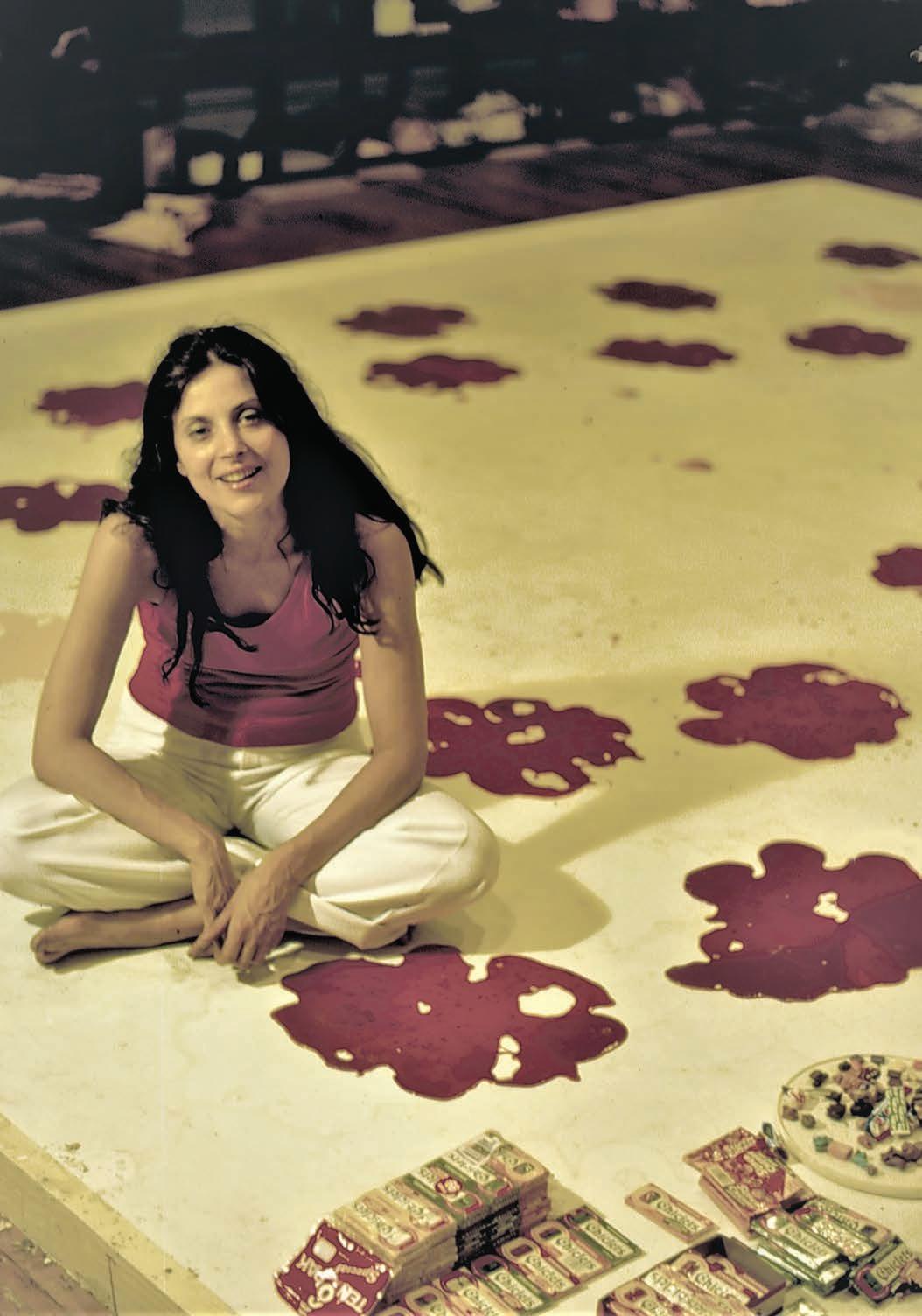
American artist Hannah Wilke (1940–93) created innovative and provocative art to affirm life. Her work embraces the vitality and vulnerability of the human body as essential to experiencing life and connecting with each other. She explored this subject in sculpture, photography, video, drawing, and performance. Wilke used her art to challenge gender inequality and empower all of us to realize a more sensuous connection to life and a more liberated society.
Born in 1940 in New York, Wilke studied at Tyler School of Fine Arts in Philadelphia. She majored in sculpture and specialized in clay, a material she worked in throughout her career. Wilke also experimented with unconventional materials like latex and chewing gum. These soft media conveyed the body’s movement, playfully capturing its liveliness.
Wilke was a critical figure in the US art scene after the Second World War, in part for her unique approach to materials and the human body. In the early 1960s, Wilke explored representations of the body with frankness and intimacy. Engaged in the emerging feminist movement, she developed an abstract visual language based on vaginal forms in support of gender equality. For Wilke, making the vagina a focus of her art was meant to celebrate and validate women’s bodies and experiences.
In the 1970s, Wilke began to work in photography and video. She often used her body to challenge how the media objectified women, portraying them as commodities. Through these works,
Wilke sought to make room for her vision of women in society, characterized by freedom and self-love.
Wilke’s art gained new meaning in the face of cancer, first her mother’s diagnosis in the 1970s and later her own in 1987. With humor, compassion, and unflinching honesty, she addressed illness and death as part of life. Wilke continued to create work that challenged societal norms until her death in 1993 at the age of fifty-two.
Hannah Wilke: Art for Life’s Sake spans the full arc of Wilke’s life-affirming practice. In her work, the body is always central. Her embrace of its sensuality and vulnerability opened new approaches to artmaking and continues to resonate today.
1Wilke, quoted in Chris Heustis and Marvin Jones, “Hannah Wilke’s Art, Politics, Religion and Feminism,” The New Common Good (May 1985): 11.
Hannah Wilke: Art for Life’s Sake is curated by Tamara H. Schenkenberg, Curator, with Katherine B. Harnish, Curatorial Assistant. This exhibition is generously supported by the Scintilla Foundation.
On Feminism
Feminism, at its core, is the pursuit of equity and inclusion on the basis of gender. Early feminist efforts in the US focused on voting rights, only legally guaranteed to women in 1920. And while feminists of diverse ethnic and racial backgrounds supported this cause, the right to vote continued to be denied to many Black women and women of color for multiple decades, with voter suppression still persisting to this day. In the last century, feminists fought to remove barriers for women to enter and advance in the workforce, to earn equal pay, and to gain agency over their own bodies, among many other causes. The ongoing efforts of Black, Indigenous, and people of color and LGBTQ+ activists have brought about greater acknowledgment of intersections of race, class, and gender, as well as expanding notions of gender and sex beyond the binary of male and female.
As part of the broader feminist movement, many artists in the 1960s and 1970s took up the feminist cause. They created work aimed at overturning sexist systems, pursuing many different priorities and strategies.
For Wilke, an important part of this work was advocating for a frank attitude toward all parts of the body. References to the vagina in her work are a vital part of her legacy of innovation as an artist and feminist. Knowing the power of language, she questioned her culture’s aversion to the word “vagina.” Shying away from this term, she noted, shuts down important conversations, including those about healthcare and reproductive rights. As a challenge to this attitude, Wilke aimed to, in her own words, create “a positive image to wipe out the prejudices, aggression, and fear” associated with the term.2
Wilke strongly linked the vagina with her own experience of being a woman, as did many feminists of the 1960s and 1970s. In the intervening decades, queer and transgender
voices have continued to fight for greater recognition for a broader spectrum of gender expressions. In this and other ways, feminism continues to evolve in many directions amid ongoing struggles for equality.
2Wilke, “Visual Prejudice [1980],” in Hannah Wilke: A Retrospective, ed. Thomas H. Kochheiser (Columbia, MO: University of Missouri Press, 1989), 141.
Galler y
Entrance
From the start, Wilke’s work revealed her interest in the body. This gallery features a selection of drawings and works in clay from the early to mid-1960s. In the spirit of the countercultural movement and sexual revolution of the time, Wilke advocated for taking pride and pleasure in one’s own body for personal and political liberation.
Throughout the gallery, bulbous, organic shapes and forms suggest a range of body parts, including breasts, buttocks, knees, and phalluses. This visual language engages with Surrealism, a major twentieth-century art movement that dealt with subconscious desires and sexually charged imagery. Historically, this subject matter was largely the domain of male artists. Undaunted, Wilke took up this material to express her own perspective.
Ceramic sculpture and drawing are two media that Wilke continually worked in throughout her career. She rejected the potter’s wheel, sculpting directly with her hands and simple tools. By leaving many of her early sculptures unglazed, Wilke highlighted the rough natural texture and ruddy color of the terracotta clay. Her early drawings, meanwhile, often featured the primary colors red, yellow, and blue. These artistic choices suggest a raw vitality that fits Wilke’s unabashed attitude toward the body and sexuality.
1. Untitled, 1960
Pastel, paint, and pencil on board 20 × 29 7/8 inches (50.8 × 75.9 cm)
Private Collection London. Courtesy Alison Jacques, London
Works in Focus: #2–4
2. Untitled, ca. 1964–66
Pastel and graphite on card
6 1/2 × 4 1/2 inches (16.5 × 11.4 cm)
Hannah Wilke Collection & Archive, Los Angeles. Courtesy Alison Jacques, London, and Marc Selwyn Fine Art, Los Angeles
3. Untitled, ca. 1964–66
Pastel and graphite on card 6 1/2 × 4 1/2 inches (16.5 × 11.4 cm)
Hannah Wilke Collection & Archive, Los Angeles. Courtesy Alison Jacques, London
4. Untitled, ca. 1964–66
Pastel and graphite on card 6 1/2 × 4 inches (16.5 × 10.2 cm)
Hannah Wilke Collection & Archive, Los Angeles. Courtesy Alison Jacques, London
In these early drawings, ambiguous shapes suggest a range of body parts including sexual organs. Colliding and merging, the forms resist easy identification. Wilke embraced her work’s openness to multiple interpretations, saying: “There is this ethics of ambiguity otherwise it wouldn’t be art.”3
Wilke’s bold application of oil pastel underscores the
physicality of these drawings. With intense colors, the drawings brim with life, capturing the primal energy of the human body.
Here, we see elements that will return throughout Wilke’s career. Notice the use of the primary colors red, blue, and yellow; the rhythmic lines; and the rounded shapes in conversation with geometric ones. Even as her style and technique evolved over time, Wilke frequently used these elements to communicate the body’s liveliness.
3 Wilke, quoted in “Artist Hannah Wilke Talks with Ernst,” Oasis d’Neon 1, no. 2 (1978): n.p.
5. Untitled, ca. mid 1960s
Pastel on paper
18 × 24 inches (45.7 × 61 cm)
Collection of Larry and Susan Marx, Aspen. Courtesy Marc
Selwyn Fine Art, Los Angeles and Alison Jacques, London
6. Untitled, early 1960s
Ink and paint on onion paper
19 × 25 inches (48.3 × 63.5 cm)
Collection of Donald and Helen Goddard. Courtesy Ronald Feldman Gallery, New York
7. Untitled, 1965
Ink on rice paper
12 1/4 × 17 5/8 inches (31.1 × 44.8 cm)
Hannah Wilke Collection & Archive, Los Angeles. Courtesy Alison Jacques, London
8. Untitled, ca. 1964–66
Pastel and pencil on paper
18 × 24 inches (45.7 × 61 cm)
Hannah Wilke Collection & Archive, Los Angeles. Courtesy Alison Jacques, London
9. Untitled, ca. 1960s
Pastel, chalk, and graphite on paper
18 × 24 inches (45.7 × 61 cm)
Hannah Wilke Collection & Archive, Los Angeles. Courtesy
Alison Jacques, London, and Marc
Selwyn Fine Art, Los Angeles
10. Untitled, ca. mid 1960s
Pastel and pencil on paper
18 × 24 inches (45.7 × 61 cm)
Hannah Wilke Collection & Archive, Los Angeles. Courtesy Alison Jacques, London
Work in Focus: #11
11. Five Androgynous and Vaginal Sculptures, 1960–61
Terracotta
a: 2 1/2 × 2 × 3 inches
(6.4 × 5.1 × 7.6 cm)
b: 3 × 2 3/4 × 2 7/8 inches
(7.6 × 7 × 7.3 cm)
c: 6 × 3 × 3 1/4 inches
(15.2 × 7.6 × 8.3 cm)
d: 4 1/2 × 4 × 2 1/2 inches
(11.4 × 10.2 × 6.3 cm)
e: 4 3/4 × 2 × 2 1/2 inches
(12.1 × 5.1 × 6.4 cm)
Hannah Wilke Collection & Archive, Los Angeles. Courtesy Alison Jacques, London
These vessel-like forms have openings and protrusions that suggest bodily orifices and genitalia without being overt. Wilke used the word “androgynous” in the title to describe their sexual ambiguity. For her, this term evoked a fluidity between male and female sex organs.
Made of unglazed terracotta, the sculpture appears earthy and natural, complementing Wilke’s unashamed approach to the body. When she began sculpting in clay, it had minor importance in the art world because of its association with crafts and functional ceramics. Wilke saw the chance to reclaim and elevate it as a sculptural material.
12. Motion Sensor, ca. 1966–67
Terracotta
3 × 10 1/4 × 6 3/4 inches (7.6 × 26 × 17.1 cm)
Hannah Wilke Collection & Archive, Los Angeles. Courtesy Alison Jacques, London, and Marc Selwyn Fine Art, Los Angeles
13. Untitled, ca. 1960s
Terracotta
3 1/2 × 3 3/8 × 4 1/2 inches
(8.9 × 8.6 × 11.4 cm)
Hannah Wilke Collection & Archive, Los Angeles. Courtesy Alison Jacques, London
The main gallery highlights Wilke’s evolving experiments with clay. The subject matter of her work during the later 1960s and the 1970s, while still expressed abstractly, became more clearly vaginal. In a culture that viewed women as lesser and genitals as shameful, Wilke sought to celebrate both through her art.
We can see how Wilke’s techniques of working in clay developed, moving from vessel-like forms displayed in the previous gallery to built-up layers and eventually to pared-down folds. With these changes, her signature vaginal motif took on new depths of meaning. For Wilke, this form was meant to represent not only femalemarked anatomy and embodied experiences but also ideas of generativity, creativity, and shared human connection.
Along with many of her peers in the 1960s and 1970s, Wilke directly linked the vagina to her experience of being a woman. The intervening decades have brought an understanding of a much broader spectrum of relationships between anatomy and gender—that is, that a person’s genitals do not determine their gender. In today’s context, Wilke’s use of the vaginal form continues to resonate through its motivation to be more inclusive and to open up the art world to more people on the basis of gender.
14. Untitled, ca. 1963–65
Acrylic on canvas
48 × 60 1/8 inches
(121.9 × 152.7 cm)
Hannah Wilke Collection & Archive, Los Angeles. Courtesy Alison Jacques, London
Hannah Wilke Collection & Archive, Los Angeles. Courtesy Alison Jacques, London
18. Untitled, ca. early 1970s
Terracotta
2 3/8 × 4 1/2 × 5 inches (6 × 11.4 × 12.7 cm)
Hannah Wilke Collection & Archive, Los Angeles. Courtesy Alison Jacques, London
19. Teasel Cushion, 1967
Terracotta, acrylic, and plastic
4 × 12 × 12 inches
(10.2 × 30.5 × 30.5 cm)
Collection Walker Art Center, Minneapolis; T. B. Walker Acquisition Fund, 2002
20. Untitled, ca. late 1960s
Terracotta
8 × 7 3/4 × 5 1/4 inches
(20.3 × 19.7 × 13.3 cm)
Hannah Wilke Collection & Archive, Los Angeles. Courtesy Alison Jacques, London
21. Untitled, ca. late 1960s
Terracotta
6 1/4 × 5 1/4 × 3 inches
(15.9 × 13.3 × 7.6 cm)
Hannah Wilke Collection & Archive, Los Angeles. Courtesy Alison Jacques, London
22. Untitled, ca. late 1960s
Terracotta
3 3/4 × 7 1/8 × 8 1/4 inches
(9.5 × 18.1 × 21 cm)
Hannah Wilke Collection & Archive, Los Angeles. Courtesy Alison Jacques, London, and Marc Selwyn Fine Art, Los Angeles
23. San Antonio Rose, 1966
Terracotta
8 × 11 × 10 1/2 inches
(20.3 × 27.9 × 26.7 cm)
Collection of Gail and Tony Ganz, Los Angeles. Courtesy
Alison Jacques, London, and Michael Solway, Cincinnati
24. Untitled (Vaginal Box), ca. 1970
Latex and ceramic
6 3/4 × 10 1/2 × 5 inches
(17.1 × 26.7 × 12.7 cm)
Collection of Donald and Helen
y
Goddard. Courtesy Ronald Feldman Gallery, New York
Sculptures in this display case demonstrate the experiments and evolution of Wilke’s technique of working in clay. In the late 1960s and 1970s, she moved away from what she described as the solidity and monumentality of traditional sculpture and toward lighter, less material form.
Wilke created the earlier works in this group like San Antonio Rose (#23) by wrapping sheets of clay around a square base. She called these types of sculptures “boxes,” a punning reference to their construction that was also slang for vagina. For Wilke, working with a vaginal form was a way to affirm her own body and uplift others to do the same. The result of her “box” construction is compact yet supple, on the verge of unfolding.
Density and tension give way to more relaxed forms in slightly later works like Yellow Rose of Texas (#17). Here the pared-back layers of clay almost seem to fall away from the airy center.
Wilke further distilled this
form soon afterwards. Abandoning the box form, she began creating sculptures made from folded clay, exemplified by this untitled work (#18). It consists of just one circle of clay that Wilke cupped in her hands and then folded and tucked the edges to leave the center open. This seemingly effortless process conveys a sense of immediacy. Always resulting in unique forms, this method became the basis of all of Wilke’s future works in clay.
25. Untitled, ca. early 1970s Watercolor on paper 10 3/8 × 17 3/8 inches
(26.4 × 44.1 cm)
Hannah Wilke Collection & Archive, Los Angeles. Courtesy Alison Jacques, London
Works in Focus: #26–29
26. Just Fifteen, 1977
Unglazed ceramic on compressed wood particle board
Collection of Gail and Tony Ganz, Los Angeles. Courtesy Alison Jacques, London, and Michael Solway, Cincinnati
29. Elective Affinities, 1978
Porcelain and wood
Overall display dimensions variable
Partial purchase with funds provided by Tate Americas Foundation, Tate International Council and an anonymous donor (Tate) and partial gift Marsie, Emanuelle, Damon and Andrew Scharlatt, Hannah Wilke Collection & Archive, Los Angeles (Tate Americas Foundation) 2015
“My sculpture is about oneness. One circle of clay or gum or latex rubber becomes a three-dimensional form through human gesture. It’s like cell division, the instant and constant transformation of simple life forms to complex life forms, all similar but each distinct.”4
In the late 1970s, Wilke began creating multipart works of art. Each component is the result of her one-fold technique. Wilke started with uniform circles of clay and shaped them into unique three-dimensional forms using a cupping and folding motion, seeming to breathe life into the sterile geometry. Wilke’s process of handmade, organic variation was a direct response to Minimalism, a movement in which artists embraced the precision of mechanical reproduction. Each one-fold sculpture is subtly different from the next, yet they are all related through their shared origins as circles of clay. In this way, Wilke meant to express the individuality and commonality among all people. The interrelationships between the sculptures hold them together as a new, collective whole. But they also reach outward.
4 Wilke, quoted in Heustis and Jones, “Hannah Wilke’s Art,” 1.
The rhythmic placement of the repeating forms suggests expansion and growth.
In these multipart sculptures, we also see a shift in Wilke’s style. The clay she uses in these works is thinner, with smooth surfaces and pastel hues. This contrasts with the earthly unglazed terracotta of her mid-1960s work. Wilke shared that she used pastel tones—a range of colors that were historically dismissed because of their association with femininity— as another way to push against cultural expectations.
“My
sculpture is about oneness. One circle of clay or gum or latex rubber becomes a threedimensional form through human gesture. It’s like cell division, the instant and constant transformation of simple life forms to complex life forms, all similar but each distinct.”5
—Hannah Wilke
5Wilke, quoted in Heustis and Jones, “Hannah Wilke’s Art,” 1
Cube Galler y
In this gallery we see the innovative results of Wilke’s experiments with unconventional materials. Creating her signature abstract vaginal forms in latex or chewing gum gave them new expressive potential. Unlike bronze or marble, these materials were not made to last.
Wilke poured latex into lacy shapes. When they dried, she folded, snapped, and gathered them into exuberant sculptures. She also shaped chewed gum in a vivid array of colors. By pulling it into strips and pressing them together, Wilke created tiny, colorful forms.
Many of Wilke’s early latex works have already deteriorated because of the formula she used and the inherent instability of the material. She embraced this risk knowingly. Latex becomes fragile over time. Gum was cheap, something to be used briefly and thrown away. Their vulnerability made the pleasure of the moment all the more poignant.
For Wilke, this playful, irreverent approach to artmaking was a way to celebrate her own body’s capacity for pleasure. She believed that sensuality could bring about liberation, which for her meant the freedom to experience life to the fullest in the brief time we have.
30. Untitled, 1967
Pastel, charcoal, and graphite on paper 17 3/8 × 24 inches (44.1 × 61 cm)
Collection of Donald and Helen Goddard. Courtesy Ronald Feldman Gallery, New York
Works in Focus: #31–33
31. Wishing You a Very Happy Easter, 1971
Pastel, pencil, and collage on paper 18 × 24 inches (45.7 × 61 cm)
Hannah Wilke Collection & Archive, Los Angeles. Courtesy Alison Jacques, London, and Marc Selwyn Fine Art, Los Angeles
32. To Sister, 1973
Pastel and collage on paper 18 × 23 7/8 inches (45.7 × 60.6 cm)
Hannah Wilke Collection & Archive, Los Angeles. Courtesy Alison Jacques, London
33. The Forgotten Man, ca. 1970
Pastel, pencil, and collage on paper 23 × 29 1/2 inches (58.4 × 74.9 cm)
Collection of Donald and Helen Goddard. Courtesy Ronald Feldman Gallery, New York
In these collaged works, vintage greeting cards anchor Wilke’s curving lines, amorphous shapes, and horizontal bands. Such cards are associated with sentimentality, which in turn is associated with femininity. By making these cards the center of her rigorous
artistic experimentation, Wilke took something her culture dismissed as lowly and questioned the reason for that dismissal. This is the same approach, grounded in feminist critique, that she took to reclaim clay, pastel colors, and, most provocatively, the vagina.
The exchange of greeting cards represents the relationships of care and reciprocity between people. We can see that emphasis on connection in the way Wilke’s drawings echo and elaborate on the cards’ designs. They seem to dance around the greeting cards, implying a responsive set of interrelationships.
Work in Focus: #34
34. Ponder-r-rosa 4, White Plains, Yellow Rocks, 1975
Museum of Modern Art, New York. Committee on Painting and Sculpture Funds and gift of Marsie, Emanuelle, Damon, and Andrew Scharlatt, Hannah Wilke Collection & Archive, Los Angeles, 2008
Looking at the skin-like latex
and the metal snaps evokes our sense of touch. Organic folds, perforated with irregular holes, blossom out from the wall, reaching toward us. The sculpture seems to embody Wilke’s desire to connect through her work: “I want to overwhelm you. I want to touch your feelings. I want to give you tender strength. Feel! Feel the folds; one fold, two folds, expressive precise gestural symbols. Multi-layered metaphysics below the gut level, like laughter, making love, or shaking hands.”6
Wilke loved bringing humor into her work. She often used puns such as the one in the title: Ponder-r-rosa. Ponder... roses? Ponder...Eros?
Ponderosa Steak House? Wilke began the Ponder-r-rosa series in the mid-1970s with a commission for art to display in the corporate headquarters of the Ponderosa Steak House restaurant chain. Wilke wittily turns our attention to the act of wondering with the word “ponder.” She also makes a visual reference to roses, highlighting the blooming structure of her sculpture. On yet another level, the title
also refers to one of Wilke’s artistic points of reference— the French-American artist Marcel Duchamp (1887–1968), and in particular, his alter ego, Rrose Sélavy. In French, Rrose Sélavy sounds like “eros, c’est la vie,” or, in English, “sex/love, that’s life.” Wilke’s playful free association brings out the sculpture’s layered meanings of taking pleasure in humor, pondering the natural world, and contemplating the intersections of love, sex, and life.
Works in Focus: #35–36
35. Untitled, ca. mid-1960s
Pastel and pencil on paper 16 1/2 × 24 inches (41.9 × 61 cm)
Hannah Wilke Collection & Archive, Los Angeles. Courtesy Alison Jacques, London, and Marc Selwyn Fine Art, Los Angeles
36. Untitled, ca. late 1960s
Pastel and pencil on paper Image: 16 × 23 inches (40.6 × 58.4 cm)
Hannah Wilke Collection & Archive, Los Angeles. Courtesy Alison Jacques, London There are holes in these
6Wilke, “Letter to Women Artists,” in Art: A Woman’s Sensibility, Feminist Art Program (Valencia, CA: California Institute of the Arts, 1975), 76.
drawings—or rather, openings. Wilke cut into the paper, letting in air and light. With these works, she invites us to look not only at the drawings but also through them.
On one level, these openings can be understood as abstract references to vaginas, a site of pleasure as well as the origin of human life. We can find another layer of meaning in Wilke’s philosophical interest in being open to life, to experience, and to connection with the world around us.
Works in Focus: #37–51
37. Untitled, ca. late 1970s
Gum sculpture in Plexiglas box
2 1/2 × 2 1/2 × 1 inches
(6.4 × 6.4 × 2.5 cm)
Hannah Wilke Collection & Archive, Los Angeles. Courtesy
Alison Jacques, London, and Marc Selwyn Fine Art, Los Angeles
38. Untitled, 1984
Gum sculpture in Plexiglas box
2 1/2 × 2 1/2 × 1 inches
(6.4 × 6.4 × 2.5 cm)
Hannah Wilke Collection & Archive, Los Angeles. Courtesy
Alison Jacques, London, and Marc Selwyn Fine Art, Los Angeles
39. Untitled, ca. late 1970s
Gum sculpture in Plexiglas box
2 1/2 × 2 1/2 × 1 inches
(6.4 × 6.4 × 2.5 cm)
Hannah Wilke Collection & Archive, Los Angeles. Courtesy
Alison Jacques, London, and Marc Selwyn Fine Art, Los Angeles
40. Untitled, ca. late 1970s
Gum sculpture in Plexiglas box
2 1/2 × 2 1/2 × 1 inches
(6.4 × 6.4 × 2.5 cm)
Hannah Wilke Collection & Archive, Los Angeles. Courtesy
Alison Jacques, London, and Marc Selwyn Fine Art, Los Angeles
41. Untitled, ca. late 1970s
Gum sculpture in Plexiglas box
2 1/2 × 2 1/2 × 1 inches
(6.4 × 6.4 × 2.5 cm)
Hannah Wilke Collection & Archive, Los Angeles. Courtesy
Alison Jacques, London, and Marc Selwyn Fine Art, Los Angeles
42. Untitled, ca. late 1970s
Gum sculpture in Plexiglas box
2 1/2 × 2 1/2 × 1 inches
(6.4 × 6.4 × 2.5 cm)
Hannah Wilke Collection & Archive, Los Angeles. Courtesy
Alison Jacques, London, and Marc Selwyn Fine Art, Los Angeles
43. Untitled, 1984
Gum sculpture in Plexiglas box
2 1/2 × 2 1/2 × 1 inches
(6.4 × 6.4 × 2.5 cm)
Hannah Wilke Collection & Archive, Los Angeles. Courtesy
Alison Jacques, London, and Marc Selwyn Fine Art, Los Angeles
44. Untitled, ca. late 1970s
Gum sculpture in Plexiglas box
2 1/2 × 2 1/2 × 1 inches
(6.4 × 6.4 × 2.5 cm)
Hannah Wilke Collection & Archive, Los Angeles. Courtesy
Alison Jacques, London, and
Marc Selwyn Fine Art, Los Angeles
45. Untitled, 1979
Gum sculpture in Plexiglas box
2 1/2 × 2 1/2 × 1 inches
(6.4 × 6.4 × 2.5 cm)
Hannah Wilke Collection & Archive, Los Angeles. Courtesy
Alison Jacques, London, and Marc Selwyn Fine Art, Los Angeles
46. Untitled, 1977
Gum sculpture in Plexiglas box
2 1/2 × 2 1/2 × 1 inches
(6.4 × 6.4 × 2.5 cm)
Hannah Wilke Collection & Archive, Los Angeles. Courtesy
Alison Jacques, London, and Marc Selwyn Fine Art, Los Angeles
47. Untitled, 1979
Gum sculpture in Plexiglas box
2 1/2 × 2 1/2 × 1 inches
(6.4 × 6.4 × 2.5 cm)
Hannah Wilke Collection & Archive, Los Angeles. Courtesy
Alison Jacques, London, and Marc Selwyn Fine Art, Los Angeles
48. Untitled, ca. late 1970s
Gum sculpture in Plexiglas box
2 1/2 × 2 1/2 × 1 inches
(6.4 × 6.4 × 2.5 cm)
Hannah Wilke Collection & Archive, Los Angeles. Courtesy
Alison Jacques, London, and Marc Selwyn Fine Art, Los Angeles
49. Untitled, 1976
Gum sculpture in Plexiglas box
2 1/2 × 2 1/2 × 1 inches
(6.4 × 6.4 × 2.5 cm)
Hannah Wilke Collection & Archive, Los Angeles. Courtesy
Alison Jacques, London, and Marc Selwyn Fine Art, Los Angeles
50. Untitled, 1984
Gum sculpture in Plexiglas box
2 1/2 × 2 1/2 × 1 inches
(6.4 × 6.4 × 2.5 cm)
Hannah Wilke Collection & Archive, Los Angeles. Courtesy Alison Jacques, London, and Marc Selwyn Fine Art, Los Angeles
51. Gum Landscape, 1975
101 chewing gum sculptures on painted wood
15 7/8 × 17 15/16 × 2 5/8 inches
(40.3 × 45.6 × 6.7 cm)
Private Collection. Courtesy Ronald Feldman Gallery, New York
Colorful, sweet, and ultimately disposable—chewing gum appealed to Wilke as an innovative material worth exploring in sculpture. In the mid-1970s, she started collecting different colors (and flavors) of gum.
Though she often referred to their form as vaginal, Wilke pointed out that her gum sculptures also resembled the head of a penis. She valued the visual and sexual ambiguity of this form, which she described as androgynous. Decades before conversations about transgender and intersex embodiment were emerging, works like this give insight into Wilke’s interest in expanding views about human anatomy and how it connects to gender. Each tiny sculpture started as
gum chewed by Wilke or by others. She then pulled the gum into a strip, pressed it together with different colored strips of gum, and folded it into its finished form. These sculptures display Wilke’s cheeky approach to eroticism with their playful twist on ideas of oral pleasure.
In addition to being sugary and colorful, gum is disposable. Wilke explored the implications of making art from a material that was intended to be enjoyed for just a few minutes before being thrown away. She felt it spoke to the way women were so often treated— almost as objects of planned obsolescence: “I chose gum because it’s the perfect metaphor for the American Woman—chew her up, get what you want out of her, throw her out and pop in a new piece.”7
52. Untitled, 1975–78 Ceramic
60 sculptures, overall 32 × 32 inches (81.3 × 81.3 cm) Collection of Marguerite Steed Hoffman. Courtesy of Alison Jacques, London
7 Wilke, quoted in Avis Berman, “A Decade of Progress, But Could a Female Chardin Make a Living?”
, October 1980, 77.
Lower Main Galler y
Work in Focus: #53
53. Gestures, 1974
Black-and-white video with sound 35:30 min
Hannah Wilke Collection & Archive, Los Angeles. Courtesy Electronic Arts Intermix, New York
Pinching, pulling, molding, slapping, stroking—in her first video work, Wilke treated her face as if she were sculpting clay. Here she manipulates her skin and features in repetitive, morphing movements, asserting her agency over her own body while simultaneously revealing its expressive potential.
Wilke dedicated this work to her former brother-in-law Hal Scharlatt who passed away suddenly. She made this work the day after his death as a way to process this loss. In her words, “When my brotherin-law died, I set up the video camera in Claes’s studio [referring to then-partner, the artist Claes Oldenburg], and I touched myself, felt myself, molded my face, and stroked myself until I got back my body at a time when I felt emotionally lost.”8
8 Wilke, quoted in a 1986 interview with Linda Montano, “Hannah Wilke Interview,” Performance Artists Talking in the Eighties (Berkeley, CA: University of California Press, 2000), 139.
Lower South Galler y
Through the camera lens, Wilke continued to break taboos in service of social and sexual liberation. She began using photography and video in the mid-1970s to address the repressive societal norms that she traced to capitalism, consumerism, misogyny, and patriarchy. Wilke critiqued these forces, and the deadening conformity they produce, to make space for individuality and freedom of expression. Wilke is nude in many of these works. She understood this as a way to communicate vulnerability. She believed that living fully meant connecting with the world through our bodies and senses, so nudity shouldn’t be a source of shame.
In her own art, Wilke contended with the ways women had been objectified in art history and commercial culture—their only value as subjects to be looked at. She wanted to affirm her own body and take control of its representation. To this end, Wilke developed an approach she called “performalist self-portraiture.” She used this phrase to acknowledge those who assisted her in making images of herself, while also highlighting her role in both posing for and directing the works. In her own words: “People want others to be the objects of their desire. But I became the subject and the object, objecting to this manipulation.”9
Works in Focus: #54–62
54. S.O.S. Starification Object Series, 1974
Gelatin silver print
40 × 27 inches (101.6 × 68.6 cm)
Collection of Alison Jacques, London
55. S.O.S. Starification Object Series, 1974
Gelatin silver print
7 × 5 inches (17.8 × 12.7 cm)
Collection of Olivia Walton. Courtesy Alison Jacques, London
56. S.O.S. Starification Object Series, 1974
Gelatin silver print
7 × 5 inches (17.8 × 12.7 cm)
Collection of Michael and Sharon Young. Courtesy Alison Jacques, London
57. S.O.S. Starification Object Series, 1974
Gelatin silver print
7 × 5 inches (17.8 × 12.7 cm)
Collection of Olivia Walton. Courtesy Alison Jacques, London
58. S.O.S. Starification Object Series, 1974
Gelatin silver print
7 × 5 inches (17.8 × 12.7 cm)
Collection of Donald and Helen Goddard. Courtesy Ronald Feldman Gallery, New York
59. S.O.S. Starification Object Series, 1974
Gelatin silver print
7 × 5 inches (17.8 × 12.7 cm)
Collection of Heidi and Erik Murkoff. Courtesy Alison Jacques, London
60. S.O.S. Starification Object Series, 1974
Gelatin silver print
7 × 5 inches (17.8 × 12.7 cm)
Collection of Tom and Alice Tisch. Courtesy Alison Jacques, London
61. S.O.S. Starification Object Series, 1974
Gelatin silver print
7 × 5 inches (17.8 × 12.7 cm)
Collection of Teresa Tsai. Courtesy Alison Jacques, London
62. S.O.S. Starification Object Series, 1974
Gelatin silver print
7 × 5 inches (17.8 × 12.7 cm)
Collection of Shezad and Miranda Dawood. Courtesy Alison Jacques, London
What judgements do we make when we look at each other? Wilke believed that prejudice began with sight: “People are first visually prejudiced and that’s why I made myself very visual.”10 She wanted to use her image to draw out prejudices so that people would have to confront them.
These photographs are selections from a series that includes twenty-eight pictures. In each image, Wilke dares us to look at her. She uses different props and poses to evoke a range of stereotypes, parodying representations of fashion models and movie stars.
9, 10 Wilke, quoted in Heustis and Jones, “Hannah Wilke’s Art,” 11.
Lower South Galler y
Wilke placed her gum sculptures on her face, hands, and chest. They interrupt the act of looking at her in the role of a model—that is, as an object of commercial or sexual desire. For the artist, this objectification was a source of distress, which she signaled through the pattern of gum and title of the work (S.O.S.), which refers to Morse code. In this way, she asks us to pause and think about the real, vulnerable human beings pictured in such images.
The gum sculptures are also meant to represent scars, visualizing emotional and psychological pain. This includes the pain of contending with the prejudices that fuel not only stereotypes but also discrimination and violence. As a Jewish woman born during World War II, Wilke spoke about these gum scars as referencing, in part, the marking and dehumanization of Jewish people during the Holocaust.
By using her gum sculptures in this way, Wilke insisted on art’s capacity to enact political resistance, to inspire agency, and to dislodge deadening (even deadly) systems of oppression.
63. Untitled #4, 1976
Chewing gum on 16 sheets of rice paper, framed in Plexiglas 33 7/8 × 25 3/4 inches (86 × 65.4 cm)
Collection of Marguerite Steed Hoffman. Courtesy Alison Jacques, London
Work in Focus: #64
64. Atrophy, from the So Help Me Hannah series, 1978–84
Performalist Self-Portrait with Donald Goddard Vintage black-and-white photograph in yellow frame 60 × 40 inches (152.4 × 101.6 cm) Hannah Wilke Collection & Archive, Los Angeles. Courtesy Alison Jacques, London
In this photograph, Wilke is nude and balances precariously in high heels on an air compressor. Her pose reveals her position in society as a woman, contrasting her own vulnerable body with that of the mechanical equipment. The machine can be understood as a symbol for the industrial, capitalist, and patriarchal structures of the dominant culture.
Over the air compressor, Wilke superimposed the word “atrophy”—meaning to diminish or waste away. As someone who loved wordplay, she meant for us to read the word a second way, as “a
trophy.” This refers to the idea of women as status symbols that diminish in value over time. Wilke’s foothold on the machine, while tenuous, suggests that she and other women have a chance to flip this dynamic and rise above it, and that, perhaps, it is the dominant culture that will waste away. This work is based on one of fifty photographs in the series So Help Me Hannah, for which Wilke posed throughout the P.S.1 Institute for Art and Urban Resources, Queens (now MoMA PS1).
Work in Focus: #65
65. Hannah Wilke Can, 1978
Photo-reproduction on 5 coin collection cans
Each: 6 × 3 inches (15.2 × 7.6 cm)
Hannah Wilke Collection & Archive, Los Angeles. Courtesy Alison Jacques, London
A rapturous Wilke in high heels and a loincloth adorns these tin cans. Her pose is a reference to Venus, the Roman goddess of love, who was often represented in the history of Western art in this half-revealing position.
The tin cans, with slits in the top, are the kind used for
soliciting donations. She made them to use in a performance at a fundraising event for the Public Art Fund. The can form raises the question of the economic struggle of artists, especially women artists who have so often been kept out of structures of power in the art world. By placing a nude image of herself on the can, Wilke seems to be thinking about the commercial exploitation of women and strictures around their sexuality. At the same time, she asserts, through a pun in the title, that she “can” overcome these obstacles.
Work in Focus: #66
66. Intercourse with…, 1978
Black-and-white video with sound 27 min
Hannah Wilke Collection & Archive, Los Angeles. Courtesy Electronic Arts Intermix, New York
In this taped performance, Wilke uses nudity in order to communicate the vulnerability of being in personal relationships. We see her slowly removing her clothing as she listens to answering machine messages left for her by family, friends, lovers, and colleagues. Letters on her bare body spell out the names
Lower South Galler
or initials of her callers. She peels the letters from her skin, an action that seems to ask: how do our relationships mark us, define us, or constrain us? And who are we with and without them?
The soundtrack shifts to Wilke reading her artist statement. As a part of this text she gives examples of crude language for genitals to show how it encourages shame, fear, and aggression toward human bodies. In contrast, Wilke explains that her goal is to create art that addresses the body in positive and empowering ways. The statement gives further meaning to Wilke’s actions in the performance. Removing the letters now also suggests removing other people’s expectations or judgements about her body as she reclaims it for herself.
Works in Focus:
#67–73
67. Franklin’s Tomb, Philadelphia, 1977
Kneaded erasers on postcard and painted wood in Plexiglas box
Goddard. Courtesy Ronald Feldman Gallery, New York
68. Corcoran Art Gallery, 1976
Kneaded erasers on postcard on painted board in Plexiglas box
Overall: 15 3/4 × 17 3/4 inches (40 × 45.1 cm) Collection of Gail and Tony Ganz, Los Angeles. Courtesy Alison Jacques, London, and Michael Solway, Cincinnati
69. The Hudson River, West Point, NY, 1975
Kneaded erasers on vintage postcard and painted board in Plexiglas box
Los Angeles County Museum of Art, Gift of Marsie, Emanuelle, Damon, and Andrew Scharlatt, Hannah Wilke Collection & Archive, Los Angeles
Stretchy and malleable, kneaded erasers are the primary material of these works. While they are often used to erase marks from drawings, erasers themselves are unusual as sculpting material. For Wilke, making abstract representations of vaginal forms from erasers was a way to point out the historical absence of women from various sectors of society.
By titling several works
Needed-Erase-Her (#72–73), she punned on the name of the material, drawing attention to women as both “needed” and “erased.” In other works (#67–71), Wilke strategically placed kneaded eraser sculptures onto vintage postcards depicting civic monuments such as art museums and other public spaces. The eraser sculptures represented both the present exclusion of women and the
exciting potential of their inclusion. The works envision a world where women are free from the suppression of patriarchy and can participate more fully in society.
⚫
“I made myself into a work of art. That gave me back my control as well as dignity.” 11
—Hannah Wilke
11Wilke, quoted in Montano, “Hannah Wilke Interview,” 139.
Lower East Galler y
For Wilke, embracing the life of the body meant both reveling in its pleasures and also coming to terms with illness and death. In the late 1970s, she worked to make visible these often hidden aspects of life. This gallery, divided into two sections, features the bodies of work Wilke created documenting her mother’s—and later her own—long and ultimately fatal illness with cancer.
As Wilke’s earlier photographs challenged conventional representations of women, so too do these works. With remarkable candor, Wilke depicted both herself and her mother Selma Butter not as idealized women but as real individuals—vulnerable but fully alive.
Throughout this period, Wilke continued making art as a way of affirming life.
Gallery Part One
The first half of this gallery brings together work Wilke made of or about her mother, Selma Butter. In 1970, when Wilke was thirty years old, her mother was diagnosed with breast cancer. Selma had a mastectomy that sent the cancer into remission, but it returned in 1978. Despite further treatments, she died in 1982. During those four years, Wilke devoted time to her mother, who became a major subject in her work: “I took thousands of photographs of her. . . . The images I made of myself and my mother kept me alive.”12
During this time, Wilke continued to work in clay and applied colorful paint to her sculptures. She later reflected that as her mother got sicker, the colors she used became brighter. In addition to this change in surface treatment, Wilke began thinking about her abstract vaginal sculptures in new ways. She spoke of the works in this gallery as references to both wombs and tombs, representing the full cycle of life. ⚫
Work in Focus: #74
74. In Memoriam: Selma Butter (Mommy), 1979–83 Photographic triptych with floor sculpture
Triptych: 3 groups of 6 gelatin silver prints, each with press type and art paper, mounted on board, each 41 × 61 inches (101.1 × 155 cm), framed. Sculpture: 3 groups of 2 acrylic painted ceramics on an acrylic painted Masonite board, each 13 × 20 × 4 inches (33 × 50.8 × 10.2 cm) Hannah Wilke Collection & Archive, Los Angeles. Courtesy Alison Jacques, London
In 1978, Wilke’s mother Selma learned that her breast cancer had come back from remission. Throughout the following four years, Wilke spent much of her time with her mother, taking her to doctors’ appointments and keeping her company. Wilke took hundreds of photographs documenting moments in Selma’s daily life. She believed this to be therapeutic for both of them. After Selma died in 1982, these images formed the basis of Wilke’s multipart memorial to the woman that gave her life.
Below the photographs, 12Wilke, “Seura Chaya,”
Lower East Galler y : Part One
cutout shapes of paper echo some of the negative spaces of the images. Beneath the shapes are words that describe Wilke’s relationship with her mother. Clay sculptures in primary colors complete the work. For Wilke, the color palette suggested the primal bond between parent and child.
Works in Focus:
#75–77
75. B.C. Series, Self-Portrait, May 13, 1988, 1988
Watercolor on Arches paper
71 1/2 × 51 1/2 inches
(181.6 × 130.8 cm)
Hannah Wilke Collection & Archive, Los Angeles. Courtesy Alison Jacques, London, and Marc Selwyn Fine Art, Los Angeles
76. B.C. Series, Self-Portrait, May 22, 1988, 1988
Watercolor on Arches paper
71 1/2 × 51 1/2 inches
(181.6 × 130.8 cm)
Hannah Wilke Collection & Archive, Los Angeles. Courtesy Alison Jacques, London, and Marc Selwyn Fine Art, Los Angeles
77. B.C. Series, Self-Portrait, April 24, 1988, 1988
Watercolor on Arches paper
71 1/2 × 51 1/2 inches
(181.6 × 130.8 cm)
Hannah Wilke Collection & Archive, Los Angeles. Courtesy Alison Jacques, London, and Marc Selwyn Fine Art, Los Angeles
“I realized that what I had done in the last few days, because I had been quite depressed, was to make gestural layered watercolors of only my face in which I took away my hair, creating circular patterns. But these portraits really became portraits of my mother, who had lost all of her hair from chemotherapy.”13 Wilke started making these portraits in 1986, four years after her mother’s death. By painting just her face, she felt she was also portraying her mother, encircling them both.
The brushwork seems to caress Wilke’s face rather than delineate it, creating loose forms. Her woven brushstrokes evoke her desire for oneness and interconnection with the self and the world. With these portraits, Wilke envisioned herself as ever-changing, vitally open to life without
13Wilke, quoted in Montano, “Hannah Wilke Interview,” 140–41.
denying her own mortality.
Wilke began making these works before learning of her own cancer diagnosis in 1987. She continued making them for several years and decided to title them B.C. Series for “before cancer.”
78. Generation Process Series #16, 1982
Acrylic on ceramic and wood
3 1/2 × 19 1/2 × 19 1/2 inches
(8.9 × 49.5 × 49.5 cm)
Hannah Wilke Collection & Archive, Los Angeles. Courtesy Alison Jacques, London, and Marc Selwyn Fine Art, Los Angeles
79. Generation Process Series #6, 1982
Acrylic on ceramic and wood
3 1/2 × 19 1/2 × 19 1/2 inches
(8.9 × 49.5 × 49.5 cm)
Hannah Wilke Collection & Archive, Los Angeles. Courtesy Alison Jacques, London, and Marc Selwyn Fine Art, Los Angeles
80. Generation Process Series #15, 1982
Acrylic on ceramic and wood
3 1/2 × 19 1/2 × 19 1/2 inches
(8.9 × 49.5 × 49.5 cm)
Hannah Wilke Collection & Archive, Los Angeles. Courtesy Alison Jacques, London, and Marc Selwyn Fine Art, Los Angeles
Work in Focus: #81
81. Untitled (Seura Chaya), 1983
Watercolor on paper 7 × 10 inches (17.8 × 25.4 cm)
Hannah Wilke Collection & Archive, Los Angeles. Courtesy Alison Jacques, London
This colorful, intimate drawing is a portrait of Wilke’s pet lovebird, Seura Chaya. The day after her mother’s funeral, this little bird flew into Wilke’s life. It had gotten into her future husband Donald Goddard’s apartment, and he brought it to Wilke. She and her sister named the lovebird Chaya—their mother’s Hebrew middle name, which means “living thing” or “animal.” From then on, lovebirds became a significant symbol for Wilke, representing love, caring, and the cycle of life.
Work in Focus: #82
82. Portrait of the Artist with Her Mother, Selma Butter, 1978–81
Cibachrome prints, 2003
Each: 40 × 30 inches
(101.6 × 76.2 cm)
Hannah Wilke Collection & Archive, Los Angeles. Courtesy Alison Jacques, London
How do you represent pain in a culture that only values
Lower East Galler y : Part One
health, happiness, and youth, especially in women? Seeming to ponder this question, Wilke paired these two portraits. On the left we see Wilke in a photograph from 1978, and on the right is her mother Selma in 1981. Their poses mirror one another, and their heads incline together, connecting the two women across time and circumstance.
Wearing heavy makeup and boldly engaging the camera, Wilke interrogates her position as a conventionally beautiful woman in a culture that objectifies people based on their appearances. The little objects on Wilke’s torso stand in for found objects she had collected for her former partner, the artist Claes Oldenburg. Here, they visualize Wilke’s emotional and psychological wounds through their resemblance to scars.
The photograph of Selma shows the scar of her mastectomy covered in small sores caused by the cancer that had returned. This photograph reveals Selma as aging and ailing. These are experiences that visual culture does not often make room for, and yet they are realities of life.
By bringing these photographs
together, Wilke asks us to consider the bonds of love, empathy, and biology that connect the two women.
“I
guess that I can finally accept the fact that she died, knowing that she lives inside me. Although she lost her breast with the cancer that finally ate up her body, she knew what it was like to live. She was a woman of wisdom, courage, and love. She gave me spirit, mind, and also my body.14
—Hannah
Wilke 14Wilke quoted in Montano, “Hannah Wilke Interview,” 141.
Lower East Galler y : Part Two
Gallery Part Two
The second part of the gallery focuses on the work that Wilke created following her own diagnosis of nonHodgkin’s lymphoma in 1987. With honesty and humor, vulnerability and persistent vitality, Wilke documented the changes to her body through the stages of her illness and treatment. Her prolific creativity during this period is a testament to her continued belief in the life-affirming power of art.
Many of these works are part of her Intra-Venus series. The title alludes to Venus, the Roman goddess of love, as well as to the intravenous medical treatments Wilke received.
In the monumental photographs, Wilke affirms the life of her body, even as that body is compromised (#83–84, 89–91). We see an echo of the way she presented herself in earlier work. Here, she continues to make visible and validate the parts of her life as a woman that, as she asserted, society did not value.
Wilke also created many drawings of her face and
hands in sketchbooks that she kept with her during hospitalization (#86, 87). With these works, Wilke continued her lifelong exploration of her ever-changing relationship to her own body and image.
83. Intra-Venus Series No. 6, February 19, 1992, 1992
Performalist Self-Portrait with Donald Goddard
Chromogenic supergloss print with overlaminate
47 1/2 × 71 1/2 inches (120.7 × 181.6 cm)
Collection of Donald and Helen Goddard. Courtesy Ronald Feldman Gallery, New York
84. Intra-Venus Triptych, 1992–93
Performalist Self-Portrait with Donald Goddard
Chromogenic supergloss prints with overlaminate
Each: 26 1/4 × 39 1/2 inches (66.7 × 100.3 cm)
Hannah Wilke Collection & Archive, Los Angeles. Courtesy Alison Jacques, London, and Marc Selwyn Fine Art, Los Angeles
85. About Face #4, 1989
9 watercolors on paper
49 1/4 × 40 1/4 inches (125.1 × 102.2 cm), framed
Hannah Wilke Collection & Archive, Los Angeles. Courtesy Alison Jacques, London
86. Untitled, 1991
Watercolor on paper
12 × 9 inches (30.5 × 22.9 cm)
Hannah Wilke Collection &
Archive, Los Angeles. Courtesy
Alison Jacques, London
87. Intra-Venus Hand (NYC Hospital)
October 18, 1991, 1991
Watercolor on paper
12 1/2 × 9 1/4 inches (31.8 × 23.5 cm)
Hannah Wilke Collection & Archive, Los Angeles. Courtesy Alison Jacques, London
Work in Focus: #88
88. Blue Skies, 1987–92
Acrylic on ceramic and wood 7 × 59 × 59 inches
(17.8 × 149.9 × 149.9 cm)
Hannah Wilke Collection & Archive, Los Angeles. Courtesy Alison Jacques, London
Swirls and streaks of pink, green, and blue paint activate the folded clay sculptures of Blue Skies. This lively treatment underscores the meaning of the title, which is a reference to the popular 1926 song by composer Irving Berlin. When she was a child, Wilke used to sing it with her mother and sister, Marsie Scharlatt. Its lyrics speak about better days ahead. Through the title we get a sense of Wilke’s optimism as she continued to receive treatment and hoped for a cure.
89. Intra-Venus Series No. 1, June 15, 1992, and January 30, 1992, 1992
Performalist Self-Portrait with Donald Goddard
Chromogenic supergloss prints with overlaminate
71 1/2 × 47 1/2 inches
(181.6 × 120.7 cm)
Collection of Donald and Helen Goddard. Courtesy Ronald Feldman Gallery, New York
90. Intra-Venus Series No. 4, July 26 and February 19, 1992, 1992
Performalist Self-Portrait with Donald Goddard
Chromogenic supergloss diptych with overlaminate
Each: 72 1/4 × 48 1/4 inches (183.5 × 122.6 cm)
Hannah Wilke Collection & Archive, Los Angeles. Courtesy Alison Jacques, London
91. Intra-Venus Face No. 10, February 8, 1992, 1992
Watercolor on paper 12 1/2 × 9 1/2 inches (31.8 × 24.1 cm)
Hannah Wilke Collection & Archive, Los Angeles. Courtesy Alison Jacques, London
Imagine seeing Wilke’s sculptures in a public space on a monumental scale. Wilke actively pursued this vision but couldn’t realize it due to a lack of financial support. She had hoped to add her feminist voice to the landscape of public sculpture, a realm long dominated by male artists.
To accomplish this goal, she learned how to cast in bronze during an artist residency in 1979 at Ohio University, Athens. There she created models for large-scale, outdoor sculptures (#94–95).
Experimenting with metal casting, Wilke reimagined her delicate, ephemeral forms in materials that would reflect the value of the subject matter for years to come. For example, in Pyramid Sculptures (#95), Wilke builds on the idea of layering by casting rectangular strips of chewing gum to create this form that also references monumental architecture. These drawings and models give us insight into the scope of Wilke’s artistic ambition.
92. Untitled (Cityscape with Large Scale Sculpture), 1988
Ink and watercolor on cardboard with reverse image
8 1/2 × 11 inches (21.6 × 27.9 cm)
Hannah Wilke Collection & Archive, Los Angeles. Courtesy Alison Jacques, London
93. Model for Large Scale Sculpture in Steel or Bronze Cast, 1979
Magazine image and ink on paper 24 × 18 inches (61 × 45.7 cm)
Hannah Wilke Collection & Archive, Los Angeles. Courtesy Alison Jacques, London
94. Ohio, 1979
3 matte patina bronze sculptures 5 × 6 × 9 inches
(12.7 × 15.2 × 22.9 cm)
3 × 5 × 8 inches
(7.6 × 12.7 × 20.3 cm)
3 × 5 × 9 inches
(7.6 × 12.7 × 22.9 cm)
Hannah Wilke Collection & Archive, Los Angeles. Courtesy Alison Jacques, London
95. Pyramid Sculptures, Models for Large Scale Outdoor Sculptures, 1975–80
Hannah Wilke Collection & Archive, Los Angeles. Courtesy Alison Jacques, London
Lower West Galler y
The exhibition concludes with works inspired by nature, a perennial theme in Wilke’s practice. This gallery highlights the wide range of media and techniques she explored throughout her career, in works dating from her student days in 1959—the earliest in the show—to 1992, during the final months of her life.
Wilke often took inspiration from the visual and symbolic qualities of natural forms, especially flowers. Many of her drawings and sculptures refer to petals, buds, and blooming growth, accentuating the vitality of this traditional symbol of femininity. Flowers are also associated with mortality and the cycle of life, and Wilke embraced this meaning as well. She spoke about them in the context of her mother’s illness: “I used to draw flowers and watch the flowers die, sort of as preparation for her death.”15
For Wilke, life was about movement and change. Both vast and intimate, the outdoors offered scope for her feminist fantasies of freedom from cultural constraints. The natural world opened possibilities for a more profound and joyful engagement with life.
15Wilke, quoted in Ernst Weber, “Oasis d’Neon Video Magazine Talks With Artist Hannah Wilke,” a one-hour videotape filmed at Wilke’s Greene Street studio, March 21, 1985.
Work in Focus: #96
96. Hello Boys, 1975
Black-and-white video with sound 12 min
Hannah Wilke Collection & Archive, Los Angeles. Courtesy Electronic Arts Intermix, New York
Shot through a fish tank, Wilke bobs around like she’s underwater. She flirts with the fish to The Who’s album Quadrophenia, including the song “The Real Me.”
Throughout her career, Wilke balked at the way people tried to stereotype her. In this video, she playfully subverts one such stereotype, the femme fatale.
The title Hello Boys brings to mind a woman addressing a group of men, pleasurably aware of her sexual power. As the trope goes, openly sexual, self-aware women are dangerous, luring men to destruction. In the video, Wilke’s sensual movements are paired with silly antics, suggesting a light-hearted, joyful, and non-threatening embrace of sexuality.
97. Barber’s Pond, 1975
Kneaded erasers on postcard and painted board in Plexiglas box
Overall: 15 3/8 × 17 3/8 × 3 inches
(39.1 × 44.1 × 7.6 cm)
Hannah Wilke Collection & Archive, Los Angeles. Courtesy Alison Jacques, London
98. Sea Wall, 1975
Kneaded erasers on postcard and painted board in Plexiglas box
Overall: 15 3/4 × 17 3/4 × 2 3/4 inches
(40 × 45.1 × 7 cm)
Hannah Wilke Collection & Archive, Los Angeles. Courtesy Alison Jacques, London
99. Seashore, 1975
Kneaded erasers on postcard and painted board in Plexiglas box
Overall: 15 3/4 × 17 3/4 × 2 inches
(40 × 45.1 × 5.1 cm)
Collection of Donald and Helen Goddard. Courtesy Ronald Feldman Gallery, New York
100. Hannah Manna, 1985–86 77 painted sculptures on painted board with hand-typed, signed wall plaque under glass Overall dimensions variable
Hannah Wilke Collection & Archive, Los Angeles. Courtesy Alison Jacques, London
Works in Focus:
#101–106
101. Untitled (Gum on Acorn, Los Angeles) from the Gum in Landscape Series, 1977
Hannah Wilke Collection & Archive, Los Angeles. Courtesy Alison Jacques, London, and Marc
Selwyn Fine Art, Los Angeles
Wilke sometimes took her gum sculptures out into the lush playground of nature. For Wilke, these sculptures proposed an unabashed embrace of the body— including the parts that society deemed shameful or lowly. Shaped to refer to genitalia, their meanings build and shift depending on the context. Perched on an open blossom or nestled in grasses, away from society, we can understand the gum sculptures as emphasizing the body as our means of connecting with nature and the wider world.
107. Untitled, 1983
Painted ceramic
4 3/16 × 10 1/4 × 5 inches (10.6 × 26 × 12.7 cm)
The Jewish Museum, New York, Gift of Ellen and Fred Harris, 2012-37
Thank you to all of the collaborators and workers who supported the creation of Hannah Wilke: Art for Life’s Sake, as well as the Pulitzer’s talented staff and dedicated Board of Directors.
We’re Listening
We’d love to hear your thoughts!
Scan the following QR code or visit pulitzerarts.org/survey to access a brief survey about your visit. Complete the survey and be entered to win a prize.
Upcoming Exhibition
Assembly Required
March 4, 2022–July 31, 2022
Assembly Required will feature eight artists whose work invites your active participation. You may build, shape, and use these artworks, collaboratively or on your own. The artists were selected based on a shared belief that public action is vital for transforming society.
Created between the 1960s and the present, the artworks in this exhibition respond to distinct social and political moments, from unrest in the United States during the Vietnam War to Peru’s military dictatorship. The artists offer unique perspectives on social change, addressing the need for optimism and hope in the face of global tensions.
Including works by Francis Alÿs, Rasheed Araeen, Siah Armajani, Lygia Clark, Hélio Oiticica, Yoko Ono, Lygia Pape, and Franz Erhard Walther, Assembly Required asks questions about how art allows us to imagine new ways of being in the world.