Terry Adkins: Resounding
Mar 13, 2020–Feb 7, 2021
Terry Adkins: Resounding
Mar 13, 2020–Feb 7, 2021
Experience the exhibition with a curator as your guide. Access the free audio tour on our website using your mobile device and our Wi-Fi: Pulitzer Public. Objects accompanied by in this guide correspond to tracks on the audio tour.
Hay materiales traducidos al español disponibles en recepción. Visite pulitzerarts.org para más información sobre nuestros recursos en español. Visit the front desk to access a translation of this Museum Guide in Spanish.
Terry Adkins: Resounding is accompanied by a fully illustrated catalogue with essays by Clifford Owens, Lowery Stokes Sims, and Stephanie Weissberg. Purchase your copy at the Information Desk, or online at pulitzerarts.org/shop.
If you need assistance, our museum staff is here to help. Have a question about the artwork? Ask our team or email askacurator@pulitzerarts.org .
American artist Terry Adkins (1953–2014) made art that transgresses boundaries. Over more than three decades, he created an expansive and pioneering body of work that blends sculpture, sound, performance, video, and printmaking. Combining deep interests in history, language, and music, he devoted his work to upholding the legacies of larger-than-life figures, often from the canon of African American culture. Through his singular vision as well as his ongoing work as an educator and mentor, Adkins made a significant impact on the fields of contemporary sculpture and performance. Bringing together works from across the artist’s prolific career, Terry Adkins: Resounding surveys the evolution of the artist’s practice and sheds new light on the wide-ranging influences that informed his creative output.
Adkins was raised in a musical household in Alexandria, Virginia, where he learned to play piano and saxophone. From a young age, he was drawn to the work of jazz luminaries such as John Coltrane, Charlie Parker, and Ornette Coleman. While Adkins turned his primary focus to visual art, earning degrees in fine art and printmaking from Fisk University (1975), Illinois State University (1977), and the University of Kentucky (1979), music would remain essential to his practice. Often referring to himself as a “composer,” he applied the principles of improvisation and experimentation that he learned through jazz to his approach to art making. Throughout his career he maintained the goal of making “music as physical as sculpture might be, and sculpture as ethereal as music is.”
In 1986 Adkins founded the Lone Wolf Recital Corps, a rotating group of musicians and artists who performed alongside his installations. Over the next ten years he developed a signature method of working called the “recital,” in which he would bring together a body of artworks and performances that collectively explored the legacies of under-recognized figures such as blues singer Bessie Smith, abolitionist John Brown, and sociologist and activist W. E. B. Du Bois.
Adkins did not shy away from difficult subject matter and often used his recitals as a platform to challenge familiar narratives. Referring to his work as “abstract portraiture,” he rooted his practice in research into the history of particular places and communities. Adkins mined these sites for found items such as instruments,
furniture, and machinery, using these objects as the foundations for his sculptures. Ultimately, he believed these strategies allowed him to unlock the potential of his materials in order to bring to life critical but untold stories.
Terry Adkins: Resounding includes more than forty objects that the artist produced from the 1970s until his death in 2014. Rarely exhibited examples from Adkins’s early practice are presented alongside some of his most celebrated works, with selections from several acclaimed installations and recitals on view for the first time since their original debuts. Resounding also includes items that the artist collected over his lifetime including books, musical instruments, and objects from a range of artistic traditions, offering new insight into the breadth of Adkins’s literary, musical, and visual influences.
Terry Adkins was deeply interested in materials. Mining historical sites, industrial areas, archives, and his own neighborhood, the artist gathered objects that others might have considered scraps. Through a process he referred to as “potential disclosure,” he brought these cast-off items home or to his studio and lived alongside them until they revealed their purpose: “I take the things that society considers useless and throws away and give them a new life by re-creating and re-combining them into works of art.”
This gallery includes several examples of the broad range of materials with which Adkins engaged, spanning from more traditional media like watercolor to the inventive use of found objects as in Nenuphar (#4), made from the fused bodies of two sousaphones. Like a number of the works on view in this exhibition, Nenuphar also represents Adkins’s enduring interest in symmetry, repetition, and mirroring, concepts he sometimes traced to the architecture of churches he attended as a child.
Unless otherwise noted, all works in this exhibition are by Terry Adkins (1953–2014).
1. Unknown Maker
Untitled, n.d.
Metal and leather
Dimensions variable
Estate of Terry Adkins
Throughout his career Adkins collected, performed with, and incorporated bells into his sculpture. His fascination with these instruments related not only to their physical forms, but also to their potential for activation through motion. He often wore bells during his performances, using the movements of his body to produce particular sounds and rhythms. Adkins specifically linked bells to African American spiritual music, in which he said: “Heaven is a bountiful land of milk and honey where one hears perpetual choirs, ringing bells, shining trumpets, and God’s trombones.”
2. High Point, 1993
Oxidized steel
43 1/2 × 36 1/2 × 9 inches
(110.5 × 92.7 × 22.9 cm)
The Metropolitan Museum of Art, Purchase, Louis and Bessie Adler Foundation, Inc. Gift, 1994. 1994.320a-j
High Point is made from a patchwork of rusted railroad plates and stakes. Adkins found these industrial scraps around Greensboro, North Carolina, in 1993. He was particularly interested in the region’s historical production of textiles, furniture, and coal. These products were transported through a network of train lines connecting Greensboro to cities across the United States, including nearby High Point— the birthplace of prominent jazz saxophonist John Coltrane (1926–67).
With this sculpture, Adkins references the history of industry while also alluding to the major influence that Coltrane had on his life and work.
3. Mvet Majestic II, 1989
Wood and acrylic
Overall dimensions variable, approximately 80 × 36 × 2 inches (203.2 × 91.4 × 5.1 cm)
Private collection
4. Nenuphar, 1998
Brass and copper
30 × 69 × 9 inches
(76.2 × 175.3 × 22.9 cm)
Collection of Catherine Gund
5. Untitled, n.d.
Mixed media on paper, three sheets
30 × 60 inches (76.2 × 152.4 cm)
Estate of Terry Adkins
Main Gallery
“My quest has been to find a way to make music as physical as sculpture might be, and sculpture as ethereal as music is. It’s kind of challenging to make both of those pursuits do what they are normally not able to do.”
—Terry Adkins
6. Divine Mute, 1998
Aluminum, brass, nickel, and wood
77 × 77 × 21 1/2 inches
(195.6 × 195.6 × 54.6 cm)
The George Economou Collection
For Adkins, Divine Mute signified the spiritual awakening that abolitionist John Brown described as the inspiration for his attempts to eradicate slavery in the United States, most famously through a raid on a federal armory at Harpers Ferry, West Virginia. Through this maneuver, Brown (1800–59) hoped to supply enslaved people with weapons and incite a revolt. Although he and his men were ultimately captured, their actions were part of a series of events leading to the American Civil War (1861–65).
Adkins imagined that Brown’s divine calling was marked by “either a very big sound or a very bright light,” similar to how artists, writers, and musicians have historically represented mystical revelations. Themes of announcement and echoing are amplified in Divine Mute by the repetition of circular forms, including the central sousaphone bell, the eight shining roundels, and the reflective aluminum disc.
Adkins revisited Brown’s legacy across eight recitals and was particularly interested in the spectrum of responses to the abolitionist, ranging from celebration to villainization.
7. Muffled Drums, 2003
Bass drums and mufflers
Overall display dimensions variable Tate: Purchased using funds provided by the 2013 Outset / Frieze Art Fair Fund to benefit the Tate Collection 2014
This towering stack of bass drums is the tallest sculpture Adkins produced. He included eleven drums in the original presentation. However, Adkins sometimes installed the work with eight, as seen here, because he was drawn to the numeral’s symmetry and repetition of circular forms. Some of the instruments feature designs including a painted landscape; the logo of a marching band from Danville, Virginia; and the insignia of Adkins’s performance group, the Lone Wolf Recital Corps.
Adkins originally included this work in a recital exploring the legacy of W. E. B. Du Bois, a pioneering American sociologist, historian, and civil rights activist. Its title likely references the Silent Protest Parade of July 1917 that Du Bois helped organize. Newspapers described over eight thousand people marching silently to the “beat of muffled drums” in the streets of New York City, protesting segregation, discrimination, and lynching in the United States. The event was developed partly in response to the 1917 East St. Louis riots in which numerous Black residents were killed; the official death toll is not known to this day.
As a lifelong student of history, Adkins often used works such as Muffled Drums to demonstrate the resonance of historical events within contemporary society, in this case highlighting the continued struggle for racial justice on behalf of Black lives.
8. Last Trumpet, 1995
Brass, sousaphone, and trombone bells, four parts
Each 216 × 24 × 24 inches (548.6 × 61 × 61 cm)
The Museum of Modern Art, New York. Gift of David Booth; and gift of Mr. and Mrs. Murray Thompson (by exchange), 2017
Adkins made this monumental work as a tribute to his late father. The iconic sculpture consists of four “Akrhaphones,” trumpet-like instruments of the artist’s own invention. They allude to the trumpets played by angels during the biblical narrative of God’s Last Judgment on humanity.
To create these eighteen-foot-long horns, Adkins attached sousaphone and trombone bells to tubes of cast brass, not realizing at first that the instruments would actually produce sound. The artist exhibited this work in several recitals, and his performance group, the Lone Wolf Recital Corps, has played it on multiple occasions.
9. Greater Deeps, 1995 Tin and wood
32 × 27 × 18 inches
(81.3 × 68.6 × 45.7 cm)
Estate of Terry Adkins
Adkins repurposed parts of a Tonka toy truck to create this memorial to his father, Robert Hamilton Adkins (1927–95), who was both a source of encouragement and figure of admiration for his son.
The artist associated Greater Deeps with religious themes, including death, resurrection, and the soul’s departure from the body. Adkins tended to install Greater Deeps high on the wall, emphasizing the sculpture’s spiritual symbolism.
“When I am most successful, the work of art becomes illuminated, retaining the brilliance of the revelatory experience that created it.”
—Terry Adkins
Entrance Gallery
In Nenuphar, the last recital Adkins completed before his death, he explored the biographies of two twentieth-century innovators: American agricultural scientist George Washington Carver (1864–1943) and French conceptual artist Yves Klein (1928–62). While the two men never met, Adkins identified a series of connections between them, often highlighting lesser-known aspects of their histories. For example, works in the recital explore their mutual fascination with ancient Egypt, biographical connections to the sea, and the fact that they both created a similar hue of ultramarine blue several decades apart. The word nenuphar refers to a type of blue water lily indigenous to Egypt, serving as a link between Klein and Carver’s shared interest in the color blue, ancient Egypt, and botany.
10. Smoke Signal, 2013
Eames chair bases, concrete, leather, and ebony
222 × 27 × 30 inches
(563.9 × 68.6 × 76.2 cm)
Estate of Terry Adkins and Lévy Gorvy, New York
11. Nenuphar, 2013
Glass and Plexiglas
52 13/16 × 44 7/8 × 3/4 inches (134.1 × 114 × 1.9 cm)
Estate of Terry Adkins and Lévy Gorvy, New York
12. Methane Sea, 2013
Wood, steel, rope, and tape
78 × 40 × 55 inches (198.1 × 101.6 × 139.7 cm)
The Museum of Modern Art, New York.
Gift of Agnes Gund, 2014
Methane Sea consists of a thick tangle of maritime ropes draped over fids, wooden instruments used on ships. In an interview recorded shortly before his death, Adkins described how he used this sculpture to illuminate Carver and Klein’s “different relationships to the sea and to ships.” Specifically, Adkins was interested in the fact that Carver was born into slavery, a system supported by the historical transatlantic shipping routes used to transport African people into bondage in the Americas. Klein grew up in the port town of Nice, France, where, according to Adkins, “he saw no division between the sea line and the sky.” Adkins believed this experience led to Klein’s emphasis on the infinite, limitlessness, and the color blue.
The words “methane sea” appear in the lyrics of Jimi Hendrix’s song “Voodoo Chile” (1968) alongside a reference to “honey from a flower named Blue.” It is possible these
lyrics were a point of inspiration for Adkins, who dedicated multiple recitals to Hendrix.
13. After Bonnaterre 29, 2013
Gouache on botanical engraving 11 1/4 × 8 inches (28.6 × 20.3 cm)
Collection of Marysia Woroniecka
14. After Bonnaterre (unidentified number), 2013
Gouache on botanical engraving 11 1/4 × 8 inches (28.6 × 20.3 cm)
Estate of Terry Adkins
15. After Bonnaterre 5, 2013
Gouache on botanical engraving 11 1/4 × 8 inches (28.6 × 20.3 cm)
Estate of Terry Adkins
These works on paper (#s 13–15) allude to Carver and Klein’s lifelong investment in the natural world, color, and history. Starting with images from a series of eighteenth-century botanical illustrations, Adkins applied a vibrant layer of ultramarine gouache to evoke the iconic blues developed by the two men. The works are named for French natural scientist Pierre Joseph Bonnaterre (1752–1804), who authored several texts in the encyclopedia series from which these illustrations are drawn. Klein and Carver’s mutual intellectual pursuits resonate with several of the plants depicted here including the water cabbage (as seen in #15), a species native to the Nile River that appears in ancient Egyptian writings.
“[I am] engaged in an ongoing quest to reinsert the legacies of unheralded immortal figures to their rightful place within the panorama of history.”
—Terry Adkins
16. Untitled, n.d.
Mixed media on paper
40 × 55 inches (101.6 × 139.7 cm)
Estate of Terry Adkins
17. Mute, 2007–11
Single-channel digital video, silent 22:07 min.
Estate of Terry Adkins and Lévy Gorvy, New York
In Mute, the frame lingers on blues singer Bessie Smith’s polka-dotted dress, mournful face, and wringing hands as she sings a tune we cannot hear. Adkins cropped these three shots from St. Louis Blues, a 1929 film that contains the only known footage of the esteemed songstress. Much of the film centers around Smith’s expressive rendition of “St. Louis Blues,” which she sings after her unfaithful partner leaves her for another woman. Here, however, Adkins has removed the sound, focusing instead on the emotional intensity of Smith’s body language. Adkins conceived Mute in the form of a triptych, a type of three-part artwork often placed on church altars.
Adkins admired Smith (1894–1937) for her lasting influence on blues and jazz music. He was disappointed by the lack of public monuments to the singer in Philadelphia, where she lived for nearly two decades. In order to help recover her legacy, Adkins dedicated two recitals to Smith and employed Mute in performances.
18. Infinity, 1972–2014
Cherokee trunk and John Coltrane
Infinity albums
20 × 26 1/2 × 13 1/2 inches
(50.8 × 67.3 × 34.3 cm)
Estate of Terry Adkins and Lévy Gorvy, New York
19. Infinity drawings, ca. 2010–13
Graphite on paper
13 drawings, each 19 × 13 inches
(48.3 × 33 cm)
Estate of Terry Adkins and Lévy Gorvy, New York
Adkins’s longest-running work, Infinity (#18), was born out of an act of repentance. When the artist was nineteen years old, he stole a copy of the John Coltrane album Infinity (1972) from a Nashville-area record store. Consumed by guilt, he decided to atone for his indiscretion by buying a copy of the record every time he encountered it for the rest of his life. Here, seventyfive records rest in a vintage trunk, whose starburst lining complements the psychedelic album covers.
Adkins described his Infinity drawings (#19) as another “way of doing penance” for the theft. He began making them in 2003, working from Coltrane’s 1960s sketch of a twelve-tone musical scale. Consisting of a series of intersecting lines that connect twelve points along a circle, these drawings were made by Adkins every morning and every evening.
The selection on view in this exhibition was made at the artist’s home and at residencies he held in Lugo and Rome, Italy; Saratoga Springs, New York; and Svalbard, Norway.
He compared the process of creating them to practicing a musical instrument, and also regarded it as an act of “retracing... the same action that [Coltrane] did.”
This gallery features objects from Adkins’s extensive library and personal collection. While most of the makers of these objects are unknown, works by Adkins are noted.
Adkins was a prolific reader, and his personal library consists of thousands of books, a selection of which are presented on these shelves. Beginning in middle school, the artist began collecting copies of Italian poet Dante Alighieri’s Divine Comedy (written ca. 1308–20), eventually gathering dozens of copies of the book. He read the text at least twenty times and often referenced it in his work, including four works on paper on view nearby (#s 25–28). Adkins’s library also includes volumes on religion, art, music, philosophy, and literature from across cultures. Many of these texts served as points of inspiration for his artistic practice.
Adkins also displayed a range of memorabilia, instruments, and cultural artifacts alongside his books. Included here is a statuette of a saint wrapped with rosary beads (#24), as well as two memory jugs— commemorative objects from the American South that are inset with items like buttons, doll parts, shells, and beads (#s 21 & 23).
20. Selection of books from artist’s personal library
Paper and binding
Estate of Terry Adkins
21. Memory jug
Mixed media
11 × 5 × 5 inches (27.9 × 12.7 × 12.7 cm)
Estate of Terry Adkins
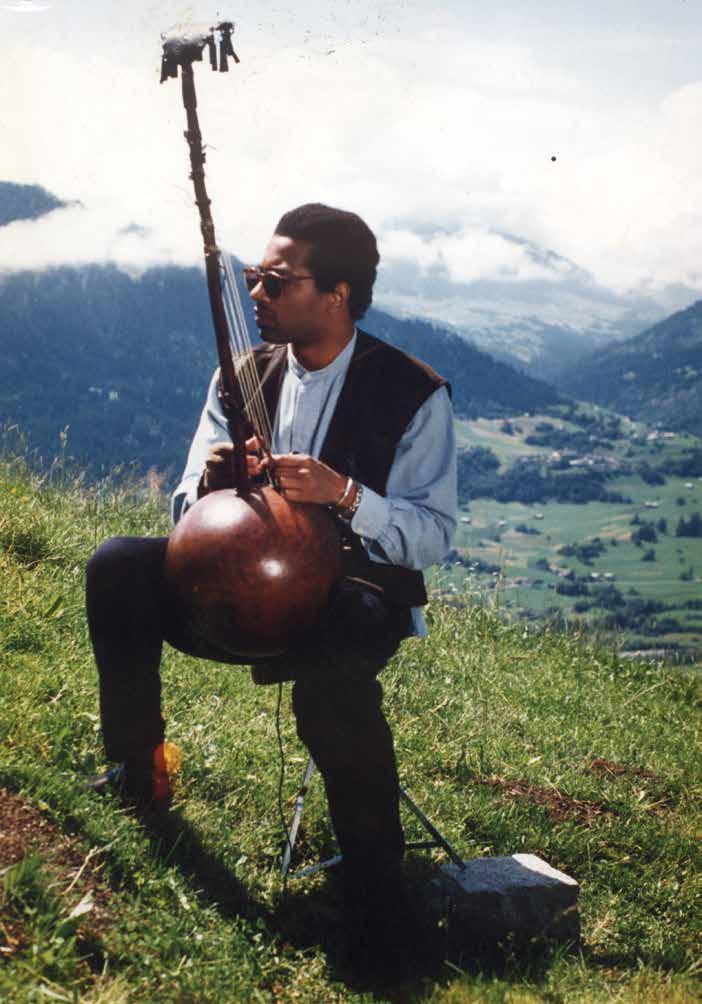
22. Photograph of the artist with a harp lute, 1980s
Photograph 7 × 5 inches (17.8 × 12.7 cm)
Estate of Terry Adkins
23. Memory jug
Mixed media
11 × 6 × 6 inches
(27.9 × 15.2 cm × 15.2 cm)
Estate of Terry Adkins
24. Saint statuette
Wood, pigment, and rosaries
13 1/2 × 4 1/2 × 4 inches
(34.3 × 11.4 × 10.2 cm)
Estate of Terry Adkins
25. Terry Adkins (1953–2014)
Untitled, n.d.
Gold pigment in binder on paper
15 × 18 inches (38.1 × 45.7 cm)
Estate of Terry Adkins
26. Terry Adkins (1953–2014)
Untitled, n.d.
Paint on paper
15 × 18 inches (38.1 × 45.7 cm)
Estate of Terry Adkins
27. Terry Adkins (1953–2014)
Untitled, n.d.
Gold pigment in binder on paper
14 3/4 × 18 1/8 inches (37.5 × 46 cm)
Estate of Terry Adkins
28. Terry Adkins (1953–2014)
Untitled, n.d.
Paint on paper
15 × 18 1/4 inches (38.1 × 46.4 cm)
Estate of Terry Adkins
29. Bells
Metal, leather, and rabbits’ feet
Dimensions variable
Estate of Terry Adkins
As a lifelong musician Adkins maintained an expansive collection of instruments from around the world, eighteen of which are exhibited here. This presentation was inspired by a 1990 installation in which Adkins hung a dense configuration of instruments from his personal collection, including a number of the ones on view here, against a royal blue wall. Nearby was a selection of the artist’s own works, several of which shared formal similarities with the instruments.
Adkins was particularly drawn to instruments from Africa, due in part to their roles in ceremony and performance. Most of the objects in his collection were made with organic materials, such as the chest drum covered with lizard skin (N) and the five wooden thumb pianos (B, I, J, K, L). The mvet (G), xylophone (M), two bowl lyres (O, P), and rattles (E) incorporate gourds, whose hollow bodies resonate sound.
The artist sometimes played the instruments in his collection, including his cherished West African harp lute (R), which he likely acquired from an art dealer while traveling in Europe in the 1980s. A nearby photo (#22) depicts Adkins with this instrument in the Alps.
Unless otherwise specified, the dates when these instruments were made are unknown. For more information about the instruments on view here, please ask for a copy of our in-gallery resource sheet.
Rawhide drum
Rawhide and metal
18 × 18 × 5 inches
(45.7 × 45.7 × 12.7 cm)
Estate of Terry Adkins
Thumb piano
Wood, metal, and bottle caps
9 1/2 × 8 × 2 1/2 inches
(24.1 × 20.3 × 6.4 cm)
Estate of Terry Adkins
Drum
Wood, hide, hair, and plant fiber
41 3/4 × 12 × 12 inches
(106 × 30.5 × 30.5 cm)
Estate of Terry Adkins
Drum
Wood and hide
33 1/4 × 8 × 8 inches
(84.5 × 20.3 × 20.3 cm)
Estate of Terry Adkins
Rattles
Left: Wood, metal, plant material, and feathers; Right: wood, metal, plant material, and animal pelt
Left: 12 × 3 × 2 inches
(30.5 × 7.6 × 5.1 cm);
Right: 12 × 2 × 2 inches
(30.5 × 5.1 × 5.1 cm)
Estate of Terry Adkins
Pocket trumpet
Metal
6 × 8 1/2 × 4 3/8 inches
(15.2 × 21.6 × 11.1 cm)
Estate of Terry Adkins
Mvet
Gourds, wood, and plant fiber
15 × 58 3/4 × 12 inches
(38.1 × 149.2 × 30.5 cm)
Estate of Terry Adkins
Terry Adkins (1953–2014)
Medallion, 2002
Iron bells sheathed in rattan with feathers and tape
32 × 13 × 4 1/2 inches
(81.3 × 33 × 11.4 cm)
The George Economou Collection
Thumb piano
Wood and metal
9 × 4 1/2 × 1 1/4 inches
(22.9 × 11.4 × 3.2 cm)
Estate of Terry Adkins
Thumb piano
Wood and metal
9 × 6 × 1 7/8 inches
(22.9 × 15.2 × 4.8 cm)
Estate of Terry Adkins
Thumb piano
Wood, metal, plant fiber, and glass beads
10 1/2 × 4 5/8 × 2 1/8 inches
(26.7 × 11.7 × 5.4 cm)
Estate of Terry Adkins
Thumb piano
Wood, metal, and plant fiber
10 × 4 5/8 × 2 1/8 inches
(25.4 × 11.7 × 5.4 cm)
Estate of Terry Adkins
Xylophone
Gourds, wood, hide, and textile
41 1/4 × 28 × 15 1/2 inches
(104.8 × 71.1 × 39.4 cm)
Estate of Terry Adkins
Chest drum
Wood, reptile skin, and hide
11 1/2 × 9 × 9 inches
(29.2 × 22.9 × 22.9 cm)
Estate of Terry Adkins
Bowl lyre
Wood, hide, pigment, plant fiber, and synthetic string
25 × 18 1/2 × 6 inches
(63.5 × 47 × 15.2 cm)
Estate of Terry Adkins
Bowl lyre
Wood, reptile skin, hide with animal hair, and plant fiber
22 1/2 × 18 × 6 inches
(57.2 × 45.7 × 15.2 cm)
Estate of Terry Adkins
Slit drum
Wood 16 1/4 × 3 × 3 inches
(41.3 × 7.6 × 7.6 cm)
Estate of Terry Adkins
Harp lute
Hide, plant fiber, wood, metal, gourd, duct tape, and electrical wires
49 × 16 × 16 inches
(124.5 × 40.6 × 40.6 cm)
Estate of Terry Adkins
One of the most formative periods in Adkins’s career was the two years he spent in Zurich, Switzerland, starting in 1986. During residencies at Projekt Binz 39 and Galerie Emmerich-Baumann, the artist refined what would become some of the core aspects of his signature style. Many of the works on view here demonstrate Adkins’s lifelong interest in symmetry, circular forms, and vivid color. The handcarved and painted sculptures, often made from salvaged wood and metal, also represent his early engagement with found materials.
Shortly after arriving in Zurich, Adkins founded the Lone Wolf Recital Corps, a rotating group of musicians and artists who performed alongside his installations. Adkins’s interest in music and performance is evident in the titles and forms of many of the works in this gallery, some of which reference the instruments in his collection.
31. Mvet Glorious, 1989
Acrylic on wood
Overall dimensions variable, each 76 × 21 × 3 3/8 inches (193 × 53.3 × 8.6 cm)
Collection of Ruth Lloyds and William S. Ehrlich
Mvet Glorious reflects Adkins’s interests in mirroring, surface, texture, and the connections between form and sound. The sculpture’s serrated edges resemble the ridged gourds that often adorn the mvet, a stringed instrument used by the Fang people of Central Africa (see #30 G, an example from Adkins’s own collection, in the previous gallery). For Adkins, the instrument’s name, pronounced “em-vet,” felt particularly onomatopoeic—the sound of
the word evokes the twanging tones that the instrument produces.
32. Reply, 1987
Copper, wood, and pigment
67 3/4 × 11 × 4 5/16 inches
(172.1 × 27.9 × 11 cm)
Collection of Mr. and Mrs. Lee Broughton
33. Call, 1987
Brass, iron, wood, and plaster
7 × 47 1/2 × 7 inches
(17.8 × 120.7 × 17.8 cm)
Private collection
34. Horus, 1986
Wood, rawhide, and enamel paint
30 × 30 × 1 1/2 inches
(76.2 × 76.2 × 3.8 cm)
The George Economou Collection
35. Parker Gray, 1986
Wood and enamel
10 × 37 × 5 inches (25.4 × 94 × 12.7 cm)
Estate of Terry Adkins
36. Ascension Academy, 1989
Wood and pigment
16 × 61 × 10 1/4 inches
(40.6 × 154.9 × 26 cm)
Chrysler Museum of Art, Norfolk, VA. Museum purchase with funds from the Virginia Commission for Arts Grant and Art Purchase Fund. 93.48
The titles of these two works (#s 35 & 36) link them directly to the artist’s biography. Parker Gray (#35) is titled after the first public high school for the Black community of Alexandria, Virginia—opened in the 1920s by Adkins’s grandfather, Reverend Andrew Warren Adkins (1884–1963). The sculpture’s striated wooden surface mimics the clapboard siding common to homes in the surrounding neighborhood.
Ascension Academy (#36) also makes reference to a school of personal significance to Adkins. In the mid-1960s the artist was among the first class of Black students to integrate Ascension Academy, an elite all-white Catholic school. This sculpture, painted in a luminescent white, shares a similar form to Parker Gray, and both works demonstrate Adkins’s deft ability to convey concrete concepts such as personal biography through abstraction.
37. Nile (Three Rivers for the M. P. Year), 1987
Gourd, rubber, wood, and copper
16 1/8 × 94 1/8 × 5 7/8 inches
(41 × 239 × 15 cm)
Galerie Greta Meert
38. Untitled, 1986
Wood and encaustic
5 11/16 × 55 11/16 × 1 15/16 inches
(14.5 × 141.5 × 5 cm)
Galerie Greta Meert
This gallery originally included a sculpture by Adkins titled The Still from 1989. The work was not available for the extended timeline of the exhibition.
With his 2003 recital Towering Steep, Adkins explored the intersection of blues music and the Great Migration, a period during which millions of Black Americans moved from the South to metropolitan centers of the northern, midwestern, and eastern United States. The recital included works Adkins created during a residency at the former Finesilver uniform factory in San Antonio, and pays homage to four early blues icons with Texas connections: Blind Lemon Jefferson (1893–1929), Blind Willie Johnson (1897–1945), Robert Johnson (1911–38), and Lead Belly (1888–1949). The sprawling floors of Finesilver were filled with decades-old mechanical and textile scraps that Adkins repurposed into art. He listened to Texas blues late into the night while creating a body of work that addressed the lives and contributions of both the nowanonymous factory workers and the illustrious musicians who shaped the character of San Antonio.
39. Bona Fide, 2000
Stencil board
86 × 86 inches (218.4 × 218.4 cm)
Estate of Terry Adkins and Lévy Gorvy, New York
Bona Fide consists of approximately fifty stencils originally used to create pant legs. Adkins fanned the stencils out in the order that he encountered them in their boxes, capitalizing on the chance affinities between the patterns’ sizes and shades. This element of improvisation relates to his longstanding interest in the spontaneity of jazz music. The repetitive task of laying out the materials not only references their original use in an industrial setting, but also highlights Adkins’s interest in working with “materials that were made by other hands for other purposes.”
40. Single Bound, 2000
Metal and rooster feathers
84 × 72 × 11 1/2 inches
(213.4 × 182.9 × 29.2 cm)
Blanton Museum of Art, The University of Texas at Austin, Purchase through the Archer M. Huntington Museum Fund and with support from the Blanton Contemporary Circle, 2001
41. Smoke Stack, 2003
Copper, aluminum, and tar
16 1/2 × 30 × 30 inches
(41.9 × 76.2 × 76.2 cm)
Estate of Terry Adkins and Lévy Gorvy, New York
42. Matchbox Blue, 2003
Aluminum clothes hangers
42 × 28 × 18 inches
(106.7 × 71.1 × 45.7 cm)
Estate of Terry Adkins and Lévy Gorvy, New York
To create Matchbox Blue, Adkins
consolidated rusted metal hangers into a teeming mass. The artist likely found the materials on the premises of the former Finesilver uniform factory in San Antonio. The work takes its title from a song written and recorded by Blind Lemon Jefferson in 1927, with lyrics that describe the nomadic lifestyle of early blues musicians: “I’m sittin’ here wonderin’ will a matchbox hold my clothes? / I ain’t got so many matches but I got so far to go.”
43. Strung Refuge, 2000
Aluminum and wood
36 × 48 × 24 inches (91.4 × 121.9 × 61 cm)
San Francisco Museum of Modern Art. Gift of Eileen Harris Norton
44. Possession, 2003
Inkjet on paper, sound
Each 7 7/8 × 5 7/8 × 3/4 inches
(20 × 14.9 × 1.9 cm)
Estate of Terry Adkins and Lévy Gorvy, New York
Possession pays tribute to the four pioneering blues musicians who inspired the Towering Steep recital: Blind Willie Johnson, Robert Johnson, Lead Belly, and Blind Lemon Jefferson (shown here from left to right). As in the original recital, iconic portraits of the men are paired here with audio of their greatest hits, creating an immersive environment reminiscent of Adkins’s time at Finesilver, when he worked long hours while listening to their music.
45. Pine, 2003
Rattles and incense
Each 18 × 18 × 16 inches
(45.7 × 45.7 × 40.6 cm)
Estate of Terry Adkins and Lévy Gorvy, New York
“You could say that [I’m a composer]… who selects the structure, sets up the situation, but then lets it take on a life of its own.”
—Terry Adkins