




“We are an academic community dedicated to excellence where each student is valued, challenged, and empowered to achieve.”
PulaskiAcademyprovidesarigorouscurriculumforcollege-bound students within a secure,highly-supportiveenvironment.Weencouragestudentstobecomecreative, independentthinkersandtakeresponsibilityfortheiracademicandsocialchoices.
Thisguidedescribesthecourseofferings for the 2026-2027schoolyearforgrades5 through12.Additionsordeletionsofclasseswillbedeterminedasaresultofstudent registration.Becausestudentshavedifferentneeds,abilityranges,interests,andgoals, PulaskiAcademy’scollegepreparatorycoursesincludevariousdegreesofdifficulty. Studentsshouldenrollincoursesaccordingtotheirabilities,achievements,interests,and timecommitments.Studentsshouldconsiderbalancewhenchoosingalloftheircourses.
Pulaski Academy has participated in the Advanced Placement (AP) Program since 1980. Sponsored by the College Board, this program gives students the opportunity to pursue college-level studies and earn college credit while still in secondary school. Many colleges award academic credit and sophomore-level entry to AP students who score well on national exams. These exams are administered each May on national exam days. Students enrolling in AP classes must complete required portfolios and take these exams and try their best.
Because Advanced Placement courses are college-level classes, students entering AP classes should expect a more rigorous curriculum. Admission to such courses depends heavily on the student’s previous performance in that subject area. Course enrollment must be approved by the counseling department and department faculty. A student should consider AP selections in those disciplines he or she has maintained strong grades in and most enjoys.
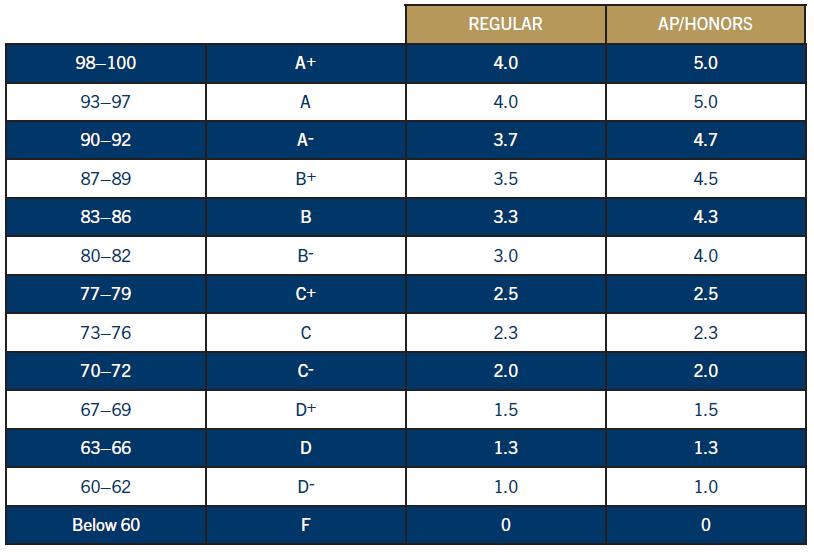
Students performing in the A and B range for those courses which are designated as honors, Pre-AP, or AP will receive an additional quality point when the grade point average is computed. Students performing in the C range and below will not receive additional quality points.
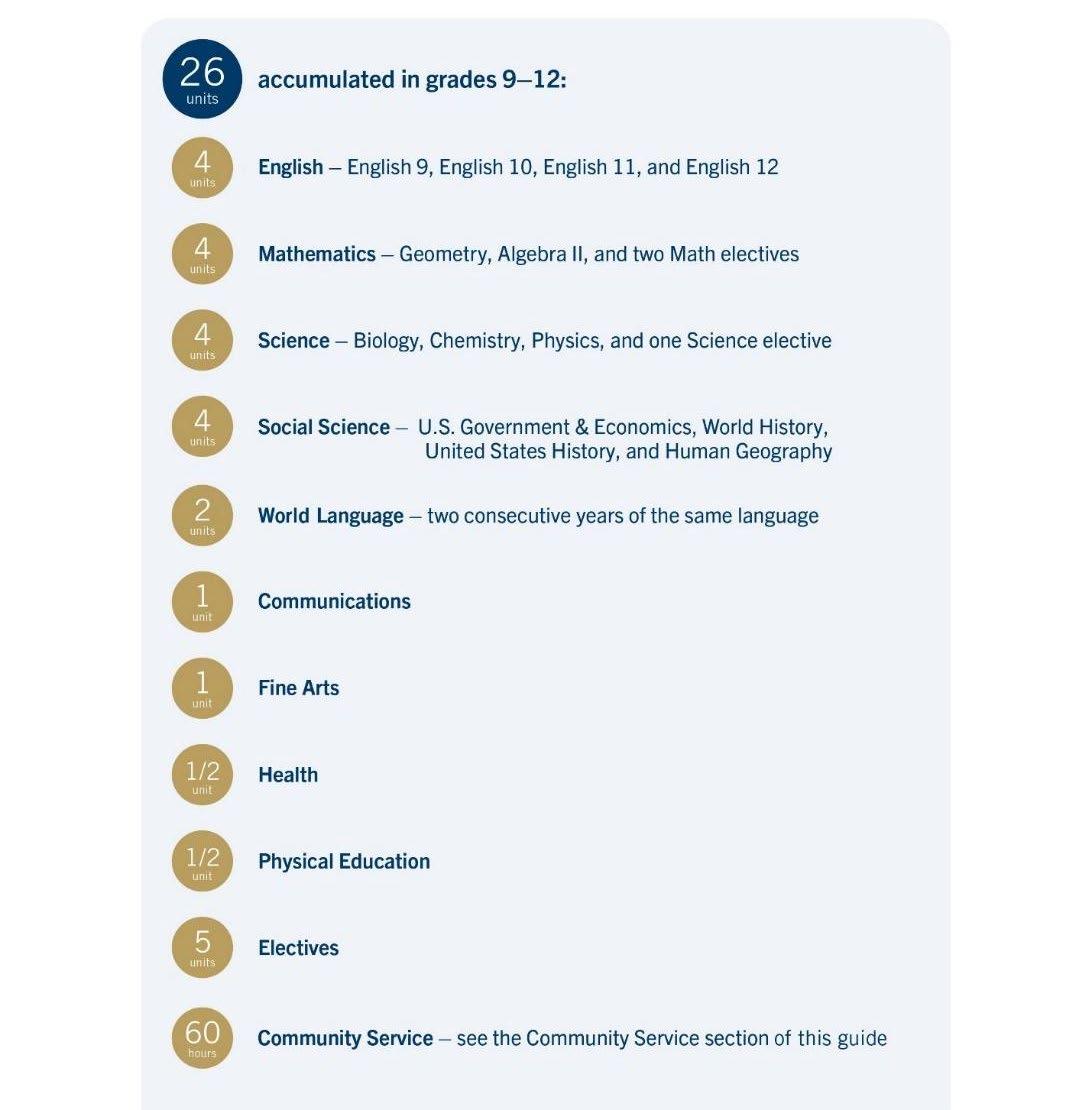
Upper School students at Pulaski Academy are required to participate in 15 hours of service annually, which equals a 60 hour minimum for graduation. The program has been designed to provide students opportunities to explore and define their purpose in the life and welfare of their community.
A community service grade of Honors, Pass, or Fail will be recorded on the student’s transcript. In order to receive an Honors grade, a student must complete 30 hours of service.
Pulaski Academy offers online courses internally, as well as through a partnership with Laurel Springs. Pulaski Academy’s online courses are Health and Web Development I & II, all of which are semester offerings for ½ credit.
The required Health course is only available online and is the only summer Upper School course available. Please contact a counselor for more information.
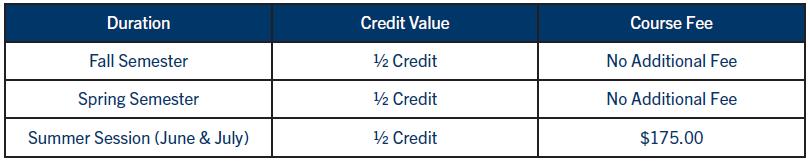
The course will run from June 1 to July 24, but students may complete the work at their own pace. The course fee will be assessed via FACTS in May and detailed information about accessing the class and expectations will be communicated at that time.
Students enrolled in an online course will be assigned a designated class period for the course during the standard school day. This time may be used to work on online course assignments and to meet with the course facilitator as needed. The classroom assigned will be a study hall setting, and attendance regulations will be followed, as explained within the PA Family Guide.
Grades will be assigned as outlined within the individual course syllabus utilizing the grading scale published within the PA Family Guide. Course credit for a Health class taken during a summer session will not be factored into the GPA until the end of the following fall semester. Graduation credit will not be issued for courses taken prior to the ninth grade year.
Pulaski Academy partners with several providers to expand our elective offerings. These include Laurel Springs School and Brigham Young University. See an Upper School Counselor for further information and approval to enroll in these courses.

How do our experiences and backgrounds shape our identity? This essential question will frame the focus of 9th grade English. While reading mythology, short stories, poems, drama, and novels from around the globe, students will examine how culture plays a large role in one’s own sense of self. Students discover how a text can serve as either a mirror or a window into another culture. Assigned texts may be consulted in our Literature Matrix.
How do our experiences and backgrounds shape our identity? This essential question will frame the focus of 9th grade English. While reading mythology, short stories, poems, drama, and novels from around the globe, students will examine how culture plays a large role in one’s own sense of self. Students discover how a text can serve as either a mirror or a window into another culture. Assigned texts may be consulted in our Literature Matrix. The Honors 9 course places emphasis on possible interpretations of literary passages in a variety of genres, the universality of themes, analysis of structure and style, and the recognition of literary devices such as tone, imagery, mood, allusions, and figures of speech. Students will be expected to participate in regular seminar-style discussions and write extended reflective, narrative, and analytical papers.

How do we find our voice in a world full of noise? And how do we speak out when others try to silence us? These essential questions will frame the discussion focus of 10th-grade English. While reading novels, short stories, memoirs, and poems from around the globe, students will explore the courage it takes to share their voice when fear or indifference could prevent it. Assigned texts may be consulted in our Literature Matrix. Students will strengthen their writing skills, discovering their own voice in all modes, with an emphasis on process and style. English 10 continues structured independent reading, in which students can develop reading skills through self-selected texts and related presentations and writing.
How do we find our voice in a world full of noise? And how do we speak out when others try to silence us? These essential questions will frame the discussion focus of 10th-grade English. While reading novels, short stories, memoirs, and poems from around the globe, students will explore the courage it takes to share their voice when fear or indifference could prevent it. Assigned texts may be consulted in our Literature Matrix. Students will strengthen their writing skills, discovering their own voice in all modes, with an emphasis on process and style. English 10 continues structured independent reading, in which students can develop reading skills through self-selected texts and related presentations and writing. The Honors 10 course places emphasis on possible interpretations of literary passages in a variety of genres, the universality of themes, analysis of structure and style, and the recognition of literary devices such as tone, imagery, mood, allusions, and figures of speech. Honors 10 students continue structured independent reading and are encouraged to consider selections from the wide range of texts that appear on the AP Literature exam.

The AP English Language and Composition course aligns to an introductory college-level rhetoric and writing curriculum. AP English Language and Composition focuses on the development and revision of evidencebased analytic and argumentative writing, the rhetorical analysis of nonfiction texts, and the decisions writers make as they compose and revise. Students evaluate, synthesize, and cite research to support their arguments. Additionally, they read and analyze rhetorical elements and their effects in nonfiction texts including images as forms of text— from a range of disciplines and historical periods. Assigned texts may be consulted in our Literature Matrix.
F. Scott Fitzgerald famously writes in his novel The Great Gatsby, “So we beat on, boats against the current, borne back ceaselessly into the past.” The CP American Literature course focuses on engaging students with various authors, poets, essayists, and playwrights spanning from our nation’s founding to the present day. Students will perform close reads and provide analyses of American literature with an emphasis on how American history has and continues to impact our literary heritage. Students will further hone their analytical, argumentative, expository, and narrative writing skills. Assigned texts may be consulted in our Literature Matrix.

The AP English Literature and Composition course aligns to an introductory college-level literature and writing curriculum. AP English Literature and Composition focuses on reading, analyzing, and writing about imaginative literature (fiction, poetry, drama) from various periods. Students engage in close reading and critical analysis of imaginative literature to deepen their understanding of the ways writers use language to provide both meaning and pleasure. As they read, students consider a work’s structure, style, and themes, as well as its use of figurative language, imagery, and symbolism. Writing assignments include expository, analytical, and argumentative essays that require students to analyze and interpret literary works. Assigned texts may be consulted in our Literature Matrix.
Literature forms a rich tapestry in which the authors of one culture inspire another, where American author William Faulkner riffs on Irish author James Joyce’s use of stream of consciousness; where Japanese author Haruki Murakami channels Argentine poet Jorge Luis Borges’ use of magical realism. World Literature seeks to connect some of these threads by exposing students to seminal works from authors outside the United States. Students will engage with these works through Socratic seminars, presentations, and writing assignments, all of which will develop students’ ability to analyze and synthesize literary works. Assigned texts may be consulted in our Literature Matrix
OPEN TO
How do you know you exist? Rene Descartes answered the question with his famous statement, “I think, therefore I am.” Other philosophers ardently disagree with his assertion. The Literature of Philosophy and Psychology course explores this, many other burning questions, and the many twists and turns of the human mind and human behavior. The course will include philosophy and psychology writings from Aristotle, Plato, Kant, Confucius, Kierkegaard, Jung, Chomsky, and Arendt, among others. Additionally, the course will explore philosophical and psychological themes through fiction, non-fiction, poetry, and drama from authors. Assigned texts may be consulted in our Literature Matrix. Through these readings, students will explore ideas such as beauty, purpose, truth, and good and evil ideas that touch on the core beliefs that give meaning to our existence.
OPEN TO
“A poet’s work is to name the unnameable,” Salman Rushdie proclaims. Poetry is the most mysterious of the literary arts, and the Poetry course seeks both to demystify poetry for readers and to guide readers to appreciate the ambiguity it is energized by. Poetry is deeply connected to our imagination, and understanding it even experiencing it requires readers to engage both the most playful aspects of their imagination as well as their deepest concerns for the human condition. The Poetry course will explore poetry from all cultures and of all types, from lyric to narrative; poems of form to free verse; and classic to contemporary. Assigned texts may be consulted in our Literature Matrix.
OPEN TO
What happens when the so-called “Angel in the House” picks up a pen? When fine ladies, expected to remain silent, contribute their voice to a world of writing dominated by men? This course will explore the legacy of women writers, unruly women, who defied the cultural norms of their times and introduced female protagonists as thinking, rational persons confined within the limitations of their society. We will study the writing of women who paved the way by remaining anonymous or using male pseudonyms in order to gain recognition, such as Jane Austen and the Brontë sisters, and those who later dared to publicly demand change, such as Virgina Woolf. In addition to reading memoirs, short stories, novels, and poems, students will also place each piece within its historical context. Assigned texts may be consulted in our Literature Matrix.
OPEN TO

The elective course Honors Creative Writing offers students the opportunity to write in literature’s predominant modes: poetry, fiction, and creative non-fiction. The course will offer an in-depth look at the creative process by studying what other writers have to say about inspiration, writing, and editing. Through this study and through daily writing workshops, students will develop strategies that they can use to evaluate and revise their own work. As they gain valuable writing practice, find methods for inspiration, and learn to silence their inner critic, students will be encouraged to write with greater detail, to approach their work with authenticity, and to take additional risks in their writing. For guidance, we will read and discuss master texts from a writer’s perspective and will also learn to use other arts such as music or the visual arts to inform the how and why of writing. Assigned texts may be consulted in our Literature Matrix.
Communications
OPEN TO

Communications students will gain an understanding of the dynamics of effective communication when speaking, listening, and responding. In addition to studying the process of effective communication, students will express ideas and present information in a variety of communication tasks including small group discussion, democratic decision-making, formal and informal presentations, oral interpretation of literature, and argumentation. Students will develop basic communication competencies including ethical practices in communication, recognition of communication barriers, and effective use of interpersonal communication. Emphasis will be placed on audience assessment, verbal messages, nonverbal messages, and digital media as students prepare for formal presentations and argumentation.
Prerequisite: Communications
OPEN TO
Advanced Speaking and Leadership will continue the study of effective communication when speaking, listening, and responding. In addition, there will be a focus on increasing self-confidence in order to develop leadership skills. Through the study of persuasive techniques, media messaging, conflict management, and more, students will cultivate their abilities to lead, manage, and organize others. Building on present communication skills, students will expand their capacity to express ideas and present information in creative ways. This course will also build on the foundation and attitude of the school which encourages ethical thought and service-minded behavior. Emphasis will be placed on preparing students for college and the workforce while strengthening the desire for public service.
OPEN TO
Yearbook students will serve in staff positions for the Bruin student yearbook. Staff members will plan and develop the yearbook theme, design the cover and section pages, write and edit stories, design graphics, sell and design advertising space, write headlines and captions, and shoot and prepare photos for publication. Students will use digital photography and computer technology to publish the yearbook, including Adobe InDesign and Photoshop software. Some after-school work will be necessary. Photographers will shoot photos at extracurricular school events. Although this is primarily a lab course, students will spend several hours each week learning journalism concepts. A five-day journalism workshop in July is highly encouraged for all Yearbook staff members.
Prerequisite: Previous Band experience
OPEN TO

Upper School Band serves as the primary instrumental music ambassador of Pulaski Academy and performs at select athletic events, concerts, and competitions throughout the school year. Students are encouraged to audition and participate in individual festivals and competitions during the year. The Upper School Band strives to increase the musicianship of each student through formal musical training and an emphasis on practice and performance.
Prerequisite: One year of Upper School Band and instructor approval
OPEN TO
Honors Band is offered as a specialty track of Band. The courses meet simultaneously. In addition to and independently of Band, an honors student commits to attend off-campus instrumental performances, compete in All-Region Band, All-State Band (if qualified), and Region Solo and Ensemble competitions. Students in Honors Band take on leadership roles within the band, such as leading sectionals during class, helping to mentor band members, assembling ensembles, etc.
Prerequisite: Audition
OPEN TO
Jazz Band is an auditioned ensemble available to all students, regardless of their participation in the Upper School Band. This ensemble provides students with the experience of playing in a professional style ensemble and focuses on teaching students all aspects of jazz music, including its history, idiomatic playing style, standard repertoire, and improvisation. Auditions are held in the spring semester for the following year’s ensemble and places instrumentation limits: 5 saxophone, 4 trumpet, 4 trombone, 2 guitar, 2 bass, 2 piano, and 2 drums.
Piano Lab
OPEN TO
Piano Lab provides opportunities for students to start or continue learning how to play the piano. Students will receive training in piano technique, music reading, and basic music theory. Students will apply their knowledge and skills through repertoire ranging from classical to popular within their individual levels of performance. Lessons are taught on acoustic and digital pianos. Students will learn and perform individual pieces for each other during class as well as learn and perform ensemble pieces with the class. A formal recital will take place at the end of the year in CPAC.
Prerequisite: Piano Lab I or instructor approval
OPEN TO
Students will build off of the skills learned in Piano Lab I to continue to develop as musicians. Students will continue studying piano technique, music reading, and basic music theory. Students will apply their knowledge and skills through repertoire ranging from classical to popular within their individual levels of performance. Lessons are taught on acoustic and digital pianos. Students will learn and perform individual pieces during class as well as learn and perform ensemble pieces with the class. A formal recital will take place at the end of the year in CPAC.
Prerequisite: Instructor approval
The AP Music Theory course explores the fundamental concepts and processes of how music is made. Students will develop the ability to recognize, understand, and describe musical materials and processes in both aural (listening) and written forms, and they will learn basic music composition. Additionally, students will develop skills of sight-singing and musical dictation. The skills and competencies gained prepare students for further music study as well as for lifetimes of music appreciation and music-making.
PA Sounds ensemble members will study and perform choral pieces and demonstrate correct vocal technique, sight-reading skills, ear training, and musicianship. Moderate to advanced pieces (most often a cappella) are studied and performed. Music studied will challenge the ear, increase vocal range and breathing, and enhance musicianship. PA Sounds is open to male and female students in grades 9-12. Auditions will be held on an as-needed basis. Please contact Mr. Willis to arrange an audition if you are new to choir. There will be a required concert uniform of tuxedos and black dresses to be purchased by the parents/guardians. Approximate cost is $75-$110.
Prerequisite: One year of PA Sounds and instructor approval
Honors PA Sounds is offered as a specialty track of Choir. The courses meet simultaneously. In addition to and independently from choir, an honors student commits to attending off-campus choral performances, competing in vocal assessments such as All-Region Choir and All-State Choir (if qualified), and taking on leadership roles within the choir, such as leading sectionals, serving in a choral officer position, leading Singing Valentines groups, etc.

Introduction to Theatre Arts is a performance-based history class open to students in grades 9-12 who are interested in learning about theatre as an art form. Students will track through major eras in theatre history with project-based learning through acting, directing, and theatrical design exercises tailored to each era and role in theatre. This course fulfills the communications requirement for graduation.
Prerequisite: Introduction to Theatre Arts or audition
Acting is designed for serious theatre students to hone their skills in the art of acting. Students in this course will study the techniques of four of the leading acting coaches in the world. Through the teachings of Viola Spolin, Konstantin Stanislavski, Sanford Meisner, and Anne Bogart, students will explore the world of acting and expand their skill levels through various solo, duet, and group performances and activities.
Prerequisite: Introduction to Theatre Arts or consent of instructor
OPEN TO
Directing is designed for serious theatre students to develop their skills in directing and play production. Students will learn the art of direction and have the opportunity to direct and produce their own productions. Students will develop confidence in their theatrical vision as well as problem-solving skills as they learn to work with actors and technicians.
Prerequisite: Introduction to Theatre Arts, Acting, and Directing
OPEN TO
Theatre Production is a senior-level course and is designed to offer serious theatre students the opportunity to explore theatrical works in a rehearsal-type setting. Students will expand their knowledge of dramatic literature through an active, hands-on approach, apply skills acquired in their acting and directing courses, and enhance their techniques through performance-based projects. Students in this class also have the opportunity to direct the Middle School musical.
OPEN TO
Stagecraft courses are makerspace style classes in which students learn the proper use of tools (including power tools), building, painting, and how to apply this knowledge by creating elements for use in theatrical productions. Students in these courses will have artistic involvement and ownership in the school’s theatrical productions as they help construct set, prop, and furniture pieces.
OPEN TO
Stagecraft courses are makerspace style classes in which students learn the proper use of tools (including power tools), building, painting, and how to apply this knowledge by creating elements for use in theatrical productions. Students in these courses will have artistic involvement and ownership in the school’s theatrical productions as they help construct set, prop, and furniture pieces.
Prerequisite: Stagecraft I and Stagecraft II
OPEN TO
Advanced Stagecraft further develops skills learned in Stagecraft and provides the opportunity to design for the stage. We will explore more advanced techniques and disciplines. Students’ interests will be considered as we advance our studies, allowing for more individualized production contributions. This course may be taken in subsequent years for credit.
Studio Art I
OPEN TO
In Studio Art I, students will explore drawing, painting, printmaking, mixed media, and sculpture. Students will learn the basic skills of each medium and have the opportunity for experimentation and individual expression in each project. Art history and contemporary art will be incorporated into every lesson, and students will build a digital portfolio throughout the school year. Students will have the opportunity to enter art contests, attend field trips, attend the AYAA art competition, and display artwork in the Frosty Follies Art Exhibition and the annual spring Visual Arts Exhibition.
Art
Prerequisite: Studio Art I or Digital Media I
OPEN TO
Art II Ceramics is a comprehensive hand-building course. The primary emphasis of this course will be on handbuilt ceramic forms. Students will explore the nature and limitations of clay. They will learn different handbuilding techniques: pinch, slab, and coil methods. The rich ancient history of ceramics will be incorporated into the curriculum as well as exposure to contemporary ceramic artists. Students will gain a basic understanding of kiln fundamentals and experiment with a variety of decorative techniques. Students will present finished artwork for a peer review and critique. Students will create a digital portfolio. Students will have the opportunity to enter art contests, attend field trips, attend the AYAA art competition, and display artwork in the Frosty Follies Art Exhibition and the annual spring Visual Arts Exhibition.
Prerequisite: Studio Art I
OPEN TO
This course is for students who want an opportunity to advance to a higher level of understanding and skill development in two-dimensional art. Art II Mixed Media builds upon the skills and knowledge learned in Art I. Stronger emphasis is placed on mastery of drawing and painting techniques, composition and the creation of original artworks for student portfolios. Students will be required to participate in class discussions and critiques, and to write about their own and other’s artwork. In addition to the advanced course work, students are required to participate in both of the Visual Art Department’s Exhibitions, the AYAA competition in the spring semester, attend department field trips, and enter various other competitions.
OPEN TO
In this course, we will focus on building foundational technical skills and thought processes associated with the practice of digital design. Emphasis is placed on the elements and principles of design, along with learning techniques in Adobe Photoshop and Procreate. Topics to be covered include composition and layout, text and typography, digital images, digital photography, websites, social media, illustration and basic animation.
Prerequisite: Digital Media I
OPEN TO
In this course, we will focus on building advanced technical skills and thought processes associated with the practice of digital design. Emphasis is placed on further developing knowledge obtained in Digital Media I, specifically on the elements and principles of design, along with learning techniques in Adobe Photoshop and Procreate. Further and more advanced exploration of the topics introduced in Digital Media I will be covered and include composition and layout, text and typography, digital images, digital photography, websites, social media, illustration and animation.
Prerequisite: Studio Art II or Graphic Design II
OPEN TO
Studio Art III: 2D is an advanced course designed for students who have completed two visual arts credits and are interested in developing a strong portfolio. Students in this course will develop advanced drawing and painting skills. This course provides opportunities for revision, skill building, experimentation, and prepares students for SA IV. Over the course of the year, students will be supported through the process of creating a dynamic and diverse portfolio. Critiques and visual research journals (sketchbook entries) are an integral part of the course, as well as material/method experiments. Students will have the opportunity to participate in local art competitions and exhibitions.
Prerequisite: Studio Art II or Graphic Design II
OPEN TO
Studio Art III: 3D is an advanced course designed for students who have completed two visual arts credits and are interested in developing a strong portfolio. Students in this course will develop advanced ceramics skills and explore sculpture techniques using a variety of materials and methods. This course provides opportunities for revision, skill building, experimentation, and prepares students for SA IV. Over the course of the year, students will be supported through the process of creating a dynamic and diverse portfolio. Critiques and visual research journals (sketchbook entries) are an integral part of the course, as well as material/method experiments. Students will have the opportunity to participate in local art competitions and exhibitions.
Prerequisite: Honors Studio Art III
OPEN TO
Studio Art IV is an advanced course designed for students who are in their senior year and have successfully completed 3 visual arts credits. Students choose a track in either Graphic Design, Mixed Media (Painting/Drawing), Photography, or Ceramics. Over the course of the year students will be supported through the process of creating a dynamic and diverse portfolio. Critiques and visual research journals (sketchbook entries) are an integral part of the course, as well as material/method experiments. Students will have the opportunity to take the AP Exam in May as well as participate in local art competitions and exhibitions.
Prerequisite: Studio Art II or Digital Media II
OPEN TO
AP 2D Art and Design is an in-depth exploration of drawing, painting, printmaking, mixed media, collage, and other non-traditional media. Students will be guided through different two-dimensional media experiences. The course will provide guidance and instruction in advanced skills and techniques. Many of the projects will be driven by the student’s ideas and the exploration of a self-selected inquiry. The inquiry will be investigated through art and design, experimentation with materials, and conceptual or idea-driven artmaking. Students will practice communicating about their artwork and ideas through class presentations, critiques, and written proposals. Students will learn about contemporary and historical artists relevant to their medium or concepts. The students will also be responsible for conducting research and making connections with contemporary or historical artists and personal inquiries. In addition to the advanced course work, an AP student is required to participate in both of the Visual Art Department’s Exhibitions, the AYAA competition in the spring semester, attend department field trips, and enter various other competitions.
Prerequisite: Studio Art II or Digital Media II
Honors Art III 3-D is a course designed to further explore advanced sculpture processes and techniques, along with the exploration of papier mache, plaster, and other non-traditional sculpture materials. The students will learn to build armatures for different kinds of sculptural structures. This course will allow the students to develop a personal inquiry that will lead to experimentation with materials and techniques to investigate ideas. Students will be introduced to different skill-building exercises, and have the opportunity to utilize the skills in creating independent projects. The students will also learn how to install and display artwork. In addition to the advanced course work, an AP student is required to participate in both of the Visual Art Department’s Exhibitions, the AYAA competition in the spring semester, attend department field trips, and enter various other competitions.
Prerequisite: AP 2D Art and Design
AP Drawing is a course designed to introduce young artists to the process of making meaningful, everevolving personal artwork. Artists will learn to ask questions and how to explore observations through the art-making process. The instructor will provide guidance and personalized instruction in advanced drawing, painting, and printmaking skills. Projects will be driven by the student’s exploration of a self-selected inquiry. The inquiry will be investigated through experimentation with materials, and conceptual art-making. Students will expound upon their artwork and ideas through written proposals, class presentations, and critiques. Students will learn about contemporary and historical artists relevant to their medium or concepts throughout the course. AP Drawing students will be required to conduct exploratory research relevant to their inquiries. They will be required to demonstrate this research through writing and experimentation in their sketchbooks. The artist will also be required to photograph and document progress. In addition to the advanced course work, an AP student is required to participate in both of the Visual Art Department’s Exhibitions, the AYAA competition in the spring semester, attend department field trips, and enter various other competitions.
OPEN TO
Algebra 1 formalizes and extends students’ understanding and application of functions. Major topics of study include fundamentals of algebra: evaluation of algebraic equations and inequalities, solving and graphing linear and absolute value equations and inequalities, solving systems of equations, exponent rules and manipulation, polynomials, radicals, factoring, and solving and graphing quadratic equations.
Prerequisite: Algebra I
OPEN TO
Geometry is a course that develops students’ understanding of geometric concepts and their applications. Topics include the classification of geometric figures, congruence and similarity, triangles and right-triangle relationships, elementary trigonometry, circles, coordinate geometry, and the calculation of area and volume
of two- and three-dimensional figures. Algebraic skills are integrated throughout the course to support problem solving and real-world applications.
Prerequisite: Accelerated Algebra I
OPEN TO
Honors Geometry is a course that develops students’ understanding of geometric concepts through rigorous reasoning and higher-level thinking skills. Instruction emphasizes analyzing relationships among geometric figures and applying concepts to complex, real-world problems. Topics include the classification of geometric figures, congruence and similarity, triangles and right-triangle relationships, elementary trigonometry, circles, coordinate geometry, and the calculation of area and volume of two- and three-dimensional figures. Algebraic concepts, as well as statistics and probability, are integrated throughout the course to deepen conceptual understanding and support sophisticated problem solving.
Prerequisite: Geometry
OPEN TO

Algebra II focuses on the study and analysis of functions and their graphical representations. Students explore a wide range of function types, including linear, absolute value, piecewise, quadratic, radical, polynomial, rational, and transcendental functions. Emphasis is placed on interpreting graphs, analyzing relationships, and applying functions to solve problems. Graphing calculators are utilized as tools to model functions and support mathematical understanding.
Prerequisite: Honors Geometry
OPEN TO
Pre-AP Algebra II provides a rigorous and in-depth study of functions and their graphical representations. Building on background knowledge from previous honors mathematics courses, students analyze linear, absolute value, piecewise, quadratic, radical, polynomial, rational, and transcendental functions. Instruction emphasizes graphing, modeling, and critical and creative thinking through real-world applications and complex problem solving. Graphing calculators are utilized as tools to model functions and support mathematical understanding. This course prepares students for AP Precalculus.
Prerequisite: Geometry and Algebra II
OPEN TO
Trigonometry will explore the six trigonometric functions and their graphs, right triangle trigonometry, the unit circle, inverse trigonometric functions, solving trigonometric equations, and the law of sines and cosines. Students will also study algebraic and transcendental functions and their graphs. Additional topics of study will include systems of equations, sequences, series, probability, and conic sections.
Prerequisite: Pre-AP Algebra II
OPEN TO
Advanced Placement Precalculus includes an extensive study of trigonometry and advanced algebra topics. The topics mastered in this course are essential for the advanced problem-solving skills needed in any higher level mathematics course. AP Precalculus includes advanced applications of trigonometry, function analysis, parametric and polar models, matrices, sequences and series. Applying background knowledge from previous honors math courses, the active learning required in this course incorporates graphing, critical and creative thinking skills for real-world application and complex problem-solving. The AP course prepares the student for the Advanced Placement Calculus course.
Prerequisite: Trigonometry or AP Precalculus
OPEN TO
Calculus introduces students to fundamental concepts commonly encountered in college-level mathematics. Using the unifying ideas of limits, derivatives, and integrals, students explore how calculus is used to analyze change and accumulation. Emphasis is placed on conceptual understanding, problem solving, and real-world applications. This course is not intended to prepare students for the AP Calculus examination.
TO
Prerequisite: Trigonometry or Calculus
Finite Mathematics is focused on quantitative literacy in mathematics found in both business and everyday life. Students will study linear equations and applications, systems of linear equations, matrix algebra and applications, linear programming, probability and applications, set theory and game theory, and statistics.
Prerequisite: AP Precalculus
AP Calculus AB is a college-level course that provides an in-depth study of differential and integral calculus, designed to prepare students for the AP Calculus AB exam. Students explore the unifying concepts of limits, derivatives, and integrals, developing conceptual understanding and mathematical reasoning skills. Emphasis is placed on problem solving, real-world applications, and the interpretation of results in various contexts. Graphing calculators are used strategically to support exploration, visualization, and analysis of functions. This course prepares students for further study in mathematics, science, and engineering while fostering critical and creative thinking skills.
Prerequisite: AP Calculus AB
OPEN TO
AP Calculus BC is a college-level course that extends the study of differential and integral calculus, preparing students for the AP Calculus BC exam. Building on concepts from AP Calculus AB, students explore advanced topics including polynomial approximations, series, parametric, polar, and vector functions, as well as advanced integration techniques. Emphasis is placed on developing deep conceptual understanding, sophisticated problem-solving skills, and the application of calculus to complex, real-world situations. Graphing calculators are used strategically to support exploration, visualization, and analysis of functions. This course prepares students for further study in mathematics, science, and engineering while fostering critical, creative, and analytical thinking.
Prerequisite: Honors Algebra II or Trigonometry
OPEN TO
AP Statistics is an introductory, algebra-based college course in statistics. The four main topics of study are: exploring data through patterns, planning a statistical study, mathematical modeling based on probability theory, and testing models through statistical inference. A statistics course is often required for college students majoring in social sciences, health sciences, business, science, engineering, or mathematics.
Prerequisite: Algebra II or Trigonometry
OPEN TO
In Introduction to College Algebra, first semester topics include a review of functions and their graphs: linear, absolute value, quadratic, polynomial, radical, rational, logarithmic, exponential, and piecewise. Second semester topics of study include trigonometric functions and their applications, sequences and series, systems of equations, matrices, probability, statistics, and conic sections.
OPEN TO
This online course provides each student the opportunity to develop well-informed goals for healthy living. Students will assess their current health status, investigate the advantages of a healthy mind/healthy body, and develop health goals based on the study of current age-appropriate health topics, including nutrition.
OPEN TO
This course will teach fitness concepts and conditioning techniques used for obtaining optimal physical fitness. Students will benefit from comprehensive weight training and cardiorespiratory endurance activities as well as learn the basic fundamentals of strength training, aerobic training, flexibility, restorative practice, and overall fitness and conditioning. The course includes both lecture and activity sessions. Students will be empowered to make wise choices, meet challenges, and develop positive behaviors in fitness, wellness, and movement activity for a lifetime. This course may be taken in subsequent years for credit.
OPEN TO
The following sports are available as a course for team practice during the standard school day. Enrollment in the course is required for all students intending to participate as part of the team or as a team manager. This course may be taken in subsequent years for credit.
A comprehensive list of all team sports can be found on this page.
OPEN TO
Biology is a lab-based course that will allow students to explore the concepts of the cell and its function, biochemistry, ecology, genetics, and human biology. Students will participate in hands-on labs, collect and analyze data, evaluate scientific research, and will participate orally, in writing, and in cooperative learning situations. In addition to daily coursework, students will complete an in-class science fair project.
OPEN TO
Honors Biology is a rigorous course designed for the science-oriented student. This lab-based course will allow students to explore the concepts of Biology, including the cell and its function, biochemistry, ecology, genetics, and human biology. Students will learn to use instrumentation used in the field of biology, collect and analyze data, and will evaluate research presented in scientific journal articles. In addition to daily coursework, students are required to complete a science fair project.
Prerequisite: Biology (12) or Honors Biology (10, 11)
OPEN TO
AP Biology is an introductory college-level biology course. Students cultivate their understanding of biology through inquiry-based investigations as they explore topics like evolution, energetics, information storage and transfer, and system interactions.
OPEN TO
Chemistry studies the structure, composition, and behavior of matter. Atomic structure, chemical formulas and equations, as well as the physical phases of matter, are also studied. Acids, bases, salts, and their relationships are covered in the study of solutions. Laboratory experiences serve to reinforce and increase the understanding of the principles discussed in class.
Prerequisite: Algebra II (enrollment may be concurrent)
OPEN TO
Honors Chemistry studies an in-depth and mathematical basis of the structure, composition, and behavior of matter. Atomic structure, chemical formulas and equations, as well as the physical phases of matter, are also studied. Acids, bases, salts, and their relationships are covered in the study of solutions. Laboratory experiences serve to reinforce and increase the understanding of the principles discussed in class.
Prerequisite: Algebra II and Honors Chemistry
OPEN TO
AP Chemistry is designed to be the equivalent of a first-year college chemistry course. The AP course provides an in-depth qualitative and quantitative study of the structure of matter, the states of matter, chemical reactions, descriptive chemistry and laboratory procedures. Emphasis will be placed on developing problemsolving skills, and logical thinking.
Prerequisite: Honors Chemistry and Pre-AP Algebra II
OPEN TO
Honors Organic Chemistry students will study the types of organic molecules and focus on nomenclature, physical properties, chemical reactions, and common applications. The major types of Organic Chemistry laboratories will include distillations, extractions, and separation techniques. The teaching methods utilized in this course include lecture presentations, class discussions, cooperative learning groups, experimentation, and research projects.
Prerequisite: Algebra II (enrollment may be concurrent)
OPEN TO
Physics 1 helps students recognize the nature and scope of physics and its relationship to the other sciences. Students will learn about basic topics such as motion, forces, energy, momentum, heat and heat transfer, waves, electricity, and magnetism. Students will be engaged in scientific inquiry, investigations, and labs so that they develop a conceptual understanding and basic scientific skills.
Prerequisite: Pre-AP Algebra II (enrollment may be concurrent)
OPEN TO
AP Physics 1 is the equivalent to a first-semester college course in algebra-based physics. The course covers Newtonian mechanics (including rotational dynamics and angular momentum); work, energy, and power; and mechanical waves and sound. It will also introduce electric circuits.
OPEN TO
Prerequisite: AP Physics 1 and AP Precalculus (enrollment may be concurrent)
AP Physics 2 is a course which is the equivalent to a second-semester college course in algebra-based physics. The course covers fluid mechanics, thermodynamics, electricity and magnetism, optics, and atomic and nuclear physics.
OPEN TO
Prerequisite: AP Physics 1 and AP Calculus AB (enrollment may be concurrent)
AP Physics C is a calculus-based first-year college physics course. This course is designed for students who have a high interest in the physical sciences and specifically engineering as a field of study. Physics C will cover in depth Newtonian mechanics.
OPEN TO
Anatomy and Physiology is an advanced course in the study of the structures and functions of the human body. Each body system is studied in detail. Students will learn the relationships that exist among the systems, the structures, and their specific functions. Laboratory experiences, dissection activities, and group and individual activities are coordinated with the text. Students will also learn how anatomy and physiology relate to the fields of medicine, nursing, physical therapy, veterinary science, dental hygiene, as well as other health science fields.
OPEN TO
AP Environmental Science is a yearlong examination of the interrelationships of the natural world. Students identify and analyze environmental problems and their effects, and evaluate the effectiveness of proposed solutions. Students learn to think like environmental scientists: making predictions based on observations, writing hypotheses, designing and completing field studies and experiments, and reaching conclusions based on the analysis of data derived from these experiments. Students apply the concepts of environmental science to their everyday experiences and current events and issues in science, geopolitics, and society. The course provides opportunities for guided inquiry and student-centered learning to foster critical thinking skills.
Prerequisite: Algebra II
OPEN TO
Engineering is a course appropriate for students who are interested in both engineering and design. The major focus of this course is to expose students to the design process, research and analysis, teamwork, communication methods, global and human impacts, engineering standards, and technical
documentation. Engineering provides students the opportunity to develop skills and understanding of course concepts through activity-, project-, and problem-based (APB) learning. Used in combination with a teaming approach, APB-learning challenges students to continually hone their interpersonal skills, creative abilities, and understanding of the design process. It also allows students to develop strategies to enable and direct their own learning. Students focus on problem-solving with an engineering mindset while developing technical skills.
OPEN TO
Zoology is a course designed to familiarize students with the major animal phyla. The purpose of this course is to study the comparative anatomy and physiology of invertebrates and vertebrates in the animal kingdom. This is a semester course where the emphasis will be placed on levels of organization, reproduction and development, comparative systems, and a survey of selected phyla. This course will also explore the role and contributions of zoos as learning laboratories for animal science, conservation, research, and the preservation of endangered species. Appropriate laboratory experiences will include microscopic observations and dissections to reinforce topics discussed in lecture.
OPEN TO
Marine Biology is a one-semester course that introduces students to the physical, chemical, and biological aspects of the marine environment with emphasis on the ecology, biodiversity, sustainability, and conservation of marine resources. Marine Biology focuses on the identification, classification, and interaction of marine organisms. Information is presented in an integrated approach with science as inquiry, science & technology, science & social perspectives, and the history & nature of science. Topics include but are not limited to oceanography, ecology, physiology, behavior, fisheries, and conservation.
OPEN TO
US Government and Economics is designed to give students the civic, economic, and financial knowledge necessary for responsible and effective citizenship in an interdependent world. The content will be presented in a more structured manner focused on the gradual development of skills necessary in future Social Science courses including reading, research, analysis, and writing. Projects will include a National History Day research project tailored to research and writing skill development during the fall semester and a five to seven-page research paper in the spring.
OPEN TO
Honors US Government and Economics is designed for students who possess strong reading and writing skills and who enjoy a more interactive, discussion-oriented course. Honors US Government and Economics will prepare students to become responsible and effective citizens in an interdependent world. This course will challenge students with more discussion, reading, and writing diversity that allows them to hone the skills they currently possess. Motivated and successful students may opt to take the AP Government exam in the spring. Projects will include a National History Day research project tailored for competition quality during the fall semester and a six to eight-page research paper in the spring.
OPEN TO
World History students will study the major people and events throughout the world from the fall of the Roman Empire to the 20th century. Students will develop the skills necessary to think like a historian as they explore the evolution of global processes and interactions between societies. The intent of this course is not to focus on simple factual knowledge and dates but rather the concepts essential for future college coursework in the Social Sciences. Projects will include a National History Day research project in the fall semester and a research paper in the spring.
OPEN TO
AP World History is a college-level class that will introduce students to the evolution of global processes and contacts from the 1200s to the 20th Century. This course is reading, research, and writing intensive as it highlights the nature of changes in international frameworks and their causes and consequences as well as comparisons among major civilizations and regions. Projects will include a National History Day research project in the fall semester and a research paper in the spring.
OPEN TO
United States History is a course designed to provide students with a fundamental background of U.S. History while implementing 21st Century skills, such as critical thinking, creativity, collaboration, crosscultural understanding, communication, and technology. The objective is for students to gain insight into America’s past while engaging in historical thinking with the use of primary source analysis. Students are required to complete assigned reading, participate in group discussions, and complete one major research project in the fall.
OPEN TO
AP United States History is a chronological study of American History, starting with Pre-Columbian societies and ending with Post-Cold War America. Students taking the course will follow the development of America through period studies and focus on the spiraling themes throughout American history. Using primary documents and historical scholarship, students will analyze and assess historical trends, interpretations of events, and change over time. Two major research assignments are required; discussions and group projects are an integral part of this course.
OPEN TO
The Human Geography course provides a survey of contemporary concepts and processes concerning population, migration, culture, geopolitics, land use, economics, urbanization, industrialization, and development within a global perspective. Through this course, students will increase their technical skills with a better understanding of contemporary mapping resources, data analysis, research, and writing. Required major assignments include a fall research project and a spring research paper (8-10 pages).
OPEN TO
The AP Human Geography course will introduce students to the study of patterns and processes that have shaped human understanding, use, and alteration of the Earth’s surface. It is a survey of contemporary concepts and processes concerning population, migration, culture, geopolitics, land use, economics, urbanization, industrialization, and development within a global perspective. Students in this course should expect to complete a rigorous mix of readings, research, and writing. Participation in class discussion is mandatory. Required major assignments include National History Day in the fall, Foreign Service essay and a spring research paper (10-12 pages).
OPEN TO
The Model United Nations course gives students an understanding of the structure and function of the United Nations, the interaction between the UN and the international community, and the role of peacekeeping operations. Numerous oral and written reports will be required, as well as participation in state and regional Model United Nations conferences. Travel expenses may be incurred. This course will fulfill the communications requirement for graduation.
OPEN TO
AP Comparative Politics and Government is an introductory course in comparative political systems. This course provides the opportunity to understand the workings of modern political systems including Great Britain, Russia, China, Iran, Mexico, and Nigeria. Part one of the course is “thematic,” focusing on the basic concepts of comparative political analysis. This section includes legitimacy, culture, participation, institutions, elites, and change. Part two of the course will comparatively analyze the specific countries/case studies. Two research papers are required. This course is offered in alternate years.
OPEN TO
Honors International Studies provides students with a greater understanding of the factors shaping the world in the 21st century. The course will take a multidisciplinary approach focusing on political, historical, cultural, and economic themes. This seminar style course will have a heavy emphasis on presentations and research. The readings will deal with a number of timely topics in international affairs including terrorism and political violence, globalization, and the role of technology in shaping the world. Two research papers will be required. This course is offered in alternate years.
OPEN TO
Honors Senior Thesis is designed for students interested in engaging in intense research and writing on a topic of their choice. Working in close consultation with an instructor, the student will produce a major paper on a selected topic. The focus of the course will be on research methodology as well as organizational skills and time management. Honors Thesis will prepare students for the challenges of writing and research at the college level.
OPEN TO
Computer Science I introduces students to the foundational concepts of computer science and challenges them to explore how computing and technology can impact the world. This course is an introduction to computer science and computer programming using Javascript, Python, and Java as coding languages. Students will work on foundational programming skills with topics such as data types, graphics, control structures, Boolean logic, and modular programming. This course will develop a disciplined approach to the design, coding, and testing of computer programs.
Prerequisite: Computer Science I
OPEN TO
Computer Science II introduces students to more complex concepts within the field of technology. Fundamental topics in this course include the design of solutions to problems, the use of data structures to organize large sets of data, the development and implementation of algorithms to process data and discover new information, the analysis of potential solutions, and the ethical and social implications of computing systems. With a unique focus on creative problem solving and real-world applications, the Computer Science II course gives students the opportunity to explore several important topics of computing using their own ideas and creativity, use the power of computing to create artifacts of personal value, and develop an interest in computer science that will foster further endeavors in the field.
Prerequisite: Computer Science I or consent of instructor
OPEN TO
AP Computer Science emphasizes object-oriented programming and problem-solving methodologies using Java. Students will also develop communication, collaboration, and critical thinking skills appropriate to this domain. Students will complete hands-on programming projects with real-world applications. Students will complete a capstone project in alignment with AP guidelines.
OPEN TO
Prerequisite: Computer Science II or AP Computer Science A Honors Computer Science empowers students to chart their unique path within the expansive domain of computer science. Tailored for students with a strong foundation in a programming language and computer science principles, this program offers the flexibility to choose a discipline such as programming, cybersecurity, game development, discrete mathematics, data science, and web development. Students are encouraged to explore the endless possibilities within the field of computer science. Within their chosen discipline, students can specialize in critical areas, such as front-end development (creating captivating user interfaces), back-end development (architecting essential backend functionality), full-stack development (comprehensive end-to-end solutions), API development (seamless data integration), and database management (foundational data handling). Additionally, students have the freedom to select a programming language that aligns with their discipline, ensuring in-depth proficiency in the tools and skills required for becoming accomplished computer scientists. Through the documentation of their progress and the compilation of a portfolio of their work, students emerge with hands-on experience and a solid foundation to excel in their selected field of computer science. This program prioritizes adaptability, personalization, and practical learning, preparing students to thrive in the ever-evolving landscape of technology and computer science.
OPEN TO
This course is beginner-friendly as it does not require background knowledge in coding. In this course, students will learn how machine learning works and how it is used to train artificial intelligence systems such as large language models. Students will learn the limitations of training data and the role of compute in improving models. Students will engage in hands-on work with various models, including agentic AIs.
Prerequisite: Algebra II
OPEN TO
This course provides students a foundational overview of data collection, cleaning, analysis, and visualization. This course will also cover data ethics, including privacy. Through hands-on projects, this course focuses on turning data into actionable knowledge. Students will primarily manipulate data through spreadsheets, but may also do light programming in Python and data visualization through Power BI.
OPEN TO
Web Development I is a semester course that will provide an introduction to the fundamental, conceptual, and practical skills necessary to develop and analyze basic websites. No previous experience of web development is assumed or required. Students will learn the core concepts of web development to include HTTP, FTP, client-server relations, while focusing on CSS and HTML.
Prerequisite: Web Development I
OPEN TO
Web Development II is a semester course that will provide students the opportunity to expand upon skills learned in Web Development I by using industry standard tools in order to create quality web-based products, while becoming familiar with the tools used by professionals. Using HTML, CSS, and JavaScript, students will focus on individual and group projects and will learn how to collaborate in open-source projects.
Prerequisite: Computer Science II or AP Computer Science A
OPEN TO
Students will learn how databases enable the organization, storage, and retrieval of information across various industries. This course focuses on understanding relational databases and mastering Structured Query Language (SQL). Through hands-on practice, students will learn how to design, implement, and manage databases effectively. By exploring real-world applications, students will develop the technical skills needed to handle data-driven challenges and enhance their problem-solving skills.
OPEN TO
Robotics is a lab-based course that uses a hands-on approach to introduce the basic concepts of robotics, focusing on the construction and programming of autonomous mobile robots. This course covers a variety of multidisciplinary topics necessary to understand the fundamentals of designing, building, and programming robots. During this course, students will be required to gradually complete the design and construction of a robot using the Vex Robotic System kit and following the constraints and objectives for competing on the final project demonstration. When applicable, students will participate in Robotics competitions.
OPEN TO
Step behind the microphone and bring the excitement of the game to life in our Sports Broadcasting course. Students will learn the fundamentals of play-by-play and color commentary, explore on-air interviewing techniques, and develop skills in audio mixing, live production, and sports journalism. Whether calling a lastsecond buzzer-beater or crafting a compelling highlight reel, students gain hands-on experience using professional equipment and real athletic events as their classroom. This course is perfect for students who love sports, storytelling, or media, and want to build confidence while having fun.
Chinese I focuses on introducing students to the language and culture. They will learn pronunciation, basic reading and writing skills, and the ability to understand and speak Chinese on practical everyday topics. Throughout the year, students will build a solid foundation for proficiency and explore the culture intertwined with the language, enhancing their global awareness. This course serves as the first major stepping stone on the path towards the Arkansas Seal of Biliteracy, an award that is both nationally and internationally recognized, demonstrating students' success in Chinese.
During their second year of studying Chinese, students will build upon what they learned in Chinese I by continuing to focus on expanding their proficiencies in listening, speaking, reading, and writing of Chinese. In addition, students will dive deeper into Chinese culture. As the next step towards the Arkansas Seal of Biliteracy, students will begin to develop a Novice to Intermediate proficiency in Chinese.
As students progress to their third year of Chinese, they now have the opportunity to study at the honors level. Building on their skills and knowledge from Chinese I & II, students will bolster their confidence in using and understanding Chinese. At this level, students will begin to explore cultural topics designed to progress them towards global citizenship. This course serves as the third stepping stone towards the Arkansas Seal of Biliteracy. Students will begin to maintain an intermediate level proficiency in the language. During Honors Chinese III, students will have the opportunity to take the HSK2 exam, which tests proficiencies in listening and reading in Chinese. Students who score an average proficiency of Intermediate Mid on the exam will be awarded the Arkansas Seal of Biliteracy in English & Chinese.
In Honors Chinese IV, students will continue to develop their proficiency in listening, speaking, reading, and writing. Building on their skills and knowledge from Chinese I & II and Honors III, students will explore advanced topics in both the language and culture of Chinese. During Honors Chinese IV, students will have the opportunity to take the HSK2 exam, which tests proficiencies in listening and reading in Chinese. Students who score an average proficiency of Intermediate Mid on the exam will be awarded the Arkansas Seal of Biliteracy in English & Chinese.
In AP Chinese Language and Culture, students will continue to develop their skills in listening, speaking, reading, and writing. The course explores the relationship between Chinese language and culture, focusing on the AP themes of Families & Communities, Personal & Public Identities, Beauty & Aesthetics, Science & Technology, Contemporary Life, and Global Challenges. Students will engage with advanced topics through conversations and essay writing, enhancing their comprehension and cultural awareness of Chinese. In AP Chinese V, students will take the AP Chinese Language & Culture exam in May, as well as the AAPPL exam, which tests students' proficiencies in listening, speaking, reading, and writing. Achieving a proficiency of Intermediate High on the exam will fulfill the requirements of the Global Seal of Biliteracy.
In French I, the instructor employs the language teaching methodology of Comprehensible Input which strives towards proficiency in the skill areas of listening, speaking, reading, and writing of the French language. During their first year, students will begin learning the basic building blocks of the language which will help them to eventually move towards proficiency in the target language. As well, students will explore the culture that is intertwined with the French language. Moreover, French I serves as the first major stepping stone on the path towards the Arkansas Seal of Biliteracy–an award that is both nationally and internationally recognized that demonstrates students' success in French.
During their second year studying French, students will build upon what they learned in French I by continuing to focus on expanding proficiency in listening, speaking, reading, and writing of the French language. In addition, students will dive deeper into the culture of French-speaking countries. As the second stepping stone on the path towards the Arkansas Seal of Biliteracy, students will begin to develop a Novice to Intermediate proficiency in French.
As students progress onto their third year of French, they now have the opportunity to study French at the honors level. Building on the skills and knowledge from French I & II, students will bolster confidence in using and understanding French. At this level, students will begin to explore cultural topics designed to progress students towards global citizenship. Successful completion of this course counts towards the Upper School language requirement for US students only. This course serves as the third stepping stone towards the Arkansas Seal of Biliteracy. At this level, students will begin to maintain an Intermediate level proficiency in the language.
In Honors French IV, students will continue working on their proficiencies in the skill areas of listening, speaking, reading, and writing. At this level, students will begin exploring advanced topics in both the language and the cultures surrounding French. The lessons are conducted entirely in French. During French IV, students will have the opportunity to take the AAPPL exam which tests students' proficiencies in listening, speaking, reading, and writing of French. If students attain an average proficiency of Intermediate Mid on the exam, students will have fulfilled the requirements of the Arkansas Seal of Biliteracy in English & French.
In AP French V, students will continue to work on the skill areas of listening, speaking, reading, and writing. The AP French Language & Culture course explores the relationship between the French language & culture and the AP themes of Families & Communities, Personal & Public Identities, Beauty & Aesthetics, Science & Technology, Contemporary Life, and Global Challenges. The lessons are conducted entirely in French. The Students will have the opportunity to take the AAPPL exam which tests students' proficiencies in listening, speaking, reading, and writing of French. If students attain an average proficiency of Intermediate Mid on the exam, students will have fulfilled the requirements of the Seal of Biliteracy in English & French. Students will take the AP French Language & Culture exam in May.
OPEN TO
In Spanish I, the instructor employs the language teaching methodology of Comprehensible Input which strives towards proficiency in the skill areas of listening, speaking, reading, and writing of the Spanish language. During their first year, students will begin learning the basic building blocks of the language which will help them to eventually move towards proficiency in the target language. As well, students will explore the cultures that are intertwined with the Spanish language. Moreover, Spanish I serves as the first major stepping stone on the path towards the Arkansas Seal of Biliteracy–an award that is both nationally and internationally recognized that demonstrates students' success in Spanish.
OPEN TO
During their second year studying Spanish, students will build upon what they learned in Spanish I by continuing to focus on expanding students' proficiencies in listening, speaking, reading, and writing of the Spanish language. In addition, students will dive deeper into the cultures that surround Spanish. Comprehensible Input serves as the main component in the teaching of Spanish in this course. As the second stepping stone on the path towards the Arkansas Seal of Biliteracy, students will begin to develop a Novice to Intermediate proficiency in Spanish.
OPEN TO
As students progress onto their third year of Spanish, they now have the opportunity to study the language at the honors level. Building on the skills and knowledge from Spanish I & II, students will bolster confidence in using and understanding Spanish. At this level, students will begin to explore cultural topics designed to progress students towards global citizenship. Successful completion of this course counts towards the Upper School language requirement for US students only. This course serves as the third stepping stone towards the Arkansas Seal of Biliteracy. At this level, students will begin to maintain an Intermediate level proficiency in the language.
OPEN
In Honors Spanish IV, students will continue working on their proficiencies in the skill areas of listening, speaking, reading, and writing. At this level, students will begin exploring advanced topics in both the language and the cultures surrounding Spanish. During Honors Spanish IV, students will have the opportunity to take the AAPPL exam which tests students' proficiencies in listening, speaking, reading, and writing of Spanish. If students attain an average proficiency of Intermediate Mid on the exam, students will have fulfilled the requirements of the Arkansas Seal of Biliteracy in English & Spanish.
In AP Spanish V, students will continue to work on the skill areas of listening, speaking, reading, and writing. The AP Spanish Language & Culture course explores the relationship between the Spanish language & culture and the AP themes of Families & Communities, Personal & Public Identities, Beauty & Aesthetics, Science & Technology, Contemporary Life, and Global Challenges. Students will have the opportunity to take the AAPPL exam which tests students' proficiencies in listening, speaking, reading, and writing of Spanish. If students attain an average proficiency of Intermediate Mid on the exam, students will have fulfilled the requirements of the Arkansas Seal of Biliteracy in English & Spanish. Students will take the AP Spanish Language & Culture exam in May.
Learning Services
OPEN TO
Learning Services is available in ninth through twelfth grades as an elective course for students who qualify for special academic services. Accommodations are based on the student’s current psychoeducational evaluation and are tailored to meet the needs of each individual. Copies of the accommodations are provided to and reviewed with each of the student’s classroom teachers. Accommodations vary by room arrangement, testing situations, and lesson presentation based upon each individual student. Students have the benefit of software programs for reading, grammar, spelling and math based on individual needs. Students also benefit from one-on-one and small group instruction for daily assignments. Additionally, students are also able to apply for special testing for all standardized tests as long as their evaluations are up to date. This paperwork is completed in accordance with the College Board and ACT through the counseling office. This course may be taken in subsequent years.
Study Hall
OPEN TO Study Hall is a supervised class time for students to work on assignments, projects, and test preparation. This course may be taken in subsequent years.
Art reinforces and enhances skills in painting, drawing, and sculpting. Students will explore principles of design and create artwork from spontaneous expression, prior knowledge, and experiences.
The athletics curriculum is focused on empowering all students to participate actively in organized team sports and enhancing the requisite skills to ensure success in a given sport. Sport-specific skill/drill instruction will be provided in the following areas: football, basketball, volleyball, and wrestling. All students who desire to focus on these specific skills or want to participate in the youth sports programs through Pulaski Academy are encouraged to enroll. Students in athletics must participate in the sport that is in season if they are playing that sport for the school.
The English 5 literacy course is rooted in using authentic literature as a tool to strengthen a reader’s comprehension and encourage a life-long love of reading. Instruction is based on the Reader’s and Writer’s Workshop model which is focused on teacher modeling and independent practice of new skills. Students will gain knowledge on how to deepen their comprehension, respond to literature using written and oral expression, and explore the many genres of literature. Students will also learn to navigate and master the writing process by writing frequently for an extended period of time. An emphasis will be placed on writing mechanics and technology; while learning to apply grammar and vocabulary as students sharpen 21stcentury skills to produce published pieces of writing.
Guided Study is a course designed to better equip and prepare students for the rigor and challenges that are brought on in middle school. During this time, students will participate in a variety of class activities that include additional math/literacy instruction, physical exercise, homework support, and emotional support. Students will dive deeper into understanding their emotional intelligence through the implementation of our RULER program, as well as through the integration of guest speakers. Additionally, students are given time each week to focus on study habits and best practices for completing homework. Our Math and Literacy teachers create vibrant and exciting mini lessons for Guided Study that extend and support the concepts already being taught in their classes. Furthermore, students are able to experience physical activity, as studies have proven it to be such an integral piece to student success. Guided Study is a dynamic class that helps meet the social, emotional, intellectual, and physical needs of all our students.
Students will explore the world around them by learning about continents, countries, and cultures. Combining hands-on interactive activities with tried and true traditional teaching methods, students will gain a deep understanding about how geography impacts history and the daily lives of citizens.
Starting in Grade 5, the Integrated Technology course emphasizes establishing a robust foundation in digital literacy, promoting self-advocacy, and responsibility. As students navigate collaborative projects integrating technology with core subjects, they not only master foundational skills but also cultivate effective communication abilities. The early focus on self-advocacy lays the groundwork for students to take charge of their learning journey and responsibilities.
Math 5 allows students to work independently and cooperatively to demonstrate number sense, problem solving, and reasoning. Students review and refine skills using the four basic mathematical operations. Other topics include measurement, fractions, decimals, and graphing.
This course builds on musical concepts and skills from Grade 4 by encouraging students to create, perform, and respond to music through singing, playing, listening, moving, and composing. Students will learn proper vocal technique in singing choral and contemporary music. Fall semester students will sing in the Frosty Follies holiday concert, and spring semester students will perform in the Spring Tribute to Pop Music concert. Musical games, movement, music listening, and basic composing/songwriting are highlights of this course. Students will also learn simple, melodic instruments and percussion. Students will receive foundational skills for exploring future vocal and instrumental music opportunities at PA–and have a lot of fun in the process!
The physical education curriculum is focused on empowering all students to sustain lifelong physical activity and instilling the knowledge and skills needed to develop a foundation for a healthy lifestyle. Activities include instruction related to cardiovascular endurance as well as organized recreational games.
Science 5 uses hands-on learning to teach critical thinking skills. The scientific method is introduced and continually reinforced. Students will investigate life science, environmental science, physical science, earth science, and engineering. Technology is incorporated into teaching and student activities.
Art will introduce students to the fundamentals of art and expand their visual arts knowledge and skills. Manipulative and organizational skills will be challenged through various art ideas, color theories, and problem solving concepts. Art history also will be incorporated so students will better understand how art reflects, records and shapes history in every culture.
The athletics curriculum is focused on empowering all students to participate actively in organized team sports and enhancing the requisite skills to ensure success in a given sport. Sport-specific skill/drill instruction will be provided in the following areas: football, basketball, volleyball, and wrestling. All students who desire to focus on these specific skills or want to participate in the youth sports programs through Pulaski Academy are encouraged to enroll. Students in athletics must participate in the sport that is in season if they are playing that sport for the school.
Beginning Band serves as the starting point for PA students’ instrumental music education. Throughout the year, students will develop the fundamentals needed to build exceptional musical ability with each instrument. They will perform as a combined group at the end of each semester during Frosty Follies and the Spring Awards Concert.
Beginning Theatre for 6th grade will introduce students to the art of theatre. This one-semester course will focus on basic skills for performance and technical theatre, as well as individual and ensemble creativity. This class will challenge both the mind and the body through various activities such as acting, movement, playwriting, and theatrical design. Students will study roles and basic terminology in theatre, and the journey of a play from putting pen to paper to striking the set!
Science 6 is the study of the physical processes which affect and alter the environment of the Earth. Students will examine the fundamental processes in four main areas – astronomy, geology, meteorology, and oceanography. Learning is facilitated through hands-on activities and projects.
The English 6 course is built upon the foundation that reading and writing are thinking. The class is centered around the Reader’s and Writer’s workshop models designed to emphasize the mastery of independent reading, the application of writing genres, student collaboration, and literature circle groups. Emphasis is placed on teacher coaching, sharing, and peer conferencing. Students are trained to look at print through a reader’s and writer’s lens. One highlight of the curriculum includes the completion of a multi-disciplinary research paper. Grammar skills are taught through literature, mentor sentences, and real-world application.
Moving into Grade 6, the Technology curriculum takes a leap forward by introducing proficiency in Google Workspace and advanced keyboarding techniques. This stage encourages students to become independent problem solvers, equipping them with the skills necessary for effective communication in a digital context. The incorporation of graphic design elements and web development sparks creativity, allowing students to express themselves visually. Simultaneously, economic and financial literacy concepts are introduced, laying the groundwork for an understanding of real-world applications of technology.
Learning Services is available for students in fifth through eighth grades as an elective course for students who qualify for special academic services. Accommodations are based on the student’s current psychological evaluation and are tailored to meet the needs of each individual. Copies of the accommodations are provided to and reviewed with each of the student’s classroom teachers. Accommodations vary by room arrangement, testing situations and lesson presentation based upon each individual student. Students have the benefit of software programs for reading, grammar, spelling and math based on individual needs. Students also benefit from one-on-one and small group instruction for daily assignments. Additionally, students are also able to apply for special testing with all standardized tests as long as their evaluations are up to date. This paperwork is completed in accordance with the College Board and ACT through the learning services specialist.
Math 6 students will study all operations with integers and rational numbers. Additional units include geometry, expressions and equations, ratios and proportional relationships, and statistics. Special emphasis is given to mathematical thinking, problem-solving, and the application of these skills to real-world situations. Students work toward higher level thinking with explanation of answers through modeling and written expression.
Music for 6th grade builds upon the 5th Grade and Lower School music experience by offering the building blocks of music fundamentals, choral singing, and performance in a fun and encouraging atmosphere. Students will learn proper vocal technique, music reading skills, and part singing. Movement and composition opportunities are incorporated to further build students' creativity and performance skills as individuals and as an ensemble. Students will be assessed through class participation and performances.
The physical education curriculum is focused on empowering all students to sustain lifelong physical activity and instilling the knowledge and skills needed to develop a foundation for a healthy lifestyle. Activities include instruction related to cardiovascular endurance as well as organized recreational games.
Study Hall is a supervised class time for students to work on assignments, projects, and test preparation.
This course allows students to explore how the role of culture shapes human experience and understanding. It aims to build a global perspective by exchanging ideas and viewpoints in the spheres of politics, social structures, economics, religion, and interactions with the environment. Students will master geography in both memorization and application. The ultimate goal of the class is to enable students to think broadly and communicate effectively in this culturally diverse and ever-evolving world.
Accelerated Pre-Algebra follows the same basic curriculum, in an enhanced manner, as the Pre-Algebra course. Students will learn about and explore topics including integers and rational numbers, order of operations, algebraic expressions, one and two-step equations, proportions, percents, probability, geometry, and linear equations and inequalities. Enhancements include completing various activities and learning concepts designed to challenge and deepen mathematical understanding. Students have frequent opportunities to engage deeply with texts, sources, and data as well as compelling higher-order questions and problems.
History 7 is a survey course that spans material from the Revolutionary War through the Vietnam War. Arkansas history is also included. Students engage in interactive activities and integration of technology and research.
The objective of this course is to give a hands-on introduction of the elements and concepts of art in a variety of art mediums in both 2-dimensional and 3-dimensional concepts. Familiarity of two dimensional design underlies materials utilized in the studio by visual artists from drawing, painting, art history and photography. Three dimensional concepts focus on the elements of form, the principles of design, and the fundamentals of spatial structure through a variety of approaches, tools, processes and materials.
The athletics curriculum is focused on empowering all students to participate actively in organized team sports and enhancing the requisite skills to ensure success in a given sport. Sport-specific instruction will be provided in the following areas: football, cheer, basketball, volleyball, and wrestling. 7th and 8th-grade athletics allow students to participate in team sport course offerings. When each sport is not in their respective season, students participate in strength and conditioning activities.
Beginning Band is a band class for students with no experience on their instrument. Throughout the year, students will develop the fundamentals needed to build exceptional musical ability with each instrument. They will perform as a combined group at the end of each semester during Frosty Follies and the Spring Awards Concert.
English 7 will focus on skills in grammar, writing, and literature. Grammar instruction will continue to build on the parts of speech along with mechanics in writing. Writing instruction will cover mechanics, three paragraph essays, a five paragraph research paper and constructing paragraphs. Literature units will also be incorporated throughout the course to enhance learning of story elements, figurative language, and comprehension strategies.
Grade 7 marks a pivotal stage in the Integrated Technology journey, where the curriculum delves deeper into the digital realm. Responsible digital citizenship becomes a cornerstone, instilling ethical considerations and proper online behavior. Students explore the realms of coding, robotics, and computing, fostering critical thinking and problem-solving abilities. Entrepreneurship concepts make their entrance, urging students to think innovatively and apply their technological skills to real-world challenges. This grade is characterized by a forward-looking perspective, introducing students to the exciting world of machine learning concepts and their potential impact on various fields.
Cheerleading for 7th graders is a fall semester class offered for students who want to show school spirit and support our sports teams! This practice time will focus on learning cheers, chants, stunts, and dances to encourage our sports teams. There will be no tryouts for Jr Cheer. Students in this class and a part of the Jr Cheer Squad will be required to attend the Monday night football games where they will cheer for the HOME 7th grade football team. These games are an important part of the experience, and attendance is mandatory to participate in the class. Please note that all practice time will be during school hours there will be no after-school practices.
Junior Dance is a fall semester class for 7th and 8th graders who want to show off their dance moves and school spirit! This class will focus on learning fundamentals, dances, routines, and sideline chants to perform at 8th grade football games. Students will be required to try out for Jr Dance. Once you make the team, you’ll practice during your class period, which is the same as the Varsity Dance team’s class period. Jr Dance will perform and cheer at the Thursday night HOME 8th grade football games, and attendance at these games is required. Please note that all practice time will be during school hours there will be no afterschool practices.
Science 7 students will study living organisms, their life processes, and their interrelationships. Topics include cells and genetics, ecosystems, and body systems. Students will be able to demonstrate growth in science by carrying out investigations, analyzing and interpreting data, communicating ideas and information, and engaging in argument from evidence. Labs and hands-on activities will be included. In addition to daily classwork, students will complete a science fair project.
Learning Services is available for students in fifth through eighth grades as an elective course for students who qualify for special academic services. Accommodations are based on the student’s current psychological evaluation and are tailored to meet the needs of each individual. Copies of the accommodations are provided to and reviewed with each of the student’s classroom teachers. Accommodations vary by room arrangement, testing situations and lesson presentation based upon each individual student. Students have the benefit of software programs for reading, grammar, spelling and math based on individual needs. Students also benefit from one-on-one and small group instruction for daily assignments. Additionally, students are also able to apply for special testing with all standardized tests as long as their evaluations are up to date. This paperwork is completed in accordance with the College Board and ACT through the learning services specialist.
7th Grade Math is designed to help students fine-tune their computation and problem solving skills to support a smooth transition from arithmetic to Pre-Algebra. Students will develop an understanding of operations with rational numbers; work with expressions and linear equations; develop an understanding of proportional relationships, and the types of problems they can utilize to solve; solve problems involving scale drawings and informal geometric constructions; work with two and three dimensional shapes to solve problems with area, surface area, and volume; and draw inferences about populations based on samples.
Middle School Band will meet as a combined 7th and 8th grade group, with students assigned chair positions based on playing tests. Students will continue building upon the fundamentals introduced in the Beginning Band, and will begin learning how to rehearse as an ensemble. This group will perform in all band concerts throughout the year, and students from this group may participate in ASBOA Junior High All-Region auditions and ASBOA Region Solo and Ensemble.
All 7th and 8th Grade students interested in singing are encouraged to join Middle School Choir. Students will develop their musicianship skills and receive instruction to address the needs of their developing male and female voices. Students will experience a wide range of music, learn music theory and proper vocal technique, and perform for our school and in the community. There are four required concert performances during the school year and a concert uniform that should be purchased by the parents/guardians at the beginning of the school year (approximate cost is $75). Come sing with us!
Middle School Technical Theatre will provide students the opportunity to learn how theatrical elements such as scenery, costumes, makeup, properties, and lights are designed and created for productions. Through hands-on, project based learning, this class will provide fundamental skills in stagecraft, theatrical design, and stage management for students wanting to learn how to work behind the scenes in theatre.
Middle School Theatre will introduce students to the art of theatre. This combined 7th and 8th grade course will focus on basic skills for performance as well as individual and ensemble creativity. Students will have the opportunity to work with improvisation, mime, solo, duet, and ensemble acting. In addition, students will learn about the history of theatre, movement techniques, devised theatre, character development, and playwriting. Field trips to local theatre performances and special workshops may be offered.
The physical education curriculum is focused on empowering all students to sustain lifelong physical activity and instilling the knowledge and skills needed to develop a foundation for a healthy lifestyle. Activities include instruction related to cardiovascular endurance as well as organized recreational games.
Pre-algebra is a foundational course that will support student’s mathematics learning throughout high school. Students will learn about and explore topics including integers and rational numbers, order of operations, algebraic expressions, one and two-step equations, proportions, percents, probability, geometry, and linear equations and inequalities.
Study Hall is a supervised class time for students to work on assignments, projects, and test preparation.
Accelerated Algebra 1 follows the same basic curriculum, in an enhanced manner, as the Algebra 1 course. Through a comprehensive course of study, students will develop a solid understanding of a variety of concepts. The curriculum includes linear, absolute value, and quadratic equations and inequalities, functions, exponents, systems of equations, polynomials, factoring, and radical expressions. Enhancements include completing various activities and learning concepts designed to challenge and deepen mathematical understanding. Students have frequent opportunities to engage deeply with texts, sources, and data as well as compelling higher-order questions and problems.
Algebra 1 formalizes and extends students’ understanding and application of functions. Major topics of study include evaluation of algebraic equations and inequalities, solving and graphing linear and absolute value equations and inequalities, solving systems of equations, exponent rules and manipulation, polynomials, radicals, factoring, and solving and graphing quadratic equations.
Art 8 provides a hands-on introduction of the elements and concepts of art in a variety of art mediums in both 2 dimensional and 3 dimensional concepts. Familiarity of two dimensional design underlies materials utilized in the studio by visual artists from drawing, painting, art history and photography. Three dimensional concepts focus on the elements of form, the principles of design, and the fundamentals of spatial structure through a variety of approaches, tools, processes and materials.
The athletics curriculum is focused on empowering all students to participate actively in organized team sports and enhancing the requisite skills to ensure success in a given sport. Sport-specific instruction will be provided in the following areas: football, cheer, basketball, volleyball, and wrestling. 7th and 8th-grade athletics allow students to participate in team sport course offerings. When each sport is not in their respective season, students participate in strength and conditioning activities.
Dive into the world of Multimedia Production! In this 8th grade course, explore video and audio recording, editing, and equipment maintenance. Develop storytelling, copywriting, producing, and directing skills, and learn the basics of on-air reporting, event promotion, and marketing. Upon course completion, students will have the tools they need to join the PALIVE team (if they choose), collaborating on live broadcasts of school events throughout the year.
Science 8 focuses on chemistry, engineering, and physics. Topics include the nature of science, kinematics and Newton’s Laws, forces, energy and thermodynamics, electricity and magnetism, the chemical nature of solids, liquids, and gases, the periodic table and chemical reactions/bonds. This course also incorporates some basic engineering concepts and activities that are both hands-on and integrated with technology.
Chinese I introduces students to the language and culture, covering pronunciation, reading, writing, and everyday conversation. It provides foundational skills for proficiency and a cultural understanding. This course is the first stepping stone towards the Arkansas Seal of Biliteracy, showcasing success in Chinese. It also helps students decide which language to pursue in Upper School, opening doors to cultural enrichment and global opportunities.
In French I, the instructor employs the language teaching methodology of Comprehensible Input which strives towards proficiency in the skill areas of listening, speaking, reading, and writing of the French language. During their first year, students will begin learning the basic building blocks of the language which will help them to eventually move towards proficiency in the target language. As well, students will explore the culture that is intertwined with the French language. Moreover, French I serves as the first major stepping stone on the path towards the Arkansas Seal of Biliteracy–an award that is both nationally and internationally recognized that demonstrates students' success in French. This elective course gives students an opportunity to decide which language they would like to pursue in Upper School.
English 8 consists of further instruction in grammar, writing and literature. Grammar continues with development of previous skills learned through mastering more complex sentences to enhance better writing. Writing skills are strengthened in thesis development, in expanding and supporting ideas and in shaping these ideas into wellwritten essays. Students are guided through the research process, which culminates into a persuasive, research paper with an outline and bibliography. A selection of literary works, modern and classical, are read for recall, understanding and appreciation to increase their higher level thinking skills through oral discussion and writing.
Junior Dance is a fall semester class for 7th and 8th graders who want to show off their dance moves and school spirit! This class will focus on learning fundamentals, dances, routines, and sideline chants to perform at 8th grade football games. Students will be required to try out for Jr Dance. Once you make the team, you’ll practice during your class period, which is the same as the Varsity Dance team’s class period. Jr Dance will perform and cheer at the Thursday night HOME 8th grade football games, and attendance at these games is required. Please note that all practice time will be during school hours there will be no afterschool practices.
Learning Services is available for students in fifth through eighth grades as an elective course for students who qualify for special academic services. Accommodations are based on the student’s current psychological evaluation and are tailored to meet the needs of each individual. Copies of the accommodations are provided to and reviewed with each of the student’s classroom teachers. Accommodations vary by room arrangement, testing situations and lesson presentation based upon each individual student. Students have the benefit of software programs for reading, grammar, spelling and math based on individual needs. Students also benefit from one-on-one and small group instruction for daily assignments. Additionally, students are also able to apply for special testing with all standardized tests as long as their evaluations are up to date. This paperwork is completed in accordance with the College Board and ACT through the learning services specialist.
Middle School Band will meet as a combined 7th and 8th grade group, with students assigned chair positions based on playing tests. Students will continue building upon the fundamentals introduced in the Beginning Band, and will begin learning how to rehearse as an ensemble. This group will perform in all band concerts throughout the year, and students from this group may participate in ASBOA Junior High All-Region auditions and ASBOA Region Solo and Ensemble.
All 7th and 8th Grade students interested in singing are encouraged to join Middle School Choir. Students will develop their musicianship skills and receive instruction to address the needs of their developing male and female voices. Students will experience a wide range of music, learn music theory and proper vocal technique, and perform for our school and in the community. There are four required concert performances during the school year and a concert uniform that should be purchased by the parents/guardians at the beginning of the school year (approximate cost is $75). Come sing with us!
Introduction to Technical Theatre will provide students the opportunity to learn how theatrical elements such as scenery, costumes, makeup, properties, and lights are designed and created for productions. Through hands-on, project based learning, this class will provide fundamental skills in stagecraft, theatrical design, and stage management for students wanting to learn how to work behind the scenes in theatre.
Middle School Theatre will introduce students to the art of theatre. This combined 7th and 8th grade course will focus on basic skills for performance as well as individual and ensemble creativity. Students will have the opportunity to work with improvisation, mime, solo, duet, and ensemble acting. In addition, students will learn about the history of theatre, movement techniques, devised theatre, character development, and playwriting. Field trips to local theatre performances and special workshops may be offered.
The physical education curriculum is focused on empowering all students to sustain lifelong physical activity and instilling the knowledge and skills needed to develop a foundation for a healthy lifestyle. Activities include instruction related to cardiovascular endurance as well as organized recreational game
Pre-Algebra is a foundational course that will support student’s mathematics learning throughout high school. Students will learn about and explore topics including integers and rational numbers, order of operations, algebraic expressions, one and two-step equations, proportions, percents, probability, geometry, and linear equations and inequalities.
In Spanish I, the instructor employs the language teaching methodology of Comprehensible Input which strives towards proficiency in the skill areas of listening, speaking, reading, and writing of the Spanish language. During their first year, students will begin learning the basic building blocks of the language which will help them to eventually move towards proficiency in the target language. As well, students will explore the cultures that are intertwined with the Spanish language. Moreover, Spanish I serves as the first major stepping stone on the path towards the Arkansas Seal of Biliteracy–an award that is both nationally and internationally recognized that demonstrates students' success in Spanish. This elective course gives students an opportunity to decide which language they would like to pursue in Upper School.
Study Hall is a supervised class time for students to work on assignments, projects, and test preparation.
Students will analyze how major events of the past shape today's modern world. This class will examine how empires, revolutions, wars, and key historical figures shaped our collective history. The class encourages critical thinking about the world’s diverse cultures and histories and its impact today.
Garry Sullivan
Head of School garry.sullivan@pulaskiacademy.org 501.604.1915
Derek Daly Assistant Head of School for Academics derek.daly@pulaskiacademy.org 501.604.1915
Justin Robken Head of Middle School justin.robken@pulaskiacademy.org 501.604.1936
Lucas Anderson Head of Upper School lucas.anderson@pulaskiacademy.org 501.604.1965
Jason Wyatt Athletic Director jason.wyatt@pulaskiacademy.org 501.604.0056
Sarah Gorman Head of College Counseling sarah.gorman@pulaskiacademy.org 501.604.1941
Susan Koller Counselor (9-12) susan.koller@pulaskiacademy.org 501.604.1947
Korbin Bock Counselor (5-8) korbin.bock@pulaskiacademy.org 501.604.1914
Shelby Patterson Registrar shelby.patterson@pulaskiacademy.org 501.604.1935
John Willis Director of Fine Arts john.willis@pulaskiacademy.org 501.604.1912