P U E B L O
C O U N T Y
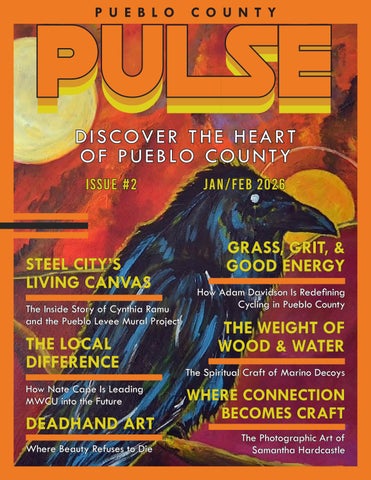
PULSE DISCOVER THE HEART OF PUEBLO COUNTY ISSUE #2
STEEL CITY’S LIVING CANVAS The Inside Story of Cynthia Ramu and the Pueblo Levee Mural Project
THE LOCAL DIFFERENCE How Nate Cape Is Leading MWCU into the Future
DEADHAND ART Where Beauty Refuses to Die
JAN/FEB 2026
GRASS, GRIT, & GOOD ENERGY How Adam Davidson Is Redefining Cycling in Pueblo County
THE WEIGHT OF WOOD & WATER The Spiritual Craft of Marino Decoys
WHERE CONNECTION BECOMES CRAFT The Photographic Art of Samantha Hardcastle
Forged in Steel, Driven by Purpose. Empowering our Members Strengthening our Community Making a Local Difference
mymwcu.com 719.544.6928 Serving Southern Colorado Since 1937
5 Local Area Branches
mymwcu.com Insured by NCUA
GUARDIAN OF THE LEVEE
Cynthia Ramu is the guardian of the Pueblo Levee Mural Project. She’s been protecting, preserving, and renewing the project for over three decades, and is making every effort to instruct and inspire the next generation of artists and conservationists. Read all about Cynthia and her work with the Pueblo Levee Mural Project on page 20.
@unalomephotoart
JANUARY/FEBRUARY 2026
CONTENTS
THE PUEBLO LEVEE MURAL A Canvas of History, Community and Resilience
GRASS, GRIT, & GOOD ENERGY How Adam Davidson Is Redefining Cycling in Pueblo County
06 12
18
SCENE & SEEN We Came, We Saw, We Took Pictures
steel city’s living canvas The Inside Story of Cynthia Ramu and the Pueblo Levee Mural Project
THE LOCAL DIFFERENCE How Nate Cape Is Leading MWCU into the Future
20
26 32
SCENE & SEEN Aurora Over Pueblo
DEADHAND ART Where Beauty Refuses to Die
THE WEIGHT OF WOOD & WATER The Spiritual Craft of Marino Decoys
34 38 44
SCENE & SEEN Into the Quiet White
WHERE CONNECTION BECOMES CRAFT
46
The Photographic Art of Samantha Hardcastle
UP THE SPINE OF BEULAH Hiking Tower Trail through History, Forest, and Sky
contributors Meet the Talent Behind the Pulse
PARTNERS & sponsors Meet The Believers
52
56 58
12 GRASS, GRIT, & GOOD ENERGY How Adam Davidson Is Redefining Cycling in Pueblo County
20 STEEL CITY’’S LIVING CANVAS The Inside Story of Cynthia Ramu and the Pueblo Levee Mural Project
26 THE LOCAL DIFFERENCE How Nate Cape Is Leading Minnequa Works Credit Union Into the Future
34 DEADHAND ART Where Beauty Refuses to Die
38 THE WEIGHT OF WOOD & WATER The Spiritual Craft of Marino Decoys
46 WHERE CONNECTION BECOMES CRAFT The Photographic Art of Samantha Hardcastle
PUBLISHER’’S NOTE Since moving to Pueblo in 2020, I’ve learned a lot about this city’s history, its culture, and its people. It has always been, and remains to this day, an inspiring melting pot of customs, cuisines, art, music, beliefs—in short, cultures. Pueblo is a place shaped by layers: indigenous roots, industrial grit, immigrant stories, and generations of families who have stayed, adapted, and built lives here. As I’ve spent more time listening, a common theme keeps surfacing in the stories people share. Pueblo is built on resilience. On showing up when things are hard. On work that is often unseen but deeply felt. There is pride here, not the loud kind, but the earned kind—rooted in craft, in care for one’s community, and in a deep connection to place. Whether I’m talking with artists, business owners, organizers, or families who have been here for decades, the throughline is the same: people believe in Pueblo and in one another. This city doesn’t pretend to be something it’s not. It knows who it is, where it’s been, and what it’s capable of becoming. This issue of Pueblo County Pulse is a snapshot of that spirit. I’m proud to feature these stories of creativity, perseverance, and community, told by the people who live it every day. I hope, in some small way, you are as inspired by these stories as I am. - Nate Jordon -
THE PUEBLO LEVEE MURAL by FORD GRANADA 6
PUEBLO COUNTY PULSE
A
WALL THAT BECAME A STORY
If you follow the Arkansas River as it winds through the heart of Pueblo, you’ll eventually come upon something extraordinary: a massive concrete wall that once stood as nothing more than a flood barrier. Today, it’s a living, evolving monument to the city’s grit and imagination. Layered with color, memory, and meaning, the Pueblo Levee Mural is more than painted cement. It’s a public diary. A patchwork
of triumphs and tragedies. A mirror Pueblo holds up to itself and says: This is who we are. The mural didn’t arrive through committees or consultants or curated festivals. Its beginnings were messy, rebellious, improvised, born of students sneaking out at night with brushes and cans of paint. What grew from that guerilla spark has become one of Pueblo’s most iconic cultural landmarks. Its story is one of world records, decades of creative expression, a near-total erasure, and
now, a full-throated renaissance. This is the story of how a plain gray levee wall turned into one of the world’s most compelling outdoor art projects, and why its next chapter may be its boldest yet. A WALL BUILT FROM TRAGEDY Before it held paint, the levee held purpose. After the catastrophic flood of 1921—a disaster that reshaped Pueblo forever—the city faced the urgent need to protect its people and
PUEBLO COUNTY PULSE
7
A CANVAS OF HISTORY A MURAL OF COMMUNITY A STORY OF RESILIENCE its future. The solution was monumental: a 65-foot-high, miles long concrete levee leaning at a 45° slope built to reroute the Arkansas River and safeguard the downtown corridor. It was impressive in scale, but uninspired in appearance. A blank slab. A monolith of gray. For nearly half a century, that’s all it was. Until a group of college kids decided it could be something more. THE SPARK: FISH IN THE BATHTUB Sometime in the late 1970s, a loose crew of CSU–Pueblo art students 8
PUEBLO COUNTY PULSE
who called themselves the TEE HEE’s began eyeing the levee wall not as infrastructure, but as opportunity. Pueblo didn’t have a thriving street art culture yet. Murals weren’t woven into the identity of the city. There was simply a long, lonely wall begging to be reinvented. So in 1978, under cover of darkness, the students grabbed their paint and created the now-famous “Fish in the Bathtub.” It wasn’t political. It wasn’t profound. But it was electric. A wink. A dare. An announcement that something new was possible.
Word spread, as it does in small cities with big personalities. Suddenly, artists weren’t asking if the wall could be painted, they were asking what could be painted next. FROM OUTLAW ART TO LEGAL LANDMARK By the late ’70s, the levee mural was gaining momentum. More artists wanted in. More ideas were bubbling up. But with momentum came attention, and with attention came the law. Instead of shutting the project down, Pueblo did something remarkable: it chose to embrace it. Former District Attorney Gus Sandstrom helped establish a permit system in 1979, legitimizing the murals and opening the door for broader community involvement. What had started as a midnight experiment was suddenly a sanctioned, city-supported artistic movement.
This legitimization coincided with the rise of new traditions, most notably the annual Paint-A-Thon, held on Cinco de Mayo, spearheaded by artist Dave Roberts, who championed the use of recycled latex paint to refresh and expand the murals. Each spring, artists descended on the levee to add color, depth, and story, transforming the wall into what felt less like a canvas and more like a cultural festival stretched across miles.
• A communal art practice that welcomed anyone with a brush and a vision
A GUINNESS WORLD RECORD & GLOBAL SPOTLIGHT
But even the strongest walls age.
By 1995, the murals had grown into something almost mythical. Stretching more than three miles and covering over 100,000 square feet, the Pueblo Levee Mural was officially recognized by Guinness World Records as the largest outdoor continuous mural on the planet. That title held from 1995 to 2018, but the record wasn’t really the point. What mattered was what the mural represented: • Hundreds of contributing artists • Thousands of volunteers • Countless stories layered on top of one another
To walk the levee then was to walk through Pueblo’s imagination, its humor, its heartbreaks, its legends, its hopes. The wall had become a visual autobiography of the city. THE CRISIS: CRACKS IN THE CANVAS
By the early 2010s, engineers began raising alarms: the levee was bulging, cracking, and no longer meeting FEMA certification. Pueblo faced the same reality it confronted in 1921. This wall existed to protect lives, and if it failed, the consequences would be devastating. In 2014, the decision was made to begin repairs. The makeover would be massive and costly, roughly $15 million worth of reconstruction. It involved: • Lowering the levee from ~65 feet to around 25–30 feet • Re-shaping and stabilizing its slope • Reinforcing it to meet modern safety
The Charles W. Lee Footbridge stretches gracefully across the Arkansas River, linking parks, trails, and people. Completed in 2021 and named to honor community leader Charles W. Lee, the bridge stands as a symbol of Pueblo’s ongoing riverfront revitalization, where thoughtful design meets everyday connection.
PUEBLO COUNTY PULSE
9
standards But there was a heartbreaking cost: the original mural had to be destroyed. For the artists, for the community, and for anyone who had grown up knowing the levee as a place of creativity, it felt like watching decades of Pueblo’s cultural DNA scraped away. Fortunately, preservationists acted quickly. High-resolution photography and documentation efforts worked tirelessly to archive the murals before demolition. Thanks to their work, the original levee mural lives on in digital memory, even if its physical form was washed away in concrete dust. A NEW ERA: THE REBIRTH OF COLOR After years of construction and uncertainty, a new question emerged: What happens after the wall is rebuilt? Pueblo answered the only way Pueblo can: with paint. By 2020, the mural project officially reopened, and artists began reclaiming the fresh concrete surface. The effort has been guided, once again, by longtime coordinator and artist Cynthia Ramu, who has shepherded the project since 1992 and personally contributed more than 30 murals. Under her leadership, the rebirth has been intentional. Organized. Historically rooted. And ambitious. As of 2025, the new levee: • Features over 125 completed murals • Covers roughly 130,000 square feet of surface • Continues to expand with each season and each approved design College groups, nonprofits, profes10
PUEBLO COUNTY PULSE
sional artists, and everyday Puebloans have all contributed to the new tapestry. One highlight: a recent Pueblo Community College student mural, celebrating unity and resilience, a reminder that the next generation is already carrying the torch forward. LOOKING FORWARD: A VISION TO RECLAIM THE RECORD The levee mural’s renaissance isn’t just about restoration, it’s about evolution. Project organizers have their eyes on something big: breaking the world record again. Here’s the ladder they’re climbing: • Current U.S. record: ~170,000 sq ft (Wichita) • Current world record: ~254,000 sq ft (Seoul) • Pueblo’s current coverage: ~130,000 sq ft and growing The math is simple: Pueblo has room. The walls are wide open. And the community has never lacked ambition. One artist helping lead this charge is Desiree Talmich, who won the 2023 design competition with a mural celebrating Pueblo’s layered identity—five flags, indigenous roots, the steel mill era, and the fire and flavor of Pueblo chiles. Desiree has been working on the mural consistently for years now. The Pueblo Conservancy District and Pueblo Arts Alliance have introduced updated mural guidelines emphasizing historical accuracy and cultural relevance. The idea isn’t just to fill space—it’s to tell Pueblo’s story from its prehistoric roots to its modern reinvention. WHY IT MATTERS: BEYOND PAINT The Pueblo Levee Mural is not just
decoration, it’s an engine of identity. Its impact radiates through the city in ways both seen and unseen.
Cultural Identity The levee has become a long-form narrative of Pueblo’s past, present, and future. Indigenous history. Steelworkers. Farmers. Students. Veterans. Dreamers. All of it is there, captured in color. Tourism With the Riverwalk nearby and new trail access, the levee is becoming a must-see destination for visitors and locals. Every mural gives people a reason to stop, wander, and linger a little longer in the heart of the city. Community Engagement Schools, colleges, small businesses,
nonprofits, everyone has a stake. Everyone has a story to tell. And everyone is invited to add a brushstroke to the next chapter.
Resilience Few art projects endure a full demolition and come back stronger. The levee mural is proof that Pueblo doesn’t fold under pressure. It rebuilds, reimagines, and rises. For Community Members Walk the trail. Bring your kids. Bring your friends. Make a day of it. The levee is meant to be experienced up close. For Supporters Donate. Volunteer. Share the project on social media. Every bit helps sustain this massive, multi-year effort. PUEBLO’S STORY, WRITTEN IN COLOR
Above is a completed mural by local artist Deadhand.
We caught Deadhand on the levee in December, working on her next piece.
The Pueblo Levee Mural is more than a public art project. It’s a testament to what happens when a community chooses to make beauty out of history, connection out of adversity, and identity out of cooperation. Thousands of hands have shaped it. Thousands more will shape what comes next. Stand along the river, look up at that wide concrete slope, and you’ll see it: Pueblo’s past rising in color. Pueblo’s resilience written in bold lines. Pueblo’s future still waiting for its next brushstroke. But this is a mural that refuses to be simply looked at. It asks you to participate. To imagine. To belong.
Read our exclusive interview with Deadhand on page 34.
And in true Pueblo fashion, the wall seems to whisper back:
We have work to do.
PUEBLO COUNTY PULSE
11
GRASS, GRIT, & GOOD ENERGY How Adam Davidson Is Redefining Cycling in Pueblo County by Nate Jordon
Photo © Tyler Shown @tylershown
12
PUEBLO COUNTY PULSE
Grassroots Gravel isn’t your standard bike race—it’s a community. While there are fast riders and big miles, the heart of the event is people of every pace, background, and body, brought together by organizer and accidental community-builder Adam Davidson. For Davidson, bikes are tools of empowerment, the outdoors belong to everyone, and Pueblo is a cycling destination hiding in plain sight. Grassroots Gravel has grown into one of Colorado’s most talked-about events not by chasing prestige, but by creating a space where everyone feels seen, safe, and welcome.
I
f you’ve ever wandered into a Grassroots Gravel event in Pueblo, one thing becomes obvious fast: this is not your standard bike race. Sure, there are fast riders, elite athletes, and big miles on the menu. But the heart of this thing? It’s people. All people. Every pace, every background, every body. At the center of it is Adam Davidson, a rider, organizer, storyteller, and accidental community-builder whose ethos runs deeper than routes and race-day logistics. For Adam, bicycles are tools of empowerment, the outdoors is for everyone, and Pueblo is a cycling destination waiting for the rest of the world to figure it out. Grassroots Gravel has quickly become one of the most talked-about events in Colorado—not because it chases prestige, but because it creates belonging. Davidson’s philosophy is simple: the outdoors should feel like home, and the people who show up deserve to feel seen, safe, and welcome. We sat down with Adam to talk origin stories, unexpected growth, community inclusion, and what it really takes to build a movement disguised as a bike race.
PULSE: Before Grassroots Gravel existed, what was the spark? What made you believe this could become your life’s work? ADAM: At my core, I’ve always believed the outdoors should be accessible to everyone. Bikes changed my life—they were freedom, transportation, adventure, and a way to connect with people and places. That stuck with me. Even as a teenager, I just wanted to share the things that made my life better with other people, especially the things with low barriers to entry.
Riders Trek Deep into Pueblo County / Grassroots Gravel 2025 @s_tribby Photo © Scott Tribby
Bikes are exactly that. You don’t need a license, you can often fix them yourself, and you can go explore the world without spending a ton of money. Before Pueblo, I was running community rides in Greeley, doing bike-powered composting work in Arizona, serving on the board of Southern Colorado Trailbuilders, building trails, organizing events—always this blend of bikes, community, and connection. So by the time Gravel Locos came to Pueblo in 2022, all the pieces were already there. I understood the roads, the land managers, the relationships, the potential.
place people think of when it comes to gravel cycling. What makes this region so special for the sport? ADAM: Pueblo has flavor—as a community and as a landscape—and gravel is such a place-centric experience. From downtown, you can be on a gravel road in about four miles. You can hop on the river trail from almost anywhere. You’re connected to Lake Pueblo State Park with a huge trail network. You can ride desert mesas, mountain forests, or farmland with a farm stand stop—all within a small radius.
When Gravel Locos pulled out of the Pueblo market in 2023, I knew the region still needed something—but something different. Something truly welcoming. Something where everyone could belong.
Ride 20 miles one direction and you’re in Wild West open country. Ride 20 miles the other direction and you’re in Ponderosa pines at 10,000 feet on a legendary mountain gravel road.
My wife, Abby—who is the pragmatist between us—looked at the idea, the numbers, the vision, and said, “You’re not crazy. Go for it.”
The accessibility is unreal. The variety is unreal. And Pueblo has all the services, culture, and charm that make a weekend here feel complete.
That was the moment. That’s when I knew this was real.
PULSE: Your brand focuses a lot on community inclusion rather than just race-day performance. Why was that philosophy important from the start?
PULSE: Pueblo isn’t always the first
PUEBLO COUNTY PULSE
13
ADAM: Because everyone deserves a space where they feel welcome—period. If you want people from any background, body type, identity, or skill level to show up, you have to communicate from the start that this is a place where they will be safe, seen, and supported. That’s not marketing fluff. That’s structure, tone, and intention. Pro performance matters to the folks chasing it, and we absolutely make space for them. But race-day performance doesn’t matter to the entire community. Inclusion does. Connection does. Joy does.
And honestly, this comes from lived experience. I spent most of my youth in a much bigger body. I know what it feels like to be excluded. Creating a space where people can exist as themselves—without judgment—that’s the most important thing I can do.
PULSE: What’s a moment — big or small — that made you think, “Yeah, we’re onto something here”? ADAM: When Abby said, “Go for it.” It was after our first event—built in just three months while I was still working full-time—we watched the festival come alive. The atmosphere, the energy, the people connecting with each other… I knew we had something that mattered.
PULSE: Grassroots Gravel has attracted riders from all over. What do you think resonates most with people when they participate? ADAM: Our messaging and our media make it crystal clear that this is for everyone, and people feel that the moment they show up. We highlight real humans—different ages, speeds, bodies, backgrounds— not just elite podium shots. We intentionally choose visuals and stories that feel relatable. But also: clarity is kindness. Our operations team is world-class. Our volunteers are incredible. Every detail is deliberate so riders can relax into the experience instead of worrying about logistics. People want to feel welcomed, supported, and celebrated. That’s what sticks.
PULSE: You do a lot to engage local youth and new riders. What does building the next generation of cyclists look like for you? ADAM: The ethos doesn’t change. Make people feel welcome and safe, and they’ll want to be there. We’ve partnered with the Boys & Girls Club to help kids train for Grassroots Gravel, learn basic bike repair, and gain confidence on the bike. We volunteer with them directly. We’re now part of the Generation Wild Pueblo Region coalition through Great Outdoors Colorado, which will expand these opportunities even more. It’s all about meeting kids where they are and plugging our strengths into organizations already doing amazing work.
Rolling Through Downtown Pueblo / Grassroots Gravel 2025 @unalomephotoart
PULSE: Running events is no small feat. What’s something riders may never notice on race day that takes massive effort behind the scenes?
That trust takes years to build.
community’s greatest strengths.
PULSE: How has Pueblo’s cycling community grown or shifted since Grassroots Gravel launched?
PULSE: What’s your long-term vision — where do you see Grassroots Gravel five, ten years from now?
ADAM: There are more people riding gravel now—locals who didn’t even realize these road networks existed. And in the industry at large, Pueblo is firmly on the map.
ADAM: I want Grassroots Gravel to be known as the event where every rider feels welcome—and where the experience is so dialed that elite racers can still throw down.
Then the festival: power, vendors, traffic flow, trash, staging, volunteer coordination, logistics. It’s endless.
The goal moving forward is to continue inviting mountain bikers, road riders, new riders, casual riders— everyone—into this space. And to tell the stories that highlight what makes this region special.
I want Pueblo to be understood as a true cycling hub of Colorado. Not replacing its existing identities, but adding to them.
But the biggest unseen factor is relationships. None of this exists without trust from the city, county, law enforcement, fire departments, land managers, and chamber partners.
Our volunteers are consistently praised as the friendliest people riders encounter anywhere in the country. I want Pueblo to know that the world sees that. It’s one of this
ADAM: Everything. Truly. Designing the course means understanding bottlenecks, emergency access, water needs, aid station supply calculations, signage, safety implications of every left turn, jurisdiction boundaries—every tiny detail matters.
And I’d love for Grassroots Gravel to become the big end-of-season celebration—the event riders look forward to all year because it’s joyful, challenging, friendly, and unforgettable.
PUEBLO COUNTY PULSE
15
PULSE: When you’re not organizing events, what kind of ride do you personally crave? Long and meditative? Fast and competitive? Something else entirely? ADAM: If I’m mountain biking, give me the weirdest, most technical, zero-flow trail imaginable—stuff that feels like problem-solving on two wheels. But my favorite rides are long, questionable adventure routes where I’m not sure what will happen— washed-out sections, mystery trails, unexpected obstacles. Big effort, big payoff, finish with tacos with friends. And for the record: El Pampano. Full stop. *** Grassroots Gravel isn’t just a cycling event, it’s an energy, a philosophy, a community invitation disguised as a race. Under Adam’s leadership, it has become a gathering place where people rediscover the outdoors, rediscover Pueblo, and in many ways, rediscover themselves. In a world where outdoor spaces can feel segregated by skill, speed, or image, Grassroots Gravel flips the script: everyone belongs, everyone rolls out together, and everyone comes home proud. Pueblo is lucky to have this movement rooted right here. And something tells me the story is only just beginning.
16
PUEBLO COUNTY PULSE
Creating a space where people can exist as themselves— without judgment that’’s the most that important thing I can do.”
At the Starting Line / Grassroots Gravel 2025 Photo © Kim Shepperd @kimoutgallivanting
PUEBLO COUNTY PULSE
17
SEEN & SCENE
@unalomephotoart
@mishilaashlynphotography
@unalomephotoart
18
PUEBLO COUNTY PULSE
@photos.scs
@unalomephotoart
@photos.scs
@unalomephotoart
@unalomephotoart
@unalomephotoart
@photos.scs
@unalomephotoart
PUEBLO COUNTY PULSE
19
STEEL CITY’’S CITY LIVING CANVAS The Inside Story of Cynthia Ramu and the Pueblo Levee Mural Project by Nate Jordon
C
ynthia Ramu is an artist, muralist, and long-time coordinator of the Pueblo Levee Mural Project, a public art effort that has become inseparable from Pueblo’s cultural identity. For over three decades, she’s overseen the evolution of the levee wall as canvas, caretaker, and archive, mediating between artists, institutions, and the steel city’s changing rhythms. The Pueblo levee itself was built in the wake of disaster. After the cataclysmic flood of June 1921, which submerged downtown Pueblo and led to massive destruction and loss of life, city planners rerouted the Arkansas River and erected a 65-foot tall concrete wall, leaning at a 45° slope, to protect the city from future flood-
20
PUEBLO COUNTY PULSE
waters. Decades later, in the late 1970s, students and local artists began covertly repainting sections of the concrete barrier over existing graffiti, effectively reclaiming an austere structure as a living, evolving mural canvas. Over time, the effort grew, gained community backing, and by the 1990s was recognized in Guinness as “The Longest Outdoor Mural Gallery in the World” spanning over 177,000 square feet along the Historic Arkansas River. Now, what was once a flood control wall has become a visual chronicle of Pueblo’s people, histories, and changing aesthetics. Cynthia is one of the storytellers holding that chronicle together.
We met on a crisp November morning at 3 Birds Coffee in downtown Pueblo. PULSE: You’ve been in the Pueblo arts scene for decades. Is there a resurgence happening now? CYNTHIA: There is a resurgence happening—almost a new renaissance. I came down from Denver during the thick of it in the ’80s. I’d visit because I knew a couple of guys working on the levee, Dan Magoon and Phil Vallejo, and I remember asking, What is the levee? They even had one of the only levee-focused art shows in Denver around 1984, at the News Gallery. So I started coming down on week-
Art is not here to please. It’’’s to share who we are It and where we are.”
PUEBLO COUNTY PULSE
21
ends, hanging out, and saying, “Let me know—I want to paint,” even though I was afraid of heights. At the time, I was a theater producer in Denver, a music booking agent, running a few galleries, and organizing community fundraisers. But Pueblo grabbed me because of the levee. I saw potential there. I kept saying, “This needs to be in Guinness!” and my friends told me to go for it. So I did. I’d come down and move through different art circles; everything was very organic. The university was a real melting pot—most of the artists were there. So yes, there have been ebbs and flows, but it’s moving forward. PULSE: What was the original vision for the Levee Mural Project, and how did it evolve into a landmark? CYNTHIA: The roots go back to the ’70s, when painting the levee was illegal. A group of young artists— 22
PUEBLO COUNTY PULSE
some from the university—started planning to paint it anyway. Before touching the levee, they practiced on Main Street at night, timing how fast they could run, figuring out escape routes, and learning to work covertly. They called themselves “The Tee Hee.” Around ’77–’78, they finally painted a fish on the wall, with friends stationed along the banks and the top of the levee to watch for trouble. Someone spotted the lights, police were called, and everyone scattered. Their leader, Dianne Massette, and another artist, Alan, even jumped onto a moving train to escape. The next day, Alan returned for his truck—only to find the police waiting. A grid drawing of the fish was on the seat. They were caught. The whole thing hit the public sphere just as Gus Antrom was running for District Attorney. Part of his campaign platform became legalizing levee painting through a permit system. He won, and by 1979, artists had a
pathway to paint legally. He eventually became president of the Pueblo Conservancy District. I met him around ’88. A friend of mine, Dave Roberts—who was around during all this and was teaching at the university—knew the whole backstory. He went to the Conservancy District and said, “If you give me a mass permit, I’ll make sure anyone painting on the wall signs a release so they will be painting legally.” Dave was also a contractor in Colorado Springs and offered to bring free paint. So, every year during Cinco de Mayo, they held a Paint-A-Thon event. I came down around then and got to know Dave. We painted together. He eventually launched major paint-recycling programs in Colorado Springs and across Colorado. When that grew into a business, he handed the mural project to me around ’92. I had first painted the levee in ’88, though my mural washed off—so I went back
and repainted it. “Earth Rise” was based on the historic photo the astronaut took of Earth from the Moon. My mural was a 3D door opening on the moon with the Earth in the distance. You could see my mural just next to the 4th Street Bridge on the west side.
city—its peaks, valleys, and deep working-class roots. Over and over, artists return to the steel mill, family histories, or community connections. That’s true of the historic section and of artists like St. Mary Corwin, Deadhand, Sister Cities International, Damon Runyon, and so many others.
Because I’m a graphic designer, I often coach artists so their submissions are polished and ready—it saves time and prevents confusion. I’m stepping away from the Pueblo Conservancy District at the end of the year, so I’m training others to keep the process moving smoothly.
Back then, there weren’t many artists on the wall. It was rare to see anyone unless we organized a group. We started restoring as many murals as we could, and by ’95 I had completed my first three.
I keep encouraging people to bring their culture, identity, and history to the wall because the levee is a visual narrative of Pueblo. Most locals don’t even know the wall was torn down and rebuilt. The murals preserve stories people don’t always speak aloud. It’s an open-air monument to the community.
The Levee Mural Project itself is separate from the Conservancy. The project belongs to the artists past, present, and future; the Conservancy just oversees the wall.
PULSE: How do you decide which artists or themes appear on the levee today, and what does that process look like?
CYNTHIA: The surface is angled at 45 degrees, so your body has to adjust. We use harnesses and ropes, and everyone completes safety training. The materials matter, too—specific primers, specific paints. On the old 85-yearold levee, artists could throw on anything and it soaked in beautifully. The new technology is less forgiving; every section behaves differently.
A friend of mine—a national artist, Jerry De La Cruz moved from Denver, and he and his wife helped me measure the wall in ’94 for a world-record attempt. We didn’t get it that year, but we went back in ’95 and broke the record, with 178,200 sq ft as the “Longest Mural in the World”. That record stood until 2018, when the wall finally came down. PULSE: In what ways do the murals reflect Pueblo’s identity—it’s working class roots, it’s creativity, it’s grit? CYNTHIA: Pueblo’s story is one of resiliency. The art scene mirrors the
CYNTHIA: I work closely with the Pueblo Conservancy District, and together we developed full guidelines for the wall. Artists now submit online applications, which go through an Art Review Committee of artists and curators before the Conservancy board reviews them.
PULSE: What physical or logistical challenges do people not realize about painting the levee?
Paint needs UV protection. The
PUEBLO COUNTY PULSE
23
primer must be covered immediately. You can’t paint too thickly—oil painters especially struggle because the layers peel. We’re still fixing murals where the wrong materials were used. We’ve worked closely with D&S Paint for 35 years, and PPG and their local rep. We’re also using a clear coat now that protects murals for an extra ten years, thanks to Judy Baca’s work in L.A.—my hero—and several Denver artists who’ve helped us learn how to apply it correctly. I even created a cheat sheet for artists: bring water, bring a broom, sweep and blow debris before priming, watch for moisture, avoid painting when the wall is cold. People underestimate how many variables there are. It’s absolutely not “slap that sucker up there,” and it’s not like doing a mural on a building. PULSE: How has the levee changed your view of what public art can be? CYNTHIA: It created a tribe. It gives young people a voice and helps older generations honor their stories. Levee painters are multi-generational. I’ve had 80-year-olds want to paint and 15-year-olds wanting to start their first mural. Many artists tell me they dreamed of painting the levee as kids—they walked the trail, fished there, rode bikes along the river. Public art is also healing. Universities are now tying public art to mental health programs. When I taught, I took my eighth graders to paint murals—those still exist near Santa Fe and I-25. I’ve worked with Boys & Girls Clubs, youth programs, and community groups. I’ve taught over a thousand kids, and now many of them come back in their thirties saying, “I’m ready for the big wall.” And Pueblo loves this wall. Parents 24
PUEBLO COUNTY PULSE
used to walk into conferences and ask me about the levee before asking about their own child. Steelworkers, miners, railroad families—it meant something to everyone. It still does. PULSE: With weather, graffiti, and new projects, how do you balance maintaining old murals with creating new ones? CYNTHIA: It’s constant upkeep. I track which murals need work and ask artists to check in on their pieces. Some have moved away, so we rely on volunteers—people who aren’t necessarily artists but who show up with great attitudes and strong backs. There’s always maintenance happening somewhere on the wall. It’s a living ecosystem. PULSE: Is there a particular mural or moment that still moves you when you think of it? CYNTHIA: Two, actually. The biggest was my CF&I mural from 1992. I received a grant and spent months researching the mill—its victories and tragedies. The mural was massive: 120 feet long and 65 feet tall. I brought friends to help me prime it, and the experience bonded us deeply. CF&I gave me a private tour—melting, pouring, fabrication. They gave me their version of history, but I’d already researched independently, and the stories didn’t always match. That mural stirred up a lot of emotions in the community. At the dedication, they blew the mill whistle, and all these retired workers and older women came in arm-in-arm searching for familiar faces. It was powerful. That project made me realize I wanted to live here. PULSE: How do you want future generations to view this stretch of riverbank?
CYNTHIA: As everything: art project, community statement, living story. We’re lucky to have a gallery this large and accessible. I hope we’re back in Guinness soon, and that the wall continues to spark curiosity— Why did they paint that? What does it mean?—and inspire expression across all art forms. It’s a creative playground in the middle of nature. PULSE: What have you learned about Pueblo from people’s reactions to the murals? CYNTHIA: That we share far more than we differ. Even decades ago, when I bartended at the Gold Dust, travelers were already falling in love with Pueblo—the mountains, the river, the friendly vibe. When you mix that with the arts, it shows that Pueblo is a place with a strong voice. Art doesn’t exist to please; it exists to express who we are. PULSE: Where do you see the project heading in the next decade? CYNTHIA: People will keep painting, and the area will draw more foot traffic. It’s positioned between historic districts and the river, so it deserves more visibility. And I hope we see more representation of the Indigenous communities who lived here long before us. That history matters and should be honored on the wall.
***
Standing beside the river, the levee hums with the layered voices of Pueblo: past, present, and still to come. What began as a concrete barrier has become a monument to persistence and imagination, a place where artists leave their mark and the city answers back in color. Cynthia Ramu’s work reminds us that art doesn’t just decorate a community, it documents its heartbeat, one brushstroke at a time.
ON THE COVER: Electric Crow by Deadhand
PUEBLO COUNTY PULSE
25
THE LOCAL DIFFERENCE How Nate Cape Is Guiding Minnequa Works Credit Union With Heart, History, and a Commitment to Southern Colorado by Nate Jordon PHOTOS by LEPIK PHOTOGRAPHY
26
PUEBLO COUNTY PULSE
I
f you spend any time around Pueblo’s business or community circles, you’ve probably heard the name Nate Cape more than once, and always in a positive light. As CEO of Minnequa Works Credit Union, Cape sits at the helm of an institution woven deeply into the fabric of Pueblo for more than 85 years. But he’s not just running a credit union, he’s championing a mission. Under his leadership, MWCU has doubled down on its promise of The Local Difference—a philosophy centered on community-first banking, real relationships, and tangible impact. Cape is one of those rare leaders who shows up everywhere: supporting small businesses, investing in local kids’ programs, partnering with nonprofits, and advocating for financial education. He’s the kind of CEO who doesn’t hide behind a desk. He’s out shaking hands at ribbon cuttings, volunteering at events, and making sure MWCU is a credit union Pueblo can not only rely on, but feel proud of. His leadership style blends vision, humility, and a deep belief in Pueblo’s potential, making him a pivotal figure in shaping the city’s next chapter.
Minnequa Works Credit Union has several locations in Pueblo. mymwcu.com 719.544.6928
We met on a chilly December morning at MWCU’s Abriendo location, just across from the steel mill it originated from. PULSE: MWCU has a long, rich history in Pueblo. What part of that legacy resonates most with you, and how does it guide your leadership today? CAPE: Minnequa Works was founded in 1937 as the credit union for CF&I steelworkers—literally out of a desk drawer. Pueblo was the steel mill of the West, and that story is personal to me. My great-grandfather, grandfather, and dad all worked at the mill, and I grew up surrounded by that culture of grit, diversity, and hard work. This credit union was also part of my childhood. My mom brought me here, and I remember getting lollipops at the teller line. So, leading it now feels full circle. The steel mill created a melting pot that shaped Pueblo’s identity, and that spirit still lives in MWCU. I try to lead with that same work ethic and sense of community connection, honoring the people who built both the city and this institution
@lepikphotography
PULSE: “The Local Difference” is clearly more than a slogan. What does PUEBLO COUNTY PULSE
27
learned a lot there, but I fell in love with credit unions the week I joined one. The CEO showed up during onboarding, had lunch with us, and talked about what credit unions are really built on: people helping people. Not as a slogan, literally how the work gets done. I immediately connected with that cooperative mindset. At first, I thought leadership opportunities would be decades away. But mentors kept pushing me, asking how they could support my growth. Ten years later, the chance to lead Minnequa Works arrived, and I grabbed it. Once I understood the heart of the credit union movement, I was all in. PULSE: MWCU is deeply involved in youth programs. Why is investing in Pueblo’s kids so central to your mission? CAPE: The risk of not investing in our kids is huge. Financial decisions hit fast—between 18 and 21, people are choosing careers, getting first paychecks, taking on credit, buying cars. Without guidance, those choices can shape the rest of their lives.
it mean in practice? CAPE: As big banks and fintechs have pulled away from Pueblo, the idea of “local” has changed. We’re still here, face-to-face, rooted, and invested. Being local means serving people across every stage of life, understanding their needs, and showing up where it matters. A big part of that is supporting ALICE households: families who earn just above the poverty line but still struggle. Nearly half of Pueblo County falls into that category, so we 28
PUEBLO COUNTY PULSE
focus on partnerships, volunteer work, financial education, and programs that help people build stability. We’re not trying to be a statewide institution. Our mission is southern Colorado, plain and simple. The team embraced that long before I became CEO. My job is to amplify it. PULSE: What moment made you realize you wanted to work in financial services and eventually lead a credit union? CAPE: I started at Wells Fargo and
We run Youth Savings Accounts, give $100 dividends for meeting savings goals, and host Bite of Reality budget simulations in schools so kids can learn real-world financial decision-making. We also partnered with the Sangre de Cristo Arts Center to build a mini-branch inside the Children’s Museum where kids can explore what a credit union does. It’s not just community outreach, it’s our future membership. If we don’t build relationships with the next generation, we can’t thrive. Even if they don’t end up choosing us, I hope we’ve helped them become confident, financially capable adults.
PULSE: Credit unions pride themselves on relationships. How do you maintain that personal touch as MWCU grows?
Nate Cape met with our publisher, Nate Jordon, at MWCU’s original Abriendo location, a stone’s throw from the old CF&I steel mill that is responsible for the credit union’s birth.
CAPE: We focus on being that “Cheers” experience, where members walk in and our team knows them by name. We see people on their best and worst days, so we show up as humans first, financial partners second. Our strategic priorities this year reflect that: 1. Be a great place to work, because our staff’s energy directly impacts member experience. 2. Elevate every member journey, from newborns to retirees. 3. Stay rooted in relational banking, not transactional service. We can’t compete with fintechs on speed or scale, but we can compete on genuine connection. PULSE: You show up everywhere in Pueblo. How do you determine which partnerships align with MWCU values?
pride. What do you think is most misunderstood about it, and how does MWCU challenge that?
CAPE: We look for impact across youth, diversity, and nonprofits that strengthen southern Colorado. And we like to have some fun along the way, like partnering with the Pueblo Bulls and me suiting up as a goalie for a night.
CAPE: Inside Pueblo, young people sometimes feel like they need to leave to find opportunity, but many come back. I was one of them. Once you’re ready to build a life, Pueblo’s support system and culture mean something.
The idea is simple: when people need financial help, they should think of someone local they’ve seen in their community, not a faceless institution. Showing up builds trust.
Outside Pueblo, old narratives about the steel industry’s decline still shape how people see us. But that’s changing. Our community is growing, investing, building. When I joined statewide leadership meetings, I felt imposter syndrome, like I was just “the guy from Pueblo.” Two years later, I’m co-chairing the committee.
These relationships have also led to programs like our Fueling Futures Grant, which has awarded about $60,000 to local entrepreneurs in two years. When small businesses succeed, the whole community benefits. PULSE: Pueblo is a city with grit and
I’’m constantly working to be a better husband, father, CEO, and human. The goal is simple: get a little better every day.”
Pueblo is resilient, diverse, and opportunity-rich. We need to give ourselves credit, and MWCU is helping reinforce that story every day. PUEBLO COUNTY PULSE
29
PULSE: What life experiences shaped the way you lead today? CAPE: My parents were my first leadership model. My mom worked multiple jobs, my dad worked overtime outdoors, and their sacrifice taught me work ethic and gratitude. I’ve had great mentors, and a few examples of what not to do, which taught me to lead shoulder-to-shoulder. I’ll never ask someone to do something I wouldn’t do myself. We say “One Team, One Dream,” and we mean it. That mindset comes from generations of Pueblo workers: show up, work hard, grow, support the people around you. PULSE: As Pueblo evolves, what role do you see MWCU playing in shaping its future?
30
CAPE: Our role is to help people navigate financial life, whether that’s starting a business, buying a home, raising a family, or planning retirement. If we can make life more affordable and more manageable, we’re building a stronger southern Colorado. We’re always looking at how to train our team, what technology supports members best, and how to maintain real human connection as the world becomes more automated. AI can help with efficiency, but it won’t replace conversations about someone’s first home or major life decision. Relationships will always be our foundation. PULSE: Finally, what motivates you personally? What gets you out of bed fired up for this work? CAPE: My wife—my high school
sweetheart—and our two kids motivate me every day. Thinking about how to build a future for them and for the next generation drives a lot of my decisions. I’m also responsible for a team of 50 and nearly 13,000 members. Every strategic choice affects real families. That matters. And personally, I’m always chasing growth. I relate to that Matthew McConaughey quote, “My hero, the man I’m chasing, is me in 10 years. I’m never gonna get there, but that’s what keeps me coming.” I’m constantly working to be a better husband, father, CEO, and human. The goal is simple: get a little better every day. *** In a city built on grit, loyalty, and generations of hard work, Nate Cape
feels like a natural successor to Pueblo’s story. He leads the way Pueblo itself tends to lead—quietly, steadily, and with a deep sense of responsibility to the people who call this place home. Under his guidance, Minnequa Works Credit Union isn’t just keeping pace with Pueblo’s growth; it’s helping shape what that growth looks like. Whether he’s championing youth programs, empowering local businesses, or simply standind shoulder-to-shoulder with his team, Cape continues to remind the community that The Local Difference isn’t a slogan, it’s a commitment. And maybe that’s the heart of it: in an era where financial institutions feel increasingly distant, Cape is proving that relationships still matter, people still matter, and local still matters. Minnequa Works has been part of Pueblo for nearly a century, but with leaders like him at the helm, its future feels just as rooted, just as resilient, and just as hopeful as the city it serves.
Fenrir Swallowing the Sun by Clara Kupsch
PUEBLO COUNTY PULSE
31
SEEN & SCENE
AURORA OVER PUEBLO
This once in a lifetime shot of the aurora borealis over Pueblo comes from the lens of local photographer David Armenta. @davidtookit PUEBLO COUNTY PULSE
33
DEADHAND ART WHERE BEAUTY REFUSES TO DIE
by Nate Jordon
34
PUEBLO COUNTY PULSE
P
ueblo has always carried a certain gravity, a raw, unvarnished honesty that pulls artists to their edge. Few tap into that pulse as fully as Deadhand. Her work doesn’t just challenge the eye; it unsettles, invites, and demands a kind of emotional excavation. In her hands, decay becomes texture, memory becomes material, and the roughedged spirit of this city finds a voice both feral and fiercely tender. Step into her studio, and you’re stepping straight into that collision of beauty and ruin, the place where Deadhand’s art insists on being alive. We met in the morning at her new Pueblo Arts Alliance studio downtown. She was still moving in. PULSE: What first sparked the creation of Deadhand Art, and what does the name represent to you? DEADHAND: Deadhand came after a couple earlier rebrands that just didn’t click. I was still in school, still building a portfolio, and trying to figure out what represented me. “Deadhand” was actually a nickname friends gave me after an accident at a job out in the Industrial Park. A bunch of us got sick, and they later found cyanide and jet fuel in the air vents. I ended up with permanent nerve damage and would drop things without realizing it. My friends started jokingly calling me “Deadhand.” Eventually, I thought: Why not use it? It’s memorable—like a single-word persona, Cher or Prince—but rooted in something personal. Turning something unfortunate into something empowering felt right. So I launched it, and it stuck. PULSE: Your work has a raw, tactile energy — what materials or techniques are you drawn to right now?
Deadhand’s new studio is located inside the Pueblo Arts Alliance
DEADHAND: Right now, most of my time is on the Pueblo Levee Mural. I’ve got two murals in progress, all exterior latex and spray paint, respirator on, rappelling gear—very physical work. In my private practice and gallery work, I’m mostly in acrylics on canvas. When I need to reset creatively, I make short films. It’s such a complete shift that it recharges me. I work with a small group—about five of us— and we submit to festivals. It’s a great way to approach storytelling from a different angle. PULSE: How does living and creating in Pueblo shape your artistic perspective? DEADHAND: Pueblo has such a resilient, hardworking energy. It’s blue-collar and deeply creative at the same time. People here build their own opportunities—because historically, nothing is handed to you. That grit, that “make something out of nothing” mindset, really inspires me. It feels like generations of people turning hard situations into something good. And it’s beautiful here. We’re surrounded by mountains, desert, the
river—so many landscapes feeding creative energy. I wish more people recognized how inspiring Pueblo is. PULSE: Do you see Deadhand as an extension of yourself, or as its own entity? DEADHAND: A bit of both. I created the persona to put some separation between my personal life and my public work. When I’m in the media or promoting art, I use Deadhand. It’s a boundary I can step in and out of, and it gives me freedom to play, evolve, and shift styles as needed. PULSE: Every artist has a moment that changes their trajectory. What was yours? DEADHAND: Meeting James Beck. We connected through film festivals, and he became one of my biggest collaborators. His work is abstract and intricate, and he basically taught me how to doodle again. I came out of college thinking I had to be a realist painter—because that’s the “expectation.” But it wasn’t fun, and it wasn’t me. James pushed me to loosen up: “Draw what you think a tooth looks like. Or a toaster. Or whatever.” At first it felt PUEBLO COUNTY PULSE
35
weird, but it cracked something open in me. My entire trajectory flipped. We’ve collaborated on several projects since, and people sometimes see hints of his style in mine, which I love. He gave me permission to drop expectations and create authentically. PULSE: What role does imperfection or decay play in your aesthetic — is it something you chase or something that finds you? DEADHAND: Imperfection is everything. One of my biggest inspirations is Basquiat—his rawness, his willingness to express without polishing the edges. That hit me hard when I first saw his work in school. It wasn’t about perfection; it was about emotion and lived experience. I take that mindset into my own process. With abstract work especially, the piece eventually becomes its own thing. There’s a point where the work takes over, and my job is just to
finish it without forcing it into something it doesn’t want to be. The decay aesthetic—the rough edges, the breakdown paired with vivid color—creates a tension I love. That push and pull between deterioration and vibrancy invites people to sit with their own contradictions. It’s the juxtaposition that keeps me coming back. PULSE: What story are you trying to tell through your current body of work? DEADHAND: I just finished a series called St. Anger at Pueblo Community College. I revisited old art-therapy pieces from years ago—dark, isolated, sometimes violent imagery from a period when I couldn’t verbalize certain things. My therapist back then encouraged me to paint them and discuss each line or mark. It was incredibly effective.
Deadhand working on the Pueblo Levee Mural Project Photo © Ted Shafer @tedshafer
36
PUEBLO COUNTY PULSE
For St. Anger, I challenged myself to build a whole show loosely inspired by that old work. What surprised me was that the series ended up joyful. It became a celebration of how far I’ve come, even though it started from old wounds. That contrast—anger to joy, isolation to growth—became the story. PULSE: So you’re taking risks and exposing vulnerability. DEADHAND: Always. There’s no barrier between me and the canvas. In shows, people will ask deeply personal questions about what a piece “means.” I rarely answer directly. If I explain too much, it robs them of their own interpretation. People naturally fill the emotional gaps they recognize in the work. We all have holes we’re trying to fill. Every series I’ve made is personal, but once it’s on the wall, it becomes theirs too. Vulnerability is part of the deal.
PULSE: How do you balance making art for yourself versus creating for clients? DEADHAND: I’m full-time, so yes— most of my work pays the bills. One of my levee projects is a commissioned mural with a very clear objective. Another is grant-funded and gave me more creative freedom. I try to alternate: structured work here, a gallery show where I can do whatever I want there. Everything earns income in some way, but I deliberately make room for non-commercial creativity too—like films—which don’t make money but feed me artistically. That balance keeps me sane. PULSE: What’s one misconception about your art or process you wish people understood? DEADHAND: I actually don’t feel misunderstood. But I do wish people understood how much emotional energy creative work takes. There’s a
cycle: intense creation, then a vacuum afterward—whether the project succeeds or collapses. Professors and mentors warned me about it, but I didn’t get it until I lived it. Culturally, we expect artists to produce constantly, but real work requires rest, recovery, and reinspiration. Musicians take years between albums for a reason. Creatives aren’t machines. We need downtime to refill the tank—emotionally, mentally, spiritually. I’m still learning how to build that into my life while also, you know… paying rent. PULSE: When people walk away from your work, what feeling or thought do you hope lingers? DEADHAND: I don’t care whether they love it or hate it—I just want them to feel something. My work is deeply internal, not usually political or statement-driven. It’s about emotion, intuition, personal excavation.
and ends up spending time with themselves—thinking, remembering, questioning—that’s the goal. If my work helps them connect to their own interior world, then it did what it needed to do. *** Deadhand doesn’t soften Pueblo’s grit; she elevates it. In every mural, canvas stroke, and film frame, she reminds us that art isn’t meant to be tidy — it’s meant to pulse, bruise, provoke, revive. Her work lingers because it refuses to lie. It honors the wreckage, the resilience, the impulse to rebuild even when the world feels split open. In a city built from fire and stubborn hope, Deadhand’s creations are proof that beauty doesn’t just survive here — it claws its way up, bares its teeth, and refuses to die.
If someone looks at one of my pieces PUEBLO COUNTY PULSE
37
38
PUEBLO COUNTY PULSE
THE WEIGHT OF WOOD & WATER THE SPIRITUAL CRAFT OF MARINO DECOYS
Marino Decoys marinodecoys.com 719.240.0632
by Nate Jordon
W
hen Mike Marino picks up a block of cedar, he doesn’t simply see wood, he sees potential. A curve waiting to emerge, a head waiting to lift, a bird waiting to settle on the water as if it were alive. But beneath the technical work—the carving, sanding, painting, weighting, balancing—there is something deeper at play. Something that traces its way through faith, fatherhood, loss, hope, and the quiet moments between a man and his calling. Marino didn’t plan any of this. He didn’t dream of becoming a decoy carver, a craftsman, or the founder of a growing small business that now carries his family’s name. His journey wasn’t mapped out in a business plan. It was sparked by frustration, and carried forward by a belief that handmade things, like handmade people, deserve care, time, and
purpose. Maybe that’s why, in a world overrun with mass-produced plastic birds, Marino’s decoys have become something more than tools for a hunt. They’ve become heirlooms. Vessels of memory. Bridges between fathers and sons. Symbols of healing for men grieving the loss of a loyal dog. Touchstones for people searching for meaning in a culture that often forgets to slow down. This is the story of Marino Decoys. Born not from ambition, but from calling. And the story of the man behind them, who discovered that sometimes the most unlikely pieces of your life are the ones that fit together perfectly in the end. We met on a warm December morning at his studio in Pueblo County near the community of Blende. PULSE: What was the exact moment or
experience that triggered you to carve your first duck decoy? What inspired you? MARINO: I ordered a set of decoys that looked terrible, nothing like the real thing. I’d spent a lot of money on them and felt cheated. That frustration pushed me to try carving my own. I bought a chunk of cedar, grabbed some tools, and went at it. My first one looked more like a chicken than a duck, but I was hooked. I wanted them to look and perform like the real thing, and that challenge pulled me deeper into the craft. PULSE: Once a children’s pastor, now a decoy carver — how do those two callings inform each other? Does your faith influence your carving, or vice versa? MARINO: Absolutely. I believe you can do ministry anywhere, not just in a church, and sometimes this feels like ministry. Honestly, I talk to more PUEBLO COUNTY PULSE
39
people about God while carving or hunting than I ever did inside a building. When I’m carving, I’m thinking about purpose, process, and patience, the same things I used to teach kids. And I’ve found that hunters are some of the most open, honest people I have ever talked to. These conversations happen naturally out in the field or right here in the shop. PULSE: What inspires you day-to-day in the shop? MARINO: Watching something come to life out of a block of wood. I also get inspired by the people I meet— hunters, fathers, veterans, folks going through something. And honestly? Nature. Just being outside, seeing how a real bird sits on the water, how light hits a wing. That stuff keeps me chasing accuracy and beauty in the work. PULSE: From that first rough decoy that “looked like a chicken” to winning Best-of-Show at the Colorado State Fair — what were the biggest lessons or turning points in your development as a carver? MARINO: Humility. I hit a point where I knew I needed help, so I reached out to experienced carvers. These guys had no reason to answer me, but they did. That taught me never to be too busy for someone who’s trying to learn. And the more I learned, the faster I improved. When my wife convinced me to enter the fair, I didn’t expect anything. Winning became a turning point—it showed me I was on the right path. PULSE: When you carve a decoy, what are you trying to achieve: realism? Functionality? Artistic expression? Some combination? MARINO: A blend of all three. A decoy should float, self-right, and move on the water like a real bird. 40
PUEBLO COUNTY PULSE
But it also needs to look alive in the hand. Ducks have posture, weight, subtle movement—I try to capture that. I want someone to pick one up and say, “Wow.” If I wouldn’t hunt with it myself, it doesn’t leave the shop. PULSE: Many artists speak of a meditative flow when creating. What does the carving process feel like for you, emotionally or spiritually? MARINO: I start with a block of wood and a block of cork, and I take everything away that doesn’t belong. At first, it doesn’t look like a duck at all—I have to carve out the shape of the head and the body. Then I move on to sanding, smoothing the lines of the decoy, fine-tuning it piece by piece. Every step of the carving process reminds me of how God cuts away the unnecessary parts of our lives. When painting, I’m reminded of how God made each one of us unique. I use specific colors and feather details
You’’re You’ handcrafted, you’re here for a reason, and no failure changes your value”.”
based on the species—if I’m painting a mallard drake, I have to use the right colors to make it look real. And because each decoy is handcrafted, each one is unique, and therefore special, just like me. Just like you. PULSE: Many people are drawn to your “Duck Devos.” Where did those come from? MARINO: They just started happening. I’d be carving or sanding and something would click—“This is exactly like that moment in scripture.” Creation, process, refinement… it all overlaps. So, I started sharing it online, and guys began reaching out, saying they’d never connected their hobbies to something deeper. It’s become a way for me to encourage people—not preach at them, just remind them there’s more to life than the grind PULSE: Does carving and building Marino Decoys carry a message for young people? What do you hope they take away from your decoy-making journey?
Out in the wild with Mike Marino — the craftsman behind Marino Decoys, where realism meets results. Spotted in the field with a client, Marino shows why hunters trust his work: lifelike decoys, real success. This isn’t just gear — it’s legacy in motion.
MARINO: I hope they see that you can chase your calling, even if it looks different from what you expected. I thought I’d be a businessman in a suit every day. Instead, I’m here in a shop painting ducks. But I’m doing exactly what I believe I was built to do. And I always told those kids: you’re handcrafted, you’re here for a reason, and no failure changes your value. If my story reinforces that, good. PULSE: Have there been moments of doubt — in your carving skills, in running a small business, in pursuing your passions? How did you get through them? MARINO: By remembering that I’m not doing this alone. I have an incredible wife, my kids, and the belief that this path was put in front PUEBLO COUNTY PULSE
41
of me for a reason. And every time I think about quitting, someone reaches out saying one of my videos helped them, or they want a decoy to honor their dog. Those moments tell me to keep going. PULSE: If someone buys one of your decoys or an urn decoy for a departed hunting dog, what do you hope it means to them? What part of your heart and purpose are you putting into each piece?
He looks down at the decoy in his hands and says, “I think about the dad who’s going to hunt with this one day. Or the son holding it for the first time. Or the guy healing from losing his dog. I think about how something I made might be part of their story.” A decoy is just wood and paint and weight and shape. Until it isn’t.
MARINO: Healing. When a dog passes, you usually get a box that ends up on a shelf or in a closet. These urn decoys let someone keep their dog with them—on the mantle, in the blind, even on the water. I’ve had guys send pictures of themselves hunting with their dog “one last time.” That’s powerful. It honors the animal and the memories. That’s why I take so much care with them.
Until it becomes something else.
PULSE: Where do you see Marino Decoys heading in the next 5–10 years? Do you envision building a larger workshop, teaching apprentices, or keeping it intimate and handcrafted?
And maybe that’s the point. In a chaotic world, Marino has carved out something rare—an art form that slows time, honors relationships, and reconnects people to the land, to one another, and to the quiet, steady work of becoming who they were meant to be.
MARINO: I’d love a bigger shop, more business, and eventually a few apprentices. I want to teach father-son classes, summer workshops, and maybe build a small carving school. But I never want to mass-produce anything. Every decoy will stay hand-carved and hand-painted by me. And if God opens more doors, I’ll walk through them. If not, I’ll keep doing what I’m doing—one bird, one person, one conversation at a time. *** Ask Marino what he thinks about when he’s carving late at night, the heater humming, the wood fragrant, the shop quiet except for the rasp of sandpaper. 42
PUEBLO COUNTY PULSE
A vessel. A memory. A mirror. A ministry. A legacy.
In the marsh, a decoy can turn a flock. In life, a calling can turn a man. And in both cases, when done right, it changes everything.
Couple in Neon Alley Photo © Steven Spencer @photos.scs
PUEBLO COUNTY PULSE
43
SEEN & SCENE
CLOUD HEAD by
Jon Watson
the mountain drinks the mist a silent communion sends out the rain mountain streams cry down to rivercrystal green golden branches dance in the cloudwind the jeweled gloom emerald mist over rain twilight sapphire emerald rain twilight mist over the sapphire day declining
44
PUEBLO COUNTY PULSE
INTO THE QUIET WHITE
Mishila Ashlyn ventured into the quiet white during a snowstorm to capture this peaceful scene in Pueblo’s City Park. @mishilaashlynphotography
PUEBLO COUNTY PULSE
45
WHERE CONNECTION BECOMES CRAFT
S THE PHOTOGRAPHIC ART OF SAMANTHA HARDCASTLE by Nate Jordon
amantha Hardcastle isn’t simply taking pictures, she’s building emotional time capsules. As the owner of Samantha Hardcastle Photography, she’s become one of Pueblo’s rising creative voices, known for portraits that feel warm, lived-in, and deeply human. Her work leans into balanced light, genuine interaction, and the subtle nonverbal moments that families often overlook in the rush of daily life. Whether she’s photographing seniors in the studio, families in the sagebrush, or professionals in gritty downtown alleys, Samantha shoots with one goal: capture connection, not just composition. Rooted in community and fueled by a love of people, she’s quietly shaping how Pueblo sees itself, one authentic frame at a time. We met at her new downtown studio on a chilly December morning. PULSE: Photography often begins with a moment that “clicked.” What was the turning point that made you realize this
46
PUEBLO COUNTY PULSE
Samantha Hardcastle Photography 129 E. Abriendo Ave. Pueblo, CO 81007 719.283.6730 samanthahardcastlephotography.com
would become your life’s work? SAMANTHA: Honestly, it started with sewing. I was making clothes for my kids and needed a camera to photograph the finished pieces. Then 2020 hit, and a few friends with seniors— who suddenly couldn’t get a photographer—said, “Hey, you have a camera…” But I realized how much I loved interacting with people. That’s when I thought, Maybe this could be a business. Maybe I can do this and stay home with my kids. I officially launched in 2021 and dove headfirst into learning—the art, the science, the business. There wasn’t one huge “a-ha” moment. It was more: This feels right… keep going. And the better I got, the more I loved it. A big part of that joy is offering printed products. Watching someone see their album for the first time— those “holy crap” reactions—fuels me. So, I just keep iterating and letting the work evolve. PULSE: How would you describe your style?
@samanthahardcastlephotography
SAMANTHA: People-driven. Connection-driven. Well lit. I joke that my style is “reality plus 10%.” I want PUEBLO COUNTY PULSE
47
Cattail Crossing have incredible sagebrush. When it blooms, photographing a family there feels dreamy and open, almost cinematic. Beyond locations, the creative energy here is inspiring. So many solopreneurs and small business owners… It really does feel like that cheesy High School Musical line—we’re all in this together. PULSE: What kinds of stories or emotions do you hope people feel when they look at your images? SAMANTHA: For family portraits, I want a mom to feel the same pride she feels when she looks at her kids in real life. I want the lighting and clothing to quietly support the moment—not distract from it. For a viewer scrolling my site, I want them to see connection: They look happy. They look loved. That person looks confident. That’s the story I want to tell. PULSE: Every photographer has a session they’ll never forget—whether magical or chaotic. What’s one that still sticks with you, and why?
people to feel comfortable, powerful, and seen. Those little nonverbals—the way someone tilts their head toward their partner or softens when they laugh—are what I’m after. When clients tell me the photos feel like them, that fills my soul. PULSE: Pueblo shows up in a lot of photographers’ work with very different personalities. How does the city influence the way you shoot? SAMANTHA: Pueblo still has a small-town feel. People here want connection, and that pushes me to 48
PUEBLO COUNTY PULSE
stay people-focused—even with corporate clients. And visually? Pueblo is a playground. My studio sits near so many great textures: chain-link fences, graffiti, historic buildings, gritty alleys. I can shoot inside for an hour, then walk the block and get something totally different. On the nature side, Mineral Palace Park has beautiful trees and water. Below City Park is an all-time favorite—especially with the aspens. Out in Pueblo West, places like
SAMANTHA: My “pilot kid.” We got to shoot at the airport, and everything aligned—weather, clouds, lighting. He was relaxed and confident because he loves flying, and we’d already built that rapport during earlier sessions. My son was assisting with lighting, the planes looked incredible, and even the plane owner said, “Holy crap, you actually know what you’re doing.” It was just one of those sessions where everything clicked. PULSE: Your work feels very people-driven. How do you get subjects— especially shy ones—to relax and show up authentically on camera?
SAMANTHA: Find their “baby.” Everyone has something they love to talk about. With that senior, it was planes. Once you tap into that, walls come down. That’s why pre-shoot consultations matter. I get a feel for how people move, what they’re nervous about, what excites them. And then… I’m a giant goofball. I’m obsessed with dad jokes. People either laugh with me or at me, but either way, they loosen up. I warn clients: “Ridiculous things will be said during your session.” Compliments help too—but real ones. Not “You’re pretty,” but, “Your cheekbones are amazing,” or “That shirt really makes your eyes pop.” Compliments about choices build confidence. The last piece is pacing and energy. My husband calls it “pacing and leading.” Match their energy first— bubbly, quiet, anxious, whatever— then gently guide them toward comfort. Body-language mirroring, those slow three nods, little cues from Vanessa Van Edwards… All the psychological tricks from networking translate beautifully to photography. The goal is always the same: help people feel seen. PULSE: What inspires you creatively right now, both inside and outside the world of photography? SAMANTHA: Trying new techniques— when I have the time. I shot landscapes the other week for a PPC [Professional Photographers of Colorado] print exchange, which is funny because portrait photographers don’t usually gift each other pictures of strangers. I’ve also been doing more compositing—totally creative pieces I’m not
sure I’ll ever sell, but I love making them. They keep me inspired. Nature inspires me too. Nerdy things inspire me. Challenging myself is always fun. PULSE: Running a photography business is as much about connection as it is about technique. What do you wish more clients understood about the process? SAMANTHA: Prints matter. More than people realize. Somewhere along the line, we treated digitals like the default… and they’re the least stable form of preservation. Thumb drives corrupt. CDs died. Hard drives fail. Cloud services change terms. We have no idea what our Google Drives will look like in 15 years. So, I ask clients, “What do you want to do with these photos?” Most say, “Post them on Facebook.” But in 10 or
I want people to feel comfortable, powerful, and seen. Those little nonverbals—the way someone tilts their head toward their partner or softens when they laugh are what I’’m after.”” PUEBLO COUNTY PULSE
49
20 years, the photos that matter are the ones printed in albums or framed in your home. A printed portrait becomes part of the space. It’s a daily reminder of connection. It’s not vanity—it’s legacy. Families deserve that. So, what was the point? You don’t need 100 family photos from one session. You need a few— printed. Put them in an album or a portrait box. Give them physical form. You will be far more likely to open an album in 10 years than to hunt for a thumb drive you haven’t seen since the move. A printed photograph becomes part of the home. When you walk into a space and see a large, beautifully presented portrait, it stops you. It’s a conversation piece. It’s a monument to the people you love.
50
PUEBLO COUNTY PULSE
It’s the same idea you see in important buildings—the courthouse, the county building—photos of people who matter hanging on the walls. Your home should have that too. It’s not vanity; it’s your story. I want a mom to walk into her house and see a portrait of her grown kids, or even her dogs, and feel connected and at home. We collect mile markers along the way. PULSE: What’s one piece of gear, ritual, or creative habit you rely on to stay grounded and inspired during shoots? SAMANTHA: Celebrating and showing the back of the camera. I’ll nail a shot, do a little jump or clap, then gallop over to show them. That’s right, gallop. It gets people excited and builds confidence.
Some older photographers say, “Never show the back of the camera.” But it’s 2025. I can zoom, check focus, adjust, reshoot. No big deal. I also shoot tethered to my laptop and TV so clients can watch images appear in real time. That collaboration energy keeps everyone engaged. PULSE: Looking ahead, what do you hope to explore next—new styles, new projects, new corners of Pueblo, or something completely unexpected? SAMANTHA: Shutter drag—I love that light-trail effect, especially for seniors. Same with light painting. And more compositing. My husband is a huge Stargate Atlantis fan, so I created a family composite in that universe. It’s printed big on metal in our home. Everyone was photographed individually, then combined
in Photoshop. AI speeds up pieces of it, but it’s still very hands-on. I’d love to offer more of that creative work. I also want to do Santa sessions next year—not mall Santa, but a full storytelling experience where kids walk through a narrative and get a custom book at the end. That would be so much fun. And networking events! I love networking. I want to host more gatherings here, including a “solopreneur Christmas party” for people who don’t have coworkers. Plus a few workshops with PPC—we’ve got some exciting people lined up.
***
Samantha Hardcastle’s work is a reminder that photography isn’t about poses or perfect lighting, it’s about connection, intention, and the small emotional truths that define us. Whether she’s building heirloom albums, experimenting with new creative techniques, or helping a shy senior step into confidence, her approach always centers on people first. In a creative community as collaborative and vibrant as Pueblo’s, Samantha stands out not just for the quality of her images but for the heart and authenticity she brings to every session. Her portraits don’t simply document moments, they honor them, preserve them, and turn them into something families can hold onto for a lifetime. The Atronach of Flame by Clara Kupsch
PUEBLO COUNTY PULSE
51
UP THE SPINE OF BEULAH
HIKING TOWER TRAIL THROUGH HISTORY, FOREST, AND SKY by FORD GRANADA
52
PUEBLO COUNTY PULSE
M
ost hikes worth taking require effort, but not every hike rewards you in return. The Tower Trail in Pueblo Mountain Park is one of the rare ones that do both, and do it generously. Tucked into the quiet folds of Beulah Valley, this 2.5-mile round-trip hike isn’t the longest trail in the region, nor the most rugged, but it’s one of those routes that condenses everything
people love about southern Colorado into a single, deeply satisfying arc: pine-scented forest, history, and panoramic payoffs. Whether you’re a weekend wanderer, a family looking for an approachable adventure, or someone chasing that meditative hour where the world falls away, Tower Trail will give you exactly what you came for.
A TRAIL THAT FEELS LIKE A STORY Every trail has a story, and Tower Trail wastes no time inviting you into its own. Starting from the designated Tower Trail parking area within Pueblo Mountain Park, the route is straightforward: a moderate 500-foot climb to the old fire lookout perched on the ridge above Beulah. But the experience unfolds in chapters. As you begin a gradual descent, the trail grows more textured. The elevation gain is steady, but never punishing. On warm days, the breeze funnels up from the canyon, lifting birdsong and the low whistle of wind across treetops. HIKING TOWARDS A PIECE OF PUEBLO’S PAST About halfway up, the Tower Trail settles into a series of winding switchbacks. These are the moments that start pulling Beulah Valley into view. Through the trees, the land opens in glimpses. These same switchbacks have been trekked long before it was a recreational trail. Pueblo’s forest lookouts climbed this route for a very different purpose. At the top of the ridge, the fire tower is the trail’s quiet, weathered reward. Built in the early 20th century, the structure once functioned as a watchpoint for smoke detection during high-risk fire seasons. Long before modern aerial surveillance or satellite detection, human eyes and intuition kept Colorado’s forests safe. From this tower, lookouts would scan the horizon for the faintest thread of smoke—a task that required patience, solitude, and an intimate understanding of the land. Though the tower no longer operates as part of modern fire-monitoring systems, it remains an important piece of Pueblo’s conservation history. PUEBLO COUNTY PULSE
53
VIEWS THAT FOCUS AND EXPAND From the tower, you get a sweeping perspective of the Wet Mountains. On clear days, Fremont Peak and Greenhorn Mountain show off their spare lines, and the valley below looks almost prehistoric in its calm. Sometimes, red-tailed hawks circle at eye-level here. It’s also common to see ravens riding thermals. If you’re lucky, a kestrel might perch on a snag near the tower. In spring, mountain bluebirds flash electric through the trees. And while black bears are rarely seen, visitors do occasionally notice tracks or scat along the upper trail, subtle reminders that this landscape is shared. Mule deer and wild turkey also roam freely along the lower trail.
a trail that pulls a whole community together without trying to. It offers challenge without intimidation, beauty without extravagance, and enough history to remind you that people have been caring for these mountains long before recreation was the point. Pueblo Mountain Park itself is a gem. It’s one of those public spaces where local identity, environmental stewardship, and outdoor access blend seamlessly. Trail maps are easy to find. Facilities are thoughtfully maintained. And the Tower Trailhead is tucked close enough to the heart of the park that you can build a whole day around exploring: picnic spots, nature center visits, family walks, and then the main event: the steady climb to the fire tower.
A HIKE THAT BELONGS TO THE COMMUNITY
WHAT TO BRING AND WHAT TO EXPECT
There’s something grounding about
Even though the hike is only 2.5 miles
54
PUEBLO COUNTY PULSE
round-trip, Tower Trail rewards a little preparation: • Sturdy shoes – preferably hiking boots – the switchbacks get rocky. • Water – no explanation needed. • Layers – winds along the ridge will surprise you. • Camera – no explanation needed. • Binoculars – especially for bird lovers. • Awareness – keep an eye out for wildlife sign and be respectful of the habitat. * Dogs are welcome but must be leashed. WHY THE TRAIL MATTERS Pueblo County is full of outdoor beauty, but Tower Trail hits different. It’s intimate, historic, and challenging without feeling punished. It carries the quiet soul of Beulah in a way few other places do.
For locals, it’s the hike they return to for clarity, exercise, and a quick reset. For visitors, it’s an introduction to the subtle magic of the Wet Mountains and the layers of story carved into the landscape.
And for those who reach the old fire tower at the summit, it’s a touchpoint between eras and a reminder that our connection to the land is always evolving, yet deeply rooted.
PUEBLO MOUNTAIN PARK 9112 Pueblo Mountain Park Rd. Beulah, CO 81023 719.485.4444
PUEBLO COUNTY PULSE
55
CONTRIBUTORS LEPIK PHOTOGRAPHY
DAVID TOOK IT
MISHILA ASHLYN PHOTOGRAPHY
From weddings and senior portraits to small business projects and documentaries, Lepik Photography has cultivated more than a business—they’ve built a practice rooted in connection, collaboration, and community pride. This dynamic duo was recently awarded the 2025 Best of Pueblo for Photography/Videography!
David Took It is one of Pueblo’s signature photographers. David’s work is instantly recognizable. His use of light, both natural and artificial, is what makes his work pop, as well as his use of warm tones. David provides us with eye-catching images of the people and events that make Pueblo County a unique place to live and visit.
Mishila is a professional photographer specializing in portrait, wedding, and event photography. Known for a people-centered approach, she is dedicated to capturing authentic moments. Mishila’s work blends artistry with storytelling, creating images that feel both timeless and personal.
STEVEN SPENCER
CLARA KUPSCH
JON WATSON
Steven is a retired veteran with a master’s degree in film, bringing a disciplined eye and storytelling mindset to everything he creates. As a photographer, he focuses on capturing moments with intention, blending technical skill with narrative depth shaped by both service and cinematic training.
Clara, also known as ruby.matic, is a queer, autistic artist originally from Arizona. Their art is inspired by the beauty of nature, whimsical fantasy themes, and the wonder of the cosmos. Bright, saturated colors, and neat clean edges are important aspects to their style. Mystical creatures meant to represent guiding forces are featured heavily in their works. Using a layering technique using acrylic paints, many more shades and hues can be observed by patient eyes.
Jon Boy Watson is a grunge dinosaur, a 90s relic marinated in Beat poetry, 18th Century English Lake poetry, an humble disciple of Cobain, Corso, and Shelley. Lone member of the Snow Leopard Tribe. Hermit of Greenhorn Mountain.
56
PUEBLO COUNTY PULSE
INJURED?
HAVE YOU BEEN IN A CAR ACCIDENT IN PUEBLO COUNTY? Free Consultation No Fee Unless We Win Contact Us Today!
719.300.7554 springslawgroup.com LET’S GET YOUR LIFE BACK PUEBLO COUNTY PULSE
57
PARTNERS & SPONSORS THANK YOU FOR BELIEVING IN US! MINNEQUA WORKS CREDIT UNION
Minnequa Works Credit Union (MWCU) is a Pueblo-based, member-owned financial institution built on relationships, not transactions—putting people, community, and trust first. For more than 85 years, they’ve delivered The Local Difference, investing in local families, businesses, and the future of Pueblo.
MYMWCU.COM
SPRINGS LAW GROUP
Springs Law Group is a Colorado Springs-based personal injury law firm that represents clients hurt in car accidents, slips & falls, dog bites and other negligence cases. They offer free consultations, work on a contingency fee basis (you pay only if they recover compensation), and emphasize compassion, responsiveness and transparency throughout their process.
THE SACRED BEAN
The Sacred Bean in downtown Pueblo is a vibrant café known for its inventive specialty coffees—think Pueblo Chile mochas—and rich brunch offerings including vegan pastries.
FACEBOOK.COM/SACREDBEANPUEBLO
SPRINGSLAWGROUP.COM
DANDY
DANDY in downtown Pueblo is a curated men’s lifestyle shop offering premium grooming products, beard care items, and stylish accessories alongside gifts suited for grooms and groomsmen.
FACEBOOK.COM/DANDYPUEBLOCOLORADO
58
PUEBLO COUNTY PULSE
LEPIK PHOTOGRAPHY
Lepik Photography is a husband-andwife–run photography and videography studio in Pueblo, Colorado, known for capturing weddings, portraits, families, seniors, and life’s special moments with a personalized, timeless style that turns memories into legacy imagery.
LEPIKPHOTOGRAPHY.COM
GOFUNDME SPONSORS
Becky Cline Sue Sutterfield Anonymous THANK YOU!
GOFUND.ME/4A0A006F8
ADVERTISE WITH US GROW YOUR BUSINESS WITH PUEBLO COUNTY PULSE!
AD SIZE
1X RATE
3X RATE
6X RATE
FULL PAGE 2/3 PAGE 1/2 PAGE ISLAND 1/2 PAGE 1/3 PAGE BLOCK 1/3 VERTICAL 1/6 VERTICAL / HORIZONTAL
$250 $200 $150 $125 $100 $75 $50
$200 $150 $125 $100 $75 $50 $25
$150 $125 $100 $75 $50 $25 $15
PREMIUM PLACEMENT
CONTACT FOR DETAILS
CONTACT FOR DETAILS
CONTACT FOR DETAILS
INSIDE FRONT / BACK COVER
$350
$300
$250
BACK COVER
$450
$400
$350
FULL PAGE ADS COME WITH THESE SPECIAL FEATURES:
PRINT & ONLINE SPECIAL!
A PROFESSIONALLY WRITTEN ARTICLE
ALL BUSINESSES RECEIVE SOCIAL MEDIA SHOUTOUTS
CUSTOM PHOTOGRAPHY & VISUAL CONTENT
NATIVE ADVERTISING AVAILABLE
1/6 PAGE
ALL BUSINESSES FEATURED ON OUR WEBSITE
1/3 PAGE BLOCK 2/3 PAGE
1/3 VERT
1/2 PAGE
1/2 PAGE ISLAND
For more information and to discuss Nate Jordon your advertising options, contact: nate@pueblocountypulse.com PUEBLO COUNTY PULSE
59
STAY TUNED FOR ISSUE #3 ARRIVING IN MARCH PUEBLO COUNTY PULSE is published six times a year. For inquiries & submissions, contact us at: 33 S. Golfwood Dr. W. Pueblo West, CO 81007 719.822.4822 nate@pueblocountypulse.com
pueblocountypulse.com