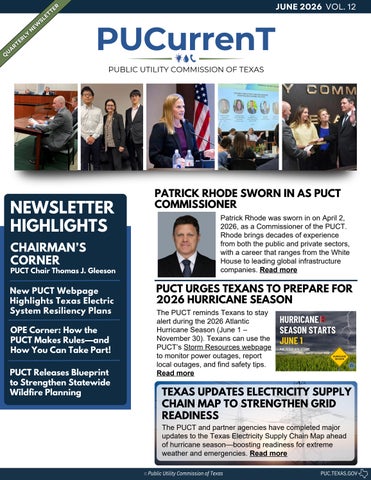

CHAIRMAN’S CORNER
PUCT Chair Thomas J. Gleeson
New PUCT Webpage Highlights Texas Electric System Resiliency Plans
OPE Corner: How the PUCT Makes Rules—and How You Can Take Part!
PUCT Releases Blueprint to Strengthen Statewide Wildfire Planning



Patrick Rhode was sworn in on April 2, 2026, as a Commissioner of the PUCT. Rhode brings decades of experience from both the public and private sectors, with a career that ranges from the White House to leading global infrastructure companies. Read more
The PUCT reminds Texans to stay alert during the 2026 Atlantic Hurricane Season (June 1 –November 30). Texans can use the PUCT’s Storm Resources webpage to monitor power outages, report local outages, and find safety tips. Read more

The PUCT and partner agencies have completed major updates to the Texas Electricity Supply Chain Map ahead of hurricane season—boosting readiness for extreme weather and emergencies. Read more

PUCT
Chair Thomas J. Gleeson
The fourth and final pillar of the Texas Energy Fund (TxEF) is now in place, completing the build out of this visionary, voter-approved fund that is already adding megawatts to the Texas grid and delivering results for Texans. With the Commission’s recent adoption of rules for the Texas Backup Power Package Program (TBPP), all four TxEF rulemaking projects are now complete—marking a major milestone in turning legislative direction into real, on-the-ground reliability improvements.
And those improvements are not theoretical—they are happening right now.
In May, Governor Greg Abbott celebrated the opening of a 460-megawatt peaking power plant in Central Texas, the first TxEF loan-backed project to come online. This facility adds dispatchable generation to the grid, providing critical support during periods of peak demand and helping meet the needs of our fast-growing state. It represents exactly what the Texas Legislature and voters envisioned: New, reliable power brought online when and where Texans need it most.
The first opening of a TxEF-supported project marks another key step forward—moving from planning and financing to construction and, ultimately, more megawatts on the grid. Together, these milestones demonstrate that TxEF is not just a policy framework; it is a working engine driving new generation and strengthening grid resilience.
The TBPP, adopted on May 7, adds another critical layer to that reliability effort. As I shared in our press release, Texans depend on critical facilities to stay up and running during emergencies. This program ensures backup power is available for facilities like hospitals, nursing homes, police and fire stations, emergency response centers, and water and wastewater systems—places where losing power is simply not an option.
Much of what we do at the PUCT is necessarily complex and deeply technical. This isn’t. This is putting life-saving power right where it needs to be, so it’s there when it’s needed, virtually at the push of a button.
The Texas Legislature passed TxEF. The governor signed it into law. Texas voters overwhelmingly approved it. And now, with all four rulemakings adopted and projects moving from groundbreaking to grid connection, the PUCT is proud to be implementing it in real time.
This is truly Texans taking care of Texans.

Thomas J. Gleeson Chairman

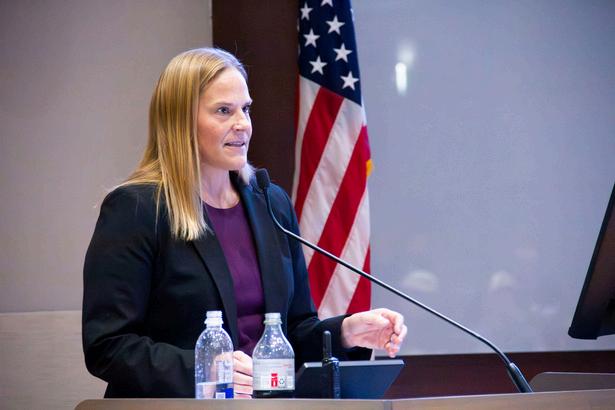
Patrick Rhode was sworn in on April 2, 2026, as a Commissioner of the PUCT. He was appointed by Governor Greg Abbott, with his term taking effect April 1, 2026. Rhode brings decades of experience from both the public and private sectors, with a career that ranges from the White House to leading global infrastructure companies
“I’m honored by Governor Abbott’s appointment and grateful for the opportunity to serve Texans in this important role,” Rhode said “The issues before the Commission are critical to households, businesses, and communities across Texas I look forward to working with my fellow commissioners and PUCT staff to ensure reliable, affordable utility services statewide and to keep our economy growing.”
Rhode’s background includes time as a Special Assistant to the President of the United States, a Senior Advisor at NASA, and senior leadership roles at the U.S. Department of Homeland Security in the years following 9/11. He also spent 16 years as a Vice President at an international infrastructure company and later founded and led a corporate affairs and development consultancy based in Austin
In addition to his professional career, Rhode has served on several national infrastructure boards and committees He previously served on the boards of both the Texas Association of Business and the Austin Chamber of Commerce. Originally from Hot Springs, Arkansas, Rhode holds bachelor’s degrees in Political Science from the University of Arkansas in Fayetteville and in Communications from the University of Arkansas at Little Rock. He lives in Dripping Springs, Texas, with his family.



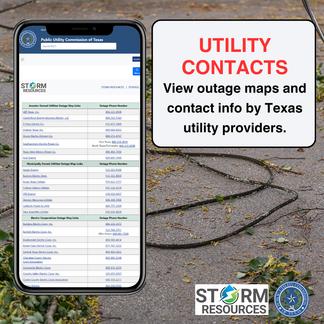
The PUCT reminds Texans to stay alert during the 2026 Atlantic Hurricane Season (June 1 –November 30). Texans can use the PUCT’s Storm Resources webpage to monitor power outages, report local outages, and find safety tips.

The Texas Division of Emergency Management (TDEM) recommends residents in hurricaneprone areas:
monitor weather forecasts, create an emergency plan, review evacuation routes, build an emergency kit, and check flood risk and insurance coverage.


The PUCT requires all electric utilities to host up to date outage maps on their websites, including contact information for reporting outages and getting updates on restoration efforts. During hurricane season, the PUCT works with electricity providers to ensure hurricane preparedness and quick response to outages. Providers also supply customers with preparedness information via billing statements.
As part of the Texas Emergency Management Council, the PUCT coordinates with the Governor’s Office, TDEM, and other state agencies during severe weather emergencies at the state’s central hub for public communications, the Texas State Operations Command Center, to prepare for, respond to, and recover from severe weather.
Visit gov.texas.gov/hurricane and ready.gov/hurricanes for more resources.
The PUCT has launched a new System Resiliency Plans webpage to help the public better understand how electric utilities across Texas are strengthening their systems to handle extreme weather events.
System Resiliency Plans (SRPs) are voluntary, long-term plans to strengthen an electric utility's equipment and facilities. The plans, which span multiple years, can include physical system grades, technical modernization, and operational improvements that will prevent and reduce tages for Texans, improve grid reliability, and protect against natural disasters and other threats
Texas experiences rapid economic and population growth and increasing demand on electric stems, extreme weather and other risks can increase the strain on local electric equipment. ecuting approved SRPs lets utilities make forward-looking reliability improvements that may not within traditional maintenance cycles to prevent or minimize system damage and protect stomers.
use Bill 2555 (88 Texas Legislature) and the resulting PUCT rulemaking allows electric utilities submit system resiliency plans to the PUCT for approval Plans must describe how the utility ns to:
Assess risks, Prioritize investments, and Coordinate emergency preparedness and restoration efforts.
The new webpage explains the general topics they must address such as risk identification, system hardening measures, and post event review processes It also provides links to Commission orders, rules, and filings, making it easier to track implementation and compliance over time
The page offers a clearer window into how utilities are planning for more reliable service in extreme heat, cold, storms, and other threats. And it serves as a centralized reference point for understanding expectations, timelines, and transparency around resiliency planning.
To learn more about how Texas is approaching electric system resilience, visit the new System Resiliency Plans page on the PUCT website
The PUCT and partner agencies have completed major updates to the Texas Electricity Supply Chain Map ahead of hurricane season—boosting readiness for extreme weather and emergencies.
The map shows how electricity and natural gas systems connect across Texas so state emergency management can act fast to protect Texans when disaster hits and the grid is under stress.
Statewide power assets updated. Generation plants, transmission lines, and substations are now current and published.
More gas infrastructure mapped. Critical natural gas facilities from the Railroad Commission of Texas were updated this spring, including a higher number of gas wells.
Emergency and community systems added. Updated emergency contacts for disaster districts, Texas Department of Transportation road data, and more water and wastewater treatment plants are now included.
Connections completed. The PUCT has linked critical natural gas facilities to the electric substations and feeders that serve them. Utilities have reviewed the data, completing this phase of the supply chain mapping effort.
Why it matters
This map helps state leaders see risks quickly and restore service faster during hurricanes, heat waves, and winter storms. Some sensitive security details remain protected by law, but public layers are available on the PUCT website.
The Electricity Supply Chain Security and Mapping Committee continues to meet quarterly, with one public meeting each year. Continued coordination—and new automation tools—are speeding updates and improving accuracy.
Texas is better coordinated and more prepared to keep the lights on when it matters most.
The PUCT has introduced a new standardized blueprint and set of guidelines to help electric utilities, municipally owned utilities, and electric cooperatives strengthen their wildfire mitigation plans (WMPs) and improve transparency for regulators and the public.
Under PUCT Rule §25.60, entities that own electric infrastructure in areas of elevated wildfire risk are required to prepare a WMP to reduce that risk, protect their infrastructure, and support reliable service to customers.
“An electric entity now has a clear, organized way to present its wildfire mitigation strategies,” said PUCT Executive Director Connie Corona. “These guidelines help ensure plans are thorough, easy to review, and focused on protecting Texans, their property, and reliable electric service.”
Each entity—electric utilities, municipally owned utilities, and electric cooperatives alike—must maintain an updated WMP tailored to its specific service territory, equipment, and level of wildfire risk. WMPs must address key topics such as identifying areas of elevated wildfire risk, inspecting electric infrastructure, managing vegetation, adjusting operations during high-risk weather conditions, and coordinating communications and emergency response during wildfire events. While the blueprint provides structure and best practices, entities are not required to use it, nor does it replace entity-specific planning.
Additional details on the WMP blueprint and guidelines are available in PUCT Project No. 59053 Through this effort, the Commission aims to promote consistent planning, clearer communication, and proactive measures to reduce wildfire threats across Texas.
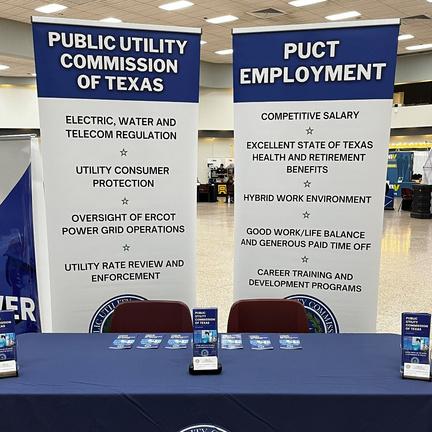
If you want to be part of a mission-driven organization filled with Texans working for Texans, we want to work with you! It’s our job to ensure reliable, affordable, and accountable electric, water and telecom utility service for Texans and our fast-growing state.
We have several openings in various programs across the agency. Please visit our website for our latest career opportunities.
The William B. Travis Building (WBT) Lobby officially reopened earlier this spring. It closed last summer as part of a partial remodel on several floors.
All employees and visitors to the WBT may now use the first-floor lobby entrance.
For assistance when visiting the building, please contact the PUCT Main Reception Line at 512-936-7001.

By Mike Hoke, Director, Office of Public Engagement
The PUCT wants the public involved early and often in its rulemaking. The process is open, transparent, and designed for Texans to participate.
When Texas law changes, or when the Commission identifies a need, a rulemaking project begins. Each project gets a number. All filings and updates are posted online on the agency’s Interchange, and anyone can sign up for alerts when new documents are added.
Before writing a final rule, the PUCT gathers information. Staff may ask questions of participants; release an early discussion draft of the rule on the Interchange to allow for public input, or host a workshop to learn more about the issue. These steps help ensure all voices are heard, including consumers, industries, and advocacy groups.
Next comes a proposal for publication. A draft version of the rule is posted publicly before a Commission open meeting. Commissioners discuss the draft in a meeting open to the public and broadcast online.
The public can submit written comments online about the proposal for publication. If 25 or more people request it, the Commission will hold a public hearing. Spoken comments carry the same weight as written ones.
After reviewing public comments, PUCT staff prepares a revised draft of the rule—this version is considered the final draft to present to the Commission. This draft is posted online at least one week before the Commission considers it.
At a final open meeting, the Commission may revise and vote on the rule.
Why it matters: PUCT rules affect all Texans. Your input matters. Participate, stay informed, and make your voice count.
Questions? Contact the Office of Public Engagement by email at public@puc.texas.gov