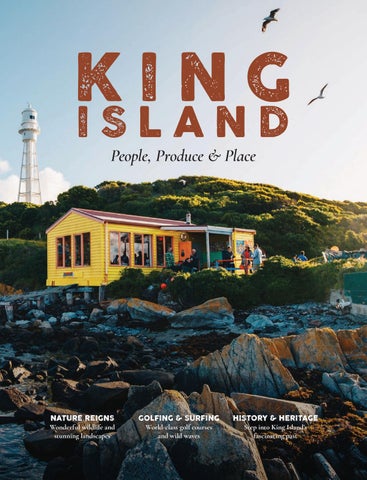
KING ISLAND People, Produce & Place
NATURE REIGNS Wonderful wildlife and stunning landscapes
GOLFING & SURFING World-class golf courses and wild waves
HISTORY & HERITAGE Step into King Island’s fascinating past
WELCOME
King Island welcomes you. Grab a glass of wine and some King Island cheese. Sit on a saltbush by the rocks or barbecue a steak on the beach. Feel the energy and the rhythm of the pounding seas on this Bass Strait Isle like no other place in Australia. Yes, it is a simple life. King Island is home to a small, hardworking population producing world-class beef, cheese, crayfish, abalone, king crab and kelp. Basically, we are a big farm in the middle of the ocean. Surprisingly fertile, very seasonal and with two stunning, worldclass golf courses sculpted into the West Coast, King Island has more reasons to visit than ever before. Enjoy a wild round of golf, go fishing, dine on delicacies, surf, walk, be inspired to create some art. There are so many things to do, including simply enjoying the incredibly fresh food and air. For me, King Island represents freedom. Here I can do unusual things, such as rescuing an old boathouse built in 1871 and turning it into a Restaurant with No Food. Bring your parka, swimming costume and a woolly hat – you might need them all in one day. Or perhaps you’ll just fling them aside and go for a swim on a remote beach. The climate is unpredictable and the produce is seasonal, but boy is it a fun place to be. Caroline Kininmonth LOCAL ARTIST
PUBLISHER Michelle Hespe DESIGNER Ryan Vizcarra DEPUTY EDITOR Matilda Meikle SUB-EDITOR Claire Hey CONTRIBUTORS Sarah Hinder, Craig Tansley, Matilda Meikle and Michelle Hespe King Island magazine is published by AusBiz Pty Ltd ABN: 78 621 375 853 ACN: 621 375 853
The reproduction of any content, in whole or part, without prior written permission by the publisher is strictly prohibited. All information in this magazine was believed to be correct at the time of publication, and all reasonable efforts have been made to contact copyright holders.
CONTENTS 2. THE NATURAL WONDERS OF KING ISLAND
Granite coastlines, sweeping paddocks, secluded beaches and thriving wetlands unite to create a wonderland of natural attractions.
6. KELPING IS BIG BUSINESS Life on King Island is often about living off the land and utilising natural resources. Kelping is one industry supporting generations of families.
8. BOUNTY OF THE SEA
King crabs, abalone and crayfish are just some of the delicious, sought-after produce from the sea surrounding King Island.
10. TEEING OFF ON KING ISLAND
King Island is home to two of the best golf courses in the world, both with stunning views and their fair share of challenging holes.
14. FOOD, GLORIOUS FOOD
King Island produce is some of the finest in Australia. From top-grade beef to award-winning cheese and delicious crayfish, it’s a foodie’s haven.
18. HISTORY & HERITAGE ON KING ISLAND
Shipwrecks, lighthouses and soldier settlements. Dive into some of the fascinating stories that make King Island what it is today.
22. SURF’S UP. IT’S WILD OUT THERE
King Island is a surfer’s idea of paradise. It’s wild out there, with big waves and often there's only Mother Nature for company.
24. THE ARTFUL ISLE
King Island has a thriving arts community. Visitors can meet local artists, or join in and create something special to take home.
LEFT TO RIGHT: Caroline Kininmonth at the Restaurant with No Food; Fresh abalone straight from the sea. (© Kramer Photography)
KING ISLAND 1
THE NATURAL WONDERS OF
KING ISLAND King Island is an oasis of granite coastlines, sprawling paddocks, secluded beaches and thriving wetlands. Here, on this remote island in the middle of the Bass Strait, nature reigns. WORDS: MATILDA MEIKLE
: Disappointment Bay (© Kramer Photography). 2 KING ISLAND
Nature
From little penguins waddling along the sand at dusk and regal cormorants gathering on rocky precipices, nature on King Island is as much a part of the community as its people. King Island practices a slow, meaningful way of life. When you’re out in nature, make sure to look a little longer, wander a little further, and leave nothing behind.
WONDERFUL WILDLIFE REIGNS
King Island is home to 10 of Tasmania’s 12 endemic bird species, along with nine subspecies unique to the island. Many birds will land on its shores to rest during their migration journeys, making for an unforgettable birdwatching experience. Keep an eye out for brown thornbills, fairy terns, flame robins and red-necked stints. Passionate birdwatchers should also head to Lavinia Nature Reserve, which contains major wetlands including the Sea Elephant River estuary and Nook Swamps. The reserve is one of a few largely unaltered areas on the island, containing much of the remaining native vegetation. It is also an important refuge for threatened species, including the endangered orange-bellied parrot. The parrot feeds on the samphire plant, which is in the saltmarsh, and at night roosts in the trees and scrub surrounding the Sea Elephant River estuary. Birds of King Island (BOKI) hosts surveys where locals and visitors are encouraged to collect data about the island’s bird species to monitor changes in populations and the natural environment.
KING ISLAND 3
THIS PAGE, CLOCKWISE FROM ABOVE LEFT: Boulder Point (© Kramer Photography); Cormorants at Porky Beach Conservation Area; A platypus in the wild on King Island; An echidna ambles along.
In the paddocks and countryside, wallabies and pademelons roam, while the beaches belong to the little penguins, the smallest species of penguin in the world. At dusk, these adorable animals return from a day in the ocean to their beachside burrows. Those visiting Grassy Harbour and other sheltered beaches around the island are likely to spot them racing for home. One of the most delightful wildlife experiences on King Island is the chance to spot a platypus in its natural habitat. These elusive creatures are most active at dawn and dusk, gliding through the island’s creeks and freshwater waterways in search of insects, larvae and small crustaceans. Guided wildlife and nature tours offer visitors the best opportunity to see platypuses while learning about the island’s unique ecosystems and conservation efforts. Local guides know the quiet stretches of water where sightings are most likely, and 4 KING ISLAND
they can also point out native birds, wallabies and other wildlife along the way. A platypus tour provides a memorable glimpse into one of Australia’s most fascinating and extremely elusive animals.
WALK THE COAST
The best way to see King Island in all its beauty is on one of its many walks and hikes. The Kelp Track is a gentle threekilometre one-way walk along the west coast. Along the way, visitors will catch a glimpse of the island’s kelpharvesting industry, as bull kelp is still collected, dried and exported all year round. Make sure to take in the beaches and birdlife and snap a photo of the Netherby shipwreck site at the end of your trek. Adventurous spirits can also walk to the northern tip of the island and stand beneath Cape Wickham Lighthouse, the tallest lighthouse in Australia. It was built in 1861 in response to the
wreck of Cataraqui and continues to guide ships through the Bass Strait. A nearby picnic shelter makes the perfect spot for a light lunch, while you soak in views of Victoria Cove and the Great Southern Ocean. On the west coast, Currie Lighthouse is located beside the King Island Museum. This important landmark was built in 1880 and overlooks the coastline at Currie Harbour. It is a must-visit for history and nature lovers alike, who want to combine magnificent views with the island’s fascinating past. The Copperhead Walk starts at Seal Rocks, the island’s highest cliffs which rise 60 metres from the sea. Set out along the clifftops for a four-kilometre return trip that passes powerful rock formations and cliffs, and boasts views across the Southern Ocean. This trail celebrates King Island at its most rugged, with birds and other native wildlife, incredible nature, and complete isolation.
Nature a lake sits above the surrounding water table, due to sand mixing with decomposed organic matter to create an impenetrable layer above sea level for the water to sit on. Located near Martha Lavinia Beach, this lagoon is a top spot for swimming, kayaking, picnicking and enjoying a relaxed day surrounded by wildlife. There are also picnic facilities, barbecues and public toilets, making it a perfect spot for families and friends. King Island has some of the best land-based fishing in Tasmania, with the chance to reel in sweep, snapper, salmon and gummy shark. Cast a line from the jetties at Naracoopa and Currie Harbour or pick a spot along the shores of Disappointment Bay and Sea Elephant Bay. For those who set out on a boat, you can also expect to find bluespotted flathead, barracouta, garfish and King George whiting. Known for their strength, speed and fighting spirit, kingfish attract anglers from across Australia seeking an unforgettable fishing experience on King Island. These powerful fish thrive in the nutrient-rich waters around reefs, rocky headlands and offshore structures, where they feed on baitfish and squid.
BEACHES AND WATERWAYS
Disappointment Bay is a remote beach known for its dramatic coastal scenery, top ocean swell and maritime history. Surfers, fishers and photographers frequent the area, making use of the picnic facilities after hours of exploring the sea and shore. The bay gets its name from the Neva, a ship carrying Irish convict women that struck the island reef and sank. However, the area is anything but disappointing with its wildlife and peaceful location, which gives the impression that you’re thousands of kilometres from civilisation. Penny’s Lagoon is one of three perched freshwater lakes in the world. This rare phenomenon occurs when
If you’re planning to fish for the famous King Island rock lobster or abalone, you will need a licence before you head out.
THE HISTORY THAT NATURE KEEPS
King Island’s Calcified Forest is a prehistoric marvel. It was formed when calcium carbonate attached itself to the roots of coastal vegetation. The sand surrounding these structures was eroded by wind around 7000 years ago, revealing the root casts in a sprawling forest of hundreds of strange limestone shapes. Visitors can take a short 1.3 kilometre walk around the forest with a viewing platform at the halfway point. It’s one of Tasmania’s 60 Great Short Walks. To immerse yourself further in history, take the self-driving King Island Maritime Trail. The dangerous seas around the island have resulted in around 140 shipwrecks, each with their own unique stories. Pick up a brochure from the Visitor’s Centre in Currie and then set out to discover the locations of eight of the most famous shipwrecks. You will also stop at the island’s lighthouses and lookouts, revealing the island in all its beauty.
TOP TO BOTTOM: Little penguins; The Calcified Forest.
KING ISLAND 5
KELPING IS BIG BUSINESS
Hauling bull kelp from the shores is not easy, but King Islanders embrace the hard work needed to secure this precious bounty from the sea. WORDS: SARAH HINDER
THIS IMAGE, THEN BOTTOM, LEFT TO RIGHT: Local kelper David Bowling; Bull kelp in the sea; Hauling kelp is tough work (© Kramer Photography).
King Island is one of the few places in the world where giant storm-cast bull kelp washes ashore by the truckload. This kelp only grows in extremely cold waters around places such as Tasmania, Chile, Norway and Iceland, and while it lacks roots, it clings tightly to reefs, requiring strength and robust winching systems to harvest. For those undeterred by hard labour, kelp carting can be highly rewarding. Often a father-and-son venture, it offers families a solid income, with good money being paid for large truckloads of kelp. King Island’s cattle also enjoy eating kelp, which boosts their health by providing them with vital vitamins and minerals. In fact, it’s one reason the island’s beef is so exceptional.
6 KING ISLAND
Quite a few locals hold kelp harvesting licences on King Island, mostly working part time. Competition is healthy, and kelp carting is a flexible second job where you can work as hard as you please. The industry peaks in winter, which is the most challenging season due to gale-force winds. For local kelper David Bowling, the day often begins before dawn. “The early bird gets the worm – he who gets there early gets rewarded,” he says. Like many islanders, David has worn many hats throughout his life, working across industries both on and off the island. Yet kelping is something he always returns to. “It’s always been one of those things I can fall back on,” he says. “I’ve come and gone, but it’s always been there for me to take up.
“The thing I like about kelping is the total freedom,” he adds. “With kelping, simplicity and freedom are luxuries in life.” Locals fiercely protect King Island’s environment and only gather kelp washed ashore. It’s actually illegal to harvest it directly from the ocean, and this form of management preserves the fragile ecosystem. Some days yield truckloads, others less, but those who do it appreciate the physical exercise and outdoor work that come with the demanding game. Visitors to King Island can learn about kelp harvesting and the drying process at Kelp Industries’ Visitor Centre on Netherby Road, or simply have a chat to friendly locals, who are always happy to share.
Industry “The thing I like about kelping is the total freedom. With kelping, simplicity and freedom are luxuries in life,” says David Bowling.
DID YOU KNOW?
Bull kelp is used in a surprising range of everyday products, including toothpaste, shampoo, ice cream, salad dressings, pharmaceuticals, pet food, frozen foods, beverages and so much more.
KING ISLAND 7
BOUNTY OF THE SEA Crayfishing, king crabbing and abalone diving are synonymous with King Island, with all three bringing in delicious produce. WORDS: MICHELLE HESPE
8 KING ISLAND
Max Summers from King Island Seafoods showing his granddaughter a crayfish.
Industry
Ask anyone what King Island is famous for, and they’ll likely mention cheese or beef. However locals will tell you the island is renowned worldwide for its king crab, abalone, and crayfish. “Crayfish and king crab fisheries are among Tasmania’s highest value wild fisheries, generating significant economic activity through commercial fishing, processing, transport, export, and associated support industries,” says local Millie Whitehouse Summers, whose parents own and run King Island Seafoods. “The economic benefits extend well beyond King Island, supporting employment and business activity throughout Tasmania and contributing substantially to the state’s export earnings and international reputation for premium seafood products.”
GENERATIONS OF CRAYFISHING
There’s no doubt about it: King Island produces some of Australia’s finest southern rock lobster, which is known locally as crayfish. For generations, crayfishing has been central to the island’s economy, culture and way of life. Many fishing operations are family-owned, with vessels, knowledge and traditions passed through the generations, as
well as sustainable fishing practices that protect resources for the future. Each season, fishers brave the often-rough waters to deliver premium crayfish prized by restaurants and seafood lovers across Australia and far beyond.
ONE ISLAND, AND TWO KINGS
The giant Tasmanian king crab is an impressive crustacean prized for its succulent, firm and sweet meat. This highly sought-after gourmet delicacy thrives in the cold, nutrientrich waters around King Island, and the industry supports the economy and preserves traditional fishing ways. Local fishermen use specialised traps to catch king crabs sustainably, adhering to the strict regulations that protect both the crab population and the environment.
DIVING DEEP FOR DELICIOUS ABALONE
Blacklip has a dark frill (known as a lip) around its foot, and a reddishbrown to greenish shell. It is the most common and widely caught species, known for its sweet, briny flavour. The greenlip has a bright emeraldgreen lip and dense white flesh. It is highly prized for its slightly stronger flavour, compared to blacklip. Harvesting abalone is a traditional, skilled activity performed by free diving or using surface-supplied air gear. The island’s clear waters and strong tides offer ideal yet challenging conditions, demanding experience and extreme caution. Divers carefully select mature specimens to maintain sustainable populations and to ensure the industry’s long-term viability.
TOP TO BOTTOM: A fleet of fishing boats (© Kramer Photography); Fresh crayfish; Abalone.
In King Island’s pristine waters and rocky coastline, abalone flourishes. This gastropod mollusc (also known as a single-shelled sea snail) is prized locally and internationally for its firm texture and delicate taste. There are two species found around King Island – greenlip and blacklip. KING ISLAND 9
TEEING OFF ON 10 KING ISLAND
Golf
KING ISLAND King Island is home to some of the best golf courses in the world. The golfing is challenging and the scenery is breathtaking. WORDS: CRAIG TANSLEY
Cape Wickham Golf Links (@ Kramer Photography).
KING ISLAND 11
“On some holes I travel across wooden bridges built right over the coastline, on others tee-shots must be struck across deep chasms and sandy beaches.”
That King Island could be home to two of the world’s best golf courses comes as quite a shock to the first-time visitor. There’s little fanfare on arrival, and not much to suggest that this is one of Australia’s best golf destinations. I arrive at a tiny airport and am taken along a bumpy road to the island’s far northern tip with only a farmer on a tractor for company. The course is simply signposted, but as we turn a blind corner I see it: Cape Wickham Golf Course (capewickham.com.au) – Australia’s best public course. The course debuted at 24 on US golf bible’s Golf Digest Top 100 Courses list when it opened in 2015, which is one of the highest rankings by any new course in the history of the sport, in the world. 12 KING ISLAND
It’s not hard to see why. All of the 18 fairways roll straight down to sprawling sand dunes and ridges above a wild ocean, and every hole has a view of the sea. Five-metre-high Southern Ocean swells crash onto the rocky reef beside the greens. On the 18th hole (which bends around a cove where two surfers bob in the sea) the beach – and the surfers – actually come into play. And on the 11th hole, the green is often completely swamped by the sea. All this and yet there’s hardly anyone here playing – on the back nine holes, I have the course entirely to myself. On some holes I travel across wooden bridges built right over the coastline, on others tee-shots must be struck across deep chasms and sandy beaches.
Golf FROM LEFT TO RIGHT: 18th fairway at Cape Wickham Golf Links; Ocean Dunes golf course (©Kramer Photography); Teeing off at Ocean Dunes (© Jacob Sjoman).
Course designer Darius Oliver says that Cape Wickham is one of the world’s great seaside courses. “I’ve seen close to 2000 courses worldwide,” he says. “There isn’t a golf course here in Australia or anywhere overseas that I’d prefer to play.” A little further south, on King Island’s west coast, Ocean Dunes Golf Course (oceandunes.com.au) is Australia’s fourth best public course. It opened in 2016, and Golf Australia magazine calls it: “one of the most impressive seaside locations for golf on the planet”.
I think it’s even more challenging than Cape Wickham’s tricky layout; on some par threes I’m forced to hit across the sea to greens surrounded by sharp ridges of rock. When the wind blows hard – which it does from mid-morning today – playing Ocean Dunes is about as tough as it gets in golf. But even if you’re sinking your entire collection of golf balls in the sea, you can’t help but be impressed by the wild beauty of a course built along two kilometres of empty coastline, shaped across gigantic sand dunes with panoramic views from every hole. Other courses
that rank so high in world golf circles often require booking months ahead to play (many courses in Scotland require a ballot system to play); but you’ll always be able to play a round on King Island. There’s also a nine-hole course near the island’s main township of Currie. It’s a local’s favourite, and a course most travellers won’t have heard of. And yet it resembles the layout of golf’s most famous course, St Andrews. The golf offerings on King Island are like this: understated and never, ever crowded.
KING ISLAND’S LONG AND PROUD HISTORY OF GOLFING
King Island Golf & Bowling Club (© Kramer Photography).
Long before Cape Wickham and Ocean Dunes placed King Island on the global golfing map, there was the King Island Golf & Bowling Club. Established in 1931, this much-loved community course laid the foundations for King Island’s reputation as Australia’s home of links golf. Today, its spectacular ocean views, challenging coastal conditions and welcoming club atmosphere continue to attract locals and visitors alike. The club hosts the annual King Island Open Golf Championship, first played in 1971. It’s a proud island tradition that brings golfers together from across Australia to experience the original King Island links course. The island’s global reputation as a golf destination truly took off in the mid-2010s, when Cape Wickham and Ocean Dunes were developed. The vision behind the world-class courses was to create a golfing experience that rivalled Scotland and Ireland’s famous coastal links. With the natural beauty and rugged coastline of King Island providing the perfect canvas, the developers saw an opportunity to create something special. The gamble paid off, as these courses now attract golfers from around the world, eager to experience the raw beauty and challenge of golfing on King Island.
KING ISLAND 13
FOOD GLORIOUS FOOD WORDS: MATILDA MEIKLE
King Island Bakehouse (© Kramer Photography).
14 KING ISLAND
Food
CLOCKWISE FROM TOP LEFT: Delectable lamb cutlets; Cooked crayfish; Cheese from King Island Dairy (© Kramer Photography); King Island Brewhouse (© Adam Gibson).
On King Island, award-winning cheese, grass-fed beef and freshly caught crayfish abound. The produce that makes this island famous lives up to its reputation, and visitors don’t have to wander far to stock up from the source.
SIMPLY THE BEST
Lauded as one of the best spots on the island for a long lunch or romantic dinner, the Restaurant with No Food is an offbeat community project conceived by local artist Caroline Kininmonth. When an old boatshed near Currie Harbour burnt down, Caroline resurrected the place, turning it into a café-cum-restaurant that she painted canary yellow and decorated with her colourful, eye-catching art. Without food or waiters, the quirky spot is a favourite among locals and visitors alike, who are more than happy to arrive with their own food and drinks. Everything else - from tables and plates to cutlery and glasses - is provided.
A legend of the island for more than 100 years, King Island Dairy is on the must-do list. Sample a huge variety of cheeses accompanied by a glass of wine or a craft beer while sitting on the deck and watching the world go by. Made from milk collected daily from a handful of nearby farms, cheese doesn’t get any fresher than this. Enjoy a talk about the different varieties of cheese, and pack a cooler bag so you can take your favourites with you. Or you can buy a King Island cooler bag as a souvenir from the store. King Island Bakehouse is a popular stop for an early morning start or a bite to eat throughout the day. While best known for its world-famous crayfish pie, the bakehouse also has a tempting range of freshly baked delights made from quality local produce. From traditional sourdough loaves and savoury pies to golden sausage rolls, delicious cakes, slices and sweet treats, there’s something to satisfy every appetite. Pair it all with a freshly brewed coffee and you’re all set. KING ISLAND 15
Food
CLOCKWISE FROM THIS IMAGE: King Island produce; King Island cattle makes great steak; A healthy pour at King Island Distillery Bass Strait.
There’s a smattering of paddock-to-plate eateries on King Island, from pubs and cafés to some fine dining overlooking Bass Strait. The local approach is to serve dishes inspired by the island’s best produce: fish, crayfish, abalone, king crab, beef, lamb, dairy and vegetables. Scan the QR code for food & drink offerings
FROM GRAIN & HOPS, TO THE GLASS
King Island Distillery Bass Strait is run by local distiller Vaughan O’Connor. An award-winning producer of premium spirits that are inspired by courage, endurance and endeavour, every batch is hands-on, small-scale and made while showing the utmost respect to the environment. In fact, sustainability is at the core of the business. Grain is milled onsite, and the entire process from fermentation to bottling relies exclusively on filtered King Island rainwater. All spent grain is given back to the local community as feed for pigs and sheep, treated rainwater is used to irrigate the surrounding paddocks for cattle grazing, and hot water from the still comes in handy for brewing. The result is a collection of spirits completely unique and proudly local. 16 KING ISLAND
The Gidley Pinot Noir Gin, named after former governor of New South Wales Philip Gidley King, was recently awarded best gin in Australia at the 2026 Gin Guide Awards in London, scoring 97 at the Halliday Spirit Awards. Its King Island Coastal Gin and King Island Gidley Dry Gin were both awarded gold medals at the San Francisco World Spirits Competition, and its King Island Waterwitch Vodka scored a bronze medal. Heidi Weitjens (known as Happy Heidi) owns and runs King Island Distillery. She lovingly creates a range of spirits, liqueurs and cocktails, bottling and labelling each one by hand. Heidi was mentored by whisky legend Bill Lark, and in this charming, bespoke distillery, it’s all about the intimate experience. During tastings, Heidi talks guests through each product, sharing stories of her upbringing on the island. King Island Brewhouse is a small, family-owned craft brewery surrounded by sprawling green fields. Opened in 2021, it offers a core range of traditional beers, a crisp ginger ale, and seasonal surprises made from locally grown hops. Locals and visitors swing by the brewhouse for awesome pizza and live music, and there are regular tastings and 15-minute guided tours to learn about the brewing process. Check out the QR code on this page for up-todate information on offerings and opening hours.
Food
international export markets, with produce from King Island Seafoods sold worldwide. King Island Beef is focused on maintaining the unique characteristics of the island’s produce, sourcing only from free-range cattle living on King Island. Due to the lush pastures and clean ocean air, the beef is naturally lower in cholesterol and high in protein and vitamin B12. The company sources from local farmers who are connected to their home and passionate about producing the highest quality beef possible.
A LOCAL LOVE AFFAIR
Everyone on King Island takes so much pride in producing and serving up local delicacies such as crayfish, beef and abalone, and locally caught fish such as salmon and snapper. According to Millie Whitehouse Summers, whose parents own and run King Island Seafoods, living on this special island has always been about a sense of connection. “Everyone is so proud of our products and the stories behind them,” she says. “You know where everything is produced, and every product has a story. From the farmer down the road growing vegetables, to the milk sourced for the famous cheese factory, we work together to create a legacy for the island. We’re creating more than just products – we’re creating stories as well.” Millie is proud of how everything is intertwined. “While each business is unique, we’re all connected and we all help each other out,” she says. “We all share a passion for hard work and creating a great life for ourselves.”
SELF-CATERING SEAFOOD AND BEEF
King Island Seafoods was established around three decades ago when a food processor in Melbourne was looking for a local contact to supply high-quality produce. It didn’t take long for the business to gain traction, and it soon expanded into a massive operation dealing with around 225 tonnes of produce a year. Now the seafood is shipped to both the domestic and
For those after a quieter evening, selfcatering is a popular option on the island. On the main street of Currie, King Island Meat Providore is always stocked with homemade condiments and spreads, while the fridge is full of local beef and lamb products that can be cooked on free barbecues across the island, or taken back to your accommodation. Supermarkets provide fresh produce and imported goods for a quick and efficient shop, while King Island Larder is ideal for coffee, sandwiches, cakes and other treats. KING ISLAND 17
HISTORY History
AND HERITAGE ON KING ISLAND From shipwrecks to soldiers, King Island is rich with history. WORDS: SARAH HINDER
It’s easy to assume that King Island has always been as it is today: bustling with industry and home to a thriving and welcoming close-knit community. But from its tragic shipwreck history to its significant involvement in World War I – not to mention its more ancient history as the former home to Australia’s only pygmy emu – this rugged, windswept island’s past is complex and unique.
SHIPWRECK TRAGEDIES
There’s a dark and gripping history of wrecks off King Island’s shores. Close to 100 ships have foundered here, claiming a total of more than 1000 lives. The most significant of these was the 1845 wreck of the Cataraqui, which was
sailing from England to Melbourne as part of the “bounty scheme”, where passengers were given free passage to Australia. It was supposed to be the last vessel to accept the bounty scheme, but sadly gales and incessant rain in the Southern Ocean meant navigation was almost impossible for the captain. The vessel slammed straight into the middle of King Island, just south of Currie, and almost 400 people lost their lives on the rocks. An underwater dance and soundscape called Fathom honoured the story of those lost at sea in the search for a new home. It was first shown on King Island with an exhibition
History FAR LEFT THEN TOP TO BOTTOM: An old photo of Cape Wickham Lighthouse; A rendition of the Cataraqui wreck of 1845; Shannon shipwreck.
of artworks titled Poor Souls as part of 10 Days On The Island in 2021, in commemoration of the Cataraqui. Following the Cataraqui disaster, talks began to erect a lighthouse in the island’s north. Thanks to the poor communications and out-of-date maps of the day, however, once it was installed in 1861, Cape Wickham Lighthouse initially made things worse. Many seafarers coming into Bass Strait from Europe mistook Cape Wickham for Victoria’s Cape Otway, so they sailed further south and ran straight into King Island. This led to an extra 13 shipwrecks over 18 years. Not every ship was doomed, however. An astounding survival story is the Netherby wreck of 1866. The vessel – carrying immigrants headed for Queensland – hit the coast two kilometres south of Currie. The ship was carrying approximately 500 people and, remarkably, everyone aboard made it safely to shore. There was also a birth among the passengers, the day after everyone managed to make it to land.
ARTEFACTS AND EXHIBITIONS
A second lighthouse was built in Currie in 1879 after another major wreck – the British Admiral – occurred near the
township. The second lighthouse put a significant stop to maritime disasters. Today, the former lighthouse keeper’s residence is home to the King Island Museum, and setting aside an afternoon to peruse its collection is a must for any history enthusiast. The museum houses three shipwreck rooms, as well as enthralling exhibitions about the first settlements and life on the island from the early 1880s and the island’s lighthouses. There’s also an agricultural room filled with artefacts from the early days, an impressive collection of minerals from around the island, a natural history exhibit starring the King Island pygmy emu, and exhibits honouring the King Island ANZACs. The greatest support for the
museum comes from the locals, as for many, its records detail the lives of their ancestors.
HONOURING THE ANZACS
King Island sent the most men per capita to fight in World War I compared to anywhere else in the British Empire. Decades later, the museum staff located a box of undeveloped glassplate negatives portraying World War I diggers, which made an appearance in an exhibition to mark the centenary of the ANZACs in 2015. Most significant was the discovery of an extra 36 names that had never been added to the honour roll and King Island’s history. Following four years of research, and with thanks KING ISLAND 19
History
“The museum really is one of the most precious things on the island. It belongs to the people, and it is a part of their lives.”
to the memories of the King Island community (many of whom remember stories of their grandparents and great-grandparents who fought), the Historical Society have pieced together a three-part book series on the history of King Island during World War I. Part three, The War Diaries And Other Wartime Literature, includes two war diaries, letters home from the men fighting in Gallipoli and on the Western Front, and local war-time literature. It was published in July 2019 to coincide 20 KING ISLAND
with the 100th anniversary of the signing of the Treaty of Versailles.
MINING AND EARLY EXPEDITIONS
On the south end of King Island is the mining town of Grassy. The open cut mine is clearly visible when driving through the township, and it is a producer of tungsten. Known to toughen steel, tungsten was particularly sought after in times of war, where it was used in heavy
weaponry including shells, tanks and aircraft. While the mine boomed during the wars, it had to close down between conflicts due to Grassy’s small population, and it shut down again in 1990 before reopening in 2023. Nearby, Grassy Harbour also boasts a mining-era legacy. Before its construction in the 1970s, ore from the mine was transported across the island by truck to be shipped off from Currie. Realising the opportunity for development, the purpose-built modern shipping harbour was built with a roll-on-roll-off port, cranes, and a stern-loading ship ramp. Drive north from Grassy to discover Sea Elephant Bay – a peaceful stretch of coastline with a charming esplanade and a calm, sheltered beach. This is where French and English explorers arrived at the same time to survey the coast, creating a remarkable moment in the island’s history. In 1802, Nicolas Baudin’s scientific expedition anchored here. Having completed his coastal survey ahead of the botanists and zoologists accompanying the voyage, Baudin and his team spent two weeks at Sea Elephant Bay, where tensions within the expedition began to rise. Zoologist François Péron recorded that the beach was blanketed with sleeping southern elephant seals. At the time, English sealers were hunting these remarkable animals, a practice Péron viewed with deep concern. “This great species of seals is going to find itself attacked on all sides at once,” he wrote. Sadly, Péron’s warning proved prophetic. Today, King Island is no longer home to elephant seals. For more information on the history and heritage of King Island, visit kingisland.tas.gov.au/live/rich-inhistory, or call King Island Tourism on: (03) 6462 1778 or 0487 735 703.
CLOCKWISE FROM OPPOSITE PAGE : Currie Lighthouse and cottages; Inside King Island Museum; The modern day lighthouse and museum (© Kramer Photography).
KING ISLAND 21
SURF’S UP. IT’S WILD OUT THERE
If you love having the waves to yourself, King Island will no doubt become one of your favourite surf spots in Australia. In fact, locals ask that, if you see another surfer out, you move on to the next spot, or at least paddle up the beach. WORDS: CRAIG TANSLEY
22 KING ISLAND
Surf
Surfing on King Island is not for the fainthearted. In winter, water temperatures drop to 12 degrees, and you’ll freeze without booties and a thick wetsuit. However the quality of the surf off these shores is legendary. It’s worth spending time at Currie’s bars and cafés and introducing yourself – you never know which local might give up their secret spots. There’s also a surf safari company with extensive local knowledge (kingislandsurfsafaris.com.au). King Island’s best wave isn’t a secret, as Martha Lavinia’s famous barrels break barely 30 metres off the beach on the island’s northeast coast. This is a wave Australia’s surf bible Surfing Life calls one of the 10 best waves on Earth. Regardless, if you don’t mind lonely big wave surfing in cold water (though temperatures in summer can reach 20 degrees), King Island is your dream location.
Travelling professionals (like two-time world champ John John Florence) often come to escape the crowds, and the limelight. There are always waves – you’ll never be short of swell in Bass Strait. And the best thing about surfing on a small island is that, no matter which way the wind’s blowing, somewhere on the island will always be offshore. While experts can get their fill at breaks such as British Admiral Beach and Phoques Bay on King Island’s north-west coast, Porkies is great for beginners. With the huge crowds at surf breaks on Australia’s eastern seaboard these days, it’s hard to believe that so much deserted coastline still exists this close to Melbourne. With some of the world’s best waves breaking on it, King Island offers travelling surfers a chance to find their own private piece of sporting glory.
© Kramer Photography KING ISLAND 23
A R T F U L ISLE THE
With its warm and welcoming community embracing the arts, nature and the environment, King Island is an ideal haven for creative souls. WORDS: MICHELLE HESPE
Arts & Culture
Melaleuca by local artist Dianne Blake KING ISLAND 25
CLOCKWISE FROM TOP LEFT: Local artist Pam McKay; Local artwork at The Top Shop; Caroline Kininmonth; King Island Gallery; The interior at Reekara.
There are four major creative hubs on King Island: King Island Gallery, The Boathouse, The Top Shop at Reekara and King Island Museum. Each has its own special significance to the islanders, and they are also inspirational venues for events, festivals, film and photography. King Island Gallery is a collaboration between King Island Council, artists, art enthusiasts, professionals and volunteer guides working together to present contemporary work that reflects the unique environment, history and lifestyle of King Island. It provides a focus for the creative growth and enjoyment of the King Island community. King Island Council sponsors an Artist Residency program, where select Australian artists working in a range of mediums are invited to stay on the island and draw on the dramatic landscape for inspiration. The residency includes a vehicle, accommodation, and a studio space 26 KING ISLAND
Artists and creatives are typically drawn to inspiring places where the mind is free to wander and where there is a true sense of history. A touch of magic doesn’t go astray either, and King Island offers all these elements in spades. next to Currie Harbour. Across the twoto-four-week program, visiting artists are encouraged to connect with local creatives while honing their practice in a distinctively regional environment. The Boathouse is otherwise known as the Restaurant with No Food. Local artist and legendary advocate for King Island arts Caroline Kininmonth renovated it and filled the space with
art and everything you need to enjoy brunch, lunch or dinner. You simply bring your own food and beverages and meet up there with friends. It’s so inspiring that world-renowned chef Tetsuya Wakuda once cooked up a storm there for some special guests, using local produce such as beef, crayfish, cheese, wallaby and farmgrown vegetables and herbs. The Top Shop at Reekara is another example of local artists and makers collaborating to showcase the creative side of the island community. Located in the old Reekara School towards the north of the Island, the Top Shop features paintings, prints, and crafts for sale. There’s often someone working on pottery, or you might meet kelp crafter Sandy Robinson, shaping her kelp characters. Sandy collects bull kelp from the shores of the island and then cuts, scores, stitches and manipulates the tough material into quirky creations. The museum is a treasure trove of
CLOCKWISE FROM THIS IMAGE: Journaling workshop; The Top Shop in Reekara; An artist workshop; Bird sculptures in the town of Currie.
Arts & Culture
Music is yet another major part of life on King Island, and a huge drawcard for visitors. The Festival of King Island (aka FOKI) has been attracting superb artists from all over the country for over 10 years. The two-day event, which is all about “music, surf, food and fun”, also includes yoga and local operators offering all sorts of activities. Taking place on the edge of Currie Harbour, the festival is a great way to soak up the incredible natural attractions of the island while also enjoying live performances and food stalls.
HISTORICAL ART
an estimated 2000 objects and 1500 photographs that shine light upon stories from across the island. There’s also an impressive collection of art here; from earrings made out of ceramics left behind from shipwrecks, to prints of local produce and paintings of King Island’s storms, the work generated is truly wonderful. Bird tourism is also incredibly strong on King Island, and it ties in with the arts in many ways. Wings on King is a project centred upon finding and telling the story of King Island’s birds. Since 2017, bird enthusiasts have been encouraged to visit the island and help gather data from survey sites to identify conservation areas and ensure that endangered species are protected.
A poignant example of nature meeting history and art is the work of Tasmanian artist Catherine Stringer, who visited King Island for the Artist Residency program. She is best known for her dreamy underwater images. King Island has been the location of almost 100 shipwrecks, and Catherine researched the famous shipwreck of the Neva, which sank off Cape Wickham in 1835, claiming 224 lives. She learned that there were 28 Catherines onboard, and this inspired her 2016 Neva Reliquary exhibition, which showcased a collection of 42 framed garments crafted from delicate paper that she handmade from seaweed. In January 2019 Catherine returned to King Island with a body of work called Sea Stories, which is a collection of artworks created from seaweed.
Two of Catherine Stringer’s artworks (top to bottom): Ocean Tears; Gown for Mary Delaney.
KING ISLAND 27
GETTING HERE
There are many easy ways to get to King Island and start your holiday, but do note that there are no passenger ferries to the island, so you have to fly. Chartered aircraft fly to King Island from as far away as Brisbane in Queensland, Scone in NSW, and Wilpena Pound in South Australia. If travelling in a group it may be surprisingly cost-effective to charter a plane from a convenient location. Scan the QR code for exciting local events
FACEBOOK.COM/ VISITKINGISLAND 28 KING ISLAND
There are three airlines providing services to King Island, seven days a week from mainland Australia and from Tasmania. Rex departs from Melbourne’s Tullamarine, (with additional flights sometimes operating in the summer) while Sharp Airlines operates out of Essendon Airport. If you’re closer to the eastern side of Melbourne you might prefer to fly with King Island
Scan the QR code for top accommodation options
INSTAGRAM.COM/ DISCOVERKINGISLAND
Airlines – which departs from Moorabbin Airport. Moorabbin is easily accessible by car from Melbourne’s CBD, or if you’re using public transport you can catch the train to Cheltenham Railway Station and take a short taxi ride to Moorabbin Airport. Visitors from Tasmania can fly from both Launceston and Burnie (Wynyard) with Sharp Airlines, or from Melbourne with Rex airlines. Scan the QR code for Getting Around
KINGISLAND.ORG.AU
STAYING IN TOUCH
Telstra is the only mobile service provider on King Island. Visitors who are unsure which network they are on are advised to check with their service provider before arriving.
Ready to see it for yourself? King Island awaits. See you on the Rock! If you have any questions, please call us on (03) 6462 1778 or 0487 735 703, or visit our website by scanning the QR code below. Scan for more details
FACEBOOK.COM/ VISITKINGISLAND
INSTAGRAM.COM/ DISCOVERKINGISLAND
KINGISLAND.ORG.AU KING ISLAND 29
People, Produce & Place KINGISLAND.ORG.AU