THE SKAGWAY NEWS.
August 25, 2023

August 25, 2023
A memo from the Department of Education and Early Development (DEED) dated July 27, sent to all superintendents and municipal managers across the state, could cause consternation for districts that receive funding outside the cap, or maximum amount of local funding. Skagway School received $500,000 in special revenue funding for Fiscal Year 2024.
The memo reads: “This letter is to remind districts that local appropriations and inkind funding being applied to special revenue fund(s) are considered towards the maximum local contribution or ‘local cap’ set out in AS 14.17.410.”
The Skagway Borough Assembly funded the school to the cap at $2.3 million. The school asked for an additional $1.1 million to cover current programs such as vocational technology and music. The assembly declined that request but provided $500,000. The district had approximately $1.1 million in reserves at the time of budget discussions.
The back and forth between Skagway School Superintendent Josh Coughran and Mayor Andrew Cremata during budget readings was sometimes tense, with the municipality just emerging from the economic crisis of COVID-19.
According to Coughran, the school has historically used direct funding outside of the cap for established special revenue funds.
“I took a quick look at our archives and found documented evidence of special
The National Park Service (NPS) shut down Dyea Campground Aug. 23 as a result of several bear encounters. The area will remain closed through Labor Day.
Karl Sommerhauser, NPS Chief Ranger, said the bears all matched the same description and are believed to be one culprit, a young black bear.
The first incident occurred Aug. 20 when a bear entered an unoccupied tent, “got a hold of a camping mat and ran into the woods.”
Several incidents followed on Aug. 22. Early in the day, a camper used bear spray on a bear close to the entrance of their camp site. The bear ran into the woods. Later while the camper was cooking at
For the latest news and updates, follow us on Facebook, Instagram and Twitter.
their site, the bear was again spotted. The camper set off their car’s panic alarm.
That evening, the bear approached another site and sniffed an occupied tent. For safety, the family left the area. Upon returning the next morning, they found the bear had destroyed the tent.
On Aug. 23, Sommerhauser observed a bear approaching a tent and deployed bear spray.
Dyea Campground has a red box with a phone inside that connects directly to the police department. Sommerhauser encourages campers to immediately report bear activity so officials can respond appropriately.

“If we get the info late, the [bear’s] behavior goes unchecked,” he said. Visit https://www.nps.
gov/articles/hiking-in-bearcountry.htm for information about living in bear country. A 20-minute bear safety film is available at the Chilkoot Trail Center on Broadway between 5th and 6th.
“Preventing a food reward is essential to maintaining healthy interaction with bears,” Sommerhauser said. Odorous products such as toothpaste can also attract bears. Cooking in a separate food pavilion vs. in a camp site and changing clothes after preparing meat are also best practices.
“We did not identify any issue of food storage as being a problem,” Sommerhauser noted regarding the recent bear activity.
Sommerhauser said he is working closely with the Skagway Police Depart-
ment. They continue to monitor the situation with the hope of hazing the bear to discourage it from re-entering the campground. The municipality’s Dyea Flats Campground remains open. “Keep bear spray close,” Sommerhauser advised.
 Skagway, Alaska
The Skagway News. Skagway’s First Newspaper
Christened in 1897, buried alive in 1904 and resurrected in 1978, The Skagway News is currently celebrating 46 years of reporting in Skagway and Dyea, Alaska, recording our Centennial years and beyond.
Next issue will be published
SEPT. 8, 2023
Please email sales@skagwaynews.com
All ads and classifieds by Sept.1
COPY, LETTERS, CALENDAR DEADLINE:
Please email editor@skagwaynews.com
All news copy, letters and calendar events by Sept. 1, 2023
Vol. XLVI, No 15 (954) August 25, 2023
Published online the second and fourth Friday of the month Phone: (907) 983-2354 www.skagwaynews.com editor@skagwaynews.com sales@skagwaynews.com
Publishers
Melinda Munson
Gretchen Wehmhoff
Contributors
James Brooks
Nakeshia Diop
Lex Treinian
Editor Emeritus
William J. “Jeff” Brady
The Skagway News welcomes opinions pieces and letters to the editor. Opinion pieces should be no longer than 600 words and will be published based on space availability and relevance to current and local events.
Letters to the editor should not exceed 250 words.
Submit letters and opinions to editor@skagwaynews. com. Letters may be edited for grammar and length.
Sign up online at www.skagwaynews.com
or call us at 907-983-2354
Mail checks to:
The Skagway News PO Box 244, Skagway, AK 99840
All subscriptions include online access.
Online Only $27
USPS 697130 ISSN 0745-872X
Periodicals postage paid at Skagway, Alaska 99840 and additional mailing offices. POSTMASTER send address changes to: The Skagway News PO Box 244, Skagway, AK 99840

The filing period for the Oct. 3 municipal election closed Aug. 11. Only the mayor’s race, with three declared candidates, is competitive. The assembly ballot will have two contenders for two positions. No one submitted declarations to run for three school board seats.
Current assembly members Sam Bass and Orion Hanson will face off in a three-way race for mayor with previous assembly candidate, William Lockette, II. Hanson is the current vice mayor. His current term expires in 2025. Bass’s assembly term expires this October.
The Skagway Library celebrated with a tea party Aug. 13. The dresses and personal belongings on display belonged to Harriet, great-grandmother to Maxine. “Soapy Smith gets a lot of attention and he was a crook and only lived here for a short time,” said Katherine. “I would like to keep the Hariett Pullen story alive.”

My goodness, what a gem is Melinda’s July 28 column shouting to all of us to Just Keep Swinging! Until one has been there, one does not know how quickly one can clear a playground, or upset children to tears, or just bask in the experience of being on the receiving end of taunts, jeers and pointing fingers.
Those who are made uncomfortable by non-typical children and adults should know that we do not exist in order to ruin their days, but we are not going away and we must Just Keep Swinging, even when that work is uphill.
We remember well a talented high school girl who used our old-fashioned word processor to pound out her grand-prize winning story which landed her on the cover of a national magazine, and her story in its pages.
Your Easter egg hunt idea is spot on. You made us cry.
By the way, Melinda, our special needs child/man will turn 41 on Christmas Eve. At bedtime, there is a litany of those he lifts in prayer and when we come to your name, he often poses the question, “What do you think Melinda is doing now?”
Current mayor Andrew Cremata’s term ends this fall.
In the assembly race, two seats are open. Kate Kolodi will run alongside Alex Weddell who was selected to fill the Reba Hylton’s position earlier this year when Hylton stepped down to relocate to Haines. Should Kolodi and Weddell remain unopposed, the assembly will be, for the first time, composed of an equal number of men and women.
As of Aug. 25, no one has signed up to run for the three school board seats. Two seats are three-year commitments and the third seat is a one-year position.
Any residents who meet Skagway voter qualifications and missed the Aug. 14 filing deadline may file as a write-in candidate by submitting a letter of intent to the clerk’s office by 5 p.m. Sept. 29. Details about the contents of the letter and financial disclosure information requirements can be found in Skagway Municipal Code 2.20.040 or by contacting the borough clerk, Steve Burnham
Three ballot questions regarding property tax exemptions, seasonal sales tax and a lease will also be on the Oct. 3 ballot.
The Skagway Borough Assembly voted Aug. 17 to postpone a vote on Resolution 23-30R, proposed by Assemblymember Sam Bass, until a title to Garden City RV Park and the archeological assessment is presented at the next meeting.
The resolution would “reserve and make available one parcel for use as a memorial site to acknowledge and commemorate the existence and operation of the Pius X Mission Resi-
dential Boarding School, dispose of four parcels to the public by lottery for high-density housing and dispose of remaining parcels to the public by lottery “with no requirement for development.”
The Skagway Traditional Council (STC) did not comment on the resolution. The government was recently invited to an assembly of the whole to discuss plans for Garden City, but decided not to participate.
A July 27 letter from STC states: (see page 6 - STC)
Question One asks for approval of an increase in the property tax exemption level from $250,000 to $350,000 for residents who are “65 years of age or older,” “disabled veterans,” or “widows or widowers of persons who qualified for an exemption.”
The second ballot question seeks approval for a sales tax increase from 5% to 6.25%. Voters turned down an increase to 6.5% in April’s special election. The question has been modified by .25% and to express intent.
The third question seeks approval of a 35year lease between the municipality and Petro 49, Inc. to include adherence to environmental and industrial standards as contained in the essential terms of Ordinance 23-20.
Information about the election can be found at www.skagway.org/elections.
twoMaxine Selmer and her daughter, Katherine Selmer Moseley, at the 163rd anniversary of Harriet Pullen’s birthday. Courtnay Thoe, Kate Brunell and Crystal Harris dress for Harriet’s tea party.
(Continued from front page)

revenue funds dating back to at least FY2010, specifically student activities, food service, preschool and technology improvement,” he said. “I’m certain that the practice dates back farther than that as I remember special revenue funds being part of the lexicon as a brand new teacher in 2003.”
The Juneau School District also used money from its local government to fund outside the cap. The Juneau Assembly recently awarded the school an additional $2.3 million to fill deficits for transportation, childcare and community education.
In a letter to DEED dated July 28, the Juneau Board of Education President Deed-
ie Sorenson and Clerk Will Muldoon state that “inadequate funding from the State of Alaska has harmed students.” Among other issues, the board argues that transportation costs should not be counted towards the cap.
While Skagway’s recent funding from outside the cap is not as large as Juneau’s, it is sizable and the legality of future budgeting practices remain unclear.

“This is a significant development that threatens the way we do business as an organization,” Coughran said.
“Our seven special revenue funds (student activities, food service, preschool, vocational education, technology, music, foreign language)
represent over a million dollars each year in expenditures. The municipality gave us $500,000 for FY24 to fund all of these programs – our reserves covered the balance. If the state takes a hard line on this, it could be devastating to our fiscal position. Thankfully, it seems that DEED is willing to engage in conversation with districts to sort this out.”
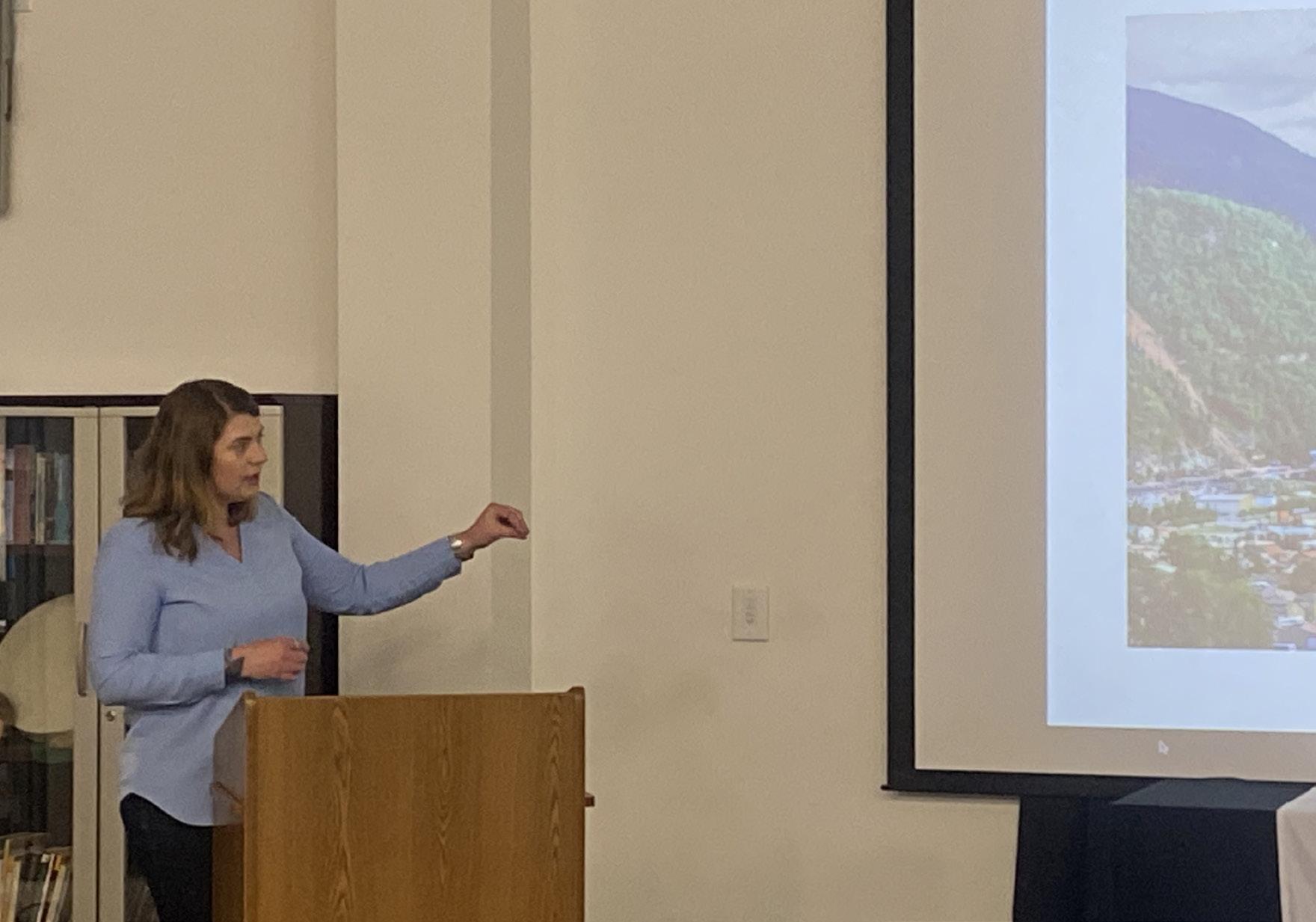
According to Coughran, school administration will meet face-to-face with the commissioner of education on Sept. 6, “to discuss what sort of revenue request to the city will pass muster with the state. I’ve got a lot of ideas that may help us structure a revenue request and subse-


quent budget that will retain all of our employees and keep each of our programs intact.”

Coughran said the school has not undertaken any immediate cost saving measures.
“Truth is, we don’t have enough information yet to react to the memo appropriately,” he said.
The budget issues will be discussed at the regular board meeting, Aug. 29, at 7 p.m.

Cremata remains satisfied with the assembly’s school budget decision.
“Considering the intense
scrutiny that the governor’s office is bringing to supplemental school budgets, I’m encouraged by the fact that the assembly brought intense scrutiny to Skagway School Distict’s supplemental budget during last year’s budget cycle,” he said.
“It’s likely the assembly saved the school board from some difficult decisions. It also underscores how important it is for elected officials to pay close attention to all funding requests, even when they’re presented by neighbors, friends and colleagues.”
I only had a few days to prepare once I heard Secretary of Transportation Pete Buttigieg was coming to town. The first thing I did was start practicing his name.
“How do you pronounce it?” I asked numerous friends.
Everyone said it slightly differently. I studied the NPR pronunciation (buddah-judge). Nervous that I would screw up, I settled on calling him Mr. Secretary.
The next big issue was what to wear. I knew his aide would be dressed in a sweater and jeans, so the pressure was off in that aspect. But which shoes to don? Xtratufs felt right for the drizzly weather. Mine are scuffed and have grass stains from the precious few times I’ve mowed the lawn. (We like to
Aug. 4


keep it long for the bees, plus our mower keeps breaking.)
Should I purchase a new pair of Xtras, a nice set to save for dignitary interviews? It was a good excuse to buy a fresh set I’d been eyeing with the latest Salmon Sisters pattern.
“Nah, wear your old ones,” someone advised. “Show him authentic Alaska.”
Buttigieg did get to see authentic Alaska. But it wasn’t me, or my worn boots, that showed him. It was the weather and a broken ferry, all in the month of August. (Winter isn’t even here yet.)
Buttigieg was scheduled to fly into Haines on Aug. 16. From there, he was to take the Hubbard to Skagway, then board a Seaplanes flight home. Due to weather, he ferried to Haines. The Hubbard experienced mechanical failure, which meant Buttigieg never could have made it to Skagway to see the sign on the Red Onion’s window welcoming him and Senator Murkowski.
-Fire personnel assisted with a scheduled medevac.
-Police responded to an incident aboard the Carnival Spirit.
-A key ring containing two keys was turned into dispatch.
-A different key ring was reported lost.
-Dispatch contacted the on duty provider.
Aug. 5
-Dispatch contacting the on duty provider multiple times.
-Police performed a welfare check.
Aug. 6
-Police assisted with a stranded vehicle.
-Dispatch contacted the on duty provider multiple times.
-A lost dog was found and reunited with its owner.
-Officers advised folks that pulling live salmon out of Pullen Pond was not allowed.
-Fire personnel responded to a medical emergency.
-Fire personnel assisted with a scheduled medevac.
Aug. 7
-Fire personnel responded to a fire alarm at a downtown business.
-Police personnel responded to a report of harassment.
-A lost dog was found and reunited with its owner.
-Police responded to a report of someone sleeping in a vehicle.
-A Canadian passport was reported lost.
Aug. 8
-Fire personnel assisted with a scheduled medevac.
-Fire personnel responded to a fire alarm at a downtown business.
Aug. 9
-Fire personnel responded to a report of a smoking house. It turned out to be normal chimney use.
-A lost credit card was turned into dispatch.
He didn’t get to speak with Billi Clem to hear that when ferries didn’t run in the winter, she missed her breast cancer check-ups. He didn’t hear from parents whose children couldn’t travel for sports and other school activities. He doesn’t know what it’s like to have a full ferry schedule in the summer, when Skagwegians are too busy serving tourists to leave town to visit the dentist, only to be stuck in Skagway when the season is complete, unable to care for body and spirit.
The most vital person Skagway needed to visit was unable to make his way up the Lynn Canal. The irony isn’t lost on a single person in this town. Thank you Secretary Buddah-judge for trying.
Some vinegar sold in Alaska stores may not be acidic enough for use in home canning, according to the University of Alaska Fairbanks Cooperative Extension Service. Vinegar used in nonpressurized water-bath canning, such as pickles or chutney, should have 5% acidity. Some vinegar now in Alaska stores has only 4%. The acidity percentage is listed on the label.
The higher acidity is necessary to prevent the growth of deadly botulinum bacteria.
The level of acidity in a pickled product is as important to its safety as it is to taste and texture. If the vinegar is too weak, soft or slippery pickles will occur. These symptoms indicate microorganisms were not destroyed.
If you have used vinegar with an acidity of less than 5%, the National Center for Home Food Preservation recommends the following:
If your canned food has been preserved for less than 24 hours using 4% vinegar, it is recommended to store the jars in the refrigerator to maintain the safety and quality of the product.
If your canned food has been preserved for more than 24 hours using 4% vinegar, it is recommended to discard the product.
For more information, contact Health, Home and Family Development agents Leslie Shallcross at lashallcross@ alaska.edu, 907-474-2426 or Julie Cascio, jmcascio@ alaska.edu, 907-745-3677.
-Fire personnel assisted with a scheduled medevac.
-An Android phone was reunited with its owner.
-Police assisted a highly intoxicated individual in returning to their cruise ship.
-Fire personnel responded to a report of smoke around the incinerator which was found to be normal.
-Dispatch contacted the on duty provider.
-A lost dog was reunited with its owner.
-Police responded to a report of a domestic dispute.

Aug. 10
-Police advised individuals drinking at Pullen Park that it is against the law to do so.
-Police responded to a civil dispute.
-Police personnel responded to a report of a reckless driver.
-A black jacket was found and turned into dispatch.
-Dispatch contacted the on duty provider.
-Police, fire personnel and search and rescue volunteers located a missing person.
Aug. 11
-A lost cell phone was reunited with its owner.
-Police reunited a lost man and his wife.
-Fire personnel assisted with a scheduled medevac.
-A bear was spotted on Dyea Road.
-Police responded to a report of a fight.
-A counterfeit $100 bill was identified by a local cashier.
-A lost wallet was turned in to dispatch.
Aug. 12
-A lost ID was reunited with its owner.
-Dispatch contacted the on duty provider.
-Police responded to a report of harassment.
Aug. 13
-A large amount of rocks were reported on the Klondike Highway.
-Fire personnel assisted with a scheduled medevac.
-Dispatch contacted the on duty provider twice.
-Dispatch received a report of a lost wallet.
-Fire personnel responded to a medical emergency.
-Police responded to a report of reckless driving.
Aug. 14
-Fire personnel assisted with a scheduled medevac.
Aug. 15
-Fire personnel responded to a structure fire on the Klondike Highway.
-Fire personnel responded to an EWS fire alarm at a downtown business.
Aug. 16
-Police personnel responded to a report of slashed tires on a vehicle.
-Police personnel responded to a report of shoplifting.
-Dispatch contacted the on duty provider.
-A counterfeit $100 bill was identified by a local cashier.
Aug. 17
-Police responded to a report of erratic driving on the Klondike Highway.
-Fire personnel responded to an EWS fire alarm at a downtown business.
-Dispatch contacted the on duty provider.
Aug. 18
-Fire personnel responded to two separate medical emergencies.
-An iPhone SE in an orange case was reported lost. -Police helped an individual gain access to their locked vehicle.
-Dispatch contacted the on duty provider twice.
Aug. 19
-Fire personnel responded to a report of a burning cigarette disposal post.
-Police responded to an altercation aboard a cruise ship.
-A lost fleece jacket was turned into dispatch.
-Dispatch contacted the on duty provider twice.
The Chilkat Valley News
Patrons stepping into the Pioneer Bar in Haines on Friday and Saturday night were transported to the 1950s, as the establishment celebrated 70 years in business. The walls of the bar were adorned with 45s from the artists that defined what many consider the Golden Age of America. Even though the jukebox was no longer in service, the music of Elvis Presley, Pat Boone and Bobby Darin boomed through the bar.
The bartenders and waitresses wore chiffon dresses, full skirts and polka-dot prints. Christy Tengs Fowler, owner of the Pioneer Bar and Bamboo Room, sported a blonde wig and pink jacket on Friday as she played trivia with her friends. Despite owning the bar with her husband, Bob Fowler, since 1991, this was her first time playing trivia at the establishment.
Festivities over the weekend also included music from Skagway rock and roll band New Twin and an enormous cake that said, “The Pioneer Bar, Cheers to 70 years!” Patrons also enjoyed ‘50s gastronomy such as tuna salad sandwiches, Swedish meatballs, Jello molds and ham roll ups.
“It was really great, I was really happy with it. And I was glad that we went back to the 50s, because 50s music is so happy, and everybody just really enjoys themselves,” said Fowler.
On Saturday night, Fowler performed a song that she had written a week prior about her life story, which is deeply intertwined with the history of the bar itself. The song is titled, “Doin’ Life Behind Bars,” which provides a glimpse into the love-hate relationship Fowler has developed with the place she considers home.
Amidst the laughter and conversation, one could strain to hear the lyrics: “Born into this life, I’m a product of alcohol/Mama claimed I was conceived on whiskey sours after all/ Raised on pepperoni sticks and pickled eggs in jars/I’ve been doin’ life behind bars.”
Fowler’s father Marty Tengs had come to Haines
in 1952 as a steelworker to work on the Lutak Dock. He met Christy’s mother Helen Bergstrand, who came to Alaska to be a teacher, at the Harbor Bar, and the two married in 1953.
That same year, Tengs became co-owner of the bar with his friend Ole Lillegraven, and by the following year he was the sole owner. The place the Bamboo Room now stands used to be a liquor store and card room until Fran Fox leased the space in 1956 and separated the bar from the restaurant with a bamboo curtain.
Fowler’s family lived in an apartment above the bar, where music would often seep through the floors. “This was part of my home, always,” said Fowler, looking across the bar. “It was a crazy place to grow up.”
The story unfolds as Fowler sings on, “Daddy made me do my schoolwork/Sittin’ in the Bamboo Room/Feel like I’m at home when I smell gin and cheap perfume/Oh, rollin’ quarters washin’ dish rags and sweepin’ up cigars/I’ve been doin’ life behind bars.”
Fowler started bartending when she was 19. “I remembered drinks even better than people’s names sometimes,” said Fowler. When she had her two sons, Marty and Chevy, the boys also grew up working at the Pioneer Bar and Bamboo Room. “These boys both waited tables and cooked here and worked from when they were like seven years old.”
Speaking of her and her husband Bob Fowler, she said, “We’re still pouring coffee, Bob’s still cooking, and I’m still waiting tables.”
Even though it was a lot of hard work, Fowler said growing up, “my dad made great money, so it was worth it.” Then she paused. “But there were a lot of hard times with his drinking, you know. And then there would be boom and bust, boom and bust all the time.”
The song ends with the verse, “Won’t you buy this place/Put a smile upon my face and serve me drinks in my cabana on island time.”
Fowler said she’s ready to sell the business, even though letting it go would
be hard. “I really want somebody to buy it who keeps the spirit of the place.”
Her love for the Pioneer Bar and characterization of its spirit is encapsulated in another song she wrote, titled “Crossing the Bar.” New Twin played the song Saturday night.

“Come for the spirit of friends who have gone,” they sang. “Come for a taste of the love that lives on. Come for the poets who speak through these walls. And tell us to dance ‘til we hear that last call.”
The celebration of 70 years of the Pioneer Bar ended with the band singing “Cause our time is measured, we don’t get another shot. Cause our time is measured, hey let’s
have another shot!” Then Fowler rang the bar bell and everyone took a shot in honor of the Pioneer Bar, the
Bamboo Room, the Fowlers, and all that they have meant to the Haines community for the past seven decades.
TUESDAY, OCTOBER 3, 2023
NOTICE IS HEREBY GIVEN that on Tuesday, October 3, 2023, there will be held in the Municipality of Skagway, Alaska, a REGULAR MUNICIPAL ELECTION
THE FOLLOWING QUESTIONS WILL BE ON THE BALLOT:
Ø Shall the Municipality of Skagway increase the property tax exemption level from $250,000 to $350,000.00 for primary residences within the Municipality of Skagway Borough for residents who are “65 years of age or older,” “disabled veterans,” or “widows or widowers of persons who qualified for an exemption ?
For " #
Against " #
Ø Shall the rate of sales tax collected upon sales made and services rendered in Skagway be increased from 5% to 6.25% for increased operational and infrastructural demands during the 2nd and 3rd quarters of each calendar year, April through September?
For " #
Against " #
Ø Shall a 35-year lease, beginning at market rent, with Petro 49 Inc. be approved, that requires Petro 49 Inc. to adhere to all environmental and industrial standards, as contained in the essential terms of Ordinance No. 23 -20?
For " #
THE FOLLOWING OFFICES WILL BE ON THE BALLOT:
Against " #
Ø Two (2) Assembly Seats – for three (3) year terms each, to expire October 2026;
Ø One (1) Borough Mayor Seat – for two (2) year term, to expire 2025;
Ø Three (3) School Board Seats – two (2) for a three (3) year terms, to expire October 2026 One (1) for a one (1) year term, to expire October 2024.
CANDIDATE QUALIFICATIONS: Any person qualified to vote in borough elections may have their name placed on the ballot for election as a candidate for any borough elective office. No person may serve simultaneously as mayor and assembly member.
FILING DATES: Interested persons wishing to file for an elected office may file a DECLARATION OF CANDIDACY with the Borough Clerk between July 31, 2023, and August 14, 2023. A PUBLIC OFFICIAL FINANCIAL DISCLOSURE must be on file in the Borough Clerk’s Office or attached to the Declaration of Candidacy to be considered complete.
• UPDATE: The candidate filing period has CLOSED. Any person wishing to file as a WRITE-IN CANDIDATE must submit a LETTER OF INTENT before 5:00 p.m., Friday, September 29, 2023.
ELECTION HOURS: The polls will open at 7:00 a.m. on Tuesday, October 3, 2023, and will close at 8:00 p.m. on the same day.
DEADLINE TO REGISTER TO VOTE: The deadline to register to vote in the October 3, 2023, Regular Municipal Election is Sunday, September 3, 2023
VOTER QUALIFICATIONS: A person may vote in a municipal election only if the person:
1. is qualified to vote in state elections under AS 15.05.010;
2. has been a resident of the municipality for 30 days immediately preceding the election;
3. has registered before the election as required under AS 15.07 and is not registered to vote in another jurisdiction
ABSENTEE VOTING: Voters who will be out of town for the Regular Municipal Election on October 3, 2023 are able to vote absentee in person at the Borough Offices beginning Monday, September 18, 2023, and ending Monday, October 2, 2023, between the hours of 8:00 a.m. and 5:00 p.m., Monday through Friday. To allow sufficient time for mailing, absentee ballots by mail should be requested by Friday, September 22, 2023
For more information visit www.skagway.org and click on “Government” then “Elections, or contact the Borough Clerk at s.burnham@skagway.org or 907-983-9706.
Somewhere between a floating crescent moon and the inky depths of Tagish Lake, a mother moose leads its calf away from speeding vehicles on the highway and into a wide greasy meadow. The moon hangs over jagged mountain peaks like a pale gray sickle against the deep blue backdrop of a fading evening sky, eager to harvest the final days of summer in preparation for the fall feast.
I’m lost in thought, the monotonous hum of rubber tires against pavement transformed into something like a meditative mantra. Somewhere near Summit Lake, a submerged memory surfaces like some ancient deep-sea monster of legend come to reclaim its ancestral land.
It’s the night of my grandfather Jose’s funeral. Late summer in Tampa, Florida, and I’m standing in the parking lot of the church under a rising full moon. My friend is with me and we’re outside because the church is packed full of my grandfather’s family and friends who came from far and wide to pay their respects.
My grandfather had been sick for some time - bedridden in the hospital. The night before he died, my father asked if I wanted to visit him. I chose to stay home
and listen to music.
The wave of guilt I felt as a teenager washed over me as I passed Summit Creek. The unexpected emotion signaled an older memory of an outing with my father and grandfather on my first-ever boat fishing trip.

The night before, I could barely sleep, my mind racing with anticipation. At sunrise, we boarded the vessel, owned by a family friend, and slowly motored through dense fog until we reached the fishing grounds.
No sooner than our baits hit the water, fish began biting. Our captain managed to place the boat directly over a massive school of whiting and within minutes, fish were piling up in the cooler.
There was nothing in the world Jose enjoyed more than fishing and he was smiling broadly as he reeled in one whiting after another. The fish we caught were all average size - around 13 to 14 inches long.
Suddenly, Jose’ hooked into something that put a deep bend in his rod.
“Mirar!” Jose said in his thick Hispanic accent. “I got a big one!”
Moments later, Jose pulled up a massive whiting, at least 20 inches long and double the size of anything caught up to that point. He hoisted
the big fish up and out of the water before swinging the rod sideways to lift it into the boat. Unfortunately, my grandfather pulled a little too hard and swung the whiting entirely over the boat before it twisted off the hook and fell back into the water.
My grandfather scowled while everyone else laughed. No matter. It was well known that Jose’ always caught the biggest fish, as though it were ordained by the fishing gods.
Nearly five years later, during one of Jose’s final healthy days, I caught the biggest fish. It was the first and only time I ever bested my grandfather. On the drive home, I was vocal about my accomplishment. Jose’ complained and made excuses but his smirk betrayed a feeling of pride, knowing he’d
passed along the knowledge of something both mysterious and meaningful.
The secret of catching big fish.
The secret is one that cannot be explained, either by definition or allegory. Searching for words to describe this formula is as futile as attempting to map the dark side of the moon with the naked eye.
On the night of his funeral, I marveled at the sight of hundreds of people I’d never seen before in attendance at Jose’s funeral. He was known as a rigid man, hard-working and blunt, with no patience for mincing words or delicate handling. So it surprised me to see so many eager to express their love and respect.
Repeatedly, I heard the same words from both
strangers and family friends. “Your grandfather always spoke the truth, even when it wasn’t what I wanted to hear.”
“Jose helped me and my family when we were going through a really tough time.”
“I loved your grandfather. He was the wisest man I’ve ever met.”
It’s difficult to imagine a thing so dense as a man’s life. How the threads of his words and actions weave through time and space, connecting human lives and creating something sublime.
Jose’ always caught the biggest fish but he was best known for other reasons. I wasn’t old enough to know the man who had touched so many lives, but I am grateful to have inherited his joy, and I hope, the ability to speak the truth.
(Continued from page 2)
“...given the lack of meaningful progress on the issue, drain on tribal resources, missing historical records, cost of pursuing legal options and the enormous emotional toll that this has taken on tribal members and boarding school survivors, we would like to take a step back and withdraw our engagement with the MOS for an assembly of the whole meeting.”
The Pius X Mission Boarding School for Indian Children operated on the site of Garden City RV Park from 1932 to 1959. In a letter dated Aug. 21, 2019 from the Diocese of Juneau, Francis A. Cowgill, who served at Pius X from 1952-1959 as assistant priest, was among a list of men “who have been determined by the diocese’ independent commission to
have credible evidence of sexual misconduct involving minors and vulnerable adults.”
“I think it’s important to remember that although there may be some positive history (at the school), there’s also some negative experiences and negative history, and it’s documented … There are documented cases of abuse and atrocities and that’s difficult to argue with,” STC President Jaime Bricker stated in February 2022.
The land (Blocks 95 and 102) was purchased by the municipality from the Juneau Archdiocese in 2013 for $1.7 million. Bricker has questioned if the land should have gone to STC.
The Tribe officially asked
for a portion of land to use to commemorate the school. A resolution by former Assemblymember Reba Hylton, that was never approved, proposed that half the land be repatriated to STC.
Near the close of Charity Pomeroy’s Aug. 17 Citizens Present testimony that half of Garden City should be returned to STC, Mavis Hendrickson stood up in the audience and started shouting, “We paid for it!”
Under Mayor Andrew Cremata’s direction, Hendrickson was escorted by police from chambers. After a five-minute recess she was invited back in but declined.
Assemblymember Orion Hanson noted during discussion that, “We continue to pay over $100,000 a year to
the Catholic Church.”
“I still welcome a discussion with STC that’s not going to veer into what are indigenous rights versus municipal land. I’ve said that numerous times and I don’t know how that’s gotten so sidetracked,” he said.
Orion stated that the issue should be placed for a public vote.
Assemblymember Deb Potter voiced her strong opinion.
“I personally, I’m just not going to accept anything less than giving a minimum of six, not giving. Sorry – let me take that back,” she said. “I want to be very clear with my words. Returning a minimum of six slots to the Tribe who has experienced so much emotional and physi-
cal trauma, they can no longer attend these meetings to talk about it.”
Bass said he tried to take into account the STC’s July 27 letter while drafting the resolution.
“I realize there are many details that must be determined: timeline, street layout, support infrastructure, budget allocations, numerous ordinances … These all must be completed,” he said. “So there’s still a lot of work to do. But you can’t get to the finish line if you can’t get to the starting line. And that’s what this resolution is, this is the starting line.”
Bass’ resolution calls for the two blocks to be divided into a total of 24, 5,000 square foot parcels.


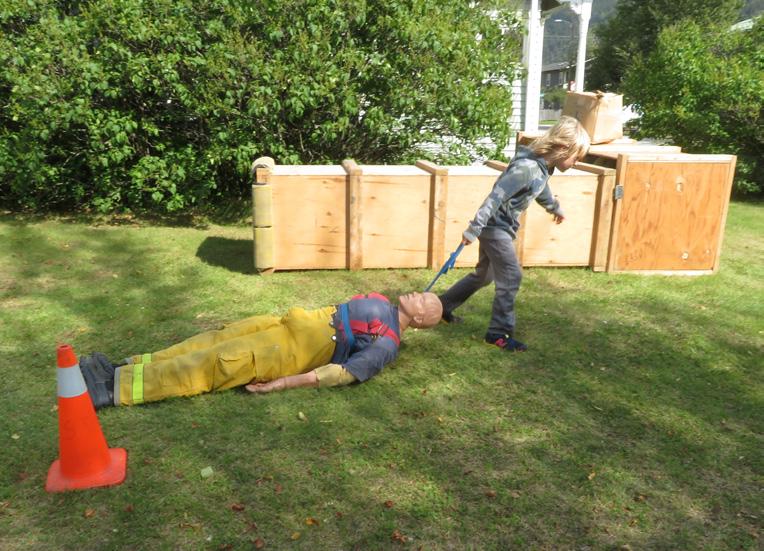
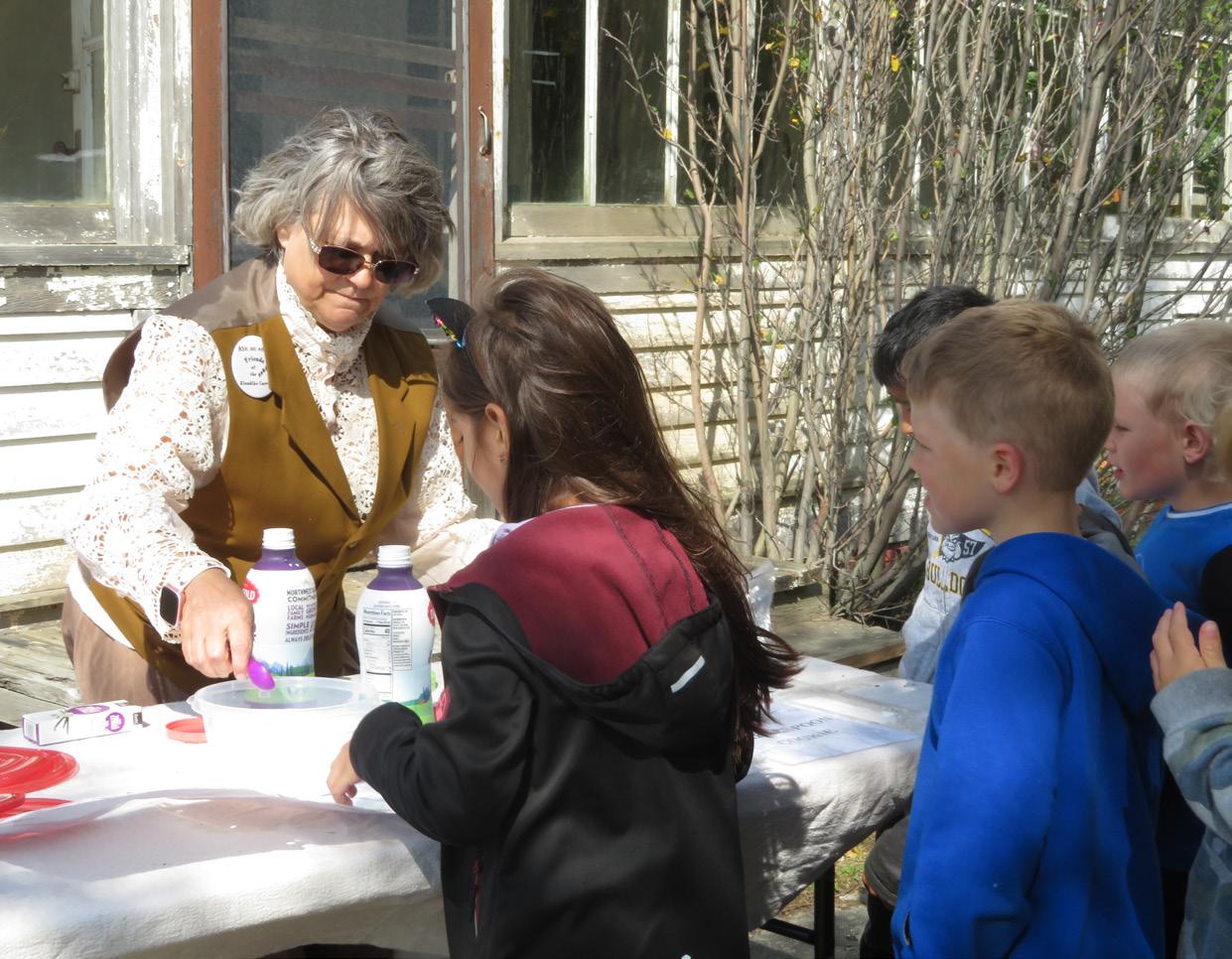
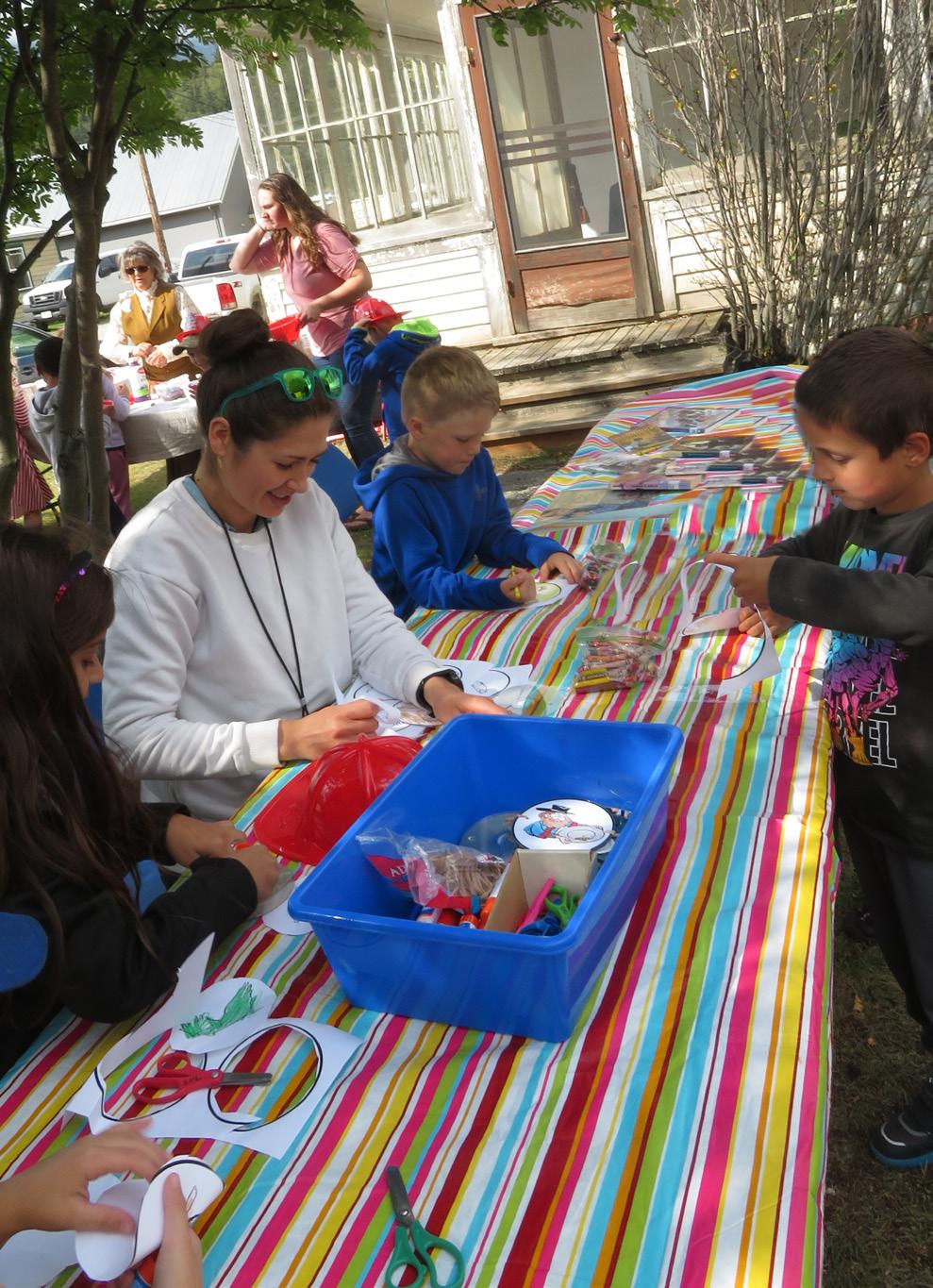
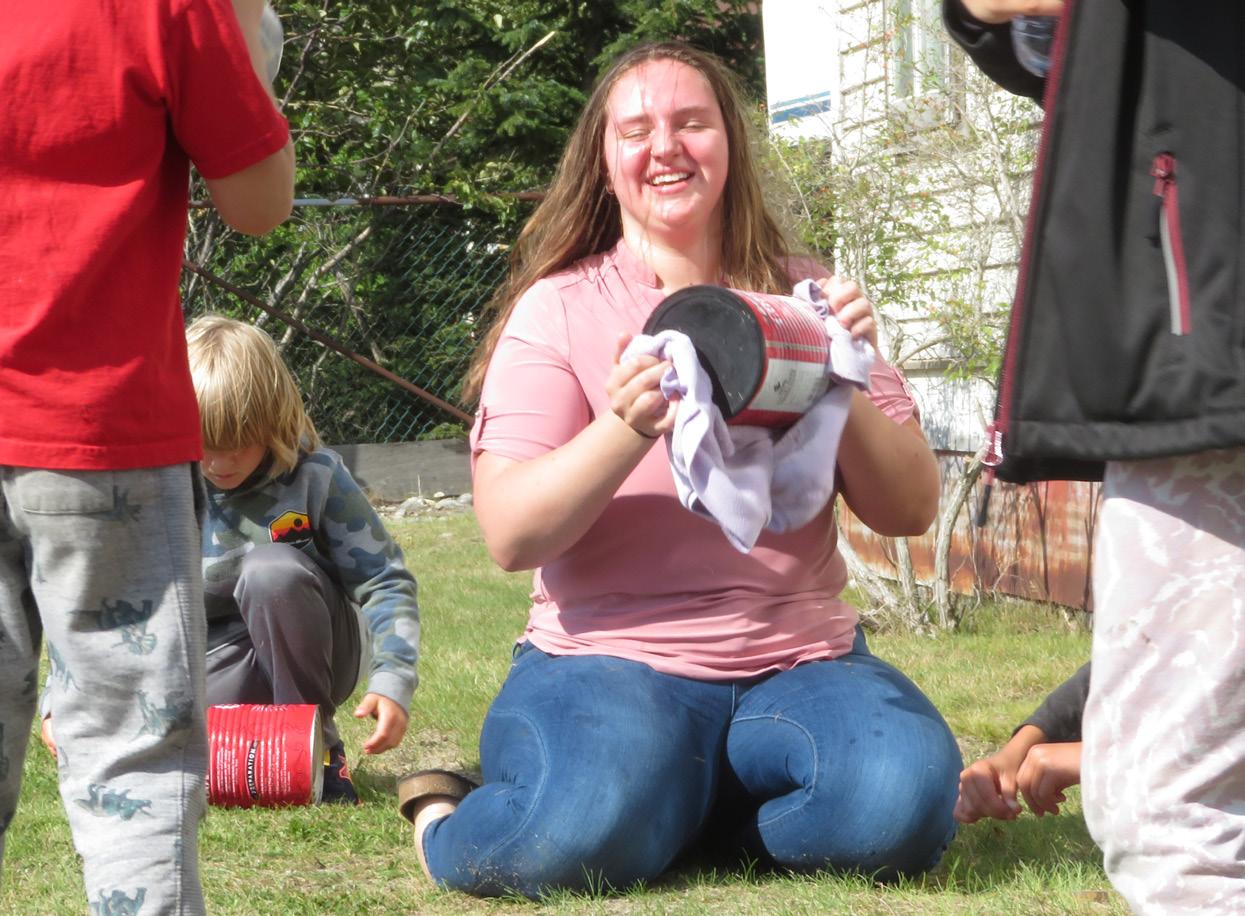
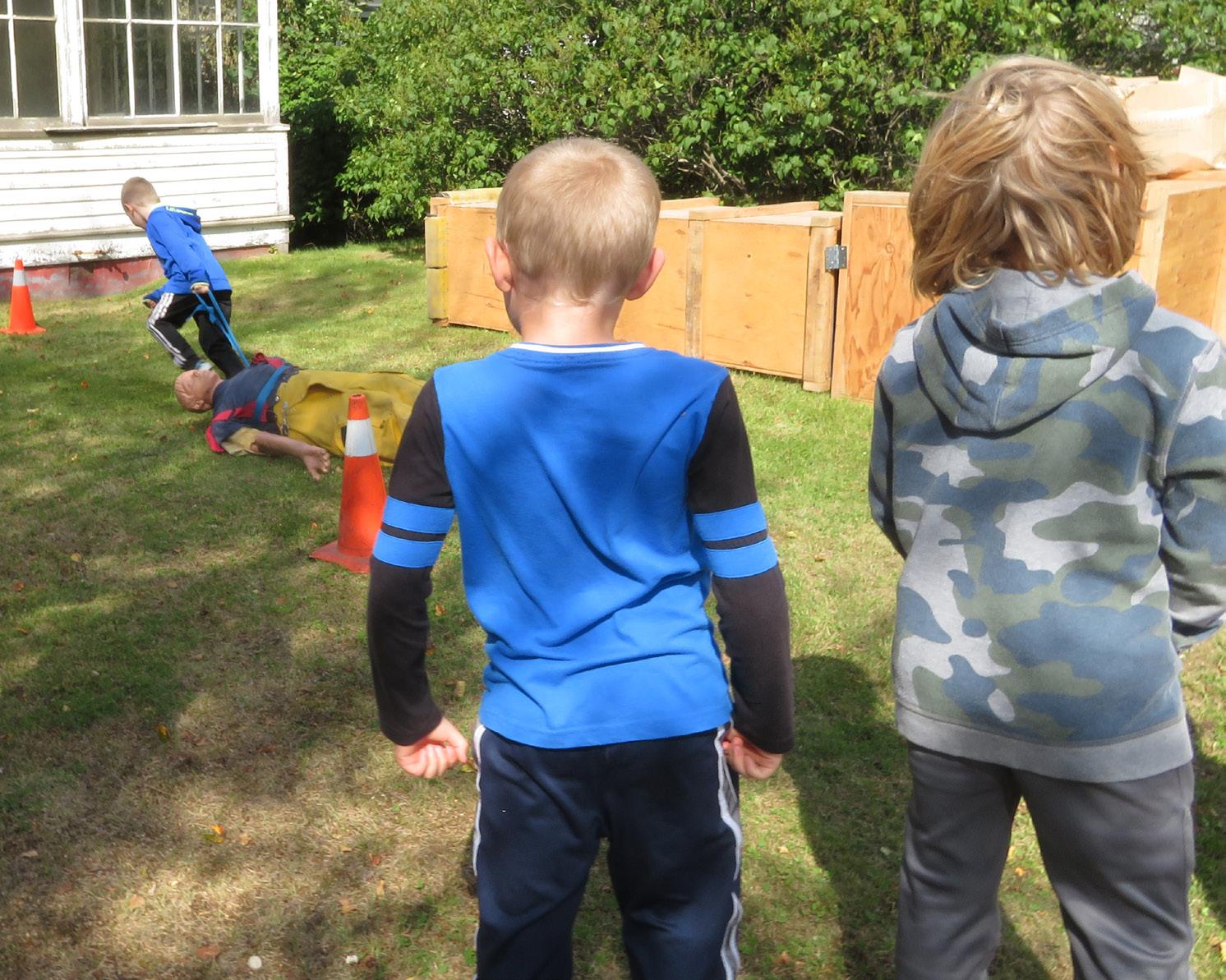
Friends of the Klondike Corridor (FKC) hosted Skagway children on the lawn of the Rapuzzi home at 2nd and Main on Aug. 24. The National Park Service provided Junior Ranger activities, Skagway Volunteer Fire Department showed the kids how to pull someone (a training dummy) from danger. The Skagway Library offered a motion art craft and shared books about the Klondike. FKC taught everyone how to make old-fashioned ice cream in a can. Everyone who completed an activity received a cold prize. You guessed it. A Klondike Bar.





3
4
5
9




29
Do you know the history of Labor Day in the USA?
See




COMMUNITY CALENDAR
Library Hours:

Mon. - Thurs. 11 a.m. - 7 p.m. Fri. 11 a.m. - 6 p.m.
Weekends 1 p.m. - 5 p.m. Call 983-2665 or email library@skagway.org
KHNS is searching for our next General Manager. You can see the full job description on our website at https://khns.org/job-opportunities . Position open until filled with first review on Sept 15th.

Dahl Clinic Winter Hours: Mon. - Fri. 8 a.m. - 5 p.m. Closed Sat. and Sun. 907-983-2255
For after-hours emergencies, dial 911.
Solid Waste Facility Hours T, Th, Sa, Su. 1 - 3 p.m.


Skagway Museum
907-983-2420

Border stations: 7 a.m. - 11 p.m. Call each station for specifics.
Ferry Terminal Hours
M-F 7:30 a.m. - 4 p.m.


Assembly of God Church
8th & State • 907-983-2350
Sun. Worship....................11 a.m.

Wed. Bible Devotions & Prayer 7 p.m. Email skagwayag@outlook.com
First Presbyterian Church
5th & Main • 983-2260
Sunday Worship 11 a.m.
Sunday School 9:45 a.m.
Women’s Prayer 10 a.m Tues. Bible Study time varies. Please inquire.
Online access available to all events.

The Church of Jesus Christ of Latter Day Saints
11th & State • 983-2518
Sun. Sacrament Meeting...10 a.m.
St. Therese Catholic Church 9th & State • 983-2271
Sun. Mass..........4 p.m. and 7 p.m.
Mass Mon. & Tues.....12:10 p.m. (when a priest is available)
907-983-2259
To reach the Dahl on-duty provider, contact police dispatch at 907-983-2232
When U.S. Secretary of Transportation Pete Buttigieg’s flight from Juneau to Haines was rained out on Wednesday, he changed plans and did what Alaskans have done for decades: He boarded a ferry.
Sen. Lisa Murkowski, R-Alaska, traveled with Buttigieg and said the last-minute switch in travel plans “was a typical Alaska jump ball.”
On Alaska tour, Buttigieg encounters extreme conditions and touts federal investments
It was an appropriate capstone to Buttigieg’s three-day Alaska visit: a trip intended to emphasize the benefits of the Biden administration’s infrastructure law, passed by Congress in 2021. As of July, that law has sent $5.2 billion in federal funding to Alaska.
The Alaska Marine Highway System will receive more than $286 million. That figure, which includes funding for new ferry terminals and ships, is more than three times the size of the ferry system’s annual budget.
For the first time, the federal government is also subsidizing ferry operations here. That’s a major policy change: While the federal government underwrites most of the cost of hard-surface roads and can underwrite the cost of new ferry boats, Alaska has borne the cost of operating them.
After a decade of state-directed budget cuts here, the system’s supporters say that money will be a godsend.
“It is salvaging what was the certain demise of the ferry system and allowing a modern version to emerge that can serve us in the future,” said Robert Venables, director of Southeast Conference, the regional economic development organization for Southeast Alaska.
“It’s incredibly important,” said Rep. Louise Stutes, R-Kodiak, who traveled with Buttigieg on the trip to Haines. “Let’s face it. Alaska is very, very fortunate in relation to the federal dollars we get. The challenge is using those dollars in a way where all Alaskans get to benefit from them.”
On Wednesday, Buttigieg spent four hours aboard the ferry Hubbard, talking to Murkowski, tribal and governmental leaders before touring Haines, whose Lutak cargo dock is slated to receive $20 million in federal infrastructure aid.
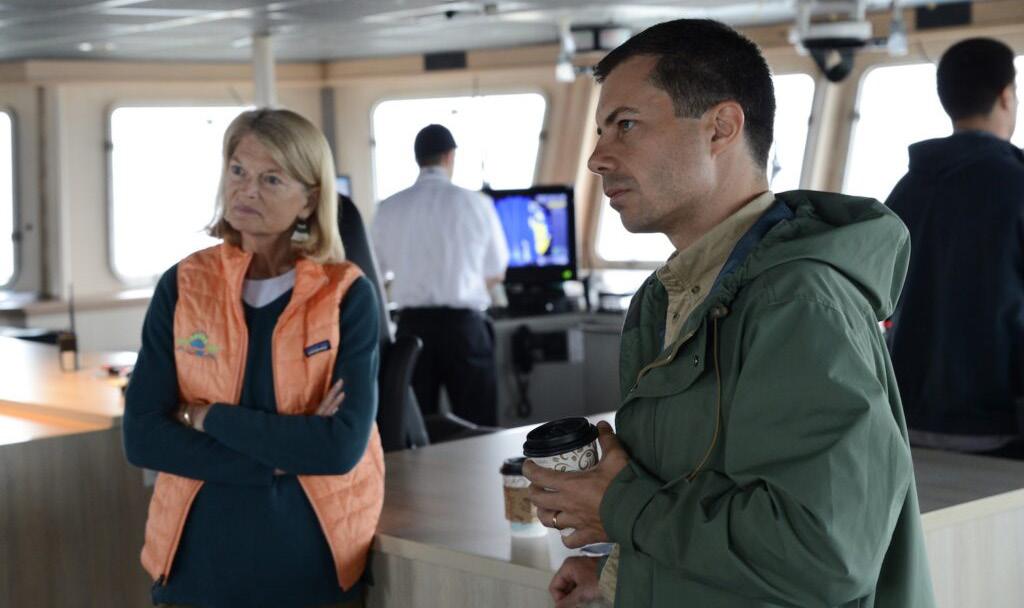
The Haines visit included a meeting with tribal and city officials, plus some souvenir shopping at the grocery store owned by the city’s mayor. One of the purchases was a copy of the local newspaper whose headline story was Buttigieg’s visit.
Speaking aboard the Hubbard, Buttigieg said the ferry funding is “something that is here largely by way of Sen. Murkowski,” who insisted that Alaska’s ferries “be considered in a big way” as part of the federal infrastructure law.
Murkowski, together with Sen. Dan Sullivan, R-Alaska, were two of the key votes needed in the U.S. Senate to pass the law through the chamber, and Murkowski used Buttigieg’s trip on Wednesday to re-emphasize the importance of the ferry system to Alaska.
The size of the resulting law is a “once in a lifetime” opportunity for improving American infrastructure, including Alaska’s ferry system, Buttigieg said.
Alaska is slated to receive $8.6 million to design a new ferry, more than $68 million to build a new mainline ferry, and another $46 million to build an electric ferry. The latter boat could run between Haines, Skagway and Juneau, Buttigieg suggested, taking advantage of the clean hydroelectricity used in those communities.
But Buttigieg’s trip also demonstrated that federal help won’t completely solve the system’s woes. In Haines, he spoke with ferry workers who stressed the problems the system has had hiring new workers.
That problem has been exacerbated by uncompetitive pay and benefits, they said, including the lack of a pension plan for new employees.
“Without a pension, it’s really hard to keep people in this environment, because it is not the happiest place,” ferry captain Gabriel Baylous told Murkowski and Buttigieg. “Sometimes it’s hard — especially with our economic woes and budget woes — to ride through those without that pension.”
The infrastructure law doesn’t address issues with pay and benefits, or the national maritime worker shortage.
“I would look at it as a partnership,” Buttigieg said when asked about the possibility of further federal support. “No one level of government, not even the federal government, can lift up a transportation system on its own. So a partnership with the state — and the cost shares will always be important — but the more the state is ready to put forward, the better partner we can be at the federal level.”
Bryan Ritter, an ordinary seaman who was among the ferry crew who spoke to Buttigieg, said he’s concerned by budget cuts that have reduced service to Sitka, home to a regional hospital.
Ten years ago, the state budget included $160.8 million for the ferry system. Five years ago, that figure was down to $138 million. This year, it’s just $91.2 million.
The infrastructure law includes $44 million for rural ferry operations. That’s not enough to restore all of the cut routes, but it will help, Ritter said.
“More reliable ferry funding means people are
going to be able to make it to their doctor’s appointments, and that’s huge,” he said.
The law also includes more than $45 million for new ferry terminals, including some in Southeast to serve the state-funded Alaska-class ferries, which were built even though the state failed to construct the ferry terminals intended to support them.
In part because the state has retired so many ferries, the Alaska-class ships are being pressed into routes they weren’t designed for, and the state has spent tens of millions of dollars to add crew quarters aboard the Alaska-class ferry Hubbard, allowing it to sail for longer stretches of time.
Federal infrastructure money will pay for similar quarters aboard the Tazlina, the other Alaska-class ship.
Other problems appear to be persisting.
On Wednesday, the Hubbard suffered a generator failure after delivering Buttigieg to Haines, and it wasn’t immediately clear whether the ship could return to Juneau with passengers aboard.
Buttigieg flew back to Juneau aboard a small commercial plane, sitting in the co-pilot’s seat as the aircraft traveled through skies that had somewhat cleared from morning rain. The itinerary change meant the group would have to skip the stop in Skagway.
It was his first trip to Alaska, he said, but he intends to return, even if the next time is on a personal visit rather than a professional one.
“I certainly hope to (come back), and I’d love to come back with my family. It’s such a remarkable place, both professionally and personally. I’ve seen a lot, and I think there’s a lot more to see,” he said.
Alaska Beacon is part of States Newsroom, a network of news bureaus supported by grants and a coalition of donors as a 501c(3) public charity. Alaska Beacon maintains editorial independence. Contact Editor Andrew Kitchenman for questions: info@alaskabeacon.com. Follow Alaska Beacon on Facebook and Twitter.