Tattler
d’vis du nord-êt
Ever Green





Spring has sprung the grass is riz, I wonder where the birdies is. They say the birdies on the wing, but that’s absurd, I always thought the wing was on the bird.
An old nursery rhyme made famous by Spike Milligan, but apt because the centre pages of this, the Spring edition, are taken up by Trinity’s own ‘birdman’ Mike Stentiford. He was delighted to give us an insight into his ‘journey’ to becoming one of Jersey’s most respected environmental experts and I was equally pleased to have the opportunity to showcase a man who has worked tirelessly all his life to try to keep Jersey green.
As well as the above, we have two articles on walks within the parish. With the spring weather upon us hopefully they will inspire you to get out and appreciate the stunning parish countryside. I am grateful to Fred and Julia for these articles and to Diane, our newest team member, for a wonderful account of the houses Gerald Durrell lived in, in Corfu. It sounds like she had a lot of fun tracking these down.
With Jersey charities being more and more in the news these days it is interesting that Trinity is home to several of them. It is a pleasure to be able to give them space in the Tattler to tell us a bit about their work. It would be interesting to know how many volunteers there are working for free in the parish, not only for the charities but also for the associations and as honoraries – many hundreds I should think.
Happy reading, Josie

P.s. Please do get in touch and let us know if you particularly enjoyed an article in this edition or if there is a subject you would like us to cover in a future one: trinitytattler@gmail.com
Also do remember that copies of this and past issues can be viewed on line on the parish website.




Trinity Tattler is a community magazine, for you, about you and from you!

Got something you’d like to see in the next edition? Send us your ideas, articles or pictures or thoughts to: trinitytattler@gmail.com
It is hard to believe that just over ten years have passed since I wrote my first contribution for the Tattler, and twelve years since I was first elected as Connétable of our wonderful Parish. This will be my final message to you all via the parish magazine, as the summer contribution will come from my successor. You will be pleased to know that I will not reminisce at length about my time in the role, save to say that it has been an honour and both a rewarding and enjoyable phase of my life. I hope that my successor—whoever you choose to elect on 7th June (please diarise the date)—will have a similarly positive experience.

I would like to use this final piece to thank all those, past and present, who so generously give their time in support of the Parish and our Parishioners. These include our Procureurs, Honorary Police, Rates Assessors, Roads Committee Members and Roads Inspectors. Our Parish Rector, and Minister at Ebenezer and all the Church Officers, for their ministry within our community. My thanks also extend to the dedicated volunteers of the Trinity Community Support Team, the Committee of the Three in One Club, the Youth Centre Committee, and everyone who contributes to this wonderful magazine. Each of these individuals gives freely of their time for the benefit of our community.
Finally, I would like to express my sincere appreciation for the support and encouragement I have received from my family and parishioners throughout my time in office. I step down from the role confident that the Parish and its parishioners will be in safe hands.
Philip
Philip Le Sueur, Connétable of Trinity



By the time you are reading this we will have said farewell to several much loved members of our Honorary Police team. They will be very hard to replace not only due to their enormous wealth of knowledge and experience but also the great characters that they are.
John Howell joined in 2015, serving in all ranks including Trinity Chef de Police for 18 months. Famed throughout the Parish for his huge personality, infectious laugh, kindness, fairness and generosity and for his baking skills too - he will be sorely missed.
Dennis Owen has also left us after an incredible 23 years service during which he has served as both Constables officer and Centenier. He is the epitome of a great officer and someone that we all strive to be like. We know that Dennis, despite stepping down, will still be integral in some way to Parish life and we wish him well.

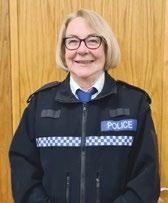
Our last farewell, but no means least is to Alison Keogh who has served two terms with us as a Constables Officer and sadly for us has decided now is the time to depart. Parish life runs through her veins though and we have no doubt Alison will continue in some capacity assisting our community in other ways!
We thank all three officers for the thousands of hours that they have given voluntarily to our Parish – all to ensure Trinity remains the lovely, low crime, community orientated Parish that it is.
On a happier note, Vingtenier Jenny Ozouf has been elected for her 4th term of office and we have welcomed Craig Kahn to our team as a newly elected Constables officer. We are looking forward to seeing what 2026 has in store.
Whilst recent vacancies for Proceurer and Centenier have been filled, there are still vacancies in the Municipality of Trinity for Constables Officers. To find out more please contact the office at the Parish Hall on 865345 or email parishhall@ parishoftrinity.je

By the time this edition of the Tattler arrives in March, the year will already have gathered a little weight. The excitement of Christmas and the New Year has faded and whilst we may feel that winter has overstayed its welcome with short, chilly days, March brings with it a quiet turning point. Beneath the surface, something is changing.
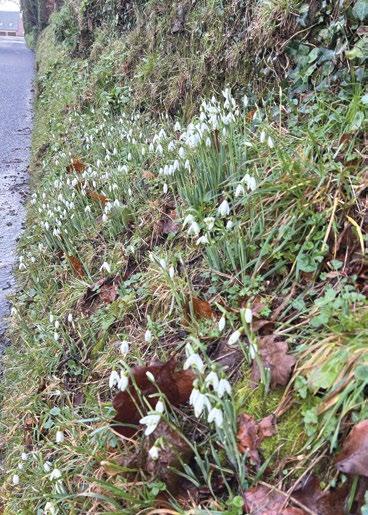
There is a particular kind of joy found in these early months of the year. It is not the loud joy of celebration or fireworks, but a steadier, gentler joy rooted in noticing small signs of hope. Days drawing out and lighter skies. Snowdrops pushing through cold soil. Brave daffodils appearing along roadsides, in fields and gardens. These moments remind us that even when progress feels slow, growth is taking place.
Modern life encourages us to rush ahead, to measure our days by productivity and results. The first months of the year can feel like a test of how quickly we can ‘get back on track’. But nature works differently. Spring does not arrive all at once; it unfolds patiently. Perhaps there is wisdom in allowing ourselves the same grace — permission to move forward at a more managed pace, to take stock, and to notice what brings us quiet contentment.
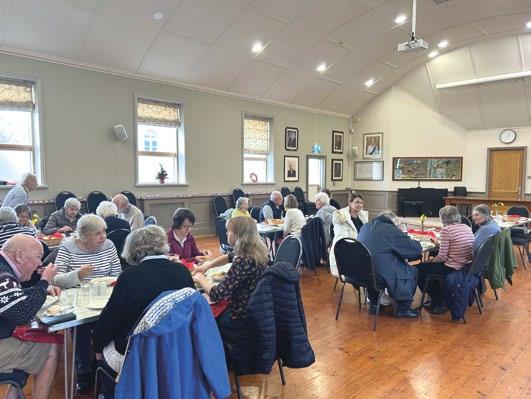
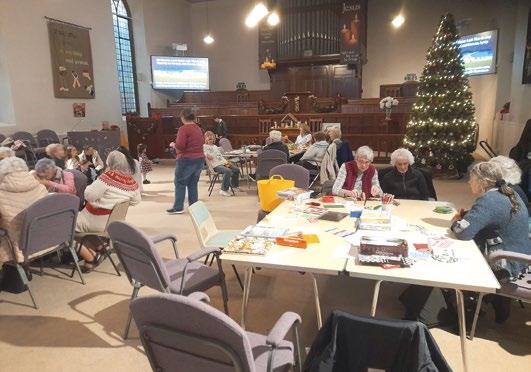
Joy does not always come from grand events. Often it is found in simple, shared experiences: a phone call, whatsapp message, a warm cup of tea on a cold afternoon, a conversation with a neighbour, laughter around a kitchen table, or a walk taken without hurry. These moments may seem ordinary, yet they are the threads that quietly strengthen community and wellbeing.
As a church within the community, we see daily how connection and kindness matter. Whether through shared activities, support offered quietly behind the scenes, or simply being present; small acts can carry surprising power. We have evidenced that in our Soup, Pud and Chat sessions at the Parish Hall, as well as at our community groups, Generations and Games Afternoons for the more senior, Pickles for babes & toddlers and Pickles Plus our after school club.
March also invites us to look ahead. The promise of spring offers reassurance that change will happen. Though we may not see it yet, the earth is quietly preparing for new life and the invisible is becoming visible – buds forming, roots deepening, creatures beginning to wake. The cycle of the seasons reminds us that renewal is part of life.
As we move through these first months of the year, perhaps we can all take a moment to pause and notice what is beginning to move — in our gardens, in our neighbourhoods, at Ebenezer and with us. Spring will arrive in its own time. Until then, may we find joy in the waiting and encouragement in the promise of what is yet to come.
by Canon Geoff Houghton, Rector & Vice Dean

Change, they say, is as certain as death and taxes! And while there can be long periods of time that change seems almost imperceptible, there are seasons when many changes seem to come at once.
This seems to be the nature of geo-politics currently; and in this election year we will see changes in the States Assembly and at our Parish Hall where our Constable (never an easy role), Philip, has given tremendous public service and leadership to our community and in the States.
As many will have heard, I too am retiring this Spring after some twenty years as Rector of the Parish and thirty years in the Island. My last Sunday leading at the Parish Church will be the 19th April, two weeks after Easter Sunday. It has been an honour and a privilege to serve the community alongside wider Island responsibilities. Being community is always interesting, and I know none better than Trinity. While Fran and I will retire to England, the wonderful people of this Parish will be always be in our hearts as a blessing Thank you.
In the Church of England, of which all the Rectors are part, the appointment process may seem ponderous, taking some months, but please be patient and supportive of those who will lead at Trinity Church through this period of transition out of which new blessings and initiative will surely come.
The November fire at the Rectory that started with a malfunction of the heating boiler caused some fire and heat damage and, more extensively, pervasive smoke damage, all
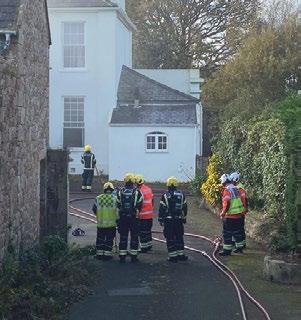
now being addressed by the insurers and will be fully restored by the Spring, and in good time for my successor.
The challenges of change and transition are at the heart of the Christian Gospel and come to a head in the shocking events recalled in what is known as Holy Week and then the wonderous new life of Easter.
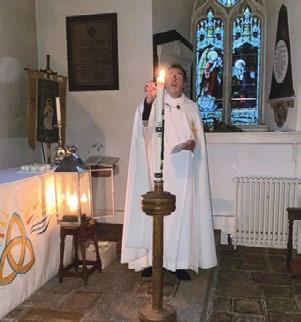
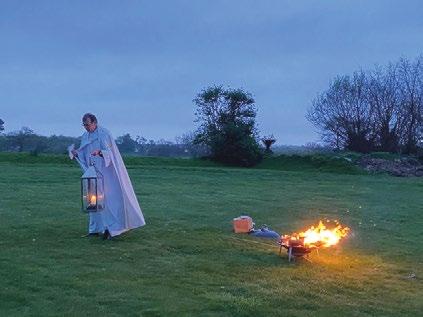
Easter Sunday, this year celebrated on 5th April, beginning with a Dawn Service at 6 am and including a light breakfast. The principal service is at 11 am and all are welcome. This but one of many festivals celebrated across the Parish over the next few months. Keep an eye out in Parish News and on the Church website trinitychurchjersey.com for details of all that is coming up: from Children’s Sessions to the Rogation walk around Trinity Manor gardens, and many other services and events to which all are welcome.
Ebenezer Methodist Church takes the lead in our Parish celebration of Liberation Day, the end of a forced occupation not just of these Channel Islands, but of most of Europe through the Second World War – the antitheses of maintaining good relations through good fences, and I know you will join me in continuing prayer for resolution and peace in places of war in our own age.
Our Parish and Church’s Patronal Festival, Trinity Sunday, is celebrated on the 31st May. It continues an endeavour of faith to understand that we encounter the Divinity in three distinct yet one persons, Father, Son and Holy Spirit. Like many, I find Andre Rublev’s beautiful icon based on the hospitality of Abraham under the oaks of Mamre most helpful, and indicative of how we too, when we open our hearts and minds can find ourselves hosting angels when we welcome strangers.

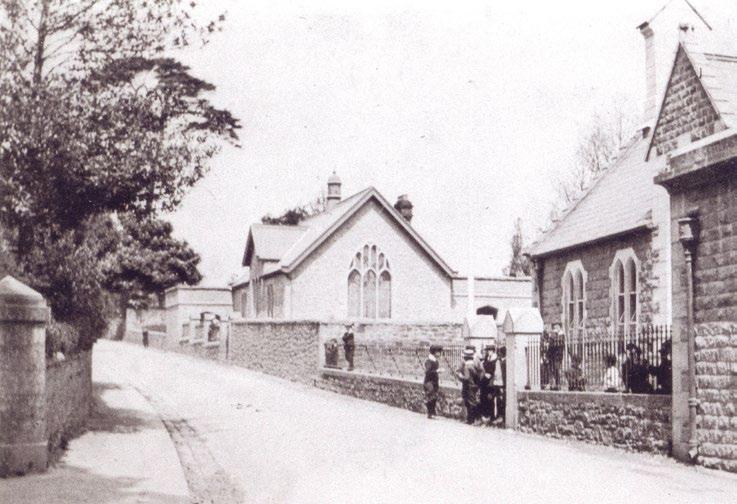
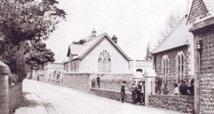
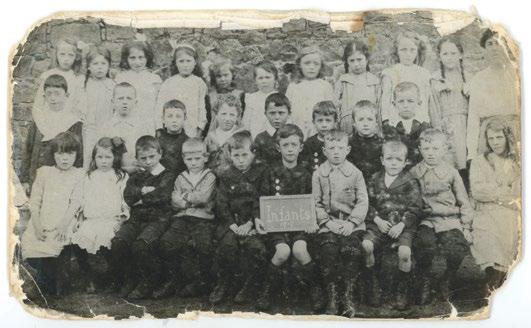
Continuing Jersey Archive’s ‘What’s Your School’s Story’ series, a presentation was held on Trinity School in November 2025. A huge amount of research has been done and one of the archivists, Harry Le Feuvre took those attending through a journey of more than 170 years, exploring the history of our school.
Beginning before the school itself existed (when education was shaped almost entirely by the church), through the founding of the school in the mid19th century and then exploring the challenges, changes and growth that showed just how resilient, adaptable and innovative many who passed through the doors were.
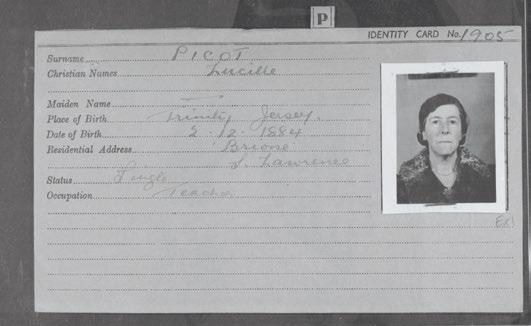
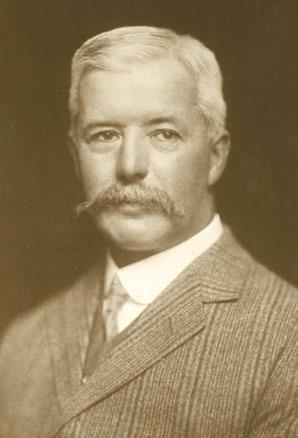
The opening of Trinity School in 1854 was mainly driven by William du Heaume, the Rector of Trinity at the time. He brought great energy and ambition and was determined to establish a place of learning for children of the parish. An assembly voted that ‘any school should be privately funded and not built on church land’ so Mr. du Heaume gathered support and raised funds to carry through his vision.
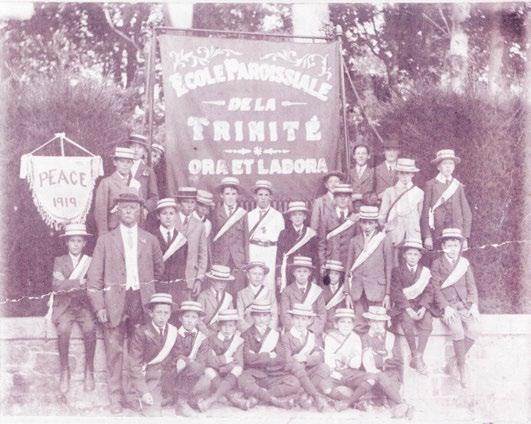
Harry and his colleagues have studied log books dating back to 1878 and admission registers from 1934, together with parish and school minutes and newspaper reports. What they have is a fascinating account of schoolmasters who came and went making their mark and helping to form the thriving education hub we have today.
One of the schoolmasters in particular deserves a special mention – Ernest John Gruchy who served from 1886 to 1891. Mr. Gruchy was determined to introduce better teaching standards and both the school’s population and achievements steadily improved under his guidance. For instance, he

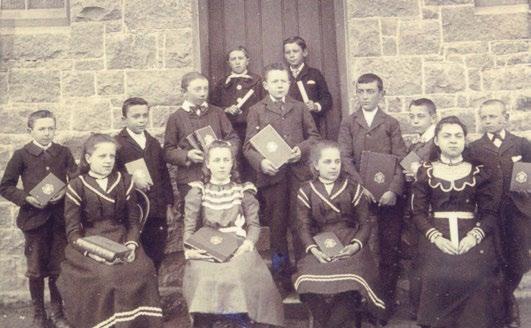
recognised exceptional artistic talents in one of his pupils, Edmund Blampied who attended in the late 1800’s. Edmund Blampied is now of course, famous for his drawings of local scenery, caricatures and accomplished art work both in Jersey and further afield. We hope to go into more detail of the rise of Edmund’s career and his subsequent achievements in a later edition of the Tattler.
There are also many teachers who have strived tirelessly to educate and improve the learning of pupils. One such teacher, known as the ‘Indomitable Miss Picot’ deserves an article of her own. She was a fixture of Trinity School for nearly 43 years starting in 1903. Her long tenure came with recurring sore throats and loss of voice – hardly surprising given the time she must have spent disciplining children.
Archivist Harry Le Feuvre’s research not only highlights the people going through Trinity School’s doors but also how the building came about and how it has evolved over the years. The impact of both World Wars and the Occupation years also left their mark as did the many pandemics and health issues.
If this article is of interest to you, it is highly recommended that you visit Jersey Archive and read Harry’s report in detail – it is truly fascinating.
Readers can explore more about Trinity School, and view related historical records, via the Jersey Heritage Online Catalogue at catalogue.jerseyheritage.org/wyss-2025/ trinity-school
N.B. A huge thank you to Harry Le Feuvre and the team at Jersey Archive for their help in writing this article and supplying the amazing photos – Josie, Editor
Stuart Burgher has over 30 years of knowledge and expertise
Experience counts when it comes to making Dentures
Trust us with your dental care


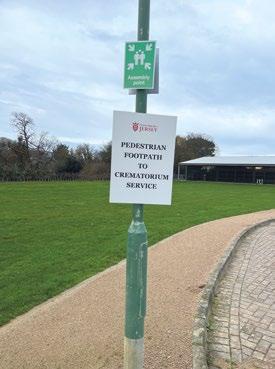
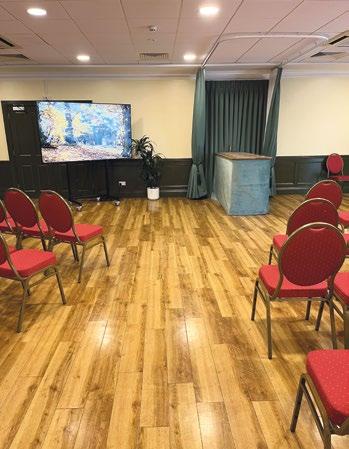
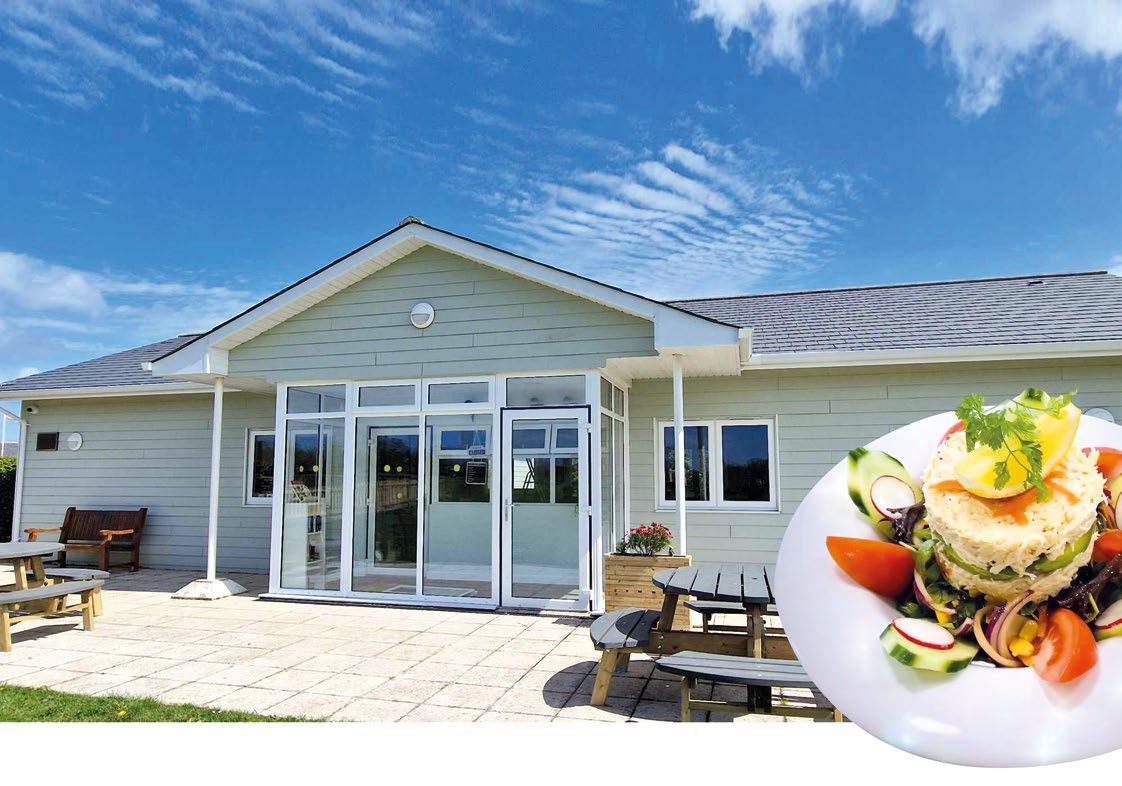
The Jersey Crematorium’s chapel services have been temporarily relocated to The Members Room at the RJA&HS in Trinity and it is interesting to see how the new facilities have been adapted.
The construction of the new Acute Hospital at Overdale is scheduled to take over three years to complete and so finding and setting up a new location for cremation services was essential. Because of the noise and vibrations of the heavy machinery at Overdale it was felt that privacy, dignity and respect could not be maintained for those attending services at the crematorium.
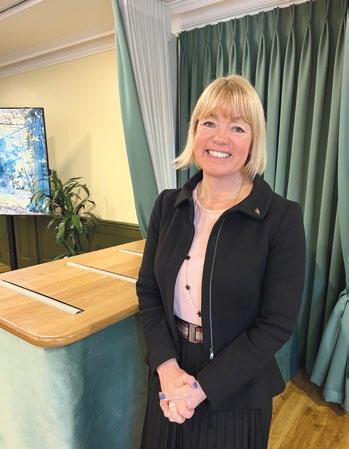
Superintendent Irene Whitewood oversaw the re-location which certainly presented many logistical and technical challenges. Apart from ensuring the Chapel had the calming and respectful ambience required many other things had to be taken into account. Entering the new venue for a service one cannot help but feel a sense of calm and serenity – no mean feat when the same room may have been used for a totally different event only the day before.
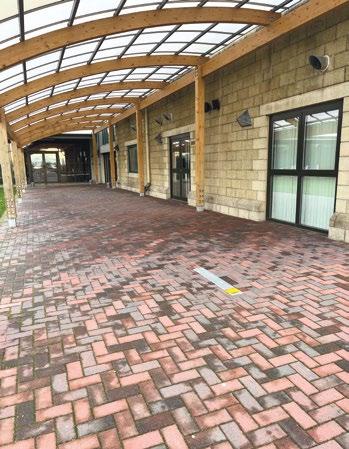
chapel and plenty of covered area outside to accommodate any overfill. When stepping out of the main doors the countryside views are stunning and tranquil.
A blessing of the temporary facility was conducted in August by four of Jersey's faith leaders and the new chapel offers a peaceful and respectful environment to support families with grieving their loss and celebrating the memories of their loved ones. An organ has been installed together with a new sound system ensuring any music can be played depending on requirements.
Coffins are delivered either early in the morning or for each service and then taken to Westmount for cremation. Floral tributes are kept outside on the day of the funeral and then taken for display at the crematorium unless family members want to take them with them. Services at the RJA&HS are mainly held between Monday and Thursday. As direct cremations and committals are still held at Westmount it means that the crematorium is able to offer more services.
Attention to detail is clearly something very important to Irene. In particular she and her team work closely with Dave Cottrell the events & facility manager of the RJA&HS. Open evenings were held before the Chapel was officially opened, a media campaign to ensure everyone knew what and why the move was necessary and leaflets were given to pupils at Trinity School to explain what was going on and regular discussion groups are held with all those concerned.
The Members Room has been thoughtfully refurbished to provide the same respectful and dignified experience as the Westmount chapel. With plenty of parking, disabled access and seating for up to 110 people it is easy to see why this venue was chosen. There is also some standing space at the back of the
It is important to note that only the chapel services are relocated – all other services remain at the existing location on Westmount Road and Irene stresses that the Chapel at RJA&HS is only temporary and will return once the new hospital is built.








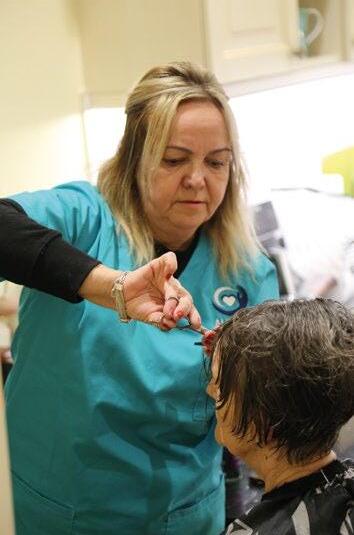




















The Trinitaise ladies of Soroptimists International Jersey are delighted to celebrate 75 years since the club was set up in the Island in 1950.
The first Soroptimist club was established in 1921 in Oakland, California. Loosely translated from Latin ‘soro’ means sister and ‘optima’ best for, a focus on equality for women and girls and the community is at the heart of all Soroptimist clubs around the world.

Over the decades the Jersey club has raised and donated thousands of pounds for local charities and been long time collectors for the Jersey Christmas Appeal and The Royal British Legion Jersey Poppy Appeal. In the 1950s the Soroptimists were the drive behind Mont à L’Abbè School, in the 1980’s they help start the Women’s Refuge and in 1994 it was Soroptimists who founded the Jersey Association of Carers.
The first Soroptimist ‘Woman in the Community Award’ was presented in 1999 to Barbara Marie for her work with the Jersey Society for the Disabled. The Club wanted to recognise the work of the many unsung women who do so much for others in the Island.
We meet once a month at The Monterey Hotel, to listen to speakers and to discuss how we are going to support our projects: Zumba Glow fundraiser, STEM bursaries for girls at Highlands, Sustainable Period Pads for Year 6 girls, Has Your Fridge Got The Message?, the Orange The World March…. please check our full list of ‘What We Do’ on our website www.sigbi.org/jersey
We hold a coffee morning on the first Thursday of each month at the Beresford Steet Kitchen from 11am-12.30pm so if you would like a friendly chat or want to know more about the club, you are welcome to meetings at no obligation. The age range of members is 20s to 90s! Friendship is the core of the club, whatever Parish we are from!
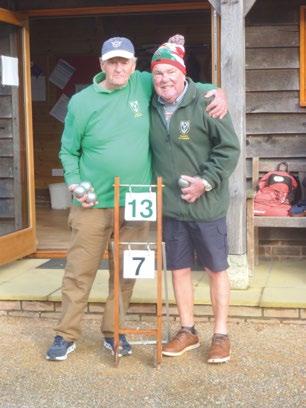
With all our inter parish petanque matches having been played by the end of November, we finished the season in December with the final play off for the Lawrence de Gruchy Knock out singles competition.
Two previous winners David Vautier and Paul Waters played against each other having won their close rounds to get to the finals, often with unexpected results.
David started slow and did begin to make a comeback, but Paul played some super boules to take the victory by winning thirteen games to seven. He was presented with the cup by Philip, our Connétable. We then all joined in with our own games followed by freshly barbecued hot dogs, mince pies and warm drinks on a bitter cold morning.
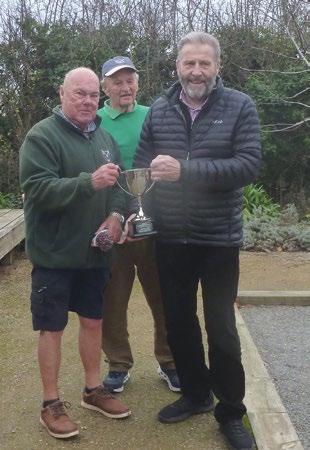
Cup presentation
In January we start practising again as inter parish matches recommence at the beginning of February. There are always many other island competitions that we are eligible to play in.
Wherever we play, the other teams always envy us having such excellent facilities in Trinity. We are forever thankful to the Roy Overland Charitable Trust for the wonderful club house kindly financed by them and for the support we have received over the years from the Connétable.
by the Trinity School Comms Group
We are very fortunate at Trinity School to have the charity, Caring Cooks working with us this school year presenting their Let’s Get Cooking Programme! and we value the excellent work that they are doing not only in school but also for our school community through their projects.

Tcooking lessons will increase in difficulty as the children get older. Depending on what the groups prepare, the children either enjoy the food in school or they can take it home to share with their parents.
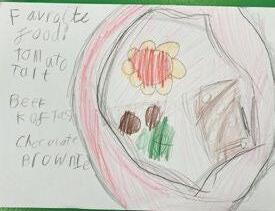
Home Challenge – Year 2 were challenged over the Christmas holidays to make some of the recipes that they learnt in school using the free recipe book that they were given at the start of the course. [Photos attached]
his year our Gallichan House has chosen Caring Cooks as their House Charity and throughout the school year there will be fundraising events organised by the children to raise money for this worthwhile cause.
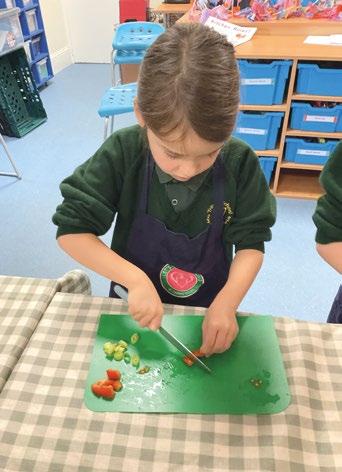
Thanks to the Caring Cooks charity the children from Year 1 through to Year 6 are offered the experience to learn new cooking skills including mixing, cutting, weighing, chopping and learning about dough handling. The children are also given the opportunity to try new foods once a week. The lessons incorporate nutrition and healthy eating whilst making it fun and understanding the food groups too. Each lesson will highlight the Eatwell Guide which encourages children to eat healthily every day. The year groups have a 6-week programme where they learn to cook a different

So far Year 1, Year 2 and Year 3 have taken part in the Caring Cooks sessions at Trinity School and the other year groups will have the opportunity to experience the lessons during this school year.

Year 1 started the programme in the Autumn term, and they have learned basic cooking skills including how to make sandwiches, enhancing their skills with buttering bread and they also enjoyed a Greek Pasta Salad dish where they learned how pasta was cooked and all about the different types of pasta available. The tuna lettuce cups (boats) were a favourite too with this year group and some of the children ate tuna for the first time and they liked it! Esme liked making the pasta salad and she enjoyed learning how to chop food in fact she has loved everything that she made during the course.
Year 2 completed their sessions before Christmas, and they particularly enjoyed making apple crumble and salmon tacos

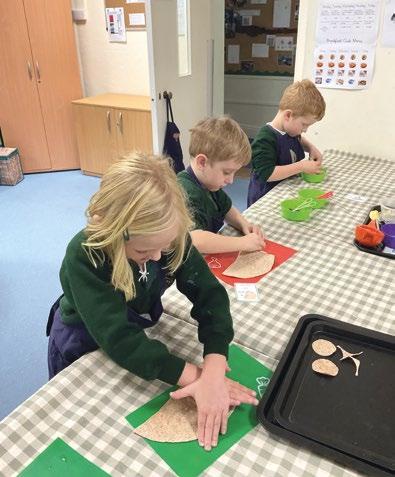

really enjoyed making the flatbreads, pointing out that whilst doing the recipes, he is also able to practice his reading and use his maths skills with the weighing and measuring of the ingredients. Vanessa and Liza-Lijn really loved the salmon tacos and they enjoyed making the apple crumble which was a big hit with this year group!
Year 3 are currently taking part in the programme and they are enjoying the sessions on a Wednesday morning. So far, they have made Mediterranean scones, which they loved despite being a new way to bake a scone (they are used to eating fruit scones). They have also made beef koftas, where they experienced using a mortar and pestle to grind the cumin and coriander seeds into a fine power. Alice pointed out that the lessons go so fast because she really enjoys them. Arcadia has loved trying new foods and her favourite so far has been the tomato & feta cheese tarts which had olives with it just like the scones.
All these new cooking skills are so important for the children to learn and they will take these with them as they go through their lives. It has been lovely to witness all the children cooking together in school and hearing their conversations about food and what they have been learning from the sessions. We want to say a very big thank you to the Caring Cooks team who lead these lessons so brilliantly each week- they really are a highlight of our curriculum.


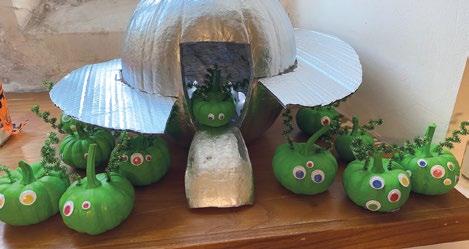
Looking back on our busy Autumn term, we had some great fundraising activities to see us through to Christmas. Firstly, our Halloween dress down day and pumpkin competition put the school in a spooky mood! The efforts and creativity that went into all the pumpkins were amazing and it was definitely a tough job to judge a winner!
Closer to Christmas we had our annual school disco with Mrs Sleath on the DJ decks! The children had a great time and there were some serious shapes busted on that dance floor.
We ended the term with our Christmas hamper raffle for all our families, and for the kids a “Guess the name of the bear & reindeer” competition. Our winners were announced in the last assembly of the term, which caused much excitement in the hall! Thanks as always to our wonderful families who donated towards the hampers, their generosity allows us to create some really wonderful hampers which are such a treat!


Looking ahead to this term we’ll be organising a ‘Break the Rules Day’, a school movie night and an Easter competition. I’ll look forward to updating you on these next time.
Agnetta



I have always had an interest in the work of Gerald Durrell and what he achieved during his lifetime.
As Gerald’s 100th birthday would have been in 2025, I decided to travel to Corfu, with my husband, to see where Gerald spent 4 years of his childhood. My main aim was to view a few of the homes which he lived in during his short spell on Corfu, which was brought to an abrupt end with the outbreak of World War II.
Gerald was way ahead of his time in respect of wildlife conservation and human interaction, which began in the open-air classroom of Corfu and continued to our beautiful island, Jersey, where he founded our zoo, helping to change the history of conservation. I believe that the lessons learned by Gerald in Corfu were not just about natural history but also about the complex relationship between humans and the animal kingdom. By being “allowed” to use his homes as sanctuaries for the specimens which he found, he was able to develop an understanding that was quite unique.
be very adept at hairpin bends on these steep hills, so hiring a small car was advantageous for us. Even Corfu Town itself has retained a lot of its original character with picturesque alleyways. The island definitely takes you back in time and I

could appreciate why Corfu captivated Gerald’s curiosity in creatures. Even the tavernas take you back in time with their local cuisine and are authentically run by more than one generation of a family.
Finding the homes where Gerald lived was not as simple as I had expected, but with tenacity, along with more than a few sighs from my husband, I achieved what I set out to do.
Corfu is a must-see island for both nature and literary lovers. Although it is now a lot more popular as a holiday destination than in Gerald’s time, Corfu has managed to retain much of its rustic charm – especially its windy narrow hills! You have to
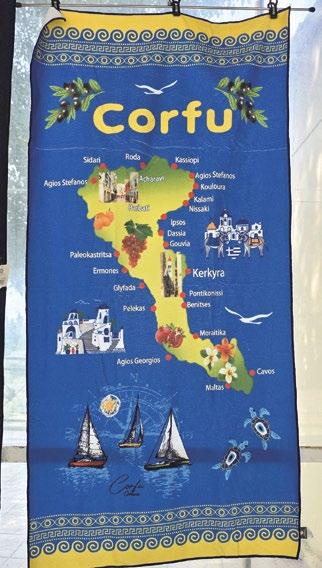
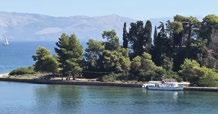
The Strawberry-Pink Villa (Villa Agazini) is believed to be the first home that the Durrell family settled in on Corfu. It is on a steep hill (as many Corfiot properties seem to be!) with beautiful views of the Ionian Sea and Mouse Island


(Pontikonissi). Mouse Island fueled Gerald’s fascination with the natural world. The villa also gave Gerald easy access to Halikiopoulos Lagoon, a rich wetland area for Gerald’s nature studies. I understand that a good number of his wildlife collection would have been found in this lagoon.
The Daffodil-Yellow Villa (Villa Anemmoyani) is believed to be the next property that the family moved to, a large Venetian Mansion. You cannot view the property as it is a private residence, but we did catch a glimpse of it. Again, the lush gardens, groves and forest would have been a source of interest in flora and fauna for Gerald.

The family’s final home in Corfu was The Snow-White Villa (Villa Cressida). This is also a private residence, very much hidden from public view. Depending on where you read, the original villa where the Durrell family apparently lived is no longer in existence. Again, it is situated near Halikiopoulos Lagoon, giving Gerald continued access to species of interest to him.
The White House was not a residence of the family – only Lawrence Durrell, Gerald’s eldest brother; albeit it was often frequented by the family. It is the most famous of the

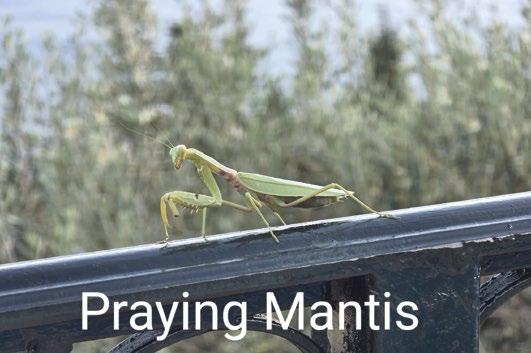
properties as it is now a taverna as well as a holiday villa. When Lawrence lived there it was a small fisherman’s cottage, which has now been extended to be a tourist attraction. We enjoyed a very decadent meal there and for fans of Durrell, it is a must on the holiday itinerary.
Villa Posillipo, an 18th century property, is the waterfront villa used as the Durrell family’s home in the popular TV series. I must emphasise that the real Durrell family did not live at this villa. It is a private property which can be rented out as a holiday villa, at a cost. Although it can be seen from the sea, it is not open to the public. I had fun wading out on uneven, slippery surfaces to take photos, much to the hilarity of my husband who stayed on shore!
Danilia Village, established after Geralds’ time on Corfu, is a replica of a 1930s Corfiot village and was used for various scenes in the TV series. The village comprises of shops, tavernas, houses, a museum and a church. The characteristic farmhouses, the village square and other buildings have all been reconstructed to bring authenticity to this village. It is open to tourists for purely a visit or for an authentic traditional Corfiot meal, as well as being a wedding or party venue.
The Boschetto Gardens are another attraction we visited whilst on our “Durrell holiday”. In 2006, these small public gardens were officially renamed the “Durrell Garden” after both Gerald and Lawrence Durrell. Two bronze busts of the brothers were unveiled in the gardens in “thanks” to their literature helping to put Corfu on the map.
As mentioned at the start of this piece, the family’s time on Corfu was brought to an abrupt end by the outbreak of World War 2, but it would seem that those few years were a lasting memory for Gerald. For fans of Gerald Durrell, like me, a visit to Corfu and the properties and tourist attractions mentioned in this piece, give a tangible link to Geralds’s early years of curiosity when he became enthusiastic in wildlife conservation. Diane


•Build
•Cut
•Sell
•Store
•Protect





Jersey Zoo have welcomed some new arrivals; four Critically Endangered greater bamboo lemurs. These arrivals make Jersey Zoo only the tenth holder of the species worldwide.
They have welcomed a male called Orsa from Cotswold Wildlife Park, as well as two females and a six-monthold male called Tsara, Aina and Sakai from France.

Once thought to be extinct until they were rediscovered in the 1960s, greater bamboo lemurs are a rare sight with only around 1,500 left in the wild. Sadly, fossil evidence suggests that this species was once the most common lemur, with an estimated 1 million of them roaming Madagascar 90,000 years ago.
Whilst they look like other bamboo lemurs, such as the Alaotran gentle lemurs also cared for at Jersey Zoo, greater bamboo lemurs are actually more closely related to ring-tailed lemurs.
As you might guess from their name, 95% of their diet consists of bamboo. Like giant pandas, they have specialised teeth to help chew the tough plant. Bamboo contains high levels of cyanide, but greater bamboo lemurs can consume 48x the lethal dose for their size, due to their digestive system which has evolved to process the poison, filtering it out through their urine.
All four greater bamboo lemurs can be found in Jersey Zoo’s Kirindy Forest, through the arches near the zoo entrance.
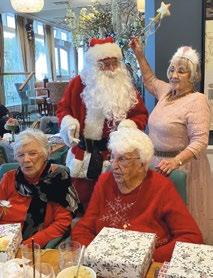
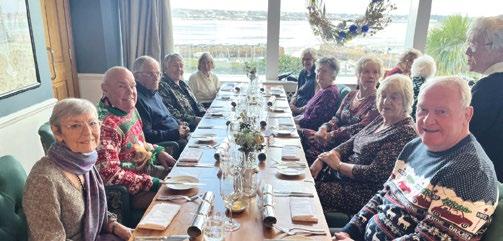
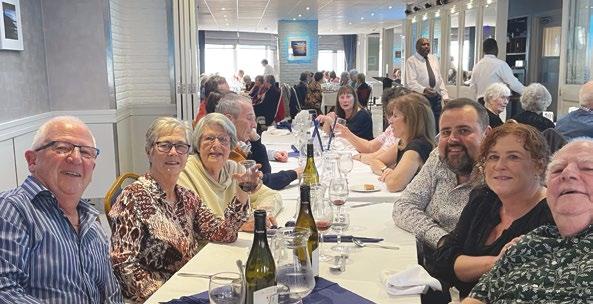
December ended on a high with 49 attending our Christmas lunch – a break with tradition saw us attend the Somerville Hotel where we were graced with stunning views, excellent food and luckily Santa managed to find us too.
We are still finalising our calendar for this year but are really pleased with the activities we have already scheduled in the diary. We look forward to the year ahead with our existing members and others that may consider this could be the year to join us. We will continue to meet on the 1st Thursday of each month throughout the year at the Parish Hall – 2.30pm unless notified otherwise.
There was no meeting in January but looking ahead to the first half of 2026 our diary is as follows:
February we will welcome 3 dogs and their owners from Jersey Therapy Dogs to talk to us about their very rewarding roles and some of the interesting places they visit.
March we will welcome a guest speaker.
April we welcome back Laugh, Move and Groove for a fun, seated exercise class.
May we will be holding a Liberation themed tea party with a good old fashioned sing song.
June will be our first trip out and will be going to Hamptonne Country museum using money donated to us by the Connect me Community Fund.
Hopefully you will agree, a real mixture and something for all tastes.
Anyone wishing to have more information, please contact Angela Le Sueur on 864198
Champion trees are exceptional examples of their species. More specifically, a champion tree is typically classified as such by its size, relative to other specimens of the same species in the same geographical area – whether global, national, regional or local. Age, rarity and historical or cultural importance are further factors that can lead to a tree gaining champion status.
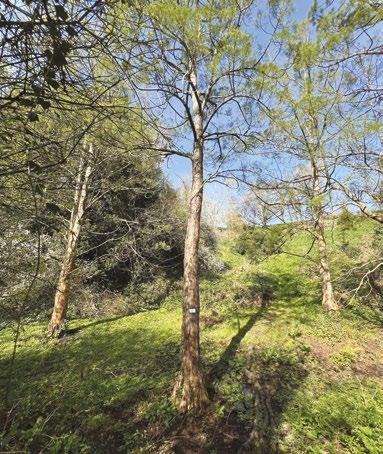
These specimens are crucial to the wellbeing and preservation of their local ecosystems. For context, a normal healthy mature tree supports hundreds of wildlife species while sequestering something like 20-40kg of carbon annually (a very approximate figure before considering size, species, methodology etc). Therefore, you can ramp up these numbers for a healthy champion.
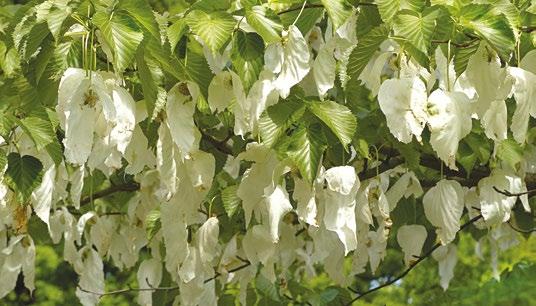
Champion trees also provide important information about genetics and resilience traits such as drought tolerance, disease resistance and structural stability. All of these are considerations when cultivating, which, unsurprisingly, is another of their uses.
We can’t talk about champion trees without a nod to their cultural and historical importance. They’re a symbol of cultural heritage, often acting as landmarks and providing identity to an area, as well as being a source of interest, engagement and education to the local community and visitors from further afield.
Standardised measurement methods differ by country. In the British Isles we measure the tree’s girth (circumference) at a height of 1.5m above ground level on the upper side of any slope. Height is measured formally using a hypsometer or clinometer, although more traditional (i.e. non-technological) techniques can be used to approximate.
Although by no means universal, many countries have systems and processes to identify and register their champion trees. In our region, Tree Register of the British Isles (TROBI) is responsible for granting this status. Around 80,000 British and Irish trees are currently listed, of 275,000+ on its database.
TROBI is a registered charity run by volunteers. Despite the practical limitations this brings, they visited Jersey in 2003 and again in 2013 to undertake assessments, updating the database to include around 500 local specimens in total. While some are sure to have since been lost to Storm Ciáran, many more will be unidentified.
Appreciating the incredible work TROBI does, Jersey Trees for Life is contributing by providing information about our island’s finest arboreal examples. Its volunteers have started assessing potential candidates for champion status and, from spring, when trees are easier to identify and far more photogenic, the mission will begin in earnest. Potential champions include a bearded alder at the Alder Collection (Alnus glutinosa subsp. barbata), a handkerchief tree (Davidia involucrata) at Rozel Valley and a magnificent Chinese swamp cypress (Glyptostrobus pensilis) at Val de la Mare.
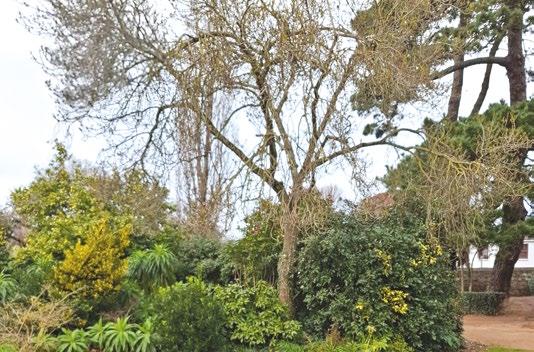
The charity is also contributing to an upcoming JEP series profiling prominent local trees.
If you think you have a champion tree, or know of one in the island, let us know at admin@jerseytreesforlife.org


This guide explains how to use the Trinity household recycling collection. A collection planner is included so you know when your recycling will be collected. Every home in Trinity receives a recycling collection, in addition to the existing rubbish and glass collections. Recycling collections will be on the same day as your glass collection.
For the month of April Glass & Recycling Thu 23/04/2026 Fri 24/04/2026
For the month of May Glass & Recycling Thu 28/05/2026 Fri 29/05/2026
For the month of June Glass & Recycling Thu 25/06/2026 Fri 26/06/2026
For the month of July Glass & Recycling Thu 23/07/2026 Fri 24/07/2026
For the month of August Glass & Recycling Thu 27/08/2026 Fri 28/08/2026
For the month of September Glass & Recycling Thu 24/09/2026 Fri 25/09/2026
For the month of October Glass & Recycling Thu 22/10/2026 Fri 23/10/2026
For the month of November Glass & Recycling Thu 26/11/2026 Fri 27/11/2026
For the month of December Glass & Recycling Wed 23/12/2026 Thu 24/12/2026
All refuse, recycling and glass out before 5am please
For more information, visit gov.je/recycling
For collection enquiries, contact GermBusters Ltd. Tel (01534) 869918 | Email info@germbusters.je

Myth
All recycling collected in Jersey just gets burned in the Energy Recovery Facility.
Items sent for recycling through Parish and Government of Jersey collections are not incinerated . Only contaminated materials are diverted for energy recovery.
Myth Recycling and general refuse are collected by the same truck, and get mixed together.
Some collections rounds use the same type of vehicle , but the loads are kept separate to ensure proper recycling.
Myth You don’t need to rinse out food containers or bottles before recycling.
Dirty items can contaminate the whole collection, making them unrecyclable . Always rinse before recycling!
Myth You should leave metal lids on jars and bottles.
Myth Glass can go in general waste orenergy recovery.
damage the Energy
be recycled properly.
Myth Plastic bottle tops can’t be recycled.


,


Metal lids and tops should be removed and placed with your household metal recycling.

to


The last few months has seen club members involved in a mix of competitions and social events.
In late October the club held its annual coffee morning in the Parish Hall. As usual it was well attended and the hall was full of people enjoying the various stalls and meeting friends for a chat over tea and scones. In December it was the Christmas draw. This year it was decided to hold it in the afternoon when members were treated to a cold buffet and took part in various activities with a wide range of attractive prizes. The third social event took place in early January when club members and their partners enjoyed a Sunday lunch at the Ambassadeur Hotel.
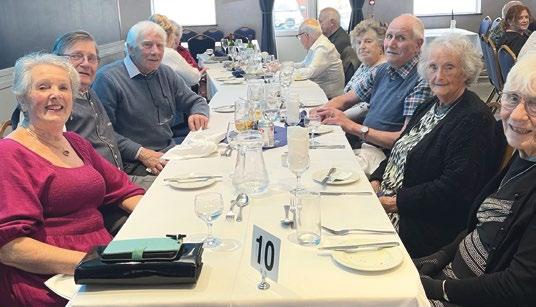
A wide range of competitions have been held and trophy winners decided. Norman Cabot and Andrew Pallot won the Target Competition. Christine Gallichan won the Mixed Singles Sets. Carole Bisson became Ladies Champion and Andrew Bisson won the Men’s Trophy. Christine Gallichan and Andrew Pallot won the Pairs Competition. Congratulations to them all.
The club continues to host residents of Jersey Cheshire Homes for games and early in the year will be introducing scouts and cubs from St Mary and Trinity to the basics of indoor bowls.
The club welcomes anyone who would like to have a go. Please contact the Club Chairman, Alan Otterwell on 07797 766969 or the Club Secretary, Norman Cabot on 01534 861413

As usual the ladies of the Trinity WI have had some interesting talks during our meetings.
One of our members, Maureen de Gruchy gave us a brilliant talk about when she and her friend arranged a seventeen-foot circle of flowers to celebrate the 1994 Commonwealth Games in Vancouver. It was the highlight of her life, she said. Maureen and her friend were the only ones from the Commonwealth to accept the Bishop’s invitation to help decorate the Cathedral in Vancouver. They travelled with their husbands, six boxes of flowers and their equipment including drain rods. Arriving in Seattle they were stopped from taking the flowers into America but were eventually let in. Maureen’s husband, Lawrence told the customs officer that the flowers needed a drink as much as he did! The arrangements were finished in time for them to see the opening of the Games, followed by an invitation to dinner in the Games Village with everyone treating them like royalty.
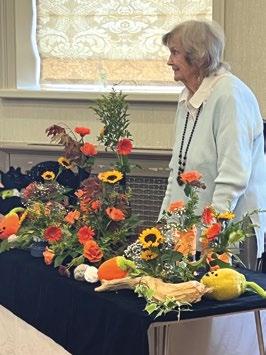
Another enthusiastic guest speaker was Julia Williams, a director of the family business Jersey Pearl, which is celebrating forty years this year. Pearls are a niche market and make memories for people and can be expensive or affordable depending on their rarity and colour. It requires ten thousand oysters to be opened for one natural pearl to be found whereas finding cultured pearls has a 99.9% success rate and are bigger, stronger and brighter.
The name “Mother of Pearl” derives from the growth of the pearl in the inner layer of the shell. Pearls are popular with all generations and are known to be calming on one’s skin. More men are buying them nowadays and recently an English rugby captain attended a launch party wearing a dropped pearl earring. Pearls cannot be grown locally as the shell species needed doesn’t survive here.
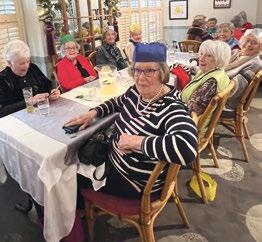
We celebrated Christmas with an excellent lunch at the Dolphin Hotel and which was enjoyed by all of us.
When my dear friend and erstwhile colleague, Tracy, and I threw ourselves into the (somewhat gruelling) Jersey Tour Guide Association bronze badge tourist guide course in January 2025, we had little idea of what we would actually use the qualification for, should we even get to the point of graduating.
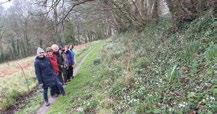
Styling ourselves as Let’s Go!, we certainly had great fun developing our skills and testing out a few different guided tour options during the summer and consequently planned to offer a menu of gentle and interesting parish story walks on occasional Sunday afternoons during the winter months.
Of course, being eune Trinn’taise to the bone, a walk around our beautiful lanes was to be one of the items on the programme - but where to walk and what to say? Designing a guided parish walk is about far more than choosing a route - it’s about shaping an experience that brings local stories, landscapes and community spaces to life.
Our key criteria focused on accessibility and comfort: easy terrain, minimal elevation, and a pace that allows for conversation and reflection. While we wanted the walk itself to last about an hour, the guided format stretches this to a relaxed twohour experience, with plenty of stops for storytelling and shared memories. We expected most (if not all) of our walkers to be locals and therefore would have much

Let’s go
to contribute to the chat. The pauses need to be carefully placed; at wide field entrances, on quieter lanes, and at safe viewpoints away from awkward junctions.
After exploring options starting from the spacious Les Platons car park, we decided that the need to walk on quite a long stretch of main road ruled this out, despite the beautiful views that the route offers. We settled on a more westerly starting point, at Jardin d’Olivet. This was always a favourite childhood spot for my family, with jolly memories of kite flying, blackberrying and hide-and-seek, and is very much a top spot for dog walkers. The location definitely provides the pleasant and familiar meeting point that we wanted.

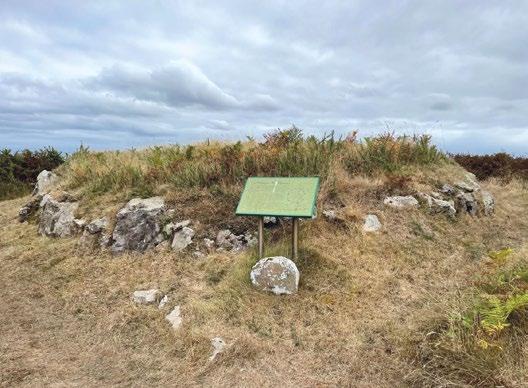
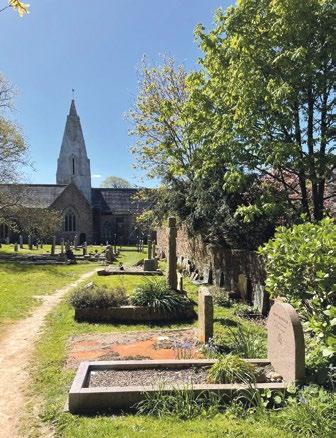
The route we chose followed eastwards then southwards along Rue de la Falaise, to the west along Rue des Câteaux, northwards up La Verte Rue to Trinity Arms, through the church grounds, taking in the war graves and Alan Whicker’s resting place, then through the parish hall grounds into the Golden Jubilee Garden. We completed the loop by walking eastwards along Rue de la Petite Falaise, a quick dogleg section up Route de Boulay then back to the carpark along Chemin d’Olivet/Rue de la Falaise. The rural route offered us a lovely blend of heritage, landscape and community life, with occasional views of the coast and sea towards France.
As we walked, on the chosen Sunday in January, we talked about not only what we could see, but various significant aspects of Trinity life over the centuries, and told stories about some key sons and daughters of the parish, and some who just passed through on their journey.
• Edmund Blampied (1886-1966), the renowned Jersey artist and caricaturist, famous for Jersey vraicing scenes, who spent most of his childhood at Augres and was educated at Trinity school.
• Philippe Falle, the Rector of Trinity 1681-87. His great legacy is that he bequeathed his collection of books to the people of the island. The Falle Library is the brick building at No.5 Library Place (hence the name); it became first public library in Jersey and was even claimed to have been the first public library in the British Isles.
• Alan Whicker’s grave in the church grounds; the travelogue television series Whicker’s World ran from 1959-1994, with at least one episode still available on BBC iplayer. He moved to Mont D’Olivet 1969.
• Not a human, but the story of Simba the lion is fascinating! He was kept at Rockmount, the house at the top of Bouley Bay hill. From 1964, the 600lb forest bred lion was held in captivity by Mr & Mrs Marshall, housed in the round building that can be seen from the roadside. People who were around in the 60s can recall him being walked down to the harbour on a daily basis by Mr Marshall. Poor old Simba could be seen looking out of the window - maybe dreaming of the savanna?
• Russian/Ukrainian troops stationed in Trinity during the Occupation: they wore Russian insignia on their field grey uniforms, some of which were found after Liberation; it was thought that they wanted to distance themselves from the German occupying forces, possibly even to pass as forced labour. The Russians were billeted in a range of commandeered dwellings in locations around the parish including in Bouley Bay Lodge, La Rosiere and at Jardin D’Olivet - occupying troops must have been a common daily sight in the parish for those civilians who were living here at the time.

Some of our other points of interest included tales and facts about…
• The Zoo and Augres Manor
• Bouley Bay Hill Climb
• Captain Ayton and Operation Hardtack
• Trinity Manor and the role of the Seigneur.
• RJA & HS and T B Davis, with some great Jersey cow facts!
• The Black Dog of Bouley legend
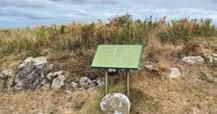
• La Hougue des Platons neolithic cist grave - some of the earliest parish residents
• War graves and commemorations; W. J. Le Breton of the Royal Jersey Militia and S. R. Graham, Stoker 1st Class, who served on HMS Woolwich, and the fallen soldiers remembered in the lychgate memorials.
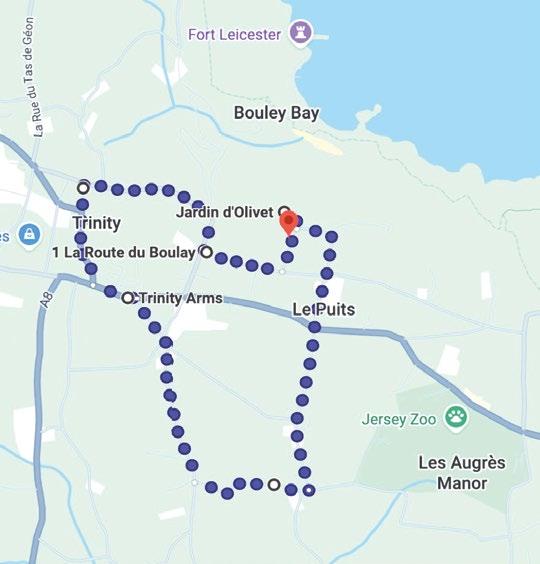
There was so much potential content that, of course, we didn’t have the opportunity to say everything that we could have included, but we chose to regale the walkers with some of the less well-known stories and information that our research had turned up.
It was a thoroughly enjoyable couple of hours, despite the liquid sunshine! We’ve thoroughly enjoyed designing the parish walks we’ve put on over the winter and we very much look forward to repeating them next winter, maybe with some fresh tales and newly discovered nuggets of parish folklore.
The Northern Parishes Battle of Flowers Association celebrated the run up to Christmas with its junior float taking part in the illuminated parade through town at the end of November.
Everyone had fun and there was a great atmosphere with hundreds of people all along the route. The following month, the float was taken on a tour of Trinity, visiting residents of Le Grand Clos and Les Maisons Cabot before heading back to the Trinity Parish Hall in time for the arrival of Santa Claus. On a separate evening, the float travelled to St John and was put on display by the parish hall.


With the arrival of a new year, plans are in hand for the 2026 Battle of Flowers parades which will be on Friday and Saturday, 14th and 15th August. It will be free admission again this year but there will be a return to Victoria Avenue, using just one lane to enhance the carnival atmosphere and the crowd's connection with the parades. The organisers also plan to include more local bands, dancers, performers and youth groups.
The Northern Parishes' Association, subject to sufficient helpers, hopes to enter both junior and senior floats so if you would like to get involved or would like more information, please get in touch. Email collette@bisson.je or send a text on 07797720615. Please also support the fund raisers which will be publicised on each parish's Facebook page. This year, this includes plans to take over the running of the monthly bingo sessions at St John's Parish Hall.
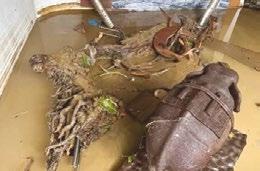
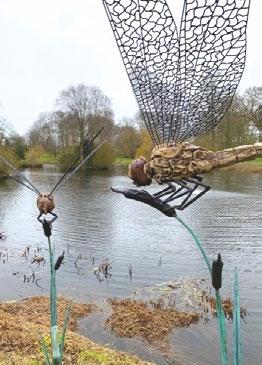
Visitors to the Gardens at Trinity Manor will have been fortunate enough to have seen the collection of amazing driftwood sculptures on display here in the grounds, created by the world-renowned artist James Doran Webb.
Tragically in November, James who is based in Cebu in the Philippines, had his workshop literally swept away in the devastation caused by Typhoon Tino, destroying twenty years of set up. Fortunately, his sculptures survived the typhoon, and James and his team are now busy rebuilding their workshop.
However, unfortunately, back here in Trinity one of our prize sculptures ‘The Stag’ was a casualty of Storm Goretti that hit the island in January. It was damaged by a falling Beech tree and is now on route back to the Philippines to be repaired. This will be our stag’s second visit back to see James for repair. In November 2023, he was hit by a falling Oak tree during Storm Ciaran!!
When he returns to us at Trinity Manor, he will be displayed in a ‘tree free zone’ (if we can find one)!
On a much brighter note, Pam and Paul Bell kindly invited the International Camellia Societies Channel Island Group to visit the gardens and see the selection of Camellias that we have here in the grounds. Jane Fraser seized the opportunity to make good use of this extremely valuable source of collective knowledge and expertise. Members of the group enthusiastically explained and identified the classification of various flower forms on different varieties of Camellias.

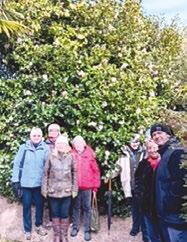
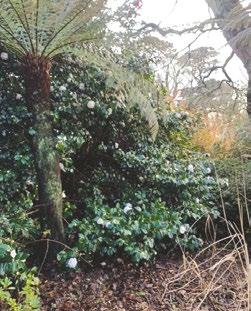



The Camellias are looking particularly good this year, all producing an abundance of buds. The open flowers are very much appreciated by hungry bees looking for an early supply of nectar. Probably the combination of regular mulching of bark chippings, manure and leaf mould to keep roots moist and provide nutrients, plus a hot summer have contributed to a stunning display of flowers this year.
We are extremely excited to see if our roses in the walled garden are going to be as prolific as the Camelias have been this year.
Jane Fraser
Head Gardener at Trinity Manor.
Mike was born in Exeter in 1935 so he was 4 years old at the outbreak of WWII and ten years of age when it ended in 1945.
As an evacuee, the war years severely impacted on his education although, by the age of fourteen, he was attending the South Devon Technical College and within just a few months, he had left to start a 7 year apprenticeship as a signwriter.
In 1955, he married Hilary and, one year later, was conscripted into the RAF on National Service. By 1956, first son Keith was born when, being newly demobbed from the RAF, the threesome ‘family unit’ arrived in Jersey in March 1958.
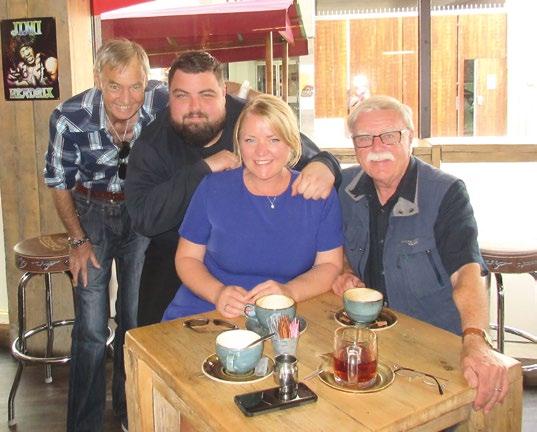
This followed the arrival, in February, of Mike’s parents: dad taking on the manager-ship of the Home & Colonial Stores in King Street. Living briefly in Vine Street, the ‘Stenti’s’ then rented Naparima Cottage in Trinity which, in 1972, was purchased as their very first family home.
By this time, Mike’s second son Philip had arrived and life in the rural setting of Trinity settled into a busy family routine - Mike working for the signmakers Tubeolight, Hilary involving herself with the Trinity WI, and both boys attending Trinity School. From the early 1970’s Mike had ‘adapted’ himself as a voluntary environmentalist taking on the dual roles of leader of the Young Ornithologists Club (YOC) and the Royal Society for the Protection of Birds (RSPB).
Other ‘successes’ during the 70/80’s included instigating the formation of the Jersey Conservation Volunteers, the Jersey Walking Group and creating the annual Garden Bird Watch for the Jersey Evening post. Invitations followed to join various environmental trusts and committees - Durrell Wildlife, Nature Conservancy Council, JSPCA, Tree Advisory Council, Jersey Ecology Fund, Jersey Botanical Trust, Jersey Environment Forum, Howard Davis Farm Trust, Natural Jersey and the Jersey Coastal National Park.
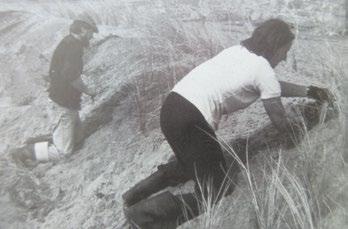
By 1985, his signwriting career was exchanged for a role as messenger at Hambros Trust but, in 1992, the pull of the environment led to his position as countryside interpretation officer with the, then, IDC at South Hill. This ‘dream job’ enabled Mike to conduct regular ‘eco- awareness’ events, guided walks and visits and talks to the Island’s schools. Although enjoying the very best job any environmentalist could possibly wish for, retirement beckoned in 2000 when, spurred on from receiving his MBE from Queen Elizabeth II (for commitments to nature) new horizons arrived.
The first of these came in 2001, when Mike was the first recipient of the Jersey Heritage Millennium Portrait Award. A major honorary position, however, came in 2008 when Mike became President of The National Trust for Jersey. During his three year presidency, much was achieved island-wide, not least, in October 2000 when the peaceful ‘Line in the Sand’ demonstration (Mike’s idea) resulted in the official endorsement within the Island Plan 2011 of the Jersey Coastal National Park.
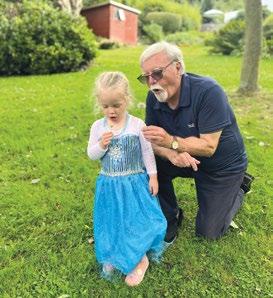
Having recently reached the grand old age of ‘fourscore-years-and-ten’ Mike has accepted that his days of ‘walking the walk’ and ‘talking the talk’ simply remain as wonderful memories. Nevertheless, he is grateful that a few
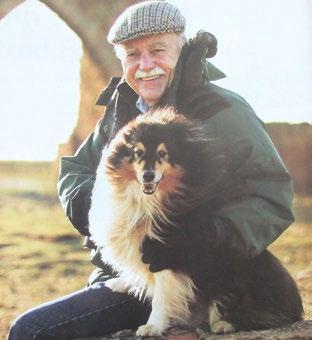

marbles are still ‘rattling around in his head’, a privilege that allows him to continue writing regular eco-features for the JEP and occasional items for parish magazines - including, on this occasion, the Trinity Tattler.
How long have you lived in the Parish?
I arrived in Victoria Village in 1965 and have lived at Naparima Cottage ever since.
What's the best thing about living in Trinity?
Trinity’s rural character and ambience which, along with its amazing coastline, retains a wonderfully timeless quality.
What’s been the best/worst day of your life so far?
The worst times, by far, have been the loss of my wonderful wife Hilary in 1998 and of my two sons, Philip in 2009 and Keith in 2021. No father should ever encounter triple blows such as this. However, my wonderful granddaughter Melinda, beautiful 5 year old great-granddaughter Genevieve, a fine grandson Andy and remarrying in 2003 to Angelika, has emphasised the continuity of family life.
What is your favourite Parish memory?
In the 1980’s, funds were raised to buy a second-hand minibus enabling regular trips for our young birdwatchers (YOC). One memorable Christmas, Hilary persuaded me - and the minibus driver – to drive the lovely ladies of Trinity WI around the parish for a carol singing fundraiser. On route was the Water’s Edge
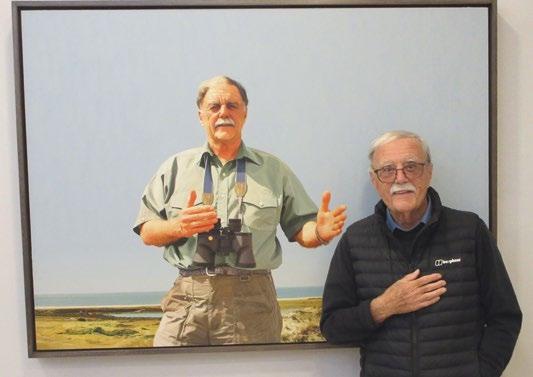
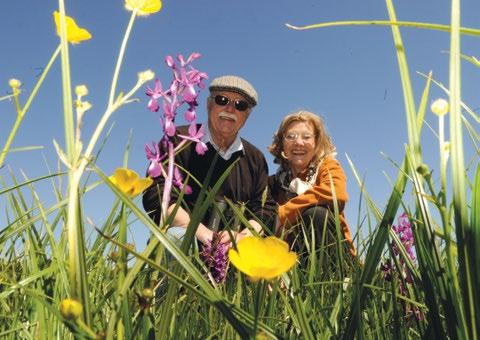
Hotel where the dulcet tones of the WI ensured a bulging collection tin. What days they were!
What’s the biggest change you’ve seen in the Island over the years?
Change always has to be expected but I think we must all take heart in the fact that, unlike many urban areas, rural Trinity continues to maintain a recognisable quality of life – apart from the traffic, that is.
Who stands out as a memorable parish personality (past or present) and why?
Being a voluntary guide at the Jersey Zoo during the 1970’s gave plenty of opportunities to meet with Gerald Durrell. Christmas was always extra- special when a party was held for volunteers, the star of the show always being the great man himself.
your favourite spot in the Parish?
Far too many to choose from, I’m afraid, but apart from cosy little Naparima Cottage, moments of reflection from a Trinity coastal headland takes an awful lot of beating.
Which Islander (past or present) would you like to chat to over dinner?
My dear friend Dr Michael Romeril who I worked alongside in the environmental restoration of St Ouen’s Bay. Before his retirement to the UK, Michael was the States Environmental Advisor who occasionally returned to Jersey on holiday and always ensured a social catch-up. Michael passed away in 2024 and with so much still to mull over, a few more hours chatting about the ‘good old green days’ would be absolutely marvellous.
If you could change one thing on the Island, what would that be?
Unfortunately, we can’t put the clock back to the days when collective politeness, patience and respect were everywhere. Adding a few more genuine smiles from strangers would, I think, strengthen, even more, the Island’s amazing ‘feel-good’ factor.
Can you describe our Parish in 3 words?
(ACE) - Astonishing - Creative - Enchanting
The 2025/2026 season has been in full swing for the Trinity minis and juniors with all age groups developing with training and matches organised by the coaches. For the older groups, the Trinity teams have been competing in the JFA leagues and playing some excellent football.
Some of the Trinity players have even been catching the eye of some of the Jersey Bulls coaches with Trinity players supporting both the Jersey Bulls girls and boys squads. This is a great testament to the players, parents and the hard work and dedication of the volunteer coaches who give up their time each week to develop and support junior football. Connecting with the Jersey Bulls has been a feature for Trinity junior football over the past few seasons with a number of the teams attending some of the Jersey Bulls match days as mascots at Springfield.
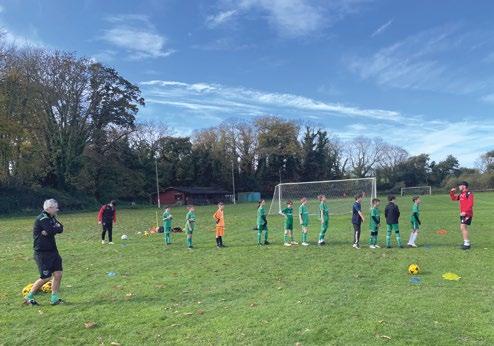
Before Christmas the Trinity Yr6 team welcomed a visit from a couple of surprise football coaches one Sunday morning when Jersey Bulls captain James Queree and star player Jonny Le Quesne gave up their own time to take a training session for the Trinity players. Both James and Jonny provided a first-class training session involving drills on skills, teamwork and shooting, followed by a game. This was the opportunity for James, Jonny and the players to show off their skills, which all of the players enjoyed.
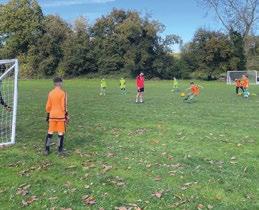
This training session was a great advert for Jersey football and local community spirit coming together to support and enhance grass roots football. Trinity junior footballers will no doubt continue to develop, with every chance of representing Jersey in both the male and female teams in the years to come.
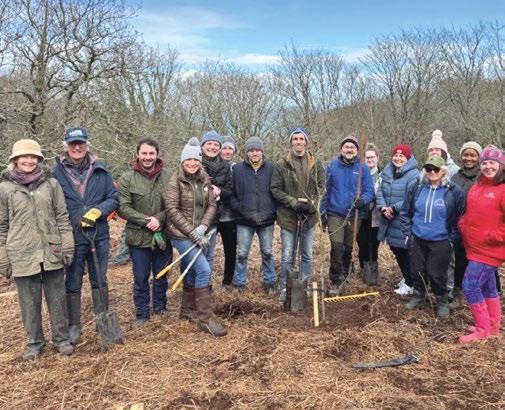
As part of the management plan laid out by Ecologist John Pinel, volunteers have been busy planting trees at Egypte Woods.
The main aim of the plan is to expand the woods, ensuring they are safe for the public to enjoy and to protect the land from too much human disturbance.

Sponsored by Greening Jersey (a Jersey Finance initiative to rewild parts of Jersey) just under 300 trees have been planted comprising numerous species including wild pear, bird cherry, rowan, medlar, larch and walnut.
This planting marks the first stage of woodland expansion in the area and work will continue throughout the coming months and years. If you are interested in helping please contact John Michel at Trees for Life who will be happy to tell you more.


**Based
Get up to £9,000† towards switching to electric heating, with a government incentive.
Discover the cost of switching using our online tool at switchon.je.
Using an air source heat pump you could save up to 50%** on your heating bills compared to an oil boiler. Contact us today for a free, personalised estimate on 01534 505600.

Whether you’re looking to protect wealth, grow your investments or prepare for life’s important events, the support of an expert can help you make the most of your money.
Drop in, say hello, and find out more about how we work, the services we provide and how we support islanders every day.
Stay tuned for confirmed dates and more details.


Sixty solar panels have been installed on the Acorn Reuse donations building – and they are going to fuel Acorn’s new electric vans.
Acorn, which aims to be carbon neutral by 2030, already has solar panels on its café roof which have been delivering savings since 2021. Acorn executive adviser Steve Pearce said: ‘We worked with Acacia to carry out an assessment of all of Acorn’s impacts on the environment and society, both negative and positive. By installing more solar panels, we can increase our production and consumption of renewable energy and reduce our carbon emissions. The additional electricity generated will be used to power lighting and heating, as well as to charge two new electric vans. ‘We were happy to work with SunWorks again, and we are incredibly grateful to the Roy Overland Charitable Trust for backing the project.’

This year, two new Renault electric vans will be seen on Island roads for deliveries and collections. One has been jointly funded by the Association of Jersey Charities and PwC, and the other by the Jersey Community Foundation.

In addition, the charity secured funding from the Robert Hall Foundation for the installation of a new charging point on their Trinity site. Steve said they were very grateful for the generosity of funders. ‘We couldn’t do it without them. Solar energy contributes to Acorn’s financial and environmental sustainability and enables us to focus our funds on our charitable purposes, providing work and training for Islanders who have a disability or longterm health condition.’
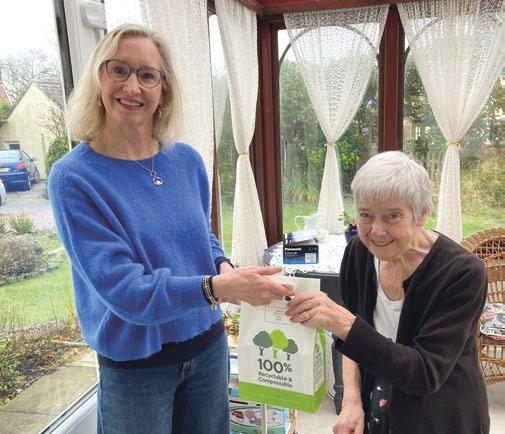
We have a well respected team of community support volunteers, but at times we struggle to meet requests for help. Whilst many charities are asking for people to get involved, we just ask you to consider ways you can help close to home.
Our team is slightly different in that we do not need a regular time commitment, we put the calls out to our volunteer group as a whole, knowing that all we need is one person at a particular time who happens to be available. The more volunteers that we have, the higher the chances of success. We check out the requests that come and volunteers are all DBS checked (and we can help arrange that if needed). Our volunteers can help out once a month or once a year. Super flexible!
Whilst offering practical assistance our volunteers help to ensure that each visit is also a positive, friendly contact with folk who may need some reassurance and emotional support.
150! That’s the number of times our team of volunteers were able to help parishioners in 2025 We are currently a team of 15 volunteers, plus the four phone holders, and we are so grateful for their time and companionship. We understand that folk are very busy these days - but we see all the time that ‘every little helps!’ Mobile - 07797 741285


By the autumn of 1944 the Channel Islands are starving but on 27 September, Winston Churchill writes: ‘I am totally opposed to our sending any rations to the Channel Islands for the civil population thus enabling the German garrison to prolong their resistance.’
Then, not for the first time, the prime minister has a change of heart. “If they’re starving,” he barks. “We must invade. I recall Mountbatten had a plan, Operation Condor. Get it dusted off!”
Despite immediate objections from the Chiefs of Staff that the Channel Islands are irrelevant to the thrust towards the heart of the German Reich, Churchill points out that the alternative is to send food to the Islands. “Any such sustenance will be seized upon by the Boche. A show of real force should be sufficient.”
Churchill is insistent and Mountbatten’s plans from 1943 are revisited.
Churchill himself proposes a task force comprising the battlecruiser HMS Renown and the Jutland veterans HMSs Royal Sovereign and Resolution, all currently in home waters, supported by a screen of antisubmarine destroyers.
“These islands are truly impregnable fortresses,” Churchill is warned.
He retorts, “Manned by a garrison that is hungry. They may be materially strong but spiritually they are weak. It can be done! It will be done!”
“Inevitably there will be civilian casualties,” Churchill is warned again.
“Surely they will be few, particularly if the attack takes place before dawn on a Sunday. This can be done! See to it!”
Thus plans are laid. The show of force will take place at dawn on Sunday, 8 October.
At 0630 Central European Time on Sunday, 8 October, the approach of three heavy units with escorts moving at high speed towards Jersey is reported by the Würzburg radar situated at Guernsey’s Fort George .
The invasion of the Channel Islands is nigh and within an hour the entire German forces in Jersey have retreated to their underground shelters and bunkers.
It is still dark at 0745 CET when HMSs Royal Sovereign and Resolution open fire on Jersey with their main armament, each firing three full broadsides. Their targets are Batterie Lothringen
It is understood that Admiral Friedrich Hüffmeier, commander-in-chief of the German forces in the Channel Islands, in April 1945 and despite Germany’s defeat being inevitable, stated to Jersey’s Bailiff Alexander Coutanche that ‘you and I will be eating grass before I surrender’. Even if that’s a myth, it makes a good title.
Compiled by Peter Tabb


at Noirmont Point, the airport and St Helier’s harbour installations, areas believed to be largely free of civilians
Several shells miss their targets and cause major damage in the town behind the harbour and in the countryside around the airport. A few civilians, although less than a dozen, caught in the open while hurrying to shelter, are killed but no member of the garrison suffers any injury.
The bombardment is halted at 0800 CET.
In the Royal Court House in St Helier, a stunned Bailiff Coutanche, who has just arrived behind his desk because of the curfew, telephones the Platzkommandantur but receives no response. He hurries down to the Royal Square where he is joined by Charles Duret Aubin, the AttorneyGeneral, still wearing a pyjama jacket under his overcoat.
Duret Aubin is aghast. “Surely we are not under attack, Mr Bailiff?”
“It seems, Charles, that we are…”
“Where are the Germans?”
“They must have gone to ground. Like the rats they are…”
In the aftermath of the brief bombardment, the breaking silence is eerie.
At that moment a signal is being received at the Kriegsmarine wireless station at St Jacques in Guernsey from the GOC Southern Command advising Generalmajor Graf von Schmettow that the subjugation of the Channel Islands has commenced with a bombardment of military targets on Jersey. Further bombardments will follow unless the garrisons indicate their immediate intention to surrender. The signal concludes that the


German will be held responsible for any civilian casualties. The German commander-in-chief has an hour in which to make up his mind.
In Guernsey von Schmettow mutters, “They are killing their own people.”
“They will claim that we are letting them be killed, Herr Generalmajor.” The dry comment is made by von Schmettow’s chief-of-staff, Vizeadmiral Friedrich Hüffmeier.
Von Schmettow raises an eyebrow. “Are you suggesting we comply, Friedrich?”
Hüffmeier flushes. “Certainly not! Our ultimate victory is certain, Herr Generalmajor. We must not weaken now.”
“Then what do you suggest, Friedrich?”
“We fight back, Herr Generalmajor.”
“The Tommies are out of range of our guns, Friedrich, even Batterie Mirus… We are facing an enemy we cannot fight…” Yet to surrender would be regarded by Berlin as treason, with untold consequences for the families of the men who had committed it.
“Herr Generalmajor, I suggest we sit out any assault. The defences are quite capable of withstanding this type of bombardment. If the Tommies attempt a landing, then we will annihilate them on the beaches…”
“What about the Islanders?”
“Their fate is in the hands of their countrymen. It is my suggestion that we remind the British of that.” He looks at his watch. “Before their deadline…”
Von Schmettow confers with his senior officers. In the tobacco smoke-filled headquarters there is no talk of surrender but concern at the number of civilian casualties.
“It is war,” Vizeadmiral Hüffmeier retorts.
“Quite so,” agrees von Schmettow. “Nevertheless I propose that we seek an armistice…”
Vizeadmiral Hüffmeier is outraged. “An armistice! This is treason!”
“Friedrich, Friedrich…” von Schmettow soothes. “Hear me out. What I propose is an armistice, for 48 hours, to allow the Britsih to discuss with us the evacuation of the civilian population…”
“The Führer will never agree. The civilian populations are an important bargaining counter…”
“Indeed, Friedrich. But we cannot be held to blame for the consequences if our offer is refused…”
“But just 48 hours? How will the Tommies evacuate more than 60,000 civilians in just 48 hours?”
“They will have to find a way.” Von Schmettow chuckles. “I recall they withdrew more than 300,000 combatants from Dunkirk in a matter of days. And this time there will be no-one shooting at them.”
“The man’s a fantasist!” Winston Churchill is still in his silk pyjamas although a cigar is already clamped between his teeth. Brendan Bracken gently disagrees. “Not necessarily, Prime Minister. I suspect he recognises that having some 65,000 British civilians at his mercy gives him significant bargaining power…”
“Not with me, it doesn’t!” The PM turns to his naval adviser. “Could it ever be possible? To evacuate so many civilians in just two days?”
Admiral Cunningham scratches his jaw. “In theory, yes. But in practice, no.”
Churchill paces the Cabinet Room pausing to stare out at Downing Street.
Eventually he speaks. “Gentlemen, I have decided. Notify the Germans that we agree that the International Red Cross feed the civilian population.” A blast of cigar smoke. “Give the order to the Navy to withdraw. Tell the admiral ‘well done’.”
The foregoing is a work of fiction. It did not happen but it might have done.

The foregoing is a work of fiction. It did not happen but it might have done.


















“What Was but What If” will be published later this year.

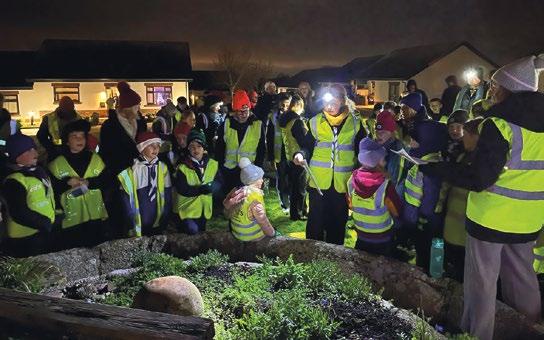
The 6th Jersey Scout Group has had a lively and rewarding start to the year, with each section enjoying a wide range of activities and opportunities.
Our youngest members in Squirrels have been exploring science through hands-on experiments, including learning how to grow caterpillar grass heads. Alongside this, they will soon be putting their navigation skills to the test and beginning some basic first aid activities, helping to build confidence, curiosity and practical life skills from an early age.
Beavers have plenty to look forward to, including visits to the Lego Club at the library. They also recently enjoyed celebrating Burns Night with our sister colony at St Mary’s, sharing a lovely evening of food tasting, music and dancing together.
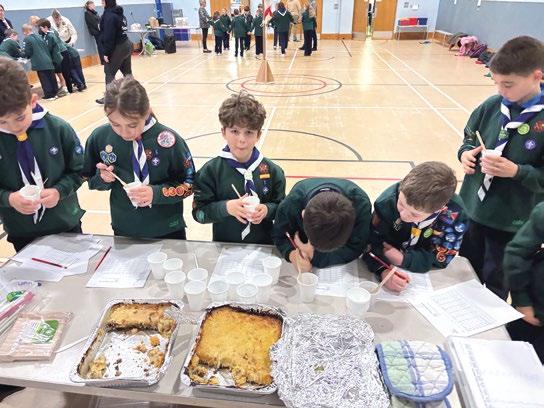
The Cubs section has been just as busy. Cubs took part in green bowling with Alan Otterwell and the team, an activity that was thoroughly enjoyed by all. They also marked Burns Night with traditional food tasting and Scottish dancing, making it a fun and memorable experience.
In the Scouts section, Eunice Fromage has taken on the role of Scout Leader following Tim Saunders stepping down at Christmas. Eunice brings a wealth of knowledge to the role and continues to lead the Squirrels section while we look to recruit additional volunteers. Scouts are also looking forward to Lego Club sessions and science experiments led by our resident science teacher, Colette.
As a group, we were extremely proud of our Christmas hamper deliveries and carol singing in mid-December. We are truly grateful to Waitrose Valle des Vaux, La Mare Wine Estate, Jersey Dairy, the parish and Trinity Parish helpers for their generous support.
We are always looking for new volunteers. If you would like to get involved, please contact GLV6TH@SCOUTS.ORG.JE


Islanders seeking freedom from glasses or contact lenses can now access expert vision correction closer to home. Led by renowned refractive surgeon Mr Mike Tappin, Evolution Eye Care’s Vision Correction Service has become an established part of its regular clinic schedule.
Patients considering treatment are assessed in Jersey directly by Mr Tappin – the same surgeon who would perform their procedure.

Mr Tappin is a leading surgeon with over 30 years’ experience in refractive surgery. He conducts clinics in Jersey, and operates at Prema, a state-ofthe-art surgical facility in Portsmouth operated by Laser Vision UK. Prema is conveniently located just 20 minutes from Southampton airport, with three modern hotels next door if accommodation is required.
“Our goal is to make the vision correction process as seamless and reassuring as possible for Jersey patients,” said Mr Tappin. “By combining consultations onisland with surgery at Prema, patients on our collaborative pathway receive the convenience of local care, with the safety and reassurance of a leading UK surgical environment.”
“It’s important that patients meet the surgeon who will perform their procedure,” added Mr Anish Shah, co-founder of Evolution Eye Care. “That continuity builds trust and ensures decisions are always made in the patient’s best interests.”
Some refractive clinics offer free consultations. This can create pressure to convert enquiries into surgery, just to cover costs. At Evolution Eye Care, a £99 vision correction consultation fee reflects a commitment to transparency, allowing the clinic to provide honest, impartial guidance –even if the best recommendation is not to proceed with surgery.

“Charging a modest consultation fee allows us to offer genuine advice rather than sales-driven opinions,” said Mr Shah. “Our patients receive clarity, not persuasion.”

Prema is equipped with modern, regularly serviced laser and surgical equipment, maintained to the rigorous standards required by the UK Care Quality Commission (CQC). This ensures every procedure is performed with the precision, safety, and reliability expected of the UK’s top ophthalmic centres.
Jersey patients are already benefiting from this trusted and convenient pathway, exploring laser vision correction or lens replacement surgery with world-class expertise and modern technology – all coordinated through Jersey’s largest private eye clinic.
For more information or to book a consultation, visit www.evolution.je/book email info@evolution.je, or call 01534 835400

1st Floor
Little Grove Clinic
Rue de Haut
St Lawrence JE3 1JZ


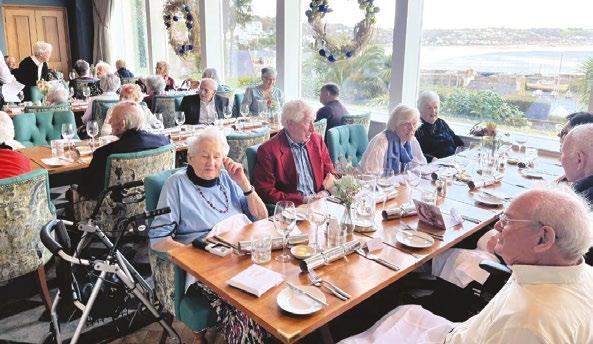


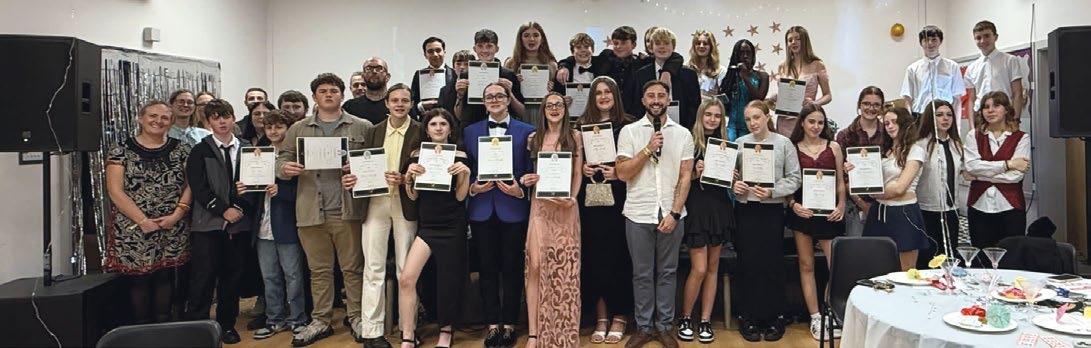
We are incredibly lucky at Trinity Youth Project to have an amazing young volunteer team with 26 young volunteers in total.
In fact, they’ve become so committed that we’ve had to put them on a rota! In 2025, they have collectively given up over 700 hours of their own time to support others. That is an incredible achievement.
Every single week, they show up. They participate. They plan. They lead.
And most importantly—they make a difference.
We ended 2025 in style by celebrating our young people with a big ‘Yoscars’ event. We decided that if we were going to do the Yoscars… we were going full glam so on the night, we had:
• Bouncers on the door,
• Paparazzi and photo opportunities,
• A red carpet,
• Mocktails,
• A chocolate fountain,
• A live band for entertainment

We were also really honoured to have some special guests attend and present our certificates: Constable Philip Le Sueur, Deputy Hilary Jeune, and Jersey Youth Service’s Principal Youth Officer Bradley Cooper.
There were three levels of awards available — Bronze, Silver and Gold — each with different criteria.
• Bronze was for young people who got involved in a wide range of youth club activities.
• Silver was for those who helped plan different youth project activities.
• Gold was for young people who take a lead within the youth club.
We were proud to present 13 Bronze, 7 Silver and 3 Gold awards on the night.
Each year, we also award the Dawn Dennison Memorial Trophy to a young worker who has gone the extra mile and shown outstanding dedication. I know I say this every year, but with such a strong team, it truly feels almost impossible to pick just one winner. And this year… we just couldn’t so we had two joint winners! Both young people have grown so much, shown real leadership, and become amazing role models within the team. A huge congratulations to Summer and Jenna — both incredibly deserving winners of this year’s Dawn Dennison Trophy.

Here’s some tips for the colder months
The nerves which detect temperature in your feet can be damaged by diabetes. This is called neuropathy. If you have neuropathy you may not be aware that your skin is being damaged. Heat damage can lead to blisters which can become infected and ulcerate.
Check your feet at least once every day - twice is better! This is because neuropathy can also mean that you do not feel pain. If you cannot see to check your feet, ask someone else to have a look or use a mirror to look underneath.
If you are planning to have a bath or soak your feet, use your elbow to check the water temperature. Your hands can also be affected by neuropathy and thus are generally less sensitive to heat.
Keep your feet warm with socks, make sure that the seam does not cause pressure or irritation to your toes - you can turn them inside out or buy seamless socks. Try to avoid tight elastic around your legs as this can restrict blood flow and result in swelling.
Never apply direct heat to your feet, therefore do not use hot water bottles, electric blankets, heated socks, wheat bags or heat pads.
Never put your feet onto a radiator or heater, keep a safe distance from fires and be aware of the foot-well heater in the car. This can get hot enough to burn your feet.
Check your shoes or slippers before you put them on. Make sure that nothing has fallen into your footwear and that linings and insoles are smooth.
In wet weather, try to wear waterproof boots or shoes. Skin is more fragile when it becomes wet and prolonged wetness can make your feet more prone to damage.
Do not walk around with bare feet. You could easily stand on something which might damage your skin.
Wash and dry your feet carefully, paying particular attention to the spaces between your toes.




Moisturise your feet every day, particularly around the heels where skin is most likely to split.













If you have diabetes, regular checks will prevent minor cuts or blisters developing into something serious.
Remember, check your feet every day – twice is better!
With Development Works underway to prepare the Overdale site for construction, and with the ongoing procurement process to secure a Main Works Delivery Partner running in parallel, a new hospital for Jersey has never been closer.

If you drive past the Overdale site, you will notice it has changed progressively in less than two years – from delivering healthcare services to demolition, to an active construction site.
Ashbe Construction - along with local sub-contractorshave removed the areas of remaining hard standings and residual structures below the ground and cleared the site area. Good progress is being made on the site hoardings, which are currently being installed around the perimeter. Once complete, a total of 1,500 metres of hoardings will surround the full site.
Other Development Works to provide the required temporary and permanent water, electricity and drainage infrastructure to the site are also underway. Temporary water supplies have been installed along Westmount Road to the site, and the JEC substation installation for the Acute Hospital was completed in December.
In addition, local drainage diversions within the site have been planned and are scheduled for completion to enable the next phase of works. A new borehole has also been provided to supply the Rose Garden at the Crematorium. Finally, early works are underway to start creating the Active Travel Route from the JEC Substation on the inner road - all under the supervision of an Ecological Clerk of Works and in accordance with Planning Conditions.

A ‘hospital shaped hole’
A ‘hospital shaped hole’ can already be discerned in the hillside – but this will be taken down to near formation levels in the next Development Project that is currently out to tender. The foundations for the new Acute Hospital can then be formed.
With all these preparatory works underway - which have so far been won by local contractors - the site continues to be readied for the Main Works Delivery Partner to begin construction. More than a year of detailed procurement work has culminated in the selection of the Preferred Tenderer – Bouygues UK – to build the Acute Hospital. At the time of writing, they are preparing their final offer for the works, with Meet the Buyer events between Bouygues UK and local suppliers having taken place last month to understand the capability, capacity and skills available locally to support the final phase of the procurement process. The overview presentation was full to capacity and more than 100 face to face meetings between local suppliers, Bouygues UK and the New Healthcare Facilities team were held.
While delivering the Acute Hospital at Overdale has been the most immediate priority - and is the critical path to all of the future facilities - it is one part of the wider, long-term vision for multi-site healthcare for Islanders.
As the Acute Hospital moves into the construction phase, it begins to unlock further work across the wider portfolio of healthcare sites, including the Ambulatory (outpatients) facility at Kensington Place and the Health Village at St. Saviour. Whilst the Kensington Place site is not available for public use owing to its close proximity to various sensitive activities on the hospital access road, it has been used as much needed storage and operational space.
A significant amount of work is currently underway to refine the briefs and proposals on the other major healthcare facilities’ sites. Over the past six months, the New Healthcare Facilities team has met with more than 150 healthcare colleagues to ensure that the Development Control Plans and Functional Briefs developed nearly three years ago are fully refined and reflect Jersey’s current and future healthcare needs, especially with the ongoing progression of digital technologies in medicine.
In the months ahead, as work continues to progress, more detailed information about the next steps for these sites will be shared. We are looking forward to sharing these proposals with you, neighbours and other stakeholders to take your feedback – just as we did on the Acute Hospital site that has now progressed so far.
Just because you can’t make it to the Town Library, Communicare Library, or the Mobile Library doesn’t mean you have to miss out on the joy of reading.
Jersey Library offers a completely free home delivery service for anyone who finds it difficult to visit in person, whether due to health issues, mobility challenges, or full-time caring responsibilities.
The service is open to people living independently at home as well as those in residential care. When you join, a member of our friendly library team will chat with you about your reading preferences. Whether you need normal print, large print or audiobooks, and the genres and authors you most enjoy. We then hand-pick a selection tailored especially for you, so every delivery feels like a personalised book bundle.
Our dedicated team of library volunteers delivers books across the island, covering 12 routes each month. In 2025, we made more than 800 deliveries to around 80 readers. For

many, this service is a lifeline, a way to stay connected, entertained, and comforted by the pleasure of reading.
If you or someone you care for would like to use this service, please contact Angela at the library on 448700 or email je.library@gov.je
We’re here to help bring books straight to your door.

MONDAY
10:00 - 11:00
St Ouen's Parish Hall
11:15 - 12:15
St John's Parish Hall
TUESDAY 09:30 - 11:00 Holme Grown 11:15 - 12:45 Gorey Common Carpark 14:30 - 16:30 Jersey Zoo
WEDNESDAY
09:30 - 11:00 Langtry Gardens
11:15 - 12:45
St Martin's Village Green
14:30 - 15:30 Le Rocquier School


Located on the edge of the Jersey National Park in St Ouen, Maison des Landes Hotel and Community Hub is nestled amidst breathtaking countryside and offers panoramic sea views.
Built around a strong sense of community and run by a charitable trust, we have recently celebrated 60 years of welcoming locals and visitors to the island, with the very best in modern design to provide a fully inclusive environment.
Want to try a new restaurant?
You’re in for a treat! Chef Sachin and his team proudly create fresh, locally sourced dishes at very reasonable prices. We also welcome group lunch and afternoon tea bookings. Join us for lunch on Easter Sunday, we’d love to see you!
Relax and recharge whilst enjoying the tranquil gardens and uninterrupted coastal views. Swim in our indoor hydrotherapy pool, maintained at 33 degrees, which is perfect for relaxation and rejuvenation. With 15 out of 23 rooms adapted to suit a range of needs, everything has been thought through.
Looking for somewhere different for an event or special occasion?
Our stunning venue is perfect for a wedding or special occasion, wellness retreat, corporate offsite, or private event in a calm, natural setting.
At Maison des Landes, our guests come first. Friendly, dedicated and always willing to go the extra mile, our staff team take genuine pride in what they do, and nothing is too much trouble.




During April and May, we’re offering over 50% OFF a delicious two-course evening meal and a choice of full English or continental breakfast.
• £129 per night for 2 adults
• £85 per night for 1 adult
• £99 per night for 1 adult and 1 child
• plus £20 per night per child
These offers are open to Jersey residents only and are valid for stays during availability at time of booking.

To book please call the hotel directly on 01534 481683 or email reservations@maisondeslandes.co.uk

Spring is perhaps the best time to enjoy this walk, and this edition is the most fitting to include an appreciation of it, for one reason — snowdrops. Snowdrops grow in abundance along the top of a côtil at the southern end of the walk leading to Rue du Moulin de Ponterrin and also along the banks of the road going down to the ruins of the mill.
As I write this in the second week of January, snowdrops are just beginning to appear in hedgerows around the island, but nowhere do they make such a glorious show as in this area.
Thanks to the goodwill and public spiritedness of the landowners who have granted a licence to the Public to maintain this path over their land, it is possible to enjoy a picturesque stroll along the eastern side of Trinity valley from Rue de la Blanche Pierre to Rue du Moulin de Ponterrin exiting at the top of the steep hill above the mill. Known perhaps only to a few locals in the past, the path was opened formally to the public in 2018. Turning left at the end of the path, instead of going down to the mill, approximately 200 yards up the road there is another shorter path running parallel to the snowdrop walk which will take you back to the road known as La Rondiole leading to Victoria Village near the turning to Rue de la Blanche Pierre. Both are earthen paths which, though occasionally muddy in places, add to their attraction.
Apart from snowdrops, which sadly will no longer be flowering by the time this edition is published, there is much of interest to take in along the path. Marked by a wooden fingerpost, the entrance at Rue de la Blanche Pierre lies opposite the old mill pond for Ponterrin Mill. Remains of the sluice gate are still apparent at the start of the leat which runs through a culvert under the road and then below the path which winds its way
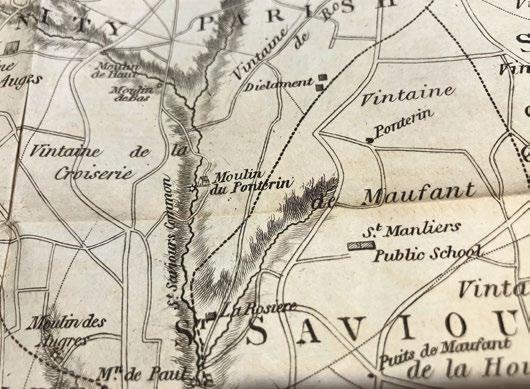
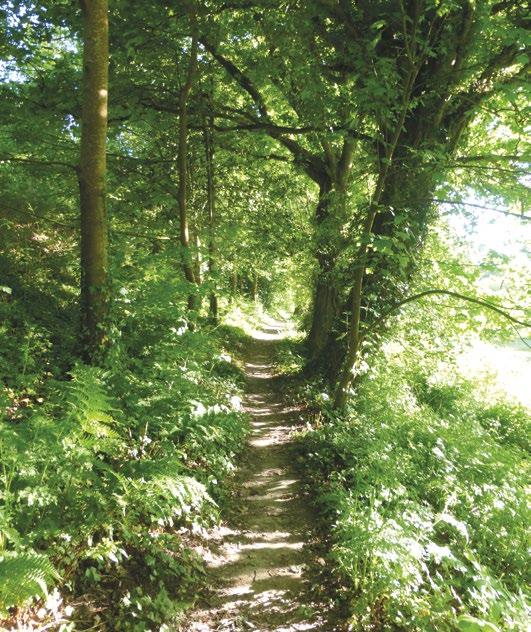
along the side of a wooded bank until reaching a meadow from which two streams flow into the leat. Roderick Dobson, a noted field naturalist who wrote a popular study entitled Birds of the Channel Islands (1952), owned the nurseries now occupied by the Orchid Foundation. A subsequent owner of the nurseries built a small pond at this point fed by the leat, from which water was pumped up to the greenhouses. However, one night there was a tremendous explosion which destroyed the pump and its shed — only the foundation remains. He also organised shooting parties aiming at snipe, a timid bird which thankfully can still be seen sheltering over the winter months in the valley.

The small pond is no longer there, and the leat was diverted across the meadow forming part of what was Ponterrin Common on the valley floor, and now flows into the main valley stream which eventually reaches Grands Vaux Reservoir. The original distance from the mill pond to the mill is almost half a mile long. Whether from a lack of water, or more likely, problems maintaining the leat, by 1892 a steam engine was installed to run the mill which made the water wheel redundant, and the leat from this point fell into disuse and is now filled in. The attached photograph taken at the end of the 19th century, the only image known of the working mill, shows the brick chimney built for the new steam engine. Interestingly, an ancient mill path, no longer accessible, which dropped down from Rue de la Blanche Pierre (at the entrance to La Vieille Maison), across the valley and ran alongside the old leat to the mill, is shown on a map attached to the inside cover of W. Plees’ Account of the Island of Jersey published in 1817.
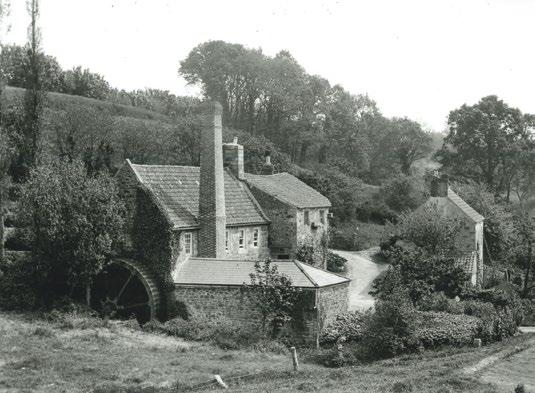
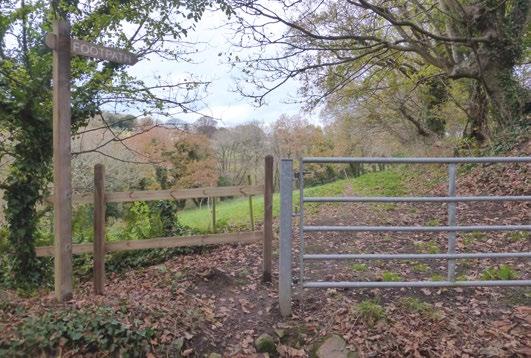
Having crossed the two streams at the base of the meadow, one is confronted by a dramatic, if tragic, prospect in the form of a devastated beech copse which has been blasted twice recently — by Storm Ciaran in 2023 and by Storm Goretti this month. The copse was, and to a reduced extent still is, unique, being the largest beech tree plantation in the Island. The storms have blown down or damaged at least half of the trees, and it is now necessary to access the path through two large upturned root balls of two magnificent trees, one felled in each storm. It is to be hoped that replanting will take place, but only future generations will experience what was once enjoyed.
Emerging from the copse on to a côtil overlooking the valley, the path continues under the lee of a high bank where the snowdrops flourish. A veritable white carpet at their best, it’s a sight not to be missed — next year!
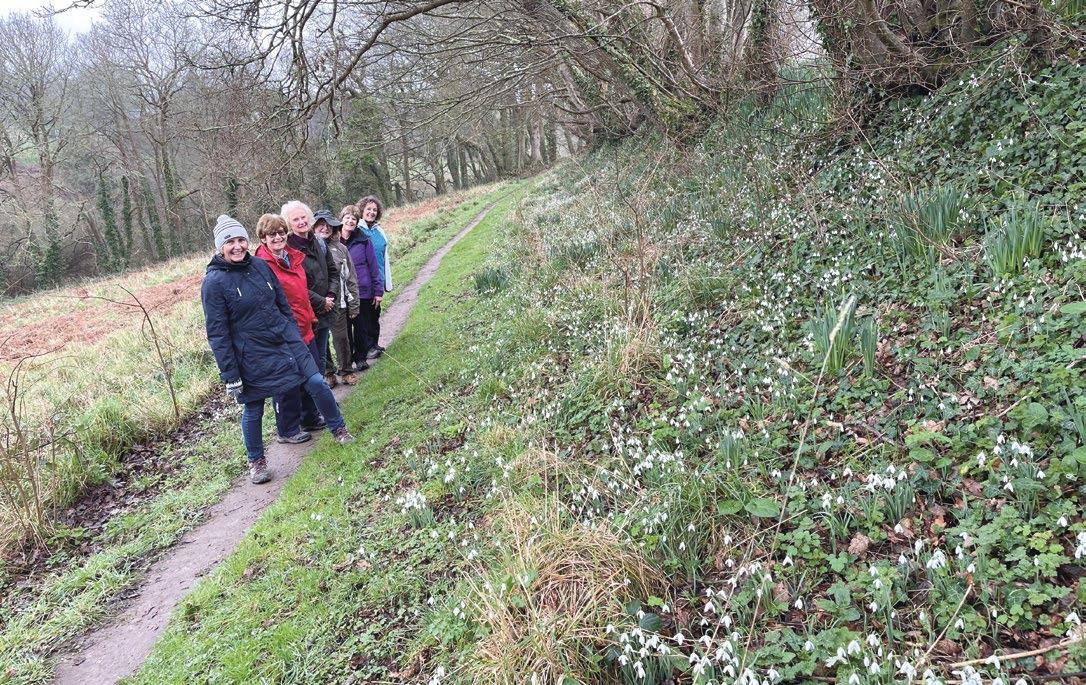

When
Queen Elizabeth II acceded to the throne in 1952, there were over 30 million hedgehogs roaming around Britain. As her reign came to an end in 2022, there were less than one million.
Ido not attach any blame to the late monarch for the demise of the hedgehog population; I merely give pause for thought.
Jersey’s much-loved mammal is now ‘threatened with extinction’. The International Union for Conservation of Nature has placed them on the red list after numbers declined by 30% in just the last 10 years. Our experience mirrors this. We have admitted far fewer hedgehogs this year, with many of them so sick, injured or emaciated that they could not be saved. Yet we fight on, knowing that the work we do at Jersey Hedgehog Preservation Group means each and every hedgehog we can treat and release back into the wild is a precious life saved.
Hedgehogs do not hibernate during the mild Jersey winter, except during exceptionally cold snaps. They will be out and about looking for food when the weather allows.
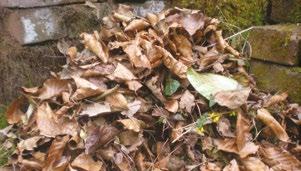

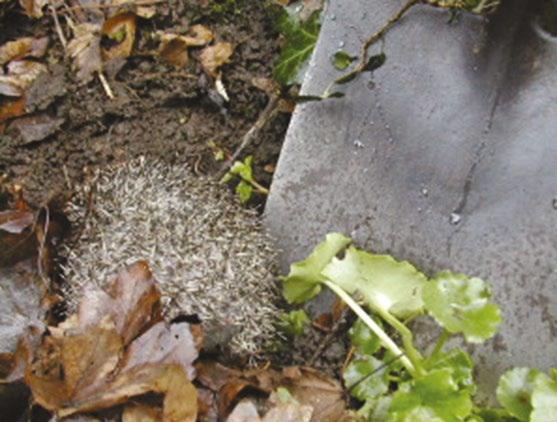
They will have built weatherproof winter nests called hibernacula. Favourite nesting sites are in piles of twigs and leaves, compost heaps, pampas grass, thickets, long grass and log piles. As you begin to tidy the garden ready for spring planting, please be aware that you may be disturbing more than earthworms! Take great care when turning over your compost heaps or raking your leaf piles.
It goes without saying that you should refrain from using pesticides; there are many cost-effective natural remedies to ensure your garden grows beautifully. If you are strimming or mowing weeds and long grass, please check carefully for sleeping hedgehogs before you start. CHECK BEFORE YOU CHOP!!
If you net your fruit bushes, leave a 13cm gap between the ground and the bottom of the net and put football goal nets away: you would be amazed how many hedgehogs get caught in netting!
If possible, leave some wild areas alone – leaf piles as they rot down, bug hotels, twigs and log piles are also home to the very beetles and bugs and other invertebrates that supply the hedgehog's natural diet. However, supplementing that diet with a small dish of cat food or small dog kibble will be appreciated, particularly in dry weather when there is less natural food around. Never give mealworms, sunflower seeds, peanuts, or milk and bread (hedgehogs are lactose intolerant).
Finally - would your school, charity or association benefit from a visit from one of our volunteers?
In addition to rescuing, rehabilitating and releasing sick, injured and orphaned hedgehogs, we are also here to educate the public about hedgehogs and the dangers they face going forward.
If you think your organisation would be interested in finding out more about our prickly friends, please contact us via facebook, e-mail us at jerseyhedgehogs@hotmail.co.uk or phone on 734340 and we will endeavour to help. You can also find out more at jerseyhedgehogs.co.uk
Thank you for caring!
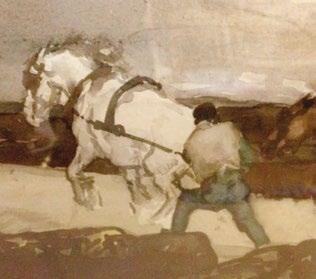



St Brelade Parish Hall
St Clement Parish Hall
St Ouen Parish Hall
Trinity Parish Hall
St Saviour Parish Hall
St Martin Public Hall
Saturday 10am-12pm
Throughout the year we will be offering free legal guidance at the above locations around the island.
All are welcome at each event no matter your parish. No need to register or book, simply show up on the day.

































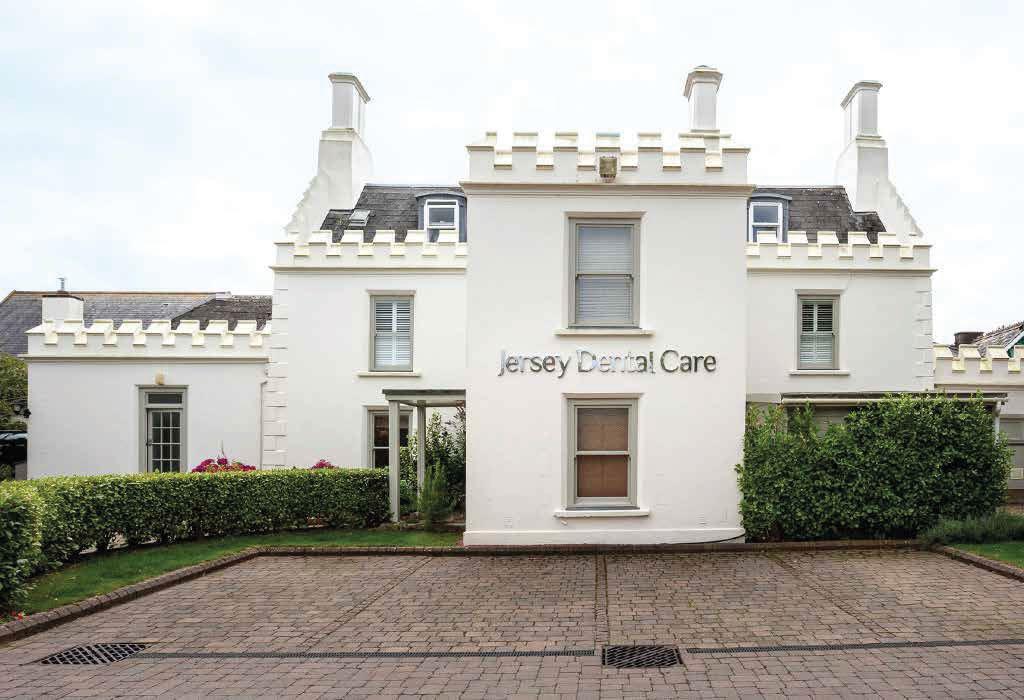

With a strong focus on preventative care, we provide high quality contemporary dentistry in an environment with charm. We believe our patients should have access to trusted resources at any time and our new website is designed with this in mind. Please contact us if you would like help with any aspect of your oral care. We look forward to meeting you or continuing your care.


We’re excited to announce that 32Co clear aligners are now available at our clinic in Jersey, Channel Islands. 32Co is a UK-based, expert-led clear aligner system that helps you straighten your teeth with nearly invisible, custom-made aligners. What sets 32Co apart is its collaborative approach: treatment is planned with the support of specialist orthodontists to deliver predictable, high-quality results that fit your goals — all with comfortable, removable aligners that are tailored to you.



Among a collection of old contracts and documents belonging to the late Maurice Richardson, sometime President of La Société Jersiaise, a document has come to light inscribed on vellum in 1645 recording the creation in 1480 of an obit in memory of a former rector of Trinity Church. The document brings to life people living during one of the most tumultuous periods in the Island’s history.
Obits were masses said for the soul of a dead person and were believed to hasten their journey to heaven through purgatory to heaven. Depending upon the size of the gift creating the obit, or the wealth of the fraternity funding obits for their members, chantry priests might be employed to sing or say masses annually, or even daily, at shrines in churches or in small chantry chapels built for the purpose.
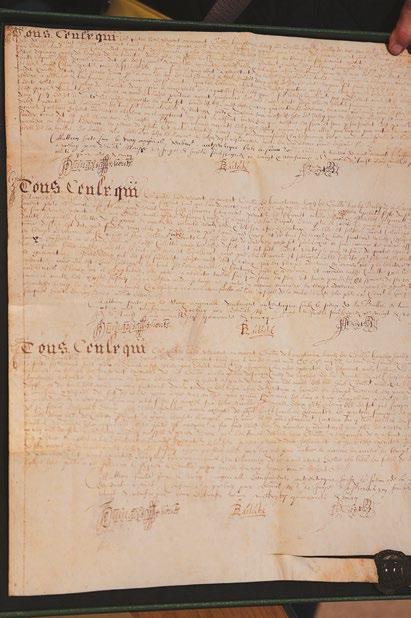
In this case two wheat rentes, one for two quarters, and the other for two cabots (i.e. a total of eighteen cabot baskets full of wheat due to be delivered at Michaelmas to the owner of the rentes) were acquired by the Colin Cabot, the Executor of the former rector’s Executor, in order to carry out the wishes of the Rector Guillaume Malo to observe a weekly mass….’in order to pray to God for the soul of him and of his friends and benefactors.’ (Until the 19th century, transactions, particularly sales of land, were paid for by the creation and transfer of rentes payable in kind and charged against property) during his tenure as rector.
Guillaume Malo became rector of Trinity Church in 1437 and must have been a significant figure in the life of Trinity
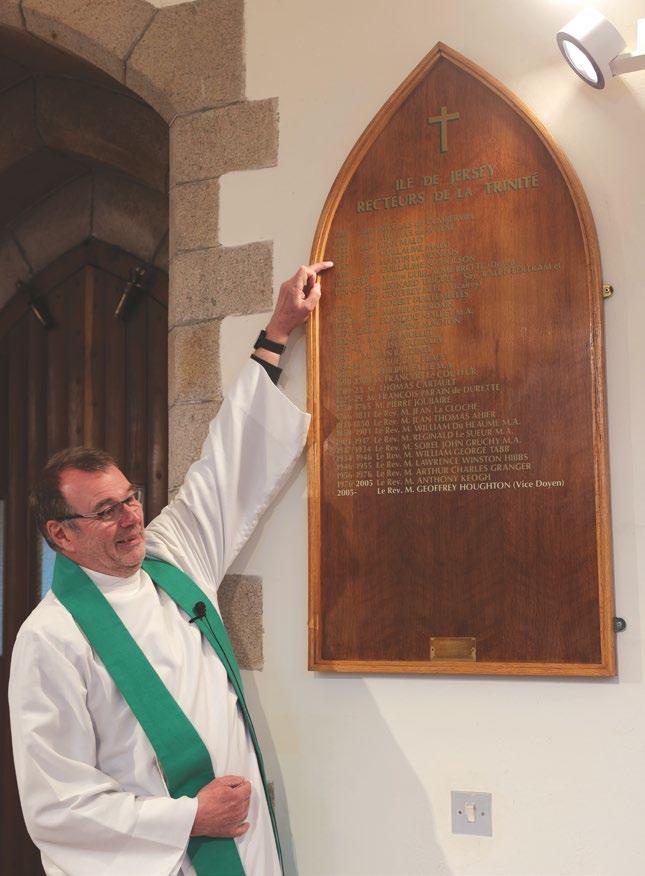
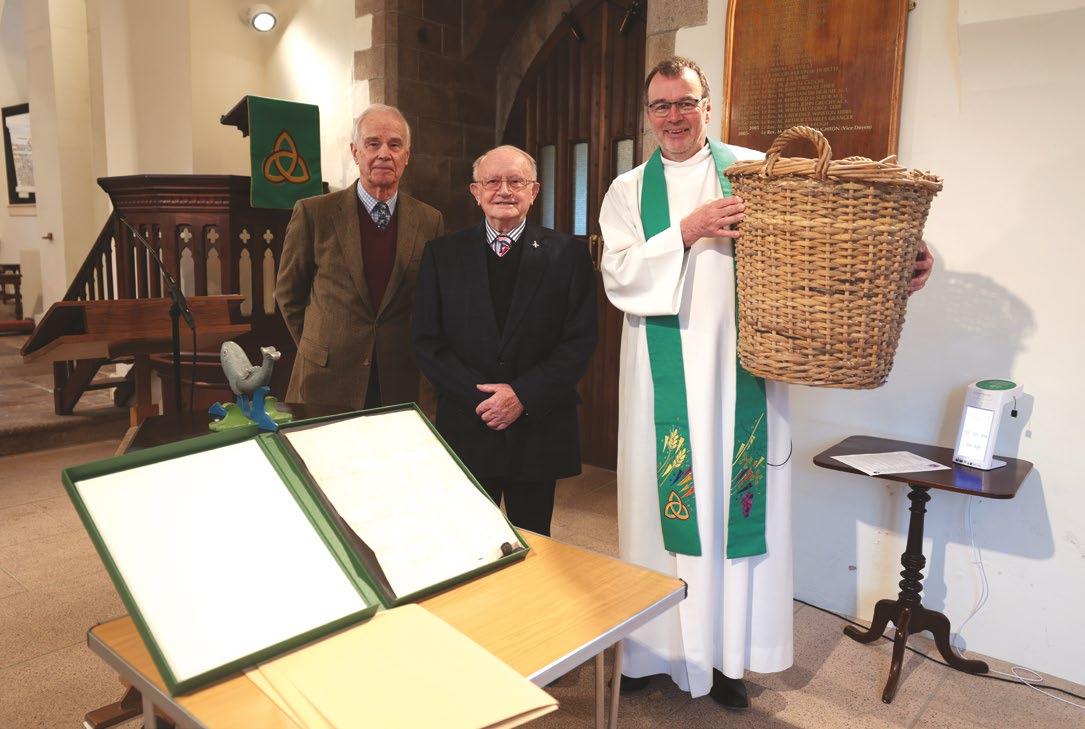
Church, as the north chapel and transept are believed to have been rebuilt c.1450-75 during his tenure as rector, (see John McCormack, Channel Island Churches, 1986). Also, he would have been the incumbent during the seven years when Jersey was occupied by the French until they were expelled following a successful siege of Mont Orgueil castle lasting nineteen weeks in 1468 led by Sir Richard Harliston.
Guillaume himself was French. An ancient charter records that his predecessor rector Jean Malo exchanged appointments with Guillaume, becoming chaplain of the Chapel of St Louis at the Abbaye aux Dames in Caen previously occupied by Guillaume, (A. Messervy’s article in La Société Jersiaise’s Bulletin 1926 citing Rymer’s Foedera (Cart.No.247)). Though the right of appointment at this date would have been vested in the Augustine abbey in Cherbourg, it is interesting to speculate whether Trinity Church had an historic connection with the Abbaye aux Dames in Caen with which it shares the same dedication to the Holy Trinity. The abbey in Caen was founded by William the Conqueror’s wife Matilda, the abbess, to whom the Fief de l’Abbesse de Caen, upon which Trinity Church stands, was probably granted by William.
The identity of Perotyne Fanigot who sold the first rente recorded on the document is also intriguing. She was a Guernsey lady. Referred to as Perrotine Famget, formerly widow of Philippe Johan, then of Thomas Preaulx, she was granted money and rentes by Sir Richard Harliston in the name of King Edward IV by formal deed signed at Mont Orgueil on 15 September 1479 in recognition of the aid afforded by her first husband, Philippe Johan, from Guernsey ”durant le
temps du siége tenu de par nous devant ce Chastel de Mont Orgueil…” (see Note XXVII, page 566 in Charles Le Quesne’s Constitutional History of Jersey,1856). Several named merchants in Guernsey, and fewer in Jersey, were rewarded by Edward IV by charter for assisting the funding of the siege, but Philippe Johan’s name is missing. An unattributed source claims that Fanigot’s husband was murdered in Jersey, which would explain why the grant was made to her.
Postscript. The weekly mass however could only have been observed for seventy years. Henry VIII, by Act of Parliament of 1545, and Edward VI, by a second Chantry Act in 1547, confiscated chantry foundations and their possessions. The Acts were subsequently enforced in Jersey by Crown Commissioners who travelled to Jersey in 1550 charged with selling every type of confiscated ecclesiastical property, the proceeds of which were to be applied to building fortifications in the Island, (see the Introduction by S.W.Bisson to The Jersey Chantry Certificate of 1550.) Thus, there appears (on page 29 of The Jersey Chantry Certificate) at the end of the list of sales of rentes for obits in the Parish of Trinity, the sale on 23 September 1550 to Nicolas Soulemont of two quarters, now split into four smaller sums, formerly endowed “for the mass of Sire Guillaume Malo.” The remaining two cabots may well also have been bought by Nicolas Soulemont with the other Trinity rentes on the same day, but without attribution. Stewart Mourant M.B.E., into whose care the late Maurice Richardson left the document, has caused it to be conserved by Jersey Heritage and has arranged for it to be presented, with a translation and an explanatory note, to Trinity Church.


I’m in employmentfull-time


I’ve studied at Level 6 (undergraduate programme)

Brand new Master’s (part-timeDegree while you work)
CollegeUniversityJersey



I’m doing my my A-levels / Level 3


I’d like to go to university




I’m doing my GCSEs

CollegeUniversityJersey

I’m looking for long-term learning withexperiencehands-on





I’d like to upskill or reskill in a profession Adult & Community Education

Adult & Community Education

I want to continue in full-time study

Apprenticeships
Highlands Apprenticeships
6th Form College Jersey
Students who want to achieve a degree

Study; business, social work, sport + more
Experience local work placements
Earn a UK degree right here on-island
Get tailored support in small classes
PROGRESS TO JOBS OR FURTHER STUDY 96%
Anyone who wants to earn while they learn

Work in your chosen industry
Gain experience and job-ready skills
Get paid while studying part-time
Earn qualifications in your craft
Adults wanting to upskill and get promoted

Study; leadership, project management + more
Choose flexible formats – day, evening, online
Apply new skills directly at work
Gain industry-recognised qualifications


School leavers FULL-TIME

Study Level 3 or JPQ courses
Join work placements + volunteering
Build future-ready real-world skills
Boost your confidence + independence

Look after your wellbeing
Meet new people and spark creativity
Uncover hidden passions and be inspired
Learn skills to start a job or side hustle
Craft with a cuppa, get social, keep curious LEARNERS EVERY


Saturday 21st March 11am to 4pm
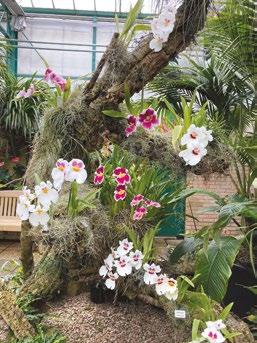
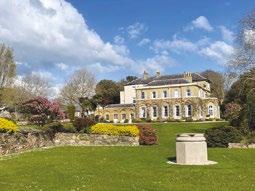
Sunday 17th May
Domaine Des Vaux
St Lawrence
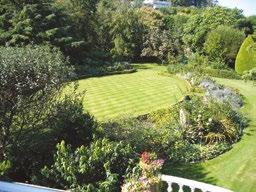
Sunday 28th June
Seafield House
St Lawrence
Sunday 19th April
Government House St Saviour
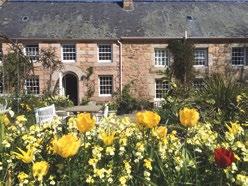
Sunday 31st May
Woodlands Court Grouville


ISLANDERS hoping to achieve a nautical ambition are invited to apply for the 2026 Jersey Clipper Bursary – a £1,000 cash award aimed at furthering maritime endeavour.
The bursary, which also offers a £500 runner-up award, is designed to assist an Islander of any age to fulfil a particular nautical dream. This could, for example, be a trip on a tall ship, attending a training course, participating in a watersports competition or competing in an ocean race –anything with a maritime theme.
The annual award, a legacy from the three Jersey campaigns in the Clipper Round- the-World Yacht Race, was established 19 years ago through the generosity of Dandara, Les Pas Holdings and UBS.
The successful applicant will follow in the wake of Jamie Le Marquand (17) who used the funds to take part in the 2025 Tall Ships Race, joining the crew of the historic fishing boat Excelsior on the leg from Scotland to Norway.
‘Everyone should try sailing on a tall ship,’ said Jamie, following his Baltic adventure. ‘It’s a truly incredible experience with people coming from all over the globe for the same reason – to sail.
‘Thanks to the Jersey Clipper Bursary for making this dream possible for me and I hope that other Jersey residents will be encouraged to apply for the 2026 bursary.’
Islanders can apply for the 2026 Jersey Clipper Bursary by outlining their particular nautical ambition in no more than 200 words in an email to philipjeune@gmail.com The deadline is 30 April
For further information please call PHILIP JEUNE on 857309 or 07797 722127









and Liberation Supper at Parish Hall
7TH JUNE Elections for Connétable, Senators and Deputies at
26TH JUNE – First Branchage of 2026
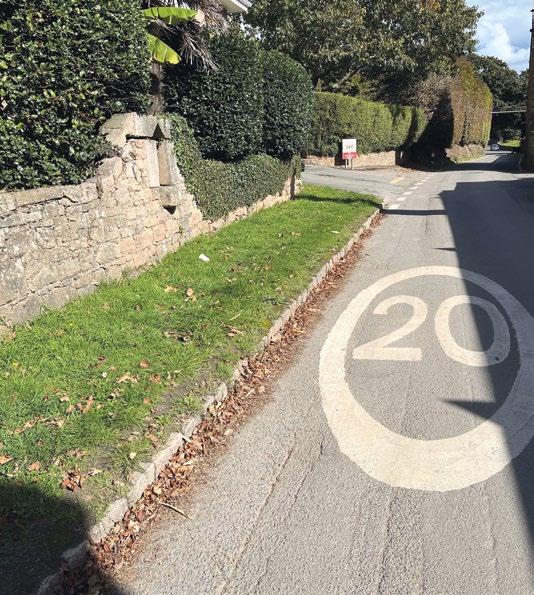

EDITORIAL trinitytattler@gmail.com
ADVERTISING Martyn Farley 07797 743 191 / martyn@farley.je
ACCOUNTS Helen Carré