Household recycling collection 2025
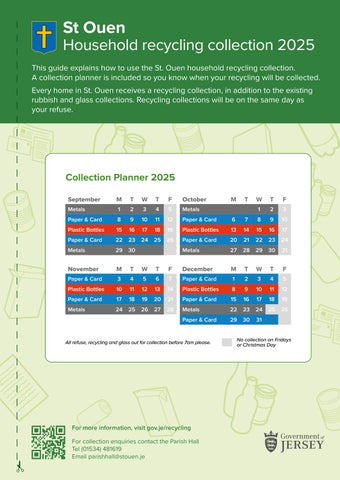
This guide explains how to use the St. Ouen household recycling collection. A collection planner is included so you know when your recycling will be collected. Every home in St. Ouen receives a recycling collection, in addition to the existing rubbish and glass collections. Recycling collections will be on the same day as your refuse. For more information, visit gov.je/recycling For collection enquiries contact the Parish Hall Tel (01534) 481619 Email parishhall@stouen.je
Collection Planner 2025
Recycling in Jersey MythBusters

Myth
FAct !
All recycling collected in Jersey just gets burned in the Energy Recovery Facility.
Items sent for recycling through Parish and Government of Jersey collections are not incinerated Only contaminated materials are diverted for energy recovery.
Myth Recycling and general refuse are collected by the same truck, and get mixed together
FAct !
Some collections rounds use the same type of vehicle , but the loads are kept separate to ensure proper recycling.
Myth You don’t need to rinse out food containers or bottles before recycling.
FAct !
Dirty items can contaminate the whole collection, making them unrecyclable . Always rinse before recycling!
Myth You should leave metal lids on jars and bottles.
FAct !
Myth Glass can go in general waste orenergy recovery.
FAct ! FAct !


Myth Plastic bottle tops can’t be recycled.





Metal lids and tops should be removed and placed with your household metal recycling. Glass can damage the Energy Recovery Facility , leading to costly repairs. It must be recycled properly.


Plastic bottle tops can be recycled, so don’t throw them away!
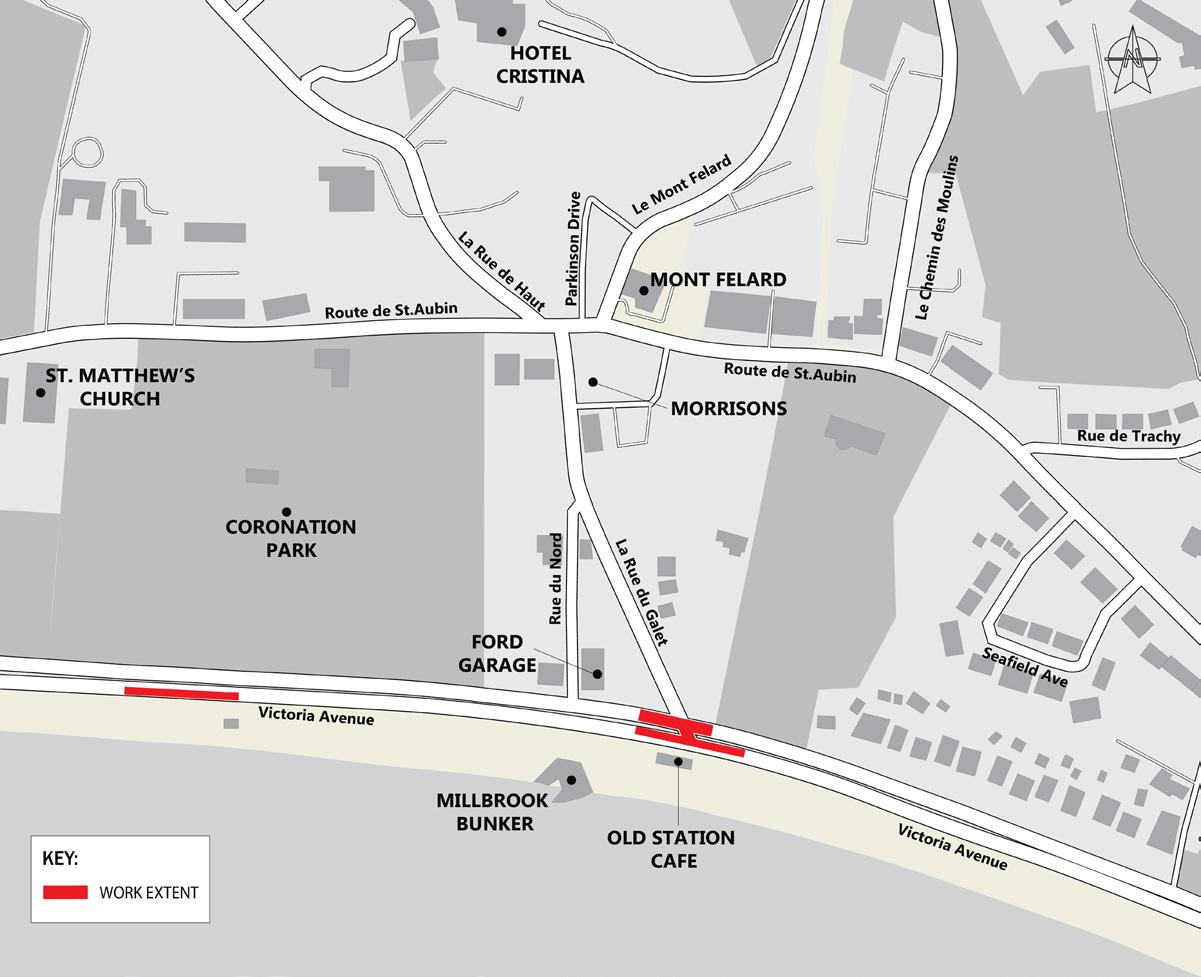
Victoria Avenue - Rue du Galet Junction Resurfacing Scheme
October Half Term - 2025

Further information
As part of the ongoing highway maintenance by Infrastructure and Environment (I&E), resurfacing works are planned along sections of Victoria Avenue, including junction with Rue du Galet.
Stay up to date on access arrangements,traffic managements and working times by visiting gov.je/roadworks or scanning the QR code provided.
Thank you for your patience while these essential works take place.We apologise for any inconvenience caused.

Progress update: Advancing the New Healthcare Facilities Programme – and what’s next

As part of the Government of Jersey’s broader initiative to showcase progress on our shared Common Strategic Priorities, Islanders may have seen recent updates highlighting how the New Healthcare Facilities Programme (NHFP) is advancing its commitment to “start building a new hospital at Overdale”. So, for this quarter’s edition, I thought it would be helpful to take a moment to recap where we currently stand with the Programme as a whole – and what critical work is still to come.
What’s happened since the start of the Programme?
Since the Independent Review was presented to the States Assembly in November 2022, the Programme has made steady progress. The review found that a single-site hospital at Overdale was no longer achievable within the approved budget and recommended a phased, multi-site approach.
In line with good governance, the Strategic Outline Case was developed and endorsed in June 2023. It considered different options for new facilities and confirmed the continued urgent need, or case for change. The recommended way forward from that review was a multi-site model and the Feasibility Study explored different options for two configurations of multi-site proposals (Hot and Cold vs Acute and Ambulatory, both combining with a separate Health Village) and locations, with Overdale selected for the Acute Hospital, Kensington Place for Ambulatory Care, and St Saviour for a new Health Village.
Key milestones since then include the start and completion of demolition at Overdale (December 2023–Nov 2024), the relocation of Samarès Ward to St Ewold’s (May 2024), and a public consultation on the Acute Hospital’s concept designs to support the Planning Application. The Outline Business Case was approved in November 2024, securing Phase 1 funding from the States Assembly. Design work for the Acute Hospital progressed throughout 2024, with planning permission granted earlier this year. Meanwhile, the procurement process to appoint a Main Works Delivery Partner has been ongoing since December 2024. Crematorium services will move from Westmount to the refurbished Members’ Room at RJA&HS from September.
Next stages for the Programme: Kensington Place and St Saviour’s Health Village
Given the critical importance of delivering the Acute Hospital at Overdale, much of the team’s recent work has rightly focused on developing its design, securing planning permission, and progressing the procurement of a Main Works Delivery Partner to build the facility.
However, the Programme goes far beyond Overdale. Both the Kensington Place Ambulatory Facility – utilising the site on Kensington Place and part of the existing General Hospital site –and St Saviour’s Health Village remain essential components in the wider redevelopment of our healthcare estate.
Work is now underway to refresh the Functional Briefs and Concept Designs for Kensington Place and St Saviour. This work is still in its early stages, and the next steps will involve re-engaging with clinical colleagues across Health and Community Services, as well as other key stakeholders.
The phased and flexible structure of the Programme is intentional and beneficial. It allows plans for areas that are more subject to change - such as Kensington Place and St Saviour - to evolve as required, rather than locking us into fixed decisions too early. It also enables schemes to be progressed as they are affordable.
There is still significant work to do to develop these plans, and they will only move forward with the right level of engagement. That includes input from clinicians, local residents, and the wider public.

We are currently working towards completing the updated Functional Briefs and Development Control Plans (DCP) for both sites by Q4 2025, with a view to sharing these more widely in early 2026. A DCP is a document that sets out how best a site can be most efficiently, and cost effectively developed. Once the DCPs are further developed, the team will be providing more detail on the first permanent construction works on each of the sites. They need to be carefully considered to ensure that throughtout the NHFP and especially at the end of every phase, healthcare services are operating efficiently and effectively, providing the care that islanders expect, helping staff to do their work.
In the meantime, as part of the phase one funding approved by the States Assembly, there is also budget available to develop more “meanwhile” uses for the Kensington Place site. It has been used since purchase by HCJ for valuable additional storage and other operational needs. We are actively exploring how the site could be continued to be used in the short term to support the overall needs of HCJ as well as deliver improved Public Realm. These discussions are ongoing, and while there isn’t a confirmed timetable at this stage, the current intention is to begin meanwhile works in early 2026, subject to proposal approvals and any required regulatory sign-off (for example, Planning Services).
Continuing progress at Overdale and appointing a Main Works Delivery Partner
The procurement process for a Main Works Delivery Partner to build the Acute Hospital
continues, with parties who are capable of building the facility having expressed their interest. A preferred tenderer for these construction works is expected to be agreed in Q3 2025, with the signing of a main contract hopefully before the end of the year and construction works following.
The main focus of the procurement process is to deliver quality and value for islanders, and the timeline may change to ensure we achieve this. As I hope Islanders understand, this process is commercially sensitive and complex with all parties needing to ensure that they understand the designs and anticipated costs before entering into a contract.
However, I look forward to providing further information about this important progress as soon as possible. In the meantime, the NHFP will continue progressing works at the site, ensuring continuity of development. In coming months, works will continue to prepare the old Jersey Water buildings to be site offices, erecting hoardings, diverting existing services, developing designs for site welfare, and site excavations.
Find out more about the New Healthcare Facilities Programme and stay in touch:
▪ Listen to our podcast to find out more about the Programme
▪ Watch videos about the Programme
▪ Follow us on social media
Statistically, every day one more person in Jersey is diagnosed with diabetes
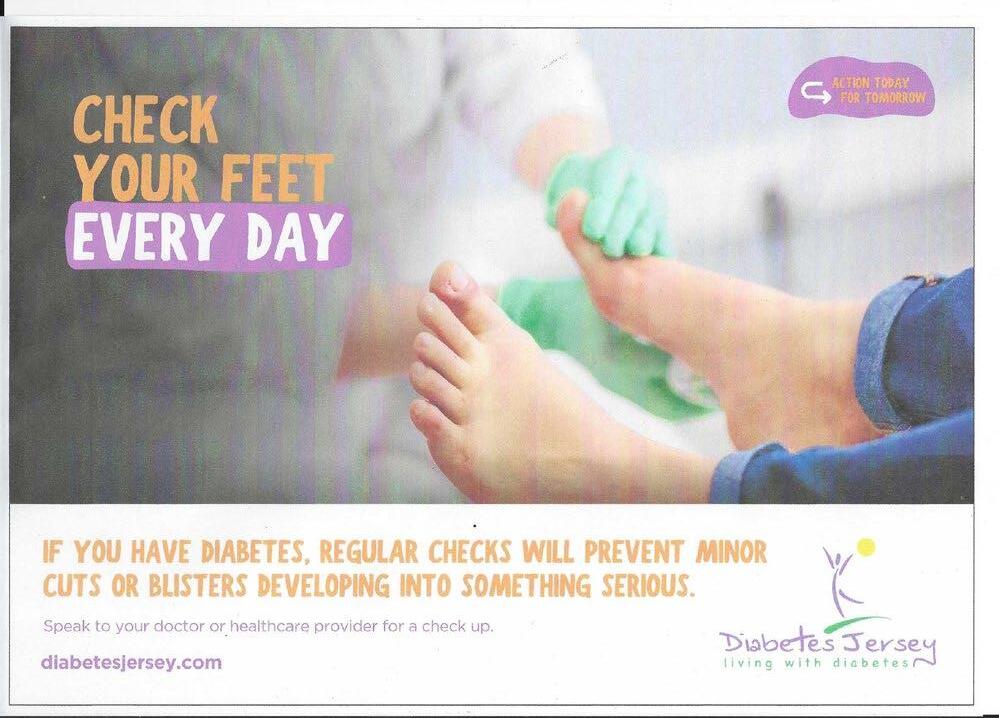
It may seem odd that a feature creating awareness of diabetes should highlight feet but, if you are diabetic, the daily check of your feet and keeping them in good condition, will prevent one of the disease’s worst consequences, the loss of limbs due to a lack of feeling in the extremities (neuropathy) leading to cuts or blisters in particular becoming gangrenous.
Today managing Type 1 diabetes with insulin injections is commonplace but diabetes itself still remains something of an enigma. It is a condition which is not preventable and Type 1 occurs when the pancreas ceases to produce the insulin we all rely upon to manage the level of sugar in our blood.
Type 2 diabetes, which occurs as the pancreas progressively produces less insulin, while itself not totally preventa-
the risk of acquiring it can be managed and diminished, by the way in which we live.
Most of us would assume that choosing our lifestyle is very much up to ourselves. However, your lifestyle can actually lead you down a path whose ultimate destination is the very last thing you want and that is to diabetes.
Diabetes is all about sugar in the blood and occurs when the body becomes incapable of controlling how much sugar our blood is prepared to accept. Fortunately for most of us our pancreas (a large gland behind the stomach) produces the hormone insulin which automatically regulates glucose levels in the blood.
Why diabetes occurs is not known and therefore it cannot be prevented and Type 1 can strike children as young as two or three years old. There is no early detection for Type 1 diabetes, but Type 2 can be detected with a blood test and if detected early enough, can be managed, and even reversed.