June 20-23, 2026
University of Denver
June 20-23, 2026
SATURDAY, JUNE 20
12:00 PM – 7:00 PM
Honors Institute Check-In Centennial Towers Ballroom
5:00 PM – 6:30 PM
Dinner Community Commons Dining Hall
7:00 PM – 8:15 PM
First General Session
Welcome Center (formerly the Cable Center)
Speaker: Josh Allan Dykstra Themes: 1, 3, 4, 7, 8
8:30 PM – 9:15 PM
Seminar Group Meeting 1 Sturm Hall
9:15 PM – 10:15 PM
Welcome Social
Community Commons Grand Central Forum
SUNDAY, JUNE 21
7:00 AM – 8:15 AM
Breakfast
Community Commons Dining Hall
8:30 AM – 9:15 AM
Second General Session
Sturm Hall Room 248 Davis Auditorium
Speaker: Dr. Lynn Tincher-Ladner Themes: 1, 3, 6, 8
9:45 AM – 11:30 AM
Seminar Group Meeting 2 Sturm Hall
Noon – 1:00 PM
Lunch
Community Commons Dining Hall
1:30 PM – 2:15 PM
Educational Forums – Round 1 Sturm Hall
2:30 PM – 3:15 PM
Educational Forums – Round 2 Sturm Hall
3:30 PM – 4:15 PM
Educational Forums – Round 3 Sturm Hall
5:00 PM – 6:00 PM
Dinner
Community Commons Dining Hall
6:15 PM – 8:15 PM
Third General Session
Sturm Hall Room 248
Davis Auditorium
Movie: Hopper (2026) Themes: 1, 2, 3, 4, 5, 6, 7, 8
8:30 PM – 9:30 PM
Seminar Group Meeting 3 Sturm Hall
9:30 PM – 11:00 PM
Advisor and Regional Coordinator Reception
Community Commons 4th Story Overlook
MONDAY, JUNE 22
7:00 AM – 8:30 AM
Breakfast
Community Commons Dining Hall
9:00 AM – 10:15 AM
Fourth General Session
Sturm Hall Room 248
Davis Auditorium
Speakers: Glenn Rohlfing and Stefan Huddleston Themes: 1, 3, 7
10:30 AM – 11:30 AM
Seminar Group Meeting 4 Sturm Hall
11:45 AM – 12:45 PM
Lunch
Community Commons Dining Hall
1:15 PM – 5:00 PM
City As TextTM Exercise at Meow Wolf; Meet your seminar group to depart.
NOTE: For City As TextTM we will utilize public (RTD) transportation. Your Faculty Scholar will have your pass.
5:45 PM – 6:45 PM
Dinner
Community Commons Dining Hall
7:00 PM – 8:30 PM
Fifth General Session
Sturm Hall Room 248
Davis Auditorium
Speaker: Dr. Sammy Ramsey Themes: 1, 5, 6, 8
8:45 PM – 9:45 PM
Seminar Group Meeting 5 Sturm Hall
10:00 PM – 10:45 PM
Farewell Social
Welcome Center (formerly the Cable Center)
Daniels Great Hall
TUESDAY, JUNE 23
7:00 AM – 8:30 AM
Breakfast
Community Commons Dining Hall
By 11:00 AM
All Participants Depart
Group 1 | Sturm Hall 210
Dr. Jamie Mahlberg
Phi Theta Kappa Honor Society
International Headquarters
Group 2 | Sturm Hall 234
Kristy LeVert
Phi Theta Kappa
International Headquarters
Group 3 | Sturm Hall 286
Denise Woolsey
Yavapai College
Beta Gamma Pi Chapter
Arizona Region
Group 4 | Sturm Hall 287
Dr. Liesl Harris
Jefferson State Community College
Beta Lambda Delta Chapter
Alabama Region
Group 5 | Sturm Hall 124
Jeff Edwards
Phi Theta Kappa
Advisor Emeritus
Group 6 | Sturm Hall 186
Dr. Joy Moses-Hall
Pitt Community College
Beta Nu Upsilon Chapter
Carolinas Region
Honors Program Council Member
Group 7 | Sturm Hall 187
Dr. Diego Tibaquirá
Miami Dade College
Beta Kappa Iota Chapter
Florida Region
Honors Program Council Member
Group 8 | Sturm Hall 311
Dr. Dan Platt
Des Moines Area Community College
Beta Epsilon Eta Chapter
Iowa Region
Honors Program Council Member
Group 9 | Sturm Hall 324
Julie Rancilio
Kapi’olani Community College
Alpha Kappa Psi Chapter
Pacific Region
Honors Program Council Member
Group 10 | Sturm Hall 380
Sarah Henry
Glen Oaks Community College
Alpha Delta Omega Chapter
Michigan Region
Group 11 | Sturm Hall 435
Amy Winters
Western Nebraska Community College
Lambda Pi Chapter
Heartland Region
Honors Program Council Member
Group 12 | Sturm Hall 479
Thayre Trzepacz
CT State Community College
Alpha Lambda Zeta Chapter
New England Region
Group 13 | Sturm Hall 480
Dr. Nancy Weissman
Cuyahoga Community College
Beta Upsilon Beta Chapter
Ohio Region
Honors Program Council Member
Group 14 | Sturm Hall 490
Pattie Van Atter
Phi Theta Kappa
International Headquarters
Group 15 | Sturm Hall 491
David Mantini
North Hennepin Community College
Phi Xi Chapter
Minn-Kota Region
ROUND 1 | 1:30 PM – 2:15 PM
Start Strong: Research that Powers Honors in Action
Presenters: Dr. Liesl Harris & Denise Woolsey Sturm Hall 251
Learn more about exemplary Honors Study Topic research that sets your team up for HIA success.
Curious About Themes 1 & 2? Let’s Review
Presenter: Julie Rancilio & Amy Winters
Sturm Hall 253
Have Themes 1 and 2 of the 2026/2027 Honors Study Topic piqued your interest? Discuss these themes with members of the PTK Honors Program Council.
Navigating What’s Next: The Honors in Action (HIA) Journey
Presenters: Dr. Jamie Mahlberg
Sturm Hall 254
Great HIA projects start with curious minds and shared questions – and a solid plan. Using the updated HIA Workbook, this session maps the full HIA process step by step, giving new and returning chapters alike the tools to begin (or build on) their work. Walk in curious. Walk out with a plan.
Remove the Boxing Gloves: Navigating Uncomfortable Situations Successfully
Presenter: Laura Dupree
Sturm Hall 151
Take off the boxing gloves and tackle conflict with confidence. Learn practical strategies for listening, de-escalation, and successful resolution.
What’s Next for You? Designing Your Future with the Discovery to Design (4D) Framework
Presenter: Dr. Kismet Loftin-Bell
Sturm Hall 281
In this interactive workshop, participants use a four-phase career alignment process to gain clarity on who they are, where they’re headed, and how to get there.
ROUND 2 | 2:30 PM – 3:15 PM
Bringing HIA to Life: Action & Collaboration
Presenter: Dr. Jessica Hargis & Brandy Jumper
Sturm Hall 251
Explore how to effectively move from Honors Study Topic research to action and how to choose collaborators who can enhance all parts of your HIA project.
Curious About Themes 3 & 4?
Let’s Explore
Presenters: Dr. Diego Tibaquira & Amy Winters
Sturm Hall 253
Have Themes 3 and 4 of the 2026/2027
Honors Study Topic piqued your interest? Discuss these themes with members of the PTK Honors Program Council.
Curious About Themes 5 & 6?
Let’s Dig In
Presenters: Dr. Joy Moses-Hall & Julie Rancilio
Sturm Hall 254
Have Themes 5 and 6 of the 2026/2027
Honors Study Topic piqued your interest? Discuss these themes with members of the PTK Honors Program Council.
Better Together: Creating College Projects with Purpose
Presenters: Jennifer Stanford, Catherine Derival, & Krisy Rachal
Sturm Hall 151
Learn how chapters and college leaders can partner on projects tied to campus priorities while building stronger relationships and creating meaningful impact together.
What’s Next? Your Path to International Leadership
Presenters: Dr. Sam Levy, Pattie Van Atter, Jose Fuentes, Endri Dobrovoda, & Samuel Pembele
Sturm Hall 281
Curious about International Office? Explore candidacy, leadership responsibilities, campaign strategies, and how you can shape PTK’s future.
Making It Count: Reflecting on HIA Impact
Presenters: Dana Burton & Kira Arthurs
Sturm Hall 251
Set your team up for HIA success by learning how to effectively reflect on the impact of your Honors Study Topic research, action, and collaboration.
Curious About Themes 7 & 8? Let’s Navigate
Presenters: Dr. Dan Platt & Dr. Nancy Weissman
Sturm Hall 253
Have Themes 7 and 8 of the 2026/2027 Honors Study Topic piqued your interest? Discuss these themes with members of the PTK Honors Program Council.
Navigating What’s Next: The Honors in Action (HIA) Journey
Presenter: Dr. Jamie Mahlberg
Sturm Hall 254
Great HIA projects start with curious minds and shared questions – and a solid plan. Using the updated HIA Workbook, this session maps the full HIA process step by step, giving new and returning chapters alike the tools to begin (or build on) their work. Walk in curious. Walk out with a plan.
Presenter: Kristy LeVert
Sturm Hall 151
“A goal without a plan is just a wish.” Navigating the demands of college, chapter leadership, and future career paths requires more than just ambition—it requires a reliable navigation system. GPS: Goal Planning Session, is an interactive workshop designed to equip Phi Theta Kappa students and advisors with a structured framework to turn vision into actionable reality.
Presenters: Justin & Kelli Oberndorf
Sturm Hall 281
What happens when we unplug? Explore the lessons of the Disconnect to Reconnect Challenge and discover how technology shapes connection, dependency, and belonging.
Saturday, 7:00 - 8:15 pm | Themes 1, 3, 4, 7, 8
Josh Allan Dykstra is an optimistic futurist who helps leaders stop reacting to chaos and start making sense of what’s next. He’s known for cutting through AI. panic and future-of-work noise to focus organizations on what actually matters: the systems shaping tomorrow, not the trend of the week. He equips leaders with practical, future-focused frameworks that reduce complexity, rebuild optimism, and design work environments where transformation energizes people instead of burning them out.
Over the past 15 years, Josh has worked with organizations employing more than 1 million people — including Microsoft, CHANEL, Amazon, Sony, and Genentech — helping them rethink change, technology, and culture. His thinking has been featured in Fast Company, Forbes, Huffington Post, and Business Insider. He’s the author of Igniting the Invisible Tribe, host of the Hello Tomorrow Podcast, and is currently writing his next book.
Sunday, 8:30-9:15 am | Themes 1, 3, 6, 8
Dr. Lynn Tincher-Ladner is President and CEO of Phi Theta Kappa Honor Society, the nation’s oldest and largest honor society for community college students. She is dedicated to expanding opportunity for some of the nation’s hardest-working learners—connecting them with life-changing scholarships, transformative leadership experiences, and pathways to family-sustaining careers. With nearly three decades in higher education, Lynn has served as a community college instructor in math, chemistry, and physics; a computer programmer and database administrator; an institutional researcher; and a university faculty member.
She currently serves on the national boards of the Center for Community College Student Engagement and the Rural Community College Alliance. Her past service includes the American Association of Community Colleges Board of Directors, America’s College Promise, and the J. William Fulbright Foreign Scholarship Board. A passionate advocate for community colleges and their students, Lynn uses data-driven storytelling to highlight their achievements and the vital role these institutions play in shaping the nation’s future.
Monday, 9:00 -10:15 pm | Themes 1, 3, 7
Glenn Rohlfing is an Associate Professor of History and Chair of the History, Humanities, and Political Science Departments at Pikes Peak State College. His research focuses on the medieval papacy, Pope Innocent III, and Icelandic Sagas.
A passionate advocate for curriculum innovation, Glenn has spent over two decades reshaping history education at the community college level. As History State Discipline Chair, he led a statewide initiative to renumber Colorado’s history courses around regions and themes to better serve BIPOC and gender communities. He pioneered Colorado’s first History of Science and Technology course and served as Executive Director of a Reacting to the Past Grant, coordinating six faculty teams to develop game-based simulation curricula.
His teaching excellence has earned him the PPSC Faculty of the Year award, the NISOD Excellence and Master Teaching Awards, and six consecutive years as a PTK Faculty Scholar. He also co-organizes the Colorado Springs Undergraduate Research Forum.
Stefan Huddleston is an Assistant Professor of History and a historian who focuses on pop culture history (film, TV, and tabletop games), the history of marginalized groups throughout time, and modern sub–Saharan Africa. Stefan produced and directed a short documentary on the Alexander Film Company, which at one time was the largest employer in Colorado Springs, and the largest maker of commercial film clips in the world during the mid-20th century. He earned an MA in history at the University of Colorado in Colorado Springs.
Monday, 7:00 - 8:30 pm | Themes 1, 5, 6, 8
One of only a handful of African Americans to earn a Ph.D. in entomology, Dr. Sammy Ramsey is an inspirational science leader and communicator who has defied the odds to achieve his dreams. When people said he didn’t have what it took to make his mark in entomology, he proved them wrong by making a breakthrough discovery in the field of bee research — one that could potentially reverse a devastating pandemic in bee populations. And when people told him he didn’t “look” like a scientist, he remained true to himself and redefined what a scientist could look like.
Described as “your friendly neighborhood entomologist,” Dr. Ramsey is the endowed professor of entomology at the University of Colorado Boulder, where he teaches about effective communication and how understanding of the deep interconnectedness of all organisms can solve real-world problems. He is also the founder of The Ramsey Research Foundation, which conducts cuttingedge, novel research on issues affecting pollinator health globally — including parasite spread, disease management, and habitat preservation. He has utilized his exceptional skillset working in academia, industry, and government — including alongside the U.S. Supreme Court, House of Representatives, and the United States Department of Agriculture.
For Taxi/Uber/Lyft: University of Denver | Centennial Towers | 1770 S High St, Denver Co 80210
For Light Rail: There’s a light rail station right next to University of Denver that serves as a stop on the E, F and H lines. You will the necessary line to University of Denver Station.
REGISTRATION / CHECK-IN
All Honors Institute attendees will check in at the Centennial Towers Hall where they will pick up their registration packet, name badge, and dorm assignment. The address: University of Denver, Centennial Towers, 1770 S High St, Denver CO 80210
DORM CHECK-IN
AND
Neither Phi Theta Kappa nor University of Denver can be responsible for the safety of any items left in the residence hall rooms or in any campus building. Neither Phi Theta Kappa nor DU can accept any responsibility for any mishap or incident occurring off-campus, or at any other time.
University of Denver has no responsibility for the conduct of any program or activity offered by Phi Theta Kappa, DU functions only as a site for the conference and will provide many of the services specified for the conference such as facilities, food, and housing. The University assumes no responsibility for any damage, injury, or loss to any person or property, from any cause whatsoever except to the extent such liability results from the sole negligence of University of Denver.
Honors Institute participants requiring mobility assistance equipment are encouraged to contact Mobility Plus for pricing, availability, and rentals at their own expense. Delivery and Pick-Up service to University of Denver is available. Please use discount code PTKHI26 for 10% off.
Please note: The fee to replace a lost key is $325.
Attendees will stay in either Centennial Towers, Nagel Hall, or Nelson Hall. Rooms are suite-style with shared bathrooms, and each attendee will have their own private bedroom within the shared space. Centennial Towers | 1770 S High St. Nagel Hall | 2194 S High St. Nelson Hall | 2184 S High St.
DORM CHECK-OUT
Attendees must be checked out of the dorm on Tuesday, June 23 by 11:00 am. Upon check out at the reception desk of your dorm, return your key and swipe card.
Remove all personal belongings from the room. If trash is over-flowing from your bin, please kindly take it out. Extra trash liners may be obtained at the front desk. Please turn off the lights, close the windows, and leave your linens in your room.
COMMUNITY KITCHENS / REFRIGERATORS
Each residence hall includes a community kitchen available for attendee use. In addition, every suite is equipped with a refrigerator for storing snacks, drinks, and personal food items.
LAUNDRY
Every overnight guest will be provided with a pillow, blanket, sheets, and towels. All residence halls have an app-operated laundry room. There are instructions for use posted in the laundry room, and credit card is accepted for payment. Detergent is not provided.
DORM MAINTENANCE
Bedrooms and suites will be cleaned before arrival. Dorm common areas will be cleaned daily. You are responsible for keeping your room tidy and taking out your trash if needed during your stay. Please contact the front desk to obtain extra trash liners and/or borrow a vacuum cleaner. Guests staying in suite-style rooms may obtain extra toilet paper at the front desk.
DINING
Meal swipe card will be provided to attendees at check-in. This will serve as entry into the dining hall for all meals between Saturday night dinner through Tuesday morning breakfast. The Community Commons is located at 2055 E. Evans Ave., Denver, CO 80210
CAMPUS PARKING
There are parking lots located next to each dorm. Lot C is in between Centennial Halls and Centennial Towers. Lot N is underneath Nelson Hall which is also available to Nagel Hall attendees. Parking passes are sold at each front desk and they accept cash only. ATM’s are available in the lobby of each residence hall.
Parking Permits:
$14 daily | $53 weekly
WI-FI
Wireless internet access is available throughout the DU campus and in the residence halls. Contact the front desk for instructions on how to log-in.
CAMPUS SAFETY
University of Denver is committed to creating a safe environment at all times. You may choose to download the DU safe app as recourse for safety information as well as timely updates from Campus Safety.
Mobility Plus Colorado – Denver Store: https://www. mobilitypluscolorado.com/rentals
Recommended dates for rental: Deliver: Saturday, June 20 Pick-up: Tuesday, June 23
Please specify to deliver/pick-up based on the following address: Centennial Towers 1770 S High St. Denver, CO 80210
HOSPITAL / URGENT CARE CLINIC
Hospital: Portal Adventist Hospital 2525 S. Downing St. Denver, CO 80210 303-778-1955 (main)
Urgent Care: CareNow 1405 E Evans Ave, Denver, CO 80210 720-449-8050 (main)
WALGREENS PHARMACY
Walgreens pharmacy a 4 min. drive / 13 min. walk from campus. Address: 1235 E Evans Ave, Denver, CO 80210
ALCOHOL & DRUGS
Alcohol may not be consumed by guests under the age of 21. Guests 21 or older may not consume alcohol in the presence of others under the age of 21, or in any public areas such as lounges or hallways. Guests may not have or consume federally illegal drugs (including marijuana in any form and paraphernalia), or improperly use controlled substances or alcohol on DU property.
SMOKING POLICY
In response to public health concerns related to second-hand smoke from tobacco products, it shall be the policy of the University of Denver that smoking will not be allowed in either indoor or outdoor areas of the campus.
GUESTS
The Honors Institute is open only to Phi Theta Kappa members and advisors. Family members of participants cannot be accommodated in residence halls, at Institute meal functions or at any Institute events.
SPEAKERS’ VIEWS
The views expressed by the Institute speakers do not necessarily reflect the views and opinions of Phi Theta Kappa Honor Society or University of Denver.
RECORDING SPEAKERS’ PRESENTATIONS
Recording General Session speakers is prohibited.
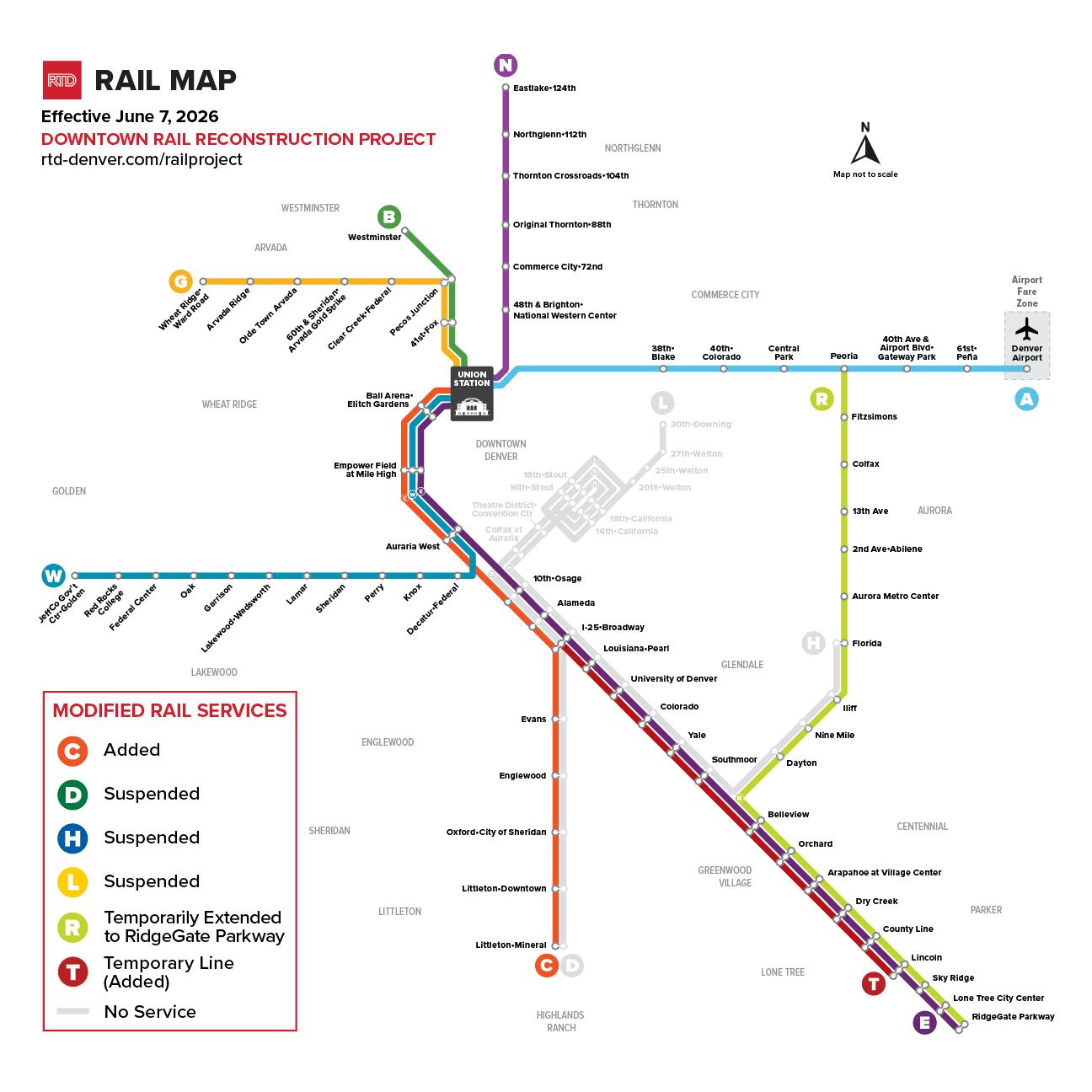
Step-by-step directions from University of Denver to Meow Wolf via RTD:
• Walk to University of Denver Station (near Centennial Towers on campus)
• Board the E Line train Northbound (In the direction of Union Station)
• Exit train at Empower Field at Mile High (One stop past Auraria West)
• Walk to destination (0.3 miles)
• Arrive at Meow Wolf (1338 First St., Denver, CO)
Step-by-step directions from Meow Wolf to University of Denver via RTD:
• Walk to Empower Field at Mile High station
• Board the E Line train Southbound (In the direction of RidgeGate Parkway)
• Exit train at University of Denver (One stop past Louisiana - Pearl)
Honors Institute participants will engage in City As TextTM exercises on Monday, June 22.
Seminar groups will travel with Faculty Scholars via RTD on Monday to the Meow Wolf immersive exhibit. As you travel and walk to the destination, these strategies may be helpful for this learning experience: mapping, observing, listening and reflecting.
1. Mapping – You will want to shape a mental construction, during and after your explorations, of the primary kinds of buildings, points of interest, centers of activity, and transportation routes (by foot or vehicle); sketching your own map might be helpful in this construction. You will want to look for patterns of building use (housing, offices, shops, parks, recreation, etc.), traffic flow, and social activity that may not be apparent on any traditional map. Where do people go, why do they go there and how do they get there?
2. Observing – You will want to look carefully for the unexpected as well as the expected, for the familiar as well as the new. You will want to notice details of architecture, landscaping, social gathering, clothing, possessions, decoration, signage and advertising.Try to answer the following questions: Does everybody seem to belong? Do some people seem lost or out of place? Why? Who talks to whom? In what ways is social interaction encouraged or discouraged? What feeling do you get about people as you watch them? Are they stressed, purposeful, interesting or lonely? Try to identify why you get these feelings about people.
3. Listening – If presented with an opportunity to have brief conversations with Denver residents, find out from them what matters to them in their daily lives, what they need, what they enjoy, what bothers them, what they appreciate. Imagine yourself as somebody looking for a job or a place to live, and ask about such matters as where to find a place to live, where to find a cheap meal (or an expensive one), what the politics of the neighborhood are (Do people like their neighborhood organization? The mayor? Do they like working or living here?), what the history of the neighborhood is, what the general population of the neighborhood is like (age, race, class, profession, etc.), what people do to have a good time. An important strategy is eavesdropping: How are people talking to each other? What language(s) are they using? What are they talking about? How are they connecting to (or disconnecting from) their surroundings as they converse?
4. Reflecting – Throughout your explorations, keep in mind that the people you meet, the buildings in which they live and work, the forms of their recreation, their modes of transportation – everything that they are and do – are important components of the city environment. They are part of an ecological niche. You want to discover their particular roles in this ecology; how they use it, contribute to it, damage it and change it. You want to discover not only how but why they do what they do, what they see and how they see it. Like all good researchers, make sure that you are conscious of your own biases, the lenses through which you are seeing and judging, and that you investigate them as thoroughly as you investigate the culture you are studying.
Source: National Collegiate Honors Council’s Honors Semesters Committee
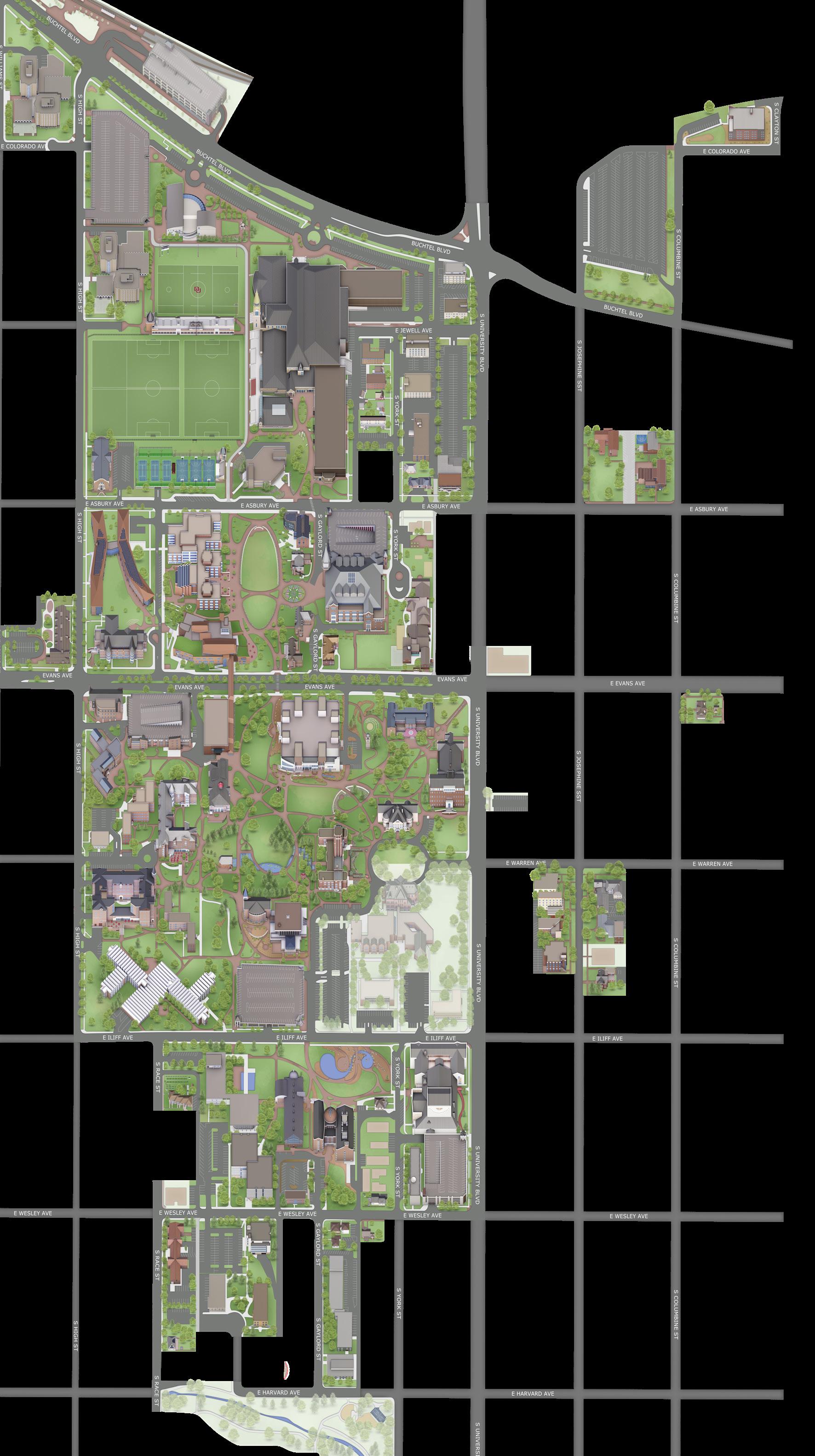


Please note: This legend focuses solely on Honors Institute locations. For a full legend of all the icons and numbers referenced on the map, please visit the DU website.