THE FOOD CO-OP NEWSLETTER
AROUND THE TABLE
FALL - WINTER 2026
FREE
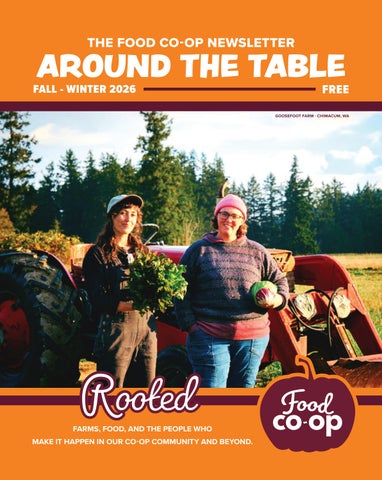
GOOSEFOOT FARM - CHIMACUM, WA
Rooted
FARMS, FOOD, AND THE PEOPLE WHO MAKE IT HAPPEN IN OUR CO-OP COMMUNITY AND BEYOND.
THANKS TO OUR CONTRIBUTORS General Manager Kenna Eaton Managing Editor Andrea Stafford Layout & Design Christopher Bunch Contributors
Andrea Stafford, Loren Alexanian, Kenna Eaton, Estelle Giangrosso, Thea O’Dell, Crystie Kisler, Danielle Carson, Amanda Milholland, Jon Steinman, NCG (National Co-op Grocers)
WHAT’S IN THIS ISSUE? 1: INDEX 2: CELEBRATING 15 YEARS OF COMMUNITY 3-7: FARMER FUND REPORTS 8-10: IT TAKES A COMMUNITY TO FEED A COMMUNITY 11-12: IT’S A CO-OP WORLD 13-17: GROCERY DEMOCRACY 18: BEANS FOR BAGS NOMINATIONS 19-20: FIBER MAXXING 21-22: PAINTING COMMUNITY IN THE HEART OF UPTOWN 23-27: HOLIDAY GUIDE 28-34: HOLIDAY RECIPES
Cover Photo Goosefoot Farm
Around The Table
is published by The Food Co-op.
SEND US YOUR ARTICLE IDEAS! If you are interested in contributing content for Around The Table, please contact marketing@foodcoop.coop to discuss your article idea. Articles should include stories about food, community, sustainability, or cooperation.
1
COVER PHOTO: GOOSEFOOT FARM
Goosefoot Farm is a free food farm project that grows produce, herbs, and flowers in Chimacum, Washington. They are a collective of young farmers that believe that high quality produce should be accessible to all people, regardless of their employment status, housing situation, income level, sexual orientation, gender, race, age, or ability. All of their food goes out for free to Jefferson County residents through various community partnerships. Past partnerships include the Tri-area Food bank, Jefferson Healthcare, Recovery Cafe and Jefferson County Anti-racist Fund. We are a proud garden member of local non-profit, Food Bank Growers.
Goosefoot Farm was a recipient of the 2026 Farmer Fund which helped purchase a walk-behind tractor that will improve essential farm operations while protecting soil health and increasing efficiency. This will allow them time to grow more food for their free distribution program.
CELEBRATING 15 YEARS OF COMMUNITY BY KENNA EATON, GENERAL MANAGER
Fifteen years ago, my husband and I packed up our house in a snowstorm well, it was three days of packing and snow as we left Idaho to move to Port Townsend. We arrived here in mid-February and I was instantly enamored with our new home. No snow and a sense of spring in the air wowed me, as did the view of the shipping straits from our new abode. My first memory of being at work was a welcome party thrown by staff. Each team had written a skit and performed for me amid laughter and song what a welcome that was! Over the past 15 years, together we have made magic growing our building and business by leaps and bounds. I have so many memories of being here at the Co-op; fun, hard work, and yes, even some tears along the way. But regardless, throughout that time I always had a strong sense from our staff and members that we were in this together, no matter what the challenge. Since we made the announcement I was retiring almost a year ago, this has possibly been the world’s longest (and best!) retirement party. Thank you everyone for your kind words, your appreciation and gratitude. I have really enjoyed my time working at the Co-op. I feel honored to have worked at a place that aligns with my values, one that has allowed me to be my best self, and one that allowed me to go home every night to sit on the front porch marveling at the abundance of life here in PT. I’m also proud of our Board of Directors for having done the hard work of finding a great new general manager for our store. I hope that they will feel just as welcomed and appreciated as I have. But in the end, this isn’t about me, what I’ve done, or how I have felt. Because I haven’t really done anything but let the people and place work their magic. After all, it’s about you—our staff, our board of directors, and our members. You have gone out of your way to make me feel appreciated, and for that, and all those memories, I thank you. With Care, Kenna
Thank you Kenna! 2
Farmer Fund Reports 2026
2026 Farmer Fund Grants were awarded to thirteen local farms/food producers in Jefferson County. Thanks to all of the customers and members who contributed to this program. Together we are building a stronger agricultural resilience in our community. Follow along with these four stories from recent tours!
Growing Roots at Glendale Farm BY ANDREA STAFFORD, DIRECTOR OF MARKETING AND OUTREACH & MEMBER OF THE COMMUNITY ENGAGEMENT COMMITTEE
As part of the Community Engagement Committee (CEC), I get to do one of my favorite jobs: following up on where your Farmer Fund dollars actually go. Spoiler alert, it’s not just tractor parts and mysterious machinery (though there’s plenty of that too). Sometimes it’s the foundation for something much bigger. Glendale Farm has been a cornerstone of the Chimacum Valley since 1857, owned by the Sexton family and shared with a rotating crew of resident and seasonal farmers. As the largest remaining agricultural property in east Jefferson County, it’s less a single farm and more a living, breathing collaboration. Flowers, organic veggies, livestock, horses, and trails winding up along Chimacum Creek toward the Valley View Forrest’s edge. What struck me most on this visit wasn’t just the beauty of the land. It was the care it took to get here. After a devastating fire, Seth Sexton has been working closely with community partners on rehabilitation projects across the property, with much of the progress made possible through work trades, volunteer hours, and handson partnerships rather than a single big fix. The farm also holds a conservation easement with Jefferson Land Trust, protecting the land for generations of growers and collaborations to come. This year alone, Glendale opened its gates to host crowds for the Jefferson County Farm Tour and welcomed the community for the Harvest Festival Lamb Dinner, proof that this land is already doing what it does best: bringing people together. Farmer Fund Dollars helped purchase a new farm stand, and it’s just the beginning. Glendale is now in the early phases of building a full farmstand and community hub, with plans for cold storage, a coffee bar, and maybe even a rooftop terrace down the road. It’s a bold vision, and it’s deeply rooted right here at home. When we invest in farms like Glendale, we invest in a future where our community and our land grow stronger together. 3
Market Kitchen BY THEA O’DELL, FOOD CO-OP HR DEPARTMENT & CEC
I met Kelli and her mom Suzen in 2012 (maybe 2011) back when we were neighbors on Tyler Street Uptown PT. when I was renting a 2-bedroom house with a yard and separate garage for $850 a month. Hard to believe nowadays. The main things that struck me the most about Kelli and Suzen is how down to earth they were and how it was always a joy to run into them for a neighborly chat on our street. I noticed that both women had a kind of twinkle in their eye, which made me feel at ease right away. After I moved, I lost touch with them and found out later that Suzen had passed which was sad news indeed. I also found out that they started Crust Bakery and sold delicious hand pies at the farmer’s market. I would hear great things about them but due to a gluten free phase, I never tried one. Until recently, and I have to tell you that when I tried the curried lentil hand pie, it took me somewhere old world. It was like if you could take cozy and wrap it up in a blanket and then take that blanket and turn it into a buttery crust and fill it with hearty lentils flavored with scrumptious spice. Now, unfortunately, I’m hooked. Kelli and Suzen bought the Market Kitchen from Aaran Stark in 2014. Many, many venders and farmers in our community have benefited from the Market Kitchen and I highly recommend going to crustpies.com to check out their website to learn more. Kelli needed to repair the kitchen’s 1950’s 80-quart Hobart mixer, a beast of a machine that once repaired, will return back to its reliable work horse status. And for the love of keeping it local, Kelli has hired Anami of Quimper Fixit to do the job. Kelli was chosen for the Farmer’s Fund because in her words, “Making larger batches of dough is an efficient use of time and energy. The larger batch produces more product, resulting in more local food produced for our community and more resiliency in the local agricultural supply chain.” Please find a Crust Pie at the farmer’s market or grab one from our deli case at the co-op. You won’t regret it. Also, a HUGE thank you to all who donate to our Farmer’s Fund. This community truly rocks! 4
A Cold Snap Brings Maple Syrup to Quilcene BY LOREN ALEXANIAN, FOOD CO-OP MARKETING DEPARTMENT & CEC
For most of us, a cold snap means adding another layer, stoking the woodstove, or wondering if we really need to leave the house. For Daryl Dietrich, founder of Cold Snap Farm in Quilcene, it means something sweeter: maple syrup season. Daryl has lived on her 20-acre property for eight years and has been homesteading for much longer. Her path to maple sugaring began with a gift—a copy of Gary Buckland’s booklet Bigleaf Sugaring: Tapping the Western Maple. What started as an idea has grown into an ambitious new farm project, with about 1,000 taps now set in the bigleaf maple trees on her land. Maple syrup may be synonymous with Vermont and the northeastern U.S., but Daryl is helping prove that Western Washington has a place in the sugaring story, too. Cold Snap Farm is one of just a handful of maple syrup operations on the West Coast, and its 1,000 taps are still tiny compared with the 70,000-tap operations found in the East. But small doesn’t mean insignificant. With support from the Farmer Fund, Daryl is building the infrastructure she needs to turn sap into syrup right on the farm. Canadian maple equipment company Lapierre is also partnering with her, providing equipment and investing in the farm’s setup. From large 2000-gallon stainless steel containers to pumps, steam and filters all of this will help keep the operation clean and efficient. And then there’s the weather. Maple sap flows when conditions are just right, with cold temperatures at night followed by warmer days creating the pressure changes that get the sap moving. Depending on the weather, Daryl could begin collecting as early as November and continue into spring. She’s hoping for her first syrup this winter, with production beginning in January or February 2027. It takes roughly 80–100 gallons of sap to make one gallon of maple syrup. Daryl estimates Cold Snap Farm could eventually produce about 200 gallons of syrup in a season. She’s considering offering the syrup in three sizes so there’ll be a little something for everyone. Daryl has also helped shape the future of maple sugaring in Washington, working to change state regulations so small-scale producers can process syrup on their farms under appropriate conditions. That means less hauling sap off-site and more opportunity for this budding local industry to take root. Projects like Daryl’s remind us that building a strong local food system isn’t always about growing more of what we already know. Sometimes it’s about trying something new, learning from the land, and creating space for new kinds of food production to take root. 5
Strait Up Shrooms BY ESTELLE GIANGROSSO, CEC
I first met Kyle of Strait Up Shrooms at last year’s Olympic Peninsula Fungi Festival (October 17th & 18th—see you there!), where growers, artists, and renowned mycologists from across the country all gather to celebrate the magic of mushrooms. My partner, his brother, and I were so pleased to meet a grower from our neck of the woods that it felt like a celebrity sighting. Kyle’s tables were laden with sporific bounty, and I walked away with both arms full of bags of shiitake, oyster, and perfect, palm-sized lion’s mane mushrooms. I am happy to contribute to the Co-op’s mission of nourishing community by serving on the Community Engagement Committee (seeking members at large—apply online). Some of the work we do involves the arduous and impactful decision-making of how to distribute and award the Farmer Fund, with funds generously donated by Co-op shoppers at the check stand. Among this year’s applicants was Strait Up Shrooms, applying for a grant for an autoclave—one that would allow Kyle to sterilize substrates. As a foraging enthusiast, 2025 was my second year at the OPF Festival. Interested in producing medicinal and delicious mushrooms, I attended several fascinating cultivation workshops. So, in 2026, when reviewing Strait Up Shrooms’ Farmer Fund application, I had a clear idea of what a game changer an autoclave would be for his operation. On a bright day in beautiful Chimacum this summer, I was approached by a little pig on the dusty road. Being an animal lover, I was thoroughly distracted and drove right by Strait Up Shrooms to greet this little wanderer. Later, joining my fellow committee members and Kyle, I found the one-man mushroom operation discreetly tucked into a valley filled with farms and barns of animals. It manifested in a couple of shipping containers against an older structure, surrounded by piles of sawdust and bins of spent grain from Finnriver Brewery, with a nest of barn swallows overhead, swooping here and there. 6
Learn more about the Farmer Fund and the other 2026 recipients by visiting
FOODCOOP.COOP/Farmer-Fund
The spent grain repurposed from the brewery and sawdust—local waste materials—make up the mushroom substrate, a surface on which mushrooms, molds, and many other things can grow. Substrates are essential to growing beautiful, nutrient-dense, and bountiful mushrooms. But to successfully cultivate the desired mushrooms in a substrate, one must sterilize it first. Inside the first shipping container, Kyle introduced the committee to the compelling science behind his cultivation process. Showing us the new autoclave already put to use, he demonstrated what it makes possible as he led us to the next shipping containers, packed with bags of spawn-inoculated substrate and bags of fruiting mushroom bodies. Spawn will soon be produced locally with the aid of Strait Up Shrooms’ new autoclave, eliminating the need to rely on spawn shipped from out of state, reducing costs, and increasing local production! What do you call a mushroom that makes music? A decomposer—turning natural cycles of decay into something vibrant and life-giving. After seeing firsthand the scale and skill with which Strait Up produces its mushrooms, I am content to leave the production to Kyle and look forward to what will be accomplished next.
APPLICATIONS OPEN
FARMER FUND GRANTS DUE: NOV 30, 2026
ARE RIPE
FOR THE PICKING! 7
APPLY TODAY:
WWW.FOODCOOP.COOP/FARMER-FUND
8
It Takes a Community to Feed a Community BY CRYSTIE KISLER, DIRECTOR OF NONPROFIT SERVICES AT JEFFERSON COMMUNITY FOUNDATION AND DANIELLE CARSON, COMMUNITY HEALTH AND FARM TO SCHOOL LEAD AT WSU CLALLAM COUNTY EXTENSION
Across the North Olympic Peninsula, food access depends on a remarkable network of neighbors helping neighbors. With around 13% of our community experiencing food insecurity (Feeding America, 2022), food banks, meal programs tribes, farms, schools, social service agencies, volunteers, donors, local businesses, and community organizations each play a role in making sure nutritious food reaches people who need it. The Peninsula Food Coalition (PFC) has helped weave these efforts together for over a decade. In 2015, regional food bank leadership began convening peninsula and statewide food access organizations with the goal of reducing silos and creating collaborative solutions to shared problems. Now co-hosted by Clallam County WSU Extension and Jefferson Community Foundation, the Peninsula Food Coalition’s monthly gatherings create space for established food banks and grassroots programs alike to exchange information, identify gaps, and learn from one another. In rural food systems like ours, these relationships matter. When organizations communicate regularly, they can respond more effectively to changing needs, share resources, avoid duplicating efforts, and help connect residents with the services closest to them.
9
Peninsula Food Coalition members explore complex challenges involving food distribution, storage, transportation, local purchasing, and reaching people who cannot easily travel to a food bank or meal site. Looking ahead, the PFC is exploring cooperative purchasing models that could help smaller organizations access better pricing, piloting food processing programs to reduce and transform food waste and strengthening the regional emergency food system’s commitment to sourcing local food through value chain coordination. Local food networks are sustained by community support in many forms. From volunteers stocking shelves or delivering groceries; growers donating fresh produce; shoppers contributing to food drives or rounding up at the register; businesses offering transportation, storage, or financial support; and donors investing in infrastructure that keeps food moving. Organizations such as our local Food Co-op also help build connections among producers, consumers, and community food programs—strengthening both immediate food access and the broader local food system. Expanded cold storage, warehousing, transportation, and mobile distribution remain important needs. No single organization can address them alone. But through coordination—and the continuing generosity of volunteers, donors, farmers, businesses, and community members—we can build a more resilient regional food system in which everyone has access to nourishing food.
Learn more about the Peninsula Food Coalition at extension.wsu.edu/clallam/peninsula-food-coalition
The Olympic Peninsula Farm to Food Bank Fund is going to be on our Nov/Dec 2026 Beans 4 Bags Program!
10
It’s a Co-op World Cooperation is more than just a good idea — it’s a way to transform the way business is done.
W
hen you walk into a food co-op, you’re entering something that’s beyond a grocery store. You’re in a cooperatively owned space, created to meet the needs of the people who shop there. Simply put, a food co-op is a grocery store owned by the people in the community. They are independent stores, built on the idea that everyone can benefit from cooperative ownership.
Food Co-ops: Open to Everyone Anyone can shop (and eat and gather) at a food co-op. And everyone is welcome to become an owner. Co-op owners can get financial rewards, as well as a vote to choose the board of directors and influence the co-op’s future direction. Food co-ops bring benefits to the entire community — owners, shoppers, workers, vendors, farmers, suppliers and beyond. They keep more money in the local economy, increase the market and access for locally produced food, and prioritize business practices that are good for people and the planet.
11
NCG_Cobranding_Newsletter_Turnkey_Co-ops are Everywhere_4.indd All Pages
Co
The Co-o their for s In inclu neigh coffe utilit name
Here
Agr
Agric to ac agric
Fina
Finan to st mem
Hou
Hous home peop
hing y
y he
is ds,
p r for
Co-ops Are Everywhere
Choose Co-ops
The co-op model works for much more than grocery stores. Co-ops provide the framework that allows people to achieve their goals, whether it’s access to housing or bigger markets for small farmers, in a way that better meets their needs. In the United States, there are more than 29,000 co-ops, including — but not limited to — food co-ops. Beyond your neighborhood food co-op, cooperatives exist for brew pubs, coffee suppliers, olive oil producers, credit unions, electric utilities, hardware stores, artists and chocolate makers, to name a few.
You can support co-ops by seeking out their products at your food co-op. You’ll find Co-op Trade signs on the shelves directing you to goods grown, made or distributed by co-ops.
Here are a few common types of co-ops:
Agricultural Co-ops Agricultural co-ops bring independent farms together to achieve long-term success. You’ll find products from agricultural co-ops in your local food co-op.
Financial Services Co-ops Financial services co-ops such as credit unions help to strengthen the economy by granting account members ownership.
Housing Co-ops Housing co-ops are apartment complexes, single-family homes, mobile home parks or student housing that empower people with homeownership and responsibility.
Equal Exchange is a worker-owned co-op providing fairly traded coffee, tea, chocolate, bananas, olive oil and nuts grown by small farmer organizations around the world. Frontier Co-op, more than 50,000 memberowners strong, is dedicated to sourcing the highest-quality spices, herbs and botanical products through the Frontier Co-op, Simply Organic® and Aura Cacia® brands. Organic Valley is the largest farmer-owned organic cooperative in the U.S. and one of the world's largest organic consumer brands.
Look for Co-op Trade signs on the shelves directing you to goods grown, made or distributed by co-ops. Reprinted by permission from grocery.coop.
12
5/22/26 2:07 PM
GROCERY DEMOCRACY
Rise of the Citizen-Consumer
BY JON STEINMAN, AUTHOR, GROCERY STORY: THE PROMISE OF FOOD CO-OPS IN THE AGE OF GROCERY GIANTS
If you shop at a food co-op, co-own a food co-op, or work at a food co-op, this article is for you. It’s written as a reminder that food co-ops are a people’s movement with shared histories going back generations. From early Black-led co-ops inspired by civil-rights leaders like W.E.B. Du Bois, to depressionera co-ops of the 1930s, to the many waves of co-op formation that followed, all have been inspired by deep commitments to human rights, equal rights, food sovereignty and economic democracy. Your food co-op is a descendant of these people and their efforts. Their work set in motion the very reasons why you are reading these words now. Your co-op and this publication are part of an uninterrupted lineage of change. There’s value in reminding ourselves of this. Co-ops thrive and remain relevant when the people who use them remember where they came from and why they exist. For food co-ops, this is no easy task. Food co-ops are as much “grocery store” as they are “co-op,” but their grocery DNA, being the most visible, often feels dominant, like a child who appears to take after one parent more than the other. It’s why food co-ops so often wrestle with the dominant grocery narrative among shoppers: —“my relationship to grocery stores is transactional.” This transactional narrative is largely invisible. “The grocery store is a food and price-provider.” “The shopper is a consumer and price-taker.” “The success of this relationship is determined by the cheapest price, greatest value, and maximum convenience.” We can say “co-ops are different” as loudly and as often as we want, but food co-ops still confront these transactional storylines. Without a dedicated effort to remain connected to our “co-op” genes, we risk losing sight of the other co-op “parent.” By remembering that our co-ops are linked to democracy movements of generations past, we’re adding an essential ingredient to the work of storytelling and narrative change. This work also benefits from disrupting the prevailing beliefs of what a grocery store is and what it does. 13
Grocery Stores Are Not Neutral A grocery store is not just a grocery store. It’s a health-shaping, economy-shaping, and planet-shaping institution, sitting at the most powerful juncture within food supply-chains. A grocery store determines which foods make it to market, and which don’t. The grocery store is a gatekeeper, determining the future of food. —and yet, no one holds them accountable for their role in these four key areas of influence. Instead, grocery stores are most often governed and controlled by absentee owners, where shareholder primacy serves as the sole mechanism of accountability. This is why the term “Grocery Democracy” is so powerful. It disrupts the transaction narrative. It’s also an invitation. It invites all grocery shoppers (co-op shoppers included) to reconsider the position of grocery stores in our lives and communities.
Why Groceries Make People Feel Powerless Groceries can make people feel powerless. Especially now. When I examine the origins of this disempowerment, I always return to the same thing—the deeply-rooted transactional grocery experience. The good news? We might be living through the most opportune time to change it. Rising grocery prices, industry consolidation, fear of concentrated economic power, supply chain instability, tariffs, social fragmentation, distrust of institutions, people and communities feeling less in control. Grocery Democracy is more relevant today because the gap between who uses the food system and who controls it has never been more visible, or more consequential. This is a powerful moment for movementbuilding and imagining a different future.If we continue treating grocery stores like vending machines, we risk passing that transactional relationship – and the disempowerment that comes with it – on to future generations. But if a grocery store becomes something we participate in, not just something we use, we flip the script. We begin to see grocery stores as “community infrastructure” and “essential services,” and we begin to understand our role as one of “citizen-consumer” with a civic responsibility. When grocery stores become “essential community infrastructure,” the narrative changes – our grocery dollars are no longer “expenses,” but “investments” – actual contributions to our communities, and to the people who handle our food from soil and sea to shelf. By anchoring Grocery Democracy in how we think and how we shop, we are effectively challenging assumptions of what a grocery store is and where democracy lives. This is less about changing how things look, and much more about how the relationship feels and what it means. 14
The “Citizen-Consumer” In a Grocery Democracy, we become “citizen-consumers.” Equal Exchange co-founder Rink Dickinson uses this language of “citizen-consumer” to help flip the script on unprecedented consolidation throughout food supply chains. As economic power concentrates into fewer hands – alongside the political power accompanying it – consumers can respond by using the same logic of consolidation. “Consumers are the group that is not consolidated and, unlike our farmer partners, not even organized. As long as consumers stay unorganized their power is questionable and, similar to farmers, consolidation is only making things worse. But this group is the sleeping giant. This is the group with the most potential to make a massive change in the food system. And the requirement is to get organized and to think differently.” – Rink Dickinson, co-founder, Equal Exchange When shoppers begin to see themselves as “citizen-consumers,” we anchor the narrative change even deeper. Whereas a “consumer” asks: “what’s cheapest?” or “what’s the best quality or value?” A “citizenconsumer” asks: Who owns this? Who benefits? What kind of community does this create? What is my role and responsibility? By offering shared-ownership of a grocery store, and by recirculating benefit back into the store and the people who depend on it, the food co-op model is facilitating that very possibility—where people can become citizens within the economy. This is the co-op story—Grocery Democracy. But the risk remains. Democracy at our food co-ops is not inevitable – not when the dominant grocery experience of transaction is so strong. We must keep reminding ourselves and one another of how democracy shows up in food co-ops and we must continue to engage differently.
What is Grocery Democracy? Grocery Democracy is not just an abstract concept. It means ordinary people having influence over the institutions that feed them. It means shoppers becoming active stakeholders. It means participating in the economy instead of moving through it only as consumers. It means grocery stores being governed by the people who use them. It moves the narrative from grocery stores as transactional to relational.
15
Grocery Democracy Beyond the Ballot Box The easiest and most potent example of Grocery Democracy in a food co-op is our capacity to elect a board of directors to govern the store. But democracy shows up in many other ways, beyond the ballot box.
Power
When power concentrates into fewer hands, co-ops act as a remedy by distributing power more widely and equitably. No single co-op member has more power than any other.
Democratizing the Economy
Democracy and the economy are inseparable — something made increasingly visible as concentrated economic power translates into concentrated political power. This makes democracy within the economy essential to the survival of democracy in politics. When we invest our food dollars into co-operative enterprises, citizen-consumers are rebalancing economic and political power.
Learn more about Learn more about the Food Board by visiting our Co-op Board by visiting Foodcoop.coop/board-of-directors
foodcoop.coop/board-of-directors
Public Grocery Stores
Long before the current conversations about public grocery stores, food co-ops were already demonstrating what democratically governed grocery infrastructure can look like. When a food co-op supports other community organizations, they become community development agencies. When a co-op stocks local products — working one-on-one with suppliers to help grow their businesses — it becomes an economic development agency. This is the work of a public institution.
Economic Durability Never before has a food co-op been sold to private interests. Why? Because no GM/CEO or board of directors can make that decision without approval by the co-op's member-owners — often numbering in the thousands. The durability of the co-op model is also what democracy looks like. It transforms grocery shoppers from passive consumers into citizen-consumers, entrusted with protecting a community asset across generations.
Belonging Within the hope to preserve and expand democracy is often a deeper desire for connection and meaning. People are hungry for spaces where they matter beyond transactions. Food co-ops, and Grocery Democracy, remind us how democracy is not only a political system, but a habit of participation and belonging. This is experiential democracy. In this narrative, “belonging” isn’t only to what’s in front of us and around us — it’s also about belonging to movements for economic democracy that span generations.
Next time you walk through the doors of your food co-op, say to yourself:
“This is what democracy looks like.”
16
Movement Implies Momentum Counter-culturalism requires effort. Just as movement implies momentum. This is not only the work of the co-op’s communication team, but something we can all take part in. The timing couldn’t be better. Power is concentrating into fewer hands. Many are feeling a democracy deficit and loss of control. This is the momentum. Momentum means continuing to show up, resisting the transactional story we inherited, and strengthening the co-op story we want future generations to inherit. It means organized citizenconsumers expanding the venue for democracy. It means remembering that grocery stores are not just places we use to transact business, but institutions shaped by people and generations before us, and institutions we can shape together. Remembering where we came from. Participating in what we build together. Telling the story forward. This is what democracy looks like!
Jon Steinman is a food systems thinker, author, and educator with a 25-year career shaping how communities engage with food. He is the author of Grocery Story: The Promise of Food Co-ops in the Age of Grocery Giants (New Society Publishers) www.grocerystory.coop
17
NOMINATIONS
ARE OPEN!
This is BEAR-Y good news!
2027 BEANS FOR BAGS
• Members can nominate any local non-profit to receive bean jar funds in 2027. • Recipients are chosen by the Community Engagement Committee. • Open now until Nov 30th Enter your favorite nonprofit here by scanning the code or visiting www.foodcoop.coop/beans-for-bags 18
Fiber: Nature’s Original Superfood Fiber is having a moment—and for good reason. While it may not be the flashiest nutrient, it’s one of the simplest ways to support your overall health. Fiber helps keep your digestive system moving, nourishes the beneficial bacteria in your gut, helps you feel satisfied after meals, and supports steady energy throughout the day. For many women, fiber can be especially helpful during perimenopause and menopause, when changing hormones can affect digestion, blood sugar, and heart health. Here’s the good news! It’s naturally found in many delicious foods you can find throughout The Food Co-op and you don’t have to overhaul your diet to eat more fiber. Start by adding one more serving of fruits, vegetables, beans, or whole grains to your day. Small changes can make a big difference— and autumn is the perfect season to get started.
Fiber Rich Fall Favorites As the weather cools, hearty fruits and vegetables take center stage. Apples, pears, winter squash, and root vegetables are all delicious ways to keep the fiber coming through the fall and winter months. They’re perfect roasted, added to soups, or baked into your favorite seasonal recipes. Apple Pear Raisins Sweet Potato (skin on) Brussels Sprouts Pumpkin (canned) Acorn Squash Red Kuri Squash Sweet Dumpling Squash Butternut Squash Beets Parsnips
1 medium 1 medium 1 cup 1 medium 1 cup cooked 1 cup 1 cup cooked 1 cup cooked 1 cup cooked 1 cup cooked 1 cup cooked 1 cup cooked
Wellness Department Picks
19
4g 6g 6g 4g 6g 7g 9g 6–7g 6–7g 7g 4g 7g
Bean There, Ate That If there were an MVP of fiber-rich foods, beans would be at the top of the list. They’re affordable, versatile, and one of the easiest ways to add more fiber to almost any meal. (Fiber per 1 cup cooked) Bean Fiber Navy Bean 19g Lentils 16g Split Peas 16g Black Beans 15g Pinto Beans 15g Chickpeas 12g Cannellini Beans 11g Edamame 8g
Use them to • Add to soups • Blend into dips • Toss on salads • Stir into pasta • Add to tacos • Mix into grain bowls
Scoop Up Some Fiber In Our Bulk Department Chia Seeds 2 Tbsp 10g Ground Flaxseeds 2 Tbsp 4g Psyllium Husk 1 Tbsp 7g Rolled Oats ½ cup dry 4g Steel Cut Oats ¼ cup dry 5g Barley 1 cup cooked 6g Quinoa 1 cup cooked 5g Brown Rice 1 cup cooked 4g Bulgur 1 cup cooked 8g Popcorn 3 cups popped 3.5g Use them in: • Overnight oats using oats and chai seeds • Add ground flaxseeds to smoothies or your favorite muffin recipe • Add barley, brown rice or quinoa to any soup recipe • Add to tacos • Mix into grain bowls You don’t have to “fiber maxx”overnight. Simply adding a few more fiber-rich foods to your plate each day can support your digestive health, nourish your gut microbiome, and help you enjoy the incredible variety of seasonal foods available throughout the year. If you have questions about your individual dietary needs or are making significant changes to your diet, talk with your healthcare provider or a registered dietitian.
20
Painting Community into the Heart of Uptown BY AMANDA MILHOLLAND, JCFM EXECUTIVE DIRECTOR
PC: RODNEY JUST If you walked through Uptown Port Townsend on September 8-10th, you may have noticed something different underfoot: a lot more color. Over three days in September, more than 100 community volunteers of all ages came together to bring the Uptown Community Street Mural and Pride Crosswalks to life on Tyler and Lawrence Streets. Volunteers swept and prepared the streets, chalked designs, mixed paint, filled brushes and rollers, painted colorful fruits and vegetables, cleaned supplies, and added layer after layer of color to the roadway creating a semi-permanent street mural (paint will last 3-5 years!). It was a joyful—and very hands-on—example of what can happen when a community decides to make something together. Powerful love in action! The project was led by Jefferson County Farmers Market, Port Townsend Pride, The Production Alliance, and gudlife and brought to live by artists of all, generous community donors, a small grant from the Port Townsend Arts Commission, and an incredible team of volunteers. Thank you, Food C-op, for helping us provide refreshments for mural painters. The finished artwork includes a farmers market-inspired street mural along Tyler Street, a fruit and vegetable crosswalk at Clay and Tyler, and colorful Pride Crosswalks at Tyler and Lawrence. Together, these pieces celebrate local food, agriculture, creativity, community connection, and belonging. For Jefferson County Farmers Market, helping lead this project is closely connected to our mission: to support local farmers and artisans with vibrant marketplaces that cultivate community and provide access to healthy food for all. Farmers markets are, of course, places where food and arts change hands. Farmers bring what they have grown and harvested, and shoppers bring it home to their families. But markets are also about something less tangible and equally important: relationships. Each week, people run into neighbors, children dance to live music, shoppers talk with the people who grow their food, local artists share their work, and community organizations connect with residents. Over time, these repeated interactions help create a sense of place and belonging. The new street mural extends some of that spirit beyond the hours of the farmers market. Local artist Aliina Lahti designed the community farmers market mural with imagery that reflects our local food system. During the painting, children and adults alike had the opportunity to contribute. Some volunteers carefully outlined designs, while others filled large areas with color. Families stopped by to paint a strawberry or vegetable. Other volunteers spent hours mixing paint, washing brushes, welcoming participants, and making sure the project kept moving. . 21
The Pride Crosswalks offer another important expression of community: a visible message of welcome and belonging for 2SLGBTQIA+ community members and a celebration of the diversity of people who make Port Townsend home. One of the most meaningful parts of the project was seeing how many different kinds of contributions it took to make the finished artwork possible. Some people helped plan for months. Some donated money. Some volunteered for three days, while others stopped by for an hour, picked up a paintbrush, and added a little color. Every contribution became part of the whole. That feels a lot like our local food system, too. A resilient community isn’t created by one farm, one market, one grocery store, or one person. It grows through relationships and through many people contributing what they can. We are deeply grateful to everyone who helped bring this project to life, including our mural planning and leadership team: Kerri Kitaji, Amanda Milholland, Jason Victor Serinus, Julia Cochrane, artist Aliina Lahti, technical advisor Danielle Fodor, painting lead Carol Long, Andrea Blair, and paint station leads Tim Blair, Randy Welly, and Doug Milholland. And there are many more people we could name. To everyone who painted, donated, carried supplies, cleaned brushes, mixed paint, or simply stopped by to encourage the painters: thank you! The next time you’re in Uptown, take a walk down Tyler and Lawrence Streets. We hope you’ll see more than paint on pavement. We hope you’ll see a little reflection of the community that created it—colorful, collaborative, creative, and welcoming.
Want to help us maintain this project over time? Donate here: jcfmarkets.org/community-street-mural
PC: RODNEY JUST
22
2026
FOOD CO-OP
Holiday Guide The holiday season is just around the corner, and we’re here to help make every gathering delicious, festive, and a little easier on the budget. From cozy fall recipes and ready-to-enjoy deli favorites to turkeys for your holiday table and seasonal drink recommendations, our Holiday Guide has plenty of inspiration for the season ahead. Plus, check out our weekly deals and special savings to help you make the most of your holiday shopping!
SCAN AND
SAVE! 23
OR VISIT, FOODCOOP.COOP/WAYS-TO-SAVE
Make the Holidays Deliciously Easy, Let the Deli do the Cooking! From classic holiday sides to savory turkey and ham, the Deli is serving up all the favorites you need to make your holiday table feel extra special. Pick up a few dishes, grab a pie (or two!), and spend more time enjoying the season with the people you love. Hot Bar favorites will be available November 19–28, with packaged Grab & Go holiday items available November 19–25.
What's on the Menu?
Coconut Yams
Cranberry Relish & Charlie’s Cranberry Sauce
Garlic Mashed Potatoes
Mushroom Gravy & Turkey Gravy
Herbed Green Beans
Maple Bacon Brussels Sprouts 24
Turkey
Stuffing
Save Room for Pie!
Ham Top off your holiday feast with a variety of delicious pies from the Deli. Whether you’re craving a classic or looking to try something new, there’s something sweet waiting for your holiday table.
Fresh Turkeys Are Coming!
Planning the centerpiece of your feast? Fresh turkeys arrive November 18 in the Meat Department. Get yours while supplies last and make this holiday one to remember! Questions? See the Meat Department or Deli for more information.
25
GOBBLE GOBBLE Gobble Gobble Wobble Wobble Recommendations from Zachary, our Beer and Wine Specialist!
WINES Marrowstone Vineyards GSM 750M
Dark Rock Brut Nature 750ML BTLS
G.D. Vajra Rosso 750ML BTLS
BEER
AND
CIDER
Lindamans oude Samuel Smith Gueuze Chocolate Stout 750ML BTLS 16.9 BTLS
NA
One2One Cab Sauv NA 750ML BTLS
Pinkus Ur-Pils 16.9 BTLS
Eaglemount Dry 750ML BTLS
Woodys Blanc de Blanc 750ML BTLS NA
Finn River Pear 16.9OZ BTLS
Clausthaler NA Lager 12OZ BTLS
26
stock up and save
27
Apples Anytime Ah, autumn — perfectly embodied in the humble apple. More than 17,000 varieties of this tempting fruit have been identified, and Red Delicious is only the beginning. At the co-op, you’ll find apple varieties that boast wide-ranging flavor profiles, from the oh-so-tart to satisfyingly sweet. Some are ideal in a lunchbox, while others shine in baked goods. Explore an array of possibilities for savoring this versatile fall favorite at every meal with these recipes. You’ll quickly discover that “an apple a day” isn’t nearly enough!
28
French Toast with Warm Apple Pecan Compote Servings: 6. Prep time: 60 minutes.
Compote 3 ⁄4 cup water or apple juice 1 ⁄4 cup brown sugar 1 ⁄4 cup maple syrup 1 ⁄2 teaspoon cinnamon 1 ⁄4 cup raisins 1 ⁄4 cup chopped pecans 3 cups apple, peeled and cut into 1⁄2 -inch pieces Pinch of salt 1 tablespoon cornstarch 2 tablespoons butter French Toast 2 tablespoons butter 5 large eggs 1 cup milk 2 tablespoons maple syrup Pinch of salt 1-pound loaf of soft-crusted bread (such as brioche or challah) cut into 1-inch thick slices 1. To make the compote, bring the water, brown sugar, maple syrup, cinnamon and raisins to a boil in a saucepan. Add the pecans, apples and salt. Bring the mixture to a simmer and cook for about 15 minutes, stirring occasionally. Add the cornstarch and butter and simmer another 3 to 5 minutes until slightly thickened. Keep warm while preparing the French toast, or prepare the compote the night before and reheat. 2. Heat the oven to 300˚ F. Place a metal rack in the oven to keep pieces of finished French toast warm while the rest is cooking. Melt a little of the butter in a large skillet (or two skillets to make the process go faster) over medium-low heat. Whisk the eggs, milk, maple syrup and salt in a large bowl. Soak each slice of bread in the egg mixture for about 30 seconds on each side. Place in hot skillet and cook each side for 3 to 4 minutes until golden brown. Add more butter for each new piece of toast added to the pan. Slice French toast into triangles and serve topped with warm apple compote. 29
Waldorf Salad with Yogurt and Honey Servings: 4 – 6. Prep time: 30 minutes.
1 lemon, juice and zest (about 2 to 3 tablespoons juice) 1 ⁄2 cup Greek yogurt 1 teaspoon honey Salt and pepper to taste 2 cups apple (1 large apple), cut into bite-sized pieces 1 cup seedless grapes, halved 1 cup celery (2 to 3 ribs), cut into 1⁄2 -inch pieces 1 ⁄2 cup toasted walnuts, coarsely chopped 1. In a small bowl, whisk together the lemon juice, zest, yogurt and honey. In a large salad bowl, gently toss the apples, grapes, celery, and walnuts with the dressing. Season to taste with salt and pepper. Substitute nonfat Greek yogurt for a lower-fat version if you like.
Breakfast, lunch and dinner — or anytime in between — there are endless ways to enjoy apples all day. Visit grocery.coop to find more delectable apple recipes.
Cinnamon Apple Coffee Cake
Gingered Beet and Apple Salad
Servings: 8. Prep time: 55 minutes; 15 minutes active.
Servings: 6. Prep time: 30 minutes.
⁄2 cup whole wheat flour ⁄2 cup all-purpose flour 1 cup rolled oats 3 ⁄4 teaspoon baking soda 1 ⁄2 teaspoon salt 1 ⁄4 teaspoon allspice 1 1⁄2 teaspoons cinnamon 1 cup sugar 1 ⁄2 cup vegetable oil or melted coconut oil 1 egg, beaten 1 ⁄4 cup milk 1 teaspoon vanilla 1 cup diced apple 1 ⁄4 cup dried cranberries
1 pound beets, peeled 1 apple (about 1⁄2 pound) 1 ⁄4 pound carrots, peeled 1 ⁄2 cup fresh parsley, minced 2 tablespoon apple cider 2 tablespoon apple cider vinegar 1 tablespoon fresh ginger, minced 2 tablespoon olive oil Salt and pepper to taste
1 1
1. Heat the oven to 350°F. Butter or oil an 8 x 8 inch pan. 2. In a large mixing bowl, whisk together the flours, oats, baking soda, salt, spices and sugar. Stir in the remaining ingredients until just combined. The batter will be very thick. Spread the batter evenly into the pan. Bake for 35 to 40 minutes or until a toothpick stuck in the middle comes out clean. Let cool before slicing.
This moist cake featuring dried cranberries and whole grains is sure to become a coffee break favorite.
1. Using the shredding blade of a food processor or a grater, shred the beets, apple and carrots. Mix well with the remaining ingredients. Season with salt and pepper. Serve immediately or refrigerate to let the flavors blend.
Fresh apples and apple cider make this beautiful, jewel-toned slaw refreshing and delicious. Try using a variety of beets — like golden or chioggia beets — for an even more colorful salad.
30
Reprinted by permission from grocery.coop. Find recipes, plus information about your food and where it comes from at grocery.coop.
31
1
Lorem Ipsum | The Newsletter of Your Co+op
Winter 2021
Rooted in Tradition Hearty, comforting sweet potatoes are a natural for winter meals and festive gatherings with loved ones.
W
hy are sweet potatoes at the heart of so many beloved family recipes? Is it the warm color palette? The subtle, sweet flavors? Or a versatility that lends well to being roasted, mashed or candied in dishes that are perennial favorites of the holiday season? Well, yes! Besides being delicious, sweet potatoes are practical: They’re affordable, they store well after harvest and they’re quite nutritious, offering a good source of vitamins A and C, potassium and fiber.
Sweet potato or yam — which is it? Though the terms “sweet potato” and “yam” are often used interchangeably, they are actually two different vegetables. Related to the morning glory, sweet potatoes have thin, smooth skin and moist flesh. Yams, with their drier, starchy flesh and rougher skin, are tubers related to the lily that grow in tropical regions, primarily West Africa, the Caribbean and Asia. You’re less likely to see true yams in U.S. grocery stores — in fact, the “yams” you find in the produce aisle may be sweet potatoes, such as the Garnet yam.
To complicate matters, there are white-fleshed or firm sweet potatoes that are nuttier and less sugary. But the more common varieties — including Garnet, Jewel and Beauregard — are soft and intensely sweet, with vibrant orange flesh.
Folks have been turning humble sweet potatoes into a caramelly celebration for much longer than we have been making chips out of them. These butter-soft, sweet treats will melt in your mouth.
Candied Sweet Potatoes Serves 6. Prep time: 1 hour, 20 minutes; 20 minutes active.
3 pounds sweet potatoes, peeled 4 tablespoons unsalted butter ½ cup light brown sugar 1 teaspoon vanilla 1 teaspoon cinnamon ½ teaspoon ground ginger ½ teaspoon salt 1. Preheat the oven to 375°F. Cut the sweet potatoes into 1½-inch chunks, placing in a 2-quart baking dish as you cut. 2. In a small pan, melt the butter over low heat, then stir in the brown sugar, vanilla, cinnamon, ginger and salt. 3. Pour the butter mixture over the sweet potatoes in the baking dish, and stir and turn the pieces to coat. 4. Cover the pan with foil and bake for 1 hour, or until the potatoes are very tender when pierced with a knife. Let cool slightly before serving warm.
32
Sweet Potato and Parsnip Latkes
Spiced Sweet Potato Pie
Serves 12 (12 latkes). Total time: 30 to 40 minutes.
Serves 8. Total time: 1 hour, 50 minutes.
2 cups shredded sweet potatoes 1 cup shredded parsnips 3 scallions, sliced 2 eggs, beaten 1 ⁄3 cup flour 1 ⁄2 teaspoon salt 1 ⁄4 teaspoon black pepper Vegetable oil for frying Topping ⁄2 cup light sour cream 1 cup apple, peeled and minced
1 1⁄2 pounds sweet potatoes 3 ⁄4 cup half and half 2 eggs 1 ⁄2 cup maple syrup 1 ⁄2 cup light brown sugar 1 teaspoon cinnamon 1 ⁄2 teaspoon allspice 1 ⁄2 teaspoon ginger 1 ⁄4 teaspoon nutmeg 1 ⁄4 teaspoon salt 1 pie shell, unbaked Roasted pecans halves for garnish (optional)
1. Peel the sweet potato and parsnip and shred using a grater or food processor. Wrap the shredded sweet potato and parsnip in a few paper towels and squeeze to remove excess liquid. 2. In a large bowl, mix the sweet potato and parsnip with the scallions, eggs, flour, salt and pepper. 3. Heat a large iron skillet over medium-high heat. Add enough vegetable oil to cover the bottom and come up the sides at least a quarter of an inch. When the oil is hot, scoop about 1⁄4 cup of latke mixture into the pan and slightly flatten. Repeat until the pan is full but not crowded. Brown the latkes on each side 3 to 4 minutes. Set aside on a plate lined with paper towels when done. While the latkes are cooking, stir together the sour cream and minced apple. Serve the apple sour cream on top of the warm latkes.
1. Preheat oven to 425°F. Bake the sweet potatoes, skin on, for 30 minutes. Remove the skin and purée. Measure 2 cups to use in the pie, reserving any leftover for another use. 2. Return the purée to the food processor and add the half and half, eggs, maple syrup, brown sugar, cinnamon, allspice, ginger, nutmeg and salt, and process until smooth. 3. Pour the sweet potato mixture into the pie shell and bake for 15 minutes, then reduce the heat to 350°F and bake for about 45 minutes longer. When the center of the pie is puffed and a paring knife inserted in the center of the pie comes out with no wet batter, remove it from the oven. 4. Cool the pie on a rack for at least 30 minutes before slicing.
Latkes are crispy, fried potato pancakes often prepared as part of the Jewish holiday Hanukkah. This tasty variation calls for a duo of sweet root vegetables.
The perfect finale to a holiday feast! Fans of pumpkin pie will love this Southern favorite made with sweet potatoes and garnished with pecans.
1
33
Sweet Potato Maafe Serves 6. Total time: 30 minutes.
1 tablespoon vegetable oil 1 large yellow onion, diced 3 cloves garlic, minced 1 to 2 teaspoons fresh ginger, minced (optional) 1 ⁄4 cup tomato paste 1 pound sweet potato, peeled and cubed 2 carrots, peeled and chopped 2 turnips (or other root vegetable), peeled and chopped 1 ⁄4 to 1⁄2 teaspoon red pepper flakes 2 cups vegetable stock or chicken stock 1 ⁄3 cup smooth, natural peanut butter 2 cups green cabbage, chopped Salt and pepper to taste
A popular West African dish, maafe is a rich, hearty stew that you might serve during the celebration of Kwanzaa. This vegetarian version features the satisfying flavors of sweet potato in a spicy peanut and tomato sauce.
1. Heat the oil in a large pot over medium-high heat. Add the onion and sauté until it begins to soften, about 5 minutes. Stir in the minced garlic and ginger, if using, and sauté for 1 to 2 minutes more. Stir in the tomato paste and cook for 1 to 2 minutes. Add sweet potato, carrot, turnip, stock and red pepper flakes and bring to a boil. Lower heat and simmer until the sweet potato, carrots and turnip begin to soften, about 10 minutes. 2. In a small bowl, whisk together the peanut butter with a little hot broth from the pot. Add the peanut butter mixture to the pot along with cabbage and stir to combine. Simmer for 5 minutes more or just until the cabbage has wilted and the other vegetables are cooked through. Add salt and pepper to taste, if needed, and serve hot.
34
Happy Holidays WWW.FOODCOOP.COOP
Open Daily 8am - 9pm
Follow Us! @ptfoodcoop 414 Kearney St. Port Townsend, WA