The Call of the Ecological Self: An Experiential Exploration
By Valerie Silidker
We live in the midst of a deep awakening. In the past century, science has opened our minds to the depth of our interconnection with life and expanded our understanding of evolution and cosmology. We understand that we are part of a complex web of life that has been unfolding within this universe for 13.7 billion years (Swimme & Tucker, 2011). In fact, we are shaped by this journey. Simultaneously, Earth and all living beings are in great peril. It is undoubtedly the most fragile time in the history of the human species physically, emotionally and psychologically. Because, although we have this scientific understanding, our society continues to operate from a limited anthropocentric paradigm that touts separation from the natural world, and in this, we suffer. Psychosynthesis has the potential to address this suffering and contribute to our collective evolutionary journey through reconnecting us with nature. It is a theoretical point of this framework to form ever-expanding unifying wholes, from the individual Self to the collective Self, by ultimately integrating the ecological paradigm within the psyche and supporting people to care for both themselves and our world. However, what can this actually look like in practice for both coach and client? In this chapter, I will explore this topic and offer several exercises that can support our deepening connection with a greater Ecological Self.
Over the past century, psychosynthesis has contributed to a vast understanding of the many complexities within our psyche as well as our interpersonal relationships. It has supported a deep awareness of Self by shining a light on our personal wholeness and integrating the fragments, or subpersonalities, which can create an identity that is too small. Here is an invitation to bring this profound work of psychosynthesis into an even deeper context. One that
includes a rich cosmological and ecological vision of wholeness and interrelatedness; one that expands our perception of Self and inspires greater activation of will both in our individual lives and on behalf of our collective evolution. This is not just about diving into our complex inner world; this is about setting a deeper context for life and taking part in a greater movement, through psychosynthesis and ecological principles, for the healing and “wholing” of our world.
Take a breath.
Breathe into wildness.
In this moment, expand your awareness to be with Earth in its subtle and dynamic beauty and, through this, to experience your own.
At first, the wild movements: the sensation of the wind cooling the fierce sun on your face, tiny red-winged blackbird chasing the vultures away from his tree, tricolored heron hunting for fish. The more you watch, the more you listen, the deeper the subtle rhythms begin to move within you.
You feel yourself deepening, your breath deepening.
Take a moment to become deeply present to what is alive in you now.
You begin to notice an undeniable connection where your internal world expands and your body becomes larger, stretching out beyond your skin.
Feel the sensation; you are expanding, becoming more whole, feeling the world within.
The Earth is moving, and there is a rhythm that moves in you.
Close your eyes. Take a moment to experience the sounds and sensations within you.
Breathe deeply, and slowly open your eyes.
When we tune into the intimacy of nature, the idea of what is inside of us no longer feels like ours alone. We belong to the world. We see and experience our own sense of wildness reflected back to us.
Every cell in our bodies, the animal and mineral ancestors, the information woven into our DNA, the atoms and elements, the billions of organisms that dance in synergy together to make you, you, is of Earth. Beyond our individual self, we are interconnected with life. Everything has come from Earth, and this is not limited to just your physical body. Your emotions and thoughts also exist within this intimate, wild evolutionary dance. It is only in synthesizing these parts together that we recognize our true sense of wholeness.
When we have a thought or an emotion, all of life is participating in creating that thought or emotion along with us. We have been shaped by our
entire ecological experience, both within us and outside of us. Our cultural identity, our cultural conditioning, our family dynamic, our empathic ability to feel with our world, our unexamined assumptions about the way we should behave or the things we should accomplish, all of these things and more contribute to our identity, our subpersonalities, and our emotional and intellectual response to who we think we are. Sadly, our current state of world has created some devastating effects on our psyche.
The State of our World and the Psyche
There is a movement happening in our world, bringing greater awareness of ourselves and our relationship to life. Though we are experiencing this new level of conscious self-awareness as a positive forward movement, we are also simultaneously experiencing the collapse of certain modern systems and a devastating effect on our psychological and physical well-being. Today, much of the human living environment has become paved over, mechanized, standardized and artificial, alienating us from our basic connection with Earth and suppressing the imagination. Many in Western society live fast-paced, unsatisfied lives, seeking out endless sources of stimulation and distraction leading, ultimately, to an inability to simply be. Depression, addiction, obesity, Attention Deficit Disorder, and more, have skyrocketed in both children and adults. Richard Louv (2008), author of Last Child in the Woods, has called this deteriorating psychological consequence from our disconnection with the Earth “Nature Deficit Disorder.”
Cultural historian and theologian Thomas Berry said, “We might summarize our present human situation by a simple statement: “In the 20th century, the glory of the human has become the desolation of the Earth, and now the desolation of the Earth is becoming the destiny of the human” (Berry, 1978). Our world has become unsustainable and we know that that which is unsustainable, by definition, cannot last. Berry (1988) emphasizes this: “Such an order of change in its nature and magnitude has never before entered either into Earth history or into human consciousness” (p. xiii).
We are, fortunately, in the midst of a paradigm shift, involving a fundamentally new way of perceiving the world, the environment, each other, and ourselves. We are in a transformational moment in the history of the human species referred to by many as The Great Turning: a shift from the Industrial Growth Society to a life-sustaining society. This term was coined by David Korten in his book titled: The Great Turning (2006). The shift involves a movement to an ecological postmodern worldview that seeks to incorporate and
transform modernist views to align with the evolution of our consciousness. Ken Wilber (1996) confirms this understanding with his view on the development of paradigms. He states: As the higher stages in consciousness emerge and develop, they themselves include the basic components of the earlier worldview, and then add their own new and differentiated perceptions. They transcend and include. Because they are more inclusive, they are more adequate. (p. 67)
In essence, the foundation of this emergent paradigm is based on connection and relationships and involves deepening or expanding our perceptions. It encourages us to expand our perception of the whole to be more inclusive and interconnected.
We now live in a period of transformation, when a new world is struggling to be born. The Western world is abounding with possibilities. Deep ecology, for example, provides a philosophical foundation for the formation of an ecological worldview that adequately represents our emerging scientific knowledge. Emerging psychologies, such as ecopsychology, have opened the doorway between nature and the psyche. Within the past few decades, Thomas Berry and cosmologist Brian Swimme claim that modern science has provided the world with a new ecocentric cosmology based on the Universe Story—the scientific understanding of the unfolding universe—within which humans can reconnect with one another and the Earth and find their place and values in an evolutionary/ecological context (Berry & Swimme, 1989). Thomas Berry calls this the New Story or the New Cosmology. This new, more expanded perspective, provides us with a renewed sense of our role as guides in the evolutionary process.
As psychosynthesis practitioners, we know that when we are unaware of certain structures or behaviors, they hold us prisoner and keep us feeling disconnected from our sense of wholeness. Yet, learning to see the structures within which we operate begins a process of freeing ourselves from previously unseen forces and narrow vision, ultimately mastering the ability to work with them and integrate them. This fundamental shift in perspective scientifically, philosophically, emotionally and psychologically, for both coach and client, absolutely is crucial if we hope to contribute to a greater evolutionary movement and support people to reconnect with nature through psychosynthesis. The theory is here; we now need to utilize the practices to incorporate this deeper sense of wholeness into our lives.
Integrating Psychosynthesis and the Ecological Paradigm
Psychosynthesis is an evolving transpersonal psychology. It offers tremendous potential for not only integrating subpersonalities within the whole personality of an individual, but also synthesizing the whole person within a greater ecocentric perspective as part of a more-than-human world. In doing so, it can support people not only in deepening their self-awareness, but the awareness of an Ecological Self and, ultimately, in the conscious participation of our collective evolution. This understanding can set our lives into a deeper context, fundamentally shift our personal meaning, purpose, and values, strengthen the will to act in our own lives on behalf of a larger vision, and, ultimately, contribute to the potential of a more connected, compassionate world. According to the founder of psychosynthesis, Roberto Assagioli (1965a):
In spite of all contrasts, all oppositions and all negative appearances, the principle of interdependence, of solidarity, of cooperation, of brotherhood —that is, of synthesis—is rapidly gaining recognition. An increasing number of men and women are animated by the will to implement it, and are actively working within different groups and in all fields, outwardly unorganized but inwardly closely connected by a common dedication to the same purpose: the psychosynthesis of Humanity. (p. 6)
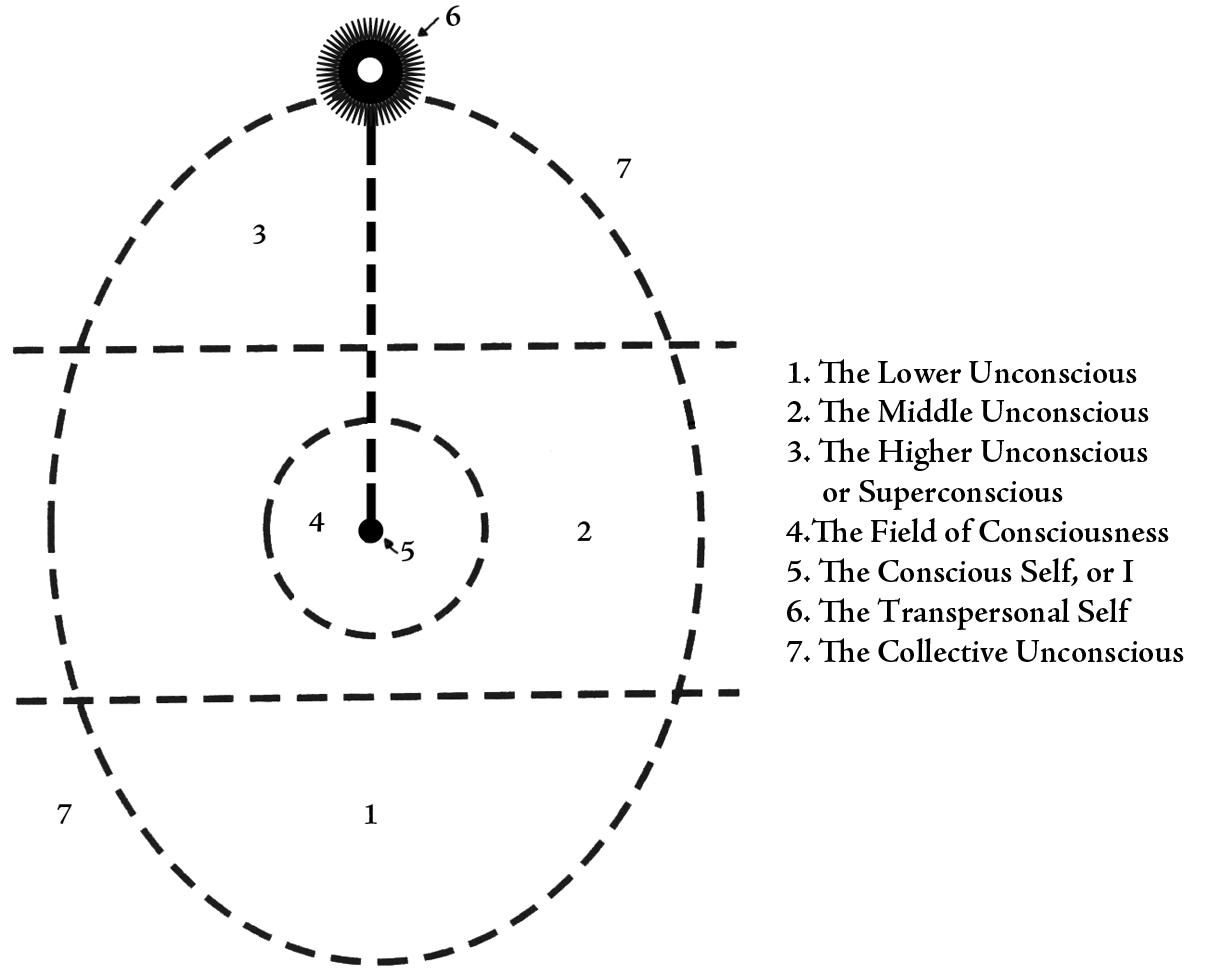
At its core, psychosynthesis offers maps as guidelines to support this integration. One of these is the Egg Diagram used to illustrate the different aspects of consciousness and the individual and collective unconscious. Our individual unconscious—higher, lower, and middle—is within the Egg and separated from the collective unconscious by permeable dotted lines, illustrating the seamless flow between these states. According to Assagioli (1976), the outer line “should be regarded as analogous to the membrane delimiting a cell, which permits a constant and active interchange with the whole body to which the cell belongs” (p. 21). He goes on to say that the “processes of psychological osmosis are going on all the time, both with other human beings and with the general psychic environment.” Within this understanding, we can expand our idea of the collective unconscious to include not only human collective unconscious, but also the ecological unconscious, which contributes to our psychic environment.
From this perspective, we can visually see how our unconscious is interconnected to everything. Information is flowing both into us from our collective unconscious and from us to the collective. Everything is interconnected. This can fundamentally shift our state of conscious awareness to understand how we hold within us not only our own personal pain, but also the pain of
the world; not only our own inner wisdom and higher qualities, but also the universal wisdom and intuition from which that springs.
I remember my first big heart-break. It was a paradigm shattering experience in my early twenties of recognizing how we treat other animals in factory farms, circuses, marine parks, etc. and the cruelty we inflict on these helpless ones. I simply had no idea. The truth is, I had never thought about it. Society had shielded me from this recognition until I finally saw the truth, and that reality changed me. My perception shifted, my values shifted, my purpose shifted; everything in my life changed from that moment on. I became a voice, an activist, an organizer, a connector, a lover. I began to feel more deeply with our world and to identify with my Ecological Self as the prime driver in my life. Because I fell in love with the higher quality of compassion for myself as an individual and with a greater vision for the potential of humanity, it led me to study mythology, ecology, deep ecology, ecopsychology, cosmology, and psychosynthesis. I became passionate about understanding our stories, our perspectives, our hearts and widening our vision of what it means to be human in this moment in time.
I believe many of us care about our world. We care about each other and this planet, and we want to make a difference. We are beginning to wake up, yet we can easily become overwhelmed by our personal challenges, our individual wounds, fears, or sense of inadequacy; and we become overwhelmed by the
pressures of society and the state of our world. I have found, however, that when we embrace a larger vision of wholeness it can change our relationship to the things that may normally paralyze us or hold us back as individuals. It gives us a different context for living, and this changes our relationship to everything. What we really want are the higher qualities like peace, compassion, connection. When we can experience our pain for the world as our passion for justice, it shifts our perspective.
Feeling with our world is evidence of our interconnection with life. When these emotional responses are understood and experienced as a healthy response, our sense of identity expands and the mind, freed from its cultural trance, retrieves a natural state of clarity. Just imagine the insights and intuition that return once we reconnect to Earth; imagine the shift in our choices, our sense of purpose. We experience our relationship to Self, each other, and our world more clearly and live our lives from a greater vision. Our values become shared values that move us toward a more whole world, and we become part of a positive evolutionary force of collective will.
Insight and Exercises to Support Ecopsychosynthesis
There is much available to us as coaches and group facilitators toward integrating our work with this ecological paradigm. In fact, the work of psychosynthesis is already serving as a base for several ecocentric programs. Deep ecologist and systems scholar, Joanna Macy, founded a body of work called the Work That Reconnects (WTR). Based on ecopsychology, deep ecology, and systems thinking, this experiential group work explores theory and eco-therapeutic practices that move us through the emotional and psychology aspects of this ecological paradigm. Molly Young Brown, author of several books in psychosynthesis, co-authored with Macy the guide to WTR entitled Coming Back to Life (2014). Brown merges the work of psychosynthesis and WTR in her practice and for decades has been a huge advocate for bringing the ecological paradigm into the work of psychosynthesis. She pioneered a movement she refers to as ecopsychosynthesis, inviting the community to take a stronger position in this ecological movement in order to create truly meaningful transformation.
In Reflections on Ecopsychosynthesis (Firman & Klugman, ed. 1999), Brown invites colleagues to engage in this discussion from various perspectives. She reflects on the limits of psychosynthesis and offers expansive ideas for forward movement. She proposes that the “Self” described in psychosynthesis is related closely to the “Ecological Self” coined by founder of Deep Ecology,
Arne Naess. This Ecological Self can be understood as “a sense of self encompassing all of nature, all of life, and acting from this very inclusive perspective” (p. 8). Molly argues that psychosynthesis, even as it aims to bring together the spiritual and psychological dimensions, suffers from an anthropocentric perspective. She said, “The spiritual has often been treated as a transcendent aspect removed from the material world, rather than immanent within all creation...” (p. 9).
Another prominent voice in this movement is eco-depth psychologist “gone wild,” Bill Plotkin (2013). Plotkin founded Animas Valley Institute, which wilds the work of psychosynthesis and ecopsychology through theoretical and experiential nature-based practices of wholeness. He incorporates subpersonality work as he guides people into the inner wilds of the soul with his work of Soulcraft. He also created the Nature-Based Map of the Psyche as a guide to becoming fully human. Plotkin adds his voice to the ecopsychosynthesis conversation.
My own experience as a Deep Ecologist and psychosynthesis guide focuses on group and individual coaching and weaves into psychosynthesis powerful tools from the Work That Reconnects, Soulcraft and ecopsychology. I have experienced profound breakthroughs with my clients using nature-based visualizations, experiential wilderness work, and deep self and collective inquiry based in ecocentric perspectives. I have found that the inner desire to engage the will and bring about personal change becomes magnified when it is done on behalf of a larger calling. It is fueled by a collective will sparked by the Call of the Ecological Self. This Call that whispers, nudges, and screams for us to awaken into a deeper awareness, invites us to do our inner work so that we can fully align our will with this collective evolutionary will and recognize our unique purpose toward the whole.
We are in a unique position as coaches, to work with those who are called to this inner journey of self-exploration and integration into wholeness. In psychosynthesis, we understand the Self as a center of contentless awareness and will, and just as we know our Self beyond the stories, we also get to know our Self through the stories that shape us in our own lifetime and beyond. The greatest evolutionary story of our time, The Universe Story, brings with it an expanded vision of what is possible when we align our self with our higher Self, which includes the Ecological Self, and live a life that is deeply meaningful, purpose-driven, and part of a greater vision than we may have even realized. We are called upon now to support the collective movement needed to take part in the Great Turning and consciously move us forward in our planetary evolution. In this way, psychosynthesis can fully support the individual, groups, and the planet in their process of unfolding.
Journey Deeper into this World
To support our work in bringing theory into embodied practice, it is important to deepen our own awareness. I have included several exercises and visualizations to support us. It is important that we experience them first as guides and coaches, so that we may become more present to our own connection with our Ecological Self. From this intimate understanding, we are better able to use these tools with clients.
These exercises are a great way to begin. They are sourced from psychosynthesis, the Work That Reconnects, and my own experience. May they support you personally in your life and in your role as a guide for others. As you step powerfully into this world, may you, too, be inspired to create your own.
The Blossoming of the Rose
This is a classic psychosynthesis visualization and, in my opinion, one of the best invitations from our field to presence ourselves as nature as well as universal energy. I have included it here, because I feel it is relevant to this particular focus.
1. Sit quietly and comfortably. Close your eyes, take a few deep breaths, and relax your body.
2. Imagine a rosebush, with many flowers and buds. Now turn your attention to one of the buds. The bud is still enclosed in its green leaves, or sepals, but at the very top, a rose-colored point can be seen. Focus on this image, holding it in the center of your awareness.
3. Now, in a slow movement, the sepals start to separate, turning their points outward and revealing the rose-colored petals, which are still closed…The sepals continue to open until you can see the whole bud.
4. Next, the petals also begin to unfold, slowly separating... until a fragrant, fully opened rose is seen…At this stage try to smell the perfume of the rose with its characteristic and unmistakable scent.
5. Now, imagine that a ray of sunlight shines on the rose, giving it light and warmth...Take a few moments to experience the sunlit rose.
6. Look at the very center of the rose. You will see appearing there the face of a wise being, full of understanding and love for you.
7. Talk to him or her about whatever is important in your life now. Feel free to ask questions about what is meaningful to you: life issues, direction, or choices you may need to make. Take the time you need to communicate in this way. (If you like, you can pause at this point and write down what happened, amplifying and evaluating further
whatever insights were gained.)
8. Now, identify yourself with the rose: imagine that you become the rose, or that you take the whole flower inside yourself...Be aware that the rose—and the wise being—are always within you and that you can get in touch with them and draw on their qualities whenever you choose...Symbolically, you are this flower, this rose. The same life that animates the universe and has created the rose is enabling you to awaken and develop your innermost being and all that radiates from it.
9. Now, imagine that you become the whole rosebush…Be aware that you are firmly planted in the earth, drawing nourishment from it ...Your leaves and flowers are growing upward, nourished by the energy and warmth of the sun's light.
10. Become aware of other rosebushes, other plants and trees—all animated by the same life energy, all part of the same planet, of the greater whole. Take some time to experience this...Then, whenever you like, open your eyes.
11. You may want to write about what happened or draw a picture, paying special attention to your dialogue with the sage, and to any insights that the exercise brought you.
(Assagioli, 2000, pp.188-190)
Self as Earth
This simple visualization, written by me, invites us into an expanded sense of Self and allows us to experience the rhythms of life within us. Though you have read it earlier in the chapter, take time now to fully experience it.
Take a breath.
Breathe into wildness.
In this moment, expand your awareness to be with Earth in its subtle and dynamic beauty and, through this, to experience your own.
At first, the wild movements: the sensation of the wind cooling the fierce sun on your face, tiny red-winged blackbird chasing the vultures away from his tree, tricolored heron hunting for fish. The more you watch, the more you listen, the deeper the subtle rhythms begin to move within you.
You feel yourself deepening, your breath deepening. Take a moment to become deeply present to what is alive in you now.
You begin to notice an undeniable connection where your internal world expands and your body becomes larger, stretching out beyond your skin.
Feel the sensation; you are expanding, becoming more whole, feeling the world within.
The Earth is moving, and there is a rhythm that moves in you.
Close your eyes. Take a moment to experience the sounds and sensations within
you.
Breathe deeply, and slowly open your eyes.
What did you notice?
Reference: Written by Valerie Silidker
The Web of Life
This practice is an invitation to reconnect with the interconnectedness of life. It was written by Joanna Macy for the Work That Reconnects.
Lie down, stretch out. Relax into the floor.
Feel your breathing in your lungs, abdomen. Notice how it glides in and out. The oxygen ignites each cell, stirs it awake as it burns in the metabolism of life. Extend your awareness deep within to feel this energy.
It is all around you, too, weaving you into the web of life.
Imagine you can see interlacing currents, like threads of light. See how they connect you with others. Experience the great multiplicity of strands, formed by countless relationships, woven of the work and food, the laughter and tears you’ve shared with others. They shape what you are, they hold you in place. Sense those interwoven threads, rest into them.
The web sustains your bones and blood and skin, concocted so intricately out of the food you have eaten, out of grains, vegetables, fruit, nuts. The soil that yields the grain for your bread, the boughs of the tree that bear apples for you. The hands that plow, sow, reap, gather. They all are of your body now.
Back through time this web extends: mothers, fathers, great-grandmothers and great-grandfathers, giving you your coloring and features, your gestures, your tone of voice.
The web extends back through countless generations, through numberless ancestors we share, all the way back to those with gills and wings. For it is of star stuff evolving that we all are made in the flowing of time. We are each a jewel in this vast net, that called us into being. Each of us an irreplaceable gem, sparkling with awareness, reflecting the world. Sound of gull crying over the sea, sight of mountain rising, colors of sunrise, scents of pine and loam, the excitement of a new idea, the melody of a halfforgotten song.
There is pain, too, coming in along the strands of the web: a friend with cancer, an oil spill coating the beach, an Iraqi mother weeping for her lost children. Do not shut them out, they live in the web of this planet time. Open to these sorrows, breathe them in, so the channels may stay open for the flow of energy and life and change. If we block
the pain, we block the joy as well.
There is power in the flowing of this fluid net, love that has enriched us, and love that we give. Feel the caring and love that flow through you.
Open to the pulsing of the web, its murmurs, whispers, tugs. Through that vast network all forms arose, intelligence arose. It shaped you as it shaped the mockingbird and the deep-diving trout. You are of it, of it, even to the terrors we’ve unleashed now. Open to it all, unafraid, relaxed, alert. You are the universe knowing itself.
To all our brothers and sisters, open now, in this time of great hardship. You go now through a dark place, but you do not go alone. And you do not go without your own timeless knowledge of the dark. You come from it, it is behind your eyes, and we will look into it, together, until the dark itself is clear…and home. There is nowhere you can go where you’re not held in the web that sustains us all.
Still sensing these connections through space and time, stir and stretch now, open your eyes.
(Macy & Brown, 2014, pp. 270-271)
Breathing the Tree
This guided visualization gives us an experience of interdependence as an evocative way to tune into connection with and gratitude for our world.
Take a deep breath and close your eyes.
Imagine that you are stepping into a lush forest.
Notice the smell of the damp soil and other earthy scents that fill the air.
See the sunlight dancing on the leaves, the depths of colors. Listen to the sounds of birds singing, the wind whispering through the trees.
As you step deeper into this forest, notice the way the soft earth embraces your step, the sensation of the ground beneath your feet, calling you deeper.
Allow yourself to wander, taking in the world around you.
As you find yourself entering deep into the heart of the forest, you come to a large old growth tree.
Take in the presence of this ancient One, several hundred years old.
You cannot see the top of this tree as it extends into the sky. You expand your arms and the base of the trunk is far wider than your reach.
You step forward and gently place your hands upon the rough textured bark. Deep grooves caress your hands and you tune into the energy of life flowing through this living being.
You become aware of your breath.
Inhaling and exhaling, you begin to feel as if you are being breathed.
As you exhale, you are aware that this tree is breathing in your carbon dioxide,
you are breathing into this tree. And as you inhale, this tree is breathing into you; you are breathing in the oxygen of this tree’s breath.
Stay present to this exchange of life. Breathing into the tree and being breathed into, the tree’s breath filling your lungs.
Inhale…exhale…together. This interdependent dance of life.
You exist as one being mutually dependent upon the other for your life.
Take a few moments to breathe, together.
Staying with your breath, you gently bow to honor this exchange and give thanks to this tree for your life.
You slowly make your way out of the forest, feeling deeply connected and aware of your interconnectedness and interdependence with life.
Gently coming back to your body, your present awareness in this moment.
Open your eyes.
Write down any insights that you received from this journey.
Reference: Written by Valerie Silidker
The Council of All Beings
This ritual sparks the imagination, intuition, and other psychological functions to reconnect with the more-than-human world and remember our interconnection with life. It was originally written by Joanna Macy and John Seed. The Council allows us to break free from our anthropocentric cultural views and embrace and embody a wider vision of our Ecological Self.
The Council of All Beings is described below by Joanna Macy.
1. Participants begin by letting themselves be chosen by another life-form, be it animal, plant, or natural feature like swamp or desert. We use the passive verb, be chosen, in order to encourage people to go with what first intuitively occurs to them, rather than selecting an object of previous study. This way our minds are more receptive and humble, more open to surprise. When out-of-doors, we can wander off alone to happen on the identity we will assume. When indoors, some quiet moments suffice, as we relax and wait with an open, non-discursive mind for the imagined presence of another life-form. Then we take time to behold this life-form in our mind's eye, bestowing upon it fullness of attention, imagining its rhythms and pleasures and needs. Respectfully, silently, we ask its permission to speak for it in the Council of All Beings.
2. If time allows and supplies are available, we make simple masks, working together in companionable silence with paper and paints, twigs and leaves. Then, briefly clustering in small groups, we practice taking on the identity of our chosen life-form.
This helps us let go of our self-consciousness as humans, and become more at ease in imagining a very different perspective on life.
3. Then, with due formality, the participants assemble in a circle and the Council of All Beings commences. To create a sense of sacred space, prayers and invocations are spoken. Native American practices, such as smudging with sage or cedar, and calling in the blessings of the four directions, are often used here to good effect. When I am the guide, and speaking, of course, as my adopted life-form, I like to begin the proceedings by inviting the beings to identify themselves in turn, a kind of roll call: Wolf is here, I speak for all wolves. I am Wild Goose; I speak for all migratory birds.
4. Welcoming them all, I thank them for coming, and, with some solemnity, set the theme for our deliberations. "We meet in council because our planet is in trouble; our lives and our ancient ways are endangered. It is fitting that we confer, for there is much now that needs to be said and much that needs to be heard."
5. The council unfolds in three consecutive stages. First, the beings address each other, telling of the changes and hardships they are experiencing in these present times.
a. "The shells of my eggs are so thin and brittle now, they break before my young are ready to hatch."
b. "I'm tightly crowded in a dark place, far from grass and standing in my own shit. My calves are taken from me, and instead cold machines are clamped to my teats. I call and call for my young. Where did they go? What happened to them"
c. "As Lichen, I turn rock into soil. I worked as the glaciers retreated, as other life-forms came and went. I thought nothing could stop my work; but now I'm being poisoned by acid rain."
6. The second stage of the Council begins after most have spoken, and the guide invites humans into the center. Since it is clear that one young species is at the root of all this trouble, its representatives should be present to hear these testimonies. So, a few at a time, the beings put aside their masks and move to sit for a while, as humans, in the middle of the circle. The other life-forms now speak to them directly.
a. "For millions of years we've raised our young, rich in our ways and wisdom. Now our days are numbered because of what you are doing. Be still for once, and listen to us."
b. "See my possum hand, humans? It resembles yours. From its print on the soft soil you can tell where I have passed. What mark on Earth will you leave behind you?"
c. "Humans! I am Mountain speaking. For millennia your ancestors venerated my holy places. Now you dig and gouge for the ore in my veins. Clear-cutting my forests, you take away my capacity to hold water and release it slowly. See the silted rivers? See the floods? In destroying me, you will destroy yourselves."
7. In the third stage of the Council, the other life-forms offer gifts to the humans. Recognizing how dependent they have become on humankind, they would help this young species deal with the crisis it has created. As ritual guide, I might cue this stage by saying, "Many humans now realize the destruction they are causing; they feel
overwhelmed and powerless in the face of the forces they have unleashed. Yet our fate is in their hands. O fellow-beings, what strengths of ours can we share with them, what powers can we lend them?" With this invitation, the beings in the Council spontaneously begin to offer their own particular qualities and capacities.
a. "I, Lichen, work slowly, very slowly. Time is my friend. This is what I give you, humans: patience and perseverance."
b. "I, Condor, give you my keen, far-seeing eye. Use that power to look ahead beyond your daily distractions, to heed what you see and plan."
8. One after another, the beings offer their particular powers to the humans in the center. After speaking, each leaves its mask in the outer circle and joins the humans in the middle, receiving the gifts still to be given.
a. "As Mountain, I offer you humans my solidity and deep peace. Come to me to rest, to dream. Without dreams, you lose your vision and hope. Come, too, for my strength and steadfastness, whenever you need them."
b. "As Leaf, I would free you humans from your fear of death. My dropping, crumbling, molding allows fresh growth. If you were less afraid of death, you would be readier to live."
9. These gifts reside already in the human spirit, as seeds within the psyche; otherwise, they could not be spoken. Their naming brings forth a sense of wholeness and glad possibility. When all of them have been offered, the Council of All Beings is formally concluded. Then the assembled often break into singing, drumming, exultant dancing - releasing energy after the long, attentive listening. Sometimes the group just sits in stillness, silently absorbing what has been learned or writing in journals.
10. Care is taken to thank the life-forms, who have spoken through us, and to dispose of the masks in a deliberate fashion. The masks may be formally burned, or hung on a tree or wall, or taken home with us as symbolic reminders of the ritual. On occasion, at the close of a Council, wanting to stay identified with the other life-forms, we fancy that we are putting on human masks, the better to work for them as we reenter the world of the two-leggeds.
Reference: (Macy, 2005)
Joanna Macy (2005) invited us to consider the Council of All Beings as a way of connecting with, and accessing insight into, our Ecological Self. As we come to a close, I invite us to consider that as well. What other-than-human being might choose you to speak on its behalf at the council? What would you represent of our larger world, and what gifts would you offer humanity in support of The Great Turning?
The part of us that allows us to be chosen by and speak on behalf of other-than-human beings is guided by our imagination and intuition, two
powerful psychological functions for moving us beyond anthropocentrism and into the wisdom of our Ecological Self. You see, everything that we create in this world must first be imagined. To take part in the healing of our world, we must first imagine what that might look like.
In the council, when we speak on behalf of another being, we also access our intuition through our imagination as wisdom from the collective unconscious. This wisdom is always present within us, for we have been shaped by the same mystery that gave birth to the universe. In this way, the Council of All Beings is a profound invitation to tune us into our Ecological Self and receive guidance from our collective unconscious. When we cannot physically access the natural world or take part in a group ritual however, guided visualization offers us access to our inner world in very similar ways. Either way, these exercises help us remember our potential as human beings and see with new eyes a more whole and inclusive world.
Together, we can imagine a more connected and compassionate future, and listen more deeply to our collective calling. As we ignite our hearts and spark our vision, we become inspired to respond to this ecological call and take action on behalf of life. With greater awareness comes greater will. Psychosynthesis can help lead the way.
References
Assagioli, R. (1965a). Psychosynthesis: Individual and social. Synthesis Center. Available at http://synthesiscenter.org/articles/0116.pdf.
Assagioli, R. (1976). Psychosynthesis. New York: Penguin.
Assagioli, R. (2000). Psychosynthesis, A collection of basic writing. Amherst, MA: The Synthesis Center, Inc..
Berry, T. (1978). The new story: Comments on the origin, identification, and transmission of values. Teilhard Studies, (1), 1–13.
Berry, T. (1988). The Dream of the earth. San Francisco: Sierra Club Books.
Berry, T., & Swimme, B. (1989). The universe story. Clinton, WA: New Story Productions.
Firman, D., & Klugman, D. (Eds). (1999). Conversations in psychosynthesis: An AAP monograph: Reflections on ecopsychosynthesis. Amherst, MA: Association for Advancement of Psychosynthesis.
Korten, D. (2006). The great turning: From empire to earth community. Bloomfield, CT: Kumarian Press.
Louv, R. (2008). Last child in the woods: Saving our children from naturedeficit disorder. Chapel Hill, NC: Algonquin Books of Chapel Hill.
Macy, J. (2005). The council of all beings. Available at Rainforest Information Centre, http://www.rainforestinfo.org.au/deep-eco/Joanna%20 Macy.htm.
Macy, J., & Brown, M. Y. (2006). Coming back to life: Practices to reconnect our lives, our world. Canada: New Society Publishers.
Macy, J., & Brown, M. Y. (2014). Coming back to life: The updated guide to the work that reconnects. Canada: New Society Publishers.
Plotkin, B. (2013). Wild mind: A field guide to the human psyche. New World Library, Novato, CA: New World Library.
Swimme, B. & Tucker, M. E. (2011). Journey of the universe. New Haven, CT: Yale University Press
Wilber, K. (1996). A brief history of everything. Dublin: Gill and Macmillan.