magazine
PSWC
“A L L W E T ” I S S U E | F E AT U R E D A RT I S T L I N D A M U T T I | PA S T E L S U S A : 9 9 V O I C E S 2 0 2 6
PASTEL SOCIETY OF THE WEST COAST VOLUME 17, ISSUE 3
FALL 2026
We. Are. Pastelists. Join one of the most dynamic pastel groups in the U.S. and pursue your passion! You don’t have to live on the West Coast to become a member. With PSWC members located around the U.S. and internationally, the Pastel Society of the West Coast offers a strong voice for expanding the presence of soft pastel as a major fine art painting medium. PSWC was organized in 1984 to promote pastel artists and the medium of soft pastel. Today we are one of the largest and most recognized pastel societies in the country with an ever-increasing international presence.
BENEFITS INCLUDE • Pastels USA Annual Juried Exhibition • Members Only Online Competition • Out of Bounds! Juried Exhibition • In-person and Virtual Workshops by Noted Pastel Artists • PSWC Magazine • PSWC Social Media Exposure Opportunities • We Talk Art Interview Series • Regional In-person Events • Online Demonstrations • Free Online Gallery • Membership in IAPS
www.pswc.ws 2
magazine
PSWC Table of Contents
FEATURES
ABOUT ART
SPECIAL SUPPLEMENT 2026 Pastels USA: 99 Voices in Pastel
42
Bound to Inspire Book recommendations by Marla Baggetta
Featured Artist Linda Mutti
22
Meet the Members Linda Evans Margaret Larlham Kim Long Glen Maxion Peggy Post
77
REGULARS
98
Letter from the Editor Francesca Droll
4
Art School Clint Howard
100
From the Desk of the PSWC President Pamela Comfort
7
Art Workshops Christine Obers
104
Regional Activities News from Our Regional Representatives
8
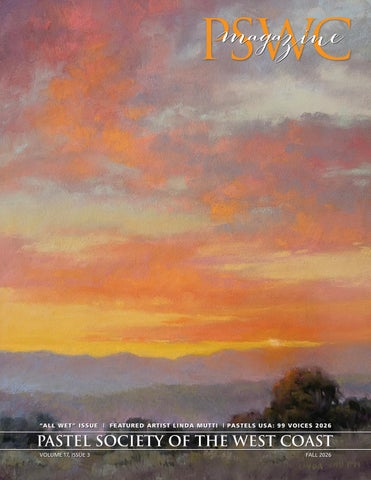
Cover art: Sky Lights by Linda Mutti
PSWC Magazine | Fall 2026
3
EDITOR’S NOTE
Dear Artists, A fun adventure happened this summer and I just have to share it with you. I got an email in early June from Pamela Comfort, president of PSWC, and she was going to IAPS in Alburqurque and then she and her charming husband, Scott, and Henry (their sweet poodle) were willing to drive all the way from the southwest to the northwest, paying their expenses all the way, just to meet me face-to-face. The day they arrived with their RV, it was raining buckets. My husband, John, and I hosted dinner and we made elk burgers which was a request from Scott. We are in elk country after all. The next day, the storm had passed and our plan was a drive up Going to Sun Highway in Glacier National Park. As lovely as the Park is just about anytime of year, the views sweeping and extraordinary, the one thing that makes it so much better is an animal sighting. Half way up the GTS Highway, we were stopped by a bear walking down the road as if it didn’t have a care in the world. A bear—the best sighting of all! We continued up until just before Logan Pass where we took a little side trail to a spectacular overlook. This is the spot where visitors often see mountain goats because they love this area. Right on cue, the goats were there and were quite spunky. Bonus! Another wildlife sighting! The final leg of the drive to the top of the pass is only 2 minutes more. We had our picnic dinner and unbelievably, bighorn sheep arrived at a mountain slope directly across from the parking lot. There was a herd of about a dozen bighorns and a couple even made a show of butting their horns. Another bonus! My goodness, but we were all walking on clouds. The last sighting was a beautiful mule deer, a buck with an impressive rack. We started home and I was no longer surprised when we drove by a herd of elk in a meadow. That was our fifth wildlife sighting (a record in one day) and the only iconic wildlife we were missing at this point were the bison and the moose. The next day, Pam and Scott came over as we had another deluge of rain. Plein air was out of the question so we painted in my studio from photos. So much fun to paint with Pam. They drove off on Monday morning and I got a text not long after saying they had driven by the Bison Range and had seen the bison! Next time they come back we’ll dial up a moose sighting. They were the luckiest of visitors and I hope that made the long drive north worth it for them. “Art is when you hear a knocking from your soul and you answer.” —Terri Guillemets
Our president, Pam Comfort, is not only the kindest and most gracious of human beings, she is totally committed to our Society and its members. Her dedication, efficiency, organizational skills are what make this Society one of the most successful and enduring in the pastel community. It’s truly an honor to be included and participate in such a wonderful organization. Thank you, Pam (and Scott and Henry) for your visit this summer!
Francesca 4
pswc.ws
CONTRIBUTORS
Contributors Pam Comfort, PSWC President In addition to serving as President, Pam co-chairs the Out of Bounds! show, and covers open positions. She also serves as secretary of IAPS. Pam earned a doctorate in Educational Leadership and retired after a long career in public education. She loves to travel and aspires to create art that communicates a strong sense of nature, culture, and place. pamelacomfort.com
Marla Baggetta is a nationally acclaimed artist, a gifted instructor, and a pioneer in the realm of online art education. With a career spanning over three decades, Marla’s artistry has flourished in pastel, oil, and notably, abstract acrylic. Marla’s contribution to the art world extends beyond her paintings and workshops. Her paintings have been featured in several books and publications and exhibited throughout the United States. She has been featured in the Pastel Journal, Plein Air Magazine, the Pastel Society of the West Coast Magazine and is the author of Step by Step Pastel by Walter Foster Publishing. marlabaggetta.com
Kim Essex chairs the Scholarship program. She has a journalism degree from Drake University in Des Moines, Iowa. Kim is two years into her pastel journey, having started painting after retiring from a career in public relations and moving to Valencia, Spain, with her husband Sean and dog Trax. She says she hopes she has artistic genes; her mother, aunt, brother, niece, and grandfather were all artists. She believes everyone should surround themselves with original art as it reminds us of our shared humanity and the beauty within.
WANT TO GET INVOLVED? Our Society runs on volunteer power. We’re always grateful to receive more help. Please contact us— we have a spot for you!
KEEP IN TOUCH FOLLOW US!
Clint Howard, IAPS/MC, PSA, is an Arkansas-based artist who started painting with pastels early in 2023. He is an International Association of Pastel Societies Master Circle artist, a juried Signature Member of the Pastel Society of America, and a juried Signature Artist in the American Tonalist Society. Clint has a varied background, including a degree in biology, nearly eight years of service as a pastor, and over fifteen years in the web and graphic design industry. Clint’s focus in his art is to evoke a sense of calm, nostalgia, and connection to nature. He is especially drawn to traditional and contemporary Tonalism and Impressionism but he also enjoys exploring other landscape painting styles. clinthowardfineart.com
PSWC Magazine | Fall 2026
5
6
DESK OF THE PRESIDENT
Desk of the PSWC President Dear Friends, What an exciting summer we have had! In June, we had a wonderful presentation for our members by award-winning artist Nancy Nowak. She provided a slideshow of her works, described her artistic process and techniques, and the different materials she uses. Nancy shared numerous examples of her work across different subjects and locations, discussing her approach to composition, color theory, and the importance of finding the right focal point in each painting. Also in June, many PSWC members converged with other pastel artists at the IAPS Convention in Albuquerque. The workshops, demonstrations, reception, banquet and exhibition were all fabulous events bringing together pastel painters from around the world. The best part was simply being in the company of so many friends, old and new, who understand our love for the medium. PSWC was well-represented and we came away with a sense of appreciation and new members! July’s This Challenge is All Wet! event provided an opportunity to practice skills and share methods for painting all things water. See some of the participants efforts in this issue, and check out the Art School article by Clint Howard, as well as suggestions from some of our Meet the Members interviewees for additional concrete ideas about painting water—a subject we all love! Our July We Talk Art guest was Diane Townsend, who shared information about her pastel-making process, and her experiences as an artist. Diane explained the technical aspects of making pastels, her influences, and her philosophy on art-making, emphasizing the importance of freedom and enjoyment in the creative process. Next, an August demonstration featured Natalie Richards creating a desert landscape painting in real time. She explained her process, discussed her use of soft pastels, a light touch, and a combing tool for blending, emphasizing the importance of fresh marks and simplification.
Pam Comfort
This summer, PSWC Regional Representatives provided local opportunities for artists to come together. Clark Mitchell hosted a paint-out at a winery in Santa Rosa; Carol Talley hosted a Casual Critique in her home near Santa Barbara; Jean Myers put together a paint-out in Ventura; Lisa Skelly welcomed artists to a session of Mentorship Painting in Newport Beach; and Kim Lordier organized a docent-guided private tour of “Monet and Venice” at the de Young Museum in San Francisco. Most exciting, our 40th Anniversary Pastels USA: 99 Voices International Juried Exhibition opened at the Visual Experience Fine Art (VEFA) Gallery in Torrance, California on August 1st. The show was thoughtfully arranged and the Gala Awards Reception on August 8 was attended by hundreds of artists, their guests and members of the public. The whole evening felt like a joyful celebration of art and artists. Pastels USA Exhibition activities also extended beyond the show, by including a workshop with show judge Clark Mitchell and another with juror Otto Stürcke. In addition, Lisa Skelly, Mike Ishikawa, Bridgette Duffy, Denise Busony, and Otto each provided a public demonstration on different Saturdays during the show run. The workshops and demonstrations took place right in the center of the gallery, so that participants were surrounded by the beautiful art on display. This summer season especially, I am reminded of what an honor and pleasure it is to be a part of the pastel art family. We can be proud of the way our commitment to education, community and excellence helps to promote and enhance public awareness of the pastel medium. Stay dusty!
Pam PSWC Magazine | Fall 2026
7
REGIONAL ACTIVITIES
R E P R E S E N TAT I V E S
R E P O RT
Regional Activities We appreciate the regional volunteers who coordinate a wide range of in-person activities for PSWC members and guests. Because our membership is so large, it isn’t feasible for everyone to gather face-to-face regularly; these events complement our in-person workshops and exhibitions by creating opportunities for members of our cherished art community to connect in person.
PSWC ~ Sebastopol, Napa, Sonoma Region Activities Regional Representative: Clark Mitchell • For more information on these dates, call Clark at 707.477.0276
Close to 20 artists gathered this past June at Matanzas Creek Winery outside Santa Rosa (Sonoma County) to paint lavender in full bloom. The humming of happy bees and the intoxicating scent of blossoms in sunshine made the painting experience that much more delightful.
UPCOMING October 22, 2026: Paint-Out 9:30 am to 12:30 pm Location: Tolay Lake Regional Park, 5869 Cannon Lane, Petaluma Variety of subjects from rolling hills, distant vineyards, close-up old barns, mature trees. Something for everyone to paint. Bring water and a snack for yourself. There are porta potties but no water.
8
pswc.ws
REGIONAL ACTIVITIES
PSWC ~ San Francisco Bay Area Peninsula to Big Sur Region Regional Representative: Kim Lordier • For more information, email: kim@kimfancherlordier.com
Kim Lordier organized a visit to de Young Museum in San Francisco to view the “Monet and Venice” exhibit. which ran from March 21 – July 26, 2026.
UPCOMING October 14, 2026: Paint-Out at Cavallo • 9:30 am Location: Cavallo Point, 557 McReynolds Rd, Sausalito, CA 94965 Ready to use your reds and oranges to paint the Golden Gate Bridge? Or how about the stunning San Francisco skyline with sail boats and sea lions? Magnificent Eucalyptus trees and great hiking for partners who don’t paint. Could be foggy, could be crystal clear. Either way there is plenty to paint at the historic Fort Baker army base situated in the Golden Gate National Recreation Area. Cavallo Point: Situated at the foot of the Golden Gate Bridge, it offers some of the best vantage points of the bridge, San Francisco Bay, and the city skyline. Historic Fort Baker: The lodge is built on a former U.S. Army post, thoughtfully restoring the symmetrical, Colonial Revival-style officers' quarters into luxury guest rooms. It is listed on the National Register of Historic Places. Dress in layers. Bring a snack or lunch. There is a restaurant on site if your prefer.
PSWC Magazine | Fall 2026
9
REGIONAL ACTIVITIES
PSWC ~ California Central Coast & San Luis Obispo County Region Activities Regional Representative: Bobbye West-Thompson For more information, email Bobbye at bobbyethompson@charter.net We had eight painters attend the recent Central Coast Region paint out hosted by Jim Tyler. Expansive views of pasture land and Hollister Peak were enjoyed by all who participated. Clockwise from left: Jim Tyler, Melissa Lovett-Adair and others, Debbie Whitney, Tami Dalley
UPCOMING November 6, 2026: Paint-Out 9:30 am — noon Location: Morro Bay, boat harbor parking area across from the State Park restrooms (10 State Park Drive) Inspiring views of iconic Hollister Peak, boats, sea birds, the estuary and lovely vegetation. Bring your camera, art supplies and enthusiasm—you won't be disappointed. PLEASE RSVP. Questions? Email me.
10
pswc.ws Bobbye West-Thompson’s painting on the easel.
REGIONAL ACTIVITIES
PSWC ~ Santa Barbara County Region Activities Regional Representative: Carol Talley Email carol at carol@caroltalley.com for address and details. October 24, 2026: Casual Critique • 3:00 pm Location: Carol’s home located between Santa Barbara and Goleta There is easy access to the freeway and lots of street parking. We can share what we need help with, and be supportive of one another. The activity will take place outdoors, on the patio, weather permitting.
PSWC ~ Southern California/Ventura County Region Activities Regional Representative: Jean Myers Please RSVP that you are participating by texting Jean’s cell: 805.402.2609 September 26, 2026: Paint-Out 11:30 am to 3:00 pm Location: Channel Islands Harbor, 3500 S. Harbor Blvd., Suite 1-100, Oxnard Let’s grab lunch together at the Waterside Restaurant and then paint the harbor. Meet in front of the restaurant at 11:30. Afterward, enjoy scenic views of docks, boats, water and seagulls. Free parking. Restrooms available.
PSWC ~ Southern California/Orange County Region Activities Regional Representative: Lisa Skelly To reserve your spot, at any of these email Lisa at HuseSkellyGallery@gmail.com Dates: September 1, 2026 Location: Huse Skelly Gallery, 229 Marine Ave., Suite E, Balboa Island, CA 92662 Mentorship Painting • 9:00 am to noon A special opportunity for up to 12 artists to bring your pastels and work on your paintings alongside Lisa Skelly in a relaxed space with other pastel artists. It’s all about pastels and Lisa will be there to help with tips and techniques.
PSWC Magazine | Fall 2026
11
REGIONAL ACTIVITIES
PSWC ~ Idaho/Montana/Wyoming Region Activities Regional Representative: Bonnie Davis Kenaley September 30 –- October 1, 2026 3-day Workshop by Kim Lordier 9:00 am to 4:00 pm Location: Catalyst Arts Collaborative, 6427 W Ustick Road, Boise ID 83704 Information at pswc.ws/new-workshops/
October 3 – October 10, 2026 Location: Eagle Plein Air Festival Including demonstration by PSWC Pastel Laureate Kim Lordier, Friday, October 9, 2026 at 11:00 am. Information at eaglepleinair.com
November 2 – November 30, 2026 PSWC Regional Art Show 10:00 am to 5:00 pm Location: Finer Frames, 132 E State Street, Eagle, ID 83616 For information, contact Bonnie Davis Kenaley at bk6550@gmail.com.
REGIONS COVERED The PSWC greatly appreciates our Regional Reps! These artists have stepped up to help the Society fulfill it’s commitment to promote art and art education in our communities and to have a little fun while doing it! They organize Paint-Outs, PaintIns and social events in their geographic areas. If you live in one of these areas, contact them through their websites to find out about upcoming events. Traveling near-by? Here’s a chance to find out about events that will turn your vacation into an art trip! Interested in becoming a regional rep? Please contact us!
12
pswc.ws
IDAHO, MONTANA, WYOMING Bonnie Davis Kenaley SEBASTOPOL, NAPA, SONOMA Clark Mitchell • clarkmitchellart.com SAN FRANCISCO AND PENINSULA Kim Lordier • kim@kimfancherlordier.com CALIFORNIA CENTRAL COAST, SAN LUIS OBISPO COUNTY Bobbye West-Thompson • bobbyewestthompson.com SANTA BARBARA COUNTY Carol Talley • caroltalley.com SOUTHERN CALIFORNIA, VENTURA COUNTY Jean Vineyard Myers • jeanmyers1990@gmail.com SOUTHERN CALIFORNIA, ORANGE COUNTY Lisa Skelly • HuseSkellyGallery@gmail.com
PSWC Magazine | Fall 2026
13
PS W C
•
•
CHALLENGES
M E M B E R
Challenges 2026 February 1–10
Winter Painting Challenge: Multimedia My Way Ways to experiment with multi-media paintings:
COMPLETED
• Create an underpainting: Use watercolor, inks, oil paint, washes of acrylic paint, gouache, etc. Leave a high percentage of the underpainting in place, rather than covering it all with pastel. Remember, your support has to accept wet media. • Create a monotype: Use printmaking ink or paint on freezer paper to create a monotype, and experiment with different tools to create marks, after printing, add pastel over the ink or paint • Pastel over collage: Experiment with a variety of materials such as glued fabric and paper to create a collage and put the pastel on top, along with other media. • The possibilities are endless…go to pswc.ws/painting-challenges for more ideas.
April 1–10
Spring Painting Challenge: What Springs to Mind? Take advantage of this opportunity to create new pathways for your own artistic expression! A daily visual prompt will be provided (such as a squiggle or shape).
COMPLETED
July 1–10
Redraw the visual on your substrate and build upon it to create your painting, or study the visual and think about what it brings to mind. Use that concept as the basis for your painting. Or, identify your first emotional reaction to the visual and create a painting that represents that emotion. The sky is the limit, as long as you can express the connection between the visual prompt and your painting.
Summer Painting Challenge: This Challenge is All Wet! Utilize any and all principles related to painting water.
COMPLETED
Any and all types of water count: ocean, lake, river, creek, stream, waterfall, pool, marsh, even water in a flower vase. Consider stillness/reflection, movement/ripples, light/refraction, eye level and shape, depth and clarity. Look through art books, and at online videos for tips on painting water. Practice by recreating paintings by the masters. For inspiration, check out the works of Monet, Homer, Sargent, Hopper and contemporary artists Amy K. Sanders, Abi Whitlock, and Jessica Masters.
October 1–21 Fall Painting Challenge: The BIG One! 21 Paintings in 21 Days Use this opportunity to commit to nearly a full month of daily painting. Here are some ways to keep the momentum: • Prepare your paper ahead of time • Focus on small works • Limit your time to 30 minutes or so • Plan to work in a “series” every few days or week • Choose one subject or reference and paint it using several different palettes • Go to bed each night with the next day’s block-in or underpainting on your easel For rules, more complete descriptions, and to participate, please visit pswc.ws/painting-challenges/
14
pswc.ws
CHALLENGES
Our Summer Challenge was All Wet! by Pamela Comfort
O
ur July Challenge, This Challenge is All Wet!, gave participants the opportunity to utilize any and all principles related to painting water: the ocean, lakes, rivers, creeks, waterfalls, pools, marshes, even water in a flower vase. Painters took into consideration stillness/reflection, movement/ripples, light/refraction, eye level and shape, depth and clarity. Whether big or small, oceans, puddles, pools, even a single drop in a vase counted. Splash, ripple, trickle, or pour—if it was water, it belonged in the mix. We were encouraged to look through art books, and at online videos for tips on painting water, to practice by recreating paintings by the masters and to draw inspiration, from the works of Monet, Homer, Sargent, Hopper and contemporary artists Amy K. Sanders, Abi Whitlock and Jessica Masters. Pastels offer a unique advantage for painting water: you can physically blend the pigments directly on the paper to create seamless gradations and fluid textures. However, because pastels are dry and opaque, capturing the transparency and liquidity of water can be tricky. Painting a calm, reflective lake, crashing ocean waves, or a moving river, requires a specific color palette and stroke
Barbara Archer
strategy for each. Our challenge participants posted a wide variety of subject matter, illustrating diverse methodologies and approaches to problem-solving. The challenge afforded the artists to try new things, take risks, and share ideas — all with the support and encouragement of one another. And of course, encouragement and inspiration came from our everfaithful Challenge Cheerleader, Kelly Ann Hines. Congratulations to all who participated in this playful exploration, all those who completed the ten days of painting, and to the three winners, chosen randomly, who received a PSWC gift certificate: Rachel Sylvers, Laura Pritchard, and Bonnie Kenaley. Mark your calendar for our next challenge, the October 1st through 21st free-for-all, when participants may choose to either paint something fallthemed, or anything else at all!
Vicki Brink
PSWC Magazine | Fall 2026
15
CHALLENGES
Nanci Cook
Karen Horne
“Thank you. I find these challenges a good time to experiment a bit.”
Carrie Cornils
Janis Ellison
16
pswc.ws
Bonnie Davis Kenaley
CHALLENGES
“Thank you Kelly Ann Hine and all at PSWC for this summer challenge! Great exercise in diving right in at the easel. Its been fun seeing everyone's approaches.”
Susan Mueller
Dave LaPier
Laura Pritchard
Judy Miller
Teresa Steinbach-Garcia
PSWC Magazine | Fall 2026
17
CHALLENGES
Olga Symonenko
Rachel Sylvers
“I've worked on a variety of scenes, all that had been just potential subject matter sitting in my photo files. Love that I've had a chance to loosen up and experiment, trying them out without overthinking. And fun to focus on the look of water.”
Viviane Tubey
Watch for ‘The Big One!’ our Fall Challenge, which runs from October 1–21, 2026. For rules, more complete descriptions, and to participate, please visit pswc.ws/painting-challenges/
18
pswc.ws
“It was a beautiful reminder of what makes this community so special. The energy, generosity, learning, laughter, and shared love of pastel made the IAPS 2026 Convention an unforgettable gathering.” —Pam Comfort
PSWC Magazine | Fall 2026
19
IAPS 2026 CONVENTION
20
pswc.ws
IAPS 2026 CONVENTION
BOOK SIGNING BY ARTISTS
PSWC Magazine | Fall 2026
21
After the Storm, pastel
22
pswc.ws
F E AT U R E D
A RT I S T
Making Magic on Paper Linda Mutti on Pastel, Perseverance, and the Lifelong Dream of Art by Pamela Comfort
Speaking with Linda is a reminder that an artist’s life is rarely a straight line. Our conversation moved easily from horses and childhood drawings to family, loss, landscape, friendship, and the quiet discipline of learning to see. Linda speaks with warmth, humor, humility, and a deep reverence for the natural world. What emerged was not simply the story of a painter returning to pastel, but the story of an artist who has continued, through every chapter, to make room for beauty.
Pamela: Linda, thank you again for taking the time to talk with me. Let’s begin with, where did you grow up, and what kind of childhood first shaped the way you see the world? Linda: I was born in Tucson, and I do have memories of Tucson, but when I was five we moved to Santa Barbara. So, basically, Santa Barbara is where I grew up. I grew up when Santa Barbara was still a very small town, with lots of open spaces, lots of horse owners, and lots of trails. We could ride our horses all over—to the beach, up the creeks, into the mountains. It was honestly a great childhood. I remember sitting at the end of my driveway with my stick hobby horse, waiting for real horses to go by. One man rode past and said, “Do you want to trade?” I was
about six years old, and I said, “Yes!” I waited a long time for him to come back. That pretty much sums me up. I was one of those horse girls from the beginning. Pamela: That image of a little girl waiting at the driveway for a horse to trade feels like the beginning of both your horse life and your artist’s eye. Your mother also seems to have been a powerful creative presence. Tell us about her. Linda: My mother was very artistic—very artsy-craftsy in the best possible way. She did beautiful copper enamel jewelry, fabric dyeing, painting on fabric, watercolors, portraiture, and all kinds of drawings. She was a wonderful draftsman. I was always mesmerized by the things she made. She always made our Christmas cards, too, which felt magical to me as a child.
PSWC Magazine | Fall 2026
23
A Breath of Nature, pastel
I wish I still had more of her work, but I lost my home in a wildfire, and many of those things were gone with it. So much was lost, but I still have the memories. I remember wanting to carve wood when I was little, and my mother took me right to the craft store and bought me balsa wood and knives. Looking back, I think, “Oh my gosh, I don’t think I would hand knives to my own daughter!” But that was the kind of faith she had in me. Pamela: Did that creativity run through your siblings as well, or did drawing and painting feel like your particular language? Linda: They were all crafty, but nobody really wanted to draw or paint the way I did. They might do stamping or other kinds of crafts. There were five of us originally; now there are three sisters left. At Christmas, we still like to set up a craft table and just go for it. Every other year,
24
pswc.ws
I have a timeshare in Tahoe, and I try to bring some kind of craft for us to do together. It’s a fun way to connect. Pamela: And your father seems to have supported the horse side of your life. What role did he play in the family story? Linda: My dad was the reason we moved to Santa Barbara. He was the manager of a Sears store, and he was pretty much a workaholic. But he loved horses, so he supported that part of my life. Later, when he retired from Sears, he opened a travel agency in Santa Barbara because he loved to travel. He worked at that until he passed away. Pamela: Your father later opened a travel agency, but when you describe your own childhood travel, it sounds as if the outdoors mattered more than faraway places.
Linda: Not international travel or anything like that. The traveling we did as a family was camping, and I still love camping so much. I was happy to give those experiences to my daughter, too, and she loves camping now. That love of being outdoors is part of why nature is such a constant inspiration for me.
horses’ legs worked. We knew there were angles, but we couldn’t quite see them. Then in fifth grade, one friend—Marnie—figured it out and showed the rest of us. It still gives me goosebumps. Suddenly we understood the ankles, the hooves, the whole structure. It was very exciting.
Pamela: When did drawing become more than just something you liked to do—when did it become part of how you understood things?
Pamela: That is such a wonderful first lesson in seeing: not just drawing a horse, but figuring out how a horse is built. Did school give you a place to keep developing that interest?
Linda: My earliest memories are of drawing. I drew and drew and drew, and because I loved horses, I drew horses. I wish I had some of those drawings now. I vividly remember that I didn’t understand their legs, so I would put the horses behind a log. Then, to explain why they were behind the log, I would put an apple on the log. I had a couple of friends who also loved horses and loved to draw, and we talked all the time about how
Linda: All the way through junior high and high school, I always took art as my elective, so I never learned how to type. Typing was another elective, but I loved the art classes so much. I did drawings for the yearbook and big posters for the school. It wasn’t anything especially academic—it was projects, paint this or draw that—but I loved it. It fulfilled something in me, for sure. Those were my favorite classes, and I still remember my teachers.
Field of Dreams, pastel
PSWC Magazine | Fall 2026
25
Pamela: From there, you followed art into Santa Barbara City College and then UCSB. But that path took an unexpected turn, didn’t it? Linda: I went to Santa Barbara City College as an art major, and I loved it there. That was where I was exposed to oil painting and brushwork. But I still didn’t learn things like temperature, value, and edges, so for a long time I didn’t know what I didn’t know. After two years, I transferred to UCSB, and that was very different. It was a time when representational art was looked down on, and the program felt much more avant-garde. One of my instructors came into class with a project made from two small sails stapled around the edges, stuffed and spray painted. That was a turning point for me. I remember thinking, “I am not an artist. I am out of here. I have to figure out what I’m going to do and how I’m going to support myself.” So I changed schools and majors, and I didn’t paint for thirty years.
The Winding Road, pastel
26
pswc.ws
Pamela: That moment could have closed the door permanently, but instead your life moved into a very different kind of work with children. How did that next chapter begin? Linda: I switched to early childhood education because I loved kids. I went to Cal Poly and got a degree in that field, and my first job was directing a preschool in Beverly Hills. It was not your average preschool. I had children of well-known people in my class—Regis Philbin’s daughter, Diana Ross’s daughter Tracee Ellis Ross, Richard Pryor’s daughter Rain, Jamie Voight—and there were some memorable moments too. One day Diana Ross came in while I was doing circle time, and she was standing right behind me. I could hardly speak. As a twenty-three year old, I was kind of starstruck. I didn’t really like living in Los Angeles, though, and my boyfriend at the time—who later became my husband—was in Santa Barbara. Eventually I moved
back and became director of a preschool there called Mother Goose, which is now just down the street from my house. Pamela: And then you made another shift, into accounting. It sounds practical on the surface, but even that chapter kept you surprisingly close to landscape and horses. Linda: I wasn’t making enough money, and I was good with numbers, so I went back to school. I’ve always felt very left-brain and right-brain. I took the CPA exam in Fresno while I had bronchitis and somehow passed all the parts. Then I realized that ski season is tax season, and I thought, “I don’t want to do that.” So I went to work as an accountant for the Santa Barbara County Office of Education, in School Business Advisory Services. The county school building looked right out on the San Marcos Preserve foothills, and I could see horses running in pastures. It was only about a mile and a half from my house, so that was a perfect fit. I’ve done paintings from there. Pamela: Then your husband’s veterinary clinic brought the practical and animalloving sides of your life together. Linda: My husband just could not find a good business manager for the clinic. He would come home so stressed, and I thought, “I have got to go support him.” So I quit my county schools job and went and ran our clinic. I loved it a lot, because I am an animal person. Pamela: After more than thirty years away from painting, pastel came back into your life. What opened that door again? Linda: For the thirty-plus years I didn’t paint, I did a lot of crafts. Then we had I Madonnari here in Santa Barbara, a street painting festival through the County Education Office, based on the big one in Italy. I saw people doing all these fun squares and thought, “How fun is that?” So I got a square, and they gave me a box of pastels. You’re on your hands and knees drawing with those pastels for hours and hours, but I loved it. And then I had a box of pastels.
Kings Canyon, pastel
Pamela: Almost immediately, horses entered that story again. How did that first pastel horse portrait happen? Linda: I was riding, because I love horses, and someone I was riding with was getting married. She had a lot of money, so I thought, “What do you give somebody who doesn’t need anything?” I decided to do a portrait of her horse. I went to the art store, which was pretty minimal in Santa Barbara, picked up a few sticks, and I didn’t know anything about papers. I knew nothing. But I managed to get a pretty darn nice portrait. I presented it to her at the horse show, and she was ecstatic. Then somebody else saw it and wanted one, and then somebody else saw it and wanted one. So it kind of grew that way as an exposure to pastels. Pamela: Then another doorway opened through the pet hospital. What do you remember about that encounter?
PSWC Magazine | Fall 2026
27
One Fine Day, pastel
High Desert, pastel
28
pswc.ws
Linda: Glenna Hartman came in because she wanted to put a dog portrait in our pet hospital. She was quite well known, a member of Plein Air Painters of America and the Oak Group, and she was a good friend of Richard McKinley’s. I loved her work, so even though I’m pretty shy, I asked whether she gave workshops. She said no, but she told me what paper she used and what pastels she worked with. She told me about Hahnemühle velour paper and Sennelier pastels. I didn’t know those names then, so I drove to Los Angeles to find them. I walked into the art store and asked, “Where are your sin-yel-yay pastels?” and the person behind the counter with a perfect French pronunciation asked, “Do you mean Sennelier? I said, “I guess I do.” I bought the pastels and the velour paper, and that paper was so fun to work on. I did a lot more portraits after that. Pamela: Just as the portraits were growing and pastel was becoming a real language for you, a fire changed everything. What do you remember from that time? Linda: Our house burned down in a wildfire. I had commissions going, and I had all my horse stuff there. I saw a plume of smoke in the mountains and thought, “That doesn’t look good. I’m going home.” By the time I got to my street, the police line was already up because it was very windy, and we had sundowners blowing down the mountains. Little shy me just thought, “Get out of my way. I’m going,” and I drove right through the police line. I got to the house and got my animals. The cat did not want to get in the cardboard carrier, of course, but I got the dog and cat out. I grabbed home movies, photographs, material for a little flower-girl dress I was making for my daughter, and—of all things—my hair dryer. In that moment, you grab what you grab. That was what
Cowgirl Up, pastel
I was able to get out with. I remember that because the end of our dead-end street turns into a dirt road, there were horses up at the end, and people just opened up their gates and let the horses go. So the horses were running down the street. There's only one way out from this area, and you're coming down a mountain. So there's one street, and everybody's trying to jam into the street. But then, trailers started pulling up out of the main street to pick up horses. It gives me goosebumps. They took them to our showgrounds, and people could go and try to find their horses. It was amazing. The next day, I opened the pet hospital because I thought people might need a place to bring animals.
PSWC Magazine | Fall 2026
29
They did. Another pet hospital was under threat too, so I said, “Come on over.” I stayed there all night with the doors open. My husband got stuck on the other side of the fire, because it crossed the freeway. So we were on different sides of the freeway. We had no clothes, because everything was gone. My husband did make it to work the next day, in his karate clothes. Later, when we returned to the neighborhood, it looked like the moon because everything was gray. We rebuilt on the same lot, but the new house changed the way I live with the view. Our original little tract house had only one frosted bathroom window facing the mountains. Now I have a studio on a second story that looks out on the mountains, and that makes me really happy. Pamela: After the fire, what helped you begin again— not just with a home, but with painting?
Into the Mystique, pastel
30
pswc.ws
Linda: You know what? The rest is just stuff. After I found us a place to live while we rebuilt our house, I thought, “Well, what do I do now?” We have a fantastic adult education program here, so I signed up for an oil painting class. I knew nothing, but I started to meet people, and that is how I got into landscape painting. At first I was doing it in oils, and they were boring. I did not see color yet. If I saw gray pickleweed, I painted it gray. I just didn’t get it yet. But it is so fun to look back and see how you have progressed. Then I thought, “You know what? I’ve got those pastels. I’m going to come out with pastels.” The thing about pastels is that they are so immediate. You can pick up a color that you might think is kind of crazy and try it right then. My work did a 180. It became so much brighter and so much more fun that I was absolutely hooked. Pamela: You work in several other media besides
Walk the Path, pastel
pastels. What do those different materials give you that pastel doesn’t?
by looking hard at paintings and asking why they work. What has been the key to your growth as an artist?
Linda: I work in pencil, charcoal, scratchboard, oils, and gouache. You know, you have to keep challenging yourself. Sometimes, I’ll jump to those other mediums when my pastels are not working. Scratchboard is especially fun because it is like drawing, but it makes you think backward. You often start with a black panel and carve out the light. I had done a little bit of it in high school, and later I started following someone on social media who was doing it. That got me interested again.
Linda: I study, study, study. I’m constantly looking at paintings and trying to understand what makes them work—their edges, light, composition, air, values, and color. Breakthroughs happen when I’m ready to hear and understand a concept. It took me a long time to really understand “bright, not light,” and that was important because I love early and late light.
Sometimes I like to do something very precise. I love a super-sharp pencil, and I love drawing horses and getting into all those little details. Pencil and scratchboard let me get those tight, detailed yayas out. Then I can be freer and looser when I go back to pastels or oils. Pamela: You’ve described yourself as someone who studies constantly—not just by taking workshops, but
I look at other artists’ work constantly, not to copy it, but to learn from it. I ask myself why a composition feels right, why an edge matters, how the light is moving, where the value structure is holding the painting together. That kind of looking has been as important to me as doing. Pamela: Richard McKinley seems to have been a strong influence—almost a permission-giver. What changed because of him?
PSWC Magazine | Fall 2026
31
Pamela: That permission to make a mess seems closely tied to plein air painting, where you have to respond quickly and directly. Do you feel connected to that tradition? Linda: I love the plein air movement. Direct observation gives you so much information and insight into the landscape—the feel of the air, the sounds, the scents. Plus, how great is it to be out with other artists? That camaraderie is a real joy. Also, your photos lie. I'll never forget, my first workshop was with Albert Handel, and when we brought paintings for him to look at, he went down the line and said, “You painted from a photograph. You painted from a photograph. You painted from a photograph.” How did he know? Well, it was because the shadows were too dark. That's what your photo does. Pamela: When you begin a new painting, before the marks become too precious, what part of the process feels most alive to you?
The Sky’s the Limit, pastel
Linda: Richard changed everything for me. I was so fortunate that he came to Santa Barbara every year from 2008 to 2019. At first, I hid from him because I was so shy and lacked confidence. But he gave me permission to go out and make a mess—to not get too serious, to go play—and I will never forget that. It was huge for me. He helped me understand that the painting process did not have to begin with perfection. It could begin with exploration. He also introduced me to sanded paper and different ways to use underpaintings—watercolor underpainting and oil stain both really resonated with me. I don’t know where I’d be without him, honestly. Plus, he has so many good stories!
32
pswc.ws
Linda: The dream is the most exciting part for me. How can I translate my concept—my love of the image—onto a two-dimensional surface? It even goes back to when I was six or seven years old: the dream to be an artist, the dream to make magic on paper, the dream to get what is in your head out into the world. That question is always there at the beginning. It took me a long time to say, “I am an artist.” For years, I would say, “I want to be an artist.” I also love doing the underpainting because it isn’t precious yet. There’s no pressure. With a watercolor underpainting, you can really play and let unexpected things happen. Pamela: And before you let yourself jump into painting, you start with a Notan. How does that help? Linda: I start with a Notan. It helps refine the composition, and it gives me time to look at my subject and
Monterey Resident, pastel
make friends with it. It is hard not to jump right into the painting, because that is the fun part, but the Notan is time well spent. When I skip it, I often end up fighting the composition later. Pamela: Shortly after you returned to pastels, your husband passed away at 55. Many people share that their art has had a role in the healing process, after a loss, did you have that experience? Linda: When he passed away, I continued to work in the office for a while. But one day, I was up in a cute little valley area having lunch with friends. They were all going to go out and paint, and I had to go to work. That’s when I decided I was going to quit my job. It was hard stepping away, because that was our business. But it was also time. The art world kind of saved me, honestly. My daughter was an adult with her own life, and the art world gave
me a passion to pursue. It gave me a group of friends, a community of people with the same passion. It gave me structure, because I started taking classes. And it gave me something to look forward to. I look forward to every new painting. That’s part of the dream, too. “I want to finish this, so I can get to work on that.” And it gave me adventures! I never would have been in Albuquerque and probably never would have gone to the Tetons. That’s really cool! I feel very fortunate. Pamela: You said that as your confidence has grown, your work has evolved. How do you think about that evolution? Linda: As your understanding and confidence grow, your artwork naturally grows. I embraced the “what if” much more, and that really brightened up my work. It also made my work looser. That is the beauty of pastel— it is so spontaneous.
PSWC Magazine | Fall 2026
33
At the same time, I’m always hoping to say more with less, but that may not be my personality. And you know what? That’s okay. I really dislike the idea that we tend to say a painting is better if it is looser. Says who? But ironically, I put that pressure on myself too. I think our work naturally evolves if we keep at it. Why not just embrace your own hand?
me what to do. Sometimes it tells me to crop out what works, wash it off, turn it upside down, or just put it away for a while. I have quite a stack of naughty paintings! They’re bad, sad little kids. They did it, not me. But, one of my award-winning paintings even came from a failed painting that I washed off and turned upside down, so you never know.
Pamela: Many artists know that fear of ruining a painting. What has been the biggest challenge for you, and how do you work through it?
Pamela: Alongside all that private persistence, there have also been public moments of recognition. What experiences have felt especially rewarding?
Linda: Fear of making a mistake. But I tell people that even a “failed” painting will teach and inform you. There are times when I’m struggling and I think, “Why do I work so hard? Why don’t I just give up?” That’s when I stop and go back to a pencil drawing. I have a great love of horses, and I love to draw them.
Linda: Acceptances and awards are affirming, of course, but my greatest joy is being out painting with friends. I also love helping people. Receiving my Eminent Pastelist medal at the last IAPS convention was incredibly meaningful, and having it presented by two friends, Shirley Anderson and Richard McKinley, was the icing on the cake. I cried.
When a pastel painting is not working, I put it on a shelf and look at it periodically. I wait for the painting to tell
Nature’s Splendor, pastel
34
pswc.ws
Pamela: Your admiration for other artists also feels very
Calm Before the Storm, pastel
Misty Morning, pastel
PSWC Magazine | Fall 2026
35
generous. If you could collaborate with any artist, living or not, who would you choose? Linda: I’m such a fan of Kim Lordier. I would love to collaborate with her just so maybe some of her understanding might spill over. She has such a deep understanding of light and composition that I’d like to do the Vulcan mind meld. Pamela: Outside the studio, what continues to feed you most deeply? Linda: Nature is my cathedral, and it is a constant inspiration. I feel best when I’m in nature. I grew up camping, and I still love it. Nature can be as close as my backyard, or as wide open as the Western landscape I hope to explore more. Pamela: When people stand in front of your work, what do you hope they receive from it? Linda: I hope that when people see my art, they can
Stillness of the Evening, pastel
36
pswc.ws
relax and take a breath. I hope to impart a feeling of peace and comfort, and a sense that there is such beauty in our world when we slow down and really see. Sometimes people say, “Your painting is so pretty” like it’s a bad thing. But that’s what I want to add to this crazy world. Adding beauty to the world is just fine. Pamela: Where do you see your art taking you next? Linda: I have no end game. I view my art experience as a journey that keeps evolving, and I’m just along to enjoy the ride. I hope to explore more of the Western landscape and keep learning, learning, learning. Pamela: For artists who are just beginning—or beginning again—what would you most want them to remember. Linda: Be kind to yourself and remember that growth is a process. If you keep painting, you will grow. It is the journey, not the destination.
Looking Out to Sea, pastel
Linda is an award winning Distinguished Pastelist member of the Pastel Society of the West Coast, a Signature member of the Pastel Society of America, an Artist Member of the esteemed California Art Club, Eminent Pastelist with the International Association of Pastel Societies, Signature Member with American Women Artists, an OAK Group member, American Impressionist Society Signature member, and Women Artists of the West Signature member. She is also a member of the Santa Barbara Art Association and SCAPE (Southern California Artists Painting for the Environment). Her paintings are held in collections across the United States, Canada, Australia and Europe. She has been an invited artist participating in Quick Draw Festivals and Street Painting Festivals in Los Olivos, San Rafael, Santa Barbara and San Diego. See her work at lindamutti.com.
PSWC Magazine | Fall 2026
37
PSWC PASTEL LAUREATE
PASTEL SOCIETY OF THE WEST COAST N E W PA S T E L L A U R E AT E 2 0 2 6
Clark Mitchell PSWC-PL, CAC, LPAPA, PSA
by Pamela Comfort
PSWC’S Pastel Laureate is the highest level of membership designated by The Pastel Society of the West Coast. It is granted to honorees in recognition of their nationally or internationally significant contributions to the advancement of the pastel medium. The honoree’s impact on the advancement of pastel may be through teaching, writing and/or major contributions of their work in galleries or museums. Having won at least ten awards in the Pastels USA exhibitions and membership in the PSWC may also be considered qualifying factors. The PSWC Board of Directors nominates and selects the recipient of this award.
while developing his skill at rendering a variety of landscape scenes, from realistic to more abstracted. Clark’s career benefited from an important boost when his work was shown at the John Pence Gallery in San Francisco in the early 1990s. He and his husband Ron now live in the Sonoma County wine country, where they moved over thirty years ago.
Born in Denver, Colorado, and growing up in the shadow of the Rockies, Clark discovered a love of the natural world at a young age. At the age of 15, his father handed him a set of fine old Schmincke pastels that had traveled from Dresden, Germany with his father before World War II. Clark could not foresee how important that moment would become to his future career. He also credits a school-year-abroad program in Barcelona with expanding his artistic imagination. Visiting museums in Barcelona, Madrid and Toledo, he was exposed to paintings by Picasso, Dalí, Velázquez, Goya, and El Greco, among other Spanish and European masters. He says that it opened a new world for a boy “who’d been delighted simply by what the Denver Art Museum had to offer.” Clark has a bachelor’s degree in art, and studied at the Academy of Art College in San Francisco. He also studied with Albert Handell, Michael Lynch, Clyde Aspevig, Skip Whitcomb, and William Hook
38
pswc.ws
Autumn—High County, Clark Mitchell
PSWC PASTEL LAUREATE
Clark has been designated a Master Pastelist by the Pastel Society of America a Signature Member of Laguna Plein Air Painters of America, and prior to this designation, a Distinguished Pastelist with the Pastel Society of the West Coast. He has received many awards in local, national, and international competitions and has oil and pastel paintings included in art collections around the world. Clark has been the cover artist for American Artist magazine, the poster artist for the Sedona Plein Air Festival, the cover artist for The Pastel Journal and a featured artist in Southwest Art.
leaf: copper, composition gold and aluminum, adding a distinctive sparkle and shine to some areas. Clark Mitchell is a kind, humble and generous longtime member of PSWC, who focuses his work on always finding new ways to paint beauty. We are proud to have him installed as our newest Pastel Laureate!
Clark joined the Pastel Society of the West Coast in 1986, merely two years after it was founded, and has been an active member, entering competitions and winning awards since. He also serves as the PSWC Regional Representative for the Sebastopol/Napa/Sonoma area. He teaches pastel workshops and gives private lessons in his lovely Straw Bale Studio or on location. He is known for his clear and encouraging instruction and great sense of humor. Students mention that their work has “excelled by leaps and bounds” due to his guidance, and collectors identify his work as a treasured part of their collections. Clark has served as juror and judge in multiple international exhibitions. Clark is represented in galleries in Mendocino, Healdsburg and Santa Rosa, California. His newest collection, the Mitchell Leafscapes, represents an exciting new aspect to some of his oil paintings that include metal
Moonlit Plum Blossoms, Clark Mitchell
Delta Grazing, Clark Mitchell
PSWC Magazine | Fall 2026
39
PASTEL LAUREATES
2000
2003
2004
Albert Handell, PSWC-PL, PSA-MP
Daniel E. Greene, PSWC-PL, PSA-MP, NA
Bob Gerbracht, PSWC-PL, PSA-MP
Deep Woods
Self Portrait
Portrait
2009
2006
40
Margot Schulzke, PSWC-PL, PSA
2008 Marbo Barnard, PSWC-PL, PSA
Amber in the Wind
Kimono & Zoris
Duane Wakeham, PSWC-PL, PSA-MP Evening Marsh
2012
2019
2023
Richard McKinley, PSWC-PL, PSA-MP
Gerald Boyd, PSWC-PL, IAPS-MC, PSA
Dug Waggoner, PSWC-PL, IAPS-MC,PSA
Twilight Moon
Tahitian Moon
That’ll Do Truck
2025
2025
2026
Terri Ford, PSWC-PL, IAPS-EP, PSA-MP, PSNM, SPS
Kim Lordier, PSWC-PL, CAC, LPAPA, PSA
Clark Mitchell, PSWC-PL, PSA-MP, LPAPA
Florence Night
Kaleidescope Carpet
Kaleidescope Carpet
pswc.ws
your pastel specialist! PASTELS
BLUE EARTH • ART SPECTRUM • BLOCKX CARAN D’ACHE • CRETACOLOR • DIANE TOWNSEND FABER-CASTELL • GIRAULT • GREAT AMERICAN HOLBEIN • J. LUDA • MOUNT VISION • NUPASTEL PANPASTEL • REMBRANDT • RICHESON • SCHMINCKE SENNELIER • TERRY LUDWIG • UNISON
SURFACES
ART SPECTRUM COLOURFIX • CANSON MI-TEINTES CANSON TOUCH • CANSON SAND GRAIN • CANSON VELVET DAKOTA BOARDS • FABRIANO CROMIA • LA CARTE LUXARCHIVAL • MAZZOULI PADS • PASTELBORD PASTELGRAIN • PASTELMAT • PASTEL PREMIER RIVES BFK • SENNELIER MIXED MEDIA • UART • VELOUR
888.345.0067
WWW.DAKOTAPASTELS.COM Painting by TONY ALLAIN
Gala Awards Reception August 8, 2026 6:00 – 8:00 pm
Be sure to check out our Facebook page for the video of the Gala Awards Reception. PSWC’s President, Pam Comfort, introduces esteemed judge, Clark Mitchell who announces the award-winning paintings and shares his thoughts on those pieces that stood out to him.
42
pswc.ws
40th ANNUAL INTERNATIONAL OPEN EXHIBIT
VEFA GALLERY Torrance, California August 1 to September 12, 2026
PSWC Magazine | Fall 2026
43
PASTELS USA: 99 Voices in Pastel
O
ur 2026 PASTELS USA: 99 Voices in Pastel 40th Anniversary International Open Exhibition just closed at the beautiful Visual Experience Fine Art (VEFA) Gallery in Torrance, California. It is safe to say that this was truly one for the books!
Our jurors, Mary Aslin, Otto Stürcke, and Joe Mancuso, did a fabulous job of selecting beautiful works for the show. We know that it is never easy to choose among the many wonderful paintings that are entered. Esteemed Judge Clark Mitchell tackled the unenviable task of assigning awards. No small feat! Thanks to our Ways and Means Coordinator, Kris Finfer, and our generous sponsors, those awards totaled $18,608 in value, with the top winners receiving substantial cash prizes. This year’s Awards Gala was exceptional, with hundreds of people in attendance to enjoy the awards announcements, beautifully prepared hors d’oeuvres, a festive atmosphere, and, of course, an absolutely gorgeous display of art. At the gala, Clark was surprised to receive the special recognition of being named PSWC’s latest Pastel Laureate. This year’s Show Chair, Lynn Attig, did a wonderful job of leading the effort and working closely with the Anderson family, owners of the gallery, to make sure that no detail was left to chance. A special thank you to
Kath Anderson for helping to make every aspect of the exhibition and the receptions top notch. In addition, Lynn coordinated workshops with Clark Mitchell and Otto Stürcke, which took place right in the center of the gallery, and Saturday demonstrations by some of the exhibiting artists that were open to the public. Thank you to Lisa Skelly, Mike Ishikawa, Bridget Duffy, and Denise Busony for helping us to increase the public’s appreciation for the pastel medium! We thank Austin Hamblin of ShowSubmit for providing valuable customized support, Chris Stillians for carefully handling the shipping details, and Delcee Comfort Fields for ensuring that information about every phase of the show was front and center on our website and in our weekly eBlasts. It’s a pleasure to work with such a dedicated and talented team of volunteers to make sure that the artists enjoy the best display and celebration of their art possible. Finally, we appreciate and congratulate each and every artist who took the time to enter work in the show, those whose work was accepted, and the award winners. Next year, we return to the prestigious Hilbert Museum of California Art in Orange, California. Watch for the Call for Entries in early June, with the show opening on September 28, 2027.
J U D G E
Clark Mitchell Judge of Awards, Clark Mitchell grew up in the country outside Denver, Colorado, and at a very early age began sketching the beautiful local landscape using a set of fine German pastels given to him by his father. He’s made Northern California his home since the early seventies. Every year, Mitchell travels to different parts of the country to participate in plein air events. In 2005, he won Best of Show at the Laguna Beach Plein Air Invitational, in 2011, Best of Show at Maui Plein Air Painting Invitational; and in 2024, Best of Show at Paint Sausalito. He’s been designated a Pastel Laureate by the Pastel Society of the West Coast and a Master Pastelist by the Pastel Society of America.
44
pswc.ws
J U R O R
Mary Aslin Juror, Mary Aslin loves to paint the beauty in our world, beauty which invites contemplation and peace. Light and nuances of color and form guide her as she composes and paints, most often directly from life with florals and figures as her subject. A lifelong learner, and honored with many awards, Mary has been featured in many books and publications, is a juried Artist Member of the prestigious California Art Club, a Signature Member of the Pastel Society of America and a Distinguished Pastelist with the Pastel Society of the West Coast, and a Master’s Circle Member of the International Association of Pastel Societies. Her paintings have been exhibited in France, and collected worldwide, with one painting recently honored with a Founder’s Award Acquisition at the Hilbert Museum of California Art. Mary loves to share her knowledge with her students through local and international workshops and can be seen painting plein air near her home and studio in San Juan Capistrano.
J U R O R
Joe Mancuso Juror, Joe Mancuso is well known for the quality of light in his work. He is greatly influenced by the changing of seasons and the weather. The more dramatic the weather, the more inspired he feels. Joe celebrates the mood each season brings and he enjoys working on location to accurately see and capture the changing light. Joe’s hard work and consistency are often rewarded with Best of Show, Best Pastel, People’s Choice and Artist Choice designations at plein air festivals and exhibitions. His work has been published in the Pastel Journal, Southwest Art, and the Santa Barbara Seasons, to name a few. Joe achieved Master Circle Status with The International Association of Pastel Societies, is a Signature Member with the Pastel Society of America and a Distinguished Pastelist with The Pastel Society of the West Coast. He is an Artist Member of the California Art Club, a Signature member of the Laguna Beach Plein Air Painters and a member of The Pastel Society of Southern California.
J U R O R
Otto Stürcke Juror, Otto Stürcke is a representational artist who is influenced by the Dutch Masters. Otto seeks to impart sincerity and an admiration for the classical in a contemporary world through a variety of techniques. He aims to depict an allegorical narrative with an intriguing balance of light and dark. Recognition and awards for his work include Master Circle Status in the International Association of Pastel Societies, Master Pastelist title and honoree of the Art Spirit Foundation, Dianne B. Bernhard Gold Medal Award by the Pastel Society of America. His works are included in the American Latino Collective at the Smithsonian Museum and many years at the Butler Institute of American Art. He has been honored with several Best in Show and First Place awards in prestigious exhibitions and magazines, including Art Los Angeles and Pastel Journal, 1st International Pastel Exhibition in Rome, and Pastel Society of the West Coast. His work was published in the French publication “40 Maitres du Pastel” (40 Masters of Pastel) by Pratique des Arts Magazine, The Art of Chalk book by Tracy Lee Stum, and as “Artist of Note” by Southwest Art Magazine.
PSWC Magazine | Fall 2026
45
PASTELS USA: 99 Voices in Pastel Donations The Pastel Society of the West Coast extends our appreciation to the following organizations and individuals who sponsored 28 awards totaling $18,608 in prizes!
Sponsor
Value
Sponsor
Value
Streamline Publishing
$4,400
Canson
$ 212
Pastel Society of the West Coast*
$3,000
Blick Art Materials
$ 200
Mungyo Handmade Pastels
$ 800
Connecticut Pastel Society*
$ 200
FASO/BoldBrush
$ 612
ShowSubmit*
$ 200
Pamela Comfort*
$ 600
Cheery Young*
$ 200
Dakota Art Pastels
$ 600
Golden Peak Media
$ 164
Earthberry Pastels
$ 600
Pastels Girault
$ 160
Bonnie Zahn Griffith*
$ 600
Airfloat Systems
$ 150
PaintingLessonswithMarla.com*
$ 600
SA Kushinka*
$ 150
Goodmundson Family*
$ 500
BF Reed*
$ 150
Great American Pastels
$ 500
UArt Pastel Paper
$ 120
Pastel Painters Society of Cape Cod*
$ 500
Ampersand Art Supply
$ 100
Royal Talens
$ 500
Patti Arbino*
$ 100
Terry Ludwig Pastels
$ 380
Louise Chandler-Hones*
$ 100
HK Holbein
$ 350
Kris Finfer*
$ 100
Jack Richeson & Co., Inc.
$ 341
Mike Ishikawa*
$ 100
J. Luda Pastels
$ 320
Margie L. Murray*
$ 100
Clairfontaine Pastelmat
$ 300
Diane Townsend Pastels
$ 80
Pastel Society of America*
$ 250
Golden Artists Colors
$ 75
Schmincke
$ 234
Easel Butler
$ 60
*CASH DONATIONS
46
pswc.ws
PASTELS USA: 99 VOICES IN PASTEL
AWARDS
2026 BEST IN SHOW
DANIEL GREENE MEMORIAL AWARD Long Day, John Sherry
PSWC Magazine | Fall 2026
47
PASTELS USA: 99 VOICES IN PASTEL
FIRST PLACE GOVERNING BOARD AWARD Morning Fruit Julie Skoda
48
pswc.ws
PASTELS USA: 99 VOICES IN PASTEL SECOND PLACE MEMBERSHIP AWARD OF EXCELLENCE Summer Reflections Glen Maxion
THIRD PLACE WAKEHAM/SUTHERLAND HONOR AWARD Sunflowers and Tea Dori Dewberry
PSWC Magazine | Fall 2026
49
PASTELS USA: 99 VOICES IN PASTEL
STREAMLINE PUBLISHING AWARD Shadows in Nude Wash—Borrego Natalie Richards
FINE ART CONNOISSEUR AWARD I Borderless Carol McAlester
50
pswc.ws
PASTELS USA: 99 VOICES IN PASTEL
MUNGYO HANDMADE PASTEL AWARD
FASO/BOLDBRUSH AWARD
Slowing Down, Andrew McDermott
The Minstrels, Patti Arbino
FINE ART CONNOISSEUR AWARD II Applesauce Today Barbara Archer-Baldwin
PSWC Magazine | Fall 2026
51
PASTELS USA: 99 VOICES IN PASTEL
EARTHBERRY PASTELS AWARD
DAKOTA ART PASTELS AWARD
Synergy John Plishka
Indigo Kim Niehans
J. LUDA AWARD Forest Frolic Kim Eshelman
52
pswc.ws
PASTELS USA: 99 VOICES IN PASTEL
ROYAL TALENS AWARD Clare in the Philodendron Jan Frank
TERRY LUDWIG PASTELS AWARD Coloring Laura Mocnik
HK HOLBEIN AWARD Zooming Enid Wood
PSWC Magazine | Fall 2026
53
PASTELS USA: 99 VOICES IN PASTEL
JACK RICHESON AWARD Lightning Strike Carol Harden Hall
GREAT AMERICAN AWARD I Dare to Dream Anne Spivey
CLAIRFONTAINE PASTELMAT AWARD Apple Slices Elizabeth Amacher
54
pswc.ws
PASTELS USA: 99 VOICES IN PASTEL
AIRFLOAT & AMPERSAND AWARD Juanita Cynthia Baker-Gusman
GREAT AMERICAN AWARD II Afternoon Light Kathleen Weil
BLICK ART SUPPLIES AWARD Low Tide, Galway Nancie King Mertz
PSWC Magazine | Fall 2026
55
PASTELS USA: 99 VOICES IN PASTEL CANSON AWARD Joshua Glow Kathryn Young
UART & DIANE TOWNSEND AWARD Cloudburst Patrick Harron
GOLDEN PEAK MEDIA AWARD La Quinta Desert Morning David Wolfram
56
pswc.ws
PASTELS USA: 99 VOICES IN PASTEL GOLDEN ARTIST & EASEL BUTLER AWARD Meeting Lisa Rico
PASTELS GIRAULT AWARD Meandering Carol Strock Wasson
SCHMINCKE AWARD II Shimmer Ann Sanders
SCHMINCKE AWARD I Imposing Bristlecone Pine Zuzana Drobnik
PSWC Magazine | Fall 2026
57
PASTELS USA: 99 VOICES IN PASTEL
ACCEPTED
Old Salt, John E. Baldwin Into the Wild, Marcia A. Ballowe
Winter Solstice, Jennifer Blackburn
Timeless Confection, Nanette Catigbe
58
pswc.ws
PASTELS USA: 99 VOICES IN PASTEL
WORKS
Cable Car Up Sugar Loaf in Rio Gerald Boyd
Mirror Lake Dawn Buckingham
Crowned, Han Christ
The Calm Before the Storm, Denise Busony
PSWC Magazine | Fall 2026
59
PASTELS USA: 99 VOICES IN PASTEL
This Pool Ain’t Gonna Mop Itself: Taj Mahal, Pamela Comfort
Garden of Blossoming Hope Bridget Duffy Evening Path, Keith Demanche
Shimmering Tendrils, Katy Despot
Prickly, Terri Ford 60
pswc.ws
PASTELS USA: 99 VOICES IN PASTEL
Cloud Break on the River, Janis Lacey Ellison
Frosty Gathering, Ted Fuka
Exit USA, Kristine K. Finfer
Gossip Girls Mardilan Lee Georgio
Cracks in My Heart, Elizabeth Gomes PSWC Magazine | Fall 2026
61
PASTELS USA: 99 VOICES IN PASTEL
Super Bloom Lupines, Granite Bay, CA, Marie Yoshiko Gonzales
Little Orphan Annie, Karen L. Glancy
Clear Creek, Quiet Current Rebecca Guinn
Reflections, Joy L. Gonzalez
Promised the Moon, Ellen Gust
62
pswc.ws
PASTELS USA: 99 VOICES IN PASTEL Queen Anne’s Lace Bonnie Zahn Griffith
Afternoon Shift Karen Horne
Light in the Valley, Kelly Ann Hine
Pond in the Forest Inge Ivens
What a Dune, Mike Ishikawa
PSWC Magazine | Fall 2026
63
PASTELS USA: 99 VOICES IN PASTEL
Blood Moon Rising, Diann Johnston
Side by Side, Janet E. Johnson
Stick Figures, Mike Barret Kolasinski
Riot in the Valley, Lynda Kravitz
Morning Praise, Virginia Kamhi
64
pswc.ws
PASTELS USA: 99 VOICES IN PASTEL
California, Margaret Lindsey
Ricordi di Via Vittoria, SA Kushinka
Buckwheat Greeting, Margaret Larlham
Drift of Light, Carmen Lamp PSWC Magazine | Fall 2026 Here Comes the Sun, Kelly Ann Hine, Santa Ynez, CA
65
PASTELS USA: 99 VOICES IN PASTEL
Nevada Canyon, Matt Lister
Nocturne in Silence, Li Lin
Tides Out, Mike Major
Fiery Autumn, Maureen McHale
Half Moon Bay, Tatiana Makht 66
pswc.ws
PASTELS USA: 99 VOICES IN PASTEL
Geyserville Sunflowers, Karen A. Miller
Dancing Weeds, Eve Miller
Peace And Quiet, Linda Louise Mutti
What Remains, Joy Morgan
Rocky Mountain Line Dance, Shannon O’Dunn PSWC Magazine | Fall 2026
67
PASTELS USA: 99 VOICES IN PASTEL
Creek Bend, Erika Perloff
Prickly, Becky Neideffer
Water’s Edge, Sandra Place
Local Surf, Peggy Davidson Post
Drama at Fajada Butte, Letitia Roller 68
pswc.ws
PASTELS USA: 99 VOICES IN PASTEL
Garden of Falling Light, Carolyn Romer
Buffalo Gal, William Schneider
Songs in the Surf, Lisa Skelly
A Life Arranged, BF Reed
Nothing to Be Done, Mary H. Russell
PSWC Magazine | Fall 2026
69
PASTELS USA: 99 VOICES IN PASTEL
Love this River, LaVone Sterling
Radiant, Dilmit Singh
Fields of Gold, Christopher Stillians
Hat Trick, Jill Storey
Beach Grass, Rachel Sylvers
70
pswc.ws
PASTELS USA: 99 VOICES IN PASTEL
Sunrise, San Pedro Harbor, Paula Vukmanic
Waiting to Dance, Nori Thorne
Bluff Trail Homestead, Vianna Szabo
The Light and the Shadow, Jim Tyler
PSWC Magazine | Fall 2026
71
PASTELS USA: 99 VOICES IN PASTEL
Nature’s Rush, Rachel White
Red Rocks Rhapsody, Melissa Walton
Red Caboose, Sharon Will
Into the Negative Space, Avon Waters
Cotswold England, Cheery Young
72
pswc.ws
PASTELS USA: 99 VOICES IN PASTEL
RECEPTION
The Pastels USA: 99 Voices in Pastel Gala Awards Reception was held at VEFA Gallery in Torrance on August 8, 2026. The well-attended event featured an Awards ceremony presented by Clark Mitchell, who also received the PSWC’s Pastel Laureate designation for 2026. Congratulations, Clark!
PSWC Magazine | Fall 2026
73
PASTELS USA: 99 VOICES IN PASTEL
RECEPTION • DEM
74
pswc.ws
PASTELS USA: 99 VOICES IN PASTEL
OS • WORKSHOPS
Pastels USA: 99 Voices Exhibition activities also extended beyond the show, with a workshop featuring show judge Clark Mitchell and another with juror Otto Stürcke. In addition, Lisa Skelly, Mike Ishikawa, Bridgette Duffy, Denise Busony, and Otto each provided a public demonstration on different Saturdays during the show run. The workshops and demonstrations took place right in the center of the gallery, so that participants were surrounded by the beautiful art on display.
PSWC Magazine | Fall 2026
75
A very special thank you to our Individual Sponsors for their generous cash donations!
76
ART ADVOCATES
ART ALLIES
Pamela Comfort Bonnie Zahn Griffith Goodmundson Family
Cheery Young SA Kushinka BF Reed
pswc.ws
Patti Arbino Louise Chandler-Hones Kris Finfer Mike Ishikawa Margie L. Murray PSWC Magazine | Fall 2026
76
MEET THE MEMBERS
Linda E vans
MEET am et Larlh Margar
THE
MEMBERS In this issue’s Meet the Members, we feature a
Kim Long
few artists who have “made their mark” by painting water. For these artists, and perhaps for many of us, painting water is an exciting challenge, to apply an opaque medium and create translucence, depth and light. Glen Maxion
Their works are worthy of study, their artistic journeys are informative and their tips are actionable. —Kim Essex
Post Peggy
PSWC Magazine | Fall 2026
77
MEET THE MEMBERS
Linda Evans By Kim Essex | Images by Linda Evans © All Rights Reserved
Sadly, as we were producing this issue, Linda Evans passed away. In this story, we hope to capture the joy art brought to Linda and what makes her work unique.
lindaelesiyaevans.com
rom her home in Brookings, Oregon, Linda Evans looked out toward a coastline that stretched south to Crescent City and north to Lone Ranch, and she carried that landscape with her wherever she went.
F
She preferred to experience that nature directly, setting up her easel outdoors and working in plein air. The changing light and weather were not inconveniences to overcome but essential parts of the experience.
“Painting for me is a way of life, through inspiration and opportunity,” Evans said. “Whenever I look at nature, I'm painting in my head.”
“Painting plein air brings me closer through a sensory experience of looking and feeling everything I'm painting in the moment,” she said. “There is nothing better.” She wrote in her biography that her husband, Craig Evans, a professional musician and composer, often accompanied her on outdoor painting excursions. He joked about how quickly she worked as she tried to keep pace with the sun and its shifting light. “Believe me, I do nothing else quickly,” she said.
Easy Application, Greater Color Complexity Evans came to pastel naturally. She studied with Roni Marsh at Central Art in Reno beginning in 2006, working alongside both beginners and advanced students. In 2012, she began studying with Richard McKinley, the internationally renowned pastel and oil painter and educator whose weekly mentoring group she continued attending for a decade. She also took workshops with master painter Albert Handell and artist Terri Ford. Her formal education included a BA in Art and English from UC Davis and an MA in Early Childhood Education. Pompadour Bluff, Linda Evans
78
pswc.ws
Yet pastel itself seemed almost instinctive.
MEET THE MEMBERS
“Pastels have always come easily to me,” Evans said. “I love how easy they are to apply initially and to layer over each other for greater color complexity.” She worked in pastel, oil and mixed media with watercolor, choosing the medium according to the moment. Her equipment was always ready to go. If something caught her eye, she might paint it immediately or photograph it and return to the studio. Her approach remained rooted in Impressionism.“It really hasn't evolved, just gotten better!” she said. That improvement was not simply technical. Evans developed a visual language distinguished by what she called a “freshness and vibrancy of color and
style”—work that could feel familiar while remaining unmistakably her own.
The Movement of Water The Oregon and Northern California coast gave Evans an endless subject in the form of moving water. For her, painting the ocean, a lake or a river was not merely about reproducing what she saw. It was about capturing the energy within it. “Water is great to take on as a challenge of movement of color,” she said. “If you can get water to move, you can get your painting to glow.” That philosophy explained her preference for studying water from life. Its constant changes demanded atten-
Pyramid, Linda Evans
PSWC Magazine | Fall 2026
79
MEET THE MEMBERS
tion, observation and decisiveness. The goal was not to freeze every wave but to understand its movement and translate that knowledge into paint. The experience also connected to her larger artistic ambition: to bring the tangible world and something more evocative together. “Working as an artist, I'm hoping to bring symbolism and reality together,” Evans said, “having my art be successful in both worlds.”
A Landscape Worth Remembering Evans found inspiration in artists whose work transformed the familiar. Van Gogh and the Russian painters attracted her with their distinctive approaches to color and style, while the French Impressionists offered what she called beautiful color. Her own landscapes similarly invite viewers to reconsider places they might have thought they already knew. “I'd love to take you to each place I paint when you view my work, and have you see it in a new way,” she said. That impulse became part of her legacy. Evans belonged to the Pastel Artists of Oregon, Pastel Society of the West Coast, Northwest Pastel Society and International Association of Pastel Societies. Beginning in 2013, she received awards in juried competitions held by those organizations, as well as ribbons from the Southern Oregon Society of Artists. She was also selected for “Shifting Patterns— Climate Change,” sponsored by the Oregon Arts Council. Evans joined the Pastel Society of the West Coast because she admired its artists and their ability to make a familiar world personal. They were, she said, creating “a world we have all seen, each in their own way, to create art that is unique and memorable.” In her own work, Evans pursued precisely that: the beaches, water, light and weather she knew so well, transformed through her particular vision. We’re grateful to have her beautiful work as an invitation to see landscapes and seascapes in a new way.
Windermere Dusk, Linda Evans
80
pswc.ws
MEET THE MEMBERS
Summit, Linda Evans
PSWC Magazine | Fall 2026
81
MEET THE MEMBERS
Margaret Larlham By Kim Essex | Images by Margaret Larlham © All Rights Reserved
margaretlarlham.com
I
n the garden behind her San Diego home, Margaret Larlham has created a studio that seems designed to blur the boundary between indoors and out. Built five years ago on the property where she and her family have lived for four decades, the light-filled space is surrounded by glass and screens. “The sun is chasing around all day,” she says witha smile. Margaret keeps two easels there, one for pastel and one for oil. Pastel is her primary medium, but oil provides a welcome counterpoint. “I am always holding two oppositions very close to me,” she says. “I allow myself to move from alternatives. It’s
Dartmoor Stream, Margaret Larlham
82
pswc.ws
an addiction.” That appetite for alternatives has characterized much of Margaret’s life.
From the Stage to the Landscape Born and raised in South Africa, Margaret began her creative life not with a paintbrush but on the stage. She studied movement and dance and eventually came to New York City to study dance. She married an actor and director, and together they became university professors, earning a living through teaching, acting and dancing. When her husband accepted a position at San Diego State University, Margaret began taking classes in painting and printmaking.
MEET THE MEMBERS
Tugela River, Margaret Larlham
For years, art was recreation rather than vocation. Growing up in South Africa, she says, she revered artists and “would never dare to call myself an artist.” It was Americans who taught her to claim the word, she says. Her journey into pastel began after she visited an exhibition by the Pastel Society of San Diego in Balboa Park. She was captivated by the medium’s vitality and range of expression.
Plein Air Peace of Mind Today, plein air painting is Margaret’s passion. She says on her website, “If I don’t go out to paint every day, wherever I am, I get a bit cranky with myself—so I try to avoid that for everyone’s peace of mind!” She paints the diverse landscapes surrounding San Diego—coastal chaparral, mountains, deserts and seascapes—and carries her supplies when traveling to South Africa, Tanzania, England and Greece. For Margaret, painting outdoors has elements of both strategy and compulsivity.
Strategy includes choosing a manageable section of landscape, establishing a direction, managing limited time and remaining faithful to the initial sketch. Compulsivity comes from the landscape itself: The moment when the landscape seems to say, “Look at me.” “The painter is the servant of nature,” she explains. Her process begins with observation. She may make a small sketch or notan, determine the “mother color” holding the landscape together, and establish an underpainting using pastel and alcohol. She works to preserve the lightest and darkest passages rather than simply constructing shapes. “One of the things I am looking to preserve is the light,” she says, “to remind myself of the energy or the forming of whatever is in front of me.”
Wildness, Water and Memory Margaret is especially drawn to wild places—landscapes that retain something of “the earth’s basic formula.” She told me, “Sometimes, I have to talk to myself and
PSWC Magazine | Fall 2026
83
MEET THE MEMBERS
Neptune’s Place, Margaret Larlham
not react in fear: ‘This is perfectly fine.’ The wildness allows me to not be perfect.” Water is a recurring subject. Rivers, ponds, streams, oceans and puddles offer a compelling combination of order and chance. Reflections repeat forms, but wind and currents disrupt them, creating opportunities for |abstraction. Her painting Tugela River illustrates this and also holds personal meaning for her. The river in South Africa was a place where she vacationed with her grandmother and mother. The family stayed on a small island that could become inaccessible when the river flooded. Despite its name (which means Frightening River), the place remains magical in her memory—a kind of “Garden of Eden,” she says.
The Magic of Water “There is an element of illusion in all the arts. The
84
pswc.ws
appearance of transitory elements—light, air, glass and water—if successfully conveyed, are particularly magical.” When asked what someone can learn from her about how to paint water, she says, “Rendering or painting passages of water encourages boldness, I think. It should connect and support the chosen palette but in a more abstract way.” She adds, “Leaving the water to be painted last is useful as one can solve many issues of the composition at that stage—water ripples for example can direct the energy and weld different aspects of the composition.” Her gauge of success is uniquely plein air. When a passerby stops to watch her paint or asks whether a painting is for sale, she experiences a quiet version of the applause she once knew in theater. “The key is recognition,” she says. “What you have painted is reaching another person’s view.”
MEET THE MEMBERS
Quiet Awakening—Greece, Margaret Larlham Aqua Green Oceanside, Margaret Larlham
PSWC Magazine | Fall 2026
85
MEET THE MEMBERS
Kim Long By Kim Essex | Images by Kim Long © All Rights Reserved
instagram.com/kim_m_long
K
im Long grew up on a small farm in Marion, Ohio, surrounded by horses, livestock and parents who encouraged creativity. Her father was a craftsman who carved wood and gourds, while her mother was active in the Marion Garden Club.
“As a child growing up with arts and crafts, I used whatever my parents had tucked away in their desk drawers. I painted on glass, saws, gourds, canvases, and wood, using oils or acrylics. I never knew about the pastel medium until later in life, after I retired,” Kim told me.
Looking Back, Kim Long
86
pswc.ws
Earth’s Bounty, Kim Long
MEET THE MEMBERS
A New Medium, A New Beginning While still living in Ohio, Kim was introduced to the Ohio Pastel Artists League, or OPAL. The group gave her an entry point into the medium. “Being part of a group of like-minded artists helped me learn the basic principles I needed,” she says. Members shared techniques and discoveries, creating an environment that encouraged Kim to keep learning.
“Ocean views, winding rivers, and beautiful stretches of marshland” became part of her visual vocabulary.
Painting the Feeling of Sunlight Kim describes her work as contemporary impressionist landscape painting, with an emphasis on light, atmosphere and expressive color.
She describes her artist self as “determined.” Drawing and painting had always been part of her, she says.“I just had that desire for it, hunger for it.”
Her influences range from Norman Rockwell and Thomas Kinkade to Impressionist and landscape artists Edgar Payne, George Inness, Richard McKinley and Albert Handell. And like many of them, light is a central character in her paintings.
After retiring, that hunger became a commitment. Kim attended workshops, studied books and magazines, joined pastel societies and practiced constantly. When she moved to Southport, North Carolina, in 2017 after remarrying, the coastal landscape opened an entirely new source of inspiration.
“Light is always my primary subject,” she says. She delights in contrasting cool blues and violets with warm oranges, golds and earthy reds, simplifying forms into broad masses of color. Rather than excessively blending her pastels, she wants her marks to retain energy and freshness.
Sun Kissed, Kim Long
PSWC Magazine | Fall 2026
87
MEET THE MEMBERS
Looking Back, Kim Long
She has learned to use the pastel almost like a brush, varying pressure and allowing the surface of the paper to contribute to the effect. “Lightly skim,” she explains, describing how she layers marks without completely filling the tooth of the surface, to creating luminosity. Water is a recurring subject because it offers endless opportunities to capture that interplay of light and atmosphere. “When I paint water, I’m not just painting the water itself,” Kim says. “I’m painting the feeling of sunlight, the moisture in the air, the movement, and the depth you sense when you’re standing there.”
A Studio by the Coast When her supplies outgrew a guest bedroom in her Southport home, she moved her studio to the upstairs “FROG”—she told me that’s what Southerners call a bonus room. It is a spacious, light-filled workspace.
88
That discipline has paid off. Her work has appeared in local, statewide, national and international exhibitions, and she has earned awards and signature memberships in several pastel organizations. She also taught pastel classes at Brunswick Community College, sharing her own early work with students to show them that improvement comes through practice. Her advice remains straightforward: “squint, squint, squint, and practice, practice, practice.”
Always Learning Kim’s artistic journey is far from finished. She wants to deepen her understanding of color theory and experiment with new textures and surfaces. She continues to learn through workshops, books, demonstrations and pastel societies, including the Pastel Society of the West Coast.
She’s grateful that her husband supports her art practice. “I kind of take over the house,” she says with a laugh.
For Kim, the appeal is not simply the beauty of a finished painting. It is the continuing discovery—the next mark, color, texture or glimpse of light.
She tries to make art part of every day. “I’m afraid if I get away from it too much, I’ll get out of the habit,” she says. Even on days when she is not painting, she might clean her pastels or read in the studio.
That sense of possibility brings her journey full circle. After years spent raising a family and building a career, she returned to the creative impulse that had been there all along.
pswc.ws
MEET THE MEMBERS
Main Street, Kim Long
PSWC Magazine | Fall 2026
89
MEET THE MEMBERS
Glen Maxion By Kim Essex | Images by Glen Maxion © All Rights Reserved
glenmaxion.com
G
len doesn’t need a fancy studio to make beautiful art. He and his wife live in San Diego, about 20 minutes from the beach, where he paints in what he calls his “multi-purpose studio.” The space doubles as a laundry room, pantry and storage area. “It may not be glamorous, but it works,” Glen said as he toured me around the space via video conference. Art was valued in his family from the beginning. His mother was a watercolorist, and Glen initially followed her lead, working in watercolor while developing an early fascination with the human figure.
Two Girls on a Raft, Glen Maxion
90
pswc.ws
MEET THE MEMBERS
An Unexpected Introduction to Life Drawing Knowing his interest, Glen’s wife suggested he sit in on a life-drawing class taking place at the same time as a class she was attending. He asked the teacher if he could join. Instead, the teacher presented him with an unexpected proposition: The model hadn’t shown up. Would he model for the class? “Not the kind of sit I was expecting,” Glen jokes, but he agreed. In return for being a good sport, the teacher told him he could come back anytime to draw. Glen eventually began exhibiting his watercolors, mostly figures in isolation. But he felt something was missing. He was relying heavily on emotion without having the technical foundation to support what he wanted to express. So, he began studying anatomy and carefully observing what he saw.
From Quick Gestures to the Beach Sustained poses in figure-drawing sessions did not capture his imagination. Rather, Glen was intrigued by one- and two-minute gestures. He enjoyed drawing the model during breaks or drawing people who were drawing the model.
before and there will be something after.”
“So, I asked myself: Where can I get one-second poses in a natural setting? That’s how I wound up at the beach,” he explains.
Glen is particularly interested in the way light and water interact with the human figure, studying the reflection, refraction and constantly changing quality of light.
The beach offered an endless supply of spontaneous movement—people entering the water, turning, walking, playing and interacting. Glen began painting studies in oil and taking “tens of thousands of photographs.”
“In my paintings, the water isn't just the background. It's the negative space that defines the figures, creates movement, and holds the entire composition together,” says Glen. “They're really not paintings about the beach—they're paintings about how it feels to be there.”
Just like beachgoers replaced studio models, “Candid photographs gave me the freedom to create more developed compositions,” he says.
Where People Meet Water Most of Glen’s paintings are completed in studio, and as such, he works from reference photos, which he describes as source material, not the subject. “The subject is the emotional experience. The photograph tends to freeze time, and I don’t want my painting to freeze time. I want it to suggest there was something
Happy Days, Glen Maxion
Wipe Them Off and Draw Again He sketches his compositions on Canson Mi Teintes paper in charcoal until he’s satisfied. “I’ll spend hours and then remove all of it with paper towel,” he says. “They are not precious to me. It is the experience that is precious. Wipe them off and draw again. Sometimes, I hit on something that I want to paint, and I can just go over it with pastel because pastel is so opaque.”
PSWC Magazine | Fall 2026
91
MEET THE MEMBERS
Orangesicle, Glen Maxion
A Lifelong Education For more than 30 years, Glen worked as a special education teacher, working with children with severe disabilities. Art remained a constant throughout his career. He drew his students and used art to process his experiences. He also drew his two daughters when they were first born. At 77, he can look back on decades of exploration and recognition, starting with his first art competition in fifth grade, which he won. His honors are numerous, including taking second place in this year’s “Pastel USA: 99 Voices," Pastel Society of the West Coast 40th Annual International Juried Exhibition and the Gold Award in Honor of Daniel Greene in
92
pswc.ws
the International Association of Pastel Societies 16th Masters Circle Division.
A Choreographed Dance Glen describes the relationship of water to figure in his paintings as a kind of choreographed dance. Figures move toward and away from one another; someone looks back while another person approaches. Reflections become part of the movement, dissolving the boundary between the figure and the water. Sometimes a photograph provides the starting point, but Glen’s goal goes beyond capturing a particular instant. Through drawing, painting and years of looking, he is after something more elusive: the experience of seeing people in a place that is not merely around them, but part of them.
MEET THE MEMBERS
Summertime Surge, Glen Maxion
PSWC Magazine | Fall 2026
93
MEET THE MEMBERS
Peggy Post By Kim Essex | Images by Peggy Post © All Rights Reserved
peggydavidsonpost.com
W
ater has been part of Peggy Post’s life for as long as she can remember. Growing up in a family that loved camping, swimming, canoeing and waterskiing, she spent summers around California’s rivers and lakes. Today, living on California’s Central Coast, about a halfmile from the ocean between Carmel and Monterey, water remains the subject that fascinates her most. “I walk along the sea strand daily, gazing at the water, marine mammals, seaweed, birds, coastal plants and sky. It’s enough inspiration for a lifetime,” she says. She admires water not just for its beauty, but for its contradictions. Water obscures and reveals, she explains. It reflects and absorbs. It moves, changes color and carries light. That complexity gives Peggy an endless subject to explore.
From Art School to Art Teaching Peggy received her BFA from California College of the Arts while also earning certificates in both elementary and secondary education, which came in handy when her husband took a teaching post at Vasser College and they moved to Westchester County in New York where they would remain for 40 years. Throughout those decades, Peggy never stopped making art, but she also built a remarkable teaching career, teaching art to children from her home, working in art centers and lecturing at colleges. Altogether, she estimates she taught art in roughly 40 different places. In California, she studied weaving, spinning and papermaking. In New York, she was active with the Empire State Craft Alliance.
94
pswc.ws
Above and Below, Peggy Post
MEET THE MEMBERS
Finding Pastel Peggy returned to painting after being inspired by the American wing of the Metropolitan Museum of Art. “I thought there is nothing like a landscape painting— so I went home and started to paint,” she recalls. In 2006, after her children were grown, she discovered pastel by attending a class with artist Rae Smith. “More than any of the other virtues of pastel (vibrancy, color purity), I love the ability to layer,” she says of pastels. But also, pastel is so forgiving. “A mistake is never an event that can’t be overcome.” That philosophy suits an artist who self describes as a “frequent error maker” and “experimenter.”
Between Representation and Abstraction Peggy describes her style as occupying the space between abstract and representational art. Her formal training taught her to faithfully represent the subject, but she has never been comfortable staying in one artistic lane. One example is “Surface Tension,” a painting of glare on water at California’s Pinnacles National Park. The image is barely identifiable as a creek except for the surrounding rocks. What first appears abstract becomes representational through context. When she feels stuck, she changes direction. She may cut up an old or unsuccessful pastel and reassemble it into something entirely new.
Weaving a New Path That impulse has led to a new body of work in which she creates one painting on Yupo (polypropylene paper)
Surface Tension, Peggy Post
with alcohol ink and another on UART pastel paper, then cuts one or both into strips and literally weaves them together. The process recalls her early work with fiber and handmade paper, but the result is deliberately intuitive. “This whole line of work really satisfies something basic in me. It doesn’t try to be anything. I’m not trying to render something accurately. It’s much more intuitive,” she explains. For Peggy, that freedom is essential. She resists rigid definitions about what constitutes art, remembering her California art-school experience, where students could study everything from painting and fibers to glass and metalwork. “There is a big wide world out there,” she says.
Seeing, then Intuiting Although Peggy paints plein air, she prefers to create in her small backyard studio, her “happy place,” where she is surrounded by all her materials.
PSWC Magazine | Fall 2026
95
MEET THE MEMBERS
But first she walks the coast. “I’m out there before I work in the studio. I’m constantly peering into tide pools, studying the way the water hits the sand,” she says. “I know if the photo doesn’t look like anything I saw, I can change it.” She may saturate colors that appear muted by the morning’s coastal fog, alter shapes or adjust values. “I may use the photo to start. Then I paint intuitively. And if something isn’t working, then I may go back to the photo,” Peggy says.
Surface Values, Peggy Post
96
pswc.ws
Follow the Water Her advice to anyone learning to paint water: Give up assumptions and believe what you see. “Water isn’t always blue. It can be green, yellow, black. The light parts of a painting of water are reflecting what’s above, but the shadows tell you what’s underneath. What a fun concept to play with,” she says. As she plays, her goal remains: Follow her intuition, develop her skills and “paint something wonderful.”
MEET THE MEMBERS
Time Softens, Peggy Post
PSWC Magazine | Fall 2026
97
BOUND TO INSPIRE
Bound to Inspire by Marla Baggetta
Artist Marla Baggetta references her personal collection to recommend essential books for inclusion in your own library.
I
have always loved books, not simply for the information they contain, but for the possibility of sitting down with someone else’s lifetime of observation, experience, and thought. An artist can spend decades learning to see more clearly, wrestling with ideas, making mistakes, and discovering what works—and then gather some of that knowledge between two covers. I often think of the familiar phrase standing on the shoulders of giants. None of us learns in isolation. Books allow me to learn from those who have spent their lives asking the same questions I am asking. When I want to understand something more deeply, I reach for a book. And quite often, when I think I understand something already, a book reminds me there is still more to learn. These three books do exactly that, each in a very different way. Together, they represent three parts of an artist’s education that I value enormously. Laws teaches us to observe. Henri asks us to think and feel. Wilcox encourages us to question and investigate. Perhaps that is why books remain such an important part of my life as an artist and teacher. I don’t want to depend only upon what I have figured out for myself when others have spent lifetimes exploring these same questions. Why wouldn’t I learn from them? That is what standing on the shoulders of giants means to me. It is not about accepting everything another artist or teacher says. It is allowing their knowledge to give us a higher vantage point so that perhaps we can see a little farther for ourselves. My books are marked up, dog-eared, and filled with slips of paper and notes. I return to them and discover things I wasn’t ready to understand the first time. That may be one of the great gifts of a good art book: it waits for you. You can close it, go into the studio, work, struggle, learn, and come back. The words haven’t changed. But you have. And suddenly, something you have read before makes perfect sense. That is why I continue to collect books, study them, and keep them close at hand. They remind me that an artist’s education is never finished—and there will always be another giant whose shoulders might allow us to see just a little farther.
Learn more about Marla’s artwork and workshops at paintinglessonswithmarla.com
98
pswc.ws
BOUND TO INSPIRE
The Laws Guide to Drawing Birds by John Muir Laws makes you want to pick up a pencil almost immediately. Birds present an irresistible challenge for an artist: beautiful, complicated, constantly moving, and wonderfully varied. Laws approaches drawing them not simply as an exercise in anatomy, but as an exercise in observation. Rather than teaching you to copy the appearance of a bird, he helps you understand its construction, proportions, posture, balance, feathers, and movement. I especially appreciate his emphasis on gesture. Birds rarely pose for us, and focusing on every detail can quickly produce something stiff and lifeless. Laws teaches us to look for the action and relationships of shapes first. It is a lesson that extends far beyond birds: drawing well begins with seeing well.
The Art Spirit by Robert Henri occupies an entirely different place on my bookshelf. If Laws encourages us to look outward, Henri asks us to look inward. Drawn largely from Henri’s teachings and conversations with students, the book feels like sitting in a studio listening to a remarkable teacher talk about painting, individuality, discipline, courage, and what it means to live as an artist. It is not a book to read once and put away. It is a book to return to. Henri continually reminds us that technique, while important, exists in service of something larger. We spend so much time learning how to paint—drawing, materials, composition, value, and color—that it is easy to forget to ask why we are painting in the first place. Henri never lets us forget. His belief in the individual artist is invigorating. Reading him makes me want to work.
And then there is Blue and Yellow Don’t Make Green by Michael Wilcox, a title almost guaranteed to make an artist stop and say, “Wait a minute.” That is precisely the point. Color can appear deceptively simple until we begin working with it. Wilcox challenges our assumptions and explains why individual pigments behave differently. A blue is not simply “blue,” nor is a yellow simply “yellow.” Their particular characteristics affect the colors they can produce. For someone who loves the study of color as much as I do, this is the kind of book that sends me down wonderful rabbit holes. Although pastel artists do not mix paint on a palette in quite the same way as painters in wet media, the underlying ideas are enormously useful. Understanding why colors behave differently sharpens our perception—and perception is ultimately what we are training. I also appreciate Wilcox’s willingness to challenge accepted wisdom. He asks us to look again, experiment, and become more curious about color.
PSWC Magazine | Fall 2026
99
ART SCHOOL
The Nature of Water Understanding and Painting Convincing Water in Pastel by Clint Howard
Y
ou found a beautiful scene you were dying to paint, but you were a little intimidated because there was a river running through the composition. “Painting water is my weakness,” says the whisper in the back of your mind. But the scene is too memorable and exciting to pass up, and you shove the little voice back into the corner and start painting.
The process starts off great. The colors and composition are coming together. But the whisper is back, claiming it’s only going fine because you are avoiding the river. And the whisper is right. Procrastination takes over, and you paint everything else but the water, leaving a blank curve, or, maybe worse, a garish blue ribbon that you tell yourself you will come back to later.
So let’s give our brains a break and simplify. That’s usually the solution for most painting, especially landscape painting, and painting water is no different. That’s where we’ll start, learning to paint water: Painting water is no different than painting anything else.
Finally, you have to confront the ribbon, and the whisper. Everything else is done and you have no other choice. You grab more blue sticks because water is blue, of course, and you make some tentative marks hoping that a miracle happens and a natural looking stream magically appears from your hands. But there are so many ripples, waves, currents, colors, and the closer you look the more complicated they get. So your brain melts. You set the painting aside, telling that aggravating whisper in your mind that it was right, but promising it that you will come back to the painting later and figure this out. I’ve been there. But there’s good news. There’s bad news, too, but we already know that: painting water, especially with a dry medium, can be challenging. The good news is you are probably overcomplicating it, and it’s not as challenging as you or your whisper thinks.
100
pswc.ws
The Sound of Thaw, Clint Howard
ART SCHOOL
Cold River, Clint Howard
#1
Forget That It’s Water Remember those fun How To Draw books you used when you were a kid, and how they showed you how to draw a horse by starting with a series of circles, or some other step-by-step method? Those books are helpful and the methods successful because they help you simplify the subject. We do this with trees, mountains, flowers, portraits. We squint to see values, find the average color in an area, block-in basic shapes, and simplify. But, for some reason, when we look at water our brains melt. Maybe the transparency and light and motion trick us into thinking it’s different. But it’s not different. It’s shape, color, and value. When water is transparent, the colors and values of the objects under the water are similar to what they would be if there were no water, just darkened because they are wet, and tinted slightly because the water itself has color to it. When there is a reflection on the water the colors and values vary subtly within that reflection because of the variation of the reflection itself (from clouds, for example), and from the objects below the surface that are colored by the reflection. It can be complex, and there are often so many interactions between light, water, and solid objects that our
brains can’t handle everything. So, we need to simplify. Shape, color, value. Forget about transparency and opacity. Forget about motion and ripples. What are the basic shapes, and what color and value are they? This is the simplest approach to painting anything, including water: careful observation and simplification. Yes, there is added complexity because of the nature of water. It is one thing to know you need to simplify, and another entirely to do it. It’s difficult enough simplifying a cloudscape or tree line, with all their nuance and variation. But with water you have to digest a lot more detail, including all that is above and below the surface, the rocks, waves, ripples, etc., and an additional layer on top of that consisting of reflections, shadow, sparkle, and everything else the light does on the reflective water. It’s like a double-exposed image, one image overlaid on top of another. But we can still make it easier with simplification. So, with that in mind, a few rules and guidelines can help us with the job of simplification. Let me show you a painting in progress to help illustrate.
PSWC Magazine | Fall 2026
101
ART SCHOOL
#2
Water Is Flat
It’s so obvious it often escapes our notice. You’re having fun, enjoying the painting process, and then you step back. Something is off. Your pond feels like it’s sliding to the left. Your ocean horizon tilts to the right. Your river looks like it is flowing uphill. luckily this one has a simple solution. Make your water flat, horizontal, perfectly level. Use a ruler if you need to, or a detailed drawing at the beginning. But think flat.
Additionally, our brains are good at picking out differences. This is a strength and a weakness. You can turn it into super-powered observation, if you learn to fine tune it. But if you’re not careful your power will run away with itself. Curves and angles that are subtly different often become overly accentuated when we try to draw them. This is why your water sometimes feels slanted, or the perspective of your river or pond is off. Most likely you failed to keep things flat and you overly accentuated curves.
Untitled, Clint Howard
Yes, there are curves in waterways, and ripples, swirls, waves, and all sorts of movement that can flow in any direction. But all the chaos happens at your feet. Linear perspective flattens things out as objects shrink in the distance, and nuances are reduced to no difference at all. And water, because it is liquid, always settles flat. When you combine these two forces the result is horizontal and level water. Look out in front of you and all of that motion and curvature begins to level out within 15 yards or so.
102
pswc.ws
Keep these two truths in mind to fine tune your powers of observation: 1. Ripples and waves that are not at your feet should almost always be perfectly horizontal. 2. The curve in the bank or beach is not as round as you think.
ART SCHOOL
Not only should you keep your ripples and waves flat, you also need to turn the curves in the bank into triangles and lines. Notice how the curve along the right bank of this creek essentially comes to a point. And the bank directly ahead, that curves around in the middle ground from right to left, is nearly horizontal, and becomes more so as the bank recedes into the distance. And although the water ripple highlights haven’t been added, yet, there is already an established foundation of levelness with the marks and layout. Think “flat” and your water is more likely to level out. By the way, reflections are often very vertical, especially in the distance. So this creates a nice, simple framework of horizontals and verticals to build on.
#3
Build the Current
One of the powers of pastel is layering. So use that to your advantage! We have some wonderful pastelists who are very direct and expressive with their mark-making, but that’s only one way to use pastels, and it takes a lot of work and experience to get there. For many artists, it is more effective to be indirect. Let me show you what I mean with the ripples in this scene.
Notice how the water feels transparent, like you can see some rocks beneath the surface while others are more obscured by opaque reflection or motion. Look closely and you’ll see that the effect didn’t come from painting a creek bottom and then trying to paint a light layer of blue over it (as many would assume). The illusion comes from the contrast of cool hues directly next to warm, and a smoother appearance next to texture (texture that comes from the mark-making, as well as the value contrast). It comes from careful selection of color and value.
Again, this is a work in progress, and the water does not yet have the lightest highlights and darkest darks (at least as light or dark as the water will get). But the foundation of middle values and various thin layers of pastel set the stage for those final marks of highlight and shadow. This foundation wasn’t built directly, but with various light passes using random, almost chaotic scumbled marks. Let the paper texture do some of the work. Leave tooth for important, thicker marks later, if needed. Let the reference image be your guide, but capture the spirit of the movement of the water rather than the exact frozen-in-time nature of the reference.
PSWC Magazine | Fall 2026
103
ART SCHOOL
#4
Subtlety Produces Impact
Sure, impact produces impact. But subtlety can be far more impactful. Remember that the complexity of water comes from the merging of two images: the water itself, plus the reflections on top. When the one image overlays the other, colors and values begin to mesh, and shifts become nuanced. And the way water interacts with light also adds even more nuance. Water that is close to you is more transparent because you are looking down through it. As a result, close water is usually warmer in hue, because you can see the browns and oranges of the bottom of the waterway or the color of the water itself, and it is usually darker, sometimes subtly darker, but darker, nonetheless, because, again, you can see through the water to the darker depths and shadows beneath the rocks. Water that is in the distance reflects light at you like a mirror. It becomes completely opaque so you only see the reflection of whatever is above and beyond, usually the sky. The reflection will generally be a bit darker than the thing being reflected and the colors a bit muted.
Copper Current, Clint Howard
The overall result produces a gradient. As water stretches into the distance it becomes lighter, and, generally, cooler as it has more opportunity to reflect the sky colors. Atmospheric perspective does the same (but for different reasons), so the two effects combine and can accentuate one another, even within a short distance.
So the tips above might help you keep your brain from melting when you are faced with the complexity of water. But remember the goal is to observe and simplify. Almost all problems in painting can be solved with this approach.
It’s also important to note that the foundational hues of the water take their cues from the sky. When water is reflecting the sky, then the sky color has to influence the water. That doesn’t mean they will be the same. But it does mean your water and sky must be harmonious. Consider scumbling some sky color on your water, especially in the distance, or using darker shades of the same sky hue as color notes in various places in the water.
104
pswc.ws
#5
Observe and Simplify
How dark is the foreground reflection compared to more distant reflection? How do the blues shift from one area to another? What basic shape does the reflection form (hint: often triangles!)? What colors and values appear that cause one area to look transparent while another area feels opaque? Forget that it’s water, and use the super-power your brain provides: the power to detect subtle differences and nuance. Then simplify those differences, shapes, and effects until you build your own approach to water. Now go make something!
S O F T PA S T E L S For more than 70 years, Mungyo has been developing and producing coloring art products. With the combination of the finest raw materials and Mungyo’s unique technology, Mungyo pastels provide a rich pastel experience that you can trust to give you the best results!
With 200 vibrant and vivid colors and a smooth texture, Mungyo Soft Pastels deliver natural and even color results. Additionally, its excellent lightfastness ensures that the colors won’t fade over time, preserving the beauty of your artwork for years. Made from non-toxic materials for guaranteed safety.
REMBRANDT SOFT PASTELS For more than 125 years, Royal Talens has been dedicated to inspiring creative expression through exceptional artist materials, innovation, and education. At Royal Talens North America, our mission is to engage, inform, and inspire artists, educators, and creative communities by providing the tools, knowledge, and support that encourage experimentation and artistic growth.
Featuring Rembrandt Soft Pastel, our marquee pastel brand, celebrated for its rich pigment, velvety softness, brilliant color, and lasting lightfastness.
PSWC Magazine | Fall 2026
105
WORKSHOP CHRISTINE OBERS All the Gusto, Without the Dusto: Intro to Pastel Pencils NOVEMBER 7–8, 2026 9:00 AM – 3:30 PM EACH DAY
䊳 Online 2-day Zoom workshop through PSWC www.pswc.ws/new-workshops $175 for PSWC Members $195 for Nonmembers
About the Artist Christine Obers has won many international awards including the Master Circle, Gold Medal from the International Association of Pastel Societies and Signature Member of the Pastel Society of America. She is also a Distinguished Pastelist in the Pastel Society of the West Coast and Master Pastelist in the Pastel Artists of Canada Association. Her artwork has been exhibited at the National Arts Club, in New York; Albuquerque NM; Morro Bay CA, and the Aurora Art Center, Ontario, Canada. She has been featured in major art publications, including the Pastel Journal, Southwest Art, and American Art Collector. Obers’s artwork can be found in private collections throughout Canada and the U.S.
106
pswc.ws
About the Workshop Participants will learn to paint a Grisaille. A grisaille allows an artist to focus on form and values. It has been used as a formal teaching aid for centuries. In this workshop we will be creating a grisaille using only a few pastel pencils on a grey surface. There will be a demonstration in the morning followed by questions. Artists will begin working on their individual projects. Artists may share their work in progress at any time by emailing or texting the image. I’ll offer suggestions and advice that will be available to all participants, including how to fix problem areas. 12 hours instruction, 6 hours /day, with break for lunch and stretches.
New Members June – August 2026 NAME
CITY
STATE
WEBSITE sherrybarberfineart.com
Sherry Barber
Prosper
TX
Dr. Cheryl Christian
Hutto
TX
Stephie Clark
Armidale, NSW
AU
Christy Croix
El Campo
TX
Claudia Rose Emerson
Redondo Beach
CA
claudiaroseemerson.com
Emily Engh
Holladay
UT
emilyenghart.com
Joy Gonzalez
San Pedro
CA
joygonzalez.com
Rita Hamilton
Los Angeles
CA
LK (Linda) Jeffers
Washington
DC
Susan Kashmiri
Thousand Oaks
CA
Scott A. Leckrone
Denver
CO
Margaret Lindsey
Torrance
CA
Martine McNabola
Arlington
VA
Kimberly Muller
Yucaipa
CA
Tamara Parnay
Sebastopol
CA
Victoria Knafelc Sekits
Lafayette
CA
Alexandra Shinn
Sherman Oaks
CA
BOARD APPOINTEES MEMBERSHIP COORDINATOR Open
Debbie Strobel
Pleasant Hill
CA
VEFA Gallery
Rancho Palos Verdes
CA
Phyllis Willey
Essex Junction
VT
Yanqi Zhai
Palatine
IL
Stephie.clark.net
lkjeffers.com
EXECUTIVE BOARD PRESIDENT REGIONAL REPS OUT OF BOUNDS CO-CHAIR Pamela Comfort VICE PRESIDENT PASTELS USA: 99 VOICES CHAIR Lynn Attig SECRETARY WE TALK ART HOST OUT OF BOUNDS CO-CHAIR Bonnie Zahn Griffith TREASURER 501(c)3 COORDINATOR SA Kushinka Deborah Pepin
vickiekfineart.com
vefagallery.com
zyqart.com
AT-LARGE BOARD MEMBER Sabrina Hill
MEMBERSHIP SHOW (MOOS) CHAIR SA Kushinka WAYS & MEANS COORDINATOR Kristine Finfer WORKSHOP COORDINATOR Jean Vineyard Myers MAGAZINE EDITOR MARKETING Francesca Droll
Did you know that member art from our exhibitions is rotated through sections of our website? Take a peek and you may see your own work gracing one of the pages!
WEBSITE MANAGER Delcee Comfort Fields SOCIAL MEDIA COORDINATOR Han Christ MEMBERSHIP STATUS Jan Miller SCHOLARSHIP CHAIR Kim Essex
PSWC Magazine | Fall 2026
107
In memory of Diane Arenberg, Co-Founder of the artist-in-residence program at Ghost Ranch.
We. Are. Pastelists. Join us and find out what it’s all about. www.pswc.ws