GEOGRAPH
Winter 2023
Department of Geography at Penn State
1
14
16
CONTENTS 18
11 12
20
GEOGRAPH is a publication of the Department of Geography in the College of Earth and Mineral Sciences at Penn State.
Assistant Professor Ida Djenontin: Reflecting on Year One Wetlands, water quality in Chesapeake Bay focus of Van Meter NSF CAREER Award
13
Fowler named 2023 recipient of Penn State Award for Faculty Outreach
14
Zimmerer researches food biodiversity sustainability on sabbatical in France
16
Mahda at Meta: Transdisciplinary approach to research benefits geography alum’s career path
18
Celebration held to honor former dean and director, William Ewart Easterling III
20
GeoGraphics lab opens
22
Three decades of impact: Andrew Carleton’s academic career
23
Roger M. Downs: Charting a lifelong journey in geography
24
GENIUS workshop equips underrepresented students for geography graduate programs
26
Walker Building Renovation Project
Sections 3 Department Head’s Message 4 Science Snapshots 8 AAG photos Department Head Brian King Editor/Lead Writer Krista Pylant Contributers Matthew Carroll, Patricia Craig, David Kubarek, Francisco Tutella, Jodi Vender
2
9 Summer shapshots 10 Graduate student cohort photos 27 Community updates Contact Us Department of Geography 302 Walker Building University Park, PA 16802-6813 Telephone: 814-865-3433 Email: geography@psu.edu Web https://www.geog.psu.edu/
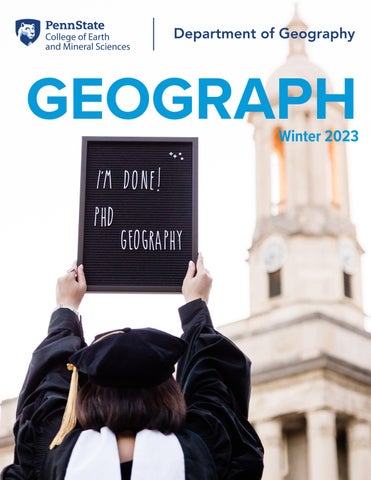
On the cover... Cover Photo: Mahda Bagher at Old Main © Janna Scott Photography.
Follow Us
www.instagram.com/pennstategeography/ twitter.com/PSUEMS www.linkedin.com/groups/6781082/
Geograph
DEPARTMENT HEAD’S MESSAGE Change and growth I write this column as State College begins the transition into winter. The days are getting shorter and colder, yet there is much to celebrate. The past year has been full of many events and opportunities, and I am pleased to report that our department continues to change and grow in exciting new areas. First, four faculty members have joined our department this academic year. All will receive their own highlight in the next newsletter, but this column presents an opportunity to officially welcome them into our community. Dr. Dani Aiello is an urban geographer with training in urban political economy and theories of critical race and post-colonial studies. Over the last decade, her work has focused on the geographies of housing inequality, especially eviction and rent-burden in North America. She is a member of The Right to Remain research collective, which is working to support tenant organizing and uncovering the history and present of struggles for dispossession in Vancouver’s Downtown Eastside. Dr. Belén Noroña works at the intersection of grassroots grounded research, decolonization, and transformative justice. She is currently collaborating with rural and Indigenous communities, particularly women in the Amazon rain forest, with particular attention to how social difference is spatialized in human bodies and territories. As her work demonstrates, this assists in shaping complex human-environmental landscapes and territories. Dr. Victoria Nimmo is a physical geographer whose doctoral research focuses directly on plant trait expression and plant-soil interactions. She has developed and performed environmental science research from the ecosystem to the organismal scale in a range of environments including agricultural fields, greenhouses, boreal forests, and peatlands, and has utilized an array of methodological approaches in support of her research and teaching activities. Our fourth new faculty member is joining us in January 2024. Dr. Zhenlong Li works in GIScience with a focus on geospatial big data, spatial computing, social media analytics, cyberGIS, and geospatial artificial intelligence (GeoAI). By synthesizing cutting-edge computing technologies, geospatial methods, and spatiotemporal principles, Dr. Li and his research lab aim to accelerate spatial information extraction and advance knowledge Department of Geography at Penn State
discovery to support domain applications such as disaster management, human dynamics, public health, and climate change. While we celebrate these additions to our faculty, we also celebrate our two retirements. Dr. Bill Easterling, Professor and former Dean of the College of Earth and Mineral Sciences, retired after a lauded and highly-impactful career at Penn State. Our department and college owe much to his tireless leadership and dedication. Also retiring is Dr. Todd Bacastow, who served as a Professor of Geography for geospatial intelligence in Penn State’s Dutton e-Education Institute. In addition to his expertise in geospatial technology policy, geospatial information technology governance, and critical infrastructure protection, he was integral in making our online geospatial education programs one of the best in the world. As is detailed in this newsletter, the department is experiencing change and growth in our physical presence. Thanks to your generous donations, especially from the McCrory Fund, renovations of the second and third floor of Walker have begun. The entry way to the main office will have panels that convey the research diversity of our department. Additionally, new flooring will be installed with an emphasis on our local landscapes that will support our teaching mission. For those of you that fondly remember the topographic map, know that we have carefully removed it and plan an online auction for the pieces in Spring 2024. More details to follow! There are so many other items to which I could mention; however, since I began with reflection, I should mention the department’s first external review. In April 2023, four leading geographers from outside institutions visited Happy Valley to provide an evaluation for the college and university. In preparation, we spent months conducting an thorough self-assessment with significant data gathering. In short, the external review was extremely positive, which serves as a reflection of the health and vibrancy of Penn State Geography. I cannot thank you enough, all of you, for helping support our central mission of advancing outstanding research, world-class graduate training, and transformative undergraduate teaching. As we prepare for the arrive of spring, it is fitting to look both backward and forward, to feel saddened by departures but also excited for new arrivals to our community. I am confident that we are changing and growing in ways that will be exciting to watch. Sala Kahle (Stay well),
Brian King 3
SCIENCE SNAPSHOTS
Fresher AIr: AI and mobility data may improve air pollution exposure models Residents of the Northeastern United States were alert to air quality warnings this summer as wildfire smoke contributed to a noticeable orange haze in the sky. The concern centers on fine particulate matter (PM 2.5), which poses significant health risks, particularly to those with pre-existing conditions. Assistant Professor of Geography Manzhu Yu has innovated air quality models by incorporating artificial intelligence and mobility data to provide more accurate exposure assessments. Published in Frontiers in Environmental Science, the Patrick Mansel / Penn State research analyzed PM 2.5 data across eight metropolitan areas. The team integrated machine learning with land use regression models, considering both static and dynamic geographical factors to improve prediction accuracy. By including mobility data, the models could now identify hotspots of high pollution and pedestrian traffic, crucial for targeted public health responses. Yu said, “Incorporating artificial intelligence and mobility data into air quality models can improve the models and help decision makers and public health officials prioritize areas that need extra monitoring or safety alerts because of unhealthy air quality.” https://bit.ly/3tVtAhK
Hotter and drier conditions limit forest recovery from wildfires Recent research in the Proceedings of the National Academy of Sciences reveals that rising temperatures and drier conditions in western U.S. forests are hindering tree regeneration following wildfires. A team, including Alan Taylor, professor of geography and ecology, notes the diminishing likelihood of new growth after fires, with the situation poised to worsen without swift ecologically driven forest management. Taylor emphasizes the significance of this study, “We have a chance to buffer these climate effects. By reducing fire severity across the landscape and reducing the potential for large, high-severity fires, we can better equip our forests for the future.” The research spanned over 10,000 field plots to assess regeneration in eight major conifer species after 334 fires, revealing a notable reduction in suitable conditions for tree regeneration. Taylor attributes a century of fire suppression policies that have increased forest density and fuel as a key factor for escalated fire severity. https://bit.ly/3QuSCfv 4
Researchers investigate effect of perchlorate in fireworks on drinking water Kim Van Meter, assistant professor of geography, joined a multiinstitutional team in a $2.2 million EPA-funded project to explore perchlorate contamination from fireworks in the nation’s water bodies. This research gains importance in the wake of a court ruling pressing the EPA to regulate perchlorate levels due to health concerns. “Residual non-combusted perchlorate particles can settle on the ground or water surface and some studies have shown elevated concentrations of perchlorate in both surface and groundwaters occurring near the firework displays,” Van Meter said. The project will span various locations, assessing perchlorate levels before and after fireworks events. The goal is to produce a comprehensive dataset that informs predictive models for water quality and potential regulations, ultimately protecting public health from firework-induced pollution. https://bit.ly/47ioBGk
CDC
Pixabay
Geograph
Mark Ortiz
Ortiz Selected for AAG’s Inaugural Climate and Society Program Mark Ortiz, a Presidential Postdoctoral Scholar in the Department of Geography, was selected to the American Association of Geographers’ (AAG) first-ever cohort in the new Elevate the Discipline program. Ortiz is one of fifteen scholars from eleven states and the West Indies who were selected through a competitive process. “I’m excited and honored to be among the first cohort of the AAG’s Elevate the Discipline program focused on climate and society,” Ortiz said. “I look forward to working with the AAG and other cohort members to learn more about advocating for evidence-based, public policymaking on climate, greater awareness of climate change issues, and communicating my research on youth climate justice perspectives to policymakers and the public.” Ortiz is a geographer with a strong background in youth and political geographies. His research, outreach, and public-facing work focuses on transnational youth climate advocacy and climate politics. https://bit.ly/43Op159
A team of scientists led by Assistant Professor of Geography Shujie Wang have analyzed the events leading up to the 2002 collapse of the Larsen B ice shelf, presenting data that may help predict similar events in Antarctica. Wang said, “The collapse is generally thought of as an independent event. Our work shows that it was the last phase in a calving sequence that began in 1998 and was controlled by both atmospheric and oceanic warming anomalies that weakened the ice shelf structure over time.” The team’s research, which scrutinizes data from as early as the 1960s, could refine sea-level rise projections. Understanding the nuanced indicators of ice shelf instability is crucial for predicting the impacts of global warming on polar ice sheets. https://bit.ly/40yejQo
NASA
Penn State Study Tackles Poaching with Integrated Geospatial Data
Wendy Zeller Zigaitis
Doctoral student Wendy Zeller Zigaitis and Associate Professor of Geography Anthony Robinson are tackling the global threat of poaching by enhancing the use of technology in wildlife conservation. They emphasize the challenge of integrating vast geospatial data from drones and other sources to thwart poaching effectively. Despite advancements in surveillance tech, such as drones, cameras, and satellite imagery, the sheer volume of data and lack of integration impede anti-poaching efforts. They advocate for synthesizing both tech-generated and human-collected data, like ranger logs, to create a comprehensive understanding of movement patterns in protected areas. Zeller Zigaitis suggests future work should concentrate on creating standardized tools that can work across various systems and even international boundaries, essential for tracking poachers who do not adhere to park limits. These tools aim to direct anti-poaching resources more effectively, potentially addressing broader environmental crimes beyond poaching. https://bit.ly/44LYarg
Department of Geography at Penn State
5
SCIENCE SNAPSHOTS
Study Decodes Ice Shelf Collapse for Future Predictions
SCIENCE SNAPSHOTS
New model provides improved airquality predictions in fire-prone areas Globally, wildfires are becoming more frequent and destructive, generating a significant amount of smoke that can be transported thousands of miles, driving the need for more accurate air pollution forecasts. A team of Penn State researchers developed a deep learning model that provides improved predictions of air quality
in wildfire-prone areas and can differentiate between wildfires and non-wildfires. “As climate change continues to cause ecological changes and challenges, it is likely that wildfire activities will continue to rise,” said Manzhu Yu, assistant professor of geography at Penn State and lead investigator on the project. “Because of this, it is an urgent research priority to accurately predict the concentration of air pollutants induced by wildfire smoke, especially in wildfireprone areas.” Wildfire smoke contains a combination of particulate matter and many gaseous pollutants. Fine particulate matter, referred to as PM2.5, has been associated with significant risks to human health and is regulated by the U.S. EPA. “The fine particulate matter in wildfire smoke can adversely impact human health when the levels are high,” said Yu. “Air quality predictions for fire-prone areas can significantly help emergency managers and public health officials mitigate potentially adverse environmental and public health impacts from air pollution events.” According to Yu, the team’s new model would be able to warn people sooner about hazardous air quality. https://tinyurl.com/y9ahfcjz
Melting ice falling snow: Sea ice declines enhance snowfall over West Antarctica As the world continues to warm, Antarctica is losing ice at an increasing pace, but the loss of sea ice may lead to more snowfall over the ice sheets, partially offsetting contributions to sea level rise, according to Penn State scientists who reported in the journal Geophysical Research Letters. The researchers analyzed the impacts of decreased sea ice in the Amundsen Sea in West Antarctica and found the ice-free ocean surface leads to more moisture in the atmosphere and heavier snowfalls on the ice sheet. While the additional snowfall is not enough to offset the impacts of melting ice, including it in climate models may improve predictions of things like sea level rise, said Luke Trusel, assistant professor of geography at Penn State and co-author of the study. The Antarctic ice sheet plays a significant role in global sea level dynamics. As one of the world’s largest reservoirs of freshwater, any change in its volume directly impacts sea levels. Trusel noted that while popular attention is often on visible processes like chunks of ice breaking away, or calving, and floating away as icebergs, more subtle interactions — like snowfall on the ice sheet — can be equally significant. https://tinyurl.com/yares32p 6
Geograph
Over spring break 2023, Penn State graduate students traveled to Arizona to participate in a transformational research experience as part of the Landscape-U program. During the week students visited sites connected to food, energy and water topics, the focus of the trip. They also visited traditional working landscapes within Navajo Nation and learned firsthand about the Nation’s rich culture and history. Landscape-U is a National Science Foundation Research Traineeship (NRT) program designed to engage graduate students in transdisciplinary activities to find solutions to societal issues around food, energy and water. Erica Smithwick, distinguished professor of geography and director of Penn State’s Earth and Environmental Systems Institute, is the lead investigator on the project. https://tinyurl.com/ab9pzjmp
Guido Cervone co-authors national report on ethical artificial intelligence use From facial recognition on smart phones to digital voice assistants like Siri to tools like ChatGPT, artificial intelligence and machine learning are part of our everyday lives. Their benefits are many, but their rapid rise is also spurring questions about their risks. The ethical use of artificial intelligence and machine learning (AI/ML) in scientific research is also becoming a more visible and important consideration, according to Guido Cervone, professor of geography and meteorology and atmospheric science. Cervone contributed to a report on principles and best practices for the ethical use of AI/ML in Earth and space sciences research, published by the American Geophysical Union (AGU). Cervone, who serves as president of AGU’s Natural Hazard Section, was one of six members on the steering committee and one of twenty authors on the report. AI/ML tools and methods are enabling advances in understanding the Earth and its systems at all scales, informing critical decisions by researchers, organizations and government agencies. AI/ML are powerful tools to evaluate diverse datasets, which can help Earth, space and environmental scientists uncover new insights about our planet and improve scientific predictions, including alerting communities to natural hazards, such as tornados and wildfires, or forecasting future climate-related risks, such as rising sea levels. According to Cervone, AGU’s report, “Ethical and Responsible Use of AI/ML in the Earth, Space and Environmental Sciences,” was designed to support these advances while mitigating potential risks. https://tinyurl.com/mvhrjtcr Department of Geography at Penn State
7
SCIENCE SNAPSHOTS
Landscape-U program connects graduate students with Navajo Nation
SNAPSHOTS
AAG Conference March 23-27, 2023 Denver, Colorado (From left to right, top to bottom): Nate Cherok explains his research poster to Department Head Brian King. Nate Vincent presents his GIS research poster. Danielle Dedeaux shares her research on Penn State recycling. Assistant professor Manzhu Yu presents research on spatio-temporal methods. Assistant professors Luke Trusel and Shujie Wang with Nicolle DiDomenico and Jessica Kromer who took home the R.S. Tarr Student Presentation Awards in the Cryosphere Specialty Group. Photo credit: Krista Pylant
8
Geograph
SNAPSHOTS
Photo credit: Lilly Zeitler
Photo credit: Ida Djenontin
Photo credit: Sam Cohen
Photo credit: Emma Robertson
Summer 2023 Snapshots (From left to right, top to bottom): Ph.D. candidate Lilly Zeitler works with P’gaz K’Nyau community leaders to collect GPS data and map dam sites. Sam Cohen homogenizes fish at his EPA internship in Athens, Georgia. Tiza Mfuni at the IASC Conference in Nairobi, Kenya. Emma Robertson does fieldwork in the Arabian Sea with the Office of Naval Research Arabian Sea Transition Layer (Astral) project. Nate Vincent and Emily Shiels serve as mentors at EMS TEEMS student orientation event. Photo credit: Krista Pylant
Department of Geography at Penn State
9
SNAPSHOTS
2023 Graduate Student Cohort Upper photo: (From left to right, front): Samrin Sauda, Yu-Chen Chuang, Sarah Riadi, Nafisa Anjum, Lucy Thompson, Kiely Hine (Back): Huan Ning, Temitope Akinboyewa, Mary Mugeni, Faisal Elias, Sophie Lelei, Ledeebari Banuna, Mark Owidhi. (Not Pictured): Zahra Bahrami On Wednesday, August 16, the 2023 graduate student cohort met with Stacey Budd the program coordinator at Shaver’s Creek Environmental Center and engaged in icebreakers and team building activities. Photo credit: Krista Pylant
10
Geograph
Assistant Professor Ida Djenontin: Reflecting on Year One engaging learning environment, which complements her research pursuits and serves as the foundation of her approach. “I embraced my expanded responsibilities with enthusiasm, especially when it came to teaching,” Djenontin said. “Teaching courses, interacting with students and igniting their curiosity about human-environment geography are incredibly fulfilling. It’s a way to explore and address the many socio-environmental challenges our society faces.” Throughout her first year, Djenontin engaged in various research projects. These projects included in-depth investigations into landuse and forest governance, with a specific emphasis on power dynamics and equity issues related to ecosystem restoration processes. She also explored cleaner cooking alternatives, aligning with the global shift toward sustainable energy practices. Additionally, she initiated research proposals aimed at addressing questions related to the climate crisis. Djenontin’s research is deeply rooted in her interactions with rural communities grappling with environmental issues. Her motivation for conducting problemsolving research in natural resource and land-use management stems from her early experiences with rural farmers who faced challenges due to environmental changes and risks to their livelihoods. This drove her to seek solutions for positive change.
Department of Geography at Penn State
Photo credit: David Kubarek
After completing her first year as a faculty member in the department, Assistant Professor Ida Djenontin took some time to reflect on her journey and achievements. During this contemplation, she discussed her research, the challenges she faced and her aspirations for the 2023-24 academic year. Djenontin is a human-environment geographer who specializes in environmental governance and sustainable development. Her research focuses on understanding the complex relationship between environmental and climate changes in sub-Saharan Africa, particularly how these changes impact forested ecosystems and shared natural resources. Djenontin’s first year at Penn State came with its own set of challenges and successes as she transitioned from her previous role as a postdoctoral researcher at the London School of Economics and Political Science. “My first year as a tenure-track assistant professor ended positively, but it was not without its challenges,” Djenontin said. “I had to navigate the dual transition of moving from the UK to the US and from a postdoc role to an assistant professor position. However, the support and collegiality I received in my new work environment helped me navigate these changes and made me feel welcomed.” During her first year she taught two courses, GEOG 230 Geographic Perspectives on Environment, Society and Sustainability in fall 2022 and GEOG 438W Human Dimensions of Global Warming in spring 2023. She said she is committed to creating an
“I’ve recognized the need to integrate profound socio-cultural realities into environmental policy and management decisions,” Djenontin said. “My experiences mirror the complex relationship between humans and their environment in typical rural landscapes across various African contexts, complicated further by climate change. These factors shape both my interest and my approach to contributing to scientifically informed solutions.” For this academic year, Djenontin has set new goals for herself. “One of my goals is to establish a solid foundation for my research lab,” Djenontin said. “This includes securing larger external grants, forming my research team and updating my website.” With a strong foothold established in her first year, Djenontin is primed to continue enriching the field of human-environment geography. She is excited to put three seed grants into action and work with her two new Ph.D .students, Faisal Elias and Maria Mugeni, with whom she looks forward to collaborating and offering guidance.
11
WETLANDS, WATER QUALITY IN CHESAPEAKE BAY FOCUS OF VAN METER NSF CAREER AWARD From improving water quality to providing a haven for endangered species, wetlands are the unsung heroes of our planet. Wetlands provide a range of critical services, like reducing storm damage and removing excess nutrients, and are among the most productive ecosystems in the world. Kimberly Van Meter, assistant professor of geography, received a $644,595 Faculty Early Career Development Program (CAREER) Award from the National Science Foundation (NSF) to study the role of wetlands in improving water quality in the Chesapeake Bay region. For many years, the bay has faced significant water quality issues due to nutrient runoff. Excessive amounts of nitrogen and phosphorus flow into the bay through rivers and streams, leading to a decline in water quality. In recent years, there has been increased interest in wetland restoration as a tool to improve water quality, according to Van Meter. “Unfortunately, our understanding of how to optimize the placement and function of restored wetlands to improve water quality remains limited,” said Van Meter. “The primary objective of this research project is to gain a better understanding of controls on fluxes of landscape nitrogen to current and restorable wetland sites and, thus, to better predict the contributions of wetlands to water quality in the Chesapeake Bay Watershed.” Wetlands play a key role in maintaining and improving water quality by acting as filtering systems by removing sediment, nutrients, and pollutants, Van Meter said. “Wetlands are great in and of themselves, but the fantastic thing is the water purification role they play,” said Van Meter. “Think of contaminated water flowing into a wetland. That water will sit there instead of just flowing off into the river system where it’s going to go downstream to the coast. It sits there and there’s time for chemical reactions to take place. They hold on or retain those nutrients and then keep them out of the downstream water supply.” 12
A critical step of wetland restoration is deciding where to place them. Van Meter is interested in identifying areas where wetland restoration efforts can have the greatest impact on water quality. “I’ve done some previous work showing that even a ten percent increase in wetland area could take us a very long way towards improving water quality,” said Van Meter. “One of the things that I really focus on in my work is how to better target the restoration projects that we do. As much as we know about hydrology, we still don’t totally understand how wetlands are connected with the surrounding landscape. You can’t just put a wetland anywhere and expect it to improve water quality; you have to put it in a location where the landscape is right. Most importantly, you have to place them where water from agricultural areas will actually flow into them. You can’t reduce nitrogen if you don’t have nitrogen coming into the wetlands.” Van Meter’s research approach centers on the creative examination of the widely used herbicide, metolachlor. According to the U.S. EPA, metolachlor is not toxic to humans at low levels and it quickly degrades into a compound called MESA, which can persist in the environment and move through the landscape like nitrogen. Van Meter plans to examine the presence of MESA in water samples from wetlands to determine if they are receiving agricultural runoff from nearby fields. This information can be used to track the movement of agricultural pollutants in the environment and identify priority areas for wetland restoration efforts to achieve the greatest benefits of improving water quality in the Chesapeake Bay region. “The primary novelty of this research lies in the use of MESA to inform estimates of agricultural nitrogen fluxes to wetlands and thus to improve landscape-scale predictions of nitrogen removal by wetlands,” said Van Meter. The CAREER award allows Van Meter to expand upon her previous and concurrent wetland research, which is supported by both NASA and USDA. The funding will also be used to create the Chesapeake Bay Summer Water Institute, a pilot program that aims to facilitate better connections between Penn State and other nearby universities and agencies such as the U.S. Environmental Protection Agency (EPA) and the U.S. Geological Survey (USGS) operating in the Chesapeake Bay area. The institute will also host a four-week formal summer program for a cohort of graduate students. “The program aims to create a workshop environment that will train and educate a new generation of Geograph
FOWLER NAMED 2023 RECIPIENT OF PENN STATE AWARD FOR FACULTY OUTREACH Chris Fowler, associate professor of geography and demography, received the 2023 Penn State Award for Faculty Outreach. The award honors faculty who have positively and substantially affected individuals, organizations, or communities through problem-solving or development as a result of extending their scholarship. Fowler was nominated for his work with then-Gov. Tom Wolf’s office to generate a statement of best practices in support of a voting map for the state that reduced the legacy of historic gerrymandering. Nominators said the work likely shaped the outcomes of the 2022 elections. Wolf called Fowler’s work a “lasting contribution” to promoting more fair and equitable elections in the state. Fowler is a geographer who specializes in spatial demographics and population-level studies. His work uncovers ways that drawing boundaries—for political districts, school attendance zones, or neighborhoods— has been used to produce highly uneven political and economic outcomes. The work benefits both Fowler’s students and leads to more equitable outcomes in health, education, and economic development, nominators said. “What makes Fowler’s nomination so exciting is the integrative nature by which he has interwoven his outreach, research, and teaching,” said a nominator. “Recognizing the importance of creating an informed citizenry related to voting rights and patterns, Dr. Fowler is proactively innovative in his teaching to provide these learning experiences to his students. Specifically, he has brought his outreach activities to the classroom to directly engage students in the process. One class won the first statewide prize for redistricting hosted by Draw The Lines, and Dr. Fowler has regularly invited his public-facing partners to discussions in his classrooms.” In fall 2022, Fowler taught an honors class on gerrymandering. Wolf attended one of the classes and
spent forty-five minutes talking with the students about what it means to have elected officials represent their constituents. A nationallyrecognized leader in addressing spatial voting patterns, Fowler shows decisionmakers and the general public how voting maps can best be created to support democratic elections. Fowler actively engages the public through media sources including The Washington Post, Penn State’s Democracy Works podcast, and The Conversation, where one piece was titled “How to make voting districts fair to voters, not parties.” Nominators said Fowler’s work comes at an important time for democracy. He’s testified several times to state government, has served as an expert panelist for decisionmakers and advocated on behalf of Pennsylvania’s Black and Hispanic communities. “As a result of this impact and the depth of this engagement, both in our Penn State communities of research and learning, and through lasting stewardship of democratic processes in the communities across the commonwealth, Dr. Fowler is extremely deserving of this recognition,” a nominator said.
researchers,” Van Meter said. “Our focus will be on addressing questions related to the Chesapeake Bay and working together toward specific research questions each summer term, which I hope will allow students to add something to their research and publication portfolio.” Additionally, the NSF award presents an opportunity for Van Meter and fellow researchers to continue work conducted in the Riparia Center. Late professor emeritus Robert Brooks founded the Riparia Center in 1993 and began Riparia’s Reference Wetland Collection, composed
of 222 wetland sites across Pennsylvania with data collection spanning thirty years. Van Meter who now serves as the center’s associate director said, “Rob Brooks was a real leader in the field of wetland research and studying wetland function. We plan to run the Summer Institute through the Riparia Center. We’re really excited in this project to leverage that earlier data and identify wetlands where we would want to do more on the ground analysis. I think the NSF funding allows us to continue the work that’s been going on here in the wetland domain over the last few decades.”
Department of Geography at Penn State
13
Zimmerer researches food biodiversity sustainability on sabbatical in France Professor Karl Zimmerer returned from sabbatical at France’s Montpellier Advanced Knowledge Institute on Transitions (MAK’IT) where he addressed concerns of food biodiversity amidst global changes. At MAK’IT, Zimmerer delved into the ties between human activities, environmental shifts, and agriculture. His research, influenced by his grandparents’ culinary journey from Eastern Europe, aimed to address the growing trend of dietary simplification in resource-limited areas. With new insights ready to be shared with the academic community at Penn State and beyond, Zimmerer’s findings offer a new perspective on sustainable development and food systems.
Diversity in our diets is not only crucial for human nutrition and well-being but also essential for maintaining healthy and resilient landscapes. Our landscapes need biodiversity to combat pests and diseases, maintain soil health and use water efficiently.
Karl Zimmerer
Karl Zimmerer, a professor of geography, had what he said was a “transformative” sabbatical at the Montpellier Advanced Knowledge Institute on Transitions (MAK’IT) in Montpellier, France. Zimmerer applied and was accepted as a visiting scientist with MAK’IT, renowned as a global center of excellence for his research area, at the University of Montpellier. The MAK’IT program, which recognized Zimmerer’s ongoing collaborations at the Center for Functional and Evolutionary Ecology and the Diversity and Dynamics of Society and Environment group, pursues sustainable development goals through focus on the sciencepolicy interface of food, environment and health. Zimmerer, who also is affiliated with Penn State’s ecology and 14
rural sociology programs, expressed his excitement about the opportunity to immerse himself in a vibrant research community with other visiting international experts. “I was thrilled because this is the global center for the kind of research, scholarship, and science-policy advocacy that I do, and it’s very connected to influential policy debates and decision-making worldwide,” Zimmerer said. “The cohort of other visiting researchers that I am with is wonderfully diverse. I am constantly getting to present and discuss cuttingedge sustainability research with people in other fields and from other cultures.” Zimmerer’s research centers on the interplay between human activities and the environment, particularly in relation to the biodiversity of food and
agriculture amid rapid global changes. He has dedicated four decades to studying people and their food biodiversity in relation to changing environments and landscapes, livelihoods and sociocultural conditions worldwide. During his sabbatical, he said, he expanded his ongoing research activities and collaborations in the Western Mediterranean, especially in Spain and France, which stands out as a region emblematic of the interplay of this biodiversity and rapid changes. “Most of the world’s food systems are becoming more and more biologically simplified, so that about two-thirds of the world’s food comes from three or four major crops,” said Zimmerer. “This dietary simplification is a concern, particularly in areas with limited resources and high poverty levels.” Geograph
In an ongoing six-year project funded through the Carasso and McKnight Foundations, Zimmerer and his collaborators from the University of Michigan and several institutions in Peru have compiled a comprehensive database of 1,200 recipes from Peru. Through rigorous analysis, they are exploring the associations between food diversity, urbanization, and migration, ultimately seeking to inform science-policy strategies to promote healthier and more sustainable food systems. Zimmerer’s sabbatical was an opportunity to test new theoretical models while integrating trips for field research and community engagement, he said. “Diversity in our diets is not only crucial for human nutrition and well-being but also essential for maintaining healthy and resilient landscapes,” said Zimmerer. “Our landscapes need biodiversity to combat pests and diseases, maintain soil health and use water efficiently.” Moreover, Zimmerer said, his research on urbanization and migration effects delves into contextual factors, such as gender, place, and generational differences, that further influence food diversity. His approach recognizes the significance of social and cultural aspects in shaping food choices and their implications for diverse populations, he explained. Reflecting on his inspiration for this research, Zimmerer spoke fondly of his immigrant grandparents who hailed from the border of what is now Poland and Ukraine. Their journey and cultural traditions continue to influence his work, he said. “They brought their foodways and recipes, and they’ve always been an inspiration in my life,” he said. “Their experiences motivate me to explore how we can navigate and make positive changes for people experiencing challenges today, such as immigrants and refugees.” During his sabbatical, Zimmerer said he engaged in collaborative efforts with fellow interdisciplinary researchers,
(Top): A graphic Zimmerer created to visualize his research on the interplay between human activity and the environment. (Bottom): While on sabbatical, Zimmerer traveled to Peru for field research on food biodiversity and sustainability.
leading to a pair of new publications in the journals of Agricultural Systems and Elementa: Science of the Anthropocene. The supportive Montpellier research community played a crucial role in enriching the interdisciplinarity of his experience, he added. Having embraced the immersive experience of living and working in France on sabbatical, Zimmerer said he relished the opportunity to refresh his French language skills and immerse himself in the rich cultural heritage of the region. He also explored French cuisine and reignited his passion for playing badminton.
Department of Geography at Penn State
Zimmerer said he anticipates sharing the knowledge and experiences of his sabbatical with colleagues, students, and practitioner communities at Penn State and the places where he is researching. He intends to integrate his findings into his new teaching and research, as well as with sciencepolicy groups, he said, and hopes this work will inspire current and future generations of geographers, interdisciplinary researchers and policymakers, and community food activists to investigate and support the intricate connections between environment, society, and food biodiversity. 15
MAHDA AT META TRANSDISCIPLINARY APPROACH TO RESEARCH BENEFITS GEOGRAPHY ALUM’S CAREER PATH In the fast-paced era of innovation where breakthroughs are a constant occurrence, a Penn State geography alumna is actively engaged in harnessing the potential of new technologies to redefine our interactions with technology and the world. Meet Mahda Bagher, a 2022 Ph.D. graduate, whose journey has propelled her to the forefront of groundbreaking research in the realms of virtual reality (VR) and human-computer interaction (HCI). In July, Bagher secured a position at Meta as a UX (user experience) research scientist in their Reality Labs, where she is a member of the Haptic Experience Research Science (HXRS) team. Bagher specializes in exploring embodied interactions within extended reality technologies (XR), which include augmented reality (AR), mixed reality (MR), and VR .
“As a GIS specialist I have always been captivated by how humans perceive and understand spatial data,” Bagher said. “One of the most valuable aspects of my time as a geographer at Penn State was the comprehensive training I received to become a transdisciplinary researcher. Working with diverse scientific fields significantly expanded my research perspective.” In 2016, Bagher joined the former Chorophronesis Lab in the Department of Geography, working under the guidance of professor Alexander Klippel, who is now at Wageningen University. Their goal was to visualize 3-D data into VR, which is an inherently threedimensional platform. To interact with geographical objects in a 3-D environment allows the users to use their hands and body instead of relying solely on a mouse and keyboard. The collaboration between
researchers from different disciplines has proven particularly valuable for her position at Meta Reality Labs, Bagher said. The activities of the Chronophronesis Lab are now housed in Penn State’s Center for Immersive Experiences. For her dissertation, Bagher delved into the realm of VR to visualize earthquake locations across the globe. Her aim was to create an embodied 3-D experience for students studying geosciences, enabling them to better grasp subsurface data and enhance their learning outcomes. “The exploration of embodied interaction within VR was a significant aspect of this project, which ultimately contributed to joining the HXRS team at Meta Reality Labs,” Bagher said. “This virtual experience was seamlessly integrated into an introductory geosciences course during the pandemic when physical labs were inaccessible. It allowed
MAHDA’S ADVICE FOR STUDENTS INTERESTED IN THE FIELD OF HCI 1.
Maintain a transdisciplinary mindset: Embrace a multidisciplinary approach and actively seek collaborations with other departments or disciplines. This will provide a broader perspective and enhance your understanding of the subjects you are passionate about.
2. Pursue interdisciplinary opportunities: Look for internships or summer projects that bridge geography with human-computer interaction and virtual reality. These experiences will allow you to apply your geographical knowledge in practical contexts and gain hands-on experience. 16
3. Stay updated on industry advancements: Keep yourself informed about the latest advancements, trends, and emerging technologies. Follow industry news, research papers, and relevant blogs to stay up to date. 4. Build a strong portfolio: Develop a portfolio that showcases your projects, internships, or research. This portfolio will serve as a tangible demonstration of your skills and experiences, making it easier to showcase your capabilities to potential employers or academic programs.
5. Develop technical skills: Focus on acquiring technical skills that are relevant to your desired path. This may include programming languages, 3D modeling and animation, and user interface design. These technical skills will be essential for working effectively in these fields. 6. Embrace lifelong learning: Recognize the importance of being a continuous learner. Stay curious, seek out new knowledge, and be open to learning new technologies, methodologies, and concepts throughout your career. Being adaptable and eager to learn will help you stay relevant in this rapidly evolving field. Geograph
Department of Geography at Penn State
Photo: Janna Scott Photography
students to study plate boundaries and earthquake events from the comfort of their homes, ensuring uninterrupted learning opportunities.” As the Chronophronesis Lab evolved into the Center for Immersive Experiences in the Institute for Computational and Data Sciences, the collaboration between researchers from different disciplines was further enhanced. Bagher said this has proven particularly valuable for her position at Meta Reality Labs. “Many individuals often express concerns about becoming transdisciplinary, fearing that they may lose their deep knowledge expertise in a specific field,” Bagher said. “However, I firmly believe that embracing a transdisciplinary approach is crucial for success in today’s rapidly advancing technological landscape. Geographers are trained to think this way. Moreover, during my academic journey, I acquired the skills necessary to be a responsible researcher capable of crafting effective research designs. This enables me to generate meaningful outcomes that not only push the boundaries of the field but also have a tangible impact on users’ experiences with specific products.” In her new role at Meta Reality Labs, Bagher remains connected to Penn State and is committed to supporting current geography students in their career paths. Her contributions to the Center for Immersive Experiences and her involvement as an external board member in curriculum redesign exemplify her dedication to giving back to the academic community that shaped her journey. To aspiring researchers interested in the field of HCI and XR, Bagher offers valuable advice: “Embrace a transdisciplinary approach and actively seek collaborations with other departments or disciplines,” Bagher said. “This will provide a broader perspective and enhance your understanding of the subjects you are passionate about.”
17
Celebration held to honor former dean and director, William Ewart Easterling III he was appointed assistant director of the National Science Foundation in charge of the Geosciences Directorate, which supports fundamental research spanning the atmospheric, earth, ocean, and polar sciences. “Bill has had so many accomplishments it is hard to focus on any one success,” said Eva Pell, senior vice president for research and dean of the Graduate School emerita, and professor emerita of plant pathology. “In my interactions with him, both when he was an institute director and when he was dean of the College of Earth and Mineral Sciences, what I found so compelling about his leadership was his ability to see the big picture. Bill grasped the key issues facing our environment, and that, of course, included our management of energy needs. He understood that to be successful you needed to bring to the table a range of The College of Earth expertise, and then knit and Mineral Sciences together a broad array and the Department of talent that would go of Geography recently beyond a single field, hosted a celebration department or college. to honor William His ability to articulate Easterling’s legacy those needs and of leadership to the convince competing University. More than actors to work together, 100 faculty, staff, and defined so much that Bill former colleagues and Easterling was able to students gathered on accomplish.” Nov. 9 at the Penn Stater Hotel and Conference After serving at the Center to pay tribute to NSF for four years, his extraordinary career Easterling resumed and accomplishments. his appointment as professor of geography Easterling served the and earth system University for 26 years. Upper photo: Lee Kump, John Leone Dean in the College of Earth and Mineral science on June 1, 2021. He joined the Penn State Sciences, presented Bill Easterling, professor emeritus of geography and dean He retired earlier this year faculty in 1997 as an emeritus of the College of Earth and Mineral Sciences, with an etching from the and is now professor associate professor of Penn State Elms Collection at the celebration of his retirement on Nov. 9. Lower emeritus of geography geography and earth and dean emeritus of the system science. In 2001, photo:Etching of Old Main and the Obelisk. College of Earth and Mineral Sciences. he became the founding director of the Institutes of Energy and the Environment, the focal point for interdisciplinary “I think, what I’ll miss more than anything and a thread research in energy and environmental science and that went through my years as a college administrator, engineering at Penn State. and as a science administrator for the NSF as well, it is working with really smart, dedicated, interesting In 2007, he was appointed dean of the College of Earth colleagues and helping create opportunities for them,” and Mineral Sciences and held that post until 2017 when 18
Geograph
Easterling said. “At the end of the day, the most rewarding part of your time as a leader is creating opportunities.” Easterling trained as an economic geographer and climatologist and is an internationally recognized expert on how climate change likely will affect the Earth’s food supply. As dean of the college, Easterling strengthened the college’s position as a world leader in the earth, material and energy sciences and engineering. He led strategic planning for research initiatives focusing on the food-energy-water nexus, clean carbon energy, additive manufacturing, big data challenges in forecasting, and risk and uncertainty in environmental decisions. “Bill has been especially effective as an ambassador for Penn State and the College of Earth and Mineral Sciences on the national and international scene, as IEE director, EMS dean, and assistant director for the Geosciences Directorate at NSF,” said Lee Kump, John Leone Dean in the College of Earth and Mineral Sciences. “That representation continues through his retirement as a dean emeritus as he facilitates connections with his vast STEM leadership network, for me and for others in academic leadership positions.” As the founding director of IEE during a period in which Penn State rose from 25th to 13th in federal environmental research expenditures according to NSF, Easterling directed the coordination of interdisciplinary environmental and energy research, teaching and outreach across eight colleges of the University. He facilitated the allocation of 30 new faculty lines in targeted environmental priority areas. IEE was expanded in November 2006 to include all energy sciences, engineering, and policy. The University augmented the resources of IEE to add 24 new faculty lines and associated program funds for energy. “Working with scientists has been a joy throughout my career,” Easterling said. “I think it’s really special to be able to help people whose jobs are to create new knowledge that we’ve never had before. When I look back on my career, I think one of my greatest contributions was in the quality of faculty we hired to the University.” Upper photo: Cindy Brewer, Brian King, Rosie Long, and Helen Greatrex at celebration; middle photo: Bill Eastlerling enjoying the presentation while Lorraine Dowler looks on; lower photo: Melissa Wright giving testimonial on the impact Bill had on her career. Department of Geography at Penn State
19
GeoGraphics lab opens This summer the department put the finishing touches on the new GeoGraphics Lab, a multimedia cartography laboratory housed on the first floor of the Walker Building, designed to serve as a dedicated space for cartographic design, production, and research. The lab’s director, Anthony Robinson, said the lab offers students and faculty opportunities for innovation and hands-on experience in map making and with access to tools such as a large format printer, a thermographic machine for tactile maps, and 3-D printing capabilities. “I hope the lab helps students and faculty in geography to make maps that make a difference,” Robinson said. “That might mean we are advancing the state of the art in terms of the science of cartography, or it might mean that we’re doing the storytelling that helps extend the impact of advances in geographic science. It’s important to have a space where students and faculty can gather and brainstorm, design problems, gain inspiration, and refine their work.” The idea for the lab originated from Robinson’s longstanding vision to create a collaborative space for individuals passionate about maps. Following his sabbatical in 2021, Robinson, who is an associate professor of geography and directs the online geospatial education programs, seized the chance to establish the lab. The lab’s namesake is the original Deasy GeoGraphics Laboratory, an area in which cartographic research and production was conducted in the 1990s. Harrison Cole, who was Robinson’s Ph.D. student and former postdoctoral scholar, helped Robinson kickstart the lab in July 2022. “I know I could have benefited from the lab as a graduate student, and I am glad that current students will now have the tools that they need to do really interesting and exceptional work.” Cole said. “There are so many
20
possibilities for the directions the lab can take things and areas of expertise it can help develop.” The involvement of students is a vital aspect of the GeoGraphics Lab. As part of the Gould Center for Geography Education and Outreach, the lab integrates both undergraduate and graduate students into ongoing cartographic design projects. Undergraduate student Nate Cherok spent the summer working as a cartography intern updating and designing maps and figures for the latest edition of Professor Cynthia Brewer’s book, Designing Better Maps. Students and faculty are also working on physical map installations for display in the Walker Building. Additionally, students working on mapping-related research can utilize the lab’s computational and production resources including equipment for biometric user experience or user interface analysis—eye-tracking software for online maps. Looking toward the future, Robinson envisions the lab building a strong reputation for producing excellent maps and making significant advances in cartographic research. “I want to ensure that we have a diverse range of projects that students and faculty can take part in,” Robinson said. “I also hope that the lab becomes one of many reasons why undergraduates might choose geography as a major. On a more general level, I want the lab to help people tell stories about people and the environment that are best conveyed via creative cartographic design.” The lab is open to the Penn State community as well as individuals outside the University who express interest. The lab’s team, including graduate students Tim Presby, Lily Houtman and Harman Singh, possess a diverse range of expertise to cater to various project requirements. Robinson’s goal is that by empowering students and faculty and providing state-of-the-art resources, the lab will have a lasting impact on the field of geography and beyond.
Geograph
Top photo: Clockwise from bottom right, Tim Prestby, Rylie Adams, Nate Cherok, Harman Singh, Cynthia Brewer, Lily Houtman, and Harrison Cole meet in the new GeoGraphics Lab, a multimedia cartography laboratory housed on the first floor of the Walker Building, designed to serve as a dedicated space for cartographic design, production and research. Lower photos: example maps produced by Harman Singh (left), Lily Houtma (lower left), and Riley Adams (right). Left page: Example maps produced by Nate Cherok (left) and Tim Prestby (right)
Department of Geography at Penn State
21
Three decades of impact: Andrew Carleton’s academic career Retirement marks a momentous occasion in the academic journey of Andrew Carleton, a distinguished figure in the field of geography. With a career spanning nearly three decades at Penn State, Carleton has left an indelible mark on the realms of physical geography, climatology, and environmental science. Carleton’s career in academia began with a passion for geography that ignited during his school days in Australia. Geography was a big part of the curriculum, and he delved into coursework on map reading, physical geography, and human geography. His interest in weather and climatology stemmed from a book he stumbled upon in the school library at the age of fourteen, How to Make Your Own Backyard Weather Station. This early fascination with weather laid the foundation for his love of climatology. “My love of weather really is what got me into climatology,” Carleton said. “I can really trace that back to finding that book in the library. It taught me to build a thermometer shelter and to take measurements on wind speed and direction. I did twice daily observations of the weather at our home in Adelaide every day for two years.” Following his passion, Carleton would pursue his undergraduate degree in geography and masters degree in climatology at Adelaide University. He then traveled to the United States and earned his Ph.D. at the University of Colorado Boulder. Having a strong desire for both research and teaching and with three degrees in hand, he knew academia was his calling. Great mentors played a pivotal role in his journey, from Bruce Mason, a meteorologist previously at the Australian Bureau of Meteorology, and the late climatologist Peter Lamb during his undergraduate and master’s studies, to the late Roger Barry, his Ph.D. adviser at Colorado. These mentors fueled his love for writing, research, and teaching; skills he has cherished throughout his career. Carleton worked as an assistant professor at Arizona State University from 1982 to 1985 and as assistant and then associate professor at Indiana University from 1985 to 1994 before landing at Penn State in 1994. His career at Penn State, saw several proud moments. He obtained National Science Foundation grants for his three main research areas: polar low weather systems in the Arctic and Antarctic, jet aviation contrail impacts on climate, and Midwest land surface climate interactions. These grants allowed him to foster research work with graduate students, and seeing their success brought him immense joy. One of the highlights of his career was winning the Wilson Faculty Mentoring award in 2017, affirming his commitment to helping others succeed. “Each time I got one of those grants it was always a really good feeling,” Carleton said. “I have really thrived on seeing my graduate students be successful. Each time one of my graduate students gets the job, or career that they want and deserve, it’s a really great experience for me as well. I remember when I was in that position and all the hard work that goes into that. That’s always a big reward seeing your graduate students succeed.” Throughout his career, Carleton has seen the field of geography evolve. Rigid divisions between subdisciplines have broken down, and he’s witnessed a greater integration of knowledge across various branches of geography, breaking barriers between physical geography and human geography. He believes this integration is vital in addressing the important issues and challenges of our time, including climate change and environmental justice. As he looks forward to retirement, Carleton is actively involved in research collaborations at Penn State, including a Penn State Institute of Energy and the Environment-funded seed project with colleagues in geography and aerospace engineering on contrails’ impacts on climate. Additionally, he enjoys road trips and photography, capturing the beauty of natural landscapes and human impacts. 22
Geograph
Roger M. Downs: Charting a lifelong journey in geography From holding a pilot’s license with aspirations of joining the Royal Air Force to contributing to the beloved children’s television show Sesame Street, Professor Emeritus Roger Downs’ career path in the Department of Geography is nothing short of eclectic. Born and raised in England, Downs went to college assuming he would enter the Royal Air Force, but a series of factors nudged him in a different direction. His academic pursuits introduced him to Roman archaeology, and he relished his time in the field, crafting maps, and participating in digs. However, Latin courses deterred him from pursuing archaeology further. Instead, geography became his focus, and he earned a bachelor’s degree and a doctorate from the University of Bristol in England. Early in his academic journey, Downs was able to blend his twin passions of geography and education and collaborations with psychologists set the stage for his academic explorations. This interdisciplinary approach took a unique turn when he, in collaboration with his partner, developmental psychologist Lynn Liben, worked on Sesame Street. “Crafting a geography curriculum for Sesame Street was a highlight of my career,” Downs said. “We came up with ideas for segments on the show. One big project we undertook was to help children understand perspective and scale changes. Sesame Street used a crane on a playground in the Upper West Side of New York and had a camera suspended wherever the character was dropping down. It was fun, and we enjoyed it.” In July of 1970, Downs joined the Penn State faculty, after working at Johns Hopkins University. He taught undergraduate courses in human geography, human spatial behavior, and urban geography, as well as graduate courses in research design and geography education. In 1994, he assumed the role of department head, a position he held until 2007. One monumental stride for Downs was the development of the Online Geospatial Education program in the early 1990s. Recognizing the burgeoning potential of digital education and invigorated by the Alfred P. Sloan Foundation’s funding, Downs and colleague David DiBiase laid the program’s foundation. “As department head I decided establishing this online program was a priority and a big investment,” Downs said. “It wasn’t about simply reading and taking tests. We emphasized interactive teaching, and it’s been incredibly successful. It gave us a chance to establish a position and reputation in the geospatial realm.” This endeavor fundamentally changed the department. Since its 1999 launch, the program has bestowed more than 4,000 certificates and degrees. Presently, it spans an array of more than thirty courses, including Geographic Information Systems (GIS) and Spatial Data Science and Programming. However, for Downs, the heart of his experience at Penn State isn’t just the academic accomplishments. It’s the community. “Penn State, and particularly the Department of Geography, foster a remarkable sense of culture,” Downs said. “We work collaboratively, with mutual respect, and everyone feels a sense of belonging.” As he navigates retirement, Downs jests about the intricacies of this transition, saying “There should be lessons on how to retire! The hardest part is learning not to work.” Despite a life brimming with industriousness, from childhood newspaper routes to stints at butcher shops, retirement is a novel terrain. Still, ever the quintessential geographer, Downs is perpetually in motion—writing, presenting, and traveling between State College and New York. Department of Geography at Penn State
23
GENIUS workshop equips underrepresented students for geography graduate programs In May, Penn State’s Department of Geography held a workshop aimed at supporting third- and fourth-year students from underrepresented groups in their journeys toward applying for graduate programs in geography. Coined the GENIUS workshop—Geography Education Networking Initiative for Underrepresented Scholars— the three-day event provided essential mentoring and networking opportunities to equip students with the tools they need for successful graduate school applications. Participants had the opportunity to network with peers and scholars from across the United States and Canada. Joshua Inwood, professor of geography and African American studies, and Emily Rosenman, assistant professor of geography, served as co-organizers of the workshop. Inwood emphasized how important networking was during the workshop. “It really is about building community and a support network for students,” Inwood said. “The community of scholars and students will be able to support one another in their efforts to build professional careers. It was the hope that students would have a good start on a graduate application at the end of the program and would also be able to begin to have a cohort of students and mentors that can help guide them in graduate school.” The workshop offered a range of opportunities for participants, including one-on-one mentoring sessions, group discussions, and collaborative work on graduate application materials. Sessions were also held on specific topics including how to choose a graduate program and adviser, financial planning, mental health, and navigating predominantly white institutions. Other Penn State faculty,
24
including Lorraine Dowler, Trevor Birkenholtz, Michael West, Cynthia Young, and Presidential Postdoctoral Scholar Mark Ortiz, participated in leading sessions. Rosenman said the vision of the workshop is to create long-term organizational change in the discipline of geography, which has often excluded underrepresented people as both students and faculty. “Historically the discipline of geography has often excluded racially underrepresented people,” Rosenman. “With this workshop we hope to help level the graduate school playing field in a small but meaningful way by explaining some of the unwritten rules and unspoken expectations. As we continue to host the workshop in future years, we hope that attendees will apply to graduate programs in geography throughout North America and beyond and eventually become graduate students and faculty.” Participants who traveled from throughout the United States to attend expressed their appreciation for the support and mentorship they received during the workshop. One participant said, “I left feeling extremely supported and feeling so thankful for all the guidance everyone shared with us.” Another applauded the depth and relevance of the lectures and guest speakers, calling them “insightful, powerful, and emotional.” Another said, “A lot of great information was given. Previous graduate school panels I’ve attended have not been this in-depth. I really appreciated the thought and effort that went into putting the workshop together.” Rosenman said current Penn State graduate students in the department also had the opportunity to benefit from the workshop. “My favorite parts of the program were witnessing the one-on-one interactions between visiting students and mentors,” Rosenman said. “The graduate students gained valuable skills in mentorship, and the visiting students were able to hear firsthand about the graduate school experience.” Victoria Sanchez, the associate dean for educational equity in the College of Earth and Mineral Sciences, praised the program’s impact. “This innovative and high-impact program is creating a pathway to graduate study in geography for Emily Rosenman Geograph
Melissa Wright
underrepresented students, many of whom have not had access to information about graduate school options,” Sanchez said. Sanchez commended the participants’ enthusiasm and their newfound connections with faculty, mentors, and fellow students, emphasizing the long-term benefits of their professional networks. “I had the chance to interact with the students while they were here and their appreciation for the program was enthusiastic as they discovered so much in common with each other and their mentors and so many possibilities for their graduate education,” Sanchez said. Inwood appreciated getting to interact with the workshop participants. “Getting to know the students was my favorite part of the workshop,” Inwood said. “They are really amazing and it makes me happy that the future of geography is so bright. These students are engaged in really important activities and they bring such a diverse set of skills to the discipline. I cannot wait to see how their creative endeavors play out.” The GENIUS workshop was funded with a grant from the Penn State Equal Opportunity Planning Committee (EOPC). Support was also provided by the Department of Geography and the College of Earth and Mineral Sciences. Department of Geography at Penn State
Emily Rosenman
Krista Pylant
25
Walker Building Renovation Project
We are thrilled to announce a significant transformation in the department. Our traditional topographic map will be replaced by interactive panels showcasing our department’s research and teaching. The new panels will honor the late Professor Peirce Lewis thanks to generous donations to the McCrory Family Geography Discretionary Fund in the College of Earth and Mineral Sciences. The topographic map has been carefully dismantled into more than thirty-five pieces, which we plan to sell in spring 2024 to fund further renovations, including flooring updates on the second and third levels of Walker Building. The renovation project has commenced with initial structural changes like installing double doors for the office and graduate student lounge, followed by preparing walls for innovative light panels. The above rendering of the final design, excluding the new flooring plans, provides a glimpse into our department’s exciting future. We are grateful for your support in these transformative endeavors!
Upper photo: rendering of new interactive panels; middle right: staff cutting topographic map; lower left: displaying maps; lower right: new office doors and painted wall. 26
Geograph
Community Updates Awards and Achievements Jennifer Baka was promoted to associate professor with tenure. She also received a National Science Foundation CAREER award to study the development and potential impacts of a petrochemical cracker plant in western Pennsylvania. Bronwen Powell was promoted to associate professor with tenure. Andrew Carleton was awarded an E. Willard and Ruby S. Miller Professorship in Geography. Manzhu Yu was named the E. Willard and Ruby S. Miller Faculty Fellow by the College of Earth and Mineral Sciences at Penn State. Guido Cervone was appointed an American Geophysical Union Local Science Partner. He was also named a faculty affiliate at the Scuola Superiore Sant’Anna in Pisa, Italy.
Support Geography The Department of Geography at Penn State aims to inspire the highest levels of geographic teaching, learning, and mentoring while engaging in the scholarly pursuit of geographic knowledge, and to apply this knowledge toward understanding the ever-changing interplay of human societies and physical environments. To help support our mission, please consider donating to the department.
Joshua Inwood received the American Association of Geographers Media Achievement Award. Karl Zimmerer received a Montpellier Advanced Knowledge Institute on Transitions 2022–23 Research Fellowship, France. Graduate students Nicolle Di Domenico, Emma Robertson, and Tim Prestby received National Science Foundation Graduate Research Fellowships. Graduate student Ruth Buck received a National Science Foundation Graduate Research Fellowship Honorable Mention. Graduate students Vivian Rodriguez Rocha and Saumya Vaishnava received Society of Woman Geographers Evelyn L. Pruitt National Fellowships for Dissertation Research.
Department of Geography at Penn State
All photos, unless noted, provided by Penn State. This publication is available in alternative media on request. The University is committed to equal access to programs, facilities, admission and employment for all persons. It is the policy of the University to maintain an environment free of harassment and free of discrimination against any person because of age, race, color, ancestry, national origin, religion, creed, service in the uniformed services (as defined in state and federal law), veteran status, sex, sexual orientation, marital or family status, pregnancy, pregnancy-related conditions, physical or mental disability, gender, perceived gender, gender identity, genetic information or political ideas. Discriminatory conduct and harassment, as well as sexual misconduct and relationship violence, violates the dignity of individuals, impedes the realization of the University’s educational mission, and will not be tolerated. Direct all inquiries regarding the nondiscrimination policy to the Affirmative Action Office, The Pennsylvania State University, 328 Boucke Building, University Park, PA 168025901, Email: aao@psu.edu, Tel (814) 863-0471. U.Ed. EMS 24-44.
27
Department of Geography 302 Walker Building University Park, PA 16802-6813
28
Geograph