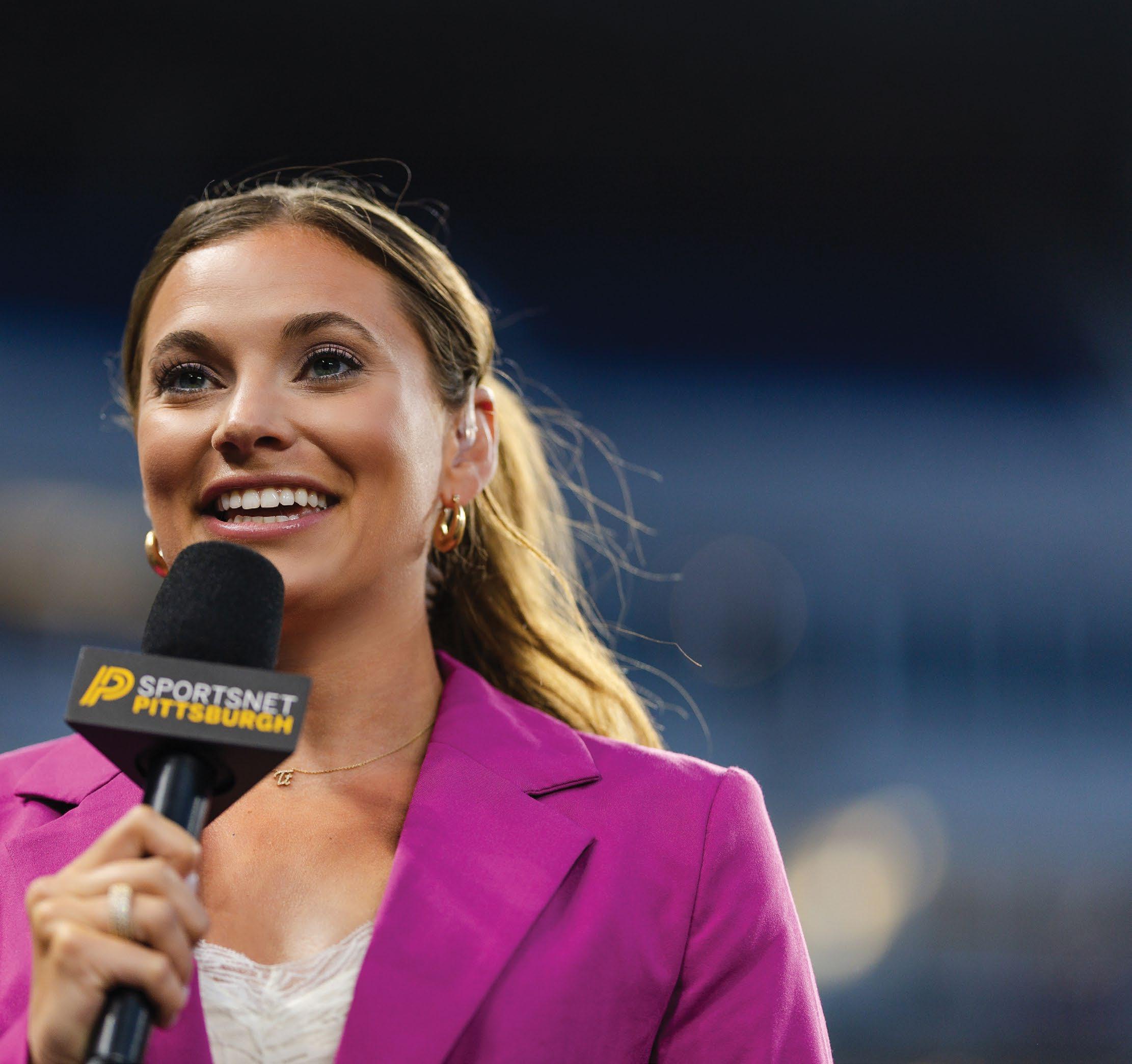
Penn State has emerged as one of the nation’s most impressive pipelines for gameday newsbreakers.
Q&A WITH DEAN EMILY T. METZGAR

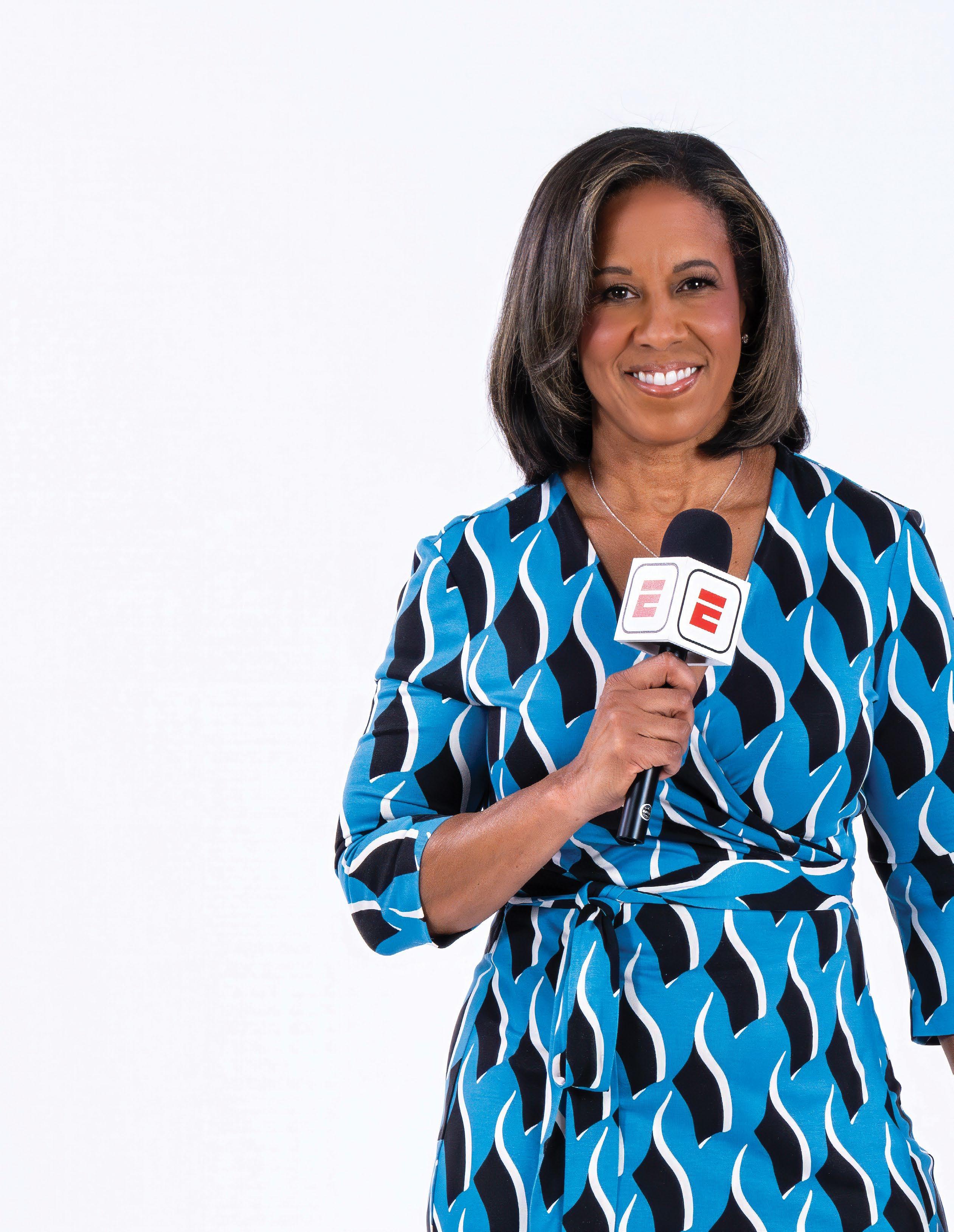


Penn State has emerged as one of the nation’s most impressive pipelines for gameday newsbreakers.
When I visited the Donald P. Bellisario College of Communications to interview for the role of dean in February 2026, I was struck by how true the tagline on the website really seemed: “Big School Resources; Small School Feel.” In meeting after meeting, everyone I spoke with wasn’t just excited to be part of the Bellisario College, but also effusive in their praise of how welcome they feel in this space.
Six months later as I step into the role of dean, I’ve realized this wasn’t just the kind of enthusiasm shared with a job candidate. I’ve been so warmly welcomed, and I couldn’t be prouder or more excited to be here and to have the opportunity to help promote the spirit of that tagline in everything we do.
It’s an honor to follow in the footsteps of Dean Marie Hardin and Interim Dean Denise Bortree as we look toward the future — something we’re doing at a time of profound transformation. Note that in more ordinary circumstances, a copy editor might suggest that last sentence was superfluous or an exaggeration. But at this moment, it’s just a statement of fact.
Happily, the Bellisario College’s new strategic plan will be our guide for what’s next. It focuses on four core pillars: advancing student success, growing interdisciplinary research, strengthening our community and expanding our land-grant impact, and with this column I want to share five priorities that will shape my work as we bring the strategic plan to life:
• Leading in tech through AI ethics: As Penn State pursues its University-wide AI Transformation Initiative, we’re well positioned to lead conversations about media governance and responsible usage, ensuring our graduates and colleagues around campus develop the critical ethical competencies required for the current communication environment.
• Championing cross-campus collaboration: We can partner with experts across campus to help translate research into content for general audiences while also equipping undergraduates in all disciplines with the communication skills and media savvy required of today’s workforce.
• Promoting retention with personalized care: We’ll continue championing student retention by providing support that honors our “small school feel.” We’ll keep our focus on preventing small roadblocks from becoming insurmountable hurdles, helping all our students find a path to success.
• Amplifying impact: We’ll continue fulfilling our part of the University’s land grant mission by seeking partnerships with media outlets in Pennsylvania and beyond to distill complex, peer-reviewed research into actionable solutions for policymakers, industry leaders and others.
• Prioritizing financial relief: We’ll tackle inequities in access by steering financial relief to students who need it most. We’ll explore creative ways to support current students and recent graduates — including the possibility of loan repayment support for those who seek public-interest roles. In doing this, we can help ensure that a Bellisario College education remains an exceptional opportunity that doesn’t come with a painful financial burden after graduation.
A final note: These priorities are not a rigid mandate; they’re an open invitation for us to work together. I want to hear from you, and I look forward to working with all of you to champion the values that will continue to define the Bellisario legacy.

Emily T. Metzgar





By Ryan Hockensmith (’01)

The Communicator magazine is an annual report of activity in the Donald P. Bellisario College of Communications for alumni, students, faculty, staff and friends.
DEAN
Emily T. Metzgar
EDITOR
Steve Sampsell (’90)
ASSISTANT EDITORS
Jonathan McVerry (’05)
Erin Strout (’97)
CONTRIBUTING EDITOR
Paris Palmer (’17)
GRAPHIC DESIGNER
Whitney Justice
All items relating to the Donald P. Bellisario College of Communications and its faculty, staff, students and alumni will be considered for publication.

CORRESPONDENCE
The Communicator
Penn State Bellisario College of Communications 201 Carnegie Building 319 Fraser Road University Park, PA 16802 bellisarioinfo@psu.edu @PSUBellisario bellisario.psu.edu
Emily Danczyk, who graduated in May with degrees in political science and media studies, was one of four students from across Penn State honored with a 2026 John W. Oswald Award.
The award, established in 1983, annually recognizes graduating seniors who have provided outstanding leadership in at least one of several areas of activity. Danczyk was honored for creative and performing arts. She was a member of the Concert Choir and served as secretary and social media chair.
The award is named for John W. Oswald, who served as president of the University from 1970 to 1983.
Hundreds of Bellisario College students complete internships every year, at companies big and small and locations all over the world. In the spring, senior advertising/public relations major Alana Liang completed what turned out to be a history-making internship. She worked at “Late Night with Stephen Colbert” and was on set for the last episode of the program.
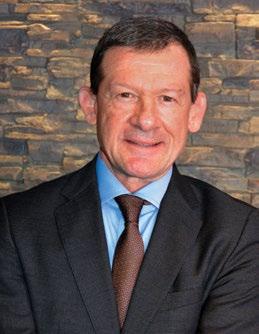
Patrick Plaisance, the Don W. Davis Professor in Ethics at Penn State and a member of the Department of Journalism in the Bellisario College, was selected to serve on the Society of Professional Journalists (SPJ) Ethics Committee and help review and possibly revise the SPJ Code of Ethics, the nation’s most-cited journalism ethics code, through an effort that coincides with the code’s 100th anniversary in 2026.
As part of what will be a transparent, year-long process, the ethics committee will review the ethics code and then present its recommendations to SPJ’s board. If the board approves any proposed changes the society’s members will also vote on them. Plaisance will serve on the 16-member committee along with ethics education leaders and respected journalists from around the country. Plaisance is a noted media ethics researcher, author of a media ethics textbook and past editor of the Journal of Media Ethics.
The committee is attempting to revise the SPJ Code of Ethics for the sixth time since 1926, when the society first adopted the nowdefunct American Society of News Editors’ Code of Ethics. SPJ revised its code in 1973, 1984, 1987, 1996 and 2014. The committee aims to update the code’s interactive online version as well. It will include new links to resources offering supplementary guidance and ethics case studies.
The Accrediting Council on Education in Journalism and Mass Communications offered a glowing evaluation based on a weeklong campus visit in the fall. The once-every-sixyears process again rated the Donald P. Bellisario College of Communications as one of the best in the nation.
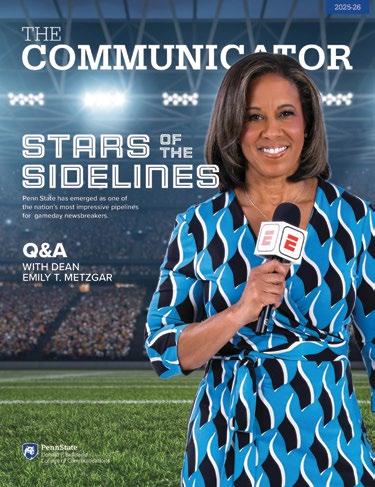
ON THE COVER Alumna Lisa Salters of “Monday Night Football” will work the Super Bowl this season.
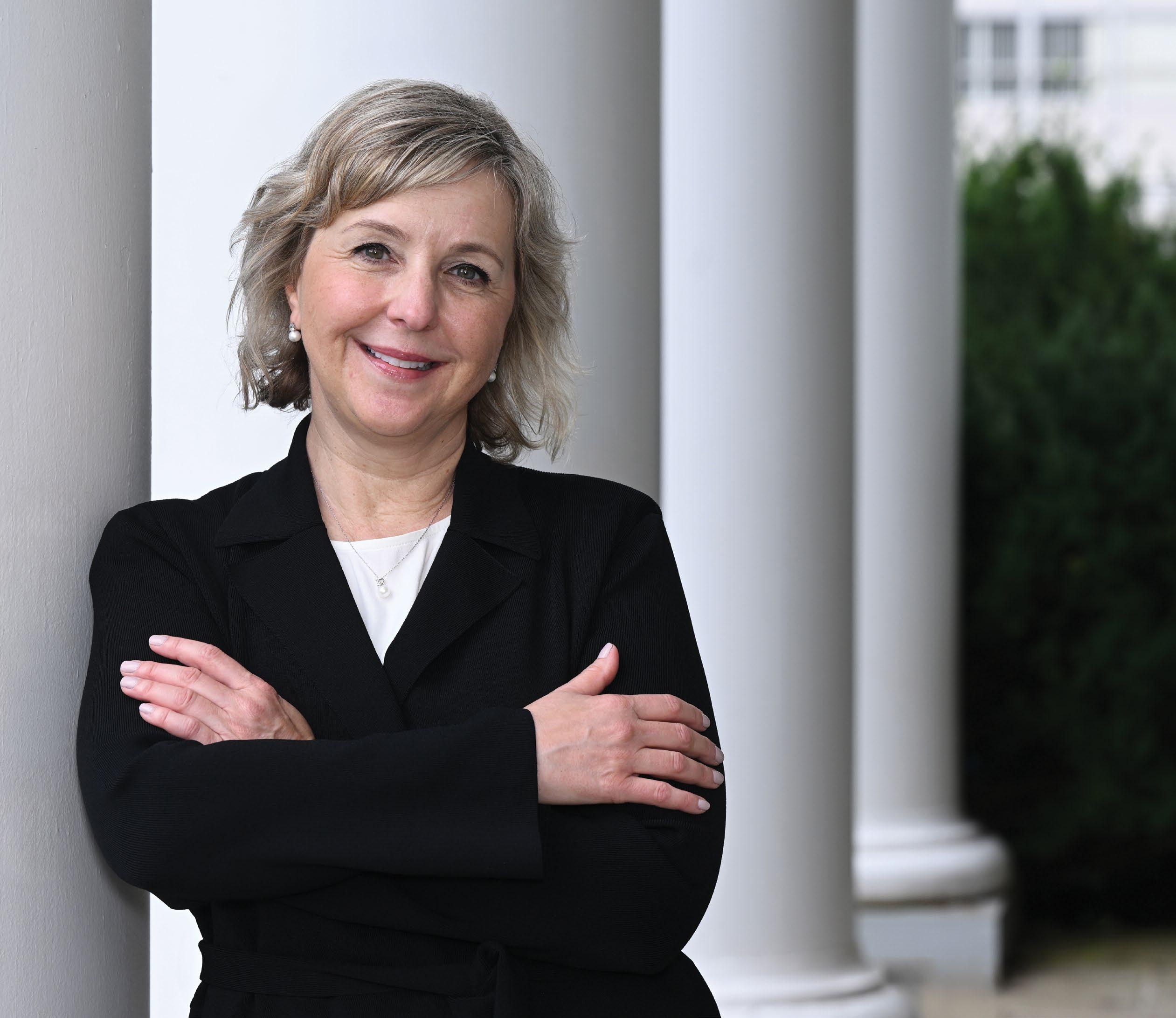
Emily T. Metzgar, professor and director of the School of Journalism and Media at Kent State University, was named the new dean of the Donald P. Bellisario College of Communications at Penn State, following a national search. Metzgar’s appointment began on July 1, 2026.
Metzgar succeeds Denise Bortree, a professor in the Department of Advertising/Public Relations and director of the Arthur W. Page Center for Integrity in Public Communication, who served as interim dean during the 2025-26 academic year. Bortree was named interim dean following the departure of Marie Hardin, who became president of Quinnipiac University on July 1, 2025.
“I am delighted to welcome Dr. Metzgar to Penn State as the next dean of the Bellisario College of Communications,” said Fotis Sotiropoulos, executive vice president and provost. “Dr. Metzgar brings a thoughtful vision for strengthening the student experience and preparing graduates to lead and innovate in a rapidly evolving communications landscape. At a time of profound change in communications, educating the next generation of practitioners, scholars and media specialists is more important than ever. Under Dr. Metzgar’s leadership, Penn State will continue to be well positioned as a national leader in communications education and scholarship, and I look forward to working with her as she builds on the college’s many strengths and leads it into an exciting new era.
“I also want to express my appreciation to Dr. Bortree for stepping up and leading the college as interim dean during this time of transition. I know Dr. Bortree will remain a valued asset to the college as she returns to her role as associate dean and professor.”
Metzgar was named director of the School of Media and Journalism at Kent State University in 2020, providing leadership and oversight for more than 600 undergraduates, 30 specialized graduate students and nearly two dozen full-time faculty members. In that role, she guided a range of initiatives
aimed at strengthening the school’s academic environment and student success. Her leadership included efforts to increase student retention, review course offerings and prerequisites, develop new minors and certificates, modernize facilities and create new channels for stakeholder communication. She also has directed accreditation and assessment efforts; supervised the development of new courses and programs at the graduate and undergraduate level with an emphasis on AI-forward, student-first outcomes; and oversaw fundraising for the school.
“I am humbled and honored to join the Bellisario College of Communications as its next dean,” Metzgar said. “It is clear this is a special place — one defined by creativity, collaboration and a shared commitment to excellence. I am excited to support and expand the college’s role as a leader among top research institutions, where innovative scholarship and creative work drive meaningful impact. At the same time, our mission must always center on our students. I look forward to continuing to build cutting-edge experiences that prepare them for life and career success — through new technologies, hands-on learning and opportunities for experiential learning. Just as important is my commitment to the people who make this college exceptional. I am dedicated to supporting all of our faculty, staff and students and creating an environment where everyone can thrive. It is a privilege to join such a vibrant and distinguished community, and I look forward to working together to build the next chapter in the college’s rich history.”
Metzgar brings a broad professional perspective to her work in media education, with a career that has spanned diplomacy, policy analysis, journalism and academia. Prior to joining Kent State, Metzgar was a faculty member at The Media School at Indiana University from 2008 to 2020, serving as director of the school’s honors program from 2015 to 2018 and director of undergraduate studies from 2018 to 2020. As director of undergraduate studies, Metzgar led all facets of undergraduate education for more than 2,000 students and drove curricular reform, launched new degrees and majors, and coordinated endto-end course development.
Before embarking on her academic career, Metzgar was a blogger, podcaster, community columnist and contributing editor in Louisiana from 2002 to 2008. From 1997 to 1999 she was a foreign service officer for the U.S. Department of State in Washington, D.C., and China, serving at the U.S. Embassy in Beijing. She also analyzed East Asian political-military issues as a research assistant for the Institute for National Strategic Studies at the National Defense University in Washington, D.C., from 1996 to 1997.
Metzgar’s scholarly research focuses on the intersection of media foreign policy and how shifts in the information environment shape public understanding of international affairs. She is the author of “The JET Program and the U.S.–Japan Relationship: Goodwill Goldmine” and co-editor of “The Course Reflection Project: Faculty Reflections on Teaching Service-Learning.” Her current book project is titled “The American Narrative: U.S. Information Diplomacy Since World War II.” Metzgar’s research has appeared in journals such as the
International Journal of Communication, Journalism Practice, New Media & Society, and Political Communication, among others. Her commentary has appeared in such outlets as Columbia Journalism Review, USA TODAY, Los Angeles Times and The Conversation.
She is actively involved in professional leadership and service within journalism and communication education. Metzgar is the immediate past president of the Association of Schools of Journalism and Mass Communication and recently completed a two-year term on the board of the Association for Education in Journalism and Mass Communication. She also serves as a site team member for the Accrediting Council on Education in Journalism and Mass Communications.
Metzgar holds a doctorate in media and public affairs from Louisiana State University, a master’s in international politics from George Washington University and a bachelor’s in political science and French from the University of Michigan.
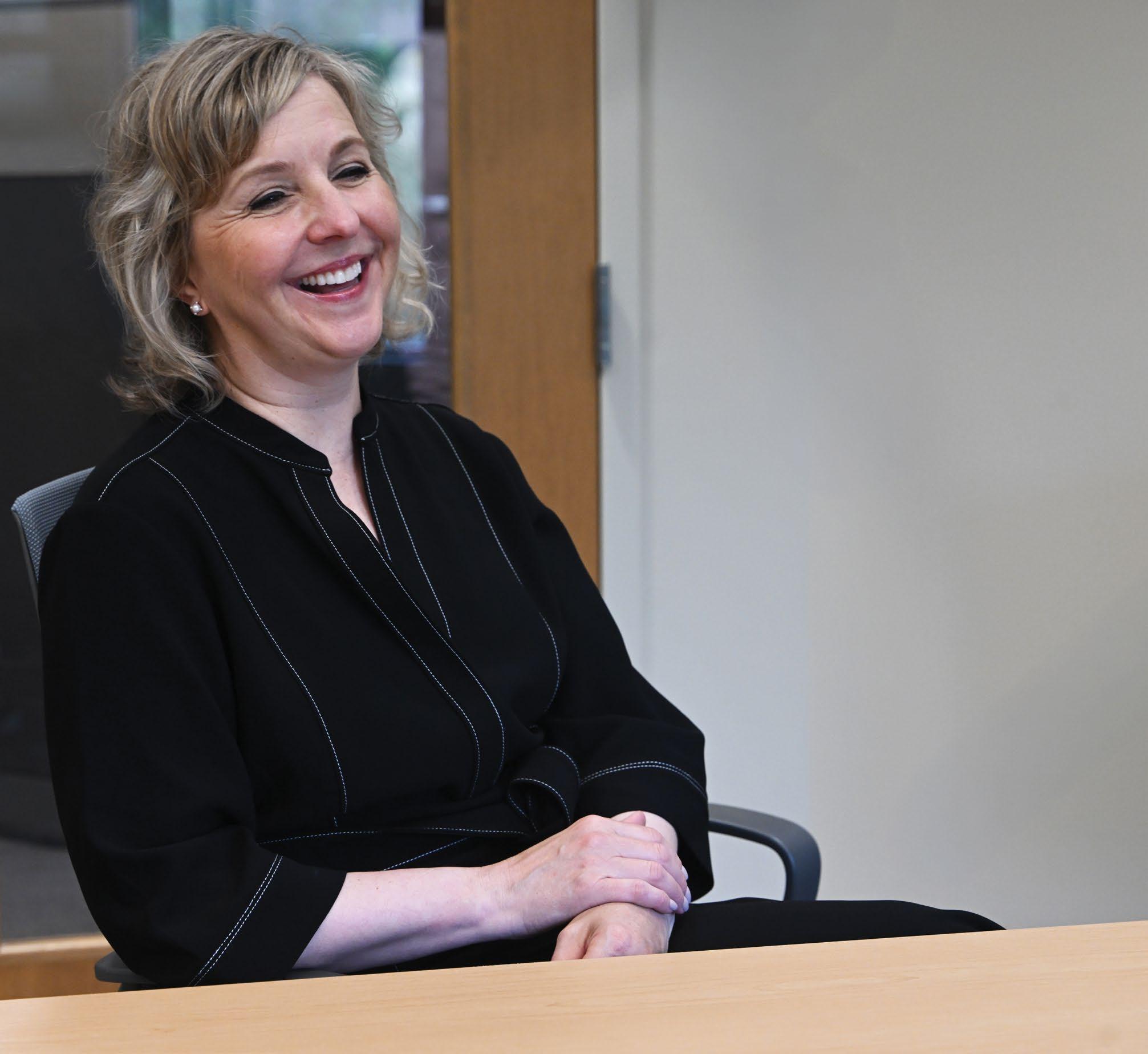
Q: What did you know about Penn State and what prompted you to apply to be dean of the Bellisario College?
A: I knew the college had a tremendous reputation in the broader journalism and mass comm community. The faculty are wonderfully ubiquitous at some of the major, academic conferences in the discipline. So, it was clear that this was a robust academic community.
It was also clear that the students are talented and successful through national awards and other markers of quality. The Bellisario College just always rises to the top. And through my interactions with faculty and leadership from the Bellisario College, it was clear that it was a community that is committed to preparing students for industries across the communications sphere.
Q: You had visited campus long before the job was even open, right?
A: Yes, I had visited for the first time probably 10 years ago, as part of an AEJMC leadership mentorship training program. So that was the first time the Bellisario College was really on my radar, and it never left. Then the more I learned as I was doing my homework in giving serious consideration to applying for this role, it was just so impressive.
(AEJMC: Association for Education in Journalism and Mass Communication)
Q: What did your homework entail?
A: I dug in and looked at past self-studies for ACEJMC, for example, and I looked carefully at what kinds of awards the students had been winning over the years. Looking at the website, it was almost overwhelming with the information and excitement there. And I loved seeing the language on the homepage: Big School Resources, Small School Feel. That really resonated with me.
(ACEJMC: Accrediting Council on Education in Journalism and Mass Communications)
Q: Why?
A: That is so important. As a student, as a creature of the Big Ten myself, having done my undergrad at Michigan, having spent 12 years on faculty at IU, I know how important it is to find your people on a campus with tens of thousands of people. And the fact that the Bellisario College leans into being that community and providing that safe space for students was incredibly appealing to me.
Q: There’s a difference between preparing and applying. When was the moment you knew you really wanted the job?
A: I think reading the position profile that had been provided by the search firm, talking with the leaders of the search firm team, getting a sense of what the search committee said it was looking for in a new dean. Then talking with other people, tapping into different relationships, friends of friends who have connections
to Penn State and to the Bellisario College, I did my due diligence and as I was preparing I just got more and more excited about all the ways that my professional and academic experiences really aligned with what the college was looking for in the new dean.
Q: Who was the first person, or who were the first people, you told when you accepted the position?
A: Well, first, when I was offered the position, I was, sworn to confidentiality for a period and that was very difficult. When I worked for the State Department, I had a top-secret clearance. I know how to keep a secret, but this was hard to keep secret. I was visiting with my mom when I got the offer. I told my mom. I told my long-term boyfriend, partner, about it, and I told my current dean, who is also a friend and a mentor. We had worked together at Indiana University. She’s a big reason why I made the leap from Indiana University to Kent State. So, I shared it with her, not only because she’s a trusted friend and mentor, but also because this was going to have ripple effects for her, for the months ahead and years ahead, and I wanted to make sure that she had as much runway as possible to make the transition. When it was announced, I was at the Association of Schools of Journalism and Mass Communication. I was in Chicago and it was wonderful to be able to start telling people. My former dissertation committee member and mentor and friend, Dave Kirpius at University of Missouri, was one of the first people I ran into. And he was so excited. So, it was wonderful to have the opportunity to share the news in person with so many people that I care about and who have been so incredibly supportive of me.
QYou don’t build a network like that and the connections you have without being good at dealing with people. Along with that, what are you best at? What do you consider your strengths?
AI care deeply about what I do, both at the institutional level and then at the national level and with the organizations where I have found a home. I just deeply appreciate friendships and connections with people. I will say, going back to your question about who else did I tell, one of the best pieces of advice that Kirpius gave me as I was preparing for my visit to campus was to run your presentation past some trusted people. Make sure that the first time you deliver it is not in that auditorium. And so, I convened two different groups of friends who gave me wonderful advice.
I really like people, maybe that’s what it boils down to. I really value relationships. I’m not a big social media person, but I rely on it to help maintain friendships with people that I don’t get to see all the time.
Q: What would freshman-year-of-college Emily be surprised about, if anything, about your career path?
A: Oh, freshman Emily would be stunned that I have ended up in academia and that I’m doing what I’m doing in this discipline. My interest from, I don’t know, fourth or fifth grade was foreign policy, international affairs, national security issues. That really was what I was pursuing from my first day on campus at the University of Michigan, and through my time in Japan as a participant in the JET program, through my master’s degree at George Washington University in international politics and to joining the State Department.
Leaving Washington, D.C., for Louisiana was hard but there were family reasons, and I had a friend who pulled me aside before I left and said, ‘Girl, bloom where you’re planted.’ And I just dug into building relationships and making friends and finding a way to contribute to the community where I was in northwest Louisiana. That started with writing an opinion column and then doing a blog and eventually a podcast.
Before I left D.C., I had been looking at doing a Ph.D. program and when I got to Louisiana, I decided I’m going to find the best Ph.D. program in the social sciences in Louisiana, and I’m going to do it. And that was at the Manship School of Mass Communication at LSU. It was the perfect mix of what I had been doing, focused on foreign policy and beginning to focus on public policy and channeling it into a communications and public affairs context. It was a wonderful entrée into meeting new people, very interesting people, so many characters in that state.
Q: What brought you back north?
A: As I was finishing my Ph.D., I got an offer to join the faculty at IU. It was a hard decision to leave Louisiana but ultimately, I wanted to be closer to home. It was a chance to go back to the Big Ten, which was terrific. My family and my people are in the Midwest. I grew up in Michigan and although I’ve got friends all over, they’re concentrated, sort of, in the Upper Midwest. And I haven’t regretted making that choice at all.
Q: How would you assess yourself as a faculty member?
A: My promise to myself as I started at IU was, I wanted to be the faculty member that I never had at University of Michigan. I loved my time at Michigan. The intellectual environment was incredible. The classes were really challenging. I made wonderful friends. So, I would never throw shade at Michigan or my Wolverines.
But I was in the political science department and the French department, both near the top rankings nationally. And those were hardcore programs, and the faculty were hardcore researchers. So even when they were teaching classes there was not always a lot of attention to the freshmen, or the sophomores, or even the upperclassmen, and I promised myself that at IU, I would be accessible. My door would be open. I would be answering emails. I would meet with students outside of office hours and I would really work to try to connect with my students every step of the way.
Q: How did it go?
A: You know, sometimes that works and sometimes it doesn’t. When I first started at IU, I participated in a teaching fellowship program, and one of the instructors said something that has stuck with me all these years. She said, sometimes no matter how hard you work to support students, they’re just not going live up to the expectations that you’ve set for them. They’re not going go through the doors that you’ve opened for them. And she said, ‘My mantra is, I cheerfully embrace the choices you’ve made.’ And that sounded a little harsh to me.
But as I’ve thought about it over the years, that really is the approach that I think faculty need to take. We give our students everything we’ve got — from an intellectual standpoint, and in terms of really caring about them and being compassionate and offering them lots of opportunities to try to redeem themselves. Sometimes there are students who just choose not to take advantage of that, and I recognize there are a whole host of reasons why that happens.
Q: Did that affect what you did in the classroom? Or with your career?
A: Very early on I decided that while I enjoy teaching, as I looked around at how a university operates, and as I looked around at administration, I thought this is a place where I think I have some things to contribute. So, I began looking for leadership opportunities along the way.
I’ve really enjoyed the leadership opportunities I’ve had, both at the institutions where I’ve been located, and then increasingly with national opportunities. A mentor I had suggested I get involved with some of the divisions and interest groups at AEJMC. I naturally sought out the International Communication Division.
In the ensuing years, it’s been a pleasure to serve in many roles with AEJ and, later, because of my role at Kent State, with ASJMC.
But, going back for a moment to my role as a member of the teaching committee for AEJ, and as chair, one of the things that I really worked on hard was to find a way to honor educators. There was no specific award. When I was on the board as chair of the teaching committee, I said, you know, AEJMC really should have an inhouse teaching award. When I first pitched it to the board, there wasn’t a whole lot of interest, but it started the conversation. And I’m happy to report that in the intervening years, it’s been, what, probably six years now, seven years, this is the first year AEJMC is going to be awarding its own teaching award. It really drives
QYou’ve talked about your Big Ten roots and experience. Is there a shared DNA among those institutions?
AI’ve never thought about it explicitly. When I took the job at IU, I joked, I’m going back to my people. Even though realizing that every institution is different, and truly south central Indiana, in many ways, is more southern than it is northern.
I mean, every one of these campuses has its own personality. But I think the size, and I think with some of them being land-grant institutions, that’s a shared characteristic. Also, I think ‘Midwest nice’ is really a thing.
Plus, there’s family tradition. A lot of students come from a family where it is assumed that if they’re going to pursue a college education, it’s often just the assumption that you are at least going to aim to try to get into the Ohio State or Penn State or IU or Purdue. You go grocery shopping and you can get toddler-sized cheerleading outfits representing the university. It’s engrained early.
home for me, and this it honestly is true — it’s a cliché but it’s true — that it does not matter who gets the credit. Let’s just do good work and not care who gets the credit.
Q: You’ve talked about your Big Ten roots and experience. Is there a shared DNA among those institutions?
A: I’ve never thought about it explicitly. When I took the job at IU, I joked, I’m going back to my people. Even though realizing that every institution is different, and truly south central Indiana, in many ways, is more southern than it is northern.
I mean, every one of these campuses has its own personality. But I think the size, and I think with some of them being landgrant institutions, that’s a shared characteristic. Also, I think ‘Midwest nice’ is really a thing.
Plus, there’s family tradition. A lot of students come from a family where it is assumed that if they’re going to pursue a college education, it’s often just the assumption that you are at least going to aim to try to get into the Ohio State or Penn State or IU or Purdue. You go grocery shopping and you can get toddler-sized cheerleading outfits representing the university. It’s engrained early.
Q: How many miles a week do you need to get out and hike to feel good?
A: Gosh, I need to get in so many miles to feel like I’m really getting out of the office. But five miles is always a good number. Going out into the woods is absolutely my attitude adjustment.
I am judgy when I see people out on the trail wearing earbuds, though. I think, from a safety standpoint, it’s not great. You need to be aware of your environment, but also, I like watching the seasons change on some of my favorite trails, listening to the frogs, seeing the skunk cabbage start to grow.
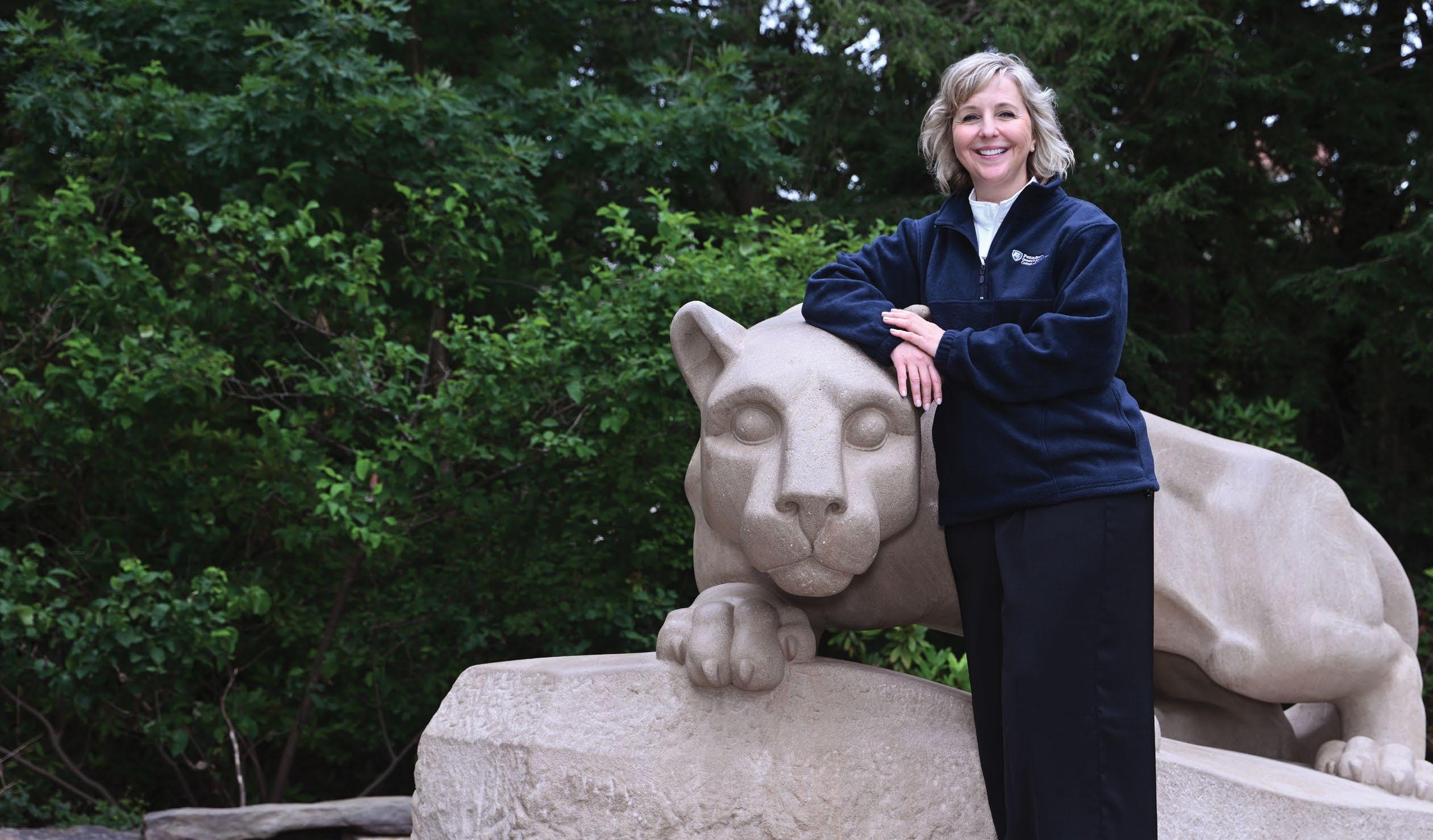
I just love it. When I was in Indiana, I earned the Indiana Master Naturalist certification. Think of Master Gardener, but focused on things like birds and plants and topography and trees and mushrooms.
Q: What does your media consumption look like on a daily or weekly basis?
A: I listen to a lot of podcasts. I try to practice what I preach to students regarding media literacy. So, it’s a wide diet. In the political environment that we’re in right now, the only way to get at truth or some relatively accurate sense of what we think we know about what’s going on in the world right now, is to just read widely, to listen widely. And so, I will listen to things across the political spectrum. Right now, I’m really digging in on a lot of the tech stuff. I’m fascinated by AI, not just by the tech and by its applications, but by its social implications. One of my favorite podcasts on that front is “Hard Fork.” It’s one of the New York Times tech podcasts. It’s funny, and it’s interesting. There’s a podcast called “Moonshots,” run by a guy named Peter Diamandis, who is an exceptional self-promoter, and he and his friends have exceptionally high opinions of themselves and their abilities to influence the world, but they’re also buddies with Elon Musk and with a lot of other people, leaders of some of the frontier AI operations, so there’s a lot of intel about what’s going on. So, I appreciate listening to that.
And then, if you were to look at my YouTube channel, it is all over the place. One of my favorites right now, and I recommend it, is “What’s Going On With Shipping?” It’s by a guy named Sal Macagliano. When I first encountered him several years ago, he was being interviewed by a Bloomberg team for their podcast, Odd Lots. They interviewed him after that ship hit the bridge in Baltimore Harbor, and I thought, this guy is interesting. He has more than half a million subscribers. He posts almost every day about the shipping industry, the maritime shipping industry. Who knew? As a public policy geek, I found it fascinating.
Q: Toughest one for last. What do you consider to be the role of a dean?
A: Making sure that everything we do is in support of our students. They’re the reason we’re here. That means being visible and available to young freshmen and seasoned doctoral students alike. For the dean, supporting students often means keeping the administrative trains running on time. Don’t micromanage. Make sure you’ve got professionals in place and then get out of the way and let them do their work. Be the one who is available to help. Advocate for faculty and staff when they’re trying to get something done that they should be able to get done, and they can’t get it done because a university can be a large, resistant bureaucracy.
Being an advocate for the faculty is especially important, and when I say that I’m talking about helping tenure-line faculty successfully navigate the tenure and promotion process. That process is, no matter how clear university documentation is, no matter how clear college documentation is, there is so much that is sort of unwritten about what that process is like, and what expectations are, and what good advice or bad advice for navigating it might be. The same holds true for supporting non-tenure line faculty colleagues. Review processes are different, but many of the same dynamics can be at play. Helping them navigate their careers at the university is another critical role for the dean.
I take very seriously the responsibility of the unit head, and in this case, the dean, to provide support, to provide mentorship, to be available to meet when colleagues are interested in doing that. You’ve hit this logjam. You’re facing this challenge. What can
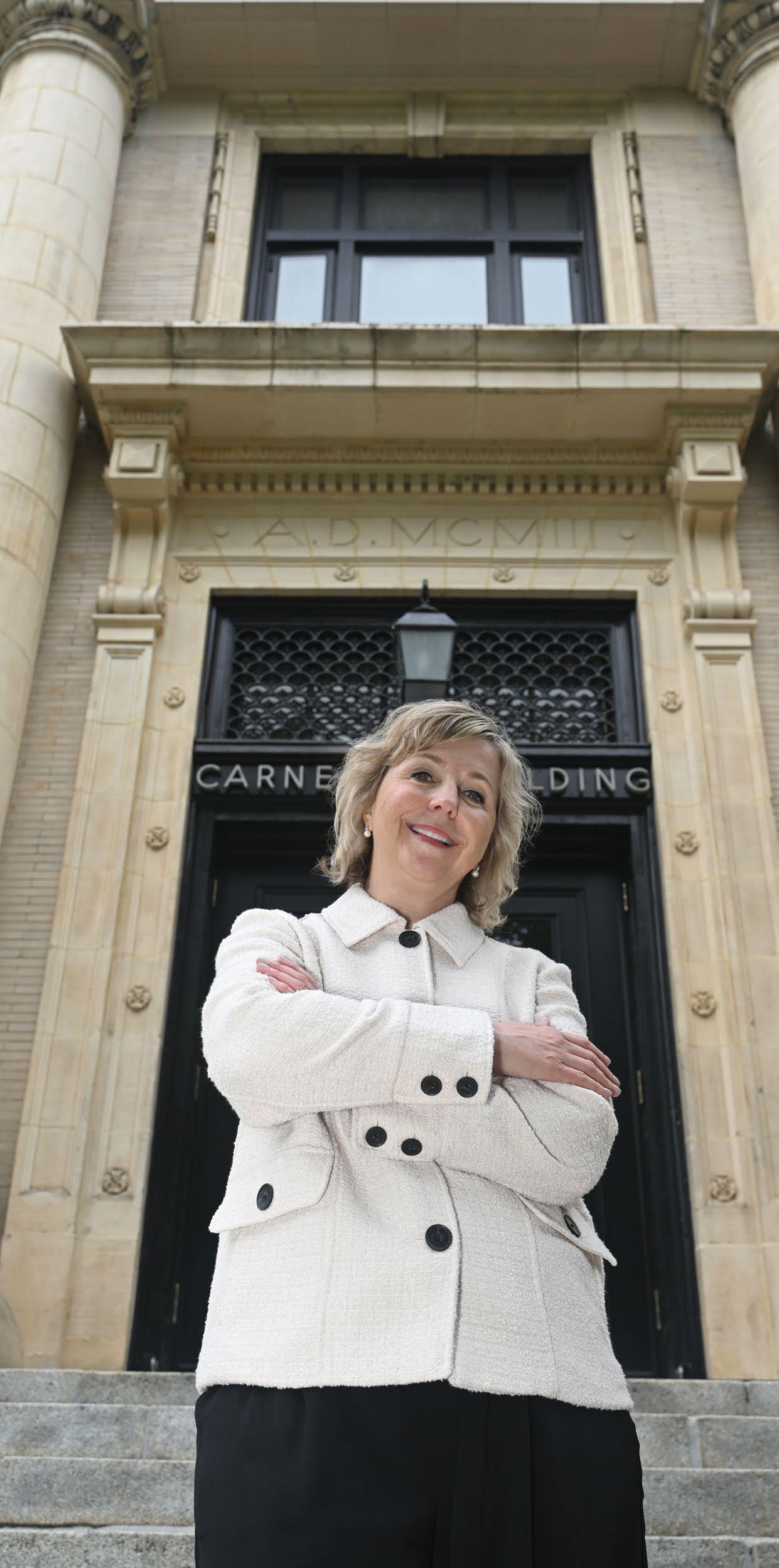
we do? You’re having trouble getting this article placed? You’re looking for new opportunities to get involved? Let’s talk about it. I think there are parallels in supporting staff as well. Universities are hard for staff for lots of reasons, but often, there aren’t necessarily clear paths for career advancement. Staff colleagues get hired into a particular role, and it can be hard to get promoted or to move from one kind of role to another. I believe in encouraging staff colleagues to seek additional training, to take time to pursue other interests. It makes me happy to see someone succeed.
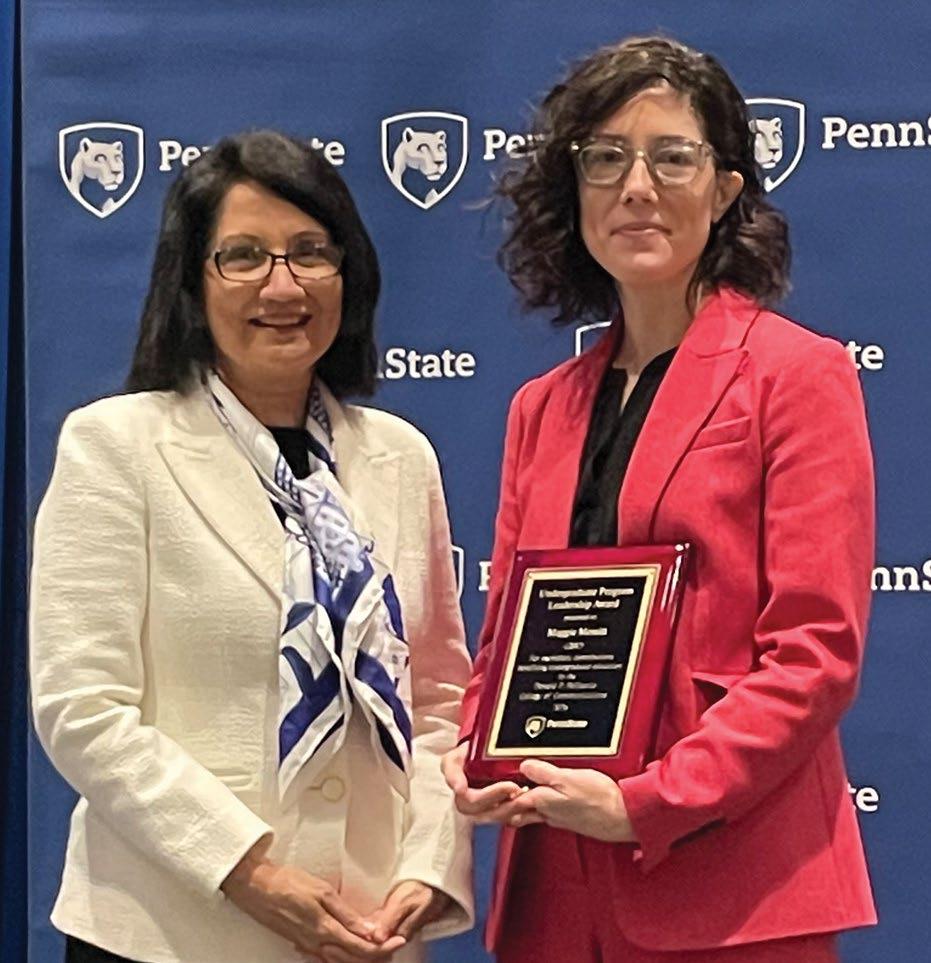
Maggie Messitt, the Norman Eberly Professor of Practice in Journalism in the Bellisario College, received the 2026 Undergraduate Program Leadership Award, recognizing faculty members who have transformed or revitalized the undergraduate program in some way.
Messitt has worked as a social entrepreneur, journalist and editor inside underserved communities in rural South Africa and across the United States for 20 years.
Nominators said Messitt has enhanced the journalism major — one of the largest majors at Penn State — by creating advanced, experiential learning opportunities for students. She directs the News Lab, a teaching newsroom and research-and-development space that offers students professional journalism experiences on campus while also serving Pennsylvanians with in-depth, investigative and accountability journalism.
“Launched three years ago through Messitt’s vision and the college’s support, News Lab provides students with handson newsgathering and storytelling experience while serving Pennsylvania communities,” a nominator said. “Messitt manages the program’s budget, cultivates partnerships with news organizations and community stakeholders, recruits and trains students and ensures their work reaches residents in rural counties across the commonwealth. To date, News Lab stories have been published in more than 25 news outlets statewide.”
Messitt has also secured grant funding from significant organizations like the American Press Institute, Hearst Foundations and the Knight Election Hub to support this work and to launch Centre Documenters, a program that trains community members — in this case, students — to attend and document local government public meetings. It is the first student-run and first rural documenters program in the country. This service, nominators said, offers a great training opportunity for civically engaged students and the community they serve, and has become a model for other journalism schools.
Nominators said Messitt continues to attract new students and keep them engaged. In addition to directing the News Lab, she teaches a large-enrollment introductory course that’s often where students first learn out about News Lab and its range of opportunities.
Messitt also teaches smaller, more intimate and intensive workshops through which she guides students to report as a team and produce narrative and often interactive journalism. This has included a 20-stop audio tour chronicling the East Palestine train derailment and its aftermath across the region; an audio documentary born out of reporting on the intersection of agriculture and aging in Pennsylvania; an open source investigation into historic missing persons cases; and more.
Messitt also launched the college’s first robust badging program through the News Lab. In-person and online trainings and badging opportunities are available each semester. Students have earned badges in public records requests, photographic lighting, scriptwriting, broadcast packages, building a beat and more. Trainings are open to students across the Bellisario College and the University, and an average of 700 spots are occupied each semester.
In spring 2026, the News Lab started its first podcast, “Centre Access.” The weekly recap of news for Centre County residents is produced by students with stories from newsrooms in Happy Valley and across Pennsylvania.
BY SEAN YODER
In the spring, Boaz Dvir, an associate professor in the Bellisario College, was named the inaugural recipient of the Nicholas P. Jones Faculty Award, named for the former Penn State Provost.
The award recognized integrity, loyalty, human-centered leadership, academic excellence and impact by faculty members who have served the University for at least five years. The award is named for former Penn State Provost Nicholas Jones.
Dvir is the Donald P. Bellisario Career Advancement Professor in the college’s Department of Journalism. He has created and led award-winning documentary films, delivering stories of ordinary people in extraordinary circumstances, such as “Class of Her Own,” “Jessie’s Dad” and “To Kill a Nazi” (formerly titled “Cojot”).
“I’m drawn to ordinary human beings who go through trying times and challenges and rise up to that occasion and become leaders and trailblazers,” Dvir said. “I didn’t set out to do that. But when I look back, I realize all my protagonists follow that arc.”
Dvir is the founding director of Penn State’s Hammel Family Human Rights Initiative and the Holocaust, Genocide and Human Rights Education Initiative. Through these initiatives, Pennsylvania K-12 educators get to connect with Penn State faculty who contribute expertise on teaching difficult social and historical topics, use of media in the classroom, trauma-informed pedagogy, the Holocaust, gender studies, human rights violations, international law, art education and more.
He explained that the initiatives aim to give educators and their students the opportunity to develop crucial skills such as critical thinking, developing tough and interesting questions, civic discourse, primary research.
“Besides training K-12 educators and giving their students opportunities to gain valuable skills,” Dvir said, “we’re trying to affect policy and reconstitute what student success looks like.”
Nicholas Jones served as Penn State’s executive vice president and provost from 2013 to 2022. His work as the University’s chief academic officer supported the success of thousands of faculty members and more than 90,000 students at Penn State’s 24 campuses and the online World Campus.
Candidates for this award are nominated by a dean, chancellor or their designee. Each college or campus is able to nominate one person per year. The winner receives $1,000 to use as funding for their work. To learn more about the nomination process, which opens in the spring semester, visit the Center for Faculty Development and Advancement.
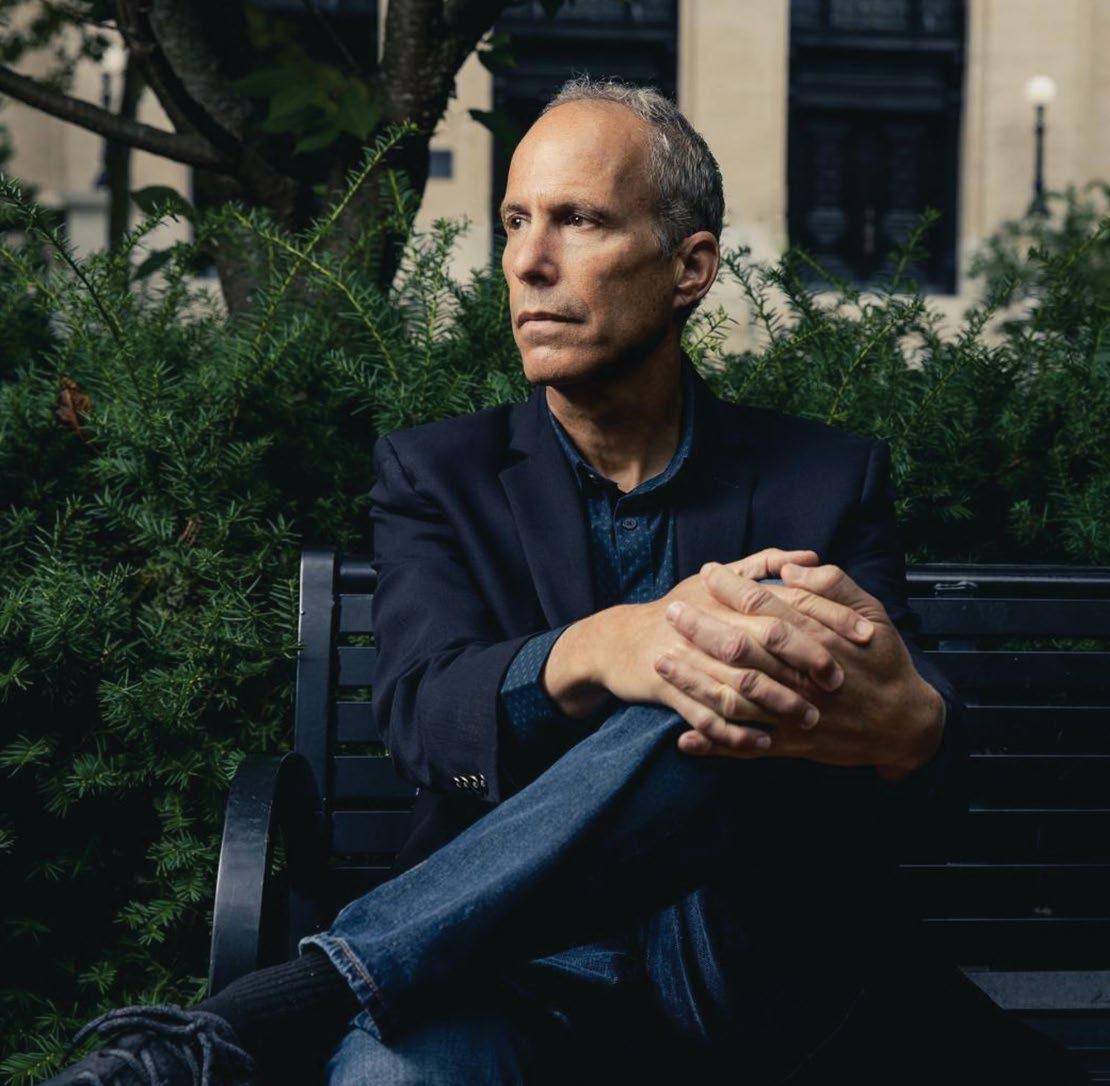
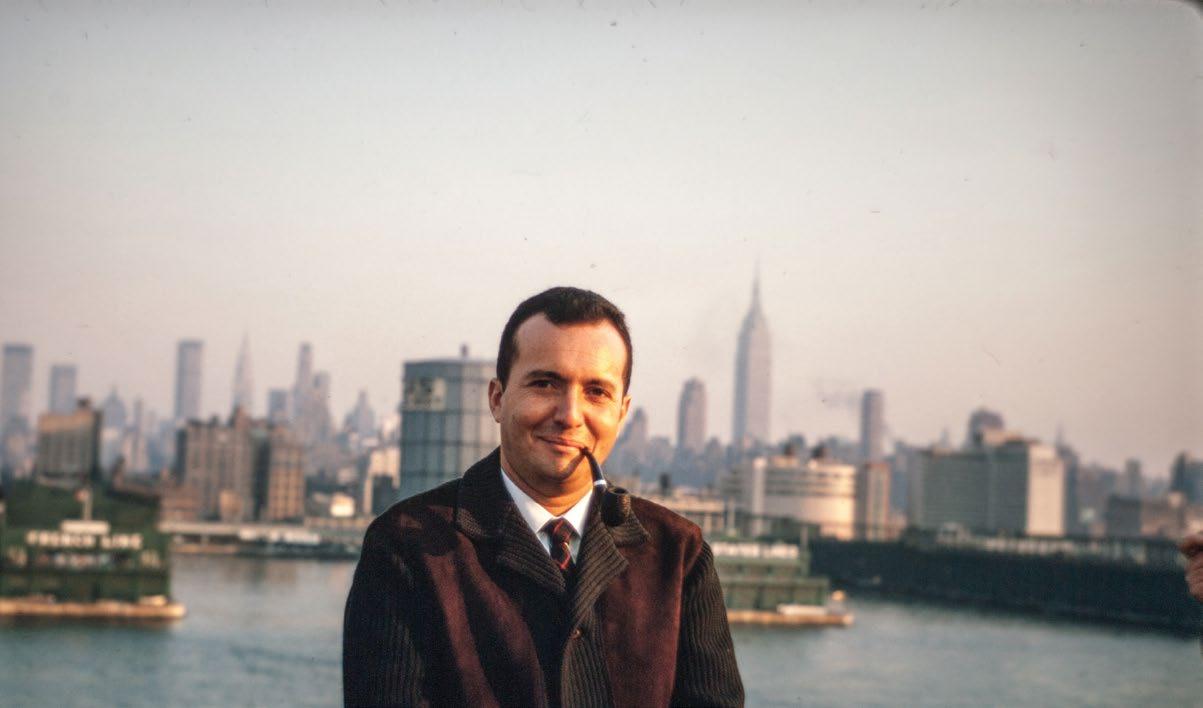
“To Kill a Nazi,” Boaz Dvir’s documentary about a French family man’s quest to kill his father’s Gestapo executioner, made its world premiere June 22, 2026, as an official selection at Dances With Films, and screened at the legendary TCL Chinese Theatre in Los Angeles.
Written, directed and produced by Dvir, an award-winning filmmaker, and narrated by iconic actor Jason Alexander, the film shows Michel Cojot regretting his assassination decision and seeking redemption the following year during a hijacking and hostage crisis.
In 2023, USA Today named the Dances With Films festival a Top 10 North America film festival and more recently MovieMaker magazine called it one of the world’s “25 Coolest Film Festivals.”
Dvir’s previous documentary feature, “Class of Her Own,” has screened at nearly 30 film festivals around the world, winning more than a dozen awards since it was released in 2024.
Digital Media Trends and Analytics option provides real-world preparation for fast-changing marketplace
An undergraduate minor designed to better prepare communications students for their careers has become the largest academic minor at Penn State because of its combination of AI-era media strategy and hands-on experience with real-world tools and platforms.
The Digital Media Trends & Analytics minor (DMTA) was intended to complement the curriculum and empower students — and it’s done just that for the past decade.
“A faculty member told me about the minor and encouraged me to check it out because it would be helpful. That’s certainly been the case,” said Isabelle Flores (’25), an advertising/public major who graduated in December. “I’m a peer mentor for the Bellisario College and I always tell underclassmen the DMTA minor is a good move no matter your major.”
That message has spread far and wide. Since 2017 the minor has graduated over 1,400 students from 71 different majors across the university. Currently 548 students are enrolled.
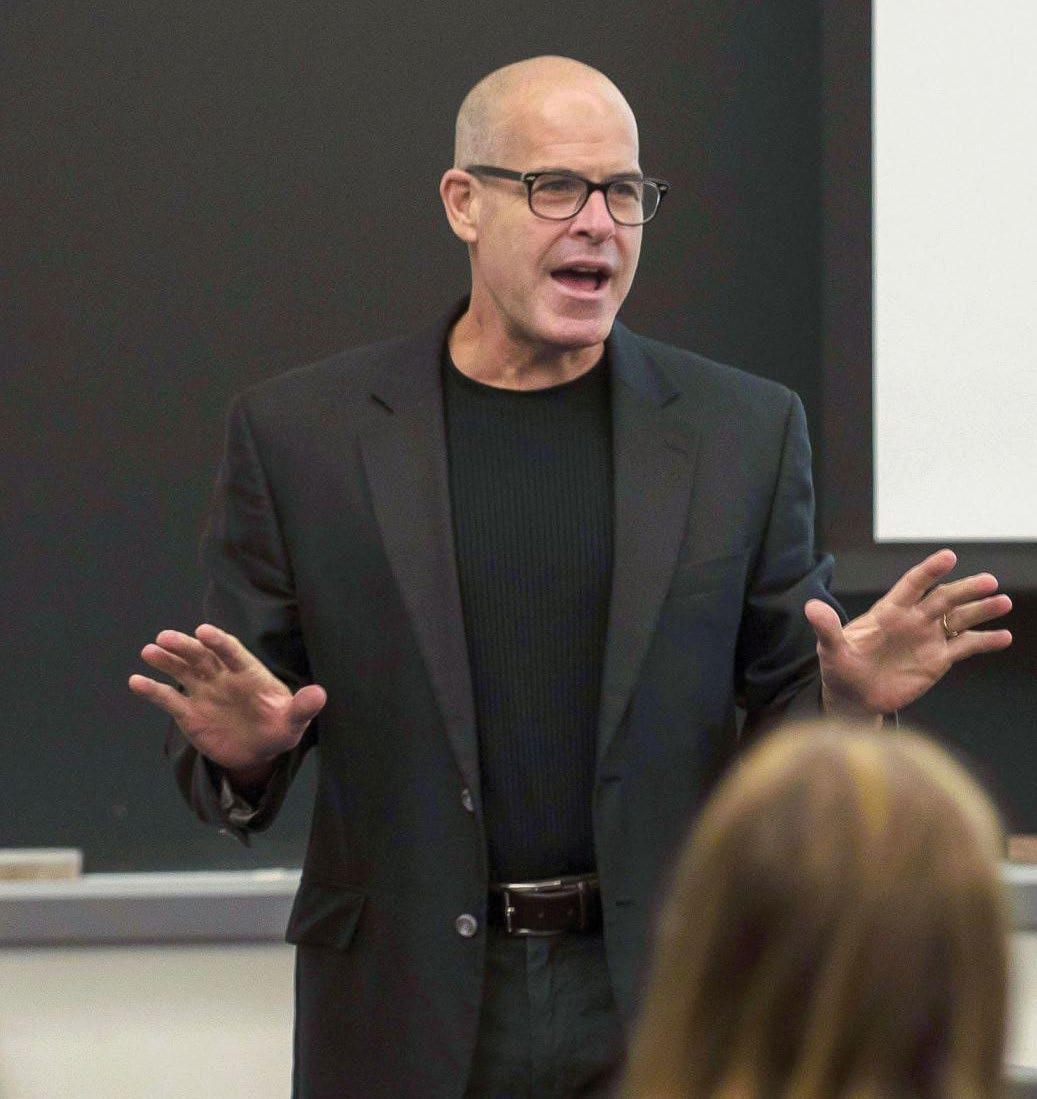
Lee Ahern, an associate professor of advertising/public relations in the Donald P. Bellisario College of Communications, created and helped launch the minor as part of a collaboration with the College of Information Sciences and Technology in 2016. He saw the potential need an utility for the program and has witnessed its growth since its inception.
The 18-credit minor includes introductory courses in advertising/public relations and information systems and advanced courses in digital media metrics, digital public relations and programmatic, AI-driven advertising. Ahern teaches a capstone digital campaigns class.
“These are real-world courses, and it helps us as faculty members, to keep our finger on the pulse of what’s happening in industry while helping prepare students,” Ahern said. “By using real-world tools like Google Ads, students are witnessing how leading tech companies are rolling out AI functionality in real time.
“Especially with AI the last couple of years, students are looking for ways to make it clear that they’re up to date in a fast-changing marketplace,” Ahern added. “With the minor, the
fact that they’re able to add more skills and certifications to their toolbox is obviously appealing.”
Students in Ahern’s capstone campaigns course us platforms including Google Ads, Google Analytics, and Swipe Pages landing page builder. The course also exposes students to key digital marketing tools like Google Trends, Google Rich Results Test and URL builders.
More than
1,400 students from 71 majors have complete the minor since it was created.
“The skills students develop using these tools, and understanding their strategic importance, position them to navigate and innovate in the modern digital media marketplace,” said Fuyuan Shen, the Donald P. Bellisario Professor and head of the Department of Advertising/Public Relations. “Prof. Ahern’s leadership and coordinator of the minor has been instrumental to the success of the DMTA minor.”
As digital platforms have altered the dominance of traditional platforms, the DMTA minor serves more than just advertising or communications students. In addition, better understanding
AI can enhance creative development and inform strategy and transactional efforts in almost any discipline.
The minor offers foundational theories and tools that can help combine AI and communication into modern practice.
Rather than teaching AI as a side topic, the DMTA minor positions AI as the connective tissue of digital advertising education. Students are exposed to:
• AI-assisted keyword and audience generation;
• automated campaign optimization features;
• generative-AI display and text ad creative tools;
• data-driven modeling inside analytics platforms; and
• ethical considerations in algorithmically mediated advertising.
Students don’t just learn AI — they build campaigns with it, evaluate its results, and critique its outputs with guidance from experienced faculty. In a field where creative intuition and machine-assisted precision must coexist, this balance helps prepare a workforce for what agencies increasingly expect on day one.
“It feels like I’ll be better prepared for my first job because of the DMTA minor,” said Sidney Newell (’26), an advertising/ public relations major who graduated in May. “My dream job is to be an A&R representative for a music label or to be a creative strategist for artists, and the minor has helped me with the familiarity of important tools that can make me better. I just feel like it’ll help me stand out as a candidate.”
Both the Bellisario College and the College of IST provided consistent, foundational support for the minor.
In addition, courses have been developed and/or taught by several faculty members — Yujin Heo, Krishna Jayakar, Hunter Overton, Heather Schoenberger, Stephanie Thomas and Bill Zimmerman.
“It is a team effort. So many people in administration, scheduling and advising have been committed to serving students and helping build the minor,” Ahern said. “A special thanks to Jamie Perry and Nikki DiOrio and Julie Evak.”
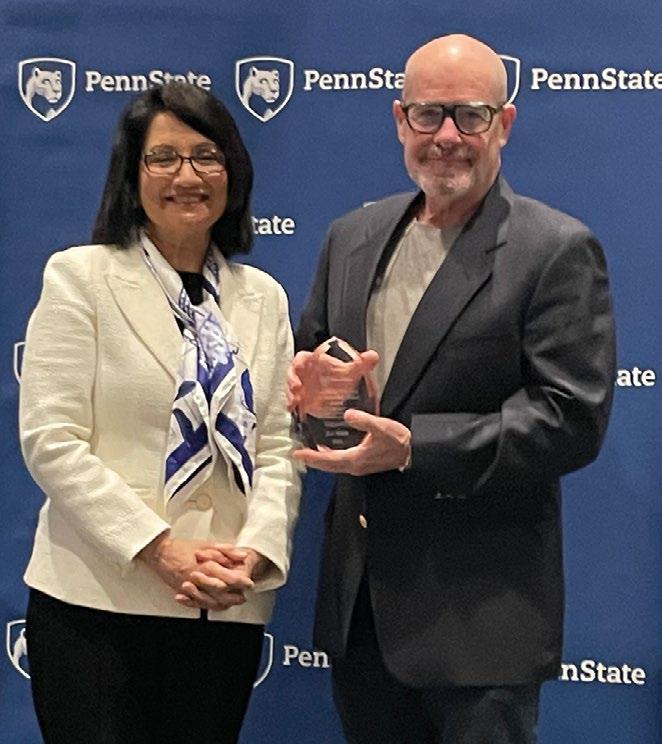
Lee Ahern, an associate professor of advertising/ public relations in the Bellisario College, is the recipient of the 2026 Teaching and Learning with Technology Impact Award at Penn State.
The award celebrates the accomplishments of faculty members whose work transforms education through the use of technology, and is given in recognition of excellence represented by a single contribution or series of contributions.
Nominators said Ahern’s vision, leadership, innovation and commitment to technology-enhanced learning has transformed the experiences for thousands of students at Penn State.
“My philosophy of using technology in education starts with a simple premise: tools don’t transform learning — students and teachers do,” Ahern said. “Technology becomes innovative only when it deepens how students think, make meaning and explain their decisions. In applied media fields like digital advertising and analytics, technology should sharpen a student’s ability to reason through systems, interpret data, and communicate impact, not just complete tasks inside a platform.”
Ahern developed and oversees the digital media trends and analytics minor, which is now the largest minor at Penn State.
In 2016, Ahern saw a growing need for students to develop fluency in emerging digital tools such as large language models.
“Nearly a decade later, the minor stands as a model of forward thinking curriculum design — one that has graduated more than 1,400 students from 71 majors and currently enrolls over 500 more,” a nominator said. “This growth is not accidental; it is the direct result of Ahern’s ability to identify industry shifts early and translate them into meaningful, accessible learning experiences.”
Ahern doesn’t just show his students digital tools, he immerses them in the technology. For his capstone digital campaigns course, students follow a professional workflow as they develop marketing campaigns that use real-world platforms such as Google Ads, Google Analytics, Swipe Pages, tracking URLs and a suite of AI-driven tools. Students build campaigns using automated tools for keyword generation, optimization features and data-driven modeling. Then they evaluate their results using analytics and algorithmic tools. They also consider the ethical implications of using AI in marketing.
It’s a chance for students to show a mastery of all the tools they learned through the minor as they develop a digital advertising campaign. Students are provided a client and an objective. From there, they create a call to action and a strategy for advancing the campaign.
“In an era defined by rapid technological change, Ahern has created a learning environment where students are not merely keeping up, they are confidently stepping ahead,” a nominator said. “His teaching exemplifies the transformative potential of technology when paired with thoughtful pedagogy, and his service has had a measurable, lasting impact on student learning across the University.”
BY JONATHAN McVERRY (’05)
One in three people believe they don’t have to seek the news from traditional outlets like newspapers and television. Instead, they think the “news will find me” (NFM), relying on algorithms and social networks to get their information. A research team led by Penn State scholars recently found that these individuals often consider their online networks to be as trustworthy as professional editors and journalists.
This mindset may make people more vulnerable to believing and sharing misinformation, according to the researchers, who published their findings in the journal Social Media & Society.
To understand news consumption behavior, the researchers designed an experiment that allowed them to observe how individuals with different levels of NFM engage with news. The researchers found users with higher NFM considered news recommended by algorithms or shared by others in their social network to be just as credible as news recommended by editors and reporters.
The content stayed the same across news feeds, only the source of the recommendation — algorithm, friends or editors — changed. This allowed the researchers to examine how each source prompted participants to rely on different heuristics: “mental shortcuts,” or rules of thumb that people use to make quick judgments.

However, mid- and low-NFM individuals more critically evaluated news sources and placed higher value on stories from editors and reporters.
“The good news is that, overall, professionals are still valued,” said corresponding author S. Shyam Sundar, Evan Pugh University Professor and James P. Jimirro Professor of Media Effects at Penn State. “But people with this tendency to rely on news coming to them — which is becoming more and more people — are trusting algorithms and social media friends to be their news sources.”
When readers grant algorithms and social networks the same authority as journalists, it’s easy for bad actors to manipulate that digital space versus imitating a trusted news source, the researchers said.
“The underlying psychological mechanism was not parsed out in previous studies,” said first author Mengqi Liao, assistant professor at the University of Georgia who completed her doctoral studies with Sundar at Penn State. “We did this experiment to understand and explain why respondents evaluate the recommended news the way they do.”
The web-based experiment included 244 participants. Each user completed a pre-questionnaire that measured NFM level using a standardized survey scale. Then participants were randomly assigned to one of three simulated news feeds, which recommended content by a news editor, social media friends or an algorithm.
For example, when a news article is recommended by an editor, this activates the authority heuristic, prompting readers to trust the information because it comes from professional journalists.
When content is recommended by an algorithm, it triggers the machine heuristic. Articles recommended by social media friends activate the homophily heuristic, meaning people are more likely to trust information shared by individuals they see as similar to themselves.
“For some people, the algorithm now carries the same weight as a journalist,” said co-author Homero Gil De Zúñiga, distinguished professor of media studies at Penn State. “We’re seeing a flattening of authority so that algorithms and social media feeds are being trusted like professional journalism.”
Sundar said the fact that this makes people with high NFM more vulnerable to misinformation and less informed overall is especially problematic with more people adopting an NFM approach to their news and information.
Liao added that it “would be a really big problem” if social media friends and algorithms are recommending very biased or even false information.
“Subscriptions are going down; people are not actually seeking news,” Sundar said. “Machine as a source is now becoming predominant, undermining the more traditional professional sources, and that’s worrisome.”
Sundar suggested possible strategies for combating the phenomenon, such as targeting high NFM people with customized media literacy interventions. These interventions could inform readers where information originated from, as well as the steps journalists took to uncover the information.
Yuan Sun, assistant professor at the University of Florida who earned a doctorate in mass communication and media studies from Penn State in 2023, and Timilehin Durotoye, doctoral candidate in the Donald P. Bellisario College of Communications at Penn State, were authors on the paper as well.


Penn State has been named one of the nation’s Top 50 Film Schools, according to a competitive and prestigious list compiled by TheWrap, a leading, authoritative digital news organization covering the business of entertainment and media. Penn State came in at No. 45 on the list.
The rankings emerge as the result of a multifaceted survey focused on acceptance, graduation and retention rates, along with the student-faculty ratio and the quality of faculty at schools across the country. In addition, the rankings consider student access to equipment, the number of films students make, and real-world experience in the form of internships, mentoring and networking.
The rankings also value career-related support available to students, along with alumni and awards, as well as the availability of on- and off-campus career development sessions, including guests and workshops.
“Our students have the opportunity to make multiple films while at Penn State, collaborating with their peers both in class and through extracurricular opportunities,” said Maura Shea, an associate teaching professor and associate head of the Department of Film Production and Media Studies. “We pride ourselves on building a close-knit community of creatives.”
Penn State’s history with film and impact in Hollywood date to the early 1930s when twin brothers Julius and Philip Epstein cowrote the screenplay of “Casablanca.” They also cowrote the screenplay for “Arsenic and Old Lace.”
Nearly 95 years later, the film production major in the Donald P. Bellisario College of Communications enrolls about 150 students each year — and those students benefit from a powerful combination of academic offerings, a big alumni network, ample hands-on opportunities and a support system that helps ensure student success.
Specifically, the Bellisario College has its own soundstage and students have access to state-of-the-art equipment.
Class assignments and many individual projects offer opportunities to create documentary or narrative films.
The Penn State curriculum includes courses on foundational matters, including history, writing and basic production, as well as classes that showcase the breadth and depth of faculty expertise. Along with capstone production opportunities, there are advanced workshops on topics such as directing, cinematography and screenwriting.
In addition to the classroom work, and in part because of it, the Student Film Organization conducts a film festival at the State Theatre in downtown State College each spring highlighting the best student films from the academic year.
Students also travel to New York City each spring for the daylong Films & Friends networking and screening event with alumni.
In addition, the growing and respected Centre Film Festival brings filmmakers from all over the world to campus and the community each fall. This year’s event is scheduled for Nov. 2-8, 2026.
The Penn State Hollywood Program, created because of student interest and bolstered because of alumni engagement, allows students to spend a semester in Los Angeles while completing classes and working at internships in the film industry and related fields.
Award-winning faculty members who consistently work on their own projects also strengthen the program.
Save the Date November 2-8, 2026

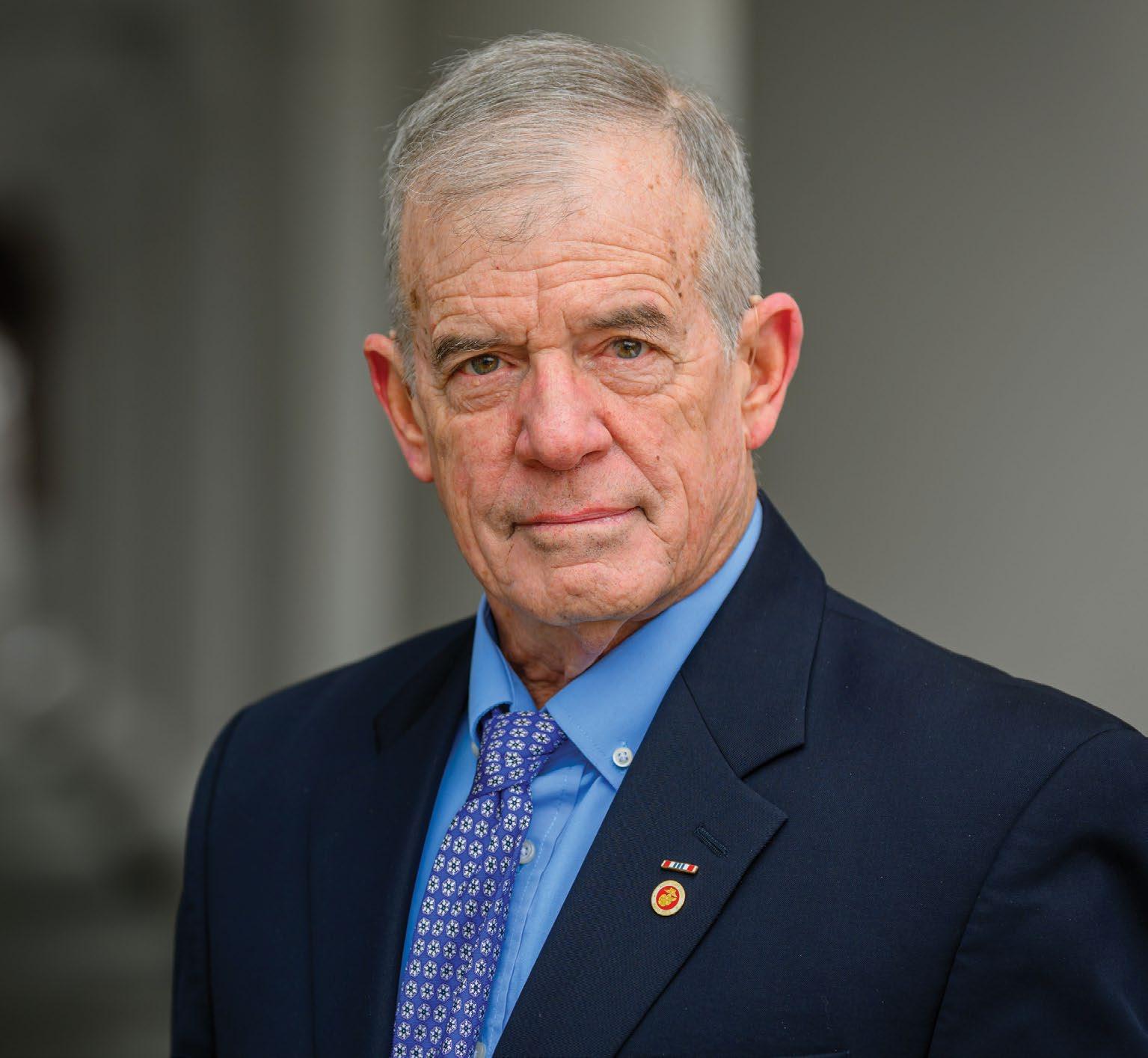
Steve Manuel, an associate teaching professor in the Donald P. Bellisario College of Communications at Penn State, has retired. His last day as faculty member at the University was June 30, 2026.
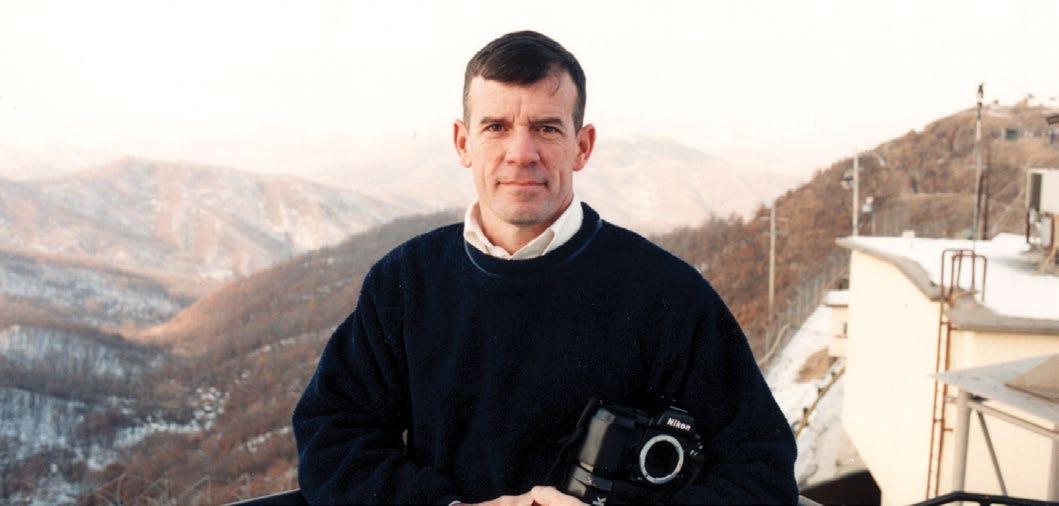
Manuel has been teaching public relations, crisis communications and photojournalism at Penn State since October 1996 — a month following his 28 years of military service. He enlisted in the U.S. Marine Corps in January 1969 and served as a photojournalist and as a commissioned officer for the Marines before retiring from active duty as a major in September 1996.
During his nearly 30 years at Penn State, Manuel taught more than 10,000 students, from first-year seminars to 400-level capstone courses. His senior-level crisis communications class was infamous for its “hot seat” exercise that challenged students to field questions in a real-life scenario pulled from Manuel’s military career.
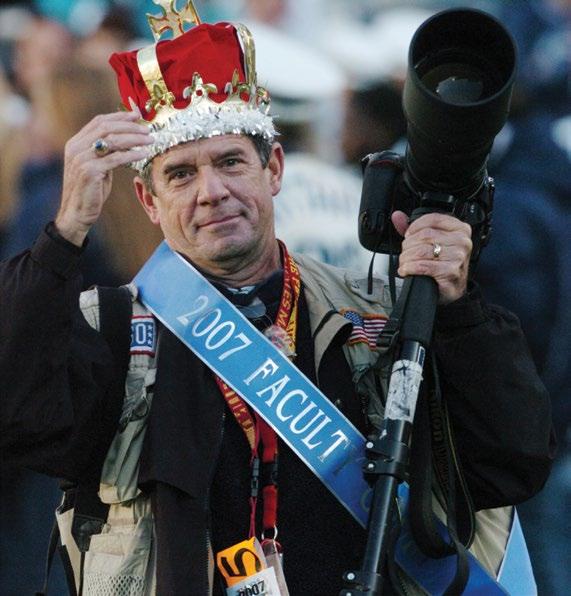
Along with his duties in the classroom, Manuel has been an active photographer at Penn State, where he photographs many of the University’s Division I sports teams and regularly partners with Intercollegiate Athletics and the Penn State Alumni Association, which has published his work in brochures, calendars, posters and various publications (including “The Football Letter”) through the years.
Manuel’s photographs have been published in more than 115 publications, among them Athlon Sports, Blue/White Illustrated, Navy Magazine, Spectrum Sports Magazine, Sports Illustrated, the New York Times, the Philadelphia Inquirer and USA TODAY. He also photographs for the Associated Press. He has earned numerous photographic and writing awards.
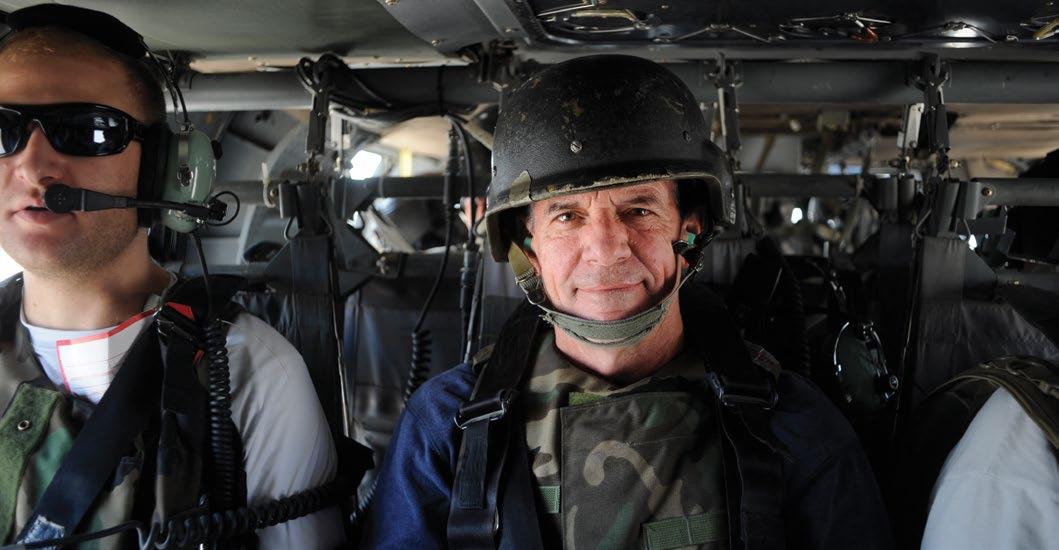
Manuel has participated as a photographer in major United Service Organizations (USO) show tours to Afghanistan, the Balkans, Cuba, Guantanamo Bay, Kuwait and Okinawa/South Korea. In June 2008, he visited Iraq with comedian/actor Dane Cook, and he joined seven PGA golfers on a trip to the country at Thanksgiving 2008. He returned in June 2009 with Stephen Colbert. Manuel traveled to Qatar, Bahrain and Abu Dhabi with actors Kate Walsh (“Grey’s Anatomy”) and Kal Penn (“House”) in May 2013.
During his military career, Manuel was a public affairs officer for the Office of the Secretary of Defense and a Marine Corps spokesman. His primary duty, when not responding to media queries, was writing public affairs guidance for field commands of all the military services for response to any questions from the press on exercises, operations and specific events. He was responsible for the Western Pacific region, which included China, the Korean Peninsula, Japan, the National Security Agency and POW/MIA Affairs.
He served in many locations throughout the world, including Hawaii, Vietnam, Pennsylvania, Virginia, North Carolina, Florida and New York.
Manuel earned his undergraduate and graduate degrees from Penn State in 1984 and 1992, respectively. When not behind a camera, he spends time scuba diving, creating stained glass windows and lamps and playing tennis. He lives with his wife, Jaylene, in State College, and they are the proud parents of four children, eight grandchildren and two great grandchildren.
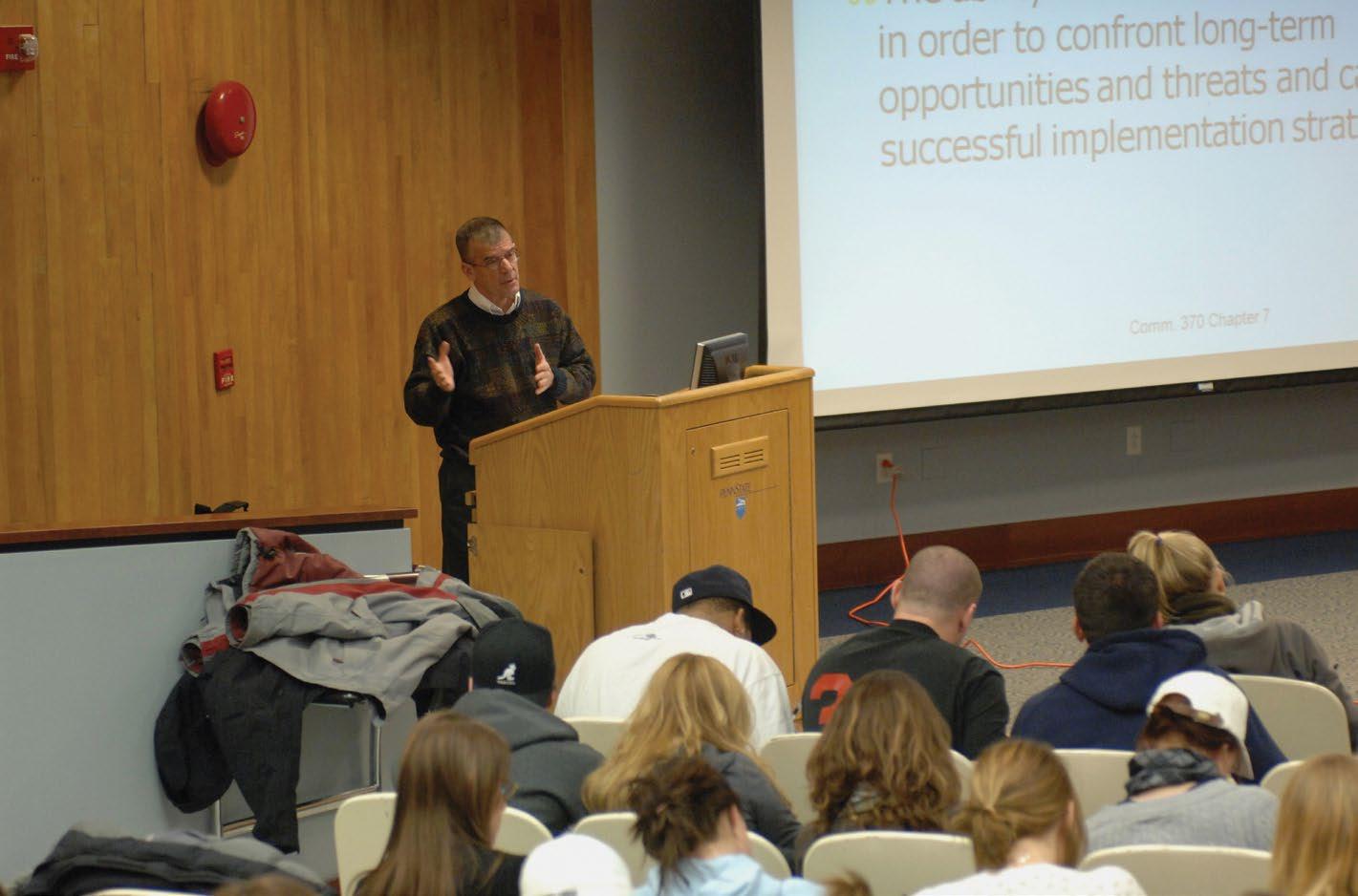
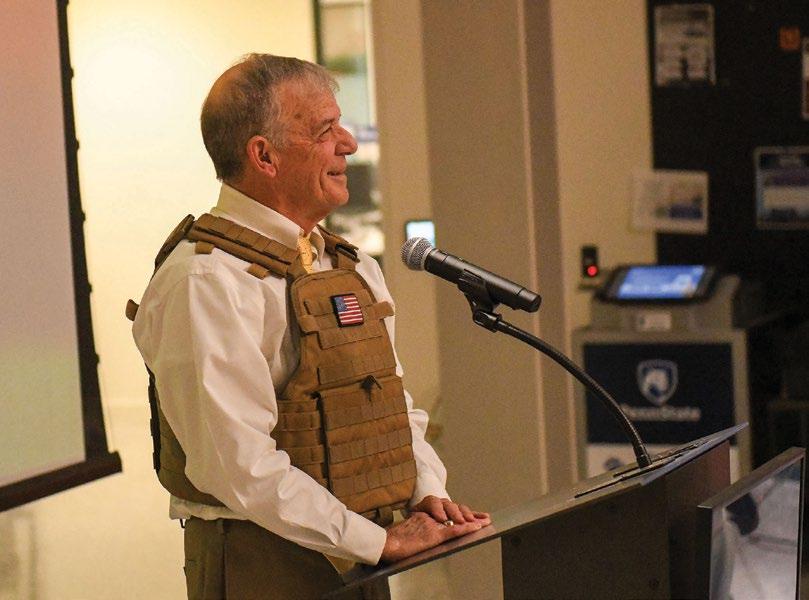


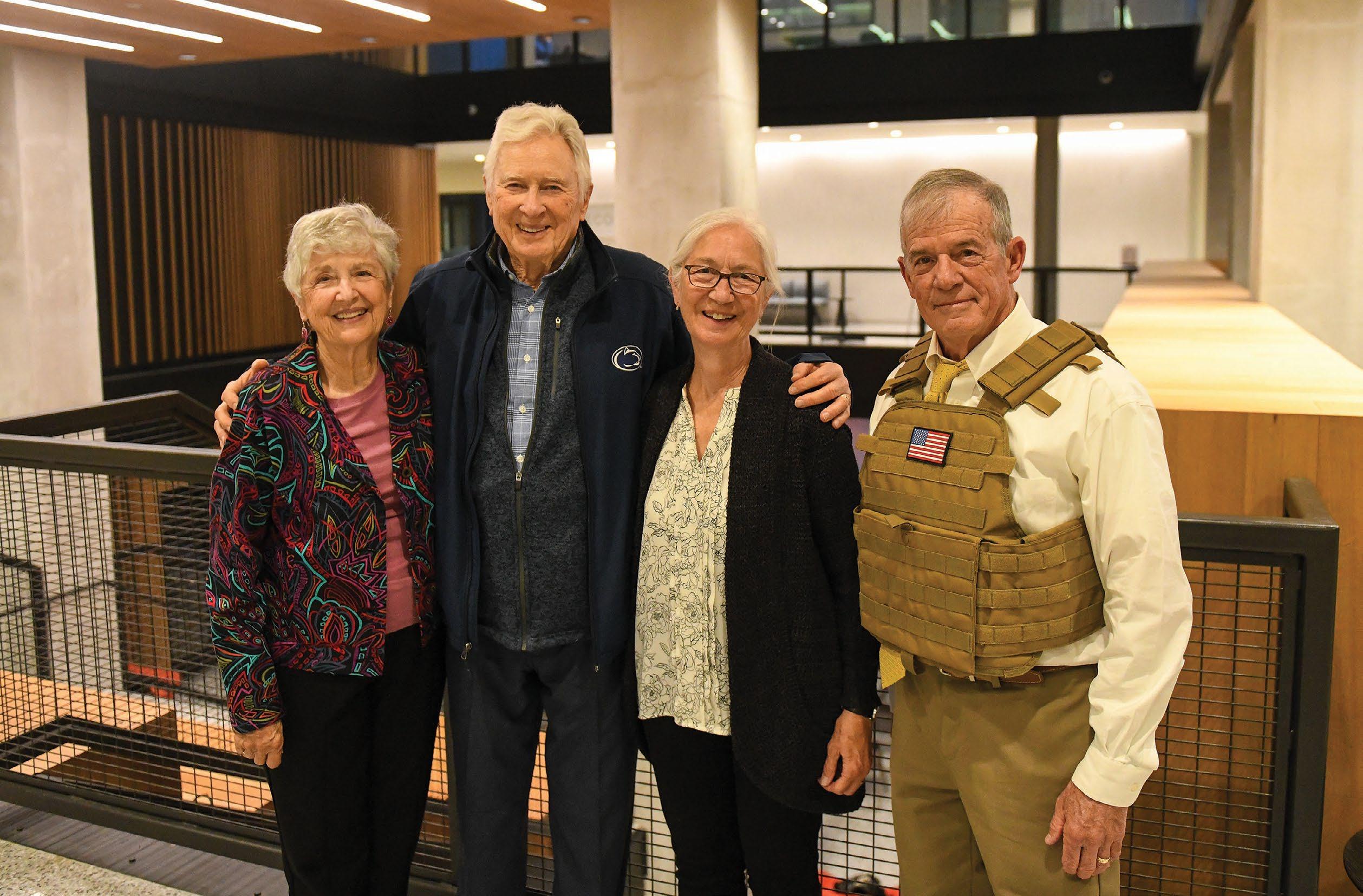
attend Manual’s mock news conference during his retirement event. Manual jokingly donned a bulletproof vest, which he wore on USO trips, to handle the “tough” questions lobbed at him at the news conference, modeled after the “hot seat” exercise in his capstone class.
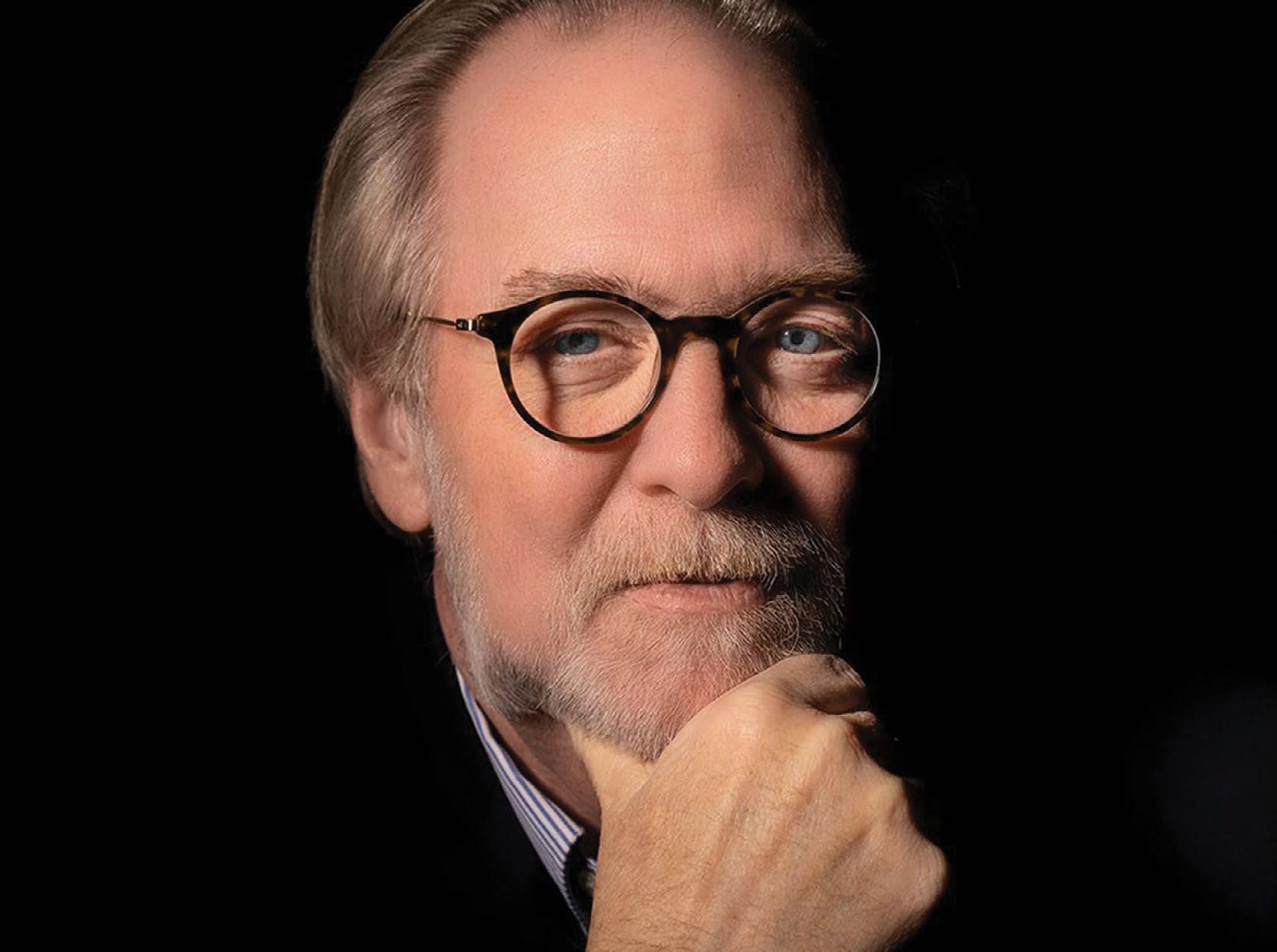
Jeff Brown, an instructor and longtime faculty general manager of CommRadio, retired from the Donald P. Bellisario College of Communications at Penn State on June 30, 2026.
Brown had been with the University since 2001 while balancing duties as a morning show disc jockey in State College along with roles as public address announcer for Penn State basketball and the State College Spikes. He has also shared his talents as an emcee and host for a variety of charitable events benefiting Centre County nonprofit organizations.
Brown has been named “Best Radio Personality” several times in the State College market and was named small market Broadcaster of the Year by the Pennsylvania Association of Broadcasters in 2018. He was inducted into the Slippery Rock University Broadcasting Hall of Fame in 2016.
Although he’s retiring from his academic unit role, Brown will keep working as a morning-drive DJ and continue in his efforts with Penn State Athletics and nonprofits.
Brown’s impact and legacy include the creation of CommRadio, the official radio/streaming station and podcast network of the Bellisario College, which has helped thousands of students start their careers and set the stage for more to do so in the future.
With many students interested in broadcasting, Brown guided the launch of CommRadio — making the Bellisario College an early adopter of streaming to allow students to gain necessary on-air experience and serve listeners.
In his role leading the organization, Brown crafted numerous opportunities and partnerships that benefited students. Specifically, CommRadio often provides some of the first hands-on production experience aspiring broadcasters get at Penn State, and the organization also conducts some of the most high-profile assignments available for students.
Brown has championed all those opportunities.
He understood the importance of students getting immediate experience, so he found ways for them to create content and participate as soon as they arrived on campus. In addition, his leadership was vital in the creation of high-profile experiences that have included annually covering the NFL Draft on location as well as covering Penn State football games and bowl games. In 2009, CommRadio was the first college station credentialed for the NFL Draft and students have continued to cover the event for the past 17 years.
CommRadio students regularly produce half-hour newscasts, provide play-by-play of many Penn State and State College Area High School sporting events and are responsible for creating and airing talk shows each week. Students also produce a variety of podcasts, social media content and written stories on news, sports, entertainment and more.
The combination of teaching and mentoring fit Brown’s passion and skillset perfectly.
He planned to major in elementary education and teach kindergarten when he attended Slippery Rock University, but that changed when he found his passion at the campus radio station. His career took him to Texas, Maryland, New York and Pittsburgh before he arrived in State College.
His first day on the air in State College was Aug. 8, 1988, and he started his morning duties at the market’s classic rock station in 2000.
Brown, who has adult children and four grandchildren, created an additional family through his work at Penn State. He made connections with alumni and leaders in the profession while nurturing and supporting students so they could succeed.
The approach led to exceptional growth and participation in CommRadio and built a community and culture that will resonate for years — just like Brown’s voice.
Thank You, Jeff!
BY JONATHAN McVERRY (’05)
Users tend to trust artificial intelligence (AI)-powered fact-checkers as much as human fact-checkers, but for different reasons, according to a new study led by Penn State researchers. The researchers said there is no definitive “winner” when comparing the two fact-checking systems, because users see distinct strengths and weaknesses in each.
In their study published in Media Psychology, participants tended to trust AI more for large-scale scanning tasks, like identifying “red flags” in social media posts. They trusted humans for more nuanced fact-checking that requires piecing together evidence or interpreting complicated situations.
about machines. They found that while participants assumed AI systems were objective and accurate, they also distrusted AI for lacking human judgment. When it came to determining which system garnered the most trust, first author Mengqi Liao said the two opposite perspectives offset each other.
The ideal situation would be a human-AI collaboration, but it’s not always possible for humans to intervene and check for evidence from multiple sources.
“There’s a very clear distinction that emerges from the study that AI is considered good at low-level linguistic features, like identifying telltale signs that something is not credible,” said author S. Shyam Sundar, Evan Pugh University Professor and James P. Jimirro Professor of Media Effects at Penn State. “Humans are seen as being better at corroborating evidence from multiple sources.”
– S. Shyam Sundar, Evan Pugh University Professor and James P. Jimirro Professor of Media Effects
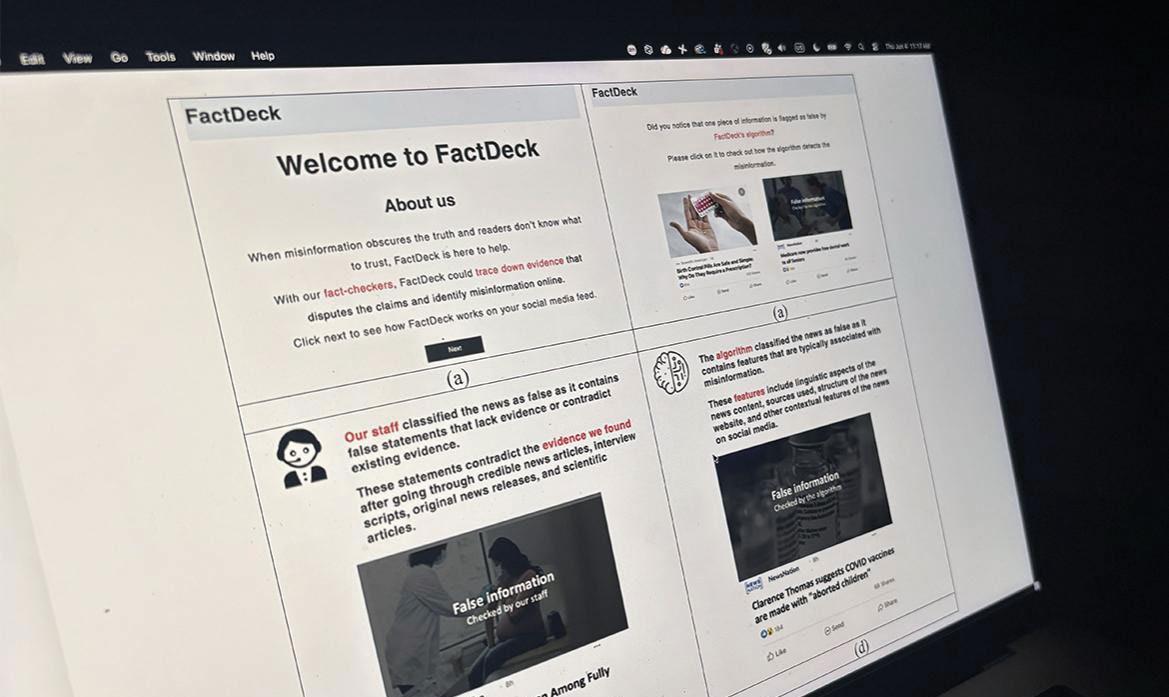
The research team first conducted a pretest to identify six news headlines that varied in credibility. Two hundred and ninety-one participants residing in the United States were then shown those headlines in simulated social media posts via an application created for this study called FactDeck. Some posts were labeled as fact-checked by an AI system and others by human fact-checkers. Participants saw one of three types of explanations:
• Evidence-based: The system labeled the post false with a reference to the information that contradicted the post.
• Feature-based: The system flagged suspicious wording or unusual phrasing.
• “Black box”: No explanation was given for why the post was marked false.
The researchers focused on “machine heuristics” — mental shortcuts people use when evaluating AI, based on stereotypes
“Some studies only compare AI versus human fact-checkers, to find out which is trusted more,” said Liao, assistant professor at the University of Georgia, who completed her doctoral studies with Sundar at Penn State. “They get a lot of inconsistent results. That’s why we proposed a competing hypothesis that showed how positive and negative views of both can coexist and cancel each other out.”
Liao added that users preferred some explanation rather than none — the “black box” option.
“We want to provide enough explanation to users that helps them better understand how the system makes a specific decision. It may help them calibrate their trust,” Liao said. “They’re not just relying on the system’s decision. They can also make a judgment based on how the system reached the decision.”
The findings suggest that effective fact-checking tools should not only provide accurate results but also explain how those results are reached. Liao said that fact-checking programs should help people recognize what AI systems are good at and what they’re not, rather than relying on users’ own naïve, outdated notions of machine capabilities.
Sundar said this is increasingly important as AI fact-checking becomes more necessary. Human fact-checking can’t keep up with the volume of misinformation on social media today.
Sian Lee, assistant professor at the University of Mississippi, who earned a doctorate in informatics from Penn State in 2024; Annie Dooley, a doctoral student at the Ohio State University, who earned a master’s degree in media studies at Penn State; and Aiping Xiong, assistant professor of privacy and cybersecurity informatics at Penn State, were authors on the paper as well.
Amy Kristin Sanders, the John and Ann Curley Professor of First Amendment Studies, joined the Bellisario College in 2025. Sanders earned her undergraduate degree from Truman State University, then earned a master’s degree and juris doctorate from the University of Iowa and her Ph.D. from the University of Florida. A licensed attorney and internationally recognized scholar, she has been published in more than 30 journals and is frequently quoted by news outlets. In her role at the Bellisario College, Sanders blends teaching, research and community outreach, focusing on how emerging technologies intersect with regulation, ethics and freedom of expression.
Q: What is the John and Ann Curley Professor of First Amendment Studies?
A: It’s my dream job. Hands down. This is the dream job because the generosity of the Curleys allows me to fulfill the land grant mission of Penn State. That is to be responsible to and responsive to the citizens of the Commonwealth. And one of the amazing aspects of this position is that it gives me the opportunity to work with citizens groups all over Pennsylvania. It’s been phenomenal. I’m getting connected with folks in Harrisburg and attorneys who represent people making claims about freedom of speech and freedom of expression. Getting to go out into communities and work with citizens and educate citizens about all these things is what I’m passionate about. It isn’t work. It’s fun.
Q: What drives your interest in these areas?
A: I’m from rural Missouri. I spent some time in Texas. I spent time in Minnesota and Iowa. These are all states that have really geographically diverse populations, and significant rural populations that have very dramatically different needs than the urban cores. It’s really important and rewarding for me to take my rural background and do things that help other rural communities and give those communities the attention that
they deserve. They are often overlooked. It’s really easy for state governments to respond to outcry from major urban areas. It’s really hard for rural communities to band together to get the infrastructure they need, whether it’s broadband, which is something that’s a big issue in the United States right now, or whether it’s something that we saw in Texas, which is emergency response for natural disasters. At the Bellisario College, we’re at the center of all that, because communication is really the foundation of those things. We can’t be a functioning democratic society without communication.
Q: Do you see that diversity in your students?
A: I think so. A lot of people told me before I got here that Penn State students are all from Philadelphia or Pittsburgh, and that’s simply not true. So, one of the things that I really love to do is ask the students where they’re from. I tell them about my rural background and connect with them in that way. I think one of the challenges that we have in the College is talking to students about the importance of local journalism and really building a local news culture, because we’ve seen news organizations abandoned rural communities, which has had real, measurable impact on the amount and quality of information that residents receive.
Q: Do students understand the connections between communication, media and the law?
A: I’ll talk about whatever law they want to talk about if it means that they’re learning and they’re understanding that they have a say, and they need to be thinking about the issues that are happening in their communities. My class [COMM 403: Mass Communication Law] is really interesting because obviously it’s a required class for journalism and telecommunications majors, but it also draws a lot of students from criminology and legal studies across Penn State. So, I think the fun part about the course is getting these two disparate groups of students talking with one another and working with one another, because they think about how the topic affects their daily lives in different ways.
Q: Given the new perspectives they’re learning, do you find students optimistic or pessimistic about the current era they’re living in?
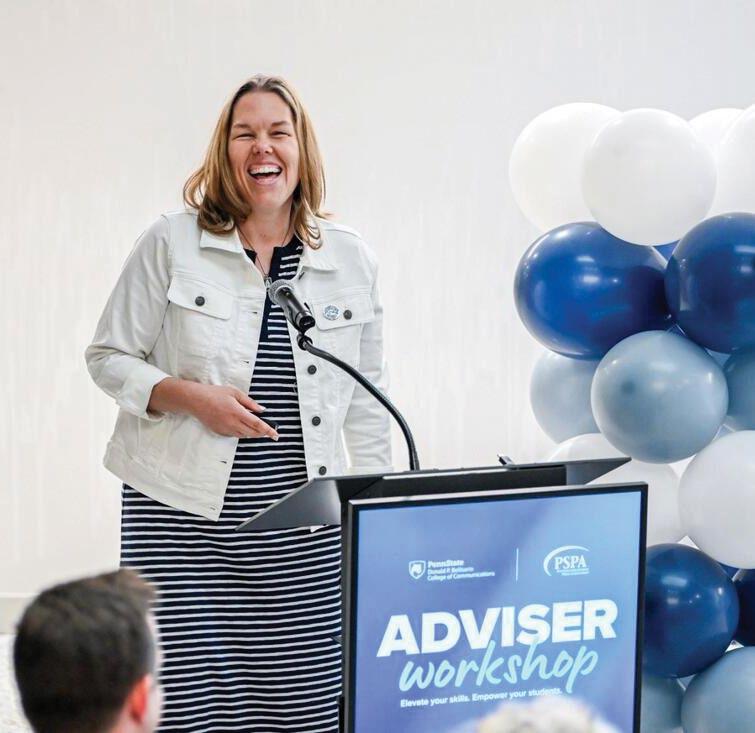
A: I don’t think I could say they’re optimistic or pessimistic. They’re certainly concerned. Some of them leave feeling overwhelmed, and I don’t blame them. All of those feelings, I think are valid. If you would survey the general population, whether it’s someone like me who has a sophisticated understanding of how government and the legal system works or it’s somebody who doesn’t, I think you’re going to find people who have those feelings. I try to always contextualize what’s happening now in the realm of what’s happened in the past. There are things happening that are truly unprecedented, but there are also many things happening that people say are unprecedented that really aren’t. I also think it’s really important for me to bring in my expertise and say, “Look, here are actual examples of our system of checks and balances working.”
Q: Do you think students are aware of how unique this time in history is?
A: The thing that really struck me this school year is that I think students are really tuning into the fact that what’s happening around them is unusual. I don’t think they all know how to make sense of it and again, I don’t blame them. I don’t know how to make sense of all of it — and I have a law degree. I am spending more time bringing in current events to my classes. Even if they may not be related to mass communication law, they’re related more broadly to being an engaged citizen, being an engaged member of a democratic society.
Hear more from this interview with Sanders on the Bellisario College’s COMMversations podcast. In the episode, she discusses how students are grappling with artificial intelligence and how everyone — including lawyers — are learning as they go. She also explains why Pennsylvania is a great place to start finding solutions.
BY JONATHAN McVERRY
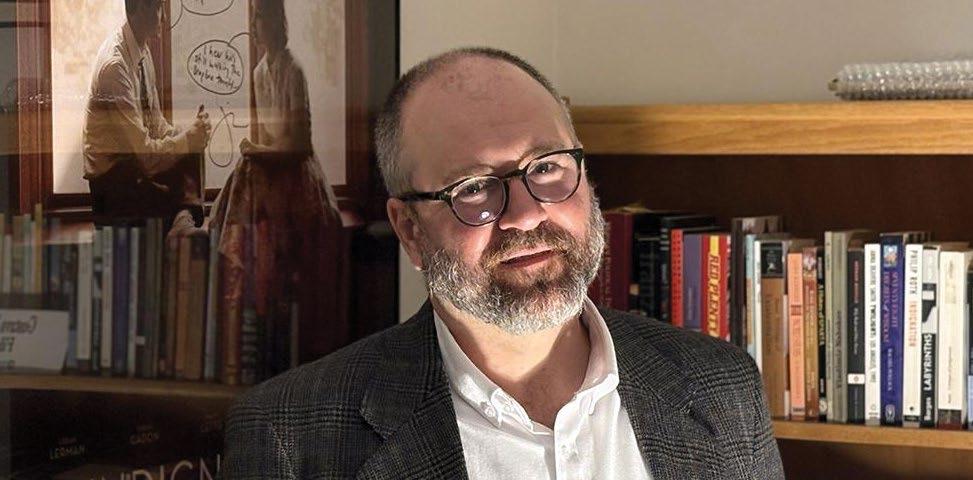
Gustavo Rosa says filmmaking can help students understand life. He says by learning the craft, students must ask tough questions, make good arguments and take big risks. Through that, they find their voices.
Rosa joined the Donald P. Bellisario College of Communications in 2025. He teaches courses on narrative filmmaking in which students work together to create short films. His classes go beyond the practical tasks of making a movie; Rosa instills a deep appreciation for film — the art, the process, the collaboration and the competitiveness.
“The classes are a high-wire act,” Rosa said. “Because it’s highly dependent on the students, their interests and the kind of movies they want to make. So, every single time, it’s different.”
He added, “The reality is that teaching filmmaking is embracing the fact that all of them will fail in some ways. There are really profound lessons that come from that.”
Rosa was born in Tubarão, Brazil. When he was 12 years old, his family immigrated to Boston. Three years later, his love for cinema emerged after watching films online by Italian director Federico Fellini.
“Two of his films that really spoke to me were ‘Eight and a Half’ and ‘Nights of Cabiria,’” Rosa said. “I remember finding them on the internet somehow. I had heard of Federico Fellini’s name, I think because there was a rock band in Brazil called Fellini.”
Despite the newfound interest, Rosa hadn’t considered a career in film. He went to Williams College to study literature and political science — two majors that Rosa said would go on to help his filmmaking significantly
While in college, Rosa started to fall in love with the movie-making process. He devoted himself to watching a movie every day, a commitment that he kept for four and a half years. The cinematic journey helped him appreciate every part of filmmaking as he took in whole filmographies and grouped works by theme, style and era.
“I loved movies very much, but I realized that I would watch them and not fully grasp everything there was to get,” he said. “If you watch one movie by a director, it’s like, ‘OK, I kind of get the idea,’ but when you watch 20 of
them, you start to understand that there’s a beautiful organizing principle that reveals something about the person who made the movies and how they get through life.”
For Rosa, the transition from viewer to creator was nearing completion.
After graduating from Williams, Rosa took the possibility of a career in film more seriously. He got his master of fine arts degree in filmmaking from Columbia University and continued developing work that reflected his interest in identity and the human condition.
His films focus on character-driven storytelling and have been screened at more than 50 festivals around the world, including Berlin, Sundance and Guadalajara. For several years he worked at indie production company Symbolic Exchange under James Schamus, the co-founder and former CEO of Focus Features.
Rosa’s short film “Carro” tells the story of an undocumented Brazilian immigrant living in Boston. It premiered globally at SXSW in 2018 and was licensed and broadcast by HBO in 2019.
Creatively and professionally, 2025 was a landmark year for Rosa. He had four separate feature film projects premiere at world-class film festivals. “So Far All Good,” a micro-budget feature that premiered at the 2025 Tribeca International Film Festival, recently won Best First Feature at the Athens Film and Video Festival in 2026, one of the premier experimental festivals in the United States. “Seconds Away,” a sports documentary that premiered at the Austin Film Festival in 2025, went on to win Best Sports Film at the Centre County Film Festival.
“Those Who Whistle After Dark,” a dark comedy about a family unraveling, set in Turkey, premiered in Goa IFF and won the best actress prize at the Istanbul International Film Festival in 2026. This film recently had its U.S. premiere at the San Francisco Film Festival in May 2026, with Rosa in attendance.
“Last year was the culmination of a lot of hard work over many years between myself and my collaborators,” Rosa said. “Having that kind of professional breakthrough has been very helpful in the classroom because I am able to model to students the kind of long-term commitment they have to put into their own projects and careers.”
“First of all, modern media has been made to fragment our consciousness,” Rosa said. “We’re being fed these images and being catered to, and our attention spans are being attacked. This is why I think it’s important that we find agency in the way we engage with art and the world.”
Rosa encourages his students to see film not as “content,” but as an art form that seeks answers about how they live, what they value and who they are. He sees each class project as a way students can “figure out life,” and learn to collaborate with each other to tell important stories and take risks.
One student in Rosa’s COMM 338 course pitched a film about his summer job repairing railroads. The class picked it. The student asked permission from the railroad company to use its facilities and he enlisted coworkers and classmates to act. He is now editing the short film with production set to wrap up this summer. Rosa said those extra steps reap big rewards.
“He sent me a message when he was filming it, saying ‘Professor, this was one of the most exhausting weekends of my life, but also one of the best,’ because he felt like this enormous sense of achievement and accomplishment,” Rosa said. “Making a movie about your own experience is really what art should be about.”
Rosa’s influence on the film community at the Bellisario College goes beyond the classroom. Earlier this spring, he started the Uncanny Valley Film Series with associate teaching professor Marni Zelnick and teaching professor Kevin Hagopian. Each week, the three faculty members screened films in the Carnegie Cinema and followed each one with a discussion.
The series aims to “expand students’ understanding of what film can be in all its glorious diversity.” Rosa said attendance grew each week sometimes garnering 50 viewers. The series is open to the public and will run again next fall semester.
“Gustavo has come to us filled with ideas for innovating and expanding the scope of our film production program,” said Matt Jordan, professor and head of the Department of Film Production and Media Studies at the Bellisario College. “His energy as a tireless filmmaker, whether directing or producing, is translating very well into teaching our students. We are thrilled to have him.”
Rosa said he plans on continuing to build the film community at the Bellisario College through initiatives like the Uncanny Valley film series and more student projects which focus on the kind of stories that can only be told in central Pennsylvania. He will also continue work on several of his own films that are in different stages of development, including narrative features based in his native Brazil.
Rosa encourages his students to see film not as ‘content,’ but as an art form that seeks answers about how they live, what they value, and who they are.
“Signing up to be a filmmaker is a lifelong journey,” Rosa said. “I’m always working on multiple different projects at once, and whether or not the project works or doesn’t, you learn your lessons and then move on to the next one. That’s what I always try to instill on my students: You signed up to be a filmmaker, so now it is your job to make it count and to get better at it, no matter how frustrating.”
He added, “This journey goes well beyond the classroom, and can help them make sense of far more than just movies.”
BY JONATHAN McVERRY (’05)
For David Norloff, the thrill of technology lies not only in the tools themselves but in the constant evolution they represent. His career began in the era of flip phones and dial-up modems, yet today he’s immersed in a world of artificial intelligence (AI) and smartphones. It’s that energy and enthusiasm that powers his teaching every day.
As an associate teaching professor of telecommunications in the Bellisario College, Norloff brings a unique professional perspective to the classroom. Much of that perspective originated while serving in product development roles for telecommunications companies, including Nextel, during the transitional period of the early 2000s.
At the time, the industry was fast-paced, highly competitive and rapidly changing. Norloff helped launch and manage many products and services that are second nature to users today, including text messaging and wireless technology.
“The rate of change was astounding to watch,” he said. “People previously were just using their phones to place a phone call, and all of a sudden we started offering data services and text messaging and using the phone for a lot more.”
Norloff graduated from Penn State in 1991 with a degree in engineering. After a few years in that industry, he completed an MBA to learn about the business side of the technology industry. He worked in consulting before moving into the wireless industry where he was front and center for the technological and cultural shift to data services.
“It was a fun time to be a part of,” Norloff said. “People ask what I liked best about it, and I say the pace. It was exciting and everything was changing.”
When those same people ask what he didn’t like about it, Norloff quipped, “The pace. It was really interesting, and it was fun working with great people, but we worked a lot of hours.”
By 2007, Norloff’s company was facing a major merger, and he began to rethink his career path. He returned to Penn State that year in a staff role with Outreach’s client development organization.
While at this new position, he connected with Matt Jackson, an associate professor of telecommunications and, at the time, head of the Department of Telecommunications. Jackson asked
Norloff to create a class based on wireless technology for the Bellisario College.
“That inspired me to try my hand at teaching,” he said. “It was a new venture for me and, thankfully, I really enjoyed it right out of the gate and got positive feedback from the students. I want students to understand where the current market trends are. I want to make sure it’s clear to them why they’re learning the information and how they’re going to use it. So, I lean into my professional experience quite extensively.”
Lately, Norloff lectures a lot about AI and its effect on just about everything. He also discusses cloud computing and how its emergence changed the way global companies like Apple and Amazon do business.
While he worked at Outreach, Norloff taught as an adjunct instructor for a few years, but his knack for teaching led him
to a full-time faculty role in 2014. He said the transition was smooth and he gained a lot of inspiration from colleagues in and around the Bellisario College.
“The people that I work with day-in and day-out are just the best people,” he said. “I’ve never met a more dedicated, compassionate group who are so student focused.”
The Bellisario College’s student-centered culture provided a framework for teaching, he said.
“Do you care about the students? Do you care about the learning? Do you put them first and always conduct yourself in a way that’s going to hopefully benefit them?” Norloff said. “That’s the litmus test.”
Jackson said Norloff’s background and “no nonsense” approach to teaching has made him a respected and favorite faculty member among students. He said many new adjunct faculty members learn that teaching is “not as easy as it looks,” but Norloff was a natural.
“The time and effort he puts into his lesson plans is just incredible,” Jackson said. “Dave very quickly became one of our most popular instructors even while he maintains such high standards and expectations for his students.”
Do you care about the students?
Do you put them first and always conduct yourself in a way that’s going to hopefully benefit them?
That’s the litmus test.
– David Norloff
Norloff teaches “COMM 280: Telecommunications Technologies,” which is a required course for all telecom students, and “COMM 483: Telecommunications Product Development.” He also occasionally teaches “MGMT 215: Entrepreneurial Mindset,” which is part of the entrepreneurship and innovation minor (ENTI), a popular interdisciplinary minor where colleges host “clusters” that attract students from across the University.
As the director of the Bellisario College’s ENTI new media cluster, Norloff advocates for entrepreneurial learning and opportunities that are relevant to every student — not just those in communications. It’s not just about starting companies, he said. Lessons in entrepreneurship teach students to identify real problems, validate solutions, work across disciplines and take ownership of their ideas.
“That’s the beauty of the ENTI minor,” Norloff said. “You can take your core classes and then you can pick a cluster you like. A Bellisario College student can take classes in [the College of Information Sciences and Technology] or Smeal or engineering and work on that specific cluster based on their interests. I think that’s something pretty unique to Penn State.”
Norloff said opportunities at Penn State like the ENTI minor and Penn State’s LaunchBox program, which Norloff is also active in, build a powerful entrepreneurial spirit that attracts and develops creative, hard-working students.
“It’s great to walk through the Bellisario Media Center every day and see the students and feel the energy,” he said. “Penn State as a whole has tremendous resources. The students here are incredibly impressive, and they keep getting better and better.”
BY ANGELIQUE REDWOOD
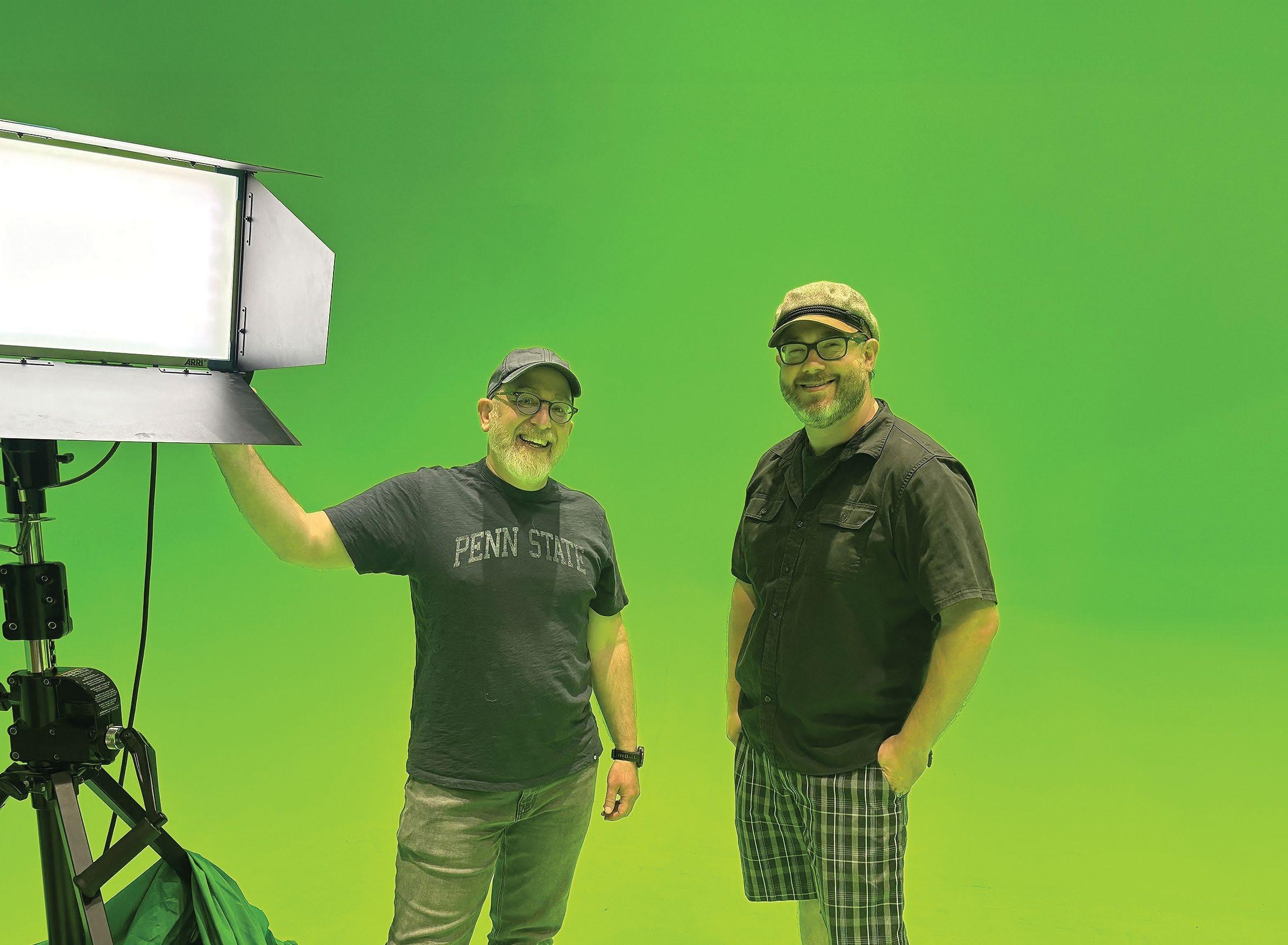
In the Bellisario College, visual communication is at the core of student work. From lighting to cameras to calling “Action!” on set, students get the chance to bring their visual ideas to life thanks to one of the best places on Penn State campus, the Bellisario College Equipment Room, where two of the best people on campus offer help and support.
Equipment room leaders Mike Zelazny and Scott Travers are the go-to crew for students searching for the perfect working tools, filmmaking or otherwise.
Zelazny serves as the coordinator, always wearing his newest, coolest hat, maneuvering boxes and bags through the equipment room’s long hallways. Never far behind is Travers, the assistant manager who is a former Hollywood cameraman and current master’s student in strategic communications at Penn State.
Both staff members do more than just rent equipment to students; they serve as mentors to the visual dreamers of Bellisario College.
“The equipment room is not just about equipment, absolutely not,” Zelazny says. “We are a social eye point for the entire college. We have students that come to our counter and show edits of their videos and ask us questions.” Students visiting the equipment room end up learning more than just the technical things, and both Zelazny and Travers take the best approach to fostering a well-rounded experience.
Travers says the skills imparted on students aren’t limited to prepping equipment, either. Knowing what gear is appropriate for different projects translates to organizational and logistical teamwork, which mean communication is important, too.
“Being there for those students when they’re having a rough time is part of the job, too,” Zelazny adds. “It’s part of what makes the equipment room special, is being able to connect with people where they can feel free to talk to us because we’re not giving them a grade.”
The key to the equipment room’s success lies in the balanced approach Zelazny and Travers take to keep everything running.
While Travers uses his film industry expertise to get creative with the students, he also brings a technical knowledge that blends well with their visions. “I’ve had a really good time here because in the world that I came from, it was all business, and it was very serious,” says Travers, who was honored with a Rising Star Award among Bellisario College staff in 2025. “Here, it’s more pure. It’s creative, and so I feel inspired all the time by these students.”
Travers says he has the best partner to help guide the equipment room to success. “I think we complement each other really well. Mike is the best boss in the world. I’m not the only one who thinks that. The kids think it too. I think we complement each other really well.”
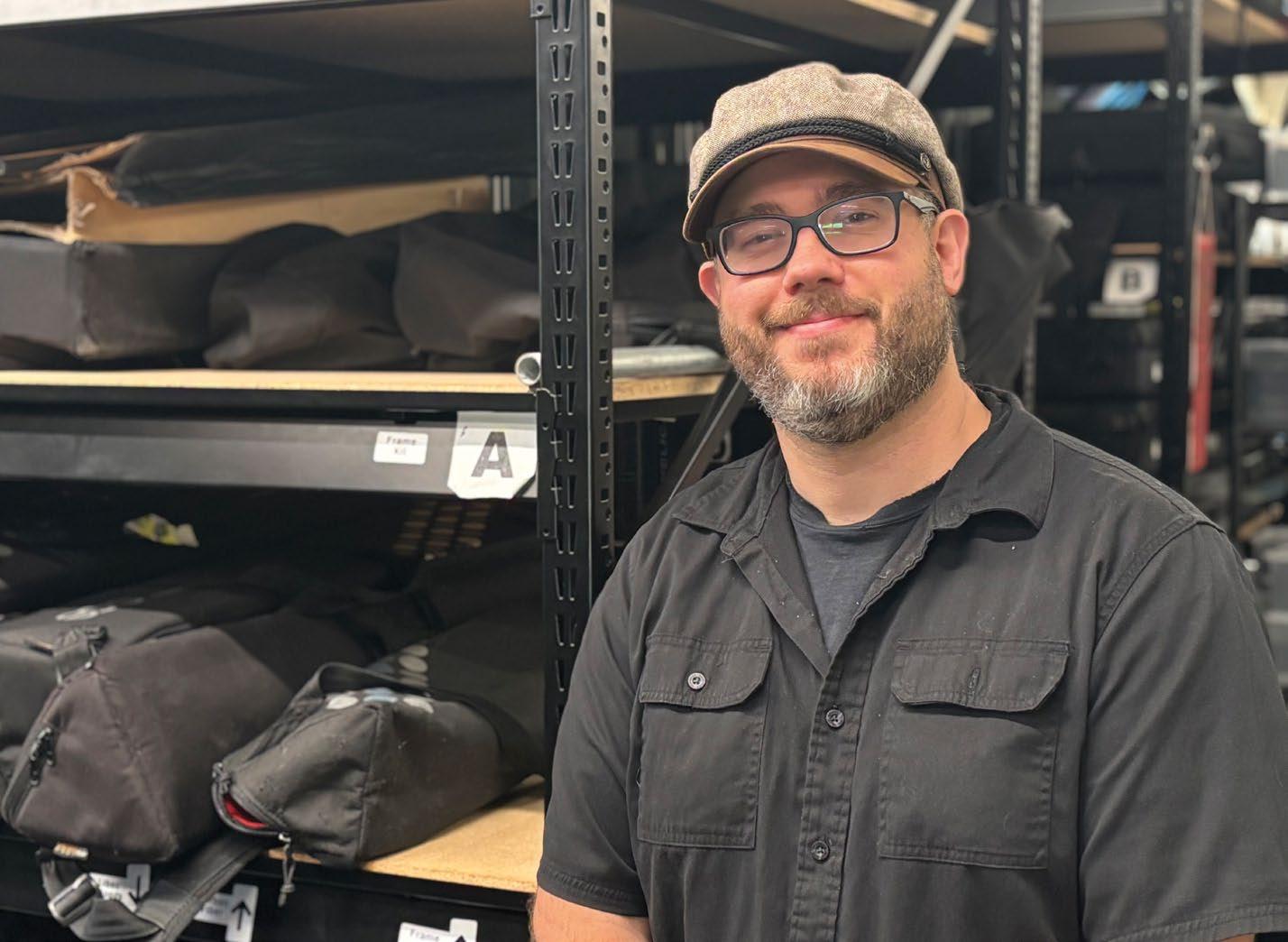
Zelazny has always appreciated working behind the scenes— and as a 2006 Bellisario College graduate, he’s also familiar with the program. Zelazny began working at the college in 2008 and has been honored with awards as an adjunct instructor and a staff member ever since.
“I think I was interested in the equipment side of film more than I was interested in movie-making from a young age,” Zelazny says. “So, once I came to the film major, aside from my classes, working in the equipment room and getting more technological was sort of a natural thing.”
While trading witty barbs and their favorite success stories, Zelazny and Travers keep students — and their success — at the core of what they do. “All of our equipment is relegated to what courses you’re currently in, what major you’re in and what you’ve been trained on in the process of getting your degree,” Zelazny says, describing the intentional process necessary for equipment rentals by Bellisario College students.
While they partner and support students, the equipment room team also gets to watch.
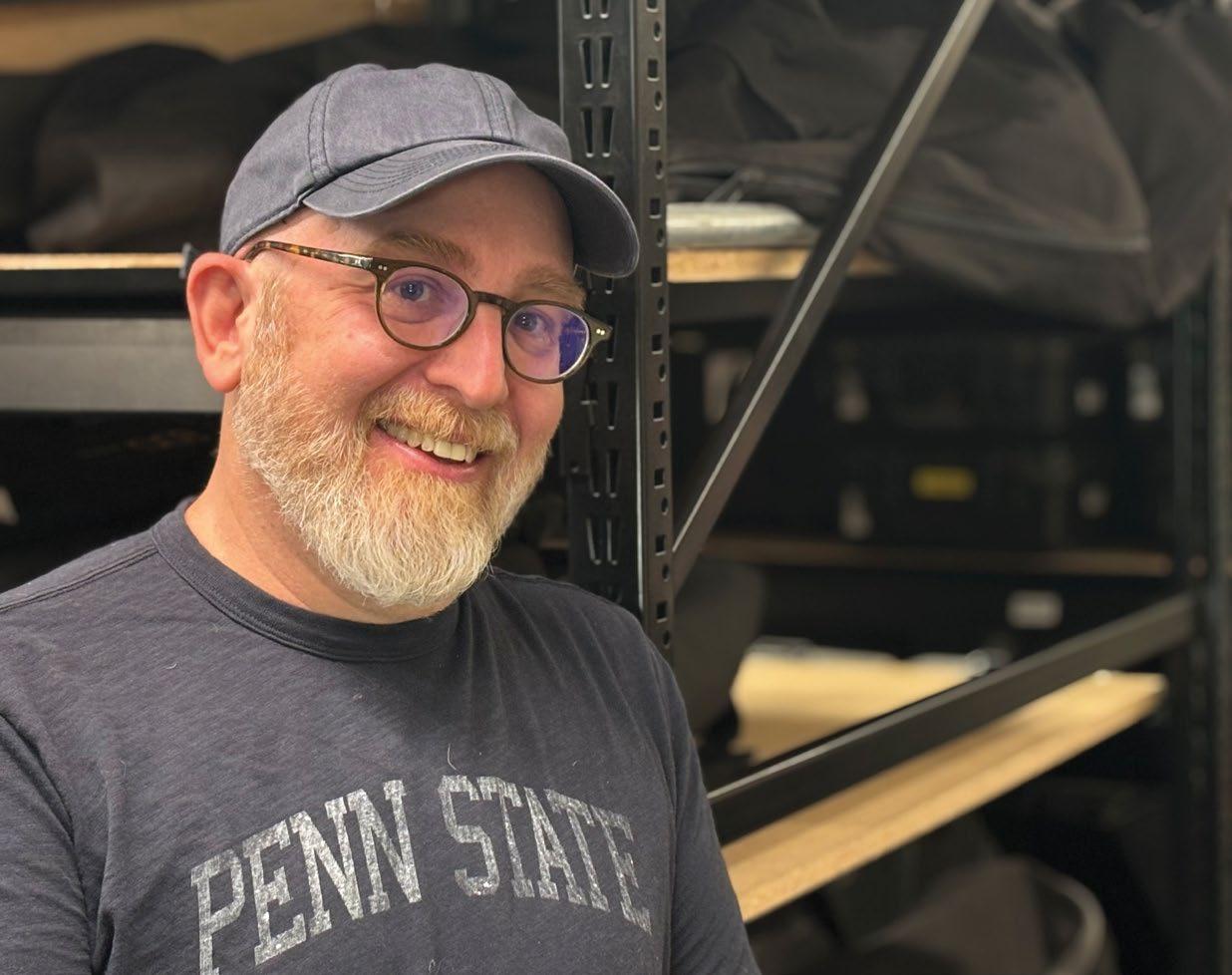
“You see their confidence grow and that’s really fun,” Travers says. “When someone gains confidence in anything, then they become more adventurous and now something new becomes popular, because now they have the confidence to try something they hadn’t tried before. Without confidence, they probably wouldn’t be learning as much and having as much fun, I think.”
The great energy Zelazny and Travers bring to the equipment room spreads throughout Bellisario College, and they have an impact far beyond the equipment room. Zelazny has traveled and taught as part of teams with students completing international documentary classes. And both he and Travers have earned during their tenures. Alongside the student’s growth, the equipment room grows as well, evolving each year to best fit the incoming classes of students.
“The college has historically put value into the equipment,” Zelazny says. “We’re always looking at things getting better every single semester.”
The equipment room constantly changes offerings to reflect the tools students need to perfect their crafts.
“[The students] know and trust that we’re out here advocating for them,” Travers says. “We listen to them. We’ve actually bought stuff based on their suggestions and needs. That’s going to remain true into the future.”Anyone walking through the ground floor of Willard Building just may catch the excited conversations and clicks of equipment at the buzzing window of the equipment room. With Zelazny and Travers there, it’s the perfect space for anyone in need of some gear or a good laugh.
Even if you’re a little shy, the equipment room ringleaders will welcome every student to their corner of Willard.
“The equipment room is here for the students, bottom line,” Travers says.
Dedicated faculty and staff members provide the foundation for serving students and driving innovation and research success in the Bellisario College, and a series of annual awards recognized more than a dozen individual standouts from the 2025-26 academic year during an end-of-the-year awards ceremony.
The honorees included three staff members, a graduate student and nine faculty members.
Awards presented were:
Djung Yune Tchoi Graduate Teaching Award
Eunchae Jang
Staff Rising Star
Shilo Brown, undergraduate program coordinator
Deans’ Excellence Award for Staff
Julie Evak, coordinator for undergraduate education
Dorie Glunt, finance coordinator
25 Years of Service
BB Muré, academic adviser
Julie Evak, coordinator for undergraduate education
Inclusive Excellence Award
Catie Grant, assistant teaching professor and director of CommAgency
Deans’ Excellence Award for Affiliate Faculty
Courtney Whitmer
Deans’ Excellence Awards for Teaching
Catie Grant, assistant teaching professor
John Pendygraft, assistant teaching professor
Deans’ Excellence Award for Research
Homero Gil de Zúñiga, Distinguished Professor
Deans’ Excellence Award for Integrated Scholarship
Heather Shoenberger, associate professor
Deans’ Excellence Award for Service
Steve Kraycik, associate teaching professor
Bill Zimmerman, assistant teaching professor
Staff excellence awards are selected after nominations made by colleagues and coworkers. Faculty awards are determined by the Bellisario College’s academic leaders — the dean and associate deans for undergraduate education and research. Thus, the honors are referred to as Deans’ Excellence Awards.


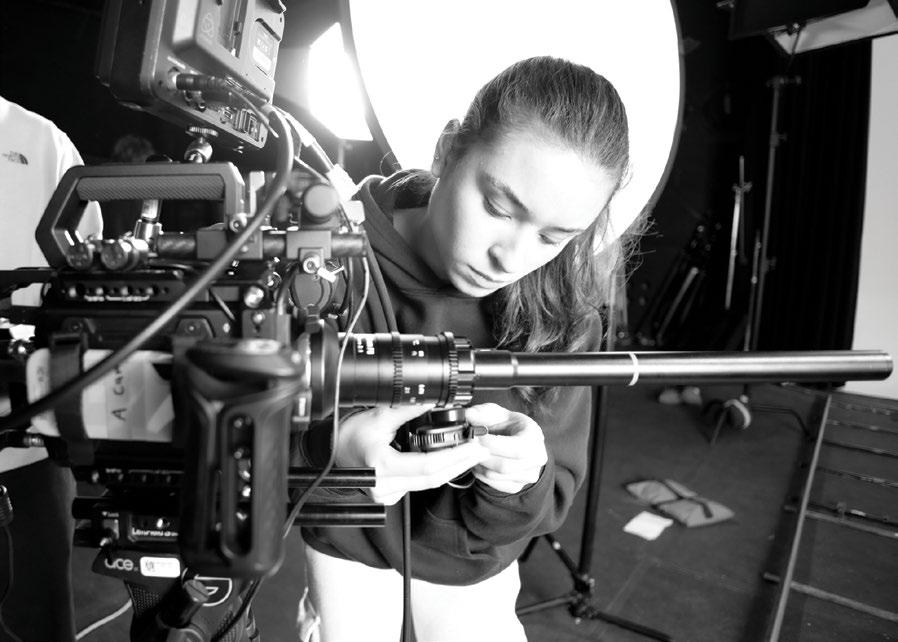


Some teams plan for years ahead of a potential World Cup opportunity—and so do some Penn State students.
“When I came to Penn State, I came knowing there was a connection and history of students getting to cover major sporting events. So, it was almost a three-year plan to put myself in position for something like this,” said Owen Cameros, a rising senior journalism and economics double major from Seattle.
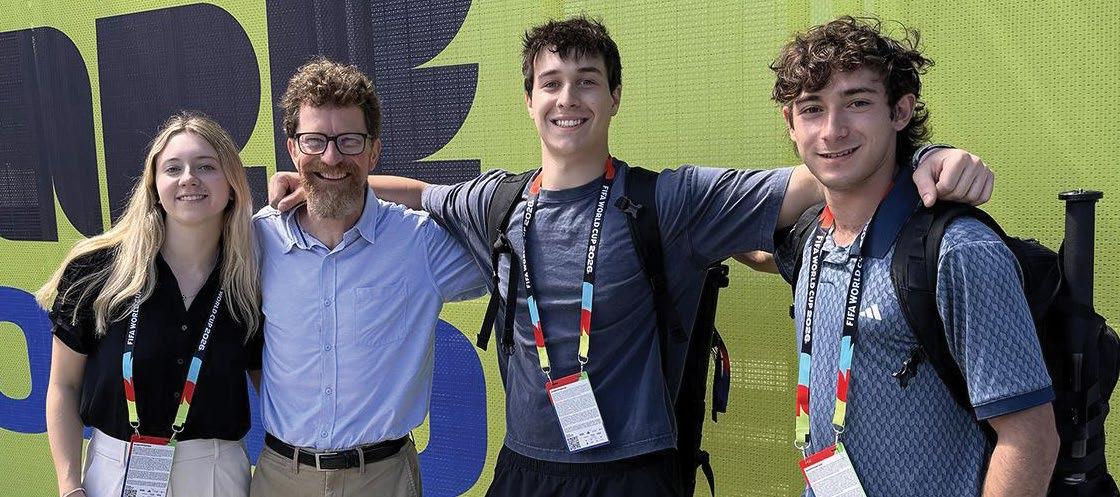
Cameros and 14 other Penn State students covered the 2026 FIFA World Cup during June and July as part of a partnership with the Associated Press. The students, many a part of John Curley Center for Sports Journalism, housed in the Donald P. Bellisario College of Communications, were working from locations in Boston, New Jersey and Toronto throughout the fiveweek long international event.
Cameros spent two separate weeks in Toronto (sandwiched around a week at home in Seattle where he assisted with World Cup coverage there), and several other students cycled in and out of the city to help with coverage as the tournament progressed. Six World Cup games were played in Toronto, including the first ever for Canada in its home country.
While he and most other Penn State students spent only a portion of the tournament in Toronto, two students were there for the entire month. Rising seniors Lexie Linderman, from Ashburn, Virginia, and Kassandra Vasellas, from York, Pennsylvania, moved to the hotel that served as their home base in early June and remained there until July 3. Linderman’s duties were more writing focused while Vasellas focused on video.
Linderman also balanced a remote summer internship, continued her duties as football editor of The Daily Collegian and got accustomed to living out of a hotel room for a month.
At least the hotel adaptation was a shared experience.
Vasellas, who traveled with the Pittsburgh Post-Gazette to cover a Steelers game in Ireland last fall, embraced the many potential opportunities of the World Cup assignment. All of the students met regularly together and with Associated Press partners to plan and prepare. In addition, she said her Penn State classes provided a strong foundation for what she and the other students were asked to do.
“As a result, I’ve gotten stronger with what I create and edit,” Vasellas said. “My experience in classes like COMM 260 and COMM 360 helped a lot too. You have to go up and meet people and talk to them in these situations — that’s not something I would’ve been able or comfortable doing before coming to Penn State.”
After her World Cup duties, she returned to campus in July and worked as a counselor for some Bellisario College summer camps.
Bronwyn Liber, a former camp participant and now a rising senior, worked in Toronto as well. Like her classmates, it made for a busy summer. She was on site in Toronto for 10 days (June 17-27). She also had an internship with WKRC-TV in Cincinnati this summer.
A journalism major from Prosper, Texas, her duties were more video-related as well. “It’s kind of everything around the games — changes for local residents, clothing, the environment, food, ticket prices,” she said. “It’s just a wide range of short form content. It’s a unique opportunity to look at things through a different lens.”
The partnership with The Associated Press was facilitated by the John Curley Center for Sports Journalism. Penn State students have benefited from similar Curley Center partnerships with regularity. For example, students have covered international NFL games, the NFL Draft, the Paralympics and the Little League World Series.
Penn State’s efforts for the World Cup were not exclusively focused on Toronto, either.
Three of the 15 students helping with the partnership produced video content from New Jersey and Philadelphia during the tournament.
Danny Jamer, a rising junior advertising/public relations major from Mendham, New Jersey, had a summer internship as a graphic designer with the New York Post this summer. Along with that, he helped provide video coverage of World Cup-related events in and around New York City and MetLife Stadium in New Jersey, where eight games, including the final, were contested.
Again, it was a bit more about the activities surrounding the event than the games themselves, and that provided an abundance of opportunity and variety. Unlike some students involved in the World Cup effort, Jamer is not focused on sports for his eventual career goal, but the major international event offered a way to broaden his experience and skillset.
He knows it’s important — even if it means some hectic days balancing his internship duties and adjusting his typical summer plans.
“I usually like going down to the shore and having a relaxing summer,” Jamer said, “but this is something so special I just had to commit to make it work.”
BY ALEXANDRA WENSKOSKI (’26)
EDITOR’S NOTE: This story, first published by Penn State Student Media in December 2025, won a 2026 Golden Quill Award as the best Student-Written Profile.
Half an hour before the track opened at Clinton County Speedway, Jim “Cowboy” Kennedy climbed into his yellow and red sprint car, put his helmet on, and fastened his seat belt. He was ready to go.
Around him this late summer weekend was the cacophony of the pits. The roaring of engines gearing up. RTV tires squeaking on the gravel roads. The pattering of wrenches and air machines, fixing and refining cars down to the last minute.
Now, amid all those sounds was something else. Cowboy’s yodeling voice rang out amid the chaos.


As he sat behind the wheel, serenading his competitors, drivers and their crews were frantic, touching up their cars at the trailers, adding extra gas, visiting the drivers’ meeting — a session Cowboy would not attend.
Once he finished his song, Cowboy waited silently. His checkered orange fire suit was worn with years of caked dirt and fraying sleeves. At last, an RTV arrived to push him down the track. Then it was time to do what he knows how to do best: race.
The No. 7 sprint car sped down the 3/8-mile dirt track, sometimes tearing around the inside and sometimes drifting along the top of the track — looking like it was ready to take off.
After just two laps, Cowboy whipped down the exit ramp and returned to his trailer to wait for his race. He only warmed up with a couple of hot laps so he didn’t get too tired.
See, the thing about Cowboy is, he’s 91 years old.
The race track is not just for drivers. Summer weekend nights in Pennsylvania are a time for sprint-car racing and there are a bunch of tracks between Philadelphia and Pittsburgh, places like Clinton County Speedway, about 30 miles east of State College.
Much of the community comes out to feel the exhilaration of racing. There’s always the smell of gas and fried food in the air, the constant, deafening sound of engines accelerating, maybe a crash or two, and — on the wildest nights — even a heated argument between drivers.
For people in central Pennsylvania, it’s a respite from dayto-day life, a great way to kick back. Racing people call it “the show.”
“This is kind of what our weekends consist of, as a family, every weekend,” said Kasey Weaver, who — like his brother Kolby — is one of the drivers.

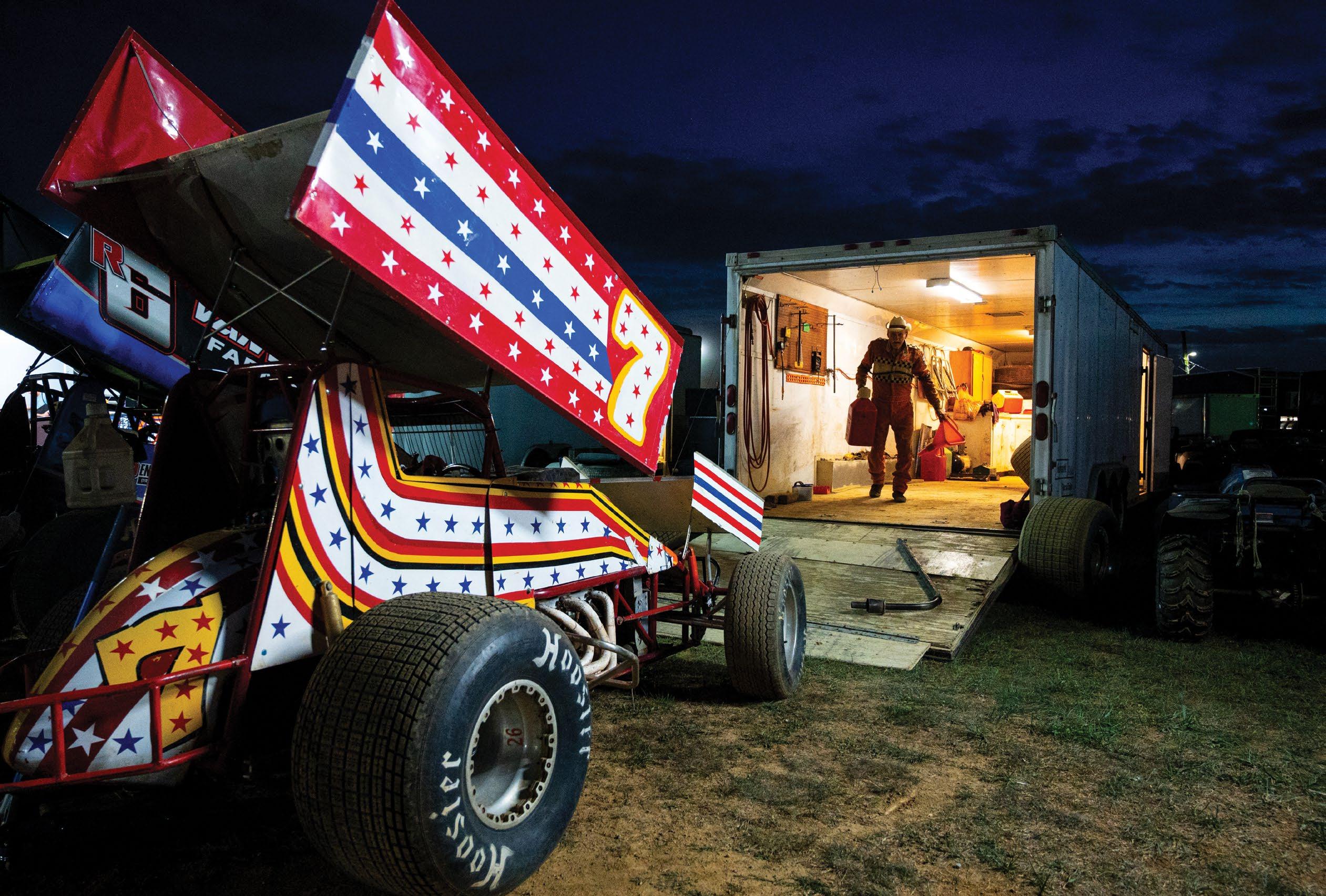
Cowboy is one of those people who fell in love with motor sports at a young age. He started in 1958 and did whatever it took to get on a race track, and he’s long been a bit of a lone wolf.
He used a cardboard wing when he began — the wing on the back of a race car does the opposite of a wing on a plane, it pushes the vehicle down. Cowboy only just recently updated his car to use a metal wing. He gets all his car parts from auction and is his own mechanic.
With a single wrench, Cowboy changes his own tires, fills his gas tank, and does the regular maintenance checks that sprint car racing requires. Although he can do most things, there are some areas that he needs help with — so he’ll recruit the racers in the pits around him to help out.
“I’ve got them to help me put the wing on,” he said. “The wing ain’t heavy, but I can’t put it on myself.”
Kasey and Colby Weaver’s shiny new trailer towered over Cowboy’s on the last night of the season at Clinton County Speedway. They had a plethora of gadgets, fuel and bright lights. Next to them, Cowboy operated off one light with only a few spare wrenches to fill out his tool kit in case of emergency. The Weavers helped as Cowboy’s pit crew that night.
“We’re here to have fun, and we don’t want to see no one miss out on the fun for something dumb, like not being ready,” Kasey Weaver said.
The Weavers race all over the state and across the country. They started in 2020 during the COVID-19 pandemic because they said that there was nothing else to do besides go to races.


But racing was never Cowboy’s way of making a living. He worked as a welder on the Pennsylvania Turnpike, joined a union, got married, had a family. All his extra money, meanwhile, went to funding his passion for the track.
Sprint car racing isn’t glamorous, but Cowboy was big time in his day. In his career, Cowboy has raced at 31 tracks. His biggest wins came at Port Royal Speedway, a nationally known track about an hour south of State College, where he had five wins in 410 sprints. Sprint car divisions are set up by engine sizes — 270s, 305s, 410s. To keep it simple, the bigger the engine, the cooler it is to win the race.
“People say, what track you like the best?” Cowboy said. “I just kind of like them all.”
“He still races about the same,” said Jeff Weaver, a frequent winner at Clinton County who is not related to Kasey and Kolby. “He’s just not as fast as he used to be.”
Although the times and technology have changed, Cowboy likes to keep his racing simple. His fire suit is secondhand — the name stitched on it is “Niki Young.” But he’s gotten good use out of it for 10 to 12 years, now.
And he comes to the race track alone. He drives his trailer over from Everett, which is about two hours away. He arrives dressed and in gear, unlike most drivers, who get dressed in their trailers just ahead of the race. Then, he’ll eat one or two cheeseburgers from McDonald’s that he picked up along the way, and after that it’s time to set up his car.
Cowboy had four children with his wife, Marlene. He prides himself on his family, but they haven’t attended in years. Marlene doesn’t go to sleep until he gets home, he says, but races can go very late, sometimes 11:30 p.m. or later — and then there’s the drive home.
“I retired when I was 62, and that’s 29 years ago, and she didn’t want to go no more then, so she hadn’t been in the grandstand for 29 years,” Cowboy said.

At the season-ender at Clinton County, called the Fall Clash, Cowboy finished last in all his races — but he asked to start in the rear, anyway. At this point, he goes about his racing in a smart way, not racing to win, but racing just to be on the track and feel the thrill.
“He’s kind of settled into, ‘OK, I’m not as fast as I used to be, so I’m going to run the bottom, and try to stay out of everybody’s way,’” said Dale Schweiart, another driver and friend of Cowboy’s. “He’s doing it a lot smarter than he had a couple years ago.”
Racers endure a mix of good and bad with tight racing on short-track speedways.
After finishing 15 seconds behind the second-to-last racer in his first event, Cowboy waited all night to participate in the Sprint Car Feature. Halfway through that race, a driver in front of him hit the edge of the track and flipped. It was too late for Cowboy to get out of the way, leading to a crash.
Both drivers were determined to be OK, but this meant the end of their nights. The yellow and red car, littered with stars, had a totaled frame. Luckily, it was almost the end of the racing season.
It didn’t seem to faze Cowboy. He was all smiles back at his trailer, saying that he would just go to the auction in the offseason and fix it up. In the meantime, he would compete at the Bedford Fairgrounds Speedway in mid-October with his backup car. It’s what he does.
Cowboy is among the oldest racecar drivers in the country, if not the world.
In the Guinness Book of World Records, the oldest male racing driver is Erik Berger, a Swedish race car driver who was
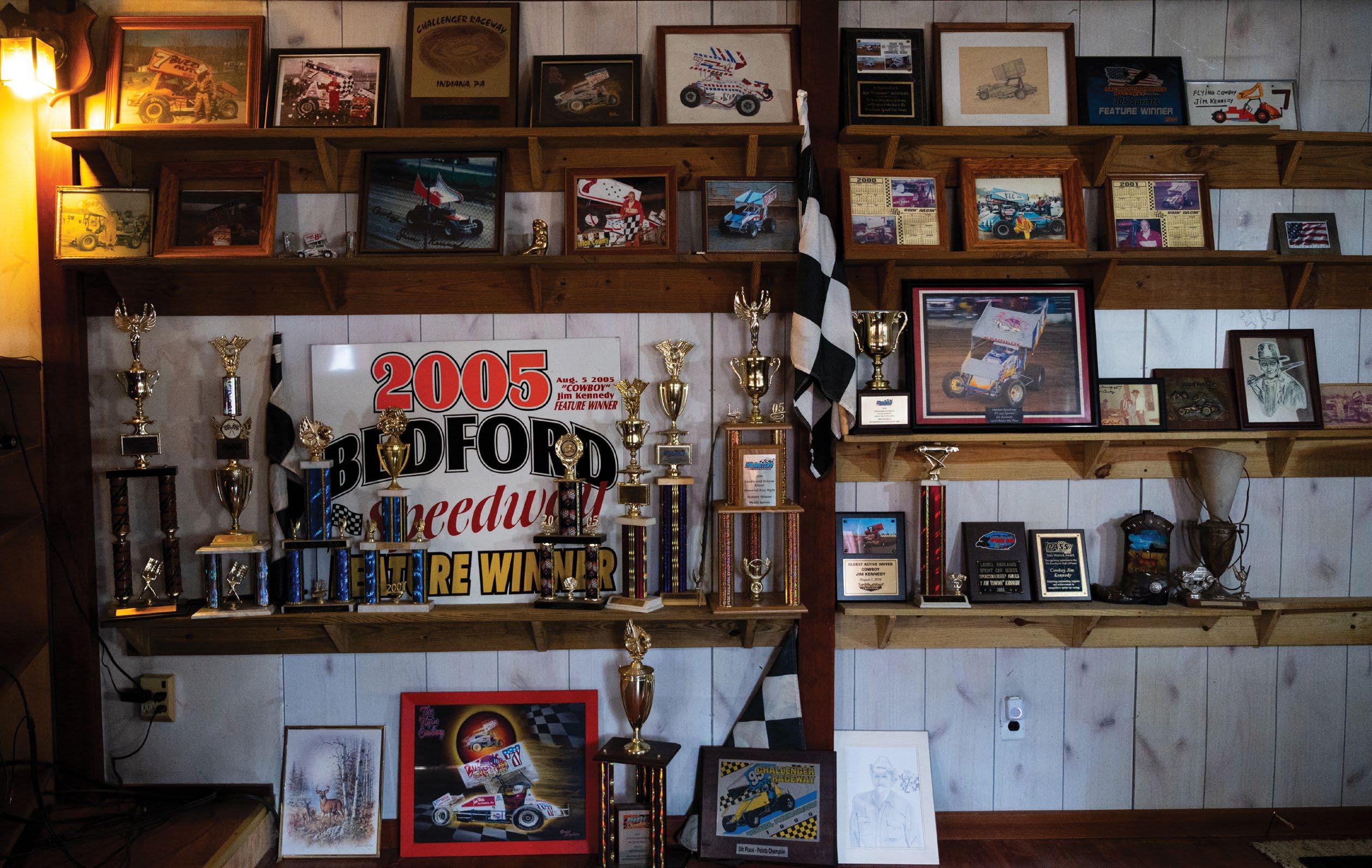
89 years old in 2014 when he set the record, and continued driving for some time after that. He died in 2018.
Charles “Red” Farmer is a 93-year-old American stock car and dirt track racer. He competed in Alabama, recently hanging up his helmet for health issues.
“Cowboy knows that’s the mark he has to try to beat,” said Jason McCahan, the Clinton County Speedway promoter.
But, because Red Farmer was not a sprint car driver, it is very possible that Cowboy is the oldest of his kind. It’s hard to ever know for sure. This isn’t Major League Baseball, with a massive and authoritative record book.
McCahan has been trying to get Cowboy into the Guinness Book of World Records, but it’s a difficult process — and a costly one, too. While applying for a record is close to free, having an event to celebrate with a Guinness World Records official can cost thousands of dollars.
This may not seem surprising, but Cowboy doesn’t have any plans to retire soon. Why? Why even ask why? A lot of things about Cowboy are a little bit of a mystery.
His nickname, for instance. Cowboy says it’s just something he’s had all these years. And the yodeling. Why does he do it? Can’t say. It’s just what he does — might have picked it up from his dad or an uncle.
But in Pennsylvania, that yodel is the song of the racetrack. And as long as he wants to come out, the boys at the track will welcome him.
“Fans cheer a little louder when he rolls onto the track, and every driver in the pits looks at him with the kind of respect you can’t teach,” McCahan said. “Watching him race reminds us all that passion doesn’t age, dreams don’t expire, and legacy is built one lap at a time.”
Maybe the only people who know how long Cowboy will be cowboying are the man and Marlene.
“I tell the wife I’ll be 102,” Cowboy said, “and not driving these.”
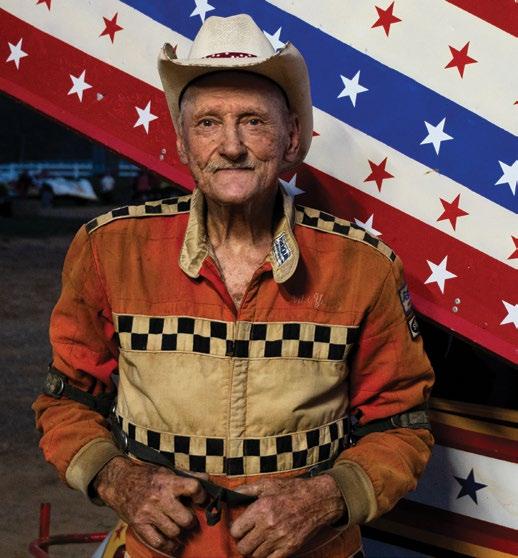
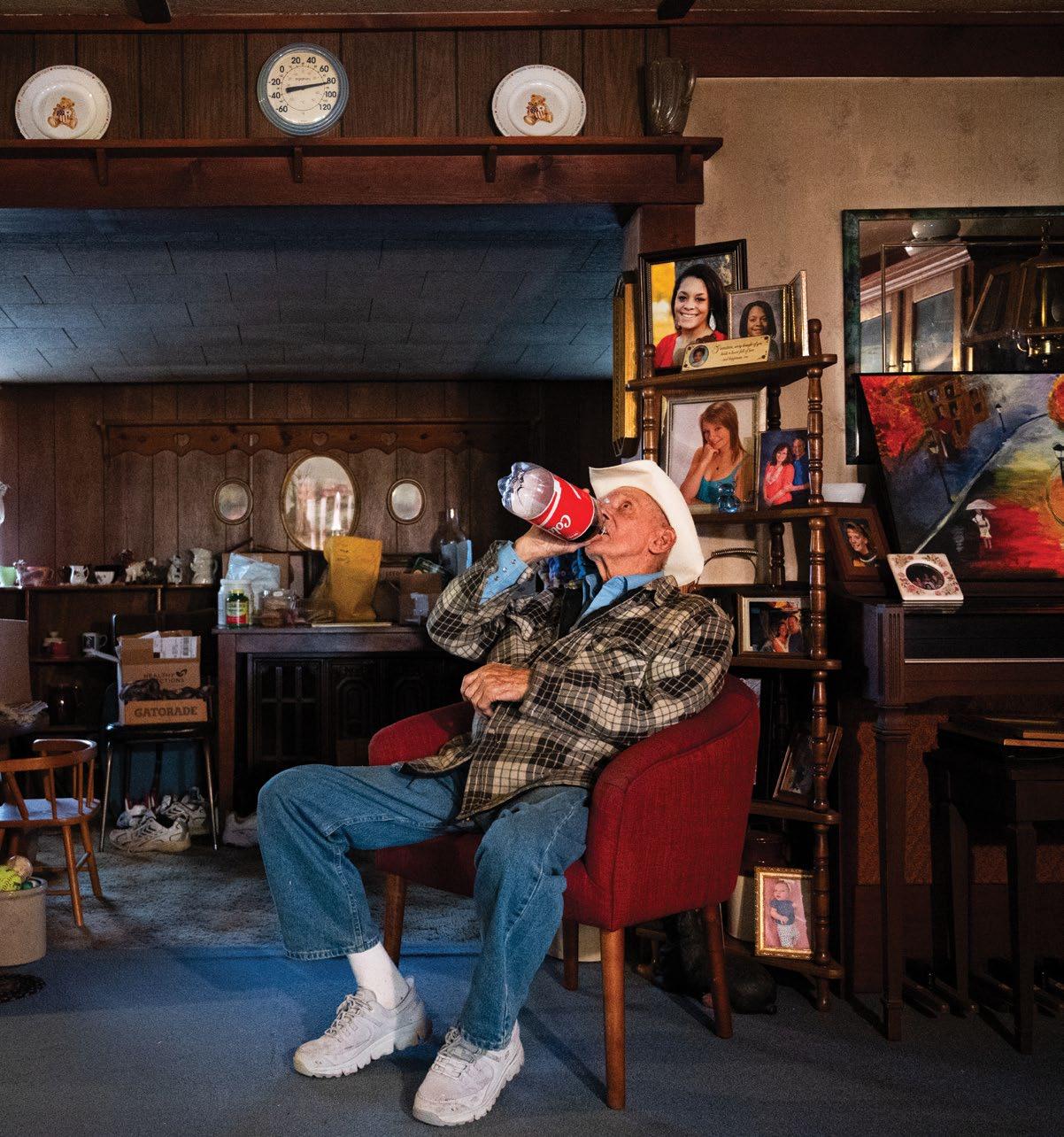
James “Cowboy” Kennedy, a lifelong racing enthusiast, died April 2, 2026. Born on Aug. 7, 1934, in Curryville, Pennsylvania, he was the son of the late James B. Kennedy and Florence G. Kennedy.
He is survived by his beloved wife, Marlene, with whom he shared 72 years of marriage. The couple had four children, four grandchildren, eight great-grandchildren and two great-great grandchildren.
Before retiring in 1996, Jim held a variety of jobs and was a proud member of the Carpenters Union.
Kennedy began his racing career in 1958 and went on to spend 68 years behind the wheel, competing in 305 and 410 sprint cars. His passion for racing carried him through August 2025, earning him recognition as a dedicated and respected figure in the sport.
His one-man approach to racing, along with his cowboy hat and his yodeling made him a recognizable competitor on short-track speedways around central Pennsylvania during a racing career that spanned nearly seven decades. In honor of his achievements, he was inducted into the PA Racesavers Sprint Car Hall of Fame.
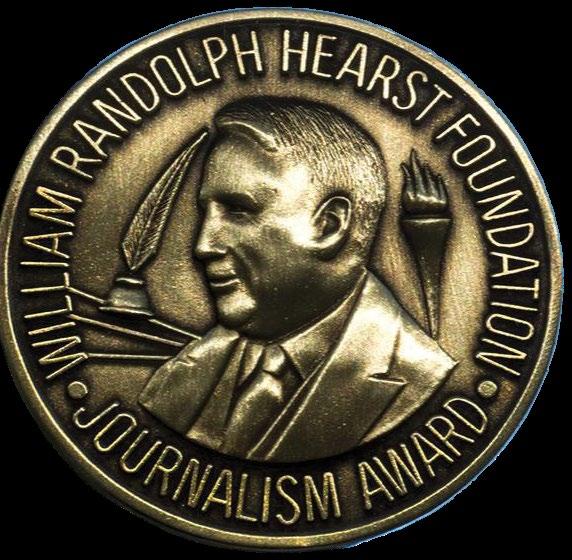
Another strong performance in ‘Pulitzers of college journalism’
With top-10 finishes in every competition discipline and a competitor in the individual national championships, Penn State’s journalism program again finished in the overall top 10 of the William Randolph Hearst Foundation’s Journalism Awards Program for 2025-26.
The competition, often referred to as “the Pulitzers of college journalism,” operates under the auspices of the accredited schools of the Association of Schools of Journalism and Mass Communication.
Monthly competitions in a variety of categories — writing, photojournalism, audio, television, podcasting and multimedia — are open to undergraduate students nationwide. During the 202526 competition cycle, a total of 1,353 entries were submitted across the 14 competitions. Overall Intercollegiate winners are determined by the highest combined student point totals from those entries.
Penn State finished sixth overall — the highest finish of any program in the Big Ten Conference. The overall winner was North Carolina.
Points earned by individual students in the monthly competitions determine each discipline’s intercollegiate rankings, with schools accumulating points based on the entrants’ highest accumulated points in each category throughout the year.
Penn State finished seventh in writing, fourth in photo, seventh in audio/TV/ podcast and eighth in multimedia.
Penn State perennially finishes in the top 10 of the Hearst Foundation’s Journalism Awards Program. In addition, during the past decade and a half its average finish in the program has been the best of any school in the Big Ten or Northeast.
The Intercollegiate Awards have been acknowledged since the inception of the program, and in 1990 monetary awards were added to the Hearst Journalism Awards Program budget. Publisher William Randolph Hearst established the William Randolph Hearst Foundation and The Hearst Foundation Inc. in the 1940s, a few years before his death
Never mind Alcatraz, the seals at Pier 39 or the trolly cars, it was not a tourist trip to San Francisco for Greg Finberg in early June.
Nope, Finberg had competition and hard work on his mind.
Finberg, who earned his bachelor’s degree in journalism in May, was one of 29 students from 17 universities across the nation competing in the individual national championships of the William Randolph Hearst Foundation’s Journalism Awards Program. There were eight writing finalists, five each in audio, photo, television and multimedia, and one podcast finalist.
Students on site in San Francisco were challenged to write stories
in 1951. Since then, the foundations have awarded more than $1.5 billion in grants and programs.
Presently, 104 colleges and universities with accredited undergraduate journalism schools are eligible to participate in the Hearst Journalism Awards Program. Funded and administered for 66 years by the William Randolph Hearst Foundation, the Journalism Program awards up to $700,000 in scholarships, grants and stipends annually.
1. North Carolina
2. Florida
3. Syracuse
4. Missouri
5. Western Kentucky
6. Penn State
7. Michigan State
8. Nebraska
9. Southern Cal
10. Montana
on location, after earning their spots in the competition as the result of 14 monthly competitions covering a variety of topics earlier in the year. The finalists qualified after 1,353 entries were received in those competitions.
Finberg qualified because of a fourth-place finish in the sports feature category. His story examined the struggle to find and hire scholastic sports officials in central Pennsylvania. Finberg, an editor for SB Nation, completed an internship with the Philadelphia Inquirer and served as a writer and later sports editor for the Daily Collegian during his time at Penn State.
Nearly two dozen Penn State students have qualified for the individual national championships in the past two decades. Three Penn Staters have earned the individual national championship during that time — Melissa Manno (2021), Anna Orso (2014), Andrew McGill (2010), and Halle Stockton (2007).

Children react as water falls on them from overhead buckets during the Central Pa. Festival of the Arts. The photo by Penn State student Alexandra Antoniono (’27) was the winner for Feature Photography in a regional competition conducted by the Society of Professional Journalists.
A newscast with local and national segments, touching on timely issues and offering a humanizing perspective on a couple of emotional stories, was selected as the nation’s best student-produced newscast by the Society of Professional Journalists.
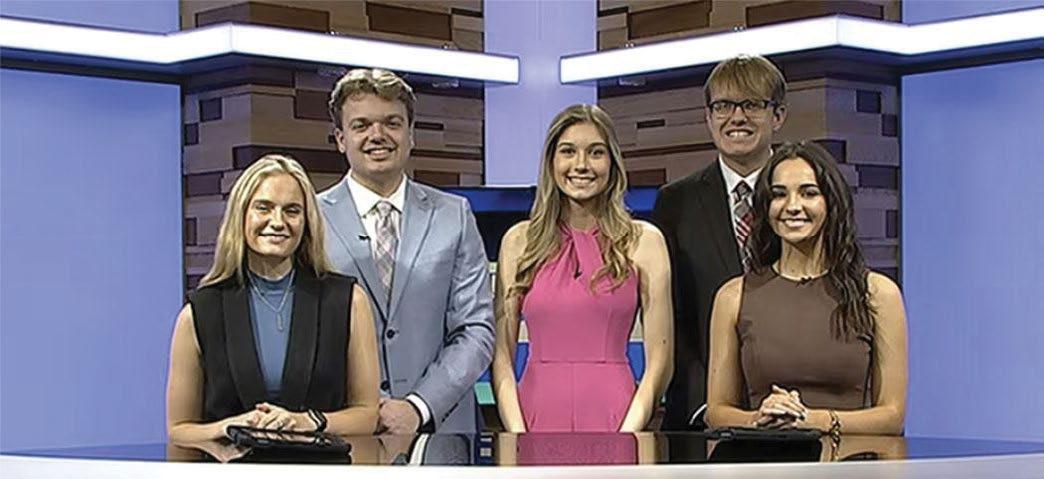
An April 4, 2025, episode of “Centre County Report,” produced by Penn State students in the Donald P. Bellisario College of Communications, earned a 2025 Mark of Excellence Award in the annual national competition conducted by the Society of Professional Journalists (SPJ).
The weekly half-hour newscast included an exclusive interview with the family of Timothy Piazza as they push to make fraternities safer nationwide. The newscast also offered reac-
tion to the proposed closing of Rockview state prison in Centre County and included a segment focused on a local church with a history of helping people in Myanmar as the country dealt with the effects of a devastating earthquake.
The same episode of the award-winning newscast was previously honored as the nation’s best by two other groups: the Broadcast Education Association and College Broadcasters Inc.
“Centre County Report” finished first in its regional SPJ competition and advanced to the national competition as a result. The Mark of Excellence Awards honor the best in student journalism, in this case work broadcast or published in 2025.
In a separate category, “Centre County Report in Kazakhstan” finished second as Best All-Around Television News Magazine. That special episode resulted largely from an international reporting class trip to the country.
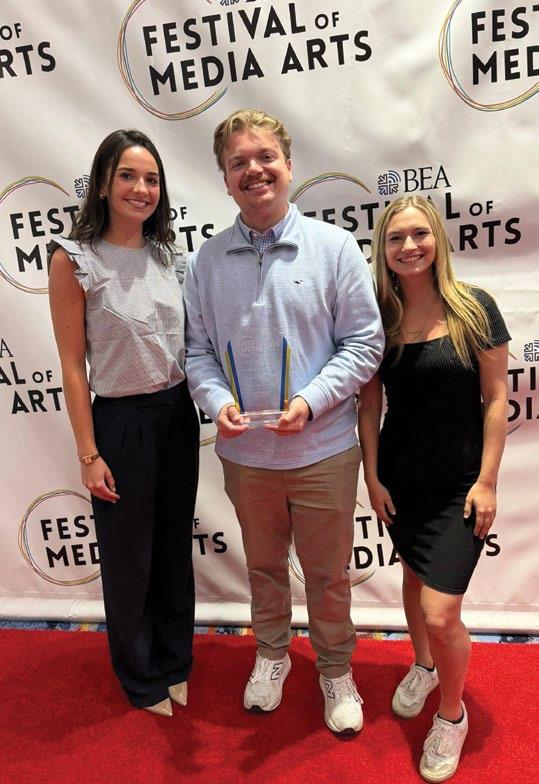
Video projects created by Bellisario College students earned numerous awards in two separate international competitions — including a prestigious Gold Telly Award — this year.
At the Telly Awards, CommAgency, the student-driven creative agency housed in the Bellisario College, earned the awards in three different categories for projects completed with the Department of Women’s, Gender & Sexuality Studies and the Penn State Alumni Association, respectively.
The video for Women’s, Gender & Sexuality Studies earned three awards — a Gold Telly in the Non-Broadcast - Educational Institution category, a Silver Telly in the Non-Broadcast - Student category and a Bronze Telly in the Non-BroadcastDEI: Diversity, Equity & Inclusion category.
The video for the Penn State Alumni Association earned two Silver Telly Awards — one in the Non-Broadcast - Educational Institution category and one in the Non-BroadcastStudent category.
The 47th annual Telly Awards received more than 13,000 submissions from all 50 states and five continents this year. The awards, which are judged by leaders from video platforms, television, streaming networks and production companies, were established in 1979.
At the Communicator Awards, four videos produced by CommAgency earned six awards in five different categories.
That competition attracts more than 3,000 entries from around the world.
Specific work recognized was:
• “Bellisario College Researchers,” honored for excellence in the General-Schools & Universities Category.
• “CommAgency Who We Are,” honored for excellence in the General-Recruitment Category.
• “Alumni Association Shakers Video,” honored for distinction in both the General-Schools & Universities Category and the Craft Categories-Videography & Cinematography.
• “Learning Factory Training Video,” honored for distinction in both the General-Student Category and the General-Training (for Corporate use) Category.
The 32nd annual Communicator Awards, sanctioned and judged by the Academy of Interactive and Visual Arts, received entries from ad agencies, digital agencies, production firms, in-house creative and communications professionals, graphic designers, design firms and public relations firms.
CommAgency, a student-driven creative agency housed in the Bellisario College, creates high-quality, low-cost media for Penn State clients, local nonprofit organizations and start-ups. It gives students real-world experience working with professional equipment and real-life clients.
A team of Penn State students won the district championship for the second time in three years during the American Advertising Federation’s National Student Advertising Competition, a highly competitive annual event that challenges college students to develop a fully integrated advertising and communications campaign for a national brand.
Penn State’s District 2 presentation was selected as the best from a dozen schools in an area that includes New York, New Jersey, Maryland, Pennsylvania and Washington, D.C.
The competition required student teams to build a campaign from the ground up by conducting original consumer and market research, developing a strategic platform, creating a comprehensive communications program across multiple channels and presenting a detailed media plan. Teams presented their work in a 20-minute competitive pitch before a panel of industry judges, who then challenged students with a 15-minute question-and-answer session.
With the victory, Penn State’s team, including students from the Donald P. Bellisario College of Communications, advanced to the national semifinal round. At that level, teams submitted a video of their presentation for judging, followed by a live question-and-answer session with the panel.
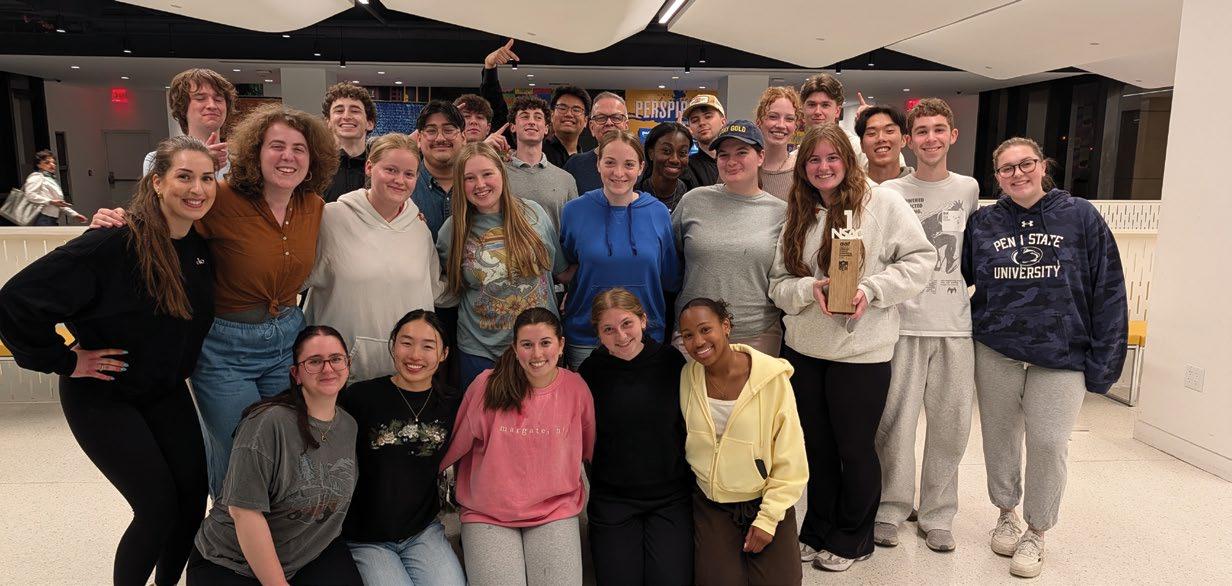
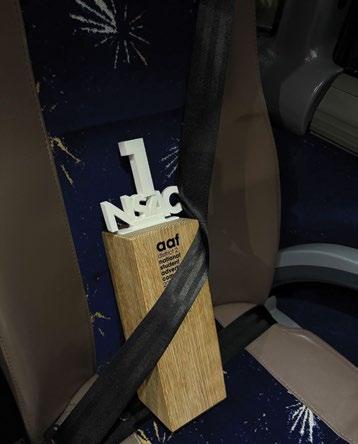
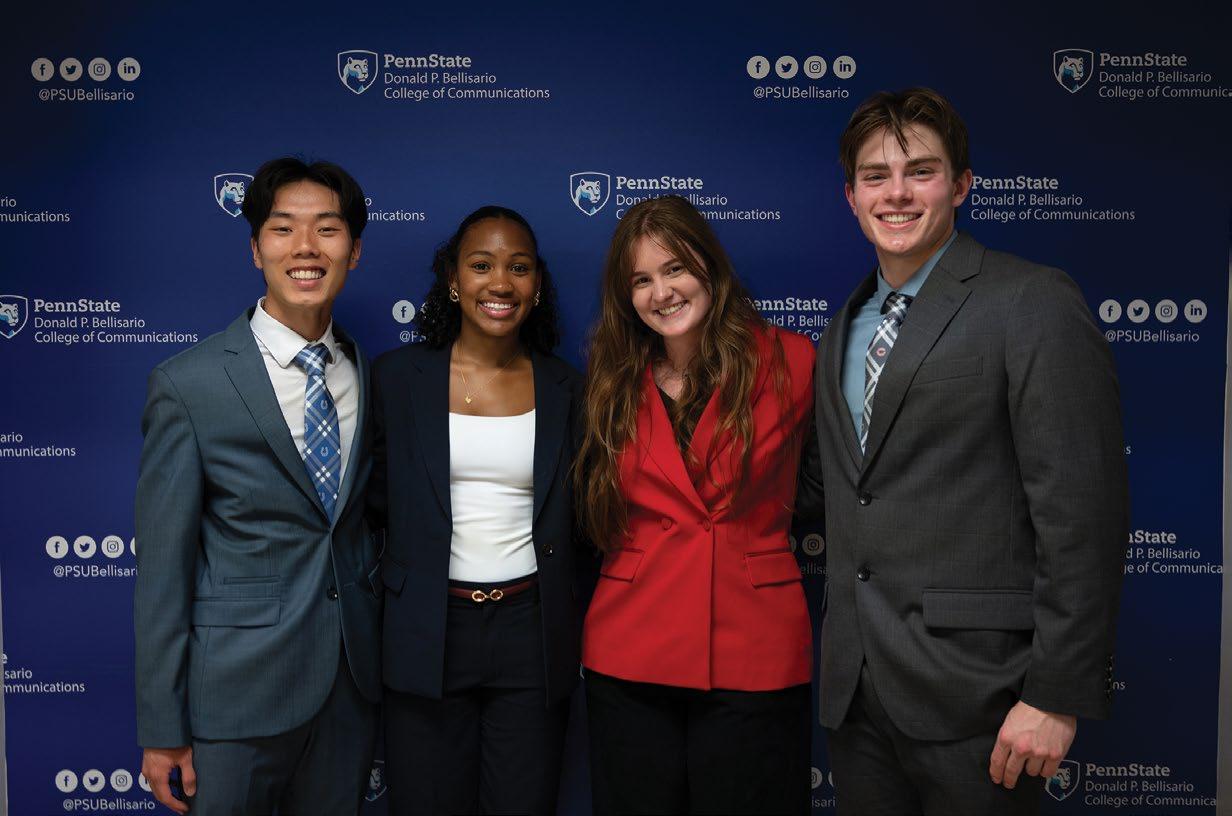
It all happened quickly late in the academic year, a Wednesday in mid-April.
Joy Donald and Vida Lashgari, classmates in COMM 474 Depth Reporting, were talking with a detainee housed in the Moshannon Valley Processing Center, an ICE detention facility in Clearfield County, located about half an hour from Penn State’s University Park campus.
While Donald and Lashgari had spent much of the semester working on feature stories related to the center (one about people impacted by the detention of family members and another about a chaplain at the center accused of misconduct) the call with the detainee on April 15 was one of their first interactions with someone held inside the facility housing about 1,600 immigrants — making it the largest ICE detention center in the Northeast.
Most of their reporting for previous stories had included research online and through Facebook groups, along with conversations with family members or lawyers.
This was different, as was the result.
Because Lashgari is fluent in Spanish, she led the interview, which was conducted though the GTL Connect Network, with the Spanish-speaking detainee.
“It was general things at first, where he was from, how he was detained, the conditions inside the facility, that kind of thing,” Lashgari said. “As we talked more, he talked about bad food, medical negligence and poor treatment of detainees. He was saying people were arriving in good health and were increasingly getting worse over time. And that they were getting ignored when they asked for medical help.
“That was the catalyst for the hunger strike. When he said detainees were not eating and there was hunger strike happening, we were like, ‘Oh this is news.’”
The first call lasted about 45 minutes, and a brief follow-up call lasted about 15 minutes.
After the second call ended, Donald and Lashgari reached out to Shaheen Pasha, an associate teaching professor of journalism in the Bellisario College, who was teaching the class in collaboration with Joshua Vaughn, an investigative/enterprise reporter with PennLive.
They offered insight and support — as well as an outlet for the story after Vaughn talked to his editors at PennLive.
“It was after noon at that point, and I’m supposed to be in the middle of a shift at work, so I told my boss I needed a little more time,” Donald said. “We kind of put everything on hold and were writing.”
Lashgari translated and shared notes while Donald pulled in more context as they shaped the story. By 1 p.m., they were done writing.
After fact checking and reviews from the instructors, the story — with a shared byline for Donald and Lashgari — was
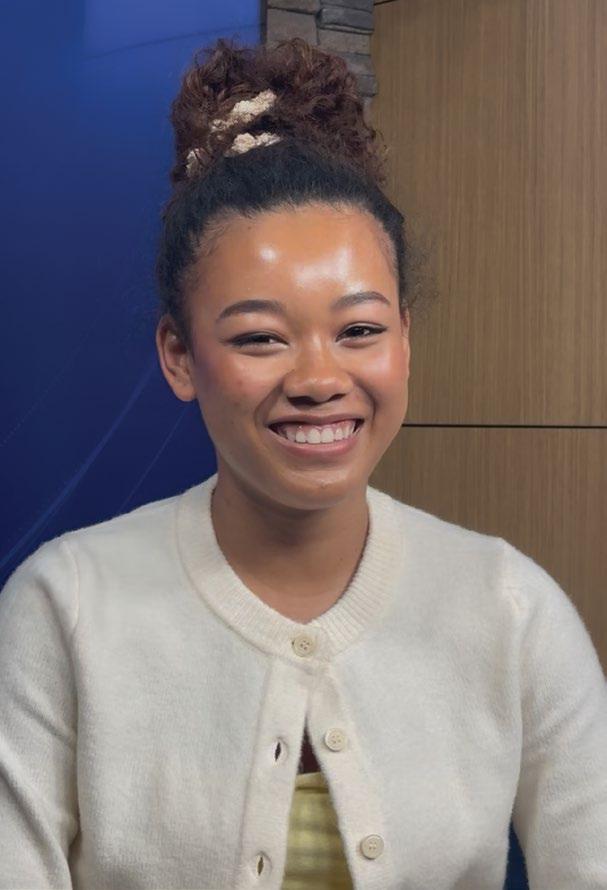
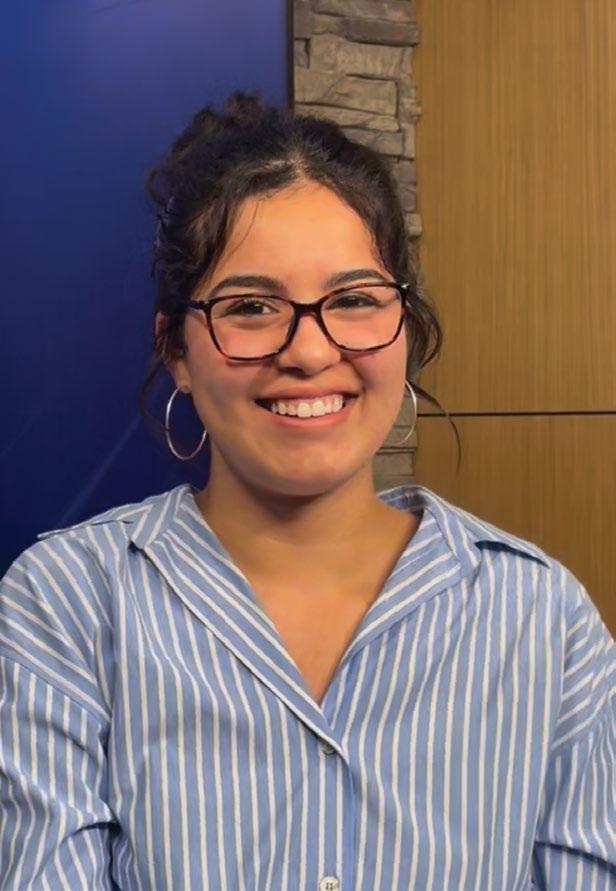
published on April 17. With the headline ‘Something is fundamentally wrong: Detainees start hunger strike at Pa. ICE facility,’ the story attracted attention.
It prompted one elected official to call for the facility to close. It was included in a rundown for a national newscast the next night. It even led to another story about the detainees who coordinated the hunger strike after they were placed in solitary confinement.
“When I talked to our source a couple days later, he said the hunger strike was hard to organize because the people being detained all spoke different languages,” Lashgari said.
All of it was a heady experience for Donald and Lashgari.
It was also a practical experience that provided value to the semester-long classroom efforts.
“Our goal with this class was for students to really immerse themselves in the community and find those hidden stories related to ICE and immigration,” said Pasha. “This type of reporting is challenging, both logistically and emotionally. But it’s necessary and I’m so proud of the light they were able to shine on conditions in Moshannon. That’s their job as journalists and they really rose to each challenge.”
Pasha added that the breaking news stories really set the stage for the special eight-part series of student features that PennLive began publishing in May.
“To have a story this impactful being published and being read was an amazing experience,” said Donald, a rising senior majoring in journalism. “I never felt so much achievement in just three hours. It felt like we did our civil duty as journalists.”
For Lashgari, who graduated in May with degrees in journalism and political science along with a minor in Middle Eastern studies, it was a step along the way to a long-intended career as a foreign correspondent. She starts graduate school at Columbia University this fall.
“The goal of journalists is to bring information people don’t know to light, and that was realized with this story,” Lashgari said. “We were able to do that with fact checking, storytelling and verification. We hoped we could tell people something and it would get the attention it deserved — and I think it did.”

The Arthur W. Page Center is a research center in the Bellisario College. Since its founding in 2004, the center has supported more than 350 scholars and awarded over $1 million in research funding. The center consistently supports academic exploration into the understanding of principles of public communication. Other initiatives focus on educational opportunities like regular speaker series, webinars and popular online ethics training modules.
‘Integrity at the center of everything.’ PR legend and Page Center chair Bill Nielsen’s legacy endures
Willard “Bill” Nielsen, a leading figure in the public relations industry and chair of the Page Center advisory board since 2015, died on Jan. 13, 2026.
A believer in communication’s role in maintaining successful organizations, Nielsen was a staunch advocate for building back public trust in the industries of communication. He felt truthful communication was more than just good business – it was essential for a healthy society.
“Bill believed deeply that organizations must speak truthfully, act responsibly and place integrity at the center of everything they do,” said Denise Bortree, Page Center director. “We are profoundly grateful for Bill’s leadership, wisdom and friendship, and we feel his loss deeply. Even in our sorrow, we are thankful for the example he set and the lasting impact of his life and work.”
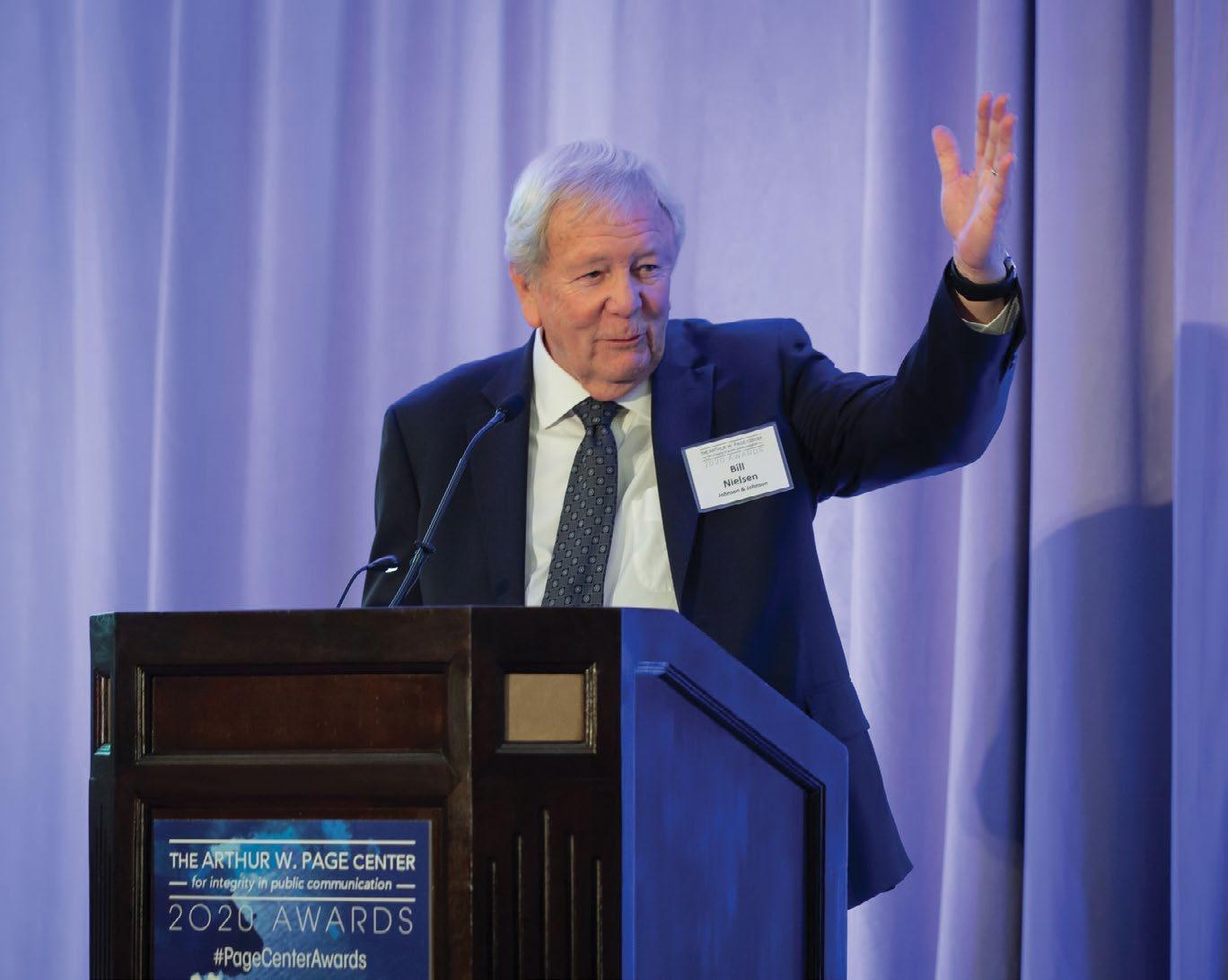
Funds raised from this year’s Page Center Awards benefited the new Bill Nielsen “Impact Through Integrity” Endowment. This endowment will develop ethics-based research, events and training that professionals can use in the era of artificial intelligence and other emerging technologies.

Honorees urge courage, compassion and integrity at ninth Page Center Awards
Communicating in a rapidly changing, unpredictable media landscape was a common theme during conversations at the ninth annual Page Center Awards, which aired on March 23. This year’s group of Larry Foster Award recipients shared tips and tactics for managing today’s challenges through adaptability, empathy and integrity.
Honorees Kaitlan Collins, chief White House correspondent and anchor at CNN; Jeffrey Goldberg, editor-in-chief of the Atlantic; Hubert Joly, Harvard Business School faculty member and former CEO of Best Buy; and Kelli Parsons, CEO of Avoq, participated in the online event. The respected leaders were recognized for their commitment to honest and truthful communication with the public. This year’s honorees join 25 past recipients in a group of remarkable communicators representing business, journalism, public relations and other areas.
Denise Bortree, Page Center director, and Jonathan McVerry, Page Center communications manager, hosted the awards live at a watch party in the Bellisario Media Center.


This popular Page Center Awards ethics training module captures the magic of the annual event. The module is free and open to everyone. Those who complete its two lessons learn how important ethics, integrity and trust are to effective communication, and also receive the 2026 Page Center Integrity Badge.
In April, the Page Center announced the recipients of its 2026 Page/Johnson Legacy Scholar grants, selecting 11 projects that will assess how corporate social responsibility, advocacy and activism are evolving in a polarized political and cultural environment.
The grant call for proposals was announced in August and received 67 submissions from scholars around the world. The accepted projects feature 26 scholars from 15 universities. Areas addressed in the call include environmental justice, DEI backlash and other corporate advocacy and activism insights and strategies.
Funding innovative and timely research through its Page/Johnson Legacy Scholar Grant program is a core initiative of the Page Center. Each year, the center appoints senior research fellows to identify emerging issues and solicit research proposals that advance scholarly, industry and public understanding of those topics.
“The scope and urgency of what corporate responsibility and advocacy mean today made this an especially strong call,” said Holly Overton, Page Center research director. “These projects reflect the kind of research needed to better understand how organizations are navigating ethical communication in challenging and unpredictable situations.”
By Grace Mathews

The Page Center combines stories, advice and experience with scholarly research in its new video series, “Truth Bombs.” These short videos showcase insights into pressing topics facing the media today, giving communicators an accessible way to perform with integrity and maintain autonomy with regard to emerging technologies.
“Truth Bombs” episodes are posted weekly on Facebook and YouTube and discuss the importance of integrity and authenticity in the modern-day media landscape. Topics include artificial intelligence education, personal responsibility and building trust in a challenging time.
The series has featured Penn State communications faculty members Lee Ahern, Amy Kristin Sanders and Stephanie Thomas. The series has also featured several expert academics, professionals in the field and Page Center Awards honorees.
The Page Center is partnering with the Crisis Communication Think Tank at the University of Georgia to support collaborative student research. As part of the partnership, the Page Center’s Graduate Student Lab Group and CCTT’s Crisis Insights & Analytics Lab have joined forces to produce innovative and timely research on a number of topics within the areas of ethics, digital technology and crisis communication.
The collaboration between the center and the Think Tank will support student-led research projects led by Penn State graduate students and students from Georgia.
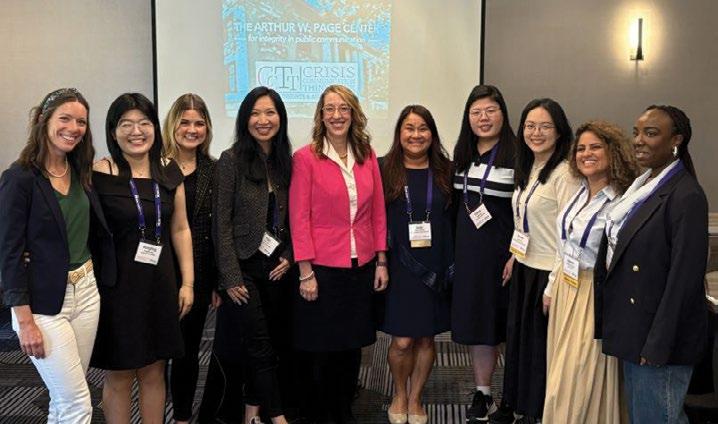
‘The Divided Dial: Season 2’ from ‘On The Media’ earns nationally competitive annual award
A podcast series focused on shortwave radio, from its little-known and influential history to its resurgence among a variety of niche audiences, has earned the 2025 Bart Richards Award for Media Criticism.
“The Divided Dial: Season 2,” a four-episode series from “On The Media,” earned the award that annually honors work that evaluates news media coverage of significant subjects or issues. The series, hosted by reporter Katie Thornton and edited by executive producer Katya Rogers, was the result of nearly two years of research and writing. The award will be presented on campus at Penn State at the start of the fall semester, when Rogers and Thornton will make classroom visits and participate in sessions with faculty and students.
The Bart Richard Award for Media Criticism, presented by the Donald P. Bellisario College of Communications at Penn State, annually considers constructively critical articles, books, and electronic and online media reports; academic and other research; and reports by media ombudsmen and journalism watchdog groups.
Faculty screeners from the Bellisario College reviewed entries for the respected national award and then forwarded finalists to external judges. Those judges — Andy Alexander, a retired visiting professional at Ohio University and former Washington Post ombudsman with more than four decades of journalism experience; Jill Billante, a Penn State alumna and executive producer at NBC News Now; and Russ Eshleman, associate teaching professor emeritus at Penn State and an award-winning journalist who covered Pennsylvania politics for the Philadelphia Inquirer — were unanimous in their selection of “The Divided Dial: Season 2.”
the award.”
Likewise, Billante said the podcast was interesting and timely, especially with what it indicated about the impact of media consolidation. Eshleman said the series was award-worthy because it was much more than a historical summary, instead finding impact and strength because it broke new ground with the information it provided.
The winning four-episode podcast series about shortwave radio, which is far-reaching but less listened to than AM or FM radio, focused on the creation and science of the medium as well as its adoption, growth, success, anticipated demise and even its resurgence among certain audiences. Along with the reporting and research, the series included a trove of audio clips that heightened interaction and provided historical context.

Thornton, an award-winning freelance audio and print journalist, has published with the New Yorker, Rolling Stone, the Atlantic, the Guardian, the BBC, NPR, WNYC, Minnesota Public Radio, 99% Invisible, and many others. She has earned a prestigious Fulbright-National Geographic Fellowship for her storytelling work. She is especially interested in longform, historically informed reporting that shows how infrastructure and communications technologies impact the daily lives and deeply held beliefs of Americans.
She spent years working behind the scenes at small radio stations and radio-related organizations, which has influenced her interest in, and admitted soft spot for, the medium. Thornton’s work previously earned the Bart Richards Award in 2022 and 2024.
Judges said the podcast series was consistently strong.
“Sometimes over a series of podcasts, the last one might be weak or simply wrap things up,” Alexander said. “This series was strong from start to finish, and that final episode felt revelatory with new information. Plus, the series focused on the shift away from the airwaves being used in the public interest, and that type of information really seems to meet the spirit of
Rogers is the executive producer of “On The Media,” which is produced by WNYC and aired nationwide on 450 stations with an audience of more than a million weekly listeners. During Rogers’ tenure at the helm of the show, it has won multiple awards, including the Peabody, multiple Mirrors, and the Front Page Award. “On the Media” has earned the Bart Richards Award four times in the award’s 31-year history.

In the booming business of sports sideline reporters, Penn State has emerged as one of the nation’s most impressive pipelines for current — and future — gameday newsbreakers.
BY RYAN HOCKENSMITH (’01)
been delivering news to America. And yet now, on this winter day in 2012, she is struggling mightily to figure out how to tell her dad one of the biggest headlines from her own life.
What words should she use? Should she have fun with it? Or just be straightforward?
At that moment, Salters decides she’d like to add a little gravitas to her breaking news story. She wants to say some thing memorable, something befitting the announcement that she has landed a job that is a dream gig for both her and her dad. So, she opts to add a sound effect to what she is about to tell him.
“Dad, guess what they want me to do in my new job?” she asks.
Salters (’88 Journ) pauses to let him wrack his brain for a second. Then she hits him with the noise: “Duntdunt dunt-duuuuun,” mimicking the iconic theme music from the broadcast team she is about to join. That’s all he needs.
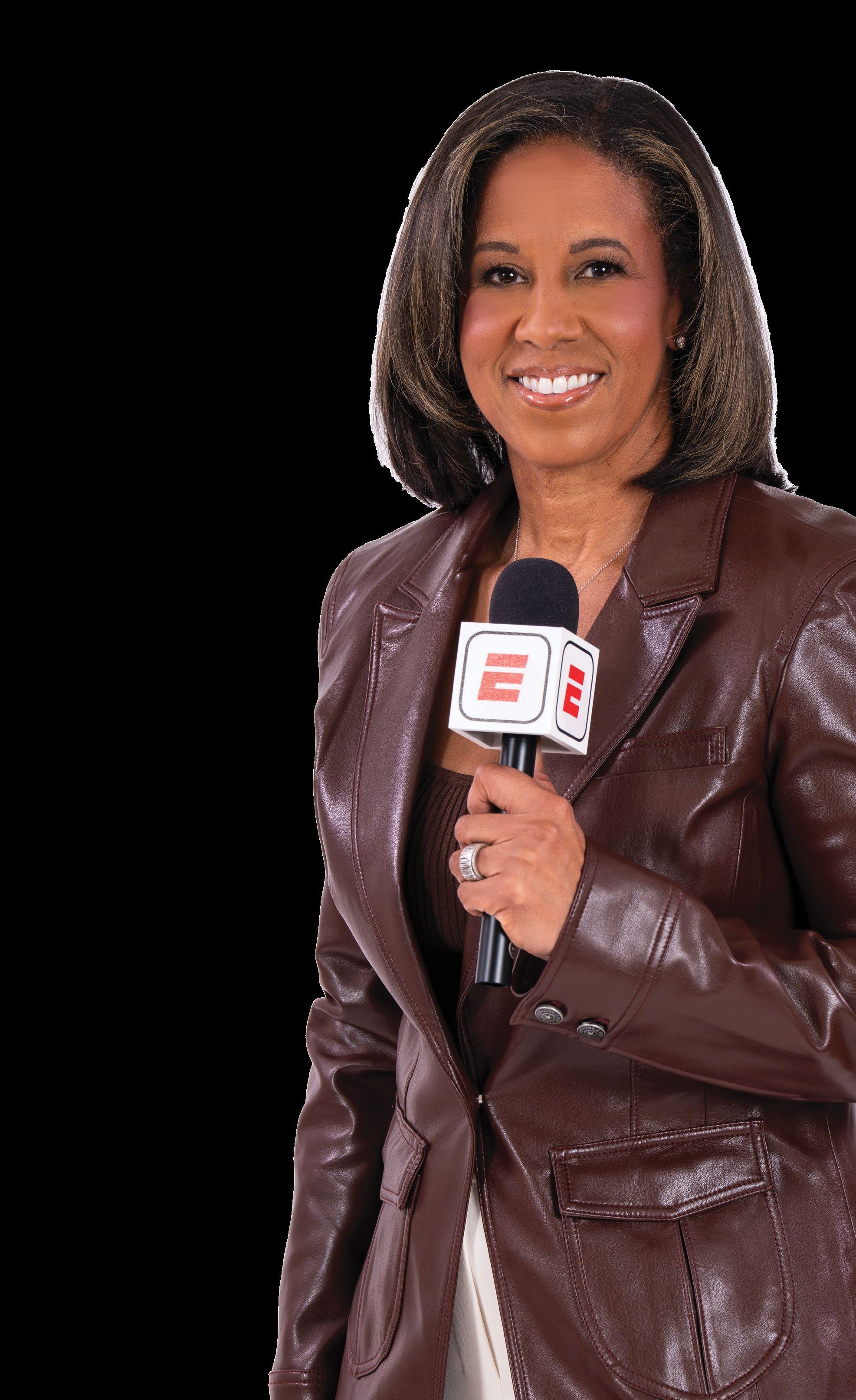

“You’re doing Monday Night Football?!” he exclaims.
The answer is yes. They rejoice together for a few minutes as she explains that the latest chapter of her storied journalism life will be as a sideline reporter for Monday Night Football. The job will require her to use all the tools she’d learned over the previous 20 years as a journalist — a good nose for news, the flexibility to move on or off stories in seconds, and a fearlessness to chase down, literally and figuratively, some of the most popular, guarded people in America.
Chapter 1 for Salters had been finding her footing in State College as a broadcast journalism major. She had grown up in King of Prussia, Pennsylvania, watching legendary Philly news anchor Lisa Thomas-Laury, a 20-year stalwart of city news who had served as an inspiration to young girls like Salters. “I saw her on TV every night,” Salters says. “That’s why representation matters. I wanted to be like her.”

There are more sideline reporters than we’ve ever had before. They’re an essential part of the biggest sporting events in the world.
– Richard Deitsch, Sports Business Journal and CBC Sports correspondent
That chapter ended hilariously with her graduating and got offered a $13,000 job driving the Oscar Meyer Wienermobile right out of college. “My mom was mortified,” Salters says. “She asked me, ‘What am I going to tell my friends? That we sent you to school to drive a hot dog?’”
But Chapter 2 began before the Wienermobile adventure could hit the road — at a media job fair on campus, she met with reps from WBAL-TV, the local NBC affiliate in Baltimore. She took a job behind the scenes there right after college.
After about eight months of being what she calls a glorified gofer, she was summoned from the end of the bench to go report from the scene of a nearby fire. Everybody else was already out on assignment and the news went live in less than an hour, so Salters grabbed a camera person and went for it. She still laughs about botching the location — she called it Charles Avenue instead of Charles Street—but she had found what she wanted to be when she grew up.
“I knew it was for me,” she says. “That was what I was supposed to be doing.”
Chapter 3 came a few years later, when she got an incredible offer to go out to Los Angeles and be one of ABC’s West Coast news correspondents. She covered both O.J. Simpson trials, civil and criminal, over the course of three years, as well as the Oklahoma City bombing in 1995 and the 1998 killing of Matthew Shepard. On some of the most complex, tragic news stories of the past 40 years, millions of Americans relied upon Salters.
Chapter 4 began in 2000, when she needed a spiritual breather for herself. She’d never fully investigated whether sports reporting could be an avenue for her journalistic talents. But when an opportunity to cover sports for ABC/ESPN came along, she was at the right point in her career where she had an open mind. Her 1990s reporting had been invaluable for her, as a person and as a journalist, but the bleakness of her coverage area had taken its toll.
So, in 2000, she opted to join ABC/ESPN, where she would get to do TV magazine-style journalism as well as sideline reporting. By 2006, she was front and center every week on ABC Saturday Night college football broadcasts, along with plenty of NBA game coverage. That all led to her being approached about the MNF gig. A new chapter was upon her.
Monday Night Football represented something bigger to Salters. She felt a calling to the esteemed broadcast. She’d grown up watching those games with her family, especially when her cousin Tony Dorsett was playing for the Cowboys. She still feels warmth in her heart from that phone call telling her mom and dad that her life had come full circle.
Now when he watched Monday Night Football every week, her parents would see their daughter on TV — and so would the next generation of sideline reporters.
job was invented in 1974, for a college football broadcast of UCLA at Tennessee. ABC had hired two young broadcasters, Jim Lampley and Don Tollefson, to report from the sidelines with mostly frilly interviews and observations. Lampley, a future icon of boxing and Olympics coverage, would later describe their tasks on the sidelines as “a bunch of nonsense.”
But the position evolved in the decades afterward, from hanging out with cheerleaders and mascots to critical in-game updates and interviews with coaches and players. Not just in football, either — NBA and MLB broadcasts would add dugout and on-court reporters in the 1980s, too. By the time Salters came to ESPN in 2000, sideline reports were a common part of nearly every televised sporting event, with people like Craig Sager, Andrea Kreamer and Lesley Visser becoming A-list personalities to American sports fans.
Over the past quarter century, the sideline reporter job has continued to rapidly grow and expand within broadcasts. It’s hard to fathom a major sport now without at least one reporter on the sidelines of every national broadcast, ranging from MLB, NBA, WNBA and NHL to the UFC, professional golf and most NCAA championships. There’s no database for the exact number of sideline reporters working these days. But in
the streaming era, with more sports broadcasts than ever before, surely this is the golden age for sideline journalists.
“I couldn’t tell you if it is 10 times or five times as many people doing the job,” says longtime media reporter Richard Deitsch, formerly of Sports Illustrated and now a Sports Business Journal and CBC Sports correspondent. “But there are more sideline reporters than we’ve ever had before. They’re an essential part of the biggest sporting events in the world.”
Sideline reporters are often key news breakers during many broadcasts, including during pre and postgames. Many of the best-known reporters, including Penn State grads Salters, Emily Kaplan and Tom Verducci, came to the job with impressive journalism backgrounds and were able to deliver important updates on weather, starting lineups and injuries. In-game interviews with players and coaches have become standard operating procedure for virtually all games.
Perhaps the least-known part of the job is that the bulk of their work product — Deitsch puts it at 80-90 percent — ultimately goes uncredited. They hustle from sideline to sideline or roam the court during games, then feed what they are gathering to the production crew and occasionally directly to the announcers. Sometimes they hang onto news until the camera gets put on them, but most of the time that info ends up being folded into the game broadcast without any on-screen or on-air appearance by the reporter themselves. “It’s a very, very valuable part of the job and people don’t usually see that,” Deitsch says.
That information, whether attributed to the sideline reporter or not, has never been more valuable. Fantasy sports and gambling have both become multi-billion-dollar industries, with the smallest behind-the-scenes intel devoured from more angles than ever.
“Our job is to serve the viewer,” Salters says. “If the information I am giving you helps you with fantasy or gambling, fine. But I’m here to provide information. That’s it.”
doesn’t remember the exact Penn State game when she found herself starstruck a few feet away from Lisa Salters. She thinks it might have been during the 2003 season. The only thing she remembers for sure is that she felt like she had to introduce herself.
“I’m a huge fan,” Collins told Salters. “I want to do what you do someday.”
Collins had grown up in Port Matilda and graduated from State College High before going to Penn State. When she got her broadcasting degree in 2008, she thought she would probably turn it into a studio hosting gig in the sports world. And she did land several studio jobs before ultimately finding herself getting pulled toward the sidelines. She ended up taking a job with CBS in 2014 and has become one of the sport’s top sideline reporters, working primarily with Kevin Harlan and Co. on Sunday CBS NFL games.
She’s done lots of other gigs—the Sochi Olympics, the 2014 World Cup in Brazil and even the Nathan’s Hot Dog Eating Contest—but Collins is a Sunday staple these days for what is usually one of the best games of the weekend.
She’s a prominent factor in what is perhaps the most scrutinized two-hour window in sports sideline reporting, from around 11 a.m.-1 p.m. on an NFL Sunday. That’s when dozens of iffy NFL players must be declared active or inactive for that day, which is incredibly valuable information for gamblers and fantasy players who are craving updates from the stadium about starting lineups and warmups. Even something as basic as rainy conditions or if a quarterback is wearing a splint on an injured finger can send ripples through the sports ecosystem right before kickoff.
“You wouldn’t believe how often I get hit up from people for possible gambling info,” Collins says. “I can’t say a word, and I don’t. I avoid it at all costs. I don’t even talk casually about it with fans. I consider fantasy to be a different thing. But I’m careful with that, too.”
That Sunday early window can often be a chaotic upheaval to a week of prep work by production crews. Collins was on the field in Miami on Sept. 8, 2024, prepping to do a pregame check-in interview with Tyreek Hill when she got shocking news: Hill had been detained by police on his way to the stadium. Social media surfaced video of Hill handcuffed along the side of the road just outside Hard Rock Stadium before the Dolphins’ season-opener. Forget fantasy and gambling implications—this was one of the biggest news stories of the weekend, and all eyes
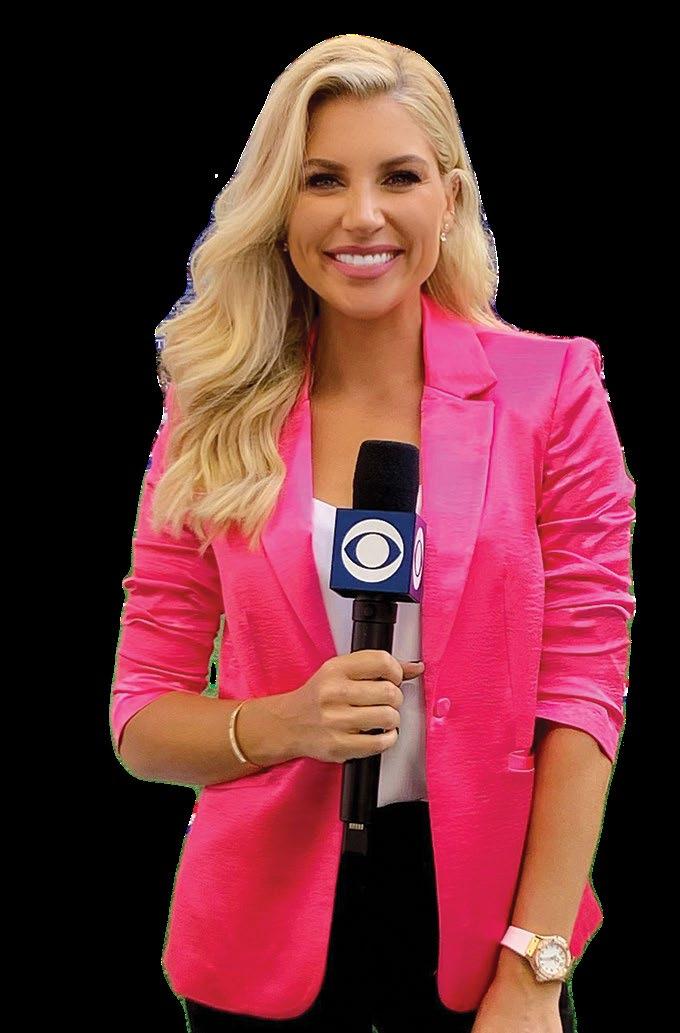
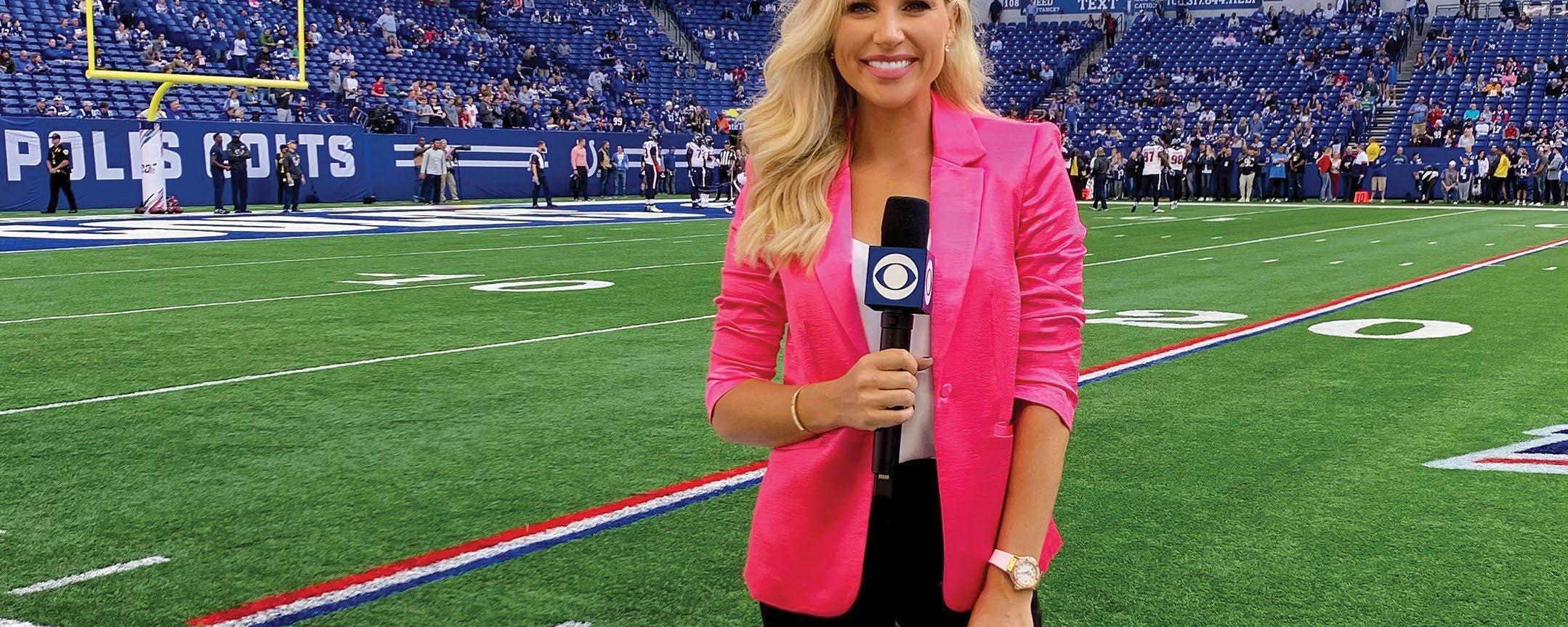
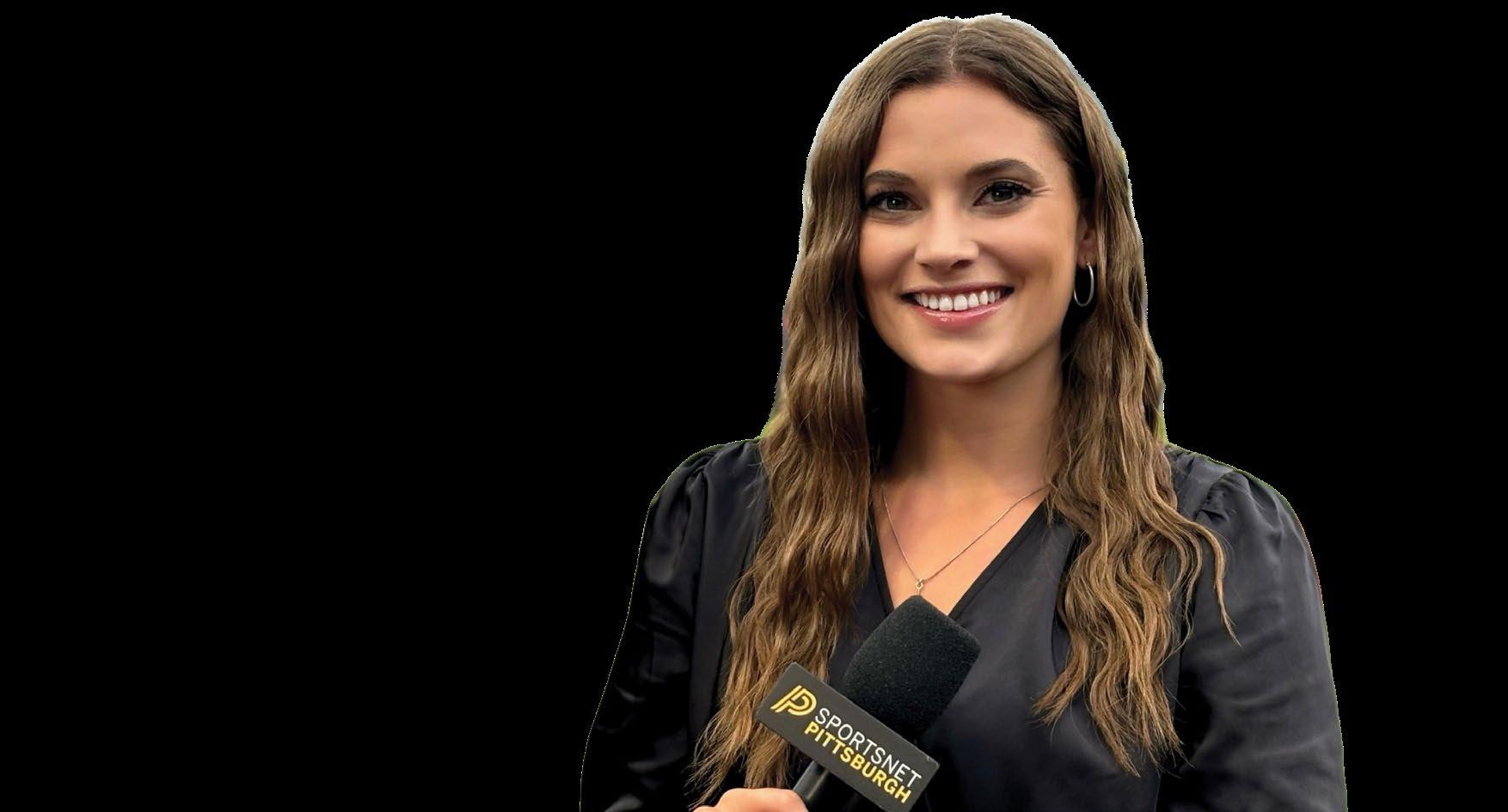
turned toward Collins to be ready to report live.
She ran across the field and into the CBS production truck, where she and her bosses went through how to report that news using the latest information, along with the proper language to describe what happened (for example, Hill was detained, not arrested, which is a fairly significant distinction). “Everything I had prepared for that day was out the window,” she says.
Collins provided live updates on the CBS pregame show, then interviewed Hill before the game. He’d been released and played that day, scoring a touchdown and imitating being handcuffed during the celebration. For a large portion of Football America, she was the voice of record on their TVs that day.
She’s also quickly becoming a holiday regular, too. Collins made history on Dec. 25, 2024, when she worked Netflix’s inaugural Christmas Day game. For that Chiefs-Steelers game, Collins joined fellow sideline reporter Stacey Dales and a broadcast team of Ian Eagle, Nate Burleson and J.J. Watt for a one-day-only crew.
Collins also did last year’s Cowboys-Commanders game on Christmas, which she loved … but also missed her family and dogs. She often has to leave her dogs with her parents when she jets off every week, which makes her more of a joint custody dog mom than she wants to be.
“I love my job, though,” Collins says. “I miss some of the holiday stuff but that’s part of the deal when you cover sports. At least football is only that chunk of the calendar. I’m not sure how I would do with something like baseball.”
THERE MAY NOT be a harder sideline job in sports than an MLB dugout reporting gig. The baseball regular season runs roughly 190 days, with 162 games during that stretch. Imagine coming up with storylines for a 3-hour broadcast almost every single day for six months straight.
That’s exactly what SportsNet Pittsburgh dugout reporter Hannah Mears (’20 Journ) has done for the past two-plus years, though. She’s in the middle of a promising Pirates era right now, with young talent like Paul Skenes and Konnor Griffin as cornerstones. But even exciting, good teams have plenty of dog days, so Mears has to constantly have a back pocket full of
things to bring up on air.
The upside to reporting on so many games is that Mears almost always has tomorrow. For so many sideline reporters, they may not see certain teams or players for a year or more, which makes some storylines one-and-done every weekend. Mears welcomes hanging onto some storylines to use the next day in favor of interesting current events on a gameday.
The wear-and-tear of the job is real. Mears has to leave her best little furball buddy, a Mini Bernese Mountain Dog named Oakley, with her parents for long stretches of time because of work. And she laughs about having a personal life from about March through October. “I have lots of great friends and family,” she says. “I just don’t see them during the season.”
Football isn’t much better. Salters and Collins both live in Tennessee, but travel almost nonstop for the entire fall and winter. The ebb and flow of their weeks is usually a day or two at home after a game, with prepping for the next week underway almost immediately. Then travel begins to the next stop of the season, with game-week interviews and an occasional practice before the weekend rolls around. Rinse and repeat after every Sunday and Monday.
Mears’s weeks are spoken for in a broad sense, but she has the days down to a science. She grew up in the Pittsburgh area, so she knows how to work the city and duck down that side street that’s going to save six minutes getting to the stadium. She loves the city and especially the people. So even when she was graduating from high school and thinking about going away to play college soccer and major in nursing, part of her hoped she’d get back to the 412 area code.
One trip to a Penn State football game shifted the trajectory of her life. She never even went into the game, but the tailgating scene alone put the school into her bloodstream. She paid the application fee herself, got in and enrolled the next year.
Mears always thought she would follow in a long family history of health providers. But at Penn State, she fell in love with her communications classes. At one point, she connected with Mike Poorman, longtime lecturer and Bellisario College of Communications director of alumni relations. She expressed her interest in maybe chasing broadcasting as a career path, and within a few weeks, Poorman pointed her toward a job in the Penn State athletic department helping out with Beaver Stadium Extra.
She got the job, and she was hooked. She loved being a reporter. Loved gathering sound from players. Loved the pressure of TV. Loved the possibility of a good story list that she
could chase. Almost immediately, she realized that this would be her life going forward. “I owe so much of my life to Mike Poorman,” she says now. “He helped me find the right path for me.”
But she still felt timid at times, especially during some of the media mob sessions after Penn State football games. She’ll never forget hanging back on the periphery of a scrum with Saquon Barkley, who she had met before on campus. At one point, she made eye contact with the running back and he started laughing. “Sorry, something was funny,” he said to the assembled cameras.
She felt a pang of insecurity. Why was he laughing? Later, he explained to her that he was just happy to see her there in the fray, doing what she had discovered was the job for her.
He did have one critique, though. “If you’re going to be in that press conference room,” Barkley said, “you need to speak up and ask a question. You have to believe that you’re supposed to be there.”
“OK, deal, but you have to answer my question respectfully,” she said.
“Deal,” Barkley said.
A week later, Mears asked her first scrum question to Barkley, and he smiled and gave a good answer. When she went to the Super Bowl with the Bellisario College the next year, she found herself standing in front of Nick Bosa along with dozens of other reporters. She thought back to her conversation with Barkley, then fired off a question.
She’s never looked back. After she graduated, Mears walked right into a tepid job market, in the middle of COVID. She took a gig doing sideline reporting for local Pittsburgh high school sports and some work for the Big Ten Network, while also trying to pay down her student loans by working as a server at the Latrobe Country Club. A little over two years ago, SportsNet called her with an awesome offer—to report live from the Pirates dugout every day.
“I think there is so much opportunity out there right now because of how much sports is on TV,” Mears says. “There’s never been a better time to be in sports broadcasting, yes. But it’s also quite competitive. People like Lisa Salters and Melanie Collins have paved the way for me and others.”
THE CURRENT CHAPTER of Salters’ life has been going on for a record-breaking length of time now. In fact, at 14 years and counting, she’s the longest-tenured sideline reporter in Monday Night Football history. On the Mount Rushmore for sideline reporters, Salters has to be among the first faces to be etched in stone.
“Lisa has made it a priority during her career to make sure what she reports is accurate and thoughtful,” Deitsch says. “Nothing is superfluous. She is not trying to be flashy. When she is on air, she is always reporting something that is important to the viewer.”
She is a consistent presence on football and NBA broadcasts, along with periodic award-winning reporting on E:60 film and documentary series productions. Salters drew widespread praise for her reporting from on the field during the Bengals-Bills game on Monday Night football in which Damar Hamlin suffered cardiac arrest. She did a remarkable job of reporting what she knew, avoiding speculation and hyperbole, in a way that almost no one else in the business can.
“She approaches things like a true journalist,” Deitsch says. “She delivers accuracy and professionalism, and that’s been important in the grand scheme of sideline reporting.”
In her ESPN time, Salters has covered everything from difficult news stories like the Rae Carruth murder case and the Marty McSorley trial to multiple Olympics and World Cup assignments. She’s become such a fixture that she now has athletes who approach her and say, “I grew up watching you!”
She remains amused at how Ravens QB Lamar Jackson’s nickname for her, Miss Lisa, has stuck around the NFL. She didn’t love it at first. But she accepts it for what it is—a sign of deep respect and appreciation for the way she approaches her job. She’s been around the world and back, with just one blank page in her storied career: the Super Bowl.
That will change in February 2027, when ESPN’s Monday Night Football crew handles Super Bowl LXI. Salters will be on the game alongside announcers Joe Buck and Troy Aikman in a first for ESPN —and her. By then, she’ll have put together a resume that is still going strong and will probably never be duplicated. “Why do I need another chapter?” she says. “I’m good. I’ve covered every sport I ever wanted to, and I have a great job that I love.”
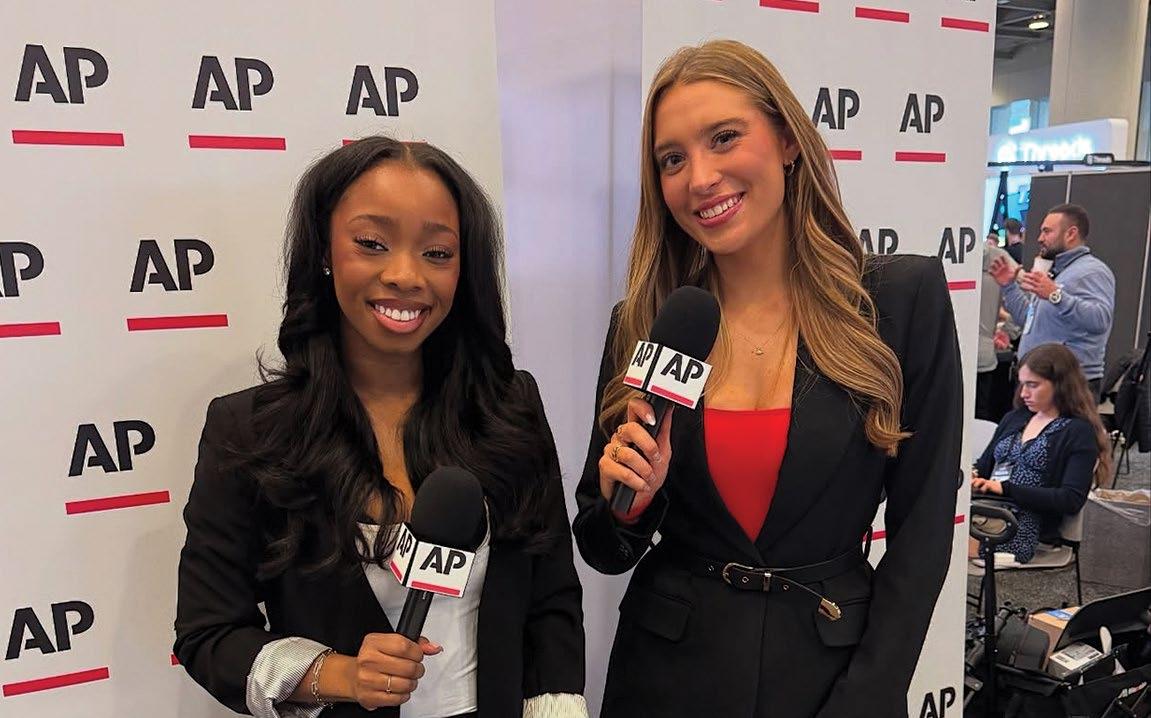
Along with the alumni who have already established careers as sideline reporters, students annually arrive in the Bellisario College with similar career aspirations.
Among a group of a half dozen Penn State students who worked at the Super Bowl in February were Gigi Jones (left) and Cailey Thalman. During the buildup to the Super Bowl, both were active contributors to Associated Press coverage of the event.
Both women, who graduated in May, made the most of their Penn State experience with a variety of on-air and hands-on opportunities to prepare for eventual careers.
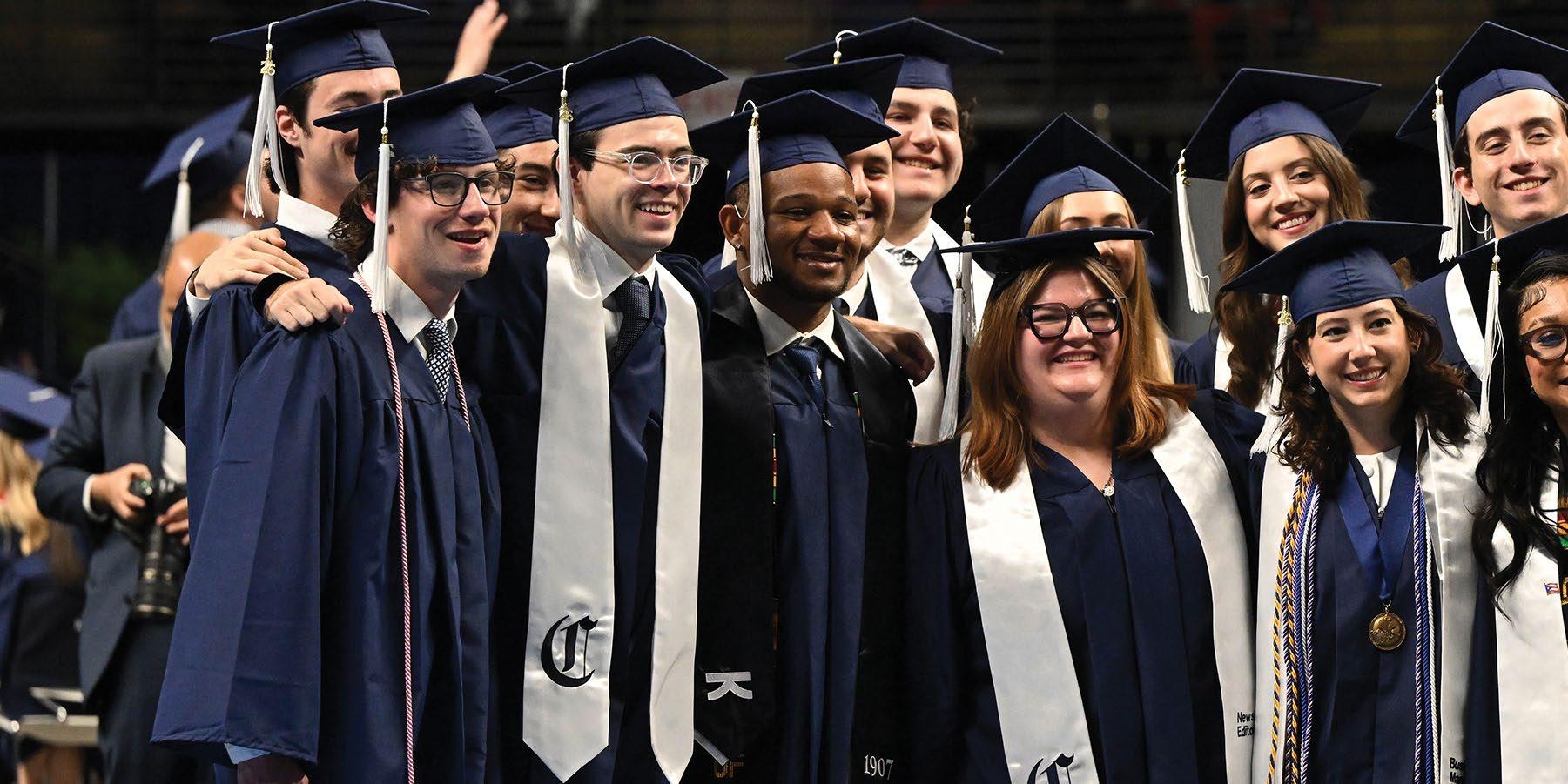
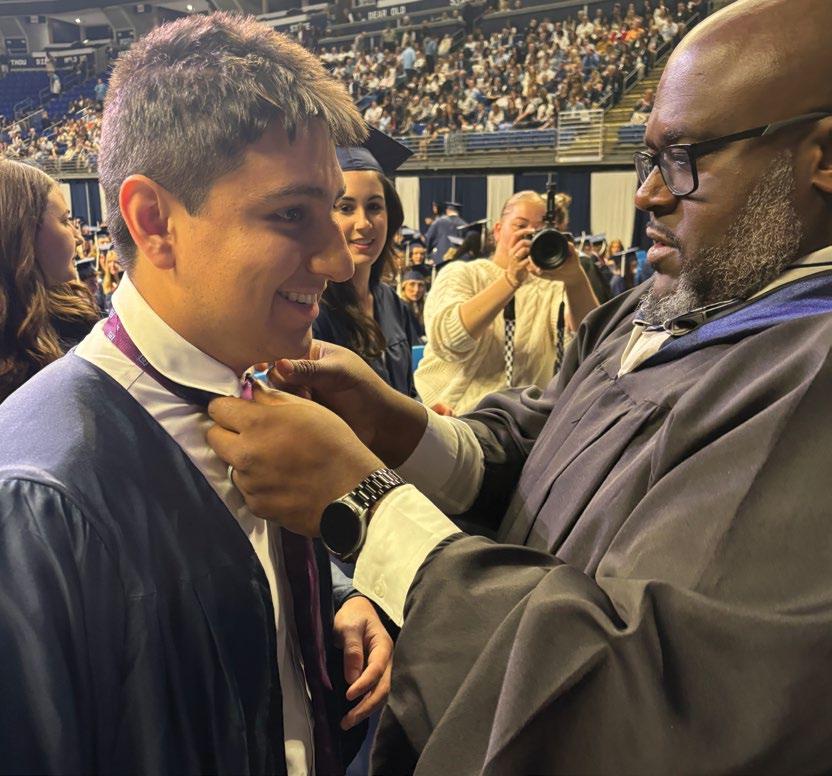
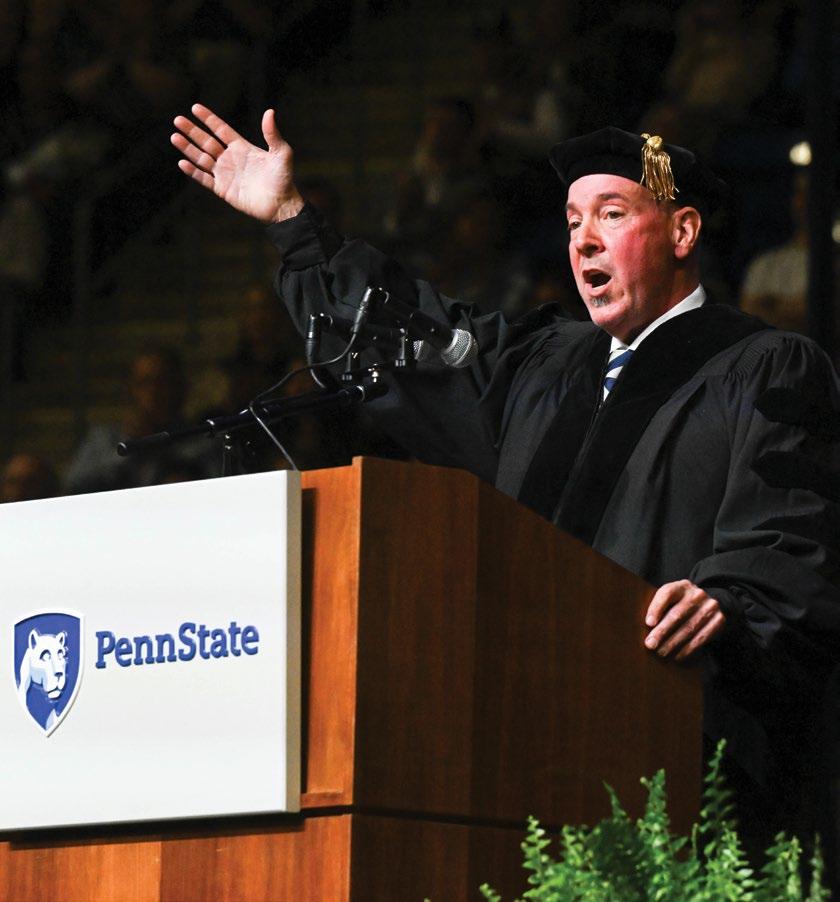
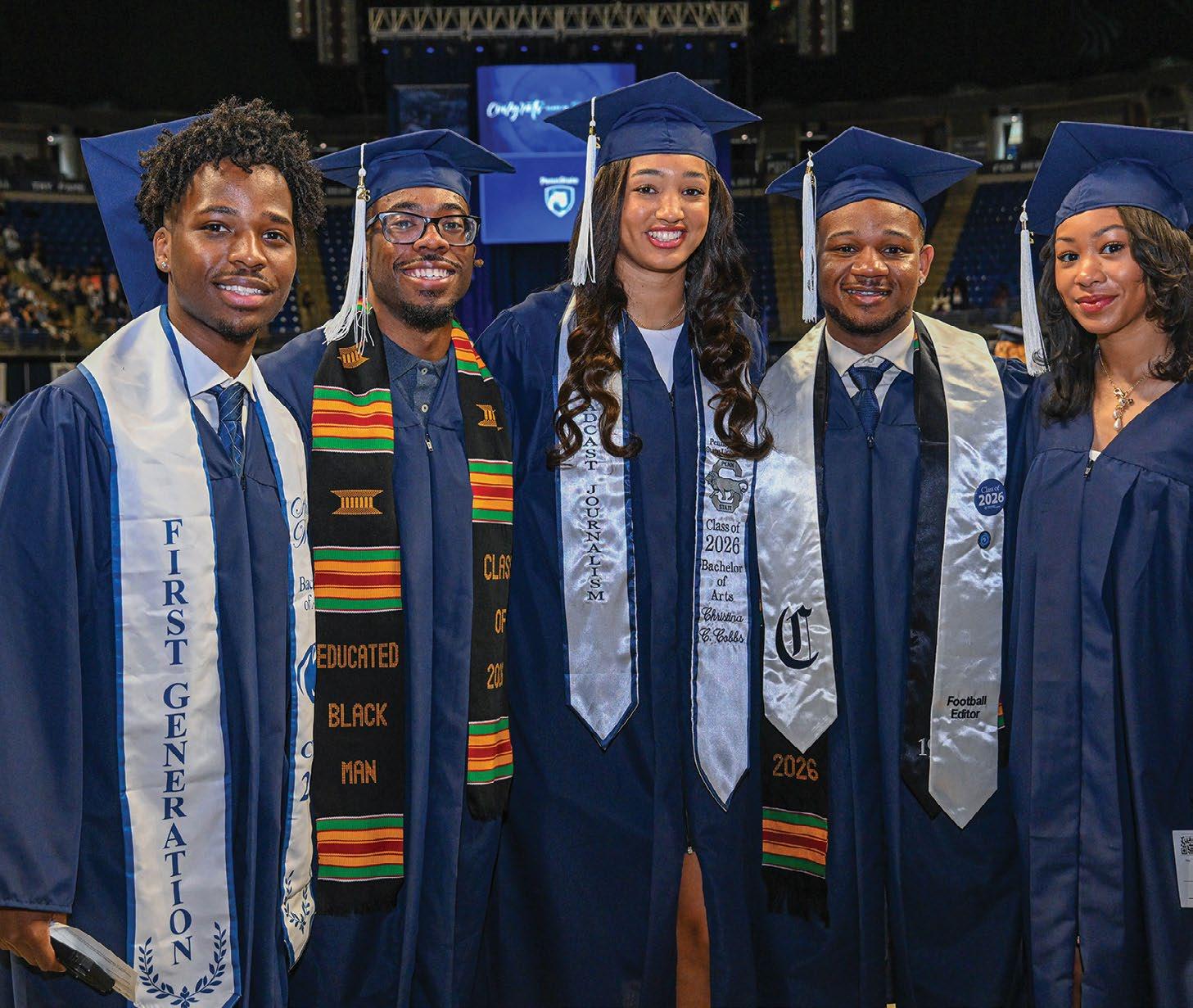
There are lots of reasons why the current landscape is tricky, but I do trust this: Penn State has prepared you well for what comes next.
— MARK LIMA
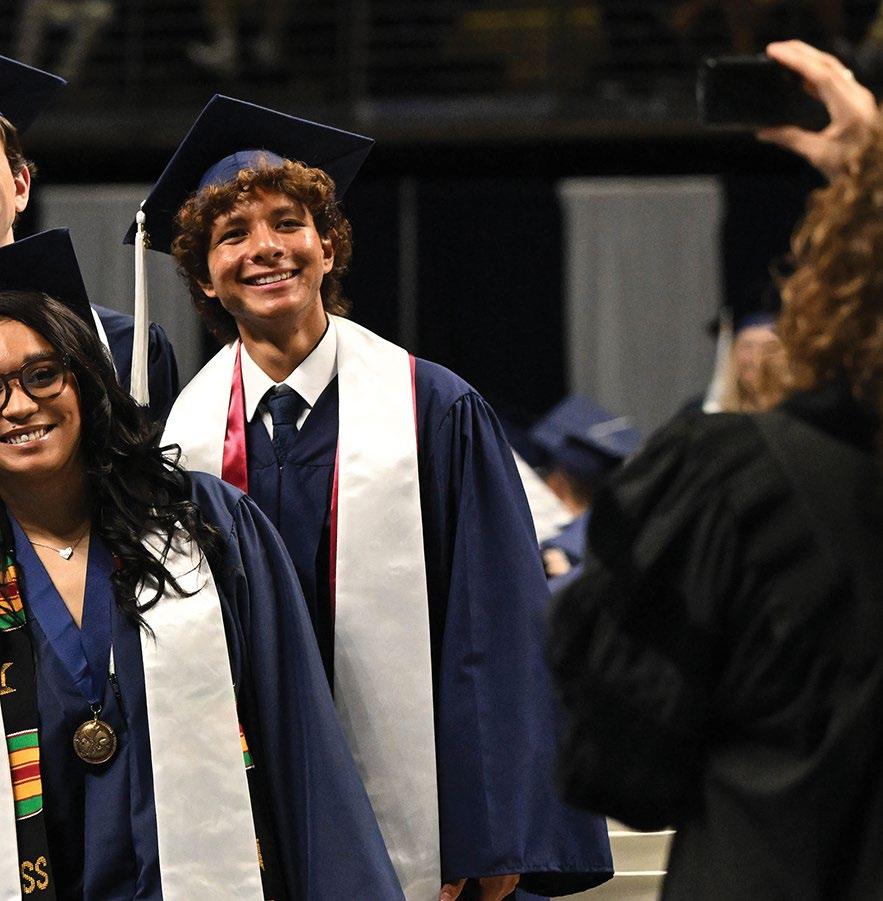

The University’s 412th set of commencement exercises included the Bellisario College event at the Bryce Jordan Center on Saturday, May 9, 2026, as 715 students crossed the stage and earned their degrees.
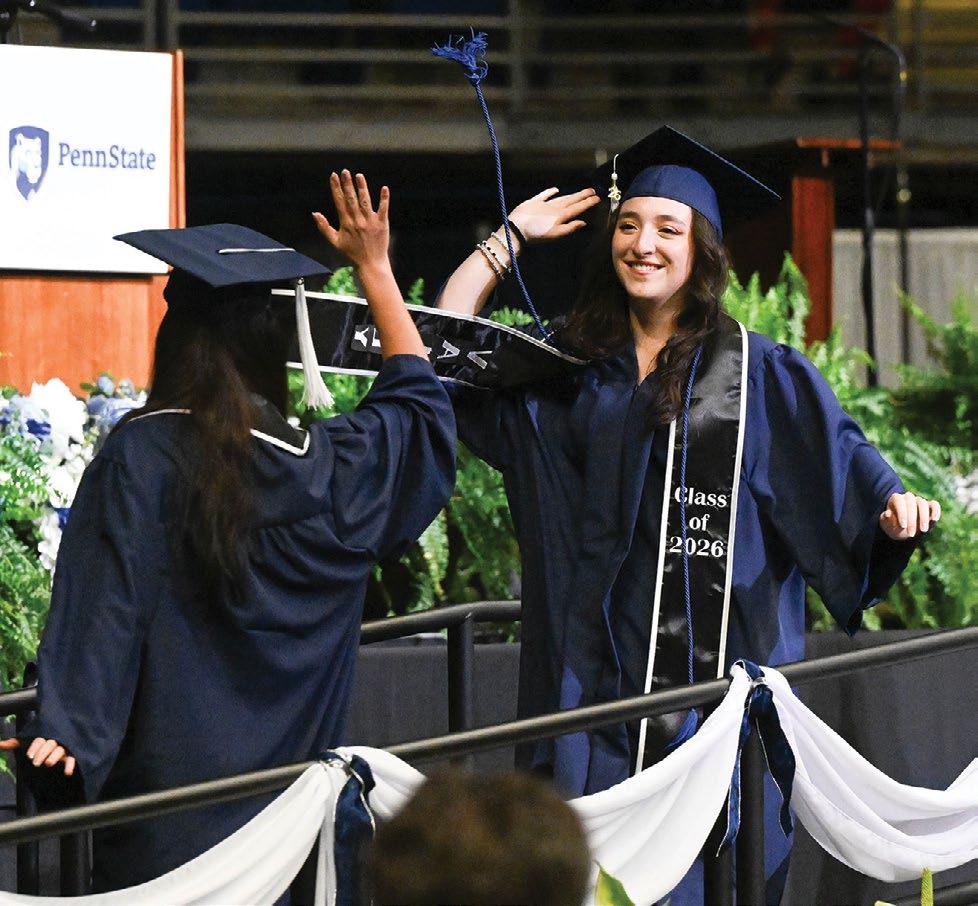
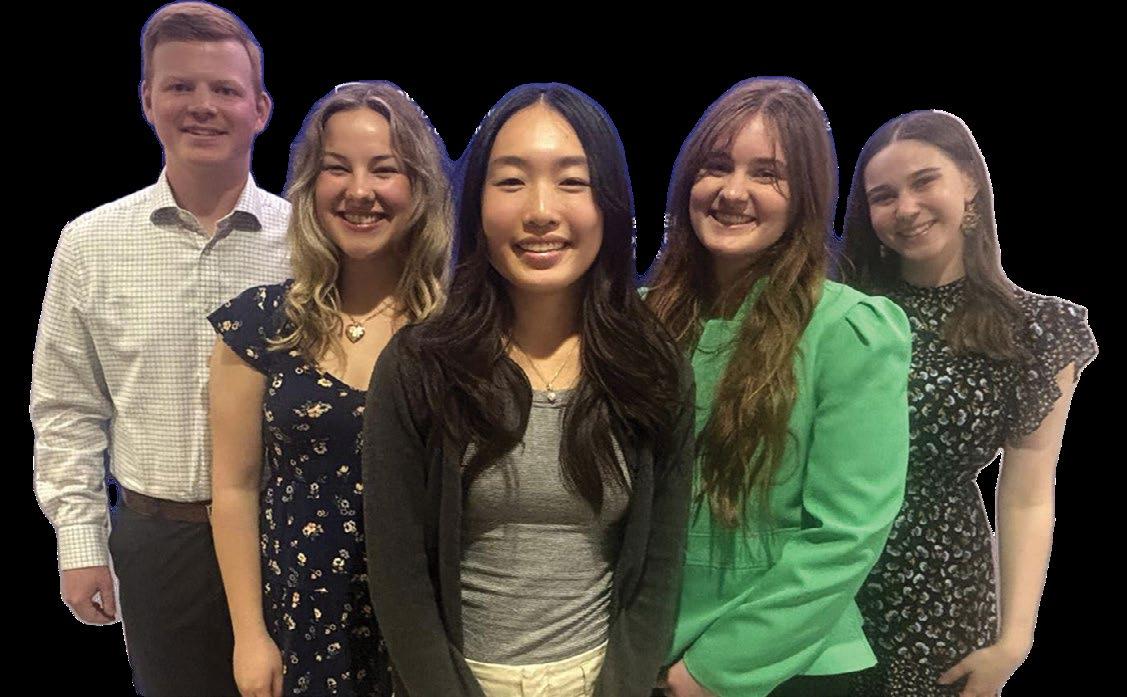
During the 2025-26 academic year, eight Bellisario College students were recognized as student marshals. Marshals are selected because of their combination of on- and off-campus success. The breadth and depth of their accomplishments represent a combination shared by many graduating seniors in the Bellisario College.
Those honored during the 2025-2026 academic year were:
FALL 2025
Bailey Allison (Brockway, Pennsylvania)
SPRING 2026
Overall
Kristen Jan (Cresskill, New Jersey)
Advertising/Public Relations
Lucy Bickel (Myerstown, Pennsylvania)
Film Production
Rachel Traub (Stroudsburg, Pennsylvania)
Journalism
Amanda Vogt (Wayne, New Jersey)
Media Studies
Emily Danczyk (York, Pennsylvania)
Telecommunications and Media Industries
Ryan French (Lancaster, Pennsylvania)
World Campus
Renato De Leon

Fall 2026
Sunday, Dec. 20 | 1 p.m.
Bryce Jordan Center
Spring 2027
Saturday, May 8 | 1:30 p.m.
Bryce Jordan Center
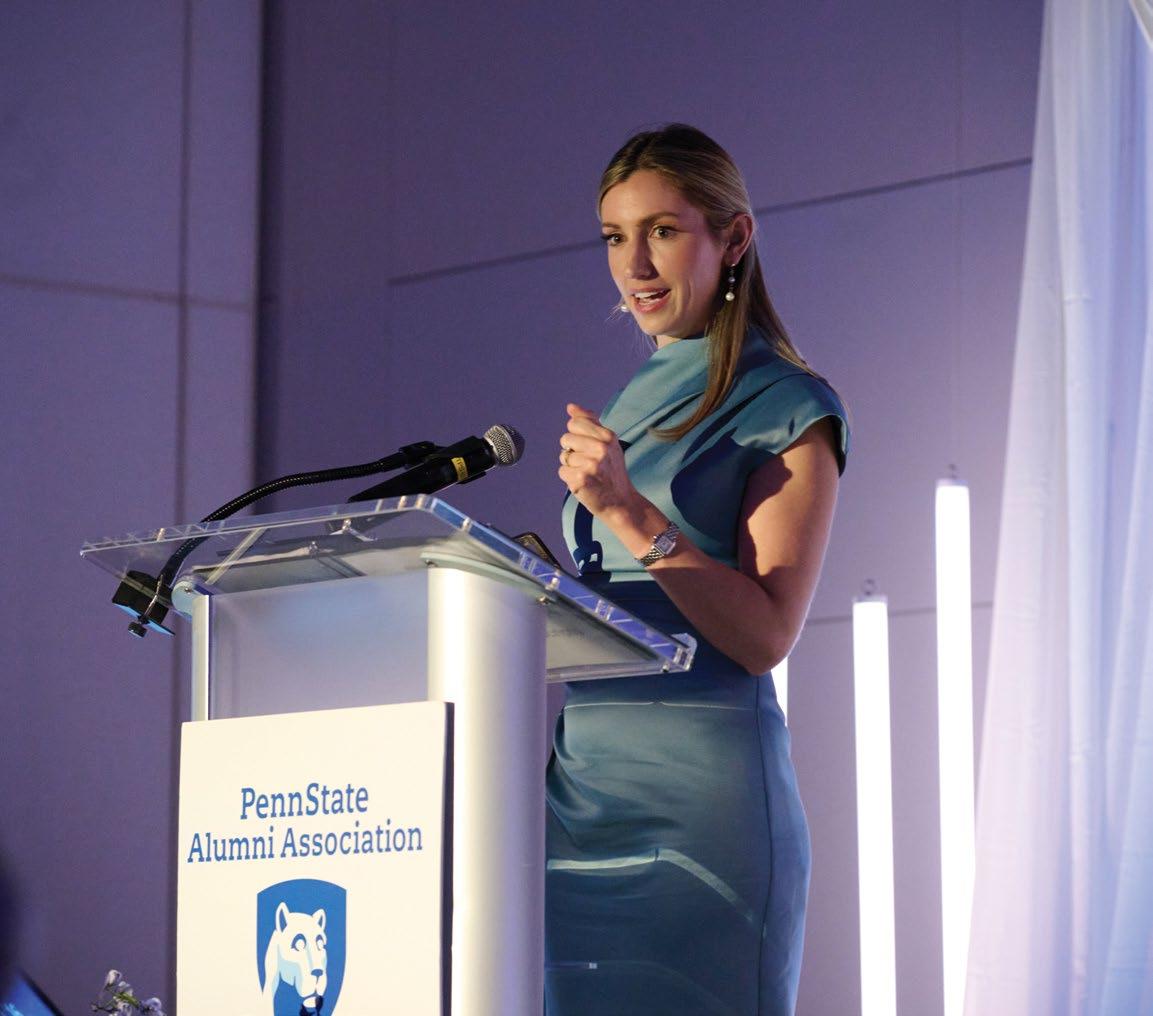
Alex Hogan (’16) was one of nine young Penn Staters honored this past year with the prestigious Alumni Achievement Award.
The award recognizes Penn State graduates aged 35 and younger for their extraordinary professional accomplishments. Nominated by their academic colleges, recipients are invited by the University president to return to campus to share their expertise and experiences with students, faculty and administrators — demonstrating the remarkable impact Penn Staters are making early in their careers. Celebration activities brought together the honorees, their families, University leadership, and Penn State faculty and staff to celebrate.
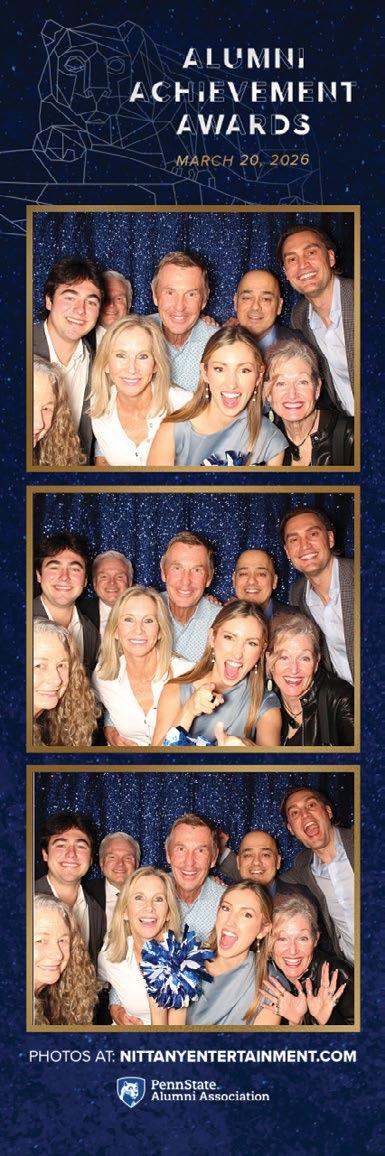
During the ceremony, President Neeli Bendapudi introduced the honorees and presented each with their award, designed by artist and Penn State Alumni Fellow Jeanne Stevens-Sollman. Bendapudi told the recipients, “You embody the very best of Penn State. You remind us that leadership begins with courage, innovation begins with curiosity, and impact begins with a willingness to step forward.”
Hogan is a foreign correspondent for FOX News Channel, covering international and domestic stories, including Ukraine, Taiwan and European humanitarian crises. A regional Emmy Award winner, Hogan brings a global perspective to her reporting and continues to engage with Penn State by mentoring students and sharing her professional experience.
Hogan was one of several honorees who spent time during their return to campus to meet with students and faculty, speak with classes and tour facilities — in her case the Bellisario Media Center.
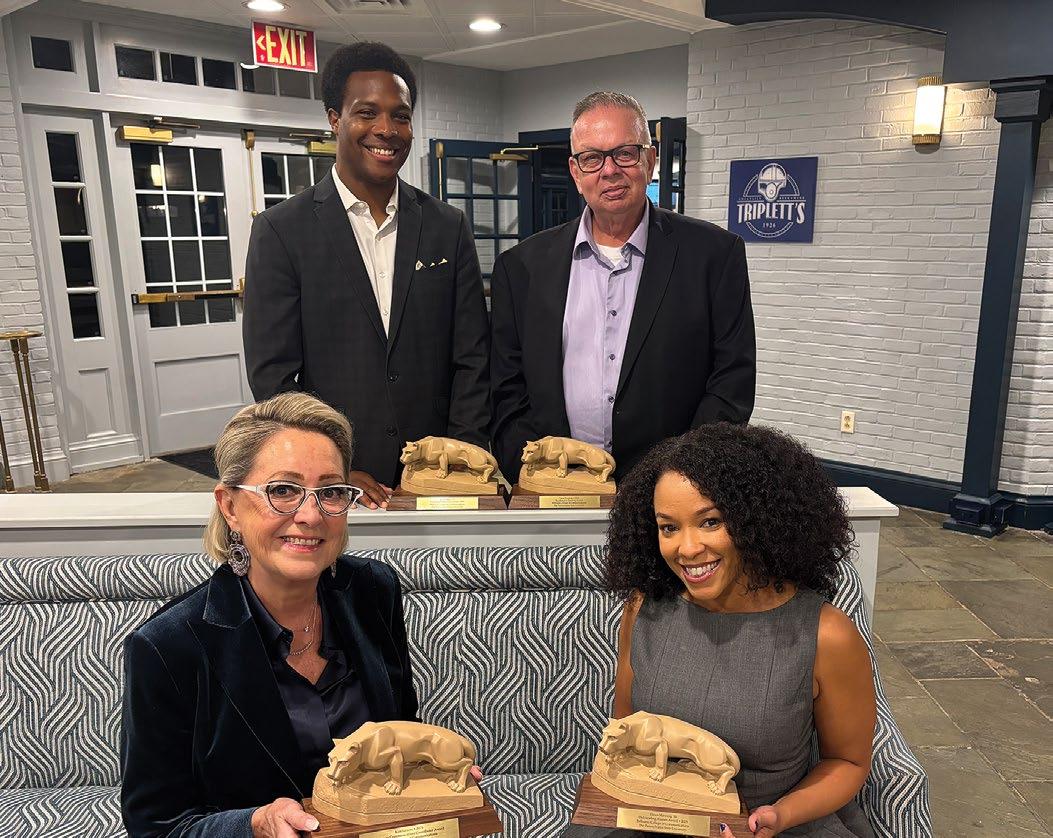

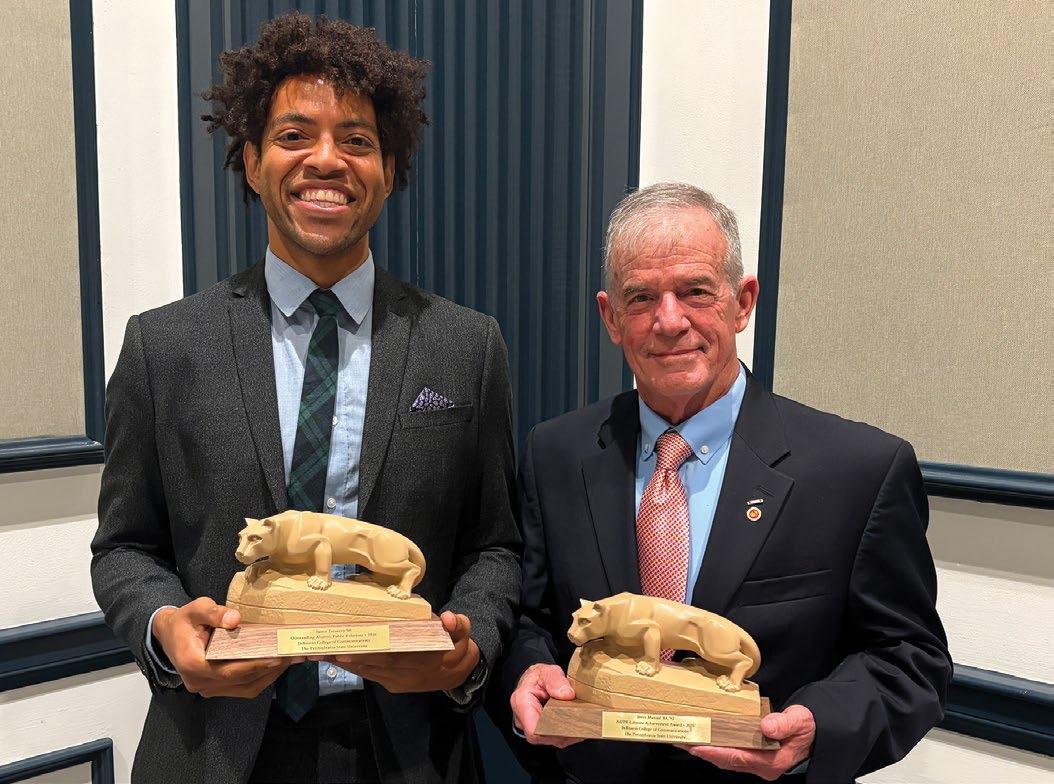
Ad/PR Network Board Award Winners Alumnus Bjorn Trowery (’08), head of consumer communications for Yelp and faculty member Steve Manuel (’84, ’92g) were among the honorees recognized by the Ad/PR Alumni Network Board with annual awards. Not pictured: Becky Kitlan (’07), group creative director for GALE.
On the second Monday of June, a seasonable evening in midtown Manhattan, Mike Poorman arrived at the meeting place and restaurant with large bags of blue-and-white decorations, door prizes and name tags as well as a couple of pull-up Bellisario College banners.
He was wearing a Hawaiian-style Penn State shirt and dark slacks. He was comfortable, a connector a networker in his element.
For more than two hours, Poorman stood behind the check-in table and welcomed everybody at the “We Are ... Networking in New York City” event, held annually for alumni who’ve graduated in the past decade from Bellisario College.

Poorman and the Alumni Society Board created the event, which has drawn about 100 alumni each year since it launched. It’s one of hundreds of mentoring, networking and alumni efforts Poorman conducted during his tenure as the Bellisario College’s director of alumni relations — a role he held for 20 years as the alumni based swelled to nearly 35,000.
Poorman didn’t know every Bellisario College alumnus by name, but it often felt that way.
Making connections made him tick.
He found joy helping students, young alumni, or even people he’d known for years make a connection with another alumnus.
Poorman’s relationship with the Bellisario College dates to his time as a Penn State student, nearly 50 years. Through the decades he’s served us in almost every possible role … volunteer, faculty member, staff member, advocate, colleague, mentor.
The Bellisario College’s alumni boards became more active and diverse during his tenure. He partnered across the Bellisario College, with his thumb on the pulse of activities and events. He valued the history of the unit, and especially the people who made that history.
In addition, Poorman was successful in the classroom, teaching a variety of classes and impacting thousands of students in that role — which made him even better as an alumni director.
He retired as director of alumni relations in the Bellisario College in early July, but will teach and do some research in the College of Health and Human Development going forward.

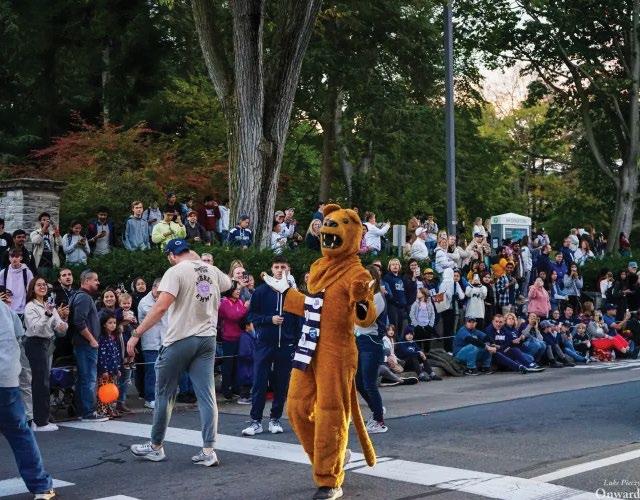
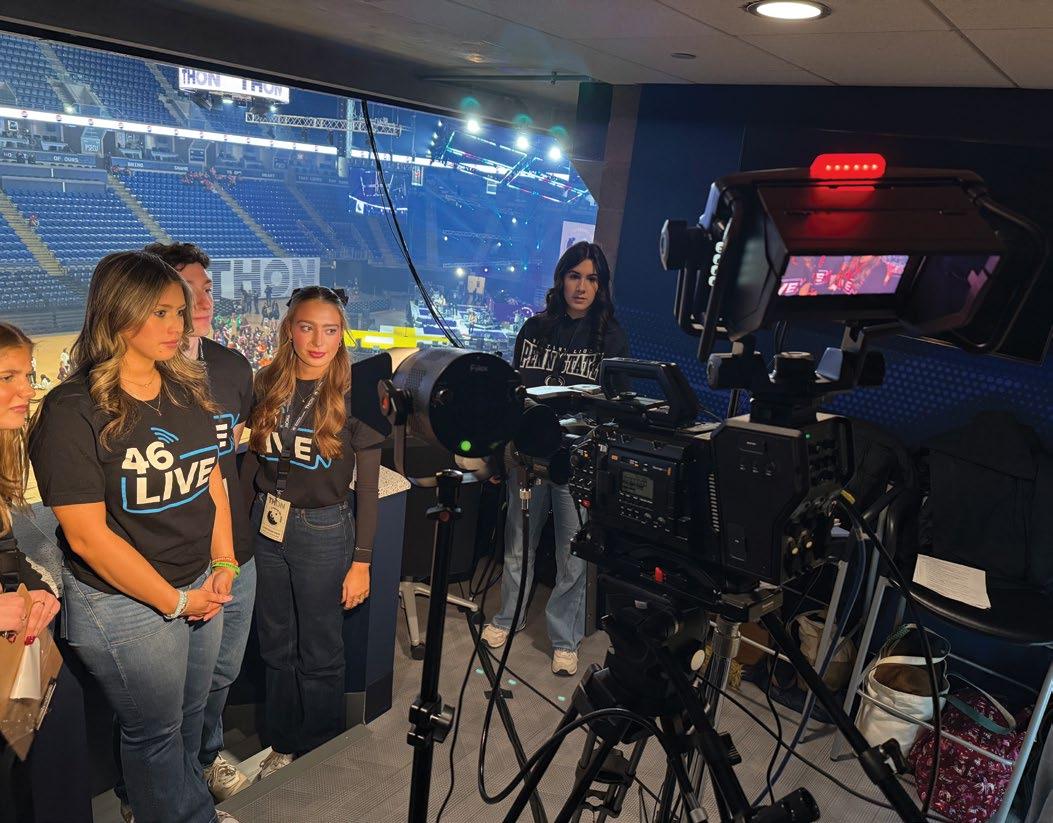

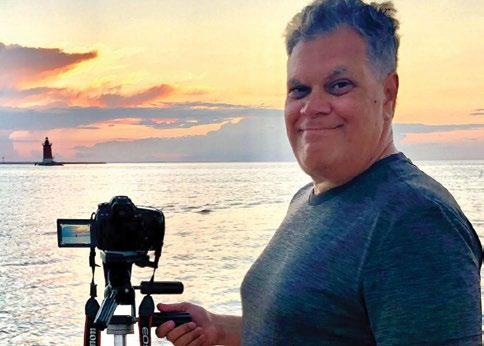
Patrick Littlewolf Brooks, artist, musician, storyteller
Michael Danese (’77 Film) recently published “Avenging Angela,” a fact-based short story about a hospital nurse at a maximum-security prison. The time is the early 1960s, when single working women were not the norm. Angela is a caring, compassionate nurse and a favorite among the staff. She has also tasked herself with ridding the world of those she decides are a threat to society. Or those whom she believes she is saving from terminal pain. This setting is perfect for a serial killer like her.
Rick Weber (’79 Journ) has contributed to his fifth Chicken Soup for the Soul book, “Angels and the Miraculous.” His other books include: “The Golf Book” and “Teacher Tales.” He also wrote an inspirational biography, “Pink Lips and Fingertips.” He has been a top-10 finalist in the APSE contest twice and won the 1994 Casey Medal for Meritorious Journalism for a package on teenage runaways, “A Tragedy, Not a Romance,” that was full of gripping stories of life on the street. He lives in Fort Myers, Florida.
Terry Mutchler (’87 Journ) chair of Philadelphia-based Obermayer Rebmann Maxwell & Hippel LLP’s Transparency and Public Data Practice, was honored with the Advocate of the Year Award from the Pennsylvania NewsMedia Association. Mutchler is a former journalist and the first executive director of Pennsylvania’s Office of Open Records.
Bryan E. Cummings (’90 Journ) retired as a sergeant with the Millersville University Police Department after a 31-year career in campus law enforcement. He was previously employed by Penn State Police Services as an auxiliary officer at the University Park and Hazleton campuses.
Dolphins Radio Network, which includes fellow Penn State alumni OJ McDuffie as a pregame host and Jimmy Cefalo as the lead play-by-play talent.
Aly Millman (’01 Telecomm) focuses on content acquisition, distribution and partnerships for Reframed Content Studios, which recently launched a FAST channel, “Cesar’s Pack Leader TV,” featuring Cesar Millan (“The Dog Whisperer”). The content, based on Millan’s training philosophy, is live globally.
Julia Ziegler (’03 Journ) is the director of news and programming for WTOP News in Washington, D.C.
Jennifer Shutt (’10 Journ, Lib) earned the 2025 Everett McKinley Dirksen Award for Distinguished Reporting of Congress by the National Press Foundation. Shutt is a senior reporter for States Newsroom’s Washington, D.C. Bureau. Shutt’s “clear, accessible reporting” on fast-moving Congressional action over the past year was highlighted by NPF judges, who noted her exemplary work covering the impact of Medicaid cuts on rural hospitals, shifts in FEMA duties and funding of tribal radio stations among other stories. Before joining States Newsroom, Shutt covered Congress for CQ Roll Call for more than six years.
Rossilynne Skena Culgan (’10 Journ, Lib) joined The Metropolitan Museum of Art as a senior editor.
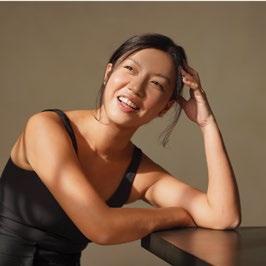
Patrick Littlewolf Brooks, artist, musician, storyteller
Sally Chia (’12 Ad/PR) is the co-founder of MakarttPro, which makes professional nail products accessible through multiple e-commerce channels, including the company’s website, Amazon and a TikTokShop.
Rachel Casciano (’15 Ad/PR) was named director/global brand management-performance activities at lululemon.
Sam Janesch (’15 Journ) joined The Philadelphia Inquirer as a national political reporter.
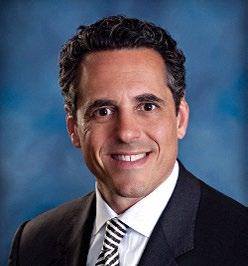
Patrick Littlewolf Brooks, artist, musician, storyteller
David Yadgaroff (’90 Brcab), senior vice president and market manager at Audacy Inc., was named to the 2025 Broadcast Pioneers Hall of Fame by the Philadelphia Ad Club.
Tina Hennessey (’93 Journ) joined Bowling Green State University as vice president for university advancement and CEO of the BGSU Foundation.
Will Althoff (’01 Journ) was promoted to assistant programming director of KIOD and WINZ in Miami. In 2025-26, he completed his third season as senior producer for the Miami
Paul Kemper (’16 Journ) is a marketing manager at American Prairie.
Callie Curley Smith (’18 Journ) joined the Northeast Dairy Producers Association, a resource and network hub for New York’s family dairy farms for more than three decades, as the organization’s director of membership and communications. A lifelong advocate for agriculture, she has led communications for a privately owned dairy ingredient manufacturer, a farmer-owned agricultural retail cooperative and a statewide agricultural membership organization. She grew up on a family dairy farm in Pennsylvania. She lives in Indianapolis.
Katie McFadden (’18 Journ, Lib) joined Chief as senior manager, brand and member communications.
Hugh Kibera (’26 Journ) accepted a network associate position with C-SPAN in Washington, D.C.
Patrick Littlewolf Brooks, artist, musician, storyteller
Haley McCullough (’24 Ad/PR) joined the Atlanta Falcons as a fulltime video editor.
Andrea Prest (’24 Ad/PR) has joined Razorfish as a paid social senior analyst.
Molly White (’25 Journ) accepted a full-time role as a social media coordinator with the Philadelphia Eagles.
Josh Bartosek (’25 Journ), who works for the Rochester Grizzlies professional hockey team, was named NATV Broadcaster of the Year.
Anna Licastro (’26 Journ) accepted a position as a reporter at WJAC-TV, which serves the Johnstown/Altoona/State College markets.
Dylan Molis (’26 Telecomm) joined Hearst Television as a Marty Faubell Broadcast Technology fellow at WYFF-TV in Greenville, South Carolina.
High school students from across Pennsylvania were honored for their work in multiple categories when the Bellisario College hosted the annual Mid-Atlantic Region’s National Student Production Awards. The event inside the Bellisario Media Center showcased student work and provided the opportunity for advisers and students to network — and for students to envision a potential future at Penn State.
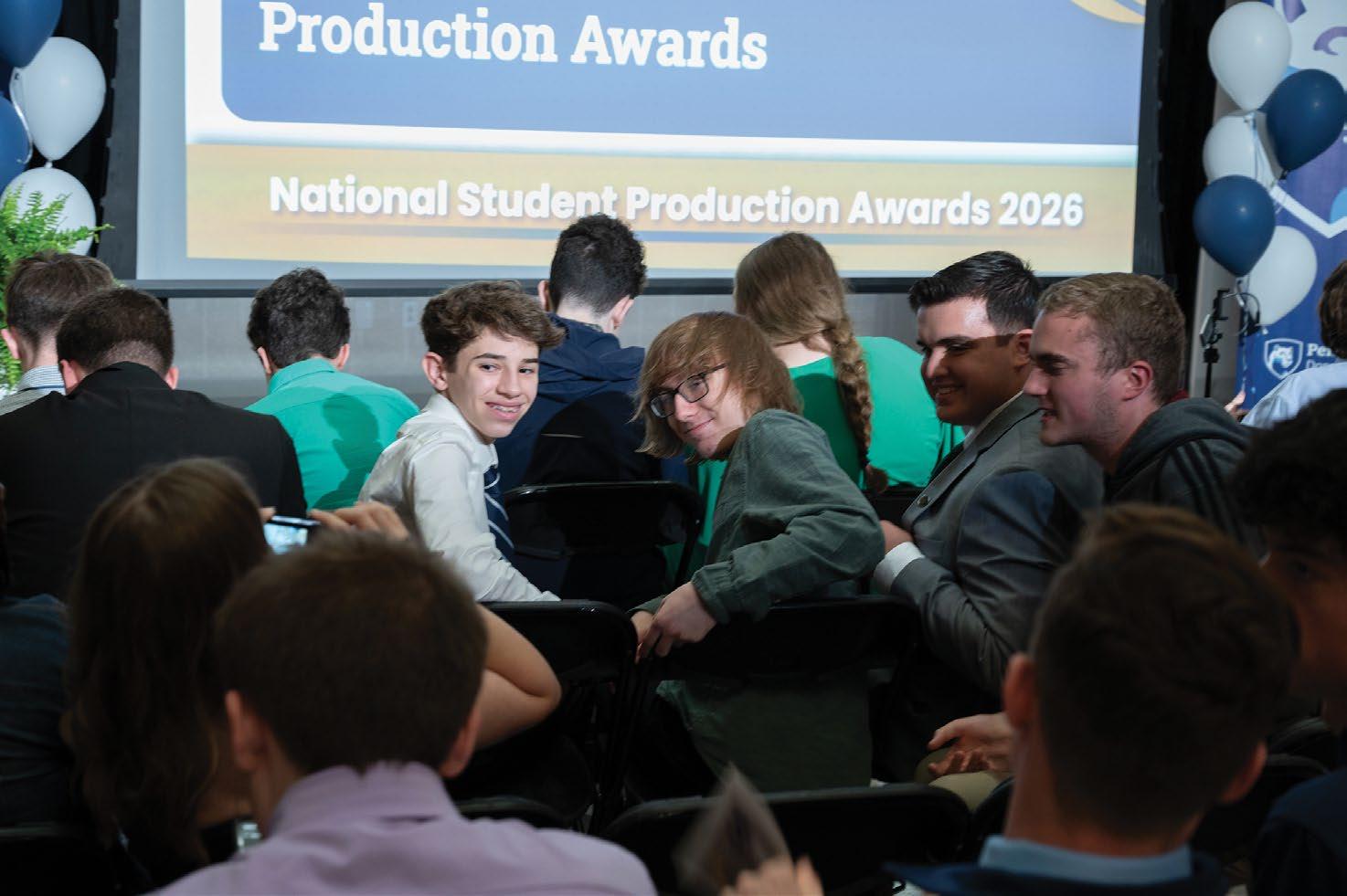
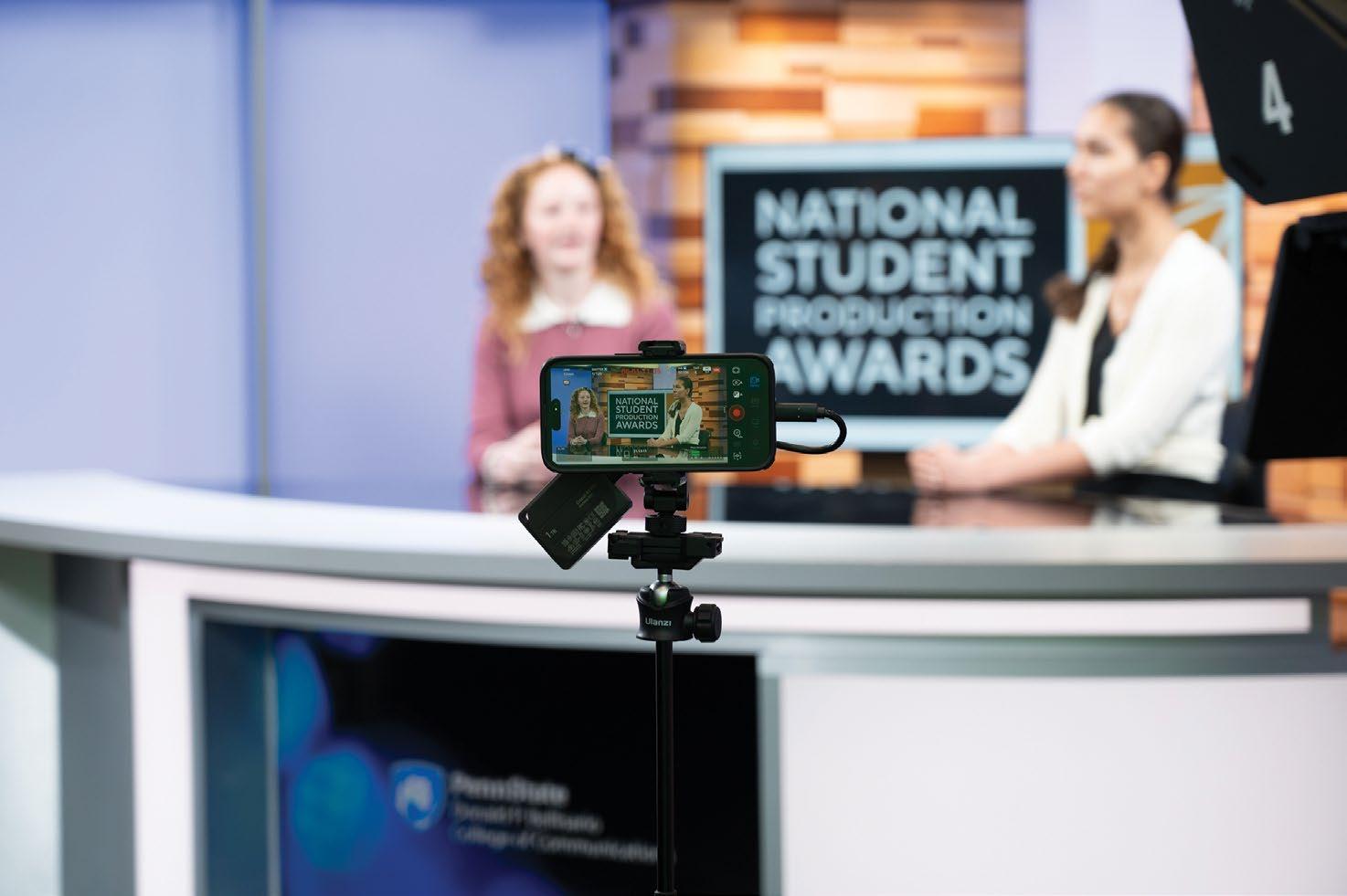
Mimi Barash Coppersmith, a Penn State alumna and philanthropist, publishing and advertising entrepreneur, and the first woman to chair the Penn State Board of Trustees, died on Sept. 14, 2025. She was 92.
Barash Coppersmith had a notable career beginning from the time she earned a degree in journalism from Penn State in 1953 until her death, during which time she improved the State College community through her unmatched drive and passion, as well as her hands-on service. As co-founder of the State College-based advertising and publishing firm The Barash Group with her late husband Sy Barash, Barash Coppersmith focused on highlighting the region and helping to uplift women. She held the role of president of The Barash Group and publisher of Town & Gown Magazine for nearly 50 years before she sold her businesses in 2008. Barash Coppersmith was known for her “Lunch with Mimi” column in Town & Gown, which featured notable members of the Penn State and local communities.
She was elected by alumni to serve on Penn State’s Board of Trustees from 1976 to 1997 and was named trustee emerita in 1997. Barash Coppersmith was the first woman chair of the board and held the position in 1991 and 1992.
A vital part of the State College community since arriving in 1950, Barash Coppersmith was actively involved with many local and community organizations, including serving as president of the State College Area Chamber of Commerce (today known as the Chamber of Business & Industry of Centre County), the Central Pennsylvania Festival of the Arts, and Penn State’s Renaissance Fund. She was the capital campaign coordinator for Centre LifeLink EMS, a member of the Palmer Museum of Art Advisory Board, and an honorary chair of the State College Choral Society’s Holocaust Memorial Project.

Charles Bierbauer, whose career in journalism took him all over the world and who later became a leader in higher education, died Friday, Aug. 29, 2025. He was 83.
Bierbauer worked for CNN in Washington, D.C., and around the world from 1981 to 2001. He covered the Pentagon and was the network’s senior White House correspondent for nine years during the presidencies of Ronald Reagan and George H.W. Bush.He later became a senior Washington correspondent, focused on the presidency, policy and politics. He also covered presidential campaigns and the Supreme Court between 1984 and 2000.
Bierbauer traveled with presidents to all 50 states and more than 30 nations and served as president of the White House Cor-
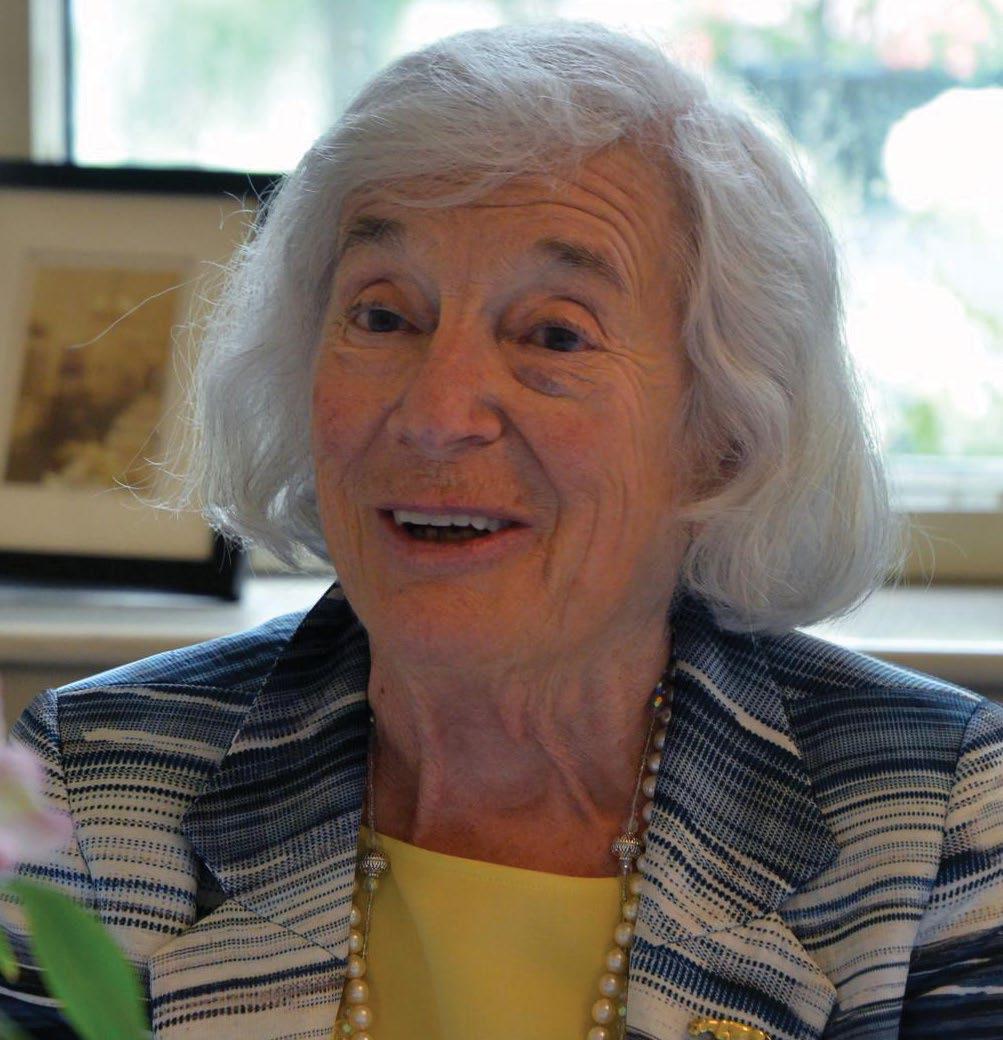
With a long-standing commitment to philanthropy, Barash Coppersmith dedicated her efforts to multiple causes, including the American Cancer Society, Centre County Historical Society, Centre Safe, Girl Scouts, Pennsylvania Pink Zone and the Youth Service Bureau, among many others.
At Penn State, she was a driving force behind the creation of the Renaissance Fund, which offers scholarships to students with academic talent and financial need. Since the fund was established in 1969, it has raised more than $26 million in endowed funds, and it inspires support by honoring community leaders with named scholarships.
respondents’ Association from 1991 to 1992.
He won an Emmy Award for his coverage of the 1996 Olympic Park bombing in Atlanta. He also won an Overseas Press Club Award in 1973 for his reporting on the Yom Kippur War.
In 1980, Bierbauer was named an Alumni Fellow, the most prestigious award given by the Penn State Alumni Association, and he was honored in 1991 with a Distinguished Alumni Award, the University’s highest honor for alumni.
As a Penn State student, he was a resident assistant and earned the Steinman Journalism Award.
As an alumnus, he was an active and regular participant in the Penn State Washington Program and a member of the Hetzel Circle Club.
After Bierbauer retired from CNN in 2001, he became the first dean of the University of South Carolina’s College of Mass Communications and Information Studies in 2002. He left that role in 2017.
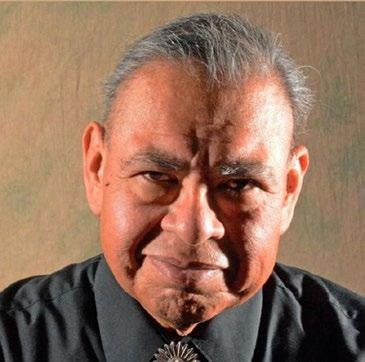
John Sanchez, an associate professor in the Donald P. Bellisario College of Communications, died March 12, 2026. He was 72.
Sanchez, who earned the Dr. James Robinson Award from the University in 2023, became a member of the Penn State faculty in 1997. Sanchez also was a recipient of the Excellence in Teaching Award from the Bellisario College Alumni Society and was named a distinguished professor in the Schreyer Honors College. Upon his retirement in 2024, he was granted emeritus status; of all his academic accomplishments and awards, he was most proud of this honor.
The Dr. James Robinson Award, sponsored by the Penn State Alumni Association, was established in 1988 and renamed in 1998 to honor the late James Robinson, a distinguished alumnus and former Alumni Council member. It recognizes a fulltime faculty or staff member with at least two years of active service who promotes opportunity through and/or contributes to enhancing the educational environment of the University by improving cross-cultural understanding.
Nominators said Sanchez was a transformative teacher and leader at Penn State through his outreach and education efforts.
Sanchez brought an understanding and appreciation of cultural and ethnic differences to his classroom, nominators said. He educated the next generation of journalists and public communicators about critical elements of inclusion, respect and diversity.
Students said Sanchez was an educator who encouraged them to think deeply and with empathy for others — they leave not just educated, but better informed.
Sanchez, a member of the Apache Nation, also is widely known for the Penn State Powwow, which he founded. The two-day event celebrated its 20th year in 2026. Sanchez raised funds and organized the two-day event that brings about 250 American Indian dancers from across the continent to State College. Thousands of visitors attend each year to participate in the event and learn about American Indian culture, crafts, dance, food and traditions.
Sanchez taught news media ethics, including an honors section, and a course about American Indians and the media.
American Indian identity in the 21st Century, specifically at the intersection of American Indian cultures and the American news media, was Sanchez’s area of interest and research. He published widely, including articles in Communication Quarterly, Communications Studies, The Howard Journal of Communications, Journal of American Indian Culture and Research, and Teacher Education Quarterly, among others. Sanchez also wrote “American Indians and the Mass Media,” the first book of its kind, which was published by Oklahoma Press.
Sanchez was named one of the leading scholars in the field of intercultural studies by The Communication Institute for Online Scholarship. He also was a Freedom Forum Teaching Fellow and an AEJMC/ASJMC Freedom Forum Journalism Leadership in Diversity Fellow. He served on the executive boards of the CIC American Indian Studies Consortium and the American Native Press Archives and as a consultant to the board of directors of the American Indian Policy and Media Initiative.
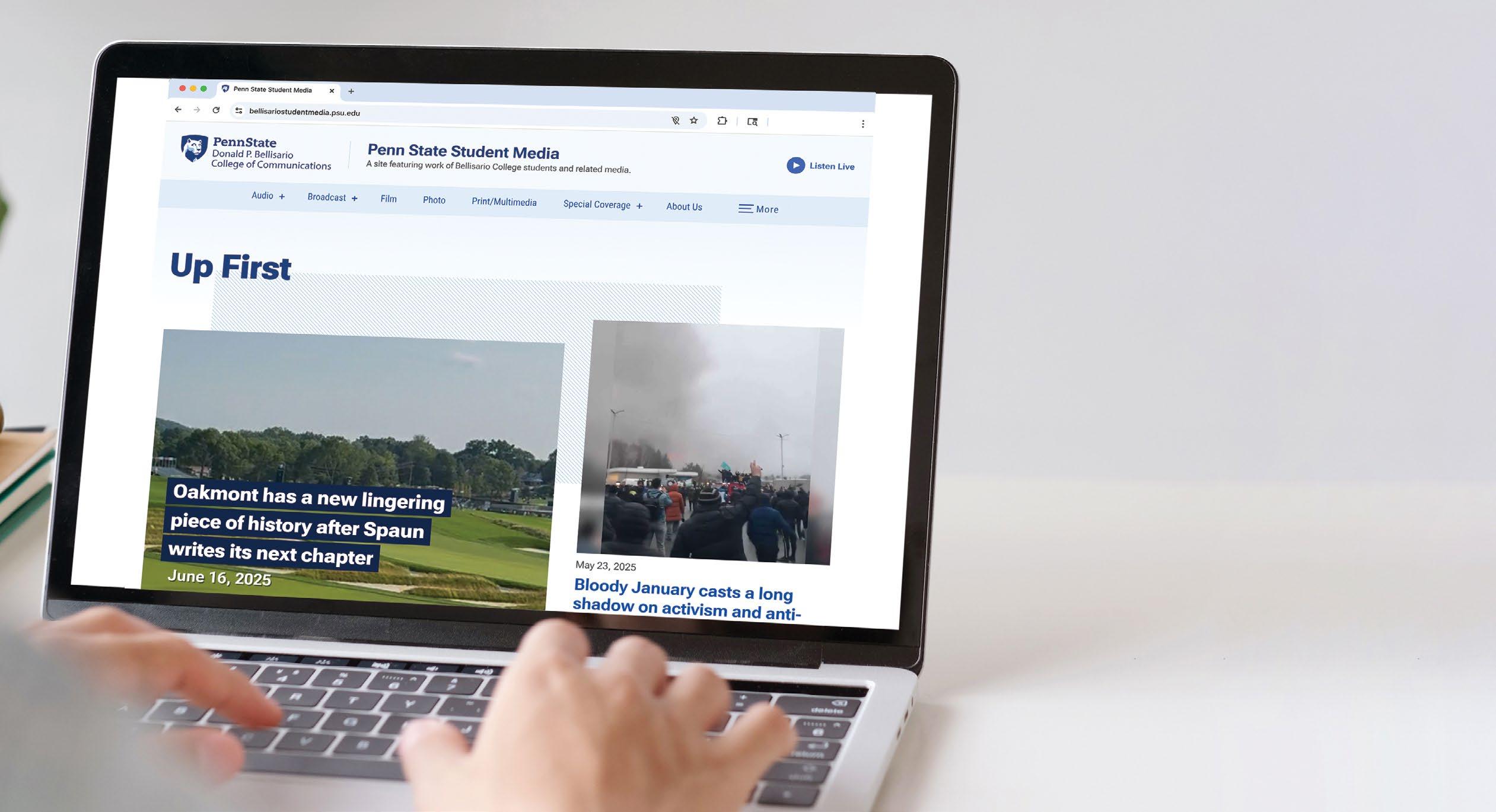
The home for work produced by Bellisario College students. Newscasts, international reporting, films, special programming and more.
Mike Abrams (’94), deputy editor for trust, The New York Times
Eugene Ofori Agyei, assistant professor, Knox College
Barbara Allen, founder, CollegeJournalism.org
Kevin Alonzo (’15), account senior communications manager, National Basketball Association
Marian Arias, head of corporate communications, Harlem Globetrotters
Geoff Arbourne, film producer
Tresa Baldas, courts reporter, Detroit Free Press
Jeff Ballou (’90), producer, ABC News
Robyn Batsell, casting recruiter/associate producer, Lighthearted Entertainment
Leah Beasley, deputy athletic director for strategic engagement and brand advancement, Penn State
Hannah Bennett (’14), vice president/brand partnerships, Omaha Productions
Greg Bishop, senior writer, Sports Illustrated
E.J. Borghetti, special assistant to senior vice chancellor for external relations, University of Pittsburgh
Jack Brewster, CEO, Newsreel
Matt Brown, founder, Extra Points
Pamela Brunskill, senior director of education design, News Literacy Project
Judson Burch (’92), former vice president/ production, ESPN
Paula Knudsen Burke, senior supervising attorney, Reporters Committee for Freedom of the Press
John Canzano, independent sports columnist and radio host
Shirley Carswell, executive director, Dow Jones News Fund
Neal Chase, CEO, CalMatters
Peter Cherukuri, CEO, UpNext
Kevin Cirilli (’11), founder, meet the future
Meredith Clark, assistant professor, University of Virginia
Brianna Cooper (’16), producer “90 Day Fiancé” franchise
Dan Cox, senior vice president/strategy, Harmelin Media
Reid Davenport, documentary filmmaker
Trevor de Gorter, advertising marketing manager, Tubi
Mare D. De Jesus, director/Pictures of the Year, University of Missouri
Anjanette Delgado, managing editor for state news, Hearst Connecticut
Chris Dell, founder and editor-in-chief, Fantasy Edge Media
Will DiBonaventura (’24), strategic communications specialist, CzechMates
Brian Dickerson, retired editorial page editor, Detroit Free Press
Kiely Doerr (’24), associate/media and engagement, Real Chemistry
Chris Dolack, director of communication and creative, World Racing Group
Abby Drey, journalist, Centre Daily Times
Rebecca Droke, photojournalist
Wyatt Dubois (’00), senior director/public relations, Penn State
Brooke Erin Duffy (’02), associate professor, Cornell University
Ryan Ehrie, assistant athletic director/ Commonwealth Campuses, Penn State
Michael Elavsky, adjunct associate professor, Masaryk University
ML Elrick, Pulitzer Prize-winning reporter and columnist, Detroit Free Press
Kristin Ennis (’04), vice president/internal communications, The Campbell’s company
Paul Fahri, former media reporter, Washington Post
Michael Fimognari (’96), director/cinematographer/producer
Patrick Finn, vice president/programming and operations, FOX Sports
Whit Friese (’90), vice president/creative marketing, Home Depot
Joe Galiani, author
Pete Gergley (’01), director/content and fan experience, New York Yankees
Matt Goldberg, director of experimental research, Yale Program on Climate Change
Dustin Gouker, co-founder, The Closing Line
Teresa Gould, commissioner, Pac-12 Conference
Manuel Goyanes, associate professor, Universidad Carlos III-Madrid
Megan Grasser, political ad sales manager, EffecTV
Lauren Groff, (’24), communications leadership development program associate, RTX
Tom Hallman Jr., storyteller and teacher
Teresa Hamilton, assistant professor, Penn State
Julie Hancher (’06), co-founder and editor, Green Philly
John Hanna, associate director of athletic strategic communications, Penn State
Marlene Harris-Taylor, director of community engagement, America Press Institute
Elizabeth Harvey, performance analytics manager, Clorox
Cati Hence, senior manager/strategic partnerships, FOX Sports
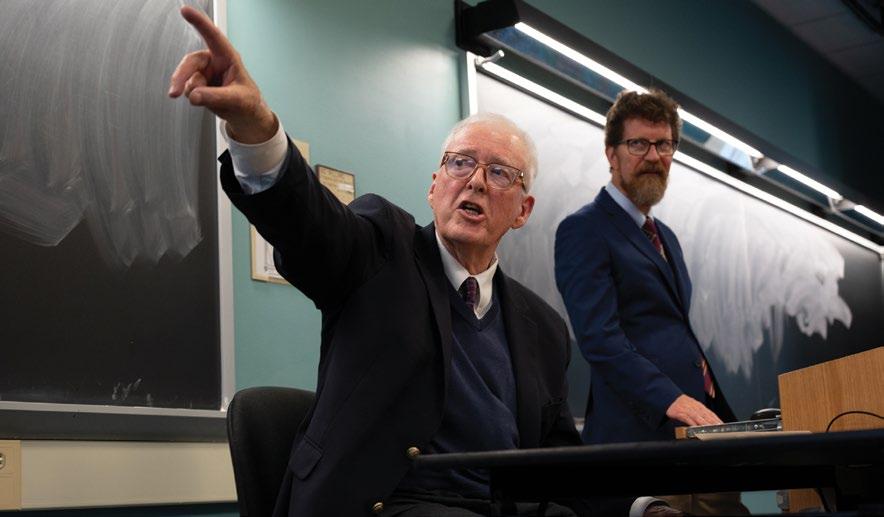
Paul Hendrickson (’68 MA), author and journalist
Maria Hinojosa, journalist
Jerry Hoak (’03), chief creative officer, Martin Agency
Ryan Hockensmith (’01), writer, ESPN
Julia Hoover (’14), internal communications manager, Instagram
Alistair Hogg, founder and executive director, Sunday Red Digital
Emma Holtz (’24), marketing assistant, University of Mississippi
Chuck Huff, professor. St. Olaf College
Ali Ingersoll (’12), investigative producer, NBCUniversal
Breanna Jacobs (’14), associate director/strategic communications, Ohio State Athletics
Rich Jaroslovsky, founding editor, WSJ.com
Jeff Jarvis, media critic, author and emeritus professor, CUNY
Jim Jimirro (’58), former chairman and CEO, Walt Disney Television
Mikel Jones (’15), senior vice president/sports PR, Prosek Partners
Matthew Jordan (’14) director of communications/sports, William Morris Endeavor
Callie Kalny, Ph.D. candidate, Northwestern University
Tianna Karlin (’18), director of communications, United Entertainment Group
Paul Keeling, director of talent, West Shore Home
Dean Kenefick, senior associate athletic director, Villanova University
Emily Ketchen, senior vice president/CMO, Lenovo
Kathy Kieliszewski, executive editor of innovation, Bridge Michigan
Mike Kilian, editor, Rochester Democrat & Chronicle
Ted Kim, director of newsroom careers program, The New York Times
Greg Kincaid (’10), assistant athletic director, Penn State
Ken Kitch (’98), group executive producer, Johannes Leonardo
Lisa Knight, director of media, West Shore Home
Lisa Krantz, assistant professor, University of Montana
Samindra Kunti, investigative sports journalist
Pamela Krayenbuhl, assistant professor, University of Washington Tacoma
Chris Krewson (’98), executive director, Local Independent Online News
Keeley Lamm (’25), marketing coordinator, Bananas Foster Inc.
Melissa Langer, cinematographer and documentary filmmaker
Peter Leimbach, senior vice president, FOX Entertainment/Sports
Justin Leusner (’24), founder, TDAY Sports
Samantha Leybman (’12), senior director of marketing, Philadelphia Union
Baylor Long (’09), news director, WTAE-TV
Kija Lucas, photographer
Leticia Malavasi, sport manager, LA28 Olympics and Paralympic Committee
Tony Mancuso (’08), senior director/digial media operations, New York Jets
Dawn Manning (’00), vice president of production, Westbrook Media
Sean Marcus, interactive learning designer, MediaWise
David Marchenko, founding production lead/AI experiences, Electronic Arts
Jenna Meleedy (’25), media literacy educator, National Association for Media Literacy Education
Melissa Melewsky (’99), in-house counsel, Pennsylvania NewsMedia Association
Maggie Metnick, actor and director
Mateja Mir, project manager, RTV Slovenia
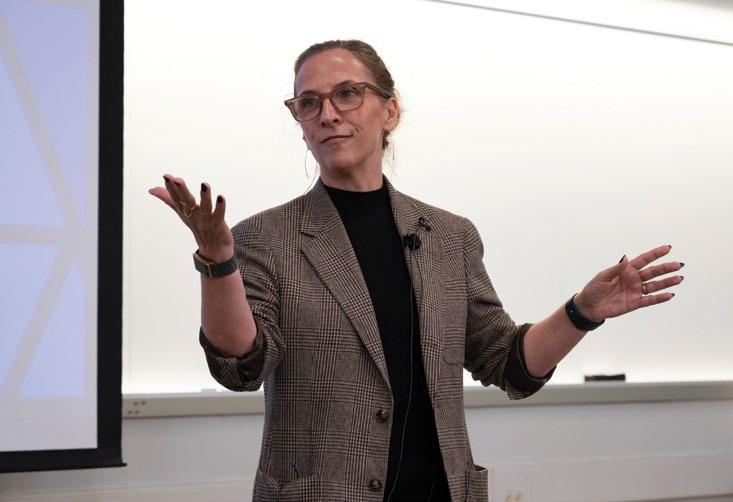
Patty Michalski, senior vice president/ content strategy and innovation, Hearst Newspapers
Asria Mohamed, artist and filmmaker
Fabio Montanari, filmmaker
Brian Moritz, associate professor, St. Bonaventure University
Josh Moyer (’08), reporter, Centre Daily Times
Heather Murray, associate director, Cornell University Law School First Amendment Clinic
Sharbil Nammour, founder/managing partner, Vallaris Consulting
Steven Nammour, actor
Liz Kelly Nelson, founder, Project C
Julie Noal, managing editor, Centre County Gazette
Isabella Pacheco (’25), assistant account executive, Lippe Taylor
Jim Pasquarella, vice president, HISTORY, A+E Global Media
Lukas Pietrzak, director of public policy, Fiber Broadband Association
Samantha Powell, talent acquisition specialist, West Shore Home
Sarah Rafacz (’15), State College bureau editor, SpotlightPA
Crystal Ramsay, senior director, Penn State TLT
Erik Reynolds, founder, Strategic Entertainment
Anna Stefano Robinson (’11), head of executive communication, AbbVie
Angela Rocco, sales and marketing specialist, AMP Sales & Marketing Solutions
Jen Roth, Daytime Emmy-winning TV editor
Hernando Rojas, Firstbrook Franklin Professor, University of Wisconsin
Alysa Rubin (’23), digital media archivist, Pittsburgh Steelers
Geoff Rushton (’01), managing editor, StateCollege.com
Ralph Russo, senior writer, The Athletic
Bill Ruthhart, writing coach and editor, The New York Times
Jonathan Salant, political columnist, Pittsburgh Post-Gazette
Jim Schaefer, executive editor, Detroit Free Press
Carly (Hart) Schammel (’21), marketing and communications specialist, Deloitte
Eric Shirk (’07), human resources internal communications director, University of Maryland Medical System
Colin Smeeton, president, Authentic Studios
Audrey Snyder (’12), founder, Inside the Lions
Ryan Stevens (’16), senior manager/corporate communications, Houston Rockets
Jillian Susi (’18), public relations and communications manager, Spotify
Kelsey Sweet, influencer and cause marketing manager, Buffalo Bills
Jeff Szklinski (’12), senior manager/ communications, CBS Sports
Asria Taleb Mohamed, artist, journalist and human rights defender
Devon Taylor (’09, ’13), senior vice president/ strategy, Klick
Al Tompkins, journalism teacher, Poynter Institute
Katie Thornton, freelance journalist
Dan Victor (’06), senior live editor, The New York Times
Joe Walther, distinguished professor, UC Santa Barbara
Aubrey Whelan (’11), staff writer, Philadelphia Inquirer
Judi Weiss (’89), senior remote operations producer, ESPN
Brandon Williams (’08), vice president/global communications, Fanatics
Rodnell Workman (’95), managing partner, MarketingWORK Advisors LLC
Amanda Curtis Young (’08), senior vice president/marketing and communications, Philadelphia Union
Marc Brownstein (’81), CEO, Brownstein Group
Ad/PR Alumni Network Board
Elizabeth Fetter (’80), managing partner, Frontier Insights LLC
Jeanmarie Biemer (’17 Journ)
Richard Frank (’94 Eng)
Kelly Gallagher (’14 Ad/PR)
Dan Hartman (’85), media consultant, Hartman Media
Mike Marcus (’67), head of management, Echo Lake Entertainment
Caitlin Rush (’12 Ad/PR)
Jordan Rednor (’75), president, Rednor Group
Suzanne Schulner (’08 Ad/PR), past vice president
Mary Meder (’84), president, Harmelin Media
Anne Sparkman Glassmyer (’04 Ad/PR)
Amanda Harrington (’16 Ad/PR)
Becky Kitlan (’07 Ad/PR)
Jayne Jamison (’78), former SVP and publisher at O, The Oprah Magazine
Steven Lampert (’74 Journ), past president
Adam Pietrala (’04 Ad/PR)
Alexandra Piscitelli (’13 Ad/PR)
Jessia Kartalija (’01), national correspondent, NewsNation
Melanie Querry (’98 Ad/PR)
Ned Show (’89 Journ)
Tara L. Smith (’06 Ad/PR), president
Terry Mutchler (’87), chair of transparency and public date practice, Obermayer Rebmann Maxwell
Joanne Ryder (’96), retail distribution marketing strategy, TD
Evan Spector (’95 Econ)
Heather Wagner (’18 Ad/PR)
Allison Wulfhorst (’20 Ad/PR)
Jackie Jamieson Szafara (’83), executive director, National Arts Program
Holly Semanchick Xhema (’15 Ad/PR), vice president
Eric Rabe (’68), senior communications counselor
Sean Reardon (’98), CEO, Epsilon
Carolyn Xu (’08), founder, Fortae Co.
Jasper Abrahams (’26 Journ), student rep.
Lucy Bickel (’26 Ad/PR), student rep.
David Yadgaroff (’90), market manager, Audacy Philadelphia
Australia 8
Bahrain 1
Bangladesh 1
Bolivia 2
Brazil 4
Brunei 1
Canada 28
Cayman Islands 1
China 474
Colombia 1
Cyprus 5
Dominican Republic 2
Ecuador 5
Egypt 1
England 5
Fiji 1
Finland 1
Germany 5
Ghana 1
Greece 2
Grenada 1
Guatemala 2
Honduras 1
Hong Kong 20
Hungary 1
Iceland 1
Italy 6
Iran 1
Ireland 1
Israel 2
India 26
Indonesia 2
Japan 18
Jordan 2
Bellisario College alumni live in 66 different countries
Ad/PR Network Board
Tara Smith. (’06), president
Holly Semanchick-Xhema (’15), vice president
Allison Wulfhorst (’20), secretary
Jeanmarie Biemer (’17)
Richard Frank (’94)
Kelly Gallagher (’14)
Amanda Harrington (’16)
Adam Pietrala (’04)
Alexandra Piscitelli (’13)
Melanie Querry (’98)
Caitlin Rush (’12)
Anne Sparkman Glassmyer (’04)
Evan Spector (’95)
Heather Wagner (’18)
Kazakhstan 9
Korea, Republic of 136
Kuwait 3
Malaysia 12
Mexico 3
Mongolia 1
Netherlands 4
New Zealand 2
Nigeria 2
Pakistan 1
Panama 2
Philippines 2
Poland 2
Puerto Rico 1
Qatar 1
Romania 1
Russia 1
Alumni Society Board
Maddy Pryor (’13 Ad/PR), president
Nancy Berman (’19 Ad/PR), vice president
Kelsey Bell (’20 Ad/PR), secretary
Jocelyn Antol (’12 Journ)
Michael Appleman (’15 Journ)
Felicia Bray (’07 Journ)
Emily Chambers (’16 Ad/PR)
Adrea Cope (’17 Ad/PR)
Alex Gilliland (’14 Journ)
Saudi Arabia 2
Singapore 7
Spain 6
Sweden 1
Switzerland 5
Taiwan 46
Thailand 8
Turkey 1
Uganda 1
Ukraine 1
United Arab Emirates 8
United Kingdom 23
Venezuela 4
Vietnam 4
Zimbabwe 2
Military Abroad 16
5.2% of Bellisario College alumni live outside the United States
Jack Hirsh (’20 Journ)
Sean Hudson (’22 Ad/PR)
Madison Landau (’28 Ad/PR)*
Madeliene Maggs (’16 Journ)
Francesca Molen (’22 Ad/PR)
Joey Niedziejko (’18 Ad/PR)
Autumne (Shannon) Peth (’08 Ad/PR)
Tanya Scalisi (’08 Ad/PR)
George Stockburger (’18 Journ)
Anne-Marie Toccket (’06 Journ)
Julie Wehrung (’15 Journ)
*Student representative.
APPLY ONLINE
Get on board!
Here’s your chance to join the Bellisario College’s Ad/PR Alumni Networking Board! The group serves as a resource for faculty, students and alumni with class visits, mentoring, events and more!
Aug. 24, 2026
Sept. 7, 2026
Sept. 25-27, 2026
Sept. 27-29, 2026
Nov. 2-8, 2026
Nov. 11, 2026
Fall Semester Classes Begin
Labor Day Holiday
Penn State Homecoming Weekend
Alumni Society Board Meeting
Centre Film Festival
COMM Careers in the Capital
Nov. 23-27, 2026 Thanksgiving Holiday
Dec. 11, 2026
Dec. 20, 2026
Jan. 11, 2027
Jan. 18, 2027
Feb. 10, 2027
Feb. 19-21, 2027
March 8-12, 2027
April 30, 2027
May 8, 2027
Fall Semester Classes End
Commencement
Spring Semester Classes Begin
Martin Luther King Jr. Holiday
Success in the City
Penn State Dance Marathon
Spring Break
Spring Semester Classes End
Commencement

Bellisario Summer Camps offer high school students hands-on experience in communications fields. Students get to experience campus life, gain valuable communications related skills and make life-long friends. ALL INCLUSIVE!
Instruction, housing, food, program materials, field trips and activities.
Eligible applicants age 14-18 (as of July 1, 2027)
Online Application Available December 2026
Questions? Contact Emily Clevenger at 814-863-6081 and/or bellisariosummercamps@psu.edu.
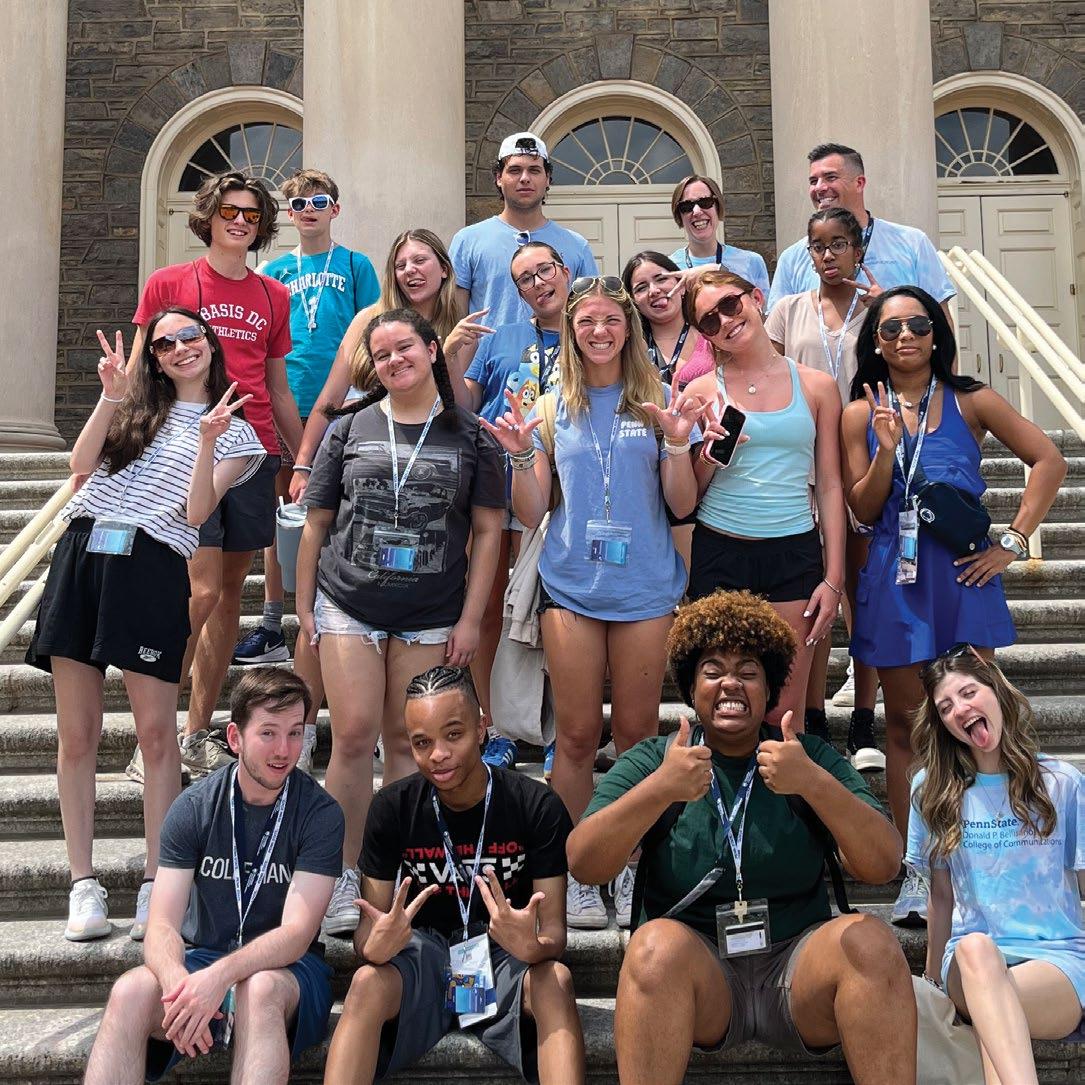
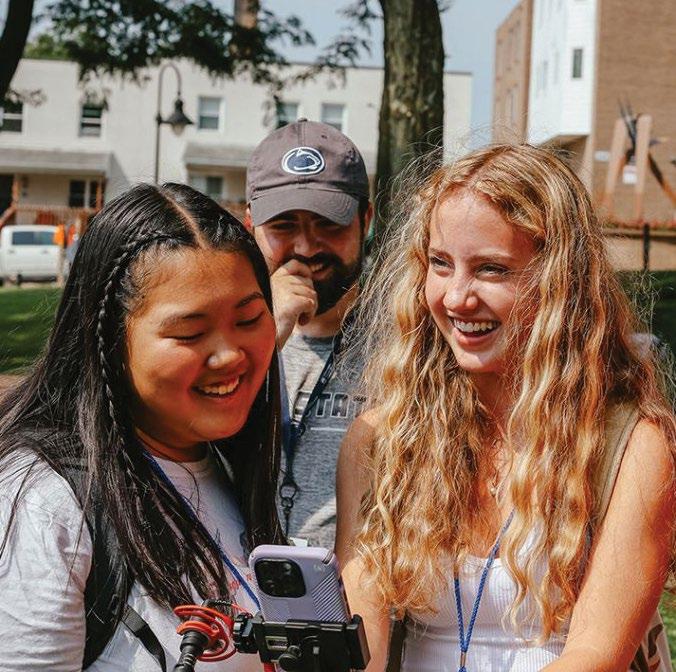
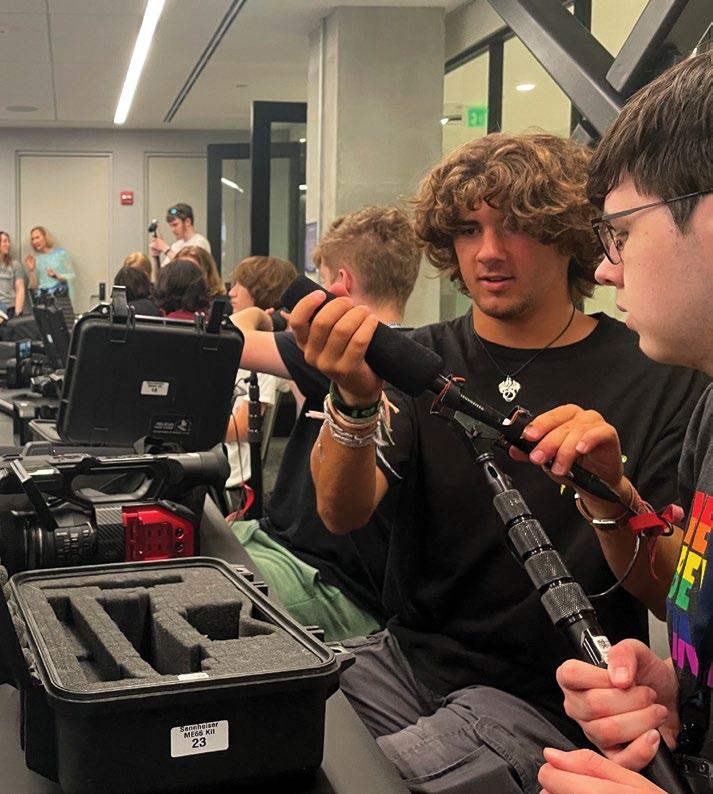
201 CARNEGIE BUILDING, 319 FRASER ROAD
UNIVERSITY PARK, PA 16802
BELLISARIO.PSU.EDU | @PSUBELLISARIO 12,289 4,333 841 6,829 8,654 1,018